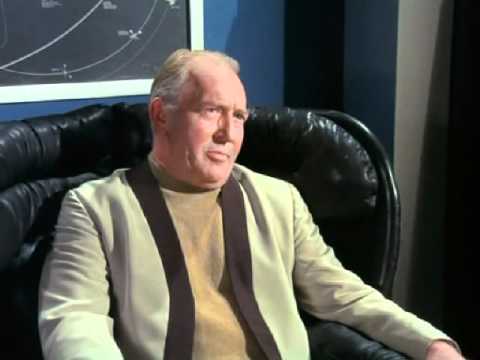
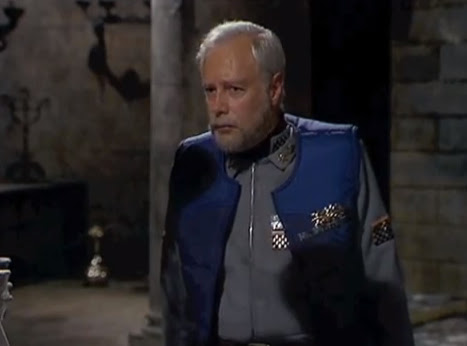
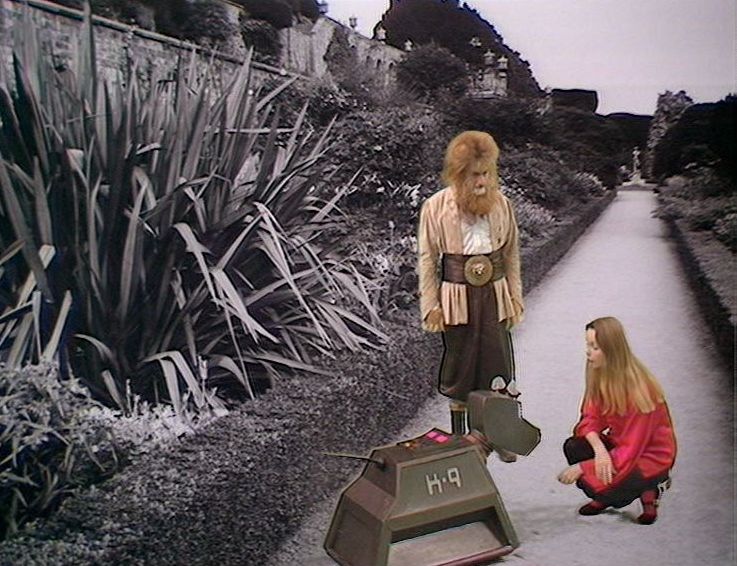
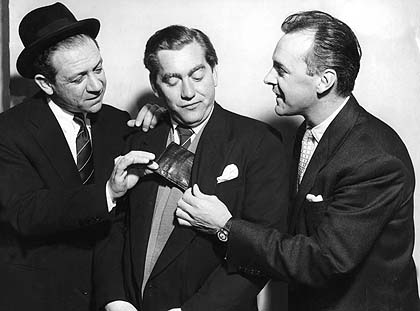
The opening of The Dalotek Affair is quite interesting. Dr Frank E. Stranges (author of numerous books on UFO’s) plays himself in a brief chat show segment. He cites the widely reported positive views of General MacArthur on UFOs, although it seems that MacArthur was misrepresented, see here.
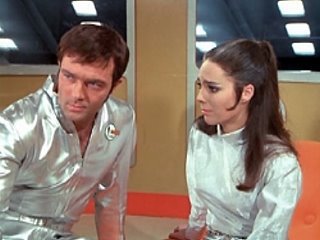
We then switch to a very groovy restaurant where Foster and Freeman are enjoying a meal. Foster spies a young woman that he knows, Jane Carson (Tracy Reed), but who doesn’t know him. How is this possible? It’s all to do with the Dalotek Affair, some six months back. Cue echoing soundtrack as we travel back to find out what he means.
UFOs are targeting apparently empty sections of the Moon, there’s interference with Moonbase communications and a meteorite has landed near the Dalotek installation (a private research base working on the Moon, much to Straker’s disgust). A more grumpy than usual Straker tells Foster to investigate.
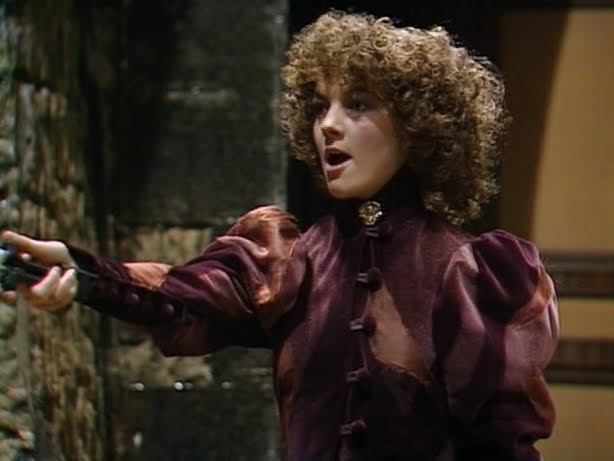
It doesn’t take long for Foster to start making eyes at Carson, although not everyone approves (check out Joan Harrington as Foster and Carson have a little chit-chat, some unrequited love there, possibly?)
Foster gets to the bottom of the mystery eventually but his passion for Jane Carson goes no further as her short-term memory is wiped (as she’s seen SHADO’s operations on Moonbase, something no civilian can do). Another example of SHADO’s frightening amount of power.
A so-so episode, with the Foster/Carson subplot (and the shot of them after the amnesia drug has taken effect has to be seen to be believed) helping to liven up proceedings.
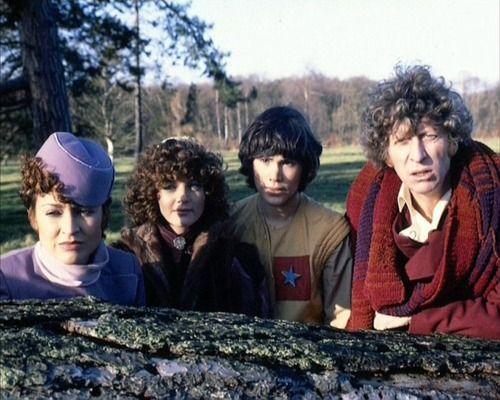
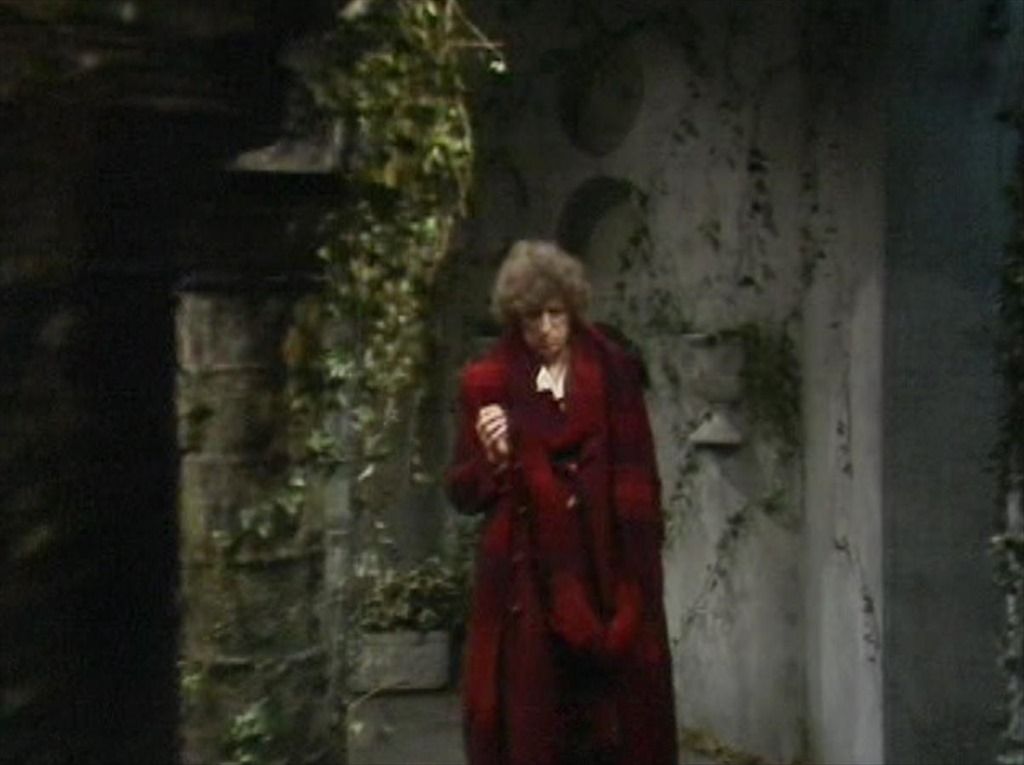
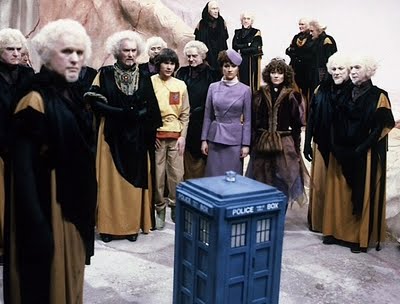
As soon as Peter Davison had been announced as the Doctor there was speculation as to how he would play the part. JNT believed that he had cast a “personality” actor, similar to Jon Pertwee or Tom Baker, so assumed that Davison would effortlessly inject his own persona into his portrayal.
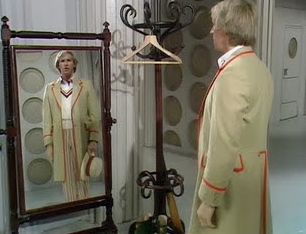
Davison was less sure that he was that sort of actor and so went back to the tapes to study his predecessors. Castrovalva has some obvious nods to past Doctors (particularly in the first episode) but going forward what Davison seemed to mostly draw upon were elements from the Hartnell and Troughton incarnations.
Jon Pertwee and Tom Baker’s Doctors tended to automatically dominate proceedings, whereas Hartnell and Troughton might stay a little more in the background before emerging with the solution. Davison’s Doctor would also, like Troughton’s, be happy to play the fool in order to lull people into a false sense of security.
If elements of his portrayal harked back to Hartnell and Troughton, then having three companions was another link back to the 1960’s. However this worked better then than it did in 1982, for several reasons.
Firstly, as the 1960’s series ran virtually all year round, a larger regular cast helped to fill the gaps when one of the lead actors took a holiday. The stories also tended to be longer, therefore there were more opportunities to split the narrative between the Doctor and his companions.
But possibly the most obvious reason why the dynamic of the Doctor/Ian/Barbara/Susan worked so well was down to how each character operated within the structure of the series as it was during S1. To put it somewhat crudely, the Doctor provided the scientific know-how, Ian provided the practical know-how, Barbara was the moral centre and Susan screamed and needed rescuing.
Somewhat of a rough generalisation, but in essence that was how things worked. The S1 Doctor was mostly motivated by a desire to return to the safety of the TARDIS and if he helped anybody along the way it was often incidental. It was Barbara and sometimes Ian who most often tried to help others (or interfere as the Doctor would say, in The Aztecs for example).
Over time the Doctor would take over the characteristics of Ian and Barbara, so that by the early 1970’s the Doctor only needed a single companion – to ask questions, scream and be rescued (again, to put things slightly crudely).
“Well, I suppose I’ll get used to it in time.”
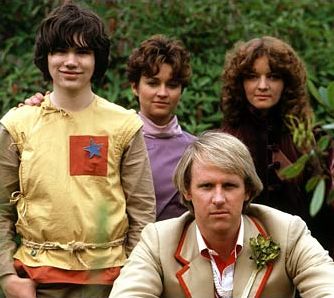
The problem of the overcrowded TARDIS was obviously picked up during the scripting of S19, so in Castrovalva Adric takes a back seat which allows Nyssa and Tegan to take the lions share of the action. Nyssa then sits out Kinda so that Adric and Tegan can enjoy a more substantial role in proceedings.
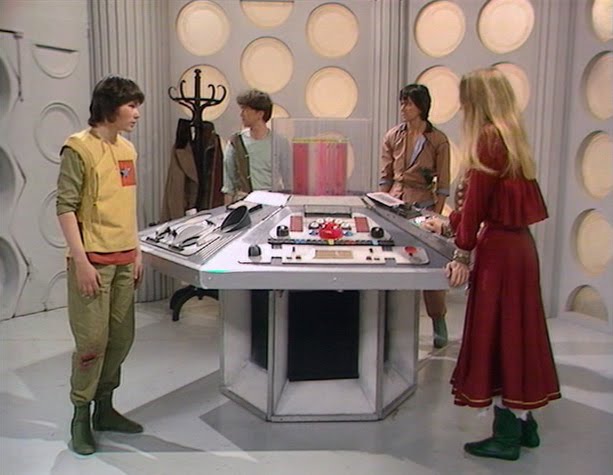
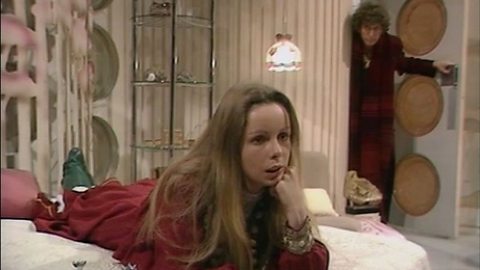
Christopher H. Bidmead obviously loved the concept of the TARDIS and the first episode and a half are set within the ship. During this time we see flashes of the Doctor-to-be from Davison and Nyssa and Tegan’s friendship starts to develop.
Whilst the Doctor is weak and vulnerable for much of the story, particularly in the opening couple of episodes, there’s enough signs to demonstrate that Davison already has a good grasp on the part (although this story was actually recorded fourth). His character wouldn’t really emerge until the end of episode four, but it’s a confident enough performance.
Unlike Patrick Troughton or Tom Baker, Davison could never take a so-so script and turn in a performance that would help you to ignore the average material. But give him a good script and a well written character (Frontios, Androzani) and he would deliver the goods.
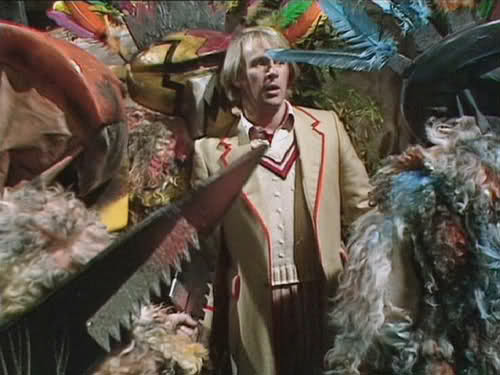
Once the TARDIS crew enter Castrovalva then the story really begins to motor. There are fine performances from Frank Wylie (Ruther), Michael Sheard (Mergrave) and Derek Waring (Shardovan) and the dialogue has a pleasing, lyrical nature. It’s maybe a shame that they didn’t pitch up here an episode earlier.
Michael Sheard was always such a dependable performer, both in Doctor Who and in general, and there’s a typically good performance from him in this story as Mergrave. This is complimented by Frank Wylie and together they make a nice double-act.
“If we could cook your memories, Ruther, we would feast indeed.”
Most interesting of all is Derek Waring as Shardovan. There’s a clear sense of misdirection at play here as everything is directed to make the audience believe that he’s the villain (he’s dressed in black for example whilst the Portreeve is dressed in white) but he turns out to be a man struggling with the concepts of reality and illusion.
As for the Master, Anthony Ainley has a bit of a sticky wicket. In the first few episodes he’s stuck in a cupboard and forced to share numerous two-handed scenes with Matthew Waterhouse – a difficult task for any actor. He then gets to indulge in a bit of dressing up as the Portreeve. The Master’s love of disguises would reach a peak in The King’s Demons, for which I find it difficult to find adequate words to describe the full majesty of his performance. Once I reach that story I promise to try though!
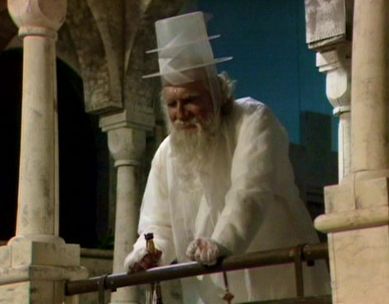
The mad hatter
He’s more restrained as the Portreeve, but it still begs the question as to whether it was designed to fool the audience or the Doctor and his friends. It’s hard to imagine that the audience wouldn’t have failed to notice it was Ainley dressed up, so let’s be generous and assume that the Doctor didn’t twig because of his post-regenerative state and the atmosphere of Castrovalva affected Nyssa and Tegan’s senses.
Apart from the Master’s dressing up games, it has to be said that this is one of the most bizarre and convoluted schemes he’s ever been responsible for. It’s therefore possible to posit that somewhere between The Deadly Assassin and The Keeper of Traken the Master went completely, totally, mad. This would explain the incredibly over-elaborate plan he’s concocted here.
Somehow he knew that the Doctor would die in Logopolis, knocked up a duplicate Adric with block transfer computation, switched him for the real one, got the faux Adric to programme the TARDIS to fly back to Event-One, and if that failed to destroy the ship then the TARDIS would journey onto the non-existant Castrovalva, as well as inputing information about the planet in the TARDIS data-bank. Faux-Adric only flicks a few buttons on the TARDIS console, but it’s enough to do all this. Clever, that!
Then the Master creates a whole world, down to the smallest details, in order for what exactly? His great plan seems to consist of nothing more than a wish to prise open the zero cabinet so he can take one last look at the Doctor before killing him. Couldn’t he have just killed him on Earth? It would have saved a lot of bother.
Ainley’s performance when the Master is attempting to open the zero cabinet with a poker is a little embarrassing, although maybe that was what they were aiming for, as it clearly shows the Master’s grip on reality has gone completely. But the final shot of the Master, as he’s pulled back in the city by the Castrovalvans, is very well done – it has a suitably nightmarish quality.
Overall then, Castrovalva is a decent opening story for Peter Davison with some good guest performances. It wraps up the plot threads from S18 and allows a fresh start for the further adventures of the new Doctor and his young group of companions.
Conflict is a good episode for both Ed Bishop and Michael Billington. Straker gets to lock horns with James Henderson (Grant Taylor), who as President of the International Astrophysical Commission is responsible for approving the funding level for SHADO. And in the interests of good drama, Straker is always pushing for more whilst Henderson is always trying to cut back.
This conflict is at the heart of the episode. Straker believes that the various items of space junk orbiting the Earth are a hazard to SHADO spacecraft and wants them removed. Henderson doesn’t agree and won’t release the funds.
This is one of several key episodes that examines the conflict between Straker and Henderson and both Ed Bishop and Grant Taylor are excellent at portraying two totally single-minded individuals who both believe they are always right.
Shortly after their meeting, a SHADO lunar module is destroyed on reentry. Straker is rightly convinced that the aliens were responsible – they have infiltrated the space junk with limpet mines. But their ultimate aim strikes somewhat more closer to home.
Michael Billington gets another solid episode as Foster disobeys the ban on lunar flights to test a hunch. It nearly gets him killed, but he proves to his satisfaction that there is alien involvement. But Henderson isn’t convinced and after he thinks that Straker has left SHADO HQ undefended and in imminent danger of a UFO attack he attempts to remove him from command.
I’ve said it before, but the modelwork (particularly the lunar shots) are absolutely breathtaking. Derek Meddings would later design the miniatures for the 1979 James Bond film Moonraker and some of the shots here wouldn’t have looked out of place in that film.
This isn’t an action-packed episode but the spat between Straker and Henderson is strong enough to drive the episode and makes it one of the stronger entries in the early part of the series.
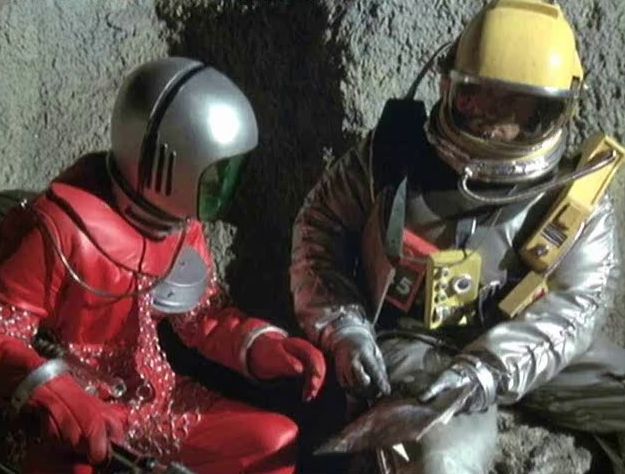
A UFO lands on the moon and the alien shoots out a window on Moonbase, killing a SHADO worker. As so often, the aliens’ motives remain unclear – why travel all that way for such a minor attack?
As the UFO is still on the Moon, Straker is keen to capture it. New Moonbase commander Paul Foster is more interested in killing the alien in order to avenge the murder of one of his men, but things don’t quite go as expected.
As ever with UFO, there’s some gorgeous modelwork – the lunar surface is particuarly impressive. The full size lunar landscape looks very good too, although some of the rocks do have a tendency to wobble when somebody is thrown against them!
The main plotline develops in an interesting way, Foster leads a party to capture the UFO but it’s destroyed by the interceptors after the Moonbase party is attacked. Foster is reported as missing, believed dead. The alien is still alive though, saves Foster’s life and together the two of them begin the long trek back to Moonbase.
It’s surprising that everybody gives Foster up for dead so quickly. Even if they were convinced that he couldn’t have survived you would have thought that they would have gone back to retrieve his body. But his apparent death leaves a vacancy which Straker proposes to fill with Mark Bradley.
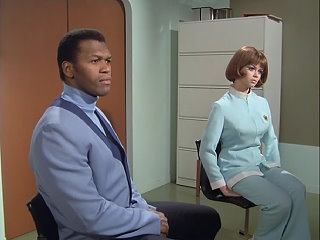
Bradley is reluctant for several reasons, not least his colour. Straker is unconvinced by this, telling him that racial prejudice burned itself out five years ago. This, of course, must stand as UFO’s least convincing predication of the future! After winning him round with such winning words as “I don’t care if you’re polka dot with red stripes, do you want the job?”, Bradley agrees.
The lunar scenes with Foster and the alien are quite slow paced, understandable in a way because they have to simulate the lack of gravity and also since the alien and Foster can’t communicate. But they could have done with a bit of trimming, as this section does drag a little.
But it’s a key story as it’s the first to portray the aliens in, for want of a better word, a more human light and not as implacable killers. But as the series always had a fairly pessimistic viewpoint it’s probably no surprise that Foster’s new-found friendship is very short lived.
And so after seven long years it all came to an end on a set cobbled together from leftover pieces from The Hitchhiker’s Guide to the Galaxy and Top of the Pops.
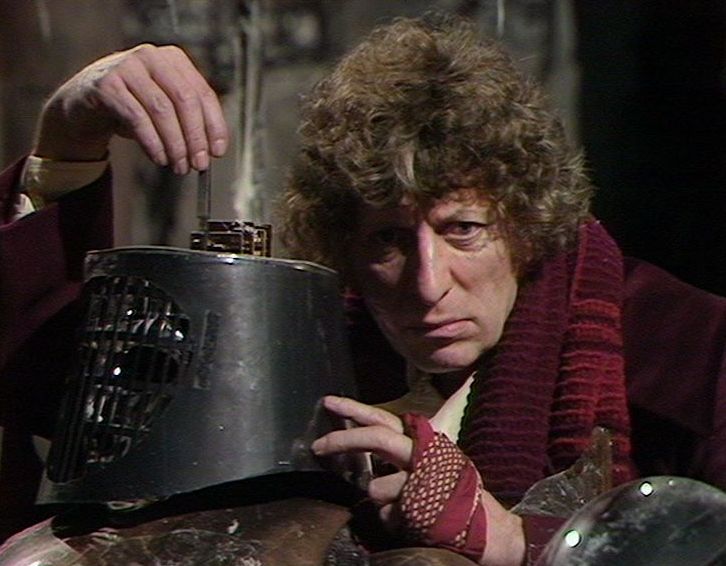
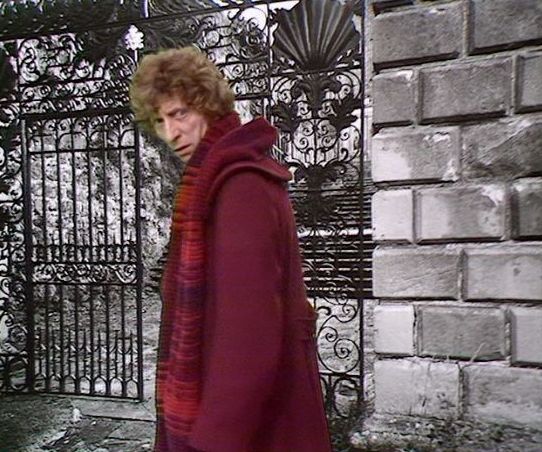
Tom Baker still casts a long shadow over Doctor Who – he was voted No 1 in the DWM 2014 poll which is a fair indication that his support amongst older fans remains secure whilst many younger ones have also succumbed to his charms. If there’s one certainly, it’s that in five or ten years time Matt Smith will have slipped from the No 2 position but Tom Baker seems indomitable at No 1, ready to outsit eternity you might say.
Is Logopolis a good story to bow out on? Yes, pretty much. It’s by no means perfect, but it does give Tom some good moments whilst also moving into place the line-up that would accompany Peter Davison through S19.
Introduced in this story is Tegan (Janet Fielding). An unwilling traveler at first, to put it mildly, Tegan would take several stories (probably until Kinda) before she really settled in. In Logopolis, this may be partly be because she’s much more broadly Australian than later on, when her accent is notably toned down, or it could be that from Kinda onwards she was simply a better written character.
Like Adric and Nyssa, Tegan joins the Doctor after a close relative is murdered – coincidence or a definite story plan, I wonder?
Both Nyssa and Tegan have lost loved ones at the hands of the Master who makes a full appearance here, in the guise of Anthony Ainley, following his brief appearance at the end of The Keeper of Traken.
Entropy increases
Christopher H. Bidmead seemed to hold the opinion that the Delgado Master simply wasn’t evil enough, so the Ainley Master has notably less charm than the Delgado incarnation. But this does seem to fundamentally misunderstand the role of the Master during the Pertwee era.
The Doctor’s been cut down to size
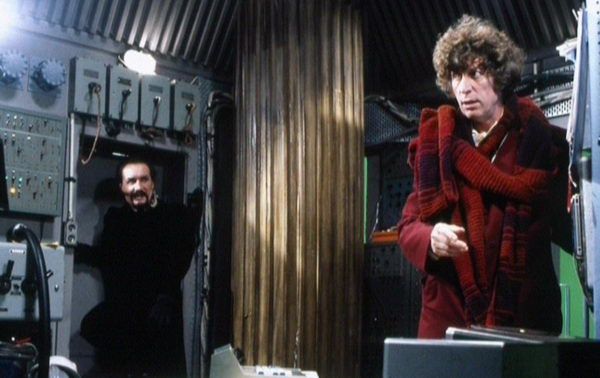
Whether by accident or design, Pertwee’s Doctor largely ended up as a moral, rather humourless figure, so Delgado’s Master was allowed to have all the charm and wit that the Third Doctor rarely showed. Remove this aspect from the Master and there’s little left. But the Doctor and the Master do enjoy a little byplay in Logopolis, such as this scene –
MASTER: The Pharos computer room.
DOCTOR: Yes. I envy you your TARDIS, Master.
MASTER: Excellent, Doctor. Envy is the beginning of all true greatness.
DOCTOR: Shush.
(A technician returns to the room. The Master points a device at him. The Doctor snatches it away.)
DOCTOR: No!
MASTER: It’s the lightspeed overdrive, Doctor. You’ll need that to accelerate the signal from the transmitter.
DOCTOR: I’m so sorry. I thought you meant to shoot him.
MASTER: Oh, Doctor. You can explain.
DOCTOR: Yes.
DOCTOR: Ahem. Good morning. Good evening.
(The Doctor notices the Master now has a weapon in his hand and drags the technician’s chair aside before the Master can fire)
DOCTOR: He’s unconscious.
MASTER: Never mind. I feel we’ve been spared a very difficult conversation.
The return of the Master wasn’t the only link to the Pertwee era. Possibly it was the influence of Barry Letts as executive producer that saw several lifts from Third Doctor stories (the radio telescope as seen in Terror of the Autons and the Master’s TARDIS inside the Doctor’s TARDIS from The Time Monster).
Barry Letts was also on hand to read the scripts and offer his advice, although often it wasn’t taken. He wasn’t happy, for example, with the Master’s line that although Tremas was dead his body remained useful, feeling that the concept of an animated corpse was rather disturbing. He also queried the rather large plot hole concerning the lash-up job that the Doctor and the Master made at the Pharos Project to save the Universe.
The Doctor and his humble assistant
What would happen to the Universe, asked Letts, if the Pharos Project switched it off? This is quietly forgotten at the end of the story and the impact of the imminent death of the Universe is rather swept under the carpet.
Letts also disliked the concept of the Master broadcasting his threats to the entire Universe. How, he reasoned, could they respond? Still, he wasn’t alone in pointing out how idiotic that was!
But whilst the script does feel somewhat bitty in places, there is a definite sense of impending doom as the Doctor finds himself shadowed at every turn by the Watcher. And despite the end taking place in a hastily cobbled together set made from bits and pieces from other programmes, it’s a sequence that still (particularly for those of a certain age) resonates today.
Doctor Who would go on, but Tom Baker would be a very hard act to follow.
Exposed is the introductory story for Paul Foster (Michael Billington). Foster is a test pilot who gets tangled up in a battle between Sky 1 and a UFO. Foster remains adamant that he saw a UFO but nobody will believe him. He keeps on digging though and eventually the trail leads to Ed Straker.
This episode allows us to see SHADO from an outsiders point of view. Billington is good value as he tangles with various different characters on the way to his meeting with Straker. But what he doesn’t realise is that everything has been coordinated by the SHADO boss in order to test Foster’s reactions and see if he’s a possible recruit.
If he responds in the right way then a job in SHADO will be his but it’s interesting to wonder what would happen otherwise. There must have been other people over the years who stumbled onto the truth about UFOs and it’s hard to imagine that they’d all have been SHADO material. Everything that we’ve seen so far seems to indicate that Straker would have no problem in silencing them for good, but luckily for Foster he makes the grade.
Also debuting is Vladek Sheybal as Dr Doug Jackson. Jackson pops up regularly during the series and is particularly prominent in the forthcoming episode Court Martial. There’s always something slightly unsettling about Sheybal’s performance and he contrasts well with the more straightforward members of SHADO. With Jackson, you never quite know if he’s following a different agenda from everybody else.
Exposed gives us a chance to see the backlot at MGM Borehamwood, where the first production block was shot. The studio is the place where Straker and Foster meet for the first time and Straker has a unique way of determining whether Foster is the man for the job. This seems to consist of pointing a wind machine at him and then pretending to shoot him at point blank range!
It’s hardly a surprise that he does get offered a post with SHADO, particularly since he’s been on the credits since the first episode, but overall this is still a decent episode. Not outstanding, but it’s a good chance for Michael Billington to make a strong first impression.
Written by Ian Scott Stewart Directed by Ken Turner
Oh dear. This isn’t very good at all. Let’s look at some of the problem areas in a bit more detail.
Our old friend the day-for-night filter makes an appearance at the start of the episode. As mentioned in Identified this is rarely a convincing effect and the bright sunshine here makes it look even more false.
More problematic is that apart from one brief scene with Lt Ellis, the first ten minutes are devoted to guest star George Cole as Roper. Cole’s performance is curiously flat and although it becomes clear early on that he is being blackmailed it’s very difficult to care or feel any empathy for him. His silly haircut doesn’t help either.
The story would have probably worked better a little later in the run, where Roper’s part could have been taken by one of the numerous walk-ons that we see crop up in each episode. At least then there would be a little frisson to them betraying SHADO, as we would have seen them interacting with the likes of Straker and Freeman over several episodes. We’ve never seen Roper before so why should we care about his problems?
Why did the UFO target Roper’s car? Straker seems to believe it was because the information Roper passed on was inaccurate but how did the UFO know that the car was Roper’s? Nice modelwork though, although it does beggar belief that Roper could walk away from the crash with barely a scratch.
And how did the UFO that attacked Roper manage to land on Earth undetected? So far it’s seemed to be impossible for a UFO to land without SHADO picking it up. The idea that the aliens are recruiting human spies is interesting, but how does it work in practice? What can the aliens offer in payment?
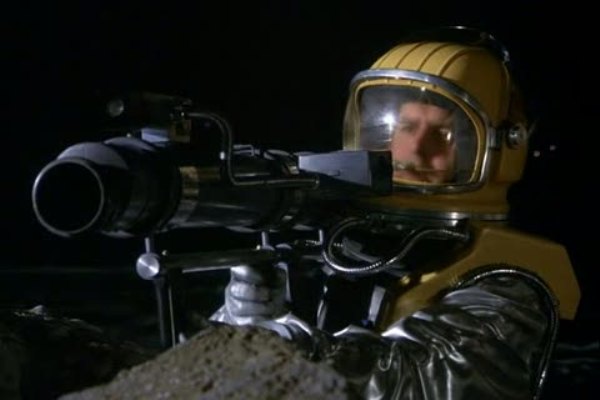
The rather convoluted plan for the UFO to bypass Moonbase’s defences (thanks to Roper’s information) has been unraveled and Straker’s response is to put Roper on the Lunar surface with a rocket launcher to stop it. Why not put ten, or twenty people, on the surface, so that it wouldn’t be the suicide mission it turns out to be?
And since there’s only a single UFO approaching it’s hard to to understand exactly why there should be so much panic. Everybody does their best to ratchet up the tension, but it all falls somewhat flat. The final shot is quite nice though as it’s another example of how ruthless Straker can be.
With a more charismatic actor playing Roper this might have been a bit better but as it stands it’s something of a damp squib.
You will find immobility endurable, Doctor. I speak from experience.”
Although some may view The Keeper of Traken as simply a prelude to Logopolis and the confrontation between the Doctor and the Master, there’s enough of interest in Johnny Byrne’s story to ensure it’s a good yarn in its own right.
Like the majority of S18, Traken was subject to a heavy re-write by Christopher H. Bidmead (and I do like the theory that later script editor Eric Saward was unaware of this and wondered why Byrne’s subsequent stories lacked the quality of this one).
One notable amendment was the revelation that Melkur was actually the Master, although this doesn’t really affect the story too much as it’s only discovered at the end of the story. Indeed, if you view Traken as a Master story then you could come away disastisifed, despite Geoffrey Beever’s brief but impressive turn.
But taking the story on its own merits and not worrying about how it fits into wider Doctor Who continuity, what we have is a tale that seems to hark back to the Hartnell era. The Doctor and Adric’s early encounter with the Keeper paints an idyllic picture of a whole series of planets free from war and hatred –
KEEPER: I fear that our beloved world of Traken faces disaster.
ADRIC: Universal harmony, you said.
DOCTOR: Shush.
KEEPER: The Doctor does not exaggerate. Since the time of the Keepers, our Union has been the most harmonious the universe has ever seen. Does the boy not know of this?
DOCTOR: Oh, he’s not local. E-space, wasn’t it?
KEEPER: How vain one can be. I thought the whole universe knew the history of our little empire.
DOCTOR: Yes. They say the atmosphere there was so full of goodness that evil just shriveled up and died. Maybe that’s why I never went there.
KEEPER: Rumour does not exaggerate, Doctor.
Don’t look into his eyes!
We’ve been here before, as this seems like how the Conscience Machine operated in The Keys of Marinus. Presumably the Source Manipulator works in a similar way and it’s impossible not to conclude that it must somehow sap the will as a complete lack of anger or aggression doesn’t seem at all natural.
In Marinus the Doctor concluded that human beings weren’t meant to be controlled by machines but there’s no such statement here as by the end of the story Luvic (from an increasingly short-list of possibilities) steps into the breach to maintain the status quo.
If the story has a feel of the Hartnell era, then the Shakespearean-style production design could be another nod to this. We don’t quite have characters speaking in iambic pentameter, as in The Crusade, but it’s close.
Production-wise, Traken is a studio-bound world that looks somewhat artificial and theatrical although it’s possible to argue that this is intentional as maybe they were attempting to replicate the look of the then current BBC cycle of Shakespeare productions.
Margot Van der Burgh (from The Aztecs) is another link back to the Hartnell era and she, like the rest of the cast, plays it dead straight – there’s no S17 goofing around here. Sheila Ruskin as the doomed Kassia is very good as is Anthony Ainley as Tremas. His performances as the Master can best be described as variable, but he’s restrained and subtle as Tremas.
Nyssa of Traken packs a punch
Sarah Sutton gives an acceptable performance as Nyssa, although you’d be hard pressed to predict that she’s automatic companion material, as plenty of one-off characters in the past have had much more potential. But there was clearly something in the scientific nature of Nyssa that caught the attention of both Bidmead and JNT. A pity, then, that incoming script editor Eric Saward would have much less interest in developing scientific themes, hence Nyssa would have a reduced role to play, particularly once Tegan was installed in the TARDIS.
As the Doctor and Adric leave Traken all seems well, but a final confrontation awaits the Doctor in a cold and lonely place …
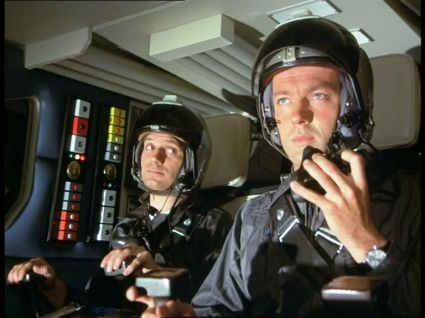
After Interceptor 1 is destroyed in a collision with a UFO, Straker calls the relevant personnel back to Earth. Computer analysis decides that Lt Ellis diverted Interceptor 3 first because of her emotional attachment to its pilot Mark Bradley (Harry Baird) and both are reassigned to new duties.
Computer Affair juggles two plot threads – the investigation into the destruction of Interceptor 1 and the hunt for the UFO – quite deftly. In the quieter moments of the episode you can play count the cigarette, as it’s amazing how many scenes feature the characters either smoking or handling a cigarette. Nowadays of course they’d all have to go up to the surface and stand outside the building.
The relationship between Ellis and Bradley never really developed due to Baird leaving the series after filming just four episodes, although he does appear in a few other episodes courtesy of stock shots. The use of stock footage also occurs in this episode as a few brief shots of Shane Rimmer (who appeared in Identified) crop up.
Straker assigns Freeman to hunt down the UFO and bring the occupants back alive and he in turn includes Ellis and Bradley in the retrieval team. The scenes of the mobile units hunting the UFO through the Canadian forest, and indeed the whole episode, feature some stunning miniature work. This was always a feature of Gerry Anderson’s productions, and there’s plenty of fine examples here.
One of the aliens is brought back to SHADO HQ and Straker is desperate to get some answers from it. In order to do this he injects the alien with drugs to force a response but this only speeds the creature’s demise. This is an early sign of Straker’s ruthless streak and there will be many more to come.
The amended computer report that confirms Lt Ellis acted correctly in reassigning the Interceptors (had she followed standard procedure then all three would have been destroyed). This message of the story would therefore seem to be that for all their usefulness, computers are no match for human instinct.
A slower paced story than the opening episode, but not without interest.
Written by Gerry and Sylvia Anderson with Tony Barwick Directed by Gerry Anderson
The first notable thing about this episode is that it opens with a graphic murder – as we see a woman’s bullet-ridden body slump to the ground. The next is that, like all ITC shows, they would never shell out the extra money for night-time shooting, so we have the usual unconvincing day-for-night filter. It will happen again throughout the series so be prepared. The third is that when Peter Carlin and his sister are being pursued through the undergrowth, Barry Gray’s score certainly favours the drums. I don’t know who the drummer was, but he gave his all!
Our first shot of Alec Freeman (George Sewell) shows him attempting to use all of his masculine charm on Straker’s secretary, Miss Ealand (Norma Ronald), but with a notable lack of success. Never mind, as soon as he ventures into SHADO’s underground base there’s plenty of other women he can charm. And In case you missed Freeman’s subtle approach, Barry Gray drops some slinky saxophone onto the soundtrack to hammer the point home.
The episode has a lot of ground to cover in order to introduce all the key players, so after our first look at SHADO control it’s off to Moonbase. Gabrielle Drake’s performance in UFO continues to attract a certain amount of attention, and it’s not difficult to understand why.
A trip to Skydiver lets us know that Carlin (seen at the start of the episode ten years earlier, fleeing with his sister from the UFO attack) is now the pilot of Sky 1 although he remains unaware of his sister’s fate, Straker gets to berate one of his team, which handily allows a large info-dump about how SHADO works, and Freeman tangles with the cool Colonel Virginia Lake (Wanda Ventham)
After a tense tussle between Sky 1 and a UFO, SHADO are able to capture the alien occupant. They are unable to save the alien’s life, but an autopsy provides the chilling proof that they are harvesting human organs for their own ends. This strikes close to home when it’s discovered that the alien had the heart of Carlin’s sister, who vanished following the UFO attack seen at the start of the episode. A bleak ending to the episode then, which makes it clear that there’s a long battle ahead.
Identified had to do a lot within 49 minutes – introduce SHADO and the reason for the alien attacks – but it managed it successfully and produced a well-paced episode that never flagged. An impressive opening.
Gerry Anderson’s first foray into television live action drama was this fondly remembered series, created by Gerry & Sylvia Anderson and Reg Hill.
UFO is set some ten years in the future and depicts a world coming under increasing attack from a mysterious race of aliens. In the opening episode we learn that they are harvesting organs from their human victims although their ultimate aims remain nebulous.
In order to combat this threat, a secret global organisation called SHADO (Supreme Headquarters Alien Defence Organisation) is established. SHADO has various bases but the key one is located underneath the Harlington-Straker film studios in the UK.
SHADO’s commander is Ed Straker (Ed Bishop) who juggles a public job as chief executive of the film studio whilst in private he leads SHADO’s continuing battle against the alien menace.
His second-in-command is Colonel Alec Freeman (George Sewell) whilst Colonel Paul Foster (Michael Billington) is a new recruit introduced in the fourth episode Exposed.
L-R Ed Straker (Ed Bishop), Paul Foster (Michael Billington) and Alec Freeman (George Sewell)
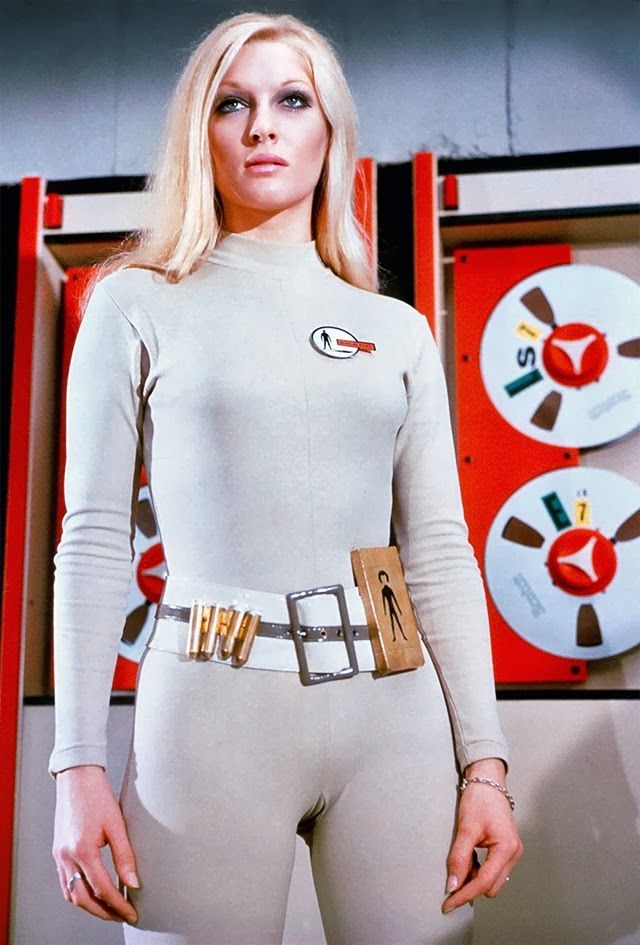
Incoming UFO’s are initially tracked by supercomputer SID (Space Intruder Detector). The forward line of defence is launched from Moonbase, which has three Interceptor spacecraft fitted with nuclear warheads. The Moonbase operations are co-ordinated by Lt Gay Ellis (Gabrielle Drake), Lt Joan Harrington (Antonia Ellis) and Lt Nina Barry (Dolores Mantez) amongst others.
L-R Nina Barry (Dolores Mantez), Joan Harrington (Antonia Ellis) and Gay Ellis (Gabrielle Drake)
If the UFOs manage to evade the Interceptors and penetrate the Earths atmosphere then SHADO calls upon various other forms of defence, including the submarine Skydiver which can launch the interceptor aircraft Sky One, whilst Mobile land vehicles can also be called upon if the UFO has made a successful landing.
Sky One
Although Gerry Anderson had, until this time, been responsible for a series of successful children’s Supermarionation series (Stingray, Thunderbirds, Captain Scarlet) UFO was very much a move into a more adult form of storytelling, despite the fact that visually it had much in common with his Supermarionation series.
As with those series, special effects were supervised by Derek Meddings whilst the various vehicles were designed by Meddings along with his assistant Michael Trim. The model-work and effects were the clearest links to the previous Anderson shows, but the story content was much darker (although elements of Captain Scarlet had probably begun this process).
The concept of human beings being forcibly used as organ donors is a fairly horrifying concept whilst later episodes such as The Long Sleep and Timelash are notable examples of stories that delve a little deeper than many sci-fi series of the same period. Timelash, for example, sees Straker inject himself with a drug (X 50 stimulant) in order to stay awake during the mysterious time freeze with the result that it’s not clear what part of the story actually happened and what may be a result of his drug-induced dreams.
A UFO in the woods
Elsewhere in the series there was more emphasis placed on human relationships than was often seen in science fiction programmes of the time. Although it may seem somewhat stilted and naive today, the interracial relationship in The Computer Affair was noteworthy at the time of its original broadcast whilst several episodes (Confetti Check A-OK and A Question of Priorities) show exactly how Straker is unable to juggle the demands of his secret job and his family life.
Whilst these, and other examples are laudable, it’s undeniable that UFO’s sexual politics were fairly underdeveloped as very often women are simply used as eye-candy, which can be either amusing (particularly Alec Freeman’s various toe-curling chat up lines) or irritating, depending on your point of view.
Totally gratuitous eye-candy. Sorry.
But while parts of the series have badly dated (and the mystery of the purple wigs was never explained) there is much to enjoy across the 26 episodes of UFO. So as I begin a rewatch of the series, I’ll blog a short review of every story which will hopefully capture some of the key points of each episode.
If the previous story, State of Decay, could be said to depict Doctor Who at its most traditional, then Warriors’ Gate is certainly a trip into the unknown.
The inexperience of key members of the creative team is definitely a reason for this – as they didn’t necessarily know the rules then they didn’t realise when they broke them. For some, particularly director Paul Joyce, it was a bruising experience as he came up against inflexible BBC bureaucracy.
Script editor Christopher H. Bidmead was keen to get new writers onto the show and Steve Gallagher seemed to fit the bill. Gallagher had plenty of ideas but had no experience in television script-writing, but he had previously written radio plays and also had just seen his first novel published.
Bidmead was later to comment that Gallagher’s draft scripts did read like a novel, as they included many unnecessary descriptive passages. Bidmead, with some input from Joyce, set about the task of distilling Gallagher’s scripts into something workable. Along the way he included some ideas and concepts of his own, such as the I Ching.
Whilst Steve Gallagher was initially aghast at the treatment of his scripts he was later to appreciate the reasons for Bidmead’s ruthless rewrites and he would be better prepared when he came to write Terminus a few years later.
Like Gallagher, Paul Joyce was also very inexperienced in television terms, with only a single Play for Today on his cv. Joyce had hoped to direct this story in a filmic style but the reality was that this simply wasn’t achievable at this point in Doctor Who’s history.
Joyce’s preferred way of working was to shoot scenes a couple of times and then assemble everything in post-production. But as the recording time for each story was strictly limited this caused numerous delays and was very unpopular with the BBC technical staff.
Each Doctor Who story was allocated a number of studio sessions and all the material for the story had to be completed within that timescale. At the end of the recording day the sets would be removed as the next day another production or programme would need the space.
Overruns were extremely costly – at 10pm the lights went out whether everything had been completed or not – and even worse was the prospect of a remount, where another studio would have to be booked and the sets reassembled.
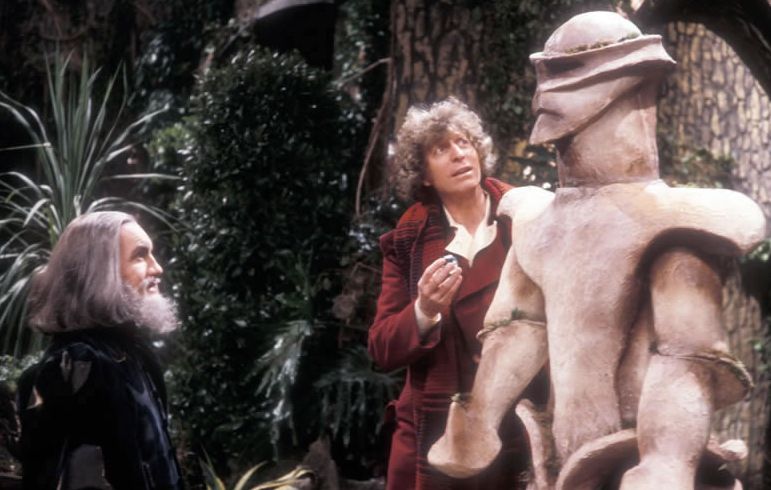
The Doctor ventures beyond the gateway
After day one, the production was behind schedule and it began to slip further behind as each day progressed. Joyce was sacked briefly and then re-instated and whilst everything was eventually completed there’s no doubt that tensions ran high throughout all the studio days. It’s worth reproducing this excerpt from the BBC Technical Manager’s report for the studio session which ran from the 24th – 26th of September 1980 –
The director lacks a working understanding of the methods used to make programmes in BBC television studios. His shooting ratio must be near the 10:1 level of a feature film production. He expects a 360 degree panorama to be continually available to the ‘hand held’ camera and the lighting and sound problems are endless.
If the BBC is really interested in quality and economy, no Technical Operations crew should be subjected to such self-indulgent incompetence.
It’s therefore no surprise to learn that Paul Joyce was never asked to direct another Doctor Who and it could be that this experience was one of the reasons why producer John Nathan-Turner tended to favour the likes of Peter Moffatt and Ron Jones in the future. They could best be described as “journeymen” directors and he could guarantee that they’d get the show made on time and on budget. Indeed, there wouldn’t be another Doctor Who story directed with such flair as this one until Graeme Harper helmed The Caves of Androzani in 1984.
But for all the production problems we are left with a story that is visually very arresting and although Joyce still bemoans that the final product is comprised, enough remains to mark this out as something very different.
The opening tracking shot, which takes us through the spaceship and up to the bridge, is a clear statement of intent. The hand-held camera work gives the shots a fluidity of movement which would have been impossible with the traditional rostrum cameras.
Whilst not all of Steve Gallagher’s concept and story made it to the screen he was very clear that Cocteau’s Orphee and Testament d’Orphee would be key texts that needed to be understood in order to visualise the story. Joyce certainly took this on board and the production design reflects these influences, for example in the stylised black and white deception of the world on the other side of the Gateway.
Joyce was able to recruit some quality actors, including Clifford Rose as Rorvik (best known at this time for Secret Army) and Kenneth Cope as Packard (a familiar face from Randall & Hopkirk). Rose likened Rorvik to Captain Mainwaring in Dad’s Army since he was the leader of a group of men who are less than competent and are never quite able to follow his orders out. By the end of the story, Rorvik has lost his grip on reality completely as seen in his final moments as he prepares to blast the Gateway, killing himself and all his crew in the process.
Clifford Rose as Rorvik
Given the denseness of the original script, it’s possibly not surprising that it doesn’t all make sense. Some sections are particularly inexplicable – the cliff-hanger ending to episode three looks wonderful as a horde of Gundan Robots attack the Doctor and the Tharils in the banqueting hall, but how only the Doctor manages to move in time from the past to the present isn’t clear at all.
Elsewhere, the answers are there, just buried deep in the text as this excerpt from episode two demonstrates –
GUNDAN: There were always slaves from the beginning of time. The masters descended out of the air riding the winds and took men as their prize, growing powerful on their stolen labours and their looted skills.
DOCTOR: Yes, well, look, look, I’m sure this is frightfully interesting. Could you get back on to the bit about the gateway, please?
GUNDAN: The masters created an empire, drained the life of the ordinary world.
DOCTOR: Your ordinary world. I’m from N-space.
GUNDAN: They came from the gateway.
DOCTOR: Ah ha.
GUNDAN: There are three physical gateways and the three are one.
DOCTOR: Well
GUNDAN: The whole of this domain, the ancient arch, the mirrors.
DOCTOR: The thing is, it’s not actually a physical gateway that I’m looking for.
GUNDAN: All the gateways are one.
DOCTOR: Ah. So it is here. The way out.
It later becomes clear that the Tharils were the enslavers that the Gundans spoke of and now ironically they find themselves enslaved by the likes of Rorvik. With the help of a Time Lord then can travel through E-Space releasing the Tharils held captive on other planets.
Although as it’s often been assumed that Rorvik and his crew came from N-Space and only ended up at the Gateway (the dividing line between N-Space and E-Space) by accident, who are holding the Tharils in captivity in the rest of E-Space?
The noblest Romana of them all
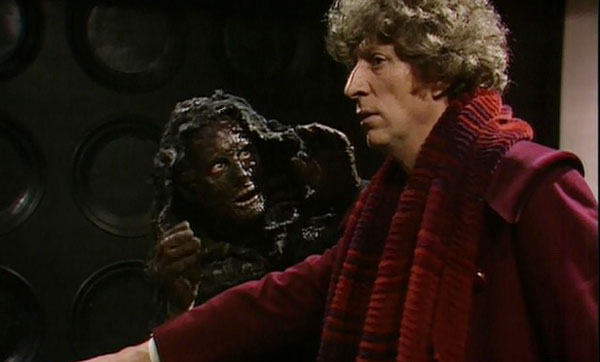
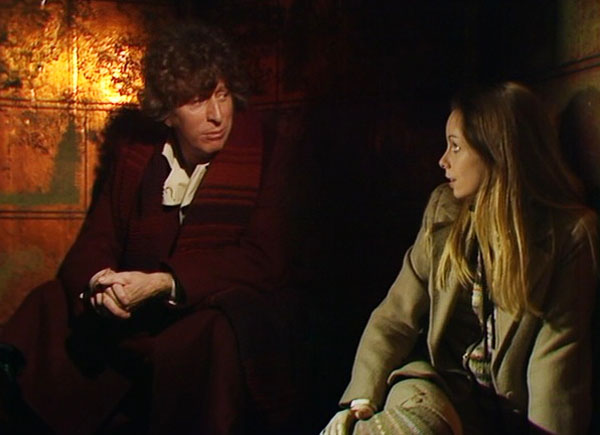
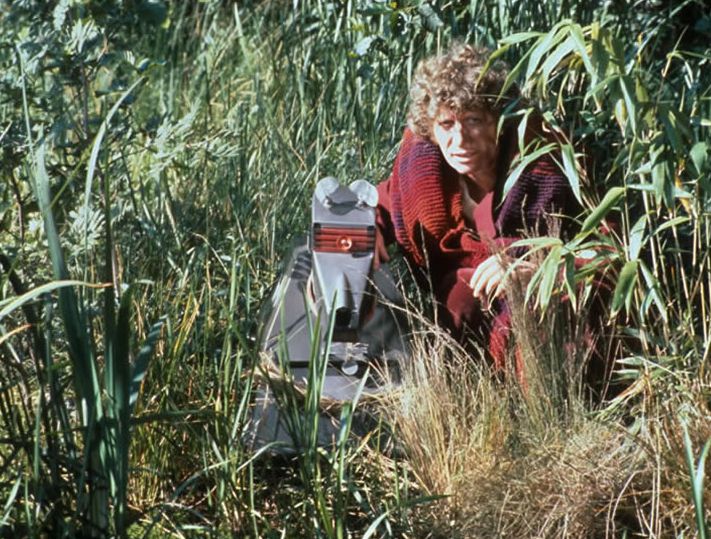
Although sidelined a little, Tom Baker does have some nice moments, particularly when he faces off against Rorvik. This story is, of course, notable for featuring the departures of Romana and K9 Mk 2. It’s quite a hurried farewell (not quite as bad as Leela maybe, but close) but had Baker or Ward wanted to add anything they probably could have, so they must have been happy with it at the time.
Rorvik’s suicidal attempt to break free has destroyed his ship (and inexplicably freed the imprisoned Tharils and also sent the Doctor and Adric back into N-Space). But back in the old home universe, this Doctors days are looking distinctly numbered ….
Australian actor Bill Kerr has died at the age of 92.
Kerr was born in Cape Town in June 1922 and was raised in Australia. A radio star in his own country he moved to Britain in 1947 in search of new career opportunities. During the four decades or so he was resident in the UK he notched up numerous credits on film, television and radio.
He appeared in films such as The Dam Busters and The Wrong Arm of the Law and television series like Ghost Squad, No Hiding Place, Compact and Dixon of Dock Green. Another notable guest appearance on British television during the 1960’s was as Giles Kent in the Doctor Who story The Enemy of the World. Five episodes of this six part story were lost until 2013 and Kerr’s performance is one of the highlights of an impressive serial.
For many people though, he will always be best remembered as a comic foil for Tony Hancock across six radio series of Hancock’s Half Hour.
L-R – Sid James, Tony Hancock and Bill Kerr
Although Kerr never crossed over to the television version of HHH, he did appear with Sid James in the first series of Citizen James. This series, like HHH, was written by Galton and Simpson and it’s quite possible to imagine that the Sid and Bill from this series are the same characters that appeared in HHH.
Kerr returned to Australia in the late 1970’s and continued to work, appearing in films such as Gallipoli and television series like Anzacs with his last recorded credit coming in Southern Cross in 2004.
One of the joys of YouTube is stumbling across things you weren’t expecting to find. Like this studio tape of outtakes from the BBC Schools programme You and Me (which I found whilst researching for my post on The Boy From Space).
I love studio stuff like this although it was surprising to learn that Dibs has such a foul mouth!
Look and Read (1967 – 2004) was a long running BBC Schools programme that is fondly remembered by several generations of school-children.
Its aim was to help less developed readers gain confidence but the drama segments (each twenty minute episode would be a mix of studio based learning lessons and a continuing serial) ensured that the programmes appealed to most children.
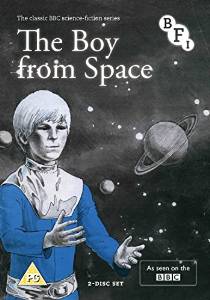
The Boy From Space was the third in the Look and Read series, originally broadcast between September and November 1971 and was scripted by Richard Carpenter.
Carpenter had started his career as an actor and during the 1950’s and 1960’s he racked up an impressive list of credits on shows such as Z Cars, Softly Softly, Emergency Ward 10, No Hiding Place, Sherlock Holmes, Dixon of Dock Green and Strange Report. But by the late 1960’s he had decided to change course and become a writer.
His first series, Catweazle, was an instant success. Broadcast on LWT between 1970 and 1971, it starred Geoffrey Bayldon as a magician from Norman times who found himself adrift in the modern world and totally unable to understand many of the simplest things we take for granted.
Carpenter would continue to notch up an impressive list of writing credits over the next few decades (creating The Ghosts of Motley Hall, Dick Turpin and Robin of Sherwood, amongst others) and he also penned several further serials for Look and Read – Cloud Burst (1974) and The King’s Dragon (1977).
Turning back to the original 1971 broadcast of The Boy From Space, it comprised 10 episodes of 20 minutes duration. Although it was repeated several times up until 1973, sometime after that the tapes were wiped which meant that that only the drama inserts remained.
At this point in time the majority of BBC programmes were made and broadcast on videotape. Videotape was expensive and could be re-used, hence the reason why so many shows from this era are lost for ever – as periodically the tapes would be wiped so that new recordings could be made.
Film, however, could not be re-used, which explains why these sections of The Boy From Space remained in the archives.
In 1980 BBC Schools were looking around for a new Look and Read serial, so it was decided to use the material shot in 1971 along with newly created learning inserts. And as the original music was lost Paddy Kingsland from the Radiophonic Workshop was commissioned to write a new score.
Wordy and Cosmo
The 1980 series was presented by Phil Cheney as Cosmo with Charles Collingwood providing the voice of Wordy whilst Katie Hebb was the puppeteer who brought him to life. Derek Griffiths led the team of singers who performed the educational songs. The cast list from the 1971 drama inserts was as follows –
Anthony Woodruff as Mr Bunting
Colin Mayes as Peep-peep
Gabriel Woolf as Peep-peep’s father
John Woodnutt as the thin space-man
Loftus Burton as Tom
Stephen Garlick as Dan
Sylvestra Le Touzel as Helen
As with the 1971 series, it was broadcast over 10 episodes –
01 The Meteorite (15 Jan 1980)
02 The Spinning Compass (22 Jan 1980)
03 The Man in the Sand-pit (29 Jan 1980)
04 In danger! (5 Feb 1980)
05 The Hold-up (12 Feb 1980)
06 Where is Tom? (26 Feb 1980)
07 The Hunt for the Car (4 Mar 1980)
08 The Lake (11 Mar 1980)
09 Captured! (18 Mar 1980)
10 In the Spaceship (25 Mar 1980)
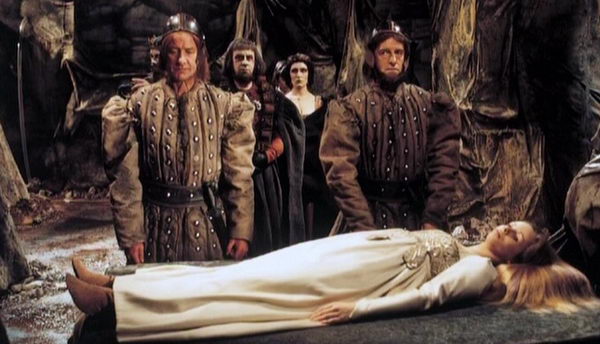
It’s fair to say that The Boy From Space is an odd viewing experience. The drama sections concern two children, Dan (Stephen Garlick) and Helen (Sylvestra Le Touzel) who, whilst out stargazing, spy an object plummeting to the earth. They decide to explore and discover a crashed space-ship.
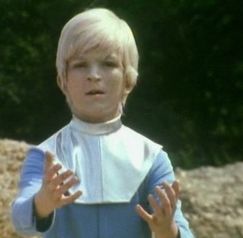
Peep-peep
Amongst the ship’s inhabitants is a young alien boy christened “Peep-peep” by the children due to his backwards language. But there is danger from another alien who the children refer to as “the thin space-man”, played by John Woodnutt. He seems to have a hold over their new friend from space and this puts them all in danger.
Whilst this is obviously quite low budget, there’s plenty of merit here. The child actors are pretty good (Le Touzel would go on to have a lengthy career) whilst Gabriel Woolf and John Woodnutt are as solid as you would expect. Another plus point is the score by Paddy Kingsland. Anybody who loves early eighties Doctor Who music will find much to appreciate.
The thin space-man
The educational inserts may be of less interest to some, but thanks to the comprehensive package prepared by the BFI, there are several different viewing options.
You can either watch the series as broadcast in 1980 or there’s an option to view just the drama sequences in a new 70 minute edit on the second disc.
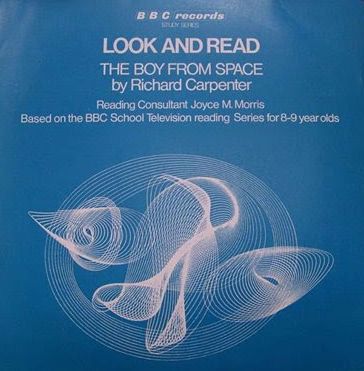
There’s also two versions of the BBC Schools LP recording. The first is the original audio, with narration from Wordy himself and the other marries footage from the show along with the LP audio.
The original LP sleeve
In addition to this, there’s Wordy’s Think-ups (animated lessons from the episodes), PDFs of the school brochures from both broadcasts and an interesting booklet which contains information about BBC Schools programmes in general as well as detail on the Look and Read series.
The DVD is part of the BFI’s Sci-Fi: Days of Fear and Wonder series of releases. Also available now is The Changes, with others such as Nineteen Eighty Four and Out Of The Unknown to follow later in the year.
The series by itself would have been a worthwhile purchase but the supplementary features mean that it’s an even more attractive package. It’s probably not to everyone’s tastes, but it’s nice to see the BFI releasing something slightly left-field like this. Hopefully there will be more to follow in the future.
In retrospect, State of Decay by Terrance Dicks looks totally out of place in S18. As already touched upon in my article on Full Circle, new script editor Christopher H. Bidmead was a man who wanted the Doctor Who stories he commissioned to have a strong scientific basis. If there’s one thing he disliked it was scripts which paid homage to/ripped off other films, books or television programmes.
Therefore it’s no surprise to learn that Bidmead didn’t commission the story, instead it was new producer John Nathan-Turner, who whilst leafing through a pile of unmade stories found a submission entitled The Vampire Mutations from a few years earlier.
So Bidmead and Dicks couldn’t have been further apart in their understanding of what made good Doctor Who. Dicks always shared the opinion of his friend Malcolm Hulke who once said that in order to write good science fiction you need: “a good original idea. It doesn’t have to be your original idea.”
Doctor Who had been borrowing from other sources for a long time, for example other Tom Baker scripts by Terrance Dicks include Robot (King Kong) and The Brain of Morbius (Frankenstein). Indeed, the only surprising thing about State of Decay is that Doctor Who hadn’t tackled a vampire story before.
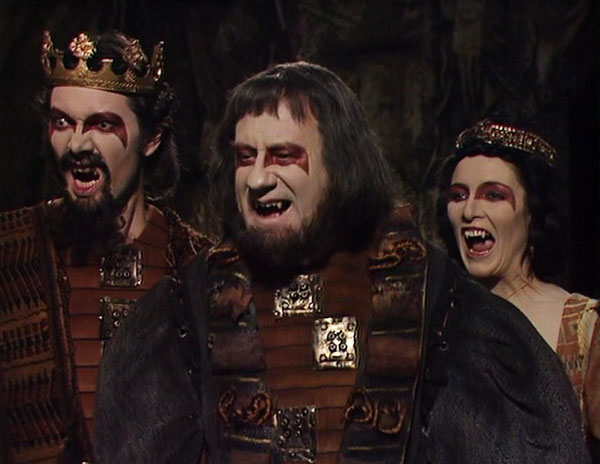
Despite Bidmead’s misgivings (and he did attempt to crowbar some of his ideas into the story, much to Dicks’ chagrin) the story went into production. And if it wasn’t clear from the script that this was Doctor Who meets Dracula then the design and costume should have made it explicit.
To be honest, there’s no logical reason why the inhabitants of the Hydrax should have chosen to dress like they’ve just walked off the set of a Hammer film, just as there’s no logical reason why Morbius, one of the greatest scientists in the galaxy, should choose to live in a castle that looked just like Baron Frankenstein’s castle instead of working and living in a modern laboratory.
But it does work in a visual sense, so sometimes you have to accept that style has to win out over content.
If Terrance Dicks was unabashed about borrowing from other sources to create his story, then it’s fair to say that his other writing traits are also present and correct here.
For Dicks, the Doctor should always be central to the action. Other stories in S18, particularly the forthcoming Warrior’s Gate, depicted the Doctor as a passive figure, not much more than an observer who does little to resolve matters. This certainly isn’t the case in State of Decay where the Doctor has the lions share of the plot.
A sacrificial victim
Terrance Dicks was also well-known for his opinion that the companion existed to get into trouble and be rescued by the Doctor. He has two here – Romana and Adric – to fulfill that function. Romana does seem a little underwritten by Dicks, for example when she’s held captive in the final episode there’s not much spark. It’s tempting to suppose that he wasn’t really writing for Romana – possibly more for a generic companion along the lines of Jo or Sarah.
The peasants aren’t particularly well drawn and they tend to conform to fairly common stereotypes – the weary head man of the village, the hotheaded rebel, etc.
The Three Who Rule are more fun though – particularly Aukon (Emrys James). James was an actor of some distinction, a former RSC player, and although he can’t resist laying on the ham it was probably difficult not to.
The Three Who Rule
Zargo (William Lindsay) and Camilla (Rachel Davies) underplay a little more and are very effective. Particularly when Zargo confesses to Camilla that he is afraid. A small character beat, but quite a revealing one.
Although the Three Who Rule hold the majority of the villagers in a grip of fear, there are still a few who rebel. When the Doctor meets them in their base he is shocked to discover how far their society has regressed –
KALMAR: Some of us could still read. It’s forbidden, but the knowledge was passed on in secret.
DOCTOR: What? Reading forbidden?
KALMAR: All science, all knowledge is forbidden by the Lords. The penalty for knowledge is death.
ROMANA: No schools of any kind?
KALMAR: Children start in the fields as soon as they can walk, stay there till they grow up, grow old and die.
In 1979, John Pilger, David Munro and Eric Piper traveled to Cambodia in the immediate aftermath of the overthrow of Pol Pot. What they found there was shared with the world, first in a special issue of the Daily Mirror and later in an ITV documentary, Year Zero: The Silent Death of Cambodia. Their discoveries were pretty much the same as the events described by Kalmar and this would have been clearly understood by the audience at the time. Doctor Who rarely commented on real-world events, so this is an interesting reference.
As previously mentioned, Tom Baker is in his element here. He has some wonderful material to play with, such as this –
DOCTOR: Do you know, it just occurs to me. There are vampire legends on almost every inhabited planet.
ROMANA: Really?
DOCTOR: Yes. Creatures that stalk in the night and feast on the blood of the living. Creatures that fear sunlight and running water and certain herbs. Creatures that are so strong they can only be killed by beheading, or a stake through the heart.
ROMANA: Or? Please, say something.
DOCTOR: Whatever it is, we want to find it, don’t we?
ROMANA: No.
DOCTOR: Good. Come on then.
The only downside to the story is the reveal of the Great Vampire, which is something of a disappointment. It would have been better to leave him to the viewer’s imagination as the brief glimpse seen in the last episode fails to convince in every possible way.
This is only a minor niggle though and the Doctor’s solution to find a stake big enough to kill the Great Vampire is pretty ingenious.
With Tom Baker’s time on Doctor Who drawing to a close it was a nice touch to have a story that harked back to the Hammer Horror style of his early years. This probably wasn’t intentional though, as it seems that the script was pressed into service because stories were urgently needed.
But whatever the reason it was made, State of Decay is an effective tale from the pen of one of its longest-serving contributors. It’s not brimming over with originality, but sometimes you just need to borrow – and if you do so then borrow from the best.
Change was most definitely in the air during the 18th season of Doctor Who. A new producer (John Nathan-Turner) and a new script-editor (Christopher H. Bidmead) were firmly in place, whilst an experienced old hand (Barry Letts) kept a watching brief as executive producer.
Those who have been around Doctor Who fandom for a long period will probably recall the time when S18 was highly rated. This was at exactly the same time that some of fandom intensely disliked S17.
The viewpoint at the time seemed to be –
Season 17 = Silly = Bad
Season 18 = Serious = Good
But as S17 came back into fashion this seemed to dent S18’s popularity a little. It was now seen by some as a little po-faced and science obsessed compared to the free-wheeling S17.
For me, both seasons have their merits and demerits and the dividing line between them can get a little blurred. Meglos, for example, could easily fit in to S17, whilst The Leisure Hive had originally been commissioned for S17.
By the time we get to Full Circle, the third transmitted story, we are seeing more of the pure vision of Bidmead though. Without a doubt this season, for good or bad, was created in his image. He once estimated that he wrote about 70% of S18 and Full Circle is a story that he had a great input into, as he considerably reworked Andrew Smith’s original scripts.
It doesn’t all work (there are some holes in the logic) but there’s a fine performance from Baker, particularly in episode three, and confident direction from Peter Grimwade which carries the story along.
Bidmead is quite a divisive figure. The DVDs have allowed him the space to clearly state his vision of what he believed Doctor Who should be – a series rooted in scientific fact and definitely not drawing on popular books or films to pastiche. One can only wonder how he would have got on with Robert Holmes, although we can probably guess by the somewhat strained relationship he had with Terrance Dicks, who didn’t care for his rewrites on State of Decay.
Bidmead’s extensive input across the season does mean that there’s a thematic unity unusual in Doctor Who at the time. The first six stories all portray civilisations that for one reason or another are stagnating.
The Argolins are sterile, Tigella is a planet held back by the superstitious nature of the Deons, the Three Who Rule have deliberately devolved the development of their planet, the Tharils once enslaved others but now they find themselves enslaved while the inhabitants of the Traken Union live in harmony for as long as the Keeper lives.
In the final story, the Logopolitans have been attempting to stave off the heat death of the universe by attempting to maintain stasis. But as the Doctor observes, entropy increases, and like the other stories of the season, change is inevitable.
In Full Circle, the Alzarians seek to deny the course of evolution by sealing themselves in the Starliner until the danger they believe exists has passed. Theirs is truly a stagnant society – with ineffectual leaders, the ironically named Deciders, who are unable to make any decisions except to maintain an existence based on continual procrastination.
The creatures from the Black Park lagoon
Production-wise, this is an impressive Doctor Who directing debut from Peter Grimwade. The early episodes benefit from a generous amount of location filming and the location, Black Park, looks gorgeous in the sunshine. It looks so good that it’s surprising it wasn’t used more often in Doctor Who.
The production was fortunate to shoot in sunshine, which enhanced the shots, but there was also clearly some thought given about how to depict an alien landscape. Grimwade used coloured lamps from just off-screen to bathe parts of the landscape in an unearthly glow. It’s a simple trick, but effective.
Full Circle was, of course, the first transmitted story featuring Adric. In production terms Matthew Waterhouse had already recorded State of Decay, but as can be seen he’s still somewhat uncertain in the role.
Given his lack of acting experience this isn’t a surprise – although a more actor-friendly director may have helped to refine his performance. But anecdotal evidence suggests that Grimwade wasn’t an actors director, so Waterhouse had to make his own way.
Romana meets the Outlers
He’s not noticeably worse than the rest of the Outlers though, who all have a whiff of the stage school about them. They’re fairly unrewarding parts but Richard Willis (Varsh), Bernard Padden (Tylos) and June Page (Keara) do the best they can. Although maybe it’s indicative of one re-write too many when Keara becomes suddenly intensely curious about everything in the last episode – possibly her lines were originally intended for Romana or Adric.
We’re on much firmer ground with the Deciders – James Bree (Nefred), Alan Rowe (Garif) and George Baker (Login). Bree had previously given a strange performance in The War Games, where every line was drawn out to the nth degree, but he’s far, far, better here. Bree plays it like many a politician or manager promoted way above their ability – he is able to project a calm outward exterior whilst having no original or helpful ideas of his own.
Alan Rowe, a familiar face from his guest appearance in Horror of Fang Rock a few years earlier, is equally indecisive as Garif. As previously mentioned, the title of Deciders is obviously intentionally ironic, but both of them are lucky to have a new Decider who knows his own mind in the form of George Baker.
Episode one establishes the planet and the mystery of the negative co-ordinates before ending on the emergence of the Marshmen. As monsters incapable of speaking, for a large part of the story the Marshmen are simply used as figures to menace the Alzarians. But the Marshchild shows that they are intelligent, reasoning creatures who have a closer relationship to the inhabitants of the Starliner than at first thought.
Episode two is where the story begins to kick into gear as the Doctor meets the Deciders and can begin to understand exactly what is happening on the planet.
In episode three the Marshchild dies and enough groundwork has been laid to ensure that we don’t regard it as just another monsters death. The Doctor’s link with the creature means he reacts with a fury that hasn’t been seen for a few years (since the conclusion of The Pirate Planet). It’s a wonderfully acted scene from Tom Baker.
DOCTOR: You Deciders allowed this to happen.
GARIF: The marsh creatures are mindless brutes. Animals!
DOCTOR: Yes. Easy enough to destroy. Have you ever tried creating one?
NEFRED: We were within our rights.
GARIF: One might argue that Dexeter was overzealous.
DOCTOR: Not an alibi, Deciders! You three are supposed to be leaders.
GARIF: Certainly we are. Though, of course, Nefred is, er, is now First Decider.
DOCTOR: Then Nefred is responsible.
NEFRED: For the community, yes.
DOCTOR: No, no! Perhaps they haven’t let you in on the secret, Login. Shall I tell him, gentlemen?
GARIF: Secret?
DOCTOR: Yes! And the fraud of perpetual movement. The endless tasks going round and round. The same old components being removed and replaced.
We haven’t yet discussed the other regulars. Lalla Ward gets an episode or so where she’s possessed by the Marshman. Although Sarah-Jane Smith used to get taken over on a regular basis it’s not something that has happened before to Romana, so it has a little more impact. Poor K9 finds himself decapitated half way through, which is a clear sign that his days are numbered.
“You can’t fight the Time Lords”.
The eventual solution to the mystery in episode four is something that may have been clearer in early drafts. The notion that the Marshman boarded the Starliner when it first landed, killed the occupants and then gradually evolved into the Alzarians is possibly not too explicit in the dialogue – so anybody watching for the first time might have missed this important plot twist.
And if the Starliner has been on the planet for 40,000 generations, how many generations passed until the Marshmen evolved into the humanoids we see today? It surely couldn’t have taken all of that time, so why have the Marshmen not been able, until now, to board the Starliner again?
Minor quibbles apart, this is a solid story. Attractive location filming, a decent monster, a great performance from Tom and some solid actors for him to react to all help to lift this above the norm. It’s only ranked 143rd out of the 241 stories in DWM’s 2014 poll and deserves to be higher (but then what has poor Meglos done to be ranked 231 out of 241? It’s not perfect but anything with Bill Fraser and Freddie Treves can’t be all bad, can it?)
After a slightly shaky start with The Leisure Hive and Meglos, S18 really started to gain momentum with Full Circle. And there was even better to come.
The commentary participants for the forthcoming BFI DVD of Out Of The Unknown (to be released in October 2014) have been announced by Toby Hadoke on his website.
All commentaries are moderated by Toby and they feature a comprehensive collection of guests –
No Place Like Earth with Mark Ward (Out Of The Unknown expert) and Dan Rebellato (playwright, lecturer and John Wyndham expert).
The Dead Past with John Gorrie (director) and Brian Hodgson (Special Sounds).
Time In Advance with Peter Sasdy (director), Wendy Gifford (Polly), Philip Voss (Police Officer) and Danvers Walker (Dan).
Sucker Bait with Clive Endersby (Mark), Roger Croucher (Fawkes).
Some Lapse Of Time with Roger Jenkins (director), John Glenister (PA), Jane Downs (Diana Harrow) and Delena Kidd (Dr Laura Denville).
The Midas Plague with Peter Sasdy.
The Machine Stops with Philip Saville (director), Kenneth Cavander (adaptor), Michael Imison (story editor).
Level 7 with Mordecai Roshwald (author), Michael Imison (story editor).
This Body Is Mine with John Carson (Allen).
Welcome Home with Moris Fahri (writer), Bernard Brown (Bowers Two).
The Man In My Head with Peter Cregeen (director), Tom Chadbon (Brinson), Jeremy Davies (designer).
Given the short time that was available to record these commentaries, the range of participants assembled Is extremely impressive. The 11 commentary tracks should shine plenty of new light on the making of these stories and they promise to be one of the highlights of an impressive sounding package.
Hancock, broadcast on the BBC between May and June 1961, was Tony Hancock’s last series for the BBC and was also the last one written for him by Ray Galton and Alan Simpson.
From 1954 onwards, Hancock had enjoyed great success with Galton & Simpson’s scripts, both on radio and on television. There had been six series of Hancock’s Half Hour on the radio – between 1954 and 1959 – as well as six television series, which ran from 1956 – 1960.
But by 1961 Hancock was restless and wanted changes. Sid James had been present in virtually every television and radio episode, but he was dropped from Hancock, at Tony’s request. And when this series had finished Tony Hancock dispensed with Galton & Simpson as well. For many people this marked the start of the long downward spiral in Hancock’s personal and professional life which ended with his suicide in Australia in 1968, at the age of 44.
Among those who insisted that the ties Hancock severed led directly to his untimely death was Spike Milligan, who said: “One by one he shut the door on all the people he knew; then he shut the door on himself.”
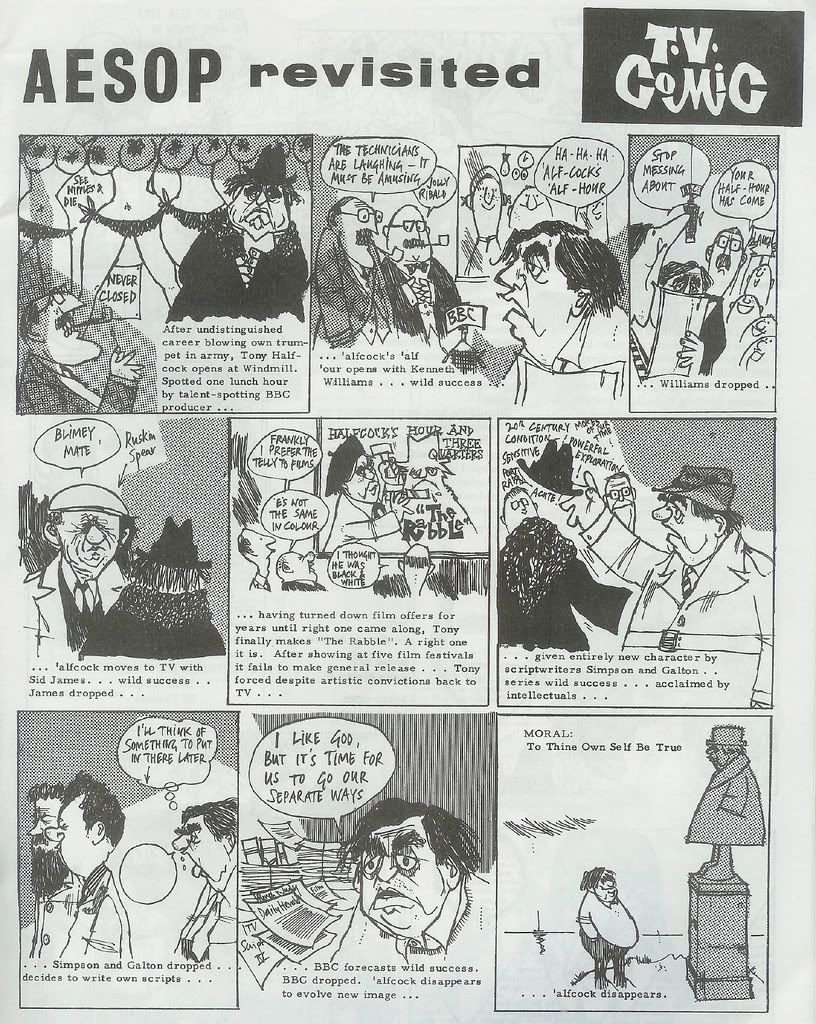
Harsh criticism of Tony Hancock can be found in the following cartoon from Private Eye in June 1962, drawn by Willie Rushton.
But whatever happened after Tony Hancock left the BBC in 1961, between 1954 and 1961 he, along with Ray Galton and Alan Simpson, created some of the finest episodes of situation comedy ever seen in any country. And their final series, thanks in part to Tony’s insistence on changing the character slightly, ensured that they ended their creative partnership on a high.
Hancock (Broadcast on BBC Television between 26th May – 30th June 1961)
Galton & Simpson like to tell the story that Hancock asked them to write an episode where he was the only character seen. They thought it wouldn’t work and decided to write something to prove to Tony that it was impossible. The result was The Bedsitter and it proved to be an excellent showcase for Hancock and one of the best things that G&S ever wrote.
When G&S started to write for Tony, they tended to craft elaborate plots which usually hinged on Sid trying to con Tony into doing something. Over the years they pared down the storylines so they became less fantastic and more mundane.
The most mundane episode of the radio series has to be Sunday Afternoon At Home. This isn’t a criticism – it’s a beautifully judged picture of a typical Sunday afternoon where there’s nothing to do except kill time. In that episode though, Hancock had Sid James, Bill Kerr, Hattie Jacques and Kenneth Williams to spar with, but in The Bedsitter there’s nobody but himself.
It shouldn’t work, but it does. Nothing much happens – Tony attempts to read some Bertrand Russell, loses interest and then attempts the more hard-boiled charms of Lady Don’t Fall Backwards. But even that proves to be a problem, as he concedes: “It’s a waste of time me reading, I can never remember anything. I’ve got too much on my mind, you see, nuclear warfare, the future of mankind, China, Spurs.”
Later on, a misdirected call offers the chance of a date, but in the end it comes to nothing. Hancock though maintains a brave face: “That was a lucky escape! I nearly got sucked into a social whirlpool there, diverted from my lofty ideals into a life of debauchery! The flesh-pots of West London have been cheated of another victim! Eve has proffered the apple and Adam has slung it straight back at her!”
One of the strange things about the G&S series is that unlike most sitcoms there was never any attempt to maintain even a basic level of continuity. Hancock’s status would change week by week – one week he could be penniless and unknown and the next – as we see in The Bowmans – he may be the popular star of a top-rated radio series.
“Hello me old pal, me old beauty.”
A none too subtle swipe at a popular rural radio soap opera,The Bowmans certainly gives Hancock full reign to unleash his country accent, which is great fun. It’s also a rarity in that we see Hancock finish on top for once. His character is killed off from the soap, but public opinion forces the producers to bring him back as his own twin brother and then he takes great delight in ensuring the majority of the villagers fall to their deaths down a disused mine shaft!
The Radio Ham is not quite a solo performance likeThe Bedsitter, although Hancock does spend the majority of the episode alone in a room by himself. He does have company though, via the ham radio he’s built. Substitute the internet for the radio and it seems right up to date.
Re-recorded for LP release in 1961, The Radio Ham has quite rightly become one of the classics of British sitcom. Comedy rarely gets better than this, with so many quotable lines.
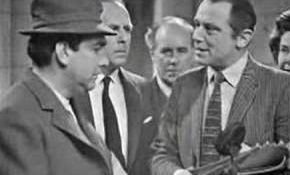
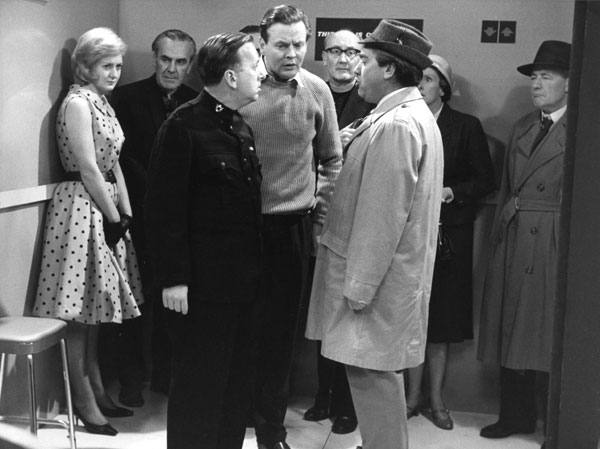
The Lift is an episode that it’s possible to imagine in any series of HHH. Like The Train Journey from series 5 it has a similar premise – take a group of disparate characters who are trapped together (in a train or a stuck lift) with Hancock at his most annoying and wait to see what happens.
Noel Howlett, Jack Watling, Hugh Lloyd, John Le Mesurier and Colin Gordon are among the unlucky people who have to share a lift with Tony. It’s not an episode that innovates, like The Bedsitter, but it does what it does very well. And it’s helped no end by the fine performers stuck in the lift with Hancock.
Doctor: I’m a doctor. Hancock: Yes, we all know you’re a doctor. You’ve been talking about nothing else since we’ve been here. I don’t understand you. I don’t go around telling people what I am all the time. Doctor: I think we’ve all reached an opinion as to what you are.
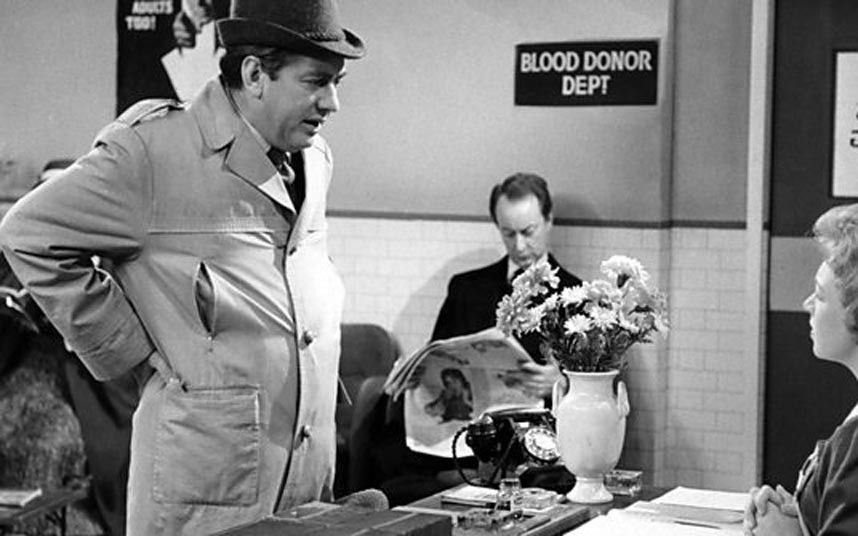
Along with The Radio Ham, The Blood Donor is probably the most famous Hancock episode (helped by the excellent LP re-recording previously mentioned). With this one though, I do prefer the LP version – due to the circumstances of the television taping.
“To do one unselfish act with no thought of profit or gain is the duty of every human being. Something for the benefit of the country as a whole. What should it be I thought? Become a Blood Donor or join the Young Conservatives? But as I’m not looking for a wife and I can’t play table tennis here I am.”
In the week prior to the tv episode recording, Hancock was involved in a car crash. He wasn’t badly hurt – although more make-up than usual can be seen on his face to hide the superficial scars – but he didn’t have time to learn his lines, so he read them off boards held above the camera.
Once you know this, then it’s impossible not to be distracted by the fact that he obviously never looks at anyone else in the scene as he’s always looking to the side and his next line. There is the odd stumble, but overall his performance is brilliant – considering that when he speaks any line he’s just seen it for first time and he has to instantly decide on pacing and inflection.
“A pint? That’s very nearly an armful!”
However you experience it, it’s a classic. So many quotable lines and a collection of first rate performers for Hancock to bounce off (June Whitfield, Patrick Cargill, Frank Thornton, Hugh Lloyd).
If you view Hancock as an album, then the first five episodes are hit singles whilst the last, The Succession – Son and Heir, is resolutely an album track.
It’s not a bad episode, but compared to the other five it’s not quite in the same class. The premise is bright enough though, Tony decides the time has come to perpetuate the line and produce a heir, so a bride is sought. But thanks to his luck with the opposite sex in the end he decides to stay single.
There’s still plenty of quotable moments though, particularly when Tony’s thumbing through his little black book for suitable partners: “Elsie Biggs: 42-36- ….. oh no, that’s her phone number. Still, I don’t fancy her pounding about the house all day long. She’s a bit too hefty for me. She had me over a few times.”
Conclusion
Classic comedy that nobody should be without. There’s a boxset containing all the surviving BBC TV episodes or if you just want to sample this series, then The Best of Hancock is a single DVD with five of the six episodes (excluding The Succession). Either way, no collection of British television comedy can be complete without something from the Lad Himself.
L-R – Neil Stacey, Joanna Van Gyseghem, Keith Barron and Gwen Taylor
Incredibly popular in its day, Duty Free is a series that has aged pretty well. Yes, it’s predictable stuff, but the regulars (particularly Keith Barron and Gwen Taylor) are so good that they can, and do, lift the sometimes thin material.
The first series is by far the best, particularly once Amy (Taylor) discovers her husband, David (Barron) has been involved with Linda (Joanna Van Gyseghem).
Rather endearingly, David and Linda’s affair never seemed to have progressed beyond holding hands and the odd clinch. Like the Carry On films, frustration is the name of the game.
But after Amy learns the truth, Taylor has some wonderful scenes that have a little more depth than might have been expected. Gwen Taylor is the star player throughout the run, and never more so than here.
The second and third series tend to stretch the love triangle to breaking point, but they still have their moments.
Not ground-breaking then, but certainly an enjoyable watch.