Written by Margaret Simpson. Tx 29th January 1980
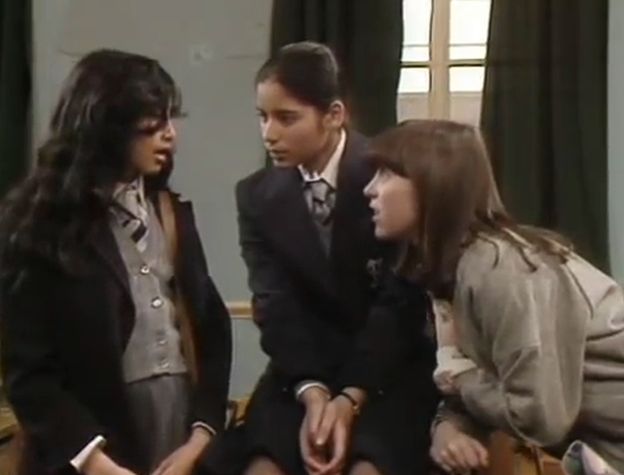
A new girl, Fatima Bibi (Belgit Gill), is placed in the care of Sudhanami Patel (Sheila Chandra). This seems to be because Fatima doesn’t speak any English and the assumption appears to be that Sudhanami will be able to communicate with her.
But it becomes clear very quickly that Sudhanami isn’t going to make any headway. Mrs Conrad (Margaret Stallard), the teacher responsible for working with pupils who need to increase their English language skills, is quick to grasp the gulf between Fatima and Sudhanami. Sudhanami comes from Uganda and Fatima hails from East Pakistan. The unconscious racism on the part of the other members of staff who’d obviously assumed they’d be able to communicate is never directly commented upon, but is clear enough.
Grange Hill has, from the first episode, been a multi-cultural school, but it’s rarely something that’s been a central part of any ongoing story. True, Benny did receive taunts about the colour of his skin in some of the early episodes, but he was also bullied because his family was poor. This episode is therefore notable since it attempts to deal with two thorny topics at once – the problems of how those newly arrived (like Fatima) integrate into British society but also how the people already established (like Sudhanami and her family) adapt to the culture around them.
Fatima is a one-shot character and won’t be seen again after this episode. This it’s a bit of a shame, since there would have been some mileage in showing her develop. But Sudhanami does remain a semi-regular for a while (up until the end of series four). She’s rarely central though, so this is really the one episode where she moves to the heart of the story.
Her father, Mr Patel (Minoo Golvala), wants to transfer her to an all girls school. He seems to be almost a caricature of a traditional Indian father – he hates the fact that she goes to school with boys, listens to pop music, etc. All this does rather beg the question as to why he allowed her to go to Grange Hill in the first place.
Although a strict traditionalist (he expects her to help in the shop and is reluctant to allow her to spend time with her friends outside of school hours) it’s clear that he does genuinely love her and has (or at least he believes he has) her best interests at heart. As for Sudhanami herself, she’s somewhat submissive and is happy to follow her father’s directions. If he decrees that she will take part in an arranged marriage sometime in the future, then that’s what will happen.
This may be an accurate, although not terribly progressive, portrait of the times – but it’s notable that as the series progresses we’ll tend to see children who will be much less prepared to toe the family line. Instead they’ll be keen to embrace all that Western culture can offer, irrespective of what their parents may say.
Although this is a fairly serious episode, there are a few lighter moments. Trisha and Cathy are aghast to find that Miss Mooney and Mr Sutcliffe are engaged – Cathy earlier remarked that Mr Sutcliffe “wouldn’t marry a thing like that”! Trisha and Cathy also attempt to teach Fatima some useful phrases such as “Flippin’ ‘eck” and “Shut yer mouth”.
Tucker’s artistic flair is put to good use again when he designs a cut-out figure for the school fair. The teachers line up to put their heads through the opening and have to suffer wet sponges being thrown at them. It’s all for a good cause, so they can’t complain, and naturally the pupils are delighted for the chance to take their revenge – especially on Mr Baxter!
 Archive Television Musings
I’m glad I found your comments.
I’ve been enjoying Grange Hill (a new discovery for me) for about a year.
I loved this episode because “Fatima” was just adorable, and she reminded me of the many, many times I was new kid, immersed in a new culture, after moving to another state, or even going from North or South within the same state
That was when my country had rather defined regional differences in culture and language.
I’m with you I would’ve liked to her adjustments as time went on episode to episode, especially if she was wiz at math or science, or an great athlete.
LikeLiked by 1 person
Miss Peterson doing that ‘if I shout at her loudly and slowly she will understand English’ thing. As for the insensitivity of “she’ll just have to do it in her vest and knickers then” and pulling up Fatima’s skirt to check on the knickers!!! Dreadful woman.
LikeLike
I hope this episode wasn’t as cliched in 1980 as it feels today. The immigrant parent/Westernised child culture clash story is well trodden but often seems to go down the same stock issues. I forget who it was who said that there was a time when the only variation in the parts offered to British Asian actresses was just which member of the family they would play in a story about arranged marriages. And Sudhanami’s father is a shopkeeper (and I suspect the reason it looks more like a stationery shop than a general corner shop is down to BBC advertising rules).
(It’s also a surprising contrast with the last series where Susi’s parents were talking about entrance exams and boarding schools as the only alternatives yet here it seems there’s at least one all-girl’s school in the borough that Sudhanami could be transferred to.)
The treatment of Fatima shocked me especially as Miss Peterson is her form tutor so isn’t discovering her lack of English for the first time in the changing room. And even when Cathy and Trisha are talking to Fatima and teaching her a few words there’s an uncomfortable feel that they’re approaching the situation like teaching a pet to be naughty. Fatima is said to be “Pakistani” and from “East Pakistan” but Bangladesh had been independent for nine years. Was this a slip or a very subtle hint that even Mrs Conrad and Sudhanami are ignorant?
LikeLiked by 1 person
Certainly in tv dramas of that time, GH included, there was often a focus upon the ethnicity or cultural background of Asian or black characters, in the context of ‘social problem’. (Though in an earlier series, there was also a Greek-Cypriot boy who was portrayed in a stereotypic way.)
It was early days and a reflection of attitudes in the real world, both sympathetic and otherwise, and the writing was usually sincere, if a little ham-fisted on occasion. As time went on, you’d see this far less, and the characters would be presented just as young people, but early on the characters weren’t as nuanced. Benny’s character was perhaps an exception but even he had to deal with Michael Doyle.
LikeLike
A rare Benny Green sighting! It’s a shame they seem to be using him less and less as the series progresses, he was a fabulous young actor.
LikeLike
Terry Sue Pat’s availability became less regular during Series Three (as in the case of a number of the younger actor’s, was trying to keep up with education at the time, which was why in some instances characters wouldn’t return for the following series). Most of Benny’s scenes for S3 appear to have all been filmed in one block, all location work, with him only appear in studio scenes a couple of times all of S3. In a couple of cases, his lines were altered to instead give to Tommy.
I love Benny, one of my favourite early characters, I was always disappointed he featured less regularly after Series One/Two.
LikeLike
Who on Earth wants to be progressive? Yet another Diversity, Inclusion and Equality lecture from BBC. Known as D.I.E. for short. Notice how those from the ethnic minorities have been on the BBC for sixty years. Yet they still claim they are excluded from the media.
Get them young and they’ll believe is the BBC’s agenda here. Yet BBC does not do what it preaches. With most of its talent (term used very loosely) drawn from the top public schools or Oxford or Cambridge. Nothing wrong with that. But please spare us the lecture on inclusivity.
In the 2020’s we had Prime Minister and British Cabinet who went to Eton, we have Archbishop of Canterbury who went to Eton, and a future King who went to Eton. Yet they all lecture you about diversity on your television. In particular they lecture the working-class. Yet it is the working-class who have done much more integrating and assimilating of ethic minorities over the past sixty years than any other section of society. You couldn’t make it up.
LikeLike
I’m genuinely confused if you’re pro diversity or anti diversity or somewhere in the middle. You start by saying how ethnic minorities have been on the BBC for sixty years yet ‘still claim they are excluded from the media’, and yet the next minute are saying how great ‘minorities’ are. So confusing! 🙂
LikeLike
After the greatness of the previous episode, we come back down to earth slightly here in what is itself a fairly reasonable episode. It’s nice to finally have the spotlight on Sudhamani, who has been part of the cast since Series Two, got little to really say or do during s2 much at all, and at the start of Series Three we did get a hint at her father’s strictness when she’s asked why she still wears school uniform now that it is optional.
I quite like how the episodes illustrates the innocent and naive racism displayed towards Sudhamani, with first year head Mrs. Kennedy (Nickola Sterne, in the final of her four appearance in the series), presumes that just Sudhamani will automatically speak the same language as new girl Fatima (which, of course, she doesn’t) and so places Fatima in her care. However it is maybe odd that Mrs. Peterson, who is of black origin and whom herself would have likely have been subjected to similar misguided presumptions in her time, doesn’t pick up on Mrs. Kennedy’s naive mistake.
In comparison, Mrs. Conrad (Margaret Stallard), who teaches the specialist class for pupils with limited or no English language skills, is far more understanding and clued up. Fatima (Belgit Gill) herself is sympathetically portrayed, her confusion and isolation – and indeed a quiet sense of sadness about her – being quite apparent. As Mrs. Conrad says, “She must find school awfully frightening – 1500 children all jabbering away in a language she doesn’t understand”.
It is such a shame that this episode would be both Fatima and Mrs. Conrad’s lone appearance in the series. Even if it wasn’t felt there was scope enough to follow the plot through closely, to revisit both Mrs. Conrad and Fatima, as she adapts and learns, and slowly makes some friends, every few episodes would have been quite welcome. As it is, although the episode means well and does indeed illustrate the casual racism and isolation involved, it does feel vaguely like a token gesture for just this one lone episode.
However, the episode does serve to delve a bit further into issues involving different races as it takes a closer look at Sudhamani herself, and her very strict and protective father – although sadly, this story itself will never go all that much further than this single episode.
Miss Peterson’s conduct towards Fatima – without wanting to be badly presumptuous myself – goes from bad to worse as the episode continues. After bellowing at the confused girl because she hasn’t got a gym kit, she lifts her skirt to check that she’s wearing knickers – itself quite a shocking moment – and demands that she’ll have to instead do it in her underwear. Mrs. Peterson is quite a hard character to fathom out – we’ve already had the debatable events two episodes prior where she pushed the poorly Sally to do P.E. which lead to Sally suffering an attack, having a fall, and being hospitalised. It was always very ambiguous if Miss Peterson should have been held to account for the incident (it was never really followed up on), and now we have this very questionable conduct. The character seems to have been conceived as “firm but far”, but all we ever really seem to see of her his over the top strictness without ever pausing to consider the other side of things.
We do get a slightly lighter hearted later development, even if it is itself dated and awkward, as Cathy and Trisha, amidst trying to encourage Fatima to speak various English phrases, decide to amuse themselves by her Fatima various “rude phrases”, although as this was children’s teatime viewing, the rudeness extends as far as “Flippin’ ‘eck” and “Shut your mouth”. The writing of this scene is as debatable as the rest of the episode. In essence, Cathy and Trisha never display any malice towards Fatima, indeed they are shown to be friendly towards and have showing concern for her well-being. However there is a certain underlying feel of awkwardness to the scene which maybe, like the rest of the episode, simply hasn’t aged very well. Well, whatever the case, it does give us Trisha slowly saying “Shut … your… maaf”, which I once amused myself by making into a message tone for my phone (simple things please simple minds)!
Regarding Sudhamani and her father, the issues of the strict and over-protective father raised are interesting ones, although were maybe too complex to be squished down into a “single episode and then forgotten” storyline. Although the issue of different cultural standards certainly do come into play, in a way the plot does have some comparisons with that of Susi’s parents (particularly, her mother) in Series Two (which occasionally also has echoes in Series Three). Although that plot did reach over into several episodes, it’s actual point of focus was itself only in one episode (s2e17); however, as a character Susi is far more prominent in the series, we know more about her, and as mentioned there are occasional follow-ons from that storyline in other episodes. Sudhamani, on the other hand, we know far less about, and yet the whole plot is attempted to be squished up in one single episode, which is a shame and indeed quite cramped, what with the Fatima storyline also being in play.
Equally as interesting is Sudhamani’s unhappiness that she is friendly with Andrew, not liking her being around other boys. It is never made explicitly clear whether Andrew might have romantic designs on her or is merely being friendly, but if it is the former, then he never once conducts himself improperly towards her, behaving quite gentlemanly. This itself is a potentially interesting yet rather rushed subject – a similar issue would be looked at, longer and better, with Robbie and Asian classmate Aichaa, in Series 13 in 1990 (which is actually one of the slightly more positive things I can find to say about that horrible series, but anyway…)
Elsewhere, we get another science lab scene where Miss Mooney illustrates that she can potentially be an absolute menace, being the scattiest science teacher imaginable – although the writing for the scene is quite good, with Miss Mooney continually forgetting the words she’s trying to say and instead conveying things in gestures – feeling something akin to a ‘Two Ronnies’ sketch. The “Hopwood and Mooney” plot continues onwards, but it is a plot which has had so little development that it’s hard to particularly care. Trisha carelessly manages to burn a hole in her sweater with acid … resulting in Sudhamani later commenting that she should wear school uniform like herself, and that it keeps her best clothes from getting worn out. This does feel like a rather rushed and ham-fisted attempt at pointing out a benefit of school uniform, and feel a bit pointless and lost within the busy episode.
In that same scene, we also get our last appearance of Jenny Yates, Trisha’s often forgotten sister. Oddly downplayed in all three episodes in which she appears, and quite easy to miss the fact that she is indeed Trisha’s sister – in fact, this is the only time both herself and Trisha appear within the same scene. Benny’s brother Michael and Andrew’s sister Karen also didn’t work out in Series Three and dropped thereafter, but they did at least get their chance in the spotlight; poor old Jenny just seems to have been stuck in as an afterthought and would quickly be forgotten about again.
The rest of the episode is taken up with the school fayre, to raise funds for the school. Cue “hilarity” as Bullet Baxter has sponges thrown at him in one of those ‘stick your head through the hole’ seaside things painted by Tucker; an okay but slightly drawn out sequence, which feels a bit like salt in the wound by an episode which has rushed through potentially more interesting and relevant issues. An interesting episode, mostly interesting in how extremely dated (and by extension, clunkily) the issues of race and cultural differences covered are handled, although they clearly were well meaning and at the time, addressing topics never really touched upon by children’s television before. The greatest crime, though, is that there was much more story here to be told, both for Sudhamani and for Fatima, but they were all squished into a single episode, with poor old Fatima never even being seen again…!
LikeLike
After the greatness of the previous episode, we come back down to earth slightly here in what is itself a fairly reasonable episode. It’s nice to finally have the spotlight on Sudhamani, who has been part of the cast since Series Two, got little to really say or do during s2 much at all, and at the start of Series Three we did get a hint at her father’s strictness when she’s asked why she still wears school uniform now that it is optional.
I quite like how the episodes illustrates the innocent and naive racism displayed towards Sudhamani, with first year head Mrs. Kennedy (Nickola Sterne, in the final of her four appearance in the series), presumes that just Sudhamani will automatically speak the same language as new girl Fatima (which, of course, she doesn’t) and so places Fatima in her care. However it is maybe odd that Mrs. Peterson, who is of black origin and whom herself would have likely have been subjected to similar misguided presumptions in her time, doesn’t pick up on Mrs. Kennedy’s naive mistake.
In comparison, Mrs. Conrad (Margaret Stallard), who teaches the specialist class for pupils with limited or no English language skills, is far more understanding and clued up. Fatima (Belgit Gill) herself is sympathetically portrayed, her confusion and isolation – and indeed a quiet sense of sadness about her – being quite apparent. As Mrs. Conrad says, “She must find school awfully frightening – 1500 children all jabbering away in a language she doesn’t understand”.
It is such a shame that this episode would be both Fatima and Mrs. Conrad’s lone appearance in the series. Even if it wasn’t felt there was scope enough to follow the plot through closely, to revisit both Mrs. Conrad and Fatima, as she adapts and learns, and slowly makes some friends, every few episodes would have been quite welcome. As it is, although the episode means well and does indeed illustrate the casual racism and isolation involved, it does feel vaguely like a token gesture for just this one lone episode.
However, the episode does serve to delve a bit further into issues involving different races as it takes a closer look at Sudhamani herself, and her very strict and protective father – although sadly, this story itself will never go all that much further than this single episode.
Miss Peterson’s conduct towards Fatima – without wanting to be badly presumptuous myself – goes from bad to worse as the episode continues. After bellowing at the confused girl because she hasn’t got a gym kit, she lifts her skirt to check that she’s wearing knickers – itself quite a shocking moment – and demands that she’ll have to instead do it in her underwear. Mrs. Peterson is quite a hard character to fathom out – we’ve already had the debatable events two episodes prior where she pushed the poorly Sally to do P.E. which lead to Sally suffering an attack, having a fall, and being hospitalised. It was always very ambiguous if Miss Peterson should have been held to account for the incident (it was never really followed up on), and now we have this very questionable conduct. The character seems to have been conceived as “firm but far”, but all we ever really seem to see of her his over the top strictness without ever pausing to consider the other side of things.
We do get a slightly lighter hearted later development, even if it is itself dated and awkward, as Cathy and Trisha, amidst trying to encourage Fatima to speak various English phrases, decide to amuse themselves by her Fatima various “rude phrases”, although as this was children’s teatime viewing, the rudeness extends as far as “Flippin’ ‘eck” and “Shut your mouth”. The writing of this scene is as debatable as the rest of the episode. In essence, Cathy and Trisha never display any malice towards Fatima, indeed they are shown to be friendly towards and have showing concern for her well-being. However there is a certain underlying feel of awkwardness to the scene which maybe, like the rest of the episode, simply hasn’t aged very well. Well, whatever the case, it does give us Trisha slowly saying “Shut … your… maaf”, which I once amused myself by making into a message tone for my phone (simple things please simple minds)!
Regarding Sudhamani and her father, the issues of the strict and over-protective father raised are interesting ones, although were maybe too complex to be squished down into a “single episode and then forgotten” storyline. Although the issue of different cultural standards certainly do come into play, in a way the plot does have some comparisons with that of Susi’s parents (particularly, her mother) in Series Two (which occasionally also has echoes in Series Three). Although that plot did reach over into several episodes, it’s actual point of focus was itself only in one episode (s2e17); however, as a character Susi is far more prominent in the series, we know more about her, and as mentioned there are occasional follow-ons from that storyline in other episodes. Sudhamani, on the other hand, we know far less about, and yet the whole plot is attempted to be squished up in one single episode, which is a shame and indeed quite cramped, what with the Fatima storyline also being in play.
Equally as interesting is Sudhamani’s unhappiness that she is friendly with Andrew, not liking her being around other boys. It is never made explicitly clear whether Andrew might have romantic designs on her or is merely being friendly, but if it is the former, then he never once conducts himself improperly towards her, behaving quite gentlemanly. This itself is a potentially interesting yet rather rushed subject – a similar issue would be looked at, longer and better, with Robbie and Asian classmate Aichaa, in Series 13 in 1990 (which is actually one of the slightly more positive things I can find to say about that horrible series, but anyway…)
Elsewhere, we get another science lab scene where Miss Mooney illustrates that she can potentially be an absolute menace, being the scattiest science teacher imaginable – although the writing for the scene is quite good, with Miss Mooney continually forgetting the words she’s trying to say and instead conveying things in gestures – feeling something akin to a ‘Two Ronnies’ sketch. The “Hopwood and Mooney” plot continues onwards, but it is a plot which has had so little development that it’s hard to particularly care. Trisha carelessly manages to burn a hole in her sweater with acid … resulting in Sudhamani later commenting that she should wear school uniform like herself, and that it keeps her best clothes from getting worn out. This does feel like a rather rushed and ham-fisted attempt at pointing out a benefit of school uniform, and feel a bit pointless and lost within the busy episode.
In that same scene, we also get our last appearance of Jenny Yates, Trisha’s often forgotten sister. Oddly downplayed in all three episodes in which she appears, and quite easy to miss the fact that she is indeed Trisha’s sister – in fact, this is the only time both herself and Trisha appear within the same scene. Benny’s brother Michael and Andrew’s sister Karen also didn’t work out in Series Three and dropped thereafter, but they did at least get their chance in the spotlight; poor old Jenny just seems to have been stuck in as an afterthought and would quickly be forgotten about again.
The rest of the episode is taken up with the school fayre, to raise funds for the school. Cue “hilarity” as Bullet Baxter has sponges thrown at him in one of those ‘stick your head through the hole’ seaside things painted by Tucker; an okay but slightly drawn out sequence, which feels a bit like salt in the wound by an episode which has rushed through potentially more interesting and relevant issues. An interesting episode, mostly interesting in how extremely dated (and by extension, clunkily) the issues of race and cultural differences covered are handled, although they clearly were well meaning and at the time, addressing topics never really touched upon by children’s television before. The greatest crime, though, is that there was much more story here to be told, both for Sudhamani and for Fatima, but they were all squished into a single episode, with poor old Fatima never even being seen again…!
LikeLike
Just to add. I must be very careful about what I say on this blog. I might have my bank account closed next week. LOL. However I have quite inadvertently used the word “ethic” minorities rather than word “ethnic” minorities. In way it makes my point. For whatever you think about “minorities” at least they actually believe in something. Their culture, values, ethics. Quite unlike many in Britain – and quite unlike BBC who, for some unknown reason, keep on using “ghastly” word British.
LikeLike
After the greatness of the previous episode, we come back down to earth slightly here in what is itself a fairly reasonable episode. It’s nice to finally have the spotlight on Sudhamani, who has been part of the cast since Series Two, got little to really say or do during s2 much at all, and at the start of Series Three we did get a hint at her father’s strictness when she’s asked why she still wears school uniform now that it is optional.
I quite like how the episodes illustrates the innocent and naive racism displayed towards Sudhamani, with first year head Mrs. Kennedy (Nickola Sterne, in the final of her four appearance in the series), presumes that just Sudhamani will automatically speak the same language as new girl Fatima (which, of course, she doesn’t) and so places Fatima in her care. However it is maybe odd that Mrs. Peterson, who is of black origin and whom herself would have likely have been subjected to similar misguided presumptions in her time, doesn’t pick up on Mrs. Kennedy’s naive mistake.
In comparison, Mrs. Conrad (Margaret Stallard), who teaches the specialist class for pupils with limited or no English language skills, is far more understanding and clued up. Fatima (Belgit Gill) herself is sympathetically portrayed, her confusion and isolation – and indeed a quiet sense of sadness about her – being quite apparent. As Mrs. Conrad says, “She must find school awfully frightening – 1500 children all jabbering away in a language she doesn’t understand”.
It is such a shame that this episode would be both Fatima and Mrs. Conrad’s lone appearance in the series. Even if it wasn’t felt there was scope enough to follow the plot through closely, to revisit both Mrs. Conrad and Fatima, as she adapts and learns, and slowly makes some friends, every few episodes would have been quite welcome. As it is, although the episode means well and does indeed illustrate the casual racism and isolation involved, it does feel vaguely like a token gesture for just this one lone episode.
However, the episode does serve to delve a bit further into issues involving different races as it takes a closer look at Sudhamani herself, and her very strict and protective father – although sadly, this story itself will never go all that much further than this single episode.
Miss Peterson’s conduct towards Fatima – without wanting to be badly presumptuous myself – goes from bad to worse as the episode continues. After bellowing at the confused girl because she hasn’t got a gym kit, she lifts her skirt to check that she’s wearing knickers – itself quite a shocking moment – and demands that she’ll have to instead do it in her underwear. Mrs. Peterson is quite a hard character to fathom out – we’ve already had the debatable events two episodes prior where she pushed the poorly Sally to do P.E. which lead to Sally suffering an attack, having a fall, and being hospitalised. It was always very ambiguous if Miss Peterson should have been held to account for the incident (it was never really followed up on), and now we have this very questionable conduct. The character seems to have been conceived as “firm but far”, but all we ever really seem to see of her his over the top strictness without ever pausing to consider the other side of things.
We do get a slightly lighter hearted later development, even if it is itself dated and awkward, as Cathy and Trisha, amidst trying to encourage Fatima to speak various English phrases, decide to amuse themselves by her Fatima various “rude phrases”, although as this was children’s teatime viewing, the rudeness extends as far as “Flippin’ ‘eck” and “Shut your mouth”. The writing of this scene is as debatable as the rest of the episode. In essence, Cathy and Trisha never display any malice towards Fatima, indeed they are shown to be friendly towards and have showing concern for her well-being. However there is a certain underlying feel of awkwardness to the scene which maybe, like the rest of the episode, simply hasn’t aged very well. Well, whatever the case, it does give us Trisha slowly saying “Shut … your… maaf”, which I once amused myself by making into a message tone for my phone (simple things please simple minds)!
Regarding Sudhamani and her father, the issues of the strict and over-protective father raised are interesting ones, although were maybe too complex to be squished down into a “single episode and then forgotten” storyline. Although the issue of different cultural standards certainly do come into play, in a way the plot does have some comparisons with that of Susi’s parents (particularly, her mother) in Series Two (which occasionally also has echoes in Series Three). Although that plot did reach over into several episodes, it’s actual point of focus was itself only in one episode (s2e17); however, as a character Susi is far more prominent in the series, we know more about her, and as mentioned there are occasional follow-ons from that storyline in other episodes. Sudhamani, on the other hand, we know far less about, and yet the whole plot is attempted to be squished up in one single episode, which is a shame and indeed quite cramped, what with the Fatima storyline also being in play.
Equally as interesting is Sudhamani’s unhappiness that she is friendly with Andrew, not liking her being around other boys. It is never made explicitly clear whether Andrew might have romantic designs on her or is merely being friendly, but if it is the former, then he never once conducts himself improperly towards her, behaving quite gentlemanly. This itself is a potentially interesting yet rather rushed subject – a similar issue would be looked at, longer and better, with Robbie and Asian classmate Aichaa, in Series 13 in 1990 (which is actually one of the slightly more positive things I can find to say about that horrible series, but anyway…)
Elsewhere, we get another science lab scene where Miss Mooney illustrates that she can potentially be an absolute menace, being the scattiest science teacher imaginable – although the writing for the scene is quite good, with Miss Mooney continually forgetting the words she’s trying to say and instead conveying things in gestures – feeling something akin to a ‘Two Ronnies’ sketch. The “Hopwood and Mooney” plot continues onwards, but it is a plot which has had so little development that it’s hard to particularly care. Trisha carelessly manages to burn a hole in her sweater with acid … resulting in Sudhamani later commenting that she should wear school uniform like herself, and that it keeps her best clothes from getting worn out. This does feel like a rather rushed and ham-fisted attempt at pointing out a benefit of school uniform, and feel a bit pointless and lost within the busy episode.
In that same scene, we also get our last appearance of Jenny Yates, Trisha’s often forgotten sister. Oddly downplayed in all three episodes in which she appears, and quite easy to miss the fact that she is indeed Trisha’s sister – in fact, this is the only time both herself and Trisha appear within the same scene. Benny’s brother Michael and Andrew’s sister Karen also didn’t work out in Series Three and dropped thereafter, but they did at least get their chance in the spotlight; poor old Jenny just seems to have been stuck in as an afterthought and would quickly be forgotten about again.
The rest of the episode is taken up with the school fayre, to raise funds for the school. Cue “hilarity” as Bullet Baxter has sponges thrown at him in one of those ‘stick your head through the hole’ seaside things painted by Tucker; an okay but slightly drawn out sequence, which feels a bit like salt in the wound by an episode which has rushed through potentially more interesting and relevant issues. An interesting episode, mostly interesting in how extremely dated (and by extension, clunkily) the issues of race and cultural differences covered are handled, although they clearly were well meaning and at the time, addressing topics never really touched upon by children’s television before. The greatest crime, though, is that there was much more story here to be told, both for Sudhamani and for Fatima, but they were all squished into a single episode, with poor old Fatima never even being seen again…!
LikeLike