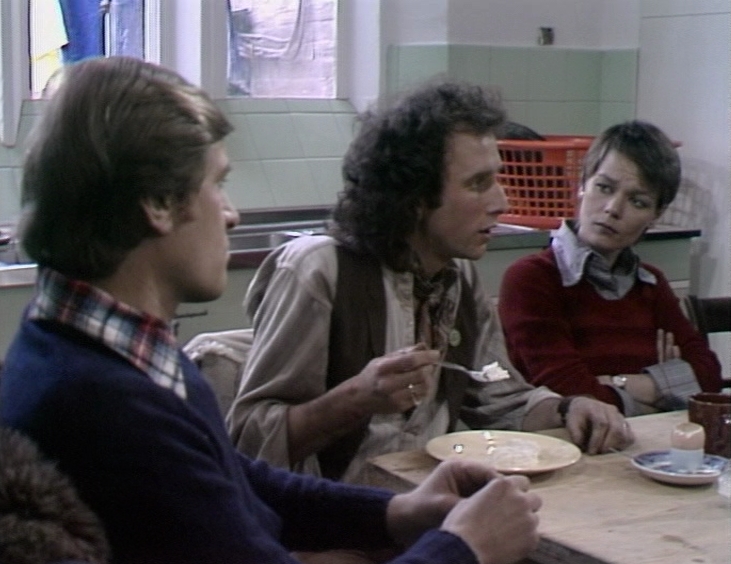
Grange Hill. Series One – Episode Nine

grange hill s01e09

Written by Phil Redmond. Tx 5th April 1978

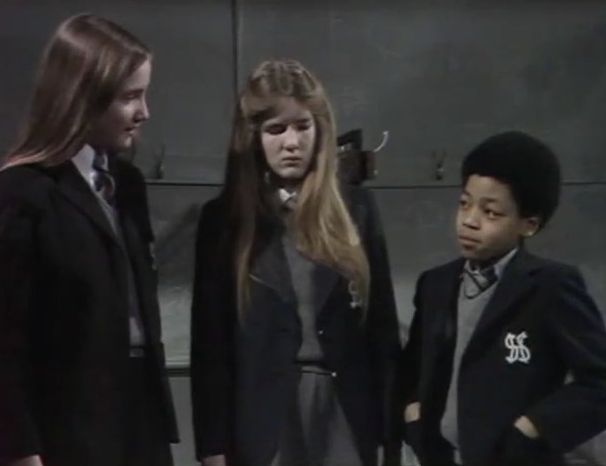
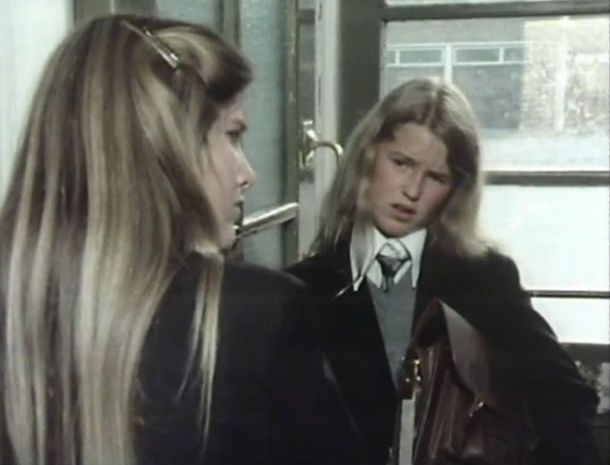
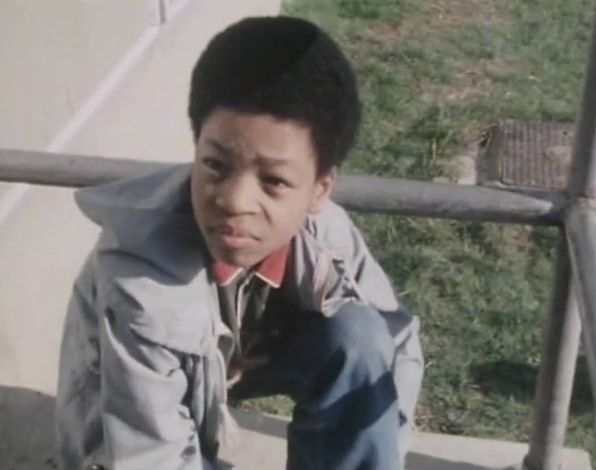
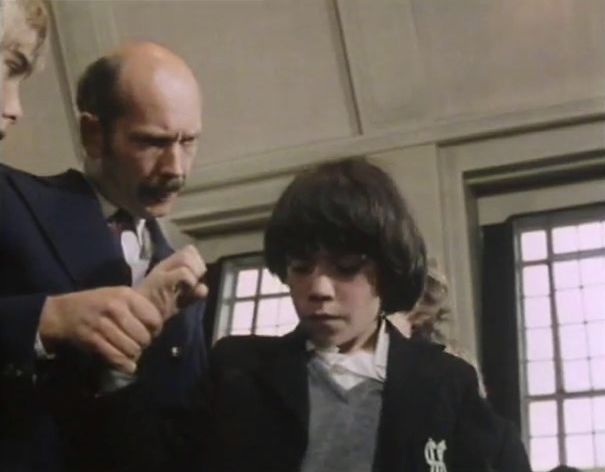
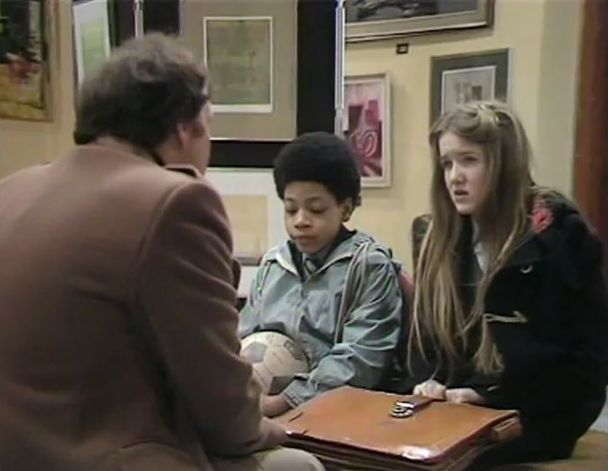
Both Trisha and Benny decide to play truant – but for very different reasons. Benny has been suffering racial taunts at the hands of Doyle and his friends, whilst Trisha continues to clash with the teachers over her use of jewellery and nail varnish (both of which are strictly forbidden).  Mr Mitchell sets out to find them, which he does, and once again demonstrates that he’s the rare sort of teacher – the listening kind.

The chronology of this episode seems a little odd, since Benny’s back wearing casual clothes (which is one of the excuses Doyle uses to bully him). A few episodes ago we’d seen him kitted out in a new school uniform, so it’s a mystery what’s become of it.

The other taunts, about the colour of his skin, seem to be hard for him to take and its the reason why he skips school. Compared to Gripper’s reign of terror in series six it’s mild stuff, but it’s still noteworthy for the series to have tackled this topic so early on.

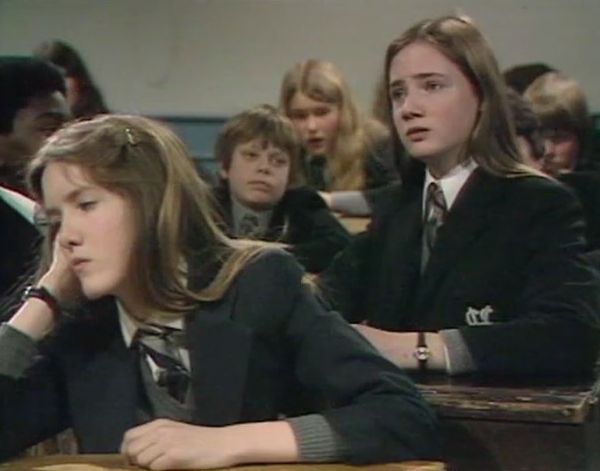
Trisha’s attitude is the one she’ll carry with her for the rest of her time at Grange Hill. She simply doesn’t understand why other people have the right to tell her what to wear. When school uniform is later made optional it’s something that obviously pleases her, but she’ll still find plenty of other things to complain about!

Trisha and Benny both run into each other (literally) whilst they’re truanting. This is the scene that has Trisha’s infamous line to Benny where she tells him that he “can’t help being a nig-nog.” It’s meant ironically (he answers back that she can’t help being a honky) but it’s one of those moments that would be almost certain to be snipped out now if the episode was repeated. Which is a shame, as it works in the context of the story.

It seems that nobody really believed Grange Hill would be a particular success, so the positive ratings and feedback (tempered with the negative feedback from some press and parents) seemed to have come as a surprise. A second series, with double the amount of episodes, was commissioned and from series two onwards the show would begin to develop a greater level of complexity (especially with interweaving plot-threads).

Grange Hill. Series One – Episode Eight

grange hill s01e08

Written by Phil Redmond. Tx 29th March 1978

After Doyle steals an antique flintlock pistol, loaned to the school for the upcoming festival, the boys and girls team up to recover it.

Tucker’s convinced that Doyle took it – but he has no evidence. Trisha overhears him confronting Doyle and decides to take action herself. The relationship between Tucker and Trisha is always a joy – particularly in this episode when they call an uneasy truce in order to find the pistol. But some of the girls aren’t necessarily convinced that Tucker’s telling the truth (Ann reminds him that he once claimed that the Headmaster had a wooden leg!). However, Trisha does believe him (as she doesn’t trust Doyle – she thinks his eyes are too close together).

Various ways are mooted by the boys and girls about how they can prise the truth out of Doyle. Sending him to Coventry is one idea, whilst Tucker naturally favours beating the truth out of him. Surprisingly, the goody-goody Ann Wilson doesn’t consider this to be a totally bad idea either. And it’s the highly sensible Ann who eventually saves the day – by suggesting that the pistol could be returned anonymously.

Plot-wise, this one is fairly thin, but it’s the performances, especially Todd Carty’s spot-on comic timing, which make it so memorable.

Grange Hill. Series One – Episode Seven

grange hill s01e07

Written by Phil Redmond. Tx 22nd March 1978

Perhaps the most significant part of this episode concerns Michael Doyle’s (Vincent Hall) transfer to Mr Mitchell’s class. It’s spelled out very early on that Doyle is bad news (he and his friends were bullying other pupils so it’s been decided to split them up).

Over the next few series he’ll lock horns with Tucker time and again, but in this episode he’s more concerned with Ann Wilson, who’s running for election to the school council. First though, she has to win the vote from her form (which she does, beating Tucker into second place).

It’s a shame that Lucinda Duckett didn’t return for series two, but it’s clear to see that her character (serious, hard-working) was simply re-created several times – firstly with Penny Lewis and then later with Pamela Cartwright. It’s quite possible to imagine Ann Wilson doing everything that Penny Lewis later did – clashing with Doyle, writing endless articles for the school magazine, etc.

Her path to election success isn’t straightforward though, as Michael Doyle uses all the tricks in the book (including intimidation) to ensure that his preferred candidate wins. But after a last minute adjustment to the voting (which I’m not sure was strictly legal) Ann is declared the winner.

This episode sees the first of three appearances by Carole Nimmons as Miss Mather. Nimmons has had a long and successful career, which includes the rather good series Bird of Prey, starring Richard Griffiths.

Grange Hill. Series One – Episode Six

grange hill s01e06

Written by Phil Redmond. Tx 15th March 1978

Tucker’s still very much a loose cannon. His latest trick is seeing how often he can throw his woodwork chisel into a piece of wood – which is rather dangerous to say the least. The fact that the teacher remains oblivious to this no doubt would have upset those watching at home who already found him and some of the other pupils to be less than ideal role models.

His next wheeze is to persuade Benny to explore an abandoned building which he claims is an ammo dump. Rather unexpectedly, Justin asks to join them. Tucker’s reluctant (since the incident at the swimming pool) but Benny is happy for him to come along, so Tucker eventually agrees.

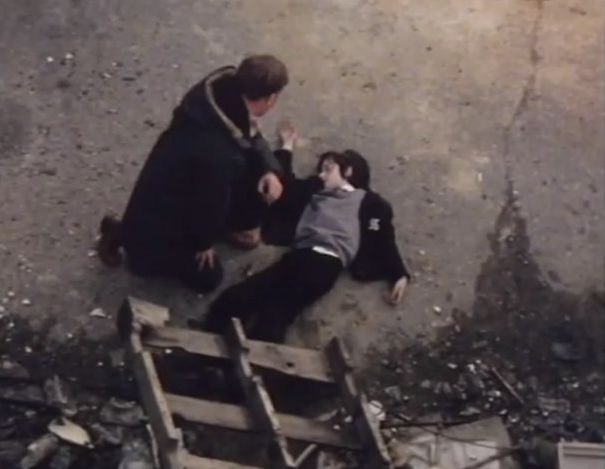
The abandoned building offers plenty of scope for unusual camera angles and tension is ramped up by mysterious noises (which turn out to be a cat!) But the abandoned building isn’t quite as abandoned as it seems – two workman turn up. As the three boys attempt to escape, Justin loses his footing and falls.

At first glance, it looks as if he might be dead. But it would have been a daring move (and probably a step too far) to kill off a pupil so early in the run. Although at the time the first series was made it was far from certain that a second would go into production, so you could argue that they had nothing to lose.

But after the fall-out that occurred over the swimming pool incident, they were probably wise to ensure that Justin only suffered broken bones and concussion. We’d have to wait a little longer before the series started killing off its pupils.

Mrs Jenkins and Mrs Green are called to the school and it’s refreshing that neither find fault with the school – they both put the blame onto their children (whilst also accepting that they have to shoulder responsibilty as well). After some deliberation it’s decided that only corporal punishment will fit the bill – and this is enough to finally wipe the smile off Tucker’s face (although, brave to the end, he does insist that he can take more punishment than Benny!)

Grange Hill. Series One – Episode Five

grange hill s01e05

Written by Phil Redmond. Tx 8th March 1978

This is a rather nice episode, played mainly for laughs, which centres on Trisha and her well-intentioned efforts to help Mr Rankin (Blake Butler). Mr Rankin teaches biology and Trisha has recently taken to helping him tidy his lab in the lunch-breaks. Her sister teases her that it’s because she has a crush on him – something Trisha vehemently denies.

When Judy pops in, Trisha grandly tells him that she’s Mr Rankin’s assistant. Judy asks if she can hold the hamster and Trisha, against her better judgement, agrees. Naturally, the animal escapes and then the problems really begin.

In trying to find it, they overturn a bookcase, before Judy hits on the bright idea of buying another hamster at the local pet shop to replace it. There then follows a race-against-time, which doesn’t work out quite as intended (Judy is distracted when buying the animal and doesn’t notice that the one chosen by the assistant is a different colour!)

It’s all for nothing anyway, since when Mr Rankin returns he spots the original hamster on the floor. But he’s inclined not to punish them, since they did make an effort to rectify the problem. Trisha’s in trouble anyway though, thanks to a run-in with another teacher, Miss Clarke (Jill Dixon). She objects to Trisha wearing jewellery in the lunch-time, which irritates the girl no end.

This moment marks the beginning of Trisha’s battles against authority.  Any time she feels her basic freedoms are being eroded she’s not backwards in expressing herself ….

Grange Hill. Series One – Episode Four

grange hill s01e04

Written by Phil Redmond.  Tx 1st March 1978

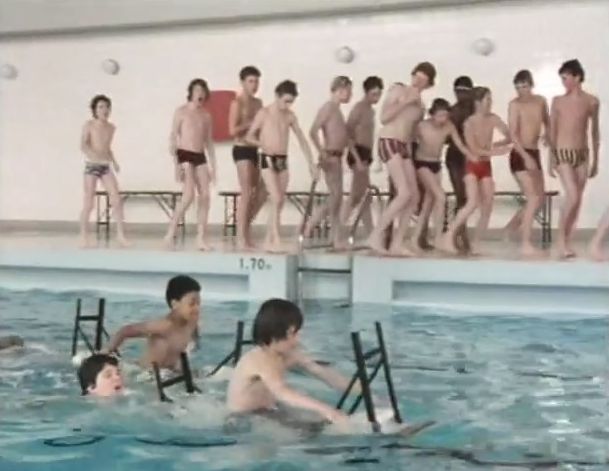
Episode four was the first (but certainly not the last) time that Grange Hill found itself courting controversy. This centered around the unsupervised swimming lesson which saw Tucker and his friends running amok in the pool.

Given that there were two teachers, Mr Mitchell and Mr Malcolm (Christopher Coll) on duty, it does feel slightly contrived that both of them were absent. The reason why one of them had to leave (a boy injured his foot) is reasonable enough, but when he only suffered a fairly small cut, did they really both have to carry him away?

Tucker, Benny and Alan decide to throw some of the benches into the pool and have a race – whilst being cheered on by the other boys. The only one who doesn’t join in is Justin (who’s no doubt still smarting from the fact that Tucker stole his trousers during their previous swimming lesson). He runs off to find the caretaker and when Mr Malcolm returns he has his own way of dealing with the miscreants.

His punishment (a ban from swimming for three weeks and a detention) does seem incredibly lenient though – anything could have happened in his absence and it’s remarkable that there’s no further action taken. Perhaps this is because Mr Malcolm is well aware that he and Mr Mitchell were at fault and considers it to be best to leave things as they are.

Tucker would later turn into something of a loveable rogue, but he’s simply a rogue here. His wild behaviour would continue in episode six, but the events there seem to finally bring him more into line.

Grange Hill. Series One – Episode Three

grange hill s01e03

Written by Phil Redmond.  Tx 22nd February 1978

Judy Preston is still deeply unhappy at Grange Hill, bemoaning the fact that nobody ever speaks to her. Although, as her mother points out, she probably needs to put a little more effort into trying to make friends. But the next day it seems as if the first tentative steps towards a friendship are established after Trisha rescues her from the boisterous attentions of Tucker and Benny.

Tucker isn’t best pleased to find himself bested by a girl and offers her a knuckle sandwich – before belatedly remembering that he doesn’t hit girls. Always a charmer, the young Peter Jenkins!

But Trisha isn’t around when Judy finds herself facing the unwelcome attentions of three fifth-form girls, led by the spiteful Jackie Heron (Miriam Mann). All three clearly have a great deal of experience in bullying those younger than themselves and there’s something quite disturbing about these scenes.

Possibly it’s because we’ve seen how isolated and friendless Judy is, so we know that she’ll be totally unable to put up a fight. After rummaging through Judy’s possessions, Jackie spots a rather nice pen. Judy pleads with her not to take it, as it was a present from her late Grandfather. Jackie tells her that she can have it back – if the price is right.

Later, Trisha becomes aware of what’s happened and instantly decides to help. This gives us an early insight into Trisha’s character – she’s always keen to help the underdog and never seems to realise when she’s outnumbered. In this case, two first-years facing off against three fifth-years is clearly an unequal battle, but the prospect of defeat never seems to have entered Trisha’s head.

In the end, Trisha’s sister Carol (Julia Gale) saves the day. Like Jackie, she’s a fifth-former and is able to confront her on equal terms and so forces her to give back the pen. This episode has a clear message at the end as Carol tells the two girls that “people like Jackie Heron never pick on someone who’s able to stand up to them. So if you can’t do it, the answer’s simple – get someone who can. Look, if anything like this happens again, tell someone.”

Short of Carol looking directly down the camera and adding that that goes for everybody else watching at home too, the moral couldn’t have been more clearly stated.

Grange Hill. Series One – Episode Two

grange hill s01e02

Written by Phil Redmond. Tx 15th February 1978

Mr Foster is something of a monster. There’s a slight resemblance between him and Mr Baxter (who is introduced in series two) but whilst Mr Baxter could be hard and uncompromising, he also had a kindly side. There’s no kind side to Foster (the amount of physical abuse he inflicts on the children is disturbing) . As a games master he’s strict and unrelenting – every pupil must have precisely the correct kit or they don’t take part in the lesson.

This brings him into conflict with Benny, who can’t afford to buy either a school uniform or a games kit. This is a particular problem since Benny wants to take part in the football trials, but without the correct kit Mr Foster won’t let him. His new friend Tucker comes to the rescue though, “borrowing” Justin’s sports top (I do like the way that Tucker never thinks to offer him his own!)

This still leaves the question of football boots. It’s nice that Mr Mitchell brings up the question in class and asks everybody if they have any suggestions since it helps to build a feeling of community. Ann Wilson (Lucinda Duckett) offers him her hockey boots – they’re not quite the same as football boots, but they’re better than nothing.

Eventually we see Mr Foster turn a blind eye to the hockey boots and he allows Benny to take part, but the fact he’s been so obstructive doesn’t reflect well on him. Mr Mitchell’s already told him that Green is a talented footballer and everything we’ve seen so far would suggest he’d be an asset to the school-team. So the fact that Mr Foster would be prepared to deny him a trial because he doesn’t have the right kit is rather petty-minded (you know that Mr Baxter would place ability over clothes any day).

Making brief appearances in this one are Perry Benson (later to become a familiar television face) and Brenda Cavendish as the games mistress. As a fan of Public Eye, it’s always nice to see Brenda Cavendish pop up in any other series.

Grange Hill. Series One – Episode One

grange hill s01e01

Written by Phil Redmond. Tx 8th February 1978

Benny Green (Terry Sue Patt) has the honour of being the first pupil we see entering the grounds of Grange Hill. Quite why he’s so early isn’t explained here – but it’s obvious from his opening scene that he lives for football. He’s also black and poor – both of which were considerable disadvantages in late seventies Britain – but he’s always a positive character and never spends his time complaining about what he doesn’t have.

This opener is quite effective in demonstrating how intimidating a comprehensive school could be on your first day and the key part of the episode is the way that the various pupils react. Tucker (Todd Carty) and Alan (George Armstrong) take it in their stride whilst Judy (Abigail Brown) and Justin (Robert Morgan) view the place with barely disguised horror. Both are isolated, since all of their old friends have gone to different schools. Trisha (Michelle Herbert) on the other hand, seems to regard the new school with complete disinterest.

Most are placed under the care of Mr Mitchell (Michael Percival). As their form tutor, Mr Mitchell will be a key figure in guiding them through the school year and it’s clear from the outset that he’s both funny and compassionate.

On the other end of the scale is Mr Foster (Roger Sloman) who we’ll see more of in episode two. He lacks all of Mr Mitchell’s redeeming qualities and his early run-in with Tucker makes this quite clear. It’s somewhat staggering to learn that Sloman was only thirty two at the time this was made, as he looks a good ten or fifteen years older. It certainly bears out the truth that some people aged quicker back in the old days!

What will become something of a GH cliché gets its first outing here – a noticeboard with an arrow pointing the way to the assembly hall (which handily can be turned the opposite way to fox a green newcomer!).  Ann (Lucinda Duckett), who overslept, is the first pupil to fall foul of this trick as several mean older girls, led by Jackie Heron (Mariam Mann), delight in sending her the wrong way.  Even as a child it never struck me as credible that the arrow would be a moveable one (why not just chalk it on the board?) but no matter, it’s certainly a memorable moment.

It was a nice touch that the final episode of the final series, broadcast in 2008, ended with yet another changed arrow gag.  The more things change …..

Although it might seem surprising that not all of the pupils are working class (the likes of Tucker, Alan, Benny and Trisha are firmly working class whilst Ann, Judy and Justin are resolutely middle class) this was an intentional move on the part of Phil Redmond.  One of the themes he wanted to explore was the way that Comprehensive Schools took in a range of pupils of mixed abilities and backgrounds – as opposed to the grammar/secondary modern split which had existed before.  It also helps to set up the possibilities of conflicts based on class, which would always be a fruitful avenue to explore.

Like a number of episodes from the early years, most of this one was shot on film and on location at an actual school.  Although single-camera filming would have been more expensive and slower than multi-camera videotaping in the studio there were obvious advantages – both aesthetic and financial.  The gloomy vistas of a real school (endless corridors seemingly stretching to infinity) are more effective at creating a sense of space and isolation than studio sets would have been.  Shooting on location also meant that substantial constructions (like the school assembly hall) didn’t have to be mounted in the studio, which made financial sense.

Colin Cant’s direction, demonstrated with the screencap above, sometimes liked to favour low angle shots.  It’s an obvious but effective trick – since the camera is positioned around Tucker’s eyeline, it makes Mr Foster seem more imposing than he otherwise would be.

By the end of the episode we’ve seen Tucker and Trisha clash for the first time and everything now seems to have settled down a little. The mystery of Alan’s surname (given as Turner in the episode, Hargreaves on the end credits and later to be changed again to Humphries) is a mystery that’s never been explained (at least not to me).

Target – Big Elephant

big elephant

Hackett and his colleagues have been keeping Ceti (Walter Randall) under close observation as the word is that half a million pounds worth of heroin will shortly be delivered to him by a sailor called Pink (Alan Rebbeck).  As soon as Pink is spotted entering the house the team pile in – but they find nothing.

Pink knew that he was under observation, so he passed the drugs over to Sharkey (Ken Hutchinson) for him to deliver.  But the police got there first and Sharkey beats a hasty retreat.  So he’s at loose in the city – with a fortune in drugs and both sides of the law tracking his every move.

The second of Douglas Camfield’s two Target episodes, Big Elephant was written by Bob Baker and Dave Martin (two more familiar faces from Doctor Who).  It’s grim stuff – especially when depicting the squalid reality of drug dependance.  This is highlighted by Joanne (Katy Manning) – a hopeless addict.  Best known for Doctor Who, this is obviously a major change of pace for her but Manning is convincing as a woman who can’t think any further ahead than her next fix.  Increasingly twitchy, pallid and hysterical as the episode wears on, it’s a memorable performance.

Sharkey is such a loose cannon (the pre-credits sequence see him “borrowing” a fork-lift truck and taking it for a ride along the docks, before getting nabbed by the police) it’s impossible to believe anybody would entrust him with such a package.  It’s also slightly odd that as Pink knew he was under observation he didn’t change the drop-off point for the drugs.

Ken Hutchinson starts the story as a stereotypical drunken Scot, but gradually more of a character emerges.  Sharkey forms an unlikely relationship with Joanne – they seem to be two lost souls clinging together for comfort.  He wants to help her kick her habit but Hackett tells him that it’s not worth it – she’s a junkie and she’ll never change.  Hackett does later tell him that he’ll arrange treatment, but it’s too late.  She overdoses, leaving a scribbled note on the wall which reads “Dear god I’m only little, love Joanne.”

There’s plenty of action in Big Elephant.  The initial raid on Ceti’s house is played at a frantic pace and the final confrontation between Hackett and Ceti also packs a punch.  Hackett does finally get his man, but the trail of destruction which has led to Ceti’s arrest means that there’s no real cause for celebration.  This is confirmed by the final shot of the episode which sees Hackett alone and isolated.

Target – Blow Out

blow out

We open with three men attempting to open a safe with an oxyacetylene torch.  The man operating the torch, Rocky (Michael McKevitt) is injured, so the others have to take over.  Harry Skeats (Maurice Roëves) is clearly the leader of the three and he assumes command.

Later, Harry and Rigby (Tom McCabe) drop off Rocky’s body at the hospital, but it’s too late – Rocky’s already dead. Had they not decided to continue with the job then they probably could have saved his life – but these are career criminals, with little or no conscience.

But Rocky’s body is the first solid evidence that Hackett and his team have concerning the wave of robberies which have swept the area. And since this latest robbery netted the villains a cool eighty seven thousand in uncut diamonds, the pressure is on to find the gang.

Roger Marshall’s list of credits is impressive (co-creator of Public Eye, creator of Travelling Man and a skilled writer on numerous series including The Avengers, The Sweeney, Survivors and The Gentle Touch).  This would be his only contribution to Target though, due to his unhappiness with the way it turned out, so much so that he asked for his name to be taken off the credits (the in-house BBC pseudonym David Agnew was used instead).

Douglas Camfield was a highly experienced director who specilised in precisely this sort of material (with episodes of Special Branch, The Sweeney and The Professionals to his credit).  He was able to assemble a cracking cast, featuring impressive turns from Maurice Roëves, Christopher Benjamin, Kenneth Colley and Ron Pember.

Actors who would later make an impression in other series also pop up, such as Geoffrey Leesley (later to be a regular on Bergerac) sporting a very impressive moustache and Sandy Ratcliff (one of the original series regulars on Eastenders).

Given the long-standing disagreement that existed between Camfield and Dudley Simpson (which dated back to an incident at a party in the mid sixties) it comes as no surprise that Simpson didn’t provide the music for this episode.  With no credit on the closing titles, it’s probable that the sparse incidentals were drawn from library cues.

Ex-jailbird Tom Farlow (Ron Pember) is somebody that Hackett attempts to use to infiltrate the gang.  But instead of keeping the meet, Farlow, recently released from prison, has gone to find his wife – who’s left him for another man.  This leads into the most memorable scene of the episode as Farlow methodically fills a large pan full of scalding water and walks upstairs to confront his wife and her lover.

After advising the man to leave, he throws the water over his wife.  Despite the fact that don’t actually see anything (we only hear her screams) it’s still very disturbing.  It’s a good example of how a poweful effect can be created purely in the mind of the viewer.    Tate is far from impressed with the way things have turned out and tells Hackett that “you get a phoney tip-off, she gets a face-full of scalding water. That’s one hell of a day’s work.”

The episode ends with another action-series cliche (Hackett rugby-tackles Harry Skeats into a swimming-pool).

Blow Out isn’t a particularly good example of Hackett’s detective skills as he tends to flounder from one situation to the next (and even though he catches Skeats, the story ends with the news of another robbery.  So the squad seem to be back at square one).

It’s fairly light on action, but Camfield and the excellent cast keeps things moving at a very decent pace.

Target – Shipment

shipment

If Target is remembered today, then it’s usually because of its reputation as a cheap Sweeney knock-off or possibly due to its Doctor Who connection (incoming Doctor Who producer Graham Williams created Target, outgoing Doctor Who producer Phillip Hinchcliffe would become Target’s producer).

The lack of a DVD release or recent screenings (series one aired on BSB in 1990, whilst series two hasn’t been seen since selected repeats back in 1980) have no doubt added to the series’ mystique. It’s not a classic by any means, but there’s plenty to enjoy (although Patrick Mower’s performance is an acquired taste, it must be said).

Mower had starred in the Euston Films revival of Special Branch (generally regarded as a dry-run for The Sweeney) as well as two episodes of The Sweeney itself, so was ideal casting as Det Supt Steve Hackett. Mower is never less than totally unsubtle, rampaging through the series like a bull in a china shop. I can’t decide whether he’s playing it tongue-in-cheek or if he’s being serious – either way you can’t take your eyes off him (although not always for the right reasons).

One of Hackett’s snouts gives him a tip-off that an incoming ship (containing a supply of silver) will be robbed.  Hackett and his men organise a stake-out but no attempt is made. The infuriated Hackett runs back to his car to remonstrate with his snout, only to find him murdered.

It’s a very decent pre-credits hook scene, even if it makes no sense. Who would be stupid enough to kill a police informant when there are so many police nearby?

Naturally, Hackett is out for vengeance and he’s convinced that he knows who’s responsible – Maynard (Jon Laurimore). The quality of actors is one of Target’s main strengths (we also see Bernard Kay as a forensic officer and Jack May as the ship’s Chief Officer in this episode).

Another actor it’s always a pleasure to see is Philip Madoc as Hackett’s boss, Det Chief Supt Tate. Sadly he’s got very little to do, so on the basis of this episode it seems odd to cast an actor as good as Madoc in such an unrewarding role.

It may come as no surprise that the episode ends in a punch up. David Wickes’ direction is suitably muscular (he also co-wrote the episode with Hinchcliffe) and the lessons he must have learnt earlier on The Sweeney are put to good effect here (it’s also not surprising that he directed several episodes of The Professionals the following year).

Given his work on Doctor Who, it seemed an obvious choice for Hinchcliffe to draft in Dudley Simpson to compose the theme tune and incidental music, but it’s a little distracting. Dudley always had a distinctive style, shall we say, so hearing music not dissimilar to his Doctor Who scores on Target is rather disorientating.  It’s also worth pondering how he had the time to work on Doctor Who, Target and shortly afterwards Blakes’ 7 all at the same time. It’s no wonder that occasionally all his music does sound rather similar!

A decent opener, then. Low on subtlety but high on action, with the character of Hackett clearly defined.

Survivors – A Beginning

beginning

There’s yet another crisis at the community.  The seeds that they received in exchange for the petrol turn out to be useless and this disappointment is another blow for Abby and Greg.  The pair of them are clearly finding leadership to be a tiring and thankless task and when Abby learns that Jenny is pregnant it causes her to pause and reassess her own life.

But there’s another problem to deal with before Abby can consider her next move.  A group of new arrivals turn up – they’ve been driven from their own settlement and plan to find another, but ask that they leave one of their party (a sick woman) behind.  The community decides that it’s too risky to take her in, so all the strangers leave.

But when they discover the woman has been left behind anyway, they’re forced to accept her (although Greg and Abby still argue the point).  Afterwards, Abby slips away to be by herself and encounters Jimmy Garland – who’s now back in control at Waterhouse.  It seems inevitable that their destinies are intertwined – but when she returns back to the Grange she also has to deal with some unexpected news ….

A Beginning is a somewhat bitty story, since it concerns itself with tying up some loose ends as well as looking ahead to the second series.  The arrival of the strangers at the start reminds the community about the story told to them by Robert Lawson in the previous episode.  He painted a picture of small communities who were becoming increasingly isolated and insular as they begin to jealously guard themselves against all “outsiders” whether they be friend or foe.

The Grange community are convinced that the only hope of long-term survival is to establish a federation of communities – each one independent, but able to assist the others as and when required (we’ll see how Charles Vaughan attempts to make this dream a reality in the second series).

The arrival of a sick woman is yet another example of how society has changed. Prior to the death, she wouldn’t have been turned away – but now, it’s understandable that Abby, Greg and the others are reluctant to accept her (she could have illnesses that would kill them all).  The irony is that when she recovers she’ll prove to be one of the most important and useful members of the community.

Her name is Ruth Anderson (played here by Annie Irving, although she’d be replaced by Celia Gregory in series two).  She was a medical student and although she never qualified, her knowledge, in a world where only a handful of doctors and nurses have survived, will prove to be invaluable.

She also has other news.  On her travels she met a group of people living on a houseboat.  One of them was Dr Bronson, who Abby met earlier in the series, and another was Abby’s son, Peter.  This provides an unexpected happy ending to the first series, as Abby and Jimmy Garland set out to find Peter.

We’ve already been told of the unlikelihood of people from the same family surviving and even if we accept that, it does seem a remarkable coincidence that out of all the places Ruth could have ended up, she arrives at the place where Peter’s mother is living.  Given the decimated nature of the population, it becomes a little more acceptable, but only a little!

This is the last we’ll see of Abby (although she has returned in the recent Big Finish audios).  We have to assume that she did find Peter and that they, and Jimmy Garland, lived happily ever after.  Although if you favour a more downbeat ending, then Terry Nation’s Survivors novelisation is worth tracking down.

So series one ends on an optimistic note.  But as we’ve seen, any happiness tends to be short-lived and the opening moments of the second series plunge the survivors into another desperate situation.

Survivors – Something of Value

value

Another stranger, Robert Lawson (Matthew Long), pays a visit to the Grange.  He stays the night and leaves the next day, but before he goes he clearly notices the petrol tanker in the courtyard (left by Donnie in the previous episode, Revenge).

Overnight, a heavy storm has totally destroyed all of the community’s stores in the cellar.  This is serious, as without supplies to see them through the next few months they won’t be able to survive.  Everybody agrees to trade the petrol for goods with another local community, Little Barton (the first time they’ve been mentioned).

Greg and Jenny set off in the tanker, but Lawson and his friends are lying in wait.  They want the petrol and are prepared to use any means necessary to get it ….

It’s possibly not a surprise that Something of Value is a Terry Nation script since it’s strong on action and low on philosophy.  Although that might be a slightly back-handed compliment, it’s still a very decent story and exactly the type of tale needed to slot between some of the more talky, self-contained community stories.

One of the more pleasing aspects of this one is that it pitches Jenny right into the middle of the action.  Even in this new world, male chauvinism has been seen to be present and correct – with the girls (especially Jenny) often sidelined.  Given this, it does seem slightly surprising that Greg would elect to take Jenny, rather than Paul, but it’s a chance for her to get out and about (and it’s true that when she’s threatened it does matter to Greg, due to their continuing relationship).

Ian McCulloch’s preference was always for episodes like this, so it would be a safe bet that it ranks amongst his favourites.  Greg’s central to the action and whilst he’s outnumbered he still manages to win through.  It’s not without cost though, as all of their attackers die.  He later wonders if “that what life’s worth nowadays. Fifty gallons of petrol? God help us all.”

Something of Value has a straightforward, brutal narrative that indicates clearly how the death has changed the motivations of some people.  Now that people are prepared to kill for a tanker of petrol, it shows that danger lurks everywhere.  After a few episodes set in and around the Grange, the return to the violent world outside is quite a jolt.  Series two would have a similar vibe as the community stories generally (although not always) have a safe feeling, in contrast to those set in other locations.

Survivors – Revenge

revenge

Vic’s been in a depressed state for a while and this culminates in an apparent suicide attempt (although Greg isn’t convinced – he believes that if somebody wants to shoot themselves then they don’t miss).  But if it wasn’t a genuine attempt, maybe it was a cry for help.

The crippled Vic regards himself as a useless encumbrance, but Greg has a plan which involves stressing how important it is that Vic continues to teach the children everything he knows.  If Vic feels that his teaching is of value then hopefully this will help his shattered self esteem.

But the return of the spoilt Anne threatens Vic’s sanity and stability.  Anne was the woman who left him for dead and he’s vowed his revenge ever since Greg rescued him from the quarry.  Now that fate has thrown the two of them together again, the outcome is far from certain.

Revenge was the third story in Vic’s trilogy (which began with Genesis and continued with Spoil of War).  Given that he’s the key figure in the story, the production was dealt a major blow when Terry Scully was unable to continue in the role (he suffered a nervous breakdown).  A replacement had to be found at the last minute and Hugh Walters managed a very credible job of filling the void.  Vic’s suicide attempt was written in at the start of the episode.  It was a useful device which enabled his face to be scarred and this helped to disguise the change of actor.

Survivors started shooting in the middle of winter, which was of was of benefit to the early episodes as the bleak weather suited the mood of the initial stories.  But by now the survivors are beginning to get organised and the bright sunshine we see here (and in the previous episode) are a subtle reminder of rebirth and renewal.

The opening moments are particularly nice as most of the community set off to make hay.  There’s something rather idyllic about this (although given how we’ve seen most of the characters suffer during the course of the series, you know that any happiness is going to be short lived).  But there is a twist to this apparently innocuous scene – Vic’s inability to help is the trigger which pushes him over the edge.

And the arrival of Anne, along with Donny (Robert Tayman), obviously doesn’t help.  Donny has a tanker of petrol, which the community desperately needs, but how can they offer shelter to Anne after the way she treated Vic?

Hugh Walters gives a cracking performance as Vic. Scully’s take on the episode would have been interesting to see, but Walters is a more than adequate subsistute.  It would have been easy to overdo the melodrama, but Walters is restrained and focussed, managing to express Vic’s constant anger in a very subtle way.  Myra Francis’ Anne is just as objectionable as ever.  She’s also still clearly desperate to hang on to any shred of civilisation she can – even going so far as to wear a fur coat in the middle of summer!

Their eventual meeting is the key to the episode, but it’s wisely held back until the last ten minutes or so.  It gives another chance for Walters to shine as he pours out the story of Anne’s abandonment of him to the whole community (whilst Anne sits there silently).  If he’s expecting contrition or compassion from Anne then he’s sorely mistaken.  She tells him that “I thought you were finished.  If you’d have been a horse or a dog, I’d have shot you.”

One of the problems with series one of Survivors is that a large cast of regulars were added to the second half of the run – this influx meant that many of them remained rather undeveloped.  Vic does get a chance to take centre-stage here, but afterwards he moves into the background again (and then dies off-screen in the series two opener).

Thanks to Hugh Walters and Myra Francis, Revenge is a compelling episode.  The shot of Anne walking away from the community (as the credits play) is a very effective visual way of bringing this part of Vic’s story to a conclusion.

Survivors – The Future Hour

future

The arrival of Laura (Caroline Burt) and Norman (Denis Lawson) spells danger for everybody.  After the death, Laura formed a relationship with a man called Bernard Huxley (Glyn Owen).  Laura, already pregnant, was told by Huxley that she couldn’t keep her baby once it was born.

Laura, by now only days away from giving birth, seeks refuge at the Grange.  Huxley’s not prepared to give her up easily though.  As a trader he appears to view Laura as just another commodity and is clearly willing to use force to reclaim her.

Another Terry Nation script, The Future Hour sees a tense stand-off between Huxley and the Grange community.  And we once again see Abby and Greg lock horns.  Greg insists that Laura leaves (having met Huxley, he’s well aware of how dangerous he could be) whilst Abby won’t turn her out.  Had Carolyn Seymour stayed for series two, it’s interesting to wonder how the Abby/Greg power struggle would have played out.

Is Huxley mad or stupid?  At different times in the story both viewpoints are expressed.  It does seem bizarre that after obtaining a considerable stockpile of every product imaginable (food, hardware, etc) he’s asking for gold as payment.  As Greg incredulously asks, what use is gold?  Huxley, like some others we’ve met, is convinced that eventually society will get back on its feet and therefore the man who holds a decent supply of gold will be in a powerful position.

Nothing we’ve seen so far supports this viewpoint, so it does seem to be a character beat that’s designed to flag up to the viewers that Huxley’s maybe not the most rational of characters.  His pursuit of Laura is odd as well – since they’ve only known each other for a few months, why is he so determined to get her back (including terriorising the Grange community)?  An extra reason for his pursuit is added after it’s revealed that Norman stole two bags of his precious gold.  But once that’s returned, surely he would be wiser to cut his loses?

Shortly after they arrive, Laura and Norman leave, which gives us another tense scene between Abby and Greg.  Greg tells Abby that she made her own mind up (although he admits that he told her about Huxley’s ultimatum).  An incensed Abby slaps Greg (although it’s a bit of a feeble slap).  Paul’s face, as he follows Greg, is a picture!

Laura and Norman don’t make it back to Huxley as she goes into labour en-route.  She’s taken back to the community where she gives birth to a baby girl.  And as befits a Terry Nation script there then follows some action as Huxley and his men step up the attacks and also engage in a brief gun battle.

Tom shoots Huxley dead and is shot dead himself.  Given that he murdered Wendy in the previous episode, Law and Order, it’s possibly not a surprise that he’s killed off here (especially after he’s earned a degree of redemption – Greg’s epitaph for him is that “he’s done worse things”).  Series two would see a similar character (Hubert) introduced, so it’s a pity that Tom couldn’t have been kept on longer – perhaps the thought of having a murderer walk around unpunished wasn’t acceptable?

Apart from Abby and Greg, character development amongst the regulars is quite thin here.  Considering it’s his last episode, Tom has very little to do (which makes his sudden death all the more jarring).  Jenny is also pretty anonymous, fading into the background somewhat.  On the plus side, Paul does have a few nice moments, especially when he’s tied to a tree by Huxley’s men and threatened with death.

Glyn Owen’s very solid as Huxley, which makes up for the fact that the rest of his men are quite faceless.  Overall, it’s a decent yarn, but it’s hard to feel that invested in the fate of either Laura or Norman since neither are particularly interesting or well-drawn characters.

Survivors – Law and Order

law

A number of small niggles are affecting the morale of the community. None of them are particularly important in themselves (Arthur is hoarding supplies and prefers to eat by himself, the pigs escape from their enclosure, destroying the cabbage patch) but added together they help to create a dangerous tension.

Abby realises that they need something to focus on and suggests a party. Everybody reacts enthusiastically and it’s a great success. But there’s a tragic aftermath which throws the community into crisis – the next morning, John and Lizzie discover that Wendy is dead (she’s clearly been the victim of a brutal attack).

Barney had spent some time with her at the party the previous evening, so he becomes the prime suspect, meaning that the others have to act as judge and jury. And when a verdict is decided upon, they have to be the executioner as well.

Barney, of course, was innocent – it was Tom who killed Wendy (his interest in her was established right from their initial meeting). For those who have an issue that Survivors tends be dominated by white middle-class characters, the reveal that the murderer was drawn from working class stock is an obvious problem.

Jenny, Emma and Tom declare that he’s not guilty and Charmain, Paul, Arthur, Vic, Abby and Greg vote that he’s guilty.  The question then turns to what his punishment should be.  Four votes for banishment and four votes for execution – leaving Abby with the deciding vote (after much deliberation she votes for execution).  Out of everybody, Greg is by far the most vehement that Barney should pay the ultimate price – had he not been so insistent, it’s unlikely that the others would have ever taken this step.

The fact that we witness a monstrous miscarriage of justice seems to be very much the point of the episode – especially if we accept that Law and Order is essentially a debate about the value of capital punishment. None of the characters, especially Greg, emerge from the story with a great deal of merit – unlike some series, the regulars are fallible and can’t always be relied on to do the right thing.

Although series one of Survivors had a female lead in Abby, there’s still a whiff of male dominance as only the men draw lots to decide which of them has to kill Barney (it falls to Greg). The bitter irony is that shortly after Greg does the deed, a tearful Tom confesses to Abby that he killed Wendy. Abby shares this information with Greg, but it doesn’t go any further. Abby wants to let the rest of the community know but Greg violently disagrees – and he threatens to challenge her leadership if she tells them. So Abby reluctantly concedes. This power struggle is a key part of the episode. Up until now, Greg has been content to follow Abby’s lead, but the balance between the two of them has now certainly shifted.

Law and Order is an uncomfortable watch, because it’s clear very early on that an innocent man is going to suffer. In a way it harks back to Genesis, where we saw a horrified Abby witness Wormley’s men shooting an unarmed man. Wormley was convinced he was in the right – the man had broken the law (as defined by Wormley) so he had to pay the price. Now that Abby and the others have a community of their own, they have a similar dilemma to face.

The vast influx of new characters over the last few episodes has meant that it’s been difficult to get to know them in the same depth as Abby, Greg and Jenny. So Wendy’s death lacks a certain impact – had she featured for longer then the viewers may have invested in her more. As it is, she remained rather undeveloped and the story tends to concentrate more on Barney’s punishment than her death.

The fact that everybody is keen to believe Barney’s guilt (based on the slenderest of evidence) is disturbing.  An unanswered question is why Tom Price is never considered a possible suspect, since the less savory aspects of his character are well known (and he pestered Jenny at the party, something which isn’t mentioned).  It’s very strange that they don’t make any effort to question everybody – once a suspect has been found, that appears to be good enough.

Talfryn Thomas is once again excellent as the guilt-ridden Tom (who becomes increasingly haunted and haggard as the episode wears on) and the rest of cast rise to the occasion as well.  It’s a self-contained, obviously talky story, but thanks to the stakes it never feels dull or drawn out. Although there were behind the scenes problems (Clive Exton requested that his name be taken off the script and a pseudonym used) they’re not visible on screen and Law and Order is a highlight of the first series.

Survivors – Spoil of War

spoil

Spoil of War adds another four characters to the growing community at the Grange.  At times it does feel like new people are just being added into the mix for the sake of it but some initially unpromising arrivals, such as Arthur, do later turn out to be useful people.

First to arrive is Paul Pitman (Chris Tranchell).  He’s previously lived in a commune and is an expert on self-sufficiency.  He can’t resist telling Greg that he’s doing everything wrong (which obviously doesn’t endear him to Greg, who resents his interference).  Paul is self-aware enough to realise this.  “I know what you’re all thinking. Who’s this long-haired git, coming here, telling us what to do. What does he know about it?”

But it doesn’t alter the fact that he talks a lot of sense, especially about how they need to rotate their crops.  It’s clear that the others, although they’ve started with a great deal of enthusiasm, lack specific knowledge and Paul will be (if they can persuade him to stay) a valuable asset.

At first, it doesn’t seem that the next arrivals, Arthur Russell (Michael Gover) and Chairmian Wentworth (Eileen Helsby), have a great deal to offer.  Neither seem cut out to be survivors – Arthur was a businessman and appears to lack even the most basic of practical skills, whilst Chairmian was his secretary before the death and is content to still tend to his every need.

Whilst Chairmian would remain undeveloped (she would be one of the surplus characters to perish in the fire at the start of series two) Arthur would over time transform into a wise and resourceful man who would remain until late in the second series.

The fourth new recruit is by far the most unlikely.  Greg’s been working on a tractor with little success and this reminds him of the tractor at the quarry, where he met Vic and Anne. In addition to the tractor, the pair had gathered a substantial amount of supplies. He sends Tom and Barney to find out if the supplies are still there – but when they don’t return, Greg and Paul venture out to find out what’s happened to them. When they arrive they’re pinned down by what seems to be several gunmen.

In turns out that Vic’s still alive and has rigged up a number of guns to defend himself.  Initially suspicious, Vic eventually believes Greg when he tells him that he thought he was dead.  Due to his useless legs he’s been unable to leave the portakabin in the quarry, but the plentiful food supplies have kept him alive.  He’s reluctant to leave since he still believes that Anne will return and he wants to extract his revenge on the woman who abandoned him.  Greg is eventually able to persuade him (and you do get the feeling that Anne, like so many other characters, will be irresistibly drawn towards the Grange anyway) so this swells the community even more.

Returning to discover Vic’s fate, who we haven’t seen since episode two, is another sign that Survivors has a strong serial element – which is something that rewards regular viewers.  Also, Chris Tranchell as Paul is a strong addition to the series and it’s a pity that his unhappiness with the scripts ensured that he left early in series two.

As with the next story, this was written by Clive Exton (under the pseudonym M.K. Jeeves).  The use of a pseudonym indicates that Exton was unhappy with the way his work reached the screen, but there’s nothing obvious to indicate why.  Spoil of War is another solid character-led episode that may not be too significant in itself, but does lay the ground for events later on.

Survivors – Starvation

starvation

Starvation opens with two women, Wendy (Julie Neubert) and Emma (Hana-Maria Pravda), facing starvation.  They live in a fairly isolated spot in the country and have eaten all the food in the few other houses nearby.  Wendy suggests that she goes into the nearest town, but Emma dissuades her.  Wendy might be young, but she’s no longer strong (due to malnutrition) and the town is probably rife with diseases.

Because Emma is an old woman and unable to actively find food herself, she’s happy for Wendy to go out foraging.  Wendy does find something to eat, but it’s in the hands of Tom Price, who’s keen to share – but only on his terms ….

Although Starvation is a decent character piece, which introduces us to three new survivors (Wendy, Emma and later on, Barney) it does feel rather contrived in places.  Given that Wendy and Emma live in the country it’s impossible to believe that there’s no fruit to be found or any fish in the river.  As for the latter, we later learn there’s plenty of fish, as Wendy comes across Tom who’s caught some, so it’s odd that neither of the women seem to consider this possibility.  Instead, they’ve been living on nettle soup and the like, whilst all the time slowly growing weaker from a lack of solid nourishment.

It’s been a while since we’ve seen Tom Price and he’s grown grimier and hairier.  When he spots Wendy he’s instantly and obviously attracted and tells her that he’s a merchant who gets people what they want and in return they give him what he wants.  Exactly what he gets isn’t spelled out, although it’s not exactly difficult to guess what he means.  Especially when he tells Wendy that he’s a rich man who could treat her like a princess (“you’re a pretty little girl”).

Thanks to his prominent teeth and his strong Welsh accent (which he could make even broader when the part demanded it) Talfryn Thomas could never be described as a subtle actor.  But his broadness (in contrast to the dialed-down performances of virtually everybody else in Survivors) works well – as he can be sinister or amusing, subversive or supportive (whilst the others have more settled, straightforward personas).

Naturally, Wendy declines his charms in favour of the charms of the fish and runs off with his food.  As he pursues her, Abby, Greg and Jenny spot Emma being attacked by a pack of wild dogs.  A few minutes earlier the dogs had surrounded their van before they all ran off together to harass Emma.  Why did they do this?  In story terms it’s obvious, but it’s another part of the plot which doesn’t really make a great deal of sense.

Abby frightens the dogs away and looks after Emma whilst Greg and Jenny draw them off in the van.  There then follows another plot contrivance – after they appear to have shaken the dogs off, why doesn’t Greg just reverse back to Hannah’s cottage?  Instead, he tries to find another route and on the way discovers a substantial manor house.  Greg, Jenny, John and Lizzie are then trapped because the wild dogs have returned and once again surround the van.  I’m assuming that the van has run out of petrol, otherwise surely they could have driven away and lost them?  Of course, Greg and Jenny need to be removed from the middle part of the episode so that Abby can meet Emma and then re-encounter Tom by herself, but it’s another awkward part of the story.

Having decided to settle down and find a permanent place to live, the place they’ve found, The Grange seems ideal as it has a substantial amount of fuel, acres of land for growing crops and even some sheep.

There’s a lovely two-handed scene with Carolyn Seymour and Hana Maria Pravda.  Emma Cohen couldn’t be further removed from the likes of Jimmy Garland.  Garland relishes the prospect of living in this new world whilst Emma wishes she was dead (and therefore with the rest of her family).  Emma’s a prime example of somebody who needs other people in order to survive and it’s no surprise that she and Wendy will join the others at the Grange.

On the commentary track for The Fourth Horsemen episode on the DD Video release of series one, Carolyn Seymour commented that she never really knew or understood Talfryn Thomas, which is understandable since they’re very different actors.  This gives their scenes in this story an extra frisson (in addition to the fact they’re quite amusing, a rarity in Survivors, which was obviously never the most light-hearted of programmes).

In pursuit of Wendy, Tom discovers Abby and Emma.  He manages to take Abby’s rifle, so he holds the upper hand.  He then tells her that he’s a merchant who can provide things for people, provided they do things for him.  Abby calls his bluff and seems quite keen for such an arrangement – leaving Tom half eager and half afraid, maybe because (rightly as it turns out) he fears that Abby’s going to trick him!

The contrast between Abby’s cut-glass accent and attitude and the grimy Tom (who doesn’t look like he’s had a wash for months) is what makes this rather entertaining.  In the end all becomes clear – Tom goes off to his van to get some food and the previously unseen Wendy locks him in.  But even when we can’t see him and can only hear his voice (alternatively threatening and pleading) Talfryn Thomas is still the centre of attention.

Plot-wise, this is a fairly thin episode and the various logical flaws are a slight irritation, but it works well as a way of introducing the new characters into the series.  Later, the others encounter Barney (John Hallet).  He’s a well-built man, but has a simple, trusting nature.  It’s no surprise that Tom latches onto him, as he obviously realises he’s the one person that he can dominate.

Everybody seems happy with the Grange as a base, so the survivors set out to explore their new home and work out a plan to make the best use of the land.  But the arrival of a stranger in the next episode shows them that they’ve still plenty to learn.
Village Hall – Mr Ellis Versus the People

R.I.P. Ron Moody (1924 – 2015)

archivetvmusings's avatarArchive Television Musings

jack

For visitors to the blog from outside the UK, today is General Election day.  Of course, those from the UK will hardly need reminding of this as it’s been a constant topic of conversation in the media for some time.  And should no party gain a majority tomorrow, no doubt the conversation will go on!  But since I’ve made my trip to the polling station and cast a vote, it seems apt to dig out this episode of Village Hall, written by the late, great Jack Rosenthal.

The Village Hall has been turned into a polling station and present are three very different people.  First there’s presiding officer, Mr Ellis (Ron Moody).  Mr Ellis is a veteran of every election since 1945 and there’s nothing that could possibly happen which would surprise him.  He’s assisted by the eager young Mr Martin (Brian Miller) and the equally young and eager Miss Robinson…

View original post 451 more words