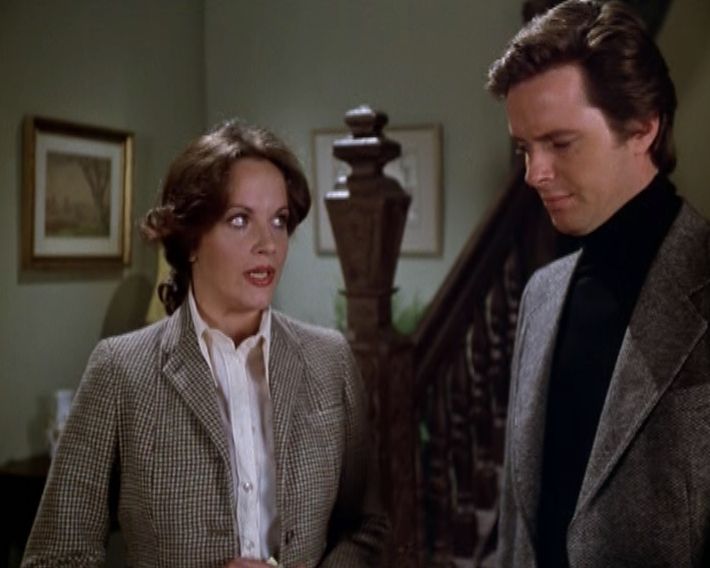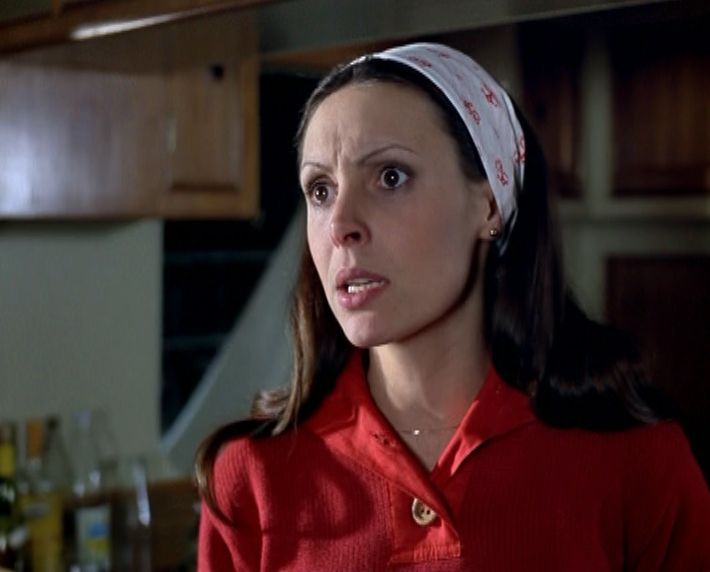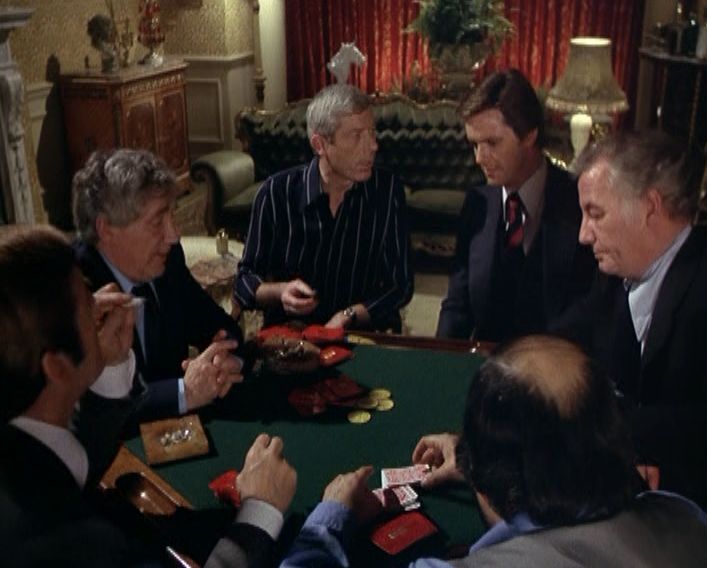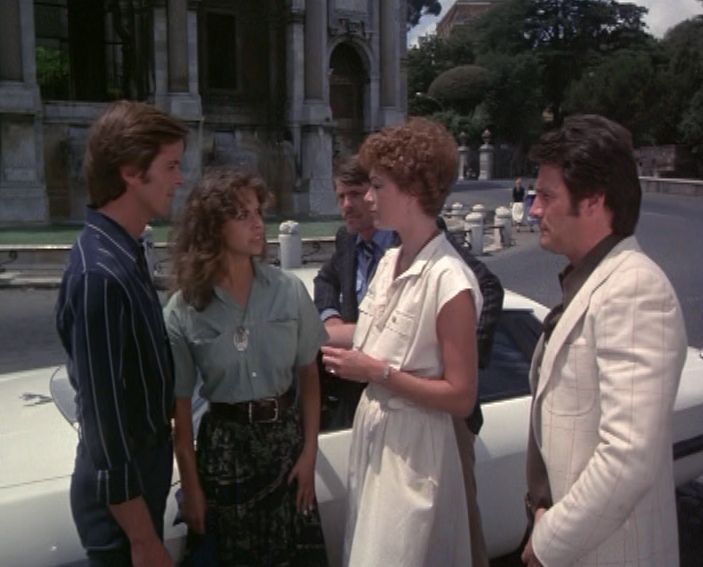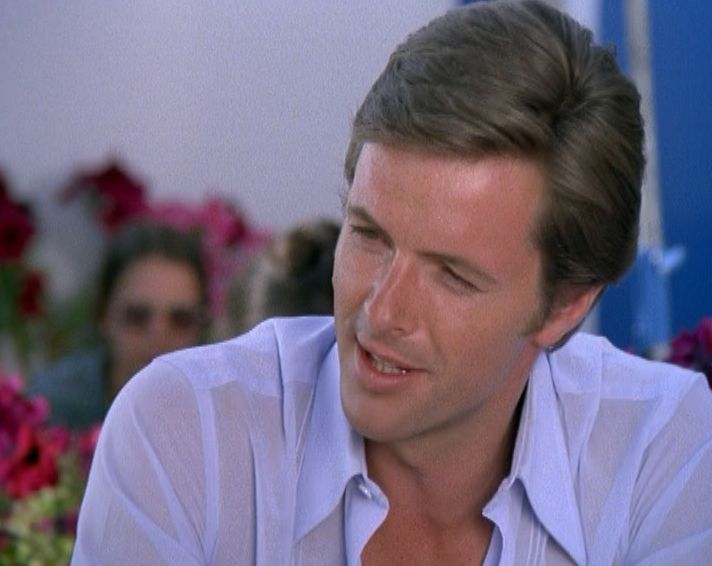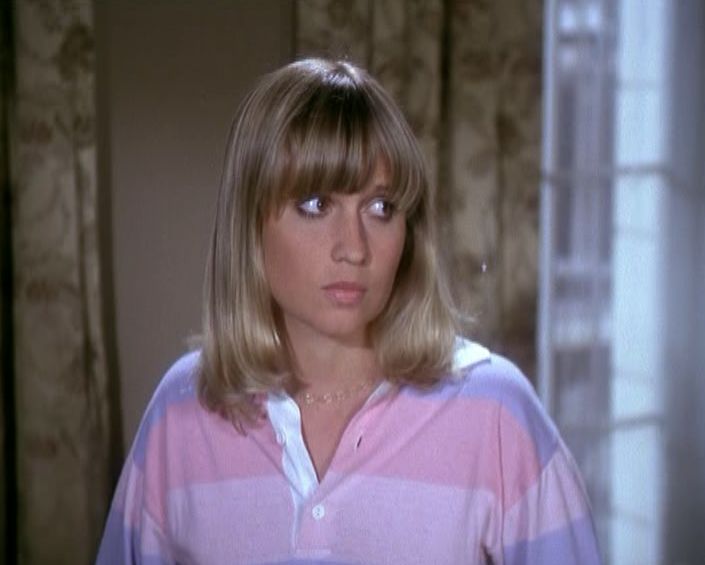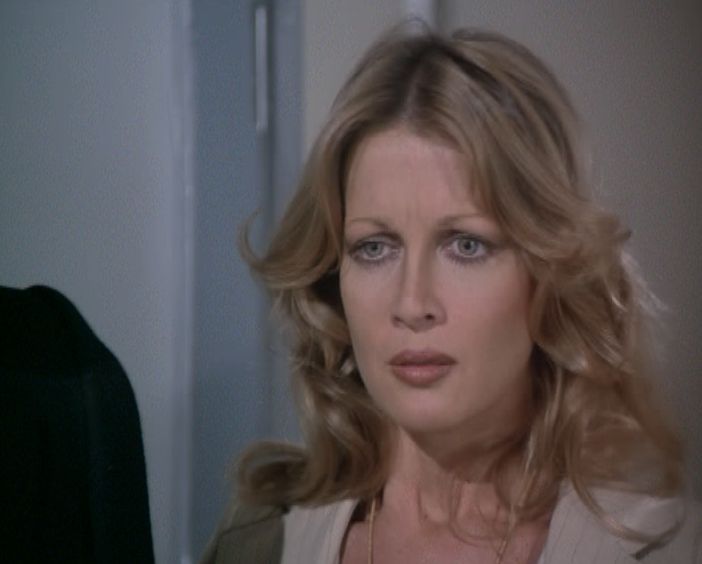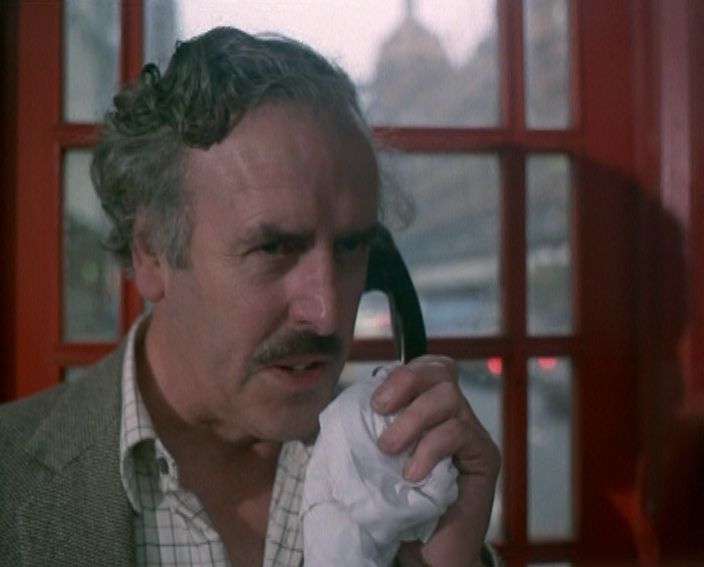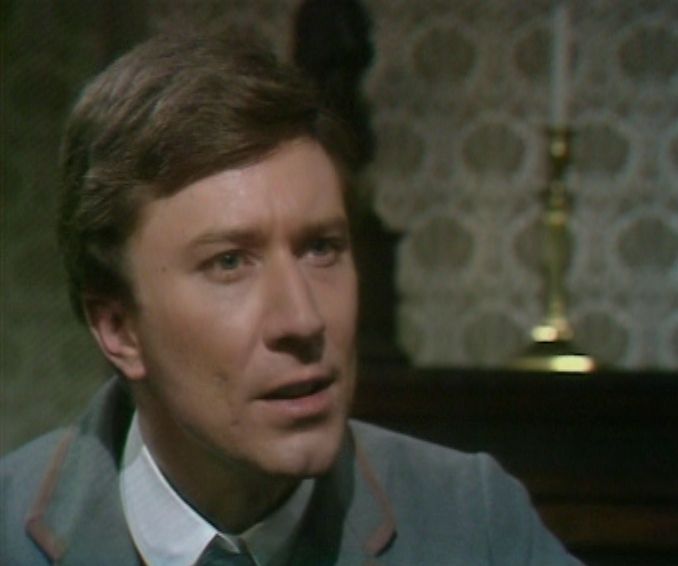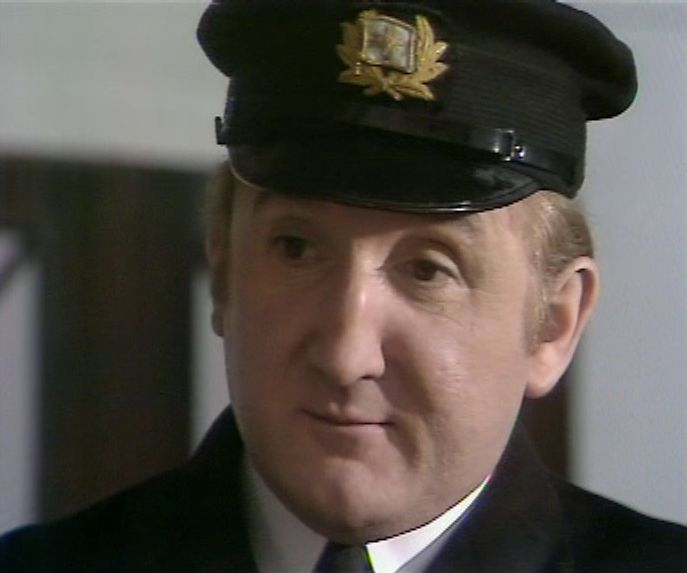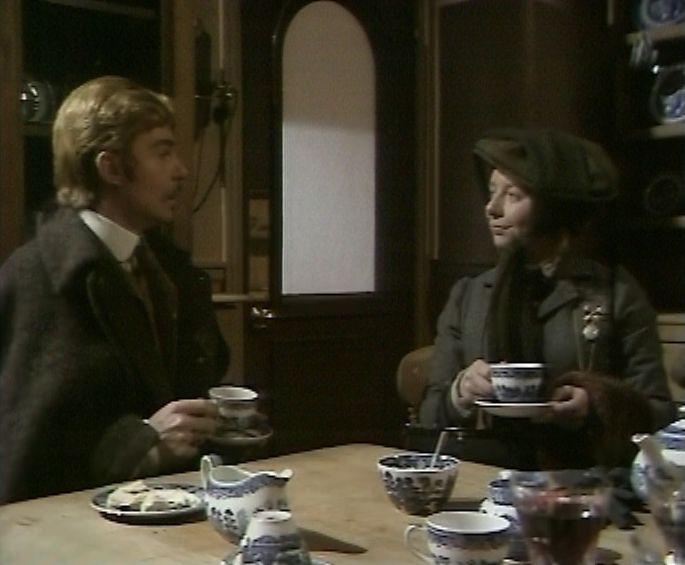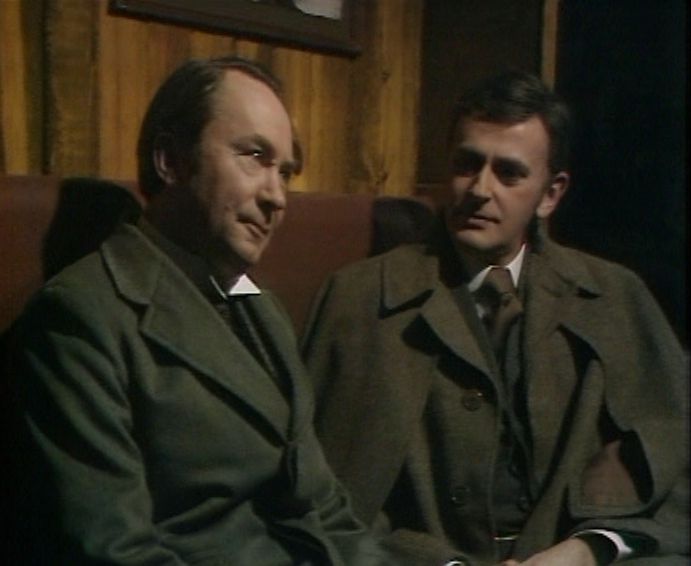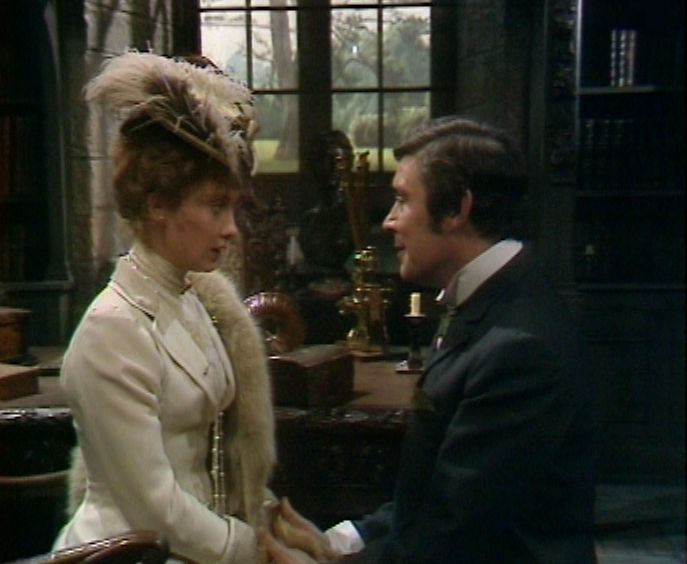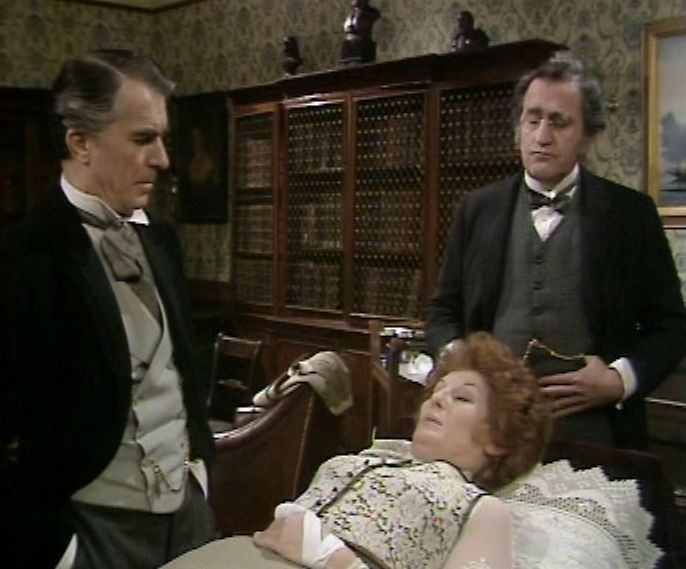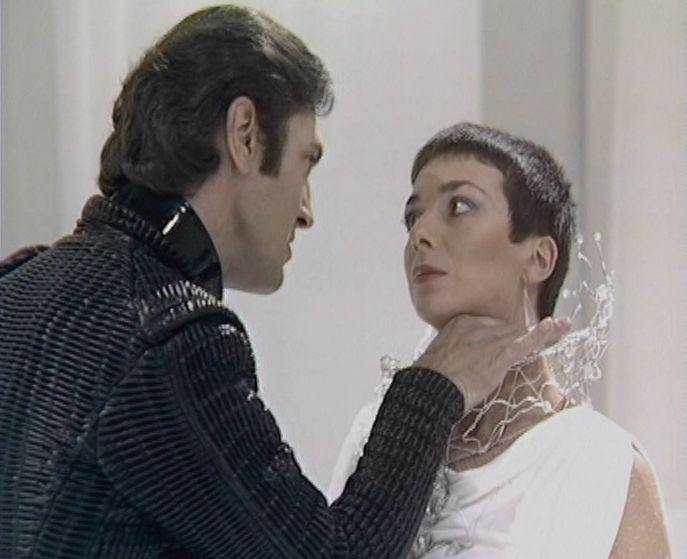
Blakes 7 – Weapon

weapon 01

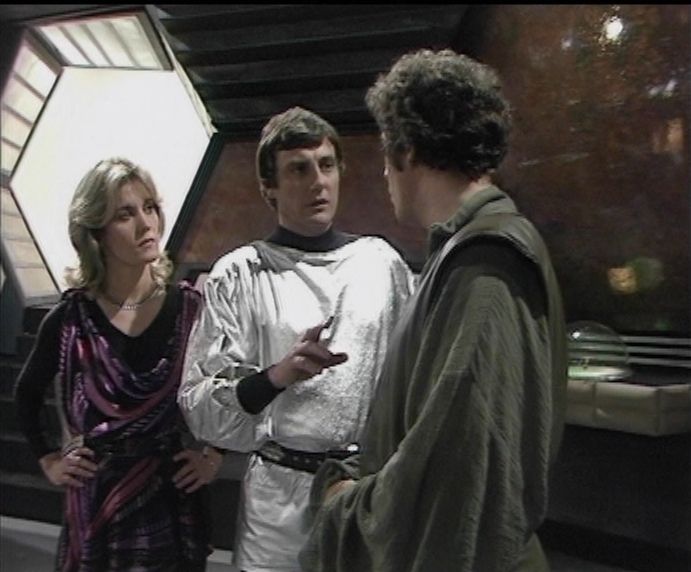
Weapon gives us our first opportunity to see Travis Mk 2 (Brian Croucher) in action.  And he’s angry, very very angry.

One of the main character flaws with Travis is that he exists for one purpose only – to kill Blake.  And when, week after week, this doesn’t happen he can’t help but become something of a figure of fun (or contempt).  But it’s not only Blake and his friends who hold him in contempt, in this episode it’s clear that Servalan loathes him as well.

As we go through series two there will be the odd highlight (Trial) as well as plenty of lowlights (Voice from the Past is easily the most bonkers use of him).  Given that he became something of a marginalised character almost immediately,  it’s no surprise that Stephen Greif decided to bail after series one.  This leaves Brian Croucher with an almost impossible task.

Croucher has made no secret of the fact that his time on Blakes 7 wasn’t terribly happy – he’s singled out director George Spenton-Foster as someone he had serious problems with.  And since Spenton-Foster directed this episode it looks obvious that the problems start here.

From the first scene Travis is struggling with barely suppressed rage.  It’s a totally different acting choice from Greif, who had much more of an ironic detachment, and it doesn’t really work (it’s easy to imagine Greif saying the same lines, but in a very restrained way).  If Spenton-Foster wasn’t giving Croucher adequate direction then it’s probable that he just went his own way – resulting in a performance where Travis is little more than a thug.  He’ll tone things down as we move through the series, but it’s not an auspicious start.

His first scene is quite arresting though – as he kills Blake!  Or at least, someone who looks remarkably like him (is this a nod to the pre-credits sequence of From Russia with Love?).  Travis has, of course, just killed a clone of Blake – but one that’s identical to his arch-enemy in every physical way.

Clonemaster Fen (Kathleen Byron) is clearly a being of awesome power – we can tell this because Dudley Simpson goes overboard on the organ and there’s a great deal of dry ice floating about.  I do always worry when she’s walking rather gingerly down the stairs though, one false move and she could have had a nasty accident.
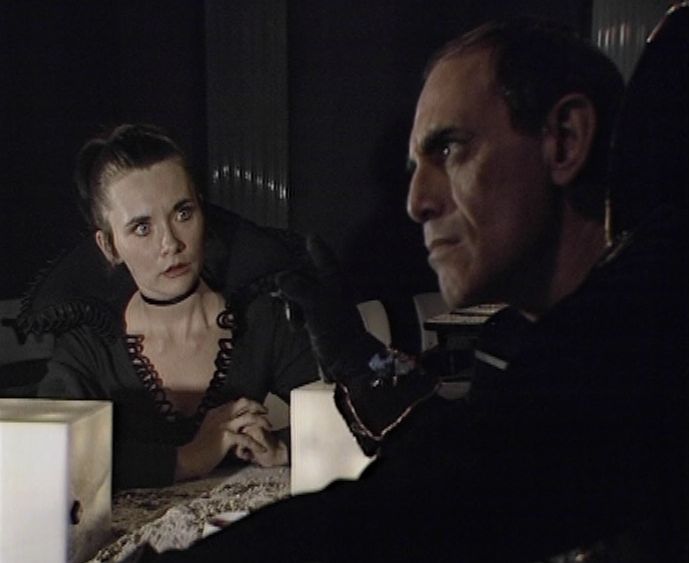
weapon 02

In Project Avalon we saw it was possible to create a perfect android replica of someone (something that’s never done again after that episode).  In Weapon we see that it’s possible to create a perfect clone of someone (something that’s never done again after this episode).  I sense a pattern emerging here.  Given how incredibly useful both android duplicates and clones could be, it’s remarkable that once they’ve served their purpose in their respective stories they never crop up again.

Although the Blake clone will be an important figure in a great deal of post Blake fan fiction ……

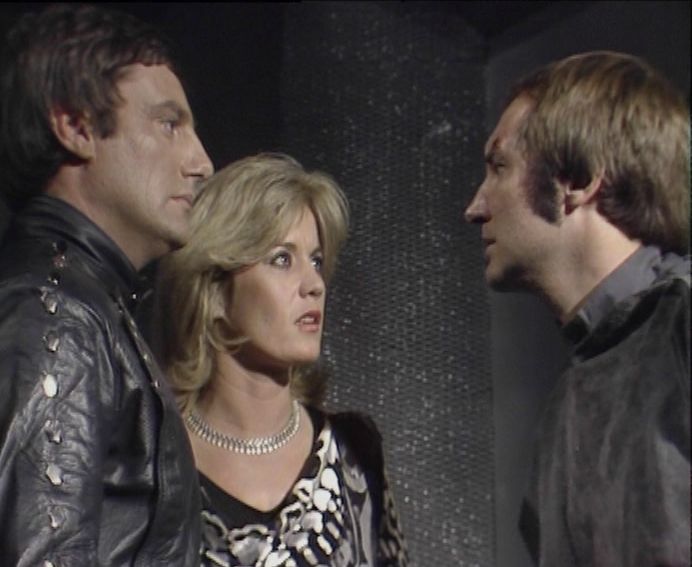
I like the idea that Servalan commissions two clones of Blake, since she knows that Travis will be unable to resist killing one of them.  Their dialogue after this happens is instructive and it clearly indicates the current stage of their relationship (not good).

SERVALAN: Travis, you are pathetic.
TRAVIS: If you say so.
SERVALAN: Of all the cripple-brained idiots.
TRAVIS: Me – or you?
SERVALAN:What did you say?
TRAVIS: You’re angry, Supreme Commander. Surprised by what I did. You devious – you always have been devious. You knew what would happen.
SERVALAN: Take your hand off me.
TRAVIS: You knew if it was Blake I’d kill him. I’d have to kill him.

The clone of Blake is part of a highly complicated plan by Carnell (Scott Fredericks).  Carnell is a psychostrategist (who are unflatteringly nicknamed “puppeteers”) and Servalan appears to have commissioned him to kill two birds with one stone.  Eliminate Blake and his crew as well as acquire IMIPAK (a deadly new weapon).

If you’re not particularly aware of Blakes 7 fan-fiction and spin-off fiction then it might come as a surprise than Carnell (a one-shot character) has had quite an extensive after-life – appearing in numerous fan-fiction stories as well as novels and audios by Chris Boucher (superior fan-fiction you might say).  Most of his appeal has to be down to Scott Fredericks’ twinkling performance – his sparring with Jacqueline Pearce is a highlight of the episode.

The main guest star is John Bennett.  He plays Coser, the inventor of IMIPAK, who’s been manipulated by Carnell to not only have a nervous breakdown but to escape from the Federation’s weapons development faacility with IMIPAK.  Servalan then plans to use the clone of Blake to retrieve this from Coser.

The most obvious question is why go to all that trouble to create a clone of Blake when it doesn’t actually do anything?  Servalan could have simply turned up herself and taken IMIPAK (which is basically what happens – Coser gives it to clone Blake and he hands it over to her).

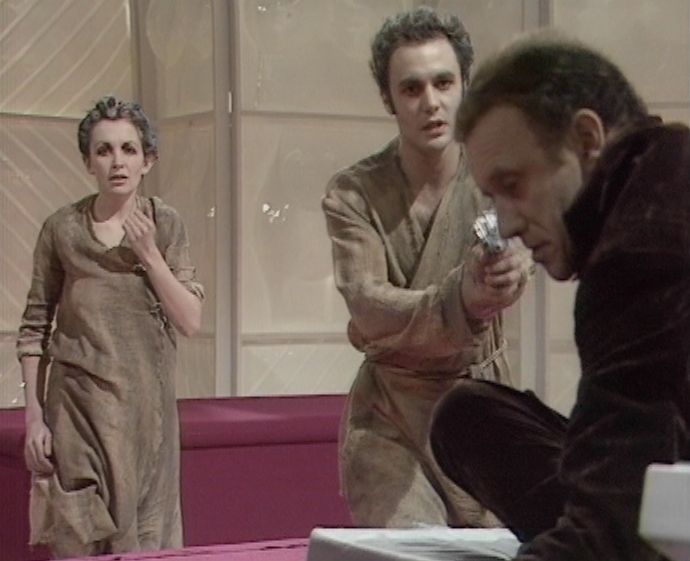
I always had a lot of respect for John Bennett, he was an actor who enlivened many a dull programme.  But he’s got his work cut out here as Coser is such an unlikable sort right from the start – he’s a terrible bully to the lovely Rashel (Candace Glendenning).  And once you see what he’s wearing it’s even harder to take him seriously …..

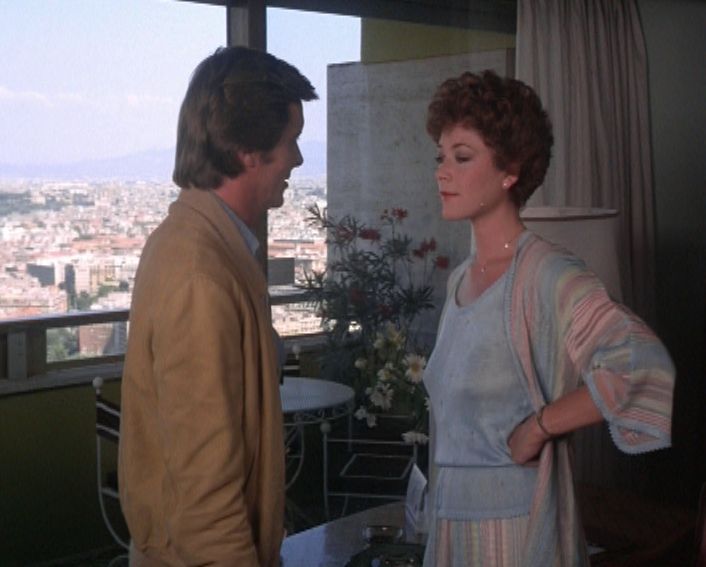
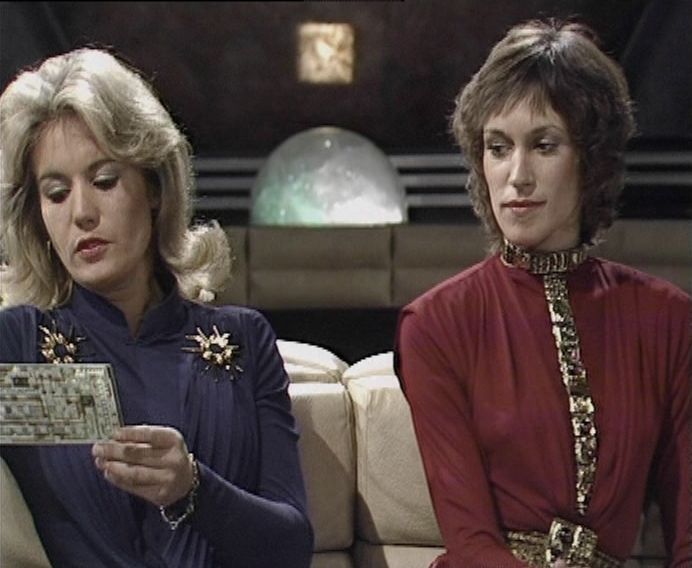
An odd story then and somewhat illogical.  Some of the banter between the Liberator crew does go some way to salvaging things and Jenna and Cally look rather fetching in their blue and red outfits so there is some small recompense.
weapon 03

Blakes 7 – Shadow

shadow 01

Shadow was the first Blakes 7 story to be scripted by Chris Boucher (as well as the first not to be written by Terry Nation).  Because of this it’s pretty clear there’s a difference in tone – although it is believed that Boucher had already contributed fairly considerably to series one.

Legend has it that Nation’s season one scripts became thinner and thinner as time wore on – meaning that Boucher had to add more and more of his own material to flesh them out.  But even if that was so, Shadow was the first chance he had to craft something entirely of his own making and one of the most interesting parts of his debut script is how Blake himself is portrayed.

Blake and the others arrive at Space City.  It operates outside of Federation law and is reputed to be the base of the Terra Nostra.  The Terra Nostra are responsible for virtually all the organised crime on every Federated world – and Blake can only see the positives in allying with them.  “Think what they’ve got – men, material, information. Think what we could do with a fraction of the resources they control.”

For once Avon seems to be in agreement with him, so it’s left to Gan to be the main dissenting voice.  “No, YOU think, Blake. Think what it is they control. Everything dirty, degrading, and cruel on just about every colonized world.”  Moving Gan into a position where he can oppose Blake is welcome for several reasons, especially since it gives David Jackson a more meaty role than usual.  Gan’s time was already ticking though, so it’s sadly too little too late.

Blake’s use of semantics is instructive.  He tells Gan that they’re going to use the Terra Nostra, not do business with them.  But as he later offers them money in exchange for access to their infrastructure on Earth, the distinction is far from clear.  Is Blake simply deluding himself?  He’s obviously quite happy that the ends justify the means – the Terra Nostra can help him in his fight against the Federation so he has no moral qualms in using them.

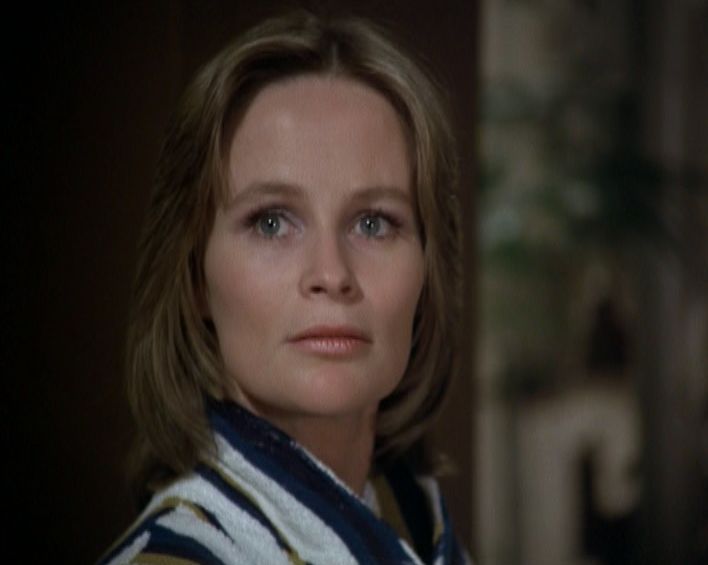
Space City might be the “satellite of sin”, according to Vila, but it’s very underpopulated.  We only see Largo (Derek Smith) and one of his enforcers (Archie Tew) on the side of the Terra Nostra whilst Hanna (Adrienne Burgess) and Bek (Karl Howman) represent the Terra Nostra’s “customers”.  Hanna is an addict and her drug of choice is Shadow – the Terra Nostra’s most successful product.

shadow 02

It’s a little surprising that director Jonathan Wright Miller didn’t employ a few extras to at least give some impression that Space City was a thriving and bustling place, so you simply have to use your imagination.  As for the actors he did cast, Derek Smith is rather good as Largo – he manages to exude a rather silky menace.  Smith could sometimes go soaring over the top but is fairly restrained here and is all the better for it.  Tew has little to do for most of the episode except wave a gun around and look menacing, but he does later manage to move up the pecking order at the expense of Largo (proving that there had to be more to him than met the eye).

Karl Howman is very much the weak link, delivering his lines rather unconvincingly.  Dialogue such as “killing a Terra Nostra pusher will be the best fun I’ve had all day. You stupid murdering scumball.” is delivered with all the intensity of a first year drama student.  What’s odd is that he was already quite an experienced television actor at this time.  Much better is Adrienne Burgess as Hannah.  She’d been teamed up with Michael Keating a few years earlier in the Doctor Who story The Sunmakers, and is able to give Hannah, a hopeless drug-addict, some sort of character.

If there’s one thing that Shadow tells us, again and again, it’s that Blake’s operating way out of his depth.  Vila sums it up quite succinctly.  ” Look, he was an Alpha grade on Earth. A highly privileged group, the Alphas. Wouldn’t last five minutes among the Delta service grades where I grew up. And it’s the service grades where the Terra Nostra really operate. Without anesthetic, usually.”

This is proved when Blake, Avon, Jenna and Gan are detained by Largo, who dismisses them as “amateurs” and they only manage to escape from Space City by the skin of their teeth, taking Bek and Hannah along for the ride.  Blake’s not finished though – if he can’t buy the Terra Nostra’s co-operation then he’ll force them to help.  His plan?  To locate the planet where they refine Shadow and take control of it.

Again it’s Gan who provides the main voice of dissent.  This, he says, would make them little more than pushers.  Tellingly Blake again brushes off his protests.  Shadow may cause misery and death for millions but if it helps him in his fight against the Federation then he’s content.

The planet Zondar is supposed to be incredibly warm (the rather overcast sky in the quarry gives the lie to this, but at least it wasn’t raining!).  Whilst Blake, Avon and Jenna explore (and to be honest achieve very little) Cally has also teleported down to the surface.

She’s been locked into her own subplot for most the episode, battling with Orac – or an unidentified entity that’s taken over Orac.  This seems to have been bolted on to the main story in order to pad the running time out and doesn’t quite work.  The shots of Cally being isolated (done quite simply with lights and a few simple video effects) is effective but it’s frustrating that the identity of the invader is never established.  It also seems something of a contrivance that Cally is able to force it back into its own dimension with the aid of the telepathic creatures on Zondar.  How fortunate that the Liberator’s next port of call was able to provide her with the allies she needed!

The ultimate revelation that the Terra Nostra is controlled by the Federation (“It’s quite logical. To have total control, you must control totally. Both sides of the law. The Terra Nostra, the Federation – two sides of the same power.”) provides a neat ending to the story and demonstrates that the Federation’s influence is more insidious and far-reaching than was previously thought.

Following on from the gung-ho space adventure of Redemption, Shadow offers a subtle re-tooling of the direction the series would take during series two.  There would be plenty more gung-ho adventures to come, but this is the first time that Blake’s decision-making has come under strong scrutiny.  And in a couple of episodes time, following the events of Pressure Point, it will again.

shadow 03

Blakes 7 – Redemption

red 01

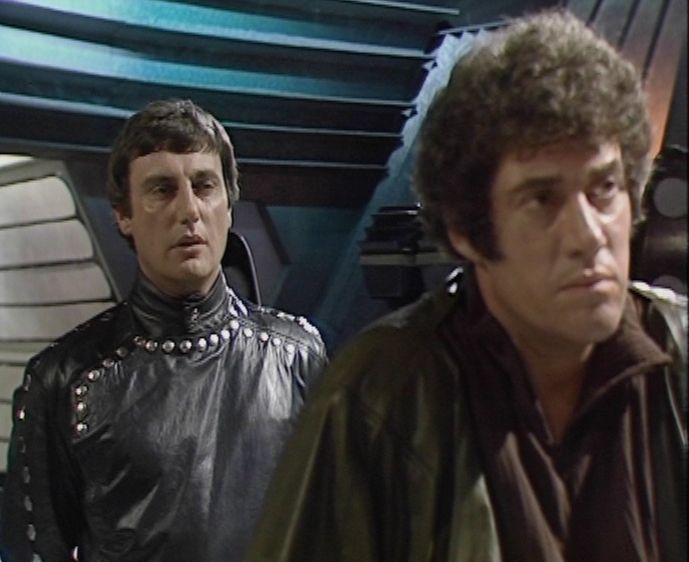
The easiest way of knowing we’ve reached series two of Blakes 7 is to look at the costumes of the Liberator crew.  In series one you could best describe them as drab, but now June Hudson’s been recruited things have certainly changed (and this is only the beginning).  Highlights are Avon’s natty black studded number (which he later donates to Tarrant) and Blake’s rather extraordinary green plastic jacket with enormous puffy sleeves.

But if the costumes are different then the story is much more familiar (not surprising since it was Terry Nation’s fourteenth script in a row).  Like The Web or Breakdown it’s a story of two halves.  The first takes place on the Liberator and the second kicks into gear once they’ve reached their destination.

Before things start happening there’s an interesting exchange between Blake and Avon.  Blake is still concerned by Orac’s prediction that the Liberator apparently faces imminent destruction.  He’s been poring over the data, only for Avon to provide him with the solution.  They can pinpoint exactly where the event will happen by the starfield shown behind the ship – so all they need to do is to ensure they never travel to that part of the galaxy and the prediction will be null and void.

When Avon admits that he worked this out several hours ago, Blake asks him why he’s not said anything to the others. “Well, all they had to do was ask. Perhaps in future, they won’t rely on you to provide all the answers”.  This battle of wills between the pair of them will bubble on for the remainder of the second series.  As to who will gain the upper hand, Vila puts it best when he says that “if it ever comes to a showdown, my money’s on Blake. Well, half of it. I’ll put the other half on Avon.”

Another fascinating little moment occurs just after Avon’s scored this point over Blake.  An explosion rocks the ship and as they fall to the ground Avon puts a protective arm around Blake.  I wonder if this was scripted or something worked out in rehearsal?  It’s only a throwaway thing, but it’s a lovely touch – proving that although he may profess to despise virtually everything Blake stands for, Avon still seems to have an automatic reflex to protect him.

red 02

Shortly afterwards, the ship comes under attack and they then lose all control of the Liberator, ending up as little more than helpless passengers (any repairs are rejected by the ship).  Avon tells the others his theory.

AVON: Think of the ship as a living entity with massive networks of electronics acting as a nervous system.
JENNA: All linked into a central computer.
BLAKE: The brain.
AVON: Carry the analogy a stage further. When a living creature is hurt – a cut or a wound – antibodies gather around the injury to repair it and to fight infection.
VILA: You mean the computers are treating us like germs.
AVON: Crude, but accurate.

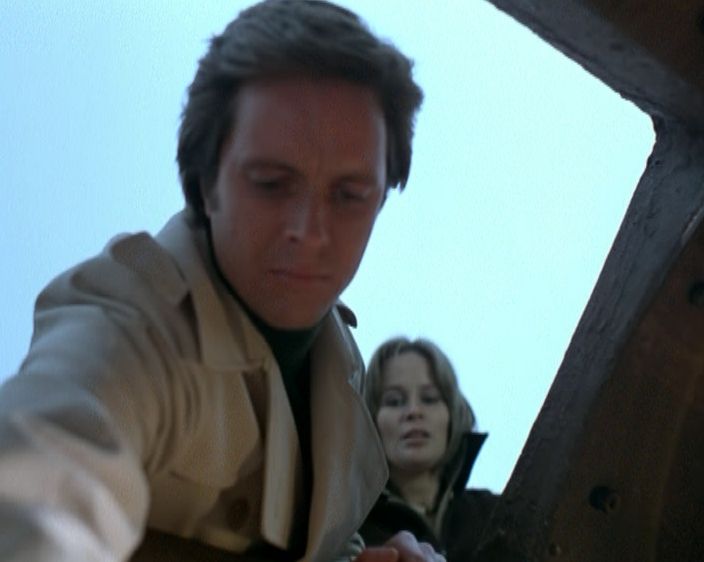
Blake has first-hand experience of this when he’s attacked by a cable in one of the service areas.  Yes, the wires holding it up are rather obvious but it’s not as bad an effect as it could have been.  Once again it’s Avon who saves the day and he’s not slow in telling Blake that one day, probably quite soon, he’ll require payback!

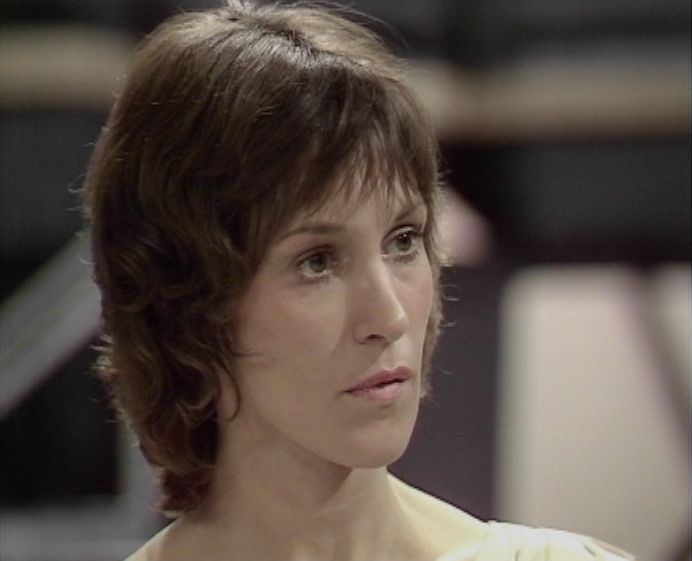
The Liberator is under the control of its creators and soon all the crew are prisoners.  Blake has a chat with Alta 1 (Sheila Ruskin) and Alta 2 (Harriet Philpin).  This is a part of the story that doesn’t quite hold together.  Both Alta 1 and Alta 2 are linked to the System (a supercomputer which controls the three planets in this sector).  We’re told that the System has ruled for several generations.  As Blake discovers when he speaks later to a slave (played by Roy Evans) this means that whilst there’s no war or famine, there’s also no freedom.

Could the System have been responsible for designing the Liberator?  Surely if they had it would have been much more functional.  And if they did create it, what was its purpose?  The Federation has clearly never come across a ship like the Liberator before (even though it’s established later that it’s not unique) so it doesn’t appear that the System is interested in expanding its empire or has very often ventured into Federation territory.  Visiting the civilisation that designed the Liberator was an obvious thing to do, it’s just a pity that it falls rather flat.

The System also bears a passing resemblance to the Conscience of Marinus as seen in Terry Nation’s Doctor Who story The Keys of Marinus – proof that Nation was never averse to reusing a good idea.

Neither of the Altas are great conversationalists, but they’re dressed in tight blue lycra which is some consolation.  Another plus-point is the filming at the Oldbury Nuclear Power Station which adds a little gloss to what otherwise is a fairly routine story.

But Redemption is still an effective season opener.  It reignites the Blake/Avon power-struggle as well as giving the rest of the regulars a moment or two to shine.  And although the plot, once we reach the System, feels a little undercooked there’s still enough going on to ensure that the story never seems to drag too badly.

red 03

Return of the Saint – The Debt Collectors

debt 01

After Simon comes to the aid of a runaway horse ridden by Jeri Hanson (Mary Tamm), he finds himself embroiled in the murky world of espionage.  Jeri’s sister Christine (Diane Keen) was convicted of passing military secrets and is six years into a prison sentence.  But just one day before she’s due to be released on parole she escapes.

This was engineered by Sir Charles Medley (Geoffrey Keen) of the Ministry of Defence.  Jeri tells Simon she’s convinced her sister is innocent and it appears that Sir Charles arranged Christine’s prison-break in order to flush out a traitor in MI5.  But who can be trusted?  In the world of intelligence, things are not always as they appear to be …..

The Debt Collectors was written by George Markstein.  Given his background (script-editor/writer on series such as The Prisoner, Callan and Mr Palfrey of Westminster) it’s no surprise that he delivered a dense story set in the world of British Intelligence.

And after finding some of the previous episodes to be rather linear and straightforward, it’s a pleasure to have one where people’s motivations aren’t immediately obvious.  Things appear to open normally enough, with Simon coming to the rescue of an attractive young woman.  But she’s under surveillance and when Simon is later told not to speak to her again this only strengthens his interest.

By the time this aired, in December 1978, Mary Tamm was already more than half-way through her single season as Romana in Doctor Who.  Here, she seems to be the archetypal ROTS heroine – her function in the plot being little more than providing a decorative presence and also the excuse for the Saint to become involved in the story – but there’s a twist in the tale later.

Of more immediate interest is Diane Keen as Christine.  An actress who hardly seemed to be off the television screens in the 1970’s and early 1980’s, her first scene (behind prison bars) sees her playing a hard-bitten old lag.  This is rather a stretch for Keen and it’s no surprise that once she goes over the wall Christine becomes much more of a vulnerable character.

With the revelation that there could be a traitor in MI5, several possibilities present themselves.  There’s Sir Charles and also Simon’s MI5 contact Geoffrey Connaught (Anton Rodgers).  Geoffrey Keen, best known today for playing the Minster in the James Bond films, is perfect casting and Rodgers, later to carve a niche as a sit-com performer, shares some decent scenes with Ogilvy.

The story does have a few niggling plot-holes.  Why was Christine stuck in prison for six years before Sir Charles elected to use her to flush out the mole?  And since she was due to be released the following day why engineer a prison break?  If she’s on the run then presumably that makes her more of a target for the mole.  But since she doesn’t know his identity, Christine is ultimately something of a red-herring.

Whilst the looseness of the plot (which is a little surprising given Markstein’s background as a script-editor) is a slight irritation, there’s more than enough happening to negate these quibbles.  Apart from the already mentioned performers, the likes of Neil McCarthy (a familiar television face) and Bob Shearman (best-known for his regular role in The Sandbaggers) help to bolster an already impressive cast.

The Debt Collectors is a cut above the average ROTS script and rates four halos out of five.

debt 02

CGI Reconstructions of the missing Doctor Who episodes on YouTube

I’ve been rather impressed with a series of CGI recons that have appeared on YouTube during the past couple of months.  At present, all of Marco Polo and the two missing episodes from The Crusade are up and the intention seems to be that all ninety seven episodes will be tackled in time.

There’s some undeniable rough edges which could benefit from additional work, but for now what’s been posted is certainly very watchable.  Below is episode one of Marco PoloThe Roof of the World.

Return of the Saint – Tower Bridge is Falling Down

tower 01

Jenny Stewart (Fiona Curzon) is concerned about her father Charlie (Sam Kydd), so she turns to the Saint for help.  Charlie has been having disagreements with his business partner Ray Dennis (John Woodvine).  The two of them built up a thriving building firm but Charlie is convinced that Dennis has conned him out of a substantial sum of money.

Dennis is a highly amoral figure and after a brief fight with Charlie he has no compunction in leaving him in a building scheduled for demolition.  And when Charlie’s lifeless body is recovered from the rubble Simon vows to exact the maximum amount of revenge on Dennis.  So he puts his plan into action – an elaborate con involving transporting Tower Bridge to America ……

Written by the creator of Minder, Leon Griffiths, Tower Bridge is Falling Down was his sole contribution to the series.  It’s basically Hustle, thirty years early, and it sees Simon posing as Sir Malcom Street, a top government official.  In order to hook Dennis effectively, first Simon contrives to lose ten thousand pounds to him at a rigged poker game.

And when the man he believes to be Sir Malcolm proves unable to settle his debt Dennis is slowly reeled into the con.  This involves his company being awarded the contract to demolish Tower Bridge (provided he can sweeten the deal by paying Sir Malcolm off).

All the familiar tricks from a normal episode of Hustle are present and correct.  For example, Sir Malcolm is a real person and the Saint brazenly takes over his office in order to meet with Dennis.  And as so often happens, the real Sir Malcolm returns just as the Saint is leaving (the two pass each other in the corridor).  Dennis is easy to con because, as seen in Hustle every week, he’s a greedy man.  Had he been honest then he wouldn’t have fallen for Simon’s ploy, but he sees the chance to make a quick and illegal profit and jumps at it.

It’s a pity that Leon Griffiths didn’t contribute any further scripts (although he would have been busy at the time setting up Minder).  John Woodvine is excellent as Ray Dennis.  Dennis’ lack of morality is clear right from the pre-credits sequence when he casually disposes of Charlie Stewart and although he isn’t the most complex of characters, Woodvine still manages to dominate proceedings whenever he’s on the screen.  A chilling moment occurs when he threatens to permanently disfigure Jenny if she doesn’t reveal Simon’s whereabouts.  It’s obvious from the parameters of the series that this is a threat which won’t be carried out, but Woodvine is intense enough to make you believe for just a few seconds that it might.

Alfie Bass, as Sammy, has a nice role as a con-man who works with Simon to rope Dennis in (he’s the sort of character that could easily have cropped up in Minder or indeed Hustle).  And although Simon’s involvement is down to Jenny, for once this is a very male-dominated episode and she only takes a minor role in proceedings.

It”s a pity that the con doesn’t play out to the end, since Dennis learns about Simon’s true identity.  This means there’s a more traditional conclusion (a punch up) followed by Ray Dennis’ arrest for murder.  Whether his confession about Charlie’s murder (secretly taped by Simon) would actually have stood up in court is a moot point, so it would have been more dramatically satisfying for him to have been conned.

Even allowing for this, thanks to John Woodvine and the unusual plot, Tower Bridge is Falling Down rates four halos out of five.

tower 02

Return of the Saint – The Roman Touch

roman 01

Michelle (Kim Goody) is deeply unhappy.  She may be an international singing star, with a string of hit records to her name, but she’s also worn out thanks to a grinding schedule of tours and recording sessions.  Michelle doesn’t even have the satisfaction of having made any money, due to the repressive contract she signed with her manager Bruno (Laurence Luckinbill).

Simon’s known her since she was a teenager and is anxious to help.  So he kidnaps her …..

The Roman Touch sees the return of the old-style Saint.  Although he kidnaps her with the best of intentions (he demands a ransom from Bruno of a million dollars, which is enough to pay Michelle the money she’s owed and also cover his expenses) it’s still an example of him operating on the wrong side of the law.  This is something of a rarity in ROTS, where he tended to be allied with the authorities more often than not.

Kim Goody, an actress with some musical talent, is perfect casting as Michelle.  Whilst her career in the music business is painted with broad brushstrokes (complete with a grasping manager) she still manages to give some solidity to her character.  Linda Thorson plays Diamond, her personal assistant.  At first she seems to be yet another person who is interested only in exploiting Michelle, but over time it becomes clear that she has her best interests at heart.

Simon’s attempts to help Michelle are hindered by the local Mafia, headed by Capo (Danielle Vargas).  The script is obviously written to present them as the villains of the piece – which is negated when Capo reveals that Michelle is his daughter and he’s been secretly keeping watch over her.  This is quite a neat reversal – as is the fact the somebody kidnaps Michelle again (with Simon unable to stop them).

Another foreign episode, the sunny visuals help the episode no end (had it taken place in rainy London it may not have been so effective).  But the basic problem is that there’s no particular tension since it’s obvious that Simon will rescue Michelle.  The question isn’t if he’ll do it, but how.  For a formula series like ROTS, predictability of events can be an issue and after an interesting setup things plays out pretty much as you might expect.

Nothing earth-shattering then, but solid enough.  The Roman Touch rates three halos out of five.

roman 02

Hancock – The Bedsitter

bedsitter

Tony Hancock told his writers, Ray Galton and Alan Simpson, that he wanted changes for their next (and as it turned out, final) BBC television series.  It’s often been assumed that Hancock’s wish to drop Sid James was motivated from envy and insecurity – Sid was getting too many laughs, so he had to go.

I think it’s much more likely that Hancock understood the format of the series had to change.  Hancock’s Half Hour (both on radio and television) had been a staple of the 1950’s, but now the 1960’s were upon us.  Had the show stayed the same for much longer there might have come a point when both the critical and public acclaim turned to indifference and boredom.

Maybe the seeds for change had been subconsciously sowed by some lines from the classic radio episode Sunday Afternoon at Home.  Tony’s quiet and boring Sunday afternoon is interrupted by next-door neighbour Kenneth Williams.  In this episode, Tony’s radio persona parallels his public one (he’s a successful radio comedian).  But Williams, whilst professing to be a big fan, is monumentally tactless when he tells him that he thinks he’s slipping and that Ted Ray had the edge on him the previous week!

There’s no doubt that these lines from Galton and Simpson were nothing more than affectionate mockery, but for Hancock it may have struck home a little deeper.  So for their final BBC series, renamed Hancock, Sid was gone, East Cheam was gone, and for this first episode Hancock was all on this own, literally.

I love the idea that Galton and Simpson wrote The Bedsitter slightly with their tongues in their cheeks – they reasoned that if Hancock wanted to be by himself, then they’d present him with a script where he’s the only person present!  But Hancock leapt at the chance and despite the one man/one room nature of the episode it’s a tour-de-force for him.

It’s rather like Sunday Afternoon at Home in many ways – a study in boredom.  Tony’s life is basically held in statis, which is made explicit as the last shot of Tony is the same as the first (he’s lying down blowing smoke rings).  And despite his claims that tomorrow will be different, it seems that he’s just deluding himself.  Alone and isolated in an Earls Court flat he has plenty of dreams but lacks the drive to make any of them a reality.

There’s a few nods back to the past.  At one point he picks up a lurid paperback thriller, Lady Don’t Fall Backwards (which was the centrepoint of the classic HHH episode The Missing Page).  Hopefully this time he’s been able to find a copy with that elusive final page!  And when practicing his ventriloquism skills he mentions Peter Brough and Archie Andrews.  One of Hancock’s early radio breaks occurred when he appeared in Educating Archie, acting as a straight-man to Archie Andrews (a vent’s doll voiced by Peter Brough).

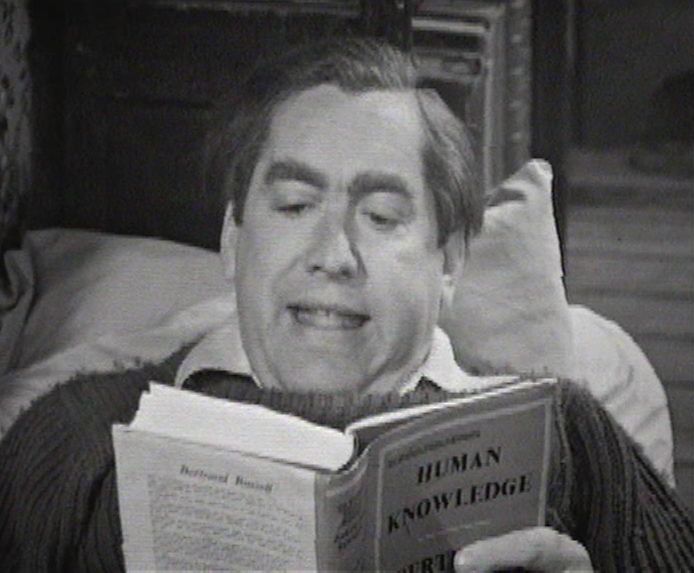
Otherwise there’s a stream of unconnected moments – Tony attempts to read Bertrand Russell but is put off by all the long words, burns his lip on a cigarette, attempts to get a signal on his television, etc.  The fragmentary nature of The Bedsitter would be a daunting prospect for many comic actors (as a contrast, Paul Merton’s remake is available to compare) but Hancock is easily up to the task.  Although he was presumably anxious about having to carry a twenty five minute show by himself (and had lines written around the set as a backup) he wasn’t reliant at this point on reading the lines off boards.

Mid-way through the episode it seems that Tony’s luck has changed.  A wrong number leads to an invitation to a cider and gin party (I’ll bring the cider, says Tony).  A chance for a date with (he hopes) an attractive woman brings out a burst of enthusiasm, although this all comes to naught when she rings up later to cancel.  You can hear a few audible awwws from the audience at this point, which is rather nice.

If The Bedsitter teaches us anything, it’s that Tony Hancock was perfectly able to carry the show by himself.  Had Sid been present in the flat then the whole dynamic of the piece would have been totally different – not necessarily better or worse, just different. However, the rest of the series does operate on more traditional lines and sees Hancock crossing swords with a whole host of very good comic actors.

And the quality of the supporting casts that we’ll see over the forthcoming episodes (Patrick Cargill, Hugh Lloyd, June Whitfield, John Le Mesurier, etc) does rather give the lie to the oft-repeated and lazy claim that Hancock hated to be upstaged by others.  If he had, he would have surrounded himself with mediocre talent – which is obviously not the case here.  It does seem plain that one of the reasons why these shows remain fresh, some fifty five years later, is due to the fine ensemble casts.

A wonderfully detailed and thought-provoking analysis of The Bedsitter can be found on the blog You Have Just Been Watching.  It’s well worth a read.

Up next is an everyday tale of country folk which remains very topical today.

Return of the Saint – Signal Stop

signal 01

Simon Templar and Janie Lennox (Ciaran Madden) are both passengers on a train bound for London.  When the train stops at a signal, Janie sees what she believes to be a murder taking place in a nearby warehouse.  Simon, who moments earlier was wishing that something would happen to break the monotony, is naturally intrigued.

The next day, Simon, Janie and the police travel to the building – but the body that Simon and Janie found earlier in the day is no longer there.  Inspector Grant (Frederick Jaeger) later tells Simon that since Janie has a history of psychiatric illness it’s probable her story was nothing more than a delusion.

Following on from the picture-postcard stylings of The Imprudent Professor, Signal Stop has a very different feel.  Most of the story takes place in dirty or run-down locations – an abandoned warehouse, a scrap-yard, etc which gives it something of a Sweeney/Professionals feel.

Just as The Arrangement owed more than a little to the novel Strangers on a Train, Signal Stop also seems to have been inspired by a crime classic.  In 4:50 From Paddington by Agatha Christie, a character witness a murder from her vantage point on a train – but with no body she finds it impossible to convince the authorities and only her friend Miss Marple takes her seriously.

The notion of observing a murder from a train (and therefore being helpless to intervene) is a decent one – although it’s fair to say that this story is a little flawed.  The major problem is that it’s baffling why the body was simply not taken away before Simon and Janie turned up the next day to find it.  No body = no crime.

Instead, the murdered man is left on site for them to find.  Simon then drives Janie all the way back to his house before phoning the police and driving back.  Naturally enough, by the time he returns the body has vanished.  Since he has a phone in his car, why didn’t he call the police and wait for them at the warehouse?

But despite these rather serious plotholes, there’s still a very decent, and unusual, story here.  Ciaran Madden impresses as the vulnerable Janie.  Unlike most of the other Saint heroines, she’s a flawed and damaged individual – although Simon’s faith in her never wavers.  It’s possible to argue that the script missed a trick by allowing the viewer to see the attack take place though.  Had this not happened, and we only had Janie’s word, it would have allowed the viewers to wonder if it maybe was just a figment of her imagination.

Ian Cullen is hardly stretched as one of the police officers, especially since he’d had a been a regular in Z Cars and could presumably have played this sort of part in his sleep.  Brian Glover, George Sweeney, Ralph Arliss, Heather Wright and Sabina Franklyn help to round out the cast.  Franklyn has a blink-and-you’ll-miss-it role as a uniformed police officer who Simon effortlessly charms whilst Arliss makes a brief appearance as a hells-angel sort of biker.  Although as so often with ROTS, the biker gang never really exudes any sort of menace.

Frederick Jaeger’s rather good as Inspector Grant.  It’s the sort of part that seems at first to be fairly routine but by the conclusion of the episode he’s moved more into the forefront of the action.

Despite some flaws, Signal Stop rates a healthy three halos out of five.

signal 02

Return of the Saint – The Imprudent Professor

prof 01

Professor Edmund Bartlett (Bill Simpson) is a philanthropic scientist who wishes to share his new invention (synthetic petrol) with the world.  But his daughter Emma (Susan Penhaligon) is concerned for his safety.  She’s well aware that certain countries and interest groups would be very interested in her father’s discovery and could be inclined to use force to extract the information from him.

Emma hires Simon to keep an eye on him, much to the disgust of Boothroyd (Anthony Steel), the local representative of the British government.  Posing as a disgruntled ex-colleague of the Professor, Simon strikes up a friendship with the alluring, but deadly, Samantha (Catherine Schell).  Samantha works for Genius Inc, an organisation who sells geniuses to the highest bidders.

When the Professor disappears, Simon faces a race against the time before Bartlett is spirited out of the country and lost forever.

After a couple of London-based episodes, The Imprudent Professor is literally a breath of fresh air.  Filmed in and around Nice, it certainly uses the location to its maximum advantage.  And as well as the gorgeous visuals, there’s a sparkle about Terence Feeley’s teleplay that means it’s a definite cut above the norm.

Unlike Feeley’s previous script, The Armageddon Alternative, there’s an intriguing hook in the pre-credits sequence.  Simon interrupts a speech from the Professor by claiming that Bartlett is a fraud and he – Simon – is the true inventor of the synthetic petrol.  Since ROTS normally has fairly straightforward narratives, this is something of a jolt.

It doesn’t take long before the truth emerges though.  Simon’s decided that the best way to keep the Professor safe is to act as a judas goat and lure any people interested in his invention out into the open.  His tactics don’t meet with whole-hearted approval by everyone though, especially the Professor – who’s incredibly stubborn and unwilling to believe he’s in any danger.  Bill Simpson, best known for Dr Finlay’s Casebook, is (as might be expected) very Scottish.  He’s also quite an imposing figure and certainly makes an impression, even with his limited screen-time.

Susan Penhaligon (not even remotely Scottish) is suitably winsome as his daughter Emma.  Like many of the female roles in the series she’s only lightly sketched – but whenever she and Samantha meet there’s a nice tension between the pair of them.  This is because she clearly believes Samantha has designs on Simon (you can feel the waves of jealousy emanating from her!)

Ian Ogilvy looks like he’s having great fun and is certainly given plenty of good material.  When acting the part of the Professor’s disgruntled ex-employee he affects a Scottish accent (badly!) and wears a pair of glasses (obviously he thinks they make him look much more studious).  It’s also a nice touch that he uses the alias of Sebastian Tombs (a favourite of the literary Saint).

Simon gets to tangle with Samantha (some lovely comic moments between Ogilvy and Schell) and also crosses swords with Boothroyd of DI6.  His initial meeting with Boothroyd (the always classy Anthony Steel) is pure James Bond – we see Boothroyd relaxing by the poolside of a impressive looking house surrounded by a bevvy of gorgeous girls in bikinis.

Simon quips his way out the situation and at the same time is easily able to outwit some of DI6’s less able operatives, like Cartwright as played by Peter Childs.  If there was ever an episode of ROTS that could have been designed to showcase Ogilvy as a potential James Bond, then this was the one.

The plot may be a little routine (there’s a slight twist, although it’s not difficult to guess), but the location-work, guest-cast and the sheer spirit of the production help to make this one of the most enjoyable episodes of the series.  Four and a half halos out of five.

prof 02

Return of the Saint – The Armageddon Alternative

arm 01

Simon is abducted by a masked man and driven to an unknown location.  He’s shown an atomic bomb and the man tells him (via pre-recorded taped messages) that unless his demands are met the bomb will be detonated in the heart of London.

The mystery man’s demands are quite simple – he wants Lynn Jackson (Anouska Hempel) to be guillotined in public.  He gives Simon and the authorities until early evening to accede to his request – and in order to prove he’s serious, a conventional explosion will be set off every hour, on the hour ….

The Armageddon Alternative is a somewhat flawed story and the flaws are apparent from the pre-credits sequence.  Why does the masked man never speak?  The logical answer is that he’s a member of a team and the taped messages were recorded by somebody else.  Alas, logic has rather taken a holiday in this episode.

Simon later explains that the voice was recorded in order to disguise it (otherwise he would have instantly known who it was).  But that makes no sense – as soon as we hear the tape it’s obviously George Cole putting a funny voice on.  And when we see Fred (George Cole) a few minutes later it hardly takes a nuclear scientist to put two and two together.

Fred looks after the cars in Simon’s block of flats and is clearly the last person in the world you’d assume would be in possession of an atom bomb or have the skill to use it.  The mid episode reveal that he’s responsible should be a shocking twist – but it’s no surprise at all.  This possibly isn’t the fault of Terence Feeley’s teleplay though.  He would no doubt have assumed that director Leslie Norman (father of Barry) would be able to effectively disguise Cole’s voice.

What is a mystery is why Fred should want a gorgeous young woman like Lynn executed.  Although when it’s revealed that her father, Professor Loder (Frank Gatliff), is the Government’s chief psychiatric vetting officer, things begin to fall into place.  It seems obvious that someone who Loder filed a negative report against has decided to take the most drastic of revenge.

A likely suspect is Parkinson (Gordon Gostelow).  He turns out to be innocent, but takes a perverse delight in stringing Simon and the police along.  It’s a nice cameo from Gostelow who plays unhinged very well.  Indeed, the cast here is very strong – George Cole is his usual dependable self, whilst Anouska Hempel is also very watchable.  True, she’s not the strongest-drawn female character that ROTS has ever offered us, but Hempel manages to make something out of nothing.

Although laughs are thin on the ground, there was one (although I’m not sure whether it was intentional).  When Simon is kidnapped, he asks the man a question and amazingly the next thing on the tape is an answer to the question!  This is either an incredibly sloppy piece of scripting or a good joke.  It does rather bring to mind the Monty Python sketch featuring Michael Palin as a barber who has an uncontrollable fear of cutting hair though.

Great cast, but as the identity of the bomber is blown before we see the opening credits I can only give it two and a half halos out of five.

arm 02

Return of the Saint – The Arrangement

arrangement

When Lady Greer Stevens (Carolyn Seymour) and Sheila Northcott (Sarah Douglas) share a drink on a flight back to the UK they discover they have something in common.  Both are trapped in unhappy marriages and Greer suggests that each of them should kill the others husband.  Sheila idly agrees, not realising that Greer is quite serious and also quite mad.

Greer fulfills her side of the bargain by killing Guy Northcott (Michael Medwin) and now expects Sheila to murder Sir Trevor Stevens (Donald Pickering).  Fortunately for Sheila, she has the Saint on her side …..

The Arrangement is essentially a rewrite of Patricia Highsmith’s novel Strangers on a Train (later filmed by Alfred Hitchcock).  Strangers on a Plane, as it were.  Carolyn Seymour is mesermerising as the completely unhinged Lady Greer Stevens.  We get an early example of her disregard for others when she trips up a rather loud American at the airport (he’d been annoying her on the plane).  Simon’s there to tend to him, although given that the man had just fallen a long way down an escalator it seems rather reckless for the Saint to roughly drag him away!

Sir Trevor Stevens is an influential politician, but it’s clear that he’s not satisfying his wife’s needs, despite her (somewhat half-hearted) claims to the contrary.  An interesting moment occurs when their servant Nina (Vikki Richards) announces that Greer’s bath is ready.  Greer mentions suggestively that Nina might like to scrub her back and this – together with a zoom into Nina’s expectant face and a shot of Sir Trevor looking disgusted – broadly hints that there’s more to this mistress/servant relationship than meets the eye.  Given that ROTS was a pre-watershed series it’s not surprising this is never explicitly spelt out – but the inference is clear enough.

Seymour’s mad-as-a-hatter turn is highly entertaining and by far the best thing about the story.  The second best thing is the Survivors mini-reunion, as Ian McCullough has a small role as Inspector Stone.  Seymour and McCullough only exchange a few words but it’s nice to see them together again.

As Greer Stevens is such a vivid character, Sarah Douglas’ Sheila Northcott can’t help but seem rather pallid when the two are put side by side.  Sheila is the typical sort of Saint heroine, utterly dependent on Simon to get her out of trouble.  And she’s not the only one in danger, as later on Greer kidnaps Sheila’s sister Aileen (Jane Hayden).

Aileen is younger than Sheila and quite a different sort of character.  Nina drugs Aileen’s drink when the pair of them are at a new-wave/punk club.  It’s not the first time that ROTS has dabbled with the underbelly of modern Britain and like the previous examples it doesn’t feel totally convincing.  Although the band are vaguely shouty, the club still seems rather sedate and well-behaved.  Later, we see Aileen kept captive and docile (she’s been pumped full of drugs).  Again, this is something that sits somewhat uneasily alongside the series’ more usual escapist atmosphere.

The ending might be a little predictable (and obviously shot in the studio) but The Arrangement easily rates four halos out of five.

The Rivals of Sherlock Holmes – The Missing Q.C.s

missing

Robin Ellis as Charles Dallas in The Missing QCs by John Oxenham
Adapted by John Hawkesworth. Directed by Jonathan Alwyn

When two leading barristers who are conducting an important murder case (one for the prosecution, the other for the defence), vanish without trace, it falls to junior barrister Charles Dallas (Robin Ellis) to investigate.  The trail leads him to a lunatic asylum run by Professor Dyne (John Phillips) where events take a very unexpected turn ….

The Missing K.C.s was written by William Arthur Dunkerley, using the pen-name of John Oxenham.  Dunkerley was a prolific writer – crafting novels as well as poetry and hymns.  The character of Charles Dallas only appeared in this one story, published in the late nineteenth century.

Skilfully adapted by John Hawkesworth (Upstairs Downstairs), The Missing Q.C.s is a story that lurches in a very unexpected direction.  To begin with, it plays out like a traditional courtroom drama – with plenty of enjoyment to be derived from the performances of John Barron and Jack May as the battling barristers.  Both Barron and May were highly experienced actors, blessed with excellent comic timing, which means that their barbed insults are a joy to watch.  Charles Lloyd Pack, as the judge, also gives a fine turn as the man in the middle, attempting to keep order.

It’s expected that the story will revolve around George Wilson (Howard Goorney), on trial for the murder of his wife, and whether he’s innocent or guilty.  But the whole courtroom section is merely an excuse to introduce us to the Q.C.s and set us up for the second part of the tale.

During the courtroom portion of the story, Charles doesn’t seem that concerned about the case (where he’s acting as Sir Revel’s junior) as he spends his time trying to find the right moment to ask Sir Revel for his daughter’s hand in marriage.  Milly Revell (Ceila Bannerman) is a highly spirited young lady and the way she manipulates Charles is an early example of how he tends to be buffeted by events, rather than directing them.

The mysterious disappearance of Sir Revel Revell (John Barron), James Ladbroke (Jack May) and then later on Milly, forces him to take action.  Ellis, a few years away from his career-defining appearance in Poldark, is forced by the script to be a rather conventional leading man.  This means that the likes of Barron, May and Phillips can effortlessly steal the scenes whilst Ellis has the slightly thankless task of being the rational centre-point of the story.

What makes The Missing Q.C.s so interesting is the sudden gear-change from a conventional mystery to a Hammer-style gothic yarn.  Professor Dyne turns out to hold the key to the mystery – and his revelations are gloriously pulpy.  Dyne’s lunatic asylum – complete with a mute butler, moaning inmates and vicious dogs roaming the grounds, is certainly a far cry from the sedate courtroom setting of the first half.

As Charles breaks free into the grounds, desperately attempting to avoid the pack of dogs, Milly is still in the clutches of the evil Professor – bound and gagged just as a traditional pulp heroine should be.  Also held captive are Revell and Ladbroke, and both of them will shortly be operated on by Dyne.  Charles manages to escape and he makes his way to the local police-station, but in a glorious comic sequence he has to struggle to make himself believed.  Once the officers learn he’s come from the lunatic asylum they naturally assume he’s an escapee!

With some decent supporting performances (such as Gordon Gostelow as Inspector Mayhew) this brings the second and final series of The Rivals of Sherlock Holmes to a strong conclusion.  There were still plenty of other stories that could have been adapted in future series, so it’s a little bit of a shame that it never came back – but the twenty-six episodes that were made do offer a fascinating snapshot of some of the best crime fiction of the late Victorian/early Edwardian age.

TV50 (BBC 1986) – Quatermass and Doctor Who clips

That’s Television Entertainment was a three hour programme broadcast in 1986 as part of the BBC’s TV50 season (which celebrated fifty years of BBC television).

I’ve just uploaded to YouTube the brief section covering Quatermass and Doctor Who.  Ringo Starr and Cliff Richard discuss their love of Quatermass and whilst there’s no celebs on hand to talk about Doctor Who, there is a generous three minute selection of clips.

Most of the sixties and seventies footage is taken from the 1977 documentary Whose Doctor Who.  I’m not sure how they selected the post 1977 material (since it’s bizarre to see a clip of Mestor from The Twin Dilemma – hardly one of the series’ high-points!).

Today, this is a nice selection of clips, but nothing more.  Back in 1986 though it was a tantaslisng glimpse into mostly unobtainable Doctor Who history.  The VHS range was still in its infancy (only a handful of tapes were available).  Stories from the 1970’s were still airing in certain parts of the world (not in the UK alas) but everything that existed from the 1960’s was pretty much out of circulation.  There were pirate videos of course, but even those were fairly restricted then.

These three minutes of clips seemed to be the closest we’d ever get to accessing a large part of Doctor Who’s history.  The idea that everything that existed would one day be available at the touch of a button was mere science fiction back then.

The Rivals of Sherlock Holmes – The Mystery of the Amber Beads

beads

Sara Kestelman as Hagar in The Mystery of the Amber Beads by Fergus Hume
Adapted by Owen Holder. Directed by Don Leaver

A rich widow called Mrs Arryford (Doris Rogers) is brutally murdered and shortly afterwards her precious string of amber beads turns up at a pawnshop run by a young gypsy called Hagar (Sara Kestelman).  All the evidence suggests that Mrs Arryford’s maid Rose (Sarah Craze) killed her mistress, but Hager isn’t so certain ….

The Mystery of the Amber Beads was written by Fegus Hume and was one of a collection of short stories published in 1898 under the title of Hagar of the Pawn Shop, which can be read here.  Two years earlier he self-published a novel called The Mystery of a Hansom Cab.  It very quickly became a publishing sensation but Hume was to receive little financial benefit, since he sold the British and American rights for just fifty pounds.

Female detectives were rare in the Victorian/Edwardian era and an ethnic detective, such as Hagar, was rarer still.  Most of the other sleuths featured in these adaptations either have official standing or are gentleman amateurs who are indulged by the authorities.  Hagar clearly doesn’t fall within either of these categories.

The forces of law and order are represented by Grubber (Joss Ackland) and his relationship with Hagar is one of the key dynamics of the episode.  He’s maybe more accepting and trusting of her than you would expect, but although it’s probable that more drama could have been mined from an antagonistic relationship, their interaction is still intriguing.

Hagar proves early on that she’s no fool as she tells him the serial number of the five pound note that was handed over to the mysterious woman who pawned the beads.  Later, Hagar is able to prove that the woman wasn’t Rose – although to be fair this is done in a way that would be hard to prove in a court of law.

Joss Ackland gives a broad performance as Gruber.  He makes the policeman a very bluff, cockney figure who tends to teeter on the edge of caricature.  But Ackland is a good enough actor to be able to occasionally pull back and show that there’s more to the man that meets the eye.  Gruber is somewhat of a hypocrite though.  To begin with he’s convinced that Rose is guilty and tells a disbelieving Hagar so.  Then after Hagar has proved otherwise, he blithely tells her that he knew all along that Rose didn’t do it!

Sara Kestelman is impressive as Hagar.  She’s a dual outsider – not only a woman in a man’s world but a gypsy to boot and therefore certain to be regarded with suspicion by the majority of her fellow citizens.  Hagar does have a code of honour though and whilst she probably would have been aware the beads were stolen when she accepted them, she didn’t attempt to hide the fact that she had them when Gruber came enquiring.  And her sense of justice is clear after she champions the cause of Rose.

If it wasn’t Rose, then who might it be?  Mrs Arryford’s household is fairly small and apart from the servants there’s only her companion Miss Lyle (Kathleen Byron) and Miss Lyle’s nephew Freddy (Stephen Chase).  Freddy seems an obvious suspect – he’s very smooth and makes an instant byline for Hagar.  Kathleen Byron had a lengthy and impressive career (she had a memorable role in the classic film Black Narcissus for example) and doesn’t disappoint as Miss Lyle.  It’s a little while before she has her moment to shine, but it’s worth waiting for.

Rounding off the main cast is Philip Locke as Vark.  Vark is adamant that the pawnshop should be his and as a solicitor he’s willing to use every trick at his disposal to ensure he makes it so.  Locke is perfect as the thoroughly oily and untrustworthy Vark and it’s no surprise that Hagar despises him.  Vark either doesn’t realise this or doesn’t care as at one point he suggests marriage – which doesn’t go down very well with Hagar!

This is yet another studio-bound show, but the production design does its best to hide these limitations.  We see several horses as well as numerous extras who are all employed to create bustling street scenes whilst sound effects are also used to create the impression of busy city activity.

A strong episode, thanks to the quality cast, headed by Sara Kestelman.

The Rivals of Sherlock Holmes – The Looting of the Specie Room

specie

Ronald Fraser as Mr Horrocks in The Looting of the Specie Room by C. J. Cutcliffe Hyne
Adapted by Ian Kennedy-Martin. Directed by Jonathan Alwyn

The RMS Oceanic is attempting to cross the Atlantic in a record time.  It’s also carrying a fortune in gold bullion, under the watchful eye of the ship’s purser Mr Horrocks (Ronald Fraser).  But when the ship docks at Liverpool, Horrocks is appalled to find that half of the gold has been stolen.  The ship’s owner, Lord Altington (Paul Hardwick), gives him a stark ultimatum – if the gold isn’t recovered by the time the Oceanic reaches Southampton, Horrocks will have to find another job …..

The Looting of the Specie Room was written by C. J. Cutcliffe Hyne.  Best known for the fantasy novel The Lost Continent: The Story of Atlantis, he also wrote a series of stories featuring Captain Kettle.  Horrocks made his first appearance as a supporting character in the Kettle tales and later featured in his own book Mr Horrocks Purser (1902).

Like most of the adaptations in the series, it stands or falls on the performance of the detective and sadly Ronald Fraser is something of a disappointment.  This is a pity, since he’s usually an actor I enjoy watching – but he’s very subdued here.  Ian Kennedy-Martin’s adaptation provides plenty of scope – Horrocks is an affable, honest and friendly man who’s skilled in dealing with the numerous demands of his well-heeled passengers.

But although he’s treated with indifference by some of them and with outright contempt by the Oceanic’s owner Lord Altrington, Fraser never manages to make anything of this.  Instead, he stumbles through the episode with hardly a flicker of emotion, only slightly coming to life when talking to the attractive young widow Mrs. Vanrenen (Jean Marsh).

If Fraser is a little off, then there’s some consolation to be had with the supporting cast.  Edward Dentith is profoundly shifty as Sir Edward Markham – could this apparently upright gentleman have something to do with the robbery?  Jean Marsh shares several nice, understated scenes with Fraser and as I’ve said it’s pretty much the only time he seems in any way animated.

Stephen Yardley (almost unrecognisable at first, thanks to sporting pretty much a full head of hair and a moustache) is another suspect.  His character, First Officer Clayton, has run up serious gambling debts and this gives him a strong motive.  Norman Bird, a veteran of film and television, is another quality addition to the cast.  He plays Inspector Trent, who joins the ship in England and teams up with Horrocks to locate the stolen gold.

The actual mechanics of the robbery aren’t terribly interesting (and do show the limitations of the studio) but Horrocks’ confrontation with the culprit do go some way to ensuring that the story closes strongly.  Although he successfully plays amateur detective, Horrocks finds himself demoted to another, smaller ship in the fleet (he accepts this slight with equanimity).  But when he learns that the captain of his new ship will be Clayton (a man he accused of robbery and therefore someone who has no love for him) he does seem to perk up a little!

An indifferent installment, but even with Fraser’s leaden performance it’s not a total write-off.

The Rivals of Sherlock Holmes – The Secret of the Foxhunter

foxhunter

Derek Jacobi as William Drew in The Secret of the Foxhunter by William Le Queux
Adapted by Gerald Kelsey. Directed by Graham Evans

After two European spies join a hunting party at an English country house, William Drew (Derek Jacobi) tags along as well.  As a friend of the family Drew is easily able to mingle amongst the guests – and one especially catches his attention.

Beatrice Graham (Lisa Harrow) is a luminous beauty, engaged to one of Drew’s colleagues, but she’s clearly very perturbed.  Can she, or her fiance, be a traitor?  It later turns out that Beatrice is in possession of a document that the foreign spies are extremely eager to obtain – and they’ll stop at nothing, including murder, to achieve their ends.

William Le Queux was a prolific writer, most successful in the decade or so before WW1.  The Invasion of 1910 (serialised in the Daily Mail in 1906) was a notable bestseller for him.  Le Queux tended to concentrate on the thriller, spy and mystery genres and whilst there’s a certain pulpiness about his works, he can still lay claim to being one of the founding fathers of British spy fiction.  The Secret of the Foxhunter can be read here.

Gerald Kelsey’s adaptation takes certain liberties with the source material, mainly by injecting a certain amount of humour (Le Queux’s original is lacking in this).  One major difference is the role played by Miss Baines (Denise Coffey).  Miss Baines is governess to the daughter of the German spy Count Kremplestein (Richard Warner) and takes a much more active role in the adaptation (in the original story she’s a very marginal figure).  Coffey, a noted comic performer, tackles her role with gusto and plays against Jacobi very well.

Another touch added by Kelsey is the extreme reticence of the British government, in the form of Drew’s boss The Marquess of Macclesfield (Richard Pearson), over the whole beastly business of spying.  The Marquess clearly regards spying as a deeply underhand business and not something that a British gentleman should undertake.  A good example is when Drew comes into possession of a letter written by Beatrice – it could contain a vital clue, but the Marquess really doesn’t like the idea of opening a lady’s letter (he does overcome his scruples though).

The Secret of the Foxhunter was Lisa Harrow’s television debut.  She would rack up an impressive list of television, film and theatre credits over the years (she’s probably best remembered for playing Nancy Astor in the 1982 series of the same name).  Here, she brings an excellent, doomed intensity to Beatrice – Drew is keen to help her, but it’s to no avail sadly.

Derek Jacobi (despite a fake moustache – the curse of the series, alas) gives a strong central performance as William Drew.  Equally able to play comic scenes with Denise Coffey and Richard Pearson as well as more dramatic moments with Lisa Harrow, Jacobi’s never less than first rate.  In terms of the adaptation, a major change by Kesley comes at the conclusion of the story, which provides Jacobi with another chance to shine.  It’s an unexpected moment – but all the more powerful because of this.

The Rivals of Sherlock Holmes – The Moabite Cypher

cypher

Barrie Ingham as Dr John Thorndyke in The Moabite Cypher by R. Austen Freeman
Adapted and Directed by Reginald Collin

Dr John Thorndyke (Barrie Ingham) and his faithful assistant Dr Jervis (Peter Sallis) come to the aid of a man kicked by a police horse.  The man never regains consciousness and after talking to the police they learn that it’s possible he was an anarchist plotting to assassinate a visiting Russian archduke.  Thorndyke is intrigued by a strange letter recovered from the man’s body – written in some sort of code – and turns his energies to deciphering it.

Created by R. Austen Freeman, Dr John Thorndyke appeared in around sixty novels as well as numerous short stories.  The Moabite Cypher formed part of the short-story collection John Thorndyke’s Cases (as did A Message from the Deep Sea adapted for series one) and can be read here.

What makes The Moabite Cypher so enjoyable is the relationship between Thorndyke and Jervis.  Ingham’s Dr Thorndyke is an intellectual tyrant – always convinced that he’s right about everything – whilst Dr Jervis plods along several paces behind, acting as his loyal Watson.  Whilst he contributes little to the story, it’s amusing to see Peter Sallis steal scene after scene.

Possibly the best moment comes when the pair are travelling back to London.  They accompanied Alfred Barton (Julian Glover) out of town – apparently to visit his sick brother, although Thorndyke was well aware that Barton wasn’t all he claimed to be.  Barton’s plan was to strand them in the middle of the countryside and then return to Thorndyke’s London rooms to ransack them.  As Thorndyke wearily tells Jervis how obvious it was that Barton was a wrong ‘un, it’s hard to take your eyes off Sallis.  He doesn’t have much dialogue, but his facial expressions make it plain exactly how he feels.  Lovely stuff.

Thorndyke is a fairly insufferable character, which is highlighted when he later confronts Barton.  Barton pulls a gun and threatens to shoot – but Thorndyke seems not to even consider for a moment that he’ll pull the trigger.  He does, of course, and Thorndyke is lucky to escape with just a graze.

Apart from Ingham and Sallis, Julian Glover is excellent as usual.  It’s not the largest or most interesting of roles, but Glover’s just so good with villainous roles.  Derek Smith gives an unforgettable turn as Professor Popplebaum.  He plays it with such gusto that I can’t make my mind up whether it’s one of the worst performances I’ve ever seen or one of the best.  If you’re familiar with Lewis Fiander’s appearance as Professor Tryst in the Doctor Who story Nightmare of Eden then it certainly hits those giddy heights.

Obviously fake facial hair is another aspect of The Rivals of Sherlock Holmes that it’s sometimes difficult to ignore and there’s a breathtaking example here – George Innes as Adolph Schonberg.  Schonberg sports a bushy red beard and a similar amount of red hair.  It looked so fake that I was half wondering if it was actually a disguise – but no, it seemed to be genuine (in the story at least).

Reginald Collin, who both adapted and directed the story, throws the odd little flourish in.  We open with some sepia-toned archive footage, which is followed by a studio shot, also in sepia (which then becomes colour after a few seconds).

Barry Ingham is very clipped and precise as Thorndyke.  There’s more than a touch of Sherlock Holmes about his performance (he finishes by saying the problem was elementary) and it’s clear he would have made a very good Holmes.  He never did alas, but he did voice Basil The Great Mouse Detective, which was close.

The Rivals of Sherlock Holmes – The Anonymous Letters

letters

Ronald Lewis as Dagobert Trostler in The Anonymous Letters by Balduin Groller
Adapted by Anthony Steven. Directed by Dennis Vance

Vienna, 1900.  Countess Nadja (Nicola Pagett) has received several anonymous letters of a most intimate nature.  Nadja is anxious that not a breath of scandal reaches the ear of her husband, Archduke Othmar (Michael Aldridge) and therefore consults Dagobert Trostler (Ronald Lewis),  Dagobert is a confidant of the noblest of Viennese society and therefore the ideal man for the investigation.

The Anonymous Letters was written by Adalbert Goldscheider, under the pseudonym of Balduin Groller.  Groller created Dagobert Trostler in 1890 and like so many other writers of the era he sought to create a detective somewhat in the mould of Sherlock Holmes, albeit one who was resident in Vienna.  But Dagobert is quite different from Holmes.  The London detective had little time for polite society and was never impressed by rank or title, whereas it’s clear that Dagobert relishes his influential friends and would be loath to lose them.

If I had to describe this episode in one word then “florid” seems apt.  Possibly this is due to the translation from German to English, which means there’s a somewhat melodramatic unreality to the story.  This might be why none of the main characters ever quite seem to come into sharp focus.  Dagobert is amusing enough, but his deductions are fairly routine and his affair with Countess Tildi Leys (Carolyn Jones) doesn’t quite convince.

Nicola Pagett had already appeared in Upstairs Downstairs, so the role of a pampered member of the upper-classes clearly wasn’t too much of a stretch.  And despite the difference in nationality there’s more than a touch of Elizabeth Bellamy in Nadja, but whilst Upstairs Downstairs gave us the chance, over time, to appreciate Elizabeth’s vulnerable side, we don’t have the same luxury here.  So although Nadja is completely blameless it’s hard to invest a great deal of interest in her fate.

Michael Aldridge sports an impressive beard (like much of the facial hair in the series it was clearly stuck on) and is also responsible for an unintentionally amusing moment after he storms into Dagobert’s rooms and accuses him of taking advantage of his wife.  After slapping his face, he then challenges Dagobert to a duel, but the younger man responds by knocking him out!  His servant then rushes in and mournfully tells him that he’s hit a Habsburg – which was clearly deemed to be a sufficiently dramatic point to lead into the second advert break.

Although The Anonymous Letters has the usual excellent cast, the lack of characters that can be identified with does mean that it’s difficult to fully engage with the story.  Certainly one of the lesser adaptations from series two.

The Rivals of Sherlock Holmes – The Superfluous Finger

finger

Douglas Wilmer as Professor Van Dusen in The Superfluous Finger by Jacques Futrelle
Adapted by Julian Bond. Directed by Derek Bennett

A top surgeon, Prescott (Laurence Payne) is perturbed when a young woman (played by Veronica Strong) asks him to amputate one of her fingers.  Prescott refuses since there’s no medical reason to do so, but on her way out she deliberately traps her finger in the door – forcing Prescott to accede to her wishes.  He later calls in Van Dusen (Douglas Wilmer) to untangle this strange mystery.

The Superfluous Finger was the second of two Professor Van Dusen stories to be adapted for series two of The Rivals.  The original story, by Jacques Futrelle, can be read here.

The story has a strong Sherlock Holmes influence, especially since it opens with a puzzling mystery (why should anybody wish to have a perfectly healthy finger amputated?).  Some of the other Holmesian touches were added by Julian Bond’s adaptation – such as Van Dusen being able to deduce that the woman recently travelled from America (due to her clothes) as well as his assertion that whilst he has many acquaintances he has very few friends.

Of course, having Douglas Wilmer in the lead role (a notable Sherlock Holmes himself) also helps to connect Van Dusen and Holmes.  But though there are some similarities between Wilmer’s portrayal of both characters there are also some fairly major differences.  Wilmer’s Holmes tended to be somewhat abrupt and humourless, whilst Van Dusen has a more light-hearted and ironic air.  Van Dusen seems to breeze through life in a rather detached way, rarely exhibiting strong emotions.

What connects the two is the delight they take in keeping their deductions to themselves.  Both are disinclined to share their initial thoughts with others (Holmes with Watson, Van Dusen with Prescott) for pretty much the same reason.  The others have seen what they’ve seen, so if they can’t draw the same conclusions from the evidence why should it be spelled out to them?

Van Dusen is aided in his investigation by the reporter Roderick Varley (Mark Eden).  It’s odd that Nicholas Courtney didn’t return as Hutchinson Hatch (especially since Hatch is featured in the original story) so I can only assume that filming dates for Doctor Who clashed with this recording.  But Eden is a more than adequate substitute and enjoys a decent part of the action.

This starts when he tails the mysterious woman in a film sequence which clearly had some money thrown at it.  We see hansom cabs with horses (one previous episode had a cab in the studio – but no horse – with a stage-hand clearly shaking it about to create the effect of motion!) as well as several extras walking up and down the street.  It’s a welcome moment of fresh air that does help to open out the story.

Varley later seems to find the woman murdered and is arrested by the police (in the form of Mallory, played by Charles Morgan).  Van Dusen has to go and effect his release, this he does in a wonderfully comic scene which showcases Douglas Wilmer at his best.  Charles Morgan was no stranger to playing Victorian policeman (thanks to his role in the long-running Sergeant Cork) and is just as good here.

William Mervyn (as Sir Hector Drummond) turns in the sort of eccentric performance that he possibly could have done in his sleep, but is amusing nonetheless.  And Laurence Payne is dependable as Prescott, the man who invites Van Dusen to investigate but finds it hard to hide his exasperation with the Professor’s unorthodox practices.

Although the story opens with an intriguing mystery it’s probably not too difficult to work out what the solution is long before Van Dusen tells us (the pre-credits sequence, added by Julian Bond, does tend to give the game away somewhat).  But whilst it’s not the most interesting story, Wilmer is once again good value as the eccentric Professor.