The ninth episode of series one, Reliable Sources is something of a milestone episode as we bid farewell to Det. Supt. Eden. There’s been a serial element running through a number of these episodes, which continues here (and in the episode to follow). Eden – after an intense grilling from the security commission – is told that he’s been cleared of any wrongdoing in respect of his handling of the Troika debacle (as have his fellow Special Branch officers). But any jubilation proves to be short-lived ….
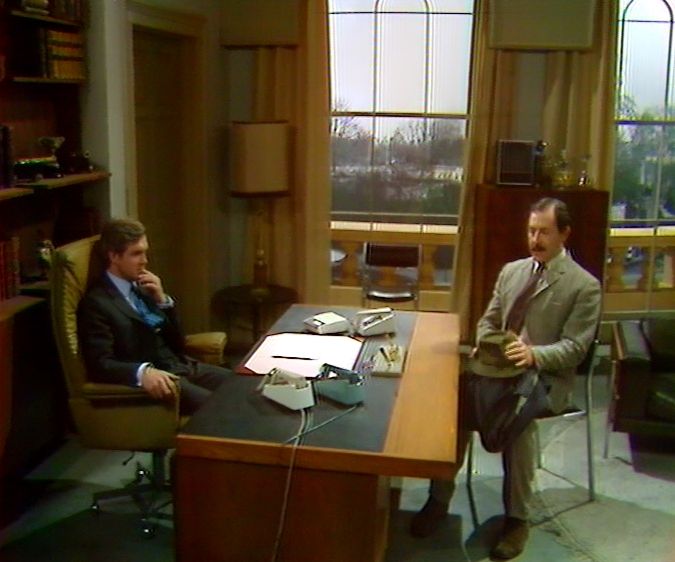
If Reliable Sources shows us anything, then it’s how the bluff, honest Eden is no match for the devious Moxon. Right from the start, when Moxon warns Eden not to poke around in matters which don’t concern him, it’s plain that Eden will come off second best.
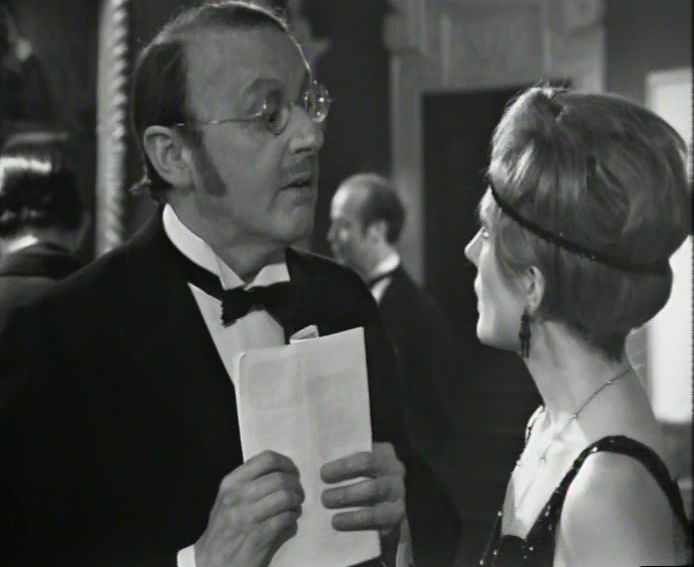
A Russian spy called Alexandrov (heavily involved in the Troika affair) has defected to the West. This means little to Eden, who still has a warrant for his arrest and is keen to enforce it, but Moxon firmly warns him off. When the news of Alexandrov’s defection is leaked to the papers, Eden becomes a prime suspect – especially since he’s recently lunched with Clive Bradbury (Tony Britton), an experienced Fleet Street hack who specialises in security stories.
What’s interesting is that Moxon admits to bugging Bradbury’s phone, so the true culprit of the leak would already have been known to him (although he later shrugs this off). Why then did he make Eden feel so uncomfortable? Possibly Moxon, the arch manipulator, simply can’t help himself.
The twist in the tail – the man responsible for leaking the story meets with Moxon – shouldn’t really come as a surprise. But both Eden and Jordan jump to the wrong conclusion (Moxon is corrupt) rather than the right one (Moxon is laying a false trail to confuse the Russians).
Morris Perry is on top form today and it’s nice to see both Tony Britton and David Collings guest-starring. Collings plays Bradbury’s editor, who’s just as keen as he is for a scoop on the Alexandrov affair. Although the story that’s leaked to them via Moxon’s proxy (Alexandrov’s precise whereabouts) doesn’t sound that exciting.
The fact that Eden’s been totally outplayed from beginning to end is highlighted by the way he’s unceremoniously shunted out of Special Branch and into an important-sounding (but no doubt meaningless) job for the next twelve months until his retirement is due. It’s easy to imagine Moxon’s hand in this, although given how easy Eden has been to manipulate, maybe not – after all, the next man in the hot seat might pose more of a challenge.
There’s been whispers throughout the episode that Jordan is in line for the job. He certainly seemed to think so, as when the Deputy Commander breaks the news that Det. Supt. Inman will be taking over, Jordan’s face visibly falls.
The next episode is clearly a key one as George Markstein returns to write it. Plus there’s the fact that the series moves into colour, which – together with the arrival of Fulton Mackay as Inman – helps to give these later S1 episodes the feel of a new series launch.
The RAF mount a massive raid over Berlin – the big one. But things go awry after bombs are dropped short, destroying a residential suburb on the outskirts of the city. Amongst the dead are Brandt’s wife and son ….
The Big One is an episode that could easily have centered totally around the Germans as Lifeline’s contribution is pretty negligible. Opening with the bombing raid (stock footage mixed in with newly shot material and somewhat melodramatic music cues) we then cross to the Candide, where Brandt is dining with Oberst Neidlinger (Mark Jones). Neidlinger is the latest oficer attempting to draw Brandt into the conspiracy to kill Hitler, but Brandt still refuses to commit himself.
The conflict between the aristocratic military (as represented by Neidlinger) and the thuggish Gestapo (as represented by Kessler) is given another airing today. Kessler, dining with Madeline, repeats his views on the subject (he’s still fuming about the way the Gestapo is treated with arrogant comtempt by the military elite). The cliché of the good German hovers in the background of this episode, but by the end the lines between Kessler and Brandt have been somewhat blurred.
Brandt travels to Berlin in order to arrange the transfer of his family to a safer location – ironically on the same day that the bombs hit. There’s some more stock footage patched in, along with a small rubble strewn set which is the only bit of desolated Berlin we see. Brandt’s collapse (after he learns of his loss) is nicely underplayed by Michael Culver.
The relationship between Kessler and Madeline inches forward (he gives her a chaste kiss).
I like the way we switch from Lifeline (listening to the BBC radio broadcast stating that 22 RAF aircraft failed to return) to Kessler and Madeline (German wireless reported 45 aircraft shot down). Both Max and Albert have a suspicion that the German figures are more likely to be correct.
Lifeline pick up one airman, Flight Sgt. Bert Lewis (Daniel Hill), but they don’t hold onto him for very long. Frankly it’s not surprising as their interrogation of him is brutal and hectoring. Plot-wise the reason for this is obvious – Lewis, believing they were German spies, later makes a run for it – but given the experience Lifeline have, it’s hard to believe that Monique and Alain would be quite so clumsy.
And this is Lifeline’s major contribution to the story. Whilst a little tension is generated (will Lewis betray any of Lifeline’s secrets?) this falls flat as Lewis doesn’t really know anything about them. So this part of the plot would have played out just the same had Lewis spent a couple of days wandering around the countryside before getting picked up by a German patrol.
Brandt returns to Brussels and is treated to a meal by Kessler. This is a fascinating scene, not least for the way that Brandt behaves (in a very jolly and hyperactive manner). Seemingly shrugging off the death of his wife and son as matters of no consequence, he then playfully begins to mock Kessler’s liaison with Madeline. The reason for doing so is obvious – it’s Brandt’s way of telling Kessler that whilst others may gossip about his totally innocent relationship, he doesn’t (and hopes in turn that Kessler doesn’t read anything into the meetings he’s had with known anti-Hitler officers).
Given that Brandt earlier confessed to being somewhat wary of Kessler, it’s strange that he decided to be quite so blunt. But maybe it’s a sign that he’s not thinking clearly.
Matters come to a head for him during his interrogation (or debriefing, as he calls it) of Lewis. It begins amicably enough, in his trademark friendly style (something which Kessler has long derided). But a still grieving Brandt eventually loses control and takes out his frustration on Lewis. The few minutes leading up to his sudden outburst of violence are mesmerising – it’s framed as a tight two-shot of Brandt and Lewis, which slowly closes in on Brandt as his anger increases.
The Big One is Michael Culver’s episode and he doesn’t disappoint.
This special, directed by Brian Tesler, neatly falls into three separate sections. In the first, a solo Sammy entertains with a selection of songs, some affable chat to the audience and an impersonation of Adam Faith thrown in for good measure. All this takes place against a fairly basic set, so it’s clear that the budget wasn’t spent on this section.
A little more spending is evident in part two which begins with an OB shoot at a deserted Battersea funfair. Sammy leads a group of cute children around the fair, all the time indulging in plenty of song and dance action. Thanks to the presence of the kids there’s a strong sense of schmaltz about this part of the show, but it’s tightly choregraphed and it’s also nice to get a look at the long vanished fair.
We then return to the studio to see Sammy – desperate to become an English gentleman – receiving some instruction from Lionel Blair. Their initial crosstalk might drag a little, but it’s worth wading through as the pay-off (the pair attempt to out tap each other) is great fun. They seem to genuinely spark off each other, with Sammy spontaneously bringing him back in part three to take another bow.
The final third of the special has a nightclub ambiance. A dinner suited Sammy performs behind an orchestra with well-dressed ladies and gentlemen sat at tables nearby. Had the whole show been like this then I wouldn’t have objected – as it is, these remaining fifteen minutes gives him a chance to demonstrate his versatility one final time (singing, playing the drums and attempting various impersonations – of which Louis Armstrong is the most impressive).
Steamboat Shuffle (1960)
I was expecting this to take place on a Steamboat set in the studio, so it was a pleasant surprise to discover that the twenty five minutes of trad jazz action occurs on a real boat – the Cottontail – moored on the riverside at Teddington. It was built especially for this short series (of which the edition on this disc is the sole survivor).
Introduced by the affable Peter Elliott, Steamboat Shuffle is interesting for several reasons – not least for the way director Ben Churchill managed to make the OB recording flows nicely (giving it the feel of a live production). Logistically it must have been something of a nightmare, with the cameras for certain performances placed on the dockside (meaning that the cameramen had to nip past the jiving hip young things) but there were very few muffled shot choices.
The musical turns come thick and fast, with the performances from a young Kenny Lynch especially catching the eye. It’s an enjoyable way to spend twenty five minutes, and it leaves me a little saddened that this episode is the only one still left in existence.
Big Night Out – The Peggy Lee Show (26th August 1961)
This edition of Big Night Out has a similar feel to the Sammy Davis Jr special, although Peggy Lee wasn’t quite the same all-rounder – her brief chat to the audience has a faint air of awkwardness (as does a skit she appears in, featuring David Kossoff as a taxi driver). But luckily this show plays to her strengths, so it mainly comprises of a series of excellent musical performances (Fever is an obvious highlight).
The third part of the show sees Peggy joined by three friends – Sammy Cahn, Jimmy Van Heusen and Bing Crosby. This is something rather special as the affable Cahn enjoys some nice musical byplay with Peggy (Van Heusen remains silent, content just to play the piano). Bing Crosby wanders on towards the end to perform a couple of songs, although given the Cahn/Van Heusen catalogue (both together and separately) this part of the show can only scratch the surface of their musical output.
Celebration (9th April 1966)
The final programme on the disc, Celebration with Duke Ellington and his orchestra, is a little heavier than the three other other light entertainment offerings, but it’s still a fascinating watch. Recorded at Coventry Cathedral, Celebration was only rediscovered in 2018. Including the European premiere of his ‘Concert of Sacred Music’, the performance was one that was close to Ellington’s heart (he later referred to it as “one of the most satisfying things I have ever done. And the most important.”)
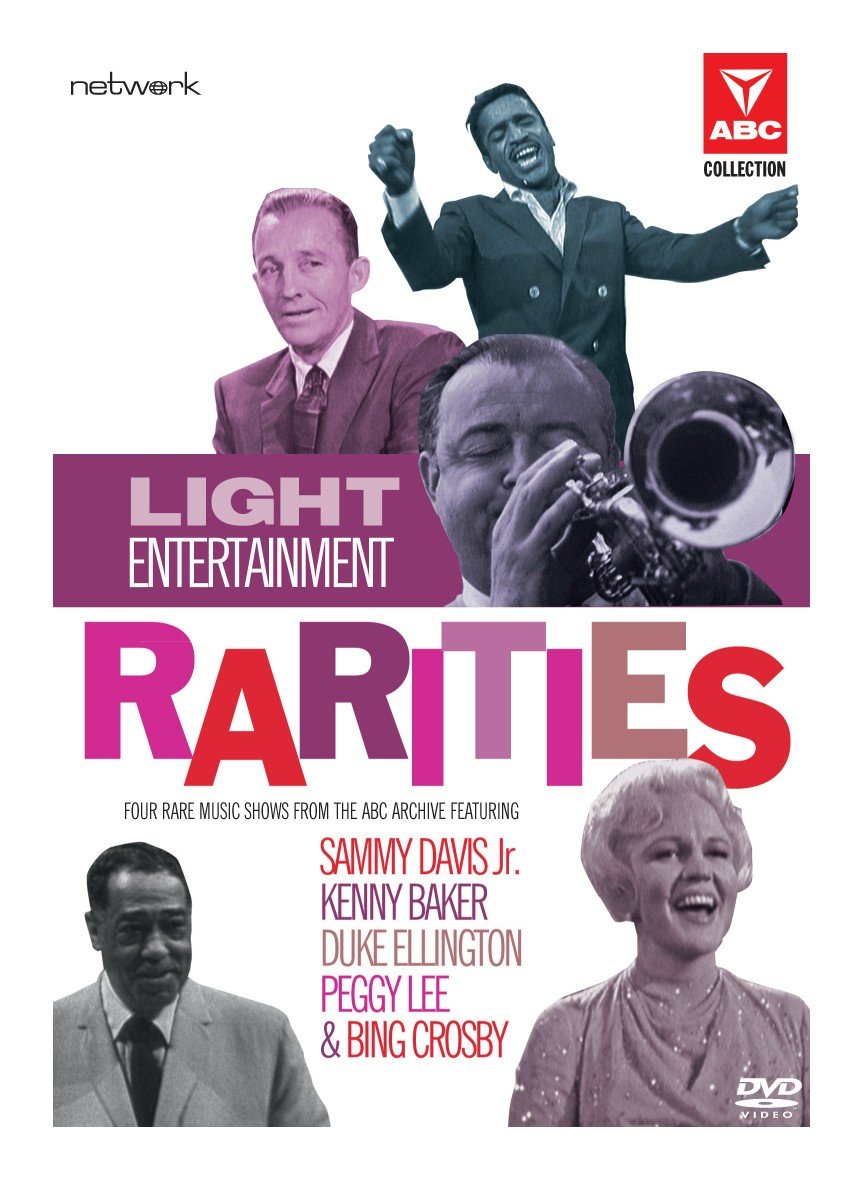
Light Entertainment Rarities is an excellent release, scooping up a selection of one-offs or orphaned episodes from otherwise wiped series which would be too short by themselves to merit a stand-alone release. Fingers crossed that a volume two follows in due course, but for now this DVD is well worth checking out.
Light Entertainment Rarities was released by Network on the 9th of November 2020 (1 disc, running for 177 minutes). It can be ordered directly from Network here.
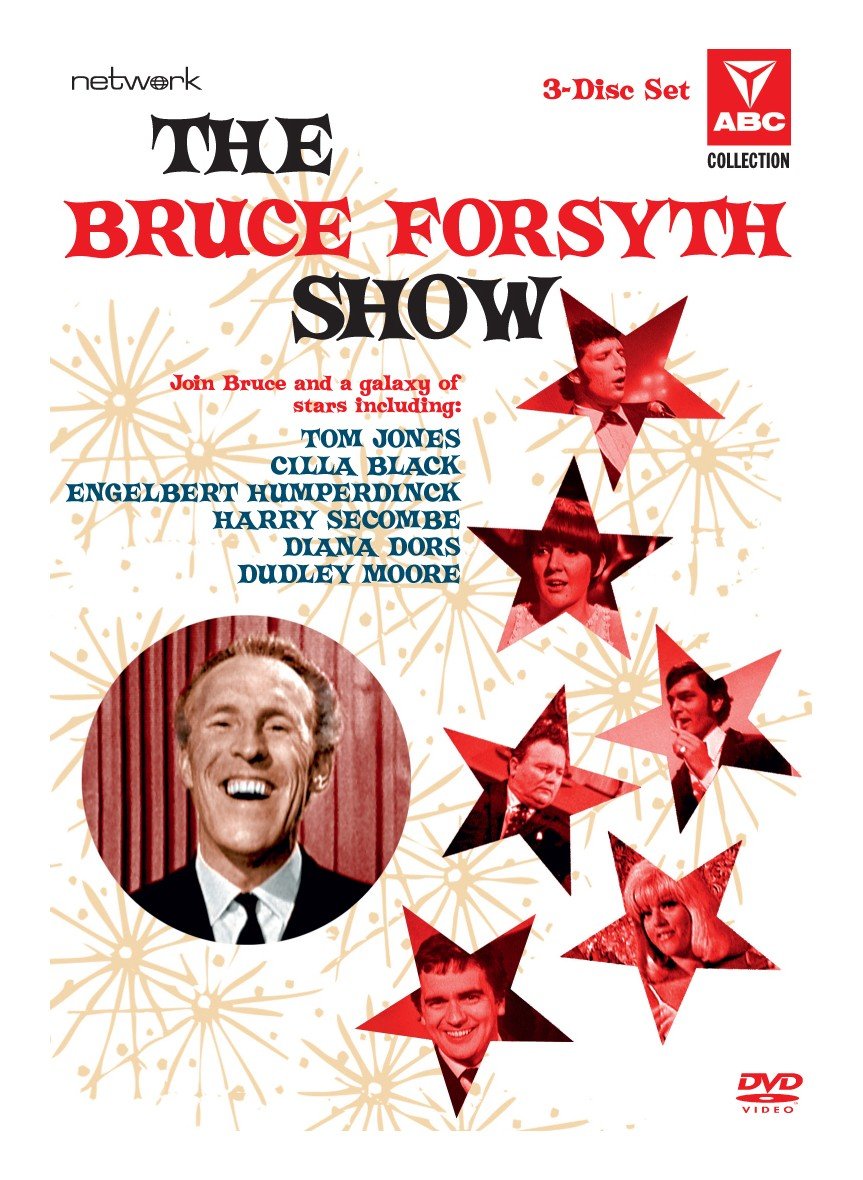
Sandwiched inbetween Bruce Forsyth’s initial breakthrough as one of the hosts of Sunday Night at the London Palladium during the late fifties and his rebirth as a fully-fledged game-show host on The Generation Game in the early seventies, The Bruce Forsyth Show is a fascinating programme (Brucie’s missing link, you might say).
Most thumbnail biographies tend to skip over this period, contending that it took The Generation Game to restore Bruce to full television glory. And yet The Bruce Forsyth Show doesn’t skimp on star names – Frankie Howerd, Cilla Black, Dudley Moore, Tommy Cooper, Douglas Fairbanks Jr, Diana Dors, Kathy Kirby, Julie Rogers, Harry Secombe, Engelbert Humperdinck and Tom Jones were amongst the performers appearing.
No doubt its low profile is due to the fact that it’s been pretty much unavailable since its original broadcast, so a tip of the hat to Network for bringing it back into circulation.
The debut show was broadcast on Christmas Day 1965. There’s a distinct lack of festive trimmings though – which raises the possibility that the show may have been put out on the 25th of December as something of an afterthought. Cilia Black is the show’s big guest – sharing some slightly uncomfortable crosstalk with Bruce (although it’s still good natured) and belting out a couple of songs.
Unsurprisingly, Brucie’s skills as a song and dance man are put to good use (as they are throughout the series) and he also takes part in a number of sketches. These try the patience a little more – although the skit with Miriam Karlin (she plays a hoity toity dog breeder) does have a few bright moments. They mainly occur when Bruce wanders off script (he tended to be more comfortable when he could riff with the material).
Laughs are fairly thin on the ground later on when Bruce and Francis Matthews play a couple of drunk golfers, returning home. This was a sketch that probably would have been twice as funny if it had been half as long. The final third of the show picks up though – with an orchestra skit (featuring Bruce as the conductor) – so overall this debut show was a pretty strong effort.
After this one-off, the series proper debuted on the 14th of August 1966. Sid Green and Dick Hills returned as the writers, with Douglas Fairbanks Jr, Ronnie Corbett, Lionel Blair and Tom Jones appearing. Tom throws himself into things with gusto – appearing in a frenetic sketch where he’s pushed and pulled from pillar to post. The BBC era of The Morecambe & Wise Show has gained the reputation of being the show which allowed the stars to do things outside of their comfort zone, but it’s easy to see that Brucie was doing something similar years earlier.
Sid and Dick will always be best remembered for their 1960’s work with Morecambe & Wise (mostly also at ATV). They fashion similar material for Bruce here – even to the extent of appearing in a sketch themselves (which they regularly did with Eric & Ernie).
Like many series of this era, The Bruce Forsyth Show doesn’t exist in its entirety, but its survival rate is pretty good (especially when compared to other variety series such as Sunday Night at the London Palladium). Series one is virtually complete, only about ten minutes from the 4/9/66 edition (Frankie Howerd and Julie Rogers guest-starring) are missing. As for series two, three of the six shows still remain – they feature the likes of Harry Secombe, Beryl Reid and Engelbert Humperdinck.
There’s also a brief clip from an otherwise wiped 1967 Christmas show with Bruce and Frankie Howerd. Recorded on one of the earliest domestic video recorders, the quality of this brief excerpt is pretty poor but nevertheless it’s nice to have it (to have it, nice).
If the sketch material across the series tends to be fairly routine, then the calibre of the guests (Dudley Moore and Tommy Cooper teamed up, for example) helps to keep the energy levels raised. Like all variety shows, The Bruce Forsyth Show is something of a mixed bag, but thanks to Bruce’s exuberance and playful interactions with the guests it’s almost always watchable and comes warmly recommended.
It’s nice to see some more 1960’s LE on DVD, hopefully Network will continue to dig through the archives as I’m sure there’s plenty more waiting to be unearthed.
The Bruce Forsyth Show (3 discs, 503 minutes) is released by Network on the 9th of November 2020. It can be ordered directly here.
A Mug Named Frank, the first episode of series five, in some ways feels like an addendum to series four. There’s the Brighton setting, the black and white visuals (albeit only due to the colour strike) and the reassuring presence of Mrs Mortimer (Pauline Delaney). And yet …
Series four of Public Eye was very much an authored piece. Roger Marshall wrote all seven episodes, which helped to give them a serial-like feel, but for the remainder of PE’s run his input would be drastically reduced. Producer Michael Chapman penned this installment, which concerns itself with uprooting Frank from Brighton and settling him down in Windsor.
Marshall would later cast a slightly withering eye over the direction of the Windsor series, labelling it as rather cosy (this interview is a fascinating read). Although it’s worth noting that it was Marshall who created Mrs Mortimer and established a “will they, won’t they” vibe between her and Frank.
How Marshall would have developed their relationship is unknown but it seems unlikely he would have gone in the direction of Chapman’s story – which not only abruptly wrenches them apart, but also rather off-handedly negates most of Frank’s Brighton experience. And this is why I find this episode a rather curious watch – rather like The West Wing after Aaron Sorkin’s departure, A Mug Named Frank feels inauthentic (Chapman attempting, but not really succeeding, to mimic Marshall’s voice).
The main plot is quite simple. Frank befriends an old lady, Mrs. Stuart (Nora Nicholson), who he spots in the supermarket popping a tin into her shopping bag, presumably with the intention of stealing it. He manages to diffuse the situation, but this plot-thread isn’t really developed. Was it an absent-minded slip, a cry for help or a theft borne out of necessity? We never find out, so it appears to have been little more than a clumsy way of bringing Frank and her together.
She lives in a rather threadbare couple of rooms with only one object of value – a silver box – which was given to her by her son, Gerald (Barry Foster), shortly after the war. He’s a clearly something of a shifty type (I think it’s the moustache) and is keen to “borrow” the box in order to raise some money for his failing business.
Frank knows him of old – they were fellow jailbirds for a brief while – and their clash towards the end of the episode is a definite highlight. As is André Morell’s cameo as Gerald’s rich uncle, who mockingly declines to bail him out. The scene adds little to the story overall, but I’ll never turn down a few minutes of Morell.
Travelling to Windsor in search of the silver box, Frank meets Inspector Percy Firbank (Ray Smith) and Nell Holdsworth (Brenda Cavendish), two characters who will loom large in the episodes to come. Although I take Marshall’s “cosy” point, the series quickly establishes itself in Windsor – shaking off the last vestiges of the Brighton era with a crop of strong scripts from a pool of first-rate writers.
UpDown was rarely the sort of series to indulge itself with showy directorial flourishes, but the opening shot of this episode – we see a worried Lady Marjorie through a rain-soaked window – is quite nice.
She’s concerned about a bill that’s been forwarded onto her from a jewellers – James has run up quite a debt with them. Lady Marjorie – always keen to think the best of her son – worries that he’s fallen into bad company, gambling with his brother officers (who can easily afford to shrug off substantial losses as matters of no consequence).
But Richard points out that these aren’t gambling debts – jewels suggest a young woman. Richard goes on to surmise that he’s fallen into the clutches of an unprincipled female who intends to take him for every penny that he’s got.
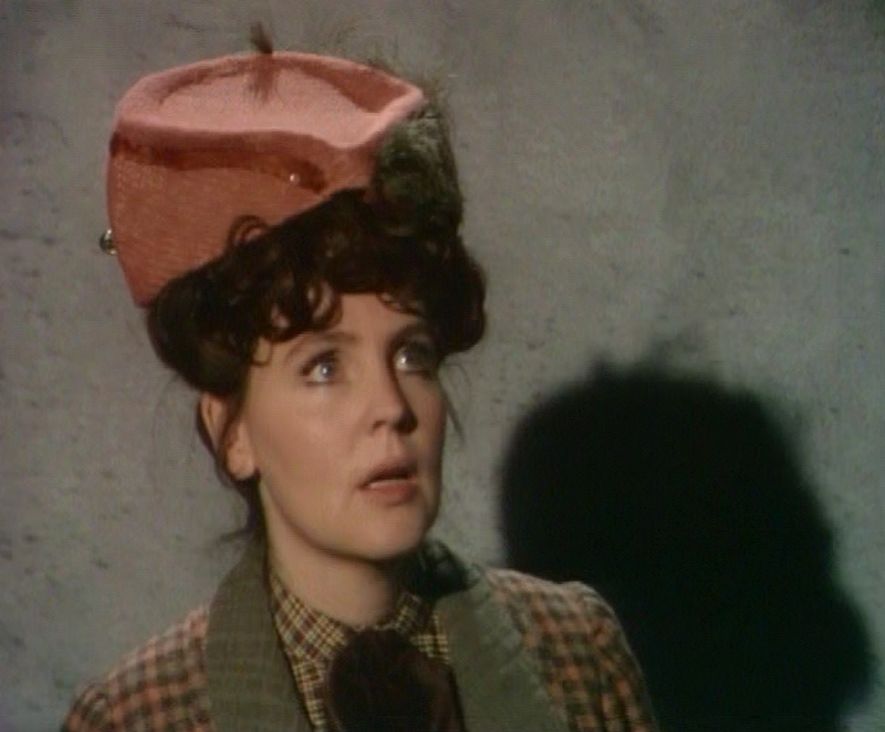
Just to hammer this point home, the action then cuts to Sarah (wearing a hat that certainly catches the eye). She fits the bill of a gold-digger, but it’s interesting how the episode is quick to turn this idea on its head. James has got large gambling debts and he obtained the jewels in order to pawn them (thereby raising a little money). Sarah is doing her best to help him, but it’s plain that he’s in a desperate situation.
James’ commanding officer, Colonel Winter (Moray Watson), pays a visit to 165 Eaton Place. Watson could play this sort of role in his sleep, but he’s still very watchable – Winter makes polite smalltalk with Lady Marjorie and Richard for a few minutes before breaking the bad news. James is drinking far too much and running up debts at a rate of knots.
That would be enough to generate a decent episode’s worth of drama by itself, but everything then moves up several notches after Sarah tells James that she’s pregnant (“there’s a little captain on the way” as she puts it). Thankfully, this bombshell means that Sarah stops acting in a manic manner (when Pauline Collins is in full flight it’s a little difficult to take).
Rose has arrived to take tea in the servants hall and has a letter waiting for her from Sarah. Mr Hudson and Mrs Bridges are incensed that she has the nerve to write (following the scene she made at Miss Elizabeth’s wedding) but the younger servants, like Edward, are much more indulgent.
Rose later visits Sarah and she shares her news. After a moment of shock, Rose decides that James has to do the right thing by her. Despite Rose’s obvious affection for Mr James, all of her sympathy lies with Sarah (who begins to wail in a rather over the top manner).
James meets with his parents and comes clean. As you might expect, Lady Marjorie doesn’t react kindly to the news that James has fathered a child with their former parlour maid. She’s too far well bred to make a scene though – instead her features simply set into immobility.
Mrs Bridges isn’t surprised to learn about James’ gambling debts. She mutters darkly about James’ Uncle Bertie, which helps to fill in another chink of the Southwold family tree (they seem to be mainly comprised of dissolute spendthrifts, at least according to her occasional reminiscences).
The arrival of Sarah sets the servants’ tongues a wagging – especially when she’s invited upstairs. If there’s a problem to be fixed, then Sir Geoffrey Dillon (Raymond Huntley) is your man. He’s got it all worked out – Sarah moves down to Southwold and eventually – after the child is born – will be found a suitable job, in the laundry maybe. Sarah doesn’t react very well to this ….
James comes over as rather spineless in this scene. Whilst Sir Geoffrey intones, James says very little – unable to meet Sarah’s eye or respond to her pleas. Eventually he does speak a few words to her (“I’ll write to you”). This comment is greeted with a faint smile and a nod of the head. For all that Pauline Collins can go over the top at the drop of a hat, this is a subtle moment.
James is banished to India – which writes out Simon Williams until the final episode of series two. That’s a shame, but by the time he finally returns he does become more of a central character.
The final line of the episode (Sarah’s “Rose, I’m frightened”) manages to strip away all of Sarah’s brittle bravado to reveal a more vulnerable woman underneath. Mind you, I’ve a feeling that she’ll bounce back ….
David Main continues to seethe over the fact that Patrick Bell (Bernard Kay) is now responsible for the upkeep and moral guidance of his children. He remains intensely keen to win back custody …
We’ve seen Main angry before, but at the start of this episode he reaches levels of hysteria which are quite new. The reasons why are obvious – but it takes Henry Castleton some time before he can talk Main down and remind him that emotion won’t help to win the day. But the law very well might.
What’s really interesting about this episode is what we don’t see. With Kate O’Mara no longer a member of the cast, Julia’s increasing desperation at the prospect of losing her children has to be discussed through third parties. It’s surprising that O’Mara didn’t return for these first few episodes, as the tug of war custody battle would have given her a hatful of dramatic scenes (something sorely lacking for her character during the first series).
After Main wins custody, his uneasy fumbling relationship with his children (who, due to the pressures of his work, are like strangers to him) is reported second hand rather than shown. It seems strange to skip such an obviously dramatic scene, but this plotline hasn’t been about Main and his children (who remain shadowy indistinct figures, only briefly glimpsed on film). It’s much more concerned about the clash between Main and Bell.
Bell crumbles in the witness box once some of his darker secrets (a fondness for using the cane) have been unearthed. Sidney Bulmer proved his worth by digging up the dirt, although if the positions had been reversed and Bell had been Main’s client, no doubt the tone would have been somewhat different.
Two scenes late on in the episode are both standouts. The first – Main talks to his ex-wife on the phone – required a lot from John Stride. His monologue is convincing enough to suggest he was actually speaking to someone. The way the camera slowly closes in on his face helps to ratchet up the tension.
Main had earlier confided to Bell that Julia, deprived of the children, would be in a mental institution within six months. Given this harsh statement it’s fairly easy to guess how the story will be resolved – Main retains custody but allows the children to go back to Julia and Bell, provided they accept Main’s choice of schools and Bell moves to a slightly better neighbourhood. Once again, Stride and Kay both command the screen. Bell’s initial reluctance to betray his principles is bitterly mocked by Main (who processes to be sickened by the inflexibility of his rival).
The episode’s secondary plot – an antiques dealer called Mrs. Clifford (Diana Coupland) is seeking financial restitution from two young thugs who blinded her – ticks along nicely as well.
It Could Happen to You might be a little predictable in places, but the drama still plays out effectively – especially in the last few minutes when Main fights a two-pronged battle. Not only seeing off Bell but also tackling the smooth defender – Mark Freedler (John Barcroft) – who dared to deprive Mrs Clifford of her money.
Lord Sellington (John Robinson) is estranged from his son, Sir Harry Carlin (Edward Fox). Harry is a dissolute spendthrift, desperate for money which his father refuses to supply. So when Lord Sellington is found dead, his son is the obvious suspect. But is he too obvious?
Well, yes – otherwise there wouldn’t be much of a story. To be honest, the mystery part of The Strange Case isn’t terribly taxing as the list of possible suspects is quite small. So it’s best just to sit back and enjoy the story.
Robinson (the grumpy Quatermass) plays a rather grumpy Lord. Typecasting at work I think. Although to be fair to him, there’s a brief moment later on when he starts to unbend just a little (after Lord Sellington is reunited with his grandson). Robinson certainly does what he can to give the role some light and shade.
Edward Fox’s character spends most of his time blissed out on opium down a seedy Limehouse den but in the few moments when he’s lucid, Harry displays an arrogant charm. Incidentally, still reeling from the browning up in the last episode, today there’s the unforgettable sight of Denis Shaw as Wu Tong. It’s very much a “me velly solly” sort of performance.
John Malcolm (later very solid in Enemy at the Door) and Jennifer Wilson also feature. It’s one of the odd quirks of archive television watching that you can so often stumble across the same actors again and again – having just seen Wilson in an episode of Special Branch, she now reappears in this (as Harry’s estranged wife – now working as Reeder’s temporary secretary).
Reeder is initially a little reluctant to hire a member of the aristocracy, but he succumbs. The best comic moment of the episode occurs when Sir Jason Toovey discovers her true identity – nobody could splutter quite like Willoughby Goddard.
Once again, I have to say that whilst the story is a little thin, Hugh Burden manages to come up trumps. Reeder’s tangle with the baddy is great fun – Mr J.G. pulling a sword from his umbrella in order to do battle. So whilst the mystery is a little lacking, a series of strong performances from the main cast members helps to keep the interest levels up.
A cult orgainsation called The Children of Delight pique the interest of Special Branch. Are they simply a group of people who have found a better way to live or is there something sinister lurking beneath their tranquil façade?
Adele Rose’s sole SB script, The Children of Delight declines to answer this question directly – although there’s plenty of evidence to sift through. With Jordan and Eden remaining mostly office bound, it falls to Detective Sergeant Sarah Gifford (Sheila Fearn) to infiltrate the group. It’s a very decent guest role for Fearn (a pity her character didn’t return).
Sarah is welcomed by Mrs Bishop (Georgine Anderson), who seems reassuringly normal – a middle-aged woman who doesn’t look in the least brainwashed. But it’s not long before the first discordant note is struck – poor Mr Turner (Arnold Ridley) has transgressed their rules and is required perform manual work (scrubbing floors, etc) for a week. Anyone who could do such a thing to a nice old man like that must surely be evil.
Two cult members on the lowest of the three rungs – Mr Turner and Jimmy Cole (Wilfred Downing) – are given a chance to speak. Both seem happy and content, although we’re told that Turner has left his home and family whilst Jimmy’s mother, Mrs Cole (Anna Turner), is a constant tearful presence throughout the episode. Desperate to be reunited with her son, he nevertheless rejects her when the pair finally meet again.
The fact that John Abeneri (playing a character called Comber) is one of the Children of Delight’s higher ups doesn’t inspire confidence in their benign aims – he spends most of the episode lurking in corners, acting in a sinister way.
There’s an extraordinary scene just before the second ad break – Comber and Mrs Bishop attempt to initiate Sarah via a remarkably rough series of questions (is she a lesbian, has she committed incest, etc). Under such relentless abusive questioning she can’t help but break down and admit to being a police officer. This leads Moxon to later mutter that he knew it was a mistake to ask a woman to do this job.
For a short while it appears that a subplot – a key American scientist is one of the Children of Delight – will assume prominence, but that doesn’t really go anywhere. However, his suicide does get Jordan out of the office – his impatient conversation with a distinctly unimpressed uniformed sergeant (played by Tony Caunter) is a late highlight of the episode.
As touched upon earlier, there’s no closure to the story of the Children of Delight. They may be breaking up homes but Eden is prepared to let them be. After all, he maintains, they’re entitled to their freedoms just like everyone else. But Moxon – who initiated the investigation – bypasses Eden’s recommendations and gets the result he was looking for anyway. Sometimes you wonder why Moxon bothers to involve Special Branch, since he so often ignores their advice …
Kessler is taken hostage by two desperate American airmen whilst Lifeline are keen to get their hands on three priceless paintings by Rubens ….
Even those with only a rough working knowledge of ‘Allo! ‘Allo! will be able to spot that this episode was used as the inspiration for the long-running saga of the Fallen Madonna with the Big Boobies (by Van Klomp). And whilst the later parody by ‘Allo! ‘Allo! means that the paintings subplot raises a titter (as it were), events later in this episode take a rather grim turn.
I’ve previously raised an eyebrow at some of the series’ plotting and I’ll do so again here. Kessler knows that three paintings by Rubens are stored in a convent somewhere in the country, but he doesn’t know their location. Then up pops Oberleutnant Horst (Christian Roberts) who helpfully tells him exactly where they are. Well, that’s lucky.
Not only that, Lifeline are preparing to take possession of the paintings with the full consent of the Mother Superior (Sylvia Barter) and plan to leave expert forgeries in their place. What were the odds that Kessler and Lifeline would suddenly both decide to take a great interest in art?
For Albert the paintings mean security – at least for a little while. With no money currently coming in from London, once the paintings are sold they will allow the escape route to carry on (although not indefinitely). The shifting objectives of the war are touched upon here, with Albert unhappy at the way London are attempting to take more control (insisting that Communist spies are weeded out from the line). Although given that Albert’s first love has always been money (others in Lifeline may be patriots, Albert is much more mercenary) I’m not quite sure why he doesn’t just go with the flow.
It’s interesting to ponder what Kessler’s motives are. He tells the Mother Superior that the paintings are being taken into protective custody, bemoaning the fact that other art treasures have been looted. Is he telling or truth or does he plan to squirrel them away for his own use?
Christian Roberts gives a nice performance as the hapless Horst. Keen to impress Kessler at every turn, he nevertheless ends up a fellow prisoner after the pair are captured by Peter Harris (Paul Wagar) and Charles McGee (Vincent Marzello). The series has presented us with unpleasant airmen before, but McGee is in a class of his own.
Whilst Harris is mild-mannered and conciliatory, McGee is arrogant and reckless. Both are lucky to stumble across a friend of Lifeline who takes them in for the night – but McGee isn’t prepared to wait around to be collected the following day. Instead he ambushes a car (containing Horst and Kessler) and puts his masterplan into operation. Actually I don’t really think he’s got a plan, so it’s rather fortunate that he happens to stumble across the barge owned by Hans Van Broecken (this seems a tad contrived).
Kessler, now a prisoner on the barge, seems to be deriving a certain pleasure from the situation, confiding to Horst that he rarely has had the chance to study evaders at such close quarters. Clifford Rose, yet again, is on top form – contrast Kessler’s early (and quite informal) conversations with Horst to his later business-like persona.
Another plot oddity concerns the three Rubens. They’re in the boot of Kessler’s abandoned car which is located quite easily by Monique and Max (they swop the originals for the forgeries). How did they know where the car was, especially since it was moved off the main road and hidden?
The episode really springs into life towards the end. When McGee and Harris finally end up with Lifeline, McGee’s sexist banter doesn’t go down well with either Natalie or Monique. Angela Richards has a mesmerising moment as Monique spells out the facts of life to McGee at gunpoint.
And for those thinking that everything has gone just a little too smoothly, there’s a late sting in the tail – Hans and his wife Lena are taken away by Kessler for questioning. Kessler is at his most chilling when he tells them that they have nothing to worry about – provided they have nothing to hide.
Lena – unable to face the prospect of interrogation – commits suicide by stepping out into the path of an oncoming car. The bitter irony is that Kessler’s questioning was (or so he says) purely routine. Hans tells him that he doesn’t realise the fear he instills in people. Kessler replies that he does ….
It’s a slight surprise that we don’t see Natalie’s reaction to the news that her aunt has died.
Weekend was written and directed by Paul Annett. It’s an unusual double for this era of British television (Annett was much more prolific as a director, his only other television writing credits being a couple of episodes of Agatha Christie’s Partners In Crime). Apart from a few plot niggles, it’s a decent episode. Not the best the series has to offer, but still very watchable.
Elizabeth and Lawrence are back from their honeymoon. Already there’s a air of brittleness between them – it’s noticeable that when they pay a visit to Lady Marjorie the pair don’t sit together. Elizabeth sits closest to Lady Marjorie whilst Lawrence lurks in the background, only able to see Elizabeth’s back. Presumably this was an intentional script or directorial touch, as it suggests – despite their brave chatter – they’ve already become isolated from each other.
Ruby makes her debut (a little over five minutes in, Mrs Bridges utters her first “oh Ruby” – the first of many). Mrs Bridges is on especially fine form at the start of the episode, uttering meaningless comments such as “handsome is as handsome does” whilst Mr Hudson continues to wonder about Lawrence’s character.
Despite the fact that Hudson always tells the others not to gossip, today he can’t help himself. He concedes that Lawrence is a very charming young man, but only Hudson could make this sound like a deadly insult. It’s plain that he’s still not taken with him – which is in sharp contrast to Rose, who’s been won over by his superficial charm and his not so superficial good looks.
Shortly after, there’s a lovely scene when Elizabeth goes downstairs to give the servants a present (a musical box). She waltzes around the kitchen, almost bumping into Hudson (both are slightly discomforted by this). As Elizabeth departs with Rose for her new home in Greenwich, Hudson explains to Ruby that Miss Elizabeth’s behaviour can be explained away by the fact that she grew up in Eaton Place. Mrs Bridges tenderly responds that in some ways Miss Elizabeth will never grow up.
John Alderton makes his debut as Thomas Watkins (boyo). I’m not sure why they couldn’t have found a Welsh actor to play a Welshman, but there you go. Thomas – interviewed by Elizabeth for the position of Lawrence’s manservant – manages to talk himself into the job. He certainly doesn’t have Hudson’s deference – Thomas favours a brooding, enigmatic style.
His initial meeting with Rose isn’t very favourable, but it’s not soon before she seems to be somewhat smitten. Hearing her singing whilst she works, Lawrence acidly wonders if “the desires of Rose, the virginal nymph, are aroused by the dark masculinity of the Welsh bull?” Thomas begins to win Rose round after he cleans her boots (she’s still wearing them at the time, which gives the scene a mild erotic charge). He then expounds his theory that life is for living and enjoying – something which I don’t think Rose has ever considered before.
Thomas is curious about 165 Eaton Place. Working there, as opposed to being out of the way in Greenwich, would be a step up the ladder. When he calls round for Elizabeth’s trunk, it’s fascinating to see the way he manipulates Mrs Bridges (lavishing praise on her cherry-cake). Mr Hudson reluctantly shakes his hand, but he’s not won over by Thomas’ easy charm.
Elizabeth and Lawrence aren’t exactly settling into domestic bliss. They have arguments over the dinner table (much to Rose’s discomfort). And then there’s the sleeping arrangements – Lawrence doesn’t seem terribly keen to share his wife’s bed.
A slight spot of hanky panky in the pantry between Thomas and Rose irritates Elizabeth no end (she gives them both a week’s notice). She doesn’t mean it of course – it’s only a spasm of annoyance at the fact others are enjoying themselves whilst she has found herself trapped in a frozen marriage. Nicola Pagett then launches into some strange paroxysms of sobbing which closes the episode.
A pity the series didn’t have a more sombre closing theme to use when the stories were sad, as the jolly music crashing in rather spoils the moment.
It’s the first episode of the second series, which means we’ve moved into colour with a similar – but reshot – title sequence. After the scene-setting opening – Alec Grafton (Robin Hawdon) accuses his father, Dr. John Grafton (Patrick Barr), of murdering his mother – there’s a fair bit of info-dumping to be done at Main’s London office.
David Main’s wife, Julia, is now his ex-wife. Her divorce, successful custody battle and remarriage all seem to have gone through without a hitch. Main is outwardly sanguine about it, although inwardly you can tell he’s seething. A brief visit by Julia’s new husband, Patrick Bell (Bernard Kay), strikes a slightly discordant note, but their encounter seems fairly inconsequential. However, it’s reasonable to note that you don’t cast as good an actor as Kay in a nothing role, so it seems plain he’ll return later.
Dr Grafton is a respected man about town, and therefore a great deal of sympathy comes his way. Because his wife was terminally ill and in a great deal of pain, there’s an unspoken suggestion that even if he did do something, it was in her best interests. Indeed, Det. Chief Insp. Guthrie (David Lodge) is quite happy to speak it aloud – in his eyes, Dr Grafton (even if he had a hand in her death) should be held blameless.
Alec Grafton is a less respected man about town – this seems to mainly be due to his youthfully arrogant and bumptious nature. Hawdon’s performance is a little odd and overplayed, although he does calm down by the time Alec Grafton meets with Main (who eventually agrees to take on his case). Alec Grafton might be a plain-speaker but – like his father – he’s a notable local citizen (running a factory – set up by his mother – which presumably employs a fair few people).
As with the final episode of series one, there’s a suggestion of closed minds amongst the Leeds elite. Henry Castleton won’t even listen to Alec Grafton’s claims about his father – he doesn’t need to, as he’s known and respected John Grafton for many years. It takes an outsider like Main to break through this wall of polite silence.
There are a handful of stand-out scenes in this episode. Sarah’s clash with Peter Findon over the best time to tell Main that his children have been uprooted from their public school and placed into a rough comprehensive, is one. Sarah and Main are still enjoying a playful platonic relationship whilst Peter – now a full solicitor – begins to show his ruthless side. This a plot-thread that will run and run.
Patrick Bell is called back to the office, which is the sign for John Stride to hit the roof. Main is incensed that Bell has the temerity to have decided what’s best for his children. You get the sense that Main is on very shaky ground here as it’s obvious why Julia and Bell have had to move from Chelsea (as a humble schoolteacher he couldn’t afford to live there).
Bell’s argument that Main’s children should receive a decent public education like everyone else would no doubt have struck a chord with many. The arguments and counter-arguments between Main and Bell are excellently played by both Stride and Kay.
The moment when Main pauses, stricken, after Bell strikes home with the comment that all his money couldn’t buy his children “love, affection, companionship” is especially noteworthy. David Main might always have prided himself on providing his wife and children with material benefits, but it’s plain that he rarely gave them his time or attention.
Still simmering nicely, Main takes this anger into court where Alec Grafton has brought a private prosecution of murder against his father. Richard Hurndall sits in judgement as the Stipendiary Magistrate – he doesn’t have a great deal to do, but Hurndall was always the sort of actor who could wring the maximum from a mere handful of lines. Main’s speech for the prosecution is a set-piece scene for John Stride. Since this was the opening episode of a new series it’s easy to understand why he was given such a showy moment.
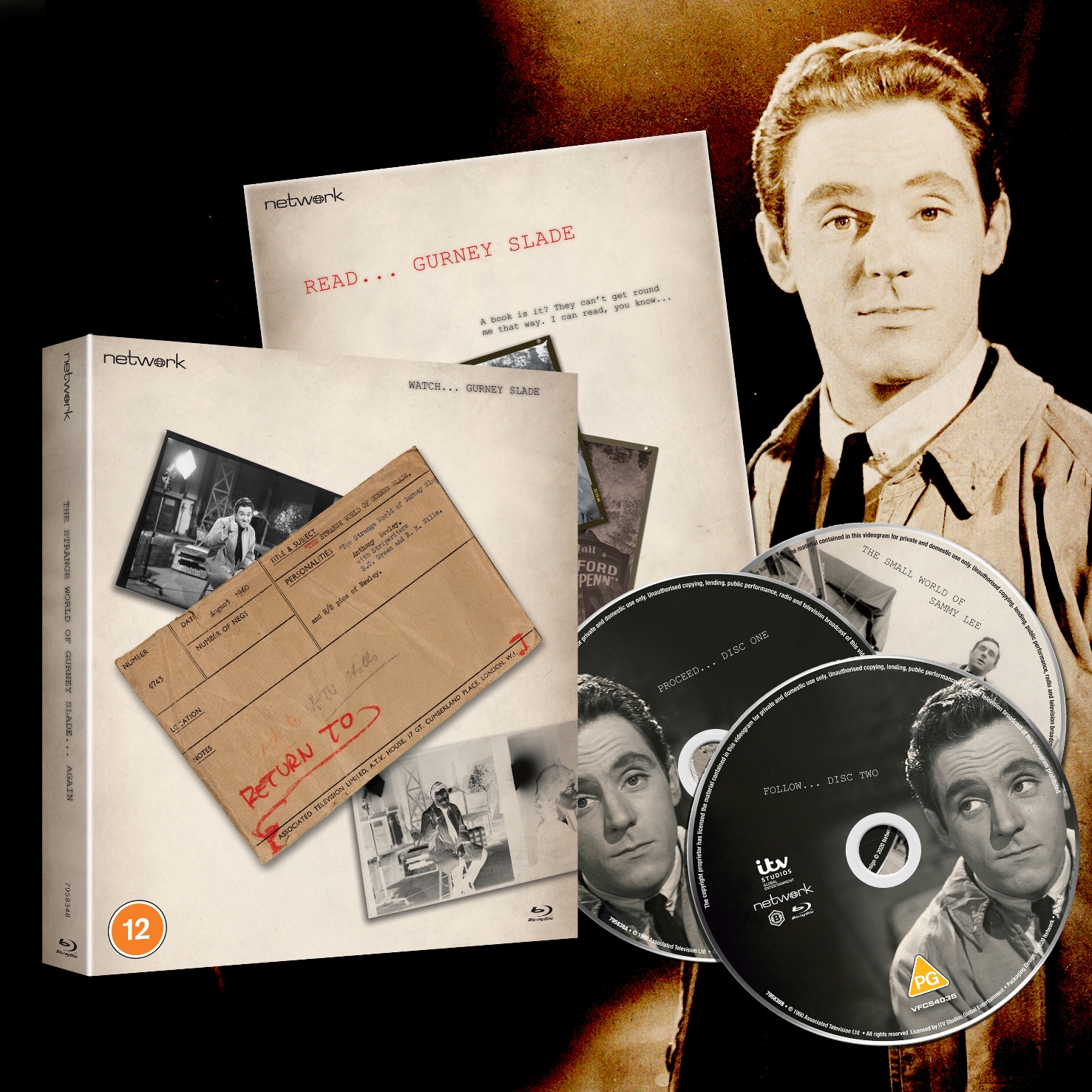
Network have just announced a BD release of The Strange World of Gurney Slade on the 30th of November, with some mouth-watering special features. The press release is below.
On 22nd October 1960 renowned singer and actor Anthony Newley crashed through the fourth wall in his weird and wonderful ATV television series The Strange World of Gurney Slade. To celebrate its 60th birthday all six episodes have been restored in HD from the original 35mm film elements and are now, sixty years to the day since their debut, available to pre-order on a Limited Edition Blu-ray packed full of rare special features exclusively from networkonair.com – this includes streaming of all six episodes via watch.networkonair.com.
This brilliantly inventive and startlingly surreal comedy was unlike anything previously seen on television. Audiences were flabbergasted to see this star on the rise in such an experimental series that deconstructed the fledgling sitcom genre and provided a platform for Newley’s unique stream of consciousness. It was ultimately dropped from its primetime slot after two episodes but not before it managed to take hold in the minds of fans, not least a young David Bowie who’s own breaking of the fourth wall and surreal characters took notes from his fascination and imitation with Anthony Newley and the bizarre Gurney Slade.
Carrying on from where radio’s The Goon Show left off in 1960, Gurney Slade’s influence on comedy was to be felt across the decades that followed – in the late Sixties and Seventies with the surreal sketches of Monty Python ‘s Flying Circus and Marty to the present day Peep Show. The Strange World of Gurney Slade is to television comedy what The Prisoner has since become to television drama – both firmly of its time and spectacularly ahead of it.
The series saw Anthony Newley star as an actor who walks off the set of a banal sit-com and into a fantasy world of his own imagination in a dreamlike odyssey through one man’s personal alternative reality. Talking to dogs, rocks and fairies and dancing with vacuum cleaners it is an unpredictable, absurdist fantasy created by Newley and written by comedy legends Sid Green and Dick Hills (soon thereafter to become key writers for Morecambe and Wise). The series features British stalwarts including Una Stubbs, Anneke Wills, Geoffrey Palmer and Bernie Winters.
This Limited-Edition Blu-ray is brimming with special features including three rare Saturday Spectacular shows from 1960 which acted as a testing ground for Gurney Slade’s internal monologue and feature Shirley Bassey, Peter Sellers, Lionel Blair and more. Also included is a commemorative booklet with contributions from Andrew Pixley, Dick Fiddy and Andrew Roberts and Anthony Newley’s 1963 beat influenced British crime feature film The Small World of Sammy Lee from writer/director Ken Hughes. Released on 30th November it is now available to pre-order exclusively from networkonair.com and includes streaming of the series’ six episodes via watch.networkonair.com – Network’s new streaming platform launched this July.
“Well, it was a noble effort, wasn’t it? You tried. I give you that, you tried. But the public is no man’s fool, you know. The public knows what it wants, and you had no right to even try and suggest something different. Anyway, the public doesn’t like anything… suggestive.” – Gurney Slade #GurneySlade60
Special Features:
Three Saturday Spectacular shows from 1960 featuring Anthony Newley alongside Shirley Bassey, Peter Sellers, Janette Scott, Lionel Blair and others. These variety specials feature Newley’s initial attempts at building the “internal monologue character” that would eventually become Gurney Slade.
Original Gurney Slade promotional shorts.
Extensive image galleries.
The Small World of Sammy Lee: The classic 1963 British crime film starring Anthony Newley
The Small World of Sammy Lee special features: newly discovered archive film material featuring an alternative ending, textless titles and a promotional interview with Anthony Newley
Commemorative booklet with contributions from Andrew Pixley, Dick Fiddy and Andrew Roberts
Free streaming of the series’ six episodes from today only when you buy the limited-edition Blu-ray set
British actors browning up is an occupational hazard you encounter when watching television from the sixties and seventies. Today’s episode of Reeder has two prime examples – Michael Bates (as Ras Lal Punjabi) and Leslie Lawton (as Ram Bannerjee).
Bates, of course, would later don the brown make-up once again when he played Rangi Ram in It Ain’t Half Hot Mum. Bates’ performance in IAHHM is presumably one of the reasons why the sitcom no longer receives television screenings, which is a shame as Ram (as befits a Perry/Croft character) does have certain subtleties.
However, subtle is certainly something you couldn’t accuse Ras Lal Punjabi of being. The character is grotesquely over the top, but then – as per the episode title – that’s really the point of the story. Bates’ turn has an air of mockery, but it’s still somewhat difficult to take.
Elsewhere in the episode, a fresh-faced Ken Campbell catches the eye as Tommy Fenalow, an obviously criminal type. The suit and the moustache are both dead giveaways.
The story, such as it is, is not terribly gripping. But, as always, Hugh Burden manages to make something out of it. Reeder’s love for melodramatic theatre (he’s a devotee of the Sweeney Todd type of drama) is a nice little touch. Guy Verney’s direction is also quite noteworthy – he makes good use out of some strong production design (the high angles in the warehouse set, for example).
Having quickly skimmed through the original story, it’s interesting to note that Vincent Tisley’s adaptation was pretty faithful – especially the passage where Reeder explains to Margaret Belman exactly why he enjoys a decent melodrama.
You have to feel sorry for Keith Washington. He might be the lead of this episode but that’s not enough to enable him to have his name on the opening credits (even though Jennifer Wilson – who only has a handful of lines – does).
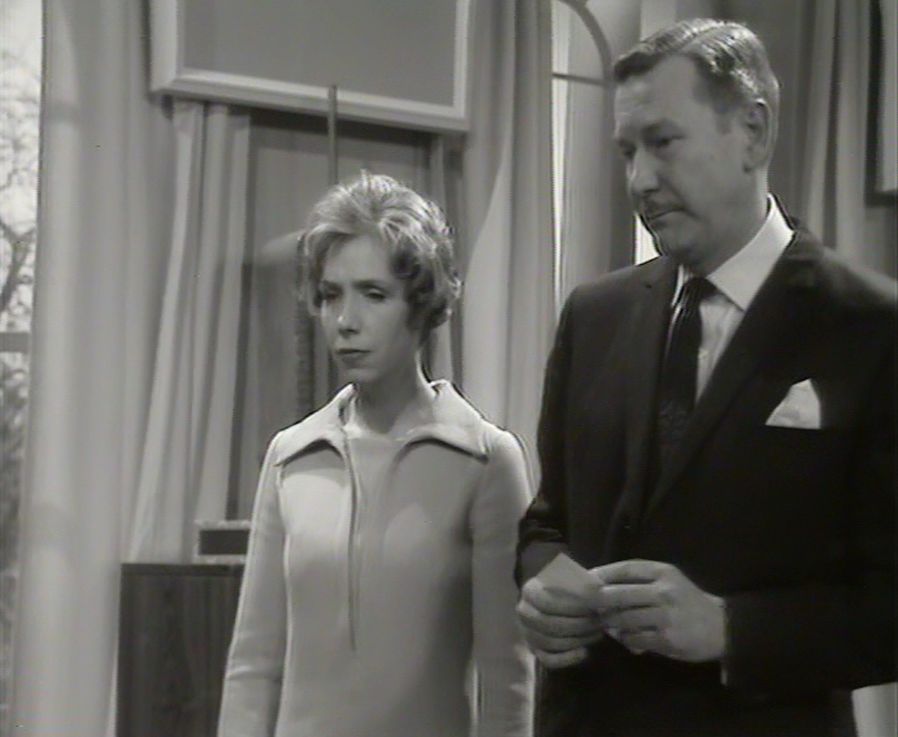
Anthony Skene’s script is an odd one. His sole contribution to the VT era of SB (he’d pen another episode when the series was rebooted by Euston Films in the mid seventies) it’s pretty much crime free. Det. Con. Morrissey (Washington), working for the week at London Airport, has to tell Barbara Cartwright (Mel Martin) that she’s unable to enter the UK. Her country of origin, Rhodesia, isn’t recognised by the British government and so she’s persona non grata.
At first the pair are snippy towards each other, but Morrissey then takes pity on her and decides to give her a whirlwind tour of London (her return flight to Rhodesia isn’t until the next day). These scenes give us an excellent tourist snapshot of late sixties London – we take in fashionable boutiques, familiar landmarks like the Post Office Tower as well as a trip to Madame Tussauds (Barbara is something of a crime expert and is fascinated by the Chamber of Horrors).
There’s also a visit to a glorious VT nightclub where the dying embers of hippydom continue to burn.
This was Mel Martin’s television debut and she’s terribly watchable as the vulnerable Barbara – shocked that the country she’s always regarded as home has now rejected her. Barbara’s something of a dreamer – most of her knowledge of London comes from books and old films, meaning that Morrisey has to tell her that there’s no trams and no pea-souper fogs any more.
An unlikely romance quickly develops between them and just as quickly has to be extinguished. This episode certainly puts a bit of meat onto the bones of Morrisey’s character, although he still remains somewhat unreadable. Quite why he reacts so violently to Barbara’s wish to visit a hip and happening nightclub isn’t clear, for example.
Oh, and there’s also the chance to see Clive Merrison pop up in an early role (nice helmet, sir).
A little drama is generated by the fact that Morrisey is required to give evidence the following day at an important trial which has been unexpectedly brought forward several days. He, of course, is out and about with Barbara and remains totally oblivious to the fact that everyone is running around like headless chickens in an attempt to find him.
You Don’t Exist is certainly a change of pace for the series, but it has a travelogue charm.
Mel Martin
Hawley Harvey Crippen, Mel Martin & Keith Washington
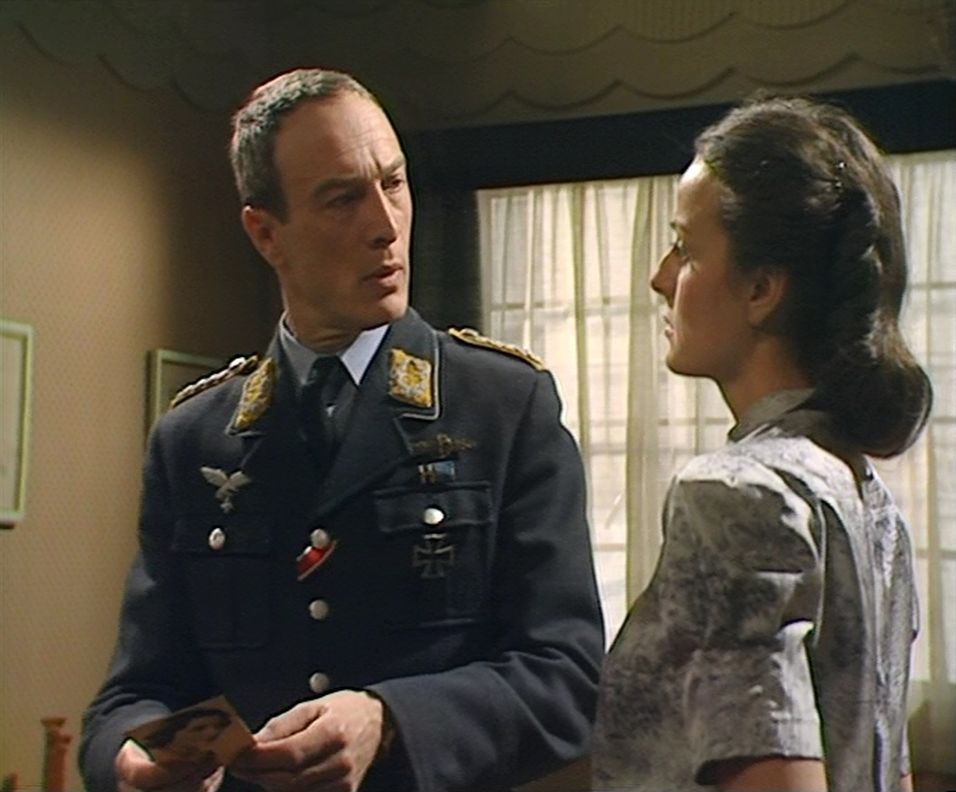
Major Brandt’s wife, Erika (Brigitte Kahn), is in Brussels for a brief visit. Their interactions later provide the spur which kicks the plot into gear, but before that there’s plenty of nice character development on offer.
Brandt is clearly delighted to see her (something she reciprocates, although in a rather cooler way). This is partially explained by the fact that, as a General’s daughter, she suffers from something of a superiority complex – for example, she has no wish to meet Kessler. A member of the SS is plainly a much lower form of life.
Plot-threads which pay off later in the year are established here. Erika now finds living in Berlin, which is suffering heavy bombing raids on a regular basis, intolerable. Fearful for her own life (and that of their children) she begs Brandt to move them to Brussels. This he declines to do, although he concedes that they should leave the city.
There’s an intriguing moment when she finds a photograph of an attractive young woman in his wardrobe. His mistress? Since we know that he’s a workaholic it would seem not and his protestations of innocence do appear to be sincere. And yet ….
You have to say that his explanation for its presence (the cleaning woman could have left it there) is a bit feeble.
Brandt has already tried and failed several times to infiltrate the escape line with one of his officers. Indeed, during series one it seemed like he was doing it every other week.
He hasn’t attempted it for a while, so I suppose it was bound to happen again. The way that the audience (and Lifeline) learn about it today is a touch contrived though. Brandt and Erika are having an argument in bed and he tells her the whole story (an infiltrator – accepted as genuine by London – will shortly be going down the line). But at that precise moment his cleaning lady happens to overhear the whole thing.
That’s hard to swallow moment number one. Hard to swallow moment number two is the fact she knows that Albert is the person who needs to be told about this straight away. Slightly clumsy plotting then.
Hans Van Broecken (Gunner Moller), Natalie’s uncle (and no friend of Albert), returns. As a German himself, he’s the ideal man to try and identify the spy, but given his loathing for Albert, will he agree? Yes of course, otherwise the plot would have floundered somewhat.
If he’s unsuccessful then there will be some difficult decisions to be made. With nineteen British airman in Brussels, one way out would be to shoot them all. It seems cold-blooded, but it might be necessary in order to protect the line.
Some familiar faces can be found amongst the motley collection of airmen. James Wynn (later to play Sooty Sutcliffe in Grange Hill) is one whilst Harry Fielder (someone with a list of credits longer than several arms) is another. The spy isn’t either of these though – but he’s eventually dealt with by Max, with a horrified Hans looking on.
Hans’ disgust that Max resorts to murder is a little difficult to credit. Did he think they’d just let him walk away? He might not have discovered too much about the escape route, but he still would have been able to identify a number of people (Max and Hans, for two).
As touched upon eadlier, the plotting of the episode feels a little suspect in places. We’re told several times that various airmen have been cleared of suspicion, but it’s not explained how this is done. Considering that the infiltrator appears to be, until the very last minute, a perfectly normal British officer it’s hard to work this out.
Kessler only features briefly, but his scene – a meal with Madeleine (Hazel McBride) – is still a fascinating one. There’s some light shone onto Kessler the private man (he admits to being lonely at times, which is why he’s sought the company of Madeline – he’s decided she’s a kindred spirit). And he almost (but not quite) declares that Brandt is his friend, explaining to Madeline that normally he’d be irritated by the superior attitude of Erika, but given his respect for Brandt he’s content not to make a scene.
There’s an odd chronology at work here – the caption tells us that some six months have passed since the previous episode (when Miss Elizabeth stormed out of 165 Eaton Place) and yet all the other evidence (Rose bringing Elizabeth a case of clothes, for example) suggests that only a few days could have elapsed.
Elizabeth continues to rail against the conventions of the society she was brought up in – desperate to help the poor on the one hand and break free from the stifling embrace of her parents on the other – although Rosemary Anne Sisson’s script manages to lob a few well-aimed barbs her way. One minute Elizabeth tells Rose that she’s her friend and the next she’s passed over all her dirty washing (brushing away Rose’s complaint that she’ll never be able to get it past Mr Hudson as a matter of no consequence).
Rose, by keeping secrets from the rest of the staff and her employers, incurs the cold wrath of Mr Hudson. He, of course, knows his place and brings Rose back into line. Elizabeth, by disavowing the conventions of respectable society, is positioned as a disruptive element – breaking the harmony that exists between master and servant. This is a theme that’s been touched upon before and will again in the years to come.
Speaking of disruptive elements, Sarah (yet again) returns – this time as a bawdy music hall star (the toast of Camden Town). A pity that the budget didn’t run to filming in a real music hall, but Sarah’s big number (set to the UpDown theme music) is certainly a talking point. Sarah’s relationship with James picks up steam here, although the real pay off won’t occur until series two.
Introduced in the previous episode, the effete poet Lawrence Kirbridge (Ian Ogilvy) continues to loll about, dispensing bon mots in the style of a cut-price Oscar Wilde. A little of Lawrence tends to go a long way, but there is one small moment when his public image wavers and we get to see the real man beneath (a much less confident and far more real person).
Plot-threads in this first series tend to be rather disjointed. In the last episode Elizabeth was infatuated with Lawrence but he only viewed her with indulgent indifference. Now the pair seem to be in love and marriage may be on the cards.
Except that Elizabeth is insistent that there’s no way she’d submit to such an old-fashioned concept as marriage. That is, until after the second ad break when we see her sorting through her wedding presents. Hmm.
Having spent most of the episode reacting with horror at Elizabeth’s actions, Richard and Lady Marjorie are later gifted a few nice comic moments. Slowly warming to the possibility of welcoming Lawrence into the family, Richard can’t help but critique Lawrence’s latest poem whilst the pair visibly cheer up once they realise that he comes of good Tory stock.
There’s plenty of other good character touches scattered throughout the script – Rose’s reminisces of how she sat with her dying mother all night (and how Lady Marjorie also kept vigil with her) or the way Rose gives the cheeky young Edward a hard slap, for example. A favourite of mine is the arrival of Sarah at the wedding, loudly mixing with the nobs downstairs whilst the servants (kept well out of the way in the upper balcony) look on with a mixture of amazement and horror. Hudson, of course, is horrified ….
Drew Heriot (Jeremy Wilkin) and his sister-in-law, Anne (Rosemary Nichols), continue their quest to locate the “underminds” – brainwashed individuals intent on destabilising the country by whatever means necessary ….
A somewhat forgotten series (despite the fact it’s been available on DVD for a few years) Undermind certainly has some points of interest – not least the fact that it’s nice to see Wilkin (one of those actors who spent most of his career in supporting roles) take the lead for a change. Rosemary Nichols (later to play the third banana in Department S) also gets plenty to do, today’s episode especially.
The series’ writing team was a strong one. It was created (or evolved, according to the credits) by Robert Banks Stewart, with the likes David Whitaker, Bill Strutton, Hugh Leonard and Robert Holmes supplying episodes.
In this episode, Drew’s name is discovered on the client list of a murdered prostitute (along with the names of a great many influential men). Given that the Profumo affair would have been very fresh in the memory at this time, the character of Mr Beymer MP (Derek Francis) has an obvious satiric touch. He may profess to be an upright public servant, but it’s plain that there are some skeletons lurking in his closet. Francis gives a nice performance, although his stick on beard is a little distracting.
Best turn of the episode comes from Patrick Allen as Fenway, a shadowy type who gives Drew an intense grilling. At first it looks as if Fenway might be part of the undermind conspiracy, but he’s simply doing his job – ensuring that public confidence in the establishment isn’t destroyed. This is certainly a theme that’s as topical today as it’s ever been. Garfield Morgan, as Fenway’s no 2 (the suspiciously named Smith) also catches the eye, due to his habit of wearing dark glasses indoors.
Anne is very proactive today, posing as a former call girl in order to investigate a shady employment agency. She does pretty well, although it’s an initial shock to see the previously straight-laced Anne transformed into a short-skirted woman of easy virtue.
David Whitaker’s script does drag a little, so I can only give The New Dimension a cautious thumbs up. And that’s similar to my feelings of the series to date – three episodes in and whilst I’m happy to return for another installment next week, the series has yet to really grip me.
For many people, series nine is peak Grange Hill, thanks to the absorbing storyline which chronicles Zammo’s descent from loveable scamp to duplicitous heroin addict. It shouldn’t be forgotten that introducing such a theme into a children’s series was a somewhat risky move – but it’s done in a very effective and obviously moral manner (certainly no-one could claim that GH was glamorising drug use).
What surprises me though, when reviewing the series, is the way several obvious dramatic beats are missed. I’m not sure if this was because the production team were being extra careful not to foreground this plot too much or whether it was the choice of incoming producer, Ronald Smedley.
The first few episodes set up a mystery – Zammo is acting a little oddly (plus his relationship with Jackie is desperately floundering) – but after that point we rarely return to the fifth formers en masse, which means that we’re denied any scenes where they express their worries about him. The audience is also not privy to moments when key figures like Jackie learn that Zammo is an addict.
And whilst Roland is the first character on-screen to learn the truth (thanks to the memorable episode fourteen cliffhanger) we don’t witness him telling the others, which is yet another surprising moment of potential drama missed.
‘Grange Hill Copyright: BBC’
That’s not to say that Zammo’s travails don’t generate any scenes which linger in the memory. As touched upon, the end of episode fourteen – showing an unconscious Zammo – is a classic moment (although it’s a pity that the jaunty theme music crashes in rather too suddenly). Whilst the end of episode eighteen – Mrs McGuire cupping the face of her mute son, pleading with him to tell her that he’s not an addict – still carries an emotional punch.
The twenty third episode (a now slowly recovering Zammo is visited by Miss Booth) contains another key scene. Although Zammo initially displays a cheerful façade, it’s not long before a strong feeling of isolation and despair begins to seep through. Miss Booth, unable to comfort him, stands awkwardly by as Zammo’s tear stained face looks out of a rainy window.
Throughout these episodes, Lee MacDonald is always on top form. It must have been a daunting role to take on, but he’s never less than totally compelling.
Although Zammo’s slowly dawning realisation that the drugs don’t work is this year’s main theme, there are several others of interest. Such as Fay’s growing relationship with Mr King (David Straun). It’s done in a very chaste way (there’s never any suggestion that they progress beyond holding hands and taking walks in the park) but this is still enough for Mr King to lose his job. Plus there’s an entertaining power struggle between Mrs McClusky and Mr Bronson, which manages to enliven several episodes.
The influx of new characters – Georgina, Helen, Imelda, Ant, Danny – prove to be something of a mixed bag. Ant Jones takes over Zammo’s role as Mr Bronson’s chief irritant (and possibly the irritant of many watching at home as well). More positive is the arrival of Imelda – the series hasn’t had a decent bully since Gripper departed under a cloud in 1983 (plus Imelda is the series’ first long-running female bully).
Series Ten
Harriet the Donkey.
Three words which are guaranteed to strike terror into the hearts of Grange Hill fans of a certain age. It’s all Sir Phil Redmond’s fault (he was the writer of the 1985 Christmas Special – included in this set – which introduced her in the first place). But whilst Harriet was fine as a one-off guest star in a light-hearted Christmas episode, the audience’s goodwill was probably sapped after she became the focal point of an interminable storyline during series ten. Scraping around for positives, the endless adventures of Harriet does give George A. Cooper a little more to do (which is always welcome – he’s the sort of actor I could watch all day).
When the series began, storylines were concluded in a single episode. After GH was renewed for a second series, the show began to take on a soap format, allowing plot-threads to breathe over multiple episodes. Sometimes this was to the series’ benefit – Gripper’s relentless hounding of Roland during series five needed to be drawn out, otherwise the boy’s apparent suicide attempt would have had far less impact – but by 1987 certain storylines (like Harriet) were being allowed to run on far too long.
‘Grange Hill Copyright: BBC’
Elsewhere, another of this year’s long-running storylines – featuring Mr Scott (Aran Bell) – was much more successful. GH had already shown teachers (Mr McGuffy, Mr Knowles) receiving a hard time from the pupils, but their travails tended not to last more than a few episodes. Mr Scott’s problems are different as Imelda has marked him out for maximum vengeance, so he has to endure a slow torture across multiple episodes.
But even after she’s expelled, his problems continue. Fast forward to episode seventeen and he’s struggling with his class over the register (“the register is a legal document and must be taken twice daily”). Trevor – growing more truculent and annoying as each year passes – steps up to be his latest tormentor.
By the end of the series, an uneasy peace has broken out between Mr Scott and N3. It’s a pity that he didn’t return for series eleven though – as it means we’re denied the pay-off (could he have actually transformed himself into a respected teacher?) to the question that the series spent the best part of a year developing.
Banksie had been one of the characters to suffer most during series nine. The rivalry he enjoyed with Zammo had been a key part of series eight, but come the next year Banksie virtually turned invisible.
He’s given much more to do this year, via a storyline that chips away at his hardman image. Banksie is given a work experience placement at Hazelrigg School, a place that caters for children with disabilities. As expected, he initially reacts with disdain (muttering that “clearing up after a bunch of weird kids” will be embarrassing) but over time he comes to appreciate both the place and the people, especially after forming a friendship with the wheelchair-bound Lucy (Leah Finch).
The moral of the story – disabled children are still human beings – isn’t maybe delivered with a great deal of subtlety, but it still works, especially when others – such as Banksie’s girlfriend, Laura – are shown to be less tolerant. Making her react in this way was a good touch, especially since Laura had previously been positioned as a positive and welcoming person.
Another key series ten storyline sees a large part of the school revolting (as it were). Clashes between the pupils and the autocratic Mrs McClusky have played out several times over the past decade (although this is the last large-scale demonstration of pupil power mounted by the series). It possibly won’t surprise you to learn that Mrs McClusky – calmness personified – wins the day. Although Gwyneth Powell would remain with the series for a few more years, she’d rarely take centre stage like this again.
For some reason Eureka weren’t able to supply me with a complete set of review discs, but what I have seen – a disc apiece from both series nine and ten – looks fine to me. Some previous GH releases suffered from ‘filmising’ (most notably on the original BBC releases of the first four series) but there’s no issues on the episodes I’ve been able to sample.
Grange Hill – Series Nine and Ten might be a bit of a mixed bag, but the two series are still strong enough to come warmly recommended.
Grange Hill – Series Nine and Ten is released by Eureka Entertainment on the 19th of October 2020. It contains 49 episodes (2 series x 24 episodes plus the 1985 Christmas Special) across eight discs and has an RRP of £34.99.
The final episode of the first series, With All My Worldly Goods has an abrupt opening – an irate Main insistent that he won’t defend George Mynter (Brian Oulton) on a charge of murder. This turns out to be the secondary plot of the episode, but it’s fascinating nonetheless.
Both Henry and Margaret Castleton view Mynter with a bizarre indulgence – he may have viciously bludgeoned his wife to death, but since he’s a pillar of the community and apparently was provoked (returning home to find his wife in bed with another man) they’re prepared to give him a free pass. This is a little difficult to swallow ….
In Outlon’s handful of scenes he manages to exude an air of Crippin-like menace. There’s no closure to the case, but it seems more than likely that Mynter is insane (possibly he fabricated the story of another man in the house). This leaves Main and Margaret (who’s acting for him) with a serious dilemma – given Mynter’s glowing record of public service it’s possible he might only have to serve a token sentence, but do they have the right to get him off so lightly?
The main plot of today’s episode initially seems a little unpromising. I find it difficult to be too concerned about the business travails of the wealthy Tim Cowley (Richard Wyler), partly because Wyler offers a somewhat wooden performance. The fact that he and his wife, The Hon. Fiona Cowley (Elizabeth Shepherd), then engage in a rapid and bitter divorce is more interesting, but the real bombshell is yet to come.
In open court it’s revealed that Cowley has been having an affair with Julia (Kate O’Mara), David Main’s estranged wife ….
It’s strange that Julia didn’t feature more during the first series (this one certainly gives her the most to do). What’s also odd is that by the end of the episode it seems plain that she still wants to be involved with him (even if they can’t live together). But With All My Worldly Goods would prove to be O’Mara’s swansong – possibly she felt that the character was unlikely ever to add up to much or maybe this decision was taken by the production team.
With Neil Wilson and Hamilton Dyce both appearing, this is almost like a dry run of Spearhead from Space (well, sort of, there’s no meteorites or shop-window dummies). It’s also good to see David Lodge again (playing Det. Sup. Guthrie). Guthrie’s sometimes strained relationship with his old pal Sidney Bulmer (the always immaculate John Arnatt) is something that could have been developed a little more.
If the episode is a bit of a slow burn to begin with, then the final twenty minutes or so (Main goes off the rails, gets drunk several times, beds a lovely young lady and defends himself against a charge of professional misconduct) is definite recompense.
Revisiting series one has been rewarding, so now it’s onwards to series two and colour ….


















 Archive Television Musings