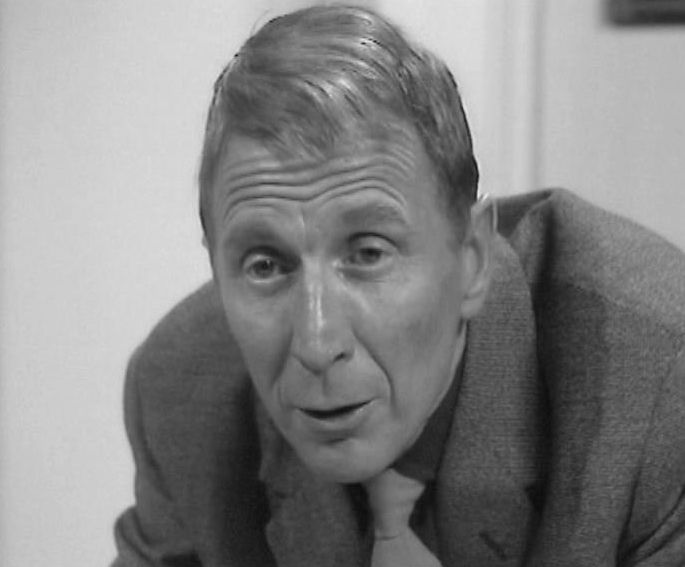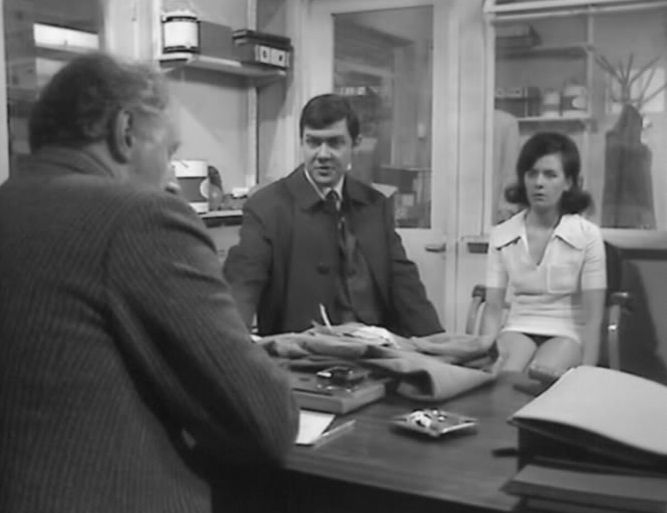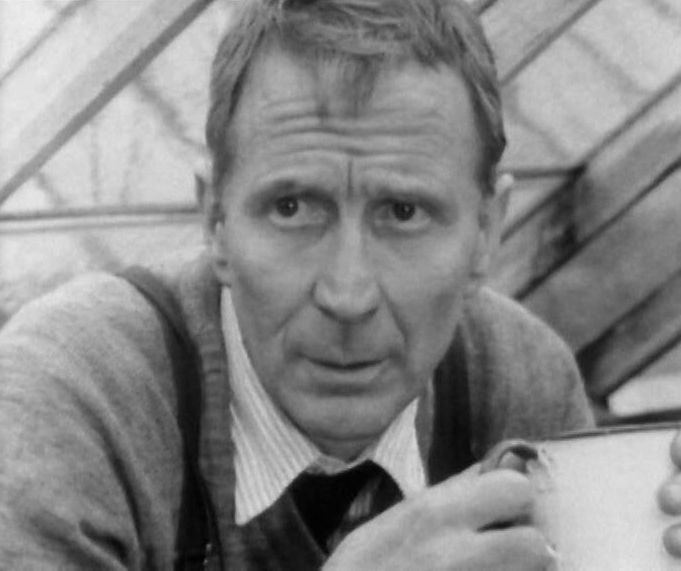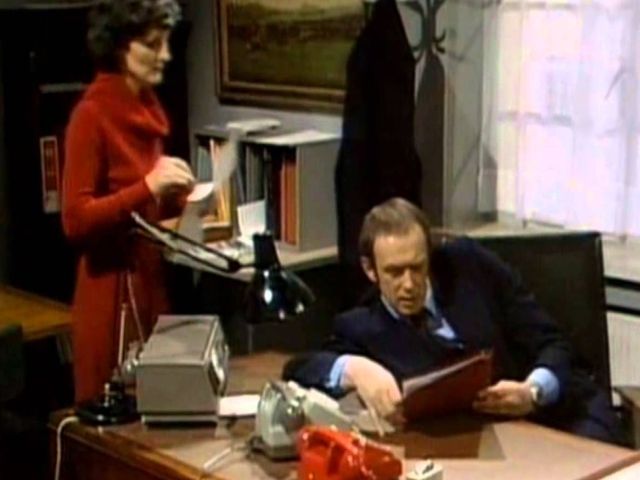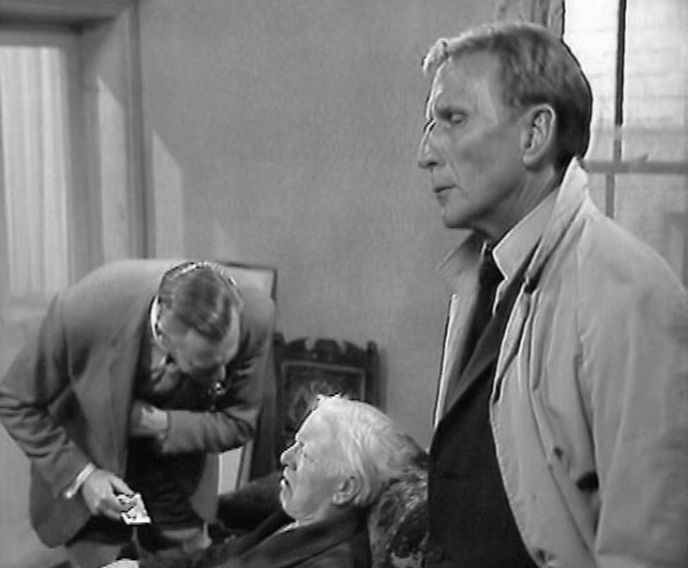
Public Eye – Case for the Defence

case for the defence

Helped by the sole writer on this series, Roger Marshall, there’s a strong sense of continuity between the stories – so that at times it feels more like a serial than a series.  This is evident in Case for the Defence, which harks back to events and characters first seen in Paid in Full.

During Paid in Full, Marker tangled with Detective Constable Broome (Leslie Lawton) who was convinced that Frank had stolen a colleague’s pay-packet.  Eventually the true culprit is caught and Broome returns here to try and make amends for the injustice Frank suffered (losing his job at the builder’s yard).

Frank’s now got another job, stacking supermarket shelves, but it’s obviously far from satisfying.  Broome tells him that there’s a position vacant at a local detective agency.  It’s a tempting possibility – although it would mean the fiercely independent Frank would have to work with others (which isn’t always his strongest point).  But the chance of returning to what he knows best is irresistible, so he accepts the offer of the agency’s owner, Joe Rylands (Stanley Meadows).

His first case involves gathering evidence for the defence concerning the forthcoming trial of Barry Osborne (Billy Harmon).  This is another link back to Paid in Full – as Marker encountered Billy during that story at the police station (Marker was in another interview room, discussing the wages theft).  It’s an undisputed fact that Billy killed a garage owner, Flockton, by stabbing him with a screwdriver.  There seems to be no reason for this, which is even more baffling when you consider that Billy comes from a wealthy family and has received every privilege.

His father, Ben Osborne (William Lucas), is keen to impress on Marker that he wants his son to get off, by whatever means possible.  It’s a powerful performance from Lucas, portraying a single-minded wealthy man (who’s made his money by being the main meat supplier for the county) used to buying whatever or whoever he wants.  This is going to place him on an inevitable collision course with Marker, who prizes the truth highly and will refuse to be cowed or intimidated by him.

Frank is able to establish that Flockton had gone to prison a decade earlier for GBH.  Osborne is delighted – it gives them a chance to craft a plea of self defence.  Together, Osborne and Frank visit Flockton’s victim, Mr Jackson (Richard Bird). but a series of strokes has rendered him virtually unintelligible.  Osborne’s pressurising of the sick old man disgusts Frank, who exits the house.

By now, Frank’s seen more than enough to be convinced that Osborne will do anything, including bribery, to ensure that he can produce witnesses to support his line of defence (that Barry was attacked by Flockton and inadvertently caused his death whilst defending himself).  Frank corners Rylands and lets him know what’s been going on.

MARKER: I think you ought to know that you could be letting yourself in for a great deal of trouble.
RYLANDS: How?
MARKER: Friend Osborne and his cheque book is going around getting at witnessess. Bribing them, getting them to perjure themselves.
RYLANDS: Strong words.
MARKER: Well you’d better hear them now than in the dock.
RYLANDS: Any proof?
MARKER: Not yet.
RYLANDS: Well I’m glad you let me in on this, Marker. Yes, they’re very pleased with you, you know. I’m delighted.
MARKER: Well I don’t want another job to fold up underneath me.
RYLANDS: You’re quite right. But you must remember Marker, when you’re paid to turn up stones, you mustn’t get too queasy at what you find underneath.
MARKER: I’m not queasy, but I just don’t want to be there when he offers the judge fifty quid and a years free meat.

In the end, Barry decides to plead guilty, despite his father’s protestations.  Exactly what happened at the garage is never established, and never will be.  It’s possible that Barry was defending himself, but equally it could just have been a motiveless murder.  Later in the story, Frank talks to a friend of Barry’s, Dorry Milner (Pauline Challoner).  She’s convinced that the blame for Barry’s current situation can be firmly laid at his father’s door.  “He screwed up Barry pretty efficiently.”

There’s no pat resolution to this story.  Marker was paid to do a job, which he did to the best of his ability.  Barry’s decision to plead guilty manages to negate most of Frank’s investigations – so what we take away from Case for the Defence is the unscrupulous nature of Ben Osbourne and his assertion that the truth can be bought.

Marker’s rarely in the position to be able to pick and choose his clients and his conflicts with them, when he comes to realise that their aims are ones he is morally unable to respect, will fuel the drama of many of the episodes to come.
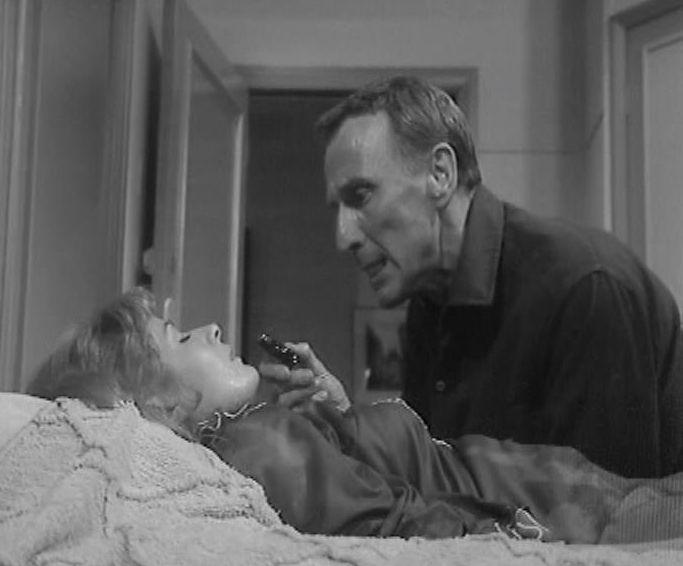
Public Eye – My Life’s My Own

my life's my own

After three very Marker-centric episodes, My Life’s My Own offers a change of focus – as somebody else’s problems take centre-stage.

Early on, Frank has a meeting with his probation officer, Jim Hull (John Grieve).  There’s the possibility of another labouring job, but it’s clear that Frank’s heart isn’t really in it.  He tells Hull that eventually he’ll probably return to his old job as an enquiry agent although he admits that it’s never going to earn him a fortune.  “Often, the big chunks of money can be for something quite trivial.  I mean a couple of hundred quid for finding out who’s stealing in a factory.  What, two day’s work.  And then you can spend a week or more putting the whole world straight for somebody, for a tenner.  Because that’s all they can afford.”

The possibility of doing a great deal of work for little or no reward is also the theme of this episode.  Shirley Marlowe (Stephanie Beacham) unofficially becomes a client of Frank’s after a failed suicide attempt (although no money ever changes hands).  His motivation for attempting to help her is characteristic of him (and maybe he sees something of him in her – they both appear to be loners operating on the fringes of society).

Shirley turns up at the boarding house looking for a room.  Mrs Mortimer’s away (looking after a sick relative) and Frank’s initially reluctant to let her in.  When she tells him she simply can’t walk the streets he agrees to let her have a room.

There seems to be something odd and off-key about her, although Frank either doesn’t pick up on it or maybe he considers that it’s not his problem.  Is the fact he didn’t spot the signs of her distress a motivation for his involvement afterwards?

She’s fond of her transistor radio, which blares out the latest pop hits.  But when it’s still playing at three in the morning, Frank’s concerned – and he breaks her door down.  He finds Shirley unconscious, with a glass containing the dregs of a cocktail of drugs nearby.  Whatever else he is, he’s good in a crisis and he drags her to the bathroom, forces her to vomit and waves some smelling salts under her nose.  He also shakes her violently and slaps her hard across the face several times, which may not be in the first aid manual!

This eventually brings her around, although she’s still very groggy.  When Mrs Mortimer returns she asks Frank why he didn’t call an ambulance.  He doesn’t have a particularly good answer, merely that he thought he could cope.

But as events later seem to spiral out of control, he begins to question his judgement – maybe he decided to take charge because he’s been used to dealing with people’s problems for so long or possibly it was to spare her family the distress of the publicity and the inevitable official enquiries which would follow.

Frank takes her out and walks her up and down Brighton seafront (a nicely atmospheric sequence).  As it’s three in the morning this attracts the attention of a passing police car, but luckily they don’t stop.  When she’s more recovered, Frank’s able to tease her story out of her – and it seems to revolve around a married man called Chris.

Frank finds a letter addressed to a Dr C Nourse (Gary Watson) and goes to visit him and his wife.  Dr Nourse confirms that Shirley used to work for them, as a nurse for his wife, but she recently left.  He seems unmoved by Shirley’s suicide attempt (claiming that it wasn’t serious – if it had been then she wouldn’t have left the radio on for Frank to hear).  His wife seems much more upset, and the penny only drops as he leaves – her name is Chris, his name is Charles.

This is a fairly progressive theme for a mainstream late 1960’s drama and it’s handled subtly and well.  The episode is largely a two-hander between Alfred Burke and Stephanie Beacham, both of whom give fine performances.  Burke is his normal, excellent, self – excelling in the scene where Marker frantically tries to bring Shirley round, for example.

Roger Marshall’s script also provides a meaty role for Beacham.  It means she has to be disheveled and distinctly unglamorous for most of the story – but she’s certainly game for this and turns in an affecting performance as a vulnerable girl who’s prone to sudden changes of mood.

There’s two possible endings to this story – a happy or an unhappy one.  Either she makes another suicide attempt and succeeds or she gets on with her life.  It’s slightly surprising that her decision is taken off screen and therefore is reported second hand to Frank at the close of the story – but I suppose this allows the focus to be put back on him. And although this denies us a final scene between Burke and Beacham, it does bring My Life’s My Own to a decent conclusion.

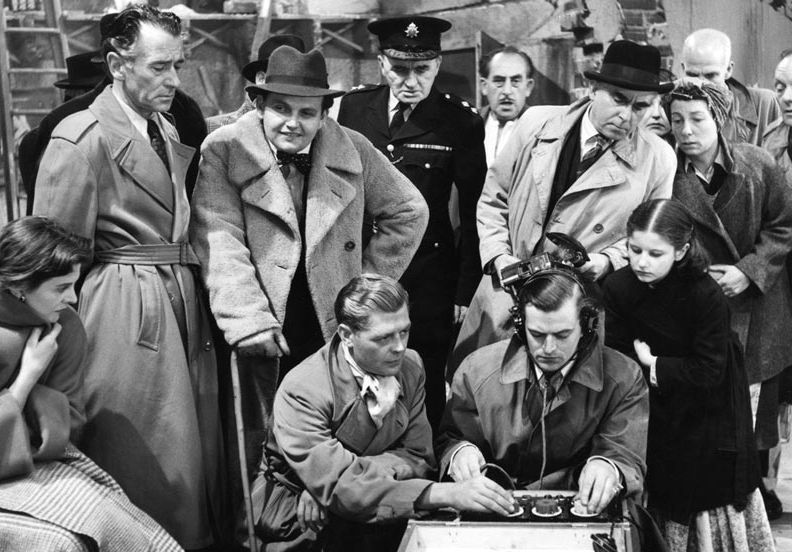
Nigel Kneale’s Quatermass Serials – Introduction

quatermass experiment

If you wanted to make the case that Nigel Kneale and his BBC trilogy of plays featuring Professor Quatermass were key moments in the development of British television drama, then there’s plenty of evidence to back that up.

The fledgling BBC television service launched in 1936.  Its reach was initially restricted to a fairly small radius around the London area (since only one transmitter – at Alexandra Palace – was in use).  It therefore made little impact during these early years, which wasn’t helped when WW2 forced it off the air (it ceased broadcasting in 1939 and only resumed in 1946).

Post war, more transmitters began to pop up around the country – so that by the early 1950’s the majority of the country could now receive television.  And as the familiar story goes, it was the coronation of Queen Elizabeth II on the 2nd of June 1953 that provided the impetus for many people to purchase a television set of their own.

With the launch of ITV still two years away, the BBC had a captive television audience.  So what did the average television schedule look like in 1953?  Thanks to the BBC Genome website (a wonderful resource for the researcher and the merely curious) we can find out.  This is the complete schedule for the 11th of July 1953 (the week before episode one of The Quatermass Experiment made its debut).

13.15 : Cricket
ENGLAND v. AUSTRALIA
Third Test Match
The third day’s play at Old Trafford, Manchester
Commentators : E. W. Swanton and Brian Johnston

15.15 : AQUAVIEW
A glimpse of the preparations for this evening’s cabaret on land and water

15.25 : Athletics A.A.A. CHAMPIONSHIPS
Some of the events in the Amateur Athletic Association’s Annual Championships at the White City Stadium, London
Commentators: Peter Dimmock, Jack Crump and Geoffrey Dyson

16.30 : Cricket
ENGLAND v. AUSTRALIA
Third Test Match followed by a short summary of the day’s play

18.30 : CHILDREN’S TELEVISION
Bruce Gordon in Gordon Gets Going

‘The Appleyards’
A family serial
3-‘ Flying Visitors’ by David Edwards
Settings by Michael Yates
Produced by Kevin Sneldon

19.15 : THE WEEK’S NEWSREELS
This week’s Television Newsreels

20.25 : Interlude
‘Making a Posy’ by William Powell Frith

20.30 : Betty Paul and Andrew Osborn in ‘STAND BY TO SHOOT’
A serial play in six episodes by Donald Wilson
Produced by Dennis Vance
6-‘ Double Take ‘

21.00 : THE TEST MATCH
After the third day’s play, Brian Johnston, with some cricketing personalities, considers the state of the fight for the Ashes

21.15 : ‘EVENING ALFRESCO’

22.30 : Weather Forecast and NEWS (sound only)

Sports fans were obviously well catered for, but drama is pretty thin on the ground –  with only the concluding episode of Stand By To Shoot (and Quatermass would take its place in the schedules the following week).  Generally, drama was fairly sparse at this time – there would be serials during the weekend and one-off plays during the week, but it only formed a small part of the BBC’s output.

Why was this so?  Partially, it was due to resources.  BBC television was still a relatively new organisation and in the early 1950’s it was still finding its feet.  One problem was that drama was broadcast live, as there was no effective way to pre-record.  This would be solved in the years to come, but in the early 1950’s if a play was to be repeated then the cast would have to reassemble and perform it again!  With a limited number of studios, and live broadcasting, drama therefore had to be somewhat restricted.

The drama output of the BBC of this time also owed a heavy debt to the theatre.  The majority of television directors had come from the theatre, as had the actors, and virtually all of the plays were adapted from existing theatrical works.  With the added pressure of live television, it’s not surprising that most BBC drama tended to look stagey (many consisting of a single set, for example, with actors making their entrances and exits).

The Quatermass Experiment was a conscious effort by Nigel Kneale to produce something new – not only was it a serial not adapted from a play, it also had a scope and scale that hadn’t been seen up until that point.  Multiple sets, pre-filmed inserts and a heightened pace of storytelling all helped to make this something unusual.

Of course, what exists of the first serial (episodes one and two) does look somewhat clunky to modern eyes.  This isn’t helped by the fact that the recording of the serial used the BBC’s oldest and least effective cameras (the Emitrons) as well as the primitive nature of the telerecordings.  Indeed, it’s generally assumed that because the telerecordings of the first two episodes were deemed to be of such poor quality it was decided not to record the remaining four – hence they were broadcast live and are gone forever.  Some people do cling on to a faint hope that they were recorded and that copies may exist somewhere, but I’m not holding my breath on that one!

If The Quatermass Experiment was a little rough-and-ready then Quatermass II (1955) was a major step up in quality and Quatermass and the Pit (1958/1959) was yet another major advance.  It’s therefore possible to get something of a feel for the development of BBC television drama during the 1950’s by watching the three original Quatermass serials in sequence.  Quatermass and the Pit was the best of the three, both dramatically and technically.  Although still predominantly live, QATP was by far the most polished production, helped no end by the assured performance of André Morell.

The Quatermass story concluded some twenty years later with the Euston Films production of Quatermass, starring John Mills. Originally developed as a BBC serial in the early 1970’s, it was certainly no easy exercise in nostalgia – not surprising, since that was never Kneale’s style.

I’ll shortly be starting a rewatch of all the existing episodes and blogging my thoughts as I go along. For anybody who hasn’t yet seen the BBC episodes, the DVD is ridiculously cheap at the moment and also has some good supplementary material, such as documentaries and viewing notes from Andrew Pixley. Any collection of British archive television is the poorer without Quatermass on its shelf.

Public Eye – Paid In Full

paid in full

When one of his colleagues, Arthur Wilson (Maurice Good), has his pay-packet stolen, Frank Marker is the obvious suspect.

The legacy of his criminal record and how it colours other people’s opinions of him is the main thrust of this episode.  Although his criminal past should have been a secret at the firm (only the owner, Kendrick, knew officially) somehow it’s public knowledge – which places him firmly in the frame.

While the police, in the form of Detective Constable Broome (Leslie Lawton), are making enquiries, Frank is totally oblivious to the oncoming storm.  He’s enjoying an afternoon off and has decided to do some shopping.  He passes by an antiques shop and is rather taken with a china figure he sees in the shop window.  It’s absolutely the last thing you would expect Marker to be interested in, and his reason for being drawn to it allow us to explore some previously unknown facets of his character.

He tells the shop’s owner (Susan Richards) that his family had something similar when he was a child.  “Must have been the only thing we had that was worth anything.”  She presumes that it must have been a happy family, since he has an attraction to this object.  Frank tells her, matter-of-factly, that no, they weren’t particularly happy and he’s not able to articulate fully the reason why this figurine appeals to him.  This is a lovely character moment for Marker and it seems to exist in the story purely for this reason – to shine a little light on this incredibly private man.

Frank has a visit from Broome who accuses him of the theft.  Marker vehemently denies it.  “And I’m favourite?  Yes, of course.  Well go on, search the place.  Take the bed apart, take the carpet up.”  The indignity of being visited by the police and having his room searched obviously affects him (he eats little at dinner time).  It’s then interesting to see how Mrs Mortimer and Enright (who, like Marker, is an ex-con lodging with Mrs Mortimer) react.

L-R - William Moore, Leslie Lawton & Tania Trude
L-R – William Moore, Leslie Lawton & Tania Trude

When Broome calls, Frank is out and although Mrs Mortimer agrees he can wait, it’s clear from her tone that she views the police officer with hostility.  Enright turns down Frank’s offer of a drink at the local pub, claiming he’s got some work to do, but since he’s coming towards the end of his probation no doubt he’s reluctant to get involved with anyone who’s attracted the attention of the police.

Later, Mrs Mortimer brings Frank a whisky in his room.  They then have a heart-to-heart discussion, which is a major step towards developing their friendship.  She tells him that she believes he’s innocent and goes on to explain that contrary to Frank’s surmise, she isn’t a widow – her husband is alive and (sadly for her) well.  Frank, as he so often is, is more of a listener than a talker, but it’s another well crafted character-based scene from Roger Marshall.

Next day, Frank has to face the accusing stares of his work colleagues.  He approaches Wilson and tells him that he didn’t steal his money and although Wilson says he believes him, from the tone of his voice it’s apparent there’s still considerable doubt.  Alfred Burke, once again, is on great form here, crackling with anger as he faces down Wilson.  “You lost eighteen quid, I could lose eighteen months.”

He does have some supporters though.  Kendrick’s secretary, Jenny (Tania Trude) believes him and she does assist in clearing his name.  Wearing a selection of ridiculously short skirts, Trude was a very appealing presence in both this and the previous story.  She only has a handful of television credits, of which Public Eye was her penultimate one.  Where she is or what she’s doing now is something of a mystery, but she’s one of those actresses that managed to light up the screen and therefore leaves you wondering why she didn’t have a much longer career.

Thanks in part to Jenny, the truth eventually comes out.  Wilson’s money was stolen by his friend Starkie (Brian Croucher on fine form as a loud-mouthed yob).  Starkie says he only took it as a joke, in order to teach Wilson a lesson (Starkie’s miffed that Wilson never wants to go out anymore, instead he prefers to stay at home with his family).

That should be that then, but Kendrick is forced, reluctantly, to let Marker go.  He says he doesn’t want to, but he’s been advised that Frank’s continued presence would be a “disruptive element”.  Again, Burke’s first-class here, railing against the injustice of it all.  But it’s all to no avail, and so the episode ends with Frank walking out of the yard for the last time.

Public Eye – Divide and Conquer

divide and conquer

Divide and Conquer opens with two bikers, Harry (Terence Rigby) and Frank (Richard O’Callaghan), enjoying their breakfast at a Brighton cafe.  They manage to con the cafe owner (Ken Jones) out of five pounds before making a stealthy escape.

At the same time, Marker is enjoying his breakfast at Mrs Mortimers, prior to starting his new job.  As with his accommodation, it’s been provided by the probation service.  It might not be exactly what he wants to do (he starts off by repairing the sea-wall at a lonely stretch of beach) but as an ex-prisoner he can’t afford to be too choosy.

A visit to the local pub with Enright (Peter Cellier) sparks trouble.  Enright, like Marker, is an ex-con who’s also lodging with Mrs Mortimer.  Unlike Marker, he’s something of a gregarious chap, and he eventually manages to persuade the insular Marker to share a drink with him.  At the pub, Marker sees Harry try to con the publican (played by Norman Mitchell) with the same trick he pulled on the cafe owner.

There’s no reason for Marker to get involved, but he does and it forces Harry and Frank to beat a hasty retreat.  Professionals wouldn’t have attempted to use the same trick more than once in the same area and by the same token, professionals wouldn’t hang about.  But Harry and Frank aren’t professionals and Harry vows to get even with Frank Marker.

Divide and Conquer is another excellent character-driven story from Roger Marshall.  Harry and Frank, whilst occasionally faintly ridiculous, also manage to exude an air of menace.  Terence Rigby was always an idiosyncratic actor.  He could be excellent (for example, as Big Al in Alan Plater’s Beiderbecke stories) but he could also turn in fairly indifferent performances (such as a rather wooden Dr Watson opposite Tom Baker’s Sherlock Holmes in the BBC Classic Serial adaptation of The Hound of the Baskervilles).

This story showcases both his strengths and weaknesses.  At times, Harry is an intimidating figure (when he pulls a knife on Marker after the unsuccessful attempt to con the publican) but it’s fair to say that at times Rigby’s delivery and performance borders on the pantomimic.  O’Callaghan doesn’t speak too much, and therefore is more of a looming presence, but he’s key to the resolution of the story.

The last fifteen minutes are the heart of the episode.  It’s a single sequence, shot on film, which sees Harry and Frank confront Marker whilst he’s at work.  As I’ve said, it’s a lonely spot, so Marker wouldn’t be able to count on anybody coming to his aid.  We’ve previously seen that he can take a beating as well as give one out (for example, Nobody Kills Santa Claus) but the odds here are stacked against him.  If he’s going to walk away unscathed, then it’s words not actions that will save him.

That’s what the title of the story means, as Marker has to play Harry and Frank off against each other.  Harry is keen to attack Marker, Frank isn’t so sure – and Marker is able to slowly plant seeds of doubt in both of their minds.  He tells them what would happen if they carry out the attack.  “That would put you right in the big league.  Send you up for two years, soon as look at you.  If someone says to me, ‘two years inside’ I’d go like that.”  And Marker shakes his hand to indicate how frightened he is.  The more susceptible Frank agrees.

It’s a great three-handed scene and is yet another example of quality acting from Alfred Burke.  At the start there’s an imminent sense of violence, but Marker is able to chip away at their confidence bit by bit, targeting first one and then the other.  Once he’s managed to convince Frank, it makes Harry less of a threat – and eventually both of them decide to cut their losses and drive off.

Jim Goddard’s direction during this lengthy film sequence either favours very low angles, shooting up at the three actors, or tight close-ups.  Both help to keep the focus firmly on the characters and the dialogue, whereas wider shots would have dissipated some of the tension.  It’s a very well-shot section and it’s just a pity that the original film inserts no longer exist (this means that all the film sequences are a little blurry, they certainly aren’t as good as the remastered VT interiors).

Another very solid episode.

Public Eye – Welcome to Brighton?

welcome to brighton

Welcome to Brighton? was the first episode of Public Eye‘s fourth series, originally broadcast in 1969.  It was also the first series to be made by Thames (the previous three were ABC productions).  Sadly, only a handful of episodes from the ABC years exist (a mere five out of forty one).  Given how good these surviving episodes are, it’s a great pity that so few escaped the archive purges – but luckily all of the Thames episodes are present and correct.

The fourth series is noteworthy for several reasons – firstly it’s the shortest series of Public Eye (seven episodes) and secondly it’s the only one where all the episodes were penned by a single writer – in this case, Roger Marshall (who co-created the series with Anthony Marriott).  Having just the one writer allows for a unity of characterisation – which is particularly important, since most of this series revolves around Marker himself.

When a show has an actor as good as Alfred Burke, it’s understandable that the scripts would be tailored to his many strengths.  So series four of Public Eye is concerned with Marker’s journey back into society first and foremost, and we don’t see him back in his old job as an enquiry agent until later in the run.

At the end of the final episode of series three (Cross That Palm When We’ll Come To It) Marker was convicted of handling stolen goods (although he was innocent) and sentenced to two years imprisonment.  Welcome to Brighton? opens with him in his last few days at Ford Open Prison, prior to his release.  There’s plenty of people ready to offer advice, such as fellow con Jakeman (George Sewell) and the Governor (Martin Dempsey).  Both, in their different ways, are somewhat pessimistic about Frank’s chances.

Frank tells Jakeman that he plans to go straight, but Jakeman isn’t convinced – as he believes that the police will constantly be on his back.  “Once you’re in their little black book, you’re there forever.  They’ll be leaning on you, turning you over.”  This is something we see borne out later in the series, though Frank’s done his time and is now a free man, he still has to face the suspicion of the police and others – once a con, always a con, it seems.

The Governor is concerned that Frank is a solitary individual, with no apparent friends or family.  “Have you always been so withdrawn? Or has prison made you like that?” Frank counters that he’s still the same person he’s always been and the Governor suggests he should try changing – “bend with the wind occasionally”.  In the Governor’s opinion, without people look out for him, he’s likely to re-offend again.

Frank’s release day comes and he’s driven down to the railway station in a Black Maria.  This obviously marks him down as a released prisoner and he has to face the curious and accusing stares of his fellow passengers.  The probation service have set him up with a job in Brighton and also accommodation – at a bed-and-breakfast run by a Mrs Mortimer (Pauline Delaney).  Mrs Mortimer takes in the occassional ex-criminal (provided they’re not violent, she says she doesn’t want to wake up in heaven) as something of a civic duty and welcomes Frank into her home.  Although she only has a single scene in this story, during series four Mrs Mortimer will become the closest thing to a friend that we’ve ever seen Frank have.

After checking out his room, Frank goes for a walk around Brighton.  The most notable occurrence is a meeting with Grace (Heather Canning).  She spies him drinking a bottle of whisky by the seafront and offers him the use of her toothmug back at her flat – he readily agrees and it’s clear that there’s more than whisky on offer.  It’s uncharacteristic of Frank to pick up a total stranger, but after two years and more in prison, it’s understandable.  When he goes to the toilet, she steals some money from his wallet and Frank, when he returns, knows instantly that something’s wrong.  Alfred Burke here (as he is throughout) is excellent, as we see the repressed anger bubbling just beneath the surface.  Marker is usually a pretty laid-back character, but circumstances change that.  He nearly strikes her and has no compunction is forcibly removing the money from her clutches.  He does leave the whisky with her though, as a consolation.

If Weclome to Brighton? feels like a series of vignettes, then that’s a fair assessment.  The next concerns Jakeman’s wife, Freda (Anne Ridler).  Jakeman asked Frank to visit her and find out why she hasn’t replied to his letters or visited him recently.  This he does and he tells her that a wife who doesn’t stand by her husband in prison can’t be much good.  This is the signal for Freda to tell Frank in no uncertain terms exactly what she thinks.  “He’s safely banged away in his cell.  Every time responsibility comes up, he’s off, never fails.  Well, you’re all the same.  Half of you run back inside every time some little problem comes up you don’t want to cope with.  You’ll be back there, you see.”  There’s plenty more where that came from and Freda’s speech highlights how a prison sentence affects the people left on the outside just as much as those inside.

So Welcome to Brighton? is not only a series of vignettes, but it’s a series of  vignettes where Frank come off second best (particularly in his encounters with Grace and Freda).  It’s a sign that his new life in Brighton will be far from smooth.

The Galton and Simpson Playhouse – Big Deal at York City

big

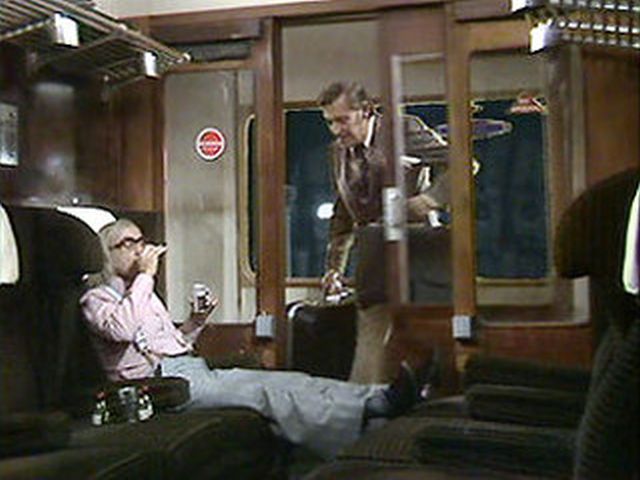
Albert Cakebread (Warren Mitchell) has had a good day at York Races.  On the train back to London, he flashes his winnings (over two thousand pounds) in the bar and offers to buy everyone a drink.  This catches the attention of one of the passengers, Basil Trenchard (Gerald Flood).

Later on, Trenchard, along with two other people (played by Alister Williamson and Robert Dorning), asks Albert if he fancies a friendly game of cards to while away the journey.  Albert agrees, as does another passenger in the carriage (a businessman played by Robin Parkinson).  In order to keep things fair, Albert asks the imposing figure of the Bishop (Lockwood West) to deal the cards.

It’s obvious that Flood and his two friends are con-men who plan to fleece the ebullient Albert out of his winnings.  Each hand reduces Albert’s money little by little, so that by the last hand he desperately stakes everything he has  The others do as well and it seems that Trenchard is going to walk away with the lot.  But amazingly, it’s the mild-mannered businessman (Parkinson) who actually has the winning hand and he scoops the whole pot.  The twist is that he, Albert and the Bishop are also a gang of con-men (who have managed to outfox the other three by being a little more subtle).

Big Deal at York City boasts an interesting performance from Warren Mitchell who affects an accent which I believe is a West Country one.  Why he didn’t use his more familiar London tones is a bit of a mystery, unless it was supposed to lull the three marks into believing him to be a country bumpkin.  His character certainly comes over as something of a simple, trusting soul (although as we see that isn’t the case at all).

Gerald Flood (bad King John, or at least something that looked like him, in the Doctor Who story The Kings Demons) is rather good as the card-sharp who spies what he thinks is an easy mark, only to be taken to the cleaners himself.  Another solid performance comes from Lockwood West as a man of the cloth who seems to gain a great deal of knowledge about poker as the game goes on!

Although Mitchell’s accent and slight overplaying is a little distracting, Big Deal at York City is an entertaining twenty-five minutes that brings the Galton and Simpson Playhouse to a close.  Although the quality of the series was a little variable, the first-rate casts in each episode do help to sometimes lift the material.  It’s not Hancock or early Steptoe standard by any means, but it’s certainly worth a look.

The Galton and Simpson Playhouse – I Tell You It’s Burt Reynolds

burt

I Tell You It’s Burt Reynolds takes place in the living room of a typical family home.  The arrival of Jim (Leonard Rossiter) is enough to send the kids to their room (“he never stops talking”) although the adults are less fortunate.  They’re just about to watch McMillan and Wife and although Jim tries to tempt them with the football on the other side, he settles down to watch it as well.

Jim is an insuffrable know-it-all.  This starts when he tells Joyce (Gillian Rayne) about the deficiencies of her television set.  “You know your colour’s all wrong? There’s too much red. You can’t watch it like that, it looks like he’s been boiled.”  Granny (the peerless Patricia Haynes) is old enough to speak her mind.  “What’s he want to keep coming round here for?”

After they manage to prevent Jim taking the television set apart with a screwdriver, he keeps quiet for a moment.  But it doesn’t last long, as he spies a familiar face just behind Rock Hudson.  What, he wonders, is Burt Reynolds doing in an episode of McMillan and Wife?  Everybody else tells him that it’s not Burt Reynolds and indeed that it looks nothing like him, but Jim is convinced.  “Course it is.  Don’t tell me I don’t know Burt Reynolds when I see him.”

Thanks to Leonard Rossiter, this is the best episode of The Galton and Simpson Playhouse and it’s fair to say that few comic actors would have been able to deliver such a tremendous performance of ever-increasing hysteria.

Although Burt isn’t listed in the TV Times or on the end credits, Jim isn’t going to give up, despite the fact that nobody else cares.  Calls to Yorkshire Television and the Daily Telegraph (Jim disgustedly tells them he’ll be buying the Daily Express from now on) are fruitless – so he decides the only way to settle this is to call Burt Reynolds in Hollywood.  Incredibly he gets through, but when Burt doesn’t give him the answer he wants, is Jim finally going to admit defeat?  Of course not!

Twenty years later, this was remade with Paul Merton in the main role.  The two series of Paul Merton in Galton and Simpson’s … are interesting.  Merton was always on something of a hiding to nothing, since many of the episodes were television classics (such as the various Hancock episodes selected, including The Radio Ham and Twelve Angry Men).  The Paul Merton I Tell You It’s Burt Reynolds is fine, but it really doesn’t work without the full-throttle attack of a top comedy performer like Rossiter.  The Galton and Simpson Playhouse was very fortunate to get a performer at the top of his game, as he was able to wring every last comic drop out of the scenario.

The Galton and Simpson Playhouse – Variations on a Theme

variations

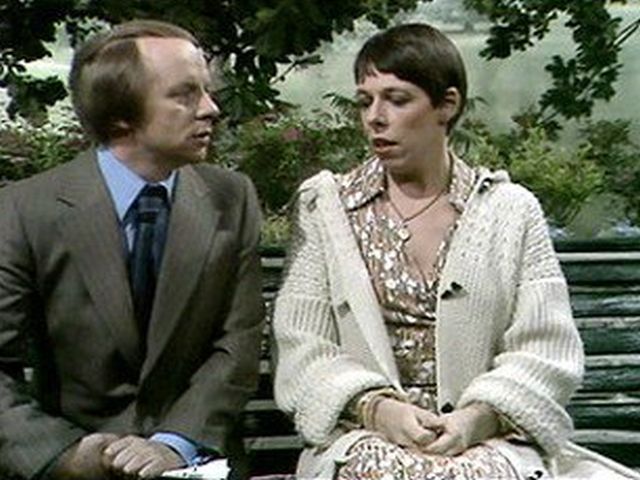
Variations on a Theme is an interesting concept. It’s essentially two very short one act plays with the same actors (John Bird and Frances de la Tour) and the same setting (a park bench)  In both cases the story develops from the same line from de la Tour’s character – “Robert’s found out” – and both stories have a twist at the end.

In part one, the two are lovers – meeting in the park after their afternoon of passion the previous day.  The bombshell that Robert (her husband) has found about their relationship strikes fear into the heart of Bird’s character.  She consoles him that he had to find out sometime, which he disagrees with.  “We only met yesterday.  Some men get away with it for years.  Some men never get found out at all.”

Bird’s character is particularly anxious, since Robert is a television wrestler (the Streatham Strangler) who’s well known for his violent temper.  Another cause for concern is what the scandal will do to him – as chairman of the Marriage Guidance Council it’s more than a little embarrassing.  “I’m expected to save marriages.  You came into my office yesterday for advice.  Two hours later we were in bed together, people aren’t going to understand that.”

John Bird is excellent as the twitchy adulterer, constantly looking over his shoulder in case Robert’s lurking in the bushes nearby.  Frances de la Tour is equally good as a woman seemingly possessed of a deep passion.  However, the twist is that after he’s paid her £5000 to keep his name out of the divorce proceedings, she moves onto the next park bench where it’s clear that there’s another mark who she’s also enjoyed a one night stand with (and presumably she’ll be conning him out of a similar sum of money).

In part two, the pair are a married couple and Robert is their son – who’s found out about the facts of life from a friend.  Bird’s character reproaches himself.  “It’s a father’s responsibility to tell his son about these things.  I failed that boy.  I had it all planned about how I was going to tell him.  I mean it’s only three months since I brought the rabbits home.”  Although, as de la Tour’s character points out, the rabbits were both female, which was a bit of a problem.

It quickly transpires that Bird’s character, despite being a psychiatrist, has something of a hang-up when it comes to sex – so he’s very reluctant to broach the subject with his son.  He then wonders if Robert ever saw the two of them in bed.  de la Tour’s character thinks not, but Bird’s character isn’t convinced since “you usually have a pillow over your head and I have my eyes shut.”

Eventually he decides to employ a course of aversion therapy on Robert and then bring up the subject in a couple of years time.  She then reminds him that it’s Robert’s birthday the following day – when he asks how old he is (nine or ten he thinks) she informs him that he’s twenty three.  As they leave the park together, they discuss appropriate presents (she thinks a cowboy suit would be right, whilst he thinks a railway set would be ideal).

Again, Bird and de la Tour are excellent in another two-hander.  Had either of the two story ideas been stretched to the whole twenty-five minutes it probably wouldn’t have been as memorable an episode.  But spinning two totally different plots from the same opening is what make this stand out a little from the norm.

The Galton and Simpson Playhouse – Naught for Thy Comfort

roy

Richard Burton (Roy Kinnear) is an airline steward who returns home to find a Dear John (or rather a Dear Richard) letter from his wife.  She’s left him for another man, but in-between informing him that his dinner’s in the oven and that his spare uniform is at the dry-cleaners, she goes on to tell him not to “blame yourself in any way for what has happened.  You’ve been a good husband and I’ve nothing to reproach you for, which makes it even harder to do what I’m doing.”

This is an obvious blow and he desperately needs to find somebody to pour out his troubles to.  The problem is that nobody’s interested – as his so-called friends seem to regard him as something of an encumbrance, to put it mildly.  After finding no useful information from his mother-in-law, he calls “good old Harry, one of the best.”  Harry desperately conjures up an excuse to avoid talking to him – Richard seems like a nice enough fellow, but Harry gives the impression that he’s a crashing bore that no-one wants to spend any time with.

Possibly part of the reason for his lack of social success is his complete inability to appreciate the problems of others.  Later on, we seem him conducting a lengthy conversation on the phone with another friend, Jack, who he’s stunned to discover is burying his wife the next day.  He then remembers that Jack did mention this fairly important fact earlier on (Richard’s call has lasted over an hour) but Richard’s so wrapped up in his own world of pain that he has little empathy for anybody else’s grief.

Encounters with a barman (Robert Gillespie), a vicar (Frank Gatliff) and a phone-in host (Alan Freeman) don’t go well either and it seems that nobody wants to listen to him.  He then receives a call from a man in a phone-box (John Clive).  This is the man who his wife was originally going to run off with (which raises the interesting question as to how many men she was seeing!) and he’s just as upset as Richard to find she loves another.  Richard cams him down and tells him to pour out his troubles – as it’s good to talk these things through.

Naught for Thy Comfort operates in familiar Galton and Simpson territory.  Burton, like Hancock or the Steptoes, is something of an outsider from the normal run of society.  And like them, he’s not always the most sympathetic of characters, although this changes right at the end when, ironically, he takes a great interest in the welfare of his wife’s former lover.  Is this because he understands the pain that occurs when nobody will listen to you and therefore he’s able to derive some comfort by offering a sympathetic shoulder to cry on, even when it’s for a man who’s cuckolded him?

Roy Kinnear was something of a British comedy legend and his casting certainly gave the episode a lift.  There’s not many belly-laughs here, but it does raise a smile or two.

The Galton and Simpson Playhouse – Cheers

cheers

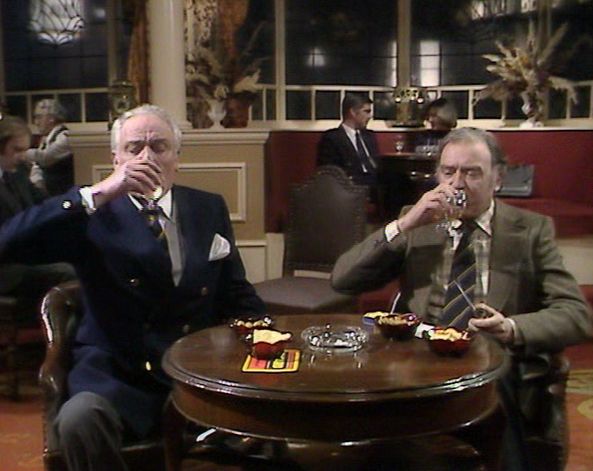
Charles (Charles Gray) and Peter (Freddie Jones) operate under a strictly fixed routine.  Friends since childhood, they went through the army together and now share the same house.  Charles likes to organise everything and as they enjoy their regular evening drink at the pub, he outlines how he sees the week progressing.  Friday night sounds particularly exciting.  “In here for our usual and then off home and wash our hair.  I’ll wash yours and you can wash mine, I never get all the soap out otherwise.”

Then Peter drops a bombshell – he’s getting married on Saturday.  This throws Charles into a spin, how can Peter get married when they’ve got the laundrette to do?  Peter is firm though, he’s in love and he’s going to be married at 12.00 noon on Saturday.

Charles continues to be baffled that Peter could desert him, after all they’ve been through.  “After thirty five years, school chums, brother officers, comrades-in-arms, joint lease-holders of a maisonette and an allotment – which we were going to manure on Sunday.”

But Peter wants to break free from his routine existence and do something very different.  He tells an increasingly appalled Charles that he and his wife-to-be will be “staying in South America.  We’re taking a raft up the Amazon, right into the rainforest.”

If all this sounds very unlikely, then there’s a good reason why – Peter’s made it all up.  There’s no girlfriend, no marriage and on Saturday he’ll be locked into the same old routine.  He then confesses to Charles that he created this wild fantasy in order to try and break the monotony.  Charles agrees that they should try and do something different, but it’s clear that they never will.

A bittersweet tale, Cheers is pretty good stuff, although there are a few awkward moments which do firmly place it in the 1970’s.  Charles is disgusted to see a black woman on the arm of one of the other pub regulars (Nicholas Courtney).  He mutters that such a thing shouldn’t be allowed and he declares that “I’d like to know where he gets his money from, I’m sure he’s a mercenary.”  Awkward though this is, it’s always nice to see Nicholas Courtney and whilst it’s not a large part, he makes the most of it.

Charles is also amazed to learn that people consider that he and Charles are a couple of “poofs”.  The fact they do everything together (including washing each others hair) has clearly not gone unnoticed by the other pub regulars (who call them “Pinky and Perky” behind their backs) but Charles doesn’t understand this at all.  “I don’t believe it! I don’t look anything like a poof.”

Freddie Jones gives a lovely turn as a middle-aged man yearning for escape from his humdrum life whilst the always solid Charles Gray is suitably bluff as another middle-aged man who lives for exactly the routine that drives Peter up the wall.  If anything changes, you can tell that Charles simply wouldn’t be able to cope.

If the scripting of The Galton and Simpson Playhouse so far hasn’t always been the sharpest, the star-quality of the actors has been enough to hold my interest.  Cheers is another good example of this.

The Galton and Simpson Playhouse – Swop You One Of These For One Of Those

swap

One major theme running throughout so much of British comedy during the 1970’s was that of sexual frustration. The Carry On’s, Benny Hill and Les Dawson’s Cosmo Smallpiece are just some examples of the typically frustrated British comedy male.  Richard Briers as Henry Fairlane in Swop You One Of These For One Of Those is someone who fits snugly into this niche as well.

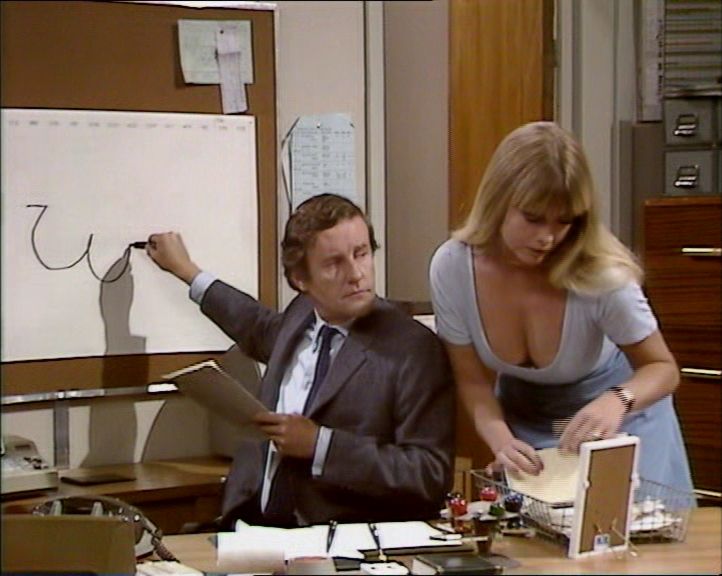
The 1960’s may have been the decade of sexual revolution, but for some (and especially Henry) it seems to have totally passed them by.  He spends his time in the office ruminating on the clothes the secretaries wear.  “Shouldn’t be allowed to walk around the office dressed like that. They’re asking for it, they really are. Trouble is, they don’t ask me for it.”

He’s happily married, but his eye is certainly roving.  When one of the secretaries (Linda Hayden) wonders why he should bother to play around, he tells her that “I’m not old enough to turn it in.  I should be playing around, it’s natural.  I mean it keeps you young and healthy, it gives you a better disposition.”

Linda Hayden
Linda Hayden

Briers is perfect as a twitchy forty-something who’s desperately yearning for new horizons.  And as luck would have it, his colleague Roger Gresham (Henry McGee) has the answer – an invitation to a wife-swopping party.  You couldn’t really get any more 1970’s than that!  Henry’s keen, but Roger tells him that he has to make sure he brings his wife along – no wife, no entry.

Come the night of the party and Henry’s been separated from his wife – he lost her at Belsize Park tube station.  Roger refuses to let him in without her, so he has to keep a lonely vigil outside, watching enviously as numerous other couples gain admittance.  The frustration part is key to the comedy – Henry has to remain constantly unfulfilled,  otherwise the joke doesn’t work.

Eventually, Henry’s wife Linda (Jan Waters) does turn up – just after Henry stepped away from the door.  Roger’s delighted to see her and and instantly lets her in (after some hesitation she throws herself into the party with gusto).

So by the time the party’s over, Linda’s had a great time and poor Henry’s been stuck outside the whole time.  Henry, like so many comedy characters from this decade, is forced to constantly have his nose pressed to the glass, watching others enjoy themselves.

Richard Briers gives a very nice turn and Henry McGee (a familiar Benny Hill stooge) makes an impression as one of the oldest swingers in town.  It’s also good to briefly see the imposing figure of Peggy Ann Clifford.  She made a memorable non-speaking appearance in The Missing Page episode of Hancock’s Half Hour as the woman who watches Tony mime the plot of a particularly exciting book.

Swop You One Of These For One Of Those is a step up from Car Along The Pass and is, if nothing else, a good time-capsule of the period.

The Galton and Simpson Playhouse – Car Along The Pass

car

Ray Galton and Alan Simpson’s writing career started in the late 1940’s (when they were both confined in the same tuberculous sanatorium) and it continued for the next thirty years – coming to an end with this series.  After The Galton and Simpson Playhouse was transmitted in 1977, Alan Simpson retired from scriptwriting whilst Ray Galton carried on, working with several other collaborators (such as Johnny Speight).

Galton and Simpson, are of course, best known for Hancock’s Half Hour (six radio series and six television series), Hancock (their seventh and final television series written for Tony Hancock, featuring classics such as The Bedsitter, The Lift, The Bowmans, The Blood Donor and The Radio Ham) and Steptoe and Son.

Following Tony Hancock’s decision to fire them as his writing team, the BBC offered them carte-blanche to write about anything they wished, and so the Comedy Playhouse series was born.  One episode, The Offer concerned two rag and bone men and it seemed to have potential – out of this came the long-running Steptoe and Son.

YTV’s The Galton and Simpson Playhouse seemed to be a conscious nod to this series, as the programme clearly emulated the style of Comedy Playhouse (one off comedy playlets featuring some of the best acting talent around).  It’s a pretty decent effort for them to bow out on, as whilst it’s fair to say that their writing heyday was in the 1950’s and 1960’s, this series isn’t completely without merit.

Having said that, it’s a shame that it kicked off with Car Along The Pass, easily the weakest of the seven shows.  Henry and Ethel Duckworth (Arthur Lowe and Mona Washbourne) take a cable-car trip in the Swiss Alps.  Henry hasn’t enjoyed his holiday at all and things don’t improve when the cable-car stops when it’s only half way across.  The passengers are told that repairs will take a few hours, so naturally Henry (since he’s an Englishman) decides to take charge.

Henry Duckworth has faint echoes of Lowe’s most famous comedy character (Captain Mainwaring from Dad’s Army).  Both are rather pompous and incredibly proud of their country of birth, but Mainwaring is also a basically decent man (plus he has the rest of the platoon to keep him in check).  Duckworth is just a blinkered bore, with no redeeming qualities whatsoever.

There’s plenty of comic potential in taking a disparate group of people and trapping them in a confined space – after all, Galton and Simpson did this to great comic effect with the Hancock episode, The Lift.  But Car Along The Pass is a very pale imitation.  Had Henry learnt anything about his fellow passengers, or himself, then it might have been worthwhile – but his worldview remains the same at the end as it was at the start.

He’s dismayed to find there’s only a few British people aboard and even more upset to discover that means he’s surrounded by foreigners.  The one that seems to cause him the most pain is a smooth-talking German, Heinz Steiner (Anton Differing).  Steiner is something of an anglophile and professes a love of rugby (which he played whilst at public school in England).  When Steiner asks if Duckworth attended public school, the Englishman is reticent.  “That, um, is something that we never ask in England.  We just know.”  Predictably, Ethel spoils the moment by saying she didn’t think Henry played rugby at Witham Grammar, she though he played football instead.

Steiner wonders if Henry has visited Germany.  Yes, he says, in 1945.  The presence of French and Italians gives him further scope to restate the superiority of the English.  During this, it’s hard to decide whether we should be laughing at him or with him.  It’s the Alf Garnett problem, I suppose – some of the audience will probably agree with his sentiments whilst others will view him as an out-of-date dinosaur.

My affection for Arthur Lowe means that I can find some merit in this (although you have to dig deep) and Anton Differing is very good, but to be honest, Car Along The Pass is pretty poor stuff.

The Sandbaggers – Special Relationship

special

An East German spy called Mittag (Brian Ashley) has obtained aerial photographs of a new missile complex which is probably targeting R.A.F. bases in West Germany.  This information is vital, but there’s a problem – Mittag is convinced he’s under observation, so he won’t travel over to the West.  Instead, he wants somebody to collect the pictures in person.

The question is, who?  There seems to be a shortage of possibilities, as whoever goes has to be Berlin-orientated (i.e. able to pass themselves off as an East Berliner).  Laura has all the qualifications, but Burnside is very reluctant to consider her.  Is it because of their growing relationship or is there another reason?

Willie offers to go – although Burnside points out how foolish that would be, since he doesn’t speak German.  He breezily says he’ll go over the Wall, and it’s clear that he’s made the offer to save Burnside from having to send Laura.  Eventually, Burnside decides that Laura is the right person for the job, and she’s sent in.  But the nightmare happens and she’s caught by the authorities, which leaves Burnside with a limited number of options, all of them bad.

Special Relationship is the ultimate example of how compartmentalised Neil Burnside is.  There’s no doubt that he’s in love with Laura (he’s seen smiling several times in the early part of the episode, which is far from normal behavour) and after she’s detained he starts to make frantic attempts to secure her release.  Given their relationship this is understandable, but there’s another reason.  Before she was sent to East Berlin, Laura was briefed on the Hungarian networks – and if this information is extracted from her it could mean the deaths of dozens of people.  Was this the real reason why Burnside was reluctant to send Laura in?  As so often, there’s no “right” answer – maybe it’s a combination of this and his genuine feelings for her.

Time’s not on his side – within forty eight hours she’ll have told them everything she knows, so she has to be recovered before then.  A swop would seem to be the best option, but there’s nobody currently held by the British who fit the bill.  The French have somebody though, but will they agree to hand him over?  They do, but the price is incredibly high – they want access to the information supplied to the British by the Americans (via the special relationship).  They also want a signed agreement from “C” and Sir Geoffrey Wellingham confirming this.

If the Americans found out that their information was being passed over to the French it would be the end of the special relationship, but Burnside has no other options.  He speaks to “C” first.  “C” says that if they sign it, both he and Sir Geoffrey will be finished, politically.  Burnside agrees, but tells him that his career is drawing to a close anyway.  “C” concurs but ruefully muses that “I had hoped not to end mine in disgrace.”  He reluctantly signs.

Sir Geoffrey is harder to convince.  He’s still smarting over Burnside’s treatment of his daughter and even when Burnside tells him that he’s in love with Laura, Sir Geoffrey doesn’t believe him.  “I think you’re lying Neil.  The way you always lied, cheated, double-dealt to get your own way.”  Burnside makes no defence of his past, but tells him he’s not lying this time.  Sir Geoffrey signs as well.

So this is a three-cornered problem.  Protect the Hungarian networks, maintain the special relationship and save Laura Dickens’ life.  Two out of the three can be done, but not all.  By this point in the story it should already be clear which will have to be sacrificed.

Laura is shot and killed at the rendezvous point before she’s exchanged for the Russian prisoner.  Her death has saved the Hungarian networks and since the exchange didn’t go ahead it allows Burnside to declare the document drafted to the French null and void.  So it’s Laura who was expendable, killed on Burnside’s command.  It’s a powerful moment, with her dead body lying almost at Burnside’s feet.  The split-second before she was shot we see her smile at him, which just twists the knife a little more.

Caine lashes out at Burnside.  This event signals a change in their relationship which will be reflected in the following two series.

CAINE: You bastard! Why?
BURNSIDE: You know why. I had to get Laura away from them, into the open to save the Hungarians. To do that I had to set up the swap with …
CAINE: But why the hell didn’t you swap?
BURNSIDE: I couldn’t. The only way I could convince the Americans was by guaranteeing that there would be no swap. Look, you must see it Willie.

It’s another jarring move by Ian Mackintosh.  Having killed off two Sandbaggers in Is Your Journey Really Necessary? it didn’t seem likely that another death would happen so soon.  Everything looked to be set up to develop Laura’s character further, as she’d only featured in four episodes and there was still considerable scope for broadening her relationship with Burnside.  Her sudden, brutal death brings this to an end – and it’s also an incredibly powerful way to bring the first series of The Sandbaggers to a close.

The Sandbaggers – A Feasible Solution

feasible

A top missile engineer, Professor Colby (Donald Churchill), has disappeared in Cyprus.  When news filters through that a Russian expert in missile guidance has also gone missing, it starts alarm bells ringing. Burnside, Laura and Willie kick around possibilities about who could have taken them.  In the end it seems that a group operating in Cyprus, such as the Greek Cypriot National Front, are the most likely suspects. Smuggling missiles into or out of Cyprus would be tricky – much better to have them prepared inside the country.

Another complication occurs when the deputy head of station in Cyprus is brutally killed. Logically, it makes no sense – until now it was only a theory that forces within Cyprus were responsible for kidnapping the scientists, but this murder seems to prove it. Burnside dispatches Caine to Cyprus and he’s accompanied by the replacement deputy, Jill Ferris (Sarah Bullen).

Wille’s not happy about minding a woman, but she quickly proves to be more than capable – which raises his suspicions, as she’s supposed to be fresh out of the training school. The answer is that she’s a Russian agent, who’s disposed of the real Jill Ferris (the Russians also killed the previous deputy head of station, so they could replace him with one of their own). Since the Russians only have a limited presence in Cyprus it makes sense for them to work covertly with the SIS. For now, Caine is told to play along with her – which may be a problem as he seems to find her somewhat attractive.

A Feasible Solution is a somewhat unusual episode of The Sandbaggers since it features quite a heavy amount of gunplay and plenty of dead bodies.  As soon as Caine and the bogus Jill Ferris arrive in Cyprus, they find themselves pitched into an intensive gun battle.  It’s interesting to hear Willie say that he doesn’t really like guns and Burnside comments that it’s the first time in over a year that Willie Caine has been armed.  Although he’s the chief Sandbagger, it seems that killing people isn’t something he particularly cares for – although he’s undoubtedly good at it.

Once again we see the UK doubling for a foreign country.  It works quite well here – thanks to the fact that the sun shone when the filming took place.  The soundtrack of chirping insects also helps to create the illusion of being abroad.  The missing scientists are almost a Macguffin, since the thrust of this part of the story is concerned with the relationship between Willie and Jill, as well as providing us with a more action-orientated episode than is usual.

Back in the UK, Burnside pays a visit to the section psychiatrist Philip Jeremiah (Richard Cornish).  Burnside tells him he’s convinced that Laura Dickens has some sort of hang-up and he wants to know what it is.  Jeremiah replies that she has no hang-up which will affect her performance as a Sandbagger, but there is something.  “She was dominated by her parents and told that all men are beasts, that sex is simply for the propagation of the species.”

The conclusion seems to be that Laura is very emotionally fragile. When Burnside asks how she would respond to kindness, say a dinner invitation, Jeremiah tells him not to try and hustle her into bed. “Incurable romantic” mutters Burnside in return. But he seems to have got the answer he wanted, and this is the clearest evidence yet that he’s interested in her as a person and not just as a Sandbagger.

Burnside and Laura have their dinner.  It’s another good scene from Marsden and Keen, with Burnside acting somewhat hesitant (a departure from his usual gruff, professional attitude).  When they return to his flat for a drink, she tells him that, given her past, he’ll have to be patient.  He replies that he can be, and the scene ends with Burnside laughing.  Which isn’t something you see every day!

By the end of the episode, he’s back to his usual, cold self though.  Caine has returned – and he’s managed to rescue Professor Colby.  The fake Jill Ferris also located the Russian scientist, Yugorov, although since he defected willingly she kills him.  Caine and Ferris go their separate ways, much to Burnside’s annoyance.  “You were alone with Colby and Yugorov whilst she made a dummy run with the ambulance. You didn’t think to put a bullet in Yugorov, blame it on the opposition? With Yugorov dead and out of the way, she’d have kept her cover and stayed on as the Cyprus number two and we could have fed her false information.”

A Feasible Solution is a good story for Ray Lonnen, as it allows us to see how well Caine works in the field.  It also develops the Burnside/Laura relationship – which is going to be resolved in the next story, which was also the final story of the first series, Special Relationship.

The Sandbaggers – Always Glad To Help

always

The M.O.D. are concerned about a Russian merchant vessel called the Karaganda.  They believe it may be a spy ship and want Burnside’s help to investigate it.  He considers that the Royal Marines and the S.B.S. (Special Boat Service) would be the best people for the job and refuses.  The Director General of Intelligence at the M.O.D. (Gerald James) threatens to go over his head, but Burnside, as usual, isn’t intimidated.

Back at HQ, we see Peele visit Burnside in his office.  It’s interesting to see how Caine and Burnside react.  Caine immediately stands up when Peele enters the room but Burnside doesn’t.  Since Peele outranks Burnside he should have stood up too, but he’s clearly got no time for such formalities.  He’s even less time for Peele’s request that they need to reduce the special section’s travel costs by 10%.  “If they go first class they arrive fit, if they go economy they arrive tired.  The difference could be their lives.”

Once again, Burnside ridicules Peele’s lack of operational experience.  Although Peele was the one-time head of the Hong Kong station, Burnside retorts that “the only thing you put at risk was your liver.”  This initial spat is merely the prelude for the main part of the episode, as we see Peele and Burnside once more cross swords.

Hamad (Peter Miles) is the Crown Prince of a small Middle Eastern nation.  He’s approached Wellingham and asked for his help in engineering a coup and thereby removing his father (a pro-Russian supporter) from power.  Wellingham is keen to assist, for various reasons.  “We help him get rid of his father, he turns the Sheikdom pro-West.  Buys British weapons, gets a British firm to build the new refinery.”

There’s no two ways about it – Peter Miles isn’t of Middle Eastern descent.  Sixties and Seventies television were full of British actors playing various nationalities (of varying believability) and The Sandbaggers was to be no differerent.  It’s difficult to take Peter Miles (especially when he’s slightly browned-up)  that seriously, which is a slight problem.  Also noticeable is the scene in Wellingham’s club, just after we’ve seen Hamad for the first time.  Roy Marsden’s face seems to be caked in orange make-up.  It’s very odd and doesn’t re-occur elsewhere during the story.

Anyway, back to the story.  Wellingham is keen to press ahead as quickly as possible, but Burnside is cautious.  He made his position clear in First Principles – a mission can only succeed when there’s clear and solid information.  At present, too much is unknown.  Most importantly, is it known for sure that Hamad would be sympathetic to the British government?  To overthrow a dictator and then put somebody worse in their place is far from desirable.

Burnside outlines some of the essential information he requires to Peele.  “How much support does Hamad have in the country, how well organised is it and how quickly can it be rallied?”  Burnside isn’t impressed by Peele’s statement that they should move ahead simply because Wellingham wants it to happen.  “To hell with Wellingham, he’s feathering his own nest as usual.”

In order to try and answer the question as to where Hamad’s sympathies lie, Burnside elects to find out by using Laura’s undeniable feminine charms.  But before this, they have a typically stormy meeting – Laura tells him she wants to leave the Sandbaggers at the earliest possible opportunity (mainly because he’s their boss).  Burnside responds by calling her a bitch once she’s exited the office.  Caine cheerfully tells Burnside that they’re clearly both in love with each other – they just don’t know it yet.

Laura makes an immediate impression on Hamad by rolling over her car in front of his.  They quickly begin a relationship and he seems besotted with her.  Peter Miles’ staccato delivery is oddly unnerving and the casual clothes that Hamad wears when they go bowling are interesting, shall we say.  Diane Keen does her best and it’s a memorable part of the story, but possibly not for the right reasons.

Much better is a scene between Burnside and Laura at his flat.  The fact she’s there at all is noteworthy – as you get the impression that not many people are invited around.  There’s some nice playing from both Marsden and Keen here.  Maybe Willie was right and there is a spark of attraction, but who will make the first move?

Burnside goes to make coffee and opens up a little.  “All of us have aspects of our lives with which it’s difficult to cope. In the office, I’ve learnt to survive. At home, I’m unprotected – from visitations, faces, eyes, voices.  Two more in the last few weeks.”

As the preparations for the proposed coup go ahead, Peele is dismayed to find the M.O.D. dragging their feet.  When he’s told it’s because Burnside refused to help them over the Karaganda, he promises to get it sorted, which he does – much to Burnside’s disgust.

Burnside’s slow and methodical information gathering regarding Hamad is proved to be the prudent course – eventually it’s proved that had the British intervened it would have been disastrous.  The Karaganda was discovered to have an underwater hatch as an outlet for divers, so according to Peele it’s shared honours.  “You were right about Hamad, I was right about the Karaganda.”  Burnside’s reply is cutting and it looks as if his frosty relationship with Peele isn’t going to thaw any time soon.

Always Glad To Help has some nice character touches for Burnside and an impressive car stunt (when Laura overturns her Mini in front of Hamad).  As I’ve said, Peter Miles is a bit of a weak link, but that’s more down to his miscasting then anything else.  Otherwise it’s typical Sandbaggers – the majority of the battles we see in the series aren’t fought overseas, but rather closer to home – and with words, not guns.

The Sandbaggers – The Most Suitable Person

suitable

There’s a lot going on in The Most Suitable Person.  Firstly, Des Yardley, a member of the Morocco station, is found murdered in Gibraltar.  He’s normally based in Tangier, so his presence in Gibraltar is a mystery – as is the reason for his death.  Burnside elects to send Willie Caine to investigate.  He knows that Caine isn’t the world’s best investigator, but he’s good at stirring things up – and this should enable him to flush out the murderer.

With Caine in Gibraltar, this makes finding replacements for Landy and Denison ever more pressing.  The problem is that Burnside has exacting standards and there doesn’t seem to be any trainees even remotely suitable.  Out of the current crop of active SIS agents, Caine knows that Colin Grove (Jonathan Coy) is very keen to join the special section, but Burnside is dismissive – he doesn’t think he’s even remotely suitable.  And when Bob Sherman tells him that Grove has been seeing a Hungarian psychiatrist, it raises the possibility that he’s a serious security risk – with both British and American secrets potentially passed over to a hostile power.

In addition to the mysterious death of Yardley and the investigation into Grove’s conduct we also have a third element to the story, the newest recruit to the Sandbaggers – Laura Dickens (Diane Keen).  Laura is by far the best of the new recruits, but Caine knows that the boss isn’t going to like it – because she’s a woman.

Laura Dickens (Diane Keen)

Burnside reluctantly agrees to see her (and there’s a nice moment when, just before she enters his office, he tidies up his desk and straightens his tie!).  He asks her if she’s interested in joining the special section and she tells him no, she’s not.  Her cool dismissal of a posting that most people would give almost anything to achieve, clearly intrigues him.  Laura explains the reasons why.

I’ve never been very good at playing Cowboys and Indians.  You see, I can’t help feeling that special sections exist because they create work for each other. You manipulate yours, so the other side manipulate theirs. It may keep everybody happy but what does it achieve in the long term?

It’s her belief that she’s wrong for the job than convinces Burnside that she’s exactly right.  “Volunteers for the special section usually see themselves as James Bond.  I’d rather have someone, male or female, who sees the job in perspective.  A while ago I tried to change the name, special section, into something less evocative.  As far as I’m concerned it’s only special because few people are right for it.”

Laura agrees to join the Sandbaggers on a temporary secondment – until Burnside can find permanent replacements for Sandbaggers Two and Three.  He then dispatches her to Tangier in order to discover what Yardley was working on.  Before she goes, he gives her his personal phone number and tells her she can use it to contact him anytime.  Professional or personal business?  The Burnside/Laura relationship begins here, and it’s something that will be a prime focus of the remaining series one episodes.

Meanwhile, Willie’s following up leads in Gibraltar (actually it’s filmed, like most of the foreign locations in the series, around the Manchester area!).  He gets to experience a bit of gunplay – although it’s clear that The Sandbaggers isn’t aiming at James Bond-style glamour and action.  When Caine returns a borrowed car to Detective Chief Inspector Gomez (Stephen Grief), he offers to clean it first – because he’s been sick in it (following the gun battle).  It’s a small character beat that helps to highlight that even the most experienced of agents are subject to normal stresses and strains.

The three plot-threads of this episode does mean that it feels a little fragmented and subsequently it’s not as compelling a drama as say, Is Your Journey Really Necessary?. Laura’s introduction is the obvious highlight and she quickly proves to be a more than capable officer – she uncovers the reason for Yardley’s trip to Gibraltar and this information helps to foil a terrorist attack on a passenger plane.

The truth about Grove is also established, which allows Burnside the satisfaction of getting one up on MI5.  He explains this to Peele at the end of the episode, thereby giving Jerome Willis a nice character moment.  Willis was absent from the previous episode, and is only on the periphery in this one, which is a shame as he was always a very watchable actor.  But the next episode does offer him a little more scope ….

The Sandbaggers – Is Your Journey Really Necessary?

journey

Is Your Journey Really Necessary? opens in the Ops Room, where Burnside, Caine and the others are following the progress of Operation Nightingale. Burnside mounted it as a favour for the CIA, but it ends in tragedy for the Sandbaggers.

Sandbagger Two, Jake Landy (David Glyder) is caught behind enemy lines with no possible means of escape. So Sandbagger Three, Alan Denison (Steven Grives) is ordered to shoot him, rather than let him fall into Russian hands.

Afterwards, “C” and Burnside have a postmortem meeting. “C” tells him that the mission was carried out without departmental or political clearance. Burnside is unabashed and also explains that Landy was killed on his orders. “To avoid giving the FCO and Number 10 the excuse they need to tie the other hand behind my back.”

When Denison returns, Caine offers him another reason why Landy had to die – if he’d been captured, then he would have been tortured, exhibited on a show-trial and executed. At least this way it was quick.

It’s interesting that there are only ever three Sandbaggers (agents trained to carry out “special” operations). With the whole of the globe to cover, this does mean that they are invariably spread very thin. The loss of Landy is therefore bad, but when Denison breaks the news he wants to quit, it throws Burnside into a tail-spin.

Denison wants to get married and doesn’t feel that he can carry on as a Sandbagger once he has a wife. Whilst Burnside is cordial to his face, behind his back he makes it quite clear to Caine they’re going to keep him, by whatever means necessary.

The obvious problem is Denison’s girlfriend, Sally Graham (Brenda Cavendish). She’s already been vetted, but Burnside wants her watched and he wants some dirt on her. The first couple of episodes have already demonstrated just how ruthless Burnside can be, but here it moves to a whole new level.

Caine follows Sally and photographs her enjoying a meal and staying the night with a male friend (whilst Denison is out of the country on a mission). At the same time, Burnside burgles her flat to look for anything incriminating. He’s happy with Caine’s pictures, as whilst Caine says they don’t prove anything, Burnside isn’t concerned with that. “I’m not interested in proof. Suspicion’ll do me.”

Burnside corners Sally, shows her the pictures and tells her to break off the relationship with Denison. Although Sally denies anything happened, Burnside brushes this off and then chillingly tells her “I can have you taken off the streets, drugged, stripped and into bed with a dozen different men. Then I can have you done for soliciting, shoplifting, breaking the Official Secrets Act.” And given what we’ve seen of him, it’s possible to believe this is no idle threat.

Events then take a tragic twist. Denison calls Sally to tell her he’s reconsidered and wants to stay with the Sandbaggers. Sally, still upset from her meeting with Burnside, doesn’t take the news at all well.  Shortly afterwards we learn that Denison is dead – he wasn’t killed on the mission, he was knocked down by a car in a simple accident. As Caine says, he obviously had things on his mind. And it’s interesting that we don’t even see this, as his death happens off-screen.

So in the course of one episode, two members of the Sandbaggers have died. First time viewers would probably have expected that both of these characters would be regulars, so their deaths are something of a jolt.  In the last episode we were told that the previous Sandbagger fatality happened three and a half years ago.  That was clearly a wrong-footing move to lull the audience into a false sense of security, as here we see just how dangerous the job of a Sandbagger can be.  Or are we meant to consider the culpability of Burnside?  He’s only been D-Ops for a short while, therefore both deaths occured on his watch.

Sally is also dead – from an overdose of sleeping pills. Although Burnside didn’t think he was too hard on her, it was obviously more than enough to push her over the edge. Had Burnside agreed to let Denison go, then they probably would have both still been alive. His decision to fight to keep him indirectly resulted in both of their deaths.

This is a bleak, bleak tale that brings into question the judgement of Neil Burnside. And it certainly won’t be the last time that he’ll have the deaths of colleagues on his conscience ….

The Sandbaggers – A Proper Function of Government

proper

A Proper Function of Government is an archetypal episode of The Sandbaggers – low on action but high on character and debate.  Although there is a mooted mission in Africa as well as an actual one in Vienna, the majority of the story is firmly based at the SIS HQ in London (and the brief scenes in Vienna were obviously not filmed there).

There’s plenty of pointers here about the character of Neil Burnside.  He’s quite happy to take decisions independently (sending one of the Sandbaggers to Iran, for example) without first consulting his immediate superior, Peele.  Peele has found out, but Burnside is able to talk him round.  Since neither Peele or “C” have any operational experience, Burnside is happy to trust his judgement over theirs and make unilateral decisions.  This is something that will cause him problems in the episodes to come ….

There are two main plot-threads in A Proper Function of Government.  The first concerns Sir Donald Hopkins (Lawrence Payne) who is the chief scientific advisor to the government.  He’s currently on leave and his leave form stated he would be fishing in Scotland.  But he’s been seen in Vienna – which raises the possibility that he’s preparing to defect.

Burnside approaches Wellingham to break the possible bad news.  Wellingham is appalled – Sir Donald is a personal friend and he finds it difficult to believe he could be a traitor.  Sir Donald Hopkins is portrayed as a typical establishment figure, with many friends in high places (including the Prime Minister).  The year after this episode was broadcast, Anthony Blunt was exposed as a Russian spy, although his treachery had been known in intelligence circles for many years prior to this. If Ian Mackintosh did have links with the intelligence community, then it’s possible that Hopkins was inspired by Blunt’s case.

The second plot-thread concerns a small African state headed by President Lutara.  He’s no friend of Britain and during the last year has executed several British citizens.  The latest murder brings back unhappy memories for Willie, which he relates to Sandbagger Three, Alan Denison (Steven Grivies).

About three and a half years ago, the boss was Sandbagger One, I was number two and Sandbagger Three was a lad called Bob Judd. He was younger than you are. It was the last time we lost a Sandbagger, so we do remember it quite well. He died in East Africa – one of Lutara’s ant-hills. He was alive when they put him on top of it, but they cut his stomach open and the ants found the cut.  And there was nothing we could do about that. Not even Neil Burnside could go for a head of state without permission.

Maybe the latest death will push the government into action?  Again, this is something that could have been taken from the headlines.  Stories of covert operations, such as the one Willie hopes to mount, have been rife for decades.  Willie, of course, wants to lead the mission (if one is agreed).  He makes this quite clear to Burnside, but Burnside has an agenda of his own.

He dispatches the two Sandbaggers in London to Vienna – so that they can monitor Hopkins.  He’s clearly done this deliberately, so that he can request the Lutara mission himself.  For a Head of Operations to go back into the field is unusual, to say the least, and Burnside is prepared to play every card he has in order to get his own way.  He sets up a meeting with Wellingham and tells him that he’ll go back to Belinda (his ex-wife and Wellingham’s daughter) if the mission is approved and he’s selected to carry it out.  This is a good insight into the single-minded focus of Burnside – he’ll do anything to achieve the result he requires.

In the end, it comes to nothing as the government refuses to green-light the mission.  “C” tells Peele and Burnside that the Prime Minster doesn’t approve of political assassination.  “He does not consider assassination to be a proper function of government.”

Later, Wellingham authorises Hopkins to be picked up.  He tells them that “the Prime Minster made a good point. He feels that Hopkins might start shouting on the way back. Say as he’s going through immigration and customs. Declare himself for what he is and tell the world he’s being forced out of Austria by the Secret Service. It would be almost as damaging to the government as if he actually defected.”  Wellingham spells it out – they have authority to kill him.

Burnside is quick to point out the paradox.  “We can’t knock over a lunatic who’s murdering ever day, but a man who threatens the government’s future, all the jobs and the perks that go with it, not only authority to assassinate, but instant authority.”

Late on, there’s a spellbinding scene between Roy Marsden and Alan McNaughtan.  Willie Caine’s reason for wishing to take the Lutara mission has already been established – but Wellingham knows that Burnside isn’t interested in vengenace for Bob Judd.  The sucessful assassination of Lutara would have significantly increased Burnside’s chances of promotion – and he judged that not only was a dangerous mission (where he might be killed) was worth it, he was also prepared to restablish a relationship with a woman that he clearly no longer loves.  For Burnside, the SIS is his whole life.

This is an absorbing fifty minutes of drama, which sets up many of the character dynamics and conflicts which we’ll see play out as the series progresses.

The Sandbaggers – First Principles

first

The Sandbaggers ran for three series, and twenty episodes, between 1978 and 1980.  Hailed by the New York Times as “the best spy series in television history” it’s a show that eschews the glamour of James Bond and instead is located at the more realist end of the genre, alongside the likes of Callan and Tinker Tailor Soldier Spy.

The series was created, and largely written by, Ian Mackintosh.  Mackintosh, a former naval officer, penned all the episodes from the first two series as well as four from series three.  However, during production of the third series, the plane he was piloting went missing near Alaska and neither Mackintosh, or his girlfriend, were ever found.  The authenticity of The Sandbaggers has led many people to suppose that Mackintosh had previously worked for the intelligence services and some also believe that his disappearance was not a simple accident.

His loss meant that several other authors were drafted in to provide episodes for the third series, but without Mackintosh’s guiding hand it was clearly felt that the series had run its course.

Rewinding back to the first episode of series one, First Principles acts as a strong introduction to many of the main characters.  Neil Burnside (Roy Marsden) is always at the centre of the series.  Burnside is the Director of Operations (D-Ops) for the Secret Intelligence Services (SIS).  In order to carry out the numerous dirty jobs requested by his masters, he has three highly trained operatives, codenamed Sandbaggers.

Burnside is humourless, totally driven, somewhat arrogant and seems to exist only for his work.  His marriage, to Belinda, foundered some time ago – although he still keeps in contact with his former father-in-law, Sir Geoffrey Wellingham (Alan MacNaughtan), who is the Permanent Undersecretary of State.  They enjoy a sometimes cordial relationship which is rather frowned upon by Burnside’s immediate superior, Matthew Peele (Jerome Willis).

Peele is the deputy director of SIS and is clearly presented as a man who lacks field experience, which means he’ll often clash with Burnside over operational matters.  Burnside previously served as a Sandbagger, so at least he understands the implications of the jobs he asks his men to carry out.

Head of the SIS is Sir James Greenley, referred to as “C” (Richard Vernon).  “C” is a diplomat, and not from an intelligence background, so is initially viewed with suspicion by Burnside – although they do later form a good working relationship.

Jeff Ross (Bob Sherman) is head of the London Station of the CIA.  Ross and Burnside are friends, although they’ll sometimes find themselves on opposite sides as their masters manipulate events for their own benefit.

As for the Sandbaggers, it’s a high risk job, so some last longer than others.  The one who remains during all three series is Willie Caine (Ray Lonnen).  Caine can be blunt and outspoken and isn’t content to follow Burnside’s orders blindly (as seen in this episode).  Had the show ran to a fourth series, there were interesting hints as to how his character would have been developed, but sadly this came to nothing.

As the episode opens, we see Burnside walking through the streets of London.  He stops from time to time, looks in shop windows, and then carries on walking.  When he gets to the office he wonders exactly who was tailing him – whoever it was, they didn’t do a very good job.  Caine says that he was tailed too, which raises a faint alarm bell with Burnside.  He muses as to whether MI5 are using his men to train their recruits.

It turns out that the shadowers are from the fledgling Norwegian secret service.  Burnside demands an explanation from their chief, Torvik (Olaf Pooley).  Torvik apologies, but tells him that “you belong to the oldest and most respected secret service in the world. I have charge of a rather newer and less professional one.”

Torvik does have another motive though.  The Norwegians have lost a spy-plane, which went down between the border between Norway and Russia.  The plane and its occupants are now within the Russian border and Torvik wants the Sandbaggers to go in and rescue them.  Burnside refuses, since it’s an incredibly dangerous mission that’s of no benefit to the SIS.

But Whitehall are keen.  If the Sandbaggers mount the rescue, then the Norwegians will buy the British Nemesis missile.  If the British refuse to help, the Norwegians will approach the Americans and buy their missile, the Warbonnet, instead.

Burnside’s far from happy, but he has no room for manuovure – so he reluctantly agrees.  He doesn’t move quickly enough for Torvik though – and just as the Sandbaggers are due to parachute into Russia, Burnside is appalled to receive a message from Torvik requesting he abort the mission.

It’s far too late though, as they’re already on the ground.  Ross fills him in on the details.  Since Torvik believed that Burnside was dragging his feet, he approached the Americans – who set up their own operation to rescue the crew. This they managed to do, but they ran directly into a Russian patrol and were all captured – but at least it allows the Sandbaggers to creep away undetected to the border.

For Burnside, it’s a complete mess although Wellingham is able to look on the bright side – as it was the Americans who were caught and not the British, maybe the Norweigans would still be interested in the Nemesis missile.  As Wellingham says, that after all, was what the mission was all about.

Burnside has one piece of unfinished business to attend to, as he tells Torvik exactly what is required to mount a Special Operation and his speech stands as a mission statement for the series.

Special Operations doesn’t mean going in with all guns blazing. It means special planning, special care.  Fully briefed agents in possession of all possible alternatives. If you want James Bond, go to your library. But if you want a successful operation, sit at your desk and think. And then think again. Our battles aren’t fought at the end of a parachute. They’re won and lost in drab, dreary corridors in Westminster.

Torvik suggests they have a drink, but Burnside tells him that “if I had a glass in my hand at the moment I’d shove it down your throat.”  Burnside is many things, but a diplomat he is not.

First Principles is a decent opening episode.  It’s true that the Russian/Norweigan border looks suspiciously like the English countryside, but you’ll have to get used to various foreign countries bearing a remarkable similarly to locations much closer to home (although they do manage foreign filming, in Malta, for a couple of episodes).