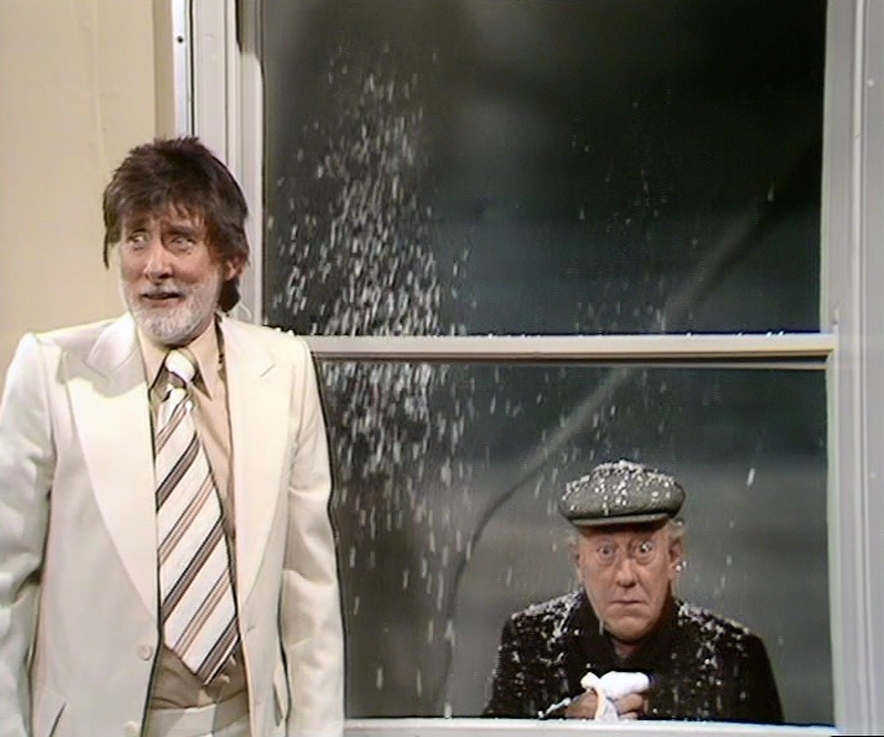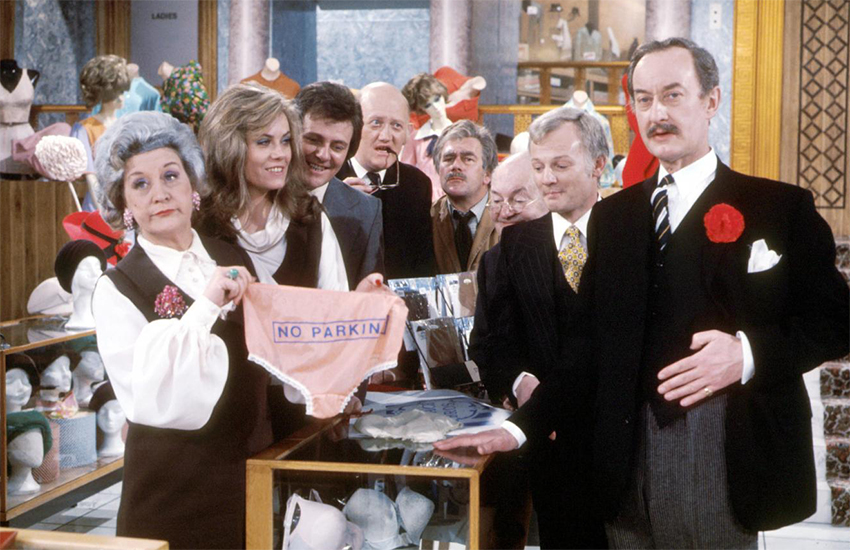
Are You Being Served? and the Munich Olympics

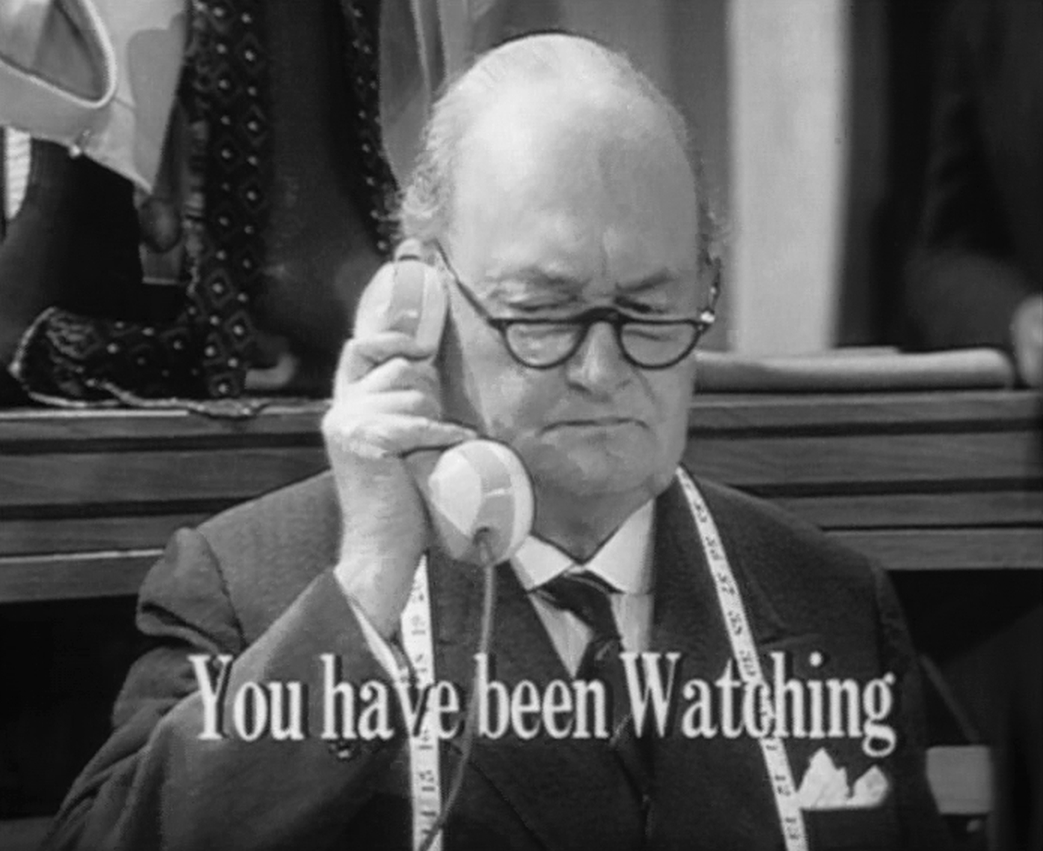
One fact everybody knows about the Comedy Playhouse broadcast of Are You Being Served? in September 1972 is that it was hastily parachuted into the BBC schedules after the massacre at the Munich Olympics created large programming gaps.

Speaking in the AYBS? edition of Comedy Connections (tx 23rd June 2003), co-writer Jeremy Lloyd confirms this, stating that “they then had a terrible disaster at the Olympic Games … where there was a terrible tragedy and they suddenly had blank screens and they needed something and somebody reached for the nearest show, basically. Which turned out to be Are You Being Served?

But was that actually the case?

The massacre took place during the evening of the 5th and the early morning of the 6th of September. The Games were suspended for 24 hours before resuming, so by the 8th of September (when Are You Being Served? was broadcast) full coverage was back on.

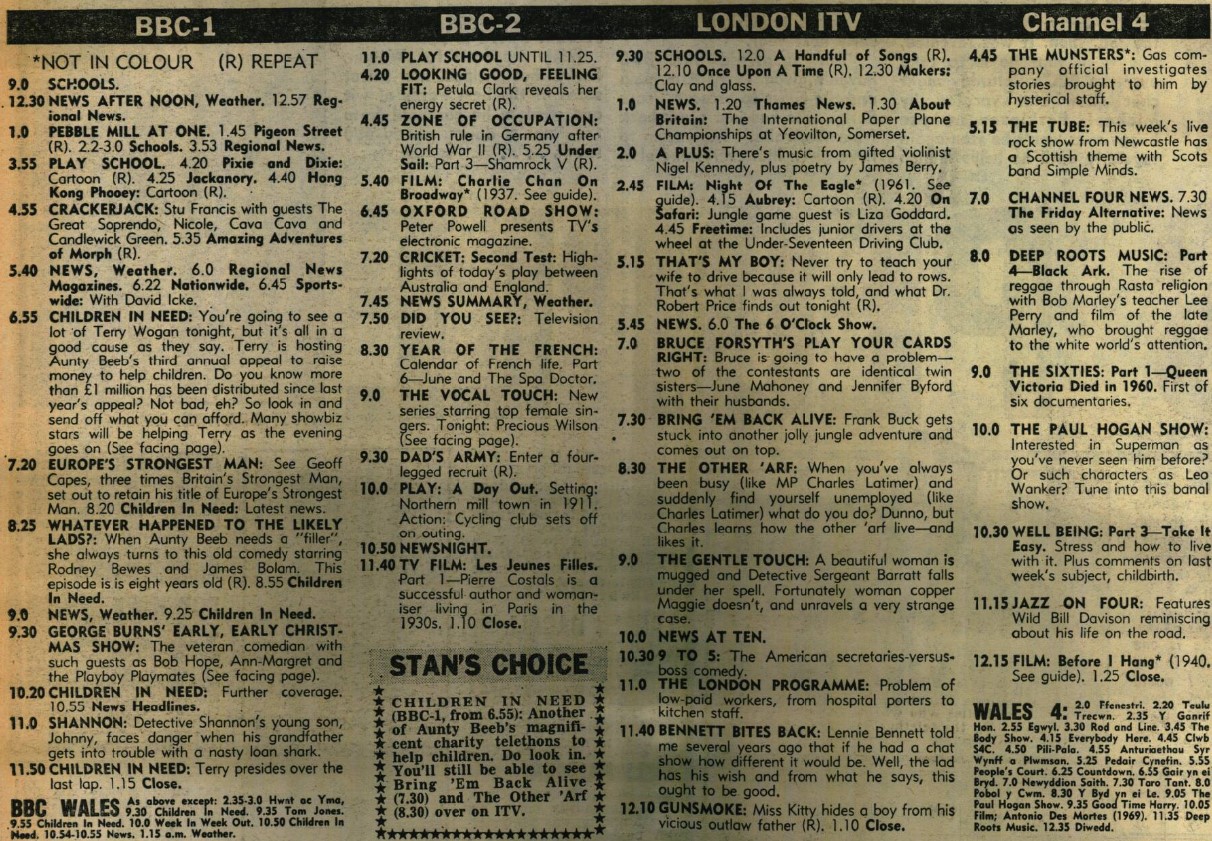
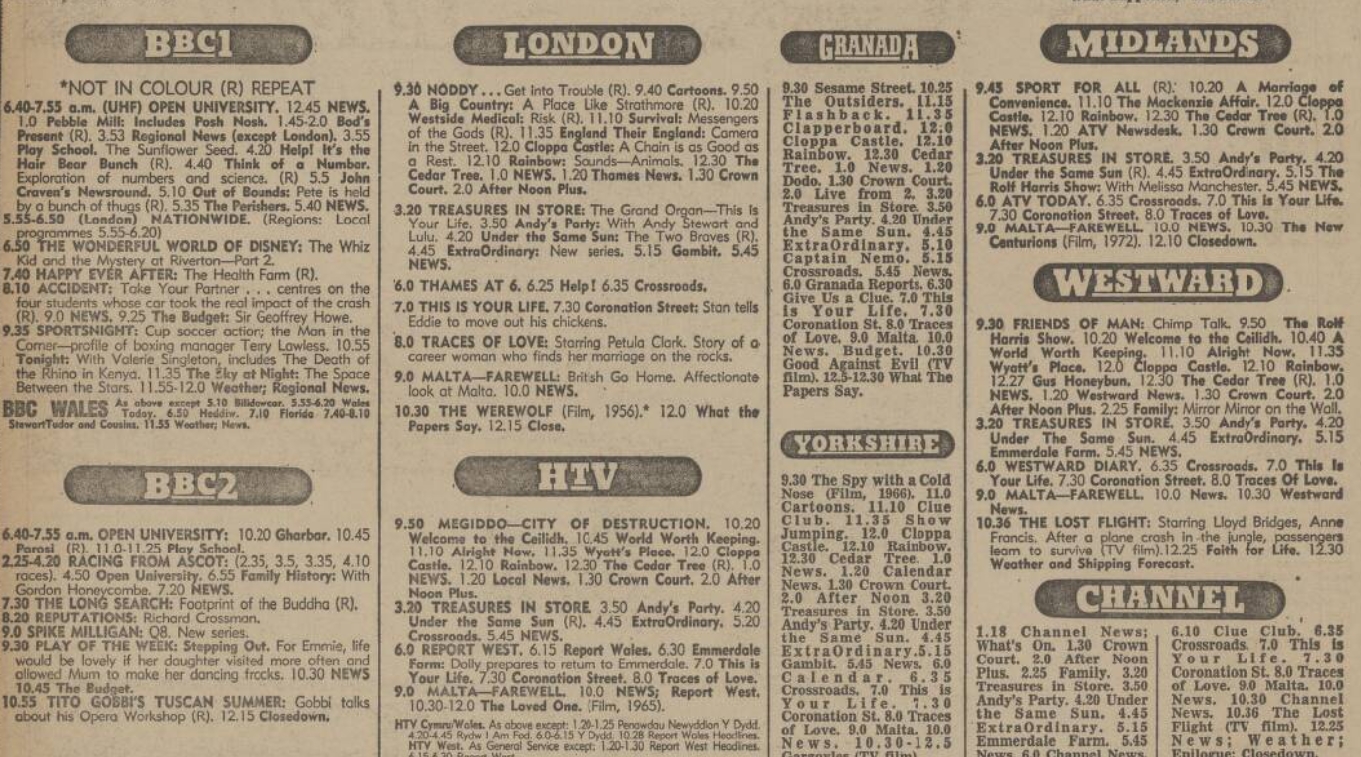
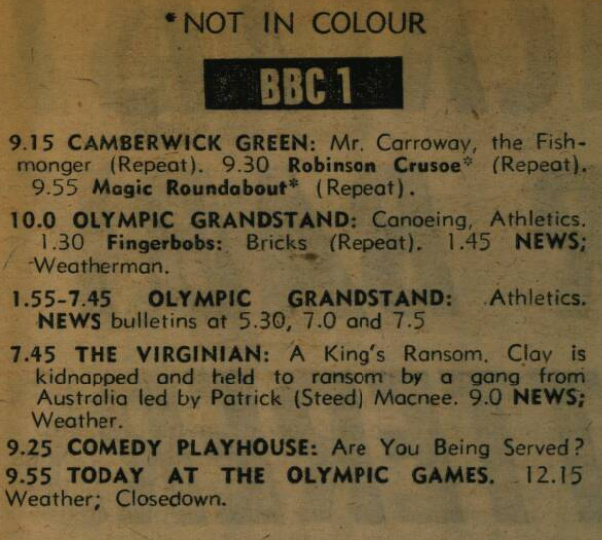
Looking at the Radio Times listing on BBC Genome, there’s no mention of Are You Being Served? But daily newspapers (such as this example from the Mirror) show it occupying the 9.25 pm timeslot –


This matches very closely to the Radio Times listing (which was obviously produced before the terrorist incident) with the only change being the insertion of AYBS? In the RT, Today at the Olympic Games began at 9.25 pm.

It’s true that Today at the Olympic Games in the RT lasted an hour longer, but if the broadcast programme was curtailed (finishing around midnight instead of an hour later) there’s still no reason to have bulked out the schedule with AYBS? (as a midnight closedown would hardly have been unusual).

The Daily Mirror listing for the 9th is similar to the level of coverage provided by the BBC for the rest of the Olympics – they would start in the morning and continue until the early evening (say around 7.00 pm when regular programmes would take over). Any evening action not broadcast live would no doubt have been included in the lengthy highlights show later on.

According to Nicholas Smith (speaking in the Comedy Connections doco) AYBS? should have been broadcast in the Comedy Playhouse series which aired at the start of 1972, but the BBC so disliked the programme that they shelved it. So maybe the BBC decided to fling out AYBS? later in the year, hoping it would get lost in the Olympic hubbub. If that was the case, then it didn’t work as the show ended up 8th in that week’s television chart, with some 13 million viewers.

The last-minute scheduling of AYBS? remains a bit of a mystery, but the oft-repeated claim that it was required to fill a gap in the schedule caused by terrorism at the Munich Olympics seems to be nothing more than a myth.

Morecambe & Wise – Scene/Omnibus documentaries (1973)

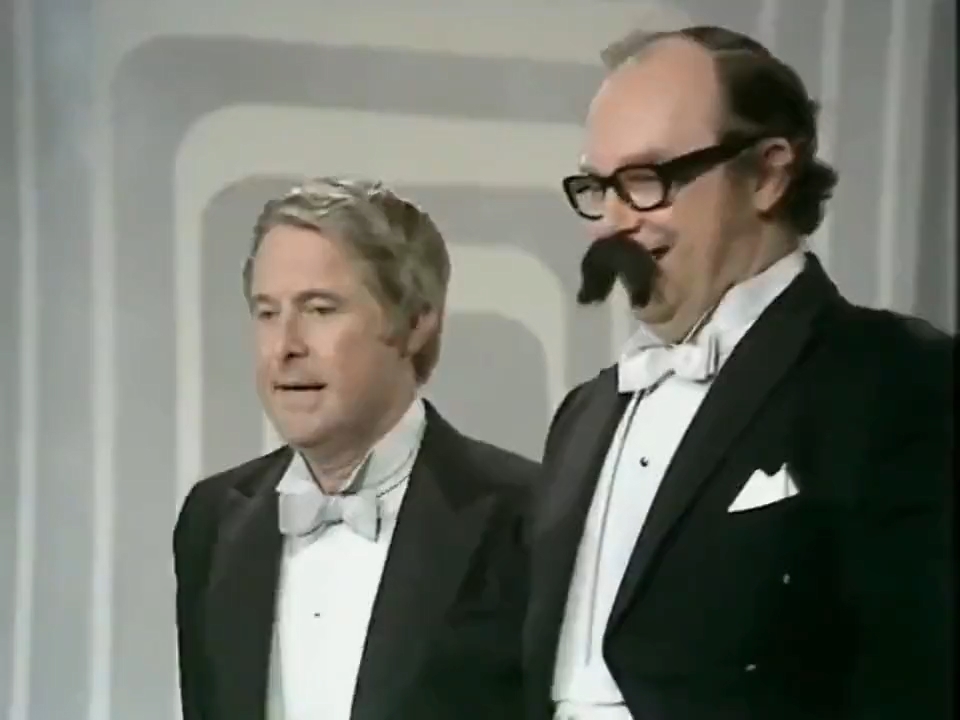
In early 1973 two documentaries about Morecambe & Wise hit the airwaves within a month of each other. First, the BBC Schools programme Scene aired a 22 minute programme on BBC2 (18th January) and then on BBC1 (18th February) the Omnibus strand broadcast Fools Rush In, which ran for 50 minutes.

Both documentaries were culled from fly on the wall footage shot the previous summer, when episode 7.7 of The Morecambe & Wise Show was being rehearsed and recorded. Show 7.7 was broadcast two days before the Omnibus doco, which meant that the lucky schoolchildren who caught the original Scene screening had an early peak at one of the most enduring M&W moments (“Arsenal!”)

Without knowing the original tx dates, it would be easy to assume that the Scene programme was simply a cut-down version of the adult documentary. But given that Ronald Smedley was the producer of both, it’s plain that Scene was the original one (presumably it was felt that the material gathered was too good to waste – hence it was reassembled and expanded for Omnibus).

Ronald Smedley spent his career working in children’s television. His highest profile job was as the producer of Grange Hill between 1985 and 1989, a period that saw the programme hit highs of controversy and public interest (Just Say No) and lows (Harriet the Donkey).

That apart, I find it fascinating that he worked on a series of impressive drama productions for BBC Schools, some of which were later repeated for an adult audience (including a modern language version of Julius Caesar, renamed Heil Caesar, and An Inspector Calls).

This serves as a reminder that schools programmes of this era could often be of a high quality. Indeed, the Scene documentary about Morecambe & Wise doesn’t talk down to its audience so it’s easy to imagine it receiving a peak time slot on its own merits (although with so much footage recorded it’s maybe understandable that the decision was made to produce a new effort from scratch).

Both have similar structures – although one notable difference is that Scene employs a narrator whilst Omnibus doesn’t. So while the Scene viewer is told that Eddie Braben lives and works in Liverpool, the Omnibus watcher is simply shown a picture of his house and either has to work out his geographical location or just not care.

Although Eric Morecambe can’t resist acting up for the cameras, both Eric and Ernie also talk seriously about Braben’s pivotal role in the series. At one point, Eric wistfully admits that he could never do what Braben did every week (enter his writing room on a Monday with a blank piece of paper and emerge with something). The pair concede that they may be able to improve on Braben’s work, but they’d be lost if they had to attempt to create it from scratch.

Both of these programmes would have made excellent special features on the Morecambe & Wise DVDs. Of course, neither were included ….

Sadly, the original range of releases lacked any extras at all (not even the Parkinson interview) and while the most recent DVD (containing previously lost episodes) did include a few bits and bobs, it was something of a half-hearted attempt. But at least there’s reasonable quality copies currently on YouTube. Links for both are below.

Porridge – New Faces, Old Hands (5th September 1974)

“With these feet?”

The series proper of Porridge kicks off with this episode. As touched upon in the last post,  a few adjustments have had to be made – at the end of Prisoner and Escort it looks like Fletch had already been processed and allocated a cell (he’d certainly been in for a chat with the governor).

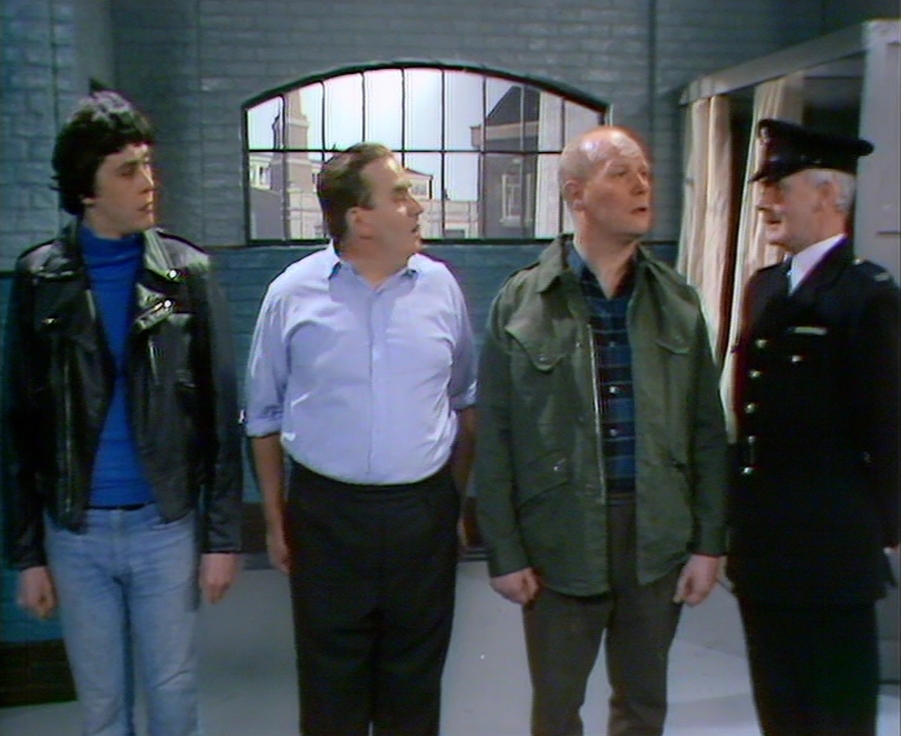
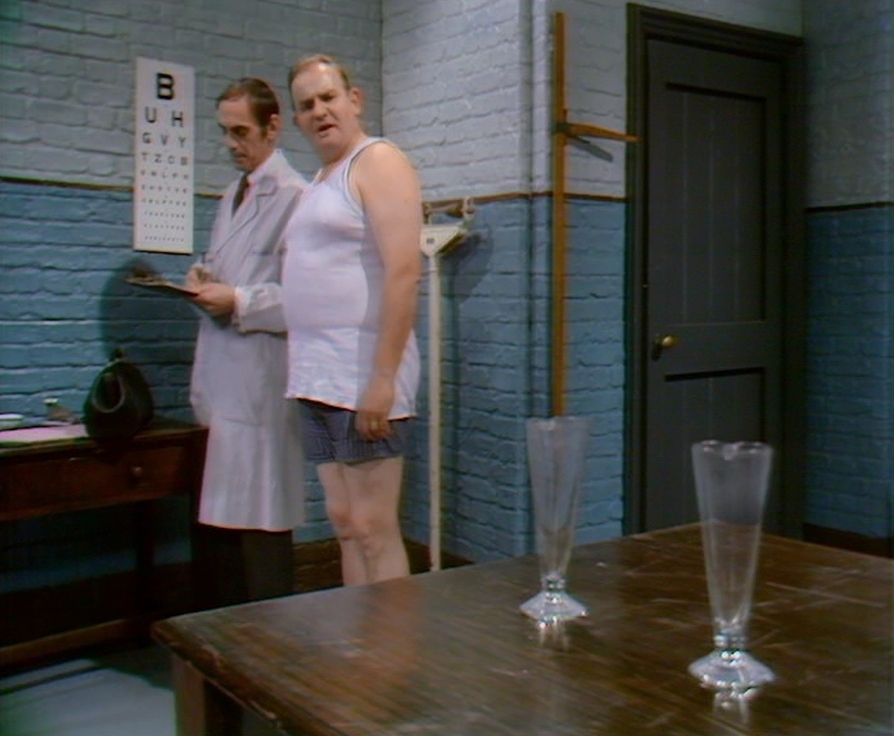
At the start of New Faces, Old Hands the story has rewound somewhat – Fletcher now finds himself lined up with the ingenuous Godber (Richard Beckinsale) and the gormless Heslop (Brian Glover) as the three are forced to listen to a lecture from Mackay, suffer a cursory inspection from the indifferent Medical Officer (John Bennett) and then are dished out with uniforms from Mr Barrowclough (“looks like Charlie Chaplin on stilts”).

Godber is the audience identification figure. Fletch instructs him (and us) about the way the prison works. Fletcher, the old hand of the title, knows the system inside out and how far it can pushed. Godber’s accent is a little more noticeable in this episode (possibly it was suggested to Beckinsale that he tone it down).

Brian Glover (“I read a book once. Green it was”) makes the first of three appearances as Heslop. He’d already had form with Clement and La Frenais – turning up as the cackling Flint in the series one Whatever Happened To The Likely Lads? episode No Hiding Place (tx 20th February 1973).

Michael Barrington debuts as the governor, Mr Venables (he’d appear eight times in total). Clearly Barrington had that sort of face, as he’d already played a prison governor in the forgotten late 1960’s sitcom Her Majesty’s Pleasure (which also featured a future Slade prison inhabitant – Ken Jones).

New Faces, Old Hands is stuffed with quotable lines. For example –

MO: Suffer from any illness?
Fletch: Bad feet.
MO: Suffer from any illness?
Fletch: Bad feet!
MO: Paid a recent visit to a doctor or hospital?
Fletch: Only with my bad feet!
MO: Are you now or have you at any time been a practicing homosexual?
Fletch: What, with these feet? Who’d have me?

Not to mention –

MO: Now I want you to fill one of those containers for me (points to a specimen container some distance away).
Fletch: What, from ‘ere?

It’s well known that Clement and La Frenais (working as uncredited script doctors) added this exchange into the 1983 James Bond film Never Say Never Again. My memory tells me that I’ve seen very similar lines in a late sixties/early seventies television series, although I can’t remember where. If anybody knows, please drop me a line ….

The episode opens on film at Ealing Studios with Mackay, Barrowclough and the silent (and never seen again) Mr Leach noisily striding down the metal walkways. This moment is played straight and since it directly follows on from the title sequence (which is rather bleak and also joke free) some viewers might have begun to wonder if this new programme was a drama rather than a comedy.

Mr Leach exists simply so that Mackay can tell him (and the audience) about the new arrivals. It seems odd, in retrospect, to see Mackay being deferential to another member of staff in uniform (later he’d be firmly established as Slade’s top dog, answerable only to the governor).

Although New Faces, Old Hands revolves around Fletch’s confidence that he can buck the system, Clement and La Frenais aren’t yet prepared to give him too many “little victories”. It’s Godber, rather than Fletch, who’s allocated a single cell and Fletch’s cushy job (mucking out the pigsty) turns out to be not that cushy after all.

It’s interesting that at the end of the episode Fletch and Godber are split up (the logical decision would have been to make them cellmates straight away). Was this because Clement and La Frenais, at the original writing stage, saw Godber as a similar supporting character to the likes of Heslop? If so, they would quickly change their minds ….

7 of 1 – Prisoner and Escort (1st April 1973)

7 of 1 served a dual purpose – not only was it a showcase for Ronnie Barker (allowing him to assume a variety of very different roles) but it also was a collection of pilots that could, potentially, be developed further.

Indeed, the first three episodes were all spun off into series. First there was Open All Hours (no prizes for working out what that became) followed by Prisoner and Escort (Porridge) and finally My Old Man (which ended up on ITV with Clive Dunn inheriting the Barker role).

Famously, out of the two episodes written by Clement & La Frenais (Prisoner and Escort, I’ll Fly You For A Quid) Barker felt that the latter one had more scope. History has proved that, on this occasion, his judgement was slightly faulty.

Although many of the building blocks of Porridge (which began in September 1974) are already present, it’s also interesting to note the differences.

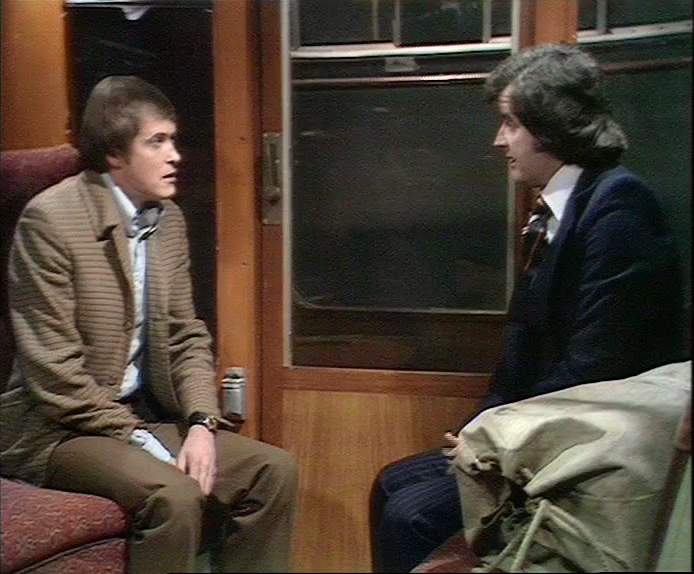
Fletch’s baiting of Mr Mackay (Fulton Mackay) is already firmly in place (“I spy with my little eye something beginning with C”) as is the way that Fletch can effortlessly wrap the pliable Mr Barrowclough (Brian Wilde) around his little finger. Although in Prisoner and Escort, Fletcher is harsher (watch how, in the railway carriage, he cuts across Barrowclough in order to make his own points).

Since Mackay is absent for large stretches, Prisoner and Escort is essentially a two-hander between Fletch and Barrowclough. Holed up in a lonely cottage hours from anywhere (after Fletch sneakily directs his urine into the van’s petrol tank) the pair share a bottle of whisky as Barrowclough is encouraged to open up his heart.

We hear for the first time about Barrowclough’s unhappy home life (his unseen wife – here described as a serial philanderer – would become an item of interest in the future, not least in one of the Christmas specials) and he also admits that his career has been a complete and utter failure. This is tragic stuff (Wilde is so good) especially when you realise that Fletch is simply waiting for Barrowclough to fall unconscious so that he (Fletch) can make a break for it.

Barker’s wolfish expression as the oblivious Barrowclough chatters on is a little bit chilling – in the future Fletch could be hard, but he’d never be quite so menacing as he is here.

And, of course, based on what we later learn, it’s totally out of character for Fletch to attempt to escape. But as a set-piece moment in what could have been just a one-off, it’s fine (especially when the gag – Fletch wanders around the moor for hours and is eventually shocked to find out he’s walked in a complete circle and has returned to the cottage – is played so well by Barker).

Prisoner and Escort ends with Fletch having finally arrived at the prison (not yet called Slade). He’s in a cell that looks nothing like the one he’d later occupy and the fact he’s already quite comfy means that a bit of retconning has to be done with the first episode of Porridge (Old Faces, New Hands) which implies that Fletch, Godber and Heslop had all arrived together.

Christmas is coming ….

Christmas, as tends to always happen around this time of the year, is fast approaching. I’ve already begun to rummage around in my archive for some suitably festive programming to enjoy. The three surviving Christmas Night With The Stars from its original run (1958, 1964, 1972) have all received an airing earlier in the week. Surely it’s about time BBC4 rebroadcast 1958? An upgrade from my timecoded copy would be very welcome ….

YouTube is currently offering a selection of festive treats – such as Basil Brush’s Christmas Fantasy Pop Goes Christmas and this quite unforgettable mid 1970’s Crackerjack-esque version of Robinson Crusoe. It’s not for the faint hearted (Ed ‘Stewpot’ Stewart as Man Friday, for example) but it’s nice to see the likes of Windsor Davies, Don Estelle and John Inman.

Later this month, I’ll be spending the Christmas fortnight back in 1982. By a fortunate coincidence, the 1982 double issues of the Radio and TV Times run from 24/12 – 7/1, just like 2022, so I’ll be in some sort of sync with real life. Already I’ve begun to peruse the mags and started to tick off what I want to see (there looks to be plenty to keep me amused).

Back To November 1982 (26th November 1982)

We’re back in the days when Children In Need didn’t dominate the entire BBC1 evening schedule. Indeed, it’s surprising just how little coverage there is (less is more, maybe?). From the available programmes, I’ll be taking Whatever Happened To The Likely Lads? 

Whenever I tweet something about the series, you can guarantee that someone will pop up to tell me that nasty old James Bolam blocked any repeats. But there’s no evidence of this (indeed, the fact that the Daily Mirror’s Stan bemoans the fact that WHTTLL? is often dug out as a schedule filler rather proves the opposite).

There’s another old sitcom repeat on BBC2 (Dad’s Army). The series wasn’t quite as obliquitous in re-runs during the early eighties, which meant that this was probably when I saw a lot of these episodes for the first time. Today’s offering is Man Hunt from 1969, not a stellar episode, but it’ll still pass thirty minutes very agreeably.

Finally there’s a new programme to enjoy. ITV at 9.00 pm is Gentle Touch time. P.J. Hammond is scripting, which is the guarantee for an odd and unsettling fifty minutes (today’s ep features a very effective guest turn from Sheila Gish as Adela Baker).

Back to May 1986 (19th May 1986)

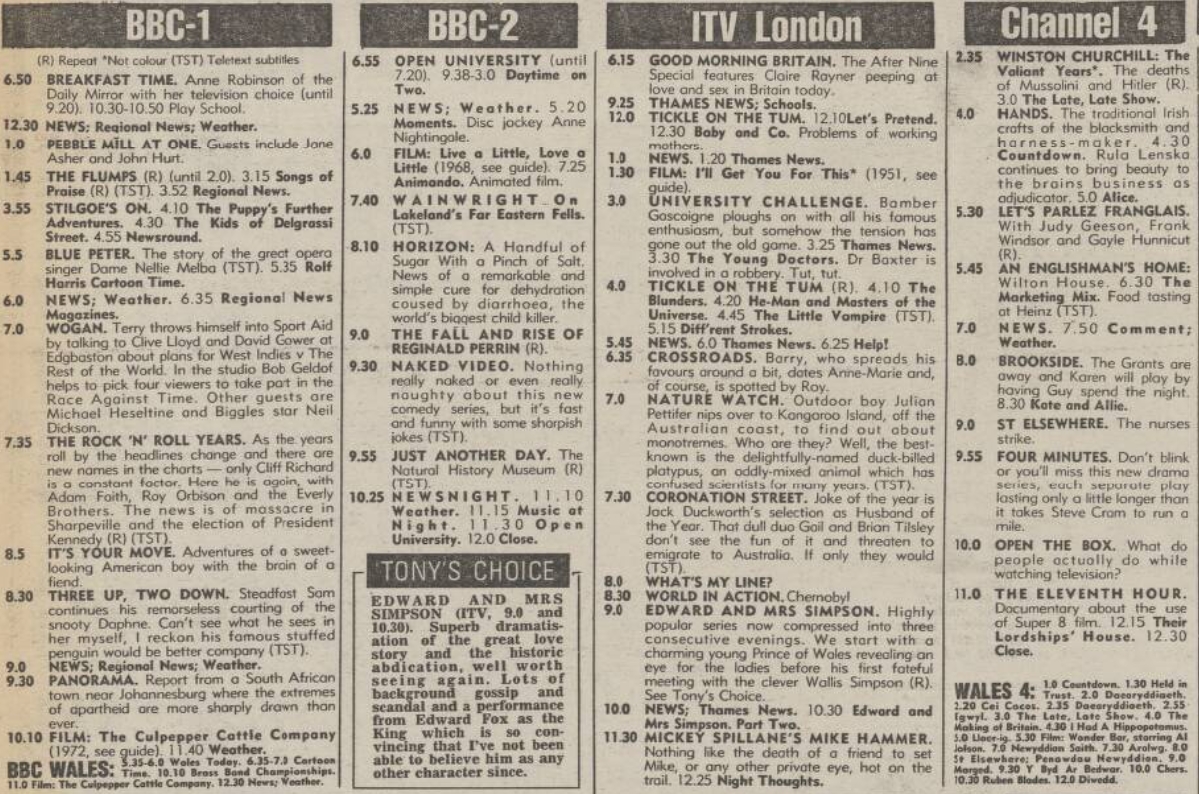
The repeats just keep on coming, although many of them (like The Rock ‘N’ Roll Years) are very welcome. It’s difficult to articulate today quite how magical this series was back then – when history (news, music, entertainment) wasn’t available at the click of a button, these half hour digests were windows into vanished worlds.

Today’s episode, 1963, was – of course – notable for the assassination of John F. Kennedy, but for a generation of young Doctor Who fans it meant we could enjoy a clip from An Unearthly Child. With the Five Faces repeat from 1981 a distant memory and the VHS release still four years away, it was like gold dust ….

Moving over to BBC2, there’s another chance to see The Fall and Rise of Reginald Perrin. And on ITV’s there’s a re-run of Edward and Mrs Simpson, now stripped over three evenings. As it was originally broadcast in seven parts, it looks like it’s been trimmed down to fit six one-hour slots.

Rather like, Winston Churchill – The Wilderness Years, it has a supporting cast to die for. If the likes of Nigel Hawthorne, Peggy Ashcroft, Marius Goring, Cherie Lunghi, Kika Markham, John Shrapnel, Maurice Denham, Geoffrey Lumsden, Patrick Troughton, Patricia Hodge, Wensley Pithey, Gary Waldhorn and Hugh Fraser doesn’t get the pulse racing then you’re probably reading the wrong blog …

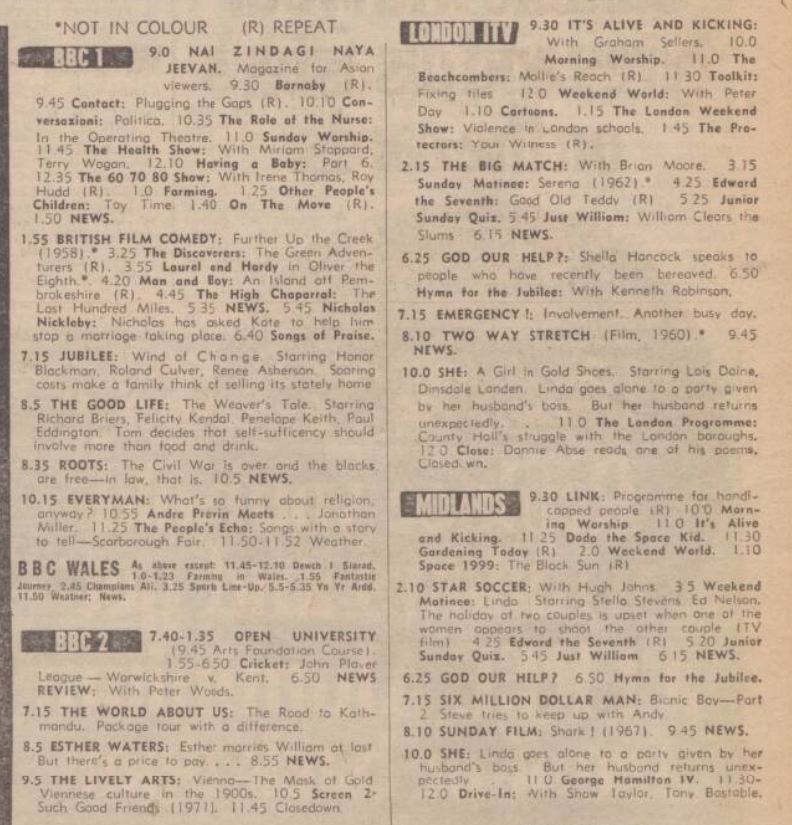
Back to May 1977 (1st May 1977)

Rounding off my week in 1977 with a skim through Sunday’s schedules.

The Good Life is an obvious pick – tonight’s new episode is The Weaver’s Tale.

It never fails to give me a twinge of amusement when somebody comments on Twitter about how selfish Tom is – why has it taken them so many decades to work this out? Tonight’s episode is a perfect example of his working methods – Tom spends his and Barbara’s hard earned profit on a loom without consulting her. No surprises though that everything works out in the end.

London ITV has an afternoon repeat of The Protectors whilst the Midlands plumps for Space 1999. I think I’ll go for The Protectors (partly because Space 1999 has never really interested me and partly because The Protectors, although far from perfect, rarely outstayed its welcome at 25 minutes).

I’ll stick with ITV for a repeat of Edward VII and (from a variety of regional films) Two Way Stretch.

If I had access, then both Jubilee and She would be on my list. Maybe they’ll surface sometime in the future, fingers crossed …

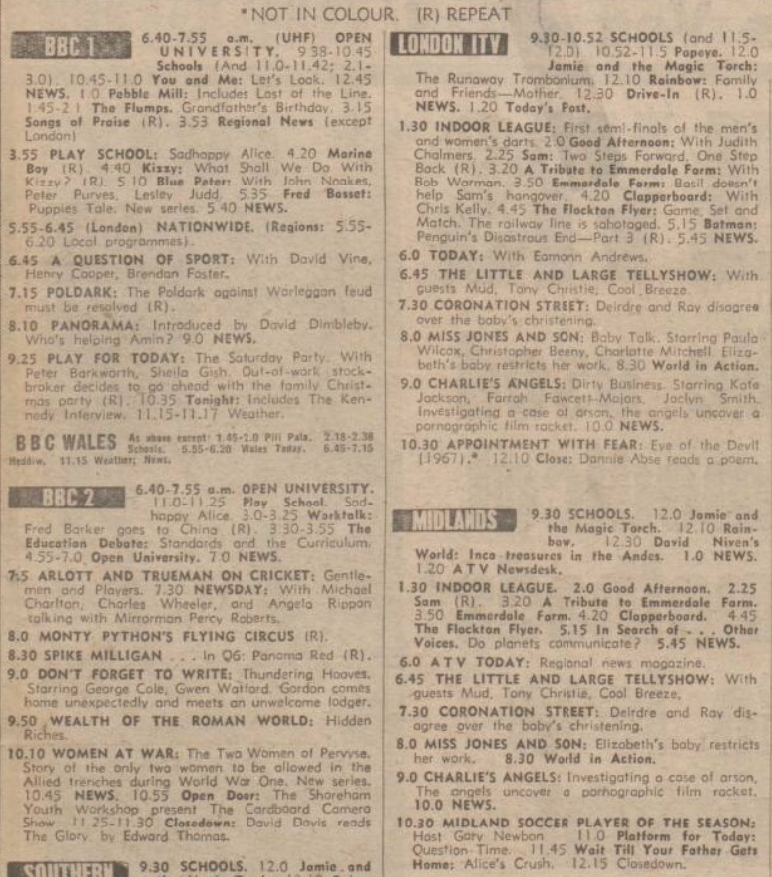
Back to April 1977 (25th April 1977)

I’ve fired up the Randomiser, which has taken me back to 1977 to spend a week riffling through the television schedules. Hope there’s some good programmes to watch ….

There’s something pleasing about Monty Python and Q6 sitting next to each other on BBC2 (especially since the Pythons were always quick to acknowledge the debt they owed to Spike). Today’s edition of Python hails from the first series (Man’s Crisis of Identity in the Latter Half of the Twentieth Century) which is fine by me, as it’s probably the run of episodes I return to the most.

Given the lengthy gap between Q5 and Q6, Milligan was on top form throughout most of Q6 (later series tended to crop up more regularly and were much more bitty).

I’ve just started rewatching Don’t Forget to Write! so that’s going on the list. This programme always has a slightly odd feel for me – it could easily have fitted into a 30 minute sitcom slot, but instead was a 50 minute non-audience drama/comedy. George Cole, Gwen Watford with Francis Matthews head the cast.

The BBC schedules are stuffed with repeats today. Apart from Python and Q6 on BBC2 there’s also Poldark and Play for Today on BBC1. The Play for Today repeat makes sense as the sequel to this play will be broadcast tomorrow, so I’ll be tuning in for both of them (anything with Peter Barkworth is worth a look).

All of this means that I won’t have much time over on ITV, although if I’ve a spare half hour then there’s always Coronation Street.

Back to April 1979 (4th April 1979)

During the next seven days I’ll be sampling April’s schedules between 1979 and 1985. As before, I’m only going to choose programmes that I can actually source from my archive, so anything which looks intriguing but I don’t have will have to be sadly passed over. Let’s dive in ….

BBC1 offers a repeat of Happy Ever After which is followed by a repeat of Accident (no doubt the high preponderance of repeats was irritating certain viewers).

Accident has reached episode two, Take Your Partners. It’s an interesting series, which focuses on the ramifications of the same event (a multi vehicle accident) from different perspectives. This gives it a similar feel to Villains (LWT, 1972). There’s no shortage of good actors across the series’ eight episodes and this was one of three directed by the always reliable Douglas Camfield.

Over on ITV, there’s chicken issues in Coronation Street (a short-lived but nevertheless amusing plotline which sees an initially reluctant Hilda transformed into a doting fowl lover). Later I’ll be crossing over to BBC2 for the start of a new series – Q8. By this point, Spike Milligan’s idiosyncratic sketch show defies any sort of description – but, if you’re in the right mood, there’s usually some nuggets of gold still to be found.

On this day (9th January)

Strangers on a Train, the first episode of Whatever Happened to the Likely Lads?, was broadcast on BBC1 in 1973.

There might be previous examples which have slipped my mind, but WHTTLL has to be one of the first sitcoms which allowed its characters to grow and develop. Most sitcoms prior to this (Steptoe & Son or Dad’s Army, say) existed in a kind of stasis, but the Bob and Terry of 1973 were certainly different from the young lads we first met in the early sixties.

Given Bolam and Bewes’ later estrangement, it’s hard not to rewatch the series without pondering how far real life mirrored fiction. Graham McCann’s summation of their relationship (click here) might be a little waspish towards Bewes, but it does help to redress the balance previously painted (largely by Bewes as a victim, it must be said).

Throughout WHTTLL it becomes obvious that Bob and Terry have little now in common and it’s mainly the ties of childhood friendship which still keep them together. For Bolam and Bewes during the 1970’s, it was only the work that kept them together – like Bob and Terry they were totally different people with few shared interests.

Mind you, I don’t have a problem with discovering this and am always surprised when someone states that they find it difficult to now watch the series after learning that the stars weren’t the best of friends. For me, they’re simply giving an acting performance – and if they convince, then they’re very good actors.

The Grand Design, the first episode of Yes Prime Minister, was broadcast on BBC2 in 1986.

I think that the first series of YPM has to be my favourite run of episodes (Yes Minister was always consistent, but these eight episodes just have the edge). By now the formula was well established, the three regulars were totally comfortable with their characters and the elevation of Jim Hacker to the PM’s chair gave the series a little extra spice.

Sitcom fans were well catered for this evening, as you could then switch over to BBC1 to catch the first episode of Blackadder IIBells.

Sirens, the first episode of Rockliffe’s Babies, was broadcast on BBC1 in 1987.

For the best part of thirty years the BBC pumped out a series of top-rated police series – Dixon of Dock Green, Z Cars and its various sequels and Juliet Bravo. After Juliet Bravo came to an end in 1985, they struggled to find a long-running replacement.

Rockliffe’s Babies briefly looked like it might have the legs, but in the end it only ran for two series. Oh, plus there was the faintly bizarre spin-off in which Rockliffe became a country copper (which was almost as jarring as seeing DI Maggie Forbes in the C.A.T.S. Eyes environment).

Reviewing it now, Rockliffe’s Babies is patchier than I remember, but there are some strong episodes and it has the same urban feel of The Bill from this period (like its Thames counterpart, the show was shot entirely on VT).

Ian Hogg’s always good to watch (although in this one he’s only called upon to utter a few words) and maybe casting seven relatively unknown young actors was done in the hope that one or two stars might emerge who could then be given their own series (as had happened with the likes of Auf Wiedersehen Pet). Most are still acting today, although Susanna Shelling’s post Rockliffe career was fairly brief (her last television credit was in 2007).

On this day (3rd January)

Peter the Postman, the first episode of Camberwick Green, was originally broadcast on BBC1 in 1966.

The first and arguably the greatest of the Trumptonshire trilogy, this is the series that features the iconic Windy Miller. Whenever I post a clip on Twitter, I like to play Camberwick Green bingo by wondering how long it’ll take before someone mentions Windy’s fondness for cider or posts a screengrab from Life On Mars …

The Bill Poster, the first episode of Trumpton, was originally broadcast on BBC1 in 1967.

Gordon Murray (or maybe the BBC schedulers) were obviously keen on the 3rd of January, as exactly a year after Camberwick Green first aired, along came Trumpton. All together now – Pugh, Pugh, Barney McGrew, Cuthbert, Dibble, Grubb ….

Meet the Gang, the first episode of It Ain’t Half Hot Mum was originally broadcast in 1974.

Fair to say that this is a series that polarises opinion. Two things – Sergeant Major Williams’ treatment of the platoon (they’re nothing but “a bunch of poofs”) and Michael Bates’ casting as Ranji Ram – remain hotly contested talking points.

Jimmy Perry made it plain that he was drawing on his own experiences and men like Williams did exist, so I personally don’t have a problem with him – plus if he wasn’t there to provide conflict, then the series would have fallen somewhat rather flat.

This wasn’t the first time that Michael Bates had played an Indian character, but Ranji is a far more rounded character than the stereotype Bates portrayed in an episode of The Mind of Mr J.G. Reeder. And there’s something rather bittersweet about Ranji’s unflagging love of Britain, as it becomes clear over time (although this is left unspoken) that if he ever did get to the UK then he’d quickly find out it wasn’t quite the paradise he imagines it to be.

John Thaw, born in 1942.

Rifling through my Thaw collection for something slightly obscure to watch today, I’ve gone for The Absence of War, a Screen Two from 1995 adapted by David Hare from his own play.

Last of the Summer Wine – And a Dewhurst Up a Fir Tree (27th December 1979)

There’s no reason why Christmas specials have to be set at Christmas – even though most of them are. Roy Clarke, who established a mild anti-festive tone in his previous LOTSW festive special, has his (Christmas) cake and eats it in this one – there’s plenty of Christmas talk, even though the setting is late summer.

It’s always a little jarring to revisit these early episodes and witness our three heroes doing their own stunts. The sight of Sallis, Owen and Wilde indulging in a spot of plastic bag sledging is a joy though – especially since even the normally reserved Foggy seems to be enjoying himself for once.

It’s not long before Foggy’s normal character clicks back into gear though. Back at Clegg’s house he – with typically military precision – inflicts a slide-show on the other two. Neither are exactly delighted. Compo hopes that it’s not Foggy’s holiday snaps again whilst Clegg is slightly anxious, re his curtains (“I hate drawing my curtains during the daytime. Suppose the neighbours start sending flowers”).

Foggy’s pictures reveal a dismal picture of last Christmas – after taking Compo’s advice all their Christmas shopping was carried out on the 24th of December, with the result that they had no trimmings and a rather paltry Christmas dinner (a fish finger and a chip). But the attentive viewer will know that their previous Christmas as transmitted on television wasn’t like this at all, so clearly time in LOTSW land runs in a different way to the rest of the country.

Determined not to be caught napping a second time, Foggy decides the time is right to start their Christmas shopping (but finds that festive cards and treats are thin on the ground in August). Things get no better later on after he buys himself a bargain (100 Christmas trees for just £10). The Forestry Commission are having a summer sale you see.

It slowly dawns on Foggy that he’s been had (but then if you exchange money in the pub with someone called Big Eric, what do you expect?). Poor Foggy is eventually brought back to reality when the three trek over to see his purchases – since each tree is 100 ft high, they’re going to be a tad tricky to cut down ….

Brian Wilde rather drives this episode. I love Foggy’s wistful shake of the head when Compo asks him whether MI5 had attempted to recruit him. “I dropped hints that I was available when me time was up in the army. I watched for the postman every morning since, but nothing”. The final scene – which plays over the end credits – of Foggy left alone also rather tugs at the heartstrings.

Elsewhere, Ivy and Nora enjoy a cup of tea and swop notes about the sex-pest in their lives – Compo. Over the years, as the regular female cast grew, these interludes would become a regular fixture. This one, despite being a two-hander, is still good though – Ivy advising Nora to take a spoonful of sugar occasionally (“you might find it might relax you. Keep your hands off your airing cupboard”). The mundanity of their conversation (“troublesome as men are, their old vests make for lovely dusters”) is delightful.

They then plot to stop Compo in his tracks. Nora advises Ivy to drop the chip pan down his trousers (“the sooner it gets covered in batter the safer it’s going to be”). Ouch! In the end they elect to just forcibly remove his trousers, but maybe – for the moment – it may have done the trick.

Last of the Summer Wine – Small Tune On a Penny Wassail (26th December 1978)

Small Tune On a Penny Wassail opens with Wally – still dressed in his pyjama top – briefly tasting a moment of freedom before being dragged back into the house by Nora to continue his festive obligations. A reflective Compo, observing this domestic fracas, sighs before walking down the deserted streets. This is an early sign that Roy Clarke won’t be bashing you over the head with false Christmas sentiment – that’s simply not his way.

A moment of levity then occurs when Compo spies a lad with a new skateboard. Ever the child at heart, he can’t resist having a go (as you might expect, he falls off rather abruptly). This isn’t a big set-piece moment, but it does set things up for the episode climax.

The others are also given their solo moments. Foggy, after attending church, manages to accidentally hit the vicar in a very delicate place with his stick. It’s a typical Foggy moment – for a brief moment he’s given an air of authority and respectability, which is then abruptly punctured.

Meanwhile Clegg, never one to be overflowing with Christmas cheer, has nevertheless stirred himself and wandered off to the phonebox to ring up his friend, Gordon (Larry Noble). Gordon’s not in the mood to receive yuletide greetings though, due to the fact a fire’s broken out in his shed. What caused the fire remains an unresolved mystery ….

Eventually all three meet up at Clegg’s house for Christmas dinner. Compo’s assistance in the kitchen is clearly not called for, so he stalks around the house like a bored child whilst the other two reflect on the time of the year. Clegg: “Christmas comes but once a year, it just seems longer.”

The cynical Clegg gets most of the best lines during these scenes. “I gave up smoking so that I could live longer. It’s at times like this you wonder if you’re doing the right thing”. At least the meal prepared by Clegg looks like it was worth eating – which almost makes up for the air of melancholy that’s descended over them. Although when we drop in on some conventional family units later on it’s plain they’re not having a particularly sparkling time either.

Foggy suggests they pop down the hospital to visit poor old Edgar (Teddy Turner), who there all on his own. But of course it’s revealed that Edgar’s got everything he could wish for – all the food he can eat and plenty of attention from the nurses. Compo acidly mentions later that even the man dying in the next ward is having a better time than they are.

We’re then given a little vignette showing Ivy and Sid at home in their kitchen. They’re busy feeding the hordes of (unseen) relatives who have descended on them – Ivy with an air of duty, Sid with an ever increasing sense of exasperation. There’s a matching moment with Nora and Wally, where Wally is given a killer putdown. “Why don’t you go sit down, Nora? You’ve been on your mouth all day”.

Back at Clegg’s house it’s finally time for the presents. It’s always seemed slightly odd to me that Clegg and Foggy wrapped their presents for Compo in the same type of wrapping paper (plus their presents to each other were also in identical paper, albeit different from Compo’s). If you see what I mean. It’s probably easier to understand when you watch the scene but there’s something not quite right there.

They all seem quite chuffed with their gifts, as does Ivy when she receives an unexpected present from Sid. Sid and Ivy’s café based warfare can be vicious at times but there’s clearly still a frisson of love between them, even if it’s buried very deep. Her look of pleasure at the black negligee gifted to her by her husband suggests that his luck might be in later. Or not, depending on your point of view ….

We’re heading into the era when stunts (and stunt doubles) would dominate. This episode has been much more reflective and downbeat, but I suppose you can’t blame Roy Clarke for wanting to end things on a high – so an irresistible force (Compo on a skateboard) manages to navigate his way through a seemingly immovable object (the Dodworth Colliery Brass Band).

I’ve still yet to work out how the episode title ties back to the episode itself though. Answers on a postcard please.

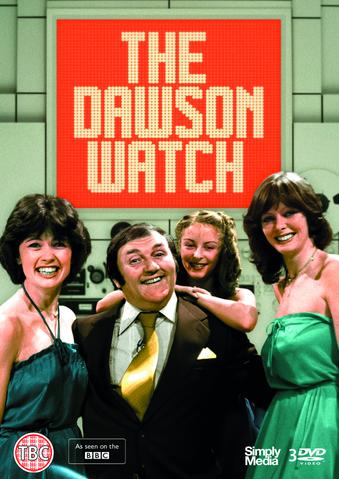
The Dawson Watch – Simply Media DVD Review

164454- Chief Crazy Horse Sleeve.indd

Les Dawson’s road to television stardom was a long and rocky one. Born in Collyhurst, Manchester in 1934, Dawson pursued numerous dead-end jobs whilst attempting to break into the comedy world.  After many false starts, thanks to a spot on Opportunity Knocks his luck slowly began to change.

His own show – Sez Lez – which ran on Yorkshire Televison from 1969 to 1976 was key in establishing his brand of entertaining miserablism.  Whilst some of the early editions were a bit thin comedy-wise, the arrival of a crop of experienced writers such as Barry Cryer and David Nobbs gave the show a considerable boost.  Having John Cleese as a regular co-star for a while didn’t hurt either.

Whilst with Yorkshire, Dawson also appeared in The Loner (scripted by Alan Plater) and Dawson’s Weekly (penned by Galton and Simpson) so he didn’t lack for heavyweight writers. Throw in a number of one-off specials, guest spots on other people’s programmes and appearances on panel shows such as Joker’s Wild and Celebrity Squares and it’s fair to say that by the mid seventies Dawson had well and truly arrived.

His defection to the BBC in 1977 wasn’t a shock on the same level as the departure of Morecambe and Wise to Thames, but it still raised a few eyebrows.  Lacking his familiar group of writers (even though they would have been happy to continue working with him) Dawson’s first BBC starring venture – imaginatively titled The Les Dawson Show – turned out to be something of a damp squib.

The writers – including Eddie Braben and a young David Renwick – were strong, but in some respects it seemed to be little more than a Sez Lez rehash (Les interacting with guest stars – such as Lulu – plus regular spots for singers and dancers).  The time was clearly right for Les to do something a little different next time and so The Dawson Watch (1979 – 1980) was born.

Dawson’s monologues (which he wrote himself, the sketches tended to be penned by other writers) often railed at life’s follies, so a series in which Les examined a different hot topic each week (Housing, Transport, Money, etc) was something which played to his strengths.

Along with a new writing team – Ian Davidson as script editor, Terry Ravenscroft and Andy Hamilton providing the sketches – the show began to take shape.  The Dawson Watch has the air of a consumer programme in which Les introduces sketches illustrating the topic of the week whilst moving around a studio packed with high-tech equipment (well, high-tech for the late seventies) and attractive young ladies pushing buttons.
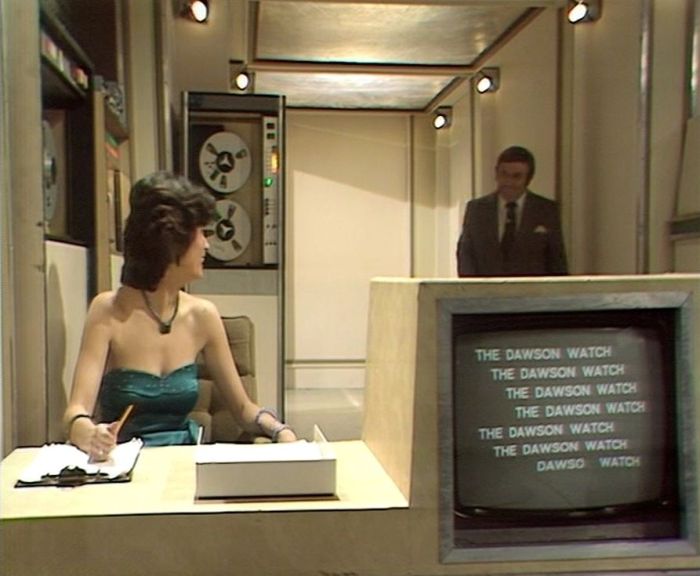
daw20.jpg

It’s fair to say that the first series was a learning experience for all concerned.  Dawson seemed a little ill-at-ease in the first programme, only coming to life when he began to banter with the audience about where they live.  Once he does that – and presumably starts to go off-script – he visibly perks up.  Although there’s plenty of new material in his monologues, several old favourites (“until I was fifteen, I thought that knives and forks were jewellery”) also receive airings.

There are so many gems which can be mined from Dawson’s routines, such as this bleak portrait of Christmas.  Les confided that he could “only remember being given one Christmas present by my father. It was a do-it-yourself electric train set. Turned out to be a roll of fuse wire and a platform ticket”.

Possibly the major failing of the first series is the fact that Dawson doesn’t appear in many of the sketches.  Familiar faces such as Cosmo Smallpiece and Cissie and Ada do pop up, but most of the sketches are handled by others.  There’s certainly some very talented performers on view during these early shows – Sam Kelly, Johnny Ball, Michael Knowles, John Junkin, Patrick Newell, Terence Alexander, David Lodge, Andrew Sachs – but it would have been much more enjoyable had we seen Dawson playing off against them.

However, one of Les’ early sketch appearances (with Roy Barraclough as Cissie) is a Dawson classic.

CISSIE: Leonard and I went to Greece last year.
ADA: Oh, Bert and I have been to Greece, with Wallace Arnold’s Sunkissed Package Holiday and Inter-Continental Tours.
CISSIE: Oh, really? Did you have the shish kebabs?
ADA: From the moment we arrived. All down that side.
CISSIE: Did you see the Acropolis?
ADA: See it? We were never off it.

Clearly lessons had been learned for series two as Dawson takes a much more central role in the sketches whilst Vicki Michelle (as one of the computer girls) proved to be a welcome additon to the line-up. The girls in the first series were rarely called upon to be anything more than mute and attractive – acting simply as fodder for Dawson’s remarks – but Michelle possessed the comic chops to be able to engage in banter with him (which made Les’ lecherous advances seem a little less uncomfortable).

The astonishing roster of familiar faces making guest appearances during series one was reduced for the second and third series.  As was more common with series of this type, a “rep” of performers was used instead – Roy Barraclough headed the list, with Daphne Oxenford and Gordon Peters amongst the other regulars.

The formula remained the same for the third and final series (broadcast in 1980 and culminating with a Christmas Special discussing the obvious topic of Christmas). Vicki Michelle wasn’t featured so prominently, although one of her future Allo, Allo! co-stars, Kirsten Cooke, made a few appearances whilst it was also nice to see the likes of George Sweeney and Michael Keating.

Compared to some of his contemporaries, such as Mike Yarwood and Dick Emery, Les Dawson is very well represented on DVD. Virtually all of his surviving ITV material can be purchased from Network whilst this release from Simply constitutes a welcome chunk of his later BBC work. Hopefully more will surface in the future.

Whilst some aspects of Dawson’s humour haven’t aged well, there’s still so much of interest here – his wonderfully crafted monologues, the impressive parade of supporting actors – to make it easy for me to wholeheartedly recommend this release.

The Dawson Watch consists of nineteen 30 minute episodes spread across three discs (six, six, seven) and is subtitled. It’s released tomorrow (4th March 2019) by Simply Media and can be ordered directly here (quoting ARCHIVE10 will apply a 10% discount).
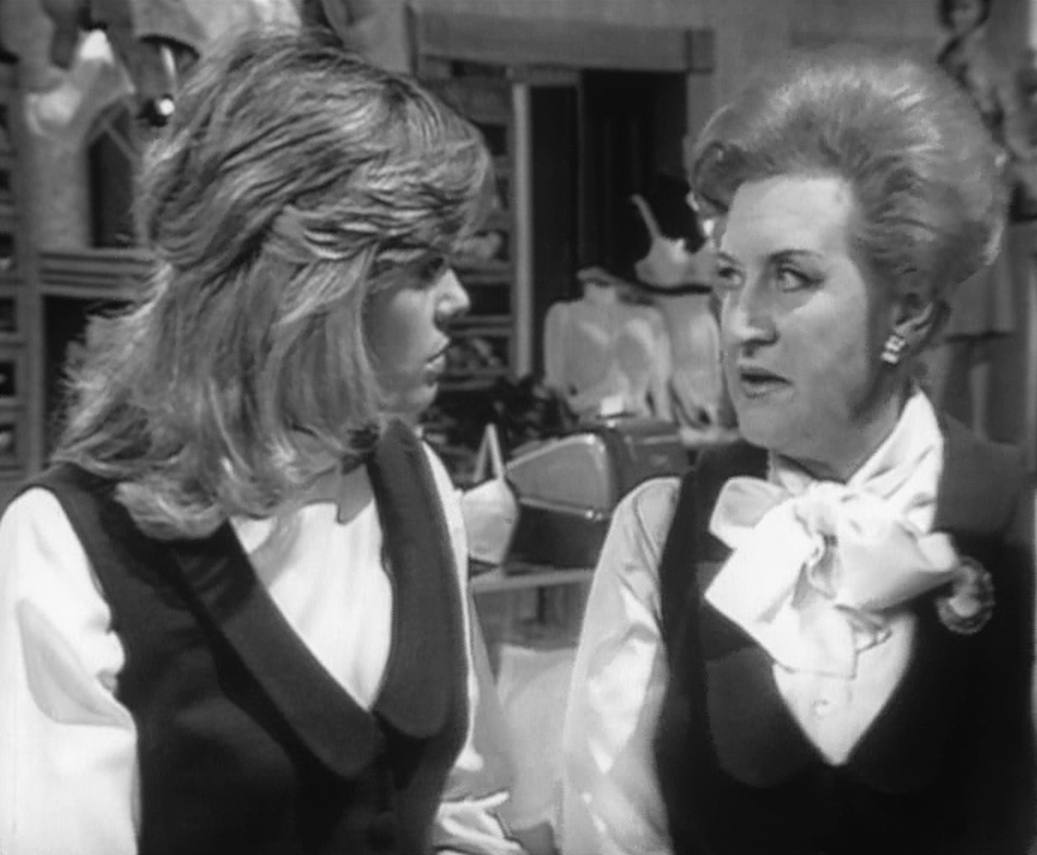


The Two Ronnies – Sid & Lily, George and Edie

r1

Trawling through the British Newspaper Archive on a separate research project, I stumbled across this interesting article from the Daily Mirror, dated the 29th of October 1979.

It reported how the death of Freddie Usher (who wrote the Lily & Edie segments of these joint sketches) might mean the characters wouldn’t be seen again  (John Sullivan was responsible for writing the Sid & George parts).

Whenever I watch these sketches I’m always conscious of the fact that I enjoy the segments with Sid & George much more than Lily & Edie’s contribution.  I’d previously thought that this was down to the fact that the Rons in drag never quite convinced (at least outside of their barnstorming musical numbers).

Certainly compared to the masters of the genre during the seventies – Les Dawson and Roy Barraclough – the Rons never seemed totally at ease during the Lily & Edie sketches, with the laughs (such as they were) being somewhat muted.

But this new nugget of information about the different writers could explain the disparity between the two halves.

I’d love to have a complete breakdown of the writing credits for The Two Ronnies but (unless anybody knows differently) there’s not one in circulation. A fair few sketches can be credited (most of Ronnie Barker’s contributions for example and various others, such as David Renwick’s Mastermind) but a fair few are less certain.  Even identifying which sketches were penned by the Pythons isn’t clear cut.

Moving back to Sid & Lily, George and Edie, it’s interesting that their slot in series seven (broadcast between December 1978 and February 1979) is right in the middle of the programme, exactly where – in previous series – the film serial would have been.  Since inflation was biting and budgets were being cut, I can only assume that this year the Rons weren’t able to afford the type of lavish serial they’d previously enjoyed.

So this cheap studio sketch had to suffice (the running time of each episode tended to be about five minutes shorter than previous years as well).

A last point – if there’s one thing that’s always irked me, it’s the fact that the doubles of Barker and Corbett (seen in the opening titles) look nothing like them.  The double of Barker is somewhat on the thin side whilst the faux Corbett seems a little tall.  Never mind, one day I’m sure I’ll get over it ….

The Good Life – Silly, but it’s fun (26th December 1977)

Unsurprisingly, the message of Silly, but it’s fun is that you don’t have to spend a fortune in order to have an enjoyable Christmas – all you need is the company of good (no pun intended) friends.

The Goods, of course, have no other choice than to economise (Tom scavenging a Christmas tree – or at least part of it – from the greengrocers, Barbara using her craft skills to make a yule log with a rather substantial Robin). But on the plus side, it does mean that this year’s Christmas has only cost them fifteen pence!

But next door, commercialism is rampant – with Margo railing against tradesmen. David Battley is the tradesman in question, offering a wonderfully phlegmatic performance which was something of a trademark of his (a similar turn in The Beiderbecke Tapes immediately springs to mind).

Margo’s unhappy that her tree – part of her Christmas delivery – is slightly under the required height, so she decides that everything will have to go back (it’s all or nothing for her). Given that it’s Christmas Eve this seems a little reckless. I know that the seventies was another era, but surely nobody would have been expecting another delivery on Christmas Day? And yet, this is the crux of the story.

Suspension of disbelief also has to come into play when pondering the question as to why Margo’s left it so late to take delivery of all her Christmas provisions – not only the tree, but the food, drink and decorations. A severe lack of forward planning? Or maybe back in the seventies, Christmas really did begin on Christmas Eve and not – as it seems today – in late November ….

The upshot is that when no fresh delivery is forthcoming, she’s forced to ring up all her friends and fob them off from coming around (claiming that Jerry has chickenpox and therefore is out of bounds for the duration). Jerry’s “political” chickenpox cheers him up, as he wasn’t looking forward to spending yet another Christmas with all their friends, mouthing the same pointless trivialities at the same round of endless parties.

I daresay his wish (which came true) to simply have a quiet Christmas at home would have struck a chord with many ….

So Margo and Jerry spend Christmas Day with Tom and Barbara. It may just have been the especially potent peapod burgundy, but Jerry does get rather frisky with Barbara (although you can’t really blame him). The same sort of sexual tension doesn’t crackle with Tom and Margo (the mind boggles at the thought of that) but they do share a rather intimate scene in the privacy of the kitchen – although this is more about Tom forcing Margo to unbend a little, and embrace their silly Christmas revels.

It’s rather touching that Margo confesses that she’d like to, but simply doesn’t know how. But it doesn’t take long before she’s completely warmed up and throwing herself into all the party games with gusto.

Some sitcom Christmas specials, especially from the eighties onwards, tended to offer something more expansive than their usual fare. Silly, but it’s fun revels in the fact that nothing much happens except that the Goods and the Leadbetters have a jolly enjoyable Christmas day. The way it’s content to embrace the joy of simple pleasures may be one of the reasons why this episode always seems to strike a pleasing chord whenever it makes a Christmas appearance.


Are You Being Served? – Christmas Crackers (22nd December 1975)

cracker 01

It’s Christmas, so we can forgive the employees of Grace Brothers for indulging in a spot of dress up. Mind you, as the series progressed they tended to do it virtually every week ….

Christmas Crackers is a game of four halves.  It begins with a brain-storming meeting called by Mr Rumbold – although in his absence Captain Peacock moves into his seat with alacrity. He also quickly acquires Mr Rumbold’s cup of tea (the only one in a real cup – the others have to make do with plastic ones). It’s a reminder of the rigid herichary which exists at Grace Brothers.

Elsewhere the chat is, as you’d expect, very dependent on double entendres. Mrs Slocombe frets about her pussy whilst Mr Grainger – late once again – tells the others that Mrs Grainger failed to rouse him this morning. Mr Lucas supplies the obvious punchline.

The strangest moment occurs just after Mr Humphries suggests that they should organise a glee club.  This seems reasonable enough, but it tickles the fancy of one member of the audience who hoots in a very distracting fashion.  John Inman, pro that he was, carried on regardless which meant they didn’t have to go for a retake.

When Mr Rumbold eventually does turn up, he reveals that young Mr Grace has already decided exactly how the department should get into the Christmas spirit, thereby negating the previous ten minutes of chat.  This is either a clever touch or it reveals that the plotting of AYBS? was never that solid.

The second section of the episode revolves around a shop-floor spat between Mrs Slocombe and Captain Peacock.  Mrs Slocombe doesn’t like the high-kicking automated display model which has been wheeled onto the floor by the ever-annoying Mr Mash. She wants it removed, but Captain Peacock stands firm and tells her to return to her counter.  So she turns it on when his back is turned and the inevitable happens (it kicks him up the backside).  Mr Humphries then notes that it’s playing the Nutcracker Suite ….

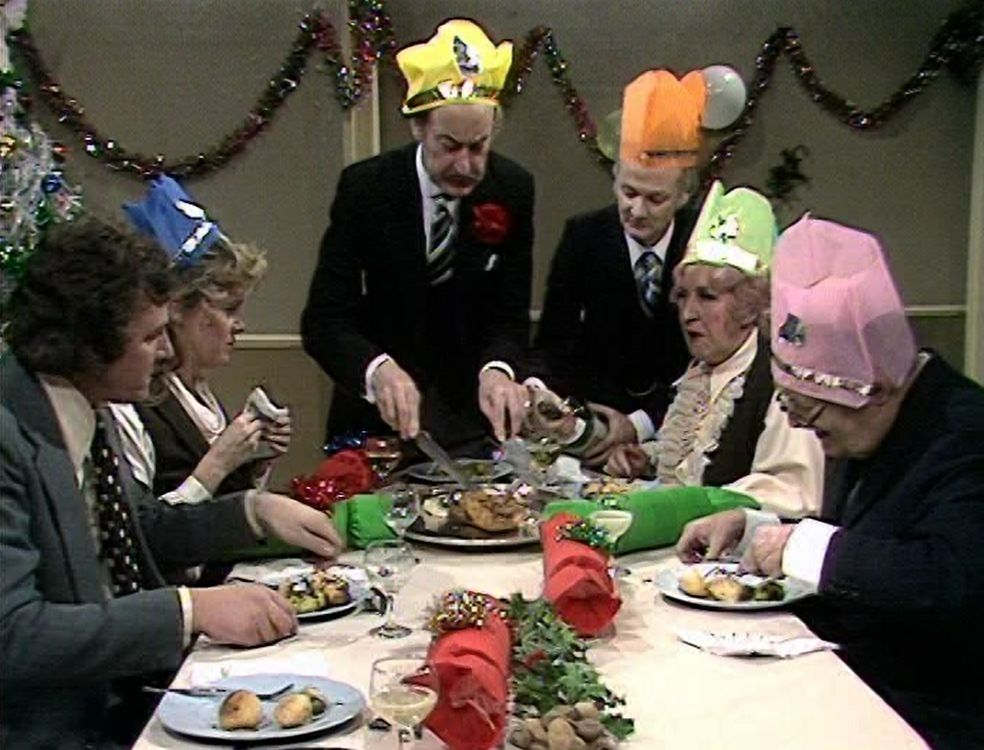
Christmas dinner is next on the agenda, which is a good example of the fact that Grace Brothers remains the most parsimonious of employers.  A microscopic chicken has to be shared amongst them all, whilst their Christmas pudding deflates after Mr Mash liberally sprinkles it with a dose of powerful wood alcohol.  Mind you, their crackers were very large and did include decent novelties, so it wasn’t all bad. Chief amongst these were Captain Peacock’s googly eyes and Mr Grainger’s sticky-out ears, which allows him to cosplay as Mr Rumbold.

This just leaves the reveal of the shop floor, now transformed into a very credible Christmas grotto (clearly all the money went on this, rather than the staff Christmas dinner) and the emergence of the regulars, all decked out in their costumes (this was young Mr Grace’s brainwave).  Whenever dress up was on the cards it seemed there was a strict pecking order (with Mr Humphries always being the last to show his face). This suggests that the writers had quickly latched onto the fact that Inman had clicked with the audience (he certainly gets the loudest whoop of appreciation – although it’s debatable whether his costume is the funniest).

Captain Peacock’s snowman is wonderful (I think it’s the addition of the pipe which really sells it) whilst Miss Brahams and Mr Lucas, as a fairy and Long John Silver, don’t let the side down. Mrs Slocombe’s Robin Hood isn’t too way out but it’s counterbalanced by Mr Grainger’s egg costume (my favourite). As always, Arthur Brough helps to sell the moment – Mr Grainger’s long-suffering miserablism is pitched at just the right level.  Like all Croft/Lloyd and Croft/Perry series, AYBS? was never the same once the original cast began to break up and Brough’s death (following the conclusion of series five) undeniably affected the balance of the show.

Once all the staff have assembled, out of nowhere music begins to play and also out of nowhere everybody starts to sing a song based on the way their day has gone.  This isn’t quite as jolting as raising a glass and wishing everyone at home a very Merry Christmas, but it’s not far short.

Are You Being Served?

served.jpg

Are You Being Served? is a series I’ve never added to my DVD collection – mainly because the R2 sounded a little unappealing (certain episodes used shorter edits prepared by David Croft for a nineties repeat season) and in the past I didn’t have a R1 compatible player, so the uncut American release was out of reach.

Which meant that I’ve come to the recent Gold repeats pretty fresh and – so far – AYBS? has proved to be a more than pleasant surprise. Of course, it’s early days yet (I’m currently on series three) and there will no doubt come a point – as happens with most Croft/Perry and Croft/Lloyd sitcoms – where the show starts to run out of steam.

Often it’s cast changes which seem to signal the beginning of the end. Dad’s Army was never the same after James Beck’s death, although it’s true that his absence wasn’t the only reason why the post Beck episodes lacked a little spark. On the other hand, the departure of Simon Cadell from Hi-De-Hi! was a major tipping point. When Jeffrey Fairbrother was replaced by someone more streetwise and less vulnerable it was a blow which the series never recovered from.

I’m expecting the post Trevor Bannister years to be a little tricky and I can’t say I’m looking forward to the introduction of Old Mr Grace. Young Mr Grace (Harold Blewett) was always a charming character, but Old Mr Grace (Kenneth Waller) was just a nasty type.

But one piece of replacement casting which I think did work was that of Arthur English stepping in for Larry Martyn (as the general handyman/dogsbody character). Martyn’s Mr Mash stands out during the early series, mainly because Martyn is playing much broader than the others (had he appeared during the later run this might not have been such a problem). Another issue with Mash is that Martyn’s clearly been made up to play older, which didn’t work very well. So the later hiring of a more mature actor (English) made sense.

If the Gold repeats continue, then I await with interest the numerous replacements for Mr Grainger, none of whom lasted very long.

The innuendo of AYBS? started fairly mildly, although you can see that series by series things are getting broader. One such barometer is Mrs Slocombe’s pussy, whose misadventures become much more suggestive over time ….

Apart from the increasing lashings of sexual innuendo, highlights so far have included Camping In (S01E04). There’s something rather charming about the way that the members of staff – forced as they are to sleep in the store overnight – reminisce about the good old days of WW2 and engage in a spot of Blitz-era spirt with a good old singalong. This one also ties the programme to another specific moment in British history – namely the early seventies when strikes and power shortages were increasingly common (other episodes also make capital out of this).

Several episodes focus on work/office politics in a way that’s still highly recognisable today. How the others react unfavourably to Captain Peacock being rewarded for twenty years loyal service (with the key to the executive washroom) will no doubt strike a chord with many. The travails of Coffee Morning (S02E02) is another one which seems just as relevant today as it did then. Stores like Grace Brothers might be long gone, but companies who react unfavourably whenever workers elect to nip off for a tea break or a visit to the toilet are still very much with us ….

The last word should be left to Mrs Slocombe.

It’s a wonder I’m here at all, you know. My pussy got soaking wet. I had to dry it out in front of the fire before I left!

Blankety Blank – Series One

DW-3ehjX4AAZtsB.jpg

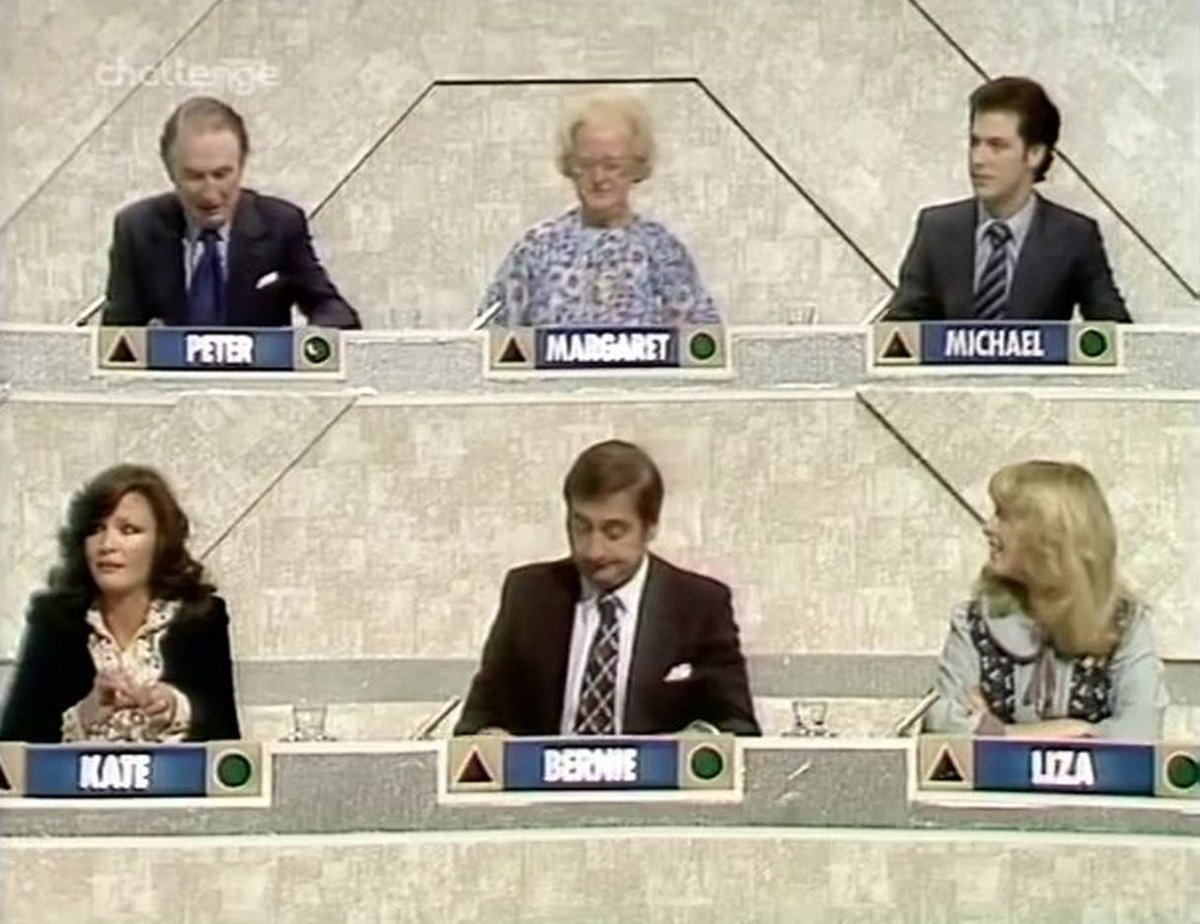
Those hardy souls who’ve been keeping an eye on my Twitter feed recently will have noticed that I’ve been tweeting screencaps from the first series of Blankety Blank (I cater for very niche interests it has to be said ….)

Although I’ve a great deal of time for the later Dawson incarnation, my heart really belongs to the Wogan era of Blankety Blank. And thanks to Challenge broadcasting a selection of shows a few years ago (although they could really do with digging out some more) I’ve now got most of the first series available whenever I need a BB fix.

And I do tend to give them a spin quite regularly. Why should a quiz game, no doubt seen at the time as rather disposable, still work so well for me today? I’ll try and explain …..

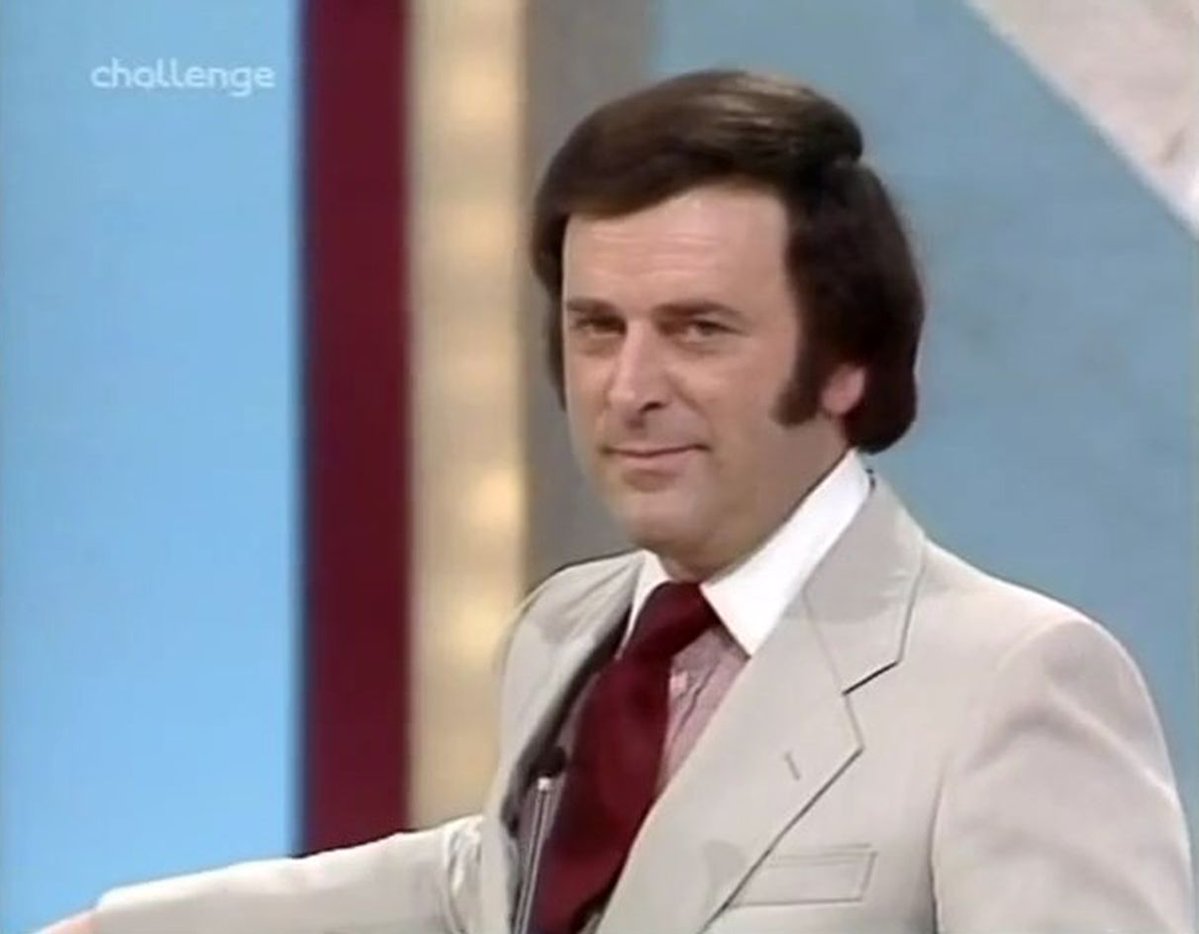
The presence of Terry Wogan is an obvious plus. Relaxed and jocular, he’s nevertheless quite happy to be the butt of endless jokes from the more boisterous panel members (Paul Daniels springs to mind). On the one hand this shows a refreshing lack of ego, but Wogan was canny enough to realise that by playing the victim he could gain a good deal of audience sympathy (which he does). But whilst he may be a ham (witness his endless array of funny voices when reading out the questions) he’s an endearing one.

DXW_Pe9XUAAz3mS

The range of guests across this first series is another major plus. There’s plenty of faces that you’d expect to see on a show of this type (Bernie Winters, Lennie Bennett, Lorraine Chase, etc) but it’s the more leftfield choices which really catch the eye. George Baker and Ron Moody are two actors who would appear to be fishes out of water in this sort of environment, but both throw themselves into the spirit of the game with gusto.

The real stars are some of the more regular players. Beryl Reid appears to be gloriously disconnected from reality whilst Peter Jones’ cutting wit always entertains. It’s always good to see Bill Tidy and his cartoons whilst David Jason (not really a quiz game regular outside of BB) seems to acting a part (that of the abrasive quiz game celeb) but he’s still good value.

But goodness, Paul Daniels is irritating. I’ve always been very appreciative of Daniels the magician, but he’s at his impish worst here. Position five, where Daniels sits, quickly came to be seen as the place where you plonk the comic/disruptive element (lest we forget it was Kenny Everett’s favourite seat).

I have to confess that I found the presence of the likes of Shirley Ann Field, Alexandra Bastedo, Diane Keen and Wanda Ventham to be rather pleasing ….

Jon Pertwee only made one appearance during this first series, but it’s a good ‘un. He decided to come along dressed as the Doctor (or maybe that was his usual evening leisurewear) and couldn’t help but aim a sly dig at Who mid way through. It clearly always rankled with him that Tom Baker was more popular in the role than he was.

The Generation Game had already presented us with the spectacle of the contestant as star, but Blankety Blank is more of a throwback to an earlier age. Most of the contestants (bar the odd confident chap – such as the Taxi Driver of the Year) seem more than a little overawed. This is best seen during Terry’s introductory chat, which always tends to be brief and to the point.

Generally Terry has three questions for them – finding out the quaking contestant’s name, the place where they live and then either their job or whether they’re married. For some, even this brief (but very gentle) interrogation seems like a terrible ordeal.

It’s interesting that much later quiz/panel shows have come in for criticism due to the dominance of male players. Blankety Blank never had that problem – the celebrities were always split equally as were the contestants. True, it’s noticeable that Terry is always keen to clutch the younger, female contestants tightly (plus they also run the risk of attracting the attention of the likes of Paul Daniels) but it was the 1970’s, so that sort of treatment was no doubt par for the course.

If you haven’t seen it for a while, then you could do much worse than seeking it out on YouTube. Genuinely entertaining, series one of Blankety Blank is something of a keeper.