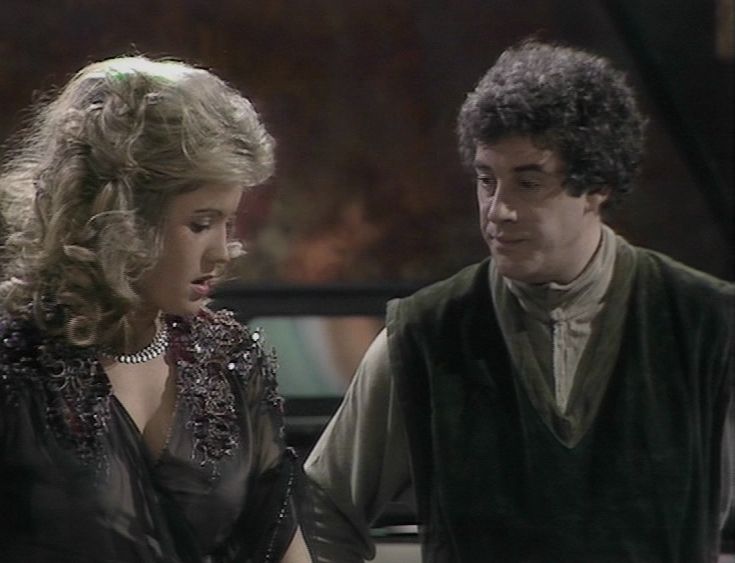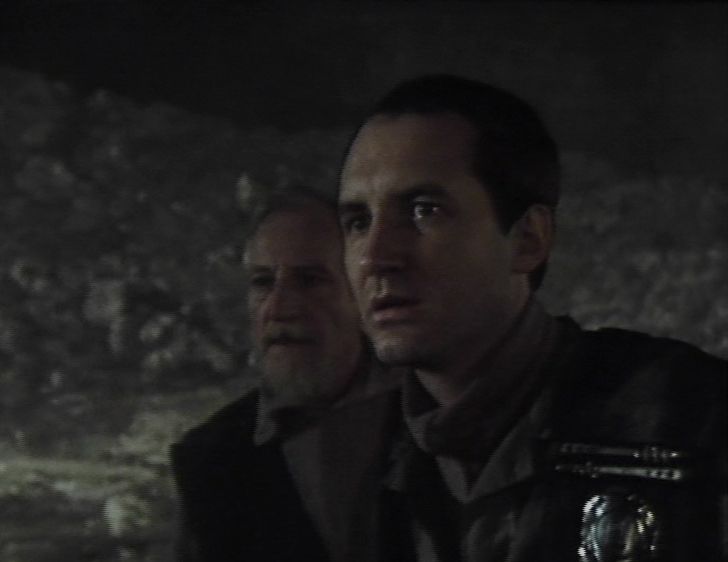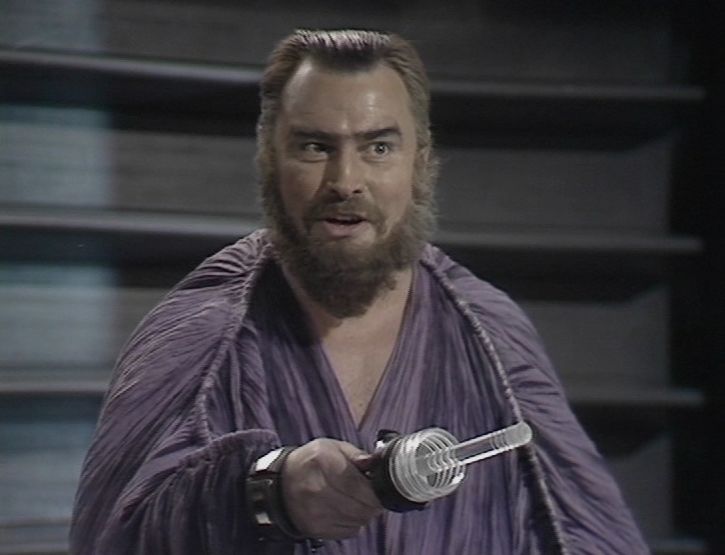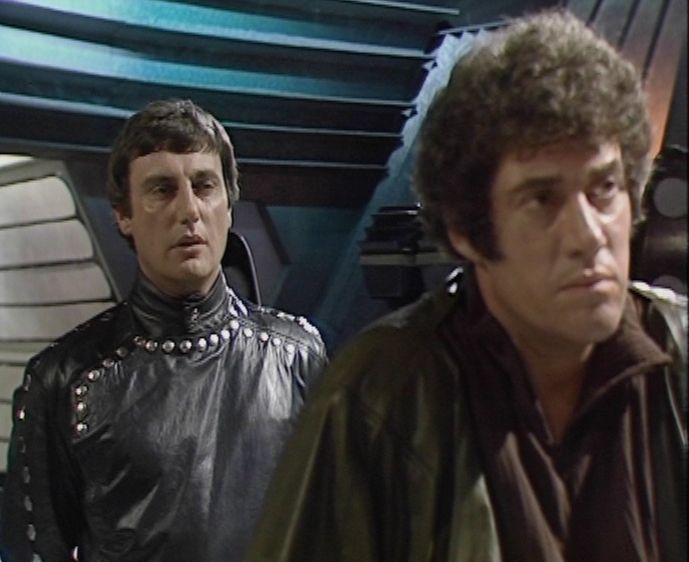
Blakes 7 – Redemption

red 01

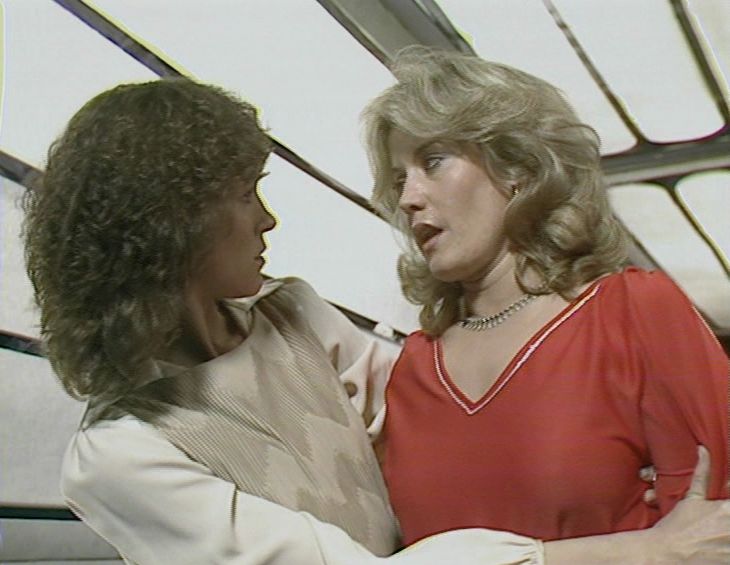
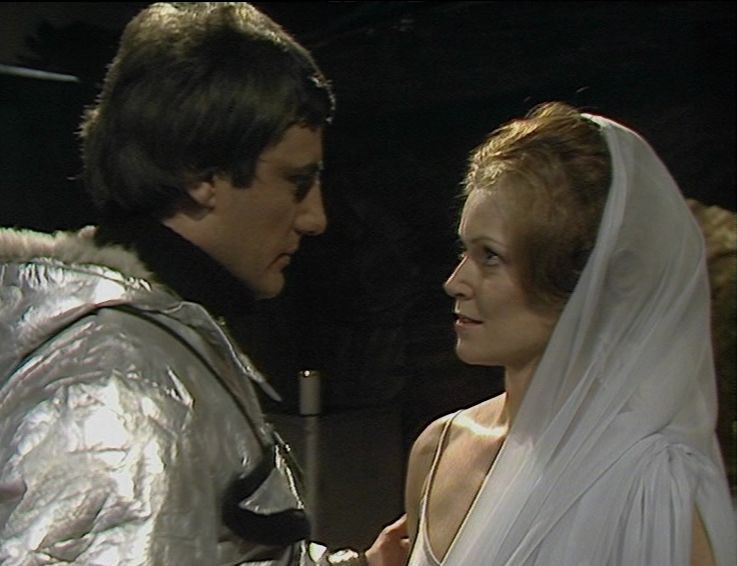
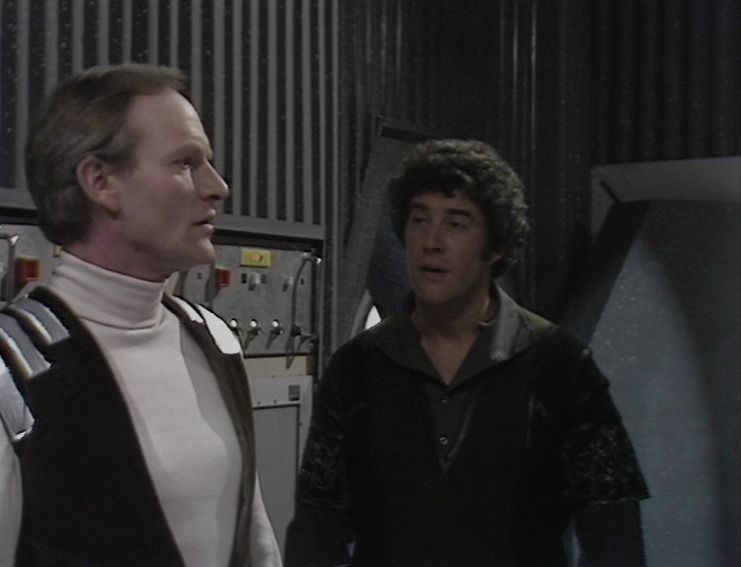
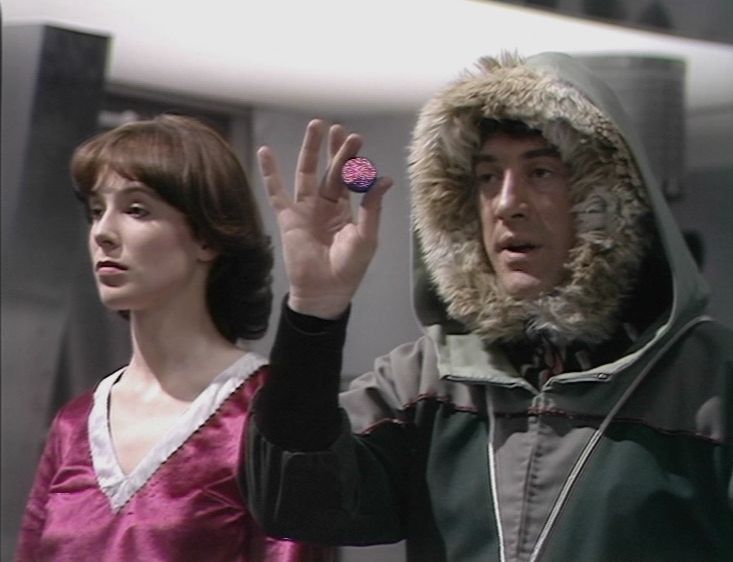
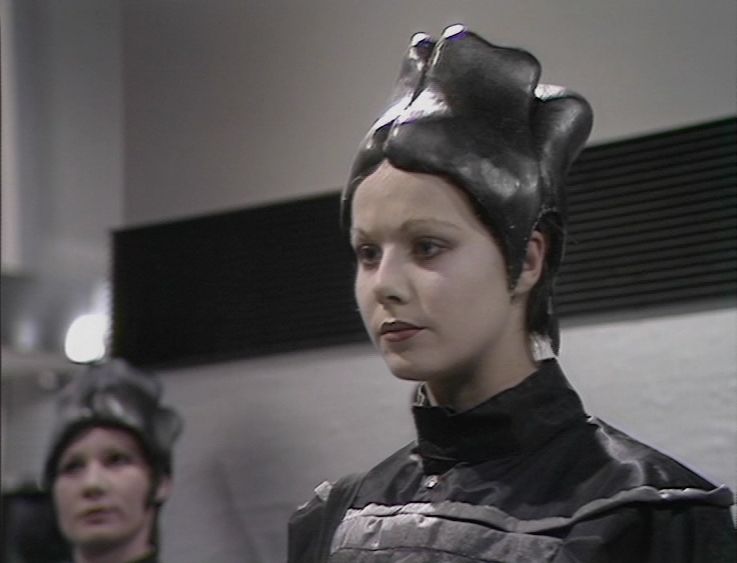
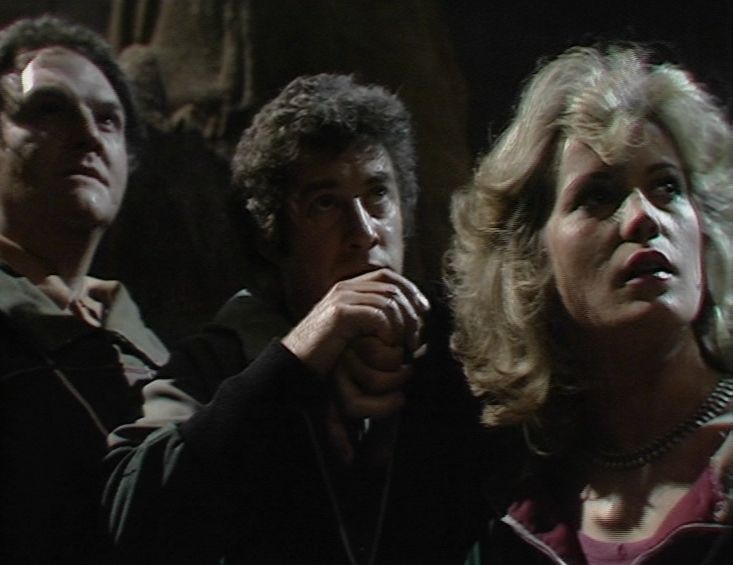
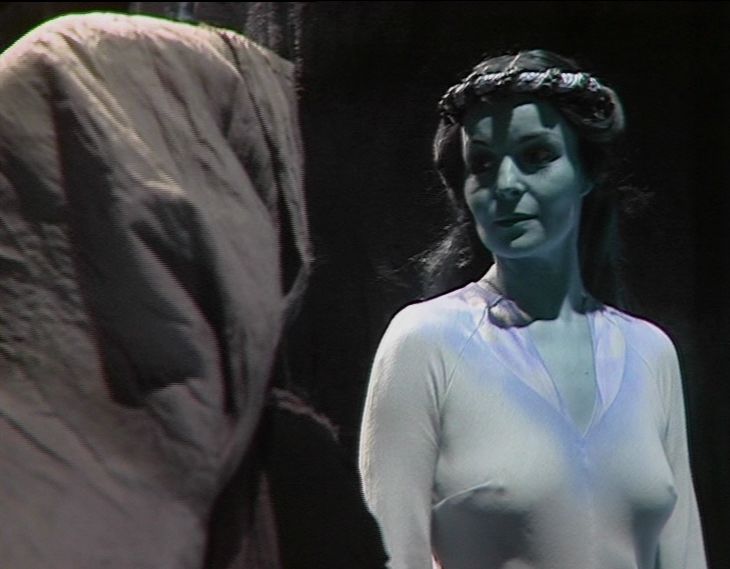
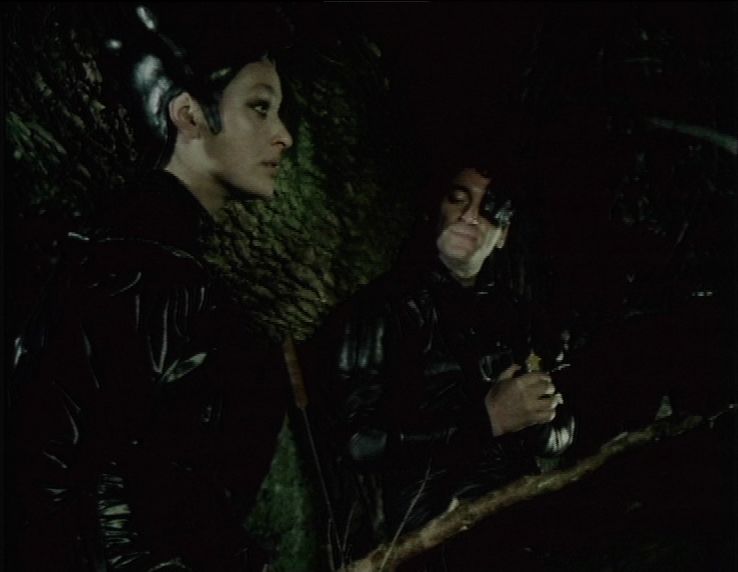
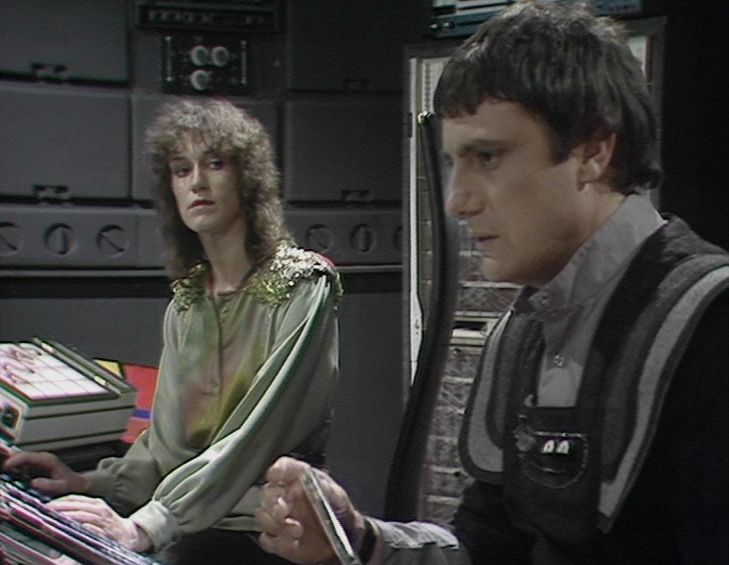
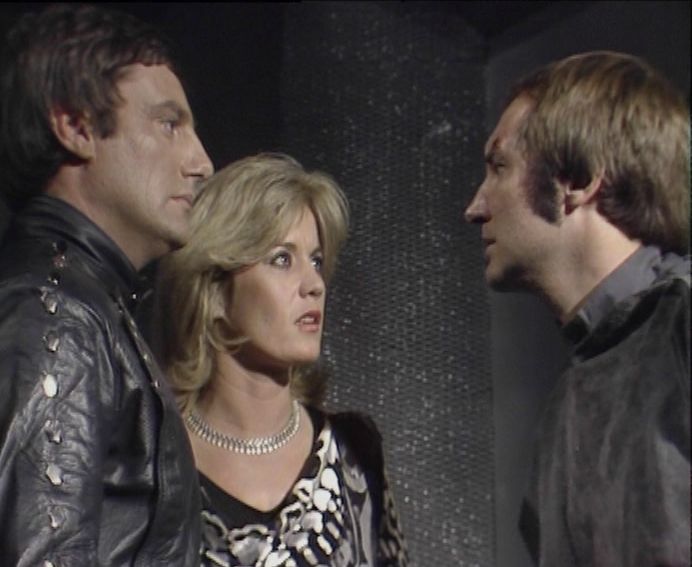
The easiest way of knowing we’ve reached series two of Blakes 7 is to look at the costumes of the Liberator crew.  In series one you could best describe them as drab, but now June Hudson’s been recruited things have certainly changed (and this is only the beginning).  Highlights are Avon’s natty black studded number (which he later donates to Tarrant) and Blake’s rather extraordinary green plastic jacket with enormous puffy sleeves.

But if the costumes are different then the story is much more familiar (not surprising since it was Terry Nation’s fourteenth script in a row).  Like The Web or Breakdown it’s a story of two halves.  The first takes place on the Liberator and the second kicks into gear once they’ve reached their destination.

Before things start happening there’s an interesting exchange between Blake and Avon.  Blake is still concerned by Orac’s prediction that the Liberator apparently faces imminent destruction.  He’s been poring over the data, only for Avon to provide him with the solution.  They can pinpoint exactly where the event will happen by the starfield shown behind the ship – so all they need to do is to ensure they never travel to that part of the galaxy and the prediction will be null and void.

When Avon admits that he worked this out several hours ago, Blake asks him why he’s not said anything to the others. “Well, all they had to do was ask. Perhaps in future, they won’t rely on you to provide all the answers”.  This battle of wills between the pair of them will bubble on for the remainder of the second series.  As to who will gain the upper hand, Vila puts it best when he says that “if it ever comes to a showdown, my money’s on Blake. Well, half of it. I’ll put the other half on Avon.”

Another fascinating little moment occurs just after Avon’s scored this point over Blake.  An explosion rocks the ship and as they fall to the ground Avon puts a protective arm around Blake.  I wonder if this was scripted or something worked out in rehearsal?  It’s only a throwaway thing, but it’s a lovely touch – proving that although he may profess to despise virtually everything Blake stands for, Avon still seems to have an automatic reflex to protect him.

red 02

Shortly afterwards, the ship comes under attack and they then lose all control of the Liberator, ending up as little more than helpless passengers (any repairs are rejected by the ship).  Avon tells the others his theory.

AVON: Think of the ship as a living entity with massive networks of electronics acting as a nervous system.
JENNA: All linked into a central computer.
BLAKE: The brain.
AVON: Carry the analogy a stage further. When a living creature is hurt – a cut or a wound – antibodies gather around the injury to repair it and to fight infection.
VILA: You mean the computers are treating us like germs.
AVON: Crude, but accurate.

Blake has first-hand experience of this when he’s attacked by a cable in one of the service areas.  Yes, the wires holding it up are rather obvious but it’s not as bad an effect as it could have been.  Once again it’s Avon who saves the day and he’s not slow in telling Blake that one day, probably quite soon, he’ll require payback!

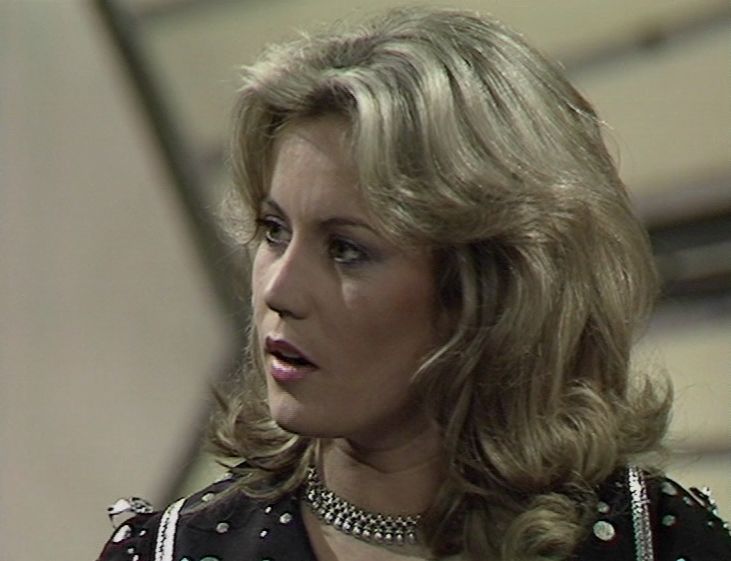
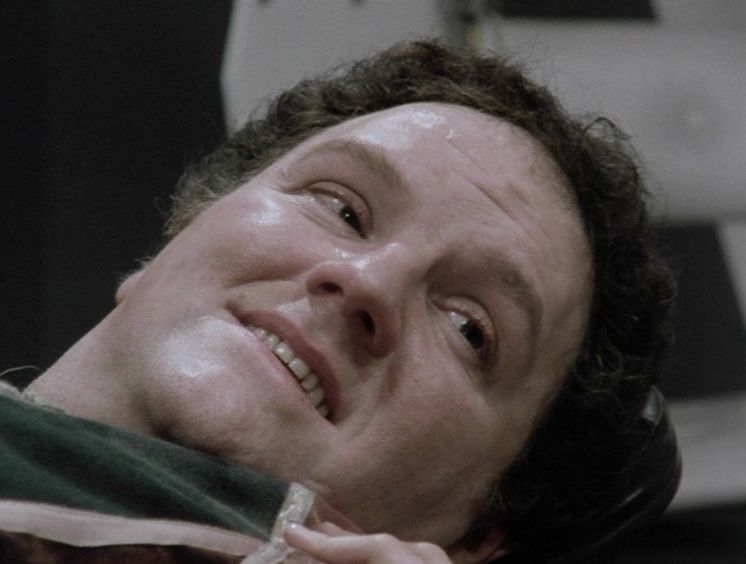
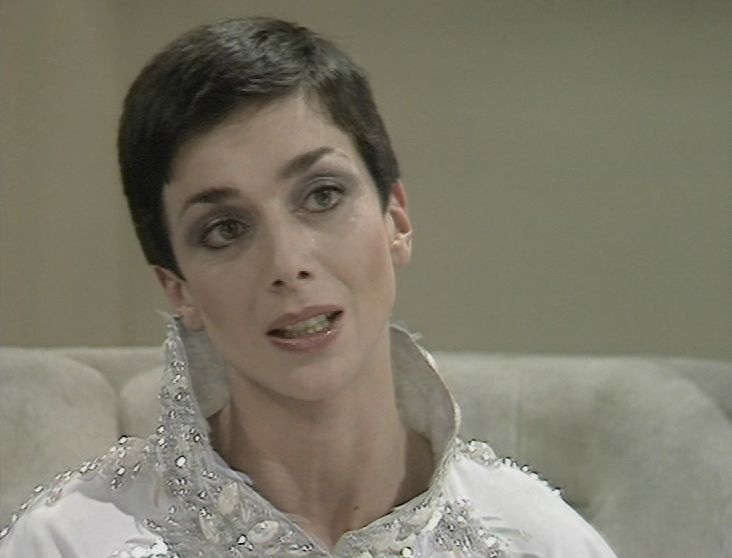
The Liberator is under the control of its creators and soon all the crew are prisoners.  Blake has a chat with Alta 1 (Sheila Ruskin) and Alta 2 (Harriet Philpin).  This is a part of the story that doesn’t quite hold together.  Both Alta 1 and Alta 2 are linked to the System (a supercomputer which controls the three planets in this sector).  We’re told that the System has ruled for several generations.  As Blake discovers when he speaks later to a slave (played by Roy Evans) this means that whilst there’s no war or famine, there’s also no freedom.

Could the System have been responsible for designing the Liberator?  Surely if they had it would have been much more functional.  And if they did create it, what was its purpose?  The Federation has clearly never come across a ship like the Liberator before (even though it’s established later that it’s not unique) so it doesn’t appear that the System is interested in expanding its empire or has very often ventured into Federation territory.  Visiting the civilisation that designed the Liberator was an obvious thing to do, it’s just a pity that it falls rather flat.

The System also bears a passing resemblance to the Conscience of Marinus as seen in Terry Nation’s Doctor Who story The Keys of Marinus – proof that Nation was never averse to reusing a good idea.

Neither of the Altas are great conversationalists, but they’re dressed in tight blue lycra which is some consolation.  Another plus-point is the filming at the Oldbury Nuclear Power Station which adds a little gloss to what otherwise is a fairly routine story.

But Redemption is still an effective season opener.  It reignites the Blake/Avon power-struggle as well as giving the rest of the regulars a moment or two to shine.  And although the plot, once we reach the System, feels a little undercooked there’s still enough going on to ensure that the story never seems to drag too badly.
red 03

Dixon of Dock Green – Reunion

reunion

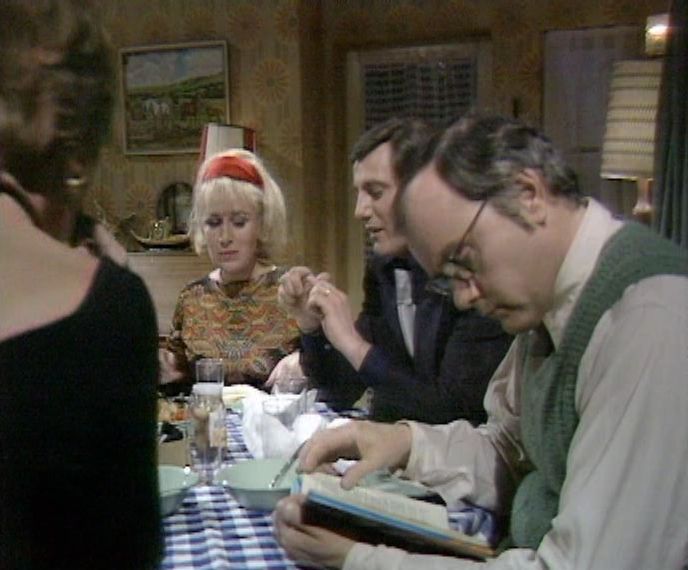
Twenty years ago a number of officers, including George Dixon, were involved in a major operation at the Docks.  Information received suggested that a well-known villain called Trunky Small was planning to steal half a million pounds in silver from a ship called the Galveston Bay.  Trunky and his gang were caught, but the operation wasn’t without incident as one of the officers lost his life that night.

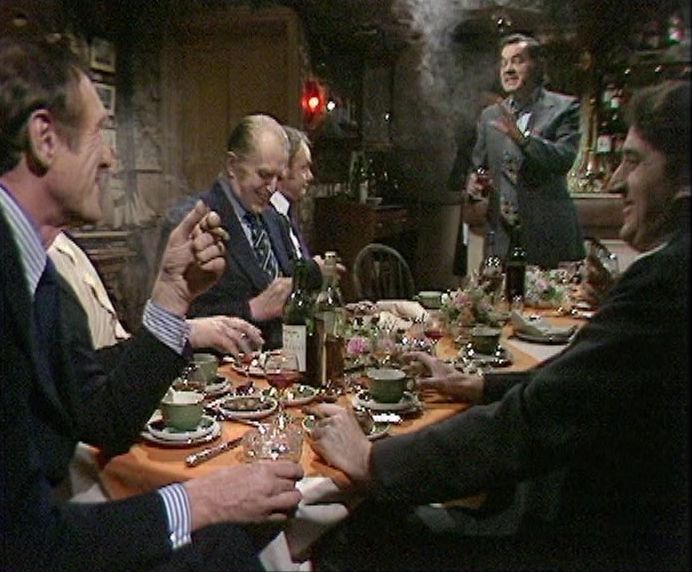
Cope (Glynn Edwards), now a detective sergeant, has organised a reunion dinner.  It appears at first to simply be a chance for old colleagues to meet up and compare notes, but Cope clearly harbours animosity against Ashe (Jack Watson).  At the time Ashe was the DI in charge, today he’s risen to the rank of Commander.  As the evening wears on it seems obvious that revelations will be made.

The final episode of Dixon of Dock Green, Reunion doesn’t acknowledge this, even obliquely, so when Dixon bades us good night at the end there’s no sense that it’s a final goodbye.  But when you consider that the last episode of the previous series, Conspiracy, was very obviously crafted as a farewell episode (Dixon’s final monologue about his life in the police, the shot of the blue lamp as the credits rolled) it’s understandable they didn’t decide to play the same trick twice.

It does place Dixon more in the centre of things though, which was reasonable enough, although even here he’s still in his familiar role as an observer – watching proceedings, occasionally asking the odd question, but never directing events.  It’s Cope who’s in charge.  He set up the dinner and also arranged for an extra place to be set (in honour of their dead colleague).  Like the rest of the evening this is for Ashe’s benefit – as is the fact that the waitress, Joyce (Jo Rowbottom), was the dead officers wife.

Glynn Edwards might be best known as the long-suffering Dave in Minder, but his CV is a long and impressive one.  He guest-starred in many popular series during the 1960’s and 1970’s, such as The Baron, The Saint, The Avengers, Public Eye, Out of the Unknown, Callan,Target and many others.  He also had a regular role in the later series of The Main Chance and appeared in films such as The Ipcress File and Get Carter.

And like many other actors he also racked up a number of credits in Dixon, playing several different characters.  He appeared as Jackie Silver in two 1963 episodes and would later play Chief Inspector Jameson in several stories during the late 1960’s and early 1970’s (one of these, Jig-Saw, still survives).  The fact that he then turned up several years later playing a different copper shouldn’t come as a surprise, as it was a very common occurrence.

Alan Tilvern is another example of this.  In Reunion he plays Morrie Finn, now an ex-policeman and someone doing very nicely indeed on civvy street.  This was Tilvern’s seventh Dixon appearance, each time playing somebody different.  His previous role had only been the year before – in the wiped episode It’s a Gift (although an infamous outtake still exists, showing Tilvern sharing a scene with Victor Maddern who finds it impossible to say the words “Dock Green Nick”).

I’ve mentioned it several times before, but the guest-casts of this final series have been very strong.  Apart from Edwards and Tilvern, there’s also Jack Watson as Ashe.  Another very familiar face from both films and television, Watson pitches his performance perfectly – showing an increasing unease as the evening wears on.

The resolution of the story is quite understated and low-key.  It later becomes clear that Ashe was made aware that one of his officers had fallen into the dock.  He could have stopped and rescued him, but that would have meant Trunky Small would have escaped.  So he chose to ignore this and press on.

It’s a mystery why nobody has ever brought this up during the last twenty years, but even after it’s made public here that’s as far as it goes.  Joyce has the chance to finally confront Ashe, but there’s no anger as she tells him that “I feel sorry for you. It can’t have been easy. Not then, nor since.”  And that seems to be that, as there’s no suggestion that any proceedings will follow.  As Joyce makes clear, the burden Ashe himself carries is punishment enough.

Another piece of the puzzle is supplied by Sam Platte, a man rescued from drowning by Harry Dunne.  For most of the episode this appears to be just a secondary story, but at the end Platte’s connection to the events of twenty years are uncovered.  He’s Joyce’s father and was the man who tipped off the police that Trunky Small was planning to rob the Galveston Bay.

It’s an outrageous coincidence that Platte should turn up on the same night as the reunion dinner and it can’t help but feel like rather clumsy plotting, but Bill Dean is excellent as a merchant seaman reflecting on a lifetime of toil with little to show for it.  It also allowed Stephen Marsh (as Dunne) a chance to shine.  For the majority of this series he’s had the fairly unenviable task of operating as the junior collator (largely existing to feed Dixon lines).

Low-key it might be, but Reunion is also a satisfying fifty minutes of drama.  With one exception, it’s very pleasing to have all the colour episodes of Dixon of Dock Green available on DVD and hopefully the black and white ones will follow soon.

Dixon of Dock Green – Legacy

legacy

After a couple of years in Wormwood Scrubs, Jack Montelbetti (Tom Adams) has an unusual homecoming after he discovers a dead body in his flat.  The dead man, Bruno Pacelli, was an old-time criminal, specialising in jewel robberies.

Jack knew Bruno well (he was engaged to his daughter Julia at one time) and though he died from natural causes that’s only the starting point of the case.  After years out of the game it appears that Bruno went back to his old tricks and pulled a diamond heist in North London and was then keen to use Jack’s skills as a fence.  The jewels were stolen from Van Heerden (John Savident) who issues Jack with a stark choice – the jewels or his life.

This was Tom Adams’ second appearance as Jack Montelbetti (the first, Jack the Lad was broadcast in 1974 and like most episodes of Dixon it sadly no longer exists).  Adams gives Jack a cool, laconic presence – he’s a man who’s rarely perturbed, even when he stumbles over a corpse.  And though he’s a convicted criminal the old-timers at Dock Green (especially Dixon) seem to have a grudging respect for him.

But a newcomer to the manor, Len Clayton, doesn’t share their views.  He knows that Jack’s a newly-released prisoner and is extremely aggressive when questioning him.  This might have been another slight attempt to toughen up the series – at one point Clayton asks him if he’d like a slap in the mouth – but equally it might have been designed to show that rough-and-tumble tactics don’t always work.

Jack doesn’t take to Len Clayton at all and doesn’t waste any time in telling him exactly what he thinks of him.  “I spent two years banged up with a pair of incontinent morons. I worked six hours a day in a laundry for ten fags and a jar of jam. I said yes sir, no sir to the biggest shower of illiterate screws you ever met in your life and then when I come home I get you. Oh brother, life can be hard.”  He goes on to say that he’s not prepared to answer any of his questions, due to Len’s attitude, so he’ll wait for Bruton to turn up instead.

Jack and Julia were estranged several years ago (at the start of the episode Julia flinches when she hears his name) but it doesn’t take too long before they re-establish their old love.  With several different plot-threads running at once there’s not a great deal of time spent on their relationship, but Adams and Gigi Gatti do their best with the limited time available .  Gatti’s film and television CV is quite small (several appearances in Survivors as Daniella later in 1976 are possibly the highlight) and her lack of credits is quite surprising as she’s an appealing presence.

John Savident makes the most of his role, affecting a Dutch accent and waving a gun around.  There’s not a great deal of menace with his character though, possibly due to Dixon‘s status as a pre-watershed series.  The Sweeney would have been able to get away with displays of violence from Van Heerden (to prove that he could follow through on his claim he would do Jack serious harm) but that would never happen in Dixon.

The ending is another example that crime sometimes does pay.  Van Heerden is arrested but Jack gets away (and it’s implied he’s pocketed the jewels).  Dixon, in his end of episode summing-up, doesn’t sound at all aggrieved about this – another sign that Dixon of Dock Green operated on a different level from most police series.

For Dixon a conviction isn’t everything – sometimes villains will walk free (especially if they’re seen as basically decent people) and there’s a tacit acknowledgment that although the strict letter of the law hasn’t been followed maybe it’s for the best.  This certainly sets the series apart from many cop shows where the “result” is all that matters.

Dixon of Dock Green – Jackpot

jackpot

Harold Tovey (Kenneth Cope) is a bookish, mild-mannered man who continually finds himself hen-pecked by his wife Margaret (Pat Ashton).  When she tells him to take a relaxing holiday abroad by himself, he’s suspicious – as he’s certain she’s involved with the smooth-talking Mickey Walker (Tim Pearce).

But if there was any fight in him, it appears to have long gone and he dutifully plods off to the airport.  However, when his flight is cancelled he heads home to see his wife and Mickey heading out together.  This is the catalyst for a series of unlikely adventures, which start when he appropriates a large sum of money previously stolen by his brother-in-law Tony Kinsley (Paul Darrow).

Jackpot is a comic treat with Kenneth Cope (Coronation Street, TW3, Randall and Hopkirk) on fine form as the bookworm who turns.  The first fifteen minutes or so constantly reinforce the notion that Harold is a complete and utter nonentity – his wife says so, Tony Kinsley says so, even the boys at Dock Green nick say so!  But even the mildest-mannered man can only take so much and his eventual revolt is a delight.

He turns up at a posh hotel, complete with chauffeur, and proceeds to take the grandest suite.  He’s also acquired a nice new suit and, best of all, a full head of hair (thanks to a very impressive wig).  Outrageously tipping the hotel porter (Eric Mason) ensures that he gets the very best service – including some female company to help him relax.  His encounter with the escort Sybil (Pamela Moiseiwitsch), is another highlight of the episode as he does everything he can to impress her.  “Do you have a bucket of caviar for dinner every night?” she asks him

The performance style of the guest-cast is best defined as “broad”.  The likes of Pat Ashton tended to play comedy anyway whilst Paul Darrow’s broad cockney accent also raises a smile, although that probably wasn’t the intention.  Darrow’s very entertaining though, even if it’s hard to accept he’s a hard-bitten villain.

The comedic antics of Harold do contrast somewhat with the more serious scenes at Dock Green nick.  The two different environments don’t really connect very well – probably because the Dock Green officers aren’t integrated into Harold’s story (in fact, we could have concentrated solely on Harold and we probably wouldn’t have missed the input of Dixon and the others).

Quite a short episode, clocking in at just over forty-six minutes, it’s another one that succeeds thanks to the guest cast, especially Kenneth Cope.

Dixon of Dock Green – Alice

alice

Mohinder Singh (Renu Senta) is involved in the trafficking of illegal immigrants.  Forty individuals are currently in Ostend, awaiting shipment to Britain – but they won’t be going anywhere until the captain of Dutch vessel is paid in cash.

Singh contacts a dodgy import/exporter called William Keeley (Harry Landis).  Keeley is unwilling to make the trip himself, but a likely candidate presents herself at just the right moment.  Alice Benfield (Angela Pleasence) is a gifted music student who rents a room above Keeley’s office.  She appears to be vague and lacking in any social skills, which encourages Keeley to use her as an unwitting courier.

But Alice isn’t quite as innocent as she appears and is more than willing to undertake the job, provided the price is right.  And this isn’t the only surprise that Alice springs …..

Alice takes a while to get going (the first twenty minutes or so drag somewhat) but once we get into the heart of the story things pick up nicely.  Angela Pleasence, daughter of Donald Pleasence, gives an intriguing performance as the titular Alice.  When we first meet her she’s incredibly vague and hardly seems able to string two words together.  Is this an act?  By the end of the episode (after she’s pocked the money from Singh and taunted him that he’s powerless to do anything) she’s transformed completely.

Keeley ends up as her partner in crime (Dixon’s closing piece to camera states that they later went into business together).  Harry Landis is hardly pushed, but is good anyway, as the sharp Jewish businessman not averse to accepting a crooked deal.

The one discordant note comes from Tania Rogers as Keeley’s secretary Samantha Jones.  Her jive talking (referring to white people who annoy her as “honky”) hasn’t aged well and her acting in general is rather brittle and forced.  A sample of some of her other performances during this period, such as Zilda in the Doctor Who story The Robots of Death, shows that she did tend to overact.

Renu Setna is much better value as Singh – a man who professes he only wants to help his fellows, but isn’t averse to making a healthy profit out of them.  Refugees and migrants remain a hot topic today – although they’re not not really the focus of the episode.  As we never see them, the migrants are only used a plot device to put the sum of money into Alice’s hands and it could have equally been drugs or pornography Singh and Keeley were dealing in.

This is an episode where it seems that crime does pay, as Alice uses the money she’s stolen from Singh to give a recital at the Wigmore Hall.  All Dixon can offer any viewers concerned to hear she’d got away scot-free is the news that the critical response was poor!

Although the opening is dull and Alice’s character transforms rather too completely over the course of the episode for my tastes, this is decent enough fare.

Dixon of Dock Green – Everybody’s Business

business

Mrs Hooker (Queenie Watts) is a familiar presence at Dock Green nick.  She might be motivated by a strong sense of public duty (or could simply an officious busybody).  Her suspicious nature is a running joke with her tenants, such as Dave Palmer (Rod Culbertson) and Rita Batty (Cheryl Hall).

When Dave tells an incredulous Rita that Mrs Hooker examines their rubbish (in the hope of finding something incriminating) they decide to play a joke on her by drawing a plan of a fictitious robbery and popping it in the next bag of rubbish.  Naturally enough she finds it and goes rushing off to the station to report her latest find.

But whilst Dave and Rita are planning make-believe crimes, a real one is happening right next door.  Mrs Collins (Sylvia Coleridge) has become quite the local celebrity, following a piece in the local paper about how she discovered one of her paintings was worth forty thousand pounds.  This makes her a target and Walker (George Sweeney) and Ron Fielding (Roger Lloyd-Pack) plan to relieve her of this precious work of art.

When Ron Fielding turns up at Mrs Hooker’s house, looking for a room, it’s pretty clear from the outset that something’s not quite right.  Although he’s offered a nice, quiet room at the back he prefers the smaller one at the front.  Problem is that Rita has the front room and doesn’t want to move.  Ron spins Mrs Hooker a yarn about how his wife has moved in over the street with another man, which gives Queenie Watts a lovely moment as she purses her lips and declares that spying on people isn’t nice at all.

Of course, he’s simply interested in the room because of its location to next door and the painting.  But though he doesn’t get the room he still plans to use it – as soon as Rita leaves to work at the pub that evening.  Alas, she comes back too soon and finds herself bound and gagged by Ron and Walker.

Everybody’s Business is another good character-based story.  Roger Lloyd-Pack and George Sweeney (both to later find fame in John Sullivan sitcoms – Lloyd-Pack in Only Fools and Horses and Sweeney in Citizen Smith) exude a certain menace.  Their initial meeting, in a bleak and rubbish-filled street, is another snapshot of how grim many areas of London were back in the 1970’s.

Cheryl Hall (who would also later appear in Sullivan’s Citizen Smith, alongside her then husband Robert Lindsey) is rather appealing as Rita.  She has a mischievous streak, brought on by Mrs Hooker’s snooping, but also finds herself tramautised after spending the night tied up.  Sylvia Coleridge, who had a lengthy career largely playing eccentric old women, plays somewhat to type as Mrs Collins.

Bruton is very brusque with both Rita and Dave (it appears that he doesn’t believe her story to begin with) and this causes Dave to call him a pig, once he’s out of earshot of course.  It’s quite rare for the police in Dixon to behave quite so off-hand to witnesses, so this is possibly a sign that the series was gently trying to toughen up a little.  There’s also a very brief, Sweeney-like, bit of action at the end as we see police cars racing through the urban wasteland to nab the criminals.

With the crime only taking up a small part of the running time, Everybody’s Business is much more about character interactions and because the story is so well-cast this makes it one of the stronger episodes from this final run.

Dixon of Dock Green – The Vagrant

vagrant

A vagrant (John Carson) is knocked down by a car in the street.  An eye-witness, Fred Smethwick (Bill Treacher), is insistent that the car deliberately drove into him and his statement catches the interest of the Dock Green police.  The vagrant is later identified as Joseph Conway, a career criminal who turned Queen’s Evidence a few years previously.  He helped to put two criminals, Gerald Tate (Johnny Shannon) and Bert Flower (John Hartley), behind bars and since they’re both now back in circulation it seems likely one of them was the driver.  But the truth is rather more complicated …..

The Vagrant benefits from John Carson’s guest turn.  Whilst he’s rarely been a leading man, he’s a quality actor who enhances any production he appears in.  Still active (he popped up in an episode of Midsummer Murders a few years back) he’s enjoyed a lengthy career stretching back to the 1950’s.  The Doctor Who story Snakedance and the Out of the Unknown episode This Body Is Mine are two of his credits which have been covered previously in this blog (both of which are enriched by Carson).

He’s rather cast against type here as a down-and-out.  The part calls for him to adopt a hoarse and hesitant voice and a rather vague manner, but it’s obvious from fairly early on that there’s more to Conway that meets the eye.  He may appear now to be a broken wreck of a man but that wasn’t always the case (in fact he’s not even Joe Conway).

His real name is Francis Spurling and the reason for him changing his identity helps to spin the story off in another direction completely.  After Spurling and Joe Conway swapped identities, it allowed him to drop out of circulation (Conway’s dead body was mis-indentifed as Spurling).  His wife, Margaret (Suzan Farmer), has since remarried and naturally views his return with horror.  But Spurling hasn’t returned to make trouble – he simply wants to try and make amends with Margaret and also help his friend Percy (a lovely turn from Paddy Joyce).

The Dock Green boys take a back seat in this one as the bulk of the episode revolves around Conway/Spurling, although Clayton and Bruton do entertain themselves by questioning Tate and Flower (Johnny Shannon is wonderfully belligerent as Tate).  As I’ve said, Paddy Joyce is very entertaining as Conway/Spurling’s fellow vagrant Percy and whilst he adds little to the plot, he’s a colourful character who enriches the episode no end.

There’s little for George Dixon to do and the story does somewhat splutter to a conclusion, but as ever, the first-rate guest cast (John Carson, Paddy Joyce, Johnny Shannon, Suzan Farmer), helps to keep the interest bubbling along.

Dixon of Dock Green – The Job

target

Sgt Wills fishes a barely conscious petty criminal called Phil Harvey (George Innes) out of the river.  It wasn’t suicide though – as Harvey was bound and gagged.  After he’s taken to the hospital Wills in unable to get any useful information from him.  DC Clayton is equally unsuccessful with Harvey’s wife, Jessie (Mela White).

The first breakthrough comes when Harvey’s car is found – close to the office of Stephen Gilles (David Lodge).  Gilles is a target criminal and therefore of special interest to the Serious Crimes Squad.  Dixon contacts DCI Bassett (Stephen Greif) who’s been keeping Gilles under observation and suggests they pool their resources.

There’s some effective film-work at the start of The Job as we see Wills rescue Harvey.  It once again shows that one of Dixon‘s strengths during this period was the dock-based location filming (which helps to break up the generally studio-bound, static feel of the series).  There’s not a lot of location work in this one but every little helps to open out the show a little.

The opening of the story also brings Sgt Johnny Wills a little more into the centre of the action.  Between 1960 and 1976 Nicholas Donnelly chalked up over two hundred appearances and was therefore as much a fixture at Dock Green as Jack Warner or Peter Byrne were.  Donnelly was able to give Wills a likeable, friendly air which fitted in well with the general tone of the series.

Here, he spends most of the story at the hospital – cadging endless cups of tea from a friendly young nurse (played by Glynis Brooks).  She only appears to have eyes for the dashing young DS Bruton though and later views Wills’ habit of listening at doors with a little disfavour.  Wills is unabashed though – if it means gaining information then it’s a legitimate tactic.

As ever, there’s a very decent guest cast.  George Innes (Upstairs Downstairs, Danger UXB) gamely opened the episode by being caked in mud and submerged in the river (kudos to him, considering the early hour the scene was shot and how cold it looked).  Mela White (best known as Diamante Lil from Bergerac) is gloriously vacant as his wife.  But is she really that slow on the uptake or is it just a way of concealing what she knows?

It’s possibly not a surprise that it’s Dixon (rather than Bruton or Clayton) who realises that Serious Crimes have been keeping tabs on Gilles which is confirmed after he arranges a meeting with DCI Bassett.  It’s another subtle demonstration that whilst he may be getting on, Dixon’s knowledge still remains formidable.  Greif’s scenes are rather distracting, thanks to his false-looking moustache, but his meet with Dixon is a good excuse to get Jack Warner out of the studio and onto film.

David Lodge, an actor with an impressive list of comedy credits (appearing alongside the likes of Peter Sellers and Spike Milligan), has a fairly small role but casting a name actor helps to make it a memorable appearance.

As so often with television of this era, it’s the period feel which makes it an interesting watch.  The Harvey’s house (especially the wallpaper) screams out that it’s the 1970’s and some of the film-work – as Bruton and Clayton tail Gilles down the local high-street – is also rather evocative.  This filming also highlights the somewhat ad-hoc way these programmes were made.  Often it appears that they’d just turn up and start filming, without attempting to close off the street.  Meaning that you’ll often see members of the public unable to resist the temptation of staring straight down the lens!

The second of Derek Ingrey’s five scripts for series twenty-two, it’s another effective, character-based story.

Dixon of Dock Green – Domino

domino

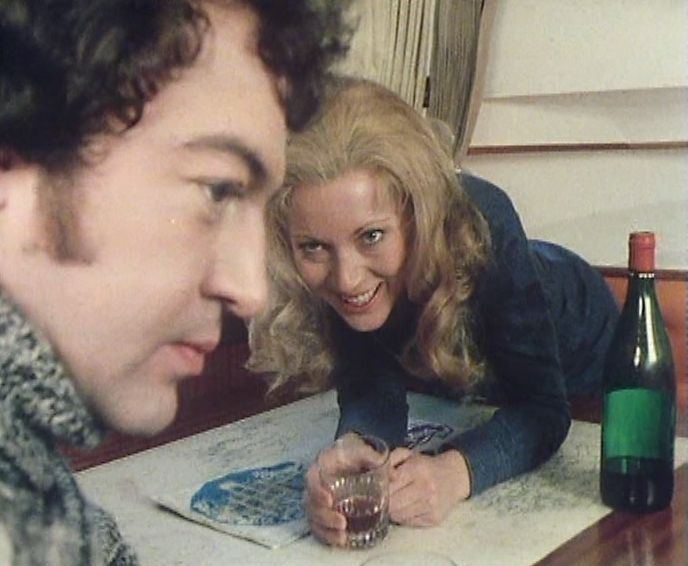
When Annabelle Sturmer (Sally Faulkner) moors her impressive-looking yacht at Dock Green she instantly catches the eye of dock-worker Ron Mason (Alan Lake).  Annabelle and Ron share a drink and everything seems friendly enough – but in an instant her mood changes and there’s a struggle.  She returns with a gun and then a shot is heard.

Ron is seen leaving the boat, pausing to throw something in the water.  When Annabelle’s disappearance is noted, the boys at Dock Green investigate.  All the evidence suggests that Ron murdered her – but things aren’t quite as straightforward as they first appear …..

Domino was the first episode of Dixon of Dock Green‘s twenty first and final season.  This series saw several changes to Dixon‘s tried and tested format.  Firstly, we’re told that Andy Crawford (Peter Byrne) had transferred to another area, so there’s several new faces in CID – DS Alan Bruton (Richard Heffer) and DC Len Clayton (Ben Howard).

As for Dixon himself, he’s moved from being the desk sergeant to taking up the post of collator.  In some ways this wasn’t too drastic a change – as per the previous few series George stays in the station and provides the others with nuggets of information that enable them to run the criminals down.

As is probably well known, Jack Warner had some trouble moving about, so Dixon tends to remain either seated or standing upright.  He does walk about a bit, but not very far (his days of pounding the beat were long, long over).  But the job of collator was an inspired one, as it allowed him to still have a decent input into the stories as well as giving him a chance to mentor a younger officer, PC Harry Dunne (Stephen Marsh), who we’re told will take over from him in due course (was there thought given to continuing the series following Warner’s retirement?).

Whilst Peter Byrne’s departure was a loss, Richard Heffer is a very welcome addition to the cast.  A familiar television face already (Captain Tim Dowling in Colditz and JImmy Garland in Survivors were amongst his numerous roles) he brings a touch of class and charm to Dock Green nick.  Ben Howard, as Len Clayton, provides a nice contrast, since he seems to have an ironic sense of humour as well as possessing a harder streak.

Derek Ingrey’s script sets up a mystery which isn’t resolved until the closing minutes.  Sally Faulkner doesn’t have a great deal of time to make an impression, but still manages to do so.  Annabelle Sturmer appears to be a spoiled little rich girl, who took her father’s yacht without permission and sailed it back to Britain.  The implication is that she’s an alcoholic, which would explain her fondness for drinking early in the morning as well as her violent mood swings.

Alan Lake, who died at the very early age of forty three in 1984, might be best remembered as Diana Dors’ husband, but he also had an impressive list of acting credits (including eight appearances in Dixon, playing eight different characters).  He didn’t tend to do subtle very often, but that works perfectly well here. Ron Mason needs to be a twitchy, unpredictable character, that way it makes the question as to whether he’s harmed the girl harder to answer

Lake is one of the episode’s chief attractions and he enjoys a generous amount of screen-time.  Also worth watching are Gwyneth Powell (in her fifth and final Dixon appearance) as Mason’s long suffering wife and Simon Lack (later to star with Richard Heffer in LWT’s Enemy at the Door) as Annabelle’s father.

The down-beat ending might have been easy to guess, but it still has a certain impact.  A solid, if not spectacular, series opener.

Blakes 7 – Orac

orac 01

The Liberator is en-route to Aristo, to deliver medical supplies to a seriously ill man called Ensor (Derek Farr).  He isn’t the only sick person though, as Avon, Jenna, Vila and Gan all display signs of radiation poisoning following their time spent on the planet Cephlon.  Since there aren’t any anti-radiation drugs on the Liberator they have to hope that Ensor will be able to help them.  Also travelling to Aristro are Servalan and Travis, who are keen to acquire the mysterious Orac, an invention of Ensor.

Orac was the second episode of a two-part story (a unique occurrence in Blakes 7).  Rather helpfully, for the benefit of anybody who might have missed the previous installment Blake spends the first few minutes recapping the events of Deliverance to Avon (and of course the people watching at home).  This is a rather obvious device (there’s no logical point for Blake to tell Avon what he already knew) but it sort of works.

The lack of anti-radiation gloves (sorry drugs) on the Liberator is hard to swallow.  It’s the most fantastically equipped ship in the galaxy and there’s nothing suitable?  Hmm, okay.  Even odder is that they make no attempt to stop off at any other planet before visiting Ensor, which means they pin all their hopes on the possibility he’ll be able to help them.  Yes, they know that Ensor’s life is at stake, but so are theirs – you’d assume they’d put their own interests first.

Derek Farr was a very familiar face with numerous television and film appearances to his credit.  On television he had decent guest spots in the likes of Bergerac, Rumpole of the Bailey and Some Mother’s Do ‘Ave ‘Em whilst his film credits included The Dam Busters.  He also appeared with Gareth Thomas in Star Maidens, but I doubt that’s a credit either would have put at the top of their cv’s!  He’s rather good as the seemingly cranky and bad-tempered Ensor, who displays a much more human side when he realises that his son is dead.

CALLY: We went to the aid of a spacecraft that had crashed, one of the crew was already dead and the other man was dying, but before he died he asked us to get these to you.
ENSOR: Both men dead, you say?
CALLY: Yes.
ENSOR: One of them was my son.
CALLY: I’m sorry. He tried desperately to reach you. He did everything he possibly could.
ENSOR: Oh, such a waste. He had a good mind. Death is such a waste. You were with my son when he died?
CALLY: Yes.
ENSOR: It’s always too late, isn’t it? I wonder if he knew how much I loved him?
BLAKE: I think he did.
ENSOR: Oh I, I’m sorry if I snapped at you. It’s, it’s just my way. Thank you, for doing all you could to help.

Orac isn’t a story that serves either Servalan or Travis especially well.  Neither are central to the story and the sight of Jacqueline Pearce being mauled by a man in a rubber suit (one of the Phibians) isn’t one of her finest moments, although the concept of Servalan not being in control is an intriguing one.

It’s probably just as well that Greif’s role wasn’t especially large, as an accident meant he was unable to shoot the studio scenes.  A body-double was used and Greif dubbed Travis’ dialogue a few months later (though he was far from impressed with the actor they used, remarking that he had flat feet!)

Blake offers to take Ensor back to the Liberator so he can perform the operation that’ll save his life.  Travis’ arrival forces them to escape via the tunnels and Ensor dies before they reach the surface.  His death is rather perfunctory alas, but it’s necessary in story terms – since it allows Blake to take charge of Orac.

And once Orac is back on the Liberator, everybody is keen to test his limits.  They know it can draw information from any computer without a direct input (not very impressive in the modern internet age, but this was 1978, remember) but what else can it do?  Orac boasts it can effectively see into the future and demonstrates this by showing the apparent destruction of the Liberator ….

Thanks to Terry Nation, the first series of Blakes 7 had a consistent tone, although he would later admit that he found difficulties in finding ideas for some of the later stories in this first run.  So he fell back on some familiar storylines (radiation poisoning, for example) and also had to rely on Chris Boucher to take more of an active scripting role.

From series two onwards, Boucher’s voice in the series would be even stronger and he also bought on board a group of different writers (some better than others) who would take Blakes 7 into various different directions.

orac 02

Blakes 7 – Deliverance

deliverance

Approaching a planet called Cephlon, the Liberator crew comes to the aid of a stricken ship.  Avon, Jenna, Vila and Jenna teleport down to the surface to see if anybody survived the crash-landing.  Of the two-man crew, one of them, Maryatt (James Lister), is already dead, but the other, Ensor (Tony Caunter), is alive – although badly injured.

They teleport him back to the ship, but when the others realise that Jenna hasn’t returned, Avon, Vila and Gan return to look for her.  Ensor is insistent that they leave straight away (to the planet Aristo and his seriously ill father) and he forces Blake at gunpoint to comply.

This leaves the others stranded on a planet high in radiation and surrounded by distinctly unfriendly primitive types …..

Like several previous stories, Deliverance has two main plot-threads running throughout the episode.  The first, concerning Ensor and the deal he’s made with the Federation, is set up here, but won’t be concluded until the series finale, Orac.

Ensor and his father have enjoyed a long period free from Federation interference, but his father’s declining health has meant they now need to trade something to pay for the medical attention he desperately needs.  They offer the Federation Orac and in return the surgeon Maryatt travels back to Aristo with Ensor Jr.

There’s several major flaws with this.  Are we to suppose there’s no non-Federation surgeons available?  Even more ridiculous than this is Servalan’s plan.  She’s rigged Ensor’s ship with a bomb and once it detonates (killing both Ensor and Maryatt) she plans to travel to Aristo and take Orac.  Ensor Snr will be dead by then, since the medical attention he requires wouldn’t have arrived, so she foresees no difficulties.

The obvious question is why didn’t she simply detain Ensor Jr after he’d approached her.  Why go to all the trouble of allowing him to leave and with a top Federation surgeon who she needlessly sacrifices?  When she later discusses this with Travis, he expresses a twinge of conscience when he realises that Maryatt has been killed – he was the surgeon who saved his life.

Travis is more subdued in this episode, no doubt this has something to do with the loss of his command during the Project Avalon debacle.  After he enters Servalan’s office, she deliberately ignores him for a moment.

TRAVIS: You sent for me?
SERVALAN: You’ve lost some of your fire, Travis. Whatever happened to your pride?
TRAVIS: My pride, Supreme Commander?
SERVALAN: I ignored you. A calculated insult. You obviously recognised it as such.
TRAVIS: I did.
SERVALAN: And yet you remained silent. There was a time when you wouldn’t have taken an insult like that from anyone. Not even me.
TRAVIS: True. I want my command back. To get it I’ll do whatever’s necessary. If you think my silence is weakness, you mistake me.

Both Jacqueline Pearce and Stephen Greif are excellent in this scene.  Travis is more restrained and rational than we’ve previously seen – though he still has an intense desire to hunt Blake down.  Servalan’s murder of Maryatt clearly disturbs him, but he’s prepared to ignore that (and help Servalan steal Orac) if it means he’ll get his command back.  By now, hunting Blake is his sole motivation and he’ll do anything which will ultimately lead to Blake’s destruction.

As for Servalan herself, she oozes ruthless, smiling villainy in a way that would become very familiar over the next three series.  This is highlighted when she tells Travis that Maryatt will be posted as a deserter (ensuring that his family will be sold into slavery into one of the Frontier Worlds).

The second plot, on the surface of Cephlon, has its problems, mainly centered around the shambling, skin-covered primitives.  Once you’ve seen them, you know you’re in for a rocky ride – articulate conversationalists they’re not.  The most interesting game to be played when they pop up is to try and identity them, as the likes of Harry Fielder and Pat Gorman are amongst their number.

But the last fifteen minutes or so are livened up by the arrival of Meegat (Suzan Farmer).  She is convinced that Avon is an all-powerful Lord, sent from another world to aid her people.  “Counting yourself, that makes two people who think you’re wonderful” says Vila acidly.

Paul Darrow has some nice moments here.  He manages to show us that Avon is both uncomfortable and slightly flattered to be worshiped as a God.  And Avon lives up to his God-like status by reactivating a dormant spaceship, which contains genetic banks and brood units.

GAN: Do you really think we could launch that ship?
AVON: If the people who built it did their job properly, I don’t see any reason why not. And it does seem we have a reputation to live up to.
VILA: Oh, you certainly do, Lord Avon. I wonder why she picked on you?
AVON: Well, now, you are hardly the stuff that gods are made of.
VILA: And you are, I suppose?
AVON: Apparently.

On its own, Deliverance isn’t that impressive, since it’s mainly concerned with setting up the plot for the final episode (and the stand-alone part of the episode, with the grunting primitives is quite tiresome – although Meegat is some consolation).

The line about the high levels of radiation (always a favourite Terry Nation trope) on Cephlon seems to be merely a throwaway one – but we’ll see how it pays off in Orac.

Blakes 7 – Bounty

bounty 01

Sarkoff (T.P. McKenna) was formally the president of Lindor, but following a crushing election defeat he now lives a comfortable, if restrictive, existence on an unnamed planet as an effective prisoner of the Federation.  Blake and Cally attempt to persuade him that he needs to return to Lindor as he’s the only man who can unite his people and resist the Federation’s plans to invade.

But Sarkoff appears to be a broken man, haunted by his past defeats.  Eventually Blake does convince him, but when they teleport back to the Liberator they find it eerily deserted.  The ship has been captured by a number of Amagon bounty hunters, led by Tarvin (Mark Zuber), who plans to sell the crew and the ship to the Federation …..

Bounty is the first example of a Blakes 7 episode that opens “cold” – we see Cally in a forest, hiding from Federation troops, and shortly after she’s joined by Blake.  We don’t know where they are or what they’re doing – which gives us a strong hook into the story.  Previously, we’ve opened with at least several minutes exposition on the bridge of the Liberator (as in Project Avalon) before they teleport down.  The absence of this helps to move the story along a little quicker.

To be honest, this is very much an episode of two halves – the first concerns Blake’s attempts to persuade Sarkoff that he needs to return to Lindor and the second takes place on the Liberator as Blake and the others attempt to overpower the Amagons.  The first is by far the stronger, helped no end by T.P. McKenna.

McKenna was an incredibly prolific actor, with a list of credits far too numerous to mention (although his appearances as Richmond in the final series of Callan are especially good).  He’s perfect as the ex-politician who lives in comparative luxury (surrounded by various treasures from 20th Century Earth) but appears to have an inability to grasp the reality of his situation.

It’s obvious to Blake that Sarkoff is a prisoner of the Federation and that they’ll return him to his planet only after they’ve taken it over – so he can rule as a puppet President.  Sarkoff, on the other hand, tells Blake he’s merely their guest and the guards are there to prevent his assassination.  But Tyce (Carinthia West) is convinced that Sarkoff knows the truth of the situation, even if he won’t admit it.

bounty 02

But whether Sarkoff is a guest or a prisoner, he declines Blake’s invitation to return to Lindor and he tells him why.  “I’ve wasted my life listening, listening to people who are arrogant, or vacuous, or just plain vicious. I smiled and acquiesced in the face of prejudice and stupidity. I’ve tolerated mediocrity and accepted the tyranny of second-class minds. But now all that is over. I am ready to die, here among the things I value.”

Sarkoff is a spent force and even though he redeems himself at the end of the episode, the question has to be, will he ever be anything more than a figurehead?  He could very well unite his people in the short-term, but beyond that there’s the uncomfortable possibility he’ll find himself manipulated by others for their own ends.  It’s interesting that Blake latches onto Sarkoff as a unifying figure.  Later in Blakes 7 (especially in the final episode, Blake) Roj Blake himself becomes a figurehead capable of inspiring trust and loyalty in others – which is the reason why Avon attempts to find him again.

Whilst I like Bounty (mainly for McKenna’s performance) it’s fairly sloppily scripted.  Firstly, Sarkoff is guarded by very inept Federation troops.  Although they know that at least two intruders are at large, they don’t exactly leap into action (and one of them also misses the fairly obvious sight of Cally climbing a wall and pulling a rope up behind her!).  It’s also baffling that none of them decide it might be a good idea to check on Sarkoff – thus allowing Blake plenty of time to win him round.  Added to this, the actor (Mark York) playing the guard commander is, shall we say, not terribly impressive.

Whilst Blake and Cally are down on the surface, the others discover a ship which seems to be in distress.  You’d have thought that by now (especially after the events of Time Squad) they’d be rather cautious – but instead they just blunder straight into the trap.  Gan teleports over and a few minutes later we hear him report back that everything’s fine.  It’s clear that something’s not right – he’s talking in a slightly strange, emotionless way – but nobody twigs.  And by the time they do, it’s too late and the Amagons (all three or four of them) have taken over the ship.

It’s difficult to take them seriously, mainly because of their exotic clothing.  Mark Zuber does do his best though and Tarvin’s past relationship with Jenna is an intriguing touch – as it allows her a reason to apparently change sides.  Had this been earlier in the series, her shifting allegiance might have been more believable, but it’s not really a surprise that she hasn’t really betrayed her friends.

An interesting part of Bounty is that it shows us that Blake does have some purpose.  So far in his fight against the Federation, he’s actually done very little – destroying the transceiver complex on Saurian Major (which seemed to have little effect) and stealing the Federation’s cypher machine (which was detected almost immediately) have been his main achievements.  But although they weren’t able to get a great deal of useful material from the cypher machine before the Federation changed the code, at least they managed to learn about the Federation’s plans for Lindor, which initiated Blake’s visit.  In the general scheme of things, helping to keep one planet out of the Federation’s clutches is still pretty small beer, but it’s a step in the right direction.

Apart from McKenna, another noteworthy appearance comes from Carinthia West as Tyce.  Late on, it’s revealed that Sarkoff is her father – prior to this, the exact nature of their relationship (older man, younger woman) was open to other interpretations.  Tyce operates as her father’s conscience and there’s good reason to suppose that she’ll be as important, if not more so, than Sarkoff himself when the new government on Lindor is established.

One odd moment occurs after Blake, Cally, Sarkoff and Tyce teleport back to the ship.  Blake and Cally are captured and locked up with Avon, Gan and Vila, whilst Sarkoff and Tyce are allowed to remain on the flight-deck with Tarvin.  What’s strange is that despite all the commotion, Tyce is able to change her top and hairstyle!

Thanks to T.P. McKenna (and some nice banter between the regulars) Bounty is a decent watch.

bounty 03

Blakes 7 – Breakdown

breakdown 01

Gan’s limiter has malfunctioned and it’s turned him into an uncontrollable psychopath.  Although Blake and the others manage to subdue and sedate him, it’s obvious that he needs urgent medical attention.  After reviewing the various options, Avon mentions to Blake that the nearest facility, XK-72, would be ideal.

Zen refuses to take the Liberator on a direct course (due to unspecified dangers) so Jenna has to pilot the ship without computer assistance in a desperate race against timeBut although they eventually reach their destination, can they they trust the brilliant surgeon Kayn (Julian Glover)?

Poor Gan.  Always something of a third wheel, even this episode (in which he ostensibly takes centre-stage) doesn’t really do him any favours.  The main problem was that he was just too nice and affable.  Blakes 7 thrived on character conflict – you could take any two from the remainder of the crew (Blake, Avon, Vila, Jenna, Cally) and instantly an interesting dynamic would be created.  For example, Blake/Avon, Avon/Vila, Vila/Jenna, Cally/Blake, etc.  But teaming Gan up with anyone else never worked nearly as well because of his status as a friendly everyman.  True, there was a slight edge between him and Avon, but then Avon disliked everybody!

And whilst the others were defined partly by their skills (Blake the organiser, Avon the computer expert, Vila the locksmith, Jenna the pilot, Cally the telepath) Gan had little to offer apart from his strength.  So he was fated to remain a background player, constantly overlooked in favour of the other, more dynamic, crew-members.

It’s therefore ironic that Breakdown – the one episode in which his problems are the main part of the story – doesn’t allow him a great deal of effective screen-time either – he spends the majority of it either unconscious or in a mad rage.  So basically Gan just becomes a piece of malfunctioning machinery which Blake and the others need to fix.

Having said that, he does have one good scene.  Gan is under restraint in the Medical Room (both for his own safety as well as the safety of the others).  Although the limiter is causing him extreme pain, he’s still devious enough to pretend that he’s fine.

CALLY: How are you feeling?
GAN: Tired. Very tired. What’s been happening?
CALLY: You were ill. We’re trying to get to a place where you can receive medical treatment.
GAN: I’m all right. Just that I, I can’t remember. Why am I being held down like this?
CALLY: When the pain was too much for you, you became violent, and we were frightened you might harm yourself.
GAN: I’m sorry, I just can’t remember. I’d like to sit up. Help me, will you, Cally?
CALLY: I think you should stay where you are until we can get help.
GAN: I’m all right. A bit uncomfortable. I’d like to sit up.
CALLY: There is some turbulence. You’re safer where you are.

But Cally does release him and by way of thanks he throttles her.  Although brief, it’s a disturbing moment – not only for the visual image, but also for the questions it raises.  We know that Gan was a convicted murderer – but was that a one-off crime or is the malfunctioning limiter now showing us his true nature?  This would have been a fruitful area to explore in a future story, but alas it was never exploited.

Gan’s opening fight with Blake is good fun and it’s also quite noteworthy as director Vere Lorrimer chooses to shoot it with a hand-held camera.  This style of shooting is commonplace now, but at the time it was quite rare.  It helps to add a little punch to what is otherwise a fairly static episode (that’s unavoidable since the majority of it takes place on the Liberator).

Breakdown was clearly written as a budget-saving show.  Apart from the regular Liberator set, we only see a small office on XK-72 (which looks like Servalan’s office, redressed) and there’s just three guest actors.  But it’s a great consolation that one of them is Julian Glover.  Glover is someone who seems incapable of giving a bad performance and his presence helps to boost the second part of the episode considerably.

Before they reach XK-72, they have to brave the terrors of the unknown.  This is a fairly blatant plot device to slow their journey down and if it works at all it’s because the regulars convince us that they’re in danger.  Although this section of the story does drag a little, there’s the odd dialogue gem, such as –

AVON: Blake, in the unlikely event that we survive this …..
BLAKE: Yes?
AVON: I’m finished. Staying with you requires a degree of stupidity of which I no longer feel capable.
BLAKE: Now you’re just being modest.

The other interesting part of Breakdown is the way in which it shows us where Avon’s loyalties lie.  Blake and Avon discuss various likely places that could treat Gan.  Avon dismisses one and tells Blake that because it’s six hundred hours away “you haven’t anything like that much time.”  It’s a moment that goes unremarked, but the fact Avon says “you” and not “we” helps to highlight that he still sees himself as an outsider – Gan is Blake’s problem, not his.

Later, his loyalty is put to the test when he considers leaving the Liberator and remaining on XK-72.  Whilst visiting the facility, he’s told that Federation pursuit ships are on their way.  He knows he could stay in safety on XK-72 but decides to go back and warn the others.  When he returns he also backs up Vila who’s persuading the reluctant Kayn to begin his operation on Gan (Kayn is the one who’s called for the Federation and earlier declared he had no intention of operating).  Avon’s decision to return to the ship is a key moment, but it’s another character beat that’s underplayed – he’s the only one who knows he had a chance to escape and it’s obvious he won’t share this information with the others.

The operation succeeds, but the bad shooting of the Federation pursuit ships has serious consequences for XK-72 (“say goodbye to one bolt hole” remarks Avon).  Minus points for the final scene featuring all the Liberator crew having a good laugh – partly because these endings are reminiscent of Star Trek (Spock and McCoy clashing, whilst Kirk looks on with a grin) but mostly because it seems a little off, especially since XK-72 is now a smouldering ruin.

breakdown 02

Blakes 7 – Project Avalon

avalon 01

The Liberator has travelled to an icy, inhospitable planet in order for Blake to make contact with the resistance leader Avalon (Julia Vidler).  Avalon has started resistance movements on a dozen Federation planets and has requested Blake’s help in relocating somewhere safer.

Blake is keen to assist, but when he and Jenna teleport down they find a scene of devastation – clearly the Federation has beaten them to it.  Avalon isn’t amongst the dead though – they learn from the sole survivor, Chevner (David Bailie), that she’s been captured.  So Blake sets out to rescue her, not realising he’s fallen into Travis’ trap …..

Time has obviously moved on since the events of Seek Locate Destroy and Duel and it’s interesting to note how the Federation’s plans have changed.  In Seek Locate Destroy, the apprehension of Blake was their main objective – now it appears that capturing the Liberator is just as important, if not more so.

The notion that there’s been some unseen adventures between Blake and Travis is confirmed when he bitterly mentions to Servalan he’s twice had the chance to destroy Blake, but it would have meant destroying the Liberator as well, so he was forced to disengage.  Servalan concedes this, but in an early display of the same needling relationship they’d enjoy from now on, tells him that whilst she’s defended him, he needs to capture Blake soon or he’ll be replaced (and no doubt his life will be forfeit).

It’s clearly meant to be a surprise that Avalon is female – a mere girl leading a resistance cell! – and this is reinforced by Dudley Simpson’s tinkling piano just before she’s captured by Travis.  Once she’s in his power, she’s reduced to her underwear and strapped into a very uncomfortable-looking machine for a purpose which only becomes clear later on.  Whilst it’s no surprise for a female character to become an objectified figure in a late 1970’s British science fiction series (or indeed any series of this era) it’s still slightly eye-opening.  When Blake found himself in a similar machine, his modesty was rather better preserved!

Whilst Avalon is helpless, Travis tells her that she should be flattered to receive such “special” attention.  She replies that “anyone who opposes the Federation knows what to expect if they get captured. It’s a risk we’re all prepared to take.” It’s a difficult line to deliver and it’s fair to say that Julia Vidler does struggle somewhat in depicting the idealistic young rebel (her delivery tends to stay on something of a monotone).  It’s probably a blessing that later she reappears as an emotionless android – she manages to play this rather more convincingly.

Rather more engaging is Glynis Barber as this week’s Mutoid sidekick.  I’m not sure whether it’s as scripted, or just her performance choice, but Barber’s considerably more assured and confident than Carol Royle’s Mutoid in Duel was.  This works very well –  as she operates more as an equal with Travis in the early part of the episode, rather than living in his shadow.

Director Michael E. Briant had previously filmed in Wookey Hole for the 1975 Doctor Who story Revenge of the Cybermen.  Although the caves are a lot smaller than you might think, it’s still a very good location and makes a nice change from Blakes 7′s default locations (quarries, refineries, nuclear power plants, etc).   This wasn’t the only link to Briant’s previous work on Doctor Who as he cast David Bailie (who had appeared in The Robots of Death) as the doomed Chevner.

Alas, the silly looking robot pops up again.  His first scene is priceless – since he speeds along a such a lick it’s obvious he’s being wheeled on a board.  Indeed, if you freeze frame, there’s a tell-tale flash of the board to confirm this!  Like the Daleks and K9, he was clearly a robot with serious mobility issues.

Gan’s very taken with Avalon (or at least what appears to be Avalon).  His hero-worship (if that’s what it is) does allow David Jackson an entertaining scene towards the end of the episode.  Once it’s become clear that Avalon isn’t all she appears to be, Gan attempts to strangle her – but Avalon’s super-human strength stops him.  I wonder why the limiter didn’t prevent him from hurting her?  Is his implant so clever that it knows what appeared to be Avalon was only an android or is it just a case of selective scripting?

It may come as no surprise to learn that Travis’ rather elaborate plan doesn’t succeed and he finds himself, for the first time but certainly not the last, relieved of his command.  His closing words are a none too subtle hint that he may be down but he’s far from out. “If it takes all my life, I will destroy you, Blake. I will destroy you. I will destroy you.”

avalon 02

Blakes 7 – Duel

duel 01

Round two of the battle between Blake and Travis is interrupted by two mysterious and powerful characters – Sinofar (Isla Blair) and Giroc (Patsy Smart).  Both Blake and Travis are ordered by Sinofar to fight to the death.  Blake isn’t keen – he has no desire to fight for anybody’s amusement – but there’s no alternative. Sinofar also tells them that whilst half the lesson they will learn concerns the death of an enemy, the other relates to the death of a friend.

Blake is given Jenna as a companion, whilst the friendless Travis is accompanied by one of his Mutoid subordinates (played by Carol Royle).  The rest of the Liberator crew watch on helpless as Blake and Travis duel.  The question is, can Blake kill in cold blood?

This has always been a favourite episode of mine and one of the chief reasons is Douglas Camfield’s direction.  Camfield had, by this time, directed more episodes of Doctor Who than anybody else, as well as a host of other series (including The Sweeney).

He’d gained a well deserved reputation as an excellent director of action (so it’s no surprise that the fight scene in Duel is well staged) but he was also someone who looked to make all of his shots as visually interesting as possible. There’s some good examples in this episode – such as the early scenes on the barren planet of Sinofar and Giroc (it’s something of a challenge to make it look other than it is – a small studio set – but some tight camera angles and lighting effects help to create the illusion of space and depth).

Another major difference with Duel is the lack of Dudley Simpson’s music.  After a falling-out at a party in the mid sixties Camfield had declined to use Simpson from then on, so here the music is drawn from stock.  And much as I love Simpson, it really works to the benefit of the story – indeed, more variety with the composers during Blakes 7‘s run would have been very welcome.

Although the duel between Blake and Travis is the centre of the episode, it takes a while before we reach that point.  Before then, there’s an extended battle between the Liberator and Travis’ fleet of ships.  All of Travis’ crew are Mutoids – emotionless alien creatures who depend on blood for their survival.  They are also highly efficient and this is one of the reasons why Travis is able to bring the Liberator to the brink of defeat.  Blake decides there’s nothing left to do but ram Travis’ ship – but before he can carry out this potentially risky manovure, both he and Travis find themselves plucked off their respective ships.  Sinofar and Giroc explain why and what will happen to them.

duel 02

SINOFAR: Our powers grew out of a thousand years of war, out of hate, and fear and the will to survive.
GIROC: We built destruction, weapons that your peoples have not yet dreamed of. Every passing year brought new ways to kill, and throughout the centuries the war raged across our planet.
SINOFAR: With each generation there were fewer of us. The dead vastly outnumbered the living. There was not victory for either side.
BLAKE: How did it end?
GIROC: How? Another development of another weapon. We demanded their surrender, they refused, the weapon was used. Those that we call our enemy were annihilated. TRAVIS: You won, that’s all that matters.
SINOFAR: It wasn’t a victory, only the end of the war. We were left with a planet made barren by radiation. Our children were monsters, or died, or were never born. This, we won.
BLAKE: How many of you are there now?
GIROC: None. We are a dead race.

Isla Blair and Patsy Smart are both impressive – Blair is calm, whilst Smart is mischievous.  True, their main function is to provide a large infodump mid-episode, but there’s a certain poetry to their tale of a dead world.  It’s not an original concept, but in an era when the threat of nuclear attack was still an ever-present concern it must have carried a certain resonance.  Terry Nation had form for this of course (such as the first Dalek story, set on the radiation-soaked planet of Skaro).

After the fairly routine previous episode, Mission to Destiny, Duel is a major step up – especially when it comes to the dialogue.  There’s plenty of memorable lines to be found and one of my favourite exchanges is this one aboard the Liberator.  The others are able to watch Blake and Jenna but can’t do anything to help.  When Avon gets up, Vila asks him if he’s thought of a plan.

AVON: Yes. I’m going to get some sleep.
VILA: How can you sleep with all this happening?
AVON: With all what happening? Blake is sitting up in a tree, Travis is sitting up in another tree. Unless they’re planning to throw nuts at one another, I don’t see much of a fight developing before it gets light.
GAN: You’re never involved, are you Avon? You ever cared for anyone?
VILA: Except yourself?
AVON: I have never understood why it should be necessary to become irrational in order to prove that you care, or, indeed, why it should be necessary to prove it at all.
VILA: Was that an insult or did I miss something?
CALLY (smiling): You missed something.

The next day, Blake and Travis continue to hunt each other down.  Eventually, Blake has Travis at his mercy and prepares to strike the killing blow.  Gan, Cally and Vila (like us, acting as the audience) urge him on, but Avon spots Blake’s hesitation and in another lovely character moment, smiles.  Does he regard Blake’s inability to kill as a strength or a weakness?

Although Blake didn’t kill Travis, he’s won the contest and when he admits that one of the reasons he didn’t kill him was because he would have enjoyed it too much, Sinofar concedes that maybe there’s not a great deal for him to learn.  Duel is very much a vehicle for Gareth Thomas and Stephen Greif, although Paul Darrow does have some good moments, even though he’s absent from the main narrative.

Travis and Servalan tended to be joined at the hip rather, but this episode indicates that he works best on his own – too often Servalan just seems to be there to berate his bungling after he’s left slip another chance to catch Blake (which can’t do anything but seriously weaken his character). The next episode, Project Avalon, is another strong Travis tale – but it would have probably been wise to retire the character after that.  Alas they didn’t, so it’ll be a case of diminishing returns from then on.

duel 03

Blakes 7 – Mission to Destiny

destiny

The Liberator’s sensors pick up a ship, Ortega, which is drifting in a circular pattern.  After getting no response from their hailing call, Blake, Avon and Cally teleport over to investigate.  They find the entire crew unconscious, incapacitated by a tranquilising gas called Sono Vapour.  Once roused, Blake and the others question the crew.

Dr Kendall (Barry Jackson) believes that somebody is attempting to steal an energy refactor which they are taking back to their planet, Destiny.  Destiny depends on agriculture for its survival and has been hit hard by a fungal disease.  The energy refactor will eliminate this problem, but without it Destiny is doomed.

The sabotage aboard the ship means that they won’t reach home for five months, so Blake offers to take the refactor in the Liberator (this will only take four days).  The crew agree and Avon and Cally remain behind as hostages.  As the Ortega slowly drifts along, there is another death – and Avon finds himself in the unfamiliar role of detective as he unravels the mystery ….

Nobody’s favourite story, Mission from Destiny is a rather dull murder-mystery.  It does boast a decent supporting cast though – Barry Jackson, Stephen Tate, Beth Morris, John Leeson, Brian Capron, Nigel Humphreys, Carl Forgione, Kate Coleridge – most of whom are familiar television faces.  The problem is that most of their characters are only sketchily drawn, so it’s hard to invest a great deal of interest in their fate.

This week’s plot contrivance, which keeps the Liberator crew involved in the plot, is the MacGuffin-like energy refactor.  Without it, it’s hard to imagine Avon sticking around (he admits that “I don’t care if their whole planet turns into a mushroom”).  Although in the next breath he does tell Cally he’s staying because he doesn’t like an unsolved mystery.  This is rather uncharacteristic – until now, Avon has appeared to be motivated mainly by self interest.

Whatever the reason, Avon and Cally begin to investigate the crew.  It’s the first time that Avon and Cally have teamed up and Darrow and Chappell’s interaction helps to lift the episode.  There aren’t that many quotable lines in the story, but I do like this short exchange –

CALLY: My people have a saying, a man who trusts can never be betrayed, only mistaken.
AVON: Life expectancy must be fairly short among your people.

Avon also gets to demonstrate the special way he has with women, when he punches Sara, played by Beth Morris.  “You’d better get her out of here, I really rather enjoyed that.”

Despite the strong supporting cast, most of the performances are perfunctory at best.  Nigel Humphreys and Stephen Tate spend most of the time skulking around in a suspicious manner, John Leeson appears to be friendly and helpful, Beth Morris is hysterical and tearful, whilst the others don’t seem to have any particular personalities at all.

Mission to Destiny reuses the spaceship set from Space Fall, suitably redressed, so it was obviously planned as one of the cheaper series one episodes.  It’s therefore odd that some of the interiors were shot on film at Ealing.  This would be understandable if there were explosions or other effects, but there’s nothing of this type – so it seems an unnecessary expense.

I noted that in The Way Back that Dudley Simpson’s music was on the sparse side, but that’s not an observation that can be made of this episode’s score.  Like most of Simpson’s work on Doctor Who and Blakes 7 around this period, it’s very much a case of Dudley’s Greatest Hits.  Many of the cues are very familiar (it has more than a hint of Spearhead from Space, for example), but since there’s stretches where not much of interest occurs on screen, playing spot the cue does help to pass the time.

Somewhat of a filler episode then, particularly since it’s sandwiched between two key Blake/Travis showdowns.

Blakes 7 – Seek Locate Destroy

seek 01

The Liberator crew teleport down to Centero to steal the Federation’s cipher machine.  They achieve this successfully, but Cally is left behind and is apprehended by Federation troopers.  Blake, of course, vows to rescue her, whatever the cost.

Blake’s devotion to his crew will be used by Supreme Commander Servalan (Jacqueline Pearce) and Space Commander Travis (Stephen Greif).  Servalan has been tasked with the job of capturing Blake and she assigns Travis (who has history with him) to carry out the mission.  Using Cally as bait, Travis lures Blake into a trap, where he plans to destroy him …..

Everything changes in Seek Locate Destroy.  Until now, the Federation has provided Blake with rather faceless opposition.  But here, Servalan and Travis are strong, defined characters who will obviously be much more of a challenge to overcome.  And for those who regard Blakes 7 as a sci-fi version of Robin Hood (Blake = Robin, Jenna = Maid Marion, Gan = Little John, etc) the parallels are strengthed by the arrival of Servalan (the Sheriff of Nottingham) and Travis (Sir Guy of Gisbourne).

As with most Robin Hood series, we’ll see how regular returning villains tend to lose their effectiveness over time (due to overexposure).  Of the two, Travis was always going to be harder to write as a continuing character.  When Greif decided to leave at the end of the first series it probably would have been best to create a new character, rather than recast, since there’s only so many times that Travis can be bested by Blake before it becomes monotonous.

But Greif certainly does his best with the material he’s given – he even manages to invest his ripe closing speech with a striking intensity. “Run, Blake. Run. As far and as fast as you like. I’ll find you. You can’t hide from me. I am your death, Blake.”  His replacement in series two, Brian Croucher, was rather less successful unfortunately.

What gives the Blake/Travis conflict extra spice is the history the pair have.  Blake explains to the others exactly what happened.

BLAKE:  The group had arranged to meet in a sub-basement. There were about thirty of us. I was very particular about security. I had our people watch the entrances and exits for a full twenty-four hours before we were supposed to meet. No Federation forces came anywhere near the place. I was absolutely sure that we were safe. That night we were assembled and about to begin, and Travis and his men suddenly appeared from nowhere.

AVON:  Didn’t you post any guards?

BLAKE:  Of course I did. Travis was already there. He’d been hiding in that basement for more than two days. We made no attempt to resist arrest. There was no point, we had no chance. I said to Travis, “We will offer no resistance.” And he just stared at me. And then he ordered his men to open fire. Everybody was diving for cover that wasn’t there. I, I ran, I found myself grappling with a guard, and I managed to get his gun away from him, and then I was hit in the leg. But as I went down, I saw Travis. And I fired. I saw him fall. I was sure I’d killed him.

Another character who would suffer from overuse is Jacqueline Pearce’s Servalan – plus she would become camper and camper as the series progressed.  She’s quite different here – efficient, charming (when she needs to be) but also capable of barely suppressed fury (when speaking to her old flame Rai who dares to question the appointment of Travis) as well as showing occasional moments of hesitancy.  It’s a controlled performance which works very well.  In this episode we see Servalan the politician, manouvering others to do her bidding.  Later, she’d become more mobile and would appear to run into the Liberator crew nearly every week, which didn’t always work.

Pearce and Greif help to bolster what is a fairly flimsy story – Blake steals the cypher machine, realises Cally has been captured and then rescues her.  The location filming (at Fulham Gasworks) does help matters – Blakes 7 always loved an industrial setting – but several minus points for the rather silly-looking robot.  Sadly it reappears in a later story – presumably (despite appearances) it was expensive to make, so I assume they felt they had to get their monies worth.

It’s difficult to believe that nobody realises Cally hasn’t returned with the others, but given the excitement of the raid it’s just about believable I guess.  Jan Chappell’s fight with the trooper, which results in her losing the teleport bracelet, is rather ineffectual – had it been shot on film there would have been time to cut it together properly, but the unforgiving medium of multi-camera VT simply didn’t allow this (so it’s less a fight, more a series of shoves!).

Afterwards, it’s interesting to see the Federation trooper remove his helmet – to reveal a fairly nondescript looking man.  The masked troopers have a nightmarish and dehumanised appearance, so this moment (whilst understated) helps to show us that the troopers aren’t monsters, they can be just normal people.

A similar point is touched upon later, when Rai (Ian Oliver) expresses to Servalan the disquiet that he and his fellow officers have concerning the reappointment of Travis.  Travis has been suspended after another massacre of unarmed civilians and in Rai’s opinion he should have been dismissed from the service.  Whilst the series in general tends to paint the Federation en-masse as tyrants and killers, here we see Rai presented as a decent and honourable officer, disgusted with the return of a psychopath like Travis.  And the fact he’s not the only one to feel this way about Travis does suggest that maybe the Federation isn’t quite as black as Blake believes.

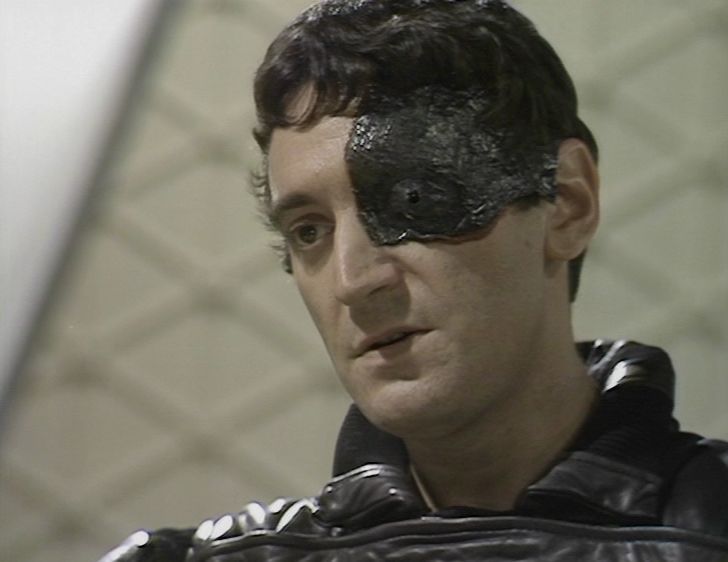
Although Travis is the centre-point of the story we don’t actually see him until more than half way through the episode.  His first scene in priceless though – to the strains of Dudley Simpson at his most dramatic, Grief strides in, hands on hips, as he confronts Servalan.  He’s already spoken a good few lines before the camera cuts to his face and we see the signs left by his last tussle with Blake.

Any episode is always enlivened by a touch of Peter Miles (at his most cutting here),  He forms a nice double-act with John Bryans and the pair will also return in the series two episode Trial (Bryans also pops up in series three, in a different role, in Rumours of Death).  Ian Cullen (formally a Z Cars regular) is rather wasted as Escon and Peter Craze (brother of Michael) is Prell.

Solid stuff then and it’s obvious that Travis will be back again and again – only death, it seems, will end the feud between him and Blake.

seek 02

Blakes 7 – The Web

web

Cally, under the control of a mysterious alien, pilots the Liberator to a distant planet where it becomes ensnared in a strange web.  Blake teleports down to the surface, finds more of the web-like substance and meets Geela (Ania Marson) and Novara (Miles Fothergill).  They are under attack from a group of diminutive aliens called the Decimas (as is Blake when he arrives).  But as Blake begins to assess his surroundings, he finds that his sympathies lie more with the Decimas than the distinctly odd Geela and Novara.

Exactly why the two humanoids are on the planet, their relationship with the Decimas, and the involvement of the mysterious Saymon (Richard Beale) are all puzzles that Blake finds he has to solve.

The Web is a story that seems rather out of place in series one (although you could imagine it fitting into series three or four quite easily).  But on the other hand, since the majority of the first series from now on will be dominated by Servalan and Travis, it’s probably not a bad idea to have a couple of non-Federation/pure SF stories.

True, it’s not one to watch in the company of non-fans, as there are various production choices (the Decimas, Saymon, etc) which will no doubt only generate derision.  But digging deeper underneath, there’s a creepy SF story here – which makes a nice change from the Blake versus the Federation yarns.

Cally’s only been onboard the Liberator for a short while and she’s already taken over by a mysterious alien force (this certainly won’t be the last time it’ll happen either).  As previously discussed, it’s easy to spot various plot contrivances that have been put into place in order to shape the drama and Cally’s possession is another.  In Doctor Who, the TARDIS could simply land at random on a planet and then the adventure would begin.  This can’t happen in Blakes 7, so another way had to be found to involve Blake and the others in Saymon’s affairs.

Michael E. Briant’s direction is very effective – the story opens with a nice panning shot of Saymon’s laboratory and the film sequences (recorded at Black Park) have a spooky atmosphere.  Miles Fothergill had previously played the emotionless robot SV7 in the Doctor Who story The Robots of Death, which was clearly good practice for his similar role here.

Richard Beale has a somewhat thankless role.  Saymon’s dialogue (here’s a sample – “They must come. They must. They must. They must come. They must. They must. They must. They must come. They must come. They must. They must. They must come to us” etc) is rather repetitive and his appearance – which should be shocking – can’t help but be rather comical.  Beale’s clearly just poking his head through a wall, so it’s hard to take him seriously.  But he is a very good actor, so he’s still able to make something out of the fairly unpromising hand he’s been dealt.

The dubious morality of genetic engineering is debated and it’s pleasing that there’s no pat, neat solution at the end.  Blake sides with the Decimas, but not everyone share his sympathies.  “These are what you wanted to protect” comments Avon, with Blake retorting that the Decimas are fighting for their lives.  “Who isn’t” counters Avon.

The early part of the story takes place on the Liberator, which allows everybody to enjoy some more character development.  It then becomes more of Blake’s story as he meets Geela, Novara and Saymon.

Highlights of the first part of the episode include the controlled Cally knocking Vila out, which happens just after he asks her what she thinks of his new outfit.  My opinion?  Not very good.  Also of note is the scene between Cally and Avon.  She’s still under the control of Saymon at the time (although Avon doesn’t realise this until later) and there’s an intimacy to her words which clearly rattles the cold, logical Avon.  It’s one of the few times thus far that we’ve seen him wrong-footed, so it’s a nice character moment.  Jenna’s possessed acting is also interesting, shall we say …..

The Web probably isn’t a particularly highly regarded episode, but it’s certainly not without merit and is a step-up from the tedious run-around antics of Time Squad.

Blakes 7 – Time Squad

time

The Liberator is en-route for Saurian Major.  Blake explains that it’s home to the Federation’s transceiver complex.  “It’s a vital nerve centre in the Federation space control system. Destroy that, and you blind, deafen and silence them.”

On the way, they stop to pick up a capsule which contains several people in deep cryogenic sleep.  Jenna and Gan remain on-board as their visitors slowly return to life, whilst Blake, Avon and Vila teleport down to the planet.  The three of them meet Cally (Jan Chappell) – the last surviving member of Saurian Major’s resistance group.  She guides them into the complex whilst Gan and Jenna tussle with the now very awake and very deadly aliens ……

Time Squad opens with Blake asserting his authority over the others.  He unilaterally decides to attack Saurian Major and expects the others to follow him, although he does say that anybody is able to opt out at any time, which he obviously considers closes the debate.

Nobody decides to leave, so for the present they all seem content.  Jenna, as we’ve seen, might be happy to remain because of her growing relationship with Blake – there’s further small examples of this during the episode (in addition to the fact that she seems very put out when Cally joins the crew!).  Vila seems to go with the flow, whilst Gan later admits that he can’t be on his own – he has to be around people he can trust (although the reasons for this aren’t immediately clear).  And Avon, by far Blake’s staunchest critic, remains on the sidelines, tossing the occasional barbed comment Blake’s way.

As previously touched upon, because Blakes 7 has such an abundance of technological wonders (and there are more in this episode, such as the device which instantly mends Jenna’s broken arm) ways have to be found to limit their effectiveness – lest the dramatic tension of the stories are completely eroded.

There’s two direct examples in Time Squad – and indeed, the word “limiter” is mentioned in both cases.  The first occurs when the Liberator encounters the floating projectile – it seems clear that Zen senses it contains danger, but can’t or won’t directly state this.  For dramatic purposes this makes sense – had he told them it contained several homicidal lunatics who were programmed to destroy all life, it’s a fair bet they would have left it where it was!

But it doesn’t make any logical sense for Zen to have this limit placed upon him (by, presumably, the Liberator‘s creator).  It just feels like slightly clumsy plotting, as is the fact that nobody seems to take the slightest heed to Zen’s strange behavour anyway.  You would have assumed that someone would have twigged that maybe the sleepers were bad news (a look at their faces should have been proof enough).

The second limiter has been placed in Gan’s head.  I assume this was done after he was convicted of murder, since it means he can no longer take a life.  His inability to kill will have serious consequences when the sleepers are running amok – although it didn’t seem to be a problem in the previous few episodes, where he was happy enough to crack any number of heads together.  Why couldn’t Gan aim to disable, rather than kill?  Again, this feels like a plot contrivance – in order to make him less effective (and place Jenna in direct peril) a way had to be found to neuter him.

With Gan below par, this leaves Jenna at the mercy of the aliens.  Whilst it’s true that the concept of a woman stalked by several stronger men is a familiar, if not very progressive, trope, it does at least allow Sally Knyvette a decent amount of screen-time.  In later episodes she would become progressively marginalised, ending up as little more than the teleport operator.  The Blake/Avon/Vila combination seemed to be the most appealing for many of the writers, which unfortunately meant that Jenna and Cally had very little to do at times.  In Time Squad though, she’s able to carry part of the narrative by herself.  Jenna may be frightened, but she’s also resourceful and independent.

Whilst Gan and Jenna have their hands full aboard the Liberator, Blake and the others teleport down to Saurian Major (which you may not be surprised to learn is a quarry) and meet Cally.  She will prove to be an asset – as she’s a hardened fighter and someone who’s just as fanatical, if not more so, than Blake.

Blake says he needs Cally’s help to infiltrate the complex, but it’s hard to see why, since they appear to just stroll in with no trouble at all.  This is more than a little bizarre – if this really is a top-security installation, how are they able to reach their goal without anybody challenging them?  It’s just too easy and therefore there’s no tension to these sequences.  And though Blake tells us that the transceiver complex is a vital piece of Federation hardware, its destruction doesn’t seem to make any difference to the Federation’s ability to hunt the Liberator down in later episodes.

Since this part of the plot isn’t very effective (and the lumbering sleepers plotine drags on as well) it’s fair to say that the crew interactions are the main pleasures to be taken from Time Squad.  Everybody gets some space to develop their characters – especially Gan, as we learn some of his back-story (which unfortunately is never touched on again).  Vila continues to wisecrack.  When told that some of the plant-life on Saurian Major has an intelligence rating, he says “that’s a comfort. I should hate to be eaten by something stupid.”

Blake/Jenna/Cally is an intriguing triangle which was never really developed in the series (although I’m sure there’s plenty of fan-fic out there, should you wish to find it).  We’ve seen Blake and Jenna develop a closeness and also observed how she seems put out to see Cally join the crew.  It’s hard to imagine anything romantic developing between Blake and Cally, but their fanatical nature makes them two of a kind.

Blakes 7 – Cygnus Alpha

cygnus 01

Once Blake, Avon and Jenna have learnt a little about the new spaceship they’ve “acquired” (and also tangled with the mysterious super-computer Zen) they set a course for the prison planet Cygnus Alpha.  Once there, Blake is keen to free as many of the prisoners as he can – he needs a crew to start fighting the Federation.  But the charismatic ruler of Cygnus Alpha, Vargas (Brian Blessed), needs new recruits to serve his god and he isn’t going to give them up without a fight …..

Cygnus Alpha is a story of two halves.  Later we explore Cygnus Alpha and Vargas’ weird religion, but to begin with we follow Blake, Avon and Jenna as they start to evaluate the Liberator and slowly begin to understand its capabilities.  Blake remarks that the design is alien – it certainly doesn’t appear to be of Federation origin.  In story terms of course, it’s handy for Blake’s small group to have such an advanced ship – otherwise their battle against the Federation would have been rather brief.

If you accept this as a dramatic requirement, then you also have to turn a blind eye to the fact that the Liberator has a well stocked arsenal of weapons and a teleport system which means they never have to land the ship, handy that!  At this point, they can only remove one gun each (“single function isomorphic response” as Avon puts it) although this is a convention that’s later blithely ignored.

The teleport system is the closest link to Star Trek – and as in the American series it’s a device that is frankly just too useful.  The ability to teleport anybody out of danger at any time is a problem, so during the course of the series we’ll see various ways used to limit its power.  Sometimes the Liberator will be forced to leave teleport range (because of incoming Federation ships) and on other occasions, like here, the loss of a teleport bracelet will prevent a quick escape.

One oddity in this story is that at the end there appears to be two teleport areas.  We see Blake, Vila and Gan appear in the usual one and then Vargas seems to materalise in another teleport area on the opposite side.  Although it’s possible this is just a bad piece of editing, since this secondary teleport area (if that’s what it is) is never used again.

Shortly after finding the guns they encounter Zen (voiced by Peter Tuddenham) for the first time.  As he’s got such a clear personality it’s no surprise that Blake later claims him as one of the seven.  But as the following exchange illustrates, Zen has boundaries that he’s not prepared to cross.

BLAKE: Zen, how does the teleport system work?
AVON: Would its function be injurious to our species? Have you the necessary data?
ZEN: Wisdom must be gathered, it cannot be given.
AVON: Don’t philosophise with me you electronic moron. Answer the question.

Zen doesn’t answer Avon’s question which infuriates him no end.  Avon vows to reprogram the computer, but it’s probable that he’s met his match.

cygnus 02

Down on the surface of Cygnus Alpha things are grim – as might be expected of a penal planet it’s a pretty bleak environment.  There is a smidgen of civilisation though – led by Vargas and Kara (Pamela Salem).  They, and the others, worship their god in a quasi-medieval setting.  New prisoners (or as Kara refers to them “new souls for the faith”) are therefore always welcome – though it may not come as a surprise that Vila’s far from keen.  When Gan spies a building, he asks Vila what he thinks.  “The architectural style is early maniac” he responds.

Apart from Gan and Vila, we see a couple of new prisoners – Arco (Peter Childs) and Selman (David Ryall).  Well, I say new, but they must have been aboard the London, so we have to assume they were always just out of shot in the previous episode. Either of these actors would have livened up Blake’s crew (I certainly would have taken Arco over Gan).

Whilst Blake’s recruiting members for the cause on Cygnus Alpha, Jenna faces a moral dilemma aboard the Liberator.  She’s discovered a room with untold riches, which certainly appeals to Avon.  He’s keen to take the money and run as he tells her that Blake would “look upon all this as just one more weapon to use against the Federation. And he can’t win. You know he can’t win. What do you want to be, rich or dead?  We might never have this opportunity again.”

Jenna agrees, although she decides to wait for an hour to see if Blake contacts the ship.  But when it comes to the crunch she can’t leave him – and neither, it appears, can Avon.  Why Avon doesn’t jump ship at the next available port with as much wealth as he can carry?.  Could it be that he too is beginning to believe in Blake’s crusade?  It seems improbable, but Avon’s motivations aren’t always easy to read (compared with how transparent Blake is) so it’s hard to say for sure.

The surface of Cygnus Alpha might only be a quarry, but the location benefits from extensive night shooting, atmospheric dry ice and some decent matte effects.  The interiors are more conventional and look like they could have been drawn from stock, but are reasonably solid.

Just two episodes after the nihilistic opener, we’re into something totally different here. Cygnus Alpha is much more conventional adventure series fare – complete with an over-the-top villain in Vargas. Brian Blessed could do this sort of performance in his sleep (possibly he did!) and whilst he’s undeniably a powerful actor, it’s hard to take Vargas very seriously as we know it’s only Brian Blessed dialing it up to eleven.

By the end of the story, Blake has been able to rescue Vila and Gan, so his band of brothers has got slightly bigger. It still seems that they’re very few to be thinking about launching an all-out attack on the Galactic Federation, but for a true fanatic like Blake that’s not something that’s going to bother him.

cygnus 03