Adler is moved back to CID by Cullen. Given what we’ve seen of Adler in previous episodes, it comes as no surprise to learn that he grasps this opportunity with both hands. But he’ll have to try and forge a close working relationship with Harry Hawkins, which may prove to be tricky ….
Adler’s character is delineated a little more at the start of this episode. He tends to be somewhat condescending (calling both Hawkins and Knowles “son”) and also there’s a nice moment concerning his love of plants. A scene where he blithely offers Cullen some sage horticultural advice is preceded by a conversation between Knowles and one of Adler’s neighbours, Miss Polkington (Janet Burnell). She casts aspersions on Adler’s garden (hers is much better, she says). A small touch, but it does suggest that Adler may occasionally place too much confidence in his own abilities.
Given Hawkins’ rather placid personality, putting him together with Adler is an interesting move. Both have very different styles – Hawkins favours movement and action, Adler is methodical – which suggests that decent drama will be generated once they begin to come into conflict. Especially since Adler is swiftly promoted and becomes Hawkins’ immediate superior ….
To be honest, the main plot (a crooked antique dealer) rather ambles along until we’re about mid-way through the episode. That’s when the antique dealer in question, Bensfield (James Bree), makes his first appearance. James Bree was an actor who could do subtle (Secret Army) but could also deliver something a little broader (the Doctor Who story The War Games, say). Today he’s screamingly camp. It’s the sort of turn that’s difficult to forget, especially the moment when Bensfield turns his lascivious attentions towards the stolid Hawkins.
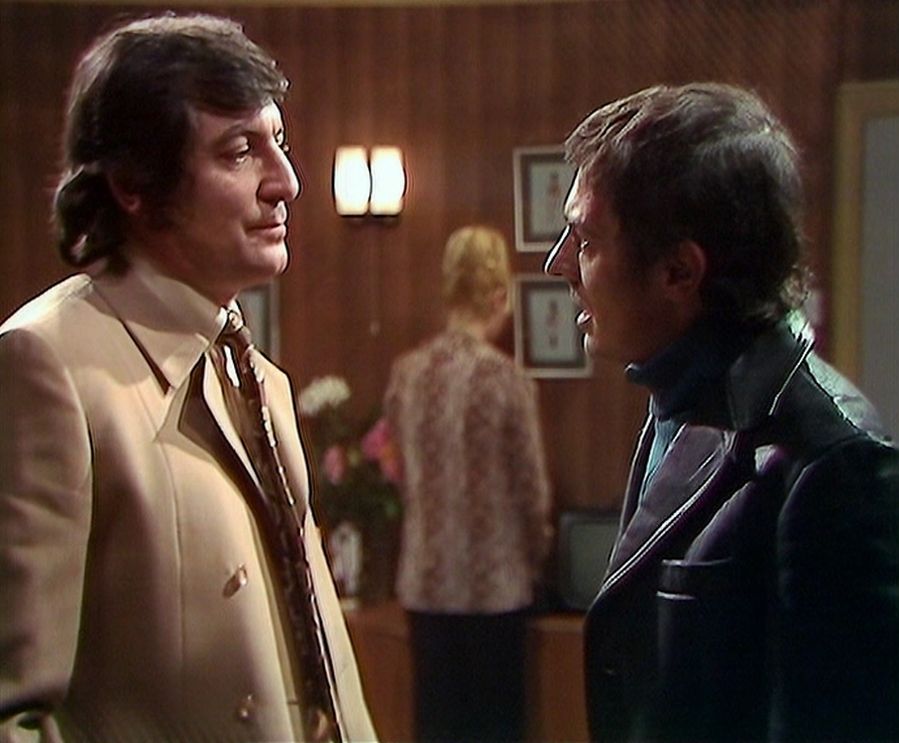
Another familiar face popping up is Karl Howman. He plays Fletcher, Bensfield’s young, leather-jacketed bit of rough who duffs up Knowles (he was house-sitting for the antique laden Miss Polkington). Howman, in his first television role, is very squeaky but the scene he shares with Bree does manage to tease out a moment of tenderness between Bensfield and Fletcher (which helps to humanise Bensfield, making him seem like less of a camp caricature).
Plot-wise this isn’t the most interesting story, but the interaction between the regulars is pretty decent and whilst the guest players are somewhat mannered and stylised, they do catch the eye.
The aptly named Con Richards (John Abineri) and a young woman called Mary (Maggie Wells) are flooding the district with forged one pound notes. As most of the scenes which feature them are in public places we don’t get much of a feel for their real characters. Con’s ever-changing accent is an entertaining touch though.
Paper Chase is more concerned with how this forged money impacts the recipients. The market trader Fisher (David Swift) and his wife (Paula Jacobs) are the first to be conned. Both are Jewish (very, very Jewish in fact – Mrs Fisher reacts with a heartfelt “oy vey” once she realises they’ve been passed dud notes).
They don’t twig for a while that the charming couple who bought a stack of clothes from them were dodgy (surprising, since I was instantly struck by Mary’s obvious wig). So their credulity is a little hard to swallow, especially since Snow has already been around to tip them off about the forged notes.
Swift (sporting an impressive pair of mutton-chop sideburns) is quite entertaining as a basically honest man who nevertheless attempts to later pass off the forgeries as genuine (he’s experienced enough to know that the chances of recovering his losses are slim to zero).
Poor Mrs Baker (Valerie Lush), the proprietor of a small corner shop, is also something of an innocent – but her lack of knowledge seems to be a little more credible. For a small business, the loss of ten pounds is clearly a real blow. But even if it’s more than likely that she’ll end the story still out of pocket, at least she has the satisfaction of knowing she was the one who put the dogged Evans onto Con’s trail.
Whilst Fisher attempts a touch of fraud to resolve his loss and Mrs Baker simply stoically accepts it, our third victim – the greyhound track manager Clegg (Richard Hampton) – laughs it off as a matter of no concern (he’s insured). By the time that the episode gets to the fourth conned person (a hotel receptionist) clearly time is tight as we never learn how they feel about it.
Running alongside this theme is a subplot concerning an imminent raid on a cash-heavy business. It’s assumed to be the greyhound track, although no robbery occurs by the time the episode concludes. Watt’s picture of the gang (wielding pickaxes and knives) is quite vivid, although it does bring to mind a more 1950’s vision of crime (no guns are mentioned).
Paper Chase has several incidental pleasures. Alan Bennion, appearing as a bank manager, is one. Although he racked up a fair number of credits over the years, it’s his Ice Lord appearances in Doctor Who which I instantly think of whenever I hear his name. So it’s nice to see him for once without his face being covered in latex.
The location work at the outdoor market is very evocative. The film crew turned up on a regular market day, which makes me wonder whether some of the old biddies who crowd around our regulars were just ordinary members of the public, rather than extras. A few are quite eye-catching.
There’s also a spot of character development for Harry Hawkins. Although he’s been a regular since the Softly Softly days, Hawkins has rarely made much of an impression (compared to the likes of Snow and Evans he seems quite stolid and far less quirky). But today he gets to cross swords with Watt (Hawkins likes to be out and about whilst Watt believes he should be more desk bound) and he also entertainingly interacts with PC Knowles, now firmly settled into the role of the office administrator.
If some of the previous plays in the set – The Basement especially – were designed specifically for television (utilising numerous scene changes in a way which would have been impossible to achieve on stage) then Old Times turns out to be a very different beast.
The staging is very theatrical with no concessions made to the television format. At the time (and indeed well into the eighties) this style of production was very common, but eventually it fell out of favour. The quest for realism demanded that drama be shot on single-camera film, with the result that multi-camera videotaped recordings of this type began to look hopelessly old-fashioned to certain people.
Personally, I love the clarity of this type of production as it really does stand or fall on the quality of the writing and the performances. There’s no place to hide ….
The stagey nature of the piece is evident right from the opening titles. Deeley (Barry Foster) and Kate (Anna Cropper) are seated in separate chairs. The room is dark and they are immobile (whilst the fact that both are spotlighted helps to suggest their emotional distance from each other). Meanwhile, Anna (Mary Miller) stands in darkness at the back of the room.
Deeley and Kate are a married couple, awaiting the arrival of Kate’s old friend, Anna. That the play begins with Deeley and Kate discussing Anna (who is present but ignored by them) gives the piece a strange, disconnected air. This odd feeling continues when Anna suddenly steps into the light and begins interacting with the other two.
Several theories have been propounded to explain the meaning of the play. Possibly the whole drama is being played out in Deeley’s subconscious (and furthermore Kate and Anna are aspects of the same person). When Anthony Hopkins tackled the role of Deeley in 1984 he asked Pinter for some pointers. The playwright’s advice? “I don’t know, just do it”.
Old Times finds us in familiar Pinter territory. A previously tranquil household is transformed into a battleground for supremacy as Deeley and Anna both stake their claim on Kate. As the play unfolds, every statement has to be parsed for meaning as the three interlock.
Deeley begins the play in a dominant position, quickly joining forces with Anna to reminisce about times past via a medley of their favourite songs. Kate at this point seems to be somewhat passive and colourless compared to Anna. Deeley is keen to claim ownership of his wife (remembering how they bonded over the same film – Odd Man Out) but his own memories of Anna and the revelation of her previous closeness with Kate both serve to somewhat destabilise him. (a lengthy discussion between Deeley and Anna about the best way to dry a freshly bathed Kate crackles with intensity).
As ever, if you want closure and neatness then you’ve come to the wrong playwright. Old Times is an emotionally distanced experience which isn’t afraid to leave questions unanswered. The fallibility of memory, a familiar Pinter device, is key here. And if there’s some doubt about the reality of the present-day setting, how many of these past reminisces can we actually rely upon?
Despite the title, the primary focus of New Broom isn’t about establishing John Watt as the new Task Force boss. Instead, it centres around a murder investigation, following the discovery of a severed arm at a rubbish dump ….
This is an unusually macabre plot element for the series and although the rest of the dismembered torso is mainly discussed and not seen, towards the end of the episode the murderer does reveal the only other body-part still in existence (a hand).
After the sensationalist opening, New Broom settles down into a pattern of pure routine. It’s good to see a number of extras in uniform swelling the ranks in the incident room today. In some of the previous episodes we rarely saw any other police officers apart from the regulars, which tends to give the unfortunate impression that the Task Force is comprised of no more than around half a dozen officers.
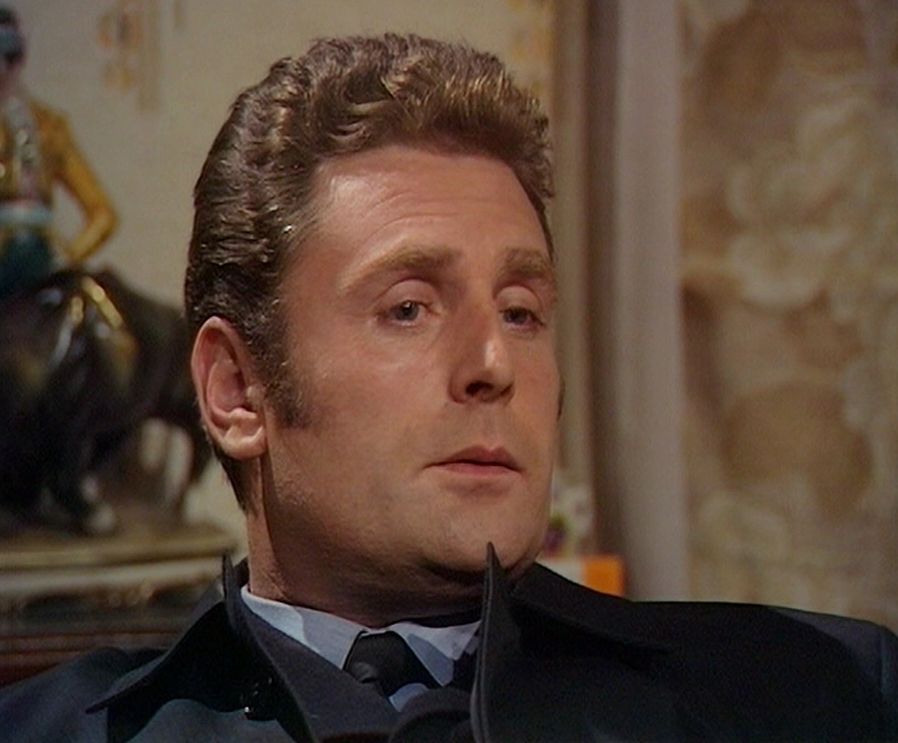
John Franklyn-Robbins makes his second appearance as Chief Inspector Bill Adler. Having only skirted around the perimeters of the story in his previous episode, he’s much more central here. A former detective, various indiscretions several years back (mainly concerning women and alcohol) have seen him reduced in rank, returned to uniform and forced to plough a frustrating furrow as a desk-bound administrator.
He’s never less than totally thorough, but it’s plain that jobs such as organising the furniture for Watt’s new office isn’t quite the sort of thing he joined the police force for. This subplot is the episode’s one concession to portraying Watt as the new broom. His office décor is very different from Charlie Barlow’s – Watt favours a minimalist approach (featuring strikingly modern chairs and desks) with the result that Cullen, passing by, first of all believes that there must have been a mix-up with the furniture delivery ….
Adler is later seconded to assist the murder investigation and it’s his dogged and painstaking approach (plenty of sifting of facts and staring at blackboards) which leads them to a suspect, Edward Harrison (Willie Jonah). Adler will return in most of the remaining episodes on the third and final Pidax DVD set and I’m looking forward to seeing how his character develops.
There’s an intriguing relationship teased out here between him and Watt, which bodes well for the future. Adler desperately wants to get back to being a detective, but Watt is content to keep him where he is for now (Adler offers to take a crack at Harrison, but Watt delegates Hawkins instead, much to Adler’s obvious disappointment).
If the majority of New Broom is interesting without being especially gripping, then the late interview between Hawkins and Harrison raises the temperature somewhat. A good two-hander, it’s one of the highlights of the episode (the development of Adler’s character being another).
Elsewhere, Frank Windsor effortlessly slips into place as the new focus point of the series. John Watt’s plain, no-nonsense style hasn’t really changed since he first appeared in Z Cars and New Broom makes it plain that business will carry on as usual.
And so we have to bid farewell to Charlie Barlow. The first run of Barlow At Large had preceded series three of Softly Softly: Task Force, but the remainder (three seasons from 1973 onwards) aired after he’d left Thamesford for good.
Poached by the mysterious Fenton (Neil Stacey) from the Home Office, Barlow faces an unknown future. Back then, the viewers wouldn’t have had long to wait to find out what he’d let himself in for (the first episode of the new series was broadcast in February 1973). Today I’ve a feeling we’re in for a far longer wait (Barlow At Large may eventually surface on DVD, but I’m not holding my breath). Fenton would be a regular in the series and thanks to his brief appearance with Cullen here, it’s possible to imagine the sort of combative relationship he and Barlow would later enjoy ….
Run For Your Money is a low-key departure for such an important character. His meeting with Cullen (who buys him lunch at the swanky Stag At Bay restaurant) is delightfully awkward. Barlow then treats Watt and Hawkins to a meal at the same venue later on (if you’ve got the set in the studio then it’s sensible to make the most of it). After he’s broken the news, it’s fair to say there’s conflicted feelings – John Watt has his eye on Barlow’s seat but feels uneasy drinking a toast to celebrate his departure.
Hawkins, as befits his cheery, breezy persona, seems less concerned. It’s an interesting touch that Sara is more ambitious than he is, deciding that Barlow’s departure would mean promotion for everyone.
If the lunchtime meeting between Barlow and Cullen wasn’t awkward enough, the fact that Sara and Hawkins just happened to be noshing in there at the same time added an additional frisson of social embarrassment. Although Sara, as befits her upper-crust breeding, wasn’t at all perturbed. She treats Cullen with amused disrespect and decides that Barlow (out of his earshot) is something of a sad case.
Possibly the most notable thing about The Stag At Bay is that all the waitresses have very low cut tops. Since they’re always bending over the tables this is very noticeable ….
Run For Your Money does have a spot of crime too though. Austin (Ronald Radd) has embezzled twenty thousand pounds from the company he used to work for. A well-spoken, intelligent, middle-aged man, he’s reluctant to reveal where the money is, much to Barlow’s frustration.
Radd’s second and final SS:TF appearance adds a touch of class to the episode. He only appears in a few scenes, but they’re incredibly watchable. The first is a three-hander between Barlow, Evans and Austin. Taking place in the interview room, the sense of claustrophobia is ramped up by the way that the camera keeps tight focus on each of the three in turn. To be honest, I wouldn’t have minded an entire episode just featuring Johns and Radd in the interview room ….
It’s a curious thing, but so many actors back in the sixties and seventies looked a good deal older than they actually were. Radd, for example, was only forty three when he made this episode, but could easily have passed for a man in his late fifties (indeed, Austin states that he’s fifty seven). It would have been interesting to see Barlow break Austin in the interview room, but the mystery of the missing money (there’s a connection to the Vietnam War, which was unexpected) is solved by a spot of good old detective work.
The final shot we have of Barlow is a slow and silent zoom in the interview room (he’d gone back to confront Austin). It’s an unshowy exit for someone who has dominated the series. He’ll be missed.
The Witness was one of two SS:TF directorial credits for David Maloney. Knowing his fondness for using a regular “rep” of actors, I had a quick skim through the cast list to see if I could spot any familiar names.
There’s Tony McEwan, for one. Maloney had already used him in one Doctor Who (The War Games) and would later cast him in another (Planet of Evil) in addition to Hawkeye, The Pathfinder. Given McEwan’s fairly limited list of credits, these performances constitute a fairly sizeable chunk of his television career.
Today he’s playing Carson, a lorry driver whose cargo (scotch whisky worth twenty grand) is hijacked by a gang of gun-toting masked men. It’s not the best performance you’ll ever see (although there’s a even less convincing one later) but Carson’s interrogation is still highly entertaining, mainly because both Barlow and Watt are in the room.
The pair work well apart, but something special tends to happen whenever they team up. They’d begun the episode in Barlow’s office, enjoying a late-night drink. Barlow, still smarting that his promotion prospects have been dashed, was clearly in need of a shoulder to cry on and Watt fitted the bill nicely. As for Watt, having done his duty he was looking forward to getting off home, but a last minute phone-call (about the robbery) dashed that.
For Barlow (fretting about his empty house) more work is just the ticket. Watt seems less enthused about rushing straight over to take charge, although the private smile he gave before they both left the office was a nice little moment, letting the audience know that he didn’t mind that much (presumably he’s just relieved that Barlow has something new to occupy him).
The always-reliable Ron Pember turns in another good performance as Wilf Taylor. He’s a member of the gang, albeit a somewhat sickly and insubstantial one. The power behind the throne seems to be his wife, Betty (Mitzi Rogers). SS:TF wasn’t renowned for having that many strong female guest roles (crime back in the seventies seemed very much to be a man’s world) so Betty is a notable character, even if she does end up as a victim by the end of the episode.
She runs a corner shop (which bears a passing resemblance to Awkright’s store) and right from the off is very combative. Dominating the weak Wilf, she then steps up the intensity another couple of notches when the police come calling.
Most of her early ire is directed at DS Green (Heather Stoney). If the series didn’t specialise in decent female guest roles, then it also was struggling at this point with its female regulars. Stoney, with her handful of appearances across the third and fourth series, always played what she was given very well, but Green was rarely placed in the centre of a story.
Mitzi Rogers has the best guest role of the episode (Betty’s heavy blue eye shadow and leopard skin coat helps to make her stand out) but James Mellor, as Albert Dirman, is also very watchable. Dirman is the Mr Big of the hijackers and reacts with cold fury when he mistakenly believes that Wilf’s talked to the police (he hasn’t, but Betty has).
Dirman’s promise to disfigure Betty with acid is a chilling one, although the threat is slightly negated when the instrument of his retribution – Stan (Gordon Bilboe) – lumbers into view. Partly it’s because of the haircut, moustache and suit, but there’s no denying that Bilboe’s performance is rather stilted. True, he’s not gifted terribly good dialogue (mostly it’s of the “you got nothing on me, copper” variety) but Bilboe’s delivery doesn’t help ….
The late action scene (Hawkins purses a fleeing Stan) isn’t that convincing, but the main thrust of the episode – the way that Barlow manipulates both Wilf and Betty in order to nail Dirman – is very compelling. And the final sting in the tail (even after Betty’s been attacked with an iron bar, Wilf is unwilling to talk) is a fascinating wrinkle. Another strong series four entry.
On The Third Day juggles two separate Barlow plotlines. In the first, he’s targeted by Timothy Redway (Anthony Heaton) a violent criminal with a grudge and in the second he undergoes a grilling at an intensive promotion board.
The former could easily have been the major theme, but instead it’s very much secondary – even though the resolution of this storyline provides the episode with its climax. It does serve to place Barlow under pressure though (something which maybe later has a knock on effect at the board).
What’s especially interesting is that in the previous episode Mrs Barlow was killed off-screen in a road accident, so if a pretext had been required to explain why Barlow was even more prickly than usual, surely that would have sufficed. As it is, the death of Mrs Barlow seems slightly puzzling in plot terms – it does allow us to see a brief softening of Barlow’s character, but that’s about all (although maybe its function was to highlight just how career driven Barlow is – the widowed man seems hardly different from the married one).
Still, we get to see Barlow at home, pottering about in the kitchen (it’s rather orange). Given that his kitchen décor is rather horrid in places, possibly Redway did him a favour by attempting to burn the house down ….
No surprises that the fire largely occurs off-screen. Big action set pieces were outside of the series’ budget.
By far the most interesting part of the episode occurs when Barlow travels down to Eastbourne. There, along with a group of brother officers, he undergoes a series of tests, exams and interviews. Three heavyweight actors – Richard Vernon, Patrick O’Connell and John Arnatt – are the ones in charge, which helps to make these scenes fly.
The three-hander between Barlow, Asst. Chief Constable Morton (O’Connell) and Chief Constable Daniels (Arnatt) is a cracking scene. With Morton playing bad cop and Daniels good, Barlow’s character is slowly unpicked. But Barlow more than holds his own, even if his distaste for the some parts of this procedure is made clear.
Barlow’s one-on-one meeting with Sir Ralph Townley (Vernon) looks set to develop along similarly entertaining lines, but alas it’s cut short by a gun-toting Redway. All those police around the place and Redway was still able to get close enough to the window in order to loose off a few shots. Somebody should be for the high jump.
Knowing that Barlow’s time with the series was drawing to a close, I wondered at first if On The Third Day was designed as an exit point. But no, Barlow’s promotion attempt is unsuccessful and so he seems fated to remain at Thamesford for the foreseeable future. But that’s not the case, the clock is definitely ticking ….
A Barlow-heavy episode is always going to get a thumbs up from me (Stratford Johns doesn’t disappoint of course). And with Vernon, O’Connell and Arnatt plus Donald Burton as one of Barlow’s fellow interviewees it’s plain this isn’t an episode short on decent guest stars.
The featured regulars are also gifted some good scenes – Walter Gotell never has that much to do, but he always maximises every line (even when he’s being pleasant, there’s something rather unsettling about Chief Constable Cullen). Meanwhile, Evans and Knowles are turning into a very decent double-act.
Clocking in at just twenty minutes, Monologue is the shortest main feature on the Pinter at the BBC set, but even with this brief running time it’s still unmistakably Pinter.
The staging is simple – a single room with one occupant. The unnamed man (Henry Woolf) addresses an absent friend represented by an empty chair. As the monologue progresses, several questions begin to form. Is his friend dead? Or did he ever exist? And what about the black girl, who drove a wedge between their friendship?
Watching the plays on the set in transmission order, the parallels between this and The Basement helps to highlight the way that Pinter always returned to certain themes (for example, how male friendship can be disrupted by the arrival of a female.
Christopher Morahan, who had directed two of Pinter’s Theatre 625 plays a few years earlier, treats the empty chair as a character in its own right. Therefore just as the camera occasionally zooms into Woolf, it also does the same with the chair. A simple camera operation, but it’s still very effective.
With Woolf addressing the empty chair rather than the camera, the viewer is therefore placed in the position of an outsider, taking a voyeuristic interest in the unfolding drama.
This is reinforced by the way that the camera begins proceedings outside the door before entering the room (and then at the conclusion of the talk discreetly exits).
Henry Woolf’s friendship with Harold Pinter dated back to the 1940’s (as detailed in this Guardian article). His relationship with this piece would also be lengthy (he performed it again at the National Theatre in 2002).
A fairly neglected piece, Monologue doesn’t offer any startling revelations, but it remains a memorable Pinter miniature.
There’s an incredibly high level of coincidence to be found in Bank Rate, but since it’s a pretty decent episode I’m prepared to cut it some slack.
Harry Hawkins’ relationship with Sara (Jenny Hanley) continues. They’ve bonded over a mutual love of horses, something which Sara’s cousin, Peter Warner (Jonathan Newth), also shares. Warner is a bank manager whose establishment is due to be targeted by Tom Rattery (Carl Rigg), a robber who both Hawkins and Warner have met in passing. Oh, and Sara’s stable-hand, Danny Fitch (Angus Lennie), knows more than he’s telling about these bank raids ….
Newth’s an instantly recognisable actor, someone with a score of interesting credits to his name. He’s perfect casting as the superior Warner, a man keen to cultivate Hawkins for his own profitable ends. Hawkins is having none of it though – he reports the approach to Watt with horror (according to Hawkins, Warner’s offer of sharing his prize horse is akin to loaning out a woman!)
Angus Lennie could always be called upon to play the downtrodden type very well, as he does here. Mind you, it’s a slight pity that Danny’s shifty nature is so obviously signposted right from the start – the first time Danny spies Hawkins he reacts with a very guilty look (which rather gives the game away). And anyway, why would any decent criminal confide their plans to the garrulous Danny? That’s a part of the plot which doesn’t make sense.
I’m used to Havoc providing the action in early seventies drama, but today it was Action Unique (who mustered a very athletic bunch of criminals it has to be said). The final scene, which sees the robbers confronted in Warner’s bank by Hawkins and co, is priceless – especially the part where a dapper John Watt grabs a Bobby Ball look-a-like and slams his head against the desk several times!
The other moment which caught my eye was an earlier meeting between Watt, Snow, Knowles and three CID officers. It became clear very quickly that the CID men were unspeaking extras, so whilst Watt expounded at great length, they were forced to remain mute. Nodding their heads vigorously and checking their notebooks with a faint air of embarrassment were the only options left open to them ….
Dog Eat Dog is that rarest of SS:TF beasts – a Snow-centric episode. PC Snow stumbles across Colin Talbot (Greg Smith) a troubled teenager who – like Snow – has recently lost his dog. This would seem to be the cue for the two to bond, but it’s not quite as straightforward as that.
Snow later returns with a present for him (a puppy) but Colin angrily refuses it. Given that Rigby and Smith share several strong scenes at the start of the episode, we seem to be heading towards a story in which Colin will feature heavily. It’s therefore slightly surprising that he then disappears from view until the final ten minutes or so.
But even though he’s offscreen, the problem of Colin still dominates. His father, Harry Talbot (Windsor Davies), is a right piece of work – a workshy layabout, he despises the boy (demonstrated by the fact he strangled his dog). Needless to say Snow doesn’t react to this news terribly well – the scene where Snow and Talbot face off is an episode highlight. The way that Snow casually calls Talbot a “bastard” before threatening violence is all the more chilling due to Rigby’s typically measured delivery.
Another highlight is Watt’s confrontation with Snow. With Barlow absent, Watt is the episode’s authority figure – although he’s largely used here for comic effect. After sustaining a nasty injury to his nose (Evans was forced to break heavily when Snow’s puppy ran out in front of their car) Watt’s patience with the do-gooder Snow is stretched to breaking point ….
PC Knowles (Martin C. Thurley) also gets a spot of character development. The latest of the desk-bound coordinators, he has a few mild clashes with the practical Snow (Knowles – somewhat physically underdeveloped – also admires Snow’s impressive shoulders!). This is another nice comic touch which helps to balance out the drama of Colin’s storyline.
If we trust IMDb, then this was Ewart Alexander’s sole SS:TF script, which might explain why the tone feels slightly different. No complaints though, as it’s good to have some episodes which push the series in an unusual direction.
Surveillance begins slowly (which is hardly unusual for SS:TF) although things hot up when Frank Martin (Frank Wylie), one of three safecrackers, is pursued from the scene of the crime by Snow.
Since Martin’s already loosed off one shot whilst making his escape, it seems a little unwise for Snow to slowly step towards him, especially since he’s still brandishing the gun. This moment seems to be a homage to that scene from The Blue Lamp, but Snow proves to be much more agile than poor old George Dixon (he dodges the bullet).
Martin gets away and later holes up with William Chalmers (Jon Laurimore). Martin might be physically slighter than Chalmers, but he finds himself in a position of authority (mainly because Martin’s arrest would also implicate Chalmers). Laurimore could play this sort of dodgy role in his sleep, but he’s still more than watchable – especially later on when Chalmers and Barlow come face to face.
Wylie has the best defined guest role though. Martin’s unpredictability and simmering violence is teased out during the episode, even if it’s hard to ever believe in him as a real threat. Possibly this has something to do with the fact that SS:TF generally had a very sedate pace – violence rarely reared its head.
If Barlow loses his rag when briefly questioning another of the gang, Terry Condon (Nigel Humphreys) then he’s sweetness and light when Chalmers is wheeled in later. I’m not sure which is the most dangerous – impulsive Barlow or cold and calculating Barlow ….
Surveillance has a nice spot of night-time location filming at the beginning and the end of the episode. This helps to open up what would otherwise be a fairly static story. Overall it’s not a top-tier instalment, but Wylie and Laurimore help to keep the interest levels up.
There’s a lot to process during the opening few minutes of Spit and Polish. A new theme tune, Hawkins in uniform, Evans in plain clothes and PC Snow’s faithful canine friend, Radar, seems to have died ….
Entirely shot on film, it’s certainly in much better nick than the last available all-film episode (Lessons from series two). The Task Force are on the hunt for an attacker of women. At present he hasn’t done anything worse than tear their clothes, which Barlow – to Evans’ disgust – is disappointed about. A rape or serious assault would provide them with some decent forensic evidence.
Early on the women are just passive victims (mentioned, but not seen). The next target – Sara Jamieson (Jenny Hanley) – is quite different. An upwardly-mobile horsey type, she’s able to beat her assailant off with a riding crop and seems undisturbed by the attack. Later she wonders why the man didn’t target one of the many women who are begging to be raped (a moment which helps to date the story firmly in another era).
Sara is certainly something of a hit with the Task Force. She and Watt have a brief moment of banter (Watt’s a bit of a flirt on the sly) and later Sara has a lengthy chat with Snow (a good character moment for Rigby). But it’s Harry Hawkins whom she’s got the hots for – they pop out for a spot of dinner and dancing.
Hanley’s excellent value as the pampered (but not unlikeable) rich girl. The always dependable Peter Copley pops up as Brigadier Jamieson, Sara’s father and a local big-wig (hence Barlow’s desire to keep him sweet).
Spit and Polish certainly has an expansive feel, quite different from some of the more enclosed, studio-bound episodes (it concludes with an impressive stunt featuring the attacker jumping off a ship). Whilst the rape comment (especially coming from Sara’s mouth) is very jolting, at least the episode doesn’t present her as a victim (indeed, she’s the key to running the assailant to ground) which is certainly something in its favour.
Having skirted around the periphery of several stories (although it’s possible that he featured more heavily in some of the episodes not currently available on DVD) Conclusion sees PC Drake (Brian Hall) move centre stage.
SS:TF was often content not to rush, but the opening five minutes of this one – Sergeant Evans considers Drake’s solid gold pencil from all angles – takes some beating. This expensive trinket is enough to set alarm bells ringing with Evans (as is the revelation that Drake lends his colleagues money).
One such recipient is PC Snow. It’s hard to imagine two more different characters – the confident and fly Drake lined up against the methodical and painfully honest Snow. Given this, it’s slightly difficult to see them forming much of a friendship.
Drake’s convivial relationship with his local publican (compared to Snow’s refusal to accept a drink from the same landlord) helps to differentiate their characters even more. It suggests that Drake is taking bribes, although it all seems a bit too obvious. As does the fact he flashes a gold pencil about. Surely a corrupt policeman would be a little more subtle?
The crime of the week – local churches are being robbed of their valuables – takes second place to proving Drake’s guilt or innocence, but it does provide an excellent character moment for Terence Rigby. PC Snow returns to the church where his previous police dog was shot and killed. Rarely placed in the forefront of the action, Rigby is nevertheless always excellent value – there’s something very reassuring about the implacable Snow.
The denouement probably won’t come as too much of a surprise. Brian Hall was often cast on the wrong side of the law, as he was again here when Drake’s true nature is finally brought into the light by Barlow. Once again, Stratford Johns doesn’t disappoint.
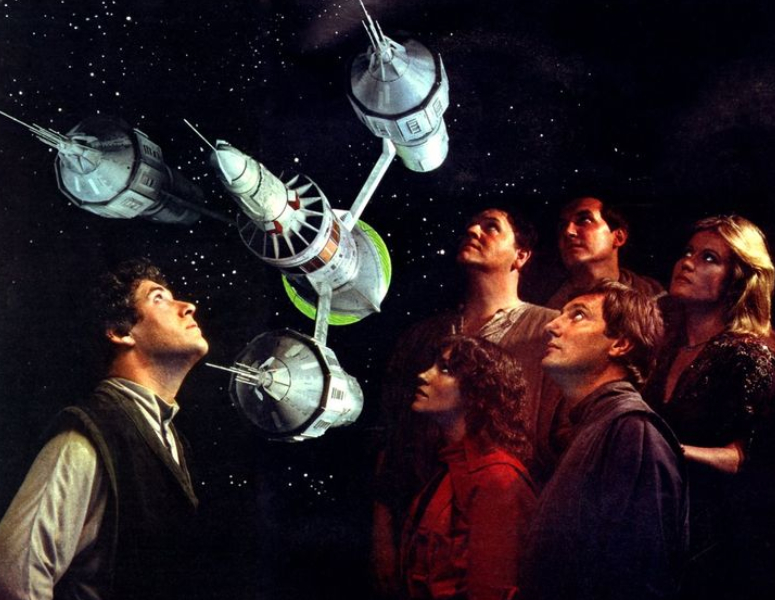
Last year I treated myself to a fortieth anniversary Blakes 7 rewatch (one episode per week). It was jolly good fun (well, apart from Hostage and a few others) and by the time everybody had bitten the dust on Gauda Prime, I did feel a more than a twinge of regret.
I also came away from the rewatch with a new appreciation for series A, which (if I was the sort of person to bother about rankings) I’d have to claim as my favourite run of B7 episodes.
Partly this is borne out of nostalgia as I acquired ex-rental VHS tapes of The Beginning and Duel back in 1987. With the unedited, episodic releases not beginning until 1991, for a number of years these were the only B7 episodes I had. So I watched them again and again and again ….
Trimmed as they are (The Way Back was reduced to a mere 15 minutes, the others clocked in at around 40 minutes each) there’s still something magical to me about these video presentations. A pity that nobody’s uploaded good quality versions to YouTube. Oh well.
Trevor Hoyle’s first novelisation also helped to stoke my interest in these early episodes (I’ve no idea why I didn’t buy the others at the tine). Roj Blake’s struggles after leaving the security of Dome City (from the publishers of Star Wars no less) certainly fired my imagination.
This slideshow requires JavaScript.
Occassionly this question is posed from a B7 newbie – where to start? The Way Back would seem to be the obvious choice, but some say no. That’s baffling to me (I suspect they’re rabid Avon fans, pining for their hero) as whilst The Way Back is totally atypical, you really need to watch it in order to understand just what makes Blake tick.
Playground dispute question, who’s best – Blake or Avon? I’m a confirmed Blake fan (although series C and D weren’t without their moments of interest). Both characters have plenty of layers which can be unpeeled, but Blake has always fascinated me more.
Series A also boasts strong roles for Jenna and Cally (well, strong-ish). I always got the feeling that Sally Knyvette’s decision not to re-sign for series C was the reason why Jenna was written out of large parts of series B (on more than one occassion the girls were relegated to the job of teleport operators whilst the boys went out to play). Both are certainly better served by Series A, even if they’re not driving any of the plots.
Series A also benefits from the best Travis and only a handful of appearances by Servalan. Of course I love Jacqueline Pearce, but Servalan was hopelessly overused during the next three years. Ideally she should have had strong roles in three or four stories each year. Alas, they couldn’t resist the temptation of shoe-horning her into any old plot, whether she fitted or not ….
Terry Nation may have run out of steam towards the end (Deliverance/Orac) and also had to rely heavily on Chris Boucher at times (Nation’s first draft of Bounty was very weedy) but the fact that Series A featured a single authorial voice is something else which appeals. The series had to broaden its writers pool in order to survive, but there’s an undeniable unity to these stories and this helps to compensate for some of the more clunkier or familiar plot devices (radiation sickness! anti-radiation drugs!)
The fairly drab costumes also anchors the series into some sort of reality. Clearly at this point they hadn’t discovered the Liberator wardrobe with the more outlandish clothing creations. We’d have to wait for series B for that.
So there you have it. Series A is really rather good. In fact I think I’m going to go and watch it again.
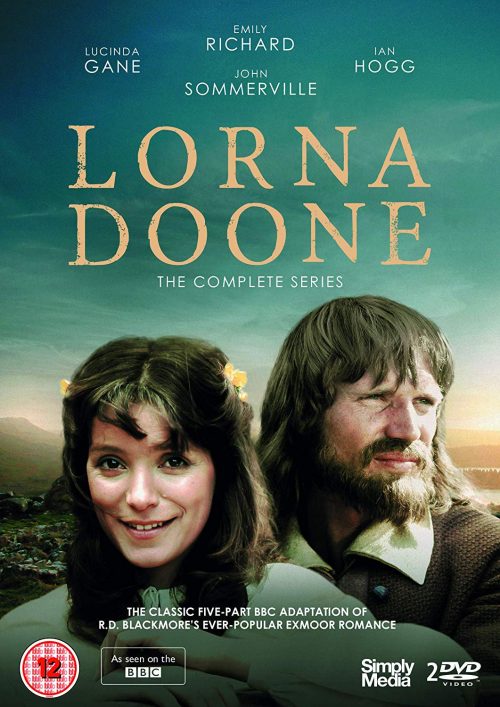
John Ridd (John Sommerville) was just a boy when his father, a good and honest man, was brutally murdered by Carver Doone (John Turner). Despite an outward display of respectability, the wealthy Doone family delight in creating havoc and mischief.
As John grows up, he vows to avenge his father’s death. But matters are complicated when he falls deeply in love with the young Lorna Doone (Emily Richard) whose hand in marriage has been promised to her cousin, Carver ….
Subtitled A Romance of Exmoor, Lorna Doone by R.D. Blackmore was originally published in 1869. An instant success, it has spawned numerous television and film adaptations over the last hundred years or more. It’s easy to see why, since it’s a heady mixture of action, adventure, revenge and romance.
This 1976 BBC Classic Serial version is a faithful adaptation (always a hallmark of the Classic Serials) although it does take a short time to tune in to the style of production. Even for those well used to the delights of archive television, some of the 1970’s Classic Serials initially appear to be rather earnest and mannered (the numerous very fake-looking beards are also a hindrance). But it doesn’t take long before the story starts to engross and the small niggles fade away.
Richard Beaumont, as the young John, carries most of the first episode. Although still a teenager, he’d already enjoyed a decent career stretching back to the late 1960’s (including a brief recording contract with Decca records). His John is a pleasing mixture of youthful impatience and innocence and such is the impression he makes that it’s almost a shame when John suddenly turns into the much older John Sommerville.
This slideshow requires JavaScript.
It’s slightly odd that none of the other characters seem to age though (which makes John’s transformation from scrawny youth to strapping young man all the more jarring). Possibly it would have been better to have staged this transformation at the start of the second episode, rather than at the end of the first.
Episode one also gives us a brief glimpse of the young Lorna, played by Jennifer Thanisch (best known for appearing as Anne in the Southern series of The Famous Five). John Somerville’s John Ridd is a stolid enough creation but it’s Emily Richard’s Lorna Doone who really catches the eye. Easily the more experienced actor of the two, Richard had just starred in The Glittering Prizes and would later appear in the well-remembered WW2 drama Enemy At The Door.
Plenty of familiar faces are on show. Patrick Troughton plays Councillor Doone, not a terribly large role but Troughton was always good value whatever part he played. Ian Hogg is very appealing as the roguish highwayman Tom Faggus whilst Lucinda Gane (later to play Miss Mooney in Grange Hill) appears as Lizzie, one of John’s sisters. David Garfield, Max Faulkner and Trevor Baxter are amongst those who contribute to a strong supporting cast.
The romance between John and Lorna is a key part of the narrative, with various other subplots – the infighting amongst the Doones, rumbles of unrest in London about the King ‘s conduct – also bubbling away nicely throughout the episodes.
Whilst it’s true that some of the rustic supporting characters err on the ripe side, Lorna Donne boasts some fine performances amongst the principals. If you love the 1970’s era of the BBC Classic Serials then this should certainly appeal.
Lorna Doone is available now from Simply Media, RRP £24.99. It can be ordered directly from Simply here (quoting ARCHIVE10 will apply a 10% discount).
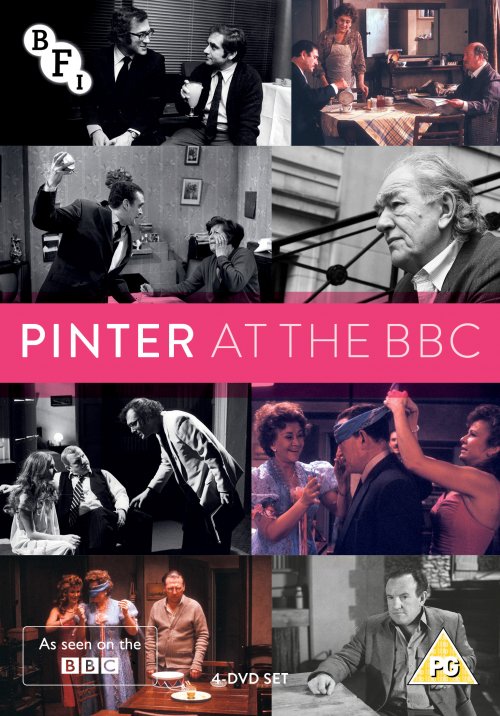
This is an incredibly welcome release, as it brings together a very healthy chunk of Harold Pinter’s BBC output (none of which has been commercially available before). Indeed, Pinter’s television work on DVD has, until now, been rather sparse (a few isolated offerings from Network – the Armchair Theatre production of A Night Out and the Laurence Olivier Presents staging of The Collection – have been the highlights so far).
Disc One
Leo McKern in Tea Party
Tea Party (25th May 1966). 76 minutes
Tea Party was commissioned for a prestigious Eurovision project, entitled The Largest Theatre In The World, which saw the play performed in thirteen separate counties over the course of a single week (some took a subtitled version of the BBC original whilst others staged their own adaptation).
It’s a layered and uncompromising piece, with Leo McKern mesmerising as a self-made businessman who begins to lose his sense of reason (and also his sight). Has he been destabilised by inviting his brother-in-law Willy (Charles Gray) into his business or has his infatuation with his new secretary, Wendy (Vivien Merchant), pushed him over the edge? Do his two young sons from his first marriage really harbour evil intentions towards him or does his new wife, Diana (Jennifer Wright), possesses secrets of her own?
So there are plenty of questions, but as so often with Pinter the answers are less forthcoming. The final scene is extraordinary. Disson (McKern) – his eyes firmly bandaged – sits immobile in the middle of a party held in his honour. Although Disson plainly can’t see, we’re privy to his thoughts (he imagines a three way intimate exchange between his wife, brother-in-law and secretary) as he slowly regresses into a catatonic state.
All of the principals offer polished performances, with Merchant – Pinter’s first wife – especially eye-catching. Given the subject matter and the already rocky relationship she was enjoying with Pinter, it’s fascinating to ponder just what she made of the material. Tea Party is fluidly directed by Charles Jarrott and given that the cameras of this era were bulky and not terribly manoeuvrable, some of his shot choices are quite notable.
It’s a shame that the telerecording isn’t of the highest quality (a new 2K transfer was struck for this release, but given the issues with the original recording the benefit of this was probably minimal). A pity, but at least the worst of the print damage occurs early on.
The Basement (20th February 1967). 54 minutes
Harold Pinter contributed three plays to the Theatre 625 strand in 1967. For some reason the third of these plays appears on the first disc whilst the first two are featured on the second. That’s slightly odd, but since all three aren’t linked in any way it doesn’t matter which order they’re watched in.
We’re in absolutely classic Pinter territory here as Law (Derek Godfrey) discovers his cosy basement flat has been invaded by an old friend, Stott (Pinter) and Stott’s young and mainly silent girlfriend Jane (Kika Markham). Initially pleased to see Stott, Law is less enthused – at first – about Jane ….
The arrival of an outsider into a settled domestic setting is a dramatic device that Pinter would use time and again, but The Basement – the only one of his three Theatre 625 plays to be an original work – is notable since it plays with the artifice and techniques of television.
Even more so than Tea Party, the line between reality and fantasy becomes increasingly blurred as the play continues. Some scenes (such as when Law and Stott, both stripped to the waist, fight each other with broken bottles) seem obviously fantastical, but what of the others? Time certainly seems to move in a disjointed fashion (one moment it’s winter, the next summer) whilst the final scene posits the possibility that everything we’ve seen has been a fantasy.
Pinter is menacing and monosyllabic as Stott but not as monosyllabic as Markham’s Jane, who is passive throughout whilst Godfrey has most of the dialogue and seems to be the most decipherable character of the three. A tight three-hander, The Basement has aged well.
Special Feature
Writers in Conversation – Harold Pinter. A 1984 interview with Pinter, running for 47 minutes.
Disc Two
Hazel Hughes and Maurice Denham in A Slight Ache
A Slight Ache (6th February 1967). 58 minutes
Another three-handed play which also pivots on the arrival of an disruptive outsider, A Slight Ache boasts remarkable turns from both Maurice Denham and Hazel Hughes. Husband and wife – Edward and Flora – they seem reasonably content in their country cottage, but when they invite a nameless and mute matchseller (Gordon Richardson) into their home everything changes.
Denham’s fussy, pernickety Edward is slowly destroyed by the matchseller’s ominous silence whilst Flora finds that her long-dormant sexuality has been reignited by his presence. Some contemporary reviewers found this a little hard to swallow, but realism isn’t the chief component of this play. The matchseller simply serves as a catalyst for Edward and Flora to indulge in several powerful monologues.
Despite its radio origins, A Slight Ache has a much more of a theatrical feel than The Basement. Barry Newbery’s sets (especially the lush garden) are a highlight of the production.
A Night Out (13th February 1967). 60 minutes
It’s interesting to be able to compare and contrast this production of A Night Out to the 1960 Armchair Theatre presentation. Honours are pretty much even, with Tony Selby here proving to be equally effective as the repressed mummy’s boy as Tom Bell was back in 1960.
Anna Wing, as the mother in question, makes for an imposing harridan – although wisely she doesn’t overplay her domineering nature. Albert (Selby) is all she has left, but she ensures that her psychological games comprise honeyed words and pitiful entreaties rather than abuse.
Albert’s humiliation at an office party eventually leads him to a prostitute (Avril Elgar). That she, in her own way, is just as controlling as his own mother unleashes his ugly side. All the pent-up emotions he can’t express at home are unloaded on this poor unfortunate.
Well-cast throughout (John Castle and Peter Pratt catch the eye) A Night Out is the most straightforward of the three Pinter Theatre 625 productions, but is no less fascinating.
Disc Three
Henry Woolf in Monologue
Monologue (13th April 1973). 20 minutes
We’re now in colour for the fifth play in the Pinter set. At just twenty minutes it’s one of the shortest and only features a single actor – Henry Woolf, but it still packs plenty of content into its brief running time though. An unnamed man (Woolf) addresses an empty chair, which is standing in for his absent friend. Or does he believe that his friend is actually sitting there? Or is his friend simply a figment of his imagination?
As so often, several readings can be made, each one equally valid. The story which unfolds – male friendship disrupted by the arrival of a female – echoes back to the likes of The Basement and is skilfully delivered by Woolf. One of Pinter’s oldest friends (the pair enjoyed a relationship for more than fifty years) Woolf doesn’t really put a foot wrong (he later reprised this piece at the National in 2002).
This might be a Pinter in miniature, but is certainly deserving of attention. Something of a neglected piece (there’s no listing on IMDB for example) hopefully this DVD release will shine a little more light on it.
Old Times (22nd October 1975). 75 minutes
Old Times has a very theatrical feel. This form of television staging would eventually fall out of fashion – for some it was simply electronic theatre (a bad thing apparently). But it’s always been a style that I’ve enjoyed – when there’s no location filming or clever camera angles, the piece has to stand or fall on the quality of the writing and acting.
It’s another triangle story – married couple Deeley (Barry Foster) and Kate (Anna Cropper) find their status quo disturbed by the arrival of Kate’s old schoolfriend Anna (Mary Miller). With Kate remaining passive for most of the play she becomes an object that both Deeley and Anna seek to claim as their own.
Several theories have been propounded to explain the meaning of the play. When Anthony Hopkins tackled the role of Deeley in 1984 he asked Pinter for some pointers. The playwright’s advice? “I don’t know, just do it”.
Anna’s presence at the start of the play (standing at the back of the living room in darkness and immobile) is a early indictor that the production isn’t striving for realism. She shouldn’t be there – the dialogue between Deeley and Kate makes it clear she’s yet to arrive – so her presence ensures that a tone of oddness and disconnection is set. Foster and Cropper duel very effectively (a lengthy scene where Deeley and Anna discuss the best ways to dry a dripping wet Kate is just one highlight).
Puzzling in places (has everything we’ve witnessed simply been Deeley’s imaginings?) Old Timesis nevertheless so densely scripted as to make it a rewarding one to rewatch.
Landscape (4th February 1983). 45 minutes
Landscape is a two-hander shared between husband and wife Duff (Colin Blakely) and Beth (Dorothy Tutin). Both indulge in separate monologues which never connect to the other person’s conversation. Beth in fact never acknowledges Duff’s presence, although he does appear to know that she’s there (or at least that someone is).
The Lord Chamberlain’s office, back in 1967, found itself unimpressed with Landscape. “The nearer to Beckett, the more portentous Pinter gets. This is a long one-act play without any plot or development … a lot of useless information about the treatment of beer … And of course, there have to be the ornamental indecencies”.
A little harsh maybe. Landscape is plotless but leaves a lingering impression. The music, composed by Carl Davis and played by John Williams, helps with this.
Special Feature
Pinter’s People – four animated short films (each around five minutes) from 1969. A pity that a fifth – Last To Go – couldn’t be included for rights reasons, but the ones we do have are interesting little curios (Richard Briers, Kathleen Harrison, Vivien Merchant and Dandy Nichols provide the voices, so there’s no shortage of talent there).
Disc Four
Derek Newark in The Hothouse
The Hothouse (27th March 1982). 112 minutes.
Watching these plays in sequence, what’s especially striking about The Hothouse is just how funny it is. There have been moments of levity in some of the previous plays, but the farcical tone seen here is something quite different. Originally written in the late fifties and then shelved for twenty years, The Hothouse is set in a government rest home which, it’s strongly implied, uses any methods necessary to “cure” its unfortunate patients (who we can take to be political dissidents).
Although a dark undertone is always present (indeed, the play concludes with the offscreen deaths of all but one of the senior staff) there’s also a playful use of dialogue and even the odd slapstick moment. Derek Newark as Roote, the hopelessly out of his depth manager, steamrollers his way through scene after scene quite wonderfully.
A man constantly losing a running battle to keep his anger in check, Roote seems incapable of understanding even the simplest of things. Although he may not be quite as dense as he appears (his culpability in the death of one patient and the pregnancy of another is certainly open to interpretation).
With a strong supporting cast, The Hothouse was certainly the most surprising of the main features.
Mountain Language (11th December 1988). 21 minutes.
A one-act play which was first performed at the National Theatre in late 1988, it swiftly transferred to television just a few months later with Michael Gambon and Miranda Richardson reprising their stage roles. One of Pinter’s more political pieces, Gambon and Richardson (along with Julian Wadham and Eileen Atkins) all offer nuanced performances.
Gambdon and Wadham are soldiers, facing down a group of prisoners who include Richardson and Atkins. Language, so often key in Pinter’s works, is once again pushed to the forefront.
“Your language is forbidden. It is dead. No one is allowed to speak your language. Your language no longer exists. Any questions?”
Mountain Language is another prime example of the way Pinter could make an impact in a very short space of time.
Disc Five
Colin Blakely, Kenneth Cranham and Harold Pinter in The Birthday Party
The Birthday Party (21st June 1987). 107 minutes.
Written in 1957, when Pinter was touring in a production of Doctor In The House, The Birthday Party was Pinter’s first full length play. Revived thirty years later for this Theatre Night production, it’s plain that time hadn’t diminished its impact.
Kenneth Cranham is mesmerising as Stanley, a man haunted by vague ghosts from his past. Treated with stifling maternal love by his landlady Meg (Joan Plowright), the arrival of two mysterious strangers – Goldberg (Pinter) and McCann (Colin Blakely) – marks the beginning of a nightmarish twenty four hours. Also featuring Julie Walters and Robert Lang, The Birthday Party baffled many critics back in the late fifties – the reason why Goldberg and McCann have decided to target Stanley and the others is just one puzzle – but in retrospect it’s fascinating to see how key Pinter themes, such as the reliability of memory, were already firmly in place.
Special Features
Face To Face: Harold Pinter. Sir Jeremy Isaacs is the out of vision interviewer since – as per the style of all the programmes in this series – the camera remains firmly fixed on Pinter throughout. Some decent ground is covered across the forty minutes of this 1997 interview.
Harold Pinter: Guardian Interview. Audio only, 73 minutes. This is selectable as an additional audio track on The Birthday Party, even though it doesn’t directly refer to that play (or run for its whole length).
It might only be January, but this looks set to be one of the archive television releases of the year. Highly recommended.
Pinter at the BBC is released by the BFI on the 28th of January 2019.
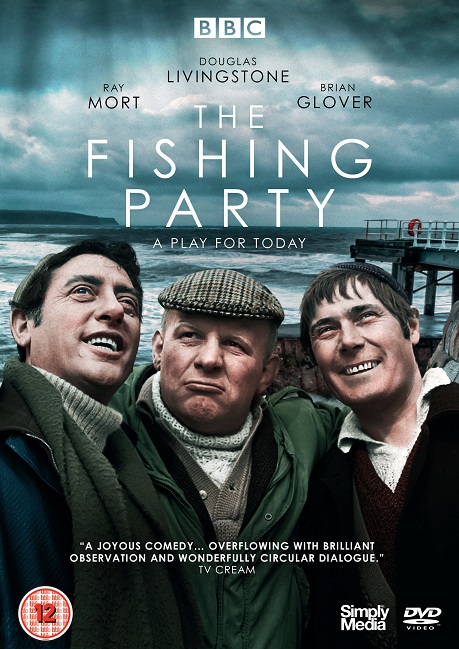
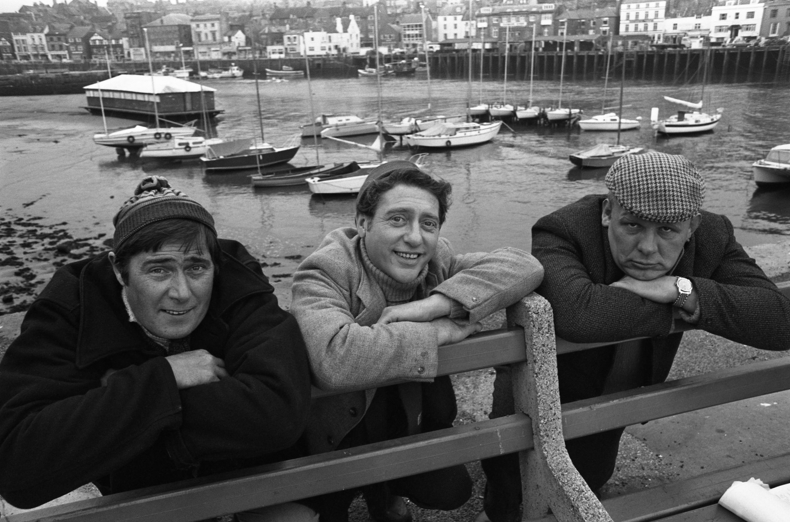
Three Derbyshire miners – Art (Brian Glover), Ern (Ray Mort) and Abe (Douglas Livingstone) – set out for a weekend’s fishing. It may be out of season but they’re determined to have a good time, although Art (the self-appointed leader) is keen to ensure that they don’t disgrace themselves. “We ain’t pigs. No brown aleing, no being sick over the wall – we’ll show our wives we can be civilised without them.”
But after being fortified with a greasy chip supper and a bountiful supply of brown ale, their good intentions start to dissipate once they take to the choppy waters ….
Originally broadcast on the 1st of June 1972, Peter Terson’s play is an entertaining comedy that’s rich in character detail. The first in a trilogy by Terson featuring Art, Ern and Abe (slightly surprising that all three haven’t been collected together in one DVD set) The Fishing Party has a wonderful sense of place and time.
There’s just something so very evocative about this small Northern fishing port. This is best observed when our hapless trio roll up to the boarding house that they’ve taken a shine to. It’s run by the domineering Audrey (Jane Freeman) and her thoroughly hen-pecked husband Brian (Frank Mooney).
Shortly afterwards, Freeman would begin thirty seven years of service in Last of the Summer Wine (as Ivy, a not totally dissimilar character to Audrey). And there’s another Summer Wine connection, as John Comer (who would be cast as Ivy’s long-suffering husband, Sid) also makes an appearance – here playing the owner of a quay-side tea van.
Brian Glover started out as a professional wrestler (billed as Leon Arris, the Man from Paris) before switching to acting in the late sixties and building up an impressive list of roles. Comedy was his speciality (shortly after this PFT he’d make several memorable appearances in sitcoms scripted by Clement and La Frenais – first as Flint in Whatever Happened to the Likely Lads? and then as Heslop in Porridge).
Glover’s Art is a wonderful creation. Overawed by the fairly modest boarding house that they’re all staying in (which he likens to a small hotel) he paints a totally unrealistic picture of the sort of culinary delights they’ll be treated to later. He’s convinced that entrées will feature, along with a selection of wines.
Alas, we never learn exactly what Audrey would have served up for their evening meal as she’s unwilling to change her serving up time from 6:45 (which is when they’ve booked their boat for) meaning that they have to head out for a bite to eat instead. But there’s no sense of disappointment from Art and the others, indeed they never lose their sense of innocence and optimism throughout the play.
There’s a lovely moment when the three – all safely deposited into single rooms – communicate with each other by shouting through the walls. Art is initially reluctant to join them in one of the other rooms (considering that consorting together is simply not quite the thing). He’s not at all convinced when told that James Bond does it all the time (delightfully, his argument with the solid wall is accompanied by a great deal of gesticulating).
The fishing trip – a nightmare journey of sea-sickness – is another obvious highlight, as is the aftermath when our shivering heroes find themselves back on solid ground. At least they have an impressive haul of cod to take back home – even if the fishy glances from the cod are all rather reproachful.
Like Glover, Ray Mort would become an instantly recognisable television face. Active from the mid fifties, he was equally at home both in drama and comedy. Douglas Livingstone’s acting career had virtually come to an end by the time The Fishing Party aired, but he’d already established a parallel writing career which would continue well into the 21st century. He would contribute to both Armchair Theatre and Play For Today in addition to a number of other series and serials. One notable later credit was his well-remembered 1981 adaptation of John Wyndham’s The Day of The Triffids.
Running for 57 minutes, The Fishing Party is an earthy comic treat. Featuring three strong performances from Glover, Mort and Livingstone and a number of sharply-defined supporting turns, the hour just flies by.
The Fishing Party is released by Simply Media on the 1st of October 2018, RRP £9.99. It can be ordered directly from Simply here (quoting ARCHIVE10 will apply a 10% discount).
Simply Media will be releasing Our Day Out, The Imitation Game and The Fishing Party on the 1st of October 2018. Below are details on all three, taken from Simply’s press release.
Our Day Out
An anarchic, bittersweet comedy drama from Oscar-nominee Willy Russell, creator of Educating Rita and Shirley Valentine. Rated 8.2 on IMDB. Directed by BAFTA-winner Pedr James (Our Friends in the North) and produced by David Rose (Z Cars).
A hilarious and chaotic romp about a group of inner-city Liverpool schoolchildren let off the leash for a day’s outing. Different teaching approaches clash when the compassionate Mrs Kay (Jean Heywood – Billy Elliot) and disciplinarian Mr Briggs (Alun Armstrong – Krull) attempt to supervise.
Stopping at a cafe, a zoo, the beach and a funfair, the children take every opportunity to cause havoc. This tender comedy draws on Willy Russell’s own experiences of school trips as both pupil and teacher.
Originally broadcast in 1977, it was later adapted as a stage musical and still features today as a popular school text.
What the Press Said:
“I laughed out loud a great deal, and secretly wept a little.” The Sunday Times
“A gloriously funny and touching play.” Guardian
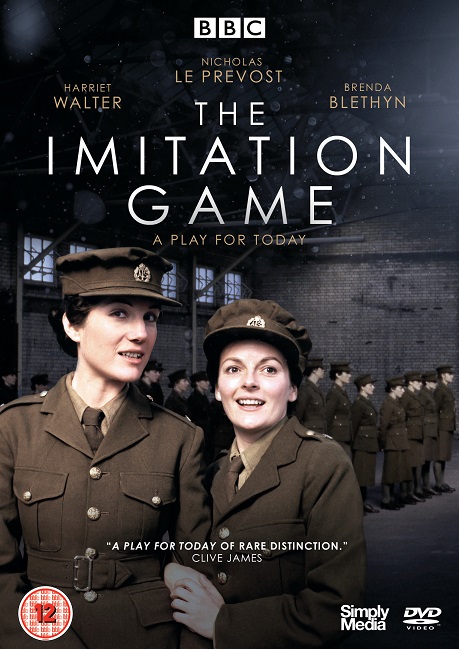
The Imitation Game
Bestselling writer Ian McEwan (The Children Act) wrote this impassioned drama, inspired by stories of women who helped to crack the Enigma Code during WWII.
Rated 7.8 on IMDB and first shown in 1980. Directed and produced by BAFTA-nominee Richard Eyre (Notes on a Scandal).
Starring Harriet Walter (Sense and Sensibility / The Sense of an Ending) in her first major screen role alongside Oscar-nominee Brenda Blethyn (Vera) and BAFTA-nominee Patricia Routledge (Keeping Up Appearances).
19-year-old Cathy Raine (Harriet Walter) lives in 1940’s Frinton on Sea, expected to spend the war working at the local munitions factory. Against the wishes of her family she signs up for the Auxiliary Territorial Service.
There she befriends working-class Mary (Brenda Blethyn) and moves to the code-breaking centre at Bletchley Park where Cathy meets Turing-like mathematics don John Turner (Nicholas Le Provost). But Cathy is being kept in the dark by the secretive male hierarchy – until she stumbles upon a secret intelligence file that may jeopardise her safety.
What the Press Said:
“A Play for Today of rare distinction” Clive James
The Fishing Party
Crown Court creator Peter Terson’s comedy of class and manners. Rated 8.9 on IMDB, and first shown in 1972. Directed by BAFTA-winner Michael Simpson (Prince Regent).
Derbyshire miners Art (Brian Glover), Ern (Ray Mort) and Abe (Douglas Livingstone) head north to Whitby for a boys-only fishing escape.
Checking into a shabby B&B run by haughty landlady Audrey (Jane Freeman – Last of the Summer Wine) and her henpecked hubby, the trio are bamboozled into paying a high price for their rooms.
Their boat is piloted by a stern ex-fisherman, who warns them about mixing chips and brown ale on choppy waters. The boys are half-cut before they leave the harbour, and as they head out to sea they’re decidedly off-colour.
What the Press Said:
“A joyous comedy… overflowing with brilliant observation and wonderfully circular dialogue.” TV Cream
All three DVDs have a RRP of £12.99, Our Day Out runs for seventy minutes, The Imitation Game for ninety two minutes and The Fishing Party for fifty seven minutes.
Gambit‘s an odd one. The main plot – the hunt for Docholli – moves very slowly whilst the production design is somewhat on the tacky side. But since Robert Holmes’ script is packed with entertaining one-liners this isn’t really a problem.
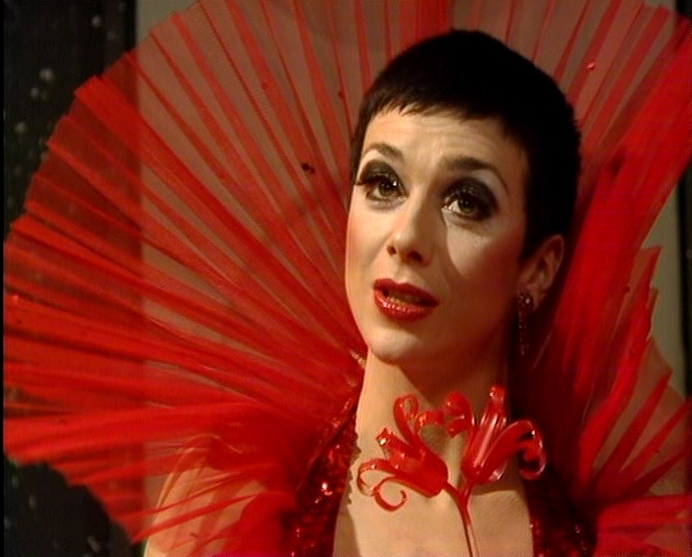
If you like your B7 stories on the gritty side, then you’re out of luck. Aubrey Woods’ overpowering Krantor sets the tone. Woods is clearly having a great deal of fun – the banter between Krantor and Servalan being one of the episode highlights.
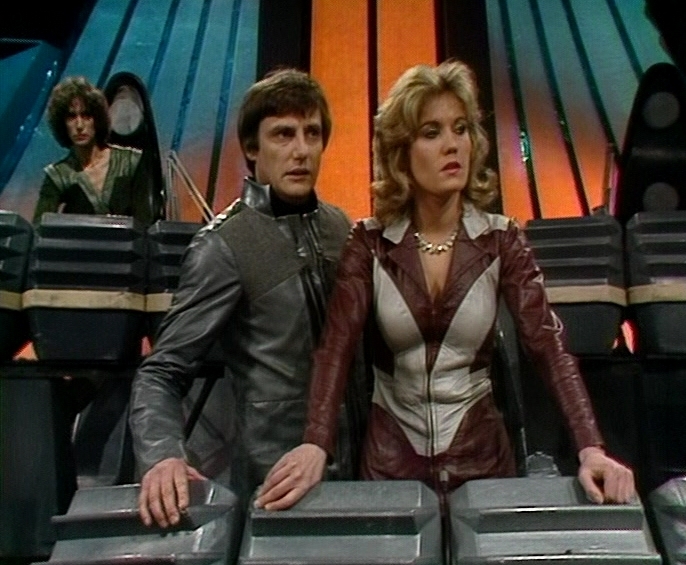
Blake, Jenna and Cally (the two girls glammed up to the nines) are involved in the main plot, but it’s Avon and Vila (attempting to break the bank at the casino) who get all the best scenes. The Avon/Vila subplot is so played for laughs that it feels more like a parody than proper B7 – the notion of Avon sneaking down to Freedom City (is he afraid of getting a ticking off from Blake?) and the way he persuades Orac to shrink himself (how handy and how odd it was never done again) are just two examples of this.
Oh, and the moment when he spits out his food after learning that Vila’s been tricked into playing the Klute at speed chess ….
With Holmes scripting, it’s possibly not surprising that the dialogue is a little different from the norm (Avon’s comment of “you dummy” doesn’t feel like something he would ever say).
There are also some prime examples of Holmes’ colourful command of the English language. Servalan’s thoughts on Krantor for one. “He is a despicable animal. When the Federation finally cleans out this cesspit, I shall have that vulpine degenerate eviscerated with a small and very blunt knife”.
Krantor’s counter-comments are equally as eye-opening (“one of these days, Toise, I am going to have Supreme Commander high-and-mighty Servalan ravaged until she does not know what month she’s in. I’ll have her screaming for death …”).
With an unforgettable turn from Sylvia Coleridge, an appearance from Bill Filer and Travis in a silly hat, Gambit is top class entertainment.
The Keeper
If you’ve seen The Pirate Planet then you’ll know what to expect from Bruce Purchase’s Gola – except that the Captain had hidden depths, whilst there’s no such luck with Gola (who’s just all bluster). The Keeper is another example of Blake’s shaky leadership qualities – no sooner has he, Vila and Jenna teleported down to the surface of Goth than they’re overpowered with embarrassing ease.
Vila (obviously) becomes the King’s new fool whilst Jenna becomes the King’s new … well, you can probably guess. Sally Knyvette manages to mine a few comic moments from this fairly unpromising scenario. Meanwhile, Blake mooches about doing nothing much whilst Avon, aboard the Liberator, leaves the others on Goth to fend for themselves as he sets off to destroy Travis’ ship. One point, how did he know that the ship belonged to Travis?
If you like ripe overacting then you’ve come to the right place. In addition to Purchase there’s also Freda Jackson as Tara (she has a nice line in cackles). Servalan’s on/off relationship with Travis is now back on, since he’s once again at her side (Travis changing from being Servalan’s enemy to her ally multiple times since Trial has been decidedly odd). The way he cuts and runs some twenty minutes in does generate the episode’s only surprising moment though.
Fifty minutes of running on the spot, The Keeper ends up as something of an also-ran although with Derek Martinus onboard as director there’s some decent camerawork in evidence.
Star One
Star One (rather like Terminal and Blake in fact) does indulge in a fair amount of running on the spot. Some of the scenes set on Star One (especially the hunt for Lurena) aren’t that interesting, but since the episode also features several of B7‘s most memorable moments the good outweighs the bad. Despite the fact that this is Blake’s last hurrah as a regular, Avon is still the one who gets all of the best lines. “As far as I am concerned you can destroy whatever you like. You can stir up a thousand revolutions, you can wade in blood up to your armpits. Oh, and you can lead the rabble to victory, whatever that might mean”.
His face-off with Travis (“Now talk or scream, Travis, the choice is yours”) is also rather good.
But at least Blake does have that brief chat with Cally, where the pair discuss the ethics of destroying Star One. It’s a fascinating scene – not least for the fact that Cally (next to Blake the most fanatical) was the only one to voice a tentative concern that killing millions of people might possibly be a bad thing.
Some of Star One’s functions are discussed in the opening few minutes. They seem rather benign (climate control) rather than oppressive and domineering. And the way the episode begins with Servalan effectively cast in the role of the goodie (discussing how to bring Star One under control in order to prevent further deaths) before crossing over to the Liberator (where Blake and the others are plotting to destroy it in order to generate chaos) shows how far the lines between good and evil have become blurred.
Servalan’s surprisingly a fairly minor character in this one, but the moment when she instigates a palace revolution is chillingly played by Jaqueline Pearce. “The President and those members of the Council who are unable to accept the realities of the situation are even now being arrested, as are those of our own people whose loyalties may be divided. At a time like this complete unity is an absolute essential”. The inference is that under military rule the Federation will become an even more oppressive force, although the aftermath of Star One rather negates this.
Travis’ death is a mercy killing (both for the character and the audience). A shame the effects shot of him tumbling to his doom isn’t terribly effective though.
I love the opening ten minutes or so, which shows that tempers aboard the Liberator are getting rather frayed, with the result that everybody – especially Jenna – has become rather snippy. Well, everybody except poor Gan, who’s been exiled to the teleport bay for no good reason.
Horizon might be a fairly unsubtle colonial satire, but both Darien Angadi and William Squire are very watchable. Angadi’s Ro is a fascinating character – when he displays disinterest in the continuing deaths of his people at the mine (whom he refers to as primitives) is this an example of his Federation indoctrination or is he genuinely unfeeling about their fate?
Squire’s Kommissar oozes seductive villiany (a much better role than the Shadow in The Armageddon Factor – especially since this time he’s not hidden behind a mask).
The one part of the plot which doesn’t quite hang together is the revelation that Blake was intimately acquainted with one of Ro’s best friends. It’s far too much of a coincidence to be credible (unless Blake knew about Ro and Horizon all along and simply pretended to the others that he didn’t).
The scenes of Avon alone on the Liberator, debating whether to cut and run, are a highlight as is his explosive appearance on the planet, where he mows down a number of Federation troopers in his best Clint Eastwood style.
Not as bad as its reputation suggests, this is pretty decent fare.
Pressure Point
Brian Croucher’s performance is considerably dialled down compared to Weapon. He still doesn’t quite convince, but a calmer Travis is a better Travis for me. It seems barely credible that Servalan would have hung about for eighteen days, waiting for Kasabi to turn up. She’s the Supreme Commander for goodness sake, who’s doing all the paperwork?
Jacqueline Pearce’s crocodile smile is on overdrive today – and she’s the recipient of some dramatic scenes with Jane Sherwin’s Kasabi. It’s always good to see Servalan slightly discomforted.
The main plot’s a bit of a run-around which doesn’t make a great deal of sense. If Central Control is only a shell, why does Servalan have so much trouble in getting the barriers deactivated? And since Travis has already snaffled the teleport bracelets from Blake and the others, he doesn’t actually need to follow them down – all he has to do is wait at the entrance, as eventually they’ll all have to come back up that way.
Blake’s cry (“We’ve done it! We’ve done it! We’ve done it! I’ve done it!”) and his subsequent collapse to the ground is a S2 highlight. That one of Blake’s merry gang dies in a totally pointless way seems apt – from start to finish this was a doomed exercise. For all of Blake’s optimism (his year of secret planning) his lack of foresight and tactical planning has been cruelly exposed.
Trial
It’s hard to get too invested in the travails of Blake and Zil, so it’s lucky that the other plotline is rather stronger.
Travis gets his moment in the sun (explaining that his misdeeds are a direct result of his Federation training). Croucher starts to go way over the top here, whereas earlier in the episode – possibly because he didn’t have too many lines – he was somewhat more restrained.
Surprising that Servalan doesn’t feature more, but presumably there were political considerations precluding her appearance at court. Kevin Lloyd gives a nice performance as Trooper Parr – it’s always good when the Federation rank and file are given a voice.
Pretty watchable, but not a favourite.
Killer
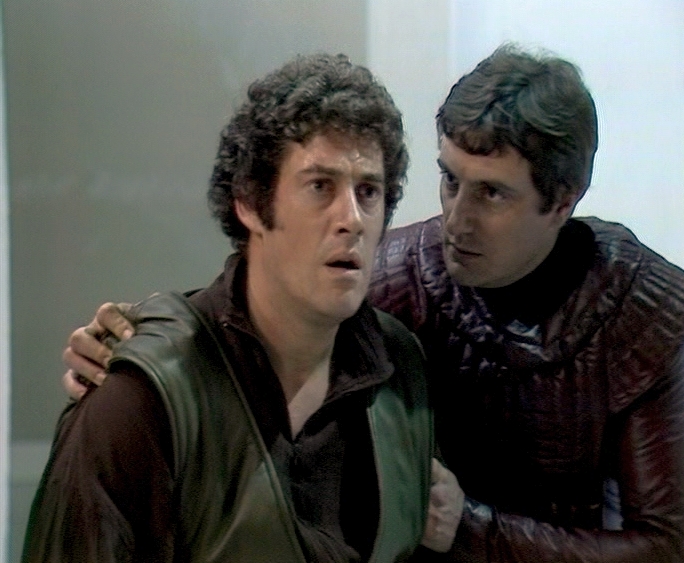
No surprise that Holmes quickly latched onto Avon and Vila as a team. Both are given plenty of good lines (such as Vila’s “When Avon holds out the hand of friendship, watch his other hand. That’s the one with the hammer”). This does mean that the others (especially Jenna and Cally) are somewhat sidelined though.
Ronald Lacey and Paul Daneman are both decent guest stars, Lacey as the untrustworthy “friend” of Avon and Daneman as a “good” Federation man. Given the way that Blake in the past has tended to regard the Federation as a single evil entity, it seems a little out of character for him to be so keen to warn the base about any possible danger from the mysterious vessel.
Some of the costumes are rather silly, but this is an occupational hazard with B7, especially during the second series.
Killer feels pretty trad – it’s almost as if Holmes was feeling his way at this point (crafting a story that wasn’t too dissimilar to what had gone before, but with a little extra twist). It’s his next one where he really starts to cut loose …













 Archive Television Musings