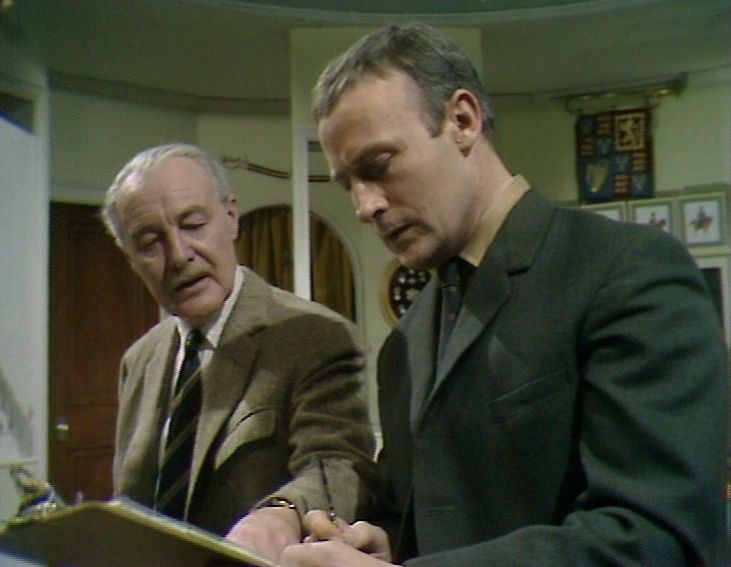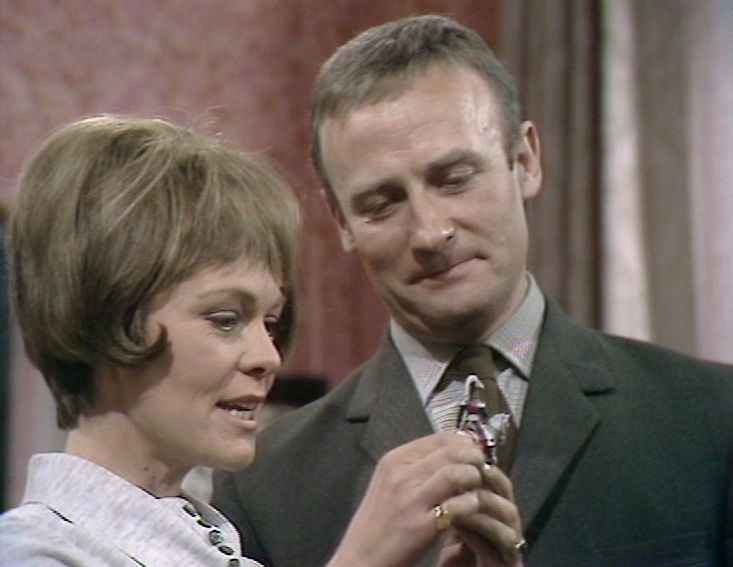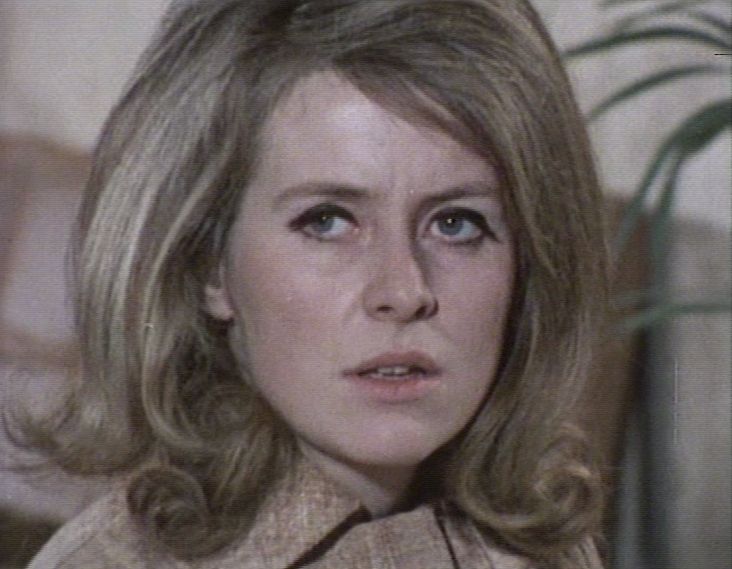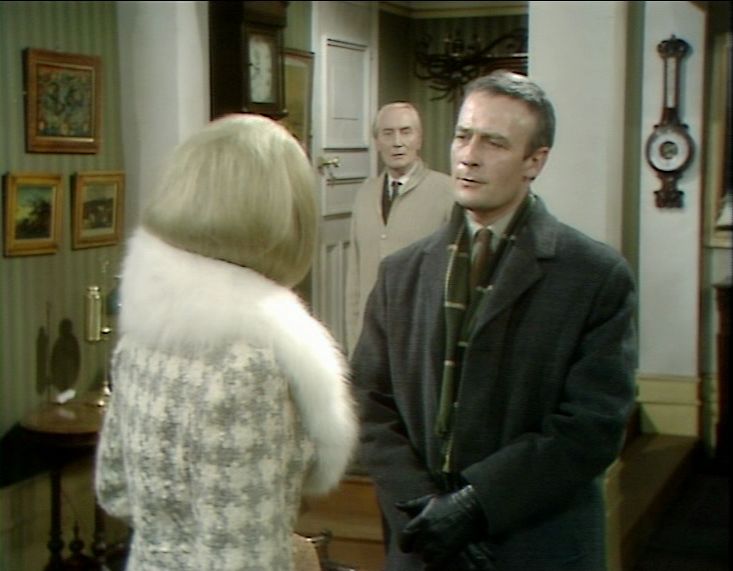
Callan – Amos Green Must Live

amos

Written by Ray Jenkins
Directed by James Goddard

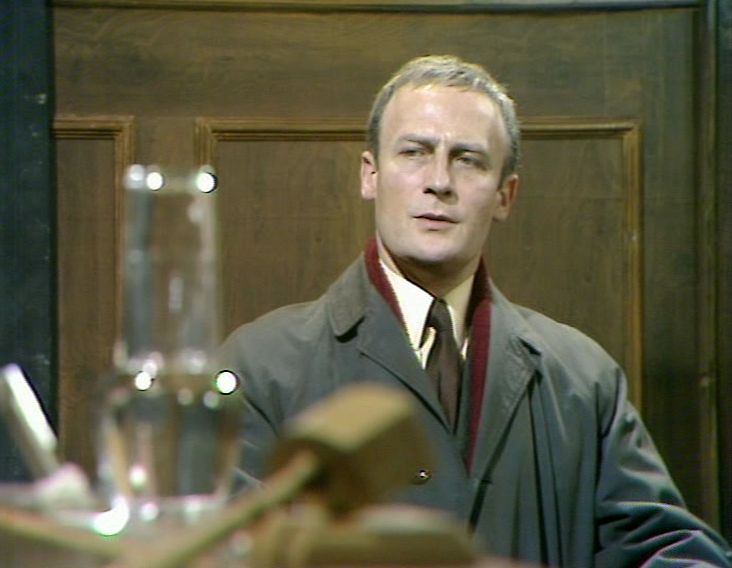
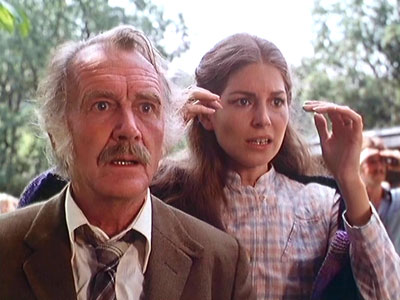
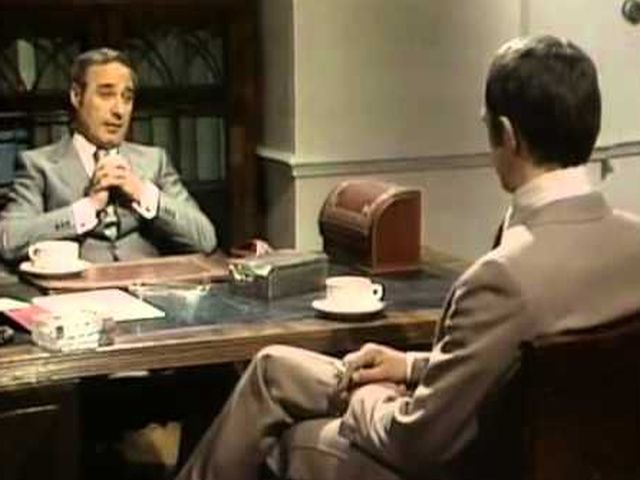
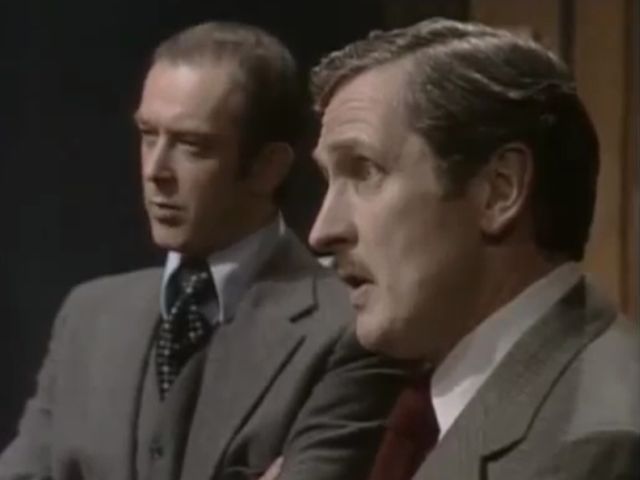
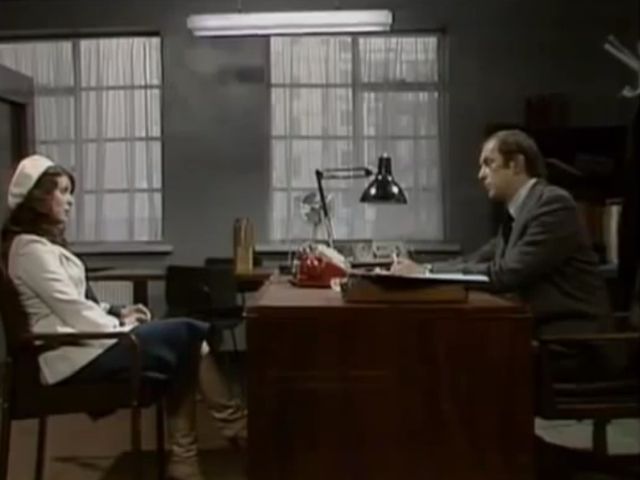
Amos Green Must Live is a bit of a misfire.  Although Amos Green’s views are just as topical today as they were over forty years ago, a slightly incoherent script does tend to drag the story down.

Amos Green (Corin Redgrave) is a politician with a clear message – Britain is full to bursting point, so he advocates sending the immigrants back home.  He’s clearly a man who likes to court controversy and when his life seems to be under threat, the Section are tasked to protect him.

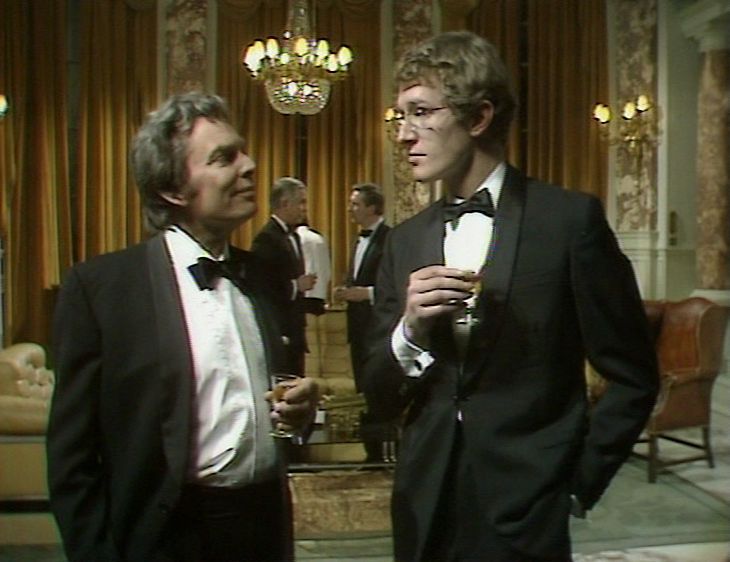
Corin Redgrave is by far the best thing about this story.  He’s very watchable in all his scenes and Ray Jenkins’ script provides him with plenty of good material.  Whether Green actually believes what he says or whether he’s simply making political capital is left to the view to decide.  Later in the story, Hunter (who for some inexplicable reason is attending one of Green’s dinner-parties) does make the point that before 1967 Green never spoke about immigration, which does visibly ruffle the politician’s feathers.

As for the worst, Annette Crosbie as Green’s housekeeper May Coswood, takes some beating.  It’s probably not Crosbie’s fault, rather it’s the way the part has been written.  May is besotted with a black man called Casey (Stefan Kalipha).  Naturally, she keeps this from Green, but she starts to act very oddly – stealing a dress, for example.  Her erratic behaviour only draws attention to herself (and Casey).

If May’s motivations are sometimes hard to understand, then the same can be said of Casey.  Towards the end we learn that he’s the prime mover behind the plot to kill Green – but there are various plot-holes along the way which are never resolved.

The Section are originally drawn into the case after a black civil rights activist from America called Arrillo is fished out of the river.  In his pocket was a book of matches with a picture of the Ace of Spades.  A similar book of matches is sent to Green, so it’s surmised that his life will also be under threat.

Casey admits that he was the taxi-driver who picked up Arrillo.  As the American was carrying a considerable sum of money, we can surmise that Casey killed him for it – which he planned to use to finance an attack against Green.  If this is so, why would he place the matches in Arrillo’s pocket and why send a similar matchbook to Green?  If it hadn’t been for the matches, then Green wouldn’t have known that his life was in danger.  But frankly, it’s a very obscure clue – what are the chances that somebody would have made the connection between Arrillo and Green?

Although Casey is organising the attack against Green (with gas weapons and guns) it’s actually carried out by several Americans (well, I think they’re attempting American accents, it’s hard to be sure).  Were they recruited with the money Casey stole from Arrillo?  Or since Arrillo was an American, did they follow him over?

Whilst there are a few nice moments (Lonely buying Callan the most hideous tie imaginable as a thank you present, for example) it’s certainly one of the less engaging episodes of the series.  When a General Election was called in 1970, the episode was pulled from the schedule and transmitted later in the run (as previously mentioned, Breakout should have been the series finale).  So there is a certain historical curiosity in watching this (albeit-temporarily) “banned” episode.

The character of Amos Green tapped into the debates of the day (he’s clearly a thinly-veiled portrait of Enoch Powell, notorious for his “Rivers Of Blood” speech) but whilst Redgrave is fine, the episode in general is just a little too heavy handed and from a modern viewpoint feels rather crude.
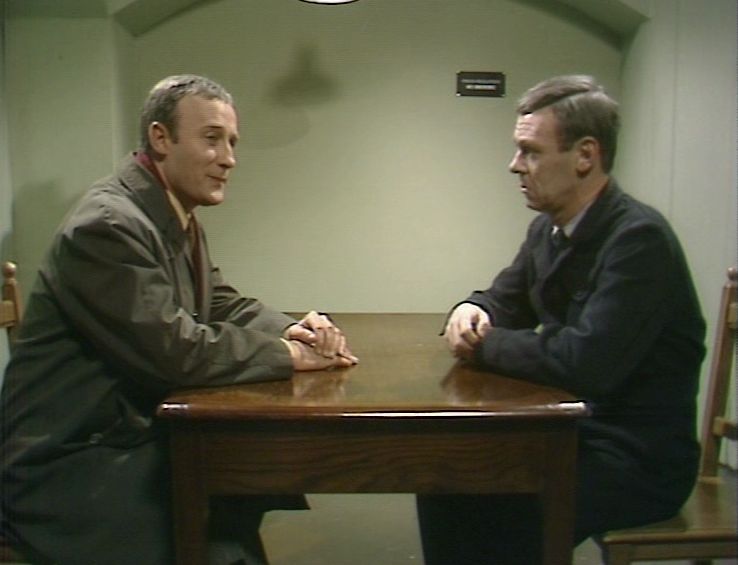
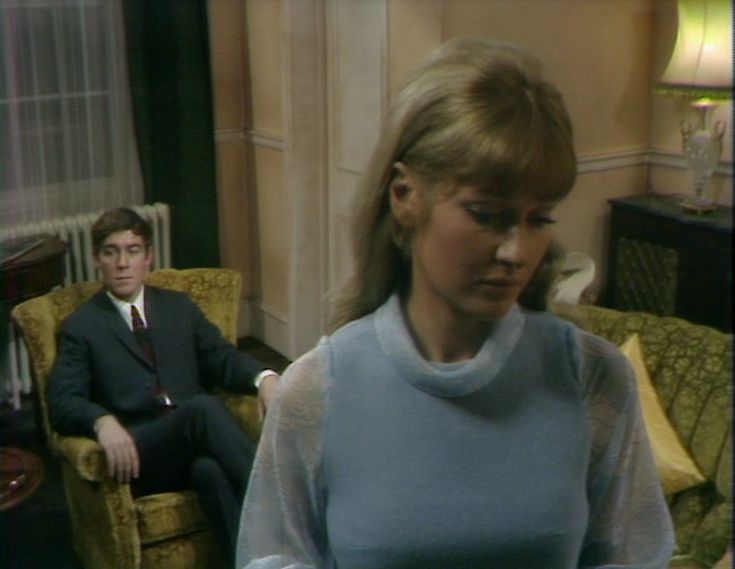
Callan – Breakout

break

Written by James Mitchell
Directed by Reginald Collin

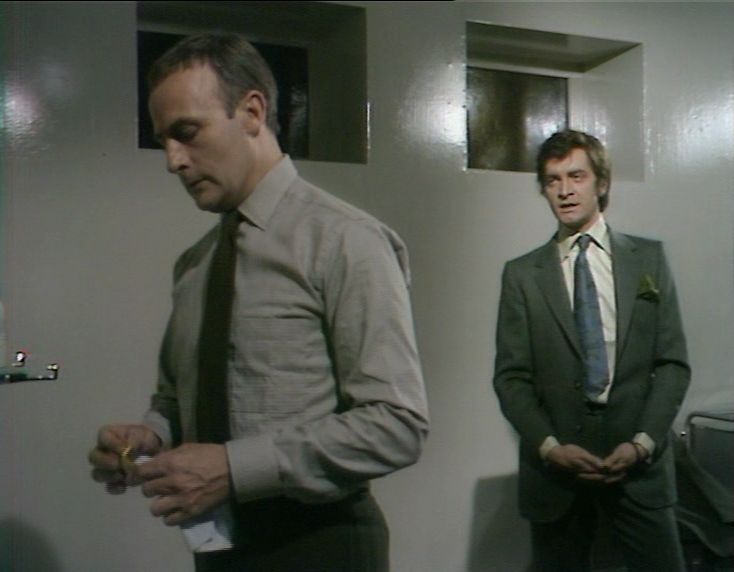
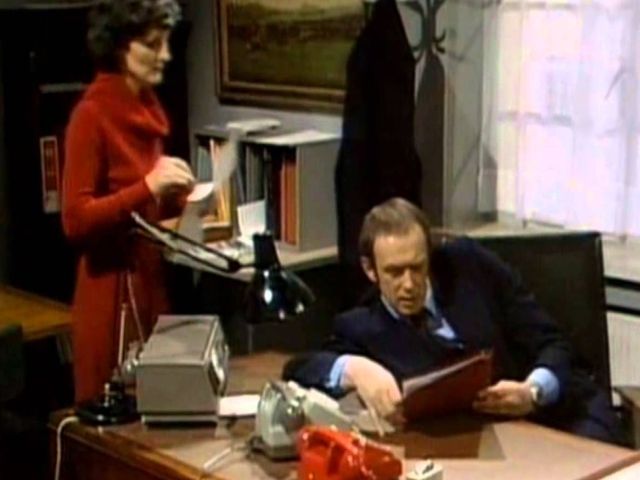
Hunter wants KGB agent Lubin (Garfield Morgan) picked up.  He possesses a list of names that would prove incredibly damaging to the Section if he were able to deliver them to his masters.  And since Hunter knows that Lubin hasn’t had the chance to communicate with them yet, speed is of the essence.

But Lubin surrenders himself to the police.  He faces a lengthy spell in prison, but Hunter knows exactly why he’s done it (inside prison he’d be out of Hunter’s reach).  Hunter has a plan though – Lubin will expect to be broken out by the KGB, so he plans to arrange for Callan to spring him and then kill him.

Breakout is more of a straightforward action story than many episodes of Callan, but though it lacks the depth of characterisation that we usually see, it still has plenty of interest – not least for the central role played by Lonely.

In Where Else Could I Go? we saw Callan stand bail for Lonely.  Now, Lonely finally faces trial for his numerous petty crimes.  As ever, Russell Hunter is a pleasure to watch – even when he has no dialogue he’s capable of expressing so many emotions.  This is highlighted when the judge comments that Lonely’s crimes were carried out with “great expertise ” (a pleased expression plays across his face) but “little intelligence” (which instantly changes to downcast).

When he’s sentenced to six months imprisonment for each of the twenty-five offences (to run concurrently) he displays a whole range of shocked emotions, especially when he sees Callan laughing.  Eventually he understands that he only has to serve six months instead of twelve and a half years, but it’s clear that it doesn’t quite sink in (as he still asks Callan for reassurance later on).

If there’s a major flaw in Breakout, then it’s the idea that Lubin is untouchable in prison.  It’s hard to believe that Hunter lacks the ability to transfer him and it’s even harder to accept that he couldn’t pull some strings to infiltrate a man into the prison to eliminate him without having to break him out first.

But whilst these possibilities are never discussed, they are able to put a man on the inside – the unfortunate Lonely.  Lubin is on remand at Castle View (where Callan once spent “six lovely months”).  Lonely is dismayed to hear that he’ll be transferred there – but Callan is delighted, as he tells him that he’ll be able to do a little job for him.

Woodward and Hunter shared many lovely two-handed scenes during the four series of Callan and there’s another cracking one here.  When Callan tells him that he’s arranging a breakout from Castle View, Lonely’s first response is that he doesn’t mind doing his time.  Callan gently tells him that he’s not the person to be sprung – Lubin is.  Lonely is dismayed. “I don’t hold with spies. Mr Callan, that man is a traitor to the Queen.”  To which Callan ironically mutters “Rule Britannia”!

Russell Hunter continues to have good material to work with, especially in the aftermath of the breakout.  As Callan enters the cell, he says “good luck, Mr Ca-” before Callan brutally pistol-whips him.  This was because Lubin knew Callan’s name (although he didn’t know what he looked like) so it was vital that Callan silenced Lonely before he revealed all.  Of course, in the light of this, it was rather silly to put Lonely in his cell (as we later learnt he spent most of his time taking about Callan!).

Callan is the leader of the small group tasked to breakout Lubin.  Cross and Mellor (Billy Cornelius) are the others.  Something we’ve seen over the years is that the Section seems to have very few decent agents and Mellor is the latest, somewhat inept, example.  Lubin is easily able to deal with him – but Callan is a different proposition.  After a brief gun-battle, Callan finishes him off.

Breakout was originally intended to be the final story of the third series and this is reflected in the final scene which sees Hunter and Callan sharing a cup of tea on a cold and deserted beach.  Hunter tells him that the KGB now regard him as a top man and so in the future he’s bound to be targeted.  This would have lead nicely into the opening story of series four, That’ll be the Day, in which Callan was picked up by the KGB and underwent a harrowing interrogation.

Unfortunately, the running order was re-juggled at the last minute – so the rather less satisfying Amos Green Must Live was the last transmitted story of this series.

Callan – God Help Your Friends

god

Written by William Emms
Directed by Peter Duguid

In Callan’s world, the innocent often have to suffer. They frequently find themselves used as pawns, sacrificed in a game they don’t even know they’re playing.  God Help Your Friends is a prime example of this – it also demonstrates Callan’s disdain for the work he has to do.

Hunter tells Callan and Cross that the engagement between Beth Lampton (Stephanie Beacham) and Mark Tedder (Michael Jayston) has to be stopped.  Beth works as a top-level interpreter for NATO whilst Tedder is suspected of being an agent for the opposition.  Hunter accepts that they have no definite evidence about Tedder, but the merest hint of suspicion is enough to make their union highly undesirable.

It’s not a job that Callan relishes, so he spends the episode in a very bad mood, taking every opportunity to rile Hunter and Cross.  Callan and Cross spend their time digging for dirt on Tedder and then making sure that Beth knows about it.  This isn’t a problem for Cross, who shares none of Callan’s scruples,  although he does come to believe that if they end the relationship it will be for the girl’s benefit.

At the start, we see that Beth and Tedder are very much in love.  But once a little suspicion and paranoia are introduced, even the strongest relationships can be destroyed.  Hunter is keen for them to achieve this as quickly as possible, but he’s adamant that he doesn’t want anything untoward to happen.  Callan bitterly reassures him that “there are other ways of killing people than with a bullet.”

Hunter assigns Cross to keep an eye on Beth (posing as a time and motion expert) whilst Callan roots around for incriminating evidence.  Initially, Callan assumes that Hunter will want him to romance the girl, but by assigning Cross we can assume that the intention is to infer that Callan’s getting slightly too old to play the lover ….

Beth is a nice girl – possibly too nice and innocent for the world she’s found herself in.  She’s surprised that, despite her sensitive job, her immediate superior wants to know about her engagement.  Given this, it seems clear it would never occur to her that the security services would be at all interested in her or her fiance.

Mark Tedder is a smooth, charming man (played to perfection by the always impressive Michael Jayston).  We never discover if he was actually an agent or not, but that’s not the point of the story.  In the shadowy world of the Section, there’s no judge or jury (although there’s certainly plenty of executioners).

As good as Russell Hunter always was (and Lonely has some nice moments in this one, especially in his first scene, when he’s dressed in a very smart suit, complete with umbrella!) by this point it was sometimes difficult to include him in the episodes without stretching credibility to breaking point.  During the first series (when Callan was still officially out of the Section) Lonely was a useful character, since he could obtain things (such as guns) which Callan couldn’t get any other way.

But by series three he doesn’t fulfill any function that a trained member of the Section couldn’t provide – so it’s sometimes harder to justify his presence.  For example, Callan asks him to break into Tedder’s flat and look for anything that could be used against him.  Callan then waits in the street below and only goes up to the flat once Lonely signals that he’s found something.  Lonely’s ability as a burglar is well-known, but do we really believe that Callan couldn’t have picked the very simple lock on the door or that he’d let Lonely search the flat by himself?

This does, however, give us the one moment of levity in the story – as Lonely excitedly thrusts a series of red-hot letters into Callan’s hand.  “Now the bird that wrote that, that is terrible, that is shocking, she’s got no shame. Now read that, read that.”

But the letters (referring to an old love-affair before Tedder met Beth) don’t do the trick and so Callan has to resort to other methods.  Eventually they succeed, but by the end of the episode there’s no particular cause for celebration.  The final words of the story go to Woodward and once again he delivers the goods.

God Help Your Friends was William Emms’ second and final script for Callan (he also wrote the wiped story The Running Dog for series two).  Active as a writer during the 1960’s and 1970’s he contributed to a number of popular series, such as Redcap, Public Eye, Doctor Who, Mr Rose, Ace of Wands, Z Cars and Owen M.D.

Peter Duguid would eventually direct eleven episodes for Callan, of which this was the eighth.  His direction here is unshowy and straightforward, but he manages to capture good performances from both Beacham and Jayston (who carry many of the key scenes).  Woodward is pushed more into the background, but he’s a constant, brooding presence and plays  Callan’s disgust with the job (and with the way it turned out) to perfection.

Callan – Act of Kindness

act

Written by Michael Winder
Directed by Mike Vardy

Away from the Section, David Callan has one major interest – model soldiers and fighting war-games with them.  Given that his job involves killing (and usually it’s the dirtiest and most squalid kind) it’s worth wondering if his love of re-creating famous battles from history is a yearning for the time when conflict was maybe a more honest and chivalrous pursuit.

Like the Armchair Theatre pilot, A Magnum for Schneider, Act of Kindness sees Callan tackle an opponent across the tabletop field of battle and it provides us with a very interesting clash of personalities.  Heathcote Land (Anthony Nicholls) isn’t a spy or an enemy agent – he works for a company that exports tractors worldwide (one of their biggest markets is Russia).

When Land receives incriminating photographs showing Donovan Prescott (Ray Smith) in bed with a young woman, he demands Prescott’s resignation.  Prescott refuses and tells him that since the photographs (taken on his last trip to Russia) must have been made by the KGB, he should tread very carefully.

Smith (a familiar face, thanks to his appearances as the acerbic Spikings in Dempsey and Makepeace) is very Welsh here (the odd “boyo” is thrown into the conversation).  He’s presented as a laddish man-about-town, but he also appears to have a patriotic side (since he did some unspecified low-level work for British Intelligence).  It’s this connection that makes Hunter keen that Land shouldn’t make the photographs public and so Callan is tasked to stop him by whatever means necessary.

Since Land also has an interest in model soldiers and war-games (or “toy soldiers” as Hunter dismissively calls them, much to Callan’s irritation) Callan is the obvious choice to tackle him.  “You really are a bastard aren’t you?” he says, less than happy that the one pastime he has which is separate from the Section has now been compromised.  After Callan leaves the office, Hunter confides to Cross that whenever Callan is angry, he remembers what happened to his predecessor ….

There’s one very clumsy piece of plotting in the story. This occurs just after Callan has introduced himself to Land and the pair of them begin to chat about model soldiers and battles.  For some reason, Callan is using the alias of Tucker (which is odd, since we learn in Where Else Could I Go? that Callan isn’t his real name anyway).  As Callan and Land start fighting a practice battle at the model soldier convention, Lonely passes by and refers to him as Mr Callan.  This, of course, instantly sets alarm bells ringing for Land.  It’s a rather sledgehammer way to raise Land’s suspicions and it’s a pity that something more subtle couldn’t have been done.

Later, we see Callan and Land prepare to fight a battle in the business-man’s impressive war-room.  There are two battles going on at once (the one between the model armies and the other between Callan and Land themselves).  The pair indulge in a fair bit of verbal jousting, each of them skirting around the issues, but it becomes clear that both know exactly what the other is thinking.

Eventually, Land comes to the point and calls his opponent Callan.  But even with this acknowledgment that Callan isn’t all he says, the battle goes on.  For those who favour the more action-orientated episodes, this one might seem to be a bit slow – but the battles between Callan and Land (although they don’t involve guns) are fascinating nonetheless.

At one point in the story, Prestcott tells Callan that if he wants to blackmail Land then he’d have to create something, since he seems to lead a totally blameless life.  As the pressure increases to protect Prestcott, all possibilities are debated by Hunter, Cross and Callan.  Cross favours taking Land out of circulation (either temporarily or permanently).  But a visit by Land to a toyshop might just provide them with the leverage they need …..

Anthony Nicholls (probably best known for sporting a rather unconvincing beard as Treymayne in The Champions) gives an excellent performance as the moral and principled Heathcote Land.  He shares a fair amount of the story with Woodward and the pair spark off each other very well – their conflict is definitely the highlight of the episode.  Ray Smith is rather less convincing as his business rival, but then it wasn’t such a well-crafted part.  This was the second and last of Michael Winder’s scripts for Callan (he previously wrote the stunning series two finale Death of a Hunter).

Act of Kindness must be something of a rarity for a Callan story, since it doesn’t feature any deaths, but that doesn’t stop it from being another intriguing story – thanks to Woodward and Nicholls.

Callan – Suddenly – At Home

suddenly

Written by James Mitchell
Directed by Piers Haggard

Callan’s in love.  Those familiar with the parameters of the series will be probably be able to guess that his happiness is going to be very short lived.

Lady Lewis (Zena Walker) is the widow of Sir Colin Lewis, the youngest Foreign Secretary for a century.  Whilst his death hasn’t left her penniless, her financial situation is certainly a little strained (she has two sons to put through public school. which isn’t cheap).  So when the smooth-talking documentary film maker Rene Joinville (Tony Beckley) approaches her with an offer of ten thousand pounds to appear in a programme about her husband, it seems to be the answer to her prayers.

But Hunter doesn’t want the documentary to go ahead.  Sir Colin knew too many secrets and he fears that whilst Lady Lewis won’t deliberately betray any confidences, the skillful Joinville will be able to tease them out of her.  It’s interesting that. for once, the Section doesn’t have all the facts.  Joinville is a Russian agent, but this vital piece of information isn’t discovered by them until very late on.  Had they known, of course, then things might have turned out very differently.

Hunter assigns Callan to warn Lady Lewis off.  He thinks that blackmail might be a good method, but Callan is rather more subtle than that.  He appeals to Lady Lewis’ sense of duty and also hints that the establishment would view the programme with extreme disfavour.  Woodward is delightfully bashful in this scene –  he’s slightly hesitant and occasionally stumbles over his words.  We tend to see Callan as the forceful man of action, so this is a good insight into his softer side.

There’s an instant attraction between them, sparked by Callan’s love of model soldiers.  He promises to bring one to show her at a later date and once he leaves she starts to swot up on the subject.  Given how totally different they are as characters, it’s a little difficult to believe in this sudden romance – but Woodward and Walker are both so good that they make it work.

Unfortunately for Callan, he never progresses beyond a rather chaste kiss.  Since Lady Lewis won’t take part in the documentary, Joinville is ordered to kill her.  He’s told to use a gun favoured by the Section – that way they’ll be blamed and the resulting furore will be something of a propoganda coup.

The killing is carried out and when Callan receives the news it’s possible to see the light go out of his eyes.  He instantly changes back into the cold, remorseless killer and you’re left in no doubt that he will avenge her death.  Initially Cross is a suspect, but he’s cleared and when the truth about Joinville is discovered, Hunter gives the younger man the task of bringing him in.  Callan queries whether he has to be brought in alive and Hunter is quite clear that, yes, he’s not to be killed.

Cross’ bungled attempt to apprehend Joinville is another example of just how inexperienced he is.  He gives Joinville plenty of warning by making a hash of picking the lock on his hotel-room door and then is very easily disarmed.  Luckily for him (although Cross doesn’t see it like that) Callan is outside the window and deals with Joinville.  When he’s finished, Joinville is very dead.

Suddenly – At Home was James Mitchell’s third script for series three. I’ve always had a soft spot for this one – partly because, along with Breakout, they were the first episodes of Callan that I ever owned (they were released on video in the late 1980’s).  Whilst it’s a bit of stretch to accept the instant relationship between Callan and Lady Lewis, there’s plenty of incidental pleasures.  Tony Beckley sports an outrageous French accent as Joinville.  He gives a slightly off-kilter performance, but it does work (where a more naturalistic turn might not have).  Zena Walker impresses as Lady Lewis – she plays her as calm and charming, which makes her sudden, violent death all the more shocking.

Piers Haggard’s direction is quite noteworthy, with some well chosen shots.  At the start of the story we see Joinville preparing to accept an award for one of his films – and the camera shoots through the award as he’s speaking to Lady Lewis (creating a quadruple image).  Also, when Callan first meets Lady Lewis, part of the scene is shot directly at a mirror, so that we see a reflection of the characters, before the camera pans off to focus on them.  Plus there’s a number of close-ups (which help to create a claustrophobic atmosphere, especially in the immediate aftermath of Lady Lewis’ murder) and some interesting low-angle shots (these make fairly standard sets look a little more interesting).

It’s another very solid episode in an impressively consistent series.

Callan – A Village Called ‘G’

village

Written by James Mitchell
Directed by Mike Vardy

Hunter’s secretary, Liz, is an absolute model employee.  She’s never late and she’s never ill, so when she fails to turn up one morning it sets the alarm bells ringing.  Hunter decides to give her another hour and if she still hasn’t appeared then the department will be on red alert.  Cross queries whether that isn’t a little excessive, but Hunter spells it out to him.  “Liz has never been late here in her life, she’s never missed a day.  She’s an example to you all.  You think I’m fussing, but I’d sooner be foolish than careless.”

Hunter’s fear is that she’s been picked up by the opposition – she knows all of the Section’s secrets so she’d be an invaluable asset.  The truth of the matter is rather different though – she’s embarked on a personal mission of vengeance and Callan, naturally enough, is right in the thick of things.

Lisa Langdon made her first appearance as Hunter’s secretary at the start of series one.  It wasn’t a terribly auspicious start, as for the first few stories she was nothing more than a disembodied voice on an intercom.  After a while she started to appear in the flesh and gradually was given a little more to do.  During the black and white years, Heir Apparent is probably the best example of this – following the death of Michael Goodliffe’s Hunter, Liz was a useful character to place between Callan and Meres.

But A Village Called ‘G’ was the episode that put her firmly in the centre of the action.  Written by series creator James Mitchell, we find out about Liz’s background – and this provides the explanation for her disappearance.

After searching her flat, Callan reports on her lack of personal documents.  “There’s no letters, there’s no memos, there’s no diaries. Nothing. She’s a sad one, that. Yeah, well, it’s pretty sad if you’re that lonely.”  The lack of information means that Callan has little to go on, so he asks Hunter if he can see her file.  Hunter refuses, but fills him in on her history.

Liz was born in Poland.  Her village was totally wiped out by the Germans in 1944, when she was just three years old.  Every man, woman and child were killed (except for Liz, who had been hidden behind a bookcase by her father).  She was later adopted by a British couple called March in the early 1950’s.  March had worked as a cypher clerk, so the Section kept a watching brief on Liz.  When her foster parents were killed by a hit-and-run driver some five years earlier, it was decided that Liz would be an ideal employee for the Section (since she was fluent in numerous languages and had no family ties).  As Hunter says.  “The Section is all she has, David. Her mother, father, her home.”

Callan goes back to Liz’s flat and asks the caretaker (a wonderfully grimy performance by George Innes) if he’s noticed whether Liz has had any regular male visitors.  When he says yes, and that the man’s name was James Cross, this immediately catches Callan’s interest.  It becomes clear that Liz and Cross have been enjoying a relationship strictly against departmental regulations.  Callan, of course, makes it clear to Cross just how stupid he’s been (in the way that only Callan can!).

Cross tells Callan that he thought that Liz was worried about something, although she didn’t say what.   She did speak about her childhood though – which given what we’ve learnt, seems to be significant.  Cross and Callan hit the archive, looking for any recent activity regarding Poland.  They find a file on a war criminal called Klist and also discover that Liz checked out a file on a man called Sabovski (Joseph Fürst).

There’s evidence to suggest that Sabovski and Klist are one and the same and that Klist was involved in the massacre of Liz’s village. Hunter decided that no action would be taken and it’s this which pushes Liz over the edge as she decides to take the law into her own hands and kill Klist.

Fürst had previously appeared in the Armchair Theatre pilot A Magnum for Schneider.  Infamous in certain circles for his incredibly ripe performance as Professor Zaroff in the Doctor Who story The Underwater Menace, he’s much more restrained here.

Liz fails to kill Klist and Klist drugs her, takes her back to her flat and puts the gas on.  Luckily Callan, Cross and Lonely reach her in time (Lonely’s comment to Callan “you haven’t croaked her?” is priceless).  There’s also a nice cameo appearance by Graham Crowden as the Groper (a struck-off doctor who Callan calls in to check Liz over).  Quite why Callan didn’t call the Section is a bit of a mystery as surely they have medical staff, but if he had then we’d have missed out on Crowden’s remarkably camp performance!

Klist is dealt with by Cross, although Callan brutally tells Liz that Cross cares more about his job than he does about her.  “Listen darling, don’t you think Liz that he killed Klist for you. He didn’t. He killed him for himself. Killed him because he’s got to finish the case.”

This wasn’t the first story to feature a Nazi war criminal (see The Good Ones Are All Dead from series one).  But Klist is much less central to this story than Strauss was in that episode.  A Village Called ‘G’ is more about Liz, Cross and Callan.  It ends with Hunter and Callan sharing a drink and Hunter complimenting Callan on handling matters effectively.  The two wouldn’t always see eye-to-eye, so this is quite a notable moment.

Callan would be Lisa Langdon’s final television credit.  She only had a handful of other credits, such as a Jackanory appearance in 1968 and a few other minor roles (like ‘Woman in Street’ in an episode of Dixon of Dock Green).   But although her cv wasn’t particularly extensive, she was always worth watching in Callan – as Liz brought a welcome human touch to the often cold and unwelcoming Section.

Callan – The Same Trick Twice

same trick

Written by Bill Craig
Directed by Peter Duguid

Callan has been sent to oversee the exchange of a Russian prisoner for two British ones.  Also present is Mr Bishop (Geoffrey Chater) who apparently works for the Foreign Office.  The handover goes smoothly and Bishop welcomes both Surtees (Richard Hurndall) and Mallory (Patrick O’Connell) back to the free world.

Later, Mallory expresses his bitterness to Callan.  He’s spent five long years in a Russan jail, thanks to Surtees (who buckled under the initial interrogation and revealed everything).  And Surtees himself plans to go public and disclose how he was blackmailed into working for British Intelligence.

The only problem is that nobody in British Intelligence has ever heard of Surtees …..

The Same Trick Twice is a dense story, where nothing is quite as it seems.  It has some excellent actors and moves at a nice pace, but there are some flaws which are hard to ignore.

The first comes right at the start.  Callan tells Surtees that he’ll be looking after him and has a nice rest laid on at East Grinstead.  The clear inference is that this is a safe house where Surtees can be intensely debriefed.  Surtees seems not to care for this and throws a cup of coffee in Callan’s face.  This allows Bishop to take charge of Surtees and he’s later allowed to go public with his claim of blackmail.  If Callan had orders to keep a tight grip on Surtees, why did he let him walk free?

Shortly after, we find that Bishop doesn’t actually work for the Foreign Office, instead he’s connected with Intelligence – not directly in the Section, but he’s certainly able to come and go there as he pleases.  Geoffrey Chater would pop up during series three and four as a semi-regular and his languid demeanor ensures that Bishop enjoys some entertaining clashes with Callan, who has a much more down-to-earth attitude.  Callan asks several times exactly who Bishop is (and he’s ignored each time by both Hunter and Bishop).  It’s never made clear what his position is, but it’s obvious that he outranks Hunter.

If you’ve got a decent selection of television from the 1960’s, 1970’s and early 1980’s, then the odds are that you’ll have some programmes featuring Richard Hurndall.  Hurndall was an intense, compelling character actor who always gave striking performances.  Off the top of my head, I can pick down from my shelf appearances he made in The Power Game, Manhunt, Public Eye, Blakes Seven, Bergerac and of course The Five Doctors.

He’s very good here as a character whose motivations remain unclear for some time.  There’s several possibilities – he could be a British agent or a double-agent working for the Russians.  Or maybe he’s simply been duped into believing he was working for the British, when actually the Russians were controlling him.

This tangle leads us to our next plot flaw.  It later becomes clear that Surtees is something of an innocent – he believed that British Intelligence had blackmailed him to work as a spy, but instead it was actually the Russians who were feeding him disinformation.  But if this was the case, how was he able to blow Mallory’s network?  Only a genuine British agent would have known specifics about the network – so did the Russians give this information to Surtees?  And if so, why didn’t Surtees mention this when he was released?

Possibly the most problematic part of the story is Mallory’s reassignment to the Section.  Callan is appalled as in his opinion Mallory is far from stable – this is understandable, since he’s spent five years in a Russian prison.  It’s clear that Bishop has ordered Hunter to take Mallory on, but why?  As with Bishop steering Surtees away at the start, he seems to have his own agenda – but it’s not clear what it is.

Time’s running out and Surtees is ready to publish his story.  It’s all lies (disinformation fed to him by the opposition) but it sounds plausible enough and would certainly be damaging if it made the papers.  Hunter visits Callan’s flat (he expresses surprise that this was the best they could do for him) and speaks to him off the record.

He wants Surtees killed, but Callan is far from happy.  “You want a chopping done, you write out a chit.  You want a killing, you give an order direct, straight, in front of witnesses.”  The unofficial nature doesn’t please Callan, but he eventually agrees.

But he doesn’t have to kill him, since he’s able to convince Surtees that he was duped.  But somebody does murder Surtees later (and whilst there’s a moment of misdirection, it’s fairly obvious who did it).  There’s a droll moment when Hunter examines the body and declares that as he was shot in the back of the head it’ll be difficult to call it suicide, unless he was a contortionist!

Although the plot doesn’t quite hold together (especially the involvement of Mallory) there’s still a great deal to enjoy here, such as Lonely’s job as the lavatory attendant at Harry’s strip bar.  Or a “hygiene operative” as Lonely defensively tells Callan. Harold Innocent is delightedly camp as Freddie, the photographer who arranged the compromising photos of Surtees and Trisha Noble is gorgeous as Jean Price, who posed in those photos with a drugged Surtees.

Callan – Summoned to Appear

summoned

Written by Trevor Preston
Directed by Voytek

Callan faces a thorny moral dilemma in Summoned to Appear.  Needless to say, the other members of the Section (Cross and Hunter, for example) find it hard to understand why Callan is at all concerned …..

Callan and Cross are tailing a Czech operative called Palanka (Sylvester Morand).  Hunter doesn’t know exactly what Palanka’s up to, but it’s certainly something that needs to be stopped.  They follow him into a railway station, but lose him.  Callan takes one platform and Cross the other.  As a train pulls in, Palanka breaks cover on Cross’ platform.

Cross goes to intercept him, but barges straight into a man walking forward to catch the train.  The unfortunate man is accidentally pushed onto the tracks and is killed instantly.  Cross disappears, but the police are called, so Callan has to remain since he’s an eye-witness.

As he later tells Hunter, he was able to lie beautifully, telling Inspector Kyle (Norman Henry) that in his opinion the man committed suicide by throwing himself under the train.  But matters are complicated by another witness, Mrs Kent (Rhoda Lewis). who maintains that she somebody push the man off the platform.

It probably goes without saying, but Edward Woodward is excellent in this episode.  Callan is an oddity in the Section – a man with a conscience.  Both Hunter and Cross are only concerned with the man’s death insofar as how it affects the Palanka operation.  But Callan is more troubled that a man is dead – someone that would have left a widow and possibly children behind.

The fact that Cross doesn’t understand why Callan is upset provides us with some decent character conflict – and we’ll see this same conflict played out in various ways throughout the third series since Callan and Cross are two very different characters.

Callan is older and highly experienced.  Hunter admits that he’s the best operative in the Section (maybe the best they’ve ever had) although he regards Callan’s conscience as his one major flaw.  Cross is young and inexperienced.  His impulsiveness and rashness are highlighted in this episode and we also see, during the climax, how embarrassingly easily Palanka was able to deal with him.

Hunter elects to use a Czechoslovakian dissident called Karas (George Pravda) to lure Palanka into the open.  Callan and Hunter both know that Palanka won’t be able to resist the chance to kill Karas.  When Cross wonders how Callan can be so sure, he tells him that Palanka is “young and arrogant.  He’s got something to prove, just like you James.”

Lonely doesn’t have a great deal to do in this episode but I love the first flat scene where Callan asks Lonely to tail Palanka.  At once point Callan calls Lonely perceptive and there’s a great reaction from Russell Hunter, who makes it clear that Lonely doesn’t understand the word and is working out whether it’s an insult or a compliment!

Callan is summoned to appear at the Coroner’s inquest, which is a problem – and it’s further complicated when he’s visited beforehand by Mr Leach (Edward Burnham) who is the solicitor acting for the widow of the dead man.  He tells Callan that if a verdict of suicide is recorded then the widow, Mrs Arlen, will only receive a fraction of her husband’s insurance policy.

Callan is under no obligation to do anything.  The Section is in the clear since there’s not sufficient evidence to prove that Cross, or anybody else, pushed the man under the train.  He could simply repeat his original statement that the man committed suicide and that would be an end to it.  But of course he doesn’t – instead he changes his story (much to the annoyance of the Coroner) and a verdict of accidental death is recorded.

Meanwhile, Palanka very easily gains access to Karas’ apartment, knocking out Cross and disarming him.  In the end, it’s Karas who kills Palanka, whilst Cross looks on helplessly.  Since Karas is an invalid, it’s even more embarrassing for Cross.

Summoned to Appear is very much a human drama (both the unfortunate Mr Arlen and the dissident writer Karas).  Callan has several blazing rows with Hunter (and they won’t be the last!) which really highlight just how good an actor Edward Woodward was.  When he was on full-throttle, there was nobody better.

It’s always a pleasure to see George Pravda (as well as his real-life wife, Hana Maria Pravda who played Mrs Karas).  The supporting cast is typically solid, with the likes of Edward Burnham and Norman Henry, whilst a young Warren Clarke makes a brief appearance as a railway guard.

Callan – Where Else Could I Go?

where else

Written by James Mitchell
Directed by Jim Goddard

Where Else Could I Go? is something of a reboot for Callan.  Partly this was unavoidable.  Since a brainwashed Callan had killed his boss in the previous episode, Death of a Hunter, there had to a new Section head and William Squire fills the part perfectly.  And thanks to the fact that the colour Thames episodes were the most assessable during the last thirty years in the UK (repeats on C4 in the 1980’s and on UK Gold during the 1990’s) Squire would have been the first Hunter that many (including myself) would have seen – so he is Hunter.

His Hunter is very much in the Ronald Radd mode.  He has a respect for Callan’s abilities, but he also has no qualms in withholding information from him (especially when he knows that such knowledge would impair Callan’s ability to successfully carry out the mission).  Squire’s Hunter is also completely ruthless, able to compartmentalise his personal life from his professional duties (see God Help Your Friends for a good example of this).

We’re told that Toby Meres is on secondment in America (in reality, Anthony Valentine was filming Codename for the BBC).  Valentine is missed during series three, but it does provide an opportunity to create a new Section operative for Callan to battle with – James Cross (Patrick Mower).

As with the Callan/Meres relationship, Callan and Cross take a little time to form a reasonable working partnership.  Cross (unlike Meres) is younger than Callan, so there’s less of a feeling that the two are equals (Callan would later always call Meres by his first name, whilst Meres would usually refer to the older man as Mr Callan).

But this edge between them (like the earlier one with Meres) is useful for creating tension and drama.  Most series would have gone down the buddy route (like Bodie and Doyle) whereas Callan does something a little more interesting.  Cross is young, keen and desperate to prove himself to be as good, if not better, than Callan.  But his inexperience and rashness will often create problems (as the upcoming episodes Summoned to Appear and A Village Called G demonstrate).

There’s still some familiar faces though.  Liz (Lisa Langdon) remains Hunter’s secretary and she’ll enjoy some decent character development during series three and four (especially in A Village Called G).  Clifford Rose is still the icily amoral Dr Snell and, of course, the peerless Russell Hunter is back as Callan’s smelly friend Lonely.

Lonely is pivotal to this story, since Hunter uses him to see if Callan still has any fight or spirit left.  If he has, there’s still a place for him in the Section.  If not, then he’s finished – certainly in the Section, but also probably outside of it.  No doubt Hunter would have no qualms in ordering his permanent removal.

Where Else Could I Go? opens with Cross visiting Callan in hospital, where he’s still recovering from the events seen at the end of series two.  Although he’s clearly far from well, his ability for self-preservation is something that’s automatic.  Cross announces that he’s come from Hunter, but Callan (who’s never met Cross before) isn’t going to take anything on trust.  Unseen by Cross, he places a razor-blade in a bar of soap and keeps this weapon behind his back until he’s seen Cross’ written authorisation.

He’s then reassured enough to put his weapon down, but not before he silently shows it to Cross.  This ensures that their relationship starts off on a combative footing.  Cross knows of Callan’s reputation but considers him to be past it, nothing but a shadow of his former self.  Callan, whilst his dislike for the Section has been stated many times, still needs it – and he isn’t going to be trampled underfoot by a young upstart like Cross.

Physically, Calllan’s not in bad shape, but it’s his attitude when he meets the new Hunter that’s concerning.  He’s conciliatory and deferential – with little sign of the old, fiery operative.  Therefore Hunter decides to threaten the one person in the world (Lonely) who Callan has affection and friendship for and see what happens.

The first meeting between Callan and Lonely in this episode is very awkward.  With Callan hospitalised for several months, Lonely drifted back into crime and since he’s not the world’s brightest crook (although with Callan to watch his back, he’s a formidable thief) he’s ended up on remand and is looking at a lengthy prison sentence.  Callan offers to help, but a tearful Lonely refuses – since Callan wasn’t around when he was arrested, why should he help now?

It’s a cracking scene for both Edward Woodward and Russell Hunter.  Callan is still hurting, but the signs are there that he’s beginning to recover some of his spirit whilst Hunter manages to make Lonely seem even more pathetic than usual.  But eventually Callan is able to talk him round, thanks to the intervention of a high-powered lawyer called Henshaw (Gary Watson).

Henshaw and Callan know each other from their army days (Henshaw was Callan’s superior officer) and their meeting helps to shine a little light on Callan’s pre-Section career.  Back then he wasn’t called Callan, and was obviously far from a model solider, but he did save Henshaw’s life and now Callan is calling in the debt.  The fact that Callan chooses to use the leverage he has to try and get Lonely released is a good sign that Callan feels responsible for him (although he’s also well aware of how useful, as a thief, he can be).

The showdown between Hunter and Callan is the episode’s key moment.  Callan loses his temper when he realises that Hunter has targeted Lonely – but Hunter isn’t upset.  He’s been waiting for Callan to show some spirit and this convinces him that there’s a still a place for Callan after all.

Hunter agrees to stand bail for Lonely and then asks him if he’s happy to be back in the Section.  Anybody who knows the history of the character will also know the love/hate relationship he has with the Section in general and the various Hunters in particular.  Previously, we’ve seen that Callan was keen to leave and forge a life outside.  But this is an older, damaged Callan who knows that, at present, he needs the security that the Section offers.

So there’s no smile on his face, just bitter resignation as he says “where else could I go?”

Quatermass – Episode Four – An Endangered Species

quat4

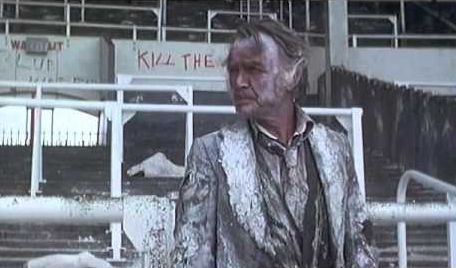
John Mills is impressively good at the start of An Endangered Species. Quatermass awakes in the bowels of Wembley Stadium to find that everybody has been taken (some seventy thousand people in the stadium itself, as well as Annie). As before, all that remains of them is an ashy substance. He staggers out into the daylight and is met by a group of guards, led by Brian Croucher.

This gives us an interesting contrast between two totally different styles of acting. Croucher is emotive, whilst Mills is steadfast and self-contained. John Mills, of course, had enjoyed plenty of practice in keeping a stiff upper lip in countless British war films – and that rather comes to the fore here. But I think he made the right acting choice. When faced with such a tragedy, the temptation is (like Croucher) to go overboard, but Mills was wise (and experienced) enough to know that less is more.

As we approach the end of the serial, it’s probably time to look at some of the themes contained within and ponder what Kneale was attempting to say. As he got older, Nigel Kneale gained the reputation of a grumpy old man and it’s fair to say that Quatermass reflects this.

It’s probable to assume that he spent the 1960’s not entirely in tune with the love and peace attitude of the flower power generation. All of the world’s ills (as seen in this serial) are laid at the feet of the young – this is explicitly stated by the older characters. The young (as depicted by the Planet People) are shown to be largely mindless sheep. This wasn’t the first time that Kneale had played on this theme (for example, the last episode of Quatermass and the Pit sees the majority of London under the thrall of the Martian influence).

But it’s more pronounced here and there’s no doubt that Kneale relished the idea of the older generation saving the day. “The theme I was trying to get to was the old redressing the balance with the young, saving the young.  Which I thought a nice, paradoxical, ironic idea after the youth-oriented 60s.”

Whatever the aliens are looking for, it seems to be contained within the young (although this doesn’t explain why Annie was taken from Wembley) and this means the older generation are largely immune. This leads to the incongruous sight of a group of white-haired scientists and soldiers toiling away to find a solution to the problem.

So we have a fairly clear picture that young = bad and old = good. There’s also the familiar theme that science = good and superstition/religion = bad. The conflict between science and religion is highlighted when Kickalong and his followers find Kapp alone in his observatory. Kapp still clings to the idea that he can contact the alien and transmit some sort of message.  After destroying all of his equipment, Kickalong offers Kapp the chance to join them. It seems that for a moment he’ll agree – but he manages at the last moment to resist.

Kickalong’s motivations have sometimes been difficult to understand and that’s the case in the following scene. We’ve already seen that he’s trigger happy, but he makes no attempt to kill Kapp – instead he leads his followers away. But he does kill one of them, Sal (Toyah Willcox), when she tells him that she wants to stay with Kapp. And it’s a brutal murder – he machine-guns her in the back.

After largely sitting out the third episode, Simon MacCorkindale has more to do in the final episode. And it’s he and Quatermass who man the invention that will stop the alien in its tracks. Quatermass has deduced that it somehow picks up a certain scent when a large group of young people are gathered together.  So (along with his octogenarian colleagues) he designs a device that will produce a scent which gives the impression that a million people are gathered together. And once the alien arrives, a small nuclear device should be enough to stop it. Of course, anybody in the immediate area will also die.

Those wondering if the plot-thread about Quatermass’ grand-daughter would be resolved will find that answered right at the end. She’s one of the Planet People (led by Kickalong) who descend on Quatermass and Kapp, just as they’re about to hit the trigger. There then follows a slow-motion sequence as the Professor and his grand-daughter are reunited and together they press the button which destroys them and the alien. Mills does his best here, but it is a slightly iffy scene – and the tinkling piano soundtrack doesn’t help.

The crisis is over. And with the destruction of the alien, somehow the whole world manages to right itself. This does imply that not only did the alien have the power to take millions of people from the surface of the Earth, it was also able to directly or indirectly influence every living creature. That’s something of a stretch – and the happy ending, after such a bleak, nihilistic tale, is a little jarring.

So where does Quatermass sit amongst Kneale’s works? At the time it received a generally lukewarm reception, with the Daily Telegraph calling the Professor “unheroic and unresourceful” whilst the Times found the production to be “so-so”. Kneale himself was later to register dissatisfaction with virtually every aspect of the production, from his own script to the performances of the main cast (including Mills and MacCorkindale).

Although it was Euston Films’ most expensive production to date (costing £1.25 million) it does look a little cheap in places (particularly the model-filming). Producer Ted Childs would highlight budget problems as well as the down-beat script as the serial’s main drawbacks. “The primary problems with it were (a) it was perhaps too depressing a story for a popular television audience and (b) the punters were used to a fairly high standard of technical presentation from American television… And we just couldn’t afford that.”

The fact that it remained rather unloved for many years is possibly the reason why it’s had a small upswing in popularity recently – as some people seem keen to champion it as an unheralded classic. It’s no classic, but it’s certainly worth a watch. Mills is unshowy but solid as Quatermass and MacCorkindale is more than decent.

But it’s probably true to say that if it hadn’t been a Quatermass story then it wouldn’t enjoy the reasonable profile it currently has.  Indeed, if Kneale hadn’t written it then it may have been largely forgotten today. However, it’s an efficiently made post-apocalyptic yarn that would have looked quite impressive in the late 1970’s (when the majority of British drama was still shot as a VT/Film mix).

The three Quatermass serials from the 1950’s do cast incredibly long shadows and therefore any fourth installment would have had a very hard job in equaling or surpassing their reputations. But if you ignore what came before, then Quatermass is well worth your time. Hopefully in the future it will receive the release it deserves (a BD containing both the four-part serial and The Quatermass Conclusion movie edit would be more than welcome).

Quatermass – Episode Three – What Lies Beneath

quat 3

Seperated from Annie and Isabel, an injured Quatermass finds help from an unexpected quarter ….

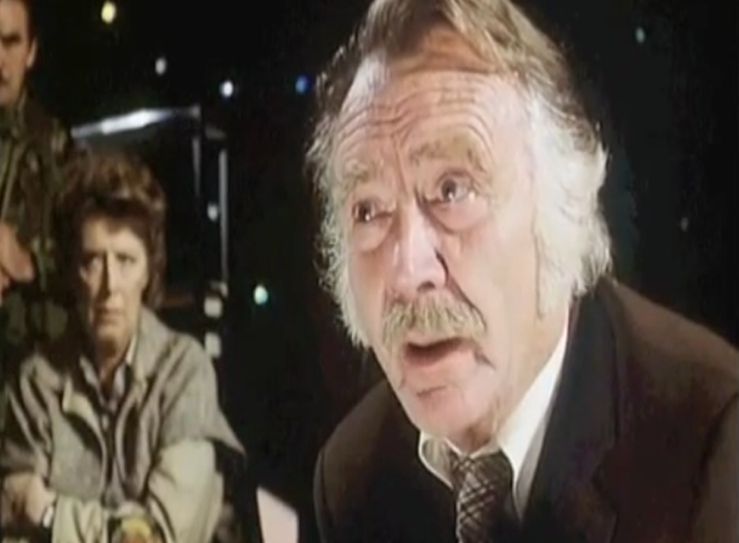
If the first two episodes concentrated on the young (the Planet People) then the first half of What Lies Beneath redresses the balance as Quatermass finds refuge with a group of senior citizens, led by Edna (Gretchen Franklin) and Jack (Larry Noble).  With society in tatters, they’ve had to scratch out a living below ground.  They’re mostly a rather sad collection of characters, although Franklin (later to become a regular on Eastenders) is good value.

Quatermass attempts to explain what he believes is happening – although what concerns them most is why the young should be saved and transported to another planet.  Why not them?  Of course, Quatermass doesn’t believe they were “saved” and later on he’ll reveal his theories ….

This part of the episode is nicely lit – as the underground location provides some interesting shadows.  But when a group of soldiers (guided by Annie) rescue him, it’s possible to wonder whether the whole section was simply a case of running on the spot (as the plot seems to have advanced very little).  We’ll have to wait until the final episode to see if there’s any pay-off for the characters introduced here.

Isabel is dead – Annie and the doctors watched, helpless to intervene, as she levitated from her hospital bed and then disintegrated.  It’s quite an arresting moment and although the effect was low-tech, it was still effective.

A common theme of the Quatermass serials was how the Professor was unable to convince the authorities that the danger was real.  Here, that’s not the case (at least temporarily) and the second half of What Lies Beneath sees Quatermass work with the remnants of the British government.

First, he and the army take over the sole remaining television station – British Television.  The logo is rather similar to one used by the BBC and it’s possible that Kneale was taking something of a swipe at his old employers.  With the country in desperate straights, BTV’s most popular programme is a bizarre soft-porn show called Tit-Umpity-Bumpity,  When the rather camp director (Tudor Davies) is firmly told that the studio is needed for a slightly more important purpose he gives way, although with very ill-grace.  “It’s the only show that anybody watches anymore.  Don’t they realise?”

The television land-lines allow Quatermass to link up with the Rusians and Americans and he propounds his latest theory.  Areas such as Ringstone Round were visited during their creation by the aliens, who somehow implanted triggers (possibly deep underground).  When the time was right (as now) the signal would be activated and the young would be irrestably drawn there.

The Americans want to send a spaceship to intercept a mysterious object in space, but Quatermass tells them it’s not a good idea.  “The ripe crop can’t appeal to the reaper.  I think this is the gathering time.  The human race is being harvested.”  This is a familiar Kneale trope.  Alien intelligences in the Quatermass stories are never corporeal or articulate.  Instead, it’s up to Quatermass and others to suggest what their motives are – based on the available evidence.

Next, he meets with the Prime Minster (the always impressive Kevin Stoney in a rather small role, sadly) and David Hatherley (David Ashford).  Ashford’s probably best known (to me anyway) for his many appearances as Charles Lotterby in Crown Court.  The news that thousands of Planet People are moving towards Wembley Stadium concerns Quatermass, although Hatherley (who’s heard the Professor’s theory that the young are taken from sites with a spiritual or magical nature) is sceptical that it’s going to happen at Wembley.  Although Quatermass does remind him of the sacred turf!

As for Joe Kapp, he spends the episode walking around in a daze – viewing the devastation of his home and hearing the voices of his children in his head.  There’s a dreamy (or nightmarish) quality about these scenes and it’s interesting that by this point in the story the position of Quatermass and Kapp has totally reversed.  At the start, Quatermass was barely functioning whilst Kapp was in command.  But the loss of his family has rendered him bereft.

Annie and Quatermass observe the growing clamour at Wembley.  The plot makes another swift gear-change as the soldiers and Hatherley turn on the pair of them – shooting at the Land-rover they’re sitting in.  More converts to the Planet People maybe?  Annie is hurt, possibly dead, so it looks as if Quatermass is on his own once more.

Quatermass – Episode Two – Lovely Lightning

quat2

The first half of Lovely Lightning is something of an exercise in mood and atmosphere – it”s certainly far removed from the dialogue-driven Quatermass serials of the 1950’s.  In the aftermath of the tragedy at Ringstone Round, Quatermass, Kapp and Clare find a survivor – Isabel (Annabelle Lanyon).

The three of them try to take her to safety, but the Planet People, headed by Kickalong (Ralph Arliss), are keen to prevent them.  It’s fair to say that a little of the Planet People does go a long way – but unfortunately there’s quite of a lot of them in this episode.  Arliss isn’t presented with much of a character, but he does his best with what he’s been given.  The problem is that the repetitive dialogue and actions of the Planet People ensure that they’re not the most interesting or engaging of characters.

En-masse though, even though they appear to espouse non-violence, there’s something sinister and threatening about them.  This is reinforced later on, when Kickalong leads an attack on a man barricaded in his home.  The Planet People initially seem just to want food, but that doesn’t appear to be Kickalong’s motive – he’s happy to fill the unseen man full of bullets and move on.

We get our first indication in this episode that the Planet People aren’t necessarily acting on their own initiative.  Alison (Brenda Fricker) leaves to join them – and it’s clear that she had no choice.  Later Quatermass muses on what they already know.  “Immense power, approaching through decades.  Decades to us, a few seconds in some inconceivable timescale.  The most vulnerable of human organisms, always the most recently formed – the youngest.”

So has some alien entity been able to manipulate a whole generation of people for their own ends?  This would partly explain why society has fractured – although if the problem is as widespread as it appears to be it’s difficult to believe that the connection hasn’t been made before.

It’s not just the young who are affected though, as Clare also starts to act oddly – after nursing the stricken Isabel.  Barbara Kellerman has some tricky moments in this episode (as Clare begins to fall to pieces).  Another actress with some challenging scenes is Margaret Tyzack as the District Commissioner Annie Morgan.  She’s initially presented as a cheery figure, who then collapses once she sees Isabel, and then recovers again.  The reason for these wild mood swings isn’t clear – logically it would be because she knew Isabel, but this doesn’t seem to be the case.

The Americans have got back in touch with Quatermass and they now need his help.  The massacre at Ringstone Round wasn’t an isolated incident (something similar happened in Brazil with thousands of young people).  Quatermass and Annie head for London, taking Isabel with them.  The Professor argues that as she’s the only survivor, she’s an invaluable witness.  The sort of tests he’ll run on her aren’t made clear, but there’s a strong inference that it won’t be pleasant.  Quatermass is firm though – in order to save more lives it’s possible that sacrifices will have to be made.  This is a key scene – as we see an assured, confident Quatermass.  As he leaves, one of Kapp’s daughters states that the old man doesn’t seem so old any more.

Kapp leaves Clare and the children behind as he visits Ringstone Round again.  When he returns, the house is deserted and it shows signs of an alien attack.  And with Quatermass and Annie facing danger on the streets on London, this gives us two strong hooks to lead into the third episode, What Lies Beneath.

Quatermass – Episode One – Ringstone Round

quat1

Following the critical and popular success of Quatermass and the Pit, Nigel Kneale was asked if he would write any more Quatermass stories.  He didn’t rule it out, although he also conceded that the three serials made a satisfying trilogy.  In the mid 1960’s, Irene Shubik asked him to pen a new Quatermass tale for the flagship BBC2 science-fiction anthology series Out of the Unknown.  Kneale declined (although he would write a non-Quatermass story – The Chopper – for the fourth and final series.  But like many of the later episodes, this was sadly wiped).

By the early 1970’s Kneale had begun to draft a fourth Quatermass serial and, like his previous work, it was offered to the BBC.  It didn’t generate a particularly favourable response from them though – and this seems to be a major factor in Kneale deciding to move to ITV (who would produce his later series, such as Beasts and Kinvig).

Euston Films (a subsidiary of Thames Television) were interested in his Quatermass story and in 1979, some twenty years after Quatermass and the Pit, the Professor made his final bow.  During those twenty years both television and society had both changed enormously – and Quatermass reflects this.  It’s by no means perfect (and it’s always been the most polarising of the serials) but there’s enough going on to make it a rewarding watch.

We open on a Britain that’s close to collapse.  The opening narration fills in some of the blanks, but it’s never made clear in the first episode exactly why the world is teetering on the brink.

In that last quarter of the twentieth century, the whole world seemed to sicken.  Civilised institutions, whether old or new, fell.  As if some primal disorder was reasserting itself.  And men asked themselves, why should this be?

Quatermass is on his way to a television studio to take part in a discussion celebrating the link-up in space of the two great powers – America and Russia.  But he has another motive for taking part – his granddaughter has disappeared and he wishes to appeal to the public for information.  He nearly doesn’t make it to the studio though, as he’s waylaid by a group of thugs.

They’re very well-spoken thugs though and this is an interesting wrinkle from Kneale.  Civilisation has collapsed – with vast areas of the country seeming to operate on a feudal basis – and the upper-class muggers demonstrate that all the different classes of society are now existing on the same level.  We later see some very polite graffiti scrawled on a wall (calling for the death of the King) which seems to make the same point.

Quatermass is rescued by Joe Kapp (Simon MacCorkindale).  Like Quatermass, he’s appearing on the show and he’s also a scientist who’s well aware of the Professor and his reputation.  Kapp clearly identifies with him (he later admits as much to his colleagues) and he takes it upon himself to look after the old man.

And this is a very different Quatermass from when we last met him.  His sharp intellect seems to have been blunted by being away from the centre of things for too long (he’s been living in a cottage in the Highlands of Scotland and was therefore unaware just how dangerous the cities had become).  But it’s interesting to see that as the story progresses he gradually recovers much of his authority (once he has a problem to solve).  In this first episode though he’s quite a passive figure – and it’s Kapp who’s the more forceful, driving individual.

Quatermass’ appearance on television certainly causes a stir as he delivers a remarkable tirade.  How much of this was Kneale’s own thoughts I wonder?  “What we’re looking at there is a wedding.  A symbolic wedding between a corrupt democracy and a monstrous tyranny.  Two super-powers, full of diseases.  Political diseases, economic diseases, social diseases.  And their infections are too strong for us, the smaller countries.  When we catch them, we die.  We’re dying now.  And they mock us with that thing?  Well their diseases are in there too.  It’ll come to nothing.  Sooner than they think.”

Minutes later. the link-up ends in tragedy and all the astronauts are killed.  The Americans naturally want to know how Quatermass knew this was going to happen.  He maintains he didn’t, it was just his feeling – but it’s clear that he’s going to be hounded, so he gladly escapes to the country with Kapp.  There he meets Kapp’s wife Clare (Barbara Kellerman), their children, and the three people who help Kapp with the work at his observatory – Tommy Roach (Bruce Purchase), Frank Chen (David Yip) and Alison Thorpe (Brenda Fricker).

The second part of the episode resolves around the Planet People.  You can view them as new-age travellers (although when Kneale first wrote the scripts back in the early seventies, it was clear that they were meant to resemble hippies).  Kneale himself regarded their appearance in 1979 as somewhat anachronistic and thought they should have been dressed as punks – although their mystical utterances would have seemed rather out of place had this been the case.

The Planet People regard Quatermass with disgust – bad enough that he’s a scientist but he worked with rockets (which is even worse).   Quatermass is interested in them and tries to understand their beliefs.  They tell him that they will be saved and transported to another planet.  This enrages Kapp who attempts to make them see the folly of this.  He doesn’t succeed and a large number of Planet People converge on Ringstone Round (like Stonehenge, it’s a fashionable place for those with new-age beliefs).

What Quatermass, Kapp and Clare observe at Ringstone Round fills them with horror.  A beam of light obliterates almost all of the Planet People.  It’s certainly an arresting image which showed that Kneale still knew how to craft a good cliff-hanger.

The Sandbaggers – Special Relationship

special

An East German spy called Mittag (Brian Ashley) has obtained aerial photographs of a new missile complex which is probably targeting R.A.F. bases in West Germany.  This information is vital, but there’s a problem – Mittag is convinced he’s under observation, so he won’t travel over to the West.  Instead, he wants somebody to collect the pictures in person.

The question is, who?  There seems to be a shortage of possibilities, as whoever goes has to be Berlin-orientated (i.e. able to pass themselves off as an East Berliner).  Laura has all the qualifications, but Burnside is very reluctant to consider her.  Is it because of their growing relationship or is there another reason?

Willie offers to go – although Burnside points out how foolish that would be, since he doesn’t speak German.  He breezily says he’ll go over the Wall, and it’s clear that he’s made the offer to save Burnside from having to send Laura.  Eventually, Burnside decides that Laura is the right person for the job, and she’s sent in.  But the nightmare happens and she’s caught by the authorities, which leaves Burnside with a limited number of options, all of them bad.

Special Relationship is the ultimate example of how compartmentalised Neil Burnside is.  There’s no doubt that he’s in love with Laura (he’s seen smiling several times in the early part of the episode, which is far from normal behavour) and after she’s detained he starts to make frantic attempts to secure her release.  Given their relationship this is understandable, but there’s another reason.  Before she was sent to East Berlin, Laura was briefed on the Hungarian networks – and if this information is extracted from her it could mean the deaths of dozens of people.  Was this the real reason why Burnside was reluctant to send Laura in?  As so often, there’s no “right” answer – maybe it’s a combination of this and his genuine feelings for her.

Time’s not on his side – within forty eight hours she’ll have told them everything she knows, so she has to be recovered before then.  A swop would seem to be the best option, but there’s nobody currently held by the British who fit the bill.  The French have somebody though, but will they agree to hand him over?  They do, but the price is incredibly high – they want access to the information supplied to the British by the Americans (via the special relationship).  They also want a signed agreement from “C” and Sir Geoffrey Wellingham confirming this.

If the Americans found out that their information was being passed over to the French it would be the end of the special relationship, but Burnside has no other options.  He speaks to “C” first.  “C” says that if they sign it, both he and Sir Geoffrey will be finished, politically.  Burnside agrees, but tells him that his career is drawing to a close anyway.  “C” concurs but ruefully muses that “I had hoped not to end mine in disgrace.”  He reluctantly signs.

Sir Geoffrey is harder to convince.  He’s still smarting over Burnside’s treatment of his daughter and even when Burnside tells him that he’s in love with Laura, Sir Geoffrey doesn’t believe him.  “I think you’re lying Neil.  The way you always lied, cheated, double-dealt to get your own way.”  Burnside makes no defence of his past, but tells him he’s not lying this time.  Sir Geoffrey signs as well.

So this is a three-cornered problem.  Protect the Hungarian networks, maintain the special relationship and save Laura Dickens’ life.  Two out of the three can be done, but not all.  By this point in the story it should already be clear which will have to be sacrificed.

Laura is shot and killed at the rendezvous point before she’s exchanged for the Russian prisoner.  Her death has saved the Hungarian networks and since the exchange didn’t go ahead it allows Burnside to declare the document drafted to the French null and void.  So it’s Laura who was expendable, killed on Burnside’s command.  It’s a powerful moment, with her dead body lying almost at Burnside’s feet.  The split-second before she was shot we see her smile at him, which just twists the knife a little more.

Caine lashes out at Burnside.  This event signals a change in their relationship which will be reflected in the following two series.

CAINE: You bastard! Why?
BURNSIDE: You know why. I had to get Laura away from them, into the open to save the Hungarians. To do that I had to set up the swap with …
CAINE: But why the hell didn’t you swap?
BURNSIDE: I couldn’t. The only way I could convince the Americans was by guaranteeing that there would be no swap. Look, you must see it Willie.

It’s another jarring move by Ian Mackintosh.  Having killed off two Sandbaggers in Is Your Journey Really Necessary? it didn’t seem likely that another death would happen so soon.  Everything looked to be set up to develop Laura’s character further, as she’d only featured in four episodes and there was still considerable scope for broadening her relationship with Burnside.  Her sudden, brutal death brings this to an end – and it’s also an incredibly powerful way to bring the first series of The Sandbaggers to a close.

The Sandbaggers – A Feasible Solution

feasible

A top missile engineer, Professor Colby (Donald Churchill), has disappeared in Cyprus.  When news filters through that a Russian expert in missile guidance has also gone missing, it starts alarm bells ringing. Burnside, Laura and Willie kick around possibilities about who could have taken them.  In the end it seems that a group operating in Cyprus, such as the Greek Cypriot National Front, are the most likely suspects. Smuggling missiles into or out of Cyprus would be tricky – much better to have them prepared inside the country.

Another complication occurs when the deputy head of station in Cyprus is brutally killed. Logically, it makes no sense – until now it was only a theory that forces within Cyprus were responsible for kidnapping the scientists, but this murder seems to prove it. Burnside dispatches Caine to Cyprus and he’s accompanied by the replacement deputy, Jill Ferris (Sarah Bullen).

Wille’s not happy about minding a woman, but she quickly proves to be more than capable – which raises his suspicions, as she’s supposed to be fresh out of the training school. The answer is that she’s a Russian agent, who’s disposed of the real Jill Ferris (the Russians also killed the previous deputy head of station, so they could replace him with one of their own). Since the Russians only have a limited presence in Cyprus it makes sense for them to work covertly with the SIS. For now, Caine is told to play along with her – which may be a problem as he seems to find her somewhat attractive.

A Feasible Solution is a somewhat unusual episode of The Sandbaggers since it features quite a heavy amount of gunplay and plenty of dead bodies.  As soon as Caine and the bogus Jill Ferris arrive in Cyprus, they find themselves pitched into an intensive gun battle.  It’s interesting to hear Willie say that he doesn’t really like guns and Burnside comments that it’s the first time in over a year that Willie Caine has been armed.  Although he’s the chief Sandbagger, it seems that killing people isn’t something he particularly cares for – although he’s undoubtedly good at it.

Once again we see the UK doubling for a foreign country.  It works quite well here – thanks to the fact that the sun shone when the filming took place.  The soundtrack of chirping insects also helps to create the illusion of being abroad.  The missing scientists are almost a Macguffin, since the thrust of this part of the story is concerned with the relationship between Willie and Jill, as well as providing us with a more action-orientated episode than is usual.

Back in the UK, Burnside pays a visit to the section psychiatrist Philip Jeremiah (Richard Cornish).  Burnside tells him he’s convinced that Laura Dickens has some sort of hang-up and he wants to know what it is.  Jeremiah replies that she has no hang-up which will affect her performance as a Sandbagger, but there is something.  “She was dominated by her parents and told that all men are beasts, that sex is simply for the propagation of the species.”

The conclusion seems to be that Laura is very emotionally fragile. When Burnside asks how she would respond to kindness, say a dinner invitation, Jeremiah tells him not to try and hustle her into bed. “Incurable romantic” mutters Burnside in return. But he seems to have got the answer he wanted, and this is the clearest evidence yet that he’s interested in her as a person and not just as a Sandbagger.

Burnside and Laura have their dinner.  It’s another good scene from Marsden and Keen, with Burnside acting somewhat hesitant (a departure from his usual gruff, professional attitude).  When they return to his flat for a drink, she tells him that, given her past, he’ll have to be patient.  He replies that he can be, and the scene ends with Burnside laughing.  Which isn’t something you see every day!

By the end of the episode, he’s back to his usual, cold self though.  Caine has returned – and he’s managed to rescue Professor Colby.  The fake Jill Ferris also located the Russian scientist, Yugorov, although since he defected willingly she kills him.  Caine and Ferris go their separate ways, much to Burnside’s annoyance.  “You were alone with Colby and Yugorov whilst she made a dummy run with the ambulance. You didn’t think to put a bullet in Yugorov, blame it on the opposition? With Yugorov dead and out of the way, she’d have kept her cover and stayed on as the Cyprus number two and we could have fed her false information.”

A Feasible Solution is a good story for Ray Lonnen, as it allows us to see how well Caine works in the field.  It also develops the Burnside/Laura relationship – which is going to be resolved in the next story, which was also the final story of the first series, Special Relationship.

The Sandbaggers – Always Glad To Help

always

The M.O.D. are concerned about a Russian merchant vessel called the Karaganda.  They believe it may be a spy ship and want Burnside’s help to investigate it.  He considers that the Royal Marines and the S.B.S. (Special Boat Service) would be the best people for the job and refuses.  The Director General of Intelligence at the M.O.D. (Gerald James) threatens to go over his head, but Burnside, as usual, isn’t intimidated.

Back at HQ, we see Peele visit Burnside in his office.  It’s interesting to see how Caine and Burnside react.  Caine immediately stands up when Peele enters the room but Burnside doesn’t.  Since Peele outranks Burnside he should have stood up too, but he’s clearly got no time for such formalities.  He’s even less time for Peele’s request that they need to reduce the special section’s travel costs by 10%.  “If they go first class they arrive fit, if they go economy they arrive tired.  The difference could be their lives.”

Once again, Burnside ridicules Peele’s lack of operational experience.  Although Peele was the one-time head of the Hong Kong station, Burnside retorts that “the only thing you put at risk was your liver.”  This initial spat is merely the prelude for the main part of the episode, as we see Peele and Burnside once more cross swords.

Hamad (Peter Miles) is the Crown Prince of a small Middle Eastern nation.  He’s approached Wellingham and asked for his help in engineering a coup and thereby removing his father (a pro-Russian supporter) from power.  Wellingham is keen to assist, for various reasons.  “We help him get rid of his father, he turns the Sheikdom pro-West.  Buys British weapons, gets a British firm to build the new refinery.”

There’s no two ways about it – Peter Miles isn’t of Middle Eastern descent.  Sixties and Seventies television were full of British actors playing various nationalities (of varying believability) and The Sandbaggers was to be no differerent.  It’s difficult to take Peter Miles (especially when he’s slightly browned-up)  that seriously, which is a slight problem.  Also noticeable is the scene in Wellingham’s club, just after we’ve seen Hamad for the first time.  Roy Marsden’s face seems to be caked in orange make-up.  It’s very odd and doesn’t re-occur elsewhere during the story.

Anyway, back to the story.  Wellingham is keen to press ahead as quickly as possible, but Burnside is cautious.  He made his position clear in First Principles – a mission can only succeed when there’s clear and solid information.  At present, too much is unknown.  Most importantly, is it known for sure that Hamad would be sympathetic to the British government?  To overthrow a dictator and then put somebody worse in their place is far from desirable.

Burnside outlines some of the essential information he requires to Peele.  “How much support does Hamad have in the country, how well organised is it and how quickly can it be rallied?”  Burnside isn’t impressed by Peele’s statement that they should move ahead simply because Wellingham wants it to happen.  “To hell with Wellingham, he’s feathering his own nest as usual.”

In order to try and answer the question as to where Hamad’s sympathies lie, Burnside elects to find out by using Laura’s undeniable feminine charms.  But before this, they have a typically stormy meeting – Laura tells him she wants to leave the Sandbaggers at the earliest possible opportunity (mainly because he’s their boss).  Burnside responds by calling her a bitch once she’s exited the office.  Caine cheerfully tells Burnside that they’re clearly both in love with each other – they just don’t know it yet.

Laura makes an immediate impression on Hamad by rolling over her car in front of his.  They quickly begin a relationship and he seems besotted with her.  Peter Miles’ staccato delivery is oddly unnerving and the casual clothes that Hamad wears when they go bowling are interesting, shall we say.  Diane Keen does her best and it’s a memorable part of the story, but possibly not for the right reasons.

Much better is a scene between Burnside and Laura at his flat.  The fact she’s there at all is noteworthy – as you get the impression that not many people are invited around.  There’s some nice playing from both Marsden and Keen here.  Maybe Willie was right and there is a spark of attraction, but who will make the first move?

Burnside goes to make coffee and opens up a little.  “All of us have aspects of our lives with which it’s difficult to cope. In the office, I’ve learnt to survive. At home, I’m unprotected – from visitations, faces, eyes, voices.  Two more in the last few weeks.”

As the preparations for the proposed coup go ahead, Peele is dismayed to find the M.O.D. dragging their feet.  When he’s told it’s because Burnside refused to help them over the Karaganda, he promises to get it sorted, which he does – much to Burnside’s disgust.

Burnside’s slow and methodical information gathering regarding Hamad is proved to be the prudent course – eventually it’s proved that had the British intervened it would have been disastrous.  The Karaganda was discovered to have an underwater hatch as an outlet for divers, so according to Peele it’s shared honours.  “You were right about Hamad, I was right about the Karaganda.”  Burnside’s reply is cutting and it looks as if his frosty relationship with Peele isn’t going to thaw any time soon.

Always Glad To Help has some nice character touches for Burnside and an impressive car stunt (when Laura overturns her Mini in front of Hamad).  As I’ve said, Peter Miles is a bit of a weak link, but that’s more down to his miscasting then anything else.  Otherwise it’s typical Sandbaggers – the majority of the battles we see in the series aren’t fought overseas, but rather closer to home – and with words, not guns.

The Sandbaggers – The Most Suitable Person

suitable

There’s a lot going on in The Most Suitable Person.  Firstly, Des Yardley, a member of the Morocco station, is found murdered in Gibraltar.  He’s normally based in Tangier, so his presence in Gibraltar is a mystery – as is the reason for his death.  Burnside elects to send Willie Caine to investigate.  He knows that Caine isn’t the world’s best investigator, but he’s good at stirring things up – and this should enable him to flush out the murderer.

With Caine in Gibraltar, this makes finding replacements for Landy and Denison ever more pressing.  The problem is that Burnside has exacting standards and there doesn’t seem to be any trainees even remotely suitable.  Out of the current crop of active SIS agents, Caine knows that Colin Grove (Jonathan Coy) is very keen to join the special section, but Burnside is dismissive – he doesn’t think he’s even remotely suitable.  And when Bob Sherman tells him that Grove has been seeing a Hungarian psychiatrist, it raises the possibility that he’s a serious security risk – with both British and American secrets potentially passed over to a hostile power.

In addition to the mysterious death of Yardley and the investigation into Grove’s conduct we also have a third element to the story, the newest recruit to the Sandbaggers – Laura Dickens (Diane Keen).  Laura is by far the best of the new recruits, but Caine knows that the boss isn’t going to like it – because she’s a woman.

Laura Dickens (Diane Keen)

Burnside reluctantly agrees to see her (and there’s a nice moment when, just before she enters his office, he tidies up his desk and straightens his tie!).  He asks her if she’s interested in joining the special section and she tells him no, she’s not.  Her cool dismissal of a posting that most people would give almost anything to achieve, clearly intrigues him.  Laura explains the reasons why.

I’ve never been very good at playing Cowboys and Indians.  You see, I can’t help feeling that special sections exist because they create work for each other. You manipulate yours, so the other side manipulate theirs. It may keep everybody happy but what does it achieve in the long term?

It’s her belief that she’s wrong for the job than convinces Burnside that she’s exactly right.  “Volunteers for the special section usually see themselves as James Bond.  I’d rather have someone, male or female, who sees the job in perspective.  A while ago I tried to change the name, special section, into something less evocative.  As far as I’m concerned it’s only special because few people are right for it.”

Laura agrees to join the Sandbaggers on a temporary secondment – until Burnside can find permanent replacements for Sandbaggers Two and Three.  He then dispatches her to Tangier in order to discover what Yardley was working on.  Before she goes, he gives her his personal phone number and tells her she can use it to contact him anytime.  Professional or personal business?  The Burnside/Laura relationship begins here, and it’s something that will be a prime focus of the remaining series one episodes.

Meanwhile, Willie’s following up leads in Gibraltar (actually it’s filmed, like most of the foreign locations in the series, around the Manchester area!).  He gets to experience a bit of gunplay – although it’s clear that The Sandbaggers isn’t aiming at James Bond-style glamour and action.  When Caine returns a borrowed car to Detective Chief Inspector Gomez (Stephen Grief), he offers to clean it first – because he’s been sick in it (following the gun battle).  It’s a small character beat that helps to highlight that even the most experienced of agents are subject to normal stresses and strains.

The three plot-threads of this episode does mean that it feels a little fragmented and subsequently it’s not as compelling a drama as say, Is Your Journey Really Necessary?. Laura’s introduction is the obvious highlight and she quickly proves to be a more than capable officer – she uncovers the reason for Yardley’s trip to Gibraltar and this information helps to foil a terrorist attack on a passenger plane.

The truth about Grove is also established, which allows Burnside the satisfaction of getting one up on MI5.  He explains this to Peele at the end of the episode, thereby giving Jerome Willis a nice character moment.  Willis was absent from the previous episode, and is only on the periphery in this one, which is a shame as he was always a very watchable actor.  But the next episode does offer him a little more scope ….

The Sandbaggers – Is Your Journey Really Necessary?

journey

Is Your Journey Really Necessary? opens in the Ops Room, where Burnside, Caine and the others are following the progress of Operation Nightingale. Burnside mounted it as a favour for the CIA, but it ends in tragedy for the Sandbaggers.

Sandbagger Two, Jake Landy (David Glyder) is caught behind enemy lines with no possible means of escape. So Sandbagger Three, Alan Denison (Steven Grives) is ordered to shoot him, rather than let him fall into Russian hands.

Afterwards, “C” and Burnside have a postmortem meeting. “C” tells him that the mission was carried out without departmental or political clearance. Burnside is unabashed and also explains that Landy was killed on his orders. “To avoid giving the FCO and Number 10 the excuse they need to tie the other hand behind my back.”

When Denison returns, Caine offers him another reason why Landy had to die – if he’d been captured, then he would have been tortured, exhibited on a show-trial and executed. At least this way it was quick.

It’s interesting that there are only ever three Sandbaggers (agents trained to carry out “special” operations). With the whole of the globe to cover, this does mean that they are invariably spread very thin. The loss of Landy is therefore bad, but when Denison breaks the news he wants to quit, it throws Burnside into a tail-spin.

Denison wants to get married and doesn’t feel that he can carry on as a Sandbagger once he has a wife. Whilst Burnside is cordial to his face, behind his back he makes it quite clear to Caine they’re going to keep him, by whatever means necessary.

The obvious problem is Denison’s girlfriend, Sally Graham (Brenda Cavendish). She’s already been vetted, but Burnside wants her watched and he wants some dirt on her. The first couple of episodes have already demonstrated just how ruthless Burnside can be, but here it moves to a whole new level.

Caine follows Sally and photographs her enjoying a meal and staying the night with a male friend (whilst Denison is out of the country on a mission). At the same time, Burnside burgles her flat to look for anything incriminating. He’s happy with Caine’s pictures, as whilst Caine says they don’t prove anything, Burnside isn’t concerned with that. “I’m not interested in proof. Suspicion’ll do me.”

Burnside corners Sally, shows her the pictures and tells her to break off the relationship with Denison. Although Sally denies anything happened, Burnside brushes this off and then chillingly tells her “I can have you taken off the streets, drugged, stripped and into bed with a dozen different men. Then I can have you done for soliciting, shoplifting, breaking the Official Secrets Act.” And given what we’ve seen of him, it’s possible to believe this is no idle threat.

Events then take a tragic twist. Denison calls Sally to tell her he’s reconsidered and wants to stay with the Sandbaggers. Sally, still upset from her meeting with Burnside, doesn’t take the news at all well.  Shortly afterwards we learn that Denison is dead – he wasn’t killed on the mission, he was knocked down by a car in a simple accident. As Caine says, he obviously had things on his mind. And it’s interesting that we don’t even see this, as his death happens off-screen.

So in the course of one episode, two members of the Sandbaggers have died. First time viewers would probably have expected that both of these characters would be regulars, so their deaths are something of a jolt.  In the last episode we were told that the previous Sandbagger fatality happened three and a half years ago.  That was clearly a wrong-footing move to lull the audience into a false sense of security, as here we see just how dangerous the job of a Sandbagger can be.  Or are we meant to consider the culpability of Burnside?  He’s only been D-Ops for a short while, therefore both deaths occured on his watch.

Sally is also dead – from an overdose of sleeping pills. Although Burnside didn’t think he was too hard on her, it was obviously more than enough to push her over the edge. Had Burnside agreed to let Denison go, then they probably would have both still been alive. His decision to fight to keep him indirectly resulted in both of their deaths.

This is a bleak, bleak tale that brings into question the judgement of Neil Burnside. And it certainly won’t be the last time that he’ll have the deaths of colleagues on his conscience ….

The Sandbaggers – A Proper Function of Government

proper

A Proper Function of Government is an archetypal episode of The Sandbaggers – low on action but high on character and debate.  Although there is a mooted mission in Africa as well as an actual one in Vienna, the majority of the story is firmly based at the SIS HQ in London (and the brief scenes in Vienna were obviously not filmed there).

There’s plenty of pointers here about the character of Neil Burnside.  He’s quite happy to take decisions independently (sending one of the Sandbaggers to Iran, for example) without first consulting his immediate superior, Peele.  Peele has found out, but Burnside is able to talk him round.  Since neither Peele or “C” have any operational experience, Burnside is happy to trust his judgement over theirs and make unilateral decisions.  This is something that will cause him problems in the episodes to come ….

There are two main plot-threads in A Proper Function of Government.  The first concerns Sir Donald Hopkins (Lawrence Payne) who is the chief scientific advisor to the government.  He’s currently on leave and his leave form stated he would be fishing in Scotland.  But he’s been seen in Vienna – which raises the possibility that he’s preparing to defect.

Burnside approaches Wellingham to break the possible bad news.  Wellingham is appalled – Sir Donald is a personal friend and he finds it difficult to believe he could be a traitor.  Sir Donald Hopkins is portrayed as a typical establishment figure, with many friends in high places (including the Prime Minister).  The year after this episode was broadcast, Anthony Blunt was exposed as a Russian spy, although his treachery had been known in intelligence circles for many years prior to this. If Ian Mackintosh did have links with the intelligence community, then it’s possible that Hopkins was inspired by Blunt’s case.

The second plot-thread concerns a small African state headed by President Lutara.  He’s no friend of Britain and during the last year has executed several British citizens.  The latest murder brings back unhappy memories for Willie, which he relates to Sandbagger Three, Alan Denison (Steven Grivies).

About three and a half years ago, the boss was Sandbagger One, I was number two and Sandbagger Three was a lad called Bob Judd. He was younger than you are. It was the last time we lost a Sandbagger, so we do remember it quite well. He died in East Africa – one of Lutara’s ant-hills. He was alive when they put him on top of it, but they cut his stomach open and the ants found the cut.  And there was nothing we could do about that. Not even Neil Burnside could go for a head of state without permission.

Maybe the latest death will push the government into action?  Again, this is something that could have been taken from the headlines.  Stories of covert operations, such as the one Willie hopes to mount, have been rife for decades.  Willie, of course, wants to lead the mission (if one is agreed).  He makes this quite clear to Burnside, but Burnside has an agenda of his own.

He dispatches the two Sandbaggers in London to Vienna – so that they can monitor Hopkins.  He’s clearly done this deliberately, so that he can request the Lutara mission himself.  For a Head of Operations to go back into the field is unusual, to say the least, and Burnside is prepared to play every card he has in order to get his own way.  He sets up a meeting with Wellingham and tells him that he’ll go back to Belinda (his ex-wife and Wellingham’s daughter) if the mission is approved and he’s selected to carry it out.  This is a good insight into the single-minded focus of Burnside – he’ll do anything to achieve the result he requires.

In the end, it comes to nothing as the government refuses to green-light the mission.  “C” tells Peele and Burnside that the Prime Minster doesn’t approve of political assassination.  “He does not consider assassination to be a proper function of government.”

Later, Wellingham authorises Hopkins to be picked up.  He tells them that “the Prime Minster made a good point. He feels that Hopkins might start shouting on the way back. Say as he’s going through immigration and customs. Declare himself for what he is and tell the world he’s being forced out of Austria by the Secret Service. It would be almost as damaging to the government as if he actually defected.”  Wellingham spells it out – they have authority to kill him.

Burnside is quick to point out the paradox.  “We can’t knock over a lunatic who’s murdering ever day, but a man who threatens the government’s future, all the jobs and the perks that go with it, not only authority to assassinate, but instant authority.”

Late on, there’s a spellbinding scene between Roy Marsden and Alan McNaughtan.  Willie Caine’s reason for wishing to take the Lutara mission has already been established – but Wellingham knows that Burnside isn’t interested in vengenace for Bob Judd.  The sucessful assassination of Lutara would have significantly increased Burnside’s chances of promotion – and he judged that not only was a dangerous mission (where he might be killed) was worth it, he was also prepared to restablish a relationship with a woman that he clearly no longer loves.  For Burnside, the SIS is his whole life.

This is an absorbing fifty minutes of drama, which sets up many of the character dynamics and conflicts which we’ll see play out as the series progresses.

The Sandbaggers – First Principles

first

The Sandbaggers ran for three series, and twenty episodes, between 1978 and 1980.  Hailed by the New York Times as “the best spy series in television history” it’s a show that eschews the glamour of James Bond and instead is located at the more realist end of the genre, alongside the likes of Callan and Tinker Tailor Soldier Spy.

The series was created, and largely written by, Ian Mackintosh.  Mackintosh, a former naval officer, penned all the episodes from the first two series as well as four from series three.  However, during production of the third series, the plane he was piloting went missing near Alaska and neither Mackintosh, or his girlfriend, were ever found.  The authenticity of The Sandbaggers has led many people to suppose that Mackintosh had previously worked for the intelligence services and some also believe that his disappearance was not a simple accident.

His loss meant that several other authors were drafted in to provide episodes for the third series, but without Mackintosh’s guiding hand it was clearly felt that the series had run its course.

Rewinding back to the first episode of series one, First Principles acts as a strong introduction to many of the main characters.  Neil Burnside (Roy Marsden) is always at the centre of the series.  Burnside is the Director of Operations (D-Ops) for the Secret Intelligence Services (SIS).  In order to carry out the numerous dirty jobs requested by his masters, he has three highly trained operatives, codenamed Sandbaggers.

Burnside is humourless, totally driven, somewhat arrogant and seems to exist only for his work.  His marriage, to Belinda, foundered some time ago – although he still keeps in contact with his former father-in-law, Sir Geoffrey Wellingham (Alan MacNaughtan), who is the Permanent Undersecretary of State.  They enjoy a sometimes cordial relationship which is rather frowned upon by Burnside’s immediate superior, Matthew Peele (Jerome Willis).

Peele is the deputy director of SIS and is clearly presented as a man who lacks field experience, which means he’ll often clash with Burnside over operational matters.  Burnside previously served as a Sandbagger, so at least he understands the implications of the jobs he asks his men to carry out.

Head of the SIS is Sir James Greenley, referred to as “C” (Richard Vernon).  “C” is a diplomat, and not from an intelligence background, so is initially viewed with suspicion by Burnside – although they do later form a good working relationship.

Jeff Ross (Bob Sherman) is head of the London Station of the CIA.  Ross and Burnside are friends, although they’ll sometimes find themselves on opposite sides as their masters manipulate events for their own benefit.

As for the Sandbaggers, it’s a high risk job, so some last longer than others.  The one who remains during all three series is Willie Caine (Ray Lonnen).  Caine can be blunt and outspoken and isn’t content to follow Burnside’s orders blindly (as seen in this episode).  Had the show ran to a fourth series, there were interesting hints as to how his character would have been developed, but sadly this came to nothing.

As the episode opens, we see Burnside walking through the streets of London.  He stops from time to time, looks in shop windows, and then carries on walking.  When he gets to the office he wonders exactly who was tailing him – whoever it was, they didn’t do a very good job.  Caine says that he was tailed too, which raises a faint alarm bell with Burnside.  He muses as to whether MI5 are using his men to train their recruits.

It turns out that the shadowers are from the fledgling Norwegian secret service.  Burnside demands an explanation from their chief, Torvik (Olaf Pooley).  Torvik apologies, but tells him that “you belong to the oldest and most respected secret service in the world. I have charge of a rather newer and less professional one.”

Torvik does have another motive though.  The Norwegians have lost a spy-plane, which went down between the border between Norway and Russia.  The plane and its occupants are now within the Russian border and Torvik wants the Sandbaggers to go in and rescue them.  Burnside refuses, since it’s an incredibly dangerous mission that’s of no benefit to the SIS.

But Whitehall are keen.  If the Sandbaggers mount the rescue, then the Norwegians will buy the British Nemesis missile.  If the British refuse to help, the Norwegians will approach the Americans and buy their missile, the Warbonnet, instead.

Burnside’s far from happy, but he has no room for manuovure – so he reluctantly agrees.  He doesn’t move quickly enough for Torvik though – and just as the Sandbaggers are due to parachute into Russia, Burnside is appalled to receive a message from Torvik requesting he abort the mission.

It’s far too late though, as they’re already on the ground.  Ross fills him in on the details.  Since Torvik believed that Burnside was dragging his feet, he approached the Americans – who set up their own operation to rescue the crew. This they managed to do, but they ran directly into a Russian patrol and were all captured – but at least it allows the Sandbaggers to creep away undetected to the border.

For Burnside, it’s a complete mess although Wellingham is able to look on the bright side – as it was the Americans who were caught and not the British, maybe the Norweigans would still be interested in the Nemesis missile.  As Wellingham says, that after all, was what the mission was all about.

Burnside has one piece of unfinished business to attend to, as he tells Torvik exactly what is required to mount a Special Operation and his speech stands as a mission statement for the series.

Special Operations doesn’t mean going in with all guns blazing. It means special planning, special care.  Fully briefed agents in possession of all possible alternatives. If you want James Bond, go to your library. But if you want a successful operation, sit at your desk and think. And then think again. Our battles aren’t fought at the end of a parachute. They’re won and lost in drab, dreary corridors in Westminster.

Torvik suggests they have a drink, but Burnside tells him that “if I had a glass in my hand at the moment I’d shove it down your throat.”  Burnside is many things, but a diplomat he is not.

First Principles is a decent opening episode.  It’s true that the Russian/Norweigan border looks suspiciously like the English countryside, but you’ll have to get used to various foreign countries bearing a remarkable similarly to locations much closer to home (although they do manage foreign filming, in Malta, for a couple of episodes).