Mr Palfrey of Westminster – Once Your Card Is Marked (18th April 1984)

p01

The first episode of the series proper, it’s plain within the first few minutes of Once Your Card Is Marked that some retooling has gone on since the Storyboard pilot (which I need to write a few words about sometime).

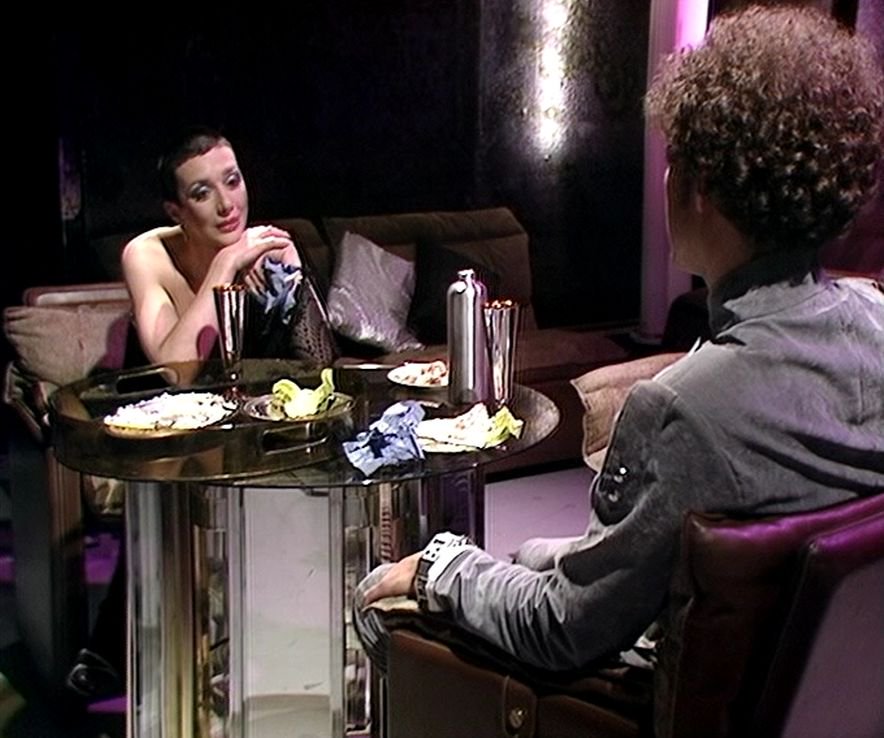
Mr Palfrey (Alec McCowen) has been stripped of his swanky high-tech office and instead is now working from a rather pokey room very close to Westminster.  The heating doesn’t work, there’s terrible modern-ish art on the wall and he’s forced to share a secretary – Caroline (Briony McRoberts) – with some of the other inhabitants. We never discover who they are – need to know, of course.

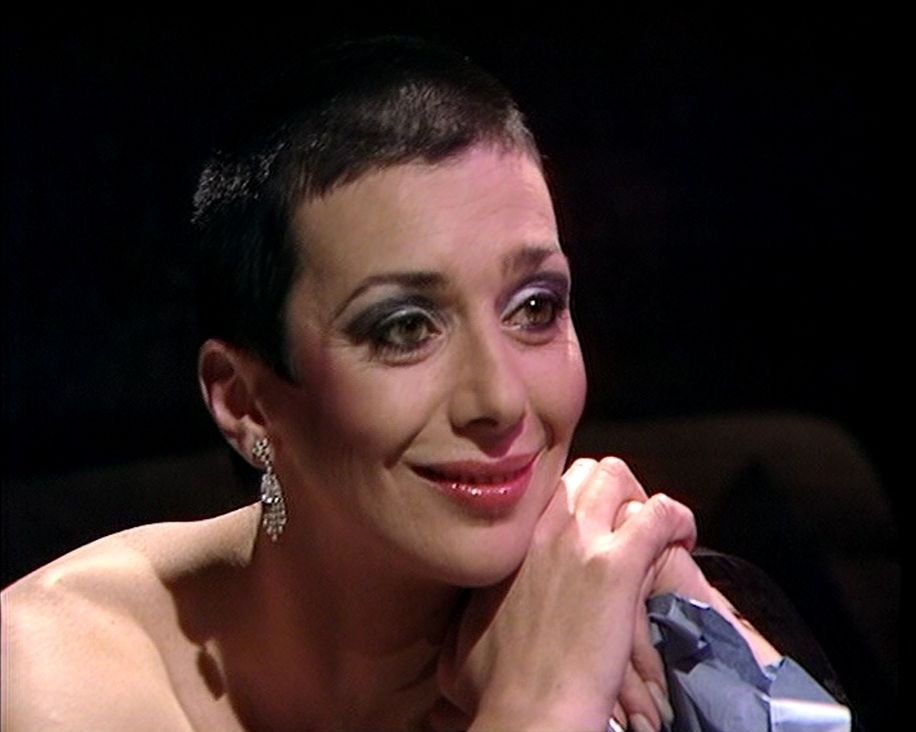
The Palfrey of the Storyboard pilot was fairly autonomous, so the fact he’s now given a new and domineering boss, known as the Co-Ordinator (Caroline Blakiston), and an assistant – the strong and taciturn Blair (Clive Wood) – are signs that his wings are being clipped.  But having said that, the move to Westminster is presented as a promotion not a demotion, although since this is a spy series it’s probably wise to parse every statement (however innocent seeming) for alternative meanings.

The Co-Ordinator comes across a fairly unsubtle Mrs Thatcher analogue. And even though the concept (and indeed the name) seems to hark back to Callan‘s Hunter, the byplay and one-upmanship between McCowen and Blakiston remains highly entertaining throughout the episode.

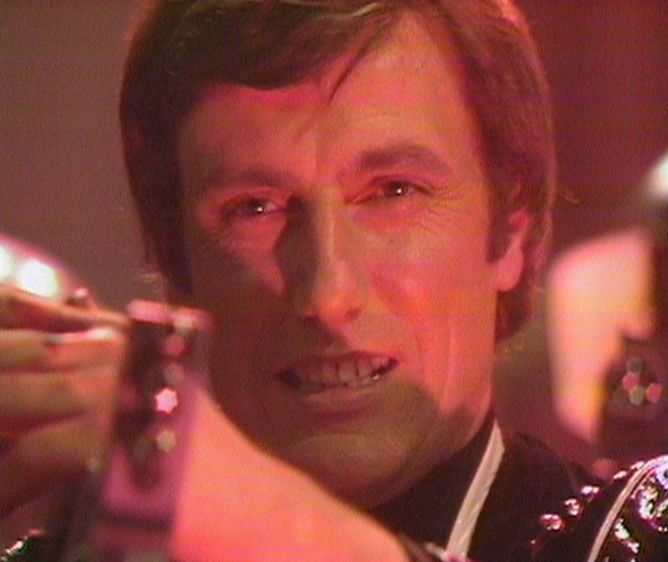
One of the most intriguing things about Once Your Card Is Marked is the way that on first viewing it looks to have a major flaw. Namely the fact that the Co-Ordinator appears to have shown a massive error of judgement in assigning Palfrey to investigate Springer (David Buck), a man suspected of passing secrets to the Russians during his Embassy residency in Prague.

The Co-Ordinator is convinced that Springer is guilty and makes it clear to Palfrey that his job is simply to confirm this as quickly as possible.  But the stubborn Palfrey continues to dig until the messy truth is revealed ….

One death later, the Co-Ordinator blames Palfrey for this debacle (if only he’d followed her instructions then there would have been no need for such extreme measures).  But did she genuinely believe that Palfrey would be compliant right from the start or was the whole operation designed to produce this very effect? Now that Palfrey has learnt what happens when he pursues his own agenda, possibly he’ll be easier to control.

Either of these two readings are valid, which I tend to feel was a deliberate move on George Markstein’s part.

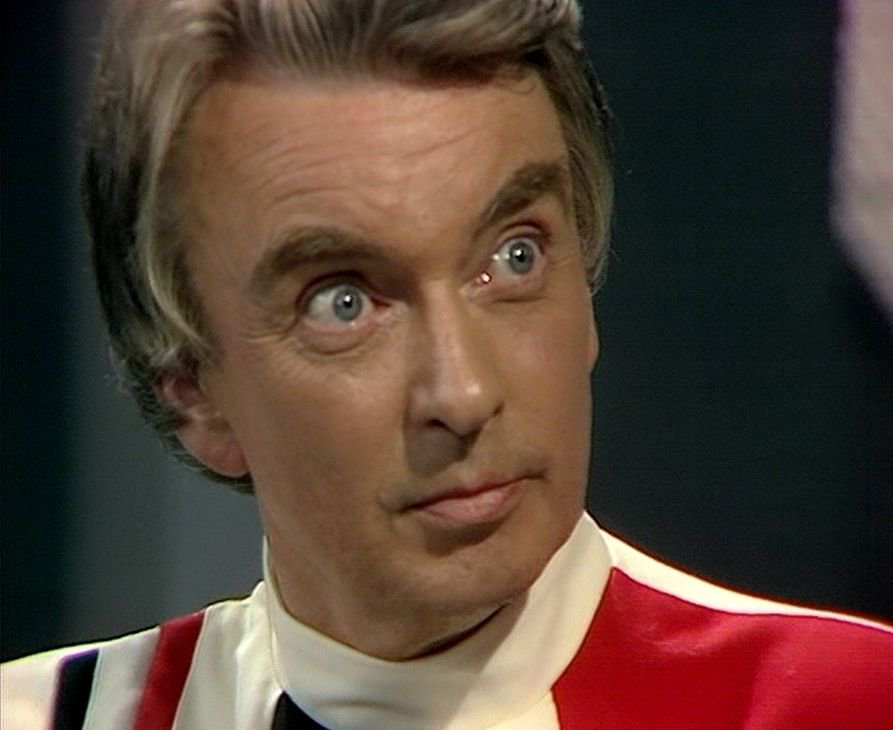
McCowen is tremendously watchable throughout. Decades after my memories of the specifics of the episodes had faded, my recollection of Palfrey – master of the knowing stare – remained strong. David Buck is good value as the twitchy Springer whilst Valerie Holliman – later a London’s Burning regular – has a pivotal role as Susan (Springer’s devoted girlfriend). Alan McNaughtan and David Quilter bulk up the quality of the guest cast a little more – both their characters serve as decent red-herrings.

Given Markstein’s involvement with Callan, it’s not too surprising that this episode has some strong Callan echoes (most notably when Palfrey brushes up against a mysterious and ruthless ‘Section’ that doesn’t officially exist).

A shame that George Markstein only wrote one further episode as he really seemed to have nailed the world of Palfrey even this early on. The previous time I rewatched the series I had a faint air of disappointment that the remainder of the run didn’t quite match the Storyboard pilot and this opening episode. Maybe this time around I’ll have a different opinion …

p02

Blakes 40. Blakes 7 40th Anniversary Rewatch – Blake


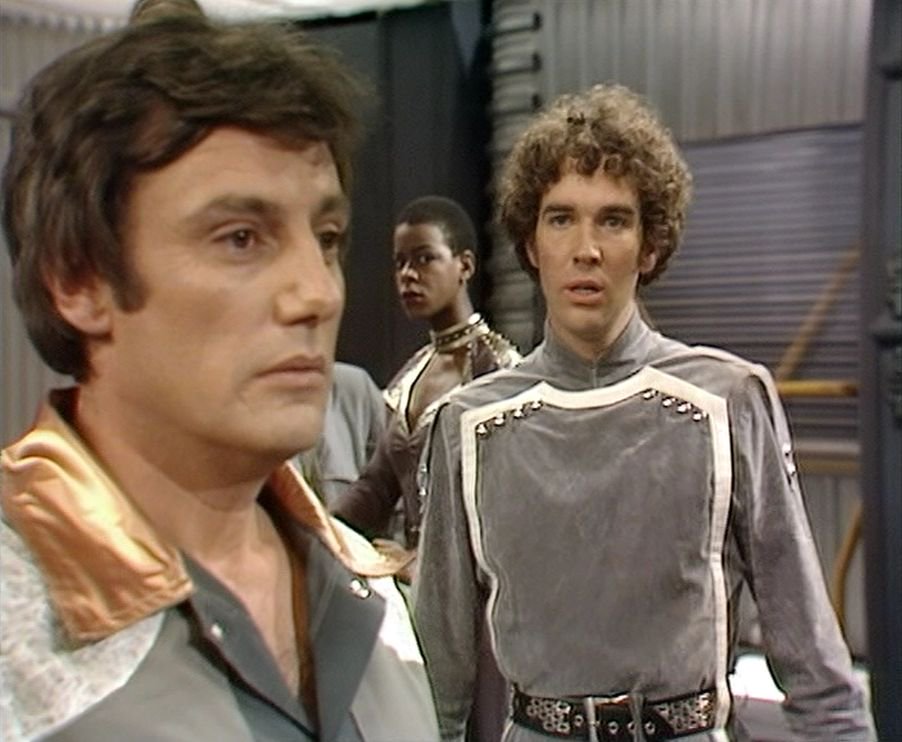
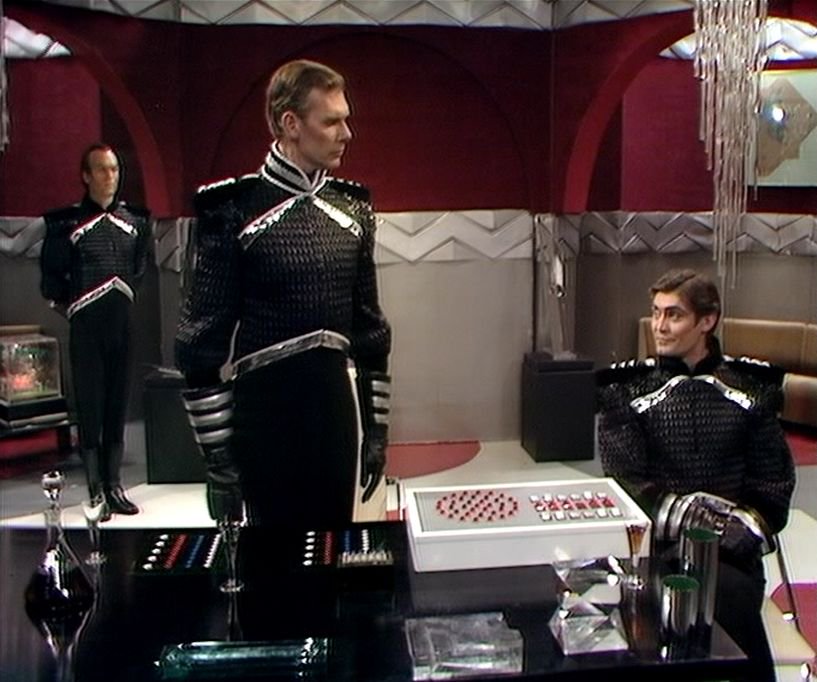
Blake is all about the ending. An obvious comment, but it means that the first forty five minutes, interesting as they are, feels like a very long prologue (a bit like one of those Dalek stories by Terry Nation, where you’re simply waiting for the Dalek to pop up at the first cliffhanger).

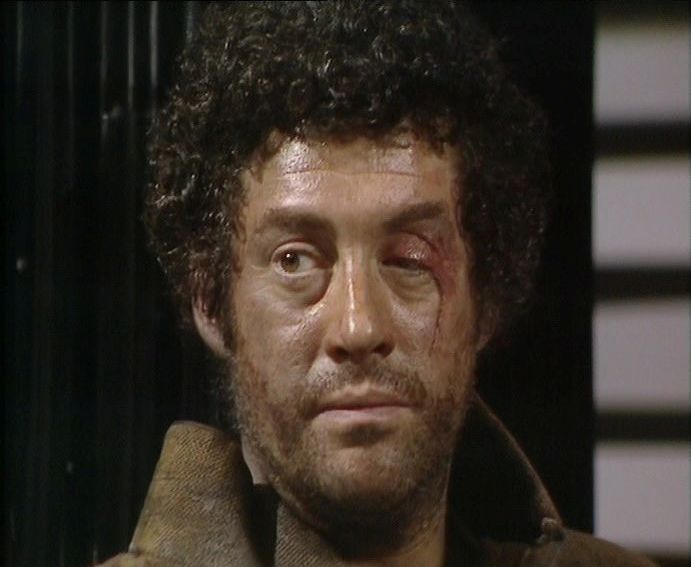
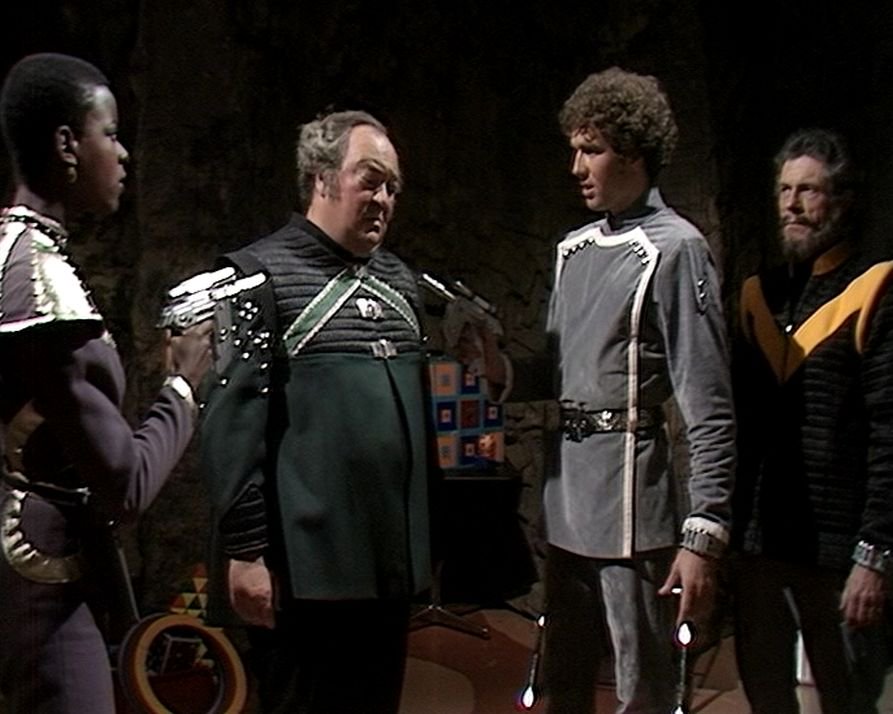
But there are plenty of compensations before the final, fatal meeting between Blake and Avon. The initial appearance of Blake – now a grizzled, embittered bounty hunter – is striking, although his later conversation with Deeva (an underused David Collings) does undercut his first few scenes.

The realisation that Blake is simply playing the role of a bounty hunter (indulging a strange whim it seems) turns out to be his downfall. Blake’s autocratic command style often led to disaster during the Liberator days, but this was his most comprehensive blunder.

There’s no reason why Blake needed to personally vet every new recruit to his latest army, and indeed it seems odd that he’s trawling amongst the dregs of the Galaxy on Guada Prime for likely suspects. Or does he now believe, after his exploits on the Liberator, that criminals are the only honest people left?

I’m not quite convinced by the shot of the model Scorpio crashing through the trees, but the destruction of the full-sized set is nicely done.

“Have you betrayed us? Have you betrayed me?”. Paul Darrow doesn’t hold back here, but since Avon is clearly a man well past his breaking point I think we can forgive his enthusiastic delivery of the line.

I wish I could share some interesting anecdote about how shocking I found the episode to be back in 1981, but alas there’s no such memory. I certainly would have watched it, but I think I just shrugged my shoulders and moved on with my life. Possibly I was already anticipating a fifth series ….

A few thoughts on humour in late seventies Doctor Who

kroll.jpg

Spurred on by TV Years sharing this late seventies audioclip of Jon Pertwee rubbishing K9, I’ve been having another ponder about the state of Doctor Who during that time. Personally, I love this era of the show – but I’m aware that not everybody shares this view.

At least today it has more love amongst fans than it did at the time (although the general public, fools that they were,  seemed to enjoy it). At the time, as can be evidenced from that short clip, it wasn’t just Pertwee who was dissatisfied. Mind you, I’ve always had the strong sense that Jon Pertwee never forgave Tom Baker for being more successful than him in the role ….

But it’s true there was a vocal section of Doctor Who fandom who were convinced that Tom Baker and Graham Williams were ruining the show. Everything was just too silly for them – if only DW could recover its gritty roots, then all would be well.

This viewpoint lasted well into the eighties. Having leafed recently through a number contemporary fanzines, it’s not uncommon to come across articles which write off all of Graham Williams’ three years as a total disaster. By the early nineties the balance had changed though – Williams was in and JN-T was out.

That’s the way fandom worked – if you disliked S17 then you liked S18, if you liked S18 then you disliked S17. Liking (or indeed disliking) both or bits of both didn’t seem to be an option. You had to nail your colours to a mast (Williams for ever, JN-T never, etc).

It always surprises me when somebody today vouchsafes the opinion that humour in late seventies Who ruined the programme.  This rather ignores the fact that DW light-heartedness didn’t begin in 1977 (Hartnell, Troughton and Pertwee all had their comic moments).

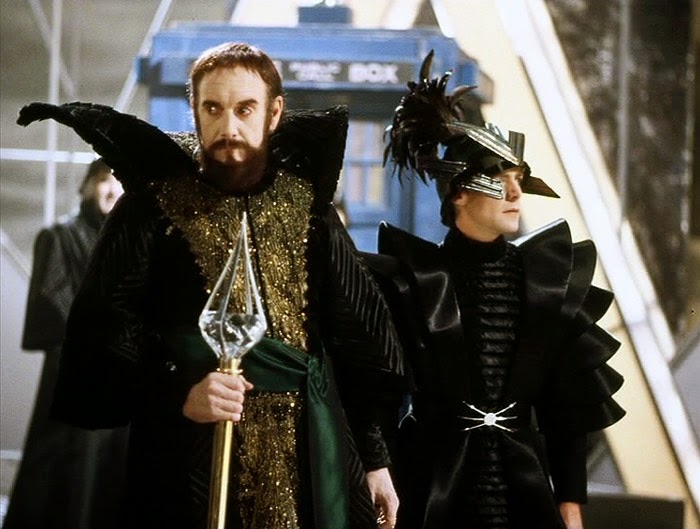
Also instructive is the way that certain Hinchcliffe stories (The Android Invasion, The Brain of Morbius) display a wisecracking Doctor very similar to the later Williams model. Slicing DW into discrete eras depending on when the various producers arrived and departed is something we’ve always done, but it doesn’t always work (see also Meglos, something which easily could have slotted into S17).

I’ve never bought into the assertion that S15-S17 are total gigglefests from start to finish. There are plenty of gags and comic moments, but there’s drama as well.  I sometimes feel I’m ploughing a lonely furrow when I declare my love for the likes of The Creature From The Pit or The Horns of Nimon but that’s okay.  Who needs to be popular?

nimon

Blakes 40. Blakes 7 40th Anniversary Rewatch – Warlord

Warlord has a striking opening. The inhabitants of Zondar – heavily drugged with Pylene-50 – are mown down by Federation troops whilst the following encouraging words (“You are cared for. You are loved”) seep out of the tannoy. A brief, but welcome, return to the nightmarish themes of The Way Back.

After that encouraging start, things return to normal when we start to focus on the delegates. Um, they’re an interesting bunch ….

Mind you, although they look more than a little silly they do brighten up the episode. Indeed, I was a little disappointed that Rick James’ appearance was so brief.

Avon’s desire to form an alliance with numerous interested parties, including the warlord Zukon (Roy Boyd), seems to have come out of nowhere. Although there was a vague attempt to recruit experts in their respective fields earlier in the year (along with the odd mention of Pylene-50) it’s a shame that this arc wasn’t developed a little more.

Of course this grand alliance is doomed to failure since Zukon is in cahoots with Servalan (shock, horror). Jacqueline Pearce exits the series with something of a whimper – her involvement in this story is minimal and not terribly interesting

I know that many were disappointed Servalan didn’t appear in Blake, but having her pop up at the end of the final episode would have been such a cliché, so I’m glad they didn’t go down that route. But they could have made a little more effort with her role in this one.

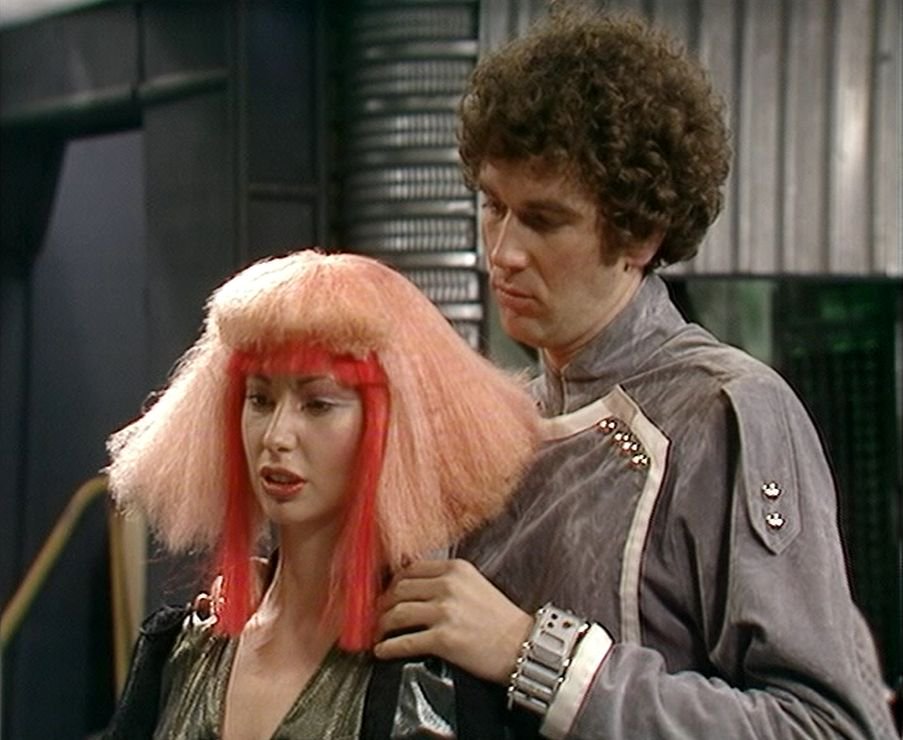
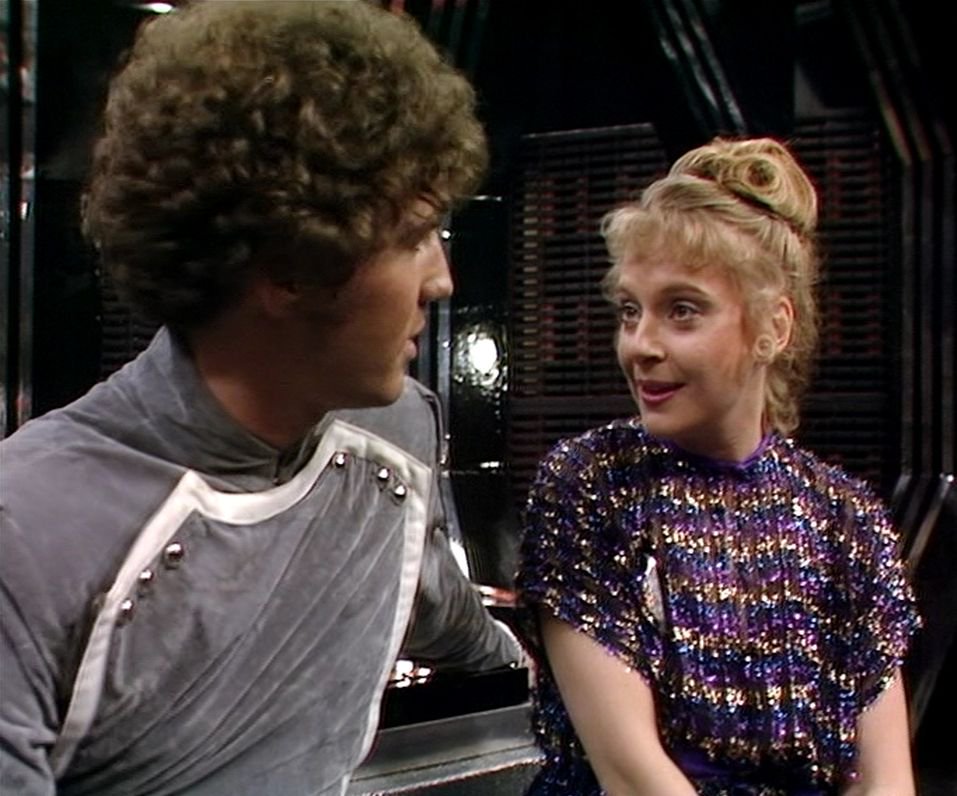
Poor Tarrant is unlucky in love yet again. His dalliance with Zeeona (Bobbie Brown) was obviously going to be short-lived (especially after we learnt that her daddy, Zukon. is a baddy). It’s hard to take their scenes together that seriously (mainly because of her Toyah hair-cut) but her final scene is nicely played.

Never a favourite, Warlord still chugs along quite nicely.

Hancock – The Lift

As is well known, Sid James – as requested by Tony Hancock – played no part in Hancock’s final BBC series penned by Galton and Simpson.  In some of the other episodes – The Bedsitter or The Radio Ham, say – it’s clear that Galton and Simpson were writing material which moved away in certain respects from their previously established formula.

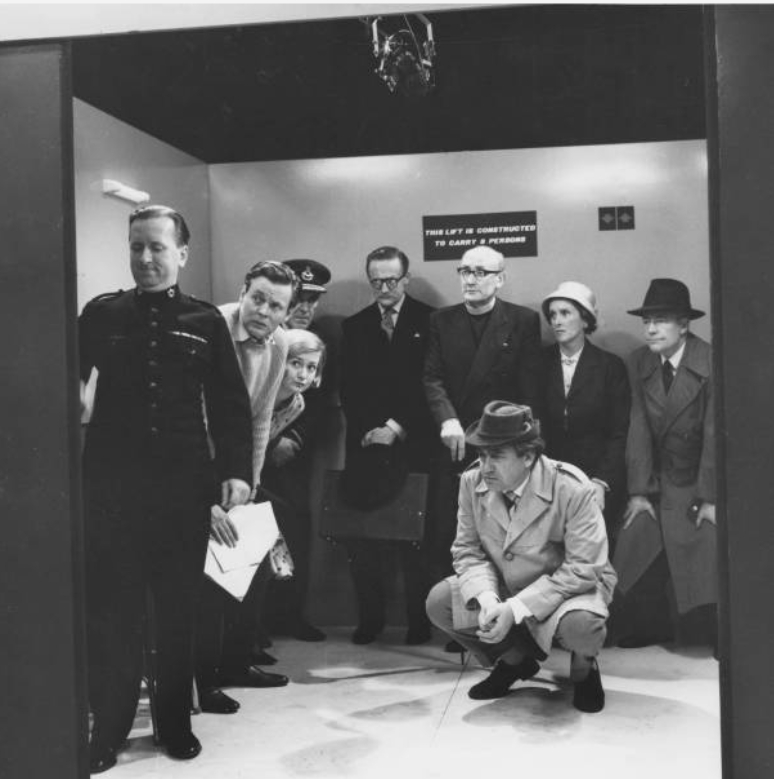
It’s easier to imagine Sid taking part in The Lift though (no doubt he would have taken it in turns with Tony to antagonise all of their fellow lift passengers). So Sid’s absence does have the side effect of making Tony seem more irritating than usual – with no confidant to take the strain, he’s the sole antagonist today.

Many of Tony’s familiar character traits are present and correct. Such as his fumbling attempt to chat up the pretty young secretary (Jose Read) and his seething indignation when he has to watch her being sweet-talked by Jack Watling (the smooth BBC producer).

The Hancock character tended to berate those he believed were below him on the social scale (such as Hugh Lloyd’s liftman) and defer to certain people above him.  Not all – the Air Marshall  (John Le Mesurier) is treated with a level of contempt that Tony doesn’t even bother to conceal.  The Vicar (Noel Howlett) is another matter altogether (witness Tony’s chumminess and delight that the Vicar’s first Epilogue went well).

Both Hancock’s Half Hour and Hancock were always so well cast. Not only regulars like Hugh Lloyd and John Le Mesurier, but also the one-off performers like Charles Lloyd Pack and Colin Gordon (who both feature in this one).

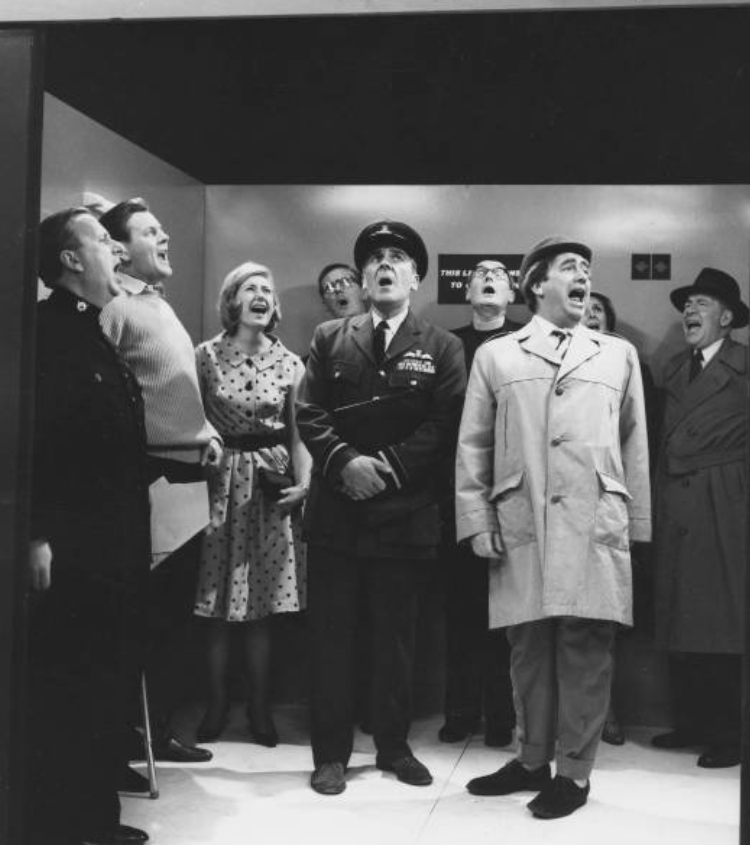
They all help to generate a combustible mix of personalities, who are all nicely stoked up when the lift gets stuck between floors. Tony – of course – decides that he should take charge.  His first suggestion – that everybody jumps up and down – is logical, but it has a disappointing lack of success.

So they’re caught in a stalemate situation, which generates some wartime memories for Tony. “It’s just like the old days. Laying on the bottom, still, silent. Nobody daring to move. Jerry destroyers dashing about upstairs, trying to find us sitting there, sweating, waiting, joined together in a common bond of mutual peril”.

This moment is punctured by the Vicar, who recalled that Tony earlier stated he was in the Army! No matter, Tony – with the agility of a born fantasist – quickly rallies, weaving a tale about the Heavy Water plants in Norway (“very tricky stuff. A cup full of that in your font, blow the roof off it would”).

I do love Tony’s attempt to keep everybody entertained by playing Charades. Of course all of his mimes are guessed in double quick time by his nemesis, the producer (“it was simple”).

The twist at the end – having been rescued, Tony and the liftman become trapped once again – doesn’t quite work, but overall there’s very little fat on this one. Not quite the best that the final series had to offer, but that’s only because the competition was very fierce.

Celebrity Bowling

bowl1.png

I’ve recently stumbled across the seventies incarnation of Celebrity Bowling on YouTube.  I’m finding it strangely hypnotic, not least for the variety of celebs on display – William Shatner, Roy Rogers, Adam West and Leslie Nielsen, for example ….

True, a fair few other bowlers are now more obscure but it doesn’t stop the show from being very entertaining. Hosted by Jed Allan and Cheryl Kominsky, I can see myself working my way through every episode.

Bob’s Full House

bob

If you were looking to crown a British King of Quiz shows, then surely Bob Monkhouse would be your man. The Golden Shot and Family Fortunes were a couple of his big hitters, although he also had some very obscure shows on his cv.  Ironically, it seems that few people today remember Monkhouse’s Memory Masters whilst his first quiz effort (Do You Trust Your Wife?) has also fallen down a crack in time.

Bob’s Full House is one that’s endured though. And thanks to repeats on Challenge, a heathy selection are available to enjoy on YouTube.

“In Bingo lingo clickety-clicks, it’s time to take your pick of the six”

This was the perfect show for Bob. It allowed him to do a bit of stand-up at the start and then interact with the four contestants in a mildly teasing (but always friendly) way before the serious part of the quiz began.  Although there were a few rumblings that bingo was too down market for the BBC, BFH was actually a pure quiz rather than a televised bingo session (although surely that’s been done by someone somewhere).

Round one was Four Corners, where you had to … well, you can probably guess.  The first contestant to answer four questions correctly would also get a prize (there would be much cooing from the studio audience in that sort of semi-ironic Blankety Blank way).

The pace would pick up with Round two – the Monkhouse Mastercard. This time the contestants could select one of their numbers which matched with a variety of quiz topics.  A slightly more impressive prize would be given to the one who managed to light up their middle line.

By the time we get to round three – Full House – things are going full throttle. Now it’s just a straight race to the finishing line, with a series of rapid fire questions requiring good fingers on buzzers action.  Bob comes into his own here, rattling through question after question like the pro he was.

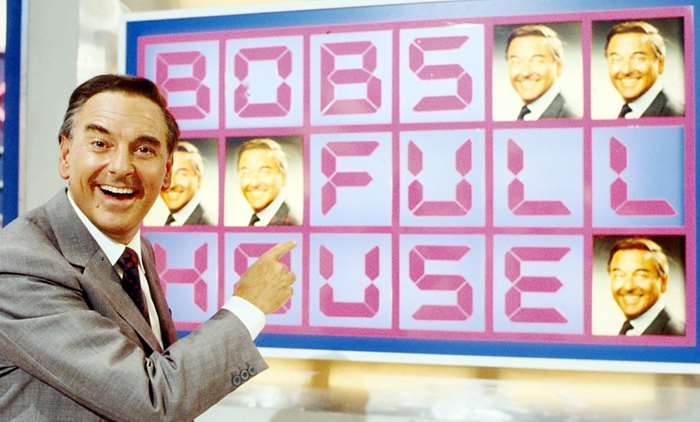
The winner would then join Bob for the Golden Card. A holiday destination (which always had to be around seven letters) was the prize and there were fifteen questions to be answered.  With a time-limit of just one minute things could get tense – the more wrong answers, the harder it would be to locate the letters (other squares on the board contained money, which was nice but no help when you were looking for an all-expenses paid holiday).

BFH was a hit straight away – by the end of the first series in December 1984, the show was pulling in more than thirteen million viewers. It’s early evening Saturday timeslot may be one of the reasons why it’s fondly remembered today – possibly it wasn’t the programme that we were all tuning in for, but it was a dependable part of the television furniture for a good number of years.

And maybe it plays a little better today than it did then. Bob was respected in the eighties, but he also had to fend off a fair number of brickbats. In the last few years of his life, and in the decades following his death, his critical standing has certainly increased.  Maybe at the time we just took him for granted – now, some thirty years on, it’s easier to see just how good he was.

bob game

Blakes 40. Blakes 7 40th Anniversary Rewatch – Orbit

DuKEKH9W4AMvN_F

You don’t really need to see Robert Holmes’ name on the opening credits to know that Orbit is one of his. Doubtful than anybody else would have had the nerve to do a story quite like this ….

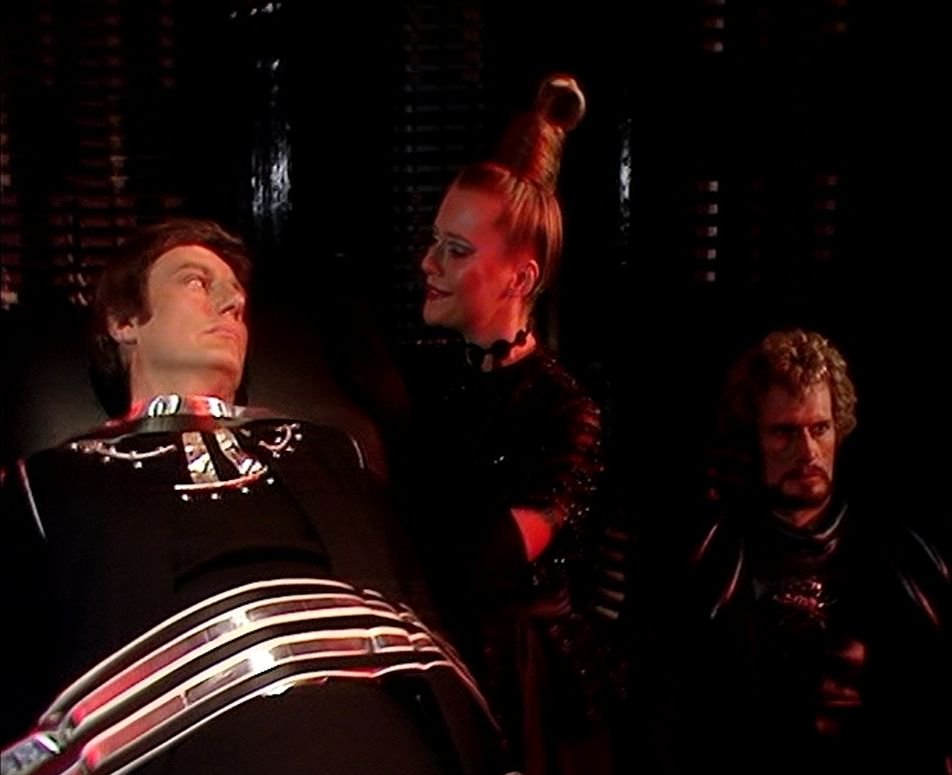
Egrorian (John Savident) is a grotesque who, despite his camp capering, still manages to come across as sinister and threatening. Savident is clearly enjoying himself, but he still reigns it in from time to time – most notably when he’s torturing the hapless Pinder (Larry Noble). “Can you feel your extensor muscle tearing? Can you feel your humerus grating against your radius? Hmm.? Just a little more… a little more… now you’re feeling it, aren’t you?”. Holmes’ dark streak is really noticeable in this story – possibly Boucher had decided that since the series had virtually run its course they might as well go for broke.

To nobody’s great surprise, Servalan is discovered to be lurking in the shadows, but on the positive side Jacqueline Pearce gets the rare opportunity to play comedy – her scenes with an amorous Egorian are wonderful (you can see a whole range of expressions flitting across her face as Egorian launches into his spiel). It seems slightly strange that Servalan has no backup at all, but if she had then the scene of her trapped with a randy Egorian wouldn’t have quite had the same impact.

The dialogue zings throughout. Egorian’s description of the qualities required by a great leader is a delight. “Natural leaders are rarely encumbered with intelligence. Greed, egotism, animal cunning, and viciousness are the important attributes. Qualities I detect in you in admirably full measure”.

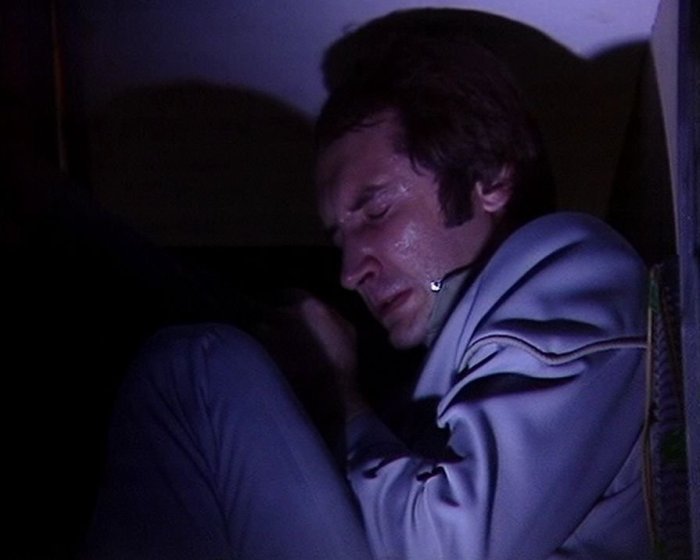
But as entertaining as all the Egorian byplay is, it’s the final ten minutes or so (as Avon and Vila find themselves in dire straits) that really stands out. A pity that Paul Darrow couldn’t make his innocent, pleading voice a little more convincing (or was it supposed to be deliberately off-kilter?). The sight of a sweating and tear-stained Vila carries a real punch (the sight of Avon attempting to shift a small Perspex box, slightly less so).

Had the show ran to a fifth series it would have been interesting to see how the Avon/Vila dynamic would have developed. Unfortunately it’s only lightly touched upon during the final two episodes.

But no matter, Orbit might be uncomfortable in many ways, but it’s still one of the series’ best episodes.

DuKF2QDW4AQplK4

Blakes 40. Blakes 7 40th Anniversary Rewatch – Gold

Dtl5i23XcAYK4EK

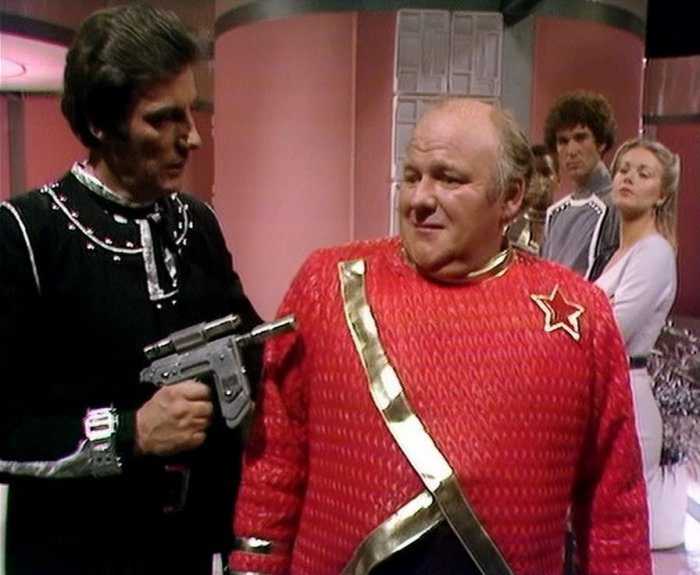
Avon’s old friend Keiller (Roy Kinnear), the purser of a pleasure liner called the Space Princess, has a foolproof plan to steal a fortune in gold. What could possibly go wrong?

Gold works as well as it does mainly because of Kinnear’s performance. He plays perfectly to type – a shifty, ingratiating sort of person – and it’s the way that Keiller interacts with his “old friend” Avon as well as his vain attempts to flatter the ice-cold Soolin which provides the episode with pretty much all of its comic highlights.

Interesting that Vila largely sits the story out, was this because it was felt that the characters of Keiller and Vila were too similar? It’s a slight pity, but the little that Michael Keating has to do is impressive – I particularly like Vila’s first meeting with Keiller (which sees Vila in a faintly sinister and threatening mood).

To be honest, the plotline of cross, double-cross and triple-cross isn’t totally engaging, so it’s the smaller moments which make the story a rewarding one. The terrible lift music which haunts the Space Princess, Tarrant’s glassy-eyed and toothsome fake drugged persona and the orgasmic sound of the doors, to name but three.

The late arrival of Servalan is one of those totally unsurprising plot-twists. This does allow her to have a little natter with Avon though (which they didn’t do often throughout S4). Avon’s hysterical guffawing after he realises that Servalan’s totally outplayed him is either a further example of his fractured mental state or it demonstrates what a good sport he is. I know which I favour ….

Not a bad yarn, but I do find my attention drifting every so often. Slightly tarnished gold then.

Dtl5i25WkAEf7Ql

Blakes 40. Blakes 7 40th Anniversary Rewatch – Sand

“I know a land beyond the heart of time. The sun never comes there. No moon ever shines. And man, a grain of sand, nameless and lost, blows with the dust”.

This monologue is an early warning that, as befits a Tanith Lee script, this will be an unusual episode. But unlike Sarcophagus we don’t get an oblique opening – instead the first five minutes are spent with Servalan and her mismatched crew.

Investigator Reeve (Stephen Yardley) is the alpha-male of the party. Reeve, hands on hips, appears to be brim-full of testosterone (although maybe the sand felt otherwise since his services were fairly quickly dispensed with). It’s hard to maintain any credibility when you’re dressed in silver, but Yardley does his best.

The episode is really Servalan’s show – it’s easily the story which delves deepest into her personal life (even though certain threads remain a little nebulous – if Don Keller was that important to her, why did she wait so long before travelling to Virn to discover his fate?).

Minor quibbles apart, there’s so much to enjoy in Jacqueline Pearce’s performance – especially the small non-verbal moments of distress, highly uncharacteristic for the former Supreme Commander. After a run of stories in which she seems to have been crowbarred into the action somewhat, Sarcophagus makes for a pleasant change.

The opening modelwork shots of Virn are very nice and the film work on the planet’s surface is also decent (just a pity that a few studio shots are dropped in, as these are inevitably jarring).

There are plenty of good dialogue moments. The way Servalan rebuilt her life after Don Keller, for one. “He left me. I grew up. Power became my lover. Power is like a drug. It is beautiful. Shining. I could destroy a planet by pressing a button”.

Orac’s bizarre declaration of love and Avon’s rejoinder to Soolin’s comment that Vila’s pulse is weak (“well that should go very nicely with the rest of him”) are a few other highlights. I also like Avon’s cock of the walk strutting and the reaction of Dayna and Soolin when they realise what they’ve been saved for ….

The obvious move would have been to lock Avon and Servalan together. I’m glad they resisted the obvious since it was about time Tarrant was given something to do. Steven Pacey holds his own against Jacqueline Pearce and the scenes between them flow nicely.

I assume it was Chris Boucher who dropped in the explanation about how Servalan escaped from the Liberator (“The teleport. A malfunction. A power surge. Suddenly I was back on a Federation world”). This doesn’t make much sense – surely the only planet close to the Liberator was Terminal, and she didn’t end up there. Or had the dying Liberator suddenly developed the power to teleport somebody over a vast distance?

Although not as memorable as Sarcophagus, Sand is still several cuts above the B7 norm.

Blakes 40. Blakes 7 40th Anniversary Rewatch – Games

Stratford Johns really is the saving grace of Games, without him it would be a much less interesting affair. Belkov may not be a very developed character – he’s a devious games player and that’s about it – but Johns is wonderfully watchable. Belkov’s face-off with Servalan about ten minutes in is a definite highlight (for once, Servalan is on the back foot).

Speaking of Servalan, not for the first time she’s pretty much surplus to requirements – this episode does smack of an attempt to fill Jacqueline Pearce’s episode allocation and little else. Her part in the plot (interrogating Belkov) could easily have been filled by any middle-ranking Federation officer.

There’s an awful lot of info-dumping early on as Avon expounds at length about the wonders of Feldon crystals. This isn’t the most effective part of the episode and neither is the sudden appearance of Gerren (David Neal). His fake beard doesn’t help, but Gerren isn’t a very memorable sort (although he’s useful as a demonstration about how ruthless Avon can be. A little light blackmail before breakfast …)

Positives? Virtually every scene with Stratford Johns, especially the byplay between Belkov and his computer Gambit (Rosalind Bailey). Vila gets a generous number of good one-liners and also demonstrates his resourcefulness on more than one occasion.

Not a bad episode, but it’s not really much more than a fairly diverting runaround.

Blakes 40. Blakes 7 40th Anniversary Rewatch – Assassin


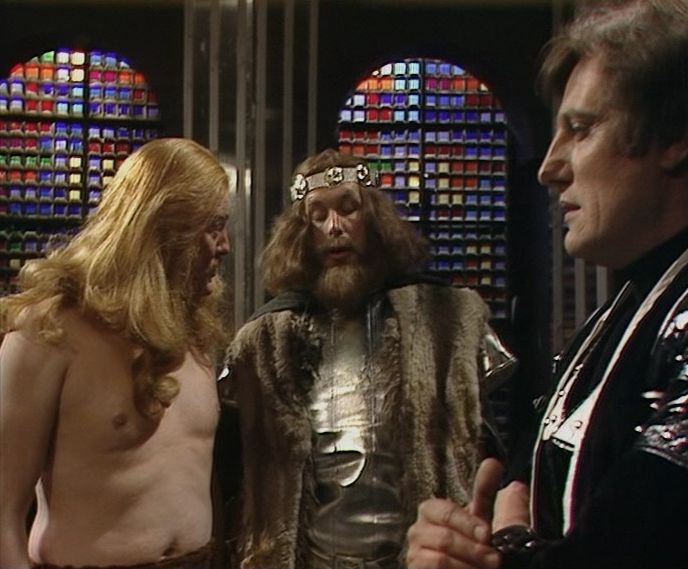
Assassin is a story of two halves. The first half – on the planet Domo – is a guilty pleasure. Domo is a barren, sandy sort of place (rather like a quarry, in fact) where men are men and wear the strangest looking beards as well as cast off costumes from Doctor Who.

Avon’s decision to get himself captured and sold into slavery is a bit of a hoot, as is his brief but energetic spot of fisticuffs (I think it was the comment about being skinny that pushed him over the edge).

The early part of the episode also has the unforgettable appearance of Betty Marsden and the fan-fic pleasing concept of Avon being sold to Servalan as her slave. “I think, if you don’t mind, I would prefer my slave to address me as `mistress’.”

Although the beardy types and Betty Marsden are something of an acquired taste, Richard Hurndall, as the doomed Nebrox, is much more solid. It’s interesting that Avon and Soolin – the coldest of our heroes – both seem to form some sort of connection with him.

After this early spot of fun and games we head into the second part of the episode, which is an even guiltier pleasure. Caroline Holdaway’s performance as Piri is a rum old thing. I’ve seen her in various other programmes (All Creatures Great and Small, Rumpole of the Bailey, Codename Kyril) and she never stood out in those, so her turn here must have been a deliberate choice rather than a lack of acting ability.

It’s still very, very odd though as a more subtle characterisation would surely have been better (for one thing, it would have made Tarrant look like less of a gullible idiot).

Having sat out most of the first half of this series, Assassin finally gives Steven Pacey something to do. True, Tarrant’s scenes with Piri are rather torpedoed by Holdaway’s hysterical playing, but it was nice to see the return of the Avon/Tarrant conflict. Another bonus is that Soolin’s given some very acerbic lines, most of them at the expense of Piri.

The main problem with Assassin is that it’s a story with very little plot. So things have to proceed very slowly until the big reveal just before the end. Still, the scenes set aboard Cancer’s ship do have an air of tension, so that’s a plus point for David Sullivan Proudfoot (but several marks off for all the screenwipes).

Not the most tightly plotted story, it’s nevertheless good, goofy fun.

Blakes 40. Blakes 7 40th Anniversary Rewatch – Headhunter 

Like Roger Parkes’ first script for the series (Voice from the Past) Headhunter is as mad as a box of frogs … and I love it.

The plot doesn’t really make any sense. Why has Muller spent his life creating a homicidal android intent on dominating all humanoid life? It also seems a little remiss that the android is only restrained when he’s wearing the correct head (there’s shades of Worzel Gummidge here). And since Tarrant was in a rush, I’ll let him off the fact that he didn’t seem to notice the corpse under the table was missing his head.

Android Muller as played by John Westbrook is a hoot. Westbrook isn’t on-screen for too long but he’s certainly memorable (a small performance it isn’t). Android Muller as played by Nick Joseph is equally as entertaining – as Joseph’s android is headless, he compensates with the most over-expressive hand acting you’re ever likely to see. Oh, and where’s his voice coming from? Hmm, never mind.

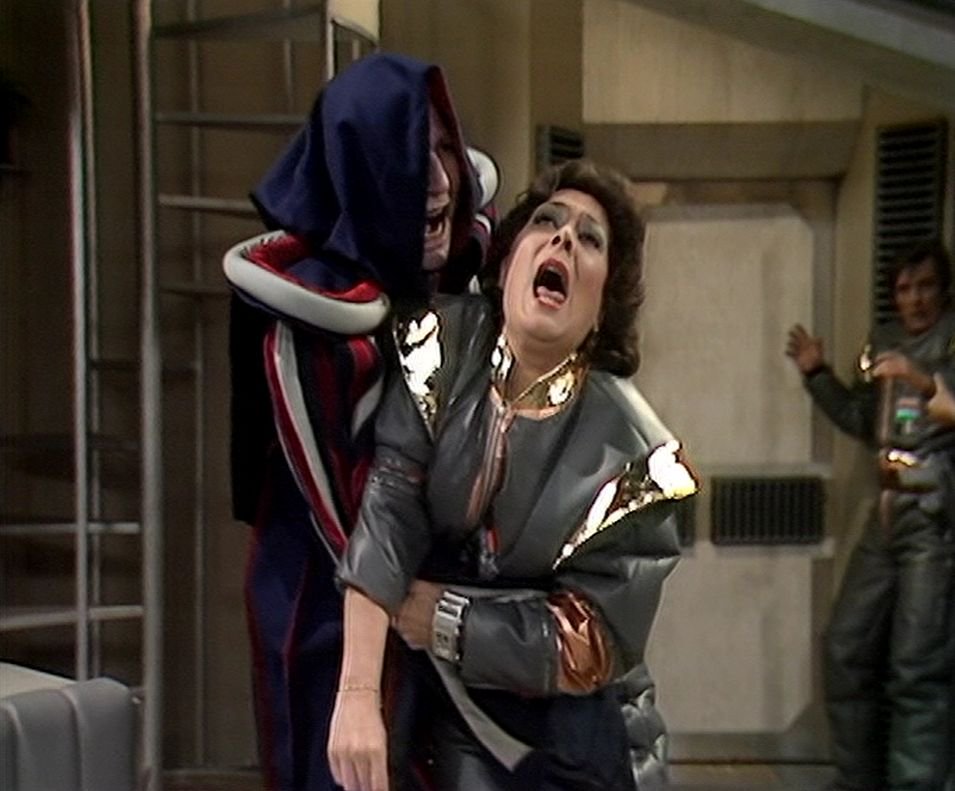
Lynda Bellingham has a decent amount of screentime but not a very interesting character to play, alas. But at least Vena gets a good death scene, crushed to death by (she thinks) her husband whilst the others look on with a varying selection of emotions. The fatal bear-hug is clearly Android Muller’s favourite way of despatching people.

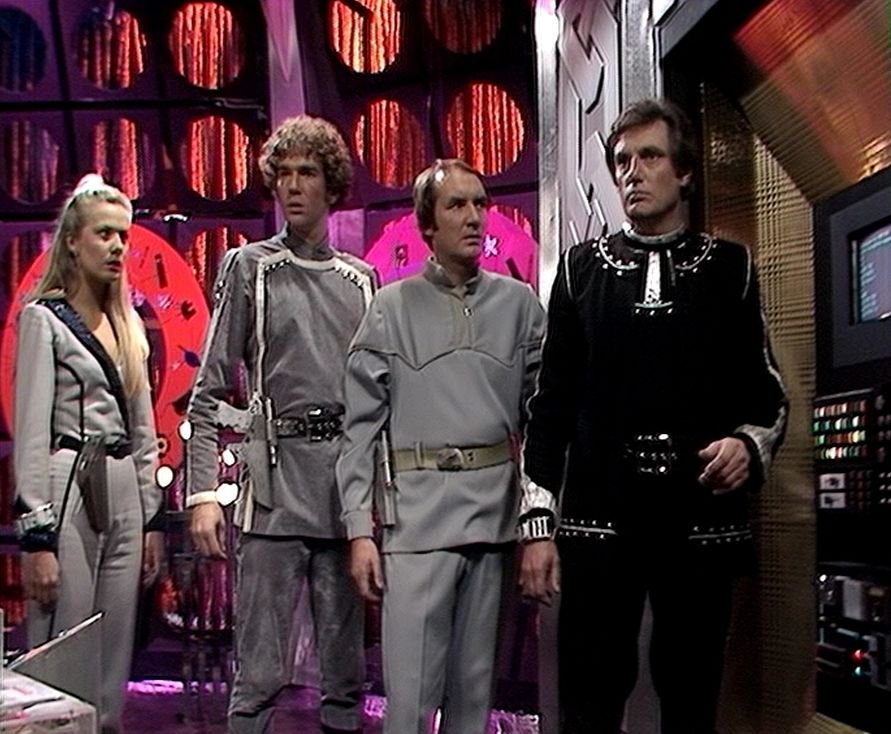
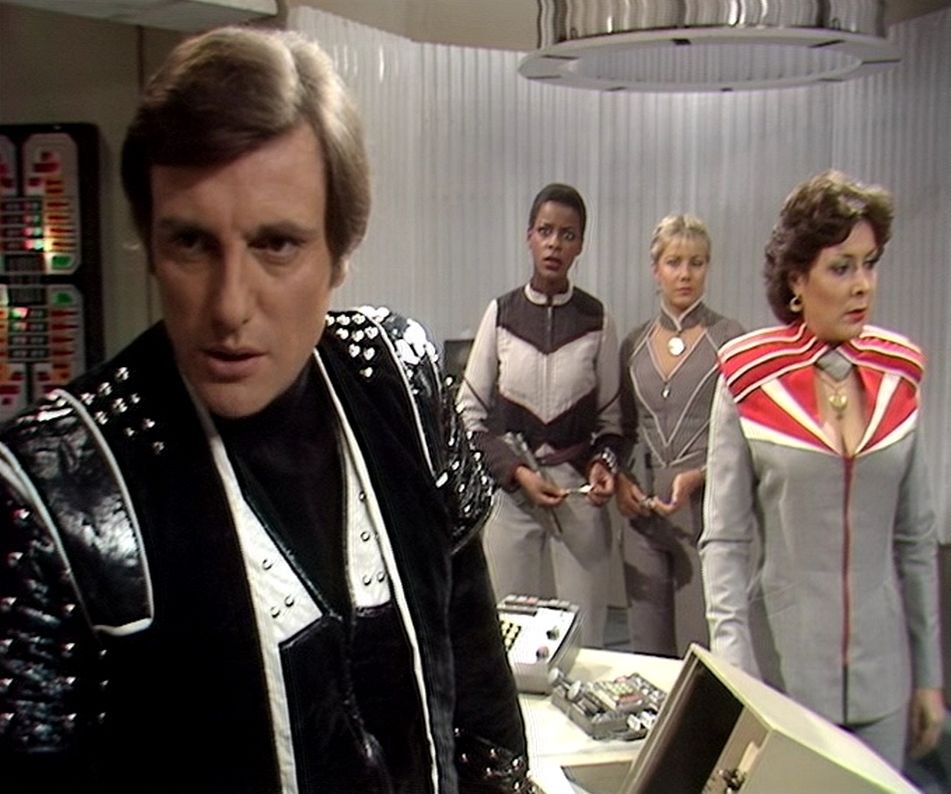
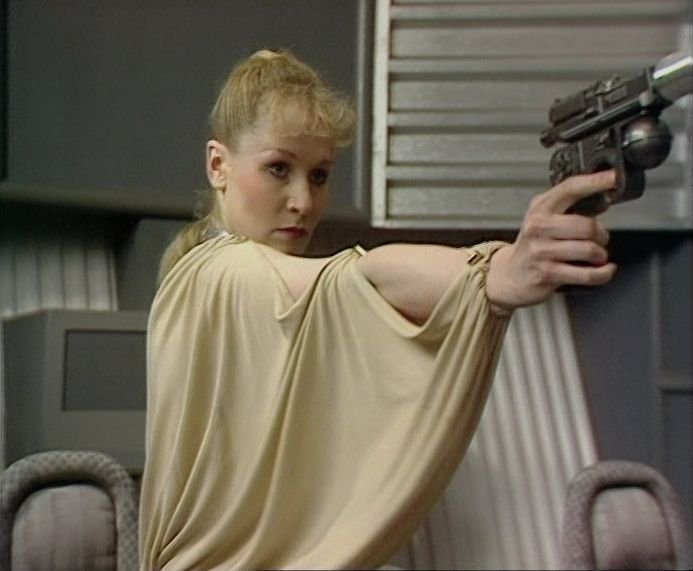
As for the regulars, Avon smiles a few times but otherwise he’s in full brooding mode. This is prime S4 Darrow – whether that’s a good or bad thing depends on how much you enjoy S4 Darrow of course. Tarrant and Vila make for a good double-act, Dayna doesn’t really do much that’s memorable whilst Soolin’s character continues to grow as she’s given some decent lines once again.

Soolin’s parting shot to a seductive Orac, promising to fulfil her every desire (“you wouldn’t know where to start”) is delivered in a nicely deadpan way. I also like surly Slave, a bit more of that would have been welcome.

The sight of the headless android stomping very slowly around the base never fails to raise a smile. Whatever else Headhunter is, it’s not dull.

Blakes 40. Blakes 7 40th Anniversary Rewatch – Animals

The main plot – which seems to be drawing inspiration from The Island of Doctor Moreau – is reasonable enough, but Animals has several major problems. Let’s begin with the beasts themselves – perhaps wisely, Mary Ridge elects to show them in all their (ahem) glory within the opening few minutes. No point in attempting to create any suspense, let’s just see them and once the shock’s passed we can move on.

The Dayna/Justin relationship is put at the forefront of the story and it’s one that’s positively dripping with subtext (“my little pupil Dayna, lovelier than ever”). The icky feeling that both have been carrying a torch for each other since their teacher/pupil days isn’t confined to the dialogue – there are several instances when Dayna gives a knowing smirk, each one is worth a thousand words.

Peter Byrne’s performance is very strong – if the script somewhat glosses over the dodgy ethics of Justin’s experiments (note the way that Dayna switches from disgust to acceptance rather too rapidly) then that’s not Byrne’s fault, he does everything he’s required to do by the script.

With Dayna shouldering the bulk of the action, the rest of the regulars are relegated to playing second fiddle (indeed Vila. Soolin and Avon even sit out the opening quarter of an hour or so). Tarrant has a nice scene with the ever apologetic Slave, Vila gets rather dirty and complains a lot whilst Soolin has one good line (when Vila wonders why he gets all the dirty jobs, she responds “typecasting”). Slim pickings for Soolin then, but better would be just around the corner.

Avon’s not a barrel of laughs today. There are some who maintain that series D was one long nervous breakdown for him whilst others contend that he was perfectly fine (just a touch unlucky from time to time). I lean towards the former viewpoint – his inability to crack a smile along with Tarrant and Soolin at Vila’s grubby predicament is one reason why. In years gone by he wasn’t afraid to show his lighter side – but it’s in very short supply at the moment. Increasing pressure due to the heavy burden of command?

Not for the first time Servalan doesn’t add a great deal to the story. I also find it odd that when Dayna is captured, we don’t see the moment when she and Servalan are brought face to face. Considering their past history this is a strange omission. It’s nice to see Kevin Stoney, although he’s wasted in a role which doesn’t really develop the plot (his character imparts a few morsels of information which Servalan could have easily discovered elsewhere).

Hmm. Those new Mutoids (I assume that’s what they are) are interesting, aren’t they?

Animals isn’t a total write-off but it’s a few drafts short of being a satisfying story.

Blakes 40. Blakes 7 40th Anniversary Rewatch – Stardrive

Nobody loves Stardrive. The reason’s pretty obvious – the Space Rats look very, very silly (things don’t improve when they open their mouths either). Their leader, Atlan (Damian Thomas), is briefly given a moment of character development when it’s revealed that he’s not actually a Space Rat. But since this revelation isn’t developed it proves to be something of a dead end.

Another issue with the Space Rats is the fact that Vila was given a few minutes to big them up – so after you’ve been told that they’re the baddest of the bad, the reality can’t help but be a disappointment ….

It’s nice to see Barbara Shelley, just a pity she’s wasted in a nothing sort of role. Doctor Plaxton is a very pallidly drawn character – we never really learn anything about her (especially why she’s so obsessed about perfecting the stardrive).

But if the guest cast are a little thin, at least the regulars are well catered for. Avon continues to blunder about (his wonderful plan to hitch a lift on an asteroid nearly kills them all). Quite why the others are still content to follow him after his recent string of command disasters is a bit of a mystery.

I love Vila’s drunk act – it’s an excellent demonstration of his natural cunning. Teaming Vila and Dayna up is another good move, even if Vila does revert to his more usual persona of a clumsy coward during these scenes.

The fact that Avon’s quite happy to use Vila and Dayna as a diversion is a telling moment (whether they live or die doesn’t seem to matter to him). Ditto poor old Doctor Plaxton, whose only reward for developing the stardrive is a painful death. The way that Avon comments “who?” after being asked about her, post-death, is a fascinating character touch – has he already blocked her death from his mind, or is he just attempting to?

Stardrive feels like a cheap story. Most of the new modelwork is pretty basic whilst the location (yet another quarry) doesn’t add any visual flair to the episode. But although it’s by means the series at its best, it’s not an absolute disaster either. The Space Rats thankfully aren’t on the screen for very long and the regulars (apart from Tarrant, who doesn’t do much at all) get a decent crack of the whip.

“What has happened to the magic of Doctor Who?”

dead1.jpg

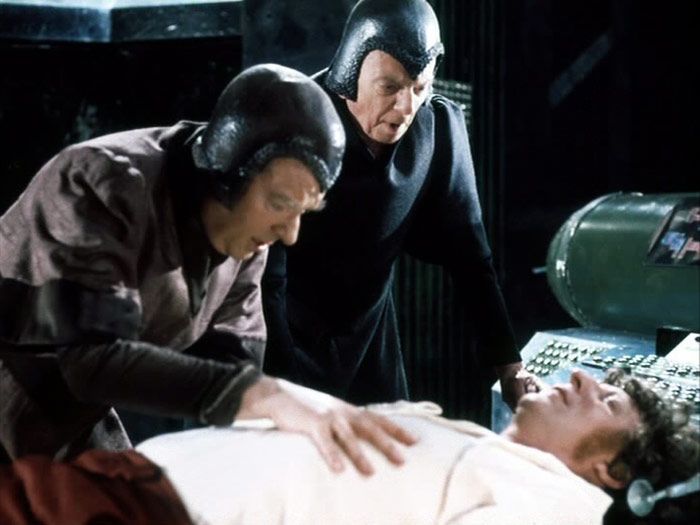
I’ve recently been re-reading Licence Denied, Paul Cornell’s 1997 anthology of Doctor Who fanzine articles. The first entry in the book was Jan Vincent-Rudzki’s 1976 demolition of The Deadly Assassin.  Reproduced in full below, it’s an absolutely fascinating read.

Few Who stories go very much against what has been done before, but recently this has changed. First, there was “Genesis of The Daleks,” then “Revenge,” “Morbius,” and now “Deadly Assassin,” or rather “Deadly Continuity.” But first let us look at the programme as someone who hardly ever watches. The costumes and sets are quite effective, but a little too Flash Gordon. It has a good cast and was well acted. The story was fair but did not hold together too well.

Now let’s look at the story as Doctor Who viewers. The following is not only my view, but that of many people (including people who aren’t avid fans). First, congratulations to Dudley Simpson for using Organ Music for the Time Lords, but thumbs down for not using his excellent Master theme. Then there’s the more than usually daft title. Have you ever heard of an assassin that isn’t deadly?

On to the ‘story’. Before we even started we heard the same boring cliche: ‘the Time Lords face their most dangerous crisis’. I suppose Omega was a minor nuisance! The next blunder was the guards. Why were there any? The Time Lords were supposed to be very powerful, so much so that anyone strong enough to invade would swat the guards with ease, and Time Lord technology should be able to deal with minor intrusions.

Then came the TARDIS. Before, it was MK 1 and the Master’s and Monk’s were very different marks of type 40 TT capsule, but why only one missing? As for such and advanced race being unable to find someone in 52 (sometimes 53) storey building. Ridiculous! I’ve always thought Time Lords names were secret and unpronounceable, so why do we suddenly know their names?

‘C.I.A’ was certainly not appreciated, nor Time Lords with bad hips. There is a time and place for humour and this wasn’t it. Particularly Runcible whose demise I was certainly not sad about. This story really showed up the infatuation for Earth people in Doctor Who. It could have been set on Earth and no one would have known the difference. Doesn’t R. Holmes realise that Time Lords are aliens and do not need to conform to human motivations whatsoever? This fact was well brought out in ‘War Games’, but ignored here.

Elgin said that premonition does not exist. Yet the Doctor had them in ‘Time Monster’, ‘Frontier In Space’, ‘Evil of The Daleks’ and ‘War Machines’. I was surprised by the Doctor saying that Time Lord machinery was ‘prehistoric’. Mr Holmes seems to have forgotten that the whole Time Lord way of life is to ‘observe and gather knowledge’.

So apart from the fact that they are supposed to be one of the most advanced civilisations (brought out so well in ‘War Games’ and ‘Genesis’) they could have easily copied more advanced races. For instance in ‘The Three Doctors’ the Time Lords were amazed that there was a force more powerful than themselves. They were pretty powerful pre- ‘Deadly Assassin’.

In ‘Deadly Assassin’ the Time Lords seem to have forgotten the Doctor yet we’ve always been led to believe it’s very rare for a Time Lord to leave Gallifrey. So he should be remembered, particularly as in ‘Three Doctors’ he saved Gallifrey (and the universe of course!) from destruction, and Borusa said they needed heroes.

The trial of the Doctor was another R. Holmes farce. The ‘War Games’ trial was so excellent, but of course this had to be in Earth norms, and was pathetic. Then later the Doctor and co. go to look at the public register system to see that really happened at the ceremony. Now we were, I believe, dealing with Time Lords, so why couldn’t they and look at a time scanner and see the truth?

Also, why need the brain machine to predict the future? Another fact forgotten is that Time Lords are immortal. In ‘War Games’ the Doctor said they could ‘live forever barring accidents’. This had never been changed until ‘ Morbius’ where we learnt that the Time Lords used the Elixir if they had trouble regenerating. So why didn’t the Master use the Elixir? We also saw in ‘Morbius’ eleven incarnations of the Doctor (‘though in ‘Three Doctors’ Hartnell was rightly the first) so now we’re left with one more Doctor, according to ‘Deadly Assassin’.

Then there wasn’t Part 3 which must be the biggest waste of time ever in ‘Doctor Who’. A ten-minute trip into the matrix would have sufficed, but 25!

One minute Elgin was saying there’s no way to tap the machine, the next he was taking the Doctor down the other ‘old part of the city’ which looked just like all the other parts. When Goth was discovered we heard the daft reason for him helping the Master, for an exchange of knowledge. Again ignorance of the Time Lord way of life is shown by R. Holmes. Goth should have been quite able to go to the extensive library and sit at a Time Scanner for a few decades or so, and find out everything himself. He could even have followed the Master’s travels on the scanners!

Borusa recognised the Doctor, but since the Doctor and the Master were at school together wouldn’t Borusa remember the Master? Also what’s this rubbish about the Doctor being expelled? We know he has a Time Lord degree in ‘Cosmic Science’ (and that was revealed in R. Holmes story!)

I was stunned to discover that the Doctor doesn’t know his own people’s history! The Time Lords would have their own history completely documented. After all, they can look back at time, so what’s all this nonsense about myths? And surely somebody would have wondered what that lump and two holes in the Panopticon floor were.

Of course, part 4 saw the return of the same old story. It couldn’t just be Gallifrey in danger, it had to be a hundred other planets in danger.

You’d have thought that not much else could be wrong with the story, but there was more to come. Time Lord power sources are well known to be novae etc., as Omega produced, not some silly black box with tubes. I would also like to know how the Doctor managed to climb up a 100′ shaft with smooth side and with plastic rocks falling on him.

Also, even if the Master was protected by the sash when everything was to be swallowed up, what point would there be to floating around in space – not much! Things get even more ridiculous when the Master falls down the deep hole (his yell lasted a long time) and he’s back very soon, regenerating (due to absorbing energy). If all he needed was energy why didn’t he use his TARDIS, like anybody else, to regenerate?

For some of these blunders you could argue that the story was set far into the future eat a time when the Time Lord race is degenerating. but it can’t be as the Doctor was recognised. No, the new rule for Doctor Who seems to be the reason, which is ‘anything pre-Holmes needn’t exist’, which can’t be good for a script editor.

What must have happened was that at the end of ‘Hand of Fear’ the Doctor was knocked out when the TARDIS took off, and had a crazy mixed-up nightmare about Gallifrey. As a Doctor Who story, ‘Deadly Assassin’ is just not worth considering. I’ve spoken to many people, many of whom were not members, and they all said how this story shattered their illusions of the Time Lords, and lowered them to ordinary people.

Once, Time Lords were all-powerful, awe-inspiring beings, capable of imprisoning planets forever in force fields, defenders of truth and good (when called in). Now, they are petty, squabbling, feeble-minded, doddering old fools.

WHAT HAS HAPPENED TO THE MAGIC OF DOCTOR WHO?

dead2

TV Comic – The First Doctor. On The Web Planet

The Doctor returns to Vortis – only to tangle once again with the Zarbi. Thanks to TV Comic’s usual brisk efficiency we only have to wait until the fourth panel on the first page before Doctor Who confronts his old enemies.

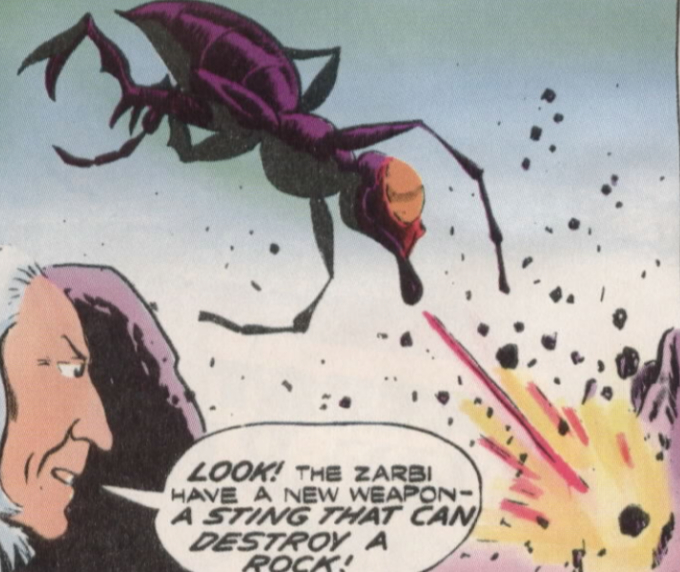
But wait! Now they can fly … and that’s not all. “LOOK! The Zarbi have a new weapon – A STING THAT CAN DESTROY A ROCK!” Easy Doctor, no need to shout ….

But there are familiar allies on Vortis as well.  The friendly Menoptera (who unlike their television counterparts don’t have names) quickly befriend Doctor Who and explain to him that all the trouble seems to emanate from a mountain area. It’s from there that the Zarbi have somehow learnt to fly ….

That the Menoptera aren’t the most proactive of races is made clear after the Doctor discovers a spaceship on top of the mountain. “We did not know this was here” exclaims the Menoptera.  That’s a little hard to believe, just how long have the Zarbi been flying about and blasting them to atoms? Surely after a while someone would have thought it might just be worthwhile to explore the mountain?
A mysterious mushroom-like object suddenly rains down a hail of gunfire on our heroes.  But Doctor Who is beginning to see the light (after ducking for cover).  Picking up a piece of rock, he declares that it’s Glavinium X – the rarest mineral in the universe.  It just looks a mouldy old piece of rock to me, but I’ll bow down to the Doctor’s greater scientific knowledge.  He then explains that the mineral could be used to build bombs of terrifying power.

Gillian, who so far has done precisely nothing (at present we’ve reached the final panel of the second instalment, so we’re four pages in), is given a close-up as part two ends on the cliffhanger of a Zarbi menacing her.  But John quickly bops it on the nose with a rock at the start of part three, so this mild crisis is averted.

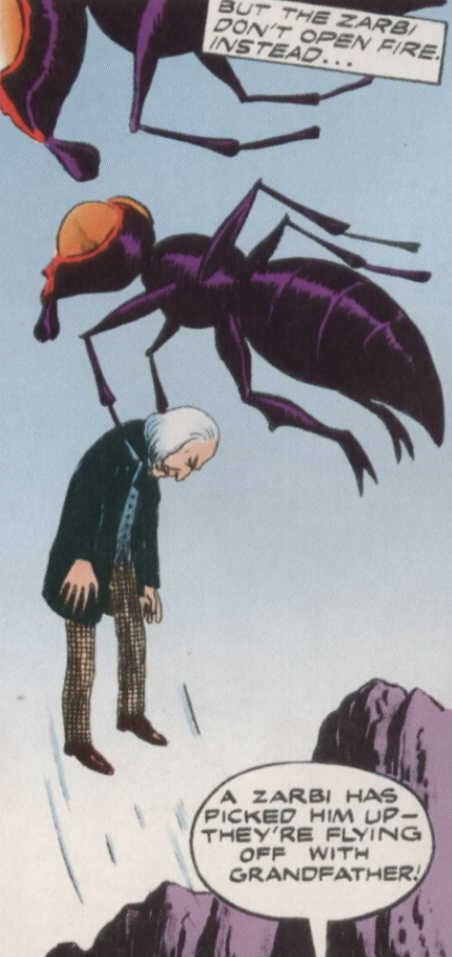
We then see the Doctor casually handling a spacegun as he amuses himself by picking off the Zarbi. “Got it! That’s one less to deal with!” Possibly it’s the Doctor’s trigger-happy nature which makes him a target – as shortly afterwards a passing Zarbi drops a rock on his head (“grandfather has been struck by a flying rock” says John, stating the patently obvious) and swoops down to carry him away.  The sight of the Doctor in the clutches of the Zarbi is a striking image.

If the story wasn’t strange enough, then things then get a little stranger.  John discovers that the Zarbi are nothing but hollow shells, operated by a warlike race called the Skirkons who don’t believe in small talk. “Soon we will be masters of the universe”. It’s always good to think big.

Quite why the Skirkons (who piloted the mysterious mountain ship to Vortis of course) elected to masquerade as the Zarbi is a puzzle that’s never answered.

The concept of a hollowed out Zarbi seems to have been a popular one, since it also featured in a story in the first Doctor Who annual. What’s interesting is the fact that this TV Comic strip was published during March and April 1965 whilst the annual wasn’t released until September 1965.  Was David Whitaker, who wrote all the stories in the first annual, inspired by this story? It might have been so ….

Zarka, leader of the Skirkons, taunts Doctor Who and then straps him to a table. Unless the Menoptera surrender, the Doctor will be neatly sliced in two by the venom ray.  This is so reminiscent of a scene from Goldfinger that it’s a great shame that the Doctor doesn’t ask Zarka if he expects him to talk. 

But John and Gillian, disguised in a Zarbi suit, are on hand to rescue the Doctor. John keeps the Skirkons covered with a gun, although Zarka remains confident.  “You won’t get away with this. No one can stop my plans, no one”. He’s not the most interesting of conversationalists, that’s for sure.

How does the story end? With a rather large explosion of course, as once again Doctor Who delights in blowing his enemies to pieces. Not quite in the spirit of the television series, but there you are.  The Menoptera are chuffed though and as the TARDIS goes spinning off into space, they have the last word. “They have gone – into the mysterious depths of time and space again!”

Blakes 40. Blakes 7 40th Anniversary Rewatch – Power

The omens for Power aren’t good. Firstly you have two little words which strike fear into the hearts of many (‘Ben Steed’) and secondly, within the first few seconds a group of hairy tribesmen lurch into view (hairy tribesmen are always one of my least favourite B7 sights). And yet ….

Dicken Ashworth’s Gunn-Sar might appear at first glance to be a typically stereotyped tribal leader (“I am Gunn-Sar, chief of the Hommiks. I rule by right of challenge, which means I’m the biggest, toughest, meanest son of a Seska on this planet”) but there’s much more to him than meets the eye. Ashworth mines the script for comic material and surprisingly for a Ben Steed episode there are some gems to be found.

The way that Gunn-Sar becomes increasingly exasperated at having to repeat his leadership mantra, his duelling (both verbally and physically) with Avon and the revelation that he’d much sooner put his feet up and embroider a nice rug are all nice little character touches. Frankly, I was sorry to see him meet a sticky end.

Gunn-Sar’s relationship with Nina (Jenny Oulton) is something which seems like it’s been dropped into the script specifically to wrong-foot viewers who were aware of Steed’s style. In public Gunn-Sar treats Nina with contempt, but in private there’s a tender bond between them. Gunn-Sar’s public/private facades are an interesting part of the story.

Isolated from the others for most of the script, Avon swans around as if he’s in a Western (which maybe he is). Avon’s easily able to get the better of Gunn-Sar but he meets his match when tangling with Pella (Juliet Hammond-Hill).

There’s something a little uncomfortable about the way Avon forces her to submit and – as so often with post S2 Avon – then grabs her for a quick snog. Just in case we aren’t following, Steed gives our hero a short speech which reinforces why men are best. “You see, Pella, it’s your strength, and however you use it, a man’s will always be greater. Unfair, perhaps, but biologically unavoidable.”

Slightly icky, but since Pella then levitates a computer keyboard to knock Avon out (Paul Darrow’s shocked expression and his slow descent to the floor are the funniest thing in the episode) it suggests that honours are pretty much even between them at this point. This is another moment where Steed seems to be subverting the male stereotypes from his previous stories (unless I’m just being too generous).

Dayna gets to challenge Gunn-Sar, Tarrant stands around a lot whist Vila becomes increasingly hysterical. All three do their best with what they’re given, but this one is really Paul Darrow’s episode. And what of Soolin? The way she turns up a minute before the end is unforgivable (just what has she been doing for the previous 48 minutes?). It would have been nice had Chris Boucher rewritten the script to give her at least a little something to do.

The Western theme is seen again in the closing minutes as Avon proves to be quicker on the draw than Pella. It’s a shocking moment, which Avon sums up thus. “You can have war between races, war between cultures, war between planets. But once you have war between the sexes, you eventually run out of people”.

If that’s the case, then he shouldn’t have killed her. Oh well.

Overall Power‘s not as bad as it might have been (even if the ease at which they gain a teleport system beggars belief). It’s never going to be a favourite, but the series did far worse.

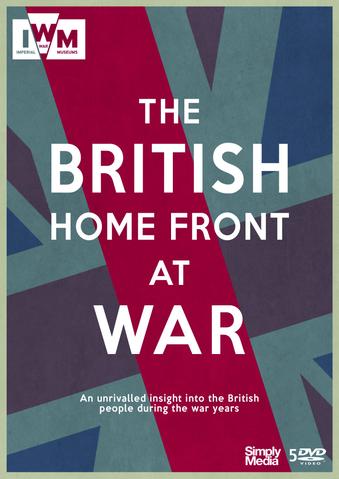
The British Home Front At War – Simply Media DVD Review

164454- Chief Crazy Horse Sleeve.indd

The British Home Front At War is an engrossing five disc set, collecting over 60 short films which are all linked in one way or another to the travails of the British home front during WW2.

Discs one and two are subtitled The Home Guard and Britain’s Citizen Army. One of the earliest films, Citizen’s Army, is in many ways pure Dad’s Army. Its portrait of a plucky groups of individuals, armed with rudimentary and improvised weapons, could have easily fitted into one of Perry and Croft’s scripts.

Rubbing shoulders with these real-life shorts are dramatised pieces which utilise an impressive roster of talent. For example, Dangerous Comment is an Ealing Studios production, directed by John Paddy Carstairs and starring the likes of Frank Lawton, Ronald Culver and Alec Clunes.  This one has a slightly odd tone it must be said – designed to demonstrate that careless talk costs lives, it features a jokey coda in which one young man (after breathlessly listening to the story recounted in the film) seems not to have learnt any lessons at all ….

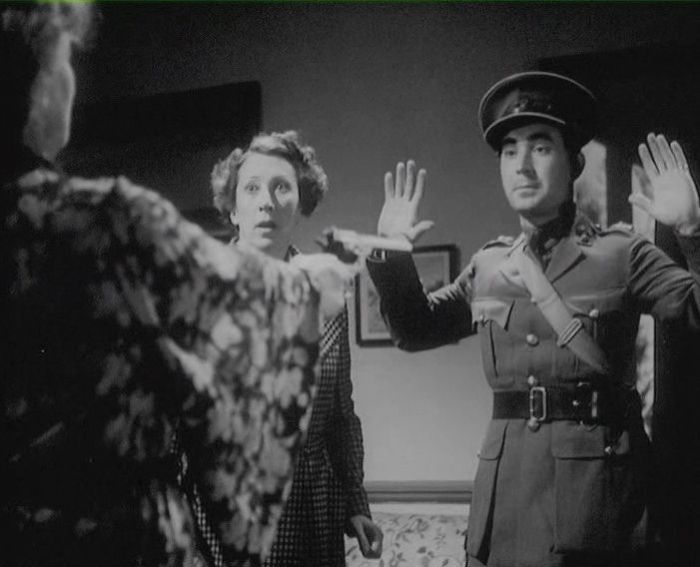
Possibly my favourite from the first few discs is Miss Grant Goes to the Door.  Played out like a miniature version of Went The Day Well?, it focuses on two genteel English ladies who are forced to take decisive action against a German paratrooper, disguised as an English officer, who has dropped from the skies.  Luckily the Hun gives himself away (due to his inability to pronounce ‘Jarvis Cross’) and after a tense stand-off, harmony is restored to their quiet English village.

british home front 01.jpg

The Home Guard and Britain’s Citizen Army would be worth the price of admission alone – it features over thirty films, averaging ten minutes duration each – but this set is bolstered by another three discs.  Disc three – London Can Take It! – features that celebrated short film as its centrepiece.

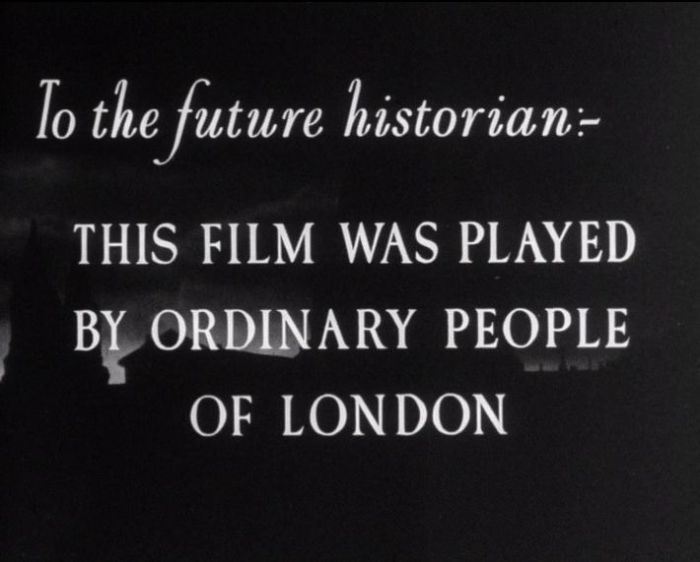
Made by the GPO film unit in 1940 and co-directed by Humphrey Jennings (a documentary film-maker of distinction) it’s a pure slice of propaganda. Narrated by US War correspondent Quentin Reynolds, it serves a duel purpose. Firstly it presents a positive picture of the chirpy and phlegmatic Londoner (keeping calm and carrying on as the Blitz does its worst) whilst also attempting to bring home the plight of Britain to an American audience who at the time seemed to have little interest in the conflict taking place far away from their shores.

Other films – such as Neighbours Under Fire – also reinforce the notion that the whole country was pulling together, keen to help one another during the dark days of the German attacks. It’s another skilfully put together piece – and whilst it may not be telling us the whole truth, there’s no denying the impact that it makes.

Women and Children At War is the theme of disc four. There’s plenty of interest here – such as Jane Brown Changes Her Job, in which Anne Firth (a familiar actress during the 1940’s) plays Jane, a woman keen to do her bit.  So she decides to leave her job as a typist and instead goes to work at an aircraft factory.  As with a number of the other films it might look a little stilted today, but it’s still easy to appreciate just how potent these shorts would have been during wartime.

Whilst factory work is central to a number of films on this disc, there were other vital wartime occupations for women as well and Ladies Only (produced by the Southern Railways Film Unit) makes the case for working on the railways.  Given how British society seemed to reset its gender patterns very quickly following the conclusion of WW2, it’s always slightly eye-opening to see – as here – the cheerful gusto shown by groups of women tackling the sort of manual labour which for decades afterwards was seen as a male-only preserve.

The final disc – Words For Battle, Writers At War – features some big names, pressed into service to help the war effort. The opening film Words For Battle is stirring stuff – Laurence Olivier intones the likes of Jerusalem over carefully selected pieces of footage.

Many notable British writers of the era are also included. J.B. Priestley wrote and narrated Britain At Bay, an inspirational piece which has a similar tone to his BBC wartime broadcasts.  Also of interest is A Diary For Timothy, written by E.M. Forster and narrated by Michael Redgrave.

The only negative with this release is that it doesn’t feature a list of the films included (a booklet would have been nice as well, but a basic listing on the back of the sleeve would have been very useful). That niggle apart, this is an absolute treasure trove of material and comes highly recommended.

The British Home Front At War was released by Simply Media, RRP £29.99.  It can be ordered here (quoting ARCHIVE10 will apply a 10% discount).

british home front 02