Mr Smart explains to E1 about the new timetables and homework arrangements. Natasha (Patsy Palmer) has possibly her first line in the series, which sees her succinctly sum everything up. “Bit of a fag, innit?”
It’s a system that seems to be deliberately confusing, so it’s possibly not surprising that Mr Smart mistakenly heads off for the upper school, convinced that’s where he should be. It’s just a slight problem that it was Miss Washington who persuaded him to do so and when Mr McCartney points out that she was mistaken (mere seconds after Mr Smart has exited the staff room in a hurry) neither decide to rush out and stop him. So you can’t really blame him for being a little miffed with Miss Washington later ….
There’s a fairly rare glimpse of the upper school corridors, which look incredibly dirty and run down. But Mr Smart doesn’t haunt them for long as Mrs McClusky soon sends him back down to the lower school. We haven’t had the old “two classes of pupils try to fit in one room” routine for a little while, so it was clearly overdue an airing.
This gives us a rare opportunity to see virtually all of E1 and N4 together at the same time (normally they tend to have their own episodes with minimal crossovers). E1 might already be present in the room, but Banksie doesn’t believe that possession is nine tenths of the law. Instead, he contends that since they’re older, they must prevail. He makes this point forcibly to Miss Washington, which only serves to highlight the flaws in his character.
The stand-up row between Miss Washington and Mr Smart is good fun, as is Gonch’s plan to bug the staff room. He’s convinced this will enable them to identify the thieves once and for all (presumably he doesn’t consider that they might be able to rob in silence). Once again, security at Grange Hill is shown to be lax in the extreme as the staff room door isn’t locked, enabling Gonch to able to enter and secure a Walkman (hired off Vince for the princely sum of fifty pence per week) under the coffee table. With the tape switched to record, what can possibly go wrong? Mr Baxter making his way to the staff room is a bit of a problem, but Hollo, on guard duty, is able to distract him quite neatly.
The first fruits of their bugging is another episode highlight. Gonch mentions “Grange Hill Watergate”, although quite how many children would have picked up on this reference is debatable. One for the older members of the family watching I guess. They manage to hear Mr Smart asking Miss Washington if she’d like to go out with him for a meal (he’s clearly recovered his equanimity), although this tender moment is cut short after Mr Baxter barges in and complains that once again they’ve finished off all the coffee!
Given that the longest cassette tape available would have been a C120, the most they could hope to record would be just an hour, so it’s not surprising that this is the only useful(?) part of the recording. Clearly if they’re going to catch the thieves red-handed they’re going to have to be very, very lucky ….
Relationships, both real and fictional are key to this episode. Annette and Fay are both shown to have less than ideal boyfriends, although it’s interesting to see that they react in different ways to being left on the sidelines (something which is mirrored later during rehearsals for the school play). Annette is quite happy to hang around, watching Stewpot play football (to his obvious irritation) whilst Fay (once Jean-Paul joins in with the same game) is much less tolerant and heads off home alone.
Elsewhere in the episode, Mr Baxter pops up to remind Fay, and the audience, that her previously impressive sporting career is suffering. And is Jean-Paul worth it? He has inevitable Gallic charm, but apart from that he’s portrayed as rather feckless. And all the time Julian stands on the sidelines, pining. Mmm, maybe all will come right in the end.
The school play, centered around conflict between the mods and rockers in the 1960’s, takes shape. Given what we’ve already seen, it can’t be a coincidence that both Mr Smart and some of the pupils aren’t terribly impressed that the plot is rather male-dominant (reducing the females to little more than appendages, standing on the sidelines). Jackie, pencilled in to play the object of both Zammo and Banksie’s affection (perfect casting!) admits that having two boys fighting over her leaves her cold.
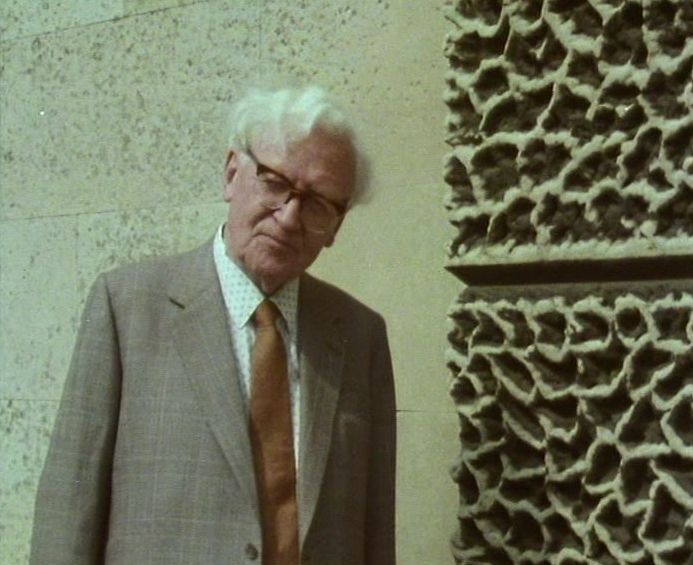
Another Six English Towns, originally broadcast in 1984, was the third and final series in which Alec Clifton-Taylor cast his expert eye over the architectural merits of a variety of English towns. My review of the first two series can be found here.
The format remains unchanged. Architectural historian Clifton-Taylor inspects the streets and notable buildings of each town, dispensing approbation or disfavour as he sees fit and quietly applauding those towns which have managed to preserve their status without recourse to the horrors of modern life (high rise buildings and pebbledash being two particular bête noires of his!).
We open in Cirencester, the capital of the Cotswolds, which finds Clifton-Taylor in an approving mood. He’s particularly taken with the pleasing mixture of styles on display, commenting that “in the market place, the buildings burst forth into a chorus of painted stucco”. The town’s mansion, Cirencester House, complete with a ten thousand acre park, also catches his eye.
Up next is the fishing town of Whitby, which nestles on the North East coast. The ruins of Whitby Abbey are striking and whilst St Mary’s Church may look somewhat unprepossessing from the outside, inside it’s quite a different matter. Clifton-Taylor regards it as “a thrill. Absolutely unforgettable. Not a work of art, but a most illuminating social document.”
Bury St Edmonds has an impressive collection of Georgian buildings, created with different varieties of coloured clay, although Clifton-Taylor is a little miffed that “they are so smothered with Virginia creeper that one can hardly see what colour they are!” This town has rich pickings elsewhere though – the town hall (reconstructed by the notable eighteenth century architect Robert Adam) appeals, as does the Theatre Royal, designed by William Wilkins, architect of the National Gallery.
Clifton-Taylor travels to Wiltshire for the fourth episode, his destination being Devizes. He’s saddened that the twelfth century castle no longer remains (on the site is something he dubs as a pantomime recreation from the Victorian period) and reacts in horror when he sees that some of the eighteenth century timber houses have recently “been smothered with that most repellent material – pebbledash!”
He remains in a slightly caustic mood when he reaches Sandwich, sorrowfully reflecting that the original character of some of the 16th century brickwork has been submerged under fresh coats of paint. But the Salutation, a house and garden designed by Sir Edwin Lutyens (1869 – 1944), is much more to his taste. Clifton-Taylor has little hesitation in regarding him as “the greatest English architect of the last 100 years”
The series concludes with Durham. He’s impressed with the Cathedral, especially the vaults, which have remained unchanged for eight and a half centuries. Clifton-Taylor is also taken with a public convenience, built in 1841, concluding that “few loos, surely, can hold their heads so high!”. An idiosyncratic, but delightful, moment.
A lovely snapshot of six English towns frozen in time some thirty years ago, Another Six English Towns will certainly appeal both to those who have already collected the first two series, as well as anyone who is familiar with the featured locations and wishes to compare then to now.
Shot on 16mm film, the picture quality is on a par with the earlier releases. The prints are rather faded and dirty in places, but still perfectly watchable.
Alec Clifton-Taylor maintains the persona of a kindly headmaster, eager to give credit where it’s due, but also quite capable of expressing irritation and exasperation (albeit with his impeccable manners always intact). An impressive series of travelogues, Another Six English Towns also educates and informs, as Clifton-Taylor is effortlessly able to show how different periods of architecture can live side by side in harmony (or not, as the case may be!)
Another Six English Towns is released by Simply Media on the 23rd of January 2017. RRP £19.99.
Rewatching Pyramids of Mars for the umpteenth time, a couple of things worried me in episode three. Of course, given that Robert Holmes had to cobble the story together at very short notice (and had clearly run out of steam by episode four) it isn’t too surprising that the odd plothole remained ….
After Sarah and the Doctor discover Lawrence Scarman’s body, Sarah is perturbed that the Doctor seems unmoved by Lawrece’s violent death. He responds that Lawrence isn’t Sutekh’s only victim, counting out the others. “Four men, Sarah. Five, if you include Professor Scarman himself.”
Hmm, okay. Lawrence, Doctor Warlock, Ernie Clements (“murdering swine!”), Namin and Collins make five, six if you include Professor Scarman. My first thought was that the Doctor was unaware of one of their deaths, or maybe he didn’t count Namin since he was a baddy?
And why did Marcus Scarman, after murdering his brother, gently prop him up into the rocking chair with such obvious care and attention? It creates a shock moment but doesn’t make much sense.
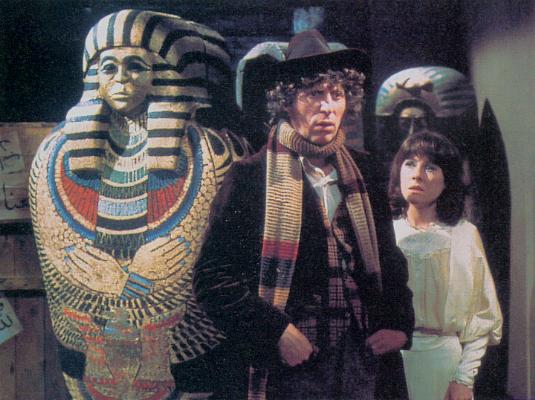
Just how many service robots were there? In actuality there were three, so if that was also the true figure why didn’t Professor Scarman immediately twig that that the faux-Mummy (containing a grumpy Tom Baker) was an imposter? Two robots had been guarding the pyramid and Scarman had seen a disassembled third just before killing Marcus.
And I’m not even going to ponder exactly when Sarah became so efficient with a rifle.
Not that any of this matters as Pyramids of Mars is still great (if rather nasty) fun. Can it really be nearly thirty years since I bought it on sell-through VHS? And a mere twenty three years since I taped the episodic repeat from BBC2, enabling me to see the scenes snipped from the official release for the first time. Time passages ….
Gonch and Hollo’s newest rubbish-dump acquisition is a plastic mannequin which they dress in school uniform and take to school. Unfortunately they drop him in the middle of an oncoming car when struggling to cross the busy road outside the school gates.
Since we can see a Lollipop leaning against the wall, it rather begs the question as to why there isn’t a Lollipop man or woman on duty. It’s mentioned that the teachers are currently assigned to road duty, with Mr Bronson taking his turn today. Alas, we don’t see him wielding the Lollipop, which is a shame.
Fay is increasingly infatuated with the laid-back Jean-Paul, much to Julian’s irritation. All of Fay’s previously held principles (such as a horror of cosmetics being tested on animals) seem to be slipping way, demonstrated best when she much prefers Jean-Paul’s present – perfume – to Julian’s – a rabbit.
Zammo and Jackie’s on-off-on-off relationship now seems to be back on, which leads to further tensions with Banksie. The school production of West Side Story comes to a crashing halt when they learn that copyright problems mean that they won’t be able to continue. A pity they didn’t check beforehand really …
No matter, the show must go on, even if it’s a different show from the one they’d originally planned.
Mr Smart continues his quest to tempt Miss Washington out for an evening of squash, but once again he’s foiled – this time because she’s too busy with the school play. Poor Mr Smart, he seems to have plenty of luck, all of it bad.
Gonch and Hollo liberate Henry, although taking it to Mr Baxter’s lesson probably wasn’t the wisest move. Michael Cronin, as ever, is on fine-form as Mr Baxter comes face to face with Henry.
Gonch’s latest money-making scheme is a video club, run during the lunchtimes with tapes “borrowed” from the shop where Vince’s dad works. We briefly get a glimpse of the film they’re watching and it’s noticeable that the picture quality is authentically bad (loads of interference) which was often par for the course with tapes from video rental shops. Although the picture here is so bad I would have been inclined to ask for my money back ….
There’s several snags with this arrangement – Vince can’t borrow the tapes for more than a day without his dad becoming suspicious and the lunch break is too short for the entire film to be seen, meaning they constantly have to fast-forward to the end, missing out most of the best bits. Never mind though, as the ever-resourceful Gonch has yet another idea – use the media studies room to copy their own tapes, which they can then sell!
Given the wave of thefts still sweeping the school, it really stretches credibility to breaking point to learn that the key to the media studies room is kept on the doorframe. Since there’s televisions and video-recorders aplenty inside you’d have assumed that a little extra security would have been taken in order to keep the equipment safe. It’s easy to see why this was done in plot-terms though – Gonch and the others need to gain access to the room and can’t have been seen to steal the key – but it still feels a tad contrived.
The builders discover that Gonch and Hollo liberated some of their building supplies in order to help Mr Light. Remarkably, they don’t seem terribly put out by this and are happy to do the repairs on Mr Light’s house for virtually nothing, although Gonch does promise to supply them with some good films on VHS.
Zammo, Mandy and Sarah observe a first-year girl being forced into a car against her will. The girl is Calley and the woman is Angela, her real mother. At first glance, this appears to be the latest instalment in Calley’s tale, but the focus quickly switches to the three fourth formers. We never really find out exactly what happened at the car – it’s plain that Calley didn’t want to go with Angela and (presumably) her husband, but she later denies this. Angela only has a few lines of dialogue, which means that this sequence is much more about providing an excuse for Zammo, Mandy and Sarah to be inside the school at lunchtime. And this is the last we see of Angela, meaning that this plot-line rather splutters to a stop in a less than dramatic fashion.
Zammo, Mandy and Sarah run into Mr Bronson, who immediately decides they’re responsible for the theft of yet another of Mr Smart’s squash racquets. All three, along with Mr Bronson and Mr Smart, head off to see Mrs McClusky, which leads into an interesting scene. Zammo is voluble in his defence, stating that Mr Bronson has had it in for him since the day they met. Mrs McClusky swiftly closes him down and asks the three of them to wait outside. After they leave, it’s plain that she is far from convinced of their guilt, which somewhat wounds Mr Bronson. That Mrs McClusky repeats Zammo’s doubts only after he’s left is something we’ve seen before – in front of pupils or parents she’ll always keep a united front with the staff, but behind closed doors it’s sometimes very different.
Having said all that, as Calley was nowhere to be seen when Zammo, Mandy, Sarah and Mr Bronson went to look for her, Mrs Clusky states that they’ll all still be in serious trouble unless she comes forward to collaborate their story. How this can be I’m not quite sure, since there’s no evidence at all to link them to this, or any other, theft. It helps to ramp up the tension – will Calley step forward to clear their name? – but it’s another moment which doesn’t quite work.
Episode eight opens in an unconventional way, as we see Robbie stepping away from the boy’s urinal! It’s not unusual to feature scenes in the toilets, but offhand I can’t think of many times when we actually see people doing the business, as it were
The scene introduces us to Gonch’s groping grab as well as moving forward his truanting plans (Hollo provides him with a stack of dental appointment cards – all they have to do is fill them out and they’ve a perfect excuse for being off school premises).
But what really interests me is how shabby and dilapidated the toilets are. There’s a whacking great piece of graffiti (“wham” – presumably somebody was a fan) which helps to make it look like the sort of place you really wouldn’t linger in. This isn’t reflected in the dialogue though, it’s simply taken as quite natural that it’s run down. We also saw this in the previous episode – one of the classrooms looked in quite a state, with nasty stains on the wall.
But if the children don’t appear concerned about the appearance of the school, it appears that others do, as two builders (played by Ben Thomas and Frank Jarvis) turn up to try and repair some of the damage. Jarvis in particular had an impressive list of credits – turning up in a score of popular television series (The Saint, Z Cars, Adam Adamant Lives!, Manhunt, Budgie, Softly Softly:Task Force, Callan, The Brothers, Dixon of Dock Green, Warshp, Target, The Professionals, etc). He also appeared in three different Doctor Who stories, although given that his final two were Underworld and The Power of Kroll, you can’t help but feel he rather drew the short straw ….
Ronnie’s hair has once again changed to “unconventional”, but this is a minor matter to begin with as Calley, having spent the night with her real mother, is in something of a state. Ronnie asks Miss Washington to speak to her, and just before the teacher leaves the classroom she asks her form to mark themselves in the register. This is an incredibly odd request (presumably a sign of Miss Washington’s inexperience) leading to an inevitably boisterous free-for-all.
Who should be passing at precisely this time? Why Mrs McClusky of course and she’s far from pleased. “I think this is the first time in all my experience I have ever heard of a teacher asking any class to mark themselves in.” And when Ronnie reappears, Mrs McClusky is staggered at her unconventional appearance. As previously touched upon, GH characters often tended to display echoes of those who had gone before them and Ronnie here has more than a touch of Trisha Yates about her. Both frequently railed against the conformity of school uniform, so Mrs McClusky’s comments could equally have easily been directed at Trisha.
Gonch and Hollo plan to “liberate” some of the school’s building materials to help Mr Light, whilst Miss Washington’s purse goes missing from the staffroom (surely Gonch’s groping grab couldn’t have been responsible?). And Patsy Palmer, an unspeaking extra, continues to steal a number of scenes as she prominently places herself in the frame …
The Witness for the Prosecution was an Agatha Christie short story, originally published in 1925. Like many of her short stories it was written for magazine publication, only appearing some years later in book form (The Hound of Death, 1933). Christie was never averse to reusing plots from her short stories and several ideas were later expanded into novels, but Christie elected to turn The Witness for the Prosecution into a stage-play, which debuted in 1953.
Although The Mousetrap is a theatre institution (running for sixty years and more), for me Witness for the Prosecution was Christie’s best play. She expanded the fairly thin material very nicely, creating the central character of Sir Wilfred Robarts for example. In 1957, the Billy Wilder film, starring Charles Laughton, Marlene Dietrich and Tyrone Power, hit the cinema screens and is for many the definitive version.
Sarah Phelps’ Christmas 2016 adaptation carried with it a certain weight of expectation then, partly because her work on And Then There Were None in 2015 had been so well received but also because the Wilder film remains popular with Christie aficionados. Sadly, Phelps’ Witness is much more of a curate’s egg than And Then There Was None was.
It’s interesting that Phelps went back to Christie’s original story, rather than the play. As the 1925 tale is rather brief and only features scanty characterisation, a large part of the teleplay had to be newly crafted by Phelps. So whilst the Queen of Crime’s voice can be heard, it’s only very faintly.
And the foggy yellow filter on the camera was an interesting visual choice I could have done without …
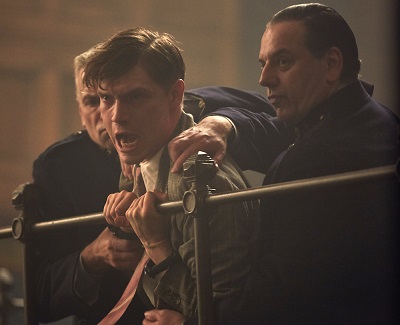
But on the positive side, the core cast were impressive. Toby Jones as Mayhew, a somewhat insignificant character at first glance, was faithful to the source material (albeit with a whole backstory created for him). The character of Leonard Vole is key and Billy Howle was suitably bewildered and endearing (the story only works if the audience immediately identifies with Vole and takes his side).
Emily French received something of a drastic makeover (a nice old lady in the Wilder film, a man-eating vamp here) but Kim Cattrall was entertaining enough and Annette Riseborough hit most of the right notes as Romaine Heilger. This is by far the hardest role to play in the piece (previous actresses to tackle the part include Dietrech in Wilder’s film and Diana Rigg in the 1982 tv movie remake).
Julian Jarrold’s direction boasted some impressive sequences, none more so than the quick cut in episode one when Emily French’s dead body is revealed. The traumatised visage of her maid and the way that her cat steps through the puddles of blood are both striking touches, and this section makes up for some of the more stodgy fare we see later.
Had it been a ninety minute one-off, it might have worked better, at two hours it rather outstays its welcome. The Witness for the Prosecution is not without merit, but my preferred viewing option remains the 1957 Wilder film (certainly worth a look if you’ve never seen it).
The disc contains several featurettes, the most substantial being From Page to Screen (running just under 25 minutes). This is of particular interest due to the way it highlights the differing expectations that may exist between a section of the audience (the Christie die-hards who know the original well) and the adapter, Sarah Phelps. Phelps discusses how she enjoyed the process of extrapolating character development from throwaway comments contained within Christie’s story, although I’m sure that some will regard Phelps’ additions with a slightly jaundiced eye.
If Witness was a tad disappointing, then we’re on firmer ground with 2015’s And Then There Were None. Originally published in 1939, Christie’s novel spawned several film adaptations, whilst she herself turned it into a successful stage play.
Eight people are invited to an isolated island by the mysterious Mr and Mrs Owen. When they arrive, the place seems deserted apart from two servants, Thomas and Ethel Rogers. And then they start to die, one by one, until none are left ….
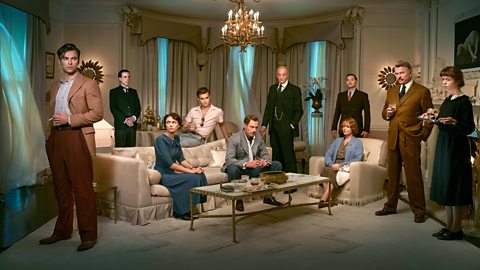
Starring Douglas Booth, Charles Dance, Maeve Dermody, Burn Gorman, Noah Taylor, Anna Maxwell Martin, Sam Neill, Aiden Turner, Miranda Richardson and Toby Stephens, And Then There Was None has an agreeable air of star quality. Unsurprisingly there are a number of deviations from the original, but what remains is a much more faithful Christie experience than Witness was.
The most eye-opening change must be Detective Sergeant Blore’s (Gorman) crime. Here, he’s alleged to have beaten up a homosexual suspect to death, in the book he’s accused of perjury.
The ending is of particular interest. When Christie turned the novel into a play, she changed the denouement (which for me made the piece less effective). Phelps doesn’t attempt to mirror the book’s conclusion, which is probably the right move, although what she leaves us with – something of a mash-up between the book and play – works very well.
And Then There None contains a substantial making-of featurette, running to just under 42 minutes, which features interviews with all the main cast as well as key behind-the-camera personnel.
Sarah Phelps is now working on an adaptation of Christie’s 1958 novel Ordeal by Innocence, which seems to suggest that the BBC are keen to have “A Christie for Christmas” each year. Hopefully this next one will lean more towards And Then There Were None than The Witness for the Prosecution.
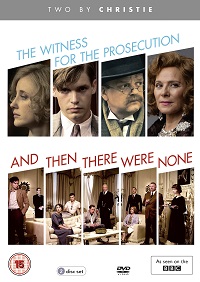
Two by Christie: The Witness for the Prosecution/And Then There Were None was released by Acorn/RLJ on the 9th of January 2017. RRP £29.99. Both titles are also available separately.
The French exchange students arrive. Mr Bronson is no doubt hoping for a rewarding cultural cross-pollination whilst I suspect that Fay and Julie are thinking about quite another form of pollination ….
Both seem impressed with the French boys, although it has to be said that most of the exchange students (both male and female) seem to be narcissistically self-obsessed. This may be a little unfair though, as their limited English obviously hampers them (expect various “comic” moments of misunderstanding) and it’s true that the Grange Hill types give them a welcome which varies enormously.
Amusingly, they’re treated very much little cattle as they get off the coach (“what’s your one like, I don’t think much of mine”) with Zammo being the worst offender. For some reason he’s very much taken against his one – a perfectly inoffensive chap – and proceeds to give him a hard time. No doubt this is because he’s still smarting over his on-off-on-off relationship with Jackie, but it’s still a rarity to see him behave in such a boorish manner.
A party at Julian’s finds everybody (to the strains of George Michael’s Careless Whisper, the perfect mid eighties smooch record) pairing off – even Roland, who’s rather taken with Fabienne (Jessica Harrison). Given that Roland is pretty anonymous during the rest of series eight, this is a nice piece of character development, especially given his long-running issues with making friends and forming relationships.
The other main thrust of the episode is the revelation that Calley is adopted and her real mother, Angela (Jean Heard), has returned to the area and is keen to establish contact with her daughter for the fist time. It’s a challenging role for Simone Hyams and her lack of acting experience is possibly exposed when the camera focuses on a close-up of e, overhearing her parents talking. We should be seeing horror, pain and confusion on her face, but instead Hyams can only manage mild inconvenience.
This is only a minor niggle though, since when she’s given dialogue she’s on much firmer ground. Her adoptive mother (played by Deidre Costello) tells her that they didn’t tell her when she was little because they thought she wouldn’t understand – Calley’s plaintive rejoinder that she’s “not been little for ages” is very nicely played and remains a memorable moment.
Ian Redford makes the first of a handful of appearances as Mr Legge – in this one he spies the absconding Gonch and Hollo and steers them reluctantly to their home economics class. Mr Legge is clearly something of a trendy teacher (sporting a lapel badge) and his easy-going nature, albeit also with a core of steel, comes across well here. He’s another of those short-lived characters who could easily have become a regular.
The cooking lesson also gives us another example that Ronnie is rather an iconoclast and a rebel (she breaks an egg over Trevor’s head). This part of the episode is also of interest thanks to the question of Ronnie’s hair. It’s in something of a Toyah style (as acknowledged) but shortly afterwards it turns back into a more normal style. I’m not sure exactly how she could have done this, so I’ll surmise it was done in order to match a later film sequence which featured her normal hairstyle.
We close on a cliffhanger – it’s late in the evening but Calley hasn’t returned home. Earlier, we’d seen her go off with Angela for a cup of tea, but where is she now?
Sion Tudor Owen makes the first of two appearances as English teacher Mr Dean. The actors name might be a bit of giveaway, as it turns out that Mr Dean is Welsh, very Welsh. He’s one of those teachers who attempts to adopt a chummy attitude with the pupils (as they dash off for their next lesson he tells them to be “careful out there” – clearly he was a fan of American police dramas).
Zammo tells Mr Bronson to keep his hair on. Oh dear. Zammo wasn’t referring to Mr Bronson’s still-unconfirmed hairpiece, but it irritates the touchy teacher. Michael Sheard continues to entertain ….
The Zammo/Jackie/Banksie triangle is still simmering away. Zammo can’t take Jackie to the UB40 concert as he’s working in the chipshop, leaving Banksie free to escort her to the gig. And the other love triangle – Stewpot/Claire/Annette – is reaching critical mass as Stewpot is taking Annette but starts to panic when Claire decides she wants to go as well. There’s a memorable encounter in the hallway between Claire and Annette. Claire tells Annette that if she was any thicker she’d clot!
Love continues to be in the air as Fay and Julian arrange a date at the concert (clearly UB40 have the power to bring numerous couples together). I do like the way that Stewpot greets Annette with a friendly kiss on the top of her head, given the difference in their heights it makes sense – he would have had to crouch down awkwardly to kiss her on the lips!
The fun stops when Claire turns up and Annette proudly tells him that Stewpot’s her man now. Claire offers him to the chance to leave with her, but he declines. Later, Precious tells her not to worry as there’s plenty more fish in the sea – we then cut to the fish shop as Kevin serves up a piece of cod. Well it amused me anyway.
One of the drawbacks about switching focus between the first and fourth years is that you sometimes have to wait a little while for continuing storylines to develop. So although we left (shock horror) Stewpot and Annette locked in an embrace at the end of the second episode, it’s only at the start of this instalment that the plot kicks forward.
Stewpot, still sporting something of a hangdog expression, has to confess to Annette that he’s yet to tell Claire that it’s all over. Stroppy Annette is far from pleased about this of course. Mind you, Claire is equally as stroppy so goodness knows how he’s going to choose between them – but his habit of lying to each of everybody is obviously going to catch him out pretty soon.
And Stewpot’s appearance, in school uniform, raises the interesting topic of uniform policy during series eight. Leaving aside for the moment why a sixth-former like Stewpot would be wearing school uniform (I can’t recall this happening at GH at any other time) we’re told early on that uniform is optional from the fourth form onwards. That some ex-Brookdale and Rodney Bennett pupils turn up at the start of term in their old uniforms is explained by the fact that they’re still clinging onto the memories and loyalties of their former schools. This doesn’t explain why so many of the old Grange Hill types in the fourth year are still wearing uniform though ….
There’s also something of a glaring continuity error between the studio and film sequences (fairly understandable since they were probably shot months apart). Inside the school Stewpot is wearing a blazer, jumper and no tie, but when he ventures outside he’s lost the jumper but gained a tie. It makes him look very odd, especially when Annette, two years his junior, is a vision beside him in orange.
The arrival of Mr Bronson sees something of a realignment of Mr Smart’s character. With Mr Bronson taking on the mantle of the hard (and occasionally fair) teacher, Mr Smart has become more conciliatory – although this may be simply due to the fact he enjoys baiting Mr Bronson. There’s a great example in this episode as Mr Smart nips into the last parking place in the school, leaving a highly aggrieved Mr Bronson with no other option than to park on the street. Watch how quickly Mr Bronson speeds off through the playground after he fails to persuade Mr Smart to give way – it’s lucky he didn’t knock anyone over.
Zammo continues to rail against the Brookies, whilst Banksie and Jackie get slightly closer. The constant fighting between the rival (and now non-existent) schools irritates Jackie no end, but all becomes clear – in story terms – when Miss Washington and Mr McCartney (Tony Armatrading) announce they plan to stage West Side Story. Casting Zammo and Banksie as the rival gang leaders with Jackie as the object of their rival affections is a perfect example of life and art imitating each other.
Calley’s latest wheeze is hypnosis, she certainly has a varied portfolio of interests. Meanwhile, the Grange Hill Bridge-Builders scheme (Mrs McClusky’s plan to help the local, aged community) and preparations for the school musical continue apace.
There are more thefts, including Ronnie’s Walkman (taken from the staffroom) and we also see Gripper’s sister, Emma (Bonita Jones), for the first time. Is there a connection between the two? Emma could have been developed as a regular – it’s been a while since GH has had a female bully – but instead she only makes a couple of appearances, meaning we have to wait until next year and the arrival of Imelda before the series gains such a character again.
Ronnie’s convinced that Gonch pinched her Walkman and Calley uses her hypnotic powers to try and confirm if this is so. But all it proves is that Gonch is a good actor as he manages to convince them all for a few moments that she really did hypnotise him.
The subject of Mr Bronson’s hair is touched upon. Previously it was believed that it was dyed (inevitably leading to the question about what it died of) but now everyone seems to know it’s a wig – or at least Precious does, especially after she collides with him. Mind you the way he anxiously checks it after the knock is a dead giveaway ….
Hollo plans to use the Bridge-Builders scheme to give his neighbour, Mr Light (James Ottoway) a helping hand. Of course, Hollo hasn’t bothered to ask him first, which makes things a little awkward at first. But after an unpromising beginning, Mr Light doesn’t quite turn out to be the stern curmudgeon we initially take him for (something of a cliché, true).
After unsuccessfully pursuing Miss Gordon for all of S7, Mr Smart’s on much firmer ground with Miss Washington – they’ve already fixed up a date at the squash court and it’s only episode three. He’s a quick mover! This episode also sees the first stirrings of Gonch’s skills as a salesman. He and Hollo have various things to sell, scavenged from the rubbish tip – and I do like the way he describes that they’ve come from a “tip-top” supplier ….
The ever patient CDT teacher Mr McKenzie (Nicholas Donnelly) appears for the first time. Donnelly would put in long service at Grange Hill, appearing for the next eight series and he’s perfect as the unflappable teacher (he seemed to specialise in such characters as he had an even longer-running but similar role in Dixon of Dock Green).
Calley is entertaining the others with some palm reading but Jane (Joann Kenny) is convinced it’s all a con. It’s plain that Calley is simply making stuff up, but we’re still invited to side with her as Jane’s plan to expose her backfires and she ends up as the one who’s ridiculed. This seems a little unfair, as Jane isn’t really positioned as a spiteful character.
A wave of thefts are sweeping the school, including Mr Smart’s squash racquets. It’s just one of a number of niggles which convince the teaching staff to make a direct appeal to Mrs McClusky. Mr Bronson is less than impressed with Mr Smart’s missing racquets, he’s more concerned with the lack of car-parking spaces. Mr Baxter, someone who’s tended to appear mostly on film during the last few seasons, is now back to being a VT character as well – he leads the deputation, but is far from impressed at the outcome, telling the others that he feels like a “right nana” after they fail to reach a consensus.
The bickering continues into the staff room and descends into a male/female debate, only terminated when Mr Baxter blows his whistle, which shuts Mr Bronson up! This is good stuff and it’s nice to focus a little more on the staff, something which we’ll see more of in later years.
And I have to spare a word for a scene-stealing extras right at the start, who have a brief conversation about fish fingers.
Annette’s got a new boyfriend. She’s coy about his identity though, only giving the other girls one piece of information – his name begins with “S”. First name or last name, they ask? She won’t say, but it’s the name he’s best known by.
The hunt for Mr S occupies the imagination of Fay, Julie and Diane. They reel off a list of (never seen) potential victims, but later are briefly convinced it’s Mr Smart! This only comes about due to a major piece of plot contrivance – Annette and Mr Smart have a chat about Mr Smart’s prowess as a squash player, whilst the others (out of sight down the corridor) misconstrue their conversation. Although given that Mr Smart and Annette aren’t exactly shouting and the girls were a fair distance away, it stretches credibility just a little that they could actually hear them. Oh well, it passes a few minutes and Fay’s shocked reaction is retrospectively ironic when you consider what happens a year later.
Mr S’s identity is revealed at the end of the episode. This could have been spun out for a few episodes more, but no matter – we now know that Stewpot prefers the charms of Annette over Claire (although strictly speaking he’s enjoying them both, as it were, at present). Mark Burdis’ end of episode expression is a classic, sheepish best describes it. Given the effort Stewpot spent trying to re-establish his relationship with Claire, it seems bizarre he’d risk it all for a liaison with Annette (who’s no less annoying this series than she’s been previously). But love is blind I guess.
In the nineties, Grange Hill would introduce several disabled pupils who weren’t characterised by their disability – that was simply a part of who they are. Eric Wallace (James Hickling) is the reverse, his few appearances in S8 all revolve around the fact that he’s partially deaf. To begin with, nobody seems aware of this and the fact that he sometimes appears to ignore people is put down to general ignorance.
It rather stretches credibility that he would have kept his deafness a secret (surely his parents would have mentioned it to the staff?) but it does enable us to have a nice moment with Mr Bronson. When the exasperated Mr Bronson, annoyed that Eric turned to the wrong page in the textbook, asks him ironically if he’s deaf, Eric says that yes, he partially is. That silences Mr Bronson quite effectively …..
Tensions between Jackie and Zammo continue to simmer away. Zammo and Mr Bronson still aren’t hitting it off, whilst Zammo is torn between being one the boys and spending time with his girlfriend (expanding the theme from last year). There’s also signs that Fay and Julian might be interested in each other – when it’s revealed that Julian is opposed to animal experimentation, Fay tells him that she is too. “Good for you” he says. It’s a slightly clunky exchange, but then Douglas Chamberlain’s overtly earnest delivery is probably part of the reason why.
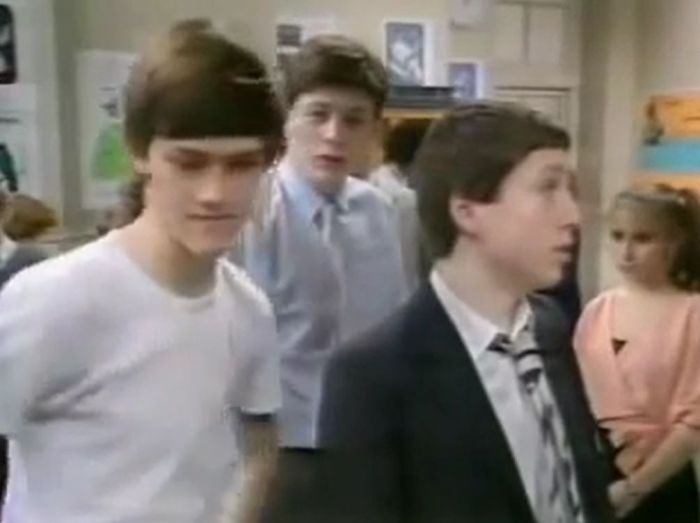
The opening episode of series eight sees a mass influx of new characters, possibly a “new broom” policy instigated by producer Ben Rea (who had just taken over from Kenny McBain). This is the first time that a fresh crop of first years had been seen since 1982, so they were a little overdue, but – thanks to the closure of Rodney Bennett and Brookdale – we also see the fourth form strengthened with an influx of refugees from those two schools (many still clinging to old, tribal loyalties) whilst several long-running teachers also make their debut.
Most of the pupils from N1 are familiar archetypes – Calley Donnington (Simone Hyams) and Ronnie Birtles (Tina Mahon) aren’t too dissimilar from Trisha/Cathy or Fay/Annette whilst Gonch Gardner (John Holmes) and Hollo Holloway (Bradley Shepherd) could be another Pogo/Stewpot partnership, especially Gonch who’ll develop, just like Pogo, into the ultimate free marketer. And the role of the class bully, formally filled by the likes of Doyle, is taken here by the initially imposing Trevor Cleaver (John Drummond). But Barry Purchese also shakes things up a little. Calley, from her first scene, is just a little odd and offbeat, carrying to school something mysterious in a box which she plans to return to the pet shop later.
Few of N1 seem to have known each other prior to the first day, so friendships (Calley/Ronnie and Gonch/Hollo) are swiftly forged. But after Hollo, riding his brother’s bike, knocks into Gonch and the passing Mr Smart seems (rather unfairly) to put all the blame onto Gonch’s shoulders, friendship seems unlikely. Despite being pint-sized, Hollo is itching for a scrap and plans to settle this score with Gonch after school (but their enmity is short-lived as they soon form an efficient double-act).
Trevor’s bullying is swiftly undercut. He may impress the squeaky-voiced Robbie Wright (John Alford) but it doesn’t take long before Trevor is cut down to size. For the remainder of his time on the show he’ll remain an occasionally aggressive character, but more often than not he’s played for laughs – Trevor’s certainly no Gripper that’s for sure.
As for the sixth form, there’s now only three old pupils remaining – Stewpot, Claire and Precious. We briefly see Stewpot and Claire in passing, but rather like the fifth-formers back in 1982 they don’t really have storylines of their own any more – instead they exist to interact with the younger pupils.
Visually the series looks a little different, thanks to using two different schools. The old Grange Hill site now houses the form rooms for the fourth, fifth and sixth forms whilst the former Rodney Bennett school is the home for the first, second and third years. Since Brookdale has been “left to rot” it rather begs the question as to how three schools worth of pupils can now be crammed into just two schools – especially since the classes in Grange Hill always seemed to be full ….
An old story staple reappears here – two teachers squabbling over one classroom. It’s an interesting wrinkle that we’d previously seen Mr Smart and Mr Knowles at loggerheads (with Mr Smart the aggressor) whereas here Mr Bronson is the one who’s happy to exercise his full range of arrogance whilst Mr Smart is placed in a subservient role.
Another interesting visual touch is seen in the opening few seconds as we see a board which states that Mrs McClusky has been demoted to deputy head, Mr Humphries is now the headmaster. There was potential for decent character conflict between the two, but alas Mr Humphries rather ends up like Mr Lllewellyn – a character who’s always just out of shot or in an important meeting and can’t be disturbed.
Jackie’s in the same class as Zammo, which makes them happy, but she’s less impressed to see some of her former Brookdale classmates, especially the loutish Banksie (Tim Polley). For a touch of contrast there’s also the well-spoken ex-Rodney Bennett type Julian Fairbrother (Douglas Chamberlain) who tells the others about their new form-tutor, the intimidating Mr Bronson (Michael Sheard).
Several new teachers are introduced here, but it’s clear that Mr Bronson (“you, boy!”) is the one with the most potential for conflict and drama. Upon entering the class he looks for someone to browbeat and the unlucky recipient is Zammo. This is the start of a repeated pattern, we’ll see that he enjoys victimising people over an extended period of time (unlucky later subjects include Ant Jones and Danny Kendall). Sheard’s wonderful from his first scene and he’s able to brighten many an episode over the next five years.
The long-running Miss Booth (Karen Ford) also appears for the first time, but Miss Washington (Caroline Gruber) was a one series character only, a pity since Gruber is really rather lovely ….
There’s a lot to pack in with just twenty four minutes to play with, but series eight hits the ground running.
Worrell and Liz are assigned to protect Emile Gurwin (Raad Rawi), a controversial author who has received death threats from Islamic radicals following the publication of his book Interim Prophets. The three travel to a remote part of Scotland where Gurwin plans to take a relaxing holiday, but a heavily armed gang has other ideas ….
It’s not hard to find a real-life parallel with Gurwin. Salman Rushdie’s 1988 novel The Satanic Verses sparked an identical storm of protest which saw Rushdie, like Gurwin, placed under sentence of death following the issue of a fatwa.
As ever with Bodyguards, political or ideological rights and wrongs aren’t pushed into the foreground. Liz might regard Gurwin with mild disdain (believing that his problems are self inflicted) whilst Worrell (who claims to have read and enjoyed the book) is somewhat more forgiving, but once the action starts there’s precious little time for philosophising.
After their car is ambushed and then trapped on a bridge, they realise that the only way to escape is via the river. This is an impressive stunt – one of several – as we see Worrell, Liz and Gurwin diving for their lives. Gurwin comes off worst, with a broken arm, and the net result places the two agents in an incredibly difficult position – they’re wet through, in the middle of nowhere, possessing radios which no longer work and with the burden of an injured man.
After a few episodes which have been fairly light on action, Steve Griffiths’ script (his only one for the series) offers a sharp change of pace. Worrell gets to demonstrate his countryside skills, some of which he says were picked up with the Boy Scouts rather than on his RAF survival course!
One slight plot contrivance is that MacIntyre is present in Scotland (he was attending an unrelated conference in the area). Worrell later explains as to why he injured, rather than killed, one of their pursuers – an injured man is a burden for the others. It shouldn’t come as any surprise to learn that the ruthless group have no compunction in killing their wounded comrade – which is something of a cliché, to be honest if they hadn’t it would have been more surprising.
The Killing Ground brings to a conclusion this short, but interesting series. Creator Jeffrey Caine had previously devised The Chief, although Bodyguards was quite a different beast. The Chief had much more of a serial feel, with storylines overlapping multiple episodes. Bodyguards is much more in the tradition of the likes of The Sweeney or The Professionals, featuring one-off stories with minimum overlap (the death of Worrell’s wife is the only story beat which features in a number of episodes).
With the combined talents of Lombard, Pertwee and Shrapnel, it’s a little surprising that Bodyguards never progressed beyond a single series. A second run might have allowed for a more layered approach to the storytelling, certainly the potential was there.
The story so far. Following the death of Robert Hammond, control of his thriving haulage firm was split four ways – equal shares were distributed to his three sons – Ted, Brian and David – whilst the fourth equal share went to his mistress Jenny Kingsley.
With no-one in overall control, there’s a constant power-struggle as elder son Ted (currently managing director) finds himself under attack from his two brothers, both convinced they could run the company better than him. And the trauma in the boardroom is matched by equal strife in their respective bedrooms.
We’ve previously seen that David’s (Robin Chadwick) recent marriage to the lovely, if rather doormat-like Jill (Gabrielle Drake), has had a few wobbles, mainly because his roving eye was elsewhere. He hadn’t actually been unfaithful, but Jill’s suspicions created a definite rift which they attempt to heal during this run of episodes.
Middle son Brian (Richard Easton) suffered even more spectacular marriage problems during the third series, although he remained blissfully unaware. His bored wife Ann (a wonderful performance by Hilary Tindall) found solace in the arms of smooth advertising type Nicholas Fox whilst chugging down far too many sleeping pills and drinking heavily. Her unhappiness at feeling trapped in a loveless marriage culminated in an overdose, although she appears to be quite her old self again now, even to the extent of restablishing contact with Nicholas.
Elder son Ted (Patrick O’Connell) doesn’t have any complaints on the marriage front, but that’s only because he’s single. He has his eye on someone though – Jenny Kingsley (Jennifer Wilson). His desire to wed his father’s mistress has been a running thread for a while, although Ted’s mother, the powerful matriarch Mary (Jean Anderson), strongly disapproves. This might have been one of the reasons why Mary keeled over at the end of series three with a heart attack.
So as series four begins, all three brothers face challenges in their personal lives whilst the business of running Hammonds also continues to cause them tremendous strife. And waiting in the wings is ambitious merchant banker Paul Merroney (Colin Baker), a man who always has his own agenda …..
Colin Baker and Murray Hayne
The series four opener, Emergency sees Mary seriously ill in hosptal. She was discovered (off-screen) by Ted and Jenny who had returned from a brief holiday with life-changing news – Ted had proposed and Jenny accepted. But their happiness quickly evaporates as he blames himself for leaving his mother on her own.
We then see a nice visual signifier of the bond between mother and son. Whilst Ted goes to the hospital to await further news, Jenny stays behind to contact Brian and David as the camera lingers on a framed portrait of Mary and Ted. It’s a clever, unspoken touch which forshadows the dominance Mary will exert over her elder son.
When Mary gets better she has no compunction in telling Ted that he can’t marry Jenny. He might be a hard-headed businessman but he always seems to come off second best with his mother. And this is enough to convince Jenny that marriage to Ted would be impossible.
Business matters take centre-stage again with episode two, Secret Meetings, as Brian and David plan to offer merchant banker Martin Farrell (Murray Hayne) a seat on the board – the first step in their plan to make Hammonds a public company. Of course they’ve yet to mention this to Ted, so sparks inevitably fly when they do. Having said this, it’s surprising that Ted accepts their plan meekly, but he’s got an idea up his sleeve – if Bill Riley also joined the board then (provided he always votes Ted’s way) the status quo would remain. This is classic Brothers, featuring plot and counterplot.
If David has always irritated me somewhat, then Brian is a much more sympathetic character, even if it’s impossible not to feel a little frustrated by the way he remained oblivious to Ann’s lengthy relationship with Nicholas Fox (Jonathan Newth). But even Brian’s blindness could only continue for so long without it seeming totally unbelievable, and when he finally twigs it’s the cue for high drama. His first reaction, of course, is to reach for a drink (heavy alcohol consumption, along with an equally herculean nicotine intake, is something of a feature of the series).
Richard Easton
Brian doesn’t confront Ann straight away, which enables him to calmly twist the knife and make her feel even more guilty than she already is. This is a good move – since you know the showdown will happen eventually, making us wait a little simply heightens the expectation. But Brian’s not backward in letting Ann know exactly what he thinks of her when the truth does emerge. “Your whole world begins and ends with yourself. You’re shallow, you’re superficial and utterly self-centered. Nothing matters to you but self, self, self!”
Ann doesn’t take this lying down. “You are a predictable bore, Brian. You don’t want a wife, you want a second mother. Somebody to cook and clean for you, and tuck you in and say, ‘there, there’ whenever you’re not feeling very well.” Both Richard Easton and Hilary Tindall are firing on all cylinders throughout (the end of episode five – Partings – as Brian knocks a shocked Ann to the floor is one of a number of stand-out moments). If Brian, following his separation from Ann, becomes something of a tortured figure then so does Ann herself. It slowly dawns on her that Nicholas Fox (a serial seducer) has no interest in a long-term relationship ….
David decides to become a racing driver (!) which means that Jill has to wait anxiously on the sidelines, hoping that he won’t be hurt. Frankly, this isn’t much of a role for Gabrielle Drake (compare and contrast to the plotlines dished out to Hilary Tindall) so it’s no surprise that she decided not to return for the fifth series.
Drake might also have been a little miffed that Jill didn’t turn up until the fourth episode and when she does finally make her first appearance it’s only to be once again verbally smacked down by David (he’s less than impressed with her anniversary gift to him – a penthouse flat – complaining that he doesn’t want to be a kept man). He eventually accepts it, but does so with his usual brand of charmless ill-grace.
Robin Chadwick and Gabrielle Drake
The on/off relationship between Ted and Jenny allows Martin Farrell to step in (much to Ted’s extreme annoyance) whilst Bill struggles with the responsibilities of having a seat on the board. He’s always been proud to have the respect of the men, will this change now he’s one of the executives?
Brian’s run of bad luck continues in Saturday, but the later part of series four focuses on company traumas. The decision to make Hammonds a public company offers up a new range of storytelling possibilities. Until now, boardroom squabbles have largely been confined between the three brothers, but now that anyone is free to buy shares everything changes.
And this is partly where Paul Merroney comes in. He’s introduced in the fifth episode as a colleague of Farrell’s, brought in to advise how Hammonds should go public and although his screentime throughout series four is quite limited, he’ll become more central in the years to come. But Colin Baker, in his first regular television role, certainly makes the most of the material he’s given.
The wonderful Richard Hurndall guests in Bad Mistake as Clifton, an influential investment manager crucial to Hammonds’ future. Ted’s blunt style leaves Clifton less than impressed, giving Hurndall a chance to demonstrate his familiar icy, amused detachment. This episode also marks the point where Merroney starts to have an influence on company policy, much to Ted’s disgust.
The series finale, the aptly named The Crucial Vote, sees Ted struggling to keep the board united as the infighting intensifies. There’s no doubt that there will be many more twists and turns to come in the battle for Hammonds, which bodes well for future series.
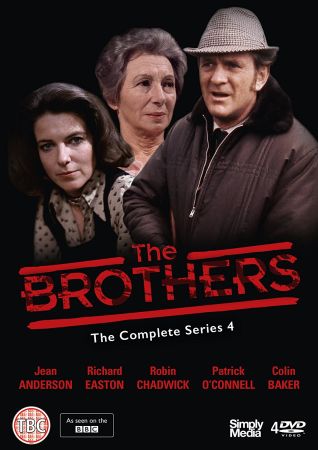
Interweaving numerous plot-threads across its fourteen episodes, series four of The Brothers continues to be highly addictive entertainment. Brian and Ann’s disintegrating marriage is the definite highlight although the unstable powder-keg that is Edward ‘Ted’ Hammond also entertains. Patrick O’Connell plays Ted as a man constantly struggling to keep his anger in check – which can be seen most clearly any time that Jenny and Martin Farrell exchange glances. David’s fleeting desire to be a racing driver is less easy to swallow, but at least the one racing-centric episode – The Race – is not without interest, especially for the authentic track footage.
If you’ve yet to sample the world of the Hammond brothers, then now – with the first four series available and the remaining three due out by the end of the year – would appear to be the ideal time to do so.
The Brothers – Series Four is released by Simply Media on the 9th of January 2017. RRP £29.99.
Richard Easton, Robin Chadwick and Patrick O’Connell
Maurice Boyd (Michael Williams), an ex-MI6 agent turned Russian defector, returns secretly to the UK to attend the funeral of his granddaughter. The Close Protection Unit are assigned to project him and have put a strict secrecy blanket in operation – since many people (including MI6) would be far from happy if it was known that Boyd was back in the country ….
Stand Off benefits enormously from the presence of Michael Williams. Maurice Boyd is something of a Kim Philby-like character and the audience’s knowledge of real-life defectors no doubt helps to fill in some of the blanks. There’s something of a personal edge to the story, as MacIntyre and Boyd had been close colleagues. Prior to his arrival, MacIntyre displays an understandable coolness towards his former friend (responsible for the deaths of many fellow agents) but we see something of a rapprochement as the story progresses.
Boyd later tells him that “I don’t regret what I did, I never will. But there are some things in my life that I do regret. And one of them is the rift between us.” Since Boyd is an arch dissembler it’s left unclear whether this is the truth or yet another lie. Throughout the story Boyd is presented as an affable, friendly sort – which means that reconciling his current behaviour with his previous actions is difficult, but that’s true of many real-life traitors.
Anthony Bate, an actor not unfamiliar with spy dramas, has the small but pivotal role of Sir Thomas Glennie. It’s always a pleasure to see Bate, even in such a brief cameo, although it’s a little surprising that he didn’t return at the conclusion of the story. But then as we’ve seen previously in Bodyguards, the focus of the series is the protection of their subjects rather than the solving of mysteries.
Stand Off poses the question as to who wants Boyd dead and there’s a credible answer provided – a high-up government official who, like Boyd, is a Russian agent, although he, unlike Boyd, has remained undetected. With Boyd working on a book that (ala Peter Wright’s Spycatcher) plans to name names, this agent is keen to silence Boyd and so arranges for his granddaughter to be killed in order to lure him to the UK.
This part of the plot doesn’t quite hold water – if Boyd was preparing to betray his Russian masters by revealing the identity of a mole inside the British establishment, why haven’t the Russians taken steps to silence Boyd and his co-writer? It would have made more sense for the Russians to deal with Boyd in their own country rather than for the mole to spirit Boyd over to Britain.
A minor quibble, since – as previously touched upon – the mystery part of the story plays second fiddle to the job of keeping the target alive. Williams and Shrapnel only have a few scenes together, which is a shame, but they certainly make the most of them. Apart from a few explosions, Stand Off is fairly low-key – character interactions rather than gunplay drive it forward – but there are far worse ways to spend fifty minutes.
A shady businessman called Steven Ballard (John Bowe) is making a brief return to the UK in order to give evidence to a Commons Select Committee. Various vested interests, apparently from the Middle East, would sooner he kept quiet, so he’s targeted for assassination …..
Ballard and Liz rather hit it off. He might be a ruthless type in business, but he also possesses a considerable amount of charm and whilst Liz doesn’t bend, possibly she buckles ever so slightly.
Liz, Worrell and a third agent, Stuart Robbins (Ashley Barker) take it in turns to guard Ballard. Since we’ve not seen Robbins before it shouldn’t be too hard to guess the way things turn out (if he had been wearing a red shirt it would have been even clearer).
Once again, the way the Close Protection Unit handles their charge is a little eye-raising. Ballard stays in his own property – a fairly substantial building – with only one agent guarding him. When a cat apparently triggers the alarm sensors it rather highlights how stretched they are – if Liz is by the window shooing the cat, who’s looking after Ballard?
During Robbins’ tour of duty things go badly wrong. An assassin breaks in, shoots Robbins, then shoots a figure in the shower (which turns out to be Ballard’s maid) and is only frightened off after Ballard hits the alarm. Not exactly the Close Protection Unit’s finest hour ….
David Saville is on good form as Nigel Henderson, a rather shady government type who’s quite keen to sweep this unpleasantness under the carpet. After all, the maid was an illegal immigrant so there shouldn’t be any problems there. Liz later raises the intriguing possibility that the British government might be the ones who would be happy if Ballard didn’t testify.
There’s also the possibility that Ballard’s security was compromised by someone inside his own organisation. We don’t see many of Ballard’s people, so it seems obvious that his trusted right-hand man Greg Burns (Nick Reading) is the guilty party. Or is that just too obvious?
Julian Jones penned four episodes of Bodyguards in addition to contributing to a score of popular series during the nineties (Taggart, Perfect Scoundrels, Stay Lucky, Soldier Soldier, Between the Lines, 99-1, Wycliffe, The Bill, The Ambassador) and more recently created the popular Saturday evening drama Merlin.
Target, by playing up the angle that no-one (not even their own masters) can be trusted, ups the ante a little, and whilst the nature of episodic television means that the reset switch has to be hit at the end, it helps to make the episode a cut above the norm. The gun-heavy climax is entertaining as well.
Worrell is designated to be the close protection agent on Robert Connor (William Hope), a right-wing Presidential hopeful. Liz is put in overall command, which doesn’t please Golding (Aaron Swartz), a particularly aggressive American agent. He doesn’t seem terribly impressed with the fact that she’s a woman, although the problem may be more that she’s British ….
Familiar tensions between the British and American agents are seen throughout Know Thine Enemy. The Americans are all aggressive, trigger happy and unwilling to defer to anyone else – all clichés of course, but they help to stoke up the drama.
The way they approach the problem of Michael Aaronson (Peter Marinker) helps to highlight their differing approaches. Aaronson holds Connor morally responsible (policy wise) for the death of his son and his arrival in Britain sets alarm bells ringing. The Americans want him picked up and detained but MacIntyre – whilst happy to keep him under twenty-four hour surveillance – won’t authorise this.
Given that Aaronson has no history of violence – he’s simply a political activist – the way he’s dealt with raises some interesting questions. If they attempt to prevent his protest (he wants to present Connor with a petition requesting stricter gun control) then Aaronson’s civil liberties have obviously been interfered with – but is this the intention of the American agents? Or do they truly believe he’s capable of violence?
Either way it’s slightly terrifying how the State apparatus is able to monitor him with ease, which raises the debate (not really touched upon here – the agents have already picked their side) about how far the liberties of the individual should be eroded in the quest to prevent terrorist attacks.
Liz intercepts and searches him and is happy that he presents no violent threat. She then allows him to take his place outside the Queen Elizabeth Centre, where Connor is speaking, so Aaronson can hand over a petition. But she doesn’t seem to have mentioned this to Golding and the other American agents, so when they see Aaronson reaching into a bag they naturally react promptly and violently.
You can’t blame them for their actions, which poses the question as to whether Liz deliberately didn’t tell them that Aaronson was present but not armed. Given the storm of negative newspaper coverage it’s hard to imagine she would have done so, which leave us with the probability that Liz just screwed up. She does tell MacIntyre that communications were fraught, but you’d have assumed this would have been a fairly vital piece of information to pass on.
Aaronson – hospitalized with a broken arm – isn’t unhappy though, as he’s gained the sort of publicity he previously could only dream of. This enables him to give Liz a lead on a potentially dangerous threat to Connor.
Throughout the episode we’ve seen a nail-bomb being prepared. Initially it seemed that Aaronson might be responsible, but after he’s put out of action – and the bomb-making continues – it becomes clear that the threat isn’t coming from him. As with previous Bodyguards episodes, the hostile party is presented in a rather abstract way (we learn little about them).
Worrell and Liz are split up for most of the episode. Worrell gets a few lighter moments – mocking Aaronson and the others (Worrell has a decent American accent) – but he’s rather placed into the background here. Liz, fretting about her first taste of command, has more to do, but Know Thine Enemy never really sparks into life. It’s decent enough fare, but lacks the personal edge of some of the previous stories.
A thirteen year-old boy called Alan Taylor (Dean Steel) is the only witness to the murder of a priest and will therefore be vital in gaining a successful conviction. Worrell, returning from compassionate leave, is assigned – along with Liz – to the job of protecting him in the run up to the trial. MacIntyre considers it to be just the sort of routine mission which will gently ease him back into the swing of things, but events prove otherwise …..
Police intelligence seems to be somewhat lacking in this one. MacIntyre doesn’t take the threats against Alan seriously and the investigating officers, lead by DCS Granger (Roger Blake), appear not to have linked the murder to a feral teenage Manchester gang, all of whom are skilled in the use of firearms.
That Alan and his family are under serious threat is made plain when his younger brother, Jamie (Dean Cook), is kidnapped. But this is a strange part of the story – you’d assume that Jamie’s abduction would be the lever that forces Alan’s mother, Helen (Eve Bland), to withdraw her elder son from testifying – but not so. Jamie is discovered, albeit dosed in petrol and traumatised, unhurt.
We never find out why they didn’t hang onto him, as the gang remain nebulous characters, little more than objects of abstract menace. None of them have names or speaking roles, which skewers the narrative very firmly on the police’s side. Programmes like The Bill also favoured this storytelling style, but it doesn’t work terribly well here.
Out of the Mouths of Babes continues to develop Worrell’s character – at the start he’s still somewhat emotionally fragile (MacIntyre wonders whether he should have returned at all) but seems to regain his equilibrium as the story progresses. Most notably, we see how he and Liz form a bond with Alan.
For the first time we also start to probe a little deeper into Liz’s character as she relates the story about how she received a commendation for bravery – but since it concerned the death of her colleague it’s a bitter-sweet remembrance. There’s another of the series’ action-packed sequences at the conclusion of the episode as the gang – via a forklift truck – force their way into the secure secret location where Worrell and Liz are guarding Alan. Not much of a secret location then ….
The relative youth of the gang has already been stated, but it’s not been possible to really register this as they’ve been masked in their few, fleeting appearances. So the moment when Worrell corners one and pulls off his mask only to reveal a child not much older than Alan is a suitably jarring moment.
Although it clips along at a decent pace, not allowing the gang a voice is a problem as is the pre-credits sequence which shows Alan observing the murder. Since the murderer was masked, how exactly could Alan have identified him? This is another puzzling part of the story which I’d hope would be addressed, but alas never was.





 Archive Television Musings