Grange Hill. Series Five – Episode Two

grange hill s05e02

Written by Alan Janes. Tx 8th January 1982

Gripper and Denny continue to extort money from Roland, but he’s far from their only victim.  Jonah and Zammo are also targeted and both (reluctantly) pay up.  Jonah doesn’t seem too bothered – ten pence a week seems a small price to pay for not getting your head kicked in – but Zammo sees the bigger picture.  If they give in now then Gripper will always be there and his demands will only increase.  Zammo briefly considers taking Gripper on, but quickly admits that it wouldn’t be an equal fight.  Neither seems to consider that if they find Gripper’s other victims there would be safety in numbers.

This episode provides us a good opportunity to stop and examine how proactive the school was at dealing with Gripper.  Jonah and Zammo tell Mr Hopwood about Gripper’s demands for money, but he seems initially disinterested – as it’ll be their word against his how can anything be proved?  However he does decide to ask Gripper to turn out his pockets – and finds a considerable amount of change – which does back up the boy’s story.  Hopwood warns Gripper to cease his actions (threatening him with physical violence in a way that wasn’t unfamiliar in the early series of Grange Hill) but that’s as far as he goes.  Surely experience would have told him that Gripper wouldn’t give up that easily?

Roland’s experiences are even more interesting.  He’s skipped school several times (in order to avoid Gripper) and most disturbingly of all deliberately cuts his hand with a chisel in woodwork.  He hopes to be sent home and is clearly upset to be told that the nurse will be able to deal with it by putting on a plaster.  Whilst this foreshadows the more extreme measures he’ll take later in the series to escape Gripper, it should have sent alarm bells ringing amongst the staff.  Mrs McClusky does want the boy to see an educational psychologist, but it’s plain that they consider the problem is purely down to Roland’s attitude.  Even after he’s told them that he’s been systematically bullied they don’t seem interested in finding out if his story was true.  Is it that they simply believe he’s making up tales to explain his bad behaviour?

Elsewhere, there’s light relief as Annette attempts to gain revenge on Jonah by throwing a stink-bomb at him.  She indirectly does him a good turn – he and Zammo were being threatened by Gripper at the time and the smell is enough to drive the older boy off.  Leaving us with the immortal line from Jonah.  “Cor Gripper, you’ve done something in your trousers”!

Grange Hill. Series Five – Episode One

grange hill s05e01

Written by Alan Janes. Tx 5th January 1982

Series Five opens with what I take to be a deliberate nod back to the very first episode as the camera tracks through the corridors of the eerily quiet school.  Before the pupils arrive it’s a haven of peace and quiet – although it’s no surprise that the silence doesn’t last for long.

Five new arrivals will be the focus of their year during series five (their classmates will also feature, but not to the same extent).  Jonah Jones (Lee Sparke) and Zammo McGuire (Lee Macdonald) are clearly cast from the same mould as Tucker Jenkins and his friends.   Jonah and Zammo are scamps and tearaways who can’t help but get into trouble – but since they lack malice the audience is invited to identify and side with them.

Annette Firman (Nadia Chambers) and Fay Lucas (Alison Bettles) bear more than a passing resemblance to Trisha and Cathy (and also Suzanne and Claire).  Annette is the rebel (like Trisha/Suzanne) whilst Fay is the more sensible one (like Cathy and Claire).  Although in later years Fay will go slightly off the rails as Cathy and Claire did.

Possibly the most significant of the new arrivals is Roland Browning (Erkan Mustafa).  Roland is friendless, overweight and becomes an instant target for Gripper and his new henchman Denny Rees (Julian Griffiths).  Gripper is a larger and more physically imposing figure from the youngster we saw in series four and it doesn’t take long before he makes poor Roland’s life a misery.  Because Roland is an isolated figure, he has no-one to turn to and his anguish only comes to an end towards the end of the series when he’s hospitalised following an accident with a car.  This is a very disturbing moment as it’s strongly inferred that he deliberately stepped out in front of it.

It’s certainly a far cry from the previous attempts by the series to show the effects of bullying.  Judy Preston was targeted by a gang of older girls during series one, but everything was neatly wrapped up in the space of a single episode.  For Roland there’s no quick solutions and the fact that the storyline was developed over a run of episodes is a sign that Grange Hill was becoming more confident to unfold longer storylines which wouldn’t have an immediate payoff (no doubt happy that the audience would stick with them).

GCE (Gripper’s Cash Enterprise) provides him and Denny with a nice little earner.  Roland is their latest victim and they force him to hand over twenty pence every Monday.  Gripper’s warning to Roland not to squeal is bleak in the extreme.  “You talk to anyone and I’ll put you in a wheelchair.”

The initial meeting between Jonah and Annette isn’t a promising one.  The girls beat the boys to the desk at the back of the classroom and Jonah isn’t prepared to take this lying down – although when Annette pushes him off his chair that’s exactly what happens!  As he lies sprawled on the ground this gives the camera the opportunity to view Miss Mooney’s attractive ankles and she decides the best place for him is right at the front.  Zammo wonders if his friend is going to take such an insult without attempting reprisals, whilst Jonah counters that there wasn’t anything he could do at the time.  Zammo’s solution – punch her on the jaw – is direct and has more than an echo of similar early encounters between Tucker and Trisha.  He was always promising her a knuckle sandwich but – as here – the threats were never followed through.

Jonah’s stink bomb helps to clear their classroom and earns the class the immediate disapproval of Mrs McClusky.  But he manages some form of redemption when he uses another of his stink bombs to force Roland out of the toilets (he’s locked himself in and refuses to come out).  It’s certainly more effective than Mr Thomson’s efforts.  Mr Hopwood had called the caretaker in – no doubt in the hope that he’d be able to lever the door off his hinges – but Thomson’s only response was to bang on it!  It’s a lovely comedy moment played to perfection by the always reliable Timothy Bateson.

Grange Hill – 1981 Christmas Special

xmas 81-01

Written by Phil Redmond, from a storyline by Paul Manning
Tx 28th December 1981

Although the 1981 Grange Hill Christmas Special isn’t quite the last hurrah for the class of 78, it’s close.  One of the surprising features about series five (which would begin transmission a week later, in January 1982) is just how marginalised Tucker and co are.  One episode does feature them strongly but otherwise the likes of Tucker, Alan, Benny and Justin only make one-off appearances (and when they do it’s so they can interact with the younger pupils – the focus is always on the new arrivals).

Tucker’s Luck, which began in 1983, would provide an afterlife for Tucker, Alan and Tommy, but the rest of the original cast just fade away over the course of the coming year.  This is in complete contrast to later eras, when the series became increasingly anxious to hang onto their regulars (by the 1990’s it was common for pupils to stay at the school for seven series – as the concept of the upper sixth form had been introduced).

But in a way it’s not hard to understand why this happened. The viewership of Grange Hill would tend it renew itself every five years or so, as older viewers moved on to be replaced by younger ones.  Therefore the new audience needed to have younger characters who they could identify with – hence the class of 82.

Returning to the 1981 Christmas Special, the storyline was written by Paul Manning (as part of a Blue Peter competition) and was developed into a script by Phil Redmond (how much of Manning’s story remained is an interesting one to ponder).  It opens with a bleary eyed Tucker telling Alan and Tommy that his brother has a job at an electrical wholesalers, which means he can bring home videotapes during the evening – as long as they get returned early the next day nobody’s any the wiser.  Titles such as Saturday Night Fever and Alien (“the X version?”) help to instantly date the episode to the very start of the video boom.  The novelty of being able to watch a film on demand, which meant you weren’t tied to the television schedule, is something that might be taken for granted now, but was a totally new concept then.

Grange Hill didn’t often do Christmas Specials, or episodes set at Christmas, so this one is something of a novelty.  There’s no snow, but various characters spend a lot of time shivering and rubbing their hands together, which creates a wintry atmosphere (but knowing how programmes tend to be recorded in advance it wouldn’t surprise me had this been recorded the previous summer!)  The school assembly scene is quite interesting – it’s shot very tightly which suggests that the number of pupils used were quite small.  The main news to come out of the assembly is that there will be an end of term disco, which the long-suffering Mr Sutcliffe is persuaded to organise.

Tucker’s delighted, as he spies a chance to make some money, and he persuades Mr Sutcliffe to let him organise it.  You’d have thought Mr Sutcliffe would know better by now, but there’s evidence that he’s somewhat under the weather (a running gag has various characters – Tucker, Mrs McClusky, Miss Mooney – pointing out how pale he looks).

Trisha and Cathy go shopping for clothes.  Trisha’s not mellowed over the years – she’s irritated at being dragged around numerous shops by Cathy who’s desperate to find just the right thing to wear for the disco.  Trisha’s determined not to make an effort, knowing that it’ll just be “the same old spotty faces making the same old spotty jokes.”

They’re both sporting new hairstyles, but the most remarkable transformation is that of Susi, who’s certainly changed since the end of series four.  If it hadn’t been for the voice, I probably wouldn’t have recognised her at first.  She’s still an item with Alan, although when he leaves school to go on the dole in Tucker’s Luck she brings their relationship to an end (which also means they didn’t have to contract her for the new series, which was a little bit of a shame).

Another thing which helps to date the episode is the admission price of 75p, which includes one drink and one sausage or one cracker.  Bargain!  Tucker’s state of the art disco equipment – complete with flashing lights – has been borrowed from his brother and it’s made very clear that should anything happen to it then Tucker’s life expectancy will be very short.

Some Brookdale ruffians attempt to steal the cashbox, which Mr Baxter rather unwisely left in Justin’s care, bad choice!  After Tucker manages to duff them up and stop them, they then decide to take the disco equipment.  It’s slightly odd that they could just walk out with this bulky equipment and nobody in the hall thought to raise the alarm, but there you go.  Needless to say, Tucker and the others are on hand to once again dispense some rough justice.  Remarkably, Doyle teams up with Tucker to beat off the Brookdale infiltrators.  Doyle only has a few brief scenes, but it’s a nice touch that his final Grange Hill appearance sees him on the right side for once.

This episode didn’t feature in the repeat run of the 1990’s (probably because of music clearance issues).  Some of the top artists of the era are featured – Madness, Ultravox, the Police, Squeeze, Cliff Richard (!).  Thanks to YouTube though (as for virtually every episode from series five onwards) it remains in circulation.

Arthur C. Clarke’s Mysterious World – Clarke’s Cabinet of Curiosities

cabinet

“Why do stones move all by themselves in California’s Death Valley? Can frogs and toads really live for centuries entombed in solid rock? Do the mountains of Mongolia still harbour neanderthal man?”

The last episode of Arthur C. Clarke’s Mysterious WorldClarke’s Cabinet of Curiosities, is a handy way to include some strange mysteries that might not fit in with the themes of the earlier editions.

It begins in Death Valley, California where tracks in the ground indicate that rocks seem to have dragged themselves across the arid desert surface.  What adds to the mystery is that in the hundred years or so since the phenomenon was first noted nobody has actually seen them move.  Dr Dwight Carey’s theory involved abnormal weather conditions – which was certainly on the right track – although it wasn’t until recently that the mystery was finally laid to rest.  The solution can be found here.

Crail in Fife is our next destination, where the topic of ball lightning is examined.  This had already been discussed briefly in the first edition (we again see the footage of the plucky cafe owners and hear the tale of the speedy exit of the man with the wooden leg!) but here there are also theories proposed as to what it might be.  Professor James Tuck, who helped to create the atomic bomb, had been working on experiments in America to artificially create ball lightning.  He certainly generated something – which he admits may or may not have been ball lightning – but the debate about what ball lightning actually is rages on.  Even today there’s no common consensus, but this webpage has some of the more recent theories.

The Minnesota Iceman is a strange story.  It surfaced in the late 1960’s and was purported to be a neathandal man encased in ice.  He became something of a minor celebrity, appearing at numerous fairs and sideshows, before mysteriously vanishing again – although he returned to the limelight fairly recently.  The fact that he’s never been made available for rigorous scientific research would tend to indicate that he’s a fake, but reports of neathandal men spotted in Mongolia suggest that maybe, just maybe, the Minnesota Iceman was real.

Frogs encased in solid rock is another odd mystery for which there’s no answer.  In his closing piece to camera, Arthur says that “even if we solved all the mysteries in this series there’s plenty more where they came from. For our universe is not only more mysterious than we imagine, it is more mysterious than we can imagine.”

Even after thirty five years, Arthur C. Clarke’s Mysterious World still stands up.  If some of the mysteries now have solutions, there are still plenty that don’t and, as previously touched upon, whilst the twenty five minute running time of each edition means that many topics could only be touched upon briefly, the series still managed to cover a considerable amount of ground.

Arthur C. Clarke’s Mysterious World – Strange Skies

strange skies

Strange Skies opens in Flagstaff, Arizona where Dr Peter Boyce discusses the canals of Mars. This was the place where, back in 1894, the Lowell Observatory was established to examine whether the astonishing claim made a few years earlier by Giovanni Schiaparelli (that the surface of Mars was rife with canals) could be true.    Percival Lowell was convinced not only that canals existed, but they were made by the Martians in order to channel water from their ice caps.  His theories sparked a wave of Martian frenzy in the late nineteenth and early twentieth centuries, which the programme compactly summarises.

Although Strange Skies gives Dr Boyce time to expound his theory that Lowell did observe something on the surface of Mars, even if it wasn’t exactly canals, Arthur’s on hand to pour cold water over these claims a few minutes later.  Given that the canal theory was dismissed some considerable time ago (indeed, long before this programme was made) it’s slightly surprising that this edition opened with a straight-faced statement that there might still be something in it.  But although it’s long been disproved it’s still an interesting story – further reading can be found here.

The apparent disappearance of the planet Vulcan (said to have existed between Mercury and the Sun) doesn’t seem to be very well known today.  This is probably because no such planet ever existed, but it’s another fascinating tale.  Urbain Le Verrier was a French mathematician who had discovered Neptune, so when he believed that he’d discovered another planet – Vulcan – it was no surprise he was taken seriously.  Others had also observed it, but then to seemed to disappear.  Most doubt it was ever there in the first place, but there’s still a few scientists who do believe in it.  This webpage has plenty of information on the subject.

Later, Strange Skies tackles a weighty topic – what was the Star of Bethlehem?  Was it a comet, or possibly a nova?  Another theory is that it was a conjunction between Jupiter and Saturn.  Dr David Hughes is seen working on a computer program which mapped the constellation at the time the Star was observed.  No doubt the computer was cutting edge at the time, although it looks rather primitive now (its total processing power could probably fit comfortably in the most basic mobile phone).  For those who believe the Star was a natural phenomenon this programme lays out some possible theories and this lengthy article is worth reading if you want to investigate further.

Although nothing is discussed in too much detail, Strange Skies still manages to provide some decent food for thought and is an entertaining twenty five minutes.

Arthur C. Clarke’s Mysterious World – Dragons, Dinosaurs and Giant Snakes

ddgs

I wonder if Roy Mackal, Chicago University’s Professor of Biology, was an inspiration for Indiana Jones?  He certainly looks the part, as he comes complete with a rakish hat.  After his introduction, he has a chat with a Chicago cab driver.  It’s an amusingly stilted exchange, as the cab driver asks him what he’s carrying.  “Well a jungle machete, some medical supplies for the tropics and a back-pack.”  The wooden cab driver then asks where he’s heading. “Well you may not believe this, we’re off to Africa to look for dinosaurs.”  Okay, sounds reasonable to me!  If he’s not Indiana Jones, then maybe he modelled himself on Conan-Doyle’s Professor Challenger?   But does he succeed in his quest?  We’re teased that later in the programme we’ll find out.  This article has some decent background on him.

Whilst Arthur’s amused expression tells its own story, he does concede that many species of animal have only recently been discovered, so it’s possible that some strange-sounding animals may exist in remote locations.  One such example is the giant snake which menaced Belgian helicopter pilot Colonel Remy van Lierde in the Congo.  There’s a picture of the snake (said to be fifty feet) although it’s hard to get an impression of its size as there’s no landmarks around it.  Arthur seems convinced though, and he reveals that analysis of the photograph proved that the snake was over forty feet long.  Further reading can be found here.

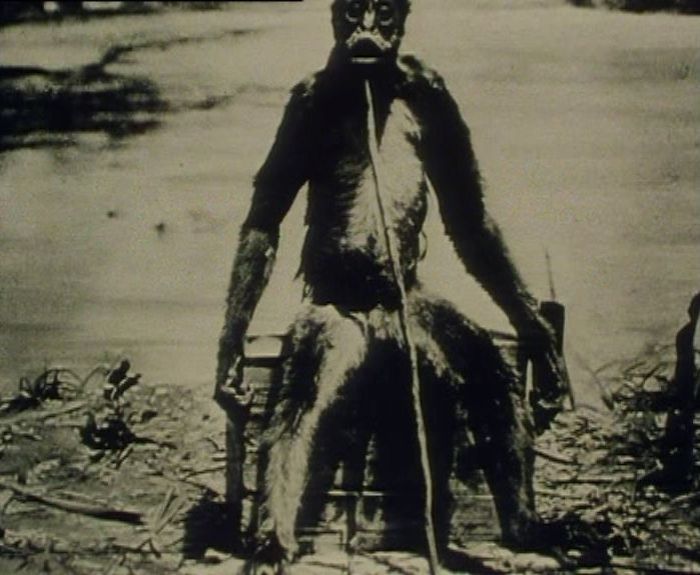
De Loy’s Ape (the picture at the top of this post) is certainly a striking image.  Is it a previously undiscovered species of ape or simply an elaborate hoax?  The programme is non-committal, but there’s plenty of opinions to be found on the internet, most of which say it’s a fake.

Some of the other animals discussed are less interesting, although things pick up a little when the topic of Mammoths is discussed.  It’s mentioned that Russian scientists planned to clone a new Mammoth the next time they found a preserved one in the ice.  It’s not been done yet, although it’s still being discussed.

As for Professor Mackal, it’s obvious that the programme’s budget didn’t stretch to following his team up the Congo.  So we have to make do with hearing him talk about what he did (or didn’t find) when he returns.  He’s non-committal, but leaves us with the hope that next time something concrete will turn up.

With a lack of definite finds or compelling evidence of strange beasts, I think it’s fair to say that Dragons, Dinosaurs and Giant Snakes is one of the less compelling editions of Arthur C. Clarke’s Mysterious World.

Arthur C. Clarke’s Mysterious World – UFOs

UFOs

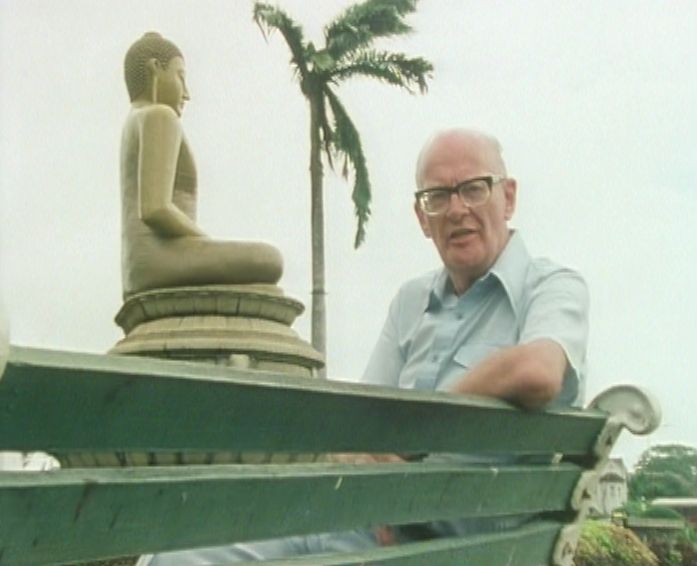
Arthur opens this edition with a forthright statement.  “I think I can claim to be a reluctant expert on UFOs. I’ve been interested in them for almost fifty years, long before the phrase ‘flying saucers’ was invented. UFOs are very common. If you’ve never seen one you’re either unobservant or you live in a cloudy area. I’ve seen half a dozen good ones. And now I have some very definite opinions on the subject.”

The first mystery discussed on UFOs occurred in Wellington, New Zealand 1978.  A plane, with a television crew aboard, had taken the same route as a previous plane which had reported multiple UFO sightings.  The television camera captured some very bright, odd shapes which couldn’t be identified.  “I really don’t know what’s going on” admitted the reporter.  This is a classic UFO sighting – there’s no doubt something was in the air which can be classed as an Unidentified Flying Object, but does that mean it was extraterrestrial in origin?  This brief report, from 2008, mentions that they remained a mystery decades later – as they do to this day.

It was a man called Kenneth Arnold who, on the 24th of June 1947, created the modern flying saucer craze.  His observation of a group of UFOs, which he likened to flying saucers, caused a sensation and from then on the most commonly reported design of UFOs were saucer shaped.  Arnold makes an appearance in this edition to tell his story (as no doubt he did thousands of times during the decades since his reported sighting) and UFOs benefits from his direct testimony.  Whether he was telling the truth is another matter of course ….  There’s a wealth of information about Arnold’s flying saucers out there for the curious to read about.  This is a good place to start.

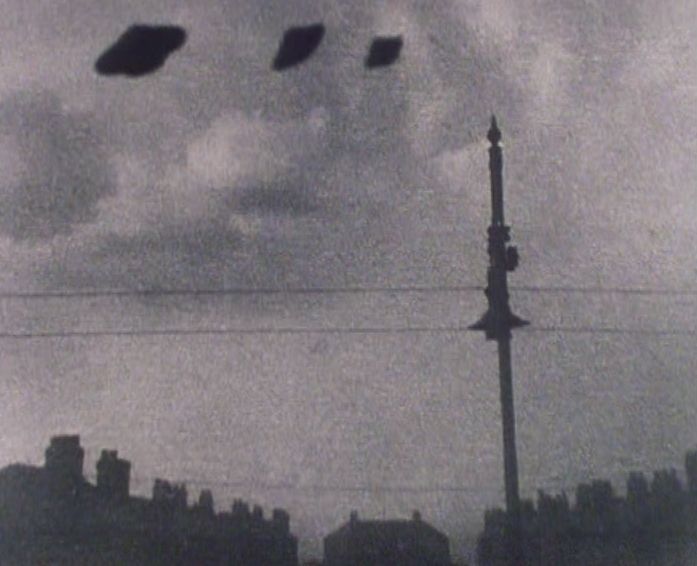
It’s interesting to ponder whether the publicity surrounding Arnold’s encounter directly affected future sightings of UFOs.  Since so many sightings post-Arnold were also saucer shaped, it’s possible to wonder where were all the flying saucers before he spotted the first one?  Some of the more famous flying saucer pictures are briefly discussed, including the iconic shot by Stephen Pratt of Yorkshire (used as the image on this post).

Arthur then discusses some of his UFO sightings – one of which turned out to be a weather balloon.  It shouldn’t come as any surprise that he leans towards finding a rational explanation for UFOs if he can.  To illustrate this, the UFO film shot by Lee Hansen in Catalina back in 1966 is investigated and is declared to be an aircraft.  Arthur agrees with this, although there will be many who still believe that it was an alien craft.  As he says, with long-range sightings there’s always room for doubt and that’s why he’s no longer interested in such reports.  But what does interest him are close encounters.

And it’s to Ranton in Stafford that we go, to speak to Mrs Jessie Roestenberg.  “To my amazement there, suspended on the top of the roof of this old farm, was this object that I can only describe as a huge mexican hat. It was that shape, without the bobbles. It must have been fifteen to twenty yards from where I stood. It covered the roof, so in circumference it must have been about sixty feet, it was enormous.  The people in the space-craft were just looking out, I could see them from the waist to the top of their heads. They were very beautiful people. They had long golden hair.”

With no evidence, it’s easy to dismiss stories like Mrs Roestenberg’s, although the programme then teases us that sometimes clues are left behind.  Forestry worker Bob Taylor tells of his strange encounter with an unearthly object just outside Edinburgh.  Even more entertaining than his tangle with this mysterious alien artifact is the reaction of his wife.  “He looked terrible when he came in the door. And he just stood at the door and I said ‘have you had an accident with your lorry?’ and he said no, I’ve been attacked. And I said ‘what with?’ and he said a spaceship. And I said ‘oh goodness me, there’s no such a thing as a spaceship, I’m going to phone the doctor'”.  Wonderful stuff!  Disappointedly he wasn’t able to take a piece of the ship as evidence, but strange track marks did pique the interest of the police.

With a running-time of just twenty five minutes, UFOs can only scratch the surface of this phenomenon.  But it does work as a useful introduction to some of the more famous cases which continue to generate debate today.

Arthur C. Clarke’s Mysterious World – Out of the Blue

blue.jpg

Out of the Blue opens with Arthur playing table tennis.  This seems slightly odd, but all becomes clear when he explains that his daily table-tennis partner – at the Otter’s Club, Colombo – saw fish falling from the sky.

There’s some classic eye-witness interviews in this one.  Joe Alpin recalls a strange event during WW2.  “The sky suddenly darkened. And then the frogs came. Millions of them. Raining out of the sky.”  Possibly Joe overestimated the number a little, as millions seem a little excessive – although he did claim it rained frogs for well over an hour, so there must have been quite a few.

Mrs Sylvia Mowday looks just the sort of sensible, late middle-aged woman that you wouldn’t think would make up a strange story simply for a bit of publicity, so maybe her froggy tale was true.  “We heard something thudding against the umbrella.  When we looked, to our amazement it was a shower of frogs. There were hundreds of them.”  This happened in the 1950’s – a few years after Joe’s sighting – and it’s interesting that Mrs Mowday only mentions hundreds.  Had raining frogs been curtailed since the war, or was she simply better at counting than Joe?!

Although reports of frogs falling from the sky are quite common, so are tales of fish descending from the heavens.  A series of interviews in Marksville, Louisiana illustrate how a number of residents all witnessed a deluge of flying fish.  From the testimony of the wonderfully named Sheriff Potch Didier to the accounts of several older woman (who all seem to have had maids at the time – clearly this was an affluent neighbourhood) it all sounds most odd.

Although Arthur considers that the whirlwind theory – freak atmospheric conditions which cause the likes of fish or frogs to be scooped up – might explain some of these events, he concedes that it doesn’t answer all of them.  And why are there never any reports of fish, frogs or other items getting sucked up into the sky?

Gordon Honeycombe’s incredibly detailed narration sets the scene for the next strange event.  “On Sunday March the 13th 1977, Mr Alfred Wilson-Osbourne, chess correspondent for the Bristol Evening Post, left the Westbury Park Methodist Church to walk home with his wife. Their journey took them past a car showroom.”

And what did they see? A shower of hazelnuts.  Mr Wilson-Osbourne wins the prize for the most accurate estimation of the number of objects he saw.  Joe Alpin reckoned he saw millions of frogs, Sylvia Mowday estimated that she observed hundreds of frogs, whilst Mr Wilson-Osbourne gives us a more precise figure – three hundred and fifty.

These aren’t the most staggering of mysteries, but they’ve quite fun nonetheless and some of the interviewees are highly entertaining.

Arthur C. Clarke’s Mysterious World – The Riddle of the Stones

stones

“Why did the people of prehistoric Britain set up the great stone circle on Salisbury Plain? What is the meaning of Stonehenge? Were Britain’s other rings of stone centres of an unknown Pagan cult? Were they places of sacrifices and death? Were they observatories where, four thousand years ago, astronomers plotted the courses of the sun, moon and stars?”

This edition of Arthur C. Clarke’s Mysterious World sets up a great many questions, so it’ll be interesting to see if it can come up with any answers.  But what’s clear from the start is that Arthur has little sympathy with “latter-day druids” who have claimed the likes of Stonehenge for themselves.  “Their association with stone circles is the invention of eighteenth century romantic writers.  The druids flourished a thousand years after the completion of Stonehenge, so to confuse them with stone circles is like mixing up the Battle of Britain and the Battle of Hastings.”

The megalithic tomb at Newgrange in Ireland is described as an almost unknown wonder.  Built over five thousand years ago it’s certainly an impressive sight.  Professor Michael O’Kelly, who was responsible for restoring it to its former glory, describes how he began to believe that the ancient builders of Newgrange had designed it in such a way as to allow the rays of the sun to illuminate the tomb on certain days – most especially the 21st of December (the Winter Solstice).  He describes how, on the 21st of December 1967, he stepped into the tomb to prove his theory.  This turned out to be correct, as he witnessed the chamber being illuminated with the bright winter sunshine.  This webpage has more detail on both Newgrange and Professor Kelly.

That Newgrange was designed to take account of the movement of the heavens seems clear and it’s also been supposed that some stone circles were created to serve as observatories – allowing ancient astronomers to use them as gigantic calendars (back then, knowing what time of the year it was would have important in many ways).

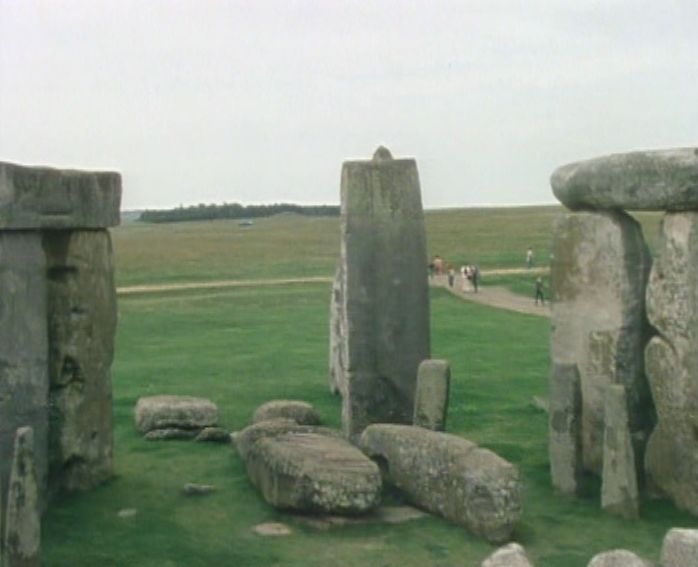
It’s a little odd to watch somebody clambering over the top of Stonehenge – it’s hard to imagine that happening today.  Richard Brickerhoff did so to test a theory that the strange bumps in some of the stones were evidence of a particular type of astronomical practice that had been carried out thousands of years ago.  It’s a nice enough theory, but doesn’t really convince.  Although Arthur admits that some stone circles do show evidence of astronomical alignments, he suggests that most could be nothing more than meeting places.

Some places continue to baffle though, such as Avebury in Wiltshire.  Containing multiple stone circles, it’s a particularly impressive construction feat – especially when you consider how difficult it would have been to move stones that weighed sixty tons (hundreds of people would have been required to move just a single stone).

The mystery of the stone circles is nicely summed up by Dr Aubrey Burl.  “It’s like reaching out into the darkness, you can go so far but in the end you can never touch them. You’re always reaching for a shadow.”  When so many experts are only too happy to spin extravagant theories, it’s refreshing to hear from someone who doesn’t claim to have all the answers.

Arthur C. Clarke’s Mysterious World – The Great Siberian Explosion

siberian

“On the morning of June the 30th 1908 something came hurtling out of the sky. An enormous ball of fire which exploded above the Siberian forest with a sound that was heard a thousand miles away and a blast that laid waste the trees over an area the size of London and New York put together.”

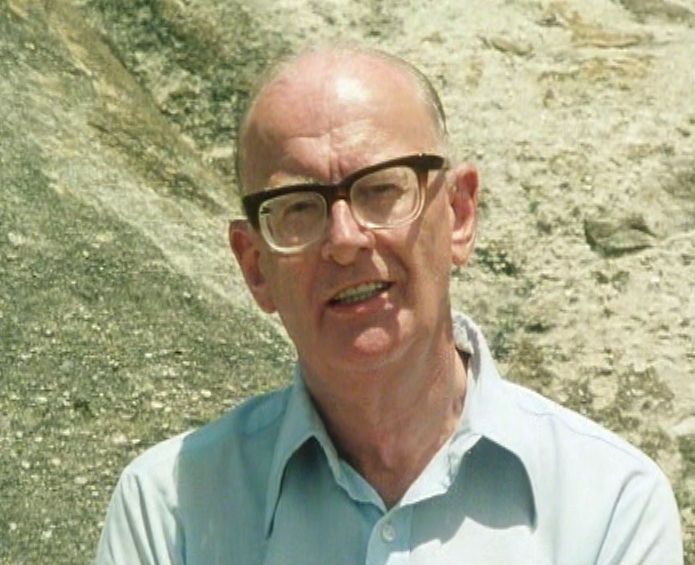
This edition opens by giving us numerous suggestions about what this strange object could have been – a meteorite, a piece of antimatter, a small black hole, an atomic bomb (decades before the first recorded one was created) or even an exploding flying saucer.  But more noteworthy than this is that the pre-credits section features a different piece of introductory footage of Arthur C. Clarke.  For the previous six editions, Gordon Honeycombe’s narration about Clarke (author of 2001, inventor of the communications satellite, etc) has been combined with shots of him strolling down a Sri-Lankan beach, umbrella in hand.  But here we see him walking through the streets instead.  It’s a small point, but after watching the episodes in quick succession it does stand out – possibly the programme makers decided it was time for a change, a wise move if so.

The effects of the explosion seemed to be far reaching.  In southern England the evening was unusually light – well past midnight it was still bright enough to play golf, for example.  Whether this was connected at the time to the Siberian explosion isn’t clear, but it is interesting that the investigation into the explosion only began in 1927, nearly twenty years after the event.

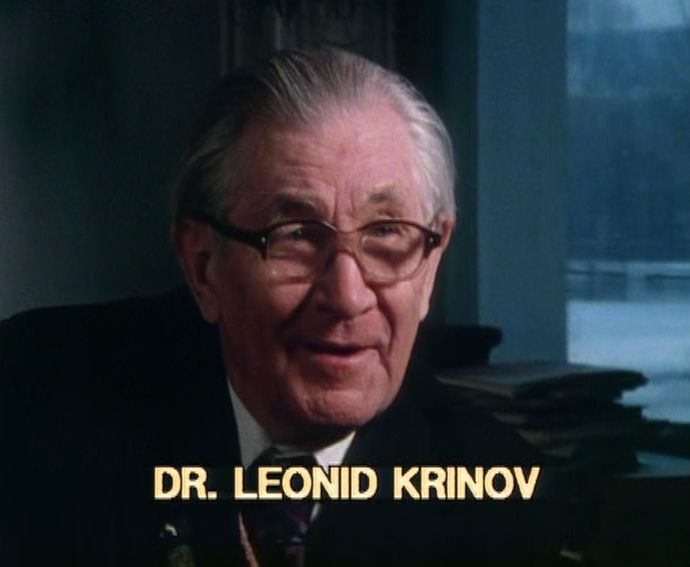
One of the things that impresses about Arthur C. Clarke’s Mysterious World is how often the programme-makers were able to talk to individuals who had direct experience of the strange events featured across the series.  The Great Siberian Explosion is no exception as Dr Leonid Krinov, who investigated the explosion back in the 1920’s, gives an account of what he learnt from the eye-witnesses he interviewed.  Even though he was asking them to remember back some twenty years it seems they had no difficulty – but then such an event would be something that would no doubt stick in the memory.

Usually the series would feature several different mysteries across a single edition, but here they concentrate on just one.  The Siberian explosion is strong enough to fill the twenty five minute running time, although the widely held belief that it was a meteor or comet that exploded in the atmosphere – which explains why no crater was discovered – might disappoint those who favour a more outlandish answer.  This webpage neatly sums up the main facts, whilst the comments underneath offers some wackier explanations.  Arthur sums up all the possibilities, although he finds it difficult to keep a straight face when describing some of them (an exploding nuclear engine from a flying saucer, for example) .

Arthur C. Clarke’s Mysterious World – The Monsters of the Lakes

lakes

Although Nessie is the most famous lake-based monster, there are plenty of others – as this edition of Arthur C. Clarke’s Mysterious World demonstrates.  The delightfully named Ogopogo is one such creature, although his fame hasn’t really spread outside of Canada.

He, and presumably his ancestors, have been swimming around Okanagan Lake in British Columbia since at least the middle of the 19th century.  We open by observing a call-in show at the local radio station, where anyone who’s spotted the Ogopogo is invited to ring in.  I have to confess to being somewhat amused by the second caller – she declined to give her name on air (for fear of being ridiculed) but it does seem that she then appears on camera to explain her story in a little more depth.  If you wish to retain your anonymity then appearing on television probably isn’t the wisest move!  According to this article, Ogopogo is the world’s most documented lake monster.

Whilst many of those who claim to have seen a monster rising from a lake are credible witnesses, it does remain easy to dismiss their sightings as either hoaxes or cases of mistaken identity.  But when three men of the cloth claim to have seen a monster, it’s harder to accept that they’re lying.  Lough Ree in Ireland, back in 1960, was the place where Father Burke, Father Murray and Monseigneur Quigly had their strange encounter.  Wonderfully, the program puts them back in their boat in the middle of the lake to tell their tale.  It’s a tad disappointing the beast of Lough Ree didn’t make another appearance when the cameras were rolling though.

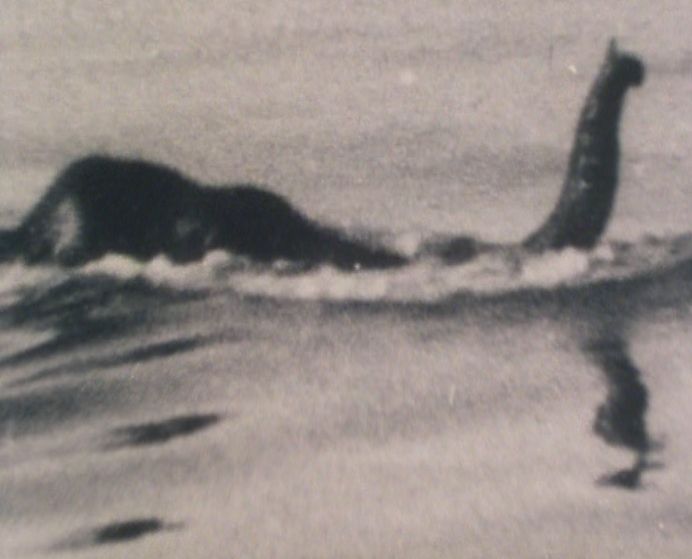
The Loch Ness Monster remains far and away the best known of all the lake monsters.  We hear a little more from Alex Campbell (briefly featured in the first programme) who claims to have seen the monster eighteen times.  Next up is Peter McNabb, who back in 1951 took a famous picture of what he believes to be Nessie.  This pro-Nessie blog is certainly convinced.  It’s no surprise that Arthur remains much more skeptical though.

One of the most famous Nessie hunters, Tim Dinsdale, is interviewed.  In 1960 he caught what he considered to be monster on film.  As he returned countless times to Loch Ness over the decades it’s hard to imagine that he was involved in a deliberate fraud – if he was, then surely one visit would have been enough?  More recent research indicates that his film may have captured something as prosaic as a boat.  See here for further information.

Arthur gives the notion of lake monsters a big thumbs down, but as with all these mysteries there’s still plenty of people about who wish to believe, so the legends will continue.

Arthur C. Clarke’s Mysterious World – Giants for the Gods

giants

“What strange compulsion made men etch vast designs on the side of the Earth?  On downlands and desert, on the slopes of solitary mountains. Why can so many only be seen from the air? What is their message from the distant past?”

It seems such an obvious point, but I’d never really stopped to wonder why ancient man created some of these images when they couldn’t see them from the ground, although Giants for the Gods does open with the possibility that some two thousand years ago the Nazca Indians might have had the power of flight (via some kind of hot-air balloon).  The Nazca Lines – created in Peru – are discussed in some detail.  With lines running for thirty miles it’s an astonishing achievement, but what purpose did they serve?  Various explanations have been postulated over the years – a giant map for space travellers was popular during the 1960’s and 1970’s when interest in Erich von Däniken’s theories were at their height, whilst others are convinced that they served an astronomical/calendar purpose.  More recently there’s been other suggestions (a little more detail can be found here).

We then travel to England to meet the rude man of Cerne.  He’s a very well-endowed giant chalk figure carved on a Dorset hillside.  Why or when he was carved is a mystery, but luckily there’s some colourful local characters on hand to give us their theories.  The first is a man with an incredibly impressive beard and whilst the next man’s beard is less impressive he does have an interesting story to tell.  “We did have one girl who had been married for about seven years and hadn’t managed to have a child. So we told her to go and sit on the giant – apparently you’re supposed to sit up there with your knickers off, I don’t know whether she did that or not – but the next spring she was pregnant.”   It’s probably not as old as the carvings of the Nasca Indians though.  The earliest record of the figure dates to the middle of the eighteenth century, although some remain convinced that he’d been there since Roman times.  Further information can be found here.

Chile is our next destination, and the Chilean Geoglyphs have some similarities to the Nazca Lines, although the images here are more varied.  The massive image of a man takes us back to the suggestion at the beginning that maybe the ancients had the power of flight (otherwise they’d have no way of viewing these carvings).  If that wasn’t the case then possibly they were produced for their gods who would be looking down at them.

Arthur’s honest enough to say that he can’t begin to answer why they were created, although he does suggest they might have been inspired in part by man’s desire to leave a mark on the face of his planet.  So there’s no definite answers, but although Giants for the Gods isn’t the flashiest edition of Arthur C. Clarke’s Mysterious World, it is one of the most thought-provoking.

Arthur C. Clarke’s Mysterious World – The Missing Apeman

apeman

Our search for the mysterious apeman begins in the foothills of the Himalayas, close to Mount Everest, with the most famous apeman of all – the Yeti, otherwise known as the Abominable Snowman.  That the Yeti exists is a widely held view amongst the local sherpas, and one of them – Khunjo Chumbi – shows us his prized possession (what seems to be a Yeti scalp).  He also imitates the Yeti cry – which seems to be “cry, cry, cry, cry, cry, cry”.  It’s not the most terrifying sound, but then Khunjo is only a small chap and you’d expect the real Yeti to be somewhat more formidable.

Desmond Doig, who led an expedition with Sir Edmund Hilary to try and establish whether the Yeti was real or just a myth is also interviewed.  With typical British understatement he says that the Yeti is very nasty tempered.  “And has been known to rip people apart if he gets a chance.”  Yes, that does sound quite nasty.  Rather wonderfully, Khunjo and his Yeti scalp had been in the news before, as this Guardian interview from 1960 featured Sir Edmund Hilary, Desmond Doig and Khunjo Chumbi.  So by the time of Arthur C. Clarke’s Mysterious World, Khunjo was an old hand at giving interviews.

The photographs taken by Michael Ward and Eric Shipton in 1951, which purport to show footprints of the Abominable Snowman, are iconic images.  Ward was also interviewed for the programme and maintained that they were real, although the internet tends to disagree (they’re also dubious about the Yeti scalp).  It’s interesting that all the interviewees are convinced of the existence of the Yeti (slightly odd they didn’t include someone who was more sceptical).  But that role is taken by Clarke, who although he’s far too polite to call anybody a liar, points out that melting snow can make footprints appear larger than they are and that the Sherpa/Yeti connection is so bound up with their religion it’s sometimes impossible to tell myth from reality.

We then head off to America to look for Bigfoot!  Dr Grover Krantz is convinced that Bigfoot exists and he goes out regularly to try and kill one.  This is a bit off-putting – casting Krantz in the mould of a big-game hunter, but there you go.  Various eye-witness reports, including several police officers, attest that they’ve seen Bigfoot in person and an excerpt from a local news report states the Bigfoot may be interested in menstruating women (as one sighting saw him rummaging through rubbish which contained discarded women’s feminine hygiene products).  An unexpected titbit of information.

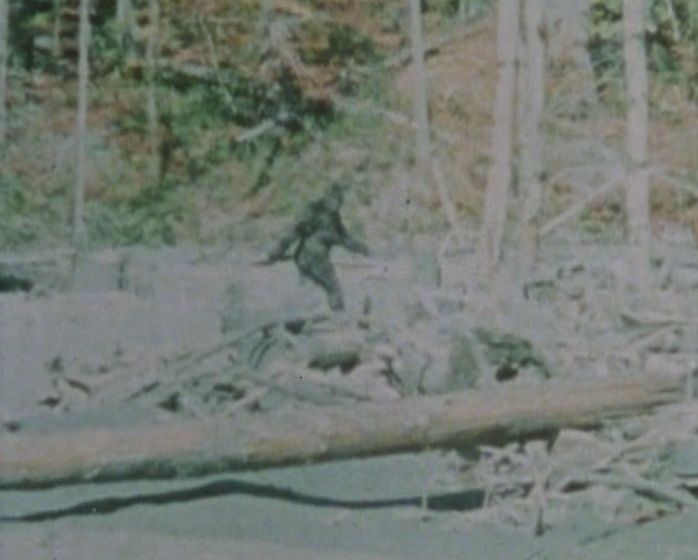
In 1967, Roger Patterson and Robert Gimlin made a brief film recording of what they claimed was Bigfoot.  For anyone with even a passing interest in the subject it’ll be a very familiar piece of film.  Although on the one hand it looks patentally fake – he looks far too much like a man in an ape suit – various experts have testified that the motion is ape-like (and a human wouldn’t be able to replicate the movements).  He’s a very jaunty Bigfoot it must be said – and he also obligingly stops and stares at the camera which was nice of him.  Even as a child I didn’t believe this film, and there are plenty that agree with this view,  although as I’ve said, others are more convinced.

As for Arthur, I get the sense that none of the tales have won him round.  He said that if he had a hundred dollars to bet on it, he’d put forty on the Yeti, ten on Bigfoot and keep the rest from himself!  On reflection, that’s probably about right.

Arthur C. Clarke’s Mysterious World – Ancient Wisdom

ancient

Arthur’s in a fighting mood at the start of Ancient Wisdom.  “A lot of rubbish has been written about mysterious knowledge possessed by the ancients. They didn’t need any help from visitors from outer space. On the other hand, there are some relics from the past which are truly mysterious because they challenge our ideas about the level of technology that existed at the time.”

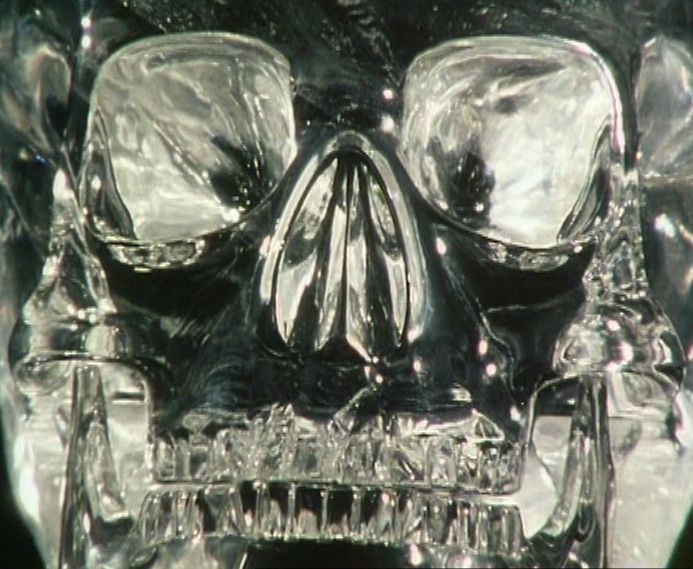
Probably the most famous image from Arthur C. Clarke’s Mysterious World was the crystal skull which featured prominently in the opening titles each week.  We’re told that Anna Mitchell-Hedges found the skull in a lost city when she was a girl.  Her arrival in the UK from Canada is notable – with security guards on hand to guard the skull – and her story is certainly intriguing.  As ever, Gordon Honeycombe’s narration sets the mood perfectly.  “This is the weirdest gem in the world. The skull of doom. The circumstances of its discovery were bizarre. Its origin is unknown. And its powers, some say, are fatal.”

That Mitchell-Hedges claimed to have discovered the skull, perfectly preserved, in an ancient temple seems more than a little unlikely, whilst an expert who examined the skull considered it to be no more than a couple of hundred years old.  Mitchell-Hedges remained adamant that it dated back at least 3,600 years and didn’t waver until she died.  Few others tended to agree with her though, and the overwhelming evidence points to the fact that it was a relatively modern creation.  See here, for example.

The other eyebrow-raising claim in Ancient Wisdom comes from Dr Arne Eggebrecht.  “He found it in an exhibition of treasures from Ancient Iran. A pottery jar, a copper cylinder and an iron rod discovered in Baghdad. He believes they are components of an electric battery made two thousand years before batteries were invented in the West.”  Arthur’s not convinced and there’s no common modern consensus, so this remains a mystery.  As ever, there’s plenty of information out there, such as here, for example.

Whilst the Crystal Skull was almost certainly a modern construction and the uses of the Baghdad Battery remain open to interpretation, the Antikythera Mechanism does seem to be the genuine article.  It was discovered by divers in 1900, who found it on a wreck off the coast of Greece, but it wasn’t until  Professor Derek de Solla Price started to examine it in earnest during the 1970’s that it began to yield its secrets.  Using x-ray and gamma photography he was able to deduce that what appeared to be nothing more than a lump of rock actually contained an intricate mechanism.  Believed to have been constructed around the second century BC, it’s regarded as the world’s first analogue computer – a device used to calculate astrological positions.  Further information can be found here.

There’s a lack of loopy eye-witnesses (who make Arthur C. Clarke’s Mysterious World so enjoyable) in this edition, but there’s still several fascinating scientific mysteries to chew over.

Arthur C. Clarke’s Mysterious World – Monsters of the Deep

mys 02

Monsters of the Deep opens with the tale of Lieutenant Cox whose leg was mauled by a giant squid following the sinking of his troopship by the Germans during WW2.  With Cox no longer being alive it’s impossible to question him first hand, but testimony from a serving sailor – Petty Officer Ira Carpenter – who recently witnessed damage to his ship is harder to dismiss.  Was this caused by a giant squid?  Maybe, and it’s notable that Clarke doesn’t dismiss the possibility out of hand.

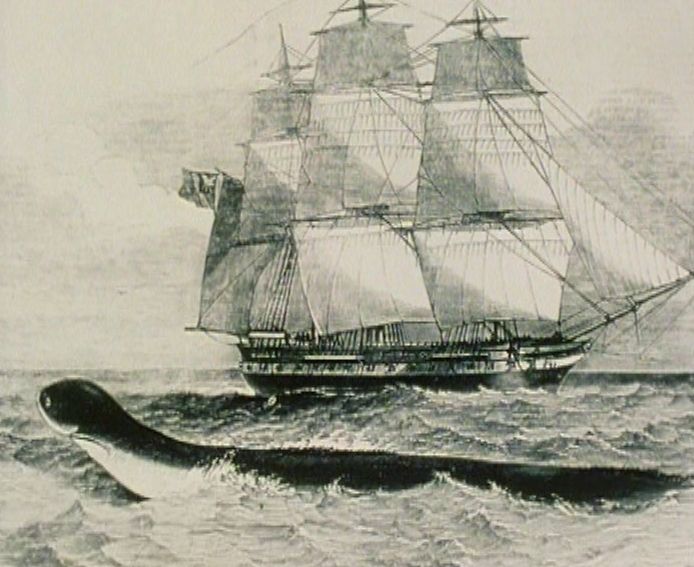
The story of a giant octopus which washed up on a Florida beach in the late nineteenth century is mildly interesting, but rather like the giant squid tales it doesn’t quite fire the imagination.  The accounts of mysterious sea serpents is rather more like it though, especially when they’re illustrated with vintage artists impressions of the leering monsters.  Although sea serpents might appear to be a problem of the past, it appears not – as two beardy Canadian scientists are seen conducting research in the waters of Vancouver.  Although they’ve done plenty of research they have no definite evidence, which is a bit of a shame.

So far there’s been a lack of colourful interviewees in this edition, so I’m thankful for the arrival of George Vinnicombe and John Cox, two Cornish fishermen.  Naturally they have to be interviewed on their boat, although the constant bobbing motion did make me feel a tad seasick.  Still it’s worth it for their tale of a strange monster who popped its head up out of the water to take a look at them.

There’s another classic bit of Honeycombe narration as he tells us about “the beast with great teeth which came ashore in Scotland at Gourock, on the River Clyde, in 1942. Being wartime, the Royal Navy wouldn’t permit photographs and finally the beast was taken to the grounds of the municipal incinerator. On the orders of the borough surveyor, Charles Rankin, it was chopped up and buried under what is now the football pitch of St Ninian’s Roman Catholic primary school, Gourock.”  Mr Rankin was interviewed for the programme and the most intriguing part of his tale is when he mentions that in the belly of the beast was something which appeared to be a seaman’s jersey.  So clearly the beast had gobbled up at least one unfortunate sailor before washing up at Gourock.

Whilst it’s a little hard to take the story of the beast of Gourock seriously, Clarke does come down on the side of generally believing that giant sea creatures are real.

Arthur C. Clarke’s Mysterious World – The Journey Begins

mys 01

Arthur C. Clarke’s Mysterious World starts with a bit of a whimper, as he observes a total eclipse of the sun.  C’mon Arthur, that’s not a mystery!  He later tells us that he classes this a mystery of the first kind – something that was a mystery to our ancestors but not to us.

But there’s plenty of mysteries of the second kind (those which have no definite explanation) to come over the course of this thirteen part series, even if it’s not surprising that the rational Clarke can often come up with a logical solution.

Our first proper mystery takes us to Fife in Scotland where, according to the sombre narration of Gordon Honeycombe, “it was in 1966 that a terrifying visitation came to the beach cafe where Mrs Jean Meldrum and her mother Mrs Evelyn Murdoch were working.”  This sounds much more promising.

These reports often have more than a touch of humour about them, although I’m not sure whether this was intentional or simply the result of rewatching the episodes in these more cynical times.  But the report of an orange ball of fire that bashes Mrs Meldrum’s chest and then vanishes, is an unusual tale to say the least.  Possibly the best part of the story is when Mrs Murdoch mentions that the beach attendant, who had a wooden leg, nevertheless showed a nifty turn of speed as he beat a hasty retreat from the oncoming fireball!

Honeycombe then teases us with some of the big-hitters of the mysterious world – the Loch Ness Monster, the Abominable Snowman, UFOs, Monsters of the Deep, etc.  In all of these cases there is photographic and/or film evidence (which we don’t have in the case of the Fife Fireball) but how much veracity can we place in this material?  And does the evidence of eye-witnesses strengthen or detract from the overall mystery?

Alex Campbell, a water bailiff in Loch Ness, claims to have seen the monster eighteen times.  He’s an entertaining interviewee, especially when he gives an impression of Nessie’s breathing.  Those who choose to disbelieve people like Campbell would no doubt simply claim he was lying (which is quite possible) but when you have a whole family – like the Holmes’ from Falmouth – who also claim to have seen a sea monster, it’s harder to understand why they would all agree to such a deception.  And they do seem quite believable, as they bob up and down in their small boat, kitted out in identical bright yellow macs.

The giant stone balls of Costa Rica are apparently one of the world’s most intractable mysteries, although I have to confess they’ve never really registered with me.   One of the joys of the internet age is that you’re only a click away from finding out whether the mystery has now been solved, but it appears not.  So I guess we’ll have to wait a little longer to find the answer (if any).

The Journey Begins ends with tales of mysterious objects falling from the skies – fish, frogs, hazelnuts, broad-bean seeds.  The latter annoyed the eye-witness from Southampton, who turned to his wife and said “this is bloody silly.”

Interestingly, Clarke suggests these might be mysteries of third kind (those for which there are no logical answers at all) but then hints there might be clues to a rational solution.  After these strange tales, I have to confess that I was expecting some sort of answer from Clarke, but he just strolled down the beach at Sri Lanka as the credits rolled.  So the great man seemed stumped on this one.

Blakes 7 – Terminal

terminal 01.jpg

As is probably well known, Terminal was due to be B7‘s final episode, but the show was granted a last-minute reprieve by BBC bigwigs who had apparently enjoyed the series so much they asked for an announcement to be broadcast over Terminal‘s end credits stating that the series would return.  Which came as something of a surprise to the cast and crew.

Having said that, it’s easy to see that Terry Nation crafted the script in such a way as to make a fourth series eminently possible.  Terminal ends with Blake and Servalan apparently dead (although both make a miraculous comeback in S4) and the Liberator destroyed (which doesn’t) but everyone else is alive and kicking.  But even if it’s not the final end it’s still an ominous, unsettling installment.  Paul Darrow’s performance (as well as the very brief return of Gareth Thomas) are the undoubted highlights and help to paper over some of the more glaring plot holes.

The main talking point has to be Avon’s bizarre behaviour. Terminal seems to look ahead to the increasingly paranoid man who’d lead the others through a number of misadventures during series four, losing just as often as winning.  If Rumours of Death started to chip away at his air of invulnerability (by revealing that he was never as close to defrauding the Federation’s banking systems as he’d previously thought) then Terminal is another nail in his coffin.  His obsession to find Blake has several consequences, the most serious is that it loses them the Liberator.  Enroute to their destination Zen detects unidentified matter in their path – he recommends going around it (“the consensus of computer systems favour a course deviation to avoid contact. In this environment, it is prudent to treat any unexplained phenomenon as potentially dangerous”) but Avon is adamant – there will be no course deviation.

Why?  It wouldn’t have cost them a great deal of time and would have been the prudent course of action.  And Avon’s always been prudent – never willing to risk either his life or that of the Liberator unnecessarily.  It’s tempting to think that Servalan’s operating a similar mental suggestion on Avon that we saw Blake suffer from in Voice from the Past.  That would also explain his burning desire to find Blake, which also seems very out of character – he spent two years trying to get rid of him!

There is the possibility that Avon is motivated to find Blake purely because of the get-rich plan that Blake was offering, although that doesn’t really hold water either – surely Avon has the ability to create his own get-rich plans if that’s what he wants?  And the Liberator is supposed to carry untold wealth anyway.

But for all the slight niggles about his motivation, the brief meeting between Avon and Blake is still magical.  It may last only a minute or so but it’s a reminder that as good as Darrow’s been during S3, he’s not had an equal – like Thomas – to measure himself against.

BLAKE: Well, you certainly took your time finding me.
AVON: There didn’t seem to be any hurry. Anyway, I always said I could manage very well without you.
BLAKE: It must have been so dull having no one to argue with.
AVON: Well, now, there were times when your simple-minded certainties might have been refreshing.
BLAKE: Careful, Avon. Your sentiment is showing.

Before teleporting down to the planet (an artificial satellite called Terminal) Avon makes it quite clear to the others exactly how he feels about them. “I don’t need any of you. I needed the Liberator to bring me here so I had no choice but to bring you along, but this is as far as you go. I don’t want you with me. I don’t want you following me. Understand this: anyone who does follow me, I’ll kill them.”  Not very friendly.

The obvious irony is that he does need them and despite the way he’s treated them they won’t just abandon him.  It’s all done in a typically understated way – no loud declarations of friendship and loyalty – but it’s there all the same.  Later, Avon explains to Servalan that he decided to do everything on his own as he felt it could be a trap – although she wonders if it had more to do with his desire not to share Blake’s mysterious treasure with them.  He smiles, but doesn’t deny it (this is a nice moment, as it offers several  different motivations for Avon’s actions).

Of course it all turned out to be a dream – Blake was never on Terminal and his image was created in Avon’s mind by some clever people working for Servalan.  This is yet another of her hopelessly over complicated schemes to capture the Liberator (in one way it’s a good thing this’ll be the last time she’ll have to do this).

If Servalan’s once again rather surplus to requirements, there’s two moments when she earns her money.  The first is when she tells Avon that Blake’s dead.  She appears to be quite emotional – was this Pearce’s choice or as scripted, I wonder?  And was it meant to imply Servalan’s sorrow at the death of a worthy enemy or (even though this seems unlikely) was she emphasising with the fact that the news would have upset Avon?

No prizes for guessing that the second is “Maximum Power!” as she finally gets command of the Liberator.  But by now it’s a very sick ship as the cloud of unidentified matter has caused irreparable damage .  It’s more than a little odd that neither Servalan or her underlings twig that something’s wrong – the whole ship’s covered with big gloopy blotches for goodness sake!

Her apparent death is an interesting moment – I wonder if they ever intended to keep her dead when S4 was being mooted.  Probably not, as she was such a powerful character, but her overuse during S3 had been a problem and a fresh adversary could have been what the series needed.

Is it wrong that I find the death of Zen to be more upsetting than the death of Gan?  Zen’s final words (“I have failed you. I am sorry”) always raises a sniffle and the slow disintegration of the Liberator is also mildly upsetting.

No story is ever perfect and the links (small men in monkey suits) help to keep this proud record going.  But apart from them, and a bit of a mid-episode sag, there’s not much wrong with Terminal (if you can accept Avon’s odd behaviour).

As they watch the Liberator disintegrate, Avon and the others face an uncertain future ….

terminal 02

Blakes 7 – Death-Watch

death 01

Anybody watching Death-Watch for the first time would probably wonder why Tarrant’s aboard the United Planets passenger liner Teal Star and why he’s wearing a very bad wig.  But this isn’t Del Tarrant, it’s his older brother Deeta (who could be Del’s twin).  Exactly how they can be so alike when Deeta’s several years older is anyone’s guess – but it’s the future, so things are obviously different there.

The opening moments contain quite a substantial info dump  – we’re told about Blood Feuds and an outbreak of war between the Vandor Confederacy and the United Planets of Teal – but this helps to quickly set the parameters of the episode, as does Deeta’s skill with a gun.  He’s First Champion of the United Planets of Teal, which makes him a valid target now that Vandor and Teal have declared war.  Deeta quickly deals with one assassin (whenever you see Stuart Fell you know there’s going to be some action) and then takes out another – Karla (Katherine Iddon).  Both these swift attacks help to emphasise how skilled a killer he is.

How does the Liberator crew get involved?  In a slightly contrived way, but it just about works.  Vila hears about the war between Teal and Vandor and he’s instantly excited (“break out the booze, girls. It’s fiesta time”).  It takes Tarrant to fill in some of the blanks.  Whenever Teal and Vandor declare war they both pick a champion to stand as a surrogate for their armies.  These two men meet in single combat to decide which side wins and which loses.  Cally’s not impressed, although Tarrant does his best to convince her.  “Look, two men fight for the honor of independent planetary systems of maybe twenty million people each. It’s hardly crude.”

According to Vila this means substantial festivities on the planet where the combat ground is situated.  But it shouldn’t come as any surprise to learn that B7‘s budget wouldn’t run to this – so no sooner do Vila and the others teleport down then they teleport back up, with Vila complaining that everything’s closed!  It’s possible that this wasn’t just budget-related though, as there are some sly satirical digs peppered throughout Chris Boucher’s script.  As the Liberator crew watch the viscast on the flight deck, there’s a suitably portentous voice-over (which even mentions “space, the final frontier”).  The V-O serves two purposes – it helps to explain exactly what will happen, but once it finishes we’re given a peep behind the scenes as a somewhat camp director flatters the V-O man that his speech “was your usual delicate mixture of enthusiasm and dignified cliche.”

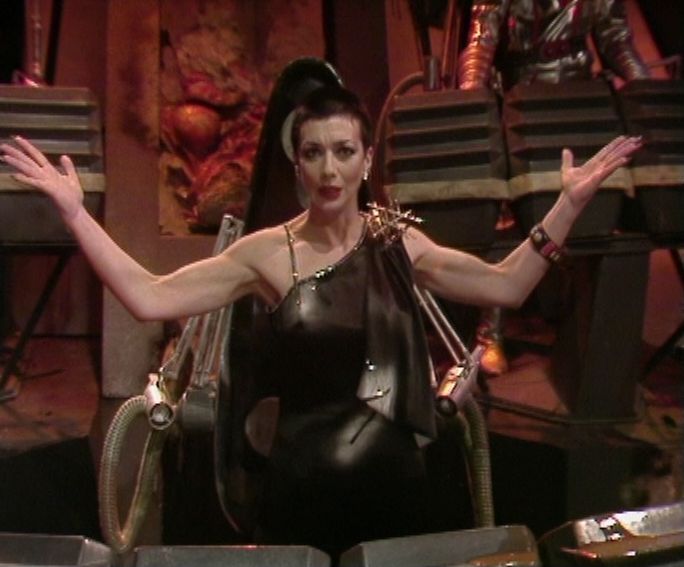
Servalan’s about, and acting as a neutral arbiter.  She doesn’t really do much though and this is definitely one story where she could have been excised without too much trouble.  However she does share one classic scene with Avon – where you could cut the sexual tension with a cricket stump.  Avon’s not got the most flattering costume – it’s the bulky shoulder pads which are the most distracting part – but he still manages to snarl and grab another snog from Servalan with aplomb.

Once he’s done that, he too heads back to the Liberator and settles down with the others to watch the action.  Rather charmingly they’ve got a decent selection of drinks and snacks to enjoy whilst they tune in to see Tarrant’s brother fight to the death.

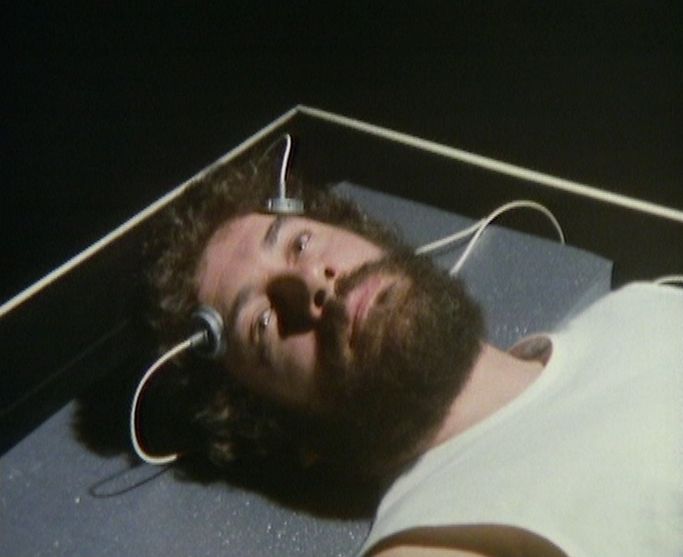
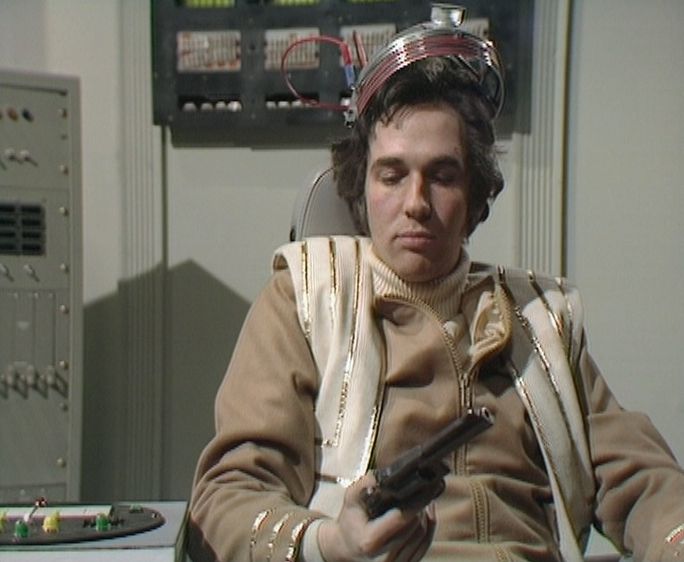
Although it’s fair to say that there’s nothing too original about any part of Boucher’s script, it’s interesting that some of the concepts (which would have been science fiction then) are closer to reality now.  Everybody has the option to feel exactly what one of the two champions feels, via the sensor net.  Deeta’s second, Max (Stewart Bevan) explains.  “Both men have had microsensors implanted in the brain. These are connected to a conductive mesh which is actually etched into the bone of the skull. When this mesh gets charged up it becomes a sort of transmitter.  You put it on your forehead. It’s activated through the optic nerves. Close your eyes and it feeds the signal directly into the brain, open them and it cuts out.  You can see what Deeta sees and feel a lot of what he feels, physically and emotionally.”  Our Virtual Reality isn’t quite there yet, but maybe one day ….

Once Deeta and Vinni (Mark Elliott) enter the killing ground, the camera often acts as their “eyes” allowing us to view the area as they would see it.  In this way it anticipated generations of first-person shooter computer games.  This choice of shot is used most effectively just after Vinni has fatally wounded Deeta – we see Vinni stand over the stricken Deeta and watch as he aims his gun directly at his opponent (i.e. the camera) to deliver the killing blow.

Whilst Deeta was hardly given any screentime to be developed as a rounded character, there were a few nice touches – such as the fact that he felt fear (so he wasn’t simply a mindless killer).  Stephen Pacey does do a good job to portray his pain at his brother’s death, although as is the way with B7 there’s no time to reflect – unfinished business has to be attended to.

Vinni’s an android and looks to be Servalan’s handiwork,  She has plenty of incentive for ensuring that Vandor and Teal go to war for real (the Federation would be handily placed to pick up the pieces and subdue the survivors).  Under the rules of Blood Feud Tarrant is able to challenge Vini and it’s probably not too hard to guess what happens next.

Most memorable part of the episode must be the silver combat suits that both Deeta and Vinni wear.  Remember this was 1980 not 1973, so quite why costume designer Nicholas Rocker decided to create something that Alvin Stardust could have worn is anyone’s guess.  Wembley Exhibition Halls and Southhall Gasworks make an excellent venue for the Deeta/Vinni battle (and should be familiar from numerous other television shows of the time).  I’d forgotten that Stewart Bevan was in this one, but then he wasn’t talking about mushrooms and didn’t have a Welsh accent, so that’s fair enough.

Death-Watch is a good opportunity for Stephen Pacey and it’s a decent sci-concept, well produced.

death 02

Blakes 7 – Moloch

moloch 01

Ah Moloch.  The one with Sabina Franklyn and the stupidest puppet alien you’re ever likely to see.  It’s odd, but apart from those two facts I couldn’t remember anything else about the story prior to rewatching it.  That’s surprising, since parts of the episode are certainly memorable (although not for the right reasons).

Avon’s been following Servalan’s ship for the best part of a month.  Quite why he’s suddenly taken such an interest in her movements isn’t clear, although it seems to be simply because he’s got nothing better to do.  In a way that sums up the actions of the Liberator crew during series three – a little light piracy here, some strange sci-fi adventures there, but as the Federation’s no longer the dominant menace it was you do get the sense they’re just marking time.

At the moment Vila’s taken over from Tarrant as the most annoying crewmember – no mean feat when you consider how irritating Tarrant can be.  Vila spends the first scene moaning about the time they’ve wasted following Servalan (although since nobody pays him any attention he needn’t have bothered).  If Michael Keating’s not best served by the start of the script then you have to give him full credit for throwing in a little bit of business as the Liberator looks set for a crash landing.  Most actors would just stagger from side to side as the camera shakes, but Keating gives us a forward roll.  Well done that man!

The planet, which turns out to be called Sardos, is initially depicted by a painting of some cliffs (with a little bit of smoke wafting across the screen).  Clearly the budget had run out by this point, although they did manage to build one model set – showing Servalan’s docked ship – which looks quite effective.

As it’s a Ben Stead script (writer, lest we forget, of Harvest of Kairos) it should come as no surprise that there’s more than a whiff of misogyny in the air.  Poola (Debbie Blythe), Chesil (Sabina Franklyn) and the other women are depicted as little more than toys for the men to play with.  After Poola spots the Liberator on a monitor screen she chooses not to report it, which incurs the wrath of Section Leader Grose (John Hartley).  The unseen Moloch (voiced by Deep Roy) tells him that she must suffer and orders that she’s given to his men.  Poola then receives a slap (albeit offscreen) although nothing else happens for the moment since Servalan then enters the room.  Poola pleads with her for mercy – which the former Supreme Commander naturally ignores – and Servalan then sums up the state of affairs on Sardos rather succinctly.  “Well, Section Leader, the records were accurate. Women, food, and inflicting pain – in no particular order.”  This is jaw-dropping stuff.

Grose is, well, gross.  As he enjoys a meal with Servalan and his second in command Lector (Mark Sheridan) he suggests that the attractive young waitress (no surprise that all the women are young and attractive) would look better with a “bit of dressing, and an apple between her teeth, eh?”  He then slaps her on the backside just to drive the point home.  Whether Ben Steed is satirising unreconstructed male attitudes to women or whether he’s approving of them is a moot point.

Vila and Tarrant reach Sardos by a circuitous route.  They teleport onto a T-16 space transporter carrying a cargo of convicts and, as they make planetfall, Vila makes a new friend – Doran (Davyd Harris).  Although he’s not quite the loveable rogue he appears.  “Ahh, my problem was always women” he tells Vila.  When Vila then asks if he likes them, Doran replies with a monosyllabic “no”.  He’ll fit right in on Sardos then.

Things then lurch in an even more unexpected direction as Grose reveals to Servalan the secret of his power – an energy mass transmuter which “takes ordinary planetary matter – usually rock – and converts it into energy.  The computer then restructures it into matter of every kind.”  That Servalan finds herself completely outmanoeuvred by Grose does stretch credibility, although he does tell her that “if your reconstituted Federation was worth a light, you wouldn’t have chased halfway across the galaxy to retrieve one legion. Already I suspect my fleet outnumbers yours. Soon, it’ll be the most powerful in the galaxy.”  It’s an interesting point, although this doesn’t quite tally with the impression given in previous stories that the Federation was slowly regaining its power.

As we head into the last twenty minutes, things get funnier and funnier (although not always intentionally).  Servalan is introduced to Colonel Astrid, Grose’s former commander.  It’s difficult to find the words to describe the Colonel, but imagine a tatty doll suspended in water and you’ll get the idea.  Moloch’s voice then pipes up and suggests that Servalan be given to Grose’s men.  That seems to be all that Moloch does – recommend that misbehaving women be passed over to the men to be sorted out.  Hmm, probably best to say nothing more.

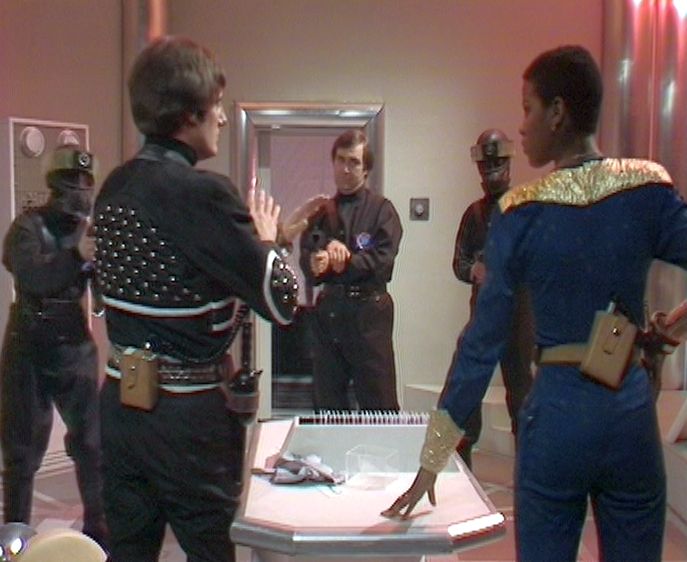
Grose has been recruiting convicts like Doran to swell his ranks and Vila (his new best friend) has also been pressed into service.  Doran tells Vila that he has a treat for him – a woman.  That it turns out to be Servalan is an amusing reveal, as is the fact that they decide to briefly team up.  Since Michael Keating and Jacqueline Pearce had rarely shared any screentime together, their odd-couple partnership is the undoubted highlight of the episode.  A pity it couldn’t have lasted longer than a few minutes.

And then Moloch appears.  “That is how I reasoned you would look” says Avon, incredibly.  Mercifully he’s only onscreen for a brief moment although there’s also the spectacle of dead Moloch a few minutes later, which is even sillier than animated puppet Moloch.

Apart from all its other problems, the passivity of the female characters is a major negative.  If at least one of them turned out to be a fighter and had helped to defeat Grose and his men that would have made some amends for the way they were treated.  Chesil seems to be written that way – but right at the end she and Doran appear to be killed off.  It’s never explicitly stated that they’re dead, but since we never see them again it’s a reasonable assumption.

Moloch is just bizarre.  There’s the germ of a good idea – Servalan being held captive by a rogue section of the military – but the rest veers from the forgettable to the hilarious.
moloch 02

Blakes 7 – Ultraworld

ultra 01

The contrast between Sarcophagus and Ultraworld is immense – in one fell swoop we move from the sublime to the ridiculous.  It’s interesting that both writers (Tanith Lee previously, Trevor Hoyle here) were novelists with no previous scriptwriting experience (and Ultraworld turned out to be Hoyle’s only work for television).  The difference between their stories couldn’t be greater though – Lee offered up a lyrical fantasy whilst Hoyle’s effort is little more than a pulp-sf runaround.

This wasn’t Hoyle’s first brush with the series as he’d penned two novelisations based on episodes from series one and would follow this up with a third novelisation adapted from selected series four episodes.  If you’ve never read them then they’re worth tracking down, especially the first one, since it looks like it was adapted from Nation’s draft scripts (there are numerous small differences).

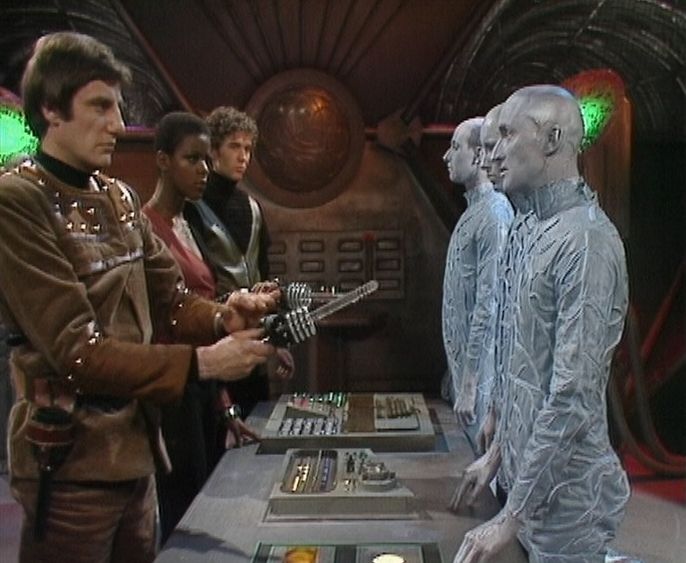
Ultraworld is an artificial world run by the three Ultras – who are blue-skinned aliens of varying baldness.  One looks to be completely bald, one is wearing a rather ill-fitting bald cap whilst the third clearly didn’t get the memo as he proudly sports hair at the sides and back.  So if the intention was to make them into a gestalt entity, someone wasn’t on the same page.  The Ultras are humourless, logical and, no surprise, not great conversationalists.

They exist to gather information (Ultraworld is nothing more than a massive computer) and it’ll come as no shock to learn that the Ultras plan to drain Avon and the others of all their knowledge and then take the Liberator for good measure.

There’s the odd nice moment.  Cally disappears from the Liberator and the others hear her crying for help from Ultraworld.  But it’s not her voice – it’s an artificial construct and this revelation is a disturbing reveal.  The location filming (at the Camden Town Deep Level Shelter) is impressive.  Previously used for the Doctor Who story The Sunmakers, it once again effectively doubles as a strange, alien environment.

But on the debit side, what has happened to Vila?  He spends the episode attempting to teach Orac jokes.  I think once example will suffice. “Where do space pilots leave their ships? At parking meteors.”  Alas, there’s many more where that came from, so it shouldn’t come as any surprise that this was rumoured to be Michael Keating’s least favourite episode (the proactive hero from City at the Edge of the World seems a long time ago).  It’s worth noting that Vila’s jokes do play an important part in the conclusion of the story, but that doesn’t make me any more disposed to enjoy them.

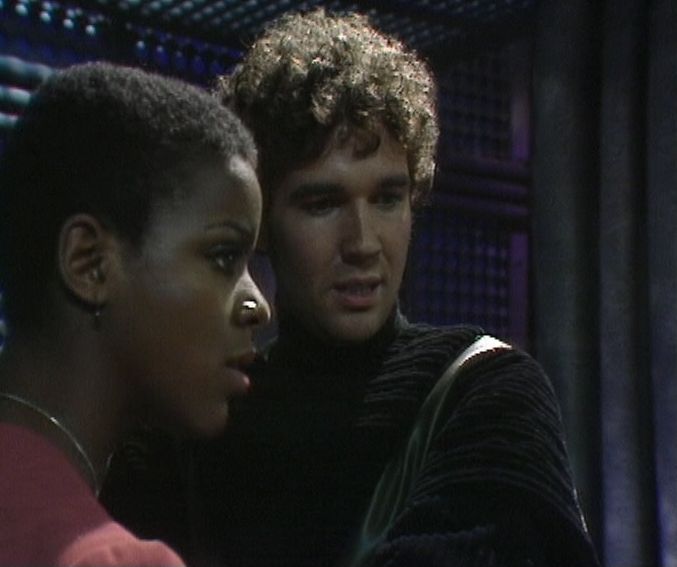
With Vila acting the fool and Cally and Avon sidelined, it falls to Dayna and Tarrant to carry the brunt of the action.  Although it’s not the greatest story ever, they make an attractive pair (and for once Tarrant isn’t particularly annoying).  They have to suffer the oddest part of the episode though, as the Ultras suddenly realise that Danya and Tarrant are girl/boy and decide that a bonding ceremony is in order.  It beggars belief that whilst they’ve accumulated masses of knowledge they know nothing of the ways of, ahem, human love.  So they’re keen for Danya and Tarrant to get it on, whilst they watch (yes, really!)  They do dangle a carrot – hinting they might let them go if they agree.

DAYNA: Tarrant, I think we should accept the offer. Then we can return to the Liberator.
TARRANT: You can’t be serious. You don’t believe what they say.
DAYNA: We have to believe if we hope to survive. Kiss me.
TARRANT: What?
DAYNA: I said, kiss me. Come on. I can’t be all that repulsive

It’s hard to take any of this seriously, especially when one of the Ultras pops up on the screen, asking “has the bonding ceremony begun?”, as soon as they start kissing – which rather puts a damper on things.

Complete with a giant pulsating brain, Ultraworld is pretty stupid sci-fi schlock, but it’s impossible not to derive some entertainment from it.  I’m glad it was more the exception than the norm though.

ultra 02