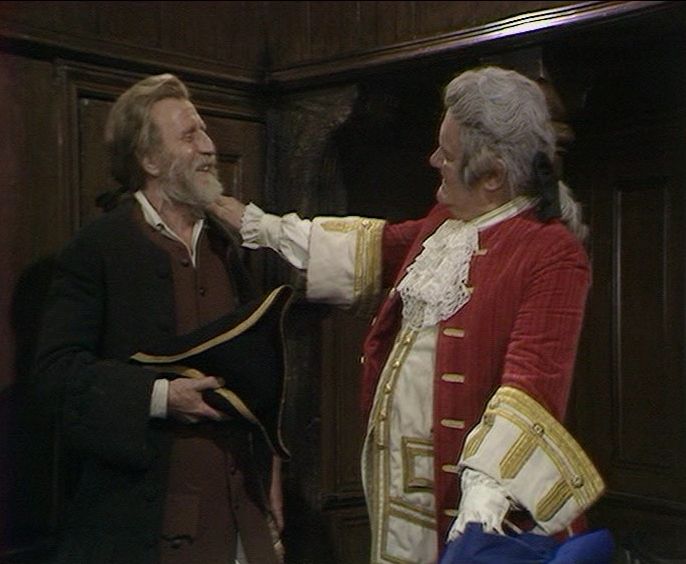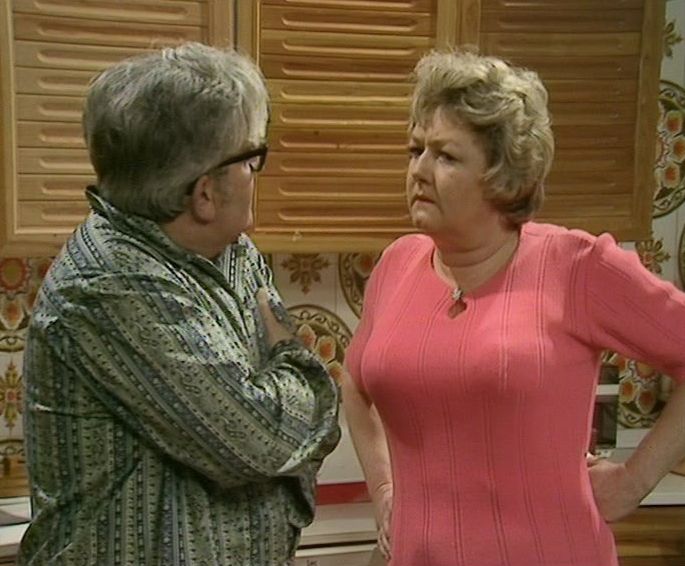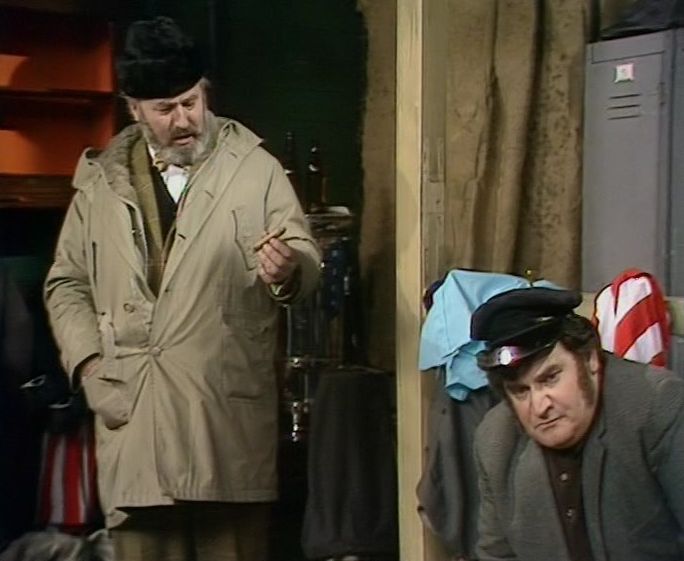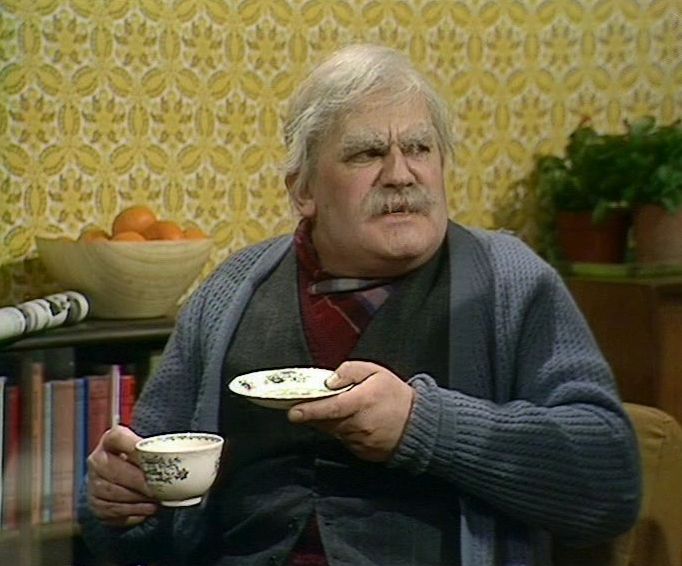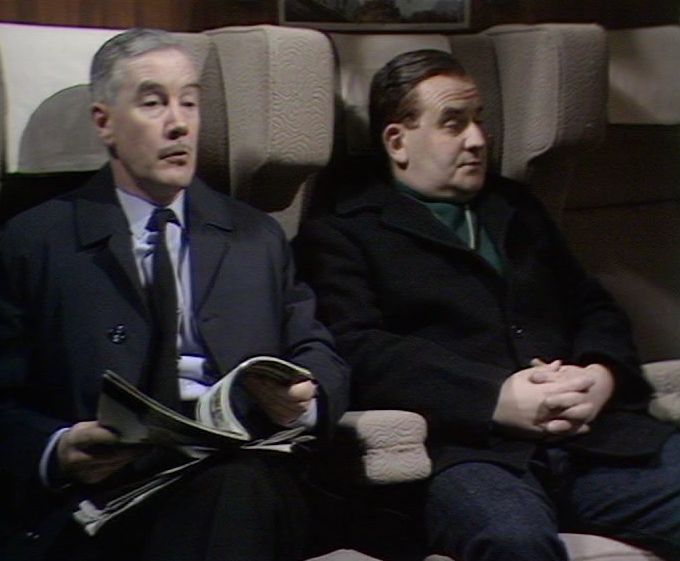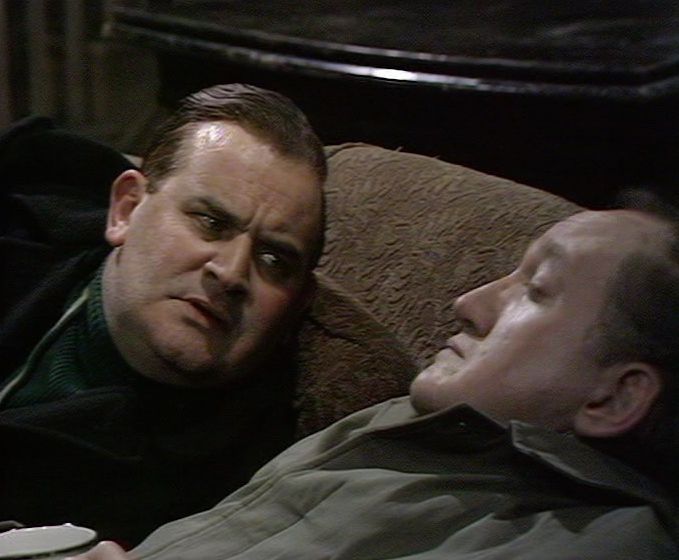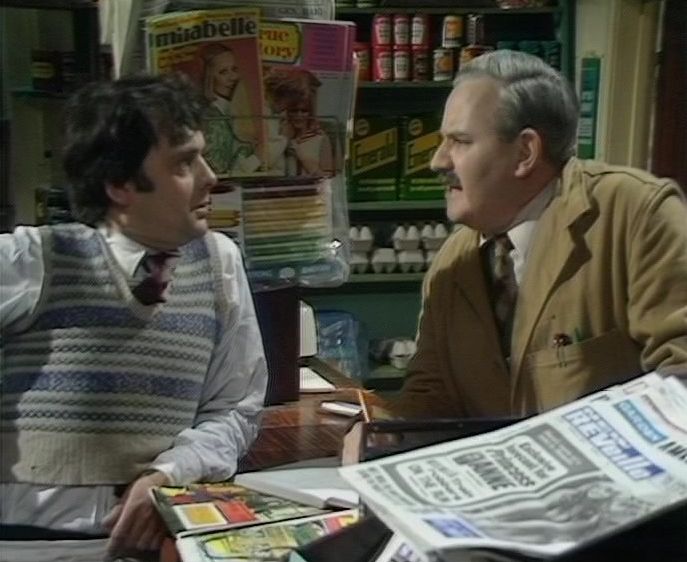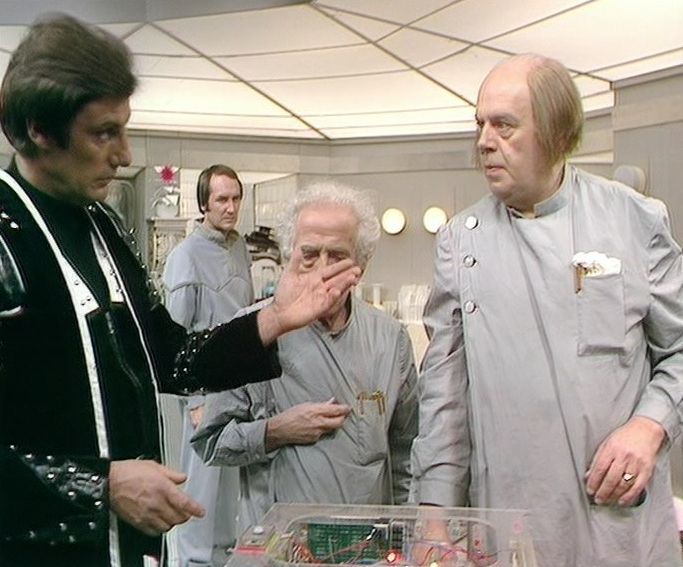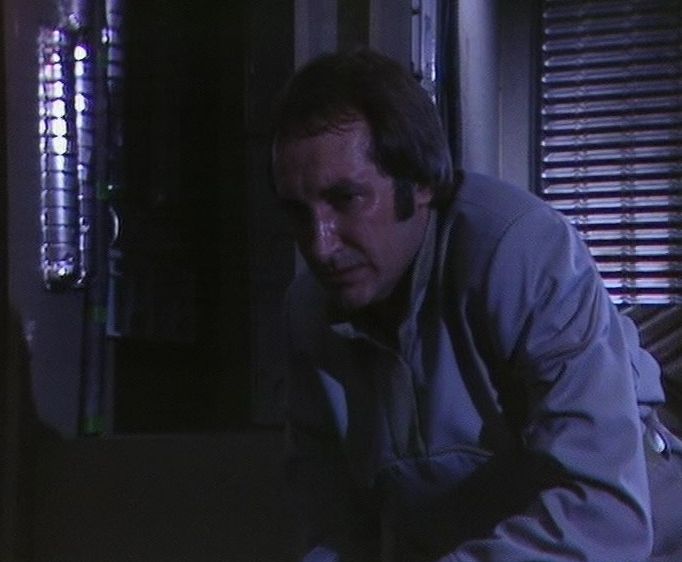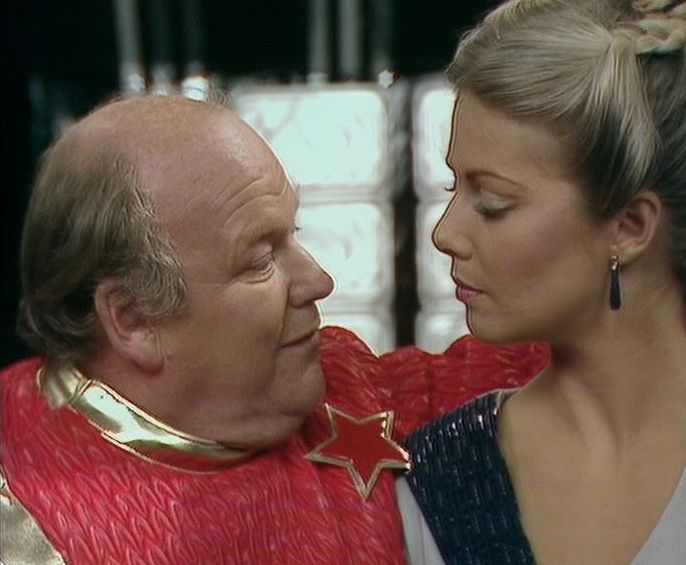
Treasure Island (BBC, 1977) – Part Three

treasure-03-01

Most of the crew have decided to throw their hand in with Silver.  Most, but not all.  One whose loyalty remains undecided is Tom (Derrick Slater).  He knows and respects Silver of old, but will he elect to join the others in mutiny?

The question of Tom’s allegiance brings the character of Silver into sharp focus.  Silver is fond of Tom and seeks to win him over – to this end, along with some of the others they make for the island (leaving Smollett, Livesey and the others aboard the Hispaniola, guarded by a small number of pirates).  Silver believes that away from the ship he’ll be able to talk Tom round.

Given all the quality character actors seen throughout the serial, it’s slightly surprising that the relatively undistinguished Slater was given this role.  True, Tom’s screentime is very limited, but since the confrontation between Silver and Tom allows us – and Jim – a chance to witness Silver’s ruthless side, it’s therefore a pity that Slater’s performance is on the lifeless side.

Tom tells Silver that “you’re old and honest too, or has the name for it. And you’ve money, which many a poor sailor hasn’t. Brave too, or I’m mistook. You tell me why you let yourself be led away by that kind of mess of swabs.”  During this monologue Silver has lain a friendly arm on him, but pulls away once he realises that Tom won’t be won over.  With a horrified Jim watching from his hiding place close by, Silver stabs Tom to death.  Given that the battle seen later in the episode is fairly bloody, it’s interesting that Tom’s murder occurs off camera.  We see Silver stabbing something, but we never see what it is.

Captain Smollett and the others make their way ashore.  Smollett really begins to take charge (Richard Beale is first class during these scenes) and they elect to use Flint’s old stockade as their base.  But even before they’ve secured it there’s a brief battle and Squire Trelawney’s loyal servant, Tom Redruth (Royston Tickner), lies dying.

Tom’s barely had a handful of lines, but he does get a good death scene.  Up until now it seems as if the Squire hasn’t really grasped the reality of the situation – it’s been little more than a game to him (finding a ship, employing a tailor to make him the grandest uniform, etc).  It takes the death of a loyal family retainer, someone uprooted from his settled life in Britain and fated to die a lonely death on a distant island far away from his family, to bring him back to reality.  He asks Tom to forgive him (and is insistent that he does so).  Tom, loyal to the last, insists there’s nothing to forgive and, as Trelawney recites the Lord’s Prayer, Tom gently slips away.  Beautifully played by both Tickner and Thorley Walters.

We meet Ben Gunn (Paul Copley).  He’s Irish and speaks in a remarkably high pitched voice, which is a little odd.  But then Ben Gunn’s supposed to be odd (what with his cheese fixation) and after a while his voice lowers a little, so a little bit of normality is restored.  His cave – a studio set – looks very good (another design triumph for Graham Oakley).

John Dearth was one of those utility actors who was always worth watching, even in the smallest of roles.  He was a regular during the first series of the ITC Richard Greene Robin Hood’s, playing a different role each week (and sometimes two in the same episode!)  Various personal problems meant that he later sometimes found work hard to come by, but he was lucky to have several loyal supporters – one of whom was Barry Letts.  Both Briant and Letts had directed him in Doctor Who, so like many of the cast it’s not unexpected that he turns up here.  Dearth’s character (Jeb) mainly seems to exist in order to stress how dangerous Silver is – Jeb states that the only man the vicious Captain Flint ever feared was Long John Silver.

I’ve already touched upon how good Richard Beale has been and he’s never better than in the scene where Smollett and Silver face off.  Both have their own set of demands and neither is prepared to give the other any quarter.  Alfred Burke switches from smiling affability to snarling disdain in a heartbeat.  This then leads into the sequence where the pirates attempt to storm the stockade.  It’s slightly jarring that the outside is on film whilst the stockade interior is on videotape – the rapid switching between the two is a slight problem.

But no matter, Michael E. Briant still manages to choreograph a decent action sequence with a liberal dose of blood (nothing explicit, but it still manages to create the impression that a short – and brutal – battle has taken place).  The pirates are beaten back, which infuriates Silver – so he elects to send for reinforcements from the ship ….

treasure-03-02

Treasure Island (BBC, 1977) – Part Two

treasure-02-01

Since Treasure Island is packed with character actors of distinction, it’s easy to overlook the young actor who played Jim Hawkins.  But Ashley Knight more than holds his own amongst such august company, possessing just the right amount of youthful spirit and innocence.

That he’s deceived by Silver shouldn’t come as too much of a surprise, since Long John also managed to fool Squire Trelawney (Thorley Walters).  But, to be fair, fooling the Squire probably wasn’t too tricky for Silver, as Trelawney (as per Stevenson’s novel) is portrayed as the sort of trusting, loose-mouthed individual you really wouldn’t want to entrust with the delicate matter of finding a ship and crew to sail to the Spanish Main in search of buried treasure.  Walters is a delight as the Squire, he may be pompous and vain but he’s also curiously lovable.

The way that Silver manipulates Trelawney into engaging him as the ship’s cook and then agrees that he can handpick the crew provides us with another opportunity to witness the apparently charming and helpful side of Silver (although he’s only serving his own interests of course).  His charm is seen again when the wily Long John takes Jim under his wing.  There’s no reason why Silver should seek to deceive Jim, which leads us to assume that his friendly stories have no ulterior motive.  But there’s a sting in the tail – at the same time he’s regaling Jim with yarns about the sea, Silver is planning to murder Trelawney, Livesey and Captain Smollett (Richard Beale) and anyone else who stands in his way.

Would he also do the same to Jim?  It’s not explicitly stated, but he does confide to Israel (the ever-watchable Patrick Troughton) that he doesn’t intend to leave any witnesses, so we can pretty much take it as read.  This dichotomy in Long John’s character is what makes him so fascinating – the other pirates make little or no attempt to hide their evil intent, but it’s the way that Silver can wear different masks at different times that makes him such an enduringly appealing creation.  And of course, in the hands of an actor as good as Alfred Burke it’s just a pleasure to watch.

Not all of the crew are content, like Silver, to wait for the right time to make their move, some want action now.  Prime amongst the malcontents is Merry (Roy Boyd) who paces the ship with a murderous look on his face, but you get the feeling that he’s never going to be any sort of match for Long John.

During this era of television, directors tended to have a “rep” of actors who they employed on a regular basis.  If you’re familiar with some of Michael E. Briant’s previous productions then names such as Roy Evans, Richard Beale, Royston Tickner and Alec Wallis will be familiar ones.  Alec Wallis has a nice little cameo as Patmore, a corrupt tailor who Silver deliberately sends along to Trelawney, just so he can denounce him before the Squire and therefore gain his trust.  Beale is suitably upright as the incorruptible Smollett, a man who sets to sea with the gravest misgivings about the crew (a pity nobody listened to him).

Before the ship sets sail there are several scenes which take place within the Squire’s cabin.  Thanks to a very simple CSO effect (bobbing waves outside the cabin window) the illusion at being on the water is created very effectively.  But there’s no substitute for the real thing and it’s the later filmwork aboard the Hispaniola, as it makes it way towards Treasure Island, which really opens up the production.

treasure-02-02

Treasure Island (BBC, 1977) – Part One

treasure-01-01

Treasure Island, an evergreen classic of children’s literature for more than a century, has generated more film, television and radio adaptations than you could shake a cutlass at.  But even though there’s many versions to chose from, this one (broadcast in four episodes on BBC1 in 1977) has to rank amongst the very best.

Like the majority of the BBC Classic Serials from the sixties, seventies and eighties, the adaptation (this one from John Lucarotti) displays considerable fidelity to the original source material, although Lucarotti is unafraid to build upon the original narrative.  In a way this isn’t surprising, since the book was told from Jim’s perspective it’s inevitable that it has a somewhat restricted viewpoint.

Lucarotti’s additions begin right from the start, as Jim’s father, Daniel (Terry Scully), someone who merited only a handful of mentions in Stevenson’s original, is fleshed out into a substantial character.  Scully excelled at playing people who suffered – he had one of those faces which could express a world of pain – and Daniel is no exception.  Daniel is clearly far from well and concern that he’s unable to provide for his family is uppermost in his mind.  So the arrival of Billy Bones (Jack Watson) seems to offer a chance to extricate himself from his financial problems.

Watson’s excellent as Bones.  With his weather-beaten face and the addition of a wicked-looking scar, he’s perfect as the rough, tough, seaman with a secret.  Bones’ decision to recruit Daniel (an invention of Lucarotti’s) is quite a neat idea, since it explains how Long John Silver and the others came to learn where Bones was (Daniel heads off to secure passage for himself and Bones to the Caribbean, not realising that Silver is monitoring the port for any unusual activity).

Lucarotti also elects to bring Silver and his confederates into the story very early, making it plain that Bones has absconded with something of great value that they’d all like back.  If you love British archive television of this era then the sight of Silver’s gang will no doubt warm the cockles of your heart (step forward David Collings, Patrick Troughton, Stephen Greif and Talfryn Thomas amongst others).

Alfred Burke’s Long John Silver impresses right from the off.  He doesn’t have Robert Newton’s eye-rolling intensity, nor does he have Brian Blessed’s physical presence – but what Burke’s Silver does possess is great charm and a rare skill at manipulating others to do his will.  But although he seems pleasant enough to begin with, it doesn’t take long before he demonstrates his true colours.

Bones’ run-in with Doctor Livesey (Anthony Bate) is kept intact from the original.  Bate is yet another wonderful addition to the cast and Livesey’s stand-off with Bones is a highlight of the episode.  Lucarotti’s subplot of Daniel’s doomed night-time misadventure slots into the original story very well, as it explains why his health suddenly took a turn for the worse, which then resulted in his death shortly afterwards.

A member of Silver’s gang, Black Dog (Christopher Burgess), arrives to confront Bones.  Burgess was a favourite actor of the producer, Barry Letts, so it’s maybe not too much of a surprise that he turns up.  He and Watson step outside (and therefore onto film) for a duel, which leads to Bones’ stroke.  Watson’s particularly fine as the bedridden Bones, suffering nightmares accrued from the horrors of a life spent on the high seas and dreading the arrival of the black spot.

David Collings’ nicely judged cameo as the malevolent Blind Pew is yet another highlight from a consistently strong opening episode.

treasure 01-02.jpg

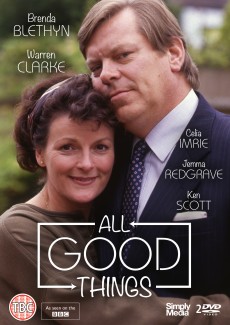
All Good Things – Simply Media DVD Review

good

Broadcast in six episodes during May and June 1991, All Good Things by Lesley Bruce is a rather obscure piece of archive television, which given its cast-list – Brenda Blethyn, Warren Clarke, Ceila Imrie, Ron Pember, Jemma Redgrave, Ken Stott and Barbara Young amongst others – is a little surprising.

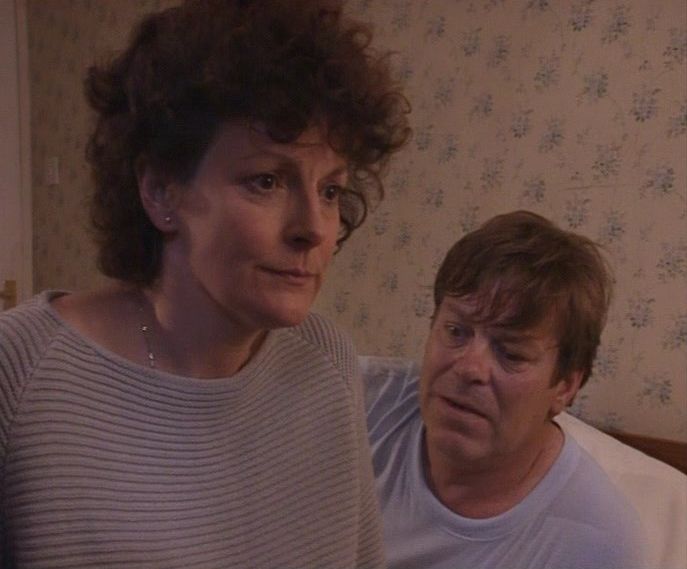
Lesley Bruce’s television credits aren’t too extensive (although she did contribute to popular drama strands such as Play for Today, Screenplay, Screen Two and Theatre Night).  We open with a married couple, Shirley Frame (Blethyn) and Phil (Clarke), who are seen arguing as they drive towards an unknown destination.  The reason for this isn’t made clear until Shirley opens the car door and we observe that she’s heavily pregnant.

Phil’s not keen about the baby’s impending arrival (their other children are now in their teens and he was looking forward to a little bit of peace and quiet – and possibly taking up a hobby, like the saxophone).  Shirley, en-route to the ante-natal class, admits – presumably for the first time – that she also doesn’t want the child (although they’ve left it far too late to do anything about this).

A sharp gear-change from comedy (Shirley’s rant is observed by all the other attendees of the ante-natal class who stare silently at her) to potential tragedy occurs when she suddenly collapses.  Is she going to lose the baby?  Well no, everything turns out fine – meaning that the scene feels a little forced and manipulative.  In drama there’s a sense that you have to “earn” moments like this, by developing your characters and the way they interact with each other.  If you just drop events casually into the narrative with no preparation it just doesn’t feel right.

But after this slightly shaky start, the opening episode – The Blessing – develops well.  Both Blethyn (b. 1946) and Clarke (1947 – 2014) were well established actors at the time and this is possibly why they’re able to quickly make Shirley and Phil seem like a real couple.  Although possibly the method of recording (All Good Things was an all-videotape production) also helped.  This was a style of television drama that (soaps apart) would vanish a few years later (from then on, drama tended to be shot either on film or tape processed to look like film) but it’s not a handicap here – videotape has an immediacy which film lacks, thereby giving the series something of a documentary “real” feel.

good-01

With a gorgeous new baby, Shirley should be the happiest woman in the world, but she’s not.  “Sometimes I feel so lonely, and bored, and bad-tempered, I could scream and yell and tear my hair out in great huge hulking handfuls!”  So Shirley needs a new direction in her life, but what?

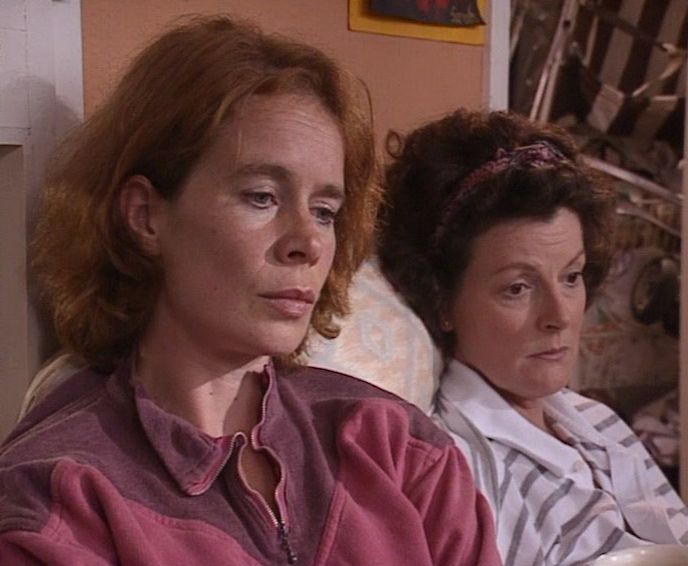
After a little consideration she decides to go and help people – there must be plenty who need help she reasons, they just have to be found.  Naturally she begins close to home, but things don’t go well after she makes a start with her mother, Hetty Snr (Barbara Young).  Hetty, still smarting from a painful divorce, is brought to tears after Shirley loses her temper and shouts at her.  Shirley’s attempts to help her sister-in-law Elaine (Jemma Redgrave) ends in much the same way, with Elaine left a sobbing mess.

Some people might possibly decide after this that being a Good Samaritan isn’t the wisest career move but Phil – always one to attempt to put a helpful spin on matters – suggests that maybe they didn’t respond because they were family.  He’s clearly only saying this to make her feel better, but she takes it to heart and it sets up the premise for the remaining episodes – Shirley will venture out into the world, meeting total strangers and attempting to fix their lives.  But given her lack of success so far (and the fact that her own life is far from perfect) what are her chances of success?

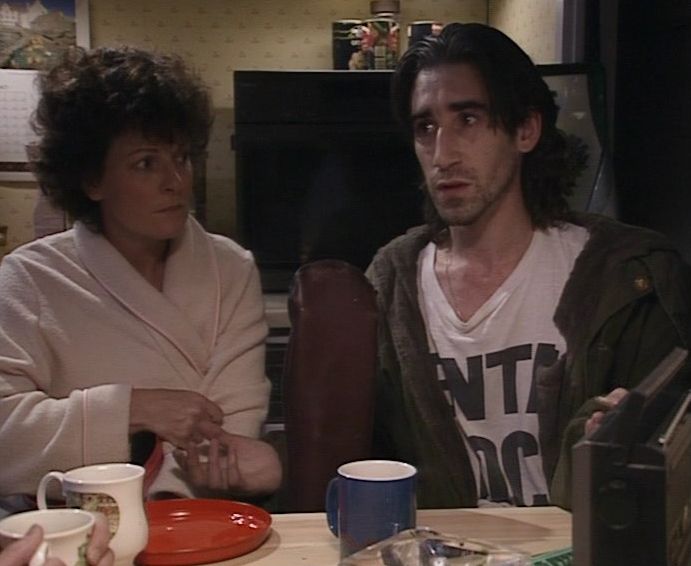
In The Suicide, Shirley prevents a young man, Vincent Gibney (John Lynch), from committing suicide. She wants to prove to Vincent that there’s still good in the world (something he doubts) and to this end she gives him her phone number, telling him that he can call on her anytime. The inevitable happens of course, Vincent arrives and makes himself at home (much to Phil’s growing exasperation). Once again there’s a sharp disconnect between Shirley’s hopes and the reality of the situation. Lynch is entertaining as Vincent, but once again it’s Blethyn who receives all the best lines. Here, she’s finally reached the end of her tether. “My God, I can see now why everyone else gave up on you! You’ve got to be the blindest, most self-regarding, insensitive wimp anyone’s ever dragged back from the edge of the parapet.”

good-02

It might be expected that Vincent would vanish after this episode, to be replaced by a new poor soul for Shirley to look after next time. But that’s not the case as he’s present for the remainder of the series, as is Karen (Liza Hayden), who features in the next episode, Reading Lessons. This interconnectivity is a definite strength as it allows the narrative to become denser as the episodes tick by.  Karen’s another lost sheep who Shirley scoops up, but once again her good intentions seem to bring nothing but discord and discontent.

If Warren Clarke has been a little overshadowed so far, then that’s redressed somewhat in The Flat. Phil’s irritation that, thanks to Vincent and Karen, he can no longer call his house his own finally bubbles over. Clarke and Blethyn excel towards the end as they both consider the state of their marriage. Earlier, Jemma Redgrave and Ken Stott impress again as Elaine and Lawrence’s marriage continues to buckle under the strain.

In The Trip North, Shirley heads off for a bonding weekend with one of her sons (which, unsurprisingly has some rocky moments) leaving Phil at home holding the baby, literally.  I love the scene where Phil’s shaving, crooning Teddy Bear whilst holding baby Hetty at the same time. The baby clearly finds this fascinating! This leads onto a more dramatic scene where baby Hett’s facial expressions ensure that she remains the centre of attention. Never work with children or animals ….

The series concluded with Marriage Guidance. Whilst Shirley has expended all her energies into helping others, her own life has fractured (a bitter, if obvious, irony – something which is also spelled out visually in the opening credits). Phil’s relationship with Doll (Deborah Findlay) offers him peace and security – two things which are now in short supply at home. Doll and Phil are work colleagues and their affair has slowly developed over the course of the series as Shirley’s drive to help others has also increased.  Finally he elects to tell Shirley that he’s leaving her, but when it comes to the crunch will he have the guts to come right out and say it?

It’s a disquieting and bleak conclusion, which leaves the viewer free to decide what happened next. There was certainly scope for a second series to pick up where this one left off, but despite the excellent cast and generally strong writing, this was the end of the line for All Good Things.

Headed by Blethyn and Clarke, this is a series that certainly doesn’t lack on the acting front. The layered developing narrative is another plus and although it’s not always an easy watch, it is a rewarding one. With the emphasis more on drama than comedy, All Good Things is an interesting archive curio which I’m glad Simply have brought blinking out into the light.

All Good Things is released by Simply Media on the 28th of November 2016.

good-03

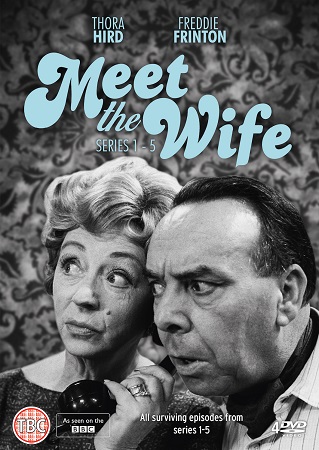
Corrected discs now available for Meet the Wife

164454- Chief Crazy Horse Sleeve.indd

As touched upon in my review, the recent release of Meet the Wife was missing an episode.  Simply have now issued a statement on their Facebook page, as below, with details about how to obtain a corrected copy.

“Unfortunately due to an authoring error an episode was missed off the release of MEET THE WIFE.

For your replacement, which has the error corrected, please contact us either by private message on Facebook, or by emailing hannah.page@simplymedia.tv with your order number and where your DVD was purchased from, along with an address to send the replacement to.

 Many thanks, and Simply Media apologise for any inconvenience caused.”


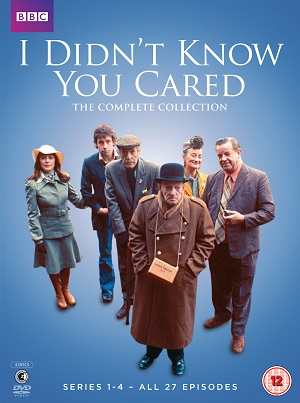
I Didn’t Know You Cared – Second Sight DVD Review

7067

Peter Tinniswood (1936 – 2003) first came to prominence in the 1960’s, collaborating with David Nobbs on The Frost Report and also penning Lance at Large, a sitcom built around the talents of Lance Percival.  He also pursued a career as a novelist and two of his books – A Touch of Daniel (1971) and I Didn’t Know You Cared (1973) – would form the basis of his most enduring television creation.

The television version of I Didn’t You Know Cared, adapted loosely by Tinniswood from his novels, ran for four series between 1975 and 1979 (a third novel, Except You’re A Bird, was published in 1976).  Although the series was popular at the time, it sadly doesn’t have a very high profile these days.  Some maintain this is because of its strong Northern atmosphere, but I’m not sure this is so – after all, it bears some similarities to Last of the Summer Wine, and that’s a series which has always had broad appeal.

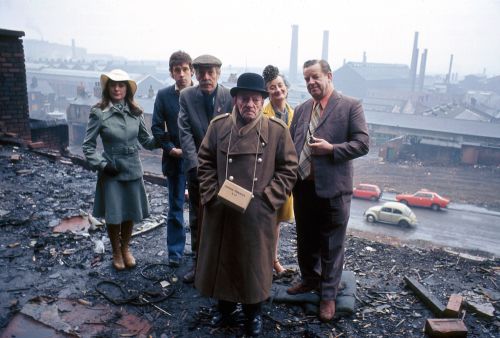
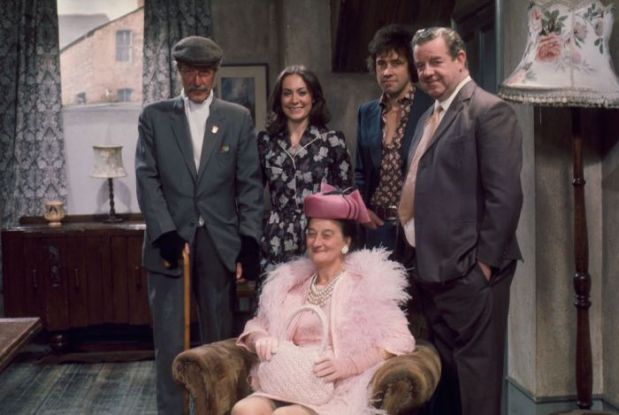
The comparison with LOTSW is a fair one (and not least because John Comer appeared in both series).  They both depict worlds where married life is a constant battle, with neither side giving any quarter.  In I Didn’t Know You Cared it’s the formidable Annie Brandon (Liz Smith) who rules the roost with considerable relish.

The opening episode, Cause for Celebration, sees Uncle Mort (Robin Bailey) bury his wife Edna (who had the bad luck to fall off a trolleybus onto her head).  Mort doesn’t exactly seem heartbroken – fretting that because the funeral’s taking so long he’s going to miss the football results – but later does admit that he’ll miss her.  “She was a dab hand at plumbing you know. God knows who’s going to paint the outside of the house now she’s dead.”  But every cloud has a silver lining and he’s happy that from now on he’ll be able to wear his cap at the dinner-table.

Bailey tended to play upper-class most of the time, so the earthy Northerner Mort was something of a departure for him.  But he’s never less than excellent and thanks to Tinniswood’s pithy dialogue he’s always got plenty of good material to work with.

7090

Mort sneaks away from the funeral party with his brother-in-law Les (John Comer).  If Mort is starting to relish his new found freedom, then spare a thought for Les, shortly due to celebrate twenty five years of marriage to Annie.  She wants a second honeymoon, whilst Les doesn’t seem to have recovered from the first.  As Mort and Les seek refuge and a nice cup of tea in the comfortable hut at Mort’s allotment (Mort grows weeds, explaining to Les that they’re much better than sprouts) they muse over the mysteries of marriage.  Les believes that having to marry a woman is where the trouble starts – if he could have chosen anyone, he’d have picked King George VI!  They’re joined by Les’ son Carter (Stephen Rea), and after a few moments Mort decides that “t’fly in ointment is the human reproduction system.”

How much better would it be, Mort says, if a woman laid an egg and sat on it for nine months.  “Just think, she’d be stuck in t’house for nine months, sat on her egg. She’d have no excuse for coming to t’pub with you then.”  Carter sees a flaw in this admirable idea though – why couldn’t she put the egg in the oven for a bit?  After considering this, Mort decides that it wouldn’t work, not with the way that gas pressure is like these days.  “You couldn’t rely on it. Just think what would happen. You’d put your oven on at regulo 2, you’d stick you egg in it, you’d nip out for a couple of gills. When you come back you find t’gas pressure’s gone up and your potential son and heir’s turned into a bloody omelette.”

Alas, their peace and quiet doesn’t last for long as Annie tracks them down.  She depresses Mort by telling him that he’s going to come and live with her and Les (so he won’t be sneaking down to the pub every night and doing exactly what he pleases).  Carter also has the sense that the walls are closing in on him after he’s forced to stop prevaricating and propose to Pat (Anita Carey).  Well I say propose, but his mumbled words fall a little short of that – no matter to Pat though, she’s now steaming full ahead and starts by asking him if he’d like a son or a colour television first …

In the space of thirty minutes Tinniswood has set everything up nicely – Annie and Les, Carter and Pat, plus Uncle Mort.  Not to mention Uncle Staveley (Bert Palmer) hovering in the background, constantly asking “pardon?”

During the first series we see the preparations for Carter and Pat’s marriage.  Mort and Les, old hands in the marriage game, are keen to give him the benefit of their experience (they both think it’s a very bad move). Unsurprisingly Pat don’t find this terribly helpful. By series two they’ve tied the knot, although Carter’s finding it rather difficult to adjust to married life.  Both Rea and Carey left after the second series, so Keith Drinkel and Liz Goulding took over the roles for the final two series (Leslie Saroney replaced Bert Palmer as Uncle Stavely for the fourth and final series).

7093

The endless conflict between men and women is explored in the series two episode A Woman’s Work. Mort is depressed at having to spend all day trapped in the house with only Annie and Pat for company. He eyes Les and Carter with envy – they’ll soon be setting off to the factory for a day of filth and squalor (he tells them they don’t know how lucky they are!)

Familiar Tinniswood tropes come to the fore – not only do the women do all the housework (which goes without saying) but they also deal with the household maintenance as a matter of course. Annie recalls the problem they had with the guttering, which wasn’t helped by the fact she was stuck on the roof for six hours after Les took the ladder away. He tells her there was a good reason – he had to repair a hole in the snooker club roof – and he doesn’t seem to appreciate that she may have had different priorities.

Carter and Pat are now married and Pat is eyeing their new home. Anita Carey continues to impress as Pat, an upwardly mobile woman who embraces the new. She’s very taken with the qualities of their potential new neighbours (mainly because of the gadgets on their cars) and is also keen to mould the reluctanct Carter into a new man. This isn’t going to be easy though ….

Mort’s reminisces of his married life are another of the episode’s highlights – especially the moment when he recalls how Edna would demand her conjugal rights every Saturday evening. “Oh ‘ell, I’d say. Can I keep me pyjama jacket on? Undiluted bloody agony.”

Paul Barber pops up in a couple of episodes, including this one, as Les and Carter’s factory colleague Louis St. John. The dialogue Barber has is a little awkward (for example, when asked if he had a good weekend he says that he “took the awd lady to t’witch doctors on Saturday, had a couple of missionaries for Sunday lunch”). Another familiar face lurking in the factory is John Salthouse as the impressively-named Rudyard Kettle. Salthouse would later play DI Galloway in The Bill.

Tinniswood’s dialogue remains endlessly quotable. In a later series two episode, You Should See Me Now, Annie recalls that the last time her husband took her out alone was the week after the Second World War ended. “We went to hotpot supper at Moffat Street tram sheds.” With just a single line Tinniswood is able to paint a very vivid picture.

Taking over roles played by someone else is never easy, but both Keith Drinkel and Liz Goulding fit very nicely into the third series as the new Carter and Pat. The opening episode – Men at Work – develops the theme from A Woman’s Work. There we saw Mort going a little stir-crazy, trapped in the house all day, now matters are made even worse as he’s joined by Les and Carter, both of whom are out of work. They react to the spectre of unemployment in different ways – Carter is building a model battleship painfully slowly whilst Les becomes an efficient house-husband (Comer looking fetching in a pink pinny).

The fourth and final series opened with The Love Match. This sees the Brandons throw a posh dinner-partly at which Les mournfully notes that they must be having peas since there’s three forks on the table. Annie is in a much more positive mood though. “It must be years since I got dressed up in a long frock and squirted scent under me armpits.”  It must be said that Liz Smith does look rather, well rather …..

Other highlghts later in the series include Mort’s unexpected expressions of love (given all he’s previously said about the horrors of married life this is more than a little surprising). An especially strong episode is The Great Escape, which sees Pat tell Carter that she’s planning to spend two nights away on business. Poor Pat wants Carter to be absolutely incensed and jealous with rage, but the phelgmatic Carter is his usual calm self. There’s a darker tone to this one though, as Carter’s eyeing the voluptuous charms of Linda (Deidree Costello) even as he’s bidding Pat farewell. But when Pat is hospitalized shortly afterwards, a stricken Carter is forced to abandon his escape plans. Drinkel, sitting by the unconscious Pat’s bedside, plays the scene very well.

With uniformly strong performances from all of the main cast (especially Bailey, Comer and Smith) and sparkling dialogue from Peter Tinniswood, I Didn’t Know You Cared is an obscure sitcom gem.  But with writing and acting as good as this it deserves to be much better known.

I Didn’t Know You Cared is released by Second Sight on the 28th of November 2016.  RRP £24.99.

7087

Seven of One – I’ll Fly You For a Quid

quid-01

Count the number of Welsh clichés in the opening thirty seconds.  Male voice choir, check.  Shot of the village with the colliery prominent, check.  A full house at the chapel, check.  If this one had ever gone to a series then goodness knows how many more clichés it would have racked up.

At least it has a decent number of Welsh actors. Talfryn Thomas, at times the BBC’s stock Welshman, naturally appears as does the always watchable Emrys James as Reverend Simmonds.  Barker, of course, wasn’t Welsh but he manages a decent accent (which he’d later revive for the largely forgotten Roy Clarke sitcom The Magnificent Evans).  Barker plays Grandpa Owen (who doesn’t last long) as well as the younger Evan Owen.

Gambling fever has long gripped the village and the late Grandpa Owen leaves his family with a problem.  His son Evan realises that just before he died his father had a big win on the horses.  But where is the betting slip?  After searching the house with no success, Evan decides that the slip must be in the coffin, meaning that Grandpa Owen’s peace has to be disturbed ….

The second of two Seven of One scripts penned by Dick Clement and Ian La Frenais, this was the one that Barker felt had the best chance of going to a series (he had to be persuaded that a prison-based comedy had legs).  And if it had moved away from the rather limiting topic of gambling then the quality of the cast (including Richard O’Callaghan and Beth Morris as Evans’ son and daughter) would have been a major plus point.

O’Callaghan may not be Welsh, but he still makes a good impression as Mortlake, a man just as keen as his father to dive into the coffin to see if the betting slip is there.  Although since the coffin isn’t yet screwed down you have to wonder just why they just don’t open it up and be done with it.  The lovely Beth Morris doesn’t have a great deal to do except stand around and look lovely (especially at the end, where her low-cut dress has Talfryn Thomas’ Mr Pugh rather lost for words).

Apart from Prisoner and Escort and Open All Hours, Seven of One offers up fairly forgettable fair.  I’ll Fly You For a Quid is one of the stronger later entries, but overall the series lacks the consistency of Six Dates with Barker.

quid-02

Seven of One – One Man’s Meat

meat-01

Alan Joyce (Barker) has been put on a strict diet by his wife Marion (Prunella Scales) and is told that he has to last the entire day without any food.  When she leaves he naturally heads straight off to the kitchen, but is appalled to find she’s taken every last scrap of food away.  And heading out to the shops is going to be a problem, because she’s removed all his pairs of trousers too …..

Written by Barker, under the penname of Jack Goetz, it’s not a surprise that One Man’s Meat gives him the (ahem) plum role.  Despite the heavyweight supporting cast – Scales, Sam Kelly, Glynn Edwards, Barbara New and Joan Sims – Barker is by himself for a large part of the episode’s duration.

Scales tops and tails the episode.  It’s nothing to do with the story, but Marion mentions that they’ve recently seen a blue movie at Bill and Nora’s house – this shines a light into the ways that the respectable middle-classes entertained themselves during the 1970’s.  Did they then indulge in a spot of wife swapping?  That would have made an interesting story, but possibly a post watershed one.

There’s more touchstones to the 1970’s as Alan mentions that he plans to fight the flab with Terry Wogan.  He’s too late to catch him though, so has to put up with Jimmy Young instead.  And since JY is delivering his latest recipe it’s all too much (he dunks the radio in the sink).

Although Alan attempts to order a takeaway from a Chinese restaurant (cue slanty-eyed acting from Barker, another moment which helps to date the story) he appears to be unsuccessful.  Presumably there were no other takeaways in the area?  This is something of a story weakness.

His desire for food then causes him to pretend he’s been burgled.  Two policemen (Edwards & Kelly) turn up, with Alan eyeing their trousers enviously.  It’s nice to see Sam Kelly and Glynn Edwards, even if they’ve not got a great deal to do.  I wonder if this small role led to Kelly being cast as Bunny Warren in Porridge?

The inimitable Joan Sims fairs a little better as the Joyce’s housekeeper, Mrs Dawkins.  Barker gives her some good lines which allows Sims to deadpan with her usual skill, ensuring that her scenes with Barker are the undoubted highlight of the whole thirty minutes.  Alas, she don’t appear for very long as Alan decides to steal Mrs Dawkins’ clothes, dress up as a woman and head out to the shops.  When in doubt, drag up, I guess.

One Man’s Meat has a sparkling cast and is a lovely time capsule of the seventies, but, like Alan’s stomach for most of the day, is a rather empty affair.  However if the story doesn’t appeal then you always entertain yourself by counting how many times microphone shadows appear (director Harold Snoad must have been having an off day).

meat-02

Seven of One – Another Fine Mess

mess

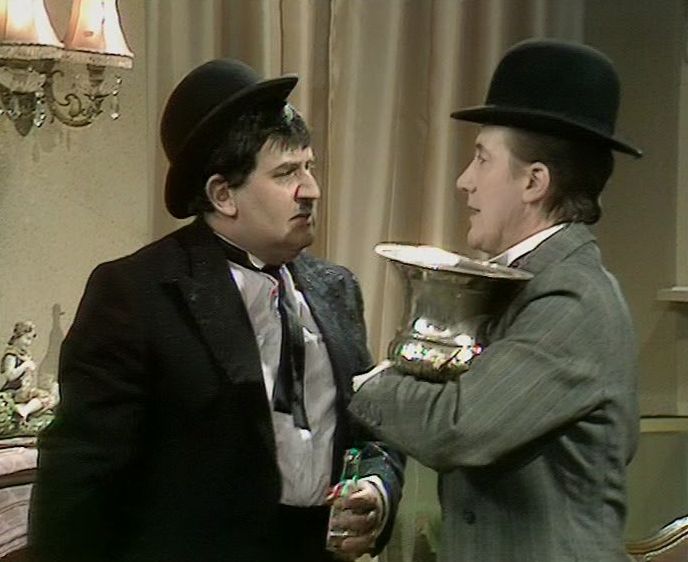
Sydney (Roy Castle) and  Harry (Barker) are keen to head off to the talent night at the Dirty Dachshund, but Harry’s ogre of a wife – Doris (Avis Bunnage) – doesn’t want him to go.  A few extra sleeping pills helps to ensure she sleeps like a baby, enabling Sydney and Harry to transform themselves into the spitting image of Laurel and Hardy and slip out into the night  …

Even before they’ve dressed up it should be fairly to easy to guess the direction that this one will take (the episode title is a bit of a giveaway too).  It’s a little strange that Sydney and Harry both talk and act like Laurel and Hardy in real life (meaning that their characters stay exactly the same once they’ve got the clothes on).  The opening finds Doris mourning the death of her mother, who passed away earlier in the day.  This provides the opportunity for Doris and her guests to poor scorn on Harry, who we’re told was an American GI (that explains why he talks like Olivier Hardy).  This part feels a little stilted.  A family bereavement offers plenty of comic potential, but Hugh Leonard’s script never really sparks during these scenes.

But once Roy Castle turns up and the pair decide to head out for the talent show, things pick up.  Slapstick humour abounds, even if Castle’s Sydney is a lot duller than Stan Laurel.  En-route to the talent show they spot a damsel in distress, Edwina (Pauline Delaney), and go to her aid.  She’s rather intoxicated, and curiously also seems to be American, and the pair decide to see her home.  Delaney (Mrs Mortimer in Public Eye, alongside a good many other roles) is amusing as the vampish Edwina, and her arrival on the scene enables Leonard to spring the big setpiece ending as Sydney and Harry demolish her flat.

Setting her electric fire ablaze, fun with soda-siphons and a nicely cued sequence where a chain of events ensure that one disaster follows another – like a row of dominos – all draw appreciative laughter from the audience.  It’s the moment where Another Fine Miss really springs into life and both Barker and Castle seem to be having a ball.

It’s hard to imagine this one as a series, every week they’d dress up as Laurel and Hardy and get into scrapes?   Hmm, maybe not, but as a one-off it certainly has its moments.

Seven of One – Spanner’s Eleven

spanner

Albert Spanner (Barker) is coach of Ashfield Athletic Football Club, a team firmly stuck at the bottom of the local league.  Their lack of success has even reached the hallowed halls of the council, so much so that Councillor Todd (Bill Maynard) presents Albert with an ultimatum – unless the team win their next match he’s out.

Although written by Roy Clarke, Spanner’s Eleven is no Open All Hours.  The concept of a hopeless non-league football team is a decent one, but for some reason the players hardly feature in the story at all (apart from a training film mid-way through, we don’t really see them emerge as characters until the last few minutes).  This is something of a wasted opportunity, especially since the likes of Christopher Biggins and Louis Mansi are amongst their number.

Unsurprisingly, since the whole series was mainly a vehicle for Barker, football-mad Albert Spanner has the lion’s share of the action, interacting with his wife Vera (Priscilla Morgan), Horace (John Cater) who covets the manager’s job and the harassed Councillor Todd.  It’s hard to really identity with Albert or to ever feel on his side.  He seems to have taken the coaching job for two reasons – firstly because he hoped it would generate a little profit for his day job (as a taxi driver) and secondly because he’s got the hot-dog concession on match days.

He’s undeniably passionate about the game (ignoring Vera, dressed in an alluring nightie, when a match is on television, for example) but given the poor string of results Ashfield have suffered it’s easy to assume he’d be happy to walk away.  Maybe he really loves the game, even at this low level, so much that he simply can’t – but this doesn’t really come over terribly well.

Bill Maynard doesn’t have much to do, but it’s nice to see him nonetheless.  John Cater, one of those naggingly familiar character actions who racked up hundreds of film and television credits during a long career, has a decent role as Horace, a man who delivers first aid during matches and – according to Albert – spends his time waiting for one of the players to have a really nasty accident!

If Spanner’s Eleven had concentrated on Albert coaching his hopeless squad then there might have been some potential in a possible series, but what we ended up with was one of Roy Clarke’s misfires.

Seven of One – My Old Man

old.jpg

With his home of forty years scheduled for demolition, crusty old Sam Cobbett (Barker) is forced to move in with his daughter Doris (Ann Beach) and his uppity son-in-law Arthur (Graham Armitage).  Their flat has every mod-con, but Sam pines for the old days and the old ways ….

My Old Man is a generational comedy.  Given that Sam mentions he worked the markets as a boy before the first war, he has to be seventy plus, although Barker (in his mid forties at the time) does rather struggle to play up to Sam’s age, which is a bit of a problem.

It’s an eye-opener to go back to a time when living in a high-rise flat was seen as both modern and desirable.  The opening sequence has a nice filmic sweep as we go from Sam’s house to view the vista of demolitions beyond and then onwards to the brave new world of the high-rise flats looming in the distance.  Doris and Arthur may be seventeen flights up but their flat is immaculate – packed with numerous labour-saving devices as well as central heating in every room.

Arthur is proud of this, as well as his own upwardly mobile status, but the earthy Sam reacts with mild horror at their clean and pre-packaged world.  It’s obvious right from the start that Arthur and Sam have diametrically opposed viewpoints, but neither are terribly sympathetic characters, so it’s maybe not possible to immediately take sides.

The eleven o’clock cup of tea is an early flashpoint.  Arthur prefers coffee, since tea’s so common, but Doris (at pains to make Sam feel settled) serves tea instead.  Sam immediately pours it into his saucer and drinks it from there.  This vignette shines a light on both their characters – Arthur (born from the same working class stock as Sam) is maybe ashamed of his roots, whilst Sam continues to embrace them.

A visit to the local pub provides another interesting character moment.  It’s the sort of modern pub that Sam feels totally out of place in, especially when greeted by the effeminate barman.  Sam later catches his attention by calling him “poofy” which generates a gale of laughter from the audience.  This is Arthur’s local, a place where he feels at home, but he finds it disquieting when Sam, along with another old friend of his, Willie (Leslie Dwyer), begins to stamp his authority on the place – having a merry sing-song and entertaining the regulars.  Are the affluent clientele laughing with them or at them I wonder?

Sam’s given several opportunities to articulate why he considers the modern world is inferior to the one he knew and loved, but the best example comes towards the end as he has a tête-à-tête with his grandson.  “To hear your father talk you’d think I was born in a slum and lived all me life in a slum. Well let me tell you something, those ugly little houses, they used to have a fire in the grate. Your gran used to bake bread of a Sunday. The smell of it used to fill the house. Lovely. We used to have the back door open in the summer, see all the flowers. Garden used to be full of flowers, flowers you could pick. Grass you could walk on.”

Both Barker and the BBC passed on a possible series, so it ended up on ITV with Clive Dunn (another actor who tended to play older than his age) taking on the role of Sam.  Barker probably made a wise choice, as whilst My Old Man made a passable half hour, it turned out to be a rather forgettable series.

Seven of One – Prisoner and Escort

prisoner 01.jpg

Ronnie Barker’s most enduring comic character made his debut in this instalment of Seven of One, Prisoner and Escort (original tx 1st April 1973).  Norman Stanley Fletcher (Barker) is a habitual criminal and therefore someone who’s constantly in and out of prison.  It’s New Years Eve and Fletcher is being escorted to begin his latest prison stretch – in the company of two prison officers, Mr Mackay (Fulton Mackay) and Mr Barrowclough (Brian Wilde).

The three-cornered dynamic between Fletcher, Mackay and Barrowclough would yield plenty of comedy when the series proper launched, and the potential for humour and conflict is just as clear here.  Mackay is a Scottish martinet, unyielding in his contempt for all prisoners, but especially a cynical one like Fletcher.  After he nips off to buy some teas, the much more kindly Barrowclough decides that Mackay is upset because he’s missing the chance to celebrate the arrival of the new year.  Fletcher is rather lacking in compassion.  “Only one thing worse than a drunk Scotsman you know, and that’s a sober one.”

If Mackay is hard as nails then Barrowclough is soft as butter.  Mackay sees criminals as people who need to be punished, whilst Barrowclough wants to rehabilitate them.  It’s plain that his liberal nature is a gift for Fletcher, who begins to subtly manipulate him whilst at the same time he entertains himself by needling Mackay, but always ensuring that he stays just within the bounds of civility.

Barrowclough is proud of the prison, telling Fletcher that it’s an experimental one.  “We’ve got a cricket pitch and a psychiatrist.”  Fletcher’s not convinced but Barrowclough continues to evangelise, telling him that if he knuckles down he could come out as an intermediate welder or an accomplished oboe player.  Barrowclough paints a vision of the prison as a place where prisoners aren’t punished, but instead are treated with compassion and understanding.  This, of course, is far removed from the Slade Prison we see in Porridge, so either Barrowclough is hopelessly deluded or Clement and La Frenais decided to craft a more traditional prison environment when the show went to series.

After surviving a lengthy train journey, they’re now on the last lap – a prison van will take them the rest of the way, across desolate and isolated countryside, to their destination.  Fletcher, desperate to use the toilet, spies an irresistible opportunity after Mackay tells him to go behind the van – he unhooks the petrol cap and relives himself.  The combination of his urine and the van’s petrol is not a good mix and soon the van breaks down, leaving them stranded in the middle of nowhere.

Given that it’s clear, even this early on, that Fletcher has been in and out of prison all his adult life, there’s something not very credible about his attempt to launch a bid for freedom (as the voice-over states, he accepts arrest as an occupational hazard).  It works in the context of this one-off, but it’s impossible to imagine the series Fletcher ever attempting it.

With Mackay setting off to find help, Fletcher and Barrowclough hole up in a nearby empty cottage.  There’s more lovely interaction between Barker and Wilde as Barrowclough unburdens himself about his desperate homelife.  His wife isn’t a happy woman and this is manifested in different ways, such as “a bad temper and spots and sleeping with the postman.”  A great two-handed scene, which is really the core of the episode.

Fletcher’s escape attempt is dealt with quite neatly (if he’s as inept a criminal as he is as an escapee, then it’s no surprise he spends so much time in prison).  Ronnie Barker may have been initially unsure (as were Clement and La Frenais) that a sitcom set in a prison would work, but Prisoner and Escort clearly points the way ahead.

prisoner-02

Seven of One – Open All Hours

open.jpg

A couple of years after Six Dates with Barker aired on LWT, the very similar Seven of One was broadcast on BBC1.  Both the BBC and Barker hoped that several of these one-off comedy playlets might have the potential to be developed into fully fledged series and this proved to be the case as Seven of One would spawn both of Barker’s most successful sitcoms – Open All Hours and Porridge.

As good as the Seven of One pilot of Open All Hours is, it would be hard to imagine that such a restrictive and enclosed format would later spawn four popular series which ran between 1976 and 1985.  It’s even more amazing that Roy Clarke has revived the series in the 21st century with David Jason still going strong as Granville, now the spitting image of the late lamented Arkwright.

Roy Clarke (b. 1930) had contributed to a number of drama series in the late sixties and early seventies (The Troubleshooters, Mr Rose, The Power Game, Manhunt, etc) but comedy proved to be his enduring strength and in retrospect 1973 turned out to be a very significant year.  At this point he was a respected, if not terribly high-profile, writer.  But the Open All Hours pilot as well as the launch of Last of the Summer Wine would both help to launch him into the mainstream.

This Seven of One pilot presents the world of Arkwright and Granville to us pretty much fully formed.  All of the familiar tics are here – Arkwright’s first words are “fetch a cloth Granville” as he spies something nasty left by a passing bird on the shop-front window, Granville fears the bite of the unforgiving till whilst Arkwright lusts after the generously formed figure of Nurse Gladys Emmanuel (played here by Sheila Brennan, later replaced by Lynda Barron for the series proper).

Virtually all good sitcoms feature people trapped together (Porridge is the ultimate example of this, of course).  Mostly the ties are family or work-related, Open All Hours (like Steptoe & Son) neatly manages to combine the two.

Granville is twenty five and yearns for a life outside of the restrictive and stifling world of Arkwright’s corner shop.  How, he argues, can he possibly have any social life when they open in the early hours of the morning and don’t close until ten at night?  The grasping Arkwright rides roughshod over these concerns – after all, if Granville ever left then he’d probably have to pay his replacement a decent wage (it’s almost certain that Granville receives little more than a pittance).

But there’s also some familial love shown by Arkwright (possibly).  It’s a harsh world out there and he’s convinced that Granville will eventually be happier if he stays with what he knows (plus all of Arkwright’s empire will eventually come to Granville).  Still Open All Hours has confirmed that despite all of Granville’s hopes and dreams he never managed to escape, turning into an Arkwright clone instead, which is something of a bitter joke.

Roy Clarke’s gift for wordplay is already in evidence.  Arkwright is more than a little perturbed that Nurse Gladys Emmanuel seems to spend more time than he considers proper dealing with Wesley Cosgrave’s bottom, whilst the corner shop setting allows for a stream of characters to pass through (here it’s Yootha Joyce with a Northern accent and a young Keith Chegwin).

Favourite line?  Mrs Scully (Joyce) asks Arkwright if she’ll give him half a bottle of sherry for her Claudine.  He tells her that it sounds like a fair exchange!

Q5/Q6/Q7 – Simply Media DVD Review

164454- Chief Crazy Horse Sleeve.indd

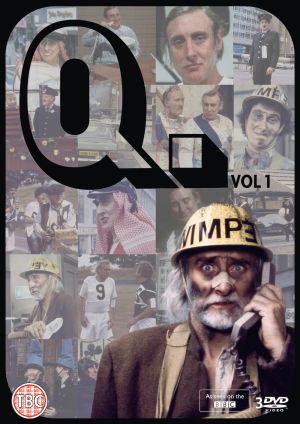
Terence Alan “Spike” Milligan, one of the key figures of British comedy, rose to prominence thanks to his work on The Goon Show.  He starred alongside Peter Sellers, Harry Secombe and (for the first two series only) Michael Bentine, with Milligan penning the majority of the scripts as well.  The Goon Show ran during the 1950’s, at a time when radio was still king, enabling Milligan’s absurd flights of fancy to reach an impressively large audience.  Informed by the traumas of his time spent in the army during WW2, The Goon Show introduced various riffs which would occur again and again in Milligan’s work (Adolf Hitler, for example, became an oft-used comedy figure).

Milligan’s earliest forays into television were on ITV during the 1950’s – The Idiot Weekly – Price 2d, A Show Called Fred and Son of Fred.  But it would be the Q series (made between 1969 and 1982) that would prove to be his enduring television legacy.  The shows were written by Milligan and Neil Shand, with occasional contributions from writers such as John Antrobus and David Renwick.  Just as Shand was an important partner on the scripting front, so Spike also seemed to draw strength from appearing alongside performers who plainly operated on his wavelength.  Some would drop in and out whilst one – John Bluthal – remained an everpresent fixture.

After something of a gap between the first and second series, Q became a more regular television fixture during the mid seventies and early eighties.  Milligan didn’t want the sixth and final series in 1982 (renamed by the BBC as There’s a Lot of it About) to be the last, but it seems that the BBC weren’t interested in commissioning any more.  That Milligan was still keen to continue is interesting – sketch comedy is often seen as a young man’s (and woman’s) game – so the fact that Milligan, at this point in his early sixties, was still energised by the thought of working in the sketch format was quite unusual.

Broadcast in early 1969, Q5 remains a landmark comedy programme.  It’s often been cited as a key influence on the nascent Monty Python team, who at the time were preparing their debut series (it would air at the end of the year).  As is probably well known, the Pythons were rather crestfallen after watching Q5, since Milligan had gleefully broken just about every rule in the comedy book they were left wondering what was left for them to do …

There’s an obvious connection between Q5 and Monty Python (Q5 director Ian McNaughton was especially requested by the Pythons since they’d admired his work with Spike) but the similarities run deeper than that, as it’s very easy to see several Q5 sketches (such as the Grandmother Hurling Contest at Beachy Head) fitting perfectly within the Python format.

But there are differences too – Q5 has a much looser, improvised feel than most of Python.  Milligan was more than happy to play with the artifice and conventions of television – he and the others would step in and out of character, wander off set, arbitrarily stop a sketch mid-way through or seem to be on the verge of corpsing.  Some sections are almost impossible to describe (a comedy riff is built up and developed almost to breaking point).
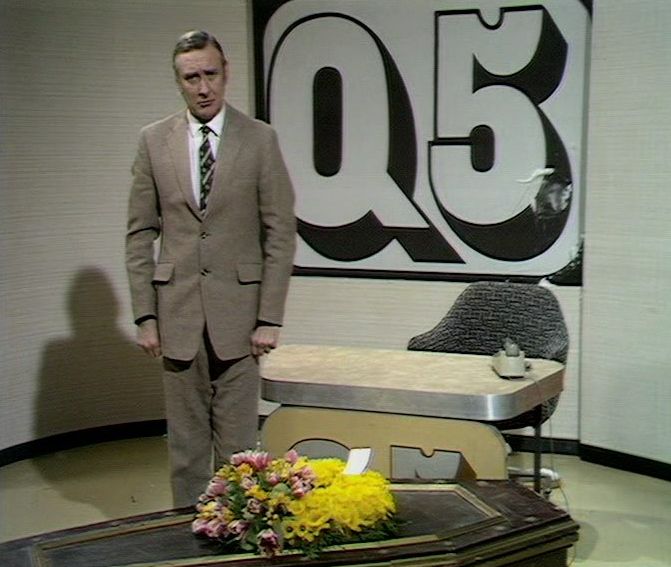
q5.jpg

This scattergun approach obviously means that not everything works – but sometimes it’s the nonsense that’s the most appealing thing. Often an idea is established but then dropped almost immediately as the show veers off in a completely different direction, meaning that whatever else Q5 is, it’s certainly not boring. Those who believe that The Fast Show pioneered the form of rapid-fire sketch comedy will have to think again ….

Given Q5’s importance in the history of British comedy, it’s a great shame that only three of the seven episodes now exist (and two of those are black and white telerecordings).  Out of the existing material, the absurdist theme is established early on (“pim-pom po-po-pom”) which you simply have to see, describing it just doesn’t do it justice.  It’s ramshackle and nonsensical, but probably the best thing in the episode.

The next surviving Q5 episode develops a theme that Milligan had first used in his Goon Show days.  Any phrase, if repeated often enough, could be guaranteed to get a laugh.  Back then it was “he’s fallen in the water” here it’s “a tree fell on him.”  The link to the Goons is strengthened thanks to several references to Harry Secombe – although he doesn’t appear in this one (but in the next episode we do hear Secombe’s unmistakable tones, as he plays a man trapped inside an elephant).   Milligan’s turn as Ned Teeth,  a mystic guru from Neasden, is another unforgettable Q sketch.
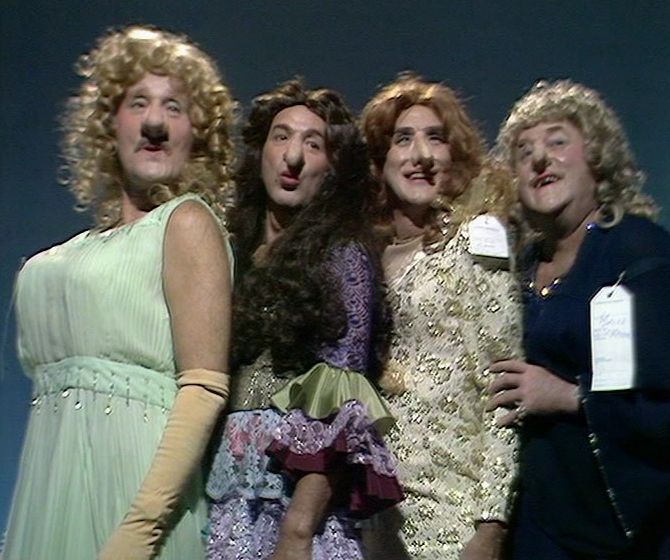
q6-01.jpg

Spike Milligan’s relationship with the BBC was always a rather tense one.  The Corporation may have broadcast many of his finest comedy moments (The Goon Show, Q) but Milligan always felt that they tolerated, rather than respected, him.  This partly helps to explain why a follow up to Q5 didn’t appear for six years.

By the time that Q6 was broadcast in 1975, the comedy landscape was very different.  Monty Python had been and gone, but the legacy of their four series remained.  Although Milligan had pioneered stream of consciousness comedy, Q6 would face a challenging time as it attempted to escape the imposing shadow cast by Python.

The likes of Peter Jones, David Lodge and Robert Dorning are regulars throughout Q6. Along with the ever-present John Bluthal, they all excel at providing solid support for Spike’s surreal flights of fancy. Jones, always a favourite performer of mine, is especially good value at whatever he’s asked to turn his hand to.  On the female front, Julia Breck is there to provide a touch of glamour whilst Stella Tanner handles the character roles.

The opening moments of the first episode sees an attractive topless woman appear for no obvious reason, presumably except that it entertained Milligan. A touch of gratuitous titillation would be a hallmark of the 70’s and 80’s Q. This first edition also has a nice guest appearance by Jack Watling and plenty of digs directed at the BBC. The remainder of Q6 has plenty of stand-out moments as well as numerous ones which can’t be adequately explained. Spike as Adolf Hitler meeting Bluthal’s Quasimodo is one such sketch. If it sounds odd on paper then it’s even odder when seen on the screen.  The economy police sketch is another strange, albeit entertaining, few minutes.
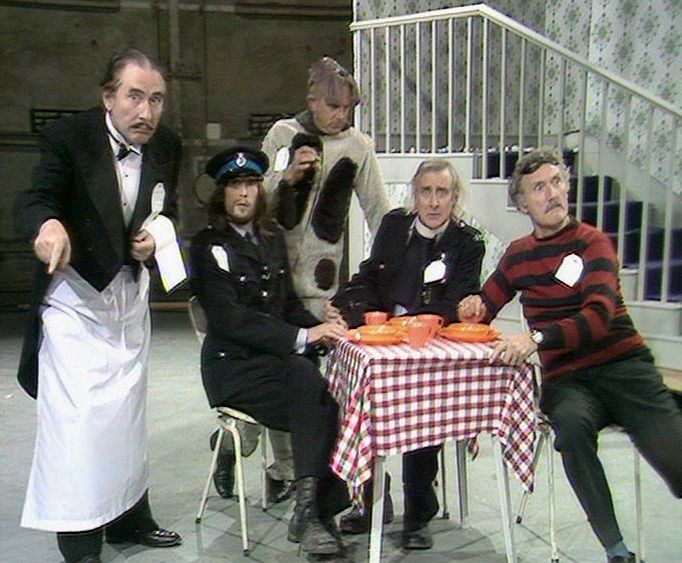
q06-02

John Bluthal’s skill at mimicking Hughie Green is put to good use several times, notably in the game show, Where Does It Hurt? The rules are simple, people with afflications or with a willingness to injure themselves can win cash prizes if the audience – via the painometer – register laughter and applause at their discomfort. With oddles of fake sincerity from “Green” and obviously fake studio applause it’s one of the more straightforward sketches.

Less conventional is Spike’s love song directed at a cardboard cutout Princess Anne. With the noted jazz pianist Alan Clare (who’d later become something of a semi-regular) providing accompaniment, it appears that as Milligan’s ardor increases, so does the size of his nose. It’s just one of many unforgettable Milligan moments.

The final Q6 show has one of its most famous sketches – the Pakistani Dalek. Dalek creator Terry Nation (or more likely his agent Roger Hancock, brother of Tony) was always reluctant to see the Daleks used as figures of fun, but it’s not too surprising that Spike got his way. Nation had been a member of Associated London Scripts (ALS) back in the sixties – a writers cooperative formed by Milligan, Eric Sykes and Galton & Simpson – so Nation’s links to, and respect for, Milligan clearly ran deep.

Also featured throughout Q6 are musical interludes, although they’re sometimes as leftfield as the rest of the series. Highlights include Ed Welch performing The Silly Old Baboon, a song written by himself and Milligan.

It might have been a long time coming, but Q6 is a strong series – all six episodes are packed with Milligan’s trademark oddness and the pace rarely flags.

Most of the regulars from Q6, although sadly not Peter Jones, returned for Q7, along with a few new faces – John D. Collins (later to be a regular in Allo Allo) and Keith Smith (probably best known for playing the irate headmaster Mr Wheeler in Alan Plater’s Biederbecke trilogy).

The first edition has a couple of lengthy sketches (Bermuda triangle/Arabs) and it’s possibly the first example of the series standing on the spot. In the Bermuda Triangle sketch Spike asks “what other TV show gives you a smile, a song and a load of crappy jokes?” and he’s maybe not too far off the mark.

Things pick up in the second show, David Lodge in drag and John Bluthal doing his best W.C. Fields voice are always entertaining, but the best moment – live from Covent Garden – comes towards the end. Milligan dragged up and blowing raspberries, what more could you want?  Overall, Q7 is more hit-and-miss than Q6 and what remains of Q5, but there’s still plenty of gems – you just have to dig a little deeper to find them.

If you have the remotest interest in British television sketch comedy then Q5/Q6/Q7 is an essential purchase.  Whilst all three series are very much of their time, paradoxically in many ways they’re also timeless.  Good comedy never gets old and this is very good comedy.

Q5/Q6/Q7 is released by Simply Media on the 21st of November 2016.  RRP £24.99.
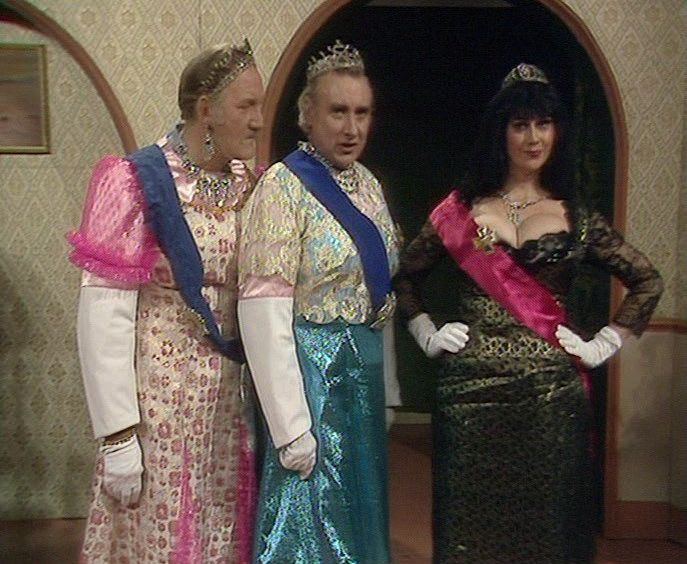
q7.jpg

The Five Faces of Doctor Who

five-faces

It’s a little staggering to realise that The Five Faces of Doctor Who repeat season began airing in early November 1981.  Thirty five years, where has the time gone?

Back then, the eighteen year old An Unearthly Child and even The Krotons (a mere thirteen years old) seemed like relics from a different age.  The flickery black and white telerecordings had a lot to do with that of course, the lack of colour made them appear much older than they actually were.  But it’s still more than a little strange that Survival seems like a much more current story today than An Unearthly Child did then, despite the fact that Survival is a whopping twenty seven years old.  Funny thing time …..

If you weren’t there, it’s difficult to describe just how important The Five Faces of Doctor Who was.  Old Doctor Who didn’t get repeated and the first commercially available story wouldn’t hit the shelves until 1983.  So if you wanted to get a feel for pre-Baker Doctor Who then your options were rather limited – Target novelisations were your best bet, although there were also the World Distributors annuals (even if their vision of the Doctor Who universe was idiosyncratic, to put it kindly).

Factual information could be gleaned from Doctor Who Weekly and Doctor Who Monthly, whilst a small handful of books – The Making of Doctor Who, The Doctor Who Monster Book – also offered tantalising glimpses of these “lost” stories.  After all, back then we weren’t concerned about the stories which were actually missing from the archives, everything from the past was as good as lost to us.

And then in early November 1981 we had the chance to see how it all started.  I’ve written here about how I view An Unearthly Child today, rewinding thirty five years I’m pretty sure I was just as taken with it then.  Three episodes of caveman antics might not be to everyone’s tastes, but the grime and despair of those episodes fitted perfectly with the dark winter evenings in 1981 (just as they would have done in 1963).  I loved it then and I love it now and I know I always will.

The Krotons had a bit of a bumpier ride.  My ten-year-old self found the story a little thin, but Troughton (like Hartnell) impressed right from the start.  It’s a story I’ve grown to appreciate a little more over the years, as it’s perfect undemanding fare.  And the lovely Wendy Padbury wears a very short skirt, which is nice.

If the internet had existed in 1981 then no doubt it would have gone into meltdown after Carnival of Monsters and The Three Doctors were broadcast the wrong way round.  Carnival, thanks to Vorg and Shirna, looked a little odd back then, and it would take a few more watches before the cleverness of Robert Holmes’ script became clear to me.  The Three Doctors is good fun, nothing more, nothing less.  It was nice to see the Brig in action for the first time though, even if I’d later realise we weren’t really seeing him at his best here.

Logopolis was an obvious choice, as Castrovalva was less than a month away from broadcast (and since it featured Davison’s sole appearance to date, if they hadn’t shown this one then the Five Faces tag wouldn’t have worked).  Since it was a current story it rather lacked the “wow” feeling of the others, but in the pre-VHS age, “another chance to see” was always welcome and following this broadcast I wouldn’t see it again for nearly a decade (a pirate copy came my way in the late eighties).

I’m off to recreate those winter evenings from 1981 with a rewatch over the next few weeks of those five serials – splendid stories, all of them.

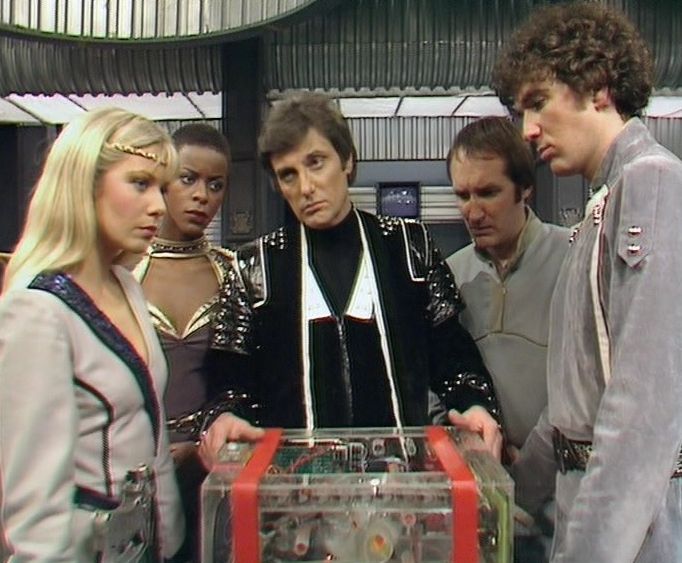
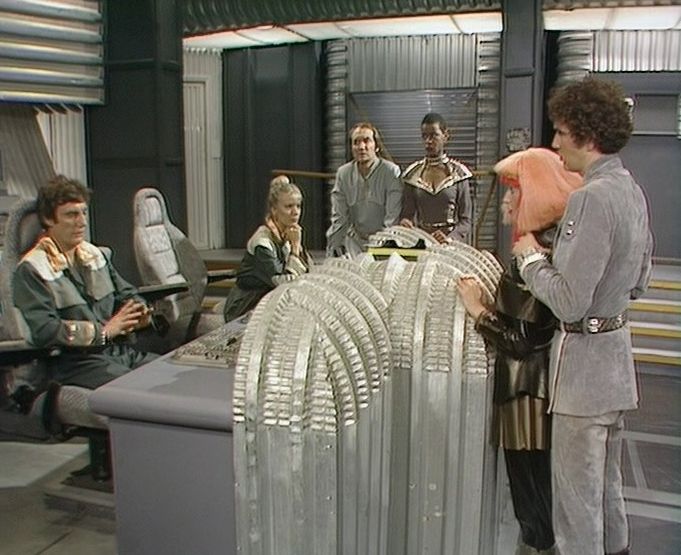
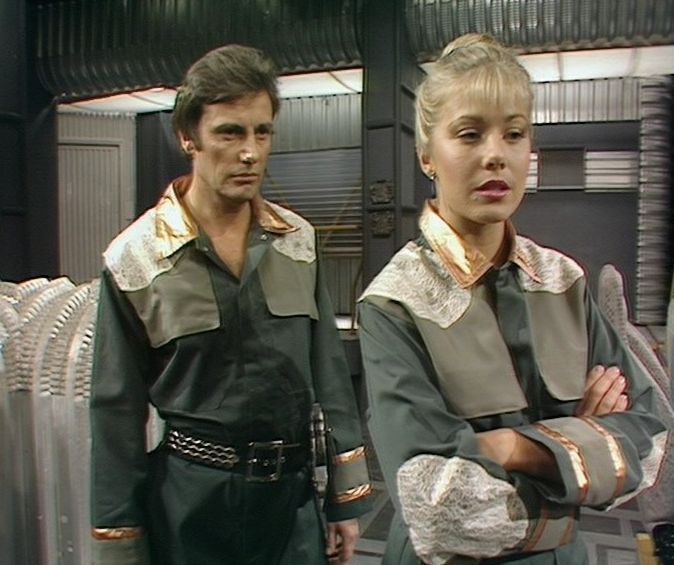
Blakes 7 – Blake

blake 01.jpg

The opening of Blake, following on from the events of Warlord, finds Avon and the others at a low ebb.  They’ve been forced to destroy their base at Xenon, due to fears that either Zukan or one of the other members of their recent meeting might have betrayed its location to the Federation.

This rather begs the question as to why Avon decided to hold the meeting there, but by now it should be fairly clear that he’s not operating in the most rational manner.  He explains that the death of Zukan leaves them with a problem – they need to find another figurehead to lead their attack against the Federation.  This doesn’t quite tie back to the events seen in Warlord though as whilst Avon was keen to use Zukan, it wasn’t as a unifying leader.

No matter, it’s only a slight continuity error and it does neatly explain why Avon’s suddenly decided to track down Blake after all this time.  He explains to the others that Blake “is strongly identified with rebels, you see, and very popular with rabbles. They will follow him, and he will fight to the last drop of their blood.”

Blake’s apparently on Gauda Prime, a totally lawless planet which has recently made an application to restore its former legal status.  In order to do this they need to ensure that all criminals are caught as quickly as possible.  And this is Blake’s job.  As improbable as it sounds, Blake’s working as a bounty hunter.

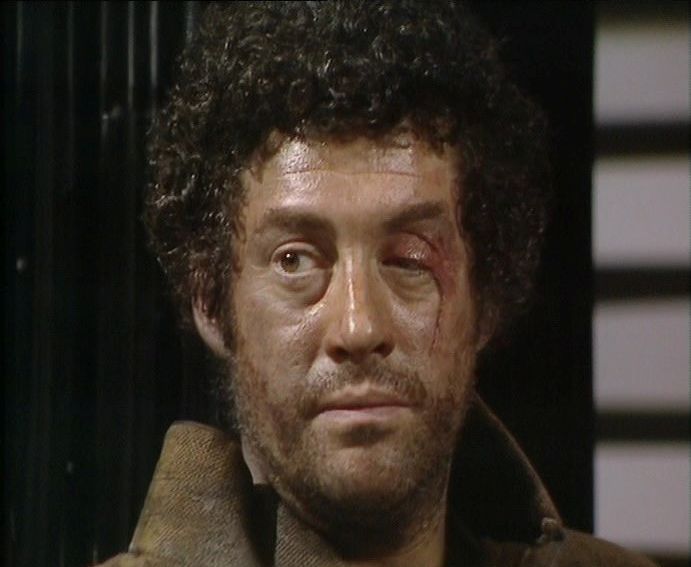
Our first sight of Blake is an arresting one.  Viewed from the side he appears to be the same man that we’d seen at the end of series two, but it’s only when he turns to face the camera that the wicked scar running down the right hand side of his face is visible.  It’s never explained how he came by this, but it’s clear that the last few years haven’t been easy for him.  Gareth Thomas instantly commands the screen as an older, wearier, bitterer Blake, seemingly reduced to catching criminals for money.

Humour is in short supply in this story, but I like the squabble between Orac and Slave, which sees Orac exasperated that Slave would have the temerity to interrupt him.  After a few minutes, Slave sounds the alarm and after everyone’s rushed about for a few seconds he admits that there’s no danger, he simply wanted to get their attention!  This moment of amusement doesn’t last long as Scorpio then really does come under attack and the painful descent to Gauda Prime begins.

blake-02

They all throw themselves around the set with abandon whilst fairly feeble explosions go off.  It all looks a little half-hearted, but once everybody except Tarrant has teleported to the surface the fun can really begin.  That’s when the ship is comprehensively destroyed and Slave speaks his final words.  If the model shot of Scorpio crashing through the trees looks a little underwhelming, then the full size destruction of the ship is impressively done.

If Blake has a problem then it’s the fact that nothing much really happens for the first forty five minutes.  Everything’s geared up for the meeting between Blake and Avon, meaning that everything else is just preamble – apart for one important revelation.  Blake captures Tarrant and manages to convince him that he’s a fearsome bounty hunter, but it’s all a sham, revealed in this conversation between Blake and Deva (David Collings).

DEVA: These stupid games you insist on playing, Blake, will get someone killed eventually.
BLAKE: I have to test each one myself.
DEVA: No, you don’t have to! I set up systems for that. I broke the security codes on their central computer. I got us access to official channels, information, everything we could possibly need! You don’t need to be involved at all.
BLAKE: All right, I find it difficult to trust. It’s a failing, I admit!
DEVA: And any one of our people could select the people you’ve collected. You don’t need to do the bounty hunter routine, either!
BLAKE: Indulge me.
DEVA: Do I have a choice?
BLAKE: Oh, there’s always a choice, Deva.

If some of Avon’s recent behaviour has been bizarre, then so is this. Blake couldn’t foresee that Avon wouldn’t listen to reason when they met up, but Deva was quite right when he told Blake that he was playing a dangerous game. This part of the story doesn’t quite hold water anyway – we assume that Blake is recruiting an army from the criminals on Gauda Prime to fight the Federation. But is picking the scum of the earth (a group of lawless murderers) really the wisest choice? Why isn’t he going from planet to planet, inciting rebellion?  This begs another question (sadly unanswered), namely is Blake’s scar as fake as his bounty hunter story?

The fact that he doesn’t even have to be there at all – he’s simply playing games – is bizarre.  And pretending to Tarrant that he’s prepared to turn them all over to the Federation proves to be a fatal mistake. Tarrant rushes over to tell Avon (who has coincidentally just stepped through the door) which means that the reunion between Blake and Avon doesn’t quite end the way either of them hoped for.

Darrow’s delivery of the line “have you betrayed us? Have you betrayed me?” has come in for a little criticism over the years. True, he’s more than a little arch here, but in context it works if you accept this is now an Avon at total breaking point.  As Avon repeatedly shoots Blake you can see a range of expressions play across Darrow’s face which indicate that Avon realises, almost as soon as he’s pulled the trigger, that he’s made a horrendous mistake. It’s a little too late though ….

Then all the others die (possibly) in slow motion. With the destruction of Scorpio and the entire crew seemingly dead, that would appear to have been a fairly final ending. But it’s always intrigued me that Gareth Thomas agreed to return only if Blake was shown to be 100% dead at the end – that way, he argued, he’d no longer have to worry that he’d lose parts due to people assuming he was still the star of Blakes 7.  But if the series was coming to an end this makes no sense.

Was a fifth series on the cards?  There’s always a way out – demonstrated by the oodles of fan fiction which states that the others weren’t really dead, they were merely stunned (even though we’ve never seen Federation guns set to stun in the series).  True, we don’t see Avon die, but unless the guards were really poor shots it’s pretty much a certainty.  And even though Blake appears to be very dead that can easily be explained away – it wasn’t Blake, it was his clone from Weapon.  Of course ….

Whether you like to believe that they all lived to fight another day or that this really was the final end, Blake offers as uncompromising a conclusion to the series as you could possibly ever expect to see.  It’s certainly worth sitting through the first forty five minutes for the final five.

blake-03

Blakes 7 – Warlord

warlord-01

The Federation’s pacification drug, Pylene 50, continues to spread through the galaxy – affecting more and more planets.  Avon calls together a number of interested parties in the hope that together they’ll be able to form an alliance.  Success seems to hinge on the cooperation of the notorious warlord Zukan (Roy Boyd).

Although Zukan’s thirst for war and conquest is well known, he tells the others that he’s here in good faith and has the means to produce a toxin to combat the pacification drug.  But matters are complicated after Zukan’s daughter, Zeeona (Bobbie Brown), is found to have stowed away on her father’s ship – especially since she and Tarrant have something of a history ….

Warlord has never been a terribly well regarded B7 story, possibly because of the interesting clothes and hairstyles.  There’s no getting away from it, the delegates look if they’d be more at home at a fancy-dress party rather than a summit meeting which will decide the fate of the galaxy.  Zukan and Zeeona also sport the most amazing haircuts, especially Zeeona who looks like a cut-price Toyah.

There’s also the Rick James problem.  If you’re a Doctor Who fan then you’ll probably be aware of his idiosyncratic performance in the 1972 story The Mutants.  Nearly a decade might have passed since that unforgettable turn, but James pretty much picks up where he left off – wooden doesn’t even begin to describe him.  Mind you, given what he’s wearing it’s no surprise that it’s hard to take him seriously.

But if you can put all that to one side, there’s plenty here to catch your attention.  After being touched upon earlier in the season, Pylene 50 makes a comeback – and in a very striking way.  The opening sequence, set on the latest planet to fall to the pacification process, is an eerie and disturbing one.  The population of Zondar, heavily drugged, are mown down by Federation troops, whilst all the time encouraging words (“You are cared for. You are loved”) can be heard over the tannoy.  This has elements of the harder-edged vision of a drugged future seen in The Way Back (although rarely glimpsed afterwards).

After enduring defeat after defeat, it looks as if Avon’s luck has finally turned.  But it shouldn’t come as any surprise to learn that Zukan’s a dirty double-crosser, secretly in cahoots with Servalan.  This is where we must bid farewell to Servalan and it has to be said that she exits with a whimper rather than a bang.  It’s long been debated as to why Jacqueline Pearce didn’t appear in Blake – you’d have assumed it would have been an obvious move, especially if it was known that the series definitely wasn’t coming back.  We’ll touch upon this again next time, but maybe Chris Boucher and Vere Lorrimer were eyeing a possible fifth series – that would certainly explain why Servalan’s final appearance is little more than a not-terribly-interesting cameo.

Simon Masters’ script (his only effort for the series) is well tailored for most of the other regulars.  Avon and Soolin carry the action, although Soolin’s proactive presence does mean that Dayna rather fades into the background.  Vila spends his time drinking and seemingly avoiding Avon.  A nod back to the events of Orbit maybe, as he tries to come to terms with Avon’s actions?

Tarrant spends his time making eyes at Zeeona, although just as Zukan is obviously a wrong-‘un, so it’s clear that Tarrant and Zeeona’s love is going to be somewhat on the short-lived side.  Her death is an interesting moment.  After learning of her father’s treachery she attempts to undo some of the damage he’s caused, but a flesh-eating virus puts paid to her.  Dayna tells Tarrant that she died because she took her glove off – was this an accident or did she, wracked with guilt about her father’s actions, decide to commit suicide?  Either possibility is valid.  Bobbie Brown may be saddled with a silly haircut but is still rather good as the doomed Zukan.

After a run of disasters, it seems that only one man can unify them, so next time Avon sets out to find Blake.  I wonder if this will be where his luck finally changes?  Hmmmm …….

warlord-02

All Good Things to be released by Simply Media – 28th November 2016

good

All Good Things, originally broadcast in 1991, will be released by Simply Media on the 28th of November 2016.  Review here.

A marriage and home can be made complete with the arrival of a new baby, but Shirley Frame (Brenda Blethyn) feels a need to share her good fortune by going out into the world and helping others – driving husband Phil (Warren Clarke) up the wall.

Shirley Frame (39) gives birth to her third child and is over the moon. Intent on sharing her delight with the world she embarks on a plan to make life a better place for as many people as possible. Husband Phil and their two teenagers aren’t easily convinced.

Very quickly Shirley learns that it’s not easy being a Good Samaritan, especially in a world of tower blocks, drug abuse and homelessness, even if your own life is rosy. Shirley identifies a string of potential good causes, leaving Phil holding the baby as she tries and fails to fix the lives of others.

Whether coaxing a potential suicide from a watery grave, giving reading lessons to an illiterate young mum with an abusive husband, or trying her hand at marriage guidance, Shirley puts her foot in it at every good turn – and invariably brings other people’s problems too close to home for comfort.

Joining double Oscar nominee, BAFTA and Golden Globe winner Blethyn (Secrets & Lies, Little Voice) and the ever-dependable Clarke (Dalziel & Pascoe, Nice Work) in this 1991 BBC six-parter are Celia Imrie, Jemma Redgrave and Ken Stott, who were all on track to become equally well-loved household names.

Screenwriter Lesley Bruce’s TV credits also include Doctor Finlay, Lizzie’s Pictures, The Practice and Home Video.

Now on DVD for the first time, this is a wry comedy of errors about losing the plot while attempting to mend the ways of life’s ne’er-do-wells and no-hopers.

Blakes 7 – Orbit

orbit-01

A renegade scientist called Egrorian (John Savident) has an offer that Avon can’t refuse – a weapon of incredible power (the Tachyon Funnel) in exchange for Orac.  You possibly won’t be shocked to hear that there’s a catch though ….

After his previous story, Traitor, failed to hit the mark, Robert Holmes certainly bounced back with Orbit.  Maybe one of the reasons why Traitor didn’t work that well was because it was the only one of Holmes’ four B7 scripts that didn’t team Avon and Vila up.  It’s plain that Holmes saw plenty of possibilities in the Avon/Vila relationship – it’s certainly of the reasons why this one works as well as it does.

Holmes’ Doctor Who scripts tended to feature double-acts, a tradition he carries on here – apart from Avon and Vila there’s also Egrorian and Pinder (Larry Noble).  Egrorian is the sort of role that’s a gift for an actor of a certain type – i.e. one who’s not afraid to go soaring over the top.  John Savident was clearly that sort of actor.  It’s a grotesque (in a good way) turn, totally lacking in subtlety but with the occasional hint of menace to counter the fairly flippant dialogue.

This must have been a fairly cheap show to make, with just a couple of new sets and only two guest stars.  But it never feels like a bottle show or something cobbled together on the cheap because the end of season was fast approaching and the money had run out.  Holmes concentrates on just four characters – Avon, Vila, Egrorian and Servalan (yes, of course she’s lurking about) – and gives them some sparkling dialogue, such as here when Egrorian lays eyes on Avon and Vila for the first time.

EGRORIAN: Surprisingly, you don’t look like the ruthless desperados of legend. But you have, of course, killed a great many people.
AVON: Only in the pursuit of liberty.
EGRORIAN: “O Liberty! O Liberty! What crimes are committed in your name!” Do you know the source?
AVON: No.
EGRORIAN: No, why should you? Natural leaders are rarely encumbered with intelligence. Greed, egotism, animal cunning, and viciousness are the important attributes. Qualities I detect in you in admirably full measure.

Larry Noble, as Egrorian’s assistant Pinder, has very little dialogue, but he still manages to catch the eye.  Noble manages to suffer incredibly well and his hangdog expression immediately engenders sympathy from the audience, something which is increased after we see how badly Egrorian treats him.  There’s a certain cruelty and sadism that runs through Holmes’ Doctor Who scripts which is also present here – best demonstrated after Pinder beats Egrorian at chess.  Egrorian doesn’t like this and proceeds to twist Pinder’s arm.  “Can you feel your extensor muscle tearing? Can you feel your humerus grating against your radius? Hmm.? Just a little more… a little more… now you’re feeling it, aren’t you?”

It’s more than a little unpleasant, but it helps to shine a light on their dysfunctional relationship.  Quite how they’ve entertained themselves during the last ten years (they’ve been in exile together) is probably best left to the imagination, although Egrorian’s comment that “naughty boys must be punished” offers a world of possibilities.

Hey, here’s a surprise – Egrorian plans to double-cross Avon and the others because he’s secretly working for Servalan.  Bet you didn’t see that coming.  So far, so familiar, but Holmes continues to give Savident some choice dialogue and he doesn’t disappoint.  Here, Egrorian outlines to Servalan his vision of a shared future.  “A connubial partnership, Servalan. Why not? Alone you are formidable enough, but together we would stand like mountains.”  Jacqueline Pearce also seems to relish the chance to play something a little different, as we see Servalan ever-so-slightly discomforted by the effusive and fulsome Egrorian.

The key part of the story takes place during the last few minutes.  Avon and Vila are heading back to Scorpio in Egrorian’s shuttle, but there’s a problem – they’ll never make the escape velocity as the shuttle’s carrying too much weight.  Frantically they jettison everything they can think of, but they still need to find another seventy kilos.  Avon wonders what weighs seventy kilos, to which Orac replies that “Vila weighs seventy-three kilos, Avon.”

Paul Darrow’s facial expression after Orac delivers this bombshell is a treat.  He shakes his head ever so slightly, but then seems to pull himself together and goes hunting for Vila.  Darrow’s S4 Avon was not known for its subtlety, and so it proves here, as he goes into “I’m not going to kill you, I’m your friend, honest” mode.  It’s not terribly convincing, so you can’t blame Vila for staying hidden.

All turns out well in the end, Avon stumbles (literally) against the problem – a microscopic fragment of a neutron star, planted by Egrorian to kill them – and is able to get rid of it.  But the damage has been done.  Vila might not have mentioned it to the others, but he now knows exactly how far Avon will go to protect his interests.  It’s a nice dramatic moment for Michael Keating, something of a rarity this late in the series.

This may be a talky, studio-based story, but it doesn’t really get any better than Orbit, thanks to John Savident’s exuberant performance and the way that Holmes skewers the Avon/Vila relationship.

orbit-02

Blakes 7 – Gold

gold-01

Avon is contacted by an old acquaintance called Keiller (Roy Kinnear), the purser of a pleasure liner called the Space Princess.  The Space Princess has a secret cargo – gold, mined from the planet Zerok.  Because it’s travelling incognito there’s very little security, so stealing it should be a doddle – except for one snag.

Before the gold is put aboard the ship it’s processed in such a way that it turns black and is therefore worthless unless you have the computer code which will change it back.  Keiller suggests they tamper with the processing machine on Zerok so that unprocessed gold is loaded aboard the ship instead.  It seems like a foolproof plan, what could possibly go wrong?

Roy Kinnear is great fun throughout as Keiller.  One of those actors who just seemed to generate goodwill from the audience, he plays rather to type as the cowardly Keiller.  Kinnear gives him such a shifty and untrustworthy air right from the start that it seems obvious he’s going to double-cross Avon and the others.  Or is that too obvious?  Since this is a heist tale there’s a number of twists and turns, so when it’s revealed that Keiller used to work for the Federation it’s possible to wonder if this is actually the truth or just more disinformation.

Keiller’s relationship with both Avon and Soolin has some nice comic moments.  He continually refers to Avon as his old friend and Soolin as my pretty one.  No surprises that Avon regards him as no friend or that Soolin is unimpressed with Keiller’s attempts at flattery.

We’re told that Vila doesn’t trust Keiller and wants no part of the scheme.  Michael Keating only has a handful of lines throughout the story, which is slightly strange – although the next episode is more tailored to his talents.  This leaves Avon and Soolin paired together whilst the familiar combination of Tarrant and Dayna also team up yet again.  All four teleport down to Zerok, Avon and Soolin travel down to the bowels of the planet with Keiller, whilst Tarrant and Dayna remain up top, keeping an eye on the guards.

The Zerok processing plant (actually a refuse disposal centre in Poole) is one of those typically industrialised Blakes 7 locations that featured regularly during the first few years of the show.  It gives Soolin a chance to demonstrate just how sharp a shooter she is as she merrily mows down multiple hapless guards.  The combination of Avon and Soolin is a good one – a slight pity it wasn’t seen on more occasions – his brain and her brawn (as well as the fact they both have a sardonic sense of humour) appeals.

It’s later revealed that the Space Princess is a fake cruise liner – it travels straight from Zerok to Earth whilst the passengers (all drugged up) are shown pictures of various sights which, in their chemically altered state, they believe to be real.  Whilst Avon busies himself with the gold, the others pose as passengers.  Stephen Pacey seems to be enjoying himself as a doped-out passenger.

Although Roy Kinnear provides the story with a veneer of comedy, underneath it’s quite a dark little tale.  The bodycount is quite high (at least a dozen or so guards are killed before the gold is stolen).  It’s also fair to say that the ending doesn’t really come as a great surprise – Servalan turned out to be behind the plan right from the start and turns up to taunt Avon.

SERVALAN: Congratulations, Avon. I see you worked it out.
AVON: Keiller was once on the personal security staff of the president of the Federation. That just had to be you. It wasn’t hard to work out. But it wasn’t meant to be, was it?
SERVALAN: I don’t know what you mean.
AVON: You wouldn’t leave me a clue like that. Not unless you really wanted to. You knew I wouldn’t be able to resist it. You planned everything, every move, you even knew that Keiller would disobey you, and you hoped that I would trust him because of that.
SERVALAN: Very good.
AVON: I almost did trust Keiller. When I found out it was you, I knew I was safe from him, at least. After all, he has nothing to gain from obeying you. Only in the end, it occurred to me that he might possibly imagine that you would keep your side of the bargain and pay him his reward instead of just killing him. He doesn’t know you as well as I do.

It’s the only time that Avon and Servalan have a meaningful face to face conversation during series four. Avon’s final reaction to their dismal failure is characteristic – he laughs hysterically whilst the others look on stony-faced. Another sign that Avon’s losing it? It could have been worse I guess, they all could have had a giggle, which thankfully only happened on a few closing scenes (Breakdown is probably my least favourite example of this).

Not quite the best that series four has to offer, but Kinnear is entertaining and the story is solid enough.

gold-02