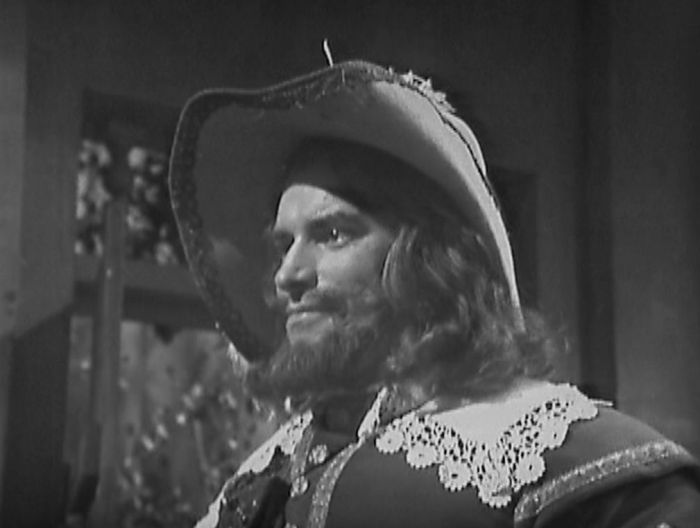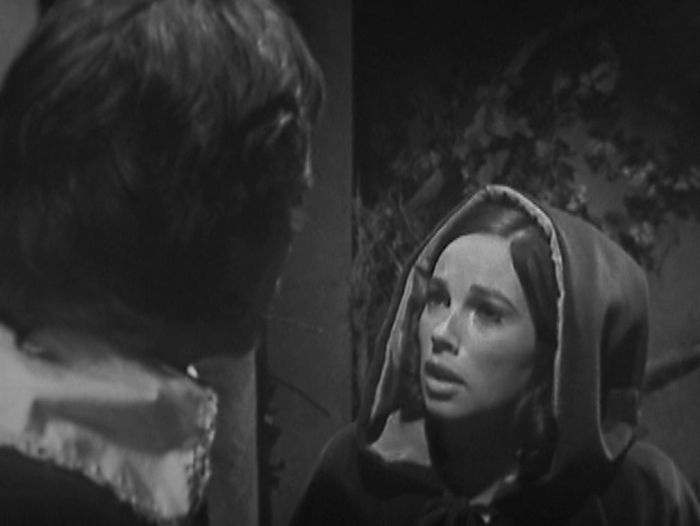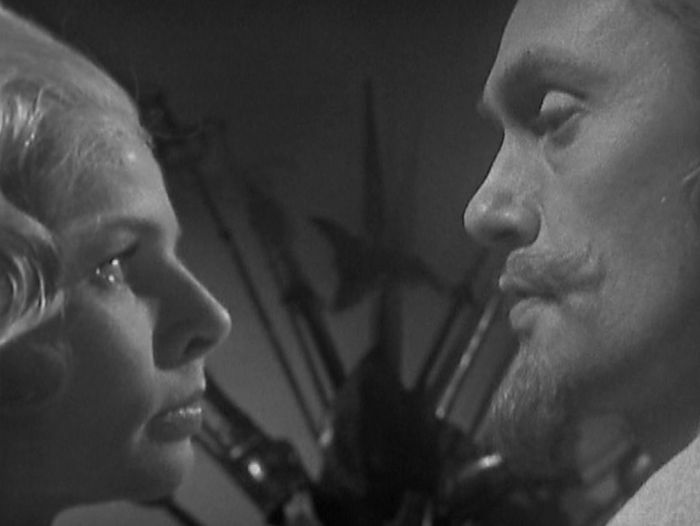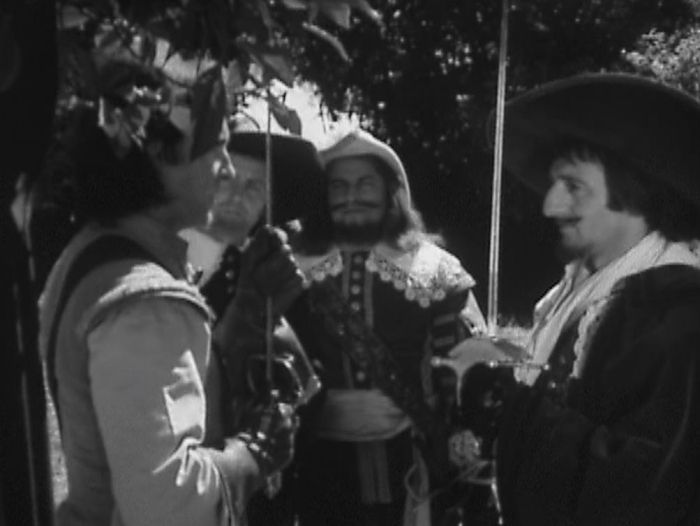
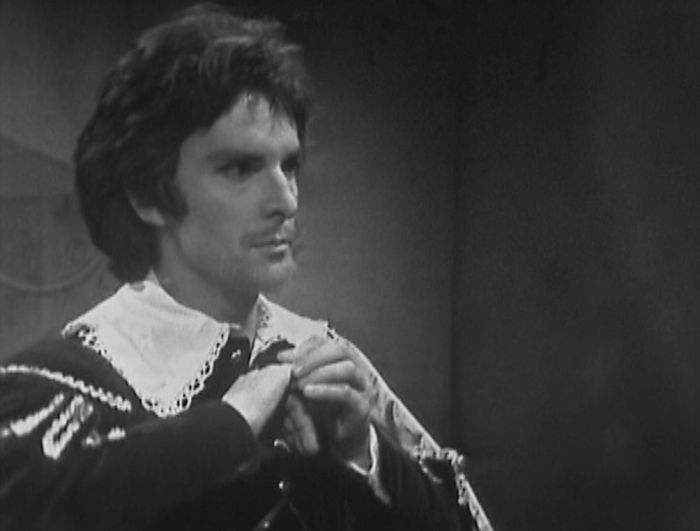
The Three Musketeers. Part Six – Branded

three 06-01

The King is upset that the Queen isn’t wearing her diamond studs and the Cardinal sees the chance to discredit her by giving the King the two studs he obtained from Milady de Winter.   But the Cardinal is foiled when she reappears shortly afterwards wearing it – and since Buckingham was able to get it repaired in England, the Cardinal’s two diamond studs are superfluous.

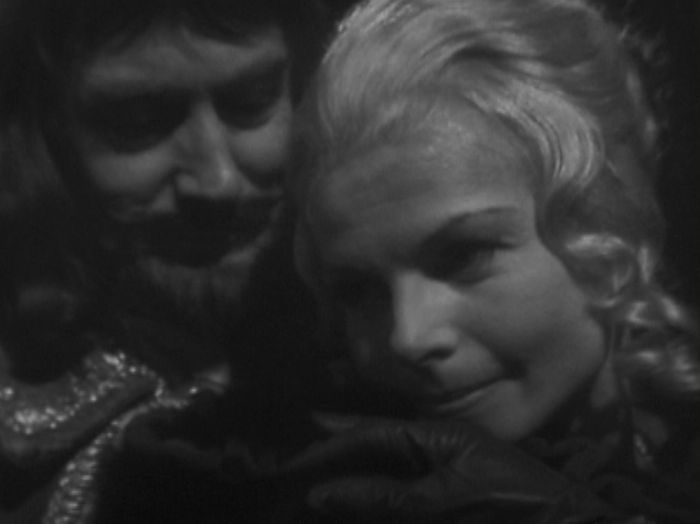
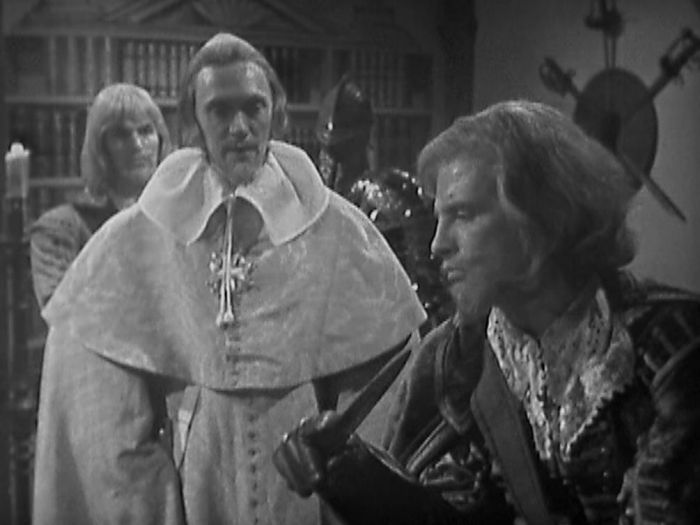
It’s intriguing that Milady is the one who’s out for vengence.  She wants to see D’Artagnan stretched on the rack, whilst the Cardinal would prefer to win him over to his side.  He professes admiration for D’Artagnan’s bravery, although this doesn’t prevent him from deciding to strike at him through his mistress, Madame Bonacieux.  The Musketeers warned him this might  happen, so it’s maybe another sign of D’Artagnan’s inexperience that he gave no thought to protecting her.

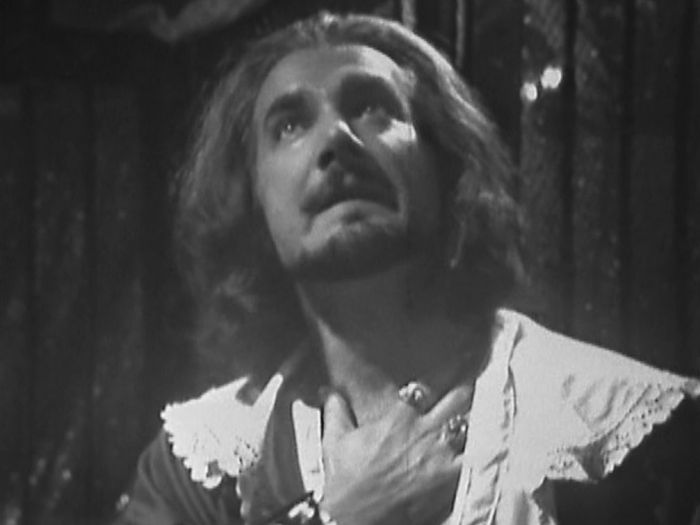
Kathleen Breck continues to demonstrate that she could scream for England as she’s carried off by Rochefort’s men.  D’Artagnan is characteristically hysterical at the news, allowing Brett to go soaring over the top once again.

He’s neatly contrasted by Young’s pragmatic Athos, who tells him that he’s only lost his mistress, not his soul.  When D’Artagnan snaps back that Athos seems to love nobody, he agrees and has little sympathy for his friend’s claim that he shares a deep love with Madame Bonacieux.  “You child! Every man believes his mistress loves him. He’s deceived.” Athos’ deep cynicism constrasts well with D’Artagnan’s boundless romantic yearnings.  Athos then tells D’Artagnan a tale about a friend of his (although it’s obviously about him).

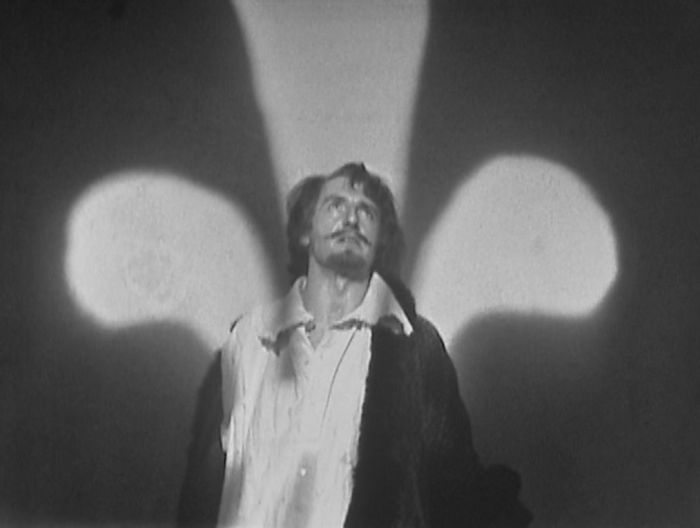
It’s another chance for Peter Hammond to craft some striking images.  Athos’ friend married a beautiful woman, but was shocked to discover some time in to their marriage that she bore the sign of the fleur-de-lys seared into the flesh of her shoulder – the brand of a criminal.  As Athos reaches this point in his tale, a giant fleur-de-lys is projected on the wall and Athos goes over and stands in front of it.  He then tells D’Artagnan that he put the woman to death, which explains why he has a rather jaundiced view of the female of the species.  It’s a wonderfully delivered monologue by Jeremy Young.  “Killing her has cured me of women. Beautiful, fascinating, poetic women. May god grant it does as much to you.”

Milady de Winter persuades her brother-in-law to kill D’Artagnan and then confides to her maid Kitty (Pauline Collins) that she’s a winner either way. If D’Artagnan dies, all well and good, if not then she inherits the family fortune. Mary Peach hasn’t had a great deal to do up to this point, but she seems to enjoy being able to let rip in this scene.

As D’Artagnan does battle with Lord de Winter (Patrick Holt), a voice-over (an unusual storytelling device for television, although one very common in radio) pops up to move the action along to the house of Porthos’ latest mistress, Madame Coquenard (Delia Corrie). He’s quite shameless in telling her that he needs money for a new horse, clothes for his servant, etc. And since her elderly husband is a wealthy man it seems logical he should provide the cash. Her cuckolded husband, listening outside the door, doesn’t seem too keen though!

D’Artagnan spares Lord de Winter’s life. Since de Winter would have told him that the duel was because of (imaginary) slghts made by D’Artagnan against his sister-in-law’s honour, it’s a little odd that D’Artagnan doesn’t treat Milady with more caution when they meet for the first time.

three 06-02.jpg

The Three Musketeers. Part Five – Scandal

three 05-01

Peter Hammond’s by now familiar directorial tic is firmly in evidence at the start of this episode, as D’Artagnan and the Musketeers pull up at a country inn.  Rochefort has arrived ahead of them and he (as well as the audience) observe their arrival through a slightly obscured window.

That Rochefort is something of an underhand cad is clearly demonstrated when he shoots one of the Musketeers’ servants.  His men, also carrying guns, then approach our heroes which, since they’re only armed with swords, hardly seems like a fair fight.

But it’ll come as no surprise that even with such uncompromising odds D’Artagnan and the Musketeers still manage to gain the upper hand.  Plenty of swashes are buckled, but it’s still a struggle for the greatly outnumbered Musketeers to hold their attackers off – and in order to buy D’Artagnan some time to complete his mission they urge him to make his escape whilst they stay behind, still fighting furiously.

When D’Artagnan reaches the coast he indulges in more swordplay.  For anyone who’s been upset of the lack of fighting in the last few episodes, the first ten minutes of this one (all shot on film) more than make up for it.

D’Artagnan meets with Buckingham. The Duke gladly gives back the Queens gift in another scene that’s uniquely shot. Buckingham has created a shrine to the Queen, complete with flickering candles, and Hammond chose to overlay even more candles over the picture. This gives the scene a rather strange look, but it sort of works.

It’s ironic that although the Queen is the woman he professes to love, his earlier dalliance with Milady de Winter obviously indicates that he’s not the faithful type! And just as we can lay blame on the Queen for giving him the gift in the first place, if he hadn’t entertained Milady in his bedchamber then she wouldn’t have been able to snip off a few of the diamond studs.

Poor Buckingham goes to pieces when he learns of Milady’s treachery. Simon Oates is once again highly entertaining as Buckingham, now rather highly strung as he and D’Artagnan try to prevent Milady from reaching the Cardinal as well as attempting to repair the Queen’s damaged gift.

Given some of the strange camera shots we’ve seen so far, I’m not sure whether the one some fifteen minutes in was an accident or another piece of Hammond planning. Buckingham and D’Artagnan exit from different sides of the frame, but the camera doesn’t follow them. Instead, for a few seconds we focus on an empty room whilst Buckingham’s voice continues off-camera. An intentional shot or a miscue? Hmmm.

It’s interesting that the three Musketeers don’t make any attempt to follow D’Artagnan after they finally manage to battle off Rochefort’s men. Instead they spend a convivial evening at the inn, eating and drinking – although there’s a twist. Porthos is perturbed to find that Athos wagered his horse in a bet with the landlord (and lost). Aramis is equally upset to discover his silver crucifix has gone the same way. Although this is nothing compared to the revelation that the meat they enjoyed earlier was Porthos’ horse! Lovely comic playing by all three actors, with a final pay off that Athos was lying to them all along and both Porthos’ horse and Aramis’ crucifix are unharmed.

three 05-02

The Three Musketeers. Part Four – Audacity

three 04-01

Peter Hammond’s showy camera-work continues in the first scene, as the Cardinal subtly manipulates the King (John Carlin). Several of the shots take place through a window, thus giving the audience a restricted view of the meeting (and also ensuring that we’re placed in the role of observers, eavesdropping on their conversation). The Cardinal professes that the Queen is wholly innocent of any inappropriate liaison with Buckingham, but then smoothly changes tack and suggests the King host a Ball in her honour. And wouldn’t it be an ideal time for her to wear the diamond studs he recently gave to her …..

Carole Potter’s Queen is distraught (again). Lying on her bed, crying woe is me, she’s fretting about how to get the diamond studs back from Buckingham in order to prevent a hideous scandal. Although as I’ve previously said, it was silly of her to give them away in the first place. Never mind, if she hadn’t then there wouldn’t have been much of a story.

Madame Bonacieux is convinced that she can count on her husband to travel to England and save the day, but he’s now the Cardinal’s man. Not only because he’s been paid off, but also for more pressing reasons. “Intrigue frightens me. I’ve seen the Bastille. I’ve seen the torture room. Wedges of wood to drive between your knees to crush your joints.” Peter Hammond’s love of mirror shots continues, as do scenes shot with restricted views. Here it’s because D’Artagnan is upstairs, viewing the confrontation between husband and wife through a crack in the floorboards. As with the opening scene of the episode, it allows the audience a chance to eavesdrop on a private conversation.

Paul Whitsun-Jones departs the serial in this episode. Later to star as the rather ineffectual baddy in the Doctor Who story The Mutants, it therefore came as something of a surprise that he was amongst the subtler actors in these early episodes. Kathleen Breck continues to be a stranger to subtlety, as Madame Bonacieux responds to her husbands departure by flinging herself across a table in a highly theatrical manner. “Dear god, what am I to do?” If I was uncharitable, I’d say a second take, but I’m not so I won’t.

It’s clear that her prayers will be answered, as D’Artagnan – due to his overpowering love for her – will do anything that she asks. “Since I love you. Since I would go through fire for you. Since I am brave, loyal to the throne, I’m your man.” Brett continues to push his intensity level up to eleven, especially when Madame Bonacieux appears to reciprocate his love. The moment when they kiss is an interesting one – as D’Artagnan is rather clumsy, to say the least. A bungled take or was this Brett’s choice, attempting to show how young and inexperienced (in so many ways) D’Artagnan is?

The Musketeers are sidelined in this episode until the last five minutes. It’s fair to say that at first they’re not best pleased at having to go to London, but duty calls. Despite the fact that D’Artagnan isn’t even a Musketeer, they seem to have no problem in accepting that not only is he is charge but that he won’t divulge the reason for their mission. For Athos, if it means a chance to fight and die then he’s content, whilst Porthos and Aramis also relish the chance for a scrap, even if they lack Athos’ apparent death wish.

With four of them, the odds are that at least one will reach London to deliver the vital message. And one is all they need. “All for one and one for all.”

three 04-02

The Three Musketeers. Part Three – Peril

three 03-01

Madame Bonacieux’s bosom heaves in an impressive fashion as D’Artagnan attempts to divine the reason why she was targeted by the Cardinal’s men. A very blatant boom shadow is a little bit of a distraction, but there’s another example of Peter Hammond’s quest to find interesting camera angles – the conclusion of the scene is shot directly at a mirror, showing us the reflections of Madame Bonacieux and D’Artagnan.

Monseuir Bonacieux finds himself a prisoner in the Concierge, questioned by the relentless Commissary (Vernon Dobtcheff). Making his sole appearance in the serial, Dobtcheff’s another very dependable actor who’s always a joy to watch – his relentless bullying of Paul Whitson- Jones’ hapless Bonacieux is very nicely played. The Commissary is further irritated when he’s presented with someone whom he believes to be D’Artagnan, but turns out to be Athos. This shows us Athos’ chivalrous side – he doesn’t deny that he’s not D’Artagnan in order to enable his friend to remain at liberty – but Jeremy Young still remains the least developed of the Musketeers at this point.

Jeremy Brett continues to chew the scenery as his love for Madame Bonacieux deepens, as does his paranoia that she loves another (and he seems to have forgotten that she’s a married woman anyway!) “Madame, if you could see my heart, you would discover so much love.” At present she can’t reciprocate, telling him that she has gratitude for him, but little else. The arrival of a strange man provides more fuel for D’Artagnan’s jealousy. But the Duke of Buckingham (Simon Oates) hasn’t got his eyes on Madame Bonacieux, he’s aiming a little higher …..

Oates, later to star as the womanising, foppish scientist John Ridge in Doomwatch, plays a womanising foppish member of the English nobility here. So not too much of a stretch. He does seem to be enjoying himself though, as he clearly relishes the ripe dialogue. More restrained performances can be seen when the disheveled Monseuir Bonacieux is brought into the presence of the Cardinal. If Buckingham and the Queen are florid and histronic then the Cardinal and Rochefort continue to downplay. This is an interesting choice, as you’d normally expect the villains to offer broad and moustache twirling performances.

Brian Blessed and Gary Watson only pop up towards the end of the episode. Blessed remains as loud as you might expect, but he’s also as entertaining as you might expect too. He tells D’Artagnan and Aramis that he has an assignation with a noble lady and takes his leave of them.  But the truth is somewhat different – he finds his pleasures with women from a lower class of society (pride prevents him from admitting the truth). It’s a nice character beat and the brief following scene is played well by Blessed, as Porthos momentarily show irritation when he’s in the company of his latest date, before he puts on a brave face and makes the best of it.

More bosoms heave as Milady de Winter reappears. The Cardinal has learnt that the Queen gave Buckingham a casket containing twelve diamond studs gifted to her by the King. It seems rather strange that not only would she decide to give away a present presented to her by her husband but also one that would be so identifiable. The Cardinal sends Milady de Winter to England with the clear directive to obtain several of these studs. Once a link between the Queen and Buckingham can be proved, the Cardinal will have all the evidence he needs to bring the monarchy crashing down …..

three 03-02

The Three Musketeers. Part Two – The Three Duels

three 02-01

Although we open episode two with D’Artagnan facing the prospect of dueling with all three Musketeers, it doesn’t take too long before he’s accepted by them and Brett gets to utter the immortal line “one for all and all for one.” Cue another fight scene shot on film with more highly dramatic music. It’s interesting to note that Hammond seemed to have the use of a crane, as there’s a couple of very high shots which gives the scene a little lift.

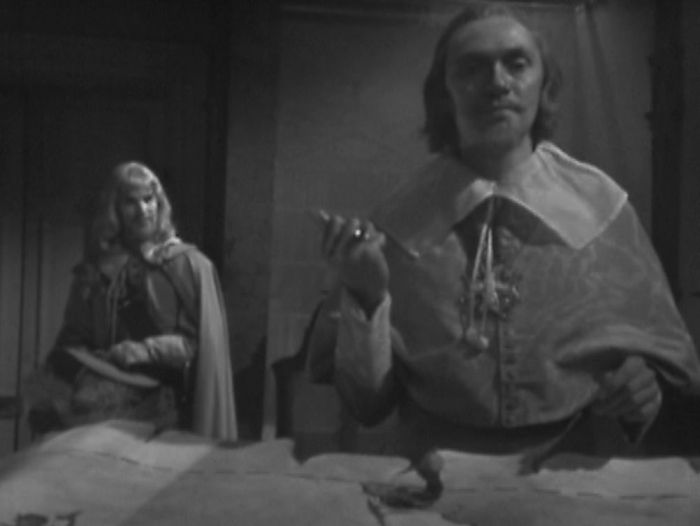
The three Musketeers and D’Artagnan enjoy their tussle with the Cardinal’s men which then leads us into our first sight of Cardinal Richelieu (Richard Pascoe). Pascoe is another strong performer, exuding quiet menace in his meeting with Brayshaw’s Rochefort.

The Queen (Carole Potter) has a low opinion of the Cardinal. “That man of God who wears the face of Lucifer. A priest who in his lust for power once dreamt of making France’s Queen his mistress. His passion filled me with disgust and I so scorned him that his breast cannot contain the hatred he now bears me.”

Potter emotes freely as the Queen struggles to free herself from the trap she knows Richelieu has set for her (he hopes to make capital out of her relationship with the Duke of Buckingham, an English noble). This is an early example of the two main parts of the serial – there’s derring do and fights aplenty, but inbetween the action the pace slows down as lengthy dialogue scenes dominate. Carole Potter’s television cv isn’t particularly extensive. She returned as Queen Anne in The Further Adventures of the Musketeers the following year and the year after that appeared as Violet Smith in the Sherlock Holmes story The Solitary Cyclist (one of the episodes from the Peter Cushing series that’s sadly wiped). Like Brett’s early scenes as D’Artagnan, she seems a stranger to subtlety as she wails about her misfortunes to her trusted servant Madame Constance Bonacieux (Kathleen Breck).

The long arm of coincidence is in operation after D’Artagnan rents a comfortable room from Madame Bonacieux’s husband (played by the always reliable Paul Whitsun-Jones). With the Queen in trouble and Madame Bonacieux her only confidant, it seems plain that it won’t be long before she and D’Artagnan meet (within a matter of minutes as it happens). D’Artagnan observes her enter through a loose floorboard and Breck rather unsubtly demonstrates Madame Bonacieux’s distress by placing both hands over her face in a very exaggerated manner. After the Cardinal’s men catches up with her, Breck starts wailing very loudly, but luckily for those with sensitive ears D’Artagnan is on hand and makes quick work of them.

Afterwards, D’Artagnan and Madame Bonacieux regard each other for the first time and it’s clear that he likes what he sees ….

three 02-02

The Three Musketeers. Part One – Enemies

three 01-01

The Three Musketeers was a ten part serial, broadcast on BBC1 between November 1966 and January 1967. It was adapted by Anthony Steven, directed by Peter Hammond and starred Jeremy Brett (D’Artagnan), Brian Blessed (Porthos), Jeremy Young (Athos) and Gary Watson (Aramis).

With the sequel serial, The Further Adventures of the Musketeers, due to be released on DVD next month, it seems the ideal time to dig out The Three Musketeers for a rewatch. Although it’s never had an official UK release, the Koch DVD from 2006 seems to play perfectly well on R2 machines, even though the packaging states that it’s R1.   Whilst it looks like an unrestored telerecording, the picture quality is actually pretty decent (I’ve certainly sat through far worse).

As you’d expect from a BBC production of this era, the studio scenes were taped pretty much sequentially with any outdoor sequences pre-recorded on film and played into the studio via telecine. The “as live” nature of this type of recording meant that it was rare to stop recording for minor technical issues, so there will always be some wonky camera movements and line fluffs.

Some of the shots, right from the start, are slightly odd though – which makes me wonder whether they were actually chosen by Peter Hammond.  A good case in point is the opening scene, where D’Artagnan’s father hands him a sword, tells him he’s now a man and urges him to make his way in the world. The opening dialogue comes from D’Artagnan’s father, but the camera is positioned behind him, so we can’t see his face. The camera then closes in for an extreme close up of the sword’s hilt as D’Artagnan wields it for the first time – but why don’t we see Brett’s face? It’s slightly odd.

As is Brett’s performance. Later to become something of a national treasure for his portrayal of Sherlock Holmes, he’s a little hammy to begin with – although once he falls in with the Musketeers he does improve somewhat. Having been told by his father that a gentleman never refuses a fight, D’Artagnan, when arriving at a tavern, doesn’t back away from a tussle with Rochefort (Edward Brayshaw) who is amused by D’Artagnan’s mode of transport (a rather weedy looking pony). Brayshaw, even with his stick on beard, is wonderful in his opening scene – mocking and controlled, contrasting very well with Brett’s hysteria. Since D’Artagnan is supposed to be something of a callow youth it’s understandable that he’s easily riled, although this makes the casting of the thirty-three year old Brett a slightly strange decision.

Rochefort declines his offer of a fight, but D’Artagnan still doesn’t shy away from single-handidly taking on three others. As this was shot on film, the fight is nicely cut together and it’s something of a treat – complete with over-dramatic music. Once D’Artagnan has been dealt with, Rochefort keeps his rendezvous with the alluring Milady de Winter (Mary Peach).

After his diversion with Rochefort, D’Artagnan has a meeting with de Treville (Martin Miller), the leader of the Musketeers. Although Rochefort steals the letter of introduction provided by D’Artagnan’s father, he’s still readily accepted – which makes Rochefort’s actions seem a little pointless. We then meet the three Muskeeters. Brian Blessed is excellent throughout the serial, an ideal Porthos, Watson gives Aramis a cultured, amused air whilst we don’t really get to grips with Jeremy Young’s Athos until later on.

Although the humour isn’t overt, it’s still there (especially if you regard Brett’s overplaying as ironic) and this is clearly demonstrated at the episode’s close as D’Artagnan manages to upset Athos, Porthos and Aramis independently within the space of a few minutes. This means they all challenge him to a duel, so it appears he’s going to be killed three times over!

three 01-02

The Ginger Tree – Simply Media DVD Review

ginger

Apart from its inherent qualities, The Ginger Tree is of interest because it was the first drama anywhere in the world to be recorded in HD.  The BBC had been running HD trials since the mid 1980’s, but this four-part 1989 serial was the first production designed for broadcast.

Because of the prohibitive cost of working with the new technology, a co-production deal with other broadcasters had to be arranged.  The choice of NHK Japan as one of the production partners no doubt influenced the novel chosen for adaptation, but that turned out to be one the strengths of the serial.  Back in the 1960’s and 1970’s, if you needed a Japanese-looking actor then you’d get Burt Kwouk if you were lucky and if you were unlucky you’d have a British actor doing his best to look Oriental.  The Ginger Tree, despite being shot on (albeit HD) VT has a filmic sweep and the lavish period setting, location filming and authentic Japanese actors all help to give the serial a rich, immersive feel that the BBC by itself would never have been able to afford.

One irony is that back in 1989 there was no way for British viewers to enjoy the high definition picture.  Compatible televisions didn’t exist and the HDVS recorder used to make the program was essentially an NTSC system  – so the programme had to be converted back into the PAL format for screening on the BBC, meaning that it looked somewhat washed out.  This DVD release is therefore able to present the programme in better quality, although it’s a pity that a BD release isn’t available as that should have been better still (although to be honest, it doesn’t look any sharper or better in SD than a typical VT production of the era).

The Ginger Tree was a novel by Oswald Wynd, originally published in 1977.  Wynd was born in Japan in 1913 to Scottish parents who had come to the country to run a mission. Wynn spent his formative years immersed in what must have been a very alien culture (which obviously helped to inform the writing of The Ginger Tree).  After WW2, where he spent several years as a Japanese prisoner of war, he returned to his native Scotland and pursued a writing career, penning thrillers under the pseudonym of Gavin Black as well as several books under his own name.  The Ginger Tree, helped in part by this adaptation, remains his most popular work.

The book was written as a series of diary entries and letters penned by Mary Mackenzie.  This literary device naturally presents some problems for the adaptor, but Christopher Hampton (who had won an Oscar in 1989 for Dangerous Liaisons) was able to capture the essence of Wynd’s novel.

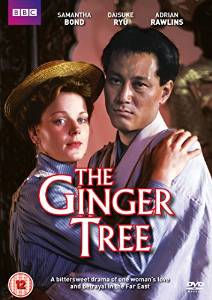
The year is 1903.  Mary MacKenzie (Samantha Bond) has travelled to Manchuria to marry her fiance, Captain Richard Collingsworth (Adrian Rawlings).  Because they barely know each other it’s clear that their marriage is doomed from the start.  But Mary’s affair with Count Kentaro Kurihama (Daisuke Ryû), a Japanese soldier, plunges her into a scandal from which there seems no escape.  After bearing his child, she finds herself facing an uphill battle as she attempts to find herself a place in the extremely rigid and formal Japanese society.

It’s possible to believe that Mary is something of an innocent. She’s never journeyed out of Britain before and now finds herself setting out on the long trek to Manchuria to marry Richard. Is she in love with him? He seems personable enough and she certainly seems keen to reach him as quickly as possible, so maybe. But they’ve only met a handful of times before their marriage was arranged, which casts obvious doubt that their union will endure.

Their wedding night is a key moment. He doesn’t turn instantly cruel, instead he becomes indifferent, which is possibly worse. He shows Mary her bedroom and then mentions he’ll be sleeping elsewhere. But he is prepared to do his duty as a dutiful husband and make love to her – although in the most perfunctory way. There’s no passion or tenderness and Bond’s silent, frozen face speaks volumes.

Samantha Bond had racked up some decent credits prior to this (Agatha Christie’s A Murder is Announced, Mansfield Park, Rumpole of the Bailey) but The Ginger Tree was her first major starring role and it required a subtle and nuanced performance, which she delivers.

Bond plays Mary in a very internalised way. This isn’t a surprise, given that ladies of her class and era weren’t encouraged to express their feelings. But given how inarticulate (emotionally) she is, it seems initially unlikely that she’ll ever form a relationship with the sensative Kentaro. Which makes the chain of events towards the end of the first episode – they take tea, they become lovers, she finds herself bearing his child – something of a whirlwind. Due to the languid pace of the episode up to this point it all seems to happen very suddenly.

Daisuke Ryû has tended to work mainly in Japanese language films, which could be the reason why Kurihama seems slightly stilted at times. But it could also be a performance choice and either way it helps to differentiate Kurihama from Collingsworth (Kurihama’s slight vulnerability constants sharply with the indifference of Collingsworth).

The sight of a heavily pregnant Mary quickly wipes the smile off the face of her returning husband. He immediately decides to pack her off back to Scotland, although he doesn’t intend to give her a divorce – for purely monetary reasons. It’s a remarkable revelation that Mary’s mother has pledged half her yearly income (some three hundred pounds) to Collingsworth for as long as the pair stay married.

Ar the station she’s faced with another option, a train ticket to Tokyo, provided by Kurihama. She accepts it and is accompanied by Baroness Aiko Onnodera (Fumi Dan). Dan gives a sparkling performance, which contrasts well with Bond’s more withdrawn persona. Aiko is an ardent campaigner for women’s rights, which has recently earned her a spell in prison, but she remains unrepentant. She’s able to explain exactly what Mary’s life in Tokyo will be like.

Kurihama has provided her with a house and servants, but as a women, a foreigner and essentially a concubine, her movements will be very restricted. Mary’s fleeting hopes that Kurihama will marry her are dashed when she learns he’s a married man with four children.

Although the general theme of The Ginger Tree is quite downbeat, there’s also a feeling of optimism. Mary might be portrayed initially as something of a naive, downtrodden figure but over time she gains strength and becomes less of a victim. Samantha Bond is very watchable, although her soft Scottish accent seems to come and go a little. Daisuke Ryû is equally impressive, as are the rest of the Japanese cast. The co-production budget allowed for a generous number of extras and set dressings, plus filming in Japan was obviously another major plus. The story unfolds over some forty years, ending during WW2, necessitating ageing makeup to be applied to the main cast, which is done very effectively.

Oswald Wynd’s tale of love and loss is effectively brought to life in Christopher Hampton’s adaptation and it’s sure to strike a chord with many.

The Ginger Tree is released by Simply Media on the 25th of April 2016. RRP £19.99.

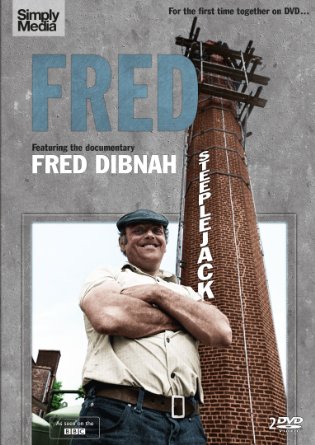
Fred (Fred Dibnah) to be released by Simply Media on 23/5/16

fred

Simply Media will release Fred on the 23rd of May 2016.  Review here.

With his specs, cloth cap and infectious toothy grin, Bolton born steeplejack Fred Dibnah was instantly recognisable. He burst onto TV screens in 1978 blithely repairing Bolton’s town hall clock at the dizzying height of some 250 feet and quickly found a place in the nation’s heart, becoming a familiar face on TV for many years. Now some of Fred’s most famous programmes can be enjoyed again thanks to the forthcoming DVD release from Simply Media.

Following that first local news report, the BBC commissioned the BAFTA winning 1980 documentary ‘Fred Dibnah: Steeplejack’, which showed him demolishing giant factory chimneys with ease and casually hopping across the chimney tops with death-defying agility.

After that, seven 30-minute programmes were made, exploring Fred’s eccentric life as a steeplejack and steam tractor fanatic, and now for the first time together on DVD, the seven episode 1982 BBC television series ‘Fred’ arrives alongside ‘Fred Dibnah: Steeplejack’.

In Fred, director by Don Haworth (A Year with Fred) caught Dibnah at great heights doing what he does best – and filmed him far below. Driving his favourite steamroller Betsy, soon the man with two very Victorian tastes became a television star just for being himself, long before the days of reality TV.

With the world literally at his feet, Fred was much in demand as a television presenter and after-dinner speaker on industrial history and all things mechanical – and especially anything related to his overriding passion: steamrollers – he even arrived on one to collect his MBE from Buckingham Palace.

Step into the fascinating life of national treasure, Fred Dibnah in this fantastic collection of his first ever appearances on TV in Fred, available on DVD for the very first time on 23 May 2016.

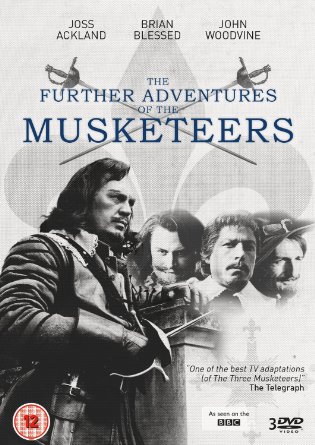
The Further Adventures of the Musketeers to be released by Simply Media on 23/5/16

further

Simply Media will release The Further Adventures of the Musketeers on the 23rd of May 2016.  Review here.

Simply Media is also pleased to announce the release of another BBC classic family favourite The Further Adventures of the Musketeers (1967) on DVD for the very first time on 23 May 2016. Starring Brian Blessed (Z Cars), Joss Ackland (The Hunt for Red October) and Michael Gothard (The Three Musketeers), this classic adventure series is set twenty years on from the original and is based on Alexander Dumas’ sequel of The Three Musketeers, Twenty Years After.

Roobarb & Custard – The Complete Collection to be released by Simply Media on 16/5/16

roobarb

Simply Media will be releasing Roobarb & Custard – The Complete Collection on the 16th of May 2016.  Review here.

More than 40 years after making their debut on British TV screens, and over a decade since their return, green dog and pink cat Roobarb and Custard are bounding back into view again, accompanied by their ubiquitous theme tune (acclaimed as one of finest children’s TV title songs ever).

The groundbreaking animated series and its sequel are being paired together for the first time ever on a DVD due to be released as Roobarb and Custard: The Complete Collection on 16 May 2016 courtesy of Simply Media.

Famed for both entertaining kids at the end of children’s TV programming, and, ahead of the teatime BBC news, wooing a cult audience of grown-ups, Roobarb and Custard is instantly recognisable, from its distinctive theme tune, penned by library legend Johnny Hawksworth (Man About the House), to its crazy lead characters. That theme tune was even sampled for a rave friendly chart version in the early 1990s.

Simply Media’s splendid new DVD release pairs the original 30 episodes from the 1974 series – the first fully animated television series to be made in the UK – as well as the 2005 Roobarb And Custard Too series, comprising of 39 episodes.

Both come from the mind of original creator Bob Godfrey (Henry’s Cat) and each feature the distinctive narration of British comedy legend Richard Briers (The Good Life). Each of the two series features the antics of the green dog Roobarb and his outlandish schemes and hapless plans, seemingly forever foiled by his next-door nemesis, pink cat Custard.

Doomwatch – The Web of Fear

web

The Minister of Health (John Savident) and Duncan are ensconced on a health farm, located on a remote island.  Quist is anxious to speak to the Minister as he needs an answer about the urgent flood problem, so isn’t best pleased to learn that the island has been placed in strict quarantine due to a suspected case of yellow fever.

Quist isn’t particularly interested in the yellow fever case, but it provides him with an excuse to travel over to the island with Fay to discuss the flood issue.  The Minister’s a wily old bird though and he agrees to read Quist’s paper – as long as he helps the island’s doctors with the yellow fever outbreak.  And it’s maybe just as well, as things aren’t as straightforward as they seem at first ….

Since this is a Gerry Davis script, it’s no surprise that it feels a little more like series one Doomwatch episode.  Something happens for which there seems to be an obvious solution, but scientific detective work is able to prove otherwise.

En-route to the island, Quist and Fay bump into the scientist Griffiths (Glyn Owen) and his wife Janine (Stephanie Bidmead).  Quist knows Griffiths very well (as we’ll discuss in a minute) but Fay has never heard of him.  Griffiths is keen to get to the island but is refused permission (although that doesn’t stop him, as both he and his wife charter a boat).  One major weakness with the script is that Quist never seems to stop and wonder why a notable scientist like Griffiths is so keen to get to the island .  Therefore it becomes clear to the audience much earlier than it does to Quist and the others that Griffiths unwittingly holds the key to the mystery.

Griffiths is a fascinating character, played with typical bluffness and spiky humour by Owen.  Quist explains to Fay a little about his history.  “He presented a paper at 2.00 pm at the Stockholm conference in ’65. By five o’clock it had been completely demolished. An elegant, almost perfect concept, ruined by inattention to detail.”  Three scientists were responsible for pointing out several flaws which invalidated his paper (which had taken him fifteen years to prepare) and one of them was Quist.  It’s a remarkable coincidence that they should now bump into each other again, but that’s television for you.

Although his life’s work was destroyed over the course of a few hours, Griffiths still doesn’t accept his research was flawed in any way, instead he still blames Quist and the others.  This is why he’s kept his latest work under wraps and this secrecy will be the death of him (and others).  It’s another sign that his researches are flawed – Quist tells Fay that a good scientist welcomes challenges to their theories (it helps them to refine and redraft) but the trauma of 1965 proved too much for Griffiths.

And what of Janine?  Stephanie Bidmead and Glyn Owen share several well-crafted scenes that do nothing to advance the plot, but help enormously to bring their characters into focus.  Janine shared Griffiths’ disappointment in 1965, but she’s been able to see that his paper was at fault and now she mourns less for him as she’s more concerned about the family they never had or the various other opportunities that passed them by, all because he was driven to chase something that always remained just out of his grasp.

The Web of Fear is a fairly bleak story although there are a few lighter moments.  Ridge’s description of Janine always seems to move chestwards (“and she has a nice pair of …..”) whilst John Savident has a couple of comic moments.  But the Minister, once he understands the gravity of the situation, is all business and is happy to back Quist once a solution is found.

What seems obvious from very early on is eventually confirmed.  Griffiths’ latest work (a man-made virus designed to combat the moths which attack the island’s apple crops) is proved to be responsible for the apparent yellow fever attacks.  Although the virus prepared by Griffiths only attacks moths, it can also trigger another virus in a new host.  So the moth is ingested by a spider and the spider then becomes deadly.  The attentive viewer would probably also have twigged this, as several times we hear different people commenting on how many spiders there seem to be –  a good indication that this is an important plot point for later.

Griffiths is stuck down a tunnel and faces danger from both the spiders and their webs.  Ridge elects to get him out and this forms the climax of the story, although it’s a little too drawn out for my tastes.  Plus the over dramatic stock music saps the tension a little.

Another problem with this scene is that Griffiths dies off camera a few minutes later, which makes all the effort to rescue him something of a waste of time.  But his death does allow Quist to give him a good eulogy.  After Janine sadly reflects that her husband wasted twenty five years of his life and ended up with nothing – not even a decent reputation, Quist begs to differ.  “He was a brilliant, intuitive scientist of the stamp of Pasteur, Einstein. The measure of the man is not that he failed, but that he so nearly brought it off. Twice.”

Although the story somewhat runs out of steam during the last twenty minutes or so, it’s still not a total write-off.  Glyn Owen and Stephanie Bidmead both have well-written parts and the core team of Quist, Ridge and Fay work well together.

Nature Boy – Simply Media DVD Review

nature

David Witton (Lee Ingleby) is a troubled seventeen year old.  Along with several other youngsters he lives with foster parents (he barely remembers his father who left home when he was a young child, his mother refuses to speak to him) and he’s been placed in the remedial class at school.

He’s not a troublemaker though, which is made clear during a particularly rowdy lesson.  The other pupils are enjoying themselves by baiting the teacher whilst David remains totally absorbed in a world of his own.  To make this point plain, the background noise is gently faded down until there’s total quiet as David continues to look out of the window at a pair of nesting birds.  When the teacher asks him what he’s looking at, he replies “great tits” which she naturally takes the wrong way (as do the rest of the class).

Even this early on, we can see that David is disconnected from virtually everyone around him.  The only constants in his life are his love of nature plus the companionship of Fred (Mark Benton) who lives on the nature reserve.  But whilst the beauty of the local landscape offers some respite from reality it can only be a temporary refuge.

The opening episode is bleak on so many levels.  David meets Anne-Marie (Vicky Binns) who’s come to stay with his foster parents.  She’s about his age, although she seems much older – telling him that her previous foster father regularly abused her.  This isn’t a major plot point, simply some incidental colour as it’s taken as read that such things happen.  A familiar television face, thanks to long stints on both Emmerdale and Coronation Street, Binns offers a haunting portrait of a doomed, disaffected youth.

The serial makes an interesting choice when it’s revealed that Fred was a paedophile  The details aren’t revealed but David remains non judgmental (telling him that’s what he was, not who he is now) although that doesn’t prevent a group of youths (who were looking for David) from burning his hut down.  It’s no surprise that Mark Benton is excellent as Fred.  Not an easy role to play (nor is it a particularly large one) but it’s another performance that lingers in the memory.

It can’t be a coincidence that David reacts in the same way after he finds a stricken deer (which he’s forced to kill in front of his horrified classmates) and when he sees Anne-Marie’s lifeless body washed up on the shore.  Both times he mourns for a life lost, and it seems that both were equally important to him.

There’s nothing left for him at home now, so he sets off to find his father, Steve (Paul McGann).  His father is a constant presence in the narrative – regularly glimpsed briefly in flashback sequences as David slowly begins to remember more about him.  But with only a single photograph it seems unlikely he’ll be able to track him down.

As episode two opens, David is far from home and living off the land.  If this open-air existence could been seen as idyllic (the acoustic, guitar based incidental music reinforces this) there’s also the sense that – as with his trips to the nature reserve in the first episode – these moments of pleasure can only be fleeting ones. As his small boat sails into port he’s greeted by an ugly, industrial landscape and the incidental music changes accordingly.

David, nursing an injured fox, is found by a young boy Miles (Samuel Sackville) hiding in his parent’s shed. Miles is withdrawn and barely speaks, thanks to his domineering father Tom (Andrew Woodall) but David’s empathy not only exists with animals – he’s able, with the aid of the fox, to bring the previously taciturn Miles out of his shell. He can obviously see something of himself in Miles (who has to endure violent rows between his parents). The pair share several lovely scenes and their final one (soundtracked by Paul Weller’s Brand New Start) stands out.

David’s winsome, vulnerable persona claims another convert as he’s befriended by Jenny (Joanne Froggatt). Downtown Abbey is one of her most recent high-profile roles, but here she was right at the start of her career. Immediately prior to this she’d played the gormless work experience girl Sigourney in the series two opener of dinnerladies and a few years later would have an impressive dual role in the first episode of The Last Detective.

Tom (a local MP) is presented as such an obnoxious individual that it’s just about credible that his wife Martha (Lesley Sharp) would be so attracted to David that she’d want to sleep with him. Just about. Although since Martha and Tom have no sex-life to speak of, it’s maybe not surprising that she grabs the nearest available man she can find (even if it’s a seventeen year old living in her shed). Clearly you’ve got to watch the quiet ones …..

It’s a slight plot contrivance that Jenny is campaigning against the local industrial company Blexco whilst Martha is handling PR for them. It’s Martha’s job to spin the message that they’re not damaging the environment – instead they’ve helping the community by bringing employment into the area as well as sponsoring local projects. No surprise that Jenny isn’t convinced (cement dust killed her brother) although she’s something of a lone voice to begin with.

Blexco are exposed, but things don’t end well for David and he’s forced to move on. The third installment begins with Jenny’s involvement with a group of protesters who are attempting to stop the felling of a forest. As with the previous episode, we see the sharp contrast between nature and business (here it’s the Keyways construction site). There’s an undeniable sense of polemic to begin with (business = bad) but when David arrives he’s able to provide another point of view.

We move into borderline telefantasy territory as Jenny stands in the middle of the forest and says “come on.” Miles away, David is visited by another vision of his father, who’s brought somebody with him – Jenny. She repeats the same words that she spoke in the forest, seemingly guiding David towards her.

The protesters are a colourful group, no doubt inspired by the exploits of Swampy a few years earlier. As they all sit around, somewhat depressed by the encroaching security, Jenny is encouraged to sing to them. Joanne Froggatt’s acapella song is yet another stand out moment, made all the more interesting as it’s partly overlaid with scenes of David’s travels. As he stops for a moment, it seems as if he’s following her singing – a striking use of non-diegetic sound.

When David turns up he rescues Jenny from drowning – except she wasn’t drowning at all (David was having a flashback to Anne-Marie’s death). As with his visions of his father, it’s another indication that his grasp on reality is somewhat skewed.

Although Jenny tells David that she can’t leave with him – as she has to stay and protect the trees, flowers and animals – he’s far from impressed with the way they’ve created a series of tunnels in order to try and halt the developers. “You’re digging under trees and pouring concrete and bits of metal down there! There’s no animals here. There’s no foxes or badgers, ‘cos you’ve driven them all away.” It’s a fascinating moment.

Richard Ridings as Ted, the sheriff charged with clearing out the protesters, is another excellent performer. Ted isn’t a cackling, evil monster – he loves the forest as much as anybody, but tells David that the runway development will go ahead because “people like to go on holiday. They want to fly their planes here, there and everywhere. They don’t want to sit by the lake.” He’s more of a rounded character than many of the protesters, who tend to be defined by their sloganeering and little else.

David, Jenny, Wack (Ged Hunter) and Donny (Stephen Taylor) take refuge in the tunnels once the contractors arrive in force. Donny, previously the figurehead of the protesters (and David’s rival for Jenny’s affections) is a different character once the claustrophobia of the tunnels begins to take hold. He’s revealed as something of a dilettante whilst Jenny’s passion burns just as bright. This isn’t a good thing though, as she’s prepared to risk her life in what appears to be a meaningless gesture. David agrees to go further undergeound with her, but not because he believes in what she’s doing – he just wants to be with her.

The final scenes of the third episode, as David and Jenny are entombed deep underground, are striking. Both Ingleby and Frogatt are mesmerising as the characters enjoy moments of solitude and intimacy, which contrasts sharply with the frantic efforts above ground as the contractors attempt to rescue them. David’s naked, mud-covered body is pulled out, but Jenny is still down there and he frantically pleads with them to go back for her …..

I’m not going to discuss the final episode in any detail, so that first-time viewers can discover Jenny’s fate (and also whether David finds his father) for themselves.  Although if you want to remain spoiler free I’d also recommend skipping the coming next montages on the first three episodes.  Coming next trailers are something of a curse of modern television and it’s interesting to ponder whether the ones on Nature Boy (lest we forget, made some sixteen years ago) are simply a very clumsy, early example of this trend or whether the clips were chosen deliberately as part of the overall story-telling experience.

The trailers for the first two episodes not only preview events from the next installment, but also look ahead to later episodes – which means that we always remain several steps ahead of the characters (especially David).  What leads me to suppose that there’s some thought been given to the choice of these clips is that some of them (especially the ones with Paul McGann) are rather misdirecting, especially the ones seen directly episode one.

If a slight weakness of Nature Boy is its episodic nature, then then sharpness of the scripting and performances more than compensates.  Lee Ingleby has a difficult role to play, as David is withdrawn and self-contained, but he manages to bring considerable light and shade to the troubled teenager.  Joanne Frogatt is equally as strong and all four episodes also boast numerous compelling one-off appearances from a host of quality actors.

That it won the 2001 Royal Television Society award for Best Drama is entirely merited and as it seems to have made a strong impression on many who watched it on its original broadcast, it’s very pleasing that it’s now available on DVD.  Simply’s release contains the four episodes (each approx 58 minutes) across two discs.  There are no issues with either the picture or sound.

Nature Boy is released by Simply Media on the 25th of April 2016.  RRP £24.99.
Doomwatch – Flight into Yesterday

flight

Flight into Yesterday has an arresting pre-credits sequence – the Minister (John Barron) and his assistant Duncan (Michael Elwyn) are at Number 10, anxiously awaiting the arrival of Quist.  Quist has just stepped off a flight from Los Angeles and has been rushed in a ministerial car to an urgent meeting with the prime minister.

But when he enters the room he appears to be disorientated – his speech is slurred and he staggers against the wall.  “He’s drunk” says the Minister, shocked.  But it only takes a second before he realises this is just the excuse he needs to get rid of Quist once and for all ….

This was John Barron’s third Doomwatch appearance and it’s an episode that puts him front and centre.  There’s so much to enjoy in his performance – the Minister’s initial shock at Quist’s appearance followed by his delight just a few beats later for example, or his wordless horror when Ridge enters his office for a meeting, dressed in his usual unconventional attire!

Martin Worth’s script centres around the Whitehall intrigue we’d previously seen in You Killed Toby Wren.  With the Minister having placed Quist on sick leave, he’s keen to groom Ridge as Doomwatch’s next boss (as was hinted in the series two opener).  The meeting between the Minister and Ridge is a fascinating one, played very well by both Barron and Oates.  Quist was in Los Angeles to deliver a speech about a proposed American Doomwatch.  The Minister is convinced that Quist planned to say that all the major threats to the environment could be laid at the door of governments.  He then casually admits that Quist is right of course, but it’s not the sort of thing you can say in public.  It gives us a brief but fascinating glimpse into the Minister’s true opinions – political expediency means that he has to be circumspect when making on the record remarks.  The clear inference is that if Ridge is prepared to be malleable then he’ll have a promising future.  It’s ironic that Quist’s speech said no such thing, but that almost becomes an irrelevance.

You Killed Toby Wren presented us with a Ridge whose motives and loyalties weren’t always clear and here that ambiguity has affected his colleagues.  It’s jarring to see Ridge sitting in Quist’s office, neatly dressed and issuing orders and Geoff seems certain that Ridge is only looking out for number one.  “The Minister’s out to nail Quist.  And if you ask me, Ridge has agreed to be the hammer.”

Fay believes that both Quist and Barbara (who was also on the flight) are suffering from nothing worse than a bad case of jet lag, but the Minister is disdainful.  So Ridge is able to manipulate him into travelling to Los Angeles to deliver Quist’s speech and if the Minister is at all disorientated when he arrives he’ll have no choice but to reinstate Quist.  But Quist is keen to protect the Minister’s reputation – he tells Ridge in no uncertain terms to ensure that the Minister rests for twenty four hours if he seems at all unwell when the plane touches down.

But there was more than just jet lag at play. Jim Ainsile (Robert Urquhart) is a charming Scottish PR man working for an American firm.  He entertained both Quist and Barbara, but he also took advantage of the long flight to use brainwashing techniques to manipulate Quist.  It didn’t quite work on him, but the Minister is a more susceptible candidate.

Also on the same flight as the Minister are Fay, Ridge and the Minister’s press secretary Thompson (Desmond Llewellyn).  Fay becomes increasingly anxious as Ainsile encourages the Minister to eat and drink heavily, whilst it’s notable that Ridge does nothing.  All of Fay’s entreaties to the Minister to take some rest before they arrive fall on deaf ears, so it seems inevitable there’s a disaster in the offing.

A totally studio-bound story, America is presented via stock footage and music.  This just about works, although the shot of Fay CSO’d into film of an American airport isn’t terribly convincing (although luckily it’s quite brief).  There’s more CSO later, as the Minister is badgered by American journalists into commenting on the usefulness of Doomwatch.  During this scene there’s also an interesting use of incidental music. The music continues up to the point where the Minister collapses (presumably from a heart attack) and then it cuts out.  It’s a slightly unusual moment, but a memorable one.

Right at the end there’s a faint rekindling of the Quist/Ridge battles of old.  Ridge tells him that he was well aware what Ainsile was doing to the Minister, but was content to let him continue as Doomwatch could only be strengthened if the Minister was removed (although there’s no suggestion that he was cold-hearted enough to know he would collapse).  Quist takes the opposite view – Doomwatch’s best chance of survival would be if the current Minister remains (better the devil you know maybe?)

If Ainsile’s brainwashing  tricks seem both a little far-fetched and overplayed, it doesn’t detract too much from another tightly written and well acted script.  John Barron is excellent throughout and even Vivien Sherrard (in that most thankless of roles – Doomwatch’s secretary) has a few nice scenes.  Science may take a back seat in this one, but the character dynamics are strong enough to ensure that’s it’s not a problem.

Crucible Classics – Archive Snooker on BBC1

crucible

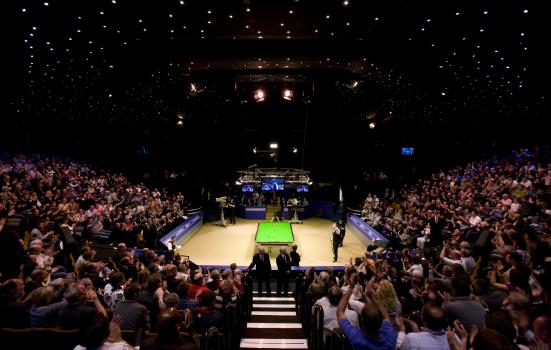
Although snooker seems to have been ever-present in the television schedules, that’s not really the case.  As a large part of understanding the flow of the game is knowing exactly where the colours are it’s no surprise that it didn’t really work in the black and white era.

But when BBC2 begun colour transmissions in 1969, channel controller David Attenborough was looking for something both cheap and colourful – and the single frame tournament Pot Black was born.  It would still be a few years before the sport’s top event – the World Championship – was covered in any depth though (and it seems remarkable that the 1972 World Championship – which saw Alex Higgins win the title for the first time – received no television coverage at all).

When the World Championship moved to the Crucible in 1977 things began to change.  By the late 1970’s there was substantial coverage and the BBC made the decision, still in place today, to record every frame of every match.

Given that the BBC has such a substantial archive of snooker footage from the last forty years it’s always been slightly irksome that they’ve rarely exploited it beyond the obvious (the Dennis Taylor/Steve Davis final frame decider from 1985 for example, which is regularly wheeled out).

So the Crucible Classics series, running in the early hours on BBC1 during the duration of the championships, is very welcome.  Whilst it’s not surprising that many of the programmes focus on finals, there are a few other notable matches.  It kicked off with Steve Davis v Tony Knowles from 1982 – the infamous first round match where defending champion Davis was humbled 10-1.

Since most of the frames won’t have been seen since their original broadcast, Crucible Classics offers a rare chance to relive some classic matches and hopefully this is a sign that the BBC might continue to open up their sporting archives.

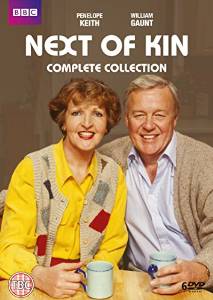
Next of Kin – Simply Media DVD Review

kin

Maggie (Penelope Keith) and Andrew (William Gaunt) are on the verge of a new life.  Following Andrew’s retirement, the pair plan to sell their house in England and move to a quiet village in France.  As they sit in the French sunshine, finalising their plans, talk turns to who they’ll invite over.  Both are adamant that Graham and his wife (unflatteringly known as Bootface) should definitely both be persona non grata.  The clear inference is that Graham’s a boring friend who they’re keen to jettison, but shortly afterwards it’s revealed that he’s their only son.

Returning home to England, they learn that Graham and his wife have been killed in a car crash, which leaves Maggie and Andrew with the difficult task of caring for their three grandchildren – Georgia (Ann Gosling), Philip (Mathew Clarke) and Jake (Jamie Lucraft).

What’s striking about the opening episode of Next of Kin is just how unsympathetic both Maggie and Andrew are (especially Maggie).  Even after the news of Graham’s death has sunk in, Maggie is unable to express any grief at all.  As she tells her housekeeper Liz (Tracie Bennett), she had very little time for her son.  Packed off to boarding school at the earliest opportunity, it’s plain that no mother/son bond (or indeed father/son) bond was ever developed.  Even as an adult, things didn’t improve as she regarded him as a pompous, priggish bore.  The last time they saw Graham was five years ago, after Bootface told her on Christmas Day that she didn’t want her to smoke in the house.  That was enough for them to decide they never wanted to see their son and the rest of his family again.  It’s another of those moments that highlights just how selfish and self-centered Maggie and Andrew are (although dramatically there had to be a reason why they hadn’t seen the children for a while – had they been regular visitors it would have dulled the culture-shock of their arrival)

Penelope Keith was no stranger to playing unsympathetic characters – both Margo Leadbetter and Audrey fforbes-Hamilton were self-centered snobs, so Maggie bears some similarities to her two most famous comic roles.  To begin with, Maggie is violently opposed to acting as a surrogate parent, she made a hash of parenting the first time so why should she have to go through it again?  But as part of the series’ theme is redemption (had they all spent three series sniping at each other things would have become very tedious) there’s obvious dramatic potential in watching how Maggie and Andrew slowly get to know and love their grandchildren.  It’s interesting listening to the studio audience during the scenes where Maggie professes she had no love for her son though, unsurprisingly they’re quite subdued.

William Gaunt, previously the harassed nominal head of the house in No Place Like Home, has a similar role to play here.  If Maggie is uptight, then Andrew is relaxed (he’s quite sanguine about taking care of their grandchildren, seeing it as their duty).

As for the kids themselves, Jake is the youngest (seven), his brother Philip is a couple of years older whilst big sister Georgia is in her early teens.  Georgia is initially presented as the most hostile to their new surroundings – she’s the archetypical stroppy teenager with a host of politically correct views inherited from her parents.  All three children (including young Jake) are shown to have picked up character traits from their parents (he still enjoys a bedtime story, but wants Maggie to continue the tale of the whale stranded in a sea of oil – a victim of human greed and corruption).

Liz is on hand to dispense the occasional nugget of wisdom (gleaned from various television and radio phone in shows) whilst battling off the advances of Tom the builder (Mark Powley – probably best known as Ken Melvin from The Bill).  Real life couple Wanda Ventham and Timothy Carlton pop up occasionally as Maggie and Andrew’s best friends Rosie and Hugh.  The four spent many happy holidays abroad together, although Rosie and Hugh now serve as a reminder to Maggie and Andrew that their days of freedom have passed – it’ll be a long time before they can simply decide to leave for a holiday on a whim.

As a family based sitcom, Next of Kin probably slightly suffered from the fact that 2.4 Children was running at the same time.  2.4 Children had a deft blend of parenting topics and surrealistic humour and enjoyed a very long run (possibly only curtailed by the death of Gary Olsen).  Although Next of Kin lasted for three years (an indicator that twenty years ago the schedulers were quite generous – today a middling sitcom would be lucky to get a second series) this wasn’t long enough to show the children developing into young adults – although they still managed to cover a fair amount of ground during the three series.

It may not offer belly laughs, but the combination of Penelope Keith and William Gaunt (especially Gaunt, who’s always worth watching in both comedy and drama) and the three young leads is an attractive one and Jan Etherington and Gavin Petrie’s scripts are quite sharp in places.  It’s never going to be acclaimed as a lost classic, but it does seem slightly unfair that it seems to have disappeared from the public’s consciousness quite so comprehensively.

Next of Kin – The Complete Collection contains all twenty two episodes (seven for both series one and two, eight for series three) across six discs (two discs per series).   Picture quality is fine, although I did notice some sound issues.  Occasionally the sound is rather tinny and there’s brief moments where the soundtrack has an odd, phasing tone.  It never renders the dialogue inaudible, but the changes in the quality of the soundtrack are quite detectable.  Having spoken to Simply they confirm this was a problem outside of their control – hence the disclaimer on the start-up screens. It’s probably something that some people will notice more than others, but it didn’t really detract from my enjoyment of the series.

Next of Kin is released by Simply Media on the 25th of April 2016.  RRP £39.99.

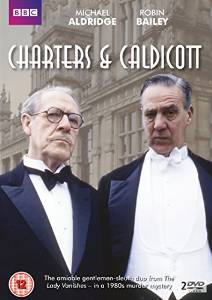
Charters & Caldicott – Simply Media DVD Review

cc

Written by Keith Waterhouse, Charters & Caldicott was a six part serial which aired on BBC1 during January and February 1985.  Waterhouse had by this point enjoyed a lengthy writing career (often collaborating with his friend Willis Hall). Some of their early film screenplays – Whistle Down The Wind (1961), A Kind of Loving (1962) and Billy Liar (1963 – adapted from Waterhouse’s original novel) – were key entries in the early sixties new wave British cinema movement.  The pair would go on to enjoy further success on the small screen, not least when they created Budgie (1971-1972) – a memorable vehicle for Adam Faith and Iain Cuthbertson.
The characters of Charters and Caldicott first appeared in the 1938 film The Lady Vanishes, scripted by Frank Launder and Sidney Gillatt and directed by Alfred Hitchcock.  Played by Naunton Wayne and Basil Radford, the characters instantly caught the public’s imagination.  Charters and Caldicott were two cricket-obsessed men whose only interest was to return to England to catch the final day of a vital test match.  Unfortunately they find themselves tangled up in a mysterious case of international intrigue on their train journey home ….

The pair proved so popular that they returned in several more films – Night Train to Munich (1940), Crook’s Tour (1941) and Millions Like Us (1943).  Wayne and Radford would also play very similar characters in a number of other films and radio plays (but for copyright reasons weren’t named as Charters and Caldicott).

Given the 1930’s setting of the original film you might have expected Keith Waterhouse to have scripted Charters & Caldicott as a period piece, but instead he elected to set it in the modern day.  Whilst it’s possible to imagine this was done for budgetary reasons (thereby avoiding the necessity to redress locations in a period style) I’m more inclined to think it was a deliberate choice.

It may be the 1980’s, but Charters and Caldicott still dress and act like it’s fifty years earlier and this culture clash generates a number of memorable comic moments.  One lovely one occurs in the first episode, when the pair set off to meet Jenny Beevers (Tessa Peake-Jones), the daughter of a recently deceased schoolchum.  They rendezvous in the sort of fast-food restaurant that you know will be anathema to both of them.  This is made plain when Charters strides up to the counter and requests a pot of tea for two – only to be handed two cardboard cups with milk sachets on top (which he then proceeds to spray over himself!) In a later episode they both attend a country house party and descend the imposing staircase for dinner immaculately dressed – only to find themselves in their version of hell, surrounded by 1980’s yuppies.

Although there’s a puzzling mystery at the heart of Charters & Caldicott – complete with dead bodies, people who may not be who they claim to be, coded messages and several gun-toting heavies – this isn’t the strength of the serial.  The mystery is simply an excuse for Waterhouse to spend six episodes scripting wonderful dialogue for both Robin Bailey (Charters) and Michael Aldridge (Caldicott).

Bailey and Aldridge are both a joy as they blithely navigate their way through the story.  Their contrasting characters help to generate a great deal of the humour – Charters is severe, precise and suspicious whilst Caldicott is warm, vague and trusting.  The pair exist in a never-never land of comfortable gentleman’s clubs, complete with a library where it’s considered bad form to speak and a sauna where they can complete the crossword in peace – sometimes!

But the recent death of their old friend Jock Beevers, forces them out of their comfort zone.  Jock left a trunk of papers in Caldicott’s possession which he passed over to Charters for safekeeping.  Several unsavoury types seem very interested in the content of the trunk and this seems to be the reason why Caldicott discovers a dead girl in his flat.  Initially both Charters and Caldicott believe it to be Jenny (who they haven’t seen since she was a child) but Jenny later appears to tell them that she thinks her life is in danger.  The long-suffering Inspector Snow (Gerard Murphy) is assigned to investigate the murder and drops another bombshell – could Jock have been a Russian spy?  If not, what do his cryptic messages sent to Charters and Caldicott actually mean?

Apart from the spot-on performances by Bailey and Aldridge, Gerard Murphy is wonderfully dead-pan as Snow, whilst Tessa Peake-Jones is suitably beguiling as an apparent damsel in distress.  Caroline Blakiston as Margaret Mottram also gives a fine performance – she’s an old flame of Caldicott and finds herself mixed up with the mystery after she agrees to give the homeless Jenny a place to stay.  Blakiston is gifted with some tart dialogue and she bounces off both Bailey and Aldridge very agreeably.

I was slightly surprised that this was an all-VT production.  By the mid eighties the BBC was beginning to move towards film as the medium for many series and serials and you would have assumed that Charters & Caldicott would have been just the sort of programme to benefit from the extra gloss that film would have provided.  But no matter, the serial works just as well on videotape as it would have done on film.

As I’ve said, the mystery part of the story does play second fiddle to the character interactions and there’s no doubt that over the six episodes the plot does meander somewhat.  But even if the storyline does drag in places, the pleasure of watching Robin Bailey and Michael Aldridge at work more than makes up for this.

Released as a two DVD set, each disc contains three 50 minute episodes.  There’s no issues with either picture or sound and as usual subtitles are provided.

Charters & Caldicott is released by Simply Media on the 25th of April 2016.  RRP £19.99

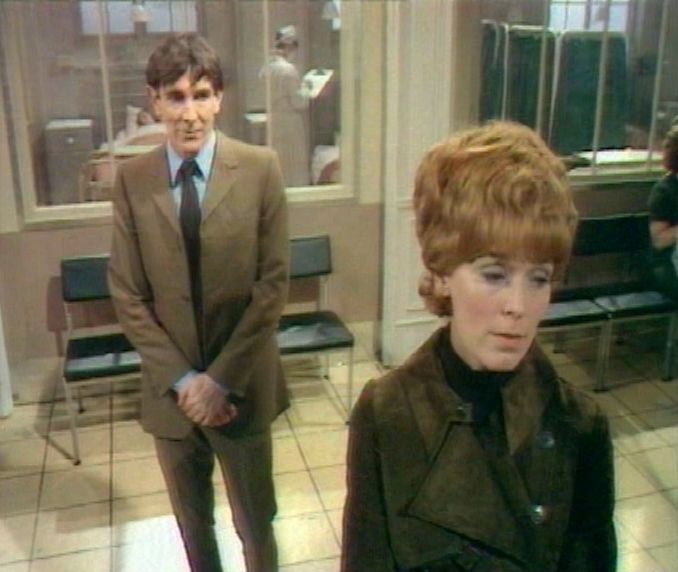
Doomwatch – The Iron Doctor

iron doctor.jpg

Quist is amongst a group of interested observers who have come to view a pilot scheme at Parkway hospital.  Dr Whittaker (James Maxwell) proudly shows them around a geriatric ward where the patients have been linked up to a powerful computer, designed to monitor every aspect of their treatment.  In all cases,  their life expectancy has been extended well beyond normal estimates and Whittaker is fulsome in his praise for the computer.  “Utterly efficient, never tiring, absolutely impartial, the iron doctor.”

But Dr Carson (Barry Foster) isn’t quite so sure and when several patients die in mysterious circumstances he becomes convinced that the computer independently decided to cease treatment.  This shouldn’t be able to happen – the computer is programmed only to make suggestions and the final decision always rests with the doctors.  However, there is evidence to suggest that the computer has begun to think for itself …..

In some ways The Iron Doctor is a development of themes expressed in the series one story Project Sahara.  Both look at the way that computers might begin to supplant human beings in the decision making process, but in The Iron Doctor it’s literally a matter of life and death, whereas in Project Sahara the computer was only concerned with people’s suitability for employment.

The fear that computers would come to dominate human beings was a common one during the sixties and seventies.  There’s several key examples in Doctor Who (which also have direct links to Doomwatch).  The War Machines saw an all-powerful computer called WOTAN attempt to take over the world’s computer infrastructure (this was the first Doctor Who story to feature input from Kit Pedler).

In The Ice Warriors, we see a  Britain in the far future which is menaced by another ice age.  Leader Clent is a man who’s abdicated his personal responsibility to the computer and won’t admit that it could ever be wrong, whilst a member of his team, Penley, regards the computer as no substitute for human actions and intelligence.

Both The Ice Warriors and The Iron Doctor were written by Brian Hayles, so it’s possibly not a surprise to find there’s certain parallels in the stories.  Whittaker, like Clent, remains totally convinced about the computers infallibility, although in Whittaker’s case it’s a little harder to understand why.  He dismisses Carson’s fears very airly, telling him that he’d no doubt be happier returning to the days of the leeches.

Whittaker is presented as the sort of misguided scientist who’s become so blinded to the possibilities of future gains (although it’s all purely for the benefit of mankind – there’s no suggestion that he’s interested in personal glory or financial rewards) that he’s not prepared to listen to any suggestions that his current research could be flawed.  It’s a tricky part to play, but James Maxwell does so with aplomb – especially at the end, when he’s forced to admit his mistake and elects to take full responsibility.

Equally good is Barry Foster as Carson.  Later to become a familiar television face thanks to Van Der Valk, Foster is a key figure in the story, since he’s responsible for bringing the deaths to the attention of Doomwatch.  Carson is – despite Whittaker’s claims – no luddite, he knows that the computer can be a valuable tool but the evidence suggests that it’s somehow begun to think for itself.   The first man to die, George Mason (Harold Blewitt), was very ill and would have died shortly anyway, but Carson’s fear is that the computer realised this and decided independently that it was useless to carry on treatment.

Events then take a slight science fiction turn (although still just within the bounds of possibility) when Carson decides to take a closer look at the computer.  It detects Carson’s presence and electrocutes him. Later, when a critically ill Carson is hooked up to the computer’s life support systems, it suddenly cuts off.  The computer was developed from a war games machine and like those models it has a built in defence mechanism as well as a capacity to learn.  Although it’s a bit of a stretch to swallow that the computer was able to record a conversation where Carson stated that it was dangerous and then take steps to remove this threat.

The story’s a good one for most of the Doomwatch team (except Barbara, who only pops up briefly with a cup of tea).  Quist is, as usual, Doomwatch’s moral centre – stating his belief that computers shouldn’t be able to act independently as well as being the one who’s finally able to convince Whittaker that the computer is flawed.

Ridge goes undercover at the hospital – complete with rolled umbrella and posh accent.  It gives Simon Oates a chance to inject a little bit of humour into the story (and naturally enough he gets to ogle a nurse or two!)  Fay has a very decent scene with Whittaker early on, where she casts doubt over his research and even Bradley gets something to do for once – venturing out of the office to take a look at the computer.  Geoff probably gets the short end of the stick again, but with an expanded regular cast it’s inevitable that not everybody will have a great deal to do.

If the story has no mystery (the computer has to be acting by itself – if the patients had simply died of natural causes then it would have been a rather uninspiring fifty minutes) The Iron Doctor is still a very watchable episode, thanks to the guest stars and the thought-provoking topic.

Doomwatch – By The Pricking of my Thumbs

pricking

Professor Ensor (Olaf Pooley) has been granted time and space at Doomwatch to conduct experiments into the extra Y chromosome, much to Quist’s disdain, who doesn’t believe a word of it.  “Only yesterday I was reading an article by a colleague of yours, Ensor, in The Lancet. Once again he cast grave and honest doubt on the theory that the extra Y chromosome predisposes one to criminal behaviour.”

Ensor has been conducting tests at a local school, asking the pupils to fill out questionnaires, as well as taking blood samples (hence the pun in the episode’s title).  This is an early indication that Ensor’s methods are suspect in the extreme – Fay has been assigned to work with him and she’s under the impression that the samples they’re studying have been taken from criminals (totally unaware that later samples have come from the school).

If this is an example of the casual way he treats his scientific research, then worse is to come.  The school’s headmaster, Botting (Colin Jeavons) has a problem – a boy was badly injured in the chemistry lab after three other pupils (MacPherson, Jenkins and Franklin) tampered with his experiment.  Botting is convinced that one of them must be the ringleader, but which one?  He discusses the matter with Ensor and, after learning that Stephen Franklin (Barry Stokes) is taller than normal for a boy of his age (he’s seventeen), the Professor decides he must be guilty.  Carriers of the extra Y chromosome are known to be taller than average, Stephen is taller than average, QED.

It’s an astonishingly thin amount of evidence, but Botting is convinced and expels Stephen, which leaves us unsure as to who’s the most culpable – Botting or Ensor.  It’s plain that Botting lacks judgement, as whilst he’s portrayed as a progressive headmaster – keen to encourage his pupils to express themselves – he’s blinded by Ensor’s apparent scientific credibility (allowing the true culprits, MacPherson and Jenkins to get off scot free).  Ensor’s reasons for picking Stephen seem very vague.  Apart from his height, the other major factor seems to be that he was adopted.  Bad blood …..

Stephen’s father, Oscar (Bernard Hepton), is appalled by the way his son’s been treated and after he gets nowhere with Botting he heads off to speak to Quist.  They know each other, but Quist can barely tolerate the man.  Oscar is a freelance journalist, working in the science field, and Quist has a poor opinion of his skills as a writer.  The always watchable Hepton gives a fine performance. Oscar is full of bluff and bluster, but he’s a fundamentally decent man who obviously cares for his son, which makes the way Quist treats him even harder to take.  He’s curt and dismissive and it’s only after Oscar leaves, and Ridge piques Quist’s interest with information about Ensor’s school experiments, that he begins to get interested.

Stephen attempts to kill himself in a rather unexpected way (by walking onto the runway at Gatwick).  He’s obviously in a confused state as before this he was heading for a plane which was flying to Jersey.  Geoff Hardcastle pops up again briefly to talk the boy down and luckily he comes away unscathed.

Everything’s built up for the big confrontation between Quist and Ensor.  It’s been stated on several occasions that Quist can’t stand him and also has little respect for him as a scientist.  Ensor attempts to defend his knowledge, but Quist simply steamrollers on.  “Your knowledge that condemns a child unheard, that drives him to risk death on an airport runway at night.”  It’s possibly not as powerful a diatribe as it could have been (it’s interesting that Quist seemed more angry at Oscar than he does at Ensor) but it’s still a nicely played scene by John Paul.

After a couple of indifferent episodes, By The Pricking of My Thumbs gets Doomwatch back on track.  Bernard Hepton and Olaf Pooley are both excellent, although Ensor isn’t as central to the plot as you might expect.  In many ways he’s more of a catalyst for the drama that’s triggered once he makes his disastrous prognosis.  Patsy Byrne, Sally Thomsett and Colin Jeavons are more familiar faces who help to enliven the story.  Byrne is good value as Stephen’s mother whilst a young Thomsett is his (slightly irritating) younger sister.

This was Robin Chapman’s sole Doomwatch script.  He was the creator and/or writer of a number  of popular series made by ITV during the mid to late sixties (The Man in Room 17, The Fellows, Spindoe, Big Breadwinner Hog) so he would have been something of a “name” writer at the time.  It’s a pity he didn’t write more for the series as this is a sharply defined character piece.

Doomwatch – No Room for Error

no room for error.jpg

Dr Fay Chanty (Jean Trend) is Doomwatch’s latest recruit, although initally she tells Quist she’s now not sure now whether she wants the job.  But her arrival is a timely one.  She formerly worked at BAP (British Associated Pharmaceuticals) helping to develop Stellamycin, a drug which can be used to combat typhoid.

A recent typhoid outbreak has seen a score of children hospitalised and fighting for their lives.  Stellamycin could be the answer – but despite Doomwatch’s cautiously favourable report the government has yet to give their approval.  So whilst Quist heads off to do battle with the ministry he sends Fay to BAP to liaise with her former colleagues.

The government grudgingly agrees to allow Stellamycin to be used, but when a child dies it sets them into a panic.  Only one group of children shows such an adverse reaction though and it’s later discovered that they all went to the same school.  A working hypothesis would be that somehow they had already been exposed to a very low level dose of the drug over an extended period.  But since it’s only just been released, how could this be so?

Like Toby Wren, the arrival of Fay Chantry allows the viewer to observe Doomwatch from the outside.  Who are these small group of scientists and what exactly do they do?  No Room for Error implies that they’re not highly regarded amongst certain parts of the scientific community.  One of Fay’s former colleagues at BAP, Nigel Waring (John Wood), has a particularly jaundiced view of them, wondering why she’d want to give up a decent job at BAP for civil service pay and a role as a government snooper …..

Although Fay Chantry was created in order introduce a woman into the Doomwatch team who wasn’t a secretary, it’s ironic that her initial storyline is somewhat sexist.  She spends most of her time rekindling her relationship with Nigel, who’s such an irritating drip that it’s therefore hard to have a great deal of respect for her judgement!

Their brief affair had been one of the factors in his recent divorce and he now suggests they marry and she returns to work at BAP.  Nigel’s boss, Professor Lewin (Angus MacKay) doesn’t think this is a good idea, telling him that the pair of them living and working together would be too much of as strain (so much better if she just became a nice little housewife).  Ridge takes the biscuit though, when he later tells Quist that because Fay’s a woman she’s likely to react emotionally.  Yes, John Ridge, a man who tends to act first and then think later (when he does think) said this!

The Nigel/Fay relationship has a soap-opera feel about it, which is reinforced when Nigel’s daughter falls ill with typhoid and he has to face an urgent dilemma – should she be treated with Stellamycin when might it prove fatal?

After extensive tests by Doomwatch, Nigel is proved to be culpable – a canister of the drug was left at a nearby farm, which in turn infected the milk at a local school.  It’s possibly an ironic touch (although maybe not) that Nigel reacts with resentment and a complete lack of personal accountability when Fay gently mentions this to him.  Earlier he was scathing about Doomwatch, not regarding them as true scientists, but when it’s revealed he was responsible for a child’s death, he turns his anger on Fay and brings their relationship to an end (a lucky escape for her, I think). He doesn’t stop to think that if it hadn’t been for those “busybodies” at Doomwatch there might have been more deaths.

After being largely anonymous during the last episode, Simon Oates has a little more to do here.  When we first see him he’s in a slightly battered state and is being attended to by Barbara Mason.  She places a plaster on a cut over his eye and is then encouraged by him to kiss it better!  Clearly some time has passed since we saw her in You Killed Toby Wren as she’s now very comfortable around him.  Possibly this was a little ad-lib worked out in rehearsals, it’s a nice moment anyway as it helps to give a touch of humour and humanity to both their characters.

Angus MacKay (a man who seemed to make a career out of playing headmasters, bank managers and the like) is suitably imposing as Professor Lewin.  It’s not much of a role but MacKay’s clipped diction is always worth listening to.  Anthony Sharp as Dr Ian Phelps (the Medical Officer of Health) is another solid performer and Anthony Ainley (as the Senior House Officer) has a couple of key scenes.  Several points off though for Norman Scase as Mr Elliott, the headmaster at the infected school.  He gives an extraordinary mannered performance which has to be seen to be believed.

Although the Nigel/Fay subplot is rather tedious (will she choose him or her career at Doomwatch?  Umm, fairly obvious really) there’s a decent mystery at the heart of the story and both Quist and Ridge are used well.  But this story is another sign that the series is changing – as character relationships are moving into the foreground whilst the science takes a little bit of a back seat.

Doomwatch – The Islanders

islanders

Six months ago, the two hundred inhabitants of the tiny Pacific island of St Simon were evacuated back to the UK (the British government believed that they were at risk from heavy earth tremors).  Because they’ve been a totally closed community for some 150 years Quist sees them as an excellent source of research material.  By studying them and contrasting (both physically and genetically) with a group of volunteers drawn from towns and cities, Quist and the others will be able to evaluate how the environment and the presence of other people affects human evolution.

Although The Islanders was an early series two entry, it clearly points ahead to the direction Doomwatch would take during its third and final series (after producer Terence Dudley had wrested creative control from creators Kit Pedler and Gerry Davis).  Louis Marks’ script is a human drama first, with the environmental problem (mercury poisoning) somewhat secondary.

The social impact of the islanders reintegration into society concerns Quist.  They’re currently living in a camp, which looks uncomfortably like the sort of place used to house prisoners of war during WW2.  The man from the government, Mullery (Geoffrey Chater), doesn’t seem at all concerned and he tells Quist that they’re free to leave and go anywhere they want at any time.  Since they come from a British protectorate they have the same rights and freedoms as any other British citizen.

But Quist knows they’re not the same.  “They come from a place where there’s no cars, no telephones, no televisions.”  The islanders lack the necessary tools and knowledge to live in a modern, technological world – in time they can learn, but it appears Mullery is keen to pass the buck.  Chater is perfect casting as the dispassionate, disinterested official (he’d later pop up as a semi-regular in Callan playing a not dissimilar figure)

When the islanders lived on St Simon, they formed a perfect unit – everybody knew their place and were content to work hard – but exposure to wider civilisation has begun to fracture this unity.  This is demonstrated by the differing viewpoints of Thomas Prentice (a strong performance from George A. Cooper) and his son Isaac (David Buck).  Thomas, the headman of the community, wants to keep everybody together, but this seems impossible when there’s no work for them.  A few people have already begun to seek employment elsewhere and one of them is Isaac.  He’s found a job at Craxton’s Bakeries and is keen to press ahead.  He’s not surprised when Quist tells him that the ministry have no plans for them and he’s not bothered either – he believes they need to make their own way.

Thomas falls ill and dies from what appears to be a bad case of flu.  The observant viewer should have picked up very early on that John Ridge, who’s been working closely with the islanders for some time, has had the sniffles.  Although the eventual reveal is somewhat laboured, Quist eventually confirms that as none of the islanders have ever had flu they have no resistance and therefore it could be fatal to them.

Isaac’s brave new world at Craxton’s quickly turns into a nightmare.  Director Jonathan Alwyn creates an interesting, albeit brief, sequence on the factory floor – shots of the cake making machines (which had previously filled Isaac with wonder) now take on a sinister and disorientating air.  After he angrily resigns, he emerges into a busy London street and is confronted by the noise and traffic.  Alwyn then closes up on Buck’s anguished face.

The doctor’s report confirms that Thomas died of liver failure – the flu just finished him off.  Quist and Isaac, together with a small survey team, return to St Simon where Quist is able to confirm that the islanders have been slowly suffering from mercury poisoning for decades – a case of the flu would simply have speed up the process.  Isaac is appalled.  “Why did this have to happen to us? Never had any wars, never had any quarrel with anyone. Just wanted to live our own lives.”

Although there’s quite a community of islanders, there’s essentially only four speaking roles – Thomas, Thomas’ wife Joan (Shelagh Fraser), Isaac and Alice (Geraldine Sherman).  George A. Cooper is excellent, but his role is fairly small since Thomas quickly succumbs to the mysterious illness.  Shelagh Fraser and Geraldine Sherman are both fairly peripheral characters, which leaves David Buck as the main voice of the islanders.

We follow his journey as he changes his opinion about the benefits of modern society from positive to negative.  Although part of the issue I have with Louis Marks’ script is that since Isaac’s point of view changes so rapidly (and it’s also problematic that he’s only islander we follow in any detail) it doesn’t really convince.  He’s portrayed as something of an innocent – easily manipulated by the factory owner – but the script doesn’t really serve him that well.  And what of the others?   What do they think of this brave new world?  We never really find out, which reduces them from an active, living community to nothing more than a collection of colourful extras.

In the end, Isaac is content to return to St Simon (as do the others).  Quist can’t recommend this, since the poison there will shorten all their lives, but Joan counters that there are just as many hazards here.  “They judged us and found us wanting” mutters Quist.

The Islanders never quite seems to come together.  The themes are interesting, but in the end it’s slightly unsatisfying.  We’re told that several other islanders, in addition to Thomas, have fallen ill, but since we never know them, the question of whether they live or die doesn’t have any impact.  The concept of a group of people totally unsuited to life in a modern technological society is a good one, but apart from a few scenes isn’t developed in any great detail.

John Paul has some decent moments (especially playing opposite the cold-hearted government official expertly portrayed by Geoffrey Chater) but Simon Oates is pretty poorly served by the script and barely contributes.  It’s not a disaster, but it’s fairly unmemorable stuff.