Dixon of Dock Green – Target

target

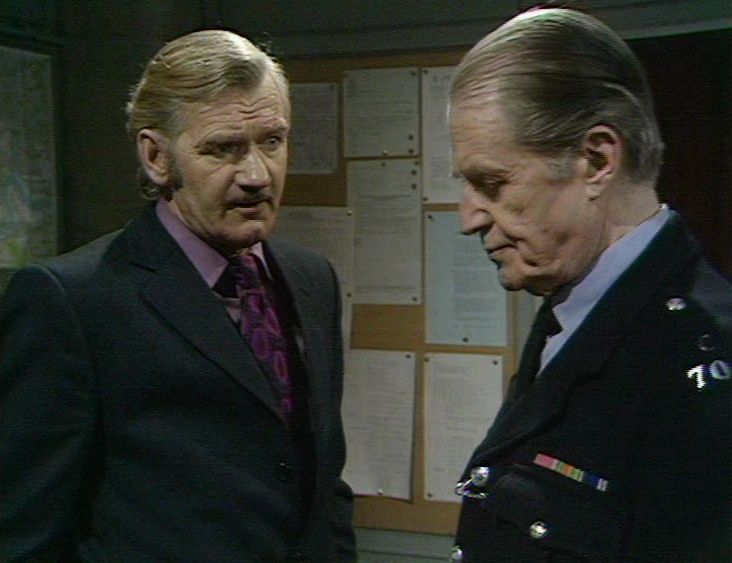
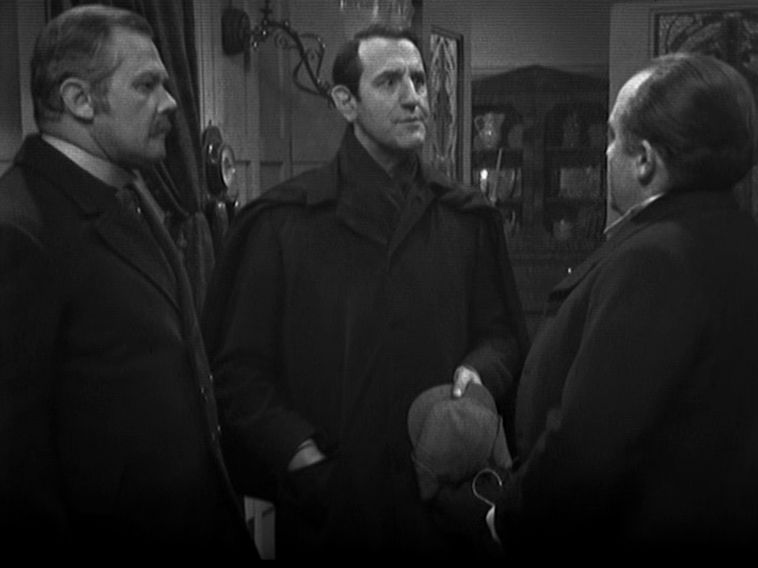
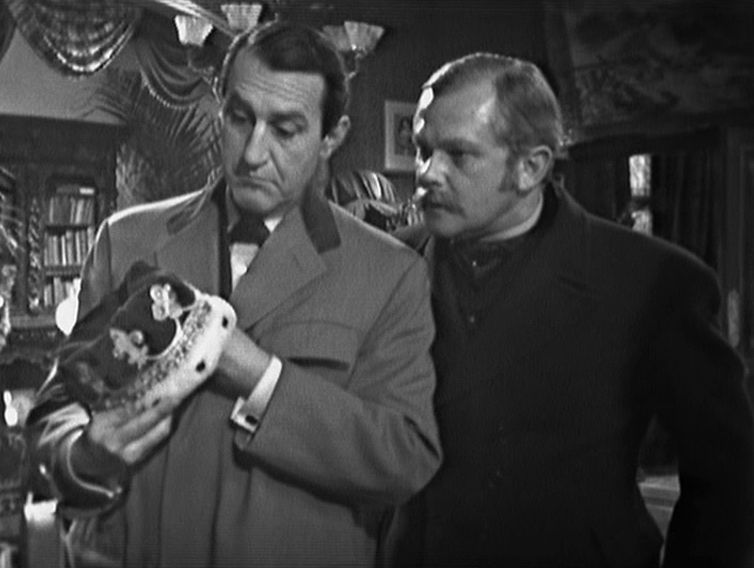
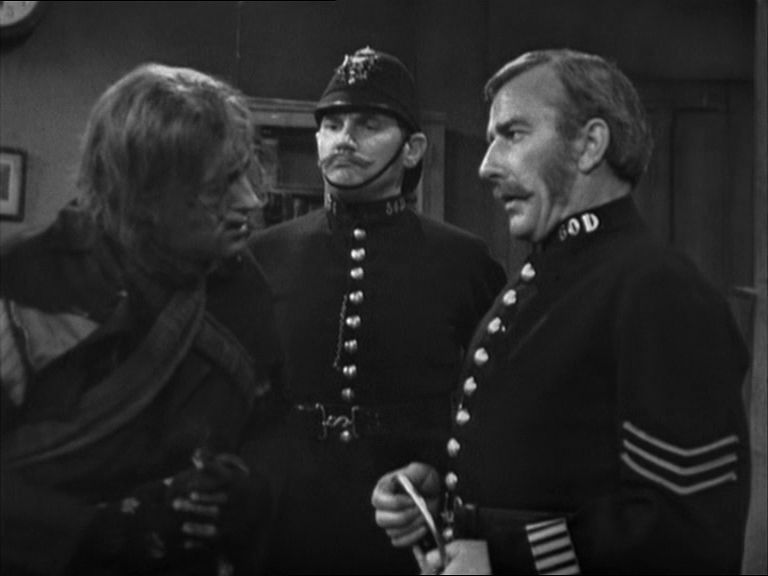
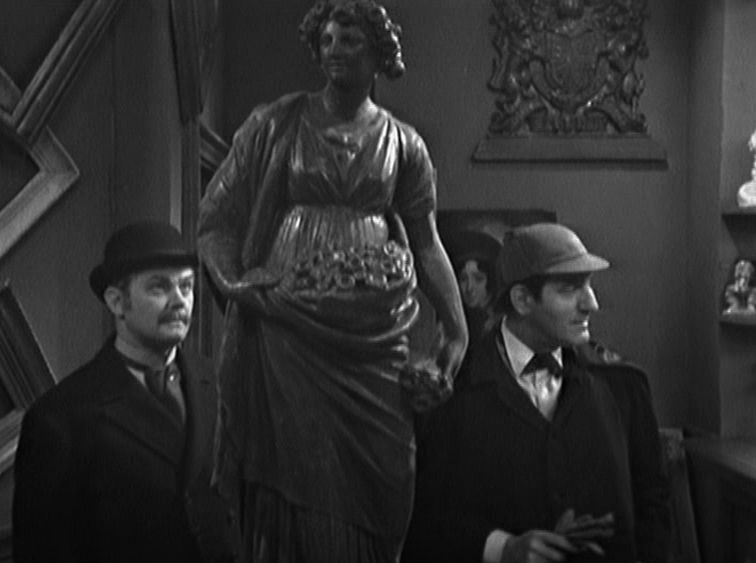
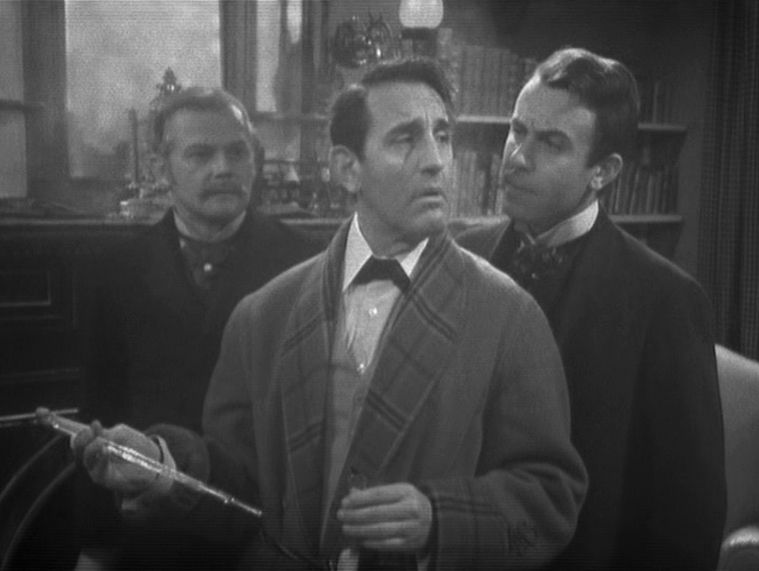
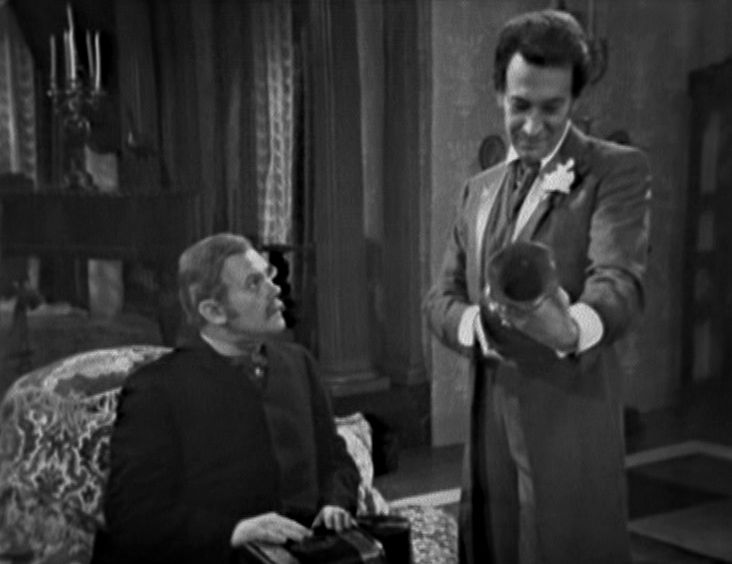
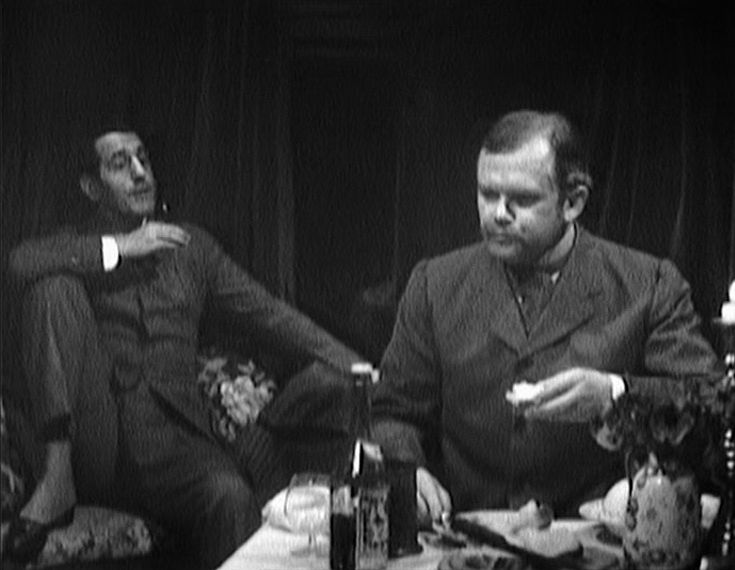
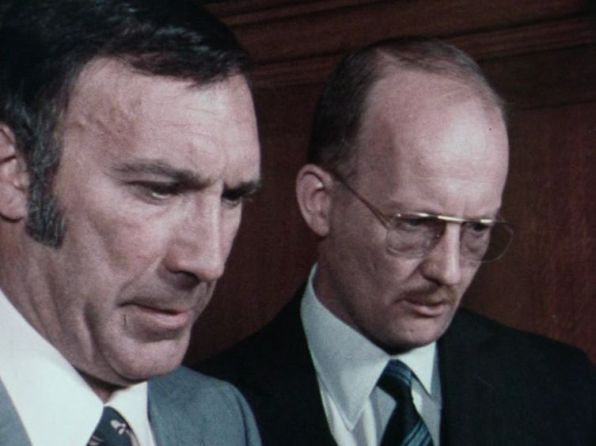
Target was the opening story of Dixon’s twenty first series (originally broadcast on the 15th of February 1975).  It’s a slow burner of an episode, as it takes a long while to establish who the target is, but there’s plenty of interest before the plot really kicks into action.

We open in a supermarket and the camera follows a man we later learn is called Smith (Anthony Steel).  He’s clearly not a well man as he staggers outside in a barely conscious state.  Vere Lorrimer’s camerawork in the early part of the episode quite effectively illustrates Smith’s distressed state (the cameras of this era are too bulky to be used hand-held, but there’s more fluidity in some shots than you’d normally expect).

When Smith exits the supermarket, the sounds of drilling trigger a flashback – and for a split-second Smith believes he hears gunfire and that the young black man, Winston Dallas (Willie Jonah), who’s concerned for his well-being is an enemy.  Winston manages to get Smith back to his flat, but Smith then pulls a gun and Winston flees.  This is enough to involve the coppers at Dock Green, but when they arrive they find complications – as Smith’s flat is already being watched.

There’s some nice humourous touches in Ben Bassett’s script.  When Crawford realises that three Special Branch officers have been staking out the flat (complete with a tent, pretending to be workman) he takes great pleasure in telling them that every criminal worth his salt knows about that particular dodge.  Wills later remarks that they tried to catch Jack the Ripper with a tent!  Mike Brewer then waylays a French onion seller and offers him a tidy sum of money so he can borrow his bike, onions and beret.  Did French onion sellers, especially such cliched ones ever exist?  Well they do here.

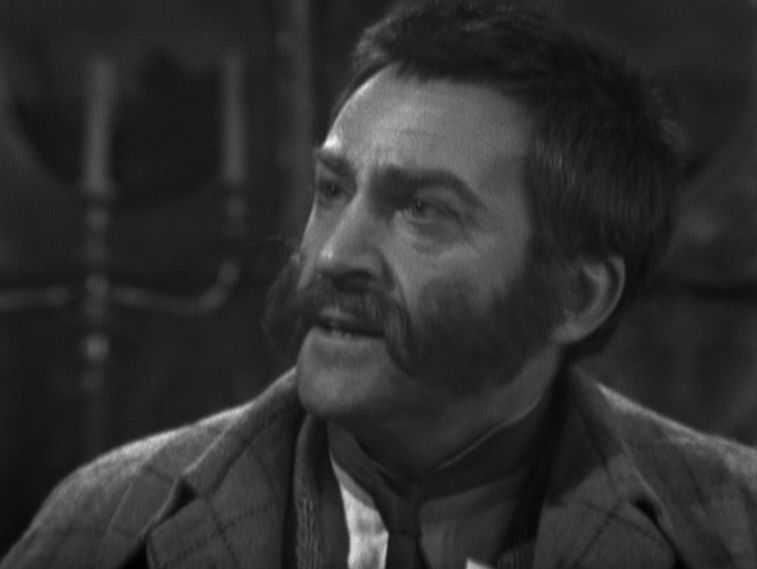
The Special Branch officers tell Crawford that they’re waiting for the arrival of a man called Kumal (Yashaw Adem), who was responsible for a particularly brutal massacre in Central Africa.  Smith is a friend and colleague, so they’re confident he’ll show up.

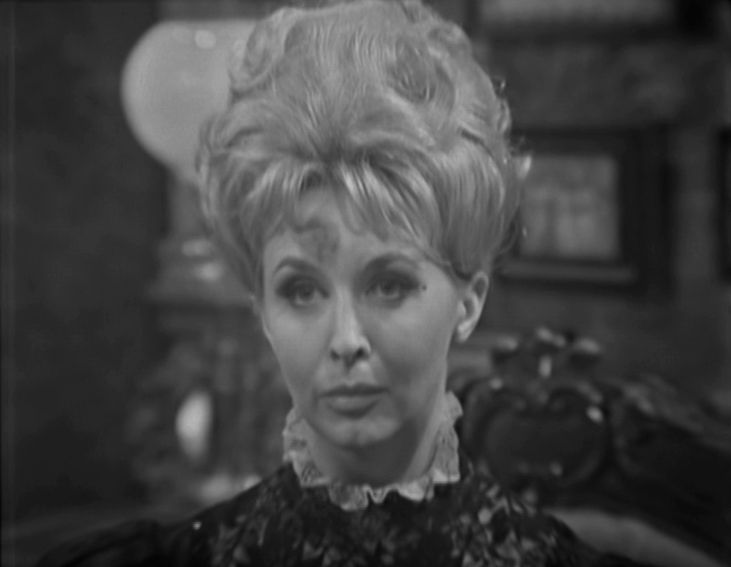
Once Smith recovers from his bout of malaria, his character’s drawn out thanks to several conversations with the owner of the flat, Joyce Baird (Freda Knorr).  Anthony Steel is excellent in these scenes – Smith is a man who’s unrepentant that his profession is killing, but he’s not a mindless thug.  Mercenaries like him regularly featured in the news back in the seventies (and in films such as The Wild Geese) and whilst such a character has less resonance today, thanks to Steel’s performance it’s still compelling.

As for Dixon himself, he has little to do, which is rather surprising for a series opener – instead Crawford and Brewer handle most of the action.  Although there’s a little gunplay along the way, it’s still far removed from action-orientated series such as The Sweeney.   Instead, Target is a decent character piece and a solid start to this series.

Dixon of Dock Green – Firearms Were Issued

firearms

Crawford leads a raid on a suspected gang of armed robbers.  Due to the possibility that they may still be armed, the Dock Green officers are also issued with firearms.  Dixon, in his role as desk sergeant, is precise in ensuring that all the correct procedures are carried out before a single gun is issued.  But events go seriously wrong and an unarmed man is shot and later dies, which means that Crawford and the others find themselves under investigation.

Apart from Crawford, Det. Con Cox (Peter Tilbury), Sgt. Wills (Nicholas Donnelly) and PC Dewar (David Masterman) are the other officers issued with firearms.  Before the operation, we’re given some indication about how two of them may react. Wills is an experienced firearms officer and so it can be assumed he will be cool under fire.  Cox is much less experienced (he’s only ever fired a gun on the training ground) whilst Dewar is an unknown factor.

The raid takes place at night-time and is effectively filmed.  The darkness makes it harder to understand what happened when the fatal shot was fired (which was obviously the intention).

Part of the conflict in Firearms Were Issued is driven by the different policing styles of Crawford and Dixon.  The younger man has a willingness to bend or break the rules in order to achieve the right result – something which is anathema to Dixon.  This is highlighted when Crawford attempts to leave the station to try and contact the informant who phoned in the original tip off.  Dixon’s quite firm – if he leaves the station then he’ll have to let the appropriate people know.  It’s a nice character moment for both, especially Peter Byrne.

Dixon is an old school, by-the-book copper – and a major part of the character’s appeal has to be Jack Warner himself.  Since he’d been playing the part so long, he’d become a virtual embodiment of “the good old days”.  But this nostalgia for better, simpler times gone by isn’t always a good thing.  It may have provided reassurance for a section of the audience at the time, but in the decades to come it was probably a key factor in the less than flattering readings we’ve seen the series receive.

But though the episodes on the first DVD have been more diverse than the reactionary Dixon of legend, it’s fair to say that the resolution of Firearms Were Issued will give critics of the series some ammunition.  It’s a much less progressive message than, say, Sounds, but although it’s an eyebrow raising conclusion it’s far from the norm (based on the small sample available anyway).

The investigation is quite intense and it leads to some decent character conflict between the Dock Green officers and Det. Chief Supt. Donovan (Percy Herbert).  The officers are insistent that the gang were armed but an intensive search fails to locate any weapons.  Did one of them shoot an unarmed man?  And if so, why?

Percy Herbert’s an intimidating presence as Donovan (he had a long career, including notable appearances in films such as Bridge on the River Kwai and The Guns of Navarone).  The versatile actor/writer Peter Tilbury made the second of his two appearances as Cox whilst the ever reliable Cyril Shaps played the somewhat shifty Green.

Whether Kendrick was armed or not, when the fatal shot was fired he was running away.  But Dixon sums it up as follows.

The four men who went out that night had every reason to believe that they were going to deal with armed and dangerous men. Later, the report for ballistics confirmed that Sgt. Wills had shot Kendrick. An inquest was held and the jury returned a verdict of justifiable homicide.  I think I’d have done the same as Dewar and Wills in those circumstances.

Dixon of Dock Green – Sounds

sounds

A few mysterious sounds of the end of the phone are enough to spark major activity at Dock Green nick.  The story opens with Anne Turner (Marion Lines) and her daughter Janey (Lyn Doyle) returning home.  “Home” at present appears to be a rather dingy flat in a very run-down area.  Anne notices the door is unlocked, which concerns her.  She sends Janey downstairs to play and calls Dock Green police station.

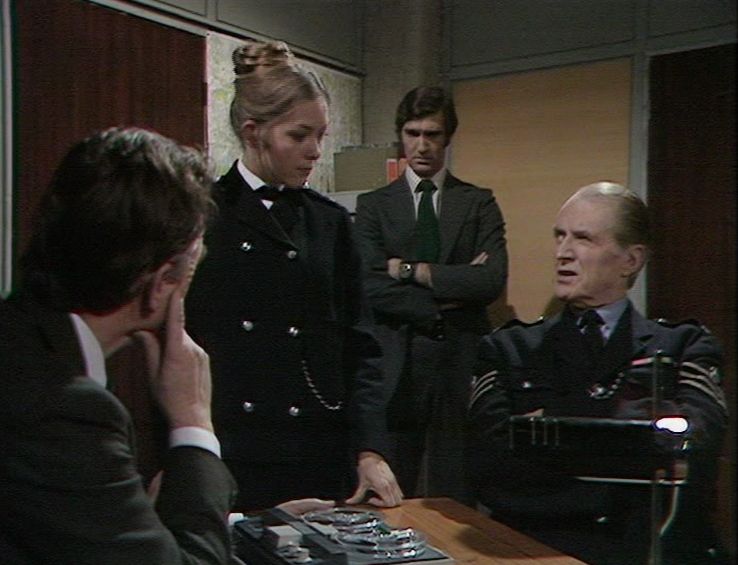
But after only a few words, WPC Hawkins (Jacqueline Stanbury) hears a choking noise as if she’s being strangled.  Dixon takes over the call and a few moments later Janey picks up the receiver, telling Dixon that her mother’s asleep.  Then either Janey replaces the receiver or somebody does it for her.  It’s little enough to go on, but Crawford, Brewer and Dixon put their heads together to try and work out what they can establish from the few sounds recorded from the call.

Sounds (the sixteenth episode of series twenty, originally broadcast on the 13th of April 1974) is very much an episode of two halves.  The first is concerned with the hunt for Anne and Janey and the second (which is the more dramatically interesting) details what happens once they’ve been found.

To begin with, they scour the tape for clues – they can hear the sound of machinery and also the hooter of a tug on the river.  Officers at Dock Green obviously have an affinity with the river, as Crawford’s able to ascertain that two hoots means the tug is turning to starboard.  He then asks for the name of every ship on the river that sounded its hooter at the time the call was made.  This should help to narrow down the search field.

An expert, Dave (David Wood), is called in to examine the tape.  He’s the antithesis of Dixon – since he sports long hair and colourful clothes – but since he’s an expert in his field, there’s grudging respect.  Dave is able to isolate the machinery noises much more clearly.  Neither Dave or Dixon can quite put their finger on what the machinery could be, but WPC Hawkins is able to smugly tell them that it’s a Heidelberg Superspeed Platen printing press.

This impressive feat of deduction is explained when she tells them that the recording could be heard in the station office and at at exactly the time it was being played, a stationary delivery was made and the printer’s apprentice recognised the sound!  This is a little difficult to believe, but it’s necessary in terms of moving the plot forward, as by now we’re half-way through the episode.

This information allows Crawford and Brewer to locate the flat, but there’s no sign of anybody and all personal belongings have been removed.  One clue is that there’s two telephone numbers – one is the Dock Green nick and the other is a local security firm.

Whilst the search for the missing woman and child has been interesting, we now enter the dramatic heart of the episode.  One of the guards from the security firm, Davis (Michael Graham Cox), pays Dixon a visit.  He’s keen to help – frankly he’s too keen and it’s clear right from the start that he has his own agenda.  It doesn’t take too long for the story to emerge.  Anne is his wife (at present she’s reverted to using her maiden name) and whilst their marriage has obviously been punctuated with bouts of domestic violence, he considers himself to be untouchable.  He knows that there’s no case without Anne’s testimony and he also knows that she’ll say that her present injuries are due to her slipping on one of Janey’s toys.

This is what she tells Dixon, but he obviously doesn’t believe it.  When he asks her if he’s beaten her up before she tells him that “it’s just between him and me, isn’t it? A private matter, nothing to do with the police.”  Dixon counters by telling her to “stop repeating everything he tells you. There’s no need to be afraid of him.”  But it’s clear that Anne won’t change her story.  Although she may be frightened of him, there’s also a sense that she genuinely loves him and believes that things will change.  The unspoken inference is that things won’t get better, but without Anne’s testimony, the police are powerless.

Davis is presented as a loathsome character – an arrogant man who’s sure he’s beyond the law’s reach.  And indeed he is – all Dixon can do is to tell him to leave the station before he gets thrown out.  It’s a small victory, but it’s all they have.

Sounds is a bleak little tale.  It gives us a glimpse inside an abusive marriage and we’re left to wonder what will happen in the future.  In his closing speech, Dixon hopes that Anne will someday pluck up the courage to make a statement (for Janey’s sake if for no one else’s) but that’s the only sliver of hope we’re left with.

This isn’t the first time that Dixon has touched upon the area of domestic abuse.  And due to the fragmentary nature of Dixon’s archive holdings, it’s difficult to know for sure when the series shifted from the viewpoint presented in the 1956 episode, Pound of Flesh.

There, Dixon observed that “if I arrested every bloke in Dock Green who clocked his wife, I’d be working overtime”.   Since Pound of Flesh is one of the rare episodes to exist from the early run, it’s hardly surprising that this quote and clip has been used on more than one occasion as a club to beat the series with.

It could be argued that Dixon’s comment was an accurate representation of the attitudes of mid fifties Britain.  In Sounds, which was made nearly twenty years later, it’s obvious that times have changed and spousal abuse is now taken more seriously.  But it’s still seen as a crime which is unlikely to result in a conviction, for the reasons that we’ve seen.

The lack of any positive solution might come a surprise to those who regard Dixon as a twee, predictable series – but as we’ve seen so far, the truth is somewhat different from the legend.

Dixon of Dock Green – Harry’s Back

harry's back

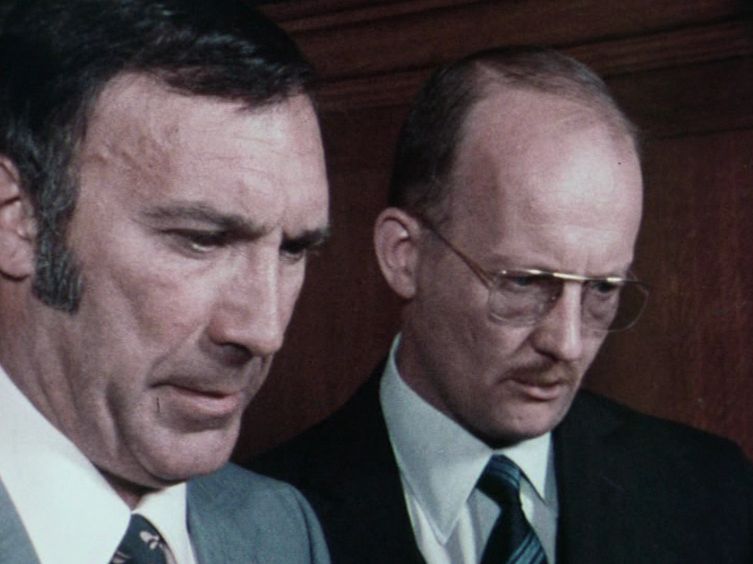
Harry’s Back (the third story of series twenty, broadcast on the 12th of January 1974) features a familiar plot which many police series have used from time to time.  An untouchable villain, who rarely makes a mistake, is doggedly pursued by a lone officer (even though he’s warned off by his superiors).

In Harry’s Back, Andy Crawford is the officer and Harry Simpson (Lee Montague) is his prey.  Harry’s a beloved figure in his local community (“one of the best”) and his early scenes help to establish his character.  To begin with, we see him return home after some months spent abroad with his new fiance Marion Croft (Susan Tebbs).  He’s greeted by an old man, who offers to carry his suitcases up to his flat – Harry agrees, even though he can see the man is struggling with the weight of the cases.  Harry slips him a few notes and tells him to take his time.  Andy later bitterly reflects that Harry’s a past-master in “buying admiration” and this is an early example.

Harry then runs into Sgt. Wills and although Wills is polite, he’s obviously not delighted to see that Harry’s back.  His disdain would seem to be shared by most of the Dock Green coppers, although Andy’s the only one who actively targets him.  This brings him into something of a conflict with Dixon – although the confrontation, if one can call it that, is very mild.

Dixon’s is an old-school copper.  He’d be happy to pursue Harry if there was clear evidence of wrongdoing, but there isn’t – so he’s content to let him lie.  The inference is that eventually Harry, like all criminals, will trip himself up and that’s the time when Dixon will pounce.  Andy takes the opposite view.  He has no hard evidence but his suspicions are enough to make him want to keep a very close eye on him.  Although this makes it easy for Harry to claim that he’s being harassed.

Throughout the story we see several more examples of Harry’s largesse.  He visits the wife of one of his old friends, Lenny Lane, and gives her a considerable sum of money.  This, he tells her, is simply what she’s owed (he says Lenny couldn’t give it to her himself because he’s lying low).  Later, he visits his local and buys everyone a round.  This is a scene that doesn’t quite work, mainly because everybody seems just a little too delighted to see him.  It just doesn’t ring true.

He also bumps into Dixon and Det. Sgt. Mike Brewer (Gregory de Polnay).  This is another interesting scene, more for what remains unsaid than what is actually said.  We’ve already had several examples of Harry’s generosity and been offered several different opinions about it.  Is he just a warm-hearted man or is he attempting to buy respect and favours?

His encounters with the various Dock Green officers are noteworthy in this respect.  He offers to send Brewer’s wife some perfume and later he tells Andy that he has a nice little house he can let him have, which will save him some money (the clear inference is that he’s offering him a bribe to lay off).

It also seems obvious why he doesn’t offer to buy Dixon and Brewer a drink – you know that Dixon would politely decline.  Harry returns to his friends and a few moments later two large whiskies are sent over to Dixon and Brewer – courtesy of Harry.  A simple generous gesture or his way of offering them a small bribe?  It’s down to the viewer to decide.

Another scene that’s open to interpretation occurs when Harry meets his prospective in-laws.  He’s only known Marion for a few weeks and this, together with the fact that he’s much older than her, makes Mr and Mrs Croft concerned that the pair of them are rushing into marriage.  Mr Croft (Peter Hughes) works in insurance and when Harry tells him it’s about time he took out some life insurance (say fifty thousand) the atmosphere changes instantly.

Is Mr Croft happy because he spies a rich commission or is he reassured that Harry’s demonstrated how responsible he is?  The tone of the story may suggest the former (Harry’s offering another bribe) but the scene can be taken either way.

N.J. Crisp was an incredibly experienced writer – penning 66 episodes of Dixon between 1964 and 1975 as well as contributing to numerous other popular series, such as Dr Finlay’s Casebook, Colditz and Secret Army.  It’s therefore a slight shame that Harry’s downfall occurs via two rather clumsy plot points.

The first concerns Harry’s unsmiling number two Bernard Moss (Michael Sheard).  Moss needs a clean driving licence and he buys one from Freddie Barnet (Esmond Knight) for fifty pounds.  Freddie suspects that there’s going to be trouble but when he knows that Harry needs it, he’s reassured.  Moss uses the driving licence to hire a car which is later used to rob a cosmetics van.

Freddie is presented right from the start as a weak link and therefore needs little persuading to tell the police that it was Moss who borrowed the licence.  Moss and Harry are known associates, so it clearly puts Harry in the frame.  Why didn’t they simply steal a car?  That way there would have been no link to Harry at all.

The second feels even more contrived.  Andy has a warrant to search Harry’s flat for evidence relating to the robbery, but the news that Lenny Lane’s body has been found (with a bullet hole in his head) makes him also keen to pin the murder on him.  But Harry’s flat appears to be spotless and it looks as if he’s going to walk away empty-handed – until (somehow) Andy realises that a safe deposit key is concealed inside a footstool.  When opened, the safety deposit box contains, amongst other items, a gun which ballistics confirm was the weapon used to murder Lane.

The way that Andy found the key is a little hard to swallow anyway, but the notion that Harry would keep such an incriminating piece of evidence beggars belief!  We’ve already seen that Dixon doesn’t always have to give us neat, happy endings, so there were several ways this one could have gone.

Harry gets convicted (as happened).

Harry walks away free, but Andy vows to get him next time.

Harry goes free, but divine intervention punishes him anyway (see Eye Witness for a good example of this.  Mr Colly isn’t convicted of the murder but shortly after is killed in a hit-and-run incident.  An accident or not?  Dixon leaves it for us to decide).

The second option may have been the best choice here, as finding the key and the gun occurs so late in the day that it can’t help but feel like something of an afterthought.

This apart, Harry’s Back has plenty to commend it, not least Lee Montague’s performance as Harry.  For most of the story he’s a relentlessly cheerful chap, but just occasionally his mask slips (such as when he suggests to Moss that the hapless Freddie needs to be persuaded not to talk to the police any more).  Michael Sheard is hardly stretched with the role of the taciturn Moss, but it’s always a pleasure to see him.

Susan Tebbs’ longest-running role was as Det. Con. Donald in the first few series of Softly Softly: Task Force.  Marion Croft is a fairly anonymous part, but since I enjoyed her appearances in SS:TF, it was nice to see her here.

Harry’s Back was one of Gregory de Polnay’s earliest appearances as Mike Brewer (and the first that exists).  He remained a regular until 1975, so as we move into a period where the archive survival rate is a little more healthy, we’ll be seeing more of him.  As a Doctor Who fan, I know him best for playing robot detective D84 in the 1977 story The Robots of Death.  But it’s only now, when I realised that he’d formally been a regular in Dixon, that it’s possible to surmise that his casting in Doctor Who was something of an in-joke!

Although the ending slightly lets it down, this is still a strong episode and it’s also notable for a late example of Dixon pounding the beat.  Soon, he’d be forced to mostly remain rooted behind the station desk.

Selected episodes from series one of Maigret (Rupert Davies) to be released in Germany in July 2015

maigret

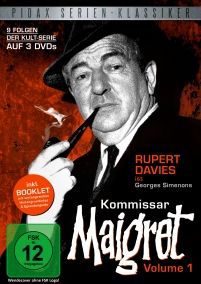
German company Pidax have announced they will be releasing Kommissar Maigret – Vol. 1 which contains nine of the first ten episodes from series one (originally broadcast in 1960/1961). Thirty-six episodes have been cleared via FSK (the German equivalent of the BBFC).

This would suggest that Pidax plan to release four volumes, each containing nine episodes.  Since all fifty-two episodes starring Rupert Davies exist, this would leave sixteen episodes unreleased.  As per one of the comments below, this may be because the episodes are being sourced from the available material contained within the German archives rather than new masters being obtained from the BBC (who hold a complete run).

Initial reports indicated the DVD would have both English and German language tracks, but now it seems that they may have German only.  So for now, it’s probably best to wait unril the DVD is in circulation before buying.

EDIT – Sadly it’s now confirmed that this DVD only has a German language track. That’s disappointing, but maybe a UK company (Simply or Acorn maybe?) might consider an English language release sometime in the future.

EDIT 8/9/15 – Volume two has been announced. Like volume one it only has a German language track – the included episodes are listed below.

1. Maigret und die Gangster (The Experts)
2. Maigret als möblierter Herr (The Cactus)
3. Maigret unter den Anarchisten (The Children’s Party)
4. Maigret und der Schatten am Fenster (Shadow Play)
5. Maigret und der Kopflose (The Simple Case)
6. Maigret trifft einen Schulfreund (Death of a Butcher)
7. Maigret und sein Toter (The Winning Ticket)
8. Maigret und Inspektor Lognons Trumph (Inspector Lognon’s Triumph)
9. Maigret und der geheimnisvolle Kapitän (The Lost Sailor)

Douglas Wilmer in Sherlock Holmes – The Disappearance of Lady Frances Carfax

carfax

Holmes muses to Watson that in his opinion “one of the most dangerous things in the world is the drifting and friendless woman. She may be perfectly harmless in herself, but all too often, she is a temptation to crime in others.  She is a stray chicken in a world of foxes, and when she is gobbled up, she is hardly missed. I very much fear that some evil has befallen the Lady Frances Carfax.” This monologue is a preamble to Holmes’ request that Watson travels to the hotel in Lausanne (where Lady Frances was last seen) so he can investigate her sudden disappearance.

Holmes is convinced that the trip will do his friend good, since he’s observed that Watson has been feeling run-down lately.  Watson, of course, is amazed that Holmes knows this – and Holmes’ explanation (involving the way Watson’s shoe-laces are tied) is a classic Conan-Doyle moment.

Watson travels to the hotel and speaks to the manager Moser (Roger Delgado).  Moser mentions that Lady Frances seemed to be worried by a bearded stranger and there’s also the question of why she gave a cheque for fifty pounds to her former maid.  The manager is also able to tell Watson that Lady Frances spent some time in the presence of Dr. Shlessinger and his wife.  This seems to be a dead-end though, as Dr. Shlessinger is a man of piety and devotion who surely can have connection to the case.

Watson’s investigations continue, but it’s maybe no surprise to learn that all of his efforts turn out to be futile.  Luckily, Holmes is on hand to shed some light on this tangled mystery.

The Disappearance of Lady Frances Carfax
was originally published in 1911. Like the preceding story adapted for the series, The Retired Colourman, it’s memorable for depicting an independent Watson, sent off to investigate by Holmes.  It’s just a pity that since this happened so rarely, the two were broadcast one after another.

But no matter, as once again we can enjoy the sight of Nigel Stock’s Watson in investigative mode.  As ever, Stock plays these scenes so nicely (witness the moment when Moser wonders if Watson is a detective and you can see Stock visibly grow in stature).  Of course, things don’t go very well and he has to be rescued by Holmes after he gets into a tussle with the bearded stranger.

Despite Holmes’ claims that he was too busy to make the trip, he has (after reading Watson’s initial reports) decided to come over after all – and Wilmer’s sudden appearance is delightful.  Holmes is wearing a very effective disguise and his ironic comment of “Dear me, Watson. You have managed to make a hash of things, haven’t you?” is one of the episode’s many highlights.

For those brought up with the efficient and unflappable Watsons of the Granada series, this may be a little difficult to take – but it’s totally consistent with Conan-Doyle’s original story.  As good as the Granada series was (for the most part) it’s fair to say that on occasions, their eagerness to redress the perceived imbalance in some of the previous portrayals of Watson sometimes pushed the character too far the other way (making him rather too capable).

This excerpt from the Conan-Doyle story is interesting –

To Holmes I wrote showing how rapidly and surely I had got down to the roots of the matter. In reply I had a telegram asking for a description of Dr. Shlessinger’s left ear. Holmes’s ideas of humour are strange and occasionally offensive, so I took no notice of his ill-timed jest.

The clear inference from this is that Watson is heading for a fall, since we know that Holmes never makes a frivolous request.  And the fact that Watson, after all his years of experience, should think so doesn’t reflect well on him.

It’s also worth viewing the Granada adaptation, which takes many liberties with the original story – including completely removing the plot-thread of Watson being sent to investigate Lady Frances’ disappeance (in the Granada version he’s already present at the hotel and sends for Holmes when he becomes concerned for Lady Francis’ safety).  All of Watson’s mis-deductions are therefore absent, which isn’t surprising since they would have jarred with the efficient and capable picture of Watson presented since series one in 1984.  It’s a valid decision, but it sits rather uneasily with the Granada’s original claim that they would return to the original stories and present them authentically (undoing the harm they considered was done by earlier portrayals, such as Nigel Bruce’s).

Thanks to Holmes’ intervention, it becomes clear that the bearded stranger is a friend not foe.  His name is the Hon. Philip Green and had Lady Frances’ family not objected, he would have married her years ago.  Joss Ackland (as Green) is completely unrecognisable (he’s sporting long black hair and a black beard).

One of my favourite actors, Ronald Radd plays Peters, the villian of the piece and a brief appearance by another favourite, Roger Delgado, is just the icing on the cake.  Holmes and Watson return to London and track down Peters (the erstwhile Dr. Shlessinger).  I love the moment when Holmes and Watson confront him.  Holmes warns Peters that Watson is a very dangerous ruffian and, after a moments pause, Stock raises his stick in a mildly threatening manner!  It’s only a little throwaway moment (possibly worked out in rehearsal) but it never fails to raise a smile.

Location filming in France helps to give the story a sense of authenticity and whilst there’s the odd production misstep (the body in the coffin looks very odd) all in all this is a very strong end to the series.

This would be Douglas Wilmer’s final appearance as Holmes in the series, as various factors made him decide not to return for a second run.  These included problems with scripts, directors and the news that series two would be made to an even tighter production schedule than the first.  For Wilmer (who considered that the quality of the series was already compromised) this was unacceptable, and it would be Peter Cushing who would have to deal with numerous production difficulties when the series returned in 1968.

It’s fair to say that the series suffers from the same problems of virtually every series of this era.  Boom shadows are a regular presence and the sets sometimes wobble (and so do the actors!).  The stories only had a limited amount of studio-time (with over-runs strictly frowned upon) so occasionally we will see scenes with technical problems (line-fluffs, malfunctioning props) that could have been resolved had the time been available for another take.

But the series also has all the strengths of television of this era – and the main strength is the sheer quality of the actors.  Peter Wyngarde, Patrick Troughton, Patrick Wymark, Nyree Dawn Porter, James Bree, Anton Rodgers, Leonard Sachs, Derek Francis and Maurice Denham are just some of the fine actors to grace the stories prior to this one.  And that’s not forgetting the numerous smaller roles which were equally well performed.

It’s not surprising that the lavish Granada series tends to be regarded as the definitive Sherlock Holmes television version as the BBC’s Sherlock Holmes will never be able to compete in a visual sense (the BBC series was much more studio-bound and therefore lacked the visual sweep of the Granada Holmes).  But these adaptations were as good (and as faithful, if not more so) to Conan-Doyle’s original stories.  Plus the first BBC series has an obvious trump card – Douglas Wilmer.

Few actors have ever been able to capture as well as Wilmer the icy, logical nature of Holmes.  Watson once called him “the perfect reasoning machine” and it’s this precise, mechanical nature that Douglas Wilmer portrays to perfection.  Many actors would have sought to soften him, but Wilmer stays true to Conan-Doyle’s original.  It’s a performance that never fails to impress, as Wilmer (even in the scenes where he has little dialogue) is always doing something that’s worth watching.

He’s complimented by Nigel Stock’s Watson.  It’s, at times, a rather comedic turn, but as I’ve mentioned it’s probably not as far removed from the original text as some people would think.

If you love Sherlock Holmes or you love 1960’s British television then the BFI DVD is a treasure.

Douglas Wilmer in Sherlock Holmes – The Retired Colourman

retired

Watson briefly meets Holmes’ latest client, Josiah Amberley (Maurice Denham), on the stairs.  When Holmes asks what opinion he formed of the man, Watson confesses he found him to be “a pathetic, futile, broken creature.”

Holmes agrees, but Amberley certainly seems to have cause for distress.  His wife has disappeared, along with Dr Ray Ernest (a friend of both of them).  Also, his strong-box has been forced and a considerable amount of cash and securities taken.  Can Holmes locate the pair as well as Amberley’s missing money?  Naturally, he can.  But the solution to the mystery isn’t quite as straightforward as it initially seems.

The Retired Colourman was one of the final Sherlock Holmes stories, originally published in 1926.  Given that it’s a very decent mystery, it’s surprising that this was the only time it was adapted for the screen.

With Holmes otherwise engaged, it falls to Watson to begin the investigation.  And this means that the story is a lovely vehicle for Nigel Stock’s Watson.  His performance in the series has, it’s fair to say, attracted some criticism over the years.  He’s not quite in the Nigel Bruce buffoon category, but neither is he as competent as the Granada Watsons.

Stock’s Watson is honest, loyal and totally unimaginative.  Yes, the series does delight in showing him to be several steps behind Holmes at all times, but if you closely read the original stories that’s a perfectly valid interpretation.  For example, in this story Holmes is very blunt when he tells Watson that his initial enquiries have missed almost everything of importance (this is taken directly from Conan-Doyle’s original story).

He’s paired up for most of the duration with Maurice Denham’s Amberley.  Denham, as expected, gives a fine performance and there’s something very entertaining about the combination of the relentlessly cheerful Watson and the doom-laden Amberley.

Holmes is rather cruel to Watson – as he sends him and Amberley off on a wild-goose chase so that he can do a spot of burglary at Amberley’s house.  Indeed, Holmes sends them so far afield that Watson and Amberley have to spend the night in a rather uncomfortable country hotel.  In the original story Watson speaks to Holmes on the phone, but here Holmes dictates a telegram to his unfortunate colleague.  The result is the same though and it’s clear from the expressions on the faces of Holmes and Mrs Hudson (making a rare appearance in the Wilmer series) that they have little pity for poor Watson, trapped at a hotel at Frinton with the unpleasant Amberley!

Denham and Stock are the chief reasons why this one is very watchable.  It’s true that there are a few plot-holes (particularly why Amberley decided to consult Holmes in the first place) but these are problems with Conan-Doyle’s story and Jan Read’s dramatisation is content to faithfully adapt the original material.  A generous amount of location filming helps to open the story out (some of the other studio-bound ones do tend to feel a little claustrophobic).

An interesting adaption of one of the “lesser” stories from the canon.

Douglas Wilmer in Sherlock Holmes – Charles Augustus Milverton

charles

Lady Eva Brackwell (Penelope Horner) has become the latest victim of master blackmailer Charles Augustus Milverton.  Milverton has acquired a bundle of rather indiscreet letters that she wrote to a young army captain.  If they fall into the hands of her intended husband,is the preferavle version.the Earl of Dovercourt, then there’s little doubt that their forthcoming marriage would be in serious jeopardy.

Holmes agrees to act for Lady Eva, but when Milverton holds all the cards, what can he possibly do?

Charles Augustus Milverton was originally published in 1904.  It’s a rather interesting story, mainly because Holmes doesn’t provide any resolution to the tale – a third party does – and therefore he needn’t have appeared at all.  Plot-wise, it strongly resembles A Scandal in Bohemia (both revolve around an incriminating item, which Holmes decides to retrieve via burglary).

Barry Jones’ Milverton isn’t demonstratively villainous.  Since he knows that his position is unassailable, he’s able to project a relaxed persona (although there’s little doubt of the evil that lurks beneath).  Holmes is well aware just how formidable a foe he is, as he tells Lady Eva.  “You have fallen into the hands of a very dangerous man. Charles Augustus Milverton is far from commonplace. In fact, one may safely call him the king of blackmailers. There are hundreds in this great city who turn white at his name.”

Holmes quickly discovers that Milverton can’t be threatened or intimidated and he won’t negotiate.  His price is seven thousand guinees – no more, no less.  When Holmes tells him that surely it’s better to accept a smaller amount than to expose Lady Eva for no personal gain, Milverton replies that it would suit his purposes very well.  If it become known that he had ruined Lady Eva, then his other victims would be all the more anxious to settle.  Penelope Horner’s Lady Eva is the nominal central figure, but it’s Lady Farningham (Stephanie Bidmead) who brings the story to its conclusion.  She had previously suffered at Milverton’s hands and we see her return to exact a measure of revenge.

If the main plot is quite linear, there’s a great deal of incidental business (mostly centered around Holmes and Watson) which make this one very enjoyable.  Nigel Stock is on fine form from the start – he’s disgusted with Milverton’s treatment of Lady Eva (indignantly calling him “a blackguard”) and later picks up a chair to attack him!

When Holmes decides that the only course of action is to burgle Milverton’s house, Watson insists on coming with him – despite Holmes’ protests.  Eventually Holmes agrees and tells him that “we have shared the same rooms for a number of years, my dear fellow. I suppose it might be amusing if we ended up by sharing the same cell.”

Wilmer has some lovely comic business when he’s disguised as a plumber who’s been courting Milverton’s maid (he later tells a shocked Watson that he’s become engaged to the girl) .  The pair enjoy a kiss and it’s obvious how discomforted Holmes is.  He gingerly places his hands on the girl and then shortly afterwards attempts to break free of her tight embrace.  Once they’ve finished, his first thought is to check that his false moustache is still in place!

The Granada adaptation was extended to two hours (and was broadcast under the name of The Master Blackmailer).  It kept the same basic plot as the original short story,  but the two hour running length ensured that a great deal of additional material had to be added.  This means that the Wilmer adaptation does bear more direct resemblance to Conan-Doyle’s original and so, for me, is the preferable one.

Douglas Wilmer in Sherlock Holmes – The Bruce-Partington Plans

bruce

Holmes’ brother Mycroft (Derek Francis) is a man of regular habits. Nothing (except the gravest crisis) would make him deviate from his normal schedule.  So when he turns up at Baker Street, with Inspector Lestrade in tow, Holmes knows it’s serious.

But his brother’s arrival is just what Holmes needs, as prior to this he had bitterly complained to Watson about how dull the London criminal had become. Now, Mycroft offers him an intriguing case of the most pressing urgency.

A clerk from the Royal Woolwich Arsenal, Arthur Cadogan West, has been found dead on the Underground tracks near Aldgate tube station. On his body were several documents relating to the top secret Bruce-Partington submarine. Several more vital documents about the submarine are missing and Mycroft urges Holmes to use all of his powers to track them down.  It seems obvious that Cadogan West stole the plans and had intended to sell them to the highest bidder. But as we’ve seen in previous stories, the truth is sometimes not quite so straightforward ….

The Bruce-Partington Plans was originally published in 1908.  It featured the second and final appearance of Mycroft Holmes. He first turned up in The Greek Interpreter, which was adapted for the second series of Sherlock Holmes (starring Peter Cushing).  Sadly, that episode is missing.

We’re slightly more lucky with this one, as the first half of the story exists (and there’s an audio copy of the second half).  For this DVD, the audio for the missing half has been nicely cleaned up and is synchronised to a reproduction of the script (with images of the cast in the background).

This works pretty well, although since the soundtrack is so clear it probably wasn’t necessary to have the script on-screen at the same time as the audio.  Instead, a decent reconstruction could have been made with images taken from the first half, along with on-screen descriptions for any visual sequences.  But while the script is sometimes distracting (mainly because it often varies from the actual dialogue spoken) it still clearly allows the viewer to understand how the story concludes.  It’s also interesting that the soundtrack for the existing half of the story doesn’t seem to be in the greatest shape – at various points the odd word is inaudible.

But although the ravages of time have rather compromised this story, what remains is very decent fare.  Derek Francis is a rather good Mycroft and though this story doesn’t have the same sort of one-upmanship that The Greek Interpreter did, there’s still some nice moments between the brothers (mainly visual ones).  For example, when Holmes offers Mycroft a seat, Mycroft promptly takes Holmes’ own – much to Holmes’ annoyance (and Watson’s amusement!).  Later we see Mycoft very freely use Holmes’ tobacco – and again there’s a slight flicker of annoyance from Sherlock.

An effective piece of model-work (a rather nice train!) and a smoky studio set help to bring the railway section of the story alive in the first half of the story and, as ever, The Bruce-Partington Plans boasts the usual quality cast (even in the smaller roles).

John Woodnutt (a highly familiar face during four decades or more of British film and television) is the station-master, whilst Gordon Gostelow (again, another very well-known actor) plays Sydney Johnson, Cadogan West’s superior.  Allan Cutherbertson, whose lengthy career included a visit to Fawlty Towers as well as a stint acting as Tommy Cooper’s straight-man, was no stranger to dramatic parts – and he’s well-cast as Colonel Valentine Walter.  It’s a pity that his more intense scenes come at the end of the story, when we don’t have the visuals.

As we’ve previously seen, Wilmer’s Holmes can be incredibly rude and off-hand at times.  His dismissal of Lestrade early in the story is a case in point and Stock’s Watson covers well for him – Holmes is clearly a man for whom social niceties count for very little.  But although he can be chilling at times, he’s also able to extend a degree of courtesy – witness his interview with Cadogan West’s fiance Violet Westbury (Sandra Payne).  Violet was convinced that her late fiance was innocent and though Holmes couldn’t hide his irritation when he realised she had little useful to tell him, he was still able to reassure her that he would do everything he could to restore Cadogan West’s honour.

Few actors have ever quite managed to capture all the nuances of Holmes’ character quite as well as Douglas Wilmer did – and he’s a major reason why this series should continue to be enjoyed by anybody who loves the original Sherlock Holmes stories.

Douglas Wilmer in Sherlock Holmes – The Beryl Coronet

beryl

Alexander Holder (Leonard Sachs) is a well-respected city banker.  Early one evening he is visited by a prominent member of society who urgently needs £50,000.  Holder is happy to advance the money, especially when he’s given the Beryl Coronet as collateral.  Holder shows it to his son and niece and though he admits it’s not quite the Crown Jewels, it’s certainly highly impressive – and is worth at least double the amount he’s advanced.

Holder’s son, Arthur (Richard Carpenter), is worried about such a valuable item residing overnight in their house, but he also has concerns of his own.  Although he’s an amiable sort, Arthur is a gambler and owes a considerable sum.  He asks his father for several hundred pounds, but Holder refuses – he’s tired of settling his son’s gambling debts.

In the middle of the night, Holder is awoken and comes downstairs to find the coronet in the hands of his son.  He is appalled to find that the crown is broken and three beryls are missing.  Arthur offers no defence and is arrested.  Although an intensive search is carried out, there’s no trace of the missing jewels.  It seems to be a simple case and Arthur’s guilt appears to be obvious, but Holmes is never prepared to take anything at face value.

The Beryl Coronet was one of the earliest Sherlock Holmes short stories (originally published in the Strand Magazine in 1892).  Since it was never adapted for the Granada series, the Douglas Wilmer version is quite noteworthy, as it’s the only sound version of the story (it was twice adapted for the silent screen, in 1912 and 1921).

Although Wilmer and Stock don’t enter the story until the 17th minute, it’s still a lovely vehicle for both of them.  Wilmer’s Holmes is rather enigmatic in this one – until he reveals the true solution to Holder at the end, he’s not prepared to share any of his theories.  This, of course, helps to sustain the mystery, which is no bad thing.  Holmes also gets to don a disguise (which totally fools Watson!)

The story boasts a strong supporting cast.  Leonard Sachs (best known for The Good Old Days) is the unfortunate Holder, whilst Richard Carpenter is his son, Arthur.  Carpenter was a decent actor, but it’s his later career as a writer that he’ll undoubtedly be best remembered for.  Amongst his many writing credits were the well-remembered Look and Read serial The Boy From Space, Catweazle, The Ghosts of Motley Hall, Dick Turpin and the best television adaptation of the Robin Hood legend – Robin of Sherwood. He’s very appealing as the unfortunate Arthur, who’s regarded by everybody (except Holmes and Watson) as clearly guilty.  Another noteworthy appearance comes from David Burke as the devious Sir George.  Burke would later play Watson opposite Jeremy Brett’s Holmes during the first two series of the Granada run.

The Beryl Coronet possibly wasn’t the most obvious story to adapt, but I’m glad they did – especially since nobody else had done so since 1921!  Wilmer continues to dominate the screen and it’s easy to see why, for so many people, he’s regarded as the archetypical Holmes.

Douglas Wilmer in Sherlock Holmes – The Man with the Twisted Lip

twisted

Mrs St. Clair (Anna Cropper) has travelled to London to conduct some business.  On her way back to the train station, she passes through Upper Swandam Lane (home to a notorious opium den).  Mrs St. Clair is astonished to see her husband briefly at the upper window of this disreputable place – but a second later he vanishes (as if pulled back by some unseen hand).

Neville St. Clair is a respected journalist who would have no reason to visit such a dive – unless he was a secret opium addict.  When Mrs St. Clair returns with the police they find no trace of her husband, although in the upstairs room they do discover a box of children’s blocks.  Mrs St. Clair collapses, as her husband told her he planned to buy such a toy for one of their children that very day.  Mr St. Clair’s clothes are also discovered.

All the evidence suggests that a well-known beggar, Hugh Boone (Anton Rodgers), was with Mr St. Clair when he was spotted by his wife.  Boone is quickly picked up by the police, but he’s saying nothing.  Holmes is convinced that Boone holds the key to Neville St. Clair’s disappearance – which he does, although Holmes’ solution is a most unexpected one.

The Man with the Twisted Lip was one of the original batch of Sherlock Holmes short stories, published in the Strand Magazine in December 1891.  Jan Read’s dramatisation is pretty faithful to the source material, but it’s a pity that the original, striking, opening wasn’t used.  In Doyle’s story, Watson travels to the opium den to extract a friend of his, Isa Whitney, who has fallen under the thrall of the drug.  When he’s leading his friend outside, he’s accosted by an old man (who turns out to be Holmes in disguise).  Holmes then explains that he’s investigating the disappearance of Neville St. Clair.  In Read’s adaptation, Watson does discover a disguised Holmes, but it sits rather uneasily in the middle of the story (where it makes less sense).

Although his screen-time is quite limited, Anton Rodgers is very effective as the disfigured beggar, Hugh Boone.  Anna Cropper, as Mrs St. Clair, is the latest stoic beauty to turn to Holmes for help.  A sign that retakes were only undertaken in the gravest circumstances is demonstrated by the scene where Mrs St. Clair visits Baker Street.  After lifting the veil from her hat, it falls down again and she simply has to push it back up and carry on.

Given the small pool of ethnic actors working in the UK during the period, it was very common to see British actors playing characters of every nationality.  Here we see Olaf Pooley (as the villainous Lascar) browned up.  To modern eyes it may seem strange, but it wasn’t an unusual occurrence at the time.

The Man with the Twisted Lip benefits from some atmospheric location filming in the East End.  The story could have been shot entirely in the studio, but the real locations certainly add something to the end product.  Within a few years redevelopment would have changed the locations beyond all recognition, so they were used at just the right time.

The first story of the series to be made (it was recorded in September 1964) it’s a very efficient production.  Given that the majority of the stories adapted for this series were later also adapted for the Granada series, it’s difficult to avoid comparing the two.  It’s slightly unfair though, since the Granada series had a much larger budget and therefore it would always score highly, particularly in a visual sense.  But whilst the Wilmer series has more modest production values, it can certainly hold its own performance wise, and in the end it’s the performances that really matter.

Douglas Wilmer in Sherlock Holmes – The Six Napoleons

six

Inspector Lestrade (Peter Madden) pays a visit to Baker Street and recounts a strange tale to Holmes and Watson.  Someone in London seems to have such a hatred of the late Emperor Napoleon that they’ve taken to smashing miniature busts of him.  What’s even odder is that they’ve resorted to burglary to do so.

Dr Barnicot (James Bree) is a collector of Napoleonic memorabilia, and he’s disturbed to find both his office and house have been burgled and in each case a bust of Napoleon has been smashed to smithereens.  When another burglary takes place, at the home of a journalist called Horace Harker (Donald Hewitt), Harker not only finds his statue smashed, but a dead body as well …..

Like The Abbey Grange, The Six Napoleons was one of the stories published after Holmes’ return from his tussle with Moriarty at the Reichenbach Falls (later collected in the volume entitled The Return of Sherlock Holmes).

The farcical side of the story is emphasied in Giles Cooper’s adaptation.  Bree’s Dr Barnicot is a character who’s certainly played for laughs – he’s depicted as a highly eccentric devotee of Napoleon who advances three theories (all of them bizarre) to Holmes, Watson and Lestrade in order to explain who could have committed such an outrage.

Wilmer, Stock and Madden have little to do in Bree’s scene – but Wilmer especially is a joy to watch as he rolls his eyes at Barnicot’s wild flights of fancy and beats a hasty retreat as soon as he politely can.  When Barnicot is alone again, he takes out a Napoleonic hat and, after putting his arm inside his jacket, strikes a suitably heroic pose by the mirror.  You get the feeling that he does this a great deal!  James Bree was certainly an idiosyncratic actor, capable of performances of depth and subtlety (series one of Secret Army) as well as turns which verged on the bizarre and unwatchable (the Doctor Who story, The War Games).  He’s quite odd here, but since he plays it as scripted and only has a small cameo appearance, it’s quite acceptable.  Had he appeared throughout, it might have been quite wearying though.

The opening of the next scene is nice – Watson is striking a Napoleonic pose back at Baker Street, to the amusement of Holmes and Lestrade.  It’s only a little throwaway moment, possibly worked out in rehearsal, but it does help to reinforce the bond of friendship between them.  Since Wilmer’s Holmes tends to be quite serious, the odd lighter moment is welcome.

The Six Napoleons sees the first appearance of Peter Madden as Lestrade.  Characteristically, Wilmer’s Holmes doesn’t pretend to be particularly pleased to see him at the start of the story – he offers him a chair with the air of a man who’d be equally happy if he left straightaway.  But as soon as he piques Holmes’ interest, the Great Detective is clearly much more kindly disposed to him!

It’s a studio-bound production, but director Gareth Davies does manage to make the most of the limited space and he offers the viewer a few good flourishes.  My favourite is the scene set immediately after the burglary at Harker’s house.  The camera tracks past a number of statues, as well as a policeman standing so immobile that he could be mistaken for a statue.  Which is almost what Watson does, as we see him walk down the line, identifying each statue to Holmes – before giving a double-take as he reaches the policeman.

Elsewhere, the limitations of the studio environment are more apparent.  There’s a brief scene set in the garden outside Harker’s house, which shows the sky to be a rather wrinkled backdrop.  Moving clouds are projected on it – had the backdrop not been so tatty it would have been quite effective.

The comic turns contunue throughout the story.  Later, Holmes finds himself caught in the middle of Josiah Brown and his wife (Arthur Hewlett and Betty Romaine) who are a rather voluble couple.  Wilmer’s pained expession is priceless.

Indeed, this is a story where the solution of the mystery is somewhat secondary to the performances.  Giles Cooper’s adaptation is good fun and certainly allows the cast plenty of scope to produce some ripe turns.

Douglas Wilmer in Sherlock Holmes – The Abbey Grange

abbey

Holmes and Watson are summoned to the Abbey Grange by Inspector Hopkins (John Barcroft) to investigate the murder of Sir Eustace Brackenstall.  His wife, Lady Brackenstall (Nyree Dawn Porter), was also attacked, but only received superficial injuries.

Holmes is irritated to have been called out as the solution seems obvious.  The district has been plagued by the Randall gang (a father and two sons) who have committed several burglaries in the neighbourhood.  After listening to Lady Brackenstall’s story, there seems no doubt that the Randall gang were responsible for this outrage as well.

But on the way back to London, Holmes isn’t happy.  It’s only a small point which worries him (concerning three wine glasses) but it’s enough to make him return to the scene of the crime and look again at the evidence.

The Abbey Grange was originally published in 1904 (it was one of the stories published directly after Holmes’ remarkable return from the Reichenbach Falls).  Sadly, this is one of two episodes which are incomplete in the archives.  Each story was made up of two 25 minute reels – and in the case of The Abbey Grange the first reel is missing (for The Bruce PartingtonPlans, the second reel has been lost).

The DVD has filled in the missing section in a novel way – with a reading by Douglas Wilmer.  Since the adaptation made a few changes to the original story, the text has also been slightly adjusted – but it’s basically the same as Conan-Doyle’s original.  This reading runs for around twenty minutes and works pretty well – although it might have been better to have reduced the text to a summary of around half the time.  But kudos to the BFI and Douglas Wilmer for making it happen, it’s certainly a nice bonus feature.

When we get to the existing section, it’s a chance to observe Holmes at his analytical best – puzzling over the three wine glasses and the severed end of the bell-rope.  His observations are enough to reveal the identity of the true murderer (which is something the police never discover).  As with several stories in the canon, Holmes elects to take the law into his own hands, calling on Watson to act as the jury.  Watson finds the man not guilty – so he’s allowed to go free.

The gorgeous Nyree Dawn Porter is effectively winsome as Lady Brackenstall, a woman who now finds herself freed from the clutches of a cruel and abusive husband.  Peter Jesson has the small (but important) part of Captain Croker, whilst Peggy Thorpe-Bates (later to be a formidable “She” opposite Leo McKern’s Rumpole) is Lady Brackenstall’s faithful maid.

With a large portion of the story missing, it’s difficult to assess how effective it is overall – but what we do have is impressive, and it works particularly well as a showcase for Wilmer’s Holmes.

Douglas Wilmer
Douglas Wilmer

Doctor Who – Rose

rose

It’s somewhat astonishing to think that ten years have elapsed since Rose was transmitted.  But then, as somebody once said, time is relative.  In many ways, it’s difficult to rewatch any Doctor Who story and not be aware of the place it holds in the history of the series (i.e. what came before it, what was to come later).

But for those new viewers tuning in on the 26th of March 2005, Russell T. Davies had written Rose in such a way that it was possible to have a clear grasp of the fundamental aims of the show without having seen any previous episodes.  He’d clearly learnt the lessons from the TVM nine years earlier (which was an uncomfortable continuity-fest in many ways).

For us old hands, there were plenty of nods to the series’ past (Autons breaking through shop windows!) but never at the cost of alienting the new audience.  Rose was therefore a clean slate – with no previous baggage.  Of course, over the next ten years, Doctor Who would start to load all of the baggage back on (as soon as the show was an established success.)

Whether this is a good or bad thing depends on your point of view.  There’s no denying, for example, that many people’s inner-fan was warmed by the return of Rassilon (and played by Timothy Dalton, no less) but too many returning elements from the series past will tend to stifle originality and creativity.  It’s often said that 1980’s Doctor Who was continuity-obsessed, but NuWho has been equally (if not more) guilty of the same crime.  But since NuWho is a ratings and critical success, it seems to be tolerated.

All this was in the future when Rose first aired.  Nobody knew how successful the series would be.  Many were convinced that the 2005 series would be the first and last of the revived show.  After all, Doctor Who (whilst it’s always maintained a small but vocal fandom) had been a critical punching-bag for the majority of time it had been on the air.  There had been good reviews from time to time (especially during the early Tom Baker years) but generally the show had acquired the air of a faded, shabby institution – tolerated at best, rather than loved by the BBC.  In its later years it still attracted love and affection from the fans – but more for what it had been, rather than what it was at the time.

The ratings success of Rose (9.9 million viewers) came as a surprise to many.  Of course, this was written off by some critics as simple curiosity – in the weeks to come, they said, the ratings would slide inexorably downwards.  But though there was the odd dip, usually during the weeks when the weather was at its best, the ratings held firm and the show was an undeniable hit.

Revisiting Rose after a number of years, it’s possible to see that it has many of the strengths (and the weaknesses) of NuWho in general.  It has a decent story (if a little vague in places) and it moves at a fast pace.  But this is part of the problem – as 45 minute stories will never allow for the same character development which the original series enjoyed.  Outside of the regulars, only Clive (Mark Benton) has any decent screen time – and his function is essentially to tell Rose (and the audience) exactly who the Doctor is.  NuWho would employ many fine guest actors, but the reduced running times of the stories tended to ensure that many were rather wasted.

Let’s rewind back to the start of the episode.  It hits the ground running and by the time we’re 120 seconds in, we have a good idea about Rose’s life.  She works in London (the big red buses are a giveaway!), lives with her mum, has a boyfriend and has a job in a department store.  Once these visual clues have been laid before us, the story proper can begin.

Rose is menaced by a collection of shop window dummies in the store’s basement and is rescued by a mysterious stranger.  He tells her that the dummies are living plastic and he intends to destroy their relay device on the roof.  Oh, and he introduces himself as the Doctor.

The Doctor does destroy the relay device (and most of the building as well).  It’s certainly a dramatic opening – although it begs the question as to whether the Doctor miscalculated the strength of the bomb or whether he simply didn’t care about the possible loss of life that might follow.

Christopher Eccleston was seen as a considerable casting coup, although the announcement (four days after the transmission of this episode) that he wouldn’t be returning for a second series did rather put a dampener on things.  He’s fine in this episode – not outstanding, just fine.  He never seemed totally at ease in the role – although this may be an inevitable consequence of knowing that his time in the role was already ticking away.

He does have some good moments though – the flat scene with Rose (where he’s in the background – examining his ears, fooling around with playing cards, etc) is nicely done as is the following scene which is clearly an important one, as it shows Rose beginning to understand who the Doctor is.  It starts with a long scene shot with no cuts (this lasts 1:20, which in modern television terms is an absolute age without a cut).

By this time, the idea that the Doctor has some connection to a small blue box has been made – although there’s still no assumption that the audience will know what it is or what it does.  That comes later, when it’s fully explained.

So now we’re 15 minutes in and the basics of the series have been established.  Mysterious plastic mannequins, a strange man who fights them (alone and without help) and a young shop-girl who’s been drawn inexorably into his orbit.  Although this is the second time that the Doctor’s left Rose behind, it’s inevitable that they’ll meet again – and already we’ve seen that they’ll make perfect travelling companions, as Rose appears to have little to keep her at home.  She obviously loves her mother (but is irritated by her at the same time) whilst her boyfriend is rather a dead loss.

This is one of the drawbacks of Rose.  It seems that the only way that Rose could be made such a strong character was by painting Mickey (Noel Clarke) as an ineffectual coward.  It really does him no favours at all, although later stories were able to redress the balance somewhat.

If the plot is gossamer thin (the Nestene Consciousness wishes to take over the world, because it can) it’s maybe inevitable this would happen, since establishing the main characters and the series format was the most important concern of story one.

In the end, it’s Rose that saves the day by rescuing the Doctor.  Did the Doctor actually need her help or was he subtly manipulating her?  It’s possible to view the scene in either way, but it’s true that once she has saved him, Rose feels more of a connection to the Doctor – which makes it more likely she’ll decide to accept his offer of travelling in the TARDIS.

Apat from the odd dodgy CGI effect, this has aged pretty well.  As the episode title suggests, Rose dominates and Billie Piper is pretty much perfect.  It’s a solid opener that didn’t attempt to be too ambitious and therefore gives the series a decent platform to build on.

Douglas Wilmer in Sherlock Holmes – The Red-Headed League

red

Holmes is distracted from the pursuit of a daring young criminal called John Clay (David Andrews) by the arrival of Jabez Wilson (Toke Townley) who has a most curious tale to tell.

Wilson makes a decent, if not particularly profitable living, as a pawnbroker.  But then his young assistant Vincent Spaulding draws his attention to the following newspaper advertisement.

On account of the bequest of the late Ezekiah Hopkins, of Lebanon, Pennsylvania, U.S.A., there is now another vacancy open which entitles a member of the League to a salary of four pounds a week for purely nominal services. All red-headed men who are sound in body and mind and above the age of twenty-one years are eligible. Apply in person on Monday, at eleven o’clock, to Duncan Ross, at the offices of the League, 7 Pope’s Court, Fleet Street.

Wilson and Spaulding duly apply and Ross (Trevor Martin), most impressed with Wilson’s fiery red hair, offers him the position on the spot.  His duties are quite straightforward – each day he has to copy out pages from the Encyclopedia Britannica.  But he has to remain within the offices of the League the whole time (if he leaves for any reason, then he forfeits his position).  Spaulding tells him that he’d be happy to run the shop whilst Wilson is working at the League, so all seems well.

For a while, everything is ticks along nicely.  But then, without warning, Wilson arrives one day to find that the office is shut and nobody else in the building has ever heard of the Red-Headed League.  Was it all just an elaborate practical joke or is there a more sinister purpose at play?

The Red-Headed League (originally published in 1892) is one of my favourite Sherlock Holmes stories, although I do find this adaption to be a little flat.  This is partially because it’s a tale that works better on the printed page than on the screen, but there are other problems.  The story rests on the notion that Jabez Wilson has such a head of fiery red hair that Duncan Ross, once he sees him, instantly sends all the other applicants away.  It’s difficult to show this in black and white though!

The major difference between Anthony Read’s teleplay and Conan Doyle’s original is that in Read’s version we know about John Clay from the start, whereas in the Doyle original we open with Wilson’s strange story and it’s only much later that Holmes realises that Clay is involved.  I’m not sure whether Read’s embellishment is an improvement or not, but it helps to bulk out the running time somewhat.

Toke Townley (best known as Sam Pearson from Emmerdale Farm) doesn’t look much like Doyle’s description of Wilson (he described him as a stout, florid-faced elderly gentleman) but he has decent comic timing and is quite a sympathetic character.  Although Carla Challoner (as Wilson’s maid) only has a small role, she’s rather striking and coincidentally one of her other 1965 television appearances (as Zenna Peters in the Out of the Unknown episode Thirteen to Centaurus) has also recently released by the BFI and is well worth a look.

The other notable guest turn comes from David Andrews as Vincent Spaulding/John Clay. He had an interesting career, and had begun to make the change from an actor to a director at around this time. Along with Trevor Martin, Andrews discusses this and numerous other matters on a chatty commentary track moderated by Toby Hadoke.

This is a wholly studio-bound production which is competently handled by Peter Duguid, although the opening scene does have some quick cuts which maybe don’t quite work as well as they should.  Whilst this episode has a certain charm, for me the later Granada version with Jeremy Brett edges it.

Douglas Wilmer in Sherlock Holmes – The Copper Beeches

copper

When Sherlock Holmes proffers the letter he’s received from Miss Violet Hunter (Suzanne Neve) to Watson, he tells him that it marks a new low-point in his career.  Miss Hunter has been offered a position as a governess, but wishes to seek Holmes’ advice before accepting the post.

Although it initially seems like a trivial matter, once Miss Hunter begins her strange story it becomes clear that there may be more to it than meets the eye.  Miss Hunter has been offered a position by Jephro Rucastle (Patrick Wymark).  Rucastle seems to be a charming man and he makes her a very generous offer – a salary of one hundred pounds a year (a considerable amount, which is much more than many people in her position could ever expect to earn).

Rucastle goes on to tell her that he and his wife (faddy people, he admits) may ask her to sit in a certain chair or wear a certain dress from time to time.  This isn’t a problem, but when Rucastle insists that she has to cut her long hair very short, Miss Hunter protests.  When Rucastle later increases the salary to one hundred and twenty pounds, she weakens – but she wishes to consult Holmes first.  Miss Hunter decides to take up the post, but keeps in contact with Holmes as strange events begin to happen.

The Copper Beeches was originally published in June 1892 and later formed part of the first collection of Holmes short-stores, The Adventures of Sherlock Holmes.  Patrick Wymark (best known as the scheming Sir John Wilder in The Plane Makers and The Power Game) is wonderful as Rucastle.  Alternatively charming and sinister, it’s a very memorable performance.

Suzanne Neve, as the plucky young Miss Hunter, is another strong piece of casting (fans of UFO will remember her as Straker’s ex-wife Mary).  As with the original story, Holmes and Watson are very much on the periphery, so it’s Miss Hunter and Rucastle who dominate proceedings.

It’s certainly a strange household that she finds herself in.  Rucastle’s wife (played by Alethea Charlton) is polite, but seems somewhat under her husband’s thrall.  There’s a rather surly couple of servants, Mr and Mrs Toller (Michael Robbins and Margaret Diamond), whilst the Rucastle’s young son, Edward (Garry Mason), is a most peculiar child.

Although Rucastle insists that his son will grow up to be an important man, there’s little evidence of that in the very brief time we spend with him.  As per the original story, Edward doesn’t feature very much – but Vincent Tilsley’s adaptation does add a little something which sharpens the characters of both father and son.  In Conan-Doyle’s story, Miss Hunter tells Holmes that Edward delights in catching all manner of animals, such as mice.  Tilsley adds a scene where Edward bashes a mouse to death in front of Miss Hunter (with Rucastle looking on approvingly).  It helps to add another rather discordant note and it’s one of a number of good character moments for Wymark.

Although, as mentioned, Wilmer and Stock don’t have the largest of parts in this one, they do enjoy some decent byplay, especially at the end when Watson appears briefly convinced that Holmes had asked Miss Hunter to marry him!  We saw that Holmes was enamored of Miss Hunter’s analytical abilities, but his appreciation of her clearly went no further than that.

It’s a decent comic moment to end the story on and overall The Copper Beeches is a faithful and entertaining adaptation of one of the most atmospheric of the early Holmes stories.

Douglas Wilmer in Sherlock Holmes – The Devil’s Foot

devil

Stress and overwork have affected Sherlock Holmes’ iron constitution, so both he and Dr Watson have decided to take a holiday in Cornwall. Holmes, naturally enough, abhors inactivity and is keen to seize on any distraction – so when the vicar (John Glyn-Jones) bursts into their cottage early one morning with a tale of death and madness, he’s immediately interested.

Three members of the Tregennis family have been struck down in a most inexplicable way – the sister is dead whilst the two brothers have been driven quite mad. A fourth Tregennis sibling, Mortimer (Patrick Troughton), was present with them the previous evening, but he insists that when he left all was well.

Holmes and Watson risk their own sanity to solve this devilish puzzle ….

Originally published in 1910, The Devil’s Foot was one of Conan-Doyle’s favourite Sherlock Holmes stories (he ranked it ninth out of twelve favourites). With a very limited number of suspects it’s not really a whodunnit, rather it’s a howtheydunnit.

According to legend, when the script was delivered it was found to be dramatically under-running, so both Douglas Wilmer and Nigel Stock intensively worked on it and were able to bring it up to the correct length. This is mentioned in the BFI booklet, so there must be some credence to the story, but it’s hard to understand why the actors had to do this (rather than script-editor Anthony Read).

Douglas Wilmer does give his opinion about what Anthony Read was doing at the time (via the highly entertaining commentary track). I won’t reveal what he says, but it’s not terribly complimentary! The comm track on this episode is a must listen as though Wilmer is 95, he’s still as sharp as a tack. Although his dissatisfaction with some parts of the series was well known (this was the reason he didn’t do a second series) I wasn’t quite aware just how unhappy he was.

He seems to have had problems with the producer, some of the directors (who he considered to be far too inexperienced) as well as several of the adaptations. Overall, he doesn’t seem to have enjoyed himself at all – which is a pity, partly because it’s still an impressive series (despite whatever was happening behind-the-scenes) but also because it’s the programme he’ll always be best remembered for. But although making the series wasn’t always a happy one, he’s still got a sharp sense of humour and this helps to stop the commentary track from simply being a long list of complaints.

The story benefits from location filming in Cornwall (the jagged cliffs and stormy seas are particularly photogenic). It’s just a shame that the original film sequences no longer exist (as the telecine process has made the images rather murky).

There’s a remarkable performance from John Glyn-Jones as the vicar. I can’t decide whether he’s playing his initial scenes (where he describes the horror of the Tregennis house) for laughs or if he’s simply overplaying to a ridiculous degree. Much more assured is Patrick Troughton as Mortimer Tregennis. It’s always a pleasure to see Troughton and whilst it’s a fairly low-key part, Troughton’s class still shines through (although his Cornish accent is a bit hit and miss).

Mortimer Tregennis is a rather shifty type, so he appears to be the prime-suspect – meaning that his death (in an identical fashion to his sister) mid-way through the story is a good twist. Suspicion then falls on Dr Sterndale (Carl Bernard) who has already clashed swords with Holmes earlier on.

Holmes eventually divines the way the murders were carried out and elects to undertake an experiment to replicate the same effect. Watson is steadfast in accepting to stay with him and afterwards we see a very nice moment between Holmes and Watson (and Wilmer and Stock of course). If Wilmer’s Holmes is often rather detached and analytical (with not too much of the warmth and humour that some actors have brought to the part) then the aftermath of the experiment provides us with a telling scene.

Holmes berates himself for risking both his and Watson’s life, although Watson tells him that “it is my greatest joy and privilege to help you.” Any Holmes/Watson relationship will only work if you believe that they enjoy a strong bond of friendship – if Holmes is too remote or Watson too stupid, then it’s difficult to fully invest in the characters.

Some of Doyle’s stories, like this one, do feel slightly stretched when adapted for a fifty minute slot, but overall The Devil’s Foot is very decent fare – thanks to Troughton, the Cornish location and the continuing good work from Wilmer and Stock.

Douglas Wilmer in Sherlock Holmes – The Illustrious Client

client

Holmes is consulted by Sir James Damery (Ballard Berkeley) who is acting for an unnamed (but illustrious) client. Violet de Merville (Jennie Linden) is engaged to be married to Baron Gruner (Peter Wyngarde). Gruner has an evil reputation (several deaths, including that of his former wife, can be laid at his door – although he’s never actually been convicted of anything).

Many people have attempted to warn Violet off, but she is completely besotted with Gruner and won’t hear a word against him. Holmes agrees to act but Gruner is a very dangerous man, so by opposing him Holmes will put his life in danger …..

The Illustrious Client was one of Conan Doyle’s final Holmes tales (originally published in 1924). The majority of stories adapted for this series tended to be drawn from the earlier runs (which are generally considered to be stronger) but since this one has a formidable villain it’s no surprise that it was selected.

Peter Wyngarde (later to play the dandy writer and sometimes detective Jason King) is compelling as the malevolent Gruner. Yes, his accent is a little distracting, but he manages to display such a sense of menace that you can forgive him for that. Gruner’s relationship with the unfortunate Violet is an interesting part of the adaptation – he makes no attempt to hide his cruel streak, instead he seems to revel in mistreating her (and she either enjoys it or is so blinded that it simply doesn’t register).

Linden (who would play Big Screen Barbara later that year in Doctor Who and the Daleks) exerts an icy control over herself whereas Rosemary Leach (as Kitty Winter) barely has any control at all. Kitty was one of the Baron’s many previous conquests – used and then tossed aside. She agrees to help Holmes in his attempt to make Violet see exactly what sort of a man the Baron is, but she also has her own agenda.  It was one of Leach’s earliest television appearances and she’s very watchable as the bitter and damaged Kitty.

There’s plenty to enjoy in this one. Holmes and Watson take a trip to a music hall to visit one of Holmes’ underworld contacts. Although it’s only a studio set, it looks very impressive and clever camera angles manage to hide how small it is (and how few people are actually there).

Holmes and Gruner face off in a spellbinding scene (lifted virtually verbatim from the original story) which is a perfect showcase for both Wilmer and Wyngarde. The only thing that slightly spoils it is some rather wonky camerawork at the start (which was something that tended to happen in VT dramas of the period – a pity they couldn’t have gone back for another take).

Nigel Stock might be largely used for comic relief, but he still manages to instill Watson with a certain dignity. Although it must be said that one of the drawbacks of making his character seem a little dense is that when Holmes asks him to swot up on Chinese pottery (so he can distract Gruner, whilst Holmes burgles his study for incriminating evidence) it’s difficult to believe that he’d be able to pull it off.

But he does pretty well and the scene between Stock and Wyngarde is another good one – Wyngarde is arrogantly playful, whilst Stock falls back on bluster when he realises he’s on shaky ground.

Like some other Sherlock Holmes stories, there’s no real mystery here – rather the story revolves around the different characters and the way they interact with each other. And thanks to the first-rate guest cast (headed by Peter Wyngarde and Rosemary Leach) it’s a memorable fifty minutes.

Douglas Wilmer in Sherlock Holmes – The Speckled Band

speckled

Helen Stoner (Liane Aukin) leads a lonely existence in the rambling home she shares with her remote, forbidding father Dr. Grimesby Roylott (Felix Felton). Over the last few years, she’s felt even lonelier – ever since her beloved sister Julia (Marian Diamond) died in very mysterious circumstances.

Julia had been engaged to be married and was due to shortly leave them – but tragedy struck before this could happen. And her last whispered words to her sister (“the speckled band”) have stayed with Helen ever since.

Shortly before her death, Julia was convinced that something would happen to her (she claimed to hear strange whistles in the dead of night, which she found very unsettling). Now, two years later, Helen is engaged herself and it seems that the same pattern is happening all over again. In desperation, she consults the one man who can help her – Sherlock Holmes.

One of the most famous of all the Sherlock Holmes stories, The Speckled Band was originally published in 1892. Given its enduring appeal, and the fact it’s an intriguing “locked room” mystery, it was an obvious story to kick off the series. Although when it first aired, in 1964 as part of the Detective series, it wasn’t a certainty that a series would be commissioned. But this was clearly successful enough to ensure that another twelve stories followed in 1965.

The first twelve minutes take place in and around Dr Roylott’s house at Stoke Moran. Although this means we have a little wait before we get to see Wilmer, this scene-setting works well, since it establishes the claustrophobic location (which is certainly dark and forbidding) as well as Holmes’ client Helen and her father, the tyrannical Dr Grimesby Roylott.

When we do see Holmes for the first time, it’s a very low-key appearance. Helen has already clearly outlined the facts of the case to Holmes and our first glimpse of Wilmer is just a back view. Watson (Nigel Stock) then enters the room, greets Helen as Holmes steps out the frame and tells the Doctor that Helen “has brought a strange and tragic tale to our breakfast table.”

Holmes then offers Julia some coffee, but his face remains unseen until Julia tells Watson that she trembles not through cold, but fear. The camera then switches to a close-up of Wilmer as he assures the woman that “you must not fear. We shall soon set matters to rights, I have no doubt.” It’s an unshowy, but impressive introduction.

If Nigel Stock sometimes ventures into Nigel Bruce territory (he can lack the subtlety that later Watsons, such as David Burke and Edward Hardwicke brought to the role) it’s also clear that even this early on, Wilmer is pretty much perfect. He displays many of Holmes’ key attributes during Julia’s consultation him (being both charming and aloof).

Liane Aukin is very appealing as Helen and Felix Felton invests Dr Roylott with just the right touch of mania. It’s pleasing to see that one of the signature moments of the story – Dr Roylott warns Sherlock Holmes off by pending a poker, which Holmes then straightens – is present, correct and done well (although the poker does seem to bend rather easily!)

Any Sherlock Holmes adaptation tends to stand and fall on the interaction between Holmes and Watson. The Granada Watsons (especially Hardwicke) expressed their dismay at how the character had sometimes been portrayed in the past (as a buffoon, basically). It seemed to them quite clear that Holmes wouldn’t spend his time with an idiot.

There’s a touch of the idiot with Stock’s portrayal – as Watson, musing on the case, tells Holmes that “if the lady’s correct and the window was shuttered and the door was locked, then no-one could have entered the room.” Holmes’ response (delivered so well by Wilmer) of “marvellous, Watson” is clearly ironic, but we’ll also see plenty of good humour between the pair as we proceed through the series.

A sinister, atmospheric story, The Speckled Band serves as a fine introduction to both Wilmer and Stock’s interpretations of Holmes and Watson.

Sherlock Holmes (BBC Douglas Wilmer series) – BFI DVD Review

wilmer

The Douglas Wilmer Sherlock Holmes series (broadcast during 1964 and 1965) wasn’t the first time that the BBC had brought the Great Detective to the screen. Alan Wheatley and Raymond Francis had starred as Holmes and Watson in a short series of six adaptations, broadcast live in 1951.

Wheatley would later call it the most difficult job of his career – the adaptations had been structured in such a way that little time was left for the actors to get from one set to the next or make costume changes. According to Wheatley, the worst example of this occured in one of C.J. Lejurne’s dramatisations when “in one particular scene she finished up with a sentence from me, and opened the next scene also with a sentence from me, in heavy disguise, with no time at all for a change!”

With no effective way for recordings to be regularly made from live broadcasts in the early 1950’s, we’ll never know exactly how good (or bad!) the 1951 series was, as no visual or audio record exists. But we’re much more fortunate with the Wilmer series – since eleven of the thirteen episodes exist in their entirety (later, we’ll discuss how the BFI have dealt with the two partly missing stories).

The stories adapted for the first series of Sherlock Holmes (a second, starring Peter Cushing as Holmes with Nigel Stock continuing as Watson was broadcast a few years later) are as follows –

The Speckled Band (18 May 1964). This was transmitted as an episode of the Detective series.

The Illustrious Client (20 February 1965)
The Devil’s Foot (27 February 1965)
The Copper Beeches (06 March 1965)
The Red-Headed League (13 March 1965)
The Abbey Grange (20 March 1965)
The Six Napoleons (27 March 1965)
The Man with the Twisted Lip (03 April 1965)
The Beryl Coronet (10 April 1965)
The Bruce-Partington Plans (17 April 1965)
Charles Augustus Milverton (24 April 1965)
The Retired Colourman (01 May 1965)
The Disappearance of Lady Frances Carfax (08 May 1965)

With the complete canon to cherry-pick stories from, the above list is an interesting selection. Some of the choices are no surprise, since they’re amongst the most popular of ACD’s tales (the likes of The Speckled Band, The Copper Beeches, The Red-Headed League, The Six Napoleons and The Man With the Twisted Lip) although it’s surprising that a few others (The Retired Colourman and The Disappearance of Lady Frances Carfax, for example) were chosen ahead of arguably stronger fare.

Of course, had the series continued, then maybe the ultimate aim would have been to record all of the fifty-six short stories and four novels. This is something that no British series has ever done (the Granada series with Jeremy Brett came close – but by the time Brett died, there were still more than a dozen unfilmed stories).

By the mid 1960’s, television no longer had to be transmitted live, since it was possible to pre-record. However, it was still often recorded “as live” (shot in long continuous takes with recording only pausing for serious technical problems or when it was impossible for the action to continue from one set to another without a pause).

01 - speckled
The Speckled Band

Sherlock Holmes, like the majority of BBC drama of the period, was made largely in the studio (captured on 405-line videotape with exteriors shot on film). Since videotape was very expensive, the tapes would be routinely wiped in order to record new programmes – so virtually everything that still exists from these years does so thanks to film copies that were made (either for overseas sales or because the programme was so technically complex that it had been decided to edit and transmit it from a film dub).

Anybody who knows a little about British television of this era will be aware that the survival rates of programmes can be frustratingly inconsistent – so we’re very lucky that virtually all of the Wilmer series exists (Cushing’s BBC Holmes run is sadly much less complete).

Something else which the archive television fan will be aware of is that the existing film prints of any series tend to vary in quality – which can be for several reasons. It may be because the prints were “biked” from country to country (when a particular country had finished broadcasting it, as per agreements with BBC Enterprises they then forwarded it onto the next country in the chain) and so the print would have suffered wear-and-tear (dirt, damage, etc). Or it might be due to the telerecording process used (The Speckled Band was the only one of the Wilmer series to be recorded with the ‘suppressed field’ process – a system that produces a noticeably lower picture quality).

The upshot is that whilst watchable, previous releases (such as the Region 1 DVD) left a little to be desired on the visual front. This BFI DVD features restored versions of all episodes and does offer a good upgrade. Although it’s true to say that it could be better (it’s not up to the standards of the frame-by-frame restorations and VidFIREd black & white Doctor Who stories, for example) it’s important to understand that the budget for restoration will only stretch so far.

If you have the BFI release of Out of the Unknown, then the restoration carried out here is comparable – certainly every story now looks better than it did on the Region 1 DVD and various picture flaws that were previously very evident (a tramline scratch on a long section of The Devil’s Foot, for example) have either been fixed or made much less obvious. With more time and money the episodes could have been improved even more – but when so many programmes of this era languish unreleased in the archive (and of the few that are released, many don’t receive any restoration) the picture quality of these episodes are generally very pleasing.  Peter Crocker, of SVS Resources, should be applauded for his efforts, considering the limited time and budget he had to work with.

If the improved picture quality is one reason to upgrade, then the strong selection of special features is certainly another. Chief amongst these are the inclusion of the existing footage from the two incomplete episodes – The Abbey Grange and The Bruce-Partington Plans (which is very welcome since neither story was represented on the previous DVD releases).

The first half of The Abbey Grange no longer exists, so it’s completed with a newly shot sequence of Douglas Wilmer reading an adaptation of the story. The second half of The Bruce-Partington Plans is missing from the archives and it’s been completed with an off-air soundtrack syncronised to extracts from the camera script. Neither is a substitute for having the complete episode (and it might have been wise to cut-down Wilmer’s piece to camera for The Abbey Grange) but it’s certainly much, much better than nothing.

Like Out of the Unknown, Toby Hadoke and producer John Kelly have assembled a mouthwatering series of commentary tracks with directors Peter Sasdy and Peter Cregeen as well as actors Douglas Wilmer, David Andrews and Trevor Martin across five episodes.

Wilmer’s involvement (on two commentaries, a 22 minute interview and the first half reading of The Abbey Grange) is particularly welcome. The BFI should be applauded for including so many good supplementary features, as these help to place the original programmes in their correct historical and cultural contexts.

From Tuesday onwards, I’ll be blogging a quick review of each story (where I’ll go into more detail about the merits of both Wilmer and Stock) but suffice it to say that if you’re a fan of Sherlock Holmes or simply a fan of 1960’s British television, then this is must buy. Good picture restoration and a quality selection of bonus features help to enhance a very strong series. Hopefully sales of this will be good enough to persuade the BFI that other BBC series of the same era deserve similar treatment.

But for now, I’d strongly recommend picking up a copy of this classic series.