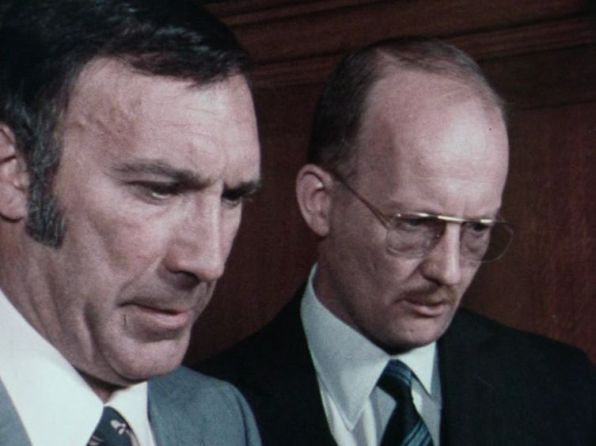
Dixon of Dock Green – Target

target

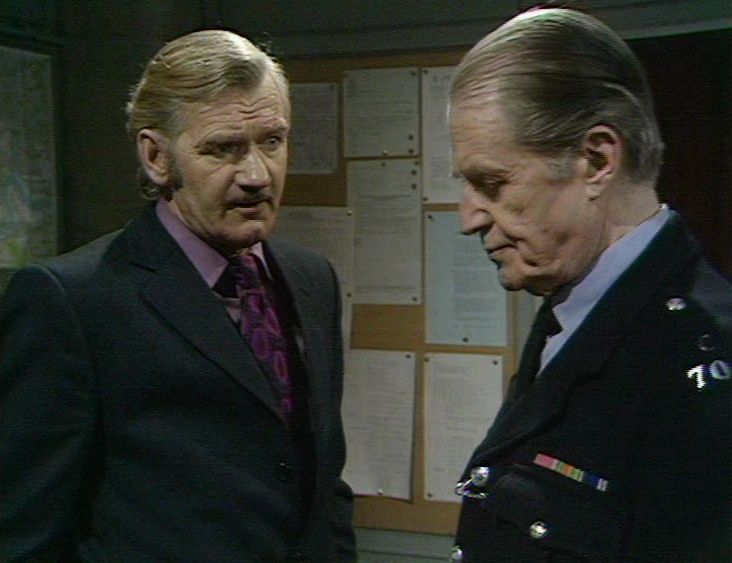
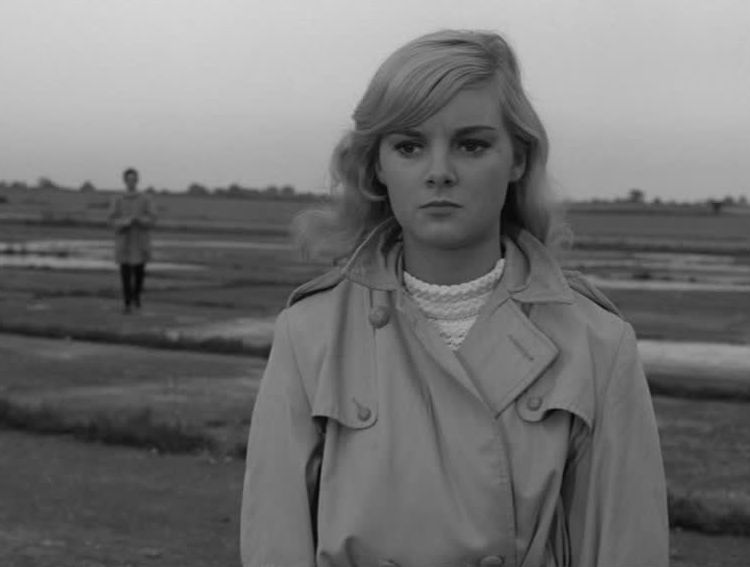
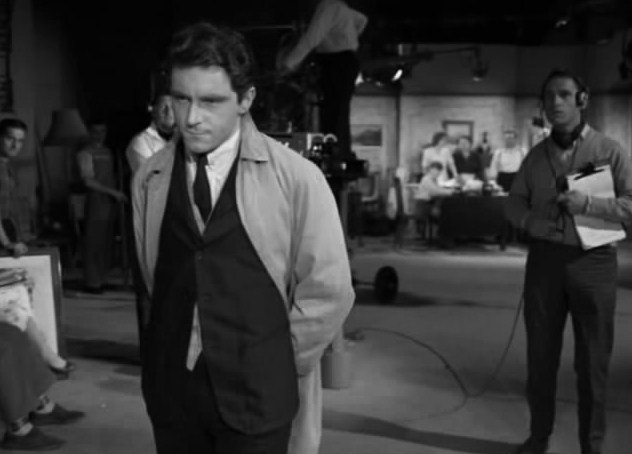
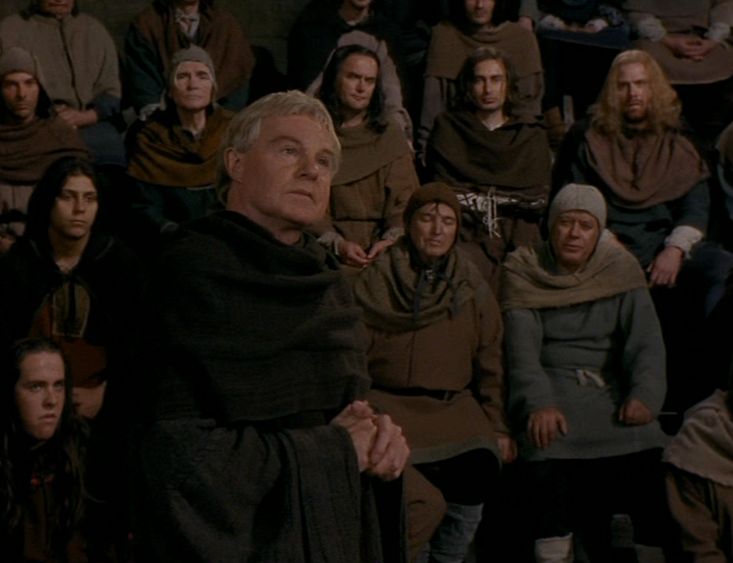
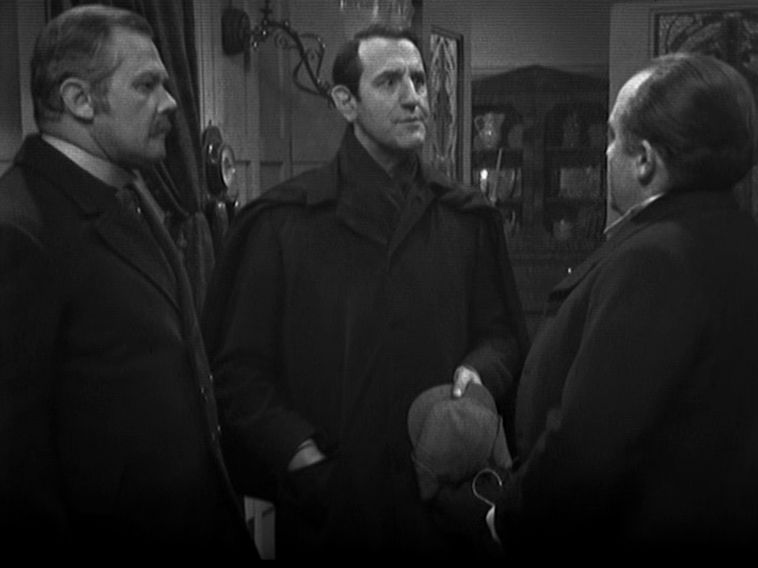
Target was the opening story of Dixon’s twenty first series (originally broadcast on the 15th of February 1975).  It’s a slow burner of an episode, as it takes a long while to establish who the target is, but there’s plenty of interest before the plot really kicks into action.

We open in a supermarket and the camera follows a man we later learn is called Smith (Anthony Steel).  He’s clearly not a well man as he staggers outside in a barely conscious state.  Vere Lorrimer’s camerawork in the early part of the episode quite effectively illustrates Smith’s distressed state (the cameras of this era are too bulky to be used hand-held, but there’s more fluidity in some shots than you’d normally expect).

When Smith exits the supermarket, the sounds of drilling trigger a flashback – and for a split-second Smith believes he hears gunfire and that the young black man, Winston Dallas (Willie Jonah), who’s concerned for his well-being is an enemy.  Winston manages to get Smith back to his flat, but Smith then pulls a gun and Winston flees.  This is enough to involve the coppers at Dock Green, but when they arrive they find complications – as Smith’s flat is already being watched.

There’s some nice humourous touches in Ben Bassett’s script.  When Crawford realises that three Special Branch officers have been staking out the flat (complete with a tent, pretending to be workman) he takes great pleasure in telling them that every criminal worth his salt knows about that particular dodge.  Wills later remarks that they tried to catch Jack the Ripper with a tent!  Mike Brewer then waylays a French onion seller and offers him a tidy sum of money so he can borrow his bike, onions and beret.  Did French onion sellers, especially such cliched ones ever exist?  Well they do here.

The Special Branch officers tell Crawford that they’re waiting for the arrival of a man called Kumal (Yashaw Adem), who was responsible for a particularly brutal massacre in Central Africa.  Smith is a friend and colleague, so they’re confident he’ll show up.

Once Smith recovers from his bout of malaria, his character’s drawn out thanks to several conversations with the owner of the flat, Joyce Baird (Freda Knorr).  Anthony Steel is excellent in these scenes – Smith is a man who’s unrepentant that his profession is killing, but he’s not a mindless thug.  Mercenaries like him regularly featured in the news back in the seventies (and in films such as The Wild Geese) and whilst such a character has less resonance today, thanks to Steel’s performance it’s still compelling.

As for Dixon himself, he has little to do, which is rather surprising for a series opener – instead Crawford and Brewer handle most of the action.  Although there’s a little gunplay along the way, it’s still far removed from action-orientated series such as The Sweeney.   Instead, Target is a decent character piece and a solid start to this series.

Dixon of Dock Green – Firearms Were Issued

firearms

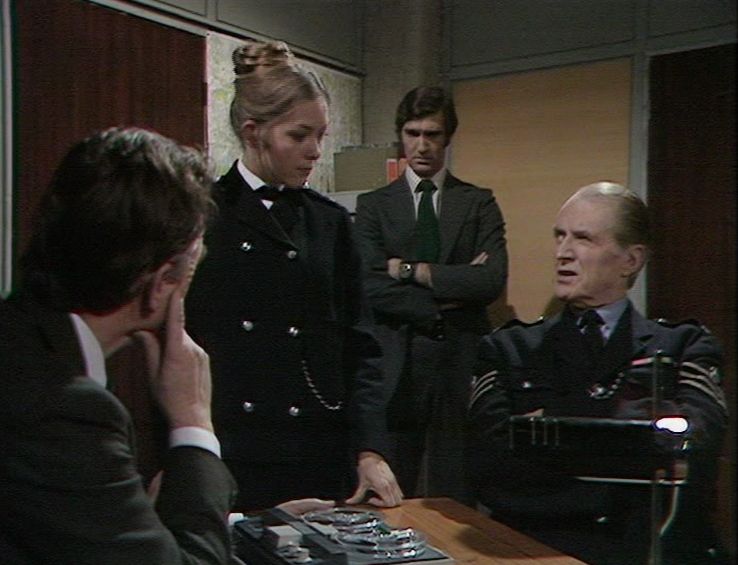
Crawford leads a raid on a suspected gang of armed robbers.  Due to the possibility that they may still be armed, the Dock Green officers are also issued with firearms.  Dixon, in his role as desk sergeant, is precise in ensuring that all the correct procedures are carried out before a single gun is issued.  But events go seriously wrong and an unarmed man is shot and later dies, which means that Crawford and the others find themselves under investigation.

Apart from Crawford, Det. Con Cox (Peter Tilbury), Sgt. Wills (Nicholas Donnelly) and PC Dewar (David Masterman) are the other officers issued with firearms.  Before the operation, we’re given some indication about how two of them may react. Wills is an experienced firearms officer and so it can be assumed he will be cool under fire.  Cox is much less experienced (he’s only ever fired a gun on the training ground) whilst Dewar is an unknown factor.

The raid takes place at night-time and is effectively filmed.  The darkness makes it harder to understand what happened when the fatal shot was fired (which was obviously the intention).

Part of the conflict in Firearms Were Issued is driven by the different policing styles of Crawford and Dixon.  The younger man has a willingness to bend or break the rules in order to achieve the right result – something which is anathema to Dixon.  This is highlighted when Crawford attempts to leave the station to try and contact the informant who phoned in the original tip off.  Dixon’s quite firm – if he leaves the station then he’ll have to let the appropriate people know.  It’s a nice character moment for both, especially Peter Byrne.

Dixon is an old school, by-the-book copper – and a major part of the character’s appeal has to be Jack Warner himself.  Since he’d been playing the part so long, he’d become a virtual embodiment of “the good old days”.  But this nostalgia for better, simpler times gone by isn’t always a good thing.  It may have provided reassurance for a section of the audience at the time, but in the decades to come it was probably a key factor in the less than flattering readings we’ve seen the series receive.

But though the episodes on the first DVD have been more diverse than the reactionary Dixon of legend, it’s fair to say that the resolution of Firearms Were Issued will give critics of the series some ammunition.  It’s a much less progressive message than, say, Sounds, but although it’s an eyebrow raising conclusion it’s far from the norm (based on the small sample available anyway).

The investigation is quite intense and it leads to some decent character conflict between the Dock Green officers and Det. Chief Supt. Donovan (Percy Herbert).  The officers are insistent that the gang were armed but an intensive search fails to locate any weapons.  Did one of them shoot an unarmed man?  And if so, why?

Percy Herbert’s an intimidating presence as Donovan (he had a long career, including notable appearances in films such as Bridge on the River Kwai and The Guns of Navarone).  The versatile actor/writer Peter Tilbury made the second of his two appearances as Cox whilst the ever reliable Cyril Shaps played the somewhat shifty Green.

Whether Kendrick was armed or not, when the fatal shot was fired he was running away.  But Dixon sums it up as follows.

The four men who went out that night had every reason to believe that they were going to deal with armed and dangerous men. Later, the report for ballistics confirmed that Sgt. Wills had shot Kendrick. An inquest was held and the jury returned a verdict of justifiable homicide.  I think I’d have done the same as Dewar and Wills in those circumstances.

Dixon of Dock Green – Sounds

sounds

A few mysterious sounds of the end of the phone are enough to spark major activity at Dock Green nick.  The story opens with Anne Turner (Marion Lines) and her daughter Janey (Lyn Doyle) returning home.  “Home” at present appears to be a rather dingy flat in a very run-down area.  Anne notices the door is unlocked, which concerns her.  She sends Janey downstairs to play and calls Dock Green police station.

But after only a few words, WPC Hawkins (Jacqueline Stanbury) hears a choking noise as if she’s being strangled.  Dixon takes over the call and a few moments later Janey picks up the receiver, telling Dixon that her mother’s asleep.  Then either Janey replaces the receiver or somebody does it for her.  It’s little enough to go on, but Crawford, Brewer and Dixon put their heads together to try and work out what they can establish from the few sounds recorded from the call.

Sounds (the sixteenth episode of series twenty, originally broadcast on the 13th of April 1974) is very much an episode of two halves.  The first is concerned with the hunt for Anne and Janey and the second (which is the more dramatically interesting) details what happens once they’ve been found.

To begin with, they scour the tape for clues – they can hear the sound of machinery and also the hooter of a tug on the river.  Officers at Dock Green obviously have an affinity with the river, as Crawford’s able to ascertain that two hoots means the tug is turning to starboard.  He then asks for the name of every ship on the river that sounded its hooter at the time the call was made.  This should help to narrow down the search field.

An expert, Dave (David Wood), is called in to examine the tape.  He’s the antithesis of Dixon – since he sports long hair and colourful clothes – but since he’s an expert in his field, there’s grudging respect.  Dave is able to isolate the machinery noises much more clearly.  Neither Dave or Dixon can quite put their finger on what the machinery could be, but WPC Hawkins is able to smugly tell them that it’s a Heidelberg Superspeed Platen printing press.

This impressive feat of deduction is explained when she tells them that the recording could be heard in the station office and at at exactly the time it was being played, a stationary delivery was made and the printer’s apprentice recognised the sound!  This is a little difficult to believe, but it’s necessary in terms of moving the plot forward, as by now we’re half-way through the episode.

This information allows Crawford and Brewer to locate the flat, but there’s no sign of anybody and all personal belongings have been removed.  One clue is that there’s two telephone numbers – one is the Dock Green nick and the other is a local security firm.

Whilst the search for the missing woman and child has been interesting, we now enter the dramatic heart of the episode.  One of the guards from the security firm, Davis (Michael Graham Cox), pays Dixon a visit.  He’s keen to help – frankly he’s too keen and it’s clear right from the start that he has his own agenda.  It doesn’t take too long for the story to emerge.  Anne is his wife (at present she’s reverted to using her maiden name) and whilst their marriage has obviously been punctuated with bouts of domestic violence, he considers himself to be untouchable.  He knows that there’s no case without Anne’s testimony and he also knows that she’ll say that her present injuries are due to her slipping on one of Janey’s toys.

This is what she tells Dixon, but he obviously doesn’t believe it.  When he asks her if he’s beaten her up before she tells him that “it’s just between him and me, isn’t it? A private matter, nothing to do with the police.”  Dixon counters by telling her to “stop repeating everything he tells you. There’s no need to be afraid of him.”  But it’s clear that Anne won’t change her story.  Although she may be frightened of him, there’s also a sense that she genuinely loves him and believes that things will change.  The unspoken inference is that things won’t get better, but without Anne’s testimony, the police are powerless.

Davis is presented as a loathsome character – an arrogant man who’s sure he’s beyond the law’s reach.  And indeed he is – all Dixon can do is to tell him to leave the station before he gets thrown out.  It’s a small victory, but it’s all they have.

Sounds is a bleak little tale.  It gives us a glimpse inside an abusive marriage and we’re left to wonder what will happen in the future.  In his closing speech, Dixon hopes that Anne will someday pluck up the courage to make a statement (for Janey’s sake if for no one else’s) but that’s the only sliver of hope we’re left with.

This isn’t the first time that Dixon has touched upon the area of domestic abuse.  And due to the fragmentary nature of Dixon’s archive holdings, it’s difficult to know for sure when the series shifted from the viewpoint presented in the 1956 episode, Pound of Flesh.

There, Dixon observed that “if I arrested every bloke in Dock Green who clocked his wife, I’d be working overtime”.   Since Pound of Flesh is one of the rare episodes to exist from the early run, it’s hardly surprising that this quote and clip has been used on more than one occasion as a club to beat the series with.

It could be argued that Dixon’s comment was an accurate representation of the attitudes of mid fifties Britain.  In Sounds, which was made nearly twenty years later, it’s obvious that times have changed and spousal abuse is now taken more seriously.  But it’s still seen as a crime which is unlikely to result in a conviction, for the reasons that we’ve seen.

The lack of any positive solution might come a surprise to those who regard Dixon as a twee, predictable series – but as we’ve seen so far, the truth is somewhat different from the legend.

Dixon of Dock Green – Harry’s Back

harry's back

Harry’s Back (the third story of series twenty, broadcast on the 12th of January 1974) features a familiar plot which many police series have used from time to time.  An untouchable villain, who rarely makes a mistake, is doggedly pursued by a lone officer (even though he’s warned off by his superiors).

In Harry’s Back, Andy Crawford is the officer and Harry Simpson (Lee Montague) is his prey.  Harry’s a beloved figure in his local community (“one of the best”) and his early scenes help to establish his character.  To begin with, we see him return home after some months spent abroad with his new fiance Marion Croft (Susan Tebbs).  He’s greeted by an old man, who offers to carry his suitcases up to his flat – Harry agrees, even though he can see the man is struggling with the weight of the cases.  Harry slips him a few notes and tells him to take his time.  Andy later bitterly reflects that Harry’s a past-master in “buying admiration” and this is an early example.

Harry then runs into Sgt. Wills and although Wills is polite, he’s obviously not delighted to see that Harry’s back.  His disdain would seem to be shared by most of the Dock Green coppers, although Andy’s the only one who actively targets him.  This brings him into something of a conflict with Dixon – although the confrontation, if one can call it that, is very mild.

Dixon’s is an old-school copper.  He’d be happy to pursue Harry if there was clear evidence of wrongdoing, but there isn’t – so he’s content to let him lie.  The inference is that eventually Harry, like all criminals, will trip himself up and that’s the time when Dixon will pounce.  Andy takes the opposite view.  He has no hard evidence but his suspicions are enough to make him want to keep a very close eye on him.  Although this makes it easy for Harry to claim that he’s being harassed.

Throughout the story we see several more examples of Harry’s largesse.  He visits the wife of one of his old friends, Lenny Lane, and gives her a considerable sum of money.  This, he tells her, is simply what she’s owed (he says Lenny couldn’t give it to her himself because he’s lying low).  Later, he visits his local and buys everyone a round.  This is a scene that doesn’t quite work, mainly because everybody seems just a little too delighted to see him.  It just doesn’t ring true.

He also bumps into Dixon and Det. Sgt. Mike Brewer (Gregory de Polnay).  This is another interesting scene, more for what remains unsaid than what is actually said.  We’ve already had several examples of Harry’s generosity and been offered several different opinions about it.  Is he just a warm-hearted man or is he attempting to buy respect and favours?

His encounters with the various Dock Green officers are noteworthy in this respect.  He offers to send Brewer’s wife some perfume and later he tells Andy that he has a nice little house he can let him have, which will save him some money (the clear inference is that he’s offering him a bribe to lay off).

It also seems obvious why he doesn’t offer to buy Dixon and Brewer a drink – you know that Dixon would politely decline.  Harry returns to his friends and a few moments later two large whiskies are sent over to Dixon and Brewer – courtesy of Harry.  A simple generous gesture or his way of offering them a small bribe?  It’s down to the viewer to decide.

Another scene that’s open to interpretation occurs when Harry meets his prospective in-laws.  He’s only known Marion for a few weeks and this, together with the fact that he’s much older than her, makes Mr and Mrs Croft concerned that the pair of them are rushing into marriage.  Mr Croft (Peter Hughes) works in insurance and when Harry tells him it’s about time he took out some life insurance (say fifty thousand) the atmosphere changes instantly.

Is Mr Croft happy because he spies a rich commission or is he reassured that Harry’s demonstrated how responsible he is?  The tone of the story may suggest the former (Harry’s offering another bribe) but the scene can be taken either way.

N.J. Crisp was an incredibly experienced writer – penning 66 episodes of Dixon between 1964 and 1975 as well as contributing to numerous other popular series, such as Dr Finlay’s Casebook, Colditz and Secret Army.  It’s therefore a slight shame that Harry’s downfall occurs via two rather clumsy plot points.

The first concerns Harry’s unsmiling number two Bernard Moss (Michael Sheard).  Moss needs a clean driving licence and he buys one from Freddie Barnet (Esmond Knight) for fifty pounds.  Freddie suspects that there’s going to be trouble but when he knows that Harry needs it, he’s reassured.  Moss uses the driving licence to hire a car which is later used to rob a cosmetics van.

Freddie is presented right from the start as a weak link and therefore needs little persuading to tell the police that it was Moss who borrowed the licence.  Moss and Harry are known associates, so it clearly puts Harry in the frame.  Why didn’t they simply steal a car?  That way there would have been no link to Harry at all.

The second feels even more contrived.  Andy has a warrant to search Harry’s flat for evidence relating to the robbery, but the news that Lenny Lane’s body has been found (with a bullet hole in his head) makes him also keen to pin the murder on him.  But Harry’s flat appears to be spotless and it looks as if he’s going to walk away empty-handed – until (somehow) Andy realises that a safe deposit key is concealed inside a footstool.  When opened, the safety deposit box contains, amongst other items, a gun which ballistics confirm was the weapon used to murder Lane.

The way that Andy found the key is a little hard to swallow anyway, but the notion that Harry would keep such an incriminating piece of evidence beggars belief!  We’ve already seen that Dixon doesn’t always have to give us neat, happy endings, so there were several ways this one could have gone.

Harry gets convicted (as happened).

Harry walks away free, but Andy vows to get him next time.

Harry goes free, but divine intervention punishes him anyway (see Eye Witness for a good example of this.  Mr Colly isn’t convicted of the murder but shortly after is killed in a hit-and-run incident.  An accident or not?  Dixon leaves it for us to decide).

The second option may have been the best choice here, as finding the key and the gun occurs so late in the day that it can’t help but feel like something of an afterthought.

This apart, Harry’s Back has plenty to commend it, not least Lee Montague’s performance as Harry.  For most of the story he’s a relentlessly cheerful chap, but just occasionally his mask slips (such as when he suggests to Moss that the hapless Freddie needs to be persuaded not to talk to the police any more).  Michael Sheard is hardly stretched with the role of the taciturn Moss, but it’s always a pleasure to see him.

Susan Tebbs’ longest-running role was as Det. Con. Donald in the first few series of Softly Softly: Task Force.  Marion Croft is a fairly anonymous part, but since I enjoyed her appearances in SS:TF, it was nice to see her here.

Harry’s Back was one of Gregory de Polnay’s earliest appearances as Mike Brewer (and the first that exists).  He remained a regular until 1975, so as we move into a period where the archive survival rate is a little more healthy, we’ll be seeing more of him.  As a Doctor Who fan, I know him best for playing robot detective D84 in the 1977 story The Robots of Death.  But it’s only now, when I realised that he’d formally been a regular in Dixon, that it’s possible to surmise that his casting in Doctor Who was something of an in-joke!

Although the ending slightly lets it down, this is still a strong episode and it’s also notable for a late example of Dixon pounding the beat.  Soon, he’d be forced to mostly remain rooted behind the station desk.

1960’s BBC sitcom Hugh and I (Hugh Lloyd and Terry Scott) to be released by Simply HE in September 2015

hugh and i

Simply HE have announced that they will release a DVD of Hugh and I on the 7th of September 2015.

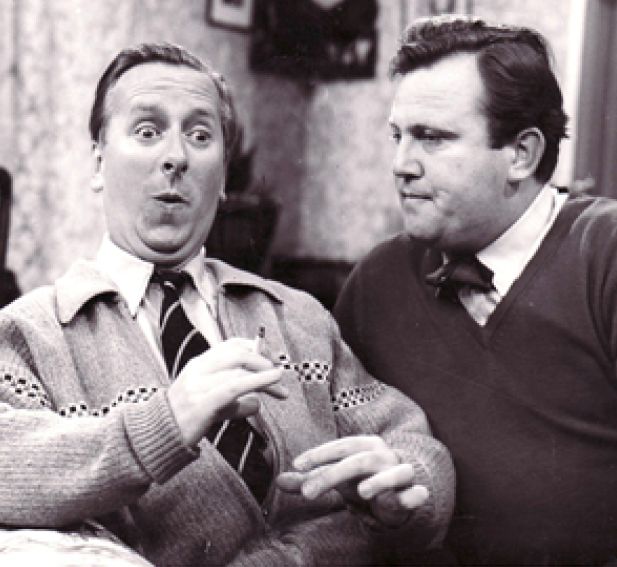
Hugh and I was a popular, if not first division, sitcom that ran on the BBC for six series, between 1962 and 1967, and starred Hugh Lloyd (a familiar face from Hancock’s Half Hour) and Terry Scott (later to enjoy sitcom fame, or infamy depending on your point of view, in Terry and June).

According to Lost Shows twenty four episodes exist, although the running time of the DVD suggests that it will contain eighteen.  Either the Lost Shows listing is incorrect or the running time is, as it doesn’t seem likely that Simply would only leave a handful of episodes for a second release.

Time will tell and if more information comes to light I’ll update this post.

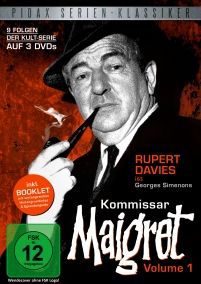
Selected episodes from series one of Maigret (Rupert Davies) to be released in Germany in July 2015

maigret

German company Pidax have announced they will be releasing Kommissar Maigret – Vol. 1 which contains nine of the first ten episodes from series one (originally broadcast in 1960/1961). Thirty-six episodes have been cleared via FSK (the German equivalent of the BBFC).

This would suggest that Pidax plan to release four volumes, each containing nine episodes.  Since all fifty-two episodes starring Rupert Davies exist, this would leave sixteen episodes unreleased.  As per one of the comments below, this may be because the episodes are being sourced from the available material contained within the German archives rather than new masters being obtained from the BBC (who hold a complete run).

Initial reports indicated the DVD would have both English and German language tracks, but now it seems that they may have German only.  So for now, it’s probably best to wait unril the DVD is in circulation before buying.

EDIT – Sadly it’s now confirmed that this DVD only has a German language track. That’s disappointing, but maybe a UK company (Simply or Acorn maybe?) might consider an English language release sometime in the future.

EDIT 8/9/15 – Volume two has been announced. Like volume one it only has a German language track – the included episodes are listed below.

1. Maigret und die Gangster (The Experts)
2. Maigret als möblierter Herr (The Cactus)
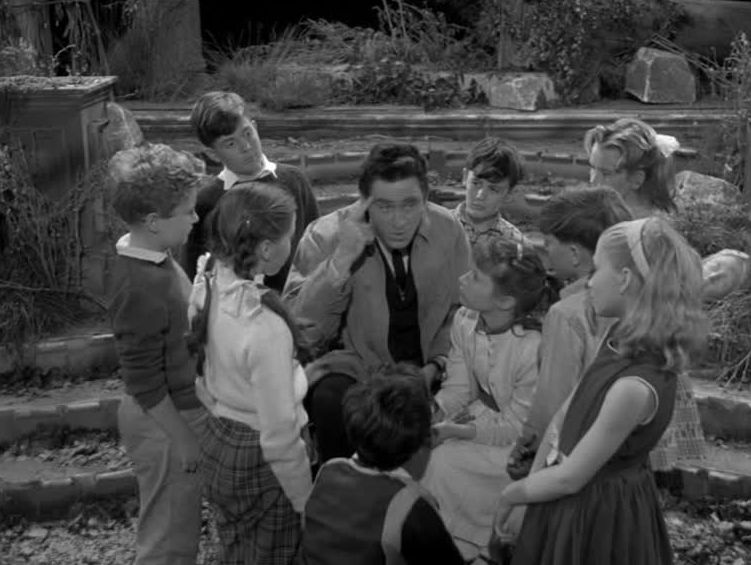
3. Maigret unter den Anarchisten (The Children’s Party)
4. Maigret und der Schatten am Fenster (Shadow Play)
5. Maigret und der Kopflose (The Simple Case)
6. Maigret trifft einen Schulfreund (Death of a Butcher)
7. Maigret und sein Toter (The Winning Ticket)
8. Maigret und Inspektor Lognons Trumph (Inspector Lognon’s Triumph)
9. Maigret und der geheimnisvolle Kapitän (The Lost Sailor)

Dixon of Dock Green – Eye Witness

eye witness

Until quite recently, critical analysis of the 1970’s runs of both Dixon of Dock Green and Z Cars tended to be rather limited.  Usually they were lazily painted as out-of-date dinosaurs – made completely irrelevant by the rise of brash new upstarts like The Sweeney.

Now, thanks to Acorn’s DVD releases, we can begin to get a picture of both BBC series which has enabled a small, but concerted, reassessment.  The Sweeney has long been seen as the anti-Dixon – but I’m not entirely sure that direct comparisons between the two are particularly valid, mainly because they operated in such different areas of the television schedules.

Dixon was a pre-watershed, family show and The Sweeney was a post-watershed, adult show.  Therefore it’s hardly surprising that the tone of each series was very different (although Dixon could throw in a darker, harder-edged story from time to time and The Sweeney was no stranger to lighter, more off-beat stories).

What’s certain is that the television schedules could easily accommodate both programmes (there’s no reason why all police series have to follow the same template).  Having said all this, whenever Dixon tackled a story that revolved around topics that The Sweeney could also have covered, comparisons are inevitable.

We’ve now moved ahead to series twenty.  There is another surviving episode from series eighteen (Molenzicht) but it remains unreleased due to unspecified rights issues and all of series nineteen was wiped.  Derek Ingrey’s Eye Witness kicked off series twenty and was originally broadcast on the 29th of December 1973.

Anne Hastings (Gwyneth Powell) witnesses a gangland murder and is immediately taken into police custody for her own protection.  As the only eye witness, she’s a vital part of the police’s case – without her testimony there’d be no hope of a conviction.  So it’s clear that her silence (by whatever means necessary) would be welcomed by a number of people, not least the intimidating Mr Colly (Steve Plytas).  But Anne Hastings is no innocent – she’s antogonistic and headstrong, which makes minding her something of a problem.

Although Gwyneth Powell would become a household name to a later generation (thanks to her decade or more running Grange Hill) she also enjoyed a very active career during the seventies in a variety of different series.  In Dixon alone she appeared five times, playing five different characters.  Her first two appearances, both in 1972 (The Bad Debt Men and The Fingerman) have been wiped, but her later two turns in Looters Ltd (1975) and Domino (1976) do exist.  Outside of Dixon, she gave memorable performances in The Guardians and Villains, amongst others.

On the wrong side of the law, Steve Plytas (possibly best remembered as Kurt, the Manuel-obsessed chef in the Fawlty Towers classic Gourmet Night) is intimidating as the gang’s Mr Big.  Stephen Greif has enjoyed a long career, often playing villains, so his role here as Tony isn’t too much of a stretch, but even when he’s got little to do he’s still watchable.

It’s difficult to avoid it, but the major flaw in this story is the fact that Dixon is assigned to mind Anne Hastings.  Yes, he does have the assistance of a female police officer (and the three of them travel out of town to a location that hopefully isn’t known to the gang) but this really stretches credibility to breaking point.  Jack Warner was seventy eight when this was made and he does look his age.  When selecting an officer to guard a vital witness against dangerous gun-toting criminals, who in their right mind would choose Dixon?!

If you can ignore this (fairly major) lapse in credibility, then Eye Witness is a decent enough story.  The location work is especially nice since it’s a break from the streets around Dock Green.  But it’s undenialble that the clash between an old-school copper like Dixon and a gang of violent armed criminals is jarring.  They would have worked perfectly well in The Sweeney, but they seem a little out of place here.  Dixon could do stories like this, but the series was always better when it played to its own strengths and concentrated on character-driven drama.

It’s a watchable yarn but it’s easily the weakest of these early surviving episodes.

Dixon of Dock Green – Jig-Saw

jig-saw

Jig-Saw was the first story of Dixon’s eighteenth series, originally broadcast on the 20th of November 1971.  Although it shares some similarities with Waste Land (a hunt for a missing person in a vast, crumbling industrial site) it also feels quite different – this one is much more a standard police procedural story.

Forbes (Victor Maddern) is the nightwatchman of a derilict gasworks.  Making his rounds, he finds an open door and after he enters the building he finds that somebody has locked him in.  He calls Dock Green nick and they take a look around.  Although they don’t find anybody, they do spot some scattered possessions which belong to a woman who went missing earlier in the week – and this is enough to initiate a search of the area.

One attraction of television of this vintage, particularly when shot in these sort of locations, is the glimpse it gives us of a landscape that would be unrecognisable today.  The gasworks were an example of Britain’s industrial past, but by the time the series was made it was a relic and scheduled for demolition.  Both Dixon and Andy Crawford professes admiration for the place (and offer a hint of regret that it’s no longer active) whilst one of the other detectives shows it no sentiment at all – in a few years, he says, it’ll probably be a housing estate.  This moment shows that Dixon and Crawford are two of a kind – sharing similar views and opinions.

If they sometimes have a father/son relationship, it’s not surprising (since Andy married George’s daughter way back in 1956).  Although Crawford is a detective sergeant, he has no qualms in seeking the advice or opinion of Dixon (who’s just a humble uniformed sergeant).  Other police programmes (such as The Bill) would have a much sharper divide between the uniformed and plain clothes divisions, but thanks to the special relationship between Dixon and Andy, that’s blurred here.

As the search continues, both Dixon and Andy view the missing woman’s husband, Colin Warren (Charles Houston), with suspicion.  He lied about where he was on the night of his wife’s disappearance (he was seeing another woman) so what else might he have lied about?  There’s also the possibility that this might not be an isolated attack – the gasworks are close to a canal towpath where several woman were assaulted a few years previously.

The possibilities soon stack up.  Warren might have killed his wife or she may have left of her own accord.  But there are other suspects, such as the nightwatchman Forbes, who has been receiving psychiatric treatment – which is is confirmed by his colleague Morris (Windsor Davies) .

Glynn Edwards is solid as Chief Inspector Jamieson, he wasn’t a regular but did pop up from time to time over the years (in a variety of roles).  Jig-Saw also gives us a chance to see Nicholas Donnelly as Sergeant Johnny Willis, who had a long association with the series (some two hundred episodes between 1961 and 1976).

Victor Maddern appeared in Dixon four times – playing four different characters.  By far his most celebrated appearance was his final one, It’s A Gift (broadcast in 1975).  This wasn’t for any particular part of the story though, rather it’s for this outtake which has become a favourite of many people.

Jig-Saw ends with a chase and the apprehension of the criminal.  It therefore offers a tidy solution to the mystery, even if it’s still rather downbeat.  Whilst Eric Paice’s script never hits the heights of Waste Land (which he also wrote) it’s still an efficient character piece that also makes good use of its impressive location.

Dixon of Dock Green – Waste Land

waste land

Waste Land was the opening story of Dixon of Dock Green’s seventeenth series and it becomes clear very quickly that incoming producer Joe Waters was keen to shake up the show’s format.  I’ve already written here about early 1970’s Dixon and how the actuality of the series differs from its received opinion.  And one of the most significant of the small number of existing episodes from the early 1970’s is Waste Land.

Originally broadcast on the 14th of November 1970, it opens, traditionally enough, with Dixon’s piece to camera.  But although Dixon is instantly a reassuring and paternal figure, his words are not designed to offer comfort.  Dixon tells us that often “most of us remain ignorant of one another” and this, he says, could apply to any walk of life – including the police.  Dixon’s opening and closing homilies are often one of most derided parts of the series (this view seems to be largely based on one notorious example from the black & white years, where Dixon condones domestic violence) but here he doesn’t provide the audience with reassurance.  Instead, it’s a clear signal that things may not end well.

Following this, the pre-credits sequence is extremely disorientating.  We see a POV shot of somebody wandering around a deserted dock (their laboured breathing indicates that something is wrong).  The sense of disconnection is enforced when we hear a woman’s voice, describing how somebody feels lost – in a waste land – unaware of whether they are actually awake or asleep.

The discovery of an abandoned panda car inside the Old Orient Dock initiates a search for the missing officer, PC Norman.  This explains the reason for the pre-credits sequence, although it’s interesting how it makes little narrative sense.  We’re led to assume that the POV shot is of PC Norman and we later discover that the woman’s voice belongs to his wife.  The third part of the sequence is the discovery of his panda car, but chronologically it’s a real jumble.  Firstly, he went missing at around midnight, but the POV shots were in daylight.  Secondly, we hear his wife’s voice before she’s actually entered the story.  It works in the context of the episode though (even if it’s odd from a story-telling point of view).

Our first sight of George Dixon helps to reinforce that he’s a competent and knowledgeable officer (he advises a police van driver to take a short-cut to the docks).  It’s a small character beat that’s useful for any new viewers – it lets them know that he’s an experienced man, who knows the area well.

The bulk of the episode takes place within the abandoned docks.  It’s an impressive location and one which cuts against the perceived notion that Dixon was a series rooted in cosy nostalgia.  Looking back at seventies Britain in general, often the picture is one of decay – crumbling buildings, dirty streets, etc.  The grimy 16mm film stock used for television reinforces this (and this episode is a good example – the film print seems to have been dragged through a hedge backwards!).

So the docks are an area that’s depicted as threatening and unsettling.  Nobody would visit there out of choice, so why did PC Norman?  It’s debated that he might have been following a suspect, but even quite early on there are other, albeit unspoken, possibilities floating about.

Elsewhere, we see a sense of community and a general level of co-operation with the police that might be one area where Dixon could be said to still be peddling an idealised picture of society.  A group of housewives are seen to have a clear bond with each other (except for one, who comes and goes at all hours and is therefore viewed with suspicion by the others).  They’re all eager to answer Andy Crawford’s (Peter Byrne) questions and one of them even volunteers useful additional information.  It’s very possible to imagine that other series might have portrayed a more isolated or disinterested community.

Jumping into this episode cold, there’s a fairly large cast of regulars of which most (apart from Dixon and Andy) aren’t particularly familiar.  This isn’t helped by that fact that the archive survival rate from the early seventies runs are so poor (Waste Land, for example, is the only episode to exist from series seventeen, the other sixteen were wiped).  It is nice to see George out and about though – as the years go by, Jack Warner’s difficulties with walking will become more and more obvious (later series see him immobile behind the desk at the station, hardly moving at all).

It’s a pity that the print is so poor (including at one point, a spectacular bit of film damage) but for such a niche release there’s no point in grumbling too much (it’s better to have it in this condition than not at all).

Waste Land is a bleak tale which never feels it’s going to end well.  The documentary style of filming (no incidental music, for example) helps to give it a sense of reality and the lack of a neat, pat ending is another plus.  It’s impossible to say whether the rest of the series maintained this same standard, but on its own merits, Waste Land is a gripping forty five minutes of drama.

The Strange World of Gurney Slade – Episode Six

gurney 06

If the whole series of Gurney Slade has offered a sly meta-textual commentary on the artifice of television, then this is taken to its logical conclusion in the sixth and final episode.

A group of executives pay a visit to the studio to observe the recording of an episode of Gurney Slade.  The recursive show-withina-show nature of the series is once again highlighted, as we then meet all of the characters from previous episodes.  They aren’t actors though – they’ve been created by Gurney’s imagination and now protest that due to his lack of thought they’re unable to live full lives.

The only character traits they have are the ones provided by Gurney – their other likes and dislikes are unknown and unknowable.  The prosecutor (Douglas Wilmer) makes this clear when he tells him that “I submit, Gurney Slade that you are guilty of providing us with inadequate lives.”

Gurney doesn’t believe it’s his fault though.  “All fictitious characters are the same. They just do the bit that the author gave them. They’re not like real people.”  This is a nod to Pirandello’s 1921 play, Six Characters in Search of an Author, which depicted a group of characters who complain that their author hasn’t provided them with sufficiently rounded personalities and motivations.

But can Gurney help them?  There’s a sense that his time is coming to an end.  As the arguments between the characters are played out, a shadowy man in the production gallery notes that Gurney only has twenty minutes left (as the episode time counts down).  The same man is also able to control Gurney (without, it appears, Gurney being aware of this).

But Gurney does seem to understand that he’s as artifical as the rest.  He knows he was born in the studio six weeks ago and he also knows that someone’s coming to take him away.  The floor manager and the executives regard Gurney with the same dispassionate interest as the cameras and lights – to them, he’s just another piece of machinery.  Are they right?

As with previous episodes, there are sly comments about the television industry in general and this programme in particular.  Gurney is described to the executives as someone who “has a tendency to produce jokes nobody can understand. You pay it about five hundred a week and it’ll do practically anything.”

There are also moments that seem designed to touch upon Newley’s public and private personas.  For example, when he re-encounters the young girl (Anneke Wills) who fell in love with him in episode two, initially she’s still blindly in love with him.  But this is only because she (like the others) is a character defined by the character traits she’s been given by him.

When Gurney tells her that he pictured her aged eighteen or nineteen, she reacts to this by telling him that, in that case, he’s a little too old for her.  “Just think, when I’m thirty you’ll be forty. An old man!”  Newley and Wills would enjoy a relationship for several years following the recording of the series, but was there already something of a feeling of mid-life crisis in Newley’s psyche?  That sometime soon he’d find himself rejected by the younger women he desired?

Luckily for everybody (apart from Gurney) they’re offered new jobs by a gentleman from the Character Bureau.  The prosecutor, for example, lands a plumb role in Boyd QC (although he does grumble about typecasting) whilst Wills’ character looks aghast at having to take her clothes off in a French film.  Therefore every character seems to have been pigeonholed as archetypes, or stereotypes, depending on your point of view.

“Cue Anthony Newley”

With those words, the programme enters its final moments with an ending that’s as memorable and as weird as the final episode of The Prisoner (Fall Out).  But as touched upon before, when The Prisoner was transmitted (some seven years later) the sixties were well and truly swinging – back in 1960 it certainly wasn’t.  This makes Gurney Slade’s wild flights of fancy even more remarkable.

Although doomed to be a noble, but flawed, experiment, thanks to the 2011 Network DVD release The Strange World of Gurney Slade has gained something of a new audience.  It’s also probably the best visual showcase for the talents of Anthony Newley, whose later career was notable for its peaks and troughs.

Below is one of the trailers for the series, which is as idiosyncratic as you’d expect and offers a final, mocking, commentary on a short, but exceptional, series.

The Strange World of Gurney Slade – Episode Five

gurney 05

Gurney is entertaining a group of children with a tale about a magic tinker.  If they’re very good, he tells them, the tinker may visit and grant them a wish.  When they ask him exactly when the tinker will appear, Gurney is forced to admit that he may not arrive today – since Gurneyland (where he lives) is a long way, away.  Gurney then tells them that “the tinker is really symbolic. He’s an allegorical figure, who represents our innermost thoughts.”

He then explains a little more about Gurneyland.  It’s a place where any of your dreams can become true.  You want to be a great footballer, better than Stanley Matthews?  Or maybe the best singer in the world?  In Gurneyland, you can.

The recursive nature of the series is once more highlighted when Gurney asks one of the children why they didn’t stay inside and watch the television.  He’s told that “there’s nothing on. Just some bloke telling kids a story.”  Shortly afterwards, two partygoers Albert (Bernie Winters) and Veronica (Coral Fairweather) arrive.  And then a few minutes later, Gurney and the children are excited to see the tinker (Charles Lloyd-Pack).

Earlier, we saw Gurney explaining to the children that the tinker wasn’t real – but once he arrives (or at least someone who could be the magic tinker) Gurney is keen to see him demonstrate some of his magic.  Was he actually the magic tinker or just an ordinary tramp?  You’ll need to make your own minds up about that – although it’s not a vitally important point.

What is important is that everybody (the children, the tinker, plus Albert and Veronica) have taken a trip to Gurneyland – quite literally, as they all find themselves transported inside Gurney’s mind.  This is frustrating for Gurney, the point of his story was that Gurneyland is inside everybody (their own personal imagination).  So he’s a little upset to find so many people running amok inside his.

How to get them out?  Once he goes into his mind, he meets his dark side – a horned version of himself.  The bad Gurney suggests drinking and visits to scurrilous French films will instantly make the children want to leave.  Our Gurney is shocked by this and refuses (although at the end of the episode he realises it’s the only way to sort things out).

Gurney’s subconscious is divided into various rooms, such as the Depression Room, the Memory Room and the Common-Sense Room (the last one, he admits, isn’t used very often).  Wandering around his own psyche allows Green & Hills (and maybe Newley himself) to poke some fun at Newley’s public persona.  He admits he has “quite a big mind, but then they always said I had a big head.”

Later on, after he finds that many of the children have invited their parents to join them, he follows them and finds them all watching a version of himself.  He’s singing Strawberry Fair (which was a hit for Newley that year).  After the performance, “our” Gurney reflects that “I should have thought that would have driven them out” and critiquing his own performance he decides that ” I always had the impression I sang better than that.”

Like the previous episode, this is a very theatrical production.  Although the first half is meant to be set outside, it feels stagey and unrealistic (this is a clear production choice, had they wished to shoot on location there’s no reason why they couldn’t have done so).  Newley excels with his multiple personalities and he also plays well off the children.

Although there’s plenty of jokes along the way (such as an invisible elephant that takes a liking to Gurney) it also has some interesting things to say about good and evil, as well as the borderline between fantasy and reality.  It’s another deep and rich episode that covers a lot of ground during its twenty five minutes.

The Strange World of Gurney Slade – Episode Four

gurney 04

Gurney Slade is on trial.  “I did a television show recently and they didn’t think it was very funny.  I’m being charged with having no sense of humour.”  Given that by this time the series had been moved to a late-night slot (due to an alarming slump in viewing figures between the first and second episodes) this was a canny piece of prediction by Green, Hills and Newley.

Unlike the first three episodes, which were location based, this is shot entirely in the studio – which means that visually it obviously feels very different.  The courtroom set is quite basic – black drapes form the background, for example (giving a theatrical feel to proceedings).

When Gurney learns that the judge is the fairy-tale figure Princess Eleanor (who’s never laughed) he knows he’s got his work cut out.  Can he rely on his defending counsel, Archie?  Archie is a old-style music-hall comedian – modelled on the likes of Max Miller.  Possibly there’s something of Archie Rice (from John Osborne’s 1957 play, The Entertainer) in his style as well.  He offers a series of painfully unfunny jokes as part of Gurney’s defence, which makes Gurney believe he’d be better off defending himself.

The prosecuting counsel (a typically effective turn from Douglas Wilmer) is convinced of Gurney’s guilt and attempts to prove it by showing the jury a clip from one of his previous shows.  This is another self-reflective moment, as the clip is new – though it could have easily featured in one of the previous episodes.  We see Gurney sitting on a bus, musing about an advertisement showing a man who appears to be delighted about a new countersunk screw.

There then follows a series of arguments and counter-arguments about whether countersunk screws are funny or not.  An average family (the ones we saw in episode two) are called to the witness box.  The father says that the clip was clever.  Not funny, but clever.  The mother was less impressed.  “I didn’t understand what it was all about. Besides that, I don’t think it ought to be allowed. Bad for kids.”  As it turns out, that possibly wasn’t too far removed from the actual response of a good proportion of the audience.

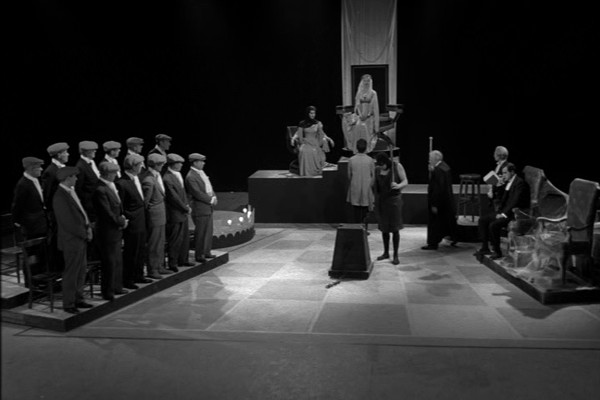
With the jury being made up of twelve men dressed identically (in cloth caps and scarfs) it’s possible to sense a little contempt for the viewing audience.  This is a potentially difficult line to tread, but they seem to have got away with it (possibly because by this time, the people left watching had invested in the programme and its worldview).

Gurney interacts briefly with the jury – and they appear not to realise that he’s the one on trial.  When the foreman asks for a show of hands, Gurney is the only one who says not guilty.  He suggests they talk about it for a while (a clear nod to Twelve Angry Men).

If television is the main target in this episode, then the press aren’t immune either.  Before the jury come back with their verdict, Gurney is offered twenty thousand pounds for his life story.  He refuses, so the press turn to Leolia Plinge (“I will reveal everything.  I first met Gurney Slade at a beauty competition at Tufnell Park.”)

Gurney is found guilty – but he’s unable to be executed due to a problem with the axe.  It needs a countersunk screw to repair it, which makes the Princess laugh (and thereby gets Gurney off the hook).  It’s an ironic ending to an episode that, whilst it’s concerned with humour, isn’t particularly funny.

That’s not a criticism though.  There’s few laughs here, but it does have plenty of well-timed swipes at television makers, audiences, advertising and the media.  The stark setting and the minimal use of music helps to create a sense of tension and unease – which is unusual for a programme that’s supposed to be a comedy.  But by now it should be clear that Gurney Slade is a very unusual programme.

Callan: Under The Red File by Andrew Pixley. Network book review

callan

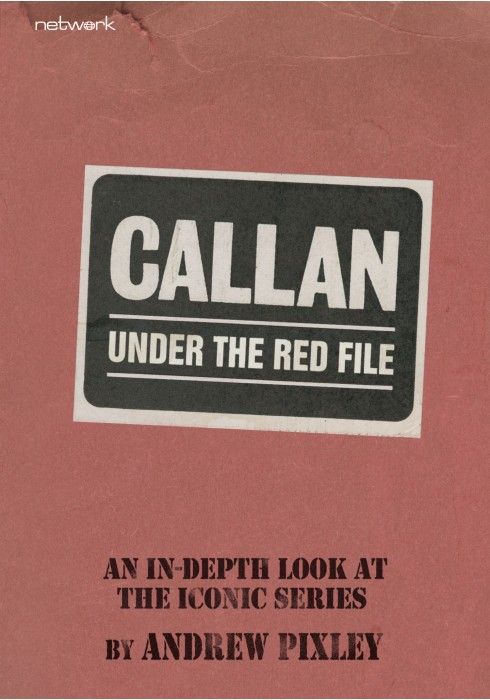
Callan: Under The Red File by Andrew Pixley is an exhaustive guide to the production of this classic television series and is now available for purchase via Network’s website.

For anybody who has an interest in British archive television, Pixley’s name should be well known.  He’s produced viewing notes for many Network titles over the years (most recently The Professionals) as well as for various BBC titles (such as their short-lived science-fiction releases).  He also penned the Archive feature in Doctor Who Magazine for many years.

The bulk of the research in the book was carried out some years ago and the intention was that the book would form part of a Callan boxset, together with all the existing episodes and some additional special features.  For one reason or another, the boxset has yet to appear – so now we have the opportunity to buy the book by itself.

If you’re familiar with Pixley’s work then you’ll know what to expect.  This is a highly factual, production-based work.  If you’re looking for a glossy, well-illustrated tome then this may not be for you.  But if you want facts, you’ve certainly got them here.

Callan is one of those programmes that has never really been examined in great detail before.  I can’t recall any previous books published on the show (although there is another, from Miwk, due out later in the year).  This means that there’s a wealth of material that was new to me – especially about the early (sadly incomplete) black and white episodes.

If you love Callan, this is an essential purchase.  It can be ordered direct from Network’s website here.  Network’s blurb on the book is below.

Nearly ten years in the writing, Callan: Under the Red File has been a labour of love for both Network and the book’s author, Andrew Pixley. Anyone familiar with Network’s releases will know our history with Andrew is a long one and he has done some excellent work for us over the years – with his books on The Prisoner, Danger Man, Public Eye and The Professionals all raising the bar for this type of archive research. Ahead of our upcoming Callan documentary, you can now buy Andrew’s new book exclusively from networkonair.com.

Initially a cult success before becoming one of British television’s most watched programmes, Callan brought the gritty, downbeat angle of Cold War espionage to 1960s British television. In stark contrast to the glamour of James Bond and the stylized capers of The Avengers, the man known as David Callan was a highly skilled killer, tasked by the Government to eliminate threats to national security. This reluctant, conscience-wracked assassin was brought to life in a remarkable performance by Edward Woodward, cementing his popularity as an actor many years before he achieved major international success in both Breaker Morant and The Equalizer.

This exhaustive book is the definitive look at the creation, production, broadcast and reception of all four series. From its conception as a one-off BBC play, through its development by ABC Television, its success as one of Thames Television’s highest-rated programmes, its subsequent ATV revival and its expansion into novels, short stories and movies – this single volume covers every aspect of James Mitchell’s most successful creation.

The Strange World of Gurney Slade – Episode Three

gurney 03a

The Strange World of Gurney Slade was a series of two halves.  The first three episodes were largely shot on location whilst the last three were studio bound.  Episode three finds Gurney in the countryside, musing that even though you may seem to be alone, you are always being observed by “bird’s eyes, cat’s eyes, sheep’s eyes, bull’s eyes, butterflies, customs and excise.”

Gurney begins by wondering exactly what life would be like in an ant colony.  He decides that he wouldn’t last very long – the life of a worker ant simply wouldn’t be for him.  Ants are able to carry approximately ten times their own body-weight – in human terms this would be akin to Gurney lugging around a grand piano (something he finds it hard to imagine).  This is a characteristically off-kilter opening to the episode – it’s hard to imagine many programmes that could feature Gurney’s internal monologue about industrious ants (although it’s possible to find an echo in the early series of Last of the Summer Wine, where plots took second place to inconsequential musings.  Although the three old boys never encountered any talking animals!).

Gurney later stops by a sign.  One way leads to Gurney Slade (such odd names they have in the countryside, he says) whilst the other points to Cuckold’s Comb.  Gurney Slade is a real place, of course.  Cuckold’s Comb is less so.

Episode three is probably the most fragmentary and plotless episode of Gurney Slade.  It’s also the one that has to be virtually carried by Newley alone – either via monologues with himself or by conversations with the various animals he meets along the way.  The most substantial encounter with another human being occurs when he encounters Napoleon (John Bennett) in a field (as you do).  Watch enough archive television and it’s almost certain that you’ll see the same actors again and again.  So only a few days after catching Bennett in the Cadfael story The Leper of St. Giles, here’s a chance to see him again (some thirty four years earlier).

Gurney wanders into a farm and has a lively conversation with a dog, who invites him to take a look around.  There’s a seperate plot which is developed between the farmer, his wife and a farmhand that pays off at the end – although it’s done with no dialogue and no interaction with Gurney.  He then chats to a cow (seductively voiced by Fenella Fielding) who tells him that she much prefers hand milking, as she points out to him that he probably wouldn’t like his “lactic glands stuffed into a vacuum cleaner.”

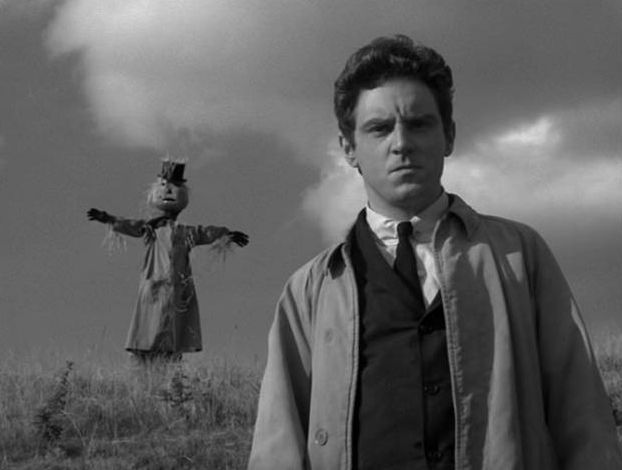
All in all, this is twenty five minutes that’s hard to adequately describe (and we haven’t even discussed the scarecrow who sings Greensleeves).  As we’ll see in the next episode, even at the time the show was being made it must have been clear that it probably wouldn’t be received with whole-hearted approval.

This one is probably the least engaging of the series, although it’s fair to say that the scattershot approach does generate more hits than misses.  But it’s only a slight dip, as episodes four to six are all very strong.  And it’s tempting to wonder if a young Patrick McGoohan was watching the final three and making notes ….

gurney 03b

The Strange World of Gurney Slade – Episode Two

gurney 02

In this second episode, Gurney ponders the delicate nature of relationships.  We open at a deserted airfield which quickly becomes (in his mind at least) a dance-hall.  He desperately wants to meet the right woman – but even if he did, what would he say?

He couldn’t just go up to her and ask her out, as they have to be introduced first – preferably at a nice cocktail party.  He then spies a gorgeous young girl (Anneke Wills, credited here as Annika Wills) and he eventually plucks up the courage to ask her to dance.  Except, interestingly he doesn’t.  Up until the point they start dancing, they don’t exchange a single word (although the audience has been privy to their, sometimes overlapping, thoughts).  And is she the love of his life?  After the dance she rejoins her friend and then exits from the story, so it doesn’t seem so.  Gurney mournfully considers that “you get nowhere if you don’t talk to them and yet you get the brush off if you do.”

This whole sequence shines a light on the rather repressed morals of late fifties and early sixties Britain.  But the irony is that Anthony Newley suffered from no such repression himself.  He enjoyed a well-deserved reputation as a womaniser – witness his relationship with Wills, which blossomed after the recording of this episode.  It led first to an abortion and then later to the birth of their daughter, Polly, in 1962 (which occurred at the time that Newley was considering ending his marriage to Ann Lynn so he could marry Joan Collins).

So if you know Newley’s history, it does give these scenes an extra frisson.  And it’s clear that the camera loves Wills’ delicate beauty and their bizarre (largely unspoken) meeting is all the more memorable for taking place in the middle of a desolate airfield.

The theme of love continues with the next sequence as Gurney meets a typical family – father, mother and three children.  He asks the husband, Frank (Edwin Richfield), if he feels that he married the right woman.  Or did he just marry the woman next door, the one he was expected to?  As with the airfield scene, this gently mocks the accepted values of the day.  As the sixties progressed, many things (including relationships) would change and become much more flexible (in a way that would have seemed unthinkable to most people in 1960). Again, this seems to foreshadow Newley’s own restless jump from one woman to another.  How much of Gurney Slade is actually Anthony Newley is an interesting, and unknowable, question.

After thinking it over, Frank decides that yes, he didn’t marry the love of his life – so he sets out to find her.  His wife doesn’t seem too concerned (plenty more fish in the sea) and she exits as well. This leaves Gurney with the children – a boy and girl (both aged about eight) and a baby in a pram.  Even for a series with such a tenuous grip on reality, it’s a little jarring to see the children abandoned.  But Gurney doesn’t seem to mind and he starts a lively conversation with the baby (who seems to be incredibly articulate for an infant).  He still believes in Santa Claus and fairies though – though Gurney tells him that there are no such things.

In the world of Gurney Slade, anything can happen – and a real-life fairy (Hugh Paddick) appears and grants them a wish.  This transports them to a rubbish tip which is strewn with parts of female mannequins.  He suggests to the children that they select the best parts and make a mother.  There’s something rather creepy about this – the stark black and white photography definitely helps to create a vague sense of unease.

In the end though, all is well as the children are reunited with their mother and father.  So what was the moral of the story?  Gurney ends by spouting a deliberately nonsensical series of proverbs, so we can assume that the story had no meaning.  Frank didn’t find his ideal woman and he seems happy to settle for the one he has.  And Gurney’s back in his imaginary dance-hall, looking for another woman to trip the light fantastic with.

The Strange World of Gurney Slade – Episode One

gurney 01

The Strange World of Gurney Slade was a programme that came and went very quickly – just six episodes, broadcast in 1960 – but in retrospect it’s a show that had a strong influence on some notable people and programmes (especially David Bowie and Patrick McGoohan’s The Prisoner).

At the time, Anthony Newley was a hot property.  He’d been acting since the 1940’s (including a memorable turn as the Artful Dodger in David Lean’s 1948 film version of Olivier Twist) and by the late 1950’s had also enjoyed a string of hit singles.  So a half-hour comedy series seemed to be the next logical move.

Gurney Slade was anything but logical though.  It’s a bizarre, surrealist trip through Newley’s psyche that appeared to totally wrong-foot the viewing audience, who were no doubt expecting something much more straightforward.  The muted critical response and poor viewing figures relegated the last few episodes to a graveyard slot and after the sixth and final episode limped out there were no calls to commission a second series.

The series was written by Sid Green and Dick Hills, although it’s tempting to assume that Newley himself had a considerable input in shaping the content of the show.  Green and Hills would become well known during the 1960’s as scriptwriters for Morecambe & Wise, but whilst their material was always solid (for example, they wrote the classic Grieg Skech, later remade with Andre Previn) it rarely displayed the flights of fancy seen in Gurney Slade.

What’s really remarkable about the series is that it was made in 1960.  Had it appeared later in the decade, then such a reflective, self-aware programme would have fitted in better with the overall television landscape.  But when you consider the type of programmes on offer in 1960, it makes Gurney Slade seem even more out of time.

Is it funny?  Well, it doesn’t offer many laugh-out-loud moments, but it’s wry and witty and it certainly isn’t predictable.  It’s unashamedly a star vehicle for Newley, who although he’s all but forgotten today, was a major star at the time.  His influence can best be seen in the career of the young David Bowie, who during the 1960’s copied Newley’s style almost perfectly.

Episode One sets out immediately to confound the audience’s expectations.  We open on a typical family living room, the Pagets, who have just moved into their new home .  We see the wife ironing, the son doing his homework and the mother-in-law unpacking.  Albert Paget (Newley) is sitting in an armchair, but it’s clear that something isn’t right – he appears to be disconnected from the events unfolding around him.  More visitors appear – the lodger and the man next door.  Every character (apart from Albert) is a clearly defined archetype and the dialogue is laboured and not terribly interesting.

After a moment, Albert gets up and puts on his coat.  He declines to answer the question about whether he’d like a nice egg for his tea, which throws everybody else into confusion.  The question is repeated sotto-voce several times, obviously in the hope that he’ll go back on script, but that doesn’t happen.  He walks out – and we see that the room is nothing more than a studio-set.  Newley strides past the cameras, the bewildered floor manager (Geoffrey Palmer) and escapes into the real world.  So he becomes Gurney Slade.

It’s a comprehensive “breaking the fourth wall moment”.  And things just get odder as he encounters objects and animals that can talk.  He picks up a stone and is about to launch it into the river when the stone asks him politely not to.  He then has a chat with a dog, who tells him that he likes Lassie but has little time for Rin-Tin-Tin.  When he picks up a newspaper without paying, the headline reads “Can’t You Afford Twopence Halfpenny”.

Later, he becomes enchanted with a poster that depicts a model advertising the Klean-o hoover.  The model (Una Stubbs) comes to life and he follows her down the street.  Interestingly, we also see a bystander watch him and he only sees Gurney – but not the girl.  This implies that whatever Gurney Slade sees, it’s only seen by him (and the audience of course).

With the notion that anything can happen, it’s a busy twenty-five minutes.  Most of Newley’s dialogue is prerecorded and then played in to simulate his thoughts.  This method is also used when he actually speaks and therefore it means that his words never quite match his lip movements.  This is another device that helps to give the programme a slightly off-kilter feeling.

At the end, Gurney returns to his sit-com family from the opening scene, only to find that they’ve been watching him all the time.  Although he escaped from the television studio, it’s clear that he’s still part of it.  He glumly admits that “I’m a walking television show. I can’t get away from them. Big Brother is watching me, and Big Dad and Big Mum. The whole family’s watching me. I’m like a goldfish in a bowl.”

Cadfael – Monk’s Hood

monk

Gervase Bonel (Bernard Gallagher) has gifted his manor at Mallilie to the Abbey.  In return, he’s given a small house, close to the abbey grounds, and his needs (such as food) will be attended to by the brothers.  To give up so much could be seen as a generous gesture – but Bonel doesn’t appear to be a generous man.  He’s bad-tempered and lecherous and it looks as if he’s ceded his estates to the Abbey in order to spite his step-son Edwin (Jonny Lee Miller) who would have inherited them.

Within a short while, Bonel is dead – poisoned by a dish sent from the Abbey kitchens.  Cadfael is disturbed to discover that the poison came from his stores – Monk’s Hood.  Monk’s Hood is completely safe when used as a liniment – but if ingested it is deadly.  The fact that murder has been committed with something prepared by his hands makes Cadfael keen to find the culprit.  Edwin is named as the most likely suspect, but Cadfael isn’t convinced.

This isn’t the only surprise he faces though – as Bonel’s wife Richildis (Mary Miller) was betrothed to him many years ago.  When Cadfael left to fight in the Crusades, they lost touch and Richildis later married another.  After her first husband’s death, she married Bonel and now she pleads with Cadfael to clear Edwin’s name.

Monk’s Hood was the third Chronicle of Brother Cadfael and was originally published in 1980.  In book order, it followed on from One Corpse Too Many and this adaptation is able to keep a key element of the ongoing story intact.  This depicts Abbot Heribert’s (Peter Copley) departure to London, where he’s called to account for his stewardship of the Abbey during the recent siege of Shrewsbury by King Stephen.  Because Heribert was slow in allying himself to Stephen’s cause, there are many (including the Abbot himself) who believe he’ll be stripped of his responsibilities.

With Heribert away, the Abbey is left in the care of Prior Robert (Michael Culver) and his slimy acolyte Brother Jerome (Julian Firth).  The uneasy relationship between Cadfael and Robert from the books is transferred perfectly in this, and the other, adaptations.  Robert dislikes the freedom that Cadfael enjoys and is keen to clip his wings at every available opportunity.  Usually, he’s unable to – but now he’s in temporary charge he wastes no time in telling Cadfael that the matter of Bonel’s murder is nothing to do with him.

Cadfael, of course, will take no heed.  His initial meeting with Richildis is tender – and she seems to still have an affection for him that is more than pure friendship.  Whatever his own feelings are, his duty to his vows comes first (witness the moment when she places her hands on his face and he gently takes her hands in his and removes them).  These scenes give us an insight into the younger Cadfael and Jacobi is his usual impeccable self.  Unfortunately, Jerome was witness to one of the meetings and he takes great pleasure in telling Robert and the other brothers …..

Once again, Cadfael was lucky in picking a good crop of guest actors who would go on to enjoy lengthy careers.  Jonny Lee Miller (currently staring in Elementary) is the earnest young Edwin Gurney.  To be honest, it’s probably not a part that’s particuarly high on his cv – as he’s rather flat and lifeless.  Normally the young man accused of murder would be a central figure, but in this one he sits in the background a little more – as more of the focus is on Cadfael and Richildis.  Another familiar face is Thomas Craig (a regular in Murdoch Mysteries) as Aelfric, one of Bonel’s servants.

Sophie Lawrence (a regular off-and-on in Eastenders) enjoys a rare role outside of the soap as Aldith, a serving maid who has to fight off the unwanted attentions of Bonel.  And although Bonel himself only has a short amount of screen time, Bernard Gallagher certainly makes an impression.  It’s not a subtle performance (he’s such an awful man that anybody watching the story with no prior knowledge would know for sure that he’s going to be murdered) but it’s quite entertaining nonetheless.

Cadfael eventually finds the murderer, but he doesn’t hand him over to the authorities.  Rather like Sherlock Holmes, Cadfael is content to use his own judgement when deciding whether the law should take its course.  In this case, Cadfael’s view is that the man’s actions were uncharacteristic and he informs him that his penance is to live a long life and do as much good as he can.

Cadfael’s constant flouting of the rules has appalled Prior Robert, but a new arrival stops him in his tracks.  Heribert has returned with their new Abbot, Radulfus (Terence Hardiman).  This is a severe blow to Robert, who obviously had designs on the position himself.  Radulfus hears Robert’s complaint against Cadfael, but the new Abbot, like the old, is a man of wisdom and this means that Cadfael’s place is secure.

Monk’s Hood brought the first series of Cadfael to a close.  The series would return with the snowy drama of The Virgin in the Ice.

Cadfael – The Leper of St. Giles

leper

The wedding of Baron Huon de Domville (Norman Eshley) and Lady Iveta de Massard (Tara Fitzgerald), due to take place at Shrewsbury Abbey, seems to be a very mismatched affair.

Huon de Domville is middle-aged and cruel (on the way through town he thinks nothing of whipping a number of lepers begging for alms) whilst Iveta is young, beautiful and loves another.  Her heart belongs to Joscelyn (Jonathan Firth), who works for Hugh de Domville as one of his squires.  But she is jealousy guarded by her aunt and uncle, Agnes and Godfrid Piccard (Susan Fleetwood and Jonathan Hyde), who take great pains to ensure she is never alone with him.

But the pair do manage to steal a few moments together (in the sanctuary of Cadfael’s hut).  Cadfael discovers them, but characteristically doesn’t give them away, since he’s concerned that Iveta is being forced into the marriage against her will.  Later, after Joscelyn is accused of theft, he’s dismissed from de Dornville’s service.

The next day, de Dornville doesn’t turn up for the wedding service and shortly afterwards it becomes clear why.  He’s found in the woods – murdered.  Joscelyn is the chief suspect, but there are others.  And a mysterious leper called Lazarus seems to have a part to play in this tangled tale.

The Leper of St. Giles was the fifth Chronicle of Brother Cadfael and was originally published in 1981.  There’s a familiar feeling to the story, not least because we once more see a pair of young lovers who find their union blocked for several reasons – mainly because the man is accused of murder. Coming back to these episodes after a few years it’s striking just how well cast they are.  Jonathan Firth (younger brother of Colin) is dashing and energetic as Joscelyn.  His tale of love certainly seems to strike a chord with Cadfael and though things look bleak for the young man, he’s lucky that the wily monk is on his side.  Tara Fitzgerald gives a suitably delicate turn as Iveta, seemingly doomed to a very unsuitable marriage.

Norman Eshley (as de Domville) looked quite familiar (although most of his dialogue seemed to be dubbed – possibly because of poor recording conditions on location?) but it took me a few moments to twig that he had previously played Jeffrey in George and Mildred.  I think it was his lack of hair that made the identification a little more difficult. Jamie Glover (the son of Julian Glover and Isla Blair) played another of de Domville’s squires – Simon.  It’s quite a good performance, and Simon appears to be a loyal friend to Joscelyn, but things aren’t always as straightforward as they seem.

Indeed, later on we witness another side of Huon de Domville – thanks to the testimony of Avice of Thornbury (Sarah Badel).  She was de Domville’s mistress for many years and paints an unexpected picture of him.  There was no particular sense of love felt by Avice towards him (theirs was strictly a business relationship) but he was considerate towards her.  After his death, she decided to become a nun – and her meeting with Cadfael is an interesting one.  Both are similar in many ways – as they came to the cloister after an active life in the outside world.

After Joscelyn is accused of the murder, he becomes a fugitive and is hidden in the leper-house by Lazarus (John Bennett).  In the book, Lazarus has formed a friendship with a young boy called Bran, and it’s Bran who acts as an intermediary between Iveta and Joscelyn.  He makes a brief appearance in the teleplay, but his role is virtually excised.

Another death follows (that of Iveta’s uncle Godfrid Picard).  Lazarus seems to be connected in some way and the story ends with a compelling meeting between Cadfael and Lazarus.  John Bennett was a quality actor (the list of his numerous credits bears witness to this) and he’s very good in this scene.  He was no stranger to acting in restricting make-up (for example as Li H’Sen Chang in the Doctor Who story The Talons of Weng-Chiang) and he has to do so again here.  For most of the time he’s masked – though we do see his face briefly (this is done to demonstrate to Cadfael that he can never return to his family – he maintains that his distorted features would repulse them). With such restrictions, Bennett has to make the character come alive with little more than his voice – and this he manages to do.  In the hands of a lesser actor we might have been invited to feel pity for Lazarus – but Bennett plays him with dignity.  It’s only a small role, but in the context of the story it’s a telling one.

The Leper of St. Giles is a story that fits the 75 minute running time well, as it doesn’t feel particularly compressed.  Strange dubbing is still a slight distraction though – my favourite is the character Jehan who speaks a line at 1:05:17 into the story.  He was clearly a local non-English actor later dubbed in the UK – as his mouth opens and closes in a rough approximation of the words spoken, but it’s pretty rough.  It’s just as well he only had the one line!

Cadfael – The Sanctuary Sparrow

sanctuary

Liliwin (Steven Mackintosh) is a penniless jongleur who has been hired to perform at the wedding feast of Daniel Aurifaber (Hugh Bonneville).  When he is dismissed without payment, Liliwin leaves the house threatening vengeance.  Later, the head of the house, Master Walter (Roy Barraclough) is found unconscious and robbed.

it seems obvious that Liliwin is guilty and he’s pursued through the town by an angry mob.  He manages to reach the safety of the Abbey and once there he claims sanctuary.  He’s given into the care of Brother Cadfael, who takes an instant like to the young man.

Shortly afterwards, another member of the Aurifaber household is murdered.  Is the murder connected to the robbery?  And if so, how?  Cadfael and Beringar find no shortage of suspects in and around the Aurifaber household …..

The Sanctuary Sparrow was the seventh Chroncile of Brother Cadfael, originally published in 1983.  Like the other adaptations, it’s somewhat streamlined from the original book but it’s fairly faithful to the source material.  One slight difference is that here we see Abbot Heribert (Peter Copley) in charge, whereas in the book Abbot Radulfus leads the brothers (this was simply a consequence of the series adapting the stories out of sequence).

Copley’s terribly good at the start – in the dramatic scene where Liliwin, chased by a mob wielding flaming torches, claims sanctuary.  Even when Heribert has confirmed that Liliwin is now untouchable by the outside world for forty days, the mob still make moves to take him.  Copley (who was pushing eighty at the time) is able to impressively quell the rabble with a few choice words.

As touched upon previously, the Cadfael Chronicles more often than not feature a young man accused of the crime who Cadfael takes under his wing and eventually proves to be innocent (usually so he can marry another character featured in the story).  This one is no different and Steven Mackintosh gives a pleasing performance as the travelling player, Liliwin.  He can’t always be guaranteed to tell the truth though, and this does cause Cadfael to wonder if his trust is misplaced, but all is sorted out eventually.

His bride-to-be is one of the Aurifaber’s serving-maids, Rannilt (Sara Stephens).  Like several other actors, she was at the start of her career when she appeared here, and she’s very appealing as an innocent who finds herself in danger at the conclusion of the story.

Another actor making an early screen appearance is Hugh Bonneville (credited as Richard Bonneville).  With long hair and a beard, he’s pretty unrecongnisable and, to be honest, it’s something of a ripe turn.  His character, Daniel, is rather a boor and a rake (bedding every available woman in town, even though he’s a newly married man) and it’s not the most nuanced or convincing of performances, shall we say.

Much better is Fiona Gillies as Susanna Aurifaber.  Susanna has run the household for several years, but now finds herself displaced by Daniel’s new wife.  Gillies displays a calm control to begin with, but as events begin to spiral out of control she is able bring more of Susanna’s true nature to the fore.

All in all, this is impeccably cast (with more good performances from the likes of Rosalie Crutchley as the grand-dame of the household and Roy Barraclough as her money-obsessed son).  As ever, Jacobi is the glue that holds it all together – and we see Cadfael in full investigative mode (making deductions from the smallest traces).

A satisfying mystery.

Douglas Wilmer in Sherlock Holmes – The Disappearance of Lady Frances Carfax

carfax

Holmes muses to Watson that in his opinion “one of the most dangerous things in the world is the drifting and friendless woman. She may be perfectly harmless in herself, but all too often, she is a temptation to crime in others.  She is a stray chicken in a world of foxes, and when she is gobbled up, she is hardly missed. I very much fear that some evil has befallen the Lady Frances Carfax.” This monologue is a preamble to Holmes’ request that Watson travels to the hotel in Lausanne (where Lady Frances was last seen) so he can investigate her sudden disappearance.

Holmes is convinced that the trip will do his friend good, since he’s observed that Watson has been feeling run-down lately.  Watson, of course, is amazed that Holmes knows this – and Holmes’ explanation (involving the way Watson’s shoe-laces are tied) is a classic Conan-Doyle moment.

Watson travels to the hotel and speaks to the manager Moser (Roger Delgado).  Moser mentions that Lady Frances seemed to be worried by a bearded stranger and there’s also the question of why she gave a cheque for fifty pounds to her former maid.  The manager is also able to tell Watson that Lady Frances spent some time in the presence of Dr. Shlessinger and his wife.  This seems to be a dead-end though, as Dr. Shlessinger is a man of piety and devotion who surely can have connection to the case.

Watson’s investigations continue, but it’s maybe no surprise to learn that all of his efforts turn out to be futile.  Luckily, Holmes is on hand to shed some light on this tangled mystery.

The Disappearance of Lady Frances Carfax
was originally published in 1911. Like the preceding story adapted for the series, The Retired Colourman, it’s memorable for depicting an independent Watson, sent off to investigate by Holmes.  It’s just a pity that since this happened so rarely, the two were broadcast one after another.

But no matter, as once again we can enjoy the sight of Nigel Stock’s Watson in investigative mode.  As ever, Stock plays these scenes so nicely (witness the moment when Moser wonders if Watson is a detective and you can see Stock visibly grow in stature).  Of course, things don’t go very well and he has to be rescued by Holmes after he gets into a tussle with the bearded stranger.

Despite Holmes’ claims that he was too busy to make the trip, he has (after reading Watson’s initial reports) decided to come over after all – and Wilmer’s sudden appearance is delightful.  Holmes is wearing a very effective disguise and his ironic comment of “Dear me, Watson. You have managed to make a hash of things, haven’t you?” is one of the episode’s many highlights.

For those brought up with the efficient and unflappable Watsons of the Granada series, this may be a little difficult to take – but it’s totally consistent with Conan-Doyle’s original story.  As good as the Granada series was (for the most part) it’s fair to say that on occasions, their eagerness to redress the perceived imbalance in some of the previous portrayals of Watson sometimes pushed the character too far the other way (making him rather too capable).

This excerpt from the Conan-Doyle story is interesting –

To Holmes I wrote showing how rapidly and surely I had got down to the roots of the matter. In reply I had a telegram asking for a description of Dr. Shlessinger’s left ear. Holmes’s ideas of humour are strange and occasionally offensive, so I took no notice of his ill-timed jest.

The clear inference from this is that Watson is heading for a fall, since we know that Holmes never makes a frivolous request.  And the fact that Watson, after all his years of experience, should think so doesn’t reflect well on him.

It’s also worth viewing the Granada adaptation, which takes many liberties with the original story – including completely removing the plot-thread of Watson being sent to investigate Lady Frances’ disappeance (in the Granada version he’s already present at the hotel and sends for Holmes when he becomes concerned for Lady Francis’ safety).  All of Watson’s mis-deductions are therefore absent, which isn’t surprising since they would have jarred with the efficient and capable picture of Watson presented since series one in 1984.  It’s a valid decision, but it sits rather uneasily with the Granada’s original claim that they would return to the original stories and present them authentically (undoing the harm they considered was done by earlier portrayals, such as Nigel Bruce’s).

Thanks to Holmes’ intervention, it becomes clear that the bearded stranger is a friend not foe.  His name is the Hon. Philip Green and had Lady Frances’ family not objected, he would have married her years ago.  Joss Ackland (as Green) is completely unrecognisable (he’s sporting long black hair and a black beard).

One of my favourite actors, Ronald Radd plays Peters, the villian of the piece and a brief appearance by another favourite, Roger Delgado, is just the icing on the cake.  Holmes and Watson return to London and track down Peters (the erstwhile Dr. Shlessinger).  I love the moment when Holmes and Watson confront him.  Holmes warns Peters that Watson is a very dangerous ruffian and, after a moments pause, Stock raises his stick in a mildly threatening manner!  It’s only a little throwaway moment (possibly worked out in rehearsal) but it never fails to raise a smile.

Location filming in France helps to give the story a sense of authenticity and whilst there’s the odd production misstep (the body in the coffin looks very odd) all in all this is a very strong end to the series.

This would be Douglas Wilmer’s final appearance as Holmes in the series, as various factors made him decide not to return for a second run.  These included problems with scripts, directors and the news that series two would be made to an even tighter production schedule than the first.  For Wilmer (who considered that the quality of the series was already compromised) this was unacceptable, and it would be Peter Cushing who would have to deal with numerous production difficulties when the series returned in 1968.

It’s fair to say that the series suffers from the same problems of virtually every series of this era.  Boom shadows are a regular presence and the sets sometimes wobble (and so do the actors!).  The stories only had a limited amount of studio-time (with over-runs strictly frowned upon) so occasionally we will see scenes with technical problems (line-fluffs, malfunctioning props) that could have been resolved had the time been available for another take.

But the series also has all the strengths of television of this era – and the main strength is the sheer quality of the actors.  Peter Wyngarde, Patrick Troughton, Patrick Wymark, Nyree Dawn Porter, James Bree, Anton Rodgers, Leonard Sachs, Derek Francis and Maurice Denham are just some of the fine actors to grace the stories prior to this one.  And that’s not forgetting the numerous smaller roles which were equally well performed.

It’s not surprising that the lavish Granada series tends to be regarded as the definitive Sherlock Holmes television version as the BBC’s Sherlock Holmes will never be able to compete in a visual sense (the BBC series was much more studio-bound and therefore lacked the visual sweep of the Granada Holmes).  But these adaptations were as good (and as faithful, if not more so) to Conan-Doyle’s original stories.  Plus the first BBC series has an obvious trump card – Douglas Wilmer.

Few actors have ever been able to capture as well as Wilmer the icy, logical nature of Holmes.  Watson once called him “the perfect reasoning machine” and it’s this precise, mechanical nature that Douglas Wilmer portrays to perfection.  Many actors would have sought to soften him, but Wilmer stays true to Conan-Doyle’s original.  It’s a performance that never fails to impress, as Wilmer (even in the scenes where he has little dialogue) is always doing something that’s worth watching.

He’s complimented by Nigel Stock’s Watson.  It’s, at times, a rather comedic turn, but as I’ve mentioned it’s probably not as far removed from the original text as some people would think.

If you love Sherlock Holmes or you love 1960’s British television then the BFI DVD is a treasure.