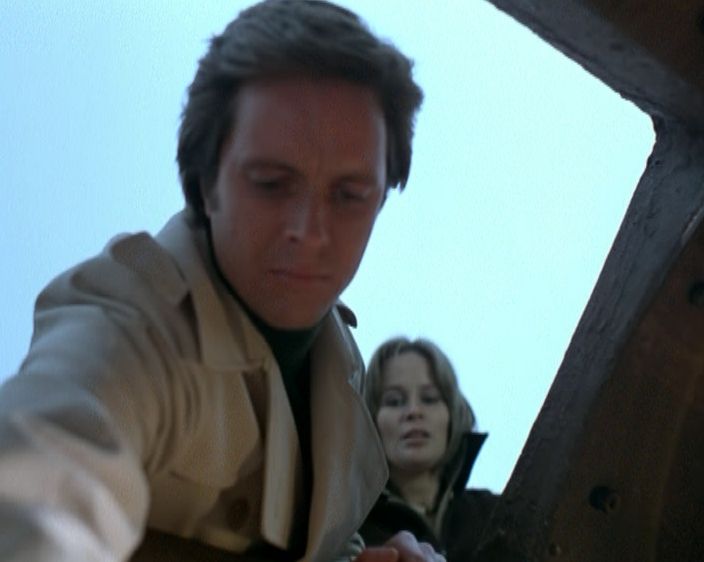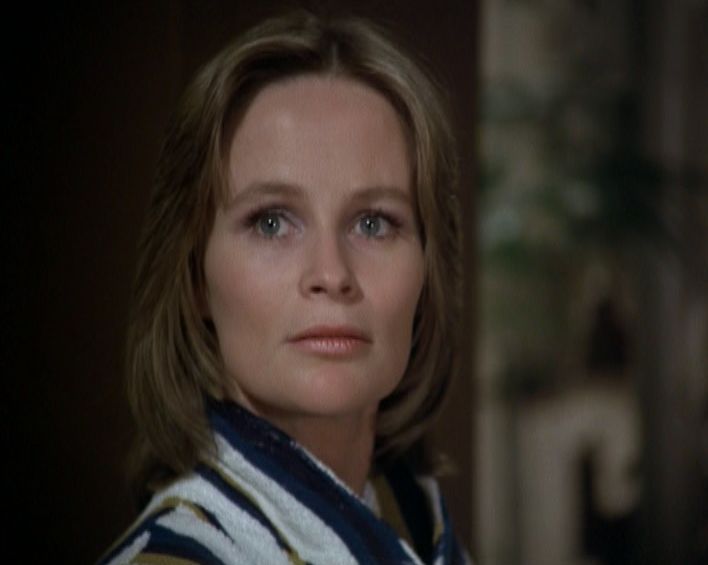
Blakes 7 – Trial

trial 01

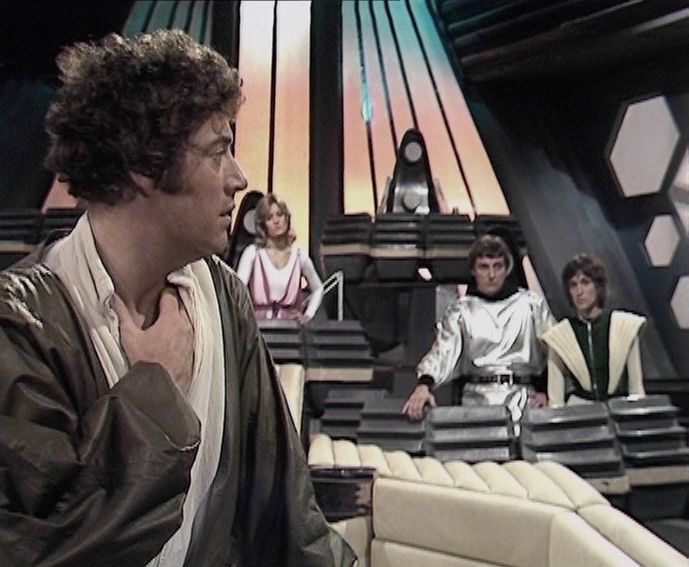
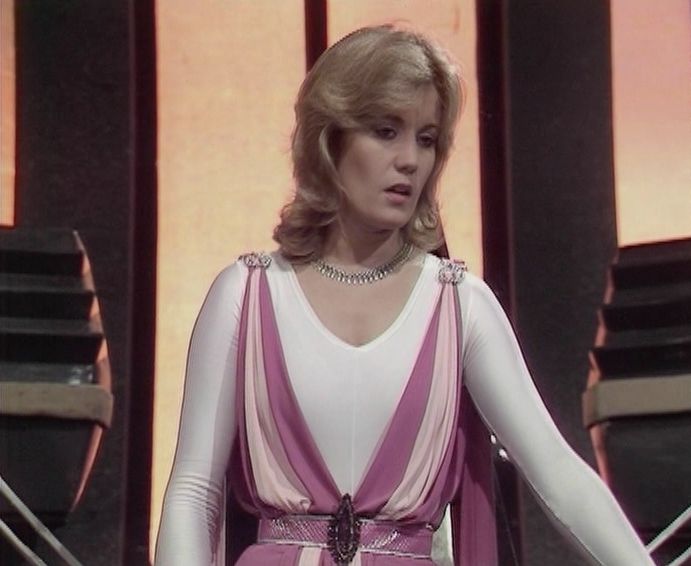
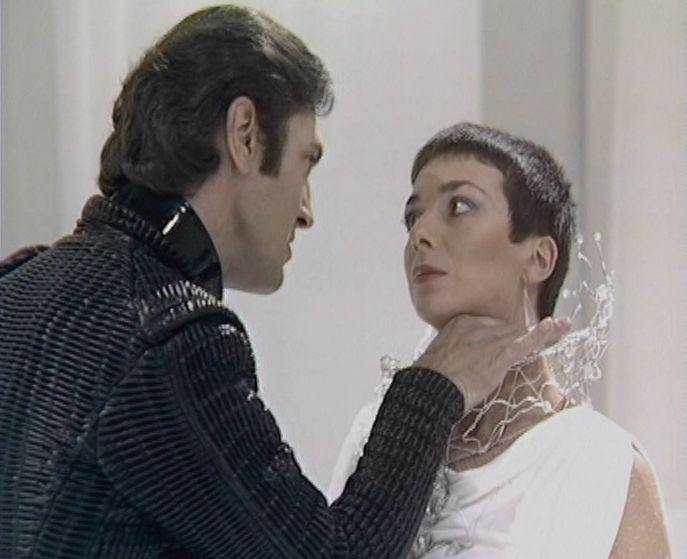
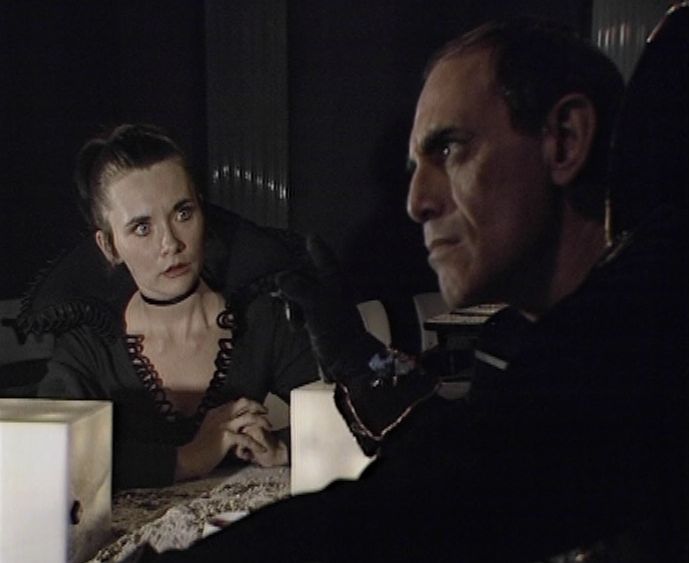
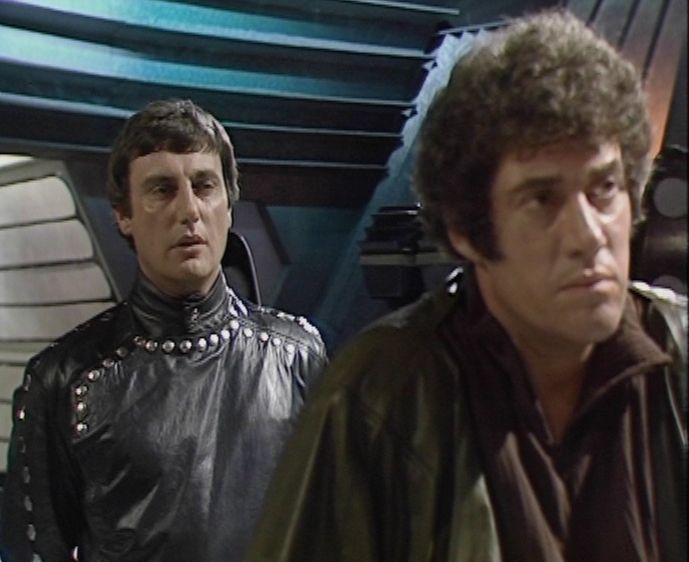
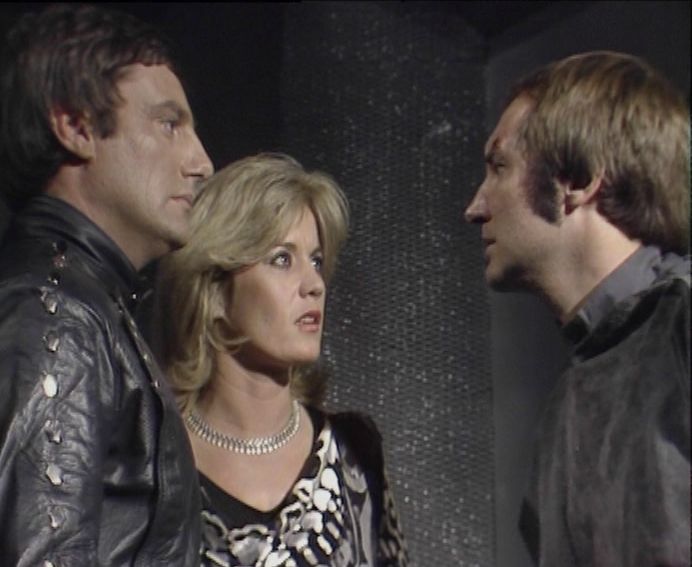
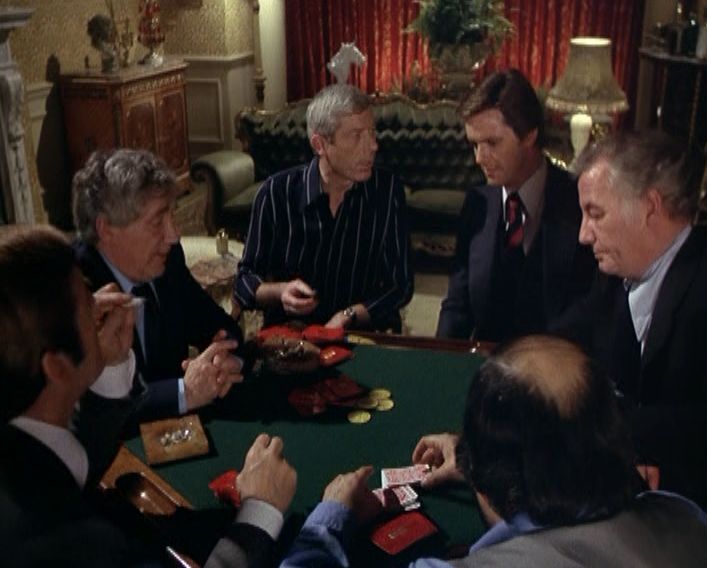
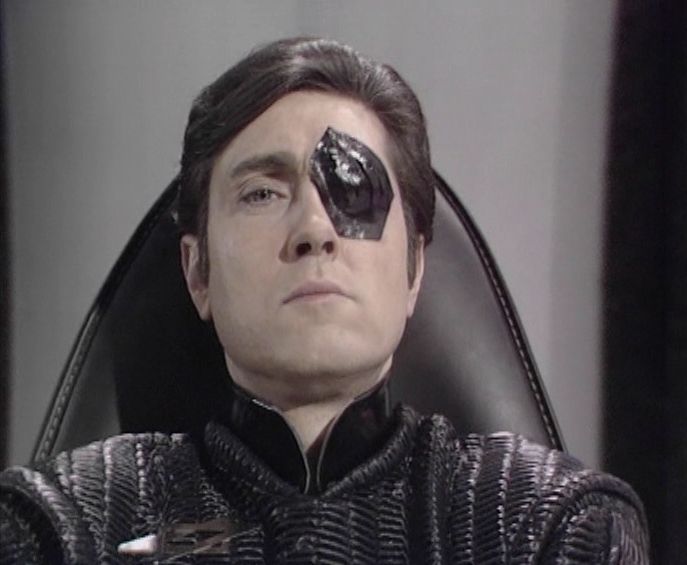
Travis is facing a court-martial, charged with the murder of one thousand four hundred and seventeen unarmed civilians on the planet Serkasta.  Whilst he remained useful to Servalan she was prepared to ignore his previous misdemeanors but following the events of Pressure Point she has no hesitation in throwing him to the wolves.  She also plans to make sure that the verdict is the one she requires by suborning Travis’ defence counsel Major Thania (Victoria Fairbrother).

It does seem slightly strange that Servalan decided to go to all the trouble of arranging a court-martial when she could have either simply ordered one of her troopers to put a bullet in Travis’ head or (as mentioned in Weapon) sent him to the slave pits on Ursa Prime.  It’s a pity that Blakes 7‘s script editor couldn’t have liaised with the writers of Weapon and Trial.  Oh wait ……

But although the reason for the court-martial does feel a little spurious, Trial is compelling since it asks us to consider the morality of the Federation in general.  There’s no doubt that Travis committed the crime (although he pleads not guilty, for a reason we’ll come to later) but is his action typical of a Federation officer?

In Travis’ debut episode Seek Locate Destroy, Servalan was confronted by a junior officer who registered his disapproval that Travis had been reinstated into the corps.  For him, Travis was a killer and someone who disgraced the uniform of a Federation officer.  In Trial, the court-martial is conduced by Samor (John Savident) a highly respected officer (Thania calls him “a rule book officer of the old school.”)  Are they more typical of the average Federation officer than Travis is?

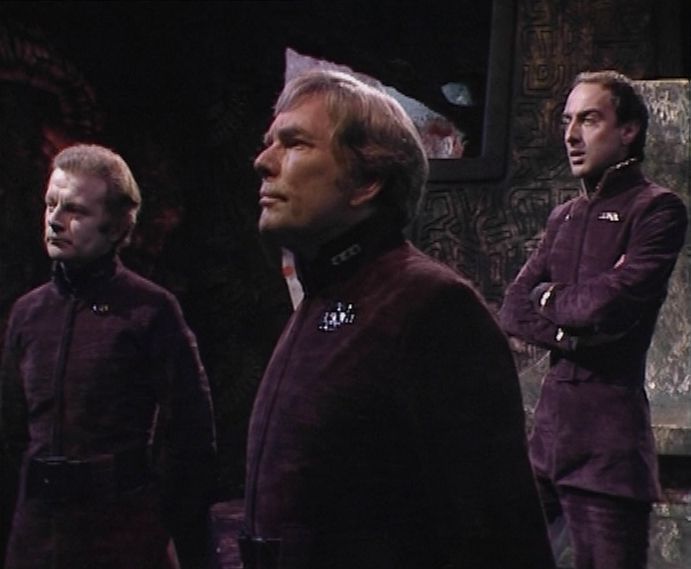
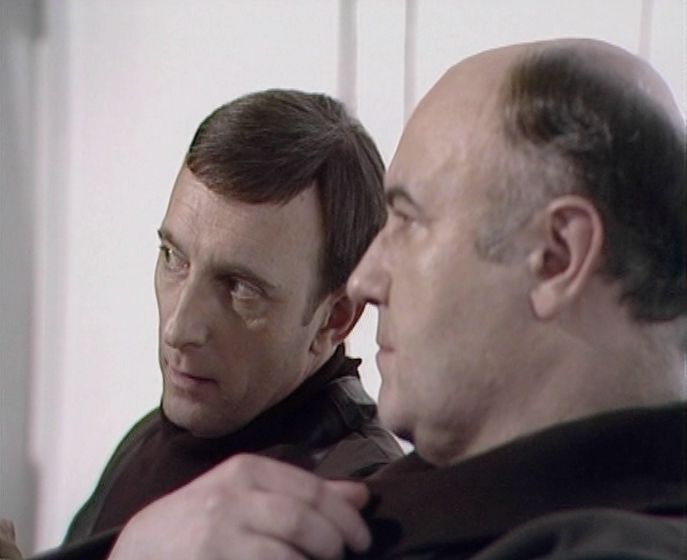
On hand to observe events are Bercol (John Bryans) and Rontane (Peter Miles).  Like a space-age Waldorf and Statler they exist to provide an ironic commentary on events.

RONTANE:One almost has to admire that woman.
BERCOL: What, Thania?
RONTANE:Servalan.
BERCOL: Oh.
RONTANE: We know that she’s sending Travis to his death in order to keep his mouth shut, but she is doing it with such an impeccably honest and painstaking tribunal that her real motives can’t even be hinted at.
BERCOL: Has a date been set for the Blake inquiry?
RONTANE: Does it matter? Without Travis’ evidence the mishandling of the Blake affair becomes a matter of conjecture. The inquiry becomes a formality.

The idea that the court-martial has been convened to silence Travis before he can implicate Servalan in the inevitable enquiry that will no doubt shortly be held into the continuing inability to capture Blake is a compelling one, but as I’ve said it would have been easier to just quietly dispose of him.

Bryans and Miles are once again a great double-act in this, their second and final appearance.
trial 02

Trooper Par (a slim-looking Kevin Lloyd) served with Travis for five years.  He tells Thania that he could always guarantee that Travis would not “get you killed unnecessarily. He never wasted troopers.” He’s certain of Travis’ guilt though – he heard him give the order – but it’s telling that he doesn’t feel any personal responsibility (“he gave the order. We just did the shooting.”)

Given that the Nazis often featured in Terry Nation’s scripts (most famously disguised as the Daleks) it’s not a particular stretch to assume that Chris Boucher was also drawing parallels between Federation troopers and, say, SS soldiers (who would also no doubt insist they were only obeying orders).

Brian Croucher has said that he wished Trial had been his debut episode as it would have allowed him to get a much better grip on the character of Travis.  He’s certainly very good throughout and is never better than the climatic scene where Travis offers his defence.

A field officer, like myself, is frequently required to make fast, unconsidered decisions. You were all field officers, you know that’s true. Time to think is a luxury battle seldom affords you. You react instinctively. Your actions, your decisions, all instinct, nothing more. But, an officer’s instincts are the product of his training. The more thorough the training, the more predictable the instinct, the better the officer. And I am a good officer. I have been in the service all my adult life. I’m totally dedicated to my duty and highly trained in how to perform it. On Serkasta I reacted as I was trained to react. I was an instrument of the service. So if I’m guilty of murder, of mass murder, then so are all of you!

It’s no surprise that Samor does not accept this.  “Space Commander, we have considered your sentence at some length. Your contention that what happened on Serkasta was a direct result of your training concerned us greatly. We accept that you are trained to kill. As are we all. What we cannot accept is that this training leads inevitably to the murder of innocents. Your behavior was not that of a Federation officer, but rather that of a savage, unthinking, animal.”

Since Samor is never presented as an officer that Servalan could influence, this must be his honest opinion.  If so (and if it’s also held by his brother officers) then it shows the Federation in a very different light from the unthinking murderers that Blake considers them to be.  It’s therefore deeply ironic that Blake decides to attack Servalan’s headquarters (where Travis is being tried) partly to regain some confidence after the death of Gan.

His attack kills the majority of the people present at the trial (including the reasonable Samor) and allows Travis to escape.  And as the credits roll, the question must be which was the greater crime?  Travis’ murder of the unarmed civilians on Serkasta or Blake’s murder of the unarmed Federation personnel on Servalan’s base?  Exactly how many are killed by Blake’s attack isn’t certain (although it’s presumably a lot less than Travis’ massacre) but it’s a uncomfortable possibilty that the scene was designed to show that Blake and Travis aren’t that far apart.

As for Blake himself, he also finds himself on trial in this episode – although in his case it’s a self-imposed one.  He spends most of the time having an odd adventure with a creature called Zil (Clare Lewis).  This would be a strange interlude in any story but it really jars here when it interrupts the drama of Travis’ trial.

Avon, of course, gets some good lines at Blake’s expense – such as this one, after Blake announces his plan to teleport down to the planet alone. “It occurs to me that if you should run into trouble, one of your followers – one of your three remaining followers – might have to risk his neck to rescue you.”

Following Gan’s death there had to be some pause for reflection, but it doesn’t last long and by the end of the episode everyone pretty much carries on as before.  This might seem a bit callous or it could just be that Gan was someone who was tolerated by the others as a work-colleague might be, rather than a close friend.

Minus points for the episode ending on a shot of Avon and Blake laughing after a rather weak joke.  Not only for the sub-Star Trek feeling but also because it feels a tad inappropriate after they’ve just killed so many people.  A similar thing happened at the end of Breakdown though, so maybe it’s a running theme that I’ve not picked up on before.
trial 03

Hancock – The Bowmans

bowmans

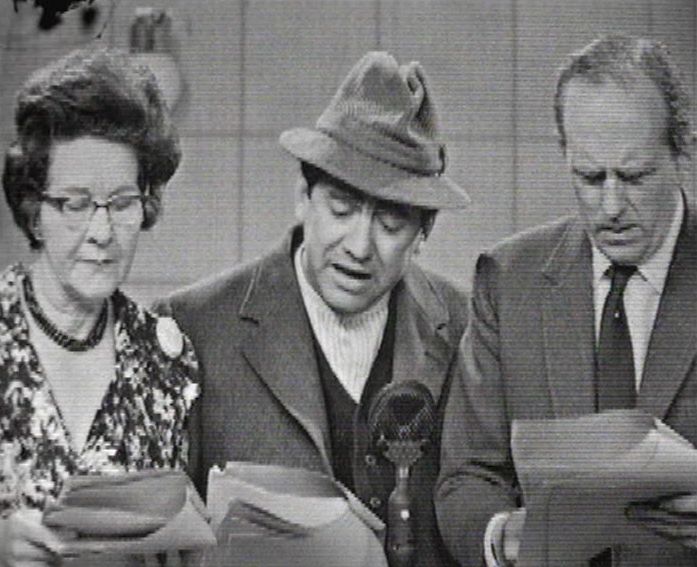
The Bowmans is a popular and long-running rural radio series (“an everyday story of simple folk” as the announcer puts it) which features Tony as local yokel Joshua Merryweather.  Even after almost fifty five years there’s no mistaking that this is a deliberate parody of The Archers – the theme tune of The Bowmans is almost a note-for-note copy of The Archers, for example.

Joshua Merryweather was modelled on Walter Gabriel (Joshua’s catchphrase “me old pal, me old beauty” is a direct crib – they were the first words ever heard on the debut episode of The Archers back in 1950).  Galton and Simpson clearly had great fun in satirising some of the conventions of a series that had, even by 1961, become an institution.

The fact that The Archers is still running today means that the jokes remain relevant and it’s also interesting that many of the gentle digs could also be applied to the various television soaps (especially Coronation Street) which would in time supplant The Archers in the nation’s affections.

One of the most telling is the way that some members of the audience seem to be unable to distinguish fiction from fact.  At the start of The Bowmans Tony mentions how Joshua received gallons of cough syrup when his character had a cold and proposals of marriage when he was jilted at the alter!  Examples continue to this day, possibly most notably the Free Deirdre Rachid campaign.  There’s an obvious post-modern irony at work with many of these public outcries but it’s also clear that people enjoy playing the game.

As for Tony, he feels totally secure in the series.  He’s played Joshua for five years and considers himself to be easily the best thing about the programme, although it’s plain that everybody else, including the harassed producer (played by Patrick Cargill) disagree.  Joshua Merryweather gives Tony Hancock the perfect opportunity to indulge in some ripe overacting – with an accent switching from Welsh, Suffolk, Robert Newton and all points in-between.  He also arrives singing a song of his own devising (all about mangle-wurzels) and likes to perform in rustic clothes, although he angrily denies that he’s a method actor.

However he’s not the first, and certainly won’t be the last, soap actor to find out that he’s not as indispensable as he thought.  When he receives the next script he’s horrified to find that Joshua falls in the threshing machine and dies.  Was this ruthlessly quick exit a comment on the death of Grace Archer some six years previously?

The next week poor old Joshua breathes his last (although Tony doesn’t go quietly) and he’s then forced to find alternative work.  This leads us into a short five minute interlude which could have easily worked as a one-off sketch.  Firstly he fails to impress in a Shakespearean audition and then finds his level in a series of adverts for Grimsby Pilchards.  These are wicked parodies of exactly the sort of thing which were appearing on ITV at the time and they see Tony dressed in various different period costumes, pausing at the most inappropriate moment to pull out a tin of Grimsby Pilchards.

The most atypical thing about The Bowmans is that Tony emerges on top.  He’s so frequently the loser that it does come as a surprise when the death of Joshua produces a massive outcry which forces the BBC to beg him to come back.  After a brain-storming session they decide he can return as a relative of Joshua’s, Ben Merryweather.  Real soap operas have done far worse, so this seems quite credible.

He also gets script approval and his first action is to write a scene where most of the villagers fall down an abandoned mine-shaft.  We end with Tony promising to repopulate the village with more of his relatives (was he planning to play all the parts himself?)

With a script that still feels fresh today (actors are still finding themselves written out and then back into soap operas just as unconvincingly as Joshua) The Bowmans is an entertaining twenty five minutes.  Patrick Cargill might not have as a large as role as he does in the upcoming Radio Ham or The Blood Donor, but he’s still excellent as the producer driven to the end of his tether.  Peter Glaze also amuses as the all-purpose voice man who brings the village’s animals to life.  One of his main roles is as Joshua’s dog, much to Tony’s disgust (he’s often threatening him with his stick!).

Although there’s a faint air of unreality about it all (Joshua is such a badly acted character that it’s impossible to believe his departure would have created such an uproar, and the new Ben-dominated series seems just as bad) there’s still a lot to enjoy in this one.

Blakes 7 – Pressure Point

pressure 01

Whilst the initial reason for scripting Pressure Point was borne out of necessity (Gan had to be written out) in the end it proved to be something of a watershed for the show.  Since the start of series one we’ve seen that Blake is a far from infallible character –  he may have positive qualities which mark him out as a natural leader but his decision making can often be deeply flawed.

This is shown most brutally in this episode.  Blake has returned the Liberator to Earth – to howls of protest from everybody except Cally.  She, like Blake, is a fanatic.  They value their own personal safety far less than the cause they’re fighting for – you know that either would be only too willing to sacrifice their life and become a martyr.  But Avon, Jenna and Vila don’t share their burning intensity – they might be happy to ally themselves to Blake, but personal preservation is never far from their minds.

And what of Gan?  We can say for certain that he’s always been (with the odd exception, such as Shadow) one of Blake’s most staunchest allies.  But it’s possible to consider that his frequent shows of support for were designed mainly to allow Avon to score cheap points at their expense.  Blake would announce a risky scheme, Gan would give him his whole-hearted support, Avon would roll his eyes and mutter something disparaging along the lines that only someone as stupid as Gan could ever think it was a good idea.

Blake tells the others the reason for returning to Earth. “Two hundred years ago, when the Federation began expansion and conquest, the Administration established a computer complex to monitor information: political, civil, military – everything. That computer is the nerve center of ALL Federation activity. Smashing that would be the biggest single step toward the destruction of their power. I don’t think they would ever recover from it.”

This seems not dissimilar to the space control complex on Saurian Major as seen in Time Squad.  That was also seen by Blake as a vital part of the Federation’s empire – although after he destroyed it there seemed to be no change at all to the smooth running of the Federation.

Coming fresh to Pressure Point, and especially if you’re aware of Terry Nation’s history as a writer, it would be reasonable to assume that Control on Earth would be similar to the space control complex on Saurian Major – just a MacGuffin which exists for the sole purpose of giving the Liberator crew something to attack.  They teleport down, shoot some guards, lay some explosive charges and teleport back up – job done.

But this doesn’t happen.  Control is an empty shell designed to lure people like Blake into a trap and the moment of revelation is a stunning one.  Blake falls to his knees, speechless, whilst Travis explains.  “You see, it’s the great illusion, Blake. You give substance and credibility to an empty room, and the real thing becomes undetectable, virtually invisible.”

The only thing worse than Blake having risked all their lives for nothing is that Gan dies as they make their escape.  And it’s the complete pointlessness of his death which is striking .  Nation could have scripted a story where Gan dies a heroic death – saving Blake and the others – instead the last shot we see of his lifeless body is deliberately anti-heroic.

It’s a far cry from, say, Planet of the Daleks (a 1973 Nation-scripted Doctor Who adventure).  In that story we see various Thals die during the course of the six episodes and each time the Doctor is on hand to deliver a short moral homily.  The Doctor’s speeches were intended to demonstrate that the Thals didn’t die in vain – they were sacrificing themselves for the greater good.  No such comfort can be drawn from Pressure Point though.  Gan did die in vain – there’s no two ways about it.

Although George Spenton-Foster (something of a bogey-man for Brian Croucher) directed this one, Croucher does seem more settled as Travis.  There’s far less of the histrionics we saw in Shadow and a touch more of the calculating Travis of old.  Possibly this is because he’s convinced that the plan to capture Blake is such a good one.

The focus is slightly more on Servalan though, thanks to her interaction with Kasabi (Jane Sherwin).  Kasabi is the rebel leader who Blake intends to contact – without her help he won’t be able to breach the outer defences.  Servalan and Travis capture her, but she proves uncooperative.  Kasabi’s previous relationship with Servalan helps to shine something of a light on the Supreme Commander.  “Don’t try and browbeat me Servalan. Or have you forgotten that I knew you as a cadet? You were a credit to your background: spoilt, idle, vicious. My confidential assessment listed her as unfit for command.  But I forgot how well-connected she was.”

As Kasabi doesn’t survive the interrogation it’s lucky that Servalan and Travis have an alternative – Kasabi’s daughter Veron (Yolande Palfrey).  This was a fairly early credit for Palfrey (who died far too young in 2011) and she’s not always entirely convincing (although we could be charitable and say this is because she was feeling the pressure of being a traitor to the cause).

pressure 02

It’s notable that when Blake and the others find her it’s Gan who’s the most solicitous.  This may be a decision from Nation to bulk up his part (too little, too late if so) or it could be a nod back to Project Avalon which saw Gan rather taken with the android Avalon.  Poor Gan, never a good judge of females (real or manufactured) it would seem.

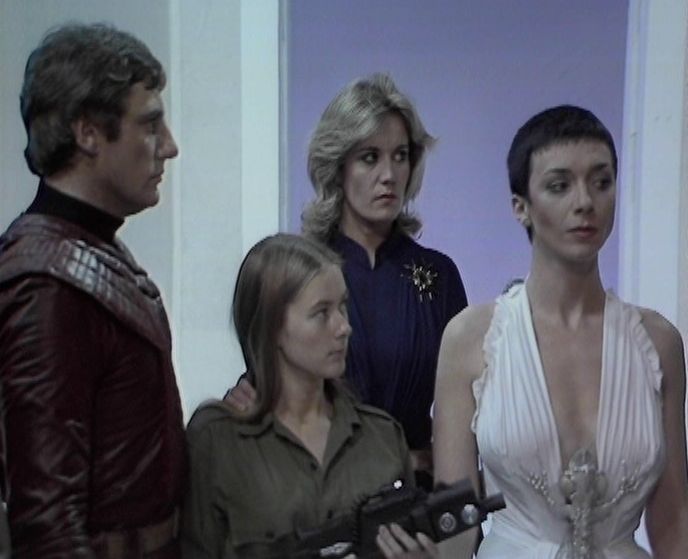
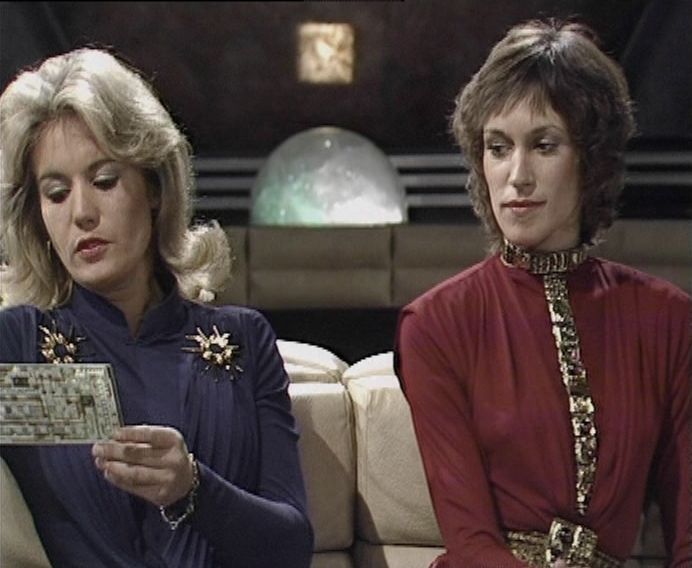
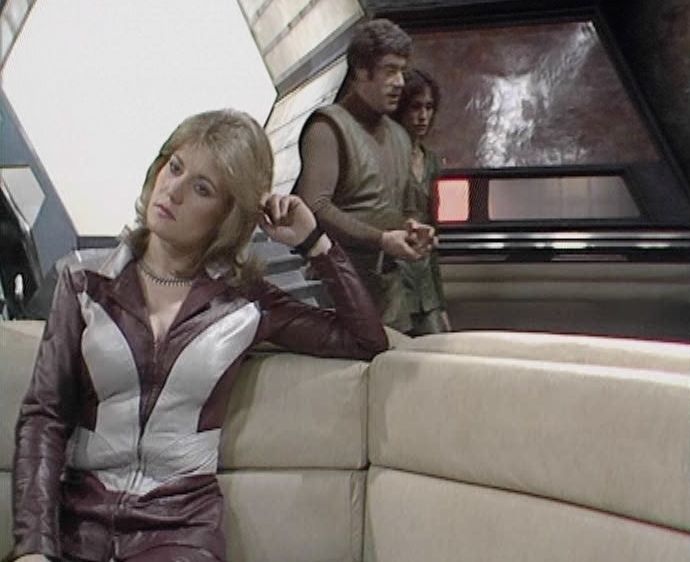
I do have to mention Jacqueline Pearce’s dress (as seen in the first picture).  Not very practical, but it’s certainly memorable.

Another point of interest is an exchange between Blake and Avon before they launch the attack.  Avon rather surprises Blake by giving him his full support, but Avon being Avon there’s a reason behind it.  “If we succeed, if we destroy Control, the Federation will be at its weakest. It will be more vulnerable than it has been for centuries. The revolt in the Outer Worlds will grow. The resistance movements on Earth will launch an all-out attack to destroy the Federation. They will need unifying. They will need a leader. YOU will be the natural choice.”

With Blake unifying the resistance, Avon will take over the Liberator.  As we’ll see, this is something that will ultimately come to pass …..

But not for a little while as Blake’s defeat here will only intensify his desire to find the true location of Control.  This will form a loose running thread which will carry on until the the conclusion of series two – Star One.

pressure 03

Blakes 7 – Horizon

horizon 01

Allan Prior contributed five scripts to Blakes 7 (Horizon, Hostage, The Keeper, Volcano and Animals).  It’s fair to say that none of these episodes would feature in most people’s top tens (unless it was a top ten of least favourite stories).

Prior’s work on B7 tended to range from the competent to the mediocre, which is slightly surprising given his very lengthy list of writing credits.  He wrote over a hundred episodes of Z Cars and also contributed to many other popular series during the 1960’s, 1970’s and 1980’s (such as Sergeant Cork, Armchair Theatre, Dr Finlay’s Casebook, Warship, The Sweeney, The Onedin Line, Secret Army, Juliet Bravo, The Charmer, etc etc).  It’s an incredibly impressive CV, but it’s notable that apart from Blakes 7 he never wrote for any other science fiction or fantasy series.

His debut script, Horizon, is possibly his best.  The science fiction in this one is laid on fairly gently – as it’s essentially a colonial story that could easily have been set in any African country (for the Federation just substitute the British Empire).

The regime on the planet code-named Horizon is one with obvious parallels in history.  The Federation needs the minerals it has in abundance (such as Monopasium two-three-nine) but a full occupying force would tie up too many people.  So the Federation “educates” the elite of the planet who remain nominally in charge whilst the Federation rule behind the scenes and siphon off the resources for their own use.

Ro (Darien Angadi) is a textbook example of a native who has been educated to think and act as a member of the Federation.  His former teacher is now the Kommissar ultimately response for the planet (played to perfection by William Squire) and he’s confident that he can continue to bend Ro to his will.

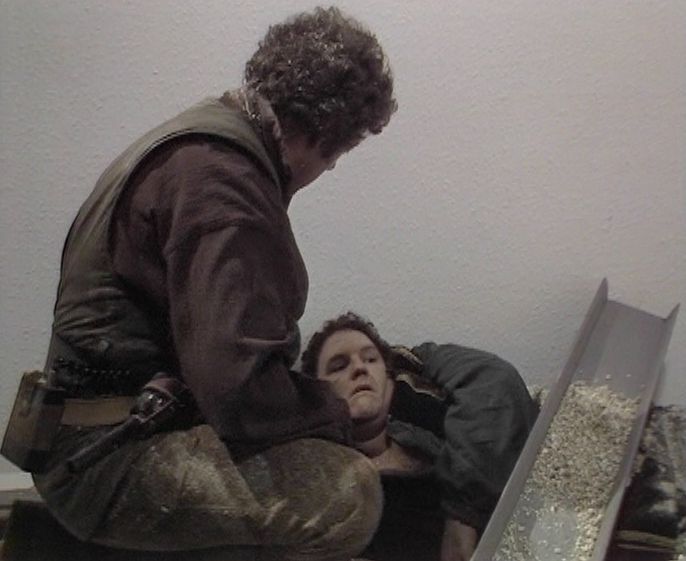
The heart of the episode is the relationship between Ro and the Kommissar.  Partly this is because the only other native speaking role we see is Ro’s finance Selma (Souad Faress).  The remainder of the natives tend to toil in the mines and are hairy, grubby and mute.  It’s slightly surprising that Ro doesn’t have a council of leaders that he has to report to – that would have created some decent dramatic tension, but restricting everything down to just a single man does work as well.

It’s interesting that Ro is aware that the mortality rate in the mines is high, but he’s just not terribly bothered about it.  To him they’re savages, little more than animals.  The fairly heavy irony that he was in exactly this position before he was lifted up by the Federation never seems to occur to him.

Blake and the others turn up to Horizon after they follow a Federation supply ship.  It’s travelling to Zone Nine – far off the beaten track – and Blake is intrigued.  But everybody else is exhausted from a series of close shaves and it’s fair to say they don’t share his curiosity.  The ratty, bad-tempered banter at the start is a nice touch and it gives all of the regulars a few decent character moments before the episode proper begins.

horizon 02

Blake and Jenna teleport down and are captured.  When they don’t return Gan and Vila teleport to look for them and are captured.  Cally then teleports down to look for them all and she is captured as well.  This leaves Avon by himself (“and then there was one”) apart from Orac and Zen.  We then see Avon wrestling with his conscience – can he simply run out and leave the others?

AVON: If I go alone, can I pilot the Liberator indefinitely?
ORAC: With the help of the automatics, of course you can.
AVON: I know that.
ORAC: Then why did you ask the question?
AVON: I didn’t. How long can I maintain myself?
ORAC: Is that a question?
AVON: Yes.
ORAC: We have concentrated food for one person for a thousand years.
AVON: And our power is self-regenerating.
ORAC: Affirmative.
AVON: Can you plot courses to keep out of the range of any known spaceship manned by the Federation?
ORAC: The battle and navigation computers can handle that perfectly adequately.
AVON: I asked if YOU could.
ORAC: Of course, should it be necessary.
AVON: Failing that, we are powerful enough to resist all but an attack by three Federation pursuit ships at once.
ORAC: Is that a question?
AVON: No. If we go now, we can sail the universe for as long as we like in reasonable safety, provided we keep out of everybody’s way and we do not do anything rash.

When he learns that three Federation pursuit ships are en-route to destroy the Liberator he decides to stay and fight.  Was he ever seriously intending to cut and run?  Maybe not, as I’m sure the pleasure he derived from rescuing everyone else was immense!  And once he teleports down Paul Darrow looks like he’s enjoying himself as Avon turns into a Wild West gunslinger, cutting down Federation troopers left, right and centre.  He nearly blows Blake’s head off as well, but luckily(?) the shot goes wild.  There’s a lovely expression on Gareth Thomas’ face as he deadpans the line “missed”.

If there’s a weak part to the story then it’s when Blake is initially captured and interrogated by both Ro and the Kommissar.  Blake’s quickly able to gain Ro’s trust by telling him that he knew an old friend of his, Paura.  Blake and Paura were both convicts on the ship London, bound for Cygnus Alpha.  This just seems a little contrived – had Blake travelled to Horizion, armed with this knowledge, expressly to talk to Ro it might have seemed more reasonable.

This niggle apart, Horizon is a pretty good stuff.  As I’ve said, William Squire (best known as Hunter in the Thames version of Callan) is perfectly cast as the arch-manipulator.  Darien Angadi also has a decent amount of screen-time as the apparently subservient puppet ruler.  Brian Miller and Souad Faress exist to act as sounding-boards for the Kommissar and Ro respectively, so have less chance to impress – but both are capable enough.

And Sally Knyvette looks rather lovely, which is always a plus point for me.

horizon 03

Blakes 7 – Weapon

weapon 01

Weapon gives us our first opportunity to see Travis Mk 2 (Brian Croucher) in action.  And he’s angry, very very angry.

One of the main character flaws with Travis is that he exists for one purpose only – to kill Blake.  And when, week after week, this doesn’t happen he can’t help but become something of a figure of fun (or contempt).  But it’s not only Blake and his friends who hold him in contempt, in this episode it’s clear that Servalan loathes him as well.

As we go through series two there will be the odd highlight (Trial) as well as plenty of lowlights (Voice from the Past is easily the most bonkers use of him).  Given that he became something of a marginalised character almost immediately,  it’s no surprise that Stephen Greif decided to bail after series one.  This leaves Brian Croucher with an almost impossible task.

Croucher has made no secret of the fact that his time on Blakes 7 wasn’t terribly happy – he’s singled out director George Spenton-Foster as someone he had serious problems with.  And since Spenton-Foster directed this episode it looks obvious that the problems start here.

From the first scene Travis is struggling with barely suppressed rage.  It’s a totally different acting choice from Greif, who had much more of an ironic detachment, and it doesn’t really work (it’s easy to imagine Greif saying the same lines, but in a very restrained way).  If Spenton-Foster wasn’t giving Croucher adequate direction then it’s probable that he just went his own way – resulting in a performance where Travis is little more than a thug.  He’ll tone things down as we move through the series, but it’s not an auspicious start.

His first scene is quite arresting though – as he kills Blake!  Or at least, someone who looks remarkably like him (is this a nod to the pre-credits sequence of From Russia with Love?).  Travis has, of course, just killed a clone of Blake – but one that’s identical to his arch-enemy in every physical way.

Clonemaster Fen (Kathleen Byron) is clearly a being of awesome power – we can tell this because Dudley Simpson goes overboard on the organ and there’s a great deal of dry ice floating about.  I do always worry when she’s walking rather gingerly down the stairs though, one false move and she could have had a nasty accident.

weapon 02

In Project Avalon we saw it was possible to create a perfect android replica of someone (something that’s never done again after that episode).  In Weapon we see that it’s possible to create a perfect clone of someone (something that’s never done again after this episode).  I sense a pattern emerging here.  Given how incredibly useful both android duplicates and clones could be, it’s remarkable that once they’ve served their purpose in their respective stories they never crop up again.

Although the Blake clone will be an important figure in a great deal of post Blake fan fiction ……

I like the idea that Servalan commissions two clones of Blake, since she knows that Travis will be unable to resist killing one of them.  Their dialogue after this happens is instructive and it clearly indicates the current stage of their relationship (not good).

SERVALAN: Travis, you are pathetic.
TRAVIS: If you say so.
SERVALAN: Of all the cripple-brained idiots.
TRAVIS: Me – or you?
SERVALAN:What did you say?
TRAVIS: You’re angry, Supreme Commander. Surprised by what I did. You devious – you always have been devious. You knew what would happen.
SERVALAN: Take your hand off me.
TRAVIS: You knew if it was Blake I’d kill him. I’d have to kill him.

The clone of Blake is part of a highly complicated plan by Carnell (Scott Fredericks).  Carnell is a psychostrategist (who are unflatteringly nicknamed “puppeteers”) and Servalan appears to have commissioned him to kill two birds with one stone.  Eliminate Blake and his crew as well as acquire IMIPAK (a deadly new weapon).

If you’re not particularly aware of Blakes 7 fan-fiction and spin-off fiction then it might come as a surprise than Carnell (a one-shot character) has had quite an extensive after-life – appearing in numerous fan-fiction stories as well as novels and audios by Chris Boucher (superior fan-fiction you might say).  Most of his appeal has to be down to Scott Fredericks’ twinkling performance – his sparring with Jacqueline Pearce is a highlight of the episode.

The main guest star is John Bennett.  He plays Coser, the inventor of IMIPAK, who’s been manipulated by Carnell to not only have a nervous breakdown but to escape from the Federation’s weapons development faacility with IMIPAK.  Servalan then plans to use the clone of Blake to retrieve this from Coser.

The most obvious question is why go to all that trouble to create a clone of Blake when it doesn’t actually do anything?  Servalan could have simply turned up herself and taken IMIPAK (which is basically what happens – Coser gives it to clone Blake and he hands it over to her).

I always had a lot of respect for John Bennett, he was an actor who enlivened many a dull programme.  But he’s got his work cut out here as Coser is such an unlikable sort right from the start – he’s a terrible bully to the lovely Rashel (Candace Glendenning).  And once you see what he’s wearing it’s even harder to take him seriously …..

An odd story then and somewhat illogical.  Some of the banter between the Liberator crew does go some way to salvaging things and Jenna and Cally look rather fetching in their blue and red outfits so there is some small recompense.

weapon 03

Blakes 7 – Shadow

shadow 01

Shadow was the first Blakes 7 story to be scripted by Chris Boucher (as well as the first not to be written by Terry Nation).  Because of this it’s pretty clear there’s a difference in tone – although it is believed that Boucher had already contributed fairly considerably to series one.

Legend has it that Nation’s season one scripts became thinner and thinner as time wore on – meaning that Boucher had to add more and more of his own material to flesh them out.  But even if that was so, Shadow was the first chance he had to craft something entirely of his own making and one of the most interesting parts of his debut script is how Blake himself is portrayed.

Blake and the others arrive at Space City.  It operates outside of Federation law and is reputed to be the base of the Terra Nostra.  The Terra Nostra are responsible for virtually all the organised crime on every Federated world – and Blake can only see the positives in allying with them.  “Think what they’ve got – men, material, information. Think what we could do with a fraction of the resources they control.”

For once Avon seems to be in agreement with him, so it’s left to Gan to be the main dissenting voice.  “No, YOU think, Blake. Think what it is they control. Everything dirty, degrading, and cruel on just about every colonized world.”  Moving Gan into a position where he can oppose Blake is welcome for several reasons, especially since it gives David Jackson a more meaty role than usual.  Gan’s time was already ticking though, so it’s sadly too little too late.

Blake’s use of semantics is instructive.  He tells Gan that they’re going to use the Terra Nostra, not do business with them.  But as he later offers them money in exchange for access to their infrastructure on Earth, the distinction is far from clear.  Is Blake simply deluding himself?  He’s obviously quite happy that the ends justify the means – the Terra Nostra can help him in his fight against the Federation so he has no moral qualms in using them.

Space City might be the “satellite of sin”, according to Vila, but it’s very underpopulated.  We only see Largo (Derek Smith) and one of his enforcers (Archie Tew) on the side of the Terra Nostra whilst Hanna (Adrienne Burgess) and Bek (Karl Howman) represent the Terra Nostra’s “customers”.  Hanna is an addict and her drug of choice is Shadow – the Terra Nostra’s most successful product.

shadow 02

It’s a little surprising that director Jonathan Wright Miller didn’t employ a few extras to at least give some impression that Space City was a thriving and bustling place, so you simply have to use your imagination.  As for the actors he did cast, Derek Smith is rather good as Largo – he manages to exude a rather silky menace.  Smith could sometimes go soaring over the top but is fairly restrained here and is all the better for it.  Tew has little to do for most of the episode except wave a gun around and look menacing, but he does later manage to move up the pecking order at the expense of Largo (proving that there had to be more to him than met the eye).

Karl Howman is very much the weak link, delivering his lines rather unconvincingly.  Dialogue such as “killing a Terra Nostra pusher will be the best fun I’ve had all day. You stupid murdering scumball.” is delivered with all the intensity of a first year drama student.  What’s odd is that he was already quite an experienced television actor at this time.  Much better is Adrienne Burgess as Hannah.  She’d been teamed up with Michael Keating a few years earlier in the Doctor Who story The Sunmakers, and is able to give Hannah, a hopeless drug-addict, some sort of character.

If there’s one thing that Shadow tells us, again and again, it’s that Blake’s operating way out of his depth.  Vila sums it up quite succinctly.  ” Look, he was an Alpha grade on Earth. A highly privileged group, the Alphas. Wouldn’t last five minutes among the Delta service grades where I grew up. And it’s the service grades where the Terra Nostra really operate. Without anesthetic, usually.”

This is proved when Blake, Avon, Jenna and Gan are detained by Largo, who dismisses them as “amateurs” and they only manage to escape from Space City by the skin of their teeth, taking Bek and Hannah along for the ride.  Blake’s not finished though – if he can’t buy the Terra Nostra’s co-operation then he’ll force them to help.  His plan?  To locate the planet where they refine Shadow and take control of it.

Again it’s Gan who provides the main voice of dissent.  This, he says, would make them little more than pushers.  Tellingly Blake again brushes off his protests.  Shadow may cause misery and death for millions but if it helps him in his fight against the Federation then he’s content.

The planet Zondar is supposed to be incredibly warm (the rather overcast sky in the quarry gives the lie to this, but at least it wasn’t raining!).  Whilst Blake, Avon and Jenna explore (and to be honest achieve very little) Cally has also teleported down to the surface.

She’s been locked into her own subplot for most the episode, battling with Orac – or an unidentified entity that’s taken over Orac.  This seems to have been bolted on to the main story in order to pad the running time out and doesn’t quite work.  The shots of Cally being isolated (done quite simply with lights and a few simple video effects) is effective but it’s frustrating that the identity of the invader is never established.  It also seems something of a contrivance that Cally is able to force it back into its own dimension with the aid of the telepathic creatures on Zondar.  How fortunate that the Liberator’s next port of call was able to provide her with the allies she needed!

The ultimate revelation that the Terra Nostra is controlled by the Federation (“It’s quite logical. To have total control, you must control totally. Both sides of the law. The Terra Nostra, the Federation – two sides of the same power.”) provides a neat ending to the story and demonstrates that the Federation’s influence is more insidious and far-reaching than was previously thought.

Following on from the gung-ho space adventure of Redemption, Shadow offers a subtle re-tooling of the direction the series would take during series two.  There would be plenty more gung-ho adventures to come, but this is the first time that Blake’s decision-making has come under strong scrutiny.  And in a couple of episodes time, following the events of Pressure Point, it will again.

shadow 03

Blakes 7 – Redemption

red 01

The easiest way of knowing we’ve reached series two of Blakes 7 is to look at the costumes of the Liberator crew.  In series one you could best describe them as drab, but now June Hudson’s been recruited things have certainly changed (and this is only the beginning).  Highlights are Avon’s natty black studded number (which he later donates to Tarrant) and Blake’s rather extraordinary green plastic jacket with enormous puffy sleeves.

But if the costumes are different then the story is much more familiar (not surprising since it was Terry Nation’s fourteenth script in a row).  Like The Web or Breakdown it’s a story of two halves.  The first takes place on the Liberator and the second kicks into gear once they’ve reached their destination.

Before things start happening there’s an interesting exchange between Blake and Avon.  Blake is still concerned by Orac’s prediction that the Liberator apparently faces imminent destruction.  He’s been poring over the data, only for Avon to provide him with the solution.  They can pinpoint exactly where the event will happen by the starfield shown behind the ship – so all they need to do is to ensure they never travel to that part of the galaxy and the prediction will be null and void.

When Avon admits that he worked this out several hours ago, Blake asks him why he’s not said anything to the others. “Well, all they had to do was ask. Perhaps in future, they won’t rely on you to provide all the answers”.  This battle of wills between the pair of them will bubble on for the remainder of the second series.  As to who will gain the upper hand, Vila puts it best when he says that “if it ever comes to a showdown, my money’s on Blake. Well, half of it. I’ll put the other half on Avon.”

Another fascinating little moment occurs just after Avon’s scored this point over Blake.  An explosion rocks the ship and as they fall to the ground Avon puts a protective arm around Blake.  I wonder if this was scripted or something worked out in rehearsal?  It’s only a throwaway thing, but it’s a lovely touch – proving that although he may profess to despise virtually everything Blake stands for, Avon still seems to have an automatic reflex to protect him.

red 02

Shortly afterwards, the ship comes under attack and they then lose all control of the Liberator, ending up as little more than helpless passengers (any repairs are rejected by the ship).  Avon tells the others his theory.

AVON: Think of the ship as a living entity with massive networks of electronics acting as a nervous system.
JENNA: All linked into a central computer.
BLAKE: The brain.
AVON: Carry the analogy a stage further. When a living creature is hurt – a cut or a wound – antibodies gather around the injury to repair it and to fight infection.
VILA: You mean the computers are treating us like germs.
AVON: Crude, but accurate.

Blake has first-hand experience of this when he’s attacked by a cable in one of the service areas.  Yes, the wires holding it up are rather obvious but it’s not as bad an effect as it could have been.  Once again it’s Avon who saves the day and he’s not slow in telling Blake that one day, probably quite soon, he’ll require payback!

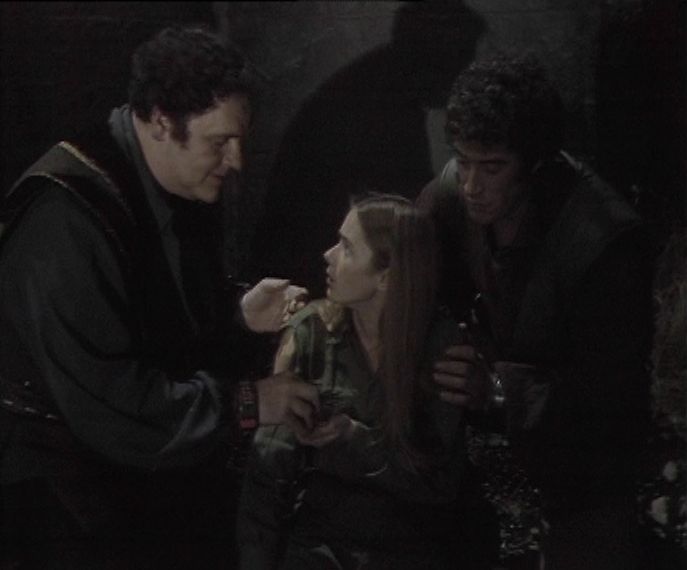
The Liberator is under the control of its creators and soon all the crew are prisoners.  Blake has a chat with Alta 1 (Sheila Ruskin) and Alta 2 (Harriet Philpin).  This is a part of the story that doesn’t quite hold together.  Both Alta 1 and Alta 2 are linked to the System (a supercomputer which controls the three planets in this sector).  We’re told that the System has ruled for several generations.  As Blake discovers when he speaks later to a slave (played by Roy Evans) this means that whilst there’s no war or famine, there’s also no freedom.

Could the System have been responsible for designing the Liberator?  Surely if they had it would have been much more functional.  And if they did create it, what was its purpose?  The Federation has clearly never come across a ship like the Liberator before (even though it’s established later that it’s not unique) so it doesn’t appear that the System is interested in expanding its empire or has very often ventured into Federation territory.  Visiting the civilisation that designed the Liberator was an obvious thing to do, it’s just a pity that it falls rather flat.

The System also bears a passing resemblance to the Conscience of Marinus as seen in Terry Nation’s Doctor Who story The Keys of Marinus – proof that Nation was never averse to reusing a good idea.

Neither of the Altas are great conversationalists, but they’re dressed in tight blue lycra which is some consolation.  Another plus-point is the filming at the Oldbury Nuclear Power Station which adds a little gloss to what otherwise is a fairly routine story.

But Redemption is still an effective season opener.  It reignites the Blake/Avon power-struggle as well as giving the rest of the regulars a moment or two to shine.  And although the plot, once we reach the System, feels a little undercooked there’s still enough going on to ensure that the story never seems to drag too badly.

red 03

Return of the Saint – The Debt Collectors

debt 01

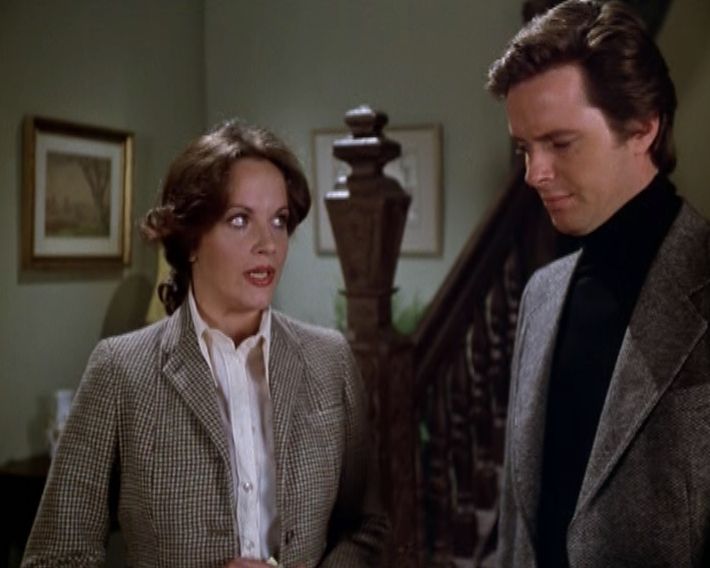
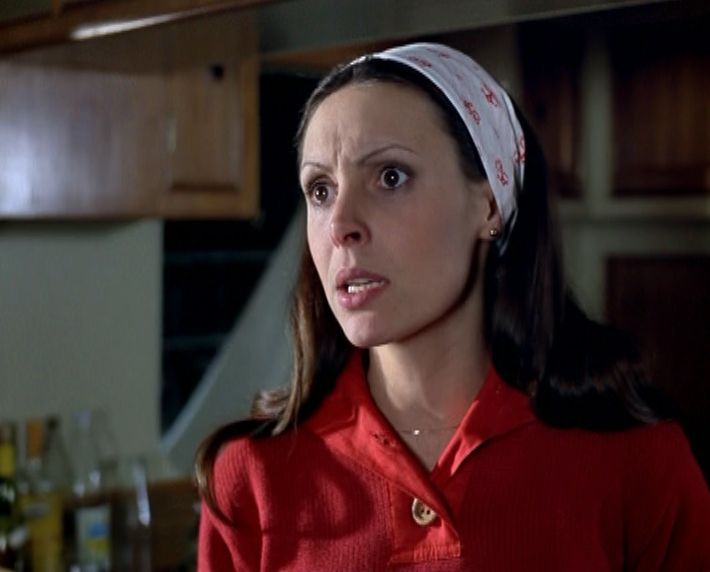
After Simon comes to the aid of a runaway horse ridden by Jeri Hanson (Mary Tamm), he finds himself embroiled in the murky world of espionage.  Jeri’s sister Christine (Diane Keen) was convicted of passing military secrets and is six years into a prison sentence.  But just one day before she’s due to be released on parole she escapes.

This was engineered by Sir Charles Medley (Geoffrey Keen) of the Ministry of Defence.  Jeri tells Simon she’s convinced her sister is innocent and it appears that Sir Charles arranged Christine’s prison-break in order to flush out a traitor in MI5.  But who can be trusted?  In the world of intelligence, things are not always as they appear to be …..

The Debt Collectors was written by George Markstein.  Given his background (script-editor/writer on series such as The Prisoner, Callan and Mr Palfrey of Westminster) it’s no surprise that he delivered a dense story set in the world of British Intelligence.

And after finding some of the previous episodes to be rather linear and straightforward, it’s a pleasure to have one where people’s motivations aren’t immediately obvious.  Things appear to open normally enough, with Simon coming to the rescue of an attractive young woman.  But she’s under surveillance and when Simon is later told not to speak to her again this only strengthens his interest.

By the time this aired, in December 1978, Mary Tamm was already more than half-way through her single season as Romana in Doctor Who.  Here, she seems to be the archetypal ROTS heroine – her function in the plot being little more than providing a decorative presence and also the excuse for the Saint to become involved in the story – but there’s a twist in the tale later.

Of more immediate interest is Diane Keen as Christine.  An actress who hardly seemed to be off the television screens in the 1970’s and early 1980’s, her first scene (behind prison bars) sees her playing a hard-bitten old lag.  This is rather a stretch for Keen and it’s no surprise that once she goes over the wall Christine becomes much more of a vulnerable character.

With the revelation that there could be a traitor in MI5, several possibilities present themselves.  There’s Sir Charles and also Simon’s MI5 contact Geoffrey Connaught (Anton Rodgers).  Geoffrey Keen, best known today for playing the Minster in the James Bond films, is perfect casting and Rodgers, later to carve a niche as a sit-com performer, shares some decent scenes with Ogilvy.

The story does have a few niggling plot-holes.  Why was Christine stuck in prison for six years before Sir Charles elected to use her to flush out the mole?  And since she was due to be released the following day why engineer a prison break?  If she’s on the run then presumably that makes her more of a target for the mole.  But since she doesn’t know his identity, Christine is ultimately something of a red-herring.

Whilst the looseness of the plot (which is a little surprising given Markstein’s background as a script-editor) is a slight irritation, there’s more than enough happening to negate these quibbles.  Apart from the already mentioned performers, the likes of Neil McCarthy (a familiar television face) and Bob Shearman (best-known for his regular role in The Sandbaggers) help to bolster an already impressive cast.

The Debt Collectors is a cut above the average ROTS script and rates four halos out of five.

debt 02

CGI Reconstructions of the missing Doctor Who episodes on YouTube

I’ve been rather impressed with a series of CGI recons that have appeared on YouTube during the past couple of months.  At present, all of Marco Polo and the two missing episodes from The Crusade are up and the intention seems to be that all ninety seven episodes will be tackled in time.

There’s some undeniable rough edges which could benefit from additional work, but for now what’s been posted is certainly very watchable.  Below is episode one of Marco PoloThe Roof of the World.

Return of the Saint – Tower Bridge is Falling Down

tower 01

Jenny Stewart (Fiona Curzon) is concerned about her father Charlie (Sam Kydd), so she turns to the Saint for help.  Charlie has been having disagreements with his business partner Ray Dennis (John Woodvine).  The two of them built up a thriving building firm but Charlie is convinced that Dennis has conned him out of a substantial sum of money.

Dennis is a highly amoral figure and after a brief fight with Charlie he has no compunction in leaving him in a building scheduled for demolition.  And when Charlie’s lifeless body is recovered from the rubble Simon vows to exact the maximum amount of revenge on Dennis.  So he puts his plan into action – an elaborate con involving transporting Tower Bridge to America ……

Written by the creator of Minder, Leon Griffiths, Tower Bridge is Falling Down was his sole contribution to the series.  It’s basically Hustle, thirty years early, and it sees Simon posing as Sir Malcom Street, a top government official.  In order to hook Dennis effectively, first Simon contrives to lose ten thousand pounds to him at a rigged poker game.

And when the man he believes to be Sir Malcolm proves unable to settle his debt Dennis is slowly reeled into the con.  This involves his company being awarded the contract to demolish Tower Bridge (provided he can sweeten the deal by paying Sir Malcolm off).

All the familiar tricks from a normal episode of Hustle are present and correct.  For example, Sir Malcolm is a real person and the Saint brazenly takes over his office in order to meet with Dennis.  And as so often happens, the real Sir Malcolm returns just as the Saint is leaving (the two pass each other in the corridor).  Dennis is easy to con because, as seen in Hustle every week, he’s a greedy man.  Had he been honest then he wouldn’t have fallen for Simon’s ploy, but he sees the chance to make a quick and illegal profit and jumps at it.

It’s a pity that Leon Griffiths didn’t contribute any further scripts (although he would have been busy at the time setting up Minder).  John Woodvine is excellent as Ray Dennis.  Dennis’ lack of morality is clear right from the pre-credits sequence when he casually disposes of Charlie Stewart and although he isn’t the most complex of characters, Woodvine still manages to dominate proceedings whenever he’s on the screen.  A chilling moment occurs when he threatens to permanently disfigure Jenny if she doesn’t reveal Simon’s whereabouts.  It’s obvious from the parameters of the series that this is a threat which won’t be carried out, but Woodvine is intense enough to make you believe for just a few seconds that it might.

Alfie Bass, as Sammy, has a nice role as a con-man who works with Simon to rope Dennis in (he’s the sort of character that could easily have cropped up in Minder or indeed Hustle).  And although Simon’s involvement is down to Jenny, for once this is a very male-dominated episode and she only takes a minor role in proceedings.

It”s a pity that the con doesn’t play out to the end, since Dennis learns about Simon’s true identity.  This means there’s a more traditional conclusion (a punch up) followed by Ray Dennis’ arrest for murder.  Whether his confession about Charlie’s murder (secretly taped by Simon) would actually have stood up in court is a moot point, so it would have been more dramatically satisfying for him to have been conned.

Even allowing for this, thanks to John Woodvine and the unusual plot, Tower Bridge is Falling Down rates four halos out of five.

tower 02

Return of the Saint – The Roman Touch

roman 01

Michelle (Kim Goody) is deeply unhappy.  She may be an international singing star, with a string of hit records to her name, but she’s also worn out thanks to a grinding schedule of tours and recording sessions.  Michelle doesn’t even have the satisfaction of having made any money, due to the repressive contract she signed with her manager Bruno (Laurence Luckinbill).

Simon’s known her since she was a teenager and is anxious to help.  So he kidnaps her …..

The Roman Touch sees the return of the old-style Saint.  Although he kidnaps her with the best of intentions (he demands a ransom from Bruno of a million dollars, which is enough to pay Michelle the money she’s owed and also cover his expenses) it’s still an example of him operating on the wrong side of the law.  This is something of a rarity in ROTS, where he tended to be allied with the authorities more often than not.

Kim Goody, an actress with some musical talent, is perfect casting as Michelle.  Whilst her career in the music business is painted with broad brushstrokes (complete with a grasping manager) she still manages to give some solidity to her character.  Linda Thorson plays Diamond, her personal assistant.  At first she seems to be yet another person who is interested only in exploiting Michelle, but over time it becomes clear that she has her best interests at heart.

Simon’s attempts to help Michelle are hindered by the local Mafia, headed by Capo (Danielle Vargas).  The script is obviously written to present them as the villains of the piece – which is negated when Capo reveals that Michelle is his daughter and he’s been secretly keeping watch over her.  This is quite a neat reversal – as is the fact the somebody kidnaps Michelle again (with Simon unable to stop them).

Another foreign episode, the sunny visuals help the episode no end (had it taken place in rainy London it may not have been so effective).  But the basic problem is that there’s no particular tension since it’s obvious that Simon will rescue Michelle.  The question isn’t if he’ll do it, but how.  For a formula series like ROTS, predictability of events can be an issue and after an interesting setup things plays out pretty much as you might expect.

Nothing earth-shattering then, but solid enough.  The Roman Touch rates three halos out of five.

roman 02

Hancock – The Bedsitter

bedsitter

Tony Hancock told his writers, Ray Galton and Alan Simpson, that he wanted changes for their next (and as it turned out, final) BBC television series.  It’s often been assumed that Hancock’s wish to drop Sid James was motivated from envy and insecurity – Sid was getting too many laughs, so he had to go.

I think it’s much more likely that Hancock understood the format of the series had to change.  Hancock’s Half Hour (both on radio and television) had been a staple of the 1950’s, but now the 1960’s were upon us.  Had the show stayed the same for much longer there might have come a point when both the critical and public acclaim turned to indifference and boredom.

Maybe the seeds for change had been subconsciously sowed by some lines from the classic radio episode Sunday Afternoon at Home.  Tony’s quiet and boring Sunday afternoon is interrupted by next-door neighbour Kenneth Williams.  In this episode, Tony’s radio persona parallels his public one (he’s a successful radio comedian).  But Williams, whilst professing to be a big fan, is monumentally tactless when he tells him that he thinks he’s slipping and that Ted Ray had the edge on him the previous week!

There’s no doubt that these lines from Galton and Simpson were nothing more than affectionate mockery, but for Hancock it may have struck home a little deeper.  So for their final BBC series, renamed Hancock, Sid was gone, East Cheam was gone, and for this first episode Hancock was all on this own, literally.

I love the idea that Galton and Simpson wrote The Bedsitter slightly with their tongues in their cheeks – they reasoned that if Hancock wanted to be by himself, then they’d present him with a script where he’s the only person present!  But Hancock leapt at the chance and despite the one man/one room nature of the episode it’s a tour-de-force for him.

It’s rather like Sunday Afternoon at Home in many ways – a study in boredom.  Tony’s life is basically held in statis, which is made explicit as the last shot of Tony is the same as the first (he’s lying down blowing smoke rings).  And despite his claims that tomorrow will be different, it seems that he’s just deluding himself.  Alone and isolated in an Earls Court flat he has plenty of dreams but lacks the drive to make any of them a reality.

There’s a few nods back to the past.  At one point he picks up a lurid paperback thriller, Lady Don’t Fall Backwards (which was the centrepoint of the classic HHH episode The Missing Page).  Hopefully this time he’s been able to find a copy with that elusive final page!  And when practicing his ventriloquism skills he mentions Peter Brough and Archie Andrews.  One of Hancock’s early radio breaks occurred when he appeared in Educating Archie, acting as a straight-man to Archie Andrews (a vent’s doll voiced by Peter Brough).

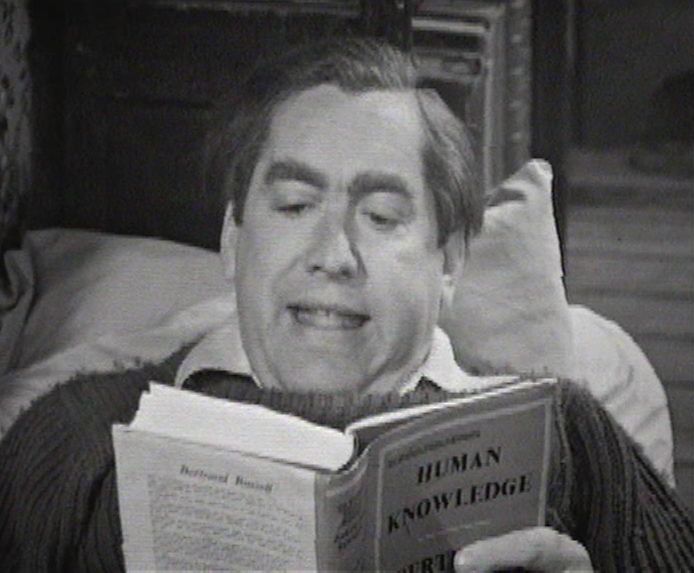
Otherwise there’s a stream of unconnected moments – Tony attempts to read Bertrand Russell but is put off by all the long words, burns his lip on a cigarette, attempts to get a signal on his television, etc.  The fragmentary nature of The Bedsitter would be a daunting prospect for many comic actors (as a contrast, Paul Merton’s remake is available to compare) but Hancock is easily up to the task.  Although he was presumably anxious about having to carry a twenty five minute show by himself (and had lines written around the set as a backup) he wasn’t reliant at this point on reading the lines off boards.

Mid-way through the episode it seems that Tony’s luck has changed.  A wrong number leads to an invitation to a cider and gin party (I’ll bring the cider, says Tony).  A chance for a date with (he hopes) an attractive woman brings out a burst of enthusiasm, although this all comes to naught when she rings up later to cancel.  You can hear a few audible awwws from the audience at this point, which is rather nice.

If The Bedsitter teaches us anything, it’s that Tony Hancock was perfectly able to carry the show by himself.  Had Sid been present in the flat then the whole dynamic of the piece would have been totally different – not necessarily better or worse, just different. However, the rest of the series does operate on more traditional lines and sees Hancock crossing swords with a whole host of very good comic actors.

And the quality of the supporting casts that we’ll see over the forthcoming episodes (Patrick Cargill, Hugh Lloyd, June Whitfield, John Le Mesurier, etc) does rather give the lie to the oft-repeated and lazy claim that Hancock hated to be upstaged by others.  If he had, he would have surrounded himself with mediocre talent – which is obviously not the case here.  It does seem plain that one of the reasons why these shows remain fresh, some fifty five years later, is due to the fine ensemble casts.

A wonderfully detailed and thought-provoking analysis of The Bedsitter can be found on the blog You Have Just Been Watching.  It’s well worth a read.

Up next is an everyday tale of country folk which remains very topical today.

Return of the Saint – Signal Stop

signal 01

Simon Templar and Janie Lennox (Ciaran Madden) are both passengers on a train bound for London.  When the train stops at a signal, Janie sees what she believes to be a murder taking place in a nearby warehouse.  Simon, who moments earlier was wishing that something would happen to break the monotony, is naturally intrigued.

The next day, Simon, Janie and the police travel to the building – but the body that Simon and Janie found earlier in the day is no longer there.  Inspector Grant (Frederick Jaeger) later tells Simon that since Janie has a history of psychiatric illness it’s probable her story was nothing more than a delusion.

Following on from the picture-postcard stylings of The Imprudent Professor, Signal Stop has a very different feel.  Most of the story takes place in dirty or run-down locations – an abandoned warehouse, a scrap-yard, etc which gives it something of a Sweeney/Professionals feel.

Just as The Arrangement owed more than a little to the novel Strangers on a Train, Signal Stop also seems to have been inspired by a crime classic.  In 4:50 From Paddington by Agatha Christie, a character witness a murder from her vantage point on a train – but with no body she finds it impossible to convince the authorities and only her friend Miss Marple takes her seriously.

The notion of observing a murder from a train (and therefore being helpless to intervene) is a decent one – although it’s fair to say that this story is a little flawed.  The major problem is that it’s baffling why the body was simply not taken away before Simon and Janie turned up the next day to find it.  No body = no crime.

Instead, the murdered man is left on site for them to find.  Simon then drives Janie all the way back to his house before phoning the police and driving back.  Naturally enough, by the time he returns the body has vanished.  Since he has a phone in his car, why didn’t he call the police and wait for them at the warehouse?

But despite these rather serious plotholes, there’s still a very decent, and unusual, story here.  Ciaran Madden impresses as the vulnerable Janie.  Unlike most of the other Saint heroines, she’s a flawed and damaged individual – although Simon’s faith in her never wavers.  It’s possible to argue that the script missed a trick by allowing the viewer to see the attack take place though.  Had this not happened, and we only had Janie’s word, it would have allowed the viewers to wonder if it maybe was just a figment of her imagination.

Ian Cullen is hardly stretched as one of the police officers, especially since he’d had a been a regular in Z Cars and could presumably have played this sort of part in his sleep.  Brian Glover, George Sweeney, Ralph Arliss, Heather Wright and Sabina Franklyn help to round out the cast.  Franklyn has a blink-and-you’ll-miss-it role as a uniformed police officer who Simon effortlessly charms whilst Arliss makes a brief appearance as a hells-angel sort of biker.  Although as so often with ROTS, the biker gang never really exudes any sort of menace.

Frederick Jaeger’s rather good as Inspector Grant.  It’s the sort of part that seems at first to be fairly routine but by the conclusion of the episode he’s moved more into the forefront of the action.

Despite some flaws, Signal Stop rates a healthy three halos out of five.

signal 02