Survivors – Garland’s War

garland

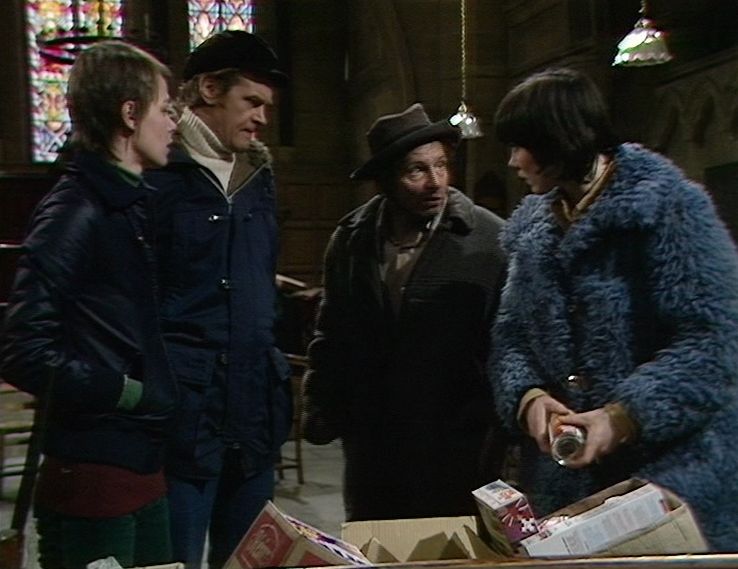
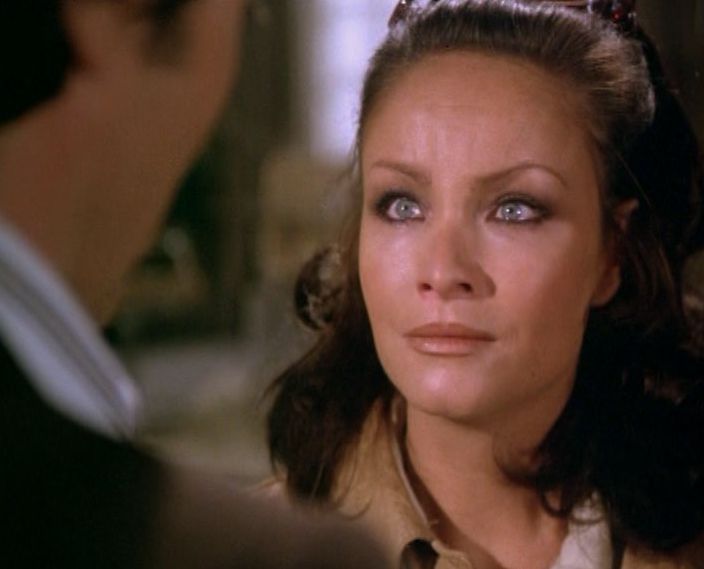
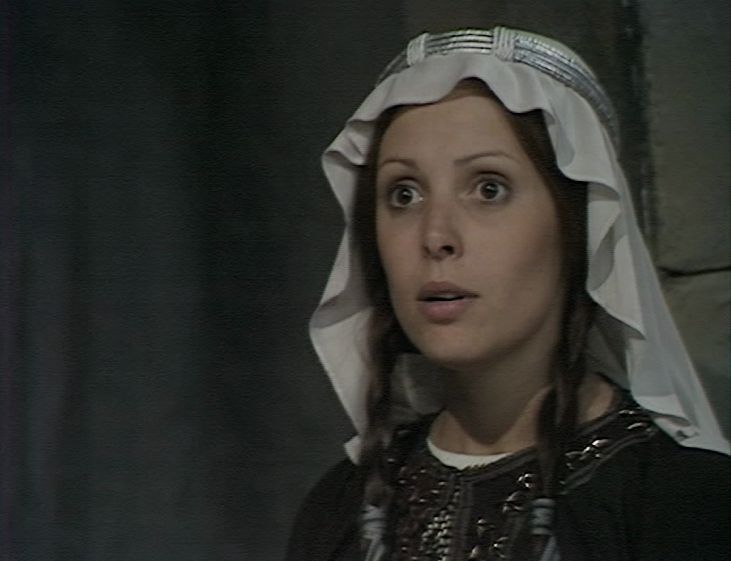
Abby’s quest for her son continues to be fruitless and the latest lead is possibly the cruelest blow yet.  Abby, Greg and Jenny travel to an isolated farmhouse because they’ve heard that a boy lives there.  When she’s told that his name is Peter, Abby’s hopes are instantly raised.  She rushes out to meet him but the expression on her face makes it quite clear that he’s not her son.

Since Abby is quite a humourless, driven character, it’s sometimes a challenge for Carolyn Seymour to give her any light and shade.  Garland’s War is a good script for Seymour since it gives her more to play with (and she works well opposite Richard Heffer).

Terry Nation returns to scripting duties for the first time since episode three and this episode bears all the hallmarks of a typical Nation story.  It’s a direct, action-based yarn which features strongly written characters who are placed in direct opposition to each other.

Next, Abby travels to a country house called Waterhouse as she’s heard that several boys are living there.  She sneaks out in the middle of the night, much to Greg’s annoyance, but he decides that it’s too late to follow her and so they’ll wait for her return.  This means that McCulloch and Fleming only appear at the beginning and the end (it’s very much Seymour’s episode).

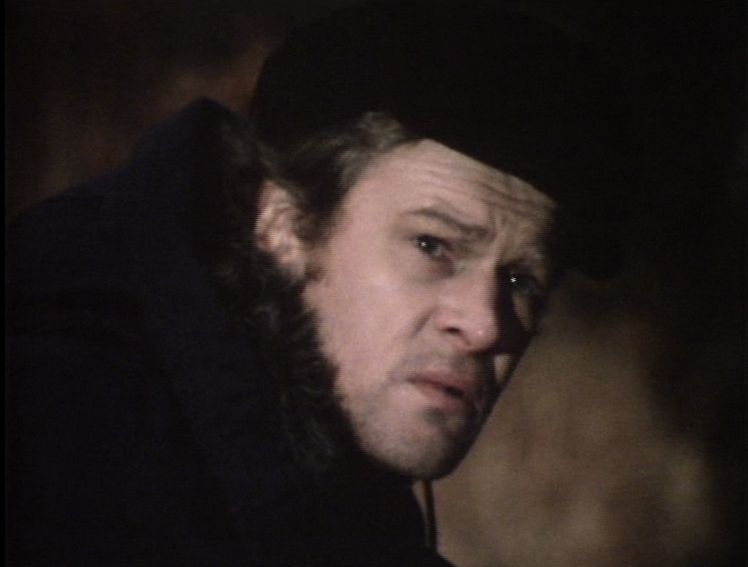
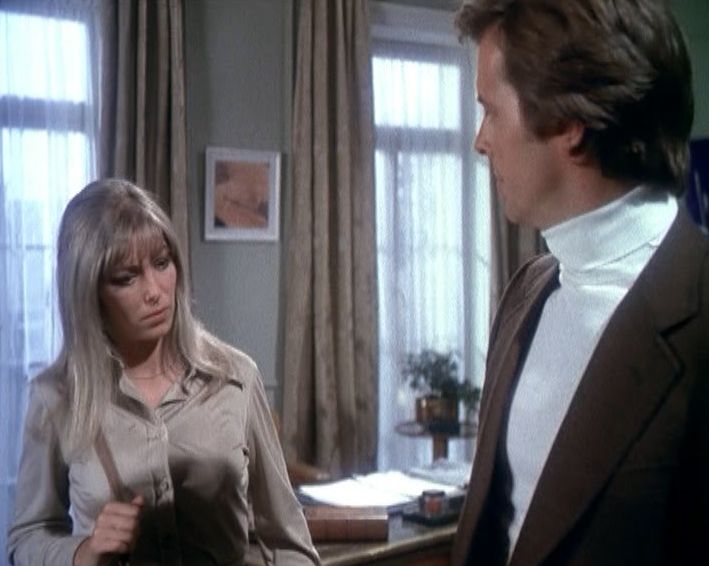
On the way to Waterhouse, Abby runs into a hunted man.  They manage to escape and he introduces himself as Jimmy Garland (Richard Heffer).  He’s also the Earl of Waterhouse, and he tells Abby that he’s been dispossessed of his ancestral seat by Knox (Peter Jeffrey) and his followers.

Garland is something of a cliched boys-own character, but Heffer is able to give him some depth.  Unlike most of the people we’ve met so far, Garland is happy to be alive in this harsh, post-apocalyptic world.  He was a solider and an adventurer and he’s quite candid in telling Abby that he was made for this time.  Waging a one-man guerrilla war against Knox and his followers is therefore all in a days work for him.

There’s a definite attraction between Abby and Garland, although she is slightly shocked by his callous attitudes.  When she asks him if he doesn’t feel anything for the millions of people who died, he says no – how can anybody processes the pain of such a catastrophe?

Although slightly underused until the last fifteen minutes or so, Peter Jeffrey is his usual immaculate self as Knox.  Since the script was written in such a way to present Garland as the clear hero and Knox as the clear villain, it comes as a surprise when Abby meets Knox face to face and finds him to be an apparently reasonable man.

He’s able to sow several seeds of doubt in her mind as he paints Garland as someone who wants to assume his place as the lord of the manor, with everybody else effectively working as his serfs.  Of course, it’s all a ruse to gain Abby’s confidence and Garland does turn out to be the man we think he is.  He’s able, with the help of Greg, to extract himself from Knox’s clutches, but although Garland has lost this battle, he’s still fighting the war.  This gives the story an open-ended feeling as we leave him to carry on his struggle to retain his home.

An interesting thing about the first series of Survivors is that people pop up from time to time – they might appear in one episode, not feature for a while and then re-appear.  This gives the programme a different feel from many series, which are more episodically self-contained.  For example, the likes of Tom Price, Vic Thatcher and Anne Tranter will all return shortly (and Jimmy Garland will be back in the series finale).  This fluidity certainly works to the series’ benefit.

We’re now moving into the phase of the programme where they have a settled base of operations.  For the remainder of series one it’s the Manor and in series two they join Charles’ community.  This gives the show a different feel, not least because from the next episode Survivors changes to an all-VT series (there’s no filming until the second series two-parter Lights of London).

It’s a pity in a way, because we lose the glossy filmic shooting from episodes like this one (the night-time hunt for Garland through the woods, for example).  But on the other hand, had Garland’s War been an all-VT production then some of the studio shots that were meant to be outside might have been a tad more convincing.

The next few episodes will see an influx of new (and not so new) characters who will swell the regular cast.  Some make it into the second series, whilst others aren’t so lucky …..
Survivors – Gone to the Angels

angels

Abby’s continuing search for Peter is a very useful plot device as it can make the main characters go to locations that otherwise they’d have no good reason to visit.  This is demonstrated in Jack Ronder’s script when Abby learns that a party of boys from Peter’s school may have gone to “visit the angels”.

Some months before the death, three men (who somehow knew that an imminent catastrophe was approaching) went off to the Derbyshire hills to live in religious seclusion.  Abby sets off to find them, whilst Greg and Jenny remain behind.

Greg and Jenny aren’t alone though, as they’ve essentially adopted two young children, John (Stephen Dudley) and Lizzie (Tanya Ronder).  The pair have been living by themselves ever since the death and jump at the chance to join Abby, Greg and Jenny.  Their initial appearance is a delight – they’re dressed in adult clothes which are far too big for them.  Both Dudley and Ronder have a natural precocious charm which is clear from their first scene.  Some might argue that casting the son of the producer and the daughter of the script-editor is rather nepotistic, but it works.

There’s another new face in the story, Lincoln (Peter Miles).  Nobody plays strange and unsettling characters as well as Miles (who’s made a long and successful career out of it) and Lincoln is another good example.  Initially, he seems a little jumpy but fairly normal, but it doesn’t take long before his instability is very apparent.  Greg and Jenny take the children and leave – he begs to come with them, but Greg is adamant that he’s not welcome, so Lincoln is left to whatever the fates decree for him.

Survivors is an often bleak series, though occasionally there are brief glimpses of hope.  But hope is in very short supply in Gone to the Angels.  Abby finds the three men on the mountainside, although she’s disappointed to learn she’s the first person to visit them since the death.  Jack (Frederick Hall), Robert (Kenneth Caswell) and Matthew (Nickolas Grace) may all be deeply religious but they’re also friendly and welcoming.

Later, the others make the trip as well.  They find an equally warm welcome (Matthew delights in playing with the children, for example).  But shortly afterwards when all three fall ill, Abby realises that she’s inadvertently infected them with the death.  As they were isolated on the hilltop it appears they never came into contact with the virus (which doesn’t really make a great deal of sense – the virus spread all over the world very quickly, surely it could make the trip up the hill as well?)

This slight plot quibble apart, it provides a chilling conclusion to the story as Abby shoulders her burden of guilt over their deaths.  Hall, Caswell and Grace are all excellent – especially Frederick Hall as Jack who retains his serenity even when he knows that he’s dying.

There’s little solace to be gained from this episode, except maybe at the end when Abby looks into the faces of John and Lizzie.  Even after all the deaths, do they (and other children) offer hope for a better future?

Survivors – Corn Dolly

corn dolly

Time has obviouly moved on since the previous episode, Gone Away.  Then, Greg was ambivalent about staying with the two girls – but the glance that he exchanges with Jenny at the start of the episode is the first indication that their relationship is deepening (later, for example, she asks “Can I hug you?”)

But the main thrust of Corn Dolly (the first episode of Survivors not to be written by Terry Nation – Jack Ronder scripted this one) concerns Charles Vaughan (Denis Lill) and his community.  This was Lill’s sole appearance during the first series – it seems that at this time Charles was scripted as a purely a one-off character.

However, Carolyn Seymour’s departure after series one meant that Charles Vaughan would return as a regular and by the third series he would become the series’ central character.  The decision to bring Charles back didn’t find favour with Ian McCulloch (although he stated later that he didn’t have anything against Lill personally).  McCulloch considered that another male lead diluted Greg’s role (and he also argued that it had an adverse effect on Jenny’s character development).

But although the character of Charles didn’t appeal to McCulloch, the series was immeasurably strengthened Lill’s presence.  Even in this episode (when it becomes clear that Charles has opinions which Abby, Greg and Jenny find unpalatable), he’s still an appealing character, since he’s practical, organised and friendly.

Before the death, Charles was someone who was already quite self-sufficient – so what he’s doing now (with a dozen or so people) is simply on a larger scale.  But Charles isn’t just content to exist, he wants to know exactly how many people are left.  Simply put, are there enough to ensure survival?  He estimates that around 10,000 people are still alive in the UK – so if they can survive the next two generations, there may be a chance.

There has to be a twist to the story though.  Returning to Charles’ community, they find most of the people are dead or dying – poisoned by fish from the river.  It’s an indication of just how fragile life is now: even a handful of deaths means that the ultimate survival of the human race could be placed in jeopardy.

Charles has his own opinions on this (and it’s not one that Abby can agree with).  They need children (as many as can be produced) and in his eyes monogamy is no longer an option.  Any women of child-bearing age need to be in a constant state of pregnancy (and the identity of the father isn’t that important).  This is a debate that has been heard before in post-apocalyptic fiction (we see a similar community in The Day of the Triffids).

Abby finds the notion of women becoming little more than cattle unpalatable and it’s Charles’ insistence on this point that forces Abby, Greg and Jenny to leave (it becomes apparent that all the women are either pregnant by Charles or, had they not died, would have been).  Of course, when Charles returns as a regular character his more extreme views are downplayed or ignored (in series two he has a partner, Pet, and this appears to be his only relationship).

It’s the shades of grey that make Corn Dolly such an intriguing episode.  Charles does burn with the conviction of a zealot, but it’s possible to understand his point of view.  However, in a world where medical assistance is so limited, childbirth becomes very hazardous.  But without the next generation, there is no future.

Survivors – Gone Away

gone away

The opening ten minutes or so of Gone Away are a good example of the leisurely pace of television drama from the mid seventies.  We follow Tom Price as he explores a deserted farmhouse in search of food.  We then see him prize open a cupboard to discover a shotgun – afterwards he manages to shoot a chicken but it’s taken away from him by a young boy,

The boy, and an older man, are living nearby and haven’t eaten in days.  Despite this, Tom demands the chicken back.  It’s another example of how selfish Tom Price is – he’s able (as the man says) to easily shoot more wildlife, so there’s no good reason why he’s so insistent on reclaiming the bird.

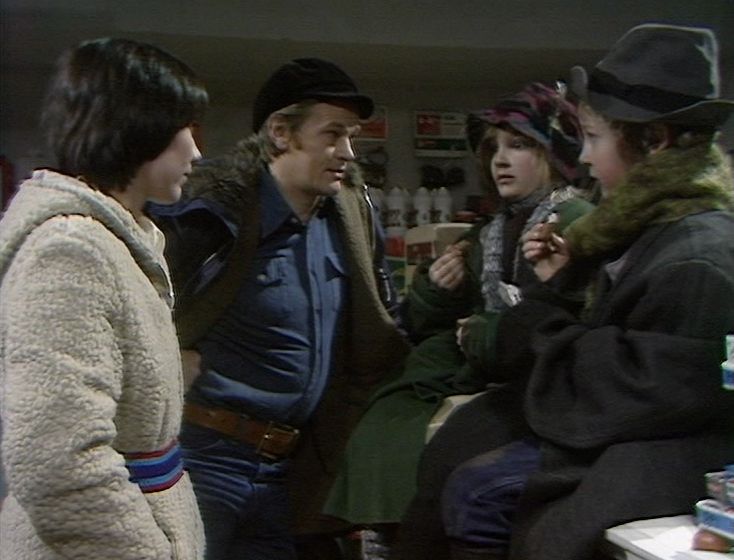
Food is also on the mind of Abby, Greg and Jenny.  They decide to stock up with provisions at a nearby supermarket, but things aren’t as straightforward as they seem.  Apart from the rats running amok, there’s the foreboding sight of a dead man, hanging from the ceiling, with the word “looter” attached to his body.

Greg sees this as a strong indication that they should go elsewhere, but Abby is insistent that they finish loading the supplies they need.  At present, Greg is a fairly passive character, content to accede to Abby’s wishes (“you’re the boss” he tells her later).  Later, we’ll see him take direct action, which does indicate that he’s slowly forming a bond with the two women.

They’re prevented from leaving by three armed men, Dave (Brian Peck), Reg (Barry Stanton) and John (Robert Gillespie).  They’re part of Wormley’s organisation and they make it clear that if they want to take the goods away then they’ll have to register and get a chit.  In some ways, it does make sense – food and other supplies should be rationed, rather than horded by a small band of people.  But the question is, who has given Wormley the authority to take control?

The answer, of course, is nobody and in Greg’s eyes this makes him and his men little more than opportunistic criminals.  Abby is less sure and wonders if a strong government, however embryonic, isn’t what’s needed.  Jenny has marked Abby down as a potential leader, although Abby herself strongly demurs – all she wants to do is find her son.

Gone Away is fairly light on plot, instead it’s more concerned with character development.  The middle of the episode allows Terry Nation to again discuss how the survivors will live their lives from now on.  Wormley’s way (an autocratic leader) or Abby’s way (a commune, with everybody contributing equally).  It’s obvious that the series will edge towards Abby’s plan, but a co-operative will only work if everybody contributes – and rogue elements, like Tom Price, will always be a problem.

Jenny snatches the shotgun from John, which changes the dynamic of the stand-off.  Given that Jenny isn’t the most forceful person it’s a little surprising that she’s able to overpower him (although later events may explain this). But it’s clear that Jenny isn’t capable of pulling the trigger.  During the whole stand-off, Greg has remained in the background, silent.  But when Jenny starts to waver, he snatches the gun and forces the men back.  This allows the three of them to escape with Dave, Reg and John in pursuit.

Ian McCulloch’s preferred vision of Survivors was the one seen in series one and he particularly rated episodes like this, which combined drama with an action/adventure edge.  The more talky series two episodes (and a lack of character development) were factors in contributing to his departure.

Later, all three encounter Tom Price.  Jenny’s run into him a few times before, but it’s a new experience for Abby and Greg.  We see Tom at his most ingratiating and obsequious, but once he gets the chance to join Wormley’s gang he leaves them without a second thought.  Over the first three episodes we’ve had plenty of opportunities to see that Tom’s not a man to be trusted (which will culminate mid series, with the episode Law and Order).

Dave, Reg and John are waiting for Abby, Greg and Jenny to return to their base (they’ve set out to discover if a boy Tom met was Peter – it turns out not to be).  John waylays them and tells them to hide so he can draw the other two off.  His decision to leave Abby, Greg and Jenny alone does give a sliver of hope that Wormley’s group may have more liberals like him.

By the end of the episode we’ve learnt that Abby’s dream that all the survivors would band together with a common aim is unlikely ever to happen.  What remains of society is fragmented and chaotic, with smaller groups (often conflicting) being the order of the day.

Survivors – Genesis

genesis

Genesis opens with Greg, Abby and Jenny all in the same part of the country but not yet close enough to make contact.  Abby sees Greg’s helicopter but can’t attract his attention, Jenny sees the remnants of a fire lit by Abby but by the time she gets there Abby’s moved on.

Greg had been working in Holland and pilots the company helicopter back to his house.  A piece of visual shorthand (a wedding photo) gives us that information and when he sees a slumped figure on the sofa it immediately brings to mind Abby’s discovery of her dead husband in the previous episode.  But his first words show us that theirs was quite a different marriage.  “I was wrong Jeannie. I thought you were the kind to survive just to spite me.”

Greg obviously still had a lingering sense of duty to check if she was alive, but her death has freed him of that obligation so he drives away.  Like most of the people we’ve seen so far, he doesn’t have any particular destination in mind, so when a woman, Anne Tranter (Myra Francis), flags him down and frantically asks for his help, he agrees.

She takes him to a quarry, where a man called Vic Thatcher (Terry Scully) is trapped under a tractor.  Greg manages to free him, but his legs are mangled beyond repair.  Anne, like Abby, comes from a privileged background, but there the similarities end since Anne is completely self centered and spoilt.  Myra Francis is perfectly cast as the rich bitch and it’s a pity that she didn’t appear in more episodes (she has one more after this).

Terry Scully excelled at playing victims and Vic is another notable one.  At the end of the episode it might be assumed that we’d seen the last of him, but he does reappear later in the series.  It’s just a shame that Scully had to be replaced by Hugh Walters for the last few episodes of series one.

The survivors are able to take anything they wish – witness Tom Price’s child-like pleasure in acquiring a Rolls Royce (I particularly like the way he continually beeps the horn, as if he can’t quite believe he’s driving it). He runs into Jenny again, who begs him to take her with him, but he refuses. He reassures her that help will be on the way soon, if not from this country then from America. He’s convinced that the Yanks will come through, just like they did in the war.

Elsewhere, we see that Greg has a much more realistic view. He tells Anne that things won’t get back to normal for decades, if ever. As an engineer, some part of Greg’s mind must be pondering how to rebuild the shattered infrastructure (even if it’s only local to begin with). Anne is clearly only concerned with her own welfare – there’s enough supplies stockpiled to ensure she can live a comfortable life, so why should she worry about anybody else? (The most obvious example of this is later, when she abandons the crippled Vic).

Arthur Wormley (George Baker) leads a group that is, for the moment, self sufficient. He appears charming, but it quickly becomes clear to Abby that he sees himself as the man to lead the remnants of society. Some may not see this as a bad thing, but in Wormley’s world not everybody is created equal. His vision of a centralised government (with him at the centre) dismays Abby, who likens his proposals to that of a feudal baron. Later, we see how ruthless he can be when dealing with anyone who disagrees with him (executing a man who has broken what he considers to be the law)

Whilst he doesn’t threaten Abby, his presence serves as a reminder that the fracturing of society will inevitably see groups of survivors banding together, not only for their own safety but simply because everybody’s chances of survival will be greater if they join forces.  This is fine, but whose authority (if anybody’s) should they be under?  This is a topic that the series will return to again.

Before Abby moves on, she does try and explain to him the importance of self-sufficiency – not just in growing food, but in all aspects of their new lives. It’s another chance for Terry Nation to outline his own philosophy (several other examples can be found in The Fourth Horseman).  It’s interesting how Abby’s speech is a refined version of the one that Dr Bronson gave to her. Clearly what he told her has sunk in.

“Don’t you see the point we’d reached in our civilisation? Now look around you, anywhere you like, in this house in this room. I doubt if it contains a single artifact that was the exclusive creation of one person. This table, this simple wooden table. Could you knock up something like this, right from scratch? You’d fell the timber, with what – an axe or a saw? The steel for the saw has been made in a foundry. The iron-ore has been dug from the ground and the fuel to smelt it with has been mined. Now what happens when the last axe-head cracks and the last saw breaks?

Wormley isn’t the only one to have visions of how society needs to be rebuilt. Anne tells Greg that they should scavenge as much food and other provisions as they can, working throughout the winter. They can then use this stockpile to their benefit – employing people to work for them and using the goods as payment. The privileged Anne sees nothing wrong in this – she had a comfortable life in the old world, why should her life in the new one be any different?

Naturally, Greg isn’t convinced and the next day he leaves, telling her that he may be back or he may not. He does, but before that happens he runs into Jenny.  Jenny tells him that she needs to be with people, despite being (or so she considered) an independent person – she simply couldn’t cope on her own.  Greg tells that there’s bound to be groups setting up, so they’ll find something for her.  At this time, it’s plain that Greg is considering moving on by himself.  Or does he need people just as much as Jenny, but his stoic personality won’t admit it?

When Greg returns to Anne with some drugs he’s scavenged for Vic she tells him that Vic’s dead, so the three of them leave. Before this, Greg gives her a long, hard stare but doesn’t question her. Given that he’s already had plenty of opportunities to see just how unscrupulous she is, it’s surprising that he doesn’t check (which leaves poor Vic stranded).

A light in the middle of the night brings Greg and Jenny into contact with Abby and now the three sides of the triangle that create the dynamic during series one are complete.  Jenny is delighted to have found another friendly person (and with the prospect of more to come) whilst Greg’s expression is a lot harder to read.

Survivors – The Fourth Horseman

fourth 01

The opening scene of The Fourth Horseman makes it quite clear that Abby Grant (Carolyn Seymour) has led a privileged life.  Not only does she live in a large house, but there’s also a tennis court (complete with an automatic serving machine).  And when she enters the house, Abby thinks nothing of asking her housekeeper Mrs Transon (Margaret Anderson) for a cold drink – the notion of fetching it for herself would presumably never have crossed her mind.

Jenny Richards (Lucy Fleming) on the other hand, seems to live in much more modest surroundings – if we assume she shares a flat with her sick friend Patricia (Elisabeth Sinclair).

What is established early on is that the two women (although they’ve yet to meet) have very different outlooks and attitudes.  Abby has a strong and independent personality whilst Jenny seems to rely much more on other people.  After the virus has burnt itself out, we’ll see how this works in the context of the series.

The increasing seriousness of the virus epidemic is drip-fed through the opening part of the episode in various ways – Abby listens to a radio report in her car which discusses how the crisis is being dealt with in other countries, Jenny visits the hospital to get help for her friend and is told that there’s nothing to be done, etc.

Other signs that the delicate infrastructure of society is slowly breaking down are also threaded through the opening twenty minutes or so, such as problems with the telephone and radio and reports of long delays on the trains.  Although issues with all three in mid seventies Britain was not exactly unusual!

The question of information, or mis-information, is dealt with.  Up until now, nobody has really taken the epidemic seriously (mainly because the news reports have greatly downplayed its effects).  In the pre-internet age, the flow of information would have been greatly restricted, so this is quite credible.  Abby and her husband David (Peter Bowles) therefore begin to slowly understand that it may take more than “a few days” (as David originally believes) to put things right.

The symptoms of the illness (sweating, pains under the arms) are quickly established (Patricia and Mrs Transon both exhibit them).  Abby is also later infected, whilst David seems to be quite healthy – so it’s reasonable to assume that Abby will die whilst David will live.

Of course, the reverse happens – Abby awakes after six days or so from the fever to find that she’s one of the few to have had the illness but not died and then discovers her husband’s dead body.  She walks through the village and doesn’t find another person alive.  “Oh god, please don’t let me be the only one.”

At the end of the episode she enters the bedroom and cuts off her long hair.  The unspoken inference is that she knows her old life is over, so now she has to start a new one (beginning by locating her son, Peter).  Symbolically, cutting her hair could be said to be part of this.

Earlier, Abby discussed with David what would happen to a city “if it all breaks down, all at the same time. There’s no power, no lighting or cooking. And food, even if you get it into the city you can’t distribute it. And there’s water, sewage, bleugh. Things like that. You know it just never occurred to me when I lived in London. The city’s like a great big, pampered baby with thousands of people feeding it and cleaning it and making sure it’s alright.”

Dialogue like this, as well as the radio and train station announcements all help to quickly establish what the problem is and how it can and will accelerate.  Immediately after Abby describes how a city is essentially a living thing, we see Jenny urged by her doctor friend to get out of the city and into the relative safety of the country, which she does.

It’s clear though that her solo adventures are a great deal more uncomfortable than Abby’s.  Jenny (whilst a resourceful person in many ways) is possibly not someone who would be able to survive on her own, so it’s fortunate that she later meets Abby and Greg.  Before that though, she briefly runs into Tom Price (Talfryn Thomas).  From their one scene here, you wouldn’t necessarily guess that he’d reappear and become a key figure in a number of early episodes.  From this appearance it might be thought he’d be the series’ comic relief character, but we’ll see later that he also has his darker side …..

With only limited resources, it’s quite tricky to create a London that’s virtually empty of living people (but this is achieved by shooting at night and the night-time filming does also help to increase the sense of unease).  The Fourth Horsemen benefits from being shot in the normal way for BBC drama of this period – VT for the studio scenes and film for the location scenes.  The majority of the later episodes would be all VT, which does actually work quite well, but the film night shooting in this one is very evocative.

We’re told that the virus is a mutant strain and is quite unstoppable.  In a few days, the dead will outnumber the living and all the major cities will resemble cess-pits.  The question now must be, what will the survivors do next?

When Abby reaches her son’s school she finds that he’s no longer there – together with a party of other boys they left before the worst of the sickness.  Dr Bronson (Peter Copley) tells her that her son may already be dead, although Abby still clings to the hope that he’s still alive.

Dr Bronson also acts as the mouthpiece for Terry Nation as he describes what has to happen once the virus has done its work.  Abby doesn’t, at first, believe that the immediate problem is too serious, since there must be an enormous stockpile of food and machinery.

Dr Bronson tells her that “they’ll be enough for many, many years  but that would be simply scavenging, wouldn’t it? And a constantly diminishing supply. What is important is learning again. Things you’ve never even needed to consider before. For instance, could you make that candle? Where does the raw material come from, do you know? Could you make something as simple as a candle from scratch? A book will tell you how electricity is generated, but could you do it, right from the very beginning? Find the metal in the earth, dig it up, refine it, turn it into wire? Could you make and cast glass for a light-bulb? You’ll need to know every part of every process.”

This is one of the mission statements of the series.  Everything has to be learnt again, otherwise the human race will face total obliteration …..

fourth 02

Survivors (BBC 1975 – 1977) – Series Introduction

title

Forty years after Survivors was originally broadcast, it’s still a disturbing and thought-provoking series.  The notion that the whole of civilisation was hanging by a single, delicate thread had long been a favorite topic of SF and speculative fiction and Terry Nation certainly seemed to have sampled the best of the available literature when creating the series.

In many ways, Survivors is essentially The Day of the Triffids but without the Triffids.  The broad narrative sweep (the majority of the population is killed off, the survivors relocate to the countryside, conflict between different groups, etc) is pretty much identical.  Terry Nation could never be said to have been a particularly original writer, but he had a knack for taking familiar concepts and giving them a twist.  Indeed, it’s fair to say that some of his best work can be found during the first series of Survivors (it’s certainly several steps up from his very generic Jon Pertwee Doctor Who scripts a few years earlier)

When DD Video released series one in 2003, the SARS virus was very much in the headlines.  Working my way through the DVDs at that time, whilst SARS was such a regular topic of conversation in the media, was a strange and rather chilling experience – it certainly helped to give the series an extra edge of reality.

One of the key concepts of Survivors is how people are able to survive when the luxury of technology is removed.  It was a valid point in 1975 and forty years later it’s even more relevant (the cushioned, cocooned world of the 21st century has seen an ever increasing reliance on gadgets).  How many people would know how to do even the most basic of jobs, such as making soap?

The actual day-to-day problems of existence would be examined in detail in the second series, which wasn’t to the liking of Ian McCulloch (who played Greg).  He considered the more settled concept of series two was inferior to the first series (which had a more wide-ranging and action feel).  Partly the change in tone was due to the departure of Terry Nation after series one.  He hadn’t seen eye-to-eye with producer Terence Dudley and Nation left – allowing Dudley to reshape the series in his own image.  Dudley had previous form for this – he’d also forced the creators of Doomwatch (Kit Pedler and Gerry Davis) to leave that series.

The changes across all three series of Survivors is one of the shows strengths, as is the ever-rotating cast of characters.  It’s clear that Dudley had a ruthless streak as actors seem to be dropped with very little ceremony.  The most obvious example is Carolyn Seymour (who played Abby Grant).  Abby was the central figure in series one and her quest (to find her son Peter) was the MacGuffin which drove the narrative.  But following disagreements with Dudley, she was unceremoniously dropped from the show.  The fire at the Manor, at the start of series two, was another blatant way of removing unwanted characters – as all of the, literal, deadwood could be said to have died in the blaze.

Although McCulloch was unhappy with the direction series two took, it did allow him to move centre-stage (and despite what some people say, there were still solid and pacy stories, such as Lights of London and Parasites).  It’s ironic that he decided not to appear in series three (apart from a few key episodes) as the format changed again and Survivors went back on the road.

If the second series had seemed, at times, a little “safe” – with the survivors living a fairly comfortable life in the community headed by Charles Vaughan (Denis Lill) – series three would see some of them (the ones that Terence Dudley had decided not to write out) venture out into the wider world again – and they would discover just how dangerous a place it was.

The first series had been based around the quest by Abby to find her son and series three had a similar theme – Charles, together with Greg’s wife Jenny (Lucy Fleming) spent their time scouring the country looking for Greg.  Greg does reappear, but his final episode The Last Laugh (one of several scripted by McCulloch) is a bleak coda to his story (perfectly consistent with the pessimistic feel of the whole series) .

One of the reasons for digging this one out again is thanks to Big Finish’s excellent series of audio plays based on the series.  Big Finish’s series one was released last year and series two is out now.  The plays slot between the existing stories and they manage to capture the spirit and feel of the original series very well.  They were able to secure key members of the original cast (Ian McCulloch, Lucy Fleming, Carolyn Seymour) alongside new characters created especially for audio.  At present, episode one of series one is available to download for free here.  It’s certainly well worth your time.

If you’ve not seen the television series, then I’d recommend watching it before reading any of the forthcoming posts (since there’s no way to examine the series in any detail without revealing numerous spoilers).  The complete boxset is ridiculously cheap at the moment – around £20.00 at Amazon say – so there’s no reason not to snap up a classic slice of 1970’s BBC drama.

Return of the Saint – The Poppy Chain

poppy

The episode opens with Simon Templar and Sandy Platt (Jenny Hanley) desperately racing across London to try and reach Sandy’s sister, Jane.  But they’re too late – when they get to her flat she’s dead (killed by an impure batch of heroin).

Sandy is naturally distraught, but her father, General Platt (Laurence Naismith), is even more so.  An old-school, but now retired, soldier, he vows to find and kill the pushers.  But he only serves to drive them underground.  So it falls to the Saint to risk his life by travelling to to Carmague region of France as he attempts to destroy the business at its source.

The Poppy Chain certainly has an arresting opening as Simon and Sandy discover Jane’s lifeless body.  It gives the episode a harder-edged feel than many of the others in the series.  Laurence Naismith’s pig-headed General Platt drives the action in the first half or so of the episode (with Simon trailing behind somewhat).  This plotline has the advantage of enabling the General to do all the spadework, but then allowing Simon to step in when things get really dangerous.

Along the way, the General tracks down the pusher who sold the drugs to his daughter.  A well-spoken, well-dressed man known as the Gent (Christopher Timothy).  He doesn’t get to kill him though, as the Gent’s wife intervenes (with a heavy object which knocks the General out).  It’s possibly just as well, since Simon tells the recuperating General that the pusher was just small fry – if you’re going to bring down the operation, then you need to aim for the head.

The Saint does this by posing as a member of the London connection, Rickman, and travels to France to meet the men responsible for supplying the raw drugs.  A change of location helps to keep the interest up and the different locale is quite interesting, as it’s probably not what might have been expected.  Scorbesi (Gregoire Anslan) and his son Dominic (Jonathan Burn) run the operation, but Scorbesi is an apparently friendly, gregarious chap and the patriarch of a village that appears to be happy and prosperous.  The fact that their idyllic lifestyle is founded on drug money is, no doubt intentionally, jarring.

Scorbesi’s realisation that he knew the General back in WW2, when Scorbesi was a Partisan, is a coincidence that’s possibly a little hard to take – especially since this revelation doesn’t really further the plot in any way.  Notwithstanding this, Anslan is good as the cheerful Scorbesi, although Burn is less impressive as his son.  I’m not quite sure why, it’s just a slightly off-key performance.

The best part of the second half of the episode is Simon’s infiltration of Scorbesi’s setup – although it’s rather bizarre that he takes no backup with him.  So it’s lucky that when the General learns about Simon’s efforts he makes the trip over and comes to the rescue.  It’s hard to believe that the Saint didn’t think that drafting in some younger assistance might have been a good idea, but this moment does allow the General a chance to prove that he’s not entirely over the hill.

I also like Ogilvy’s cockney accent when he’s pretending to be Rickman.  He makes a very effective criminal!

It’s a solid episode and rates three and a half halos out of five.

Return of the Saint – Yesterday’s Hero

yesterday's hero

Several years ago, Simon Templar, Roy Gates (Ian Hendry) and Diskett (Tony Vogel) were part of an unofficial mission in Aden.  Mid-way through the mission something went wrong and Gates was captured by the Yemenis.  Simon and Diskett weren’t aware of this though – they thought he was dead.

But Gates was alive and, having lost an arm during the fighting, languished in an Arab prison until he was bought by the Bader-Meinhoff gang of terrorists (who wanted his expertise to train their people).  Gates was initially reluctant, but he finally realised that any life was better than the life he currently had.

Eventually he was caught by the Germans and ended up in prison there.  He’s shortly due to be released and Simon pays him a visit to caution him not to directly approach his young son Michael (Matthew Ryan) before his ex-wife Sandy (Annette Andre) has had a chance to talk to him (as Michael has grown up believing that his father is dead).

But Gates is a bitter and vengeful man and once released he’ll be set on a course of revenge.  Which will inevitably bring him into direct conflict with the Saint …..

This is a bleak and atypical Return of the Saint story.  The usual humour and byplay is pretty much absent and it’s also notable that there’s few “good” characters featured.  Gates does have his compassionate side (especially when we see him spend time with his son) but it’s obvious that his various imprisonments have warped his judgement.

Normally, you’d expect the character of the ex-wife to be written in a sympathetic way, but that’s not the case here.  Simon tells her that “in your own way, you’re as crippled and bitter as Roy is.  And that’s a pity.”

It eventually becomes clear that Gates is targeting Cleaver (Gerald Flood) who ran the Aden operation and betrayed Gates.  Cleaver (now an arms dealer) is yet another unsympathetic character (which robs his death of some of its impact).  Prior to this, we see him demonstrating some weapons to the military – although the stock footage is so grainy it’s not terribly convincing,

At the centre of the episode is Ian Hendry.  In another unusual move, he dominates the action whilst the Saint has to react to events and remains, until the end, a few steps behind.  There’s an undeniable sense of melancholy hanging over the whole episode – partly because of the script, but it’s also down to Hendry’s performance (and the reading that anybody familiar with his personal life will bring to the viewing).

Yesterday’s Hero is an uncomfortable summation of Ian Hendry’s life and career.  In the early sixties, as the star of The Avengers, he seemed to have a glittering career ahead of him, but various factors (most notably a dependance on alcohol) ensured that whilst he remained a familiar presence in films and television, he never attained the heights he should have done (and he also died rather prematurely, aged just 53 in 1984).

The following comments from Annette Andre (as quoted in the book Send in the Clowns: The Yo-Yo Life of Ian Hendry by Gabriel Hershman) about her work with Hendry on this episode tend to bear these observations out.

I didn’t have many scenes with him. In the morning he was fine. Then we broke for lunch and Ian went off on his own to the pub for lunch. When we went to get him later to take him to the location for filming he was falling down drunk. We managed to get him into the car and into the make-up room and then he walked out and did it.

There was an unhappiness to him. I never really experienced Ian being unpleasant – I was fine with him and he really liked me – but I could see that when I was trying to get him out of the pub that he could get difficult. He didn’t want to eat. I sensed a deep hurt, a sense of dissatisfaction that affected his whole career. He looked older than his age, he’d lost his hair and was on a downhill spin.

This real-life unhappiness is very much mirrored in his portrayal of Roy Gates, which means that the lines between fantasy and reality become somewhat blurred.  There’s a point later in the episode where Gates breaks into Simon’s flat and is clearly drunk – it’s an uncomfortable thought that there may not have been any acting involved.

But although this knowledge does make Yesterday’s Hero a rather hard watch at times, Hendry is always solid and professional – so whatever turmoil he felt off-screen, he still commands the frame when the camera is rolling.  Thanks to his performance, this rates four halos out of five.

Return of the Saint – Assault Force

assault

Catching the bus at Heathrow, Simon notices that one of his fellow passengers is receiving unwelcome attention from several men.  And since the passenger is female and attractive, the Saint simply has to step in – he can never resist helping a damsel in distress.

Jeanette (Kate O’Mara) has information about Nodiam Mataya, the new strong-man of South-East Asia.  She plans to take it to the newspapers and expose Mataya’s appalling record of human rights (which include a group of nuns held captive and awaiting imminent execution).  Simon’s foreign office contact, Randolph Smith (Neil Stacey) is polite, but noncommittal.  He tells them that the British government is continuing to explore all diplomatic avenues, but that’s all they can do.

The Saint, however, is keen for more direct action.  A key member of Mataya’s government, Surinit, is due to land in the UK shortly.  Simon suggests to Jeanette that they kidnap him and offer to exchange him for the nuns.  Jeanette agrees and Simon assembles a crack force to carry out the plan.  But when Surinit disappears after the kidnap is successfully carried out, Simon bitterly realises that he’s been used …..

Assault Force sees the Saint team up with a group of mercenaries and it’s a departure from the episodes we’ve seen so far (where Simon is either operating on his own, or with limited help).  Here, he’s the leader of a well-drilled gang who abduct Surinit with military precision.  It’s the planning and the actual raid which forms the heart of the episode, and the realisation that Surinit is actually a good guy (and the one man who can expose Mataya’s crimes) drives the story onwards to its conclusion.

Kate O’Mara is suitably histrionic as the damsel in distress, whilst Carolle Rousseau (as Colonel Dibha) is rather alluring as a woman who appears to be on the side of the angels but turns out to be working for Mataya.  Although to be honest, this probably isn’t a great shock since she does give off a rather “evil” vibe in all of her scenes!

Elsewhere, we see the Saint recruit some colourful characters, such as O’Hara (Bryan Marshall) and Morgan (Norman Bird).  Marshall sports a broad Irish accent which occasionally crosses over into parody, but he’s still convincing as a resourceful mercenary.  Bird provides some welcome comic relief as the bookish Morgan.

Although everything is resolved in the end quite neatly (too neatly, you may say) there’s still a slightly discordant note struck which implies that the new status quo may not last forever.  Simon rescues Surinit, who returns to his country as leader after Mataya’s downfall.  Colonel Dibha seems unconcerned though, as she tells Simon that Surinit is a weak man (who clearly won’t last long in the bitter and dangerous world of South-East Asian politics)

The plot is driven by coincidences which means that it’s probably best not to examine it too deeply (although that’s not going to stop me!)  Surinit arrives in the UK to testify at a Human Rights Commission in order to expose Mataya’s crimes.  It seems obvious that Mataya’s people would try and silence him (but they don’t seem to have had any plans to do so).  Instead, rather fortunately they were able to learn of Simon’s plan to kidnap him and took advantage of this.  But had Simon not run into Jeannete at the airport by chance then nothing would have happened.  If Mataya’s men simply needed to silence Surinit why didn’t they, say, put a bomb on the plane?

Minor plot quibbles apart, the “caper” feel of the episode makes it a break from the norm and earns it three and a half halos out of five.

Return of the Saint – The Village That Sold Its Soul

village

Simon is travelling through a remote area of Italy when he witnesses a murder – he sees a woman thrown off a cliff by two men.  When Simon reaches her, she’s mortally injured but manages to tell him to “warn Vincenzo” before she dies.

Father Vincenzo (Tony Calvin) is the priest of the local village, Santa Maria.  When Simon makes his way there, he discovers that Father Vincenzo is away and that nobody else is interested in offering assistance (including the police).  There’s a sinister menace that seems to hang over the town.  What is the secret that binds everybody together and how is it connected to the patrone of the village, Prince Lorenzo Castracano (Maurice Denham)?

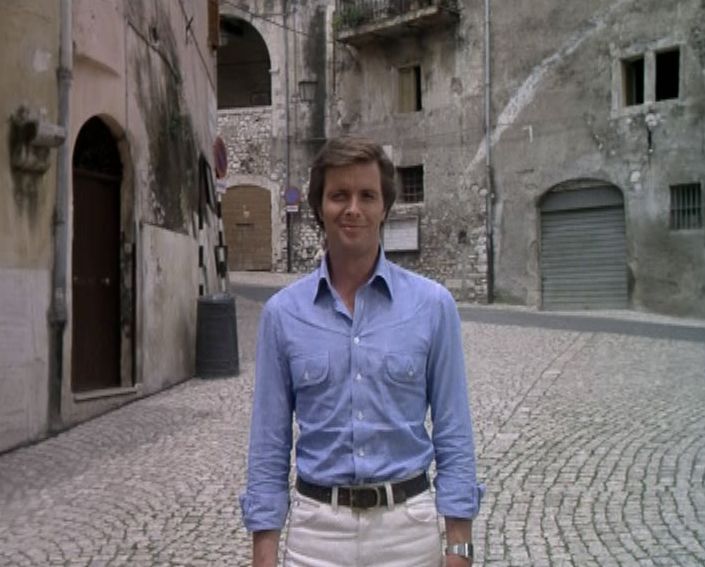
As with Duel in Venice, part of the success of the The Village that Sold Its Soul is down to the location. Filming took place mostly in Sermoneta, a hill town in the province of Latina.  Thanks to its twisting streets, it was a location that offered director Leslie Norman plenty of scope for interesting and atmospheric shots.

It’s also an unusual episode since Simon has to mostly operate on his own.  Often, he’s paired up with an attractive female and can also count on official or semi-official help from his friends in high places.  But as Santa Maria is an isolated village there’s no help for him to call on.  There is an attractive female, Sophia Castracano (Katia Christine), but she’s a relatively minor character.

It’s a solid production, although there are a few mis-steps.  The body thrown off the cliff in the pre-credits sequence is clearly a dummy and later we see Simon desperately running away from an out-of-control cart.  But even if it had hit him, it’s difficult to imagine it causing him much of an injury!

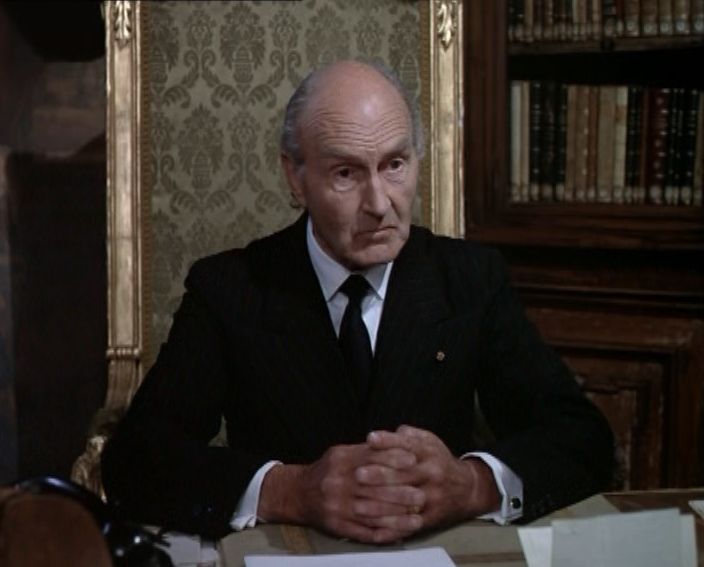
The concept of a whole village that’s complicit in a series of murders is an intriguing one (although it maybe owes something to The Avengers episode Murdersville).  Maurice Denham adds a touch of class as the Prince and it eventually becomes clear that he holds the key to the mystery.

Because of the location and Maurice Denham, as well as a solid script from John Goldsmith, The Village That Sold Its Soul rates four halos out of five.

maurice denham
Maurice Denham

Return of the Saint – One Black September

black

Abdul Hakim (Garrick Hagon) is a leading member of the Black September terrorist group.  It’s rumoured that he’s in London and is being pursed by his own people.  The Israelis are also desperate to pick him up and interrogate him (Hakim knows the names of all the top operatives in the organisation).

Simon Templar, due to his knowledge of London, is regarded by the Israelis as the ideal man to partner their leading counter-terrorist officer in a race against time to track Hakim down before his former friends find him.  Simon is initially reluctant, but when he learns that the officer is an attractive young woman (Prunella Gee playing Captain Leila Sabin) he becomes much more interested …..

One Black September is a slightly uneasy mix of real world politics and the usual escapist fare of an ITC adventure series.  For a modern audience, their name might not be instantly recognisable, but in 1978 they would have been very familiar.   Just six years earlier, Black September killed eleven Israeli athletes and a German police officer during the Munich Olympics.  During the early to mid seventies they also carried out numerous other attacks (and copycat activities were also attributed to them) which ensured that their name often featured in the headlines.

It’s the decision to use a real terrorist organisation that ensures One Black September has a slightly off-key feel, which is reflected in the attitudes of Simon and Leila.  Simon is his usual relaxed, flippant self whereas Leila is humourless and completely focused on the mission.

Matters come to a head later on, when Simon tells her she’s forgotten that she’s a woman (mainly because she seems to have no interest in sleeping with him!)  Leila counters this by telling Simon that her entire family were murdered by terrorists, so until Hakim is captured she cannot afford to let her concentration slip for even a moment.  Immediately prior to this, both Simon and the camera spend a little time ogling her shapely bottom as she bends over a map of London.  Both this, and Simon’s unsubtle efforts to romance her, mean that this is very much of product of its time.

Dodgy politics (both political and sexual) aside, this is a decent run-around.  Hakim’s former colleagues are led by Masrouf (Stephen Grief) and Rahaman (Nadim Sawalha).  Like everybody else, they’re lightly sketched characters, so the actors have to put the meat onto the bones (Grief is particularly effective with this).

Eventually Simon is able to pick Hakim up – but Leila is captured by Masrouf and the others.  Masrouf suggests a trade, which the Israelis strongly resist, but Simon gets his way.  In real life, of course, it’s impossible to imagine they would have acceded so readily to Simon’s request (he threatens to expose their illegal capture of Hakim, but it’s doubtful whether that would have really worried them).

Naturally, the Saint is able to extract Leila and keep Hakim – and in exchange for a plane ticket out of the UK Hakim gives the Israelis the names they need.  Leila bemoans that fact that a man like Hakim, responsible for countless murders, is simply going to get away.  But Simon has seen Rahaman in the airport terminal and makes no attempt to raise the alarm.

It’s another example of the Saint’s ruthless nature, which comes to the fore occasionally.  He knows that Black September will execute Hakim and is content to stand by and let it happen.  It’s a powerful moment and would have worked very well as the final scene (alas, a more conventional tag scene is added – with Simon and Leila heading off on holiday).

Although it’s not perfect, One Black September still rates three halos out of five.

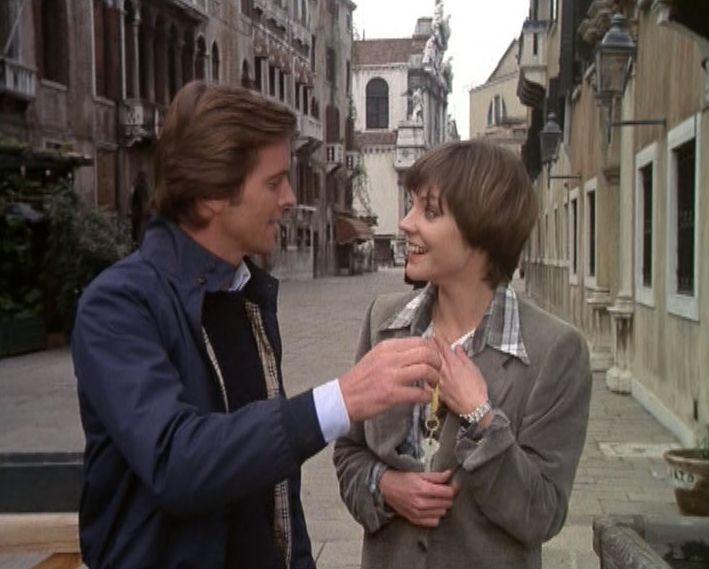
Return of the Saint – Duel in Venice

duel

When the daughter of one of his oldest friends is kidnapped in Venice, the Saint faces a desperate race against time.  Linda (Cathryn Harrison) has been abducted by Jed Blackett (Maurice Colbourne).  Blackett and Simon have crossed paths before – five years ago in Mozambique.

Ever since, Blackett has been waiting for the opportunity to exact his revenge and Linda finds herself the unfortunate bait in his trap.  Simon has just six hours to find the girl, but luckily for him he has assistance from an attractive gondolier called Claudia (Carole Andre) …

Ian Ogilvy’s favourite episode, it’s clear that the star of Duel in Venice is the city itself.  Had it been set in London it would have been a decent runaround but nothing special.  The gorgeous sights and sounds of Venice make all the difference.

It’s a pity that the storyline bears some similarities with the previously transmitted episode The Nightmare Man (an adversary from the Saint’s past is out for revenge) but that’s down to the vagaries of scheduling I guess.  And the problem of dubbing raises its head again – everybody (especially Maurice Colbourne) sounds like they’re dubbed for large parts of the episode.

Colbourne has a nice line in hysterical giggling and portrays Blackett as a completely deranged character.  It’s by no means a subtle performance, but since his screen time is quite limited (he mainly just pops up every now and again to taunt Simon) it’s not really a problem.  Cathryn Harrison has little to do except react to Blackett’s villainy with wide-eyed fear – such as when he fits her with an acoustic necklace (any loud sound would cause it to instantly tighten, killing her instantly).

So the bulk of the story is a two-hander with Simon and Claudia.  Carole Andre gives a lovely performance as the headstrong, argumentative Claudia and it’s her local knowledge which helps the Saint to eventually track Blackett down.

We never find out exactly how Simon and Blackett originally met.  Since Blackett is a mercenary and he claims that Simon left him for dead, the inference is that they were both fighting on the same side in some war.  It seems an uncharacteristic thing for the Saint to have done, but there’s another moment in the story which does hint at a darker side to Simon Templar.

Early on, Simon approaches Guido (Enzo Fiermonte) for assistance.  He’s a man of great knowledge and power (presumably a local gangster) but is initially reluctant to help, until Simon (with the aid of a gun) persuades him.  When the Saint threatens to put a hole in his head, it’s possible to believe that he’s bluffing – but he might not be.

It’s easy to believe that Leslie Charteris’ Saint would have been prepared to shoot, since the literary Saint was a much more amoral, violent character (when transferred to television, the Saint was greatly watered down).  This (and the reference to Mozambique) helps to imply that the relaxed, affable playboy that Simon Templar appears to be may not the whole picture.

Helped by the location, Duel in Venice scores four halos out of five.

Return of the Saint – The Nightmare Man

nightmare

Simon, together with the beautiful Gayle (Kathryn Lee Scott), is enjoying a weekend in Paris.  On the way back to their hotel room, he’s distracted by a series of screams from a nearby room.  The occupant is an Italian woman who tells Simon that she’s had a nightmare which foretold her husband’s death.

In her dream, they’re both riding in an open-top carriage in London (by her description, it’s clear that they’re travelling through Parliament Square).  She then hysterically tells Simon that during the journey her husband is shot dead.  Amongst the details she remembers is that the assassin has very blonde, almost white, hair.  When Simon learns that her husband is Dr Bernardo de Vallesi, Italy’s new ambassador to Britain (who is due to travel to the UK shortly) it appears that there may be some truth in her strange story.

The Nightmare Man is an odd one.  At first it seems that Mrs de Vallesi’s nightmare is simply a clumsy way of ensuring that the Saint takes an interest in the story.  But when Simon meets Dr de Vallesi, he’s introduced to his wife (who isn’t the woman from the hotel room) so the plot thickens.  But the main problem with the story is that all the action takes part in the last ten minutes or so and it’s a long slog to get there.

The real reason for the presence of the assassin is frankly bonkers and makes no sense at all.  It’s been organised by Colonel Ramon Perez (John Bennett).  He’s a bitter and vengeful man who lives for one reason only – to make the man responsible for his downfall pay.  That man, of course, is Simon Templar (but why he chose this plan is anybody’s guess).

Another problem with the story is the choice of Joss Ackland as the assassin, Gunther.  Ackland is an actor of many qualities, but this part doesn’t play to his strengths.  Gunther’s a cruel and psychotic man, but there’s never any sense of menace from Ackland.  The tone is set from his opening appearance – it’s hard to fear a man with such an obvious wig and flapping flared trousers!

There’s some other unlikely casting too – the diminutive Welsh actor Roy Evans as a supplier of guns and Stanley Lebor as a mercenary.  Although in Lebor’s case, this may be because now he’s probably best known for the Richard Briers sitcom Ever Decreasing Circles (back in the seventies he did play his fair share of heavies).

His encounter with the Saint is rather amusing.  He’s holding court in what’s supposed to be a rather rough pub (in which Simon is obviously meant to stand out).  In fact, it doesn’t really look too threatening at all – social realism was never a strong point of Return of the Saint.

Some nice location shooting in London apart, there’s not much to recommend in this one.  Two and a half halos out of five.

Return of the Saint – The Judas Game

judas

When I was a child, I was always disappointed that the animated stick-figure who appeared in the opening credits wasn’t the one who had the adventures (Ian Ogilvy was obviously a rather poor substitute!)  Time is a great healer though and I’m now reconciled to the fact that Ogilvy is the star of the show, rather than the stick-man.

ROTS was the last gasp for the ITC adventure series.  It follows their other 1970’s shows such as The Persuaders! and The Zoo Gang in having the luxury of foreign location shooting (something their 1960’s counterparts had to do without) and it’s easily the strongest series in this genre since The Persuaders!  Although it’s rather variable in quality (like many of the ITC series) at best it’s a cracking little show that’s still very enjoyable today.  I’m going to take a look at the early episodes and blog a brief, capsule review of each – as well as awarding them a mark out of five.

Simon Templar’s holiday in Italy is brought to an abrupt end, courtesy of MI6.  Led by Dame Edith (Mona Bruce), they want Simon to undertake a dangerous rescue mission.  They seem sure he’ll agree, since the kidnapped woman is an old flame of Simon’s – Sarah Morell (Judy Geeson).

Sarah has been kidnapped by a group of revolutionaries who wish to use her knowledge of counter-intelligence to train their terrorists to operate even more effectively.  Simon reluctantly agrees and with the aid of Vlora (Olga Karlatos) manage to infiltrate the heavily guarded fortress.  But a surprise awaits the Saint …..

The Judas Game has a slightly stodgy opening.  Rather obvious dubbing (a trait of many ITC series) is a little distracting in the early scenes (it’s very obvious with Mona Bruce, for example).  But once Simon snorkels his way to the island, things pick up – especially when he runs into the lovely Vlora.  Whist Judy Geeson might be the nominal female lead, Olga Karlatos has more screen time and she and Ian Ogilvy make a very effective team.  She’s remarkably easy on the eye too, especially when dressed in uniform!

Olga Karlatos
Olga Karlatos

If bad dubbing is always an intermittent problem with ITC series, then day-for-night filming is the other regular irritant.  It’s bizarre that even a series like ROTS, which enjoyed extensive overseas shooting, couldn’t afford to film at night.  Instead, a filter is placed over the camera to give the impression that it’s night-time, although the blazing sky is a dead-giveaway.  Alas, this rather saps the tension out of Simon and Vlora’s escape from the beach.

Happily, they infiltrate the fortress during the day-time and Simon is easily able to rescue Sarah.  Suspension of disbelief is required here – as he single-handedly has to make his way past numerous guards and then has to carry the unconscious Sarah back to Vlora and the van.  Why is Sarah unconscious?  When they meet, she tells him that she wasn’t kidnapped – she defected.

At this point, there’s an interesting edit.  We cut away from them and what appears to be a punch is heard.  When we cut back, Sarah is unconscious and the clear inference is that Simon’s knocked her out.  It’s a slightly clumsy edit, so it might be that after the scene was shot it was felt it wasn’t a good idea to show Simon hitting a woman (even though it’s obvious what’s happened).  I also love the way they make their escape, with Simon blowing up the fortress gate with a rocket launcher!  It’s pure James Bond.

Sarah and Vlora don’t get on, mainly because Vlora regards her as a traitor and wants to shoot her.  When the guards catch up with them, Simon seems to be of the same opinion.  “It’s quite simple Major, she’s insane. Now why don’t you just treat her as a mad dog and put a bullet through her head?”

There’s a further twist to the tale though (as well as the reveal that one of the MI6 agents is a traitor).  Overall, this is a strong episode and it’s easy to see why it was chosen as the first to air in the UK.  It’s got action, foreign filming and two attractive female co-stars for Ian Ogilvy to tangle with.  The bad-guys don’t make much of an impression, but all in all this rates four halos out of five.

House of Cards (BBC 1990) – Episode Four

house 04

The first ballot for the Conservative leadership election is six days away and Francis Urquhart has finally thrown his hat into the ring.  Patrick Woolton and Michael Samuels are formidable opponents, but Urquhart and his faithful shadow, Tim Stamper, can certainly deal with some of the others, such as McKenzie and Earl.

Ian Richardson and Colin Jeavons make a deliciously entertaining team.  Both have immaculate timing and obviously relish the lines they’re given.  Urquhart begins by mentioning Samuels, the health minister and wonders if they can work something at his next public appearance.  Stamper acidly tells him that he “doesn’t go to hospitals anymore. Kept getting beaten up by the nurses  I think he has trouble getting insured now.”  But a visit to Cybertech (a wheelchair maker) serves just as well and a demonstration is engineered which culminates with Samuels mowing down a demonstrator in a wheelchair.  One down …..

Next up is Harold Earle.  He was tangled up with a rent-boy on a train some years ago (although it was all hushed up).  Urquhart wryly observes that it would be very bad form to bring it all up again but Stamper counters that “getting sucked off for sixpence in a second class compartment is hardly prime ministerial behaviour.”  A few pictures sent to Earle is enough to convince him that he should step down from the race.

After the first ballot, neither Urquhart, Woolton and Samuels have a clear majority – so a second ballot is called.  The sex tape from Brighton (with Penny and an enthusiastic Woolton) is now pressed into service and this is enough to force Woolton out of the running,  He proclaims his support for Urquhart (which should be enough to guarantee his victory).  Patrick Woolton later tells his wife the reason why he decided to support Urquhart  – and it wasn’t out of friendship.  He believes that Samuels and Lord Billsborough engineered his downfall, so whilst he may dislike Urquhart he detests Samuels.  Another small detail that feels very true to life is when he tells her that it’s also worth supporting Urquhart because he’s the older man.  Old men die sooner and the sooner Urquhart dies, the quicker Patrick Woolton will be back.

With the house of cards beginning to wobble, Urquhart has to go to even greater lengths to protect himself.  Roger O’Neill is clearly a liability, so Urquhart invites him down to his country house, gets him drunk and then laces his cocaine with rat poison.  Whilst he’s doing this, he makes the following speech to camera.  His soft, matter-of-fact delivery is truly chilling.  “This is an act of mercy. Truly. You know the man now. You can see he has nowhere to go. He’s begging to be set free. He’s had enough. And when he’s finally at rest, then we’ll be free to remember the real Roger. The burning boy in the green jersey. With that legendary, fabulous sidestep and the brave, terrified smile.”

But even this isn’t enough to stop Mattie’s investigations.  Thanks to a replay of her various audio tapes (and it’s remarkable how each tape she puts into her recorder plays at exactly the right point!) she begins to piece everything together and starts to believe the unbelievable.

She finds Urquhart at the House of Commons roof-garden and their final meeting (a complete reversal from Dobbs’ novel) is a justly memorable one.  And with an unseen hand picking up Mattie’s tape-recorder (which contains Urquhart’s confession) it’s clear that the story is far from over.

As I’ve previously said, this is a thoroughly modern drama that really doesn’t seem to be twenty-five years old (only the slightly clunky computers date it).  Ian Richardson and Susannah Harker, either together or apart, are incredibly watchable.  Richardson imbues Francis Urquhart with a mocking, attractive persona (except on the odd occasion when real anger shows through).  Harker’s Mattie Storin is, at different times, both manipulated and a manipulator.

It’s a memorable production and easily the strongest of the House of Cards trilogy.

House of Cards (BBC 1990) – Episode Three

house 03

Henry Collingridge calls an emergency cabinet meeting and announces his immediate resignation.  He thanks all of his colleagues for their friendship and loyalty – at least those who feel that the words apply to them.  Later, he visits his brother in the private nursing home where he’s drying out and emotionally tells him that he’s glad it’s all over and he won’t have to fight the “bastards” anymore.  This is another scenario that has an eerie ring of truth (John Major, after shortly surviving a vote of confidence in 1993, was equally scathing about some of his cabinet colleagues).

Afterwards, Urquhart once again addresses the watching audience.  “Not feeling guilty, I hope. If you have pangs of pity, crush them now. Grind them under your heel like old cigar butts. I’ve done the country a favour. He didn’t have the brain or the heart or the stomach to rule a country like Great Britain. A nice enough man, but there was no bottom to him. His deepest need was that people should like him. An admirable trait, that. In a spaniel or a whore.  Not, I think in a Prime Minster.”  It’s even more impressive that he delivers this speech whilst standing at a urinal!

Urquhart is content to let others announce their desire to stand first, he’ll enter the race later in the day.  He can count on powerful friends when he does though, as he has the support of Ben Landless and his media empire.  Landless tells him that he’ll do everything he can to get him elected – and he’ll expect Urquhart to be grateful for evermore.  It’s another moment that feels horrifyingly like real life.

But there’s a subtle shift in this episode.  It’s less about Urquhart’s scheming and more about Mattie’s dogged investigations.  As the title suggests, a House of Cards may be a substantial structure, but it only takes one small movement to bring the whole edifice crashing down.  And the first stirrings happen when Mattie refuses to drop the investigation into the share scandal (even though she’s been moved off the political section of the Chronicle and onto Women’s Features).

It seems clear that Henry Collingridge couldn’t have bought the shares, since he convinces her that he’s not got a great deal in the old brain box.  So did somebody set him and his brother up?  Urquhart tries to warn Mattie off by sending Roger O’Neill round to her house (to throw a brick through the window and daub her car in paint).  This backfires when Penny confesses to Mattie that Roger was responsible, although she pleads with her not to go the police – in Roger’s current state he could easily commit suicide.

O’Neill is another link to Urquhart, but he convinces Mattie that he’s the best person to speak to O’Neill and find out exactly what he knows.  Poor, easily manipulated Roger O’Neill isn’t long for this world you’d fear ….

At present, there’s no doubt that Mattie believes everything that Francis Urquhart says.  But the problem is that she won’t stop digging.  He takes her to bed, which may be a way of earning her loyalty, but even here there’s the sense that Mattie is subtly (if unconsciously) maneuvering herself into a position of power.

Their meeting in the study is another spellbinding scene, played so well by both Richardson and Harker.  The scene alternates between tight one shots of both actors until Urquhart agrees to her request and they move into the frame together.  But what can she call him?  She doesn’t want to call him Francis and he says that calling him Chief Whip hardly seems appropriate.  After a few beats she says “I want to call you daddy.”  She has to repeat this to the (shocked?) Urquhart, but although he says nothing, the kiss seems to seal the agreement.

So can Francis Urquhart count on Mattie’s loyalty?  At present it seems so, but he isn’t aware that she’s been secretly tape-recording all of their meetings …..

House of Cards (BBC 1990) – Episode Two

house 02

The beleaguered prime minster and his colleagues have decamped to Brighton for the party conference.  Urquhart acidly rates the performances of his colleagues, all of whom are subtly auditioning for the PM’s job.

Michel Samuels (“Intelligent, sensitive, caring – all in the same sentence, I bet you”). Peter McKenzie (“God, what an idiot that man is”). Harold Earle is dismissed with a shake of the head, which leaves Patrick Woolton (“The man’s a lout, of course. A lout. A lecher. An anti-Semite. A racist. And a bully. He is however more intelligent than he seems.”)

Woolton is a clear and present danger, so Urquhart once again seeks the help of Roger O’Neill or more specifically, O’Neill’s assistant Penny Guy (Alphonsia Emmanuel). Ian Richardson displays the steel that lies just below Urquhart’s surface when he requests her services, although not for himself. “Shut up. Did you really think I wanted her?”  Instead, Urquhart requests she resume her relationship with Woolton (for reasons which will become clearer later om).

Alphonsia Emmanuel seems to have dropped off the radar in recent years (only one film/television credit post 1998) which is a pity, as she was always a very watchable presence. And every time I see her, it reminds me that Rockliffe’s Babies still remains unavailable on DVD. Maybe one day ….

When Roger suggests that she might like to join Woolton for dinner, there’s a real spark of anger.  “Pimping now, is it? Don’t you care about me at all? Don’t you care what I do?”  The anger quickly fades though and she agrees – which means her energetic love-making with Woolton is recorded by Urquhart (in a lovely scene, where he’s sitting upright in his bed, wearing a pair of headphones).  It’s another piece of insurance, to be used at the appropriate time.

Urquhart’s schemes continue apace.  He convinces Woolton that should Henry Collingridge stand down, he’d be the best man for the job.  Later, he also convinces the boorish newspaper magnate Ben Landless (Kenny Ireland) that Collingridge is yesterday’s man – and the power of the press is a powerful weapon.  Like so much of the story, it’s possible to find real-life parallels (how often has the press been gulity of creating, rather than shaping, public opinion?)  Landless is a rather unsubtle amalgam of the two most famous newspaper and media magnates of the time, Rupert Murdoch and Robert Maxwell.  I’m not quite sure exactly what accent Ireland was attempting, but he impresses nonetheless.

Mattie has an encounter in the bar with the PM’s frequently drunken brother Charles Collingridge.  It’s only a short scene, but James Villiers makes it a memorable one.  “Lord, you are a pretty girl.  Oh, no offence. I’ve got a daughter your age. Lovely girl. Lovely face. Never, never see her. Own fault. Water under the thingy.”

The full revelations of the fake financial scandal engineered by Urquhart seem to spell the end of Henry Collingridge’s career and the episode closes on the developing relationship between Urquhart and Mattie.  Elizabeth Urquhart suggested that there was one way to ensure Mattie’s total loyalty and we see the first steps taken here.

Once again, we see Urquhart standing over the seated Mattie, reinforcing his dominance over her.  He pretends to be surprised at the way the conversation has gone and tells her he’s old enough to be her father.  When she responds that maybe that has something to do with it, after a beat he sits down and tells her that “oddly enough, I always wanted a daughter.”

House of Cards (BBC 1990) – Episode One

house 01-00

When the first episode of House of Cards was transmitted, on the 18th of November 1990, it was perfect timing since Margaret Thatcher had announced her resignation as Prime Minister earlier the same week.

Michael Dobbs’ novel House of Cards, published in 1989, tells the story of a completely unscrupulous politician, Francis Urquhart, who manages to lie, cheat and murder his way to the position of Prime Minister following Mrs Thatcher’s departure.

Dobbs had held a senior position in the Conservative Party, so there’s very much a ring of truth to his writing.  And although it was highly topical twenty-five years ago, it’s hardly dated at all – indeed, its theme of power-hungry and amoral politicians is probably just as relevant in 2015 as it was back then.

Andrew Davies adapted Dobbs novel and made several key changes.  One difference was the twisted relationship between Urquhart and Mattie (in the novel they only meet a few times and are never intimate).  Davies decided that “Mattie can have an affair with Urquhart, and let’s make it kinky, she can call him Daddy when they’re doing it.”

By far the greatest change was the ending.  In Dobbs’ novel, Urquhart commits suicide after being confronted with evidence of his crimes.  It’s a neat, moral ending but Davies decided to do something arguably more realistic, which led the way open for an intriguing sequel.

Dominating the four episodes was Ian Richardson as Francis Urquhart.  Richardson had already many notable credits to his name (such as Tinker, Tailor, Soldier, Spy and Porterhouse Blue) but the House of Cards trilogy would prove to be his signature role.  In another change from Dobbs’ novel, Davies chose to have Urquhart make numerous asides to the audience.  This breaking of the fourth wall (an unusual dramatic device in modern drama) was a masterstroke as it gave Richardson an incredible amount of scope to directly share his innermost thoughts and feelings.

Episode one opens with Urquhart mourning the departure of Mrs Thatcher (albeit with a faint ironical smile).  “Nothing lasts forever. Even the longest, most glittering reign must come to an end some day.”

But who could replace her?  As Urquhart says, there’s plenty of contenders and he gives us a brief summation of each of them.  Lord Bilsborough (“Too old and too familiar. Tainted by a thousand shabby deals”).  Michael Samuels (“Too young. And too clever).  Patrick Woolton (“Bit of a lout. Bit of a bully-boy”).  Henry Collingridge (“The people’s favourite. A well-meaning fool. No background and no bottom”).

What’s absolutely clear is that, at this time, Urquhart has no thoughts about the job himself.  He’s content to serve and after Collingridge wins both the election as party leader and the General Election (although with a greatly reduced majority) he looks forward to the senior cabinet position he was promised.

But Collingridge (David Lyon) tells him that he’s much more valuable to the party if he remains as Chief Whip.  This snub is the motivating factor in convincing Urquhart that Collingridge should go and that he would make a much better PM.  But he still requires a push from his wife, Elizabeth (Diane Fletcher), before he starts to scheme in earnest.

This is another change from the novel, as Mrs Urquhart is a much more central figure in Andrew Davies’ adaptation.  And just as Davies drew on Jacobean Theatre to craft Urquhart’s asides to the audience, it’s clear to see how Elizabeth acts as a Lady Macbeth figure, urging her initially unsure husband on the path to absolute power.

That same night, he’s visited by Mattie Storin (Susannah Harker), a young journalist working for the Chronicle.  She’s desperate to know the thinking behind Collingridge’s lack of cabinet reappointments following the election and hopes that Urquhart will explain the reason why.  Harker is perfect as the ingenuous Mattie who Urquhart instantly realises can be manipulated to serve his own ends.

The pupil/master feeling is enhanced thanks to the way Paul Seed shot their initial meeting in Urquhart’s study.  For part of the scene, Richardson is standing whilst Harker remains seated.  This means that Mattie has to constantly look up to Urquhart, placing her in a subservient position (this simple staging helps to instantly establish his dominance over her).

After he’s fed Mattie some misinformation, Urquhart begins to manipulate all those around him who may be useful.  They include the charming, but unstable cocaine addict Roger O’Neill (a lovely, twitchy performance by Miles Anderson) as well as the Prime Minister’s drunken brother Charles (a typically fine turn from James Villiers).

Other key characters who will figure in the story later on are also introduced, such as Urquhart’s number two, Tim Stamper (Colin Jeavons).  He’s got little to do in this one, but Jeavons is always so watchable (observe the slight hurt on his face when Urquhart asks him to step out of the office when Roger O’Neill enters.  It’s the smallest of moments, but it helps, even this early on, to sell the idea that his loyalty may be called into question one day).

Before this, they both enjoy dressing down a rather pathetic MP called Stoat (Raymond Mason).  After Urquhart tells Stoat that he’s been able to persuade the police not to proceed, he goes on to say that “if you must use whores, for God’s sake go to a decent knocking-shop where they understand the meaning of discretion. Stamper will give you a list if you don’t know any yourself.”  After the unfortunate Stoat has left, Stamper says that “if I had a dog like that, I’d shoot it.”

Thanks to a system of embarrassing leaks engineered by Urquhart, Collingridge begins to feel the pressure.  And all the time Urquhart continues to pretend to be his most loyal supporter.  He reckons that one more scandal should finish him off – maybe a nice, juicy financial one which involves his brother?

The Legend of Robin Hood (BBC 1975) – Part Six

robin 06

Robin has sent Sir Guy an invitation to meet in single combat.  Initially Gisborne refuses, but when Marion artfully remarks that this is because he’s a coward, he naturally changes his mind.  Given that the Robin/Gisborne feud has formed an integral part of the serial, it might be expected that it would be the climax of the story.  Instead, it’s essentially a prelude to the main action.

Robin and Sir Guy meet in Sherwood Forest.  It’s a brutal fight (shot on film) which obviously took some time to record.  It was worth it though, as director Eric Davidson (and the highly experienced film cameraman Elmer Cossey) made full use of the impressive location.  Gisborne elects to start the fight with a shield and a wicked-looking mace whilst Robin only has a sword (clearly chivalry doesn’t demand that they have equal weapons!)  Indeed, there’s not a great deal of chivalry in the fight as Robin is content to aim some well timed kicks and punches to disorientate his opponent.

Eventually Robin emerges triumphant which means that Marion is finally free from Sir Guy’s advances.  But if he believes that the death of Gisborne has removed the obstacle to their union, he’s to be sadly disappointed as she returns to her own lands.

At the same time, John continues to push for power.  He’s keen to depose Longchamps and install himself as regent, but the Bishop of Durham (Malcolm Rogers) is a major obstacle.  The power-hungry Sheriff sees a chance to kill two birds with one stone – dispose of the Bishop and blacken Robin’s name – so he pays a convicted criminal to kill the Bishop whilst claiming to be one of Robin Hood’s men.

With a survivor left alive to spread the news that Robin and his friends are nothing but common criminals and murderers this marks the beginning of the end for Robin’s band of men.  Ralph Gammon and Much are hanged by soldiers in the forest and elsewhere Tuck is mortally wounded (our last sight of him is his lifeless body slumped in a forest clearing).  It’s a brutal turn of events and one which most adaptations of the Robin Hood legends wouldn’t attempt, but it’s an accurate indication of just how short life could be during this period.

Richard returns to put paid to John’s scheming and he promises Robin a full pardon and the restoration of his lands and titles, but there’s one final twist to the tale.  Robin, ill with fever, returns to Huntingdon.  He’s tended by a woman who he later discovers is Gisborne’s sister, but only after he’s drunk a goblet of poison she gave him.  It’s a logical and circular, conclusion to the story – Robin kills Gisborne so Gisborne’s sister revenges her brother’s death by killing Robin.

It has some similarity to the early ballad Robin Hood’s Death, which survives only as a fragment of a larger, now missing, work.  A later variant adds the familiar scene of Robin shooting an arrow into Sherwood and asking to be buried wherever it lands.  Here, we see Little John do it, and Marion is at his side as they both watch the arrow fall.  It’s the final scene in a quietly outstanding serial that manages to take many very familiar story elements and weave them into something cohesive.

With Little John the only merry man standing at the end, it’s possible to see the whole story as an exercise in futility.  What did Robin achieve and will things really be better now that Richard is back?  If you enjoy Robin Hood for swashbuckling derring-do and witty one-liners then this darker interpretation may not be to your liking.

When Richard captures the Sheriff and tells him that his treason will cost him his life, the Sheriff wonders if Prince John will also suffer the same fate.  Of course not, as though Prince John was an equal and willing partner, his royal blood will protect him from any punishment.  Paul Darrow is one of the serial’s many strengths and he continues this right up to his final scene.  Richard tells him that he’ll hang, but the Sheriff replies that his rank entitles him to the axe.  So he’s told that he’ll have it, with his head to be displayed on a pike on the castle gate.

Although some rate this as one of the best versions of the Robin Hood legend, there are a few dissenting voices – mainly highlighting the staginess of the studio scenes.  It’s a fair comment, but the positives of the extensive filming and the performances manage to outweigh any little niggles about a few of the studio sequences.

Martin Potter is an energetic Robin Hood (although maybe just a little too well spoken for somebody brought up as a commoner).  There are very few weak links in the cast and Potter, along with William Marlowe, Paul Darrow, Diane Keen, David Dixon and Tony Caunter are especially good.  It’s certainly a production that still holds up today and is worth seeking out (the 2 Entertain DVD is deleted, but can be found for a reasonable price).