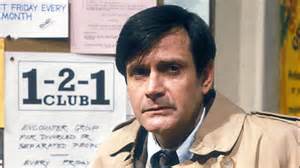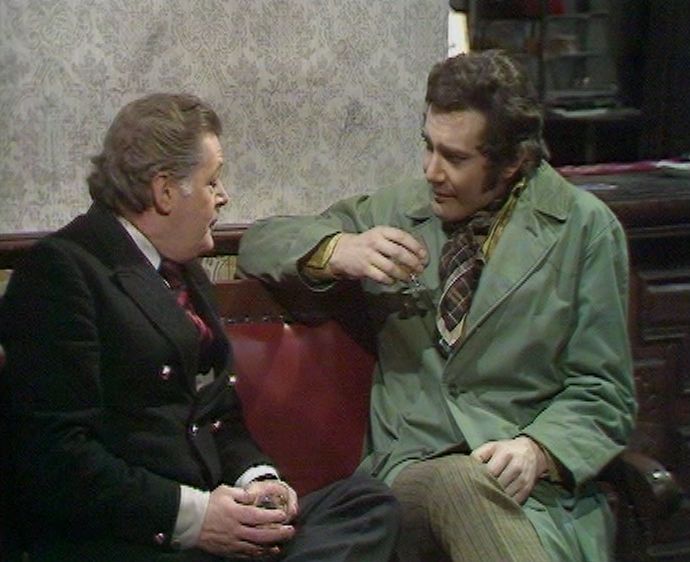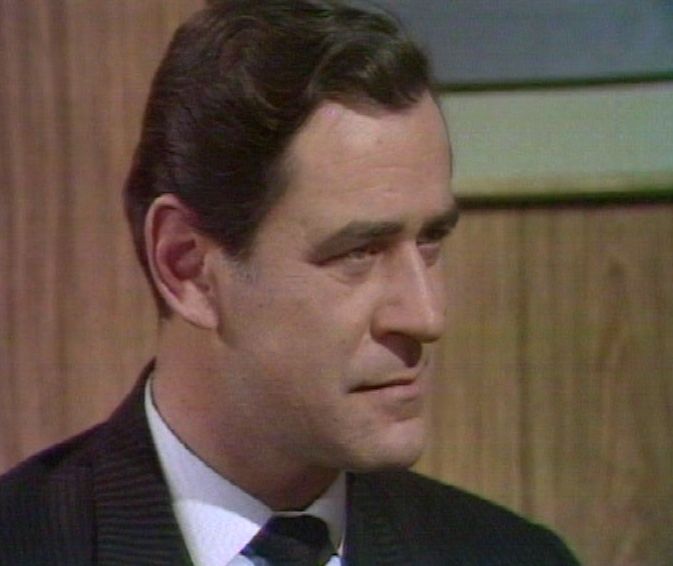
Doomwatch – By The Pricking of my Thumbs

pricking

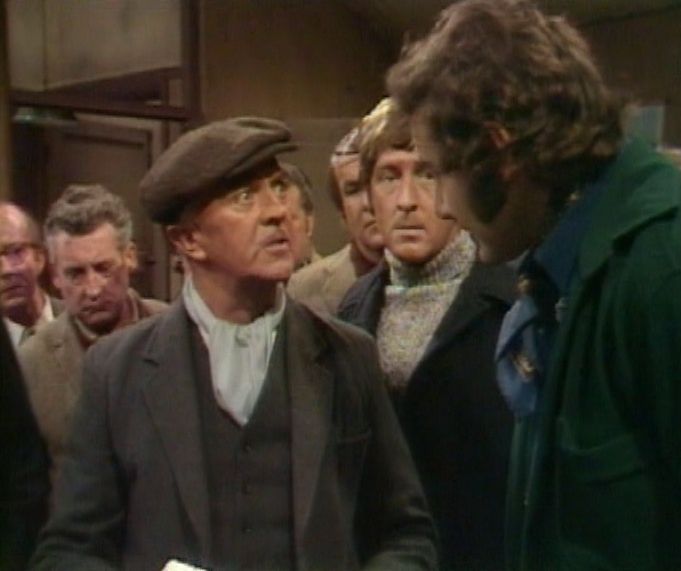
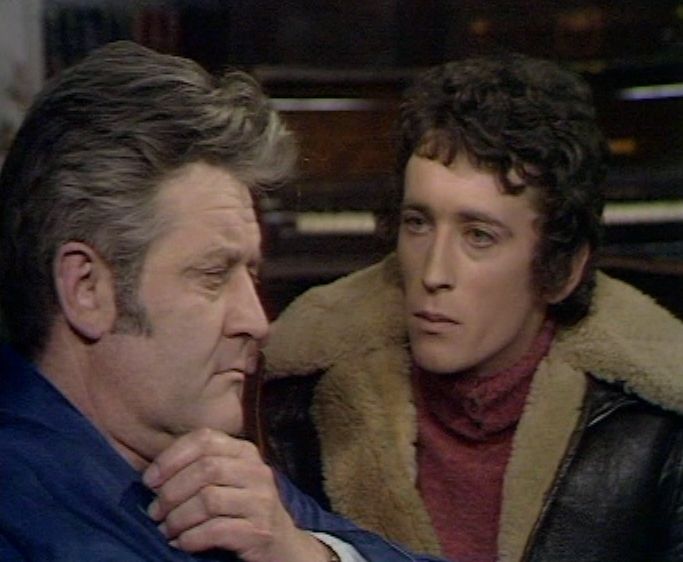
Professor Ensor (Olaf Pooley) has been granted time and space at Doomwatch to conduct experiments into the extra Y chromosome, much to Quist’s disdain, who doesn’t believe a word of it.  “Only yesterday I was reading an article by a colleague of yours, Ensor, in The Lancet. Once again he cast grave and honest doubt on the theory that the extra Y chromosome predisposes one to criminal behaviour.”

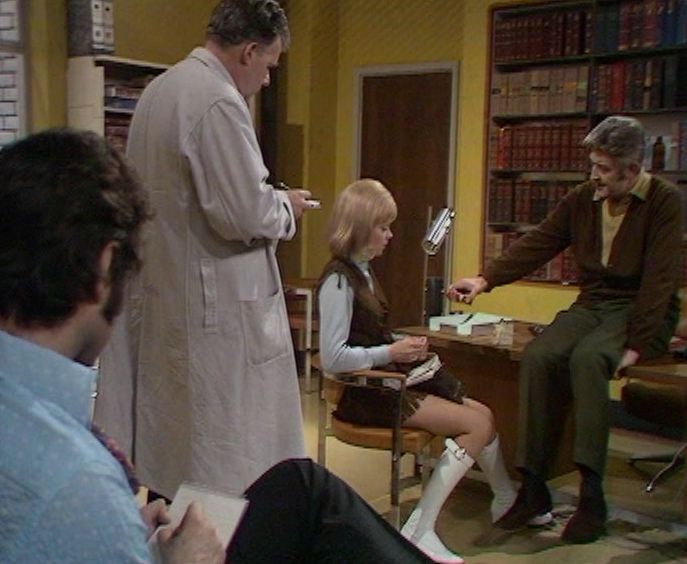
Ensor has been conducting tests at a local school, asking the pupils to fill out questionnaires, as well as taking blood samples (hence the pun in the episode’s title).  This is an early indication that Ensor’s methods are suspect in the extreme – Fay has been assigned to work with him and she’s under the impression that the samples they’re studying have been taken from criminals (totally unaware that later samples have come from the school).

If this is an example of the casual way he treats his scientific research, then worse is to come.  The school’s headmaster, Botting (Colin Jeavons) has a problem – a boy was badly injured in the chemistry lab after three other pupils (MacPherson, Jenkins and Franklin) tampered with his experiment.  Botting is convinced that one of them must be the ringleader, but which one?  He discusses the matter with Ensor and, after learning that Stephen Franklin (Barry Stokes) is taller than normal for a boy of his age (he’s seventeen), the Professor decides he must be guilty.  Carriers of the extra Y chromosome are known to be taller than average, Stephen is taller than average, QED.

It’s an astonishingly thin amount of evidence, but Botting is convinced and expels Stephen, which leaves us unsure as to who’s the most culpable – Botting or Ensor.  It’s plain that Botting lacks judgement, as whilst he’s portrayed as a progressive headmaster – keen to encourage his pupils to express themselves – he’s blinded by Ensor’s apparent scientific credibility (allowing the true culprits, MacPherson and Jenkins to get off scot free).  Ensor’s reasons for picking Stephen seem very vague.  Apart from his height, the other major factor seems to be that he was adopted.  Bad blood …..

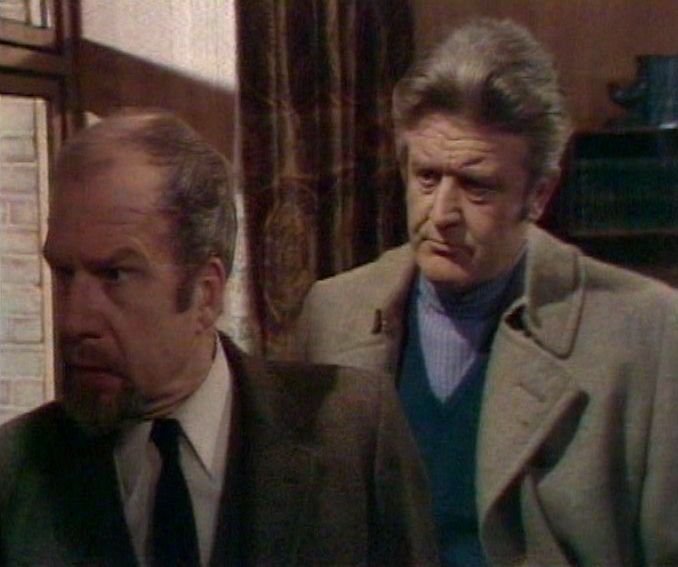
Stephen’s father, Oscar (Bernard Hepton), is appalled by the way his son’s been treated and after he gets nowhere with Botting he heads off to speak to Quist.  They know each other, but Quist can barely tolerate the man.  Oscar is a freelance journalist, working in the science field, and Quist has a poor opinion of his skills as a writer.  The always watchable Hepton gives a fine performance. Oscar is full of bluff and bluster, but he’s a fundamentally decent man who obviously cares for his son, which makes the way Quist treats him even harder to take.  He’s curt and dismissive and it’s only after Oscar leaves, and Ridge piques Quist’s interest with information about Ensor’s school experiments, that he begins to get interested.

Stephen attempts to kill himself in a rather unexpected way (by walking onto the runway at Gatwick).  He’s obviously in a confused state as before this he was heading for a plane which was flying to Jersey.  Geoff Hardcastle pops up again briefly to talk the boy down and luckily he comes away unscathed.

Everything’s built up for the big confrontation between Quist and Ensor.  It’s been stated on several occasions that Quist can’t stand him and also has little respect for him as a scientist.  Ensor attempts to defend his knowledge, but Quist simply steamrollers on.  “Your knowledge that condemns a child unheard, that drives him to risk death on an airport runway at night.”  It’s possibly not as powerful a diatribe as it could have been (it’s interesting that Quist seemed more angry at Oscar than he does at Ensor) but it’s still a nicely played scene by John Paul.

After a couple of indifferent episodes, By The Pricking of My Thumbs gets Doomwatch back on track.  Bernard Hepton and Olaf Pooley are both excellent, although Ensor isn’t as central to the plot as you might expect.  In many ways he’s more of a catalyst for the drama that’s triggered once he makes his disastrous prognosis.  Patsy Byrne, Sally Thomsett and Colin Jeavons are more familiar faces who help to enliven the story.  Byrne is good value as Stephen’s mother whilst a young Thomsett is his (slightly irritating) younger sister.

This was Robin Chapman’s sole Doomwatch script.  He was the creator and/or writer of a number  of popular series made by ITV during the mid to late sixties (The Man in Room 17, The Fellows, Spindoe, Big Breadwinner Hog) so he would have been something of a “name” writer at the time.  It’s a pity he didn’t write more for the series as this is a sharply defined character piece.
Doomwatch – No Room for Error

no room for error.jpg

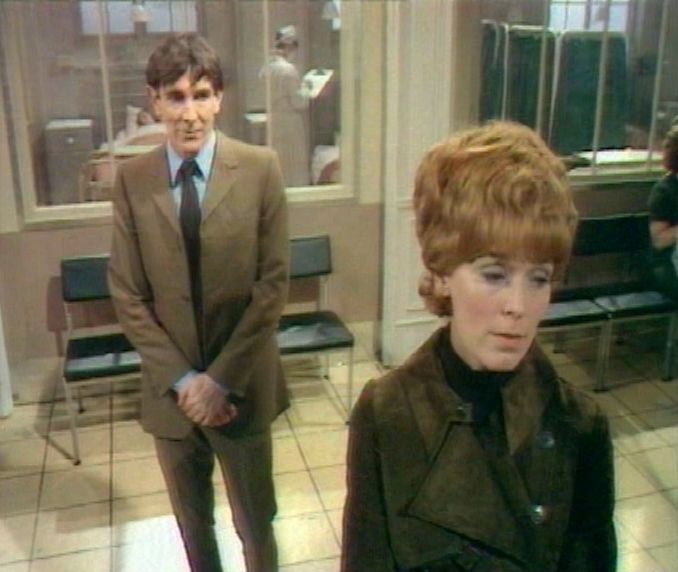
Dr Fay Chanty (Jean Trend) is Doomwatch’s latest recruit, although initally she tells Quist she’s now not sure now whether she wants the job.  But her arrival is a timely one.  She formerly worked at BAP (British Associated Pharmaceuticals) helping to develop Stellamycin, a drug which can be used to combat typhoid.

A recent typhoid outbreak has seen a score of children hospitalised and fighting for their lives.  Stellamycin could be the answer – but despite Doomwatch’s cautiously favourable report the government has yet to give their approval.  So whilst Quist heads off to do battle with the ministry he sends Fay to BAP to liaise with her former colleagues.

The government grudgingly agrees to allow Stellamycin to be used, but when a child dies it sets them into a panic.  Only one group of children shows such an adverse reaction though and it’s later discovered that they all went to the same school.  A working hypothesis would be that somehow they had already been exposed to a very low level dose of the drug over an extended period.  But since it’s only just been released, how could this be so?

Like Toby Wren, the arrival of Fay Chantry allows the viewer to observe Doomwatch from the outside.  Who are these small group of scientists and what exactly do they do?  No Room for Error implies that they’re not highly regarded amongst certain parts of the scientific community.  One of Fay’s former colleagues at BAP, Nigel Waring (John Wood), has a particularly jaundiced view of them, wondering why she’d want to give up a decent job at BAP for civil service pay and a role as a government snooper …..

Although Fay Chantry was created in order introduce a woman into the Doomwatch team who wasn’t a secretary, it’s ironic that her initial storyline is somewhat sexist.  She spends most of her time rekindling her relationship with Nigel, who’s such an irritating drip that it’s therefore hard to have a great deal of respect for her judgement!

Their brief affair had been one of the factors in his recent divorce and he now suggests they marry and she returns to work at BAP.  Nigel’s boss, Professor Lewin (Angus MacKay) doesn’t think this is a good idea, telling him that the pair of them living and working together would be too much of as strain (so much better if she just became a nice little housewife).  Ridge takes the biscuit though, when he later tells Quist that because Fay’s a woman she’s likely to react emotionally.  Yes, John Ridge, a man who tends to act first and then think later (when he does think) said this!

The Nigel/Fay relationship has a soap-opera feel about it, which is reinforced when Nigel’s daughter falls ill with typhoid and he has to face an urgent dilemma – should she be treated with Stellamycin when might it prove fatal?

After extensive tests by Doomwatch, Nigel is proved to be culpable – a canister of the drug was left at a nearby farm, which in turn infected the milk at a local school.  It’s possibly an ironic touch (although maybe not) that Nigel reacts with resentment and a complete lack of personal accountability when Fay gently mentions this to him.  Earlier he was scathing about Doomwatch, not regarding them as true scientists, but when it’s revealed he was responsible for a child’s death, he turns his anger on Fay and brings their relationship to an end (a lucky escape for her, I think). He doesn’t stop to think that if it hadn’t been for those “busybodies” at Doomwatch there might have been more deaths.

After being largely anonymous during the last episode, Simon Oates has a little more to do here.  When we first see him he’s in a slightly battered state and is being attended to by Barbara Mason.  She places a plaster on a cut over his eye and is then encouraged by him to kiss it better!  Clearly some time has passed since we saw her in You Killed Toby Wren as she’s now very comfortable around him.  Possibly this was a little ad-lib worked out in rehearsals, it’s a nice moment anyway as it helps to give a touch of humour and humanity to both their characters.

Angus MacKay (a man who seemed to make a career out of playing headmasters, bank managers and the like) is suitably imposing as Professor Lewin.  It’s not much of a role but MacKay’s clipped diction is always worth listening to.  Anthony Sharp as Dr Ian Phelps (the Medical Officer of Health) is another solid performer and Anthony Ainley (as the Senior House Officer) has a couple of key scenes.  Several points off though for Norman Scase as Mr Elliott, the headmaster at the infected school.  He gives an extraordinary mannered performance which has to be seen to be believed.

Although the Nigel/Fay subplot is rather tedious (will she choose him or her career at Doomwatch?  Umm, fairly obvious really) there’s a decent mystery at the heart of the story and both Quist and Ridge are used well.  But this story is another sign that the series is changing – as character relationships are moving into the foreground whilst the science takes a little bit of a back seat.

Doomwatch – The Islanders

islanders

Six months ago, the two hundred inhabitants of the tiny Pacific island of St Simon were evacuated back to the UK (the British government believed that they were at risk from heavy earth tremors).  Because they’ve been a totally closed community for some 150 years Quist sees them as an excellent source of research material.  By studying them and contrasting (both physically and genetically) with a group of volunteers drawn from towns and cities, Quist and the others will be able to evaluate how the environment and the presence of other people affects human evolution.

Although The Islanders was an early series two entry, it clearly points ahead to the direction Doomwatch would take during its third and final series (after producer Terence Dudley had wrested creative control from creators Kit Pedler and Gerry Davis).  Louis Marks’ script is a human drama first, with the environmental problem (mercury poisoning) somewhat secondary.

The social impact of the islanders reintegration into society concerns Quist.  They’re currently living in a camp, which looks uncomfortably like the sort of place used to house prisoners of war during WW2.  The man from the government, Mullery (Geoffrey Chater), doesn’t seem at all concerned and he tells Quist that they’re free to leave and go anywhere they want at any time.  Since they come from a British protectorate they have the same rights and freedoms as any other British citizen.

But Quist knows they’re not the same.  “They come from a place where there’s no cars, no telephones, no televisions.”  The islanders lack the necessary tools and knowledge to live in a modern, technological world – in time they can learn, but it appears Mullery is keen to pass the buck.  Chater is perfect casting as the dispassionate, disinterested official (he’d later pop up as a semi-regular in Callan playing a not dissimilar figure)

When the islanders lived on St Simon, they formed a perfect unit – everybody knew their place and were content to work hard – but exposure to wider civilisation has begun to fracture this unity.  This is demonstrated by the differing viewpoints of Thomas Prentice (a strong performance from George A. Cooper) and his son Isaac (David Buck).  Thomas, the headman of the community, wants to keep everybody together, but this seems impossible when there’s no work for them.  A few people have already begun to seek employment elsewhere and one of them is Isaac.  He’s found a job at Craxton’s Bakeries and is keen to press ahead.  He’s not surprised when Quist tells him that the ministry have no plans for them and he’s not bothered either – he believes they need to make their own way.

Thomas falls ill and dies from what appears to be a bad case of flu.  The observant viewer should have picked up very early on that John Ridge, who’s been working closely with the islanders for some time, has had the sniffles.  Although the eventual reveal is somewhat laboured, Quist eventually confirms that as none of the islanders have ever had flu they have no resistance and therefore it could be fatal to them.

Isaac’s brave new world at Craxton’s quickly turns into a nightmare.  Director Jonathan Alwyn creates an interesting, albeit brief, sequence on the factory floor – shots of the cake making machines (which had previously filled Isaac with wonder) now take on a sinister and disorientating air.  After he angrily resigns, he emerges into a busy London street and is confronted by the noise and traffic.  Alwyn then closes up on Buck’s anguished face.

The doctor’s report confirms that Thomas died of liver failure – the flu just finished him off.  Quist and Isaac, together with a small survey team, return to St Simon where Quist is able to confirm that the islanders have been slowly suffering from mercury poisoning for decades – a case of the flu would simply have speed up the process.  Isaac is appalled.  “Why did this have to happen to us? Never had any wars, never had any quarrel with anyone. Just wanted to live our own lives.”

Although there’s quite a community of islanders, there’s essentially only four speaking roles – Thomas, Thomas’ wife Joan (Shelagh Fraser), Isaac and Alice (Geraldine Sherman).  George A. Cooper is excellent, but his role is fairly small since Thomas quickly succumbs to the mysterious illness.  Shelagh Fraser and Geraldine Sherman are both fairly peripheral characters, which leaves David Buck as the main voice of the islanders.

We follow his journey as he changes his opinion about the benefits of modern society from positive to negative.  Although part of the issue I have with Louis Marks’ script is that since Isaac’s point of view changes so rapidly (and it’s also problematic that he’s only islander we follow in any detail) it doesn’t really convince.  He’s portrayed as something of an innocent – easily manipulated by the factory owner – but the script doesn’t really serve him that well.  And what of the others?   What do they think of this brave new world?  We never really find out, which reduces them from an active, living community to nothing more than a collection of colourful extras.

In the end, Isaac is content to return to St Simon (as do the others).  Quist can’t recommend this, since the poison there will shorten all their lives, but Joan counters that there are just as many hazards here.  “They judged us and found us wanting” mutters Quist.

The Islanders never quite seems to come together.  The themes are interesting, but in the end it’s slightly unsatisfying.  We’re told that several other islanders, in addition to Thomas, have fallen ill, but since we never know them, the question of whether they live or die doesn’t have any impact.  The concept of a group of people totally unsuited to life in a modern technological society is a good one, but apart from a few scenes isn’t developed in any great detail.

John Paul has some decent moments (especially playing opposite the cold-hearted government official expertly portrayed by Geoffrey Chater) but Simon Oates is pretty poorly served by the script and barely contributes.  It’s not a disaster, but it’s fairly unmemorable stuff.

Prophets of Doom – The Unauthorised History of Doomwatch to be reprinted

doom

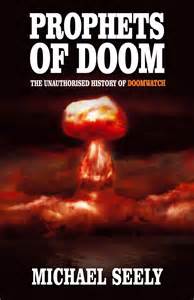
Originally published in 2012, Prophets of Doom by Michael Seely is an invaluable guide to Doomwatch.  It contains new interviews with surviving cast and crew members as well as an episode by episode guide (with a wealth of production information and background detail on each story).

The book drifted out of print a while back, but the recent DVD release has prompted a reprint which should be ready by the end of May.  It can be ordered directly from the publishers, Miwk, here.

Because Miwk are something of a niche publisher, their books don’t tend to have especially large print runs, so it wouldn’t be a surprise to see this book go out of print again in the future.  Therefore I’d recommend putting an order in sooner rather than later.  Below is the book’s blurb –

In February 1970, one of the most important television drama programmes from the 1970s was broadcast on BBC1. Not only did it introduce a new word to the English language, it also brought to a mainstream audience of ten million viewers each week the new, emerging idea of the scientists’ moral and ethical responsibility in society. This was Doomwatch, a visionary science fiction series which took scientific research and technological advances and imagined where they could go disastrously wrong if greed, politics or simple ambition won over caution. This was drama with a message. And it was heard.  The fears of the Sixties: over-population, test-tube babies, super-sonic aircraft, DDT, the Bomb, all found expression in Doomwatch.

Launching the career of actor Robert Powell, Doomwatch entertained and thrilled its audience with concepts such as a plastic eating virus, animal hearts transplanted into children, toxic chemical dumps, cannibal rats, the surveillance state, noise that can kill, food poisoned by drugs and chemicals, and by the end of its first successful series, the ultimate horror: a nuclear bomb washed up underneath a seaside pier, its countdown ticking down to claim the life of one of the celebrated Doomwatch team.

It was conceived by a research scientist and a television dramatist, Dr. Kit Pedler and Gerry Davis, who had previously devised the Cybermen for Doctor Who. With Doomwatch, they soon became famous for creating seemingly prophetic storylines in which the media eagerly found parallels in real life.  Were the writers of Doomwatch prophets of doom or simply scaremongering popularists?

The programme divided the scientific and political establishment into those who thought the programme was a much needed and timely warning and tried to do something about it, and those who thought it was a naive, reactionary piece of trivial, and ignorant television. Dr. Kit Pedler actively tried to create a real-life Doomwatch, and was at the beginnings of the alternative technology movement in Britain and did his own experiments on creating ecologically sound housing and develop a new way of living in a modern society without destroying the habitat or regressing back to the stone age.

With contributions from the family of Dr. Kit Pedler, Darrol Blake, Jean Trend, Glyn Edwards, Martin Worth, Adele Winston, Eric Hills, and others, this book will tell the proper story of Doomwatch both on and off the screen, how it was made, the true story behind the stories, the controversies, the back stage bust-ups, and how the programme inspired those who looked around the world in which they had been conditioned to accept, and begin to question.

Doomwatch – Invasion

invasion.jpg

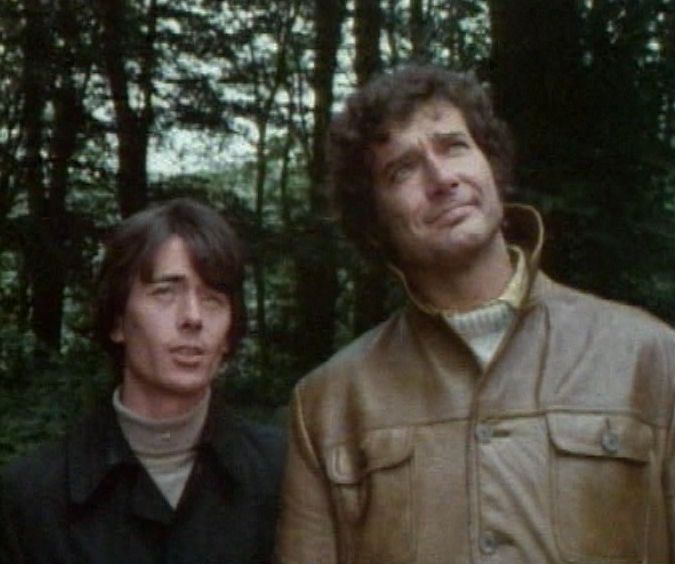
Ridge and Geoff Hardcastle (who now seems to have become a member of the Doomwatch team) are in the Yorkshire Dales, testing the nitrate levels in the local water, which is reported to be higher than average.

They’ve hired two young potholers, Reggie and Dave, to go down into the cave system and obtain the samples they need.  But when they don’t return, a major search is launched.  A map of the caves suggests they might have surfaced close to Wensdale Grange, a country house which has been in government hands since WW2.  The building is surrounded by an electrified fence and patrolled by armed soldiers, which instantly piques Ridge’s interest.

They’re able to get inside for a brief meeting with Major Sims (Geoffrey Palmer) but he’s unwilling to explain exactly what goes on there.  So it’s no surprise that Ridge decides to return later and break in.

Ridge’s attempt at a clandestine entry didn’t get him very far, but he’s not held captive for long.  After he’s released, he tells Geoff that he was stripped and sprayed with disinfectant and then goes on to explain that nothing is happening at the house now.  “But they did do something once, something that went bad on them. And it’s still in there. Waiting to get out.”

The mystery is soon revealed – the house was the location for germ warfare experiments.  Although all research was concluded five years ago the house remains totally off-limits and will remain so for decades.  Although Duncan, the Minister’s secretary, tells Quist that the bug was developed purely for defence purposes, Quist treats this statement with an ironic retort.  Exactly what’s defensive about a bug that can wipe out a city like London within six weeks?  Germ warfare appalls Quist, not only the research itself but also that it leaves an area “where no one can live for the next half century because of a wartime government experiment. Do they have any idea in the Dales what they have in their midst?”

The way the story will develop seems pretty clear. Major Sims is adamant that there’s no danger – nobody ever goes into the house and if any animals ever break into the grounds they’re shot (which explains the armed soldiers) and examined straightaway.  Quist makes it clear that it’ll only take one slip – an infected animal, contaminated water – to bring down a catastrophe on everyone.  And when Reggie and Dave turn up, seemingly none the worse for wear, it doesn’t take long before it’s established they were at the Grange and are now carriers.

It goes without saying that the fact Reggie and Dave were able to enter the Grange, pinch some antique pistols and leave again without anybody noticing doesn’t reflect very well on Major Sims.  Geoffrey Palmer is characteristically excellent as Sims, arrogant and superior.  It’s only a shame that he doesn’t feature more and we never really see his reaction to the news that his security measures have been well and truly breached.

Invasion has a major location shoot, which has (presumably) the locals acting as extras.  Because there’s so many people milling about at the end it does help to create the sense of scale that the story demands.  Quist has bad news for the villagers – although they’ve been inoculated and should be fine, they have to leave the village.  When the landlord of the local pub asks when they’ll be able to return, Quist doesn’t answer – an unspoken confirmation that it won’t be within any of their lifetimes.

After the buses pull away there’s a brief moment of silence, which is broken when a number of army vehicles pull up to the village square.  The soldiers, wearing protective gear, get to work – spraying the houses and shooting any animals they find.  There’s an eerie juxtaposition at work here – the faceless armed soldiers and the English village – which creates a powerful, unsettling image.  And the final shot of the episode – a Ministry of Defence sign reading “Extreme Danger Keep Out” – provides the episode with a stark conclusion.

Doomwatch – You Killed Toby Wren

you killed toby wren

Whilst it’s more than a little irritating that the final episode of series one – Survival Code – is missing, it’s some consolation that the last few minutes do exist (it was recycled as the pre-credits sequence for this episode).  If you want more info about Survival Code, then Doomwatch.org has a detailed synopsis here.  There’s also a fan-made audio reconstruction which can be found here.

Back in the VHS days of course, we just had to get on with it – as the second tape jumped from The Red Sky to this episode.  But it’s quite possible to watch You Killed Toby Wren without having detailed knowledge of the previous story – the pre-credits tell us that Toby was killed attempting to diffuse a bomb and that Quist looks to be culpable (which is essentially what this episode is about).

The Minster (John Baron) is absolutely delighted.  “Not only did he interfere, he obstructed the police.”  It’s his chance to nail Quist once and for all and he’s going to relish every moment.  The Minister claims to have respect for Doomwatch, but he also regards it as a dog that needs to come to heel, which he’s convinced will happen once Quist is removed.  Incidentally, it’s never stated where the Minister we saw in The Battery People has gone and why Barron’s character (not seen since the debut episode The Plastic Eaters) has returned.  Unless there were several snap general elections?  Given the events of 1974 that’s not impossible.

Barbara Mason (Vivien Sherrard) has a baptism of fire as Doomwatch’s new secretary.  She first meets Colin, who’s pleasant enough, ironically referring to himself as Doomwatch’s chief cook and bottle washer!  Ridge of course, is his usual charming self.  “Hello darling, may I help?”  When she introduces herself as the temp, his reply is classic.  “I’m John Ridge, tempt me”!

Although Ridge is jocular with Barbara he’s still in a foul mood and it’s all directed at Quist.  He’s got a large photograph of Toby which he pins on the noticeboard – and is clearly waiting for Quist’s reaction when he sees it.  When Quist enters he doesn’t say a word, but John Paul is still able to express considerable pain and suffering non-verbally.  It’s interesting that Quist soaks up Ridge’s early scornful attacks and doesn’t respond – at this point Quist looks like a broken, weary man.

Geoff Hardcastle (John Nolan) is something of a Toby Wren substitute (like Toby he finds it difficult to get through to Quist to begin with).  Although there’s a slight wrinkle in that Geoff isn’t looking to join Doomwatch – he just wants Quist’s help.  His tale – the first animal/human hybrid has been created by Professor Eric Hayland (Graham Leaman) – is an eye-raiser, which he relates to Ridge over a drink at the pub.  A chicken with a human head …….

This is very much a subplot, as the main thrust of the story revolves around Quist’s crisis of confidence and the political maneuvering in the corridors of power.  The discussion of the hybrid does lead to a classic confrontation between Quist and Ridge though – Quist believes the hybrid is an inevitable development whilst Ridge finds it disgusting and abhorrent.  We can tell that Ridge is at breaking point when he pushes over a chair in Quist’s office (yes it’s a fairly low-key display of anger).  Quist fires him but Ridge isn’t prepared to go quietly.

Quist’s relationship with the atomic bomb has been touched on before.  Ridge tells him that he enjoys wallowing in guilt about it.  “You haven’t got an honest feeling in your body. You’re an emotional hypocrite. You’re a self-indulgent bloody murderer. What’s more you’re finished, bust, kaput!”  It’s brilliant stuff and both John Paul and Simon Oates clearly relish these highly dramatic scenes.

John Paul is in impressive form throughout.  He has several key monologues, including this one.  “It was a long time ago that I realised the most important thing in life is life. Not science, not technology, politics, religion, riches, power, none of these were sacred. Only life. Sum total of man’s knowledge written down for all to read. What is it amount to? Better to be a live idiot than a dead genius.”

Quist is packed off to speak to a psychiatrist, Dr Anne Tarrant (Elizabeth Weaver).  She begins by enquiring about his sex life (he doesn’t have one) and later asks him if they can talk about the bomb.  Which one? he replies.  The Manhattan Project is the one that’s remained on his mind for the last twenty five years.  He tells Anne that he never believed it would be used.  All one hundred and thirty scientists who worked on its development wrote to the White House, requesting that it be tested in the ocean – that, he believed, would be enough to convince Japan to surrender.  But instead, two bombs were dropped on Japan and Quist has lived with the guilt ever since.

If Quist is going through the wringer then so is Ridge.  He’s romanced Dr Judith Lennox (Shirley Dixon) in order to gain access to Professor Hayland’s lab.  Once there, he’s disgusted at what he finds (not the most impressive animal mock-ups, it must be said, but never mind) and lashes out at the nearest person – breaking the jaw of one of Hayland’s assistants.  Dr Lennox is equally disguisted with him.  “You’re not only a narcissistic, nasty thug, you’re a hypocrite. A sick hypocrite. I don’t think you’re capable of any genuine feeling. You came here knowing exactly what you find and yet you’re shocked, aren’t you? But you enjoy it, don’t you? You enjoy it. You’re wallowing in morbidity up to here. You make me sick.”  Like Quist earlier on, Ridge has no answer – he just stands there and has to take it.

The evidence given to the enquiry seems stacked against Quist, with the Air Commodore (Donald Morley) especially vociferous in his criticisms of his handling of the crisis.  But then Ridge is called and unexpectedly backs his ex-boss.  “He has the sharpest, most elegant mind I know, he is also the most morally courageous. Without him there would be no Doomwatch. So if you want Doomwatch, you’re stuck with him.”  It’s quite a reversal from his previous position, presumably brought about by his confrontation with Dr Lennox.  Quist is impressive when he presents his evidence.  His earlier hesitancy has gone and it becomes clear that he will be totally exonerated.  The Minister’s insincere delight when he meets Quist afterwards is a lovely moment!

Human drama was always key to Terence Dudley’s scripts and You Killed Toby Wren has it in spades.  John Paul and Simon Oates dominate and it’s just a pity that when Quist and Ridge reconcile at the end it signals that from now on they’ll enjoy a more settled working relationship.  This is understandable – there’s no way they could have gone on sniping at each other – and the story does work well as a cathartic experience for both of them, but it’s a shame that we never see them so combative again.

Stalky & Co. – Simply Media DVD Review

stalky

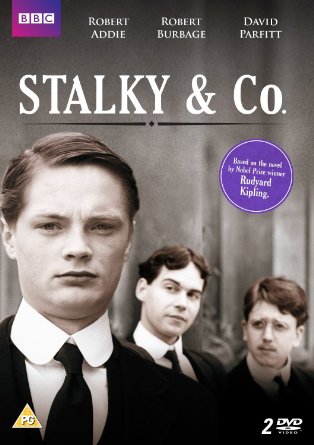
Stalky & Co. was a collection of short stories by Rudyard Kipling, originally published in 1899.  It concerns the adventures of Stalky, M’Turk and Beetle, three boys who are resident at an unnamed public school.  Kipling drew on his real life experiences when writing the stories – several of the characters are based on people he knew, whilst Beetle is a version of Kipling himself.  The novel can be downloaded here.

By the early 1980’s, the Classic Serials occupied a familiar place in the television schedule.  Sunday tea-time would be the time to see efficiently adapted serials with first rate casts, but eventually their familiarity began to breed contempt.  Just a few years later there were rumblings from certain quarters that the Classic Serials were beginning to look old hat themselves.  This was mainly do to with their visual look, as – like Stalky & Co. – they were shot entirely on videotape.  Bleak House (1985) was one of the first of the modern all-film BBC adaptations and it offered the programme-makers the ability to craft images with a cinematic sweep.  Compared to this, the poor old Classic Serial began to look somewhat second best.

But whilst the Classic Serial will never have the visual gloss of a modern film production, you know that you’re going to get decent actors and a faithful adaptation, so it’s always a pleasure when another one escapes onto DVD.

Although Robert Addie (Stalky), Robert Burbage (M’Turk) and David Parfitt (Beetle) all look a little old to be schoolboys (the actors were in their early to mid twenties at the time) it’s not really a problem as you quickly become embroiled in the action as episode one – An Unsavoury Interlude – begins.  It finds the three boys fighting a war against a rival house.  Their house, Prouts, is named after their housemaster Mr Prout (John Sterland) and they’re at bitter loggerheads with Kings, led by Mr King (John Woodnutt).

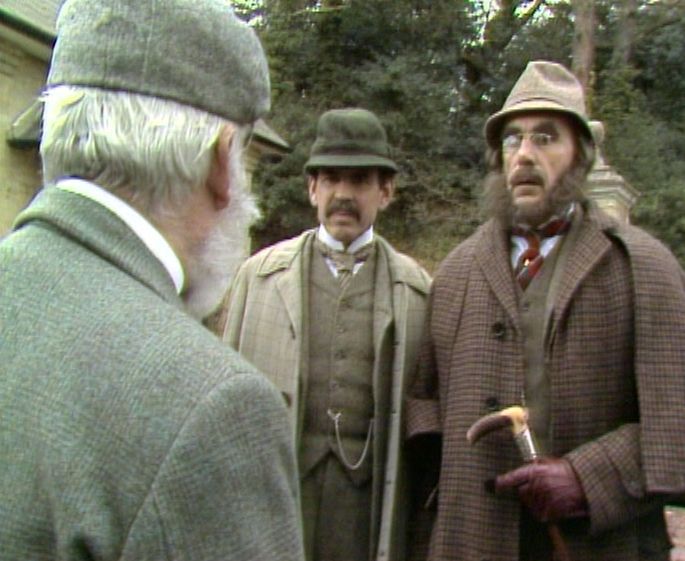
Stalky & Co. have little time for their own Mr Prout, but view Mr King with even less enthusiasm.  King (a wonderfully whiskered Woodnutt) is an eternally mocking character and his jibes are taken up by his boys.  After Stalky, M’Turk and Beetle are observed heading off for a bathe (we see their bare backsides as they dive into the water – an unexpected Sunday tea-time sight!) they have to face taunts from the Kings boys that they smell.

How do they gain revenge for this jibe?  Stalky has obtained three pistols and the boys head off to shoot some rabbits.  Beetle, being rather short-sighted, bags a cat instead and it’s an obvious wheeze to deposit the dead cat as close to the Kings dorms as possible – and then sit back and wait for nature to take its course.  This casual slaughtering of defenseless animals is a bit of an eye-opener and it’s debatable whether it would be something that would sit comfortably in an early Sunday evening timeslot now, but I also doubt that many eyebrows were raised back then.

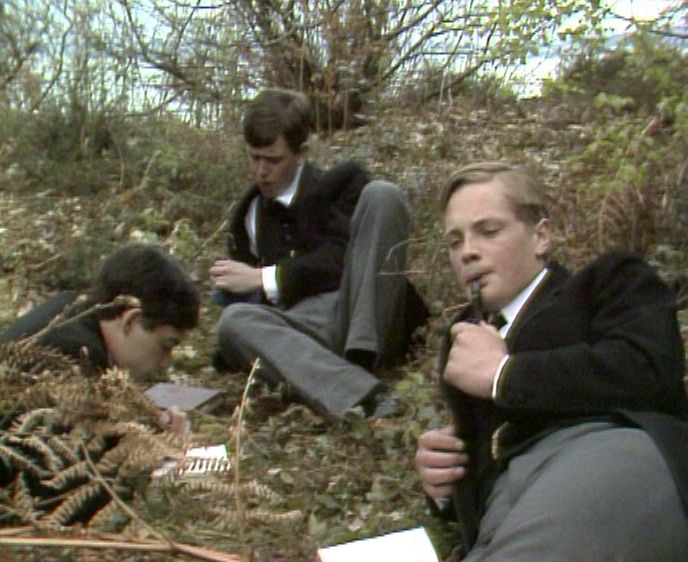
Mr Prout and Mr King team up to try and catch our heroes in the second episode, In Ambush.  Mr Prout has discovered the den in the forest used by Stalky, M’Turk and Beetle, which is a bit of a problem.  Where can they now go to smoke to their pipes in peace?  Luckily Stalky has a brainwave, and he and the others join the natural history society run by Mr Hartropp (played by Geoffrey Beevers, who like the other teachers sports an impressive moustache).  The benefits of being members of the natural history society are clear – it means they’re free to roam wherever they like in the forests.

They venture even further afield, to the woods owned by Colonel Dabney (Denis Carey).  M’Turk is appalled to see Dabney’s gamekeeper shooting a fox and rushes to the house to confront the Colonel.  Although you might expect Dabney to be somewhat put out to be buttonholed by three schoolboys trespassing on his land, this isn’t the case.  He can tell they’re gentleman and knows a little about their families and history.  This provides us with a good example of Kipling’s values and mindset – the three boys might frequently flout the school rules but they’re bred to rule, so the likes of Dabney are happy to treat them with indulgence.  Prout and King might hold a temporary position of authority over them, but Kipling’s sympathies are always directed towards Stalky, M’Turk and Beetle.

stalky 01

Although Prout and King are presented as little more than bumbling comic relief, the Headmaster (Frederick Treeves) is somewhat different.  He regards the boys more in sorrow than anger and whilst he admits he has no evidence against them, decides to cane them anyway (six strokes each on their upper backs).  He tells them this will be character forming and it’s no surprise they take it like gentleman (although it’s debatable how hard the strokes were).  So Prout and King seem to have won this round, although Stalky & Co. remain unrepedant after leaving the Headmaster’s study.

Slaves of the Lamp opens with Stalky and the others rehearsing for the upcoming pantomime.  The peace doesn’t last long as King bursts in, incandescent with rage at some unflattering doggerel written by Beetle.  This infuriates Stalky, who calls a council of war to discuss how they’re going to deal with King once and for all.  Robert Addie, who a few years later would be a memorable Guy of Gisburne in Robin of Sherwood, is in dominant form here.  This one also allows John Woodnutt the chance to go soaringly over the top, which is great fun to see.  Another brilliant comic performance comes from Roberts the cart-driver (played by Morgan Shepherd) who has a rather violent disagreement with King, which involves several broken windows and many hurled insults!

The arrival of two young men, Sefton (Glyn Baker) and Campbell (Tim Faulkner), in episode four (The Moral Reformers) sows a little discord.  They’ve arrived for six months intensive cramming and they instantly rile Stalky, although he’s quick not to offend them to their face (“remember your Uncle Stalky’s motto, never fight unless you can win”).  The relationship between the Padre (Rowland Davies) and Stalky & Co. is a fascinating one.  He treats them as equals and seems quite at ease relaxing in their rooms, puffing on his pipe.  But he does have an ulterior motive – a young boy, Clewer (Matthew Blakstad), is the victim of severe bullying and the Padre asks Stalky and the others to find out who the culprits are.

Although bullying is something that seems to regarded as part and parcel of school life (all of them – especially Beetle – suffered when they were Clewer’s age) they still readily agree to hunt the bullies down.  Their identity isn’t a surprise, but it’s another chance for Stalky to demonstrate his ruthless side. The bullies are well and truly taught a lesson by Stalky and Co. (to the evident delight of the Padre).

A Little Prep features one of the perennials of public school life – rugby.  Stalky and M’Turk find themselves drafted into the school squad and perform credibly against a team of old boys.  One of the old boys, Crandall (Simon Shepherd), is able to tell Stalky and the others about how another ex-pupil, Duncan, was killed in action (he was a soldier, fighting in India).  It’s a reminder that boys in schools such as these were bred to be officers (at one point Stalky wonders what it’s like to be shot at) and given Kipling’s background it’s no surprise that Crandall’s tale is a stirring one, with Duncan maintaining a stiff upper lip right until the end.  Apart from Shepherd, there’s another familiar face guest-starring (Dominic Jephcott).

The serial ended with The Last Term.  Stalky and the others face their last term and he wonders where they’ll all be five years from now.  The Headmaster has obtained a plumb job for Beetle – working on a newspaper in India with a salary of one hundred pounds a year.  Stalky looks set for Sandhurst whilst M’Turk has plans to be a civil engineer.  But before they leave they still have the chance for a few final scrapes ….

Produced by Barry Letts, script-edited by Terrance Dicks and with music by Dudley Simpson, this was something of a Doctor Who reunion.  Although Simpson’s scores on both Doctor Who and Blakes 7 had got into something of a rut in the late seventies, his work here is quite different (and all the better for it).  Rodney Bennett’s direction was effective and unshowy, but he was able to get the best out of the cast, enabling them to mine Alexander Baron’s adaptation for maximum comic effect.

Stalky & Co. is available now from Simply Media.

stalky 02

Dear John – Series Two

dear john 02

Series two opens with several new recruits to the Wednesday night meetings of the 1-2-1 club.  We’ve already met Sylvia (Lucinda Curtis), possessor of an incredibly annoying nervous laugh, during the first series but Rick (Kevin Lloyd) makes his debut here.  He automatically expects everybody to know who he is – as Ricky Fortune he had a brief moment of pop glory in 1969 – so is crushed when nobody recognises him.  John, nice guy that he is, pretends that he owns all of Ricky’s records, but Kirk recognises this as a barefaced lie and delights in needling the unfortunate Rick.

Rick proudly tells them that his big hit went to number one.  But not in Britain.  Or America.  Eventually he has to shamefacedly admit that he was a chart topper in Iceland. Not quite the same thing really.  The observant viewer may have noticed that Mrs Arnott isn’t present, this is purely so she can turn up later and scream with delight when she spies her pop hero Ricky!  This is another lovely use of Mrs Arnott’s character, which makes Sullivan’s decision to write her out of the series in episode two a baffling move.  As I touched upon before, although she didn’t do much her brief contributions were always telling – with the result that her absence was certainly felt.

I’ve a feeling that Sullivan was tiring of the 1-2-1 club format, as several later episodes are much more focused around John, with the others rather pushed into the background.  The fact that John was becoming more central, a change from the ensemble feel of series one, might also explain why Belinda Lang didn’t appear in the final two episodes (although she briefly returns for the Christmas Special).  But another series which starred Lang, The Bretts, was also in production at this time, so it could be that her commitments meant she could only do the four episodes.  Either way, she’s another loss.

Rick features heavily in the first two episodes and then abruptly leaves.  His departure is left fairly open (his confidence takes a knock after believing he’ll be the star of a 1960’s disco – not realising that Louise had already booked Freddie and the Dreamers) but we never see him again.  A pity, since Kevin Lloyd (probably best known as Tosh Lines in The Bill) has an appealing sense of vulnerability as the faded pop star.

The third episode centres around John’s relationship with his son Toby (played by Ralph Bates’ real son, William).  Knowing this, and also being aware of Ralph Bates’ early death, does add several layers of poignancy to any scenes they share.  This was the younger Bates’ only acting job – he’s now carved out a successful career as a musician.

If Rick’s departure felt like a slight structural oddity, then so are episodes four and five.  In episode four we’re told that John has met an attractive divorcee, Liz (Lucy Fleming), but as we never see their initial meeting she just seems to appear out of nowhere.  Since John’s the eternal loser it seems obvious that his attempts to romance her will come to naught.

This appears to be the case when they both return to his room as he’s astonished to find his best friend Ken (Terence Edmond) sleeping in his bed.  Ken’s been turfed out of his house by his wife Maggie (Sue Holderness) and has sought refuge with John.  Earlier, John, Ken and Maggie shared an icy dinner together (the highlight being Maggie’s forced politeness – nicely played by Holderness).  Ken’s presence puts a dampner on any carnal thoughts that John and Liz might have entertained and she quickly leaves.  That, you would think, would be that, but the next day she tells the dumfounded John that she’s booked them into a hotel in Brighton for the weekend.

It’s an intriguing point to end the episode on, but that’s the last we see of her.  Next time John tells the others that Liz dumped him for another man she met at the hotel (well he did have a Ferrari).  Given all we’d seen of Liz during her – admittedly brief – appearance, this seems rather out of character with the result that everything feels very odd.  If you create a relationship that looks like it has legs then the audience may feel aggrieved if it’s curtailed in such an off-hand way.  Why Sullivan couldn’t have written Fleming into episode five as well is a mystery – as her final, unseen, phone conversation with John doesn’t convince.

The slightly strange tone continues with episode six.  John’s finally got some good news – he’s shortly to be promoted to headmaster.  And when he meets a beautiful young woman called Karen (Elizabeth Morton) everything seems to be going his way.  The revelation that Karen isn’t twenty three as he thought, but is a seventeen year old schoolgirl just transferred to his school, is a brilliant comic moment, although it’s an undeniably dodgy topic which you probably wouldn’t find in a pre-watershed sitcom today (always assuming there are any pre-watershed sitcoms of course).

I do find Sullivan’s treatment of Karen to be a little troubling.  It’s revealed that she has a history of forming relationships with her teachers and has already cost at least one of them his job.  Although she’s presented as innocent romantic, just not interested in boys her own age, there’s something slightly off-putting about the way her character is handled.  For John, it’s another indication that he’s a born loser.  Although innocent of any wrongdoing, his liaison with Karen is enough to ensure that he’s passed over for the headmaster’s job this time.  Although David (Frank Windsor) airily tells him he’ll be able to apply in a few year time, when all this blows over.

It’s always a pleasure to see Windsor, and since Elizabeth Morton (now acting under the name of Elizabeth Heery) was twenty six when this episode was made it’s possible to find her attractive as a schoolgirl with a clear conscience.  But that still doesn’t stop this episode from being a somewhat strange watch.

Dear John ended with the 1987 Christmas special.  Kate returns – as eventually does Kirk.  Peter Blake spends most of the episode as Eric, telling John that Kirk is dead and he’ll never ever be him again.  But when Eric, by a stunning coincidence, happens to be present in the same pub where the others have gathered (he’s not brave enough to meet his former friends as Eric) and observes Ralph being harassed by some Hells Angels, he knows what he has to do.  Clutching his Kirk suit, which he had planned on binning, he strides into the gents toilets – to emerge as Kirk in all his glory.  The Superman theme helps to reinforce the obvious joke, but it’s clearly one that delights the audience as they launch into a round of applause.

The notion that Eric is a feeble nobody whilst Kirk is a master of martial arts is hard to swallow, so this is the moment when Dear John jumped the shark (Kirk is able to take on and beat the gang of Hells Angels without breaking a sweat).  It’s a great comic moment – as is the sight of Ralph hung up on the coatstand! – but it stretches credibility to breaking point.  Still, it was Christmas so we’ll let them off.

Better defined character comedy closes the show.  John has had a strained relationship with Mrs Lemenski (Irene Prador) for the whole of the run.  She regards him as a nutcase and was never backwards in coming forwards to tell him so.  But this episode is where we learn a little more about her and discover that she’s just as lonely as the rest of them.  But whilst John and the others have the dubious pleasures of the 1-2-1 club, she has nothing, so when she offers to cook him Christmas dinner he – after a brief struggle with his conscience – agrees.  His ex-wife has asked him to spend Christmas with her and he’d agreed with alacrity.  Mrs Lemenski seems to have put a spoke in this, but I’ve no doubt that John will be able to work something out, meaning that the series ends on a slightly positive note.

Although I’ve been slightly critical here, series two of Dear John still has plenty of excellent comic moments, it’s just that when watching it back-to-back with series one it becomes clear that something was missing.  Probably John Sullivan was right to introduce new characters and move away from the 1-2-1 club setting (otherwise it could have ended up in a rut) but given the strained nature of some of series two it does seem that everybody was aware that the show had run its course.

Dear John – Series One

john

By the mid eighties John Sullivan was on something of a roll.  Having started as a gag writer for the Two Ronnies in the late seventies he then quickly created a trilogy of classic sitcoms – Citizen Smith (1977-1980), Just Good Friends (1983-1986) and the series for which he’ll always be best remembered, Only Fools and Horses (1981-2003).

So despite having Just Good Friends and Only Fools and Horses on the go at the same time, Sullivan then increased his workload by adding another show, Dear John (1986-1987), into the mix.  Although popular at the time (and it was strong enough to spawn an American remake a few years later) it’s possibly not so well remembered today.  This may be because unlike Only Fools it never enjoyed blanket repeats (indeed the last terrestrial outing I can find a record of was back in 1991).

It also had quite a short run – two series and a Christmas Special, so just a total of fourteen episodes.  It’s sometimes been assumed that Ralph Bates’ tragically early death was the reason why the series didn’t continue, but the last episode aired in 1987 and Bates died four years later, so it seems more likely that Sullivan had run out of ideas for the characters.  This is something we’ll touch upon when we discuss series two, as there were several very clear attempts made to shake up the format.

The opening titles for the first series act as a very good shorthand to explain the concept of the show.  John Lacey (Ralph Bates) returns home to find a Dear John letter – his wife, Wendy, has left him.  We then cut to the court, where he looks optimistic (before he goes in that is).  Afterwards, things clearly haven’t gone well and he’s forced to pack his bags and move into a dingy one-room flat.

From the first scene John is presented as a loser.  A nice guy maybe, but a loser.  He’s enjoying a solitary pint, when an old friend, Roger (Michael Cochrane), pops up.  John attempts to put a brave face on his life as a divorcee, telling Roger that he’s having a great time – parties every night.  Roger must be pretty dense as he swallows these obvious lies and then tells him that it’s shame he’s so busy as a few of the lads are heading out for a Chinese meal.  John’s now dug himself into a hole – he’d love to go out with Roger and the others, but since he’s created such an active fantasy social life for himself, Roger thinks he’s joking.  It’s interesting that Roger never appears again – he seems to have been created as a potential regular (and Cochrane is the sort of actor that would enhance any series) but after this scene he vanishes, never to be seen again.

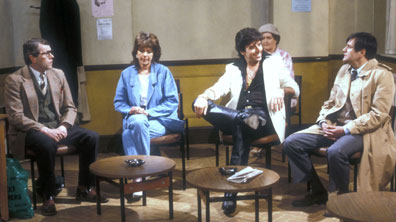
Tired of sitting in his tatty bedsit, he decides to join the 1-2-1 club, a divorced/separated encounter group.  It seems to be well attended, although it turns out that most of them are in the wrong room – they want the alcoholics anonymous meeting next door – which caps the opening gag which saw John go into the alcoholics anonymous meeting by mistake.

Once that confusion’s been settled we’re left with the motley bunch of characters who will be the main focus of the first series.  Ralph Dring (Peter Denyer) is a charisma free zone – seemingly a man with little personality or self-awareness.  Kirk St Moritz (Peter Blake) could hardly be a greater contrast – he has personality, far far too much of it and dresses in a way that can best be described as “flamboyant.”  Kate (Belinda Lang) is quiet and fairly reluctant (at first) to be the centre of attention, but she’s not as quiet as Mrs Arnott (Jean Challis) who it’s easy to forget is there at times.  Leading the group is Louise (Rachel Bell).

The characters are clearly defined in their opening scene.  Ralph and Kirk are the obvious comic creations, so they’re particularly useful when the mood needs to be lightened after a serious moment (Ralph can always provide a bizarre conversational non sequitur whilst Kirk usually has an insensitive insult ready).  Kate is a not such an extreme character, but she has a savage wit which is used to great effect to cut Kirk down to size (not that he ever minds, like a rubber ball he just bounces back).

Mrs Arnott rarely speaks – but this is a masterstroke, as whenever she does utter a few words they’re so well chosen by Sullivan that they invariably bring the house down.  Louise is something of a monster, although it takes a little while for her true nature to come to the surface.  Whilst she gives the impression of solicitous interest in her charges, it’s obvious that she really, really enjoys hearing all the gory details.  Her catchphrase (“were there any … sexual problems?”) doesn’t generate any reaction from the studio audience the first time, but when it’s quickly repeated they cotton onto the fact and begin to respond.

We see her delight in learning about all the juicy bits very clearly in episode two when John inadvertently goads Kate into admitting that her three marriages broke up because she was frigid.  Louise’s pleasure is plain to see and later, in the pub, she continues probing (“did your husbands try and force themselves on you?”) even after Kate’s made it quite plain she doesn’t want to talk about it.

My favourite episode from the first series is the third one, since it features Ralph heavily.  Peter Denyer was a joy from start to finish – deadpanning his way through each and every episode.  It’s the sort of character that has to be played completely straight (with no sense of self-awareness) and Denyer was spot on.  Here, he’s holed up at home, bemoaning the fact that not only has he lost his job but he’s suffered a death in the family.  Terry the Terrapin may not look like much, but he meant the world to Ralph.  “He was my best friend. We’d been together for years.”

This episode also shows Kirk in a different light.  He may appear to be rude, obnoxious and  narcissistically self-obsessed, but when he learns that Ralph’s razor is broke he goes out and buys him a top of the range replacement.  We’re waiting for the gag, but it’s a genuine present and offered in a true spirit of friendship.  It’s the hapless John who provides the laughs – he borrows the razor to have a quick shave, but it drops out of his hand into the fishtank (destroying Kirk’s gift and killing Ralph’s replacement terrapins in one fell swoop).  Bates, so good at both verbal and non-verbal comedy, is a delight in this scene.

The seventh and final episode of the first series is another favourite.  Kirk continues to indulge in his wild flights of fancy, which nobody (except for the gullible Ralph) believes.  But the extent of Kirk’s fantasy life is greater than anybody realised – as John discovers when he meets Kirk at home.  He’s not Kirk at all – he’s Eric Morris, a bespectacled nerdy character who lives at home with his mother (who’s entertainly abusive towards him).  The difference between the confident Kirk and the downtrodden Eric is immense (although it just about stays within the bounds of credibility here, unlike the later Christmas Special).  And there’s a decent gag at the end, when Kirk returns and berates John for coming round to one of his safe-houses.  Did he not realise he was undercover on a dangerous spying mission?!

So with a solid series of seven episodes it was inevitable that the show would return for a second series.  But whilst series two was still extremely funny in places, there were also signs that the concept was beginning to run out of steam.

dear john 01

Z Cars – A Place of Safety

safety

Tx 24th June 1964

A Place of Safety has something of an abstract opening.  We see a man climbing up several flights of stairs, but then the camera seems to lose interest in him as it tracks away – firstly to record some children going down the stairs and then to observe a woman slowly walking upwards.

But we can still hear his voice.  He’s banging on a door, demanding entry – promising that things will be worse if he has to come back.  The relative peace is then shattered as the man falls down the stairs.  We cut to the inside of a room to reveal a man holding a bloody axe.

If parts of Newtown (Z Cars‘ fictional location) were indeed new, then others most certainly were not.  The building where the man (who we later learn is a bailiff called Wallace) lies injured is a crumbling wreck, mostly populated by those on the poverty line (and who also happen to be black).  This doesn’t seem to please Fancy Smith (Brian Blessed) who is visibly exasperated when he’s unable to get any of the other residents to utter a word.  He ironically comments that they’re deaf, but the inference seems to be that they can’t, rather than won’t, speak English.

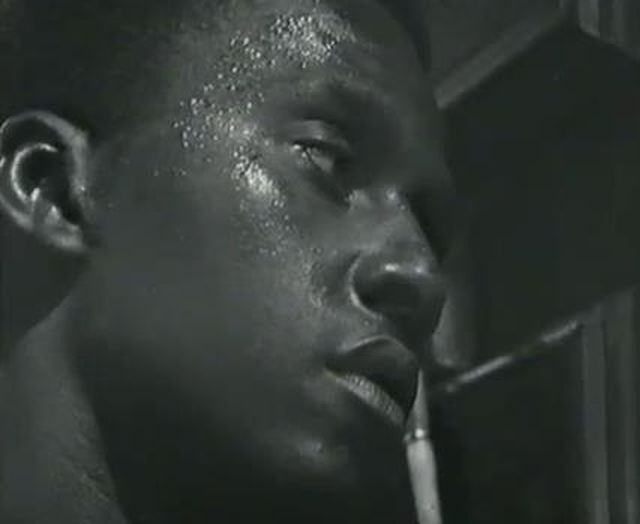
To begin with, it’s possible that the same could be said for the man with the axe – Adignu Sadik (Johnny Sekka).  Barricading the door, he’s depicted as a mute, irresolute figure.  He’s not alone, as his wife Nana (Alaknanda Samart) and his two young children are also present.  Bathed in sweat, Sadik doesn’t utter a word during these early scenes – not even when he’s tempted out of the room by Detective Chief Inspector Barlow (Stratford Johns).

Indeed it’s not until about twenty minutes in, when he’s being questioned at the police station by Detective Sergeant Watt (Frank Windsor), that Sadik utters his first words.  And he’s revealed to be an articulate, softly spoken man, unable to explain why he should have exploded in a sudden burst of anger against Wallace.

That Sadik is not an unthinking, violent creature is surely an intentional piece of scripting – as several characters have already expressed negative opinions about Sadik and the black community in general.  Wallace’s boss, Lowther (Norman Bird) regards them as savages whilst Fancy makes the unoriginal observation that they all look alike.

A Place of Safety doesn’t offer any glib answers or pat solutions and nor does it shie away from suggesting that the police are capable of prejudice just like anybody else.  Barlow gently probes Lowther to try and find out what Wallace was like as a person – did he enjoy his job too much?  Lowther reacts angrily.  Wallace was an ex-copper, doing a dirty job, he says, but he didn’t deserve to be the victim of an unprovoked assault.  After he leaves, Watt tells Barlow that Wallace does have a reputation as a troublemaker, but nothing ever comes of this (we never see Wallace after his tumble down the stairs, so he’s not a defined character).

Lowther bitterly believes that Barlow’s attempting to find excuses to excuse Sadik’s attack.  But when Barlow and Watt are alone, Barlow admits quite the reverse – he suffers from prejudice as well, so he’s doubly keen to ensure that he treats Sadik fairly.

Johnny Sekka is excellent as Sadik, a man with no previous history of violence who finds events has spiraled out of his control.  But the script also poses the question  about exactly how much sympathy we should have for him.  Another very strong performance comes from Alakanda Samarth as his wife, Nana.  She has several key scenes, but possibly the most notable one is right at the end.

With her husband locked up, she and her children have been thrown out onto the streets.  Watt arranges a temporary place for them to stay, but the children can’t remain with their mother.  Fancy and Jock drop her off and there’s an intriguing moment of tension between her and Fancy.  We’ve already seen that the bluff Fancy has an undisguised raft of prejudices and Nana is prepared to meet him head on – she’s proud and independent and can clearly pick up the negative signals from Fancy (and isn’t prepared to ignore them)

An excellent episode by John Hopkins, which also works as a fascinating slice of social history.

Doomwatch – The Battery People

battery

Quist is called to a meeting with the new Minister (David Davies).  Although the Minister is full of Welsh bonhomie, he makes it clear that he finds both Quist and Doomwatch to be something of a problem.  He’d much prefer it if they didn’t do anything controversial – but Doomwatch exists to stir up controversy and Quist isn’t prepared to sacrifice their independence.

Returning to the office, Quist is intrigued to learn of some interesting statistics from a small Welsh village that forms part of the Minister’s constituency.  The divorce rate is much higher than the national average, the ex-miners prefer to drink gin rather than beer and there’s been several reports of cock fighting.  All  of this is enough to make him send Ridge down unofficially (posting as a journalist) to do some digging.

The decline of the coal industry in the 1970’s and 1980’s hit the Welsh valleys hard – whole communities who had relied on the mines for employment found it difficult to find alternative employment.  The Battery People takes this as a starting point and depicts a typical Welsh village where the ex-miners have been fortunate enough to find new jobs – in the battery farm run by Colonel Archibald Smithson (Emrys Jones).

It’s undeniable that the Welsh here feel a little stereotyped, boyo – which might have something to do with the fact that several of the actors, such as Jeremy Young (born in Liverpool) and Ray Mort (born in Lancashire), had to put on Welsh accents.  With a fairly small cast it’s surprising that they didn’t try and recruit more Welsh actors, presumably the likes of Talfryn Thomas were busy that week!

But although Young might not be Welsh-born, he’s still very good as Vincent Llewellyn, the foreman at the Colonel’s farm.  Llewellyn has recently broken up with his wife and although it’s not explicitly stated, his impotence was the main reason.  Eliza Ward, as his wife Elizabeth, also gives a powerful performance – she sounds like she was Welsh-born, although with only two acting credits to her name it’s difficult to be sure.

The Battery People was one of Emrys Jones’ final television appearances.  In the few years prior to this he’d had several notable credits, including the Master (not that one) in the Doctor Who story The Mind Robber and Dr Roger Full in the Out of the Unknown episode The Little Black Bag.  He’s equally as good here – Colonel Smithson appears to be a generous benefactor, bringing wealth and prosperity to what would otherwise be a deprived area, but there’s naturally a catch.

His battery farming methods cause sterility and impotence among his workers.  This is one of the reasons why he insists that the majority of them are over forty (although he claimed this was because he wanted a stable labour force).  That nobody’s put two and two together before Doomwatch start poking around seems slightly remarkable, as the high breakup of marriages would indicate that Llewellyn isn’t the only one to have suffered from performance issues.  And the reason why the ex-miners now favour gin over beer remains unexplained!

The Colonel seems to be a totally ruthless man, who knew (but didn’t care) about the problems he was inflicting on his workforce, but there is room for a slightly different reading.  At the start of the story we hear him ask Llewellyn to make sure all the men wear gloves when handling the fish (it’s the fluid in the fishtank which is the major problem).  Llewellyn and the others put the gloves on, but take them off again when the Colonel leaves.  It’s difficult to handle the fish when wearing gloves and Llewellyn seems to believe that the Colonel knows this and is simply going through the motions by asking them to wear gloves at all times.

Was this the case?  Or was the Colonel simply slack in ensuring that his orders were carried out?  At another point in the story it’s strongly implied that he rarely ventures onto the factory floor, so it’s not quite cut and dried.  But whether he’s incompetent or uncaring, he suffers a fairly grisly fate, which Quist seems to regard as poetic justice.

A thought provoking tale (the stock footage of battery chickens is enough to turn anyone vegetarian) The Battery People, the last surviving series one episode, is another strong story.

Doomwatch – Train and De-Train

train

Train and De-Train opens with John Ridge investigating several hundred wildlife deaths in Somerset.  The evidence suggests that some form of pesticide has been used, so Quist asks Toby to contact all pesticide manufacturers in the area and obtain samples.

Rather conveniently a container is found near the dead animals marked “AC” which suggests that Alminster Chemicals are involved (that’ll save Toby a lot of running about).  It’s also a coincidence that the chief chemist at Alminster is Mr Ellis (David Markham) who was Toby’s old tutor.

One of the main themes of the story concerns Toby’s rashness and way he acts without considering the consequences.  This sets him apart from the others, even Ridge, who all favour a more rigid, analytical approach.  In science, you have to be sure of your facts – something which Toby has trouble with (although it’s ironic that his information is what finally saves the day).

It seems likely that Alminster are responsible for the animal deaths.  They’re developing a new pesticide called AC3051, for export use in counties which have seen vast areas devastated by locusts, and it’s probable that they’ve tested it in Somerset, hence the animal deaths, but there’s no proof.  Toby’s first mistake occurs when he meets Alminster’s managing director John Mitchell (George Baker).

Toby’s delight in meeting his old tutor is tempered when he realises how badly he’s being treated by Alminster.  Ellis has been the victim of a creeping campaign by Mitchell which is designed to break his morale and force him to resign.  First Ellis’ carpet from his office went, then his parking space was reassigned, next his phone was taken away and the ultimate insult is when he finds somebody else in his office.  After demanding an explanation from Mitchell, he receives a blunt answer.  “Oh for god’s sake, do you not see that you’re no use to us anymore?”

Ellis is fifty one and therefore is regarded as over the hill.  As Ridge later explains, it’s the American way of business – if you can’t force the person to resign with these sort of methods then you “de-train” them – make them take a more lowly position in the company.

Mitchell is quite clear – they have to export and it has to be in considerable numbers.  If not, the company has no future.  This touches upon a similar argument to the one expressed in The Red Sky, where commercial interests are seen to be (in some people’s eyes) the most important thing.  George Baker is splendidly controlled and arrogant as Mitchell, which makes his eventual comeuppance at the end of the episode (his mishandling of matters sees him replaced) even more satisfying.

So Toby’s not only appalled at Mitchell’s off-hand manner, he’s also angry at the way Ellis has been treated.  This eventually makes him launch into a tirade against Mitchell, which is tape-recorded and forwarded onto Quist.  Quist has no compunction in (temporarily) firing Toby  because, irrespective of the rights and wrongs, he’s proved not to have the objectivity that a scientist requires.

Although Train and De-Train revolves as much around office politics at Alminster as it does about the pesticide issue, it’s still another strong series one entry.  With Quist largely absent, it’s Toby who’s the focus of the story, meaning that for once Ridge has to play the voice of reason.  David Markham seems a little distracted as Ellis, but that may be as scripted.  Ellis is portrayed as the sort of compromised scientist that any of the Doomwatch team may become – if they let their standards slip.

Ellis knew that 3051 was dangerous, but went ahead with the tests in Somerset anyway.  Following his resignation he commits suicide, but beforehand he writes a letter to Mitchell.  Mitchell treats the letter with contempt – using it to light a cigar – but a copy was sent to Toby and it’s this piece of evidence that sinks Alminster, as it links them to the pesticide tests.

Given that 3051 was designed for use against locusts I’ve never really understood why they decided to test it in Somerset (not many locusts about there).  Mitchell does make the very good point to Quist that although 3051 could be dangerous in an environment with varied wildlife, that won’t be an issue in the places where it’ll be used.  So the tests only serve to draw attention to Alminster.

Mitchell also mentions that the locusts are responsible for deaths now – so they have to press the pesticide into service straight away.  Yes, there may be some ecological side-effects, but they can be worked on in due course (to delay would be to cause more deaths).  Mitchell’s undeniably motivated by the profit margin, but there’s a certain logic in what he says.

The shades of grey that make up Don Shaw’s script are fascinating.  It would have been easier to make Alminster and Mitchell “evil”, but although George Baker relishes the ruthless side of Mitchell’s character things are not as straightforward as they seem at first.

Doomwatch – The Red Sky

red

At the start of The Red Sky Quist seems to be a man on the verge of a nervous breakdown.  As Ridge, Wren and Bradley look on – all with varying degrees of concern – Quist snaps at Pat and isn’t able to complete a simple scientific experiment (his hand trembles so much that he drops a glass beaker).  His colleagues all agree that he needs to take a break, but will the workaholic Quist agree?

Unsurprisingly it’s Ridge who’s the most outspoken.  It’s often been observed that Quist’s guilt at being involved in the development of the atomic bomb was one of the main reasons why he pushed himself so hard afterwards – in order to make amends for his “crime”.  Ridge has another suggestion, that he’s motivated by hate and is a control freak.  “That man’s obsessed. There’s nothing worse than a paranoiac leader; he wants to know everything, he won’t listen, he’s got no confidence in anybody.”

Quist, of course, has come back into the office and has heard every word.  John Paul deadpans nicely through this initial scene, as well as giving the impression that Quist really is at the end of his tether.  Toby tells him that if he takes a break then all their work stops.  This is a little odd, as there’s no doubt that although Quist is a key figure there’s no reason why the others can’t function without him.

What makes this scene interesting (if not slightly perplexing) is that Quist then tells them that he plans to go away for a couple of days.  His trip had already been arranged  before the scene in the lab, so did Quist simply engineer it in order to play power games (Ridge seems to imply so) or was he really close to breaking point?

He heads off to the countryside, for something of a busman’s holiday.  His old friend Bernard Colley (Aubrey Richards) is concerned about the noise from a nearby airfield, run by the Palgon Corporation.  Before Quist arrives, Colley and his daughter Dana (Jennifer Daniel), witness the death of Tommy Gort (Edward Kelsey).  Tommy lived in a lighthouse directly in the airplane’s flight path and apparently committed suicide by throwing himself off the cliff (it’s obviously a dummy, but it looks quite realistic).

It’s clear that the planes are somehow responsible and not only did they drive Tommy to his death they’ve also deeply affected Colley.  After spending some time at Tommy’s lighthouse, Colley is hospitalised with what Quist says is a cerebral hemorrhage.  He later dies without regaining consciousness.

Quist meets with the man from Palgon, Reynolds (Paul Eddington).  Unsurprisingly he brushes off Quist’s concerns and reminds him that thousands of people work for Palgon (strongly hinting that any interference with their work would have severe economic repercussions).  It’s a theme that’s replayed throughout the series – if you rock the boat then innocent people’s jobs will suffer.  Quist knows that innocent people are already suffering – from noise pollution – and won’t give up that easily.

The Red Sky, written by Kit Pedler and Gerry Davis, is classic Doomwatch.  At its heart is a solid mystery and a strong dynamic between the regulars.  Quist has a personal stake as his friend has died (“he was a splendid man you know, when my wife died …”) whilst he and Ridge butt heads in a very entertaining manner.  The relationship between Quist and Ridge continues to fascinate. Ridge has undeniable respect for Quist as a scientist, but as a human being?  Quist’s views on Ridge remain fascinating to ponder as well.

Given that two people have died after spending time at the lighthouse it seems foolhardy in the extreme for Quist to decide to go back there alone to monitor events (and also that Ridge and Wren – who’ve now travelled down at Quist’s request – didn’t raise any objections).  Visual effects were somewhat limited in the early 1970’s, but thanks to the wonders of inlay we’re able to share his nightmare vision.

After Quist collapses at Gort’s lighthouse, Ridge is content to ship him off to a nursing home and go home.  For him, the work of Doomwatch is the most important thing – more important than any one man – and he also believes that fighting a battle against Palgon (who have the confidence of the minister) is pointless.  They can’t win, so attacking Palgon would simply give the government the excuse they need to close Doomwatch down.  It’s possible to see Ridge’s actions as something of a palace revolution – the king is dead, long live the king.

But by the merest chance Toby is at the lighthouse to witness another attack.  If he hadn’t then no doubt the whole thing would have been dropped, which is a slight weakness of the story.  It’s also hard to credit that Ridge dismisses the notion that there’s anything wrong at the lighthouse so quickly.  Two deaths and Quist’s injuries should have hinted that something wasn’t quite right.

Eventually Toby comes up with an answer and Quist is able to manipulate both Reynolds and the man from the ministry, Richard Duncan (Michael Elwyn) very neatly.  Reynolds is adamant that there’s no substance to Quist’s story, so when they all meet at the lighthouse he’s happy to remain there whilst the next jet flies overhead (as does Duncan and Ridge).  Reynolds is therefore unusual, a member of the “enemy” who becomes a convert after he realises that Quist’s story was true.  At the enquiry, he supports him – even though it might cost him his job.  And although Duncan had been described as the Minster’s hatchet-man, that’s not actually the case.  He seems a reasonable chap and is more than ready to listen to Quist’s suggestions and offer his support.

The ending is rather downbeat.  They’ve convinced Reynolds, but that’s about all.  The government agrees to fence off part of the coastline, purchase Tommy’s lighthouse and suspend flights for a month, but nothing more as Quist mutters that they “can’t let an isolated death stand in the way of progress.”  Bradley asks what will happen when the planes start flying all over the country.  Quist’s response is bleak.  “We don’t know and as usual we won’t know. Until it happens.”

Doomwatch – The Devil’s Sweets

devil's.jpg

The episode opens with four young women, dressed in checkerboard miniskirts, who are offering samples of sweets.  A group of businessmen are eager to sample them and Pat Hunnisett, who’s a bit pressed for time, also grabs one.

In the Doomwatch office, Quist is interested in a computer report that smoking has increased by 49% in the local London area.  There’s been no new brands launched, so why the staggering change in the figures?  Ridge is sent to buy sample cigarettes from various shops whilst Wren visits Checkerboard cigarettes.

Checkerboard certainly seems to be the common factor – Ridge discovers that the majority of the increased sales are for their products.  The trail leads to Shiptons, an advertising agency who have the Checkerboard contract.  The company is run by Peter Shipton (Maurice Roëves) who clearly has something to hide, as well as a very natty dress sense.

After numerous tests, the incredible truth comes out – the chocolates are laced with a drug that over time generates a craving for Checkerboard cigarettes.  Since Pat has eaten a chocolate, she’s an ideal guinea pig for the team to test, but she becomes increasingly ill and is rushed to hospital.

Ridge is still attempting to get the truth from Shipton and Pegg (the owner of the chocolate factory) when he receives a devastating call – Pat is dead and his anger is enough to force the whole story out of them.  Ridge remains angry though, especially when he learns that Pat is fine – Quist had arranged for the call to be made stating that she’d died in order to force Shipton and Pegg’s hand.

RIDGE: Are you telling me that she’s alive and you knew it?

QUIST: Sitting up in bed… and cheeky.

RIDGE: You bastard.

The Devil’s Sweets is a story about manipulation.  The pretty young women are used to manipulate people into taking the chocolates and then the chocolates themselves manipulate the people who have eaten them.  Shipton is the one pulling the strings as he’s able to convince the cigarette manufacturers that it’s his advertising that’s increased their sales (they don’t know about the doctored chocolates).  And finally Quist is able to manipulate Ridge into extracting the truth when he believes Pat has died.

This is a key moment between the two of them and the bald transcript, reproduced above, can’t really do the moment justice.  Given the episodic nature of the series, the needle between Quist and Ridge tended to wax and wane but this is still a powerful scene.

The episode allows Wendy Hall a larger than regular role as Pat.  Normally confined to answering the phone, line-feeding the others or simply standing around looking glamorous, this is a welcome change from the norm. Sadly this was to be pretty much a one-off, so it’s no particular surprise that she quit at the end of the first series.  Maybe in retrospect, given how underused she was, it might have been a good idea to kill her off anyway?

Maurice Roëves is the stand out performer from the guest cast – he’s very good as the unscrupulous Shipton, keen to get ahead in advertising by any means necessary.  And like Ridge he dresses in a way that just screams early seventies.

Unlike most of the previous stories, this isn’t a Government conspiracy – instead it’s private enterprise (courtesy of Shipton and Dr Benson, who developed the drug).  And the fact that one of the Doomwatch team is affected adds a little more frisson to their efforts to bring things under control and prevent any deaths.