Paul Merton in Galton & Simpson’s I Tell You It’s Burt Reynolds

burt

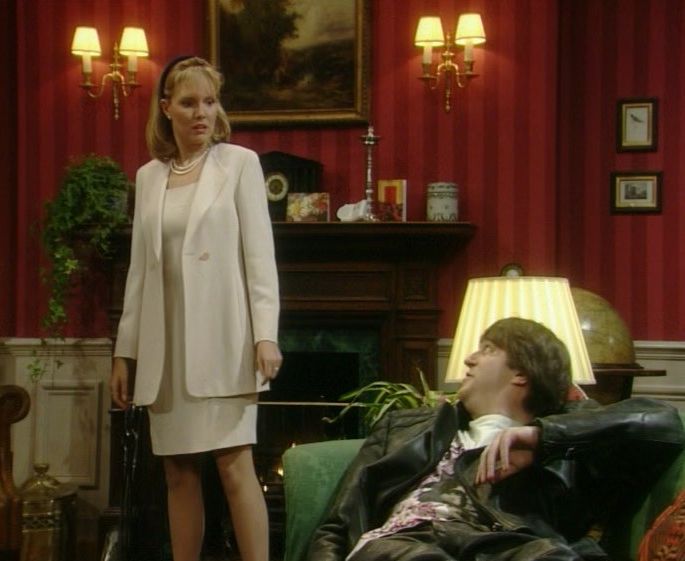
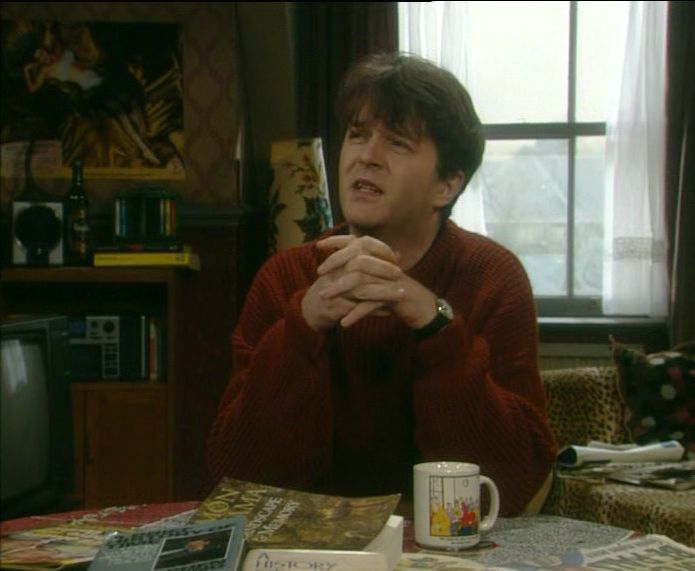
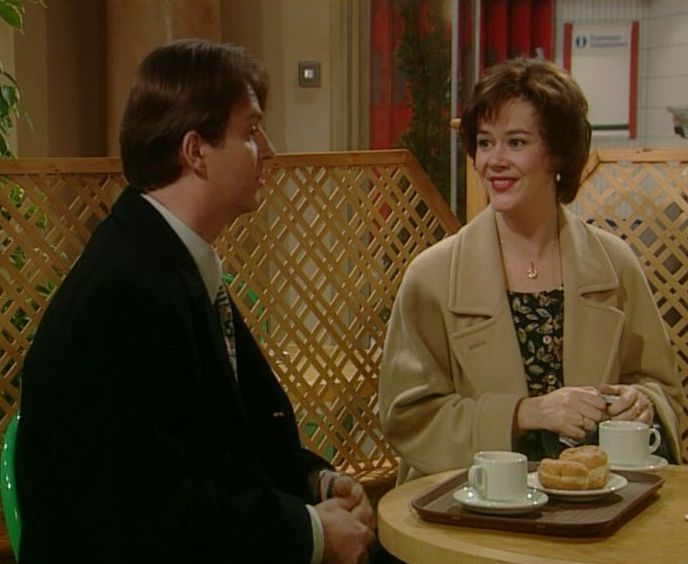
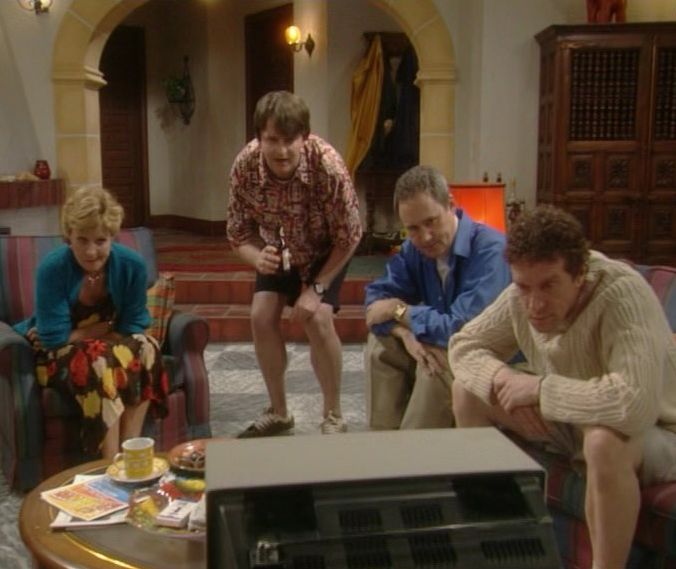
A family holiday in Spain is blighted for several reasons.  Firstly the weather is appalling and secondly they find themselves having to entertain an incredibly annoying neighbour (Paul).  He’s popped by just as they’re settling down to watch a film and Paul, uninvited, joins them.  When Paul is convinced that the bit-part actor standing behind John Wayne is Burt Reynolds, despite all their protests to the contrary, he won’t let it lie.  Instead, he goes to extremes in order to prove he’s right and they’re all wrong ….

I Tell You It’s Burt Reynolds was originally broadcast in 1977 as part of The Galton & Simpson Playhouse, with Leonard Rossiter playing the insufferable know-it-all.  I took a look at it here.

Changing the location to Spain was a slightly pointless move which doesn’t really add anything to the story (it’s an entirely studio-bound piece, taking place in one room).  Since he’d already played Nicholas Craig, Nigel Planer is perfectly cast as Gavin, a “resting” actor whilst there’s another part for Jim Sweeney, one of Merton’s fellow Comedy Store Players.  Sweeney plays Steve, Maria McErlane is his wife Jill whilst Jean Haywood has some nice comic lines as the grandmother (complete with a whistling hearing-aid).

This is another case where the remake doesn’t really add a great deal to the original.  As with Hancock, Rossiter’s shoes were large ones to fill and Merton never really captures the same sense of mounting hysteria that Rossiter excelled at.  But although he lacks Rossiter’s manic intensity, Merton still manages to make his character a profoundly irritating one – simply by the dogged way he is calmly prepared to contradict the others.

No reversal daunts him.  Burt isn’t listed in the TV Times, well not all the actors were, were they?  He doesn’t feature on the end credits, still not a problem.  There’s only one way to solve this once and for all, and that’s to phone Hollywood and speak to Burt direct.  Amazingly he gets through, but he’s not at all pleased when Burt denies he was in the film.  Of course, Paul can’t accept that and has to beg to differ ….

The ending’s rather flat.  The credits roll and the argument continues with Burt (as in the original).  The difference is that Rossiter was apoplectic by this point, whilst Paul is merely a little put out – and because he doesn’t sound too bothered the studio audience only responds with a few half-hearted titters, so we don’t close with a pleasing crescendo.

I Tell You It’s Burt Reynolds is a fairly thin piece that’s totally dependant on the lead actor.  Leonard Rossiter was able to take it by the scruff of the neck and wring every last comic drop out of it but Paul Merton’s style wasn’t really suited to the same sort of full-throttle attack.  Amusing but inessential.
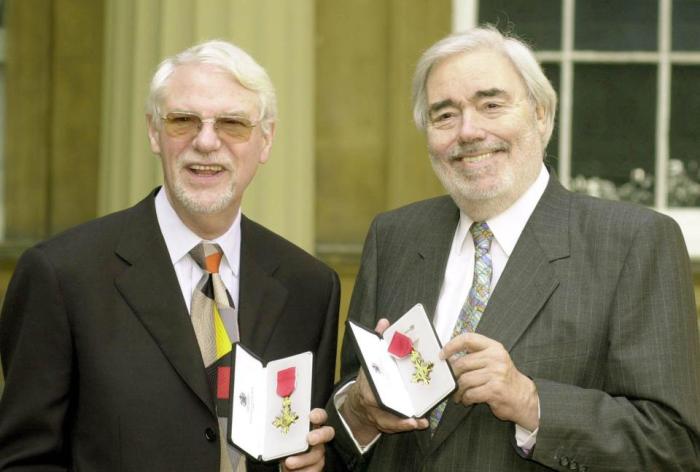
Alan Simpson (1929 – 2017)

simpson
Ray Galton & Alan Simpson

The works of Alan Simpson and his writing partner Ray Galton have been an ever-present part of my life since the early eighties.  It would have been about 1980 when, rooting around in my parents record collection for something of interest, I found two LPs – Steptoe & Son on the Pye label (The Bird on side one, a selection of series one highlights on side two) and the Golden Guinea LP of Tony Hancock’s The Blood Donor/The Radio Ham.

They may have already been twenty years old, but they didn’t feel like crackly relics from another age – instead they seemed quite fresh, even if some of the references were rather obscure (it took me years to work out what the Blue Streak was!)  For me that’s one of the many reasons why I love their work – it may be rooted in a specific time but it’s also strangely timeless.

The blog’s been on a bit of a G&S trip recently, with the Paul Merton series, and once that’s done I’ll be moving onto a series of posts about series one of the television incarnation of Hancock’s Half Hour.  Although only the scripts are left, the quality of the writing is so good that even without Tony, Sid and the others you can still get an excellent impression about how they would have played out.  Which is a true testament to the skill of Alan and Ray.

Although Alan Simpson’s health had failed a little in recent years, he was still able to witness how the scripts he wrote with Ray Galton all those years ago continued to connect with fresh audiences.  When they attended one of the R4 re-recordings of HHH a few years back they received a very warm reception (and a standing ovation) but Alan seemed more touched that the audience still responded enthusiastically to the script, just as they had sixty years ago.

Which returns me to my earlier point.  Classic comedy is timeless and will endure long after more transient fare is forgotten.  Nobody can tell what will be remembered in fifty years time, comedy-wise, but if anything deserves to be, then it’s the work of Alan Simpson and Ray Galton.

Paul Merton in Galton & Simpson’s The Wrong Man

wrong

Paul, visiting the police station to report a flying saucer, agrees to do his civic duty and take part in an identity parade.  The only problem is that three independent witnesses become convinced he’s the guilty man ….

The Wrong Man was the sole series two script to be adapted from a Hancock episode (series four, episode ten, broadcast on the 6th of March 1959).  Because no recording of it exists, it would have been new to the majority of the audience and therefore, unlike the ones tacked in the first series, wouldn’t be overshadowed by a familiar original.

A significant amount of retooling was done, so it’s interesting to read the HHH script to see exactly what changes were made.  Sid’s character was totally deleted (although some of his later dialogue was given to one of the other members of the identity parade who joins up with Paul in an attempt to prove his innocence).  The original features a lengthy opening scene with Tony and Sid at home, playing various games.  Following Snakes & Ladders, Sid suggests they try a card game but Tony, wary of Sid’s cheating ways, isn’t sure (unless it’s something like Snap or Happy Families).  The arrival of a policeman, asking if they’d attend an identity parade, then moves the story onto the more familiar ground we see in this adaptation.

The Merton version opens with Paul arriving at the police station by himself.  He’s come to report a flying saucer to the desk officer (Roger Lloyd Pack).  The policeman asks if it came from outer space.  “No, from next door’s kitchen window. Closely followed by a teapot, a saucepan and a wok. This has got to stop. Every time they have a row I get bombarded. I possess more of their wedding presents than they do.”

This two-handed scene takes up most of the first five minutes, with Lloyd Pack deadpanning delightfully.  Along the way there’s time to slip in various digs at the underfunded nature of the modern police force (the security camera has been stolen, although it doesn’t really matter as the monitors were pinched the previous week).

Upon entering the identity parade, Paul spots a menacing looking character.  He’s convinced that it’s the criminal, but instead it turns out to be the Inspector (Nicky Henson).  Henson’s the latest quality actor to grace the series and wisely he decides not to milk the comedy, playing it straight instead.  I’m not entirely sure why he’s dressed like he’s stepped out of 1940’s Film Noir though (raincoat, hat, etc).

The line-up has a bizarre mix of people, who are all different ages, heights and weights.  This is never commented upon, but the oddness is plain to see.  Lurking amongst the disparate characters are the familiar features of Ray Galton and Alan Simpson.  A lovely little in-joke.

Once the first witness has identified Paul unhesitatingly it’s plain how things will play out.  We know there’s two more witnesses, and whilst Paul is convinced they’ll clear his name, the wiser viewer knows that the opposite is bound to happen.  Part of the comedy here comes from the anticipation, with the viewers being a few steps ahead of Paul and the others.

That they’re all convinced he’s guilty makes no sense at all, especially when the real criminal – who naturally enough looks nothing like Paul, is captured at the end.  Credibility is stretched to breaking point after it seems that wherever Paul goes in an attempt to clear his name (such as the cinema to find a witness who’ll provide him with an alibi) someone will pop up to accuse him of yet another crime he wasn’t involved in.

This makes it hard to take the episode that seriously, but since there aren’t too many opportunities to see remakes of the missing episodes of HHH (even if this one has undergone major changes) it’s still a more than interesting curio.

Paul Merton in Galton & Simpson’s The Clerical Error

clerical 01.jpg

The Vicar and his wife (Geoffrey Whitehead and Sally Giles) are anxiously waiting for their babysitter to turn up.  But since they were expecting a woman, the arrival of Paul – in full wise-cracking mode – comes as something of a shock ….

The Clerical Error first surfaced in Comedy Playhouse back in 1963, with John Le Mesurier, although the 1975 remake, part of Dawson’s Weekly, is probably more familiar to most.  There, Les Dawson played the irresponsible babysitter with John Bird as the Vicar.

The Vicar complains that he was expecting an experienced young woman.  “You should have tried the rent-a-blonde escort service then” says Paul.  Both services are available from the same phone number, with Paul’s mother (“Red Maggie Merton. The finest woman ever to bring down three mounted policeman in one charge. She was the one charging”) running things.

Paul’s character is so utterly horrible (his reassurance to the Vicar that he’s “been responsible for more babies than a nine-year old rabbit” doesn’t really inspire any confidence) that it seems odd anyone would leave him in charge of four children – aptly named Matthew, Mark, Luke and John.

But since the Vicar and his wife are desperate to leave for an important dinner with the Bishop, it was clearly Paul or nothing.  Before they depart, Paul continues to bulldoze his way through their lives, lounging in the living room like he owns the place, asking the Vicar to move the television a little and complaining that the drinks cabinet is locked.  He also mistakes the Vicar’s wife for his daughter.  When he’s put straight on this, he enquires if the Vicar has “being going in for a little bit of font snatching? And why not? There’s many a good hymn come out of a good organ”!

With several hours stretching out in front of him, Paul decides to dress up and puts on a dog collar (as you do) which is the catalyst for several different comedy misunderstandings.  Firstly, an attractive young woman, Sandra Evans (Katy Carmichael), comes knocking.  She’s in a distressed state – her ex-boyfriend’s new girlfriend has beaten her up (and after she gave her ex-boyfriend the best two weeks of her life as well) – and is clearly looking for succour elsewhere ….

The arrival of two elderly parishioners (played by Rosalind Knight and Daphne Oxenford) only adds to the confusion.  They spy the slightly undressed Sandra (she was hunting for some new clothes to replace her ripped ones) and are shocked and stunned.   Paul’s decision to open the Vicarage up to a group of homeless people (a Christian act true, but not one that the Vicar will appreciate) and the arrival of Sandra’s ex-boyfriend, looking to duff up the Man of God who took advantage of his ex-girlfriend (of course he ends up throttling the totally innocent real Vicar) tops things off nicely.

If you can accept that anyone in their right minds would entrust the care of children to such an unpleasant force of nature, then The Clerical Error is a highly entertaining twenty five minutes.  Katy Carmichael is deliciously tarty as Sandra and Sally Giles is good as the Vicar’s respectable young wife.  Geoffrey Whitehead, as always, is pitch perfect as the unbending and humourless authority figure, although for once it’s easy to sympathise with his character,  nobody deserves a babysitter like Paul.

clerical-02

Paul Merton in Galton & Simpson’s The Bedsitter

bedsitter.jpg

This took nerve.  The Bedsitter is a daunting challenge for any performer – a twenty five minute solo performance where there’s nowhere to hide and no-one else to take the pressure off.  The Hancock original was simply sublime, one of the Lad’s finest half hours (well, twenty five minutes, to be strictly accurate).

Throughout this first series it’s been noticeable that Paul Merton really comes alive when he’s playing opposite good actors.  Reacting to others is one of Merton’s strengths (a reason why he’s a natural on panel games such as Have I Got News For You) whereas it’s harder to imagine him as a successful stand-up comedian, since the solo spotlight isn’t really his forte.  The fact that his comedy credentials were formed as part of a team – the Comedy Store Players – supports this observation.

Given this, I approached The Bedsitter with a little trepidation.  Could Merton pull it off or would it be another pallid remake?  Read on …..

Like some of other adaptations, this was a slightly weird viewing experience, mainly because some of the cultural references have been updated but others are left intact.  So Paul still sings Coward’s A Room With a View (this can be taken as an ironic comment on his surroundings of course).  His crooning of Maurice Chevailer’s Louise seems a little more out of place though.

Musings on the nature of bicuspids (“two swearing teeth”) and his inability to penetrate the works of Bertrand Russell are left intact and come over well.  One noticeable difference comes mid-way through when Paul looks out the window.  In the original, Tony stares out and we see a world of pain behind his eyes whereas Paul essays only mild irritation.

This is probably the main difference between their two approaches – Hancock was so good at expressing despair (possibly tapping into his real life melancholic nature) whilst Merton, whose performing persona isn’t too dissimilar to Hancock’s, offers a more buoyant outlook on life.   When Paul receives a wrong call and tells the lady on the other end that he’s a resting artiste, you get the sense that despite the fact he’s out of work and living in a crummy bedsit he still believes that things will turn around.

The remainder plays out pretty much as per the original, even the television set with the dodgy aerial (given the antiquated nature of the bedsitter this doesn’t jar too much).  Paul’s less than impressed with the number of repeats, although the BBC2 programme with Stephen Hawking (Bronowski in the original) is more to his taste.

He might clear up that theory he was postulating in his book. If I fell into a black hole a thousand light years away, my son would be fifty four, I’d be thirty five, and my dad would be ten and a half. Nah, he must be up the spout there.

It’s an obvious ironic touch that Paul, the failed intellectual, after singing the praises of Hawking, attempts to watch something rather more low-brow – a Western.

Once again, it’s hard to imagine this production supplanting Hancock’s original in many people’s affections, but it was a more than credible effort.  It was the final show in the first series and when PM in G&S’s … returned the following year, 1997, for a second run, the seven episodes adapted were much more obscure examples from the Galton & Simpson catalogue.

Paul Merton in Galton & Simpson’s The Lift

lift 01.jpg

The Lift is one of the best Hancock adaptations from series one of PM in G&S’s ….  Partly this is because of the supporting cast – Michael Fenton Stevens as the oily producer, Sam Kelly as the truculent lift man and the always reliable Geoffrey Whitehead as the Air Marshall, amongst others.

The episode keeps the same location (a television studio) although it’s no longer the BBC, instead we’re at the rather obviously made-up Alpha Television (why they didn’t simply call it Carlton is a bit of a mystery).  As in the original, the queue for the lift slowly grows and as each new person appears they press the button, no doubt under the impression that no-one else would have thought of it!

Paul’s rather taken with an attractive secretary (Sheridan Forbes) who’s joined the queue, but she’s immune to his charms, preferring instead to bask in the glow of a producer (Fenton Stevens), who can’t help but modestly mention all the top shows he’s involved in.  Also present and correct is Paul’s baiting of the Air Marshall, here he’s taunting him to press the lift button.  “Go on, pretend it’s a rocket. You’d enjoy that, wouldn’t you? Go on, five, four, three, two, one …”

Also waiting patiently is Peter Jones as the Vicar.  He’s probably best known as the Voice of the Book from The Hitch-Hiker’s Guide to the Galaxy, although that was just a small part of a long and distinguished career.  Having a comedy great like Jones onboard is yet another reason why this one is so enjoyable.

A few tweaks are made to bring it up to date.  The lift man from the original is replaced with a maintenance man (lift men were clearly a thing of the past).  Also, the producer has a mobile phone with him – although he keeps quite about it for a while!

Anne Reid ramps up the hysteria as a woman suffering from claustrophobia (“that’s a handy thing to have in a lift” says Paul cheerfully).  From Paul musing about how there won’t be enough oxygen left for everyone in the future (“the man with the biggest hooter will survive”) to his attempts to keep the others entertained with parlour games, there’s plenty to enjoy.

A fine ensemble piece.  Whilst the original is a classic slice of comedy, this version is not too shabby at all.

lift 02.jpg

Paul Merton in Galton & Simpson’s Don’t Dilly Dally on the Way

dilly.jpg

Kevin (Merton) and Joyce (Gwyneth Strong) are saying goodbye to their old house.  Kevin can’t wait to see the back of it, but Joyce just can’t let go.  This is something of a problem, because the new occupants are due any minute.   And then Joyce locks herself in the toilet and refuses to come out ….

Don’t Dilly Dally on the Way was adapted from an episode of The Galton & Simpson Comedy, broadcast in 1969.  If the release date doesn’t slip again, the series will be out shortly from Network, so it’ll be interesting to see how Jimmy Edwards and Pat Coombs fared in the same roles.

This is an odd little tale.  By 1969 many of Galton & Simpson’s best days were behind them, although they weren’t a totally spent force – some excellent episodes of Steptoe still lay ahead (along with some pretty average ones it must be said).  The premise here feels rather unnatural (as does the sight of Kevin returning to the house, sleeping bag in hand, quite prepared to sleep outside the bathroom door – oblivious to the fact that the newlyweds have just moved in!)

One of the biggest laughs from the studio audience comes earlier on when Kevin tells Joyce that if she doesn’t get out soon then “that four-eyed twit and his flat-chested wife will be here”.  Matthew Ashforde and Emma Cunniffe (David Jason and Jacki Piper in the original) as Gordon and Avril do the best with the material they have, but it’s fairly thin.

Sam Kelly and Anne Reid fare rather better as Gordon’s parents.  They’ve come round to inspect the house and Gordon’s father is far from impressed – woodworm, rising damp and a woman locked in the toilet.  It’s not the ideal way to spend your first day of married life ….

Merton’s less central in this one than in some of the other episodes.  Understandable, since the Hancock episodes were built around the central performance of Tony Hancock, whilst Don’t Dilly Dally is more of an ensemble piece.  He has some choice moments though, such as when he invites himself to join Gordon, Avril and Gordon’s parents for dinner!

The final punchline (the location of Kevin and Joyce’s new house) is a gag that falls a little flat.  This is probably because, like the central premise, it doesn’t feel terribly plausible.  You can’t fault the cast, but you can fault the script.  Don’t Dilly Dally on the Way is something of a lesser pleasure from the Galton & Simpson catalogue.

Paul Merton in Galton & Simpson’s The Missing Page

missing.jpg

Paul’s latest book from the library, Lady Don’t Fall Backwards, has him gripped all the way to the final page.  Or it would have done if it was actually there.  The last page is missing, which leaves both Paul and his wife Caroline (Caroline Quentin) desperate to know whodunnit ….

Another Hancock evergreen gets the 1990s remake treatment.  Most of the topical references are naturally updated (although it’s pleasing that Paul, just like Tony, admits to having read Biggles Flies East twenty seven times).

Patrick Barlow is good as the long-suffering librarian who crosses swords with Paul whilst it’s also nice to see James Bree as one of the shushing members of the library.  It’s noticeable that the section where Tony mimed the plot of another of his favourite books was excised.  Maybe this due to timing issues (these episodes, since they were broadcast on ITV, only ran for twenty five minutes as opposed to the thirty minutes of most of the originals) or it could have been that Merton decided he’d never be able to top Hancock’s performance.

The most obvious change, of course, was replacing Sid with Caroline.  Merton and Quentin were married at the time, so it wasn’t surprising that an episode was crafted which showed them as a couple.  She’s aggressive (becoming apoplectic when shushed in the library) and sarcastic – it’s easy to believe that both Merton and Quentin had a hand in crafting their on-screen relationship (which possibly mirrored real-life).  For me, she’s rather one note – I would have preferred Sam Kelly to carry on with the Sid role, as he did in Twelve Angry Men.

Jim Sweeney, an old colleague of Merton’s from the Comedy Store Players, has another small role (this time as the last man to read the book, who’s still upset that he doesn’t know whodunnit!).  Previously he’d walked on as one of the two policeman at the end of The Radio Ham.

There’s nothing particularly wrong with this one, and it certainly zips along nicely, but as with The Radio Ham it feels slightly redundant.  When the original is so good, there’s little reason for it to exist.  And updating it to the mid nineties does rather stretch credibility to breaking point.  The information super highway might not have been as wide then as it is now, but the Internet was certainly in existence, so why not use it?  And some of the logical flaws inherent in the original are carried over.  If Paul has read every book in the library countless times, why does he have no knowledge of Lady Don’t Fall Backwards?

A diverting enough twenty five minutes, but it can never hope to eclipse the original.

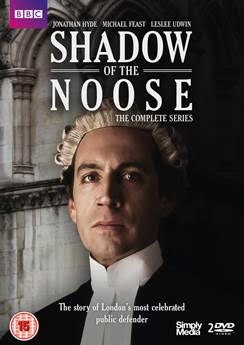
Shadow of the Noose to be released by Simply Media – 20th February 2017

shadow.jpg

Shadow of the Noose is coming later in the month from Simply Media –

A must-see series for fans of period drama and courtroom drama. Featuring outstanding acting talent including Jonathan Hyde, David Bradley, Siân Phillips, David Schofield, Caroline Quentin, and early performances from Peter Capaldi and David Rintoul

Simply Media is delighted to announce the DVD release of BBC’s Shadow of the Noose: The Complete Series. First shown on BBC Two in 1989, this highly regarded eight-part drama series, with an outstanding all-star cast, will be available to own for the first time on any home video format from 20th February 2017.

Directed by BAFTA-winner Matthew Robinson (Byker Grove / Eastenders) and Sebastian Graham Jones (Cadfael), Shadow of the Noose tells the true story of the career and personal life of “The Great Defender” Sir Edward Marshall Hall. He was London’s most celebrated barrister and the first world-famous legal celebrity, whose gripping cases consistently made news headlines and drew crowds in to the public gallery of the Old Bailey during the late Victorian era and early Edwardian era.

Jonathan Hyde (Titanic) brings Marshall Hall’s style and personality to life on screen in an outstanding performance. Marshall Hall was known for his theatrics as he argued his cases with gusto and determination, keeping the Court audience on the edge of their seat, particularly at a time when a guilty verdict meant facing the rope.

Throughout the series, which is based on true cases, Marshall Hall tackles a variety of seemingly impossible and controversial cases, and defends a colourful array of characters. Whether championing a lowly German prostitute accused of murdering a client, dissecting an ugly libel battle surrounding accusations of homosexuality within an aristocratic family, or defending the accused in the infamous Camden Town Murder…it’s all in a day’s work for Sir Edward Marshall Hall! But when a maid is accused of killing her illegitimate baby Marshall Hall is forced to face his own personal demons when it brings back unhappy memories of his first marriage…

The series also features stellar performances from the supporting cast, which includes Michael Feast (Game of Thrones) as Marshall Hall’s clerk Edgar Bowker, Caroline Quentin (Men Behaving Badly) and David Schofield (Gladiator). Marshall-Hall’s clients are also played by renowned actors such as  Golden Globe nominee Siân Phillips (I, Claudius), BAFTA-winner David Bradley (Broadchurch) and an early performance from Academy Award winner Peter Capaldi (The Thick of It, Doctor Who).

Paul Merton in Galton & Simpson’s Sealed with a Loving Kiss

sealed

Arnold (Merton) and Primrose (Josie Lawrence) are carrying on a passionate, albeit long-distance, affair by post.  The only problem is that they’ve yet to meet and both have been rather economical with the truth.

Arnold, a coalman by trade, has rechristened himself Damon, a hard-working brain surgeon who drives a Porsche whilst Primrose is Michelle, an international model often to be found in the pages of Vogue.  Both exchange photographs (not of themselves naturally) which means that when they finally come face to face confusion is bound to reign ….

The original Sealed with a Loving Kiss was broadcast in 1962, during series one of Comedy Playhouse, with Ronald Fraser and Avril Elgar as the two would-be lovers.

Comedy and melancholy often sit side-by-side in Galton & Simpson’s material – countless examples can be found in their most famous works (Hancock’s Half Hour, Steptoe & Son).  Hancock and Harold were classic under-achievers, constantly knocked about by an uncaring world that seemed not to even notice they were there.

This same theme is deftly developed here.  Both Arnold and Primrose are perfectly nice people who live respectable lives, but there’s clearly self-esteem issues which have made them take refuge in fantasy.  We never learn precisely what makes Primrose tick, but Arnold’s neuroses are laid bare in part one.

Arnold still lives with his mother (an excellent turn by Rosemary Leach) who has sabotaged his previous relationships and now seems to relish telling him that he’s too old to get married.  After all, who would look twice at him?  Merton really seems to spring to life when he’s acting opposite quality players and sparkles here.

Both Arnold and Primrose are disappointed that their dates (Michelle and Damon) haven’t turned up, so they decide to have a cup of tea in the railway station café.  Merton and Lawrence, both members of the Comedy Store Players, had a long performing history, which helps to explain why they’re so comfortable in each others company.  Lawrence displays a pleasing vulnerability and both combine to clearly touch the hearts of the studio audience (whenever you hear an “awww” from the audience, you know you’ve struck gold).

After the disappointment of The Radio Ham, we’re on firmer ground here.  No doubt helped by the fact it was a much more unfamiliar piece, we feel more invested in the fates of Arnold and Primrose, especially when they decide to eschew their fantasy lives and embrace the reality in front of them.

Packed with nice touches (for example, when Primrose reads Arnold’s letter, the voice she hears is that of the urbane Michael Jayston) Sealed with a Loving Kiss is a series one highlight.

Paul Merton in Galton & Simpson’s The Radio Ham

radio

Given how highly regarded Galton & Simpson’s final television series for Tony Hancock has always been, it’s no surprise that three episodes were adapted for series one of PM in G&S’s ….  Possibly the only surprise was that they didn’t tackle The Blood Donor – maybe they felt that one was just too iconic.

The Radio Ham has always been inexorably linked to The Blood Donor though, by virtue of the fact that both were re-recorded by Tony Hancock for LP release.  And because the only way to relive classic comedy performances in the pre-VHS days was via record or cassette, for decades the re-recordings of The Blood Donor/The Radio Ham were one of the few ways you could experience classic Tony Hancock.

So for a generation, or two, you can guarantee that many would know The Radio Ham virtually word by word – which means that a remake has to pass a fairly stern test ….

Neatly, there’s an explanation provided at the start to explain why Paul, in the mid 1990’s, is mucking about with equipment so antiquated that it requires new valves.  It’s ex-Army surplus (which possibly was extracted from a WW2 Lancaster).

Apart from the odd cosmetic touch like this, the script remains pretty much as it was.  So Paul has to run the gamut with his uncomprehending friend in Tokyo (“it is raining not here also”), carry on long-distance games of chess, poker and snakes and ladders, whilst organising trays of bread pudding for ex-pats in Kuala Lumpur.

It’s interesting that they kept the moment where Paul puts on a cod Japanese accent, all the better – he hopes – to get through to his friend in Tokyo.  It wouldn’t have surprised me had it been snipped out, but no, it’s present and correct.

Merton seems a little stiff to begin with, especially when he’s by himself.  Once he starts interacting with the voices on the radio, things pick up a little – especially when all his dreams come true and a May Day distress call starts broadcasting …..

Michael Jayston is suitably frantic as the misplaced mariner, but there’s still something missing here.  It’s competent enough, but maybe because I’m so familiar with the Hancock original this version can’t help but feel a little second best.  In an ensemble piece, like Twelve Angry Men, the load can be shared, but in The Radio Ham, where Merton is on-screen by himself for most of the duration, it’s impossible not to remember how skilled Hancock’s performance was in the same piece.

By comparison Paul Merton is competent, but somewhat lacking.  Direct comparisons are invidious, but when you’re remaking a comedy classic they’re sadly inevitable.