The Saint – The Gentle Ladies

gentle 01.jpg

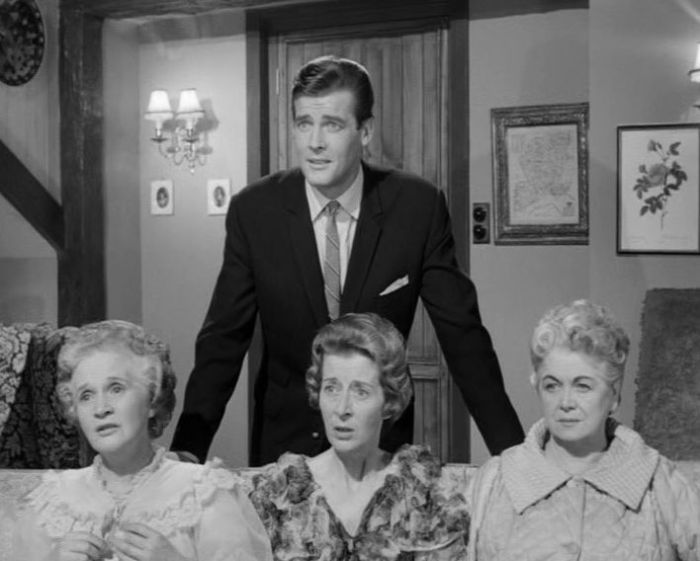
Simon is spending a few days in Sussex, partly to do some sailing and partly because he wants to see Kathleen Howard (Christine Gregg) again.  But intrigue and mystery dogs the Saint wherever he goes and the sleepy fishing village of Bosham is no different.  Three seemingly respectable sisters of a certain age – Florence (Avice Landone), Ida (Renee Houston) and Violet (Barbara Mullen) – find themselves targeted by an uncouth blackmailer called Alfred Powls (Philip O’Flynn).  What is the dark secret that all three women have been harbouring for decades?

I love the fact that everybody in the world seems to have heard of the Saint.  Simon and Florence are introduced to each other in the pre-credits sequence (she bumps into his car) and when he tells her his name, she reacts in the time-honoured fashion (and then, of course, a halo appears).  Ida and Violet are equally perturbed when they learn that the Saint is in the vicinity, no doubt worried that their – as yet unknown – secret will shortly be divulged.

As with the series opener, The Talented Husband, this is something of an atypical Saint episode.  There’s a crime element, but the village setting and the byplay between the sisters is something of a departure from the usual, more hard-boiled action.  As the title suggests, all three sisters have gentle personas, so it’s something of a shock for them when their comfortable lives are rudely interrupted by the arrival of Powls.  They know him of old – and whilst his blackmail begins modestly enough (a demand for fifty pounds) he then tells them that he wants a cottage and a yearly stipend of two thousand pounds.  The fact they seriously consider his request makes it clear that they’re all women of very substantial means ….

Avice Landone, Renee Houston and Barbara Mullen were all veteran actresses, each boasting highly impressive cvs.  Landone had appeared in a score of films during the forties and fifties (including Carve Her Name With Pride), before becoming something of a television fixture during the sixties and seventies.  Houston’s film career started in the late twenties and ended in 1975 (her final credit was The Legend of the Werewolf).  Amongst her other notable film appearances were a couple of Carry Ons (including playing the wonderfully named Agatha Spanner in Carry On At Your Convenience).  Barbara Mullen will always be best remembered as the indomitable Janet in Dr Finlay’s Casebook (she notched up nearly two hundred episodes between the early sixties and early seventies).

As the episode proceeds, the personas of the three women all become better defined.  Florence might be hopelessly accident-prone (seemingly unable to take her car out without bumping into something) but unlike the others she seems set to break free of her spinsterish bonds.  The affable George Marsh (Anthony Nicholls) has been conducting a long-term, low-key courtship of her, although the arrival of Powls drives a wedge between them.  Nicholls, later to become an ITC regular in The Champions (complete with a remarkably false-looking beard) is a strong addition to the cast whilst Timothy Bateson makes an amusing cameo as Charley Butterworth.

Violet’s the most retiring and twittery (Mullen’s very watchable during all her scenes – always doing something to catch the eye) whilst Ida is the strong arm of the three.  She’s quite prepared to give the grinning blackmailer a hefty slap!

Once Simon learns the reason for Powls’ presence then there’s the inevitable fisticuffs.  Moore again scores high on the intensity level as Simon drops his usual relaxed persona in order to forcibly ram his point home.  “Whatever the Warshed girls did in the past, they’ve lived down and I don’t want to know the dirty details. They’re loved in this town and they’re happy here.  And no dirty minded, sewer minded little creep like you is going to blackmail them. You understand?”

John Graeme’s teleplay relocates the action from America to England.  In both the original story and Graeme’s adaptation, Simon’s well-meaning attempt to run Powls out of town only drives him back to the sister’s house – but what happens next is quite different.  On television, a drunken Powls accidentally falls down the stairs to his death, but in Charteris’ story Florence bludgeons him with a poker (leaving Simon with a hole to dig in order that they can dispose of the body).

The Warshed sisters’ dark secret is quite different too (although both in print and on television it’s revealed that they’re not actually sisters).  It’s not difficult to see why it was changed though. On television they’re revealed to be highly improbable fine art thieves, in print they were prostitutes – Florence had been the madam of a notorious bawdy house, whilst Ida and Violet had been two of her girls.

A story that coasts along thanks to the guest performances of the three veteran actresses, The Gentle Ladies rates a respectable three and a half halos out of five.

gentle 02.jpg

The Saint – The Invisible Millionaire

invisible 01

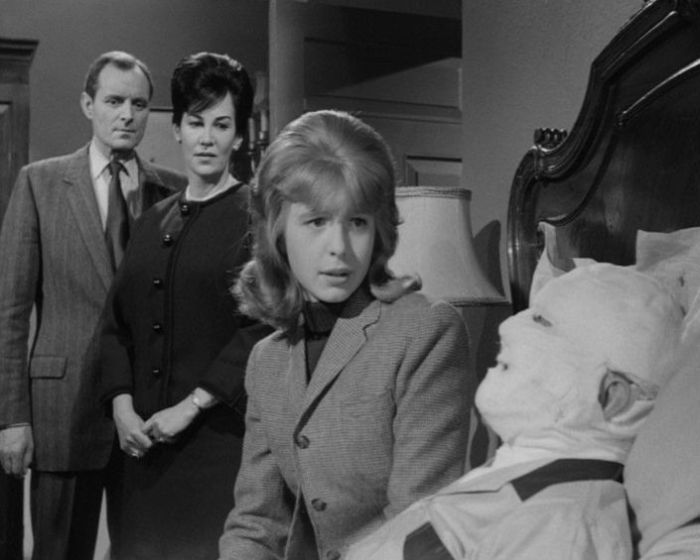
Wealthy industrialist Marvin Chase (Basil Dingham) is recuperating after being badly burnt in a car crash.  Nora Prescott (Eunice Gayson), an old friend of Simon’s, works for Chase and is puzzled by his post-crash actions (which has seen him sell off valuable elements of his business empire).  She attempts to voice her concerns to the Saint but is murdered before she can go into specifics.  Is there a connection between her death and the car accident?  There are several suspicious factors to consider – not only that Chase’s head and hands remain bandaged at all times, but also that his daughter, Ellen (Jane Asher), finds her father’s behaviour to be so changed ….

The appearance of Eunice Gayson in the pre-credits sequence (she runs into Simon who – rather improbably – is mooching around the London Stock Exchange) might lead you to imagine that she’ll be the Saint’s helper this episode.  Which she sort of is, but the fact she doesn’t make it to the end of the story alive comes as something of a jolt.  Possibly best known for her brief appearances in the first few James Bond films, Gayson is quickly transformed into the perfect secretary thanks to the addition of a pair of glasses!

The Chase house is a hotbed of intrigue and passion.  His wife, Rosemary (Katharine Blake), is carrying on a not terribly clandestine affair with Chase’s handsome young assistant, Bertrand Tamblin (Mark Eden).  Meanwhile, Chase’s black-sheep of a brother, Jim (Nigel Stock), can’t help butting in – irritated that his brother is rich and successful whilst he isn’t.

Dingham is perfect in his brief appearance as the unyielding elder brother – a man totally dedicated to making money – whilst Stock matches him as his dissolute, spendthrift poor relation.  Mix in a teenage Jane Asher as Chase’s devoted daughter and you’ve got a pretty packed household.

The car-crash is achieved in the most budget-conscious way possible.  We see a car driving down a country lane and then there’s a dissolve to a blurry spinning image which eventually stabilises itself to reveal a newspaper headline stating that Chase was injured and Tamblin killed during the blazing crash.  It was clearly a packed issue that day (other headlines include “Jobs pledge by Mac”, “Butler finds his birds have flown” and most improbably “The alpine Prince buys a pair of blue skis”).

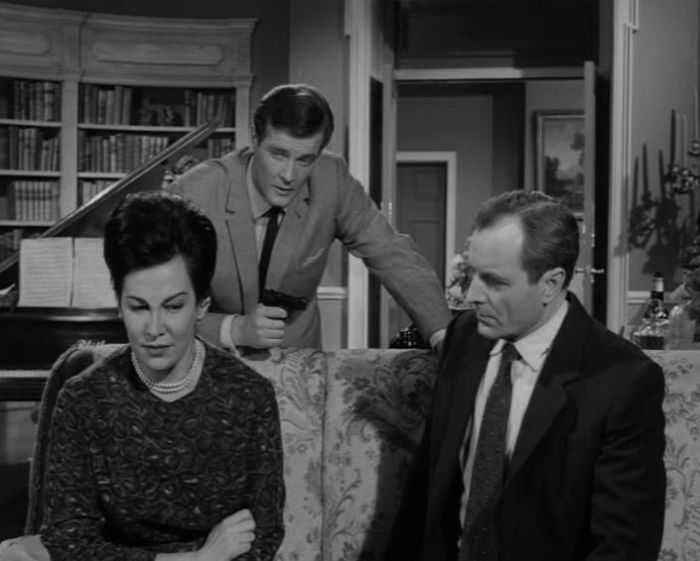
With Chase tucked up in bed, looking like the Invisible Man, it shouldn’t be too hard to guess the upcoming plot twist.  Yep, Chase was murdered by Tamblin who – suitably bandaged up – is now masquerading as his former employer with the active connivance of both Rosemary and the crooked Dr Howard Quintus (Michael Goodliffe).

Few Saint stories were better cast than this one.  Eden and Dingham were both somewhat lacking in screentime, but Nigel Stock gets a decent piece of the action.  Michael Goodliffe is also gifted a strong role – although it’s plain right from Quintus’ first appearance that he’s a decidedly dodgy doctor.  It seems odd they went down this route since it means that it’s just a little easier to guess what the denouement will be.  Jane Asher is wonderfully earnest as the apple of her father’s eye.  Jim earlier told his brother that he was a cold fish – unable to love anything except the numbers on a balance sheet – but the brief interaction between Chase and his daughter (and her stricken reaction after the accident) suggests otherwise.

Simon and Nora have arranged to meet at the boathouse close to the local pub.  But someone gets there before Simon – and that someone is carrying a very large knife …..

Needless to say, Nora’s murder takes place with the minimum of blood, but what’s more interesting is that although director Jeremy Summers attempted to ramp up the tension at first by not showing the murderer’s face, the wider shots proved to be more of a giveaway.  Since Jim was seen lurking around the pub, possibly it was intended to briefly throw suspicion onto him, but this doesn’t really work as we can see that the assailant (even though he only appears briefly) was slim and dark-haired (Stock was a little tubbier and lighter haired).  And about the only slim and dark-haired person we’ve seen so far has been Mark Eden.

In Charteris’ story, published in 1939, Simon and Nora were strangers – although her death plays out in pretty much the same way (she has information, but is killed before the Saint can reach her).  Simon’s devoted but dim sidekick Hoppy was deleted from the teleplay (possibly a blessing), whilst Nora’s backstory (her father was a failed businessman which led to a sympathetic Chase giving her a job) wasn’t touched upon.  The basic plot remained the same, although the original had a much more hard-boiled feel (and was somewhat cut down for the screen, since it was a novella rather than a short story).

Simon’s confrontation of Rosemary and Quintus is rather enjoyable.  “Mrs Chase, I’ve never hit a woman in my life but there can always be a first time. Now sit down!”  Always good to see a flash of steel in Roger Moore’s portrayal.  One curiosity occurs when Simon explains to an admiring Inspector Welland (Charles Morgan) exactly how the scam was worked.  There’s an obvious dubbed moment when Moore says “Tamblin asked Chase” which leads me to suppose he got the names mixed up on the take (since Chase was driving, Tamblin had to ask him to stop in order that he could kill him and fake the crash).

Predictable the story might be, but it’s also a pretty high quality one.  Four halos out of five.

invisible 02

The Saint – The Man Who Was Lucky

lucky 01.jpg

Small-time London bookie, Marty O’Connor (Harry Towb), is witness to a murder committed by ‘Lucky’ Joe Luckner (Eddie Byrne).  Luckner, an infamous local gangster, is well known for terrorising anybody who attempts to testify against him (hence his nickname).  The desperate Marty approaches Simon, who gladly agrees to bring the notorious hoodlum to justice ….

Regular Saint watchers will have noticed by now that most episodes tend to open with a caption (and appropriate stock footage) which creates the illusion that we’re in some exotic foreign locale.  Today’s caption (West London Dog Track) is so different from the norm that it’s hard to believe it wasn’t an ironic move.  It made me smile anyway.

The Man Who Was Lucky places the Saint into a more seedy environment than the one he’s generally used to.  It’s a gorgeous snapshot of early 1960’s London, complete with a slight noirish twinge.  You have to love Lucky’s Bar, where we first meet Cora (Delphi Lawrence), since it has a swinging light jazz soundtrack and some serious jiving on its small dancefloor.

Cora, and her friend Jane (Vera Day), are sitting at the bar and bemoaning their poor fortune.  Cora, the elder of the two (she’s in her early thirties), tells Jane that she’s getting too old for all this. “My girdle’s too tight, my feet hurt and I’m broke”.  The inference is that they’re prostitutes, but it’s not surprising this is only implicit in the script.

It’s a slight plot oddity that Cora is not only in a relationship with Marty, but is also on friendly terms with Lucky.  This means that after she bumps into Lucky in his bar, she’s then within earshot when one of his henchmen passes by to inform him that Marty and his partner, James Bailey (Nicholas Selby), need to be taught a lesson.  Lucky doesn’t seem concerned that Cora has overheard and later expresses incredulity that she and Marty might be involved with each other (although he possibly seems to be in denial about this).  It’s only a small character moment, but it’s a fairly telling one – since it shows that Lucky only believes what he wants to believe.

After receiving a severe beating (well, severe by 1962 Saint standards), Bailey dies.  This immediately places Marty in a sticky dilemma – as Cora points out, if he attempts to testify against Lucky then his life expectancy is bound to be on the short side.  Across a sixty year career (first credit in 1949, last in 2009) Harry Towb never disappointed.  With so many roles across numerous television series, he became an instantly recognisable face – often, as here, playing decent, honest people who end up getting caught in the machinations of others.

We then see some stock footage shots of various hot and happening nightclub signs – Astor, Safari Club, Le Coq D’Or, Pigalle, The Flamingo Club – before ending back at Lucky’s Bar.  It’s another decent mood moment which helps to sell that illusion that we’re deep within the smoky environs of Soho.

Eddie Byrne adds a touch of unpredictable menace as the domineering Lucky.  I have to confess that he’s not an actor I’m terribly familiar with, but since he appeared in three further Saint episodes (and a fair few other series I have in my collection) I’m going to keep an eye out for him in future.  Lucky’s interrogation of the hapless Jane is a well-played scene.  She tells him that she enjoys working at Lucky’s Bar (“it’s very stimulating meeting new people … and everything”) which serves as another hint about her profession.

lucky 01a

After Lucky slaps her about a bit, Simon (who just happened to be passing by) bursts into the office and gives him a slap in return.  Jane’s very impressed.  “Oooh, just like Superman”!

Simon, ever the Knight Errant, then takes Jane back to his (very well furnished) flat for some tea.  He tells that he doesn’t like men who slap women around (although that’s not what he said during The Golden Journey).  Her job of work is becoming more explicit by the minute, as she then expresses incredulity that she’s been in his flat for ten minutes but he’s not made a move towards her (leading her to wonder if he’s one of those people who do nothing but talk).  Brassy, yet vulnerable, this is a nice turn from Vera Day who teams up very effectively with Roger Moore.

The Man Who Was Lucky sees the first appearance of Claude Eustace Teal, dubbed “England’s greatest bloodhound” by Simon.  Played here by Campbell Singer instead of the more usual Ivor Dean (although Wensley Pithy and Norman Pitt also made one-off appearances in later episodes) the parameters of the character – constantly irritated by the Saint, especially since he usually ends up three steps ahead of him – are clearly defined.

Given that we’ve already had several New York stories with Inspector Fernack, it seemed slightly strange to relocate the action from New York (as per Charteris’ original story, published in 1939) to London.  But knowing the origins of the story, it means that Lucky’s persona in the teleplay – he acts more like an American gangster than a London one – makes more sense.  John Gilling’s adaptation (he also directed) also ups the ante by changing Lucky’s crime to murder, rather than tax evasion (this fitted well with American pre-WW2 mobsters but might not have seemed terribly thrilling for an early sixties television audience).

Playing more like an episode of Gideon’s Way than The Saint (although this is a compliment not a criticism) The Man Who Was Lucky is a very enjoyable story.  Four halos out of five.

lucky 02.jpg

The Eagle of the Ninth – Simply Media DVD Review

eagle.jpg

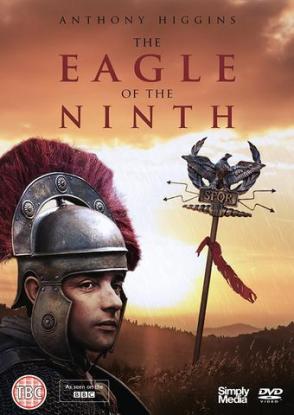
The year is 119 AD.  Former Roman officer Marcus Flavius Aquila (Anthony Higgins) is haunted by the fate of his father’s legion, the Ninth.  Four thousand men had been dispatched to fight the Caledonian tribes in Northern England, but they all vanished without trace.  Adopting the disguise of a Greek oculist and accompanied by the faithful Esca (Christian Rodska), Marcus is determined to locate the Ninth’s Golden Eagle, which symbolises the honour of the legion, and bring it back home.

Originally published in 1955, The Eagle of the Ninth was a children’s historical adventure novel written by Rosemary Sutcliff.  A prolific author, The Eagle of the Ninth has to rank as one of her most enduring works.  And although the bulk of her output was written for a juvenile audience, Sutcliff once stated that she wrote “for children of all ages, from nine to ninety”.

That her stories had universal appeal is demonstrated by this adaptation, which ran for six episodes during 1977.  Broadcast in the Sunday Classic Serials slot, there’s no sense that it was specifically tailored for a younger audience.  As was usual for adaptations from this era, it sticks pretty closely to the original source material (whereas the recent film – The Eagle, starring Channing Tatum – took more liberties and therefore rather diluted the impact of Sutcliff’s tale).

Episode one opens twelve years after the disappearance of the Ninth.  Marcus arrives in Britain to take up charge of an isolated garrison.  He’s still a little touchy about his father’s fate, but the rebellious Britons massing outside the fort might be more of an immediate problem.

eagle 01
Anthony Higgins

There’s some familiar faces lurking inside the garrison, such as the blunt Drusillus (played by Bernard Gallagher).  Gallagher, probably best known for appearing in the first few series of Casualty, gives Drusillus an entertaining dose of weary cynicism – he’s an older and a much more experienced soldier than Marcus, but it’s Marcus who’s in charge.

This first episode – Frontier – also boasts an early television appearance from Patrick Malahide, as Cradoc.  You may have to look twice to find him though, as he’s almost unrecognisable thanks to an impressive wig and beard.  Marcus attempts to foster good relations with Cradoc, a notable local, but his friendly entreaties are in vain.

Anthony Higgins impresses right from the start.  Marcus might be young and inexperienced, but he’s also honest and heroic, so it therefore seems natural that we immediately side with him against the influx of hairy tribesmen.  The episode has a generous film allocation, although the scenes of the tribesmen attacking the fort do look slightly comic (and tight camera angles have to be used in order to hide how few extras were available).  The hand to hand fighting is nicely directed though.

The injuries suffered by Marcus during the attack have left him unable to walk which means that his time as a soldier has come to an end.  Whilst recuperating at his uncle’s farm, they both elect to visit the local amphitheatre.  It’s not the coliseum, but it does introduce us to two important characters –  Esca and Cottia (Gillian Bailey).

eagle 02
Gillian Bailey

Esca is toiling in the pit – locked into a fight to the death with another slave – whilst Cottia, like Marcus, is a slightly queasy spectator (both were perturbed by the sight of a bear being gored to death).  When Esca is beaten, the crowd – overcome by bloodlust – all place their thumbs downwards, signifying that Esca should be put to death.  We can forgive this anachronstic moment – since it was widely believed to be accurate at the time – although quite how Marcus was able to persuade the crowd en-masse to spare Esca is a bit of a mystery.

Marcus needs a body slave and buys Esca.  Their relationship is a key part of the story and the interaction between Higgins and Rodska works well throughout the serial.  Esca is initially reserved and bitter, but it isn’t long before the pair form a tight bond.  Gillian Bailey also impresses as the proud Cottia.  She rails against being forced to act like a Roman maiden, rather than the Iceni tribeswoman she actually is.  There’s a lovely moment when, anxious to see the ill Marcus, she bites the arm of a slave blocking her way!

The second half of the serial sees Marcus and Esca set out to find the Eagle of the Ninth.  This quest results in Marcus suddenly gaining a rather unconvincing beard (but then fake face fungus can be found in most classic serials of this era).  He’s also haunted in his dreams by the long-dead soldiers of the Ninth – in his imaginings they’re a legion of walking skeletons (a brief, but quite effective nightmarish scene).

The Eagle of the Ninth was made in the usual way for a production of this era – film for the exteriors and videotape for the interiors.  Picture quality is as you’d expect for something that’s forty years old – some of the early film inserts are a little grubby and the studio scenes are a little soft – but overall it’s quite watchable.  Production design is very sound throughout, especially the studio farmhouse which features in several episodes (nicely designed by Campbell Gordon).

Although the serial features a number of battle scenes, this isn’t an action story – it’s more of a reflective, character-driven drama.  According to this webpage, Rosemary Sutcliff not only loved the adaptation, but was so taken with Higgins’ performance that she kept a photograph of him on her writing desk for decades afterwards.

It may be true that some of the tribal antics (and beards) are a little unconvincing, but overall this is a literate and well acted production which transcends its limited budget.  Running for six 30 minute episodes (spread across two discs) it’s released by Simply Media on the 16th of January 2018 and can be ordered directly from them here.  RRP £19.99.

eagle 03
Christian Rodska

The Saint – The Romantic Matron

romantic 01.jpg

Simon, this week in Argentina, meets a charming American lady called Beryl Carrington (Ann Gillis).  She tells him that a recent acquaintance – the personable Ramon Venino (John Carson) – has entrusted her with a list of political dissidents which he says will be vital in ensuring the future stability of the country.  Beryl passes the list to the Saint, who instantly comes under attack from the ungodly.  This raises Simon’s suspicions that the friendly Venino may not be all he appears to be ….

The Saint, like most ITC series of the time, requires a certain suspension of disbelief.  The opening stock footage and caption might tell us that we’re in Buenos Aires, but it quickly becomes clear that the filming was done a little closer to home.  Sometimes the programme makers can strike lucky and find a British location that does a fair job of doubling for this week’s foreign locale (or if not, they can simply stick a few palm trees into the frame and hope that does the trick!)

Alas, the opening of The Romantic Matron is one of the series’ less impressive location gambits.  We switch from Simon, relaxing at a pavement café, to a ridicously ugly building that isn’t at all in harmony with the attractive stock footage we’ve just witnessed.  For the dedicated ITC watcher, this will be a familiar sight – it’s the Elstree studios in Borehamwood.

Before we meet Beryl, there’s the little matter of the daring theft of one million dollars worth of gold bullion to consider.  The local police inspector (played by Patrick Troughton) resolves to hunt the criminals down.  If you’ve seen the Doctor Who story The Enemy of the World, then you might be able to guess what accent Troughton adopts – clearly it was his one size fits all solution when playing foreign types.

From the first time we see her, Beryl is presented as an innocent aboard.  Which is presumably why she’s targeted by the smooth and polished Venino (although since she’s only just arrived in the county it’s a slight mystery how he picked her out so quickly).  Venino shows her the sights, but there’s always a dark shadow dogging him – he’s followed everywhere by two silent men.

And what’s Simon doing whilst Beryl and Venino are becoming better acquainted and making googly eyes at each other?  Not a great deal, it has to be said.  This is another of those stories where the Saint remains off-screen until well into the episode – before that, Ann Gillis and John Carson take centre stage.

The title might suggest that Beryl, the romantic matron, is middle-aged, but Ann Gillis was only in her mid thirties at the time of recording.  As a child, she starred in a number of Hollywood films (seemingly positioned as the next Shirley Temple).  Her adult acting career was less prolific, although she notched up appearances in several other ITC series during the early 1960’s (EspionageThe Sentimental Agent).  Gillis is rather appealing as the ingenious adventurer – suddenly emboldened by her whirlwind romance with Venino.

John Carson’s second Saint role is much better than his first.  He’s still playing a foreigner, but at least this time he’s not browned up.  Always a favourite actor of mine, Carson manages to breathe a little life into a character that’s – possibly deliberately – not terribly well defined.

Once Beryl meets Simon and pours out her strange tale, then the story begins to pick up some impetus.  The Saint wasn’t a series which tended to dig too deeply into real-world politics, so the brief discussion here about Argentina’s current situation is fairly noteworthy.  Simon begins by pointing out how the people still seem to be a little nervous (a legacy, he claims, of decades of dictatorship).  However, things now seem to be on a more even keel thanks to the fairly popular government, suggesting that the story was set prior to March 1962 (which saw the moderate President Frondizi overthrown).

If this talk of politics seems a little dull, then never fear – it isn’t too long before Simon gets to duff up a couple of heavies.  It’s a cracking fight scene, with the Saint operating at full intensity (I especially like the way he slaps the second one around the face a few times before pushing him and his friend over and then toppling his bed onto them for good measure!)  You can tell it’s been a pretty severe tussle as Roger Moore’s usually immacuately coiffered hair is in a very distressed state by the end ….

The Saint gets a pretty good workout during this episode, as he’s later duffed up in a garage and then strung up for good measure. It looks fairly uncomfortable, but luckily Simon doesn’t stay trussed up for long.

The riddle of the missing gold bullion possibly isn’t too difficult a mystery to solve (especially when you discover that Venino – having bumped into Beryl’s car – was extremely keen to have the damage repaired at a local garage, all costs paid by him).

Larry Forrester’s teleplay relocates the action from Cuba to Argentina, but otherwise it sticks quite closely to Charteris’ story (originally published in 1958).  It’s mildly interesting that the crux of the story – Venino attempts to smuggle the stolen gold out of the country by fashioning solid gold bumpers (suitably camouflaged) onto Beryl’s car – was a plot point echoed in Ian Fleming’s Goldfinger, published in early 1959.  Did the one inspire the other, or was it just coincidence?

Fleeting appearances by some familiar faces (Patrick Troughton, Victor Spinnetti, Joby Blanshard) helps to keep the interest ticking along, but truth be told The Romantic Matron never quite sparks into life.  Gillis and Carson are both good and Roger Moore seems to relish the opportunity to handle a bit more action than usual, but the basic plot isn’t really that gripping.  Three halos out of five.

romantic 02.jpg

The Saint – The Golden Journey

golden 01

Belinda Dean (Erica Rogers) is a beautiful, albeit incredibly spoilt, heiress.  Indulged from a very young age, she’s developed a shocking temper (hapless waiters tend to wilt under her intense all-out attack).  Since Belinda is shortly due to marry one of his best friends, Simon has developed a professional interest in her and decides she needs to be taught a lesson in humility before the big day.  So he forces her to join him on a hundred mile trek through the unwelcoming Spanish countryside …..

One of the more notorious Saint episodes, The Golden Journey is a rum old tale.  I have to confess that my jaw dropped and my eyebrow raised during the opening few minutes after Simon confided to the audience that his friend Jack could easily tame the wild Belinda (but alas, he loves her too much to hit her).  Strap yourselves in, I think it’s going to be a bumpy ride.

Was it just a coincidence that Simon and Belinda were staying in the same hotel?  Or did he decide to stalk her?  I’ve a feeling it’s the latter, which makes his behaviour slightly more creepy than it already is.

Whilst she’s sleeping (again with the creep factor) Simon burgles her hotel room and steals her money and passport, leaving her stranded and helpless.  This is the first step in the Saint’s somewhat cruel plan to strip her of her self assurance, but not the last – as Simon then drops a heavy hint to the hotel manager (a fleeting appearance by the wonderful Roger Delgado) that she’s a criminal!

Goaded by Simon’s manipulation, she does then break the law – by attempting to steal a scooter – which means that she’s bonded ever closer to Simon after he bails her out of prison.  So the scene is set for their journey, where she will learn about the true values of life …..

Although we’re only around a dozen episodes in, it does seem a little strange that various actors have already popped up twice in different roles.  We’ve already seen Bill Nagy and Shirley Eaton return, today it’s the turn of Erica Rogers whilst the following episode features another appearance by John Carson.  Some – like Carson – take very different parts, but both of Erica Rogers’ appearances to date have seen her cast as fairly annoying females.  But whilst Joss Hendry in The Pearls of Peace was irredeemable, Belinda Dean is another matter altogether.

Left with no alternative, she’s forced to follow the impossibly smug Simon as he sets off on his walking trip.  He’s nattily attired of course – sensible clothes and shoes – whilst she’s wearing an expensive, if scanty, dress and high heels.  No doubt the fact that she’s not dressed for the occasion is all part of Simon’s “treatment”.

Apart from a few fleeting appearances from others (the aforementioned Roger Delgado, Stella Bonheur as Belinda’s Aunt, Paul Whitsun Jones as a cackling woodcutter) The Golden Journey is essentially a two-hander.  Lacking any sort of crime element, it’s simply an exercise in who will crack first (need you ask?)

The action switches from location (it’s not quite Spain, but the Welsh mountains are very striking) to studio on a regular basis, often from scene to scene.  This isn’t surprising for an ITC series of this vintage as they tended to be made on a very strict timetable and budget, meaning that a lengthy location shoot with the stars would have been impractical.  Therefore we see plenty of back-projection studio shots of Moore and Rogers mixed in with film footage of their doubles striding across the countryside.  They do feature in some location footage though, and after a while this mix and match approach becomes less of an issue.

Given Belinda’s misadventures (plunging into a raging stream, tumbling down a steep hill) it’s remarkable how her white dress stays pretty clean throughout.  True, it does get a little grubby but it holds up remarkably well.  Though I guess in the name of decency it couldn’t be allowed to get too frayed.

Half an hour in, we have the story’s most infamous scene.  Simon, tiring of Belinda’s backchat, puts her over his knee and treats her to a firm spanking.  There’s not a lot you can say about this, except that Simon seems to be enjoying himself enormously.

It’s not Moore’s fault, but Simon is written throughout as remarkably irritating and obnoxious (but then it’s true that the Saint is attempting to goad Belinda).  The locations are lovely, as is Erica Rogers. although the ending is remarkably predictable and pat (she learns her lesson and no doubt will be a good girl from now on).

There aren’t too many changes made from the original story (although in Charteris’ tale, Simon isn’t an old friend of Jack’s – he had only met him and Belinda a week before.  This of course, makes his behaviour towards her, a virtual stranger, even less admirable).

It’s hard to defend the strong misogynistic tone of The Golden Journey, but since it’s an entertaining travelogue I feel it just about scrapes three halos out of five.

golden 02.jpg

The Saint – The Charitable Countess

Simon is in Rome in order to attend a charity ball held by the Countess Christina Rovagna (Patricia Donahue).  Although it’s ostensibly been arranged to benefit Father Bellini’s charity for destitute children, little of the money collected actually reaches the needy.  So the Saint decides to tilt the balance back in Father Bellini’s favour ….
Simon is well aware of the irony inherent in the Countess’ charitable soiree. A group of incredibly wealthy people paying exorbitant sums in order to enjoy the finest food and wines available (secure in the knowledge that their excesses will, in some way, help those less fortunate than themselves).  The Saint may be a part of polite society – feted for his notoriety – but he’s also content to also remain an outsider.

This is evident in the way he interacts with the Countess.  At first glance she appears to be a pleasant enough person – and a charitable lady to boot – so Simon is happy to flirt outrageously with her.  But are his feelings for her genuine, or is he simply dissembling – telling her what she wants to hear?  As we’ll discover later, it’s clearly the latter.  Simon is always the arch manipulator, content to play along with whatever the current situation might be (although he does seem shocked to discover that the Countess is making such a substantial profit from her charity).

So after learning that only nine thousand out of the fifty thousand dollars raised was donated to Father Bellini (Anthony Newlands) we’re forced to reassess everything we’ve learnt about the Countess to date.  Father Bellini is very pleased with this sum though – considering it to be a fortune – so clearly he’s not the worldliest of people ….

In sharp counterpoint to the pampered lifestyle of the Countess, we’re also privy to the miserable existence of a group of street urchins, led by the voluble Franco (Philip Needs).  True, they’re all rather grubby, but the dirt looks like it’s been applied by a make-up artist (these children seem just a little too well-behaved and mannered to convince as genuinely feral creatures).

If they don’t quite seem natural when they’re sharing scenes together (although the relationship between Franco and Angelina – played by Loretta Parry – is quite touching) then Franco develops into a more rounded character once Simon and Marco (Warren Mitchell) take him under their wing.  Simon instantly feels a sense of obligation towards the boy (Marco less so).   The scenes between Moore and Needs are strong ones, with Moore pitching his performance at just the right level in order to ensure that Needs gets a chance to shine.

If he’s good when acting alongside Needs, then Roger Moore really sparkles when he returns to confront the Countess.  Also present is Aldo Petri (Nigel Davenport), the Countess’ current companion.  Simon delights in explaining to Petri that the Countess Christina Rovagna began her life as Maggie Oakes of New Jersey.  She was a vaudeville artiste famed for taking off her clothes ….

The Countess is a cool customer though, not at all fazed by Simon’s full frontal attack.  She’s strongly disinclined to hand over the rest of the charity money and reacts with scorn when Simon suggests that she sells her necklace in order to raise the sum he’s requested.  So Simon elects to steal it – which meets with her whole-hearted approval.  In many ways she’s almost the female version of the Saint – outwardly frivolous but with a core of steel – which makes their battle so entertaining.  Had she simply been a run-of-the-mill criminal then the story would be much less interesting.  She’s convinced that he’ll fail dismally and be humiliated – but we know the outcome will be somewhat different.

Charteris’ short story was originally published in 1939 (as part of the collection entitled The Happy Highwayman).  This adaptation relocated the action from New York to Rome (and added the subplot of the urchins) but otherwise the main thrust of the story – the Saint sets out to steal the Countess’ necklace in order to repay her charity debt – remained intact.  In both the original story and teleplay he doesn’t do it in a Raffles-style way though, instead he removes all the jewels from the Countess’ dinner guests at gunpoint.  However, the adaptation scores by the way that Simon is able to bring Franco and the others into the dining room in order to show his victims the reason why they should be happy to give up their baubles.

Another good showcase for Roger Moore, The Charitable Countess manages to keep the essence of the original story – featuring the earlier, more criminally-inclined Saint – intact.  It rates four halos out of five.

charitable 02

The Saint – The Effete Angler

effette 01

Vacationing in Miami, Simon is disappointed to learn that the skipper of the best fishing boat around – Patsy O’Kevin (Kevin McAlliney) – is fully booked up for the next few weeks.  But when Simon meets the radiant Gloria Uckrose (Shirley Eaton), the person responsible for chartering Patsy’s boat, his natural charm quickly wins him a place aboard.

Simon and Gloria have a relaxing afternoon on the waves, but when they eventually reach Bimini Dock – where Gloria’s husband, Clinton, is waiting – things turn a little sour.  This is not only due to Simon’s obvious closeness to Gloria, but also because Clinton (George Pravda) mistakenly believes that the Saint is aware of his criminal activities.  Together with his nefarious partner, Vincento Innutio (Paul Stassino), they ponder how to get Simon out of the way – eventually deciding that Gloria will be the perfect bait …..

Simon’s eye for a pretty face (and backside!) is on overdrive today.  The sight of a gorgeous bikini-clad blonde, carrying a large fish, captures his attention – although it’s plain that her ample proportions (back and front) were impressing him more than her fishy was.

But if Simon’s eyes were out on stalks when the fish-laden blonde passed by, that’s nothing to way he reacts after he meets Gloria for the first time.  You can’t really blame him though (Shirley Eaton looks stunning).  Given that 1962 was a very different moral era (especially in America – which was a prime market for this British-made programme) some people may have been slightly affronted at the way Simon deliberately attempts to romance a woman he knows is married.  It seems that the hotel staff might have shared this opinion too – I do like the shocked expression of the bartender after Simon tells Gloria that he’s hoping for an early dinner and a late night!

Their “affair” begins in a pretty chaste way – a few drinks and a dance in the hotel bar – but there’s something about the looks exchanged between Roger Moore and Shirley Eaton which makes this scene crackle with energy.  Making a quick return to the series after playing Adrienne Halberd in The Talented Husband, this is by far the better of the two roles for Eaton.  She’s striking from her very first scene – in which we observe her slowly soaping herself in the bath.  Little can be seen, but there’s a very sensual atmosphere nonetheless.

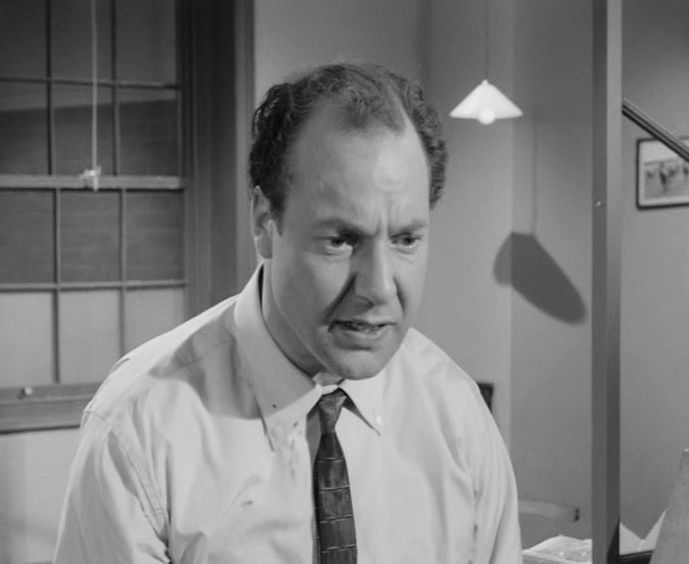
The big question must be, what did a nice young girl like Gloria see in Clinton?  Middle-aged, bad-tempered and somewhat on the dumpy side, he can hardly be said to be much of a catch (sorry, I’ll try not to use any more angling terms).  Their marriage seems to be an unhappy one – hence Gloria’s delight at spending time with Simon.  She later tells the Saint that Clinton is “dull and drab and jealous”.

She views Simon quite differently (“you’re a man”) and he reacts positively when she suggests they run away together.  But the slight face he immediately pulls suggests that he’s already a few steps ahead of her.  The revelation that Gloria isn’t the innocent and nice girl we’ve been led to believe (instead she was a willing accomplice in Clinton and Vincento’s scheme to lure Simon away from Bimini) is a decent twist – although by this point most people probably would have picked up on the fact that Gloria seemed just a little too perfect to be true.

One of the interesting things about The Effete Angler is that we don’t learn until pretty late on precisely what Clinton, Gloria and Vincento are up to.  Not that the precise nature of their villainy really matters, as it’s simply the Macguffin which ensured that Simon and Gloria were thrown together.

George Pravda, always such a watchable actor, is on good form as Clinton.  Popping tranquilisers like they were smarties, as the story wears on he cuts an increasingly forlorn figure.  His initial menacing persona therefore gets stripped away to reveal a much less impressive man – one who’s easily dominated by his wife.  The first of five Saint appearances for Paul Stassino, Vincento appears to be the muscle of the organisation – he later creeps into Simon’s room to shoot what he believes to be the sleeping Saint.  This may be an unconscious nod to a similar scene from the first James Bond film, Doctor No, but it’s no surprise to see that Simon has a brief tussle with Vincento (knocking him out) whilst Bond shoots his assailant in cold blood.  As touched upon before, this era of television was very restricted in terms of depicting sex and violence

It’s hard not to be smitten by the charms of Shirley Eaton and the character of Gloria – who switches from lovable innocent to hard-faced moll across the course of the episode – is one of the reasons why this one’s so very enjoyable.  Four and a half halos out of five.

effette 02.jpg

The Saint – The Element of Doubt

element 01.jpg

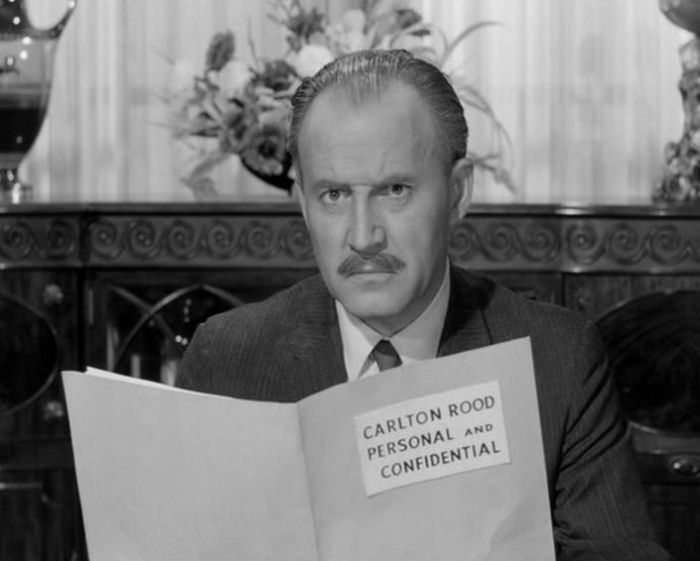
Carlton Rood (David Bauer) is a hot-shot lawyer who always gets his clients acquitted – even when they’re obviously guilty.  His latest client, Joe Sholto (Bill Nagy), burnt down his own warehouse in order to collect the insurance money (in the process, a policeman was killed in the blaze and his cleaning woman, Agnes Yarrow, was blinded).

Agnes (Margaret Vines) confirmed that Sholto was present at the scene, but under Rood’s remorseless courtroom questioning she wilts.  Sholto therefore walks free, but the Saint isn’t prepared to let it rest there.  Instead, he dishes out his own unique brand of justice ….

Apart from popping up in the pre-credits sequence, Simon doesn’t do a great deal during the first half of the story.  But he’s not really missed, as his absence allows the plot to be nicely set up, with Sholto’s ruthless character brought to the fore.  Ruthless he might be, but clever – hmm, maybe not.  It possibly wasn’t the wisest move for him to have torched his own warehouse (surely he could have hired someone to do so?)  And if he had brought in some outside thugs, then Agnes would have struggled to connect them to her employer.

Taking Willis Burnham (Robert O’Neill) along to assist him wasn’t too clever either.  From the moment the pair enter the warehouse, fire on their mind, Burnham wears a perpetually worried expression (he seems such an obvious weak link).

The New York setting of The Element of Doubt is convincingly realised.  Stock footage is kept to a minimum whilst the use of American-born actors such as Alan Gifford and David Bauer is a plus (with the British cast essaying fairly credible American accents).

It’s a pity that Alan Gifford, appearing again as Inspector Fernack (following his turn in The Careful Terrorist) didn’t become more of a regular.  Fernack, a creation of Charteris’, is essentially the American equivalent of Claude Eustace Teal.  Both might have a low opinion of the Saint, but every so often they’re forced to admit that his unorthodox approach does produce results.  Fernack has a nice comedy moment when he welcomes the glamourous insurance agent Mary Hammond (Anita West) into his office.  He doesn’t quite slobber all over her, but he comes close!

Earlier the same year, 1962, Anita West had left Blue Peter after presenting just sixteen editions (she had decided that her imminent divorce from Ray Ellington might prove an embarrassment for the show).

David Bauer gives a solid performance as Rood.  He may be well aware that his clients are often guilty, but he doesn’t overplay the sleaze – instead Carlton Rood radiates an air of solidity and respectability.  At least until he steps into court, which is when he’s prepared to use any dirty trick at his disposal in the service of his clients.  The way he reduces Agnes to hysteria is slightly chilling (even if Margaret Vines does overplay the moment somewhat).

So with Sholto now free, Simon elects to go undercover – sporting a pair of glasses and a not terribly convincing Texan accent – in order to sow discord between Rood and Sholto (he hints to Sholto that Rood’s planning to double-cross him).  As with some of Moore’s other accents, I’m not sure whether it’s deliberately supposed to be bad, or whether that was the best that he could do ….

Although Sholto is quite ruthless in the teleplay – locking Agnes in the burning warehouse – this is nothing compared to his behaviour in Charteris’ original story.  There he shot and killed Mr Yarrow (a character absent here) and blinded Agnes with acid fired from a gun.

Simon remains in the background until the last fifteen minutes or so, but since the story culminates in a well-acted tale of double-cross (orchestrated by the Saint, gleefully playing Rood and Sholto off against each other) it merits a score of four halos out of five.

element 02.jpg

The Saint – The Pearls of Peace

pearls 01

Brad Ryan (Bob Kanter), a friend of Simon’s, approaches him with a request for money.  Brad’s convinced that there’s a valuable oyster bed in Mexico, just ripe for the picking.  An indulgent Simon agrees to lend him three thousand dollars which enables Brad and his partner Harry Tiltman (Robin Hughes) to depart for San Domingo.

But Tiltman is a con-man and once they arrive in Mexico he robs Brad and leaves him for dead.  Three years pass and all of his backers, including Simon, have come to the conclusion that Brad simply stole their money and disappeared.  But then Brad’s ex-girlfriend Joss (Erica Rogers) receives a letter from him – promising the return of her stake money if she makes the trip to San Domingo.  The Saint, intrigued to discover what happened, agrees to accompany her ….

This is an odd story and no mistake.  The first part of the episode – Brad and Tiltman set out on the hunt for oysters – is told in flashback, with Simon only appearing briefly to set the scene.  Brad is the character who drives the early part of the plot – he’s a boyish but reckless adventurer and it quickly becomes clear that his trust in others could prove to be his downfall.

Joss is beautiful, but rather self-centered.  A budding actress, she’s content to let herself be pawed by producers (a topical touch) and following Brad’s disappearance has no compunction in marrying for money.  In short, she’s presented as little more than a gold-digger and whilst Simon is reasonably polite to her face, he can’t help but let the odd barb pass his lips.  When they both arrive in Mexico, he elects to search for Brad by himself, and after she asks if that’s because she’s so repulsive, he responds that her repulsiveness isn’t visible.  Ouch!

pearls 02

In Charteris’ original story he memorably described her thus.

She was a type. She was the half-disrobed siren on the jacket of a certain type of paper-bound fiction. She was the girl in the phony-tough school of detective stories, the girl that the grotesque private eye with the unpaid rent and the bottle of cheap whisky in his desk drawer is always running into, who throws her thighs and breasts at him and responds like hot jelly to his simian virility.

You can’t really miss the fact that San Domingo is a small Mexican village.  Flamenco guitar and maracas in the local bar (check).  Sombreros and ponchos on display outside (check).  This heavy-handed scene setting does raise a smile, but the village – constructed on the back lot – is quite convincing and the stock footage blends in well, ensuring that it counts as one of The Saint‘s more convincing early foreign locales.

I love the cliché moment when Simon saunters into the bar.  The mere sight of his immaculately tailored suit is enough to draw the eyes of the locals, but it’s when he mentions that he’s looking for Brad Ryan that everybody really begins to loom in a menacing fashion.  But for once, the locals aren’t there to be sinister or obstructive – instead they’re only trying to protect Consuelo (Dina Painser).

When we last saw Brad, he’d suffered a nasty head wound and very well might have been dead.  This turns out not to be the case – he was found by Consuelo who has slowly nursed him back to health.  But the twist is that the fight left him blind and only an expensive operation will restore his sight.  This revelation raises a few interesting questions – most notably what will happen to Consuelo if and when Brad regains his sight.  Although Dina Painser was only in her early forties at the time, she seemed to be made up to look older (therefore the unspoken inference is that Brad will no longer be interested in his ministering angel once he sets eyes on her).

That Consuelo is happy to put her life savings towards Brad’s operation, despite the fact he may leave her when his sight is restored, speaks volumes for her good heart.

Joss and Consuelo are plainly designed to be opposites in every way.  Joss is young, beautiful, but completely self-absorbed whilst Consuelo is older, care-worn but possessed of a deep love for Brad.  Eventually Brad obtains the money he needs for the operation (thanks to assistance from Simon) and the Saint is on hand to reassure the viewers that Brad will be able to see beyond Consuelo’s physical appearance in order to view the beauty underneath (yes, he does lay it on a bit thick).

It’s true that Simon’s closing piece to camera is slightly toe-curling and it’s very hard to warm to Brad at all (lucky that he’s got people like Simon and Consuelo to look out for him) but The Pearls of Peace isn’t a total write-off.  Erica Rogers is rather good as the very unsympathetic Joss (clearly she made an impression as she’d return to the series on three more occasions – playing a different character each time).

The adaptation by Richard Harris was pretty faithful to the original story, although Simon and Ned Yarn (renamed Brad Ryan for the teleplay) were strangers whilst Joss’ behaviour and colourful insults were rather toned down.

The Pearls of Peace doesn’t quite work, but there’s enough of interest for me to rate it a solid three halos out of five.

pearls 03

Pathe: A Year to Remember (1948/58/68/78/88) – Simply Media DVD Review

pathe news

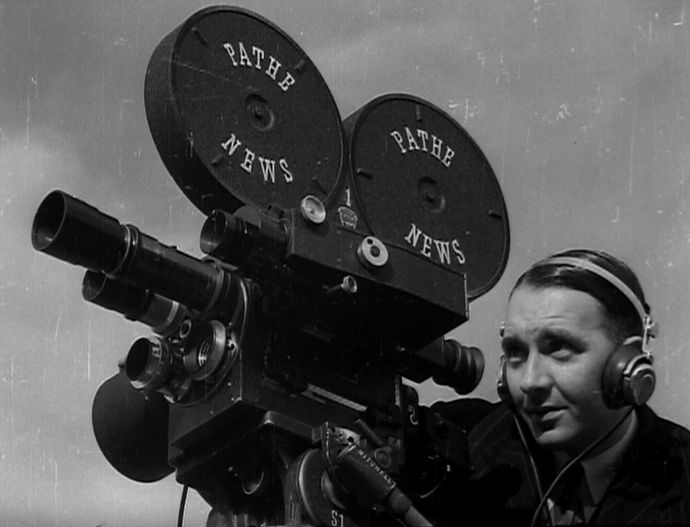
For most of the twentieth century, Pathe News produced newsreels and documentaries.  These were primarily designed for British consumption, although the topics covered ranged all over the world.  Pathe really came into their own during WW2 – since the BBC had closed their television service for the duration, Pathe ensured that the public could see (as well as hear) exactly what was going on.

The Pathe style is instantly recognisable.  A clipped, authoritative narrative style, allied to striking images (often mute and overlaid with music).  As their newsreels covered multiple events, there was never much of an opportunity to provide more than a brief soundbite of any given story, but it’s still notable just how vivid these short films can be.

As the decades wore on and television news became slicker, Pathe’s star began to dim a little.  It’s therefore interesting to compare the first three DVDs re-released here – covering 1948, 1958 and 1968 – to see if their style changed over time.  Later discs utilise BBC reports but are equally as fascinating.

164454- Chief Crazy Horse Sleeve.indd

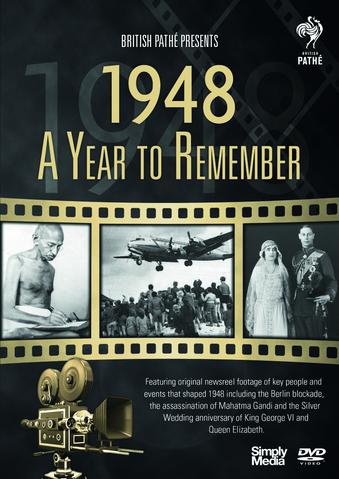
Three main areas are covered on this disc.  World affairs, domestic British affairs and sports and entertainment.  Ghandi’s funeral is a noticeable highlight from the first section – not only for the sheer scale of the event, vividly captured by the Pathe cameras, but also for the narration, which carries a certain weight and gravitas.

The British section offers rich pickings, since it mostly covers events which might not be world shattering but are rich in historical detail. The highly sedate New Years Party at the Chelsea Arts Ball is a window into another world, whilst the sight of the King and Queen touring the Ideal Homes Exhibition is a treat. Not least for the many practical crafts on display – Britain in 1948 was still a nation in the grip of austerity, so although there are consumer goods aplenty, there’s also a demonstration of make and mend skills such as basket weaving. A hand loom is also shown and we’re told what to do if wool can’t be found (simply raise silkworms instead). It truly was another time.

Royal affairs feature heavily, with a strong dollop of due deference shown. Chief attractions are the King and Queen’s Silver Jubilee and the birth of Prince Charles.

The last fifteen minutes revolves around entertainment and sport, with the likes of Joe Louis, Ronald Coleman and Danny Kaye giving brief interviews. As with all the Pathe features, time was always tight, so these soundbite moments are rarely terribly revealing (the extreme deference of the interviewers is sometimes a problem too) but having said that, the Danny Kaye piece is quite memorable.

164454- Chief Crazy Horse Sleeve.indd

There’s plenty of interest across the 1958 volume. I was especially taken with the report from Expo 58 – also known as the Brussels World Fair – which served as a shop window for various counties (including Britain) to show off their technological wares. An attempt to foster harmony acrose diverse nations (although the narrator can’t help but make a slight dig against the Russians) it’s a reminder of a more optimistic age. Technological innovation – British, naturally – is something of a running theme throughout the year.

The Munich Air Crash – which saw twenty one people, including seven members of the Manchester United football team, perish – is probably the most famous piece of footage on the disc. But the sight of the stark, twisted wreckage of the areoplane, flecked by snow, still has a considerable impact. Also affecting is the way that the camera moves across a still photograph of the team, with the narrator naming each player and then informing us whether they were killed or injured.

Domestic British affairs are well covered again – with the racial tensions in Notting Hill and the rise of the teenager both standing out. The optimism of the Windrush arrivals (covered in the 1948 volume) had plainly disappated, leaving a bitterly divided community. The footage of the hip and happening teenagers (it’s all coffee bars, jazz and jiving for them) is another of those wonderful time-capsule moments which makes these newsreels so enjoyable to revisit.

164454- Chief Crazy Horse Sleeve.indd

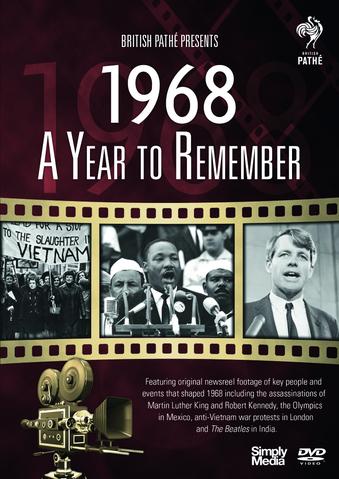
Bob Danvers-Walker, Pathe News Commentator between 1940 and 1970, introduces this disc (which suggests it was assembled at a different time from the previous two discussed). Although we’ve nearly reached the end of the swinging sixties, the Pathe style (authoritative narration, jaunty backing music) remained unchanged. This makes for a slightly odd viewing experience, but one that’s even richer in cultural nuggets. Although it’s strange that most of the material is still in black and white.

The clash between the old (the Pathe narrators) and the new (practically everything else) is very marked. There’s something slightly incongruous about seeing the bright young things of the film world – “James Fox and delicious friend” – cavorting at the Playboy Club or people lounging about on PVC furniture, whilst Bob Danvers-Walker sets the scene for us.

But elsewhere the narrators have weightier material to get their teeth into (such as the assassinations of Martin Luther King and Robert Kennedy). The death of F1 ace Jim Clark is another sobering moment. The Pathe cameras were on hand to cover the race and the sight of his teamate, Graham Hill, staring at Clark’s wrecked car is something which lingers in the memory.

164454- Chief Crazy Horse Sleeve.indd

With Pathe having discontinued their newsreel service in 1970, the post 1970 years mainly utilises BBC reports which naturally results in a very different feel.  A modern narrator – Kenneth Kendall – is used to place the various clips in context (he essentially replaces the studio newsreaders).

For some of the longer clips, Kendall’s narration is augmented by footage of the original BBC reporters such as Brian Barron, Martin Bell, Sally Hardcastle and Larry Harris.  This is a welcome touch as it helps to anchor the stories in the era they were produced.  On-screen captions of the reporter’s names are also appreciated, as although some faces are familiar, others are less so.

As ever, the stories range from the serious (Bush Wars in Rhodesa) to the ridiculously trivial (Oklahoma’s annual cow chip throwing contest).  Some things – such as the theft of Charlie Chaplin’s body from his Swiss grave – were new to me.  Proof that you can always learn something.

Since these BBC reports have never been as widely disseminated as the classic Pathe newsreels, I found this disc to be especially fascinating.  What’s especially interesting is how these filmed reports aren’t too dissimilar from the Pathe style (although the musical soundtrack has gone).  For obvious reasons, film lacks immediacy (there would always be a transmisson delay, since the recording had to be shipped home in order to prepare it for broadcast).  It was when television news switched to videotape more regularly for live outside broadcasts that things changed ….

164454- Chief Crazy Horse Sleeve.indd

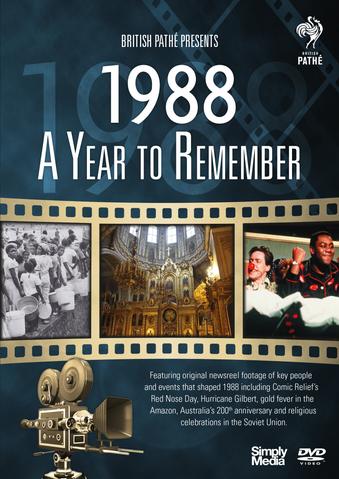
Another familiar newsreader – Michael Burke – takes over from Kenneth Kendall as the narrator of the 1988 disc.  There’s some extraordinary footage here – most notably the grenade and gun attack carried out at the funeral of the three IRA men who had been shot dead in Gibraltar by the SAS.

Entertainment (Comic Relief launches its first Red Nose Day, Ian Botham follows in Hannibal’s footsteps for another charity walk) rubs shoulders with more serious fare (Hurricane Gilbert causes devastation in the Caribbean, famine continues to cause strife in Ethiopia).  Royal stories – something of a running theme across all the discs – are well to the fore as well.

Originally assembled in the early nineties, these programmes have been released and repackaged by several different companies over the years.  Simply have brought many back into print, with these five DVDs being the most recent.  They’re obviously ideal birthday presents (it’s always interesting to see what happened in the year you were born) but they also stand up well as absorbing social documents in their own right.  The way that the reporting style changes over the course of the decades – from the clipped, deferential Pathe approach to the slightly more informal BBC coverage – is one reason why, but the front-line nature of the reportage (capturing events as they happen) is often highly compelling too.  And the variety of topics, from the trivial to the serious, ensures that there’s something of interest for everybody.

All five titles retail at £9.99 each and can be ordered directly from Simply via these links – 1948195819681978 and 1988.  They’re released on the 8th of January 2018.