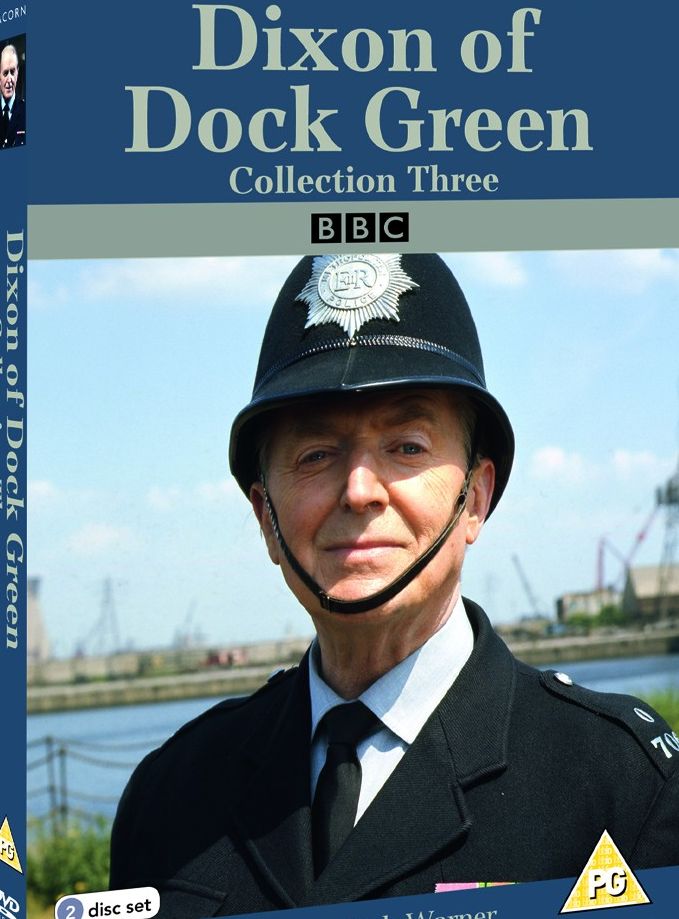
Dixon of Dock Green – Collection Three – to be released by Acorn in 2015

.evenin' all

I’m delighted to hear that Acorn will be releasing a third DVD of Dixon of Dock Green episodes.  More details can be found on their website here.

Collections one and two contained all the existing colour episodes broadcast between 1970 and 1975 (with the exception of Molenzicht which was omitted for unspecified rights reasons).

Collection three will have all eight episodes from the 22nd and final series (broadcast in 1976).  This is the only series of Dixon of Dock Green to exist in its entirety, which sadly indicates just how depleted the Dixon archive is.

The eight episodes are as follows –

1. Domino (13th March 1976)

2. The Job (20th March 1976)

3. Vagrant (27th March 1976)

4. Everybody’s Business (3rd April 1976)

5. Alice (10th April 1976)

6. Jackpot (17th April 1976)

7. Legacy (24th April 1976)

8. Reunion (1st May 1976)

This final series sees George Dixon (Jack Warner) working as a civilian collator at Dock Green police station, following his retirement from the force.  Given that Jack Warner was eighty years old at the time, this was a reasonable move (indeed, his obvious age and immobility had been a problem for a few years prior to this).

Missing from the final series was Andy Crawford (played by Peter Byrne).  As Byrne had been a regular since 1955, his decision not to take part in this series was puzzling – as it was pretty obvious that the series (due to Warner’s age) wouldn’t be continuing for much longer.

I’ve written here about my appreciation of the first collection of episodes, released in 2012, and hopefully these final eight will be of a similar standard.

This just leaves the black and white episodes which could (maybe if sales of this DVD are good) make up collection four some time in the future.

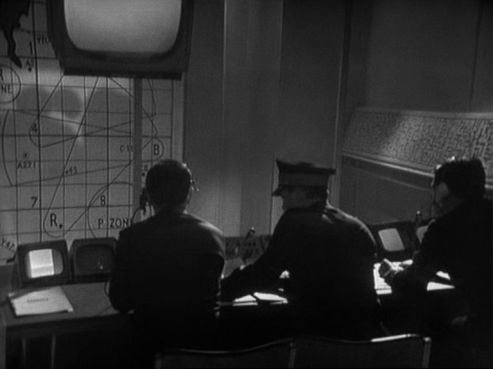
Out of the Unknown – Tunnel Under The World

tunnel

Story by Frederik Pohl, Adapted by David Campton
Directed by Alan Cooke

When Guy Birkett (Ronald Hines) and his wife Mary (Petra Davies) wake up they are perturbed to find that they’ve had the same nightmare about being caught up in a huge explosion.  They dismiss it as a strange coincidence and attempt to enjoy their breakfast.  But it’s difficult for them to find any peace and quiet since they’re constantly interrupted by annoying advertising jingles from a variety of sources (on the radio, via the post and from loudspeakers attached to cars).

The odd thing is that whilst today is June the 15th, the next day is June the 15th again. So we see the Birketts repeat everything they did the previous day (although they’re unaware of this).  And the next day is June the 15th once more.  Eventually, thanks to the intervention of Swanson (Timothy Bateson), Guy learns the horrifying truth.

The Tunnel under the World was a short story by Frederik Pohl which was originally published in 1954. Like many of the story themes adapted for OOTU, the concept of this story (annoying advertising) is just as valid today as it was in 1954 or back in 1966, when this episode was transmitted.

The various products – Chocobites, Marlin cigarettes, Frosty Flip, Feckle Freezers, Crunchipops – all have catchy slogans, catchy jingles or unique selling points (for example, Marlin cigarettes contain a special anti-cough ingredient!).

Ronald Hines (a familiar television face from the sixties) is perfect casting as the cog in the wheel who rebels. And Timothy Bateson (always such a dependable performer during numerous decades of television and film appearances) gives another good turn here, as the man who helps Birkett to understand exactly what’s happening to all of them.

The twist ending (indeed the double twist ending) is one which I doubt many would have predicted on their first viewing. There’s also a robot which pops up at the end and is, interesting, shall we say – but it doesn’t really derail the story (by this point the viewer might expect almost anything to happen).

A biting satire about advertising and big-business, Tunnel Under The World is a more outlandish and fantastic story than the hard-SF stories which make up most of the extant episodes from the first two series.  Given the depleted nature of series two, it’s a story that I’m happy escaped the archive purges.

Next Up – The Last Lonely Man

Out of the Unknown – Level Seven

level

Story by Mordecai Roshwald, Adapted by J.B. Priestley
Directed by Rudolph Cartier

Level Seven is 4,500 feet beneath the Earth’s surface and it’s designed to be the last line of attack in the event of a nuclear war.  Above them are six other levels – the first four are for civilians, the fifth is for the Government, scientists and the military whilst the sixth houses Defence Command.

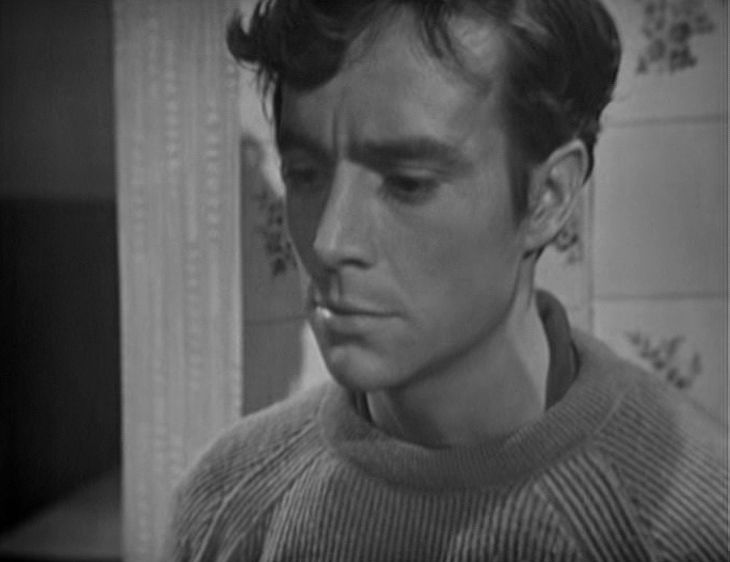
X127 (Keith Buckley) is one of a select number of operatives charged with pushing the buttons that will release the missiles of death and destruction on the enemy.  X117 (David Collings) works alongside him, but questions the reason for Level Seven’s existence.  Whilst X117 runs foul of the authorities, X127 has met and married R747 (Michele Dotrice).

Eventually the order to attack is given and X127 and the new X117 (Sean Arnold) fire every last missile.  The General (Anthony Bate) tells them that the war is over and they’ve won – but what price victory?  Slowly it becomes apparent that everybody in the world is dead or dying and whilst it was predicted that Level Seven would be immune, that isn’t the case.  There is no hope at all, so all they can do is to wait for the inevitable end.

Level 7 was a novel by Mordecai Roshwald which was published in 1959. Shortly after its publication it attracted the attention of J.B. Priestley who called it “‘the most powerful attack on the whole nuclear madness that any creative writer has made so far”. Priestley began work on a script for a proposed film, but for various reasons the film wasn’t made, so his screenplay was adapted for this episode of OOTU.

It goes without saying that it’s fascinating to have a writer of Priestley’s stature contributing to OOTU. Priestley’s abhorrence of nuclear weapons was well known (he was an active CND member) and in the play this is best given voice by a man and woman who venture up to the surface after the attack and report back to Level Seven what they’ve seen.

So listen to us, you people down there in the caves.  There’s nothing to see here, but twisted metal and radio-active dust.  Nothing, no birds are singing.  No flowers growing, no trees, no fields.  No men, no women, no children.  Bare burnt earth, tortured metal, murderous dust.  Nothing to see, nothing to hope for, nothing to love.  The world is like a scorched ship, abandoned by the crew.  It still revolves.  There’s day and night, sun, moon and stars, but that’s all.

Keith Buckley and Michele Dotrice are both very good as the lovers who end up as the last people alive in Level Seven.  Even better though, is David Collings as X117.  Collings would make a habit of playing characters who have some flaw in their character which proves to be their undoing – and so it was here.  X117 is eventually removed from his position due to insubordination and when we see him later he’s been reduced to working as a member of the cleaning staff and unable to remember X127 and the events that led to his “treatment”.

Anthony Bate gives a typically solid performance as the base commander, the General.  The General has an unswerving belief in the right of his side in any war and the cracks only start to appear when he realises that everybody in Levels One – Six are dead and that maybe victory over a dead planet was no victory at all.

Level Seven was directed by the legendary Rudolph Cartier.  Cartier had produced and directed Nigel Kneale’s Quatermass trilogy during the 1950’s and the two had also collaborated on the acclaimed adaptation of Nineteen Eighty Four in 1954.  As with Quatermass, Cartier favoured music from The Planets Suite by Holst (the inclusion of excerpts from Mars, Bringer of War were particularly apt).

There are lengthy film sequences throughout the episode, probably to show the large number of people working in Level Seven (we tend to only see the full compliment of crew on film).  The substantial amount of filming helps to give the story an extra sheen and given the involvement of Priestley/Cartier it’s possibly not surprising that the production team pulled out all the stops to make this as good as they possibly could.

Level Seven was a missing episode for decades and was only returned to the BBC relatively recently.  We can be thankful that it was recovered – as it’s a powerful anti-war story dramatised by one of the greatest British playwrights of the 20th century.

Next Up – Tunnel Under The World

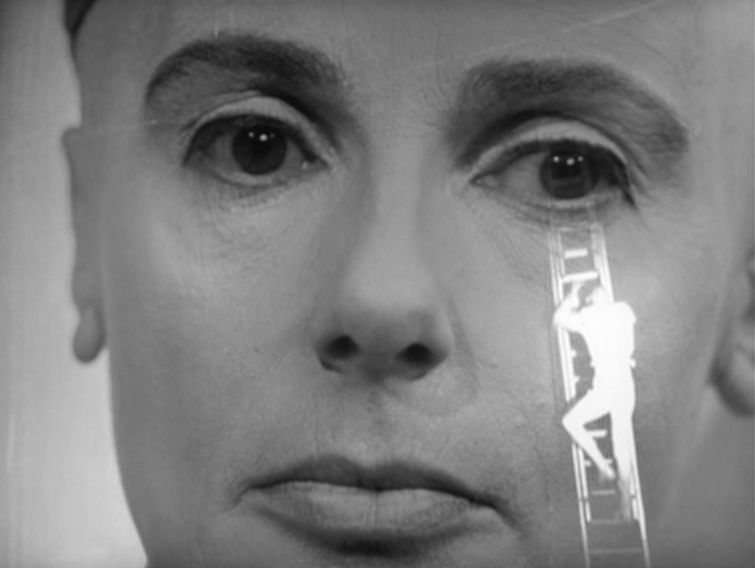
Out of the Unknown – Lambda 1

lambda

Story by Colin Kapp, Adapted by Bruce Stewart
Directed by George Spenton-Foster

In the future, conventional travel has been rendered obsolete by the TAU craft.  It doesn’t travel on or above the Earth’s surface – instead it travels through it.  The TAU craft operates under four atomic modes – Gamma, Delta, Epsilon & Omega – with Gamma being the safest and Omega the most dangerous.

A routine passenger craft (the Elektron) slips into Omega mode and becomes trapped in solid rock with seemingly no means of escape.  UK TAU controller Paul Porter (Sebastian Breaks) has a personal stake in ensuring the craft is recovered – his wife Julie (Kate Story) is aboard.  So Porter is persuaded by Eric Benedict (Ronald Lewis) to pilot the Lambda 1 craft on a hazardous rescue mission.

Lambda 1 is something of a shambles.  There’s the germ of a good idea but the production is so flawed that it only works intermittently.  At the start of the story we’re given a great deal of information about the TAU system, the various atomic modes it uses and are introduced to numerous characters.  The problem is that there’s too much information and too many characters – so there’s not a great deal that makes a lasting impression.

As time goes on it becomes clear that Paul Porter will become an important character, but it’s not initially obvious that he’s based in the UK and isn’t on the stricken ship.  Although the action cuts back between the ship and the UK command base, it takes a while to differentiate between the two.

Charles Tingwell is good as the boozy Captain Dantor and Michael Lees is quite effective as a twitchy passenger, Ferris, but the rest of the cast don’t make much of an impression.  George Spenton-Foster’s direction is somewhat loose – cues are late, the camera positions are sometimes a little off and there are occasions when a retake would have really helped the production.

The sequences when Porter enters Omega mode and is beset by strange hallucinations work very well and they’re easily the best part of the story.  But the problems with the script, direction and performances do tend to dissipate the audience’s goodwill, so that by the end it’s difficult to imagine many people will really care about the fate of the ship and its passengers.

Certainly one of the least engaging of the surviving episodes, Lambda 1 was probably a victim of its own ambition.  By over-reaching, it ends up as a rather unsatisfying experience.

Next up – Level Seven

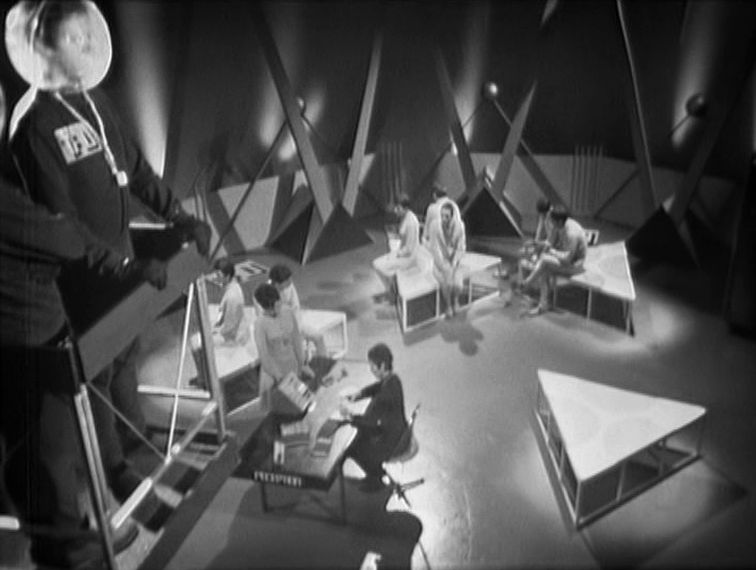
Out of the Unknown – The Machine Stops

machine

Story by E.M. Forster, Adapted by Kenneth Cavander & Clive Donner
Directed by Philip Saville

The Machine Stops is set in a future world where the majority of the population live underground and in isolation – with all their needs catered for by the omnipresent Machine.  Vashti (Yvonne Mitchell) is content with this existence, but her son Kuno (Michael Gothard) isn’t.

As long as the Machine works, then everything is fine – but Kuno tells Vashti that the Machine is slowly dying and nobody knows how to repair it.  As their civilisation has become totally dependent on the Machine, how will they be able to survive if it’s not there anymore?

The oldest story adapted for OOTU, The Machine Stops by E.M. Forster was published in 1909.  Given the period it was written in, there’s a considerable amount that has become true (effectively Forster predicted the internet and instant messaging).  It’s certainly a story that has even more resonance today than it did a century ago – with our ever increasing reliance on technology, how would we be able to cope if all of our machines stopped?

The message in Forster’s story (technology is bad) isn’t particularly subtle – but it’s a thought-provoking idea that is dealt with effectively in this adaptation.  The Machine Stops is a rather different OOTU.  The first series tended to have stories that were driven very much by dialogue and character.  This one has a much smaller cast (only two main speaking parts) and much of the power of the piece comes from the visuals.  Given that OOTU’s budget wasn’t huge, this was potentially a problem – but overall it works pretty well as the sets look solid and are well-designed.  It’s also handled impressively by director Philip Saville (especially the scenes where Kuno ventures outside for the first time) and he was able to cast two quality actors as Vashti and Kuno

Yvonne Mitchell (Vashti) had appeared a decade earlier in the Cartier/Kneale production of Nineteen Eighty Four alongside Peter Cushing whilst Michael Gothard (Kuno) would enjoy success in films such as The Devils and For Your Eyes Only before his untimely death in 1992.  Although neither has the most naturalistic sounding dialogue to deliver, they do manage to make their characters come alive (their final scene, for example, is very touching).

For the visuals and the story concept, The Machine Stops has long been regarded as one of the best episodes of OOTU.  It’s played at a more heightened pace than the majority of the first series, so some may find it less rewarding – but it’s a very worthwhile adaptation of a classic piece of literary science fiction.

Next Up – Lambda 1

Out of the Unknown – The Midas Plague

midas

Story by Frederik Pohl, Adapted by Troy Kennedy-Martin
Directed by Peter Sasdy

The Midas Plague depicts a society where robots are responsible for producing all the goods that the human population could ever need.  The problem is that the robots are producing them at a faster rate than they can be used, so people are trapped in an ever-increasing cycle of consumerism.

The poorer you are, the more goods you have to consume – so the larger your house is, the more cars you own, etc.  But as you move up the social scale, you are allowed to consume less – until you reach the very top where you can live a live of simplicity, unfettered by the useless trappings of society.

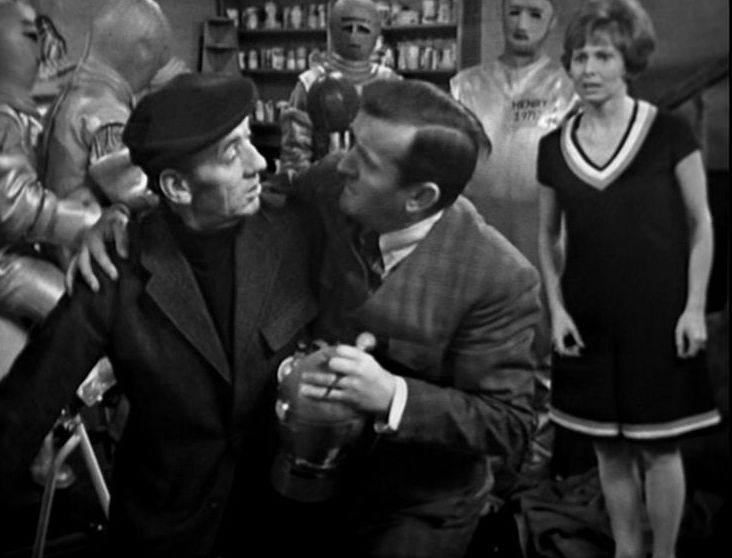
Morrey Anderson (Graham Stark) is a typical example of a lower-class worker.  He lives in a large house, staffed with a huge number of robots and along with his wife Edwina (Anne Lawson) they are surrounded by more furniture, food, drink and other products than they could ever hope to consume.  But he has a plan.  In his spare time he’s been working on a way to adjust his robots so that they can help consume some of the Anderson’s quota of products.  This he does – leading to the incongruous sight of drunken robots! But what will the authorities do when they find out?

The Midas Plague was written by Frederik Pohl and was originally published in 1954.  The satirical point it makes is pretty broad and this is broadened even further in Troy Kennedy-Martin’s adaptation.  Kennedy-Martin was a writer of some repute (he had already created Z Cars and would later be responsible for The Italian Job and Edge of Darkness) which does make him something of a left-field choice to adapt this type of story.

There’s plenty of humour in Kennedy-Martin’s screenplay and it’s pushed even further by director Peter Sasdy.  The opening scene has jaunty music by Max Harris which instantly tells us that this isn’t going to be the most serious of stories.  Casting Graham Stark in the lead role (already a familiar face from tv and film comedies) was another sign that this would be an episode of OOTU in a light-hearted vein.

Whilst not everything works (Harris’ music remains relentlessly jaunty, which begins to pall after a while) there’s some lovely moments of comedy which do hit the mark.  Most of these are concerned with Morrey’s robots once he’s turned them into avid consumers.  Whilst the robot costumes are pretty low-rent (intentional or budget related I wonder?) after a while that isn’t a problem and good actors like Anthony Dawes (as the most prominent robot, Henry) are able, even behind inflexible masks, to give performances of character.  I love the scene where he ambles into a bar and asks for a drink.  The robot behind the bar refuses to serve him and a fight breaks out, so Henry ends up in the dock!

Sam Kydd (as Fred) is good value as a house-breaker who doesn’t steal things, instead he’s paid by people to take their stuff and put it into other people’s homes.  John Barron (as the prime-minster, Sir John) has a small, but telling, role.

The Midas Plague is a fairly broad comedy and probably won’t be to everyone’s tastes, but there’s a lot to enjoy and it’s certainly different from the majority of the stories from the first series.

Next up – The Machine Stops

Out of the Unknown – Thirteen to Centaurus

thirteen

Story by J.G. Ballard, Adapted by Stanley Miller
Directed by Peter Potter

Thirteen to Centaurus opens on a space-station which is run by a crew of thirteen.  It becomes clear quite quickly that all of them, apart from Dr Francis (Donald Houston), have had their minds conditioned.  But Abel (James Hunter) is beginning to rebel and questions why they are here and what they are doing.

Dr Francis takes Abel into his confidence and tells him that they are actually on a “multi-generation space vehicle” which is traveling from Earth to Alpha Centauri.  Given that the ship can only travel at sub-light speed, it will take hundreds of years before the ship makes planetfall and Dr Francis explains that none of them will ever set foot on the new planet – this is a privilege reserved for future generations.  The truth is rather more complicated though and once Dr Francis has encouraged Abel to think for himself, the young man is dogged in his determination to discover all of the answers.

Thirteen to Centaurus was a short story by J.G. Ballard originally published in 1962.  The story, and of course this episode of OOTU, has a major twist – which for those coming to it for the first time I won’t reveal.  It certainly pushes the tale in a different direction and poses some interesting questions.

The conditioning (or effectively brainwashing) that the ship’s crew are subjected to is an intriguing part of the story.  Early on we see some of them working out in the gym and chanting “There is no other world than this. There are no other creatures but the chosen and their children shall inherit the Universe”.  This is an unsettling moment (absent from Ballard’s story) which is creepily effective.

As Abel’s reasoning grows, he begins to question more and more and effectively reverses the pupil/master relationship between himself and Dr Francis.  Like the majority of the crew, James Hunter is somewhat wooden as Abel (we could assume this is intentional – due to the conditioning he’s been subjected to).  Donald Houston as Dr Francis is pretty solid, although his performance isn’t, at times, particuarly subtle (see Moonbase 3 for more examples of Houston’s unsubtle acting choices in a sci-fi setting).

Back on Earth, there’s some quality actors (John Abineri, Noel Johnson, Robert James) who debate the future of the ship and the fate of the thirteen people onboard.  The decision is out of their hands though – it rests with Abel who has taken control of the ship.  The last few minutes are riveting and it’s certainly an ending that lives long in the memory.

Possibly the strongest of the surviving episodes from the first series, Thirteen to Centaurus is a quality production adapted from a strong story which still packs a punch today.  For anybody who wants an introduction to OOTU this is an ideal episode to start with.

Next Up – The Midas Plague

Out of the Unknown – Some Lapse of Time

lapse

Story by John Brunner, Adapted by Leon Griffiths
Directed by Roger Jenkins

Dr Max Harrow (Ronald Lewis) has been plagued by frightening nightmares in which he’s trapped in a strange primitive world and menaced by a mysterious figure (played by John Gabriel).  Dreams become reality when the man from his nightmare turns up outside his house, suffering from the same rare radiation-induced illness which was responsible for the death of his son.

The man (identified as Smiffershon) speaks in an unknown language and was found clutching a fragment of finger-bone (just as in Harrow’s dream).  Harrow is convinced that Smiffershon is a survivor from a future that’s been devastated by nuclear war (a belief that, naturally, isn’t shared by anybody else).  If this is so, how are he and Smiffershon connected?

Some Lapse of Time was one of the more contemporary stories adapted for OOTU as it was originally published in 1963, just two years before this dramatisation by Leon Griffiths (later to create Minder).  The first of two stories from Brunner to be used for the series (the second, The Last Lonely Man is the only complete story to exist from the third series) Some Lapse of Time is a dark, contemporary tale that has a strong anti-nuclear message.

The possibility that our future would be scarred by atomic fallout was a popular theme during the 1960’s and 1970’s and Brunner’s story taps into this anxiety.  Ronald Lewis is impressive as a man desperately searching for answers to impossible questions – particularly in the scene where he declares his belief that the world will return to cave-like primitivism to his appalled wife Diana (Jane Downs) and a colleague from the hospital, Dr Faulkner (Richard Gale).

Sound design is quite interesting – throughout the story there’s an ominous tolling sound which heightens the tension, especially as Harrow becomes more and more unhinged.  At the same time, the camera closes in on Ronald Lewis and the dialogue is given an echo effect.  All of these little touches work very effectively to highlight Harrow’s increasing instability.

Possibly the most noteworthy aspect about this production is that Ridley Scott was the designer, but given the contemporary setting there was little opportunity for Scott to produce anything particularly extraordinary on his sole OOTU credit.

Whilst it does feel a little drawn-out (although the last twenty or minutes or so really pick up the pace) it’s still a thought-provoking story that paints a stark picture of a future world virtually destroyed in a nuclear holocaust and the final twist ending works very well.

Next Up – Thirteen to Centaurus

Sherlock Holmes starring Douglas Wilmer (BBC 1964-1965) to be released by the BFI on R2 DVD (March 2015)

wilmer

It’s very welcome news that the BFI will be releasing the Douglas Wilmer Sherlock Holmes series on DVD next March.  Their press release reads as follows –

SHERLOCK HOLMES (4-DVD SET)

Sir Arthur Conan Doyle’s Sherlock Holmes: The Classic BBC TV series.

Regarded by many to be the best incarnation of the Baker Street sleuth, Douglas Wilmer gives a career-defining performance in this celebrated BBC series. Intelligent, quick on his heels, and bearing a striking resemblance to the original Sidney Paget illustrations, Wilmer’s portrayal as possibly the closest to Conan Doyle’s original vision that there has ever been. In 2012, his status as legend within the Sherlock pantheon was cemented when he was asked to make a cameo appearance in Sherlock with Benedict Cumberbatch.

The first story in the series, The Speckled Band, was originally produced as part of the BBC drama strand Detectives. Appearing alongside Wilmer, as Holmes loyal companion Dr John Watson, was the great Nigel Stock. Such was the success of the adaptation that Wilmer and Stock were reunited a year later for a full 12-part series. With a supporting cast that included Clochemerle star Peter Madden as Inspector Lestrade, TV veteran Derek Francis as Mycroft Holmes, and guest starts such as Peter Wyngarde (Department S, The Innocents) and Patrick Troughton (Doctor Who), the popularity of the series gave rise to a second series, in which the role of Sherlock was played by Peter Cushing.

Presented for the first time on UK DVD, this long-awaited release also includes an array of fascinating special features, including two reconstructions of partially-surviving episodes, an alternative presentation of the Detectives pilot, an alternative title sequence, an interview with Douglas Wilmer and a number of newly-recorded audio commentaries

Special features
Original 1964 Detectives pilot episode The Speckled Band
All surviving episodes from the 1965 series
Alternative Spanish audio presentation of The Speckled Band
Alternative title sequence for The Illustrious Client
The Abbey Grange episode reconstruction, featuring a newly-filmed sequence of Douglas Wilmer reading the first half of the story, followed by all surviving original footage
The Bruce-Partington Plans episode reconstruction, using all surviving original footage and original shooting scripts
Douglas Wilmer…on Television (2012, Simon Harries, 20 mins): the iconic actor discusses his career in British film and television
Five audio commentaries, including contributions from Douglas Wilmer and celebrated directors Peter Cregeen and Peter Sasdy, all moderated by actor-comedian Toby Hadoke
Fully illustrated booklet with new essays and full episode credits
UK | 1964-65 | black and white | English language, with optional hard-of-hearing subtitles | 650 minutes approx | Original broadcast ratio 1.33:1 | 4 x DVD9 | PAL | Dolby Digital mono audio | Cert: 12 | Region 2 DVD

Although the series has received a R1 release and a French R2 release, as the above indicates this will be the first UK release and the inclusion of the existing material from the two incomplete episodes as well as the Douglas Wilmer interview and commentaries are the icing on what looks like a very appealing cake.

A DVD review can be found here.

The Crucible – 21 Years In The Frame (BBC 1997)

I’ve also just uploaded to YouTube this three-part series from 1997, in which David Vine looks back at the first twenty years of the World Snooker Championships staged at the Crucible Theatre (1977 – 1996).

Given that each edition is only thirty minutes, there’s rarely time to dwell in much detail on any match (although they do show all of Alex Higgins’ legendary break from his 1982 semi-final against Jimmy White) but it’s an amiable quick trot through twenty years of snooker history.

Play of the Month – Julius Caesar (BBC 1969) starring Robert Stephens and Edward Woodward

I’ve uploaded to YouTube this 1969 BBC Play of the Month production of Julius Caesar, which features a first-rate cast including Robert Stephens as Mark Antony, Maurice Denham as Julius Caesar, Frank Finlay as Brutus and Edward Woodward as Cassius.

Out of the Unknown – Sucker Bait

sucker

Story by Isaac Asimov, Adapted by Meade Roberts
Directed by Naomi Capon

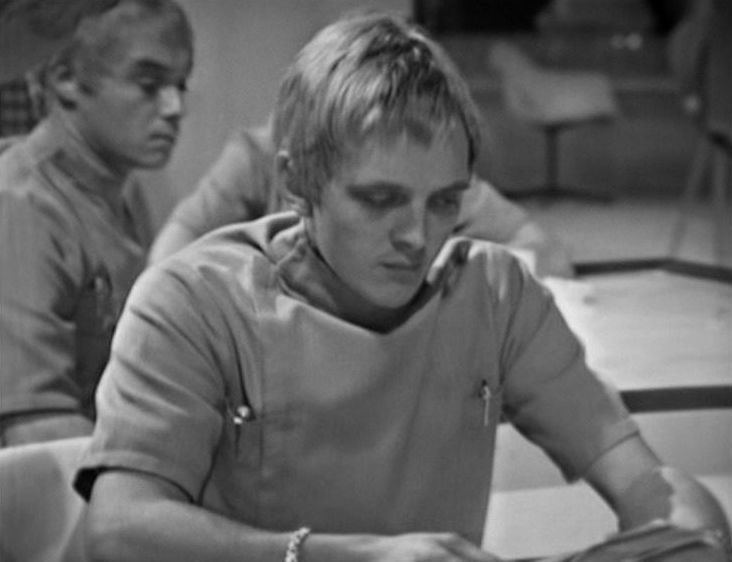
An expedition has journeyed out to a distant planet to try and discover why, a century earlier, an attempt to colonise the planet failed – resulting in the deaths of all the colonists.  On-board is Mark Annuncio (Clive Endersby) of the Mnemonic Service.  Mnemonics are special people – isolated from normal human contact from an early age, they are capable of retaining vast amounts of information (something which is impossible for a ordinary person).  In effect, they are human computers.

Although Mark is chaperoned by Dr Sheffield (John Meillon) he still manages to antagonise the majority of the crew – such as the microbiologist Rodriguez (Tenniel Evans) – by telling them that their views are essentially worthless.  Naturally, the experienced scientists have no time for somebody they view as little more than an annoying child.  But this strange, gifted teenager may be the crew’s only hope to save all their lives …..

Sucker Bait, a novella written by Isaac Asimov, was originally published in 1954 across several issues of Outstanding Science Fiction.  The story translates quite well to the OOTU format, although it is one of the lesser stories from the first series.  One of the problems is that Mark Annuncio is a fairly annoying character – this is part of the reason why he’s a gifted mnemonic, but dramatically a slightly more human and engaging personality would have worked better.

The scientists are all fairly one-note as well, although their ranks are swelled by good actors like Tenniel Evans and Burt Kwouk also has a decent role.  It’s a dense, wordy, scientific story that does sag a little towards a rather anti-climatic end.  And there are times when the production shortcomings are very apparent – the surface of the planet appears to be made from polystyrene, for example.

Not the strongest episode then, but the source material from Asimov is sound enough and the mystery of the planet (whilst quite low-key) is reasonably intriguing.

Next Up – Some Lapse of Time

Out of the Unknown – Come Buttercup, Come Daisy, Come ….. ?

come

Written by Mike Watts
Directed by Paddy Russell

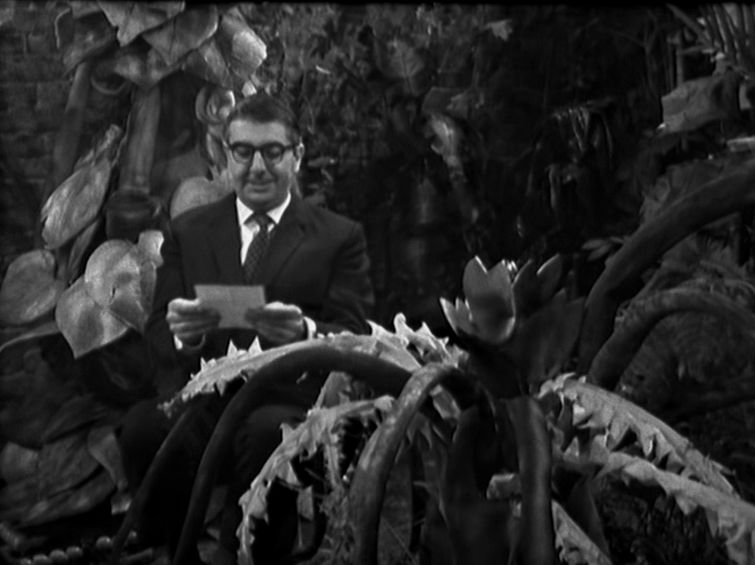
Henry Wilkes (Milo O’Shea) loves his wife Monica (Christine Hargreaves) and he loves his garden.  Nothing unusual there, you may think – but his garden is unusual. It’s full of plants that almost seem to be intelligent and they appear to respond when Henry talks to them.  But things start to go awry when the plants attack a rather annoying boy (Jack Wild) and then Monica’s dog goes missing – and it was last seen in the garden …..

Come Buttercup, Come Daisy, Come ….. ? was written by Mike Watts and was the second original story from the first series of OOTU.  As the brief synopsis above indicates, this is something of a comedy – although events do take a very dark turn.

As so often with episodes of OOTU (and indeed with television drama of this era) the cast is first-rate.  Milo O’Shea gives a fine performance as the mild-mannered Henry, who loves to talk to his plants and even give them a little tickle from time to time! Christine Hargreaves (one of the original cast members of Coronation Street) is also very good as a woman on the edge of a nervous breakdown – brought on by the strange goings-on in the garden.  Eric Thompson (responsible for the voices on The Magic Roundabout) and Patsy Rowlands also impress, whilst the ever dependable Bernard Kay pops up towards the end as a police officer who’s somewhat out of his depth.

The garden is very well designed and it’s probably just as well that the more animated sequences were shot on film (this would have allowed greater flexibility in shooting the various plant movements).  Director Paddy Russell handles both the effects and the human drama with aplomb and whilst it’s a slowly paced piece, the scripting and acting are sharp enough to not make this an issue.

Another sideways story in a series that already has demonstrated you can never be sure what you’ll see next – Come Buttercup, Come Daisy, Come ….. ? is another stand-out tale from the early episodes of OOTU.

Next Up – Sucker Bait

Out of the Unknown – Time in Advance

time

Story By William Tenn, Adapted by Paul Erickson
Directed by Peter Sasdy

Nick Crandall (Edward Judd) and Otto Henck (Mike Pratt) are pre-criminals, who have returned to Earth after serving seven years hard labour on a variety of dangerous, frontier worlds.  Pre-criminals are people who have confessed to criminal intent – and once they’ve served their sentence they’re allowed to murder one man or one woman.

Crandall wishes to kill Frederick Stephenson, the man who stole his invention and cheated him out of a fortune, whilst Henck has been waiting seven years to murder his two-timing wife.  But things don’t turn out quite the way they planned  ….

Time In Advance was a short story, originally published in 1956, by the British-born author Philip Klass (writing under the pseudonym of William Tenn).  The concept of state-legislated murder is a dramatically interesting one, so it was just the sort of story that producer and story editor Irene Shubik was looking for.

Edward Judd, who had a long acting career, is very solid as Crandall.  It’s very much his story and he’s able to give his character a little depth and motivation so that by the end you do actually care about his fate.  Pratt (best known for his role as Jeff Randall in Randall and Hopkirk) plays second fiddle throughout most of the episode, although he does have a key scene at the end.  Henck’s constant wittering about how he wants to kill his wife can get a little tiresome, so it’s harder to emphasise with him.

This is a story that goes all out to depict the far future and it’s either a noble effort or somewhat embarrassing (depending on how forgiving you are of mid 1960’s low-budget sci-fi).  Although OOTU was a prestige series, it’s easy to imagine that most of the money went on locating and paying the copyrights for the stories as the production values are, at times, a little threadbare.

The squeezy-bottle spaceship has to be seen to be believed (in fact, I’ve seen it – but I still don’t believe it) and other things (such as the visu-phone) do look incredibly clunky to modern eyes.  And this production is similar to The Counterfeit Man in that everybody is sporting the same haircut – a prediction of the future that it’s difficult to imagine ever coming true.  It also seems that some of the actors were browned up, which is also a little strange.

But whilst the production may be overstretching at times, the story is very interesting and Judd’s performance is quite compelling – so I think that most people will be able to look past the sometimes dodgy visuals and enjoy another strong OOTU episode.

Next Up – Come Buttercup, Come Daisy, Come …?

Out of the Unknown – The Dead Past

dead

Story by Isaac Asimov, Adapted by Jeremy Paul
Directed by John Gorrie

Although time-travel is impossible, the chronoscope is the next best thing – as it allows the user to focus in on events from the past.  The problem is that there’s only one such device in existence and its use is strictly regulated by the authorities.  Historian Arnold Potterley (George Benson) has been waiting two years to use it in order to study his special area of research (Ancient Carthage) but he’s finally been refused permission by Thaddeus Araman (David Langton).

Potterley rails against the walls of government bureaucracy built by men like Araman, so he decides to find somebody to build him a personal chronoscope.  Jonas Foster (James Maxwell) does so, but the results are far from what Potterley and Foster expected ….

The Dead Past, originally published in 1956, quickly became a favourite amongst Asimov’s readership (and it was also well regarded by Asimov himself).  This, plus the fact that it could be made with a small cast and a handful of sets, obviously ensured it was an ideal candidate for Out of the Unknown.

It’s very much a story of ideas and not action so it may not hold the attention of everybody.  But the cast help to bring the story to life – particularly David Langton, Sylvia Coleridge and Willoughby Goddard.

Langton (best known for his role in Upstairs Downstairs) is very good as the bureaucrat who may not be quite as faceless as he seems. Coleridge plays Arnold Potterley’s wife and whilst Potterley wishes to use the chronoscope to delve into the mysteries of the ancient past, she wants to go back twenty years or so to see their dead child. Coleridge’s performance in those scenes is heartbreaking.  Goddard (complete with cloak and eye-patch) provides some welcome comic relief.

The twist in the tale brings this thoughtful, reflective story to a satisfying conclusion.

Next Up – Time In Advance

Out of the Unknown – Stranger In The Family

stranger

Written by David Compton
Directed by Alan Bridges

Charles Wilson (Peter Copley) stands at the window of his flat, his eighteen year-old son by his side.  Wilson tells him that “down there swarm the ordinary millions. When they stumble across anything they are not used to they panic, they destroy”.

Wilson’s son, known simply as “Boy” (played by Richard O’Callaghan) is the thing they would seek to destroy.  Boy is a mutant – he possesses amazing mental powers which allow him to read minds and command anybody to instantly obey his will.  Because of these gifts, his parents are forced to move him from place to place whenever anybody becomes suspicious.

But it seems that wherever they go, they will always attract attention.  Brown (John Paul) has moved into the flat next door and seems very intersted in Boy.  It becomes clear very quickly that he’s part of a team (headed by Evans, played by Jack May) who have a very definite interest in him.  Then Boy becomes infatuated with Paula (Justine Lord), a beautiful young actress, but she also has her own agenda.  Will he be able to control himself or will they all push him into terrible acts?

After two futuristic tales, OOTU came back to contemporary Earth with a bump.  Although the majority of stories from the first three series were adaptations of existing material, there were also several original ones – of which this, written by David Compton, was the first.

It’s a pity that the original film inserts no longer exist, as this renders the opening sequences (where we see Boy wandering the streets pursued by a mysterious stranger) somewhat indistinct.  Richard O’Callaghan (the son of Patricia Hayes) is engaging as the confused, gentle Boy who has powers that he sometimes finds difficult to control.

John Paul (later to star in Doomwatch) is smooth as the mysterious Brown, whilst his future Doomwatch co-star Joby Blanshard also appears (he’s the unfortunate Hall who’s forced into the path of a lorry by Boy).  Brown blames Boy for Hall’s death and becomes increasingly antagonistic towards him.

As might be expected, the ending is pretty downbeat.  Featuring few science fiction trappings, this operates much more as a slice of contemporary drama (although there is a slightly surreal edge to Alan Bridges’ direction, as he tends to focus things from Boy’s point of view – best seen in the opening film sequences).

Whilst this does feel a little drawn out at just under 60 minutes, the quality of the cast (Richard O’Callaghan, John Paul, Peter Copley and Justine Lord amongst others) helps to maintain the impetus of the episode.

Next Up – The Dead Past

Out of the Unknown – The Counterfeit Man

hemmings

Story by Alan Nouse, Adapted by Philip Broadley
Directed by George Spenton-Foster

After the somewhat sedate opening episode, The Counterfeit Man offers a sharp change of pace – with much more of a hard-SF feel and a theme of body horror. As we’ll see as we make our way through the series, this was always one of OOTU’s great strengths – the tone would change from week to week, so you could never predict the type of story that would turn up next.

The crew of a space-ship are returning home to Earth after a mission to one of Jupiter’s moons – Ganymede. However, Dr Crawford (Alexander Davion) is perturbed by the medical records of one of the crew, Westcott (David Hemmings). Westcott has a blood sugar level of zero, which is impossible. Crawford is convinced that Westcott was killed on Ganymede and his form was then assumed by an unknown alien entity.

Crawford decides that the only way to be certain is to push Westcott to the point of madness and force the alien to reveal its true nature ….

A year before he achieved international fame in Blow Up, Hemmings took the lead role in this creepily effective OOTU. Westcott is so normal and well-balanced that it’s impossible to believe he could be a murderous alien. Hemmings is able to portray very effectively Westcott’s descent into madness as Crawford initiates a witch-hunt against him.

Due to all the crew sporting similar haircuts, it took a little while for me to twig that Crawford was played by Alexander Davion (who had starred alongside John Gregson in Gideon’s Way). Davion goes a little over the top at times, but it’s still a good turn – especially the ending which he plays very well.

The space-ship has a very pleasing design – there’s something about the 1960’s version of the distant future which is quite effective. All the solid-state technology may look a little out of date, even now, but it does have an undeniable charm. Music is generally quite sparse, except for the visual sequences of Westcott’s disintegration. Some of the sound effects will be very familiar to anybody who’s ever watched the black and white Doctor Who’s.

A strong episode, with good performances and an unsettling ending.

Next up – Stranger in the Family

Such a simple, brutal power. Just the power of tooth and claw. Doctor Who – Survival

survival

It’s often been commented upon that Survival was a story that pointed towards the style adopted by NuWho.  Like some of  the early NuWho stories, there’s a sense that the story is located in a real, definable modern location.  Other Who stories of the time (such as Silver Nemesis) were also set on contemporary Earth, but Survival takes us onto the streets and into the tower-blocks of contemporary London, a place where the series rarely ventured.

It’s also possible to imagine the story working very well as a 45 minute story (like the majority of NuWho).  Had it done so, then the majority of the first 25 minutes could easily have been jettisoned.  There’s some nice moments, such as Ace’s friend Ange who’s surprised to see her as she thought she was dead (“either you were dead, or you’d gone to Birmingham”) but far too much of the episode drags.

The business with Hale & Pace as well as the Doctor faffing around with the cat food is all pretty throwaway stuff.  But we do get to meet the arrogant Sergeant Paterson (“Have you ever heard of survival of the fittest, son, eh? Have you ever heard of that? Life’s not a game, son. I mean, I’m teaching you the art of survival. I’m teaching you to fight back. What happens when life starts pushing you around, son, eh? What’re you going to do then?”).  The constant repetition of “survival of the fittest” during the first episode is a far from subtle foreshadowing of what was to come.

It’s interesting that Survival is a very episodic story (The Keys of Marinus is another where the location would change from episode to episode, but I can’t think of many other examples from the original series off the top of my head).  Episode one takes place on Earth, episode two on the planet of the Cheetah People whilst episode three returns us to Earth.

Episode two is probably the best of the three.  The Cheetah People’s planet is very well realised, with subtle video effects used to change the colour of the sky, etc.  It’s certainly a good deal more effective that the garish Paintbox effects on Mindwarp.  I also love Dominic Glynn’s music here – so it would be nice if SilvaScreen restarted their release programme of Doctor Who soundtracks with stories like this one.

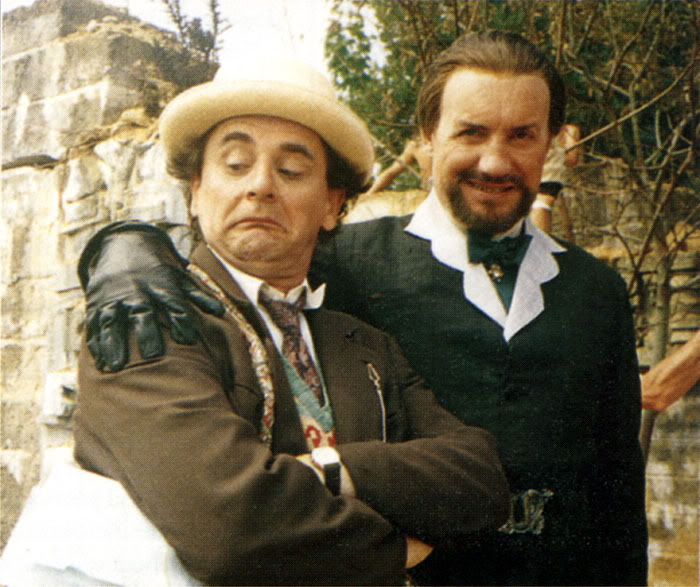
And the Master’s back! Although his interpretation wasn’t to everybody’s taste, I’ve always had a soft spot for Anthony Ainley (and considering how the New Series has treated the Master, Ainley is a model of restraint).  Survival is probably his best Doctor Who appearance as the Master (although his best appearance overall as the Master can be found on the links of the Destiny of the Doctor CD-ROM game).

For once, he has no grand scheme – like everybody else he’s just fighting for survival.  But once he returns to Perivale, things do fall apart.  The sight of the Master recruiting a gang of teenagers from the local Youth Club is bizarre, to say the least, and his motivations at the end of the story seem confused.  At one point, he tells the Doctor that he has control over the power and that he’ll use it to destroy him.  In the very next scene, the Master and the Doctor are back on the planet of the Cheetah People and the Master’s attitude has completely changed – now he wishes to die, as he doesn’t want to live as an animal.  As happened so often, script editor Andrew Cartmel seems to has overlooked plot-holes like this, which would have been easy to fix.

Although it’s not really visible, the Master’s murder of Karra (Lisa Bowerman) is quite vicious and serves as a reminder that he could be ruthless when the situation demanded it.  Karra is the Cheetah Person who forms a strong link with Ace.  And Ace’s prominent role in the story is another link to NuWho, where the companion is often more important to the story than the Doctor (although Survival is not unique in this respect – and in fact this is the last in a loose trilogy which put Ace to the fore).

Whilst Ghost Light was the last story from the original run to be recorded, Survival was the last to be transmitted and it’s really the end of an era.  Doctor Who would survive – initially as books, then a one-off TVM, then audios and then finally the relaunched series in 2005 which achieved levels of success (in the UK and also worldwide) both commercially and critically that the original series only enjoyed somewhat intermittently.