Q5/Q6/Q7 – Simply Media DVD Review

164454- Chief Crazy Horse Sleeve.indd

Terence Alan “Spike” Milligan, one of the key figures of British comedy, rose to prominence thanks to his work on The Goon Show.  He starred alongside Peter Sellers, Harry Secombe and (for the first two series only) Michael Bentine, with Milligan penning the majority of the scripts as well.  The Goon Show ran during the 1950’s, at a time when radio was still king, enabling Milligan’s absurd flights of fancy to reach an impressively large audience.  Informed by the traumas of his time spent in the army during WW2, The Goon Show introduced various riffs which would occur again and again in Milligan’s work (Adolf Hitler, for example, became an oft-used comedy figure).

Milligan’s earliest forays into television were on ITV during the 1950’s – The Idiot Weekly – Price 2d, A Show Called Fred and Son of Fred.  But it would be the Q series (made between 1969 and 1982) that would prove to be his enduring television legacy.  The shows were written by Milligan and Neil Shand, with occasional contributions from writers such as John Antrobus and David Renwick.  Just as Shand was an important partner on the scripting front, so Spike also seemed to draw strength from appearing alongside performers who plainly operated on his wavelength.  Some would drop in and out whilst one – John Bluthal – remained an everpresent fixture.

After something of a gap between the first and second series, Q became a more regular television fixture during the mid seventies and early eighties.  Milligan didn’t want the sixth and final series in 1982 (renamed by the BBC as There’s a Lot of it About) to be the last, but it seems that the BBC weren’t interested in commissioning any more.  That Milligan was still keen to continue is interesting – sketch comedy is often seen as a young man’s (and woman’s) game – so the fact that Milligan, at this point in his early sixties, was still energised by the thought of working in the sketch format was quite unusual.

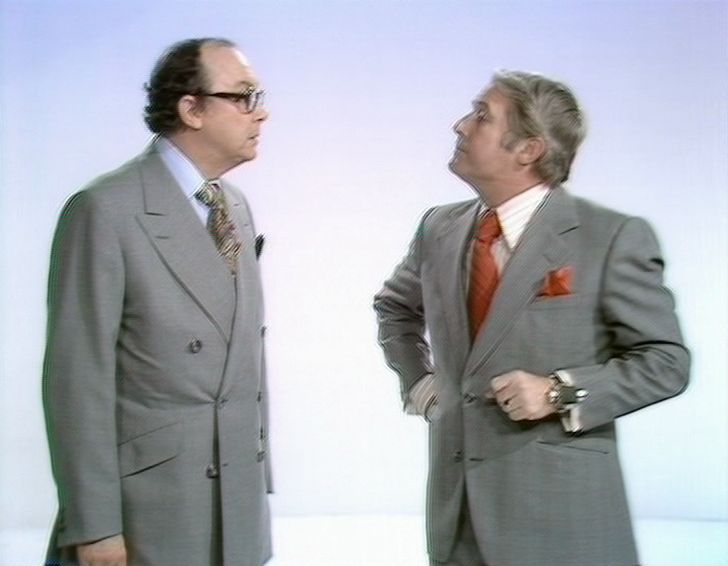
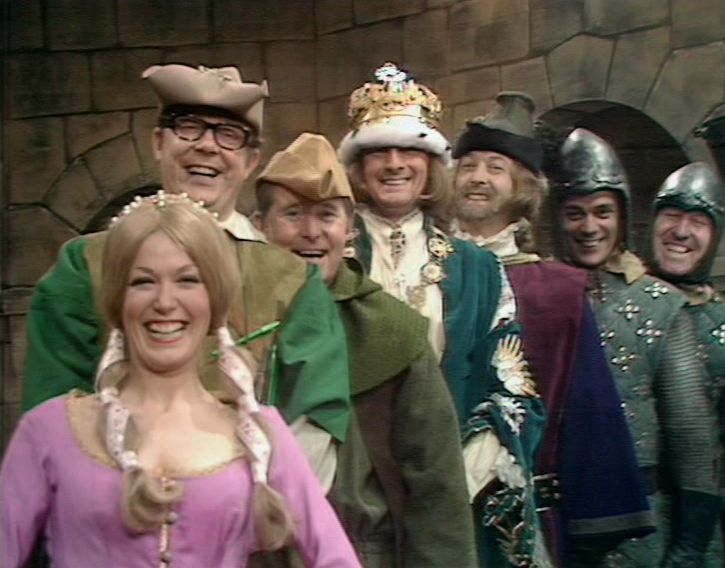
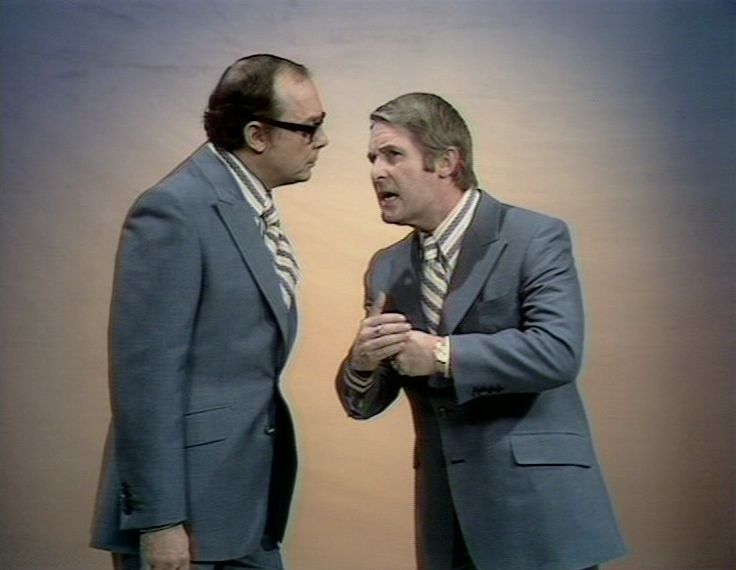
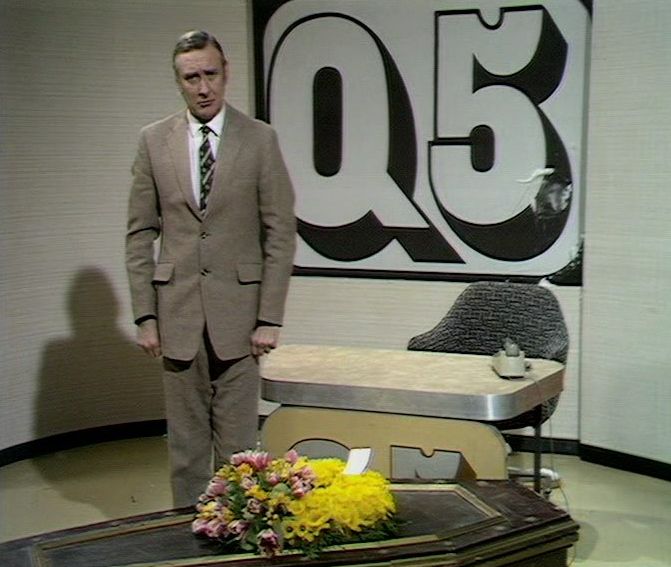
Broadcast in early 1969, Q5 remains a landmark comedy programme.  It’s often been cited as a key influence on the nascent Monty Python team, who at the time were preparing their debut series (it would air at the end of the year).  As is probably well known, the Pythons were rather crestfallen after watching Q5, since Milligan had gleefully broken just about every rule in the comedy book they were left wondering what was left for them to do …

There’s an obvious connection between Q5 and Monty Python (Q5 director Ian McNaughton was especially requested by the Pythons since they’d admired his work with Spike) but the similarities run deeper than that, as it’s very easy to see several Q5 sketches (such as the Grandmother Hurling Contest at Beachy Head) fitting perfectly within the Python format.

But there are differences too – Q5 has a much looser, improvised feel than most of Python.  Milligan was more than happy to play with the artifice and conventions of television – he and the others would step in and out of character, wander off set, arbitrarily stop a sketch mid-way through or seem to be on the verge of corpsing.  Some sections are almost impossible to describe (a comedy riff is built up and developed almost to breaking point).
q5.jpg

This scattergun approach obviously means that not everything works – but sometimes it’s the nonsense that’s the most appealing thing. Often an idea is established but then dropped almost immediately as the show veers off in a completely different direction, meaning that whatever else Q5 is, it’s certainly not boring. Those who believe that The Fast Show pioneered the form of rapid-fire sketch comedy will have to think again ….

Given Q5’s importance in the history of British comedy, it’s a great shame that only three of the seven episodes now exist (and two of those are black and white telerecordings).  Out of the existing material, the absurdist theme is established early on (“pim-pom po-po-pom”) which you simply have to see, describing it just doesn’t do it justice.  It’s ramshackle and nonsensical, but probably the best thing in the episode.

The next surviving Q5 episode develops a theme that Milligan had first used in his Goon Show days.  Any phrase, if repeated often enough, could be guaranteed to get a laugh.  Back then it was “he’s fallen in the water” here it’s “a tree fell on him.”  The link to the Goons is strengthened thanks to several references to Harry Secombe – although he doesn’t appear in this one (but in the next episode we do hear Secombe’s unmistakable tones, as he plays a man trapped inside an elephant).   Milligan’s turn as Ned Teeth,  a mystic guru from Neasden, is another unforgettable Q sketch.
q6-01.jpg

Spike Milligan’s relationship with the BBC was always a rather tense one.  The Corporation may have broadcast many of his finest comedy moments (The Goon Show, Q) but Milligan always felt that they tolerated, rather than respected, him.  This partly helps to explain why a follow up to Q5 didn’t appear for six years.

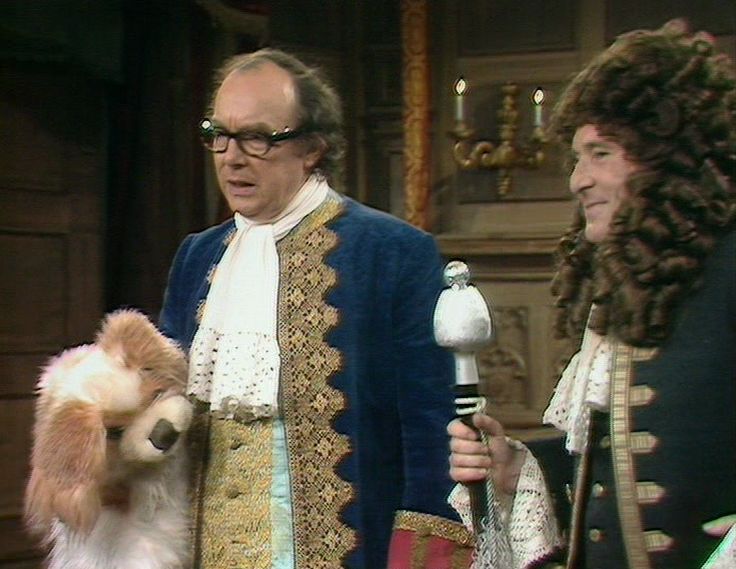
By the time that Q6 was broadcast in 1975, the comedy landscape was very different.  Monty Python had been and gone, but the legacy of their four series remained.  Although Milligan had pioneered stream of consciousness comedy, Q6 would face a challenging time as it attempted to escape the imposing shadow cast by Python.

The likes of Peter Jones, David Lodge and Robert Dorning are regulars throughout Q6. Along with the ever-present John Bluthal, they all excel at providing solid support for Spike’s surreal flights of fancy. Jones, always a favourite performer of mine, is especially good value at whatever he’s asked to turn his hand to.  On the female front, Julia Breck is there to provide a touch of glamour whilst Stella Tanner handles the character roles.

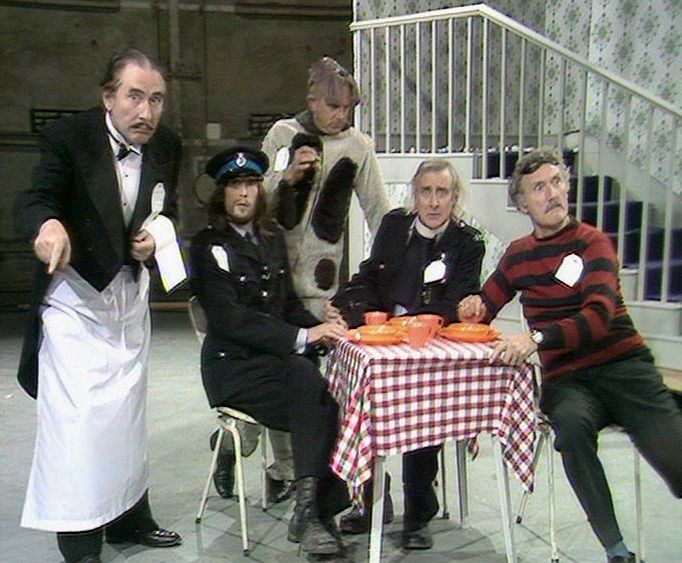
The opening moments of the first episode sees an attractive topless woman appear for no obvious reason, presumably except that it entertained Milligan. A touch of gratuitous titillation would be a hallmark of the 70’s and 80’s Q. This first edition also has a nice guest appearance by Jack Watling and plenty of digs directed at the BBC. The remainder of Q6 has plenty of stand-out moments as well as numerous ones which can’t be adequately explained. Spike as Adolf Hitler meeting Bluthal’s Quasimodo is one such sketch. If it sounds odd on paper then it’s even odder when seen on the screen.  The economy police sketch is another strange, albeit entertaining, few minutes.
q06-02

John Bluthal’s skill at mimicking Hughie Green is put to good use several times, notably in the game show, Where Does It Hurt? The rules are simple, people with afflications or with a willingness to injure themselves can win cash prizes if the audience – via the painometer – register laughter and applause at their discomfort. With oddles of fake sincerity from “Green” and obviously fake studio applause it’s one of the more straightforward sketches.

Less conventional is Spike’s love song directed at a cardboard cutout Princess Anne. With the noted jazz pianist Alan Clare (who’d later become something of a semi-regular) providing accompaniment, it appears that as Milligan’s ardor increases, so does the size of his nose. It’s just one of many unforgettable Milligan moments.

The final Q6 show has one of its most famous sketches – the Pakistani Dalek. Dalek creator Terry Nation (or more likely his agent Roger Hancock, brother of Tony) was always reluctant to see the Daleks used as figures of fun, but it’s not too surprising that Spike got his way. Nation had been a member of Associated London Scripts (ALS) back in the sixties – a writers cooperative formed by Milligan, Eric Sykes and Galton & Simpson – so Nation’s links to, and respect for, Milligan clearly ran deep.

Also featured throughout Q6 are musical interludes, although they’re sometimes as leftfield as the rest of the series. Highlights include Ed Welch performing The Silly Old Baboon, a song written by himself and Milligan.

It might have been a long time coming, but Q6 is a strong series – all six episodes are packed with Milligan’s trademark oddness and the pace rarely flags.

Most of the regulars from Q6, although sadly not Peter Jones, returned for Q7, along with a few new faces – John D. Collins (later to be a regular in Allo Allo) and Keith Smith (probably best known for playing the irate headmaster Mr Wheeler in Alan Plater’s Biederbecke trilogy).

The first edition has a couple of lengthy sketches (Bermuda triangle/Arabs) and it’s possibly the first example of the series standing on the spot. In the Bermuda Triangle sketch Spike asks “what other TV show gives you a smile, a song and a load of crappy jokes?” and he’s maybe not too far off the mark.

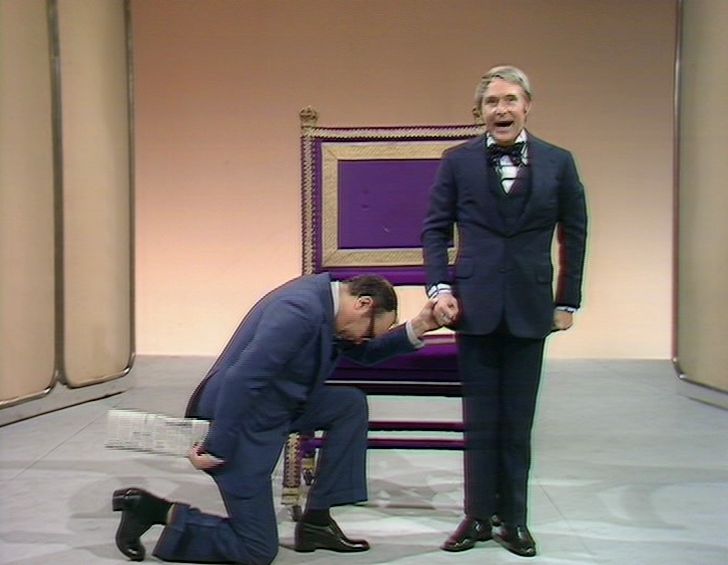
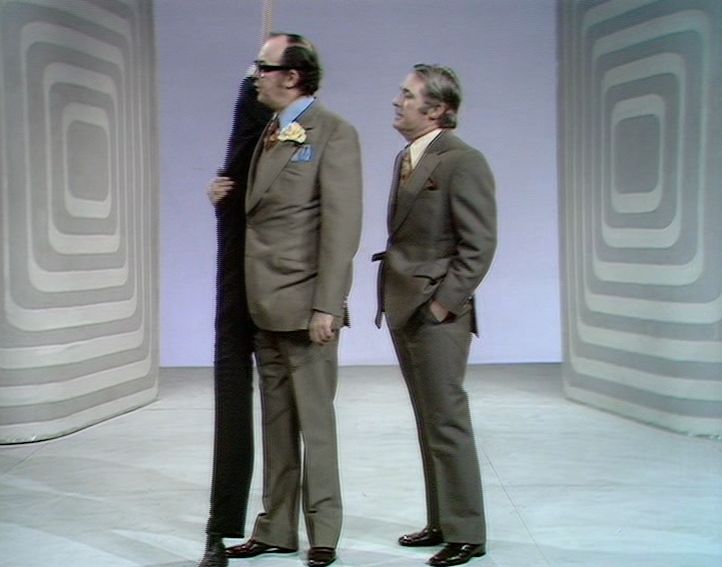
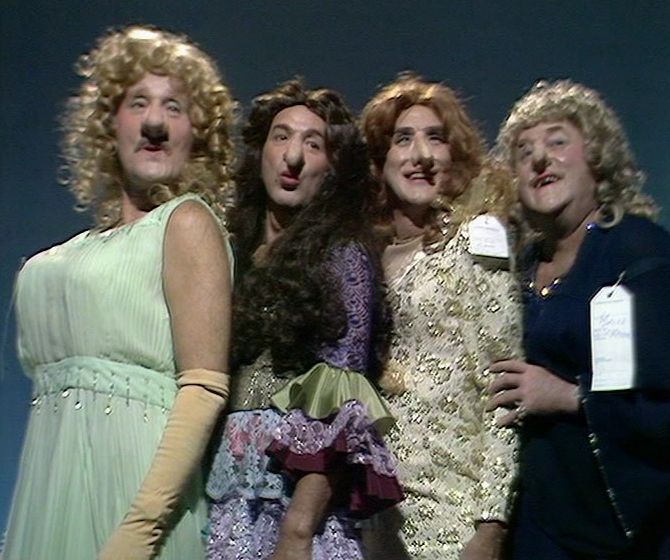
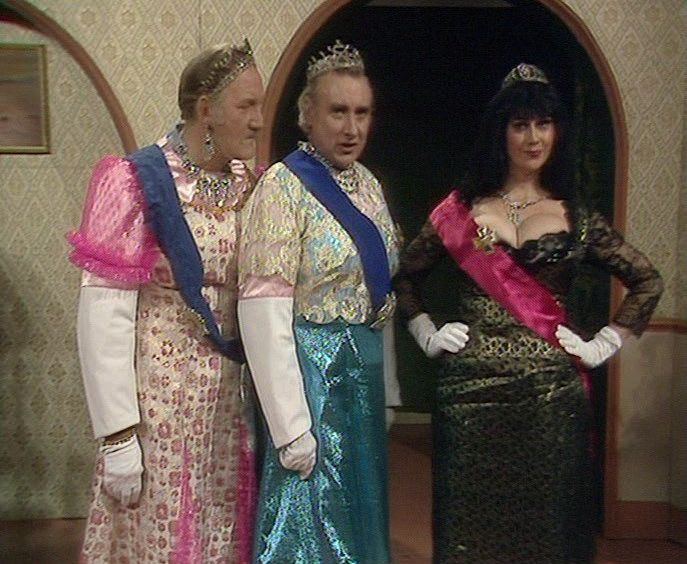
Things pick up in the second show, David Lodge in drag and John Bluthal doing his best W.C. Fields voice are always entertaining, but the best moment – live from Covent Garden – comes towards the end. Milligan dragged up and blowing raspberries, what more could you want?  Overall, Q7 is more hit-and-miss than Q6 and what remains of Q5, but there’s still plenty of gems – you just have to dig a little deeper to find them.

If you have the remotest interest in British television sketch comedy then Q5/Q6/Q7 is an essential purchase.  Whilst all three series are very much of their time, paradoxically in many ways they’re also timeless.  Good comedy never gets old and this is very good comedy.

Q5/Q6/Q7 is released by Simply Media on the 21st of November 2016.  RRP £24.99.
q7.jpg

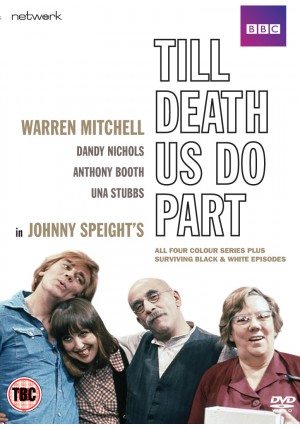
Till Death us do Part to be released by Network – 5th December 2016

till death.jpg

Till Death us do Part will be released by Network in December.

Highly popular – and more than a little controversial – Johnny Speight’s classic sitcom satirised the less acceptable aspects of conservative working-class culture and the yawning generation gap, creating a sea change in television comedy that influenced just about every sitcom that followed.  As relevant today as when first transmitted, Speight’s liberal attitude to comedy shone a light on some of the more unsavoury aspects of the national character to great effect.

Starring Warren Mitchell as highly opinionated, true-blue bigot Alf Garnett, Till Death Us Do Part sees him mouthing off on race, immigration, party politics and any other issues that take his fancy. His rantings meet fierce opposition in the form of his left-wing, Liverpudlian layabout son-in-law Mike, while liberal daughter Rita despairs and long-suffering wife Else occasionally wields a sharp put-down of her own.

Though all colour episodes exist, many early black and white episodes were wiped decades ago. The recent recovery of the episode Intolerance, however, alongside off-air audio recordings made on original transmission allow us to present a near-complete run of the series from beginning to end.

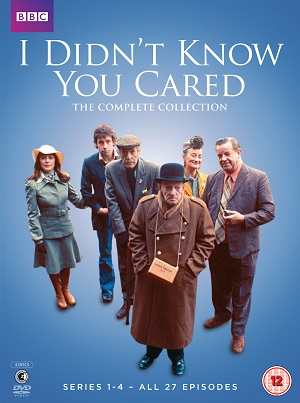
I Didn’t Know You Cared to be released by Second Sight – 28th November 2016

7067

Second Sight will be releasing all four series of Peter Tinniswood’s classic sitcom I Didn’t Know You Cared in late November.  Review here.

Classic BBC sitcom I Didn’t Know You Cared arrives as a fantastic DVD Box Set featuring all four series courtesy of Second Sight.

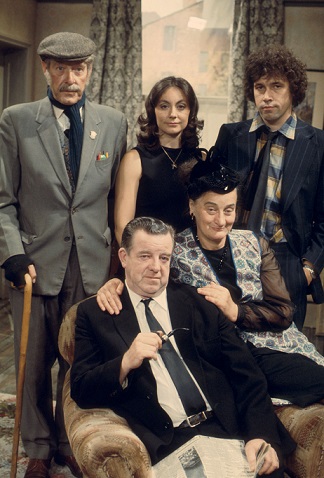
Based on Peter Tinniswood’s renowned books comes one of television’s greatest comedy families, The Brandons, in this hilarious 1970s series. There’s miserable pessimist Uncle Mort (Robin Bailey – Charters & Caldicott), his sharp-tongued sister Annie played by the inimitable Liz Smith (The Royle Family), who is forever rowing with her husband Les (John Comer – Last Of The Summer Wine), there’s their laid-back son Carter and his not so laid-back fiancee Pat and finally old Uncle Staveley who carries his friend’s ashes around his neck in a box and only enters the constant bickering with his cry of ‘I ‘eard that! Pardon’.

This brilliant slice of great British comedy arrives as a bumper four-disc DVD box set on 28 November 2016.

In series one we meet the feuding Brandon family, the only thing that unites them is their determination to turn their lazy son Carter (Stephen Rea – Dickensian) into a go-getting executive before he marries his fiancee Pat (Anita Carey – Whatever Happened to The Likely Lads?). Uncle Staveley (Bert Palmer – Z Cars), contributes to the family rows with his familiar catchphrase. There are seven episodes: ‘Cause For Celebration’; ‘A Knitter in the Family’; ‘The Old Tin Trunk’; ‘After the Ball Was Over’; ‘Aye…Well…Mm…’; ‘Large or Small, Big or Tall’ and ‘The Axe and the Cleaver’.

The second series sees Carter return from his honeymoon but he hasn’t quite adjusted to married life. There are six episodes: ‘The Way My Wife Looks At Me’; ‘Chez Us’; ‘A Woman’s Work’; ‘A Signal Disaster’; ‘You Should See Me Now’; and ‘Good Wood, God’.

Series three sees Uncle Mort worrying about dying and Carter, this time played by Keith Drinkel (Gandhi), worrying about his future at work, this series see his wife Pat played by Liz Goulding (Within These Walls). It features six episodes: ‘Men At Work’; ‘Grave Decision’; ‘Party Games’; ‘A Bleak Day’; ‘Stout Deeds’; ‘Paradise Lost’; and ‘The Last Tram’.

The fourth and final series sees the Brandons get a lodger, Pat (Liz Goulding), goes on a work trip to Europe and Uncle Mort’s pending nuptials. This series sees Leslie Sarony (Monty Python’s The Meaning of Life) star as Uncle Staveley. There are seven episodes: ‘The Love Match’; ‘Love is a Many-Splendoured Thing’; ‘A Tip Top Day’; ‘Don’t Answer That’; ‘The Great Escape’; ‘What’s In a Name?’; and ‘The Great Day’.

7094

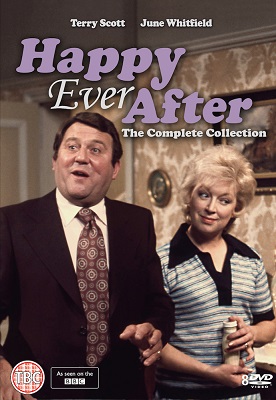
Happy Ever After – Simply Media DVD Review

164454- Chief Crazy Horse Sleeve.indd

Happy Ever After first surfaced as a one-off Comedy Playhouse episode in May 1974. Like many other series launched via Comedy Playhouse, including Meet the Wife, it would quickly develop into a fully fledged series.

Since series one of Happy Ever After followed just two months later, in July 1974, it’s clear that audience reaction wasn’t a factor – the BBC must have sensed that this was a format that had legs.  And so it proved, Happy Ever After ran for forty one episodes between 1974 and 1979 and then Terry & June (essentially the same series but with a few differences, which we’ll discuss later) chalked up sixty five episodes from 1979 to 1987.

Out of the two series, Terry & June – thanks to repeats and DVD releases – has by far the greatest profile.  But it’s a profile that’s not always been terribly positive.  Regarded by some as old-hat and embarrassing, T&J has often been cited as an example of all that’s bad and lazy about traditional sitcoms.  An over-reliance on unlikely occurrences and remarkable coincidences (later wonderfully parodied in Chance in a Million) and Terry Scott’s mugging to camera are some of the suggested reasons.  But whilst T&J did run out of steam, it also had more than its fair share of great comedy moments – as did Happy Ever After.

Created by John Chapman and Eric Merriman, Happy Ever After’s format is a simple one. Terry and June Fletcher are a middle-aged, happily married couple who have recently seen their grown-up children, Frank, Susan and Debbie, leave home.  But their hopes for a quiet life spent in each other’s company are rudely shattered when cranky Aunt Lucy (Beryl Cooke) and her mynah bird come to stay.

The format of the series would remain fairly constant.  Terry would hit upon a brilliant idea or become embroiled in events which would spiral out of his control, June would remain on the side-lines – ever patient – whilst Aunt Lucy would chip in with the odd comment.  When the series became Terry & June it carried on pretty much as before (except that Aunt Lucy had been written out).

The other change was that Terry and June’s surname was Fletcher in Happy Ever After but had become Medford in Terry & June.  This was because series creator John Chapman felt that the show had run its course by 1979.  The BBC disagreed, so a change of surname was enough to ensure that Chapman couldn’t claim the new series featured his characters, even if things carried on pretty much as before.

Although it’s difficult not to see both series as one entity, there’s a slightly different tone to Happy Ever After, especially to begin with.  It just feels a little bit more sharper (possibly not surprising since any format will eventually begin to lose its sparkle over the years) and the plots are tighter.  The presence of Aunt Lucy is also a major plus (the absence of a similar character in T&J was a shame).

happy-01

But whilst the writing is important, Happy Ever After stands or falls on the performances of the two leads. Terry Scott (1927 – 1994) had been a television star since the 1950’s, starting with Scott Free in 1957.  More success on the small screen would follow in the 1960’s – teaming up with Hugh Lloyd in Hugh and I and the bizarre-sounding (and sadly wiped) Gnomes of Dulwich.  Another series – Scott On … – would air between 1964 and 1974 (running to twenty four episodes).  He also turned up in a number of films, including several Carry Ons.

June Whitfield (b. 1925) is, like Scott, a British comedy legend, and her longevity has only helped to increase her stature.  She began as a supporting player, appearing opposite Peter Sellers in The Idiot Weekly, Price 2d, Jimmy Edwards in The Many Faces of Jim and More Faces of Jim as well as Tony Hancock (most notably in The Blood Donor).  She first appeared with Terry Scott in Scott On … and like Scott would make a few appearances in the Carry On series (although they didn’t appear in the same films).  During the last few decades she’s become familiar to several new generations thanks to Absolutely Fabulous.

The pilot shows Terry and June adjusting to home life now that their children have gone.  Terry is remarkably boorish, pouring June a gin and reminding her that it always used to get her going in the old days. June comments on how coarse he is and on this early evidence they seem a very mismatched pair.

Terry is a bundle of nervous energy (incapable of remaining quiet for a minute) whilst June is content to just relax, buried in a good book.  There’s an unspoken feeling that now the house is theirs again they might struggle to restablish their relationship.  That they’ve not been paying each other a great deal of attention is made plain after Terry is amazed to discover that June’s had a pair of glasses for the last two years – he admits he hasn’t really looked at her for a long time.

This moment, along with June’s tearful regret that the chicks have flown the nest, gives the pilot a slightly wistful air, although Terry’s hyperactive personality – a hamsfisted attempt to do some DIY for example – ensures that the mood doesn’t stay reflective for long.  When the demanding Aunt Lucy turns up with bundles of possessions, poor Terry sees his newly-won freedom fast disappearing …

The first episode of Happy Ever After proper sees Terry shocked to learn that June hasn’t been a Conservative like him during their married life (instead she’s always voted Liberal).  This is a perfect opportunity for Terry Scott to deliver some of his trademark overreacting, but when June tells him she’s considering a short break by herself, it ties back to the suggestion in the pilot that the two of them may be fundamentally incompatible.  Terry then suggests she writes a list of his faults, which she does with great glee!  Later they decide to go on a second honeymoon, which (as might be expected) doesn’t go to plan.  It’s good to see some well-known actors lurking in the hotel, such as Hammer Films stalwart Michael Ripper and radio’s original Dick Barton, Noel Johnson.

Containing the Comedy Playhouse pilot, five series and three specials (two Christmas specials and the final one-off from April 1979) this seven disc set offers a generous helping of 1970’s sitcom goodness.  Classic episodes include the series two effort Terry in Court. Returning home after a business trip, Terry’s more than a little upset to learn that their car has had an altercation with the local dustcart. June insists it wasn’t her fault and after learning that the Council refuse to admit liability, Terry decides to sue them. The trouble really starts when Terry learns that he can represent himself and so appears in court complete with a wig and gown! Scott is firing on all his comic cylinders, helped no end by a very dead-pan performance by Basil Dingham as the judge.

Another favourite is Mistaken Identikit. An identikit picture of a bag snatcher who preys on elderly ladies (giving him the nickname of the “granny grabber”) is broadcast on televison and featured in all the newspapers. And wouldn’t you know it, he looks just like Terry! Robert Gillespie pops up as a phelgmatic desk sergeant and the always-watchable Josephine Tewson also makes a brief appearance.

The Music Went Around & Around is a notable episode, as it was John Kane’s first script for the series.  Kane would only pen a couple of episodes for Happy Ever After, but he’d go on to write the bulk of Terry & June (notching up more than forty episodes). In this one, John Quayle and Janine Duvitski are both wonderful as Ralph and Cynthia, the dinner guests from hell. Terry later attempts to replace one of his classic records from the 1940’s – The Hut Sut Song. Julian Orchard, as the harrased record shop proprietor, is another first-rate guest performer, as is Damaris Hayman (who plays Miss Sneed, an assistant at the record shop). Amazingly, she’s heard of this obscure song and it’s a comic treat when she and Terry launch into a spirited performance of The Hut Sut Song.

Unashamedly middle-of-the-road fare, Happy Ever After has aged very well.  This is partly because of the contrasting comic talents of Terry Scott and June Whitfield, but the scripts are also pretty strong and it’s always nice to see familiar faces popping up in guest roles.

Happy Ever After is released by Simply Media on the 26th of September 2016.  RRP £44.99.

happy-02

Fawlty Towers – The Hotel Inspectors

hotel

Fawlty Towers is as close to sitcom perfection as you can get.  If one were being picky then you could say that the second series does have one sub-par effort (The Anniversary) but this is only because the other eleven were so good.

There are several obvious reasons as to why the series clicked from the start (even if the public and critical feedback for series one was a little muted to begin with).  These include the scripts by John Cleese and Connie Booth and the four regulars (Cleese, Booth, Scales, Sachs).

But equally important were the guest casts.  Basil Fawlty has to have strong characters to interact with, otherwise his manic personality ends up unbalancing the show.  Strong characters require good actors though, but Fawlty Towers never had a problem in acquiring the best comic actors around.

Joan Sanderson, Geoffrey Palmer and Bruce Boa were amongst those who were able to stand toe-to-toe with Cleese.  Some sitcom stars (especially if they were the co-writer as well) may have found themselves threatened by having to share the screen with experienced old pros (there’s plenty of evidence down the years to suggest that certain actors hated to have the limelight shone on anyone but themselves).  Cleese had a refreshing lack of ego on this score though and never seemed worried that others may get bigger laughs than him.

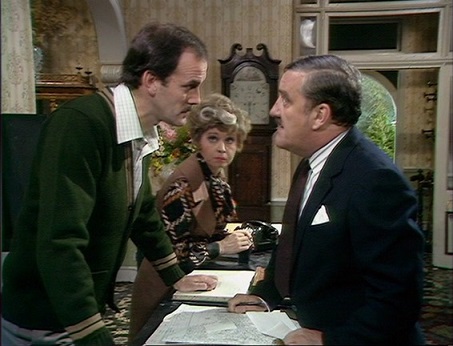
The Hotel Inspectors has one of the series’ most recognisable guest stars.   Bernard Cribbins (b. 1928) remains a national treasure.  He first came to prominence in the 1960’s with a number of film appearances (several Carry Ons, The Wrong Arm of the Law with Peter Sellers, etc).  In the 1970’s he became a children’s favourite, narrating The Wombles and making regular appearances on Jackanory.  He continues to act, probably his most high-profile recent credit was as Wilfred Mott in Doctor Who.

Mr Hutchinson (Cribbins) has arrived for a stay at Fawlty Towers.  His profession is a bit of a mystery but Basil, getting the wrong end of the stick, mistakenly believes that he’s a hotel inspector.

If Basil was rude to every guest who walked through the door then it would be amusing, but the joke would wear thin pretty quickly.  The genius of Cleese and Booth’s scripting is that Basil is a man of many and varied prejudices, which then informs us about which guests he favours or disfavours.  If you’re a member of the promiscuous society, for example, you’ll attract Basil’s ire, but a titled or professional person is guaranteed a much easier ride.

To begin with, Mr Hutchinson irritates Basil, mainly because of the way he talks.

Mr. Hutchinson: There is a documentary on BBC2 this evening about Squawking Bird, the leader of the Blackfoot Indians in the late 1860s. Now this starts at 8.45 and goes on for approximately three-quarters of an hour.
Basil: I’m sorry, are you talking to me?
Mr. Hutchinson: Indeed I am, yes. Now is it possible for me to reserve the BBC2 channel for the duration of this televisual feast?
Basil: Why don’t you talk properly?
Mr. Hutchinson: I beg your pardon?
Basil: No it isn’t.
Mr. Hutchinson: What?
Basil: It is not possible to reserve the BBC2 channel from the commencement of this televisual feast until the moment of the termination of its ending thereof, thank you so much.

The sudden gear-change which occurs when Basil believes Hutchinson to be a hotel inspector is a lovely moment.  From indifference and contempt, Basil quickly becomes the perfect host.  But even when Basil’s trying his best, things never quite work out (witness the saga of the omelette) and like every other week his house of cards slowly collapses until he’s left humiliated and isolated.  This sounds a little bleak, but luckily for us Basil always seems to recover from whatever crushing reversal he’s received in order to do battle the following week.

BBC Landmark Sitcom Season

hancock.jpg

Running across BBC1, BBC2, BBC3 and BBC4, the upcoming Landmark Sitcom Season is a series of one-off specials designed to celebrate sixty years of the British sitcom (Hancock’s Half Hour, which debuted on BBC tv in 1956, has been taken as the starting point).  Of course, if any prove to be popular they can be developed into full series, which means that the cynics amongst us might regard this as little more than a season of pilots …..

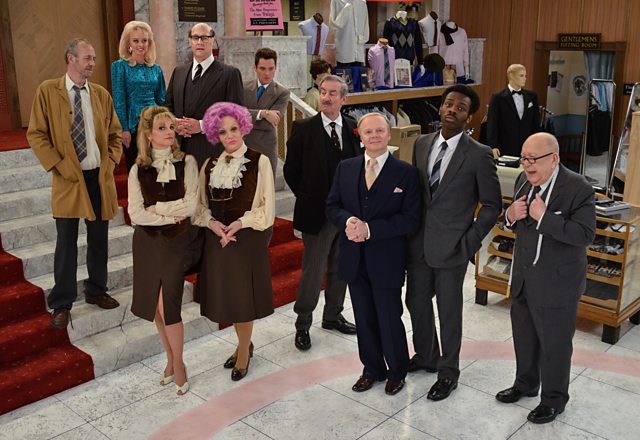
For the purposes of this blog, there’s seven which are of interest – four on BBC1 and the other three on BBC4.  BBC1 gives us Porridge, Are You Being Served, Goodnight Sweetheart and Young Hyacinth (a prequel to Keeping Up Appearances) whist BBC4 has Hancock’s Half Hour, Till Death Us Do Part and Steptoe and Son.

Goodnight Sweetheart is notable because it’s the only one able to reunite the original cast (alas, time has caught up with most of the stars from the others).  Marks and Gran have already revived another of their sitcoms, Birds of a Feather, on ITV, so it’s not difficult to believe that this has been made with one eye on a full series.

Young Hyacinth is another that’s easy to imagine has been crafted as a back-door pilot.  Writer Roy Clarke has form for this – First of the Summer Wine was an effective (if not terribly popular, ratings-wise) prequel to Last of the Summer Wine – and the current success of Still Open All Hours suggests that Clarke would be up for a revisit of another of his old shows.  Some other time I’ll cast an eye over Clarke’s whole career – it’s amazing that he’s still going strong and it has to be said that his CV is a varied one with a lot more to offer than just umpteen years of Summer Wine.

Are You Being Served looks to be a pitch-perfect recreation of the original series, complete with all the familiar catchphrases.  Whether this is a good or bad thing is very much down to personal taste of course ….

p044wkt3.jpg

Porridge looks to be doing something a little different.  It would have been easy enough to cast someone not physically dissimilar to Ronnie Barker (Peter Kay for example) and simply rehash old glories, but the clips show that it’s very much set in the present day (unlike Are You Being Served which remains stuck in the mid eighties) .  One positive is that the updated Porridge has been scripted by Clement and La Frenais themselves, although it’s slightly concerning that they’re not adverse to plagiarising themselves.  Familiar gags (“I won’t let you catch me”) and a martinet Scottish prison officer are present and correct.

Whilst the BBC1 revivals feature new scripts, the ones on BBC4 take a different approach.  Steptoe, Hancock and Till Death are newly recorded versions of wiped originals …. well sort of.  All the Steptoe episodes still exist, so they’ve chosen one which only remains as a poor quality B&W video recording.

These three episodes have a very different feel to their BBC1 counterparts.  The original sitcoms tended to be rather studio-bound, but these new recordings heighten this feel.  The lack of solid walls in the sets makes them seem rather theatrical and artificial, although it’s more than likely that this has something to do with the fact that BBC4 has a considerably lower budget than BBC1.

Although some of the efforts look interesting rather than rib-tickling, I have to say that I’m looking forward to the Hancock episode.  Kevin McNally has already recorded a number of missing HHH radio scripts for Radio 4 (jolly good they are too) and his performances make it clear just how much love and respect he has for the Lad Himself.

When the season’s up and running I’ll be blogging about some of my favourite British sitcom episodes.  So I guess now’s a good time to go off and do some research …..

Whatever Happened to the Likely Lads? – 1974 Christmas Special

likely

The Likely Lads, broadcast in the mid 1960’s, was the first sitcom success for Dick Clement and Ian La Frenais.  They then revived the series in the 1970’s as Whatever Happened to the Likely Lads?

The revival was even better than the original, thanks to the way the characters of Terry Collier (James Bolam) and Bob Ferris (Rodney Bewes) had developed.  In the original series they were unattached men in their twenties, but by the revival they were a decade older and, in Bob’s case at least, men with commitments (Bob had married his long-time fiance Thelma).

This was unusual for a sitcom, as normally they tend to remain static, unchanging affairs.  Think, for example, of Dad’s Army, Porridge or Fawlty Towers.  In those cases, characters are trapped together (because of the war, prison, the job they do).  The format of Whatever Happened to the Likely Lads? was much looser as it revolved around Bob’s eternal dilemma – he loves his wife, but he doesn’t want to lose contact with his best friend.

Over the years Bob and Terry had changed from the people we met in the sixties.  Then, they were equal – both working in the same factory and sharing a similar outlook on life.  But in WHTTLL?, Bob is married, holds down a responsible job, has a nice house on a new estate and is thoroughly middle-class.  Terry is quite different – after a spell in the army he’s content to drift along, with no particular direction in mind.  What keeps them together is their vague sense that things were better when they were younger (the theme song ponders “is the only thing to look forward to, the past?” which sums things up nicely).

This melancholic longing for a simpler time is one of the reasons why the series was so good.  And had Bolam and Bewes not fallen out dramatically (it’s reputed they’ve not spoken for nearly forty years) then it wouldn’t have been surprising if Clement and La Frenais had chosen to revisit the characters every decade or so (in a sort of 7 Up way it would have been fascinating to see how Bob and Terry fared through the eighties, nineties and into the twenty first century).

Broadcast on the 24th of December 1974, this Christmas Special was the final television episode – although Bolam and Bewes would re-record the series one shows for radio in 1975 and shoot a film version in 1976.

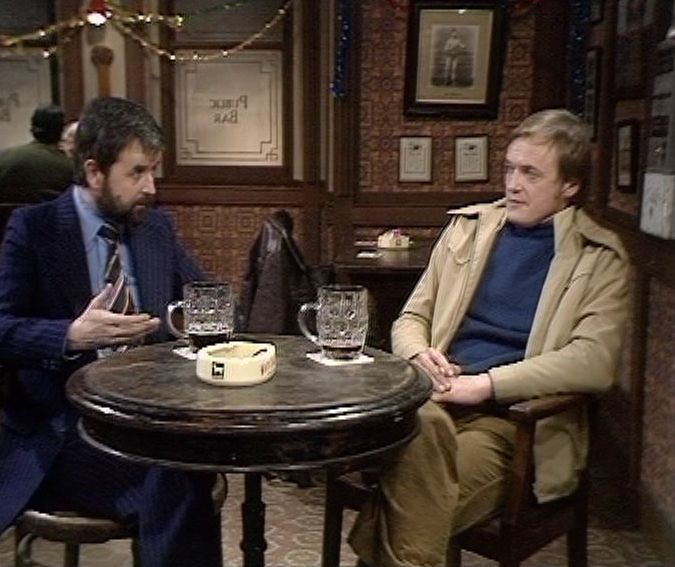
We open with Bob feeling trapped.  Thelma (Brigit Forsyth) is in Christmas planning mode – a sight which remains familiar today.  She’s fretting about the cards she needs to write, the presents she has to buy and their social engagements.  Bob isn’t thrilled to learn that he’ll be spending Christmas with his mother-in-law or that Thelma has committed them to a number of parties (when he’d much rather be relaxing at home, watching The Great Escape).  His lack of success at charades last year still rankles – as he reminds Thelma, she had an easy one – Great Expectations –  whilst he had to struggle with The AA Continental Handbook!  The pay-off to the scene is that it’s only late September, another nod to those people who need to get everything organised for Christmas months in advance.

Terry’s spent the duration of WHTTLL? content to be unemployed.  There’s a change here, as Bob and Thelma spy him taking his driving test (and of course they manage to put him off).  Despite this he still passes and he later tells Bob that he’s planning to become a long-distance lorry driver.  He has to settle for a job driving a fork-lift truck though, and it’s clear that he’s disappointed.  Terry had assumed that once he had his driving licence it would be his passport to better things – he really wanted a job where he could take his vehicle home during the evening and impress the girls.  But the only job he found like that involved an ice-cream van!  As Bob says, his chance of pulling birds in that would have been wafer-thin.

Another sign of the timeless nature of the episode is Terry’s complaint that Christmas is just too commercialised these days.  Bob doesn’t agree, he loves every aspect of Christmas (another way in which he hankers for earlier, simpler times?).  Over a pint in the pub, Terry reminds Bob that he was the last person in school to believe in Santa Claus.

I remember the day vividly. Christmas Eve afternoon it was, sitting in our back kitchen in front of the fire, reading Lord Snooty in that years Beano annual. I’d got it early, because the week before I’d been crying a lot with a boil on me neck. Anyhow, there I was, couldn’t have been happier, not a worry in the world except how Santa was gonna get a fire engine down our chimney. Then you show up with an evil, malicious grin on your face and said, ‘Santa Claus is dead.’

Bob goes on to remember that Terry had told him that Santa had been gored to death by his reindeer!

If the pub scene is the heart of the episode, there’s more traditional sitcom fare afterwards as Bob and Terry make their way home, very drunk.  Bob’s lost his car keys, so Terry elects to drive him home in his fork-lift truck.  And since he doesn’t have his front door key either, he uses the fork-lift to raise him up to the bedroom window.

On Christmas Eve, Bob and Thelma are on their way to a fancy dress party – Bob as Captain Hook and Thelma as Peter Pan (Terry’s got the job of driving their mincab).  Judging by the reaction of the studio audience they hadn’t seen Bewes’ costume before he entered the living room, since it draws an audible ripple of appreciation.  Once they get to the party, Thelma is appalled at the goings on – it seems that all their married friends have paired off with other people.  Bob’s not immune – he has his eye on Sylvia Braithwaite.

There’s more sitcom hi-jinks when a fuming Thelma asks Terry to drive her home, with neither realising that Bob and Sylvia are in the back of the cab.  Thelma invites Terry in for a drink and Sylvia insists that Bob drive her home in Terry’s cab.  This he does, but Terry sees the cab driving off and reports it stolen.

Running for just under forty-five minutes rather than the usual thirty, it’s tempting to wonder if it was originally planned as a half hour episode – if so, it would have ended with the fork-lift truck scene.  Was the fancy-dress party sequence bolted on later?  But however it was written, the final moment (when both Thelma and Terry realise that Bob stole the cab) is a great beat to end the series on.

The Wheeltappers and Shunters Social Club – 27th April 1974

wheel s01e03

Tonight’s Turns:

Stephane Grappelli and Diz Disley Trio
Little and Large
Tony Brutus
The Barcias
Terri Rogers
Lonnie Donegan

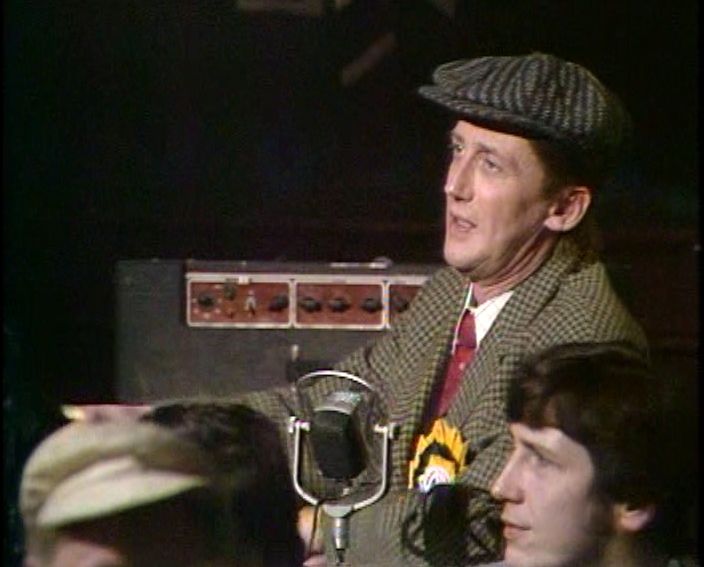
Another typically eclectic Wheeltappers show opens with Stephane Grappelli.  His lengthy career saw him play with a wide variety of fellow musicians – including Pink Floyd, Duke Ellington, Oscar Peterson, Paul Simon, Yo Yo Ma as well as Yehudi Menuhin (the pair recorded several well-received albums).  It’s hard to imagine a less likely artist to grace the bill of a working man’s club, but once you accept the incongruity of his appearance, it’s a very enjoyable (albeit brief) turn.

From the sublime to the, well, rather less sublime.  At their peak (during the late seventies and well into the eighties) Little and Large were one of television’s top-rated attractions – their BBC shows generated very good ratings which turned the pair into major stars.  But in the decades since, their stock has plummeted – so much so that today they’re mostly forgotten or held in barely disguised contempt by those who do remember them.

Does their turn here hint at any forgotten greatness?  Not really no, although it’s probably an accurate snapshot of the act they’d honed playing many similar club gigs during the years prior to their big television break (they formed in the 1960’s, so the pair had spent a long time slogging around the unforgiving club circuit).  Syd attempts to sing a song but finds himself interrupted by Eddie in numerous ways (Quasimodo impressions, using his electric guitar as a sledgehammer, etc).  Personally, I saw them live in 1985 and thoroughly enjoyed their show, so maybe they were an act that worked better in the live environment.  On television their limitations were possibly more easily exposed.

Strongman Tony Brutus attempts to lift both Bernard Manning and the local Mayor off the ground.  This is an impressive, albeit brief, feat.  The specialty acts continue with the Barcias, who display some decent feats of agility.

Next up is vent act Terri Rogers.  Rogers was an interesting character – she was born male but underwent a sex-change operation in the early 1960’s.  This naturally enough generated a certain amount of publicity, but it didn’t prevent her from enjoying a lengthy career as both a magician and a ventriloquist – mainly in the clubs, although in later years she notched up appearances in Las Vegas and on American television.

The contrast between the highly coiffured Rogers (complete with tiara) and the somewhat tatty, slightly foul-mouthed doll is the best part of her turn, even though she may not be the greatest technical ventriloquist ever (I suspect the large microphone was strategically placed at times to obscure her moving lips!).

The show ends with a bona fide British showbusiness great – Lonnie Donegan, the King of Skiffle.  He was an influence on virtually every aspiring British musician in the 1950’s (including, most famously, The Beatles).  His later musical career was less successful, as tastes changed, so it’s not difficult to imagine him in this sort of club setting during the mid 1970’s.  Like the rest of the turns, he’s only got a few minutes to make his mark, but his energetic act certainly brings this edition of the Wheeltappers to an impressive end.

The Two Ronnies Old Fashioned Christmas Mystery (1973)

ronnies 73

Apart from their links and sketches for the 1972 Christmas Night with the Stars, this was the Two Ronnies’ only Christmas special during the 1970’s.  With Morecambe and Wise reigning supreme, there was less need for a Two Ronnies Christmas show as well – but after M&W jumped ship to Thames, the Ronnies would gradually fill the void – with stand-alone specials in 1982, 1984 and 1987 (as well as Christmas shows from other years as part of their regular series).

The 1973 Old Fashioned Christmas Mystery was an attempt to do something a little different from the norm.  It takes place at the country house of Sir Giles (Ronnie Barker) and Lady Hampton.  The year is 1872 and the mystery of the title refers to the Christmas turkey – somebody’s stolen it, so what will Sir Giles’ guests have to eat for Christmas lunch?

He decides to engage the services of that ace detective Piggy Malone (and his trusty assistant Charley Farley).  Given that Malone and Farley appeared in four serials during the 1970’s and 1980’s, it’s a little surprising that none of them were set in Victorian times – maybe something of a missed opportunity.  As might be expected, they bumble about for a while, and the mystery is never really solved (although they do inadvertently provide an alternative for the Christmas dinner).

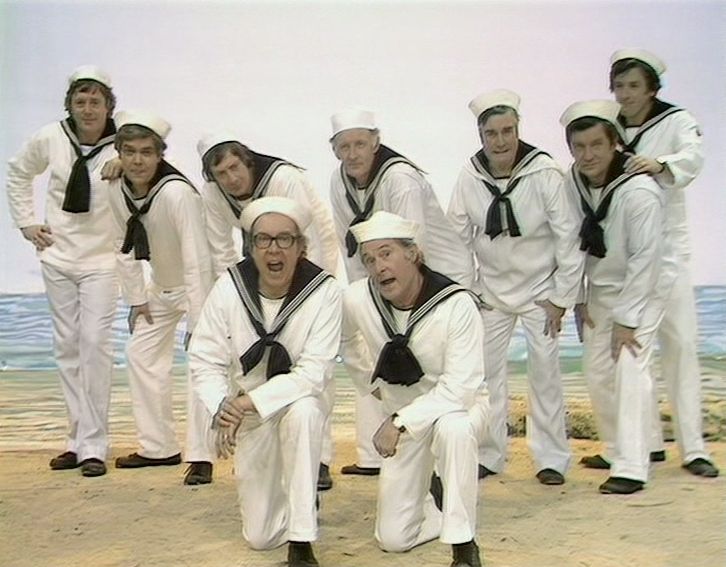
Although on the surface this looks different from the normal Two Ronnies shows, underneath there’s still plenty that’s familiar.  Ronnie B delivers a monologue, Ronnie C sits in a chair (more comfortable than his usual one) to spin a shaggy dog story and both of them end proceedings with some musical numbers (new words to the familiar tunes of Gilbert & Sullivan).

Along the way there’s some guest stars.  Tux (a man who balances plates on his head) was a throw-back to the specialty acts that were a regular feature during the first series.  Gabrielle Drake is gorgeous as Emma, who has her eye on Ronnie C – although he seems totally immune to her charms.

Cheryl Kennedy provides one of the stand-out moments by performing a monologue, Christmas Bells.  Given the opulent surroundings it’s something that certainly has an impact and serves as a timely reminder that we should always stop to remember (and help) those at Christmas who are less fortunate than ourselves.

Hear the bells are ringing, Bill? That’s cos it’s Christmas Eve. But it ain’t for you and me as there’s a ringing. When we is cold and hungry, Bill, it’s hard to make believe, as we can hear the happy angels singing. If we had a bed to sleep in, and could get a bite to eat, then bells of angel’s voices might remind us. But not when you’re to doss, Bill, in the cold and cruel street, where the Bobbies are nearly always sure to find us. Ah, it’s dreadful hard on you, Bill, cos you’re such a little kid, what didn’t oughta know a bit of sorrow, and wouldn’t if them Christian folks would do as they was bid. Why, him whose birthday’s gonna be tomorrow. But it was him what said, “Let little children come to me.” And meaning just such little coves as you, Bill. But I ain’t got no chance, cos I’m fourteen you see. And I’ll tell you, as I knows a thing or too, Bill, you can’t sell evening papers so as to get a bit to eat, like I done since the time as I was seven, without picking up enough of badness in the street to leave no earthly chance to get to heaven. Them coves what comes around with tracts summed me up a treat. I’m an outcast, little heathen, poor lost sinner.
Perhaps they’d be the same if they’d been brought up in the street and hardly ever had no proper dinner. But Bill, when you and me is dead, I’ll come along wi’ you, and you shall introduce me as your brother. And him who’s knows what sorrow is, he’s sure to let me through. Cos why? We’ve been such pals to one another. Ain’t we, Bill?

The Morecambe and Wise Christmas Show 1977

m&w 77

The 1977 Morecambe and Wise Christmas show was the end of an era – their last before moving to Thames.  It’s well known that this show attracted the largest ever Christmas audience – 28 million viewers – except of course that it didn’t.  The 1977 Mike Yarwood Christmas Show (which preceded M&W) also attracted 28 million viewers – but had a slightly larger audience share. Therefore it’s Yarwood who can said to be King of Christmas.

It’s slightly splitting hairs though – 28 million (at that time roughly half the population of the UK) was an incredible figure.  Yes, it was the pre-digital, pre-internet, pre-VHS age, so the choice of alternative entertainment wasn’t large, but it’s still an impressive achievement that will never be matched.

What would this audience have seen?  The show opens with a Starsky and Hutch parody – Starskers and Krutch.  It’s virtually a shot-by-shot recreation of the Starsky and Hutch title sequence, which works so well due to the attention to detail.  The film work (shots of the car travelling down the street through a blizzard of paper, for example) gives it a glossy, expensive feel.

Elton John’s back – although he finds a great deal of difficulty in locating the studio.  Along the way he meets a variety of familiar faces, such as newsreader Kenneth Kendall as well as John Laurie, John Le Mesurier and Arthur Lowe.  Quite why the three Dad’s Army soldiers are sitting fully-dressed in a sauna is something of a mystery – and the segment seems to have been designed just so Arthur Lowe can call Elton a “stupid boy”.  It’s a nice moment though, and all of Elton’s encounters help to sell the idea that the BBC was one large entertainment factory, with stars lurking behind every corner.

Angharad Rees looks gorgeous and Eric is fulsome in his praise. “I’ll tell you something Hand Grenade. I was thrilled when I realised that you’d escaped from Colditz.”. Eventually, Ern manages to explain that Angharad was the star of Poldark and not Colditz.

Angela Rippon’s back – this time as a member of the chorus line.  They were obviously pleased with this moment – as it’s repeated (slightly faster each time) throughout the show.

The sense that this is the end-of-an-era is strengthened by the final BBC flat sketch.  Everything is packed up as they’re preparing to move.  But there’s still time for Eric to make some familiar digs at Ern’s expense.

ERIC: I remember the first time you ever stuck your head out this window.
ERN: When was that?
ERIC: It was blowing a gale. It blew your wig off. It landed in that garden down there. A little old lady came out and gave it a saucer of milk.

Nothing Like A Dame is one of the crown jewels from Morecambe and Wise’s BBC career.  Apart from the pleasure in seeing some familiar BBC faces, it’s mainly the excellent editing (making the guests appear to be responsible for incredible feats of acrobatic prowess) which is why it’s so memorable.  Eric was famously sure that it wouldn’t look convincing, but it really does work well.  It must have taken time and money to edit and assemble, but it’s another sign that M&W could call on all the available BBC resources.

Penelope Keith and Francis Matthews star in Cyrano de Bergerac.  Several of Keith’s Good Life co-stars make cameos (Richard Briers, Paul Eddington) and it’s an improvement over the 1976 play simply by being a little shorter.  Penelope Keith also wanted to take part in a big song and dance number – and she gets her wish, sort of.  It’s just a pity that somebody forgot to complete the staircase …..

That would appear to be the end of the show, as the then credits roll.  But afterwards we see Elton John reach the studio – but he’s too late.  The show’s over, the audience has gone home and there’s only two cleaners left (played by Morecambe and Wise).  This allows us to see how tatty the audience seating was (i.e. very tatty) and it provides a somewhat melancholy ending to the show as Elton performs his song to an audience of two.  Wisely, they didn’t dub any audience reaction onto this section later.  It’s also noteworthy that Elton’s complete performance was recorded on one camera and with one take – quite impressive.

It’s an interesting ending to Morecambe and Wise’s last hurrah at the BBC.  In retrospect, the 1971 Christmas Show was by far their best (and it seems clear that the pressures of repeating that success caused some problems in the years following) but the 1977 show does run it quite close.  Morecambe and Wise would carry on, but things would never be quite the same at Christmas again.

The Morecambe and Wise Christmas Show 1976

m&w 76

The 1976 Christmas Show was the second that Eddie Braben didn’t write – although it’s certainly better than the previous non-Braben show (1972) and also an improvement on the 1975 show.  Mike Craig, Barry Cryer, Lawrie Kinsley and Ron McDonnell were on writing duties (with additional material from M&W).  Although Ern sometimes seems a little dim (not realising that Eric’s Christmas gift was incredibly duff, for example) overall it’s a good attempt at synthesising the Braben style.

There’s a dress-up sketch, similar to efforts from some of the previous Christmas shows (Turkeys/Reindeers).  Here, Morecambe and Wise are two members of a table-top football team.  Ern’s the new left back, whilst Eric has been there a while.  “42,338 consecutive games. And only had the trainer on once. And that was for a coat of varnish.”

The Nolans sing When You Are A King.  They’re very pink.

Elton John’s good value.  Initially he attempts to provide piano accompaniment for the boys.

ELTON: Do you want this blues, reggae or funky?
ERIC: (looks offstage) Can he say “funky”? No, “funky”. You were close. The studio manager is looking it up. It’s a gift he has.

Eventually Elton gets so frustrated he grabs Eric (although slightly too hard as they bump faces – watch out for Eric and Ernie’s expressions, priceless!).  He then appears a few more times, before getting the chance to sing Sorry Seems to be the Hardest Word.  He obviously made a good impression as he’s back the following year.

By this time, Ernest Maxin had taken over as producer.  He had choreographed some of the musical numbers on previous shows – so it’s maybe not surprising that song & dance numbers tended to feature quite strongly during his time as producer.  Since M&W (especially Ernie) both loved song & dance, it’s something that plays to their strengths and there’s two good examples in this show.

Ernie performs Singing in the Rain whilst staying bone-dry (it’s Eric who gets wet).  As Ernie was always something of a frustrated song-and-dance man, it’s a lovely segment for him.  The street set looked very impressive, especially for such a short sequence – which was a clear indication just how highly the BBC rated M&W (clearly money was no objective when crafting the Christmas show).

The play boasts appearances from John Thaw, Dennis Waterman and Kate O’Mara.  They help to liven things up – especially John Thaw – but like a number of the other plays it’s just far, far too long.  At twenty minutes, it feels very padded out.

Nowadays it’s a common sight for newsreaders to dress up and perform (Children in Need  or Strictly Come Dancing, amongst others).  Back in 1976, it just didn’t happen – which explains why Angela Rippon’s appearance caused such a sensation.  M&W get to dress up in top hat and tails and it provides a nice end to an entertaining show.

The Morecambe and Wise Christmas Show 1975

m&w 75

Things get off to a bad start almost straight away.  Somebody decided that the title music needed rearranging – so it’s gone all funky (wah-wah guitars and saxophone).  This is bad enough but the problems are compounded by the fact that when the titles are running there’s no clips of what’s to come (everything we see is of past glories – Andre Previn, Shirley Bassey, etc).  Watching these brief moments of old classics would really only work if the current show was of a similar standard.

And sadly, it’s not.  Eddie Braben might be on writing duties, but he seems to have struggled this year.  It opens brightly enough though.  Ernie’s less than impressed with Eric’s present to him – a ballpoint pen with a piece of chain still attached (“That’s where I snapped the chain at the post office”).  But that’s nothing to the shock Eric receives from Ern’s present – a Des O’Connor record (“God, if you want me to be a goner, get me an LP by Des O’Connor”).

After some more digs at Des (“That’s the best record Des has ever made … You mean there’s nothing on it at all?”) Mr O’Connor turns up to demand an explanation for the years of cruel jokes.  The byplay between Des and Eric & Ernie is one of the best parts of the show, especially when Des seems to go off script, much to the bewilderment of Eric (“This is all new.  You never once said ‘indelible thought’ at rehearsal”).

This then sets up a running gag of Des attempting to sing and getting thwarted each time – until he eventually manages to send the boys off on a wild goose chase, so that he can finally serenade the audience.

Apart from that, there’s not a great deal that’s really memorable.  There’s a quick sketch with Robin Day that descends into a punch-up at the end.  Periodically throughout the show we cut back to them as the fight gets more intense.  Things don’t always become funnier if they’ew repeated – that’s borne out here.

There is one great sketch though – Eric and Ernie visit a maternity shop to buy a present for Ern’s expectant sister.  Ern seems to be totally oblivious to how babies are born (“Hey. Why are those frocks so big?”) and then takes offence to the innocent questions asked by the girl behind the counter (Ann Hamilton).

My sister hasn’t got a husband.  My sister’s not married!  As a matter of fact, my sister will have nothing to do with men.  She doesn’t like men.  She wouldn’t let a man touch her any time, I’m telling you!  I don’t like that sort of thing meself, either.  All that nasty business that goes on.  It’s not nice.  All that fumbling and crumbling that goes on, I know all about that.

Diana Rigg is the big guest star and rather unusually she first appears, completely unheralded, in a sketch about a psychiatrist before starring in the big end of show play.  Ernie is Samuel Pepys, Eric is King Charles II and Diana is Nell Gwynn.  It’s long – possibly a little too long – running at just under twenty minutes, but there is some filming to break up the studio stuff as well as an unexpected appearance from Gordon Jackson (who was a favourite with the viewers at the time, thanks to Upstairs Downstairs).

If his final line “What would Mrs Bridges say?” is a little obvious, then that sort of sums up the show.  M&W would jump ship from the BBC to Thames a few years later, mainly because they were concerned that their shows were becoming stale and felt that a different network would give them new impetus.  Whether the Thames shows were an improvement over the later BBC ones is a debate for another time, but on the evidence of the 1975 Christmas Show, M&W were somewhat treading water.

The Morecambe and Wise Christmas Show 1973

m&w 73

After the disappointment of the 1972 Christmas Show, Eddie Braben was back on writing duties for 1973, so there’s a definite upswing in the quality of the material.  The show opens with Eric advising Ernie to check the Stop Press of The Harpenden Bugle and Advertiser.  Ernie has been awarded the following title – Lord Ern of Peterborough (“She was going to make you a sir, but she didn’t think knights were that short”).  There’s some more choice lines, such as –

ERIC: You’ll realise you’ll have to have a monogram?
ERNIE:  I’ll have no time for playing records

It’s this sort of banter that was largely absent from the previous Christmas Show.  Of course, there’s the inevitable disappointment for Ern when he realises that Eric’s put his new present of a typewriter to good use by typing in the Stop Press of The Harpenden Bugle and Advertiser ….

When Ernie introduces John Hanson as England’s number one musical comedy star, that gave me pause for thought.  If that was so, then time hasn’t been kind to him as he’s pretty much forgotten today.  But his M&W appearance will probably continue to keep his name alive, and he does work well with Eric & Ernie.  His chat with them in front of the curtain is a joy.

Eric’s in a particularly playful mood, especially when John has trouble saying The Chocolate Soldier.  Ernie asks him if he meant The Chocolate Soldier, just to make things clear for the audience, but Eric’s not going to let the moment pass, “No, what he said … Socolate Choldier”.  After some more good-natured banter with M&W he gets the chance to sing, backed by Eric & Ernie, who are joined by Edward Heath, Harold Wilson, Jeremy Thorpe and Enoch Powell!

Hannah Gordon’s up next, but she’s surprised to find that she’s not been hired to act – instead they want her to sing, which concerns her (“I can’t sing a note”).  But she’s game, so has a bash at The Windmills of Your Mind.  M&W have built a set for her, which should strike a note of caution for anybody who’s watched the previous Christmas Shows.  It boasts a very impressive windmill which picks up Ern (or at least his stunt double) and whirls him around.

Up next is a bedroom sketch.  It lasts for just over six minutes and I think out of everything they ever did, it’s my favourite bit of Morecambe and Wise.  Virtually every line is a winner –

ERN: Have you cut yourself?
ERIC: No, no no. My face is a bit sore, thanks to that new bathroom cabinet.
ERN: Why, what’s wrong with it?
ERIC: It’s all those fancy designs on the mirror.
ERN: What do you mean?
ERIC: I’ve just spent the last 20 minutes trying to shave a seagull off me left cheek

ERN: You’ll have sciatica in the morning.
ERIC: I won’t, I’ll have shredded wheat like everybody else.

And the best line (as a police car races past the window) from Eric – “He’s not going to sell much ice cream going at that speed, is he?”

No Kenny Ball alas, but The New Seekers aren’t too bad. The last twenty five minutes or so feature Vanessa Redgrave and they get good value from her in both a musical number as well as a play. She’s suitably vampish in the musical number (the part where she makes Eric’s maracas drop off never fails to make me laugh) and playing Josephine she attempts to seduce Eric’s Duke of Wellington. Ernie is a suitably diminutive Napoleon with a fondness for concealing rabbits in his tunic.

If somebody was compiling a Morecambe & Wise best of, possibly only the flat sketch would make the grade. But the rest, whilst not hitting the heights of 1971, is consistently good – which makes this show a pleasure from beginning to end.

The Morecambe and Wise Christmas Show 1972

m&w 72

It’s astonishing to think that the responsibility for writing virtually all of Morecambe & Wise’s BBC shows (both the series and the Christmas specials) fell on the shoulders of one man – Eddie Braben.  Other programmes, such as The Two Ronnies, would employ numerous writers, enabling them the luxury of picking the best material from a large pool of talent.

But apart from the odd recycled sketch (such as the Grieg sketch from the 1971 Christmas Special) pretty much everything was down to Braben.  And given how well received the 1971 Christmas Show had been, the pressure was on to equal or better that.  Braben would later explain the strain this put him under.

The real pressure came when I was sat in front of that typewriter with all those blank pages and there was a deadline and there was nothing happening. That’s when you realised there were 20 million or 25 million people looking over your shoulder – all saying ‘make me laugh’.

In 1972 the pressure proved to be too much and Braben had a nervous breakdown.  Whilst he recovered, the scripting of the 1972 Christmas Special would be handled by Barry Cryer and John Junkin with Mike Craig and Lawrie Kinsley providing the Reindeer sketch and Morecambe & Wise contributing “additional material”.

It’s possible to detect right from the start just how much Braben will be missed this year.  The opening crosstalk sees Eric play a number of practical jokes on Ern (a buzzer in his hand, a flower that squirts water and a telescope that leaves a black mark around Ern’s eye) although Ern has the last laugh by presenting Eric with a present that squirts foam into his face.  It’s funny enough, but it’s difficult to imagine Braben ever writing anything like this.  One of Braben’s greatest contributions to the legacy of M&W was to change their crosstalk personas, as he would later explain –

I hadn’t liked their stage ­persona. Eric was too gormless, in my view. Ernie was too abrasive and hard-edged. Yet, at that meeting it was obvious there was genuine friendship and affection between them. There was humility and innocence, too. None of that was being shown in their work, so I reckoned if all that could be developed, it would show a different, softer side to ­Morecambe and Wise.

I came back with 30 pages of material with my vision of a new, reinvented Eric and Ernie. In a way, I was caricaturing the two men as they really were. I never told Eric and Ernie that this was really a showcase for their mutual affection, because I was afraid they might become self-conscious and spoil it. Ernie was delighted with his new role. ‘At last I’ve got something to perform,’ he told me.

Until then, Eric had always referred to Ernie as his Wellmaboy. So called because as the straight man, it was his job to draw the funny line out of Eric — ‘Well, my boy, so what happened next?’ Eric would be more worldly, but as the funnyman would still bounce off Ernie, who for years had been the archetypal straight man. Now, for the first time he would have a personality of his own — he would be a playwright; conceited, pompous, and vain.

The warmth developed by Braben is largely absent from the 1972 Christmas Show (it’s notable for example that there isn’t a flat sketch – a key Braben contribution).  But at least Kenny Ball and his Jazzmen are back, so it’s not all bad news.  The Reindeer sketch is a highlight (even if it’s recycling the dress-up idea from the previous year) with a surprise cameo from Bruce Forsyth at the end.

One area where it seems that inspiration was running low concerns the appearances of Jack Jones and Vera Lynn.  Both of their spots are identical – a chat, a song where M&W appear in the background to upstage them and then a song performed without interference.  It’s a winning formula, but to repeat it wasn’t probably the best idea.

We get two plays here – Dawn Patrol with Pete Murray and Victoria and Albert with Glenda Jackson.  Dawn Patrol would probably have been twice as funny had it been half as long.  Victoria and Albert is better, as it doesn’t outstay its welcome so much and there’s a nice song and dance at the end, ensuring that the show ends on a high.

Overall, the 1972 Christmas Show is something of a disappointment which serves to highlight just how important Eddie Braben had become to the M&W show.  Hopefully, normal service would be resumed in 1973.

The Morecambe and Wise Christmas Show 1971

m&w 71

The 1971 Morecambe and Wise Christmas Show is the one where everything came together.  Three consecutive sequences are all-time M&W classics and have been endlessly re-shown over the past four decades.

The show opens with Eric registering his appreciation of the audience. “Lovely audience. They’ve done us proud, haven’t they, the BBC. Not bad, considering they fell off the back of a lorry. I love them when they’re like this, all drunk. Beautiful”.  Eric and Ernie then discuss just how much the BBC values them.  It appears that Dick Emery is top-rated, with Ern below him and Eric right at the bottom (if the size of the tankards they receive are anything to go by).  Eric’s certainly dismayed with the size of his (“I’ve only got a little-un”).

The sight of M&W dressed as turkeys is something that lingers long in the memory.  Presumably they decided not to do a retake at the start (where Ernie almost falls over) as it would have dulled the audience’s appreciation of their initial appearance.  It’s broad stuff, but there are some good lines, such as Eric’s “I don’t fancy lying in a tin of hot fat, on me back, with a roast potato stuck between me knees”.

There’s something missing from this show – no Kenny Ball and his Jazzmen.  And frankly, Los Zafiros are no substitute.  Following that disappointment, we then move into the heart of the show.  The next thirty minutes or so (Glenda Jackson, Andre Previn, Shirley Bassey) are pretty much as good as it gets.

After Glenda indulges in some crosstalk with Eric and Ernie they launch into a big song and dance number, paying tribute to Fred Astaire and Ginger Rogers.  This initially concerns Glenda, who protests that she can’t dance a step, but she manages very well.

There’s also the chance to see some familiar BBC faces (Cliff Michelmore, Frank Bough, Eddie Waring, Patrick Moore, Michael Parkinson and Robert Dougall all make quick cameos).  By paying tribute to a song and dance act from the 1930’s, nobody could claim that Morecambe and Wise had their finger on the pulse of current trends, but frankly that’s not a problem.  There’s a timelessness to great entertainment (whether it’s M&W or Fred & Ginger).

Next up is Andre Previn conducting Greig’s Piano Concerto, soloist Eric Morecambe.  This sketch dated back to the mid 1960’s and was written by M&W’s previous writing team of Sid Green and Dick Hills.  It’s a little strange and indeed disappointing that they didn’t receive a credit for this at the end (which has led many to assume that it, like the rest of the show, had been written by Eddie Braben).

The obvious change from the original to the 1971 version is the inclusion of Andre Previn as the conductor (displacing Ernie).  This does mean that Ern has less to do, but as it’s Previn who makes the sketch so memorable, that’s unavoidable.  As is probably well known, due to his busy schedule Andre Previn was unable to take part in any rehearsals, which worried Eric who was convinced that this whole sketch (the centrepiece of the Christmas show) would be a disaster.

As it turned out, Previn had great comic timing and it’s possible to see the point at which Eric begins to relax (“Pow! He’s in. I like him. I like him”) and realise that he was going to be fine.  Another part of the sketch which works well are the shots of the orchestra in the background, who are visibly enjoying themselves as some of Eric’s lines (“Which one’s the fixer?”) clearly hit home.

Shirley Bassey’s appearance has a similar template to Nina’s appearance on the 1970 Christmas Show – a chat, a song in which her attempts to sing are sabotaged by a specially designed set which doesn’t behave and a song performed with no interference (although Nina’s was in a different order).  As M&W were masters of making rehearsed moves seem like ad-libs, it’s difficult to know if Shirley Bassey’s slapping of Ernie’s face was quite the surprise it appeared to be, but it’s a nice moment nonetheless.

Her performance of Smoke Gets In Your Eyes is another clip that’s very familiar from numerous broadcasts over the years, but it still seems as fresh as ever.  And she then gives us a cracking performance of Diamonds Are Forever.

After all that, the Robin Hood play does come as a little anti-climax, although Ann Hamilton is a winsome Maid Marion and Francis Matthews throws himself into the spirit of things as King Richard.

The 1971 Christmas Special was easily the most consistent of their BBC Christmas specials to date.  Could they equal or better it in 1972?

The Morecambe and Wise Christmas Show 1970

m&w 70

Ern’s less than delighted with Eric’s Christmas present to him – a pair of socks that Eric has just removed from his own feet.  When Ern complains that they’re still warm, Eric explains that he was airing them for him.  Ern’s present to Eric is much more impressive – a silver fob watch, although Eric isn’t pleased when he opens it up and it plays the Colonel Bogey march.

Later on, Eric plans to do something different – sawing a woman in half.  When he asks Ern to get into the box, Ern protests that he isn’t a woman, to which Eric replies, “I haven’t used the saw yet”.  Luckily, there’s a diversion – Peter Cushing turns up, still looking for his fee from his appearance as King Arthur several years ago.  It’s always a pleasure to see Cushing and they’d certainly get some mileage from this running gag over the years.  His appearance here gives Eric the chance to “saw a Peter Cushing in half”.

Kenny Ball and his Jazzmen perform Hello Dolly with a few changed lyrics welcoming Eric and Ernie back (my first thought was that this was something to do with Eric’s heart attack, but the dates don’t match so I’m not sure why Kenny changed the words).

The flat sketch features Eric cooking Christmas dinner for Ern and their guest Ann Hamilton.  Ann Hamilton was such a good utility player for M&W, able to pitch in and play a wide variety of roles over many years. There’s an interesting interview with her here.

Next, Eric and Ernie are joined by Eric Porter, much to Eric’s alarm (“A drunk’s just come on. Play it cool. Don’t worry about it”). Eventually they twig that he’s not a drunk but the famous actor Eric Porter, although Eric’s still not happy (“We don’t want him on. He was rotten the last time”). They then all perform a song and dance act, which allows Porter to demonstrate his hoofing skills. This was always one of the pleasures of the M&W show – watching familiar faces demonstrating unfamiliar skills.

Nina’s back and like Shirley Bassey the following year, she performs two songs – one straight and the other with “help” from Eric and Ernie.  She should have realised there’d be trouble when they told her they’d built a special set just for her …..

The stars keep coming, with a special appearance by John Wayne – although he looks a little different from his big screen appearances (see picture seven below).   And then a real star turns up – Edward Woodward.  It’s difficult to tell if he’s genuinely a little ill at ease or if he’s playing at being irritated – I’d assume the later, since numerous interviews over the years seemed to indicate that he had a healthy sense of humour.

He’s not come on to act though – instead he wants to sing, which he does (performing The Way You Look Tonight).  Although it’s something of a footnote to his career now, he had some success as a recording artist as well as a short-lived Thames series (The Edward Woodward Hour) where he was able to demonstrate his vocal talents.

William Franklyn joins Eric and Ernie for barely controlled chaos in the closing skit, loosely adapted from The Three Musketeers.

The 1970 Christmas Show was a step up from 1969, and the 1971 Show would be better still.

Porridge – The Desperate Hours

porridge 76

Originally Transmitted – 24th December 1976

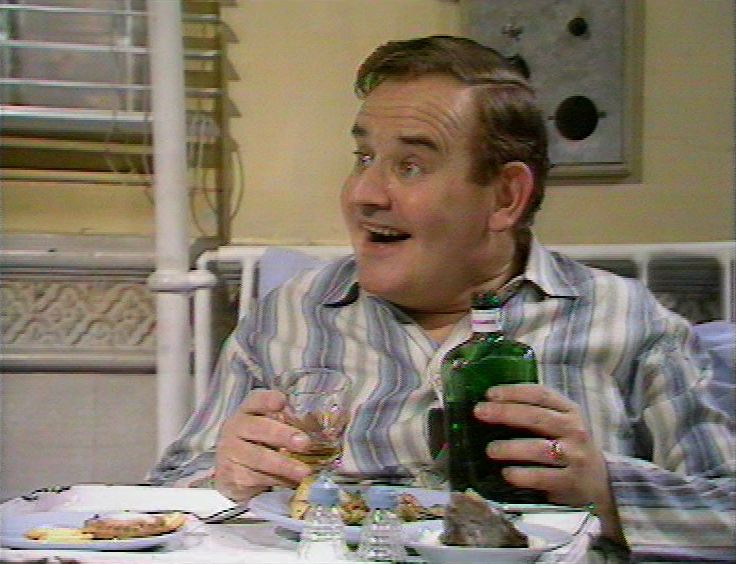
The second and final Porridge Christmas special splits rather neatly into two sections.  The first fifteen minutes or so follow Fletch and Godber’s illegal booze making activities and their attempts to interest their fellow prisoners in purchasing the fruits of their labour.  Two selections were on offer – the two-star and the five-star.  Upon sampling the five-star, Fletcher had very specific instructions.

Now, I must warn you, this should be sipped delicately like a fine liqueur.  It should not be smashed down the throat by the mugful.

Judging by their expressions, Warren, McLaren and Tulip found it powerful stuff – although quite what was in it was something of a mystery.  Next up was the two-star and Fletcher warned them that this wasn’t quite so smooth.

So go carefully, otherwise not only will you lose the flavour and the bouquet but you’ll also lose your powers of speech.

Sadly, their activities were discovered by Mackay who promptly marched them off to the Governor’s office.  The second part of the episode runs for about thirty minutes and it’s possible to believe that this was a normal episode which was expanded with the home-brew opening to produce this Christmas special.

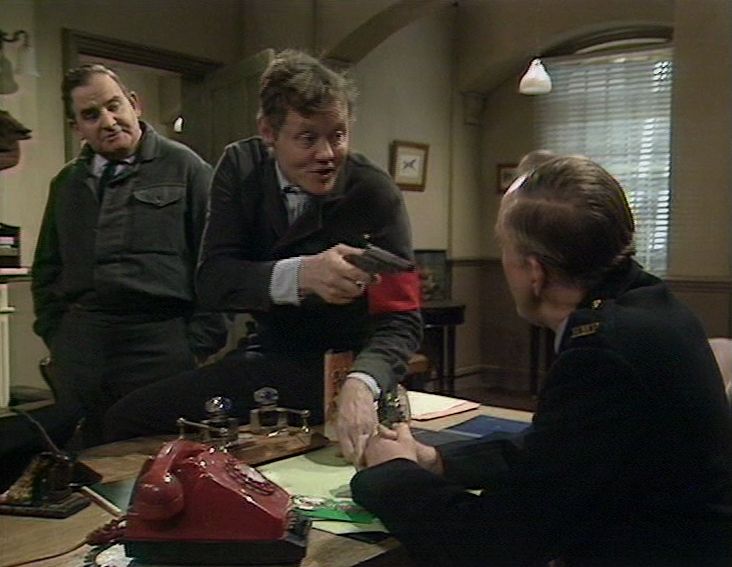
Things take an unexpected turn when the new trusty, Urwin (Dudley Sutton), takes Barrowclough, Fletcher, Godber and the Governor’s secretary (Mrs Jameson) hostage.   He has two demands for Barrowclough (“shut that blind and get me a helicopter”).  The first is easy enough, but the second is going to be more of a problem.

During the course of the siege we learn that Mr Barrowclough and Mrs Jameson are more than friends (something which Fletcher will no doubt make use of in the future) and we also discover a great deal about Urwin.  It’s a lovely performance from Sutton who really is the focus of the episode.

Urwin is a somewhat pathetic character.  Passed over for psychiatric treatment, it looks as if the system has driven him to this desperate course of action.  Eventually, Fletch is able to take his home-made gun off him (a tense and well-acted seen between Barker and Sutton).  Just prior to this, Fletch spells out to him exactly why he’s never going to make it.

There ‘aint no way.  The worst thing that could happen to you is if they say OK.  ‘Cos you know as well as I do that you’d never make it to that helicopter.  They got marksmen out there that can shoot a fly’s eyebrows off at 400 yards.  And if flies had other things they could shoot them off ‘an all.

Fletch shrugs off the admiration of Godber.  It was nothing, he says, since he knew that Unwin’s gun was a fake (it wasn’t, of course, which Fletch inadvertently demonstrates by shooting a hole in the ceiling!).

Less Christmas orientated than No Way Out, The Desperate Hours is a cracking episode, full of the usual witty banter and a fine guest turn by Dudley Sutton.

Porridge – No Way Out

porridge 75

Originally Transmitted – 24th December 1975

Christmas is approaching in Slade Prison and Godber, for one, is getting into the spirit.  He’s encouraged by the number of cons who have congregated around the Christmas tree to sing carols, but Fletcher has to break the bad news to him.

They’re singing in order to drown out the noise of a tunnel that’s being dug in order to allow Tommy Slocombe to escape (“Yeah, that’s the big occasion around here.  It’s not the coming of our Lord, it’s the going of Tommy Slocombe”).  Genial Harry Grout (Peter Vaughan) is behind the escape, so everybody will have to play their part, as Fletcher so memorably puts it “If we are asked to assist, we are in no position to refuse are we?  Otherwise, we’ll wake up one morning and find two more things hanging on the Christmas tree.  Us”.

Fletcher plans to go away for Christmas by wangling a stay in the comfort of the prison infirmary.  But the doctor (Graham Crowden) is having none of it and packs Fletch off to the local hospital for some tests instead.  This allows somebody to slip Fletcher a package containing a blank passport, which is another piece of Grouty’s puzzle, but he still needs something else – a bicycle.  “Certainly” says Fletch.  “What colour?”.

Fletcher, Godber and Warren are able to relive the unfortunate Mr Barrowclough of his bike and Fletcher then professes ignorance when Mr Barrowclough asks him if he knows where it is (“Let’s get this straight.  You are saying that you came to work this morning as a cyclist and will be leaving as a pedestrian?”).

But all of Grouty’s plans seem to have come to naught after some petty pilfering means that the screws declare that Christmas will be cancelled.  This seems to scupper the escape plan but Fletcher has an idea.  Why don’t they let the screws discover the tunnel and whilst they’re busy congratulating themselves, Grouty can quietly spirit Slocombe away by another route?

Grouty agrees and Fletch is delegated to reveal the tunnel to Mr Mackay.  He wants to arrange that Mackay will literally drop right into it.  Unfortunately, it’s Fletcher who drops into the tunnel, right before the astonished eyes of Mackay, but this does mean that Fletch will be able to spend Christmas in the infirmary after all.

Mackay has one unanswered question and promises Fletcher a bottle of scotch if he’ll answer it.  What did they do with all the earth from the tunnel?  Fletch’s answer (“They dug another tunnel and put the earth down there”) is a killer final line.

The first of two Porridge Christmas specials, No Way Out adds another ten minutes to the normal running time, which allows for a few more gags but isn’t so long that it begins to feel drawn out.  That’s one of the problems with Christmas editions of sitcoms when they started to be produced in a 90 minute format – what works in 30 minutes doesn’t always work when extended to 90.  Thankfully, Porridge didn’t go down that route.

Harry Grout is probably the role that Peter Vaughan is most associated with, which is a little surprising when you consider that Grouty only appeared in a handful of episodes.  He is mentioned in a number of others though, so that his presence is always felt (even when he’s not actually seen).  Vaughan’s ability to play everything deadpan and calm is one of the reasons why Grouty works so well – he doesn’t have to raise his voice, just a word or a snap of his fingers will do the trick.

No Way Out is a hardy Christmas perennial, usually to be found each year on BBC2 and certainly receiving several airings on Gold.  Its familiarity might have dimmed a little of its power (and it’s difficult to rewatch it now without hearing the man with the irritating laugh in the audience) but it’s still a Christmas treat.

The Good Life – Plough Your Own Furrow

plough

By 1975 John Esmonde and Bob Larby were a well-established writing team (responsible for hit series such as Please Sir!).  When creating The Good Life they started with pretty much a blank slate – they knew that Richard Briers would star (since the BBC were keen to have Briers appear in another sitcom) but everything else was up for grabs.

The first moment of inspiration came when Esmonde and Larby realised that both Briers and Larby were coming up to the age of forty – as Larby said, it was one of those “Oh God!” ages.  So it was decided that Briers’ character would be facing some mid-life crisis, but what form would this take?

Thoughts such as his character deciding to resign his job and sail around the world or live on a desert island were kicked around (though not terribly seriously) before they hit upon the idea of a man totally fed up with his job and the whole rat-race existence.  So he decides to “drop out” and become self sufficient.  This was a decent idea and the logical move would have been for him to sell his house and buy a place in the country.

But in a stroke of genius, Esmonde and Larby decided that Briers’ character (Tom Good) would do no such thing – instead his house and garden (in the middle of Surbiton) would be turned into a mini-farm, complete with animals, vegetables and all the other paraphernalia required.

With this initial concept decided, the rest of the small cast fell into place.  Felicity Kendall played Barbara, Tom’s long-suffering wife whilst Penelope Keith and Paul Eddington would be the Good’s long suffering next-door neighbours, Margo and Jerry.

Larby conceded that had Margo and Jerry simply been relentlessly negative then the series wouldn’t have worked very well.  Margo and Jerry might disapprove but they remain Tom and Barbara’s best friends and it’s the conflict between their friendship and their disapproval of the Good’s new lifestyle which drives some of the comedy along.

The first episode, Plough Your Own Furrow, is an interesting one.  It’s not wall-to-wall laughs, as there’s space when the characters (especially Tom) pause to reflect upon the course of their life so far.  Partly this may be because it was the first episode of a new series – as time went on, the audiences would become more attuned to the characters, the writing and the style of the programme and be more inclined to show their approval.

As the episode opens, we see Tom celebrating his 40th birthday.  He’s clearly a man searching for something which is, at that time, undefinable.

It’s quality of life.  That’s what I’m after.  If I could just get it right.  I’ll tackle it and get it right, as soon as I know what it is.

It’s plain that he isn’t getting any job satisfaction.   A whole host of small irritations are highlighted – such as the office car-park attendant knowing Jerry’s name, but not Tom’s (“I’ve really made an impact with you over the years, haven’t I?  Cor blimey, I’ve only been here eight years.”) and the fact there was an office cricket team but nobody thought to ask him (“We didn’t need to.  We got my dad to umpire”).

This is another indication that Tom is standing still at best or even moving backwards.  Everybody else in his department is in their twenties, so what does the future hold for Tom?  Jerry joined the company at the same time as Tom, but he’s ascended to the executive level whilst Tom remains stuck on the fourth floor, engaged in vital work such as designing a toy hippo to be included as a free gift in a popular brand of breakfast cereal.

Jerry spells it out to Tom.

We joined this company – what, eight years ago, wasn’t it it?  And do you know something?  I was frightened of you then.  You were a better draughtsman than I was and you had better qualifications than mine.  I was going to have to rely on pure cunning just to keep up with you.  Still, I needn’t have bothered, need I?  Cos look at us.  I’m up here and you’re down there, not getting picked for cricket teams.  And why?  Because you use about one tenth of your ability.  I have to use all mine and what I lack I make up with sheer, bloody crawling.

Then Sir (Reginald Marsh) joins Tom and Jerry (every time I type their names I assume that Esmonde and Larby picked those names as a tribute to a popular cat and mouse partnership) for a chat about his latest top-secret project.

The bubble has just come off the top of the think-tank and I don’t mind telling you that this is an absolute blockbuster of an idea.  It’s going to put our wildlife preservation series in the vanguard of world mouldings.  Our mould is going to be a giraffe! And Tom, I’m thinking of putting this giraffe on your plate.

Tom has the chance to advance his career with some “bloody crawling” but his hysterical laughter at the giraffe news scuppers this.  This is point when Tom finally realises the futility of his job (“You should have heard Sir.  You’d think he’d invented penicillin.  I couldn’t help laughing”).  There has to be more to life, but what?  Then Tom has a lightbulb moment, which he explains to Barbara.

I quit work and we become as damned near self-sufficient as possible.  We’ve got bags of garden, we grown our own food.  We keep some animals, chickens, a pig.  We produce our own energy, recycle rubbish.  We design the things we need.  I’ll show you what being a draughtsman is really all about.  Now , some things we can’t make, right.  Some things we can’t grow, right.  So we flog our surplus and buy stuff, and that’s without good old Medieval barter.  It’ll be damned hard work.  We won’t have much in the way of mod cons, but we might enjoy discovering what we can do without.  And we won’t need the world and his wife to give us the yea or nay.  It’ll be just us, doing it for us.  What do you think, eh?

This monologue is the essence of the series.  And Barbara’s reaction is interesting.  The camera cuts back to her on several occasions and her expression is, at best, neutral.  As it would have been incredibly unrealistic for her to instantly agree, even though it’s the middle of the night she puts on her wellies and walks up and down the garden until she finally decides that yes, they’ll do it.

This naturally results in a celebration – and as they dance in the fishpond the noise wakes up the Ledbetters next door.  We see Jerry, but only hear Margo (in this episode we don’t see Penelope Keith).  And the next morning Tom has been up good and early.  He’s sold his car and bought a plough, so he can start on the back garden and take the first step on the road to self-sufficiency.

Monty Python’s Flying Circus – Series One, Episode Thirteen – Intermission

albatross

First up is a Restaurant sketch with Cleese and Idle as husband and wife.  Idle is good value as the complaining wife (“Ooh I don’t like this, Ooh I don’t like that. Oh I don’t think much to all this. Oh fancy using that wallpaper. Fancy using mustard. Oo is that a proper one? Oo it’s not real. Oh I don’t think it’s a proper restaurant unless they give you finger bowls. Oo I don’t like him. I’m going to have a baby in a few years”).

The sketch then goes off into several different directions, best of which is Jones offering himself as the dish of the day (“I hope you’re going to enjoy me this evening. I’m the special. Try me with some rice”).

I love the authentic looking cinema adverts (“After the show why not visit the La Gondola Restaurant. Just two minutes from this performance”) which is followed an intermission with Cleese as a cinema usherette who’s only got an albatross for sale (“Course you don’t get bloody wafers with it”). For such a typically throwaway moment it enjoyed a long life, right up until the farewell shows at the O2 earlier this year.

The historical impersonations sketch (“I would like to see John the Babtist’s impersonation of Graham Hill”) really belongs to Palin, both for his suitably smarmy host and his turn as Cardinal Richelieu impersonating Petula Clark.

Also good is the police sketch (“Yes, we in Special Crime Squad have been using wands for almost a year now. You find it’s easy to make yourself invisible. You can defy time and space, and you can turn violent criminals into frogs. Something which you could never do with the old truncheons”).

A long sketch brings the series to a close. Cleese is a psychiatrist who finds Palin a difficult case to solve. He keeps hearing guitars playing and people singing when there’s no one around and what’s worse is that it’s mostly folk songs (“Oh my god”).  He’s sent along to see Chapman’s surgeon, who happily slices him open and discovers he has squatters inside him.

Squatter: Too much man, groovy, great scene. Great light show, baby.
Surgeon: What are you doing in there?
Squatter: We’re doing our own thing, man.
Surgeon: Have you got Mr Notlob’s permission to be in there?
Squatter: We’re squatters, baby.
Surgeon: What? (to nurse about Notlob) Nurse, wake him up. (she slaps his face)
Squatter: Don’t get uptight, man. Join the scene and other phrases. Money isn’t real.
Surgeon: It is where I’m standing and it blows my mind, young lad. (looks inside Notlob) Good Lord! Is that a nude woman?
Squatter: She’s doing an article on us for ‘Nova’, man.
Girl: (her head also appearing through slit) Hi everyone. Are you part of the scene?
Surgeon: Are you rolling your own jelly babies in there?
Notlob: (waking up) What’s going on? Who are they?
Surgeon: That’s what we are trying to find out.
Notlob: What are they doing in my stomach?
Surgeon: We don’t know. Are they paying you any rent?
Notlob: Of course they’re not paying me rent!
Squatter: You’re not furnished, you fascist.

Apart from a brief Gilliam animation and a Cleese voice over (“When this series returns it will be put out on Monday mornings as a test card and will be described by the Radio Times as a history of Irish agriculture”) that’s the end of the series.  Not having seen it for a good few years, it still stands up very well.  Whilst the groundswell of opinion that Python is overrated does seem to have increased over the last ten years or so, there’s still more than enough across the thirteen episodes to justify the reputation that Python has always enjoyed.  The strike rate of decent sketches is good and even the things that don’t quite work are lifted by the Pythons themselves.

(With thanks to the Monty Python – Just The Words website for the script extracts)