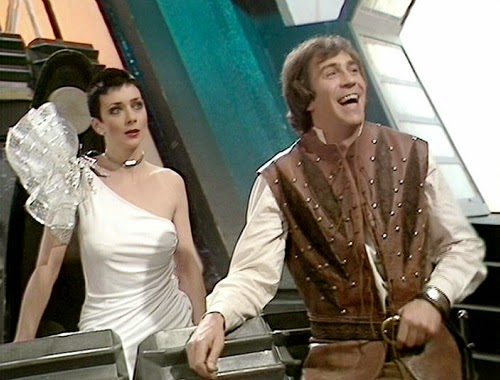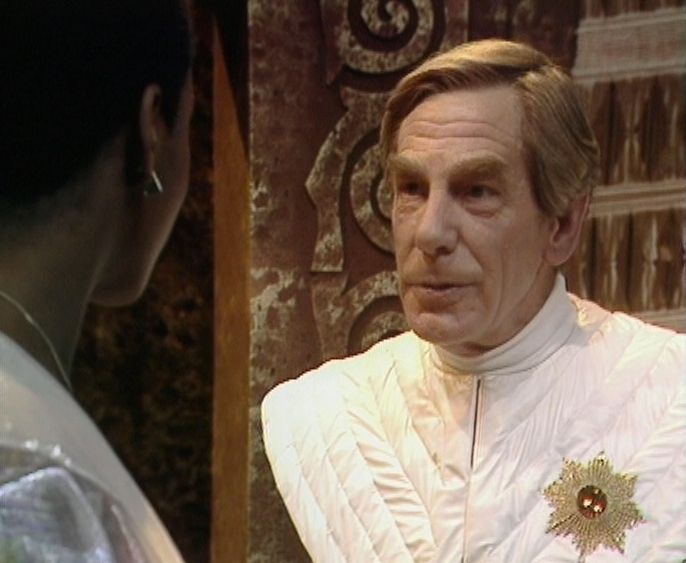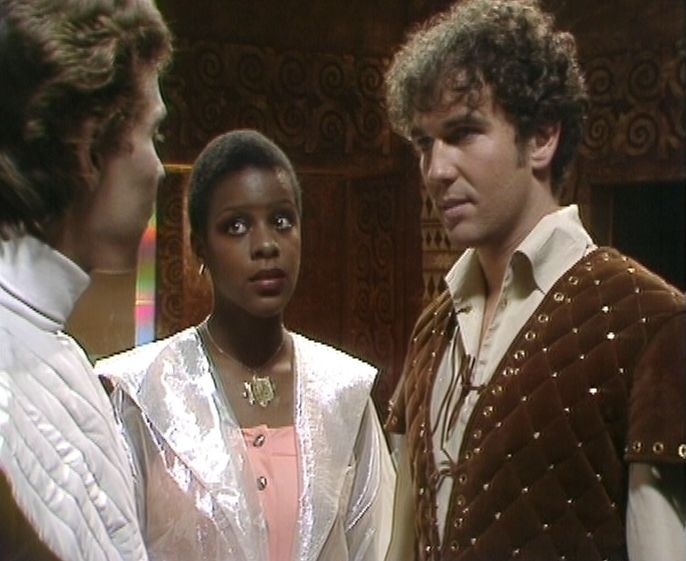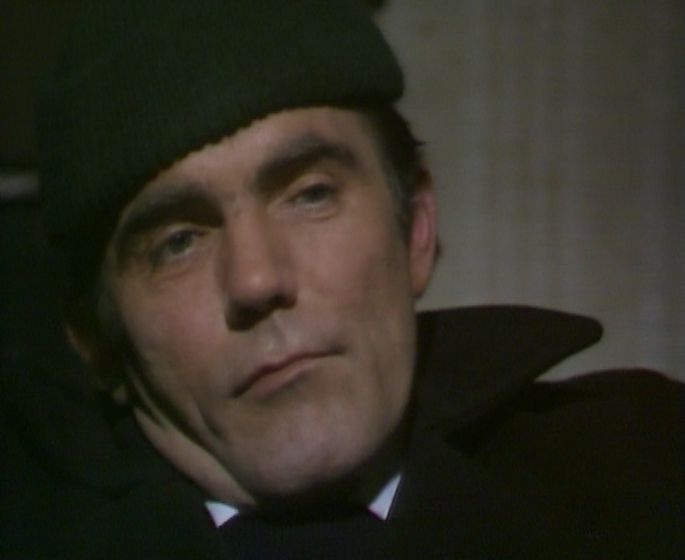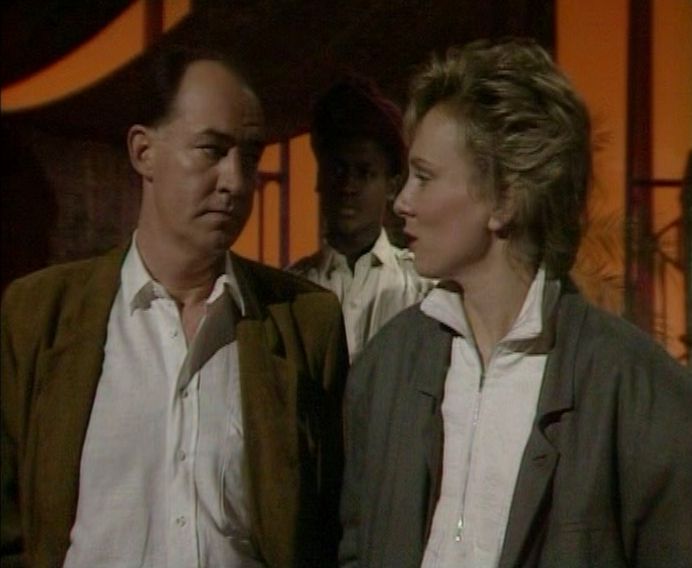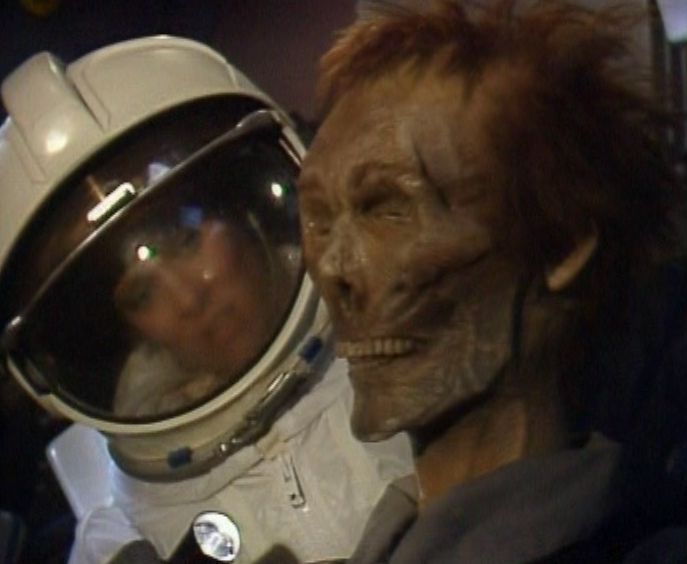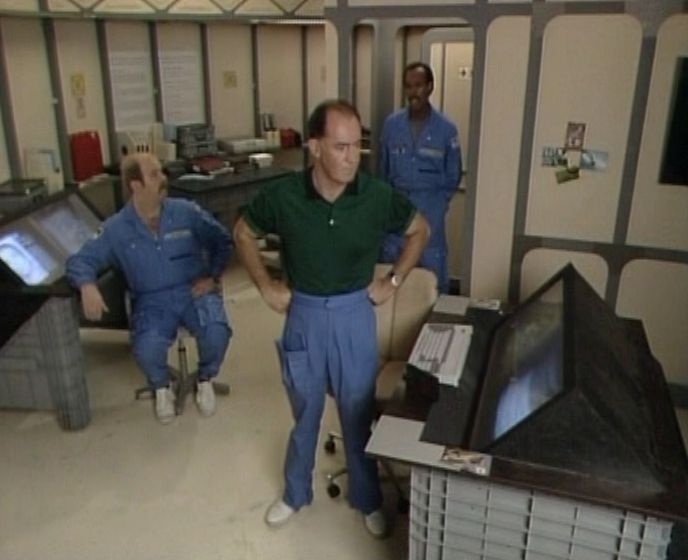
Blakes 7 – City at the Edge of the World

city 01

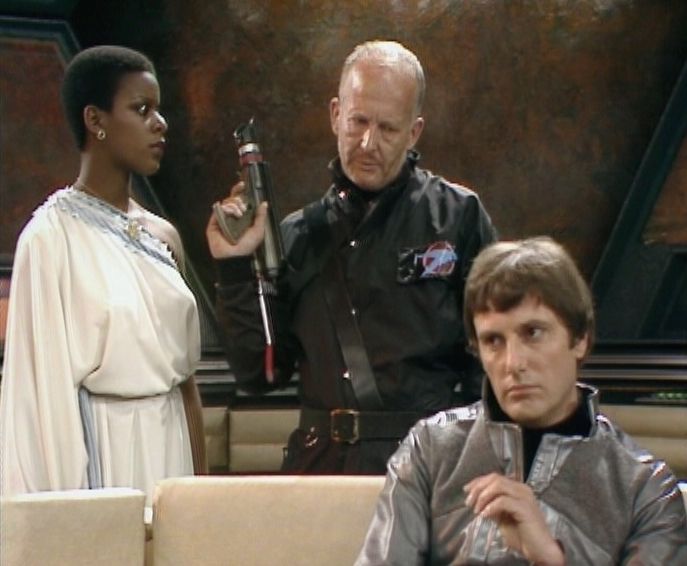
Most of the regulars take centre-stage in at least one series three episode.  Avon features heavily in Aftermath and Rumours of Death, Cally’s the main character in both Children of Auron and Sarcophagus whilst Tarrant (and his identical twin brother) stars in Death-Watch.  Danya is the only one who doesn’t really have an episode of her own, unless you count her introductory tale, Aftermath.

For everybody’s favourite thief, City at the Edge of the World is a chance to see a more proactive and heroic Vila.  Even when the script didn’t really feature him, Michael Keating could always be guaranteed to take whatever material he had and make it work to the best of his ability.  Unlike some actors he didn’t do this by upstaging others – it was simply down to his natural comic timing.  A great example can be found in Powerplay.  Vila, wounded and alone in a strange forest, attempts to frighten off any would-be attackers by pretending to be a whole troop of fighting men!  It’s an old gag – and only a throwaway moment – but Keating’s a delight to watch.

But there’s no doubt that it’s good to see Vila right in the thick of things for once.  Too often he tended to end up as either the butt of other people’s jokes or simply blissed out on adrenaline and soma.  In City at the Edge of the World he’s witty, resourceful and gets the girl.  What more could you ask for?

We open with Tarrant being irritating (yet again).  The Liberator needs crystals for its weaponry systems and he’s struck a deal with the mysterious inhabitants of a nearby planet.  It’s simple enough – the crystals in exchange for Vila’s help.  When Vila disappears and the box of crystals turns out to be a booby-trapped bomb, Tarrant is forced to eat humble pie (not before time!)

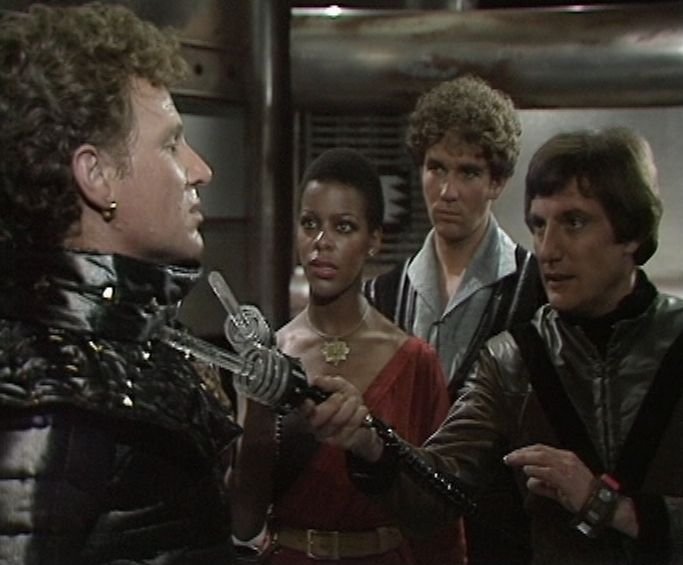
Vila’s been brought to the planet by Bayban the Butcher (Colin Baker).  A vision in black, Baker is clearly having a ball (Paul Darrow later repayed the favour by going even further over the top in the Doctor Who story Timelash).  It’s a cartoony performance but it works perfectly in this context.  Following a couple of stories that were played too straight, City bubbles along with an infectious sense of humour and many quotable lines.  This is one of my favourites, courtesy of Bayban who’s peeved to find out that he’s top of the Federation’s Most Wanted list – after Blake.  “What do you mean, ‘after Blake’? I was working my way up that list before he crept out of his creche. WORKING my way up. I didn’t take any political shortcuts.”

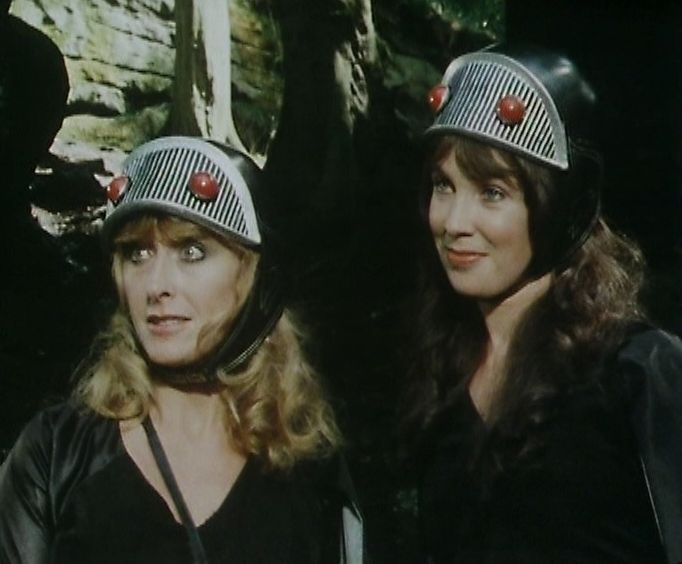
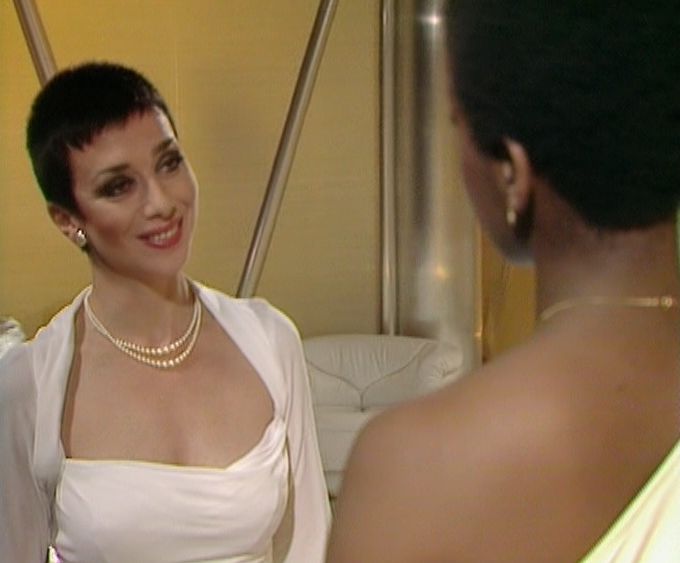
Bayban has a crack force of mercenaries, led by Kerril (Carol Hawkins) and Sherm (John J. Carney).  Carney, who’d previously given an excellent comic performance as Bloodaxe in the Doctor Who story The Time Warrior, is just as good here.  He’s got little to do except react to the others – but he does it so well.  Hawkins plays the unlikely love interest (or at least it’s unlikely to begin with).  Their first meeting is memorable – we see Vila cowering at her feet, whilst she mocks him (“little man”).  He then suggests she bathes more regularly (and uses mouthwash too).

The unexpected thaw in their relationship seems to happen after she changes out of her black leathers and into something more feminine.  Possibly Chris Boucher was attempting to make a point here.  She spends the early part of the story attempting to be one of the boys (and acting aggressively) but once she changes clothes she becomes a more passive and submissive character – effectively acting as Vila’s assistant.

To be honest the story isn’t the strongest – a mysterious race seek entry to a new world, but rather carelessly they’ve lost the key to the door.  Only their leader Norl (Valentine Dyall) ever speaks, so they remain rather undeveloped – but then they’re not really the focus here (it’s more of an excuse for Vila to demonstrate his skills and Colin Baker to chew the scenery).  Dyall is compelling though.  He had the sort of voice that instantly commanded attention, so whenever he speaks it’s hard not to listen.

Vila is given a chance to cross over to this new world with Kerril.  It’s a beautiful, unspoiled planet where they could live out their lives in peace.  He declines, and his reason gives an insight into what makes him tick.  “There’s nothing there worth stealing. You know why I neutralize security systems, open safes, and break into vaults? It’s because I can and most people can’t. It’s just that, it’s what makes me, me. Kerril, a thief isn’t what I am, it’s who I am.”

After a couple of average stories, City at the Edge of the World gets us back on track.
city 02

Blakes 7 – The Harvest of Kairos

harvest

The Harvest of Kairos has a feel of a hastily rewritten S2 episode.  Otherwise, how do you explain that Tarrant seems to have become Enemy Number One in Servalan’s eyes?  She spends the opening few minutes musing about what he’s going to do next, whilst her cringing subordinate Dastor (Frank Gatliff) hesitatingly breaks the bad news that there’s dissent among her crew.

Some believe that she’s too afraid to attack Tarrant(!).  Chief amongst the dissenters is a worker from the construction grades, Jarvik (Andrew Burt).  Since he’s clearly designed to be an alpha-male, Burt’s casting is eccentric (to put it mildly).  Burt, the original Joe Sugden from Emmerdale Farm, also has to battle with Ben Stead’s script and his first line to Servalan sets the tone.  “Woman, you’re beautiful” he says, before grasping her for a quick snog.  There’s always the possibility that Stead had his tongue in his cheek, but I’m not so sure (there’s the evidence of his subsequent B7 scripts for example).  The sexual politics are skewered towards the dominance of men, with even Servalan seeming to melt under Jarvik’s winning ways (“But first, there is the question of that degrading and primitive act to which I was subjected in the control room. I should like you to do it again”).

Jarvik also attempts to humanise the very inhuman Servalan.  “When was the last time you felt the warmth of the Earth’s sun on your naked back? Or lifted your face to the heavens, and laughed with the joy of being alive? How long since you wept at the death of a friend?”  It’s a decent enough line and if delivered well it could have some impact (it brings to mind similar comments from Kasabi during Pressure Point) but Burt rather torpedoes it.  He’s a good actor, just hopelessly miscast.

Meanwhile, onboard the Liberator Tarrant is being his usual annoying self.  He intends to steal a cargo of Kairopan (a highly valuable crystal found on the planet Kairos).  Kairos is a dangerous planet, so Tarrant plans to hijack the freighter after it’s left the planet.

As the Liberator comes under attack from Federation ships commanded by Jarvik (he’s been given a chance by the clearly impressed Servalan) Avon is strangely distracted.  Maybe this is as scripted, or possibly Paul Darrow simply wasn’t interested that week.  Avon’s absorbed with a mysterious crystal called sophron – it’s no ordinary rock, as it seems to have a capacity for reasoning that slightly exceeds Orac’s (and many other qualities as well).  No surprises that we never hear of it again, so its only function is to operate as a get out of jail free card.  After Jarvik’s plan to capture the Liberator succeeds, the crew are exiled to the definitely unfriendly Kairos.  Escape seems impossible, until Avon’s magic rock saves the day.

It’s jarring to see Servalan in control of the Liberator (a warm up for the apocalyptic events of Terminal) and once Avon and the others have been exiled to Kairos her victory seems complete.  We then lurch into the next unexpected event – Servalan is so taken with Jarvik that she’s keen to make him co-ruler, but first he has to prove himself.  And how does she decide to test him?  He has to take on Tarrant, man-to-man, and defeat him.  Yes, okay then.

Just when you think you’ve seen everything, up pops the silliest looking giant insect …..

The Harvest of Kairos is dumb fun.  It’s never less than entertaining (if you can stomach all the “ah well, he’s a man” talk) but it doesn’t fit as an early series three episode (had it come towards the end of the third series then Tarrant’s status would have been more credible).  Chris Boucher seems to have taken his eye off the ball, script-editing wise, but luckily he’d also been penning a number of decent stories and the next episode will see a marked upswing in quality.

Blakes 7 – Dawn of the Gods

image

Dawn of the Gods is very, very odd.  Logic and reason seem to take a holiday during this one, beginning with Orac’s bizarre behaviour.  He decides to investigate a nearby black hole, thereby endangering both the Liberator and its crew.  Once they enter the black hole, Cally hears voices in her head as a figure from Auron mythology – the Thaarn – has plans for her.

It would have made more sense for Cally to be drawn to the black hole by the Thaarn’s entreaties (which would have meant that Orac’s suicidal curiosity could have been dispensed with). Possibly this wasn’t done since it would have seemed like too much of a retread of The Web.

But as it stands, getting the Liberator into the black hole feels very contrived, as does the fact that the Thaarn has such an urgent need for Cally. I’ll say one thing for him though, he thinks big. “I’ve been alone with my plans for so long. Cally. Plans to build a new universe, with no one to share them with, until now. The universe, Cally. And the great univeral force that controls the universe, is gravity. The orbit of the planets, the slow turn of the galaxies. I have built a machine that can generate gravity. When it’s complete, it will be powerful enough to move planets, and stars. He who controls gravity, controls everything. We will be rulers of the universe, Cally.”

Exactly what Cally can offer him that no-one else can is never made clear. Presumably it’s telepathy, but you’d assume that someone who’s planning to create a new universe would be able to obtain a telepath from somewhere.

Like The Web, Dawn of the Gods has a bizarre creature, but here it’s unwisely held back until close to the end of the story. Let’s be generous and say that when the Thaarn does pop up he’s something of a disappointment – it certainly torpedoes any lingering credibility that James Follett’s script had.

But even before the Thaarn was revealed in all its glory, things were wobbling. Avon and the others meet several of the Thaarn’s underlings, the Caliph (Sam Dastor) and Groff (Terry Scully). The Caliph seems to have wandered in from a Charles Dickens play, whilst Groff sports a natty eyeshade. It makes a change from the usual sci-fi cliche of silver suits, but the reason for this cosplay isn’t clear. If you’d have told me it was budget related I might have believed you!

Dawn of the Gods does have the air of a low-cost episode, especially since the first half takes place aboard the Liberator. There’s a few decent bits of character interaction though – it’s particularly nice to see Avon, Vila, Cally, Dayna and Orac enjoying a game of Space Monopoly. Yes, even Avon! And Orac gets very peeved when the others become distracted.  It’s notable that the only one not playing is Tarrant (is he sulking by himself?) He’s certainly pretty insufferable, insulting Cally and generally rushing around trying to solve the crisis, but achieving very little.

So we’re currently in a bit of a dip, story-wise. I wonder if the next will be any better?

Blakes 7 – Volcano

volcano 01

Dayna and Tarrant have teleported down to the surface of Obsidian.  It’s a planet that has managed to remain unaligned from the Federation and also emerged unscathed from the recent galactic war.  Tarrant believes the planet would make a good base for them, but their pacifistic leader Hower (Michael Gough) isn’t interested.

Bad news, it’s an Allan Prior script.  Good news, it’s not Animals.  It’s not that much better though as Prior’s dialogue doesn’t exactly sparkle and few of the guest cast emerge with much credit.  Michael Gough, of course, is able to instill Hower with a certain dignity but Malcolm Bullivant, playing Hower’s son Bershar, is wooden in the extreme.  Frankly there’s more animation to be found in the extremely silly looking silver robot.  The Graham Williams era of Doctor Who (with its slapstick air) has many critics but the alternative is something like Volcano – an episode delivered with such an air of relentless earnestness that it becomes impossible to take it seriously.

Pacifistic planets are something of a sci-fi cliche.  Hower explains to Dayna how they’ve arrived at this state. “We have taught them peace from the cradle, and we have blocked, usually with a minute electric shock, every tendency towards an aggressive act. Plus of course, daily psychological propaganda. We have no war, no fights among ourselves, no lawlessness, no crime. Our people devote themselves to creation and not destruction. We are at peace here on Obsidian.”

This is all well and good, but what happens when the Federation turns up?  Although we’ve been told that the Federation are in disarray they seem in fine fettle here.  Led by Servalan (of course) their first act is to attempt to capture the Liberator.  This rather begs the question as to how Servalan knew the Liberator would be there.  And with an empire to rebuild you’d assume she’d have more pressing things on her mind than settling scores with Avon and co.  Volcano is one of those series three scripts that seems a little out of place, although it would have worked during series two (when the Federation was dominant).

The Federation, led by Mori (Ben Howard) are able to take over the Liberator with embarrassing ease.  This should be a dramatic highlight of the story but it’s pretty much a damp squib, even after we see Avon shot by Mori.  Ben Howard, a regular in the last series of Dixon of Dock Green, is the first of Servalan’s Travis substitutes and, bless him, he’s almost bad enough to make you pine for Brian Croucher.  The Battle Fleet Commander, played by Alan Bowerman, offers another amusingly rotten performance.

The Federation don’t hold the Liberator for very long and amazingly Servalan then decides to run away and fight another day.

SERVALAN: Without that ship we’ve lost a strategic advantage.
MUTOID: Madam?
SERVALAN: But, no one else has gained it. Without Blake the Liberator’s no immediate threat to our plans.
MUTOID: No, Madam President.
SERVALAN: Well the crew have no political ambitions.
MUTOID: They are merely criminals.
SERVALAN: So they’ll keep. Until the rule of law has been restored. Until my rule of law has been restored.

This doesn’t ring true – if Servalan doesn’t believe the Liberator poses a threat without Blake, why go to all that trouble to try and capture it?  The capture-the-Liberator sub-plot seems to have been rather awkwardly bolted onto the episode in order to pad out the running time.

One interesting part of the script is that Servalan’s assessment of Avon and the others seems spot on.  Tarrant tells Hower that they’re mercenaries and in exchange for the use of his planet he’ll offer them a percentage of their spoils.  I wonder if serious thought was ever given to turning them into a gang of intergalactic criminals?  This notion tends to be downplayed as we move through series three – pure sci-fi takes over – and when we reach series four there’s a return to the theme of the struggle against the Federation.

Hower’s decision to destroy his planet rather than see it colonised by the Federation should be a powerful one, but it’s another moment that doesn’t have a great deal of impact since we’ve never been given any cause to believe that Hower’s people are a real, functioning society.  Unfortunately, they’re just a series of faceless extras.

Although Volcano‘s problems are many, it’s by no means unwatchable.  It has its fair share of bad acting and illogical plotting, although that hardly makes it unique in the Blakes 7 universeIt’s undemanding stuff, but it’s frustrating as the series can do so much better.

volcano 02

Blakes 7 – Powerplay

powerplay 01

With the departure of Gareth Thomas, Blakes 7 needed a new central dynamic.  It’s easy to see how the Blake/Avon relationship was recreated with Avon/Tarrant, but there’s one major difference.  Tarrant, like Avon during series one and two, is presented as the questioning figure of the group – often wondering if the plan they’re embarking on is wise – but he clearly lacks Avon’s experience and so ends up as a much less forceful figure.

So whilst Blake/Avon was more of a meeting of equals, Avon/Tarrant has something of a father/son feel with poor Tarrant coming off second best more often than not.  No doubt this is also a consequence of the slow rise of Avon’s megalomania – as we’ll see (especially during series four) Avon becomes increasingly disinclined to listen to anyone – with disastrous results.

Stephen Pacey, like Josette Simon, does his best with the hand he’s dealt, although Tarrant does sometimes come over as intensely annoying (Harvest of Kairos, springs to mind).  But he does start off with an interesting character dynamic.  He’s presented as the enemy (so it comes as a surprise when he joins the crew at the end of the episode).  Tarrant is the leader of a Federation raiding party who’ve taken control of the Liberator (much to Avon’s barely concealed disgust) but in the end it turns out he wasn’t a Federation type after all, he was only pretending.  Hurrah!

powerplay 02

To be honest, there’s something of a lost opportunity here.  Tarrant claims that he’s a fugitive from the Federation but we’ve only got his word for it.  Could he really have been a Federation officer all along?  He’s certainly very convincing in the role.  The possibility that Tarrant may be untrustworthy and liable to sell them out at any minute would have provided a nice spark of tension, but this angle was never explored.

But if Tarrant is faux-Federation, then his second-in-command, Section leader Klegg (Michael Sheard), is Federation through and through.  With several day’s stubble and a perpetually irritated expression (like he’s just swallowed a space-fly) it’s a highly entertaining performance from Sheard – a cult film and television favourite of many, including me (he had umpteen Doctor Who‘s to his credit, along with films like Star Wars and Indiana Jones).

I wonder what Michael Keating and Jan Chappell felt when they received the first two scripts of series three?  They were barely in the first episode and spend episode two languishing in the sub-plot.  Both Vila and Cally seem to have landed on their feet after they’re taken to what appears to be a spotless hospital on the planet Chenga.  Vila thanks the two attractive young women – Zee (Primi Townsend) and Barr (Julia Fiddler) – most effusively for rescuing him. “You get paid for helping me? That’s what the primitives meant when they said that you get a bounty. You see, they’ve got it all wrong, they just don’t understand. You look after yourselves and thanks once again. I really, really mean that.”

It doesn’t take a genius to work out that Vila and Cally are being set up to take a fall.  The Chengans plan to harvest them for their organs – and wouldn’t you know it, the happy news is broken to them by Servalan.  If credibility was stretched to breaking point in the previous episode when she turned up on the same planet as Avon, there’s no words to explain how ridiculous it is that she just happens to bump into Vila and Cally.  Small universe, isn’t it?  Luckily the Liberator picks them up just before they’re sliced and diced.

Like Aftermath, this is a story that works well on a character level.  Terry Nation doesn’t provide us with any major surprises, but whilst it’s not subtle stuff it does clip along at a decent rate.

powerplay 03

Blakes 7 – Aftermath

aftermath 01

Following Gareth Thomas’ departure, Paul Darrow moved centre-stage and it’s easy to see how Aftermath was crafted to facilitate this transition.  In one way this was something of a risk – Avon (and Darrow) had worked so well during the first two series by operating as an outsider – someone who sat on the sidelines, caustically criticising Blake’s plans.  Therefore the series format had to be somewhat re-tooled (Avon’s dislike of Blake’s freedom-fighter heroics was so strong that it would have been implausible for him to simply pick up where Roj left off).

Instead we see the Federation retreat into the distance, at least for now.  Following the galactic war they’re no longer the dominant force they were (we’re told that 80% of the Federation fleet has been destroyed).  The war between humanity and the aliens is played out during the first few minutes of Aftermath in the most cut-price way imaginable – numerous model shots are reused from previous episodes in order to give the impression of a vast galactic battle.  It’s not terribly convincing, it must be said.

The Liberator has suffered severe damage, which means the crew have to head for the life capsules.  Avon says that Blake and Jenna have gone off together – whilst this may have been a script necessity to cover for the absence of Gareth Thomas and Sally Knyvette it does also make sense (since Jenna harboured a long, if subtle, pash for Blake).

I’ve never quite understood why Avon and Orac end up on the planet Sarran whilst Vila and Cally’s planetfall is somewhere else entirely – they all left at pretty much the same time so you’d have assumed they’d have ended up together.  The reason in script terms is obvious though – Keating and Chappell are written out of this one so that Darrow can establish his credentials as the new leader (similar to how The Way Back focused on Blake).

It’s a Terry Nation script, so it should come as no surprise that Sarron has its share of murderous primitives.  They’re led by Chel (Alan Lake) who observes the battle raging above the planet’s atmosphere.  “This is the day that was prophesied. The day our law foretold. They will come from the sky to destroy us. They will burn the stars to light their way. We must be prepared.”  Lake was never the most subtle of actors, but Chel isn’t a role that demands method acting so that’s fair enough.

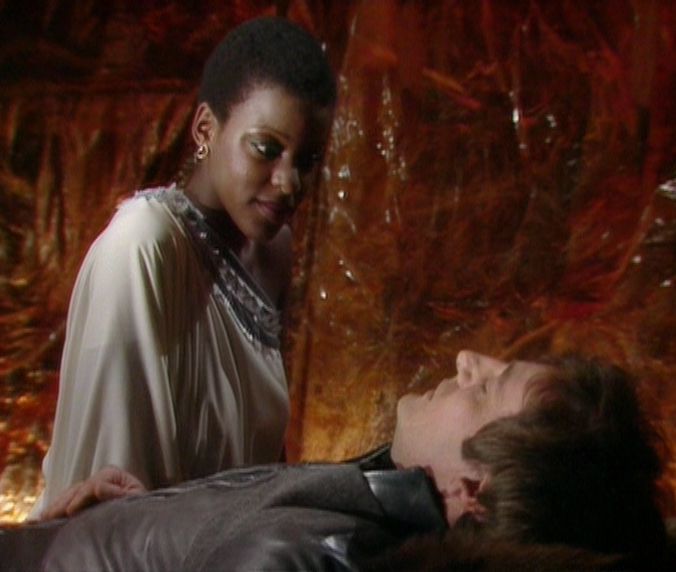
Two hapless Federation troopers (played by Richard Franklin and Michael Melia) fall victim to Chel and his men but Avon is luckier as he’s rescued by Dayna (Josette Simon).  Following Sally Knyvette’s departure there was a vacancy for a new crew-member aboard the Liberator and Dayna certainly fits the bill.  The casting of a young, black actress would have been quite noteworthy at the time (1980) and Simon, despite her lack of experience, hits the ground running.  Although the question is, can Dayna’s character be maintained over the remainder of the series?  Jenna had been introduced as a hard-bitten smuggler but eventually found herself as little more than the Liberator’s teleport operator.  Dayna does turn out to be a little luckier, but Blakes 7 remains very much a boys show and the female characters tend, too often, to play second fiddle.

Still, Dayna has a good chunk of screen-time in this episode.  Her initial meeting with Avon is a memorable one – she kisses him on the lips, telling him that she was curious.  Avon, as befits his new status as a dashing action hero has an immediate response. “I’m all in favor of healthy curiosity. I hope yours isn’t satisfied too easily. I think you’ve cured my headache.”  The arrival of Servalan shakes things up.  Pearce and Simon share a lovely two-handed scene, which sees Servalan dripping with fake sincerity and Dayna barely able to hide her loathing.

aftermath 02

Dayna is presented as something of a flawed character – the life she’s led to date (an isolated one with her father) has left her with little understanding of other people.  She regards the Sarrans as animals, who exist to be killed as and when she decides.  Her potential awkwardness with others was something that could have been developed, but never really was.

A major change in series three concerns the relationship between Avon and Servalan. Let’s be honest, during the first two series they never had a relationship at all (try counting the number of lines they exchanged during the first twenty six episodes). All that changes now as we see that love/hate is in the air.  Servalan tells Avon that Star One is destroyed, which means that the Federation has been crippled.

AVON: So Blake’s rabble finally get freedom of choice. He won after all.
SERVALAN: Forget Blake. You have control of the Liberator now. There’s no more powerful ship in the galaxy. You have Orac. Avon! Don’t you see what that means?
AVON: You tell me about it.
SERVALAN: You could rebuild it all. All those worlds could be yours, Avon, they’re there for the taking. You and I could build an empire greater and more powerful than the Federation ever was or ever could have been. Now, Avon. At this moment we can take history and shape it in our own image. Think of it: absolute power. There is nothing you can imagine that we couldn’t do.
AVON: I am thinking of it.
SERVALAN: We can do it, Avon.
AVON: I know we can.
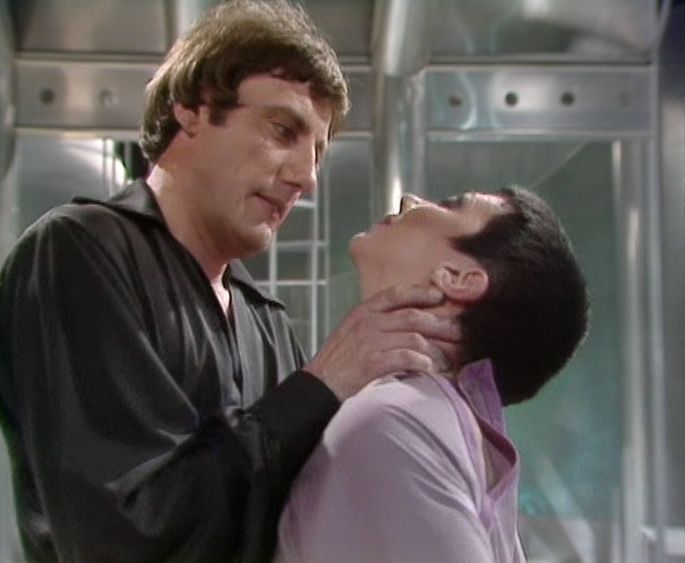
SERVALAN: We’ll be answerable to no one. Ours will be the only voice. Imagination our only limit. [They kiss. Avon grabs her by the throat and pushes her to the ground]
AVON: Imagination my only limit? I’d be dead in a week.

There’s no doubt that Avon and Servalan’s kiss (and his manhandling of her) launched a thousand fan-fics.  Darrow and Pearce are electrifying in this scene and it’s worth the price of admission alone.

The death of Dayna’s father, Hal Mellanby (Cy Grant) and her adopted sister Lauren (Sally Harrison) means that she no longer has any ties to the planet and is free to join the Liberator.  And the fact that Servalan killed her father will provide the series with some nice scenes of dramatic tension whenever the two meet again.

Although the primitives sub-plot of Aftermath is fairly tedious it doesn’t really impact on the main thrust of the story, which revolves around the Avon/Dayna/Servalan triangle.  All of them, especially Darrow, benefit from generous amounts of character development.

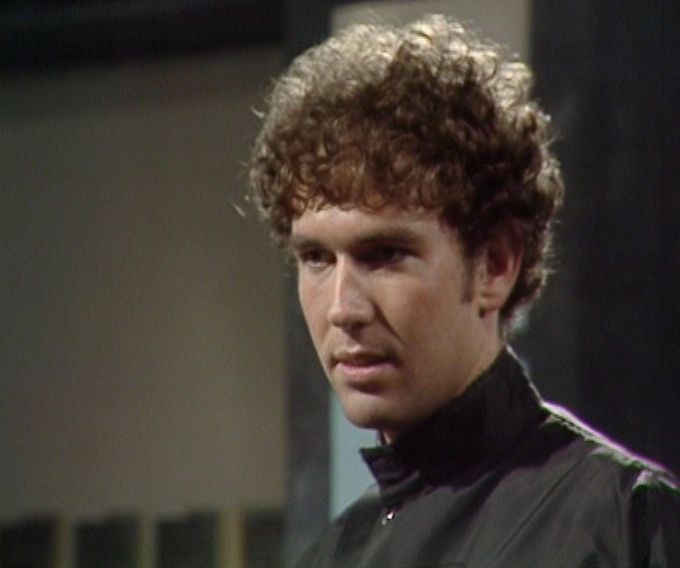
Unusually, we end on a cliffhanger.  Avon and Dayna return to the Liberator but find themselves on the wrong end of a Federation gun.  The curly-haired officer asks them why they’ve boarded a Federation ship ……

aftermath 03

The Nightmare Man – Episode Four

nightmare 04

The military arrive in force as Colonel Howard prepares to lead them in a expedition to recover a valuable piece of hardware.  Howard is remarkably blase as he informs Inskip that he’s invoked martial law and is therefore now in complete control of the island.

As the soldiers make their landing, Michael is still musing over the identity of the killer and the reason why he’s being hunted by the army.  “They lost contact with that craft and it ran aground here. Probably a power failure. Because what got out of it was no longer a man. Radioactive. Its mind in splinters.”

Douglas Camfield had been a Lieutenant in the West Yorkshire regiment, but due to health issues he was forced to leave in 1956.  His love of the military never left him though and can clearly be seen in some of his best directorial efforts.

The Web of Fear, The Invasion and Terror of the Zygons were three classic Camfield-directed Doctor Who‘s which all had a strong military angle.  And in some ways the last episode of The Nightmare Man resembles Zygons – the incongruous juxtaposition of the army and a small Scottish village, for example.

The revelation of the killer’s identity seems to be one of the main reasons why The Nightmare Man is viewed as a disappointment.  After three episodes of teasing the audience with various possibilities, the somewhat prosaic reality can’t help but feel like a letdown.  Especially as when we see him in the cold light of day he’s not a terrifying sight – although that may have been intentional (let’s be generous and give the production the benefit of the doubt).

Another slight disappointment is the way that Inskip fades away once Howard takes control.  But the fact that Howard isn’t all he appears to be is a decent twist, although the audience should have twigged this early on (after he tells Michael and Fiona that he has a great admiration for their police).

Positives. Maurice Roëves as Inskip and James Cosmo as his laconic sidekick Sergeant Carch. The slowly increasing sense of dread and fear as the attacks continue.

Negatives. Not every question is answered – for example we’re never told why the killer became cannibalistic or how he had super-human strength.  And if the killer looks rather unimpressive in the cold light of day, then that goes double for his craft. We’re expected to believe that it could travel thousands of miles in the water?  Sadly it looks like the filmiest, most unconvincing prop ever.

There’s no doubt that the dream-team combination of Holmes and Camfield would have been enough to interest many Doctor Who fans, but The Nightmare Man doesn’t really show either at their best.  The script is workmanlike (not having read the original novel I can’t say whether Holmes added many of his own touches).  His trademark humour isn’t really in evidence, although Carch gets some decent lines.  Camfield seems to perk up when the army arrive, but otherwise there’s few of the flourishes and innovative camera-angles for which he was known.

But whilst The Nightmare Man ends with a whimper rather than a bang, it still has its moments.   Not a classic, but there are worse ways to spend a few hours.

The Nightmare Man – Episode Three

nightmare 03

The Nightmare Man was Jeff Stewart’s first television role.  A few years later he was cast as Reg Hollis in The Bill and would remain with the series for an impressive twenty four years.  It’s strange to hear him speak with a Scottish accent, although since he was born in Aberdeen I assume it’s his natural one (he’s not tended to play many Scots during his career).

Stewart plays Drummond, one of three coastguards who all work in a very isolated spot.  There’s a clear vibe that they’re going to be the next victims, although it’s surprising how it takes before the unseen attacker strikes again.

This isn’t a bad thing though, as it means that Camfield’s able to gently rack up the tension as the episode progresses.  The policeman guarding the mysterious craft hears a noise (but it only turns out to be Dr Goudry), the coastguards detect something outside which triggers their radiation meter (but it slips away quickly), etc.  These little moments help to create a faint sense of unease – we know that there will be another murder, we don’t know when.  Although if you’d said just before the end of the episode, in order to create a nice cliffhanger, you wouldn’t be far off the mark!

Colonel Howard continues to move about the island, offering his help to the police (which is declined) and generally acting in a somewhat smug manner.  So it comes as no surprise when he receives a coded phone-call which confirms he’s deeply implicated in this mysterious business .

CALLER: Mother asked me to call.
HOWARD: Mother knows best. How is her chicken?
CALLER: Still free-range, I’m afraid.
HOWARD: Then forget the chicken. I’ve arranged for the egg collection. Can you close the coop?

Top marks to Jonathan Newth for keeping a straight face during that exchange of dialogue.

It seems probable that they’re both part of a military operation (who else would use so many convoluted code-words?) but we’ll have to wait until episode four to find out.

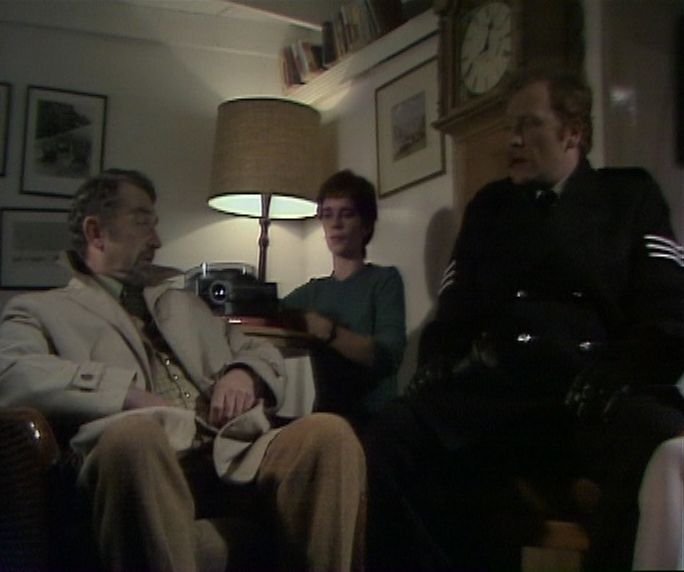
Fiona has developed the film from Dr Symond’s camera.  It was running at the time he was attacked and offers several snapshots of the killer.  Luckily, he was also recording his thoughts onto tape at the same time – so Fiona and Michael are able to organise a macabre film show for Inspector Inskip, Sgt Carch and Dr Goudry.  It’s a disturbing scene, as though we see very little (the pictures are quite blurred) the sounds the killer makes are enough to create a whole host of disturbing mental images.  There’s only one more episode to go before we find out if the reality will measure up.

With just a couple of minutes left, it must be time for another murder.  We cross back to the coastguard station, where one of Drummond’s colleagues elects to go outside by himself.  Has the man never watched any horror moves?!  It’s clear that he’s going to meet a very nasty end – which he does – and Drummond’s other colleague quickly succumbs to the implacable killer as well.

This leaves Drummond as the last man standing and so the episode ends on a close-up of Jeff Stewart’s face.  It’s quite a responsibility to carry a cliffhanger, therefore let’s be generous and remember that this was his first television job.  He does his best to pull a shocked face, but it doesn’t really convince.  Although his colleagues have both been killed he doesn’t really project a sense of dread or terror – more a sort of mild perplexity.  It’s slightly surprising that Douglas Camfield didn’t elect to try another take, but even allowing for Stewart’s lack of emotion it’s a jolting ending.

The Nightmare Man – Episode Two

nightmare 02

James Warwick was pretty ubiquitous on British television during the early 1980’s. By the time The Nightmare Man was broadcast he’d already appeared in several one-off Agatha Christie adaptations (Why Didn’t They Ask Evans?/The Seven Dials Mystery) and a few years later would star alongside Francesca Annis in Partners In Crime, also adapted from Christie’s books.  His earnest, square-jawed persona fitted the works of Agatha Christie like a glove and he plays Michael Gaffikin in a similar way.  His performance isn’t quite as good a match here though – at times it feels rather artificial (although it’s not as bad as his very wooden turn the following year in the Doctor Who story Earthshock).

The mysterious creature spends the early part of the episode lurking about (and killing the odd sheep).  Michael surmises that it could be the result of genetic experimentation whilst Inskip wonders why the woman killed in episode one (identified as Mrs Anderson) was dismembered and then taken miles away from spot where she was murdered.

Picture quality for the exteriors is pretty poor – due to the heavy mist (it does help to give the location work an unearthly atmosphere though).  But it’s difficult not to wonder just how more impressive it would have looked on film.

Because the police-force on the island is so small (limited to four of five officers) it’s reasonable that Inskip would ask for Michael and Fiona’s help.  Michael, having originally wondered if the creature came from the sea, now has another theory – that it’s extraterrestrial in origin.  Roëves continues to have many of the best lines as Inskip counters that “a straightforward homicidal maniac with bad teeth running amok is good enough for me.”

But when they find Dr Symonds’ body, Inskip is forced to admit that nothing human could have been responsible. Although it’s hard to see why, as Symonds’ body is intact (unlike the mutilated Mrs Anderson) with only a minimal amount of blood.  No doubt this is due to what was deemed permissible in a pre-watershed programme (a violently attacked body clearly wouldn’t have been). Camfield could have elected to play the scene just on the reactions of Inskip and the others, but since we’ve previously met Symonds, his death has more of an impact if we can see his face.

If the cliffhanger is a little of a damp squib, it does at least up the ante a little more.  Another death and still the mysteries deepen.  There’s a mysterious craft on the shoreline, traces of radiation and the possibility that somebody parachuted onto the island the previous night.  And it seems that the charming Colonel Howard is more than just an innocent visitor ….

The Nightmare Man – Episode One

nightmare 01

The Nightmare Man was adapted by Robert Holmes (from the novel by David Wiltshire) and directed by Douglas Camfield.  Since Holmes and Camfield were both experienced Doctor Who hands it’s tempting to view this as almost a Doctor Who story by proxy.  Holmes had a love of classic horror tales, so there’s no doubt that Wiltshire’s story of a series of mysterious deaths on a remote Scottish island would have right up his street.  Whilst there’s little blood or gore it does feel a touch more adult than his Doctor Who‘s, something which probably would have appealed to Holmes (he was always a writer who pushed against the boundaries – as Mary Whitehouse would attest to).

It’s slightly surprising that it’s shot on VT rather than film, especially since Camfield was a master with a film camera.  Presumably this was budget-related, as there’s only a handful of video effects.

Within the first few minutes we’ve met the main players.  Fiona Patterson (Ceila Imrie, sporting an impressive Scottish accent) runs the local shop whilst Michael Gaffikin (James Warwick) is an English dentist, in love with both the island and Fiona. Both run into a visitor, Colonel Howard (Jonathan Newth), who tells them that he’s planning to spend a few days exploring, whilst we also bump into Inspector Inskipp (Maurice Roëves).

But whilst all this seems normal enough, there’s something on the island which is far from normal.  This strange entity is shot from their POV and instantly creates an unsettling atmosphere.  When Michael finds a body on the golf course it appears the mysterious creature has claimed its first victim.  Inskipp is matter of fact about this grisly discovery.  “Aye, I do mean a body. We haven’t found all the pieces yet.”  During the episode we’re drip-fed more facts about the murder and nothing we hear sounds very comforting.  The body wasn’t dismembered with a knife – it was literally torn apart.

Camfield always cast his shows incredibly well and The Nightmare Man is no exception.  Maurice Roëves makes an immediate impression as Inskipp and does something with what could be a cliche role – the tough copper.  Although Camfield had a reputation for using a “rep” of actors it’s not really in evidence here, although Tony Sibbald (playing Dr Symonds) had appeared in his 1975 Doctor Who story Terror of the Zygons.

This does everything that an opening episode should.  It sets up the mystery efficiently and finishes on a strong cliff-hanger (Dr Symonds attacked by the mysterious creature).  Will the serial keep this quality up or will it end in an anti-climax?  Time will tell.

Star Cops – Little Green Men and Other Martians

little

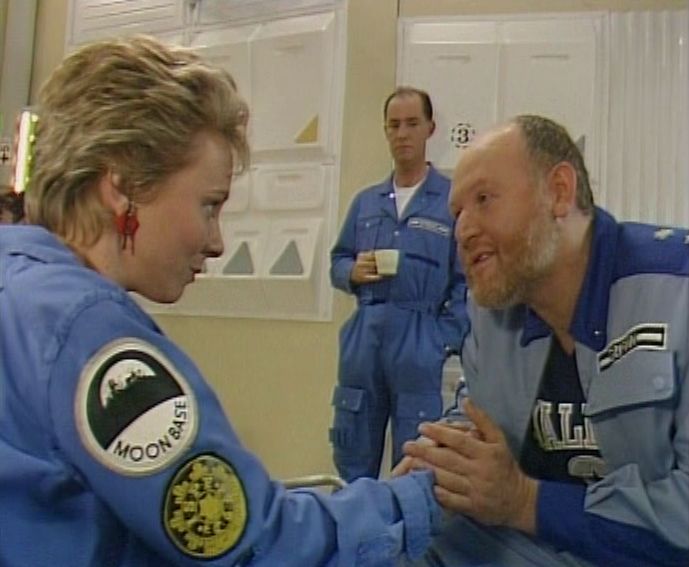
Why has the respected investigative journalist Daniel Larwood (Roy Holder) travelled to Moonbase?  It may have something to do with the persistent rumours that something has been discovered on a recent Mars expedition.  Is there really life on Mars?  Although possibly he’s more interested in a drugs smuggling ring that’s uncovered after a shuttle pilot is killed in a crash.

With Theroux on leave and Nathan soon to depart for Mars, it leaves the Star Cops rather stretched as they try and make sense of the various pieces of the puzzle.  But all this is forgotten when the shuttle carrying Nathan en-route to Mars explodes …..

After a run of four episodes by other writers, Little Green Men and Other Martians saw the welcome return of Chris Boucher.  Roy Holder is perfect casting as the crumpled journalist Larwood whose arrival is greeted with some dismay by Kenzy (the pair of them have history).  It’s implied they had a relationship when Kenzy was younger (Larwood at the time was writing an article about her and her friends).  The article clearly didn’t turn out well – Kenzy was upset to be painted as a student militant, although Larwood counters that Kenzy and her friends weren’t actually as radical as they appeared to be.

As the interest in the Martian finds increases, more journalists start to arrive.  Susan Caxton (Lachelle Carl) has a memorable first meeting with Nathan.  Unknown to him, she enters the office as he’s talking on the RT to Devis.  Colin is transporting two suspects in the drugs case in one of the Moon Rovers and Nathan is happy to play along with Devis’ suggestion that he takes them outside for a walk and leaves them there.  And since they’re miles from anywhere it’s certain they’ll die – so Nathan suggests recording their deaths as spacesuit failures

Afterwards, Caxton asks Nathan if he was joking, although Nathan’s completely unrepentant.  This firmly places him alongside old-school coppers like Jack Regan of The Sweeney who were perfectly happy to put whatever pressure they could on suspects in order to get the information they needed.  For Nathan, the rights of the individuals would appear take second place compared to the misery that drugs cause.  Carl’s first appearance in the episode was via a news report on-screen and many modern viewers would probably instantly recognise her since she had a similar newscaster role in numerous episodes of Doctor Who between 2005 and 2010.

The news that Nathan’s on his way to Mars to set up a new Star Cops base was clearly laying the ground for the projected second series (one that sadly never came).  But if it had, you could imagine this episode might have ended on a cliff-hanger showing the shuttle explosion and Nathan’s apparent death.

As it was, the shock of Nathan’s death doesn’t last very long before it’s revealed he wasn’t on-board the shuttle after all.  But before he returns from the dead it’s quite obvious how his “death” has affected Kenzy.  The increasing affection between the pair of them is also demonstrated earlier on when Nathan leaves for the shuttle.  Nathan, being typically British, offers to shake Kenzy’s hand but she decides she wants a hug instead.

It does seem strange that Nathan tells her he’ll be gone for several years.  If so, why isn’t he taking anybody else with him – how can he establish the Star Cops on Mars all by himself?  This does then seem to be contradicted at the end of the episode when Nathan asks the others if they’d like to come with him and set up the Martian base.

Star Cops had to contend with many difficulties and several of them came towards the end of the production block.  One whole episode, Death on the Moon, was never made to due to industrial action and this episode also had serious problems.  Erick Ray Evans succumbed to Chicken Pox shortly before the story was due to go into the studio, so the script had to be hastily rewritten – with virtually all of Theroux’s lines given to Kenzy.

This wasn’t necessarily a bad thing, as it gave us one more opportunity to see the Nathan/Kenzy partnership in action – surely something which would have been developed even further if the Mars-based series two had ever gone into production.

Although Little Green Men and Other Martians was a complex and confusing story at times, it was still a strong closer to a series that has plenty to recommend it.  Alas, a summer BBC2 slot at a less than ideal time sealed its fate as ratings struggled to reach two million.  VHS and DVD releases (although now long deleted) helped to bring the series to a new generation and whilst the 1987 vision of 2027 is undeniably clunky at times, it’s still a programme which has aged remarkably well and is well worth tracking down.

Star Cops – Other People’s Secrets

secrets

Living in an enclosed environment, like the Moonbase, can be highly stressful for a number of reasons.  Recognising this, Krivenko has invited Dr Angela Parr (Maggie Ollerenshaw) to the Moon.  Dr Parr is a psychiatrist who is working on a project about space psychology.  From Krivenko’s point of view it will allow Moonbase personnel to talk about any psychological problems they may be suffering from and Dr Parr will gain valuable research material.

But not everybody welcomes the idea of strangers snooping into their private lives.  Kenzy, in particular, is violently opposed to meeting a psychiatrist.  So when Nathan insists that all of the Star Cops have attend a meeting, it’s fair to say that Kenzy’s not best pleased.

But maybe Dr Parr has come at just the right time, since Moonbase has been suffering from a series of niggling technical breakdowns.  At first it just seems like wear and tear, but the increasing regularity causes Nathan to wonder if it’s deliberate sabotage.  Hooper (Barrie Rutter) is the highly overworked senior maintenance man who appears to be cracking under the strain of keeping the base operational.  Could he be responsible?

Also making a visit is safety inspector Ernest Wolffhart (Geoffrey Bayldon), who’s far from impressed with what he sees.  And when a major incident causes a decompression of Moonbase, there’s a real danger that lives will be lost.

Other People’s Secrets is the episode of Star Cops that most resembles Moonbase 3 (this is a compliment by the way!).  Because Star Cops was a more wide-ranging series (it made frequent trips back to Earth as well as several off Moon excursions) it lacked the claustrophobic nature of Moonbase 3.  In the earlier series it did seem that each week somebody was going to crack under the strain of living and working in such an unnatural environment.

This theme, full of dramatic potential, is developed quite well here.  There are several suspects as Nathan and Theroux hunt for the saboteur, but it’s not really a whodunnit as the guest cast is rather limited.  Barrie Rutter is very beardy and perpetually angry as the maintenance wizard Hooper.  He tends to vent his anger on the nearest available target, which in this case is his unfortunate assistant Beverley Anderson (Leigh Funnell).

Star Cops never really had a reputation of attracting familiar names as guest stars, but Other People’s Secrets is an exception as Geoffrey Bayldon (Catweazle himself) gives a lovely performance as Wolffhart.  Bayldon provides us with a good character study of a man who appears to live for his work (he’s already past retirement age, but he’s still working).  When we learn that he’s a widower, this seems to make sense – although it later becomes obvious that Wolffhart is a flawed man who shouldn’t be working in Space.

I wonder if the inclusion of Dr Parr was a tribute to Moonbase 3‘s own Dr Helen Smith?  I’d love to think that it was a genuine homage, but it’s probably just a coincidence, although they are similar characters in several ways.  Perhaps the most ironic similarity is that both of them find it impossible not to get involved with their subjects – Dr Smith had several dalliances, whilst Dr Parr is shocked to discover Colin Devis is amongst the Moonbase crew (they used to be married).

When the Moonbase decompression accident occurs, everybody has to find shelter in the nearest room, which is then sealed tight.  With only a limited oxygen supply, there’s nothing that the occupants can do except wait to be rescued.  Although Devis, who finds himself locked up with his ex-wife, has another idea.  “Fancy a game of hide the sausage?” he memorably asks her.

It’s perhaps predictable that Nathan and Kenzy find themselves trapped together, but sex isn’t on their minds (or at least it isn’t on Nathan’s).  Instead, in a key piece of character development he tells her about his father.  Nathan’s father worked as a computer salesman and was the best that the company, Recondite, ever had.  But it later became clear that he was stealing blueprints from his company and eventually he was caught by a keen young copper.  It’s never explicitly stated, but the inference is that it was Nathan who arrested his own father.  Both Calder and Newton are once again excellent in this scene.  Calder has the bulk of the lines but it’s Newton’s reactions that really help to sell the intensity of what we see.

Easily the best of the non-Boucher scripted episodes, Other People’s Secrets is memorable for several reasons – most notably the Nathan/Kenzy heart-to-heart but also for the fine guest appearance of Geoffrey Bayldon.

Star Cops – A Double Life

double 1

The Star Cops investigate an unusual kidnapping.  Three embryos belonging to the wealthy and influential Madame Assadi (Nitza Saul) are removed from a facility on the Moon.  All the evidence (including a genetic fingerprint) points to James Bannerman (Brian Gwaspari) being responsible.  He has a watertight alibi though – at the time the crime was committed, Bannerman (a noted concert pianist), was giving a recital at the Royal Albert Hall.

After Bannerman is abducted by Madame Assadi he seems fated to suffer a traditional Arab punishment for theft (the loss of his hand).  Nathan has discovered the true culprit, but time’s running out to save Bannerman from a life-changing fate ….

There’s an awful lot wrong with A Double Life, especially the plot which is so full of holes that it really doesn’t hold up to any sort of close examination.  For example, when Nathan hears that the embryos have been stolen he orders an immediate lock-down of Moonbase.  This is reasonable, although it’s less clear why he decides to keep two exits open – surely until a thorough search has been completed there should be no movement out of the base?

His next bad move is to assign Anna Shoun to guard one of the checkpoints.  The mysterious kidnapper is easily able to overpower her and make his escape.  Anna is naturally distraught but Colin has no sympathy at all for her – in his eyes she lacks the strength to be a decent officer.  Although Theroux and Kenzy react angrily to Colin’s statement, it’s hard not to agree with him – but her failure here is simply laying the ground for the climax of the episode.  We later see her team up with Colin to track down the kidnapper and after Colin is captured, she has to save the day.  This helps her gain Colin’s respect and cements her place in the team (not the most subtle piece of character development, but it works after a fashion).

After the kidnapper had got past Anna, it becomes confusing as to whether he’s still on the Moon or has somehow returned to Earth.  Considering how powerful Madame Assadi is, it’s difficult to credit that Krivenko wouldn’t have ordered a complete cessation of travel until the embryos were located (especially since we later learn that both his and Nathan’s jobs might be on the line if a successful resolution isn’t found).

A number of ransom demands are broadcast, but the Star Cops are unable to track their location.  That is, until the last ten minutes of the episode when Theroux suddenly realises that the signal’s originating from a disused mine on the Moon.  Had he twigged this earlier then the episode would have been a lot shorter!

The revelation that Bannerman’s father, a noted geneticist, created a clone of Bannerman provides the solution about how he can apparently be in two places at once.  His clone brother, Albi, is everything that James Bannerman isn’t – bitter, twisted and poor.  Alas, this doesn’t help Bannerman, who never even knew he had a brother, and will be the one to suffer since Madame Assadi is unable to lay her hands on Albi.

Although the plotting is more than a little suspect, the major pleasure of the episode is the developing relationship between Nathan and Kenzy.  There’s still a slight edge to their conversations, but it lacks the anger of their earliest encounters.  And when Nathan travels Earthside to negotiate with Madame Assadi, he decides to take Kenzy with him.  They make a marvelously mismatched pair – Nathan is precise and logical, whilst Kenzy is impulsive and emotional.

But it’s Kenzy’s approach that works when they are finally granted an audience with Madam Assadi.  Nathan’s appeals to see Bannerman are refused and it’s Kenzy’s more direct, angry approach that wins the day.  Although Nathan tells her, tongue in cheek, how smooth she was, she did get the job done, which was the main thing.  Also of note is her oh-so Eighties dress sense – complete with rolled up sleeves.  Maybe by 2027 they will have come back into fashion!

The studio-bound nature of the production is another problem.  It would be easy to imagine that this was a fairly low-budgeted episode in order to balance out the other, more SFX heavy, ones.  Some of the CSO shots – Bannerman performing in the Albert Hall, the outside of Madame Assadi’s mansion – really don’t look convincing.

But even though it’s quite flawed, I still can’t regard it as a total write-off. Possibly my affection for Star Cops in general has always meant I’ve cut it some extra slack, but whatever the reason, if you don’t dwell on the plotting and the cheapness of the production there are some good moments to be found.

double 2

Star Cops – In Warm Blood

warm

Pluto 5 is a survey vessel which has returned to the Moon’s orbit after a journey of several years.  After they fail to respond to hailing calls Theroux is sent up to investigate.  A macabre sight awaits him – all eight members of the crew are dead, and they now resemble little more than mummified corpses.  Pluto 5 was owned by Hanimed, a multinational drug company who are a generous sponsor of space research.  They send one of their junior employes. Dr Anna Shoun (Sayo Inaba) to investigate.

A the same time, Krivenko is concerned about Christina Janssen (Dawn Keeler).  Janssen is a respected research scientist working in isolation who hasn’t responded to any calls for the last sixty hours.  Nathan is persuaded to investigate, but he’s too late – Janssen is dead (and in circumstances similar to the deaths on Pluto 5).  When Nathan learns that Janssen has a connection to Hanimed it seems to be far too much of a coincidence.  He believes that Anna might be able to uncover the truth, but her fierce loyalty to Hanimed makes her vetry reluctant to betray any confidences.

In Warm Blood was the first of three consecutive scripts written by John Collee.  It’s a decent effort, although there’s no real mystery to the story.  The connection between Hanimed, Pluto 5 and Christina Janssen is established very early on – so it’s not difficult to work out the way the plot will develop (especially when taken in context with a news clip which mentions that Janssen had previously been criticised for using unsuspecting people as guinea pigs in medical trials).

Sayo Ibaba isn’t terribly good in a rather unrewarding part, since Anna is painted as a literal, humourless, one-dimensional character.  She’ll have a few nice scenes over the closing three episodes but she’s easily the most superfluous of the regulars and had the series been commissioned for a second run it’s easy to imagine Anna would have been quietly dropped.

The scenes aboard the Pluto 5 are nicely shot by Graeme Harper, who manages to ramp up the tension and claustrophobia as Anna, Kenzy and Theroux investigate the stricken vessel.  The realisation that one of the crew members is unaccounted for is the setup for a classic horror-movie shock as the decayed corpse makes an unexpected appearance!

Even though the body count in this episode is quite high, there’s still quite a humourous edge to the story.  Colin Devis is primarily used as comic relief, although his casual racist attitude towards Anna, whilst in character, is somewhat wince-inducing.  Another strange move is Nathan’s decision to send him to infiltrate Hanimed HQ back on Earth.

Devis is many things, but an undercover operative he is not.  As in previous episodes, Star Cops seems to operate in a world where the internet doesn’t exist.  Nathan wants the inside scoop on Hanimed, so he has to send Devis to their building in order to tap the main computer (nowadays, of course, somebody would just gain remote access).

His brilliant plan for gaining access to Hanimid’s inner sanctum also has to be seen to be believed – he boldly strides up to a visual recognition screen and claims to be Richard Ho.  Ho is the president of Hanimed and it’s fair to say that nobody would ever confuse the two.  Devis gets himself arrested and Nathan is forced to go Earthside.

This leads into a very decent climax, which sees Nathan and Ho (Richard Rees) clash.  Nathan now knows that it’s a Hanimed drug which is responsible for the deaths and he convinces Ho that he’s spiked his drink with the same drug.  It’s a very maverick cop approach, but it does gain results (even if in real life you know that Nathan would be, at best, suspended for pulling such a stroke).  Calder’s top-notch in this scene as he mercilessly baits the unfortunate Ho.

Anna finds herself out of a job after passing information to Nathan, so he offers her a job with the Star Cops.  Like Devis, she had nowhere else to go – but only time will tell whether she’ll make a good Star Cop or not.

Star Cops – This Case To Be Opened In A Million Years

case

An aborted launch of a Santoni-Italia rocket triggers a radiation alert (Santoni-Italia have a contract to transport some of the Earth’s nuclear waste out into deep space).  Luckily there was no leak, but the question is, what went wrong?

By a strange coincidence, Krivenko had already asked the Star Cops to examine the workings of Santoni-Italia.  As Nathan is forced to return to Earth for seven days leave, Theroux and Devis pay a visit to Carlo Santanini (Michael Chesden).  They find him less than helpful and the enquiry isn’t helped by Theroux’s strange behavour – ever since the radiation scare he’s been deeply distracted.

En-route to Earth, Nathan decides to spend his holiday in Italy – thanks to a chance meeting on the Moon shuttle with Lina Margello (Vikki Chambers).  But once he arrives he’s attacked and almost killed by a disgruntled ex-Santoni-Italia employee and it’s only the start of his nightmare.  Drugs are planted on him and large sums of money are deposited into his account.  He’s clearly being set up – but why and by who?

This Case To Be Opened In A Million Years was the first episode of Star Cops not to be written by Chris Boucher.  Philip Martin had been commissioned to write two scripts, but the second (Death on the Moon) was never made due to industrial action.

This story is notable for the many and varied bad Italian accents and the rather clumsy plotting.  Last episode it was the Americans who were painted with a broad stereotypical brush, here it’s the Italians.  There’s some gloriously ripe fake Italian accents, but the best (or worst, depending on how forgiving you are) must surely be Carl Forgione’s tour guide.

As I’ve said, the plotting on this one is a little suspect.  Immediately after the launch accident Nathan is required to return to Earth, which does leave virtually no time for Santoni-Italia both to decide they need to discredit him and to work out a plan.  Lina is planted to subtly guide him to Italy, but what would have happened if he’d gone somewhere else for his holidays?  Presumably they would have pursued him, but it still seems an incredibly long-winded and inefficient way of doing things.  And just because they target Nathan, do they think that would stop the investigation?  Surely they realise he’s not the only Star Cop on the Moon?

Erick Ray Evans doesn’t have a particularly impressive episode as Martin’s script asks a lot of Theroux and sadly Erick Ray Evans’ limitations are rather exposed.  Linda Newton and Trevor Cooper are much more solid though.  With Nathan on leave, Devis basically acts as Theroux’s deputy and Cooper’s comic timing is certainly in evidence.

Time seems to have passed since the events of the last episode as Nathan has lost the antagonism he felt towards Kenzy.  This thawing of relations is reciprocated by Kenzy, who obviously feels comfortable enough to tease him (telling him at one point that Aunty Pal knows all about relationships!)  This is quite a change from the barely concealed dislike they both had for each other in Trivial Games and Paranoid Pursuits.

There’s no particularly familiar faces amongst the small guest cast, but for me the most notable appearance was from Stewart Guidotti.  For those with a love of pre-Doctor Who British science fiction, he’s best remembered as Geoffrey Wedgwood from the Pathfinders trilogy of the late 1950’s/early 1960’s (a clear influence on the early days of Doctor Who).  But I have to admit that without spotting his name in the credits I’d never have twigged, since by 1987 he was definitely no longer the fresh-faced lad from Pathfinders!

This Case To Be Opened In A Million Years is watchable enough, but outside of the interaction of the regulars it’s pretty undistinguished stuff.

Star Cops – Trivial Games and Paranoid Pursuits

trivial

After firing the American Star Cop Kirk Hubble, Nathan isn’t exactly flavour of the month with the U.S. government.  Paying a visit to the American Space Station Ronald Reagan, Nathan admits to Commander Griffin (David Benzali) that he’s not sure whether he’s now regarded as the anti-Christ or just anti-American.  To Griffin, the two are pretty much interchangeable.

Nathan’s diplomatic overtures to Griffin aren’t helped by his obvious dislike of the man and the later arrival of Pal Kenzy is yet another complication.  Both Griffin and the Star Cops have been contacted by Dilly Goodman (Marlena Mackey) who tells them that her brother, Dr Harvey Goodman, working on the Ronald Reagan, has gone missing.  But Griffin, and his subordinate Pete Lennox (Robert Jezek), claim there’s no record of him ever having stepped foot on the station.  Nathan and Kenzy have to form an uneasy alliance in order to uncover the truth.

It’s fair to say that Star Cops painted various nationalities with a rather broad brush – clearly demonstrated here by Commander Griffin.  He’s an incredibly xenophobic, resolutely patriotic American, with no time for anybody else’s point of view (and holding, of course, a particular hatred for the Russians).  Because it’s such a two-dimensional character, it’s lucky that director Graeme Harper was able to cast a good actor – Daniel Benzali.

Although born in Brazil, Benzali later carved out a successful career in American television (he’s probably best known for playing Ted Hoffman in the first series of Murder One).  Benzali is able to bring some much needed depth to the cigar-chomping cliche that is Griffin and this makes the sparring between him and Nathan much more palatable.

It’s obvious right from Nathan’s arrival at the Ronald Reagan that he’s not a welcome visitor.  His shuttle is allowed to dock at the furthest port away from the living quarters and there’s nobody to meet him when he steps onto the station.  Griffin’s attitude is that he can find his own way, since he’s a detective.  Characteristically Nathan isn’t perturbed by these slights and when he eventually reaches civilisation he’s greeted by Lennox who seems surprised he didn’t lose his way.  “Did you expect me to?” asks Nathan.

The conflict between Nathan and Griffin is at the heart of the episode and it’s certainly much more interesting than the crime (the disappearance of Harvey Goodman).  What’s particularly entertaining about their verbal jousting is how so much is left unsaid – the inferences are clear, but the specifics are rarely spelled out (at least not until the end).

The arrival of Kenzy is greeted with very different emotions by Nathan and Griffin.  Nathan might have had to take her back on the force after she saved the day at the end of episode three, but he’s kept her strictly office-bound and given her nothing more exciting to do than filing.  So when he realises that Threoux’s sent her out to join him, with details of Dr Goodman’s disappearance, to say he’s far from pleased is a considerable understatement.

Griffin, on the other hand, couldn’t be more delighted to see her and it doesn’t take a mind-reader to understand the reason why.  Nathan’s also keen for the two of them to spend some quality time together – that way he can tap the Commander’s computer to find out if there’s any information on the missing Dr Goodman.

Back on the Moon, the new Moonbase commander Alexander Krivenko (Jonathan Adams) arrives.  Viewed with suspicion by some, especially Devis, he seems fascinated by all aspects of police procedure and is keen to treat the Goodman disappearance as a test case.  Judging by some of Devis’ dialogue, it would seem that in the Star Cops universe, the repressive polices of the Soviet Union are still alive and well – although Krivenko is an open and straightforward man.  But it’s not surprising that the likes of Commander Griffin view him with extreme disfavour.

Slight though the mystery part of the episode is, the interactions of Nathan/Griffin and Nathan/Kenzy make this well worthwhile.  This was the first of Graeme Harper’s four episodes and there’s some nice directorial flourishes – for example, the shots of the viewscreen as seen from behind the screen.

Not the best that the series has to offer then, but solid nonetheless.

Star Cops – Intelligent Listening for Beginners

intelligent

Nathan and Theroux travel to one of the Moon’s distant outposts to speak to Michael Chandri (David John Pope).  The work that Chandri is conducting is highly secret, and also hidden behind many layers of security, but eventually Nathan is able to prise some facts from him.

Chandri has developed an intelligent listening system which can scan the world’s chatter and isolate key words.  By using this, Chandri says he’s discovered that a group of terrorists – named the Black Hand Gang – plan to hijack an Earth to Moon shuttle.

Elsewhere on Earth, a series of accidents (at an industrial plant and in the Channel Tunnel) are attracting attention.  Computer failure is given as the official reason, but maybe there’s a more sinister explanation.  And Nathan also has some personnel issues to deal with, namely two crooked Star Cops – Hubble and Kenzy.  He decides to fire both of them – but Pal Kenzy isn’t going to take her dismissal lying down ….

When Intelligent Listening for Beginners was scripted many of the concepts were definitely futuristic – indeed, the Channel Tunnel wouldn’t open until 1994, some seven years after the episode was transmitted.  And the notion of a computer which could isolate words from the world’s chatter was also pure science fiction (or if it was a reality it was kept tightly under wraps).

The revelation that the computer failures at the chemical plant and the Channel Tunnel were caused by a worm (also referred to as a virus) seem obvious from a modern perspective, but back in 1987 this was something else that would have been new to many people.  It’s notable that the internet doesn’t seem to be part of the future we see here – in both cases the computer virus was hard-wired into the system and triggered by a code-phrase (a quote from William Blake).

It later becomes clear that Chandri’s intelligent listening system doesn’t work and he’s engineered these disasters himself.  The reason?  He remains in thrall to his dead father and always lived in fear of his father’s disapproval.  So if he can generate disasters and claim that his intelligent listening system was on the brink of locating the terrorists (before it too succumbed to the worm) then he can somehow save face.

Yes, Chandri is quite, quite mad.   David John Pope does manage to invest him with character though, rather than just portraying him as a gibbering lunatic.  Also, it’s nice to see what the Kandy Man looks like in the flesh.

There’s some slightly clumsy scripting, such as when Nathan first meets Chandri.  He admires his collection of books and just happens to select a volume by Blake.  So when it’s later discovered that each disaster is preceded by a computer message quoting Blake it’s easy to put two and two together.

In fact there’s some general clumsiness all round in this one.  Erick Ray Evans sometimes struggled to deliver his dialogue naturally (but when you have lines like “don’t patronise me, you supercilious bastard” it’s understandable I guess).

The highlight of the episode is Nathan’s first meeting with Pal Kenzy.  Nathan’s convinced that she’s crooked and fires her.  But she’s not prepared to go quietly and tells him she’ll be back (Pal has friends in high places apparently).  As luck would have it, Kenzy and Devis are both traveling back on the shuttle when it’s hijacked.  Quite why terrorists would attempt to hijack a shuttle is a bit of a mystery – it’s only traveling from the Earth to the Moon, so it’s not as if they could really turn it around and pilot it somewhere else.

Ignoring the whys and wherefores (and also that the terrorists are pretty inept) Kenzy and Devis are able to save the day.  The resulting publicity makes them both heroes and Kenzy cannily uses it to praise her boss Nathan Spring.  When Theroux asks him if he’s planning to reinstate her, Nathan wearily tells him that she’s reinstating herself.

There’s some impressive model-work in the story (although the model of the lunar buggy does look rather too much like a model, it’s still impressive).  The opening at the chemical factory is quite energetic, as various stuntmen fling themselves off buildings and fly through the air with great abandon.  Chandri’s motivations are a little strange (although after watching some of the erratic characters in Moonbase 3 maybe less so) but by the end of the episode the core team – Nathan, Theroux, Devis, Kenzy – are present and correct (although Kenzy has yet to earn Nathan’s trust).

Star Cops – Conversations with the Dead

conversations

After Nathan’s girlfriend, Lee, is murdered at Nathan’s home back on Earth, a distraught Spring returns to assist.  But the officer leading the investigation, Colin Devis (Trevor Cooper), is very antagonistic towards Nathan.  Does he believe that Nathan is implicated or is he simply enjoying the chance to needle a superior officer?

Meanwhile, the Star Cops have moved to a permanent base on the Moon.  Theroux, now acting as Nathan’s deputy, has a strange case to deal with.   A freighter bound for Mars fired its rockets too early which means there’s no way for them to regain their course – and with only a limited oxygen supply the two occupants face certain death.  That is, until Professor Paton (Alan Downer) makes a suggestion …..

Conversations with the Dead manages to juggle two plots simultaneously and by the end of the episode Nathan has another new recruit – Colin Devis.  He’s not someone who Nathan would necessarily have chosen if he’d had a free hand though.  Earlier on, Nathan tells Theroux that Devis is “one of the department’s all time cretins. British, native and all-time record holder. A cretin’s cretin in fact “.  After hearing this, Theroux ironically ponders if Nathan’s going to recruit him.  But since Devis later puts his own career on the line to help Nathan, it’s obvious that he feels honour bound to offer him a job.  So the “cretin’s cretin” does end up with the Star Cops after all.

The feeling that the Star Cops are something of a home for waifs and strays is further reinforced in the next episode, Intelligent Listening for Beginners, as Pal Kenzy cannily manages to manipulate the media in order to force Nathan to reinstate her.  And later on in the series, Anna Shoun is another officer who Nathan recruits mainly because his investigation has caused her to lose her existing job.

Lee’s death is a jarring and unexpected moment and it puts Nathan very much on the back foot.  Calder is, as might be expected, excellent throughout the episode – as Nathan gropes around in the dark for a reason why “the only friend he had” was killed.  But whatever is happening seems to be targeting him as well, which is confirmed by an enigmatic message – “Lee Jones has been dealt with. You are next.”

His quest for the truth is hampered by Devis though and his hostility towards Nathan doesn’t quite ring true.  If he’d had been part of the conspiracy it would have made sense, but since he’s not it just implies he’s not a very good copper (something he glumly admits at the end).  Given this, it makes him even more of a lame duck appointment to the Star Cops.

Back on the Moon, Theroux is kept busy investigating the mystery of the malfunctioning freighter.  It’s interesting that we never see the interior of the freighter – instead we only ever hear the voices of the two crew-members as the (admittedly very nice) model flies through space.  Was this a budget choice or as scripted I wonder?

The freighter story is very much the “b” plot as all the action is still taking place on Earth, although some of it could have been staged better.  I’m thinking particularly of the attack on Nathan in the park, which looks terribly unconvincing.  But better is to come when Nathan returns to Space and is later joined by Devis’ assistant Corman (Sian Webber).

Lee’s murderer is heading for a top-secret unmanned American Orbital Station and Corman, along with Nathan and Theroux, are in pursuit.  Since the police are politically neutral, they have a perfect right to approach the station and extricate the murderer.  And boarding the station is exactly Nathan is supposed to do.

Lee’s murder took place for precisely this reason – to give a British intelligence agent (Lee’s murderer) a legitimate pretext to approach the station.  Once on-board, he’ll attempt to learn everything he can about the installation before he’s arrested and taken for trial – later, no doubt he’ll mysteriously disappear.  But Nathan isn’t prepared to be a pawn in anybody else’s game and his solution will ensure that the secrets of the station remain with the Americans.

Given Chris Boucher’s previous writings (especially Blakes’ Seven) it’s no particular surprise that Conversations with the Dead demonstrates a deep distrust of authority.  Exactly who Corman works for isn’t made clear, but it’s obvious that she belongs to a shadowy part of the British government.  The murder of an innocent (Lee Jones) appears to be regarded as a small price to pay for the intelligence that could be gleaned from the station.

The personal angle of the case, and how it impacts Nathan, is the best part of the story.  Trevor Cooper’s first appearance as Devis is, as I’ve said, a little off – but over the next few episodes he’ll strike a better balance between portraying Devis’ less appealing character traits and his skills as an officer (especially when the core team are all together on the Moon).

Star Cops – An Instinct for Murder

instinct

Star Cops, like Moonbase 3, only lasted one series and during its original transmission attracted fairly lukewarm approval and low ratings.  But unlike Moonbase 3, over the last few decades Star Cops’ critical reputation has slowly risen.  In 1999, SFX Magazine asked a panel of experts (including Stephen Baxter and Terry Pratchett) to rate the fifty best science fiction series of all time.  Star Cops was a very respectable nineteenth and SFX wrote that it was “the SF TV show SF writers love. It wasn’t perfect but it’s as close as TV will ever get to producing proper written SF.”

Series creator Chris Boucher had been a script-editor on both Blakes’ Seven and Bergerac, so he certainly had the experience to craft a SF detective series.  Set in 2027, it depicts a future where space travel is now an everyday occurrence.  There are thriving colonies on the Moon and Mars, five space-stations operated by various countries and deeper space-bound explorations are also becoming more common.  But with the increased number of people making regular trips into space there’s an obvious need for a professional space police force.

Up until now, the International Space Police Force (ISPF) has consisted of twenty or so part-timers, disparagingly nicknamed the Star Cops.  This needs to change – and what’s required is a permanent force of full time professionals, led by a new Commander.  It’s decided that Nathan Spring (David Calder) is the ideal man for the job – although Nathan is far from keen.  For one thing, he’s a most reluctant spaceman (he says that he always preferred Sherlock Holmes to Dan Dare) and for another he rightly suspects that he’s being pushed sideways by his boss (Moray Watson) who simply wants to get rid of him.

Nathan is an oddity – he’s a detective that prefers to think for himself, rather than let the computer make his decisions for him, which on Earth makes him something of a misfit.  Hence the title of the episode, An Instinct for Murder, which shows us two murders (one on Earth and one in Space) that are only solved by human ingenuity.  In both cases, there’s a plausible computer solution, but Nathan isn’t convinced by either and eventually he’s proved right.

On Earth, his maverick nature is seen as a liability, but out in Space – the new frontier – it’s an asset.  Or that’s how his boss tries to spin it to him.  It’s clear that Space is the new Wild West – somewhere which has been largely unregulated until now, but the arrival of a new Sheriff (Spring) will bring law and order firmly back.  And since he’s far away from any interference from his superiors, he can dispense his own brand of justice without constantly having to seek approval from the computer.

The episode opens with two murders.  Since they’re identical, you could be forgiven for thinking that there’s a connection between them, but that’s not the case.  The point that’s being made is that crime in Space is just the same as crime on Earth.  Despite the different environment, solving it will need precisely the same skills.

On Earth, we see a man out for a swim.  Two others catch up with him and drown him.  In Space, we see a man in a spacesuit orbiting the Earth.  Two others catch up with him and remove his oxygen supply.

Nathan isn’t convinced that the drowning was an accident (as the computer suggested) and urges his subordinate to investigate further.  In Boucher’s original draft, the first story was spread over two episodes and it would have seen Nathan investigate the murder himself.  As it is, the compression of the story to fifty minutes meant that he only has a peripheral interest the case.  To be honest, it’s not terribly central to the story (the man was murdered on the instructions of his wife) and neither are the Space murders (a series of deaths which the computer decides were caused by space-suit failures).  The murders simply exist to demonstrate Spring’s philosophy of detection.

Chris Boucher’s relationship with producer Evgeny Gridneff was uneasy from the start (apparently when they first met, Gridneff told him that all his scripts would need to be rewritten).  Although he was generally positive about many of the cast, especially David Calder, other aspects of the series irritated Boucher – especially Justin Hayward’s theme tune.  I like it, but I suspect I’m in something of a minority.  What’s interesting about it is that it may have been written very early during the production of the series.  The lyrics of “It Won’t Be Easy” seem to refer to how difficult it will be to maintain a relationship when there’s an Earth/Space divide.  I assume it’s about Nathan and Lee Jones (Ginnie Nevinson).  Possibly Heyward assumed that Nathan and Lee would remain an item throughout the series – as we’ll see though, her story has a very finite end.

Nathan’s rather a cliched figure (although thankfully Calder is able to make something out of even the most routine material) and his relationship with Lee is a prime example of this – he’s portrayed as a workaholic who has little time for anything else.  He clearly loves her, in his own fashion, but lacks the same insight with her that he brings to his police work.  The most obvious example is when he continues to book them into a restaurant which Lee dislikes!  After Nathan’s transfer to the ISPF is ratified, it means leaving her behind.  Boucher could have kept her as a regular during the series, but he does something much more interesting – which will pay off in the next episode.

Once Nathan’s “out there” he has to start assembling his force.  Some of the existing ISPF officers are worth keeping – such as David Theroux (Erik Ray Evans).  Others, like Pal Kenzy (Linda Newton), will later be viewed with more caution.  Kenzy only has a cameo here, but from her first scene it looks highly likely that she’ll be headed on a collision course with Nathan (although after a few episodes it’s just as clear that eventually, after many trials and tribulations, they’ll form a close working relationship).

As previously touched upon, the mystery of the murders very much takes second place to setting up the series format.  But thanks to the quality model-work (which remained consistently good throughout the run) and Calder’s strong performance, An Instinct for Murder is an impressive opener.

The Day of the Triffids (BBC 1981). Episode Six

triffids 06

Six years have passed since the events seen in episode five.  Bill and Jo now have a young son and Susan, the girl Bill effectively adopted, is growing up.  They, together with a blind couple who live with them, have managed to keep their small community ticking over.

There are problems though and these are mostly Triffid related.  Although they regularly destroy them, the Triffids always come back.  Bill has built an electric fence – but powering it constantly isn’t possible.  There’s a very effective sequence early on, when Jo opens the curtains to find a group of Triffids right outside.  Just the small glimpse that we can see of them makes them even more disturbing.

The unexpected arrival of Coker offers a way out.  He’s established a community of several hundred people on the Isle of Wight and since it’s an island, it can be defended against Triffids.  Coker asks Bill and the others to join them and work on a way to eradicate the Triffids once and for all.  He then talks a little about how the community functions.

Those of us all over there have all agreed we’re not out to reconstruct the world as it was.  We want to build something new, better.  Some people don’t agree with that, they want to keep a lot of the bad, old features.  If anybody doesn’t like us, or we don’t like them, we ask them to move somewhere else.

Shortly after Coker leaves, they are visited by a number of people in military fatigues headed by a man called Torrance (Gary Olsen).  The book makes it explicit that he’s the same red-headed man who shot at Bill and the blind people earlier in the story,  This doesn’t happen here, so you could be forgiven for thinking they’re two separate people.  Torrance wants to move another eighteen blind people into Bill’s community and whilst he admits that it’ll be hard work for them all to survive on the land for the next few years, after that he tells them they’ll be able to relax a little.

Bill comes to realise that Torrance is effectively inviting him to become a feudal lord.  Torrance, like Coker, is given a chance to outline how their community operates.

Supreme authority is vested in the council.  It will rule.  It will also control the armed forces.  Then, of course, there’s the rest of the world to consider.  Everywhere must be in the same sort of chaos.  Clearly, it’s our national duty to get on our feet as soon as possible and assume a dominant role and discourage any aggressors from organising against us.

It is the diametric opposite of Coker’s community.  Coker wants to build something new and different, whilst Torrance is seeking to rebuild the new world very much along the lines of the old.  Given that there’s been a general feeling throughout the story that any rebuilding must be an improvement on the old ways, it’s no surprise that Bill and the others reject Torrance’s offer and they leave him and his men to deal with the Triffids whilst they head for the Isle of Wight.

Earlier in the episode, Bill and Jo discuss exactly how the catastrophe happened.  Jo, like many people, believes that the comet was a natural phenomenon, but Bill isn’t so sure.

Do you know how many satellites were going round up there?  How many weapons?  Or what was in the weapons?  They never told us.  They never asked us.  I suppose one of these weapons had been specially constructed to emit a radiation that our eyes couldn’t stand.  Something that would burn out the optic nerve.  Suppose there was an accident.  This weapon would operate at low levels, only blinding people they wanted to blind.  But after the accident, it went off so far up that anyone on earth could receive direct radiation from it.

Back in 1981 this would have seemed horribly possible, so when you realise that it was part of Wyndham’s novel (published in 1951, six years before the first satellite was launched) it’s an impressive feat of prediction for him to anticapte the weaponising of space.  Torrance’s aggressive militarism seems set to repeat these same mistakes, so it’s understandable that Bill and his friends reject him.

In conclusion, this is a creepily effective serial that has only improved with age.  It naturally had a limited budget, so in earlier episodes it couldn’t show the devastation of London in any particular detail – but it did manage to efficiently imply it via sound effects (gunshots, cries, etc).  If you want to watch a faithful adaptation of the novel, then this is the only one to go for – as both the film and the 2009 TV version veer wildly from Wyndham’s original.

Something of a classic, this deserves a place in anybody’s collection.