Juliet Bravo – Expectations

jb1.jpg

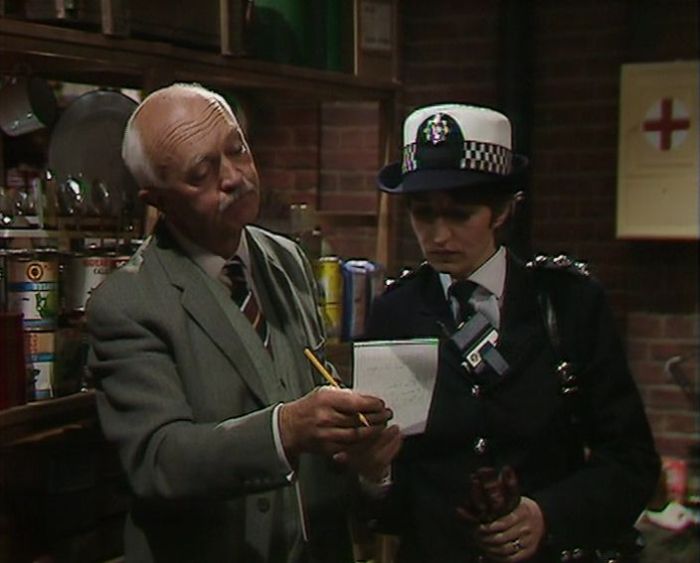
Hannah Maynard (Rosalind Wilson) is a green young WPC, temporarily seconded to Hartley. She’s keen, very keen, but quickly learns that there’s a wide gulf between theory and practice ….

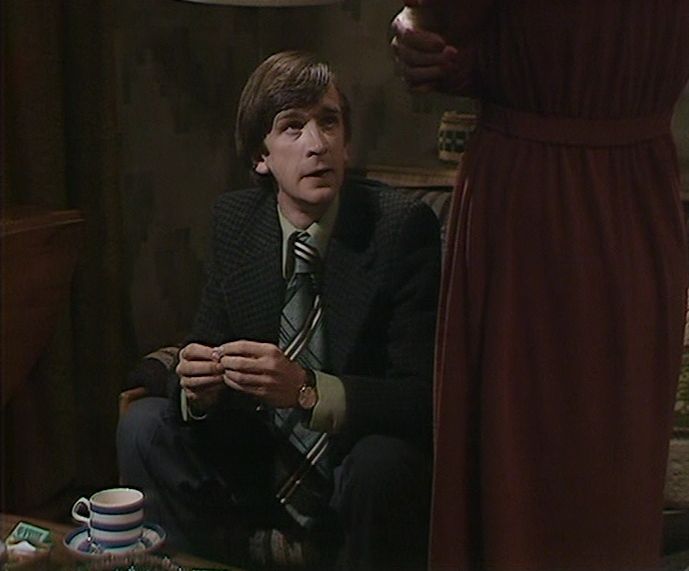
Expectations, like a number of other episodes, juggles several plotlines. The slightly testy relationship between Tom and Jean is teased out in the opening few minutes. At present he’s got an even heavier workload than she has (Tom tells her that he’ll need to work this weekend). His desire to make a success of his new career in Social Services is clear, but so is the feeling that everything’s starting to slip away from him.

His office is a glimpse into the long vanished, pre computer age. Apart from whispered conversations and ringing phones, the only sound is the gentle click clack of manual typewriters. With no computers available to store or collate data, it means that everything has to be written down – hence why everybody is drowning in reams of paperwork.

There are several examples of this – a message from Jean on Tom’s desk (reminding him about their lunch date) becomes buried under a bunch of files whilst his fumbling with more files during a case conference draws expressions of disapproval from some of the others present.

Tom’s current case concerns Laura Cartwright (Jean Rimmer) and her husband Jack. He’s confined to a wheelchair, but this doesn’t prevent him from lashing out viciously at her. Laura later tells Tom that she allows Jack to hit her for the simple reason that if he didn’t attack her then he might do something to himself. A bleak moment with no closure, it’s another of those well-mounted kitchen sink drama scenes that the series excelled at.

It’s interesting that despite this being a major plot point, it isn’t a police matter (they aren’t involved at all) and indeed the travails of Laura and Jack are somewhat secondary to the examination of Tom’s working practices. His desire to prove himself has led him to take on more and more cases (since he believed that refusing any would be a signal that he wasn’t up to the job).

With Tom’s colleague, the ever patient Jennie Randall (Wendy Allnutt), also present, Laura directs a diatribe at poor Tom – describing how his visits are perfunctory at best and useless at worst. She may be being a little hard on him, but for a man who’s always prided himself on his ability to work with people (and joined the Social Services in order to make a difference) it’s something of a hammer blow.

Whilst this is going on, Jean welcomes WPC Maynard to the team. She clearly heroine worships Jean – confirmed by the fact that she requested a secondment to Hartley precisely because she wanted to serve under an officer whom she admired. Jean isn’t especially delighted to hear this and gently tries to explain to Hannah that the job is the important thing, not personalities. It’s left unspoken, but there’s the inference that it’s rare to ever be in a position to pick your superiors (we’ve seen how the likes of Superintendent Lake are – at best – rather condescending towards Jean). Rosalind Wilson is excellent as the keen as mustard Hannah, who manages to exasperate the phlegmatic Roland with her attention to detail.

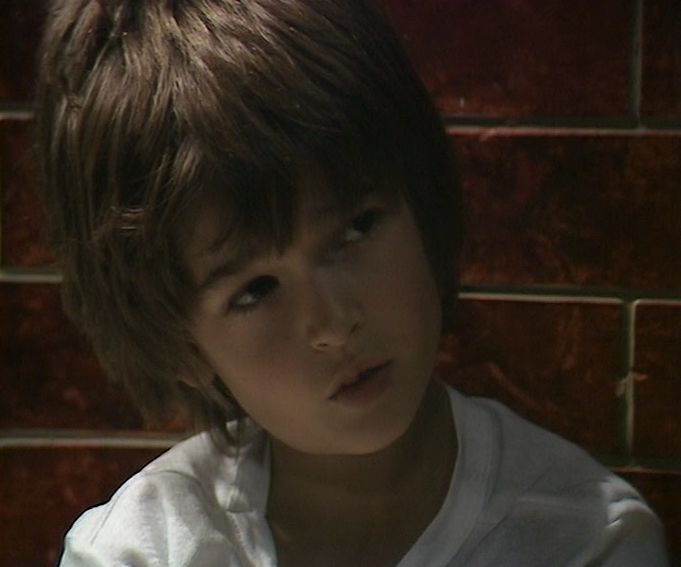
Youth culture isn’t something that the series has tackled so far, but today we see two punky teenagers – Mo (Clare Toeman) and Laura (Sarah Sugarman) – which proves that Hartley does have its share of disaffected adolescents. They mooch around the perimeters of the plot for a while – trying the doors of locked cars on a grimy housing estate, running through a bleak concrete shopping centre – before they come face to face with Hannah.

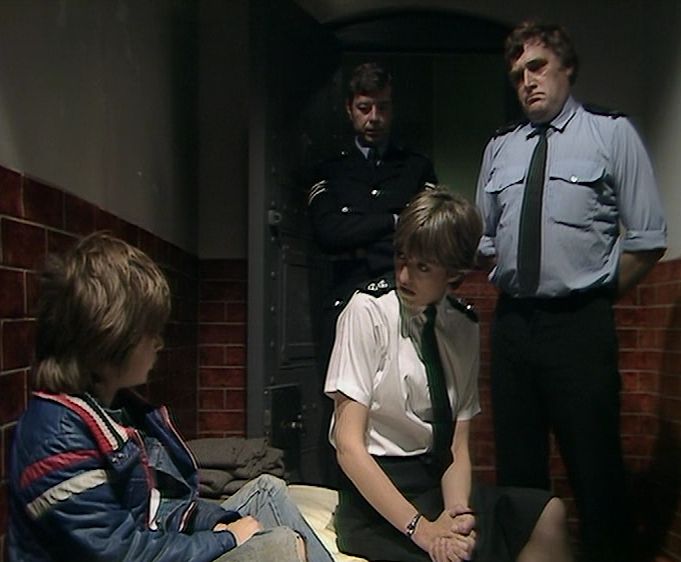
Left to her own devices by Roland for thirty minutes, it’s plain that she’s no match for Mo and Laura. The pair, apprehended for shoplifting, are marched to the manager’s office – but when he has to leave, Hannah is left alone with them, which is where the trouble starts. The manager locks them in – a strange move since it means that once the punky pair turn on her, Hannah has nowhere to run.

The sight of a dishevelled Hannah, “pig” written across her forehead, slowly walking through the store (with an amazed Jean looking on) is a memorable one. Hannah’s reason for not cleaning herself up first – she wanted to public to see the dishevelled, other side of police work – is given short shrift by Jean. She considers this to be a highly melodramatic way of proving a point.

If the title of the episode could easily relate to Hannah’s experience, then equally it fits Tom’s nightmare of a day. The episode ends as it began, in the bedroom, although this time Tom is in a reflective mood. “I was incompetent and irresponsible” he tells Jean. His long suppressed resentment of her more successful career also bubbles to the surface but as they settle down for the night, there’s the sense that they’ve turned a corner and more positive times lie ahead.

jb2.jpg

Juliet Bravo – The One Who Got Away

jb1

It’s a busy time in Hartley. A group of international counterfeiters have moved into the area, a vicious murderer is on the run and Jean’s interest is piqued by a smooth con-man who targets rich widows ….

The One Who Got Away is content to slowly introduce and manoeuvre its guest characters, meaning that it takes a while before we understand exactly who they are and what their function in the story will be. A couple, who we later discover are Detective Inspector Harry Connor (Walter McMonagle) and Detective Sergeant Annie Aspen (Stephanie Fayeman), are shown selecting an isolated cottage (which looks perfect for a stake out) whilst a confident middle aged man, Commander Scott (Geoffrey Hutchings), checks into the Highwayman hotel.

The episode will spend a fair amount of time in the lounge of the Highwayman (which is a nicely realised studio set). For Hartley it’s clearly an upmarket sort of place – albeit with fake rustic overtones – which looks to be positioned slightly out of town. The cheesy muzak which constantly plays in the background is a nice touch, setting up the atmosphere perfectly.

Everything about Scott screams con-man, which is reinforced when his dinner guest – Colette Newby (Shirley Stelfox) – arrives. Scott spins a yarn that he served with Colette’s late husband on the Ark Royal and although there’s no obvious flaws in his story, something seems slightly off-key about him.

At this point, it might be expected that Harry and Annie have arrived in Hartley on Scott’s trail, but that’s not the case. Although when Harry later sees him (coincidentally he’s entertaining Jean at the Highwayman) he does comment that he seems familiar.

If The One Who Got Away has a theme, then it’s about subverting our expectations. Not only is Scott not Harry’s target, but Scott proves to be less in control of the situation than he thinks. Colette might be an imposing and respectable figure – chairman of the Townswomen’s Guild – but she came up the hard way and is more than capable of spotting a confidence trickster when she sees one. Bedecked in a wonderful fur coat, Shirley Stelfox is good value for money.

So although the viewer might have expected Colette to be the victim, she instead turns out to be, if not the hunter, then not exactly a passive character either. Colette (real name Mavis) offers Scott (real name Trunky Porter) a job. As a smooth salesman at her second-hand car lot, he seems set to make a go of things. It may not quite be that she’s going to make an honest man of him, more a case of thieves together ….

The way that Scott/Porter drops his cultured air when later confronted by Jean is nicely done, as is his reaction after he learns that his prey’s real name is Mavis! A con-man conned back.

The return of Superintendent Lake (John Ringham) has primed the audience to expect that the arrival of Harry and Annie from the Crime Squad is big news. Their action against the counterfeiters seems set to be the major theme of the story and yet – in another example of subverted expectations – it turns out to be almost totally a MacGuffin. We do briefly see the counterfeiters, but their presence has no impact on the plot.

Instead, the latter part of the episode focuses on Annie (maintaining the stake-out, all by herself) encountering the runaway murderer (played by Andrew De La Tour). It’s already been established that the house has no phone (which Harry seemed unconcerned about) so when the wild-eyed fugitive breaks in it appears that Annie’s going to have to face him on her own. It’s a slight shame that Annie is transformed into a victim during these scenes (she manages to beat him off before Roland arrived in the nick of time).

Odd that Annie would be left by herself with no means of communication. Whilst Harry is depicted as a secretive type – only Lake and Jean know why the Crime Squad are in the area – this is stretching credibility a little too far. Andrew De La Tour casts an imposing shadow though – and he’s all the more effective since his character never utters a single word.

The meeting between Jean and Harry is one of the most interesting parts of the episode. It’s plain that they have a history, with the clear inference being that they were lovers at one point (Harry waxes lyrical about the time they were snowed in at Merthyr Tydfil during an operation). In his presence Jean is almost girlish whilst the later arrival of Annie casts a slight chill over proceedings. When Harry wanders off, Jean and Annie start a faltering conversation which seems to have a clear subtext (both, in own their way, are keen to prove that they know Harry best). Despite vanishing for a section of the story, Walter McMonagle is another strong addition to the guest cast.

Mixing several different storylines, The One Who Got Away, thanks to its wrong-footing ways, is a very decent story.

jb2

Juliet Bravo – Rage

Kim Buckley (Judy Liebert) is a new mother driven to distraction by the demands of her constantly crying baby boy. With no assistance forthcoming from her husband Jeremy (Christian Rodska) she quickly becomes a danger to her son ….

Rage opens with a visit to two very different households (although both homes are fairly spacious middle-class dwellings, not typical of Hartley). In the first, Jean and Tom are having a relaxed and playful early morning bicker. Tom is mock annoyed by the fact that the newspaper boy is slow in delivering his Guardian (he likes to park up at the end of the street and read it). Clearly he must be a well-read lad if he prefers it to the charms of the Sun.

Playing in the background is Terry Wogan’s breakfast show with Marmalade’s (an appropriate group for the time of day) version of Ob-La-Di-La-Da. The same song continues when the focus switches over to Kim and Jeremy, but the mood there is completely different.

They don’t exchange a word, although their non-verbal actions speak just as clearly as any dialogue would. Jeremy’s face expresses disgust at various small things (the way the teaspoon has been left in the sugar bag, toys scattered about the room) whilst the constantly crying baby is like a knife through Kim’s heart. When he leaves for work (slamming the door) still without having spoken to her, it might have been the trigger for the first of her breakdowns – she smashes up the living room – although this violence doesn’t appear to give her any respite.

Clutching a bottle of whisky, she eventually staggers up to her son. Up to this point we haven’t actually seen him (he’s been represented purely by sound alone). This works on several levels. Not only practically (strict rules would have governed the length of time a baby could be present in the studio) but also story-wise (there’s something slightly more disturbing about a crying baby when we can only hear it).

The sheer misery and desperation of Kim’s life is contrasted by the merry atmosphere at Hartley nick. When Jean enters, Joe is doing his best Long John Silver impression – all because they’ve received a report from a Mrs Edith Bridewell, who’s told them that her son has stolen her wooden leg ….

Moving onto film, as Kim takes her baby out, we get our first sight of the child. But not for long – once Kim enters the police station (as usual, recorded in the studio) the baby has disappeared from the pram. After Kim claims to have killed her son (the empty pram suggests this might be so) she runs off, necessitating a switch back to film as the green young PC Ian Shelton (Martyn Hesford) sets off in hot pursuit.

After this filmic moment we again switch back to the station on videotape (this constant jump from videotape to film and then back to videotape isn’t ideal but it was the way drama of this era tended to be made). A strange videotape/film mix occurs later in the episode when we see Roland checking out the Buckley’s house. The living room is on videotape, but the hallway is shot on film ….

Across the course of the episode, Judy Liebert is called upon to produce several violent mood swings – it’s certainly the sort of role that you have to through yourself into. After being pulled into the station is a deeply hysterical mood, she switches back to being quiet and composed.

She doesn’t have a particularly long list of credits, which is a slight surprise as Liebert’s very compelling as the deeply disturbed Kim. The battle of wills between Jean and Kim is well-written, giving both actors a chance to shine. Kim’s comment that Hartley “sits like concrete on my neck” sums up in a few words the sort of prison she believes she’s found herself in.

Kim’s wildly fluctuating moods continues to drive the story onwards. The moment when she punches Jean in the face (Jean responds by slapping her) is one such example. Presumably Jean intended the slap to bring her to her senses (which it did) although it’s still a jarring sight.

Writer John Foster had cut his teeth on Softly Softly (his first television writing credit was an episode of the series back in 1966) before moving onto a range of seventies dramas including Sutherland’s Law and Z Cars. He would contribute eight scripts in total to Juliet Bravo, including the memorable episodes Aunt Sally and Chasing The Dragon. It’s fair to say that downbeat often tended to be his JB style.

Offering little in the way of light relief, we do at least have a fairly happy ending after the baby is found safe and well. Jean tells Jeremy that he has to do his job better in the future (listen and respond to his wife) with Jean inclined to write this matter off. The right decision? Only time will tell.

Juliet Bravo – Cages

jb01.jpg

George Donkin (Patrick Durkin) is an inept career criminal who’s captured the attention of Melisande Duffy (Anita Carey). Duffy, the bored daughter of a wealthy local businessman, declares that Donkin is a persecuted political prisoner and organises a demonstration outside the station.

Meanwhile Donkin, firmly inside the station, suggests to Joe that he checks the back yard of Szabo’s fish and chip shop. Szabo, a friend of Joe’s, has been resident in Hartley for some time (he fled Hungary decades earlier as a political refugee). And what is Szabo hiding in his shed? Why, a bear ….

Cages has two parallel storylines which eventually converge. At first, it seems that the travails of Donkin will dominate. Patrick Durkin was an actor with one of those faces that you instantly recognise, even if you can’t quite place where you know him from. Donkin is a faintly comic character, whose general lack of criminal ability is later sketched in by Joe (he tells Szabo that the one-eyed Donkin wore a balaclava when robbing a bookies, but only cut one eye-hole in the mask!)

We never quite learn why and how Melisande Duffy latched onto him. That she’s happy to use him in order to further her own political (Marxist) ends is clear, but Duffy never really emerges as a rounded character. She does interact well with Roland though – with him playing the hapless stooge and she the temptress.

Scriptwriter Kenneth Clark is more successful with Szabo (Jon Rumney) who enjoys several lovely scenes with Joe (which are easily the highlight of the episode). When Szabo describes the interrogation he suffered in his own country (a bucket was placed over his head and hammered all night long) it’s done in a very matter of fact way, although Rumney’s skilfully able to imply the horror non-verbally.

If we don’t know why Duffy latched onto Donkin, then neither do we discover how Donkin discovered that Szabo had a bear in his back yard. The reveal is nicely done though – mainly because it’s so unexpected – with a non-plussed Joe looking on. Although the reason for the presence of the bear is another slightly sketchy part of the plot (Szabo’s brother – a circus acrobat – had recently died, so the bear was passed over to him).

Duffy, on learning about the bear from a besotted Roland, decides to free it. This leads to a rather droll line from Joe, after he explains to Jean what happened when Szabo went out to feed it. “When he took the bear his porridge, no bear”. There’s then an attempt to generate a little bit of tension – will the bear, roaming the streets, maul a group of children? – but this part of the story doesn’t really grip.

Better is the byplay between Duffy and Duckworth (David Ryall). Duckworth is a down on his luck newspaper man who senses that the Donkin story might be his ticket back to the big time. Ryall could play this sort of part in his sleep (he’d later appear again as a reporter in another police series – The Chief) but he’s gifted some decent lines as he explains to Duffy that everybody – including both of them – live in cages, just like the unfortunate bear.

Kenneth Clark had experience with a number of police series, such as Dixon of Dock Green and Z Cars, but Cages never really clicks into gear. Save for the character of Szabo (and this is mainly down to Jon Rumney’s performance) there’s not a great deal that’s memorable here. The fifty minutes pass by amiably enough, but overall it all feels a little insubstantial.

jb 02.jpg

Juliet Bravo – Coming Back

jb 03.jpg

Having served a ten year sentence for armed robbery, Mick Grainger (Ron Bain) is heading home. He has a wife, Judy (Rachel Davies), waiting for him, but his reintegration into society isn’t straightforward. Especially since some people, such as Joe Beck, aren’t prepared to forgive or forget ….

There’s not a great deal of film in one, but what we do have is used very effectively. The episode opens with a panning shot, moving from a group of industrial chimneys to a bleak block of flats which are carved unappealingly out of concrete. The eerie silence is a signifier that it’s early in the morning and as the camera closes into one specific flat, we see that Chris Evans (Kevin Whately) is preparing to take his leave of Judy.

It’s plain that they’re in a relationship – which is a complicating factor since her husband is due home any day. The fact that Evans is a constable at Hartley nick adds another layer of complexity to the problem.

An early screen credit for Kevin Whately, his role in the story isn’t terribly large (although it’s an important one – especially the closing scene). Many series tended to feature one-off characters, like Evans, who have clearly been around for some time but were never actually seen by the viewers either before or after their single appearance. This always feels less than satisfactory and since Evans is a fairly peripheral character for most of the story there seemed to be little value in making him a policeman. Given that he hardly interacts with any of the regulars during the bulk of the story – apart from one scene where he asks Jean for a transfer – he could have worked anywhere.

One of the striking things about Coming Back is that it’s not afraid to use silence. Mick’s eventual return home to Judy is a halting affair – punctuated by awkward gaps in their conversation. As we progress through the episode, various people have their say about him – Judy’s employer Mr Lawrenson (Bernard Gallagher) considers Mick to be a dangerous man whilst Joe Beck can’t forgive him for attacking one of his best friends on the force (Mick’s assault meant that the officer was forced to retire due to ill health).

And yet Mick now hardly seems to pose a threat to anyone. True, he’s capable of getting drunk and riled, but his health issues (a major operation in prison has hit him hard) seems to have curtailed his previous wild spirit. Of course, we have no way of knowing just what sort of a character he really was before this current prison spell. Joe fills Jean in with Mick’s career highlights – but given Joe’s obvious bias it’s possibly not surprising that he delights in painting as black a picture as possible.

Crime is not central to Coming Back. Joe might be convinced that Mick is already planning another job, but that’s not the case. In fact, the only crime occurs in the last minute or so (and doesn’t concern Mick). Instead we have a character based drama which just as easily could have been a Play for Today or an Armchair Theatre. Ron Bain and Rachel Davies make for an intriguing pair – the dynamic between their two characters shifts somewhat during the course of the fifty minutes – and they’re the ones who really drive the episode along.

The Hartley regulars have no interaction at all with either Mick or Judy – only Mr Lawrenson bridges the gap (a nice performance by Bernard Gallagher as a rather pompous and self-important type). There’s some decent character building moments at Hartley nick though – we see Jean relaxing with the others in the kitchen, mock annoyed at George because he had the temerity to call her a Liberal! George also has a lovely line after he turns his nose up at the news that a new wine bar’s opened in town. He sorrowfully shakes his head and declares that Hartley’s becoming more like Morecambe every day ….

The aforementioned wine bar is where Jean and Tom head off for lunch, although it’s something of a stormy meal. Their argument – mainly about whether they should take Jean’s (unseen) mother on holiday with them – continues when they get home. So far Tom’s been a rather placid character, so it’s not a bad thing to see a bit more spark from him.

Those who enjoy the rough and tumble, cops and robbers, aspect of police series won’t find much of interest here (this one couldn’t be further removed from The Sweeney). But as a piece of kitchen sink drama, Coming Back stands up very well.

jb 06.jpg

Juliet Bravo – The Runner

jb 01

Johnny Duffield (Julian Briercliffe) is a nine year old tearaway who’s been in and out of trouble ever since he was six. Currently in care, he delights in absconding and sleeping rough. He comes to Jean’s attention after stealing an invalid car – she’s determined to get him back on the straight and narrow, but he proves to be a tough nut to crack ….

Regarded with weary resignation by Joe and George, Johnny immediately piques Jean’s interest. She finds it impossible to believe that the system is incapable of keeping him under control, but it quickly becomes clear that there are no easy answers. Jean’s husband, Tom (David Hargreaves), has recently taken up a job at social services and this provides the plot with a little dollop of friction. Jean and Tom could be said to be on different sides, although it turns out that they want the same thing (although Tom’s colleagues aren’t averse to using him in order to neuter Jean’s sting!)

This was Julian Briercliffe’s sole acting credit. He certainly makes an impression as the bold, but vulnerable Johnny. We’re told that Johnny’s constructed a wall between himself and the rest of the world – with his mother dead and a father (played by John Rees) who’s been unable to control him, his immediate horizons seem rather bleak.

Mr Duffield might be initially presented as an unsympathetic type, but his character is given some dashes of light and shade as the episode progresses. Due to his busted legs, he’s forced to take in any work he can get – at present he’s button carding (“women’s work” he bitterly tells Jean). When he later confesses that Johnny never loved him, it’s possible to wonder whether he’s telling the truth or if he’s simply hardened his heart to save himself from further pain.

The title suggests one of the main features of the episode. Police walls can’t hold Johnny, as he’s apt to make a dash for freedom at the drop of hat. The first time it happens – outfoxing Joe at Hartley nick – is somewhat embarrassing for all concerned. And the sight of Joe and George (puffing down the high street after him) is a little embarrassing too. Jean’s obviously not too pleased, but when he absconds later, she’s the one who was closest to him. This is something that Joe can’t help but mention ….

If the story has a slight weakness then it’s the fact that mid-way through Johnny suddenly gains a friend from nowhere. In plot terms this makes perfect sense – as it allows Johnny to unburden himself (talking about his mother and his future plans) – but it can’t help but feel a little clunky.

This slight niggle apart, we see some nice performances throughout the episode. David Ashton plays Mr MacRae, the social worker at Johnny’s care home. Like everybody else he’s concerned about him – but he’s also confident that if anybody can fend for themselves out on the moors, then it’s this boy. It’s not really an uncaring attitude, since MacRae has attempted – and failed – to get through to him. A few years later Ashton would be a regular in Brass, playing Doctor MacDuff.

Another familiar face making an appearance is Robert Vahey (later to be the long suffering Bill Sayers from Howards’ Way). Vahey is Tom Collinson, a local reporter who’s convinced that Hartley is the location of a major IRA arms dump. His obsession has nothing at all to do with the main story, but his regular appearances help to sprinkle the episode with a dash of comic relief.

Martin Matthews is very solid as Jim Naylor. Naylor, along with his wife Cynthia (Eileen Helsby), is interested in fostering Johnny. His wayward streak doesn’t bother them and Naylor, as a former orphan, knows better than most how Johnny’s mind works. It’s interesting that he seems to be the first person to get through to the boy – this is despite the fact that everybody else (both the police and social workers) have been equally as patient. Fair to say that this is a story which isn’t criticising the system (Johnny is shown to be something of an anomaly). Since everybody’s done their best to help him, the finger of blame isn’t pointed at any specific person or organisation.

It’s maybe just a little pat that Johnny lands on his feet with a warm and loving couple who are so keen to look after him. But although we end on an optimistic note, there’s still the possibility that things might not work out in the future ….

Not a story that has too many surprises, but the major location shoot (we see plenty of Hartley and the surrounding moors) keeps the interest ticking along.

jb 02.jpg

Juliet Bravo – Trouble at T’Mill

jb 01.jpg

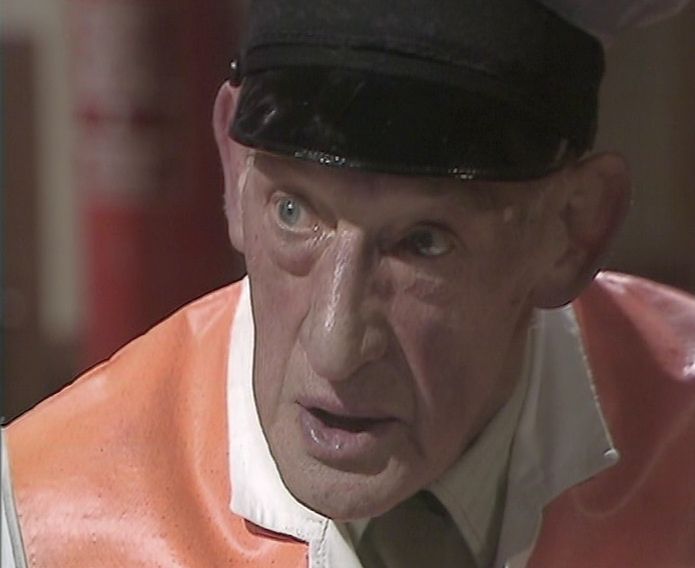
Issy Smethurst (John Barrett) is an elderly, set in his ways, lollipop man. Many passing motorists catch his ire, but none more so than Ted Galway (Alan Lake). Galway, a flashy self made man, represents everything that Issy despises. And when Galway buys the factory where Issy works part time (tending the engines) it only serves to deepen their feud ….

The character conflict between Galway and Issy is at the heart of the episode. Issy stands for tradition and continuity – although the engines he so lovingly tends (when he’s not harassing passing motorists) are contained within an eerily quiet factory. Once it was a thriving hub of activity, but now it stands idle. The current owner explains that it’s simply not cost effective to keep it running. When a smaller plant space, with newer equipment, can turn out more textiles at a cheaper cost and with far less manpower, the economic argument for its closure is strong.

The facts don’t concern Issy though. For him, it represents a lifetime of toil (he recalls how he first arrived at the factory, as a seventeen year old). To see those engines broken up – which seems likely after Galway (via proxy) buys the place – is heart-breaking for him.

Ted Galway is Issy’s complete opposite. Having disappeared to London for a few years, he returned as a self made man of considerable means. Now he owns the flashiest house in the neighbourhood (complete with a swimming pool and a snooker room), runs with the local hunt and numbers several high-ranking police officers – such as DCI Logan – amongst his friends.

Logan gently suggests to Jean that Issy needs to be warned against bothering Galway in the future. That Logan’s never even considered the possibility that Galway might be crooked seems barely credible (Logan seems to have swallowed Galway’s story that he made his fortune in a London casino hook line and sinker). Issy might be motivated (in part) by spite, but he’s plainly right when he claims that Galway’s crooked.

Although it might be expected that Issy would be the audience identification figure, there’s also something about Galway which incites a certain sympathy. This is no doubt down to Alan Lake, who manages to make Galway a curiously vulnerable figure.

There’s something ever so slightly pathetic about Galway’s delight in the trappings of his success. From his Rolls Royce (complete with an eight track cartridge system!) to the fact that he now hob nobs with all the local worthies, he leads a comfortable and law-abiding existence. So the arrival of Walter Hancock (Antony Carrick) who’s come up from the smoke is an unwelcome one – since Hancock forces him back into a life of crime.

Galway would like nothing more than to be left alone, but he owes some powerful people some favours, so has no alternative but to get involved in a furs robbery. Which happens to be observed by Issy – who by this point is keeping Galway under constant surveillance!

There are some fascinating incidental details in this story – one which stood out for me is Jean’s assertion that Hancock may very well be a criminal since he has tattooed arms. Today, tattoos are commonplace, but rewind nearly forty years and it’s plain that they were far less socially acceptable. The way we observe how Galway has moved upwards (he likes to indulge in dinner parties with jugged hare, after dinner mints and cigars) is another lovely touch.

Trouble At T’Mill possibly doesn’t show Hartley’s police force at their finest, since it’s Issy who does all the work for them. This is something that annoys Joe immensely – if Issy was a nuisance before, imagine what he’s going to be like now he’s been proved right ….

John Barrett’s a little shaky on his lines from time to time, but considering that he’s got the largest role in the episode that’s possibly not too surprising. Issy’s gifted several nice monologues and shares some decent two-handed scenes with Jean. Knowing about Alan Lake’s untimely death, it can’t help but make his later television appearances (such as this one) seem very bittersweet. Ted Galway is a fine creation – with Lake deftly shading in the nuances of his fluctuating character very well.

Lake would go on to appear in another two Juliet Bravo episodes playing different characters as would Christine Hargreaves who in this one plays Galway’s wife, Vera. You might have expected that Galway would have found himself a young, trophy wife, but not so – Vera is middle-aged and running a little to seed (and whilst Galway has assimilated himself amongst the upper echelons, Vera has remained resolutely working-class). With a cigarette never far from her lips, she seems somewhat out of place in their palatial home. Hargreaves who, like Lake, would pass away in the mid eighties, is probably best known for being one of the original cast members of Coronation Street.

Trouble At T’Mill is low on crime, but high on character conflict and is yet another strong episode from the early part of the first series.

jb 04.jpg

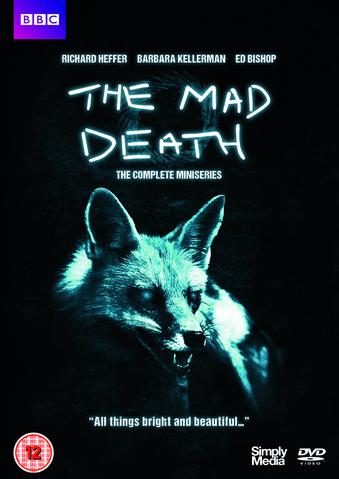
The Mad Death – Simply Media DVD Review

164454- Chief Crazy Horse Sleeve.indd

It always seemed that it could never happen here, but when a cat infected with rabies is smuggled into Britain it triggers a major crisis. Facing hostility from the public (angry that some of their pets have been impounded) the authorities struggle to stop the outbreak from spinning out of control ….

Tom Siegler’s (Ed Bishop) decision to befriend an apparently benign wolf he discovers at the side of the road has far-reaching consequences. By now the audience has already been primed to expect something awful to happen, although the tension is eked out for a few minutes longer (Tom, having cut his finger slicing a lemon, then goes over and pets the fox – although at this point there’s no reaction).

The boiling point isn’t far away though. Animal wrangling must have been an issue for the serial, as attempting to depict rabid beasts would require considerable co-operation from the animal actors (which no doubt couldn’t always be guaranteed). Director Robert Young keeps the tension bubbling along though, thanks to rapid cuts and close-ups, with the result that the action scenes feel viscerally real.

Young had cut his teeth on horror films (directing Vampire Circus for Hammer in 1971) before moving into television in the early eighties. Robin of Sherwood, Bergerac, Jeeves & Wooster and G.B.H. all benefitted from his presence. Possibly it was his work on The Mad Death which made him an ideal fit later for Robin of Sherwood, as both had – at times – a woozy, non-naturalistic feel.

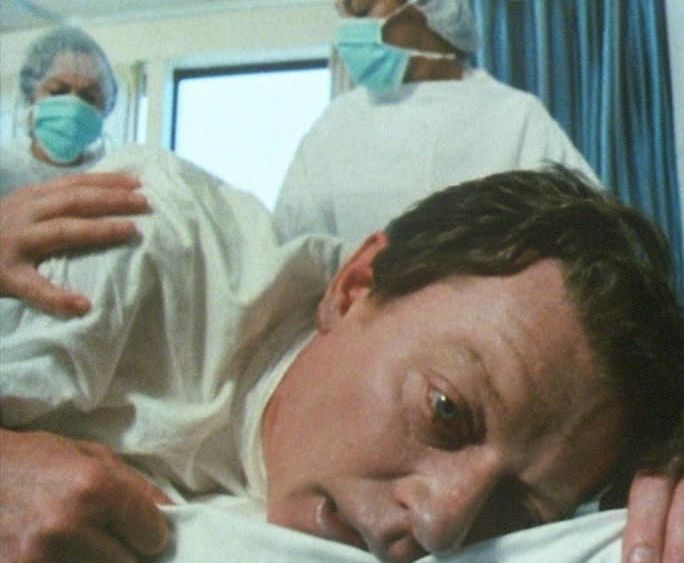
This is first seen in The Mad Death after Tom, by now seriously ill after being bitten by the fox, is hospitalised following a car crash. The hospital should be a place of safety and security, but instead it’s a hallucinogenic nightmare for him. The mere act of reaching for a glass of water becomes overwhelming (he’s then pictured drowning in a bed of water – a technically impressive shot) whilst other visions are equally as disconcerting (his wife and his mistress both pay him uncomfortable visits). It’s interesting that during these scenes we often switch in and out of reality (with the result that the viewer is privy to Tom’s fevered imaginings). This simply adds to the sense of horror.

mad 03
Ed Bishop

Bishop, a sometimes underrated actor, is excellent as the increasingly tortured Tom. Another stand-out scene for him occurs earlier in the opening episode when he attempts to dispose of the fox. First with a broom handle (that was never going to work) and later with his car. Eventually he does manage to drive him off, but by then the damage has been done.

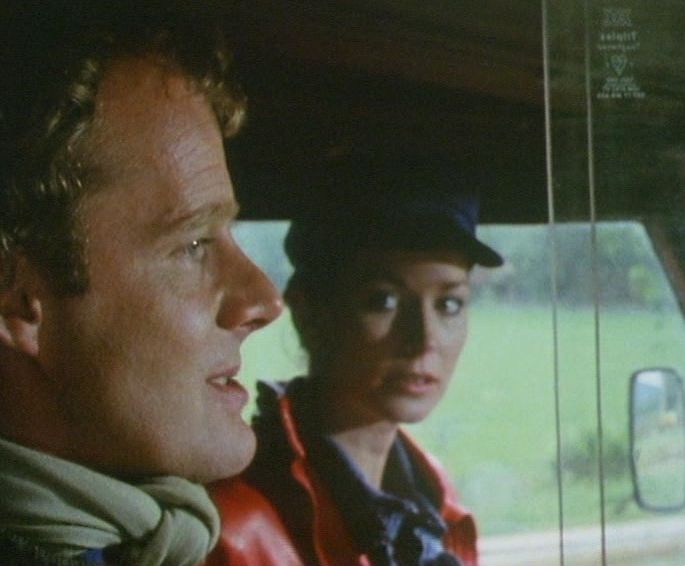
Although Tom’s story dominates the first episode, the two central characters of the serial – Michael Hilliard (Richard Heffer) and Dr Anne Maitland (Barbara Kellerman) – are also introduced. They first appear during the opening few minutes in a rather clumsy way. It might have been better to cut this scene and hold them back until they actually started to interact with the main plot (for example, when Anne was dispatched to the hospital to confirm the diagnosis that Tom is suffering from rabies).

If Anne has the medical knowledge, then Michael is her equal when it comes to the veterinary angle. But he’s refusing to get involved ….

Richard Heffer was by this time a very familiar television face. A regular in several 1970’s WW2 dramas (Colditz, Enemy at the Door) he’d also made several appearances in Survivors and had appeared throughout the final series of Dixon of Dock Green. Barbara Kellerman had also notched up some notable television appearances during the seventies (The Glittering Prizes, 1990, Quatermass) and would later go on to appear in the BBC’s C.S. Lewis adaptations during the late eighties and early nineties.

mad 06
Richard Heffer and Barbara Kellerman

The beginning of the second episode brings any latecomers up to speed with a summation of the events so far, before looking ahead to the current measures being implemented to control the outbreak. This is done quite neatly via a news report (a very effective way of info-dumping).

Episode two also sees a rabid dog terrorising a group of customers in a shopping centre. With a fair number of extras deployed, it’s a good indication that The Mad Death had a very decent budget. Robert Young once again crafts some striking shots – a slow plan past several shop window dummies (stopping eventually on what initially appears to be another dummy but turns put to be a heavily suited dog handler) is especially memorable. A series of jerky cuts gives these scenes a naturalistic, documentary feel.

Anne continues to prove that she’s no shrinking violet by driving a jeep containing Michael and a number of marksmen at high speed through the shopping centre (in a desperate attempt to get to the dog). This is something of a wish-fulfilment scene, since most of us have probably wanted to do this at some point.

Inbetween the moments of terror are longer periods of reflection. Animal lovers, such as Miss Stonecroft (Brenda Bruce), are appalled at the way their pets are being treated (chained up like prisoners twenty four hours a day, she says) whilst Michael and Anne eventually fall into each other’s arms. This always looked inevitable, but it seems sure to annoy Anne’s partner Johnny (Richard Morant). And the fact he’s an arrogant member of the landed gentry who isn’t prepared to take any precautions with his animals is guaranteed to get Michael’s back up ….

The third and final episode ramps up the action another few notches after Miss Stonecroft lets a whole pound full of dogs loose. With the animals roaming the countryside, Michael takes to the skies, coordinating a team of armed soldiers. Their instructions are clear – all animals are to be shot on sight. The filmic sweep of these scenes is another example of the serial’s healthy budget.

Meanwhile, Anne finds herself tangling with an increasingly detached Miss Stonecroft whilst Johnny, also doing his bit to deal with the dogs, eventually runs into Michael. The question is, will he use his gun on the animals or on his love rival? These interlocking plot threads help to keep the interest ticking along until the final few minutes.

Shot on 16mm film, the picture quality is generally pretty good considering the age and unrestored nature of the material. I did notice one picture glitch – at 18:38 during episode three there’s a slight picture breakdown (a brief loss of sound and a blank screen for a second or two).  After the blank screen, we see Michael raising a glass of scotch to his lips but before the glitch he wasn’t holding one, so a short section of this scene is missing (Michael being offered and then accepting a drink).  Luckily it’s not a vital moment, but If I learn any more about this issue then I’ll update this review.

Thirty five years down the line, The Mad Death is still a tense and disturbing watch, thanks to Robert Young’s skilled direction and the performances of the cast. It remains a powerful serial and is well worth adding to your collection.

The Mad Death is released by Simply Media on the 7th of May, RRP £14.99, and can be ordered directly from Simply here. Quoting ARCHIVE10 will add a 10% discount to the order.

mad 04
Barbara Kellerman

Juliet Bravo – Coins

jb 01.jpg

Major Adams (George A. Cooper), convinced that the Russians will attack sooner rather than later, has prepared for this eventuality by stockpiling an impressive array of food and other provisions. This proves to be an irresistible temptation for two young teenagers – Carol (Diana Walker) and Kenny (Mark Price) ….

The first of two episodes written by Ray Jenkins (a writer with an impressive track record across many popular series) Coins is a pretty low-key story which focusses more on the characters involved than it does the crime. The pilfering is pretty petty – some tins of food, a primus stove, etc – and is mainly of interest since it suggests that the perpetrator is somebody living rough.

Cooper’s role in the story is quite small (once Carol and Kenny are identified, Adams fades away) but as might be expected he’s terribly good value with what he is given to do. Adams (rather like Cooper’s most famous creation, Grange Hill’s Mr Griffiths) is somewhat pompous and self-important, but scratch a little below the surface and there’s hidden depths.

Adams’ war service and the things he saw might very well explain why he continues to run his life along such strict lines. His bachelor status and his self-professed pride in doing everything for himself is both admirable and slightly tragic.

There’s something of a jump (almost as if there was a missing scene) after Adams suggests that the young female thief might have been a papergirl who used to work the area. The long-suffering Roland is sent off to check this – but in the next scene we’re at the local care home, where Jean has arrived to speak to Carol. A spot of bridging dialogue, explaining that the ex paper girl was Carol, would have made this part of the story flow a little better.

Diana Walker’s acting career only encompassed this episode of Juliet Bravo and a limited run in Brookside a few years later. Her lack of acting experience helps to give Carol a natural, unforced air – with her mother in hospital (and unlikely to ever come out) she faces a bleak and uncertain future, with Kenny being the one bright light in her life.

Kenny’s disappearance drives the later part of the story, but it’s never suggested that he’s in any danger (or indeed is dangerous himself). His eventual discovery is more the solution to a puzzle, whilst his continuing absence allows the spotlight to be shone on his estranged parents – Bob (David Boyce) and Pat (Deidre Costello).

Joe Beck doesn’t take to Bob at all. Granted custody of his son, Bob seems to be a pretty decent sort of chap – true, he doesn’t often get to see his son (but that’s mainly because he’s working night shifts and sleeping during the day). As he tells Joe, he has to earn money to put food on the table. There’s something in Joe’s expression which suggests this is something of a feeble excuse and the way Boyce plays the scene does suggest that Bob is an inherently weak man.

But he must have seemed a better bet than Pat, since the court decided not to grant her custody. If Bob’s pallid and faded then Pat’s bold and brassy. But her confident public image proves to be decidedly brittle ….

Roland continues to provide a dollop of comic relief. Once again he demonstrates that he’s lacking in a sixth sense (referring to Jean as Wonder Woman, whilst unaware that she’s standing right behind him). But she keeps on giving him chances and decides to take him along to Pat’s house in order to discover whether Kenny is hiding out there. He’s told to dress in plain clothes – well, what he arrives in certainly isn’t a police uniform, but it couldn’t really be classed as plain clothes either.

It’s a slight frustration that this episode introduces us to the very capable WPC Gilbert (Helen Duvall) as sadly this would be her one and only appearance. Possibly it was felt that one female regular was sufficient, but these early episodes would have been stronger if there had been at least one female amongst the rank and file officers.

Fairly forgettable crime-wise then, but Coins is a decent character study.

jb 03.jpg

Juliet Bravo – The Draughtsman

dm 02.jpg

DS Cole (Del Henney) arrives from London. An informant of his, Arthur Roberts, was discovered murdered on the moors and Cole has come to identify the body. His role should then be at an end, but the dogged Cole is determined to work out what happened and Jean is keen to assist ….

The first of three different Juliet Bravo roles for Del Henney, Cole is initially presented as a dour, humourless man. He’s less than impressed that the body’s been moved to the mortuary (he would have preferred to have viewed it in situ), seems incredulous that the scenes of crime officers haven’t found anything and is disgusted that so many people have trampled over the site.

The fact he’s been given PC Roland Bentley (Mark Drewry) as a driver seems to be yet another irritation for him. The garrulous Roland and the taciturn Cole seem like a match made in hell. But when Cole wryly grins after overhearing Roland on the radio, telling the station that Cole is a “right one”, it suggests that he might not be quite as dour as he initially appeared.

Roland is the first of a series of PCs who appear throughout the six series. Some are more gormless than others it has to be said, with Roland being somewhat high on the gormless scale. He’s long-suffering (tutting when Cole drags him on a trek across the moors), petulant (when Jean and Cole leave him alone on observation) and ever so slightly sickly (but as he tells Jean, he doesn’t often get car sick now and rarely when he’s driving ….)

Cole is received politely, if condescendingly, by Detective Superintendent Brunskill (John Rowe). Jean later confides to the Sergeant that Brunskill was hardly going to welcome him with open arms – a murder in this area is something of a rarity, so the thought of a London copper stealing their glory wouldn’t be appreciated. Cole solving the case doesn’t concern Jean, but she is bothered about the way that Brunskill’s men have commandeered her nick.

Henney’s greatest strength in this episode is his stillness. As befits Cole’s solitary nature, he’s much more of an observer than a talker (although he can be articulate when he wishes). The best example of Cole’s ability not to react can be seen when he finds himself on the end of a boozy diatribe from Joe Beck. Joe is celebrating twenty two years on the force (confusingly, he refers to this as his “silver handcuffs” which surely would be twenty five) and everybody – including Cole – has convened to the local pub for drinks.

But Joe, a man who’s had dealings with Flying Squad officers like Cole before, is keen to vent his spleen about those flash London coppers. Henney’s the picture of control during this scene – allowing a range of expressions (from amusement to irritation) – to play across Cole’s face. That Cole doesn’t confront Joe in public but does so instead in private (in the toilet shortly afterwards) is an interesting choice. Sparing Joe a public humiliation?

The rift between Jean and Joe now seems to have been healed (although they don’t exchange more than a few words during this episode). But after being rather stroppy in Shot Gun and now drunkenly boorish here, it’s fair to say that Joe hasn’t made a good early impression.

The relationship between Cole and Roberts is teased out as the episode continues. Cole respected his skill as a blag draughtsman and regrets his death. But the main reason why he carries this regret is that he was hoping to pin a really big crime on him one day. For Cole, everything – including relationships – comes back to the job eventually.

With Roberts represented on screen only by an unseen body under a mortuary covering, the script has to work to build up a picture of him. And his criminal associates are also – until the last few minutes – equally shadowy characters (spoken about, but only briefly seen). When they do appear, it’s the cue for a mild action scene as villains and police have a bit of a bundle. The Sweeney it isn’t (director Paul Ciappessoni wasn’t really an action director like, say, Douglas Camfield).

The dichotomy of Cole – he delights in roughing up the villains but also digs into his own pocket to buy a headstone for Roberts’ grave – means that by the end we still don’t really know what makes this enigmatic man tick. Henney would return but Cole wouldn’t, which is a bit of a shame as it would have been interesting to return to the character at a later date.

dm 03.jpg

Juliet Bravo – Fraudulently Uttered

jb 03.jpg

Doris Latham (Patricia Hayes) works part time as a tea lady at Doe Electrics. Elderly, Irish and genial, she would appear to be the most unlikely criminal you could ever hope to meet. But over the last four years she’s embezzled the company out of more than thirty thousand pounds ….

Although Patricia Hayes might be best known as a comedic actress (appearing alongside the likes of Tony Hancock, Arthur Askey and Benny Hill, amongst many others) she proved to be no slouch when she moved over to drama – winning a BAFTA for the 1971 Play For Today, Edna the Inebriate Woman, for example.

She continued acting well into the 1990’s, racking up credits on popular series such as Heartbeat and Lovejoy whilst her film career included such diverse roles as Daisy in the classic Ealing wartime propaganda film Went The Day Well? (1942) and Mrs Coady in A Fish Called Wanda (1988).

Fraudulently Uttered is, of course, enhanced no end by her performance (although the Irish accent took a few moments to get used to). As Doris is a female prisoner, Jean finds herself (as the only female officer at Hartley) cast in the role of her jailor (and also interrogator). A curious mixture of innocence and steel, Doris proves to be a tough nut to crack.

The sight of a little old lady locked in a cell at Hartley nick is a powerful one, but Doris’ belief in the righteousness of her actions – she admits stealing the money, but never kept any for herself – gives her a curiously detached air. Even when she asks Jean what her sentence will be, it doesn’t seem to concern her too much. As she says, with only a pension and a cat to go home to, what does it really matter?

The innocent Doris has been manipulated by the far from innocent Jimmy Harker (Ray Smith). Harker, a second hand car salesman, caught Doris’ sympathy after he fed her several sob stories. So as a result, she was quite prepared to steal huge sums of money for him …..

With my accountancy hat on, I have to say that I’m amazed the fraud was undetected for so long. Despite only being the tea lady, Doris was entrusted with taking the cheques at Doe for signing each week. This is just about credible, but it’s the next part which is difficult to swallow. Somehow Doris had stolen a company cheque book and from time to time would slip in one from this book. Fine so far, but when these dodgy cheques were cashed they’d show up on the bank statement with all the others – so surely then somebody would have realised that something was wrong (they wouldn’t have been able to tie them back to an invoice, the cheque numbers wouldn’t have matched the others, etc). Reconciling your bank statement back to your ledger is pretty basic stuff.

Taking my accountancy hat off, there’s still plenty to enjoy in this episode. Ray Smith is wonderful as Jimmy Harker. Harker purrs with silky villainy, taunting DCI Jim Logan (Tony Caunter) that he has nothing on him. But things start to unravel dramatically after Harker tells his associate, Edward Bass (Dicken Ashworth), to take Arthur Hill (Arthur Kelly) out to the quarry and persuade him (with a hammer) that he should keep quiet.

Hill might have been an unwitting part of the fraud, but his testimony could prove fatal for Harker. That Bass and Harker are an inept pair of villains is made clear after a frantic Bass phones Harker to tell him that although he only tapped Hill a few times (!), he thinks that he’s killed him. This is the signal for Harker to make a break for it ….

All Harker’s scenes so far have had a faint comic edge and his attempted getaway carries this theme on. The sight of Harker speeding away on a moped whilst two officers crawl behind in a commandeered car driven by a vicar (played by Hugh Latimer) makes this plain.

This part of the story also gets us back on film after the largely studio-bound nature of the rest of the episode. I like the moment when we see Harker jogging for freedom down the high street. Given the number of passers-by who stop and stare at him, it’s plain that the street wasn’t closed for filming. Therefore these ordinary members of public unexpectedly found themselves television stars for a few seconds.

Another strong script from Ian Kennedy-Martin, Fraudulently Uttered has a lighter tone than Shot Gun and is a highlight from the early run of the series, thanks to Patricia Hayes and Ray Smith.

jb 07.jpg

Juliet Bravo – Shot Gun

Juliet Bravo carried on in a similar tradition to previous BBC police series such as Dixon of Dock Green, Z Cars and Softly Softly. What links them all is their low-key feel (murders and armed robberies were the exception rather than the rule).

It’s an interesting fact that series creator Ian Kennedy-Martin had also created The Sweeney (penning the original Armchair Cinema pilot, Regan). The Sweeney has long been regarded by many critics as a breath of fresh air – destroying the few remaining shreds of credibility of tired old warhorses such as Dixon and Z Cars.

The truth is a little different though. The surviving colour episodes of Dixon (most of which are now available on DVD) reveal a much more interesting programme than the “tired old dinosaur” of legend. And whilst The Sweeney blazed brightly for a while (with The Professionals and Dempsey and Makepeace following in its wake) there’s no reason why every subsequent police show had to follow this format.

Possibly due to its countryside setting, JB has come to be seen by some as a cosy Saturday night programme, a forerunner to Heartbeat. This is far from the mark though – Hartley may be an isolated town, but that’s not necessarily a good thing. Social and economic deprevation (the series debuted in 1980) is the background to many of the stories. Quiet desperation might be said to be one of the series’ recurring themes.

The major selling point of JB, of course, was the fact that a female inspector, Jean Darblay (Stephanie Turner), has been placed in charge of a station full of men. Today this wouldn’t raise an eyebrow, but the novelty of a female Inspector (or indeed a female leading a police series) would still have been strong back in 1980.

The forces of conservatism are represented by the two middle-aged sergeants, Joe Beck (David Ellison) and George Parrish (Noel Collins) with Joe being the most opposed to Jean’s appointment (his calculated insolence runs throughout this opening episode). Eventually she tells him outright not to call her “boss”. “Ma’am” will do instead.

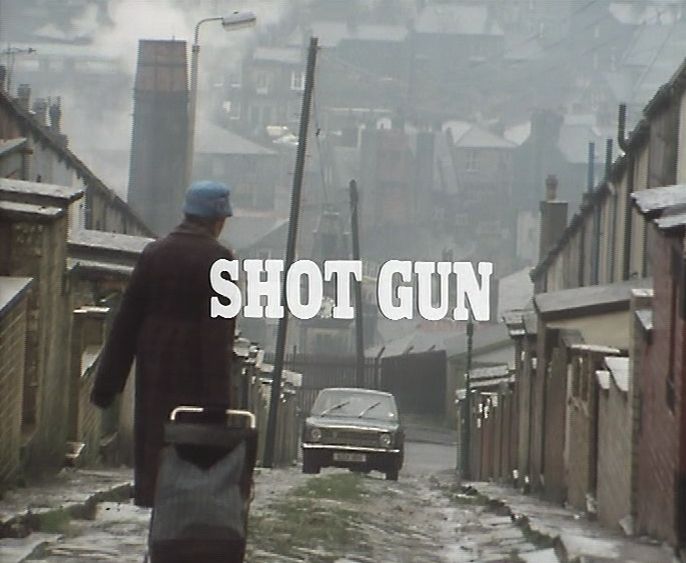
The opening few seconds of the episode – a car gingerly traverses up a steep, deeply rutted road whilst an old woman with a trolly trudges down (with a factory chimney billowing out smoke in the distance) is a wonderful piece of visual shorthand. We’re instantly aware of exactly what sort of town Hartley is (a run-down environment which has seen better days).

The car driver – Rodney Maskell (Tony Melody) – is just as quickly established as a deeply unstable man. With camera angles shooting from low on the ground and from his POV, it helps to create a sense of queasy uneasiness. He’s arrived, at gunpoint, to take his teenage daughter, Maureen (Joanne Whalley) away with him.

After this drama, we switch over to the more humdrum world of Hartley nick. Jean’s already been resident for a short while, but it’s still clearly not something that Joe and George have come to terms with. Joe’s gleefully sorrowful comment that a parade at 9:30 will be difficult is just one round in their battle of wills.

Jean’s encounter with local informer Ted Watson (John Moore) is another. Joe and George have clearly indulged this elderly chap for years, but Jean is far from impressed when she learns that he expects to receive five pounds for his statement (he claims to have witnessed a rape on the moor). This subplot is notable for establishing the bleak tone of the series – Jean attempts to question the mother of the alleged rape victim, but doesn’t get very far. The father isn’t a great deal of help either (telling Jean that if her daughter becomes pregnant they’ll “summon the bastard”. If she’s not, then they won’t).

Jackie Shin (as Mr Porter) enjoys a vivid cameo here, as Porter explains to Jean that dragging his young daughter through the indignity of a court case is something he’s keen to avoid. His parting shot (“if you weren’t a bloody woman, I’d belt you one”) is nicely delivered too.

Mrs Maskell (Margaret Stallard) tells Jean that her husband has been on a downward turn ever since he lost his job (his old place of work – a now derilict mill – could be taken as a visual metaphor for the economic decline of the North). Of course, this is where he and Maureen are holed up (Jean decides to pop into the mill all by herself and is marched out at gunpoint by Maskell for her pains).

It’s hard to see this as anything other than a massive miscalculation on her part (although to be fair, Jean wasn’t aware that Maskell had a shotgun).

Whalley might have been eighteen at the time, but she’s easily able to play a diminutive fourteen year old. She doesn’t have many lines, but no doubt due to her later career she always catches the eye.

Tony Melody is compelling as a man on a verge of a nervous breakdown. His desire to shoot his wife (or indeed the police) is contrasted by his obvious love for his daughter. That she’s the only person he won’t shoot is later used by her as she timidly tells him that she’s prepared to walk out of the door. Melody and Whalley play these later scenes very well.

This looks like it was David Reynold’s only JB episode as director, a pity as there’s some lovely filmic moments peppered throughout (Shot Gun is a major location shoot, other episodes would be more studio based). Later moving to ITV, Reynolds would become a producer, working on many of the network’s top dramas and comedies.

Shot Gun establishes the series with a bang, informing us right from the start that we shouldn’t always expect a happy ending.


A Very Peculiar Practice – Contact Tracer

contact 01.jpg

At the start of this episode Lyn and Stephen enjoy a relaxing post-coital moment. Lyn tells him that she’s his best client and that their experiences (with the names changed of course) will make valuable research material. Is she attempting to unsettle him with her talk of other partners – all part of her researches maybe? Stephen, although he’s immensely grateful to Lyn, can’t help but feel like an experiment subject. At one point he likens himself to a “smoking beagle”.

John Bird returns as Vice Chancellor Ernest Hemmingway with Frances White appearing as his ever-loyal secretary Dorothy Hampton. The members of the practice are called to an early morning meeting with the VC, where the drinks on offer – apple juice – doesn’t meet with the approval of Bob (“I’m not a bloody hippy”).

Hemmingway is a jargon-spouting bureaucrat, keen for the practice to pay its way. Stephen’s weak protestation (made even less impressive by the way he’s clutching his carton of apple juice) that they have an impressive treatment rate piques the VC’s interest for a fleeting second, but since it’s not actually something that’s generating income he’s unsure of how they can spin it into a success story.

Stephen’s encounter with Jeannie MacAllister (Geraldine Alexander) has unforseen consequences. She’s charming and Stephen is his usual affable and friendly self, but she’s also a journalist and despite Stephen’s protests that he can’t discuss confidential medical matters with her, he attempts to put a positive spin on their treatment successes. Alas, this means that he turns into Doctor Blue Eyes whilst their success at treating VD becomes a major talking point of the article.

But then there’s a rash – as it were – of cases of sexually transmitted diseases. Stephen and Rose Marie, of course, are delicate, patient and understanding with their patients whilst Bob is forthright, brisk and uncaring. “Below the waist I take it? Front or back? So we’ve got a bit of tool trouble, well, well, well”. Jock is his usual avuncular self, telling one student that it’s “one of the minor penalties extracted from us by the goddess aphorpdite”.

With thirteen cases in two days (“trouble with the trouser snake” as Bob puts it) Jock and the others have a race against time to stop the epidemic growing. Graham Crowden once again ramps the intensity up and effortlessly steals the scene as Jock rages to Bob that they have to tackle this undercover and with a Falklands spirit. Later bulletins to the troops (“we’re holding the enemy, but only just”) are delivered in the same entertaining military manner.

With only a limited number of extras on hand, a little bit of creative work ensures that the illusion of a stream of patients is created. First, we see a number of mute patients before rapidly cutting to close-ups of the doctors as they continue to work their way through a backlog of appointmemts. By this point we simply have to accept that the unseen people they’re talking to are actually there.

Bob’s rundown of which departments were the worst offenders is a classic VPP moment. “Arts Faculty produced the largest number of cases. Idle sods. Too much time on their hands. Whole department’s going down like dominos. Similar pattern with the secretaries and porters, and Communication Studies lived up to their name. Waitresses and bar staff were a problem till we sewed up the catering managers’ trousers with cobbler’s thread. Sociologists only appear to do it with each other and we’ve got control there. Engineers, you’ll be interested to hear, have a very low rate of sexual activity. Singing about it in the bar seems to be their only outlet. And Physical Sciences hardly troubled the scorer”.

The nuns – who have been ever-present background figures – call in to see Jock. Stephen’s shocked expression – surely, they can’t have … ? – offers Peter Davison a lovely reaction moment. The late twist that even the VC is affected is another gift for Davison as Stephen is forced to reluctantly approach Hemmingway in his den. Naturally, the VC immediatly jumps to the conclusion that Stephen’s attempting to blackmail him.

The VC is appreciative but as a skilled politician he finds it impossible to believe that Stephen won’t attempt to use this embarrassing information at a later date. So Stephen’s told gently but firmly that his days at Lowlands are strictly numbered ….

A Very Peculiar Practice – Black Bob’s Hamburger Suit

bob 01.jpg

An old school friend of Bob’s, Jimmy Partington (David Gwillim), is able to put a potentially lucrative consultancy deal his way. Jimmy, now working for Hamburger – a major international pharmaceutical company – wants him to trial Confidan, a wonder drug that can cure just about any ill.

And with Jock under pressure from the Vice Chancellor, this could be just the sort of thing to prove their worth. Bob ropes Stephen in and the pair start to prescribe the drug (Stephen as and when required, Bob to anybody who walks through the door). Everything seems to be going swimmingly, until ….

Black Bob’s Hamburger Suit is, as the title suggests, a Bob-centric episode. This is a very good thing. Given a little more time and space, David Troughton is able to flesh out the character of Bob Buzzard very nicely. We start by dropping in on his home life (a swooping camera pan across a number of expensive-looking, but identical houses). After a few hurried and angry words with his wife, Daphne (Kay Stoneham), he’s straight into his car. His first job is drop his boys, Ollie and Simon, off at school.

Diminutive and bespectacled, they decide that daddy is in one of his rages. The way that Bob drives – aggressively and fast – suggests this is so, however much he denies it. His children don’t seem to have a very happy school life – duffed up by the boarders who refer to them as double-glazing salesmen. No doubt this is due to their impressive briefcases – gifts from a prestigious multi-national drugs company.

Bob is clearly happy to receive trinkets like this (as well as an expensive new suit of which he’s very proud) but until he meets Jimmy he doesn’t seem to be aware that further rewards could be his. Not only money, but a trip to Bermuda possibly. Only for him of course, no room for Marjorie. Delightfully this doesn’t seem to concern him that much. His off-hand comment when Jimmy asks how Marjorie is (“oh she’s all right I suppose”) is nicely done.

Bob, for all his aggressive outer shell, is little more than a child. Unlike the more machevilian Rose Marie, he doesn’t view Stephen as a threat (on the contrary, he invites him to join the Confidan project). And with everybody urged to develop papers or topics, Stephen – with nothing on hand – agrees with alacrity. Jock is working on a new book – The Sick University – whilst the ever industrious Rose Marie has dozens of projects to choose from.

Jock’s frequent asides into his tape recorder (as he compiles material for The Sick University) is an episode highlight. It causes some of his patients to run away although others are built of sterner stuff. “A typical consulation in the sick university. All is the same, all is new. One face, one body, taken at random from the long procession of pain. This is a young man. The unlined, greasy, pustules skin denotes innocence and ignorance. But then the eyes meet the eyes of the doctor and everything is changed, changed utterly. In that moment of acknowledgment, a shared mortality in which each symptom inscribes itself as an ideograph of the inevitable death that is all we humans share”.

And the pay-off? The young man’s come to him about his piles …

There’s yet another incredibly awkward conversation between Stephen and Rose Marie. She once again turns on the full power of her considerable sexuality to discomfort him (I love the production detail that plastic nipples were sown into Barbara Flynn’s costume – thereby ensuring that Rose Marie proved to be just that little more distracting at all times!)

When Rose Marie leans in even closer to tell Stephen that she finds him attractive, there’s another lovely touch from Davison as he swallows nervously and clears his throat. Once again, he’s mainly reacting, but it’s still done very well. It hard to take your eyes off Flynn though – the way she doesn’t break eye contact, how she uses her hand to draw attention to the points she’s making – it’s another masterclass in allure.

Rose Marie has come to tell him that he really should claim joint ownership of Bob’s paper. As we’ve already had a faint suggestion that there’s something wrong with Confidan, this is obviously another of Rose Marie’s manuvoures designed to embarrass and weaken her colleagues. There’s a very interesting cynical line reading from Davison late in the scene (“as a colleague and a friend?”) that seems to suggest he’s aware that Rose Marie is playing him, but this doesn’t seem to be as scripted as afterwards Stephen goes on merrily assisting Bob.

Both Bob and Stephen are presented somewhat as innocents. Lyn’s the one who suggests they set up a control group – supplied with a placebo – so their results can be compared against those prescribed Confidan. Stephen reacts in wonder at this (“that’s brilliant”) whilst she considers it to be simply common sense.

Lyn’s a constant presence throughout the episode. Whether she’s slowly drawing out Stephen’s confidence (first with a kiss and then by sharing the same bed) it’s plain that a great deal of his new-found resolve comes from her. The fact that he’s beginning to fall in love doesn’t please her though. She likes him a lot, but she also has interests elsewhere.

Bob’s noticed the change in him, approvingly putting it down to his “totty” (“she’s not my totty” Stephen weakly replies). Daphne refers to her as a “tart” and is highly undelighted that Bob’s invited her and Stephen to Sunday lunch. Daphne’s so utterly horrible during the scene where she and Bob are discussing the upcoming lunch, that it does shine a little light into what may be a fairly wretched home life for Bob. But when he plaintively asks Daphne if she actually loves him (again, a very child-like question) she does cease her sniping and responds to him as a mother would to her son.

Stephen and Lyn are left alone with Ollie and Simon while Bob and Daphne argue in the kitchen. The boys keen them entertained with a rundown of the terrible people their daddy has to work with. “The mad old fart and the uppity dyke. And the wet liberal. He’s so wet you could shoot snipe off his back”.

It’s no surprise to learn that Confidan has a major flaw (nothing serious, but it causes a nasty ear inflammation) which means that Bob has to reluctantly file a negative report. Stephen berates him over the fact that he already knew an American trial was similarly affected, but Bob weakly responds that he was assured the problems had been fixed. After all, if you can’t trust a major international pharmaceutical company who can you trust?

Black Bob’s Hamburger Suit has always been a favourite, thanks to the way it puts David Troughton front and centre. He seems to relish every line and delivers them perfectly. There are a number of stand-out scenes, but one of most memorable has to be when Bob – making an early start – discovers Jock attempting to hang himself (a bleak moment, albiet dealt with in a comic way).

After Bob is told to go away he does, all the way to his office. There’s a few exquisitely timed beats until he wheels around and returns to Jock. He then tells Jock that he shouldn’t really kill himself. Instead he prescribes him a course of Confidan ….

Threads – Simply Media DVD Review

164454- Chief Crazy Horse Sleeve.indd

Threads may be nearly thirty five years old, but time has done nothing to dent its horrifying impact. Broadcast in 1984, during a period when the Cold War was still very chilly, it portrays in unflinching detail the aftermath of a nuclear attack.

Set in Sheffield, following the detonation of a 210 megaton bomb which has devastated the country and decimated the population, this docudrama (scripted by Barry Hines and directed by Mick Jackson) follows the path of several survivors, most notably Ruth Beckett (Karen Meagher).

Without fresh water or any form of sanitation, Sheffield quickly becomes a breeding ground for numerous diseases such as cholera and typhoid. And with food in short supply, a new class of scavenger criminal emerges and extreme measures – capital punishment – are applied in order to keep control.

But any form of control proves to be impossible as radiation sickness and damage to the ozone layer continues to thin an already shrinking population. Over time Britain returns to a state of medievalism – some toil in the fields using hand-held tools with the majority living in a state little better than animals. There are a few faint signs of hope – limited technology still exists – but the final scene (featuring Ruth’s daughter Jane) is as downbeat as it could possibly be.

Once the bomb drops, a remorseless, crushing feeling of despair permeates every frame as Ruth, the audience identification figure, finds herself buffeted through a series of horrendous adventures in which the normal rules of civilisation have been blown away. Images of a shell-shocked Ruth, wandering through a wrecked and nightmarish landscape, peopled with the dazed, disfigured and dying are incredibly affecting. The use of a narrator – Paul Vaughan – together with on-screen graphics and stills adds to the documentary feel and therefore helps to generate yet another level of unease. It’s also a useful storytelling device, since it enables key information to be clearly disseminated (had characters started reeling off reams of statistics it wouldn’t have worked as well).

threads 02

Utilising the real Protect and Survive Public Information Films, voiced by the unmistakable tones of Patrick Allen (he later provided something similar for Frankie Goes To Hollywood’s Two Tribes) was a well judged move. Produced in the 1970’s (although never actually aired) they offered a fairly optimistic picture of what life after a nuclear attack would be like. So the juxtaposition between Allen’s confident tones and the reality as depicted on screen is striking and bleakly ironic.

Many images from Threads will linger long in the memory (burning cats, mothers cradling the charred corpses of their babies or the fact that rat has now become a prized foodstuff). It’s interesting to learn that Mick Jackson originally planned to use the cast of Coronation Street – how much more horrifying would it have been if we’d witnessed the Weatherfield regulars in such distress?

After the original transmission, Jackson received a letter of support from Neil Kinnock and he later learnt that President Reagan had watched the American broadcast. It’s to be hoped that copies of the current editions make their way to today’s world leaders ….

Threads has been released on DVD before (and was also released on BD in America by Severin Films earlier this year) but Simply’s two disc DVD set looks to be, at the moment, the definitive release. Although it might be assumed that Severin’s BD would have trumped Simply’s DVD, there’s some evidence to suggest that’s not the case. The BD used the TX prints (which due to their age were somewhat worn and faded) as the starting point for their restoration whilst Simply’s DVD was granted access to the fine grain CRI films (which have been in storage since 1984 and were both unfaded and undamaged).

If Simply can licence a BD at a later date (rights issues have prevented them from doing so at present) then that will be the best of all worlds, but even at the moment it seems that the upscaled Simply DVD will trump the Severin BD in terms of picture quality. The colour palette is obviously very muted and the picture displays evidence of grain, but that’s what I’d have expected (a lighter grade and the elimination of grain would be somewhat against the bleak intention of the piece).

What makes this DVD particularly appealing is the range of special features assembled. Contextual extras are always welcome on any release, but in the case of Threads – a programme of considerable significance – they become even more valuable. The two audio commentaries (one with Mick Jackson and the other with Karen Meagher) both contain fascinating production details as do the four documentaries –

Auditioning for the Apocalypse (9″ 18′)
Destruction Designer (9″ 21′)
Shooting the Annihilation (8″ 39′)
Stephen Thrower on Threads (28″ 59′)

Although in total they only run to an hour or so, a fair deal of ground is covered and together with the two commentaries ensure that pretty much all of the bases are covered. The PDF material from the Radio Times is also worth a look, with the letters pages (featuring strong opinions both for and against) being especially notable. A shame though that the Newsnight Nuclear Debate, which ran the same week as Threads, presumably wasn’t able to be licenced, as it would have been a valuable addition.

Everybody should see Threads at least once, although it’s understandable that it won’t be something which many will revisit on a regular basis. But it’s a programme that needs to be kept in circulation and – thanks to Simply’s new restoration – is now available in greater clarity than before.

Chilling, devastating and emotionally draining, this is an exceptional piece of British television drama.

Threads is released on the 9th of April 2018 by Simply Media, RRP £14.99, and can be ordered directly from Simply here.

threads 04.jpg

A Very Peculiar Practice – Wives of Great Men

wives 01

Professor John Furie (Timothy West) is a middle-aged senior academic going through a serious mid life crisis. Suffering from listlessness and a lack of drive, he reacts with anger after Stephen tentatively suggests they dig a little deeper to discover what the problem might be. But Furie is a man of wild mood swings and shortly after he informs Stephen that he’s made an enemy for life, he’s suddenly changed tack and decides that Stephen is “one hell of a doctor”. Although whether it’s better to have Furie as an ally or an enemy is debatable ….

The obvious highlight of Wives of Great Man is Timothy West’s barnstorming bewigged performance as Professor Furie (aptly named, since he’s in constant state of … well, fury). But the rest of the episode is excellent too, kicking off with a typically entertaining practice meeting.

Today there’s an innovation as Maureen (Lindy Whiteford) is an unwilling attendee. It’s interesting to see whilst Rose Marie supported her presence, after Maureen praises Stephen there’s a decidedly chilly atmosphere between the two women. And even affable old Jock, who brought Maureen into the meeting in the first place, is irritated by the fact that she actually has the temerity to open her mouth and voice an opinion. The practice hierarchy (with Maureen at the bottom – despite doing a good deal of the work) is made very clear here.

Clashes between Jock and Bob are always a highlight.

Jock: Bob has some figures for us, culled from his rinky-dinky little computer. Bob!
Bob: Thanks Jock! [pause] Do you think you could manage “Robert”?
Jock: I’ll try, Bob. Old habits die hard.
Bob: Riiight.

Bob continues to look for savings. Closing down the sick bay and ceasing treatment for the wives of the staff would certainly be one way to streamline (and then they could look for some lucrative private income). But everyone else rejects this, leaving poor Bob frustrated (Troughton’s tight-lipped affability at this point is perfectly done). When Jock calls him “cynical” and an “opportunist” Bob doesn’t react with annoyance, instead he agrees with him. “Not dirty words in my book”. It is the 1980’s after all.

Stephen later has several meetings with his colleagues. First of all Jock, who tells him to “search out the deep sexual anxiety” when dealing with his patients. Stephen later does this with Furie of course, with disastrous results. Rose Marie once again unsettles him (she describes Furie as a “hollow plaster phallus”). Davison may not seem to be doing too much during these scenes except react (as he also does when facing the Furie onslaught) but it’s the way he reacts that’s key.

Stephen’s first meeting with Furie is rocky. “You insulting little bastard” rages the Professor after Stephen has tentatively attempted to find out how Furie’s tiredness manifests itself. Stephen’s suggestion that Furie undertakes a full medical doesn’t go down any better. “Oh yes you’d enjoy that, wouldn’t you? Feel a little more in control of the situation if you had me naked and bent double with two rubber-gloved fingers up my arse”.

Post consultation, a shattered Stephen seems to have regressed to a schoolboy, anxiously looking out the window and then skulking in corners when he does leave the practice, convinced that Furie will leap out at any moment and duff him up. Jock and Bob – united for once – offer no comfort as they tell him that whilst Furie isn’t exactly a homicidal personality he’s definitely a bit of a ruffian. The glee on Bob’s face makes it plain that he’s anticipating some pain (a few broken ribs maybe) to come Stephen’s way.

When Furie suddenly treats Stephen as his best friend (“one hell of a doctor”, remember) it’s another wonderful opportunity for Davison to play the straight man. But he’s gifted some nice comic touches too – when Stephen spies Furie advancing on him and Lyn he dives under the table, convinced that a battering is on the cards. So when Furie instead wants to shake him by the hand, Stephen has to do so from under the table ….

Earlier, Stephen had reacted with surprise at the news that the wives of the university staff required so much treatment. Rose Marie wasn’t (telling him that their husbands make them sick, literally). As per the episode title, this is a theme developed throughout as Furie’s manic suspicion that his long-suffering and ever-loving wife Helen (Philippa Urquhart) is having an affair colours his every action. Thanks to his manic mood swings (not helped by mixing the pills prescribed by Stephen with alcohol) he changes from acidly suspicious to remorseful in a heartbeat.

Although given that it seemed to be earlier set up that Furie was unsure about whether his wife was having an affair, when we later discover that she is (and Furie knows about it) it does feel slightly odd. Why was he so suspicious if everything was already out in the open?

The humour of Furie’s earlier, unbridled public insults (telling the waitress after an indigestible steak that he wished to pass “my compliments to the chef, and would he care for a fistfight with Professor Furie?”) gives way to a quieter tone as Helen unburdens herself to Stephen. That he reacts in horror to the tales of her home-life whilst she treats the stories of her husband’s manic mood swings with amused indulgence is an interesting touch.

Furie has been down, then up and then down again. His climatic encounter with Stephen – now once again more his enemy – is another classic moment. Having walked through the pond to reach the surgery, he bursts into Stephen’s consulting room, convinced that the mild Dr Daker has been conducting an affair with his wife.

Stephen: Do sit down, I was hoping we could have a chat.
Furie: About my wife, perhaps?
Stephen: No. I did speak to her yesterday, I hope you don’t mind.
Furie: In bed, no doubt. While you were shafting her, no doubt! Typical of you cold-blooded Tavvy types! Yes I do mind, very much indeed, does that surprise you? My God, I thought of Buzzard, I even thought of McCannon, but it was you, you all the time, Daker! And don’t think I’m unaware of the part the Chilean government played in this!
Stephen: [pressing intercom, meekly] Help!

Delightfully, after pressing the intercom, Furie’s continuing diatribe is then broadcast to a rapt waiting room full of patients who soak up every word!

Help arrives. Bob is felled with a single blow and Jock cowers in the corner, so it’s possibly not too surprising that Rose Marie is the one who takes charge – efficiently pinning Furie to the floor whilst calmly advising Stephen that he should phone for an ambulance.

The parting shot of the episode – Rose Marie suggests to Stephen that she is the person Helen is having an affair with – is intriguing. Whether it’s true or not – and with Rose Marie you often can’t be sure – it ensures that the episode closes on a reflective note.

A Very Peculiar Practice – We Love You, That’s Why We’re Here

love 04.jpg

The episode begins with Stephen suffering from an anxiety nightmare. Dressed in his pyjamas, he finds himself driving through the confusing university one-way system. The honking incidental music slightly spoils the mood alas.

He’s broken from this reverie by Chen, his roommate, who’s brought him a cup of tea. Chen’s a rarity – someone who accepts Stephen for who he is and was friendly towards him from their initial meeting. He listens with sympathy when Stephen tells him that his nightmare was simply “panic and terror, just ordinary stuff”.

The practice meetings are always a joy. Jock is holding forth on today’s topic with Bob and Rose Marie sniping at each other whilst Stephen looks on (a common occurrence). It’s the first day of term and Jock decides that – King Lear like – he’s inclined to share his kingdom amongst the others.

The prize on offer is Jock’s job of informing the freshers precisely what the health centre can offer them. After Jock’s delightfully condescending treatment of Rose Marie (calling her a lovely wee lassie and patting her knee) the three outline their ideas.

Bob’s all for telling the new intake precisely how much it costs to treat them and why they should be grateful. To him they’re machines and whilst he’s prepared to patch them up, he also believes that they need to look after themselves (a very Thatcherite spiel). Rose Marie is more concerned about the way that the university is little more than a phallocentric organisation designed to oppress women.

Given all he’s observed, Stephen’s initially reluctant to articulate his own opinions. But his stuttering heartfelt philosophy chimes with perfectly with Jock. It’s inevitable then that Jock will offer the job to a very unwilling Stephen. Bob (offering an ironic slow handicap) and Rose Marie (later telling Stephen that she’s unable to help him with his speech as he’s part of the problem, not the solution) are both far from delighted but it’s interesting that neither attempt to challenge the decision. Do they believe that the job is a poisoned chalice?

More dream sequences follow as Stephen – in pyjamas again – faces an oppressive hall full of chanting students. Even Lyn offers no succour (she jogs out of the hall smiling). Will the real meeting be better? Well, a dangerous mix of drink and drugs helps to loosen his tongue ….

The drugs – of the anti anxiety kind – were supplied by Bob. This was an act of decency on his part (after gleefully telling Stephen he was “up shit creek”). Troughton’s embarrassed reaction after Stephen thanks Bob is a lovely little moment. The alcohol was supplied by Chen (in Stephen’s tea) which is a problem since the drugs and any alcohol don’t really mix. Stephen’s freewheeling speech goes down a storm with the students although the grim-faced academics sitting alongside him seem less impressed.

We also follow two new students, Megan (Kate Eaton) and Angie (Francesca Brill), throughout the episode. Roommates they may be, but they could hardly be more different. Megan is Welsh, plain, humourless and dedicated to her studies whilst Angie is attractive, hyperactive, stylish and desperately keen to throw herself into university life (she’s constantly on the look out for the in crowd).

Angie later seeks out Stephen for a consultation. This helps to chip away at her confident public image (revealing the anxious girl underneath). Davison has an excellent bedside manner it has to be said. Angie wants to go onto the pill as she’s decided that her new drama teacher, Carl Pierce (Peter Blake), is the man for her.

Stephen and Lyn enjoy a drink as she fills in a bit of her background. Lyn’s a policewoman who’s come to the university to take a PhD in body language. That couldn’t be more perfect as she’s therefore uniquely qualified to heal Stephen’s touch taboo. He’s fine with patients, it’s just everyone else he can’t touch (admitting to Lyn that nobody gives him any cuddles).

Hugh Grant makes a brief appearance as Colin, a Scottish preacher. Megan and Stephen both attend one of his overpowering sermons – Megan is an instant convert whilst Stephen is much less connected.

Peter Blake’s role isn’t much larger than Grant’s, but it’s fairly key. Participating in Carl’s drama workshop is another way of attempting to cure Stephen of his touch taboo. What’s more important though is that Stephen’s on hand to diagnose that Carl is suffering from glaucoma. This scene also punctures Angie’s hopes and dreams – Carl tells her that he doesn’t mess around with his students, plus he’s in a long term relationship and there’s the small matter that he’s gay. Brill – who appears to have dropped out of acting some twenty years ago – handles this scene well. Indeed, overall it’s a very nicely judged performance.

Angie later admits to Stephen that she’s something of a fantasist (which of course should have been plain by now). But she maintains a cheerful persona and we leave her in a hopeful place. The news that Megan has got engaged to Preacher Colin is more of a surprise (when the pair visit Stephen, Hugh Grant isn’t called upon to do anything more than look faintly surprised and/or apprehensive).

With Stephen and Lyn ending the episode holding hands, it seems that things are looking up for him as well …

A Very Peculiar Practice – A Very Long Way From Anywhere

p2.jpg

AVPP was born out of necessity rather than inspiration. Andrew Davies had been commissioned to write a series about three mature women students but had lost inspiration after penning several episodes. The BBC, having already paid him upfront for the whole series, gave him two options – either return the money or write something else.

Davies decided that writing something else would be less painful, so the bizarre world of Lowlands University began to take shape. Drawing on his memories of his own past (Davies had been a lecturer at the Warwick Institute of Education) he set to work.

Receiving top billing, Peter Davison, as Stephen Daker, is the still point of the series. Surrounded by three grotesques – Jock, Bob and Rose Marie – Stephen’s function (especially in this opening episode) is to operate as their straight man. Although Davison possesses a sly and sharp sense of humour, he was quite relaxed at the prospect of being the “normal” one. “I was quite happy to be surrounded by lunatics. In effect, I was the one who the audience related to in the midst of these madmen – or madwomen”.

Miscommunication is at the heart of A Very Long Way From Anywhere. Stephen, having made the decision to make a clean break from the shattered detritus of his marriage, is determined to make a fresh start at Lowlands. But his problems start right from the moment he runs into the formidable practice receptionist – who needs some convincing that he’s a doctor and not a patient.

But that’s nothing compared to the confusion generated when he meets the senior member of the practice, Dr Jock McCannon (Graham Crowden). It won’t surprise you to hear that Crowden has a habit of stealing scenes, although when he’s placed opposite David Troughton then the honours are more even.

Jock: Would you care for a wee drop of something, Stephen?
Stephen: Oh, not for me! Bit early in the morning.
Jock: Oh! Very wise! I’m delighted to hear you say it. As a matter of fact, your predecessor gave us some cause for anxiety there. Ohhh, he gave the vodka bottle a most tremendous pummelling! [he pours himself a very generous tumbler full of scotch]
Jock: A total abstainer, eh? Very wise!

David Troughton’s Dr Bob Buzzard is gifted a whole tranche of sparkling dialogue. He begins by outlining to Stephen exactly how the University runs. “I’ll tell you what it’s like. It’s like a very, very inefficient sector of British industry. Top management are totally corrupt and idle, middle management are incompetent and idle, and the workforce are bolshy. And idle. And of course, there’s no bloody product!”

The moment when they compare notes, re their respective careers, is also wonderfully quotable. Davison underplays beautifully.

Bob: Now then. What’s your track record, old chap?
Stephen: Track record?
Bob: Absolutely right! Fair’s fair: Mine first. Classical tale of a promising career gone sour. Shrewsbury. Trinity. Guy’s. Royal Durham, ICI, Princeton. Spell in Saudi. Then, fatal mistake: Came here. What about you?
Stephen: Birmingham… Birmingham… Birmingham… Walsall.

Dr Rose Marie (Barbara Flynn) is a formidable feminist whose character seems to be just as relevant today as she was then (easy to imagine she’d be a hit on Twitter). Stephen’s introduction to her is short but not terribly sweet (I love the way that Davison’s face falls when Bob cheerily tells Stephen afterwards that she’ll now be his enemy for life!)

Rose Marie’s modus operandi is made clear when she later tells a patient, Antonia (Liz Crowther), that illness “is something that men do to women”. Flynn’s performance is a great deal more contained than the hyperactive Troughton, but it’s the contrast between the polar opposite characters of Rose Marie and Bob which helps to generate some lovely comic clashes in the upcoming episodes.

After reeling from these three encounters, Stephen then has a more pleasant meeting with ministering angel Lyn Turtle (Amanda Hillwood) at the pool (she eventually saves him from drowning). But Stephen’s continuing inability to express himself clearly leads to conflict later, after he runs into her at a drinks party organised by the Vice Chancellor Ernest Hemmingway (not that one). He’s surprised to see a pool attendant at such a party, a faux pas which he regrets straight away. And she twists the knife, just to drive the point home.

Hemmingway (John Bird) doesn’t have a great deal to do here, although he’ll play a major role later in the first series. Instead it’s his wife, Deirdre (Harriet Reynolds), who’s more to the fore during the rather excruciating (for Stephen, anyway) drinks party. Told it was very informal, Stephen’s choice of dress (a scruffy jumper) proved to be just a tad too informal. The way that Deirdre sweetly attempts to rationalise this breach of etiquette (possibly he’s just got off a flight and the airline has lost his luggage?) is another delight.

The final significant moment of the episode comes after Stephen dispatches a Chinese student (Sarah Lam) suffering from acute appendicitis to the hospital. Jock had examined her earlier, but decided that her symptoms were nothing more than home sickness. The fundamentally decent Stephen is appalled at the way that Jock let her down (made worse by the fact that she later displayed no malice towards Jock). But since Stephen can’t bring himself to publicly reproach his new boss, Jock’s little mistake is brushed under the carpet and life goes on.

Except, of course, this has served to bind Stephen just a little closer to Jock ….

Howards’ Way. Series Five – Episode Thirteen

hw s05e13-01

It’s dramatic music to the fore as Jan follows the ambulance to the hospital. Clearly she’s feeling the pressure as her car wobbles on the road a little. Steady on Jan, you don’t want to have an accident as well. With immaculate timing, as she pulls up they’re just taking him out of the ambulance (what are the chances, eh?).

He looks in a pretty bad way but there’s no attempt to eke out the tension as a few minutes later a remarkably unsympathetic doctor tells Jan that James will be right as rain once they’ve pumped out his stomach. “Why do they do it?” the doctor muses. When Jan learns that he’d taken an overdose of sleeping pills this gives her the opportunity for some decent close-up anguished acting. And she doesn’t disappoint.

Later, when James has been pumped out and wheeled home, there’s an extraordinary little scene between him and Jan. She begins by being furious with him and then they both go at each other hammer and tongs (extreme emotions – and extreme acting – are the order of the day). Complete with ominous piano chords in the background it’s a scene you can’t forget, though I’m not entirely sure it’s for the right reasons. It seem a bit rich that Jan seems to be more upset at the anguish he’s caused her than pondering about what drove him to take such a drastic step. Or was it just a cry for help? Either or I’d say – you can put your own interpretation on events.

After shouting at Jan, James then rushes out to give Ken a bit of a slap. This is great fun as he manages to land several punches whilst Ken flails around (one of James’ blows looked a little like a martial arts move). Possibly expending this energy does the trick as afterwards he seems to quieten down a little.

James fulfilled a duel role this year – Jan’s love interest and designer – but he didn’t quite convince in either role. Every year Jan happens to stumble upon a world class designer and then later that year she loses her (or him). Fair to say that this is beginning to stretch credibility just a little. His wild mood swings didn’t exactly make him the easiest character to identify or emphasise with, so I can’t say I’m too unhappy that he didn’t return for series six. A little of his moping face goes a long way with me.

I’m a little sorrier that Vicki didn’t continue past this episode. It was a fairly undeveloped part for most of the year, but during the last few episodes – as Vicki began to exert her authority – she’s started to emerge as a much more interesting character. She and Laura make for an intimidating duo – both giggling behind their hands as the hapless Ken swans about, mistakingly under the impression that he’s still the boss.

Jack’s cool as a cucumber when Charles offers him a cool three and a half million for the Mermaid. He says nothing, just continues to blow out his cigar smoke ….

It’s remarkable how everybody, apart from Jack, seems to think that selling the Mermaid is a bad idea. Only last year Tom was debating the possibility of buying another yard – offering more space – so I’m not entirely sure why there’s such a sudden reversal. Jack makes the very good point that with the money Charles is offering they could afford to buy the best, but Avril isn’t swayed by this (for her, tradition is everything). As touched upon before, this is an ironic about turn – normally Jack is the one chuntering on about tradition.

Jack pops the question again to Vanessa, but she’s disinclined to give him an answer until she knows if he plans to sell the yard. Maybe that influenced his decision not to sell? But given that we’ve previously established that Tom, Avril and Jan are able to outvote him, this seems to be a slightly unsatisfactory plotline (attempting to generate tension where none exists). After all, if the others are united (which they are) then there’s no crisis. Was this a sign that the tangled plotthreads from the past five years were beginning to fox the writers?

It’s like deva vu all over again as Ken and Leo face each other in a powerboat race. But first of all Leo needs to get permission from his mother ….

Well not quite, but Avril’s not at all happy at the thought of Leo back racing and tells him that if Jan forbids it then it’s not going to happen. Leo, tired of being treated like a stroppy child, doesn’t take this terribly well. We don’t actually see or hear Jan’s thoughts on Leo risking life and limb – can we take this as another example of Jan’s self-centeredness? Is she so obsessed with her next fashion show that she doesn’t really care about her son?

Another fashion show? But we had one only the other week. To the delicate strains of the Fine Young Cannibals and Enya the models strut their stuff down the catwalk. You know the sort of thing. Earlier, James had been a little frantic. You know the sort of thing. Of course it’s all a fantastic success and Jan is showered with kisses and flowers at the end. Hurrah!

It’s odd that James was backstage at the time and so didn’t join in with the celebration. There also seems to something of a hard cut during the scene when he meets with Jan backstage, as it ends rather abruptly.

I want a plane like Charles’. That’s the ultimate executive toy.

Abby’s been rather in the background today. We’re about forty minute in before she has her first decent scene – meeting with Orrin’s lawyer to talk about a divorce settlement. Surprise, surprise, the Hudsons aren’t willing to give up custody of William – something which causes Abby to react with anger. Clearly she’s been keeping her feelings repressed for some time (once she knows for sure what the position is, then there’s a furious release).

It’s possibly not too hard to guess what happens next. Overcome, she rushes out of the house and straight into the path of two motorcyclists. We’re denied a sight of the accident (cheapskate producers) so have to make do with the sight of a prone Abby lying in the road with an anxious Gerald close by. Just as round two of Leo verses Ken is familiar, so is the fact that Abby – following an accident – is forced to give birth prematurely.

Oh, and Leo beats Ken, but when news of Abby’s accident comes through it obviously doesn’t seem so important. But that’s only the beginning of Ken’s troubles as Laura breaks the happy news that he’s lost control of Leisure Cruise. Thanks to Vicki and Sir Alan, Laura’s now gained a majority shareholding and wants Ken out of the office straight away. “You double dealing little bitch” he snarls. Lovely stuff!

The final shot of a champagne drenched Ken echoes the similar scene from the end of series four. But then Ken was celebrating, now he’s tasting only defeat (Laura mockingly showered him with champagne this time round).

This would have been a decent way to close series five, but there was obviously a more dramatic beat to end on. The sight of an unconscious Abby – who may or may not wake up – surrounded by Leo, Charles and Gerald (with news that the hospital were able to save the child – a boy) ensures that we finish on a very sombre note.

hw s05e13-02

Howards’ Way. Series Five – Episode Twelve

hw s05e12-01.jpg

Whilst Gerald tries to keep Frere Holdings together, Charles is out sailing. Sir John takes a dim view of this. “Nero only fiddled”. It’s unusual to see Charles crewing such a small boat (and in a race as well) as in the past he’s tended to restrict his water-based activities to lounging about on his yacht.

It’s a pretty filthy day. Well in some shots. The curse of filming means that one moment the sky is overcast and the next the sun’s out. Oh and I like Charles’ hat. No really.

This is a major location shoot with many of the regulars close at hand – Jack, Vanessa and Laura are observing proceedings from the comfort of a speedboat whilst Ken and Vicki are also part of the race. Charles wins. Hurrah! Jack’s delighted too as even though Charlie Frere was the winner, at least he won it in a Jack Rolfe designed boat.

Kate, Abby and a number of fellow campaigners have started their protest. In practice this means that they’re walking round and round the main gate of the Mermaid (in eerie silence) carrying their placards. Kate does make the very good point that they really should be chanting something, but I’ve a sneaking suspicion that had they done so then all the extras would have had to have been paid more money. So they remain silent and menacing (or silent and silly, depending on your point of view).

And where is the boy Leo? Out racing powerboats, that’s where. Although he was supposed to have retired, he’s clearly happy to be back in the saddle. Later we see Abby standing on the headland (her bump getting more pronounced by the minute) looking far from happy at the risks he’s taking.

We haven’t heard the “M” word for a while, but seventeen minutes in Charles utters it. “I shall have to fly out to Malta” he says. Yes, of course. Charles’ sailing win has generated some good publicity but Frere Holdings needs to press ahead with the Marina development in order to regain the confidence of the city. And this will only happen if they can buy up the Mermaid Yard.

Jack’s surprisingly keen to listen to Charles’ proposal (you’d have expected him to dismiss it out of hand). Although Jack is an arch traditionalist, he claims to be puzzled as to why everybody’s getting into a tizzy. He declares that the Mermaid is simply a patch of land with some huts on it. This statement – and his later comment of “too many memories” – tends to tie into Jack’s running theme this year (the way he’s been haunted by the ghosts of his past).

Ken and Laura are – delightfully – each scheming away. Laura’s popped over to see Charles whilst Ken’s planning to entertain Sir Alan. Laura finds that Charles gives her a friendly welcome (Gerald is much frostier of course). Later Laura and Charles enjoy a convivial dinner – he’s tuxedo’d up, she’s dressed to kill – where she drops the bombshell that Ken’s joined forces with Sir Edward and Hudson in order to beat Charles at his own game and snatch the Malta prize from under his nose.

This rendezvous also gives us the more than interesting sight of Laura attempting to seduce Charles. The next day we find that Gerald’s incredibly jealous at the thought of Charles and Laura coupled together, but Charles tells him that he’s built of sterner stuff. “Oh it was tempting … for a moment”. In other words, Gerald’s judgement was lacking when he got involved with Laura but Charles is much more streetwise. Gerald seems to accept this with reasonably good grace.

Charles then prepares to revenge himself against Ken – if he pulls out of the Malta venture then Sir Edward will lose interest in backing Ken (since his only reason for doing so is Charles’ involvement). Since this rehashes an identical plotline from last year you’d have thought Ken might have foreseen this. Ken agrees to hand over his Relton shares to Charles and once he’s done that Charles will withdraw from the Malta bid and Ken’ s path will be clear. Are you keeping track of all this? Things are beginning to get a bit complicated.

Sir Alan’s keen to invest in Ken’s latest business venture, but only if Vicki becomes a shareholder at Leisure Cruise. The later revelation that Sir Alan and Laura are friendly suggests that Ken’s troubles are only increasing ….

Jan and James are very merry. After moping around for most of this year, James eventually seems to have turned a corner – joshing Jan that she’s eventually going to turn into her mother! And if Sir John can arrange for the bank to repay James’ loan to Ken then he’d be happier still. Later, James pops round to Leisure Cruise for a face-off with Ken. James has got the cheque which releases him from his obligation to Ken, although Ken’s not at all chuffed (“you’re going to regret this”). Ken’s then on the phone to someone called Jeremy. “I’ve got a little job for you”.

Is Jeremy a hit man? Not really, at least, not in that sense (he obviously works for the Southern Independent). James isn’t quite the main headline (that belongs to “Airliners get FBI gun guard”) but he’s still been granted a prominent spot on the front page (“Howard Brooke Designer in model’s death mystery”). James doesn’t take it well. Ensconced in a Weymouth hotel, we see him lying spark out on his bed with an empty bottle of pills close by. Jan leaps into her car and sets off for the hotel – clearly she’s quite an upwardly mobile sort of person as her car has a phone (an unusual sight in 1989).

But when she pulls up to the hotel, she sees an ambulance heading out ….

hw s05e12-02