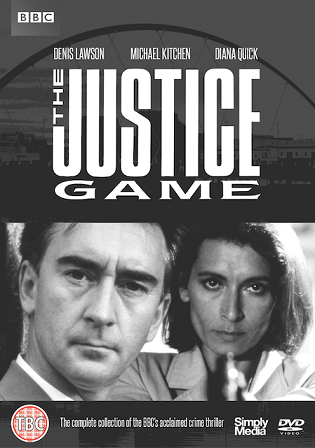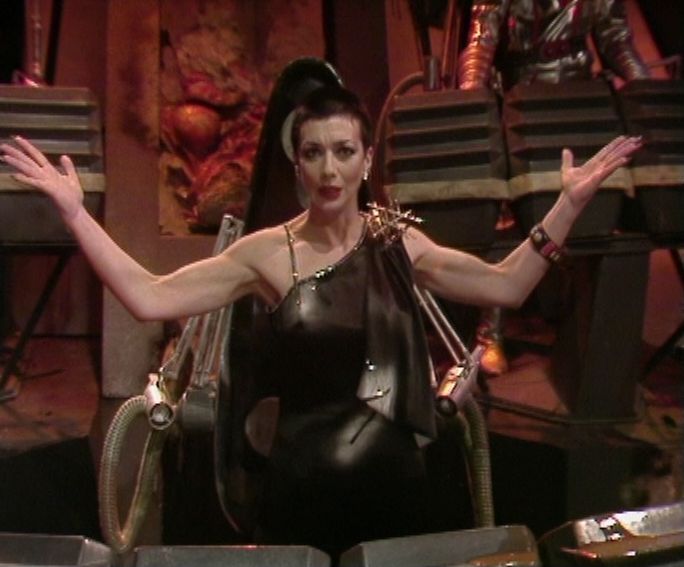
The Justice Game to be released by Simply Media – 10th October 2016

7019

The Justice Game – Series One and Two will be released on the 10th of October by Simply Media.  Review here.

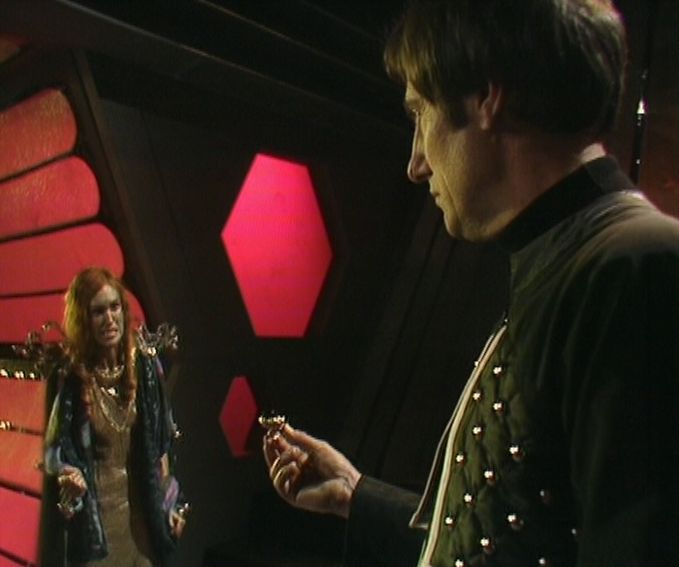
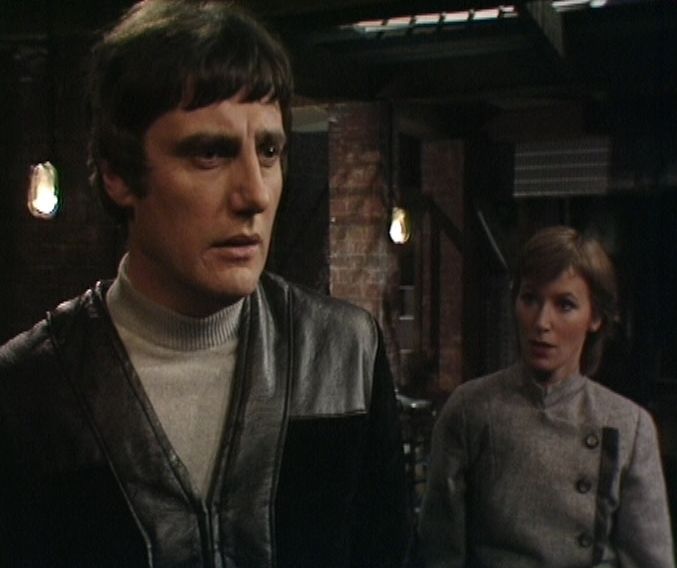
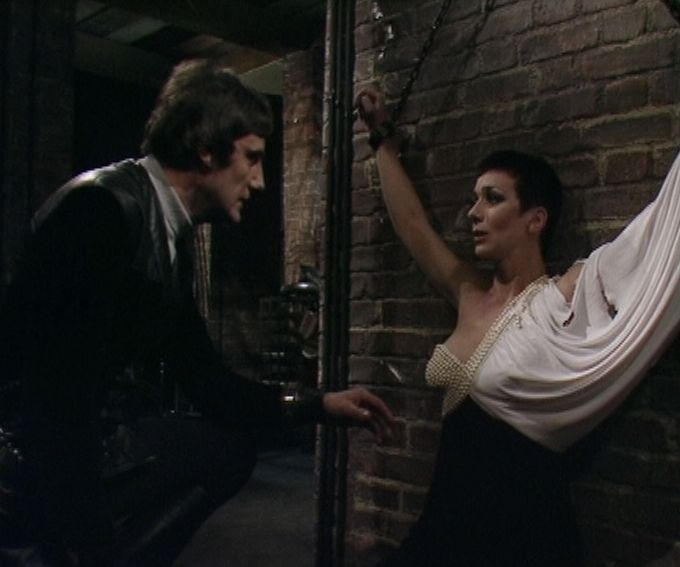
New Tricks star Denis Lawson stars as suave criminal lawyer Dominic Rossi, who exposes corruption in Glasgow and loses his heart in Italy in this gripping miniseries from 1989. After a successful career break in America, Rossi returns to his Glasgow roots. As he investigates the fatal stabbing of an elderly man at a bus stop, and defends a tough ex-soldier accused of a vigilante killing, he untangles a shady web of big business. Digging deeper, all trails lead to a Mr Big called Tim Forsythe (Michael Kitchen – Foyle’s War) – who will stop at nothing to make sure Rossi doesn’t reveal too much.

In series two, Rossi falls in love with the beautiful Francesca (Anita Zagaria – Under the Tuscan Sun) while on holiday in Sorrento, then discovers that many of her friends have been murdered. As he investigates another killing back in Glasgow Francesca shows up, apparently with the Italian murderer in tow. But it turns out she’s hiding a shattering truth from her past.

Lawson sparkles as a smooth operator with a steely sense of justice in this thrilling series alongside an all-star supporting cast including BAFTA winner James Cosmo (Braveheart), Ron Donachie (Game of Thrones), Celia Imrie (Bridget Jones’s Diary), Joss Ackland (The Hunt for Red October) and Diana Quick (Saving Grace).

Directed by BAFTA winner Norman Stone (Shadowlands) and written by John Brown (The Flying Scotsman), The Justice Game: Series 1 and 2 arrives on DVD on 10 October 2016.

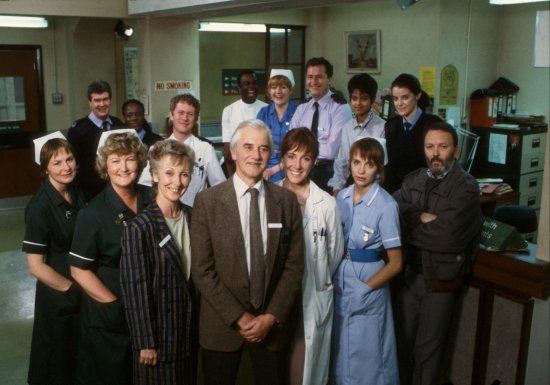
Casualty

casualty 1987.jpg

It’s slightly staggering to realise that Casualty has been running for thirty years (just exactly where have the last three decades gone?).  It’s longevity is quite an achievement, as is the fact that it still pulls in a regular audience of around five million, but it’s fair to say that whilst it’s become a British television institution, the series has ended up as television wallpaper (myself, I bailed out as a regular viewer some twenty years ago).

This wasn’t always the case though – when it started in 1986, Casualty was a show that burned with crusading zeal.  Jeremy Brock and Paul Unwin were inspired to create the series after they’d both been hospitalized.  Brock and Unwin were dismayed with what they found – doctors and nurses crushed under an unforgiving system, battling too much bureaucracy and having to work miracles with too little money.

This came over clearly in their series pitch and helped to reinforce just how polarised the 1980’s were.  For many people it was a simple choice, you were either for Margaret Thatcher and her policies or against.  Casualty was firmly against and politics would feature heavily in the first few series, thanks in part to the young firebrand Charlie Fairhead (Derek Thompson).

Just as Casualty’s rough edges have been smoothed off over the years, so have Charlie’s (which makes revisiting the first series something of an eye-opener).  Medical dramas had been a staple of television for decades (Emergency Ward 10, General Hospital, Angels) but the early Casualty episodes offered the audience a glimpse into a more visceral and politicised medical world.

This biting agenda couldn’t last and by the early 1990’s the show had already begun its transformation into a more conventional soap opera.  A sign of how comfortable Casualty had become by the time it celebrated it’s tenth anniversary is demonstrated by comparing its mid 1990’s output against Cardiac Arrest (1994 – 1996).  Written by Jed Mercurio, Cardiac Arrest is the blackest of black comedies – it has something of the feel of early Casualty, but Mercurio pushed further to create a nightmarish vision that uncomfortably might very well be true.  Mercurio’s status as a former doctor suggests that he knew exactly where the bodies were buried.

This weekend’s thirtieth anniversary episode, Too Old for This Shift, had a stunning set-piece stunt although for impact it didn’t rival Boiling Point (original tx 27th February 1993).   Maybe it was a different era, but when a gang of disaffected youths decided to firebomb the A&E department for no good reason it touched a nerve amongst sections of the viewing public (the debate seemed to resonate for a while).

It might not be the series it once was, but the fact it remains as one of the fixed points in an ever-changing television age is reason enough to celebrate.  Happy Birthday Casualty.

too old

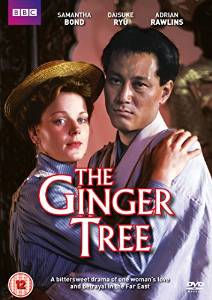
The Ginger Tree – Simply Media DVD Review

ginger

Apart from its inherent qualities, The Ginger Tree is of interest because it was the first drama anywhere in the world to be recorded in HD.  The BBC had been running HD trials since the mid 1980’s, but this four-part 1989 serial was the first production designed for broadcast.

Because of the prohibitive cost of working with the new technology, a co-production deal with other broadcasters had to be arranged.  The choice of NHK Japan as one of the production partners no doubt influenced the novel chosen for adaptation, but that turned out to be one the strengths of the serial.  Back in the 1960’s and 1970’s, if you needed a Japanese-looking actor then you’d get Burt Kwouk if you were lucky and if you were unlucky you’d have a British actor doing his best to look Oriental.  The Ginger Tree, despite being shot on (albeit HD) VT has a filmic sweep and the lavish period setting, location filming and authentic Japanese actors all help to give the serial a rich, immersive feel that the BBC by itself would never have been able to afford.

One irony is that back in 1989 there was no way for British viewers to enjoy the high definition picture.  Compatible televisions didn’t exist and the HDVS recorder used to make the program was essentially an NTSC system  – so the programme had to be converted back into the PAL format for screening on the BBC, meaning that it looked somewhat washed out.  This DVD release is therefore able to present the programme in better quality, although it’s a pity that a BD release isn’t available as that should have been better still (although to be honest, it doesn’t look any sharper or better in SD than a typical VT production of the era).

The Ginger Tree was a novel by Oswald Wynd, originally published in 1977.  Wynd was born in Japan in 1913 to Scottish parents who had come to the country to run a mission. Wynn spent his formative years immersed in what must have been a very alien culture (which obviously helped to inform the writing of The Ginger Tree).  After WW2, where he spent several years as a Japanese prisoner of war, he returned to his native Scotland and pursued a writing career, penning thrillers under the pseudonym of Gavin Black as well as several books under his own name.  The Ginger Tree, helped in part by this adaptation, remains his most popular work.

The book was written as a series of diary entries and letters penned by Mary Mackenzie.  This literary device naturally presents some problems for the adaptor, but Christopher Hampton (who had won an Oscar in 1989 for Dangerous Liaisons) was able to capture the essence of Wynd’s novel.

The year is 1903.  Mary MacKenzie (Samantha Bond) has travelled to Manchuria to marry her fiance, Captain Richard Collingsworth (Adrian Rawlings).  Because they barely know each other it’s clear that their marriage is doomed from the start.  But Mary’s affair with Count Kentaro Kurihama (Daisuke Ryû), a Japanese soldier, plunges her into a scandal from which there seems no escape.  After bearing his child, she finds herself facing an uphill battle as she attempts to find herself a place in the extremely rigid and formal Japanese society.

It’s possible to believe that Mary is something of an innocent. She’s never journeyed out of Britain before and now finds herself setting out on the long trek to Manchuria to marry Richard. Is she in love with him? He seems personable enough and she certainly seems keen to reach him as quickly as possible, so maybe. But they’ve only met a handful of times before their marriage was arranged, which casts obvious doubt that their union will endure.

Their wedding night is a key moment. He doesn’t turn instantly cruel, instead he becomes indifferent, which is possibly worse. He shows Mary her bedroom and then mentions he’ll be sleeping elsewhere. But he is prepared to do his duty as a dutiful husband and make love to her – although in the most perfunctory way. There’s no passion or tenderness and Bond’s silent, frozen face speaks volumes.

Samantha Bond had racked up some decent credits prior to this (Agatha Christie’s A Murder is Announced, Mansfield Park, Rumpole of the Bailey) but The Ginger Tree was her first major starring role and it required a subtle and nuanced performance, which she delivers.

Bond plays Mary in a very internalised way. This isn’t a surprise, given that ladies of her class and era weren’t encouraged to express their feelings. But given how inarticulate (emotionally) she is, it seems initially unlikely that she’ll ever form a relationship with the sensative Kentaro. Which makes the chain of events towards the end of the first episode – they take tea, they become lovers, she finds herself bearing his child – something of a whirlwind. Due to the languid pace of the episode up to this point it all seems to happen very suddenly.

Daisuke Ryû has tended to work mainly in Japanese language films, which could be the reason why Kurihama seems slightly stilted at times. But it could also be a performance choice and either way it helps to differentiate Kurihama from Collingsworth (Kurihama’s slight vulnerability constants sharply with the indifference of Collingsworth).

The sight of a heavily pregnant Mary quickly wipes the smile off the face of her returning husband. He immediately decides to pack her off back to Scotland, although he doesn’t intend to give her a divorce – for purely monetary reasons. It’s a remarkable revelation that Mary’s mother has pledged half her yearly income (some three hundred pounds) to Collingsworth for as long as the pair stay married.

Ar the station she’s faced with another option, a train ticket to Tokyo, provided by Kurihama. She accepts it and is accompanied by Baroness Aiko Onnodera (Fumi Dan). Dan gives a sparkling performance, which contrasts well with Bond’s more withdrawn persona. Aiko is an ardent campaigner for women’s rights, which has recently earned her a spell in prison, but she remains unrepentant. She’s able to explain exactly what Mary’s life in Tokyo will be like.

Kurihama has provided her with a house and servants, but as a women, a foreigner and essentially a concubine, her movements will be very restricted. Mary’s fleeting hopes that Kurihama will marry her are dashed when she learns he’s a married man with four children.

Although the general theme of The Ginger Tree is quite downbeat, there’s also a feeling of optimism. Mary might be portrayed initially as something of a naive, downtrodden figure but over time she gains strength and becomes less of a victim. Samantha Bond is very watchable, although her soft Scottish accent seems to come and go a little. Daisuke Ryû is equally impressive, as are the rest of the Japanese cast. The co-production budget allowed for a generous number of extras and set dressings, plus filming in Japan was obviously another major plus. The story unfolds over some forty years, ending during WW2, necessitating ageing makeup to be applied to the main cast, which is done very effectively.

Oswald Wynd’s tale of love and loss is effectively brought to life in Christopher Hampton’s adaptation and it’s sure to strike a chord with many.

The Ginger Tree is released by Simply Media on the 25th of April 2016. RRP £19.99.

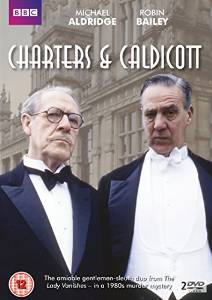
Charters & Caldicott – Simply Media DVD Review

cc

Written by Keith Waterhouse, Charters & Caldicott was a six part serial which aired on BBC1 during January and February 1985.  Waterhouse had by this point enjoyed a lengthy writing career (often collaborating with his friend Willis Hall). Some of their early film screenplays – Whistle Down The Wind (1961), A Kind of Loving (1962) and Billy Liar (1963 – adapted from Waterhouse’s original novel) – were key entries in the early sixties new wave British cinema movement.  The pair would go on to enjoy further success on the small screen, not least when they created Budgie (1971-1972) – a memorable vehicle for Adam Faith and Iain Cuthbertson.

The characters of Charters and Caldicott first appeared in the 1938 film The Lady Vanishes, scripted by Frank Launder and Sidney Gillatt and directed by Alfred Hitchcock.  Played by Naunton Wayne and Basil Radford, the characters instantly caught the public’s imagination.  Charters and Caldicott were two cricket-obsessed men whose only interest was to return to England to catch the final day of a vital test match.  Unfortunately they find themselves tangled up in a mysterious case of international intrigue on their train journey home ….

The pair proved so popular that they returned in several more films – Night Train to Munich (1940), Crook’s Tour (1941) and Millions Like Us (1943).  Wayne and Radford would also play very similar characters in a number of other films and radio plays (but for copyright reasons weren’t named as Charters and Caldicott).

Given the 1930’s setting of the original film you might have expected Keith Waterhouse to have scripted Charters & Caldicott as a period piece, but instead he elected to set it in the modern day.  Whilst it’s possible to imagine this was done for budgetary reasons (thereby avoiding the necessity to redress locations in a period style) I’m more inclined to think it was a deliberate choice.

It may be the 1980’s, but Charters and Caldicott still dress and act like it’s fifty years earlier and this culture clash generates a number of memorable comic moments.  One lovely one occurs in the first episode, when the pair set off to meet Jenny Beevers (Tessa Peake-Jones), the daughter of a recently deceased schoolchum.  They rendezvous in the sort of fast-food restaurant that you know will be anathema to both of them.  This is made plain when Charters strides up to the counter and requests a pot of tea for two – only to be handed two cardboard cups with milk sachets on top (which he then proceeds to spray over himself!) In a later episode they both attend a country house party and descend the imposing staircase for dinner immaculately dressed – only to find themselves in their version of hell, surrounded by 1980’s yuppies.

Although there’s a puzzling mystery at the heart of Charters & Caldicott – complete with dead bodies, people who may not be who they claim to be, coded messages and several gun-toting heavies – this isn’t the strength of the serial.  The mystery is simply an excuse for Waterhouse to spend six episodes scripting wonderful dialogue for both Robin Bailey (Charters) and Michael Aldridge (Caldicott).

Bailey and Aldridge are both a joy as they blithely navigate their way through the story.  Their contrasting characters help to generate a great deal of the humour – Charters is severe, precise and suspicious whilst Caldicott is warm, vague and trusting.  The pair exist in a never-never land of comfortable gentleman’s clubs, complete with a library where it’s considered bad form to speak and a sauna where they can complete the crossword in peace – sometimes!

But the recent death of their old friend Jock Beevers, forces them out of their comfort zone.  Jock left a trunk of papers in Caldicott’s possession which he passed over to Charters for safekeeping.  Several unsavoury types seem very interested in the content of the trunk and this seems to be the reason why Caldicott discovers a dead girl in his flat.  Initially both Charters and Caldicott believe it to be Jenny (who they haven’t seen since she was a child) but Jenny later appears to tell them that she thinks her life is in danger.  The long-suffering Inspector Snow (Gerard Murphy) is assigned to investigate the murder and drops another bombshell – could Jock have been a Russian spy?  If not, what do his cryptic messages sent to Charters and Caldicott actually mean?

Apart from the spot-on performances by Bailey and Aldridge, Gerard Murphy is wonderfully dead-pan as Snow, whilst Tessa Peake-Jones is suitably beguiling as an apparent damsel in distress.  Caroline Blakiston as Margaret Mottram also gives a fine performance – she’s an old flame of Caldicott and finds herself mixed up with the mystery after she agrees to give the homeless Jenny a place to stay.  Blakiston is gifted with some tart dialogue and she bounces off both Bailey and Aldridge very agreeably.

I was slightly surprised that this was an all-VT production.  By the mid eighties the BBC was beginning to move towards film as the medium for many series and serials and you would have assumed that Charters & Caldicott would have been just the sort of programme to benefit from the extra gloss that film would have provided.  But no matter, the serial works just as well on videotape as it would have done on film.

As I’ve said, the mystery part of the story does play second fiddle to the character interactions and there’s no doubt that over the six episodes the plot does meander somewhat.  But even if the storyline does drag in places, the pleasure of watching Robin Bailey and Michael Aldridge at work more than makes up for this.

Released as a two DVD set, each disc contains three 50 minute episodes.  There’s no issues with either picture or sound and as usual subtitles are provided.

Charters & Caldicott is released by Simply Media on the 25th of April 2016.  RRP £19.99

Stalky & Co. – Simply Media DVD Review

stalky

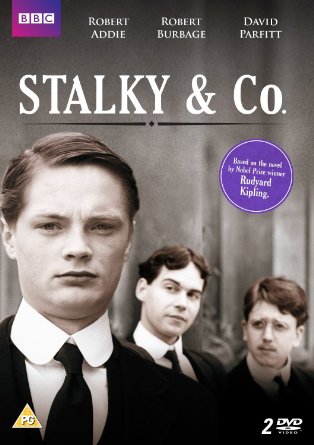
Stalky & Co. was a collection of short stories by Rudyard Kipling, originally published in 1899.  It concerns the adventures of Stalky, M’Turk and Beetle, three boys who are resident at an unnamed public school.  Kipling drew on his real life experiences when writing the stories – several of the characters are based on people he knew, whilst Beetle is a version of Kipling himself.  The novel can be downloaded here.

By the early 1980’s, the Classic Serials occupied a familiar place in the television schedule.  Sunday tea-time would be the time to see efficiently adapted serials with first rate casts, but eventually their familiarity began to breed contempt.  Just a few years later there were rumblings from certain quarters that the Classic Serials were beginning to look old hat themselves.  This was mainly do to with their visual look, as – like Stalky & Co. – they were shot entirely on videotape.  Bleak House (1985) was one of the first of the modern all-film BBC adaptations and it offered the programme-makers the ability to craft images with a cinematic sweep.  Compared to this, the poor old Classic Serial began to look somewhat second best.

But whilst the Classic Serial will never have the visual gloss of a modern film production, you know that you’re going to get decent actors and a faithful adaptation, so it’s always a pleasure when another one escapes onto DVD.

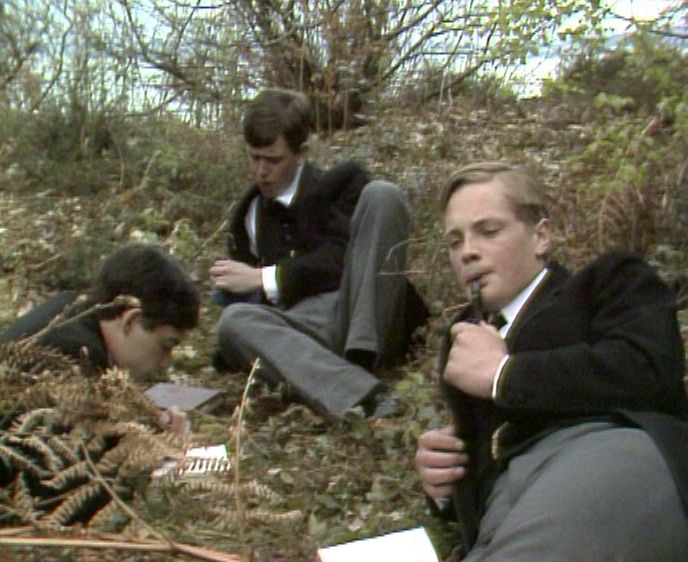
Although Robert Addie (Stalky), Robert Burbage (M’Turk) and David Parfitt (Beetle) all look a little old to be schoolboys (the actors were in their early to mid twenties at the time) it’s not really a problem as you quickly become embroiled in the action as episode one – An Unsavoury Interlude – begins.  It finds the three boys fighting a war against a rival house.  Their house, Prouts, is named after their housemaster Mr Prout (John Sterland) and they’re at bitter loggerheads with Kings, led by Mr King (John Woodnutt).

Stalky & Co. have little time for their own Mr Prout, but view Mr King with even less enthusiasm.  King (a wonderfully whiskered Woodnutt) is an eternally mocking character and his jibes are taken up by his boys.  After Stalky, M’Turk and Beetle are observed heading off for a bathe (we see their bare backsides as they dive into the water – an unexpected Sunday tea-time sight!) they have to face taunts from the Kings boys that they smell.

How do they gain revenge for this jibe?  Stalky has obtained three pistols and the boys head off to shoot some rabbits.  Beetle, being rather short-sighted, bags a cat instead and it’s an obvious wheeze to deposit the dead cat as close to the Kings dorms as possible – and then sit back and wait for nature to take its course.  This casual slaughtering of defenseless animals is a bit of an eye-opener and it’s debatable whether it would be something that would sit comfortably in an early Sunday evening timeslot now, but I also doubt that many eyebrows were raised back then.

Mr Prout and Mr King team up to try and catch our heroes in the second episode, In Ambush.  Mr Prout has discovered the den in the forest used by Stalky, M’Turk and Beetle, which is a bit of a problem.  Where can they now go to smoke to their pipes in peace?  Luckily Stalky has a brainwave, and he and the others join the natural history society run by Mr Hartropp (played by Geoffrey Beevers, who like the other teachers sports an impressive moustache).  The benefits of being members of the natural history society are clear – it means they’re free to roam wherever they like in the forests.

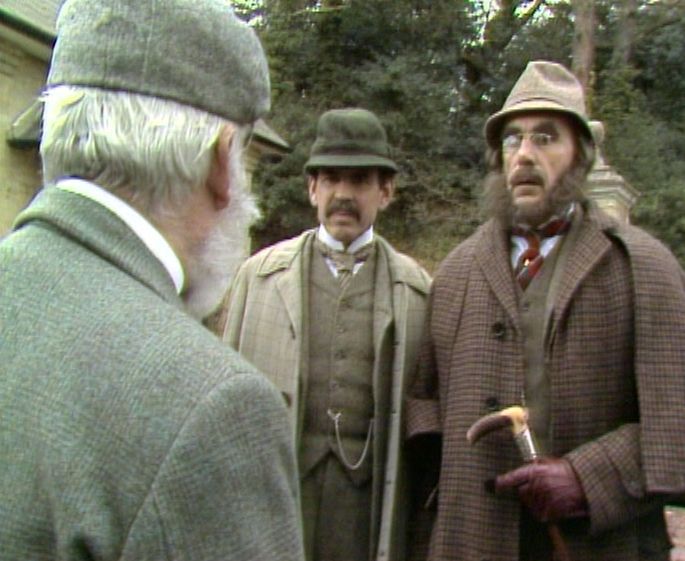
They venture even further afield, to the woods owned by Colonel Dabney (Denis Carey).  M’Turk is appalled to see Dabney’s gamekeeper shooting a fox and rushes to the house to confront the Colonel.  Although you might expect Dabney to be somewhat put out to be buttonholed by three schoolboys trespassing on his land, this isn’t the case.  He can tell they’re gentleman and knows a little about their families and history.  This provides us with a good example of Kipling’s values and mindset – the three boys might frequently flout the school rules but they’re bred to rule, so the likes of Dabney are happy to treat them with indulgence.  Prout and King might hold a temporary position of authority over them, but Kipling’s sympathies are always directed towards Stalky, M’Turk and Beetle.
stalky 01

Although Prout and King are presented as little more than bumbling comic relief, the Headmaster (Frederick Treeves) is somewhat different.  He regards the boys more in sorrow than anger and whilst he admits he has no evidence against them, decides to cane them anyway (six strokes each on their upper backs).  He tells them this will be character forming and it’s no surprise they take it like gentleman (although it’s debatable how hard the strokes were).  So Prout and King seem to have won this round, although Stalky & Co. remain unrepedant after leaving the Headmaster’s study.

Slaves of the Lamp opens with Stalky and the others rehearsing for the upcoming pantomime.  The peace doesn’t last long as King bursts in, incandescent with rage at some unflattering doggerel written by Beetle.  This infuriates Stalky, who calls a council of war to discuss how they’re going to deal with King once and for all.  Robert Addie, who a few years later would be a memorable Guy of Gisburne in Robin of Sherwood, is in dominant form here.  This one also allows John Woodnutt the chance to go soaringly over the top, which is great fun to see.  Another brilliant comic performance comes from Roberts the cart-driver (played by Morgan Shepherd) who has a rather violent disagreement with King, which involves several broken windows and many hurled insults!

The arrival of two young men, Sefton (Glyn Baker) and Campbell (Tim Faulkner), in episode four (The Moral Reformers) sows a little discord.  They’ve arrived for six months intensive cramming and they instantly rile Stalky, although he’s quick not to offend them to their face (“remember your Uncle Stalky’s motto, never fight unless you can win”).  The relationship between the Padre (Rowland Davies) and Stalky & Co. is a fascinating one.  He treats them as equals and seems quite at ease relaxing in their rooms, puffing on his pipe.  But he does have an ulterior motive – a young boy, Clewer (Matthew Blakstad), is the victim of severe bullying and the Padre asks Stalky and the others to find out who the culprits are.

Although bullying is something that seems to regarded as part and parcel of school life (all of them – especially Beetle – suffered when they were Clewer’s age) they still readily agree to hunt the bullies down.  Their identity isn’t a surprise, but it’s another chance for Stalky to demonstrate his ruthless side. The bullies are well and truly taught a lesson by Stalky and Co. (to the evident delight of the Padre).

A Little Prep features one of the perennials of public school life – rugby.  Stalky and M’Turk find themselves drafted into the school squad and perform credibly against a team of old boys.  One of the old boys, Crandall (Simon Shepherd), is able to tell Stalky and the others about how another ex-pupil, Duncan, was killed in action (he was a soldier, fighting in India).  It’s a reminder that boys in schools such as these were bred to be officers (at one point Stalky wonders what it’s like to be shot at) and given Kipling’s background it’s no surprise that Crandall’s tale is a stirring one, with Duncan maintaining a stiff upper lip right until the end.  Apart from Shepherd, there’s another familiar face guest-starring (Dominic Jephcott).

The serial ended with The Last Term.  Stalky and the others face their last term and he wonders where they’ll all be five years from now.  The Headmaster has obtained a plumb job for Beetle – working on a newspaper in India with a salary of one hundred pounds a year.  Stalky looks set for Sandhurst whilst M’Turk has plans to be a civil engineer.  But before they leave they still have the chance for a few final scrapes ….

Produced by Barry Letts, script-edited by Terrance Dicks and with music by Dudley Simpson, this was something of a Doctor Who reunion.  Although Simpson’s scores on both Doctor Who and Blakes 7 had got into something of a rut in the late seventies, his work here is quite different (and all the better for it).  Rodney Bennett’s direction was effective and unshowy, but he was able to get the best out of the cast, enabling them to mine Alexander Baron’s adaptation for maximum comic effect.

Stalky & Co. is available now from Simply Media.
stalky 02

The Cleopatras – Episode Eight

cleopatras 08

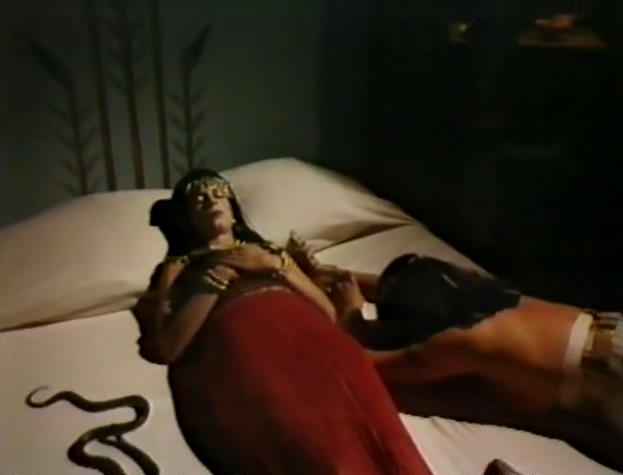
The end of the previous episode made it quite clear that the power dynamic between Cleopatra and Mark Anthony was weighted entirely in Cleopatra’s favour.  Indeed you have to feel a little sorry for Mark Anthony as he finds himself obsessed and dazzled by Cleopatra’s beauty and becomes her pliant and willing slave.  Whether Michele Newell has done enough to convince us of Cleopatra’s mesmerising qualities is open to debate – personally I found Cleopatra’s sister, Arsinoe (Francesca Gonshaw), to be much more alluring, even though she only had the merest fraction of Newell’s screentime

When Cleopatra asks Mark Anthony to do her a tiny favour and kill her meddlesome sister it did raise my hopes that Gonshaw would have a more substantial role in this final episode, but alas she’s dealt with very abruptly (like most of the deaths in the series, it’s brief and almost abstract).

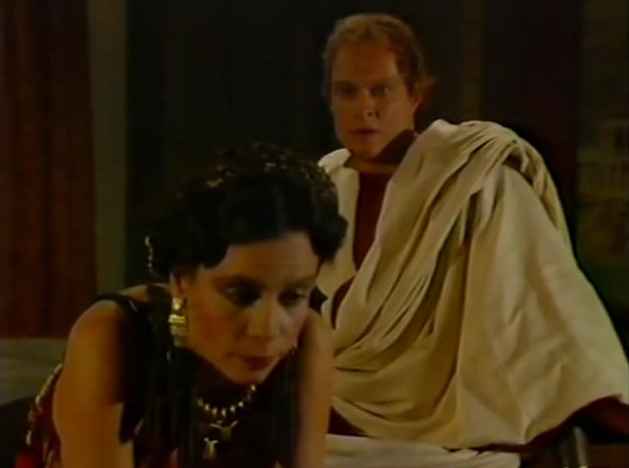
Christopher Neame continues to chew the scenery in an alarming way – witness his reaction early on when he realises that Cleopatra doesn’t want to sleep with him that night – and it’s interesting to compare his performance with that of Robert Hardy.  Hardy’s Caesar was equally as besotted, but he played it in a much more undemonstrative way.  Neame lacks any sort of subtlety which means he begins to grate after a while.

Octavian (Rupert Frazer) offers Mark Anthony a deal – the world divided up between them.  Anthony agrees (although with more than a hint that this won’t be enough to satisfy him).  Octavian seems quite content with his half though and proposes a way to cement the deal – he offers Anthony his sister Octavia’s (Karen Archer) hand in marriage (he agrees).  This sparks an imperial bout of sulking from Cleopatra …..

Needless to say they kiss and makeup and when Anthony decides to divorce Octavia it puts him on a collision course with Octavian, who’s more than a little miffed at the slight his sister has suffered.

Amongst the decadence at Cleopatra’s court, one man – his oldest friend Ahenobarbus (Matthew Long) – stands apart.  He views Cleopatra as a malign influence and has the nerve to tell her so to her face.  Before Ahenobarbus takes his leave, he tells Mark Anthony that because he loves Cleopatra “there’s no saving you from doing what legendary lovers do, dying for love. I shall die of something much more commonplace, like fever. But then I’m not the sort of person of whom legends are made.”

Although The Cleopatras ends with a bit of a whimper rather than a bang (a little of Neame’s overacting goes a long way) overall there’s a great deal to enjoy across the eight episodes.   Richard Griffiths, Ian McNeice, David Horovitch and Adam Bareham all made excellent – and very different – Kings of Egypt, whilst Robert Hardy was wonderful as the urbane Caesar (who it’s true had more than a touch of Seigfried Farnon about him).  During the series many actors flit on and off, some – such as Morris Perry and John Bennett – are memorably good, whilst others are memorably …. not so good, but we’ll spare their blushes.

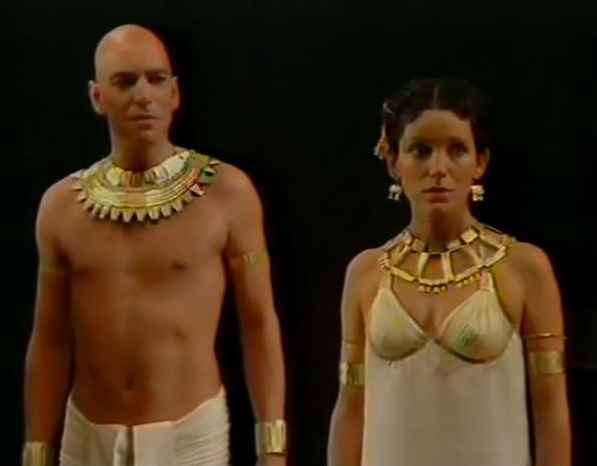
The Cleopatras is a strange production which asks a great deal of the audience.   I think that in order to connect with it you have to embrace its highly theatrical nature.  Battles, riots and other major occurrences happen off screen and the sets are minimal (with scenes often played against plain black backgrounds).  One weakness is that too much was crammed in across the eight episodes, so at times it can feel rather repetitive – there’s an autocratic ruler, someone gets poisoned, the mob starts to riot, etc.

But although it’s a curio, it’s definitely worth seeking out.  It may sometimes baffle and frustrate, but it’s never less than thoroughly entertaining.

The Cleopatras – Episode Seven

cleopatras 07

Cleopatra has a bombshell for Caesar – she’s pregnant.  He’s obviously delighted and after the child (as she predicted, a boy) is born, she visits Rome.  Cleopatra’s self absorption is made very plain within the opening minutes of this episode.  Her two maids, who are completely sycophantic in her presence, have a very different opinion of her when she’s not around.

Ammonius (Frank Duncan) is the Roman official who’s been tasked with preparing Cleopatra’s Roman villa.  When he mentions that he was a great admirer of her father, he receives a polite but cool response.  After she’s left the room her maids tell him that he shouldn’t “harp on about her father too much, she didn’t care for him. She cares only for herself. We recommend flattery, you can’t lay it on too thick.”

It’s interesting that Caesar later tells her that “you’re an intelligent woman, you like plain speaking. And you hate meaningless flattery.”  According to her maids she loves flattery – so who is closer to the truth?  Of course, the fact that Caesar tells her to her face that she hates flattery is a form of flattery in itself.  Caesar doesn’t seem very manipulative – Hardy plays him as an affable sort of chap – so maybe he’s sincere in what he says.

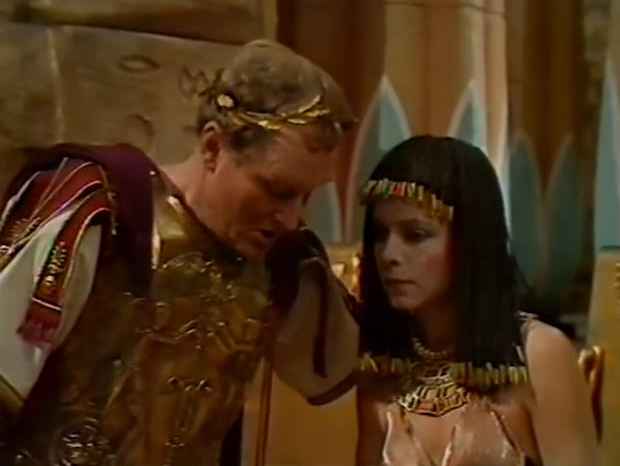
The only scene between Caesar and Mark Anthony is highly entertaining.  Caesar tells him of his desire to be crowned king, but can he persuade the republican loving Roman citizens?  Neame’s Anthony is full of boyish enthusiasm for his plans and exuberantly tells him so.  Compared to Hardy’s laconic Caesar, Neame’s Anthony is much more hyperactive.  Like some of the other performances throughout the series it’s not a subtle one, but there’s a certain amount of pleasure to be derived from watching him chew the scenery.

For all Cleopatra’s self-centeredness, she did seem to be genuinely in love with Caesar – and he with her – and she takes the news of his assassination hard.  When Mark Anthony presents himself to her, she wonders why he “didn’t die protecting him? Or die with him?”  Mark Anthony’s equally as upset as her though, as is made plan as Neame full-throttles his way through the scene.

Familiar faces (and voices) who turn up in this episode include Geoffrey Chater as Perigenes, a plain-speaking Egyptian official.  Amongst his many credits he had a memorable recurring role as Bishop, opposite Edward Woodward in Callan.  John Moffatt, as Quintus Dellius, might not have been such a familiar face, but he was a highly skilled radio actor, playing the role of Hercule Poirot over several decades.

With Mark Anthony and Octavian victorious, Cleopatra should be glad that Mark Anthony is now ruler of half the world – but that’s not enough for her.  Julius Caesar ruled the world and she wants Mark Anthony to do the same ………

The Cleopatras – Episode Six

cleopatras 06

Fluter is old and dying (although as has been observed before, people rarely seem to look older during successive episodes – there’s certainly none of the elaborate ageing makeup which was used in I Claudius).  He’s chosen Cleopatra and her brother, Ptolemy (Daniel Beales), as his heirs – with three people to act as regents until Ptolemy comes of age.

It’ll come as no surprise that the apparently meek and submissive Cleopatra is dazzled by the prospect of power.  In her father’s hearing she wishes that he would hurry up and die, although she’s quick to cover this up (claiming that she wished him to hurry up and get well).

After Fluter’s death, Cleopatra quickly displays the autocratic streak that runs through her family and firmly rejects the approach of her brother’s three regents.  One of them, Pothinius, played by John Righam, looks extraordinary – but despite being caked in makeup still manages to deliver his lines with conviction.  What a pro!  Daniel Beales is entertainingly squeaky as the boy king, completely dominated by his older sister.  He also has another sister, Arsione (Francesca Gornshaw) who immediately catches the eye.

As for Cleopatra, she spends her time flirting with the likes of Pompey (Philip Cade) and giggling about it afterwards with her servants.  As usual, they’re bare-breasted, and amongst their number is Shirin Taylor.  Eleven minutes in we’re told that the mob is rioting (you can almost set your watch by them).  This sees Cleopatra driven from Egypt thanks to the machinations of the wily Pothinius.

Robert Hardy returns as Julius Caesar.  When Theodotus (Graham Crowden) brings him the head of Pompey, he doesn’t react with the sort of delight that Theodotus was probably expecting.  Instead he mourns for a man who by chance and circumstance became his enemy.  How historically accurate this is is open to question, but it implies that Caesar has a greater sense of morality than the rulers of Egypt.

His meeting with the boy-king Ptolemy is another interesting scene.  Ptolemy is offended that Caesar didn’t rise when he entered the room, but Caesar – telling him that they got rid of their kings some time ago – is unabashed, offering him a cheery “how do you do” and a firm handshake.  He’s also asked for a meeting with the queen, but Caesar does wonder if she’ll manage to make it past the likes of Pothinius.  When you see one of her servants carrying a carpet it’s not difficult to imagine what’s coming next.  The carpet is unrolled to reveal ……. Cleopatra.

It’s a bit of a damp squib moment it must be said, although the expression of delight on Hardy’s face almost makes up for it.  Just as good is the moment when Caesar releases she’s Cleopatra (and not, as he originally thought, a prostitute).  Michelle Newell continues to play Cleopatra with a strange mixture of girlish naivety and ruthless calculation.  It’s slightly odd, but certainly effective, as Caesar falls under her spell and restores her to the throne.

Robert Hardy is the stand-out performer during this episode.  His Julius Caesar is both a diplomat and a soldier, who also possesses a wry sense of humour.  And Hardy’s more naturalistic performance contrasts nicely with some of the more mannered and dramatic turns that pop up during the series .

The Cleopatras – Episode Five

cleopatras 05

The opening of this episode finds Fluter and his brother and sister barely able to believe their good fortune.  Fluter’s now king, his sister Cleopatra Tryphaena (Emily Richard) will shortly become his wife (thereby strengthening the royal bloodline since Fluter was illegitimate) whilst Fluter’s brother Ptolemy (Graham Seed) plaintively wonders if there’s a small part of Egypt that he could possibly rule.

All three play these initial scenes in a very childlike way, reacting with open-eyed wonder at the events occurring around them.  It’s another left-field acting choice, but it contrasts well with their advisors, Philocles (John Bennett) and General Chaeteas (Morris Perry), who seem very grown up in contrast.  When Fluter’s told that he’s a king and can do anything he wants – such as making Ptolemy the king of Cyprus – he reacts with unbridled joy.  “Two kings and a queen.  We’ll have such fun.”  And Adam Bareham is great fun as Fluter, to begin with he generates a very appealing eager youthfulness that’s quite different from the jaded, back-stabbing maneuvering we’ve previously seen.

It seems likely that Fluter will be hopelessly manipulated by his advisors, but we jump forward to hear Theodotus tell the current Cleopatra that he was one of the greatest kings that ever lived.  The fact that Fluter was Cleopatra’s father leads her to suppose that he’s attempting to flatter her, but he insists not.  This is another interesting narrative choice as it allows the audience to learn the outcome of this part of the story before they know anything else.

Of course, it doesn’t take long before Fluter becomes as autocratic and manipulative as his predecessors, although he does so with an appearance of affability.  In one of the more bizarre scenes in the series (although there’s plenty of other contenders) he tells his advisors that they need to dress as women and imbibe copious amounts of alcohol.  This pains Demetrius (Roger Brierley) who drinks nothing but water, but it’s made plain that to disobey the king’s order is to invite death.  So he bites the bullet and drags up along with the others!

There’s plenty more familiar faces who can be spotted under the wigs and fake facial hair.  John Arnatt squirms delightfully as Sophron, who earns the displeasure of the older Fluter whilst John Savident is Pythagoras, who like all the others has to tread softly around the less affable Fluter.  Moray Watson is another solid performer, he plays the affable Roman, Gabinius, who finds it easy to manipulate the king.

Fluter travels to Rome in order to try and convince them to recognise Egypt as an independent nation and him as their legitimate ruler.  Julius Caesar (Robert Hardy) might be able to help – if the bribe is big enough.  Hardy’s a class performer and Caesar will be a key figure for the next few episodes.  As will, of course, Mark Anthony (Christopher Neame).

It’s either the corrupting influence of power or simply indifference, but Fluter registers very little interest in the news that Rome will shortly invade Cyprus and depose his brother.  Before that happens, Ptolemy elects to take poison – in a nicely played scene by Graham Seed (an actor who did the I Claudius/The Cleopatras double).

His brother’s death, and the loss of Cyprus, angers the people and they move to depose Fluter.  His attempt to find allies leads to a meeting with the Roman officer Cato (Godfrey James).  Cato’s not interested in helping and his discussion with Fluter – with Cato on the toilet, dealing with a particularly stubborn bowel movement – is another of those unexpected moments that (depending on your point of view) either makes The Cleopatras a delight or a despair.

Fluter’s removal from power and his wife’s death sees their daughter Berenike (Shelagh McLeod) take their place.  This inches us closer to the present day as Cleopatra remembers her sister ascending the throne.  Berenike needs to marry in order to consolidate her position and Pythagoras thinks he has the ideal candidate, a member of the Syrian royal family.  He does warn her that Seleucus (Colin Higgins) is a little rough around the edges, which he certainly is.   Seleucus admits he has a body odor problem, but tells her “you just have to get used to it that’s all. Come on, I’ve known girls who’ve quite liked it. They said it gave it a bit of a flavour. Wait till I’m your husband, we’ll have none of this mucking about then.”

It’s another tongue in cheek moment which ends with Seleucus being dragged off by Berenike’s guards.  She couldn’t take his advances any more, so she orders him to be strangled.  She finds Archelaus (Graham Pountney) to be much more acceptable, but their happiness is short-lived (it lasts for about twenty seconds or so) before Fluter and the Roman Army led by Gabinius kill them both and return Fluter to power.

This brings the story up to date and with Julius Caesar and Mark Anthony waiting in the wings, the story of the current Cleopatra will be played out over the closing installments.

The Cleopatras – Episode Four

cleopatras 04

Alexander (Ian McNeice) now reigns whilst Cleopatra Berenike (Pauline Moran) is queen.  Alexander continues to enjoy drinking and dancing and seems to have very little interest in anything else.  War with Rome seems a real possibility, but Alexander has no desire to start a war he has no chance of winning.

Alexander just wants a quiet life – he knows that Rome tolerates him (regarding him as nothing more than an aimable drunkard) and by doing nothing controversial he hopes they’ll leave him alone to live his remaining years in peace.  But his unpopularity amongst both the people and the army means that civil war seems inevitable.

Familiar themes of royal musical chairs are played out in this episode.  General Chaetaes (Morris Perry) conspires with Cleopatra Berenike to depose Alexander and replace him with his younger brother Chickpea.  Alexander’s death is either another stunning example of minimalism or it’s a symptom of the series’ very small budget.  He’s supposed to be on a seashore, although it’s little more than a CSO backdrop and a few sound effects.  And it’s interesting that his death, like most of the murders throughout the series, is portrayed in an abstract way.  Given the amount of female breasts on display there was no watershed reason why they should be so coy, so it must have been another script/directorial choice (almost as if the current Cleopatra – who’s still listening to the tales of Theodotus – is editing out the grisly bits.  After all, it’s her family).

Another batch of well known faces pop up.  Morris Perry, something of an underrated actor I’ve always felt, is smoothly manipulative as Chaetaes.  Patrick Troughton has a frustratingly small role as a Roman soldier called Sextus whilst Donald Pickering and John Bennett also make appearances.  Pickering is the impossibly smooth Roman diplomat Lucullus (not a great stretch for him it must be said, since Pickering specialised in playing smooth characters) and John Bennett is very still and restrained as Philocles.  Given some of the more exuberant playing throughout the series so far, Bennett’s scenes are a model of restraint.

The death of Alexander means that Chickpea returns and he’s now an older and seemingly much more ruthless ruler.  His mistress Irene (Lois Baxter) explains why he’s changed from the younger, baffled man we saw in the last episode.  “He loves ordering people to be killed. It makes him feel like a strong man, or a king or a god. With power over life and death.”  So at heart Chickpea’s the same man, he’s just better at creating a public persona of power.  David Horovitch continues to mine some decent comic moments from the script whilst Pauline Moran (later to play Miss Lemon opposite David Suchet’s Hercule Poirot) is a characteristically manipulative Cleopatra.

Following the death of Chickpea, Rome puts his son, Alexander the younger (David Purcell), on the throne.  Purcell isn’t one of the series’ strongest actors and thankfully his reign is pretty brief.  Rape and incest are foremost on his mind as he’s upset that Cleopatra Berenike won’t sleep with him.  After he kills her in a fit of rage he’s set upon by an angry mob (there always seems to be an angry mob hanging around the palace for some reason) and his mutilated remains are very briefly glimpsed.

So that means another of Chickpea’s sons ascends the throne.  He’s known as Fluter (played by Adam Bareham) and yes, he delights in playing the flute.  Fluter demonstrates his skills to the multitude in a characteristically idiosyncratic conclusion to the episode.

The Cleopatras – Episode Three

cleopatras 03.jpg

Episode three opens with Theodotus continuing to teach the young Cleopatra about the history of her strange and bloodthirsty family. At this point in his story, Pot Belly is approaching death. I’m going to miss him (and Richard Griffiths too of course). Griffiths has been a constant source of delight during the series so far, thanks to the entertaining dialogue provided by Philip Mackie. His opening words here are a case in point. “I wonder if I ought to be dying more publically? In a more public place, under an awning with a vast multitude hanging on my every word. Filled with admiration at the sight of how nobly a truly good man could die.”

Griffiths, like the rest of the cast, didn’t make any effort to do “noble” acting. Instead, everyone plays in a modern conversational style, which is quite unlike, say, the more stilted delivery of Biblical classics from the Golden Age of Hollywood. This may be another reason, along with the camera effects and impressionistic sets, why the series received such a muted reception.  The Cleopatras doesn’t feel like the traditional historical drama that many were no doubt expecting and it’s mixture of ripe acting and dark humour seemed to have caught many by surprise.  Make no doubt, it is a funny series.  Some may contend that it’s unintentionally so, but I think that both Philip Mackie and director John Frankau knew exactly what they were doing.

The scene where Cleopatra’s eldest daughter (Sue Holderness) and her husband Chickpea (David Horovitch) visit the dying Pot Belly is a good case in point.  They bound into the room, hand in hand, to ask how he is.  When he tells them that he’s dying, she bursts into hysterics.  Her histrionics are so utterly false (and Pot Belly isn’t taken in for a moment) that you can view this moment one of two ways – either Sue Holderness was indulging in some ripe overacting or she was playing to the script (which strongly implies that everybody’s constantly playing games with everybody else, but etiquette means that they can’t publicly say so).

It’s highly entertaining to see Marlene and Chief Inspector Slack in such unusual garb and there’s some other familiar faces who find themselves with shaven heads and remarkable – and brief – costumes.  Alexander (Ian McNeice) is another of Pot Belly’s sons who, like Chickpea, has his eyes on the throne.

Pot Belly’s dying words (his death scene is another hysterical moment) creates a storm of controversy, which is exactly what he wished.  He commands his wife to choose which of their two sons should rule.  By right of succession the throne belongs to Chickpea, but Cleopatra chooses Alexander instead.  This sparks a storm of protest and Cleopatra is forced to back down.  The discontent of the mob and their delight when Chickpea is confirmed as ruler is largely achieved via sound effects.  It’s a theatrical – and low budget – solution, but it works.

I love David Horovitch’s impossibly wet Chickpea.  Horovitch plays him as a thoroughly decent sort of chap, which means he’s totally out of his depth in Cleopatra’s court, where everybody seems to be plotting against everybody else.  Eventually Cleopatra orders his death and sets the mob on him.  His reaction when he’s told this by a loyal servant is another comic moment – he changes in a minute from an autocratic ruler to a lost child.

If The Cleopatras lacks the depth of I, Claudius (characters feel more insubstantial) then there’s still plenty of incidental pleasures to be enjoyed along the way.  Ian McNeice’s impressive dancing at the end of this episode being a case in point!

The Cleopatras – Episode Two

cleopatras 02

The studio-bound nature of the series meant that it would have been difficult to illustrate battles or major upheavals convincingly, so The Cleopatras tended not to bother.  With Theodotus on hand to push the story along you just have to fill in the blanks yourself.

So at the end of episode one Cleopatra’s mother ruled Egypt, whilst Cleopatra and Pot Belly were exiles.  In the space of a few seconds at the start of this episode Theodotus informs us of a total reversal – Cleopatra and Pot Belly have regained the throne whilst Cleopatra’s mother is the one who now finds herself in exile – in Syria.
Needless to say, she’s not best pleased about it and Elizabeth Shepherd continues to wring every last drop of emotion from the role.  I can’t honestly say it’s good acting, but she’s highly entertaining.

One of the joys of the series is that there’s a constant stream of first-rate actors who pop up for an episode or two.  Due to the amount of fake facial hair (for the men, anyway) it’s sometimes hard to identity them immediately, but their voices tend to be a giveaway.  One notable new arrival is Stephen Greif as Demetrius, the King of Syria.  Greif’s excellent as the weak-willed king, easily manipulated by Cleopatra’s mother into attempting to invade Egypt and dispose Pot Belly.  It’s not a success, alas, and Demetrius finds himself deserted by his men and then executed.
Demetrius’ widow, Cleopatra Thea (Caroline Mortimer), is a chip off the old family block.  Her elder son Seleucus (Nicholas Greake) has automatically ascended to the throne, but this doesn’t please her.  Her younger son, Grypus (James Aubrey), seems to be much more malleable, so she decides to poison Seleucus.  She does so in such a blatant way that it’s more than a little surprising that nobody seems to twig.

Richard Griffiths continues to impress.  Pot Belly is a curious mixture of diplomat and tyrant (somewhat similar to Brian Blessed’s Augustus in I, Claudius).  He agrees to Cleopatra’s mother’s request to return as Queen for one key reason.  “The people are tired of chaos. Oh it’s fun for a time, throwing people out of windows, rioting, looting, burning, refusing taxes. But eventually the people long for peace. And what better symbol can there be of the return to orderly life than the reconciliation of those two great enemies, their King and Queen?”

A peculiarity of the series is that although years have passed since the events of the previous episode, nobody looks any older.  This is particularly noticeable when we see Cleopatra and Pot Belly’s children, who are now grown up. When Cleopatra’s daughters look as old as Cleopatra herself it’s slightly odd.  She does have a little bit of make-up applied in the next episode, when Cleopatra is an old woman, but Pot Belly (on his deathbed) looks pretty much as he did in the first episode.

Most amusing picture transition in the series so far occurs forty five minutes in, as the picture contracts into a ball and appears to disappear down Cleopatra Thea’s throat!

The Cleopatras – Episode One

cleopatras 01

They don’t make them like this any more.  Indeed, they didn’t make them like this very often back then.

The Cleopatras, written by Philip Mackie and directed by John Frankau, is a series that delights in its own artifice.  At a time (1983) when British television was slowly moving towards film as the dominant medium for drama, The Cleopatras was an all videotape production which used every available video effect to create a unique atmosphere.

The series makes its intentions clear in the first few minutes – various picture dissolves and wipes (which are also used throughout the eight episodes) instantly tell us that this isn’t a run-of-the-mill production.  The sets at times appear more impressionistic than realistic and doses of CSO help to heighten the unreality.

All this helps to place the series firmly in the camp of electronic theatre rather than the naturalistic world of filmic drama (such as Tinker, Tailor, Soldier, Spy) which was increasing in popularity at this time.  Serials like I, Claudius had shown that videotaped historical drama could be compelling, but The Cleopatras – although it had a similar mix of power-struggles, incest and murder – never had the same impact.

Looking at it today, you have to be able to embrace the production (or at least to tolerate it) and ignore some of the riper overacting.  If you can do that then it’s possible to derive a considerable amount of enjoyment from all eight episodes.  And if not, you can at least admire their ambition.  Today, many dramas look pretty much identical, but for better or worse you could never say that about The Cleopatras.

Philip Mackie had previously penned a six part series called The Caesars (Granada, 1968) and it’s possible to regard The Cleopatras as something of a companion piece (both were studio-bound productions, although The Caesars didn’t indulge in trippy camera effects).

Although Mackie’s name isn’t that well known today (even amongst the select band of archive television enthusiasts) there’s plenty of interest to be found in his cv.  The Naked Civil Servant is one of his most high-profile screenplays, whilst I’d strongly recommend An Englishman’s Castle, a taut three-parter starring Kenneth More, set in a Britain where the Germans had, thirty years earlier, won WW2.

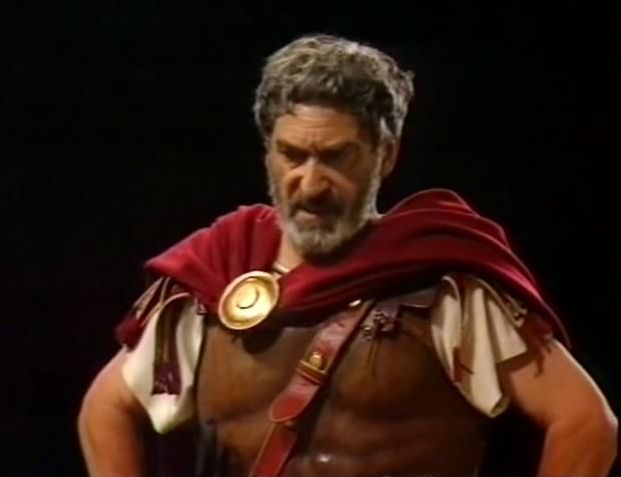
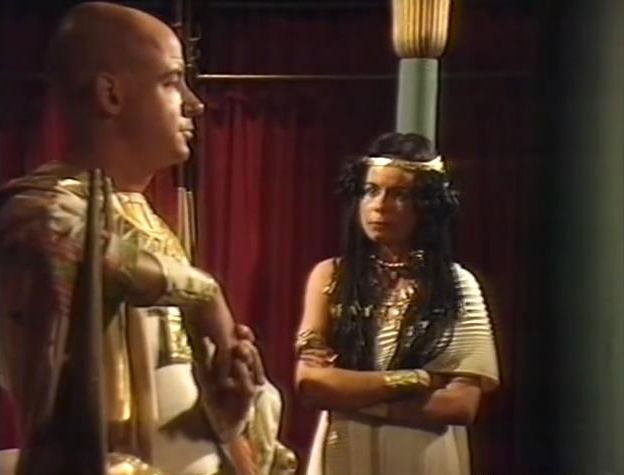
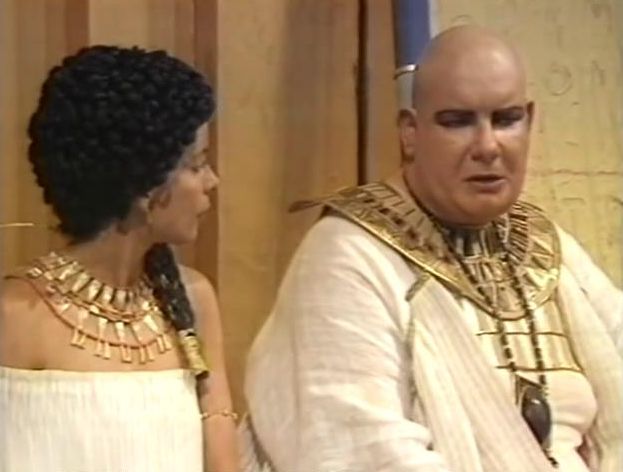
The premise of The Cleopatras is simple.  Theodotus (Graham Crowden) is instructing the latest Cleopatra (Michelle Newell) about the history of her family.  He tells her (and us of course) that the kings of Egypt, who are all called Ptolemy, almost always marry Queens called Cleopatra. The latest Cleopatra will ascend to the throne when her father dies and she marries her brother. Otherwise how will the royal blood line be kept pure? But before that happens Theodotus takes some time (the first five episodes in fact) to tell her the histories of some of her famous predecessors.

We travel back to 145 BC for the first of these history lessons. It opens with Cleopatra’s mother (played by Elizabeth Shepherd – doomed to be known as the actress who was Emma Peel for a very short while) who’s emoting in a most peculiar fashion. She tells her daughter (Michelle Newell, who plays all the Cleopatras) that her father is dead. We briefly see his death scene, but it’s presented in the characteristically abstract way that’s a feature of the series.

Eupator (Gary Carp) is in line for the throne, but Pot Belly (Richard Griffiths) is chosen ahead of him by Cleopatra’s mother. “He’s revolting. He’s so fat and horrible” says Cleopatra in disbelief. Griffiths is great fun and a highlight of these early episodes.

Eupator doesn’t last long (a mercy since Carp’s very shrill). He’s murdered in his bed in a scene that’s just as artificial as the rest of the series. We don’t see his murderers, but we hear one of them, although the voice sounds like it’s been dubbed on. Why this would be I don’t know, but it creates a strange sense of disconnection.

This continues when Theodotus pops up to explain the current state of the plot. Graham Crowden appears in a small box which then increases to fill the size of the screen. Once he’s imparted a vital nugget of information the box then shrinks before vanishing.

Cleopatra’s clearly power-hungry. She attempts to resist Pot Belly’s attentions, but ends up being raped by him. It might be expected that she’d treat him with contempt afterwards, but that’s not the case. When she tells him she’s pregnant it’s plain she’s delighted as it gives her a chance to move closer to the throne.

Cleopatra manages to easily dislodge her mother and proves to be an ideal helpmate for Pot Belly. This is demonstrated when they both attempt to bribe a visiting Roman official called Scipio Africanus (Geoffrey Whitehead). Pot Belly offers him gold (which is refused) and then a selection of topless serving girls (there’s an awful lot of bare breasts in this series, maybe one reason why it achieved a certain notoriety). When Scipio declines them, Pot Belly desperately wonders if he’d fancy boys instead! A nice comic moment from Griffiths.

There’s predictable familial strife ahead as Cleopatra’s mother doesn’t intend to lose her position of power. Cleopatra and Pot Belly are forced to flee Egypt, but we haven’t heard the last of them. And the final image – Cleopatra and Pot Belly send Cleopatra’s mother a memorable birthday present – ends the episode in an unforgettable way.

Blakes 7 – Terminal

terminal 01.jpg

As is probably well known, Terminal was due to be B7‘s final episode, but the show was granted a last-minute reprieve by BBC bigwigs who had apparently enjoyed the series so much they asked for an announcement to be broadcast over Terminal‘s end credits stating that the series would return.  Which came as something of a surprise to the cast and crew.

Having said that, it’s easy to see that Terry Nation crafted the script in such a way as to make a fourth series eminently possible.  Terminal ends with Blake and Servalan apparently dead (although both make a miraculous comeback in S4) and the Liberator destroyed (which doesn’t) but everyone else is alive and kicking.  But even if it’s not the final end it’s still an ominous, unsettling installment.  Paul Darrow’s performance (as well as the very brief return of Gareth Thomas) are the undoubted highlights and help to paper over some of the more glaring plot holes.

The main talking point has to be Avon’s bizarre behaviour. Terminal seems to look ahead to the increasingly paranoid man who’d lead the others through a number of misadventures during series four, losing just as often as winning.  If Rumours of Death started to chip away at his air of invulnerability (by revealing that he was never as close to defrauding the Federation’s banking systems as he’d previously thought) then Terminal is another nail in his coffin.  His obsession to find Blake has several consequences, the most serious is that it loses them the Liberator.  Enroute to their destination Zen detects unidentified matter in their path – he recommends going around it (“the consensus of computer systems favour a course deviation to avoid contact. In this environment, it is prudent to treat any unexplained phenomenon as potentially dangerous”) but Avon is adamant – there will be no course deviation.

Why?  It wouldn’t have cost them a great deal of time and would have been the prudent course of action.  And Avon’s always been prudent – never willing to risk either his life or that of the Liberator unnecessarily.  It’s tempting to think that Servalan’s operating a similar mental suggestion on Avon that we saw Blake suffer from in Voice from the Past.  That would also explain his burning desire to find Blake, which also seems very out of character – he spent two years trying to get rid of him!

There is the possibility that Avon is motivated to find Blake purely because of the get-rich plan that Blake was offering, although that doesn’t really hold water either – surely Avon has the ability to create his own get-rich plans if that’s what he wants?  And the Liberator is supposed to carry untold wealth anyway.

But for all the slight niggles about his motivation, the brief meeting between Avon and Blake is still magical.  It may last only a minute or so but it’s a reminder that as good as Darrow’s been during S3, he’s not had an equal – like Thomas – to measure himself against.

BLAKE: Well, you certainly took your time finding me.
AVON: There didn’t seem to be any hurry. Anyway, I always said I could manage very well without you.
BLAKE: It must have been so dull having no one to argue with.
AVON: Well, now, there were times when your simple-minded certainties might have been refreshing.
BLAKE: Careful, Avon. Your sentiment is showing.

Before teleporting down to the planet (an artificial satellite called Terminal) Avon makes it quite clear to the others exactly how he feels about them. “I don’t need any of you. I needed the Liberator to bring me here so I had no choice but to bring you along, but this is as far as you go. I don’t want you with me. I don’t want you following me. Understand this: anyone who does follow me, I’ll kill them.”  Not very friendly.

The obvious irony is that he does need them and despite the way he’s treated them they won’t just abandon him.  It’s all done in a typically understated way – no loud declarations of friendship and loyalty – but it’s there all the same.  Later, Avon explains to Servalan that he decided to do everything on his own as he felt it could be a trap – although she wonders if it had more to do with his desire not to share Blake’s mysterious treasure with them.  He smiles, but doesn’t deny it (this is a nice moment, as it offers several  different motivations for Avon’s actions).

Of course it all turned out to be a dream – Blake was never on Terminal and his image was created in Avon’s mind by some clever people working for Servalan.  This is yet another of her hopelessly over complicated schemes to capture the Liberator (in one way it’s a good thing this’ll be the last time she’ll have to do this).

If Servalan’s once again rather surplus to requirements, there’s two moments when she earns her money.  The first is when she tells Avon that Blake’s dead.  She appears to be quite emotional – was this Pearce’s choice or as scripted, I wonder?  And was it meant to imply Servalan’s sorrow at the death of a worthy enemy or (even though this seems unlikely) was she emphasising with the fact that the news would have upset Avon?

No prizes for guessing that the second is “Maximum Power!” as she finally gets command of the Liberator.  But by now it’s a very sick ship as the cloud of unidentified matter has caused irreparable damage .  It’s more than a little odd that neither Servalan or her underlings twig that something’s wrong – the whole ship’s covered with big gloopy blotches for goodness sake!

Her apparent death is an interesting moment – I wonder if they ever intended to keep her dead when S4 was being mooted.  Probably not, as she was such a powerful character, but her overuse during S3 had been a problem and a fresh adversary could have been what the series needed.

Is it wrong that I find the death of Zen to be more upsetting than the death of Gan?  Zen’s final words (“I have failed you. I am sorry”) always raises a sniffle and the slow disintegration of the Liberator is also mildly upsetting.

No story is ever perfect and the links (small men in monkey suits) help to keep this proud record going.  But apart from them, and a bit of a mid-episode sag, there’s not much wrong with Terminal (if you can accept Avon’s odd behaviour).

As they watch the Liberator disintegrate, Avon and the others face an uncertain future ….

terminal 02

Blakes 7 – Death-Watch

death 01

Anybody watching Death-Watch for the first time would probably wonder why Tarrant’s aboard the United Planets passenger liner Teal Star and why he’s wearing a very bad wig.  But this isn’t Del Tarrant, it’s his older brother Deeta (who could be Del’s twin).  Exactly how they can be so alike when Deeta’s several years older is anyone’s guess – but it’s the future, so things are obviously different there.

The opening moments contain quite a substantial info dump  – we’re told about Blood Feuds and an outbreak of war between the Vandor Confederacy and the United Planets of Teal – but this helps to quickly set the parameters of the episode, as does Deeta’s skill with a gun.  He’s First Champion of the United Planets of Teal, which makes him a valid target now that Vandor and Teal have declared war.  Deeta quickly deals with one assassin (whenever you see Stuart Fell you know there’s going to be some action) and then takes out another – Karla (Katherine Iddon).  Both these swift attacks help to emphasise how skilled a killer he is.

How does the Liberator crew get involved?  In a slightly contrived way, but it just about works.  Vila hears about the war between Teal and Vandor and he’s instantly excited (“break out the booze, girls. It’s fiesta time”).  It takes Tarrant to fill in some of the blanks.  Whenever Teal and Vandor declare war they both pick a champion to stand as a surrogate for their armies.  These two men meet in single combat to decide which side wins and which loses.  Cally’s not impressed, although Tarrant does his best to convince her.  “Look, two men fight for the honor of independent planetary systems of maybe twenty million people each. It’s hardly crude.”

According to Vila this means substantial festivities on the planet where the combat ground is situated.  But it shouldn’t come as any surprise to learn that B7‘s budget wouldn’t run to this – so no sooner do Vila and the others teleport down then they teleport back up, with Vila complaining that everything’s closed!  It’s possible that this wasn’t just budget-related though, as there are some sly satirical digs peppered throughout Chris Boucher’s script.  As the Liberator crew watch the viscast on the flight deck, there’s a suitably portentous voice-over (which even mentions “space, the final frontier”).  The V-O serves two purposes – it helps to explain exactly what will happen, but once it finishes we’re given a peep behind the scenes as a somewhat camp director flatters the V-O man that his speech “was your usual delicate mixture of enthusiasm and dignified cliche.”

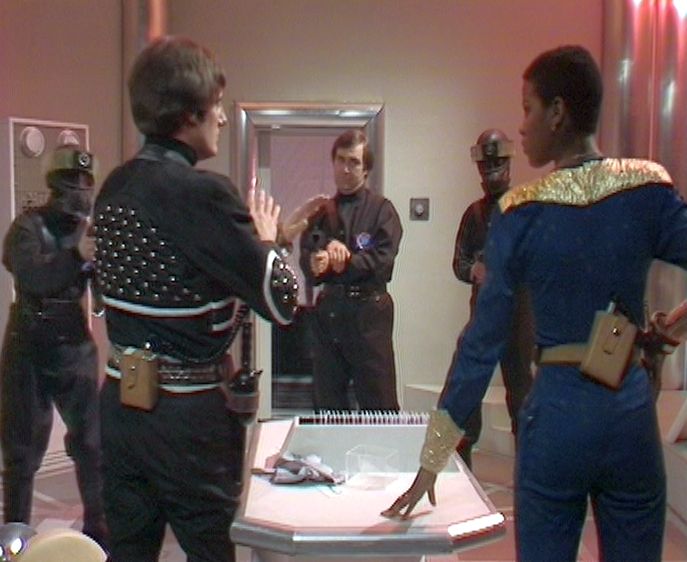
Servalan’s about, and acting as a neutral arbiter.  She doesn’t really do much though and this is definitely one story where she could have been excised without too much trouble.  However she does share one classic scene with Avon – where you could cut the sexual tension with a cricket stump.  Avon’s not got the most flattering costume – it’s the bulky shoulder pads which are the most distracting part – but he still manages to snarl and grab another snog from Servalan with aplomb.

Once he’s done that, he too heads back to the Liberator and settles down with the others to watch the action.  Rather charmingly they’ve got a decent selection of drinks and snacks to enjoy whilst they tune in to see Tarrant’s brother fight to the death.

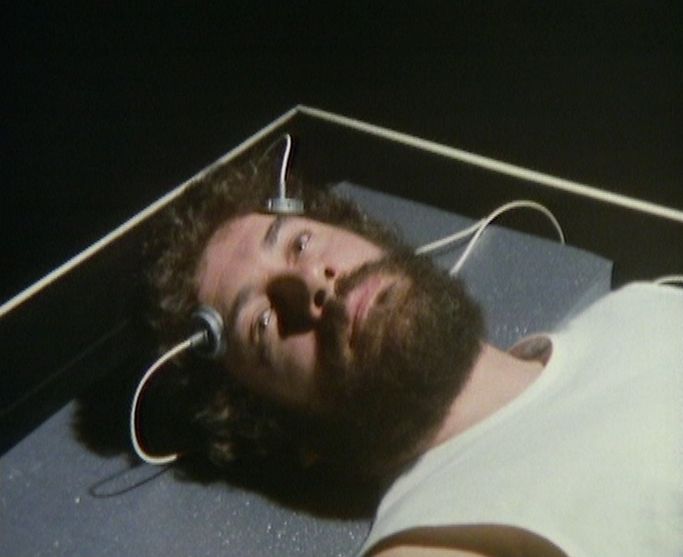
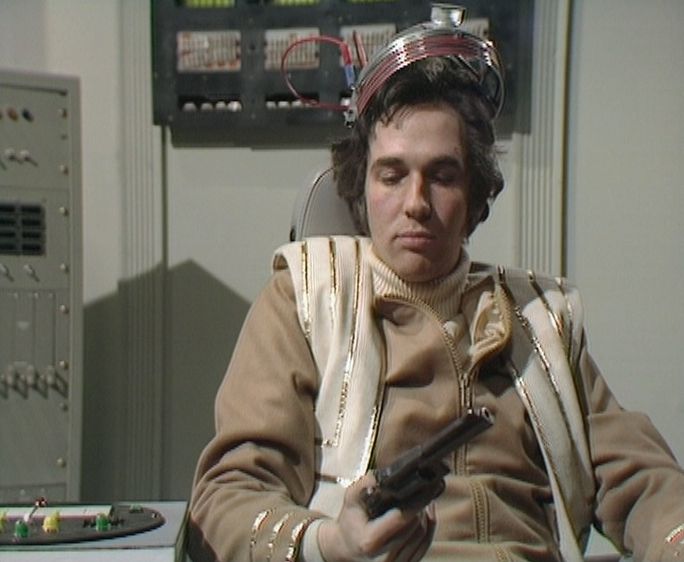
Although it’s fair to say that there’s nothing too original about any part of Boucher’s script, it’s interesting that some of the concepts (which would have been science fiction then) are closer to reality now.  Everybody has the option to feel exactly what one of the two champions feels, via the sensor net.  Deeta’s second, Max (Stewart Bevan) explains.  “Both men have had microsensors implanted in the brain. These are connected to a conductive mesh which is actually etched into the bone of the skull. When this mesh gets charged up it becomes a sort of transmitter.  You put it on your forehead. It’s activated through the optic nerves. Close your eyes and it feeds the signal directly into the brain, open them and it cuts out.  You can see what Deeta sees and feel a lot of what he feels, physically and emotionally.”  Our Virtual Reality isn’t quite there yet, but maybe one day ….

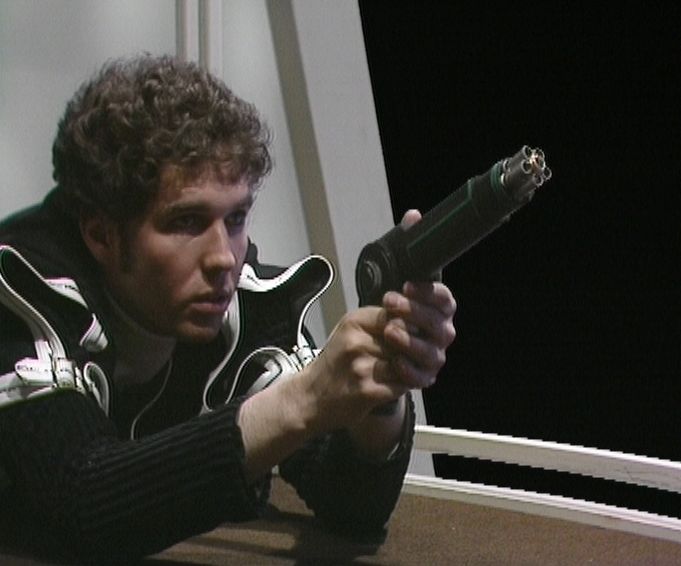
Once Deeta and Vinni (Mark Elliott) enter the killing ground, the camera often acts as their “eyes” allowing us to view the area as they would see it.  In this way it anticipated generations of first-person shooter computer games.  This choice of shot is used most effectively just after Vinni has fatally wounded Deeta – we see Vinni stand over the stricken Deeta and watch as he aims his gun directly at his opponent (i.e. the camera) to deliver the killing blow.

Whilst Deeta was hardly given any screentime to be developed as a rounded character, there were a few nice touches – such as the fact that he felt fear (so he wasn’t simply a mindless killer).  Stephen Pacey does do a good job to portray his pain at his brother’s death, although as is the way with B7 there’s no time to reflect – unfinished business has to be attended to.

Vinni’s an android and looks to be Servalan’s handiwork,  She has plenty of incentive for ensuring that Vandor and Teal go to war for real (the Federation would be handily placed to pick up the pieces and subdue the survivors).  Under the rules of Blood Feud Tarrant is able to challenge Vini and it’s probably not too hard to guess what happens next.

Most memorable part of the episode must be the silver combat suits that both Deeta and Vinni wear.  Remember this was 1980 not 1973, so quite why costume designer Nicholas Rocker decided to create something that Alvin Stardust could have worn is anyone’s guess.  Wembley Exhibition Halls and Southhall Gasworks make an excellent venue for the Deeta/Vinni battle (and should be familiar from numerous other television shows of the time).  I’d forgotten that Stewart Bevan was in this one, but then he wasn’t talking about mushrooms and didn’t have a Welsh accent, so that’s fair enough.

Death-Watch is a good opportunity for Stephen Pacey and it’s a decent sci-concept, well produced.

death 02

Blakes 7 – Moloch

moloch 01

Ah Moloch.  The one with Sabina Franklyn and the stupidest puppet alien you’re ever likely to see.  It’s odd, but apart from those two facts I couldn’t remember anything else about the story prior to rewatching it.  That’s surprising, since parts of the episode are certainly memorable (although not for the right reasons).

Avon’s been following Servalan’s ship for the best part of a month.  Quite why he’s suddenly taken such an interest in her movements isn’t clear, although it seems to be simply because he’s got nothing better to do.  In a way that sums up the actions of the Liberator crew during series three – a little light piracy here, some strange sci-fi adventures there, but as the Federation’s no longer the dominant menace it was you do get the sense they’re just marking time.

At the moment Vila’s taken over from Tarrant as the most annoying crewmember – no mean feat when you consider how irritating Tarrant can be.  Vila spends the first scene moaning about the time they’ve wasted following Servalan (although since nobody pays him any attention he needn’t have bothered).  If Michael Keating’s not best served by the start of the script then you have to give him full credit for throwing in a little bit of business as the Liberator looks set for a crash landing.  Most actors would just stagger from side to side as the camera shakes, but Keating gives us a forward roll.  Well done that man!

The planet, which turns out to be called Sardos, is initially depicted by a painting of some cliffs (with a little bit of smoke wafting across the screen).  Clearly the budget had run out by this point, although they did manage to build one model set – showing Servalan’s docked ship – which looks quite effective.

As it’s a Ben Stead script (writer, lest we forget, of Harvest of Kairos) it should come as no surprise that there’s more than a whiff of misogyny in the air.  Poola (Debbie Blythe), Chesil (Sabina Franklyn) and the other women are depicted as little more than toys for the men to play with.  After Poola spots the Liberator on a monitor screen she chooses not to report it, which incurs the wrath of Section Leader Grose (John Hartley).  The unseen Moloch (voiced by Deep Roy) tells him that she must suffer and orders that she’s given to his men.  Poola then receives a slap (albeit offscreen) although nothing else happens for the moment since Servalan then enters the room.  Poola pleads with her for mercy – which the former Supreme Commander naturally ignores – and Servalan then sums up the state of affairs on Sardos rather succinctly.  “Well, Section Leader, the records were accurate. Women, food, and inflicting pain – in no particular order.”  This is jaw-dropping stuff.

Grose is, well, gross.  As he enjoys a meal with Servalan and his second in command Lector (Mark Sheridan) he suggests that the attractive young waitress (no surprise that all the women are young and attractive) would look better with a “bit of dressing, and an apple between her teeth, eh?”  He then slaps her on the backside just to drive the point home.  Whether Ben Steed is satirising unreconstructed male attitudes to women or whether he’s approving of them is a moot point.

Vila and Tarrant reach Sardos by a circuitous route.  They teleport onto a T-16 space transporter carrying a cargo of convicts and, as they make planetfall, Vila makes a new friend – Doran (Davyd Harris).  Although he’s not quite the loveable rogue he appears.  “Ahh, my problem was always women” he tells Vila.  When Vila then asks if he likes them, Doran replies with a monosyllabic “no”.  He’ll fit right in on Sardos then.

Things then lurch in an even more unexpected direction as Grose reveals to Servalan the secret of his power – an energy mass transmuter which “takes ordinary planetary matter – usually rock – and converts it into energy.  The computer then restructures it into matter of every kind.”  That Servalan finds herself completely outmanoeuvred by Grose does stretch credibility, although he does tell her that “if your reconstituted Federation was worth a light, you wouldn’t have chased halfway across the galaxy to retrieve one legion. Already I suspect my fleet outnumbers yours. Soon, it’ll be the most powerful in the galaxy.”  It’s an interesting point, although this doesn’t quite tally with the impression given in previous stories that the Federation was slowly regaining its power.

As we head into the last twenty minutes, things get funnier and funnier (although not always intentionally).  Servalan is introduced to Colonel Astrid, Grose’s former commander.  It’s difficult to find the words to describe the Colonel, but imagine a tatty doll suspended in water and you’ll get the idea.  Moloch’s voice then pipes up and suggests that Servalan be given to Grose’s men.  That seems to be all that Moloch does – recommend that misbehaving women be passed over to the men to be sorted out.  Hmm, probably best to say nothing more.

Grose has been recruiting convicts like Doran to swell his ranks and Vila (his new best friend) has also been pressed into service.  Doran tells Vila that he has a treat for him – a woman.  That it turns out to be Servalan is an amusing reveal, as is the fact that they decide to briefly team up.  Since Michael Keating and Jacqueline Pearce had rarely shared any screentime together, their odd-couple partnership is the undoubted highlight of the episode.  A pity it couldn’t have lasted longer than a few minutes.

And then Moloch appears.  “That is how I reasoned you would look” says Avon, incredibly.  Mercifully he’s only onscreen for a brief moment although there’s also the spectacle of dead Moloch a few minutes later, which is even sillier than animated puppet Moloch.

Apart from all its other problems, the passivity of the female characters is a major negative.  If at least one of them turned out to be a fighter and had helped to defeat Grose and his men that would have made some amends for the way they were treated.  Chesil seems to be written that way – but right at the end she and Doran appear to be killed off.  It’s never explicitly stated that they’re dead, but since we never see them again it’s a reasonable assumption.

Moloch is just bizarre.  There’s the germ of a good idea – Servalan being held captive by a rogue section of the military – but the rest veers from the forgettable to the hilarious.

moloch 02

Blakes 7 – Ultraworld

ultra 01

The contrast between Sarcophagus and Ultraworld is immense – in one fell swoop we move from the sublime to the ridiculous.  It’s interesting that both writers (Tanith Lee previously, Trevor Hoyle here) were novelists with no previous scriptwriting experience (and Ultraworld turned out to be Hoyle’s only work for television).  The difference between their stories couldn’t be greater though – Lee offered up a lyrical fantasy whilst Hoyle’s effort is little more than a pulp-sf runaround.

This wasn’t Hoyle’s first brush with the series as he’d penned two novelisations based on episodes from series one and would follow this up with a third novelisation adapted from selected series four episodes.  If you’ve never read them then they’re worth tracking down, especially the first one, since it looks like it was adapted from Nation’s draft scripts (there are numerous small differences).

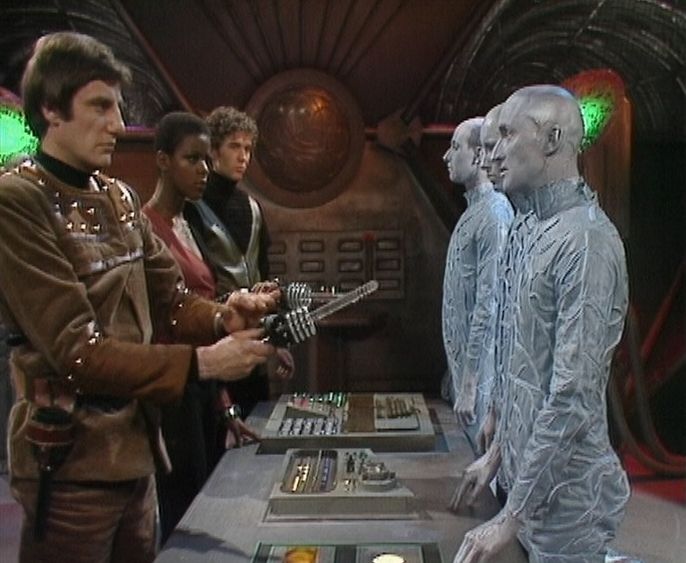
Ultraworld is an artificial world run by the three Ultras – who are blue-skinned aliens of varying baldness.  One looks to be completely bald, one is wearing a rather ill-fitting bald cap whilst the third clearly didn’t get the memo as he proudly sports hair at the sides and back.  So if the intention was to make them into a gestalt entity, someone wasn’t on the same page.  The Ultras are humourless, logical and, no surprise, not great conversationalists.

They exist to gather information (Ultraworld is nothing more than a massive computer) and it’ll come as no shock to learn that the Ultras plan to drain Avon and the others of all their knowledge and then take the Liberator for good measure.

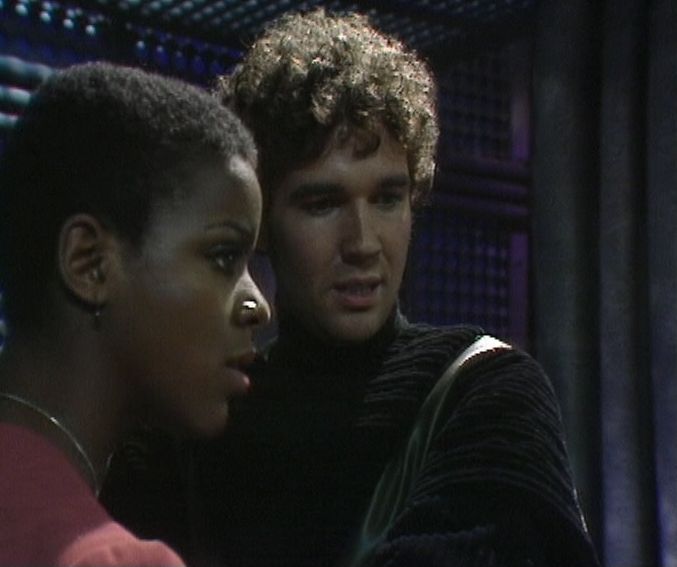
There’s the odd nice moment.  Cally disappears from the Liberator and the others hear her crying for help from Ultraworld.  But it’s not her voice – it’s an artificial construct and this revelation is a disturbing reveal.  The location filming (at the Camden Town Deep Level Shelter) is impressive.  Previously used for the Doctor Who story The Sunmakers, it once again effectively doubles as a strange, alien environment.

But on the debit side, what has happened to Vila?  He spends the episode attempting to teach Orac jokes.  I think once example will suffice. “Where do space pilots leave their ships? At parking meteors.”  Alas, there’s many more where that came from, so it shouldn’t come as any surprise that this was rumoured to be Michael Keating’s least favourite episode (the proactive hero from City at the Edge of the World seems a long time ago).  It’s worth noting that Vila’s jokes do play an important part in the conclusion of the story, but that doesn’t make me any more disposed to enjoy them.

With Vila acting the fool and Cally and Avon sidelined, it falls to Dayna and Tarrant to carry the brunt of the action.  Although it’s not the greatest story ever, they make an attractive pair (and for once Tarrant isn’t particularly annoying).  They have to suffer the oddest part of the episode though, as the Ultras suddenly realise that Danya and Tarrant are girl/boy and decide that a bonding ceremony is in order.  It beggars belief that whilst they’ve accumulated masses of knowledge they know nothing of the ways of, ahem, human love.  So they’re keen for Danya and Tarrant to get it on, whilst they watch (yes, really!)  They do dangle a carrot – hinting they might let them go if they agree.

DAYNA: Tarrant, I think we should accept the offer. Then we can return to the Liberator.
TARRANT: You can’t be serious. You don’t believe what they say.
DAYNA: We have to believe if we hope to survive. Kiss me.
TARRANT: What?
DAYNA: I said, kiss me. Come on. I can’t be all that repulsive

It’s hard to take any of this seriously, especially when one of the Ultras pops up on the screen, asking “has the bonding ceremony begun?”, as soon as they start kissing – which rather puts a damper on things.

Complete with a giant pulsating brain, Ultraworld is pretty stupid sci-fi schlock, but it’s impossible not to derive some entertainment from it.  I’m glad it was more the exception than the norm though.

ultra 02

Blakes 7 – Sarcophagus

sarc 01

Tanith Lee was a prolific novelist whose output covered many genres, including fantasy (both children’s and adult), science fiction, horror and historical fiction.  Her two Blakes 7 scripts were her only ventures into television scriptwriting so it’s obvious that Chris Boucher took something of a chance when he commissioned her (writing a novel and writing a script are two very different disciplines).

We have to be grateful that Boucher did take the risk as Sarcophagus is unlike any previous Blakes 7 script.  If you favour the action/adventure model of B7 then this one may not be to your taste – it’s a fantasy tale that includes a musical interlude and a dialogue-free opening scene featuring hooded characters performing strange acts.  Although some of the plot elements are familiar – the Liberator spies a strange craft drifting in space/Cally gets taken over – Lee is able to take this hackneyed material and fashion something quite different from the norm.

Sarcophagus opens with a funeral aboard an alien vessel.  Various masked characters perform different rituals – we see a musician, a soldier, a conjurer, etc – and later we see the Liberator crew dressed in the same garb, performing the same actions.  The mysterious alien who takes over Cally’s body later reveals that she enjoys being attended to by intelligent minions, so it would appear that she is visualising how each of the crew would best serve her.  No surprise that Vila is the jester or that Tarrant is the soldier (shoot first, think later seems to be his motto in this story).  Unexpectedly, Dayna turns out to be musical (there’s a brief song mid-way through the episode, although this isn’t Blakes 7’s – The Musical, you may be glad to hear).

Since most of the action takes place aboard the Liberator and the only speaking roles are taken by the regulars, the script is a dense, dialogue heavy affair which has plenty of time to study how the various characters interact with each other.  The relationship between Avon and Cally is key to the story and early on there’s a revealing moment in Cally’s cabin.  She’s spent the last ten hours alone, thinking of her home planet and how she’ll never see it again.

AVON: I wish I could promise you that the sparkling company on the flight deck would take you out of yourself.
CALLY: I’m all right.
AVON: No, you’re not. But you will be. Regret is part of being alive. But keep it a small part.
CALLY: As you do?
AVON: Demonstrably.

Coming so soon after the events of Rumours of Death, it’s possible to argue that Avon’s referring not only to Cally, but also to himself.  Either way, it’s a quiet, reflective moment that’s handled well by Darrow and Chappell.

The most fun to be had comes from the clashes between Avon and Tarrant.  Tarrant’s still being irritating and obnoxious – although he’s correct when he surmises that something came back with Cally from the alien vessel.  It’s his bull-in-a-china-shop approach that wins him few admirers though.

AVON: Shut up, Tarrant.
TARRANT: Did you say something to me?
AVON: I said, shut up. I apologise for not realising you are deaf.
TARRANT: There’s something else you don’t realise. I don’t take any orders from you.
AVON: Well, now that’s a great pity, considering that your own ideas are so limited.

Darrow’s at his laconic best here, and it’s clear that Avon considers Tarrant to be no threat to his dominance at all (despite Tarrant’s claims to the contrary).

As the alien draws power from the Liberatordirector Fiona Cumming elects to turn the lights down.  This not only indicates that the ship is stricken, but it helps to increase the tension – which is furthered by the fact that both Orac and Zen are put out of commission.  There’s something particularly disturbing about hearing Zen’s speech get slower and slower (he’s such a solid, reassuring presence that it’s jarring when he’s no longer there).

If the flashbacks (or flashforwards, maybe) of the Liberator crew dressed in strange costumes are odd, then even odder is Vila’s decision to do some conjuring tricks, mid episode, on the flight deck.  It’s reasonable to assume that he decides to amuse himself in order to keep his spirits up (he’s alone and frightened of the increasing darkness) but after each trick there’s a massive round of applause.  Do we suppose that this non-diegetic sound was only heard in Vila’s head?  It’s only a throwaway moment but it’s another unusual, non-realistic touch.

The alien who takes over Cally remains an indistinct character.  We learn that for her race, death is merely an interim state and that she requires Cally’s body in order to attain corporeal form once again.  She proves to be no match for Avon though – or rather it’s the part of her that’s still Cally who can’t bring herself to harm him.  Unexpectedly he kisses her, although all becomes clear when he uses this as an excuse to wrench a ring from her finger.  It’s the ring that’s allowed her to drain energy from Cally and when it’s removed, her power is broken.  Darrow’s excellent again here as he refuses her entreaties to return it (“That would be a little foolish, when I just went to so much trouble to get it”) as is Chappell, as the alien senses her end is nigh.

Avon! Avon, give it back to me. You must. You don’t know. I HAVE to keep this body. I have to live. I’ve waited so long. Centuries. More time than you could comprehend. How can you imagine what it must be like to be dead, to exist in nothingness, in nowhere. Blind, deaf, dumb, and yet to be sentient, aware, waiting. Centuries of waiting. I have to find my world again, my people, my home. I want to breathe and see and feel. And know. Don’t send me back into the dark, Avon, let me live.

With a dual role for Jan Chappell, this is very much her episode but it’s equally a good vehicle for Paul Darrow.  After a shaky few episodes early on, series three has hit a rich vein of form.

sarc 02

Blakes 7 – Rumours of Death

rumours 01

Rumours of Death features Blake 7‘s most effective cold opening.  Avon is a prisoner of the Federation and he’s in a pretty bad way.  Unshaven and in pain, he’s been a captive for five days and during that time he’s proven to be rather uncooperative.  He’s visited in his cell by the Federation’s top torturer, Shrinker (John Bryans) who is determined to get the truth out of him – one way or another.

Set-wise, this opening section is simply staged.  Avon’s cell is bare and we never venture any further into the Federation detention block.  But the illusion that Avon isn’t the only prisoner is effectively created by the off-camera screams of another poor unfortunate.  And as Shrinker brandishes a laser probe it seems likely that Avon will also be screaming soon.  Director Fiona Cumming chooses to keep the camera angle in this scene quite low – with Avon seated on the bed and Shrinker standing over him it helps to create the impression of the Federation man’s dominance.  A simple trick (like the off-camera screams) but nonetheless effective.

The attentive viewer wouldn’t have been fooled by Avon’s plight for too long.  It now becomes clear why he mentioned Shrinker in the previous episode (he’d told the rest of the crew that Shrinker was the key to understanding why Anna Grant, the woman he loved, died).  So when Shrinker appears here it’s clear that Avon’s plan is in full swing.  That he was prepared to withstand days of torture (it’s never explicitly stated what happened to him, but it clearly wasn’t pleasant) in order to lure Shrinker to his cell speaks volumes.  Whether for good or bad is debatable though.  Avon’s always been a driven, single-minded character, but the events of this episode seem to clearly indicate his future, tragic path – the loss of the Liberator, his inability to ever trust again and the cataclysmic events on Gauda Prime.

When Tarrant and Dayna teleport into the cell and take Avon and Shrinker back to the Liberator it’s remarkable how quickly Shrinker devolves into a whimpering, pathetic character.  The cliche that he was only a man who followed orders is aired, but there’s a faint sense of unreality about his total collapse.  Yes, it’s reasonable to assume that such a man would be powerless when stripped of his authority, but it might have played better had he kept a faint air of defiance.

The reactions of Tarrant, Dayna and Vila are noteworthy.  They surround the cowering Shrinker and goad him, causing a disgusted Cally to snap at them.  That Shrinker’s a mass-murderer is unquestionable and Tarrant tells her that he’s nothing more than an animal.  “Yes, and it’s contagious, isn’t it?” responds Cally.  With series three of Blakes 7 having largely abandoned the freedom fighter/terrorist attacks of the first two series, this brief exchange taps into some of the more interesting character moments from previous stories like Star One.  Shrinker is a monster, but if they behave like him can they claim to be any better?

Whilst this part of the plot is bubbling along nicely, we jump to Earth.  Sula (Lorna Helibron) and Chesku (Peter Clay) are two high-ranking officials in the Federation (and are also married).  Chesku is clearly a man with a great regard for his own oratorical skills and gives his wife a demonstration of part of a speech he plans to deliver later.  “The rabble which sought to challenge the established order lacked our inspiration, our unity, our leadership. They are crushed. Earth and the Inner Planets are once again united. Gentlemen, I give you a toast. Our inspiration, our unity, our leader: President Servalan.”

Sula responds that “I’m sure Servalan will be delighted. She is, after all, a tasteless megalomaniac.”  The faintly off-key nature of the episode continues after two Federation troopers turn up and, on Sula’s orders, shoot Chesku dead.  Peter Clay’s death (all flailing arms as he crashes into a bush) isn’t the most impressive, but never mind.  It helps to set up the events for the rest of the episode as it looks as if a palace revolution is taking place.  The power-struggles within the Federation following the war with the aliens is certainly something that could have been developed more during series three.  As it was, Servalan seemed to spend far too much time tussling with Avon and the others instead of attempting to secure her position.

Things get even stranger when Avon starts to question Shrinker.  Avon shows him a picture of Anna Grant, but he claims he doesn’t know her.  “I’ve killed hundreds and remembered them all, all of them, every last whining traitor. And there wasn’t one that died without telling me what I wanted to know. Not one.”  We then flashback to scenes of Anna in bed with Avon.  It’s maybe not immediately clear, but this is the same woman who now calls herself Sula.  In Space Fall we were told that Avon was nearly responsible for the greatest banking fraud in Federation history, but Shrinker now tells him that he was monitored right from the start (he was under the observation of an agent called Bartolomew from Central Security).  It’s another small moment which helps to emphasise that Avon’s not as infallible as he might appear.

Avon leaves Shrinker a prisoner in a cave with no escape and a gun for company.  Avon promised him a way out and this is it (“It’s a better deal than you gave any of your victims”).  With Shrinker’s information, he now decides to set course for Earth to confront Servalan and demand that she reveal the identity of Bartolomew.  This is the weakest part of the script – that Avon would decide to return to Earth seems foolhardy enough but that he chooses to do so on the same day that Anna/Sula decides to take out Servalan is one coincidence too many.

Greenlee (Donald Douglas) and Forres (David Haig) are two career officers who are on security duty at the lavish country house that serves as Servalan’s headquarters.  It seems that Chris Boucher took a leaf out of Robert Holmes’ book as Greenlee and Forres act as detached narrators for the first half of the episode – they help to fill in the blanks of what we’re seeing.  Although unlike most Holmesian double-acts they don’t make it to the end as they’re both mown down by Sula’s men.  The palace revolution is far from bloodless, but it’s comprehensive.

Jacqueline Pearce doesn’t have a great deal of screentime in this episode, but that’s not really a criticism.  Servalan’s been something of an overexposed character (especially during series three to date) so Rumours of Death works well by keeping her as more of a background character.  But her scene with Avon towards the end (she’s chained up in the cellar, helpless) is another key Avon/Servalan meeting that has no doubt launched a thousand fan-fics.

AVON: Is that it? Have you finally lost your nerve?  Have you murdered your way to the wall of an underground room?

SERVALAN: It’s an old wall, Avon, it waits. I hope you don’t die before you reach it.

That Avon is prepared to set Servalan free when Sula and others are close to destroying her power forever is intriguing (it looks as if everything that Blake fought for is within their grasp).  This is open to interpretation though.  Is Sula keen to replace her (as suggested earlier on) or does she really support the notion of a People’s Council?  If it’s the latter, then it’s ironic that Sula has been fighting for the same things that the Liberator crew did for so long.

It’ll come as no surprise that Anna = Sula = Bartolomew or that Avon kills her.  So Anna was a fiction who only existed for Avon.  But Sula’s dying words seem to suggest that she genuinely did love Avon.  But in the hall of mirrors that’s Rumours of Death can we believe her this time?

This is clearly a great vehicle for Paul Darrow, who makes the most of the material. There’s a few niggles (for example, Servalan is taken prisoner rather too easily and if Anna Grant never existed who was the man who claimed to be her brother in the series two episode Countdown?)  but overall this is a classy episode.

rumours 02

Blakes 7 – Children of Auron

auron 01

Servalan’s always been insanely ruthless, but Children of Auron is extreme, even by her standards.  She infects the whole population of Auron with a deadly pathogen to achieve two goals – firstly to capture the Liberator and secondly to continue her bloodline.

She explains why capturing the Liberator remains such a high priory – with the Federation in tatters she’ll be able to take control again quicker with the most powerful ship in the galaxy.  Does this really make sense?  The galaxy’s a big place and the Liberator, powerful though it is, is only one ship.  I can’t see that it would make that much difference (and anyway, it’s not ships she needs but good men).  The fact that she effectively wants to have children (although the technique on Auron is only able to create clones of herself) is even more startling.  Servalan’s never shown any sort of maternal instinct, so this revelation is rather hard to take.

It was perhaps inevitable that we’d return to Cally’s home planet one day and although there isn’t a great deal of time to develop its backstory, we still learn a little.  C.A. One (Ronald Leigh-Hunt) has kept Auron strictly neutral – any contact with outsiders has been discouraged, but the unfortunate result is that the pathogen is able to spread unchecked (few of his people have any sort of resistance to space viruses due to their strict isolationist policy).  It’s a shame that Leigh-Hunt doesn’t essay a subtler performance, as C.A. One ends up as little more than a bluff blusterer.

Cally has an identical twin, Zelda.  Given Auron’s skills in cloning this is reasonable enough (although credibility is stretched later in the series when we meet Tarrant’s identical twin – no cloning involved there).  Zelda isn’t a very proactive figure and doesn’t do a great deal to further the plot (although she has an inevitable and pointless death).  It’s a pity that more couldn’t have been done, as her demise does feel like a wasted opportunity.  Jan Chappell is, of course, excellent as both Cally and Zelda – especially when we see Cally take on Avon.  Avon is keen to head to Earth for a mission of vengeance (sowing the seeds for Rumours of Death).  Even when the plight of the Aurons is known he’s still disinclined to get involved, so there’s a nice tension that exists between them (which pays off later in Sarcophagus).

If Servalan’s going to rebuild the Federation then she needs good men, but alas they seem hard to find.  In Children of Auron she’s lumbered with a right pair – Deral (Rio Fanning) and Ginka (Ric Young).  They spend most of the episode bickering (Ginka’s unhappy that Deral was promoted ahead of him) and generally bumbling about.  Deral is unable to capture the Liberator even when only two of the crew are aboard and one of them is Vila, now back to his default setting of cowardly.

Ginka’s lack of judgement is even more striking.  Avon, Cally and Tarrant are taking refuge in the replication plant – they know they’re safe there, as Servalan wouldn’t destroy her own clones.  But Ginka is able to convince her that Deral switched her genetic material for his, so she gives the order to fire.  As the plant is destroyed Jacqueline Pearce gives one of her finest performances in the series – Servalan clearly feels intense pain as her clones go up in flames.  But Ginka obviously never stopped to think that possibly, just possibly, Servalan wouldn’t be terribly pleased when she discovered that he’d tricked her (as I said, he’s not the sharpest knife in the draw).  So he’s not long for this world (and neither is Deral) which leaves Servalan with yet another staffing crises.  Possibly she’s pining for the good old days with Travis.

If Auron remains a rather undeveloped world and Servalan’s schemes are barmy, that doesn’t stop Children of Auron from being a strong mid series episode.  Sandwiched between City at the Edge of the World and Rumours of Death it probably slightly pales in comparison, but it’s still much stronger than the likes of Volcano and Dawn of the Gods.

Ten points docked for the final scene though, as everybody has a good laugh on the bridge of the Liberator.  It’s not the first time it’s happened (the crew had a chuckle at the end of Breakdown, seemingly oblivious to the loss of life they’d just witnessed) but again it just feels so out of place.  We’ve just witnessed a planet devastated, so a little show of solemnity wouldn’t have been out of place.  Apart from that, this is decent stuff.

auron 02