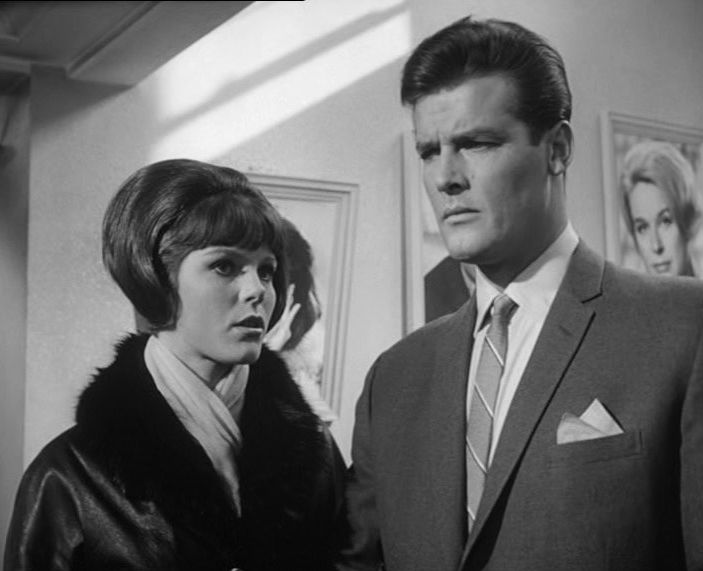
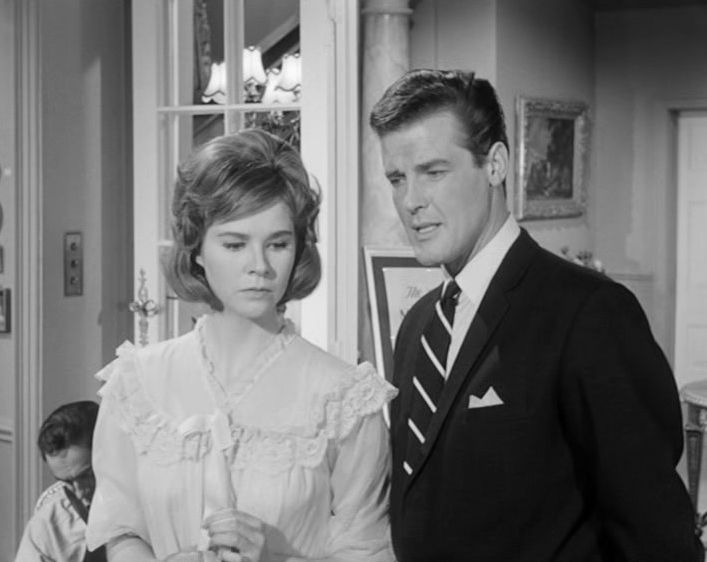
The Champions – A Case of Lemmings

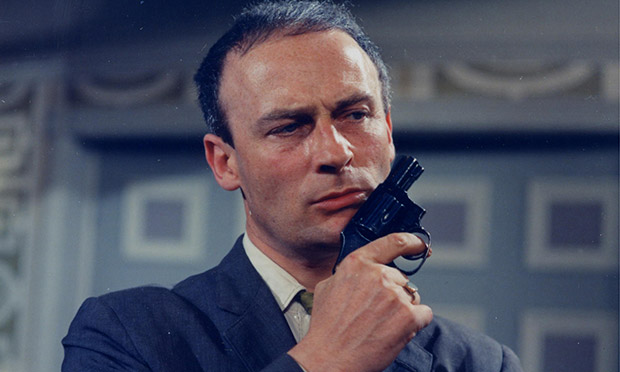
Three Interpol agents commit suicide in Paris. A strange coincidence or was there outside interference? No surprises that it’s the latter and soon the Champions are heading out to Rome in order to confront Mafia kingpin Del Marco (Edward Brayshaw) …

I do appreciate the spot of local colour we see during the second of the three deaths. This unfortunate Interpol chap is suddenly struck with an uncontrollable urge to jump from a fast-moving train – which he does whilst a baguette-chomping young lady looks on in horror. Nothing says France like a nice baguette.

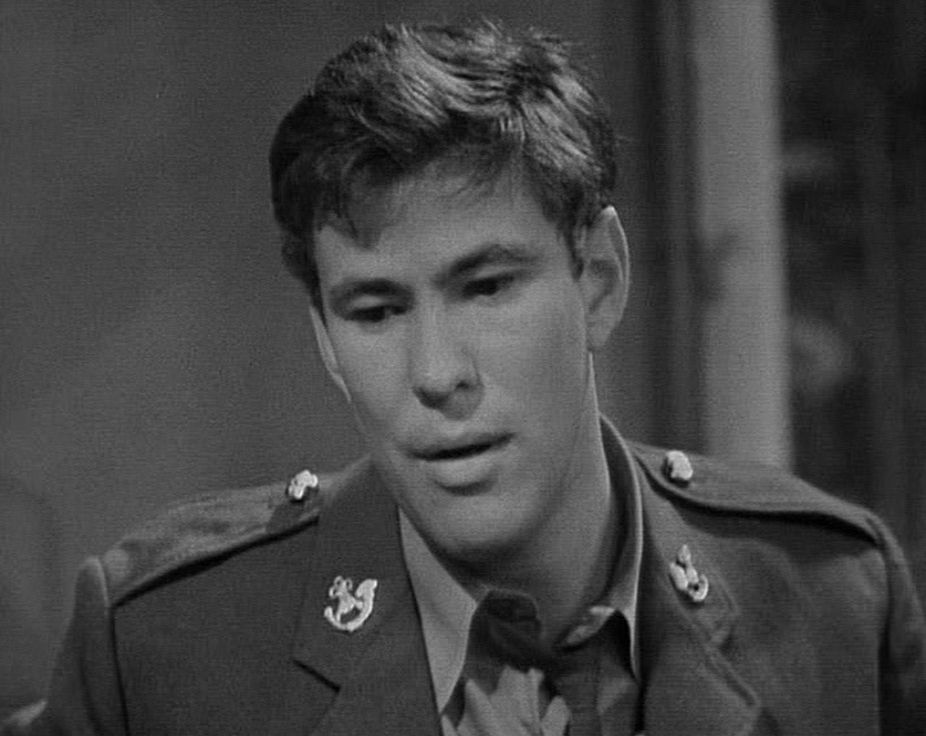
Once again, The Champions comes up trumps with its guest stars. Edward Brayshaw may forever be associated with Rentaghost but there were plenty of other strings to his bow. For example, I’ve always loved his loopy turn in Moonbase 3, a series which I enjoy with a slightly unhealthy passion.

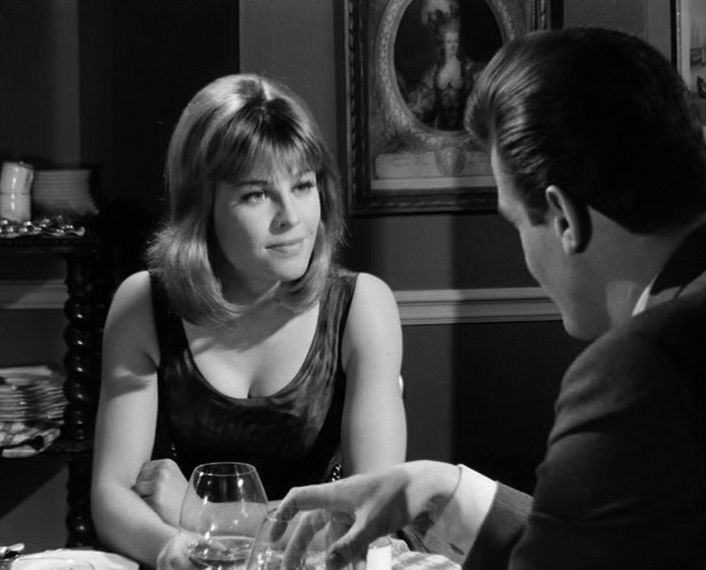
Brayshaw oozes oily villainy, easily suggesting that underneath Del Marco’s suave exterior something rather nasty lurks. And after spending the last few episodes doing very little, it’s nice to see Sharron back in the thick of the action. After receving a new hairdo she’s sent to seduce Del Marco (this does rather reinforce the notion that Sharron’s prime function is decorative though).

But at least it means that all three regulars are given an equal share of the action. Sharron vamping it up in the casino (where she meets Del Marco) is the highlight for me, although Craig’s entertaining overacting (for a few minutes he’s the dead spit of Jimmy Cagney) is also a wonder to behold.

Del Marco invites Sharron back to his apartment for a spot of champagne and …. well you know.  But their canoodling is interrupted by Craig lurking outside (this is all part of their masterplan). Our heroes reason that if one of them can upset Del Marco, he’ll unleash his suicide trick on them.

I can see one or two flaws here. What happens if Del Marco decides that a bullet would be quicker? You also have to question the wisdom of Del Marco using his suicide drug on so many people ….

Richard doesn’t get much of a comedy turn this time round, but he does get to indulge in a spot of investigative questioning. Indeed all three do this early in the episode, which gives the impression that the episode could have slotted quite easily into a number of other ITC series. 

John Bailey, as Umberto, adds a little touch of class even if his Italian accent (like Brayshaw’s) isn’t the most convincing you’ll ever hear.

Del Marco is an unforgiving boss. After Craig fails to succumb to the suicide drug, the Don has no compunction in killing Umberto (its creator). That seems a tad harsh given all the good work Umberto had done for him. Still, it means that Umberto’s dying act proves to Del Marco in a rather permanent way that the drugs still work. I love a bit of poetic justice.

Is it just me, or does the backlot used for Paris look very much like the Rome one? I know they were the same, but surely a spot of redressing could have made this less obvious.

A Case of Lemmings isn’t the most complex of episodes, but it slips by quite agreeably and is worth a score of three out of five.
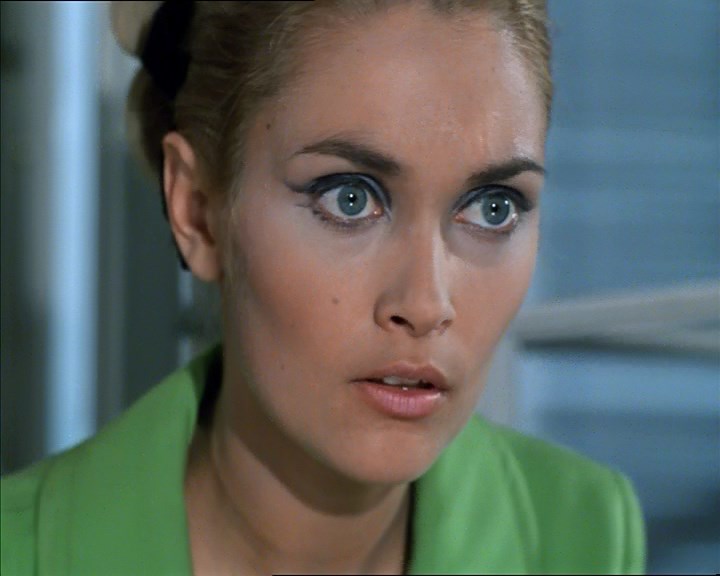
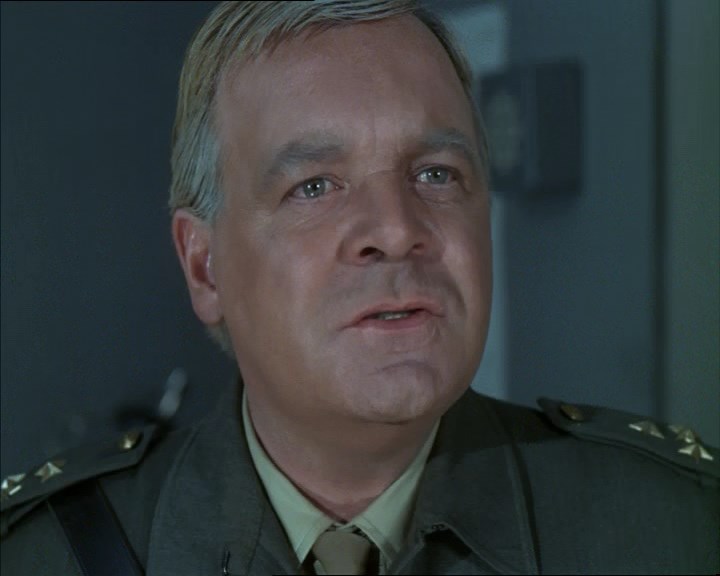
The Champions – Operation Deep-Freeze

Reports of a mysterious explosion in Antarctica have reached Nemesis. Several scientists from the nearby Scott Base sent to investigate have failed to report back. When Craig and Richard arrive they discover that the scientists have been murdered and also run across General Gomez (Patrick Wymark), the despotic ruler of a small Central American state.

He’s established a secret Antarctic base stocked with atomic weapons and plans to establish his country as a great power on the world stage, unless Craig and Richard can somehow stop him ….

Operation Deep-Freeze is another episode enlivened by a first rate guest star.  I assume most visitors to this blog will be familiar with both The Plane Makers and The Power Game (if not then you should check them out straight away).  Wymark bestrides both series as the amoral businessman John Wilder, giving a performance which has provided me with many hours of entertainment.

He also seems to be enjoying himself today – Gomez is hardly a three dimensional character, but Wymark was always a very watchable actor and his full-throttle turn is certainly a memorable one. Subtle no, memorable yes.

It’s very much a boy’s own adventure today as Richard and Craig get to handle all the action. I like the playful banter during their briefing with Treymayne (Richard promises to bring him back a penguin). It’s little moments like these which ensures their characters are slightly less cardboard than they otherwise might be.

Lashings of stock footage and some fairly effective studio work helps to create the illusion that we’re in Antarctica. Craig, Richard and Hemmings (Robert Urqhart) set out across the frozen wastelands, unaware – to begin with – that Jost (Walter Gotell) is stalking them.

It’s strange that Craig suddenly becomes realises they’re being followed whilst Richard remains ignorant. An example that all three Champions have different strengths and weaknesses when it comes to their powers, or a simple plot contrivance?

Robert Urquhart gives a nice performance as Hemmings (you get the sense that he’s not going to make it to the final reel). Walter Gotell made a career out of playing menacing types (well, apart from Softly Softly Task Force) and he’s typically good value in a fairly nothing role. The strength in depth of the cast is highlighted by the fact that George Pastell, no stranger to playing memorable villians himself, only has the briefest of brief roles.

The story picks up momentum in the last ten minutes or so after Craig and Richard are captured by Gomez. Before this happens, the boys stumble across the General’s stash of atomic weapons and decide it would be a good idea to set a timer and detonate them all. Yes, okay. I’m no expert, but I don’t think this will do the local environment any good.

Forty minutes in and we finally see Sharron. Hurrah! Stuck in Nemesis HQ, she suddenly gets a mental image that Richard and Craig are in danger.Treymane isn’t buying it – he doesn’t quite pat her on the head and tell her not to be so silly, but it’s not too far removed from that.

Her sole scene isn’t really necessary as the plot could easily have moved on without her interjection. Possibly it was decided that Sharron had to be present somehow and this brief scene was the best they could come up with.

For the way that Richard and Craig have started to function as a wise-cracking double act, not to mention Patrick Wymark’s scenery chewing performance, I’ll give this episode four out of five.

The Champions – The Invisible Man

An amoral medico called John Hallam (Peter Wyngarde) has devised an ingenious plan to make himself a very rich man – he’s created a small device (the “invisible man” of the title) which when placed in someone’s ear can be used to relay instructions (and cause extreme pain).  Hallam uses it to force Sir Frederick Howard (Basil Dingham) to steal ten million pounds worth of gold bullion from the Bank of England.

Nemesis are on the trail, but bringing Hallam to justice won’t be easy – especially once Craig finds himself under the control of his own “invisible man” ….

The Invisible Man has a tip top guest star – Peter Wyngarde – which is a definite plus point in its favour. He’s not the dandy of the later Jason King years though – to begin with he’s smartly togged out in a three piece suit (he gets more causal later on). Wyngarde’s icily calm line delivery and stillness is very effective.

Screenwriter Donald James penned eight episodes of The Champions as well as various other ITC series including The Saint, Department S, The Protectors and The Adventurer. His list of writing credits (he was active between 1963 and 1981) tended to lean quite heavily towards the adventure series market, but he also wrote for Emergency Ward 10 and General Hospital.

You have to say that Hallam likes to make things complicated – melting down such a large stash of gold is a big job (couldn’t he have got Hallam to steal some diamonds instead?). Ah well, best not to worry about plot logic too much.

Sir Frederick has the pre-credits sequence to himself, but it’s not long before we clap eyes on Craig and Richard. Both are working out in the gym, when a muscle man (played by the instantly recognisable Dave Prowse) pops in and begins to preen himself. In response, Craig can’t help but show off a little. This rather makes a mockery of the fact they’re supposed to be keeping their super powers secret.

This is a Craig-centric episode, although Sharron and Richard do appear from time to time. It does mean that I’m feeling a little Alexandra Bastedo deprived today – especially since it would be easy to imagine Sharron going undercover as a nurse at Hallam’s private clinic. A missed opportunity ….

Craig gets a chance to use his super powers when – after escaping from Hallam’s clutches – he dives into a lake and holds his breath underwater for several minutes (thereby managing to convince Hallam that he’s dead). A pity he didn’t think about doing that when Hallam gassed him earlier in the episode. These super powers, they tend to come and go.

Hallam remains a rather nebulous character. We never really learn too much about him – why he wants to steal a fortune in gold, for example. Presumably we’re just supposed to accept that he does so because he’s a baddy and that’s what baddies do.

He’s given a sidekick – Charles (James Culliford) – who mainly exists as a line feed. But there’s an interesting moment when an irate Hallam slaps Charles quite hard. Knowledge of some of Wyngarde’s other roles gives the scene a faint homoerotic subtext. Hallam later tells Charles to use the vibrator on Craig, but luckily this is all quite family friendly.

Wyngarde’s performance helps to make both the character of Hallam and the episode in general a little more compelling than it otherwise would have been. Adding on an extra 0.5 for Peter Wyngarde, I’ll give The Invisible Man an above average score of three and a half out of five.


The Champions – The Beginning

The Champions rolled off the ITC production line in the late sixties (although it had been sitting on the shelf for a little while). It’s hard not to draw a comparison between it and Department S –  which also featured a team of two men (one an American) and a single woman – although the difference here is that none of our heroes have the flamboyance of a Jason King.

Craig Stirling, Sharron Macready and Richard Barrett are all agents in the employ of Nemesis, a United Nations law enforcement organisation based in Geneva. They seem an oddly mismatched trio in some ways, but that’s the world of ITC for you …

William Gaunt proved in Sergeant Cork that he had a flair for comedy, and as the series progresses sometime he gets little moments to demonstrate that skill once more (the same goes for Stuart Damon, who can deadpan very nicely). Alexandra Bastedo, as the token female, tends to get pushed into the background as the boys usually handle the more exciting rough stuff. We’ll keep an eye on that as the series progresses.

Despite the long working days, by all accounts it was a happy production with no clashes of egos between the leads. It’s always been a series that I’ve enjoyed revisiting, so let’s go back to the start once more with the aptly named The Beginning.

We open in China (although it’s more likely to have been Borehamwood). Our old friend – day for night filming – is in operation as our intrepid heroes (dressed in black and with camouflaged faces) wait outside a sinister looking research base. Why is Sharron the only one wearing a hat? These are the sort of questions which flit through my mind as Richard and Sharron, once they’ve snuck inside, very slowly extract a few bugs from a glass case.

All seems well, but then they’re rumbled. Cue plenty of Chinese extras running about with guns and the soundtrack going into bongo overload. One plus point about these scenes is that there’s no British actors yellowing up as Chinese (something which happened a lot during the sixties and seventies). The familiar face of Anthony Chinn is seen – albeit uncredited – as the guard commander.

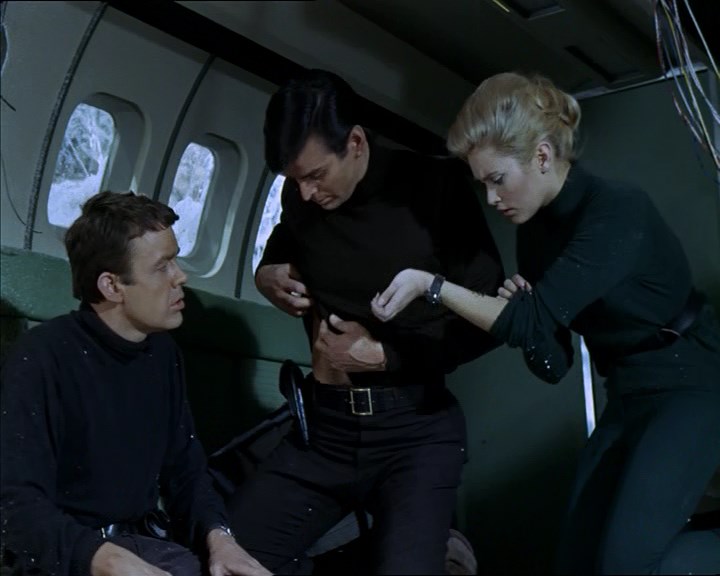
There’s a wonderfully unconvincing bit of back projection as Richard, Sharron and Craig drive a jeep rather rapidly back to their waiting plane. The model plane also doesn’t quite convince, but you have to accept this sort of thing – ITC might have had decent budgets (they were still shooting on 35mm at this time) but buying a full-sized plane was clearly beyond them.

Craig – an ace pilot – gets them off the ground but they’ve sustained damage from the barrage of shots fired at them by the irate guards, so it doesn’t look like they’re going to be up in the air for long. Sharron goes to pieces immediately (wailing that they’re going to crash).

A pity (but maybe not surprising) that it’s the female who cracks first. Although there’s a spot of dialogue later on explaining that this is Sharron’s first mission, which makes her reaction a little more understandable.

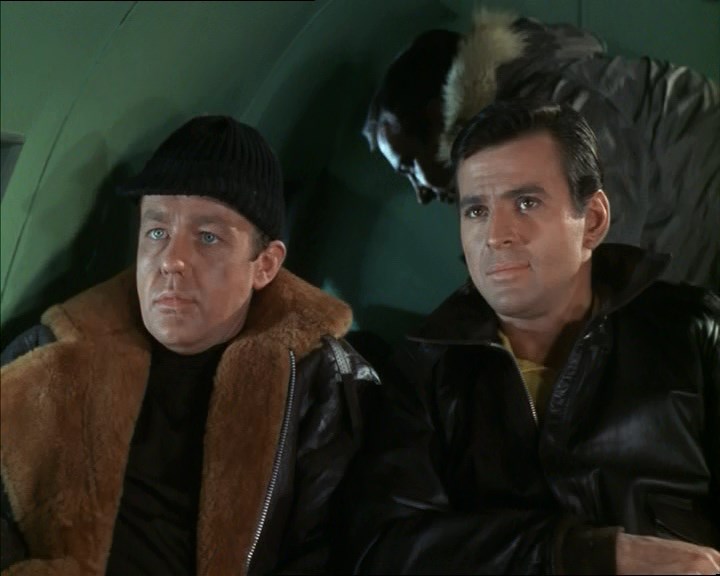
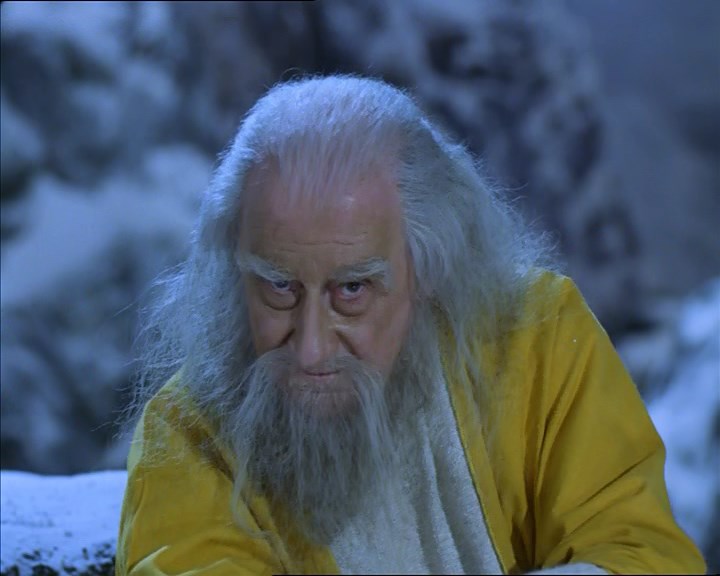
The plane crash-lands in the Himalayas, meaning we end up in an icy, studio-bound wilderness complete with lashings of fake snow.  Felix Aylmer pops up in a dressing gown (clearly his character doesn’t feel the cold) to assist the wounded trio.

This part of the story isn’t explained in any depth but you can fill in the blanks – a super civilisation patches up Craig, Richard and Sharron, giving them super powers in the process (well it would be rude not to).

Sharron and Craig decide to head off home (strolling through the snow as if they were simply out for a Sunday walk). Let’s be generous and say that post-op they now have considerably more endurance than they used to. Richard decides to remain, in order to find the mysterious city, but comes to the aid of his friends after they get captured.

Burt Kwouk (hurrah!) plays the implacable officer tasked with tracking them down. He might be good, but he’s no match for the Champions – especially after they learn to use their super powers.

This opening episode may be fairly simplistic in plot terms, but it does the job. We need to get to know our regulars and we also have to learn about the changes they’ve undergone. Dennis Spooner delivers this to us, the only downside being that there’s little for the guest cast to do (apart from Felix Aylmer, who shares a fine scene with William Gaunt).

The action’s fairly comic book stuff, although having said that it’s jarring to see Craig machine gun half a dozen or so Chinese extras. Once you’ve seen the episode, if you have the Network set don’t forget to switch on the commentary track with Damon, Gaunt and Bastedo – it’s a really fun listen.

I’ll give this episode a solid three out of five.
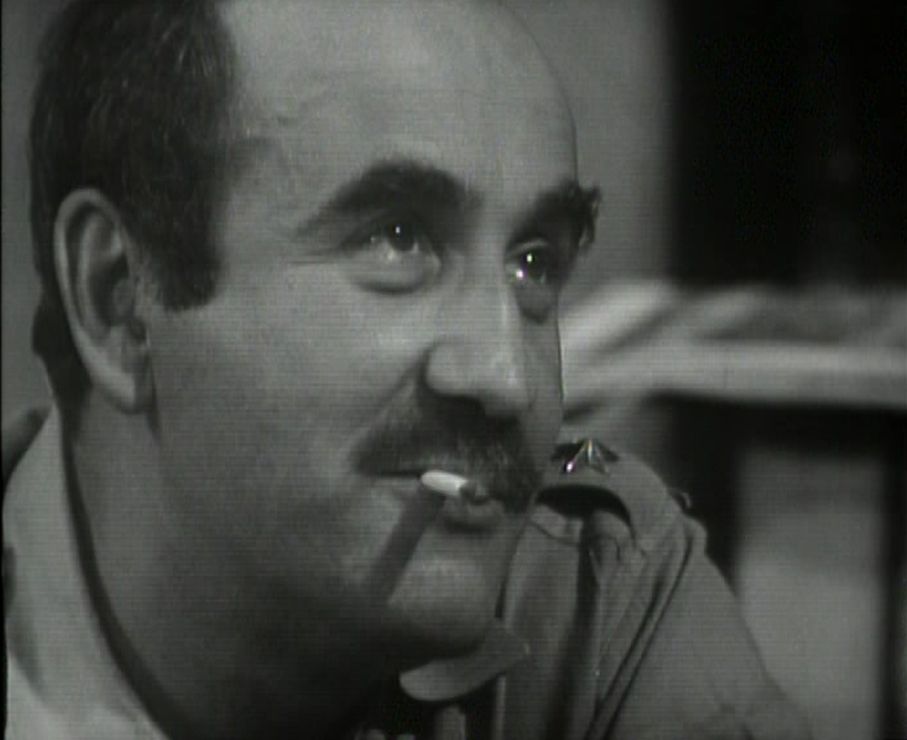
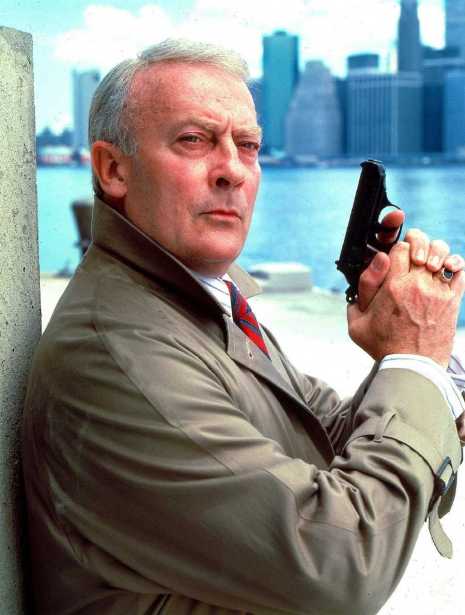
Edward Woodward Double Whammy – Callan and The Equalizer repeats to air shortly on TPTV and Forces TV

Edward Woodward as Callan

Fans of Edward Woodward (or indeed anybody who enjoys good archive drama) have two reasons to celebrate – as Callan is set to air on Talking Pictures TV (Sky 328, Virgin 445, Freesat 306, Freeview 81)  from early next month and The Equalizer will be coming soon to Forces TV (Sky 181, Virgin 277, Freesat 165, Freeview 96).

Both channels have stealthily been increasing their rota of archive television over the last year or two.  TPTV has given the likes of Gideon’s Way and Public Eye their first rebroadcasts for decades, whilst Armchair Theatre is another item of interest newly added to their schedule.

Over at Forces TV, UFO, the Thames era Special Branch and Never The Twain have all caught my eye (the latter especially, as the DVDs are long OOP).  Indeed, my one wish for the future is that we see some deeper digging into the archives from all channels, so that series which are unavailable on DVD are given another airing ….

I’ve written extensively elsewhere on the blog about each surviving episode of Callan.  Short summary? It’s unmissable.  Woodward is perfect as the world-weary state-sponsored assassin with a conscience.  Friendless, apart from a social outcast called Lonely (Russell Hunter – who, like Woodward, essayed a career defining role) each week Callan has to negotiate his way through a series of moral dilemmas, which are punctuated with flashes of violence.

During the first two series (made in black and white and sadly incomplete in the archives) Callan reported to a rotating group of superiors all called Hunter (beginning with Ronald Radd). By series three, with the show now in colour, William Squire had assumed the role of Hunter (apart from a brief hiatus during the fourth and final series, when Callan found himself in the hotseat …)

There are very few disappointing stories from the four series run, although Amos Green Must Live is one which hasn’t aged well (its attempt to tackle racial politics looks rather crude today).  As for excellent episodes there’s an embarrassment of riches  – Let’s Kill Everybody, Death of a Hunter, Suddenly – At Home, Breakout, That’ll Be The Day, Call Me Enemy, etc, etc.

Although initially reported in some quarters as a remake of CallanThe Equalizer was a very different series – although it did have certain callbacks (given Woodward’s involvement, that possibly wasn’t surprising). Mind you, if David Callan found leaving the Section to be tricky, then Robert McCall strolled out of the Company in the first episode with nonchalant ease.

There’s something very appealing about watching the middle-aged Woodward (impeccably dressed and accented) walking through the mean and dirty New York streets dispensing summary justice as and when required.  Whilst a less tortured and questioning individual than David Callan, Robert McCall did have his spasms of self-doubt and it’s on those occasions that Woodward really stepped up to the mark.

It’s an obvious comment, but neither series would have had the same impact if Edward Woodward hadn’t been front and centre.  And whenever he was given a particularly meaty script, the sparks would fly.

Star-spotting is a good game to play when watching The Equalizer.  Already established names such as Jim Dale, Linda Thorson, Telly Savalas, Robert Mitchum and Adam Ant pop up (as does Meat Loaf in a brief cameo) whilst there’s early appearances from John Goodman, Christian Slater and Bradley Whitford amongst many others. There was also a strong family feel with Michele and Roy Dotrice appearing in different episodes (Roy Dotrice had a memorable turn in Trial by Ordeal – my personal favourite).

Kudos to Talking Pictures TV and Forces TV for taking the decision to air these, as they’ve been off British television screens for far too long.  It’d be lovely to think that both series could develop a new audience – this would also hopefully spark some people into investigating what other archive treats might also exist.  And there’s quite a few ….

eq

Coronation Street – 24th December 1962

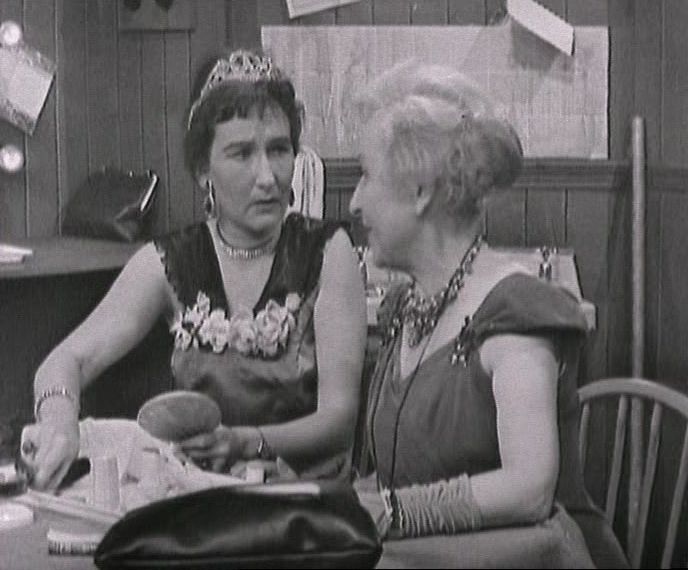
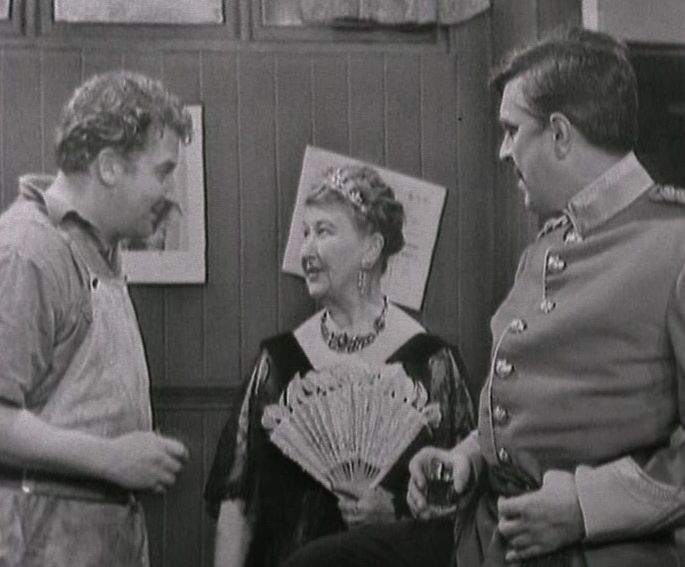
This year’s Christmas entertainment is an all-star performance of Lady Lawson Loses at the Mission Hall.  Miss Nugent has the plumb role of Mrs Gilda Montefiore (aka Lady Lawson), a notorious jewel thief who has eyes for young Gerald, Duke of Bannock (Ken Barlow) much to the dismay of his mother, the Duchess of Bannock (Annie Walker).

You won’t be surprised to hear that before the curtain goes up Miss Nugent is all of a fluster and works herself into a pitch of maximum anxiety. Mrs Walker is perfectly serene though – and offers Miss Nugent a little something to soothe her nerves.

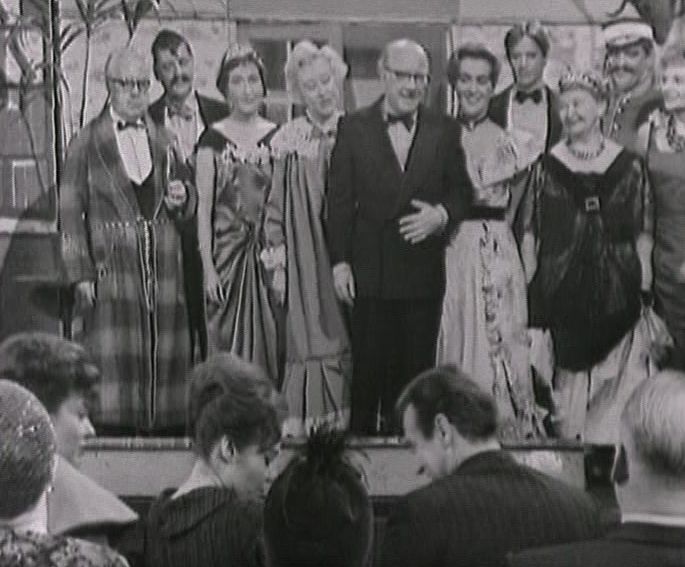
The play is a somewhat impenetrable drawing room drama, but it draws some big laughs from the audience (unintentional ones, of course).  All of the pitfalls of am-dram are present and correct, from a curtain which refuses to open, doors which are similarly problematic and numerous forgotten lines and stumbles.

At one point, Minnie (cast in the role of Lady Rhona Philbeach) observes backstage that the audience really seems to be enjoying themselves. A beat later she concedes that they shouldn’t be laughing, but no matter – at least they’re having a good time.

Minnie looks very regal, it’s just a pity that we don’t actually see her perform on stage (we do hear second-hand that she delivered her big line without a stumble though).  It would have been nice to see Ena on stage as well, but she’s relegated to providing the pre-curtain entertainment with some tunes on the piano.  Once this duty’s over she’s able to take her place in the audience, where she and Martha offer a waspish commentary (plus they rustle a mean sweet paper).

The most interesting thing about Pauline Shaw’s direction is that until the final scene all of the on-stage performances are viewed from the point of view of the audience at the Mission. This denies us any close-ups of the sweating actors, but it helps to sell the illusion to the viewers at home that we’re in the thick of the action.

Lady Lawson Loses is deliberately long-winded and not terribly interesting, which is a slight problem since it does take up a fair portion of the episode.  The mishaps are amusing enough (plus it’s always nice to see the regulars dressed up) but this is one of the less essential Christmastime episodes. I do like Mr Swindley’s closing speech at the curtain call though, which is rudely curtailed by Jed who closes the curtain with alacrity (like the audience, he’s clearly keen to hot-foot it to the pub!)

The final moment with a swooning Miss Nugent (buoyed through the second half thanks to a mixture of pills and alcohol) is another good touch. 

Coronation Street – 25th December 1961

To begin with, there seems to be a clear division of the sexes. Whilst the men – in the shape of Albert, Frank, Ken, Harry and Len – are heading off to a football match, the women (such as Concepta and Elsie) are fretting about their Christmas lunches.

The episode opens with some boisterous children running down the street, but their antics are mild compared to Len – who’s waving his football rattle, bellowing at the top of his voice and dancing in the street with Annie Walker. Goodness, he’s irritating – not the sort of person you’d want to run into first thing on Christmas morning.

As for the match, it’s between two teams of ladies (which might be the reason why all the lads are up and about so early – if not, then they really, really, love football).

The notion that the menfolk have all the pleasure whilst the women are confined to the kitchen is challenged after we see Jack slaving away. Clearly that’s one household where the roles are reversed.  Jack, as always, has to be a man of many talents – not only doing a spot of cooking but also serving behind the bar. Annie must be taking it easy.

This year it’s Minnie’s turn to cook Christmas dinner for the others.  There’s a vague air of melancholy at work here (Martha decides that it’s “a funny Christmas isn’t it? More like a very long Sunday”).  Martha’s still grumbling as she tucks into her meal, but Ena – for once – is in a good mood. “Martha, goodwill to all men, including Minnie Caldwell. She may be wilful but she is human and she is our friend”.

The fragile peace doesn’t last long though (Ena swallows one of Minnie’s sixpences and chokes). Classic, classic comedy then ensues (Martha wonders if they should pat her on the back but Minnie decides not, as Ena might hit them back!). Poor Ena, all four sixpences (wrapped up in tissue paper and cotton) found their way into her portion of pudding. “Have you never heard of windpipes?” mutters a despairing Ena. Lovely stuff.

Prior to this, there’s another touch of sadness after Martha and Ena grumble that their families steer clear of them on Christmas day. It’s worse for Minnie of course, who has no family. But at least she has friends around her.

Ena/Minnie/Martha might be the Christmas highlight, but there are some nice character moments elsewhere as well. Ken and Frank share a moment of reflection as they celebrate their first Christmas without Ida. Lucky that Esther was on hand to cook them something, otherwise no doubt they would have gone hungry …

Hapless Harry continues to get an ear-bashing from the very shrill Concepta. You can see her point though.  Mind you, his present to her – a gold watch – does cheer her up somewhat.  At least for a short while.

Interesting that the Queen’s speech is still seen as the centrepoint of the day, at least for some (Annie, Concepta).  Annie’s total devotion to Her Majesty even extends to exhorting poor old Jack (who lest we forget has been on his feet all day) to stand up when the National Anthem is playing.

Christmas at the Tanners is rather fraught. Dennis, having seen that the cupboard was bare, went out for his meal, not knowing that Elsie had rustled up something as a surprise. So when he does return she’s determined to force-feed him, whether he likes it or not. Pat Phoenix and Philip Lowrie raise the roof for a few minutes, but things then settle down. Elsie and Dennis may scrap on a regular basis, but since neither has anybody else the spats don’t last for long.

The episode had a slightly fraught production, as Derek Grainger disliked elements of Tony Warren’s first draft. Warren allowed Grainger to rewrite it, but insisted that his name didn’t appear on the credits (so the fictitious Carol Nicholas was used instead).


Redcap – Nightwatch

night.jpg

Mann returns an AWOL soldier to a regiment who are back in the UK following a stint of active service. When Mann’s prisoner is struck in his absence, he’s determined to find the culprit. This leads onto a strange tale of ghosts and the regiment’s final, disastrous mission in Borneo ….

Making his television debut as Brown (the AWOL soldier) was Hywel Bennett. It’s a very eye-catching turn, although it couldn’t have been that easy to play (Brown’s handful of scenes see him in a highly hysterical state, still heavily traumatised by their Borneo mission).

Brian Wilde was cast against type as Graham, a sergeant busted down to private due to his drinking and insubordinate nature. It seems odd that Graham is imprisoned in a cell inside the barracks room – this means not only can he see his former charges, but he’s also able to chivvy them along when they start to fall into slack habits.  And that’s certainly the case – the platoon is in complete disarray, lacking any clear direction or authority.  Corporal Scowler (nice performance by Tim Preece) is completely ineffectual on this score.

Mann wonders why the platoon is still intact – given the Borneo misadventure and the aftermath it would have been logical for them to have been split up. But the CO (Joseph O’Conor) has a different view – he can see there’s poison amongst the men, but has decided that keeping them together will bring matters to a head.  For once, Mann comes across a CO who isn’t totally obstructive, although he certainly knows his own mind.  Allan Cuthbertson was born to play the role of Major Stokely – he a!ways looked perfect in a uniform and Stokely’s character – dogmatic and not too imaginative – was the sort of part that played to Cuthbertson’s strengths.

The platoon are all deftly sketched in, especially Molt (Griffith Davies) and Metcalfe (Graham Rouse). Somebody seems to be spreading stories that the ghosts of their dead comrades are haunting the barracks (good of the spooks to have hopped back on the plane from Borneo with them) and bizarre as this may seem, more and more of the soldiers are beginning to believe it.

Given the lingering PTSD some must be suffering that’s understandable, although this doesn’t explain why several new recruits, only recently signed on, are also spooked (refusing to patrol the parts of the camp which appear to be favoured by the ghost).  Nightwatch has, unsurprisingly, a night-time setting, which allows for plenty of shadows and the possibility that something might be out there.  Bill Bain’s direction is pretty workmanlike, although there’s the odd interesting flourish along the way.

John Thaw continues to smoulder away to good effect.  After Brown is struck, you know that Mann will be implacable in his mission to find the culprit.  He – unlike Scowler – has no fear in facing down a barrack room of insubordinate soldiers.  Mann’s brief shouting match with Graham is another highlight.

Not the best episode of the run so far, but it does have an unsettling air, especially the final scene which sees Mann confronting the cackling, unrepentant trouble-maker.

night 01.jpg

Redcap – The Orderly Officer

red06-01.jpg

It looks like an open and shut case. 2nd Lt. Harry Barr (Giles Block) confesses to Mann that in a drunken New Years Eve misadventure he knocked down a concrete bollard outside his barracks.  Although it’s a relatively trivial matter, it will still mean a court martial for Barr.  But things don’t quite go the way that Sergeant Mann planned ….

This is an interesting one. It’s a good ten minutes before the crime of the episode is revealed. Which means there’s plenty of time to get to know Barr – who’s young, inexperienced and totally out of his depth. The sergeants – notably Sgt. Greatorex (Barry Keegan) – delight in running rings around him. This is demonstrated by the contemptuous grin given by Greatorex during Barr’s inspection of the men.

But maybe Greatorex isn’t totally a bad sort, as he invites Barr to a New Years Eve drink in the Sergeant’s mess. A friendly gesture or is he simply seeking to embarrass the officer further? The real trouble begins when Greatorex suggests that he and Barr pop down the road for a quick drink with a nearby Highland regiment. It may be nearly the new year but they’re both on duty, so it would be something of a dereliction. But Barr, keen to prove that he’s one of the lads, agrees and he later pulls rank by insisting that he drives them back to barracks, despite being somewhat insensible.

So the blame is shared. Barr was responsible for the accident but had Greatorex not goaded him into making the trip in the first place then nothing would have happened.  But as the officer, Barr will be the one to shoulder most of the responsibility – unless the regiment closes ranks.

A little more meat is put onto the bones of Mann’s character in this episode. He’s still working late into New Year’s Eve and is very resistant to popping down the pub for a quick drink, despite the entreaties of the Staff Sergeant (the ever-solid Bernard Kay in an all too brief role). Eventually he does agree, which proves that he’s human – but the dour, workaholic John Mann is certainly a world away from Jack Regan.

We’ve previously seen how Mann has faced hostility from certain quarters during his investigations, but not the complete obstruction that he runs into here.  On the surface they’re pleasant enough – Captain The Hon. Ian Loder (Mark Burns) is courtesy itself – but everybody has their stories and they’re sticking to them.

Can Mann force someone to confess? Greatorex is unlikely to crack and neither is the mess Sergeant (Jack Smethurst). Smethurst sketches a nice performance with his limited screentime – it appears that the Sergeant spends most of his time sampling the stock or worrying about a visit from the weights and measures man!

Mann eventually manages to break through the wall of silence when Barr admits all.  All well and good, but he then makes a fatal mistake when he allows Barr to confess his crime to the Colonel (Ronald Leigh-Hunt).  The upshot is that Mann is appalled to later find a new suspect – Trooper Kelly (Harry Littlewood) – has been put into the frame whilst Barr is nowhere to be found.  Mann attempts to interrogate Kelly, but he gets nowhere – the Trooper is a mixture of Irish charm and sorrowful remorse.

It’s previously been mentioned that Mann is somewhat inexperienced and this episode was possibly designed to reinforce that fact.  For all his implacable questioning earlier on, he’s been undone thanks to one simple request which now means that there’s no way back – this time the ranks have firmly closed and he’s forced to admit defeat.

For an ex-copper like Mann, it chafes to see a guilty man go free but the Colonel holds a different view.  In time, Barr might become a more than decent officer, so why squander that potential over such a trivial matter? Neither of them are wholly wrong but neither are wholly right either and this is what makes The Orderly Officer such a fascinating watch – for once it’s not a matter of life or death, but that makes the drama no less compelling.

This was Giles Block’s first television appearance. He’s probably best known for playing Teel in the Doctor Who story The Dominators, although his list of credits isn’t particularly lengthy.  His television inexperience probably helped here, as Barr is supposed to be something of a greenhorn. As I’ve said, it’s a shame that Bernard Kay’s part wasn’t larger, but the rest of the cast is peopled with the usual roster of strong supporting players.

Although there’s a spot of location filming, Redcap‘s studio-bound nature is still in evidence. This is most notable during a scene which attempts to suggest a country road (a few sad twigs in the background do their best, but it’s painfully obvious that we’re still in the studio).  This apart, there’s little to quibble about in this episode since it’s another strong instalment.

red06-03.jpg

Redcap – Corporal McCann’s Private War

mccann 01.jpg

Mann is in Cyprus – his mission is to track down an AWOL soldier called Corporal McCann (Ian McNaughton). Given that Cyprus is a political powder keg, the news that McCann has disappeared with three sterling machine guns and a plentiful supply of ammo only complicates matters ….

One of the interesting things about Redcap is the way that it reflected real world events. As depicted here, Cyprus in the mid sixties was a highly unstable place – following independence in 1960, bitter in-fighting had led the UN to establish a peace-keeping force. As you might expect, this means that Mann has to tread very carefully – although he’s not averse to indulging in a spot of fisticuffs with a local soldier who has the termitary to steal his identification papers!

Mann, called in by Colonel Morris (John Ringham), is concerned for McCann’s safety – a soldier with a previously spotless record. This makes the suggestion that he could be involved in black-market gun-running all the harder to swallow.  Off-screen for most of the episode (and when he does appear he doesn’t have a great deal of dialogue) McCann is something of a plot MacGuffin – meaning that it’s difficult to feel that invested in his fate.

Ringham quickly sketches in the key points of Morris’s character – a friendly, relaxed type who genuinely seems to care for the men under his charge.  He’s a fairly minor character though as two other very familiar faces – Jerome Willis and Warren Mitchell – take the lion’s share of the screen-time.

Willis is Lovelock, a political liaison officer who views Mann with extreme disfavour to begin with. He’s not in the least concerned with McCann’s fate, he only cares about the political fall-out McCann’s disappearance could generate (especially how it might be twisted and spun by their opponents).

Since Mann operates most of the time as a solitary figure, there’s something novel about the way that he and Lovelock eventually join forces. Both strong and single-minded characters, they eventually form a bond which drives the action in the second part of the episode.  Willis, as you’d probably expect, is top notch.  Warren Mitchell, as a world-weary local inspector, is equally as watchable. Rarely without a cigarette dangling from his lip, he flits in and out of the narrative – both helping and hindering.

Although there’s a brief spot of location filming, once again the bulk of the episode is studio bound.  The use of a car on the studio street (and plentiful sound effects) helps to sell the illusion of space though. Mid-way through the episode, John Thaw stumbles over his lines, although he plows on regardless and eventually gets back on track. This wasn’t unusual for this era of television (where retakes tended only to happen if there had been a catastrophic technical issue) but since Thaw was usually so secure, it does stand out.

A notable aspect of Corporal McCann’s Private War is the fact that Mann spends very little time questioning McCann’s fellow soldiers – indeed, he only quizzes the quartermaster (Windsor Davies). This is a lovely scene from both Davies and Thaw. The quartermaster is able to shed a little light on McCann’s character (he’s a keen photographer, or as the quartermaster puts it, he’s “nutty about women’s chests”).

One of these women – Ariane (Maria Andipa) – has her part to play in untangling the mystery. It’s pleasing to see that some key roles were filled by non-UK actors. Given the paucity of available players in the 1960’s this wasn’t always possible – but it always added a touch of authenticity to proceedings whenever it did happen.

Corporal McCann’s Private War starts – intentionally – in a rather disconcerting, jerky way. This feeling of being buffeted along by events, rather than controlling them, continues throughout and although Troy Kennedy Martin’s script gets a little bogged down, the performances of Thaw, Willis and Mitchell does help to keep the interest level up.

mccann 03.jpg

Redcap – Misfire

r1.jpg

Private Brian Staples (Gary Bond) has confessed to an act of robbery with violence. Mann is convinced he didn’t commit the crime, but when the man who was attacked dies, the charge beomes murder ….

It’s clear from the opening few minutes, as a hesitant Staples calls the police, that there’s something off-kilter here. The presence of Iris Pearson (Diana Coupland) reinforces this.  It takes a little time before we learn that she and Staples are an item, but when this news is revealed it becomes the focus of Roger Marshall’s script.  She’s an older woman (although not that old – Coupland was in her mid thirties at the time) and everybody seems convinced that she’s nothing more than a gold-digger, preying on a young and inexperienced man.

Barrack-room gossip paints her as either a prostitute or simply somebody who’s more than generous with her favours.  And yet …. it emerges that there’s a genuine bond of love between the pair and this was the reason why Staples confessed to a crime he didn’t commit (in order that he wouldn’t have to transfer out with the rest of the regiment – thereby saving him from being away from Britain for several years).

Coupland pitches things just right, making Iris seem – at different times – to both be vulnerable and implacable. It’s one of a number of very decent performances in the episode – the next comes from Arthur Lovegrove as RSM Staples, the boy’s father.

Now retired, he still dotes on the regiment as a father would on his son (indeed, it’s made painfully obviously that he loves the regiment much more than he does his own flesh and blood). Right from the opening few seconds of his first scene we know exactly what sort of character he is. We see Staples holding court in the mess bar where he’s surrounded by a group of dutiful, but obviously bored, officers.  You can well imagine that Staples’ rambling anecdote is one that he’s told countless times before.

The revelation that his son is in trouble pains him, but mainly because it’s something that will bring disgrace on the regiment. Lovegrove especially shines in two key scenes – firstly when Staples attempts to buy Iris off and secondly when he has a short, but not very sweet, interview with Mann.  What’s notable about this second scene is the way that Raymond Menmuir frames it – every time we cut to Staples the camera is uncomfortably close to him, but Mann is framed a little further back. A simple move, but it does tell a story. The use of rain (the studio rain machine was working overtime in this episode) is another directorial touch which creates a little atmosphere.

John Collin, as the weary and irritable Inspector Paish, offers another strong performance. His cross-examination of Staples Jnr is a highlight as is the way he tangles with Mann. We learn a little more about Mann during these scenes (for example, he used to be a member of the police force).

Lt Colonel Hilden seemed very familiar, but it wasn’t until the credits rolled that I was able to make the connection. Arthur Pentelow, alias Mr Wilks from Emmerdale Farm.

Roger Marshall rarely disappointed and Misfire is a typically well-crafted effort.

r3.jpg

Redcap – Epitaph for a Sweat

img_20181112_115056.jpg

Sergeant Mann has travelled to Aden in order to question Sergeant Rolfe (Leonard Rossiter).  Rolfe, an unbending soldier of the old school, is admired for his fighting qualities but has few friends amongst the men. Accused of beating up a local, he denies the charge – but the matter becomes much more complex after Rolfe dies on manoeuvres.

I’ve said it before and I’ll probably say it again, but Redcap featured some excellent guest casts. In today’s episode we have Rossiter, Kenneth Farringdon, John Horsley, Ian McShane, John Noakes and Mike Pratt. That’s not too shabby a line-up.

Rossiter catches the eye early on. Rolfe and Mann, as you might expect, clash quite strongly.  It’s restated in this episode that Mann is young and inexperienced and this naturally irritates an old sweat like Rolfe.  Although Rolfe denies any wrongdoing, there seems little doubt that he did viciously beat up the local – purely because he felt the “wog”  (a term which is used several times) needed to be taught a lesson.

Sergeant Rolfe may, we’re told, sometimes overstep the mark but the British army needs soldiers like that. That’s certainly the opinion of Major Coulter (John Horsley) who attempts to guide Mann into accepting this point of view. Mann doesn’t acquiesce immediately, which is another source of friction.

The Aden setting (achieved with a spot of stock footage and liberal application of fake sweat) is an interesting one. By the mid sixties it was one of the few remaining outposts of the British Empire and the pros and cons of occupation are discussed here.  Each side is allowed their viewpoint – chiefly Coulter and Asst. Sup. Yacoub (Norman Florrence) – but Richard Harris’ script isn’t a polemical one. The viewer is left to make their own mind up, although the historical distance of fifty years or more has no doubt changed the perspective somewhat.

Whilst Mann is investigating Rolfe, there’s a secondary plot bubbling away. Two young sappers, Russell (Ian McShane) and Baker (Kenneth Farringdon), are clashing time and time again. Baker is cocky and aggressive whilst Russell is passive and disinclined to respond to Baker’s taunts and jibes.  Whilst – at first – this doesn’t seem to connect to the main plot, it’s still very intriguing. Why is Russell so self-contained?

Both have little love for Rolfe, so when the pair of them – along with Morse (Roger Heathcott) and Evans (John Noakes) – head out into the desert with him, there’s an obvious question to be answered – was Rolfe’s death an accident or murder?  Having earlier questioned Rolfe, Mann now has four fresh subjects to quiz – indeed, this episode is an excellent one for showcasing Mann’s methodical approach.

Morse seems like a bit of a non-entity (he’s easily the one allocated the least lines) so can probably be discounted. And since Evans has been painted throughout as the comic relief, that leaves us with Russell and Baker as the more likely suspects.

Unlike the opening episode, there’s a satisfying conclusion to this investigation – Mann is able to extract a confession which isn’t under duress this time (even if he does play a slight trick).  The final few scenes with both McShane and Farringdon crackle very nicely – three episodes in and no duds so far.  And if this one hadn’t been an episode of Redcap then it could have slotted quite comfortably into an anthology series like Armchair Theatre.

Apart from those already mentioned, Mike Pratt has a couple of key scenes as Sergeant Bailey – possibly Rolfe’s only friend.  As you’d expect from Pratt, it’s a self-contained performance with just the odd flash of panic (at the point when Mann’s questioning becomes too probing). Much more exuberant is John Noakes’ turn as Evans. Evans is Welsh. Very, very Welsh.

During this era of television, it’s never a surprise to see British actors browning up to play ethnic roles (it upsets some today, but due to the small pool of actors available there wasn’t any alternative).  However, it’s slightly more surprising to see a Yorkshireman cast in this role.  Noakes isn’t bad (and it’s nice to see one of his handful of acting performances) but goodness, he ladles the accent on rather thickly ….

Redcap – A Town Called Love

After assaulting a German girl called Gerda, Private Pendlebury (Michael Robbins) crosses over into East Germany. He may not be prime defector material, but he’s still made welcome. Back in the West, Mann is confronted by Pendlebury’s distraught wife.  She pleads with Mann to retrieve her husband ….

There’s one really clever thing about A Town Called Love, although I have to confess that until the credits rolled I’d completely forgotten about it. Gwendolyn Watts plays two roles – Gerda (Pendlebury’s German girlfriend) and Vera (Pendlebury’s wife).

Gerda is blonde whilst Vera is a brunette. This simple act of changing hairstyles obviously helped to create the illusion that they were two different people. Or maybe I was just distracted by Gerda’s transparent negligee …..

There’s no particular reason why the two parts should have been played by the same actress, but it offered Watts a more than decent showcase for her talents. Gerda – who possibly is seeking to entrap the unwary Pendlebury into criminal activity – is the less well defined of the two, but Vera is gifted several strong scenes.  Alternating between vulnerability and calculation, she’s able to appeal to the kind-hearted Mann, who then risks his own safety by crossing over the wall in an attempt to bring Pendlebury back.

Once again, there’s so much quality in the cast.  Michael Robbins, best known for playing the long-suffering Arthur in On The Buses, is equally long-suffering here. Pendlebury is a straightforward sort of chap – after his altercation with Gerda (he says she slipped and hit her head) he hot-foots it over to the East. But he finds life to be no better there than it was in the West, so he’s easily persuaded by Mann to return and take his punishment. But there’s a nasty sting in the tale for him when he does come back.

Magda (Yootha Joyce) and Bob McGregor (Garfield Morgan) are both very welcoming to all new defectors, but only because it’s their job. Morgan’s plummy good-cheer and Joyce’s sultry seductiveness both have a very hollow feel, but then I doubt that either Pendlebury or Mann were taken in by them.

There’s a cold opening to this episode, as Mann’s now changed location and seems to have a permanent base, operating with Sergeant Coulter (Glynn Edwards) and Colonel Matherson (Peter Copley). Neither appear again though, so this posting presumably was only temporary. That’s a pity, as both characters had scope for future development – Coulter’s friendly opposition with Mann (they have very different opinions about Pendlebury) and Matherson’s avuncular but steely command style could easily have been examined in more depth across a series of episodes.

Not quite as gripping as the first episode, possibly because there’s the sense that Mann isn’t going to remain in the East for very long (it would have been a short series had he done so) there’s still enough character conflict to keep things ticking along nicely.


Redcap – It’s What Comes After

Sergeant Mann’s investigation into a soldier who went AWOL is an open and shut case. But it indirectly leads onto a more puzzling affair – why has a previously upstanding officer, Captain Lynne (Keith Barron), suddenly started to act in a very erratic manner? Maybe it’s connected to his wife’s recent breakdown ….

Airing between 1964 and 1966, Redcap offered John Thaw his first starring role. Sergeant Mann, a member of the army investigative unit, has free reign to travel the globe, unearthing crime, corruption and disorderly conduct wherever British soldiers might be stationed. This gives Mann the air of a permanent outsider who’s always faced with an uphill battle to bring any perpetrators to justice. In retrospect, this sort of character fits Thaw like a glove – it’s easy to see echoes of Jack Regan in Mann (both, at times, are no respecter of authority).

Although Mann visited a fair few countries, the series never left the UK (and indeed rarely ventured outside of the studio). Some might view this as a weakness but if you love 1960’s studio-based VT drama, then Redcap will be just your cup of tea.

There was plenty of quality on the technical side – it was produced by John Bryce (who helmed The Avengers during 1963/64) and script-edited by Ian Kennedy-Martin (later to write Reganthe Armchair Cinema pilot which spawned The Sweeney). Plenty of familiar names pop up on the writing front such as William Emms on this opening episode.

The mystery as to why Lynne has gone to pieces is eventually revealed – his wife (played by Miranda Connell) was raped after leaving a mess party. With the crime having taken place inside the army compound, this makes it more than likely that a soldier was responsible. But even after this revelation there’s still an air of mystery – why is Lynne so reluctant to admit what happened?

Barron plays Lynne as an upper-crust type and manages to nicely suggest the conflict and turmoil that lies behind his apparent passivity.  He eventually does come clean, and to Lynne’s credit he wasn’t acting purely out of self-interest (although he does admit that public knowledge about his wife’s rape would damage both his career and reputation).

Emms’ script briefly attempts to tease out the puzzle concerning the guilty party by offering us several possibilities. But since we only focus on one – Private Bolt (Kenneth Colley) – this mystery soon dissipates.  There are still several different ways the story might play out though – Bolt is guilty and confesses, Bolt is guilty but doesn’t confess, Bolt is innocent.

In the end, everything is wrapped up slightly too neatly. Mann has very little evidence, but contrives a situation where Bolt and Lynne are left alone. Lynne, having already been told by Mann that Bolt is the most likely suspect, snaps and viciously beats Bolt up. And having been pulped by Lynne, Bolt then helpfully confesses his crime to Mann.

Hmm, given this confession was extracted under duress it’s possible that it might not stand up in court. Mind you, it’s the kind of stroke you could imagine Jack Regan pulling.  Indeed, Thaw does glower throughout with the same sort of barely supressed fury that he’d later display in The Sweeney, so maybe even this early on Kennedy-Martin was taking notes ….

As with each episode, It’s What Comes After is immaculately cast. Keith Barron is good value as Lynne, whilst Colley slips in enough off-kilter gestures to suggest that Bolt is indeed the man we’re looking for.  Derek Newark, as the long-suffering Mess Sergeant (who has to deal with the insubordinate Bolt on a daily basis) also catches the eye.

It may not impress as a great example of detective work, but It’s What Comes After is certainly a strong opening episode.

The Saint – The Work of Art

work 01

Simon’s gone to Paris in order to spend a little time with the attractive Juliette (Yoland Turner). But this pleasant sojourn is cut short after Juliette’s brother, Andre (Alex Scott), is accused of murdering his business partner, Jean Bougrenet (John Bailey). Unbeknown to Andre, Jean was a member of an Algerian rebel organisation and since he recently defrauded Andre out of five hundred thousand francs, Andre had a clear motive for murder.

Attempting to clear Andre’s name, the Saint finds himself tangling with the implacable Major Quintana (Martin Benson) as well as Vladek Urivetsky (Hamilton Dyce), known as the Master Forger of Europe …..

The pre-credits sequence shows Simon relaxing at a street café. Everything is calm and peaceful, at least until the police turn up and drag a seemingly inoffensive man into the back of their police car. You might expect that this will have some bearing on the plot, but no – the man simply exists in order for Simon to tell the viewers that whilst Paris looks calm on the surface, revolutionary intrigue is bubbling away in the most unlikely quarters. It’s a slightly clumsy way of signalling what the thrust of the story will be, but no matter it’s only a passing irritation.

John Bailey was one of those actors who suffered beautifully (he had a wonderfully expressive face which could express a world of pain). He’s therefore perfect as the twitchy Jean, a man on the run from the imposing Major Quintana. Jean works for Quintana, but Quintana has come to distrust him (easy to see why, since Jean radiates unease and guilt). It’s therefore no surprise that Jean doesn’t last terribly long – he’s throttled to death within the first twenty minutes.

If the opening half of the story is rather dour and humourless – it’s mainly comprised of a number of grim looking men looking grimly at each other – then the arrival of Mère Lafond (Hazel Hughes) helps to lighten matters somewhat. Hughes – an experienced actress with a career which dated back to 1938 – is great fun as the fiery Madame Lafond. She’s a woman who operates on the shadier side of the law and expresses disbelief that the Saint may now be aligned with the godly! Hughes’ appearance is only brief but it helps to provide the episode with a much needed injection of levity.

Yolande Turner, in the first of her two Saint appearances, manages a decent French accent as the alluring Juliette. It’s not the greatest of parts, but she does her best. Robert Cawdron is given some decent comic material as the long-suffering Sergeant Ludic. Tasked with the job of staying by the Saint’s side at all times, it’s no surprise that Simon delights in leading him a merry dance.

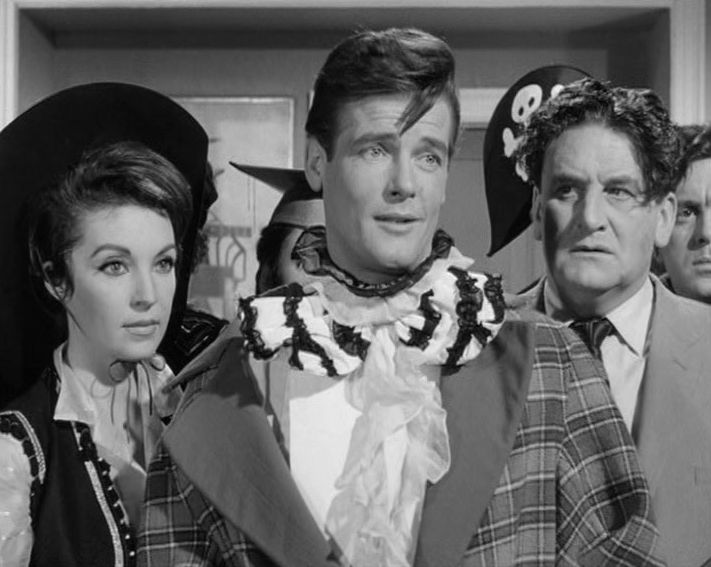
At one point, Ludic is dragged along to a fancy dress party. He remains in plain clothes whilst Simon enters into the spirt of things by dressing as a clown (some twenty years before he did so again in Octopussy). It’s difficult not to love the groovy music and general revelries, although it won’t surprise you to learn that Simon organised this treat as something of a diversion ….

Part of the problem with The Work of Art is that the Algerian question isn’t really examined in much detail (we therefore never really know exactly what Major Quintana is fighting for). Urivetsky – although he barely features – at least is given a clear motivation. Unlike Quintana he’s not interested in politics – money is his only goal.

Roger Moore gets the opportunity to demonstrate yet again that the Saint is very handy in a fistfight, whilst his trademark calm under fire is also in evidence. It’s a pity that Simon doesn’t meet Quintana and Urivestsky until the last ten minutes or so, as when he does the story starts to pick up a little impetus.

Adapted from Charteris’ 1937 novella The Spanish War, Harry Junkin’s teleplay retooled the original quite considerably – changing many of the names and relocating the action from London to Paris. The Work of Art is solid enough, but isn’t terribly engaging and so only rates two and a half halos out of five.

Watch for the sign of the Saint, he will return …..

work 02

The Saint – Judith

judith 01.jpg

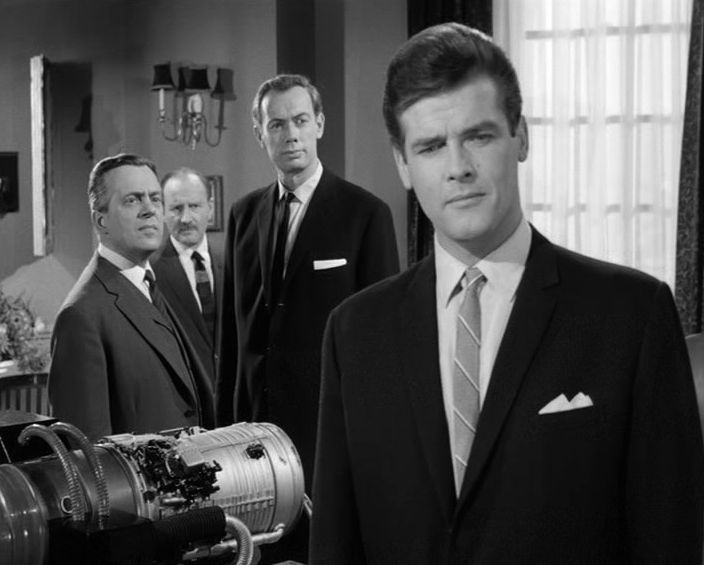
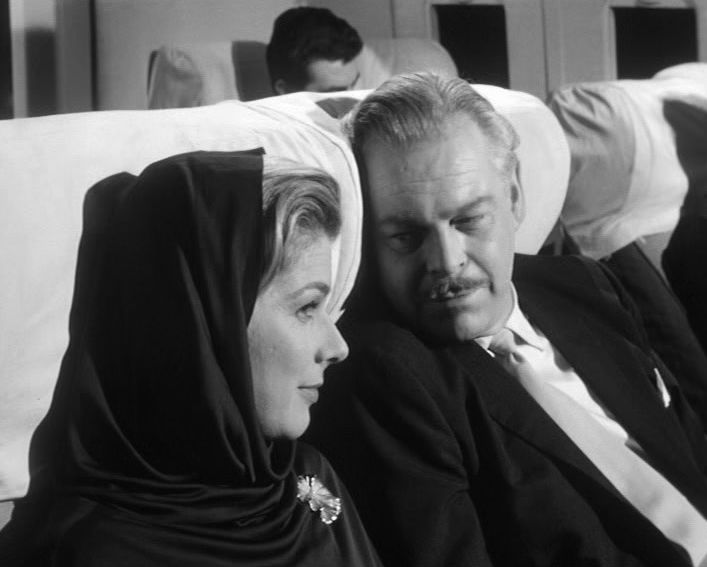
The Saint, relaxing in Canada, is approached by Judith Northwade (Julie Christie).  She  tells him that her uncle, ruthless businessman Burt Northwade (David Bauer), has appropriated the design for a revolutionary new engine from her father and plans to sell it for a small fortune.  So Simon agrees to break into Northwade’s house and steal back the plans …..

There’s plenty of stock footage used in the pre-credits sequence, which sees Simon attending an ice hockey game.  Although you might not have tagged this as Simon’s natural environment, he’s enjoying himself enormously (if the lusty shouts of encouragement he directs towards his team are anything to go by!).  His comfy sheepskin jacket was an unexpected fashion moment.

In the sort of remarkable coincidence that the series thrived on, Burt Northwade just happened to be sitting a few seats ahead of Simon.  They don’t talk – but this moment allows both of our principal characters to be seen together early on.  The episode then follows a traditional path as Simon, after popping up before the credits, fades away for a while in order to allow the guest characters to be established.

Northwade’s hard business streak is quickly spelt out.  His desire to press ahead with the sale of the engine distresses his wife, Ellen (Margo Johns) and their first scene together somewhat lurches into melodrama after he rather theatrically raises his hand to strike her.  She’s disgusted that he’s planning to swindle his own brother, whilst he blames her for not bearing him a son and heir.

We then see a mysterious and beautiful young woman keeping observation on their palatial house.  This is the titular Judith who – after being startled by Northwade’s guards – literally runs into Simon’s path (their two cars almost collide).   Judith drives off, but Simon finds himself arrested as a trespasser.  Clearly the Canadian laws on trespassers were very strict at this time – the Saint is told that if he moves before the police turn up then he could be shot!

This week’s police representative is Inspector Henri Lavan (John Serret).  He’s more suspicious of the Saint than some of his international colleagues and we’re left with the strong impression that he’s not prepared to be fobbed off by Simon’s easy charm.  The moment when he demolishes the Saint’s stated reason for visiting Montreal (Simon claimed he was planning to visit a favourite restaurant) is an interesting one, since it’s rare to see the Saint discomforted or outmanoeuvred by a member of the police force.  But Simon’s not knocked off his stride for long, as he then proceeds to laugh it off and disappears before Lavan has a chance to realise what’s happened.

Simon is given a police shadow – Sergeant Soustelle (Ross Parker) – who sticks to him like glue.  This is a little irksome, so the Saint boldly tells him that he’s planning to pick up a girl.  “And if you promise not to disturb me, you can sit at the bar and have an unlimited number of drinks at my expense”.  That Simon Templar, he’s something of a lad ….

But since the girl is Judith and Simon’s still curious about why she drove so erratically earlier, possibly his interest is purely professional.  Possibly.  Judith pours her heart out to him and it’s not surprising that her sob story hits home – after all, it’s a good story (and she’s gorgeous, which never hurts either).

Judith is an odd one.  For most of its duration it follows a linear path with no apparent mystery – Northwade’s deal is legally sound but morally reprehensible – which means that it’s not the most absorbing of yarns.  But you can still enjoy the various incidental pleasures along the way, such as the entertaining turn by Ross Parker as the gullible Sergeant (Simon is able to wrap the poor man around his little finger).

Although we shouldn’t feel too sorry for him as he doesn’t do badly out of their association – he’s able to eat and drink to his heart’s content!  And when Simon later locks him in the cupboard, the Sergeant’s half-hearted cries of “you’ll go to jail” never fails to amuse. Quite how he’s managed to stay in the force so long is a bit of a mystery.

Julie Christie is lovely of course, and she also helps to keep the interest ticking along although Judith isn’t the most sharply drawn or interesting of characters (at least not until the late twist).  This adaptation slightly softens the bite of the original, but otherwise it stays pretty faithful to Charteris’ story.  The reversal in the last ten minutes is a decent one, but since the rest of the episode is fairly forgettable, overall Judith only rates two and a half halos out of five.

judith 02.jpg


The Saint – The Bunco Artists

bunco 01.jpg

After the elderly Sophie Yarmouth (Mary Merrall) is cheated by two confidence tricksters, Simon – along with Mrs Yarmouth’s daughter Jean (Justine Lord) – decides to turn the tables and play the tricksters at their own game ….

We open in London’s glittering West End.  The scene-setting stock footage tells us that Phyllis Calvert, Marius Goring and Elizabeth Sheppard are playing in Menage A Trois whilst next door David Tomlinson is appearing in Boeing Boeing.

Simon is cooling his heels by the stage door, waiting for Jean to appear.  She’s delayed, which allows the Stage Door Keeper (played by Meadows White) to wax lyrical (“all the world’s a stage”, etc).  He also has one of the most arch deliveries of “why, you’re the famous Simon Templar” seen in the series to date.

She’s worth waiting for though (Justine Lord is a vision in white).  Jean’s a not terribly successful actress, but she’s hopeful that her big break is just around the corner.  I love her breathless précis of the exciting new role she’s hoping to snag.  “I go insane in act two, I yell and scream and carry on. And then in the end I put three bullets in my husband’s heart”.

But whilst Simon is squiring Jean around town, what of her mother?  She lives in a picturesque English village and is a big wheel at the Netherdon Parish Church.  She’s approached by a pleasant young American woman, Amelia Wade (Louise King), who tells her that the church is in line to receive a handsome donation from a mysterious American foundation (which would allow them to meet their restoration target).

This seems too good to be true – and alarm bells really start to ring when Amelia tells Sophie that she actually needs to see the money they’ve collected so far for the church restoration (records and receipts aren’t acceptable – only sight of the actual cash will do).  Of course, we’ve already got a good idea about what might happen, since Simon’s primed us in the pre-credits sequence about con artists.

But it seems as if Simon won’t be needed as Mr Henderson (Peter Dyneley), from the International Detective Agency in New York turns up, hot on Amelia’s heels.  Hurrah!  Along with the local copper, Charlie Lewis (Victor Platt), they ask Sophie to play along – if they can catch Amelia in the act, actually attempting to steal the cash, then she’ll be bang to rights.  But of course, Henderson isn’t what he seems either (he and Amelia – or Joyce, as she’s really called – are husband and wife confidence tricksters) so poor Sophie finds herself conned, good and proper.

The con is done very neatly – it’s not quite Hustle, but it’s still an effective set piece.  What’s especially entertaining is how Henderson explains to a rapt Charlie and Sophie exactly how “Amelia” carried out the switch (a case with a false bottom) only for him to then pull the same trick.  Dyneley and King make for an effective double act.  This was Dyneley’s second of three Saint appearances (it’s certainly a better role than his first, The Careful Terrorist).  American-born King made a string of appearances in British series during this period (her final credit was in 1964).  Her character is allowed a little twinge of conscience – after all, conning an old lady out of six thousand pounds (what will happen to the church roof now?) is a bit mean.

It doesn’t take Simon too long to work out that they’re actually called Mr and Mrs Richard Eade and have made their way to the South of France.  They can’t be terribly good criminals if they leave such an obvious trail ….

So the Saint and Jean set off for France and after the usual orgy of stock footage, Simon adopts the role of a friendly Texan and impresses Eade by flashing his cash about.  I’ve commented before about Moore’s interesting range of accents, and this is another good example.  Although as before, I’m not sure whether it’s supposed to be deliberately bad or not.  What’s certain is that Moore’s comic timing is put to good effect during these scenes (I like his bootlace tie as well).  But Simon’s not the only one with a silly accent as Jean’s gone all French.  Like Moore, Lord plays the comic scenes well.

There’s some familiar faces lurking about in the background. André Maranne makes his second and final Saint appearance. It’s not a terribly interesting role (hotel barman) but he does get a few lines.  John Standing plays a Gendarme whilst an uncredited Ingrid Pitt can be seen lounging by the hotel pool.

Charteris’ original tale appeared in the short-story collection, Thanks to the Saint (1957).  A fair bit of retooling went on during the first half of the adaptation (in the short story, Mrs Yarmouth believed she was handing over the money in order to make her nephew a film star) but the second half (Simon turns the tables with a sting revolving around a valueless necklace) was pretty much the same.

This change of emphasis – from film stardom to church welfare – allows Simon to make an amusingly impassioned speech after he and the Gendarme (Standing) run the crooks to ground.  “All over Netherdon parish, old people, widows, children, plumbers, bricklayers, carpenters, ordinary people, contributed their pennies and their shillings to the Netherdon Church restoration fund and these parasites stole it”.  Standing gets to react in a suitably shocked manner (“oh no”).

A lovely comic episode where everyone’s on fine form.  Roger Moore, of course, was made for this sort of role whilst Justine Lord is also very watchable.  Hard to see how this one could have been any better – five halos out of five.

bunco 02.jpg

The Saint – Marcia

marcia 01

Simon is mourning the death of Marcia Landon, famous film star, who took her own life after being disfigured in an acid attack.  Rising starlet Claire Avery (Samantha Eggar) has taken over the role Marcia was due to play in an upcoming film and after receiving a threatening letter – stating that unless she hands over five thousand pounds she too will be disfigured – calls on Simon for help.  So the Saint finds himself with a film studio full of suspects to investigate …..

The pre-credits sequence has a bleakness which wasn’t typical for the series, as we see Simon pay Marcia a fullsome eulogy.  Her face – prior to the attack – is prominently displayed both in the newspapers and on the studio walls where Simon has called to see Claire (and Marcia’s image will continue to appear throughout the episode).  The attack is shown in flashback – shot from distance and mostly using shadows, it’s effectively moody (and also isn’t explicit – which was always a consideration).

It’s a cliché but Samantha Eggar – just like Claire Avery – has undeniable star quality.  Director John Krish favours close-ups in the early part of the episode – as Claire and Simon chat about Marcia – and these shots, along with Eggar’s low, breathy voice helps to create a considerable impression.  The camera loves her and, to be honest, so do I.

Johnny Briggs creates an immediate impression as the chirpy runner, Johnny Desmond – he’s an upbeat sort of chap, always ready with a bad joke.  Marion Mathie, later to be the third and final television She Who Must Be Obeyed in Rumpole of the Bailey, is another familiar face who pops up (she plays Sheila – wife of Mike Sentinal, the director).

Jill Melford is deliciously bitchy as Irene Cromwell, an older actress who clearly believes that she should have been given Marcia’s role.  Dripping with honey-tongued venom, she’s highly entertaining.  Mix in Tony Beckley as Claire’s very disgruntled co-star and Philip Stone as a dogged police inspector and it’s hard to see how this story could have been better cast.

What’s nice about this one is that it gives us a rare chance to look behind the scenes at the studios where The Saint was shot.  It’s nowhere as self-reverential as some of the later UFO episodes, but it’s still interesting (and I daresay since it was pretty cheap to shoot, it would have pleased the producers).

As the story progresses, Claire continues to stress.  Things come to a head when a prop gun, used in the recording of the film, is substituted for a real one.  Simon, standing off-camera, shouts “drop that gun and nobody move!” in an incredibly forceful way (very uncharacteristic) whilst Claire just screams.  Oddly, she does so after the shot’s been fired (she appears to be working on a slight delay).  John Krish doesn’t really do Eggar any favours by zooming into her screaming mouth – it’s an arresting image, but not terribly flattering.

Towards the end of the episode, there’s a chance to see even more of the studio as Simon pursues a mysterious stranger through its various nooks and crannies.  This might be little more than padding, but it’s shot so well that it’s hard not to enjoy it.  Indeed, that sums up the story as a whole.  The mystery is fairly slight, but with such a strong cast it’s easy to be totally absorbed.

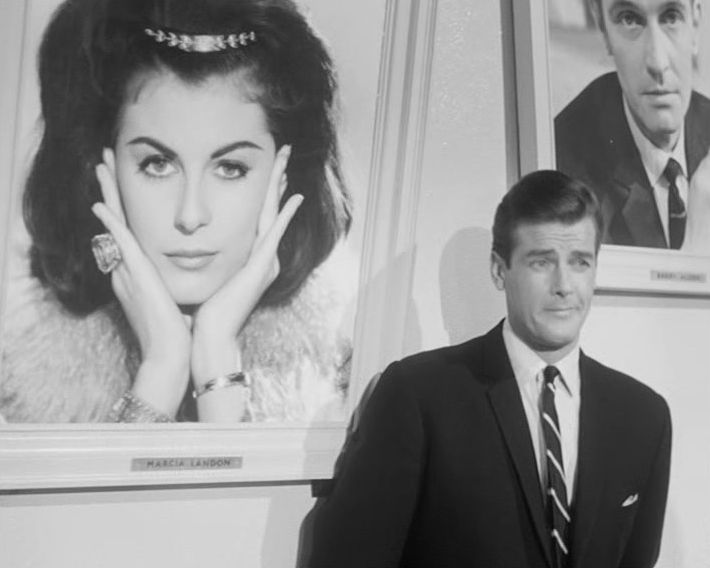
The use of Marcia’s photograph is an especially memorable touch.  It’s seen so often, in various different locations, that it’s almost like she’s always present – albeit as a passive, non-speaking observer.  This is one of the reasons why Marcia is a fascinating story which rates four and a half halos out of five.

marcia 02.jpg


The Saint – The Fellow Traveller

fellow 01

Simon is contacted by a man called Henry Matson (Brian Oulton) who tells him that he’s been forced to steal blueprints from the place where he works.  He and Simon meet in what appears to be a safe place – a deserted bus shelter in the middle of nowhere – but Matson has barely begun to pour out his story before he’s shot dead by a passing motorist.  With his dying breath, he’s able to point the Saint in the direction of the Blue Goose Club and the glamourous Magda Vamoff (Dawn Addams).

Globe-trotter Simon Templar has temporarily come back down to humbler surroundings, as the caption at the start of the story (Stevenage, England) makes plain.  Matson only makes a brief appearance before hitting the dust, but it’s enough to paint his character as a rather quiet, unassuming and insignificant man.  This makes his secret life – cavorting with the fleshpots and gamblers at the Blue Goose – a little hard to accept, but if he didn’t have some weakness (in his case gambling) then he wouldn’t have been blackmail material.

Interviews with Matson’s wife and employer temporarily place Simon in somewhat prosaic surroundings (and it’s rather odd that Simon – rather than the police – breaks the news to his employer that Matson is dead) but it’s not long before the Saint is ensconced in the comfort of the Blue Goose, which is much more his sort of place.

He quickly makes the acquaintance of Magda and elects to adopt the full frontal approach – telling her that he’s a friend of the late Henry Matson.  Since the club is occupied by individuals – such as Hans Blatt (Michael Peake) – who are just itching to kill him, going undercover probably would have been a waste of time.  Plus it would have been much less fun – there’s very much the sense here that Simon enjoys breezing around from place to place, stirring up trouble as he goes.

Magda professes not to know anything about Matson’s death, but can we believe her?  Addams is statuesque, but slightly stiff.  Magda does sport some impressive clothes though – the leopard skin coat and hat combination stands out especially.  She and Simon have a rather nice relationship – it’s all about the subtext – with Simon warily attempting to probe her for information.  At one point, as they share dinner, he casually tells her that she hasn’t told him one word of truth all evening.  She doesn’t take offence at this, so either Simon’s remarkable charm is operating at full strength or she’s so incredibly crooked that she just has to soak up the insults ….

Angus Lennie is good fun as the hotel receptionist, James Andrew MacTavish. I know this will come as a shock, but James is Scottish (no, really).  He’s a helpful sort – passing on messages to Simon and acting as a sounding board for his theories.  Another very familiar face, Glyn Owen, appears as Superintendent Kinglake.  The Superintendent is your typical Saint police officer – irritated at the way that Simon rides roughshod over his investigation, but powerless to stop him.  Owen doesn’t have a great deal to do until the last ten minutes or so, but he’s the recipient of a few decent exasperated lines.

Michael Peake had the face of a villain, so it won’t come as a surprise to learn that today he plays … a villain (Hans Blatt).  Indeed, it always came as a slight surprise whenever Peake turned out to be playing a good guy (such as in the Doctor Who story The Romans).  Blatt begins by attempting to run Simon off the road and when that doesn’t work he slips into his hotel room to pop something unpleasant into his bottle of wine.

Later, Simon reaches for the bottle and pours out a drink for himself and his visitor, Nick Vashetti (Neil McCallum).  Just in case we’d missed the scene of Blatt’s tinkering, the incidental music goes overboard with menacing drumbeats as the pair slowly raise the glasses to their lips, just to hammer the point home.  But in the split second before they take a swig, Simon senses poison and knocks the glass out of Vashetti’s hand.  A pity that Blatt didn’t choose an odourless poison (goodness knows what they were teaching people in crime school back then).

Vashetti’s death is just a pleasure deferred for Blatt though.  Vashetti has information which will allow Simon to solve the mystery, but he doesn’t get the chance to pass it over as a visit from Blatt (complete with his trusty silenced pistol) sorts him out once and for all.  It’s a rather odd scene, as although the tension is nicely ramped up by the slow and methodical way that Blatt attaches the silencer to his gun, the mood is then dissipated by the very unconvincing “pop” it makes.  It’s such an unconvincing sound that at first I wondered if it was a fake gun (designed to frighten but not kill).

The Fellow Traveller was adapted from Charteris’ short story The Sizzling Saboteur (one of two novellas published as The Saint on Guard in 1944).  The events were relocated from wartime America to modern Britain and the death of Henry (Matson on television, Stephens in print) was much grimmer in the novella.  The Saint’s car journey is interrupted by what appears to be a log in the road – but it turns out to be Henry’s blackened, dying body.

Although The Fellow Traveller has a mystery at its heart (just who is the Mr Big running the operation?) the eventual reveal of his identity is a bit of a damp squib.  It’s also difficult to be that invested in Magda’s fate as Addam’s icy persona doesn’t help to draw the viewers in.  As ever, it’s an efficient production, but since the story never quite kicks into gear it only rates three halos out of five.
fellow 02

The Saint – The Benevolent Burglary

burglary 01.jpg

Having had a successful evening in a Monte Carlo casino, Simon is in the process of cashing in his chips when he bumps into an old friend, Bill Fulton (Gary Cockrell).  Bill’s feeling depressed because the millionaire father of his sweetheart, Meryl (Suzanne Neve), has forbidden their union.  Meryl’s father, Elliot Vascoe (John Barrie), has an impressive art collection and the Saint – aiming to teach him a lesson – bets him five thousand dollars that sometime during the next four days his new gallery will be robbed.

Simon’s in full James Bond mode at the start of the episode.  He’s looking suitably dashing in a white tuxedo and – like Bond – is the sort of gambler who knows when to stop.  His taste for stylish casualwear can be seen later on when he relaxes in an impressive dressing gown.

Bill’s a penniless musician which means that in Vascoe’s eyes he couldn’t be a worse match for his daughter.  And then there’s the instrument he plays.   “A drummer! Not even a real musician, he just makes a noise”.  Needless to say, Meryl doesn’t take this sort of criticism very well – it just serves to drive a wedge between her and her father.

Suzanne Neve is rather lovely, although unlike some of the other ladies who cross paths with the Saint, Meryl carries herself with a more natural air.  Amongst her later credits, Neve would appear in The Forsyth Saga (1967) as well as popping up twice in UFO as Ed Straker’s bitter and estranged ex-wife Mary.

Simon’s baiting of Vascoe might be partly motivated by the travails of Bill and Meryl, but he’s also doing it because he despises Vascoe (they’ve clashed before).  Vascoe is the sort of character who simply rubs Simon up the wrong way – he tags him as a nouveau riche philistine, someone who doesn’t appreciate art (he simply delights in buying up various treasures in order to demonstrate that he’s “cultured”).

John Barrie racked up sixty six episodes of Sergeant Cork during the 1960’s.  Amazingly, all of the episodes exist and are now available on DVD – if you haven’t seen them then you really should (advert over).  It’s mainly thanks to Cork that Barrie has become a favourite actor of mine – meaning that it’s a treat to see him pop up in this episode.  Vascoe is not the most multi-layered of characters – he’s an arrogant type who you know is going to be taken down a peg or two – but thanks to Barrie’s performance he’s never less than completely watchable.

Another familiar face appearing is Rachel Gurney as Delphine Chambers.  Delphine has been commissioned by Vascoe to paint a portrait of Meryl, which gives her the opportunity to linger around the perimeters of the plot.  Other highly recognisable actors passing by include Ivor Salter as a typically inefficient policemen (just one of a number drafted in to keep tabs on Simon) and Andre Maranne as a radio operator.

Arnold Diamond, as Colonel Latignant, may be one of Simon’s lesser-known authority adversaries, but since he appeared in six episodes he possibly deserves to be more appreciated.  Latignant is tasked to stop the Saint (who of course runs rings around him with insouciant ease). This means that at one point the unfortunate Latignant buries his head in his hands and lets out a primal scream of anguish!

Simon’s public pronouncement has drawn a veritable rogues gallery to Monte Carlo – all of them keen to attempt the burglary, since they know that if they succeed then Simon will be blamed.  Jules Brant (Raymond Adamson) is the one who actually carries out the crime, although Simon is on hand to intercept him and give him a decent duffing up.  It’s a nice touch that Brant left the Saint’s calling card (the stickman figure) at the scene of the crime – this was something that the literary Saint tended to do in his early days.

Simon’s parting shot to Vascoe – he returns the stolen items and explains that any one of his trusted friends and advisors could have been the inside man since they all despise him – is devastating.  The television Saint has rarely been as ruthless as this, although since his actions do serve as a wakeup call for Vascoe, it’s not entirely vindictive.  This is easily Barrie’s best scene, as we see Vascoe slowly realise that whilst his life is materially rich it’s also emotionally barren.  We end on an optimistic note as Vascoe and Meryl are reconciled.

Given that it shares a few plot similarities, it’s not too surprising that this story was originally published in the same collection as The Charitable Countess (The Happy Highwayman, 1939).  Charteris’ story is set in New York rather than Monte Carlo and although Vascoe is blocking Meryl and Bill’s marriage, it’s for a very different reason.  In the short story, Bill has invented a new tube(!) that’s set to make him a fortune – but since grasping old Vascoe lent him the money to develop it, he’s now planning to foreclose on the loan and reap the rewards of Bill’s invention for himself.  The identity of the thief is also quite different and Vascoe remains unrepentant at the end.  Given that the story is pretty short, it’s not too surprising that the teleplay had to be bulked out somewhat.

Another typically strong guest cast – headed by the peerless John Barrie – ensures that this is another top quality Saint episode.  Four and a half halos out of five.
burglary 02