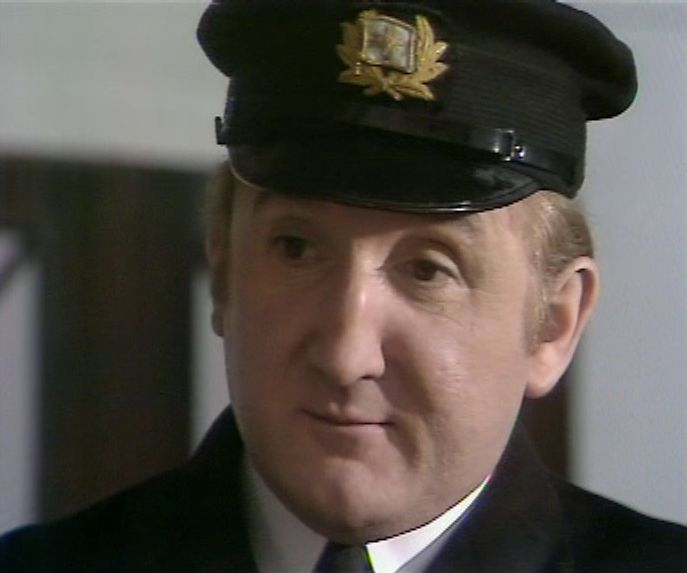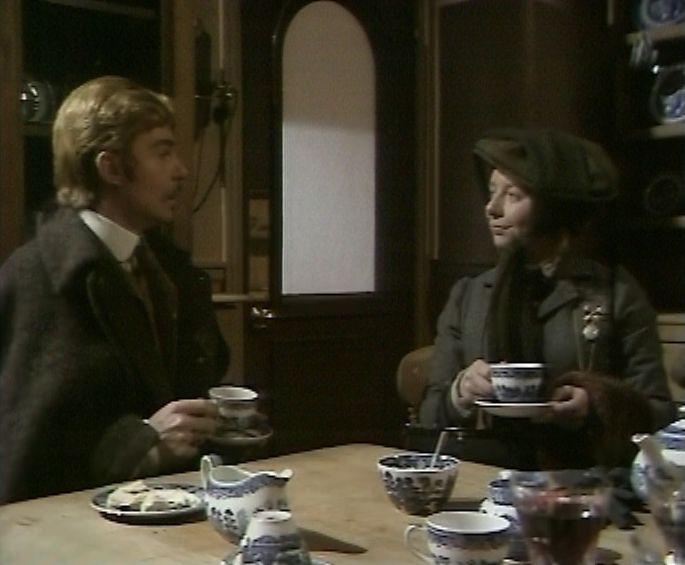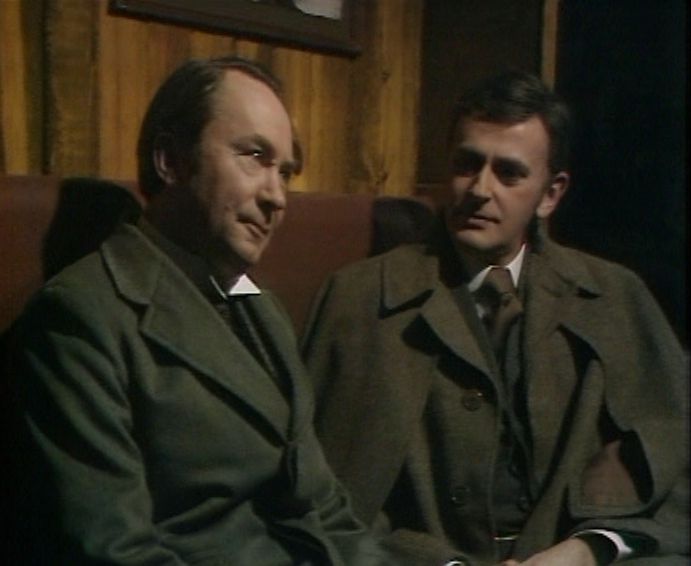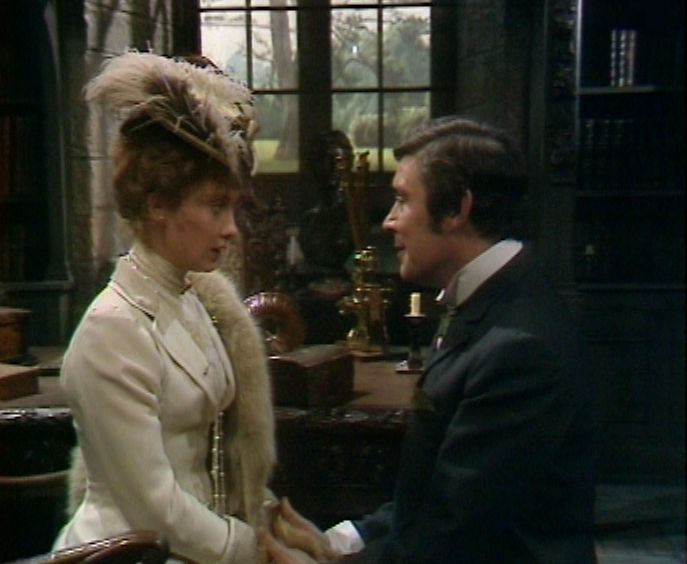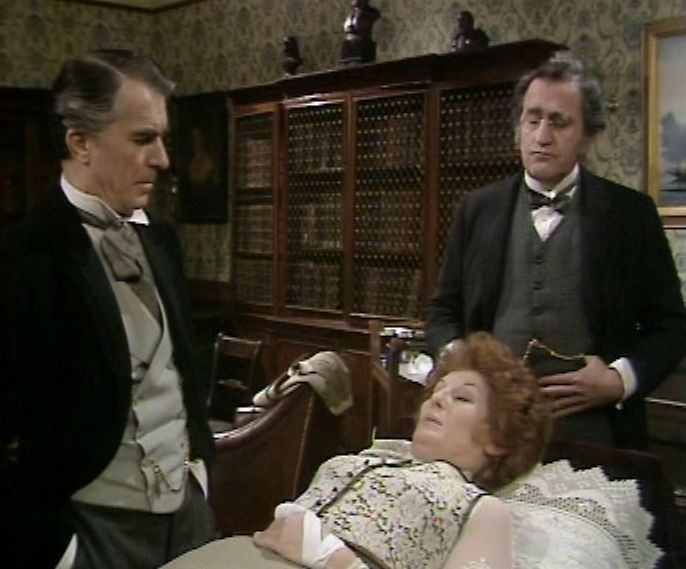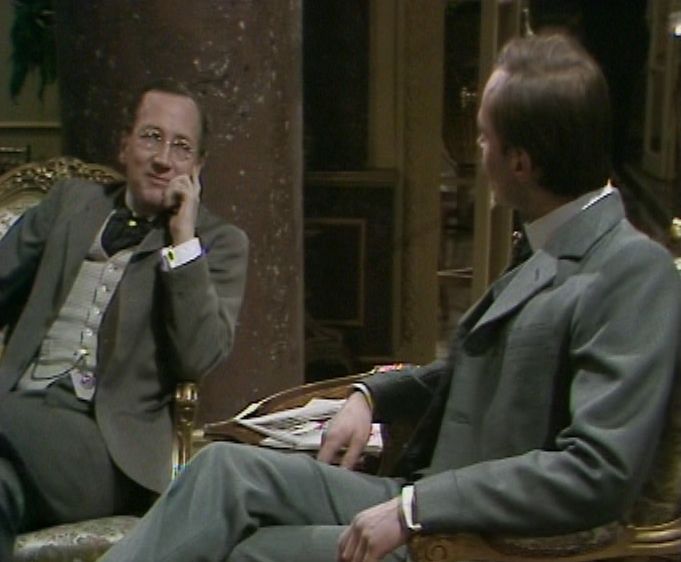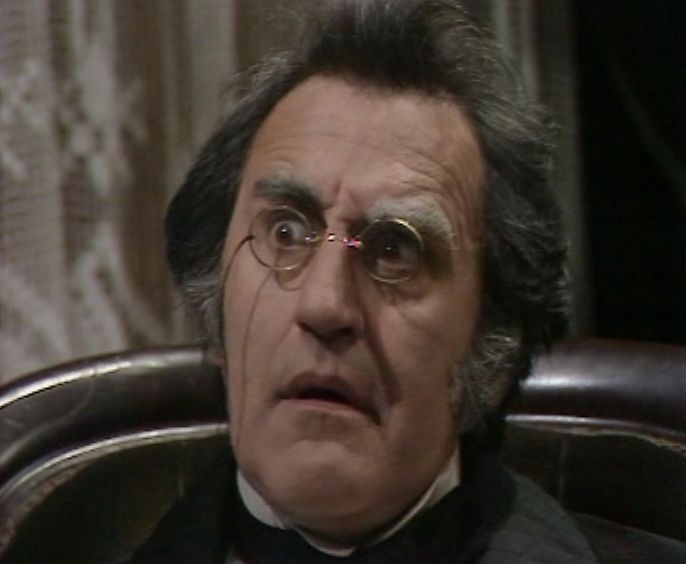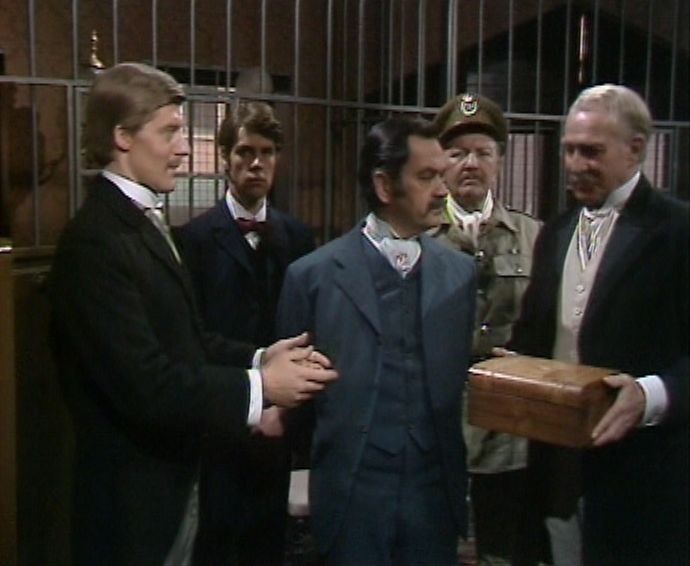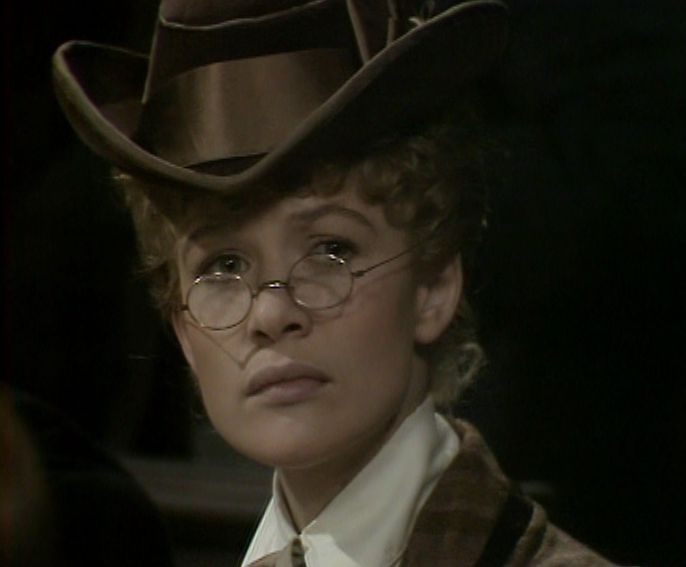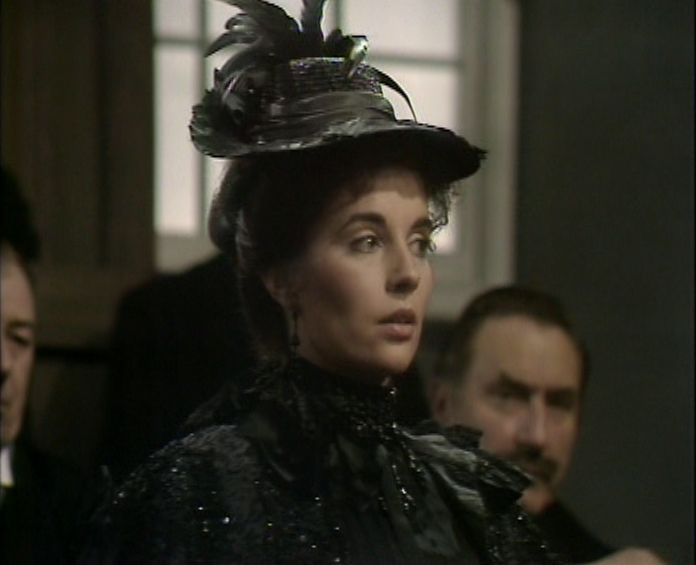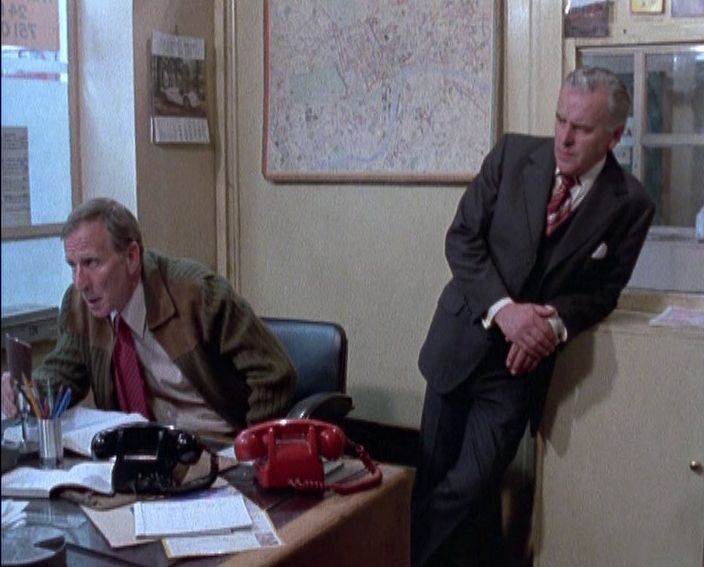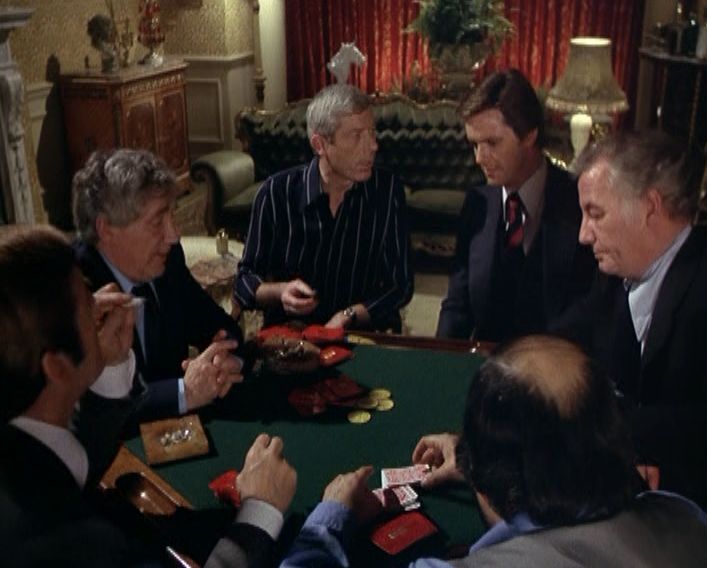
Return of the Saint – Tower Bridge is Falling Down

tower 01

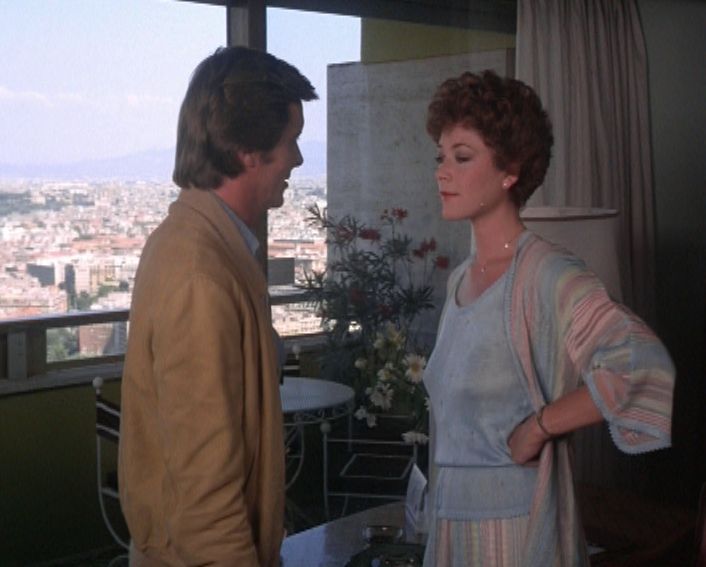
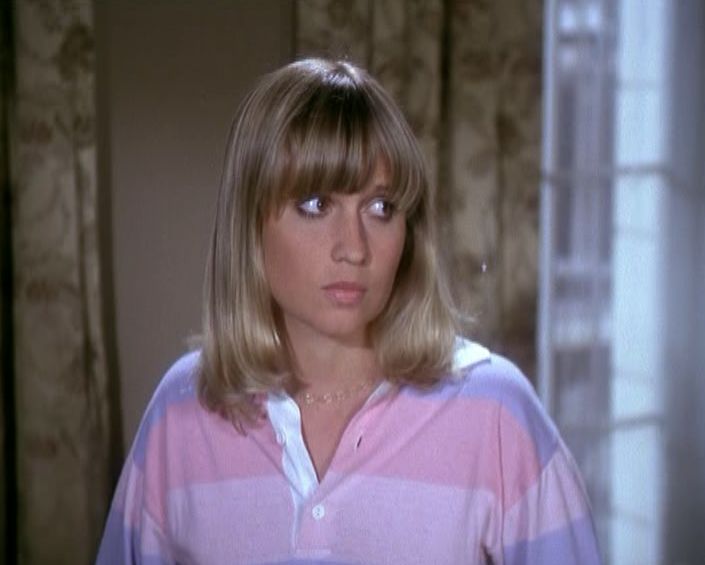
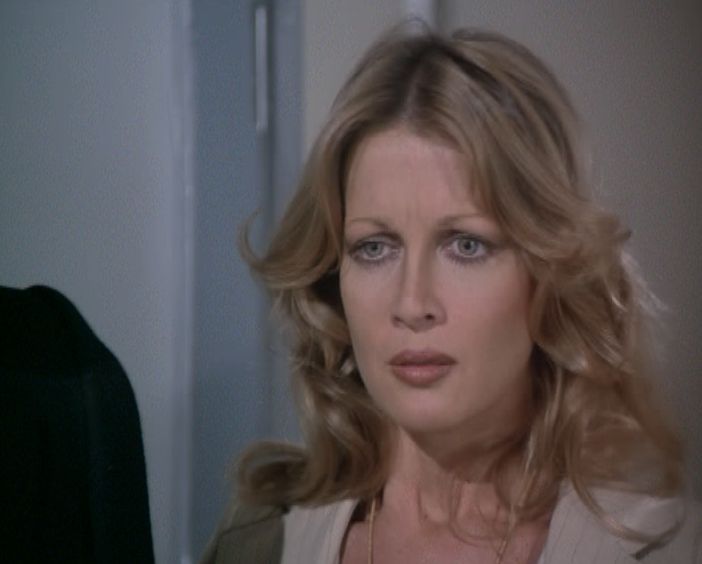
Jenny Stewart (Fiona Curzon) is concerned about her father Charlie (Sam Kydd), so she turns to the Saint for help.  Charlie has been having disagreements with his business partner Ray Dennis (John Woodvine).  The two of them built up a thriving building firm but Charlie is convinced that Dennis has conned him out of a substantial sum of money.

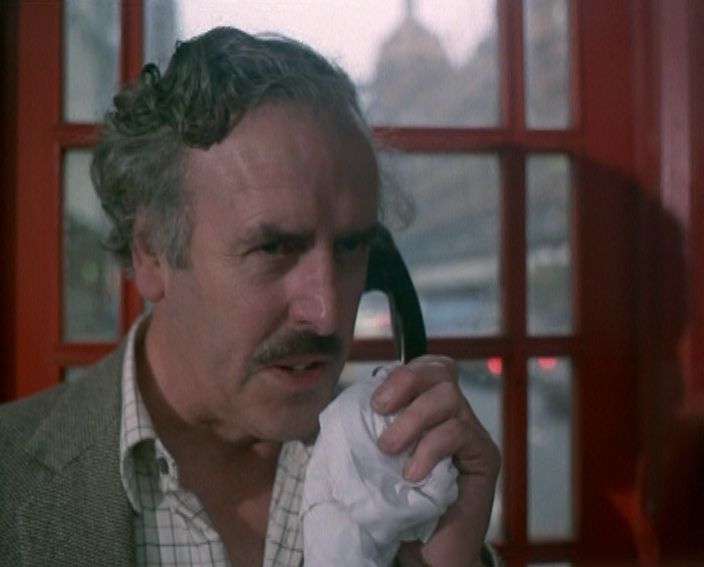
Dennis is a highly amoral figure and after a brief fight with Charlie he has no compunction in leaving him in a building scheduled for demolition.  And when Charlie’s lifeless body is recovered from the rubble Simon vows to exact the maximum amount of revenge on Dennis.  So he puts his plan into action – an elaborate con involving transporting Tower Bridge to America ……

Written by the creator of Minder, Leon Griffiths, Tower Bridge is Falling Down was his sole contribution to the series.  It’s basically Hustle, thirty years early, and it sees Simon posing as Sir Malcom Street, a top government official.  In order to hook Dennis effectively, first Simon contrives to lose ten thousand pounds to him at a rigged poker game.

And when the man he believes to be Sir Malcolm proves unable to settle his debt Dennis is slowly reeled into the con.  This involves his company being awarded the contract to demolish Tower Bridge (provided he can sweeten the deal by paying Sir Malcolm off).

All the familiar tricks from a normal episode of Hustle are present and correct.  For example, Sir Malcolm is a real person and the Saint brazenly takes over his office in order to meet with Dennis.  And as so often happens, the real Sir Malcolm returns just as the Saint is leaving (the two pass each other in the corridor).  Dennis is easy to con because, as seen in Hustle every week, he’s a greedy man.  Had he been honest then he wouldn’t have fallen for Simon’s ploy, but he sees the chance to make a quick and illegal profit and jumps at it.

It’s a pity that Leon Griffiths didn’t contribute any further scripts (although he would have been busy at the time setting up Minder).  John Woodvine is excellent as Ray Dennis.  Dennis’ lack of morality is clear right from the pre-credits sequence when he casually disposes of Charlie Stewart and although he isn’t the most complex of characters, Woodvine still manages to dominate proceedings whenever he’s on the screen.  A chilling moment occurs when he threatens to permanently disfigure Jenny if she doesn’t reveal Simon’s whereabouts.  It’s obvious from the parameters of the series that this is a threat which won’t be carried out, but Woodvine is intense enough to make you believe for just a few seconds that it might.

Alfie Bass, as Sammy, has a nice role as a con-man who works with Simon to rope Dennis in (he’s the sort of character that could easily have cropped up in Minder or indeed Hustle).  And although Simon’s involvement is down to Jenny, for once this is a very male-dominated episode and she only takes a minor role in proceedings.

It”s a pity that the con doesn’t play out to the end, since Dennis learns about Simon’s true identity.  This means there’s a more traditional conclusion (a punch up) followed by Ray Dennis’ arrest for murder.  Whether his confession about Charlie’s murder (secretly taped by Simon) would actually have stood up in court is a moot point, so it would have been more dramatically satisfying for him to have been conned.

Even allowing for this, thanks to John Woodvine and the unusual plot, Tower Bridge is Falling Down rates four halos out of five.

tower 02

Return of the Saint – The Roman Touch

roman 01

Michelle (Kim Goody) is deeply unhappy.  She may be an international singing star, with a string of hit records to her name, but she’s also worn out thanks to a grinding schedule of tours and recording sessions.  Michelle doesn’t even have the satisfaction of having made any money, due to the repressive contract she signed with her manager Bruno (Laurence Luckinbill).

Simon’s known her since she was a teenager and is anxious to help.  So he kidnaps her …..

The Roman Touch sees the return of the old-style Saint.  Although he kidnaps her with the best of intentions (he demands a ransom from Bruno of a million dollars, which is enough to pay Michelle the money she’s owed and also cover his expenses) it’s still an example of him operating on the wrong side of the law.  This is something of a rarity in ROTS, where he tended to be allied with the authorities more often than not.

Kim Goody, an actress with some musical talent, is perfect casting as Michelle.  Whilst her career in the music business is painted with broad brushstrokes (complete with a grasping manager) she still manages to give some solidity to her character.  Linda Thorson plays Diamond, her personal assistant.  At first she seems to be yet another person who is interested only in exploiting Michelle, but over time it becomes clear that she has her best interests at heart.

Simon’s attempts to help Michelle are hindered by the local Mafia, headed by Capo (Danielle Vargas).  The script is obviously written to present them as the villains of the piece – which is negated when Capo reveals that Michelle is his daughter and he’s been secretly keeping watch over her.  This is quite a neat reversal – as is the fact the somebody kidnaps Michelle again (with Simon unable to stop them).

Another foreign episode, the sunny visuals help the episode no end (had it taken place in rainy London it may not have been so effective).  But the basic problem is that there’s no particular tension since it’s obvious that Simon will rescue Michelle.  The question isn’t if he’ll do it, but how.  For a formula series like ROTS, predictability of events can be an issue and after an interesting setup things plays out pretty much as you might expect.

Nothing earth-shattering then, but solid enough.  The Roman Touch rates three halos out of five.

roman 02

Return of the Saint – Signal Stop

signal 01

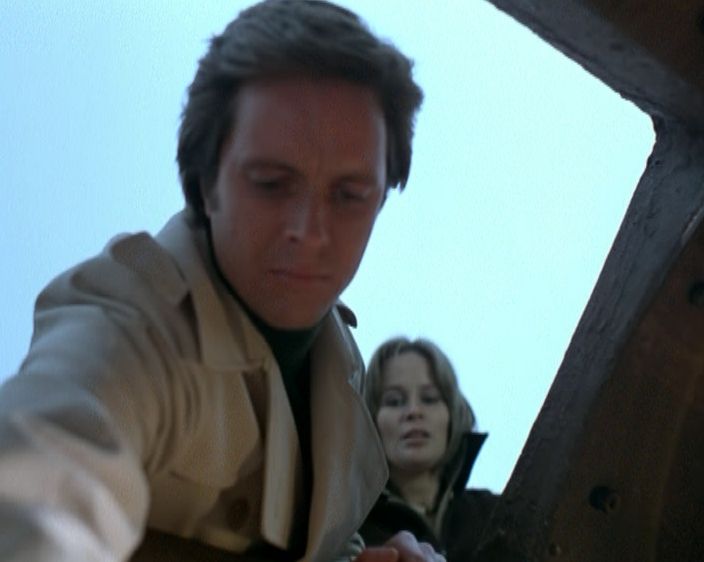
Simon Templar and Janie Lennox (Ciaran Madden) are both passengers on a train bound for London.  When the train stops at a signal, Janie sees what she believes to be a murder taking place in a nearby warehouse.  Simon, who moments earlier was wishing that something would happen to break the monotony, is naturally intrigued.

The next day, Simon, Janie and the police travel to the building – but the body that Simon and Janie found earlier in the day is no longer there.  Inspector Grant (Frederick Jaeger) later tells Simon that since Janie has a history of psychiatric illness it’s probable her story was nothing more than a delusion.

Following on from the picture-postcard stylings of The Imprudent Professor, Signal Stop has a very different feel.  Most of the story takes place in dirty or run-down locations – an abandoned warehouse, a scrap-yard, etc which gives it something of a Sweeney/Professionals feel.

Just as The Arrangement owed more than a little to the novel Strangers on a Train, Signal Stop also seems to have been inspired by a crime classic.  In 4:50 From Paddington by Agatha Christie, a character witness a murder from her vantage point on a train – but with no body she finds it impossible to convince the authorities and only her friend Miss Marple takes her seriously.

The notion of observing a murder from a train (and therefore being helpless to intervene) is a decent one – although it’s fair to say that this story is a little flawed.  The major problem is that it’s baffling why the body was simply not taken away before Simon and Janie turned up the next day to find it.  No body = no crime.

Instead, the murdered man is left on site for them to find.  Simon then drives Janie all the way back to his house before phoning the police and driving back.  Naturally enough, by the time he returns the body has vanished.  Since he has a phone in his car, why didn’t he call the police and wait for them at the warehouse?

But despite these rather serious plotholes, there’s still a very decent, and unusual, story here.  Ciaran Madden impresses as the vulnerable Janie.  Unlike most of the other Saint heroines, she’s a flawed and damaged individual – although Simon’s faith in her never wavers.  It’s possible to argue that the script missed a trick by allowing the viewer to see the attack take place though.  Had this not happened, and we only had Janie’s word, it would have allowed the viewers to wonder if it maybe was just a figment of her imagination.

Ian Cullen is hardly stretched as one of the police officers, especially since he’d had a been a regular in Z Cars and could presumably have played this sort of part in his sleep.  Brian Glover, George Sweeney, Ralph Arliss, Heather Wright and Sabina Franklyn help to round out the cast.  Franklyn has a blink-and-you’ll-miss-it role as a uniformed police officer who Simon effortlessly charms whilst Arliss makes a brief appearance as a hells-angel sort of biker.  Although as so often with ROTS, the biker gang never really exudes any sort of menace.

Frederick Jaeger’s rather good as Inspector Grant.  It’s the sort of part that seems at first to be fairly routine but by the conclusion of the episode he’s moved more into the forefront of the action.

Despite some flaws, Signal Stop rates a healthy three halos out of five.

signal 02

Return of the Saint – The Imprudent Professor

prof 01

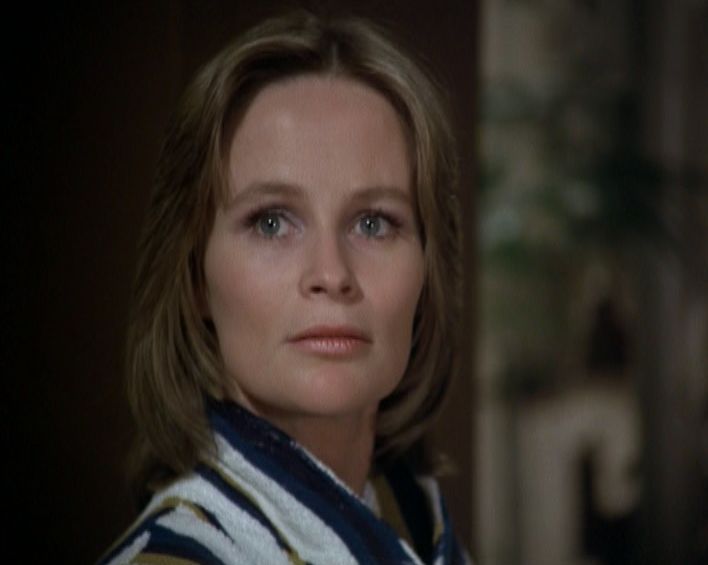
Professor Edmund Bartlett (Bill Simpson) is a philanthropic scientist who wishes to share his new invention (synthetic petrol) with the world.  But his daughter Emma (Susan Penhaligon) is concerned for his safety.  She’s well aware that certain countries and interest groups would be very interested in her father’s discovery and could be inclined to use force to extract the information from him.

Emma hires Simon to keep an eye on him, much to the disgust of Boothroyd (Anthony Steel), the local representative of the British government.  Posing as a disgruntled ex-colleague of the Professor, Simon strikes up a friendship with the alluring, but deadly, Samantha (Catherine Schell).  Samantha works for Genius Inc, an organisation who sells geniuses to the highest bidders.

When the Professor disappears, Simon faces a race against the time before Bartlett is spirited out of the country and lost forever.

After a couple of London-based episodes, The Imprudent Professor is literally a breath of fresh air.  Filmed in and around Nice, it certainly uses the location to its maximum advantage.  And as well as the gorgeous visuals, there’s a sparkle about Terence Feeley’s teleplay that means it’s a definite cut above the norm.

Unlike Feeley’s previous script, The Armageddon Alternative, there’s an intriguing hook in the pre-credits sequence.  Simon interrupts a speech from the Professor by claiming that Bartlett is a fraud and he – Simon – is the true inventor of the synthetic petrol.  Since ROTS normally has fairly straightforward narratives, this is something of a jolt.

It doesn’t take long before the truth emerges though.  Simon’s decided that the best way to keep the Professor safe is to act as a judas goat and lure any people interested in his invention out into the open.  His tactics don’t meet with whole-hearted approval by everyone though, especially the Professor – who’s incredibly stubborn and unwilling to believe he’s in any danger.  Bill Simpson, best known for Dr Finlay’s Casebook, is (as might be expected) very Scottish.  He’s also quite an imposing figure and certainly makes an impression, even with his limited screen-time.

Susan Penhaligon (not even remotely Scottish) is suitably winsome as his daughter Emma.  Like many of the female roles in the series she’s only lightly sketched – but whenever she and Samantha meet there’s a nice tension between the pair of them.  This is because she clearly believes Samantha has designs on Simon (you can feel the waves of jealousy emanating from her!)

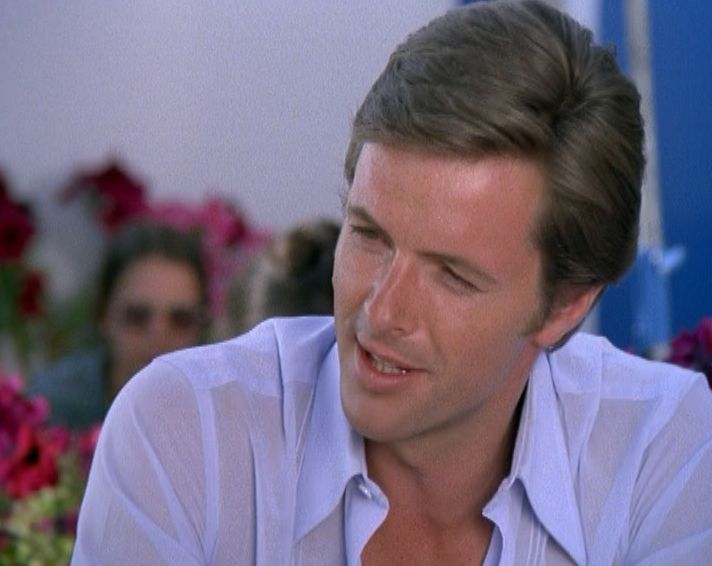
Ian Ogilvy looks like he’s having great fun and is certainly given plenty of good material.  When acting the part of the Professor’s disgruntled ex-employee he affects a Scottish accent (badly!) and wears a pair of glasses (obviously he thinks they make him look much more studious).  It’s also a nice touch that he uses the alias of Sebastian Tombs (a favourite of the literary Saint).

Simon gets to tangle with Samantha (some lovely comic moments between Ogilvy and Schell) and also crosses swords with Boothroyd of DI6.  His initial meeting with Boothroyd (the always classy Anthony Steel) is pure James Bond – we see Boothroyd relaxing by the poolside of a impressive looking house surrounded by a bevvy of gorgeous girls in bikinis.

Simon quips his way out the situation and at the same time is easily able to outwit some of DI6’s less able operatives, like Cartwright as played by Peter Childs.  If there was ever an episode of ROTS that could have been designed to showcase Ogilvy as a potential James Bond, then this was the one.

The plot may be a little routine (there’s a slight twist, although it’s not difficult to guess), but the location-work, guest-cast and the sheer spirit of the production help to make this one of the most enjoyable episodes of the series.  Four and a half halos out of five.

prof 02

Return of the Saint – The Armageddon Alternative

arm 01

Simon is abducted by a masked man and driven to an unknown location.  He’s shown an atomic bomb and the man tells him (via pre-recorded taped messages) that unless his demands are met the bomb will be detonated in the heart of London.

The mystery man’s demands are quite simple – he wants Lynn Jackson (Anouska Hempel) to be guillotined in public.  He gives Simon and the authorities until early evening to accede to his request – and in order to prove he’s serious, a conventional explosion will be set off every hour, on the hour ….

The Armageddon Alternative is a somewhat flawed story and the flaws are apparent from the pre-credits sequence.  Why does the masked man never speak?  The logical answer is that he’s a member of a team and the taped messages were recorded by somebody else.  Alas, logic has rather taken a holiday in this episode.

Simon later explains that the voice was recorded in order to disguise it (otherwise he would have instantly known who it was).  But that makes no sense – as soon as we hear the tape it’s obviously George Cole putting a funny voice on.  And when we see Fred (George Cole) a few minutes later it hardly takes a nuclear scientist to put two and two together.

Fred looks after the cars in Simon’s block of flats and is clearly the last person in the world you’d assume would be in possession of an atom bomb or have the skill to use it.  The mid episode reveal that he’s responsible should be a shocking twist – but it’s no surprise at all.  This possibly isn’t the fault of Terence Feeley’s teleplay though.  He would no doubt have assumed that director Leslie Norman (father of Barry) would be able to effectively disguise Cole’s voice.

What is a mystery is why Fred should want a gorgeous young woman like Lynn executed.  Although when it’s revealed that her father, Professor Loder (Frank Gatliff), is the Government’s chief psychiatric vetting officer, things begin to fall into place.  It seems obvious that someone who Loder filed a negative report against has decided to take the most drastic of revenge.

A likely suspect is Parkinson (Gordon Gostelow).  He turns out to be innocent, but takes a perverse delight in stringing Simon and the police along.  It’s a nice cameo from Gostelow who plays unhinged very well.  Indeed, the cast here is very strong – George Cole is his usual dependable self, whilst Anouska Hempel is also very watchable.  True, she’s not the strongest-drawn female character that ROTS has ever offered us, but Hempel manages to make something out of nothing.

Although laughs are thin on the ground, there was one (although I’m not sure whether it was intentional).  When Simon is kidnapped, he asks the man a question and amazingly the next thing on the tape is an answer to the question!  This is either an incredibly sloppy piece of scripting or a good joke.  It does rather bring to mind the Monty Python sketch featuring Michael Palin as a barber who has an uncontrollable fear of cutting hair though.

Great cast, but as the identity of the bomber is blown before we see the opening credits I can only give it two and a half halos out of five.

arm 02

Return of the Saint – The Arrangement

arrangement

When Lady Greer Stevens (Carolyn Seymour) and Sheila Northcott (Sarah Douglas) share a drink on a flight back to the UK they discover they have something in common.  Both are trapped in unhappy marriages and Greer suggests that each of them should kill the others husband.  Sheila idly agrees, not realising that Greer is quite serious and also quite mad.

Greer fulfills her side of the bargain by killing Guy Northcott (Michael Medwin) and now expects Sheila to murder Sir Trevor Stevens (Donald Pickering).  Fortunately for Sheila, she has the Saint on her side …..

The Arrangement is essentially a rewrite of Patricia Highsmith’s novel Strangers on a Train (later filmed by Alfred Hitchcock).  Strangers on a Plane, as it were.  Carolyn Seymour is mesermerising as the completely unhinged Lady Greer Stevens.  We get an early example of her disregard for others when she trips up a rather loud American at the airport (he’d been annoying her on the plane).  Simon’s there to tend to him, although given that the man had just fallen a long way down an escalator it seems rather reckless for the Saint to roughly drag him away!

Sir Trevor Stevens is an influential politician, but it’s clear that he’s not satisfying his wife’s needs, despite her (somewhat half-hearted) claims to the contrary.  An interesting moment occurs when their servant Nina (Vikki Richards) announces that Greer’s bath is ready.  Greer mentions suggestively that Nina might like to scrub her back and this – together with a zoom into Nina’s expectant face and a shot of Sir Trevor looking disgusted – broadly hints that there’s more to this mistress/servant relationship than meets the eye.  Given that ROTS was a pre-watershed series it’s not surprising this is never explicitly spelt out – but the inference is clear enough.

Seymour’s mad-as-a-hatter turn is highly entertaining and by far the best thing about the story.  The second best thing is the Survivors mini-reunion, as Ian McCullough has a small role as Inspector Stone.  Seymour and McCullough only exchange a few words but it’s nice to see them together again.

As Greer Stevens is such a vivid character, Sarah Douglas’ Sheila Northcott can’t help but seem rather pallid when the two are put side by side.  Sheila is the typical sort of Saint heroine, utterly dependent on Simon to get her out of trouble.  And she’s not the only one in danger, as later on Greer kidnaps Sheila’s sister Aileen (Jane Hayden).

Aileen is younger than Sheila and quite a different sort of character.  Nina drugs Aileen’s drink when the pair of them are at a new-wave/punk club.  It’s not the first time that ROTS has dabbled with the underbelly of modern Britain and like the previous examples it doesn’t feel totally convincing.  Although the band are vaguely shouty, the club still seems rather sedate and well-behaved.  Later, we see Aileen kept captive and docile (she’s been pumped full of drugs).  Again, this is something that sits somewhat uneasily alongside the series’ more usual escapist atmosphere.

The ending might be a little predictable (and obviously shot in the studio) but The Arrangement easily rates four halos out of five.

The Rivals of Sherlock Holmes – The Missing Q.C.s

missing

Robin Ellis as Charles Dallas in The Missing QCs by John Oxenham
Adapted by John Hawkesworth. Directed by Jonathan Alwyn

When two leading barristers who are conducting an important murder case (one for the prosecution, the other for the defence), vanish without trace, it falls to junior barrister Charles Dallas (Robin Ellis) to investigate.  The trail leads him to a lunatic asylum run by Professor Dyne (John Phillips) where events take a very unexpected turn ….

The Missing K.C.s was written by William Arthur Dunkerley, using the pen-name of John Oxenham.  Dunkerley was a prolific writer – crafting novels as well as poetry and hymns.  The character of Charles Dallas only appeared in this one story, published in the late nineteenth century.

Skilfully adapted by John Hawkesworth (Upstairs Downstairs), The Missing Q.C.s is a story that lurches in a very unexpected direction.  To begin with, it plays out like a traditional courtroom drama – with plenty of enjoyment to be derived from the performances of John Barron and Jack May as the battling barristers.  Both Barron and May were highly experienced actors, blessed with excellent comic timing, which means that their barbed insults are a joy to watch.  Charles Lloyd Pack, as the judge, also gives a fine turn as the man in the middle, attempting to keep order.

It’s expected that the story will revolve around George Wilson (Howard Goorney), on trial for the murder of his wife, and whether he’s innocent or guilty.  But the whole courtroom section is merely an excuse to introduce us to the Q.C.s and set us up for the second part of the tale.

During the courtroom portion of the story, Charles doesn’t seem that concerned about the case (where he’s acting as Sir Revel’s junior) as he spends his time trying to find the right moment to ask Sir Revel for his daughter’s hand in marriage.  Milly Revell (Ceila Bannerman) is a highly spirited young lady and the way she manipulates Charles is an early example of how he tends to be buffeted by events, rather than directing them.

The mysterious disappearance of Sir Revel Revell (John Barron), James Ladbroke (Jack May) and then later on Milly, forces him to take action.  Ellis, a few years away from his career-defining appearance in Poldark, is forced by the script to be a rather conventional leading man.  This means that the likes of Barron, May and Phillips can effortlessly steal the scenes whilst Ellis has the slightly thankless task of being the rational centre-point of the story.

What makes The Missing Q.C.s so interesting is the sudden gear-change from a conventional mystery to a Hammer-style gothic yarn.  Professor Dyne turns out to hold the key to the mystery – and his revelations are gloriously pulpy.  Dyne’s lunatic asylum – complete with a mute butler, moaning inmates and vicious dogs roaming the grounds, is certainly a far cry from the sedate courtroom setting of the first half.

As Charles breaks free into the grounds, desperately attempting to avoid the pack of dogs, Milly is still in the clutches of the evil Professor – bound and gagged just as a traditional pulp heroine should be.  Also held captive are Revell and Ladbroke, and both of them will shortly be operated on by Dyne.  Charles manages to escape and he makes his way to the local police-station, but in a glorious comic sequence he has to struggle to make himself believed.  Once the officers learn he’s come from the lunatic asylum they naturally assume he’s an escapee!

With some decent supporting performances (such as Gordon Gostelow as Inspector Mayhew) this brings the second and final series of The Rivals of Sherlock Holmes to a strong conclusion.  There were still plenty of other stories that could have been adapted in future series, so it’s a little bit of a shame that it never came back – but the twenty-six episodes that were made do offer a fascinating snapshot of some of the best crime fiction of the late Victorian/early Edwardian age.

The Rivals of Sherlock Holmes – The Mystery of the Amber Beads

beads

Sara Kestelman as Hagar in The Mystery of the Amber Beads by Fergus Hume
Adapted by Owen Holder. Directed by Don Leaver

A rich widow called Mrs Arryford (Doris Rogers) is brutally murdered and shortly afterwards her precious string of amber beads turns up at a pawnshop run by a young gypsy called Hagar (Sara Kestelman).  All the evidence suggests that Mrs Arryford’s maid Rose (Sarah Craze) killed her mistress, but Hager isn’t so certain ….

The Mystery of the Amber Beads was written by Fegus Hume and was one of a collection of short stories published in 1898 under the title of Hagar of the Pawn Shop, which can be read here.  Two years earlier he self-published a novel called The Mystery of a Hansom Cab.  It very quickly became a publishing sensation but Hume was to receive little financial benefit, since he sold the British and American rights for just fifty pounds.

Female detectives were rare in the Victorian/Edwardian era and an ethnic detective, such as Hagar, was rarer still.  Most of the other sleuths featured in these adaptations either have official standing or are gentleman amateurs who are indulged by the authorities.  Hagar clearly doesn’t fall within either of these categories.

The forces of law and order are represented by Grubber (Joss Ackland) and his relationship with Hagar is one of the key dynamics of the episode.  He’s maybe more accepting and trusting of her than you would expect, but although it’s probable that more drama could have been mined from an antagonistic relationship, their interaction is still intriguing.

Hagar proves early on that she’s no fool as she tells him the serial number of the five pound note that was handed over to the mysterious woman who pawned the beads.  Later, Hagar is able to prove that the woman wasn’t Rose – although to be fair this is done in a way that would be hard to prove in a court of law.

Joss Ackland gives a broad performance as Gruber.  He makes the policeman a very bluff, cockney figure who tends to teeter on the edge of caricature.  But Ackland is a good enough actor to be able to occasionally pull back and show that there’s more to the man that meets the eye.  Gruber is somewhat of a hypocrite though.  To begin with he’s convinced that Rose is guilty and tells a disbelieving Hagar so.  Then after Hagar has proved otherwise, he blithely tells her that he knew all along that Rose didn’t do it!

Sara Kestelman is impressive as Hagar.  She’s a dual outsider – not only a woman in a man’s world but a gypsy to boot and therefore certain to be regarded with suspicion by the majority of her fellow citizens.  Hagar does have a code of honour though and whilst she probably would have been aware the beads were stolen when she accepted them, she didn’t attempt to hide the fact that she had them when Gruber came enquiring.  And her sense of justice is clear after she champions the cause of Rose.

If it wasn’t Rose, then who might it be?  Mrs Arryford’s household is fairly small and apart from the servants there’s only her companion Miss Lyle (Kathleen Byron) and Miss Lyle’s nephew Freddy (Stephen Chase).  Freddy seems an obvious suspect – he’s very smooth and makes an instant byline for Hagar.  Kathleen Byron had a lengthy and impressive career (she had a memorable role in the classic film Black Narcissus for example) and doesn’t disappoint as Miss Lyle.  It’s a little while before she has her moment to shine, but it’s worth waiting for.

Rounding off the main cast is Philip Locke as Vark.  Vark is adamant that the pawnshop should be his and as a solicitor he’s willing to use every trick at his disposal to ensure he makes it so.  Locke is perfect as the thoroughly oily and untrustworthy Vark and it’s no surprise that Hagar despises him.  Vark either doesn’t realise this or doesn’t care as at one point he suggests marriage – which doesn’t go down very well with Hagar!

This is yet another studio-bound show, but the production design does its best to hide these limitations.  We see several horses as well as numerous extras who are all employed to create bustling street scenes whilst sound effects are also used to create the impression of busy city activity.

A strong episode, thanks to the quality cast, headed by Sara Kestelman.

The Rivals of Sherlock Holmes – The Looting of the Specie Room

specie

Ronald Fraser as Mr Horrocks in The Looting of the Specie Room by C. J. Cutcliffe Hyne
Adapted by Ian Kennedy-Martin. Directed by Jonathan Alwyn

The RMS Oceanic is attempting to cross the Atlantic in a record time.  It’s also carrying a fortune in gold bullion, under the watchful eye of the ship’s purser Mr Horrocks (Ronald Fraser).  But when the ship docks at Liverpool, Horrocks is appalled to find that half of the gold has been stolen.  The ship’s owner, Lord Altington (Paul Hardwick), gives him a stark ultimatum – if the gold isn’t recovered by the time the Oceanic reaches Southampton, Horrocks will have to find another job …..

The Looting of the Specie Room was written by C. J. Cutcliffe Hyne.  Best known for the fantasy novel The Lost Continent: The Story of Atlantis, he also wrote a series of stories featuring Captain Kettle.  Horrocks made his first appearance as a supporting character in the Kettle tales and later featured in his own book Mr Horrocks Purser (1902).

Like most of the adaptations in the series, it stands or falls on the performance of the detective and sadly Ronald Fraser is something of a disappointment.  This is a pity, since he’s usually an actor I enjoy watching – but he’s very subdued here.  Ian Kennedy-Martin’s adaptation provides plenty of scope – Horrocks is an affable, honest and friendly man who’s skilled in dealing with the numerous demands of his well-heeled passengers.

But although he’s treated with indifference by some of them and with outright contempt by the Oceanic’s owner Lord Altrington, Fraser never manages to make anything of this.  Instead, he stumbles through the episode with hardly a flicker of emotion, only slightly coming to life when talking to the attractive young widow Mrs. Vanrenen (Jean Marsh).

If Fraser is a little off, then there’s some consolation to be had with the supporting cast.  Edward Dentith is profoundly shifty as Sir Edward Markham – could this apparently upright gentleman have something to do with the robbery?  Jean Marsh shares several nice, understated scenes with Fraser and as I’ve said it’s pretty much the only time he seems in any way animated.

Stephen Yardley (almost unrecognisable at first, thanks to sporting pretty much a full head of hair and a moustache) is another suspect.  His character, First Officer Clayton, has run up serious gambling debts and this gives him a strong motive.  Norman Bird, a veteran of film and television, is another quality addition to the cast.  He plays Inspector Trent, who joins the ship in England and teams up with Horrocks to locate the stolen gold.

The actual mechanics of the robbery aren’t terribly interesting (and do show the limitations of the studio) but Horrocks’ confrontation with the culprit do go some way to ensuring that the story closes strongly.  Although he successfully plays amateur detective, Horrocks finds himself demoted to another, smaller ship in the fleet (he accepts this slight with equanimity).  But when he learns that the captain of his new ship will be Clayton (a man he accused of robbery and therefore someone who has no love for him) he does seem to perk up a little!

An indifferent installment, but even with Fraser’s leaden performance it’s not a total write-off.

The Rivals of Sherlock Holmes – The Secret of the Foxhunter

foxhunter

Derek Jacobi as William Drew in The Secret of the Foxhunter by William Le Queux
Adapted by Gerald Kelsey. Directed by Graham Evans

After two European spies join a hunting party at an English country house, William Drew (Derek Jacobi) tags along as well.  As a friend of the family Drew is easily able to mingle amongst the guests – and one especially catches his attention.

Beatrice Graham (Lisa Harrow) is a luminous beauty, engaged to one of Drew’s colleagues, but she’s clearly very perturbed.  Can she, or her fiance, be a traitor?  It later turns out that Beatrice is in possession of a document that the foreign spies are extremely eager to obtain – and they’ll stop at nothing, including murder, to achieve their ends.

William Le Queux was a prolific writer, most successful in the decade or so before WW1.  The Invasion of 1910 (serialised in the Daily Mail in 1906) was a notable bestseller for him.  Le Queux tended to concentrate on the thriller, spy and mystery genres and whilst there’s a certain pulpiness about his works, he can still lay claim to being one of the founding fathers of British spy fiction.  The Secret of the Foxhunter can be read here.

Gerald Kelsey’s adaptation takes certain liberties with the source material, mainly by injecting a certain amount of humour (Le Queux’s original is lacking in this).  One major difference is the role played by Miss Baines (Denise Coffey).  Miss Baines is governess to the daughter of the German spy Count Kremplestein (Richard Warner) and takes a much more active role in the adaptation (in the original story she’s a very marginal figure).  Coffey, a noted comic performer, tackles her role with gusto and plays against Jacobi very well.

Another touch added by Kelsey is the extreme reticence of the British government, in the form of Drew’s boss The Marquess of Macclesfield (Richard Pearson), over the whole beastly business of spying.  The Marquess clearly regards spying as a deeply underhand business and not something that a British gentleman should undertake.  A good example is when Drew comes into possession of a letter written by Beatrice – it could contain a vital clue, but the Marquess really doesn’t like the idea of opening a lady’s letter (he does overcome his scruples though).

The Secret of the Foxhunter was Lisa Harrow’s television debut.  She would rack up an impressive list of television, film and theatre credits over the years (she’s probably best remembered for playing Nancy Astor in the 1982 series of the same name).  Here, she brings an excellent, doomed intensity to Beatrice – Drew is keen to help her, but it’s to no avail sadly.

Derek Jacobi (despite a fake moustache – the curse of the series, alas) gives a strong central performance as William Drew.  Equally able to play comic scenes with Denise Coffey and Richard Pearson as well as more dramatic moments with Lisa Harrow, Jacobi’s never less than first rate.  In terms of the adaptation, a major change by Kesley comes at the conclusion of the story, which provides Jacobi with another chance to shine.  It’s an unexpected moment – but all the more powerful because of this.

The Rivals of Sherlock Holmes – The Moabite Cypher

cypher

Barrie Ingham as Dr John Thorndyke in The Moabite Cypher by R. Austen Freeman
Adapted and Directed by Reginald Collin

Dr John Thorndyke (Barrie Ingham) and his faithful assistant Dr Jervis (Peter Sallis) come to the aid of a man kicked by a police horse.  The man never regains consciousness and after talking to the police they learn that it’s possible he was an anarchist plotting to assassinate a visiting Russian archduke.  Thorndyke is intrigued by a strange letter recovered from the man’s body – written in some sort of code – and turns his energies to deciphering it.

Created by R. Austen Freeman, Dr John Thorndyke appeared in around sixty novels as well as numerous short stories.  The Moabite Cypher formed part of the short-story collection John Thorndyke’s Cases (as did A Message from the Deep Sea adapted for series one) and can be read here.

What makes The Moabite Cypher so enjoyable is the relationship between Thorndyke and Jervis.  Ingham’s Dr Thorndyke is an intellectual tyrant – always convinced that he’s right about everything – whilst Dr Jervis plods along several paces behind, acting as his loyal Watson.  Whilst he contributes little to the story, it’s amusing to see Peter Sallis steal scene after scene.

Possibly the best moment comes when the pair are travelling back to London.  They accompanied Alfred Barton (Julian Glover) out of town – apparently to visit his sick brother, although Thorndyke was well aware that Barton wasn’t all he claimed to be.  Barton’s plan was to strand them in the middle of the countryside and then return to Thorndyke’s London rooms to ransack them.  As Thorndyke wearily tells Jervis how obvious it was that Barton was a wrong ‘un, it’s hard to take your eyes off Sallis.  He doesn’t have much dialogue, but his facial expressions make it plain exactly how he feels.  Lovely stuff.

Thorndyke is a fairly insufferable character, which is highlighted when he later confronts Barton.  Barton pulls a gun and threatens to shoot – but Thorndyke seems not to even consider for a moment that he’ll pull the trigger.  He does, of course, and Thorndyke is lucky to escape with just a graze.

Apart from Ingham and Sallis, Julian Glover is excellent as usual.  It’s not the largest or most interesting of roles, but Glover’s just so good with villainous roles.  Derek Smith gives an unforgettable turn as Professor Popplebaum.  He plays it with such gusto that I can’t make my mind up whether it’s one of the worst performances I’ve ever seen or one of the best.  If you’re familiar with Lewis Fiander’s appearance as Professor Tryst in the Doctor Who story Nightmare of Eden then it certainly hits those giddy heights.

Obviously fake facial hair is another aspect of The Rivals of Sherlock Holmes that it’s sometimes difficult to ignore and there’s a breathtaking example here – George Innes as Adolph Schonberg.  Schonberg sports a bushy red beard and a similar amount of red hair.  It looked so fake that I was half wondering if it was actually a disguise – but no, it seemed to be genuine (in the story at least).

Reginald Collin, who both adapted and directed the story, throws the odd little flourish in.  We open with some sepia-toned archive footage, which is followed by a studio shot, also in sepia (which then becomes colour after a few seconds).

Barry Ingham is very clipped and precise as Thorndyke.  There’s more than a touch of Sherlock Holmes about his performance (he finishes by saying the problem was elementary) and it’s clear he would have made a very good Holmes.  He never did alas, but he did voice Basil The Great Mouse Detective, which was close.

The Rivals of Sherlock Holmes – The Anonymous Letters

letters

Ronald Lewis as Dagobert Trostler in The Anonymous Letters by Balduin Groller
Adapted by Anthony Steven. Directed by Dennis Vance

Vienna, 1900.  Countess Nadja (Nicola Pagett) has received several anonymous letters of a most intimate nature.  Nadja is anxious that not a breath of scandal reaches the ear of her husband, Archduke Othmar (Michael Aldridge) and therefore consults Dagobert Trostler (Ronald Lewis),  Dagobert is a confidant of the noblest of Viennese society and therefore the ideal man for the investigation.

The Anonymous Letters was written by Adalbert Goldscheider, under the pseudonym of Balduin Groller.  Groller created Dagobert Trostler in 1890 and like so many other writers of the era he sought to create a detective somewhat in the mould of Sherlock Holmes, albeit one who was resident in Vienna.  But Dagobert is quite different from Holmes.  The London detective had little time for polite society and was never impressed by rank or title, whereas it’s clear that Dagobert relishes his influential friends and would be loath to lose them.

If I had to describe this episode in one word then “florid” seems apt.  Possibly this is due to the translation from German to English, which means there’s a somewhat melodramatic unreality to the story.  This might be why none of the main characters ever quite seem to come into sharp focus.  Dagobert is amusing enough, but his deductions are fairly routine and his affair with Countess Tildi Leys (Carolyn Jones) doesn’t quite convince.

Nicola Pagett had already appeared in Upstairs Downstairs, so the role of a pampered member of the upper-classes clearly wasn’t too much of a stretch.  And despite the difference in nationality there’s more than a touch of Elizabeth Bellamy in Nadja, but whilst Upstairs Downstairs gave us the chance, over time, to appreciate Elizabeth’s vulnerable side, we don’t have the same luxury here.  So although Nadja is completely blameless it’s hard to invest a great deal of interest in her fate.

Michael Aldridge sports an impressive beard (like much of the facial hair in the series it was clearly stuck on) and is also responsible for an unintentionally amusing moment after he storms into Dagobert’s rooms and accuses him of taking advantage of his wife.  After slapping his face, he then challenges Dagobert to a duel, but the younger man responds by knocking him out!  His servant then rushes in and mournfully tells him that he’s hit a Habsburg – which was clearly deemed to be a sufficiently dramatic point to lead into the second advert break.

Although The Anonymous Letters has the usual excellent cast, the lack of characters that can be identified with does mean that it’s difficult to fully engage with the story.  Certainly one of the lesser adaptations from series two.

The Rivals of Sherlock Holmes – The Superfluous Finger

finger

Douglas Wilmer as Professor Van Dusen in The Superfluous Finger by Jacques Futrelle
Adapted by Julian Bond. Directed by Derek Bennett

A top surgeon, Prescott (Laurence Payne) is perturbed when a young woman (played by Veronica Strong) asks him to amputate one of her fingers.  Prescott refuses since there’s no medical reason to do so, but on her way out she deliberately traps her finger in the door – forcing Prescott to accede to her wishes.  He later calls in Van Dusen (Douglas Wilmer) to untangle this strange mystery.

The Superfluous Finger was the second of two Professor Van Dusen stories to be adapted for series two of The Rivals.  The original story, by Jacques Futrelle, can be read here.

The story has a strong Sherlock Holmes influence, especially since it opens with a puzzling mystery (why should anybody wish to have a perfectly healthy finger amputated?).  Some of the other Holmesian touches were added by Julian Bond’s adaptation – such as Van Dusen being able to deduce that the woman recently travelled from America (due to her clothes) as well as his assertion that whilst he has many acquaintances he has very few friends.

Of course, having Douglas Wilmer in the lead role (a notable Sherlock Holmes himself) also helps to connect Van Dusen and Holmes.  But though there are some similarities between Wilmer’s portrayal of both characters there are also some fairly major differences.  Wilmer’s Holmes tended to be somewhat abrupt and humourless, whilst Van Dusen has a more light-hearted and ironic air.  Van Dusen seems to breeze through life in a rather detached way, rarely exhibiting strong emotions.

What connects the two is the delight they take in keeping their deductions to themselves.  Both are disinclined to share their initial thoughts with others (Holmes with Watson, Van Dusen with Prescott) for pretty much the same reason.  The others have seen what they’ve seen, so if they can’t draw the same conclusions from the evidence why should it be spelled out to them?

Van Dusen is aided in his investigation by the reporter Roderick Varley (Mark Eden).  It’s odd that Nicholas Courtney didn’t return as Hutchinson Hatch (especially since Hatch is featured in the original story) so I can only assume that filming dates for Doctor Who clashed with this recording.  But Eden is a more than adequate substitute and enjoys a decent part of the action.

This starts when he tails the mysterious woman in a film sequence which clearly had some money thrown at it.  We see hansom cabs with horses (one previous episode had a cab in the studio – but no horse – with a stage-hand clearly shaking it about to create the effect of motion!) as well as several extras walking up and down the street.  It’s a welcome moment of fresh air that does help to open out the story.

Varley later seems to find the woman murdered and is arrested by the police (in the form of Mallory, played by Charles Morgan).  Van Dusen has to go and effect his release, this he does in a wonderfully comic scene which showcases Douglas Wilmer at his best.  Charles Morgan was no stranger to playing Victorian policeman (thanks to his role in the long-running Sergeant Cork) and is just as good here.

William Mervyn (as Sir Hector Drummond) turns in the sort of eccentric performance that he possibly could have done in his sleep, but is amusing nonetheless.  And Laurence Payne is dependable as Prescott, the man who invites Van Dusen to investigate but finds it hard to hide his exasperation with the Professor’s unorthodox practices.

Although the story opens with an intriguing mystery it’s probably not too difficult to work out what the solution is long before Van Dusen tells us (the pre-credits sequence, added by Julian Bond, does tend to give the game away somewhat).  But whilst it’s not the most interesting story, Wilmer is once again good value as the eccentric Professor.

The Rivals of Shelock Holmes – The Sensible Action of Lieutenant Holst

holst

John Thaw as Lieutenant Holst in The Sensible Action of Lieutenant Holst by Palle Rosenkrantz
Adapted by Michael Meyer. Directed by Jonathan Alwyn

Copenhagen, 1905.  A Russian countess, Maria Wolkinski (Catherine Schell), claims that her brother-in-law has travelled to Copenhagen to kill her.  Dimitri Wolkinski (Philip Madoc) is a hunted man in Russia, due to his revolutionary views (which were shared by his late brother, Maria’s husband).

Maria is placed in the care of Lt Holst (John Thaw) and after he leaves her with his wife Ulla (Virgninia Stride) he interviews Dimitri.  But although Maria seemed convincing, so does Dimitri (who tells Holst that his sister-in-law is hysterical).  Who is telling the truth and who is lying?  And will the mild-mannered Holst be able to negotiate the tricky tangle of political intrigue without losing his job?

Baron Palle Adam Vilhelm Rosenkrantz was a Danish writer who wrote several crime stories.  The majority of his works don’t appear to have been translated into English and there doesn’t appear to be an online version of this story.

John Thaw would spend a large part of his career playing policeman, although his two most famous roles (Jack Regan and Morse) were still in the future when this was made.  At first glance, Holst seems to be a world away from the rough-and-tumble Regan – he has a settled home-life and gives every impression of being someone who doesn’t plan to rock the boat.  He reminds his wife that those who do tend to find their careers cut short (something he claims he has no desire to do).

But as the case wears on he finds himself coming under great pressure from various quarters.  After listening to Maria’s story, his wife is convinced that she’s telling the truth and angrily wonders why Holst doesn’t either arrest or kill Dimitri.  Holst replies that Dimitri hasn’t committed any crime and therefore there’s nothing he can do.

When Dimitri is later in Holst’s custody (arrested on a technicality) the Russian embassy make it plain they want him back (Dimitri has told them that if he returns to Russia he’ll be executed).  Holst refuses to let a representative from the embassy visit Dimitri in his cell since he’s made it clear that he doesn’t want any visitors and Holst respects his wishes.

This brings him into direct conflict with his superior who tells him that “in this job one has to be a diplomat, not a saint.”  Dimitri’s eventual fate doesn’t come as a surprise and nor does Holst’s reaction – although it’s an excellent scene for John Thaw.  One of the joys of The Sensible Action of Lieutenant Holst is watching Thaw’s performance over the course of the episode – from the conformist dutiful officer he is at the start, to the wiser and cynical individual he becomes by the end.

Philip Madoc and Catherine Schell both help to enhance this production.  Madoc invests Dimitri with the sort of brooding presence he always did so well and Schell is also in her element – Maria is an icy, remote figure who may, or may not, be in fear of her life, a role Schell plays to perfection.

In the end, the question of whether Dimitri did plan to kill Maria is never resolved for certain.  If it was true, there would appear to have been just cause – Dimitri claimed she was a Tsarist agent responsible for many deaths (including, presumably her own husband).  Holst challenges her about this at the end and whilst she doesn’t confirm it, her silence implies that it’s true.

Whilst Ulla’s sympathies remain with the countess, Holst isn’t so sure.  It’s a suitably intriguing point to close on as Thaw is once again able to give us an insight into the conflicted psyche of Holst.  Dimitri might have been an anarchist, but Holst admits that if he had to choose, he’s not sure which side he’d be on.

With strong performances from Thaw, Madoc and Schell, this is one of the most dramatically satisfying episodes from series two.  It’s low on crime and mystery as it’s much more of a character piece.  And whilst The Rivals was never a series – thanks to being mostly studio-bound – that had a great deal of directorial flair, there was one moment that did make me smile.  After the credits we see a picture of Copenhagen, complete with a caption.  A few seconds later the camera pans out to reveal that this was merely a postcard in the hotel lobby.  Considering that similar pictures have been used, with no such irony, in previous episodes maybe this was a sly wink to the series’ low-budget!

The Rivals of Sherlock Holmes – The Absent-Minded Coterie


absent

Charles Gray as Eugine Valmont in The Absent-Minded Coterie by Robert Barr
Adapted by Alexander Baron. Directed by Peter Duguid

French amateur detective Eugine Valmont (Charles Gray) is consulted by Inspector Hale (Barry Linehan) of Scotland Yard.  Whilst Valmont easily manages to wrap up Hale’s little problem (a gang of counterfeiters) it leads him onto another case, which may be much harder to crack …..

The Absent-Minded Coterie was written by Robert Barr and was published in 1906.  Barr was responsible for the first published Sherlock Holmes parody, The Adventures of Sherlaw Kombs (in 1892) and followed this up with The Adventure of the Second Swag in 1904.  Although these two stories took gentle digs at the Sherlock Holmes phenomenon they didn’t affect his friendship with Conan-Doyle.  Both of these stories, along with his tales of Eugine Valmont (including The Absent-Minded Coterie) can be read here.

Although he didn’t write many Valmont stories (only eight in total) each one was an entertaining inversion of the sort of tales which had already become cliches, thanks to the popularity of Sherlock Holmes.  And at first glance The Absent-Minded Coterie does seem to be little more than a Holmes knock-off since Valmont, like Holmes, is a private detective who finds himself constantly badgered by Scotland Yard to help them solve their cases.

In Valmont’s own words, courtesy of Robert Barr –

Myself, I like the English detective very much, and if I were to be in a mêlée tomorrow, there is no man I would rather find beside me than Spenser Hale. In any situation where a fist that can fell an ox is desirable, my friend Hale is a useful companion, but for intellectuality, mental acumen, finesse—ah, well! I am the most modest of men, and will say nothing.

Alexander Baron’s dramatisation and Peter Duguid’s direction takes Barr’s source material to craft a very familiar late Victorian/early Edwardian setting – complete with fog shrouded streets.  The case of the counterfeiters rumbles along for a while, but it seems so commonplace that it’s difficult to understand why Hale should need Valmont’s help.

At this early stage the episode is nothing special, but it changes gear once Miss Mackail (Suzanne Neve) comes fully into view and Valmont’s fallibilities are laid bare.  When you understand that Valmont lost as often as he won (making the title of Barr’s book – The Triumphs of Eugine Valmont – deeply ironic) things begin to fall into place.  Both Barr’s original, and Baron’s dramatisation, take delight in using tropes familiar from the Sherlock Holmes stories and then turning them on their head.

Valmont jubilantly confronts Miss Mackail but is perturbed to find that she’s quite calm about it and gently goes onto remind him that as the only evidence he holds was obtained illegally it’s inadmissible in a court of law.  Just prior to this there’s a lovely moment where Valmont turns all the lights off, except for one directed straight at him.  As he stands in the spotlight, he grandly reveals to Miss Mackail that his name is Eugine Valmont.  Alas, the spell is broken when she admits she’s never heard of him!

Charles Gray sports an outrageous French accent as the vainglorious Valmont.  It’s interesting to ponder whether Agatha Christie was influenced by Valmont when creating Hercule Poirot.  Certainly the two share some similarities, although Poirot’s belief in his own abilities was well founded.  Gray’s performance is somewhat stagey, but it suits the material since Valmont isn’t supposed to be a rounded, three-dimensional character.

Barry Lineham gives a rather odd turn as Hale.  I can’t quite put my finger on what the problem is, maybe it’s his slowness of speech, but there’s something about him that doesn’t quite click.  But Suzanne Neve is lovely as the cunning Miss Mackail and it’s a joy to watch her run rings around Valmont at the end.

The adaptation probably loses some of the sparkle of Barr’s stories (which are certainly worth a read) but it does have a lightness of touch which makes it something of a joy.

The Rivals of Sherlock Holmes – The Secret of the Magnifique

secret

Bernard Hepton as Mr J.T. Laxworthy in The Secret of the Magnifique by E. Phillips Oppenheim
Adapted by Gerald Kelsey. Directed by Derek Bennett

Sydney Wing (Christopher Neame) and Anderson (Neil McCarthy) have both recently been released from prison, but that’s where the similarity ends.  Wing has the sort of casual, upper-class air which ensures he can easily mix with the highest in the land whilst Anderson hails from a much lower rung of society.

But whilst they’re very different people, both are selected by the mysterious Mr Laxworthy (Bernard Hepton).  Laxworthy has a proposition – he wants Wing to pose as a rich man-about-town whilst Anderson takes the role of his valet.  And since both Wing and Anderson are penniless they readily agree (especially when Laxworthy tells them there’s a fortune to be made).

The three later travel to the South of France, where the French warship Magnifique lies in port.  It possesses an innovate new torpedo and Laxworthy sees an opportunity to make a great deal of money …

Edward Phillips Oppenheim was a highly prolific author, penning more than a hundred novels between 1887 and 1941 as well as numerous short story collections.  Dubbed “the prince of storytellers” he was a pioneer of the spy-fiction genre – although like many of the authors featured in The Rivals he slipped into obscurity following his death.  The Secret of the Magnifique was one of a number of short stories collected in the volume Mr Laxworthy’s Adventures, which was published in 1913.  It can be read here.

Bernard Hepton is a great, albeit rather underrated, British actor.  His fairly low profile, despite his impressive list of credits, may be partly due to the type of characters he usually plays.  They don’t tend to be flamboyant or demonstrative – Hepton specialises in self-contained, internal performances.  So he’s never going to be an actor that commands the screen, he’s much more subtle than that.

The 1970’s were something of a golden period for him.  He took the lead in two WW2 series produced by Gerard Glaister – Colditz, in which he played the Kommandant and Secret Army, which saw him switch sides to take the role of Albert Foriet, a member of the Belgian underground network “Lifeline” (which was dedicated to returning Allied airman to the UK).  Other notable series, such as I Claudius and Tinker, Tailor, Soldier, Spy were also graced by his presence and there were numerous one-off appearances, such as this one.

Our first sight of Hepton is as the cabby who picks up both Wing and Anderson.  Had there not be a caption-card at the start, proclaiming Hepton as the star of the episode, then this slight misdirection might have worked a bit better.  As it is, when Laxworthy takes off his cabby’s overcoat and removes a fake moustache it doesn’t really come as any sort of surprise.  But it does give us an early indication that he’s a man who likes to be in control and also enjoys manipulating people.

Christopher Neame had also starred in Colditz (and would appear in the first series of Secret Army too).  His trademark charm is on display here, making it obvious why Laxworthy selected him.  Neil McCarthy is present for a spot of comic relief – Anderson is a rough, gruff sort of chap who’s inclined to blurt out the wrong thing at the wrong time.

The Secret of the Magnifique offers something of a change in pace for The Rivals, as there’s no detective (Laxworthy loosely fulfills this role though).  But whilst Mr Laxworthy might not be an honest man he’s not a totally dishonourable one either.  He makes a handsome profit from the secret of the Magnifique’s torpedo, but it’s maybe not in the way one might have expected.

Elsewhere in the cast, the likes of Gary Watson and John Nettleton adopt French accents of varying accuracy whilst Canadian-born Bruce Boa plays an American, Freeling Poignton.  Boa was one of a handful of Canadian actors resident in the UK during this time (Shane Rimmer was another) and this small band of ex-pat Canadians were able to earn a very good living by playing Americans.  And at least their accents always sounded convincing!

The Secret of the Magnifique is one of those episodes that leaves you wanting more.  Hepton, Neame and McCarthy make an entertaining team and a run of further adventures would have been very welcome.  As mentioned previously, it’s strange that The Rivals was never used as a series of pilot programmes since a few episodes, including this one, could have spawned their own series.   Unfortunately it wasn’t to be.

The Rivals of Sherlock Holmes – Cell 13

cell 13

Douglas Wilmer as Professor Van Dusen in Cell 13 by Jacques Futrelle
Adapted by Julian Bond. Directed by Reginald Colin

Professor Van Dusen (Douglas Wilmer) doesn’t believe Fielding’s (Donald Pickering) claim that the prison he’s designed is escape proof and says so to his face (Van Dusen states he could escape from any cell in any prison within seven days).

Fielding, slighted by this attack on his professional abilities, agrees to the challenge and so shortly afterwards Van Dusen finds himself at the imposing Grangemoor prison.  The governor (Michael Gough) and the chief warder (Ray Smith) are certain that escape is impossible and the odds certainly seem stacked against the Professor.  Seven locked doors lie between Cell 13 and freedom.  Can Van Dusen really just “think” himself out of the prison?

The Problem of Cell 13 was written by the American author Jacques Futrelle and was originally published in 1905.  It was the first of a number of stories written by Futrelle about Professor Van Dusen, nicknamed “the thinking machine” and was later included in a volume of short stories which can be read here.

Futrelle’s promising career was cut short following his decision to travel aboard the Titanic. He refused to board a lifeboat, insisting that his wife take his place.  This ensured that whilst she lived, he didn’t.  His last book, My Lady’s Garter, was published posthumously in 1912, with his wife May adding the following inscription.  “To the heroes of the Titanic, I dedicate this my husband’s book.”

The peerless Douglas Wilmer is excellent as Van Dusen.  The Professor appears to be somewhat dreamy and remote, but it later becomes clear that he’s a man of rare intellect.  And Wilmer’s comic timing is used to good effect in the early part of the story, when he finds himself subjected to the attentions of the chief warder.

But as the days wear on, Van Dusen doesn’t seem to be any closer to escaping and his various attempts (a note thrown out the window, attempting to file the bars) seem to be both painfully obvious and terribly half-hearted.  Of course, he does manage to escape in the end – but for maximum impact this doesn’t happen until virtually the last minute of his seven days

In terms of the episode’s running time, this occurs at the end of part two – so part three allows Van Dusen to explain in detail just how he did it.  He also gets the opportunity to throw a few, well-deserved insults at the chief warder such as “it’s a pity you don’t exercise your wits as often as you exercise your tongue.”

With no actual crime, it’s much more of an intellectual exercise as well as an early example of the locked-room mystery, which would be a staple of the golden age of detective fiction.  And although it’s very much a vehicle for Wilmer, there’s some decent performances from the supporting cast. Michael Gough, Ray Smith, Clifford Rose and Donald Pickering are all worth watching (although Smith’s very fake beard and overly gruff voice are a little distracting).

It’s also nice to see Nicholas Courtney pop up in a small role and Derek Ware (a well-known stuntman) is the star of the pre-credits sequence (he plays a convict who attempts to escape, but is recaptured).  This sequence is notable since it’s shot on film (a rarity for The Rivals) and also at night, which gives it a glossy, expensive feeling – making a brief change from the usual, studio-bound nature of the series.

This is good stuff, thanks to Wilmer, and there’s another appearance from the Professor, later in the series, to look forward to.

The Rivals of Sherlock Holmes – Five Hundred Carats

carats

Barry Keegan as Inspector Lipinzki in Five Hundred Carats by George Griffith
Adapted by Alexander Baron. Directed by Jonathan Alwyn

When a diamond worth millions is stolen from the small mining town of Kimberley, South Africa, Inspector Lipinzki (Barry Keegan) is quickly on the trail.  The security, organised by Mr Arundel (Patrick Barr), was impressive – so how was it stolen?

But even if he doesn’t know how, the dogged Inspector is convinced he knows who – Philip Marsden (Martin Jarvis).  Marsden, along with his colleague Charlie Lomas (Richard Morant) were tasked with guarding the diamond and therefore both must be considered prime suspects.  But Marsden is a powerful man and Lipinzki will have to tread carefully, otherwise he may find himself out of a job.

Five Hundred Carats was written by George Griffith and was originally published in 1893.  It can be read here.

The second series of The Rivals saw a greater international cast of detectives and this story, set in South Africa, is the first example.  But despite the foreign setting it’s still very much a studio bound production (although there is some location work later on – with a sandpit doubling for the South African outback).

Barry Keegan gives Lipinzki a lovely world-weary air.  Unlike some of the other detectives featured in the series, he’s not analytical or given to flights of fancy – Lipinzki is just a hard-working, methodical policeman who uncovers the truth by effectively waging a war of nerves with his suspects.  And after suffering a brief moment of doubt when he realises he’s no idea how the robbery occurred, the Inspector is on much firmer ground once he’s found a suspect he can pressurise.

He admits he doesn’t possess any evidence but he’s prepared to press Marsden hard and see what happens.  This isn’t easy though, since Marsden is a gentleman and Lipinzki isn’t.  The point is brought up early on after the affable Arundel mentions to Marsden that he’s been politely asked not to invite the Inspector to the club quite so often.  It’s a sentiment that Marsden agrees with (he views Lipinzki as being uncouth in the extreme) but Arundel is a great respecter of the Inspector’s abilities and isn’t concerned with issues of class.

But Marsden is and he wastes no time in letting Lipinzki know exactly how little he thinks of him.  The confrontation between Keegan (softly-spoken Irish) and Jarvis (upper-cut English) is one of the highlights of the episode.  And although Marsden is a character whose actions and dialogue verge on the melodramatic at times, Jarvis is a good enough actor to still make him a believable and rounded figure.

Richard Morant is effective as Lomas, whilst Aideen O’Kelly takes the only main female role as Bridie Sullavan.  Bridie is a widower who runs the local bar and finds herself an object of attention from both Lomas and Marsden.  She views Lomas with the indulgence of an elder sister but has little time for the icy-cold and superior Marsden.

Patrick Barr, always such a dependable actor, doesn’t have a terribly interesting part as the upright, honest Arundel, but manages to make him watchable anyway.  Another very good character actor, Alan Tilvern, has a more meaty role as Mr Cornelius.  Cornelius is visiting from America and is most interested in both the diamond and Arundel’s security procedures.  This makes him a suspect (and Tilvern specialised in playing shifty characters anyway) but Cornelius turns out to be nothing more than a diverting red-herring.

There’s also a murder (it occurs in the pre-credits sequence although events then flashback so it doesn’t actually happen until towards the end of the story)  Another death occurs shortly afterwards and this does tend to reinforce the point that diamonds might be beautiful but they’re also deadly.

Although the culprit is caught, the exact place where he buried the diamond isn’t known.  Lipinzki isn’t concerned, as the diamond is back in the soil of South Africa – where it should be.

Apart from some slightly over-melodramatic incidental music this is an effective episode.  The battle between Keegan and Jarvis is excellently done and this ensures that the pace never flags.

The Rivals of Sherlock Holmes – The Mysterious Death on the Underground Railway

mysterious 01

Judy Geeson as Polly Burton in The Mysterious Death on the Underground Railway
by the Baroness Orczy
Adapted by Alan Cooke. Directed by Graham Evans

A beautiful young woman, Beatrice Hazeldene (Lois Baxter) is poisoned on a subway train.  Later, her husband, William Hazeldene (Anthony Corlan) and sister, Laura Stanley (Cyd Hayman) arrive at the mortuary to make the identification.

Also present is rising young reporter Polly Burton (Judy Geeson) who is keen to solve the mystery.  Together with her friend on the police-force, Frobisher (Richard Beckinsale), they find a prime suspect, one Frank Errington (Tom McCarthy).  The evidence against him seems overwhelming, but later both her uncle, Sir Arthur Inglewood (John Savident) and Polly herself start to have doubts …..

The Mysterious Death on the Underground Railway was written by the Baroness Orczy, best-known today for creating the Scarlet Pimpernel, who first appeared in a successful play written by herself and her husband in 1903.  Equally popular was Orczy’s novelisation, which spawned a number of follow-up books (the final one was published in 1940).

But prior to this, Orczy had dabbled with crime fiction and had written a series of thirteen short-stories which had been published in 1901 and 1902.  A dozen of them were re-written and collected in book form as The Old Man in the Corner in 1910.  This book, which includes The Mysterious Death on the Underground Railway can be read here.

At the turn of the twentieth century, Sherlock Holmes still cast a long shadow over many writers of crime fiction and this spurred Orczy to create something different.  The Old Man in the Corner was very much a thinking detective – a prototype for a generation of “armchair detectives” who solve mysteries without ever visiting the scene of the crime.  Instead, he spends his time at the A.B.C. tea-shop where he is frequently visited by Polly Burton who recounts various baffling mysteries.  And after listening to her accounts, he considers the facts and delivers a solution.

Later authors would also use this device, most famously in The Thirteen Problems by Agatha Christie but it does seem that when adapting this short-story Alan Cooke found there were dramatic limitations.  The most obvious being that the Old Man never interacts with the protagonists and his solutions are rarely provable in a court of law.  So Cooke chose to excise the Old Man from the adaptation and move Polly into the centre of the narrative.

This is something of a pity, since it means that the whole point of the Old Man stories (how he is able, without moving from the tea-shop, to come up with a plausible solution which may or may not be true) is lost. But having to tell the whole story in flashback wouldn’t have been very satisfying, so it’s understandable why this happened.

Judy Geeson is very appealing as the bright young reporter Polly Burton.  Because she’s written as a rather single-minded, humourless individual, it’s Geeson herself who manages to turn her into a more rounded, less cold character.  Richard Beckinsale is rather wooden as Frobisher, which is surprising since there was some comic mileage to be mined in his relationship with Polly (Frobisher’s in love with her but she’s ruthless in exploiting this, as she’ll do anything to aid her investigations).

The studio-bound nature of the episode does become apparent at the start as tight camera-angles, sound effects and shaky camera-work are all employed to create the illusion of a moving train.  Later, captions are used to signify locations (for example, a picture of the Old Bailey).  These do tend to highlight the limitations of the production, but they’re only fleeting moments so aren’t too damaging.  Elsewhere, director Graham Evans produces some interesting shots – particularly in the scenes set in the coroner’s court, some of which are shot from very high-up.  This does help to make what would otherwise be a rather static section of the story more visually interesting.

There’s also the usual high-quality supporting cast, including Michael Sheard, Christopher Timothy and Simon Lack whilst George Tovey has a lovely scene-stealing moment as a porter.  John Savident seems to be enjoying himself as Sir Arthur Inglewood whilst Cyd Hayman is as luminously beautiful as ever.

Like some of the other stories adapted for the series, this is a who-dunnit with very few suspects – so the identity of the murderer shouldn’t be terribly hard to guess.  But the paucity of the story isn’t that important since it’s the performances that drive it along.  And even if Alan Cooke’s adaptation does take liberties with the original source material, thanks to Judy Geeson’s engaging performance this isn’t too much of an issue.

mysterious 02

Minder – Come in T-64, Your Time is Ticking Away

t-64

Candy Cabs, a minicab firm that Arthur has a share in, has suffered a series of attacks over the last few weeks – drivers have been beaten up and cars torched.  Arthur enlists Terry’s help by giving him the most clapped-out car imaginable and adding him to the drivers roster.  It soon becomes clear that these aren’t random acts of violence though, there’s a definite reason behind them.

The first of twenty Minder scripts written by Tony Hoare (his last, The Long Good Thursday, aired in 1994 and was the final episode of the original run).  He would end up writing more episodes than series creator Leon Griffiths, and whilst Griffiths’ contribution was absolutely key, in many ways Hoare would be as important as Griffiths in shaping the direction of the series.

Come in T-64 has its comic moments, but it’s also very much a product of Minder‘s earlier, more gritty, period.  It captures the late seventies run-down nature of London perfectly – Candy Cabs is located in a dilapidated part of town and whilst Arthur dreams of taking the business more upmarket and appealing to a more refined clientele, it’s clear that this will remain just a dream.

Early on, one of the drivers is attacked by two young tearaways.  Terry drives him home and before he drops him off he wonders why he’s spending his time mini-cabbing.  Terry’s told that he doesn’t have a choice – he married young, at nineteen, and has a wife and two children to support.  They live in three crummy rooms and in order to try and get on the property ladder he works nights in a bakery and spends the afternoons and evenings driving a cab.  It sounds like quite a bleak existence.

There are a few lighter moments though.  Terry agrees to spar with the local boxing champ as his regular partner hasn’t turned up.  Whilst he’s in the ring, Arthur turns up and gives Terry plenty of, no doubt well-intentioned, support even though it’s clear that Terry’s coming off second best.  When he’s knocked down again, Arthur’s incensed – he tells the barely conscious Terry that this is very damaging to his (Arthur’s) reputation!

One of Terry’s customers is Debbie (Diana Malin) who works as a stripper (the first of five appearances she’d make in the series).  Terry’s instantly attracted and it doesn’t take too long before they get together.  The next morning, Arthur calls to see him and is shocked by her nakedness (“oh my good gawd”).  This is the more familiar, prurient, Arthur that we’d grow used to seeing – always disapproving of Terry’s numerous liaisons – and is far removed from the lecherous Arthur of the earliest episodes.

By far the best comic moment comes when Kevin walks out, leaving Arthur in charge of the office.  His increasingly frantic efforts to keep track of the calls and direct the cabs makes him more and more stressed!  It’s a lovely comic sequence from George Cole.

Come in T-64 also highlights Arthur’s ruthless nature.  Although he’s invested £5,000 into the business, Kevin bitterly complains that he leaves him to do all the work.  Kevin’s keen to buy Arthur’s share, that way he claims he’d be able to make a decent living, but Arthur’s not interested – unless Kevin can come up with £8,000, some three thousand more than Kevin was expecting.

As might be expected, Alfred Burke is excellent as Kevin.  Best known for Public Eye, Burke brings a similar level of laconic weariness to this character.  There’s a few other familiar faces that pop up, such as Oscar James who’d later be a series regular in the early years of Eastenders.

In the end, both Arthur and Terry do quite well.  Arthur ends up buying Kevin’s share of the business (for a mere two thousand) and it’s plain that he’ll make a great deal more money once the site forms part of a new redevelopment.  It was Kevin, of course, who was behind the attacks – attempting to panic Arthur into selling his stake cheaply, so that he could benefit.  And even Terry, who spends most the episode being conned by Arthur, manages to make some money (a rare victory for Terry at this early point in the series).