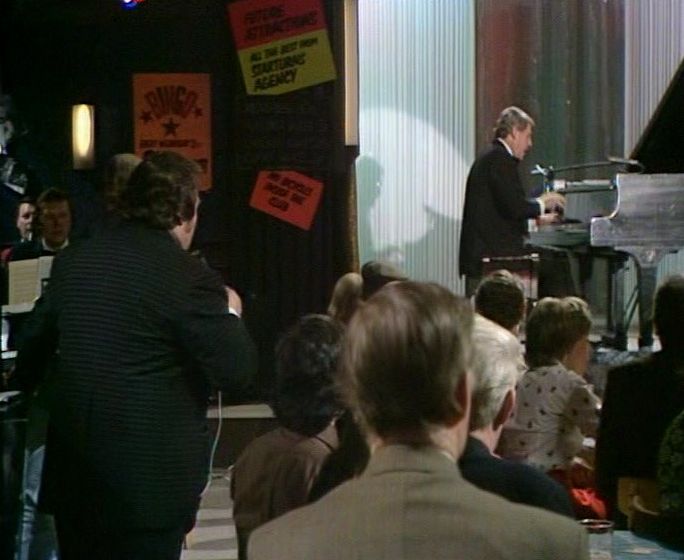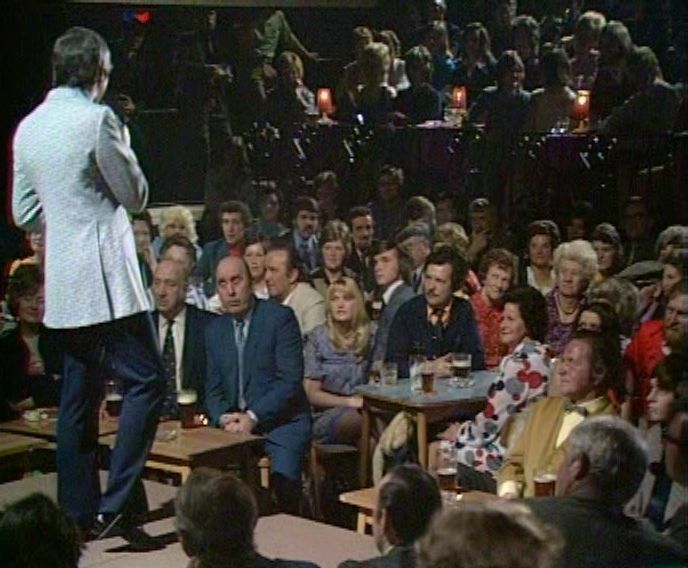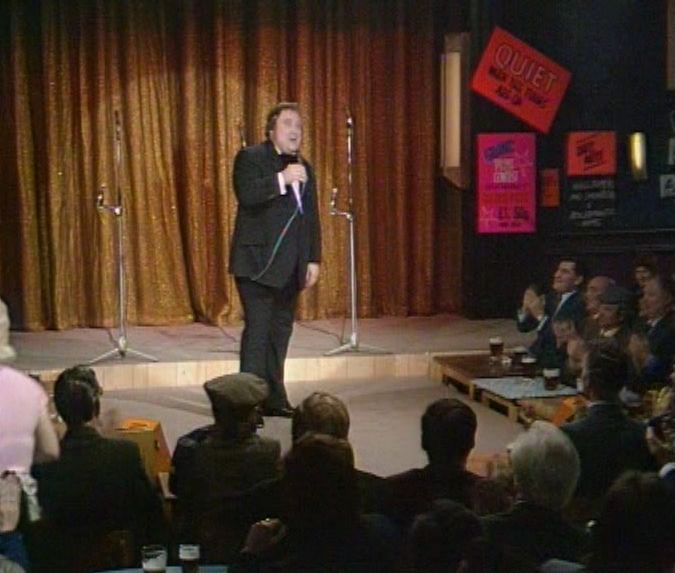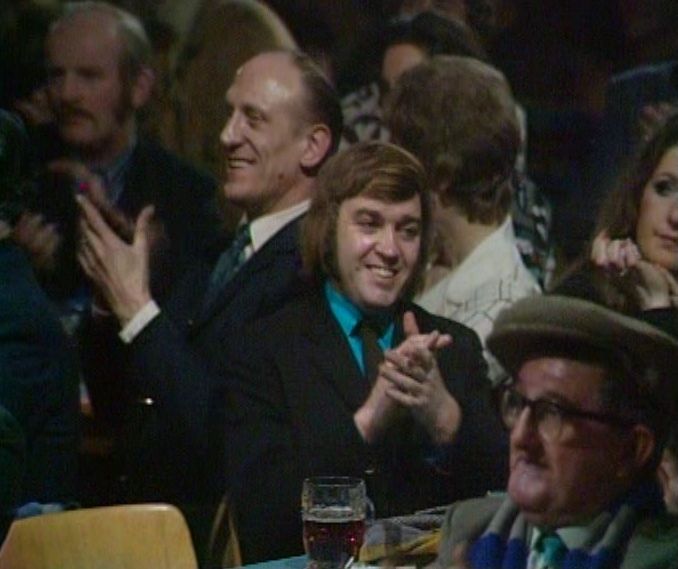
The Wheeltappers and Shunters Social Club – 27th July 1974

wheel s02e01

Tonight’s Turns:

Brotherhood of Man
Franklyn James
P.J. Proby
Los Tres Hermanos
Alex Sisters
Russ Conway

The Brotherhood of Man are simply a vision. Once you’ve finished goggling at their stage clothes then you can appreciate their full-throttled musical attack. They’re definitely not holding back as they rattle through Reach out Your Hand. A storming start to the show.

It seemed to be the law that every impressionist during the 1970’s had to take off Frank Spencer and Franklyn James doesn’t disappoint on that score. But he also mimics both Colin Crompton and Bernard Manning (Bernard seems to enjoy this) which is a nice touch. Some of his other subjects couldn’t really be more seventies if they tried – Peters and Lee, for example – whilst he also tackles some classic Western stars. Just about tolerable.

If there’s one fact that everybody knows about P.J. Proby then it’s that he once split his trousers. No such trouble on that score today as his denim trouser suit looks to be very secure. As with the Brotherhood of Man, his intensity is something to marvel at – although whether he’s being serious or just taking the mickey is a moot point. I’ve a terrible feeling that he’s being dead serious ….

Either way, it’s an unforgettable spot.

There’s no respite in this show. After still reeling from P.J. Proby, Los Tres Hermanos bounce onto the stage. There’s three of them (naturally) and are identically decked out with white trousers, red polka dot shirts and natty little red hats. With such a name, you might expect a traditional Mexican song …. instead they treat us to Tie A Yellow Ribbon. This undemanding singalong fare hits the spot with the audience, who give them the biggest cheer of the night so far.

A female double-act during this era was an unusual sight. I’ve not been able to source a great deal of information about the Alex Sisters – so I don’t know whether the act they perform here (one sings a serious song whilst the other – dressed as Charlie Chaplin – attempts to upstage her) was one they did on a regular basis. “Charlie” is, as you’d expect, silent throughout and manages to milk the audience’s sympathy when she’s ordered off the stage (all together now, “awwwww”).

Top of the bill is Russ Conway. He gives the audience what they want by opening with his biggest hit, Side Saddle (1959). His spot is thoroughly charming and following some of the more wonkier delights on today’s bill, closes the show in style. Unlike some of today’s acts, there’s no shortage of Russ Conway information out there and I recommend this website for all your Conway needs.

The Wheeltappers and Shunters Social Club – 26th May 1974

wheel s01e07

Tonight’s Turns:

Mrs Mills
Dave and Amos
Eve Boswell
The Fivepenny Piece
Peter Wheeler, Schoolmaster
The Leaways
Gene Pitney

Today’s show opens with Mrs Mills in full swing. There are few things finer in life than a good old singalong and Mrs Mills’ jaunty piano playing certainly energises the audience, who whole-heartily join her in familiar old standards such as My Old Man. It’s interesting that her brush with fame only occurred quite late in life (she made her debut television appearance with Billy Cotton, aged 43, in 1961). I now have a faint inclination to track down some of her LPs (most of which had the word “party” in the title) and singles (Mrs Mills’ Minstrel Medley sounds intriguing).

Bernard seems to be enjoying Dave and Amos’ performance, as his hearty chuckles are very audible. Or is he simply amusing himself by disrupting their act? More the latter than the former I think. Dave and Amos might be a double act, but unlike, say, Cannon & Ball they weren’t comprised of a straight man and a comic. Instead, both are somewhat off the wall (for the Wheeltappers environment anyway) and eschew traditional gags for something a little different. It might not quite work, but you have to admire them for taking the risk (although had Bernard kept quiet it might have worked a little better).

Eve Boswell pops up to sing her big hit. Pickin’ a Chicken reached number nine on the hit parade in 1956. No, I’ve never heard of it either but one of the joys of the Wheeltappers series is discovering little nuggets of entertainment history which have previously passed me by. As ever with the show, the audience – especially those in the front row, energetically clapping along – are sometimes as entertaining as the performers on stage.

Lancashire’s finest, The Fivepenny Piece, are up next – although since there are six of them shouldn’t they have been called The Sixpenny Piece? I enjoyed their folksy song I Don’t Know If I Wanna Go Home. They have a rather comprehensive website which lists all of their television appearances. I have to confess that I’d rather like to see some of the series they made in the late seventies – MH and 5p in 1978, where they shared the stage with Mike Harding, or their own four part show the following year. Maybe one day they might surface on DVD – it seems unlikely, but stranger things have been released. Although those who crave some more 5p action should check out the sixth and final series of the Wheeltappers which features them throughout one of the shows.

It’s a laughter-free zone when Peter Wheeler stands up to play a schoolmaster. If you can’t guess some of the punchlines (apologising for the drunkenness in school which turns out to be – wait for it – the teachers not the pupils) then you’ve clearly led a very sheltered life (or not experienced comedy of this type).

The Leaways are a rather good acrobatic act. He’s very tattooed (something which is commonplace now, but would have stood out much more forty years ago) whilst she – as is traditional – wears very little. The accompanying music – Moon River and others – seems a little out of place but it doesn’t detract too much from their feats of balancing – which, given the small stage, was probably a little tricky.

After a brief snatch of 24 Hours from Tulsa (rudely interrupted by Colin Crompton) Gene Pitney launches into a spirited rendition of Princess in Rags. He then closes the show with a song he wrote for Ricky Nelson, Hello Mary Lou. Personally I would have dropped Peter Wheeler so we could have heard all of Tulsa – as always with this era of the show, the turns are very limited for time.

The Wheeltappers and Shunters Social Club – 11th May 1974

wheel s01e05

Tonight’s Turns:

Splinter
Norman Collier
Kathy Kirby
Jackie Allen & Barbara
Victor Burnett & June
Frank Ifield

Splinter are the first act to brave the stage tonight. A five piece (three women, two men) they give the sort of performance which seemed to be tailor-made for clubland. With each member of the group taking turns to trade vocal lines, it’s clearly a song that went down well with the audience – at the end we see a beaming lady of a certain age whilst a cloth-capped gentleman, fag in mouth, also gives them a hearty round of applause.

Norman Collier does his act with the dodgy microphone. Some unkind people might way that was his act, but he has more than one string to his bow. I wonder if his hats routine predated Tommy Cooper’s? But Collier sings as well as changes hats (which is something – possibly mercifully – Tommy never did).

Like a number of other performers, Kathy Kirby’s appearance at the Wheeltappers was an accurate summation of the current state of her career. One of the top female performers of the 1960’s, by the early 1970’s her professional life was stuttering somewhat, which makes it entirely probable that she would have had to ply her trade in venues such as this one. Her various obituaries, which appeared in 2011, filled in some detail about her career freefall.

She belts out a good version of You Won’t Find Another Fool.

Kirby then introduces Here I Go Again as the song she wanted to release as her latest single, but due to record company pressure was prevented from doing so. This might explain why she’s a little emotional at the start, although she rallies as the tempo picks up.

After the emotional drama of Kathy Kirby, Jackie Allen and Barbara offer some light relief on the xylophones. Jackie dishes out some baby xylophones to selected audience members which adds to the hilarity as he attempts to teach them how to play. Interestingly – well I think so – when Jackie began his career he was partnered by his cousin Barbara. But when his wife-to-be, Irene Spencer, took her place, they decided to keep the name “Barbara”. They had a long career, first appearing on the wireless via shows such as Variety Bandbox and Workers’ Playtime which – prior to the dominance of television – united a large part of the nation.

Today’s show must have been underrunning as Bernard is given the opportunity to do a spot of crooning. It’s always a jolt to realise that Bernard Manning could carry a tune very well.

Victor Burnett is an old-style sort of magician. No rabbits alas, but top hats are in evidence. The fact he remains mute means that the illusions have to do the talking for him. There’s nothing staggering to be found here, but I daresay it’s an accurate picture of a typical club magicians act, so it’s of interest from that perspective.

Frank Ifield, like the other headliners from this era, doesn’t have a great deal of time to make an impression, but thanks to an energetic Waltzing Matilda (he’s Australian you know) he manages to engage the audience. I would have liked to hear I Remember You, but you can’t have everything I guess.

The Wheeltappers and Shunters Social Club – 18th May 1974

wheel s01e06

Tonight’s Turns:

Springfield Revival
Cannon and Ball
Julie Rogers
Eric Delaney
Tina Townsley
The Bachelors

The Springfield Revival open the show with a bouncy little number. They’re comprised of two white-suited gentleman strumming guitars and a lady in a blue dress shaking a tambourine for all she’s worth. There’s the odd cutaway shot to the audience who seem a little unenthused (but possibly it was early and the alcohol hadn’t begun to kick in yet). But they do manage to engage the audience in a singalong after their main number which warms them up a bit.

Tommy Cannon is introduced as a solo performer. He’s sporting an impressive brown suit complete with flares and a ruffled shirt. His sartorial eloquence somewhat detracts from his lusty attack on Summertime it has to be said. But Tommy’s moment in the spotlight doesn’t last long as an enthusiastic friend from the audience (Bobby, of course) can’t help but show his appreciation at Tommy’s star quality.

This doesn’t go down well with some members of the audience, who cry out “sit down, you’re spoiling his act”. Did they really not twig that Bobby was the other half of the double act? But it doesn’t take long before Bobby’s cheeky-chappy persona (and no doubt his politically incorrect song about a house full of Pakistanis) has won them round, which enables Bobby to milk the audience’s sympathy after Tommy orders him offstage.

You’d have been hard pushed from this spot to foresee that Cannon and Ball would go on to enjoy such a long run on ITV, but there’s clearly some spark there – even if their Wheeltappers debut is only fitfully amusing.

Julia Rogers, a vision in a sparkly pink dress, has an impressive set of lungs which she uses to belt out a couple of songs. Best known for her 1964 hit The Wedding, she has something of a Shirley Bassey feel. Given this, it’s possibly not surprising that she had a close encounter with the James Bond world – recording a demo of You Only Live Twice (albeit a different song from the one later recorded by Nancy Sinatra).

Upon Eric Delaney’s death in 2011, aged 87, many of his obituaries commented on his energetic stage persona. An inventive drummer – he pioneered the technique of playing the timpani with wire brushes – he’s good value during his short Wheeltappers appearance.

The arrival of Tina Townsley gains some murmurs of approval from the audience. Are they appreciating her baton twirling skills, or is it more to do her brief costume? Hmm, I wonder. She gets the opportunity to prove that she can twirl other things too – such as knives – although the act doesn’t really go anywhere. She appears, twirls some objects and then departs.

The Bachelors run through a medley of some of their greatest hits (Marie, Charmaine, Diane, Whispering). They then spotlight a number of songs which feature the banjo. And why not. By this point some members of the audience are warmed up enough to clap whilst others (such as a gentlemen in the front) contents himself by gently nodding his head from side to side. It’s not exactly a show-stopping finale, but it has a certain charm.

Z Cars – Appearance in Court. 10th July 1962

z cars 01.jpg

Given the episode title, the opening few minutes (which finds PC Lynch in court as a chief prosecution witness) appears to be something of an exercise in misdirection. Lynch (James Ellis) has been called upon to give evidence against a man accused of stealing a bottle of milk – not exactly the crime of the century (nor one that you would assume would be sufficient to maintain fifty minutes of drama).

But in one way it does turn out to have a later significance. The case is quickly proved, with the magistrate (played by John Gabriel) commenting that although Lynch was accused of planting this bottle of milk, he can find no reason why he would have done so. A modern audience might possibly look slightly askance at this seemingly automatic assumption that the police would be incapable of speaking nothing but the whole truth, but they’d be well advised to watch the remainder of John Hopkins’ script before jumping to any conclusions.

The bulk of the story revolves around a series of fairly petty thefts of foodstuffs organised by Trevor Kiernan (Richard Leech). Kiernan runs a small supermarket, frequented by the likes of Fancy Smith (Brian Blessed), and has taken to pilfering from his competitors in order to increase his profit margins.

But the dogged Detective Inspector Dunn (Dudley Foster) is on his case. Foster didn’t appear in that many episodes of Z Cars, which is a slight shame as Dunn’s incredibly phlegmatic and passionless officer is quite compelling. It’s plain though that he’s never going to be the sort of person to make many friends (at one point he tells a weary Lynch to grab some sleep before returning to duty but – as Lynch says – always manages to make a friendly remark sound like an insult).

Fancy and Jock Weir (Joe Brady) seem to have created a watertight case against Kiernan (thanks to a marked box) but this all comes to naught after they’re both destroyed in the witness box by Kiernan’s smooth-talking barrister, Garston (Jerome Willis).

This last ten minutes or so is easily the most compelling section of the episode. Willis’ character is able to effortlessly run rings around both Fancy and Jock, casting just enough doubt on their evidence without ever stepping over the boundary to accuse them of outright corruption. Thanks to this, he’s able to secure an acquittal for his client. Therefore the same magistrate who earlier found in favour of the police – Lynch – now finds against them.

Dunn’s reaction to the hapless Fancy and Jock afterwards is interesting. You might have expected him to be more than a little ticked off, but instead he’s fairly sanguine about the whole affair. No, they didn’t gain a conviction, but he’s convinced that Kiernan would have found the whole trial and subsequent publicity to be so off-putting that from now on he’ll stick to the straight and narrow. Other, later, police shows might regard the conviction as the be all and end all – but for this era of Z Cars that’s not the case.

Brief appearances by Barlow and Watt help to enhance a fairly routine instalment, although Jerome Willis’ appearance (and the always solid performances from the regulars) helps to keep the interest ticking along.

z cars 02

Doctor Who – Marco Polo. Episode Seven – Assassin at Peking

assassin

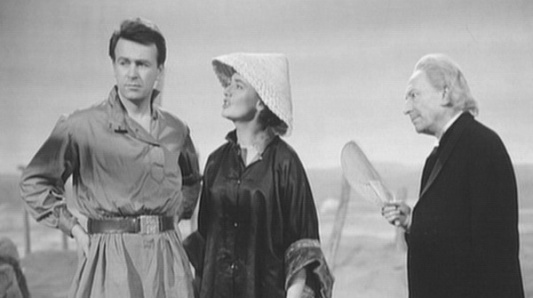
We left the previous episode with Tegana seemingly triumphant. But, alas, it’s “curses, foiled again” as the Khan’s emissary, Ling-Tau, turns up just as his moment of victory beckons. Considering that the TARDIS had been taken off the main road it’s never explained what Ling-Tau and his men are doing there – we just have to accept that Tegana is a singularly unlucky War Lord.

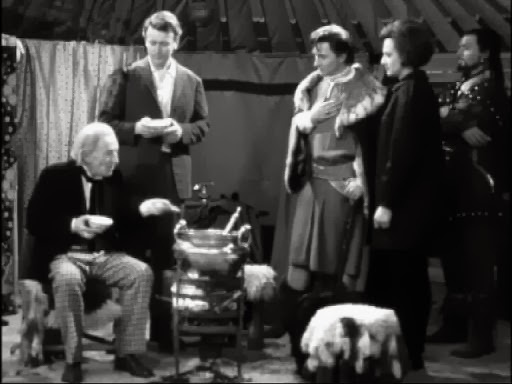
The Doctor and the Khan have been playing backgammon –

KHAN: What do we owe?
DOCTOR: Er, thirty-five elephants with ceremonial bridles, trappings, brocades and pavilions. Four thousand white stallions, and twenty-five tigers.
KHAN: That’s not too bad, so far.
DOCTOR: And the sacred tooth of Buddha which Polo brought over from India.
KHAN: Oh, that? What else? What more?
DOCTOR: I’m very much afraid all the commerce from Burma for one year, sire.

This is lovely. Hartnell’s not really had the chance to play many comic scenes up to this point, so there’s the sense (even though we can’t see him) that he’s relishing this opportunity. There’s no doubt that later comic stories (like The Romans, The Myth Makers and The Gunfighters) really plays to his strengths. The Khan’s desire to prevent his wife (played by Clare Davenport) from learning that he’s been gambling is another nice touch. The Empress, although she has very few lines, certainly seems to be an imposing presence.

The Doctor’s skill at backgammon is another new fact we learn about him (he must be good, since it seems the Khan rarely loses). When the Doctor suggests one more game – with the prize being the TARDIS, the Khan reluctantly agrees. It seems clear that, given all he’s already won, it’s a foregone conclusion. Alas, the Doctor may be good, but he’s not unbeatable, and the Khan wins the game – meaning that the TARDIS seems lost forever.

It’s around now that Marco suddenly has a change of heart and decides that it was wrong of him to take the TARDIS. Since it’s already the Khan’s property it’s a pity he couldn’t have had this crisis of confidence beforehand!

Another plot-thread neatly tied up relates to Ping-Cho’s marriage. She’s informed by the Khan that “your beloved husband-to-be, so anxious to be worthy of your love, drank a potion of quicksilver and sulphur, the elixir of life and eternal youth, and expired.” Another delightful comic moment, delivered deadpan by Martin Miller.

This just leaves Tegana to be dealt with. The Doctor realises, rather belatedly, that his meeting with the Khan is for one reason only. “Kill the leader, and where are you? What happens? The whole army dissipates itself into chaos and utter confusion. It’s happened throughout your history time and time again!” If Tegana kills the Khan, then Noghai seems certain to succeed.

You do have to suspend disbelief a little that the Khan would meet Tegana without armed guards (only the poor Vizier seems to have been present – he sacrifices his life to prevent Tegana’s first attack). The lack of visuals means that it’s impossible to judge how effective the swordfight between Tegana and Marco was. But it was choreographed by Derek Ware, a key stunt-arranger during Doctor Who‘s first decade, so that’s a sign of quality. I’d also be fascinated to know just how graphic the moment was when the defeated Tegana committed suicide by throwing himself on a sword. Maybe one day the story will come back and we’ll find out ….

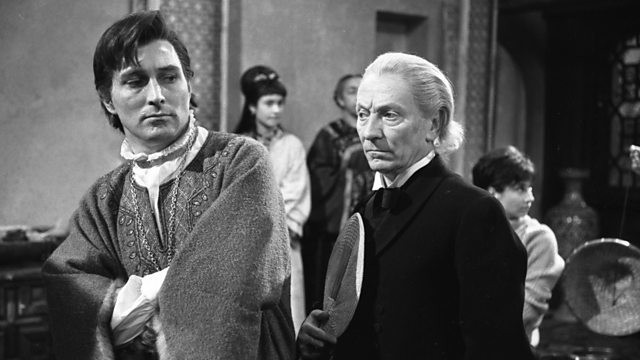
After all his intransigence during the story, it’s Marco who hands the key of the TARDIS back. The Khan, witnessing the departure of the ship, doesn’t seem particularly put-out that Marco’s just given away his flying caravan – although we never discover exactly what Marco’s fate will be. It could be that this action means he’ll never see his home again – but he obviously decided that the needs of the Doctor and his friends were more important than his own goals. Mark Eden was a solid presence throughout all the seven episodes. Although Marco was, at times, fairly unlikeable, Eden still managed to give him a sense of honour and nobility. And this final sacrifice speaks volumes about his character.

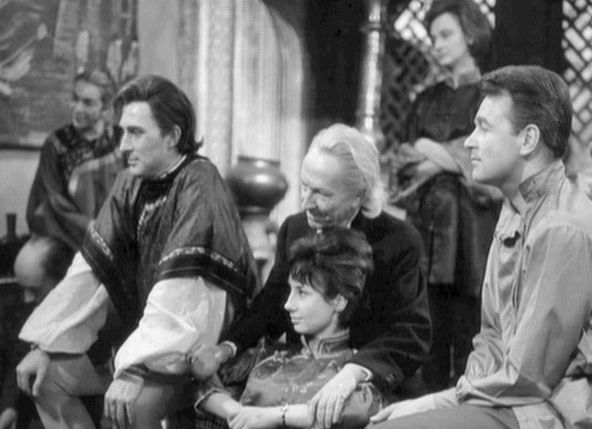
Even with just the soundtrack and a generous selection of photographs, this is a highly entertaining story. Yes, the fact that Tegana’s plans to kill Marco and steal the TARDIS are constantly scuppered do get a little annoying, but the scope of the journey allows all the cast plenty of time for character development. With just seven main characters (the four regulars, plus Marco, Tegana and Ping-Cho) and seven episodes to play with, there’s ample time to breathe and reflect.

Will the next story be of a similar standard, I wonder?

Doctor Who – Marco Polo. Episode Six – Mighty Kublai Khan

khan.jpg

Ian pleads with Tegana. “Let us all go, I appeal to you. What possible difference could it make to you? You hate Marco.” This is another indication that the emphasis in these early stories is very much centered around the TARDIS crew as they seem to care little about what Tegana might do to Marco and Ping-Cho once they leave. This is a hallmark of the early historical stories script-edited by David Whitaker (and is also a feature of his own serial The Crusade).

At times during these early historical stories (especially in Lucarotti’s next script, The Aztecs) the Doctor is a very passive character who is unwilling to get involved in local difficulties. This is possibly not because he shouldn’t, but because he can’t (the famous line in The Aztecs – “you can’t rewrite history, not one line!” – is something we’ll touch upon when we reach that story). Here, it might be more disinterest than a fear that he’ll somehow damage the delicate thread of space-time history.

Ian protects Ping-Cho by telling Marco that he stole the TARDIS key. We then have another scene where Ian pleads with Marco to hand back the TARDIS – and this time Ian tells him the truth (that the TARDIS can fly through time and space). Marco responds that he’s heard of many strange things, including a stone that burns (coal). “In Cathay, we call it the burning stone. And if a stone burns, why not a caravan that flies? Birds fly. I have even seen fish that fly. You are asking me to believe that your caravan can defy the passage of the sun? Move not merely from one place to another, but from today into tomorrow, today into yesterday? No, Ian. That I cannot accept.”

Although he can believe in a burning stone, a flying caravan and even flying fish, it seems that the concept of time-travel is a step too far. Marco then tells Ian that he knows he didn’t take the key and he only said it to shield Ping-Cho. It’s a clever piece of scripting as it demonstrates to Marco that Ian is capable of lying, which means that he can’t believe his tales of time-travel. If he did, then he would have handed the TARDIS key over (although given all he’s done so far, that seems a little improbable).

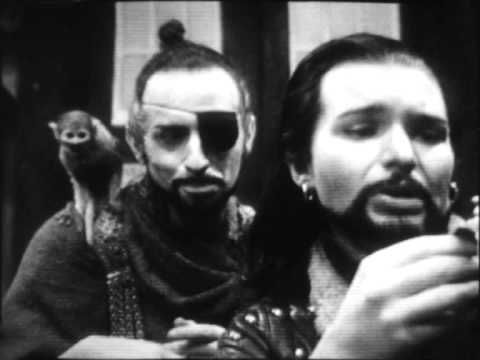
Ping-Cho, unwilling to marry a man old enough to be her grandfather, runs away – back to the Cheng-Ting Way Station. It’s a slight plot contrivance that of all the people she could meet, it’s Kuiju (the man commissioned by Tegana to steal the TARDIS). You’d have thought that the eyepatch and the monkey would have been strong indications that he was a wrong-‘un, but Ping-Cho, innocent girl that she is, mistakenly believes he’s an honest man and hands over all her money to pay for her passage back home.

That she should be robbed by the man who’s stolen the TARDIS is a bit of a coincidence – especially since it doesn’t really impact the plot. Ian has received Marco’s blessing to search for Ping-Cho and once he finds her and discovers that the TARDIS has been stolen the pair of them set off to find it.

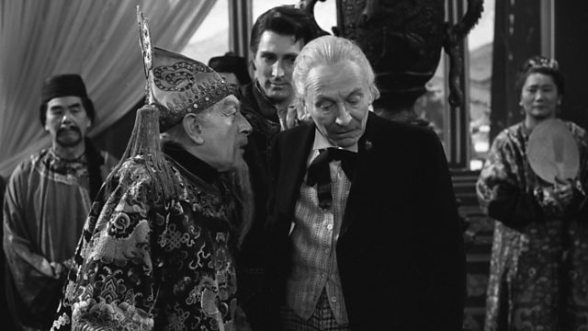
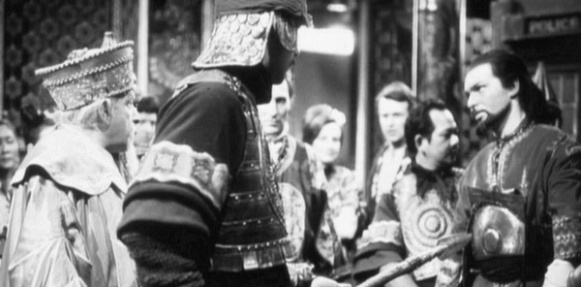
The others finally get to meet the mighty Khan, who certainly receives an impressive buildup –

Silence! Those who dare to come before the sight of the great Kublai Khan, kow-tow. Kow-tow before the War Lord of War Lords. Mighty and fearful in his strength. Kow-tow before the Ruler of Asia, India, Cathay and other territories. Kow-tow before the Master of the World.

The eventual reveal that Kublai Khan (Martin Miller) is a little old man suffering from gout is amusing – but Marco is quick to tell the others that whilst the Khan is not the mightiest War Lord ever, he’s definitely a skilled administrator. And its his organisational skill, rather than his military might, that has seen his Empire grow – so it would be wise not to underestimate him.

His meeting with the Doctor has a nice touch of comedy – with both men suffering numerous aches and pains, plus the Doctor demonstrating his singular lack of respect for authority (a trait we’ll see time and time again over the years). The Khan, rather than expressing annoyance at the Doctor’s testiness, instead embraces him as a brother. Slightly implausible maybe, but it sets us up nicely for their interaction in the next episode.

Ian and Ping-Cho have found Kuiju and the TARDIS, but so has Tegana (who was given leave by Marco to track Ian down). At last it seems that Tegana has the upper hand – he can take the Doctor’s caravan and then dispatch Ian and Ping-Cho. What could possibly go wrong?

Doctor Who – Marco Polo. Episode Five – Rider from Shang-Tu

rider

The murder of the guard causes the four time-travellers to momentarily stop and reflect. It’s fascinating (and slightly disconcerting) that the Doctor asks Ian quite seriously whether he killed him – if Ian said he had it’s probable that the Doctor wouldn’t have been terribly put out. Another interesting character wrinkle is that although the camp seems to be under attack, the Doctor is still keen to escape (clearly the fates of Marco and Ping-Cho are of little interest to him).

Tegana’s appearance puts paid to their plans, so Ian decides to wake Marco and warn him. I’ve previously touched upon how Tegana’s numerous attempts to kill Marco end up being scuppered (sometimes in a slightly contrived way) and this sequence is one of the less convincing ones. Acromat (Philip Voss) and the other Mongols are waiting for Tegana’s signal to attack. After Ian’s warning, Marco asks Tegana to rouse the guard – but why didn’t he tackle Marco in single combat there and then? It’s difficult to believe that Tegana seriously considered the TARDIS crew to be a threat to his ambitions.

Instead, he obeys Marco and the small group organise themselves into a fighting force. Marco gives the Doctor a sword, commenting that “if you’re half as aggressive with this as you are with your tongue, Doctor, we can’t lose.” Although the Doctor is sometimes painted as a pacifist who abhors weapons of any type, that’s not really borne out by the evidence of the series – although it’s still unusual to seem him bear arms quite so keenly. The loss of the episode means that we’ve no way of telling how active he was in the brief skirmish – however, just before the fighting begins he delightfully tells Marco that “we’re not going to get very far with this overgrown bread knife!” which indicates he was keen for a scrap!

Eventually Acromat and the others grow tired of waiting for Tegana’s signal and attack anyway. This presented Tegana with another golden opportunity to kill Marco (as the Mongols were keeping the others busy). Instead, he kills Acromat before he had a chance to reveal his connection to Tegana. Again, it’s another moment that feels a little false – just how many chances does Tegana need?

The arrival of the caravans at the Cheng-Ting Way Station introduces us to Wang-Lo (Gábor Baraker). From the soundtrack and the photographs it sounds like a larger-than-life performance, this is another of those times when I’d love to see the visuals in order to complete the picture. Also lurking about is Kuiju (Tutte Lemkow). Lemkow had a lengthy career (popping up in films like Raiders of the Lost Ark) and an interesting private life (at one time he was married to Mai Zetterling). Lemkow’s Doctor Who career is rather unlucky – he appeared in three different stories (but all his episodes no longer exist). It seems that anything with an appearance by Tutte Lemkow was earmarked for destruction …

When Ping-Cho realises that Susan will never see her home again without the TARDIS, she takes the key from Marco’s room. This is when the never-ending feel of the early seasons works well – back then, unless you had a copy of next week’s Radio Times it wouldn’t always be obvious whether a story was concluding or not. But this one now seems to have run its course, as the Doctor, Ian and Barbara are all in the TARDIS – but somewhat belatedly they realise that Susan isn’t there.

She’s gone back to say goodbye to Ping-Cho, something which the Doctor finds inexplicable. Despite the months they’ve been journeying together, he’s clearly failed to notice the growing friendship between his granddaughter and Ping-Cho. It’s another character moment which highlights that recently the Doctor has been, at best, totally absorbed with repairing the TARDIS and, at worst, totally self-centered. His irritation with Susan sees him utter an oath (“Great Olympus”!) which is a little unusual.

No real surprise that the Doctor’s plan of escape is scuppered again – this time it’s because Tegana has caught Susan …..

Doctor Who – Marco Polo. Episode Four – The Wall of Lies

lies

Barbara is rescued from the clutches of the Mongols after Ian realises that Susan was right – the eyes in the cave did move (behind the wall was a secret room where Barbara was being held). Once again, the Doctor is shown not to posses all the answers – he was dismissive of Susan’s claim, seemingly treating it as nothing more than a hysterical outburst – so it fell to Ian and Marco to put two and two together.

Tegana continues to chip away at Marco’s trust in the Doctor and his friends. “Only a fool defends his enemies. Be warned, Marco. They will set us at each others throats by lies and deceit, and then, when they have divided us, then they will destroy us one by one.”

Barbara insists that she followed Tegana to the cave – something he strongly denies. As Marco tells Ian. “Tegana is a special emissary of Noghai, on his way to talk peace with Kublai Khan. He’s a very important man. You are mysterious travellers from some far off land I know nothing about. Now, if you were in my position, a servant of Kublai Khan, whose word would you take?”

A slight weakness of the story is that since Tegana has been presented as such a powerful presence it slightly diminishes him every time his plans to kill Marco and the others are scuppered. But there’s a sense in this episode that we’re now entering the endgame. I particularly like the way he displays his true feeling for Marco (telling his associate Acromat that Marco should be killed like an old woman in her bed). And the Doctor’s death holds no fear for him, a stake through the heart should deal with the magician.

The relationship between Marco and the others comes to a head when he realises that the Doctor has been working on the TARDIS in secret.

POLO: I’m sorry I doubted your word, Tegana. Give me the key, Doctor.
DOCTOR: No.
POLO: You’re an old man and I do not wish to use force.
DOCTOR: That is what you’ll precisely have to do, Polo.
(Tegana wrenches the key from the Doctor)
TEGANA: Did I not say he had another key?
DOCTOR: Put that key in the lock, Polo, and you will destroy the ship. Then where will your precious Khan be, hmmm? You need more than a key to enter my ship. You need knowledge. Knowledge you will never possess.
POLO: Tell me.
DOCTOR: No, understand? No! I’d let you wreck it first!

This results in the Doctor and the others being kept as virtual prisoners. Ian chafes against this and decides that they need to take action. They resolve to capture Marco and force him to hand over the TARDIS key. The Doctor’s statement that “I think by the time I’ve finished with that gentleman, he’ll only be too glad to let us go” is intriguing. Exactly what does the Doctor plan to do to?

Sadly, we never learn what the Doctor’s special brand of persuasion might be, as Ian discovers that the guard outside is dead. With Marco’s encampment under attack they have the perfect cover to escape, but can they really just cut and run?

Doctor Who – Marco Polo. Episode Three – Five Hundred Eyes

five.jpg

With Marco and the others lacking enough water to make the journey to the oasis, it falls to the Doctor to save the day. He notices that moisture has formed on the inside of the TARDIS overnight and saves every last drop. We then have another quick science lesson as the concept is explained to Marco (and the viewers at home).

IAN: Marco, you remember, last night it was cold. Bitterly cold, Marco. The outside of the caravan cooled, but the inside stayed warm, and so moisture formed on the inside. It’s condensation, we just call it that. It’s just a name.
SUSAN: That’s true, Messer Marco. It was running down the walls, and from the ceiling. We, we took it in this, look, we squeezed it in here. You see?

These precious drops of water are enough to aid their journey to the oasis, where they find Tegana. He tells them he was unable to travel back with water as the oasis was surrounded by bandits during the night. As so often in the early stories it’s not the Doctor who exposes the fallacies in his statement (if bandits were there, why didn’t they light a fire since it was a cold night?) but one of the others – in this case Barbara. Her suspicions against Tegana only harden as the episode continues, culminating in her capture when she ventures into the Cave of Five Hundred Eyes.

One noteworthy aspect of these early scenes is that Tristram Cary’s music has an electronic feel (similar to his score for The Daleks). This fits the mood well as Marco and the others face death under the unforgiving sun. Once they are rescued, it changes back to traditional instruments (as it is for the majority of the story). It’s a pity that Marco Polo is the only of his Doctor Who scores not to exist, although we should be grateful that his other music does.

Having reached the Tun-Huang Way Station, Marco mentions the nearby Cave of Five Hundred Eyes, a place once frequented by the Hashashins. Although Ping-Cho has never heard of the cave, she does know a story about Hulagu and the Hashashins and promises to tell it to them later. This is an extraordinary sequence – the story stops for several minutes for a spot of local colour. Like the chat about condensation, it’s probable to view its insertion as another educational box-ticking exercise. But it’s charmingly performed by Zienia Merton, who delivers the lengthy monologue with aplomb. It’s easy to imagine that the air would have turned blue had it been given to William Hartnell!

Gracious maidens, gentle lords, pray attend me while I tell my tale of Alaeddin, the Old Man of the Mountains, who by devious schemes, evil designs and foul murders ruled the land.

No host of arms, no vast array of banners served this wicked lord. They were but few, ruthless, reckless men who obeyed his cruel commands.

Thus did he persuade them. Promising paradise, he gave his followers a potent draught and whilst they slept transported them to a vale where streams of milk and honey, wine and water, flowed.

Here were gardens and flowers of every hue and essence. Here, too Golden pavilions outshone the sun and even the stars of heaven envied the bejewelled interiors strewn with incomparable silks, tapestries, and treasures.

Hand-maidens, dulcet-voiced, soft of face, attended them, and thus bemused did they dwell in this man-made paradise until Alaeddin intent upon some evil deed, proffered again the hashish draught and brought them sleeping to his castle.

“What lord, are we cast out of paradise?” awakening, they cried.

“Not so. Go abroad, seek out my enemies and strike them down. But care not for your lives. Paradise is eternal.”

So terror stalked the land for many years. Then one day, came mighty Hulagu to stand before Alaeddin’s lair for three long years in siege. Thus fell Alaeddin and his men.

Now honest hands reap harvests of life from the soil where death and evil reigned. And those who journey through the vale are heard to say ’tis truly paradise today.

When Barbara notices Tegana leave the room after Ping-Cho’s tale, she follows him as he heads up to the Cave of Five Hundred Eyes. She doesn’t hear Tegana plot Marco’s destruction and the theft of the TARDIS, but finds herself captured by a group of Mongols who hold her in the cave whilst they play dice. In the next episode she tells Ian that they were playing dice to decide which of them would kill her, but it’s no stretch to imagine that they were also keeping her alive so that they could take turns to rape her. Otherwise it would have made more sense to quickly kill her and leave. Barbara becomes the object of male interest several times – in the very next story The Keys of Marinus and also during season two. Sometimes played for comic effect (The Romans) and other times played dead straight (The Crusade).

An intriguing part of the episode revolves around Tegana’s attempts to sow discord between Marco and the TARDIS crew. Why is Tegana doing this? He clearly doesn’t have Marco’s interests at heart, since he plans to kill him very soon, so is it possible that he fears the Doctor’s magic? Or it could be that he simply enjoys stirring up trouble amongst his enemies?

Doctor Who – Marco Polo. Episode Two – The Singing Sands

singing.jpg

Ian and Marco enjoy a game of chess. Tegana is a keen student of the game, as he explains –

TEGANA: I find it a fascinating game of strategy of war. Two equally balanced armies deployed upon a field of battle, and each commander determined to be the one who cries shah mat.
IAN: Shah mat? Check mate?
TEGANA: It means the king is dead.

It’s a lovely character beat that illuminates his personality a little more. Indeed, since the level of threat in this episode is fairly low (apart from the Singing Sands) several other characters also benefit from Lucorotti’s dialogue. Susan is one, as she poetically tells Barbara that “one day we’ll know all the mysteries of the skies, and we’ll stop our wandering.” Although it’s rather strange that he also elected to put various 1960’s slang words (“I dig it”, “crazy”) into her mouth since she didn’t adopt this mode of speech in any other story.

The Doctor is absent until the end of the episode – either this was a last minute rewrite to cover a bout of ill-health from Hartnell or it was just decided to give him an easy week – but the rest of the cast are so strong that he’s not really missed.

Susan and Ping-Cho’s adventure, adrift in the Singing Sands, is one of the most intriguing parts of the episode. Just how good did it look? We’ll never know the answer, unless the story ever turns up, but it certainly sounds impressive.

In terms of creating dramatic tension it’s a bit of a damp squib though – Barbara is hysterical with the thought that the girls are out in the desert unprotected, but then they turn up unharmed shortly afterwards.

Last time Tegana had a very decent scheme – poison the water gourds and then return to Lop. But for some unknown reason he’s changed his mind and elects to slash all but one of the water gourds and wait for the others to die from lack of water. Was this change of plan down to the misadventures in the Singing Sands? Afterwards, Marco tightened security and that might explain why Tegana decided he wasn’t able to leave the camp. Although it’s difficult to believe that he couldn’t have snuck away if he really wanted to.

With only a small amount of water left, they have to strictly ration it as they make their way to the nearest oasis. Will they get there in time? Mmm, I think it’s possible they just might.

Doctor Who – Marco Polo. Episode One – The Roof of the World

roof.jpg

With Marco Polo we’ve reached the first of the missing stories, although back in 2013 it seemed very possible that it had been recovered and we’d be enjoying it on DVD within a matter of months. The MEW rumour had been bouncing around various Doctor Who forums for a while (basically stating that three stories – Marco Polo, Enemy of the World & Web of Fear had been found). And when all of Enemy and most of Web did resurface shortly afterwards you could have laid a guinea to a gooseberry that Marco wouldn’t be far behind them.

Four and a bit years later there’s still no sign of it, so it seems that this rumour was only 66% right (although there are still some who cling to the belief that Marco Polo is out there somewhere). I’ve love to think that it was and that some day I’d be able to watch it on DVD (no download for me, thank you!) but if it isn’t, and no other missing episodes are ever found, then we should really just count our blessings.

All ninety seven missing episodes exist as good quality audio recordings (which have been further improved by the work of Mark Ayres during the last decade or so). We may sometimes take the audios for granted, and grumble about how annoying it is that we can’t see the pictures, but it’s worth taking a moment to stop and consider how some other popular series of the time have fared.

There’s reputed to be one poor quality audio of an Avengers episode existing in private hands, some muffled audios of Public Eye exist (several found their way onto the early DVD releases) whilst a handful of audios from Out of the Unknown were made (and are included on the BFI’s DVD release. Not bought it yet? You really should, it’s an excellent package! If you need further convincing I’ve written about it at length here).

These fairly slim pickings demonstrate just how fortunate Doctor Who is. This is particularly noteworthy when it comes to Marco Polo. The show had only been running for three months, so it’s a little surprising (but very welcome) that there were people who even this early on were dedicated enough to record every episode.

Although The Roof of the World is generally held to be the point where the Doctor starts to act more like the Doctor we come to know, he’s still remarkably bad-tempered at the start. This may be because he’s concerned for their safety (the TARDIS has broken down in the Alps and with no heat their prospect of survival looks slim) but he’s still incredibly dismissive when Ian offers to look for fuel. “Oh well, I wish you luck.”

The telesnaps offer us an insight into how these early scenes look. It’s no surprise that the Roof of the World looks rather stagey and there also appears to be a wrinkled backdrop behind the time-travellers (always a hazzard in these early stories – see The Aztecs for another example). The subtle wind effect helps to sell the illusion of cold though.

Our heroes run into the warlord Tegana (Derren Nesbitt). From his first words his character is made clear. “Hear me, Mongols. In these parts live evil spirits, who take our likeness to deceive us and then lead us to our deaths. Let us therefore destroy these evil spirits before they destroy us.” Whilst we can’t see him, it seems clear that Nesbitt relishes the dialogue he’s been given and he’s wonderfully entertaining throughout the story.

Their execution is stopped by Marco Polo (Mark Eden). If Tegana is presented as superstitious and menacing then Marco appears to be enlightened and affable. But both have their own agendas and Marco, whilst he’s friendly, quickly demonstrates that he’s equally as ruthless as Tegana. He appropriates the TARDIS and tells the Doctor that he wishes to present it to Kublai Khan as a gift – he then hopes that the Khan will then grant him leave to travel home to Venice.

This is the plot device that ensures that the Doctor remains – otherwise he would have left at the first available opportunity. Variations to make the TARDIS inaccessible are used throughout the first season (the missing fluid link in The Daleks, a forcefield in The Keys of Marinus, etc) as the Doctor is not yet written as a character who’ll stay and help people simply because it’s the right thing to do.

There are a few examples of Doctor Who‘s early educational remit. Early on, Susan finds a giant footprint – although Ian ponders that it may be just a normal sized print which looks bigger because the snow around it has melted. And later on, the science teacher in him can’t help but give Marco a quick lesson.

POLO: I’m afraid the liquid is not too warm, but the cold here is so intense, it even robs a flame of its heat.
IAN: The cold can’t affect the heat of the flame, sir. The liquid boils at a lower temperature, because there’s so little air up here.
POLO: You mean the air is responsible?
IAN: Well, the lack of it. Just as the lack of it is responsible for the Doctor’s mountain sickness.

Susan makes friends with Ping-Cho (Zienia Merton). Having someone in the cast around Susan’s age allows her to have some decent character moments and she opens up to Ping-Cho in a way we haven’t seen before.

Grange Hill. Series Eleven – Episode Twenty

gh s11e20-01.jpg

Written by Margaret Simpson. Tx 11th March 1988

Director Robert Gabriel opens this episode with an unusual shot choice. Matthew and his mother have a conversation in her car (about the upcoming custody battle) which is mainly framed in the rear-view mirror. The focus then shifts mid scene to observe what’s happening on the street before regaining focus on Matthew.

The last day of term inevitably means that people can let their hair down and so it’s in this spirit that Mr Bronson speaks to Mrs McClusky about Danny Kendall and hip-hop. The way that Mr Bronson enunciates the words “hip-hop” suggests that he’s only just learnt them.

Since Robbie, Ziggy and the others gained revenge over Mauler and his gang last time, it now means that Mauler is after counter revenge. Clearly this is the storyline that just keeps on giving. Cue yet another “comedy” chase. It’s Ziggy’s last day at Grange Hill. Although since he returns next year, this is actually bit of cheat. Although maybe the original plan was to write him out at this point?

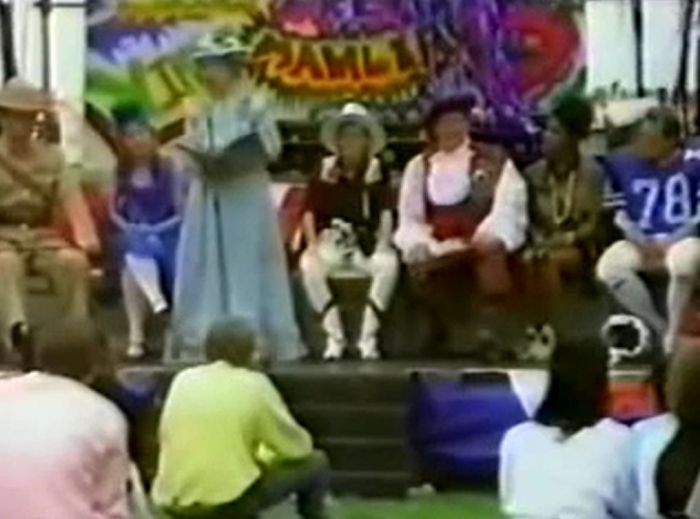
The teachers play dress up again. Mrs McClusky takes her Little Bo Peep costume out of mothballs whilst Mr Bronson and Mr Griffiths are dressed as a couple of colonials, complete with pith helmets. Laura’s rather mortified that her mother has decided to go for the full cheerleader look.

The dramatic heart of the episode is provided by Mrs Pearson’s revelation that whilst she’s gained temporary custody of Matthew, her husband can still see him at the weekends provided a third party is present. This stipulation has upset him greatly and it raises the possibility that he may attempt to snatch Matthew from school. This is a plotline which we’ll have to wait and see whether it’s developed next year.

That we never actually saw the custody proceedings (Mrs Pearson later told Mrs Reagan what occurred) clearly helped to save a little money (no need to deck out a court with extras) but it does slightly diminish the drama of the story.

Overall, series eleven was an improvement on series ten although it still had its share of Harriet moments (Mauler McCaul was an especial lowlight). At this point in time, Grange Hill is, for me, caught in a transitional period – it would gain a new lease of life from the mid nineties up until the point when it upped sticks and moved to Liverpool, but that’s still a few years away. So at present, the series is slightly misfiring. There’s enough happening to still engage, but you have to be prepared to take the good with the bad.

gh s11e20-02

Grange Hill. Series Eleven – Episode Nineteen

gh s11e19.jpg

Written by Margaret Simpson. Tx 8th March 1988

The episode begins with Ronnie and her parents at the police station, all anxiously waiting to hear what her fate will be. It’s the first time we’ve seen Mr Birtles (and he only appears once more, during series twelve). He’s played by Geoffrey Beevers, which helps to gladden my heart. Beevers is one of those actors who – although never the star – enriches any production he appears in. His credits are far too numerous to mention, but it’s a fair bet that if you’re watching a British television serial or series from the seventies onwards, he may very well pop up at some point.

The bleak institutional nature of the station helps to create a sense of tension. Director John Smith chooses to raise the camera high during the scene when Ronnie and her parents are walking down the corridor for their meeting. It’s an interesting move by Smith, who also directed the previous episode (there, he kept the camera low at the moment just before Helen and the others discovered what punishment they would receive). This birds eye view works just as well though – especially since Ronnie is positioned at the rear of the set and therefore seems somewhat diminished in size. Even the friendly smile of the policewoman escorting them can’t remove the faint feeling of dread.

Another very familiar actor – Ken Sharrock – plays the Inspector. The Inspector is remorseless in driving home to Ronnie just what a terrible crime pinching a jumper from Miss Selfridge is. He may be laying it on a bit thick, but the moral tone of this scene was obviously designed to operate as a PIF for those watching at home. If you stray from the straight and narrow then you too might find yourself at the police station, being lectured by a stern policeman.

The only odd thing about this plotline is that it sits alongside Tegs’ misadventures this year. Here, it’s hammered home that any crime is serious (after much deliberation, Ronnie is issued with a caution) whilst elsewhere we saw that Tegs regarded petty villainy as a perfectly normal part of life. Maybe this juxtaposition was intentional, but if so then it doesn’t quite work for me.

After Ronnie returns home (having faced the wrath of her father – he’s painted as a slightly ineffectual character, which means that possibly his only release is via angry outbursts) we then see a very unusual camera shot as Ronnie talks to Gonch on the phone. It’s a split screen effect, although since there’s not an actual split on the screen Gonch appears to be hovering in a ghost like fashion above her ….

Whilst some of the storylines this year (Mauler McCaul and the Grid Iron Crew, the interminable saga of the kit hire business) have been less than enthralling, Ronnie’s travails have been by far the most engaging. Tina Mahon took the material she was given and ran with it (a pity that post GH she appears, apart from a few credits, to have dropped out of acting).

The moral tone of the episode continues when we see Helen lectured by a doctor about the hazards of tattoos – specifically the danger of dirty and infected needles. Helen’s complete and utter revulsion about her tattoo (she’s distraught when she learns that laser removal is impossible and that a skin graft would leave a noticeable scar) is one of those moments which would probably puzzle a modern audience. Would the children of 1988 have shared Helen’s disgust?

Calley continues to obsess about her brace. And her obsession is now so severe that it causes her to completely forget that her best friend Ronnie had faced her day of destiny at the police station. Some friend. If Ronnie’s been gifted with a good storyline this year, then Calley hasn’t been so fortunate.

Will Grange Hill beat St Joes in the semi final? Hmm, not really bothered. The highlight of this scene is the three way conversation between Mr Bronson (who demonstrates a firm grasp of football tactics), Mr Griffiths (who reminisces about the time England won the World Cup as well as the Chinese meal he enjoyed with his good lady wife afterwards) and Mr Robson, who’s caught in the middle. Lovely stuff.

There’s a very rare mention of teacher’s strikes in the aftermath of GH’s semi final defeat (awww). Freddie is convinced that Mr Robson’s non-competitive system had torpedoed their chances of retaining the cup, although one of his teammates mentions that the numerous strikes (all of which have happened off screen) didn’t help. Freddie continues to chunter away – not even Louise’s comment that to be a good sport you have to be gracious in defeat seems to penetrate his ultra-competitive shell. I can’t confess to being too sorry that he’ll disappear after the next episode.

The on-going saga of Mauler’s comeuppance makes an unwelcome return here. This involves Robbie filling up a bin with water (which he naturally manages to mostly spill over himself). Ziggy and Robbie do manager to deliver this watery treat effectively though – which is the cue for yet more terrible overacting from Mauler and his crew.

Gonch and Ronnie arrange a blind date between Robbie and Calley, but they leave it to Trev to speak to Robbie. And of course, he tells Vince instead. The sight of Vince in his best suit with a bunch of wilted flowers attempting to woo a clearly unimpressed Calley is nicely done. But she’s kind-hearted enough not to bolt at the first opportunity, and so the pair set off for the cinema ….

Grange Hill. Series Eleven – Episode Eighteen

gh s11e18-01

Written by Barry Purchese. Tx 4th March 1988

Mrs McClusky and Mrs Reagan have an early morning meeting with Mrs Pearson and Matthew’s social worker Mr Devenish (John Bowler) which serves as the signal that this storyline is drawing to a conclusion. I would have liked the scene to be a little longer – Mrs Pearson only has time to say that she doesn’t know how she managed to miss all the signs that Matthew was desperately unhappy (quite) before the episode moves on to other matters.

Next there’s a further example of Robbie’s extremely short fuse. He reacts angrily when Ziggy tells him that they decided not to ask Calley to join their babysitting venture (as the brace on her teeth might be a bit off-putting for potential clients). Possibly Ziggy intended it as a joke, but if so Robbie doesn’t see the funny side and yet again flies off the handle. If it was another character who was subject to violent mood swings then we might wonder what the reason was – but it seems we just have to accept that it’s Robbie’s way.

But he does demonstrate his softer side when he again asks Calley out, although she’s still fretting about the fact she has to wear a brace. Although Robbie arranges a date with her – a meeting outside the burger bar – will she have the nerve to show her face? As Robbie anxiously paces up and down on the pavement, it’s hard not to focus on the scene-stealing extra sitting inside ….

Speaking of slightly hysterical, Mrs Reagan’s crumbling since Simon won’t answer her calls. “I know he’s there listening. Why won’t he talk to me?” she sobs to Laura. Although this plotline earlier revolved around Laura’s feeling of estrangement (being pushed away by her mother’s new beau) by this point it’s hard to imagine that the child audience would have been terribly interested in the question of whether Simon and Mrs Reagan were right for each other.

It’s showdown time at the Staff Council, where Freddie and the others are battling to reverse Mr Robson’s policy of non-competitive sports. They have an unlikely ally in Mr Bronson who tells them that “to play the game with all ones spirit” is an admirable thing. But the way they roll their eyes during his impassioned monologue suggests that they see his interjection as more of a hindrance than a help. Mrs McClusky also seems to be of the same opinion ….

Mrs McClusky is able to take the wind out of their sails after she reveals that they didn’t withdraw from the District Cup after all. Oh well, that was a storyline which didn’t really go anywhere.

Given Ziggy’s disastrous attempts last time to recruit female babysitters, today Gonch decides to turn on the charm. Tracking down Calley, Georgina and Helen (who are all waiting outside Mrs McClusky’s office, anxious to know what she’s decided to do about their shoplifting spree) he launches into his spiel. “We’re looking for some girls who are available at nights”. That seems a rather adult spot of innuendo ….

Mrs McClusky escorts Calley, Georgina and Helen back to the store where they did most of their shoplifting. A low camera angle (in the scene where they approach the manager’s office) helps to create a feeling of apprehension – when we see Helen look up at the manager’s sign on the door this angle makes her seem smaller than she actually is. As has happened before (notably with Ronnie’s time at the police station) we then cut away and have to be content with Helen later telling a mildly uninterested Gonch all about it (she earlier agreed to join him on his babysitting job).

Simon makes a brief and final appearance towards the end of the episode – he and an attractive young woman are ahead of Mrs Reagan and Laura in the cinema queue. So Laura never had to break the news about Simon’s roving eye – her mother could now see that for herself. It’s a bit of a spluttering way to conclude a storyline which had been burbling away for most of the year.

It’s also slightly clumsy that after Simon happened to drop his wallet, it was Mrs Reagan (via Ronnie and Fiona) who discovered it. After she hands it back to him with a feeling of smug satisfaction, she’s finally able to banish him from her thoughts and enjoy some serious mother/daughter time instead. The status quo is restored.

gh s11e18-02.jpg

Grange Hill. Series Eleven – Episode Seventeen

gh s11e17-01.jpg

Written by Barry Purchese. Tx 1st March 1988

It seems like an awfully long time ago when Robbie first started to make googly eyes at Calley. He’s only now just beginning to think about the possibility of maybe asking her out (you clearly don’t want to rush these things). Luckily, man of the world Gonch is on hand to give him a few sage dating tips (although considering Gonch’s stuttering relationship with Ronnie, surely no sensible person would listen to him).

Poor Robbie. After eventually plucking up the courage to speak to Calley, she blanks him and wanders off. We’ll find out the reason why later.

Ronnie’s back at school. She encounters Mr Bronson in the playground who – unexpectedly – welcomes her back. He does it in his own inimitable fashion of course (initially appearing to be somewhat stern) before telling her to keep her “chin up”. A nice little character moment.

Ronnie later has a meeting with Mrs McClusky. Like Mr Bronson, she’s in a supportive mood. It’s interesting to ponder whether everybody would have been quite so understanding had it been, say Tegs, caught shoplifting. Clearly not, as Ronnie’s previously unblemished character seems to count for a great deal.

Eventually Calley, Georgina and Helen decide to come clean and confess their own shoplifting sins to Mrs McClusky. Best to say she’s not terribly pleased. I think the look she gives them could probably be described as withering. It might have made the three girls feel a little better by admitting that they had a part to play in Ronnie’s lurch to the dark side, but it now places Mrs McClusky in a difficult position – should she report them to the police? And if she does, how can it be proved that they actually have been shoplifting?

Laura and her mother have another spat. Since series eleven is drawing to a close, we’re clearly coming towards the end of the Simon storyline. It’s been one of GH‘s more leisurely stories – we haven’t seen Simon since he tried to kiss Julia at the end of episode twelve (and although he’s mentioned here, he doesn’t appear). His final appearance will be in the next episode, hopefully after stringing us along for all this time it’ll be a conclusion worth waiting for.

Another episode, another money making scheme from Gonch. Babysitting. Hmm, what could possibly go wrong? First, they need to find girlfriends (or failing that, just business associates). Gonch leaves this in Ziggy’s capable hands. Oh no …..

Ziggy’s in a somewhat annoying mood today. He spends most of the episode operating at full tactless level (such as when he asks Freddie if he could chuck some of his castoff girlfriends his way, whilst Laura is in earshot). But it’s possible that he’s met his match after he runs into Karen (Barbara Sinclair). This isn’t comedy at its subtlest – Karen, due to her larger frame, might not be everybody’s ideal dream girl (she’s definitely not Ziggy’s – every time he sees her he dashes in the other direction).

No prizes for guessing that eventually, after all the other options have been exhausted, Ziggy will be forced to ask her to join him for babysitting duties. Despite Gonch’s claim that babysitting is money for old rope, Ziggy (who was clearly born under a bad sign) finds himself at the mercy of his childish charges. When he tells them that he’s not going to read them a story, the girl asks him if he’s dyslexic. “No I’m from Liverpool” he retorts. Well it amused me.

Ziggy’s increasing irritation as the children run rings around him (debating which video – Rocky 4 or Rambo – would be the best to watch and constantly asking if Karen’s his girlfriend) is easily the best part of the episode. Eventually he cracks and tells them that if they go upstairs he’ll read them a story. “You’d better come up or else” is the girl’s parting shot, leaving Ziggy to sorrowfully reflect that he’s been reduced to fending off threats from a seven year old!

And even when he’s dealt with them, there’s still the man-eating, food-loving Karen to deal with. Her intentions are plain from the moment she starts inching closer to him on the sofa. But when she flounces off after one insult too many, Ziggy’s left alone and grows increasingly frantic – until Gonch turns up. If the house was a studio set then it’s a rather impressive one – built on two levels with a practical staircase and rooms on the first floor.

Whilst Ziggy’s suffering attacks on several fronts, everybody else – Freddie, Laura, Gonch, Robbie, Ronnie, Louise and (rather improbably) Danny – are holding a council of war at the local burger bar. Robbie complains when he gets the wrong burger. It’s noticeable that John Alford’s performance has become much more aggressive during the last year or so (by this point in the series, Robbie often seems on the point of apoplexy at the most trivial of things).

The plan to get Grange Hill back into the district cup begins here ….

gh s11e17-02.jpg

Grange Hill. Series Eleven – Episode Sixteen

gh s11e16-01.jpg

Written by Barry Purchese. Tx 26th February 1988

Time has moved on since the events of the last episode. We never see Ronnie’s police interview or the reaction of her mother after she learns that her daughter has been arrested. Instead, the episode opens with Mrs Birtles and Ronnie both sitting in their living room – Ronnie is staring into space whilst Mrs Birtles is doing a spot of needlework (possibly it’s simply to take her mind off the horror of recent events).

Mrs Birtles isn’t positioned as a particularly strict or forbidding parent. Instead she regards her daughter more in sorrow than anger, an attitude which no doubt only helps to increase Ronnie’s sense of guilt and shame. Unlike Tegs, to whom criminality comes naturally, the Birtles are a nice, middle-class family who no doubt aren’t familiar with a scandal of this nature.

When Ronnie eventually does speak it’s in an unearthly monotone. Mrs Birtles appears to be more distraught than her daughter, fretting that Ronnie will have a black mark against her name for the rest of her life. And how will she get a job then? The contrast between the scenes here and Tegs’ free and easy attitude to the law is striking.

There’s also a fascinating moment of role reversal after Mrs Birtles breaks down in tears and Ronnie goes over to comfort her.

Calley is guilt striken to learn that she may have been responsible for Ronnie’s shoplifting misadventure. She’s keen to confess her own crimes, but Helen and Georgina would prefer to keep quiet ….

We haven’t seen Mrs Pearson for a while. She drops Matthew off at school and tells him that although things are difficult at the moment, they will get better. There’s an interesting story beat after she tells him that she’s sure he always has fun with his father on the weekends. The look on her face and her faint hesitancy implies that she knows all is far from well, but if that’s the case, why hasn’t she done anything about it?

Mr MacKenzie continues to be anxious about Matthew’s wellbeing, but his concern still hasn’t resulted in any positive action yet – although a meeting with the educational welfare officer has been arranged for the following week.

Justine’s hair is very red today. This is something which yet again catches Mrs McClusky’s eye, although it’s not too dramatic a change (had it been green, then fair enough). She continues to fret about the best way to help Tegs learn to read. Trisha schooled Simon in secret, but Justine doesn’t seem to have considered this – instead, she wants the school to help (not unreasonable).

Freddie and Laura begin their protest campaign against Mr Robson’s policy of non-competitive sports. The sit-down protest on the hockey field is chiefly memorable for the way it stuns the cheerful and relentlessly hearty games mistress. It doesn’t matter how many times she blows her whistle, they ‘ain’t shifting.

Finally the truth about Matthew’s abusive father comes to light. Mr MacKenzie, who had earlier expressed concern about the boy once again, is aware that during his craft lesson Matthew’s rather apathetic and listless. Given this though, it seems rather irresponsible for the teacher to let Matthew loose on a dangerous piece of equipment.

gh s11e16-02.jpg

Grange Hill. Series Eleven – Episode Fifteen

gh s11e15-01.jpg

Written by Barry Purchese. Tx 23rd February 1988

The kit-hire service may be dead and buried, but Ziggy and Robbie are never ones to rest on their laurels for too long. Their latest wheeze – security in the bike sheds – seems to be (at last) an easy and sure-fire money winner. Although you have to wonder why the children don’t have their own bike chains. But nothing’s ever straightforward as Mauler and his gang start to play with the bikes. So Robbie and Ziggy decide that, at long last, Mauler’s long overdue for a severe beating ….

Calley and Ronnie’s previously inseparable friendship continues to fracture. Calley has ben drawn towards Helen and Georgina (the bad girls) whilst Ronnie’s newfound interest in hip hop has seen her forge a new relationship with Fiona. Calley, Helen and Georgina ask Ronnie if she’d like to go “shopping” down the precinct (i.e. shoplifting) but it’s done in a slightly taunting and teasing way (no doubt they’re secure in the knowledge that the fundamentally decent Ronnie would never agree).

Ronnie’s miserable time continues after Gonch (her supposed boyfriend) and Fiona (her supposed friend) continue to make googly eyes at each other. But Gonch does have a decent suggestion as to how Ronnie could make a little money (to pay back her mother) – set up a stall in the precinct and sell some of her tapes. Interesting that Fiona keeps her eyes firmly on him during this scene, only looking at Ronnie after Gonch has finished speaking. Another sign of her infatuation?

The wave of thefts continue. A cabinet is shattered in the music room and all the recorders are stolen, leading to the cancellation of the Music Club. Crisis! Suspicion once again falls on Tegs, a boy with a bad reputation, but it seems too obvious that he’ll turn out to be the guilty one. If so, he’d surely have to leave the school – meaning that the time spent building up his character this year would have been wasted.

Speaking of characters, this episode is the first time that Liam (Steven Coe) emerges as a character, rather than just another face in the crowd. Given the small number of featured first-years, it’s not a bad idea to introduce some new blood – although it’s a pity that Coe’s delivery is rather wooden and lifeless.

Trevor may once have again lost his gang of hangers-on, but his taunting of Vince remains. Trev’s taken up weight-lifting (another of Mr Robson’s non-competitive sporting endeavours) and is doing pretty well. Poor Vince, continuing to follow him around like a puppy dog, would also like to have a go – but Trevor tell him that he’d never be able to life such weights, not in a million years. You probably don’t have to be a mind reader to work out what happens next – maximum humiliation for Vince …

Mr Griffiths is hot on the trail of the thieves – muttering darkly about “organised crime” to Mr Bronson. Their discussion takes place in the playground on a windy day – so was I the only one to marvel at the way that Mr Bronson’s wig stays firmly in place?

Tegs takes Justine round to his house (it’s best described as a tip). It’s rare that we ever see such a dishevelled house (even the more impoverished pupils, such as Benny, lived in fairly spick and span surroundings). Various sound effects – dogs barking, trains rumbling by – help to cement the sense of unease that’s palpable on Justine’s face.

Tegs finally admits to Justine that he can’t read. This is a plotline that’s been done before (Simon Shaw in S2) although Tegs has never seemed to have trouble in any of his lessons. This is a bit of a mystery – surely English and various other lessons would have been a little tricky for him? It might have been a decent storyline to develop – as it is, it’s only an incidental detail.

Ziggy’s rounded up a considerable posse to deal with Mauler. At the same time, Mr Griffiths is organising his troops with military precision (he’s still on the lookout for the thieves). This is rather wonderful – Mr Griffiths’ “troops” number precisely three – they look like a deputy caretaker, a general handyman and a cleaning woman. All three nod in silent assent as Mr Griffiths – swagger stick substitute in hand – details his plan to stake out the bike sheds. The arrival of Mr Bronson, who continues to regard Mr Griffith’s obsessions with an amused and jaundiced eye, is the icing on the cake.

An rare use of incidental music (rather High Noon-ish) is employed as Mauler and his gang prepare to face down Robbie, Ziggy and the others. The posturing of Mauler and Ziggy is a little tiresome, but the sight of Mr Bronson and Mr Griffiths – waiting like coiled springs and eager to pounce – amuses.

It’s a shame that the low-interest plotline of Mauler’s upcoming comeuppance is intercut with the more absorbing scenes of Ronnie’s fall from grace. Finally seduced by the trio of bad girls – Calley, Helen, Georgina – who tell her that shoplifting is an easy way to make money, she decides to give it a go. With disastrous consequences. All the warning signs are there (literally, as she passes a notice which states that “this store prosecutes shoplifters”) but she ignores them. So the outcome – Ronnie is apprehended by the manager after attempting to steal some clothes – is completely predictable. The sight of a tearful Ronnie being escorted out of the shop by two police officers whilst a group of onlookers (extras or simply members of the public?) is a powerful one though.

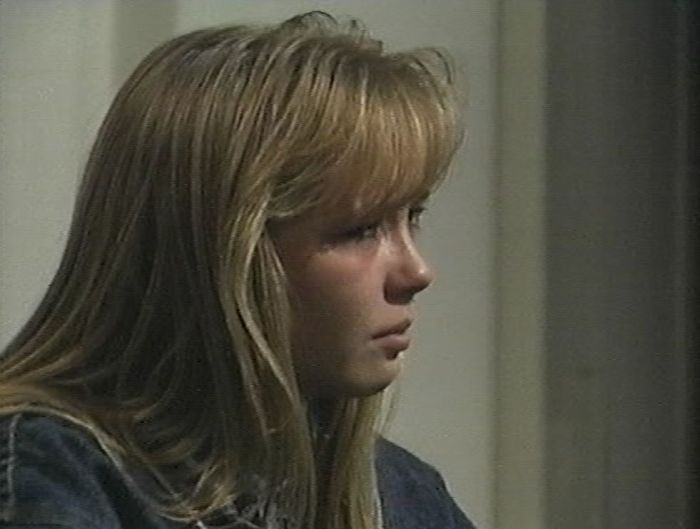
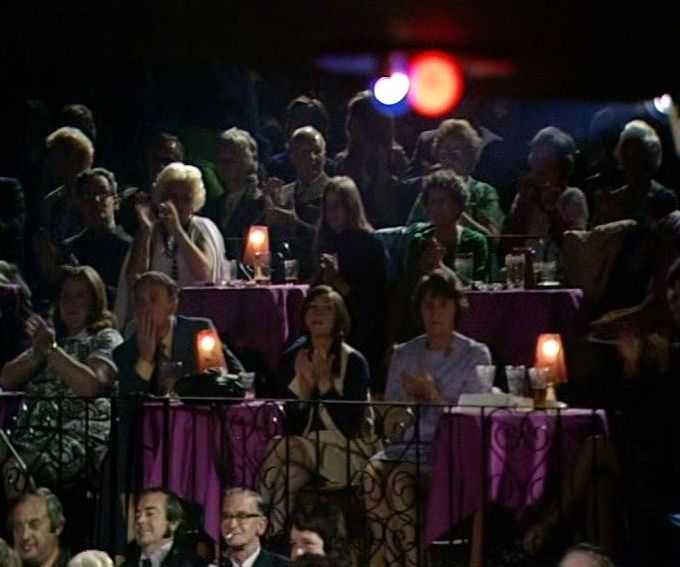
As is her arrival at the police station, where she ends up alone in an interview room. It seems more than a little unusual that a minor would be left unattended, but in dramatic terms it’s not a bad move since it allows her a moment of quiet reflection. As the camera closes in, the tears start to flow ….
gh s11e15-02

Grange Hill. Series Eleven – Episode Fourteen

gh s11e14-01.jpg

Written by Barry Purchese. Tx 19th February 1988

Justine’s gained a couple of giggly friends, who help to arrange her hair in a kaleidoscope of colours (thanks to the judicious application of ribbons). Fair to say that the new crop of first years (despite only numbering six main speaking roles) are a fairly dysfunctional bunch – Justine’s a fashion rebel, Matthew’s cursed with the home life from hell and Tegs is an unrependant criminal. Throw in the slightly flaky Susi and Chrissy and it seems as if Clarke’s the only straightforward one amongst them (which possibly explains why he doesn’t last too long – nobody likes a normal person).

The only thing worse than Mr Bronson on the warpath is a jolly Mr Bronson. So the sight of an effusive Mr Bronson, humming a merry tune, is probably the last thing Matthew wants to see at this precise point – but see it he does. “Your face is a mask of tragedy” he helpfully tells the boy, which is just the sort of thing to raise his self esteem ….
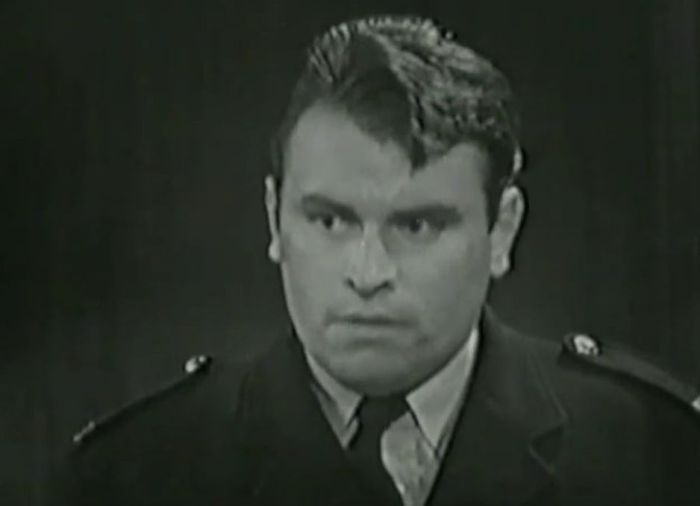
Freddie continues to chunter about Mr Robson’s training methods whilst Susi keels over in a spectacular fashion after Mrs Reagan tells her to get changed for games. Justine’s unconventional hair results in a trip to Mrs McClusky’s office. Finally, Mrs McClusky is given a little something to do, expressing weary exasperation as to why Justine – not a normally disruptive girl – indulges in these feats of exhibitionism. I also like her outburst, after Justine suddenly decides to unpick her creation there and then. “Not here! This is my office, not a hairdressing salon, you’ll do it at home”.

Mr Robson drops a bombshell – he wants to withdraw Grange Hill from the District Cup – an act which is sure to irriate Freddie all the more. For a new character, Mr Robson’s had a decent crack of the whip so far this year. These early episodes of his are also a reminder of the more radical and aggressive teacher he used to be, before the pressures of command took precedence.

Mr Griffiths, like Mrs McClusky, has been a little underused of late. But his reminisces of his own school days, to a clearly uninterested Tegs and Justine, helps to redress the balance a little. “You had to roll down a sock, because you see in those days it wasn’t everybody who wore long trousers. And it wasn’t everybody who had socks either. That was it. You had to roll down your left sock, right down to the ankle, and that was a sign”. Wonderfully, they simply carry on their interrupted conversation after Mr Griffiths wanders away.

Tegs invites Justine to tea round his Aunties. It quickly becomes clear to the audience that he’s lying – it’s just a random house that he’s decided to burgle. Again, Justine is shown to be rather slow on the uptake – even after Tegs’ shifty explanations (he tells her that his Aunty has popped out but left the back door on the latch) she doesn’t twig. It’s only when Tegs’ “Aunty” comes down the path that the penny finally drops. A smashed back window serves as the final confirmation of his crime.

Some of the long-running plotlines remain in stasis – namely Matthew’s abusive homelife and Laura’s dilemma over her mother’s lecherous boyfriend. Elsewhere, there’s an interesting two-handed scene between Chrissy and Susi where they discuss training bras and periods. Period pains are something that the series has briefly touched upon in the past, but not quite as bluntly as we see here.

gh s11e14-02.jpg

Grange Hill. Series Eleven – Episode Thirteen

gh s11e13-01.jpg

Written by Kay Trainer. Tx 16th February 1988

Ronnie isn’t one of life’s natural conspirators. This is made plain after she discovers her mother anxiously looking for something. The money which Ronnie pilfered? No, a nearly overdue library book. Crisis past for now, although Ronnie’s still giving off anxiety and guilt in waves ….
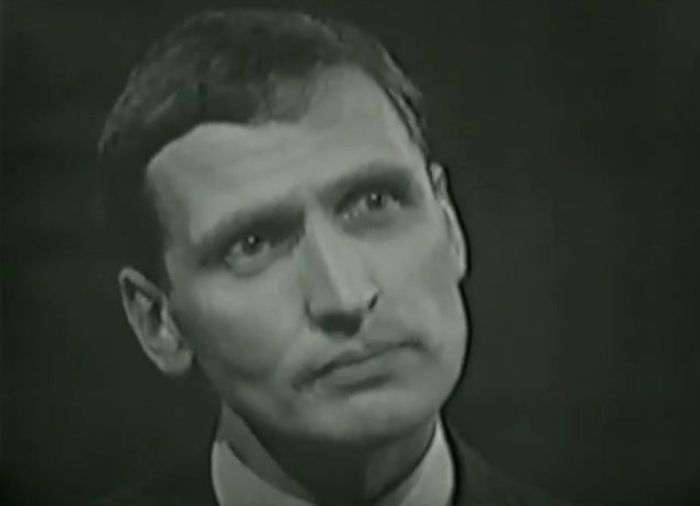
Her isolation is restated minutes later, after she’s cast in the role of a silent observer – watching Gonch and Fiona walking by, gently flirting. It seems a little strange that Gonch – who’s barely exchanged a handful of words with Fiona all year – would decide to chat her up, but it serves the purpose of darkening Ronnie’s mood just a little more.
She explains her dilemma to Calley, who’s sympathetic, but unable to offer any practical advice. Calley’s got her own problems to contend with – the revelation that she’ll need to wear a brace depresses her enormously.

I’m delighted to hear that the strip hire business has been wound up. Hurrah! Another entrepunerial sideline is launched after Chrissy and Susi decide to sell badges with real fruit on them. Yes, really. This odd minor plotline does through up a few nice character moments with the teachers – Mr Bronson is less than sympathetic to hear of their debate as to whether the olive is a fruit or not (although he later pops into the library to secretly look it up!) and kindly Mr MacKenzie (now fully recovered from his hissy fit a while back) is gently amused when Susi declares that they should make him a badge with a leek on it. He suggests that a thistle might be more apt ….

Once again we see Matthew running like a hare from his father’s car. Despite this, he’s late to Mr MacKenzie’s registration (not entirely sure why as it’s not made clear what he’s been doing). Mr MacKenzie casts a slightly concerned glance his way whilst later, Miss Booth also picks up that things aren’t quite right. Although he’s been acting in an off-key manner for a while, it doesn’t seem to be something which the staff have picked up on until this point and it has to be said that they’re rather slow in doing anything about it.

The slow torture of Matthew’s life continues after we see him, extremely unwillingly, undress for gym. Several vicious looking welts on his back tell their own story (one which probably wouldn’t have come as a surprise to many, since it seemed a while back that the story was heading in this direction). Later we see him unable to get into his house (his father is out a meeting and he tells Clarke that he’s lost his key). As so often with Matthew, it’s possible that he’s not telling the whole truth. Has his father has denied him a key? The meeting part of the story might also not be true, unless the meeting was an alcoholic one ….

A staffroom scene allows us to take a look at some of the posters on the wall. Fair Pay for Teachers is an obvious one (remember this was the 1980’s, when teacher’s strikes were very common) but it’s slightly more eye-opening to see a CND poster. It’s not commented upon, but again it helps to anchor the series very firmly in a specific period.
Mrs McClusky hasn’t really featured for a while. She briefly pops her head round the staffroom door – only to have her ear bent by Mr Bronson – but just as quickly disappears. It’s a shame that Gwyneth Powell has been rather underused this year – there would have been plenty of dramatic mileage in setting Mrs McClusky and Mr Bronson at loggerheads over the best way to run the school (although maybe it was felt that this plotline was exhausted last year).

Helen’s tattoo woes continue. Now that her mother’s found out, it simply makes her all the more anxious to get rid of it (but using a scrubbing brush isn’t going to do the trick). She cuts a teary and forlorn figure, but luckily Miss Booth’s on hand to offer some common sense advice. It’s rare to see Helen quite so exposed – her normal image is strong and assured – but the tattoo seems to have stripped away her normal acerbic defences, leaving her vulnerable and childlike.

If Matthew’s storyline has suddenly picked up some traction, then so has the question of Simon. Louise spills the beans to Laura about Simon’s mauling of Julia, which leaves her with a dilemma. Should she tell her mother, and even if she did, would she be believed?

gh s11e13-02