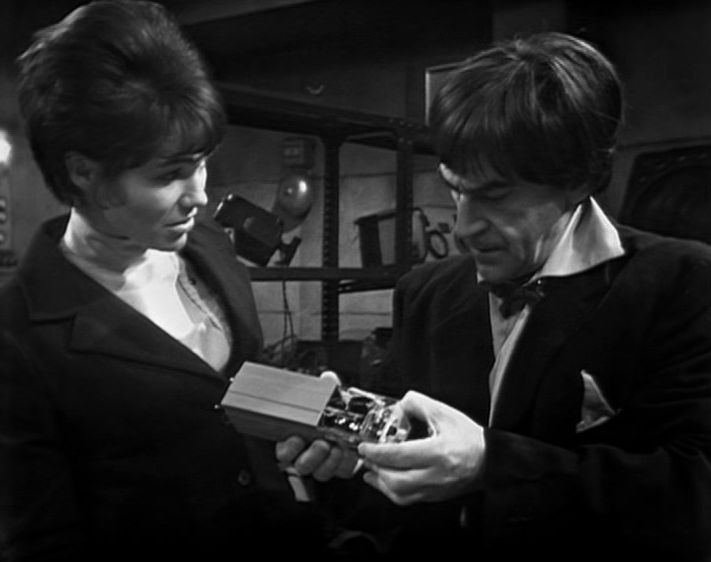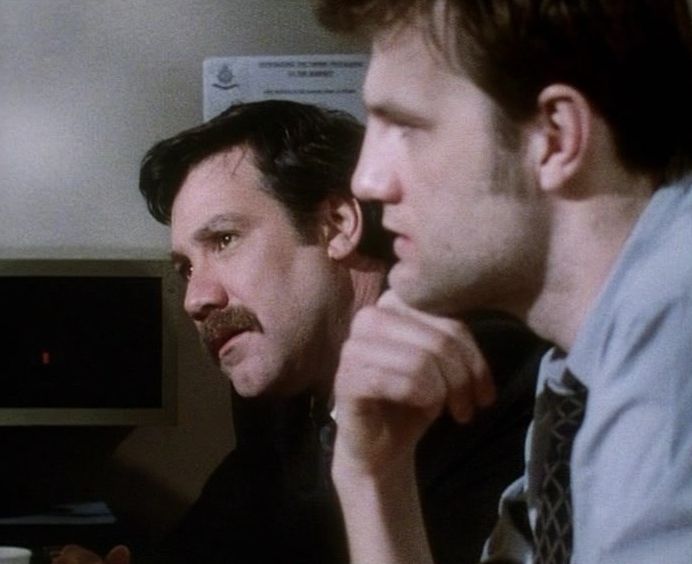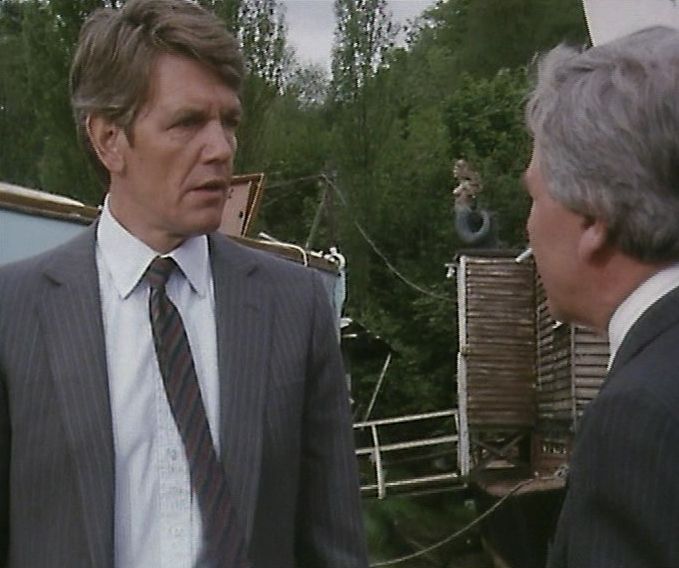
Howards’ Way – Series Three, Episode One

howards s03e01-01

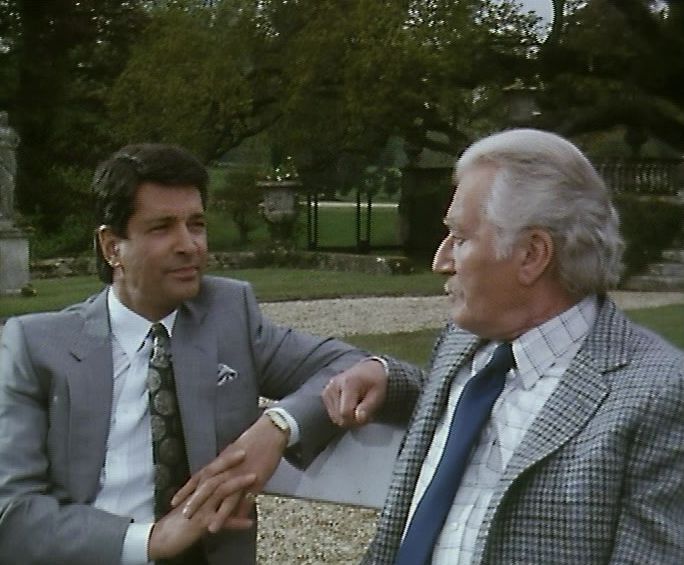
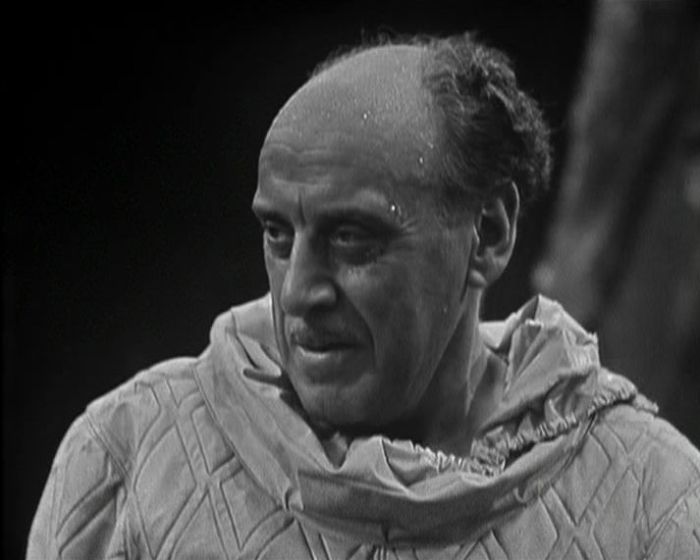
When we left Tom and Jan at the end of the second series both were suffering business traumas – the collapse of the catamaran had damaged the credibility of both Tom and the Mermaid Yard whilst the death of pony-tailed clothes designer Claude Dupont seemed to have halted Jan’s attempts to conquer the fashion world.

Polly’s looking on the bright side though.  Now that Claude’s dead, his designs are bound to go up in price, so she pops over to the boutique to snap a couple up before they all disappear.  Kate, once again stuck behind the counter, views her with politely-bred disdain.  Kate’s still very good at that sort of thing.

Tom’s rather down in the mouth about the catamaran and for new viewers who need to be brought up to speed there’s a handy moment when Jack picks up a newspaper report about it.  But since the camera only lingers on the newspaper for three seconds you would have either have to have been a fast reader or gone back later and paused your VHS recording.  Still, it’s a nice way to info-dump without having the characters laboriously spell out the ins and outs of the current situation.

The triangle of Sarah, Mark and Ken continues to simmer away, although Mark’s still totally oblivious that there is a triangle whilst Ken continues to eye the cool Sarah with longing.  His interest is so obvious that it’s a wonder that Mark hasn’t twigged yet, so maybe he really is a man who only lives for his racing.  Ken’s later pawing of Sarah (he kisses the top of her shoulder in a way that only Ken could) doesn’t quite bring him the result he was looking for though ….

Charles pays a flying visit to Relton Marine and isn’t particularly happy with what he finds.  He tells Avril that things will have to change (their icily polite conversation is an early series delight).  Charles continues to be in a snippy mood when he encounters Gerald later.

The big-money signing for this new series is, of course, Nigel Davenport as Sir Edward Frere.  He tells Sir John that it’s good to be home, which suggests he’s been away for some time.  But now he’s back there’s no doubt that sparks will fly between him and his son.

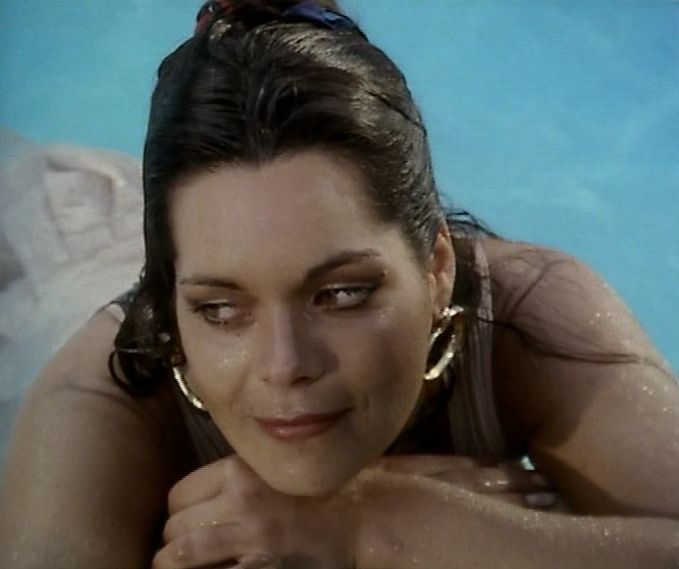
The other major new cast member debuting here is Francesca Gonshaw as Amanda Parker.  Gonshaw, thanks to her role in Allo Allo!, was a familiar television face and – having left that series – was clearly looking for new opportunities.  Series three of Howards’ Way would be her last regular television role though.

Before we see Amanda for the first time, we observe Leo gazing wistfully at a picture of Abby and attempting to write her a letter.  The number of scrunched-up balls of paper suggests that he’s being attempting this for some time.  I’ve commented before on Jan’s breath-taking indifference to her son and there’s another prime example here – she asks him what he’s doing, but isn’t really interested (she’s more concerned that he moves somewhere else, since the consultant from the bank is due to arrive soon).

But to give Jan some credit, she does attempt to gee him up a bit as she tells him that he shouldn’t spend his time reliving the past.  Especially wonderful is her comment about Lynne.  “She’s not sitting around moping about Claude, and he’s dead”.  It takes real skill to deliver dialogue like that with a straight face.

So Leo, taking his mother’s advice, heads out for a pool party.  You can tell it’s the 1980’s as Leo’s wearing a jacket with rolled-up sleeves.  Nooooooooooooooooo!

Since he’s fully clothed he obviously doesn’t intend to take a dip (at least not intentionally) and instead gravitates towards a group of beautiful(ish) young(ish) people gyrating to the hit sounds of Stevie Wonder.  And wouldn’t you know it, at exactly the point when Stevie sings “Isn’t she lovely?” the camera focuses on Amanda, who is – well – lovely.

There then follows a rather odd piece of direction.  Amanda, sitting with a male chum who’s sporting a rather colourful shirt, decides that Leo’s looking very miserable and the pair go off to cheer him up.  Maybe it was scripted that Leo was down in the dumps – staring wistfully into the distance, moping about Abby – but onscreen he’s talking animatedly to a couple of people.  Mind you, the brief snatch of Leo’s dialogue suggests that he’s pontificating about the woes of the world, so I daresay Leo’s companions were only too delighted to be rescued from his polemical onslaught!

That Leo continues droning on whilst the delightful Amanda is replenishing the others with champagne in characteristic, as is the fact that when she pours him a drink he chucks it away.  And then she pushes him into the pool.  The beginning of a beautiful friendship?  Well since he then chucks her in, possibly (this might very well be a Tarrant mating ritual).  Amanda later confesses that she likes his style.  Takes all sorts I guess.

Jack and Kate – both recovering addicts – compare notes.  Jack’s doing his best to stay off the drink whilst Kate admits that she’s had another flutter and is therefore happy to treat Jack to lunch.  Jack’s appalled – a woman paying for lunch?  But he comes round eventually.

Jan needs a new designer and fast.  She also needs £150,000 in order to open a chain of boutiques.  With no designer currently on board it seems more than a little risky to expand at this point, but Jan’s faith in her own abilities is clearly boundless.  There’s also the problem of Ken.  Jan wants to buy his minority shareholding of the boutique, but will he be agreeable?  Hmm, I wonder.

Avril and Tom have an awkward business lunch.  Charles’ presence at Relton Marine continues to concern Tom, who’s convinced that the interests of the Mermaid won’t now be her top priority.  And Tom’s jealous as hell too, of course (just as well he didn’t know that Charles dubbed him a “loser” in the business world then).

Although Charles and his father have yet to meet onscreen, there’s an early signifier of the battles to come – Charles finds himself outbid on a painting (a snip at a mere £225,000).  And the telephone buyer?  Of course it’s Sir Edward Frere ….

howards s03e01-02

The Brokenwood Mysteries – Series One and Two. Acorn DVD Review

Welcome to the town of Brokenwood.  A sleepy farming town in the middle of New Zealand where you’d assume that nothing ever happens.  But their crime rate is extraordinarily high for such an idyllic spot as barely a week seems to go by without a mysterious death occurring.

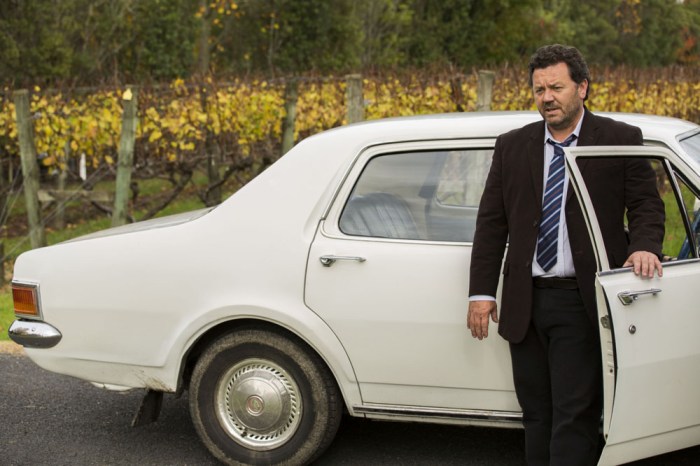
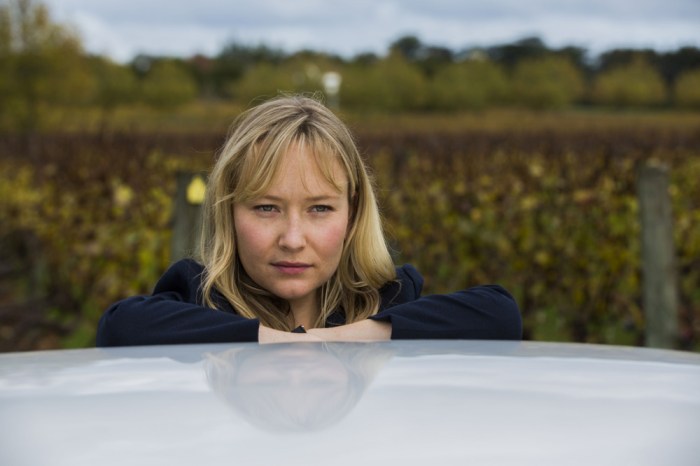
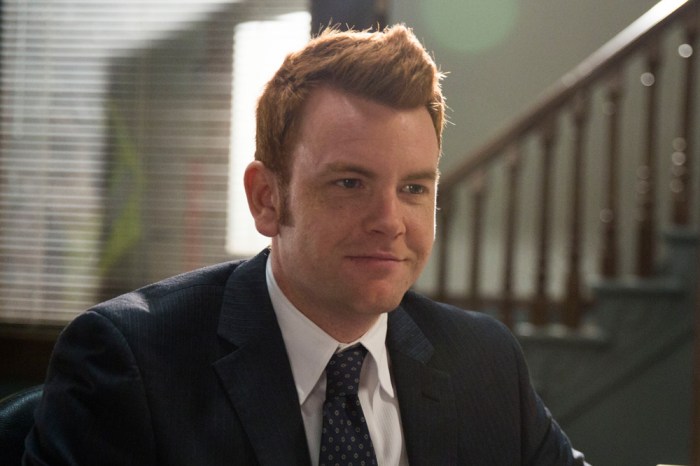
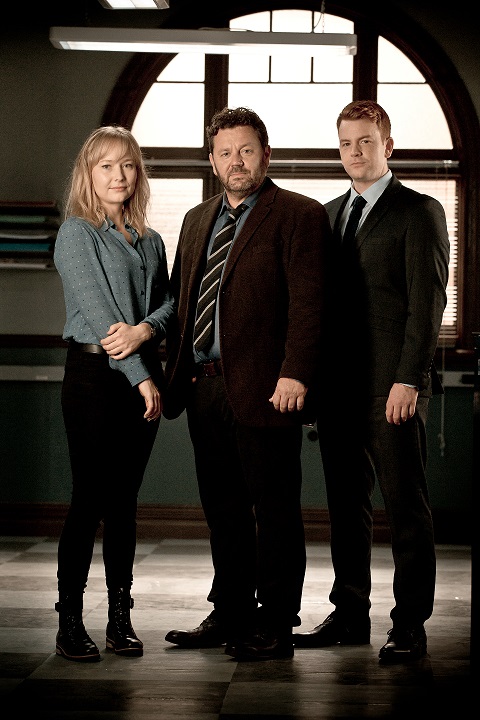
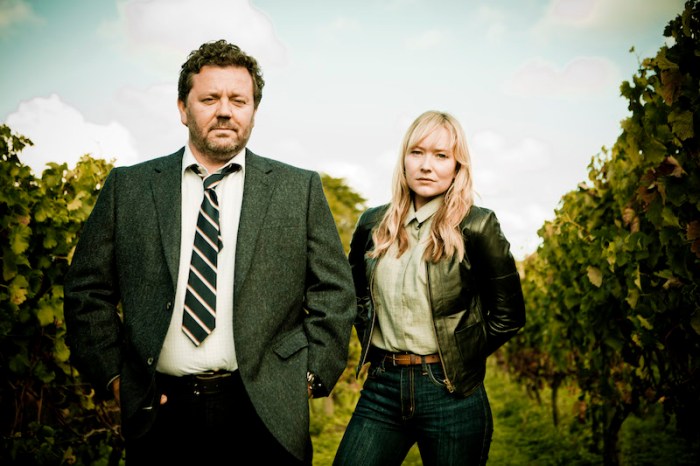
One such murder brings the experienced Detective Mike Shepherd (Neill Rea) up from the city.  An unconventional maverick, he’s partnered with the much younger and much more by-the-book Detective Kristin Sims (Fern Sutherland) and, as might be expected, to begin with they don’t hit it off.  But as inexplicable murder follows inexplicable murder, it’s also to be expected that they’ll start to form a bond as Mike adjusts to life in the country, where everybody seems to be connected to everybody else and deep, dark secrets abound ….

Brokenwood is a small place.  The population seems to be around five thousand, although it’s constantly decreasing (depending on how many people get killed in any given episode).  Brokenwood’s bucolic beauty is one of the series’ selling points – no wonder that some have dubbed the show “A New Zealand Midsomer Murders” – whilst the interplay between Mike and Kristin is another obvious plus-point.

It’s hardly an original concept for a series. A mismatched partnership – male/female – with very different takes on just about everything.  But since the formula works it’s not surprising that it gets repeated again and again.  The Brokenwood Mysteries might not bring anything particularly new to the table, but it does what it does very well.

broke 01
Neill Rea

It’s always handy to start a new series with an outsider, since they can function as the audience identification figure and we can learn along with them.  Mike Shepherd is pitched headlong into the town of Brokenwood in the opening episode – Blood and Water – which sees a local farmer – Nate Dunn (Chris Sherwood) – fished out of the river.  Did he commit suicide or was it a case of murder?  The parameters of the series are firmly set here – a leisurely running time (90 minutes plus per episode), lashings of country music (Mike’s a firm fan) and a story where long-hidden secrets hold the key to solving the mystery.

Neill Rea instantly appeals as Mike Shepherd.  Mike is a friendly and slightly rumpled character, easily able to put just about everybody he meets at their ease (a useful skill for a detective).  His private life is a bit of a mystery though.  There are definitely ex-wives in his past, although exactly how many isn’t known.  That he elects to stay in Brokenwood after solving the first case suggests that he had nothing or no-one special to return home to (he’s very much a self-contained person, happy with his own company).

He does have passions though – a 1971 car he’s very proud of (although nobody else agrees with him) and a large supply of country music cassettes.  He prefers music on cassette and he loves country music because “they’re the best three-minute crime stories ever sung. There’s heartache, adultery, jealousy, divorce, death”.  His quirks – he likes to crack inappropriate jokes when inspecting bodies (“too soon?”) as well as conversing with the corpses – ensures that he stands out from the rank and file.

His strengths are matched in equal and opposite ways by Kristin Sims (Fern Sutherland).  Kristin is everything that Mike isn’t – young, meticulous and computer savvy.  Initially she rubs Mike up the wrong way, but it isn’t long before they settle down and form a fairly harmonious working relationship, although Kristin can still sometimes be appalled at Mike’s reluctance to follow procedure.  But as time goes by there’s a definite Ying/Yang feel to their relationship as both have positive character traits that the other lacks.

broke 02
Fern Sutherland

Those familiar with the parameters of this type of series should be easily able to spot the upcoming murder victim during the opening minutes of the second episode, Sour Grapes.  Brokenwood is an area with a thriving wine industry, so it’s no surprise to learn that the annual wine contest always sparks a great deal of interest.  Amanda James’ (Josephine Davison) winery has walked away with the top prize for the last five years, therefore she is appalled when judge Paul Winterson (Alistair Browning) overlooks her this time.

The appearance of dead Winterson’s body is a jolting reveal – it comes bobbing to the surface from one of Amanda James’ vast wine vats – and his presence there means that Amanda is a prime suspect.  But although The Brokenwood Mysteries has no qualms in embracing predictability at times, with ninety five minutes to fill it’s pretty obvious that the solution isn’t quite as cut and dried as it first appears.

The remaining two episodes of the first series – Playing the Lie and Hunting the Stag – maintain the high standard already established.  Arresting reveals of the dead or dying is something of a Brokenwood trait and Playing the Lie certainly doesn’t disappoint on this score.  The sight of Adele Stone (Roz Turnbull), owner of the Brokenwood Golf Club, lurching towards a group of golfers – her face red and distorted – is certainly something out of the ordinary.  Death by poisoning? That’s what Mike and Kristen have to establish.

In Hunting the Stag, Hayden Renner (Francis Mountjoy) elects to combine his stag party with the hunt for a real animal, so he and his friends head out into the forest.  But bride-to-be Renner never makes it back – he’s shot through the head.  At first it appears to be a tragic hunting accident, but since none of his friends will admit to shooting him and all of them discharged their rifles, things turn out to be quite complex.

As series one progresses, we begin to learn a little more about the other regulars.  Detective Constable Sam Breen (Nic Sampson) is always on hand to do a spot of research or provide some necessary exposition.  Playing third banana on a police show isn’t a terribly rewarding job, but Sampson does the best with the material he’s provided with.

broke 03
Nic Sampson

Pana Hema Taylor has a more interesting role as Jared Morehu.  When Mike moves to Brokenwood, Jared becomes his neighbour as well as his drinking buddy and confidant.  In his early twenties, Jared has the air of a wide-boy who enjoys skirting around the edges of the law.  Possibly it’s a case of opposites attracting, but he and Mike quickly form a bond (there’s a surrogate father/son vibe about them) and Jared sometimes finds himself assisting – totally unofficially, of course – Mike in the odd investigation.

Gina Kadinsky (Christina Serban Ionda) is Brokenwood’s idiosyncratic medical examiner whilst Meredith Wilmott (Andi Crown) appears in several episodes.  Meredith is the Head of Police Communications as well as being one of Mike’s ex-wives, so there’s inevitable mileage to be found in their personal and professional conflicts.

Strange murders keep occurring as the series enters its second series.  In Leather and Lace, Arnie Langstone (Phil Vaughan), coach of the Brokenwood Cheetahs rugby team, is discovered dead, stripped naked and tied to a goalpost with a pair of women’s underwear stuffed down his throat.  The Brokenwood Cheetahs are a record-breaking side – with an incredible losing streak of fifty straight games – so Arnie’s death doesn’t distress many at the club.  But then a second body turns up …

One of the strengths of the series is the way that it hops from different groups and sections of society (winegrowers, rugby teams, etc).  The next episode, To Die or Not To Die, maintains this run as Mike and Kristen investigate a mysterious death at the Brokenwood Theatre Society.  The back-stabbing world of amateur dramatics is a fertile area for both drama and comedy, making this episode a highlight of series two.

broke 04
Fern Sutherland, Neill Rea & Nic Sampson

Catch of the Day poses yet another baffling mystery.  When Jared discovers a severed human hand in a crayfish pot, the team have to consider several questions – who does the hand belong to and are they still alive?  This one may feel a little drawn out, but the interplay of the regulars ensures that it still ticks along quite nicely.

After that slight dip, series two ends on a strong note with Blood Pink.  As we’ve seen, Mike is a big country music fan and is naturally delighted when his favourite singer, Holly Collins (Browwyn Turei), arrives in Brokenwood for a gig.  No surprises that she doesn’t make it out alive – which immediately points the finger at her dysfunctional band members – Slim Fingers (Peter Dabue), Waylon Strings (Jordan Maguer) and Jesse James (Colleen Davis).

Like other long-form detective dramas – Midsomer Murders, Inspector Morse – the lengthy running time of The Brokenwood Mysteries can be both a blessing and a curse.  Whilst it means that the mysteries are given time to unfold, there are also occasions when a less than engaging story can feel like something of a slog.  But luckily there’s more hits than misses across these two series, so this isn’t too much of a problem.

Both releases include a number of short special features. Series one has two interviews – the first with Neill Rea and Fern Sutherland and the other with head writer Tim Balme whilst series two has a Behind the Scenes featurette.  The brief running times of the interviews and featurettes (five minutes each for the interviews, three minutes for the Behind the Scenes feature) means that they obviously can’t go into any great depth, but they do help to place the series in context. Both series also include photo galleries, each running for around a minute.

The Brokenwood Mysteries is an engaging series which should definitely appeal to crime fans.  Recommended.

Series one and two of The Brokenwood Mysteries are released by Acorn Media on the 14th of August 2017.  Both series cost £19.99 each.

broke 05
Neill Rea & Fern Sutherland

Pathfinders to Venus. Episode Eight – Planet on Fire

venus 08

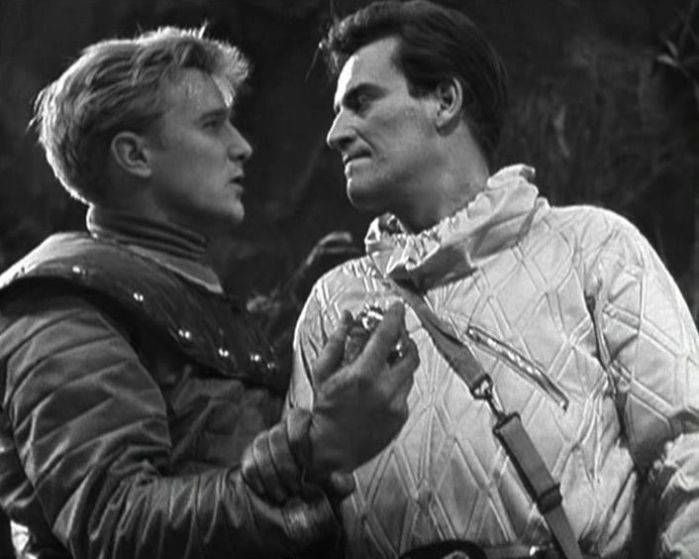
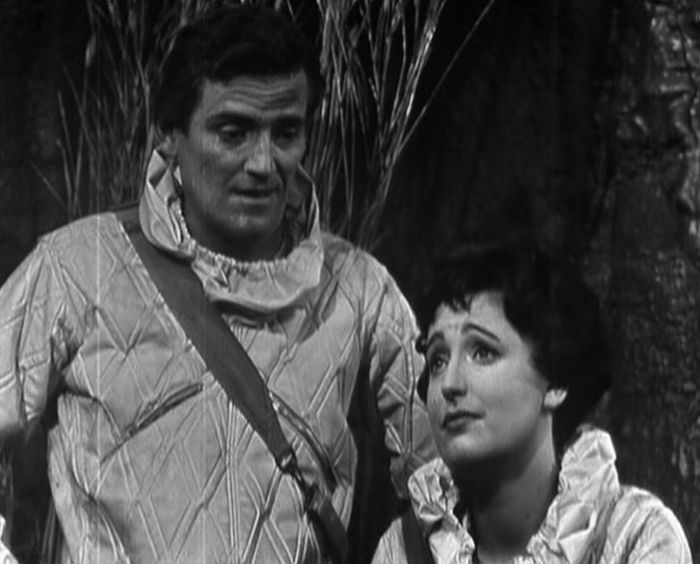
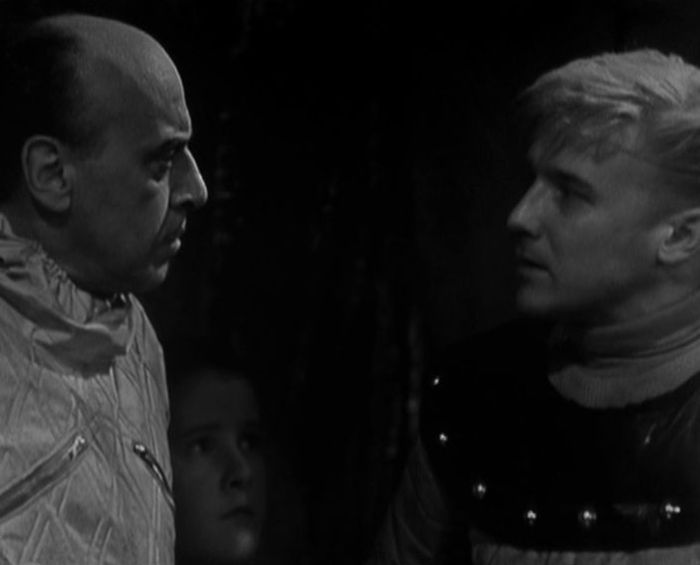
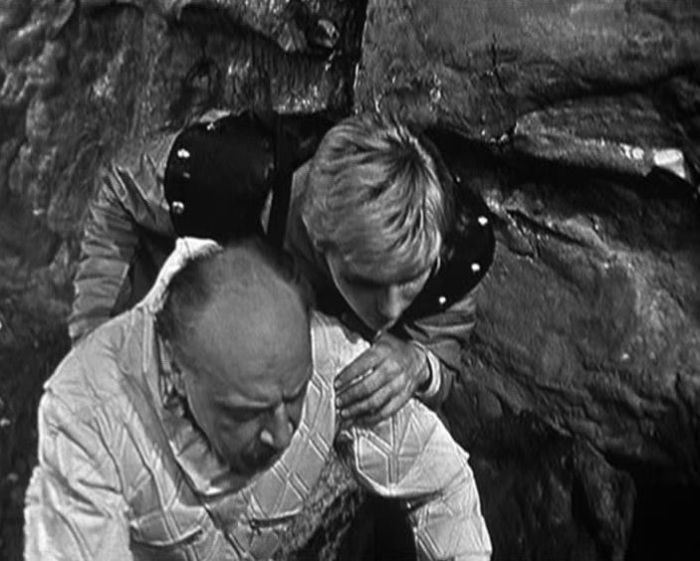
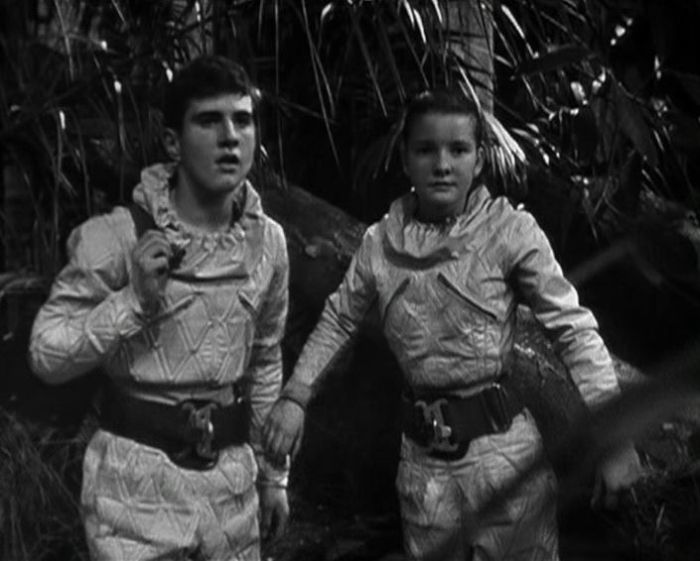
With the jungle on fire, Conway and the others struggle to reach the safety of the rocket ….

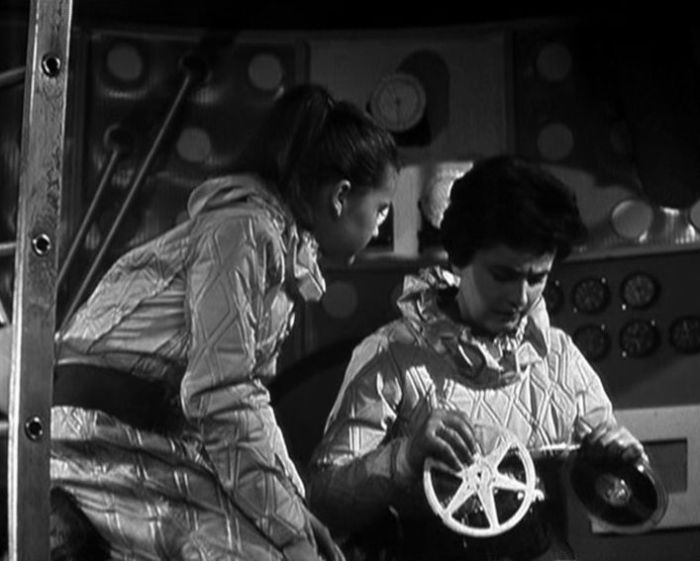
Brown’s fanaticism – he broadcasts back to Earth a message that everyone else is dead and the planet is hostile – is plainly on show here.  His attempt to sabotage the rocket is a little half-hearted though (since Conway is able to quickly to reverse his damage).

There’s another example of Brown’s disregard for the others – Wilson is attacked by a Venusian in the forest and Brown elects to leave him there.  But what’s worse is that Wilson was looking after Hamlet at the time.  So poor Hamlet’s lost in the forest – clearly Brown is a monster of the first degree …..

Will Wilson and Hamlet make it back to the rocket before Conway has to blast off?  Hmm, I wonder.

The dramatic music goes into overdrive as Conway believes they can’t leave the planet as the Russian rocket, carrying the fuel for the return trip home, appears to have crashed.  So they seem doomed to spend the rest of their lives on Venus.  If so, how will they live?  Brown’s rather keen, but the others less so.

The sudden unexpected appearance of Colonel Korolyov (Robert James) therefore comes as quite a surprise as he tells them that there’s no reason why they can’t return to Earth.  Given that the Cold War was still icy at this point, it’s possible to view the image of Korolyov and Wilson, working together in harmony, with a rather jaundiced eye.

But there’s also a subtler reading that can be made.  Wilson admits that his secret mission in space was to establish an outer-space telephone relay system.  Korolyov genially tells the others that he’s glad there was no other motive for Wilson’s flight (which still leaves us with the inference that Wilson hasn’t been completely straight with them.  Maybe there was another – military – motive behind his mission).

Brown stays behind on Venus but the possibility that the Russians or Americans (or even the British) would return one day to plunder its natural resources remains a possibility.  Whilst Pathfinders to Venus generally presents an optimistic picture of space exploration, there’s still the hint that the future might see political or monetary concerns win out over pure scientific research.

Pathfinders to Venus might be a couple of episodes too long, but you can’t help but be impressed by it’s scope and scale.  Attempting to mount an epic tale with a less than epic budget took some nerve and whilst it’s easy to view all three of the Pathfinders tales purely in terms of the way they anticipated Doctor Who, they still stand up as engaging serials in their own right.  Pulpy fun, it’s true.  But fun nonetheless.

Pathfinders to Venus. Episode Seven – The Valley of Monsters

venus 07

The episode title – The Valley of Monsters – would no doubt have raised the audience’s expectations, so possibly that was why our first sight of the monsters – stock footage of animated flying reptiles – provided the previous episode with its cliffhanger.  At least that way most people would know what they were going to get here.

This instalment was especially fascinating since it was used for an academic study into children’s viewing habits and opinions.  To this end, eight deliberate production mistakes (in addition to any inadvertent ones) were introduced into the episode.  Several groups of children were then shown the episode, with their interest levels and comments closely monitored.

It was discovered that young children were just as demanding and critical as any other viewing group.  As producer Sydney Newman later noted. “The most important thing we learnt is that if anyone thinks a young audience can be fooled or won sloppily or ‘on the cheap’ he is sadly mistaken”.  No doubt these lessons would have been taken on board when Newman moved to the BBC and initiated the creation of Doctor Who.

I have to confess that none of the production mistakes were particularly apparent.  Maybe I was just unobservant or possibly too wrapped up in the story?

Our heroes manage to escape the dangerous stock footage flying reptiles and they then proceed to make their way through the forest on the long trek back to the rocket. The forest clearing, where they pitch up for a rest, is pretty bare but a later sandstorm is effectively done.

There’s more animated stock footage (a Tyrannosaurus Rex battles a Stegosaurus as our heroes look on in awed wonder). The models are a little small and grubby, but the dramatic music – and acting – sells the illusion resonably effectively.

Latest Kisswatch update – Conway and Mary enjoy a passionate kiss on the lips. Hurrah! Marriage doesn’t seem to be on his mind though, unless he’s being very subtle. But he does ask if they can work together when they return to Earth, so maybe this is the first step in his plan to woo her.

We return to Buchan Island for the first time since the opening episode. The Russian rescue rocket has nearly reached Venus, but with no evidence that Conway and the others are still alive, it’s likely to just turn around and go home.

Malcolm Hulke tended to pepper his Doctor Who scripts with political, moral or environmental messages. Pathfinders never really went down these routes but this episode – for example, Wilson sees a chance to make a great deal of money by plundering Venus of its plentiful diamond supply – does supply us with a vague message.

It does mean that Wilson, up until now a level-headed chap, suddenly turns into an avaricious monster. This moment quickly passes, but the discovery of uranium is another flashpoint. Wilson paints a vision of Venus as a colonised world, its natural reasources mined for the benefit of Earth (America), a prospect which disgusts Brown. Wilson tells Brown that “you can’t stop progress”.

It’s interesting thar Brown’s desire not to see Venus strip-mined isolates him from the others. But when the way back to the rocket is blocked by raging forest fires, he gleefully tells them that nobody will ever leave the planet. Instead, they’ll become the first of the new Venusians ….

Pathfinders to Venus. Episode Six – The City

venus 06

In yet another remarkable coincidence, Margaret and the Venusian child locate Conway and the others.  That just leaves Brown to free from his polystyrene rock and then everyone will be back together.

Brown is remarkably noble (“save yourselves” he tells the others).  But they’re not prepared to leave him to the mercy of the approaching lava and after considerable effort (I wonder if they taught this type of acting – pretending that lightweight objects were very heavy – at RADA?) they manage to free him.

They’re all delighted to finally have emerged from the caves into the open air.  And I have to confess, so am I.  The city they can see in the distance is impressive.  Brown calls it “the creation of an advanced people with a sense of beauty of form”.  But how does that connect with the mute primitives they’ve already tangled with?

Eventually Conway decides that they’ll all take a look at the city.  But Brown can’t wait for Conway, so he sets off alone.  Hasn’t he learnt by now that bad things happen when they split up?  Tsk, he’ll never learn.  As Brown makes his way towards the city, we’re privy to his internal thoughts as he ponders the best way to make contact, which is a nice little touch.

For those keeping track of the Conway/Mary kisswatch, this episode he’s heading closer to her lips (via a peck on the cheek).  But maybe his close attention was something of a plot point, since he notices a mark on her face.  Made by an insect possibly?

This episode (and the final one – Planet on Fire) were directed by Reginald Collin (the other six were directed by Guy Verney).  This was Collin’s first directing credit, although he’d later be more prolific as a producer (notably on Callan).

All of Brown’s hopes are dashed after he learns that the city isn’t a city after all – instead it’s a massive tomb where the Venusians bury their dead.  It’s a pity that after all this effort the city turns out to be nothing more than a Maguffin.  Oh well.

But his disappointment quickly moves into the background as Mary begins to falter – the insect bite is clearly more serious than it first appeared and the others need to come up with an antidote quickly.

This T/R isn’t in a great shape – very notable tramlines throughout – but given that a good deal of this era of television doesn’t exist at all there’s no point in grumbling.

With Mary still weak, they have to improvise a stretcher to carry her (which they knock up very quickly and impressively, it has to be said).  Venus is a planet full of surprises – this week’s cliffhanger finds them menaced by flying dinosaurs!

Pathfinders to Venus. Episode Five – The Venus People

venus 05

The lights are even lower at the start of this episode then they were at the end of the previous one, so the Venusian cave-man is much less distinct than he was before.  This low-lighting seems to have foxed the vision mixer – at one point Margaret screams that he’s “breaking though” as the camera cuts to what appears to be an empty frame.

As the Venusian (Bob Bryan) ambles out of the cave, we get a closer look at him.  I think it’s fair to say that he’s possibly not going to be a terribly interesting conversationalist.

The Venus People gives us a break from watching everybody traipsing through the forest as instead they spend their time traipsing through caves instead.  As ever, things aren’t straightforward – Margaret gets separated from the others but (as luck would have it) she runs into Brown and Wilson.

Brown has to do a little bit of quick talking since he’d convinced Wilson that everyone else on the rocket was dead.  He does admit that he lied, but Wilson doesn’t seem too bothered about being deceived.  During these scenes you have to admire Hester Cameron. Margaret has been forced to carry Hamlet for some time, which must have been a little irritating.

Brown finds a narrow ledge which he believes leads to the city.  He’s happy to risk his life crossing it, but Margaret and Wilson are less keen.  But when they hear the wails of the Venusians, she has no choice but to follow.  There’s a bit of a technical blip here – we see Brown cross over, but then George Coulouris walks through the back of  the frame, presumably making his way to the next set.

Wilson meets up with Conway and the others and they too attempt to cross.  The dramatic stock music goes up a few notches as Brown is trapped by a large rock.  A Venusian child (Brigid Skemp) appears to offer Margaret a way out ….


Pathfinders to Venus. Episode Four – The Creature

venus 04

By this point the narrative has split four ways.  Geoff is alone in the jungle, Mary and Margaret are trapped in the rocket (whilst something large and unfriendly appears to be attempting to force its way in), Conway has disappeared whilst Brown and Wilson are making their way to what Brown believes is a Venusian city.

Mary eventually twigs the way that Brown deceived them – chopping a few words out of Wilson’s tape recording – whilst the tension of Geoff, Mary and Margaret’s predicament quickly dissipates.  Geoff returns to the rocket and the mysterious creature disappears.

The logical Professor Mary Meadows believes that the creature only appears when they’re alone, so Geoff decides they should rope themselves together and that’ll deal with it.  Eh? I’m not entirely convinced about this statement.

Brown and Wilson continue their slow trek to the city.  They find a cave which displays evidence that the Venusians have discovered fire (and presumably are flesh eaters).  This doesn’t chime with Brown’s assertion that the Venusians are harmless and friendly, but he’s not downhearted and quickly bounces back.  At this point poor George Coulouris suffers a line fumble worthy of William Hartnell.  “Three thousand miles, err three thousand, three hundred years ago …”

The point about fire is an interesting one – in the previous scene Mary was confident that they could use it as a weapon, since she thought it was unlikely the Venusians would have discovered it. Although as no-one ever mention fire again it turns out to be a totally redundant plot-point.

A few clips of stock footage are used throughout the serial.  This episode is slightly more low-rent though – as we hear the sound effect of thunder followed by a picture of lightening.  It’s only on the screen for a second so they just about get away with it.

Gerald Flood’s had an easy episode so far.  We don’t see him until we’re about half way through when Conway promptly wakes up, calls for Geoff and the others – who just happen to be close by – and they’re all happily reunited.

Brown and Wilson debate the ethics of technology.  Brown despairs about the way that scientific progress has ravaged the Earth and fears that the same thing will happen one day to Venus.  Wilson makes the logical point that without science they’d never have reached here in the first place.  Then Wilson reaches for a cigarette.  It’s somewhat jarring to see an astronaut having a quick puff (unless they were special space cigarettes) but then it was the early 1960’s.

The most entertaining part of the episode is poor Hamlet’s plight.  Trapped inside a flesh eating plant, it looks like curtains for the space-faring guinea pig.  Margaret doesn’t take this trauma at all well –  she’s frantic with worry as Conway manfully attempts to rescue Hamlet from within the flappy plant. Don’t worry, Hamlet fans, he eventually escapes unharmed.

The last few seconds give us our first sighting of a Venusian.  He’s lurking in the shadows somewhat, but think cave-man and you’ll be on the right track.

Pathfinders to Venus. Episode Three – The Living Planet

venus 03.jpg

As also often happened with Doctor Who, the end of episode cliffhangers were re-recorded the next week.  This is very evident here, since both Stewart Guidotti and Hester Cameron are much more restrained at the start of this episode than they were at the end of the previous one.

Geoff and Margaret, locked inside Wilson’s rocket for safety, are pondering exactly what powerful creature could have caused such damage.  Geoff has plenty of ideas.  “For all we know it might have been a reptile, or a bird with a huge beak. Or an insect with some kind of nippers like a crab”.  Given the series’ budget, I’ve a feeling it’ll be somewhat less impressive than these wild imaginings ….

It’s plain that they’re not alone though.  For a while, the camera has sometimes shot from behind flapping branches, giving the impression that someone or something is observing them.  As with the previous serials, this one is also in no hurry to show its hand (understandable, with eight episodes to fill).

So The Living Planet concerns itself with the continuing hunt for Wilson whilst Brown burns with a desire to explore what he believes to be a Venusian city.  The parallels between this story and The Daleks seem pretty obvious, was this a coincidence or did Terry Nation tune in back in 1961?  One difference is that Brown just decides to wander off by himself to explore the alleged city (unlike the Doctor, who had to trick the others into accompanying him).

Another Doctor Who connection is the distinctive piece of stock music which appears some ten minutes about ten minutes in, which also cropped up during the Hartnell era, The Space Museum to be precise.

Brown meets up with Wilson and the pair head off for the city together.  For those keeping a watch on the Conway/Mary relationship, there’s another kiss here – albeit it’s just a smacker on the top of her head.

Graydon Gould, as Wilson, starts to emerge as a more defined character in this episode, helped by the fact he finally has someone to talk to.  Gould might not have been an American, but he was the next best thing (Canadian) so at least he sounds pretty authentic.  Brown and Wilson don’t exactly see eye to eye – Brown believes that the only aggressors in the solar system are to be found on Earth and despairs that the Americans rocket was kept a secret (presumably because it contained military secrets).

You probably won’t be shocked to learn that Conway and Geoff venture out to find Wilson and Brown whilst Mary and Margaret remain behind in the safety of the rocket.  Although maybe it’s not that safe since something breaks into the rocket and begins to menace the girls.

And then Conway disappears which is the cue for Geoff to start over-emoting again.  We must be close to the end of the episode ….

Pathfinders to Venus. Episode Two – Into the Poison Cloud

venus 02

Convinced that Wilson is trapped on the surface of Venus, Conway and the others set out to rescue him.  But before they can do this they have to work out a way to negotiate the poison cloud that surrounds the planet.

After a few minutes chat, they seem confident so once again the dramatic stock music is cued as the sweet little model rocket slowly begins its descent.  You have to respect the abilities of the regulars (attempting to sell the illusion of danger with such limited resources is no easy task).

But although it’s easy to be critical of the effects, some are very effective.  The shots of the American rocket orbiting Venus are nicely done.  The rocket isn’t particularly detailed, but the fact it’s so small means that it contrasts well with the vast planet.  And our first sight of the planet’s surface – the camera tracks down to reveal the rocket nestling amongst surprising lush vegetation – is a decent model sequence.

Brown is convinced that Venus has a breathable atmosphere and – against the advice of the others – he emerges from the rocket without his space helmet.  And wouldn’t you know it, he’s correct.  This is probably the moment where it’s pointless to worry about scientific accuracy and simply go with the flow.  One obvious plus point about this is that it means our heroes don’t have to spend the entire serial wandering about with space helmets on (which I’m sure was Hulke and Paice’s reasoning).

Since this was 1961 you shouldn’t be surprised that the boys (Conway, Geoff and Brown) immediately go out to explore whilst the girls (Mary and Margaret) stay behind in the rocket.  But it isn’t long before the ever-squeaky Margaret gets her chance to take a look outside (albeit with Geoff as a chaperone).

Conway finds the place “menacing” although at present there’s no sign of life.  On the other hand, Brown is delighted – telling Margaret and Geoff that due to Venus’ slower orbit he could expect to live for another six hundred years here.  I’m going to have to think about that one ….

Poor Wilson.  Considering that the others had come to rescue him, now that they’re jaunting around on the surface he’s rather stuck.  So he too decides to make planetfall.  Geoff, manning the radio, can’t convince Conway that the blip he’s monitoring is a rocket (which is reasonable, since they all assume Wilson has already touched down).  The scene of Wilson’s rocket crash-landing is interesting.  Let’s assume that the planet’s surface is very springy (that would explain why his rocket seems to bounce up and down).

What should you never do on a strange new planet? Split up and explore.  So whilst Conway, Mary and Brown have stuck together (with Geoff and Margaret safely in the ship) what do the youngsters decide to do?  Yep, head off under their own steam for a spot of exploration.  Oh dear.

Towards the end of the episode we get to see a bit more of Venus’ lush vegetation (which seems to include large mushroom plants).  We also have our first sign of life – a snake – as Geoff and Margaret close in on Wilson’s crashed rocket.  But Wilson’s nowhere to be found and Geoff makes a disturbing discovery.  “This damage couldn’t have been done by a crash-landing. The rocket’s been ransacked by some creature!”

Stuart Guidotti’s performance, like Hester Cameron’s, is sometimes pitched at a level of extreme hysteria – as it is here.  Possibly they were both told to go for it (as in Doctor Who, end of episode acting was a specialised skill) and it’s fair to say that neither of them are holding back as this episode concludes.

Pathfinders to Venus. Episode One – S.O.S. from Venus

venus 01.jpg

Following directly on from the events of Pathfinders to Mars, the opening of S.O.S. from Venus finds our plucky band of space explorers heading back home to Earth.  Somewhat awkwardly, the chisel-jawed Conway Henderson (Gerald Flood) decides to radio Earth with a rundown of the rocket’s personnel.

This, of course, is done purely for the benefit of new viewers who may not have caught the previous serial.  So in the same spirit, I can reveal that apart from Conway Henderson, also on-board are Professor Mary Meadows (Pamela Barney), youngsters Geoff Wedgewood (Stuart Guidotti) and Margaret Henderson (Hester Cameron) and the loose cannon that is Harcourt Brown (George Coulouris).  Oh, and Hamlet the guinea pig of course.

But when they receive a distress call from an American, Captain Wilson (Graydon Gould), trapped in an orbit around Venus, they elect to change course and help him.  Brown is delighted – his quest for exploration knows no bounds and within seconds he’s chomping at the bit to step foot on Venus.  Conway tells him that they’re only going to orbit the planet, so any jaunts to the surface are strictly out of bounds.  Hmm, we’ve been here before so the astute viewer won’t be surprised to learn that Brown will shortly get his way (otherwise, with eight episodes to fill, the story wouldn’t have been terribly interesting).

Although the serial would quickly abandon its loose grip on scientific realism, in this episode Malcolm Hulke and Eric Paice were at least still paying lip service to established scientific principles, such as degaussing.

The modelwork remains as endearingly low rent as before as do the limited special effects.  Given that this was made in 1961, that’s hardly surprising, although simple camera tricks (simulating weightlessness in space – crawling on the underside of the rocket – by simply turning the picture frame upside down) are still effective.

As has happened before, the opening episode is pretty much a bottle episode – set aboard the rocket.  This means that it’s something of a slow intro – although Conway’s space-walk is good fun.  A pity that the very dramatic stock music during this scene is rather miscued (it starts, then it stops for a few seconds, then it starts again) but such technical issues were common during this era of television.

Things seem to be going smoothly.  Conway and the others have nearly reached Wilson, whilst a Russian rescue rocket is also heading towards them.  But you can always guarantee that Brown will complicate matters and when he spots something through the viewfinder (“it’s a town! A town on Venus!”) he sets to work in order to convince the others that they should land.

The way he does so takes a little swallowing.  Since Wilson’s messages have been recorded, by chopping out a small section of the tape Brown can create the impression that Wilson is on the surface and asking for help.  That Brown is able to correctly estimate precisely how much tape he needs to remove without playing it first is a highly impressive skill …..

Doctor Who – The Web of Fear. Episode Six

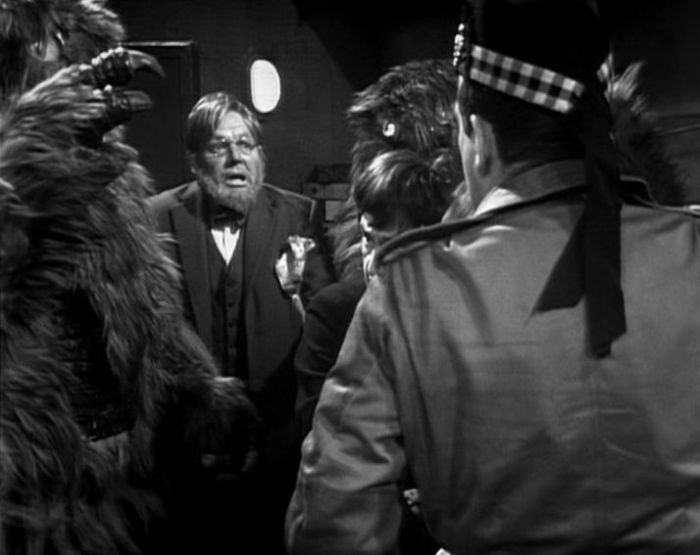
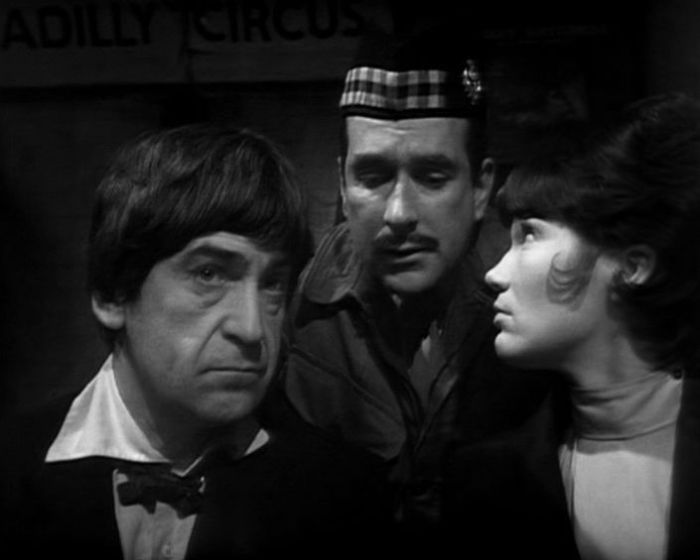
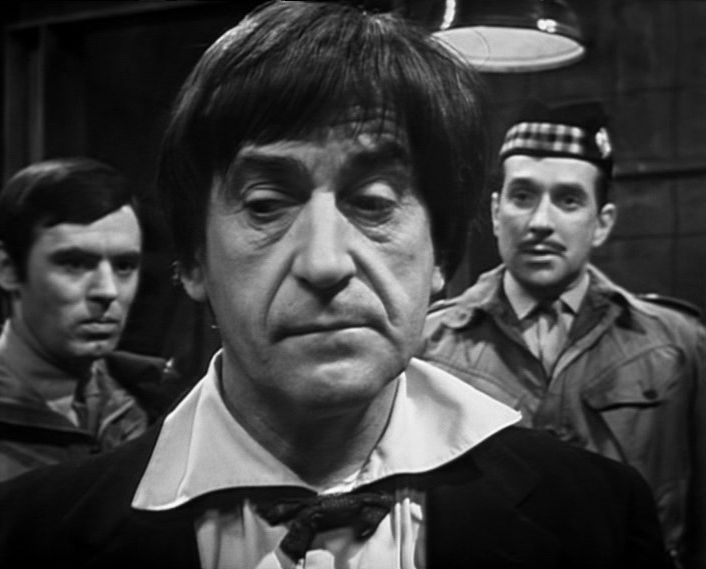
web 06-01

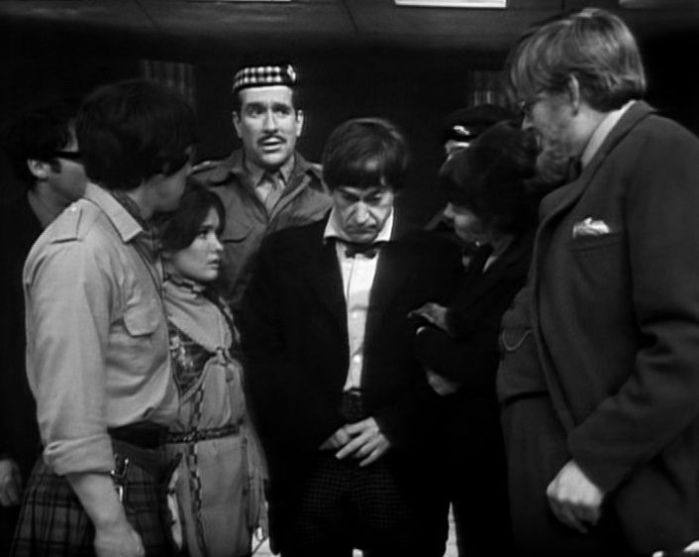
We’ve seen over the last few episodes how Lethbridge-Stewart’s fighting force has been somewhat decimated.  Apart from himself, only Evans and Arnold are still standing.  Evans remains an unreconstructed coward whilst Arnold continues to be a pillar of no-nonsense strength.

ARNOLD: Now look, lad, you’re scared, that’s understandable. But you’ve been in the Army long enough to know that orders is orders. There’s four people up there. If we don’t warn them, they’re for the chop.
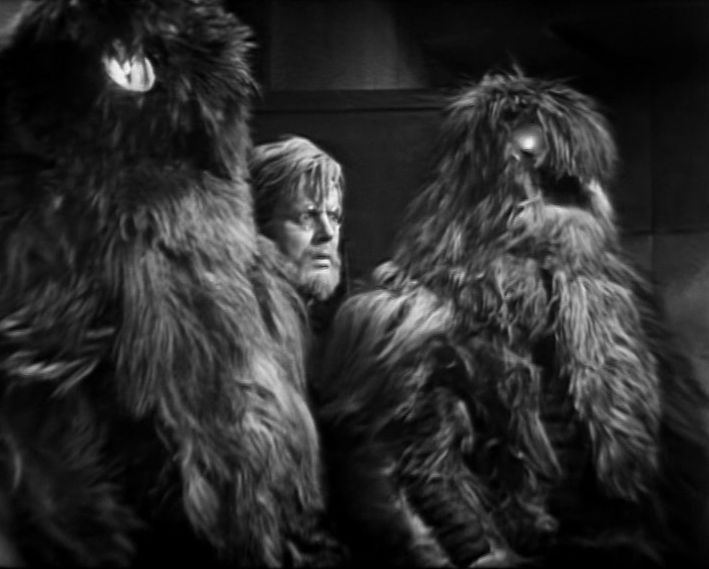
EVANS: So? Four of them’s getting the chop. There’s no reason to make it six, is there?
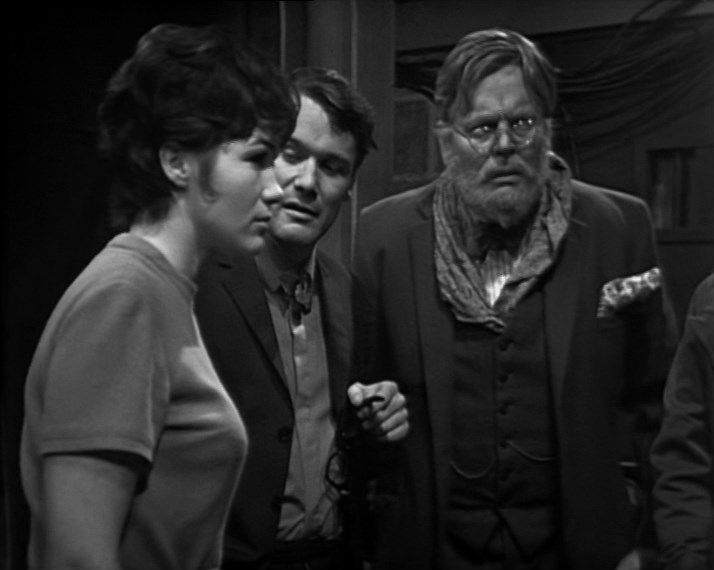
There’s another surprise reappearance – that of Chorley – who was last seen in episode three. It’s suggested again that he’s the Intelligence’s agent, but since he’s been absent for so long that doesn’t quite scan.

Evans getting carried off by the Yeti (“Hey, steady on. Oh, going for a walk, are we? There’s lovely”) is an episode highlight as is the moment when he’s deposited by the Yeti next to the Colonel and the Doctor. He brazenly denies that he had intended to make a break for it. “Desertion? Me? Oh, good heavens, no. No, I thought I’d try a single-handed and desperate attempt to rescue Professor Travers and the girl”.

We’re entering the end-game, as everyone is brought to the Piccadilly ticket hall, where the Intelligence has set up its brain drain machine. And this is where the Intelligence’s agent is finally revealed.  Right up until the last moment we’re teased that it’s Chorley, but then the shock reveal of Arnold is made.

Jack Woolgar impresses as the passionless voice of the Intelligence, but this is another of those moments which doesn’t make any sense. The Intelligence state that he’s been hiding in Arnold’s lifeless body for some time – but exactly how long?

Arnold seemed no different when he reappeared than he did before, but it’s equally hard to believe that he’s been controlled by the Intelligence all along (although that’s what the story tells us). There’s a faint air of disappointment here, somewhat akin to the feeling you get when a whodunit doesn’t play fair.

The story dropped numerous red herrings along the way, hinting that the Colonel, Evans, Chorley, etc were all credible candidates, but suspicion never fell on Arnold for a minute. Maybe this was due to the Great Intelligence’s skill, but it still feels like a little bit of a cheat.

And if the Doctor’s final reckoning with the Intelligence is a bit of damp squib, then it doesn’t really alter the fact that The Web of Fear is a classic slice of Who. A few quibbles about the script apart, this is glorious stuff and something which is always a pleasure to revisit.

web 06-02


Doctor Who – The Web of Fear. Episode Five

web 05-01

After four episodes, the Great Intelligence – speaking through the voice of Travers – finally explains what his/her/its evil plan is.  Some might think that the Intelligence has been somewhat slow on this score, but with six episodes to fill it clearly couldn’t show its hand too soon.

TRAVERS: Through time and space, I have observed you, Doctor. Your mind surpasses that of all other creatures.
DOCTOR: What do you want?
TRAVERS: You! Your mind will be invaluable to me. Therefore I have invented a machine that will drain all past knowledge and experience from your mind.

And this is where the wheels of the story slightly come off. I think that one of the reasons why I enjoy 60’s Who so much is that much of the mythos which would later build up around the character of the Doctor is absent. He’s no god-like creature, known and feared throughout the universe, he’s simply a wanderer in space and time.

So stories where he’s targeted by the baddies are pretty rare (this one and The Chase spring to mind) meaning that it’s much more likely that wherever he appears nobody’s heard of him.

And anyway, if the Great Intelligence needs the Doctor’s intelligence than he/she/it can’t be that great anyway. The Almost Great Intelligence maybe?

We’ve previously seen that the Lethbridge-Stewart of this story is a pragmatist, happy to escape rather than fight to the last man.  So when Evans suggests that if they agree to the Intelligence’s plan (delivering up the Doctor) possibly everyone else will be allowed to go free. The stalwart Brigadier would never consider this of course, but as has been touched upon, the man here isn’t quite the man he’d become and there’s a palpable moment of ambiguity in the air.

The controlled Travers stomps off with Victoria as a hostage whilst the others debate what to do next. Given that the Yeti have decimated the soldiers, there has to be a good reason why the Intelligence simply didn’t take the Doctor. And there is – unless the Doctor submits willingly, the brain drain machine won’t work.  So the fact that the Doctor has been given a deadline to either give himself up or face the consequences provides him with a welcome spot of breathing time.

The Doctor once again teams up with Anne. I wonder if these scenes influenced the creation of Zoe? Zoe might have been younger and more frivolous, but the seed of partnering the Doctor with a scientifically-minded companion might have been sown here.

The scene where Evans deliberately disobeys Lethbridge-Stewart’s order is a fascinating one.  The Brig wouldn’t have stood for this sort of insubordination of course, but the Colonel – still somewhat shell-shocked by the events of the previous episode – accepts Evans’ flagrant disregard of his orders quite calmly.  For those who know Lethbridge-Stewart well, to see the character so out of control is quite disturbing.

Deborah Watling is a little out of the action, but she does get to share a few nice scenes with her father. And when Jamie, out in the tunnels with the Colonel, spots Victoria’s handkerchief it’s hard not to be reminded of one of Frazer’s most famous convention anecdotes.

The Web of Fear is one of those stories where characters tend to disappear suddenly and then reappear with the same lack of ceremony. Both Arnold and Chorley have been MIA for a while but then Arnold pops up out of nowhere, seemingly no worse for wear.

The Doctor and Anne’s lash-up (a device to control the Yeti) seems to work, but a mass of web seems to spell the end for the Goodge Street fortress ….

web 05-02

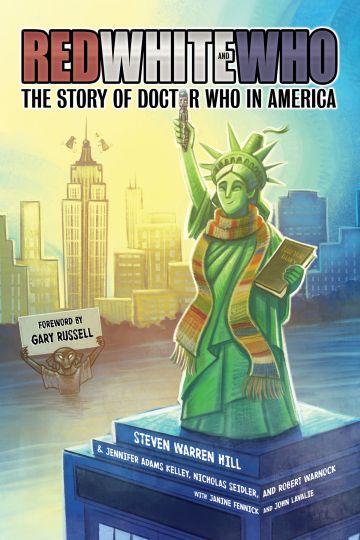
Red, White and Who – Book Preview

RedWhiteandWho

For many British Doctor Who fans, when considering America’s relationship with our favourite programme it’s the 1980’s which immediately springs to mind. That was the decade in which the show exploded in popularity across the US (in relative terms anyway) and whilst British fandom was beginning to turn on itself, becoming increasingly bitter and negative, in America there appeared to be only single-minded love for this newly discovered programme.

There was plenty of money too, as the stars of the programme quickly discovered. The leap from the fledgling and low-scale British convention circuit to the all-expenses paid, air-conditioned hotel experience of the American dream wasn’t lost on anybody. This helps to explain why just about anybody who was anybody in the Who world elected to celebrate the 20th anniversary of the programme at a massive American convention.

As Gary Russell explains in his brief, but amusing forward, this was one of the reasons why British fans regarded their American counterparts with jaundiced eyes. The fact that they also got The Five Doctors two days earlier than us simply rubbed salt into already bitter wounds. And then there’s the term Whovian ….

If you want to irritate an old-school British Doctor Who fan, just refer to them as a Whovian. It works every time. Coined by American fans back in the eighties, the new series has now brought this unlovely term back into common usage (something which continually irks me I have to admit, but then I’m an old-school British Doctor Who fan).

However, the story of Doctor Who in America began well before the 1980’s and continues right up to the current day, meaning that this mammoth book (704 pages, including 130 pages of appendixes) doesn’t leave any stones unturned in order to present us with the full picture.

I’ve had the chance to peruse several sample chapters from the book and what I’ve read has impressed me.  For example, whilst it’s fairly common knowledge that Doctor Who debuted on American television in the early 1970’s (with a package of Jon Pertwee stories) I wasn’t aware that the first faint flickers of interest in the series had occurred long before that.

In the mid 1960’s these mainly consisted of newspaper reports which took an amused look back over the pond during the period when Britain was gripped by Dalekmania.  For some American commentators there was plainly the fear that the Daleks might, following the Beatles, be the spearhead of another British invasion (something which filled certain writers with dread!)  An enthusiastic, if somewhat inaccurate, article from Famous Monsters of Filmland from 1965 is another early example of Doctor Who reporting in the US (these early chapters feature a plethora of fascinating press clippings and promotional material – both for the Dalek movies and the early television sales – which adds considerable extra value to the insightful text).

Chapter Eight – Love and Monsters – covers the PSB pledge drives as well as demonstrating early examples of fan-power.  This is another interesting topic for non-Americans – most of us have probably seen footage from various pledge drives over the years, but exactly how they worked (and the likelihood that money pledged for Doctor Who might not even go towards purchasing that series) was again another revelation.  I also loved Gail Bennett’s remembrance of John Nathan-Turner.   In the early eighties JN-T was, even in the UK, very much a fan’s producer, but it seems that he found greater acceptance in the US.  The notion of JN-T “holding court” at a convention with a group of fans in a hot tub sounds typical of the man, for good or for ill.

Chapter Ten – Doctor Who in Bits – discusses the way that American fans took to the brave new world of the internet whilst Chapter Fourteen – Creativity: Trippingly on the Tongue – exhumes another half-forgotten relic from the history of American Who.  John Ostrander’s stage-play The Inheritors of Time created a certain amount of interest in the mid eighties (not least for the fact that an American Doctor had been cast) but due to a lack of funds it was never mounted.  Ostrander teases the reader with a few hints about what the play contained, although he remains tight-lipped about many of the details (even after all these years it appears he hasn’t given up hope of resurrecting it).

Towards the end of the book, Chapter Twenty – It Couldn’t Have Happened to a More Deserving Fellow – examines the way that the series, in the Matt Smith era, really began to find a foothold in the public consciousness.  Which was a far cry from 2005, when American fans were frustrated that no broadcaster had picked up the Christopher Eccleston series.

Other chapters promise to cover Doctor Who’s first successful invasion, thanks to Tom Baker and Howard Da Silva (although possibly Da Silva’s help – via a series of narrations, designed to educate the American viewer about the series – was more of a hindrance).  As might be expected, the fan experience – via conventions and creative works – also looks to be covered in depth.

The sample chapters suggests that Red, White and Who will be the last word on this topic.  Although the list of authors – Steven Warren Hill, Jennifer Adams Kelley, Nicholas Seidler, Robert Warnock, Janine Fennick and John Lavalie – is a lengthy one, their voices seem to blend together seamlessly.

It’s available for pre-order here and whilst it isn’t cheap at $49.99, it does run to a hefty 704 pages and contains 600 images.  So whilst it’s true that the cost may be a little off-putting for some, what I’ve seen of it so far indicates that it’s no cheap cash in.  This looks to be something crafted with love and appreciation and should certainly be worth your consideration.

Doctor Who – The Web of Fear. Episode Four

,

Presumably sometime during the previous episode Anne decided to swop her mini-skirt and boots for a trouser suit, since that’s what see her wearing as the moving pictures start again.  Given all that’s going on it seems a little strange that she was such a slave to fashion.  She might be an independent young woman, making her way in a man’s world, but it’s possibly not too much of a surprise to find her portrayed as something of a clothes horse (a sign of those times).

When the Doctor and the others find her, she’s in a highly distressed state, which is pretty understandable since the Yeti have abducted her father.  Tina Packer rather overplays here, although given the situation Anne finds herself in that’s not too surprising.

Troughton continues to underplay though, which is notable in the early scene where Evans asks the Doctor if he believes that the Yeti have taken Travers.  The Doctor’s dialled-down, abstracted air makes it plain that he’s considering multiple possibilities, none of them good. When the Doctor later outlines what he knows about the Intelligence, it’s yet another wonderfully delivered few lines from Troughton. “Well, I wish I could give you a precise answer. Perhaps the best way to describe it is a sort of formless, shapeless thing floating about in space like a cloud of mist, only with a mind and will”.

Jack Woolgar continues to impress as well.  Look for the moment when Arnold tells Lethbridge-Stewart that Weams and the others are dead – Arnold’s voice cracks for a split-second, just enough to show the pain he feels at the loss of his men.  That Arnold later turns out to be the agent of the Intelligence, rather than the more obvious Chorley, is a cruel blow, possibly one of the cruellest of the story.

But red herrings continue to be spread about, since the Colonel doesn’t seem to remember meeting Evans (he was apparently his driver).  Does this mean that Lethbridge-Stewart is the agent or is Evans possibly the rotten apple?  No to both questions, but they’re nice misdirects.

Anne operates in this episode as pretty much a proto Zoe or Liz.  Like them, she’s able to speak to the Doctor on a similar scientific level (something that Jamie and Victoria were unable to do) which enables the Doctor to have a confidant who can also act as a sounding board for his theories.

One of the reasons why the Yeti work so well is that they’re not seen very often.  Keep them on screen for too long and their shortcomings become obvious.  But a few brief glimpses here and there, ideally lurking in the shadows, and they’re the stuff of nightmares.

But this episode sees them head out and about as they tangle with Lethbridge-Stewart and the others at Covent Garden.  This film sequence shouldn’t work at all – Yeti in the cold light of day sounds like a very bad idea – but Camfield pulls it off in a pulsating action scene that’s an obvious story highlight.

It’s interesting that Lethbridge-Stewart mounts the mission to Covent Garden for one reason only – to locate the TARDIS which will enable them all to escape.  The Brigadier would surely have remained and fought to the very last man, but the Colonel is much more of a pragmatist, keen to find an escape route.

During the scene you can play spot the stuntman – Terry Walsh, Derek Martin and Derek Ware should all be instantly recognisable and the minute they pop up you know that a spot of action is imminent.  It does seem a little odd that a very familiar piece of stock music (associated with the Cybermen) is used here, but maybe Camfield was unaware it had been used before or possibly it was felt that it didn’t matter that it had previously featured.

Favourite moment during this scene is Yeti who clutches his eyes before falling over.  Since we know that John Levene was playing one of the Yeti, I like to think that he was the one here who decided to go extra-dramatic.  Corporal Blake’s rather horrible death – mainly due to Richardson Morgan’s blood-curdling screams – is something which lingers long in the memory.

Knight and the Doctor head up to ground level to look for some vital electronic spares.  Alas, Knight doesn’t make it as he’s mown down by the Yeti.  The last shot we have of Knight – his lifeless body slumped across a table – is yet another unsettling choice from Camfield and Knight’s sudden, unexpected death helps to raise the stakes.  If Knight, one of those characters you’d have assumed would make it to the end, can be killed then no-one is safe.

This is also borne out when every member of the Covent Garden party – except the Colonel – is killed.  And with Knight also dead and Arnold missing, Lethbridge-Stewart is pushed to breaking point.  The cliffhanger – showing the arrival of the Yeti together with a catatonic Travers – ratchets up the tension several more notches.

Doctor Who – The Web of Fear. Episode Three

It’s a pity that this episode is still missing, although one day it might come back, yes it might come back ….

The major irritant is that it denies us our first glimpse of Nicholas Courtney as Lethbridge-Stewart (although since nothing from his debut existed in the archives before 2013 we can’t grumble about this too much).  And if there had to be a missing episode, then better this one than the next (the Covent Garden battle sequence would have been a much more serious loss).

Although Courtney’s characterisation as Lethbridge-Stewart is already pretty recognisable, the Colonel we see here isn’t quite the Brigadier that he’d become from The Invasion onwards.  Like some of the others (notably Chorley) he’s given the odd, off-key moment, suggesting he might have a secret to hide.   The fact that the story will shortly raise the spectre that the Intelligence must have a mole inside the fortress raises the possibility that the Colonel may well be a traitor ….

Chorley’s undergone something of a transformation from the previous episode.  Although things looked grim then, he was calm and in control. But now he’s suddenly become hysterical and desperate to leave.  Again, this suggests that he may be a man with his own agenda (or it could possibly be that he’s simply a coward, thinking only of his own survival).

The return of the Doctor energises the story – he quickly takes command and impresses the Colonel with his practical suggestions.  Lethbridge-Stewart also has ideas of his own – getting rid of the annoying Chorley by creating the superfluous job of “co-ordinator”, for example.

The Colonel is also in his element when leading a briefing.  Interestingly it’s Anne who is slightly riled when everybody’s presence is requested (“a briefing? We’re not in the army yet”) rather than the Doctor. It would be easy to imagine the Pertwee Doctor expressing a similar sentiment, but the Troughton incarnation was always much more easy-going.

But although the Doctor may appear to be pretty placid, it’s plain that there’s plenty going on under the surface. This was always one of the joys of Troughton’s Doctor. He didn’t need to dominate proceedings like Jon Pertwee or Tom Baker’s Doctors, he was content to sit, watch and wait. But when he spoke, people tended to listen – as seen with this short exchange between him and the Colonel.

DOCTOR: Someone here is in league with the Yeti. Maybe even controlling them.
COLONEL: What?
DOCTOR: The main door didn’t open by itself, did it? It may be any one of us.
COLONEL: Me, perhaps?
DOCTOR: Perhaps.

Based on what we later know, the idea of Lethbridge-Stewart as a traitor is laughable, but at this point we simply don’t know him, so it’s completely possible.  And the fact that Troughton doesn’t overplay this moment – he delivers his lines in very a matter-of-fact way – makes the scene even more powerful.  Unlike some of his successors, Troughton tended to understand that less was more.

Jamie spends most of the episodes stuck in the tunnels with the rather annoying Evans, whilst Victoria’s back in the fortress with the others. She doesn’t do a great deal in the episode sad to say, partly this seems to be because Anne – a more dominant character – is rather taking the limelight. And it’s a pity that as the episode draws to a conclusion we’re left with a whimpering Victoria and a slightly angry Doctor (she’s told Chorley about the TARDIS – a bad move if he’s the agent of the Intelligence).

The sudden death of Weams (the first – but not the last – of the established characters to die) and the cliffhanger shot of a terrified Travers tangling with the Yeti (who have been mostly off-screen during this twenty-five minutes) provides a strong hook into the next episode where – hurrah! – the pictures will move again.

Doctor Who – The Web of Fear. Episode Two

With Patrick Troughton on holiday, episode two allows the others, especially Frazer Hines and Deborah Watling, a little more screen-time.

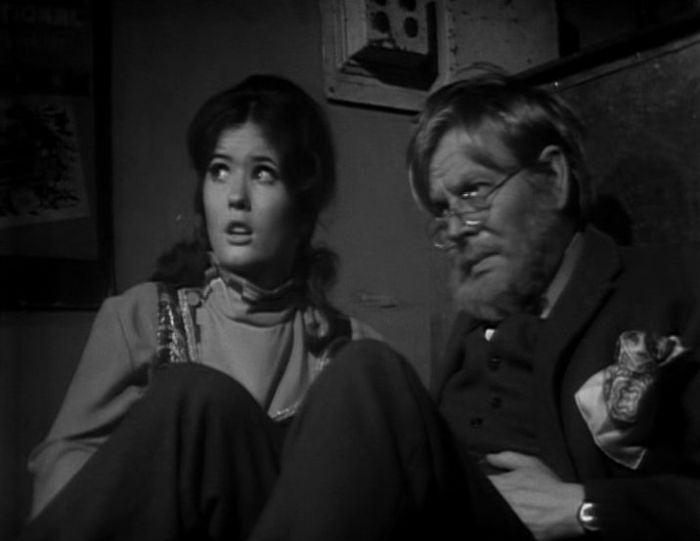
Jamie and Victoria’s first encounter with the aged Travers is a treat.  Camfield favours lingering on Victoria’s delighted face as she instantly realises that the old man in front of them is the same person they encountered forty years earlier in Tibet.  It’s a nice touch that Victoria is several steps ahead of Jamie, who doesn’t recognise Travers to begin with at all (although when he finally twigs, his comment – “here, hasn’t he got old? Oh, but we’re very pleased to see you, Professor. Very pleased” – is lovely).

The formidable Anne tangles with another man and again easily bests him. Here, it’s the oily newspaperman Harold Chorley (Jon Rollason).

CHORLEY: Oh, for goodness sake, why is everybody being so evasive? Why won’t anybody answer any questions?
ANNE: Perhaps they’re afraid you’ll interpret them in your own inimitable style.
CHORLEY: And what does that mean, pray?
ANNE: It means you have a reputation for distorting the truth. You take reality and you make it into a comic strip. In short, Mister Chorley, you are a sensationaliser.
CHORLEY: You smug little redbrick university ….
ANNE: Don’t say it, Mister Chorley. I have a very quick temper and very long claws.

Ouch! It’s interesting that although Web was made some fifty years ago, Chorley’s character – a unscrupulous journalist – is still a very recognisable one. The more things change ….

Jack Woolgar gives a lovely performance as Staff Sergeant Arnold. Arnold is your archetypical NCO – a gruff, no-nonsense type who’s easily able to keep his subordinates in order. Amongst his charges is the familiar face of Richardson Morgan (as Corporal Blake). Morgan would later turn up in The Ark in Space. Also good value is Stephen Whitaker as Craftsman Weams.

The arrival of Driver Evans (Derek Politt) adds a little levity to the story. He’s a comic, cowardly Welshman (if his accent wasn’t obvious enough, then the fact he turns up singing the Welsh national anthem provides the audience with another clue as to his nationality. Not the subtlest of characterisations then).

The Yeti look very good when lumbering through the tunnels on film. When they pop up on videotape it’s fair to say that they’re slightly less impressive, but Camfield is still a good enough director to ensure that they don’t look completely ridiculous (other directors might not have been so successful on this score).

There’s already a nice sense of claustrophobia and unease throughout this instalment, which increases as the story progresses. Although the Troughton era tended to overdose on base-under-siege stories, when done well (as here) they’re gripping entertainment. By the end of the second episode, the parameters of the story have been established – a small group of heroes isolated in the underground and menaced by the Yeti on all sides.

With Victoria lost in the tunnels and the Doctor still missing, things are nicely set up for episode three.

Doctor Who – The Web of Fear. Episode One

Following the news of Deborah Watling’s death, I’m sure I wasn’t the only one to reach for this story.  Back in the mid eighties though, if you wanted to see Victoria in action you were limited to either the second episode of The Abominable Snowman, episode three of The Enemy of the World or the first episode of this one (and that was always supposing that you were able to obtain a pirate VHS from a friendly contact).

It’s very pleasing that season five is now much better represented than it was back then and, for me, it’s the two stories returned in 2013 – The Enemy of the World and this one – which are the real jewels in the crown.

I first encountered Web 1 back in the late eighties, on a pirate tape along with a selection of other orphaned Hartnell and Troughton episodes (a bit like an early Lost in Time then, although the picture quality sometimes left a little to be desired).  It’s therefore an episode which I’m very familiar with, having rewatched it countless times across the decades (always wondering whether the rest of the story would maintain this strong opening).

Non-controversial statement – Douglas Camfield was Doctor Who‘s best director.  It’s easy to see why he directed more stories than anybody else – his skill at crafting intriguing picture compositions (both in the studio and on film) was second to none and there’s plenty of examples to be found in this opener.

Since studio time was always limited, most directors wouldn’t spend too long on creating interesting visual images – simply getting the actors to hit their marks and deliver their lines without bumping into the scenery seemed to be the top priority.  Camfield, possibly due to the fact that he ran his productions with a military precision, was quite different as he was able to find the time to craft pleasing shot selections.

A good example can be found in the early TARDIS scenes.  The Doctor, Jamie and Victoria, staring at the scanner screen, are positioned with the Doctor in front, Victoria behind him and Jamie at the back.  In order to make this shot work, all three actors had to hit their marks exactly whilst the cameraman also had to be in precisely the right place.  If anybody was slightly off, then the composition wouldn’t work.  Many directors would simply have elected to line them up side by side (this would have been easier to shoot, but also would have looked unnatural – Peter Davison raises this point several times on his audio commentaries – the way that certain directors shot the TARDIS scenes very flatly).

I assume the reason why the confrontation between Travers (Jack Watling) and Julius Silverstein (Frederick Schrecker) is recorded on film was because the underground sets took all the available studio space.  Camfield always had an affinity with film (no surprise that he later graduated to all-film series like The Sweeney) which makes this scene a creepy pleasure.  It’s true that Jack Watling gives a very broad performance (“stubborn old goat!”) and his facial contortions are something to behold, but presumably he was playing the part as written.

Strong female characters aren’t terribly common during this period of the show, so Travers’ daughter Anne (Tina Packer) stands out rather.  A scientist in her own right, she’s acidly polite when the hapless Captain Knight (Ralph Watson) attempts to clumsily chat her up.

KNIGHT: What’s a girl like you doing in a job like this?
ANNE: Well, when I was a little girl I thought I’d like to be a scientist, so I became a scientist.
KNIGHT: Just like that?
ANNE: Just like that.

Compare and contrast this with The Invasion (which in its early drafts would have featured return appearances for Anne and Professor Travers). Anne’s replacement – Isobel – is a much more pallidly drawn character who’s happy to entertain romantic overtures from Knight’s counterpart – Captain Jimmy Turner.

Whilst I may love The Web of Fear dearly, it’s not a story that makes a lick of sense.  Firstly, if the Great Intelligence’s plan was to ensnare the Doctor, why envelop London in a web?  After all this wasn’t the early seventies – a time when the Doctor was resident on modern-day (to the viewers) Earth.

And the moment when the museum Yeti changes before our eyes from the cuddly Abominable Snowman version into the sleeker Web of Fear model might look good, but again it’s something which isn’t at all logical.

Quibbles apart, this opener effectively sets the story up.  We know what we’re dealing with (Yetis in the Underground!) and we’ve also been introduced to a varied cast of military characters who we’ll get to know better as the serial progresses.

For many long years there seemed to be little hope that we’d ever get to see the rest of the story.  And then in 2013 something remarkable happened …..

Out of the Blue – Series Two, Episode Six

blue s02e06

The team investigate the death of a fourteen year old prostitute called Justine Painton (Caroline O’Hara) ….

We’re pitched straight into the action. It’s late at night and in a run down part of town, Justine’s body is discovered. With a plastic bag over her head and rope marks on her wrists it seems that natural causes can be ruled out.

The officers stand around cracking weak jokes in the time honoured fashion (anything to take their minds off the actuality of the present situation). A brief moment of levity is provided when Becky sets the record straght about her night of limited passion with Lew (she knows that he would have already spun them his version of events). The only problem is that he hasn’t said a word ….

Justine’s mother, Fran (Siobhan Finneran), maitains a shrine to her daughter at home. Numerous school photos and beauty pagent trophies act as reminders of the girl she was, not what she’d become. Wasted potential (Becky and Warren view the cleaned up girl on the mortuary slab and Warren mentions how beautiful she was) is a theme of the story.

Family-man Ron finds the case a little hard to deal with. It’s not dificult to understand why (girls the same age as his daughter leading a dissolute life). One of Justine’s friends, Kirsty (Sarah Jane-Potts), tells him and Marty that Justine embraced life on the streets wholeheartedly. Is this the truth or simply an obfuscation? And what precisely did her mother know about her daughter’s new life?

One very striking moment occurs when Kirsty is speaking about Justine. The scene is overlaid with photographs of a younger Caroline O’Hara, which serves as an effective counterpoint between the past and the present.

It’s a remarkable coincidence that Richard Shaw (Pip Donaghy), the father of Warren’s ex-girlfriend Lucy, knew Justine intimately (he took bondage photographs of her). He offers to share his information, provided the police can arrange a meeting with his estranged daughter. Warren knows precisely where she is, because he’s been keeping tabs on her (mmm, a touch obsessive).

Local celebrity, boxer Vinnie Harper (Adam Kotz), was involved with Fran. But was he also intimate with Justine? The big guns (DI Temple and Lew) are wheeled out for a pulsating interrogation as we see Vinnie hauled over the coals.

Although Caroline O’Hara (making her screen debut) has very limited screentime (after all, her character is dead when we first see her) Justine still permeates every part of the story. Her death means that she’s robbed of her own voice, so others have to ascribe her with motivations and fill in her character for us.

Although answers are provided, justice is harder to come by. This was one of the strengths of Out of the Blue, a series which never felt obligated to pretend that life was fair. One of the final scenes – in which a distraught Lew makes this point to a resigned Temple – could be seen as a setup for the third series which never came. Would series three have finally been the point where Lew went too far?

We’ll never know, but while Out of the Blue never became a mainstream success, twenty years on it stands up as a flawed – but fascinating – series.

Deborah Watling (1948 – 2017)

image

I was very sorry to hear today that Deborah Watling has died at far too young an age. Whilst she’ll no doubt always be best remebered for Doctor Who, she had several other entries on her CV which are worth checking out.

Right at the beginning of her career was H.G. Wells’ Invisible Man (1958). Ten-year old Debbie played Sally, niece to Peter Brady, the invisible man of the title. Sally rarely played a central role in the stories but Debbie was always eye-catching and managed to steal more than a few scenes.

Her last dramatic television role was as the vampish Norma in Danger UXB (1979). Possibly not a series that’s terribly well-remebered today, but it’s a quality WW2 programme with a fine ensemble cast which I’ll have to dig out soon for a rewatch.

On the big screen, 1973 saw her act with two British pop stars from very different generations. Take Me High, a tale of Cliff Richard and brumburgers is a wonky guilty pleasure whilst That’ll Be The Day is in a different class altogether. Debbie played Sandra, a young girl used and rather abused by the feckless Jim MacLaine (David Essex). That’ll Be The Day is more than a David Essex star vehicle since it stands up as a decent film in its own right. It’s something else which I’ll no doubt be revisiting shortly.

Back In my convention-going days I had the opportunity to meet Debbie on several occassions and she was always a delight – an attentive and welcoming guest. Possibly my strongest memory of her comes from a small convention held in Weston-Super-Mare during the mid nineties.

As often happened, the timetable started to go a little awry which meant that nobody was terribly pleased when the auditorium was cleared for what appeared to be no good reason. But all turned out well in the end as it became clear that Debbie had been rehearsing a special entertainment – a song and dance routine where, showing a good deal of leg, she left most of us speechless! Happy days and a memory to treasure.

This is an obvious clip to end on, but it’s a very pertinent one. Thank you Debbie. RIP.

Out of the Blue – Series Two, Episode Five

blue s02e05

Three homeless people (one of them played by the highly recognisable Andy Devine – who would later appear as Shadrach in Emmerdale) are poisoned after a seemingly good Samaritan offers them a drink of champagne laced with prescription tranquillisers.

Temple’s mildly curious, but doesn’t regard it as much more than a sick joke.  It’s a sign of the times that the office only seems to have one computer and – as the victims use it to put together an identikit picture of their well-heeled poisoner – Temple gripes about the expense.  “Have you any idea how much that computer takes out of my budget? It’d be cheaper to hire Walt Disney”.

Temple’s given some good lines in this one.  A few minutes later he asks Becky and Warren exactly what they’re going to do.  “Put out an All Points Alert for Burlington Bertie?”  That’s a rather obscure reference which – back in the pre-internet nineties – would probably have perplexed a section of the audience.

Elsewhere, Bruce, Lew, Marty and Ron go in mob-handed to tackle Gibbs (Peter Jonfield), who appears to have a shop full of stolen goods – although annoyingly none of his stock appears to be on the stolen property register.  By racially taunting Bruce, Gibbs successfully manages to get under his skin – making him all the keener to nail him, although it also might serve to make him more reckless.

This subplot somewhat moves into the background once it’s discovered that Jackson (Devine) has been attacked again, only this time he’s dead.  Is it connected to the previous poisoning?  The descriptions of the suspects indicate not and the fact that one of them had red hair gives Marty the chance for a droll comeback.  “That’s handy, I’ve been looking for an excuse to arrest Mick Hucknall”.

They trawl the drug rehabilitation centres for clues, which sees Lew and Tony take diametrically opposing views on their usefulness.  It’s no surprise that the humanitarian Tony believes they help to prevent crime as well as getting people back on the straight and narrow whilst the more cynical Lew begrudges the fact that his taxes are used on such people.

Bruce has been operating on a tight-fuse for a while.  And after Warren makes an offhand remark (wondering if his obsessive nature is a family trait) Bruce takes it as a dig directed at his father and fisticuffs ensue.  This creates a nice sense of tension which, together with Lew’s off-kilter personality, means that the team have never been more dysfunctional.

Another soap favourite, Maggie Jones (Blance Hunt from Coronation Street) makes a brief appearance as Joan Palmer.  Bruce wants Joan to identify the property from Gibbs’ shop as hers, but when she’s unable to do so Bruce is once again frustrated.  Emma Bird, who also would have been a familiar face at the time (she’d played Maxine during the 1992/93 run of Casualty) makes an impression as Nikki, another of the poisoned down and outs.  She’s an actor who seems to have slipped off the radar, as her last screen credit (an episode of Liverpool 1) was all the way back in 1999.  And the eagle-eyed might spot a young Benedict Wong making a brief appearance as a wages clerk.

The team arrest a suspect, Eamon Timmer (Simon Tyrell), for Jackson’s murder.  He’s very talkative before the tape starts rolling (“I killed Jackson Hanley! I did it. And I’ll kill every tosser in this room”) but doesn’t say a word after the red light goes on.

Although none of the plots really engage, the interactions between the team (especially the continually wise-cracking Marty) helps to keep the interest levels up.  The final scene is especially intriguing. After Becky’s attempt to console Warren (still smarting over the end of his relationship with Lucy) comes to nothing, she winds up in bed with Lew.  Her post-coital expression makes it plain that she realises what a terrible mistake it was ….