Paul Merton in Galton & Simpson’s The Bedsitter

bedsitter.jpg

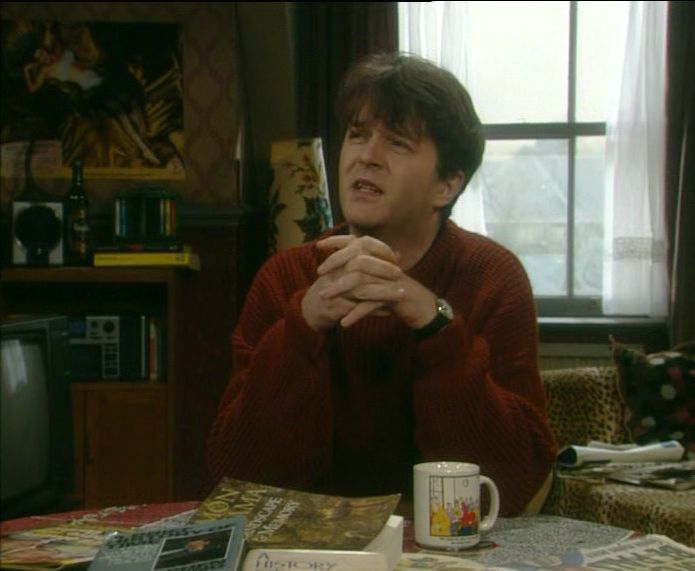
This took nerve.  The Bedsitter is a daunting challenge for any performer – a twenty five minute solo performance where there’s nowhere to hide and no-one else to take the pressure off.  The Hancock original was simply sublime, one of the Lad’s finest half hours (well, twenty five minutes, to be strictly accurate).

Throughout this first series it’s been noticeable that Paul Merton really comes alive when he’s playing opposite good actors.  Reacting to others is one of Merton’s strengths (a reason why he’s a natural on panel games such as Have I Got News For You) whereas it’s harder to imagine him as a successful stand-up comedian, since the solo spotlight isn’t really his forte.  The fact that his comedy credentials were formed as part of a team – the Comedy Store Players – supports this observation.

Given this, I approached The Bedsitter with a little trepidation.  Could Merton pull it off or would it be another pallid remake?  Read on …..

Like some of other adaptations, this was a slightly weird viewing experience, mainly because some of the cultural references have been updated but others are left intact.  So Paul still sings Coward’s A Room With a View (this can be taken as an ironic comment on his surroundings of course).  His crooning of Maurice Chevailer’s Louise seems a little more out of place though.

Musings on the nature of bicuspids (“two swearing teeth”) and his inability to penetrate the works of Bertrand Russell are left intact and come over well.  One noticeable difference comes mid-way through when Paul looks out the window.  In the original, Tony stares out and we see a world of pain behind his eyes whereas Paul essays only mild irritation.

This is probably the main difference between their two approaches – Hancock was so good at expressing despair (possibly tapping into his real life melancholic nature) whilst Merton, whose performing persona isn’t too dissimilar to Hancock’s, offers a more buoyant outlook on life.   When Paul receives a wrong call and tells the lady on the other end that he’s a resting artiste, you get the sense that despite the fact he’s out of work and living in a crummy bedsit he still believes that things will turn around.

The remainder plays out pretty much as per the original, even the television set with the dodgy aerial (given the antiquated nature of the bedsitter this doesn’t jar too much).  Paul’s less than impressed with the number of repeats, although the BBC2 programme with Stephen Hawking (Bronowski in the original) is more to his taste.

He might clear up that theory he was postulating in his book. If I fell into a black hole a thousand light years away, my son would be fifty four, I’d be thirty five, and my dad would be ten and a half. Nah, he must be up the spout there.

It’s an obvious ironic touch that Paul, the failed intellectual, after singing the praises of Hawking, attempts to watch something rather more low-brow – a Western.

Once again, it’s hard to imagine this production supplanting Hancock’s original in many people’s affections, but it was a more than credible effort.  It was the final show in the first series and when PM in G&S’s … returned the following year, 1997, for a second run, the seven episodes adapted were much more obscure examples from the Galton & Simpson catalogue.

Paul Merton in Galton & Simpson’s The Lift

lift 01.jpg

The Lift is one of the best Hancock adaptations from series one of PM in G&S’s ….  Partly this is because of the supporting cast – Michael Fenton Stevens as the oily producer, Sam Kelly as the truculent lift man and the always reliable Geoffrey Whitehead as the Air Marshall, amongst others.

The episode keeps the same location (a television studio) although it’s no longer the BBC, instead we’re at the rather obviously made-up Alpha Television (why they didn’t simply call it Carlton is a bit of a mystery).  As in the original, the queue for the lift slowly grows and as each new person appears they press the button, no doubt under the impression that no-one else would have thought of it!

Paul’s rather taken with an attractive secretary (Sheridan Forbes) who’s joined the queue, but she’s immune to his charms, preferring instead to bask in the glow of a producer (Fenton Stevens), who can’t help but modestly mention all the top shows he’s involved in.  Also present and correct is Paul’s baiting of the Air Marshall, here he’s taunting him to press the lift button.  “Go on, pretend it’s a rocket. You’d enjoy that, wouldn’t you? Go on, five, four, three, two, one …”

Also waiting patiently is Peter Jones as the Vicar.  He’s probably best known as the Voice of the Book from The Hitch-Hiker’s Guide to the Galaxy, although that was just a small part of a long and distinguished career.  Having a comedy great like Jones onboard is yet another reason why this one is so enjoyable.

A few tweaks are made to bring it up to date.  The lift man from the original is replaced with a maintenance man (lift men were clearly a thing of the past).  Also, the producer has a mobile phone with him – although he keeps quite about it for a while!

Anne Reid ramps up the hysteria as a woman suffering from claustrophobia (“that’s a handy thing to have in a lift” says Paul cheerfully).  From Paul musing about how there won’t be enough oxygen left for everyone in the future (“the man with the biggest hooter will survive”) to his attempts to keep the others entertained with parlour games, there’s plenty to enjoy.

A fine ensemble piece.  Whilst the original is a classic slice of comedy, this version is not too shabby at all.

lift 02.jpg

Paul Merton in Galton & Simpson’s Don’t Dilly Dally on the Way

dilly.jpg

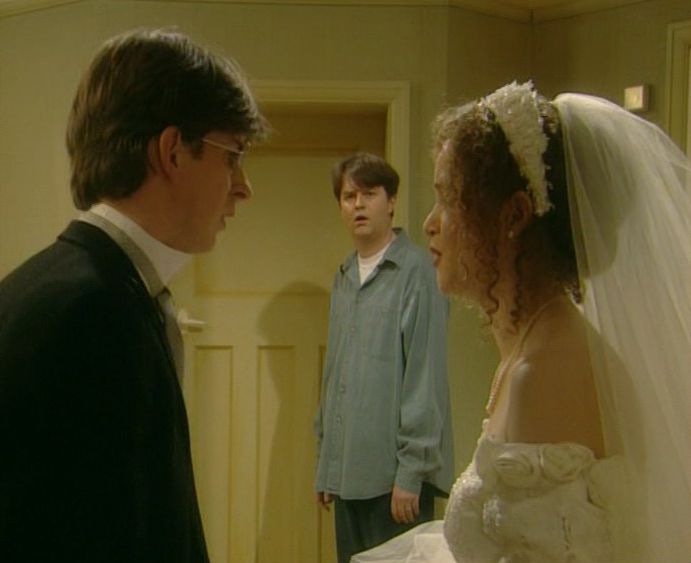
Kevin (Merton) and Joyce (Gwyneth Strong) are saying goodbye to their old house.  Kevin can’t wait to see the back of it, but Joyce just can’t let go.  This is something of a problem, because the new occupants are due any minute.   And then Joyce locks herself in the toilet and refuses to come out ….

Don’t Dilly Dally on the Way was adapted from an episode of The Galton & Simpson Comedy, broadcast in 1969.  If the release date doesn’t slip again, the series will be out shortly from Network, so it’ll be interesting to see how Jimmy Edwards and Pat Coombs fared in the same roles.

This is an odd little tale.  By 1969 many of Galton & Simpson’s best days were behind them, although they weren’t a totally spent force – some excellent episodes of Steptoe still lay ahead (along with some pretty average ones it must be said).  The premise here feels rather unnatural (as does the sight of Kevin returning to the house, sleeping bag in hand, quite prepared to sleep outside the bathroom door – oblivious to the fact that the newlyweds have just moved in!)

One of the biggest laughs from the studio audience comes earlier on when Kevin tells Joyce that if she doesn’t get out soon then “that four-eyed twit and his flat-chested wife will be here”.  Matthew Ashforde and Emma Cunniffe (David Jason and Jacki Piper in the original) as Gordon and Avril do the best with the material they have, but it’s fairly thin.

Sam Kelly and Anne Reid fare rather better as Gordon’s parents.  They’ve come round to inspect the house and Gordon’s father is far from impressed – woodworm, rising damp and a woman locked in the toilet.  It’s not the ideal way to spend your first day of married life ….

Merton’s less central in this one than in some of the other episodes.  Understandable, since the Hancock episodes were built around the central performance of Tony Hancock, whilst Don’t Dilly Dally is more of an ensemble piece.  He has some choice moments though, such as when he invites himself to join Gordon, Avril and Gordon’s parents for dinner!

The final punchline (the location of Kevin and Joyce’s new house) is a gag that falls a little flat.  This is probably because, like the central premise, it doesn’t feel terribly plausible.  You can’t fault the cast, but you can fault the script.  Don’t Dilly Dally on the Way is something of a lesser pleasure from the Galton & Simpson catalogue.

Paul Merton in Galton & Simpson’s The Missing Page

missing.jpg

Paul’s latest book from the library, Lady Don’t Fall Backwards, has him gripped all the way to the final page.  Or it would have done if it was actually there.  The last page is missing, which leaves both Paul and his wife Caroline (Caroline Quentin) desperate to know whodunnit ….

Another Hancock evergreen gets the 1990s remake treatment.  Most of the topical references are naturally updated (although it’s pleasing that Paul, just like Tony, admits to having read Biggles Flies East twenty seven times).

Patrick Barlow is good as the long-suffering librarian who crosses swords with Paul whilst it’s also nice to see James Bree as one of the shushing members of the library.  It’s noticeable that the section where Tony mimed the plot of another of his favourite books was excised.  Maybe this due to timing issues (these episodes, since they were broadcast on ITV, only ran for twenty five minutes as opposed to the thirty minutes of most of the originals) or it could have been that Merton decided he’d never be able to top Hancock’s performance.

The most obvious change, of course, was replacing Sid with Caroline.  Merton and Quentin were married at the time, so it wasn’t surprising that an episode was crafted which showed them as a couple.  She’s aggressive (becoming apoplectic when shushed in the library) and sarcastic – it’s easy to believe that both Merton and Quentin had a hand in crafting their on-screen relationship (which possibly mirrored real-life).  For me, she’s rather one note – I would have preferred Sam Kelly to carry on with the Sid role, as he did in Twelve Angry Men.

Jim Sweeney, an old colleague of Merton’s from the Comedy Store Players, has another small role (this time as the last man to read the book, who’s still upset that he doesn’t know whodunnit!).  Previously he’d walked on as one of the two policeman at the end of The Radio Ham.

There’s nothing particularly wrong with this one, and it certainly zips along nicely, but as with The Radio Ham it feels slightly redundant.  When the original is so good, there’s little reason for it to exist.  And updating it to the mid nineties does rather stretch credibility to breaking point.  The information super highway might not have been as wide then as it is now, but the Internet was certainly in existence, so why not use it?  And some of the logical flaws inherent in the original are carried over.  If Paul has read every book in the library countless times, why does he have no knowledge of Lady Don’t Fall Backwards?

A diverting enough twenty five minutes, but it can never hope to eclipse the original.

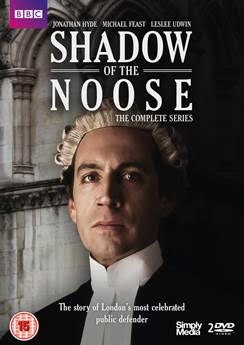
Shadow of the Noose to be released by Simply Media – 20th February 2017

shadow.jpg

Shadow of the Noose is coming later in the month from Simply Media –

A must-see series for fans of period drama and courtroom drama. Featuring outstanding acting talent including Jonathan Hyde, David Bradley, Siân Phillips, David Schofield, Caroline Quentin, and early performances from Peter Capaldi and David Rintoul

Simply Media is delighted to announce the DVD release of BBC’s Shadow of the Noose: The Complete Series. First shown on BBC Two in 1989, this highly regarded eight-part drama series, with an outstanding all-star cast, will be available to own for the first time on any home video format from 20th February 2017.

Directed by BAFTA-winner Matthew Robinson (Byker Grove / Eastenders) and Sebastian Graham Jones (Cadfael), Shadow of the Noose tells the true story of the career and personal life of “The Great Defender” Sir Edward Marshall Hall. He was London’s most celebrated barrister and the first world-famous legal celebrity, whose gripping cases consistently made news headlines and drew crowds in to the public gallery of the Old Bailey during the late Victorian era and early Edwardian era.

Jonathan Hyde (Titanic) brings Marshall Hall’s style and personality to life on screen in an outstanding performance. Marshall Hall was known for his theatrics as he argued his cases with gusto and determination, keeping the Court audience on the edge of their seat, particularly at a time when a guilty verdict meant facing the rope.

Throughout the series, which is based on true cases, Marshall Hall tackles a variety of seemingly impossible and controversial cases, and defends a colourful array of characters. Whether championing a lowly German prostitute accused of murdering a client, dissecting an ugly libel battle surrounding accusations of homosexuality within an aristocratic family, or defending the accused in the infamous Camden Town Murder…it’s all in a day’s work for Sir Edward Marshall Hall! But when a maid is accused of killing her illegitimate baby Marshall Hall is forced to face his own personal demons when it brings back unhappy memories of his first marriage…

The series also features stellar performances from the supporting cast, which includes Michael Feast (Game of Thrones) as Marshall Hall’s clerk Edgar Bowker, Caroline Quentin (Men Behaving Badly) and David Schofield (Gladiator). Marshall-Hall’s clients are also played by renowned actors such as  Golden Globe nominee Siân Phillips (I, Claudius), BAFTA-winner David Bradley (Broadchurch) and an early performance from Academy Award winner Peter Capaldi (The Thick of It, Doctor Who).

Paul Merton in Galton & Simpson’s Sealed with a Loving Kiss

sealed

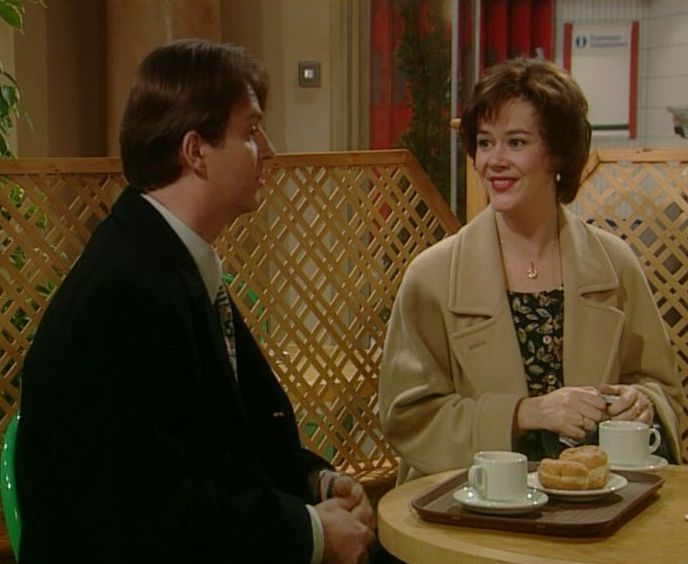
Arnold (Merton) and Primrose (Josie Lawrence) are carrying on a passionate, albeit long-distance, affair by post.  The only problem is that they’ve yet to meet and both have been rather economical with the truth.

Arnold, a coalman by trade, has rechristened himself Damon, a hard-working brain surgeon who drives a Porsche whilst Primrose is Michelle, an international model often to be found in the pages of Vogue.  Both exchange photographs (not of themselves naturally) which means that when they finally come face to face confusion is bound to reign ….

The original Sealed with a Loving Kiss was broadcast in 1962, during series one of Comedy Playhouse, with Ronald Fraser and Avril Elgar as the two would-be lovers.

Comedy and melancholy often sit side-by-side in Galton & Simpson’s material – countless examples can be found in their most famous works (Hancock’s Half Hour, Steptoe & Son).  Hancock and Harold were classic under-achievers, constantly knocked about by an uncaring world that seemed not to even notice they were there.

This same theme is deftly developed here.  Both Arnold and Primrose are perfectly nice people who live respectable lives, but there’s clearly self-esteem issues which have made them take refuge in fantasy.  We never learn precisely what makes Primrose tick, but Arnold’s neuroses are laid bare in part one.

Arnold still lives with his mother (an excellent turn by Rosemary Leach) who has sabotaged his previous relationships and now seems to relish telling him that he’s too old to get married.  After all, who would look twice at him?  Merton really seems to spring to life when he’s acting opposite quality players and sparkles here.

Both Arnold and Primrose are disappointed that their dates (Michelle and Damon) haven’t turned up, so they decide to have a cup of tea in the railway station café.  Merton and Lawrence, both members of the Comedy Store Players, had a long performing history, which helps to explain why they’re so comfortable in each others company.  Lawrence displays a pleasing vulnerability and both combine to clearly touch the hearts of the studio audience (whenever you hear an “awww” from the audience, you know you’ve struck gold).

After the disappointment of The Radio Ham, we’re on firmer ground here.  No doubt helped by the fact it was a much more unfamiliar piece, we feel more invested in the fates of Arnold and Primrose, especially when they decide to eschew their fantasy lives and embrace the reality in front of them.

Packed with nice touches (for example, when Primrose reads Arnold’s letter, the voice she hears is that of the urbane Michael Jayston) Sealed with a Loving Kiss is a series one highlight.

Paul Merton in Galton & Simpson’s The Radio Ham

radio

Given how highly regarded Galton & Simpson’s final television series for Tony Hancock has always been, it’s no surprise that three episodes were adapted for series one of PM in G&S’s ….  Possibly the only surprise was that they didn’t tackle The Blood Donor – maybe they felt that one was just too iconic.

The Radio Ham has always been inexorably linked to The Blood Donor though, by virtue of the fact that both were re-recorded by Tony Hancock for LP release.  And because the only way to relive classic comedy performances in the pre-VHS days was via record or cassette, for decades the re-recordings of The Blood Donor/The Radio Ham were one of the few ways you could experience classic Tony Hancock.

So for a generation, or two, you can guarantee that many would know The Radio Ham virtually word by word – which means that a remake has to pass a fairly stern test ….

Neatly, there’s an explanation provided at the start to explain why Paul, in the mid 1990’s, is mucking about with equipment so antiquated that it requires new valves.  It’s ex-Army surplus (which possibly was extracted from a WW2 Lancaster).

Apart from the odd cosmetic touch like this, the script remains pretty much as it was.  So Paul has to run the gamut with his uncomprehending friend in Tokyo (“it is raining not here also”), carry on long-distance games of chess, poker and snakes and ladders, whilst organising trays of bread pudding for ex-pats in Kuala Lumpur.

It’s interesting that they kept the moment where Paul puts on a cod Japanese accent, all the better – he hopes – to get through to his friend in Tokyo.  It wouldn’t have surprised me had it been snipped out, but no, it’s present and correct.

Merton seems a little stiff to begin with, especially when he’s by himself.  Once he starts interacting with the voices on the radio, things pick up a little – especially when all his dreams come true and a May Day distress call starts broadcasting …..

Michael Jayston is suitably frantic as the misplaced mariner, but there’s still something missing here.  It’s competent enough, but maybe because I’m so familiar with the Hancock original this version can’t help but feel a little second best.  In an ensemble piece, like Twelve Angry Men, the load can be shared, but in The Radio Ham, where Merton is on-screen by himself for most of the duration, it’s impossible not to remember how skilled Hancock’s performance was in the same piece.

By comparison Paul Merton is competent, but somewhat lacking.  Direct comparisons are invidious, but when you’re remaking a comedy classic they’re sadly inevitable.

Paul Merton in Galton & Simpson’s Impasse

impasse

Two cars meet in a narrow country lane.  One will have to back up and give way, but neither Dave (Merton), driving a Volkswagen Beetle, nor Mr Ferris (Geoffrey Whitehead), behind the wheel of a Bentley, are prepared to give any quarter.  So a tense battle of nerves begins ….

The original version of Impasse was broadcast during the second series of Comedy Playhouse in 1963. Bernard Cribbins and Leslie Phillips were the implacable motorists, whilst Yootha Joyce and Georgina Cookson played their long-suffering wives.  Here, Tilly Vosburgh is Dave’s wife, Kirsty, whilst Phyllida Law plays Mr Ferris’ spouse.

You might expect the script to lean towards the side of Dave, the little man facing off against the rich and privileged Mr Ferris, but that’s not really the case at all.  Both are shown to be equally pig-headed and unlikable (it’s plainly no coincidence that they treat their wives in pretty much the same way – badly).

Mr Ferris has decided that Dave’s truculence is due to class envy, but maybe Dave just likes a fight.  They nearly come to blows a little later, although their fight is more notable for the way each circles around the other, throwing punches in the air.  It rather brings to mind a similarly non-contact scrap between Hancock and Sid in the classic radio HHH episode The Last Bus Home.

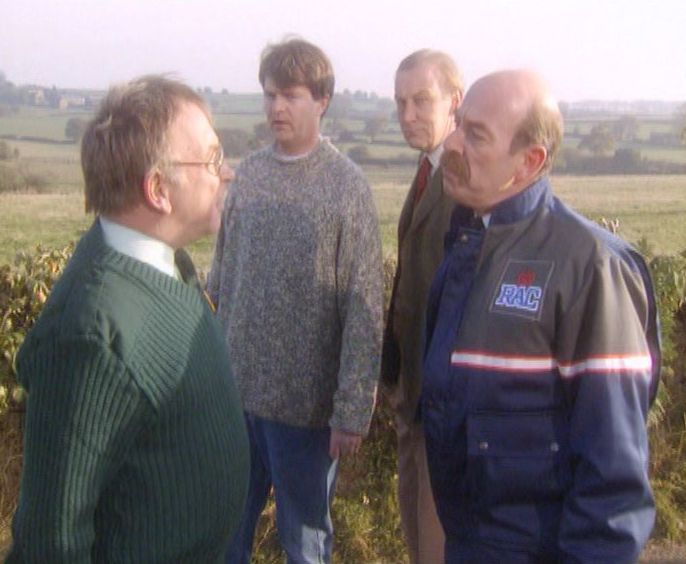
Just as you get the sense that the comic potential has been wrung out of this scenario, then help – in the form of an AA Man (Sam Kelly) turns up – shortly followed by an RAC Representative (Denis Lill).  Kelly and Lill are just as good (if not better) than Merton and Whitehead, with the AA Man standing firmly behind his member, Dave, and the RAC Man equally steadfast in defending the interests of his member, Mr Ferris.

I’ve said it before, and no doubt I’ll say it again, but it’s a joy to see the quality of the casts in this series.  It’s fair to say that Vosburgh and Law have little to do – although they do have a nice scene (not present in the original) where they’re able to pour scorn on their respective husbands. This leaves the field open for the two squabbling male sides to dominate proceedings and it’s amusing that the AA and RAC representatives carry on exactly the same sort of one-upmanship we’d previously seen from Dave and Mr Ferris.

The late arrival of a policeman (played by Roger Lloyd-Pack) who finally solves the impasse is another bonus.  The sting in the tail – the winner of the battle finds he is forced to back up anyway – brings events to a satisfying conclusion.  And unlike the original this benefited from being shot on location, rather than in the studio.

Connections – Simply Media DVD Review

connections2

James Burke (b. 1936) first came to prominence on Tomorrow’s World during the mid sixties, where his relaxed and conversational tone provided a sharp counterpoint to his co-presenter, the more precise and patrician Raymond Baxter.  His profile on TW meant that he was an obvious pick for the BBC’s Apollo coverage – he would go on to helm numerous hours of live television alongside Patrick Moore and Cliff Michelmore.

After leaving TW in 1971, Burke moved onto his own series, The Burke Special (1972 – 76), in which he examined various aspects of modern life and conjectured how they might develop in the future.  Already in place was Burke’s trademark style of swiftly jumping from one subject to another and some of the topics covered – such as test tube babies and gun control – ensured that the series generated a certain level of controversy.

Burke then moved out of the studio and onto film for Connections (1978).  Subtitled An Alternative View of Change, it sought to challenge the accepted linear view of technological progress.  Burke would argue that no part of the modern world can be regarded in isolation – instead you need to track back through history to find apparently unconnected events which can be linked together in order to show a continuity of change.

This interdisciplinary approach wasn’t to all tastes and neither was Burke’s presenting style – contradicting himself or walking out of shot during mid-sentence, for example.  But it’s fair to say that Connections was a programme which made a deep impression on a section of its audience and – whether you disagree or agree with all his theories – still provides substantial food for thought.

This three disc set contains the following –

The Trigger Effect – Original broadcast 17th October 1978

Death in the Morning – Original broadcast 24th October 1978

Distant Voices – Original broadcast 31st October 1978

Faith in Numbers – Original broadcast 7th November 1978

The Wheel of Fortune – Original broadcast 14th November 1978

Thunder in the Skies – Original broadcast 21st November 1978

The Long Chain – Original broadcast 28th November 1978

Eat, Drink and Be Merry – Original broadcast 5th December 1978

Countdown – Original broadcast 12th December 1978

Yesterday, Tomorrow and You  – Original broadcast 19th December 1978

connections-01

Burke’s idiosyncratic style is clear right from the opening moments of The Trigger Effect. He asks the audience (“would you do me a favour?”) to consider all the man-made objects in the room where they’re sitting (television, lights, etc) and the impact they have on their lives. He then moves out of shot, leaving an empty frame for a few seconds, an obvious visual cue which gives the audience some “thinking time”. It’s a good example of the way Burke challenges the viewers not to be passive observers, but instead to interact with the arguments and theories he’s generating.

In addition to Burke’s sometimes provocative statements, Connections boasts impressive visuals, thanks to the skills of director Mick Jackson. Jackson’s later and very varied CV includes the Whitney Houston/Kevin Costner movie The Bodyguard, the devastating nuclear drama Threads and the Ray McAnally political serial A Very British Coup.

Connections allowed Jackson a wide palette in which to craft some striking images.  And he was granted a very healthy budget – the series took fourteen months to shoot, travelled to nineteen countries and took in a hundred and fifty individual locations along the way.

Jackson’s eye for the unusual can be seen in the first episode as even the simple act of Burke travelling in a lift is presented in a memorable way. But this isn’t simply gloss for the sake of it – Burke makes the point that just as we have become increasingly dependent on technology, so our understanding of how it works has decreased sharply. Does he know how a lift works? No, he just accepts that it does.

I take going up in the world like that for granted. We all do. And as the years of the 20th century have gone by, the things we take for granted have multiplied way beyond the ability of any individual to understand in a lifetime. The things around us, the man-made inventions we provide ourselves with, are like a vast network, each part of which is interdependent with all the others.

This increasing dependency on technology is examined during The Trigger Effect as Burke looks back to a massive power-cut which engulfed New York in 1965. With discordant music (courtesy of Richard Yeoman-Clarke from the BBC Radiophonic Workshop) and the help of those who were present, re-enacting their roles, it’s presented in highly a dramatic fashion.
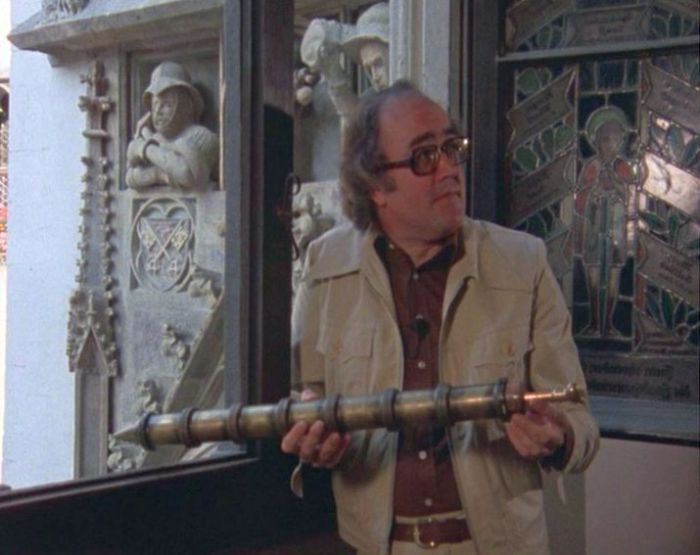
connections-02

“What does survival without technology look like?”. Burke effectively paints a nightmarish picture of the stuggles inherent in existing in a world without electricity (tapping into many of the themes developed in numerous post-apocalyptic dramas, such as Survivors) and then links this back to show how previous civilizations, such as the Ancient Egyptians, could be said to have been the first technological nations. He therorises that once an invention – such as the plough – is created, it must inevitably lead to further inventions through the ages (even if the connection between them isn’t immediately apparent).

The series’ aims are restated at the start of Death in the Morning.  Burke reflects that because knowledge of the future is impossible, tracing a modern man-made object back thousands of years is somewhat akin to a historical detective story, with twists and wrong turns along the way. He sets things up nicely by teasing us that the modern intention of this edition “affects the life of every man, woman and child on Earth” but doesn’t say what it is. Instead, his story begins two and a half thousand years earlier in the Eastern Mediterranean and is concerned with money, but will have become something totally different when we reach the present day. How we get from there to here, the intuitive leaps Burke makes and the visual imagery along the way, all help to make this a typically captivating instalment.

Highlights of later episodes include Burke’s imaginative arguments which connect the Little Ice Age of 1250 – 1300 AD to a whole host of later inventions, including the chimney and diverse objects as buttons and knitting (episode six, Thunder In The Skies).  Also of interest is Eat, Drink and Be Merry, which discusses how modern credit – the plastic credit card – can be traced back to the Dukes of Burgandy, the first state to use credit.  This then springboards into the problems of keeping food fresh (a particular issue for large armies in the nineteenth century) and Burke then presses on to show how these innovations led to the Saturn V rocket which took men to the moon.

The final edition, Yesterday, Tomorrow and You, neatly summaries everything that we’ve learnt in the series to date and returns to a theme posed by Burke posed at the start of the series, concerning the way that the world is developing increasingly advanced technology at a rate faster than our ability to understand it.  Should we be concerned about this, or just accept that change is inevitable?

With its globe-trotting camerawork, Connections engages on several levels.  Not only is it a visual treat, but it’s an intellectual one as well.  It may flit from subject to subject, but James Burke remains the series’ solid centre and his quirky approach helps to ensure that the series is much more than a series of dry lectures.  Picture quality is what you’d expect from material of this era – had fresh prints been struck from the negatives it could have looked much better, but as always it’s a question of cost.  What we have is perfectly watchable though.

Nearly four decades on, the series still engages, entertains and stimulates – a testament to the work of James Burke, Mick Jackson and the whole production team.  Warmly recommended.

Connections is released by Simply Media on the 7th of February 2017.  RRP £24.99.

connections 03.jpg

Hunter’s Walk – Disturbance

disturbance

Hunter’s Walk was a police drama created by Ted Willis (Dixon of Dock Green, Sergeant Cork) which aired on ITV during 1973 – 1976.  It bears some similarities to Dixon in both tone and pacing – you certainly could never mistake it for The Sweeney – and although the location was different (Dixon was set in London, Hunter’s Walk in a fictional Midlands town) the type of cases we see – from the mundane to the serious – could easily have also turned up in Dixon.

The series’ archive status is rather patchy.  Out of thirty nine episodes made, only ten exist and half of those are black and white telerecordings.  Given this, and approaching the first episode on disc one – Disturbance – with no foreknowledge, you might have been forgiven for assuming it was a mid season installment.  But no, it was the series’ debut (tx 4th June 1973) so it’s interesting to observe how Richard Harris’ script drops us into the setting pretty cold, using the trauma between Dennis Kenwright (Doug Fisher) and his estranged wife Janet (Helen Fraser) to illuminate the personalities of the regulars.

The chain of command is established fairly rapidly.  From Det. Sgt. Smith (Ewan Hooper) at the top, Sgt. Ridgeway (Davyd Harries) in the middle and PC Pooley (Duncan Preston) at the bottom.  Smith is shown to be an old hand, unflappable and methodical.  Ridgeway is not without compassion, but also has clear views about what is and isn’t police business.  Pooley is initially presented as something of an aggressive hothead, but we see another side to him later on.

All three interact individually with Kenwright and it’s worth taking a moment to consider their differing approaches.  Smith was called to a robbery at Kenwright’s place of work.  He tells Kenwright’s employer that he knows him – but this doesn’t seem to be in the police sense, simply that he’s familiar with Kenwright’s family.  Smith briefly questions him and Kenwright replies in a slightly touchy way.

Next, Kenwright ventures to the station to speak to Ridgeway.  This is an intriguing part of the episode – Kenwright wants to return home to speak to his wife and retrieve some of his possessions, but because Janet is now seeing someone else Kenwright would like a police presence.  The inference is that Kenwright is afraid of physical violence from Janet’s lover, although when we meet him that’s neatly inverted as Kenwright is the abusive one.  Was this more to do with the fact that Kenwright was aware he might lose his temper and wanted the police to protect his wife?

Whilst this part of the story could be said to lack a little logic, it’s not too much of a problem since it highlights Kenwright’s off-key and mildly disturbed nature (which increases as the episode progresses).  Ridgeway is slightly condescending, telling Kenwright that the police can’t get involved in domestic disputes, although they can have a man in the area.

Luckily they did, as Kenwright’s decision to take the record player sparks a row between him and his wife.  This scene also highlights Kenwright’s confused state of mind as he earlier told Ridgeway that he needed to pick up certain items urgently, but a record player doesn’t really seem to fall into this category.  He disturbs Janet’s new man, Ted Peters (John Ringham), who’s sitting in the living room, having his tea.

Ringham has little to do here, but he instantly catches the eye as Peters springs up out of his chair, knife and fork still in hand.  The way he holds onto the cutlery and his instinctive steps backwards are both non-verbal signifiers that Peters is not someone who will offer violence (borne out during the remainder of the episode – he’s a married man who wants the minimum of scandal).  Pooley turns up on the scene and forcibly brings peace to the house, although since he offers Ridgeway a lift home it’s plain that his bark is worse than his bite.

As Disturbance progresses, Kenwright starts to devolve.  He obtains a rifle, takes a potshot at Peters and then later holes up at a lonely spot, pinning down Smith, Ridgeway and Pooley.

This may seem to indicate that Disturbance is something of an action piece, but that’s really not the case.  Character is key here, both with the regulars and the guest cast.  We may have seen numerous Dennis Kenwrights before – men and women pushed over the edge – but Doug Fisher gives him a pleasing vulnerability.  Janet Kenwright is less sharply drawn, remaining more of a catalyst for the unfolding events rather than an active participant, although Helen Fraser is a vivid presence throughout.  It’s more than a little tragic that Janet’s affair is with a married man (and especially one as cowardly as Peters – lovely turn by Ringham).  Both husband and wife are the victims here.

The regulars might take a little more time to bed in, as none of them are particularly striking here.  Hooper is affable as Smith, although rather characterless.  Harries is an actor I’ve always found to be somewhat affected and mannered (the way he pronounces “off” as “orf” here is a slight indication of this).  But this may have something to do with the performances of his that I’ve seen, so it’ll be interesting to see if Ridgeway develops into more of a “real” character in later episodes.  It’s hard to disassociate Preston from his later comic roles, but he does nothing wrong as the young, and presumably inexperienced, constable.

Robert Tronson’s direction, especially the film sequences, are notable.  The first few minutes see Kenwright pounding the streets, past – I assume – real members of the public rather than extras.  Some unusual camerawork, low angles and partially obscured shots, help to make these moments stand out, as does the lack of music.  Silence can be powerful, especially when used to illuminate an isolated character like Kenwright.  I do wonder how moody some of these scenes would be if they weren’t in black and white though.

Disturbance is pretty slowly paced, so maybe wasn’t the most obvious series opener.  But even given the rather poor survival rate (six from series one, one from series two, three from series three) by the time I’ve reached the end of the set it may be more clear exactly how indicative it is of the series as a whole.

Paul Merton in Galton & Simpson’s Twelve Angry Men

twelve.jpg

The rather unwieldy titled Paul Merton in Galton & Simpson’s …. aired for two series during 1996/97.  The fifteen episodes cherrypicked both familiar and unfamiliar scripts from Galton & Simpson’s impressive back catalogue, with series one leaning heavily on adaptations of classic Tony Hancock shows.

Five of the eight series one episodes were based on Hancock material.  This one, The Radio Ham, The Missing Page, The Lift and The Bedsitter.  These choices no doubt helps to explain the rather muted critical reception the series received.  Tackling five comedy classics is asking for trouble –  since it’s highly unlikely that you’re going to match, let alone surpass, the originals.

It’s puzzling why they chose these ones.  Any G&S series had to include some Hancock, but it might have been better if they’d gone for less iconic picks (any of the missing episodes would have been obvious choices).   Possibly this had been taken onboard by the second series – only one episode was adapted from a Hancock script and it was a pretty obscure one.

Merton first came to prominence with the Comedy Store Players.  Their brand of improvised comedy lead directly to C4’s Whose Line is it Anyway? and R4’s The Masterson Inheritance.  He also found time to star in his own sketch series (imaginatively titled Paul Merton – The Series) between 1991 and 1993 and has been a regular panellist on Have I Got News For You since the series launched in 1990.

Merton wasn’t an experienced sitcom performer, which might explain why the supporting casts were so strong.  Sam Kelly, Geoffrey Whitehead, Michael Fenton-Stevens, Anne Reid, Jim Sweeney, Josie Lawrence, Roger Lloyd-Pack, Michael Jayston, Gary Waldhorn and Brian Murphy all appear in multiple episodes (often playing different characters – a very Hancockian touch) whilst an equally impressive list of performers make one-off appearances.

So let’s take a look at the first episode, which aired on the 26th of January 1996, Twelve Angry Men.

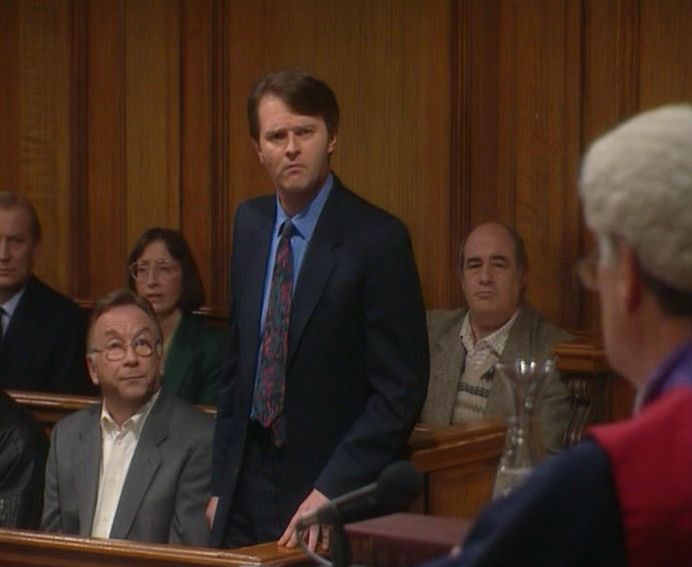
With the passage of nearly four decades, there’s numerous small topical references which have been retooled – for example, Paul regards the proceedings as the spit of Rumpole of the Bailey, rather than Hancock’s The Verdict Is Yours.  A few new gags are popped into the courtroom scene, which sound more like Merton than G&S.  This surreal exchange between Paul and Sam, for example.  “You know, my mother once changed a fillet of salmon for a pair of shoes. Well she had to pay the difference of course, well her feet were bigger for a start.”

Sam Kelly takes on the role played by Sid James in the original.  Kelly was no stranger to the world of sitcom (Porridge, Allo Allo!, On The Up) and is characteristically rock sold here. He’d appear in another four episodes of PM in G&S’s … and is great value each time.

There’s plenty of other familiar faces on show.  Peter Jeffrey plays the increasingly exasperated judge to perfection whilst Gary Waldhorn and David Daker spend the courtroom scene sitting directly behind Paul and Sam.  Waldhorn and Daker don’t have any dialogue until the action moves into the jury room, so during the first five minutes they have to be content to steal the attention of the audience with a glance or a facial expression.  And since both are old pros it’s hard not to find your eye drawn towards them ….

Daker is the farmer pining for his livestock, Waldhorn the company director fretting about losing money, whilst Geoffrey Whitehead is the juror most opposed to Paul’s increasingly bizarre flights of fancy as he continues to argue that John Harrison Peabody must be innocent. Another juror picking up a few lines is a young Rob Brydon, in one of his first television roles.

“Does Magna Carta mean nothing to you? Did she die in vain?”

As a Hancock fan, I’ve no doubt Merton relished delivering one of the Lad’s most famous monologues, although it’s fair to say that the Magna Carta line only receives a polite response from the studio audience.  Clearly they were weren’t Hancock aficionados.

A credible effort with Merton impressing.  It didn’t hurt that he was surrounded by talent though and whilst the original remains a comedy classic, this 1996 remake is more than watchable.

Grange Hill. Series Eight – Episode Eighteen

grange hill s08e18.jpg

Written by Barry Purchese.  Tx 22nd April 1985

The opening night of the school musical – Brighton Rock – is nearly here, but discord is still rife.  The lack of decent sets remains an issue, although Zammo is more concerned about the absence of any bikes, bitterly reflecting that they’re going to be the only Mods and Rockers who ever had to walk to Brighton.

Something certainly seems to be lacking and help comes from a most unexpected quarter – namely Mr Bronson.  After a year terrorising most of the pupils (and some of the staff!) he demonstrates his more approachable side after he corrals Vince into extracting sound effects from the film Death Race 2000.  Mr Bronson hopes that this will help to spice things up, although Mr Smart is less convinced.

Those with long memories will remember Gonch’s wheeze of copying tapes from the video shop owned by Vince’s dad (that explains how Mr Bronson discovered the tape of Death Race 2000 on the media resources machine).  Michael Sheard is on fine form as Mr Bronson informs Gonch that his old eyes get a little tired towards the end of term, but they’ll be undimmed at the start of the next.

It’s a pity that this new, briefly human, Mr Bronson doesn’t achieve rapprochement with Zammo.  After spending the year riling the boy, this part of the plot just fades away (next year Mr Bronson will have a new unfortunate – Ant Jones – to victimise and his contact with Zammo will be minimal).

Mr Baxter, standing in for the ever-absent headmaster, and Mrs McClusky are sandwiched either side of the Mayor, who regards the unfolding first night entertainment with a long suffering air.  Everybody seems convinced that something’s missing in the performance, although quite what is hard to say.

Banksie, after smashing up the sets, makes amends by persuading his brother Phil and some of his mates to bring their bikes into the auditorium.  When Mrs McClusky hears of this she’s not at all sure it’s a good idea (understandably) but Mr Bronson once again is on the side of the pupils.  Is this because he’s remembering his own salad days?  He seems to confess as much to Mr Smart at one point, although imagining Mr Bronson as either a Mod or a Rocker is something of a stretch ….

The bikes make an appearance, although since all they do is drive onto the stage and park up, you have to wonder whether it was worth all that effort.  The play comes to a decent conclusion thanks not to the bikes but because the final song is suitably stirring.  It claims that strife between warring groups can be settled if only everyone could learn to love one another.  It’s a nice, albeit hopelessly optimistic, sentiment and ties in neatly to the running theme of Grange Hill vs Brookdale vs Rodney Bennett.  Zammo and Jackie of course have been attempting to bridge this gap all year, although with limited success.

Whilst the 1985 Christmas Special touches on several topics (Roland’s lost love, the struggle between Cally’s real and adoptive mothers) developed during series eight, it was made as part of the production block for series nine, so series eight ends here.

Various characters – Jimmy Flynn, Julian Fairbrother, Annette Firman, Mandy Firth – all bow out with no ceremony.  Annette is at least mentioned at the start of the next series, the others join the list of the Grange Hill forgotten – pupils who simply disappear and are never referred to again.

Ben Rea’s sole year as producer introduced a host of characters who would have long term futures with the series and although at times the plotlines seemed not to be terribly well developed (frequently dropped or picked up again with little ceremony) it’s still an agreeable run of episodes.

Grange Hill. Series Eight – Episode Seventeen

grange-hill-s08e17

Written by Margaret Simpson. Tx 17th April 1985

Hollo has a brainwave about how to assemble a new set for the school play at short notice – raid the rubbish dump for suitable material.  Along with Miss Booth and the rest of E1 they head down to the dump to pick up numerous likely objects.  The fact that everything’s bound to be rusty and filthy doesn’t seem to concern Miss Booth, but I guess that needs must.

The new set doesn’t go down well with all the performers and Fay’s sporting commitments means that she’s not able to make a vital rehearsal.  This is all too much for Miss Washington who goes into something of a tizzy.  Miss Washington is sporting an interesting dress – something she’s worn before, but with a plain black dress over the top of it.

Roland’s back from his French misadventure and naturally enough doesn’t really want to talk about it.  Unluckily for him, Janet’s present to fill in all of the embarrassing details.  Now that Fabienne’s departed, so has Roland’s striped jacket and beret, although this particular storyline will be referenced again in the 1985 Christmas Special.

Jackie and Banksie are still serving their suspension.  Time is clearly hanging heavily on their hands, as we see them aimlessly wheel around on a roundabout in a deserted children’s playground.   There’s rather a nice bleakness to this scene – although it’s a sunny day, the inner-city feel of the location matches Banksie’s dialogue.  He tells Jackie they’d better get used to doing nothing, after all that’s what they’ll be doing after they leave school.

This nihilistic attitude has been aired by others before, with numerous pupils wondering why (like Jackie) they should be fretting about exams when there’s no jobs to go to after they leave school.  It’s not been touched upon for a while, so this moment helps to anchor the series in the mid eighties, when unemployment was still high.

Mr Smart continues to entertain (his transformation from the cold, unbending teacher of previous years is now complete).  Make no mistake, he’s not a man to cross, but his newly found sense of humour has certainly fleshed his character out.  Here he once again crosses swords with Gonch, who had popped into his office to retrieve Mr Bronson’s wig.  Simon Heywood doesn’t milk the comedy, but his incredulous reaction that the tattered hairpiece is Mr Bronson’s (at one point he gingerly pushes it across the desk with a pencil) is nicely done.  As is the moment when he hands Mr Bronson a small parcel containing his lost property.

With Mr Smart due to write to Gonch’s parents to tell them exactly how badly behaved he’s been all year (slightly odd that he hasn’t done so before) Gonch starts to fret about how well, or not, he’s going to do in the upcoming exams.  So naturally enough he decides to cheat ….

Even for Gonch, this is a particularly hairbrained scheme.  We’re told that Vince is a bit of a swot (not the first time this year that a character trait has been dropped on us out of the blue) and has prepared tapes which will help him in the exams.  Gonch “borrows” one such tape for a French exam, but Ronnie decides to swop it (for The Meteors – presumably it was 1985’s Monkey Breath) and everything goes downhill from there.  It’s quite interesting to see Trevor, introduced in episode one as something of a hard-man, tell Gonch that he’s mad to try and cheat in the exam.  For whatever reason it wasn’t decided to follow through and make Trevor the class bully – the introduction of Imelda will help to fill that gap.

The identities of the set smashers hasn’t been one of the series’ most taxing mysteries and N4 take their own brand out vengeance out on Banksie and his shadow, Loop.

Grange Hill. Series Eight – Episode Sixteen

grange hill s08e16.jpg

Written by Margaret Simpson.  Tx 15th April 1985

It’s time to bid a fond farewell to the French exchange students.  But Roland doesn’t seem to be too upset that he’s going to be parted from Fabienne, which no doubt has something to do with the fact that he’s decided to stow away with them on the return trip to France ….

Like the pelican crossing protests in the previous episode, this is another story beat that comes to us cold.  We’ve seen that Roland and Fabienne have been close, but since the ground for his misadventure hasn’t been laid at all, it comes across as a rather half-hearted escapade.  But it does give us our only chance this year to see Mike Savage as Mr Browning who, as ever, gives us his best hangdog expression when he learns the news, courtesy of the ever-zealous Janet (poor Mr Browning has had more than his fair share of strife with Roland over the years).

The cross-channel ferry crossing was done on the cheap – a quick bit of stock footage and then a cut to what is supposed to be a rough crossing (plenty of camera moves and overlaid mist).  Not terribly convincing, but then for such a short sequence it’s hardly surprising that they had to quickly cobble something together.

For those keeping up with the Zammo/Jackie relationship, it’s off again.  We never actually see Jackie (or Banksie) in this episode, but Julian breaks the bad news to Zammo that they’ve been seen together.  I have to admit that this eternal triangle is starting to wear a little thin with me, thankfully series nine shakes things up, as  Zammo spends the year otherwise engaged ….

Ronnie cleans Mr Bronson’s wig after Gonch asks her nicely.  Poor Mr Bronson has had to resort to wearing his emergency hair-piece, which causes a certain amount of merriment (even Mrs McClusky isn’t immune).  The question still remains about how they can return it though.

One of the longest running threads of series eight is finally brought to a conclusion as the identity of the thieves is discovered – Emma Stebson, her brother Gripper and Denny Rees.  Okay, let’s just stop for a moment and consider this – Gripper and Denny (both of whom would be recognisable to many of the pupils and staff) have apparently been wandering around the school corridors during the daytime for weeks on end, carrying out armfuls of swag.  Really?

It’s even more remarkable that we don’t even see them – we just hear their voices on Gonch’s Walkman.  At last his staffroom bugging came up trumps, it’s just a pity (for him) that Mrs McClusky, Mr McCartney and Mr Smart learn about it.  Mrs McClusky asks him, dangerously sweetly, if listening to the staff’s tittle tattle is very interesting.  Whenever Mrs McClusky is particularly pleasant you know there’s danger.  I also like the way that Mr Smart launches into full judicial mode when interrogating Gonch – grasping his lapels like he was at the Old Bailey.

With the robberies wrapped up, that just leaves the school play to sort out.  Everything seems to be going swimmingly, until it’s discovered that all the sets have been slashed.  Was this the work of Gripper or did someone else with a grudge against the school do the deed?

Grange Hill. Series Eight – Episode Fifteen

grange-hill-s08e15

Written by John Godber.  Tx 10th April 1985

Following her sons accident, Mrs Wallace (Zienia Merton), leads a spirited demonstration outside the school, calling for a pelican crossing.

This demo comes rather out of the blue, since we’ve seen no preparations previously.  But on the plus side it’s good to see Zienia Merton (probably best known for Space 1999) as a crusading parent.  What’s really interesting about these early scenes is that some of the other teachers – Miss Booth and Miss Washington – have already decided that Mrs McClusky is bound to react unfavourably.

It’s therefore ironic that Mrs McClusky is shown to be fully in favour of the aims of the demonstration.  She also calmly points out that blocking the road will do little good and instead will only serve to alienate both the police and motorists.  Mrs Wallace, in the white heat of anger, eventually comes around, but it’s much more surprising that Miss Booth or Miss Washington take so long to grasp this obvious point.

This episode is probably the best so far during series eight for Gwyneth Powell.  Mrs McClusky tangles entertainingly with Mr Bronson (always a delight when those two lock horns) and she also faces off against the builders.  They’ve returned to start work in earnest but have to shamefacedly admit that the reason they’re so far behind is because they’ve been nipping off to help the old folk with their house repairs.

Once again, there’s an inversion of our expectations – everything seems to be set up for Mrs McClusky to react in anger to this news, but instead she cues up Mr Bronson to splutter indignantly before swiftly cutting him off to sweetly praise them for their community spirit.  Lovely!

John Godber was a very infrequent contributor to the series (this was the third of his five scripts).  A pity, because there’s some sharp character work here (especially amongst the staff).  Another enjoyable moment comes when Mr Smart and Mr Baxter discuss Mr Smart’s forthcoming Hardy exhibition.  Mr Smart clearly assumes that Mr Baxter is unaware of Thomas Hardy, although Mr Baxter firmly makes the point that this isn’t so.  Mr Baxter’s disgusted expression is a delight (and continuity wise it ties back to series six, where we learnt that he has a great love of English literature).

There’s a nice literary joke when the builders confess to Mr Smart that everything’s taken so long because a good deal of the wood in the school is rotten and has to be replaced.  He wanders off, muttering that there’s “something rotten in the state of Denmark”, much to the builder’s bemusement (who later conclude he must have had a bad holiday there!).  I don’t know how many of the target audience would have got this Shakespearian joke, so maybe it was one for the parents watching.

The other running thread of the episode concerns Hollo’s new blazer and shoes.  This doesn’t really work, mainly because his blazer doesn’t look different from anybody else’s and we never see his shoes.  But it does allow Robbie to indulge in that time-honoured school gag (pinching Hollo’s clothes from the changing rooms, leaving the poor boy trouserless).

Hollo and Gonch have also done some pinching though, taking Mr Bronson’s wig (the teacher was enjoying a swim and had left it by the side of the pool).  It’s our first opportunity to see Mr Bronson sans wig (“he’s bald!” exclaims Hollo) and it leads into another great comic scene as the two boys, playing about with the hairpiece in the changing rooms, suddenly hear Mr Bronson approaching and have to swiftly hide the offending toupee.  Alas, Gonch shoves it in the rubbish bin, where it gets rather dusty!

So as the episode ends, Mr Bronson has lost his wig and Hollo is deficient in the trouser department.  Not the most dramatic of cliffhangers true, but an effective way to close one of the stronger episodes from series eight.

“I could play all day in my Green Cathedral.” Doctor Who and the Seeds of Doom

seeds

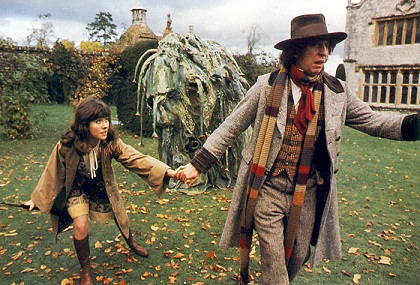
My irregular Doctor Who rewatch has reached Robert Banks Stewart’s second and last script for the series.  First things first, a few plot-holes that have always slightly irritated me.

In episode three, Dunbar tells Chase that he’s attended to the Doctor and Sarah (via a decoy chauffeur who’s rather handy with a gun).  We later learn that the chauffeur was on Chase’s payroll.  Eh?  Surely it would have made more sense for Chase to send the homicidal chauffeur to intercept our heroes, especially considering the way that Dunbar reacts in horror to the deaths in Antarctica.  So it doesn’t scan that Dunbar is happy to dispose of the Doctor and Sarah in cold blood.

Still, it’s some recompense that the chauffeur was played by Alan “Chuntzy” Chuntz, a familiar Doctor Who stuntman who rarely had the luxury of dialogue.  When you hear his rather stilted delivery, the reason becomes clear …..

The link between Chase and the stolen pod is done in an incredibly clumsy way – via Amelia Ducat’s painting, left in the car boot.  Surely Banks Stewart or Holmes could have found a slightly more nuanced way to bring Chase to the Doctor’s attention.

Another slightly baffling moment occurs when Amelia turns up at Chase’s palatial country house to demand payment for the painting.  That’s fine, but the revelation that she was sent there by Sir Colin makes little sense.  How did he know that the Doctor and Sarah had spoken to her?

But a few carps about the plotting aside (like Pyramids of Mars this had to be put together in extreme haste after other scripts collapsed) Seeds is gripping stuff.  Tony Beckley’s super-camp performance is an obvious highlight and from his first scene he’s an absolute joy (there’s no doubt that without him the story would sag a little).

Mark Jones’ role as Keeler is less showy, but equally impressive.  He’s clearly marked as doomed from the moment we first meet him and Jones is perfect as the twitchy, conscience-stricken scientist.

Possession has always been a theme in Doctor Who and it’s especially prevalent during the Hinchcliffe/Holmes era, where it’s usually tied in with a body horror theme (Noah in The Ark in Space, Sorenson in Planet of Evil).  It’s bad enough to be taken over, but even worse when it results in a grotesque physical change ….

Tom Baker’s Doctor dabbles in fisticuffs in a few other stories (such as knocking out Salamar in Planet of Evil) but this is certainly the serial in which he’s in full-on Duggan mode.  Had this happened more regularly it would have ended up as a touch monotonous, but there’s something undeniably appealing about the way that he becomes the man of action – springing through the skylight to duff up Scorby at the start of episode four is a definite highlight.  “What do you do for an encore Doctor?” indeed.

So although the tone of the story is odd and off-kilter (it rather feels like an ultra-violent TV Comic strip) it’s hard not to love The Seeds of Doom.  A little pruning (sorry) would have tightened things up – as a four-parter it would have been unbeatable – but I’m not unhappy with what we ended up with.

Grange Hill. Series Eight – Episode Fourteen

grange-hill-s08e14

Written by Barry Purchese.  Tx 3rd April 1985

There’s something a little odd going at the start of this episode.  Fay is agonising over how to tell Julian that she no longer wants to go out with him, but since they’ve never had that sort of relationship this doesn’t make any sense.  Julian’s got other things on his mind though – his beloved dog, Bumper, is nearing the end of his life, but Julian remains in denial, convinced that he’s going to get better.

Banksie’s latest plan for some quality time with Jackie involves taking his brother’s stock car for a spin, with Jean-Paul and Sarah tagging along.  Banksie might tell the others that his brother, Phil (John Blundell) is totally fine with this, but it doesn’t take a genius to work out that when Phil does make an appearance he’s going to be less than impressed.

Blundell (who had previously appeared in both the tv version and film of Scum) is menacing as Phil, probably because he doesn’t get angry.  His self-control, mildly telling his younger brother that it might be a good idea to flag down the car (Jean-Paul driving, Sarah sitting beside him) sooner rather than later, carries with it a certain chill as we can sense the inherent threat of violence behind his calm words.  This is put into action when he starts to give Banksie a few slaps and Jackie backs away in fear.

The next day Banksie turns up to school with a battered face, courtesy of his brother.  As with the familial beatings issued to pupils during the first few series, this isn’t dwelled upon – except in an obliquely approving way.  Since Banksie was in the wrong he deserved such a beating (which is certainly Zammo’s conclusion).

As for Jean-Paul and Sarah, he might have been a good driver but his luck finally runs out and he turns the car over (a nicely mounted stunt).  He walks away without a scratch but Sarah is hospitalised with a broken arm and facial bruising.  Sarah’s last moment in the episode – which also turned out to be Joanne Bell’s final scene in Grange Hill – is a powerful one, as she silently turns her ravaged face away from Jean-Paul who, finally shocked into a semblance of responsibility (or possibly he’s simply worried about the reception he’ll receive back home from his strict parents) visits her in hospital.

With Mr Humphries mysteriously absent once again, it falls to Mrs McClusky to host the parents meeting with Mr Wright, Mrs Wilks and Mrs Banks.  Mrs Banks was obviously played by a non-speaking extra though, so has nothing to say!  Mrs Wilks is much more voluble, although Mrs McClusky isn’t inclined to agree with her view that Sarah was totally innocent, so Jackie, Banksie and Sarah are all suspended indefinitely.

With Mrs McClusky now effectively back as the head, it does make you wonder why they decided to demote her to deputy if they weren’t going to follow through with any decent storylines on this topic.  It wasn’t the first and won’t be the last time that the head is an off-screen character, but at least here it’s not long until the matter is resolved.

With Banksie and Jackie suspended, that leaves an opening in the school play and Fay and Julian are drafted in at short notice.  It means they’ll have to work closely together, but now that the exciting, but reckless, Jean-Paul has returned to France, Fay regards the steady and reliable Julian more warmly.

Although since Julian doesn’t return in 1986, we’re not too far away from Fay’s next – and most catastrophic – choice of boyfriend …..

Grange Hill. Series Eight – Episode Thirteen

grange-hill-s08e13

Written by Frances Galleymore.  Tx 1st April 1985

Possibly inspired by Mr Baxter’s previous complaints that the others keep on finishing off the coffee without replacing it, the staff room is now the proud recipient of an imposing new vending machine.  Mr Smart and Miss Washington aren’t impressed though, she comments that it just makes a terrible groaning noise and doesn’t deliver, leading him to respond that it sounds like the school in general.  Mrs McClusky, of course, just happens to wander into the staff room at that precise moment ….

Caroline Gruber has another opportunity to demonstrate Miss Washington’s doe-eyed appeal after Mrs McClusky expresses her opinion that some of the first years (especially the ones in Miss Washington’s charge) are pushing the school uniform rules to the limit.  It’s plain that Mrs McClusky believes that the younger teacher isn’t setting them a good example, but politeness – and Mrs McClusky is sweetness personified during this scene – dictates that she doesn’t openly come out and say so.

There’s some later nice staff-room interplay (Mr Bronson complaining about the level of smoke and continuing to bemoan the fact that others have taken his seat) but the episode revolves around two main areas – Eric’s accident and the babysitting misadventures at the McCartneys.

Those with fairly long memories might recall that Eric, previously revealed to be partially deaf, featured in an earlier series eight episode.  The poor boy is now the recipient of Janet’s interest (who seems to have finally decided that Roland – constantly speaking French – is now totally absorbed with Fabienne) but she wasn’t there at the moment when Eric stepped out into the road and was knocked over.

I’m not sure whether Eric’s deafness is supposed to be a factor here – but this doesn’t make much sense if so, surely he’d have looked left and right to check the road was clear before crossing?  Possibly he was simply chosen because whilst not a main cast member (whose absence would be problematic) he was still someone with a higher profile than a non-speaking extra – and therefore his accident would carry a little more impact.

If that was the case, they could have used Diane.  Although she has a couple of lines in this episode, they only highlight just how underused she’s been throughout series eight (whereas during 83/84 she’d featured quite prominently).  It seemed that once her spots faded away so did any thoughts about developing her character, so she’ll not return in 1986.

One point of interest is the way that Mrs McClusky appears on the scene mere seconds after the accident.  How did she get from the school to the road outside so quickly?  Was she waiting in the playground for such an accident to happen?!

Real-life school politics of the mid eighties do get a brief mention when the fourth-formers are left to their own devices, thanks to a cover strike.  British schools were hit by waves of industrial action during this period, as teachers regularly worked to rule and refused to cover their colleague’s lessons.  Phil Redmond would have no doubt made capital out of this, but here it’s very much an incidental point – at this point in the show’s history, staff-room squabbles are more over coffee and chairs than politics ….

There’s an air of deceit running through this episode.  Fay agrees to babysit for Mr and Mrs McCartney and Julian offers to walk her home.  Fay, still not keen on the worthy-but-dull Julian, tells him that the babysitting’s been cancelled, so that Jean-Paul can go instead.  And with Annette and Stewpot also there, everything’s set for a cosy evening.  Which of course doesn’t go to plan.

If Fay lies to Julian, then Stewpot continues to lie to Annette.  Just as Claire’s been somewhat reduced in character during series eight, then poor Stewpot has also received the rough end of the scripting stick.  By continually stringing both Claire and Annette along – lacking the courage to choose between them – he’s portrayed as buffoonish at best and an insensitive idiot at worst.  Even here, he can’t bring himself to tell Annette that it’s over, but since he’s clearly not enjoying himself, why not?

Jean-Paul burns a hole in the McCartney’s carpet with his cigarette, providing us with yet another example of his flawed character.  His plan – chuck a scatter cushion over the offending mark and walk slowly away – also highlights that he never stops to think about the consequences of his actions.  This moment was no doubt one of several created in order to prepare the ground for episode fourteen.

Grange Hill. Series Eight – Episode Twelve

grange-hill-s08e12

Written by Frances Galleymore.  Tx 27th March 1985

So Claire and Stewpot’s on-off-on-off, etc relationship now seems to be on again.  I’m somewhat sorry that we didn’t see the scene where she agreed to have him back, as that would have been fun to watch.  Has anything changed?  Well Stewpot’s still making excuses when Claire attempts to arrange an evening out (this time he claims he has to help his father decorate the bathroom) so maybe not.  Surely he can’t still be juggling two girls, and both of them incredibly stroppy as well ….

I do feel a little sorry for Paula Ann Bland during this run of episodes, as Claire doesn’t really have anything to do except express disapproval at Stewpot, so she spends her time as a rather shrewish character with little light or shade.

But this does give us a lovely scene as Annette crashes into Stewpot, Claire and Precious and blithely arranges a date with him.  Claire’s response?  “Stewpot, you’d better not have chosen that tarty little fourth-year with the raggedy hair before me. ‘Cause if you have and you do see her on Friday night then you won’t be seeing me again.”  This gives Mark Burdis another chance to give us his best hangdog expression (something he’s had to do an awful lot this year).

The on-off-on-off relationship between Zammo and Jackie is now once more lurching into the off position, thanks to Zammo’s jealous and controlling nature.  Banksie invites Jackie to join him, Loop, Fay and Jean-Paul on a visit to the old Brookdale school.  She wasn’t sure, but after Zammo told her not to, it’s not hard to imagine the outcome ….

They decide to bunk off, which means that Fay spends the time in a highly stressed manner.  She may not quite be the goody-goody now she’s hooked up with the louche Jean-Paul, but she still knows right from wrong.

It’s odd that none of them seem to consider the possibility that there may still be a caretaker on site (if there wasn’t, why would there be a television set and a kettle?).  Of course there is (played by the wonderful Derek Deadman) which means there’s a short comic chase.  “Blast! Flipping kids!”


Grange Hill. Series Eight – Episode Eleven

grange-hill-s08e11

Written by Rosemary Mason. Tx 25th March 1985 

Mr Smart explains to E1 about the new timetables and homework arrangements.  Natasha (Patsy Palmer) has possibly her first line in the series, which sees her succinctly sum everything up.  “Bit of a fag, innit?”

It’s a system that seems to be deliberately confusing, so it’s possibly not surprising that Mr Smart mistakenly heads off for the upper school, convinced that’s where he should be.  It’s just a slight problem that it was Miss Washington who persuaded him to do so and when Mr McCartney points out that she was mistaken (mere seconds after Mr Smart has exited the staff room in a hurry) neither decide to rush out and stop him.  So you can’t really blame him for being a little miffed with Miss Washington later ….

There’s a fairly rare glimpse of the upper school corridors, which look incredibly dirty and run down.  But Mr Smart doesn’t haunt them for long as Mrs McClusky soon sends him back down to the lower school.  We haven’t had the old “two classes of pupils try to fit in one room” routine for a little while, so it was clearly overdue an airing.

This gives us a rare opportunity to see virtually all of E1 and N4 together at the same time (normally they tend to have their own episodes with minimal crossovers).  E1 might already be present in the room, but Banksie doesn’t believe that possession is nine tenths of the law.  Instead, he contends that since they’re older, they must prevail.  He makes this point forcibly to Miss Washington, which only serves to highlight the flaws in his character.

The stand-up row between Miss Washington and Mr Smart is good fun, as is Gonch’s plan to bug the staff room.  He’s convinced this will enable them to identify the thieves once and for all (presumably he doesn’t consider that they might be able to rob in silence).  Once again, security at Grange Hill is shown to be lax in the extreme as the staff room door isn’t locked, enabling Gonch to able to enter and secure a Walkman (hired off Vince for the princely sum of fifty pence per week) under the coffee table.  With the tape switched to record, what can possibly go wrong?  Mr Baxter making his way to the staff room is a bit of a problem, but Hollo, on guard duty, is able to distract him quite neatly.

The first fruits of their bugging is another episode highlight.  Gonch mentions “Grange Hill Watergate”, although quite how many children would have picked up on this reference is debatable.  One for the older members of the family watching I guess.  They manage to hear Mr Smart asking Miss Washington if she’d like to go out with him for a meal (he’s clearly recovered his equanimity), although this tender moment is cut short after Mr Baxter barges in and complains that once again they’ve finished off all the coffee!

Given that the longest cassette tape available would have been a C120, the most they could hope to record would be just an hour, so it’s not surprising that this is the only useful(?) part of the recording.  Clearly if they’re going to catch the thieves red-handed they’re going to have to be very, very lucky ….

Relationships, both real and fictional are key to this episode.  Annette and Fay are both shown to have less than ideal boyfriends, although it’s interesting to see that they react in different ways to being left on the sidelines (something which is mirrored later during rehearsals for the school play).  Annette is quite happy to hang around, watching Stewpot play football (to his obvious irritation) whilst Fay (once Jean-Paul joins in with the same game) is much less tolerant and heads off home alone.

Elsewhere in the episode, Mr Baxter pops up to remind Fay, and the audience, that her previously impressive sporting career is suffering.  And is Jean-Paul worth it?  He has inevitable Gallic charm, but apart from that he’s portrayed as rather feckless.  And all the time Julian stands on the sidelines, pining.  Mmm, maybe all will come right in the end.

The school play, centered around conflict between the mods and rockers in the 1960’s, takes shape.  Given what we’ve already seen, it can’t be a coincidence that both Mr Smart and some of the pupils aren’t terribly impressed that the plot is rather male-dominant (reducing the females to little more than appendages, standing on the sidelines).   Jackie, pencilled in to play the object of both Zammo and Banksie’s affection (perfect casting!) admits that having two boys fighting over her leaves her cold.