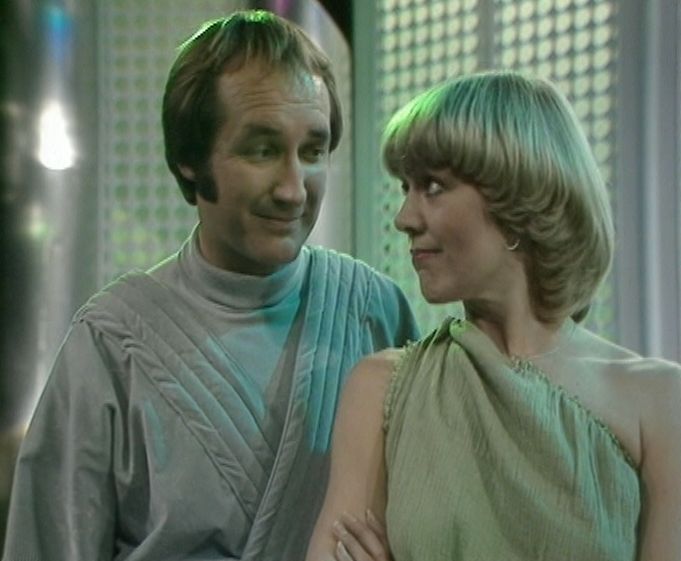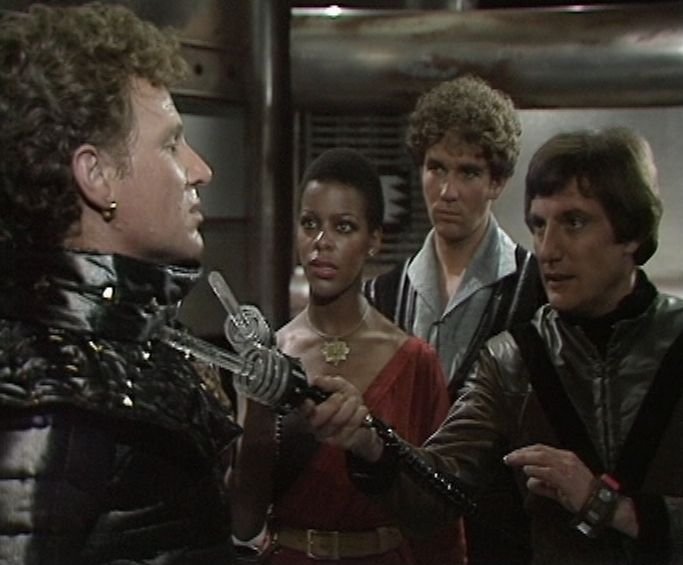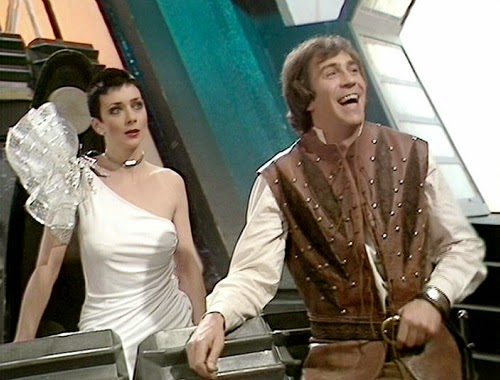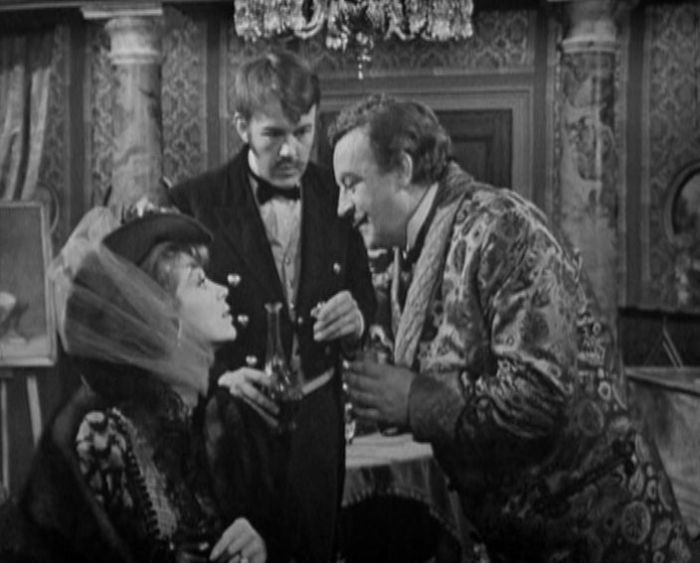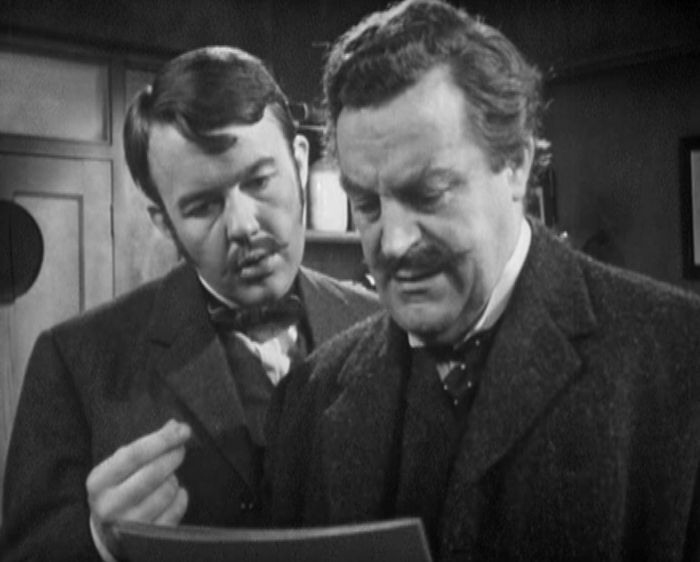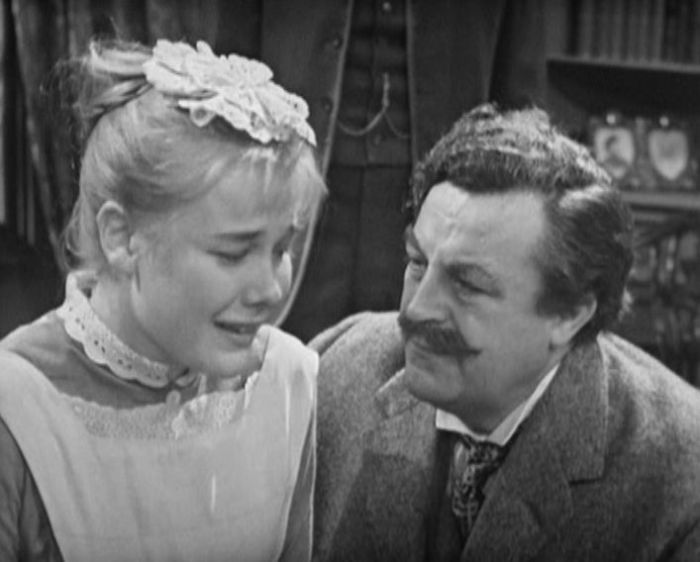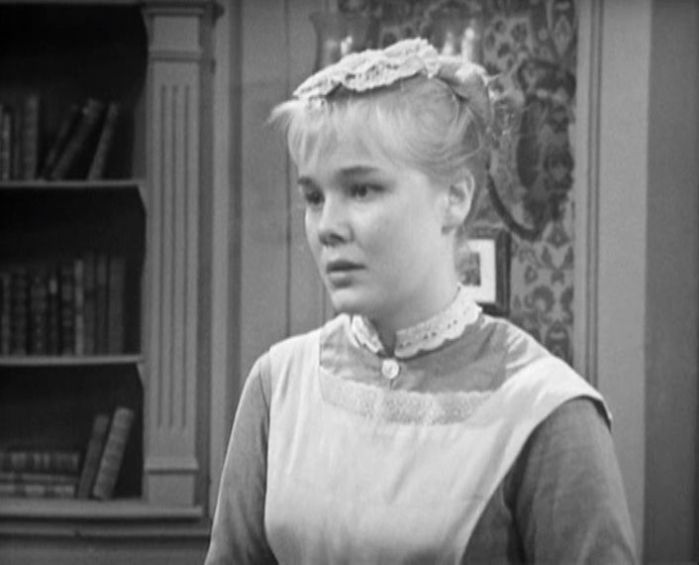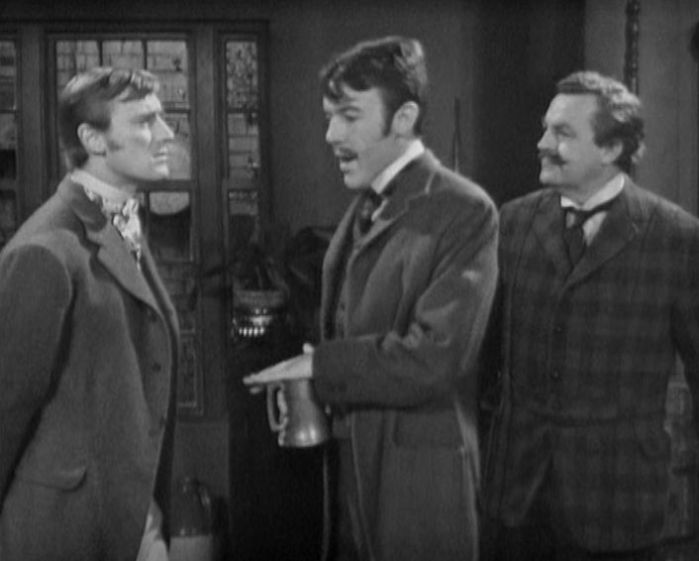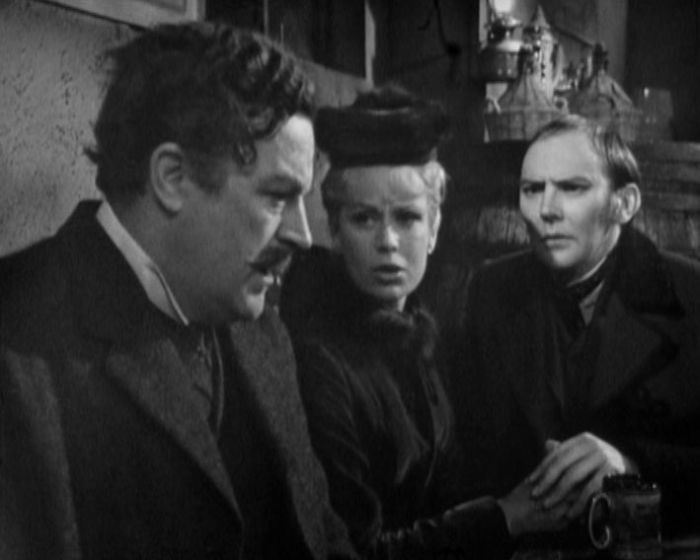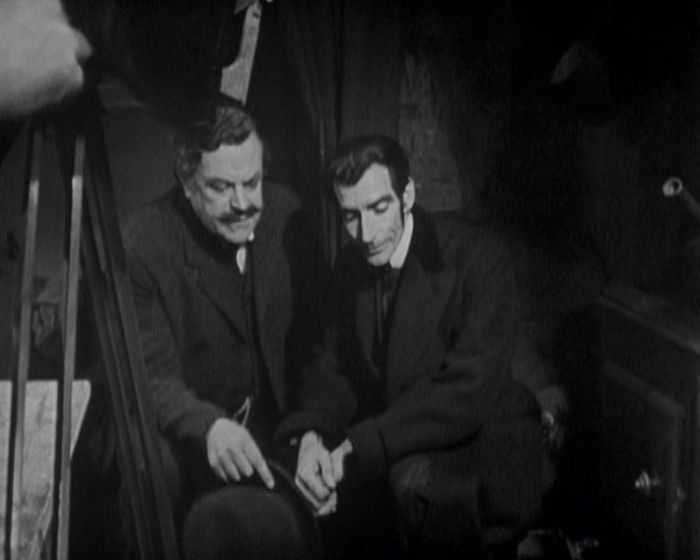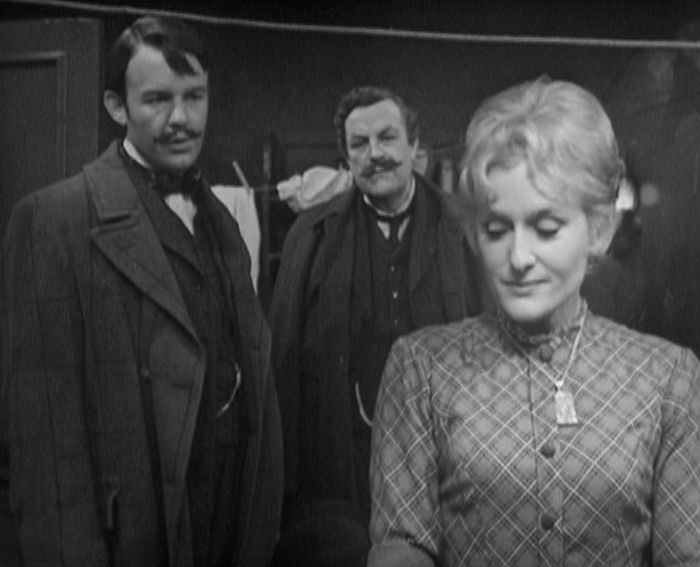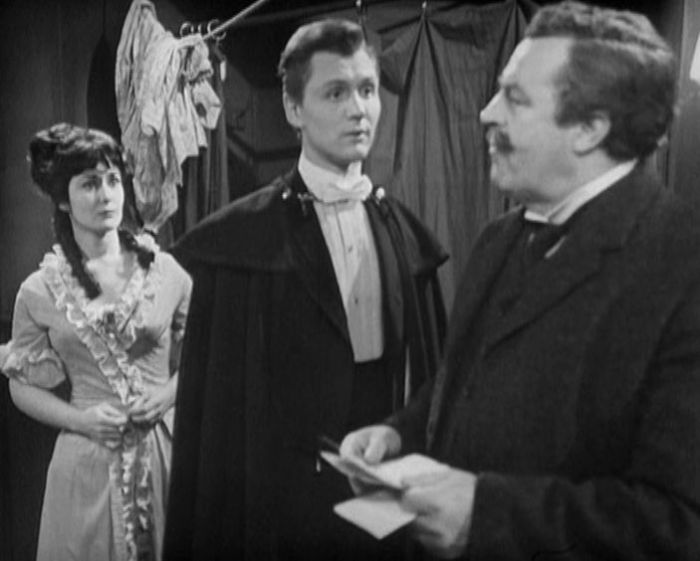
Blakes 7 – Sarcophagus

sarc 01

Tanith Lee was a prolific novelist whose output covered many genres, including fantasy (both children’s and adult), science fiction, horror and historical fiction.  Her two Blakes 7 scripts were her only ventures into television scriptwriting so it’s obvious that Chris Boucher took something of a chance when he commissioned her (writing a novel and writing a script are two very different disciplines).

We have to be grateful that Boucher did take the risk as Sarcophagus is unlike any previous Blakes 7 script.  If you favour the action/adventure model of B7 then this one may not be to your taste – it’s a fantasy tale that includes a musical interlude and a dialogue-free opening scene featuring hooded characters performing strange acts.  Although some of the plot elements are familiar – the Liberator spies a strange craft drifting in space/Cally gets taken over – Lee is able to take this hackneyed material and fashion something quite different from the norm.

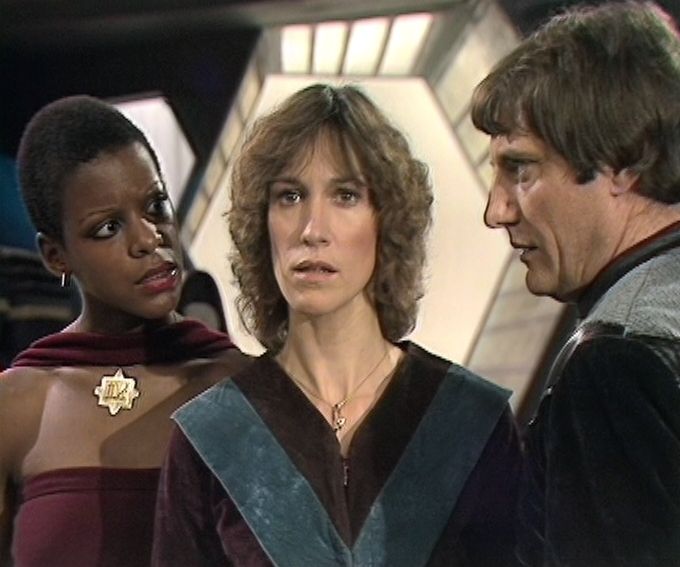
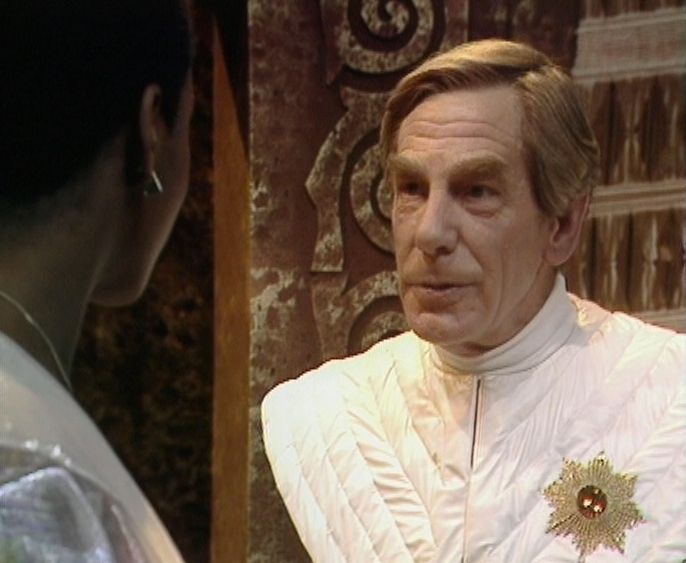
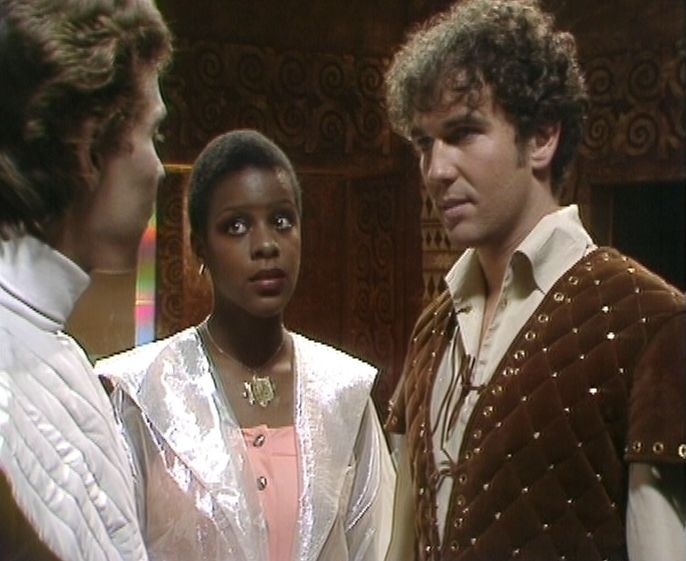
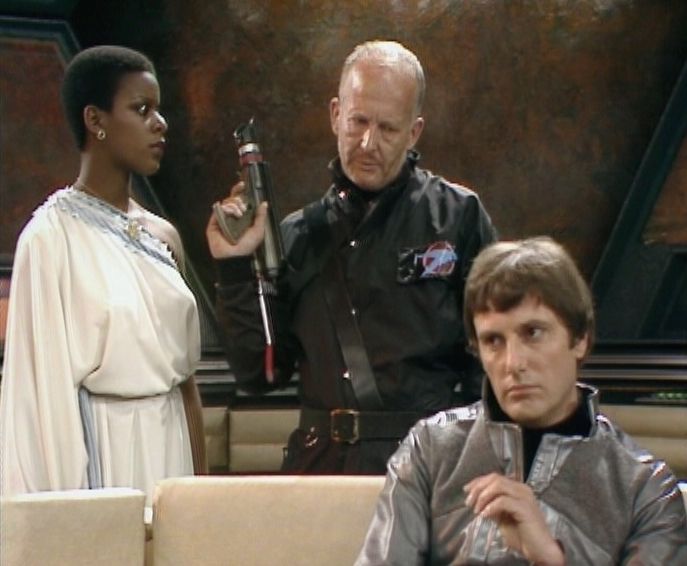
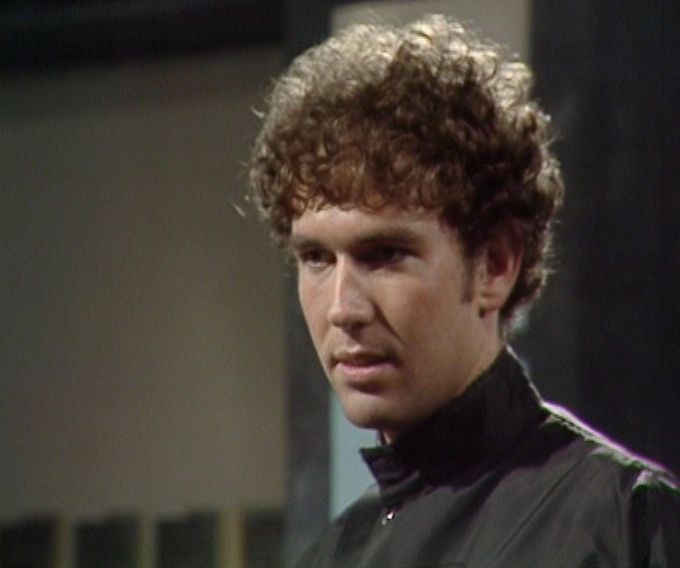
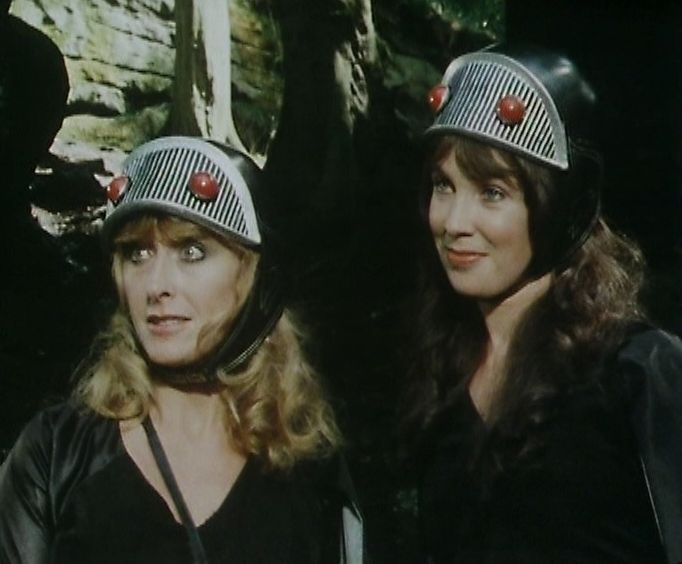
Sarcophagus opens with a funeral aboard an alien vessel.  Various masked characters perform different rituals – we see a musician, a soldier, a conjurer, etc – and later we see the Liberator crew dressed in the same garb, performing the same actions.  The mysterious alien who takes over Cally’s body later reveals that she enjoys being attended to by intelligent minions, so it would appear that she is visualising how each of the crew would best serve her.  No surprise that Vila is the jester or that Tarrant is the soldier (shoot first, think later seems to be his motto in this story).  Unexpectedly, Dayna turns out to be musical (there’s a brief song mid-way through the episode, although this isn’t Blakes 7’s – The Musical, you may be glad to hear).

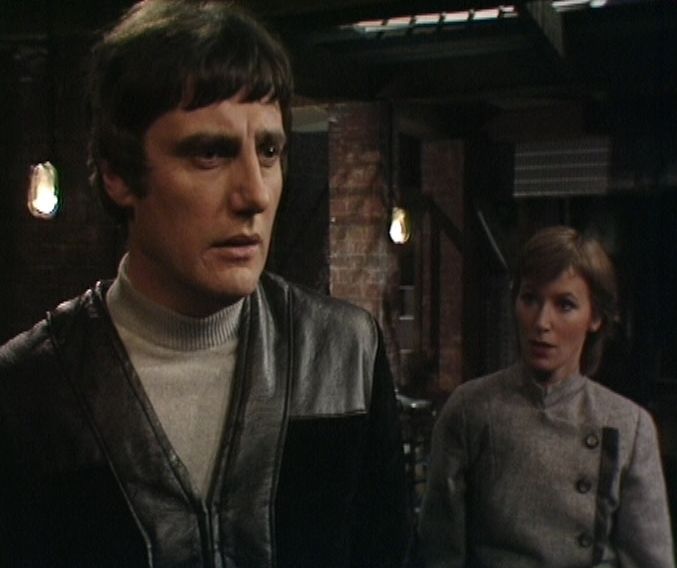
Since most of the action takes place aboard the Liberator and the only speaking roles are taken by the regulars, the script is a dense, dialogue heavy affair which has plenty of time to study how the various characters interact with each other.  The relationship between Avon and Cally is key to the story and early on there’s a revealing moment in Cally’s cabin.  She’s spent the last ten hours alone, thinking of her home planet and how she’ll never see it again.

AVON: I wish I could promise you that the sparkling company on the flight deck would take you out of yourself.
CALLY: I’m all right.
AVON: No, you’re not. But you will be. Regret is part of being alive. But keep it a small part.
CALLY: As you do?
AVON: Demonstrably.

Coming so soon after the events of Rumours of Death, it’s possible to argue that Avon’s referring not only to Cally, but also to himself.  Either way, it’s a quiet, reflective moment that’s handled well by Darrow and Chappell.

The most fun to be had comes from the clashes between Avon and Tarrant.  Tarrant’s still being irritating and obnoxious – although he’s correct when he surmises that something came back with Cally from the alien vessel.  It’s his bull-in-a-china-shop approach that wins him few admirers though.

AVON: Shut up, Tarrant.
TARRANT: Did you say something to me?
AVON: I said, shut up. I apologise for not realising you are deaf.
TARRANT: There’s something else you don’t realise. I don’t take any orders from you.
AVON: Well, now that’s a great pity, considering that your own ideas are so limited.

Darrow’s at his laconic best here, and it’s clear that Avon considers Tarrant to be no threat to his dominance at all (despite Tarrant’s claims to the contrary).

As the alien draws power from the Liberatordirector Fiona Cumming elects to turn the lights down.  This not only indicates that the ship is stricken, but it helps to increase the tension – which is furthered by the fact that both Orac and Zen are put out of commission.  There’s something particularly disturbing about hearing Zen’s speech get slower and slower (he’s such a solid, reassuring presence that it’s jarring when he’s no longer there).

If the flashbacks (or flashforwards, maybe) of the Liberator crew dressed in strange costumes are odd, then even odder is Vila’s decision to do some conjuring tricks, mid episode, on the flight deck.  It’s reasonable to assume that he decides to amuse himself in order to keep his spirits up (he’s alone and frightened of the increasing darkness) but after each trick there’s a massive round of applause.  Do we suppose that this non-diegetic sound was only heard in Vila’s head?  It’s only a throwaway moment but it’s another unusual, non-realistic touch.

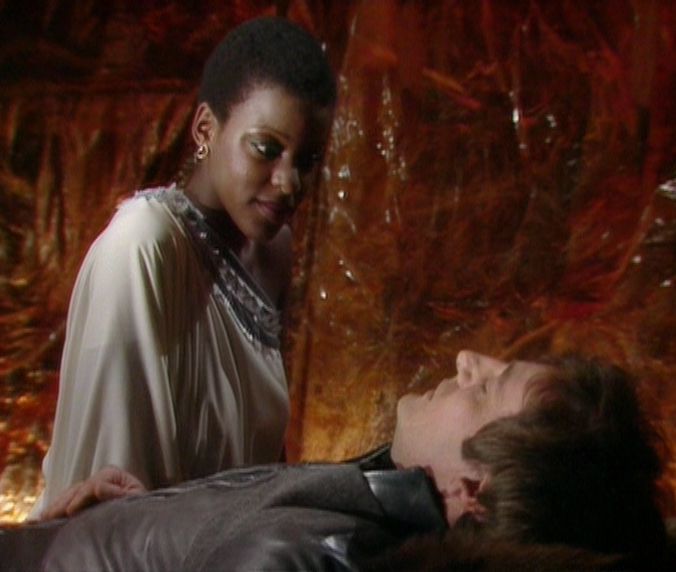
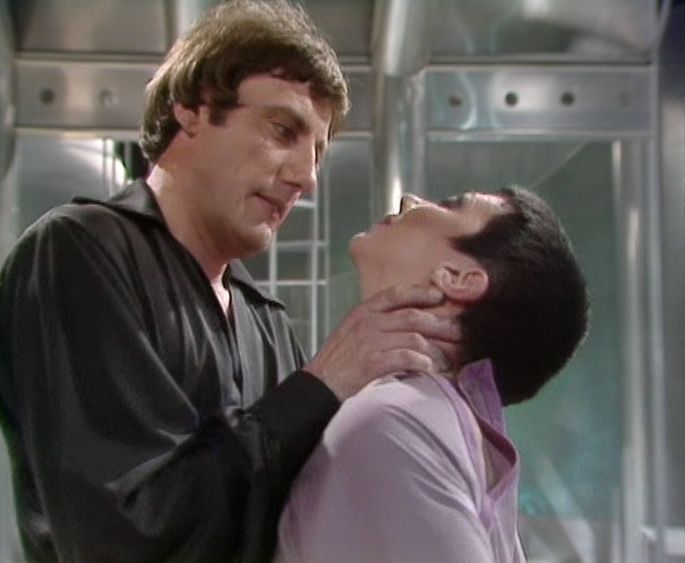
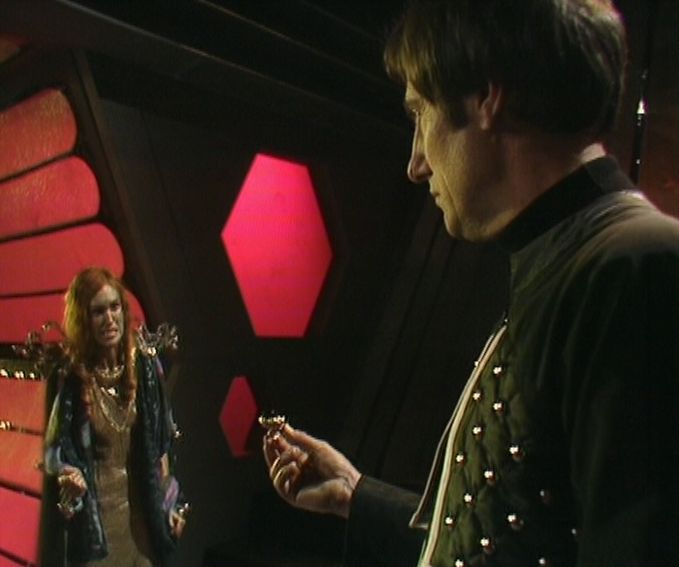
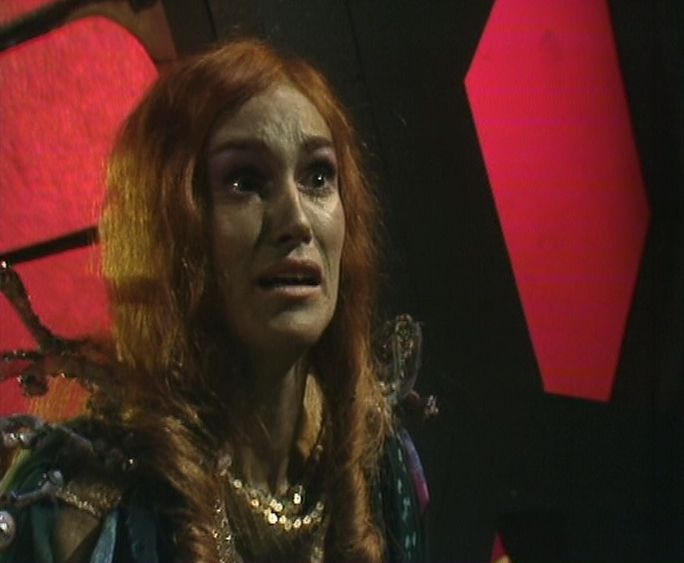
The alien who takes over Cally remains an indistinct character.  We learn that for her race, death is merely an interim state and that she requires Cally’s body in order to attain corporeal form once again.  She proves to be no match for Avon though – or rather it’s the part of her that’s still Cally who can’t bring herself to harm him.  Unexpectedly he kisses her, although all becomes clear when he uses this as an excuse to wrench a ring from her finger.  It’s the ring that’s allowed her to drain energy from Cally and when it’s removed, her power is broken.  Darrow’s excellent again here as he refuses her entreaties to return it (“That would be a little foolish, when I just went to so much trouble to get it”) as is Chappell, as the alien senses her end is nigh.

Avon! Avon, give it back to me. You must. You don’t know. I HAVE to keep this body. I have to live. I’ve waited so long. Centuries. More time than you could comprehend. How can you imagine what it must be like to be dead, to exist in nothingness, in nowhere. Blind, deaf, dumb, and yet to be sentient, aware, waiting. Centuries of waiting. I have to find my world again, my people, my home. I want to breathe and see and feel. And know. Don’t send me back into the dark, Avon, let me live.

With a dual role for Jan Chappell, this is very much her episode but it’s equally a good vehicle for Paul Darrow.  After a shaky few episodes early on, series three has hit a rich vein of form.
sarc 02

Blakes 7 – Rumours of Death

rumours 01

Rumours of Death features Blake 7‘s most effective cold opening.  Avon is a prisoner of the Federation and he’s in a pretty bad way.  Unshaven and in pain, he’s been a captive for five days and during that time he’s proven to be rather uncooperative.  He’s visited in his cell by the Federation’s top torturer, Shrinker (John Bryans) who is determined to get the truth out of him – one way or another.

Set-wise, this opening section is simply staged.  Avon’s cell is bare and we never venture any further into the Federation detention block.  But the illusion that Avon isn’t the only prisoner is effectively created by the off-camera screams of another poor unfortunate.  And as Shrinker brandishes a laser probe it seems likely that Avon will also be screaming soon.  Director Fiona Cumming chooses to keep the camera angle in this scene quite low – with Avon seated on the bed and Shrinker standing over him it helps to create the impression of the Federation man’s dominance.  A simple trick (like the off-camera screams) but nonetheless effective.

The attentive viewer wouldn’t have been fooled by Avon’s plight for too long.  It now becomes clear why he mentioned Shrinker in the previous episode (he’d told the rest of the crew that Shrinker was the key to understanding why Anna Grant, the woman he loved, died).  So when Shrinker appears here it’s clear that Avon’s plan is in full swing.  That he was prepared to withstand days of torture (it’s never explicitly stated what happened to him, but it clearly wasn’t pleasant) in order to lure Shrinker to his cell speaks volumes.  Whether for good or bad is debatable though.  Avon’s always been a driven, single-minded character, but the events of this episode seem to clearly indicate his future, tragic path – the loss of the Liberator, his inability to ever trust again and the cataclysmic events on Gauda Prime.

When Tarrant and Dayna teleport into the cell and take Avon and Shrinker back to the Liberator it’s remarkable how quickly Shrinker devolves into a whimpering, pathetic character.  The cliche that he was only a man who followed orders is aired, but there’s a faint sense of unreality about his total collapse.  Yes, it’s reasonable to assume that such a man would be powerless when stripped of his authority, but it might have played better had he kept a faint air of defiance.

The reactions of Tarrant, Dayna and Vila are noteworthy.  They surround the cowering Shrinker and goad him, causing a disgusted Cally to snap at them.  That Shrinker’s a mass-murderer is unquestionable and Tarrant tells her that he’s nothing more than an animal.  “Yes, and it’s contagious, isn’t it?” responds Cally.  With series three of Blakes 7 having largely abandoned the freedom fighter/terrorist attacks of the first two series, this brief exchange taps into some of the more interesting character moments from previous stories like Star One.  Shrinker is a monster, but if they behave like him can they claim to be any better?

Whilst this part of the plot is bubbling along nicely, we jump to Earth.  Sula (Lorna Helibron) and Chesku (Peter Clay) are two high-ranking officials in the Federation (and are also married).  Chesku is clearly a man with a great regard for his own oratorical skills and gives his wife a demonstration of part of a speech he plans to deliver later.  “The rabble which sought to challenge the established order lacked our inspiration, our unity, our leadership. They are crushed. Earth and the Inner Planets are once again united. Gentlemen, I give you a toast. Our inspiration, our unity, our leader: President Servalan.”

Sula responds that “I’m sure Servalan will be delighted. She is, after all, a tasteless megalomaniac.”  The faintly off-key nature of the episode continues after two Federation troopers turn up and, on Sula’s orders, shoot Chesku dead.  Peter Clay’s death (all flailing arms as he crashes into a bush) isn’t the most impressive, but never mind.  It helps to set up the events for the rest of the episode as it looks as if a palace revolution is taking place.  The power-struggles within the Federation following the war with the aliens is certainly something that could have been developed more during series three.  As it was, Servalan seemed to spend far too much time tussling with Avon and the others instead of attempting to secure her position.

Things get even stranger when Avon starts to question Shrinker.  Avon shows him a picture of Anna Grant, but he claims he doesn’t know her.  “I’ve killed hundreds and remembered them all, all of them, every last whining traitor. And there wasn’t one that died without telling me what I wanted to know. Not one.”  We then flashback to scenes of Anna in bed with Avon.  It’s maybe not immediately clear, but this is the same woman who now calls herself Sula.  In Space Fall we were told that Avon was nearly responsible for the greatest banking fraud in Federation history, but Shrinker now tells him that he was monitored right from the start (he was under the observation of an agent called Bartolomew from Central Security).  It’s another small moment which helps to emphasise that Avon’s not as infallible as he might appear.

Avon leaves Shrinker a prisoner in a cave with no escape and a gun for company.  Avon promised him a way out and this is it (“It’s a better deal than you gave any of your victims”).  With Shrinker’s information, he now decides to set course for Earth to confront Servalan and demand that she reveal the identity of Bartolomew.  This is the weakest part of the script – that Avon would decide to return to Earth seems foolhardy enough but that he chooses to do so on the same day that Anna/Sula decides to take out Servalan is one coincidence too many.

Greenlee (Donald Douglas) and Forres (David Haig) are two career officers who are on security duty at the lavish country house that serves as Servalan’s headquarters.  It seems that Chris Boucher took a leaf out of Robert Holmes’ book as Greenlee and Forres act as detached narrators for the first half of the episode – they help to fill in the blanks of what we’re seeing.  Although unlike most Holmesian double-acts they don’t make it to the end as they’re both mown down by Sula’s men.  The palace revolution is far from bloodless, but it’s comprehensive.

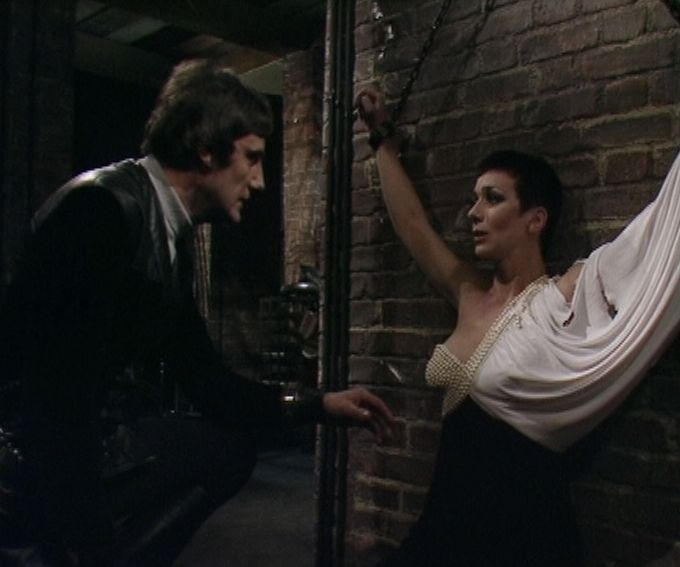
Jacqueline Pearce doesn’t have a great deal of screentime in this episode, but that’s not really a criticism.  Servalan’s been something of an overexposed character (especially during series three to date) so Rumours of Death works well by keeping her as more of a background character.  But her scene with Avon towards the end (she’s chained up in the cellar, helpless) is another key Avon/Servalan meeting that has no doubt launched a thousand fan-fics.

AVON: Is that it? Have you finally lost your nerve?  Have you murdered your way to the wall of an underground room?

SERVALAN: It’s an old wall, Avon, it waits. I hope you don’t die before you reach it.

That Avon is prepared to set Servalan free when Sula and others are close to destroying her power forever is intriguing (it looks as if everything that Blake fought for is within their grasp).  This is open to interpretation though.  Is Sula keen to replace her (as suggested earlier on) or does she really support the notion of a People’s Council?  If it’s the latter, then it’s ironic that Sula has been fighting for the same things that the Liberator crew did for so long.

It’ll come as no surprise that Anna = Sula = Bartolomew or that Avon kills her.  So Anna was a fiction who only existed for Avon.  But Sula’s dying words seem to suggest that she genuinely did love Avon.  But in the hall of mirrors that’s Rumours of Death can we believe her this time?

This is clearly a great vehicle for Paul Darrow, who makes the most of the material. There’s a few niggles (for example, Servalan is taken prisoner rather too easily and if Anna Grant never existed who was the man who claimed to be her brother in the series two episode Countdown?)  but overall this is a classy episode.

rumours 02

Blakes 7 – Children of Auron

auron 01

Servalan’s always been insanely ruthless, but Children of Auron is extreme, even by her standards.  She infects the whole population of Auron with a deadly pathogen to achieve two goals – firstly to capture the Liberator and secondly to continue her bloodline.

She explains why capturing the Liberator remains such a high priory – with the Federation in tatters she’ll be able to take control again quicker with the most powerful ship in the galaxy.  Does this really make sense?  The galaxy’s a big place and the Liberator, powerful though it is, is only one ship.  I can’t see that it would make that much difference (and anyway, it’s not ships she needs but good men).  The fact that she effectively wants to have children (although the technique on Auron is only able to create clones of herself) is even more startling.  Servalan’s never shown any sort of maternal instinct, so this revelation is rather hard to take.

It was perhaps inevitable that we’d return to Cally’s home planet one day and although there isn’t a great deal of time to develop its backstory, we still learn a little.  C.A. One (Ronald Leigh-Hunt) has kept Auron strictly neutral – any contact with outsiders has been discouraged, but the unfortunate result is that the pathogen is able to spread unchecked (few of his people have any sort of resistance to space viruses due to their strict isolationist policy).  It’s a shame that Leigh-Hunt doesn’t essay a subtler performance, as C.A. One ends up as little more than a bluff blusterer.

Cally has an identical twin, Zelda.  Given Auron’s skills in cloning this is reasonable enough (although credibility is stretched later in the series when we meet Tarrant’s identical twin – no cloning involved there).  Zelda isn’t a very proactive figure and doesn’t do a great deal to further the plot (although she has an inevitable and pointless death).  It’s a pity that more couldn’t have been done, as her demise does feel like a wasted opportunity.  Jan Chappell is, of course, excellent as both Cally and Zelda – especially when we see Cally take on Avon.  Avon is keen to head to Earth for a mission of vengeance (sowing the seeds for Rumours of Death).  Even when the plight of the Aurons is known he’s still disinclined to get involved, so there’s a nice tension that exists between them (which pays off later in Sarcophagus).

If Servalan’s going to rebuild the Federation then she needs good men, but alas they seem hard to find.  In Children of Auron she’s lumbered with a right pair – Deral (Rio Fanning) and Ginka (Ric Young).  They spend most of the episode bickering (Ginka’s unhappy that Deral was promoted ahead of him) and generally bumbling about.  Deral is unable to capture the Liberator even when only two of the crew are aboard and one of them is Vila, now back to his default setting of cowardly.

Ginka’s lack of judgement is even more striking.  Avon, Cally and Tarrant are taking refuge in the replication plant – they know they’re safe there, as Servalan wouldn’t destroy her own clones.  But Ginka is able to convince her that Deral switched her genetic material for his, so she gives the order to fire.  As the plant is destroyed Jacqueline Pearce gives one of her finest performances in the series – Servalan clearly feels intense pain as her clones go up in flames.  But Ginka obviously never stopped to think that possibly, just possibly, Servalan wouldn’t be terribly pleased when she discovered that he’d tricked her (as I said, he’s not the sharpest knife in the draw).  So he’s not long for this world (and neither is Deral) which leaves Servalan with yet another staffing crises.  Possibly she’s pining for the good old days with Travis.

If Auron remains a rather undeveloped world and Servalan’s schemes are barmy, that doesn’t stop Children of Auron from being a strong mid series episode.  Sandwiched between City at the Edge of the World and Rumours of Death it probably slightly pales in comparison, but it’s still much stronger than the likes of Volcano and Dawn of the Gods.

Ten points docked for the final scene though, as everybody has a good laugh on the bridge of the Liberator.  It’s not the first time it’s happened (the crew had a chuckle at the end of Breakdown, seemingly oblivious to the loss of life they’d just witnessed) but again it just feels so out of place.  We’ve just witnessed a planet devastated, so a little show of solemnity wouldn’t have been out of place.  Apart from that, this is decent stuff.

auron 02

Blakes 7 – City at the Edge of the World

city 01

Most of the regulars take centre-stage in at least one series three episode.  Avon features heavily in Aftermath and Rumours of Death, Cally’s the main character in both Children of Auron and Sarcophagus whilst Tarrant (and his identical twin brother) stars in Death-Watch.  Danya is the only one who doesn’t really have an episode of her own, unless you count her introductory tale, Aftermath.

For everybody’s favourite thief, City at the Edge of the World is a chance to see a more proactive and heroic Vila.  Even when the script didn’t really feature him, Michael Keating could always be guaranteed to take whatever material he had and make it work to the best of his ability.  Unlike some actors he didn’t do this by upstaging others – it was simply down to his natural comic timing.  A great example can be found in Powerplay.  Vila, wounded and alone in a strange forest, attempts to frighten off any would-be attackers by pretending to be a whole troop of fighting men!  It’s an old gag – and only a throwaway moment – but Keating’s a delight to watch.

But there’s no doubt that it’s good to see Vila right in the thick of things for once.  Too often he tended to end up as either the butt of other people’s jokes or simply blissed out on adrenaline and soma.  In City at the Edge of the World he’s witty, resourceful and gets the girl.  What more could you ask for?

We open with Tarrant being irritating (yet again).  The Liberator needs crystals for its weaponry systems and he’s struck a deal with the mysterious inhabitants of a nearby planet.  It’s simple enough – the crystals in exchange for Vila’s help.  When Vila disappears and the box of crystals turns out to be a booby-trapped bomb, Tarrant is forced to eat humble pie (not before time!)

Vila’s been brought to the planet by Bayban the Butcher (Colin Baker).  A vision in black, Baker is clearly having a ball (Paul Darrow later repayed the favour by going even further over the top in the Doctor Who story Timelash).  It’s a cartoony performance but it works perfectly in this context.  Following a couple of stories that were played too straight, City bubbles along with an infectious sense of humour and many quotable lines.  This is one of my favourites, courtesy of Bayban who’s peeved to find out that he’s top of the Federation’s Most Wanted list – after Blake.  “What do you mean, ‘after Blake’? I was working my way up that list before he crept out of his creche. WORKING my way up. I didn’t take any political shortcuts.”

Bayban has a crack force of mercenaries, led by Kerril (Carol Hawkins) and Sherm (John J. Carney).  Carney, who’d previously given an excellent comic performance as Bloodaxe in the Doctor Who story The Time Warrior, is just as good here.  He’s got little to do except react to the others – but he does it so well.  Hawkins plays the unlikely love interest (or at least it’s unlikely to begin with).  Their first meeting is memorable – we see Vila cowering at her feet, whilst she mocks him (“little man”).  He then suggests she bathes more regularly (and uses mouthwash too).

The unexpected thaw in their relationship seems to happen after she changes out of her black leathers and into something more feminine.  Possibly Chris Boucher was attempting to make a point here.  She spends the early part of the story attempting to be one of the boys (and acting aggressively) but once she changes clothes she becomes a more passive and submissive character – effectively acting as Vila’s assistant.

To be honest the story isn’t the strongest – a mysterious race seek entry to a new world, but rather carelessly they’ve lost the key to the door.  Only their leader Norl (Valentine Dyall) ever speaks, so they remain rather undeveloped – but then they’re not really the focus here (it’s more of an excuse for Vila to demonstrate his skills and Colin Baker to chew the scenery).  Dyall is compelling though.  He had the sort of voice that instantly commanded attention, so whenever he speaks it’s hard not to listen.

Vila is given a chance to cross over to this new world with Kerril.  It’s a beautiful, unspoiled planet where they could live out their lives in peace.  He declines, and his reason gives an insight into what makes him tick.  “There’s nothing there worth stealing. You know why I neutralize security systems, open safes, and break into vaults? It’s because I can and most people can’t. It’s just that, it’s what makes me, me. Kerril, a thief isn’t what I am, it’s who I am.”

After a couple of average stories, City at the Edge of the World gets us back on track.

city 02

Blakes 7 – The Harvest of Kairos

harvest

The Harvest of Kairos has a feel of a hastily rewritten S2 episode.  Otherwise, how do you explain that Tarrant seems to have become Enemy Number One in Servalan’s eyes?  She spends the opening few minutes musing about what he’s going to do next, whilst her cringing subordinate Dastor (Frank Gatliff) hesitatingly breaks the bad news that there’s dissent among her crew.

Some believe that she’s too afraid to attack Tarrant(!).  Chief amongst the dissenters is a worker from the construction grades, Jarvik (Andrew Burt).  Since he’s clearly designed to be an alpha-male, Burt’s casting is eccentric (to put it mildly).  Burt, the original Joe Sugden from Emmerdale Farm, also has to battle with Ben Stead’s script and his first line to Servalan sets the tone.  “Woman, you’re beautiful” he says, before grasping her for a quick snog.  There’s always the possibility that Stead had his tongue in his cheek, but I’m not so sure (there’s the evidence of his subsequent B7 scripts for example).  The sexual politics are skewered towards the dominance of men, with even Servalan seeming to melt under Jarvik’s winning ways (“But first, there is the question of that degrading and primitive act to which I was subjected in the control room. I should like you to do it again”).

Jarvik also attempts to humanise the very inhuman Servalan.  “When was the last time you felt the warmth of the Earth’s sun on your naked back? Or lifted your face to the heavens, and laughed with the joy of being alive? How long since you wept at the death of a friend?”  It’s a decent enough line and if delivered well it could have some impact (it brings to mind similar comments from Kasabi during Pressure Point) but Burt rather torpedoes it.  He’s a good actor, just hopelessly miscast.

Meanwhile, onboard the Liberator Tarrant is being his usual annoying self.  He intends to steal a cargo of Kairopan (a highly valuable crystal found on the planet Kairos).  Kairos is a dangerous planet, so Tarrant plans to hijack the freighter after it’s left the planet.

As the Liberator comes under attack from Federation ships commanded by Jarvik (he’s been given a chance by the clearly impressed Servalan) Avon is strangely distracted.  Maybe this is as scripted, or possibly Paul Darrow simply wasn’t interested that week.  Avon’s absorbed with a mysterious crystal called sophron – it’s no ordinary rock, as it seems to have a capacity for reasoning that slightly exceeds Orac’s (and many other qualities as well).  No surprises that we never hear of it again, so its only function is to operate as a get out of jail free card.  After Jarvik’s plan to capture the Liberator succeeds, the crew are exiled to the definitely unfriendly Kairos.  Escape seems impossible, until Avon’s magic rock saves the day.

It’s jarring to see Servalan in control of the Liberator (a warm up for the apocalyptic events of Terminal) and once Avon and the others have been exiled to Kairos her victory seems complete.  We then lurch into the next unexpected event – Servalan is so taken with Jarvik that she’s keen to make him co-ruler, but first he has to prove himself.  And how does she decide to test him?  He has to take on Tarrant, man-to-man, and defeat him.  Yes, okay then.

Just when you think you’ve seen everything, up pops the silliest looking giant insect …..

The Harvest of Kairos is dumb fun.  It’s never less than entertaining (if you can stomach all the “ah well, he’s a man” talk) but it doesn’t fit as an early series three episode (had it come towards the end of the third series then Tarrant’s status would have been more credible).  Chris Boucher seems to have taken his eye off the ball, script-editing wise, but luckily he’d also been penning a number of decent stories and the next episode will see a marked upswing in quality.

Blakes 7 – Dawn of the Gods

image

Dawn of the Gods is very, very odd.  Logic and reason seem to take a holiday during this one, beginning with Orac’s bizarre behaviour.  He decides to investigate a nearby black hole, thereby endangering both the Liberator and its crew.  Once they enter the black hole, Cally hears voices in her head as a figure from Auron mythology – the Thaarn – has plans for her.

It would have made more sense for Cally to be drawn to the black hole by the Thaarn’s entreaties (which would have meant that Orac’s suicidal curiosity could have been dispensed with). Possibly this wasn’t done since it would have seemed like too much of a retread of The Web.

But as it stands, getting the Liberator into the black hole feels very contrived, as does the fact that the Thaarn has such an urgent need for Cally. I’ll say one thing for him though, he thinks big. “I’ve been alone with my plans for so long. Cally. Plans to build a new universe, with no one to share them with, until now. The universe, Cally. And the great univeral force that controls the universe, is gravity. The orbit of the planets, the slow turn of the galaxies. I have built a machine that can generate gravity. When it’s complete, it will be powerful enough to move planets, and stars. He who controls gravity, controls everything. We will be rulers of the universe, Cally.”

Exactly what Cally can offer him that no-one else can is never made clear. Presumably it’s telepathy, but you’d assume that someone who’s planning to create a new universe would be able to obtain a telepath from somewhere.

Like The Web, Dawn of the Gods has a bizarre creature, but here it’s unwisely held back until close to the end of the story. Let’s be generous and say that when the Thaarn does pop up he’s something of a disappointment – it certainly torpedoes any lingering credibility that James Follett’s script had.

But even before the Thaarn was revealed in all its glory, things were wobbling. Avon and the others meet several of the Thaarn’s underlings, the Caliph (Sam Dastor) and Groff (Terry Scully). The Caliph seems to have wandered in from a Charles Dickens play, whilst Groff sports a natty eyeshade. It makes a change from the usual sci-fi cliche of silver suits, but the reason for this cosplay isn’t clear. If you’d have told me it was budget related I might have believed you!

Dawn of the Gods does have the air of a low-cost episode, especially since the first half takes place aboard the Liberator. There’s a few decent bits of character interaction though – it’s particularly nice to see Avon, Vila, Cally, Dayna and Orac enjoying a game of Space Monopoly. Yes, even Avon! And Orac gets very peeved when the others become distracted.  It’s notable that the only one not playing is Tarrant (is he sulking by himself?) He’s certainly pretty insufferable, insulting Cally and generally rushing around trying to solve the crisis, but achieving very little.

So we’re currently in a bit of a dip, story-wise. I wonder if the next will be any better?

Blakes 7 – Volcano

volcano 01

Dayna and Tarrant have teleported down to the surface of Obsidian.  It’s a planet that has managed to remain unaligned from the Federation and also emerged unscathed from the recent galactic war.  Tarrant believes the planet would make a good base for them, but their pacifistic leader Hower (Michael Gough) isn’t interested.

Bad news, it’s an Allan Prior script.  Good news, it’s not Animals.  It’s not that much better though as Prior’s dialogue doesn’t exactly sparkle and few of the guest cast emerge with much credit.  Michael Gough, of course, is able to instill Hower with a certain dignity but Malcolm Bullivant, playing Hower’s son Bershar, is wooden in the extreme.  Frankly there’s more animation to be found in the extremely silly looking silver robot.  The Graham Williams era of Doctor Who (with its slapstick air) has many critics but the alternative is something like Volcano – an episode delivered with such an air of relentless earnestness that it becomes impossible to take it seriously.

Pacifistic planets are something of a sci-fi cliche.  Hower explains to Dayna how they’ve arrived at this state. “We have taught them peace from the cradle, and we have blocked, usually with a minute electric shock, every tendency towards an aggressive act. Plus of course, daily psychological propaganda. We have no war, no fights among ourselves, no lawlessness, no crime. Our people devote themselves to creation and not destruction. We are at peace here on Obsidian.”

This is all well and good, but what happens when the Federation turns up?  Although we’ve been told that the Federation are in disarray they seem in fine fettle here.  Led by Servalan (of course) their first act is to attempt to capture the Liberator.  This rather begs the question as to how Servalan knew the Liberator would be there.  And with an empire to rebuild you’d assume she’d have more pressing things on her mind than settling scores with Avon and co.  Volcano is one of those series three scripts that seems a little out of place, although it would have worked during series two (when the Federation was dominant).

The Federation, led by Mori (Ben Howard) are able to take over the Liberator with embarrassing ease.  This should be a dramatic highlight of the story but it’s pretty much a damp squib, even after we see Avon shot by Mori.  Ben Howard, a regular in the last series of Dixon of Dock Green, is the first of Servalan’s Travis substitutes and, bless him, he’s almost bad enough to make you pine for Brian Croucher.  The Battle Fleet Commander, played by Alan Bowerman, offers another amusingly rotten performance.

The Federation don’t hold the Liberator for very long and amazingly Servalan then decides to run away and fight another day.

SERVALAN: Without that ship we’ve lost a strategic advantage.
MUTOID: Madam?
SERVALAN: But, no one else has gained it. Without Blake the Liberator’s no immediate threat to our plans.
MUTOID: No, Madam President.
SERVALAN: Well the crew have no political ambitions.
MUTOID: They are merely criminals.
SERVALAN: So they’ll keep. Until the rule of law has been restored. Until my rule of law has been restored.

This doesn’t ring true – if Servalan doesn’t believe the Liberator poses a threat without Blake, why go to all that trouble to try and capture it?  The capture-the-Liberator sub-plot seems to have been rather awkwardly bolted onto the episode in order to pad out the running time.

One interesting part of the script is that Servalan’s assessment of Avon and the others seems spot on.  Tarrant tells Hower that they’re mercenaries and in exchange for the use of his planet he’ll offer them a percentage of their spoils.  I wonder if serious thought was ever given to turning them into a gang of intergalactic criminals?  This notion tends to be downplayed as we move through series three – pure sci-fi takes over – and when we reach series four there’s a return to the theme of the struggle against the Federation.

Hower’s decision to destroy his planet rather than see it colonised by the Federation should be a powerful one, but it’s another moment that doesn’t have a great deal of impact since we’ve never been given any cause to believe that Hower’s people are a real, functioning society.  Unfortunately, they’re just a series of faceless extras.

Although Volcano‘s problems are many, it’s by no means unwatchable.  It has its fair share of bad acting and illogical plotting, although that hardly makes it unique in the Blakes 7 universeIt’s undemanding stuff, but it’s frustrating as the series can do so much better.

volcano 02

Inspector Morse – The Silent World of Nicholas Quinn

quinn 01

The first few minutes of The Silent World of Nicholas Quinn give us something of a guest star overload.  Michael Gough, Barbara Flynn, Clive Swift, Roger Lloyd-Pack, Frederick Treves and Elspet Gray all appear – which bodes well for the remainder of the episode.

But the star of the opening scene is the eponymous Nicholas Quinn (Phil Nice).  Quinn is a relatively new member of the Overseas Examination Board, an Oxford syndicate dedicated to producing quality examinations for overseas students.  He, along with the other members of the Board, are attending a sedate party organised by their boss, Dr Bartlett (Clive Swift).  There’s a disorientating feel about this scene – Quinn is deaf and the audience is allowed to hear only what he can hear.  This is muffled and indistinct (and at times completely inaudible).  What Quinn can (or can’t) hear will become important later on, but for now he’s convinced that Bartlett is selling the Examination Board’s secrets – and tells Philip Ogleby (Michael Gough) so.

Shortly afterwards Quinn is found dead – it looks like suicide, but Morse is convinced it’s murder.  There’s no shortage of suspects as virtually every member of the Board is seen to behave in a suspicious manner.  Donald Martin (Roger Lloyd-Pack) and Monica Height (Barbara Flynn) are conducting an affair and decided to lie about their movements on the day that Quinn was last seen.  Both Ogleby and Roope (Anthony Smee) are interested in the contents of Dr Barlett’s office (whilst Bartlett’s not there, naturally) and we’ve already heard that Dr Bartlett has been accused of corruption.

Barbara Flynn gives a memorable performance as Monica Height.  She’s a character who’s put through the emotional wringer and seems to make something of a connection with Morse.  Michael Gough has a smaller role, but does share a key scene with Thaw.  Morse is delighted to learn that Ogleby sets crossword puzzles and admits that he’s been wrestling with his puzzles for years.  Roger Lloyd-Pack is somewhat off-key as Martin – this might have been as scripted, or simply Lloyd-Pack’s acting choice (he did make something of a habit of playing people who were somewhat disconnected from reality).

The Silent World of Nicholas Quinn offers more opportunity to see Morse’s unique brand of detective work in action.  He admits that he makes intuitive leaps which sometimes prove to be incorrect, or as Morse memorably puts it.  “The trouble with my method Lewis is that its inspirational and as a result I sometimes, sometimes, get things arse about face.”  It’s only a chance remark that puts him on the right track (and by then he’s already arrested the wrong man).  The “fake” ending had long been a popular staple of detective fiction and it’s used effectively here.  Just when you think the story’s over, a last minute revelation forces us to reassess everything we’ve learnt to date.

There’s a few nice moments of humour.  Morse and the murderer have something of a battle towards the end of the episode.  Lewis discovers the pair of them locked in combat and coolly enquires if Morse needs any help!  Dr Bartlett’s interest in visiting the cinema to see Last Tango in Paris becomes something of a plot-point (with the tone of the conversations suggesting that the only reason anybody would see a film like that would be for the sex scenes).  Morse and Lewis are offered free tickets, but Morse declines – declaring that Lewis is too young.  Later Morse changes his mind and is furious to find that the film has now changed – it’s 101 Dalmatians.  Lewis is delighted and sets off home to fetch the wife and kids, leaving Morse to walk off to the pub alone.

A typically convoluted Dexter plot, The Silent World of Nicholas Quinn does suffer from having too many suspects – and the fact they all have similar possible motives doesn’t help.  But the exemplary guest cast is more than adequate compensation for the sometimes confusing plotting.

quinn 02

Blakes 7 – Powerplay

powerplay 01

With the departure of Gareth Thomas, Blakes 7 needed a new central dynamic.  It’s easy to see how the Blake/Avon relationship was recreated with Avon/Tarrant, but there’s one major difference.  Tarrant, like Avon during series one and two, is presented as the questioning figure of the group – often wondering if the plan they’re embarking on is wise – but he clearly lacks Avon’s experience and so ends up as a much less forceful figure.

So whilst Blake/Avon was more of a meeting of equals, Avon/Tarrant has something of a father/son feel with poor Tarrant coming off second best more often than not.  No doubt this is also a consequence of the slow rise of Avon’s megalomania – as we’ll see (especially during series four) Avon becomes increasingly disinclined to listen to anyone – with disastrous results.

Stephen Pacey, like Josette Simon, does his best with the hand he’s dealt, although Tarrant does sometimes come over as intensely annoying (Harvest of Kairos, springs to mind).  But he does start off with an interesting character dynamic.  He’s presented as the enemy (so it comes as a surprise when he joins the crew at the end of the episode).  Tarrant is the leader of a Federation raiding party who’ve taken control of the Liberator (much to Avon’s barely concealed disgust) but in the end it turns out he wasn’t a Federation type after all, he was only pretending.  Hurrah!

powerplay 02

To be honest, there’s something of a lost opportunity here.  Tarrant claims that he’s a fugitive from the Federation but we’ve only got his word for it.  Could he really have been a Federation officer all along?  He’s certainly very convincing in the role.  The possibility that Tarrant may be untrustworthy and liable to sell them out at any minute would have provided a nice spark of tension, but this angle was never explored.

But if Tarrant is faux-Federation, then his second-in-command, Section leader Klegg (Michael Sheard), is Federation through and through.  With several day’s stubble and a perpetually irritated expression (like he’s just swallowed a space-fly) it’s a highly entertaining performance from Sheard – a cult film and television favourite of many, including me (he had umpteen Doctor Who‘s to his credit, along with films like Star Wars and Indiana Jones).

I wonder what Michael Keating and Jan Chappell felt when they received the first two scripts of series three?  They were barely in the first episode and spend episode two languishing in the sub-plot.  Both Vila and Cally seem to have landed on their feet after they’re taken to what appears to be a spotless hospital on the planet Chenga.  Vila thanks the two attractive young women – Zee (Primi Townsend) and Barr (Julia Fiddler) – most effusively for rescuing him. “You get paid for helping me? That’s what the primitives meant when they said that you get a bounty. You see, they’ve got it all wrong, they just don’t understand. You look after yourselves and thanks once again. I really, really mean that.”

It doesn’t take a genius to work out that Vila and Cally are being set up to take a fall.  The Chengans plan to harvest them for their organs – and wouldn’t you know it, the happy news is broken to them by Servalan.  If credibility was stretched to breaking point in the previous episode when she turned up on the same planet as Avon, there’s no words to explain how ridiculous it is that she just happens to bump into Vila and Cally.  Small universe, isn’t it?  Luckily the Liberator picks them up just before they’re sliced and diced.

Like Aftermath, this is a story that works well on a character level.  Terry Nation doesn’t provide us with any major surprises, but whilst it’s not subtle stuff it does clip along at a decent rate.

powerplay 03

Blakes 7 – Aftermath

aftermath 01

Following Gareth Thomas’ departure, Paul Darrow moved centre-stage and it’s easy to see how Aftermath was crafted to facilitate this transition.  In one way this was something of a risk – Avon (and Darrow) had worked so well during the first two series by operating as an outsider – someone who sat on the sidelines, caustically criticising Blake’s plans.  Therefore the series format had to be somewhat re-tooled (Avon’s dislike of Blake’s freedom-fighter heroics was so strong that it would have been implausible for him to simply pick up where Roj left off).

Instead we see the Federation retreat into the distance, at least for now.  Following the galactic war they’re no longer the dominant force they were (we’re told that 80% of the Federation fleet has been destroyed).  The war between humanity and the aliens is played out during the first few minutes of Aftermath in the most cut-price way imaginable – numerous model shots are reused from previous episodes in order to give the impression of a vast galactic battle.  It’s not terribly convincing, it must be said.

The Liberator has suffered severe damage, which means the crew have to head for the life capsules.  Avon says that Blake and Jenna have gone off together – whilst this may have been a script necessity to cover for the absence of Gareth Thomas and Sally Knyvette it does also make sense (since Jenna harboured a long, if subtle, pash for Blake).

I’ve never quite understood why Avon and Orac end up on the planet Sarran whilst Vila and Cally’s planetfall is somewhere else entirely – they all left at pretty much the same time so you’d have assumed they’d have ended up together.  The reason in script terms is obvious though – Keating and Chappell are written out of this one so that Darrow can establish his credentials as the new leader (similar to how The Way Back focused on Blake).

It’s a Terry Nation script, so it should come as no surprise that Sarron has its share of murderous primitives.  They’re led by Chel (Alan Lake) who observes the battle raging above the planet’s atmosphere.  “This is the day that was prophesied. The day our law foretold. They will come from the sky to destroy us. They will burn the stars to light their way. We must be prepared.”  Lake was never the most subtle of actors, but Chel isn’t a role that demands method acting so that’s fair enough.

Two hapless Federation troopers (played by Richard Franklin and Michael Melia) fall victim to Chel and his men but Avon is luckier as he’s rescued by Dayna (Josette Simon).  Following Sally Knyvette’s departure there was a vacancy for a new crew-member aboard the Liberator and Dayna certainly fits the bill.  The casting of a young, black actress would have been quite noteworthy at the time (1980) and Simon, despite her lack of experience, hits the ground running.  Although the question is, can Dayna’s character be maintained over the remainder of the series?  Jenna had been introduced as a hard-bitten smuggler but eventually found herself as little more than the Liberator’s teleport operator.  Dayna does turn out to be a little luckier, but Blakes 7 remains very much a boys show and the female characters tend, too often, to play second fiddle.

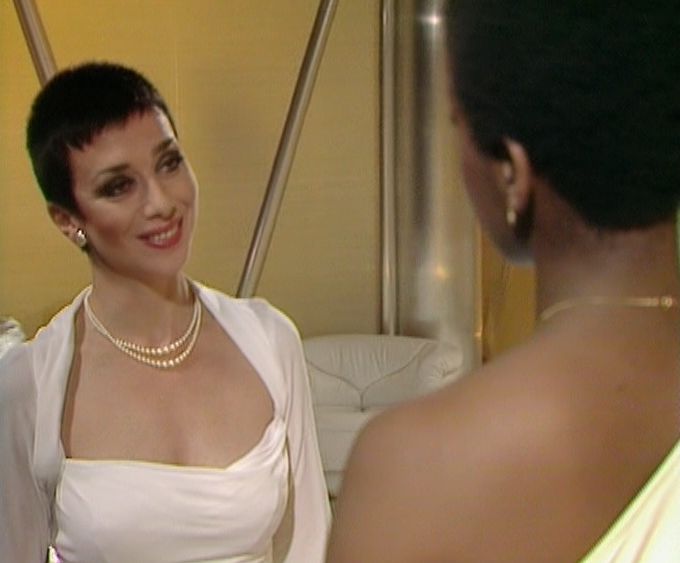
Still, Dayna has a good chunk of screen-time in this episode.  Her initial meeting with Avon is a memorable one – she kisses him on the lips, telling him that she was curious.  Avon, as befits his new status as a dashing action hero has an immediate response. “I’m all in favor of healthy curiosity. I hope yours isn’t satisfied too easily. I think you’ve cured my headache.”  The arrival of Servalan shakes things up.  Pearce and Simon share a lovely two-handed scene, which sees Servalan dripping with fake sincerity and Dayna barely able to hide her loathing.

aftermath 02

Dayna is presented as something of a flawed character – the life she’s led to date (an isolated one with her father) has left her with little understanding of other people.  She regards the Sarrans as animals, who exist to be killed as and when she decides.  Her potential awkwardness with others was something that could have been developed, but never really was.

A major change in series three concerns the relationship between Avon and Servalan. Let’s be honest, during the first two series they never had a relationship at all (try counting the number of lines they exchanged during the first twenty six episodes). All that changes now as we see that love/hate is in the air.  Servalan tells Avon that Star One is destroyed, which means that the Federation has been crippled.

AVON: So Blake’s rabble finally get freedom of choice. He won after all.
SERVALAN: Forget Blake. You have control of the Liberator now. There’s no more powerful ship in the galaxy. You have Orac. Avon! Don’t you see what that means?
AVON: You tell me about it.
SERVALAN: You could rebuild it all. All those worlds could be yours, Avon, they’re there for the taking. You and I could build an empire greater and more powerful than the Federation ever was or ever could have been. Now, Avon. At this moment we can take history and shape it in our own image. Think of it: absolute power. There is nothing you can imagine that we couldn’t do.
AVON: I am thinking of it.
SERVALAN: We can do it, Avon.
AVON: I know we can.
SERVALAN: We’ll be answerable to no one. Ours will be the only voice. Imagination our only limit. [They kiss. Avon grabs her by the throat and pushes her to the ground]
AVON: Imagination my only limit? I’d be dead in a week.

There’s no doubt that Avon and Servalan’s kiss (and his manhandling of her) launched a thousand fan-fics.  Darrow and Pearce are electrifying in this scene and it’s worth the price of admission alone.

The death of Dayna’s father, Hal Mellanby (Cy Grant) and her adopted sister Lauren (Sally Harrison) means that she no longer has any ties to the planet and is free to join the Liberator.  And the fact that Servalan killed her father will provide the series with some nice scenes of dramatic tension whenever the two meet again.

Although the primitives sub-plot of Aftermath is fairly tedious it doesn’t really impact on the main thrust of the story, which revolves around the Avon/Dayna/Servalan triangle.  All of them, especially Darrow, benefit from generous amounts of character development.

Unusually, we end on a cliffhanger.  Avon and Dayna return to the Liberator but find themselves on the wrong end of a Federation gun.  The curly-haired officer asks them why they’ve boarded a Federation ship ……

aftermath 03

Sergeant Cork – The Case of the Gold Salesman

gold

Eli Klein (Derek Francis) is a moneylender who’s not averse to turning a tidy profit wherever and whenever he can.  So the arrival of a mysterious stranger (who we later learn is called Carlyon) intrigues him, especially when Carlyon offers to sell him gold at well below the market price.  This seems far too good to be true, so Klein makes his way to Cork to ask for his assistance.  But Cork knows and distrusts Klein of old – why has he approached him?

Cork continues to explore methods of categorising felons.  He offers Bob an apple and then tells him that teeth marks, like fingerprints, are a good way of making an identification. Although how many people leave teeth marks at a crime scene is open to question!

Derek Francis’ first screen credit was in 1958 – when he was thirty-five – but whilst he may have been a fairly late starter (although he’d enjoyed a healthy stage career prior to this) he racked up an impressive list of both film and television credits during the next twenty five years or so (he died in 1984, aged 60).  Francis was equally adept at playing both comedy and drama (one of my favourites was his turn as Nero in the Doctor Who story The Romans in 1965).  Klein is also something of a comic character, although Cork does slightly disprove of him (as a moneylender, he’s driven desperate people to suicide).  It’ll come as no surprise to learn that Francis plays Klein as very broadly Jewish – the cliche that moneylenders must be Jewish is a well established one, a pity that Julian Bond’s script adheres to this stereotype.

John Woodvine (Carlyon) is an actor with considerable presence.  His film and television career (like Francis’) started in 1958, although Woodvine continues to act today (his most recent credit was 2015).  Some of his more memorable appearances include New Scotland Yard, The Tripods, Edge of Darkness and Knights of God.  His role in this story is small, but memorable.

The Case of the Gold Salesman is a Cork episode with a definite comedic edge.  Cork’s plan to catch the conmen includes leasing a house and posing as an interested buyer.  No surprises that Inspector Bird becomes positively apoplectic when he learns about this – the extra expense of a servant’s uniform for Bob and a nice smoking jacket for Cork doesn’t help either!

Julian Bond’s script takes its time to put all the pieces into place.  Cork’s masquerade as the gold buyer only takes place during the last fifteen minutes, so prior to that we’ve ambled through a number of (admittedly quite entertaining) character scenes – Klein and Cork, Bird and Marriott etc.  The meeting between Bird and Marriott is noteworthy, as Bob finally receives confirmation (much to his relief) that his probationary period is over and he’s now a fully fledged detective.

But all this preamble is worth it to see Cork relaxing in his smoking jacket, being attended to by his faithful servant Bob.  The scene between Cork and the bewitching gold agent Tamara Andreyev (Jill Melford) is lovely – for once Cork seems to be slightly on the back foot, probably because alluring females aren’t really his thing.  After he bids her farewell, he mutters to Bob that Henry Irving has got nothing to worry about!

It’s not the most interesting of cases (the fake gold scam is dealt with very perfunctorily) but the character interaction between the regulars and the guest cast more than makes up for this.

Sergeant Cork – The Case of Ella Barnes

ella

At first, the death of Ella Barnes looks like a simple case of drowning – but Mrs Sinkins (Wynne Clark) isn’t convinced.  She’s a member of the women’s protective league and had persuaded Ella to give evidence at a House of Lords enquiry into sweated labour.  Could the girl have been murdered to prevent her from attending?  Cork and Marriott venture into the slums of the East End to find out the truth.

Ella had worked at a sweat shop run by Brandel (Robert Cartland) who tells them that she was the ringleader of a recent strike.  All the other girls were fired and replaced with even cheaper (non English) labour but Brandel, for some reason, chose to take Ella back.

Although Brandel’s workshop is a pretty desperate place, Cork doesn’t rush to condemn him.  “In a way he’s just as much a victim as the people he employs. Brandel and the thousands like him who run these workshops don’t think they’re doing anything wrong. To turn out a cheap product you’ve got to have cheap labour. If you don’t turn out a cheap product you don’t survive.”

The cheapness of life is made clear after Cork speaks to several of Ella’s former work-mates.  One of them, Barbara Ellis (Rosemary Ashford), tells the Sergeant that she’s known several girls who’ve been fished out of the docks, so finds it hard to express sorrow over Ella’s death.  Mrs Brandel (Isa Miranda) later sums up the hopelessness of East End life.  “Work, work, work, for what? To eat, then more work. Maybe she’s more happy where she is. There is not much happiness here.”

Like many of the episodes we’ve already seen, as the victim is dead at the start of the episode Cork and Marriott (as well as the audience) have to build up a picture of them from the testimony of witnesses.  Whether they’re a saint or sinner will be determined from the facts they can uncover.  The news that Ella was four months pregnant, and her husband Alfred Barnes (James Kerry) had been absent for six, could be a vital clue (or it could just be a red herring).

The Case of Ella Barnes, like the earlier episode The Case of the Soldier’s Rifle, has a light dusting of social history (poor working conditions) but once again this is subordinate to the whodunnit part of the story and it’s true that Eric Paice’s script never quite succeeds in developing the misery and desperation of the sweat shops as fully as they could have been.  The guest cast is decent, although there’s a lack of stand-out performances.  But the solution to the mystery is well handled – the identity of the guilty party seems obvious, but things are not always as they seem ……

This is a fairly run of the mill episode then, although it’s enlivened by the usual high-quality production design (designer Anthony Waller creates a series of dock-based workshops in the studio very effectively) and there’s also some nice banter between Cork and Bob.

Sergeant Cork – The Case of the Public Paragon

paragon 01

Mrs Manley (Yvonne Coulette) returns home to find a mysterious man standing over the body of her husband.  Gerald Manley was a man of some substance (he was a member of parliament) so when it’s discovered that he’s dead it’s no surprise to find Cork is assigned to the case.

The opening scene is pitched at an intense level.  Mrs Manley’s maid Jenny (Natasha Pyne) becomes hysterical after the body is discovered and has to be slapped hard by her mistress.  Had time permitted it would have been a good idea to do a retake – the scene would have played better if the performances had been ratcheted down a little.  The guest appearance of a microphone boom is another problem that a retake could have rectified.

Sir Gervase Walworth (Jack Gwillam) pays Manley a fulsome tribute. “He was a man carved out by destiny for a brilliant career in politics. He was the soul of gentleness, the essence of integrity and the truest friend a man could have. Manley was a paragon.”  Cork doesn’t react to this, but when Walworth tells him that Manley didn’t have any enemies, the Sergeant counters that he hasn’t dismissed the possibility he was killed by a friend!

The nasty underbelly of seemingly respectable Victorian society is the theme of the episode, so it’ll come as no surprise to learn that Manley is not the paragon he’s been painted to be.  Cork and Marriott find a stash of photographs in Manley’s study and Bob reacts strongly to them.  “Those are pretty disgusting. I don’t mind a bit of honest sex but those … they’re enough to turn your stomach. They’re sickening.”

Manley had attempted to take compromising photographs of his maid Jenny (Walworth was also in attendance).  Although Manley’s now dead, Walworth is very much alive and he uses his considerable influence to remove Cork from the case.  Cork, of course, won’t be dissuaded and he continues digging – revealing a web of prostitution that’s linked to some of the most important people in the land.

When Cork confronts Walworth, he attempts to justify his actions.  “These girls, what are they? Street arabs. Bred in ignorance and reared in poverty, they’d jump at the chance to earn money.”  Cork counters that corruption comes from those who offer it.  John Barrie is at his implacable best in this scene.

The Case of the Public Paragon was an early screen credit for Natasha Pyne (she would later be a regular in the popular sitcom Father Dear Father) and despite her youth – she was seventeen at the time the episode was recorded – it’s an impressive performance.  Jack Gwillim had a very decent cv (film appearances included Lawrence of Arabia and A Man for all Seasons) and whilst he’s cursed with rather unconvincing facial hair (something of a continuing problem for the series) he also gives a fine turn.  Sir Gervase Walworth is initially presented to the audience as an honest, upright man (just like his friend Manley).  But as Cork’s investigations continue, it becomes clear that both reveled in the corruption of teenage girls and Walworth ends up a broken man.

The first of eight Cork scripts by Bill Craig, this is a powerful and rather disturbing story.

paragon 02

Inspector Morse – The Dead of Jericho

jericho 01

When Inspector Morse debuted in 1987 it was regarded by some as a risky venture.  The most common format for drama was the hour long slot, but every episode of Morse ran for two hours (or approximately 105 minutes once the adverts were removed).  It was generally believed that holding an audience’s attention for two hours would be a difficult task – especially with a series like Morse, which eschewed action to concentrate on intricate mysteries with, at times, an unashamed elitist air.

But the series’ many strengths – the Thaw/Whately partnership, the Oxford settings, first-rate guest casts, etc – all helped to make Morse an instant success and many other series would later copy the two hour format.  Some, like the revived Van Der Valk, didn’t endure but others (A Touch of Frost, Midsomer Murders) clearly benefited from Morse’s lead.

Inspector Morse made his debut in the novel Last Bus to Woodstock, written by Colin Dexter, which was published in 1975.  Dexter would pen another twelve Morse novels between 1976 and 1999.  When the television series went into production they had seven novels to chose from and elected to launch with Dexter’s fifth, The Dead of Jericho, published in 1981.

It’s easy to understand one of the reasons why Jericho was chosen  – it has a personal angle which helps to flesh out Morse’s character straightaway.

Anne Staveley (Gemma Jones) and Morse belong to the same choir and a friendship between them blossoms.  It becomes clear very quickly that Morse is hopeful this will lead a deeper relationship, but Anne (whilst she doesn’t explain why) gently tells him that it can’t happen.  “It’s complicated” she says.  Shortly after this conversation, Anne is found dead at her house in Jericho (a suburb of Oxford).  It appears to be suicide, but Morse isn’t convinced.

John Thaw had been a television regular since the mid sixties.  His first starring role, Redcap (1964 – 1966) had seen him play a military policeman, Sergeant John Mann, whilst The Sweeney (1975 – 1978) had been his most high profile role prior to Morse.  Detective Inspector Jack Regan was a rough, tough Flying Squad officer and it had taken Thaw a while to dissociate himself from the part.  So the thought of playing another copper might have palled, although it quickly became clear that Morse was no Regan.

This is amusingly demonstrated in the opening scene as we see Morse take part in a raid on a car chopshop.  There’s fisticuffs and the sort of action that wouldn’t have seemed out of place in The Sweeney (although it’s very atypical in Morse).  But director Alastair Reid chooses to intercut this with choir practice scenes – and the bizarre juxtaposition (together with the sweet choral soundtrack) is an odd, but effective, choice.

Thaw was only forty-four when The Dead of Jericho was shot, but he looked at least a decade older.  Thaw’s Morse is instantly a more vulnerable character than the literary Morse – his relationship with Anne is a good example of this (he pursues her with an almost pathetic eagerness).  And when he makes Lewis’ acquaintance later in the story he’s keen at every opportunity to invite him for a beer.  Is this because he wants to discuss the case or is Morse simply a very lonely man?

jericho 02

Reid’s directorial style very much favours close ups – it’s an effective way of establishing a sense of claustrophobia and tension – although he does occasionally pull the camera back.  The most striking example of this comes after Morse and Anne leave the pub, early in the story.  As Morse walks Anne home, Reid takes every opportunity to showcase Oxford’s impressive architecture (in a way that will become a signature mark of the series).

Gemma Jones is appealingly vulnerable as Anne, whilst Spencer Leigh has just the right amount of sneering superiority as Ned Murdoch, a student who’s latched onto Anne as something of a surrogate mother.  Patrick Troughton, in one of his last roles, is delightfully seedy as Anne’s next door neighbour – an odd job man who gets his kicks as a peeping-tom whilst James Laurenson is perfect casting as Tony Richards.

Richards was Anne’s former employer and all the evidence suggests he and Anne had enjoyed a lengthy affair – something confirmed by Richards’ disgruntled wife Adele (Annie Lambert).  Laurenson is one of those actors whose face is instantly recognisable, even if his name is less so, and it’s nice to know that he’s still going strong today.

If the television Morse differed somewhat from his literary counterpart then the same certainly goes for Lewis.  Dexter’s Lewis was a contemporary of Morse and tended to always be several steps behind his boss.  By casting a younger actor, Kevin Whately, the whole dynamic changes (for the better it must be said).

Indeed, The Dead of Jericho doesn’t really start to work until Morse and Lewis are teamed up.  To begin with, Lewis is partnered with the acerbic Chief Inspector Bell (Norman Jones).  Bell, in charge of the case, distrusts Morse because he’s clever(!), but Lewis has a more open mind.  It does appear that Morse and Lewis have never met face to face before – which makes more sense in the book as it’s explained that Bell works at another station.

That Morse sees himself as a free-wheeling maverick is made obvious when he fails to tell Bell that he knew Anne, or that he visited her house on the afternoon she died.  His disregard for the law can also be seen when he decides to clandestinely visit her house in the dead of night to search for clues.

Lewis, lying in wait, nabs a villainous-looking character in a back leather jacket climbing over the wall, only to be shocked when it turns out to be Morse!  It’s a nice comic moment, although it does support the view that Morse shouldn’t be allowed anywhere near the case.  But when Bell is promoted, Chief Superintendent Strange (the always wonderful James Grout) does indeed give Morse the case (and gives him Lewis as well).

Anthony Minghella’s adaptation changes most of the names as well as removing a few characters (or changing them somewhat).  Whether this helps to make the screenplay better or worse than the novel is open to debate, but it’s undeniable that around the seventy minute mark it’s impossible not to find your attention drifting.  This would always be a problem with the two hour format (more so once the series had exhausted Dexter’s novels) but it’s worth sticking with it until the end.

So whilst it’s not the most involving of whodunnits, Thaw and Whately hit the ground running and this ensured that Inspector Morse had a solid future.

jericho 03

Sergeant Cork – The Case of the Soldier’s Rifle

rifle.jpg

The army are called in to keep the peace during an industrial dispute – but when one of the strikers is shot dead it falls to Cork to investigate.  However, what appears to be a straightforward case turns out to be much more complicated.

Cork is the only man for the job, according to Supt. Nelson.  This irritates Inspector Bird who offers to lead the investigation himself – the way Nelson hurriedly turns down his kind offer is a clear indication that Bird (whilst Cork’s superior in rank) is decidedly his inferior as a police officer!  After Cork leaves, Bird has to grudgingly admit that he’s a decent officer, but believes (as does the audience, no doubt) that his abrasive manner will not go down well with the army bigwigs.  Nelson does give Bird another reason as to why he chose Cork.  Apart from his undoubted investigative qualities, Cork’s public profile continues to rise and his verdict, when reprinted in the newspapers, will carry more weight than most.  It’s another indication that the Sergeant enjoys something of a celebrity status, although it’s not something he trades on.

Like Cork and Marriott, the audience comes to the investigation with no knowledge as to exactly what happened.  Although the episode opens with the strikers confronting the army, when the shot was fired the camera was elsewhere.  Was the murdered man an agitator (as Major Edwards says), in the wrong place at the wrong time or killed for another reason?  Edwards (Basil Henson) makes his position clear from the start.  “The army doesn’t have to give reasons for what it does, it conducts its own investigations and I advise you to leave well alone before you find yourself in trouble. Clear?”  No surprise that Cork isn’t at all intimidated and instead continues to ask questions.

The murdered man, Strong, had been keen to stand up for his rights.  His brother Alf (John Boyd-Bent) makes this point forcibly to Cork and the union leader Ned Fisher (Charles Morgan) agrees (Morgan would become a very familiar face in the later run of the series, he returned for a lengthy spell as Supt Rodway).  The resentment felt between the workers and the management is spelled out by Fisher.  The workers were striking for an extra four-pence a day – and with the fruits of their labours (luxury furniture) being sold for a healthy profit, this seems a reasonable request.

Although Major Edwards and Cork didn’t exactly hit it offer when they first met, they do reach a rapprochement after Cork proves that the private soldier who claimed to have shot Strong couldn’t have done so.  Strong was killed by a revolver bullet, not one fired from a rifle, and the soldier had lied to cover up that he’d lost his rifle in the melee.  So could the factory owner Charles Robinson (Neil Arden) be responsible?  His dislike of Strong was well known and his death certainly seemed to meet with his approval.  If not Robinson, then Cork will have to cast his net even wider – maybe one of Strong’s fellow strikers pulled the trigger?

It’s probably not too surprising that the murderer turned out to be someone close to home – Cork was a fairly traditional series and a straightforward theme of social unrest would have been rather outside the series’ remit.  Instead, we have a reasonably satisfying whodunit with a light dusting of social history (poor working conditions, the army called in to keep the peace, etc).

The Case of Soldier’s Rifle was the second of two scripts by Bill Macllwraith (the first was The Case of the Two Drowned Men).  Interestingly, Macllwraith would later work on another Victorian detective series – Cribb.  Based on the novels by Peter Lovesey, it would be easy to imagine that Lovesey had been influenced by Cork (although he’s never said so).  But for anyone who enjoys Cork, Cribb is also well worth your time.

John Boyd-Bent (Alf) gives a rather broad performance, as does Jane Wenham as Strong’s widow, Ivy.  I wonder if this was more down to Macllwraith’s scripting, since The Case of the Two Drowned Men also had its fair share of histrionics?  The whodunit angle isn’t as satisfying as some of the other episodes, as the characters aren’t as well drawn (so don’t invite our sympathy or interest) but it’s still an amiable enough way to spend fifty minutes.


Sergeant Cork – The Case of the Sleeping Coachman

coachman

The Case of the Sleeping Coachman opens with Cork attempting to pack his suitcase.  He and Bob are heading down to Wiltshire to investigate a murder, the news of which seems to please Cork’s landlady Mrs Fielding (Carmen Silvera) who tells Bob “that’ll be nice for you. Make a change to do your investigations in the country, won’t it?”  This opening scene serves several purposes – Mrs Fielding’s curiosity about the reason for Cork and Bob’s trip allows them to make a none too subtle info dump but it also shines a rare light on Cork’s off duty life.  We see that he appears to be a hopeless organiser when it comes to simple matters like buying socks (he’s constantly being chivied about such things by the kind-hearted Mrs Fielding).  It’s also characteristic that we see Bob lounging around with his feet up, not concerned in the slightest that Cork is rushing about frantically.

They’ve been sent to investigate the murder of Nellie Bishop, a servant girl in the employ of Sir Henry Melrose (Mark Dingham).  Sir Henry is dismissive of the Scotland Yard men, and his son George (Philip Bond) is even more so.  Bond (father of Samantha) was good at playing disinterested, upper-class types and George is no exception.  His open contempt for Cork and Bob is shown when he insists they use the servant’s entrance (instead of entering through the front door).  Cork, of course, comes in through the front regardless!

Sir Henry is allowed a few minutes for his character to be well established.  He has a complete and unshakable belief in his own authority and this makes it clear that as soon as he and Cork meet, sparks will fly.  When Cork is asked why he didn’t enter through the servant’s entrance he casually mentions that only last month he had the privilege of entering Windsor Castle by the main gates.  It’s an indication that Cork is something of a public figure – earlier on this was confirmed by Lady Melrose (Beatrice Kane) who mentioned that she’d read about several of Cork’s more prominent cases in the newspapers.  When Sir Henry leaves, Inspector Armstrong (John Harvey) makes his feelings known to Cork.  “We’ve been treated as children or usurpers, never as responsible police officers.”

The first meeting between Bob and George is another nicely written and played moment.  At the same time that Cork was upstairs, irritating Sir Henry with his questions, Bob was downstairs in the servant’s hall, enjoying a hearty meal and seeing what facts he could learn from the servants.  When George arrives, bristling with indignation and flourishing a riding crop, he assumes Bob is a friend of one of the servants and asks him, none to politely, to leave.  Bob refuses and George then sees that he’s wearing a Winchester school tie.  It’s the same school that George went to and it staggers him to learn that Bob is a policeman (“on probation” mutters Cork).  The unspoken inference is that the police-force is no job for a gentleman.

After questioning Nellie’s parents and some of the servants, Cork makes an astute observation.  “I’ve got a feeling we’re travelling back into history. Fifty, a hundred miles away, the world is changing so fast you can’t keep pace with it.  Yet here, it’s like a book isn’t it? The lord of the manor, the arrogant son, the peasants on the estate. As though you’d frozen a calendar.”

Cork manages to get under the skin of both George and his sister Victoria (Rosalie Crutchley) to say nothing of the constant irritation he causes Sir Henry.  His relentless enquiries are one of the key pleasures of the episode and everything culminates in a classic drawing room scene as he brings the family together to reveal the murderer.

There’s plenty of good performances to savour – including Philip Bond and Rosalie Crutchley (the incestuous relationship that’s hinted between them is an interesting one to see in a popular drama of this era), John Harvey (sporting an impressive set of whiskers) and Patricia Clapton as Sarah the maid (who Bob takes something of a shine to).  All this, plus another outing for Cork’s special country suit!

Sergeant Cork – The Case of the Persistent Assassin

persistent

Prince Frederick of Sileasia (Garfield Morgan) has arrived in London for a three day visit.  Sileasia, a small country bordering Russia, is a potential political hotspot which would be ignited by Frederick’s assassination.  Cork is assigned the task of keeping him alive.

Prince Frederick is strong-willed and initially disdainful that he’s in any danger.  This is a dramatically obvious choice, as an unpredictable subject is much more interesting than a compliant one.  Morgan, a familiar television face (well known for playing Haskins in The Sweeney) gives an icy turn as the Prince.  It’s not the most nuanced of performances but as the episode progresses we do start to peel away the layers of Frederick, the man.

The studio-bound limitations of Cork are more evident in this story than some of the others – the first assassination attempt is a good example of this.  Frederick walks to the window and is lucky to avoid a rifle bullet.  After the shot is fired the camera focuses on nothing for a few seconds before we cut back to the action.  This was always a hazard of multi-camera studio recording – since editing had to be in done in real-time it was easy to miss something.  The small amount of recording time meant that retakes only tended to occur when something went dramatically wrong, so whilst this looks a little clunky it clearly wouldn’t have been judged important enough to merit recording the scene all over again.

At one point Cork mentions that he plans to consult the dynamite section.  Terrorist attacks with dynamite and other explosives weren’t uncommon during this period (see here for some real life examples) and The Case of the Persistent Assassin serves as a painless history lesson.

Frederick tells Cork that he wishes to return to his country and end the division and bloodshed.  Irene Stone (Liane Aukin) who attempted to blow him up with a bomb sees him in quite a different light.  “You butcher! You murdered my three brothers because they tried to speak against you. You put my mother and father in jail. You’ve turned Sileasia into a prison house!”  It’s quite telling that Frederick doesn’t attempt to contradict her – although it’s unlikely he would have recalled Irene’s family, he acknowledges that many innocent people have suffered in the past.  It does pose the question as to whether he’s quite the benefactor he claims to be – this is firmly answered at the conclusion of the story.

With Cork and Bob somewhat pushed into the background, this is one of the lesser episodes of the first series.  The telerecording is notable for a black blob that’s present during most of the episode.  It’s not quite as distracting as the fly that wanders across one of the telerecordings of The Avengers but it comes close.

Sergeant Cork – The Case of the Slithy Tove

tove.jpg

The death of an ex-villain called Trumble provides Cork with a puzzling mystery to unravel.

Trumble was well known to Cork and the news of his murder is greeted with sadness by the Sergeant.  His attitude is in sharp contrast to Inspector Bird, who views Trumble’s modest house with distaste and asks Dr Stuart (Robert James) “what is a case like this to do with people like us?”  Trumble’s death has caused unrest in the East End and the police are struggling to maintain order.  This also irks Bird.

The arrival of Cork changes things.  Unlike Bird, he’s happy to talk to the unruly crowd and he tells them that Trumble was just as much his friend as he was theirs.  His bluff way does the trick and the crowd disperse – although it’s noticeable that Bird doesn’t acknowledge this.

Cork brings the police photographer Perryman (John Junkin) to the crime scene.  This is something else that irritates Bird – why waste resources on such a squalid case?  Cork reminds him that photography is now becoming standard (a sign that the police are slowly beginning to embrace modern technology).  Fingerprints, one of Cork’s hobby-horses, are also mentioned, although Bob reminds him that they can’t be used in evidence.

Rex Firkin spent most of his career working as either a producer (Emergency Ward 10, The Planemakers, The Power Game) or an executive producer (Budgie, Upstairs Downstairs) but he did direct from time to time.  His sole Cork credit is unusual, as he didn’t have a production role on the series (unlike most of the other programmes he directed).  Based on the evidence of this episode it’s a pity he didn’t direct more.  The opening scene is especially interesting – the camera moves from the street (studio-bound, naturally) into Trumble’s house and then back out again.  Following Trumble’s death the camera follows a young urchin (John Barnham) as he ducks out of sight (Firkin is able to make full use of Anthony Waller’s well designed street set).   Sound effects (horses’ hooves, barrel organs) also help to create the illusion of a busy thoroughfare.

The Case of the Slithy Tove has a very strong guest cast.  Ann Lynn is vulnerable as Trumble’s daughter Nora and the always dependable Robert James has a decent role as Dr Stuart.  It’s a pity that James never returned as the doctor as he would have been a good semi-regular,  but James does have two further Cork credits (playing different characters).  Peter Fraser (probably best known for playing David Campbell in the Doctor Who story The Dalek Invasion of Earth) is slightly wooden as Nora’s fiance, Sam Manners and whilst it’s always nice to see  John Junkin, he has little to do as Perryman.  Bruce Beeby, who amongst various roles played Mitch in the radio serial Journey into Space, is the enigmatic Lake.

The identity of Trumble’s murderer is a mystery until the end.  Cork, who’s fond of quoting poetry during the episode, declares that he’s a slithy tove. Earlier, for the benefit of the audience, he’d explained that “a slithy tove is a slippery customer, it’s only when you turn your back you’re sure he’s behind you. Face him and he’s faceless.”

Cork does eventually run him to ground, but the story he has to tell is unexpected.  This leaves something of an open ending – Bob asks Cork what he plans to tell Inspector Bird, but Cork doesn’t answer.  It was common for Sherlock Holmes to decide at the end of a case that no further action would be taken, but he was a private individual and not bound by the law.  Would Cork feel it was his duty to report everything he knew to Bird or would he decide that things were best left as they are?

The first of eight Cork scripts by Bruce Stewart (who would later pen three of the four Timeslip serials) The Case of the Slithy Tove is another very enjoyable series one episode.

Sergeant Cork – The Case of the Respectable Suicide

respectale

By all accounts Mr Bertram was a pious, god-fearing man – so why did he commit suicide?  Cork is asked to investigate and discovers that even the most respectable-looking people can have secrets …..

The Case of the Respectable Suicide allows us to take a peek behind the veneer of Victorian respectability.  Although our first sight of Bertram is his lifeless body, the reading of his will allows the audience to grasp his character very quickly.  To his servants he leaves an engraved bible and five shillings to be donated to the charity of their choice.  To his estranged wife Sarah (Joy Stewart) he bequeaths his “bible and instruments of self discipline in the earnest hope that inspired by the one and spurred on by the other she may yet turn away from the life she has led and stand before the throne of judgement a repentant sinner.”

The main beneficiary of Bertram’s will is his housekeeper Mrs Holland (Diana King) who is left the house and the residue of his estate.  This is a powerful motive for murder, although Sarah must also be considered since Bertram refused her a divorce and she’s been “living in sin” for the past five years.  But his death means that she’s now free to remarry.

Bertram wasn’t quite the man he seemed to be though.  Just before he died he’d read the front page of a scandal magazine called The Pillory which had a headline alleging he’d assaulted a child twenty years ago.  The facts beyond this are never elaborated upon, although several characters read on and express various emotions.  The owner of The Pillory, the Reverend Septimus Barrow (Norman Scace), is an interesting chap.  He maintains that he prints such stories in order to smite the Lord’s enemies whilst the cynical Cork is of the opinion that he runs nothing more than a crude blackmail operation.  This front page never made it to press, so Cork wonders if it had been given to Bertram to encourage him pay hush money in order to suppress it.

It’s possible to view Bertram as a hypocrite – keeping a public face of piety whilst hiding this skeleton in his cupboard.  But his estranged wife Sarah shows true Christian compassion towards him.  She’s suffered more than most from his actions, but has come to see that he’d spent the last twenty years attempting to make amends for his one lapse.  Unfortunately he chose to do this in such a harsh and uncompromising way that he’d poisoned their marriage almost as soon as it had begun.

Diana King was an incredibly experienced actress with numerous television and film credits.  She’s very watchable as Mrs Holland, someone who appears to have much in common with the respectable Mr Bertram.  Although it’ll probably come as no surprise to learn that she has secrets as well ….

Stand-out performance in the episode though comes from June Watts as Betram’s maid Polly Read.  Watts only had a handful of credits between 1961 and 1966 and it’s a mystery why she never enjoyed a much longer career.  It’s clear that Polly knows more about matters than she’s letting on and from the time Cork enters the house he plays with her, rather like a cat plays with a mouse.  This is first seen after he observes her listening at the keyhole during the will reading – he proceeds to question her in the hallway and every time he asks a question he moves towards her, forcing the girl to retreat.  It’s an effective way of making what would otherwise be a fairly static scene into something more visually interesting.  Later, Bob catches her trying to burn the scandal paper and she’s marched off to the station for questioning.  Once she’s told them all she knows we see Cork’s softer side as he throws her a coin for her bus fare home.  Although Polly is a fairly conventionally written character, Watts makes something of the role and certainly lifts the story up a level.

At the start of the episode we meet Inspector Bird (Arnold Diamond).  Bird has nothing to do with the main story, but it’s the first time we’ve seen any of Cork’s superiors and it’ll come as no surprise to learn that he enjoys an uneasy relationship with the testy Sergeant.  Bird is presented as a bean-counter – always fretting that too much money is being spent – whilst Cork bemoans the fact that lack of resources are hampering his investigations.  That Bird has no confidence in Cork’s progressive attitude is made clear when the Inspector tells him that microscopes don’t catch villains, policemen do.

This was the first of Julian Bond’s eight scripts for the series.  Bond would contribute to many popular series of the era (The Saint, Ghost Squad, Redcap, Public Eye, Armchair Theatre, Out of the Unknown, Upstairs Downstairs) and this story is up to his usual high standard.  Possibly not the most taxing mystery ever, but it’s a joy to watch for several reasons – not least for the continuing relationship between Cork and his willing young disciple Marriott.

Sergeant Cork – The Case of the Stage Door Johnnie

stage

Kate Seymour (Eira Heath) is a music-hall performer who’s caught the attention of the Hon. James Stratton (Michael Meacham).  Stratton is infatuated with the girl and plans to marry her, much to the dismay of his well-heeled friends (one of whom warns him that “you can’t make a napkin out of a dishcloth”).  And those closest to Kate, such as her mother Bessy (played by Cicely Courtneidge), are just as keen to put a spike in their union.  Bessy has a low opinion of the male of the species anyway, bluntly telling her daughter that “if you look hard enough you’ll find something rotten in all of them.”  The delivery of anonymous letters to Kate, alleging a string of infidelities on Stratton’s part, is clearly designed to break up their intended marriage and the infuriated Stratton sets off to request the cooperation of the police.

The Good Old Days (BBC, 1953- 1983) painted an unforgettable (if rather idealised) picture of the Victorian/Edwardian musical hall and The Case of the Stage-Door Johnnie taps into a similar nostalgic atmosphere.  Presumably it was lack of budget that prevented Cork from filming in a real theatre (and even if they had, no doubt they would have struggled to hire enough extras to make it look full) so they had to recreate it in the studio.  It’s a decent effort, although a little suspension of disbelief is required.

Part one is set in and around the theatre and is notable for the absence of Cork and Marriott.  But it does enable Stratton and Kate to be brought into sharp focus as well as giving Cicely Courtneidge some pithily delivered lines.  We also see a young David Burke, who plays Arthur Stephens – one of Kate’s old flames.  Some twenty years later Burke would return to the Victorian era to play Dr Watson to Jeremy Brett’s Sherlock Holmes.

When we eventually get to see Cork, he begins by ranting at the hapless Chalky.  “Do you know the crime figures are rising? Do you realise we’re hampered, harassed and neglected? Do you realise we fight on so that you and your family can sleep safe in your bed at night? And you tell me that you’re too busy to make the tea?”  But there’s a sense that his treatment of the unfortunate Chalky is done with his tongue in his cheek (although whether Chalky sees it the same way is another matter!)

If his bad mood was genuine then it seems to have dissipated by the time he meets Kate.  He apologies that he’s got a piece of stickjaw toffee stuck in his teeth and offers her some for later.  They both rhapsodise about favourite sweets, with Cork telling her that “a lady in Chapel Street I know makes them, all home made. Humbugs, winter warmers, acid drops …”  Their chit-chat is only brought to an end when Stratton gently reminds Cork that they’ve come to the theatre on business.  It’s yet another nice character moment for Barrie.

Cork’s continuing disdain for the niceties of the social hierarchy is demonstrated during his interview with Stratton’s friend Lord George Creighton (Jeremy Longhurst).  Creighton, not happy with the tone of the interview, asks Cork to remember who he’s talking to.  “Personally I don’t care a damn who you are” responds the Sergeant.  Remarkably Creighton isn’t too upset at this sharp retort and goes on to say that Stratton shouldn’t marry outside of his own social strata – he believes that to do so would help to weaken the aristocracy’s bloodline.  Creighton is something of a hypocrite, he’s happy to sample the joys of working class girls but wouldn’t ever consider marrying one of them.

The Case of the Stage-Door Johnnie is a fairly low-key story, but Sergeant Cork wasn’t a series that always had to have a serious crime at its heart.  Cork deduces who wrote the letters and after he confronts them is happy to consider the matter closed.  Richard Harris (later to co-create Shoestring amongst many other notable credits) provided his one and only script for Cork and it’s a well-observed character piece.  Courtneidge tends to steal the show as the indomitable Bessy, keen to live her own dreams through the success of her daughter, but Eira Heath also impresses as Kate.  We’re later told that Kate is never going to be the next Marie Lloyd (despite what her mother thinks) and Heath has to tread a fine line to show that Kate is a competent, but not outstanding, performer.  Michael Mecham has less of a sharply-defined role, but does the best that he can whilst David Burke is far from subtle, but entertaining, as Arthur Stephens.  Another good episode.