An Englishman’s Castle – Part Two

castle 02

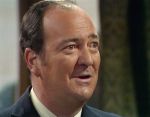
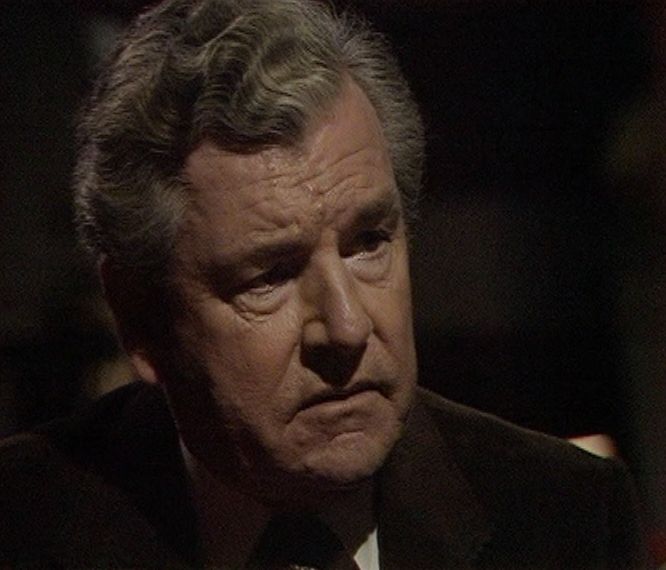
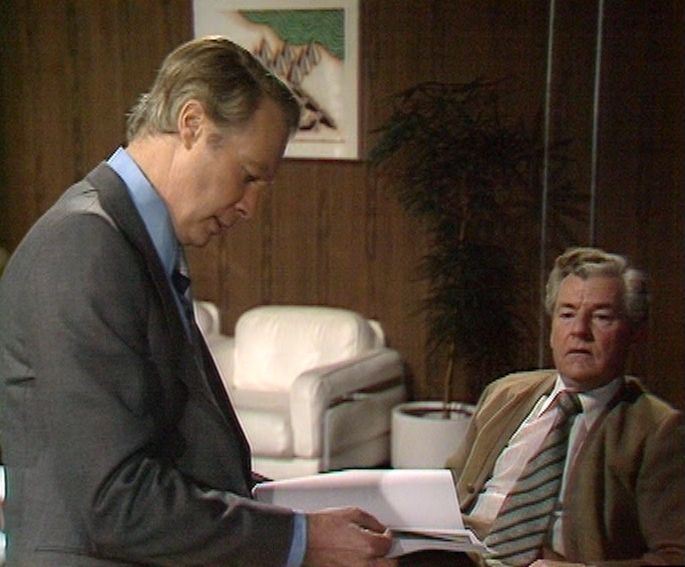
Part two opens with another excellent two-handed scene between Kenneth More and Anthony Bate.  Peter has come to tell Harmer whether he’s decided to change the name of Rosenthal to something less Jewish-sounding.  Harmer pretends to have completely forgotten about this request, but we’ve seen enough of him to know that he forgets nothing.  To Harmer’s undisguised annoyance, Peter is insistent that the name must remain and when pressed for a reason he states that he wants to send a message of hope and friendship to the Jews watching.

Harmer is incredulous and tells him that there aren’t any Jews watching the programme.  Those that are alive are in places where there aren’t any television sets.  With a series like An Englishman’s Castle, which is completely dialogue driven, it’s throwaway moments like this which help to paint a fuller picture of their alternative world.  In part one it was mentioned that there were still labour camps for some Jews (although most had already perished in the gas chambers) so the number who still exist in Britain must be small.  We know of at least one, Jill, so it could be that there are others.

Although Peter doesn’t back down, Harmer gets many of the most telling lines, especially when Peter tells him that he simply wants to show the public that the Jews are like them.  But, as Harmer responds, they aren’t.  “We are wealthy and comfortable and alive.”

In part one it was mentioned that Peter’s soap opera is drawn directly from his own wartime memories.  This theme is now developed further as one of the two sons – Frank – is set to be killed off.  The actor playing Frank is highly dismayed when he receives the latest script and learns that he perishes at the hands of the Germans.  In a scene that no doubt has echos with many real-life soap operas, when the actor realises that he’s not coming back next week his mood quickly darkens.  He protests that he’s been with the series since the beginning and is one of the most popular characters, but all to no avail.

Peter explains that the two sons in the show – Frank and Bert – are both based on him.  Frank is his romantic side and Bert is his realistic side.  When the Germans invaded in 1940, Peter’s romantic side died, so Frank has to die as well.  Since then Peter’s lived as a realist, as he’s seen no other way, but events are now changing.

Peter has two sons in the real world as well.  Henry (David Meyer) works on the show with Peter whilst Mark (Nigel Havers) despises his father and everything he stands for.  Mark appeared briefly in part one, where he denounced his father’s politics vigorously, and in part two he’s arrested by the police on suspicion of being a terrorist.  Havers performance isn’t particularly subtle (Mark’s manic radicalism seems rather overblown) but there may be a reason for this (he’s a radical, but not a member of the true underground resistance).

When Peter returns home, he finds Mark in the custody of the polite, but clearly ddangerous, Inspector (Philip Bond).  It’s probably the fact that he’s so very reasonable which is the most unsettling thing about Bond’s Inspector.  He’s not brutal or brusque, Bond gives the Inspector a casual air as if he’s just taking Mark away for a few simple questions.  The reality – as even Peter knows – is quite different.  Mark will be tortured and die, unless Peter can pull some strings.

The only man who has the influence to save Peter is Harmer, and this leads us to another absorbing scene with More and Bate.  Harmer is enjoying a candlelit dinner with his social secretary Anja (Suzanne Roquette) but once he learns of Mark’s plight he’s keen to help.  He rushes off to the phone, leaving Peter to talk to Anja – the only problem is that Anja only speaks German and Peter knows only a few words (surprisingly so, you’d have assumed everybody would have learnt the language by now).

Harmer tells the police that he doesn’t care whether Mark’s innocent or guilty, he just wants him released – which he is.  It’s another fascinating part of the story – both for the way that a television executive like Harmer is able to intercede in police matters and also for the casual confirmation that the evidence planted on Mark was faked.

Peter had come to Harmer ready to offer a quid pro quo – if Harmer can get Mark released then he’ll agree to change Rosenthal’s name to something less provocative.  It’s interesting that Harmer only learns of Peter’s decision after he’s made the call, but as ever with Harmer, he wasn’t acting out of friendship (he’s well aware just how important Peter’s programme is to the government and he’ll do anything he can to ensure his star writer is kept happy).

Peter later muses with Jill about whether Harmer orchestrated the whole thing – arranged to have Mark arrested in order to force him to back down over Rosenthal’s name.  It’s an intriguing thought – which turns out not to be true – but somebody is manipulating Peter.

It turns out to be Jill, who’s a member of the underground movement dedicated to the overthrow of the government.  She’s dismissive of the actions of people like Mark, who it’s implied are simply playing at being resistance fighters.  They throw a few bombs around and hit the headlines, but the real struggle is done deep underground – by people like her.

Peter’s realisation that Jill only became his mistress in order to recruit him is nicely played by More.  He agrees to join, but it’s not clear why.  Is it because he agrees with the aims of the organisation or is it just out of his love for her?  One thing that concerns him is her insistence that anyone who is suspected of being a delator (informer) has to be killed.  Peter might have fought in the war, but that was a long time ago.

We end this episode, as we began, with a two-handed scene between More and Bate set in Harmer’s office.  It’s another few moments which zing with tension as Harmer tells Peter that his son Henry has been promoted to director.  This is good news, but the ominous way in which Harmer goes to say just how loyal Henry is to the state indicates trouble ahead.  It was Henry who informed on his brother and this leaves Peter with some impossible decisions to make.

 

An Englishman’s Castle – Part One

castle 01-01

The 1970’s were a fertile time for British television dramas which portrayed the country toiling under totalitarian dictatorships.  Apart from An Englishman’s Castle, broadcast in 1978, there was also The Guardians (LWT 1971) and 1990 (BBC 1977).  It’s probably not too hard to understand the reason why – strikes, power cuts, the three-day week, inflation running at 30% and a humiliating bail-out by the IMF had all conspired to dent the nation’s pride.

In some ways, the 1970’s was the decade of paranoia.  Rumours of impending right-wing coups and mutterings that MI5 were planning to oust Harold Wilson and his government abounded.  So it’s no surprise to find several television dramas had tapped into this mood to produce nightmarish visions about what might happen.

But whilst The Guardians was set in the aftermath of a coup and 1990 was set a decade or so in the future, An Englishman’s Castle takes a different tack.  In this serial, the Germans won WW2 and Britain has been a subjugated nation ever since.  Coincidentally, Len Deighton’s novel SS-GB had the same basic premise of a Nazi-subjugated Britain and was published a few months after An Englishman’s Castle was broadcast.

Casting Kenneth More in the central role was a conscious statement of intent.  More had built a career playing a certain type of Englishman (exemplified by classic war films such as Reach for the Sky).  Following the gradual decline of the British film industry More moved into television (The Forsythe Saga, Father Brown) but he still tended to play upright, decent characters.  Peter Ingram also seems to be a decent man – but as the serial opens we see that he’s totally reconciled to living under German rule.  Is he simply being rational or has he been living a lie all these years?  That’s one thing that we’ll discover over the following three episodes.

An Englishman’s Castle is the name of Peter Ingram’s popular soap opera.  Set in 1940, just prior to the German invasion, it’s the story of an everyday British family.  Not only is it a success in Britain, it’s also sold all over Europe (or as Ingram says, “all over German Europe”).  Programme controller Harmer (Anthony Bate) is intrigued as to how Ingram will present the invasion.  Ingram tells him that “I can’t rewrite history. I mean, the Germans invaded us, and we got beaten.”  Harmer’s response strikes the first discordant note. “I look back on it now as a victory. A victory for common sense, and decency, and humanity. The triumph of peace-loving people everywhere.”

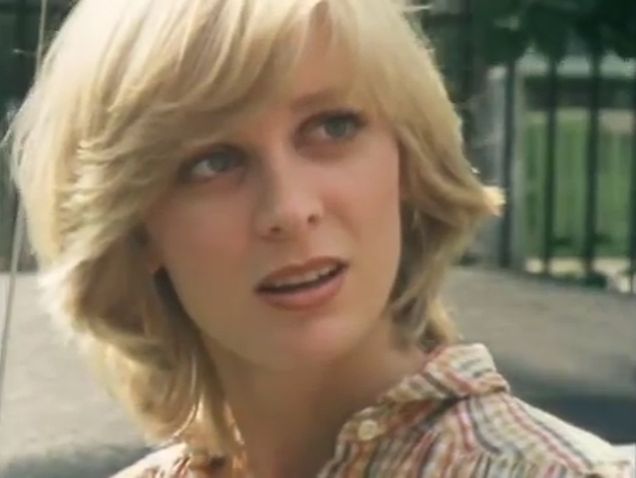
Jill (Isla Blair) plays Sally in the show.  She’s young, beautiful and Peter desperately wants to take her to bed.  Jill’s also interested in Peter, but has a mocking and questioning nature which indicates that nothing’s going to happen straightaway.  To begin with, she’s more interested in finding out about the young Peter and what happened to him in 1940.

JILL: Were you in the resistance?
PETER: Yes, of course.
JILL: And then?
PETER: And then there was Black Friday, the day that Churchill was killed.
JILL: And then?
PETER: A lot of us were killed.
JILL: One way or another.
PETER: The survivors took to the hills, and lived like ancient Britons. Had a bad time of it. Then they proclaimed a general amnesty. And I suppose we were getting older and more peace loving and we wanted to see our wives again, our girlfriends … so we came down from the hills and handed over our weapons, or at least most of us did.
JILL: You?
PETER: I couldn’t see that we would ever win.
JILL: No .
PETER: What was the point of it all? What was the use?

It’s notable that we never see any Germans and there’s no outward signs that Britain is an occupied country. All the dialogue strongly indicates that following the invasion, the British were left to govern themselves (but with the ultimate decision-making taking place in Germany). Peter has come to accept this as normal – they might be a subjugated race, but when the authorities are British it’s easy to forget this (or at least push it to the back of your mind).

When the restaurant that Peter and Jill are eating in is attacked by resistance terrorists, Jill is convinced that the terrorists will be taken away and tortured.  Peter doesn’t believe that the British police would do such a thing (“they have a long tradition of not doing things like that”).  “Had a long tradition” counters Jill.  This clearly indicates that they think in totally different ways.  It’s partly an age thing (Peter is much older) but there are other reasons why Jill is much more suspicious, as we’ll discover later.

The scenes we see of Peter’s soap opera are particularly instructive.  He hasn’t been told to write propaganda, but that’s what he seems to have done anyway.  Jill later puts this point to him very clearly.  Although it’s set in 1940, it reflects contemporary attitudes and seems to have been designed (either consciously or unconsciously) to keep the masses docile.  “What they’re saying is now. Be sensible, make peace. We don’t want to die. Nobody does. Survival, that’s all that matters. In every programme you have this keynote speech, your message for now, and your viewers think ‘he’s right, you know’, telling us we’re right. We’re right to go on as we are. Not making any fuss, obeying orders. Just content to work hard, fall in love, have children, give them a good start in life, and retire on a pension when we’re old. Eh lad, it’s not a bad life under the Germans, is it?”

It should go without saying that More is excellent here, but he’s matched step-for-step by Blair.  Another top-notch performance comes from Anthony Bate as Harmer, who is insistent that he doesn’t want to censor Peter’s script, just edit it.  Bate is at his most chilling when Harmer tells Peter that it’s impossible for him to introduce a character called Rosenthal.  The Jewish problem (courtesy of the gas chambers) was dealt with a long time ago, but there’s no way that a sympathetic Jewish character could appear on British television.

This is not a request from the Germans – Harmer is simply anticipating their concerns.  He dangles the possibility that by aggravating them over such a trivial matter they run the risk of inviting German interference in every aspect of their broadcasts.  Is this another example of the subjugated British being more rabid than the Germans would be?  In the first sign of stubbornness from Peter, he refuses to change the name straightaway and asks if he can sleep on it.  Harmer doesn’t spell out what will happen if he doesn’t, but then he doesn’t need to – by now it should be pretty clear.

When Jill reveals that she’s Jewish, Peter’s squabble with Harmer pales into insignificance.  If it’s discovered that she’s Jewish and that Peter’s slept with her then under the racial purity laws they’ll both face death.  An excellent hook to end part one with.

castle 01-02

The Vital Spark – A Drop O’ The Real Stuff

vital spark

An archive rarity has recently received an unexpected screening on BBC2 and is available, for those who can access it, on the IPlayer.

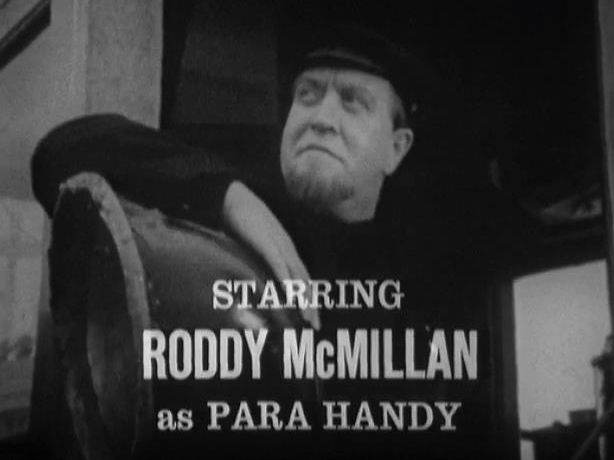
The tales of Para Handy, written by Neil Munro, first appeared in the Glasgow Evening News between 1905 and 1923.  Para Handy is the skipper of the steamboat The Vital Spark, which is his pride and joy.  Together with his mismatched colleagues – Dan MacPhail, Dougie and Sunny Jim – they wend their way around the coast of Scotland, enjoying various misadventures.

Para Handy first came to BBC television in 1959 with the show Para Handy – Master Mariner, starring Duncan Macrae as Handy.  A few years later came a fresh series of adaptations – entitled The Vital Spark.  Roddy McMillan played Handy (he’d appeared as Dougie in 1959) and there were three series – which aired in 1965, 1967 and 1973/74 (the 1970’s episodes were essentially remakes of selected scripts from the two 1960s runs).

As might be expected, the archive status (like so many other programmes of the era) isn’t particularly good.  Several episodes from the 1970’s series exist (and are available on DVD) whilst only a single episode from the 1960’s run remains in the archive – and this is what has been given a welcome airing.  A Drop ‘O The Real Stuff was the second episode of series one (first aired on the 28th of January 1966).

Para Handy would return to BBC television in the 1990’s, with Gregor Fisher taking the lead role (it’s one of those shows which has inexplicably never been released on DVD).  And whilst this incarnation is quite different to the 1990’s series (it’s a half-hour sitcom with a studio audience, for a start) it’s just as enjoyable.

A Drop ‘O The Real Stuff is worth tracking down.

Whatever Happened to the Likely Lads? – 1974 Christmas Special

likely

The Likely Lads, broadcast in the mid 1960’s, was the first sitcom success for Dick Clement and Ian La Frenais.  They then revived the series in the 1970’s as Whatever Happened to the Likely Lads?

The revival was even better than the original, thanks to the way the characters of Terry Collier (James Bolam) and Bob Ferris (Rodney Bewes) had developed.  In the original series they were unattached men in their twenties, but by the revival they were a decade older and, in Bob’s case at least, men with commitments (Bob had married his long-time fiance Thelma).

This was unusual for a sitcom, as normally they tend to remain static, unchanging affairs.  Think, for example, of Dad’s Army, Porridge or Fawlty Towers.  In those cases, characters are trapped together (because of the war, prison, the job they do).  The format of Whatever Happened to the Likely Lads? was much looser as it revolved around Bob’s eternal dilemma – he loves his wife, but he doesn’t want to lose contact with his best friend.

Over the years Bob and Terry had changed from the people we met in the sixties.  Then, they were equal – both working in the same factory and sharing a similar outlook on life.  But in WHTTLL?, Bob is married, holds down a responsible job, has a nice house on a new estate and is thoroughly middle-class.  Terry is quite different – after a spell in the army he’s content to drift along, with no particular direction in mind.  What keeps them together is their vague sense that things were better when they were younger (the theme song ponders “is the only thing to look forward to, the past?” which sums things up nicely).

This melancholic longing for a simpler time is one of the reasons why the series was so good.  And had Bolam and Bewes not fallen out dramatically (it’s reputed they’ve not spoken for nearly forty years) then it wouldn’t have been surprising if Clement and La Frenais had chosen to revisit the characters every decade or so (in a sort of 7 Up way it would have been fascinating to see how Bob and Terry fared through the eighties, nineties and into the twenty first century).

Broadcast on the 24th of December 1974, this Christmas Special was the final television episode – although Bolam and Bewes would re-record the series one shows for radio in 1975 and shoot a film version in 1976.

We open with Bob feeling trapped.  Thelma (Brigit Forsyth) is in Christmas planning mode – a sight which remains familiar today.  She’s fretting about the cards she needs to write, the presents she has to buy and their social engagements.  Bob isn’t thrilled to learn that he’ll be spending Christmas with his mother-in-law or that Thelma has committed them to a number of parties (when he’d much rather be relaxing at home, watching The Great Escape).  His lack of success at charades last year still rankles – as he reminds Thelma, she had an easy one – Great Expectations –  whilst he had to struggle with The AA Continental Handbook!  The pay-off to the scene is that it’s only late September, another nod to those people who need to get everything organised for Christmas months in advance.

Terry’s spent the duration of WHTTLL? content to be unemployed.  There’s a change here, as Bob and Thelma spy him taking his driving test (and of course they manage to put him off).  Despite this he still passes and he later tells Bob that he’s planning to become a long-distance lorry driver.  He has to settle for a job driving a fork-lift truck though, and it’s clear that he’s disappointed.  Terry had assumed that once he had his driving licence it would be his passport to better things – he really wanted a job where he could take his vehicle home during the evening and impress the girls.  But the only job he found like that involved an ice-cream van!  As Bob says, his chance of pulling birds in that would have been wafer-thin.

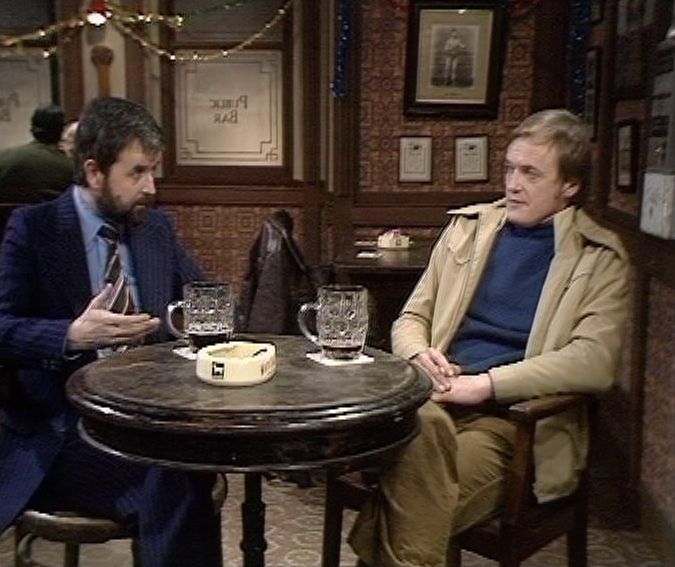
Another sign of the timeless nature of the episode is Terry’s complaint that Christmas is just too commercialised these days.  Bob doesn’t agree, he loves every aspect of Christmas (another way in which he hankers for earlier, simpler times?).  Over a pint in the pub, Terry reminds Bob that he was the last person in school to believe in Santa Claus.

I remember the day vividly. Christmas Eve afternoon it was, sitting in our back kitchen in front of the fire, reading Lord Snooty in that years Beano annual. I’d got it early, because the week before I’d been crying a lot with a boil on me neck. Anyhow, there I was, couldn’t have been happier, not a worry in the world except how Santa was gonna get a fire engine down our chimney. Then you show up with an evil, malicious grin on your face and said, ‘Santa Claus is dead.’

Bob goes on to remember that Terry had told him that Santa had been gored to death by his reindeer!

If the pub scene is the heart of the episode, there’s more traditional sitcom fare afterwards as Bob and Terry make their way home, very drunk.  Bob’s lost his car keys, so Terry elects to drive him home in his fork-lift truck.  And since he doesn’t have his front door key either, he uses the fork-lift to raise him up to the bedroom window.

On Christmas Eve, Bob and Thelma are on their way to a fancy dress party – Bob as Captain Hook and Thelma as Peter Pan (Terry’s got the job of driving their mincab).  Judging by the reaction of the studio audience they hadn’t seen Bewes’ costume before he entered the living room, since it draws an audible ripple of appreciation.  Once they get to the party, Thelma is appalled at the goings on – it seems that all their married friends have paired off with other people.  Bob’s not immune – he has his eye on Sylvia Braithwaite.

There’s more sitcom hi-jinks when a fuming Thelma asks Terry to drive her home, with neither realising that Bob and Sylvia are in the back of the cab.  Thelma invites Terry in for a drink and Sylvia insists that Bob drive her home in Terry’s cab.  This he does, but Terry sees the cab driving off and reports it stolen.

Running for just under forty-five minutes rather than the usual thirty, it’s tempting to wonder if it was originally planned as a half hour episode – if so, it would have ended with the fork-lift truck scene.  Was the fancy-dress party sequence bolted on later?  But however it was written, the final moment (when both Thelma and Terry realise that Bob stole the cab) is a great beat to end the series on.

A Christmas Carol (BBC 1977)

christmas.jpg

Broadcast on the 24th of December 1977, it’s fair to say that they don’t make them like this anymore.  This production of A Christmas Carol is completely studio-bound and at times places characters, via the wonder of CSO, in front of illustrated backdrops.  For some, this artificiality might be an issue but I feel that the non-naturalistic moments are strengths not weakness.

One of the main pluses of the production is the quality of Elaine Morgan’s adaptation.  Since Dickens’ novella isn’t particularly long, Morgan was able to compress it down quite comfortably to just under an hour.  Everything of note from the original story (including much of the dialogue) has been retained and it’s interesting that the likes of Ignorance and Want (often removed from other adaptations) are present and correct.

Michael Hordern, an actor who always seemed to play bemused and vague characters, makes for a very decent Scrooge – although since he lacks bite and arrogance, Hordern’s better as the story proceeds (especially when Scrooge is finally presented to us as a humble and chastised man).

John Le Mesurier only has a few minutes to make an impression as Jacob Marley, but he certainly does.  His scenes with Hordern were complicated by the fact that both weren’t on set at the same time (Marley, as befits a ghost, is only ever seen as an insubstantial presence).  This isn’t really a problem though, as both actors had such good timing they were able to make their scenes ‘together’ work.

The arrival of Patricia Quinn as the Ghost of Christmas Past sees Scrooge revisit his own past.  The establishing shots of Scrooge’s schoolhouse are presented via a series of illustrated images, with Horden and Quinn overlaid.  You can either view this as a necessity, due to the production’s low-budget, or as an inspired artistic choice.  One nice moment occurs when we move into the schoolhouse and there’s another illustration – which then morphs into a real-life scene.

Almost unrecognisable, thanks to a heavy beard, is Bernard Lee as the Ghost of Christmas Present (although his voice is unmistakable).  Paul Copley is slightly too jolly and irritating as Fred, but this a rare production mistep.  Clive Merrison, with an impressive wig, is a fine Bob Cratchit whilst Zoe Wanamaker is equally good as Belle.  There’s plenty of other familiar faces, including John Salthouse, John Ringham, June Brown and Christopher Biggins whilst the brief opening narration is provided by (an uncredited) Brian Blessed.

Although there are many versions of A Christmas Carol available, this one is certainly worth your time – partly because of the quality of the cast, but also due to its fidelity to Charles Dickens’ story.  Plenty of other adaptations can’t help but make various ‘improvements’ but Elaine Morgan was content to let the strength of the original tale speak for itself.

Grange Hill. Series Four – Episode Eighteen

grange hill s04e18-01

Written by Phil Redmond. Tx 27th February 1981

Claire challenges Duane to a bike race, although it’s quite noticeable she starts before he’s ready!  Despite this, he manages to catch up and they finish in pretty much a dead heat.  But Pogo infuriates her when he tells her that Duane won – he wasn’t watching, but he knows he did because boys are better than girls.

This is just one of a number of incidents which convinces Mr Sutcliffe that the annual end-of-term pupils versus teachers contest would be more interesting if it was organised across male/female lines.  This doesn’t go down well with Mrs McClusky, who tells him they should be discouraging sexual inequality not breeding it.  For once though she doesn’t get her own way as Mr Sutcliffe easily bests her in the argument.  So we can score one to the male sex!

In some ways this episode marks the end of an era.  There would be a Christmas Special later in the year with the class of 1978, but they would feature very intermittently during series five (there’s only a single series five episode where Tucker and co are anything but peripheral characters).

Back for only the second time during series four is Benny.  He doesn’t do much, although he does have an interesting line in politically incorrect jokes.  “What’s the quickest way to get out blackheads? Smash a window in Bradford.”

The males versus females contest is divided into three parts – a quiz, a sporting event and a practical one.  I love the way that Matthew has to whisper the answer to a tough maths question to the teacher!  Thanks to that spot of cheating, the boys win the quiz round.

The girls win the netball match, much to the dismay of Mr Baxter, which leaves the practical contest.  The boys are baking a cake and the girls are making a trowel.  Both of their efforts are disastrous, but they each have a perfect cake/trowel ready – which they swop when Mr Sutcliffe/Miss Mooney aren’t looking.  The reactions of the two teachers at the unveiling (“That isn’t our cake. That isn’t our trowel”) is lovely and there’s a nice sense of irony that the boys and girls really are equal (since both equally cheated!)

With the practical contest a draw, that means also that the whole contrast was a draw as well.  This was clearly the only way that things could have ended, otherwise there would have been ructions!  It’s an amusing way to end a consistently strong run of episodes.  When Grange Hill returned for its fifth series, it would have a new producer, a new intake of first-years and a slighter tougher feel as Gripper began to take control.

grange hill s04e18-02

Softly Softly: Task Force – Selected series three episodes now released on DVD in Germany

task force

The German company Pidax have just released Task Force Police – Volume One.  This contains eight episodes from series three, as below –

1. Bissige Hunde (Once Bitten)
2. Banküberfall (Hostage)
3. Die Flussratte (The Floater)
4. Erpressung (Aberration)
5. Safeschlüssel (An Inside Job)
6. Ein Ehrenmann (Man Of Peace)
7. Die Möbelpacker (The Removal)
8. Irgendein Platz (Anywhere in the Wide World)

  • There’s a little more information (although it’s naturally in German) on Pidax’s website here. Using IMDB as a guide, these episodes were broadcast 1-4, 6, 10, 13 and 17th (in total, twenty-six episodes were made for the third series).

The reason why some episodes have been omitted could be because German language tracks aren’t available.  But the good news is that unlike Pidax’s Maigret DVDs, all the episodes here do feature English language tracks.

I’ve heard that Simply plan to release series two next year, so they may get round to these episodes in due course.  But if you don’t want to wait, then the Pidax release is there.

Thanks to Berthold Deutschmann for bringing this to my attention as well as providing the screencaps below. Copyright in these images remains with the BBC.

Grange Hill. Series Four – Episode Seventeen

grange hill s04e17

Written by Alan Janes. Tx 24th February 1981

This episode is the first time that Gripper moves centre-stage and it gives us a taste of what to expect from him in the years to come.

Pogo’s latest money-making wheeze is a homework service (for which he naturally makes a handy profit).  He shares the work with Duane and also tries to rope in Matthew Cartwright (Nicholas Pandolfi) to help.  Matthew’s having none of it though and I do get the feeling this is because he senses Pogo’s scheme is doomed to failure.  There’s something so incredibly earnest about Pandolfi’s performance which makes it rather entertaining – never a central character, he’ll nevertheless pop up regularly during series five.

Gripper’s keen to avail himself of Pogo’s service and it’ll come as no surprise to learn that he doesn’t expect to pay.  Pogo weighs up the pros and cons of doing Gripper’s homework for free, worrying that if he does then he’ll have to do it for the next five years!  In the end he decides to do it all wrong and adds some ink-blots and scribbling out for extra effect.  You have to wonder if Pogo has a death-wish as it’s obvious what’s going to happen – but although he begins to have second thoughts there’s no time to change it.

Miss Mooney, always one of Grange Hill’s most mild-mannered teachers, is appalled at Gripper’s homework and tells the uncomprehending boy that he’s in a lot of trouble.  After the bell goes we see Pogo hot foot it out of the classroom and although he’s built very much more for comfort than speed, he does manage to cover the ground at an impressive rate.

But Gripper does catch up with him eventually and the pair manage to wreck the common room, breaking several windows before Mr Hopwood separates them.  It’s no surprise that Mrs McClusky is appalled, since she’s been waging a campaign on vandalism and hooliganism all term and this action simply strengthens her resolve to reintroduce school uniform.

It’s interesting that it was made optional back in series two following a school referendum.  The autocratic Mrs McClusky never seems to consider that the pupil’s opinions are important – the governors agree that reintroduction would be a good idea and the PTA are also in favour, so that means that school uniform is back.

Trisha pops up at the end to harangue Pogo.  If he hadn’t had the fight with Gripper then Mrs McClusky wouldn’t have had the pretext to push her proposal past the PTA.  Although as uniform remains optional for the fourth, fifth and sixth years (and Trisha’s coming to the end of the third year) it’s difficult to see exactly why she should be so upset.  Unless she just enjoys a good moan!

But it’s Gripper’s actions that linger.  Although he’s suspended until the end of term, it’s clear that he’ll be back and there’s never a moment in this episode when he exhibits even the slightest tinge of remorse.  And by the time we move to series five (and he’s entered the third year) he’ll be much, much worse …..

Grange Hill. Series Four – Episode Sixteen

grange hill s04e16

Written by Phil Redmond. Tx 20th February 1981

The subject of options is discussed for the first time. There are some (such as Tucker) who complain that they’ll still have to do subjects they dislike, like English and Maths whilst others (Pamela, for instance) have everything mapped out as they’ve already planned their route to University.  We also hear that some pupils consider all options to be a waste of time as they’ll be no jobs for them when they do leave school.

This will be a regular theme that occurs every few years, as options are discussed with each new class in turn, and many of the points that are raised here will occur again and again – although that doesn’t make them any less valid.

An interesting moment occurs when Trisha learns she’s not able to do technical drawing, mainly it’s classed as a boy’s subject.  It hardly needs to be said that if you ever tell Trisha she can’t do something it only makes her more determined to do it anyway.

She has a meeting with Mrs McClusky who tells her that there’s only a limited number of spaces available for technical drawing and it’s already oversubscribed.  She then informs Trisha it’s more likely that a woman will give up her career to bring up a family.  It’s hard to imagine this is a view that Phil Redmond would have endorsed, but it probably would be an accurate picture of the education system at that time – as females could often be classed as subordinate to males.

Although Trisha’s not best pleased, it’s possible to understand Mrs McClusky’s point of view.  The school only has limited resources and whatever way they choose to use them somebody is bound to lose out.

But another of Mrs McClusky’s decisions has drawn more general disfavour – her decision to expel Cathy, Gerry and Ruth.  All three are shocked by this and it does seem a very harsh punishment for skipping class on one afternoon.  It is interesting though that Mrs McClusky tells them that her decision could be overturned if they appeal to the school governors.  I can’t think of many occasions in the future where Mrs McClusky finds herself answerable to others (except when she’s relegated to deputy head in a few years time).

But as it turns out, Cathy’s mother is able to persuade her that it would be better to cane the girl than expel her.  It’s something that Mrs McClusky is reluctant to do, but Mr Keating is more in favour since he considers it will serve to discourage others from breaking the rules.

And poor Tucker’s hopes of a date with Pamela seem to be dashed forever when he overhears her telling Susi that she’d rather go out with Penny Lewis’ pony!

Grange Hill. Series Four – Episode Fifteen

grange hill s04e15

Written by Alan Janes. Tx 17th February 1981

If there’s a theme to this episode it’s how existing friendships are put under strain as new relationships develop.  Alan and Susi are now very much an item – which is an irritation for Tucker who finds himself rather isolated.  It also annoys Alan who becomes tired that Tucker’s hanging around when he wants to spend time with Susi.

Alan and Susi head off for the lunchtime judo club and are surprised to see two new recruits – Tucker and Doyle.  Doyle’s made an appearance to save himself from a detention whilst Tucker, of course, is only there because Alan is.

Both Tucker and Doyle are teamed up with experienced hands – Alan partners Doyle whilst Susi takes on Tucker.  Both the newcomers are blithely confident – with Tucker stating out loud that it doesn’t seem a fair contest.  Susi agrees, telling him that she’ll go easy!

As might be expected, both Tucker and Doyle find themselves on the floor several times (“come here often?” asks Tucker as the pair are thrown down yet again).  But whilst Tucker isn’t perturbed about being bested by Susi (instead he’s interested in more lessons) Doyle is very keen to exact revenge on Alan.

A scuffle outside finds Doyle and Robbo in possession of Alan’s judo kit, which they sell for a small profit to Junky Meade.  It does somewhat stretch credibility that not only does Alan not realise he’s lost it but that Tucker (completely innocently) later buys it.  Still it does give them a chance to partner up again as they exact their revenge on Doyle.

Another friendship that’s drifting apart is Trisha and Cathy’s.  Trisha remains an active campaigner for better conditions in the school – with her latest mission being to persuade Mr Thompson that if the pupils take food into the common rooms they won’t leave any mess for him to clean up.  Unexpectedly he completely wrongfoots her by being very agreeable to the idea – telling her that since she politely asked his opinion he has no qualms (and that he enjoys a nice sandwich himself!).  It’s a rare moment for Timothy Bateson to show a more human side to Mr Thompson.

As for Cathy, she’s still heavily involved in the pop group – along with Gerry, Ruth and the others.  She’s got them a paying gig, but they’ll need to bunk off school in order to get there in time.  Cathy hits on the bright idea of telling Miss Peterson that her grandmother’s died, which is fine until the teacher talks to Cathy’s brother Gary.  When he tells her that their grandmother died six years ago you know that Cathy is in a heap of trouble.

Rewatching series four, it’s quite noticeable that not many episodes have a film/studio mix – instead there’s a number of all-film episodes (as with episode fourteen) and the rest are studio based (like this one).  It’s quite an interesting production choice which doesn’t occur very often in the future (except for those episodes away from the school which were all location based anyway).

Grange Hill. Series Four – Episode Fourteen

grange hill s04e14

Written by Alan Janes. Tx 13th February 1981

Whilst most of this episode has a light-hearted feel, at the end there’s a much darker and disturbing tone.

The bulk of the running time is concerned with Alan and Susi’s relationship.  Or lack of it.  Tucker’s seized with a burning desire to find out if they really are a couple, so he has one of his brainwaves.  He writes a letter to Susi and signs it from Alan, suggesting a date.  He tells Alan that he and Tommy will meet up with him later at the same place.  Tommy and Tucker then stake-out the meeting place, waiting to see if Susi will make the rendezvous with the oblivious Alan.

The letter from “Alan” is certainly very florid, much to the amusement of Pamela.  “Every-time I see you my heart throbs.”  But Pamela also admits she’s a little jealous, as she’s never been asked out – and wonders if it has anything to do with the fact she spends so much time around horses.  If only she knew that Tucker’s aching to arrange a date with her – although it’s possible she may react with horror to that news!

In the end, Susi didn’t go because her mother found the letter and forbade her.  Maggie Riley (as Mrs McMahon) was one of Grange Hill‘s most formidable and snobbish mothers and her later run-in with Tony Barton (playing Mr Humphries) is a sheer joy.  Mrs McMahon is completely bested by Mr Humphries in a short, but sweet, scene.

Another running thread through the episode is the difficulty the pupils find in catching a bus home.  The lack of buses leads indirectly to a running battle between Tucker and co and some Brookdale kids.  Also making an appearance during this scene is Graham Cole (later to play Tony Stamp in The Bill).  Back in the late 1970’s and early 1980’s he was making a living as an extra/walk-on (he pops up many times in Doctor Who during this period).

If most of the episode has a comic feel then the emphasis shifts dramatically at the end.  The problem with the buses causes two younger pupils, William (Stephen Cobbett) and Benny’s brother Michael (Mark Bishop) to walk home across the common.  They’ve been warned not to do this, and the reason becomes plain when William is attacked by a strange man (played by Jay Neill).

Although Grange Hill was a children’s series and couldn’t be particularly explicit, it’s still a powerful moment.  The man asks both the children to help him search for his lost dog, but this is just a ruse to isolate them.  As the two boys move apart he drags William into the bushes and a brief struggle ensues.  Luckily Tucker was passing by and William didn’t suffer anything worse than a few cuts and bruises.  This is another memorable, almost PIF (public information film) like moment, as it graphically demonstrates why children should never talk to strangers.

And it’s all the more effective because it happens so unexpectedly.  Another all-film episode, this one is efficiently directed by Colin Cant.

Grange Hill. Series Four – Episode Thirteen

grange hill - s04e13

Written by Phil Redmond. Tx 10th February 1981

After being a regular character during series two and three, Mark Edie (who played Andrew Stanton) had a much lower profile during series four with only a handful of appearances.  This might have been his own choice, since for some actors real-life pressures like exams have to take precedence.  But whilst his series four episodes are limited he’s given a central role in this one.

It also neatly links back to events witnessed earlie on the run, when we saw that Andrew’s sister Karen was visibly upset.  The relationship between Andrew and Karen’s parents had been established as a rocky one right from the time Andrew was introduced – and now it’s finally imploded.  His father has left home, taking Karen with him and it’s Mrs Stanton’s inability to tell her son the truth which pushes him over the edge.

Failed marriages are now such a staple of television drama that they tend to be accepted as the norm, but that wouldn’t have quite been the case back in 1980.  Although we don’t often see both parents of many of the pupils (there is, presumably, a Mr Jenkins and a Mrs Humphries but they remain firmly off-screen) it can be assumed that pretty much all the children live in two-parent families. A one-parent family is therefore unusual (although as the series progresses through the eighties and nineties they’ll become much more common).

Andrew’s choice of oblivion is alcohol – which hasn’t really been touched upon in the series.  It’s a shame that he wasn’t a regular during this year as developing his addiction to alcohol over the course of a number of episodes would have been very effective.  As it is, he suddenly becomes a drinker and then just as suddenly stops.

His inebriated state is a problem for Tucker, Alan, Tommy and Justin.  Tommy’s happy to leave him, but Tucker knows the trouble Andrew would be in if he was found, so decides they have to help.  There then follows a series of frantic scenes as the four of them attempt to hide Andrew’s unconscious body in various parts of the school – resorting to such wheezes as placing him on a trolley and wheeling him around!

Eventually Mrs McClusky apprehends Tucker, but when she learns of the reason why they’ve all been skipping classes she’s inclined to be lenient (a rare example of compassion from her).

Two other points of interest.  Firstly, Alan pops along to the smokers room (a store-cupboard) and seems on the point of accepting a cigarette.  So much for his claim that he’d never smoke again in the previous episode.  And Tucker’s growing interest in Pamela Cartwright runs through the episode, but the normally confident Tucker is completely tongue-tied when it comes to asking her out!

Grange Hill. Series Four – Episode Twelve

grange hill - s04e12-01

Written by Alan Janes. Tx 6th February 1981

This is a classic Tucker episode.  Tommy is upset that he’s missed his chance to go with the others on the school trip to France, but Tucker has a brainwave – why doesn’t he stowaway?!

Tommy’s slightly apprehensive but Tucker is blithely confident.  When he’s asked about passports he tells Tommy that since they joined the Common Market they’ve done away with them.  It doesn’t take a mind-reader to work out that Tucker, Alan and Tommy are heading for trouble – and this is all established in the opening minutes.

Mr Baxter and Miss Lexington have the unenviable task of keeping order.  This ramps up the comedy a little more, since Michael Cronin is, as always, excellent as the deadpan authoritarian whilst Allyson Rees provides a strong counterpoint as a more relaxed and easy-going character (Grange Hill’s version of the bad cop/good cop).

The middle part of the episode takes place on the cross-channel ferry and is memorable for two reasons.  The first is Trisha and Cathy’s encounter with two French boys.  The girls don’t appear to know any French (which is odd, since you’d assume a trip to France would have been part of their French education) and the boys don’t know any English – making communication rather difficult.

However, one boy takes a shine to Trisha and attempts to demonstrate his affections in a language that’s universal.  Trisha is having none of it though.  “Here, leave off.  Bit handy int they?”  A notable thing about these scenes is that Lyndy Brill is looking very tanned.  Maybe she’d just come back from a long holiday (unless she was an early adopter of fake tanning).

grange hill - s04e12-02

Secondly, it sees Alan finally decide to kick his smoking habit, after a discussion with the coach driver Mr Ellis (Eric Mason) in the ferry lounge.  He gives the boy several reasons why smoking isn’t a good idea.  “One, it takes your money and two, it gives you lung cancer.”  Shortly afterwards we see Alan leaning over the side of the ferry, being sick.  Was this a mixture of his alcohol and cigarettes or did Mr Ellis’ words strike home?  Either way, he throws his fags overboard and declares that he’s finished with smoking.  It’s another one of Grange Hill‘s obvious moral lessons, but it was allowed to develop over a long period of time so is quite effective.

Once they reach French soil the problems start – the customs officer finds Tommy and since he’s not got a passport they won’t let him through.  This means one of the teachers has to escort him home and that forces the whole trip to be cancelled (it wouldn’t be practical for just one teacher to supervise the whole class).

Tucker is naturally sent to Coventry (or even further!) but something is salvaged when Miss Lexington wonders if the holiday firm they booked with would be able to offer them alternative accommodation in Britain.  Luckily they do, so the bus sets off for a week in Bournemouth.  Not quite France, but it’s better than nothing.

A rare non-school episode from series four, it’s rather a good one and since we didn’t venture very far into France it was probably quite cost-effective as well.

Grange Hill. Series Four – Episode Eleven

grange hill - s04e11

Written by Alan Janes. Tx 3rd February 1981

There’s something rather endearing about the low-level villainy of Michael Doyle.  He did issue a few racial taunts to Benny during series one but that was pretty much his worst deed.  Otherwise it’s all pretty low-key stuff – stealing Penny Lewis’ project or, as in this episode, pinching light-bulbs so he can make a small profit by selling them to Junky Meade (Harry Webster).

Doyle doesn’t just take the bulbs though – he leaves a faulty one in its place, which causes no end of confusion for Mr Thompson as he tries to work out exactly why so many light-bulbs are failing.  Timothy Bateson is once again remarkably entertaining as Mr Thompson and what’s even better is that in this episode he has an assistant to vent his frustrations to.  Norman (Leslie Hull) is young and gormless and obviously irritates the older Thompson.  Hull has a nice sense of comic timing and it’s a pity he didn’t return in the future.

There are two other highlights in the episode – the first is Cathy singing Queen Bee.  Originally recorded by Barbra Streisand in 1976, it’s certainly a good showcase for Lyndy Brill’s vocal abilities.  Had this been a few years later then it’s highly likely a tie-in record would have been released (ala the Grange Hill album or, shudder, those EastEnders singles) but there was nothing here, alas.

Perhaps the most eye-opening moment is Mr Hopwood’s confrontation with Alan.  Alan’s smoking habit has been a running theme for a while and when Mr Hopwood catches him, his displeasure is plain to see (he gives Alan a clip on the top of the head, knocking him over).

It’s remarkable that this assault is simply accepted by both parties and not taken any further – particularly since Mr Hicks was dismissed for doing something similar in an earlier episode.  But then Mr Hopwood is positioned as a good and positive character and Alan’s smoking is “wrong” so it’s clear to understand the moral tone that the episode takes.

Even more jaw-dropping is that Alan turns up for school the next day sporting a black eye.  This was given to him by his father after Mr Hopwood told him about his son’s smoking habit.  This isn’t the first time that we’ve seen a pupil physically abused by their parent (Duane was given a black eye in series three after his bike was stolen).

There’s never even a hint that Mr Humphries might have been in the wrong for hitting his child – Alan shouldn’t have been smoking and therefore has been taught a lesson he won’t forget.  It’s a fascinating look at a vanished age.

Grange Hill. Series Four – Episode Ten

grange hill - s04e10

Written by Margaret Simpson. Tx 30th January 1981

What’s notable about this era of Grange Hill is that the pupils always seem to be campaigning about something.  School uniform was an ongoing issue during series two, the outdoor centre was key to series three and already in series four we’ve had campaigns for common rooms, saving the school magazine and also protests about the cost of the new sports kit.

I wonder if this simply was a sign of the times (late seventies and early eighties Britain certainly had a militant atmosphere – there always seemed to be plenty of strikes and industrial disputes) or whether it’s due to the influence of series creator Phil Redmond.  As the eighties wore on and Redmond’s influence lessened it’s notable that pupil militancy does seem to reduce – so maybe its safe to assume he was the driving force behind these plotlines.

Either way, this is yet another episode which is dominated by unhappy pupils – in this one its school dinners that they find it hard to stomach (as it were).  No doubt this would have struck some chords with the viewers at home since school dinners of this era could be a grim affair.

There’s something of a feel of deja vu as Trisha again teams up with Susi and Pamela (both viewed as the enemy by Cathy) to try and harness support for their proposals.  But an increasingly irritated Cathy decides to restart the banned SAG (student’s action group) in order to achieve change by force rather than reason.

Although the series was often criticised for having an anti-establishment atmosphere, there’s a very clear sense that order will prevail here.  Cathy’s abortive attempt to harness support with SAG is quickly snuffed out (indeed, it would have been interesting to develop this thread over a couple of episodes) whilst the efforts of Trisha, Susi and Pamela are given tacit approval by Mrs McClusky.

Although she characteristically isn’t terribly pleased that they went ahead and distributed a questionnaire to staff and pupils without asking her permission!

Grange Hill. Series Four – Episode Nine

grange hill - s04e09

Written by Margaret Simpson. Tx 27th January 1981

The rumour that school uniform might be brought back is naturally not viewed with much enthusiasm by the pupils.  Trisha, as one of the prime-movers in ensuring it was made optional is particularly perturbed.  Amongst the first-years it’s also discussed, but here it’s used more as an excuse for Pogo to bait Richard Marks.

Marks, like Benny Green before him, comes from an impoverished background and would therefore struggle to afford to buy a school uniform.  There’s something rather disquieting about watching Pogo bait Richard, partly due to Pogo’s unflattering nickname for him (“Pongo”) but also for the reactions of the other members of the class – who are all happy to laugh along with Pogo at the unfortunate Richard.

But this is a scene where Miss Mooney shows a little steel.  Up until now she’s been portrayed as rather a scatter-brained and ineffectual teacher, but after Richard leaves the room (she asks him to take the register to Mr Keating) she rounds on the remainder of the class.  “Well I must say I’m appalled at what I’ve just heard.  I can think of nothing more small-minded than getting on to a boy or a girl because they come from a poor home.”  And she reserves most of her ire for Pogo.  “What a spoilt, smug little boy you are Douglas Patterson.  Have you ever stopped to think for a moment what it must be like to come from a home less privileged than your own?”

Cathy’s continual lateness and lack of attentiveness has become something of a talking point among both her friends and the staff.  Lyndy Brill is rather good in these scenes – she manages to give Cathy just the right amount of insolent disdain, even when she’s talking to her favourite teacher Mr Sutcliffe.

But whilst Cathy exhibits little interest in any school affairs, her best friend Trisha is the complete opposite.  She becomes the third year school council rep and persuades Justin to take the vacant boys position (which has remained empty since Michael Doyle’s dismissal at the end of series three).  And as the next school council meeting has a motion tabled by Mrs McClusky to reintroduce school uniform it’s possibly just as well that Trisha was present.  Mrs McClusky’s irritation at not being able to immediately have her own way is quite evident and she’s then further dismayed when everybody votes to use several empty classrooms as common rooms.

The mystery of Cathy’s lateness is explained – along with Gerry, Ruth and a couple of boys they’ve restarted their group and so spend all their available spare time rehearsing.  Miss Peterson offers to see if she can find somewhere for them to rehearse during the lunchtime – and that way Cathy might be able to concentrate on her lessons.

Grange Hill. Series Four – Episode Eight

grange hill - s04e08

Written by Alan Janes.  Tx 27th January 1981

Danny Taylor (Peter Hopwood) is a Grange Hill archetype – the money-making entrepreneur.  He doesn’t reappear after this episode though, which makes me wonder if he was drafted in as a late replacement for Pogo – who’s already shown an interest in get-rich schemes (which fail dismally, of course).

Danny’s wheeze is to organise a lottery, but he falls foul of Gripper who has his eyes on the main prize.  The most interesting part of this section of the episode are the opening moments – Stewpot calls round for Danny and is waved into the house by Danny’s father (who is obviously something of a wheeler-dealer himself).  Danny has inherited his father’s drive to make money and this is viewed with irritation by Stewpot.  He reckons that within a few years Danny will be sitting behind a desk and making money from other people’s efforts.  Stewpot tells him that come the revolution things will be very different!

When Gripper’s not attempting to rig the lottery (although it’s interesting that his plan is somewhat elaborate – in years to come he’d just have taken the money) he’s running foul of Mr Baxter on the football pitch.  After Gripper harshly tackles Matthew Cartwright, Mr Baxter makes it plain that he won’t tolerate any repetition.  And if it did happen again, Gripper would be the one on the ground and Mr Baxter would be standing above him, putting the boot in.  Nowadays any threat of violence from a teacher to a pupil would be viewed as an empty one – but 1981 was a different era and Gripper takes Mr Baxter’s words seriously.

Karen Stanton (Carey Born) makes her only series four appearance.  She cuts a very woebegone figure as she confides to Claire that all is not well at home – thus sowing the seeds for a later episode featuring Karen’s brother, Andrew.

Miss Lexington continues to be an object of fascination for many of Grange Hill’s pupils.  Duane’s puppy love is quite evident (he’s always popping up and asking to carry her bags) but there’s other examples as well.  Two older pupils use their time in Miss Lexington’s computer club to program a rough approximation of the female form with the words “Sexy Lexi” next to it.  But when Miss Lexington sees it she simply gives them an indulgent smile and moves on.  Is she something of a tease or simply unaware of the effect she has on certain people?  However you want to interpret her character there’s no doubt that Allyson Rees’ wide-eyed performance is terribly appealing.

Miss Lexington’s later run-in with Mrs McClusky is a highlight of the episode.  What makes their clash so intriguing is the fact that they’re such different character types – Miss Lexington is relaxed and carefree whilst Mrs McClusky is strict and unyielding.  The headmistress views the scruffy appearance of Miss Lexington’s class with extreme disfavour and she tells the younger teacher that their planned trip to the Silicon Chip factory is cancelled.  Mrs McClusky is simply not prepared to let such an untidily dressed bunch of pupils represent the school.

This is the first step in Mrs McClusky’s desire to bring back school uniform.  That obviously wouldn’t go down well with the pupils, but on the evidence of these early series four episodes it’s plain that Mrs Clusky is someone who is always determined to get her own way …..

Doomwatch to be released on DVD by Simply Media – April 2016

doom

My article about Doomwatch and its current lack of availability on DVD is one of the most read posts on this blog.  That does seem to confirm that many people are still very interested in this classic early 1970’s series.

So it’s extremely welcome news that a six disc Doomwatch set will be released by Simply in April 2016.  It will contain all the existing episodes (including the untransmitted episode Sex and Violence as well as a documentary – The Cult of Doomwatch).

In all, twenty four episodes remain in the archives.  They are as follows –

Series One

The Plastic Eaters
Tomorrow, the Rat
Project Sahara
Re-Entry Forbidden
The Devil’s Sweets
The Red Sky
Train And De-Train
The Battery People

Series Two

You Killed Toby Wren
Invasion
The Islanders
No Room for Error
By the Pricking of My Thumbs…
The Iron Doctor
Flight into Yesterday
The Web of Fear
In the Dark
The Human Time Bomb
The Inquest
The Logicians
Public Enemy

Series Three

Waiting for a Knighthood
Hair Trigger
Sex and Violence

As can be seen from the above list, the archive status for series one is pretty good (eight out of the thirteen episodes exist), series two is complete whilst series three is by far the patchiest (only three of the twelve episodes remain, although it’s slightly curious that one of the survivors – Sex and Violence – was never transmitted.  You’d have assumed It would have been one of the first to be wiped).

As I discussed here, when it comes to picture quality, what we have left is something of a mixed bag.  Ten episodes exist on their original format – 625 PAL videotape and so should look pretty good (although the film inserts will no doubt have deteriorated over the past four decades).  The remaining fourteen episodes were returned to the BBC from Canada and it’ll be interesting to see what they look like.

The Canada episodes would have been converted from 625 PAL to 525 NTSC before they were sold, then converted back to 625 PAL when they were returned to the UK.  It was these converted copies that were broadcast on UK Gold in the mid 1990’s (and a couple of episodes were also released on VHS a few years prior to that).

The conversions from PAL to NTSC and back again to PAL would have degraded the picture somewhat, although a process developed several years ago called RSC (Reverse Standards Conversion) has been applied (this should restore something of the original PAL look).  Examples of RSC can be seen on various Doctor Who DVDs, although I have to confess that the results haven’t always pleasing to my eyes (especially the three episodes on The Sea Devils release).

As it’s doubtful that Simply will have a particularly large budget for restoration it’s probable that the RSC episodes will look a little rough around the edges, but if it’s a choice between having them in a less than ideal state or not at all then it’s a no-brainer.

Update 25/3/16 – My DVD review can be found here.

Grange Hill. Series Four – Episode Seven

grange hill s04e07

Written by Alan Janes. Tx 20th January 1981

The themes of this episode fit neatly into the topic of staff/pupil consultation which has been bubbling away for a few episodes.

The pupils are appaled to be told they have to buy new sports kit from Hayes Green Sports. It’s quickly established that they aren’t the cheapest of shops and since they’re the only ones supplying the new kit it does seem obvious that they’re making a profit at the pupil’s expense. Susi quickly writes an article about this for the school magazine, only to be told shortly afterwards by Mrs McClusky that the magazine will have to close due to lack of funds.

Is there a connection? It could be, or possibly it’s because Mrs McClusky simply doesn’t like the thought of the pupils having any voice at all. In this respect, she’s a far cry from the open Mr Llewellyn as she seems very keen to stifle any debate – her word seems to be law.

But it only has the opposite effect and the usual suspects now have another couple of causes to fight for. Not only common rooms, but saving the school magazine and also investigating whether the new sports kit is being offered at a rip-off price.

Susi and the magazine’s editor Rosie (Nicola Wright) ask Mrs McClusky is they can continue the magazine if they could find a way to make it self financing. She can’t do anything but agree – so if her plan was to shut down the magazine in order to stifle dissent then she’s been circumvented. We don’t know for sure, since Mrs McClusky doesn’t have anybody here that she confides her thoughts and feelings to, so it’s up to the viewer to make their own mind up.

Although there is a scene where she asks Mr Sutcliffe if he wouldn’t mind attending the save the magazine meeting – and he rather brusquely refuses, telling Miss Mooney that he’s not prepared to do Mrs McClusky’s spying for her.

Alan and Susi rope in Mr Humphries to find out what the wholesale prices for the sports kit are. He learns that Hayes Green Sports are making over 100% profit – and he tells them that he’ll bring this up at the next PTA meeting. His obvious anger (and mutterings of rank exploitation) leave us in no doubt that more affordable sports kits will soon be available.

It’s not something that shows the Headmistress in a very good light, but it’s hard to credit that she would have colluded with Hayes Green Sports to artificially raise the price just so they could make a healthy profit. But the notion that she simply didn’t care about the cost of the kit doesn’t ring true either.

Grange Hill. Series Four – Episode Six

grange hill s04e06

Written by Phil Redmond. Tx 16th January 1981

Another wave of vandalism causes the school dance to be cancelled. Tucker knows who was responsible – Booga Benson and Gilbo – but also knows what will happen to him if he speaks out. He tells Mr Sutcliffe that he’ll get his legs busted.

Another all-film episode, it’s a memorable installment – not least for the Tucker/Booga confrontation. Up until now Booga’s been little more than a menacing background character – who seems to mainly have existed to provide a reason to lock the younger pupils out of the school during break and lunchtimes.

He now moves into the centre of the action and starts by destroying Tucker’s magazine cover entry. Given all the hard work he put into it this is a bitter blow – although he’s able to produce another, almost identical version, very quickly – even if he has to bunk off school to do it. Of course he does win the first prize (ten pounds) and impresses Mrs McClusky by telling her that he’s going to buy some premium bonds with it.

Afterwards, he goes back to helping Mr Sutcliffe set up the hall for the dance, but it all seems to be in vain once everything is cancelled. We then see him struggle with his conscience as he makes his way along to Mrs McClusky’s office – he just has to give her a name and the dance will be back on. But the consequences to him could be fatal.

He does the right thing and the evening is a great success – not least for the impressive vocal stylings of Mr Sutcliffe, Cathy, Gerry and Ruth. Everything seems to be fine as Tucker, Alan, Benny, Tommy, Susi and Pamela leave the hall at the end of the night.

But the sudden and unexpected appearance of Booga wipes the smile from everybody’s faces. There then follows a frantic chase through the school, culminating in both Booga and Gilbo giving the unfortunate Tucker a good kicking.

Another notable aspect of the episode is that it marks a rare series four appearance by Terry Sue Patt as Benny.  I don’t know whether his sporadic involvement was his own choice or it happened because he was now judged to be surplus to requirements. Either way it’s a shame that someone who was a focal character for the original run just seems to fade away quite abruptly.