Callan – Act of Kindness

act

Written by Michael Winder
Directed by Mike Vardy

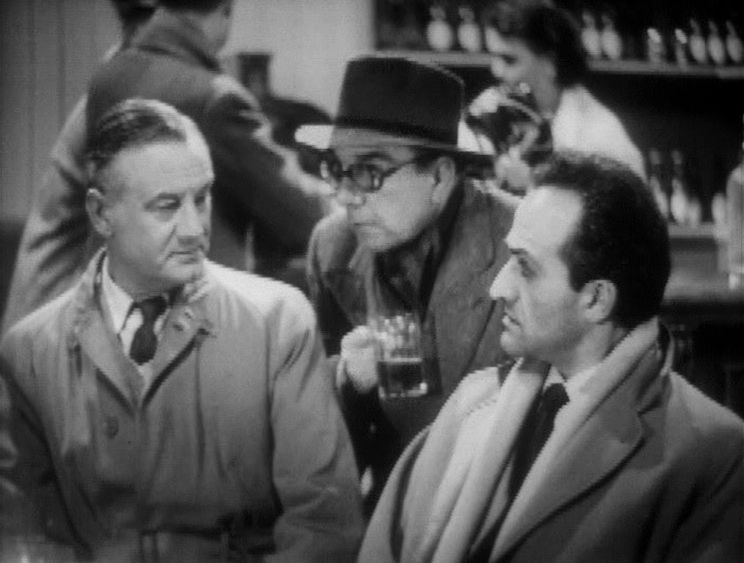
Away from the Section, David Callan has one major interest – model soldiers and fighting war-games with them.  Given that his job involves killing (and usually it’s the dirtiest and most squalid kind) it’s worth wondering if his love of re-creating famous battles from history is a yearning for the time when conflict was maybe a more honest and chivalrous pursuit.

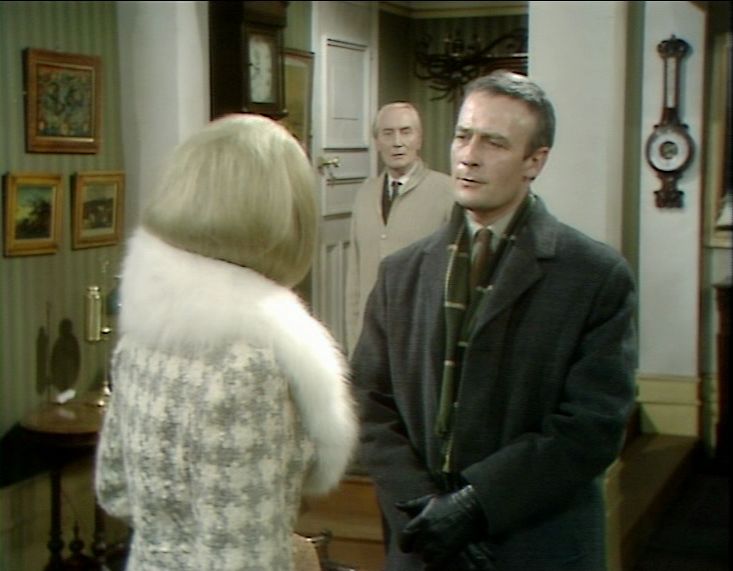
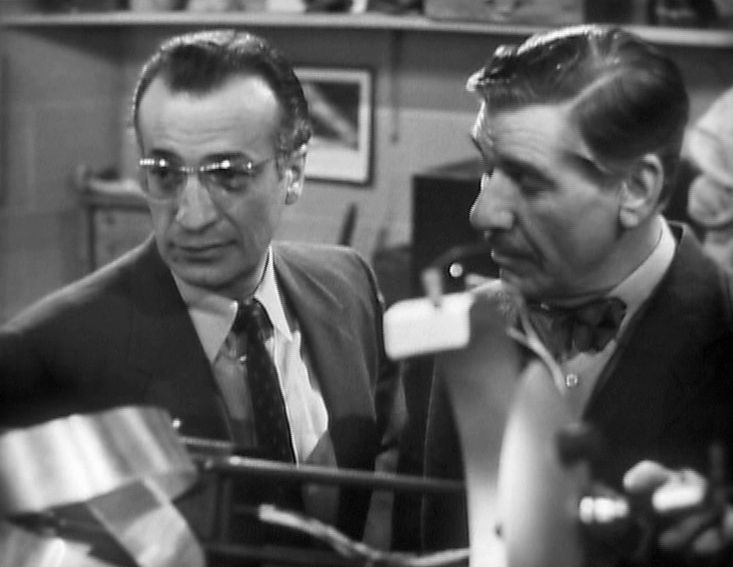
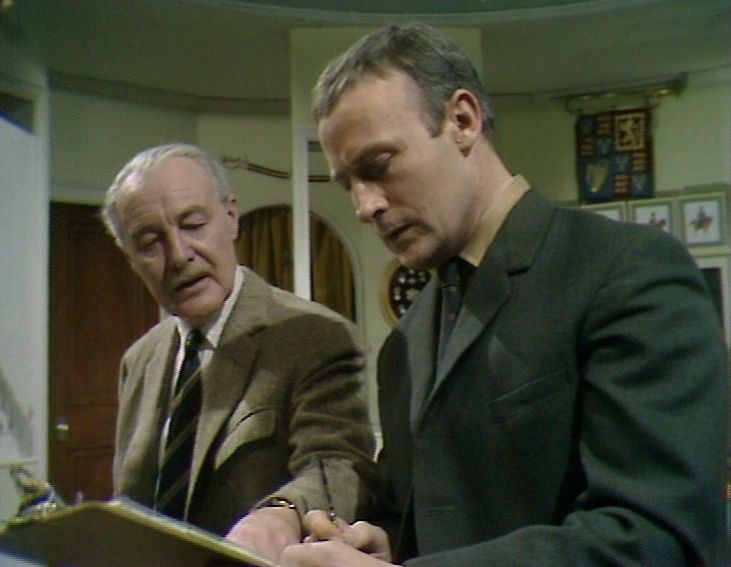
Like the Armchair Theatre pilot, A Magnum for Schneider, Act of Kindness sees Callan tackle an opponent across the tabletop field of battle and it provides us with a very interesting clash of personalities.  Heathcote Land (Anthony Nicholls) isn’t a spy or an enemy agent – he works for a company that exports tractors worldwide (one of their biggest markets is Russia).

When Land receives incriminating photographs showing Donovan Prescott (Ray Smith) in bed with a young woman, he demands Prescott’s resignation.  Prescott refuses and tells him that since the photographs (taken on his last trip to Russia) must have been made by the KGB, he should tread very carefully.

Smith (a familiar face, thanks to his appearances as the acerbic Spikings in Dempsey and Makepeace) is very Welsh here (the odd “boyo” is thrown into the conversation).  He’s presented as a laddish man-about-town, but he also appears to have a patriotic side (since he did some unspecified low-level work for British Intelligence).  It’s this connection that makes Hunter keen that Land shouldn’t make the photographs public and so Callan is tasked to stop him by whatever means necessary.

Since Land also has an interest in model soldiers and war-games (or “toy soldiers” as Hunter dismissively calls them, much to Callan’s irritation) Callan is the obvious choice to tackle him.  “You really are a bastard aren’t you?” he says, less than happy that the one pastime he has which is separate from the Section has now been compromised.  After Callan leaves the office, Hunter confides to Cross that whenever Callan is angry, he remembers what happened to his predecessor ….

There’s one very clumsy piece of plotting in the story. This occurs just after Callan has introduced himself to Land and the pair of them begin to chat about model soldiers and battles.  For some reason, Callan is using the alias of Tucker (which is odd, since we learn in Where Else Could I Go? that Callan isn’t his real name anyway).  As Callan and Land start fighting a practice battle at the model soldier convention, Lonely passes by and refers to him as Mr Callan.  This, of course, instantly sets alarm bells ringing for Land.  It’s a rather sledgehammer way to raise Land’s suspicions and it’s a pity that something more subtle couldn’t have been done.

Later, we see Callan and Land prepare to fight a battle in the business-man’s impressive war-room.  There are two battles going on at once (the one between the model armies and the other between Callan and Land themselves).  The pair indulge in a fair bit of verbal jousting, each of them skirting around the issues, but it becomes clear that both know exactly what the other is thinking.

Eventually, Land comes to the point and calls his opponent Callan.  But even with this acknowledgment that Callan isn’t all he says, the battle goes on.  For those who favour the more action-orientated episodes, this one might seem to be a bit slow – but the battles between Callan and Land (although they don’t involve guns) are fascinating nonetheless.

At one point in the story, Prestcott tells Callan that if he wants to blackmail Land then he’d have to create something, since he seems to lead a totally blameless life.  As the pressure increases to protect Prestcott, all possibilities are debated by Hunter, Cross and Callan.  Cross favours taking Land out of circulation (either temporarily or permanently).  But a visit by Land to a toyshop might just provide them with the leverage they need …..

Anthony Nicholls (probably best known for sporting a rather unconvincing beard as Treymayne in The Champions) gives an excellent performance as the moral and principled Heathcote Land.  He shares a fair amount of the story with Woodward and the pair spark off each other very well – their conflict is definitely the highlight of the episode.  Ray Smith is rather less convincing as his business rival, but then it wasn’t such a well-crafted part.  This was the second and last of Michael Winder’s scripts for Callan (he previously wrote the stunning series two finale Death of a Hunter).

Act of Kindness must be something of a rarity for a Callan story, since it doesn’t feature any deaths, but that doesn’t stop it from being another intriguing story – thanks to Woodward and Nicholls.
Callan – Suddenly – At Home

suddenly

Written by James Mitchell
Directed by Piers Haggard

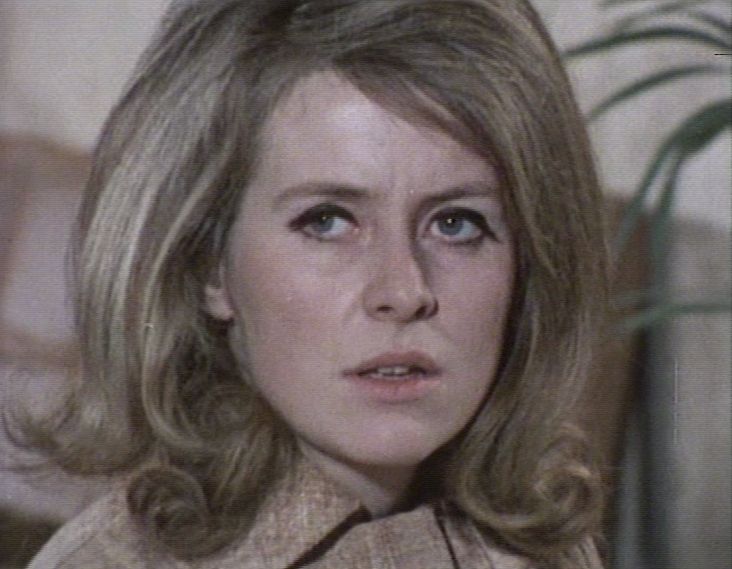
Callan’s in love.  Those familiar with the parameters of the series will be probably be able to guess that his happiness is going to be very short lived.

Lady Lewis (Zena Walker) is the widow of Sir Colin Lewis, the youngest Foreign Secretary for a century.  Whilst his death hasn’t left her penniless, her financial situation is certainly a little strained (she has two sons to put through public school. which isn’t cheap).  So when the smooth-talking documentary film maker Rene Joinville (Tony Beckley) approaches her with an offer of ten thousand pounds to appear in a programme about her husband, it seems to be the answer to her prayers.

But Hunter doesn’t want the documentary to go ahead.  Sir Colin knew too many secrets and he fears that whilst Lady Lewis won’t deliberately betray any confidences, the skillful Joinville will be able to tease them out of her.  It’s interesting that. for once, the Section doesn’t have all the facts.  Joinville is a Russian agent, but this vital piece of information isn’t discovered by them until very late on.  Had they known, of course, then things might have turned out very differently.

Hunter assigns Callan to warn Lady Lewis off.  He thinks that blackmail might be a good method, but Callan is rather more subtle than that.  He appeals to Lady Lewis’ sense of duty and also hints that the establishment would view the programme with extreme disfavour.  Woodward is delightfully bashful in this scene –  he’s slightly hesitant and occasionally stumbles over his words.  We tend to see Callan as the forceful man of action, so this is a good insight into his softer side.

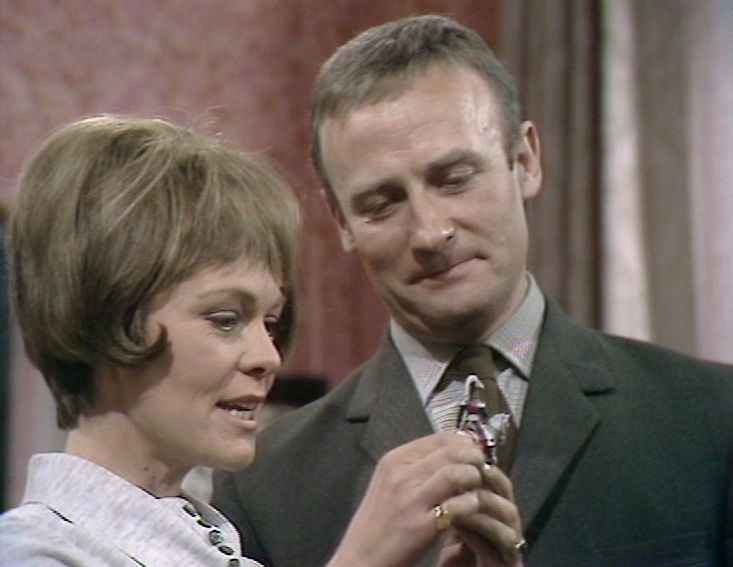
There’s an instant attraction between them, sparked by Callan’s love of model soldiers.  He promises to bring one to show her at a later date and once he leaves she starts to swot up on the subject.  Given how totally different they are as characters, it’s a little difficult to believe in this sudden romance – but Woodward and Walker are both so good that they make it work.

Unfortunately for Callan, he never progresses beyond a rather chaste kiss.  Since Lady Lewis won’t take part in the documentary, Joinville is ordered to kill her.  He’s told to use a gun favoured by the Section – that way they’ll be blamed and the resulting furore will be something of a propoganda coup.

The killing is carried out and when Callan receives the news it’s possible to see the light go out of his eyes.  He instantly changes back into the cold, remorseless killer and you’re left in no doubt that he will avenge her death.  Initially Cross is a suspect, but he’s cleared and when the truth about Joinville is discovered, Hunter gives the younger man the task of bringing him in.  Callan queries whether he has to be brought in alive and Hunter is quite clear that, yes, he’s not to be killed.

Cross’ bungled attempt to apprehend Joinville is another example of just how inexperienced he is.  He gives Joinville plenty of warning by making a hash of picking the lock on his hotel-room door and then is very easily disarmed.  Luckily for him (although Cross doesn’t see it like that) Callan is outside the window and deals with Joinville.  When he’s finished, Joinville is very dead.

Suddenly – At Home was James Mitchell’s third script for series three. I’ve always had a soft spot for this one – partly because, along with Breakout, they were the first episodes of Callan that I ever owned (they were released on video in the late 1980’s).  Whilst it’s a bit of stretch to accept the instant relationship between Callan and Lady Lewis, there’s plenty of incidental pleasures.  Tony Beckley sports an outrageous French accent as Joinville.  He gives a slightly off-kilter performance, but it does work (where a more naturalistic turn might not have).  Zena Walker impresses as Lady Lewis – she plays her as calm and charming, which makes her sudden, violent death all the more shocking.

Piers Haggard’s direction is quite noteworthy, with some well chosen shots.  At the start of the story we see Joinville preparing to accept an award for one of his films – and the camera shoots through the award as he’s speaking to Lady Lewis (creating a quadruple image).  Also, when Callan first meets Lady Lewis, part of the scene is shot directly at a mirror, so that we see a reflection of the characters, before the camera pans off to focus on them.  Plus there’s a number of close-ups (which help to create a claustrophobic atmosphere, especially in the immediate aftermath of Lady Lewis’ murder) and some interesting low-angle shots (these make fairly standard sets look a little more interesting).

It’s another very solid episode in an impressively consistent series.

Callan – A Village Called ‘G’

village

Written by James Mitchell
Directed by Mike Vardy

Hunter’s secretary, Liz, is an absolute model employee.  She’s never late and she’s never ill, so when she fails to turn up one morning it sets the alarm bells ringing.  Hunter decides to give her another hour and if she still hasn’t appeared then the department will be on red alert.  Cross queries whether that isn’t a little excessive, but Hunter spells it out to him.  “Liz has never been late here in her life, she’s never missed a day.  She’s an example to you all.  You think I’m fussing, but I’d sooner be foolish than careless.”

Hunter’s fear is that she’s been picked up by the opposition – she knows all of the Section’s secrets so she’d be an invaluable asset.  The truth of the matter is rather different though – she’s embarked on a personal mission of vengeance and Callan, naturally enough, is right in the thick of things.

Lisa Langdon made her first appearance as Hunter’s secretary at the start of series one.  It wasn’t a terribly auspicious start, as for the first few stories she was nothing more than a disembodied voice on an intercom.  After a while she started to appear in the flesh and gradually was given a little more to do.  During the black and white years, Heir Apparent is probably the best example of this – following the death of Michael Goodliffe’s Hunter, Liz was a useful character to place between Callan and Meres.

But A Village Called ‘G’ was the episode that put her firmly in the centre of the action.  Written by series creator James Mitchell, we find out about Liz’s background – and this provides the explanation for her disappearance.

After searching her flat, Callan reports on her lack of personal documents.  “There’s no letters, there’s no memos, there’s no diaries. Nothing. She’s a sad one, that. Yeah, well, it’s pretty sad if you’re that lonely.”  The lack of information means that Callan has little to go on, so he asks Hunter if he can see her file.  Hunter refuses, but fills him in on her history.

Liz was born in Poland.  Her village was totally wiped out by the Germans in 1944, when she was just three years old.  Every man, woman and child were killed (except for Liz, who had been hidden behind a bookcase by her father).  She was later adopted by a British couple called March in the early 1950’s.  March had worked as a cypher clerk, so the Section kept a watching brief on Liz.  When her foster parents were killed by a hit-and-run driver some five years earlier, it was decided that Liz would be an ideal employee for the Section (since she was fluent in numerous languages and had no family ties).  As Hunter says.  “The Section is all she has, David. Her mother, father, her home.”

Callan goes back to Liz’s flat and asks the caretaker (a wonderfully grimy performance by George Innes) if he’s noticed whether Liz has had any regular male visitors.  When he says yes, and that the man’s name was James Cross, this immediately catches Callan’s interest.  It becomes clear that Liz and Cross have been enjoying a relationship strictly against departmental regulations.  Callan, of course, makes it clear to Cross just how stupid he’s been (in the way that only Callan can!).

Cross tells Callan that he thought that Liz was worried about something, although she didn’t say what.   She did speak about her childhood though – which given what we’ve learnt, seems to be significant.  Cross and Callan hit the archive, looking for any recent activity regarding Poland.  They find a file on a war criminal called Klist and also discover that Liz checked out a file on a man called Sabovski (Joseph Fürst).

There’s evidence to suggest that Sabovski and Klist are one and the same and that Klist was involved in the massacre of Liz’s village. Hunter decided that no action would be taken and it’s this which pushes Liz over the edge as she decides to take the law into her own hands and kill Klist.

Fürst had previously appeared in the Armchair Theatre pilot A Magnum for Schneider.  Infamous in certain circles for his incredibly ripe performance as Professor Zaroff in the Doctor Who story The Underwater Menace, he’s much more restrained here.

Liz fails to kill Klist and Klist drugs her, takes her back to her flat and puts the gas on.  Luckily Callan, Cross and Lonely reach her in time (Lonely’s comment to Callan “you haven’t croaked her?” is priceless).  There’s also a nice cameo appearance by Graham Crowden as the Groper (a struck-off doctor who Callan calls in to check Liz over).  Quite why Callan didn’t call the Section is a bit of a mystery as surely they have medical staff, but if he had then we’d have missed out on Crowden’s remarkably camp performance!

Klist is dealt with by Cross, although Callan brutally tells Liz that Cross cares more about his job than he does about her.  “Listen darling, don’t you think Liz that he killed Klist for you. He didn’t. He killed him for himself. Killed him because he’s got to finish the case.”

This wasn’t the first story to feature a Nazi war criminal (see The Good Ones Are All Dead from series one).  But Klist is much less central to this story than Strauss was in that episode.  A Village Called ‘G’ is more about Liz, Cross and Callan.  It ends with Hunter and Callan sharing a drink and Hunter complimenting Callan on handling matters effectively.  The two wouldn’t always see eye-to-eye, so this is quite a notable moment.

Callan would be Lisa Langdon’s final television credit.  She only had a handful of other credits, such as a Jackanory appearance in 1968 and a few other minor roles (like ‘Woman in Street’ in an episode of Dixon of Dock Green).   But although her cv wasn’t particularly extensive, she was always worth watching in Callan – as Liz brought a welcome human touch to the often cold and unwelcoming Section.

Callan – The Same Trick Twice

same trick

Written by Bill Craig
Directed by Peter Duguid

Callan has been sent to oversee the exchange of a Russian prisoner for two British ones.  Also present is Mr Bishop (Geoffrey Chater) who apparently works for the Foreign Office.  The handover goes smoothly and Bishop welcomes both Surtees (Richard Hurndall) and Mallory (Patrick O’Connell) back to the free world.

Later, Mallory expresses his bitterness to Callan.  He’s spent five long years in a Russan jail, thanks to Surtees (who buckled under the initial interrogation and revealed everything).  And Surtees himself plans to go public and disclose how he was blackmailed into working for British Intelligence.

The only problem is that nobody in British Intelligence has ever heard of Surtees …..

The Same Trick Twice is a dense story, where nothing is quite as it seems.  It has some excellent actors and moves at a nice pace, but there are some flaws which are hard to ignore.

The first comes right at the start.  Callan tells Surtees that he’ll be looking after him and has a nice rest laid on at East Grinstead.  The clear inference is that this is a safe house where Surtees can be intensely debriefed.  Surtees seems not to care for this and throws a cup of coffee in Callan’s face.  This allows Bishop to take charge of Surtees and he’s later allowed to go public with his claim of blackmail.  If Callan had orders to keep a tight grip on Surtees, why did he let him walk free?

Shortly after, we find that Bishop doesn’t actually work for the Foreign Office, instead he’s connected with Intelligence – not directly in the Section, but he’s certainly able to come and go there as he pleases.  Geoffrey Chater would pop up during series three and four as a semi-regular and his languid demeanor ensures that Bishop enjoys some entertaining clashes with Callan, who has a much more down-to-earth attitude.  Callan asks several times exactly who Bishop is (and he’s ignored each time by both Hunter and Bishop).  It’s never made clear what his position is, but it’s obvious that he outranks Hunter.

If you’ve got a decent selection of television from the 1960’s, 1970’s and early 1980’s, then the odds are that you’ll have some programmes featuring Richard Hurndall.  Hurndall was an intense, compelling character actor who always gave striking performances.  Off the top of my head, I can pick down from my shelf appearances he made in The Power Game, Manhunt, Public Eye, Blakes Seven, Bergerac and of course The Five Doctors.

He’s very good here as a character whose motivations remain unclear for some time.  There’s several possibilities – he could be a British agent or a double-agent working for the Russians.  Or maybe he’s simply been duped into believing he was working for the British, when actually the Russians were controlling him.

This tangle leads us to our next plot flaw.  It later becomes clear that Surtees is something of an innocent – he believed that British Intelligence had blackmailed him to work as a spy, but instead it was actually the Russians who were feeding him disinformation.  But if this was the case, how was he able to blow Mallory’s network?  Only a genuine British agent would have known specifics about the network – so did the Russians give this information to Surtees?  And if so, why didn’t Surtees mention this when he was released?

Possibly the most problematic part of the story is Mallory’s reassignment to the Section.  Callan is appalled as in his opinion Mallory is far from stable – this is understandable, since he’s spent five years in a Russian prison.  It’s clear that Bishop has ordered Hunter to take Mallory on, but why?  As with Bishop steering Surtees away at the start, he seems to have his own agenda – but it’s not clear what it is.

Time’s running out and Surtees is ready to publish his story.  It’s all lies (disinformation fed to him by the opposition) but it sounds plausible enough and would certainly be damaging if it made the papers.  Hunter visits Callan’s flat (he expresses surprise that this was the best they could do for him) and speaks to him off the record.

He wants Surtees killed, but Callan is far from happy.  “You want a chopping done, you write out a chit.  You want a killing, you give an order direct, straight, in front of witnesses.”  The unofficial nature doesn’t please Callan, but he eventually agrees.

But he doesn’t have to kill him, since he’s able to convince Surtees that he was duped.  But somebody does murder Surtees later (and whilst there’s a moment of misdirection, it’s fairly obvious who did it).  There’s a droll moment when Hunter examines the body and declares that as he was shot in the back of the head it’ll be difficult to call it suicide, unless he was a contortionist!

Although the plot doesn’t quite hold together (especially the involvement of Mallory) there’s still a great deal to enjoy here, such as Lonely’s job as the lavatory attendant at Harry’s strip bar.  Or a “hygiene operative” as Lonely defensively tells Callan. Harold Innocent is delightedly camp as Freddie, the photographer who arranged the compromising photos of Surtees and Trisha Noble is gorgeous as Jean Price, who posed in those photos with a drugged Surtees.

Callan – Summoned to Appear

summoned

Written by Trevor Preston
Directed by Voytek

Callan faces a thorny moral dilemma in Summoned to Appear.  Needless to say, the other members of the Section (Cross and Hunter, for example) find it hard to understand why Callan is at all concerned …..

Callan and Cross are tailing a Czech operative called Palanka (Sylvester Morand).  Hunter doesn’t know exactly what Palanka’s up to, but it’s certainly something that needs to be stopped.  They follow him into a railway station, but lose him.  Callan takes one platform and Cross the other.  As a train pulls in, Palanka breaks cover on Cross’ platform.

Cross goes to intercept him, but barges straight into a man walking forward to catch the train.  The unfortunate man is accidentally pushed onto the tracks and is killed instantly.  Cross disappears, but the police are called, so Callan has to remain since he’s an eye-witness.

As he later tells Hunter, he was able to lie beautifully, telling Inspector Kyle (Norman Henry) that in his opinion the man committed suicide by throwing himself under the train.  But matters are complicated by another witness, Mrs Kent (Rhoda Lewis). who maintains that she somebody push the man off the platform.

It probably goes without saying, but Edward Woodward is excellent in this episode.  Callan is an oddity in the Section – a man with a conscience.  Both Hunter and Cross are only concerned with the man’s death insofar as how it affects the Palanka operation.  But Callan is more troubled that a man is dead – someone that would have left a widow and possibly children behind.

The fact that Cross doesn’t understand why Callan is upset provides us with some decent character conflict – and we’ll see this same conflict played out in various ways throughout the third series since Callan and Cross are two very different characters.

Callan is older and highly experienced.  Hunter admits that he’s the best operative in the Section (maybe the best they’ve ever had) although he regards Callan’s conscience as his one major flaw.  Cross is young and inexperienced.  His impulsiveness and rashness are highlighted in this episode and we also see, during the climax, how embarrassingly easily Palanka was able to deal with him.

Hunter elects to use a Czechoslovakian dissident called Karas (George Pravda) to lure Palanka into the open.  Callan and Hunter both know that Palanka won’t be able to resist the chance to kill Karas.  When Cross wonders how Callan can be so sure, he tells him that Palanka is “young and arrogant.  He’s got something to prove, just like you James.”

Lonely doesn’t have a great deal to do in this episode but I love the first flat scene where Callan asks Lonely to tail Palanka.  At once point Callan calls Lonely perceptive and there’s a great reaction from Russell Hunter, who makes it clear that Lonely doesn’t understand the word and is working out whether it’s an insult or a compliment!

Callan is summoned to appear at the Coroner’s inquest, which is a problem – and it’s further complicated when he’s visited beforehand by Mr Leach (Edward Burnham) who is the solicitor acting for the widow of the dead man.  He tells Callan that if a verdict of suicide is recorded then the widow, Mrs Arlen, will only receive a fraction of her husband’s insurance policy.

Callan is under no obligation to do anything.  The Section is in the clear since there’s not sufficient evidence to prove that Cross, or anybody else, pushed the man under the train.  He could simply repeat his original statement that the man committed suicide and that would be an end to it.  But of course he doesn’t – instead he changes his story (much to the annoyance of the Coroner) and a verdict of accidental death is recorded.

Meanwhile, Palanka very easily gains access to Karas’ apartment, knocking out Cross and disarming him.  In the end, it’s Karas who kills Palanka, whilst Cross looks on helplessly.  Since Karas is an invalid, it’s even more embarrassing for Cross.

Summoned to Appear is very much a human drama (both the unfortunate Mr Arlen and the dissident writer Karas).  Callan has several blazing rows with Hunter (and they won’t be the last!) which really highlight just how good an actor Edward Woodward was.  When he was on full-throttle, there was nobody better.

It’s always a pleasure to see George Pravda (as well as his real-life wife, Hana Maria Pravda who played Mrs Karas).  The supporting cast is typically solid, with the likes of Edward Burnham and Norman Henry, whilst a young Warren Clarke makes a brief appearance as a railway guard.

Callan – Where Else Could I Go?

where else

Written by James Mitchell
Directed by Jim Goddard

Where Else Could I Go? is something of a reboot for Callan.  Partly this was unavoidable.  Since a brainwashed Callan had killed his boss in the previous episode, Death of a Hunter, there had to a new Section head and William Squire fills the part perfectly.  And thanks to the fact that the colour Thames episodes were the most assessable during the last thirty years in the UK (repeats on C4 in the 1980’s and on UK Gold during the 1990’s) Squire would have been the first Hunter that many (including myself) would have seen – so he is Hunter.

His Hunter is very much in the Ronald Radd mode.  He has a respect for Callan’s abilities, but he also has no qualms in withholding information from him (especially when he knows that such knowledge would impair Callan’s ability to successfully carry out the mission).  Squire’s Hunter is also completely ruthless, able to compartmentalise his personal life from his professional duties (see God Help Your Friends for a good example of this).

We’re told that Toby Meres is on secondment in America (in reality, Anthony Valentine was filming Codename for the BBC).  Valentine is missed during series three, but it does provide an opportunity to create a new Section operative for Callan to battle with – James Cross (Patrick Mower).

As with the Callan/Meres relationship, Callan and Cross take a little time to form a reasonable working partnership.  Cross (unlike Meres) is younger than Callan, so there’s less of a feeling that the two are equals (Callan would later always call Meres by his first name, whilst Meres would usually refer to the older man as Mr Callan).

But this edge between them (like the earlier one with Meres) is useful for creating tension and drama.  Most series would have gone down the buddy route (like Bodie and Doyle) whereas Callan does something a little more interesting.  Cross is young, keen and desperate to prove himself to be as good, if not better, than Callan.  But his inexperience and rashness will often create problems (as the upcoming episodes Summoned to Appear and A Village Called G demonstrate).

There’s still some familiar faces though.  Liz (Lisa Langdon) remains Hunter’s secretary and she’ll enjoy some decent character development during series three and four (especially in A Village Called G).  Clifford Rose is still the icily amoral Dr Snell and, of course, the peerless Russell Hunter is back as Callan’s smelly friend Lonely.

Lonely is pivotal to this story, since Hunter uses him to see if Callan still has any fight or spirit left.  If he has, there’s still a place for him in the Section.  If not, then he’s finished – certainly in the Section, but also probably outside of it.  No doubt Hunter would have no qualms in ordering his permanent removal.

Where Else Could I Go? opens with Cross visiting Callan in hospital, where he’s still recovering from the events seen at the end of series two.  Although he’s clearly far from well, his ability for self-preservation is something that’s automatic.  Cross announces that he’s come from Hunter, but Callan (who’s never met Cross before) isn’t going to take anything on trust.  Unseen by Cross, he places a razor-blade in a bar of soap and keeps this weapon behind his back until he’s seen Cross’ written authorisation.

He’s then reassured enough to put his weapon down, but not before he silently shows it to Cross.  This ensures that their relationship starts off on a combative footing.  Cross knows of Callan’s reputation but considers him to be past it, nothing but a shadow of his former self.  Callan, whilst his dislike for the Section has been stated many times, still needs it – and he isn’t going to be trampled underfoot by a young upstart like Cross.

Physically, Calllan’s not in bad shape, but it’s his attitude when he meets the new Hunter that’s concerning.  He’s conciliatory and deferential – with little sign of the old, fiery operative.  Therefore Hunter decides to threaten the one person in the world (Lonely) who Callan has affection and friendship for and see what happens.

The first meeting between Callan and Lonely in this episode is very awkward.  With Callan hospitalised for several months, Lonely drifted back into crime and since he’s not the world’s brightest crook (although with Callan to watch his back, he’s a formidable thief) he’s ended up on remand and is looking at a lengthy prison sentence.  Callan offers to help, but a tearful Lonely refuses – since Callan wasn’t around when he was arrested, why should he help now?

It’s a cracking scene for both Edward Woodward and Russell Hunter.  Callan is still hurting, but the signs are there that he’s beginning to recover some of his spirit whilst Hunter manages to make Lonely seem even more pathetic than usual.  But eventually Callan is able to talk him round, thanks to the intervention of a high-powered lawyer called Henshaw (Gary Watson).

Henshaw and Callan know each other from their army days (Henshaw was Callan’s superior officer) and their meeting helps to shine a little light on Callan’s pre-Section career.  Back then he wasn’t called Callan, and was obviously far from a model solider, but he did save Henshaw’s life and now Callan is calling in the debt.  The fact that Callan chooses to use the leverage he has to try and get Lonely released is a good sign that Callan feels responsible for him (although he’s also well aware of how useful, as a thief, he can be).

The showdown between Hunter and Callan is the episode’s key moment.  Callan loses his temper when he realises that Hunter has targeted Lonely – but Hunter isn’t upset.  He’s been waiting for Callan to show some spirit and this convinces him that there’s a still a place for Callan after all.

Hunter agrees to stand bail for Lonely and then asks him if he’s happy to be back in the Section.  Anybody who knows the history of the character will also know the love/hate relationship he has with the Section in general and the various Hunters in particular.  Previously, we’ve seen that Callan was keen to leave and forge a life outside.  But this is an older, damaged Callan who knows that, at present, he needs the security that the Section offers.

So there’s no smile on his face, just bitter resignation as he says “where else could I go?”

Quatermass – Episode Four – An Endangered Species

quat4

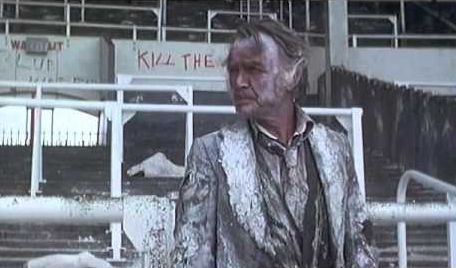
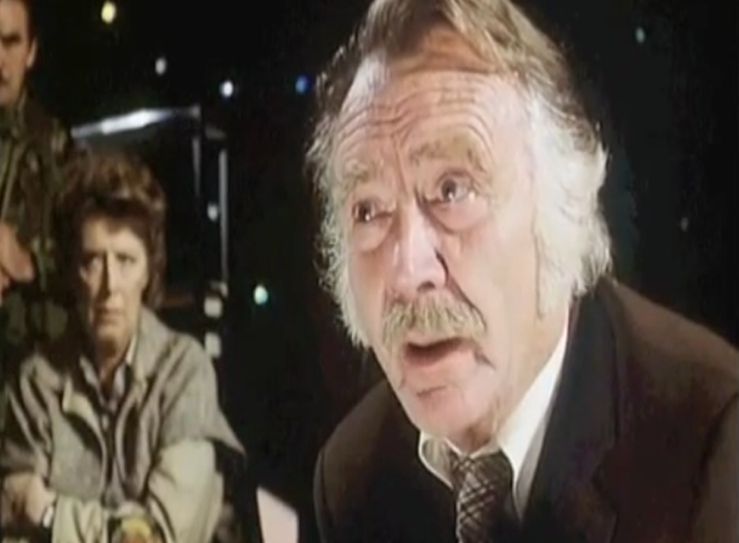
John Mills is impressively good at the start of An Endangered Species. Quatermass awakes in the bowels of Wembley Stadium to find that everybody has been taken (some seventy thousand people in the stadium itself, as well as Annie). As before, all that remains of them is an ashy substance. He staggers out into the daylight and is met by a group of guards, led by Brian Croucher.

This gives us an interesting contrast between two totally different styles of acting. Croucher is emotive, whilst Mills is steadfast and self-contained. John Mills, of course, had enjoyed plenty of practice in keeping a stiff upper lip in countless British war films – and that rather comes to the fore here. But I think he made the right acting choice. When faced with such a tragedy, the temptation is (like Croucher) to go overboard, but Mills was wise (and experienced) enough to know that less is more.

As we approach the end of the serial, it’s probably time to look at some of the themes contained within and ponder what Kneale was attempting to say. As he got older, Nigel Kneale gained the reputation of a grumpy old man and it’s fair to say that Quatermass reflects this.

It’s probable to assume that he spent the 1960’s not entirely in tune with the love and peace attitude of the flower power generation. All of the world’s ills (as seen in this serial) are laid at the feet of the young – this is explicitly stated by the older characters. The young (as depicted by the Planet People) are shown to be largely mindless sheep. This wasn’t the first time that Kneale had played on this theme (for example, the last episode of Quatermass and the Pit sees the majority of London under the thrall of the Martian influence).

But it’s more pronounced here and there’s no doubt that Kneale relished the idea of the older generation saving the day. “The theme I was trying to get to was the old redressing the balance with the young, saving the young.  Which I thought a nice, paradoxical, ironic idea after the youth-oriented 60s.”

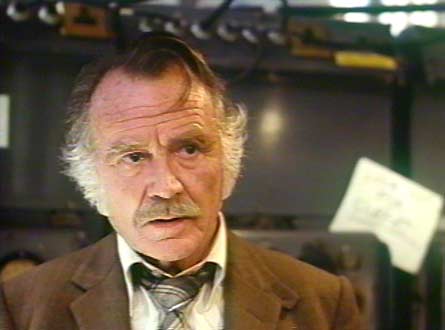
Whatever the aliens are looking for, it seems to be contained within the young (although this doesn’t explain why Annie was taken from Wembley) and this means the older generation are largely immune. This leads to the incongruous sight of a group of white-haired scientists and soldiers toiling away to find a solution to the problem.

So we have a fairly clear picture that young = bad and old = good. There’s also the familiar theme that science = good and superstition/religion = bad. The conflict between science and religion is highlighted when Kickalong and his followers find Kapp alone in his observatory. Kapp still clings to the idea that he can contact the alien and transmit some sort of message.  After destroying all of his equipment, Kickalong offers Kapp the chance to join them. It seems that for a moment he’ll agree – but he manages at the last moment to resist.

Kickalong’s motivations have sometimes been difficult to understand and that’s the case in the following scene. We’ve already seen that he’s trigger happy, but he makes no attempt to kill Kapp – instead he leads his followers away. But he does kill one of them, Sal (Toyah Willcox), when she tells him that she wants to stay with Kapp. And it’s a brutal murder – he machine-guns her in the back.

After largely sitting out the third episode, Simon MacCorkindale has more to do in the final episode. And it’s he and Quatermass who man the invention that will stop the alien in its tracks. Quatermass has deduced that it somehow picks up a certain scent when a large group of young people are gathered together.  So (along with his octogenarian colleagues) he designs a device that will produce a scent which gives the impression that a million people are gathered together. And once the alien arrives, a small nuclear device should be enough to stop it. Of course, anybody in the immediate area will also die.

Those wondering if the plot-thread about Quatermass’ grand-daughter would be resolved will find that answered right at the end. She’s one of the Planet People (led by Kickalong) who descend on Quatermass and Kapp, just as they’re about to hit the trigger. There then follows a slow-motion sequence as the Professor and his grand-daughter are reunited and together they press the button which destroys them and the alien. Mills does his best here, but it is a slightly iffy scene – and the tinkling piano soundtrack doesn’t help.

The crisis is over. And with the destruction of the alien, somehow the whole world manages to right itself. This does imply that not only did the alien have the power to take millions of people from the surface of the Earth, it was also able to directly or indirectly influence every living creature. That’s something of a stretch – and the happy ending, after such a bleak, nihilistic tale, is a little jarring.

So where does Quatermass sit amongst Kneale’s works? At the time it received a generally lukewarm reception, with the Daily Telegraph calling the Professor “unheroic and unresourceful” whilst the Times found the production to be “so-so”. Kneale himself was later to register dissatisfaction with virtually every aspect of the production, from his own script to the performances of the main cast (including Mills and MacCorkindale).

Although it was Euston Films’ most expensive production to date (costing £1.25 million) it does look a little cheap in places (particularly the model-filming). Producer Ted Childs would highlight budget problems as well as the down-beat script as the serial’s main drawbacks. “The primary problems with it were (a) it was perhaps too depressing a story for a popular television audience and (b) the punters were used to a fairly high standard of technical presentation from American television… And we just couldn’t afford that.”

The fact that it remained rather unloved for many years is possibly the reason why it’s had a small upswing in popularity recently – as some people seem keen to champion it as an unheralded classic. It’s no classic, but it’s certainly worth a watch. Mills is unshowy but solid as Quatermass and MacCorkindale is more than decent.

But it’s probably true to say that if it hadn’t been a Quatermass story then it wouldn’t enjoy the reasonable profile it currently has.  Indeed, if Kneale hadn’t written it then it may have been largely forgotten today. However, it’s an efficiently made post-apocalyptic yarn that would have looked quite impressive in the late 1970’s (when the majority of British drama was still shot as a VT/Film mix).

The three Quatermass serials from the 1950’s do cast incredibly long shadows and therefore any fourth installment would have had a very hard job in equaling or surpassing their reputations. But if you ignore what came before, then Quatermass is well worth your time. Hopefully in the future it will receive the release it deserves (a BD containing both the four-part serial and The Quatermass Conclusion movie edit would be more than welcome).

Quatermass – Episode Three – What Lies Beneath

quat 3

Seperated from Annie and Isabel, an injured Quatermass finds help from an unexpected quarter ….

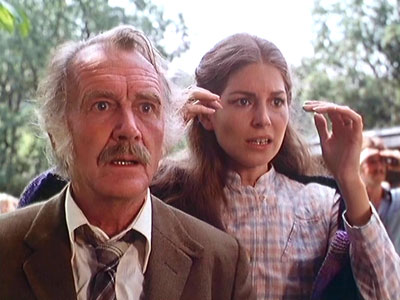
If the first two episodes concentrated on the young (the Planet People) then the first half of What Lies Beneath redresses the balance as Quatermass finds refuge with a group of senior citizens, led by Edna (Gretchen Franklin) and Jack (Larry Noble).  With society in tatters, they’ve had to scratch out a living below ground.  They’re mostly a rather sad collection of characters, although Franklin (later to become a regular on Eastenders) is good value.

Quatermass attempts to explain what he believes is happening – although what concerns them most is why the young should be saved and transported to another planet.  Why not them?  Of course, Quatermass doesn’t believe they were “saved” and later on he’ll reveal his theories ….

This part of the episode is nicely lit – as the underground location provides some interesting shadows.  But when a group of soldiers (guided by Annie) rescue him, it’s possible to wonder whether the whole section was simply a case of running on the spot (as the plot seems to have advanced very little).  We’ll have to wait until the final episode to see if there’s any pay-off for the characters introduced here.

Isabel is dead – Annie and the doctors watched, helpless to intervene, as she levitated from her hospital bed and then disintegrated.  It’s quite an arresting moment and although the effect was low-tech, it was still effective.

A common theme of the Quatermass serials was how the Professor was unable to convince the authorities that the danger was real.  Here, that’s not the case (at least temporarily) and the second half of What Lies Beneath sees Quatermass work with the remnants of the British government.

First, he and the army take over the sole remaining television station – British Television.  The logo is rather similar to one used by the BBC and it’s possible that Kneale was taking something of a swipe at his old employers.  With the country in desperate straights, BTV’s most popular programme is a bizarre soft-porn show called Tit-Umpity-Bumpity,  When the rather camp director (Tudor Davies) is firmly told that the studio is needed for a slightly more important purpose he gives way, although with very ill-grace.  “It’s the only show that anybody watches anymore.  Don’t they realise?”

The television land-lines allow Quatermass to link up with the Rusians and Americans and he propounds his latest theory.  Areas such as Ringstone Round were visited during their creation by the aliens, who somehow implanted triggers (possibly deep underground).  When the time was right (as now) the signal would be activated and the young would be irrestably drawn there.

The Americans want to send a spaceship to intercept a mysterious object in space, but Quatermass tells them it’s not a good idea.  “The ripe crop can’t appeal to the reaper.  I think this is the gathering time.  The human race is being harvested.”  This is a familiar Kneale trope.  Alien intelligences in the Quatermass stories are never corporeal or articulate.  Instead, it’s up to Quatermass and others to suggest what their motives are – based on the available evidence.

Next, he meets with the Prime Minster (the always impressive Kevin Stoney in a rather small role, sadly) and David Hatherley (David Ashford).  Ashford’s probably best known (to me anyway) for his many appearances as Charles Lotterby in Crown Court.  The news that thousands of Planet People are moving towards Wembley Stadium concerns Quatermass, although Hatherley (who’s heard the Professor’s theory that the young are taken from sites with a spiritual or magical nature) is sceptical that it’s going to happen at Wembley.  Although Quatermass does remind him of the sacred turf!

As for Joe Kapp, he spends the episode walking around in a daze – viewing the devastation of his home and hearing the voices of his children in his head.  There’s a dreamy (or nightmarish) quality about these scenes and it’s interesting that by this point in the story the position of Quatermass and Kapp has totally reversed.  At the start, Quatermass was barely functioning whilst Kapp was in command.  But the loss of his family has rendered him bereft.

Annie and Quatermass observe the growing clamour at Wembley.  The plot makes another swift gear-change as the soldiers and Hatherley turn on the pair of them – shooting at the Land-rover they’re sitting in.  More converts to the Planet People maybe?  Annie is hurt, possibly dead, so it looks as if Quatermass is on his own once more.

Quatermass – Episode Two – Lovely Lightning

quat2

The first half of Lovely Lightning is something of an exercise in mood and atmosphere – it”s certainly far removed from the dialogue-driven Quatermass serials of the 1950’s.  In the aftermath of the tragedy at Ringstone Round, Quatermass, Kapp and Clare find a survivor – Isabel (Annabelle Lanyon).

The three of them try to take her to safety, but the Planet People, headed by Kickalong (Ralph Arliss), are keen to prevent them.  It’s fair to say that a little of the Planet People does go a long way – but unfortunately there’s quite of a lot of them in this episode.  Arliss isn’t presented with much of a character, but he does his best with what he’s been given.  The problem is that the repetitive dialogue and actions of the Planet People ensure that they’re not the most interesting or engaging of characters.

En-masse though, even though they appear to espouse non-violence, there’s something sinister and threatening about them.  This is reinforced later on, when Kickalong leads an attack on a man barricaded in his home.  The Planet People initially seem just to want food, but that doesn’t appear to be Kickalong’s motive – he’s happy to fill the unseen man full of bullets and move on.

We get our first indication in this episode that the Planet People aren’t necessarily acting on their own initiative.  Alison (Brenda Fricker) leaves to join them – and it’s clear that she had no choice.  Later Quatermass muses on what they already know.  “Immense power, approaching through decades.  Decades to us, a few seconds in some inconceivable timescale.  The most vulnerable of human organisms, always the most recently formed – the youngest.”

So has some alien entity been able to manipulate a whole generation of people for their own ends?  This would partly explain why society has fractured – although if the problem is as widespread as it appears to be it’s difficult to believe that the connection hasn’t been made before.

It’s not just the young who are affected though, as Clare also starts to act oddly – after nursing the stricken Isabel.  Barbara Kellerman has some tricky moments in this episode (as Clare begins to fall to pieces).  Another actress with some challenging scenes is Margaret Tyzack as the District Commissioner Annie Morgan.  She’s initially presented as a cheery figure, who then collapses once she sees Isabel, and then recovers again.  The reason for these wild mood swings isn’t clear – logically it would be because she knew Isabel, but this doesn’t seem to be the case.

The Americans have got back in touch with Quatermass and they now need his help.  The massacre at Ringstone Round wasn’t an isolated incident (something similar happened in Brazil with thousands of young people).  Quatermass and Annie head for London, taking Isabel with them.  The Professor argues that as she’s the only survivor, she’s an invaluable witness.  The sort of tests he’ll run on her aren’t made clear, but there’s a strong inference that it won’t be pleasant.  Quatermass is firm though – in order to save more lives it’s possible that sacrifices will have to be made.  This is a key scene – as we see an assured, confident Quatermass.  As he leaves, one of Kapp’s daughters states that the old man doesn’t seem so old any more.

Kapp leaves Clare and the children behind as he visits Ringstone Round again.  When he returns, the house is deserted and it shows signs of an alien attack.  And with Quatermass and Annie facing danger on the streets on London, this gives us two strong hooks to lead into the third episode, What Lies Beneath.

Quatermass – Episode One – Ringstone Round

quat1

Following the critical and popular success of Quatermass and the Pit, Nigel Kneale was asked if he would write any more Quatermass stories.  He didn’t rule it out, although he also conceded that the three serials made a satisfying trilogy.  In the mid 1960’s, Irene Shubik asked him to pen a new Quatermass tale for the flagship BBC2 science-fiction anthology series Out of the Unknown.  Kneale declined (although he would write a non-Quatermass story – The Chopper – for the fourth and final series.  But like many of the later episodes, this was sadly wiped).

By the early 1970’s Kneale had begun to draft a fourth Quatermass serial and, like his previous work, it was offered to the BBC.  It didn’t generate a particularly favourable response from them though – and this seems to be a major factor in Kneale deciding to move to ITV (who would produce his later series, such as Beasts and Kinvig).

Euston Films (a subsidiary of Thames Television) were interested in his Quatermass story and in 1979, some twenty years after Quatermass and the Pit, the Professor made his final bow.  During those twenty years both television and society had both changed enormously – and Quatermass reflects this.  It’s by no means perfect (and it’s always been the most polarising of the serials) but there’s enough going on to make it a rewarding watch.

We open on a Britain that’s close to collapse.  The opening narration fills in some of the blanks, but it’s never made clear in the first episode exactly why the world is teetering on the brink.

In that last quarter of the twentieth century, the whole world seemed to sicken.  Civilised institutions, whether old or new, fell.  As if some primal disorder was reasserting itself.  And men asked themselves, why should this be?

Quatermass is on his way to a television studio to take part in a discussion celebrating the link-up in space of the two great powers – America and Russia.  But he has another motive for taking part – his granddaughter has disappeared and he wishes to appeal to the public for information.  He nearly doesn’t make it to the studio though, as he’s waylaid by a group of thugs.

They’re very well-spoken thugs though and this is an interesting wrinkle from Kneale.  Civilisation has collapsed – with vast areas of the country seeming to operate on a feudal basis – and the upper-class muggers demonstrate that all the different classes of society are now existing on the same level.  We later see some very polite graffiti scrawled on a wall (calling for the death of the King) which seems to make the same point.

Quatermass is rescued by Joe Kapp (Simon MacCorkindale).  Like Quatermass, he’s appearing on the show and he’s also a scientist who’s well aware of the Professor and his reputation.  Kapp clearly identifies with him (he later admits as much to his colleagues) and he takes it upon himself to look after the old man.

And this is a very different Quatermass from when we last met him.  His sharp intellect seems to have been blunted by being away from the centre of things for too long (he’s been living in a cottage in the Highlands of Scotland and was therefore unaware just how dangerous the cities had become).  But it’s interesting to see that as the story progresses he gradually recovers much of his authority (once he has a problem to solve).  In this first episode though he’s quite a passive figure – and it’s Kapp who’s the more forceful, driving individual.

Quatermass’ appearance on television certainly causes a stir as he delivers a remarkable tirade.  How much of this was Kneale’s own thoughts I wonder?  “What we’re looking at there is a wedding.  A symbolic wedding between a corrupt democracy and a monstrous tyranny.  Two super-powers, full of diseases.  Political diseases, economic diseases, social diseases.  And their infections are too strong for us, the smaller countries.  When we catch them, we die.  We’re dying now.  And they mock us with that thing?  Well their diseases are in there too.  It’ll come to nothing.  Sooner than they think.”

Minutes later. the link-up ends in tragedy and all the astronauts are killed.  The Americans naturally want to know how Quatermass knew this was going to happen.  He maintains he didn’t, it was just his feeling – but it’s clear that he’s going to be hounded, so he gladly escapes to the country with Kapp.  There he meets Kapp’s wife Clare (Barbara Kellerman), their children, and the three people who help Kapp with the work at his observatory – Tommy Roach (Bruce Purchase), Frank Chen (David Yip) and Alison Thorpe (Brenda Fricker).

The second part of the episode resolves around the Planet People.  You can view them as new-age travellers (although when Kneale first wrote the scripts back in the early seventies, it was clear that they were meant to resemble hippies).  Kneale himself regarded their appearance in 1979 as somewhat anachronistic and thought they should have been dressed as punks – although their mystical utterances would have seemed rather out of place had this been the case.

The Planet People regard Quatermass with disgust – bad enough that he’s a scientist but he worked with rockets (which is even worse).   Quatermass is interested in them and tries to understand their beliefs.  They tell him that they will be saved and transported to another planet.  This enrages Kapp who attempts to make them see the folly of this.  He doesn’t succeed and a large number of Planet People converge on Ringstone Round (like Stonehenge, it’s a fashionable place for those with new-age beliefs).

What Quatermass, Kapp and Clare observe at Ringstone Round fills them with horror.  A beam of light obliterates almost all of the Planet People.  It’s certainly an arresting image which showed that Kneale still knew how to craft a good cliff-hanger.

Quatermass and the Pit – Episode Six – Hob

pit 06

All three of Nigel Kneale’s 1950’s Quatermass serials had ambitious final episodes.  However, since no visual or audio copy of the last episode of The Quatermass Experiment exists, we can only surmise how good the climax was.  Kneale’s description of how they achieved the creature’s final manifestation in Westminster Abbey does sound endearingly low-tech though!  He recalls that somebody “bought a guidebook to the [abbey] and blew up one of the photographs and cut a couple of holes in it.  Then I stuck my hands through, which were draped with rubber gloves and various bits and pieces, and waggled them about.  It looked very good, actually, surprisingly effective.”

The last episode of Quatermass II had to be made on the cheap (since most of the budget had already been used for the previous five installments).   Unfortunately this meant that some parts of the finale were rather compromised – for example the surface of the asteroid was created by covering some chairs with a tarpaulin!  Once you know this, it’s difficult to watch those scenes without it being very apparent.

By the time Quatermass and the Pit went into production, lessons had obviously been learnt.  Hob brings the story to a very effective conclusion – and there’s no signs of penny-pinching here.  It, like the rest of the serial, had a very generous amount of film work (which really helped to give it a glossy, expensive look).  It’s a pity that all of the series wasn’t made on film, as the film sequences we do have demonstrate how good a director Rudolph Cartier was.

However, an all-film production was clearly outside of the BBC’s budget at the time – although it’s slightly curious that they didn’t mount all the pit sequences in Hob on film.  The majority are, but there’s the odd scene back in the studio – and the cuts between the two are rather jarring.

Notwithstanding this little niggle, Hob is a good exercise in making the limited resources you have stretch as far as possible.  It’s possible that when Rudolph Cartier received the script he may have despaired – as Kneale was asking for feature-film production values (we see London in flames after the majority of the inhabitants find themselves under Martian control and forced to re-enact the “wild hunt” – a purging of anything or anybody not like themselves).

But Cartier is able to achieve this very well with only a limited number of extras, stock shots of cities in flames (presumably from WW2) and other clever story-telling devices – such as the observations of a pilot above the city.  The pilot is able to describe to us what he can see, and whilst it’s an old trick (somebody telling us about something, rather than seeing it ourselves) it still works.

With London devastated, what’s happened to Quatermass and the others?  The Professor had been deeply affected by the signals from the pit and it took Roney some time to bring him back to normality.  Roney, like Potter and Fullalove, isn’t particularly affected – but they’re very much in the minority.

It’s somewhat disturbing to see Quatermass quite so disheveled and lost.  He’s been the logical, calm centre of the story – so when he’s incapacitated it’s quite a shock.  Colonel Breen is dead – he remained transfixed by the object in the pit and the last time we see him he’s been calcified.  Miss Judd and Captain Potter both make it out alive and the romantic in me likes to think that their relationship blossomed afterwards (there certainly seemed to be an interest on Potter’s side – whether this was scripted or business added by John Stratton in rehearsal isn’t clear).

The crisis is brought to an end by Roney making the ultimate sacrifice.  And the story ends with Quatermass broadcasting to the nation.  It’s a key scene, which concludes the serial terribly well – especially after Quatermass has finished and we see him walk away (leaving the other people looking slightly nonplussed).  Amongst them are Sladden and the Vicar, and it’s a nice touch that they’re both there (even though neither of them speak a word!)

Quatermass and the Pit is an amazing programme – script-wise, acting-wise and also technically.  It’s hard to believe that most of it went out live, since everything ran so smoothly.  Compared to the slightly more rough-and-ready Quatermass Experiment and Quatermass II it’s certainly on another level.  Morell is superb and he’s supported by a quality cast.

Mark Gatiss once said that Quatermass and the Pit  “with its brilliant blending of superstition, witchcraft and ghosts into the story of a five-million-year-old Martian invasion – is copper-bottomed genius.”  I see no reason to disagree with this.  If you’ve got it on your shelf but haven’t seen it for a while, maybe it’s time for a re-watch.  If you don’t own it or have never seen it, then you’re missing out on a true television classic.

Quatermass and the Pit – Episode Five – The Wild Hunt

pit 05

Quatermass returns to the Museum and tells Roney about the meeting he’s just had at the War Office.  Needless to say, he’s not best pleased and concedes that the Minster is “scared stiff.  Scared of the press, scared of being blamed for something, scared of his colleagues.  All he wants are easy answers.”  As we saw in the last episode, the Minister is happy with Breen’s theory that the object is a German propaganda weapon and that the insects are fakes (Quatermass ironically says that if you look closely enough, you’ll be able to see little swastikas on them!)

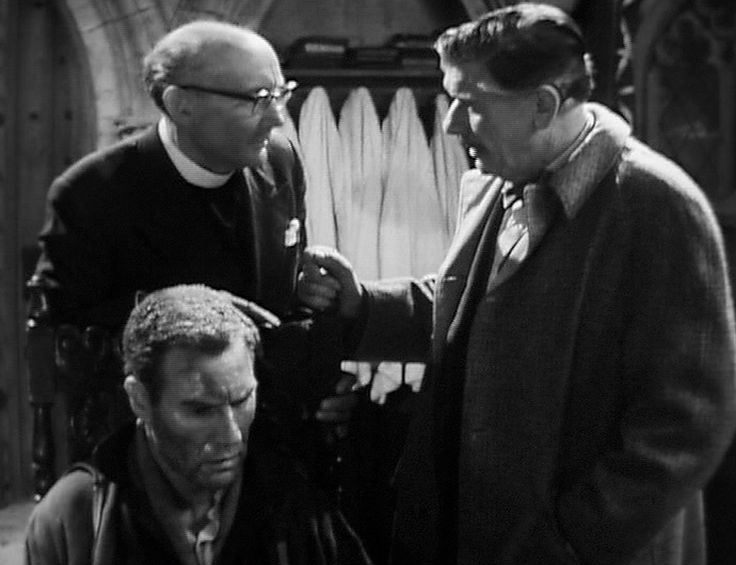
There’s no time to brood though, as Barbara Judd arrives and tells them both about the strange experience in the pit.  Shortly after this, Quatermass and Barbara set off for the vicarage where Sladden has ended up.  The conflict between religion and science is a familiar one in science fiction and it’s played out in this episode.  The Vicar (Noel Howlett) is convinced that Sladden has been in contact with spiritual evil (later he comes to the pit with an exorcism kit – “bell, book and candle” as Fullalove says) but although Quatermass agrees that they are dealing with evil, he simply disagrees about the nature of it.  For the Professor, there’s a rational, scientific explanation.  The Vicar also has an explanation – but for him, it’s a matter of faith.

The scene in the vicarage is nicely lit (with a flickering fire) and Cartier’s use of close-ups on the agitated Sladden really help to focus the audience’s attention on his plight.  In a rather incoherent fashion he’s able to explain what happened.  “I remember.  It started and then … then I couldn’t see anything but them!  Like you took out of the hull!  With eyes and horns!  They were alive!  Hopping and running.  Hundreds and hundreds and hundreds!”

Quatermass is convinced that Sladden had a vision of life on Mars – five million years ago (a race memory that may lay dormant in all of us).  He plans to record these visions via an invention of Roney’s (the optic encephalograph).  It was mentioned in passing a few episodes ago and now we can see that it wasn’t a throwaway moment – as it’ll have a fairly important role in this episode.  When attached to a user, it can record visual impressions in the brain and Quatermass uses it (via Barbara Judd) to record a “wild hunt”.  The Doctor Who story The Ark in Space would later use a very similar device to establish how the insect-like Wirrn came to be aboard the Ark.

Quatermas later arranges for the film to be shown at the War Office, in front of Colonel Breen, the Minster and various other interested parties.  He tells them that “you’re going to see a race purge, a cleansing of the hives.”  The short sequence (a nightmarish series of shots of the insects) is very effectively done (and is as good, if not better, than the similar sequence mounted for the Hammer film a decade later).

The Minister receives it with mild interest (“most curious”) but once more he’s able to rationalise it away.  Miss Judd has been in a nervous and excited state and therefore he considers the pictures to be nothing but hallucinations.  So again Quatermass is unable to make him understand just how dangerous the situation is.  The aliens may have died millions of years ago but there’s still a lingering power remaining – which is able to unleash primal forces.

It’s all to no avail though and that evening the press, radio and television are invited down to the pit.  We switch to film once more for the final few minutes of the episode (so we can guess that another set-piece sequence is about to begin).  This scene is also of interest as we see a typical BBC outside broadcast vehicle and camera (which does demonstrate just how bulky and cumbersome the cameras of this era were).  It’s also nice to see John Scott Martin (who would spend the best part of twenty five years playing many Doctor Who monsters, including the Daleks) as the tv technician.

There’s a cracking confrontation between Quatermass and Breen.  “Is Colonel Breen an imbecile or a coward?  Is Colonel Breen afraid of something, so afraid that he resorts to the thinnest rationalisations?”  Sadly, there’s no time for the argument to heat up any more as there’s been a death inside the capsule.  The last shot is rather oblique – “something” seems to be growing inside the capsule.  But we’ll have to wait until the next and final episode to find out what.

Quatermass and the Pit – Episode Four – The Enchanted

pit 04

The discovery of three insect-like creatures sends Colonel Breen into something of a tale-spin.  His moods have fluctuated wildly so far (although at the end of the last episode he seemed more reasonable and coherent) but coming face to face with these creatures clearly does nothing for his peace of mind.

He asks Roney why, if they’ve been dead more than a few years, they haven’t decomposed.  Quatermass explains to him that the “compartment was sealed.  If the things inside were completely sterile, without bacteria of any kind, they’d be free from corruption.  They could stay in there for a year or a million years.  Remain as they are, unchanged, until our atmosphere got in.  Filthy London air.  Then they’d rot as they have done.”  Needless to say, Breen doesn’t believe him.

Another sign that he’s starting to lose his grip is demonstrated when he orders Potter to eject Fullalove from the pit area.  It’s reasonable that Breen wouldn’t be keen on the presence of the press (although it’s equally understandable that Quatermass is keen for the story to get out) but it’s the way he does it – barking the order to Potter (who looks slightly askance at him) – which is quite telling.

We then move to the museum, where Quatermass and Roney muse over the creatures.  Roney points out that their antennas look somewhat like horns, something which Quatermass finds significant.  “Yes.  The horned demons in those old prints and manuscripts.  Do you remember?  As if that image were somehow projected into men’s minds.  That face, it’s like a gargoyle.  Roney, that’s not just a simile.  Haven’t you seen it before carved on walls in a dozen countries?  Is is somewhere in the subconscious?  A race memory?”

Fullalove’s exclusive – “Monster insects found”! – causes consternation at Whitehall, so Quatermass and Breen are called to the War Office to explain.  This scene demonstrates Kneale’s jaundiced view of politics and government as both Quatermass and Breen offer explanations – and the Minster chooses to believe Breen’s version.  Actually, it’s probable that he didn’t believe it, instead it was the story he felt would be most acceptable to both his political masters and the general public at large.  As the saying goes, in war, truth is the first casualty.

In Quatermass II, the Professor also made various assumptions about the threat that faced them – though back then he didn’t preface his remarks by conceding that he might be wrong.  At least here, Quatermass is a little more honest.  “You’re demanding explanations that I can’t give or prove.  All I can give you are guesses.”  It’s another splendid scene for Morell, who paces around the desk – hands in his waistcoat pockets – as he delivers his theory.  Five million years ago, there may still have been life on Mars.  If the Martians knew their planet was doomed, what would they do in order to perpetuate their existence?

Quatermass’ theory is that, on numerous occasions, they visited the Earth and took ape specimens (which they then experimented upon) before returning them back into the wild.  In time, these augmented apes would become the dominant species, and the Martian influence would live on, but in another race and on another planet.  The Minister isn’t pleased with this – the idea that the human race owes their existence to alien interference would clearly be a hard sell, so Breen’s suggestion that the object is a German V2 weapon (complete with fake aliens to create panic) is much more palatable to him.  This allows him to announce that the panic is over, reports can be distributed to state that the object is a fake and the bomb disposal team can pack up and go home.

But with two episodes to go, we clearly haven’t got to the end yet.  The last four minutes or so of The Enchanted are shot on film and they’re a real highlight of the serial.  Rudolph Cartier’s studio direction was always hamstrung by the bulky and unresponsive television cameras (like all productions of this era, they were slow to manuouvere and couldn’t zoom in or zoom out – that had to be done manually).  But shooting on film allowed him a much greater freedom and it’s the film sequences which contain many memorable and stylish visual images.

Sladden, the last man left in the pit, has entered the capsule to retrive his equipment.  As he’s doing this, Miss Judd comes back to collect her notes from the hut.  Then, as it were, all hell breaks loose.  Objects move by themselves and Sladden is deeply affected by this – exiting the pit in terror.  He has to run in such a way that seems to have been designed to mimic the aliens’ movement (a race memory coming to the fore?).  On the one hand it looks comic, but it’s played totally straight which gives it a sense of menace.  The night-shooting is incredibly evocative and once again we can be grateful that the original film inserts were kept.  Eventually, he ends up in the grounds of a vicarage.  As the lays on the floor (looking for sanctuary?) the ground around him ripples.

It’s a striking sequence, very well performed by Richard Shaw, and once again Nigel Kneale concludes an episode with a memorable cliff-hanger that lives long in the memory.

Quatermass and the Pit – Episode Three – Imps and Demons

pit 03

The unfortunate Private West (John Walker) has seen something strange inside the capsule.  His collapse agitates Breen considerably – it’s another inexplicable happening and therefore something that the Colonel hasn’t been trained to deal with.  But it is interesting to see that later in the episode he does calm down and his relationship with Quatermass, whilst still a little spiky, is more settled.

Quatermass is intrigued by the composition of the capsule.  “Ceramic material of some kind, resistant to heat to over three thousand degrees, harder than diamond.  It’s what every rocket engineer has been searching for.  A heatproof casing to get through the earth’s atmosphere.”  Although the inference is plain that this is some kind of spaceship, it’s not overtly spelled out at this time – as with six episodes to play with, there’s no need to rush.  Quatermass is also able to mock Breen’s faint hope that it may be a German device.  “You think the Germans made it in 1940 and then lost the secret?  Ask them.  Ask von Braun.”

Observing the activity around the capsule, Corporal Gibson (Harold Goodwin) wonders if Quatermass knows what he’s doing and decides that “he doesn’t.  None of ’em do this time.”  This is quite true as Quatermass is as much in the dark as everybody else.  By the time we reach the end of the story we’ll be able to consider just what the cost of Quatermass’ scientific curiosity was.  He wants to see inside the sealed chamber (as does Breen) and it’s this desire which causes all the problems from hereon in.  But, of course, had he not then the story would have been a good deal shorter!

Quatermass and Breen agree that a borazon drill might have a chance of making an impression on the door.  It would mean hiring a civilian contractor, but it’s judged to be worth the risk.  Sladden (Richard Shaw) turns up and prepares to set to work.  He’s a cheerful chap, although subsequent events wipe the smile off his face somewhat, especially in the next episode.  Sladden’s initial drilling certainly generates a reaction – creating an unearthly sound which affects everybody – especially Sladden, Quatermass and Breen.  Quatermass grabs Roney and leaves the pit area in a hurry, urging Potter to tell Breen not to continue with the drilling until he returns.

Whilst this is going on, the press (in the shape of James Fullalove) begin to take more of an interest.  The character of Fullalove had featured in The Quatermass Experiment and it had been hoped that Paul Whitson-Jones would reprise the role, but as he was unavailable Brian Worth took over.  Fullalove attaches himself to Quatermass and Roney and the three of them set off to do some research.  In the previous episode, we saw how Hobbs Lane had featured in the newspapers (back in 1927) when the story of the ghost surfaced.  Imps and Demons delves even further back into the past as it becomes clear that mysterious sightings and disturbances have been recorded for centuries, dating back to medieval times.

Returning to the pit, Quatermass finds that a hole has been made in the capsule, but not by Sladden – it just simply appeared.  Breen is still attempting to find a logical explanation for this strange occurrence.  “I suppose the vibrations of the drill must have affected all this material in some way.”  But even he can’t explain what he sees within the chamber.  He allows Quatermass to look and the Professor is equally surprised and shocked – there’s a telling moment between the two of them (for once, we see no bluster from Breen – he simply has to accept the evidence of his own eyes).

When the door is finally opened, the occupants of the capsule are exposed for the first time in five million years.  Quatermass reassures Breen.  “It’s all right.  They’re dead.  They’ve been dead for a long time.”  It’s another striking cliff-hanger which only adds another layer of mystery to the story.  If the strange inhabitants are dead, where do the centuries worth of disturbances emanate from?

Quatermass and the Pit – Episode Two – The Ghosts

pit 02

Quatermass and the Pit is as much a ghost story as it is a science fiction one.  This is a theme that Kneale would re-use in the years to come (The Stone Tape) and it’s easy to see why – the clash between science and superstition is a very potent one.  Doctor Who would also draw heavily from this Kneale template over the following decades (The Daemons is a prime example and Image of the Fendahl is probably the Doctor Who story most indebted to QATP).

Whilst the work to uncover the mysterious object continues, Quatermass is intrigued by the derelict house at the nearby Hobbs Lane.  This disrepair wasn’t caused by bomb damage (as it’s clear that only a handful of incendiary devices fell in this area during WW2.  Which also makes Breen’s claim that the object is a previously unknown German weapon rather unlikely).

The discovery that the object is emitting radioactivity (although at a very low level) is enough to ensure that operations are suspended whilst tests are carried out to verify whether it’s safe to continue.  At something of a loose end, Quatermass heads over to the abandoned house to have a look around.  He’s joined by P.C. Ellis (Victor Platt) who knows the history of the place and confirms that it’s been empty since 1927 due to a ghost scare.  Although Ellis was only a child back then, he still remembers the stories and whilst he tells Quatermass that it’s clearly all nonsense, he displays a palpable sense of unease as he moves through the house with Quatermass.  Victor Platt is terribly good in this scene, it’s mostly just exposition (laying the groundwork for the tale of the haunted house which Mrs Chilcott will explain in more depth later) but Platt is able to give Ellis a real sense of character.  Good performances from the minor players are one of the main strengths of this serial.

Two residents, Mr and Mrs Chilcott (Howell Davies and Hilda Barry) have been evacuated nearby, so Quatermass pops in to speak to them.  Barry had previously appeared in Quatermass II (as Mrs Large) and she gives another nice cameo performance here.  It’s obvious that she’s the dominant partner in the marriage, particularly since Mr Chilcott seems to be rather poorly.  “I couldn’t find his long woolies, you know, his clean ones. He may have to wear two pair at once. It’s cold.”  As the majority of the story is set amongst the military, her appearance does lighten the mood a little.

The Chilcotts are staying with Miss Groome (Madge Brindley).  When Quatermass enters, Miss Groome is telling Mrs Chilcott’s fortune with tea leaves.  This tells us that Miss Groome is a believer in the supernatural and is therefore somebody who holds diametrically opposed views from the rational Quatermass.  So his interest in the haunted house does surprise her.  “I thought all you scientists were sceptics” she says.  “We’re open-minded, most of us, or we try to be” he replies.  Mrs Chilcott’s story – mysterious noises, objects moving by themselves, a ghostly figure – is fairly typical, but what’s the explanation?  Miss Groome would no doubt be adamant they were manifestations from the other side, but the obvious inference being drawn is that it may have something to do with the mysterious object – which has apparently lain undisturbed for five million years.

The discovery of another ape skull – this one actually in the object – gives Colonel Breen even more pause for thought.  Anthony Bushell is very solid as the blinkered solider.  He likes things to be logical and rational and as the evidence begins to pile up to the contrary, he begins to lose his grip.  It’s only expressed in a subtle way during this episode, but it becomes more pronounced as the story progresses.  His reluctance to believe the evidence in front of him is highlighted by a report that confirms the radiation dates from five million years ago.  Since he finds this impossible to believe, he’s quite happy to dismiss it – anything that’s outside of his understanding he ignores.  If Quatermass and the Pit is something of a puzzle, then Breen is the sort of man that will desperately try and make the pieces fit – even if it’s clear they don’t.

Quatermass later tells Roney exactly what he feels about his new colleague.  “I told you my Rocket Group’s been taken over.  Well, he’s the official receiver.  He’s a career militarist of the worst type.  Cold, efficient, just biding his time.  That’s my colleague.”  Breen elects to use excavators to quickly unearth the object and its eventual reveal is an impressive moment.  It’s a wonderful piece of design work from Clifford Hatts – it looks substantial and solid.

Whilst some people may feel that this episode hasn’t advanced the plot very far, I’d disagree.  It’s been more about character and atmosphere – and both have been delivered in spades.  The cliff-hanger is also very striking and provides a strong hook into the next episode.  One of the soldiers, upon entering the object, reacts in terror at the sight of a mysterious figure who walked through the wall.  Instantly this recalls to us the stories of the haunted house in Hobbs Lane and the connection helps to tie the various story threads a little tighter together.

Quatermass and the Pit – Episode One – The Halfmen

pit 01

For many people, including myself, Quatermass and the Pit is the pick of the Quatermass serials.  Partly this may be due to familiarity (an edited compilation was released on VHS in 1988) but it’s undeniably a quality production.  It’s certainly the best-looking of the original trilogy, thanks to advances in the late 1950’s with the telerecording process as well as the existence of the original film sequences.

Quatermass II was telerecorded with a suppressed-field recorder, whilst Quatermass and the Pit used a stored-field film recorder. The upshot is that the picture quality of this third serial is much more detailed and smoother (plus the original video look was restored for the DVD release).  The film sequences, as per usual for the time, were shot on 35mm film and the majority of them have scrubbed up very well.  Comparing the pristine film inserts here to the blurry ones from Quatermass II is pretty much a night and day scenario.

So it looks very good, but what about the story?  It’s a very different beast from Quatermass II.  QII hopped from location to location and had a fairly large cast.  Whilst various characters come and go in QATP, the action centres on just three individuals – Professor Quatermass, Dr Matthew Roney and Colonel Breen.

After the wooden performance of John Robinson, it’s clear within a few minutes that we’re in very safe hands with André Morell.  Morell’s Quatermass has many traits that Robinson’s take on the character sorely lacked – a wry sense of humour and personal charm, for example – whilst he still exhibits the same steely determination. As we’ll see in this episode, this is an older, more embittered Quatermass. The rocket group that he founded is still active, and establishing bases on the moon is still the intention, but the military now have the upper hand and Quatermass faces being reduced to a mere bystander.

Dr Matthew Roney (Cec Linder) is, like Quatermass, an expert and enthusiast in his field. The opening scene shows us the discovery of a strangely-shaped skull, unearthed during the redevelopment of a site in Knightsbridge. There’s a nice piece of visual shorthand used after this – as the camera tracks across a series of newspapers, each displaying related headlines (“Apemen at Knightsbridge”, “Further discoveries at Knightsbridge”, “Knightsbridge Apemen – More Finds” and “Three More Bodies Says Scientist”) which significantly advances the plot in a matter of seconds.

Roney, together with his devoted assistant Miss Judd (Christine Finn), calls a press conference to try and drum up some publicity for his finds – he’s also trying to force the contractors to give him extra time to continue the excavations. Roney unveils an impression of what he considers the apeman (who he believes has lain undisturbed for at least five million years) could have looked like.  Later he receives some good-natured ribbing from his friends and colleagues about this.  “You know, a lot of people may think it’s a trifle improper to publicise wild guesses”.  Roney agrees, but it was a gimmick that sparked press interest – and publicity is what he needs.  Afterwards, he runs into Quatermass.  Quatermass is off to the War Office and tells him that “for all your troubles you’ve got one thing to be thankful for.  There’s no military value in fossil apes.”

Colonel Breen (Anthony Bushell) has just been seconded to Quatermass’ rocket group as deputy controller.  Breen is the personification of everything that Quatermass despises, so it’s pretty clear that their partnership will be an uneasy one.  In this episode, Breen appears to be a straightforward, capable officer.  As the serial develops, we’ll see how he reacts when faced with events that are outside his strict frame of reference ….

The meeting at the War Office therefore couldn’t have gone worse for Quatermass.  He’s essentially lost control of the rocket group (the Minister makes it clear that whilst there’s no call for his immediate resignation, it’s something that will probably happen in the not too distant future).  Quatermass created the rocket group for peaceful, scientific research and he’s horrified to find it appropriated by the military for their own ends.  “From the very start we’ll be going into space with one thought – war!  We’re on the verge of a new dimension of discovery.  It’s the great chance to leave our vices behind us, war, first of all.  Not to go out there dragging our hatreds and our frontiers with us.”

Needless to say, this speech (delivered to mostly military types) is treated with stony indifference.  So it’s maybe something of a relief when Roney turns up with a problem.  The excavation has been halted – due to the discovery of what looks like an unexploded bomb.  Roney isn’t happy with the officer in charge, Captain Potter (John Stratton), and wonders if Quatermass can do anything to help.  Quatermass rather neatly manages to persuade Breen to take a look, so the three of them head out to the site.

Stratton would be a familiar television face for decades (much later he would turn in a ripe performance as Shockeye in the Doctor Who story The Two Doctors).  He’s much straighter here (and barely recognisable) as the young officer.  There’s also some familiar faces in his squad, such as Harold Goodwin as Corporal Gibson and Hammer Films stalwart Michael Ripper as the Sergeant.

By the time we reach the end of the episode, many of the blocks of the story are in place, but there’s plenty of facts that are still unclear.  What’s interesting is how the pieces of the puzzle are slowly assembled – basically Quatermass and the Pit is a detective story and we’ll see Quatermass and the others uncovering information in the later episodes by various means (via books, talking to people, experiments, etc).  This is far removed from the thriller-like Quatermass II which operated in a much more straightforward way.

What appeared at first to be an unexploded bomb now looks increasingly odd.  It’s far too large, for one thing.  And the other important fact that Quatermass alone seems to have grasped is that it was below where the skull was found.  And if the skull had lain undetected for five million years, how long has the “bomb” been there?

Quatermass II – Episode Six – The Destroyers

q02-06

The Destroyers is something of an epilogue to the main story.  Quatermass II would have worked equally well as a five-parter and the conclusion of the previous episode (which saw the destruction of the creature at the plant) could have served very well as the end of the serial.  Instead, in episode six we see Quatermass and Pugh head out in their rocket to rendezvous with the asteroid.  The plan is to jettison the rocket’s nuclear motor and therefore destroy the alien menace once and for all.

The main problem was that by now the budget had virtually all been spent.  The first five episodes had cost around £7,000 (small change today, but quite a substantial sum for television drama sixty years ago).  This meant that The Destroyers had to be realised with just £600 – and there are times when the lack of money is rather obvious ….

But there are good points – the modelwork is, at times, quite effective (although some of the other shots are less impressive).  But the main problem with the episode is that the bulk of it takes place on the rocket with Quatermass and Pugh.  So far, we’ve seen that John Robinson tended to work best when he had actors of character to bounce off.

There’s no doubt that Hugh Griffith was a very good actor indeed, but as Pugh had been taken over by the aliens at the end of the fifth episode he doesn’t contribute a great deal until the climax – meaning that Robinson has to shoulder the majority of the dialogue and action up until then.  And since Robinson wasn’t the most charismatic or involving of actors, this tends to make the scenes drag a little.

Before this though, he fares a better when attempting to appeal to the humanity buried deep within the controlled Dillon.  He spells out what will happen if they can’t destroy the incoming aliens.  “There’s a possibility, no more than that, to reach the parent body from which these creatures come. If I’m not able to make this attempt, they’ll come again in their thousands and their millions. New colonies are being made ready for them elsewhere in the world. There they can develop, expand, breed, protected by their victims! Men like you Dillon! Guarding and feeding them until they spread all over the Earth!”

Quatermass and Pugh set off, although it’s hard to believe that Quatermass didn’t realise much earlier that something was wrong with Pugh.  True, he didn’t develop the very bad acting that affected most the controlled humans, but there was clearly something off-key about him.  By the time Quatermass does twig, it’s far too late and the pair of them have crash-landed on the asteroid.

Pugh attempts to shoot Quatermass, but the recoil from the rifle (and how would bullets react in zero-gravity anyway?) causes him to drift off into space.  The sight of a slowly spining Pugh, getting smaller and smaller, is a nice shot – it may be fairly simple effect, but to be inlaid onto a live production was clearly a challenge.  The end of the story is rather perfunctory though.  Quatermass fires the chemical motor, wipes out the aliens and this seems to instantly break their hold over the affected humans (if Dillon is anything to go by).

Whilst the last episode does have its problems, overall this is a serial that’s aged remarkably well.  You have to make allowances for the nature of live broadcasting, some of the effects are crude (and others are non-existent) but it’s certainly much more than simply a historical curio.  For most of the time it’s a very decent piece of drama with some good performances.

As previously mentioned, John Robinson is a something of a weak-link. Robinson’s Quatermass is a cold and remote man with whom it’s difficult to emphasise with.  Monica Grey is a little hard to take as well, and the reason for making her Quatermass’ daughter is never really developed – there’s very few displays of familial devotion from the pair of them.

The serial really comes alive with the supporting actors – and there’s plenty of familiar faces who liven up proceedings (such as Wilfred Brambell, Rupert Davies, Roger Delgado and – in the last episode – Cyril Shaps).  It’s a very pulpy sort of story and although the script does sometimes make impossible demands on the limited resources available, they manage to get away with it.

Apart from the slightly damp-squib of an ending, this is a piece of drama that firmly deserves its iconic status.

Quatermass II – Episode Five – The Frenzy

q02-05

One of the impressive things about Quatermass II is that there isn’t an episode where the action sags.  Normally, with a six part serial you’d expect it to tread water during the middle, but we’ve reached episode five and it’s still ticking along nicely.  This is probably due to the variety of supporting actors that we’ve seen.  As I’ve previously touched upon, any ally of Quatermass tends to have a fairly limited life expectancy – therefore most only feature for an episode or two.

The plus side of this is that there’s a constant influx of new characters to keep the narrative moving.  And in The Frenzy, the likes of Paddy (Michael Golden), Mac (John Rae) and Ernie (Ian Wilson) take centre-stage.  In the decades to come, television drama would be taped out of sequence (which would mean that an actor could appear throughout a serial like this but record all their scenes in a few days).  But back in days of live television this obviously wasn’t possible – hence actors pop up in a few episodes and then aren’t seen again.

Paddy, Mac, Ernie and a number of others make their way down to the plant to demand answers.  The zombie-like guards aren’t able to reassure them, so a fight breaks out.  Although the film sequences for this episode are quite murky (and somewhat murkier than the other episodes) it seems pretty clear that Paddy initiates things.  He grabs a rifle from one of the guards and begins firing.  What’s particularly interesting is that when Quatermass meets up with the men later (they’ve barricaded themselves into one of the rooms in the plant) Paddy insists that the guards fired the first shot.  Quatermass agrees with him, but does he believe Paddy or is he simply happy to agree in order to keep the men on his side?  There’s several different ways the line could have been spoken, but Robinson’s delivery is rather rushed and flat – a pity, since there’s seems to be a little bit of subtext here which was never developed.

Quatermass and the others are able to cut off the gas supply to the dome.  This begins to have an effect, as witnessed by the messages relayed to them via the tannoy.  The voice offers various inducements if they come out, such as promising that nobody will be harmed and that the injured will be taken care of.  “Music while you work” is also pumped through (a sequence that Kneale remained fond of).  Whilst Quatermass is desperately attempting to find a solution, it’s a nice counterpoint to have the scene scored with the sort of easy listening music that would be played during their normal shift patterns.

Eventually, the voice makes an offer that Mac finds irrestiable.  It offers to show them any part of the plant – Mac wishes to look at the main dome.  Quatermass tries to tell him that he’s going to his death, but he doesn’t believe him.  Along with a few others, he leaves the room and shortly after it’s clear that there’s a blockage in the pipeline.  It becomes horrifyingly obvious that Mac and the other men have been shoved down the pipeline (and turned into a pulp) in order to try and stop Quatermass’ sabotage.  After this, events lose a little coherency – as Quatermass is able to escape quite easily (and he finds Dr Pugh outside, waiting for him).  They return to the rocket and debate their next move.

Throughout the later part of The Frenzy there’s a very sharp sense that the world is tightening around Quatermass and his small group of friends.  It’s difficult to trust anybody now (and Dr Pugh is acting a little oddly at the end, which implies that he’ll be the next to go rogue).  Although the plant at Winnerden Flats has been largely destroyed, there’s still several more in other parts of the world, so the danger is far from over.  The rocket appears to be their only hope – but the return of John Dillon seems to scupper that.

Dillon, under alien control, has taken possession of the rocket.  Given what I said earlier about the number of actors who only appear in an episode or two, his re-appearance here does come as something of a surprise (he hasn’t been seen since the opening moments of episode two).  With the rocket now in alien hands, everything seems lost – which sets us up nicely for the sixth and concluding episode.

Quatermass II – Episode Four – The Coming

q02-04

The opening few minutes of The Coming sees Quatermass speculate about the form, nature and intention of the aliens.  He surmises that each meteorite contains some form of life, which expires seconds after it’s been exposed to the Earth’s atmosphere.  But within that short period of time it’s able to latch onto a human host and essentially take command of them.  He further speculates that it’s probably a colonial organism.  “Imagine a group mind. A thousand billion individuals, if you like, with a single consciousnesses.”  This was yet another element cribbed by Robert Holmes for the Doctor Who story Spearhead from Space (the Nestene Consciousness existed in a similar way).

If these points are fairly reasonable deductions, others seem to have been plucked out of the air somewhat – such as his reasoning that in its own atmosphere the alien could change in size, mass and shape.  And his suggestion that they come from one of the moons of Saturn is another surmise that seems to have no particular evidence to back it up.  Since the theme music for the serial is Holst’s Mars – The Bringer of War, it seemed a missed opportunity not to have them originate from Mars.  Even odder is that when the Martians feature in Quatermass and the Pit, it doesn’t use Holst’s theme!

This opening scene is a little bit of a nightmare for Robinson, who stumbles on several lines.  But the nature of live television is that you simply have to keep ploughing on, which he does and eventually things get back onto a more even keel.  We then see the Quatermass II rocket for the first time since episode one.  The prototype Quatermass II rocket exploded in Australia, but there’s a second one – currently being worked upon in the UK.

Quatermass tells Dr Pugh to make it ready.  Pugh, remembering the explosion in Australia, is naturally incredibly reluctant.  He tells Quatermass that it could very well turn into an atomic bomb, but maybe that’s what Quatermass wants.  Is he planning to use it as a weapon?  Quatermass is remarkably angry during this scene, barking out “I’m not listening to reason!” to Pugh and generally acting in a pretty foul manner (he’s also very abrupt to Paula).

He only perks up when he receives a call from a journalist called Hugh Conrad.  Quatermass believes that Conrad can help him to break the story, so he arranges to meet him at Winnerden Flats. Conrad was played by Roger Caesar Marius Bernard de Delgado Torres Castillo Roberto, better known as Roger Delgado.  Delgado was, of course, best known for playing the Master in Doctor Who between 1971 and 1973 and prior to that had enjoyed a successful career, again mostly playing villains.  So his appearance in QII, as a good guy, is a nice change.  Anybody who’s interested in more detail on his career should check out the documentary on the DVD of the Doctor Who story Frontier in Space.  There’s a wealth of clips from his many BBC appearances, of which far too many, sadly, are not yet available on DVD.

A new ally, like Conrad, is obviously what Quatermass needs, since his old ones have been dropping like ninepins.  The latest to succumb is Fowler, who finds himself gassed by an alien booby trap once he’s back at the ministry.  It’s a slightly sloppily directed scene (but as previously mentioned, it’s live television – so cutaways and effects shots were simply not possible).  We see the device and we see Fowler react – but we never see anything emerge from the device, so we have to use our imagination and assume that something did.

Quatermass shows Conrad the plant and afterwards the two of them visit the pub on the outskirts of the prefab town.  The prefab town houses the plant workers and both Quaternass and Conrad hope to pump them for information.  They share a drink with Paddy (Michael Golden) and Mr and Mrs McLeod (John Rae and Elsie Arnold).  Mr and Mrs McLeod are celebrating the eve of their silver wedding anniversary and Quatermass congratulates them, buys them a drink and tells them that a silver wedding was something he never had the fortune to reach.  This is the first time his wife’s been mentioned, but whether she’s dead or if they were divorced isn’t clear – although it’s interesting that Mrs McLeod says he has a sad face.

The regulars view the questions of Quatermass and Conrad with suspicion, although when a meteorite falls through the pub roof it does give them pause for thought.  Security guards enter, take it away and Quatermass and Conrad follow them.  This is a slightly odd part of the episode, as somehow Conrad’s been infected – although it’s difficult to see when this happened.  Even odder is that whilst he’s clearly not the same man he was, he’s not completely taken over and later he’s able to phone his paper in London and provide them with a succinct summary.  “Subjugation to the intention of the thing is widespread. It’s given rise to the production of a protected colony at a place called Winnerden Flats. It’s not synthetic food! It’s the re-creation of a world 800 million miles away!”  Did Conrad glean the last piece of information from Quatermass earlier or is this something he’s learnt from his association with the group mind?

Quatermass has re-entered the plant.  The last few minutes of the episode, shot on film, are very effective  – there’s no dialogue, just an ominous toiling sound as Quatermass ventures deeper and deeper into the plant.  Eventually he opens an inspection hatch and is greeted by the sight of a strange creature.  True, it’s obviously only a few pieces of plastic slowly moving about – but thanks to the music and Cartier’s shot selection, it’s still a rather eerie sight and a good cliff-hanger.

Quatermass II – Episode Three – The Food

q02-03

Quatermass finds it difficult to make any headway at the enquiry (naturally enough, since all the members are under alien control).  When he produces a replica of a meteorite that does trigger a reaction, but he leaves the room having made little progress.  There’s an interesting moment in the next scene, as Quatermass confides to Fowler that in “the last few minutes I was there, seconds really. I was afraid, Fowler. I was suddenly sharply aware of menace.”  This would imply that Kneale scripted the scene to be played much more naturally – whereas Cartier’s direction makes it obvious from the start that something’s seriously wrong (when any of the committee members speak, it’s in such an unearthly tone that the sense of danger is driven home rather unsubtly).  Had Kneale’s scripted intentions been adhered to, this scene would have played out more satisfactorily.

Whilst the early episodes of Quatermass II were attracting a sizeable audience, not everybody was happy.  Cecil McGivern, Controller of Television Programmes, conceded that the programme was “being ‘shot’ with considerable skill by Rudolph Cartier, but what he is ‘shooting’ is just not good enough.”  Kneale defended his work by explaining how it differed from the first serial.  “Instead of a normal world with one sinister element moving in it (as per The Quatermass Experiment) we have one normal protagonist moving in an increasingly abnormal world.”

This is borne out by the following scene when Quatermass and Fowler return to the committee room.  They find Broadhead alone, slumped on the desk and clearly now under the malign alien influence.  The notion that allies can be dealt with so swiftly helps to raise the stakes in the audience’s eyes – they now know that if Quatermass is going to persevere, then it’s going to be thanks to his own ingenuity and also with the help he can receive from a small group of trusted people.

Quatermass and Fowler meet with Rupert Ward (Derek Aylwad).  Ward is a public relations man who’s been to the plant on several occasions – his job was to look after selected parties of VIPs, who were shown around the installation.  This explains how the members of the establishment were brought under control, as it’s hard to imagine the alien being able to direct meteorites to each of their front doors!  For those keeping score on our Doctor Who watch, this is very similar to how the Cybermen were able to influence key people in the 1968 story The Invasion.  There, they entered the headquarters of International Electromatics and were very different when they came out ….

There’s a nice scene in this episode between Paula and Dr Pugh.  It doesn’t advance the plot very far, but it gives them both some welcome time to develop their characters.  Pugh laments the mechanical/electronic age.  “Too many machines, that’s what we’ve got. They spoil one from grasping a clear concept. I joined your father as a mathematical genius. That’s not boasting, I was once. A calculating boy.”  It’s a good moment for Hugh Griffith (a quality actor with a substantial acting career – he won an Oscar as best supporting actor in Ben Hur, for example).  Monica Grey is also allowed a little space to emerge as more of a character, although she’s still somewhat stiff and lacking in emotion (Paula’s still remarkably unconcerned about the fate of Dillon, which seems a little hard to accept).

The following scene is a very unsettling one, as we see a family (mother, father, child) settling down to enjoy a picnic, close to the installation.  Armed guards arrive and insist that they leave, but we don’t see the conclusion to the scene – as a car races past and the camera refocusses on them (the car contains Quatermass, Fowler and Ward, who are going to try and get into the installation).  It isn’t until later in the story that we hear gunfire and then see the family’s car being towed inside (with one of their arms limply visible).  As Quatermass drives back to London, he passes the shattered remains of their picnic – there’s no words spoken, but the pictures tell their own, powerful story.

This section is a good example of how ruthless Quatermass can be.  When they pass the family’s car on the way in, Fowler wonders if they should stop and try to help.  Quatermass decides not to, as the fact that some of the guards are outside could be of benefit to them when they try and gain access.  He’s right of course, but it does mean that their deaths may have been prevented if they had intervened.

Another death follows, once they gain admittance, as Ward enters one of the food domes and emerges covered in a sort of corrosive slime.  This is a nicely shot sequence, as we see the dazed figure of Ward slowly staggering down the staircase of one of the impressive location structures.  It’s just a pity that all of this scene couldn’t have been shot on film, as the cut to the studio when he reaches the bottom is a little jarring.  It’s hard to see any emotion from Quatermass as he frantically urges the dying Ward to tell him what he saw.   Was this as scripted or was it simply because Robinson wasn’t an actor capable of delivering a subtler performance?  It’s hard to imagine Reginald Tate being quite so brusque.

Back in London, Quatermass surmises that the domes may be for food after all – but not food for human consumption.  He explains to Fowler.  “Try to imagine a complete reversal. An organism for which oxygen is not a necessity of life, but a destroyer. Unable to survive in our atmosphere for more a few seconds. Safe only in a shell, a shell of stone. But with power, Fowler. Power to compel.”