Minder – The Bengal Tiger

bengal 01

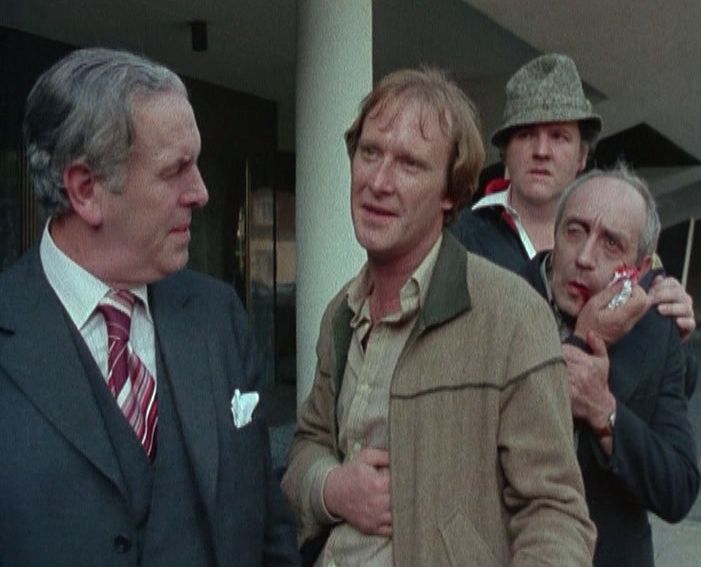
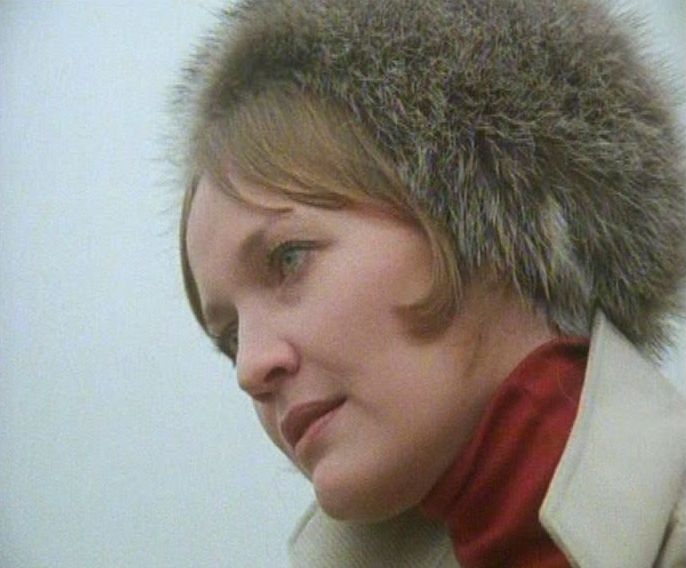
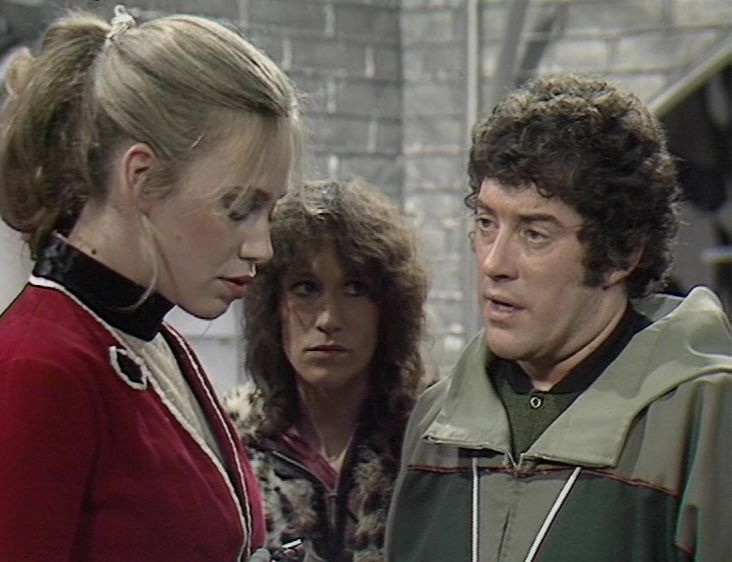
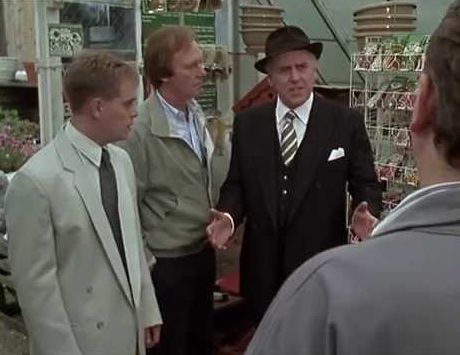
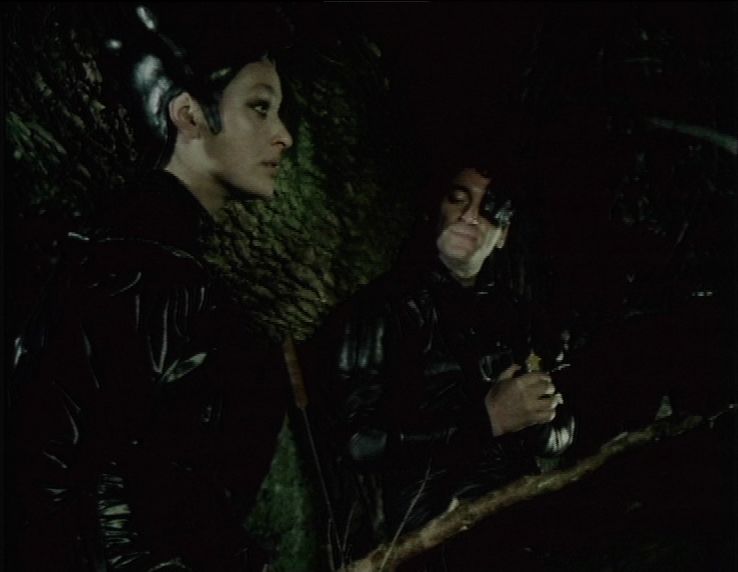
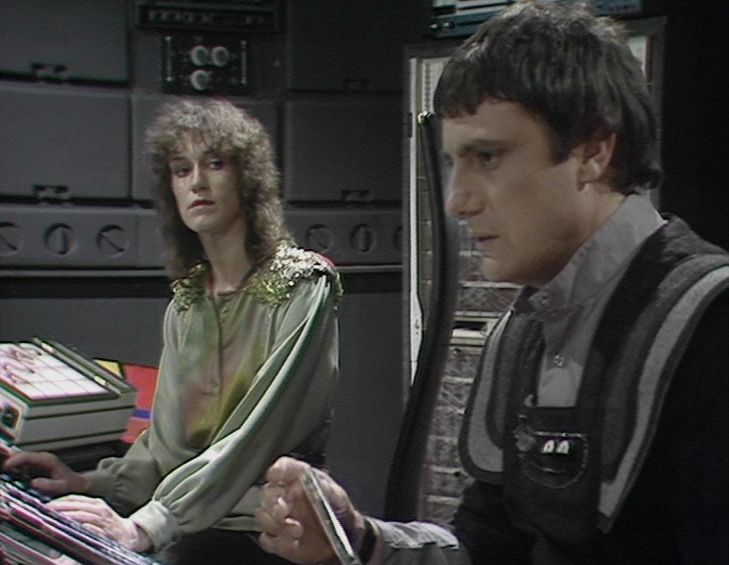
Mr Mukerjee (Saeed Jaffrey) is offered Terry’s assistance to help guard his newsagents shop following a series of attacks.  Initially it seems to be the work of kids, but it quickly becomes obvious that Mukerjee has been less than honest with either Arthur or Terry.

He’s offered his daughter’s hand in marriage to multiple families (collecting a hefty fee each time).  Unfortunately for him, Mr Aslam (Ahmed Khalil) was one of his victims and now he wants his money back.  And Mukerjee’s daughter, Indira (Shireen Anwar), doesn’t want to take part in an arranged marriage – she only has eyes for Kev (Mike Grady).

The Bengal Tiger is a fascinating time capsule of the period.  Partly because of Mukerjee’s newsagents shop, which is piled high with long vanished products.  For example, I spotted copies of the comic Misty on the shelves – this might have been a girls comic, but thanks to its spooky supernatural stories it was one I was happy to read back then!

The other thing that dates the story is, of course, the attitudes and opinions that we see expressed.  Mukerjee, although nicely played by Jaffrey, is something of a cliche.  He may, or may not, be an illegal immigrant (he’s been in the country for decades but can’t remember if he has official citizenship) and during this time he’s picked up certain English speech mannerisms which are intermingled with his strong Indian accent.  But although he’s a broad stereotype (reinforced by the fact he’s sold his daughter umpteen times) there’s a certain twinkle in Jaffrey’s performance which prevents him from being a totally unlikable character.

If Mukerjee still retains something of his ethnic roots, then his daughter Indira is the complete opposite.  She has a broad Cockney accent and has no interest in even contemplating an arranged marriage.  Shireen Anwar is delightful as the outspoken Indira and whilst it’s clear that she immediately captures Terry’s attention, she only has eyes for the gormless Kev.  Mike Grady has made a good career out of playing gormless characters (Citizen Smith, Last of the Summer Wine) and Kev is another addition to this list.  There doesn’t seem to be any obvious reason why the vivacious Indira should be attracted to him – so it must be love.

There’s some great banter between Arthur and Terry in this episode.  It doesn’t advance the plot at all, but it’s just lovely to see.  Early on, Terry tells Arthur that he’s thinking of jacking the job in – throwing drunks out of pubs and repossessing cars isn’t a fulfilling career for him.  He then mentions that he’s contemplating a career in computers, much to Arthur’s intense amusement.  Arthur tells him he can’t even work a pocket calculator, so how would he be able to deal with a computer?  After a moment, Terry reluctantly agrees, but remains convinced he could learn!

Later, Arthur drops off a number of frost-damaged freezers (yes, Terry wondered how freezers could be frost damaged as well!) to Terry’s flat in the early hours of the morning.  This is classic Arthur, as the notion that Terry may not be keen to take delivery of the freezers obviously never even crossed his mind.  And when Terry wonders why Arthur couldn’t store them at his house, he has plenty of decent excuses.  They wouldn’t go with the flock wallpaper for a start and what would happen when his friends from the Lodge came over for a drink?  It wouldn’t create the right impression, would it?

There’s some familiar faces on view.  Stanley Lebor, later to play Howard Hughes in Ever Decreasing Circles, here takes his more familiar 1970’s role as a heavy (his fight with Terry concludes the story).  Spencer Banks (probably best known from Timeslip) plays a young drunk who Terry throws out of a pub.  I knew his face was naggingly familiar, but it wasn’t until the credits that it clicked exactly who he was.  Roy Evans, a very recognisable face from this era in both films and television, has a small role as a customer in the newsagents.  He’s credited as “Elderly Man” which is interesting since he was only forty-eight at the time.  Clearly he had one of those lived-in faces.  And lastly, Graham Stark keeps on popping up to harangue Terry.  Stark gives a broad performance, but it’s a nice bit of comic relief (even if the story itself isn’t terribly serious anyway).

Thanks to Terry’s diplomacy, everything is sorted out in the end and Indira and Kev don’t have to elope.  Given the time that’s elapsed since the original broadcast (back in 1979) some of themes, especially the interracial marriage, would have seemed far more controversial back then than they do now.  Attitudes have certainly changed – for example, Kev is casually able to mention that he and Indira need to find a place of their own since they can’t stay with his mother (she doesn’t mind living next door to them, but she doesn’t want one in the house).

Another solid script from Leon Griffiths.
bengal 02

Minder – Aces High and Sometimes Very Low

aces

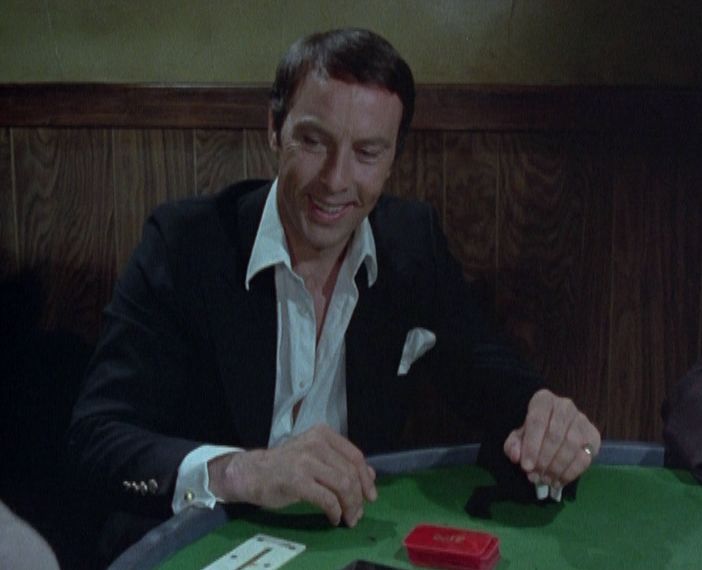
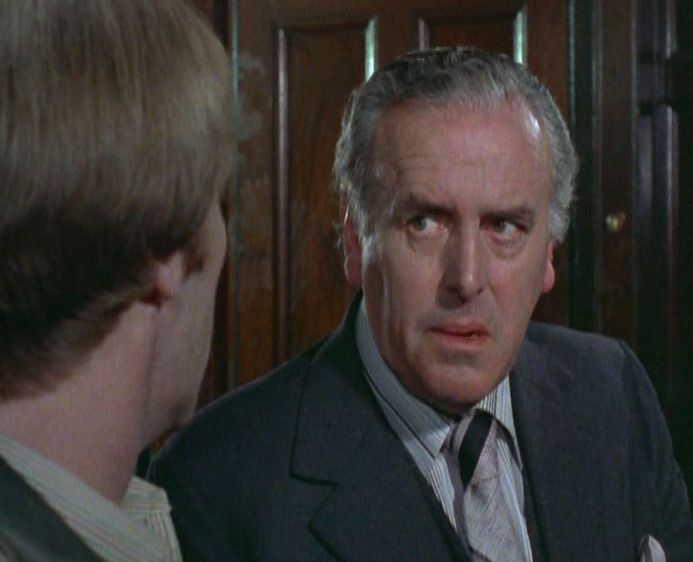
Professional gambler Maurice Michaelson (Anthony Valentine) has a problem – he’s simply too good at his job.  Because of his skill at poker, he’s found himself barred from a local casino and is later robbed of his winnings.  He’s convinced that he can make good though, thanks to a high stakes poker game run by some shady Greeks.

With Terry onboard as his minder, Maurice loses heavily.  Convinced the game was crooked he manages to persuade Arthur to advance him some more stake money (using his Jaguar as collateral) and prepares to do battle once more.

Some of the regular television characters that Anthony Valentine had played in the past tended to follow a familiar pattern.  For example, Toby Meres in Callan (charming and borderline psychotic), Major Horst Mohn in Colditz (not charming and borderline psychotic) and Raffles (charming and not borderline psychotic at all), etc etc.  Maurice Michaelson, on the other hard, is charming but he’s not really a criminal type or a sufferer of any form of neurosis – he’s just been blessed with a skill that he can’t exploit to the full.

Both Terry and Arthur take something of a back-seat in this one, as Maurice’s gambling exploits are the key focus.  But although they aren’t as prominent in the narrative as usual, they do have some good moments.  Terry tangles with the alluring Stella (a pre-Star Trek:The Next Generation Marina Sirtis) whilst Arthur naturally attempts to make the maximum amount of profit from Maurice’s car (much to Terry’s amusement).

This episode also gives us the unusual, if not unique, sight of Terry and Arthur sitting in the Winchester playing cards.  It’s obvious though that the scene only exists so that Maurice can turn up and criticise Arthur’s playing style (and their low stakes – a penny a point) and then demonstrate his own undoubted skills.

Maurice would return in the series two episode, You Lose Some You Win Some, and whilst the later episode is my favourite of the two since it has a more entertaining storyline (Maurice recruits a group of non-gamblers to work undercover at a casino he’s barred from) this one does have an authentic, seedy and smoky atmosphere – conjured up by Minder’s creator, Leon Griffiths.
Minder – The Bounty Hunter

bounty

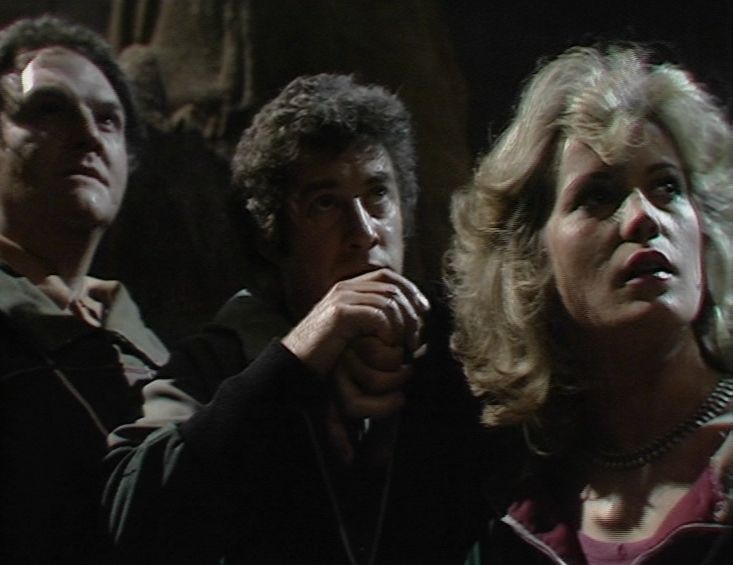
When Arthur learns that an old friend of his, Jo (June Richie), is somewhat down on her luck he does his best to help.  Following her husband’s death, she decided to sink all her savings into a Spanish villa.  Unfortunately, the villa was never built as the company responsible, Sunworthy, went bust and all her money (along with a great many other people’s) was lost.

He knows just the man for the job – Terry, of course.  And after traipsing around the streets, Terry manages to run down Freddy Fenton (Derek Jacobi) – who was the brains behind Sunworthy.  He pleads poverty, but it’s clear that he’s a skilled con-man who’ll be a tough nut to crack.

The first episode of Minder to be filmed, The Bounty Hunter is chiefly memorable for Jacobi’s turn as Freddy Fenton.  Initially, he seems to be a broken man, living on social security, but it’s later revealed that he lives in a palatial house, complete with servants and a gorgeous lady-friend, Val (Rikki Howard – best known as a yellowcoat from Hi-De-Hi!).  And even when Terry tracks him down, Fenton remains as slippery as ever.  He tells Terry that he owns nothing – everything is leased.

Jacobi’s spot on as the arrogant wide-boy, convinced that Terry’s threats are meaningless.  In the immediate years following his career-defining appearance in I Claudius (BBC 1976) he only made a handful of television appearances, so there must have been something in the character of Fenton that appealed to him.  Speaking of I Claudius, I wonder if it’s just a coincidence that Christopher Biggins (who appeared as Nero) also has a role in this story?

George Layton, as Des the mechanic, would be a semi-regular during Minder’s early years.  Here we see him con Terry into stealing cars (Terry, trusting as ever, believes that Des has authorisation to remove them!).  But he’s able to later put Des’ skills as a thief to good use when they steal Fenton’s Rolls-Royce and refuse to return it unless he pays them the money he owes Jo.

Like some of the other early episodes, this one is fairly heavy on the library music tracks (which would tend to diminish in later series).  But although some of the cues are a little on the cheesy side and the story is quite slight, Jacobi’s presence makes it well worth watching.

Minder – A Tethered Goat

goat

Terry’s latest job is acting as a bodyguard for an Arab banker Bassam Sayin (Lee Montague) who has flown into the UK to transact some business deals.  Sayin and Terry don’t quite hit it off as he’s far from impressed with Terry’s skills as a bodyguard (mainly because he doesn’t carry a gun).

Naturally, Arthur’s convinced Terry that this will be easy money, so the idea that he would need to be armed instantly sets alarm bells ringing.  But perhaps he should have been, as later Terry and Sayin find themselves menaced by a group of armed men ….

A Tethered Goat is one of my favourite episodes from series one of Minder – not only for the sparkling script from Murray Smith (incredibly his only contribution to the series) but also for the first rate guest cast.  The pick of the bunch is Kenneth Griffiths as Sayin’s temporary valet, Dai Llewellyn.  Dai’s Welsh (in case you haven’t guessed) and also likes a drink (or two).  He’s pure comic relief and gets some of the best lines, such as when he spots armed men approaching the house. “Terry, shooters! Oh my god!”.  It may not sound like much, but it’s all in the delivery and Griffiths is first rate.

Lee Montague, an actor still going strong today, has a great deal of presence as Sayin.  His relationship with Terry is the key to this episode and it’s fascinating to chart how their opinions of each other change (from distrust to mutual respect).  Another couple of very familiar television faces, Michael Sheard and Nadim Sawalha, provide the menace whilst Jenny Lee-Wright (who was well-known at the time for the likes of The Benny Hill Show but is now a leading Foley artist, working on a score of major films) provides the glamour.

As for Arthur, he attempts to ingratiate himself with Sayin in such an obvious way that it’s almost painful to witness.  Sayin’s reaction to Arthur’s hustling is a joy to behold!  But you have to give Arthur credit, he keeps on trying to make a profit – even when the bullets are flying.

Minder – The Smaller They Are

smaller

When Scotch Harry (Phil McCall) and his faithful friend Big Stan (David Jackson) steal a case from the airport they get more than they bargained for – it contains half a million dollars. And when Arthur learns of this he’s keen to offer his services, for a small commission naturally.

He tells Harry they’ll have to give it back, whoever these people are for this sort of money they won’t hesitate to get very nasty indeed.  Arthur agrees to negotiate the case’s return, although the presence of DC Rycott (Peter Childs) is an added complication.

It’s clear that The Smaller They Are is a very early Minder episode for several reasons – one of the most obvious is Arthur’s lecherous nature.  He casts an appreciative eye over a young woman wearing a tight pair of jeans in the Winchester and later attempts to chat up the pleasant airline receptionist (played by Hilary Ryan, probably best known for playing Rodan in the Doctor Who story The Invasion of Time).  Arthur’s roving eye is something that’s phased out pretty quickly, shortly after this he’ll leave that sort of thing to Terry!

We also see the first appearance of Peter Childs as Rycott.  Another sign that it’s the early days of the series is the notion that Rycott is corrupt.  After nabbing Scotch Harry, Rycott delivers him to the gang – rather than taking him to the nick – and on the way offers an oblique justification why (after years of solid service he’s still only a DC, due to a previous indiscretion).  Maybe Rycott was planned as a one-off character and when it was decided to reuse him his previous corruption was forgotten.  There’s certainly no suggestion after this episode that he’s a wrong ‘un.

Scotch Harry is such an unlikeable character (especially when he’s drunk, although he’s pretty bad when he’s sober) that it’s no surprise Terry’s keen to give him a slap to sort him out.  David Jackson (Gan from Blake’s 7) is his loyal, but none-too-bright friend.  Hans Meyer (best known as Hauptmann Franz Ulmann from the classic BBC series Colditz) is suitably intimidating as Bonnett, the leader of the money smuggling operation.

Although Meyer radiates intimidation, the episode does rather end in farce after Arthur, Terry and Big Stan return the case to him.  Stan’s upset to find that Harry’s been badly beaten up and attempts to retaliate – he’s not very successful, but Terry’s rather more so.  In the melee, Arthur attempts to take the case back (given all he’s previously said about how dangerous these people are, that does seem rather reckless).  He doesn’t succeed, but in the general confusion Bonnett ends up dropping the case on his foot and hops around the room in pain, whilst Arthur manages to take another wad of money before leaving!

But it has to be shown that crime doesn’t pay and it’s down to Dave to break the bad news – the notes are forgeries and therefore worthless.  Even this early on, it’s clear that Arthur’s only going to end up on top very infrequently.

Minder – Bury my Half At Waltham Green

bury
After jumping ahead to sample from episodes from series seven, it’s back to series one and the second episode – Bury My Half at Waltham Green.

Arthur convinces Terry that it’s the easiest money he’ll ever earn – all he has to do is mind Albert Stubbs (Nicky Henson) for a few days.  Stubbs has just been released from prison and is keen to dig up a large stash of money stolen by him and his associates. Rose Mellors (Ann Lynn) is the formidable wife of one of Stubbs’ old colleagues and she, along with her gorilla of a minder Jack (Tony Selby), is hot on their trail.

Terry’s got problems though – Stubbs is erratic and unpredictable and he quickly makes Terry’s life a misery.  When Jack pays them a visit, he manages to extract him from Terry’s grasp and proudly takes him back to Rose.  She’s far from impressed though – she doesn’t know who he is, but he’s certainly not Albert Stubbs …..

Bury My Half at Waltham Green is an excellent early example of Arthur’s highly devious nature.  Knowing full well that Stubbs would be a hunted man from the moment he was released, he arranged for Terry to mind a decoy.  The man that Terry thought was Stubbs is actually a character called George Wilson.  It’s fair to say that Terry’s far from pleased at being manipulated in this way, but he’s going to have to get used to it as it’s going to happen on a regular basis from now on.

Nicky Henson’s good value as the ebullient Stubbs Mk 1 whilst the ever-dependable Kenneth Cope is just as solid as the real, if rather less jovial, Stubbs.  Ann Lynn is a memorable femme-fatale who’ll stop at nothing (including bedding Terry) to find out where Stubbs is.  When Arthur learns that Terry’s slept with Rose, his expression is a joy to behold!  Tony Selby rounds off the first-rate cast as the accident prone, but intimidating Jack.  Both Lynn and Selby would return as Rose Mellors and Jack in the series two episode Diamonds are a Girl’s Worse Enemy.

If you want to be picky, then it’s hard to believe the rather elaborate decoy scene which sees Arthur and Stubbs drive off in a car (watched by Rose, Terry and Jack).  Rose and Jack follow them, but don’t realise they’re actually following an identical car, which contains Terry and George.  This scheme seems to have been dreamt up by Terry within a very short space of time and it does beggar belief that he’d be able to rustle up two identical cars (plus a lorry to drive one of the cars into) so quickly .

After various adventures, Albert digs up the money, although his joy is short lived as Rose steps in to relieve him of it.  Arthur also manages to get a small share, but the sting in the tail is left until the end – as it’s revealed that the money (comprised of one pound notes) is no longer legal tender, because those type of notes were phased out the year before.

It’s maybe a coincidence that the very next episode also revolves around a large sum of money which turns out to be worthless.

The Sandbaggers – Operation Kingmaker

kingmaker

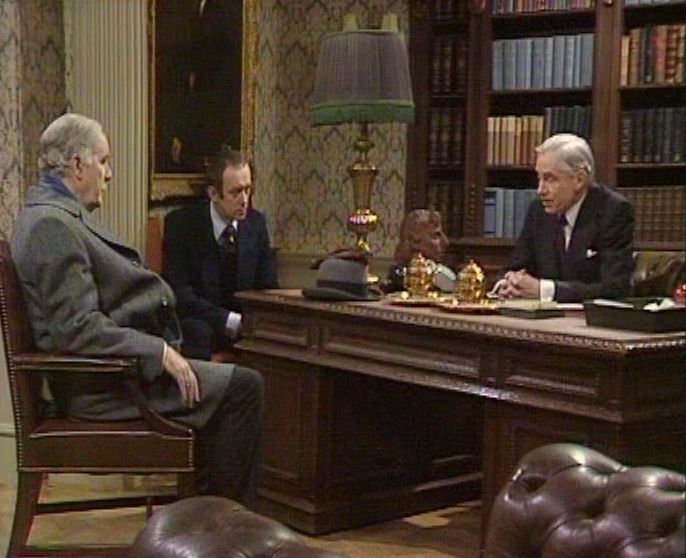
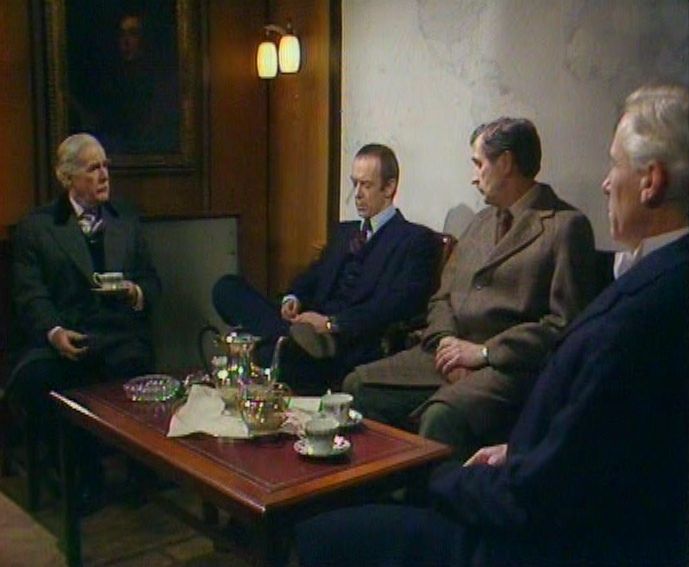
Following Sir James Greenley’s sudden retirement, the position of C is vacant.  Despite all their run-ins, Burnside isn’t averse to Peele taking over, reckoning that the devil you know is always better than the devil you don’t.  He maintains that although Peele would be a minor disaster as C, someone they didn’t know would be a major one.

And when Burnside learns that John Tower Gibbs (Dennis Burgess) is the front runner, Peele becomes more and more attractive.  Gibbs and Burnside have a long and painful history and if he did become C there’s nothing to suggest that future relations would be any more cordial.  So Burnside assigns both Sandbaggers with a new mission – Operation Kingmaker.  Its objective is to find compromising material on Gibbs whilst at the same time promoting Peele as a worthwhile candidate.

With no world shattering events to deal with in Operation Kingmaker, office politics are the order of the day.  It has a lighter tone than most of the previous episodes, especially when depicting the relationship between Peele and Burnside.  To begin with, Peele is at his most genial – as he’s attempting to use Burnside and Wellingham’s close relationship to his advantage (hoping that Burnside will be able to persuade Wellingham that he’s a serious candidate for the job).

Burnside though is already ahead of him, as he’s already pushed Peele’s credentials to a slightly incredulous Wellingham.  Wellingham has no particular liking for Peele and correctly surmises that Burnside is simply keen to ensure that anybody but Gibbs gets the job.

This isn’t the only change afoot though, as Burnside’s secretary, Elizabeth, hands in her resignation.  She’s leaving to get married and Burnside is characteristically far from delighted at the news.  He fails to congratulate her and when he realises she won’t reconsider, insists that she appoints a replacement before she leaves.  A further example of his monumental lack of tact is when he mentions he doesn’t want anybody young – someone about her age would be fine!

Finding a replacement is hard though, as nobody seems to want the job (Burnside’s fearful reputation has preceded him, much to Willie’s amusement).  But eventually she does uncover a potential candidate – Marianne Straker (Sue Holderness).  Although Marianne is younger than Burnside would like, twenty-seven, she does have the sort of outspoken attitude that appeals to him.  She used to work for Peele, but was dismissed because, according to Elizabeth “she wasn’t deferential enough.”

Sue Holderness had been acting since the early 1970’s, although she was still a few years away from her career-defining role as Marlene in Only Fools and Horses.  She only has a limited amount of time in this episode, but her brief appearance suggests that she’ll make a decent foil to Burnside.  The tone is set after he discovers she doesn’t have a regular boyfriend and he asks what’s wrong with her.  She counters that he’s considerably older than her and isn’t married, which is a decent retort.  He offers her the job and as the door closes behind her, we see something quite rare – a smile from Burnside.

Another character making her exit is Jana Shelden as Karen Milner.  She appears to have been positioned as a potential romantic interest for Burnside, though in the end this didn’t amount to anything mainly because the scars of Berlin seemed to be too fresh in his mind.  A pity she didn’t return, as she also made a good working partner for Willie (as seen in Decision by Committee) although regular team-ups between the SIS and the CIA would have probably stretched credibility a little.

Neither Willie or Mike appear to be delighted with Operation Kingmaker.  Willie doesn’t have any moral qualms about sabotaging Gibbs’ chances, he’s more concerned about what would happen to Burnside if it was discovered.  But Mike does seem a little apprehensive about what he’s been asked to do, although this may just be Michael Cashman’s acting choice as it helps to make his contribution stand out (given his fairly small role in the story).

Finding dirt on Gibbs is difficult though.  Willie asks D. Int. if he knows anything and he tells him that Gibbs has “the brain of a computer, the stamina of an ox and a bite that’s considerably worse than his bark.” They do finally uncover something promising and Burnside casually mentions it to Wellingham.  But it later becomes clear that Wellingham knew about Gibbs’ indiscretion anyway and this decades-old scandal doean’t prevent him from being appointed as the new C.

Whilst Operation Kingmaker lacks the dramatic punch of the series one closer, it sets us up nicely for the conflicts that would play out during the third (and as it turned out) final series.

The Sandbaggers – It Couldn’t Happen Here

happen

Jeff Ross is convinced that US Senator Franklin Heron was murdered by the FBI.  Heron was an advocate for the freedom of information and Ross believes he was just the latest in a long line of public figures to have been removed by the Bureau (he also mentions JFK and Martin Luther-King).  Burnside doesn’t dismiss his conjecture out of hand, but he does tell him he’s glad it couldn’t happen in the UK.

But when compelling evidence is discovered that suggests a key member of the Cabinet, Stratford-Baker (Tony Church), is a mole for the KGB, Burnside is forced to reconsider his statement.  The evidence he holds isn’t absolute proof (and was obtained illegally by the CIA) so no further action will be taken.  With the possibility that a KGB mole might one day become Prime Minister, is his removal – by whatever means necessary – justifiable?

It Couldn’t Happen Here is a story that seems to act very much as a mouthpiece for Ian Macintosh’s own opinions.  Jeff Ross spends the first five minutes outlining his theories that the FBI killed both John F. Kennedy and Martin Luther-King – mentioning the clear evidence of conspiracies in both cases which were later suppressed.  Later, Wellingham also expresses his conviction that JFK was the victim of a conspiracy.

The notion that JFK murdered as part of a shady conspiracy (involving either the KGB, CIA, FBI, Mafia, Cubans, etc) was widely held for many decades, although in recent years the possibility that Oswald was really working alone has gained more credence (Gerald Posner’s book, Case Closed, for example).  It Couldn’t Happen Here is therefore a reminder of the more paranoid days of the late 1970’s and early 1980’s.  Although since Watergate had happened just a few years earlier, it’s not surprising there was a more jaundiced view of both American politics and the American agencies that were designed to serve both it and the people.

This debate, none too subtly, sets the tone for the remainder of the episode.  Stratford-Baker is by any definition an untrustworthy man – he fled the scene of a car accident in Germany, leaving a woman (one of Burnside’s employees) for dead.  But is he a Russian agent?  He has microdots and secret papers in his house, but it’s not clear proof.  Burnside later agrees with Wellingham that it would be wrong to assassinate him, but his final words to Willie are quite different.  Is he serious when he suggests they should stage a car accident, or is it just idle talk?

Two plotlines run in this one, so whilst Burnside wonders about Stratford-Baker’s loyalties, Willie travels to America to guard Senator O’Shea (Weston Gavin).  O’Shea has taken over Heron’s responsibilities and will therefore be a key target during the time that Willie is assigned to protect him.

This part of the story does rather stretch credibility to breaking point as it’s hard to believe the American government would assign the protection of O’Shea to a foreign operative.  Willie appears to make a hash of it as well – watch the scene when O’Shea leaves the church, following Heron’s funeral.  Willie moves straight to the car, leaving O’Shea completely unprotected and therefore an easy target for a gunman.

O’Shea is killed (although not by the same people who killed Heron – O’Shea’s killer was just a lone nut) and Willie returns home, although it’s tactful that nobody mentions the acres of space he left between himself and O’Shea.

The American sequences (filmed in the UK of course) also show the limitations of the series’ budget.  The funeral of an influential senator like Heron would be a huge affair, with hundreds of people, but The Sandbaggers could only afford a handful of extras – so tight camera angles had to be employed to try and make it look credible.

Elsewhere, Burnside enjoys another meal with Karen Milner and C announces that he’s leaving, effective immediately.  Whilst C might not have been central to many episodes – the main battles tended to be fought between Burnside and Peele – he was always on hand to deliver a pithy assessment of the current situation.  Richard Vernon was a joy to watch in the role and whilst his presence will be missed, it’s a good move series-wise – as it’ll be intriguing to see how the new C works with both Peele and Burnside.

The Sandbaggers – A Question of Loyalty

question

Mike Wallace is in Warsaw to extract a defector.  When the defector doesn’t make the rendezvous, Wallace realises he’s been spooked by the clumsy efforts of the local station.  Mike is then forthright in expressing his displeasure to the Head of Section Walter Wheatley (Patrick Godfrey).

Wheatley, with his own reputation to protect, sends an immediate signal to London and blames Wallace for the aborted mission, which results in an investigation being launched, headed by Peele (much to Burnside’s disgust).  When a situation later arises in Stockholm (there’s a suggestion that the Stockholm Number Two may be a KGB agent) Burnside elects to send Wallace, which is Burnside’s way of proving to him that he still has his full support.

A Question of Loyalty might not revolve around matters and life and death for once, but it’s still a compelling episode.  We open with Wallace in Warsaw and it’s a good chance to see him work solo for the first time.  His inexperience is made clear after he’s less than diplomatic with the Head of Station (although it’s easy to imagine Burnside having a similar attitude, so maybe he’s just taking after his boss).

Michael Cashman had been appearing on television since the mid 1960’s, but The Sandbaggers was his first regular television role – although given how the series has run through a number of Sandbaggers, it’s far from clear he’ll be a permanent fixture.

The fallout from the Warsaw mission sees the relationship between Burnside and Peele drop to a new low.  There’s a real bite to their early scene, as Burnside bitterly tells him that he’s sure to side with the Head of Section (since Peele was a former Head of Section).  Peele retorts that Burnside’s bound to side with the Sandbagger (as an ex-Sandbagger).  As ever, it’s riveting stuff.

Neither the Warsaw or Stockholm missions are important in themselves – they just provide the backdrop, whilst the character conflicts and interactions play out.  This is made clear when Burnside attempts to obtain assistance for Wallace in Stockholm.  He doesn’t want to send his other Sandbagger, so he asks Jeff Ross if Karen Milner is free.  This does give us a rather parochial view of both the British and American intelligence services – the British only have two special operations agents and the Americans seem to be just as short-staffed (although it’s possible they have hundreds more in the office next door).

Jeff says he’s happy to send her, if Langley agrees, but suggests that Burnside briefs her over dinner.  It’s his way of trying to play cupid, but Burnside’s legendary spikiness makes it a far from convivial meal (at one point she asks him if he’s drinking coke or vinegar).

When Langley refuses to authorise the mission, she still attempts to assist by dropping a broad hint the next day that eventually allows Burnside to realise that the Stockholm Number Two isn’t a KGB agent, he’s a CIA one.  It’s an interesting development which shows that even so-called friendly powers are capable of deceit and deception.

But is Burnside grateful for Karen’s assistance?  Hardly, as he calls her a bitch, leading Willie to wonder exactly how much of Burnside died in Berlin last year.  This is the starkest picture of Burnside we’ve yet seen – a compulsive/obsessional, with no interests apart from his career and a man who displays a complete unwillingness to let anybody make emotional contact.  The reason’s clear – he let Laura get close and she was killed, so he’s not prepared to let it happen again.  When Willie asks him why he hates Karen, he says it’s “because she’s alive.”

And a further twist is that Peele agrees that Warsaw Station were at fault and Wallace is cleared.  Given that Burnside was convinced Peele would come down against the Sandbaggers, it provides us with another example that Peele isn’t the fool that Burnside often believes him to be – and also that Burnside’s tunnel-vision can sometimes be a handicap.

The Sandbaggers – Decision by Committee

decision

A Malaysian Aircraft travelling from Sri Lanka to the UK is hijacked by Iraqi terrorists.  A number of British and American nationals are on board, including two British VIPs – the Chief of the Defence Staff and the Chief of the General Staff.  Burnside’s chief concern isn’t about them though – Willie Caine and CIA agent Karen Milner (Jana Shelden) are both on board as well.

It’s an unwritten rule that if ever a Sandbagger is in trouble, then D. Ops would leave no stone unturned to try and rescue them – but things look far from promising.  The terrorists have issued an ultimatum – they want Iraqi prisoners freed or the two VIPs will be killed (one at 1800 hours and the other at 2000 hours) before they blow up the plane at midnight.

It’s long been supposed that series creator Ian Macintosh had been involved with the security services before he became a writer and there’s several touches in this episode that do seem quite accurate.  The first occurs early on, when Willie and Karen are comparing airline tickets.  Karen’s travelling back first class, whilst Willie’s stuck in economy.  He tells her that they always travel out first class (in order to be fresh for the mission) but nobody’s really bothered about their comfort on the way back.  A small detail, but it does sound convincing.

Incidentally, once again we see the ingenuity of YTV’s set dressing as they try to convince us that we’re actually in Sri Lanka at the start of the episode (plenty of plants are scattered about to create the impression of warmer climes).  Luckily it’s only a brief scene, but you have to give them ten out of ten for cheek!

Peele tell Burnside that he’s recommended he should be considered for promotion in ordinary course.  Although this sounds fine, it’s actually the kiss of death – as there’s several other people on an equal footing with Burnside who will have been recommended for early promotion.  So Burnside’s chances of becoming Deputy Chief are now very slim.  It’s obviously Peele’s way of attempting to clip his subordinate’s wings after his repeated flouting of the accepted chain of command.  As the episode title indicates, Peele favours decisions taken by committee whilst Burnside prefers to operate unilaterally.

Another moment that rings true is Peele’s attitude – if Burnside mends his ways then he’s every chance of being recommended for early promotion.  In this scene, he resembles nothing so much as a Headmaster, ticking off an unruly pupil.  Was this the way that the SIS was run in the late 1970’s/early 1980’s?  I don’t know, but it seems horribly possible.

A noteworthy part of Decision by Committee is that we don’t see the terrorists take control of the plane (instead, we’re told, along with Burnside, via a phone call).  Few series would have taken this route – as it’s clearly much more dramatically satisfying to show, not tell.  But as ever with The Sandbaggers, most of the action takes place in London, specifically in the Ops Room and in Whitehall.

As soon as the news breaks, the Ops Room becomes a hive of activity (and it’s also so wreathed in cigarette smoke that it’s almost like a fog’s descended!).  But although there’s plenty of talk, what actually can be done?  The Cabinet is in session, but there’s no clear course of action and Wellingham later admits to Burnside that it’s better to do nothing than do the wrong thing.

They could send the SAS in (as happened in Entebbe and Mogadishu) but if it goes wrong it’ll be a disaster that would dog the government for the rest of their time in power.  But if they prevaricate and things turn out badly they can always blame the incompetence of the local government (the plane has been piloted to Istanbul).  This is another moment that rings very true.

Burnside’s itching to do something though.  He’s not concerned about either the CDS or the CGS, all he wants to do is to extract Willie Caine.  And it’s not because of any feelings of friendship – Burnside knows that Caine will expect something to be done and if he feels let down it could affect his confidence just enough to make him a liability in the field.

It’s ironic that for all Burnside’s planning (he considers sending some of his own men in – to do an SAS style raid – despite everybody telling him that it’s an incredibly bad idea) in the end the resolution is out of his hands.  Willie and Karen are able to overpower the terrorists in a brief, but bloody gun battle.  It’s messy, violent and has unforeseen consequences (several passengers – including a child – are killed).  The Sandbaggers is as far from an action series as you could possibly expect, which makes this scene even more of a stand-out than it already is.  Top marks to Jana Shelden as Karen Milner for remaining cool under fire as well.

Given the ways things could have ended, it’s not a bad outcome – although the deaths of the passengers are likely to remain on Willie’s conscience.  The final scene (Burnside lies to him that he planned to send in the SAS) is intriguing.  Does Willie believe him or does he simply want to believe?  In the world of intelligence, the line between truth and lies remains forever blurred.

The Sandbaggers – Enough of Ghosts

enough

The disappearance of Sir Geoffrey Wellingham in Brussels (whilst on his way to NATO Headquarters) puts MI6 on red alert.  If he’s been kidnapped, there’s no shortage of terrorist groups who might be responsible – so where do they start?

Burnside decides to send both Sandbaggers to Brussels (despite Peele’s order that only one should go).  Whilst it might be seen as an indication of the respect he still holds for his ex-father in law, as so often with Burnside there’s also another reason.  A top secret file (which shouldn’t have left the building) is currently residing in Wellingham’s safe in the Foreign Office.  If Sir Geoffrey doesn’t return, and the file is discovered, then the consequences will be deeply serious for Burnside …..

Enough of Ghosts opens with Willie Caine visiting Tom Elliot’s parents.  Caine’s awkwardness is apparent right from the start and the torture of his visit is probably made worse by the sheer middle-class stolidity of the Elliots.  There’s a seemingly indeterminable pause, whilst Mrs Eliot makes the tea, before Caine can launch into his spiel.  He tells them that Tom didn’t suffer at all and that he died in a plane crash.

It’s a gross distortion of the truth, but as Burnside later says, what use would it have been if he’d told them Tom died in agony?  Possibly the worst part for Caine is that the Elliots aren’t angry or full of questions.  They realise that Tom was involved in security and understand there won’t be any publicity.  Mr Elliot is a retired Royal Marine, so the service instinct and loyalty remains strong in him.  For Caine it’s pretty much the last straw – he’s been a Sandbagger for six years, but now he wants out.

One of the most interesting moments in the story comes later on, when Bunside’s secretary, Diane Lawler (Elizabeth Bennett), mentions to him that Willie would probably be better off out of the Special Section.  Burnside is far from impressed (rather insultingly reminding her that one of her functions is to make the coffee!) but Diane isn’t cowed and makes sure she has her say.  As she’s been a character who’s remained in the background until now, her unexpected passion carries some weight.

ELIZABETH: Mission planning might suit him better anyway.
BURNSIDE: He’s been a Sandbagger for six years.
ELIZABETH: Yes, but he’s never really been the type.
BURNSIDE: Type?
ELIZABETH: Well, I’ve seen the psychiatric reports on Sandbaggers. That’s what no-one understands about them.
BURNSIDE: What?
ELIZABETH: People think a Sandbagger is some sort of superman, they don’t realise he has to have a basic character defect to quality.
BURNSIDE: Go on, Dr Lawler.
ELIZABETH: You know it’s true, every one of you has had it. None of you has been able to cope with affection, so you’ve all opted for respect instead.
BURNSIDE: Is that so?
ELIZABETH: You feel you can’t be loved or wanted for the person you are, so you have to create a false person – one who is more committed, more dedicated than anybody else. That’s your definition of a Sandbagger.
BURNSIDE: Interesting, but wrong.
ELIZABETH: Is it? I’ve been in the Ops Directorate for twelve years, longer than you. And I’ve seen Sandbaggers come and go.
BURNSIDE: You think Caine’s different?
ELIZABETH: He could have been. Why do you think he has such a loathing for violence? Because this isn’t his scene at all.  He’s a nice, uncomplicated human being who should have had a home and wife and kids.
BURNSIDE: You volunteering?
ELIZABETH: I might have done, before you got to him and turned him inside out.

It’s unusual to see Burnside very much on the back foot – the above extract demonstrates that for most of the exchange he was listening and offering short rejoinders, rather than dominating as he usually does.  He’s on firmer ground with Peele though, especially when he expressly ignores the order not to dispatch both Sandbaggers.

Peele argues, quite logically, that there’s little they can do – and if another mission comes up, it would be foolish to have both of them stranded in Brussels.  Burnside agrees, but then decides to take the opposite course anyway.  Why?  Because it’s what he feels is right or just because he knows it’ll aggravate Peele?

As for Wellingham, he appears to be held by a group of German terrorists and the Sandbaggers are later joined by a group of elite German counter-intelligence officers who have located the group’s hideout.  Nothing is quite what it seems though – although Wellingham is later released unharmed.

The plot-twist is quite neat and it’s telling that Burnside doesn’t seem to be particularly angry or affronted.  Possibly this is because it’s something that he might have done himself in the past (or if not, he may try it in the future).

The successful outcome of the mission seems to have done the trick with Caine, who decides to stay – at least until Sandbagger Two (Michael Cashman) is promoted to Sandbagger One.  By Caine’s reckoning, that’ll be another six years at least.

The Sandbaggers – At All Costs

at all costs

The head of the Bulgarian Secret Service makes contact with MI6 and offers them a list of his agents.  If genuine, this would be an incredible intelligence coup – but why would he betray his own people?  Burnside’s initial thoughts are that it’s a setup (this is strengthened when one of the Sandbaggers is requested to make the rendezvous).  Do the Bulgarians plan to lift the Sandbagger and exchange him for a prisoner held by the British?

It’s not surprising that Peele, C and the Director of Intelligence, Edward Tyler (Peter Laird), are all keen.  Burnside remains cautious though, as the last thing he wants to do is to lose another Sandbagger – especially as it’s exactly a year since he ordered the death of the previous Sandbagger Two, Laura Dickens.

At All Costs is a seriously impressive series opener which continues the excellent run of episodes from the first series.  The anniversary of Laura’s death is touched upon briefly by Willie Caine and Jeff Ross – we see both of them ask Burnside how he’s feeling.  Characteristically, he tells them he’s not brooding on the past, but the prospect of another Sandbagger’s life hanging in the balance is the ultimate cruel irony on this particular day.

Series one of The Sandbaggers should have provided ample evidence that this was never a series that took the easy way out or felt obliged to offer happy endings.  A more conventional show would have seen the unfortunate Sandbagger Two, Tom Elliot (David Bearnes), rescued from Sofia (after the hand-over is blown) but the experienced viewer would by now expect a darker outcome.

After killing several Sandbaggers in series one, would they really have the nerve to kill another right at the start of the second series?  For Burnside, a man already haunted by the ghosts of the past, it would be one more crushing blow, especially when he was so dubious about the mission to begin with.

D. Int and Peele didn’t share his qualms about sending Elliot though – if the material is genuine, then the risk would be worth it.  Peele even mentions to Burnside that whilst he understands that Sandbagger Two is taking a risk, surely that’s what the Special Section is for?  C takes a similar view, but he also adds another complication by revealing to Burnside that Whitehall plan to reduce the Special Section from three officers to two.  Burnside is incensed and demands to know if C will fight on their behalf – he says he will, but the best way to maintain the current number of Sandbaggers is by demonstrating that they provide a worthwhile service.  As C says, if Burnside continues to wrap them up in cotton wool it makes Whitehall’s plans all the easier to carry out.

Confrontations between Burnside and Peele are always worth watching.  Early in the episode, Burnside tells him that if he’s not happy then he’ll abort the mission.  Peele counters that he doesn’t have the authority.  No, Burnside agrees, but he does have the means.  The contrast between the two – Burnside (a man totally obsessed by his work, with seemingly no other life) and Peele (a fussy, by-the-book character, grumbling because he wants to leave for a game of bridge) – is never more apparent than here.

But just when you think you’ve got a handle on the characters, they can still surprise you.  After the meeting is blown, Tom Elliot is shot (although he manages to get away).  Burnside wants to go to Bulgaria, along with Willie Caine and Jeff Ross, to get him out.  Wellingham and C are dubious – Burnside is a desk man, not operations (and the intelligence he holds in his head is substantial.  If he’s captured and interrogated, it would be a disaster).  Everything we’ve seen so far suggests that Peele would support Wellingham and C – but instead he agrees with Burnside’s request to go.

Once again, we see the Yorkshire environs doubling for a foreign country (in this case, Bulgaria).  It’s suitably bleak and the grimy 16mm film makes it seem even more so.  The scenes of a badly injured Tom Elliot, hiding in a very grotty room, simply adds to this bleakness.

Willie tracks Tom down and finds him in a bad way – a bullet has grazed his spine and left him paralyzed.  Burnside knows there’s nothing else to be done – Tom has to be put down and Burnside elects to do the job himself.  He’s spared that task at least, since Tom’s already dead when he gets there (plus he manages to extract the intelligence from his lifeless body), but that’s a very small consolation.

After ending the first series on such a dramatic note, you could be forgiven for thinking there would be some respite at the start of series two.  At All Costs offers us no such pause for breath though and it’s hard to imagine a more uncompromising series opener.

Blakes 7 – Orac

orac 01

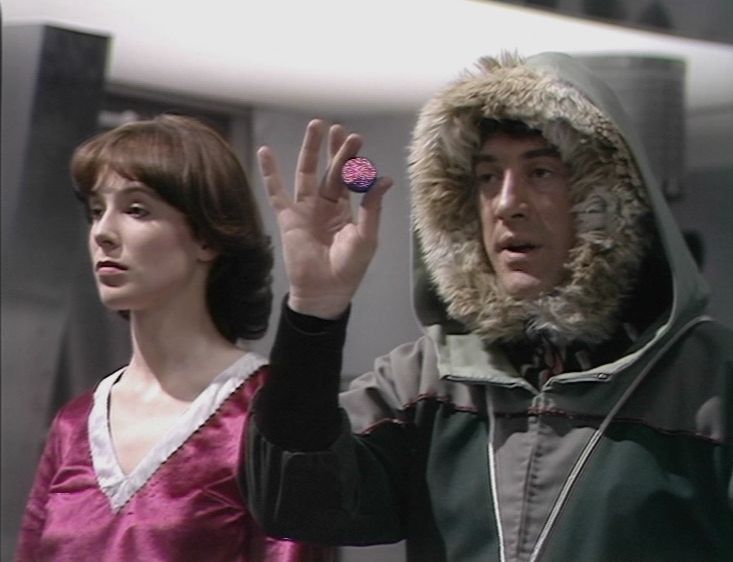
The Liberator is en-route to Aristo, to deliver medical supplies to a seriously ill man called Ensor (Derek Farr).  He isn’t the only sick person though, as Avon, Jenna, Vila and Gan all display signs of radiation poisoning following their time spent on the planet Cephlon.  Since there aren’t any anti-radiation drugs on the Liberator they have to hope that Ensor will be able to help them.  Also travelling to Aristro are Servalan and Travis, who are keen to acquire the mysterious Orac, an invention of Ensor.

Orac was the second episode of a two-part story (a unique occurrence in Blakes 7).  Rather helpfully, for the benefit of anybody who might have missed the previous installment Blake spends the first few minutes recapping the events of Deliverance to Avon (and of course the people watching at home).  This is a rather obvious device (there’s no logical point for Blake to tell Avon what he already knew) but it sort of works.

The lack of anti-radiation gloves (sorry drugs) on the Liberator is hard to swallow.  It’s the most fantastically equipped ship in the galaxy and there’s nothing suitable?  Hmm, okay.  Even odder is that they make no attempt to stop off at any other planet before visiting Ensor, which means they pin all their hopes on the possibility he’ll be able to help them.  Yes, they know that Ensor’s life is at stake, but so are theirs – you’d assume they’d put their own interests first.

Derek Farr was a very familiar face with numerous television and film appearances to his credit.  On television he had decent guest spots in the likes of Bergerac, Rumpole of the Bailey and Some Mother’s Do ‘Ave ‘Em whilst his film credits included The Dam Busters.  He also appeared with Gareth Thomas in Star Maidens, but I doubt that’s a credit either would have put at the top of their cv’s!  He’s rather good as the seemingly cranky and bad-tempered Ensor, who displays a much more human side when he realises that his son is dead.

CALLY: We went to the aid of a spacecraft that had crashed, one of the crew was already dead and the other man was dying, but before he died he asked us to get these to you.
ENSOR: Both men dead, you say?
CALLY: Yes.
ENSOR: One of them was my son.
CALLY: I’m sorry. He tried desperately to reach you. He did everything he possibly could.
ENSOR: Oh, such a waste. He had a good mind. Death is such a waste. You were with my son when he died?
CALLY: Yes.
ENSOR: It’s always too late, isn’t it? I wonder if he knew how much I loved him?
BLAKE: I think he did.
ENSOR: Oh I, I’m sorry if I snapped at you. It’s, it’s just my way. Thank you, for doing all you could to help.

Orac isn’t a story that serves either Servalan or Travis especially well.  Neither are central to the story and the sight of Jacqueline Pearce being mauled by a man in a rubber suit (one of the Phibians) isn’t one of her finest moments, although the concept of Servalan not being in control is an intriguing one.

It’s probably just as well that Greif’s role wasn’t especially large, as an accident meant he was unable to shoot the studio scenes.  A body-double was used and Greif dubbed Travis’ dialogue a few months later (though he was far from impressed with the actor they used, remarking that he had flat feet!)

Blake offers to take Ensor back to the Liberator so he can perform the operation that’ll save his life.  Travis’ arrival forces them to escape via the tunnels and Ensor dies before they reach the surface.  His death is rather perfunctory alas, but it’s necessary in story terms – since it allows Blake to take charge of Orac.

And once Orac is back on the Liberator, everybody is keen to test his limits.  They know it can draw information from any computer without a direct input (not very impressive in the modern internet age, but this was 1978, remember) but what else can it do?  Orac boasts it can effectively see into the future and demonstrates this by showing the apparent destruction of the Liberator ….

Thanks to Terry Nation, the first series of Blakes 7 had a consistent tone, although he would later admit that he found difficulties in finding ideas for some of the later stories in this first run.  So he fell back on some familiar storylines (radiation poisoning, for example) and also had to rely on Chris Boucher to take more of an active scripting role.

From series two onwards, Boucher’s voice in the series would be even stronger and he also bought on board a group of different writers (some better than others) who would take Blakes 7 into various different directions.

orac 02

Blakes 7 – Deliverance

deliverance

Approaching a planet called Cephlon, the Liberator crew comes to the aid of a stricken ship.  Avon, Jenna, Vila and Jenna teleport down to the surface to see if anybody survived the crash-landing.  Of the two-man crew, one of them, Maryatt (James Lister), is already dead, but the other, Ensor (Tony Caunter), is alive – although badly injured.

They teleport him back to the ship, but when the others realise that Jenna hasn’t returned, Avon, Vila and Gan return to look for her.  Ensor is insistent that they leave straight away (to the planet Aristo and his seriously ill father) and he forces Blake at gunpoint to comply.

This leaves the others stranded on a planet high in radiation and surrounded by distinctly unfriendly primitive types …..

Like several previous stories, Deliverance has two main plot-threads running throughout the episode.  The first, concerning Ensor and the deal he’s made with the Federation, is set up here, but won’t be concluded until the series finale, Orac.

Ensor and his father have enjoyed a long period free from Federation interference, but his father’s declining health has meant they now need to trade something to pay for the medical attention he desperately needs.  They offer the Federation Orac and in return the surgeon Maryatt travels back to Aristo with Ensor Jr.

There’s several major flaws with this.  Are we to suppose there’s no non-Federation surgeons available?  Even more ridiculous than this is Servalan’s plan.  She’s rigged Ensor’s ship with a bomb and once it detonates (killing both Ensor and Maryatt) she plans to travel to Aristo and take Orac.  Ensor Snr will be dead by then, since the medical attention he requires wouldn’t have arrived, so she foresees no difficulties.

The obvious question is why didn’t she simply detain Ensor Jr after he’d approached her.  Why go to all the trouble of allowing him to leave and with a top Federation surgeon who she needlessly sacrifices?  When she later discusses this with Travis, he expresses a twinge of conscience when he realises that Maryatt has been killed – he was the surgeon who saved his life.

Travis is more subdued in this episode, no doubt this has something to do with the loss of his command during the Project Avalon debacle.  After he enters Servalan’s office, she deliberately ignores him for a moment.

TRAVIS: You sent for me?
SERVALAN: You’ve lost some of your fire, Travis. Whatever happened to your pride?
TRAVIS: My pride, Supreme Commander?
SERVALAN: I ignored you. A calculated insult. You obviously recognised it as such.
TRAVIS: I did.
SERVALAN: And yet you remained silent. There was a time when you wouldn’t have taken an insult like that from anyone. Not even me.
TRAVIS: True. I want my command back. To get it I’ll do whatever’s necessary. If you think my silence is weakness, you mistake me.

Both Jacqueline Pearce and Stephen Greif are excellent in this scene.  Travis is more restrained and rational than we’ve previously seen – though he still has an intense desire to hunt Blake down.  Servalan’s murder of Maryatt clearly disturbs him, but he’s prepared to ignore that (and help Servalan steal Orac) if it means he’ll get his command back.  By now, hunting Blake is his sole motivation and he’ll do anything which will ultimately lead to Blake’s destruction.

As for Servalan herself, she oozes ruthless, smiling villainy in a way that would become very familiar over the next three series.  This is highlighted when she tells Travis that Maryatt will be posted as a deserter (ensuring that his family will be sold into slavery into one of the Frontier Worlds).

The second plot, on the surface of Cephlon, has its problems, mainly centered around the shambling, skin-covered primitives.  Once you’ve seen them, you know you’re in for a rocky ride – articulate conversationalists they’re not.  The most interesting game to be played when they pop up is to try and identity them, as the likes of Harry Fielder and Pat Gorman are amongst their number.

But the last fifteen minutes or so are livened up by the arrival of Meegat (Suzan Farmer).  She is convinced that Avon is an all-powerful Lord, sent from another world to aid her people.  “Counting yourself, that makes two people who think you’re wonderful” says Vila acidly.

Paul Darrow has some nice moments here.  He manages to show us that Avon is both uncomfortable and slightly flattered to be worshiped as a God.  And Avon lives up to his God-like status by reactivating a dormant spaceship, which contains genetic banks and brood units.

GAN: Do you really think we could launch that ship?
AVON: If the people who built it did their job properly, I don’t see any reason why not. And it does seem we have a reputation to live up to.
VILA: Oh, you certainly do, Lord Avon. I wonder why she picked on you?
AVON: Well, now, you are hardly the stuff that gods are made of.
VILA: And you are, I suppose?
AVON: Apparently.

On its own, Deliverance isn’t that impressive, since it’s mainly concerned with setting up the plot for the final episode (and the stand-alone part of the episode, with the grunting primitives is quite tiresome – although Meegat is some consolation).

The line about the high levels of radiation (always a favourite Terry Nation trope) on Cephlon seems to be merely a throwaway one – but we’ll see how it pays off in Orac.

Blakes 7 – Bounty

bounty 01

Sarkoff (T.P. McKenna) was formally the president of Lindor, but following a crushing election defeat he now lives a comfortable, if restrictive, existence on an unnamed planet as an effective prisoner of the Federation.  Blake and Cally attempt to persuade him that he needs to return to Lindor as he’s the only man who can unite his people and resist the Federation’s plans to invade.

But Sarkoff appears to be a broken man, haunted by his past defeats.  Eventually Blake does convince him, but when they teleport back to the Liberator they find it eerily deserted.  The ship has been captured by a number of Amagon bounty hunters, led by Tarvin (Mark Zuber), who plans to sell the crew and the ship to the Federation …..

Bounty is the first example of a Blakes 7 episode that opens “cold” – we see Cally in a forest, hiding from Federation troops, and shortly after she’s joined by Blake.  We don’t know where they are or what they’re doing – which gives us a strong hook into the story.  Previously, we’ve opened with at least several minutes exposition on the bridge of the Liberator (as in Project Avalon) before they teleport down.  The absence of this helps to move the story along a little quicker.

To be honest, this is very much an episode of two halves – the first concerns Blake’s attempts to persuade Sarkoff that he needs to return to Lindor and the second takes place on the Liberator as Blake and the others attempt to overpower the Amagons.  The first is by far the stronger, helped no end by T.P. McKenna.

McKenna was an incredibly prolific actor, with a list of credits far too numerous to mention (although his appearances as Richmond in the final series of Callan are especially good).  He’s perfect as the ex-politician who lives in comparative luxury (surrounded by various treasures from 20th Century Earth) but appears to have an inability to grasp the reality of his situation.

It’s obvious to Blake that Sarkoff is a prisoner of the Federation and that they’ll return him to his planet only after they’ve taken it over – so he can rule as a puppet President.  Sarkoff, on the other hand, tells Blake he’s merely their guest and the guards are there to prevent his assassination.  But Tyce (Carinthia West) is convinced that Sarkoff knows the truth of the situation, even if he won’t admit it.

bounty 02

But whether Sarkoff is a guest or a prisoner, he declines Blake’s invitation to return to Lindor and he tells him why.  “I’ve wasted my life listening, listening to people who are arrogant, or vacuous, or just plain vicious. I smiled and acquiesced in the face of prejudice and stupidity. I’ve tolerated mediocrity and accepted the tyranny of second-class minds. But now all that is over. I am ready to die, here among the things I value.”

Sarkoff is a spent force and even though he redeems himself at the end of the episode, the question has to be, will he ever be anything more than a figurehead?  He could very well unite his people in the short-term, but beyond that there’s the uncomfortable possibility he’ll find himself manipulated by others for their own ends.  It’s interesting that Blake latches onto Sarkoff as a unifying figure.  Later in Blakes 7 (especially in the final episode, Blake) Roj Blake himself becomes a figurehead capable of inspiring trust and loyalty in others – which is the reason why Avon attempts to find him again.

Whilst I like Bounty (mainly for McKenna’s performance) it’s fairly sloppily scripted.  Firstly, Sarkoff is guarded by very inept Federation troops.  Although they know that at least two intruders are at large, they don’t exactly leap into action (and one of them also misses the fairly obvious sight of Cally climbing a wall and pulling a rope up behind her!).  It’s also baffling that none of them decide it might be a good idea to check on Sarkoff – thus allowing Blake plenty of time to win him round.  Added to this, the actor (Mark York) playing the guard commander is, shall we say, not terribly impressive.

Whilst Blake and Cally are down on the surface, the others discover a ship which seems to be in distress.  You’d have thought that by now (especially after the events of Time Squad) they’d be rather cautious – but instead they just blunder straight into the trap.  Gan teleports over and a few minutes later we hear him report back that everything’s fine.  It’s clear that something’s not right – he’s talking in a slightly strange, emotionless way – but nobody twigs.  And by the time they do, it’s too late and the Amagons (all three or four of them) have taken over the ship.

It’s difficult to take them seriously, mainly because of their exotic clothing.  Mark Zuber does do his best though and Tarvin’s past relationship with Jenna is an intriguing touch – as it allows her a reason to apparently change sides.  Had this been earlier in the series, her shifting allegiance might have been more believable, but it’s not really a surprise that she hasn’t really betrayed her friends.

An interesting part of Bounty is that it shows us that Blake does have some purpose.  So far in his fight against the Federation, he’s actually done very little – destroying the transceiver complex on Saurian Major (which seemed to have little effect) and stealing the Federation’s cypher machine (which was detected almost immediately) have been his main achievements.  But although they weren’t able to get a great deal of useful material from the cypher machine before the Federation changed the code, at least they managed to learn about the Federation’s plans for Lindor, which initiated Blake’s visit.  In the general scheme of things, helping to keep one planet out of the Federation’s clutches is still pretty small beer, but it’s a step in the right direction.

Apart from McKenna, another noteworthy appearance comes from Carinthia West as Tyce.  Late on, it’s revealed that Sarkoff is her father – prior to this, the exact nature of their relationship (older man, younger woman) was open to other interpretations.  Tyce operates as her father’s conscience and there’s good reason to suppose that she’ll be as important, if not more so, than Sarkoff himself when the new government on Lindor is established.

One odd moment occurs after Blake, Cally, Sarkoff and Tyce teleport back to the ship.  Blake and Cally are captured and locked up with Avon, Gan and Vila, whilst Sarkoff and Tyce are allowed to remain on the flight-deck with Tarvin.  What’s strange is that despite all the commotion, Tyce is able to change her top and hairstyle!

Thanks to T.P. McKenna (and some nice banter between the regulars) Bounty is a decent watch.

bounty 03

Blakes 7 – Breakdown

breakdown 01

Gan’s limiter has malfunctioned and it’s turned him into an uncontrollable psychopath.  Although Blake and the others manage to subdue and sedate him, it’s obvious that he needs urgent medical attention.  After reviewing the various options, Avon mentions to Blake that the nearest facility, XK-72, would be ideal.

Zen refuses to take the Liberator on a direct course (due to unspecified dangers) so Jenna has to pilot the ship without computer assistance in a desperate race against timeBut although they eventually reach their destination, can they they trust the brilliant surgeon Kayn (Julian Glover)?

Poor Gan.  Always something of a third wheel, even this episode (in which he ostensibly takes centre-stage) doesn’t really do him any favours.  The main problem was that he was just too nice and affable.  Blakes 7 thrived on character conflict – you could take any two from the remainder of the crew (Blake, Avon, Vila, Jenna, Cally) and instantly an interesting dynamic would be created.  For example, Blake/Avon, Avon/Vila, Vila/Jenna, Cally/Blake, etc.  But teaming Gan up with anyone else never worked nearly as well because of his status as a friendly everyman.  True, there was a slight edge between him and Avon, but then Avon disliked everybody!

And whilst the others were defined partly by their skills (Blake the organiser, Avon the computer expert, Vila the locksmith, Jenna the pilot, Cally the telepath) Gan had little to offer apart from his strength.  So he was fated to remain a background player, constantly overlooked in favour of the other, more dynamic, crew-members.

It’s therefore ironic that Breakdown – the one episode in which his problems are the main part of the story – doesn’t allow him a great deal of effective screen-time either – he spends the majority of it either unconscious or in a mad rage.  So basically Gan just becomes a piece of malfunctioning machinery which Blake and the others need to fix.

Having said that, he does have one good scene.  Gan is under restraint in the Medical Room (both for his own safety as well as the safety of the others).  Although the limiter is causing him extreme pain, he’s still devious enough to pretend that he’s fine.

CALLY: How are you feeling?
GAN: Tired. Very tired. What’s been happening?
CALLY: You were ill. We’re trying to get to a place where you can receive medical treatment.
GAN: I’m all right. Just that I, I can’t remember. Why am I being held down like this?
CALLY: When the pain was too much for you, you became violent, and we were frightened you might harm yourself.
GAN: I’m sorry, I just can’t remember. I’d like to sit up. Help me, will you, Cally?
CALLY: I think you should stay where you are until we can get help.
GAN: I’m all right. A bit uncomfortable. I’d like to sit up.
CALLY: There is some turbulence. You’re safer where you are.

But Cally does release him and by way of thanks he throttles her.  Although brief, it’s a disturbing moment – not only for the visual image, but also for the questions it raises.  We know that Gan was a convicted murderer – but was that a one-off crime or is the malfunctioning limiter now showing us his true nature?  This would have been a fruitful area to explore in a future story, but alas it was never exploited.

Gan’s opening fight with Blake is good fun and it’s also quite noteworthy as director Vere Lorrimer chooses to shoot it with a hand-held camera.  This style of shooting is commonplace now, but at the time it was quite rare.  It helps to add a little punch to what is otherwise a fairly static episode (that’s unavoidable since the majority of it takes place on the Liberator).

Breakdown was clearly written as a budget-saving show.  Apart from the regular Liberator set, we only see a small office on XK-72 (which looks like Servalan’s office, redressed) and there’s just three guest actors.  But it’s a great consolation that one of them is Julian Glover.  Glover is someone who seems incapable of giving a bad performance and his presence helps to boost the second part of the episode considerably.

Before they reach XK-72, they have to brave the terrors of the unknown.  This is a fairly blatant plot device to slow their journey down and if it works at all it’s because the regulars convince us that they’re in danger.  Although this section of the story does drag a little, there’s the odd dialogue gem, such as –

AVON: Blake, in the unlikely event that we survive this …..
BLAKE: Yes?
AVON: I’m finished. Staying with you requires a degree of stupidity of which I no longer feel capable.
BLAKE: Now you’re just being modest.

The other interesting part of Breakdown is the way in which it shows us where Avon’s loyalties lie.  Blake and Avon discuss various likely places that could treat Gan.  Avon dismisses one and tells Blake that because it’s six hundred hours away “you haven’t anything like that much time.”  It’s a moment that goes unremarked, but the fact Avon says “you” and not “we” helps to highlight that he still sees himself as an outsider – Gan is Blake’s problem, not his.

Later, his loyalty is put to the test when he considers leaving the Liberator and remaining on XK-72.  Whilst visiting the facility, he’s told that Federation pursuit ships are on their way.  He knows he could stay in safety on XK-72 but decides to go back and warn the others.  When he returns he also backs up Vila who’s persuading the reluctant Kayn to begin his operation on Gan (Kayn is the one who’s called for the Federation and earlier declared he had no intention of operating).  Avon’s decision to return to the ship is a key moment, but it’s another character beat that’s underplayed – he’s the only one who knows he had a chance to escape and it’s obvious he won’t share this information with the others.

The operation succeeds, but the bad shooting of the Federation pursuit ships has serious consequences for XK-72 (“say goodbye to one bolt hole” remarks Avon).  Minus points for the final scene featuring all the Liberator crew having a good laugh – partly because these endings are reminiscent of Star Trek (Spock and McCoy clashing, whilst Kirk looks on with a grin) but mostly because it seems a little off, especially since XK-72 is now a smouldering ruin.

breakdown 02

Blakes 7 – Project Avalon

avalon 01

The Liberator has travelled to an icy, inhospitable planet in order for Blake to make contact with the resistance leader Avalon (Julia Vidler).  Avalon has started resistance movements on a dozen Federation planets and has requested Blake’s help in relocating somewhere safer.

Blake is keen to assist, but when he and Jenna teleport down they find a scene of devastation – clearly the Federation has beaten them to it.  Avalon isn’t amongst the dead though – they learn from the sole survivor, Chevner (David Bailie), that she’s been captured.  So Blake sets out to rescue her, not realising he’s fallen into Travis’ trap …..

Time has obviously moved on since the events of Seek Locate Destroy and Duel and it’s interesting to note how the Federation’s plans have changed.  In Seek Locate Destroy, the apprehension of Blake was their main objective – now it appears that capturing the Liberator is just as important, if not more so.

The notion that there’s been some unseen adventures between Blake and Travis is confirmed when he bitterly mentions to Servalan he’s twice had the chance to destroy Blake, but it would have meant destroying the Liberator as well, so he was forced to disengage.  Servalan concedes this, but in an early display of the same needling relationship they’d enjoy from now on, tells him that whilst she’s defended him, he needs to capture Blake soon or he’ll be replaced (and no doubt his life will be forfeit).

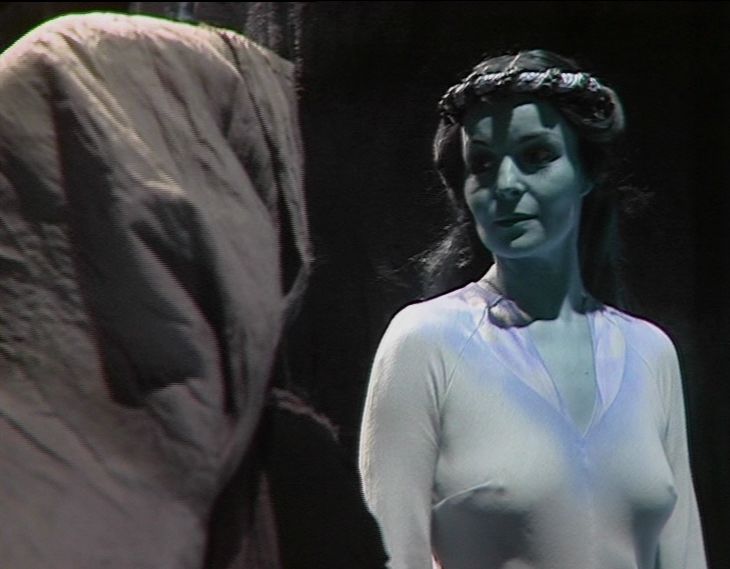
It’s clearly meant to be a surprise that Avalon is female – a mere girl leading a resistance cell! – and this is reinforced by Dudley Simpson’s tinkling piano just before she’s captured by Travis.  Once she’s in his power, she’s reduced to her underwear and strapped into a very uncomfortable-looking machine for a purpose which only becomes clear later on.  Whilst it’s no surprise for a female character to become an objectified figure in a late 1970’s British science fiction series (or indeed any series of this era) it’s still slightly eye-opening.  When Blake found himself in a similar machine, his modesty was rather better preserved!

Whilst Avalon is helpless, Travis tells her that she should be flattered to receive such “special” attention.  She replies that “anyone who opposes the Federation knows what to expect if they get captured. It’s a risk we’re all prepared to take.” It’s a difficult line to deliver and it’s fair to say that Julia Vidler does struggle somewhat in depicting the idealistic young rebel (her delivery tends to stay on something of a monotone).  It’s probably a blessing that later she reappears as an emotionless android – she manages to play this rather more convincingly.

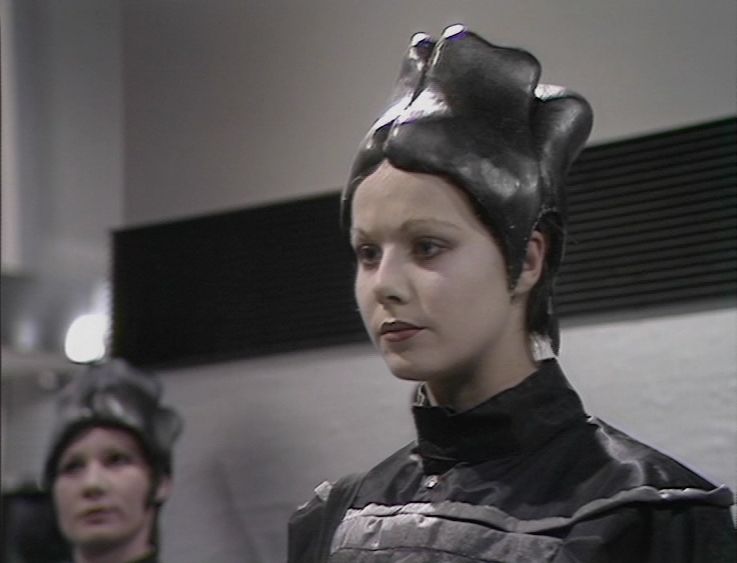
Rather more engaging is Glynis Barber as this week’s Mutoid sidekick.  I’m not sure whether it’s as scripted, or just her performance choice, but Barber’s considerably more assured and confident than Carol Royle’s Mutoid in Duel was.  This works very well –  as she operates more as an equal with Travis in the early part of the episode, rather than living in his shadow.

Director Michael E. Briant had previously filmed in Wookey Hole for the 1975 Doctor Who story Revenge of the Cybermen.  Although the caves are a lot smaller than you might think, it’s still a very good location and makes a nice change from Blakes 7′s default locations (quarries, refineries, nuclear power plants, etc).   This wasn’t the only link to Briant’s previous work on Doctor Who as he cast David Bailie (who had appeared in The Robots of Death) as the doomed Chevner.

Alas, the silly looking robot pops up again.  His first scene is priceless – since he speeds along a such a lick it’s obvious he’s being wheeled on a board.  Indeed, if you freeze frame, there’s a tell-tale flash of the board to confirm this!  Like the Daleks and K9, he was clearly a robot with serious mobility issues.

Gan’s very taken with Avalon (or at least what appears to be Avalon).  His hero-worship (if that’s what it is) does allow David Jackson an entertaining scene towards the end of the episode.  Once it’s become clear that Avalon isn’t all she appears to be, Gan attempts to strangle her – but Avalon’s super-human strength stops him.  I wonder why the limiter didn’t prevent him from hurting her?  Is his implant so clever that it knows what appeared to be Avalon was only an android or is it just a case of selective scripting?

It may come as no surprise to learn that Travis’ rather elaborate plan doesn’t succeed and he finds himself, for the first time but certainly not the last, relieved of his command.  His closing words are a none too subtle hint that he may be down but he’s far from out. “If it takes all my life, I will destroy you, Blake. I will destroy you. I will destroy you.”

avalon 02

Minder – It’s a Sorry Lorry Morrie

morrie

Following George Cole’s recent death, I had a hankering to watch some episodes of Minder as a tribute.  In the end I plumped for the seventh series – which for me is one of Minder‘s strongest runs.

Although the earlier episodes are grittier, there’s something rather appealing about these six episodes (broadcast in early 1989).  Partly, it’s the quality guest stars – Minder had always attracted decent casts, but there seems to be even more familiar faces in these episodes (Roy Kinnear and Ronald Fraser in this one and the likes of Brian Blessed and Ian McShane later on).

Some people though, especially Dennis Waterman, had decided that Minder had become too comedic and had lost its edge (which was the reason he decided to leave at the end of this series).  I personally disagree, but although Minder carried on for several more years the departure of Waterman was the clear end of an era.

One notable aspect of It’s a Sorry Lorrie Morrie is the gentle highlighting of Waterman’s advancing years.  Terry has always famously been a bird magnet, but when he attempts to chat up a young woman in the launderette he gets short shrift – she tells him he reminds her of her father!  It’s got nothing to do with the plot, it’s just a nice character moment that acknowledges his advancing years.

The plot’s quite simple – Arthur buys a job-lot of electrical goods from Morrie (James Marcus).  Terry picks them up and drops them off at Arthur’s new car-site.  Of course, the goods are stolen and the police stake the van out – waiting for the criminals to return.  Terry’s prints are all over the cab, so he faces a lengthy stretch inside.

But the joy of Minder isn’t the plot, it’s the interactions of the characters.  George Cole’s on fine form as the temporarily world-weary Arthur, who’s persuaded by the eager young Justin (Mark Farmer) to make a deal with Morrie.  Justin is Arthur Daley’s number one fan – for reasons never quite explained – and he mistakenly thinks he’s doing Arthur a favour by introducing him to Morrie.

Ronald Fraser is perfectly cast as the booze-soddled Self-Inflicted Sid.  Sid is a pathetic character – someone who hangs around the fringes of the criminal fraternity, hoping to be accepted.  He looks pretty mean, thanks to a large scar down the side of his face, although Arthur tells Justin that Sid did the damage himself (with a razor) in the hope it would make him more acceptable to the criminals he wanted to emulate.

Although the tone of the episode is quite light, there’s a dark moment when Arthur asks Sid to torch the van under the noses of the watching police.  If the van is torched, then Terry’s fingerprints are destroyed and he’s off the hook.  Arthur has no compunction in manipulating Sid, especially since he knows that Sid will do anything he’s asked, but Terry does have a moment of conscience.  But the moment passes, and Sid sets off to do the deed.

Chisholm (Patrick Malahide) departed during the 1988 Christmas special, An Officer and a Car Salesman, so DS Rycott (Peter Childs) is now the senior officer tasked with making Arthur’s life a misery – although DS Jones (Mark Povey) has stepped out of Chisolm’s shadow and is quite keen to make Rycott’s life a mystery too.

Peter Childs’ performances during series seven are another reason why these episodes are so enjoyable.  Sadly. they would be his last appearances as Rycott, as he died in late 1989 at the age of just fifty.  Later series of Minder would feature various actors in the police roles (including a young Stephen Tompkinson) but none had the comic chops of Childs.

The best moment comes when Arthur and the others drive round to see how many police are staking out the van.  Arthur’s in the back of another van and he pops his head up to look out the back window – straight into Rycott’s unbelieving face!  It’s clearly signposted before it happens, but that makes the moment even better – between Cole’s shocked expression and Childs’ unbelieving stare, it’s comedy gold.  Luckily for Arthur, Rycott passes it off as an hallucination!

Another interesting touch is that although Morrie swindles Arthur out of five thousand pounds for a van-load of goods that he’s had to destroy, Morrie isn’t forced to pay the money back.  Arthur does make a little money (thanks to another of Justin’s schemes) but Morrie walks away.  This might be a hint that Terry’s days as a top-line minder are coming to an end.

Morrie has some imposing muscle (including a pre-Eastenders Steve McFadden) and although Terry throws a few punches, he’s persuaded to walk away.  Maybe it was felt it wouldn’t be realistic for Waterman to beat two much younger men, and this might have been another reason why Waterman decided to leave the series.

All this and Roy Kinnear’s last small screen appearance as well – It’s a Sorry Lorry Morrie is a cracking episode.

Blakes 7 – Duel

duel 01

Round two of the battle between Blake and Travis is interrupted by two mysterious and powerful characters – Sinofar (Isla Blair) and Giroc (Patsy Smart).  Both Blake and Travis are ordered by Sinofar to fight to the death.  Blake isn’t keen – he has no desire to fight for anybody’s amusement – but there’s no alternative. Sinofar also tells them that whilst half the lesson they will learn concerns the death of an enemy, the other relates to the death of a friend.

Blake is given Jenna as a companion, whilst the friendless Travis is accompanied by one of his Mutoid subordinates (played by Carol Royle).  The rest of the Liberator crew watch on helpless as Blake and Travis duel.  The question is, can Blake kill in cold blood?

This has always been a favourite episode of mine and one of the chief reasons is Douglas Camfield’s direction.  Camfield had, by this time, directed more episodes of Doctor Who than anybody else, as well as a host of other series (including The Sweeney).

He’d gained a well deserved reputation as an excellent director of action (so it’s no surprise that the fight scene in Duel is well staged) but he was also someone who looked to make all of his shots as visually interesting as possible. There’s some good examples in this episode – such as the early scenes on the barren planet of Sinofar and Giroc (it’s something of a challenge to make it look other than it is – a small studio set – but some tight camera angles and lighting effects help to create the illusion of space and depth).

Another major difference with Duel is the lack of Dudley Simpson’s music.  After a falling-out at a party in the mid sixties Camfield had declined to use Simpson from then on, so here the music is drawn from stock.  And much as I love Simpson, it really works to the benefit of the story – indeed, more variety with the composers during Blakes 7‘s run would have been very welcome.

Although the duel between Blake and Travis is the centre of the episode, it takes a while before we reach that point.  Before then, there’s an extended battle between the Liberator and Travis’ fleet of ships.  All of Travis’ crew are Mutoids – emotionless alien creatures who depend on blood for their survival.  They are also highly efficient and this is one of the reasons why Travis is able to bring the Liberator to the brink of defeat.  Blake decides there’s nothing left to do but ram Travis’ ship – but before he can carry out this potentially risky manovure, both he and Travis find themselves plucked off their respective ships.  Sinofar and Giroc explain why and what will happen to them.

duel 02

SINOFAR: Our powers grew out of a thousand years of war, out of hate, and fear and the will to survive.
GIROC: We built destruction, weapons that your peoples have not yet dreamed of. Every passing year brought new ways to kill, and throughout the centuries the war raged across our planet.
SINOFAR: With each generation there were fewer of us. The dead vastly outnumbered the living. There was not victory for either side.
BLAKE: How did it end?
GIROC: How? Another development of another weapon. We demanded their surrender, they refused, the weapon was used. Those that we call our enemy were annihilated. TRAVIS: You won, that’s all that matters.
SINOFAR: It wasn’t a victory, only the end of the war. We were left with a planet made barren by radiation. Our children were monsters, or died, or were never born. This, we won.
BLAKE: How many of you are there now?
GIROC: None. We are a dead race.

Isla Blair and Patsy Smart are both impressive – Blair is calm, whilst Smart is mischievous.  True, their main function is to provide a large infodump mid-episode, but there’s a certain poetry to their tale of a dead world.  It’s not an original concept, but in an era when the threat of nuclear attack was still an ever-present concern it must have carried a certain resonance.  Terry Nation had form for this of course (such as the first Dalek story, set on the radiation-soaked planet of Skaro).

After the fairly routine previous episode, Mission to Destiny, Duel is a major step up – especially when it comes to the dialogue.  There’s plenty of memorable lines to be found and one of my favourite exchanges is this one aboard the Liberator.  The others are able to watch Blake and Jenna but can’t do anything to help.  When Avon gets up, Vila asks him if he’s thought of a plan.

AVON: Yes. I’m going to get some sleep.
VILA: How can you sleep with all this happening?
AVON: With all what happening? Blake is sitting up in a tree, Travis is sitting up in another tree. Unless they’re planning to throw nuts at one another, I don’t see much of a fight developing before it gets light.
GAN: You’re never involved, are you Avon? You ever cared for anyone?
VILA: Except yourself?
AVON: I have never understood why it should be necessary to become irrational in order to prove that you care, or, indeed, why it should be necessary to prove it at all.
VILA: Was that an insult or did I miss something?
CALLY (smiling): You missed something.

The next day, Blake and Travis continue to hunt each other down.  Eventually, Blake has Travis at his mercy and prepares to strike the killing blow.  Gan, Cally and Vila (like us, acting as the audience) urge him on, but Avon spots Blake’s hesitation and in another lovely character moment, smiles.  Does he regard Blake’s inability to kill as a strength or a weakness?

Although Blake didn’t kill Travis, he’s won the contest and when he admits that one of the reasons he didn’t kill him was because he would have enjoyed it too much, Sinofar concedes that maybe there’s not a great deal for him to learn.  Duel is very much a vehicle for Gareth Thomas and Stephen Greif, although Paul Darrow does have some good moments, even though he’s absent from the main narrative.

Travis and Servalan tended to be joined at the hip rather, but this episode indicates that he works best on his own – too often Servalan just seems to be there to berate his bungling after he’s left slip another chance to catch Blake (which can’t do anything but seriously weaken his character). The next episode, Project Avalon, is another strong Travis tale – but it would have probably been wise to retire the character after that.  Alas they didn’t, so it’ll be a case of diminishing returns from then on.

duel 03

Blakes 7 – Mission to Destiny

destiny

The Liberator’s sensors pick up a ship, Ortega, which is drifting in a circular pattern.  After getting no response from their hailing call, Blake, Avon and Cally teleport over to investigate.  They find the entire crew unconscious, incapacitated by a tranquilising gas called Sono Vapour.  Once roused, Blake and the others question the crew.

Dr Kendall (Barry Jackson) believes that somebody is attempting to steal an energy refactor which they are taking back to their planet, Destiny.  Destiny depends on agriculture for its survival and has been hit hard by a fungal disease.  The energy refactor will eliminate this problem, but without it Destiny is doomed.

The sabotage aboard the ship means that they won’t reach home for five months, so Blake offers to take the refactor in the Liberator (this will only take four days).  The crew agree and Avon and Cally remain behind as hostages.  As the Ortega slowly drifts along, there is another death – and Avon finds himself in the unfamiliar role of detective as he unravels the mystery ….

Nobody’s favourite story, Mission from Destiny is a rather dull murder-mystery.  It does boast a decent supporting cast though – Barry Jackson, Stephen Tate, Beth Morris, John Leeson, Brian Capron, Nigel Humphreys, Carl Forgione, Kate Coleridge – most of whom are familiar television faces.  The problem is that most of their characters are only sketchily drawn, so it’s hard to invest a great deal of interest in their fate.

This week’s plot contrivance, which keeps the Liberator crew involved in the plot, is the MacGuffin-like energy refactor.  Without it, it’s hard to imagine Avon sticking around (he admits that “I don’t care if their whole planet turns into a mushroom”).  Although in the next breath he does tell Cally he’s staying because he doesn’t like an unsolved mystery.  This is rather uncharacteristic – until now, Avon has appeared to be motivated mainly by self interest.

Whatever the reason, Avon and Cally begin to investigate the crew.  It’s the first time that Avon and Cally have teamed up and Darrow and Chappell’s interaction helps to lift the episode.  There aren’t that many quotable lines in the story, but I do like this short exchange –

CALLY: My people have a saying, a man who trusts can never be betrayed, only mistaken.
AVON: Life expectancy must be fairly short among your people.

Avon also gets to demonstrate the special way he has with women, when he punches Sara, played by Beth Morris.  “You’d better get her out of here, I really rather enjoyed that.”

Despite the strong supporting cast, most of the performances are perfunctory at best.  Nigel Humphreys and Stephen Tate spend most of the time skulking around in a suspicious manner, John Leeson appears to be friendly and helpful, Beth Morris is hysterical and tearful, whilst the others don’t seem to have any particular personalities at all.

Mission to Destiny reuses the spaceship set from Space Fall, suitably redressed, so it was obviously planned as one of the cheaper series one episodes.  It’s therefore odd that some of the interiors were shot on film at Ealing.  This would be understandable if there were explosions or other effects, but there’s nothing of this type – so it seems an unnecessary expense.

I noted that in The Way Back that Dudley Simpson’s music was on the sparse side, but that’s not an observation that can be made of this episode’s score.  Like most of Simpson’s work on Doctor Who and Blakes 7 around this period, it’s very much a case of Dudley’s Greatest Hits.  Many of the cues are very familiar (it has more than a hint of Spearhead from Space, for example), but since there’s stretches where not much of interest occurs on screen, playing spot the cue does help to pass the time.

Somewhat of a filler episode then, particularly since it’s sandwiched between two key Blake/Travis showdowns.