Howards’ Way – Series Four, Episode Three

howards s04e03-01

Jan’s not a happy bunny.  Sir Edward announcing their engagement without asking her was annoying enough, but it’s the continuing problems with the stolen designs that’s really ramping up the pressure.  It’s made the newspapers (complete with the most unflattering picture of Jan ever) which is one of the reasons why she’s somewhat flaky today (because it’s in the papers I mean, not because the picture of her isn’t terribly good).

Tom’s installed a new computer at the Mermaid.  It’s pretty advanced – able to communicate with other computers up and down the country – but it’s only the first step in Tom’s America’s Cup plans.  He’s also ramping up the security at the yard (including an alarm system linked to the local police station).  Has Tom spoken to Jack first?  Of course not.  And what do you imagine Jack’s reaction will be?  Yes, that’s right, he goes through the roof.  Jack might be highly predictable, but that’s part of the fun.

Jack storms off and gets very drunk.  His later reappearance at the Mermaid, late at night, triggers off the new alarm which results in the police arriving.  Tom and Emma arrive just in time to see him being poured into a squad car.   Rather wonderfully he croons “I just called to say I love you” at them before disappearing.  It’s another of those hardy Howards’ Way perennials – Jack staggering around drunk – but it never fails to entertain.

When Jack’s not legless, he’s eyeing up one of his old boats, now owned by a man called Harry Sellers (Conrad Phillips).  Jack later buys the boat – The Grecian Lady – off Harry.

Abby and Charles meet.  He’s still a changed man, uninterested in business and happy to help Abby any way he can.  He’s aware that Sir Edward is also attempting to assist her with her battle to regain custody of William, but knows that his father has ulterior motives (whereas Charles seems only to want what’s best for Abby).  But for the moment Abby is content to remain with Sir Edward and doesn’t particularly want to get to know Charles any better.  Charles doesn’t seem to mind though, he’s content to wait ….

Leo and Abby have an argument.  He’s convinced that she’s simply using people (Sir Edward especially) in order to win custody of William.  She reacts angrily to this, taunting Leo that his life is an empty one (consisting of racing powerboats and little more).  They laugh and make up after this, but later Leo – with Sarah and Abby watching on – goes hell for leather when testing the powerboat.

And then the throttle jams, so Leo seems set on a one-way collision course with some very large rocks.  Eek!  For Sarah, looking on, there’s no doubt a nasty flashback to her husband’s death.  With the incidental music ramping up, things look sticky for a few seconds but then the throttle unsticks itself and all is well.  This moment serves as an indication that Leo’s thought processes might be a little cloudy at present – was it simply an accident, or was he racing with something to prove?

Ken and the cigarette-toting Antonia continue to scheme.  He’s keen to weaken Jan’s business so that he can buy back into it (“you’re going to need me soon, my darling, I’m going to make very sure of that”).  He and Antonia also frolic in the pool (at different times though).

The next day, the pair decide to have a canoodle in one of the Leisure Cruise boats.  With screaming inevitability Sarah stumbles across them.  She’s already spent the rest of the episode with a disapproving expression painted across her face – partly at Ken and partly at Leo’s reckless attitude on the water – and this latest escapade of Ken’s only serves to irritate her even more.  But she’s far too well-bred to make a scene, she simply proclaims that from now they operate on a strictly business level, before exiting.

Sir John is keen to join forces with Gerald and – joy of joys – Ken approaches both of them with a new business venture.  Oil.  You wouldn’t have thought that the coastline was full of oil, but Ken is convinced.  Is Howards’ Way going to turn into Dallas?  This is such a bonkers idea (any scheme that Ken Masters thinks is a sure fire hit has to be approached with caution) that I can’t wait to see how it turns out.

Having previously restricted her scheming purely for her numerous extra-martial affairs, Polly’s now demonstrating that she’s got a keen eye for a business chance.  She continues to be desperate to pour her money into Jan’s business (and has visions of taking it over completely in due course – after all, once Jan and Sir Edward marry, surely he won’t allow her to work?).  But Jan, despite the fact her back’s right up against the wall, tells Polly and Kate that she intends to stand and fight.  The disappointment on Polly’s face is palpable.

Jack drops a bombshell.  He’s quitting the Mermaid Yard with immediate effect.  This is Jack Rolfe remember, a man who’s consistently inconsistent, so it’s hard to believe him – even when he sets sail in The Grecian Lady, seemingly content never to darken the Mermaid’s door again.  I’ll give him an episode before he comes back (two at the most).
howards s04e03-02


Howards’ Way – Series Four, Episode Two

howards s04e02-01

Last time we were left on a dramatic cliffhanger – would Avril live or die? That question is resolved rather speedily at the start of this episode as she opens her eyes and we’re told that she’ll make a full recovery.  This can’t help but feel like something of a let-down (if you’re going to ramp up the tension then it’s rather a cheat to let it dissipate so quickly) but we do later learn that Avril’s suffering from periodic memory blackouts, so it may be that her road to recovery won’t quite be as straightforward as it first appeared.

Jan’s still fretting about her stolen designs, worried they could be on their way to Taiwan by now (and then later appearing on a market stall near you).  She’s pinning her hopes on getting the chain-smoking Antonia Rogers (Annie Lambert) to buy her some time by stalling the distributors.

Antonia is a hoot. I love the fact that she’s organising a fashion show in what appears to be the foyer of a posh office block.  No catwalk for her models then, instead some are traipsing up and down the stairs whilst two unfortunate girls have to attempt to walk a few paces within the confines of a cramped lift.  Well, it’s certainly different.  A pity that Antonia only appears in this episode and the next.

Jan’s mulling over who could have tipped the crooks off.  Only a handful of people knew – Kate and Polly, for example.  It’s hard to imagine sensible Kate as a hard-bitten criminal but Polly … hmm.  Polly’s very keen to inject some of her capital into the business, making it’s plain that just running a boutique won’t satisfy her requirements, she wants a piece of the action as well.

Whilst Jan’s on something of a downward professional curve at present, the Urquharts are on the up and up.  Polly’s new job is one of the reasons why – and this new-found independence may explain why for the first time she’s been able to connect with Abby.  But there’s more to their new-found relationship than that.  Abby’s grown up since she’s been away and – also for the first time – has come to understand precisely how much work is involved in rearing a child (it’s easy to believe that Abby wasn’t the most docile of babies).  But given that this is HW, one shouldn’t be too surprised if the current air of détente doesn’t last too long ….

Shock news!  Charles announces at a press conference that he’s resigning as Chief Executive of Frere Holdings with immediate effect and has appointed Gerald as his replacement.  As we saw last time, the accident has deeply affected him and he’s come to realise that business is not the most important thing in his life (slightly hard to believe, but never mind).  He wants to spend more time with Avril and the daughter (Abby) he’s only just realised he has.

That won’t be easy though, as Abby’s ensconced with Sir Edward and he’s attempting to prevent her from contacting his son.  This episode there’s much less of the contrite Sir Edward and a good deal more of the ruthless tycoon.  This is also demonstrated when he discusses his possible forthcoming marriage to Jan.  Sir John tells him that financially (if not personally) he’ll be fine in the event of a divorce, provided Jan signs the appropriate pre-nuptial papers.  The way that Sir Edward confidently tells him that this won’t be a problem is a telling one – Sir Edward always gets what he wants, so why should this be any different?

Sir Edward’s tentacles are beginning to spread.  He’s behind the consortium designing a boat for the America’s Cup and Tom is delighted to accept a place on the team.  Emma, his current squeeze, will be his assistant, although Jack’s not happy.  Howards Way wouldn’t be Howards Way if Jack wasn’t sulking about something, so it’s reassuring to know that things are back to normal.  He’s concerned that Tom’s involvement in the America’s Cup will have a negative impact on the Mermaid whilst he’s never taken to Emma and her computers.  Expect sparks to fly in the traditional manner.

Sarah and Sir Edward have a meeting.  She’s been less than thrilled about Ken’s attitude of late (he rarely seems to consult her before plunging ahead with his schemes) so wants Sir Edward – who organised a bridging loan for Leisure Cruise – to clip his wings.  Sarah tries to spice things up by telling Sir Edward that Ken is still interested in Jan.  This is another of those layered plotlines which is simmering away nicely.

Amanda might be long gone, but her father’s still around.  Given that he was never keen for Leo to marry his daughter in the first place it seems a little unlikely that now he’d have so dramatically reversed his opinion – offering Leo a tidy sum if they get back together.  Leo’s not interested and eventually Mr Parker seems to get the picture.

Leo’s not downhearted at the thought of his failed marriage for long though as he and Ken head out for a spot of powerboat racing.  Leo’s thinking of a career change – rather than selling boats he wants to race them.  Whatever happened to the young lad who was so keen on the environment and righting wrongs?  Ken and Leo do look rather sweet in their matching overalls though.

Jan and Tom have a candlelit dinner.  As with most of their meetings since their divorce, it’s a polite and respectful affair.  Tom gently tells her that she doesn’t need his blessing to marry Sir Edward but Jan responds that she’d still like it.  These days Tom is understanding and kindness personified.

If episode one’s cliffhanger turned out to be something of a damp squib, then this one is much more promising.  Ken meets up with Antonia, who confirms that Jan’s in serious trouble and once Antonia (on Ken’s urging) leaks the news to the international press then her problems will only intensify.  “I want Jan Howard to be taught a very expensive lesson, Antonia, one she’ll never forget”.

Even this early on, things are shaping up nicely – especially when Sir Edward introduces Jan as his future wife.  Just a pity she hasn’t said yes yet ….

howards s04e02-02.jpg

Howards Way – Series Four, Episode One

howards s04e01-01

For those who hadn’t seen – or had forgotten – the series three finale, there’s a helpful recap here as a news report brings us back up to speed.  Charles and Avril are feared lost at sea, somewhere off the coast of Ireland.  Stock footage of Royal Navy ships is intercut with shots of a reporter called Andrew Chater (Michael Walker), clutching a very large microphone and advancing towards the camera in a slightly menacing fashion.

The opening few minutes are film heavy as we cut from the over-enthusiastic reporter to Sir Edward at Highfield (being comforted by Jan) and then to Gerald, who finds himself doorstepped by a whole posse of reporters.  Some of them are quite well dressed (one’s even wearing a black bow tie).  And though it’s obviously sad that Charles and Avril are missing, they seem more interested in the stability of Frere Holdings, given Charles’ absence.

Jack is barely holding himself together.  Eyeing a portrait of Avril on his office desk, he refuses to move (despite the entreaties of both Tom and Kate) until he receives news.

Not everybody’s paralysed by grief though.  Ken is quite chipper, organising a photoshoot for a sales brochure (this involves cheesy music and a swimsuit clad model, who he delights in, ahem, touching up).  “That’s it! That’s better. Beautiful!” Ken beams, as he unzips her just a fraction more.  Good old Ken.

He’s also not adverse to scooping up some business which might have gone Relton’s way, but now – due to the uncertainty surrounding the company’s stability – now lands in his lap.  “I’m very sorry for them, but … life has to go on”.  Ken Masters = heartless.

Leo and Sarah later discuss him.  “He’s got a taste for success and is hungry for more and he’ll use you, me, anyone to get it. Just wait and see” she says.  Oh good, I think we’re going to have some fun with Ken this year.

He continues to sniff around Jan, although she remains cool.  Is it me, or does Ken sound slightly different during this scene?  Less rough and tumble and more refined.  Is Kenneth attempting to assimilate himself with his social betters by mimicking them?

The series clearly had a fairly decent budget by this point as they were able to afford hiring a rescue helicopter.  It’s possibly a little surprising that Charles and Avril are found so quickly (some ten minutes in) but their exact conditions aren’t clear at first (only that Avril is unconscious) so there’s still there’s still a lingering sense of uncertainty for a while.  Given Jack’s face (Glyn Owen was always so expressive) I hope he receives good news soon, otherwise I can foresee him keeling over.

Oh dear.  Avril’s sustained head injuries and is still unconscious.  With the constant beeping of the life support machine, Jack holds onto her hand and hopes for the best.  It’s better news about Charles as he’s young and strong and so should make a full recovery, but Sir Edward is still melancholy.  He confides to Jan that he was never much of a father.  Does this mean that he really intends to turn over a new leaf, and even if he does will the equally stubborn Charles be prepared to meet him half way?  If S3 saw Sir Edward attempting to reconcile with his son via the business route, it looks as if here he’s going to try the personal touch.

Father and son are reunited and as you might expect it’s not a joyful encounter.  Charles is hardly in the best shape (bruised and bandaged up) but even had he been A1 it’s doubtful that things would have turned out differently.  If Sir Edward really does want to reconcile with his son then it’s long to be a long, hard road.

The fact that Sir Edward paid for Abby’s passage back home and is putting her up at Highfield is an interesting wrinkle.  Maybe if his relationship with Charles doesn’t work out then he’ll simply transfer his attentions up a generation or two – granddaughter Abby and great-grandson William.

It’s interesting to see how the dynamic between Bill and Tom has changed over the years.  During the early part of S1, Bill had little time for Tom (especially his well meaning attempts to streamline the running of the yard).  This has all changed now, as Bill specifically asks Tom, in Jack’s absence, to have a word with the lads, who are still unsettled (reporters are sniffing around).  It’s a pity that, following the departure of Davy a while back, the lads have become little more than a group of extras, but it’s always good to see them every so often as it helps to remind the viewers that there’s more to life at the Mermaid than just what takes place inside the office.

Leo’s looking rather sharp today.  White suit, blue shirt, black and red tie.  He’s off to meet Abby, but that’s not the reason why he’s smartly dressed (at this point he’s still a thrusting young powerboat salesman).  They’re at one of their favourite locations – the ruined Abbey – where she tells him that her mother has changed.  Polly now genuinely seems to care.

She then drops the bombshell that Charles Frere is her real father.  I’d have liked the camera to linger on Edward Highmore for a few more second whilst he digested this news, but there’s a lot to pack into this opening episode, so time was very clearly of the essence.  If Jan and Sir Edward do decide to tie the knot that will result in some interesting familial links between Leo and Abby.

Poor Leo now realises that Abby didn’t come home to be with him, instead she’s still working out whether or not she has a future with Orrin.  “I’m not even in the picture at all, except as a friend. Reliable old Leo”.  Aww.

A late-night meeting between Charles and Jack (Charles has been able to extract himself from his hospital bed, Jack is in the hospital chapel) is an awkward one.  Charles is conciliatory (unusual to see) whilst Jack wears a face like thunder.  What’s notable about this scene is that whilst Jack intensely disapproves of Charles, it’s less about the accident and more to do with the way Charles hurt Avril when they broke up for the first time.

Glyn Owen – as ever – is wonderful.  Jack tells Charles that “I held that girl in my arms when she was one hour old. Watched her grow into a woman. So don’t tell me anything about loving my daughter, Mr Frere”.

It’s clear that the accident has affected Charles, as the arrival of Gerald to talk business isn’t entirely welcome for him.  Gerald might be concerned about the shareholders but Charles is fixated on the death of the pilot (“how do I assess that kind of profit and loss?”).

The soundtrack suddenly goes all dramatic as Jan realises that someone’s pinched all of her designs and Jack’s told that Avril’s condition has taken a turn for the worse.  Slightly odd that both of these moments are scored the same way as I know the one I think is the more serious (and it doesn’t involve clothes).

howards s04e01-02

And A Nightingale Sang – Simply Media DVD Review

nightingale.jpg

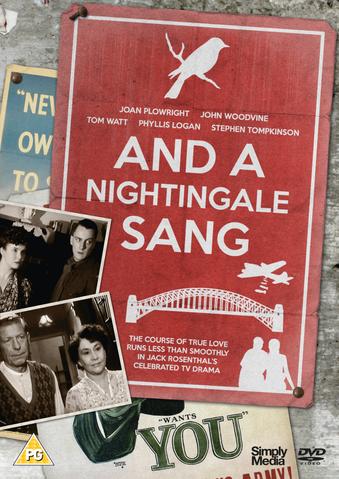
The 3rd of September 1939 may be a momentous day in the history of the British nation (with Neville Chamberlain shortly due to announce that the country is now at war with Germany) but not everybody has Hitler on their minds.  For example, in a terraced house in Newcastle, young Joyce (Pippa Hinchley) is debating whether to marry Eric (Stephen Tompkinson), who is shortly due to depart with his army colleagues to France.  As for the rest of Joyce’s dysfunctional family, they all have concerns of their own ….

And A Nightingale Sang was adapted by Jack Rosenthal from C.P. Taylor’s 1978 play.  Rosenthal (1931 – 2004) was one of British television’s greatest dramatists, equally adept at adapting other people’s material as he was at crafting his own.  He also slipped easily between genres – penning over a hundred episodes of Coronation Street during the 1960’s whilst also working on sitcoms and original one-off plays.

In many respects, the 1989 production of And A Nightingale Sang was a perfect fit for him – since it deftly mixed humour with drama in a way that was highly characteristic of his own output.  It’s very much a home-front drama (we may see soldiers, but only when they return home on leave).  But despite this, the war-time feel is very strong, partly due to the soundtrack.

Many of the familiar songs are delivered by John Woodvine’s character, George, on the piano.  George and his wife, known only as Mam (Joan Plowright), head an incredibly impressive core cast.  Woodvine has long been a favourite actor of mine, and George is a plumb of a part – there’s plenty of scope for humour (when at home George spends all his time in the front room, banging out tunes on the piano whilst the rest of the household ignores him) but he’s also afforded moments of drama and pathos.  George, who works at the shipyards, later breaks down in tears after he confesses to a workmate that he’s spent hours cleaning a ship which has recently arrived back from Dunkirk.

When his friend tells him that the bowels of the ship smell like a compost heap, George replies that it’s “human bloody compost. Stuck to the bulkheads like shit to a blanket. I’ve been trying to wash them off, scrape them off. Somebody’s lads, somebody’s flesh and blood”.

nightingale.jpg
John Woodvine

For Woodvine, born in South Shields, And A Nightingale Sang provided him with an opportunity to use his natural accent.  Some of the others, such as Joan Plowright, might not have been as local, but everybody manages credible accents.  Plowright, as the religious matriarch of the family, doesn’t get quite as much to do as Woodvine, but she makes every scene count.  The moment when she reacts in horror to the foibles of her family (such as George’s decision to become a communist) is very nicely done.

This was an early screen credit for Stephen Tompkinson, who had previously made several brief sitcom appearances in series such as After Henry, The Return of Shelley and Never The Twain.  It’s a substantial role, calling on him to experience a roller-coaster of emotions, but he handles it well.  Eric’s main problem is Joyce, who initially can’t decide whether she wants to marry him or not.  The cons (“he smells of bacon”) seem somewhat trivial, but the physical side of their potential union also seems to be troubling her.

nightingale 02.jpg
Pippa Hinchley & Stephen Tompkinson

But eventually she puts her worries behind her and they wed.  After all, with him shortly to leave for France it’s not as if they actually have to live together.  It’s only when he returns home on leave that the cracks really begin to show.  “When are you going back?” is one of her first questions (she’s also unimpressed with the French knickers he’s bought her).  Mind you, she quickly shrugs off her sexual anxieties – the only problem is that she seems to be spreading her favours very widely, with just about every American serviceman she can get her hands on ….

Pippa Hinchley and Stephen Tompkinson share some wonderful scenes together, as do Phyllis Logan (Helen) and Tom Watt (Norman).  Helen, Joyce’s elder sister, is the sensible one of the family, seemingly destined for a life where her own wishes and desires are secondary to the demands of others.  But when she meets Norman, one of Eric’s army buddies, everything changes.  In contrast to the bickering between Eric and Joyce, Norman and Helen instantly bond.  But, as you’d expect, things don’t turn out to be straightforward.  Watt, who’d recently left his signature role (as Lofty in EastEnders) and Logan are possibly at the dramatic heart of the play.  Like the rest of the main cast, they offer first-rate performances.

Produced by Philip Hinchcliffe and directed by Robert Knights, And a Nightingale Sang is a glossy production with a filmic sweep.  The Newcastle locations (cobbled streets, shipyards) help enormously with this, plus it’s an ironic bonus that certain areas of the North West in the late 1980’s were so run-down and desolate that they could easily stand in for the parts of the city devastated by German bombs.

Also included on the disc are three wartime public information films – They Keep The Wheels Turning (8″15′), Britannia is a Woman (9″17′) and The New Britain (10″16′).  These are fascinating extras which help to place the main feature into its correct historical context.  Britannia is a Woman as you might expect, looks at the role played by women during the conflict (which is obliquely touched upon during the play – both Joyce and Helen work at a munitions factory) whilst The New Britain considers the future of the country and They Keep The Wheels Turning looks at how everybody has their part to play in ensuring that the wartime effort is maintained.

A sharply observed human drama, And a Nightingale Sang is a treat, featuring an excellent cast who never put a foot wrong.  It’s available from the 6th of November 2017, RRP £12.99, and can be ordered directly from Simply here.

nightingale 03.jpg
Tom Watt & Phyllis Logan

Grange Hill – Series Ten, Episode Twenty Four

grange hill s10e24.jpg

Written by David Angus.  Tx 27th March 1987

The sun is (mostly) shining on the day of the great cricket charity match, with the on-field activity playing out mostly as you’d expect.  Freddie and Julia are first up for the pupils (she continues to grizzle – wondering why he picked her instead of Julie – whilst he typically takes charge, telling her only to run when he says so).

It shouldn’t surprise you to learn that those – such as Freddie – who weren’t particularly in favour of a mixed match are the ones to perish most embarrassingly.  He’s bowled by Mrs McClusky and caught by Miss Booth – something which delights them and disgusts him!

When the staff step up to the crease, Mr Glover also has a humiliating exit although Mr Bronson, by contrast, is able to leave with dignity.  The way that Mr Bronson – immaculately dressed with his cricket cap and dickey-bow – confidentially takes command of the wicket suggests that he’ll also be set for an early bath.  And so he is, but Mr Bronson displays hidden depths as he accepts the decision without a murmur, only pausing to complement Robbie on the quality of his delivery.  The normally placid Mr Mackenzie doesn’t take things so well though – leaving the crease with a very ill grace ….

The cricket match is a light-hearted spot of end-of-term fun, allowing us to see the staff (especially Mrs McClusky in something of a new light).  The way that Mrs McClusky flings herself around the pitch with wild abandon is something of a treat.

But the episode also serves to wrap up some long-running plot threads, although others are left dangling.  Zammo and Jackie finally pluck up the courage to postpone their wedding plans, although they do say it’s only postponed – not cancelled (maybe they will marry in the future, just not yet).

The relationship between Ant and Georgina has come to a more permanent end though.  This was something I thought had been wrapped up a few episodes ago, but series ten never seems to know when a story is dead and buried.  So for the umpteenth time Georgina tells Ant that she’s finished with him, leaving the boy to once again smoulder with the injustice of it all.

The Banksie/Lucy/Laura triangle remains unresolved.  There certainly seems to be an attraction between Banksie and Lucy (although since he’s working at the school where she’s a pupil, surely there’s the potential for a Mr King/Fay type problem?).  Although neither directly articulate their feelings, Laura does – she’s still cast as the jealous one – but we never see Banksie make an on-screen choice.

Before we wave goodbye to the pupils of Hazelrigg Road, there’s another opportunity to see how the presence of disabled children discomforts one of the regulars.  Hollo, collecting bets on the cricket match, takes a wager from Perry, but is apprehensive when he’s told that he’ll need to reach into his pocket to get the money.  This is pretty much Hollo’s last major scene in the series, as he’s one of a number of regulars not to return next year.

The absence of the sixth-formers is understandable (although the concept of an upper-sixth form had been established, we wouldn’t see it in operation for a few years) as is the fact that Ant Jones no longer continues to darken the doors of Grange Hill (he was already surplus to requirements this year).

There’s also something of a teacher clear-out, as Mr Kennedy, Mr Scott and Miss Partridge all vanish without a word.  The absence of Mr Scott from series eleven is slightly irksome.  Since the travails of his character was one of the major themes of series ten, it’s impossible not to feel a little short-changed by the fact that we’ll never learn if he did turn out to be a capable teacher after all.

As the staff and pupils end proceedings with a conga (all except Ant – who’s yet again positioned as the outsider looking in) it concludes the weakest season by some margin of GH to date.  There were some positives – it was nice to see Banksie receive a decent storyline, Mr Scott’s journey (despite his abrupt exit) was also not without interest – but the negatives – Harriet the donkey, slapdash and sloppy scripting (some storylines seemed interminable, others weren’t as developed as they could have been) – tended to overshadow the good moments.

Series eleven offers the chance for a fresh start, with a new roster of first years.  Will the quality pick up?  We shall see shortly.

Grange Hill – Series Ten, Episode Twenty Three

grange hill s10e23-01

Written by David Angus.  Tx 24th March 1987

The day after the sit-in, the post-mortems begin.  Trevor, who played no part in it, tells the others that it was a pointless exercise which achieved nothing.  He may partly be attempting to wind them up, but it’s hard not to agree with him.  Nice though, for once, to see that Mr Scott’s tutorial is peaceful.  Maybe the fact he nearly came to blows previously with Trevor has done the trick or possibly everybody’s just too deflated to lark about.

The ringleaders, on their way to a meeting with Mrs McClusky, debate what to do if they end up with none of their demands met.  The answers simple – Roland has to go on a hunger strike.  He’s not keen …

Mrs McClusky tells them that the staff handbook will be redrafted and the issue of closed profiles was already under review prior to the pupil’s revolt.  It’s possible to wonder whether this was actually the case – maybe Mrs McClusky, always a skilled politician, is being somewhat economical with the truth.  One thing’s for certain, she never believes in conceding ground or appearing to be weak in front of the pupils.

But the likes of Freddie, equally adept with the concepts of political spin, are also able to bend the truth so that they don’t emerge humiliated.  He’s also revealed to be a man of many voices, although his Scottish accent requires a bit more work (Nicholas Donnelly’s is much more convincing).

With this plotline winding down, there’s just time to start another.  Ziggy’s participation in an upcoming friendly cricket match between the staff and pupils looks to be in doubt due to his injured leg.  Helen offers to play, although she’s met with jeers from some of the boys – she’s a girl, so of course she can’t play cricket.  The likes of Mr Kennedy are also a little dubious – could the girls face up to the awesome bowling power of Steven Banks?  Ah, the battle of the sexes is always a fruitful area for drama – a pity it’s surfaced so late in series ten, had it bubbled away for a while it would have been more entertaining than the endless adventures of Harriet.

The sixth-formers want to use the canteen on Saturday, after the cricket, as a venue to celebrate Jackie and Zammo’s upcoming wedding.  But they know that Mr Griffiths will never agree so they have to be cunning.  That’s why Fay and Julie, the minxes, con him into believing that they’re organising a party in his honour, with Mrs McClusky in attendance.  When he realises that Mrs McClusky is coming (they’re such fluent liars!) he starts to waver.

Hard to believe that the saga of the Grange Hill ghost is still lingering on.  Surely this is a horse that has been flogged to death by now?  But no, Ziggy and Gonch are able to once again convince the always-gullible Trevor that down in the basement a walled up ghost exists.  Is this a different one from the cane-wielding psychopath we’d previously learned about?

Anyway, it involves a hoover (to suck up the ectoplasm of course) and Hollo, masquerading as a ghost, stuck behind the wall.  The first Grange Hill ghost was good fun but as has happened elsewhere this year, at this point the series doesn’t seem to know when to leave well alone.  I mean, it’s been established again and again that Trevor’s not the brightest, but surely not even he would be dull enough to fall for this routine yet again?!

Zammo and Jackie continue to put on brave faces, each telling the other that they have no doubts.  But when they hug, the camera switches between both of their anxious faces.  And Jackie, a nice touch, also focuses on her engagement ring – something which has come to symbolise discord and worry, not joy.

grange hill s10e23-02


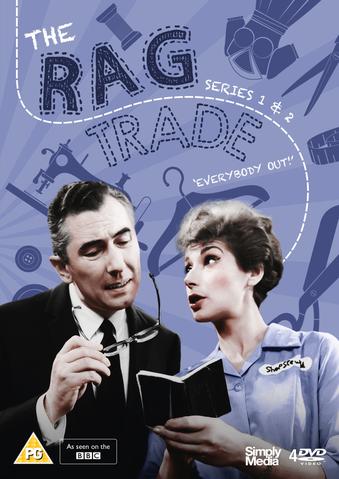
The Rag Trade – Series One and Two. Simply Media DVD Review

rag trade.jpg

Written by Ronald Chesney and Roland Wolfe, The Rag Trade ran for three series on the BBC during 1961 and 1963 (it was later revived for two runs during the 1970s on LWT, which featured remakes of some of the original BBC scripts).

Set in a clothing workshop called Fenners Fashions, the nominal head of the business, Harold Fenner (Peter Jones), forever finds himself at the mercy of his bolshy workforce – most notably shop steward Paddy Fleming (Miriam Karlin) who’s apt to shout “everybody out!” at the drop of a hat.

Stuck in the middle between management and the workforce is the long-suffering foreman Reg Turner (Reg Varney) whilst the likes of Carole (Sheila Hancock), Shirley (Barbara Windsor), Lily (Esma Cannon) and Gloria (Wanda Ventham) are some of the more prominent members of the motley workforce.

It’s fair to say that the works of Chesney and Wolfe are an acquired taste.  I’m rather fond of Meet the Wife but rather less so of On The Buses and their later 1970s ITV sitcoms.  True, the likes of Don’t Drink The Water and Yus My Dear have a certain grisly interest but you’d be hard pushed to claim they were forgotten classics (or any good).

The original Rag Trade is sharper though, possibly because it occurred earlier in their career, although the high quality cast helps too.  Peter Jones, the original and best Voice of the Book from The Hitchhikers Guide to the Galaxy, splutters with splendid comic timing throughout.

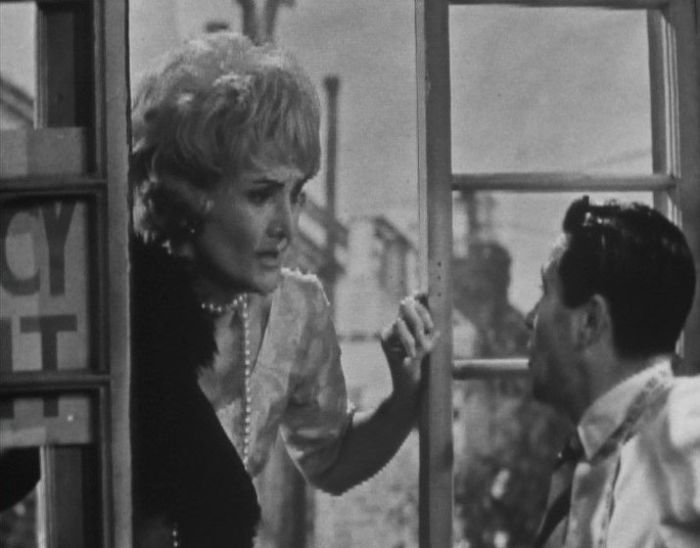
He’s matched by Miriam Karlin all the way whilst Barbara Windsor (who missed out series two but returned for series three, which sadly no longer exists), Wanda Ventham (who appeared in the second series only) and Sheila Hancock (who appears in both of the series here) all offer strong support. Hancock, as the perpetually vague Carole, is the recipient of some killer lines.

rag 1
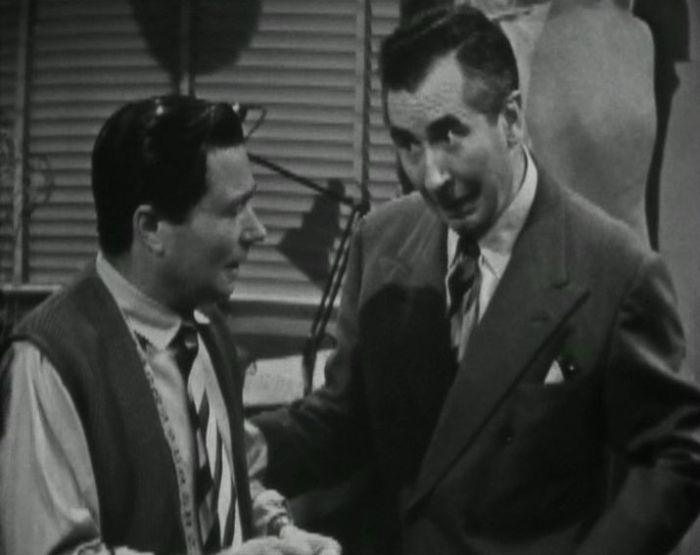
Sheila Hancock & Reg Varney

Here’s what’s contained across the four discs.

Series 1, Disc 1

1: The French Fashions
2: Christmas Box
3: The Baby
4: Getting Married

Series 1, Disc 2

5: Early Start
6: Unhappy Customer
7: Doctor’s Orders
8: The Sample

Series 2, Disc 1

1: The Thief
2: The Dog
3: Locked In
4: The Flat
5: The Client
6: Stay-In Strike

Series 2, Disc 2

7: Safety Precaution
8: Stainproofer
9: Doctor
10: Barber’s Shop
11: The Bank Manager

The series does pretty well for guest stars, with the likes of Frank Thornton, Terry Scott, Colin Douglas, Patrick Cargill, June Whitfield, Lynda Baron, Fabia Drake, Ronnie Barker and Hugh Paddick all making appearances.

Another familiar face – Peter Gilmore (The Onedin Line) – pops up in The French Fashions. Sporting an interesting American accent, he appears in the middle of a frenetic episode which sees Carole model a rock-hard pair of slacks for Gilmore’s character (it would take too to explain why) whilst the workforce later masquerades as French workers in order to snag a lucrative sales contract. None of this is terribly subtle, but there’s some typically deft comedic performances on display (Esma Cannon, as ever, effortlessly manages to steal every scene she appears in).

Another series one show – Unhappy Customer – sees “everybody out” as the girls go on strike (Mr Fenner’s more than a little unhappy that they’re eating in the workshop, but won’t agree to build a canteen). But then he has a change of heart ….

rag 2.jpg
Reg Varney & Peter Jones

Considering that he’s supposed to be a penny-pincher, his solution – an automatic food dispenser (“anything you like. Tea, coffee, snacks”) – is a handsome gesture but Paddy’s not happy. This sort of automation might mean that their ten minute tea-break would actually only last ten minutes, rather than the ninety minutes it currently does. So their minds turn to sabotage ….

Highlights from series two include the second episode, The Dog. The pet in question belongs to Lily who brings him to work (she’s concerned about his health, so smuggles him in under Mr Fenner’s nose). This is classic Rag Trade – the workers conspiring against the hapless Fenner – enlivened by the always entertaining Esma Cannon and a lovely guest turn from the elegant Patrick Cargill.

The Rag Trade – Series One and Two is a straight repress of the previously released editions by DD, which means that series one is still missing two episodes (series two is as complete as it can be – two of the thirteen episodes no longer exist).

Picture quality is variable (the opening episode of series two is probably the worst, a pretty low quality telerecording). Things are much better elsewhere, although some episodes do feature occasional brief jumps when the picture and soundtrack slips out of sync for a second (a common issue with telerecordings).

The Rag Trade stands up very well. It’s certainly one of the strongest sitcoms from the Chesney/Wolfe partnership, thanks not only to the first-rate cast but also due to the way that it comedically shines a light on British labour relations during the early sixties. Whilst it’s exaggerated for comic effect, there’s more than a kernel of truth in the way that management were often at the mercy of their workers (today, the pendulum has firmly swung the other way).

A cracking little sitcom, it’s well worth your time.

The Rag Trade – Series One and Two is available now from Simply Media, RRP £19.99.  It can be ordered direct from Simply here.

rag 3.jpg
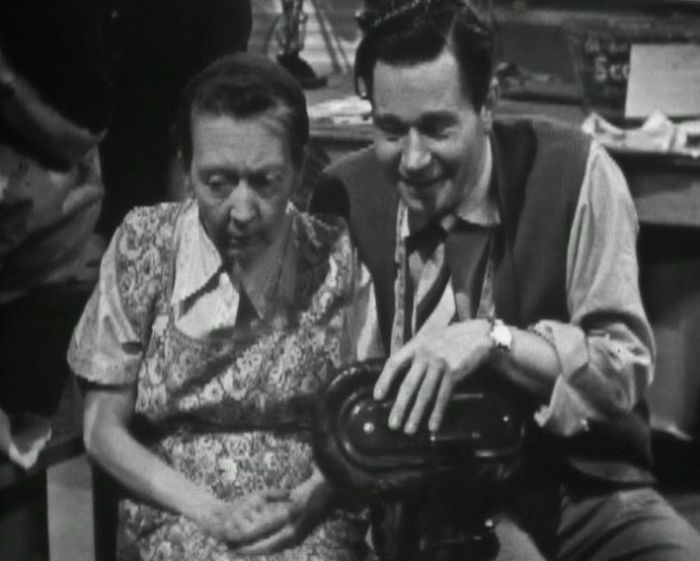
Esma Cannon & Reg Varney

Grange Hill. Series Twenty, Episode Twenty Two

grange hill s10e22-01

Written by Barry Purchese.  Tx 20th March 1987

The atmosphere of dissent continues.  Huddled secret meetings are the order of the day whilst Mr Bronson, observing the front entrance from on high, looks down impassively.  Julia’s role as a mole is once again restated as she’s delivered to school by her father who informs Mr Bronson that “she knows what’s expected of her”.  Julia doesn’t say anything, she just stares out of the car window ….

Danny might have previously been disinclined to get involved, but he can’t help himself – he’s convinced they’re in desperate need of organising.  It’s a little embarrassing that nobody else considered what would happen if the teachers decided to cut the power – how can you broadcast your demands without electricity?  Danny suggests they set up another base in the sixth form building (which has an independent power source that can’t be switched off).  He also reveals Julia’s true role to the others, but if they feed her disinformation then she can be an asset not a hindrance.

But before the fun and games of the sit-in, school life goes on as normal.  An informal meeting between Miss Partridge and a group of sixth formers helps to restate the lessons that Banksie’s learnt whilst he’s been at Hazelrigg Road,

A nice incidental detail is provided when we see a relaxed Mr Bronson swigging from his coffee mug.  It’s garishly decorated with two parrots (last year he suffered an off-screen attack from his sister’s pet bird, so it could be that they – along with steam engines – are something of a passion with him).

Julie, Fay and Jackie (slightly grizzling about traditional gender roles) are busy making the sandwiches for the sit-in.  But when the topic turns to the catering for Jackie’s wedding, she breaks down in tears.  Nerves or are doubts beginning to creep up on her?  It’s notable that she tells the others that Zammo’s really keen to get married (she clearly hasn’t been looking at his face recently as he’s been wearing a hangdog expression for some time).  As for her, now that she’s engaged she believes that their union is binding and irreversible.  It’s also very interesting that she suggests it could be worse – at least she likes Zammo.  Likes, not loves.

Meanwhile Zammo and Banksie are at the supermarket, stocking up on sit-in supplies.  Uniting in a common cause seems to have healed the rift between them, but the main reason for this scene becomes obvious when Banksie runs into one of his brother’s friends.  He’s only a few years older than them but he’s saddled with several children (and another on the way).  His wife – in the few seconds we see her – seems less than sympathetic, so the general picture created by this brief thumbnail sketch implies that marriage = loss of freedom.  Exactly what the shaky Zammo doesn’t want to hear.

Cheryl, Freddie, Julie and Ziggy have commandeered the radio room and broadcast to the school, requesting that their fellow pupils occupy the building.  They pop on a record – Sonic Boom Boy by Westworld – which then becomes the soundtrack for a score of enthusiastic extras who use everything they can find (chairs, blackboards) to barricade themselves into the classrooms.

Mrs McClusky is calmness personified.  She’s happy to accede to one of their demands – an interview – if it takes place in her office and they abandon the sit-in.  She also suggests disconnecting the speakers might be less disruptive than cutting the power.  And she’s not too concerned that her fellow teachers are unable to get into the classrooms – since at present they know exactly where the problematic pupils are.

I do like the fact that Hollo’s following Mr Griffiths about, meaning that every time the caretaker disconnects a speaker, it’s immediately reconnected!  At this point, pop fans, The Future’s So Bright, I Gotta Wear Shades by Timbuk 3 is playing.

It’s also entertaining that even when the pupils outmanoeuvre them, it’s Mr Bronson and the recently arrived Mr Glover who resort to running about like headless chickens.  Mrs McClusky continues to be very laid back.

With events now having relocated to the sixth form building, the extras – standing outside – are having a fine old time, chanting “‘ere we go, ‘ere we go, ‘ere we go” with gusto whilst Miss Partridge, Miss Booth and Mrs Reagan look on less enthusiastically.

Mrs McClusky’s plan for restoring order is simple but effective.  Ring the bell for afternoon lessons and the chanting pupils outside are drawn back to the school hypnotically.  Slightly hard to believe, but there’s possibly a point being made here about the manipulation of the masses (since they were just as easily swayed by the sloganeering of the rebels, the bulk of the school community – like the electorate at large – can be capricious and unpredictable).

This leaves the others, barricaded in the sixth form common room, in something of a bind.  It’s pointless broadcasting messages of democratic freedom when there’s nobody around to listen to them ….

grange hill s10e22-02

Grange Hill – Series Ten, Episode Twenty One

grange hill s10e21-01

Written by Barry Purchese.  Tx 17th March 1987

The pupils are still revolting, as it were.  Freddie and Laura (unusual that she’s shown here to be something of an anti-establishment firebrand) are miffed at a new directive issued by Mr Bronson.  Any pupil found to be deliberately misinterpreting the school rules will face punishment.

Freddie and Laura affect surprise and shock at this, but it can hardly have come as a surprise.  So are they genuinely upset or simply pretending for Miss Booth’s sake?  It appears to be the former, but that’s slightly hard to credit.  It’s also noteworthy that Mr Bronson isn’t the one to issue this decree, instead he remains off-stage whilst Miss Booth is cast in the unusual position of the hard woman.

It later transpires that he only intends to announce his proclamation personally to specific classes – such as E3.  The reason is plain – he can’t trust Mr Scott to do so.  That he explains this to Mr Scott – in the middle of the staffroom where everybody can overhear – is typical of Mr Bronson.  But he’s called away for a meeting with Mrs McClusky, so Mr Scott is given the joy of reading the message.

When Mr Bronson later tangles with a group of fourth-formers holding a protest meeting (Freddie and Laura are again involved) he’s at his most implacable.  The conciliatory approach doesn’t seem to be on his agenda, instead he plans to stamp down hard.  But it’s this autocratic approach which is fermenting rebellion and dissent all over the school – right up to the sixth-formers.

This sudden wave of anti-school feeling is a little hard to take seriously.  Yes, some points – closed profiles – have been debated in previous episodes but for such a staff/pupil breakdown to have occurred you’d expect there to have been many more flashpoints.  The strict interpretation of the school rules (walking in the corridors at all times, etc) was one way of protesting at the inequalities inherent in the system, but ramping it up so suddenly seems a little unnatural.

Trevor, as he has all year, alternates between being a bully and a buffoon.  On the one hand he’s keen to gain revenge on Mr Scott (where he’s allowed to be rather unpleasant) but on the other he continues to be haunted (sorry) by the Grange Hill ghost.  Gonch, Hollo, Ziggy and Robbie agree to disrupt Mr Scott’s lesson (only a few episodes ago they’d elected to ease off on the troublemaking) although they have an ulterior motive – Trevor agrees to join them later in a spot of ghostbusting.  And once they’ve humiliated Trevor again, surely Mr Scott’s troubles will be over ….

Trevor has elected to use that old chestnut – humming.  If a number of people, in different positions, all hum at the same time then it’ll be impossible to determine where the noise is coming from.  Long-time GH watchers will remember that this has been done before, although not with the spectacular results we see here.  Mr Scott might have had a very long tether, but eventually he’s come to the end of it.  He heads for the door as Trevor jeers “that’s it. Run off and get your boyfriend Kennedy”.  Once the words are out of his mouth the mood in the classroom changes.

Mr Scott turns around, the humming abruptly stops and he approaches Trevor very slowly.  As with Trevor’s previous classroom taunting of Mr Scott, everybody else is now quiet and immobile, which helps to focus all of our attention on the pair of them.  Mr Scott grabs him by the throat and aims a punch at his head … but doesn’t deliver it.  Old-school GH teachers may have smacked the pupils about, but by 1987 it clearly wasn’t acceptable – or if it did happen then the teacher would have had to lose his job straight away.  Is it significant that Mr Scott pauses after Ronnie calls out to him?

There’s a lovely meeting between Mrs McClusky and Mr Bronson.  She’s very, very miffed that he’s gone ahead with his directive without consulting her.  “You sought to determine school policy without reference to me”.  She’s not a happy bunny.

Kelly George, later to return to the series as Ray, makes his debut as a St Joseph’s pupil who tangles with Danny.  Yes, Danny’s back, although he’s not interested in joining the others in their protest.  They plan to occupy Radio Grange Hill and broadcast messages of freedom.  Hmm, I can foresee that isn’t going to end well.  But for all his studied disinterest he still quickly works out that Julia is working as a mole for her father (Freddie suspected it, but he didn’t have any evidence – only the fact that her dislike for him might be a factor).

grange hill s10e21-02