Until quite recently, critical analysis of the 1970’s runs of both Dixon of Dock Green and Z Cars tended to be rather limited. Usually they were lazily painted as out-of-date dinosaurs – made completely irrelevant by the rise of brash new upstarts like The Sweeney.
Now, thanks to Acorn’s DVD releases, we can begin to get a picture of both BBC series which has enabled a small, but concerted, reassessment. The Sweeney has long been seen as the anti-Dixon – but I’m not entirely sure that direct comparisons between the two are particularly valid, mainly because they operated in such different areas of the television schedules.
Dixon was a pre-watershed, family show and The Sweeney was a post-watershed, adult show. Therefore it’s hardly surprising that the tone of each series was very different (although Dixon could throw in a darker, harder-edged story from time to time and The Sweeney was no stranger to lighter, more off-beat stories).
What’s certain is that the television schedules could easily accommodate both programmes (there’s no reason why all police series have to follow the same template). Having said all this, whenever Dixon tackled a story that revolved around topics that The Sweeney could also have covered, comparisons are inevitable.
We’ve now moved ahead to series twenty. There is another surviving episode from series eighteen (Molenzicht) but it remains unreleased due to unspecified rights issues and all of series nineteen was wiped. Derek Ingrey’s Eye Witness kicked off series twenty and was originally broadcast on the 29th of December 1973.
Anne Hastings (Gwyneth Powell) witnesses a gangland murder and is immediately taken into police custody for her own protection. As the only eye witness, she’s a vital part of the police’s case – without her testimony there’d be no hope of a conviction. So it’s clear that her silence (by whatever means necessary) would be welcomed by a number of people, not least the intimidating Mr Colly (Steve Plytas). But Anne Hastings is no innocent – she’s antogonistic and headstrong, which makes minding her something of a problem.
Although Gwyneth Powell would become a household name to a later generation (thanks to her decade or more running Grange Hill) she also enjoyed a very active career during the seventies in a variety of different series. In Dixon alone she appeared five times, playing five different characters. Her first two appearances, both in 1972 (The Bad Debt Men and The Fingerman) have been wiped, but her later two turns in Looters Ltd (1975) and Domino (1976) do exist. Outside of Dixon, she gave memorable performances in The Guardians and Villains, amongst others.
On the wrong side of the law, Steve Plytas (possibly best remembered as Kurt, the Manuel-obsessed chef in the Fawlty Towers classic Gourmet Night) is intimidating as the gang’s Mr Big. Stephen Greif has enjoyed a long career, often playing villains, so his role here as Tony isn’t too much of a stretch, but even when he’s got little to do he’s still watchable.
It’s difficult to avoid it, but the major flaw in this story is the fact that Dixon is assigned to mind Anne Hastings. Yes, he does have the assistance of a female police officer (and the three of them travel out of town to a location that hopefully isn’t known to the gang) but this really stretches credibility to breaking point. Jack Warner was seventy eight when this was made and he does look his age. When selecting an officer to guard a vital witness against dangerous gun-toting criminals, who in their right mind would choose Dixon?!
If you can ignore this (fairly major) lapse in credibility, then Eye Witness is a decent enough story. The location work is especially nice since it’s a break from the streets around Dock Green. But it’s undenialble that the clash between an old-school copper like Dixon and a gang of violent armed criminals is jarring. They would have worked perfectly well in The Sweeney, but they seem a little out of place here. Dixon could do stories like this, but the series was always better when it played to its own strengths and concentrated on character-driven drama.
It’s a watchable yarn but it’s easily the weakest of these early surviving episodes.
Jig-Saw was the first story of Dixon’s eighteenth series, originally broadcast on the 20th of November 1971. Although it shares some similarities with Waste Land (a hunt for a missing person in a vast, crumbling industrial site) it also feels quite different – this one is much more a standard police procedural story.
Forbes (Victor Maddern) is the nightwatchman of a derilict gasworks. Making his rounds, he finds an open door and after he enters the building he finds that somebody has locked him in. He calls Dock Green nick and they take a look around. Although they don’t find anybody, they do spot some scattered possessions which belong to a woman who went missing earlier in the week – and this is enough to initiate a search of the area.
One attraction of television of this vintage, particularly when shot in these sort of locations, is the glimpse it gives us of a landscape that would be unrecognisable today. The gasworks were an example of Britain’s industrial past, but by the time the series was made it was a relic and scheduled for demolition. Both Dixon and Andy Crawford professes admiration for the place (and offer a hint of regret that it’s no longer active) whilst one of the other detectives shows it no sentiment at all – in a few years, he says, it’ll probably be a housing estate. This moment shows that Dixon and Crawford are two of a kind – sharing similar views and opinions.
If they sometimes have a father/son relationship, it’s not surprising (since Andy married George’s daughter way back in 1956). Although Crawford is a detective sergeant, he has no qualms in seeking the advice or opinion of Dixon (who’s just a humble uniformed sergeant). Other police programmes (such as The Bill) would have a much sharper divide between the uniformed and plain clothes divisions, but thanks to the special relationship between Dixon and Andy, that’s blurred here.
As the search continues, both Dixon and Andy view the missing woman’s husband, Colin Warren (Charles Houston), with suspicion. He lied about where he was on the night of his wife’s disappearance (he was seeing another woman) so what else might he have lied about? There’s also the possibility that this might not be an isolated attack – the gasworks are close to a canal towpath where several woman were assaulted a few years previously.
The possibilities soon stack up. Warren might have killed his wife or she may have left of her own accord. But there are other suspects, such as the nightwatchman Forbes, who has been receiving psychiatric treatment – which is is confirmed by his colleague Morris (Windsor Davies) .
Glynn Edwards is solid as Chief Inspector Jamieson, he wasn’t a regular but did pop up from time to time over the years (in a variety of roles). Jig-Saw also gives us a chance to see Nicholas Donnelly as Sergeant Johnny Willis, who had a long association with the series (some two hundred episodes between 1961 and 1976).
Victor Maddern appeared in Dixon four times – playing four different characters. By far his most celebrated appearance was his final one, It’s A Gift (broadcast in 1975). This wasn’t for any particular part of the story though, rather it’s for this outtake which has become a favourite of many people.
Jig-Saw ends with a chase and the apprehension of the criminal. It therefore offers a tidy solution to the mystery, even if it’s still rather downbeat. Whilst Eric Paice’s script never hits the heights of Waste Land (which he also wrote) it’s still an efficient character piece that also makes good use of its impressive location.
Waste Land was the opening story of Dixon of Dock Green’s seventeenth series and it becomes clear very quickly that incoming producer Joe Waters was keen to shake up the show’s format. I’ve already written here about early 1970’s Dixon and how the actuality of the series differs from its received opinion. And one of the most significant of the small number of existing episodes from the early 1970’s is Waste Land.
Originally broadcast on the 14th of November 1970, it opens, traditionally enough, with Dixon’s piece to camera. But although Dixon is instantly a reassuring and paternal figure, his words are not designed to offer comfort. Dixon tells us that often “most of us remain ignorant of one another” and this, he says, could apply to any walk of life – including the police. Dixon’s opening and closing homilies are often one of most derided parts of the series (this view seems to be largely based on one notorious example from the black & white years, where Dixon condones domestic violence) but here he doesn’t provide the audience with reassurance. Instead, it’s a clear signal that things may not end well.
Following this, the pre-credits sequence is extremely disorientating. We see a POV shot of somebody wandering around a deserted dock (their laboured breathing indicates that something is wrong). The sense of disconnection is enforced when we hear a woman’s voice, describing how somebody feels lost – in a waste land – unaware of whether they are actually awake or asleep.
The discovery of an abandoned panda car inside the Old Orient Dock initiates a search for the missing officer, PC Norman. This explains the reason for the pre-credits sequence, although it’s interesting how it makes little narrative sense. We’re led to assume that the POV shot is of PC Norman and we later discover that the woman’s voice belongs to his wife. The third part of the sequence is the discovery of his panda car, but chronologically it’s a real jumble. Firstly, he went missing at around midnight, but the POV shots were in daylight. Secondly, we hear his wife’s voice before she’s actually entered the story. It works in the context of the episode though (even if it’s odd from a story-telling point of view).
Our first sight of George Dixon helps to reinforce that he’s a competent and knowledgeable officer (he advises a police van driver to take a short-cut to the docks). It’s a small character beat that’s useful for any new viewers – it lets them know that he’s an experienced man, who knows the area well.
The bulk of the episode takes place within the abandoned docks. It’s an impressive location and one which cuts against the perceived notion that Dixon was a series rooted in cosy nostalgia. Looking back at seventies Britain in general, often the picture is one of decay – crumbling buildings, dirty streets, etc. The grimy 16mm film stock used for television reinforces this (and this episode is a good example – the film print seems to have been dragged through a hedge backwards!).
So the docks are an area that’s depicted as threatening and unsettling. Nobody would visit there out of choice, so why did PC Norman? It’s debated that he might have been following a suspect, but even quite early on there are other, albeit unspoken, possibilities floating about.
Elsewhere, we see a sense of community and a general level of co-operation with the police that might be one area where Dixon could be said to still be peddling an idealised picture of society. A group of housewives are seen to have a clear bond with each other (except for one, who comes and goes at all hours and is therefore viewed with suspicion by the others). They’re all eager to answer Andy Crawford’s (Peter Byrne) questions and one of them even volunteers useful additional information. It’s very possible to imagine that other series might have portrayed a more isolated or disinterested community.
Jumping into this episode cold, there’s a fairly large cast of regulars of which most (apart from Dixon and Andy) aren’t particularly familiar. This isn’t helped by that fact that the archive survival rate from the early seventies runs are so poor (Waste Land, for example, is the only episode to exist from series seventeen, the other sixteen were wiped). It is nice to see George out and about though – as the years go by, Jack Warner’s difficulties with walking will become more and more obvious (later series see him immobile behind the desk at the station, hardly moving at all).
It’s a pity that the print is so poor (including at one point, a spectacular bit of film damage) but for such a niche release there’s no point in grumbling too much (it’s better to have it in this condition than not at all).
Waste Land is a bleak tale which never feels it’s going to end well. The documentary style of filming (no incidental music, for example) helps to give it a sense of reality and the lack of a neat, pat ending is another plus. It’s impossible to say whether the rest of the series maintained this same standard, but on its own merits, Waste Land is a gripping forty five minutes of drama.
So after six and a bit episodes, the identity of the mole is revealed. It’s interesting that they didn’t pad it out until later in the episode, instead the reveal happens at the ten minute mark. Peter Guillam displays understandable anger at the lives lost. “You butchered my agents… How many since? How many? Two hundred?… Three?… FOUR?” Smiley remains calm, although in his own undemonstrative way he does display the odd spasm of anger later on.
So Gerald the mole was Bill Haydon. Smiley contacts Lacon, Alleline, Bland and Esterhase and plays them the incriminating recording which proves Haydon’s guilt.
Esterhase: Well, that’s that. Congratulations, George.
Lacon: Next step, gentlemen?
Smiley: Would you agree with me, Percy, that our best course of action is to make some positive use of Bill Haydon? We need to salvage what’s left of the networks he’s betrayed.
Alleline: [weakly] Yes…
Smiley: We sell Haydon to Moscow Centre for as many of our men in the field as can be saved – for humanitarian reasons. Professionally, of course, they’re finished.
Alleline: Quite.
Smiley: Then the sooner you open negotiations with Karla, the better. Well, you’re much better placed to talk terms than I am. Polyakov remains your direct link with Karla.
Lacon: The only difference is, this time you know it! It’s definitely your job, Percy. You’re still Chief, officially… for the moment.
Percy Alleline: Very well, George.
It’s a moment of triumph for Smiley, but there’s no overt display of emotion or triumphalism. Indeed, as we’ll see, it’ll turn out to be something of a pyrrhic victory although as the above dialogue extract indicates, he must have displayed some pleasure in Alleline’s discomfiture, who is clearly on borrowed time as Chief.
Before Haydon is sent back to Moscow, the interrogators are keen to extract every piece of information they can. The next time we see him, his face is covered in bruises, there’s blood on his shirt and he’s walking unsteadily – a clear sign of how he’s been “encouraged”.
It’s felt that he may open up more to Smiley, and in a way he does. This enables Guinness to take up his usual role as the largely unspeaking observer – but it’s nevertheless quite easy to understand exactly what he thinks and feels just by the expressions on his face. Ian Richardson takes centre-stage in these scenes as he explains why he became a Russian agent.
Haydon: What do you want to know?
Smiley: Oh… why? How? When?
Haydon: Why? You ask that? Because it was NECESSARY, that’s why! Someone had to! We were bluffed, George. You, me, even Control. Those Circus talent spotters, all those years ago. They plucked us when we were golden with hope, told us we were on our way to the Holy Grail… freedom’s protectors! My God! What a question… “why?”
Smiley learns that when Haydon had the affair with Ann, it was on Karla’s orders. He also keen to know about whether Haydon expected Jim Prideaux to be sent on the abortive Czechoslovakia operation. As the friendship between Haydon and Prideaux has been stressed several times, there’s an undeniable sense of emotion as he replies to Smiley’s questioning.
Smiley: Did you expect Control to send Jim Prideaux?
Haydon: Well… obviously we needed to be certain Control would rise to the bait. We had to send in a big gun to make the story stick, and we knew he’d only settle for someone outside London Station, someone he trusted.
Smiley: And someone who spoke Czech, of course.
Haydon: Naturally. It had to be a man who was old Circus, to bring the temple down a bit.
Smiley: Yes, I see the logic of it. It was, perhaps, the most famous partnership the Circus ever had: you and him, back in the old days. The iron fist, and the iron glove. Who was it coined that?
Haydon: I got him home, didn’t I?
Smiley: Yes. That was good of you.
The clearest sign that Haydon has got under Smiley’s skin is demonstrated by the angry way Smiley opens the door after he’s finished his questioning. A small moment, like many of Smiley’s brief displays of anger, but it’s quite telling.
Haydon never made it back to Moscow, he was murdered before the exchange could be made. The novel implies (but doesn’t overly state) that Jim Prideaux killed him, the television adaptation is a little clearer on this point.
This leaves a final scene, which effectively acts as a coda, in which Smiley and Ann discuss her latest (completed) affair as well as Bill Haydon. She tells Smiley that she never loved Bill, and her final words “Poor George. Life’s such a puzzle to you, isn’t it?” is a bittersweet ending to an exceptional drama serial.
Smiley’s hunt for the mole leads him to a rather dingy London drinking club. There he meets Jerry Westerby (Joss Ackland). Westerby is a newspaper reporter who’s done odd jobs for the Circus in the past – such as delivering packages to dead letter drops. “Telephone kiosk, ledge at the top, dump a little package ready for collection.”
Westerby is clearly somebody who enjoys the cloak and dagger aspect of the job, as well as the glamour of operating on the fringes of the intelligence services, athough it seems that his usefulness has come to an end. Possibly his fondness for alcohol is the reason. “Firewater not good for braves. They think I’ll blab, crack up.”
Or it may be because of what he knows about the Jim Prideaux shooting. Westerby was in Czechoslovakia at the time and he learnt that “the Russians moved in on Saturday, it was the day after they got Jim. Russians knew the lot, knew he was coming. They were lying in wait for him. Bad story, you see. Bad for big chief. Bad for tribe.” When Westerby returned to England he told Toby Esterhase, but Toby professed not to believe it, dismissing it as nothing more than drunken ravings.
It’s a lovely cameo from Ackland and Guinness is his usual excellent self. Whilst it’s clear from the outset that Westerby wouldn’t necessarily be Smiley’s first choice as a lunch companion, he’s easily able to tease the information out of the newspaper man. As always, Smiley asks many more questions than he answers – witness the end of lunch, as Westerby wonders exactly what Smiley’s been after. Guinness/Smiley remains inscrutable, offering very little. At one point, rather than commit himself, he smiles – and the camera remains on him as the smile slowly fades away. Tight close-ups (switching between Ackland and Guinness) are used in this scene, very effectively. As they finish their lunch, Westerby muses about Toby Esterhase.
Westerby: Rum chap, Toby Esterhase.
Smiley: But good.
Westerby: God, brilliant! First-rate chap! But rum.
If Smiley has tended to be mostly passive so far, eliciting information rather than sharing it and not expressing too many of his own opinions, then that changes once he confronts Toby. It’s the first time he’s spoken to one of the four suspects and it signals a major turning point in the story.
Toby meets Guillam at a safe house – apparently to see a potential agent – but instead he’s met by George Smiley. Now it’s Smiley who does the majority of the talking, whilst the camera closes in on Toby’s increasingly pained face. Guinness is, once again, excellent, as he’s able to fillet and humiliate Toby – but in the most gentlemanly way.
George Smiley: Ever bought a fake picture, Toby?
Esterhase: I sold a couple once.
Smiley: The more you pay for it, the less inclined you are to doubt its authenticity.
Eventually it becomes clear to Toby that source Merlin, and his London representative Polyakov, has deeply compromised the Circus. He’s desperate to assure Smiley that he knew nothing about it, as well as downplaying his own involvement.
Esterhase: Why pick on the little guy? Why not pick on the big ones? Percy Allenine, Bill Haydon!
Guillam: I thought you were a big guy these days.
Smiley: You’re the perfect choice, Toby: resentful about slow promotion, sharp-witted, fond of money. With you as his agent, Polyakov has a cover story that really sits up and works. The big three give you the little sealed packets of chickenfeed, and Moscow Centre thinks you’re all theirs. The only problem arises when it turns out you’ve been handing Polyakov the crown jewels, and getting Russian chickenfeed in return. If that’s the case, Toby, you’re going to need some pretty good friends. Like us. Gerald’s a Russian mole, of course. And he’s pulled the Circus inside out.
Afterwards, Smiley commiserates with him. “Poor Toby. Yes, I do see, what a dog’s life you must have had running between them all.” It might be just another scene of people sat in a room talking, but in the context of the story it’s riveting stuff. The result is that Smiley’s happy to discount Toby as a suspect, so that leaves the other three.
Now we’re into the endgame. Toby has told Smiley about the location of the safe-house where Polyakov meets the representatives of the Circus. In order to flush out the mole, a crisis needs to be created (so a crash meeting with Polyakov can be called). He sends Ricki Tarr to Paris and instructs him to telex the following message back to London Station. “Have information vital to the safeguarding of the service. Request immediate meeting. Personal.”
LeCarre’s novel opens with Jim Prideaux taking up his new role as a schoolmaster. Periodically through the book we return to Pridaeux and witness his growing friendship with one of the boys, Bill Roache, nicknamed “Jumbo” by Pridaeux.
Arthur Hopcraft’s adaptation chooses to hold back the school material until this episode, rather than scatter it throughout the story. This was probably the right thing to do, although it does mean we lose a great deal of the interaction between Prideaux and Roach. But a little does remain, such as the scene where Roach spies Prideaux digging up a package. Roach can’t resist taking a peep through the caravan window (where Prideaux lives) and is shocked to see him holding a gun.
Prideaux: We’ve got a secret, haven’t we? I can trust you, I know that. We’re good at keeping secrets, loners like you and me.
Roach: Is it because of that man? Would you shoot him? Are you working undercover, like Bulldog Drummond in the book? Some of the boys wanted to call you Bulldog, but we thought Rhino was better. Bigger than a bulldog.
Prideaux: Well I, uh… I used to be a soldier, Jumbo. What you saw just now, that’s a souvenir, you know, it’s like this…
[he points to his back]
Prideaux: How I got it, they’re both secrets, I keep them to myself. Y’understand that, don’t you Jumbo?
Roach: Yes, sir.
Prideaux: Knew you would, knew you would.
Since getting shot, Jim’s turned into something of an eccentric, at least when the schoolboys are around. He lets them drive his vintage car (an Alvis, his pride and joy) and has clearly made a deep impression on many of them (especially Roach). But he still has wounds that haven’t healed (and not just physical ones) which will be examined later on, when Smiley visits him.
But before Smiley speaks to Prideaux, he makes a call on Sam Collins (John Standing) who was duty officer the night Jim Prideaux was shot. When the crisis happened, Sam was unable to get much sense out of Control – so he recalls how relived he was when Bill Haydon turned up. It’s been repeated several times already just how close Bill Haydon and Jim Prideaux were, and this is clear when Bill takes charge.
All right, Sam. Now, first thing you do, you call this number, it’s Toby Esterhase’s. Tell him you’re speaking for me, and he’s to pick up the two Czechos we’ve had our eyes on in London School of Economics, and lock them up. Now, right away, Sam. Jim’s worth a lot more than those two, but it’s a start. I’ll have a word with the chief hood of the Czech Embassy. If they hurt a hair on Jim Prideaux’s head, I’ll strip the entire Czech network in this country bare. You pass that on. I’ll make him a laughing-stock!
Later, Smiley finally speaks to Jim Pridaeux. Given the number of flashbacks we’ve seen in the series so far, it was a little surprising that we don’t see Pridaeux’s interrogation by the Czechs – instead Pridaeux just tells us about it. But in retrospect, that’s actually a plus – as it allows Ian Bannen full reign to describe exactly how bad it was. And sometimes, words are more powerful than pictures – for example, when he describes the moment they finally broke him. “I hoped I’d go mad. And no, they knew how to stop that. They left me alone for a couple of days; got me ready for the long one. That was when I ga… ga… gave… g… gave them what they wanted.”
Another interesting moment is when Smiley discusses the friendship between Haydon and Prideaux. Haydon recommended Prideaux for the service and Smiley is able to quote verbatim from part of the letter that Haydon wrote to the Circus talent-scout, some thirty years earlier. “He has that heavy quiet that commands. He’s my other half. Between us we’d make one marvelous man. He asks nothing better than to be in my company or that of my wicked, divine friends, and I’m vastly tickled by the compliment. He’s virgin, about eight foot tall, and built by the same firm that did Stonehenge.”
If Tinker Tailor Soldier Spy is a collection of great acting moments, then Ian Bannen’s in this episode must rate very highly. And although his part of the story seems to be over, events might prove otherwise ….
In many ways Michael Jayston is the glue that holds Tinker Tailor Soldier Spy together. With Smiley remaining in the shadows until the end, it’s Peter Guillam who has to act as Smiley’s leg-man (for example, venturing into the Circus to obtain the information that he needs). Guillam isn’t a showy part, but Jayston is perfect casting. When Smiley’s People was made a few years later, Jayston presumably wasn’t available – so the role of Guillam was played by Michael Byrne. Byrne’s a decent actor, but Jayston’s loss was keenly felt.
In episode four, Guillam is able to successfully liberate the Testify file from the Circus file-room, but his hopes for a quick getaway are scuppered when Toby Esterhase collars him in the corridor. “Peter, I am very sorry to disturb you, but we have a crisis. Percy Alleline would like a word with you.”
Guillam finds himself confronted by the Circus’ top-men, with Alleline very much on the warpath. He tells him he’s been seen with Ricki Tarr. Guillam denies this and it becomes obvious that Alleline doesn’t have any proof – it’s more of a fishing exercise. Source Merlin has divulged that Tarr’s wife and child are en-route to England, so logically Tarr must be here as well. And it’s clear that Alleline doesn’t believe Guillam’s denials.
Alleline: What the hell are you shrugging at us like that for? I’m accusing you of playing hooky behind our back with a damn defector from your own damn section, of playing damn-fool parlour games when you don’t know the stakes! And all you do is shrug at me? There’s a law, Guillam, against consorting with enemy agents! You want me to throw the book at you?
Guillam: I haven’t seen him! If anybody’s playing parlour games it’s not me, it’s you! So get off my back!
It’s another scene that throws the main suspects into sharp relief, especially Alleline, who is shown to be both patronising and condescending. And when Guillam wonders exactly what use Tarr would be as a double-agent, Alleline can only respond with bluster. “Well never mind what sort. Muddying pools, poisoning wells maybe. That damn sort. Pulling the rug out.”
Whilst waiting for Guillam to return, Smiley and Mendel discuss him. Mendel’s slightly concerned, since he’s heard some details about Guillam’s past operations – but Smiley remains confident in him. It’s a scene that helps to give Peter Guillam a little more depth.
Mendel: He does sound jumpy. He might have overdone it a bit there. He was very loud. I’ve seen it all before, tough ones who crack at forty. They lock it away, pretend it isn’t happening, all of a sudden you find ’em sat in front of their desks, the tears pouring on the blotter.
Smiley: I think Peter will manage. You heard something about his murderous assignment in French North Africa, I suppose?
Mendel: Something. Whispers.
Smiley: Peter was over-matched, and lost. His agents were hanged. No one recovers entirely from that sort of thing. That is, I wouldn’t trust a man who did.
Later, Smiley and Guillam discuss Karla (Patrick Stewart) the man who is undoubtedly running the mole. Smiley reveals that he met him once – in the mid 1950’s, long before Karla became the legendary figure he now is. In the flashback scene of their meeting it’s notable that Stewart doesn’t have to utter a single word – Guinness does all the talking.
Look, I am not offering you money or hot women or fast cars, you have no use for such things. And I am not going to make any claims about the moral superiority of the West. I’m sure you can see through our values, just as I can see through yours in the East. You and I have spent our lives looking for the weaknesses in each others systems. I’m sure each of us experienced innumerable technical satisfactions in our wretched Cold War. But now your own side is going to shoot you, for nothing. For misdemeanors you have not committed, because of a power struggle within your own kind, because of someone’s suspicions or sheer incompetence.
Karla (Patrick Stewart)
Karla remains unmoved by Smiley’s offer and eventually returns to Moscow, where he wasn’t shot – instead during the next few decades he was gradually able to increase his power-base. When Guillam reflects that Karla’s fireproof, Smiley angrily responds that he’s “NOT fireproof! Because he’s a fanatic! I may have acted like a soft dolt, the very archetype of a flabby Western liberal but I’d rather be my kind of fool than his. One day that lack of moderation will be Karla’s downfall.”
As there’s still three episodes to go, there’s a certain sense on running on the spot – but there’s still some important matters to be discussed. The news that Irina has been executed in Moscow causes Smiley some concern.
Smiley: Ricky Tarr mustn’t know. It’s vital that he gets no wind of this! God knows what he would or would not do if he found out, and we may need to make further use of him.
Guillam: Do you really believe all that guff about Tarr being in love with her? The little homestead in the Highlands? The avenging lover, the honourable Ricky Tarr?
Smiley: He may be compelled, Peter, everyone has a loyalty somewhere. He mustn’t know.
It’s a moment that once again raises the question whether Ricky had any feelings for Irina or if he was purely interested in her for the information about the mole. And Jim Prideaux has been tracked down (he’s teaching at a minor prep school) and it’s clear he’s somebody that Smiley needs to talk to urgently. It’s emphasied that Prideaux and Bill Haydon were great friends. Since this has been mentioned several times before, it’s obviously a point of some importance.
Beryl Reid had an interesting career. She first came to prominence in the 1950’s via the radio series Educating Archie, where she played several roles (the mischievous schoolgirl Monica and the Brummie Marlene). During the 1960’s she continued to ply her trade as a comedienne and comic actress in a variety of different series. She would later reflect that “comedy is the longest apprenticeship in the world.”
But it was a non-comic role, The Killing of Sister George, firstly on stage (for which she won a Tony award) and later on film (where she received a Golden Globe nomination), that bought her to critical prominence. During the 1970’s she appeared in a number of films such Rosie Dixon – Night Nurse and Carry on Emmannuelle, which are pretty grim viewing, although they’re apparently comedies. But there were also decent roles in several BBC Plays of the Month, such as Mrs Malaprop in Sheridan’s The Rivals and Amanda in Bernard Shaw’s The Apple Cart.
Her somewhat unpredictable career path would later lead her to the role of Connie Sachs in episode three of Tinker Tailor Soldier Spy. Critically, both this and her later appearance as Connie (in Smiley’s People) can be considered career highlights – she was BAFTA nominated as Best Actress for Tinker Tailor Soldier Spy and won the BAFTA Best Actress award for Smiley’s People.
In Tinker Tailor she gives an effortless performance opposite Alec Guinness. Smiley is the patient observer, gently guiding the voluble Connie to the topic he wishes to discuss. Connie cuts a somewhat sad figure – disfigured by arthritis and living in rather shabby surroundings. Like Smiley, she has been cast out of the Circus – and she still feels the pain. “I was the best Head of Research the Circus ever had! Everyone knew that! And what did they say the day they gave me the chop? That personnel cow! ‘You’re losing your sense of proportion, Connie. Time you got out into the real world.’ I hate the real world! I like the Circus and my lovely boys!”
With official Circus records not available to him, Connie is an invaluable resource, since she has instant recall of every case that ever passed her desk. Smiley is interested in an agent called Polyakov and Connie recalls that when she tried to get Esterhase and Alleline to investigate him further, they declined. And shortly afterwards Connie was retired from the Circus. Another example of someone too close to the truth about the mole having to be removed?
Although her screen-time is only a little over seven minutes, it’s still one of the most memorable parts of the serial. “Poor loves. Trained to Empire, trained to rule the waves. Englishmen could be proud then, George. They could… All gone.”
Smiley has entrusted Peter Guillam with the task of obtaining the log recording Ricki Tarr’s reports to London concerning the Russian agent Irina. Smiley reminds him to exercise extreme caution. “You must assume, Peter, the Circus has dogs on you twenty four hours a day. Think of it as a foreign country.”
The Circus, as befits Britain in the late 1970’s is somewhat shabby and tired-looking. This is exemplified by the squeaky lift door. When Guillam says it’s about time that it was sorted, the receptionist gloomily tells him that he’s asked for it to be dealt with on more than one occasion.
Guillam’s visit is fruitless – the log has been tampered with and a vital page removed, but along the way he bumps into Haydon, Bland, Esterhase and Alleline who all react to him with varying levels of suspicion. Haydon seems the most amused. “What the hell are you doing here, you pariah?”. But like all spies, he’s not always easy to read.
These scenes give us our first proper look at the four top men at the Circus – one of whom is “Gerald” the Soviet mole. They didn’t appear in episode two and their only appearance in the first episode was in the pre-credits sequence, when the four of them silently entered a meeting-room.
The scene in the first episode is worth looking at in a little more detail, as even though only Alleline speaks, the it still manages to clearly define all their characters. First to enter is Toby Esterhase – the fact he’s early and that he gets up later to close the door behind Haydon clearly demonstrates his fussy, precise nature. Next is Roy Bland, cigarette dangling casually from his mouth. Percy Alleline is the third one in, sitting down with a pompous, self important air. Bill Haydon is last – balancing his cup of tea with the saucer on top, he betrays a sardonic, amused attitude
The remainder of the episode is told in flashback, some six months before Control’s death. Alleline has just proudly unveiled his Witchcraft material, much to Control’s disgust.
Alleline: Merlin is the fruit of a long cultivation by certain people in the Circus. People who are bound to me as I am to them. People who are not at all entertained by the failure rate about this place. There’s been too much blown, too much lost, too much wasted. Too many scandals. I’ve said so many times, but I might as well have talked to the wind for all the heed he paid me.
Control: “He” means me, George.
Alleline: The ordinary principles of tradecraft and security have gone to the wall in this service. It’s all “divide and rule”, stimulated from the top.
Control: Me again.
Alleline: We’re losing our livelihood. Our self-respect. We’ve had enough. We’ve had a bellyfull, in fact.
Does Control distrust the material or Alleline? He charges Smiley to speak to Haydon, Bland and Esterhase. “Sweat them, George. Tempt them. Bully them. Anything damn thing. Give them whatever they eat. I need time.”
Smiley draws a blank with all three. First he speaks to Toby Esterhase.
Esterhase: My problem is promotion. I mean the absence of it. I have so many years’ seniority that I feel actually quite embarrassed when these young fellows ask me to take orders from them.
Smiley: Who, Toby? Which young fellows? Roy Bland? Percy? Would you call Percy young? Who?
Esterhase: When you’re overdue for promotion and working your fingers to the bone, anyone looks young who’s above you on the ladder.
Smiley: Perhaps Control could move you up a few rungs…
Esterhase: Actually, George, I am not too sure he is able to.
Roy Bland, despite being a protegee of Smiley’s, is equally disinterested.
If there’s no deal, you’ll have to tell Control to get stuffed! I’ve paid, you see, you know that! I don’t know what the hell I’ve bought with it, but I’ve paid a packet. Poznan, Budapest, Prague, back to Poznan – have you ever been to Poznan? – Sofia, Kiev, two bloody nervous breakdowns and still between the shafts! That’s big money at any age. Even yours.
The relationship between George Smiley and Bill Haydon is tense, since Haydon had previously had an affair with Ann, Smiley’s wife. He does, however, argue quite convincingly that Control’s problem is with Alleline – not the Witchcraft material.
Merlin would do if he were my source, wouldn’t he? If dazzling bloody Bill here pottered along and said he’d hooked a whacking big fish and wanted to play him alone and sod the expense, what would happen then? Control would say, “That’s very nifty of you, Bill boy. You do it just the way you want, Bill Boy. Have some filthy jasmine tea.”
With the personalities of the four top men now firmly established, Smiley begins his investigation in earnest.
Tinker Tailor Soldier Spy was certainly a series that took its time. With seven episodes to play with, it could afford to take the long road – and this was very evident in episode two.
Ricki Tarr’s story runs for the first thirty minutes and it’s fair to say that the amount of plot in this section could have easily been condensed down to, say, ten minutes. But plot obviously wasn’t the overriding factor here – rather, it’s developing character and atmosphere.
So while Tarr’s romancing of the Russian spy Irina (Susan Kodicek) is told at a leisurely pace, it doesn’t feel drawn out and the location filming in Lisbon helps to bring a dash of colour to a series that otherwise exists in the (intentionally) drab world of British intelligence.
Ricki Tarr’s been dispached to Lisbon to liase with station head Tufty Thessinger (Thorley Walters). Tufty is convinced that a Russian called Boris (Hilary Minster) is ripe for the picking. Tarr keeps him under observation for a while and he reports back to Tufty that Boris is bad news. “We’re definitely in the wrong ball game with this chummy. That’s a professional, a Moscow Centre-trained hood. The way he sets himself. That alone!”
Tarr is about to report back that Boris is a no-go, when he decides to take a look around his apartment and see what happens. It’s dangerous and possibly somewhat reckless, but that sums up Tarr’s character – he’s someone who’s supremely confident in his own abilities to extricate himself from any situation.
When he breaks into the flat, Boris isn’t there – but his wife Irina is. Tarr puts on an Australian accent and spins her a line about how Boris has stolen his girlfriend. He manages to use all of his considerable charm to arrange another meeting with her the following day, but he quickly learns that Irina is no fool.
There’s an English expression. ‘It takes one to spot one’. You wouldn’t have fooled me for long. It’s the way we look for things, isn’t it? We don’t stare. We don’t seem to be looking. We are not like tourists … or prostitutes … or pickpockets. We just know how to see.
The relationship between Ricki and Irina is the heart of the episode – and it’s a fascinating one. As they’re both spies, how much trust can we put in what they say? Ricki seems to be the colder, more professional one. He picks up Irina for no other reason than to understand what makes Boris tick. As their brief relationship blossoms, does he ever feel any genuine love for her? Or is the fact she has information about a mole in British Intelligence the reason for his growing interest in her?
Irina professes love for Ricki. But again, can we believe her? Or is she simply telling him this so that he’ll take her back to London as a defector? But the fact she leaves him a series of notes in a dead-letter drop is one indication that her feelings were genuine. By the time he visits the drop, she’s gone – forcibly taken back to Moscow where, presumably, a brutal interrogation awaits. Was she betrayed and if so, was it the mole in London? Her parting gift to him is the sheaf of documents which detail what she knows. “I would prefer to give you my life, but I think that this wretched secret will be all I have to make you happy. Use it well”.
Her notes confirm that the mole in London is known by the codename of Gerald and that he’s a high-ranking member of British Intelligence. She doesn’t name names though, so Lacon needs somebody to investigate the Circus clandestinely and Smiley is the obvious man for the job. Especially since six months previously he tried to convince Lacon that there was a mole – only for Lacon to dismiss him out of hand.
Since the bulk of the episode is taken up with Tarr’s flashback, there’s not a great deal of screen time for Alec Guinness, but he’s still so good when he does appear – especially when he and Anthony Bate are walking through Lacon’s garden, discussing how the enquiry will work. As ever, it’s a masterclass in underplaying.
Smiley and Lacon discuss how well the Circus has been doing lately, especially with Alleline’s source of material, codenamed “Witchcraft”. The mysterious source, Merlin, has provided the Circus with invaluable intelligence – but the uncomfortable, unspoken question is how much credence can be placed on this material if Moscow have an agent at the heart of the Circus? Is Witchcraft information or disinformation?
That can wait for another time, for now Smiley is holed up in an anonymous hotel, where he can work undisturbed. He plans a trip to Oxford to visit an invaluable source whilst he asks Peter Guillam to break into the Circus to steal some key files …..
Tinker Tailor Soldier Spy has a cast to die for. It’s headed, of course, by Alec Guinness and features the likes of Michael Jayston, Anthony Bate, George Sewell, Bernard Hepton, Ian Richardson, Hywel Bennett, Terence Rigby, Ian Bannen, John Wells, Joss Ackland, Warren Clarke, Thorley Walters, Beryl Reid, Patrick Stewart, Nigel Stock and Sian Phillips.
Arthur Hopcraft’s adaptation took John LeCarre’s novel and turned it into seven episodes of absorbing television. For some people, it’s too long and it’s too talky. Certainly, if you like action, this probably isn’t the programme for you. Tinker Tailor is concerned with men (and the occasional woman) who tend to sit in rooms and talk. There’s the odd spot of action and guns are occasionally brandished – but it’s by no means a thriller.
Central to Tinker Tailor is Alec Guinness as George Smiley. Smiley is less of a talker and more of a listener. It’s a pared-down, minimalistic performance by Guinness – at times, Smiley is content to remain in the background as a nebulous figure (absorbing the information he’s told, but not feeling the need to vouchsafe his own opinions or feelings).
Moving onto episode one, Hopcraft elects to open with a meeting between Jim Prideaux (Ian Bannen) and Control (Alexander Knox). Control reveals that there’s a mole operating at the highest levels of British Intelligence (nicknamed “the Circus”). Control sends Prideaux to Czechoslovakia to speak to a potential asset called Stevcek, who Control thinks can identify the traitor.
Control has narrowed it down to five possibilities and assigns each a codename –
Percy Alleline (Michael Aldridge), Director of Operations – Tinker
Bill Haydon (Ian Richardson), Head of Personnel – Tailor
Roy Bland (Terence Rigby), Head of Iron Curtain Networks – Soldier
Toby Esterhase (Bernard Hepton), Top Lamplighter – Poorman
George Smiley (Alec Guinness), Control’s deputy – Beggarman
Prideaux’s mission is a disaster, he was led into a trap, shot and captured (we later learn that he’s back in England, although his location isn’t divulged).
In LeCarre’s novel, all of this was only reported second-hand later in the book. Instead, chapter one begins with Jim arriving at a minor public school as a temporary teacher. He befriends one of the boys and it’s a good while before we discover his identity and the part he played in the abortive operation.
Hopcraft was probably wise to hold this part back, as opening with a list of suspects and the mission is a much stronger hook. And whilst the lengthy school scenes work well in print, it probably would have tried the patience of the television audience (although I do slightly regret that so much from this part of the novel was jettisoned by Hopcraft).
After Pridaeux’s abortive Czech adventure, we see that time has moved on. Control is dead, Smiley’s been sacked and Alleline is now running the show. When we see Smiley, he appears content to potter about doing little – before having the misfortune to run into Roddy Martingdale (Nigel Stock).
Martingdale appears to be somebody on the fringes of the intelligence community who wishes to imply that he’s a good deal closer to the centre. He attempts to pump Smiley for information with no success, and then he moves on to discuss (in acid detail) the four main men at the Circus. As one of these must be the mole (I think we can safely discount Smiley, although it would have been an excellent twist had LeCarre decided to make Smiley the mole after all) his observations are interesting – although like a great deal of what he has to say, possibly not terribly accurate.
Stock gives a fine performance as a pompous windbag and Guinness soaks up all of Martingdale’s inane ramblings with a long suffering air – only right at the end does Smiley show a flash of anger. One interesting point which emerges is the reveal that Bill Haydon was a lover of Ann, Smiley’s wife. Regularly, people will ask Smiley how Ann is, and he will always respond that she’s fine – even though her present location is a mystery to him. Theirs is clearly a marriage with problems, but it’s no surprise that Smiley (a master of the secret) doesn’t share his thoughts with anyone else.
Before Smiley bumped into Martindale, he spied Peter Guillam (Michael Jayston) in the street outside and hastily beat a retreat in the opposite direction (unfortunately bumping into Martindale en-route). When Smiley gets home, Guillam is already there (he’s an expert with locks). He tells him that Lacon (Anthony Bate) wants to see him. Lacon is the civil servant charged with overseeing the intelligence services and whilst Smiley wearily agrees, he agrees to the meeting nonetheless.
When Smiley and Guillam reach Lacon’s house, they find somebody else is also there – Ricki Tarr (Hywel Bennett). Tarr used to be a Scalphunter (Circus slang for the people who do all the dirty work) but he’s been posted as officially missing. Apart from Guillam, nobody else from the Circus knows that he’s back in England. As Lacon, Smiley and Guillam sit down, Tarr (somewhat relishing his captive audience) begins his story.
I’ve got a story to tell you, it’s all about spies. And if it’s true, which I think it is, you boys are gonna need a whole new organisation, right?
Update 27/10/15 – I’m delighted to say that Doomwatch will be released on DVD by Simply Media in April 2016. More info here. That happily means that this post, written when a DVD release looked unlikely, is now out of date. I’ll leave it up though, as some of the info about the archive status of the series may be of interest to some.
As you’ll see, my thoughts were that if any company was going to take a risk on the series it would have been the BFI. I certainly wasn’t expecting Simply to do so! But credit to Simply for taking the plunge and I hope that the sales are healthy – if so, it might encourage them to continue digging through the BBC archives. My DVD review can be found here.
Doomwatch has long been a series that many fans of British telefantasy, and indeed fans of British archive television in general, have wished to see released on DVD. But it remains unreleased. Why is this so? I thought it was worth discussing some of the possible reasons and debating whether this is likely to change in the future.
Firstly, like a great many archive BBC programmes, a major stumbling block is the BBC themselves. BBC Worldwide (and previously 2Entertain) have tended to only release archive programmes that they expect will sell well (classic Doctor Who, comedies such as Dad’s Army, Fawlty Towers, etc). This was highlighted a few years back when BBC America released the Douglas Wilmer Sherlock Holmes stories. 2Entertain stated that they didn’t plan to release it in the UK, as they considered it was uneconomic to do so.
BBC Worldwide’s policy is the complete opposite from a company such as Network. Over the last decade or so, Network have released a staggering amount of titles drawn from the ITV archive. It must be said that many of them can’t have sold in particularly large quantities (unless I’ve dramatically under-appreciated the popularly of the likes of Yus My Dear for example!). So Network seem to be happy to make a small profit on a large number of titles, whilst BBC Worldwide appear to be interested in making a larger profit on fewer titles.
This, of course, is frustrating for those of us interested in British archive television. One of the solutions would be for other companies to licence BBC material – and in recent years there has been a notable increase in this. Acorn DVD (Z Cars, Dixon of Dock Green) and Simply HE (Softly Softly: Task Force) are two companies that have a growing selection of BBC DVD titles.
And after a gap of many years, the BFI have also started to release BBC titles again. Last year they had a season of programming entitled Days of Fear and Wonder which covered not only screenings but also DVD releases such as Out of the Unknown, The Boy from Space and The Changes. They are also planning to release the Douglas Wilmer Sherlock Holmes later this year.
Inevitably, when the BFI announced the Days of Fear and Wonder titles, it was hoped that Doomwatch would be amongst them – but sadly this was not to be. It would have fitted in with the other programmes released, but as we’ll see, its non-appearance may be due to the amount of work required on some episodes before they could be released on DVD. First though, let’s see exactly what remains in the archive. Existing episodes are highlighted in bold –
Series One
The Plastic Eaters
Friday’s Child
Burial at Sea Tomorrow, the Rat Project Sahara Re-Entry Forbidden The Devil’s Sweets The Red Sky
Spectre at the Feast Train And De-Train The Battery People
Hear No Evil
Survival Code
Series Two
You Killed Toby Wren Invasion The Islanders No Room for Error By the Pricking of My Thumbs… The Iron Doctor Flight into Yesterday The Web of Fear In the Dark The Human Time Bomb The Inquest The Logicians Public Enemy
Series Three
Fire and Brimstone
High Mountain
Say Knife, Fat Man Waiting for a Knighthood
Without the Bomb Hair Trigger
Deadly Dangerous Tomorrow
Enquiry
Flood
Cause of Death
The Killer Dolphins Sex and Violence
Looking at the list above, the first series has a fairly decent survival rate, series two is complete whilst series three is very patchy, with only three existing episodes – although one of them (Sex and Violence) is an interesting curio since it was never transmitted.
But things start to get complicated when we look a little closer at what formats the surviving episodes exist on. The original videotapes remain in the archives for the following episodes – The Plastic Eaters, Project Sahara, Re-Entry Forbidden, The Devil’s Sweets, The Red Sky, The Battery People, Public Enemy, Waiting for a Knighthood, Hair Trigger and Sex and Violence. So all of these stories exist in a high quality format.
The original videotapes for the other existing stories were wiped in the 1970’s, but luckily NTSC 525-line recordings were made and sold to Canada, who returned them to the BBC in the early 1980’s. These were then converted back to PAL 625-line recordings, although by then they were already at least three generations down (i.e. the original PAL 625-line tape was convered to NTSC 525-line tape which was then converted back to PAL 625-line tape). Each conversion would degrade the picture (motion would be blurry, for example) but whilst the picture quality wasn’t perfect, it was still pretty watchable and these copies were broadcast on UK Gold in the 1990’s.
A process called Reverse Standards Conversion (RSC) was developed several years ago and it was designed to restore something of the natural PAL videotape look to programmes like these. All of the BBC archive holdings of converted 525 NTSC tapes were processed with RSC, but unfortunately many of the original NTSC tapes were then junked – leaving only the new, raw RSC conversions.
The RSC conversions require grading before they can be issued on DVD and this seems to be one of the major factors in preventing the release of a Doomwatch DVD. All of the Doomwatch RSC episodes can be made ready for DVD release – but it will cost time and money. And it appears that the amount of money required for grading is greater than the potential profit of a DVD release, so at present it seems that these stories are fated to remain in the archive. It does seem a shame that the 525 NTSC tapes were wiped, as it would have been possible for them to be released. They wouldn’t have looked great, but at least they would have been watchable.
The 625 PAL episodes (comprising a good selection from the first series, one episode from series two and the three existing episodes from the final series) could be released on their own though. And there is a possibility that B&W film recordings of the stories that now only remain as raw RSC dubs are still in the archive. Black and white copies of these episodes would be better than not having them released at all. Of course, the best scenario is that we get a fully-restored release, along the lines of OOTU. For that possibility, the BFI would seem to be our best hope.
Acorn have announced a mouth-watering series of special features for Dixon of Dock Green – Collection Three, due for release in 2015.
Audio Commentary on Domino with actor Stephen Marsh (P.C. Harry Dunne).
Audio Commentary on Alice with director Michael E. Briant.
The Final Cases: Documentary on the making of this last series, with actors Nicholas Donnelly (Sgt. Johnny Wills), Richard Heffer (D.S. Alan Bruton), Gregory de Polnay (D.S. Mike Brewer) and production assistant Vivienne Cozens.
Good Evening All: A tribute to Jack Warner, with Nicholas Donnelly, Richard Heffer, Stephen Marsh, Gregory de Polnay and Vivenne Cozens.
Personnel Files: Extended Interviews with Nicholas Donnelly, Richard Heffer and Gregory de Polnay.
Acorn have also released a teaser video to further wet the appetite.
It can be pre-ordered from Acorn now (for release in early 2015). If it follows the path of previous Acorn releases. then it should stay as an Acorn exclusive for a few months before going on general release.
Having the episodes themselves would have justified the purchase price, but this set of special features is more than welcome. More information on collection three can be found here whilst there’s an overview of collection one here.
I’m delighted to hear that Acorn will be releasing a third DVD of Dixon of Dock Green episodes. More details can be found on their website here.
Collections one and two contained all the existing colour episodes broadcast between 1970 and 1975 (with the exception of Molenzicht which was omitted for unspecified rights reasons).
Collection three will have all eight episodes from the 22nd and final series (broadcast in 1976). This is the only series of Dixon of Dock Green to exist in its entirety, which sadly indicates just how depleted the Dixon archive is.
The eight episodes are as follows –
1. Domino (13th March 1976)
2. The Job (20th March 1976)
3. Vagrant (27th March 1976)
4. Everybody’s Business (3rd April 1976)
5. Alice (10th April 1976)
6. Jackpot (17th April 1976)
7. Legacy (24th April 1976)
8. Reunion (1st May 1976)
This final series sees George Dixon (Jack Warner) working as a civilian collator at Dock Green police station, following his retirement from the force. Given that Jack Warner was eighty years old at the time, this was a reasonable move (indeed, his obvious age and immobility had been a problem for a few years prior to this).
Missing from the final series was Andy Crawford (played by Peter Byrne). As Byrne had been a regular since 1955, his decision not to take part in this series was puzzling – as it was pretty obvious that the series (due to Warner’s age) wouldn’t be continuing for much longer.
I’ve written here about my appreciation of the first collection of episodes, released in 2012, and hopefully these final eight will be of a similar standard.
This just leaves the black and white episodes which could (maybe if sales of this DVD are good) make up collection four some time in the future.
I’ve just uploaded to YouTube the Z Cars edition of Stars Reunited from 2003. Dale Winton reunites four cast members from Z Cars – James Ellis, Colin Welland, Frank Windsor and Brian Blessed.
Gerry Anderson’s Into Infinity (also known as The Day After Tomorrow) is to receive a rare television screening. BBC4 will broadcast it on Sunday, 9th November at 10:50 pm.
Since the DVD has only been made available to Fanderson members, this terrestrial outing is very welcome.
Into Infinity was written by Johnny Byrne, directed by Charles Crichton and was originally broadcast on BBC1 in 1976. Planned as the pilot of a possible series, it featured some familiar names from previous Anderson ventures, such as Nick Tate and, as narrator, Ed Bishop. Brian Blessed, a guest star from Space 1999, also features.
Post Space 1999. Anderson was to find funding for his projects hard to come by, so Into Infinity never got beyond the pilot stage. But it’s certainly an interesting curio that’s worth a look.
EDIT – it will shortly receive a wider DVD release, see here for details.
Clouds of Witness was the first of five serials broadcast on the BBC during the 1970’s which featured Ian Carmichael as Lord Peter Wimsey. Although Carmichael was older than the literary Wimsey, he very much made the part his own, and it’s his performance which is the chief delight of this run of adaptions.
Clouds was Dorothy L. Sayers’ second Wimsey novel, originally published in 1926. The BBC version was broadcast in 1972 and was adapted by Antony Steven and directed by Hugh David.
There’s been a death at the Wimseys’ shooting lodge at Riddlesdale. Denis Cathcart (Anthony Ainley) who was engaged to be married to Wimsey’s sister Mary (Rachel Herbert) is discovered in the grounds, shot dead. And the tragedy strikes even closer to home when Wimsey’s brother, the Duke of Denver (David Langton), is arrested and charged with murder.
There certainly seems to have been motive – the Duke had just discovered that Cathcart was a bit of a bounder (he made his money by gambling at cards in Paris), but Mary also seems to have something to hide. With the help of his faithful manservant Bunter (Glyn Owen) and Detective Inspector Parker (Mark Eden), Wimsey eventually unravels the mystery.
One of the chief pleasures of these adaptations are the first rate casts. Carmichael, as I’ve said, is a compelling Wimsey – although he initially seems to be something of a silly ass, he also has compassion and insight, which is brought out by Carmichael’s skillful performance.
There’s a lovely connection between Wimsey and Bunter. This generally goes unsaid, but a scene at the start of episode two helps to shed a little light on their relationship. Wimsey has just woken up after a regular recurring dream – where he’s back in WW1 and finds himself buried underground. He describes to Bunter his fear that no-one would come to dig him out, but Bunter says that (during WW1) he did. A throwaway moment, but it helps to establish the bond that the two of them share.
David Langton (a familiar face from Upstairs Downstairs) has the same type of gravitas as the Duke (indeed, he could be the same character!) whilst Francis De Wollf has a nice turn as the Duke’s solicitor, Sir Impey Biggs, constantly frustrated that Wimsey’s investigations are making it harder for him to prove the Duke’s innocence. Kate O’Mara has a small but memorable role as Cynthia Tarrant, who points Wimsey, by chance, in the direction of a new suspect whilst Mark Eden is very solid as Inspector Parker.
The only slightly discordant note is made by Rachel Herbert as Lady Mary Wimsey. It may be how the part is written, but her hysterical outbursts seem somewhat out of place in the story, particularly when the rest of the cast are generally underplaying.
Hugh David’s direction is pretty good, although there are a few misteps (a couple of poor uses of CSO and a rather obvious model plane in the last episode, for example). It’s shot at quite a leisurely pace – five episodes running for 45 minutes each – and it possibly could have done with losing an episode, which would tightened things up.
But even though it does sag somewhat in the middle, it still hangs together pretty well. The ending though, is a little disappointing, but that’s a problem with the original novel and there’s little Steven could have done about that.
Clouds of Witness isn’t the strongest Wimsey novel, but it’s a very decent adaptation and brought alive by the majority of the cast. Next up – The Unpleasantness at the Bellona Club.
Dixon of Dock Green launched on the BBC in 1955 (the same year that ITV started transmitting) and would run for an impressive 21 years, finally coming to an end in 1976.
Dixon remains a series firmly lodged in the public’s consciousness, although often for the wrong reasons. It’s sometimes been compared negatively to later series (such as Z Cars) which are supposed to be harder-hitting, more realistic, etc. But a full evaluation of Dixon of Dock Green is sadly, impossible. Out of the 432 episodes made, only 32 exist – 11 in black & white and 21 in colour. And because the black & white episodes are the ones that have tended to be most often repeated during the last 30 years, it’s probably not surprising that Dixon has found itself tagged as a cosy and resolutely old-fashioned series.
Until these DVD releases, the 1970’s episodes had been much more of a mystery. Three of them had been repeated in the 1980’s (Conspiracy in 1981, Waste Land in 1982 and Firearms Were Issued in 1986) but there had been no public airings since.
The first DVD contains six of the first seven existing colour episodes. A look at the series they came from help to indicate exactly how much has been lost –
Series 17 Episode 01 – Waste Land
Series 18 Episode 01 – Jig-Saw
Series 20 Episode 01 – Eye Witness
Series 20 Episode 03 – Harry’s Back
Series 20 Episode 16 – Sounds
Series 20 Episode 17 – Firearms Were Issued
Also present in the archives is the 7th episode of the 18th series – Molenzicht – but this wasn’t included due to unspecified rights issues. The six episodes on this set span five years from 1970 to 1974 and it is interesting to consider that had a number of them not been shot entirely on film it’s probable that even fewer episodes from this period would now exist.
At the time, Joe Waters had just taken over as producer and he was keen to shake up the look of the series. Previously it had been very studio bound, so he elected to make some episodes entirely on film in order to open it out. The first four episodes on this set (along with Molenzicht) were film only episodes and they probably only survive today because film couldn’t be re-used, like videotape could. The majority of the VT Dixons would have been wiped soon after transmission in order to record new programmes (a very common occurrence during the 1960’s and 1970’s).
In 2012 Richard Marson spoke to Joe Waters, who was able to explain about the changes he made.
I changed the concept of it a bit – when Ronnie Marsh did it, it was a series about the police but when I did it, it became a series about people who got involved with the police. It had to be done very carefully. It was more on the streets of East London.
We always started a series with an episode on film, to make it different. Until then it had been very studio bound. Waste Land, the first one we did all on film, was a very big hit – it got wonderful reviews because it was so very different – all shot with hand held cameras, which was very unusual then. It was revolutionary. The following year they let me do two on film. Molenzicht I did all in Holland. It’s a shame that’s not on the DVD as its one of the best ones.
It may just be an accident of fate that these film episodes survive, but whatever the reason we should be thankful as they help to paint the series in quite a different light from the “cosy” series of the 1950’s.
Collection One Episodes
Waste Land A Panda Car fails to report in and a policeman is missing. But what kind of man is PC Norman and is he the victim of a gang attack, an accident or something even more menacing? Dock Green police find themselves operating in strange surroundings. (Radio Times Listing)
This is, pardon the pun, an arresting episode. It’s not surprising, as Waters said, that Waste Land garnered such good reviews as it’s an unsettling tale with no easy answers. The all-location nature of the shooting is an undoubted benefit as it allows us a window into a grimy, decaying wasteland. As with all the film episodes it’s a pity that no restoration was done, as the prints are extremely dirty, but for niche releases like this that’s pretty understandable. The early film episodes also enable us to see George getting out and about. As Jack Warner got older he tended to remain firmly rooted behind the desk at the police station, moving as little as possible, so it’s good to see him in the thick of the action here.
Jig Saw In this episode, Sergeant Dixon is called to Dock Green Gasworks which have been derelict for some time. A young wife has disappeared and evidence accumulates that she has recently been inside this area. Foul play is suspected and the police find strange parallels with other unsolved crimes (Radio Times Listing)
Its a pity that on the DVD this episodes follows on directly from Waste Land, since it has a very similar story, but had some of the other episodes from series 17 existed then it wouldn’t stand out so much. Again, we have a very stark picture of urban decay and the gasworks are a very good location which throw up plenty of interesting places to shoot. As with Waste Land, its probably best not to expect a happy ending.
Eye Witness In the first of the new series, Dixon takes an unexpected holiday accompanied by the only witness to a gangland murder. (Radio Times Listing)
This is an episode that stretches credibility to absolute breaking point. Jack Warner could still get around at this point, but was he really the best person to send off to guard an important witness? He wouldn’t exactly be much use in a fight would he? Gwyneth Powell (best known as Mrs McClusky from Grange Hill) is good as the reluctant witness and the locations look nice, but this isn’t really in the same league as the previous two stories.
Harry’s Back ‘One of the best.’ That’s what everybody said about Harry Simpson – everybody that is, except Sgt Crawford. (Radio Times Listing)
The last of the all-film stories on this set, Harry’s Back has a fine guest turn by Lee Montague as Harry Simpson. Montague is one of those actors that seems to have been working forever (and is still going strong today) and he’s very convincing as Harry, who is the sort of friendly criminal beloved by everybody in the community. Andy Crawford (Peter Byrne) isn’t a fan though and the episode is a battle of wills between the two. Can Crawford find a charge against Harry that will stick? Or does Harry really have a charmed life?
Dixon (Jack Warner) and Crawford (Peter Byrne)
Sounds A child’s voice on the phone and some background noise is all the Dock Green Police have to lead them to the scene of a crime. (Radio Times Listing)
This is the first colour episode to exist on VT, which was the more usual format for BBC drama productions during the 1970’s. It’s quite slow, but not without interest as we see the Dock Green police use every available technique to discover where the child was calling from (analysing the tape for sounds from the docks, for example).
Firearms Were Issued An investigation brings Det-Insp Crawford and Dock Green Police under official scrutiny. (Radio Times Listing)
A shooting during a raid leads to an official investigation. This is quite an eye-opening episode, particularly for the result of the enquiry. As with Sounds, we see the format that would last the series out – Crawford and his colleagues responsible for the bulk of the action and Dixon behind the counter (or, in the final series, working as a civilian collator).
Conclusion
Joe Waters died in 2013 at the age of 89. He had a long career with the BBC, working on popular programmes such as Warship, My Family and Other Animals and The Enigma Files. Judging from another conversation he had with Richard Marson, he remained proud of Dixon of Dock Green, if a little exasperated that for so many years it was largely written off. He did, however, have the satisfaction of seeing how warmly this DVD was received:
“Hallelujah!!! For over 40 years I’ve been sick to the teeth of being greeted by ‘evening all’ and watching and reading smart arsed critics who never saw the series (at least those that I made) who compared the very early 25 min episodes made in the 1950’s & 1960’s, ancient snippets of which had been recorded on primitive tele-recordings,with whatever the current police series was on the air, Softly Softly, The Sweeney or The Bill. An important factor which always escaped their attention was that it was transmitted between 6.15 pm & 7.00 pm so the content was highly sensitive to audience reaction. When I went freelance in 1984 my agent made me remove the series from my C.V!”
Although I’ve not spoken a great deal about Jack Warner, he is, and always was, integral to the success of the series. Although he was later sidelined, due to failing health, even in the episodes where he has little to do his presence is felt very strongly.
At present, there’s two releases available (collection two contains the next six existing episodes). Hopefully a third release will follow (containing the final series, which is the only one to exist in its entirety) and then a fourth release could contain the black & white episodes. For anybody who enjoys classic British police drama, or just decent drama, this is warmly recommended.
Softly Softly:Task Force was a spin-off from Softly Softly (which in turn was a spin-off from Z Cars) and was launched on BBC1 in late 1969. Although branded as a new series, Task Force was, in production terms, a continuation of Softly Softly.
Stratford Johns (Barlow), Frank Windsor (Watt) and Norman Bowler (Hawkins) were the three characters from Softly Softly who crossed over into the new series. They were joined by a host of new faces, including Walter Gotell as Chief Constable Cullen, Terence Rigby as PC Snow, David Lloyd Meredith as Sgt Bob Evans and Susan Tebbs as DC Donald.
Walter Gotell as Chief Constable Cullen and Stratford Johns as DCS Barlow
The first series ran for sixteen episodes and generally the quality is very high. Quick capsule reviews –
Arrival sees Charlie Barlow take up his new position as DCS of the newly formed Task Force based in Thamesford. Whilst most of the running time is taken up with Barlow investigating his surroundings there is a secondary story about a missing child with a bleak conclusion.
Next up is Exercise which sees John Watt arrive to lead Task Force 1. Shortly after his arrival the squad are deployed to investigate a stabbing. There’s a nice guest turn from Barry Jackson in this one and some needle between Barlow and Watt.
There’s a good role for Susan Tebbs, as DC Donald, in Diversion. Brian Croucher guest stars.
The first few episodes are concerned with the Task Force team and the crimes are very much secondary. The Spoilt Ones is a change of pace as the miscreants are the focus (lovely, grimy, performance by John Bennett).
Stratford Johns is outstanding in To Protect the Innocent. Given the large cast, no one character dominates each episode, but each one where Barlow is centre-stage are highlights for me.
Any Other Night. The theft of a number of tyres from the police depot is an embarrassment. The fact it happens on New Years Eve is another irritation. A routine episode, but it has some good character moments.
The spectre of football hooliganism is tackled inThe Aggro Boy. A fascinating look at the run down state of British football in the late 60’s/early 70’s. Interesting time capsule.
Frank Windsor as Det Sup John Watt and Stratford Johns as DCS Barlow
Another hot topic of the time, union unrest, is tackled in the episode Standing Orders. Fairly routine stuff, enlivened by an early appearance from Katy Manning.
Another good turn from Stratford Johns in Private Mischief. A straightforward tale, but not without interest.
Open and Shut. It seems like a simple case, but first appearances can be deceptive. A station-based, procedural episode, this is a good character piece.
An undercover operation at the docks leads to the uncovering of an illegal immigrant ring in Sprats and Mackerels. Plenty of familiar faces in roles of varying sizes (Kenneth Cranham, Sally Geeson, Joe Gladwin, Christopher Benjamin).
Like Any Other Friday is one of the lesser episodes on this release. A blink-and-you’ll-miss-him appearance from Tom Baker is one of the few items of interest here.
Things immediately pick up with Power of the Press though. It’s another Barlow-centric episode with Stratford Johns once again on great form. And here he has an opponent of equal weight – Ronald Radd as the corrupt Councillor Whitaker. The original Hunter, opposite Edward Woodward in Callan, Radd was a quality actor and it’s a pleasure to see him in opposition to Johns. Probably the best episode of the first series.
Susan Tebbs as DC Donald
Trust a Woman. Another good, but not spectacular, episode. A nice guest turn from Imogen Hassall is the highlight here.
The Hermit. A straightforward, but engaging, story about a gang of fraudsters preying on the elderly and vulnerable. Another very watchable episode.
The final episode of series 1 is Escort. Whilst it’s a bit of a runaround, it’s worth it for the last ten minutes or so.
Overall, this is a very good collection of episodes. There are a few lesser ones, but generally the hit rate is very high and the quality of the guest and regular casts make this a very enjoyable watch.
Sadly, the initial release from Simply was somewhat flawed as all the episodes had an unintentional “filmising” effect. There was a repress, but the “filmising” effect was still present on three episodes. There was then a second repress in February 2014 which finally sorted things out.
Whilst I would unreservedly recommend this series, there may still be uncorrected copies out there, so purchasers may wish to be wait until they have gone out of circulation. Simply did have an exchange program and if you do have a faulty release it might be worthwhile to contact them to see if it’s still running.
For the record, the address for returns was – Simply HE, FREEPOST RSYX-ERKC-CJJH, Ringwood, BH24 1HD.
Encoding issues apart, for anybody who enjoys British police drama from this era, SS:TF is well worth a look.
For those who subscribe to a strictly linear view concerning British police drama it is possible to draw a line something like this –
In the beginning (the 1950’s) there was Dixon of Dock Green. It was fine for its time, but the launch of Z Cars in 1962 made it an obsolete dinosaur. Z Cars was fine for its time, but the launch of The Sweeney in 1975 made it an obsolete dinosaur, etc.
Of course, the true picture isn’t nearly as straightforward. Acorn DVD’s recent releases of the majority of existing Dixon episodes from the early to the mid seventies reveal a series of considerable interest. And whilst the 1970’s Z Cars lack the edge and spirit of the earliest episodes from a decade earlier, they also have merit and in many ways point towards the style and format of later series, such as The Bill.
A brief potted history of Z Cars. It was created in 1962 by Troy Kennedy-Martin, who spent a period of illness confined to bed and listening to police messages on his radio. The range of calls that they answered, from trivialities to more serious matters, convinced Kennedy-Martin that there was considerable scope for drama which had hitherto been untapped.
Assembling a first rate cast, including Stratford Johns as DCI Barlow, Frank Windsor as DS Watt, Brian Blessed as PC Fancy Smith and James Ellis as PC Bert Lynch, the series was an instant success and ran until 1965. Stratford Johns and Frank Windsor went into the spin off Softly Softly and Z Cars itself was revived in 1967 in a twice weekly soap opera format of 25 minute episodes twice a week. In 1972 it returned to a weekly 50 minute format and stayed that way until the final episode was transmitted in 1978.
Like many series of the 1960’s and 1970’s there are some gaps in the archive, although it fares better than Dixon which only has 30 or so episodes in existence from over 400 transmitted.
From around 800 episodes made, Z Cars has just under 400 present in the archives. Certain years are hard hit (patchy selections from 1967, 1969 and 1970, nothing at all from 1968 or 1971) whilst other years are virtually complete.
With so much available, there’s plenty of scope when selecting episodes for DVD. And whilst the logical choice might have been to choose a run of episodes from the first series, Acorn instead have chosen to start at July 1972.
The first DVD, released last year, contained episodes from July – September 1972 and this new DVD contains the next six episodes, which takes us up to the end of October 1972. With the survival rate being rather poor for the next year or so it will be interesting to see what Acorn do next (provided of course there is another release). But one plus point of releasing a run of consecutive episodes is that we can get a handle on the nuances of the regular characters, something that is harder to do with the Dixon DVDs due to the large gaps in the archives.
It’s 1972 and the Z Cars team continue to patrol the fictional Newtown. Back in 1962 the name was well chosen, as it was a new town, with newly built housing estates where the working classes found themselves rehoused. A decade later there’s a general feeling of decay which is quite prevalent in a considerable amount of early 1970’s television, particularly the Dixons of this time. Everything looks grimy and rundown and there’s a feeling that people are just hanging on.
First episode on the set is Witness by David Ellis. This episode, like many others, juggles several plot lines at once, something which would be a hallmark of later series like The Bill. The main plot concerns the witness to a forthcoming trial facing intimidation and threats whilst the second plot line sees Det Sgt Stone (John Slater) face an unwelcome visitor from his past. George Appleton (Campbell Singer), a now retired colleague of Stone’s, decides to pay Stone a visit.
John Slater
Stone is a middle-aged copper who seems to have reached his peak, career wise. This he puts down to the efforts of Appleton in years gone by, whose constant belittling seems to have irrevocably damaged Stone’s confidence. Slater is one of the stand-out performers of this era of the programme, and whilst this plot thread is fairly minor, thanks to Slater it’s the best part of the episode.
Next up is Takes All Sorts by Leslie Duxbury. Inspector Pratt (Graham Armitage) is a by-the-book officer who is despised by some of the more maverick coppers, such as PC Yates (Nicholas Smith). Yates is an old-fashioned bobby who sees nothing wrong in dishing out a bit of summary justice or accepting the odd drink or meal whilst on the beat. This brings him into direct conflict with Pratt, although there’s plenty of other things happening on this night shift, such as the theft of a yellow dumper truck and the arrival at the station of Jean Knight (Gwyneth Powell) who has evidence that will put her criminal husband away for a long time.
Takes All Sorts, thanks to the interweaving plot threads, is one of the best episodes on this release. Nicholas Smith (well known for playing Mr Rumbold in Are You Being Served?) is good value here, and also in several other episodes on the DVD.
The last episode on disc 1 is Sins of the Father by Bill Lyons. There are two main plot threads – a robbery at a local supermarket and the travails of a mother and her wayward son. Like the majority of the stories of this era, the crimes are fairly low key, but it’s a solid enough episode.
Damage by P.J. Hammond is the first story on the second DVD. It does stand out from the episodes around it, which is no bad thing, thanks to it’s slightly unusual tone.
Burglar Terry Moon (John Shedden) gets more than he bargained for when he attempts to break into a house in Newtown. He finds his hand trapped in the door, tied up with string and then burnt with matches. Stone doesn’t consider that the woman who carried out the attack was responsible for her actions – rather he blames the parents for their treatment of her. This is a chance for Slater to shine again, particularly at the end of the episode.
Day Trip by Bill Barron sees the return of Det Sgt Haggar (John Collin). As soon as he’s back in Newtown he spots a familiar face – Dilly Watson (Hilary Tindall). Dilly’s a known thief, only petty thefts, but a irritant nonetheless. Haggar thinks he’s run her out of town, but Dilly returns and together with Rose (Elisabeth Sladen) plans a job to embarrass Haggar.
Chiefly notable for the appearance of Sladen, this is a somewhat forgettable episode that has all the elements, but doesn’t ever quite click into life. Elisabeth Sladen would appear several times in Z Cars (each time playing a different character) and it was this flexability that would later impress Barry Letts and prove to be a major factor in his decision to cast her as Sarah-Jane Smith in Doctor Who.
Final episode on the set is Public Relations by Leslie Duxbury. Ken Knowles (Gareth Thomas) runs a news agency and is distinctly ambitious. Upset that Haggar never seems to tip him off when a big case breaks, he decides to go and find his own.
The clash of wills between Knowles and Haggar is the highlight of the episode, and Gareth Thomas (and his coat!) are very impressive. A good story to end this release on.
Ian Cullen
Apart from the actors already mentioned, both James Ellis (Sgt Lynch) and Ian Cullen (PC Skinner) are solid presences throughout all the episodes. Ellis had been with the series from the start and would remain firmly in place until the final episode. Cullen would leave a few years later, not by choice – as he discusses in a newly shot interview on disc one, which is one of a number of short interviews with cast members produced for this release.
For the hardened archive television fan, if you have the first release and enjoyed it then this is definitely worth purchasing. If you are more selective, then I would recommend either of the Dixon DVDs or series one of Softly Softly Task Force (provided you can find a re-released copy and not the original release with the major encoding fault) ahead of this.
Apart from Damage, there’s nothing stand-out here, but the humdrum cases were the bread and butter of Z Cars. If you want squealing tyres and armed robbers then try The Sweeney. The cases in Z Cars are much more low-key but they’re not without interest for a number of reasons, particularly the quality acting – both from the regulars and the guest casts.
After watching A Foreign Field I wanted a little more Leo McKern, so digging out the Play for Today in which Horace Rumpole made his debut seemed a logical choice.
Rumpole of the Bailey would become a popular and long-running series, although it seems that the BBC didn’t consider that the character or concept had legs, so Play for Today producer Irene Shubik took it to Thames where it ran for seven series between 1978 and 1992.
The development of the series was still several years off when this play was made and it does seem that this was produced purely as a one-off. So although there’s plenty that’s familiar to viewers of the later series, there are also various interesting differences.
An obvious difference is that Hilda is played by Joyce Heron, rather than Peggy Thorpe-Bates or later Marion Mathie. At the end of the story she portrayed as a drunk with a strong hint that this is a regular occurrence. This is something we never see again, as the implication that Hilda drinks to drown the sorrow of her hollow life with Horace is presumably too bleak to bear repetition. Instead, whilst the Thames Hilda may sometimes bemoan her lot and life with Horace, it’s done with considerably more humour.
Horace Rumpole himself, apart from one important character beat which we’ll come to shortly, is quite recognisable as the Rumpole from the Thames series. He indulges in lengthy internal monologues as he makes his way to work and he also laments the fact that it’s impossible now to get a decent lunch anywhere. There’s only sandwiches and other convenience foods – which horrifies the traditionalist Rumpole.
“Hack? Not exactly a hack. Been at it for longer than he can remember, Rumpole has. No flies on Rumpole. Cut his teeth on Rex v Magwitch and the Penge Bungalow Murders. I could win most of my cases if it wasn’t for the clients. Clients have no tact, poor old darlings, no bloody sensitivity. They will waltz into the witness box and blurt out things that are far better left unblurted.”
Rumpole is at the Old Bailey to defend Ossie Gladstone (Herbert Norville), accused of stabbing a man outside Lords Cricket ground in a motiveless attack. And this is where we see the major difference between the Play for Today Rumpole and the Thames Rumpole. Here, he is very keen for Gladstone to plead guilty and even after Ossie maintains his innocence he is reluctant to consider a not guilty plea.
The Thames Rumpole never liked to plead guilty and was always ready for a fight, but maybe this Rumpole is simply more of a realist. If the evidence is strong then what’s the point of delaying the inevitable and possibly only increasing the sentence by pleading not guilty?
Or maybe Ossie is right when he taunts Rumpole that his case isn’t sufficiently interesting and too much like hard work to fight. This certainly seems to strike a chord with Rumpole in a way that it would be impossible to consider happening in the later series where the character was always much more straightforward.
So the decision is made to fight, although as the police have a signed confession it seems like a forlorn hope. Rumpole spends the morning toiling away at the police evidence before the lunch-break brings a chance to grab a last chat with his son Nick (David Yelland) who is shortly due to fly to America to take a University post.
David Yelland
The pub lunch with Rumpole and Nick is the heart of the play, as Nick confronts his father about their strained relationship. Nick and Rumpole both have very different views about Nick’s childhood – Rumpole remembers the good times in the holidays – teas, pantos, visits to the Old Bailey – whilst Nick remembers the long time spent at various boarding schools from the age of seven.
This is another relationship that is adjusted when the series debuted in 1978. During the first series the chronology was rewound, so the first story was set in 1969, some five years before this one. Therefore we get to see Nick during the time he was at school and also enjoying a much more cordial, though sometimes still distant, relationship with his father. But even when the series reached the point where Nick departed for America it was done in a subtly different way, with much less angst and Nick never displayed the same anger again that he does here.
With lunch concluded, Rumpole is able to engineer a breakthrough when Detective Inspector Arthur (Edwin Brown) states under oath that Ossie read his statement back to him. A simple ruse in the cells proves that Ossie can neither read or write and this revelation is enough to dent the police’s case and so the jury issue a not guilty verdict.
But here, as with some of the earliest stories in the Thames series, there’s some ambiguity. Although Ossie has declared his innocence, Rumpole is forced to admit that he may well be guilty – there’s simply no way to be sure. He could have admitted his guilt to the police and the confession may be geniune, but Inspector Arthur’s decision to overstate his case was enough to sow a seed of doubt in the jury’s mind.
There are other examples of this in the early Thames series, where we see that Rumpole isn’t always able to depend on the honesty of his clients. As the series became more mainstream, this, along with the various other points discussed, were gradually smoothed away so that a more family friendly, mainstream character emerged. The later Rumpole always pleaded not guilty, almost always won and could always rely on the honesty of his clients. This is not to say that the later series are not well written or well acted, but they lack a little of the bite and intensity of this Play for Today and the first two Thames series.
It goes without saying that Leo McKern is excellent here, as he was throughout the series. But as this play has more character beats he is able to instill a little more character to the part.
The closing words of the play, as Rumpole and Hilda face each other over the dinner table – “Who am I exactly?” – echo the comments of Nick at lunchtime, who tried to break the public facade of his father. At the end of the day it seems that even Horace Rumpole has his doubts. He knows what he does, and what he does well, but has his own identity become submerged under the numerous character quirks of an Old Bailey Hack?
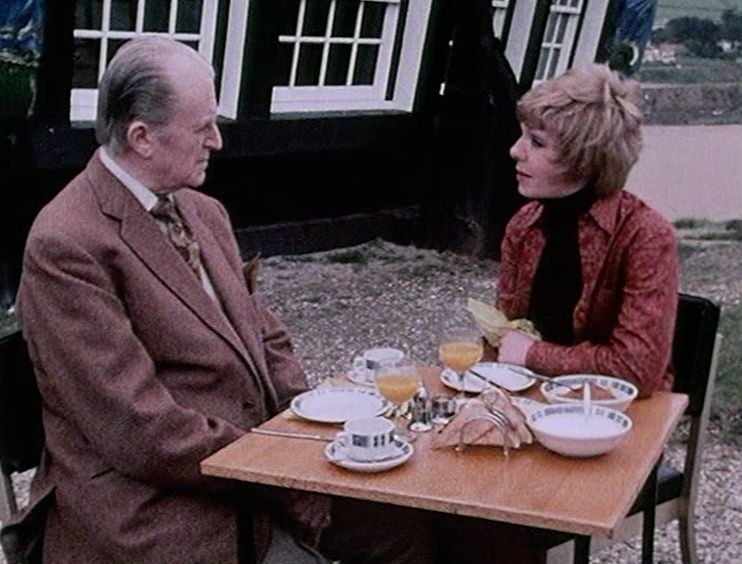


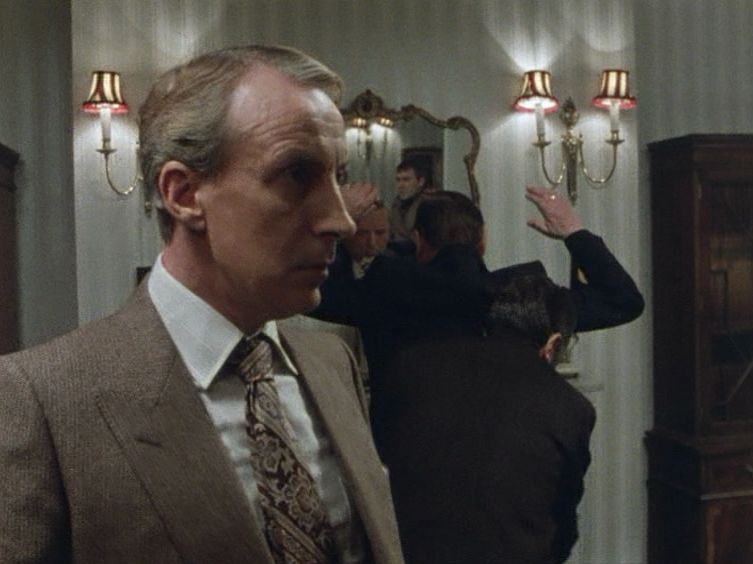
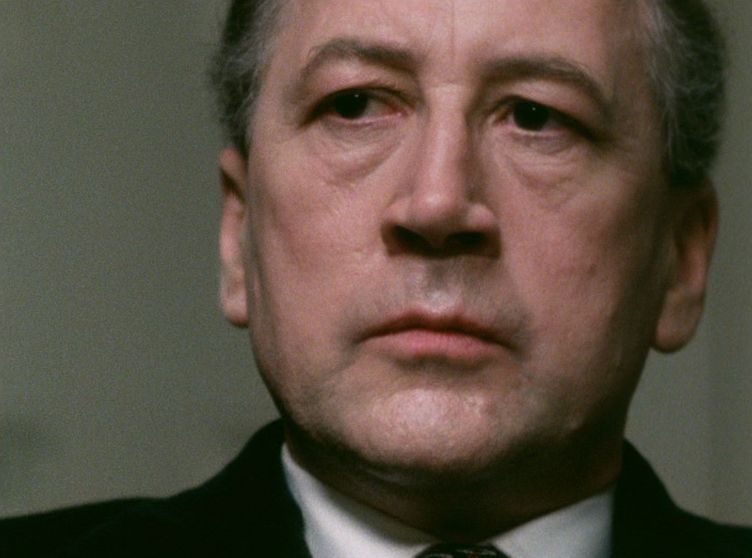

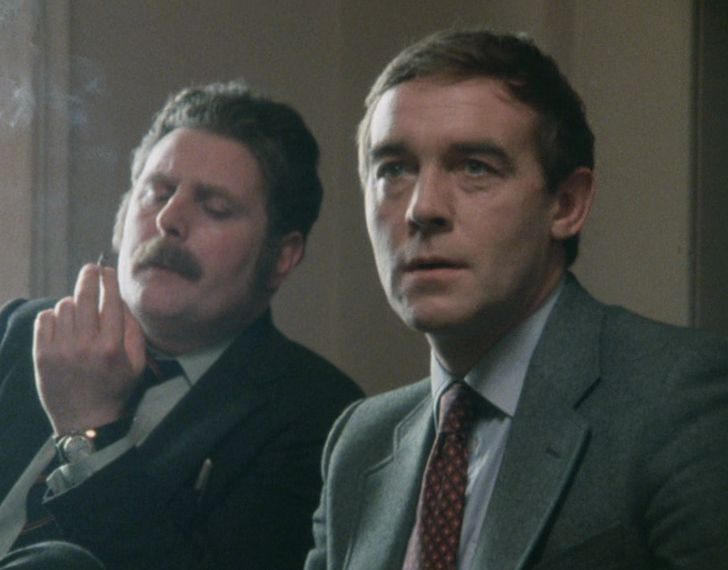

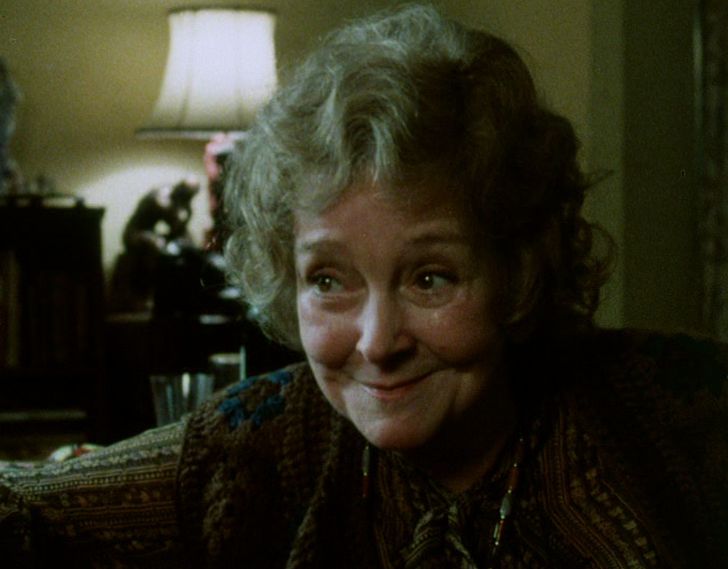
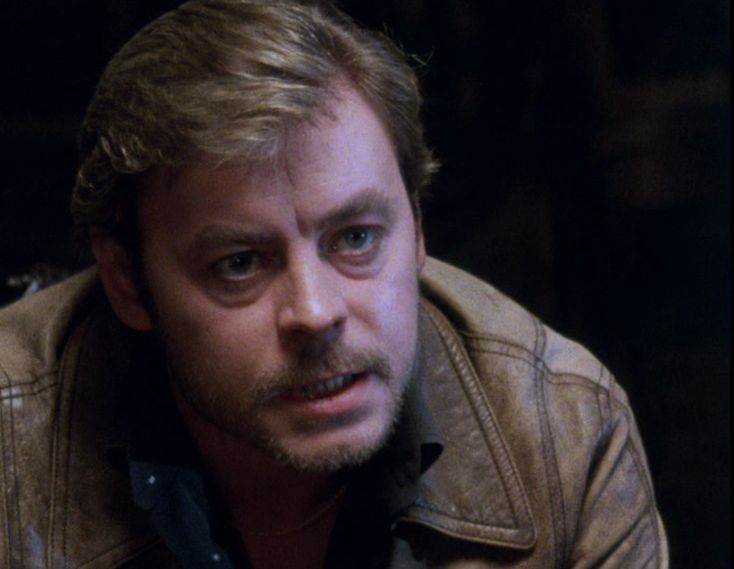

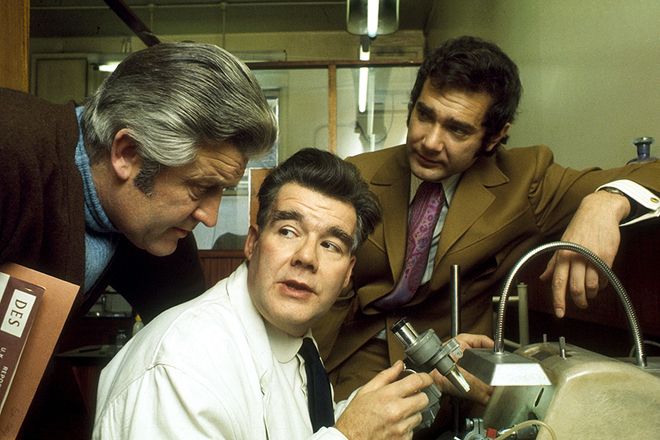
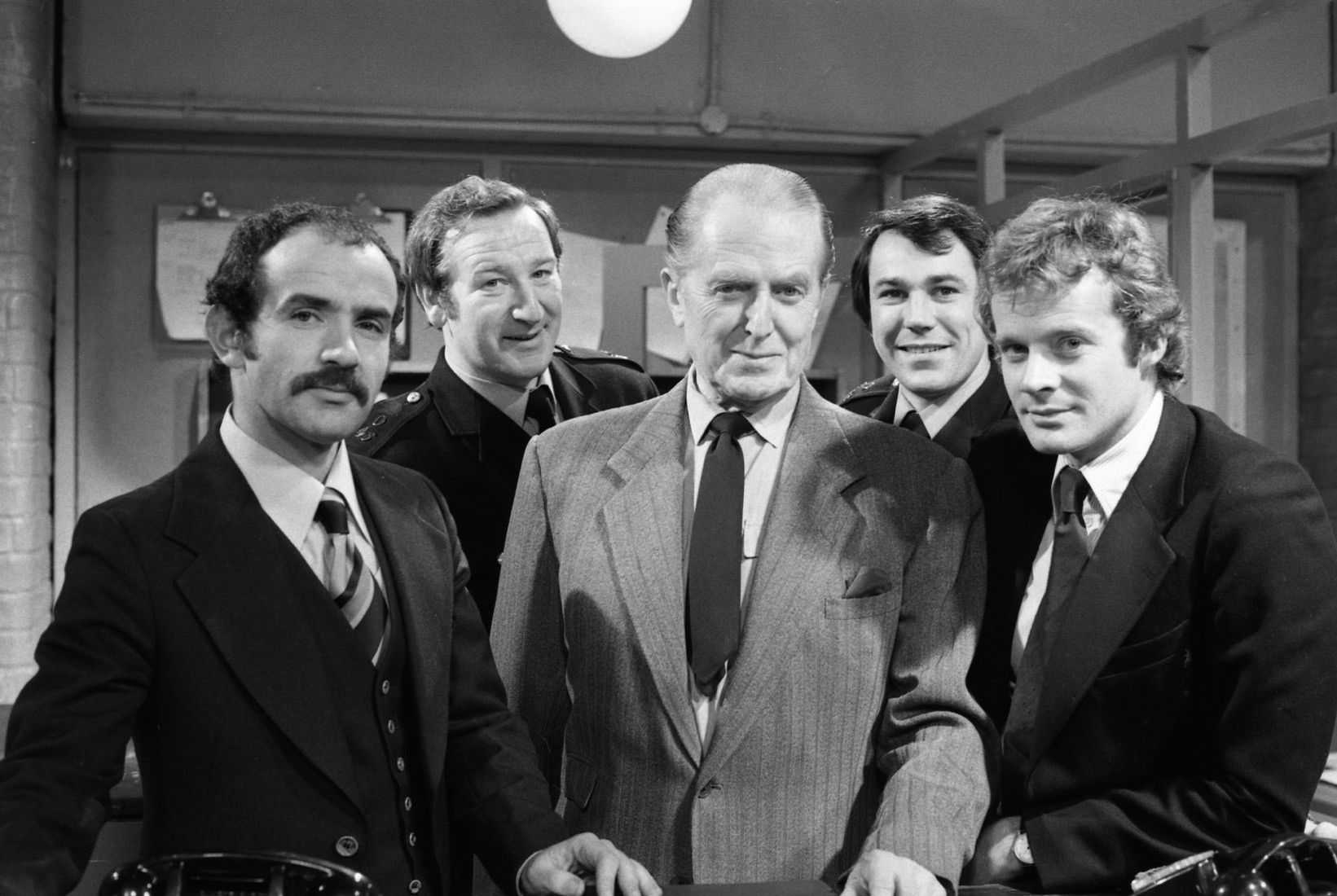
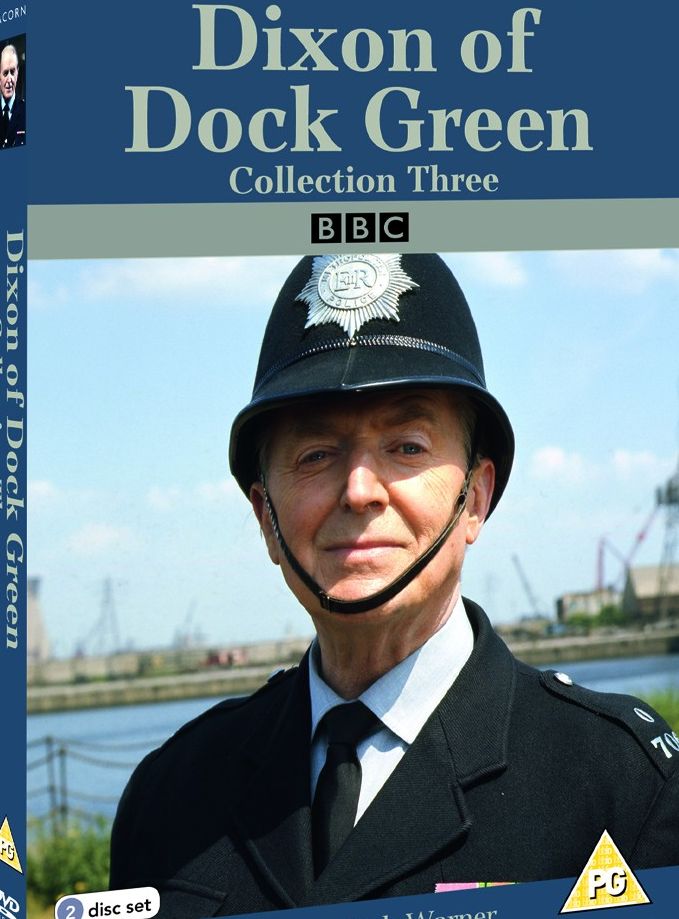
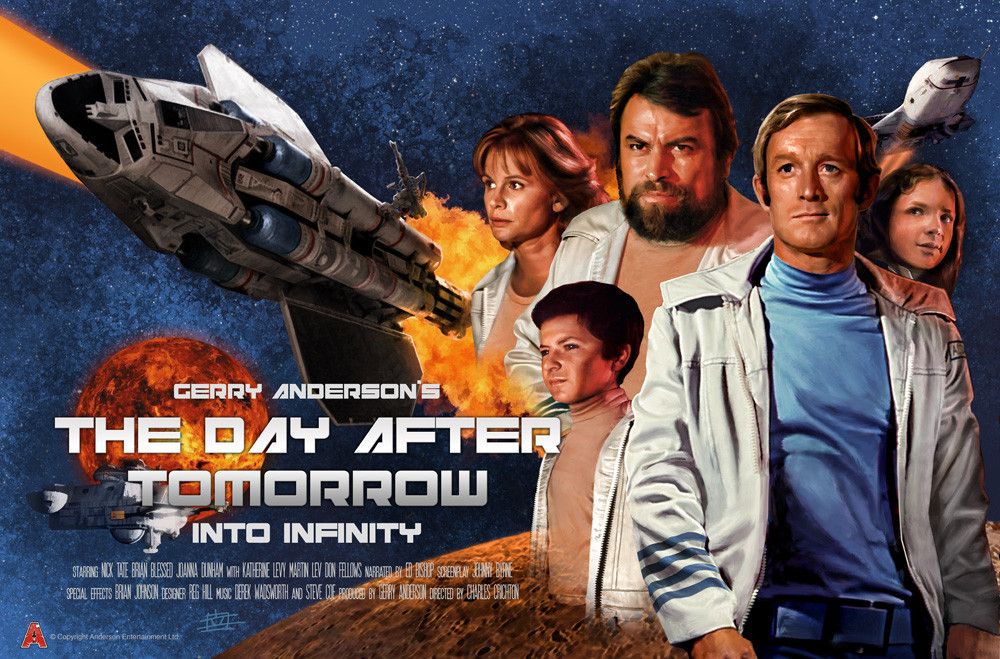
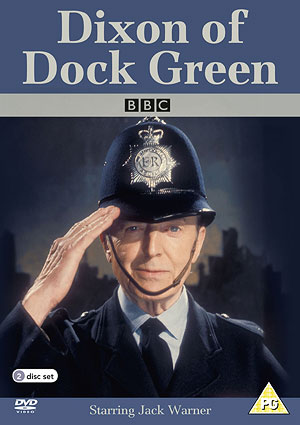
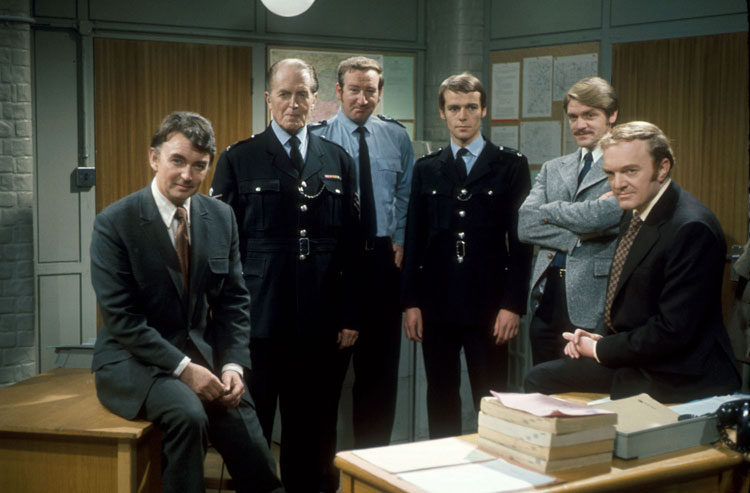
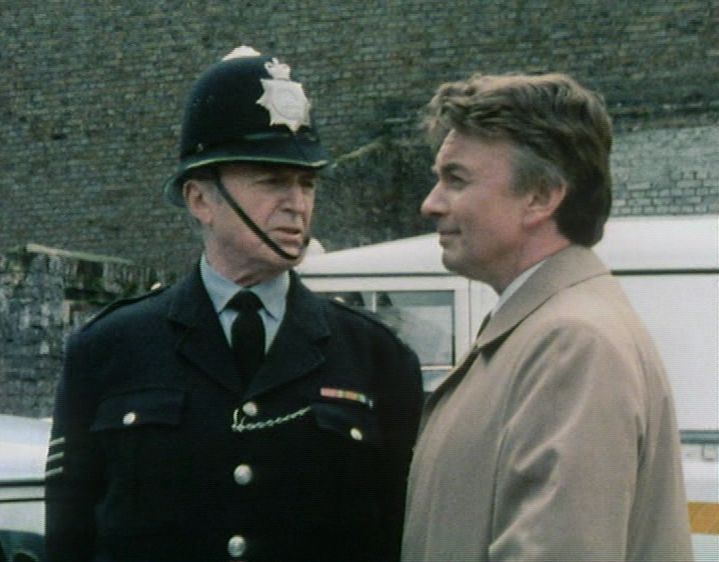


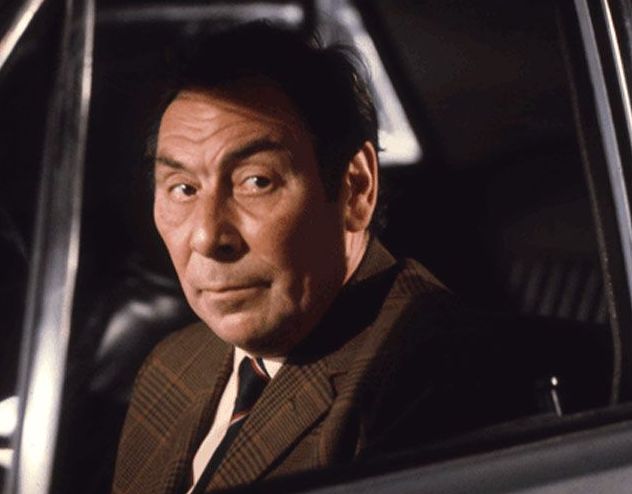
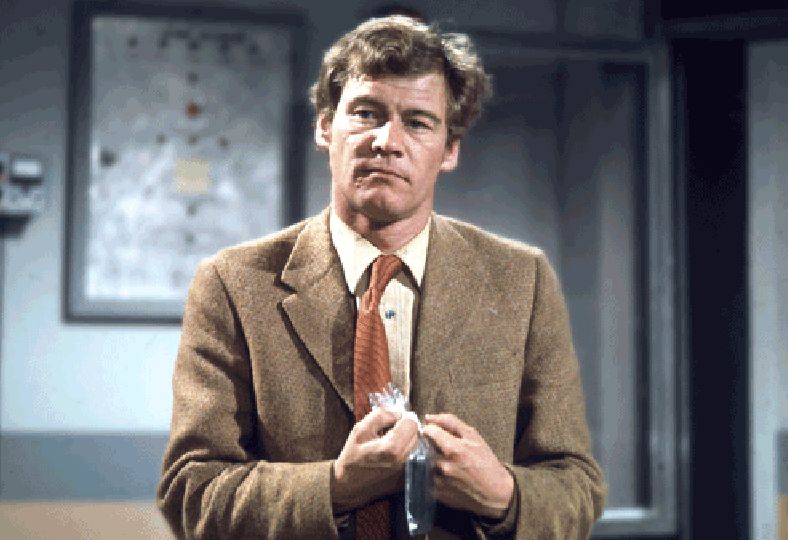
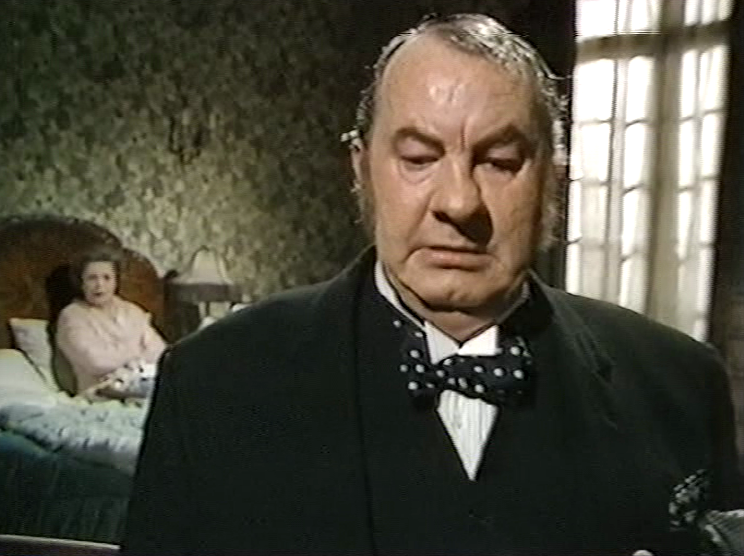

 Archive Television Musings