Sez Les – Series Four, Show One

l1

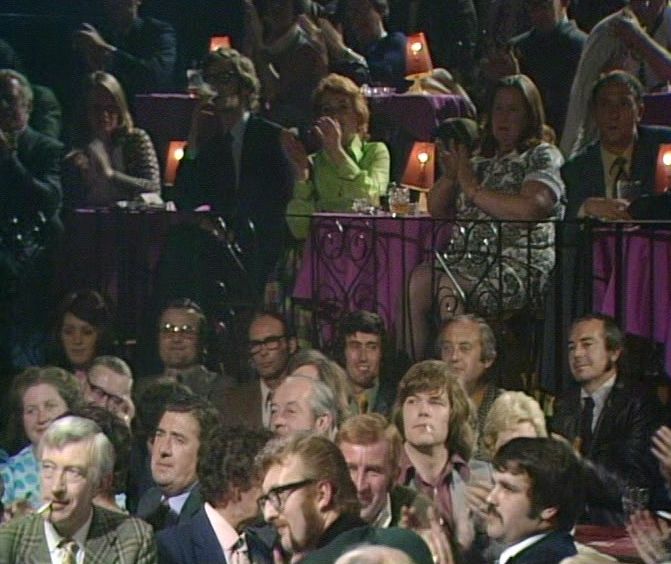
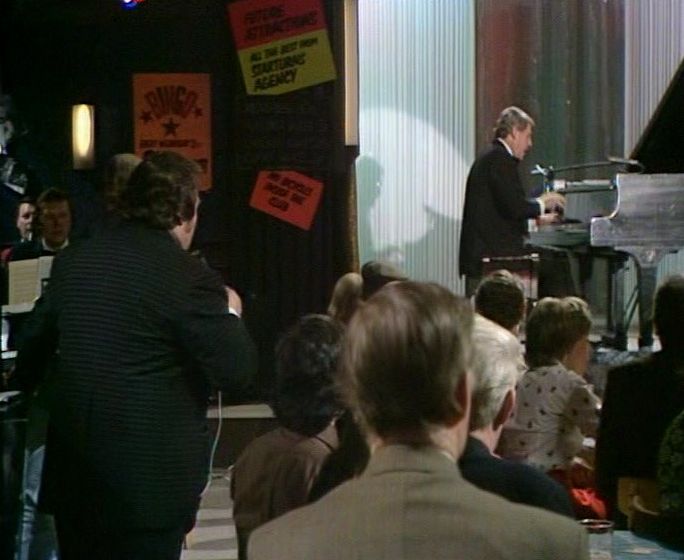
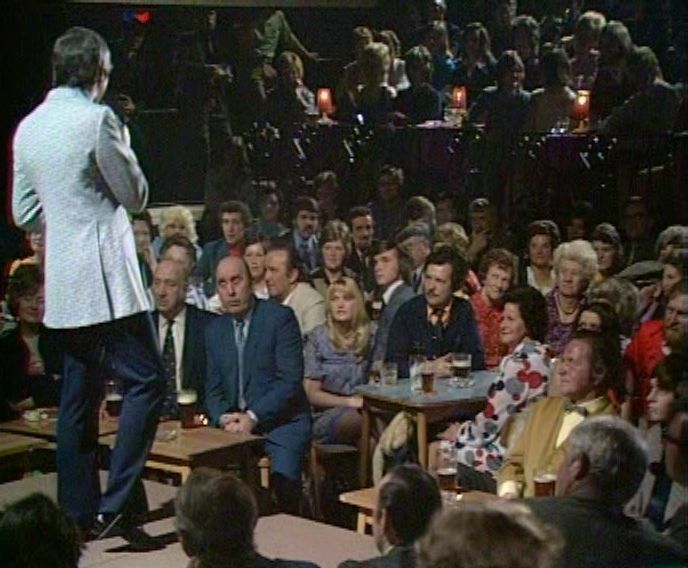
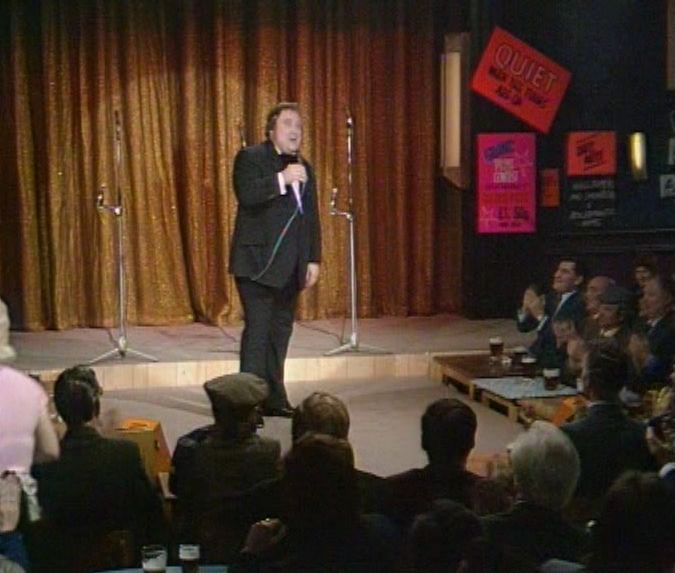
Returning in early 1972 for a run of six episodes, the format’s pretty similar to what has gone before – the Syd Lawrence Orchestra (“the only musicians I know who are mentioned in the Doomsday Book”) are still in residence, although the Skylarks are nowhere to be seen (but fret not, Skylarks fans, they’ll be back next week).

David Mallet continues to feature unusual shot selections at various points (fish-eye lenses, for example) whilst one innovation is that there’s now a selection of “quickie” sketches. These provide a change in pace between the longer items.

One of my favourite short sketches from the whole series features Les as a roadsweeper who lifts up the pavement in order to shovel the dirt underneath! It’s a lovely moment which Dawson later used (during an interview with Michael Parkinson) as an example of the difference between British and German humour (German televison executives didn’t believe this sketch would work in their country as their pavements didn’t lift up …)

As for the longer sketches (still only one each edition) today’s features Roy Barraclough as the impossibly camp owner of a crockery shop. Les, the flat-capped handyman, doesn’t tell his workmate to watch his back in so many words, but the inference is there. As a time-capsule it’s interesting, as a piece of comedy rather less so (partly because it’s obvious that everything in the shop will be destroyed somehow. It would have been more of a surprise if they hadn’t gone down this route).

Musical guests for this first show are Jeannie Lamb and Gilbert O’Sullivan. O’Sullivan I was familar with, but Jeannie Lamb didn’t really ring a bell. A quick search on the internet hasn’t left me much wiser (apart from a few scattered references to her jazz career and a collaboration with Ray Davies). But my researches continue ….

l2

Sez Les – Series Three

l1

Broadcast during August and September 1971 and running to a measly four editions, series three of Sez Les clips along at a fair rate of knots (although Dawson himself is in short supply). This is due to the fact that he has to share the stage with regular acts The Skylarks (a rather decent vocal harmony group) and the Syd Lawrence Orchestra as well as a number of guest performers. With each edition only running for twenty five minutes, there’s a fair amount to be crammed in …

The formula tends to run as follows. After the Syd Lawrence Orchestra and the Skylarks have welcomed him to the stage, Dawson kicks off proceedings with a short monologue (returning in the second half with a longer monologue). Each edition has a single sketch with the remainder of the time being taken up with the guest performers as well as spots for the Skylarks and the Syd Lawrence Orchestra (who close proceedings). The final two editions also have some brief film inserts, showing Dawson interacting with ordinary members of the public.

Luckily I have an almost unquenchable thirst for 1970’s LE, so the number of musical performers isn’t really a problem for me. But for those who are interested in seeing more of Dawson, you might be advised to skip ahead to one of the later series (plus the arrival of David Nobbs helped to sharpen the series’ comedy sensibilities quite markedly).

Guest wise, Manitas De Plata strums a mean Spanish guitar, Dana has a very credible stab at a George Harrison song (Isn’t It A Pity), Frank Ifield warbles in an entertaining fashion, Anita O’Day jazzes things up (her obituary makes for interesting reading) whilst Georgie Fame and Alan Price are good value in the final edition, as is Kathy Kirby. For those familiar with other LE programmes of this era (such as The Two Ronnies or The Morecambe & Wise Show) many of those names will be familiar.

Brian Glover assists Dawson with the sketches seen in the first two editions – the second (Dawson as an extremely nervous dentist attempting to remove Glover’s tooth) being the better of the two. It’s not subtle, but it’s good fun. After leaving Monty Python John Cleese would become a Sez Les regular, but it’s slightly more surprising to see him pop up here in a couple of brief sketches.

It’s likely Cleese recorded his contributions in something of a hurry. The train sketch in show three should have been tailor-made for him, but it’s rather thrown away and there’s little bite to his reactions of Dawson’s improbably dressed Highlander – complete with caber! The second sketch with Cleese is rather better (it also switches from VT to film in a way that’s almost Pythonlike).

Maybe the budget for the last few episodes was a little greater. In addition to this brief film insert, Dawson also went out and about on the streets, ensnaring unsuspecting members of the public with hidden camera stunts. Presumably these gags were real and not staged (although since Dawson had been a television regular for a few years it’s surprising nobody seemed to recognise him).

Producer/Director David Mallet had worked with Dawson before on Joker’s Wild. Knowing that Mallet would later pursue a career as a top music promo director (Queen and David Bowie were amongst his clients) it’s interesting to look back at his early work to see if there’s any visual flair in evidence. For Joker’s Wild, probably not – but then it was a rather static sort of series (the main highlight being a wobbly camera zoom into Barry Cryer at the start of the show).

He had more to work with during Sez Les though and the Syd Lawrence interludes do have some fast intercutting and unusual camera angles, suggesting that Mallet was interested in shaking up the visual grammar of this type of show.

Not a rib-tickling 100 minutes then, but entertaining nonetheless. As my occasional rewatch continues, it’ll be interesting to see the point at which the series began to grow. Several changes – increasing the running time, dropping the musical acts for a while – helped to shake the format up.

The Wheeltappers and Shunters Social Club – 31st December 1974

wheel s02e08

Tonight’s Turns:

Design
Charlie Williams
Kristine Sparkle
Brother Lees
Matt Monro
Freddie Garrity

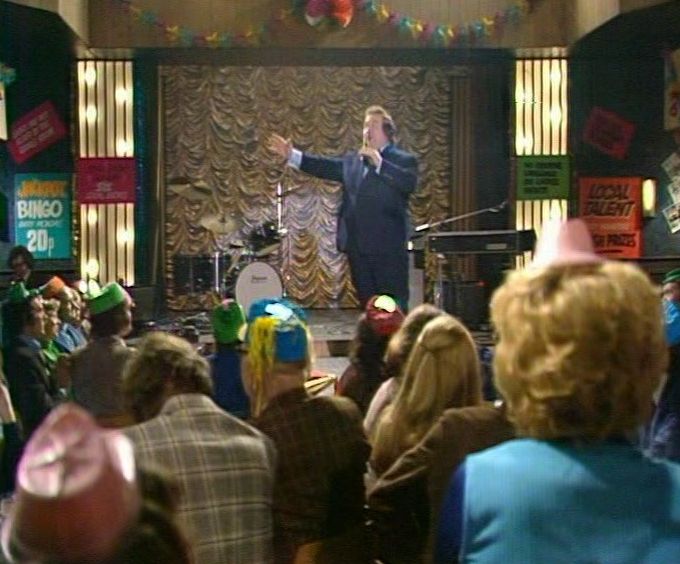
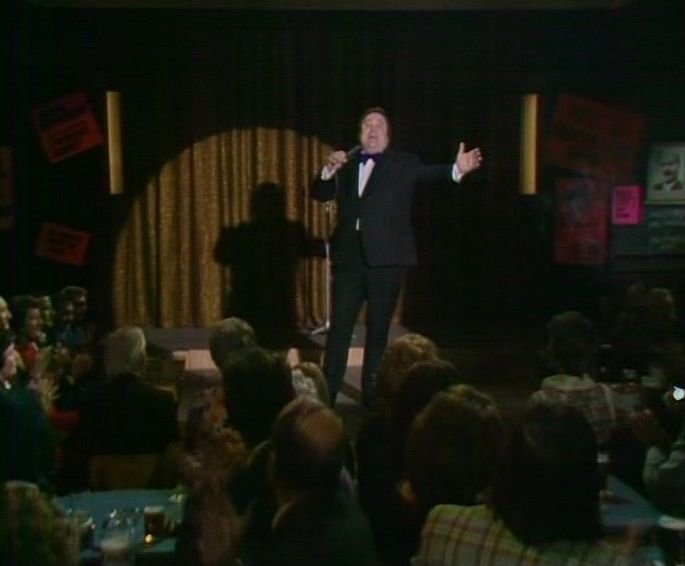
It’s New Years Eve at the Wheeltappers, so decorations, party hats and Auld Lang Syne are all to the fore. But this merriment has to come to an end eventually as it’s time for the turns to do their thing. First up are “one of Great Britain’s top recording groups” Design. Active between 1968 and 1976 (and across a range of record companies including Epic, Capitol and EMI) they may not have had many hits but thanks to a string of television spots (they appeared with Morecambe and Wise, Reg Varney, Vera Lynn, Tommy Cooper, Val Doonican, The Two Ronnies and many others) Design would have been a familiar sight to most the watching audience.

On a slightly melancholy note, it seems that this Wheeltappers performance of Listen to the Music was their final television jaunt. It’s an energetic canter through the song and kicks off proceedings in a decent, upbeat way. Design have a very comprehensive website for those who want to dig a little deeper into their history.

Receiving a typically mocking introduction from Bernard, Charlie Williams’ first point of business when reaching the stage is to thank his fellow comedian (whilst likening him to Humpty Dumpty at the same time). A former professional footballer, when he retired from the game in 1959 he decided to pursue a career as a singer. But when he discovered that his between song banter was going down better than his crooning, he switched to comedy full time.

In one respect he was certainly a trailblazer – black comics were thin to non-existent during the 1970’s – although there’s something slightly uncomfortable about hearing him use the same sort of racist jokes (albeit of a mild variety since this was the Wheelappers) that his fellow, white comics would also have been peddling at the time. But due to his genial, inoffensive nature (“hello flower”) he just about gets away with it.

When Kristina Sparkle’s music career failed to take off, she pursued a parallel career on the impressions show Who Do You Do. Indeed, her Wheeltappers appearance shows that impressions were already part of her act – her spot here culminates with a medley where she mimics the likes of Cilla Black and Lulu. Fairly broadly it has to be said (whilst the way that the cameraman lingers on her rather shapely bottom for several seconds is quite noteworthy).

The Brother Lees mix comedy and impressions. Good to see that they do both Frank Spencer and Tommy Cooper (a seventies impressionist just isn’t a seventies impressionist otherwise). They take it in turns to do various celebs individually – including Roy Orbison and Harold Wilson – whilst also tackling others such as Ken Dodd, Bruce Forsyth and Max Bygraves in triplicate. None of their impressions are stunning, but since their act is so quickfire you don’t really notice – by the time you’ve registered their current impression, they’ve already moved onto the next. An above average turn.

Matt Monro adds a touch of class to proceedings with a trio a well-performed songs – Around The World, Let Me Sing (And I’m Happy) and Born Free. For once, the band all seem to be on the same page and this part of the show slips down very easily.

Normally you’d have expected Matt Monro to have been the headliner, but today there’s one more treat. And what a treat it is. Billed as Freddie and the Nightmares, Freddie Garrity, Frank Carson and Duggie Brown (all dressed as chickens) squawk their way around the stage. Mere words alone can’t do this justice, you simply have to see it (at least once). Colin succinctly sums them up. “We’ve had some bloody rubbish here, but that beats the lot”.

The Wheeltappers and Shunters Social Club – 7th September 1974

wheel s02e07

Tonight’s Turns:

Morton Fraser Harmonica Gang
Mike Reid
David Whitfield
Marion Ryan
Max Wall
Stuart Damon

Through the decades, the basic premise of the Morton Fraser Harmonica Gang never changed – one member of the group (Royston Smith) was somewhat diminutive in size, meaning that he was unable to get his fair share of the limelight (or indeed the microphone). Equal parts slapstick and music, they’re a decent opening act. This Pathe newsreel from 1947 shows them in earlier days.

Given a typically ironic introduction from Bernard, Mike Reid’s opening comment to him is delivered with a singular lack of warmth (“ever thought of lacing your mouth up and using it as a football?”). A genuine spot of needle or were they the best of showbiz mates? Hmm, not sure. Unlike some of the other comedians who appeared at the Wheeltappers, Mike Reid never gave the impression that he wanted the audience to love him. The jokes may be average, but it’s all about the delivery and Reid’s extraordinary vocal gymnastics makes this a memorable spot (and he does a spot of singing too).

David Whitfield, born in North Yorkshire, was a tenor who had a string of hits in Britain during the 1950’s and also cracked the American market at the same time. Straddling the advert break, he’s another good addition to the line up – clearly entertaining the audience not only with his singing but also with his convivial attitude. Drink, Drink, Drink, a whistle of the Colonel Bogey March and The Soldier’s Dream comprise his act today.

Dubbed “the Marilyn Monroe of popular song”, Marion Ryan (like Whitfield and a number of other Wheeltappers acts) had been a big star back in the fifties. She had her own television show and also notched up appearances in The Army Game and Six-Five Special, amongst many others. Multiple Royal Command Performances and guest appearances in specials featuring the likes of Bob Hope and Bing Crosby followed.

Her Wheeltappers appearance proved that she still had a decent singing voice, although having to contend with the house band (who sometimes appear to be pulling in different directions) couldn’t have been that easy. But her performances of I Can’t Give You Anything But Love and The More I See You manage to overcome any musical backing deficiencies.

Bernard. as ever, is charm personified when introducing Max Wall. “Can we have a nice welcome … probably one of his last”. Although Bernard’s genuine look of delight and hearty clapping when Wall takes to the stage suggests that he was only joshing.

Wall’s career encompassed both music hall and the legitimate theatre (appearing in Beckett’s Waiting for Godot and Krapp’s Last Tape, for example). His dead-pan delivery is spot on (although it’s slightly strange that his stream of one-liners has a musical accompaniment – this isn’t really needed). Although one of his gags (“yesterday in the city of Manchester, I saved a lovely girl from being sexually assaulted. I controlled myself”) hasn’t aged well, the rest of his act is a joy.

Best known from The Champions (indeed, Bernard introduces him as such and his walk-on music is Tony Hatch’s familiar theme tune) Stuart Damon bounds onto the stage to entertain the audience with a handful of familiar songs. With a number of Broadway musical appearances under his belt from the 1960s, he obviously knew how to belt out a song. He kicks off with Bad Bad Leroy Brown before finishing up with The Yellow Rose of Texas and a snatch of The Battle Hymn of the Republic (where once again the band, led by Derek Hilton, goes somewhat off-key).

Damon’s performance style is best described as “full-on”. He certainly gives his all (and then some) and also can’t resist moving into the audience from time to time. A curious turn that’s for sure, but whatever else it is, it’s certainly not dull.

The Wheeltappers and Shunters Social Club – 31st August 1974

wheel s02e06

Tonight’s Turns:

The Wheeltappers Waiters
Syd Francis
Peter Gordeno
Dermot O’Brien
Wilma Reading
Enrico
Marty Wilde

There seems to be a lack of turns tonight, so Colin and Bernard are forced to let the Wheeltappers waiters take to the stage. And wouldn’t you know it, they turn out to be a very passable barbershop quartet. The audience seems to enjoy them (as ever, watching the audience is sometimes more entertaining than watching the acts) and they happily join in with a good old singalong. I’m not sure why the waiters all had to sport stick on moustaches though.

Next, Colin – still desperately short on turns – gives a plucky member of the audience, Syd Francis, a chance to shine. He’s a pretty decent trumpet player as well as being a comedian. A memorable contributor to The Comedians, this means that Francis is subjected to a certain amount of heckling from Bernard (who often gave his fellow comics a hard time). A few gags and The Entertainer played on the trumpet. If that’s not entertainment, I don’t know what is.

Peter Gordeno might be best remembered today for his short stint on UFO, but his main talents lay more in the direction of singing, dancing and choreography. Rather oddly introduced by Bernard as “Peter Gardinia” (a genuine mistake or a spot of Bernard’s mickey-taking?) Gordeno can certainly hold a tune (kicking off with One Is One). Mind you, it’s hard not to focus on his appearance just as much as his vocal skills – he’s sporting an impressive head of hair (complete with massive sideburns) as well as a frilly white shirt and medallion.

He then brings on four attractive young ladies for another song (I Taught Them Everything They Know) which then merges into When I’m Sixty Four and Rock-a-Bye Your Baby With A Dixie Melody. With Gordeno displaying a well-developed sense of humour, this is a pretty long spot but also one of the more entertaining seen so far during the second series. For those looking for more info on him, Gordeno’s Guardian obituary makes for interesting reading.

Variety is the spice of life at the Wheeltappers, so next up is Dermot O’Brien, an Irish accordion player who leads his band through a spirited rendition of Orange Blossom Special. The ladies in the front row seem very taken with this, as they’re clapping for all they’re worth.

The music continues with Wilma Reading, who treats the audience to The Ends of the Earth. Barely wearing a blue dress, she’s an energetic performer who seems to draw the best out of the house band (especially the bongo player). She certainly makes a memorable impression with her three minutes.

Up next is Enrico, a diminutive juggler. Dressed as a clown, he’s a more than decent spesh act and helps to keep the audience warmed up before the appearance of the headliner.

One of the original wave of British rock’n’rollers (and still going strong today) Marty Wilde offers us a whistle-stop trot through four classic songs (Mean Woman Blues/Rubber Ball/Teenager In Love/Oh Boy) within the space of his six minutes. The ladies in the front row seem particularly energised by his turn – especially Oh Boy. A cracking end to a very strong show.

The Wheeltappers and Shunters Social Club – 24th August 1974

wheel s02e05

Tonight’s Turns:

Sheps Banjo Boys
Dave Evans
Rain featuring Stephanie De Sykes
Malcolm Roberts
Johnny Hackett
The Kaye Sisters

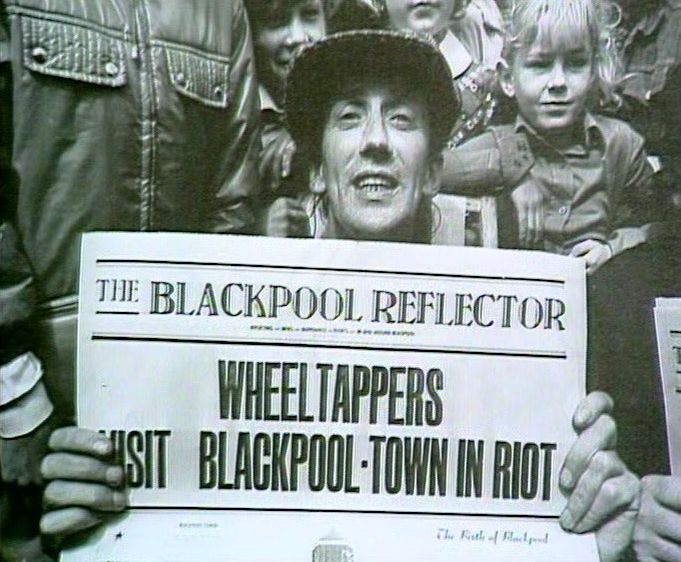
The Wheeltappers hits the road today, as they visit Blackpool. We open with a lovely series of black and white stills of Colin and Bernard enjoying the various Blackpool amenities before crossing over to the Layton Institute (Affiliated) where the Wheeltappers faithful have set up for the night.

Shep’s Banjo Boys, still going strong today, keep the audience entertained with a burst of banjo favourites. I wouldn’t have minded a bit more from them, but as always the turns tend to be wheeled on and wheeled off.

Unless I’ve got him mixed up with another Dave Evans, then the young impressionist second on the bill here is the father of Lee Evans. Will Dave be giving us Tommy Cooper and Frank Spencer (as all 1970’s impressionists had to do?). He starts off with a pretty decent Eric Morecambe before moving onto Groucho Marx (you can’t beat the classics). That he’s got a slightly different list of victims from many of his peers is demonstrated when he then takes off Acker Bilk (he may not sound too much like him, but he can handle a clarinet quite well). So no Frank Spencer and Tommy Cooper then, but a more than decent spot.

This year – 1974 – Stephanie De Sykes hit number two with the song Born With A Smile On Your Face (penned by Simon May). She sings it here, with vocal support from Rain (three gentleman who all wear shirts with very wide collars). Very nice performance too, although not for the first time it’s an irritation that a good song is faded out (here because it’s time for the adverts). Unusually, De Sykes and Rain continue after the break (once again though, we don’t get the full song as this one is faded up). Rain take more of a prominent role on Golden Day, the theme song to The Golden Shot (written by Lyndsey de Paul and Barry Blue).

Bernard cajoles Colin up onto the stage. The first part of his act is basically what he does throughout all the other shows – reading out messages and resolutions from the committee – the difference here that he’s standing up on the stage rather than sitting down and ringing his bell. Instead, Bernard’s the one sitting down and enjoying himself enormously by lobbing several well-timed heckles Colin’s way! But Colin then does something different, singing With My Little Stick of Blackpool Rock. Crompton does a very fair impression of George Formby, it has to be said.

Malcolm Roberts had three hit singles in the late sixties, although like so many who appeared on the Wheeltappers he found chart success harder to come by in the seventies and beyond. Today he performs She (which was his current single). From such a brief appearance it’s hard to get too much of an impression of him, but it seems that he carved out a decent living in clubland and also went on to have a few Eurovision adventures. This website will enable the curious to dig a little deeper.

Johnny Hackett notched up a series of appearances on various series during the 1960’s and 1970’s (including The Good Old Days, Dee Time and David Nixon’s Magic Box). Mixing comedy and music, he’s a convivial type – not exactly my thing, but he’s amiable enough.

The Kaye Sisters (who weren’t actually sisters, what a swizz!) had several hits during the late fifties and early sixties. Their spot is quite jolly, although since they’re the headliners it does seem a little stingy to give them less than three minutes.

The Wheeltappers and Shunters Social Club – 17th August 1974

wheel s02e04

Tonight’s Turns:

Aphrodite and the Grecian Kings
Los Magicos
The Crickets
The Grumbleweeds
Yana
Johnnie Ray

Unusually, today Bernard gets an introduction at the top of the show (normally, we cut into his song when it’s already in full swing). The audience have clearly been primed to wave red cards at him whilst he’s in mid-croon (the reason for this is lost in the mists of time).

With a name like Aphrodite and the Grecian Kings you’re primed for something special – and they don’t disappoint. There’s three chaps – all visions in white – whilst a blond lady sings a song in Greek (at least to begin with). When she’s not singing she gyrates around in a fashion that I’m sure the males in the audience appreciated.

Are they being serious or is it a comedy act? I’d say the latter, but with some of the turns you get at the Wheeltappers you can never be sure. It’s a rum old opening that’s for sure – when this lady sings, nobody sleeps.

Magic’s up next, with Los Magicos taking to the stage. He’s dressed in a stunning white suit, complete with flares, whilst his female helper has a similar (if somewhat abbreviated) outfit. He’s a dove man – he makes the birds appear, then he makes them disappear. Scarves and more birds (for variety, an owl) are also pulled out of a box. Fair to say that these are only modest thrills.

After the fairly average entertainment derived from the first two acts, things pick up with the arrival of the Crickets. Although a number of new members had joined during the 1960’s, the presence of Jerry Allison was a direct link to Buddy Holly which therefore makes them slightly more than just another covers band. It’s only a short spot – two songs – but it’s pretty decent.

The conceit of the Grumbleweeds’ act is that their stage clothes haven’t turned up, so they’ve been forced to use whatever they can find backstage. This includes a Musketeers costume, what seems at first to be a football kit (but turns out to be a dress), a nappy(!), a school uniform and a swimming costume. Their song routine – based on endless repetition – isn’t subtle but it’s funnier than many of the comedians who have graced the Wheeltapppers stage so far.

Given that they clearly had some visual flair, it’s slightly surprising that they never really seemed to be at their best on television (their 1980’s ITV series was only fitfully amusing). Instead it was radio where they made their mark.

The Wheeltappers, no doubt reflecting the reality of clubland, tended to feature a fair few acts who had been famous once upon a time but who had then faded into obscurity. Yana is an excellent example of this. At the height of her fame – in the late 1950’s – she had her own BBC television show and also crossed over to America, appearing with both Ed Sullivan and Bob Hope, but by the following decade she had become yesterday’s woman.

So by 1974, possibly only the older members of the audience (which, luckily, tended to be most of them) would have remembered her. Yana’s style was to breathe out a song (like Move Over Darling) whilst fondling and kissing various men in the audience. She also invites one lucky chap onstage, where he gets right into the swing of things (jigging in time to the music like nobody’s business). Possibly he was a plant, but I like to think he was simply an ordinary punter who had one drink too many. This is an odd little sequence, but one that also perfectly sums up the Wheeltappers experience.

Another blast from the past – Johnnie Ray – is today’s top of the bill. Cited by Tony Bennett as being the true father of rock ‘n’ roll, he rattles through a few familiar songs (most notably his UK number one, Just Walking in the Rain). It’s a slightly wonky listen, mainly because the regular house band aren’t the tightest, but Ray’s star quality – like Yana, he works the crowd well – shines through.

The Wheeltappers and Shunters Social Club – 10th August 1974

wheel s02e03-01

Tonight’s Turns:

Remember This
Duggie Brown
The Multichords
The Playmates
Roy Orbison

Remember This open the show with a bracing blast of Rock ‘n’ Roll nostalgia. It seems odd to think that by the mid seventies this type of music had already become a period piece, but I guess that’s musical trends for you. The band are dressed like a scruffy version of Showaddywaddy and if their energetic performance isn’t eye-catching enough then there’s two dancers – a man and a woman – placed centre stage to inject a little more oomph. It’s good stuff (Rock ‘n’ Roll Music is the main song they cover) although Colin Crompton (reading the Beano) seems less impressed with them ….

An old face from The Comedians, Duggie Brown faces attacks on two fronts – Bernard on the left and Colin on the right. Presumably his put-downs to them were off the cuff (like all club comedians he no doubt had to face down his fair share of hecklers). That’s easily the best part of his spot, as his gags are fairly ordinary (but his confidence and sheer personality enables him to make a decent impression). Since there’s only five acts today, this allows some turns to get a little longer – Brown is one recipient of this generosity as he’s able to close his act with a fairly straight song at the piano.

The Multichords are up after the commercial break. There’s two of them, playing their harmonicas for all they’re worth (and not just through their mouths either). Don’t worry, it’s nothing too terrible – one of them elects to play Wooden Heart via their nose. This is the sort of act I find fascinating – not least since you can’t help but wonder whether they were able to sustain a decent living from it. I’ve not been able to find out too much about them, but my researches continue.

Described by Bernard as a “knockabout act”, the first member of the Playmates (she’s blonde and wearing very little) draws an appreciative ripple from the audience. The other playmate – he’s small and goofy – isn’t likely to stir any hearts but the incongruity of their partnership is no doubt what makes it work. There’s a few decent acrobatic moves thrown in, but it’s mainly an excuse for the man to race around the audience prodding the females. Well, it’s a living.

Quite what Roy Orbison, waiting backstage, would have made of this is anybody’s guess but by the mid seventies he would have been quite familiar with the typical clubland bill. After the hits dried up, he made a decent living (if not an artistically satisfying one) by touring venues like the Wheeltappers.

Needless to say, The Big O is the class act of tonight’s show. Gifted ten minutes (a generous amount of time for this era of the programme) he sings three songs – Lana, Sweet Mama Blue (the current single) and Oh Pretty Woman. It’s just annoying that Oh Pretty Woman plays over the credits (and is cut short as well). Baffling that Orbison’s biggest hit received this treatment – maybe in retrospect trimming a few minutes from Duggie Brown’s act would have been the sensible move.

The Wheeltappers and Shunters Social Club – 3rd August 1974

wheel s02e02

Tonight’s Turns:

Amazing Bavarian Stompers
David Copperfield
Barbara Sharon
Susan Maughan
Paul Wynter
Winifred Atwell

What can you say about the Amazing Bavarian Stompers? If you like oom-pah music then this is the act for you. They’re still going strong today, with a website and Twitter feel, which obviously suggests there’s a market for this sort of thing. The Wheeltappers crowd, pints in one hand and pennies in the other, seem to be enjoying themselves tremendously as they use the coins to tap out a relentless beat.

The one from Three of a Kind who wasn’t Lenny Henry or Tracy Ullman, David Copperfield has tended to exist in the shadows of his more illustrious later co-stars, but his solo spot here (which would seem to be his earliest television appearance) isn’t too shabby at all. A mixture of music, comedy, magic and ventriloquism, it’s very decent. His red suit is nice as well.

As has happened before, when it’s adverts time Colin Crompton announces that they’ll entertain themselves with a nice game of bingo. But this is only a cover story, as they’re really enjoying the stripper (Barbara Sharon) and it’s only due to a spot of miscuing from the vision mixer that the punters at home receive a flash – as it were – of anything titillating.

Like a number of other Wheeltappers acts, Susan Maughan’s career peaked in the 1960’s with success a little harder to find in the following decades. She’s still able to entertain the packed crowd though and her two songs are passable fare.

Twice a winner of the Mr Universe contest, Paul Wynter’s appearance has to be one of the strangest seen so far on the Wheeltappers. He begins by flexing his impressive muscles and then moves on to bending a nail. It’s a pity that the camera isn’t able to pick up the bent nail, so we have to assume from the warm applause that he actually did bend it. Wynter then uses a karate chop on a piece of wood, shattering it in two, before bending an iron bar. Well it was the 1970’s, so possibly people were more easily impressed. As Wynter doesn’t speak, it’s down to Colin Crompton to keep the audience informed (“he’s now pulling a funny face”).

Pianists are obviously a big draw at the Wheeltappers. Last week it was Russ Conway, today it’s Winifred Atwell who tickles the ivories. She had a string of instrumental hits throughout the 1950’s and as her performance here demonstrates, still had the magic touch. An entertaining end to a bill which is a typical Wheeltappers mixed-bag.

The Wheeltappers and Shunters Social Club – 27th July 1974

wheel s02e01

Tonight’s Turns:

Brotherhood of Man
Franklyn James
P.J. Proby
Los Tres Hermanos
Alex Sisters
Russ Conway

The Brotherhood of Man are simply a vision. Once you’ve finished goggling at their stage clothes then you can appreciate their full-throttled musical attack. They’re definitely not holding back as they rattle through Reach out Your Hand. A storming start to the show.

It seemed to be the law that every impressionist during the 1970’s had to take off Frank Spencer and Franklyn James doesn’t disappoint on that score. But he also mimics both Colin Crompton and Bernard Manning (Bernard seems to enjoy this) which is a nice touch. Some of his other subjects couldn’t really be more seventies if they tried – Peters and Lee, for example – whilst he also tackles some classic Western stars. Just about tolerable.

If there’s one fact that everybody knows about P.J. Proby then it’s that he once split his trousers. No such trouble on that score today as his denim trouser suit looks to be very secure. As with the Brotherhood of Man, his intensity is something to marvel at – although whether he’s being serious or just taking the mickey is a moot point. I’ve a terrible feeling that he’s being dead serious ….

Either way, it’s an unforgettable spot.

There’s no respite in this show. After still reeling from P.J. Proby, Los Tres Hermanos bounce onto the stage. There’s three of them (naturally) and are identically decked out with white trousers, red polka dot shirts and natty little red hats. With such a name, you might expect a traditional Mexican song …. instead they treat us to Tie A Yellow Ribbon. This undemanding singalong fare hits the spot with the audience, who give them the biggest cheer of the night so far.

A female double-act during this era was an unusual sight. I’ve not been able to source a great deal of information about the Alex Sisters – so I don’t know whether the act they perform here (one sings a serious song whilst the other – dressed as Charlie Chaplin – attempts to upstage her) was one they did on a regular basis. “Charlie” is, as you’d expect, silent throughout and manages to milk the audience’s sympathy when she’s ordered off the stage (all together now, “awwwww”).

Top of the bill is Russ Conway. He gives the audience what they want by opening with his biggest hit, Side Saddle (1959). His spot is thoroughly charming and following some of the more wonkier delights on today’s bill, closes the show in style. Unlike some of today’s acts, there’s no shortage of Russ Conway information out there and I recommend this website for all your Conway needs.

The Wheeltappers and Shunters Social Club – 26th May 1974

wheel s01e07

Tonight’s Turns:

Mrs Mills
Dave and Amos
Eve Boswell
The Fivepenny Piece
Peter Wheeler, Schoolmaster
The Leaways
Gene Pitney

Today’s show opens with Mrs Mills in full swing. There are few things finer in life than a good old singalong and Mrs Mills’ jaunty piano playing certainly energises the audience, who whole-heartily join her in familiar old standards such as My Old Man. It’s interesting that her brush with fame only occurred quite late in life (she made her debut television appearance with Billy Cotton, aged 43, in 1961). I now have a faint inclination to track down some of her LPs (most of which had the word “party” in the title) and singles (Mrs Mills’ Minstrel Medley sounds intriguing).

Bernard seems to be enjoying Dave and Amos’ performance, as his hearty chuckles are very audible. Or is he simply amusing himself by disrupting their act? More the latter than the former I think. Dave and Amos might be a double act, but unlike, say, Cannon & Ball they weren’t comprised of a straight man and a comic. Instead, both are somewhat off the wall (for the Wheeltappers environment anyway) and eschew traditional gags for something a little different. It might not quite work, but you have to admire them for taking the risk (although had Bernard kept quiet it might have worked a little better).

Eve Boswell pops up to sing her big hit. Pickin’ a Chicken reached number nine on the hit parade in 1956. No, I’ve never heard of it either but one of the joys of the Wheeltappers series is discovering little nuggets of entertainment history which have previously passed me by. As ever with the show, the audience – especially those in the front row, energetically clapping along – are sometimes as entertaining as the performers on stage.

Lancashire’s finest, The Fivepenny Piece, are up next – although since there are six of them shouldn’t they have been called The Sixpenny Piece? I enjoyed their folksy song I Don’t Know If I Wanna Go Home. They have a rather comprehensive website which lists all of their television appearances. I have to confess that I’d rather like to see some of the series they made in the late seventies – MH and 5p in 1978, where they shared the stage with Mike Harding, or their own four part show the following year. Maybe one day they might surface on DVD – it seems unlikely, but stranger things have been released. Although those who crave some more 5p action should check out the sixth and final series of the Wheeltappers which features them throughout one of the shows.

It’s a laughter-free zone when Peter Wheeler stands up to play a schoolmaster. If you can’t guess some of the punchlines (apologising for the drunkenness in school which turns out to be – wait for it – the teachers not the pupils) then you’ve clearly led a very sheltered life (or not experienced comedy of this type).

The Leaways are a rather good acrobatic act. He’s very tattooed (something which is commonplace now, but would have stood out much more forty years ago) whilst she – as is traditional – wears very little. The accompanying music – Moon River and others – seems a little out of place but it doesn’t detract too much from their feats of balancing – which, given the small stage, was probably a little tricky.

After a brief snatch of 24 Hours from Tulsa (rudely interrupted by Colin Crompton) Gene Pitney launches into a spirited rendition of Princess in Rags. He then closes the show with a song he wrote for Ricky Nelson, Hello Mary Lou. Personally I would have dropped Peter Wheeler so we could have heard all of Tulsa – as always with this era of the show, the turns are very limited for time.

The Wheeltappers and Shunters Social Club – 11th May 1974

wheel s01e05

Tonight’s Turns:

Splinter
Norman Collier
Kathy Kirby
Jackie Allen & Barbara
Victor Burnett & June
Frank Ifield

Splinter are the first act to brave the stage tonight. A five piece (three women, two men) they give the sort of performance which seemed to be tailor-made for clubland. With each member of the group taking turns to trade vocal lines, it’s clearly a song that went down well with the audience – at the end we see a beaming lady of a certain age whilst a cloth-capped gentleman, fag in mouth, also gives them a hearty round of applause.

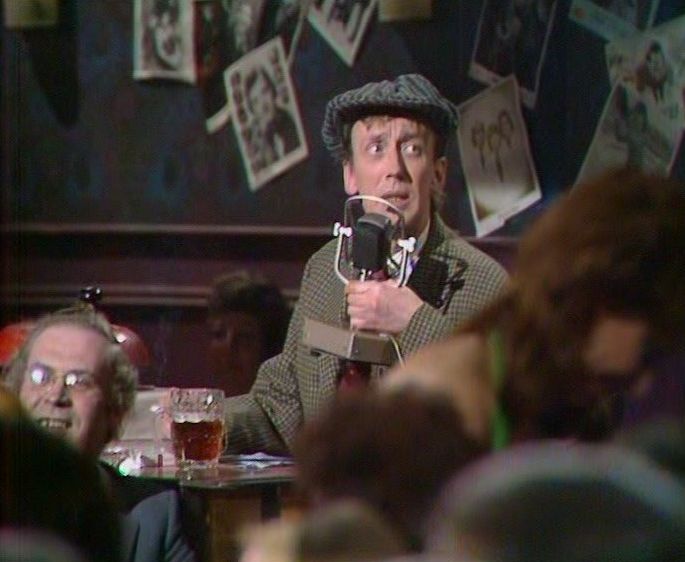
Norman Collier does his act with the dodgy microphone. Some unkind people might way that was his act, but he has more than one string to his bow. I wonder if his hats routine predated Tommy Cooper’s? But Collier sings as well as changes hats (which is something – possibly mercifully – Tommy never did).

Like a number of other performers, Kathy Kirby’s appearance at the Wheeltappers was an accurate summation of the current state of her career. One of the top female performers of the 1960’s, by the early 1970’s her professional life was stuttering somewhat, which makes it entirely probable that she would have had to ply her trade in venues such as this one. Her various obituaries, which appeared in 2011, filled in some detail about her career freefall.

She belts out a good version of You Won’t Find Another Fool.

Kirby then introduces Here I Go Again as the song she wanted to release as her latest single, but due to record company pressure was prevented from doing so. This might explain why she’s a little emotional at the start, although she rallies as the tempo picks up.

After the emotional drama of Kathy Kirby, Jackie Allen and Barbara offer some light relief on the xylophones. Jackie dishes out some baby xylophones to selected audience members which adds to the hilarity as he attempts to teach them how to play. Interestingly – well I think so – when Jackie began his career he was partnered by his cousin Barbara. But when his wife-to-be, Irene Spencer, took her place, they decided to keep the name “Barbara”. They had a long career, first appearing on the wireless via shows such as Variety Bandbox and Workers’ Playtime which – prior to the dominance of television – united a large part of the nation.

Today’s show must have been underrunning as Bernard is given the opportunity to do a spot of crooning. It’s always a jolt to realise that Bernard Manning could carry a tune very well.

Victor Burnett is an old-style sort of magician. No rabbits alas, but top hats are in evidence. The fact he remains mute means that the illusions have to do the talking for him. There’s nothing staggering to be found here, but I daresay it’s an accurate picture of a typical club magicians act, so it’s of interest from that perspective.

Frank Ifield, like the other headliners from this era, doesn’t have a great deal of time to make an impression, but thanks to an energetic Waltzing Matilda (he’s Australian you know) he manages to engage the audience. I would have liked to hear I Remember You, but you can’t have everything I guess.

The Wheeltappers and Shunters Social Club – 18th May 1974

wheel s01e06

Tonight’s Turns:

Springfield Revival
Cannon and Ball
Julie Rogers
Eric Delaney
Tina Townsley
The Bachelors

The Springfield Revival open the show with a bouncy little number. They’re comprised of two white-suited gentleman strumming guitars and a lady in a blue dress shaking a tambourine for all she’s worth. There’s the odd cutaway shot to the audience who seem a little unenthused (but possibly it was early and the alcohol hadn’t begun to kick in yet). But they do manage to engage the audience in a singalong after their main number which warms them up a bit.

Tommy Cannon is introduced as a solo performer. He’s sporting an impressive brown suit complete with flares and a ruffled shirt. His sartorial eloquence somewhat detracts from his lusty attack on Summertime it has to be said. But Tommy’s moment in the spotlight doesn’t last long as an enthusiastic friend from the audience (Bobby, of course) can’t help but show his appreciation at Tommy’s star quality.

This doesn’t go down well with some members of the audience, who cry out “sit down, you’re spoiling his act”. Did they really not twig that Bobby was the other half of the double act? But it doesn’t take long before Bobby’s cheeky-chappy persona (and no doubt his politically incorrect song about a house full of Pakistanis) has won them round, which enables Bobby to milk the audience’s sympathy after Tommy orders him offstage.

You’d have been hard pushed from this spot to foresee that Cannon and Ball would go on to enjoy such a long run on ITV, but there’s clearly some spark there – even if their Wheeltappers debut is only fitfully amusing.

Julia Rogers, a vision in a sparkly pink dress, has an impressive set of lungs which she uses to belt out a couple of songs. Best known for her 1964 hit The Wedding, she has something of a Shirley Bassey feel. Given this, it’s possibly not surprising that she had a close encounter with the James Bond world – recording a demo of You Only Live Twice (albeit a different song from the one later recorded by Nancy Sinatra).

Upon Eric Delaney’s death in 2011, aged 87, many of his obituaries commented on his energetic stage persona. An inventive drummer – he pioneered the technique of playing the timpani with wire brushes – he’s good value during his short Wheeltappers appearance.

The arrival of Tina Townsley gains some murmurs of approval from the audience. Are they appreciating her baton twirling skills, or is it more to do her brief costume? Hmm, I wonder. She gets the opportunity to prove that she can twirl other things too – such as knives – although the act doesn’t really go anywhere. She appears, twirls some objects and then departs.

The Bachelors run through a medley of some of their greatest hits (Marie, Charmaine, Diane, Whispering). They then spotlight a number of songs which feature the banjo. And why not. By this point some members of the audience are warmed up enough to clap whilst others (such as a gentlemen in the front) contents himself by gently nodding his head from side to side. It’s not exactly a show-stopping finale, but it has a certain charm.

The Rag Trade – The Christmas Rush

rag 01

Following on from the original BBC run during the early sixties and an abortive BBC attempt in the early seventies to revive the series via an unscreened pilot, The Rag Trade finally returned to television during 1977 and 1978 thanks to this LWT series.

Although only Peter Jones (Fenner) and Miriam Karlin (Paddy) reprised their roles from the BBC incarnation, all of the new characters weren’t terribly dissimilar to the old ones – which made sense, as some of the LWT scripts were directly recycled from the BBC originals.

Christopher Beeney, as Tony, stepped easily to the role vacated by Reg Varney whilst Diane Langton (Kathy) had something of the vague air of Carole, Sheila Hancock’s character (although Kathy was much more pneumatically enhanced).   One interesting conundrum is whether Anna Karen’s character is meant to be the same Olive from On The Buses.  She certain looks and acts like her and since both series were written by Chesney and Wolfe it does seem likely, although it’s never directly confirmed.

The Christmas Rush (tx 24th December 1977) finds a typically harassed Fenner attempting to chivvy the girls (and token male, Tony) into finishing up their latest order.  But of course, they’re much more interested in planning for Christmas …..

There’s a few different story threads in this one.  The first concerns Fenner’s annual dilemma – what to buy both his wife (played by Rowena Cooper) and Paddy for Christmas?  For the last fifteen years he’s abdicated this responsibility by asking Paddy to shop for his wife and his wife to shop for Paddy.  That Paddy elects to buy a smart handbag for Mrs Fenner but then pockets the accessories (purse, manicure set) is characteristic.  Mrs Fenner seem equally contemptuous about Paddy as she decides to give her one of her old presents (a manicure set!).  Fenner reacts in horror, since this was yet another gift selected by Paddy for his wife …..

The set piece comedy moment occurs after Tony bemoans the fact that he’s getting nowhere with Lyn (Gillian Taylforth).  His constant attempts to catch her under the mistletoe haven’t gone the way he planned, so Paddy suggests that if he waits until Lyn’s alone in the rest room and then switches out the light, he could embrace her in the dark.  Paddy tells him – and the other girls agree – that a woman shouldn’t be asked her consent, in fact quite the reverse (they like to be dominated).

Although Paddy later arms herself with a jug of water – all the better to pour over the randy Tony – it seems that the girls weren’t entirely lying when they suggested that the role of the female was to be submissive (although this is undercut in some of the dialogue).  You probably won’t be amazed to learn that things don’t go the way Tony planned since he ends up groping the unfortunate Mrs Fenner instead.

In today’s climate, it’s hard to imagine any scene being deemed less appropriate for broadcast (so don’t expect to see this popping up on ITV3 any time soon).  Mrs Fenner might be a little traumatised by her experience, but everybody else laughs it off and even Fenner doesn’t seem too concerned (telling his wife that Tony looks more upset than she does).

Whilst this scene, like most of the episode, is played very broadly, there’s one quiet moment – which closes the show.  With one dress ruined from an important order, Fenner needs to knock up a replacement quickly, but all the girls are keen to leave – all except Paddy.  Despite their combative relationship, she can’t bring herself to walk out (telling him that he was always a rotten machinist).  This is a beautifully played scene by Jones and Karlin which sees Fenner and Paddy share a drink in the peace and quiet of the workshop before she gets on with the job.  It certainly leaves us with the suggestion that this isn’t the first time they’ve shared a quiet moment together ….

rag 02


All Star Comedy Carnival – 1972. Part Two

all star 02-01.jpg

Christmas With Wogan

I think this could just be the greatest piece of television ever.  Things start sedately enough, with a song from Carl Wayne and Penny Lane (oh, their names rhyme) but after that the fun really begins.

Recorded on the set of Lunchtime with Wogan (all of which sadly seems to have been wiped) you can see that they’ve attempted to get the audience into the Christmas spirit by handing out some party hats.  But since there weren’t enough to go round, the camera tends to focus on the handful of lucky souls who do have one.  The audience shots are fascinating by the way (average age seems to be about eighty).

This segment is a celebration of ATV, so Crossroads naturally features quite heavily.  The sight of Amy Turtle (Ann George) pushing a tea trolley would surely melt even the hardest of hearts whilst Nurses Price and Shaw (Lynda Bellingham and Judy Buxton) from General Hospital also shuffle on.

The fun just keeps on coming as Peggy Mount, Hugh Lloyd, Leslie Crowther and Sylvia Syms appear as two ordinary couples who have been pulled out of the audience to play a game.  The sight of Crowther and Wogan attempting to shovel Mount’s ample form onto a high stool is something that will live long in the memory.

Larry Grayson, resplendent in a black cloak and mask, is brought on as the mystery guest. He has to recite his most famous catchphrases whilst the others attempt to guess his identity.  Simply sublime.

And just when you think things can’t get any better, Meg Richardson (Noele Gordon) arrives …..

Easily worth the price of the DVD alone, this is a rare Christmas treat.  Indeed, had the whole show come from the Wogan studio I would have been quite happy (although had this happened no doubt it would have been wiped along with the rest of his shows).

The Wandsworth School Choir are up next, entertaining Jimmy and the studio audience with The Holly and The Ivy.  Then Jimmy gets in the act and joins them for a trot through Do-Re-Me.  Bob Todd, as a drunken milkman, causes a little havoc for Jimmy.

all star 02-02

On The Buses

Like Love Thy NeighbourOn The Buses was one of those programmes which pulled huge contemporary audiences but hasn’t (in critical terms) aged well.  Although unlike Neighbour it does run regularly on ITV3, so clearly somebody still seems to enjoy it.  Like a number of later episodes, this was written by Stephen Lewis (Blakey) and Bob Grant (Jack).  Reg Varney is conspicuous by his absence, but he seems to have left the show after the 1972 run.

If you enjoy broad slapstick and incredible feats of mugging to the camera then this should appeal.  The story – a goose has been left on the bus and they have to stop it escaping – is the cue for everybody, including Olive (Anna Karin) and Mum (Doris Hare), to get covered in soot and flour.  For me, a little of On The Buses goes a very long way, so this is another series that I don’t have in my collection (but I don’t feel I’m missing out).

Jimmy welcomes David Nixon, who restores a touch of class to the programme.  It’s a mystery why Nixon’s existing magic shows aren’t available on DVD as he’s such an affable entertainer.  He does the eggs in the glass party trick which Tommy Cooper also attempted on his 1973 Christmas Show.  Tommy managed to get two out of four eggs in the glasses whilst David went one better – three out of three.

all star 02-03

Sez Lez

Les Dawson is on fine monologue form here.  “I bought my mother-in-law a nice fireside chair which cost me twenty five pounds and the first time I plugged it in, it fused”.  The Syd Lawrence Orchestra and Les’ dancers (Les Girls) also get in on the act.  The band are clearly all professionals as the sight of a group of attractive young ladies leaping about in silk pyjamas doesn’t put them off, not one little bit.

A moustachioed Tony Jacklin has a chat about golf with Jimmy.  They also sing ….

all star 02-04

The Fenn Street Gang

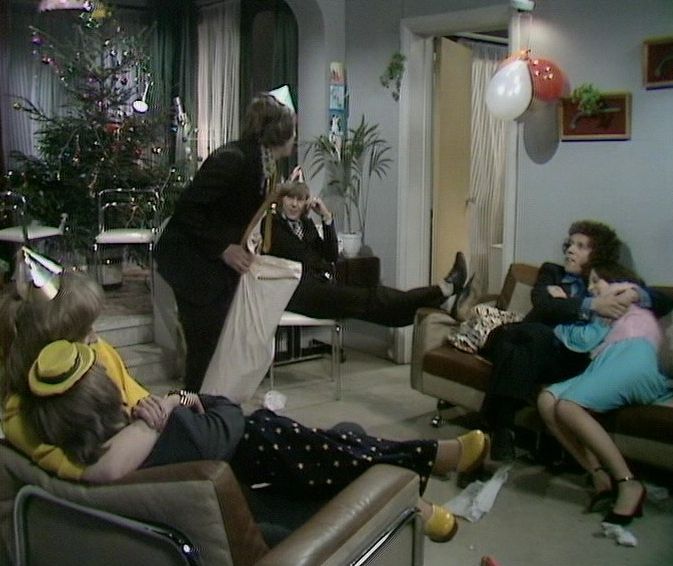
Spun out of Please Sir! after it became painfully obvious that the actors were no longer convincing as schoolchildren (they were well into their twenties by this point) The Fenn Street Gang followed their misadventures, post school.  Never as popular as Please Sir!, possibly due the fact that the characters no longer had a reason to be together and therefore the plotlines had to be split up, it still racked up an impressive thirty eight episodes.  This sketch has a good excuse for a reunion – Christmas dinner – and it passes the time nicely enough, although it’s not exactly an all-out showstopper.

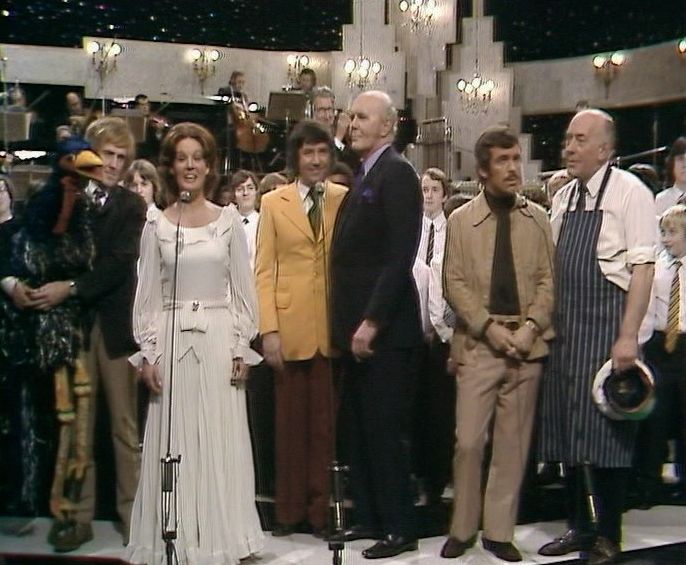
Jimmy leads everybody, including Moria Anderson, Rod Hull & Emu and David Nixon, in a rousing singalong of White Christmas.  A traditional end to a real selection box of a programme – not every chocolate is especially tasty, but luckily there’s only a few hard centres.

all star 02-05

That’s Christmas Sez Les!

sez.jpg

That’s Christmas Sez Les!, Les Dawson’s 1973 Christmas extravaganza, certainly doesn’t lack on the guest front.  Along with regular contributors Eli Woods, Roy Barraclough and the Syd Lawrence Orchestra, Clive Dunn, Jack Douglas and Ronnie Caroll are on hand for comic duties whilst Slade, David Essex, the Kessler Twins and Lynsey de Paul provide the music.

If you watch all the surviving episodes of Sez Les in sequence then there’s a considerable progression from series three (broadcast in early 1972) to this special in late 1973.  The third series shows were very tightly formatted – each twenty-five minute edition contained an opening and closing monologue from Dawson, a spot from the Syd Lawence Orchestra, a couple of musical guests, one studio sketch and possibly a brief bit of location filming.

By 1973 there was clearly more money in the kitty, as the regular shows had been extended to forty minutes (this special runs for an addtional ten minutes). Another change is that there’s now a considerable number of very short sketches rather than a couple of longer ones, which means that in some ways it feels like The Fast Show twenty five years early. You certainly can’t complain that the sketches are too drawn out, since many only consist of an establishing line and a punchline.

One slightly longer sketch features Dawson as a barman and Barraclough as a customer who’s confused when Dawson keeps throwing the drinks into his face.  A basic rule of comedy – repetition – is in play here, every time Barraclough complains, it appears that Dawson has finally understood, only for him to repeat the drink throwing once again.  There’s a predictable pay-off, but it’s pleasant to see a young Gordon Kaye pop up.

Dunn, Douglas and Caroll, along with Dawson and Barraclough, are good value as a group of wise-cracking vicars.  This enables them to rescue gags from the old jokes home (“do you save fallen women?”) but they’re good enough to get away with it, just ….

With so many very brief sketches,  Dawson sometimes struggles to make an impression whilst the deluge of guests also helps to reduce his screen-time. Still, at least the musical performers are pretty top notch, although was Noddy Holder really upset at Dawson’s trademark mocking introduction?  Noddy’s rejoinder (“ta for that introduction, fatty. Don’t call us, we’ll call you”) could be taken as good-natured banter, or maybe he really didn’t see the joke.

No matter, as Slade’s performance – lipsyncing to Merry Christmas Everybody – is just about perfect.  The average age of the typical Sez Les audience tended to be a little outside of Slade’s usual demographic, which explains why director David Mallet elected to surround the group with an enthusiastic young crowd.  With Noddy’s trademark mirrored hat and platform boots, together with Dave Hill’s gleaming Super-Yob guitar, this is a classic Christmas moment.

David Essex elected to sing live, the pick of his two songs being Lamplight.  He doesn’t have the teen audience around him, instead he’s on a darkened stage (rather apt I suppose, considering the song title) but showman that he is, he soldiers on regardless.  Lyndsey de Paul is possibly one musical guest too many, but her dancing with Les is a nice comic moment.

Actually thinking about it, Clive Dunn’s musical spot is definitely one too many.  The good news is that it isn’t Grandad, the bad news is that it isn’t as good as Grandad.  As with his earlier smash hit, he’s surrounded by a group of cute children, which is either endearing or sickly, depending on your point of view.  But it’s Christmas, so let’s be generous ….

More Les Dawson would have been welcome, especially some decent monologues (always his comic strength) but That’s Christmas Sez Les! is a compelling selection box of entertainment from a diverse group of performers.

Robin’s Nest – Christmas at Robin’s Nest

nest-01

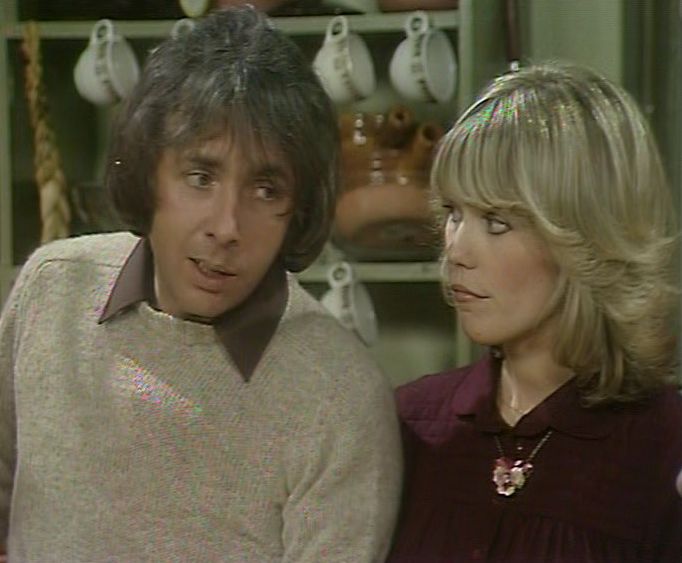
Airing on ITV between 1977 and 1981, Robin’s Nest (one of two sitcoms spun off from Man About The House) is centred around the restaurant of the title, run by Robin Tripp (Richard O’Sullivan) and his wife Victoria (Tessa Wyatt).  She provides him with moral support and able assistance whilst less able assistance comes from the enthusiastic but incompetent one-armed washer-upper, Albert Riddle (David Kelly).  Also on hand is Victoria’s father, James Nicholls (Tony Britton), a sleeping partner in the business who’s always keen to make the maximum amount of money from his investment.

Although the series was created by Brian Cooke and Johnnie Mortimer, by this time they’d stepped away from scripting duties, so Robin’s Nest at Christmas was penned by George Layton, the second of his thirteen contributions to the show.  Enjoying an equally successful career as both an actor and writer (with his writer’s hat on he’d be reunited with Britton on the middle-of-the-road but nonetheless popular sitcom Don’t Wait Up a few years later) Layton seemed to easily pick up the rhythms of the series.

Although guest actors drop by occasionally, Robin’s Nest concentrates on the four regulars – with Robin and Victoria usually playing the straight-men to the more comic characters of Albert (inept at whatever he attempts) and James (a mean skinflint, content to work Robin into the ground to generate a healthy profit).

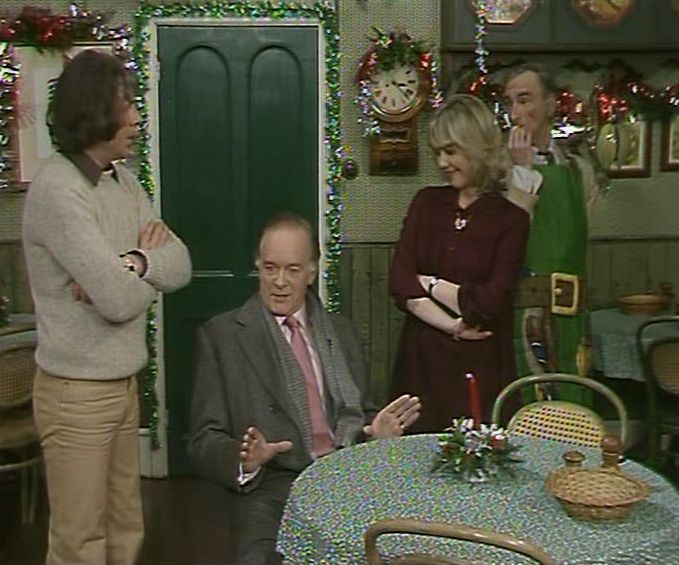
Easily the most memorable character of the four is Albert Riddle.  Kelly effortlessly steals every scene he’s in and is an endless delight to watch – without him it would be a much more routine show.  Albert’s complete ineptness is clearly on display in the opening few minutes as he attempts to help Robin to put up the Christmas decorations in the restaurant.  Of course he’s no help at all, and his endless off-key singing of Christmas songs (“Jingle bells, jingle bells, jingle all the way. We are doing up Robin’s Nest, just for Christmas day”) doesn’t help to reduce Robin’s stress levels.

Albert then pops by at one o’clock in the morning on Christmas Day to deliver a bombshell – after coming into a small windfall he’s been able to buy a business of his own so will be resigning from Robin’s Nest forthwith …..

There then follows a rather tense Christmas Day meal at James’ house, with a glum Robin and Victoria and a rather merry Albert, whilst Peggy Aitchison has a nice scene as James’ domestic servant, Gertrude.  Many sitcoms tended to have an extended running time for their Christmas Specials, but this Robin’s Nest remains at its normal twenty-five minute format.  This means that it all feels quite compact (with more time, the Christmas meal could have been extended and made to feel even more awkward) but the one interesting wrinkle is that the reset button with Albert isn’t hit at the end.  His arrival back at the restaurant in the last few minutes seems to indicate that he’s had a change of heart, but the reason for his reappearance is quite different and a good comic moment to end on.

Coasting by for 48 episodes thanks in no small part to the regulars, Robin’s Nest is undemanding but always watchable entertainment.  As for this one, I’ve always been a little puzzled why Robin is so upset at Albert’s decision to leave – since he spends all his time complaining about him you’d have thought he’d have welcomed it!

nest-02


All This and Christmas Too!

all this 01.jpg

Headed by Sidney James and Kenneth Connor and featuring cameos from the likes of Janet Webb and Joe Gladwin, All This and Christmas Too! doesn’t lack for on-screen talent.

Sidney James is probably best known for his appearances in a string of Carry On films, but his film career in general (particularly during the 1950’s) was extensive – The Lavender Hill Mob, The Belles of St Trinians, Quatermass 2 and Hell Drivers are just a few highlights.  He also served as an excellent comic foil to Tony Hancock, both on radio and television, as well as starring in a number of different television series – such as Citizen James, Taxi!, George and the Dragon and Bless This House.

Kenneth Connor was also a familiar Carry On name, although prior to his appearance in the first of the series, Carry on Sergeant in 1958, he’d already amassed a diverse list of credits – appearing alongside Peter Sellers and Spike Milligan during their early forays into television, for example.

So by the time All This and Christmas Too! was broadcast in 1971, both had built up a considerable reserve of affection from the British public, which was probably just as well.  All This and Christmas Too! is a variable fifty minutes of pretty broad comedy – but thanks to the star quality of Sid James and Kenneth Connor I can’t help but feel a little indulgent towards it.

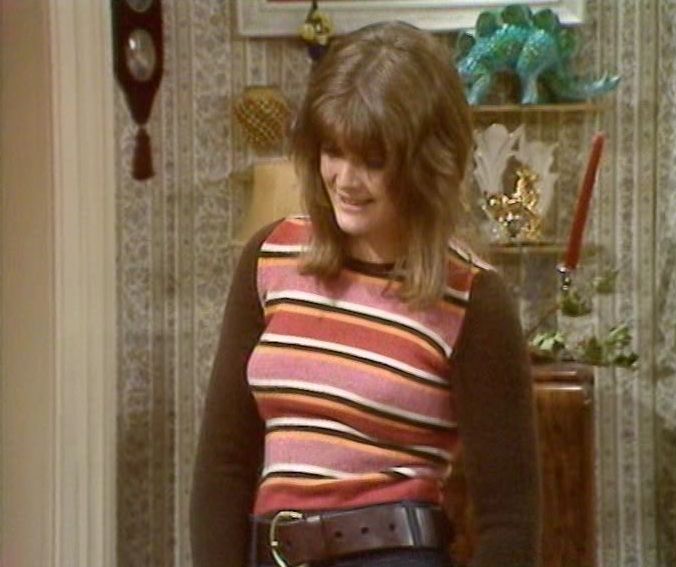
James plays Sid Jones (they must have spent hours thinking that name up) whilst Connor is his rather dim next-door neighbour, Willie Beattie.  Like the not completely dissimilar Sid Abbot in Bless This House, this Sid is also a devoted family man – with a wife, Peggy (Beryl Mason) and two daughters, Linda (Juliette Kempson) and Sally (Katie Allen).

The best gag is reserved for the opening scene, where – to the strains of Also sprach Zarathustra – a spaceman (Sid) makes his entrance.  The incongruity of a spaceman walking down the streer is quickly explained though, as Sid’s been entertaining the kids at a local party (although why he didn’t remove his costume before returning home is anyone’s guess ….).

With Sally shortly due to give birth, the hapless Sid is put in charge of keeping an eye on her whilst Peggy heads out to do some last minute Christmas shopping.  But any thoughts of a quiet few hours are quickly dismissed when Willie pops around – he wants Sid’s advice on negligees (for Willie’s wife, naturally).

I have to confess to being somewhat smitten with Juliet Kempson, who plays Sid’s non-pregnant daughter Linda. She’s really rather lovely and her presence helps to make the programme a little more enjoyable. Sam Cree’s script mines familiar generational tropes as Sid finds himself frequently baffled by his youngest daughter – the music she likes, the make-up she wears, etc. Watch out for the moment when Sid tells Linda to turn her record off, it stops several seconds before she reaches the player. The grams operator must have been a tad quick off the mark!

When Sally tells her father that it might be a good idea to call for a taxi, Sid goes into panic mode. The baby! James and Connor are both excellent at playing flustered – Willie rushes off to call a taxi whilst Sid runs round and round in circles, attempting to get Sally’s suitcase ready. Clearly forward planning isn’t big in the Jones’ household ….

Next day, Sid is surprised to find a baby in the hall. Even though it’s black, he decides that it must be Sally’s (it’s not of course). Cue more frantic activity from James and Connor as they attempt to stop the baby crying (the production clearly didn’t record a real child’s cries – it’s painfully obvious that what we can hear is an adult doing a baby impression).

When news of Sally’s baby comes through, Sid and Willie decide to toast its health, several times in fact. James and Connor both indulge in a nice spot of drunk acting, although the speed at which they become virtually insensible (mere seconds after taking a drink) is bizarre.

Unfortunately they have to try and pull themselves together and entertain Sally’s husband’s parents, Mr and Mrs Hall (the ever lugubrious Gladwin and the stoney-faced Rose Power).  What’s interesting about Sid’s attempt to make casual conversation with the foreboding Mrs Hall is that the same exchange (“I tried it once, didn’t like it”) also turned up in the following year’s Carry on Abroad.

Janet Webb, like Gladwin, has a nice comic cameo – she plays the flighty Aunt Maud. Her interplay with Gladwin’s vitually catatonic Mr Hall is something of a treat, as is the transformed Mr Hall after Sid’s special drink has taken effect.

A mixed bag then, with some of the farce elements feeling rather forced, but Sid James and Kenneth Connor do their best with the material on offer.
all-this-02

Six Dates with Barker – 2274: All the World’s a Stooge

stooge-01

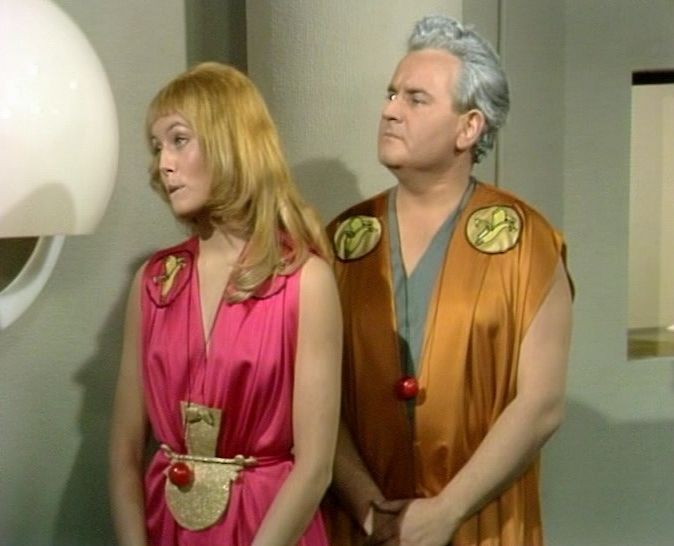
The year is 2274 and comedy is now a religion with Chaplin, Keaton and W.C. Fields revered as gods.  Life is an endless stream of corny jokes, but Prince Boffo (Barker), shortly to ascend to the throne, is increasingly dissatisfied with this.  His wife, Princess Hysteria (Joyce Grant), is baffled to learn that Boffo’s lost his sense of humour, but his daughter, Cheeky (Lesley Anne-Down) is more sympathetic.  Is Boffo fit to be King?  That’s for the Arch Funster (Michael Horden) to find out ….

Written by Barker (under his regular pseudonym of Gerald Wiley), All the World’s a Stooge is an intriguing and vaguely experimental sci-fi story.  No expense was spent to bring 2274 AD to life, although it’s possible this was an intentional nod to series such as Out of the Unknown, which also tended to depict future times on a shoestring budget.  And even if it wasn’t, it works anyway – flimsy looking sets and lashings of CSO just seem to be right for this type of story.

Did this obscure little playlet influence future writers?  It’s easy to see parallels in several later Doctor Who stories.  Vengeance on Varos also featured a couple who provide a running commentary on events, watching via their television screen (here it’s Joy Stewart and Victor Maddern as Tarty and Atlas).  And The Happiness Patrol could easily be depicting a sister world to this one.

Ronnie Barker loved corny gags and would later recycle many of them in the Two Ronnies Yokels sketches.  I’ve no doubt he enjoyed giving the old jokes featured here another airing, but there was also room to air a serious point.  This sort of humour becomes mechanical over time, with no joy to be gained from the responses and punchlines.  Boffo wants a world where humour is natural and unforced and it appears by the end of the episode that he’s got his wish, even if most of the planet (including his wife) don’t understand this and are simply glad he appears to be his old, funny self again.

A strong guest cast helps to enhance Wiley’s script.  Horden looks to be enjoying himself as the Arch Funster, especially when doing the Groucho walk.  Lesley-Anne Down is very appealing as Boffo’s idealistic daughter whilst Jack Tripp also impresses as the doctor who tells Boffo that his father is dead (“do you know what’s good for water on the brain? A tap on the head”).

Although it features a couple of indifferent instalments, overall Six Dates with Barker is a pretty strong series.  A few years later, after Barker moved back to the BBC, they did something similar with Seven of One, although that would produce both of Barker’s biggest sitcom successes …

stooge 02.jpg

Six Dates with Barker – 1971: Come In and Lie Down

come-in

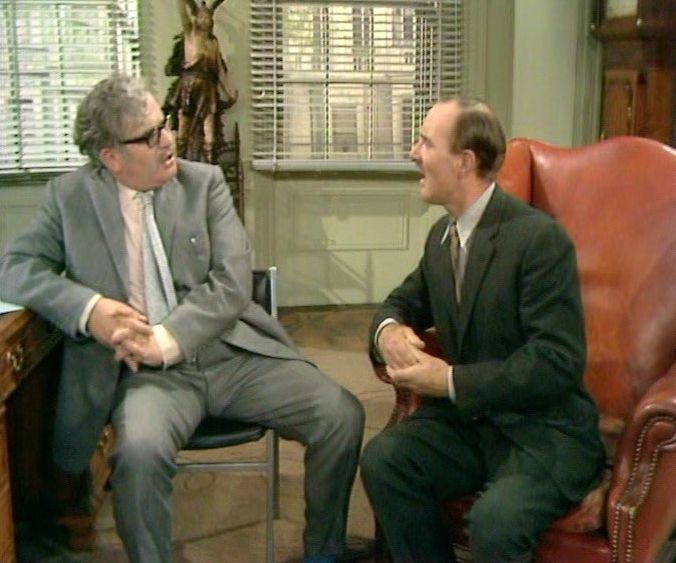
After the disappointment of Lola, things take an upward turn again with Come In and Lie Down.  Doctor Swanton (Barker) is a brusque, seen-it-all psychiatrist who’s possibly met his match with Mr Matting (Michael Bates).  Matting’s tale of being observed all the time by a small man in a Robin Hood hat with binoculars seems like a typical sort of delusion, but then Swanton sees the man as well ….

Since it’s scripted by John Cleese, it’s possibly no surprise that it has a definite Python feel (for example, Reginald Maulding is namechecked).  Bates gives an energised performance as a man who has an intense fear of being labelled a looney.  To this end, when he first enters Swanton’s consulting room he pretends to be the gas man, sympathising about the difficulties Swanton must face.  “Blimey, what a job eh? Talking to loonies all day. Wouldn’t catch me being a psychiatrist, not me. I’ll stick to gas. A load of nutters aren’t they? In here, hopping around on one leg, squawking, think they’re Napoleon.”

Bates, best known for Last of the Summer Wine and It ‘Aint Half Hot Mum, freewheels in a most impressive fashion.  To begin with, it appears that he has the more showy role (Barker comes off as rather pallid in comparison).  But once Swanton believes he can also see Matting’s imaginary man, the power dynamic between the pair subtly shifts and Swanton begins to act in a hysterical fashion.  Matting is rather irritated when Swanton declares Matting isn’t a looney.  “Oh that’s nice isn’t it? If I can see him he’s imaginary but if you can see him he’s real. I get it. You think you’re Lord God Almighty don’t you? If a patent can see something you can’t see, he’s a looney, he should be down on the funny farm, but if Doctor Smartypants can see him, he’s there mate.”

The reveal of the imaginary man (Ian Trigger) is done subtly, as for a few minutes the audience is aware of him, but neither Swanton or Matting react.  As Matting’s used to him being there all the time that’s understandable, but are we viewing the scene through his eyes only?  It’s only when Swanton double-takes that the fun really starts.

Swanton’s mounting hysteria is a gift for Barker, who doesn’t disappoint.  The conclusion, as all three debate the nature of existence, is also nicely handed.  After Swanton proves that the imaginary man is real, Matting is able to leave a happy man – safe in the knowledge that he isn’t a looney.  You can see the final story-beat coming a mile off, but it’s really the only obvious punchline.

Given how the early series of The Two Ronnies recycled material from their time at LWT, it’s easy to see  a cut-down version of this working as a sketch, with Ronnie C taking the role of Michael Bates (despite the twenty five minute length, it’s played very much in the tempo of a typical Two Ronnies sketch).  It’s certainly one that still stands up well today.