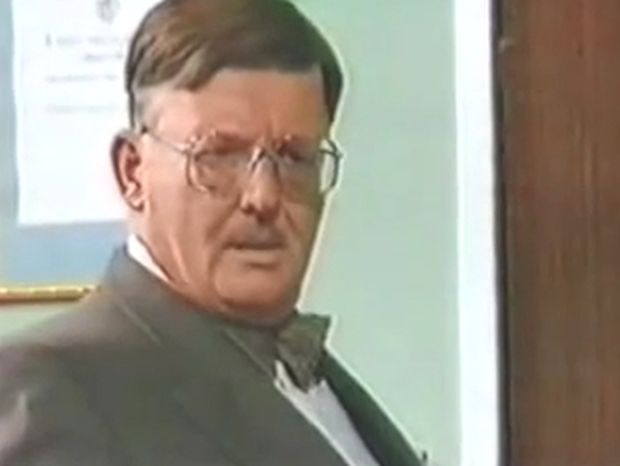
Coronation Street (12th April 1976)

corrie1

Written by Adele Rose

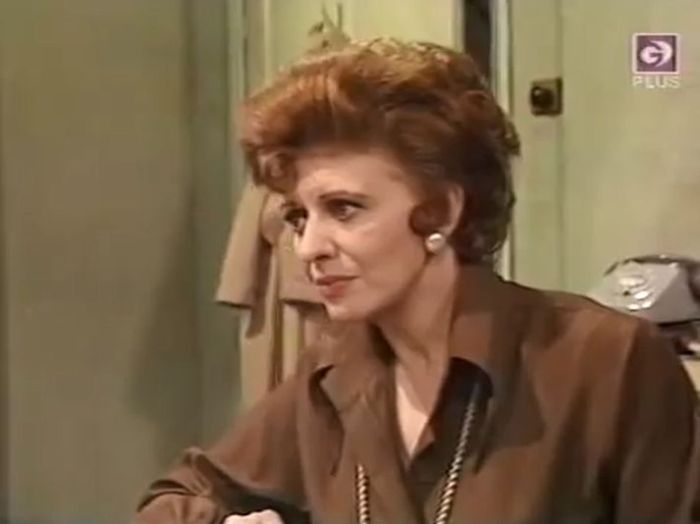
It’s breakfast time and Elsie’s looking a little rough. This was always something of a sticking point between Pat Phoenix and the production team – Phoenix always insisted that Elsie looked glamourous, no matter what the circumstances were.  The fact that she allowed Elsie to look a little dowdy here suggests that, having only recently returned to the series, Pat Phoenix was still on her best behavior. It’ll be instructive to see whether later on she slips back into her bad old ways ….

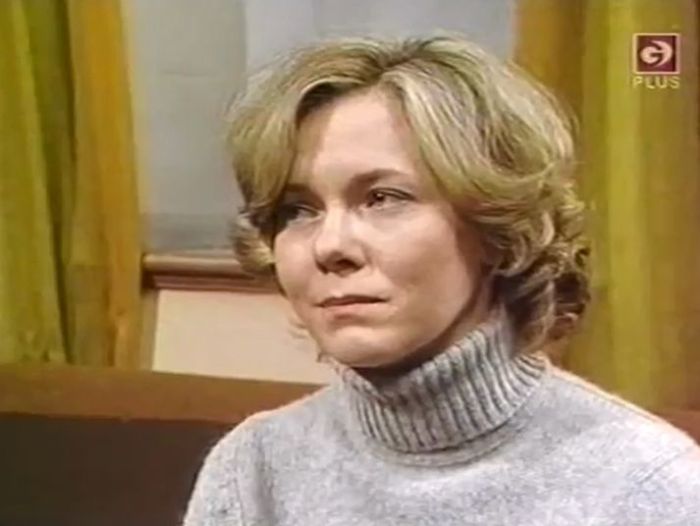
Elsie’s old rival Ena Sharples pops her head round the door. The pair had enjoyed some battle royales back in the sixties, although their chat today is much more convivial.  Indeed, for those brought up on the image of Ena Sharples as a dreadful old battleaxe, her more relaxed and friendly mid to late seventies persona might come as a surprise. Although I’m prepared to concede than sixties Ena also had her lighter side.

Ena hasn’t changed all that much though – she’s still disapproving about the way Len and Elsie are co-habiting. And she’s also still able to land a few gentle jabs and punches (telling Elsie that she’s showing her age, for example!)

A major plotline in this episode concerns Ken’s relationship with Wendy Nightingale (Susan Tebbs). This was running before the Granada Plus repeats began, so it takes a few minutes to get up to speed. Ken (the dirty devil) has been carrying on with a married women, whilst her husband, Roger (Matthew Long), remains totally oblivious.

But now the cat’s been let out of the bag and Roger learns all. Eek! And if that wasn’t enough to raise Ken’s stress level, Elsie pops round and asks him to move out of No 11. He’s not budging though and even though Elsie still owns the house, she seems powerless to force him out. It’s odd for Elsie to capitulate so meekly, but although Ken’s currently living a bachelor life, that will shortly change for a little while (so no doubt it suited the story for him to hang on there a little longer).

But Elsie won’t be cast out into the street as Betty gives her the run of the flat in the corner shop and a number of volunteers – including our Ena – pitch in to make it habitable.

I was rather fond of Susan Tebbs’ role as a regular in the first series of Softly Softly: Task Force, so it was nice to see her pop up in Coronation Street. Wendy seems totally besotted with Ken (clearly the man has depths of charisma which aren’t visible to the naked eye) and her dangerous (well, dangerous in a very understated middle-class way) obsession with him threatens to tear her marriage apart.

Today’s cliffhanger is an absolute doozy. Roger, hanging round Coronation Street in the rain, is keeping an eye on the meeting between Wendy and Ken. Eventually he can’t take it anymore and storms over, punches Ken and spirits Wendy away. Now if that doesn’t make you want to tune in next time I don’t know what will.
corrie2

Coronation Street (7th April 1976)

corrie1

Written by Leslie Duxbury

The return of Elsie was an event (it ensured that this episode was the most-watched edition of Corrie that year, and indeed the highest rating episode since 18/2/70). Middle-age sparks are still flying between Len and Elsie, as the pair circle each other warily. Len’s on-off relationship with Rita is touched upon – which will set us up for several years worth of Elsie/Rita conflict over the glittering prize of Mr Len Fairclough ….

Elsie’s in a reminiscing mood. “Funny thing. Just as I came round the corner from the corner shop, the feeling that I’d never been away. It felt just like coming home”. I wonder whether this mirrored Pat Phoenix’s feelings? By all accounts, Phoenix wasn’t the easiest actor to accommodate (something which didn’t endear her to the writing or production staff) but she remained an audience favourite.

The inquest into Ray and Deirdre’s cadging of free drinks (on account of her non-existent pregnancy) continues. Mrs Walker is not best pleased about being deceived.  Later, the pair take a stroll along the Weatherfield canal where Deirdre drops the bombshell that she’d like a chequebook. This conversation could easily have taken place at the Rovers, but it was nice to have a chance of scene and get onto film for a minute.

Minnie’s last hurrah is a very brief scene in the Kabin. Margot Bryant’s memory was so bad by this point that she was forced to refer to her script several times (which was nestling on the counter). It’s a very sad and low-key way for such a long-running character to exit the series. We’d learn later in the year that Minnie was happy though, having settled down with Handel Gartside in Whaley Bridge.

Elsie remains holed up with Len in No 9 for most of the episode. Visitors come and go – first Bet and then Rita. Bet’s visit is reasonably convivial, Rita’s less so (as you might expect).  You could have cut the atmosphere with a cricket stump – both swap icy greetings before Rita harshly wonders if Elsie’s making “a flying visit or ….”

Eventually Elsie ventures out to the Rovers, which was probably just as well since tongues had been wagging there at maximum velocity for some time.  Some – like Ken – are welcoming (although they’ll soon clash over a certain house) whilst others – like Rita – remain stony faced.  And Rita’s dour disposition doesn’t improve after she learns that Elsie’s looking for a job in the area ….

corrie2

Coronation Street (5th April 1976)

c1

Written by Leslie Duxbury

For the dedicated Coronation Street aficionado, enjoying the series as broadcast during 1960 to 1975 can only be something of an intermittent pleasure. Having recently catalogued the episodes I hold from this period (well it keeps me off the streets) I’ve established that I have a grand total of 211 (which is a fairly small sample, considering that over 1,500 episodes were broadcast).

But from April 1976 onwards we’re on much firmer ground as that was where Granada Plus started their repeat run from. Between 1996 and 2004 (when the channel was unceremoniously yanked off the air) they managed to go from April 1976 to early February 1994.  And since these episodes are circulating in various corners of the internet, with a little bit of effort it’s possible to enjoy a lengthy consecutive run of the series.

Personally, I probably won’t go too far beyond 1984, but when I get there maybe I’ll have the desire to press on a bit further. I won’t have to worry about that for a while though.

Although April 1976 seems like a rather arbitrary start point (you might have expected Granada Plus to rewind back to the start of the colour era) there looks to have been some method in their madness.  Bill Podmore had taken over as producer in early 1976 and he’d begun to refashion the series in his own image (for example, injecting more humour – which he felt had all but evaporated).

I do wonder just how dour and humourless the series had actually been before this, but until more examples of 1974 and 1975 Corrie turn up, it’s hard to know for sure.

Today’s episode – marking the return of Elsie Howard (nee Tanner) for the first time since October 1973 – is a pretty decent jumping on point. There’s a few unfamiliar characters dotted about, but many of the regulars would have been like old friends to the 1990’s audience.

The episode opens with a one-shot character, Mrs Conroy (Christine Buckley), bitterly complaining to Mavis in the Kabin about the state of her dentures. “You would think wouldn’t you, if they could build Concorde, they could make a pair of dentures that fit”. There’s no answer to that.

Good grief, Rita looks rough. Really rough. Is she feeling delicate after a night of carousing with Len? Mavis thinks so, but Rita is having none of it. We then drop in to see Ray and Deirdre getting dressed. The sight of Ray Langton with no trousers on is something that will haunt me for some time. I’m just grateful that his shirt managed to hide his underpants.

Len receives a mystery call. Who is it? Ah, you’ll have to wait until the end of the episode to find out. But if anyone can discover who it might be before then it’ll be our Hilda. She’s in full snooping mode today (her curiosity working overtime after Len asks her to clean his house). Jean Alexander is wonderful. This is something I know I’ll be repeating again and again and again ….

This era of Coronation Street has many reasons to recommend it – not least the way it’s now become a fascinating social document. Characters will often stop to bemoan the state of the country (some things never change then). Mrs Walker’s monologue today is a case in point. “I don’t trust the government. Industry is either a playground or a battleground according to the whim of the week”.

Minnie’s relaxing in the snug. Make the most of her as she’s soon to vanish, never to return.

Unlike some incoming producers, Bill Podmore didn’t swing the axe too much. But one character he did decide to write out was Tricia Hopkins (Kathy Jones). I’m not quite sure why though – after all, the Street was hardly awash with younger characters at this time and she had formed a decent partnership with Gail.  Her departure is especially odd when you look ahead to January 1977, whuch saw the introduction of Suzie Birchall – a character not too dissimilar to Tricia.

Everyone’s treating Ray and Deirdre to drinks at the Rovers because they believe Deirdre’s pregnant. Except she’s not. There then follows an embarrassed silence when the truth comes out, although I’m not sure how they were going to get away with it (would Deirdre have stuck a pillow up her jumper in a few month’s time?)

Len’s mystery visitor is …. Elsie. And although we don’t see her today, Ena’s curtains are already twitching in anticipation ….

c2

Tonight at 8:30 – Shadow Play (2nd June 1991)

shadow1

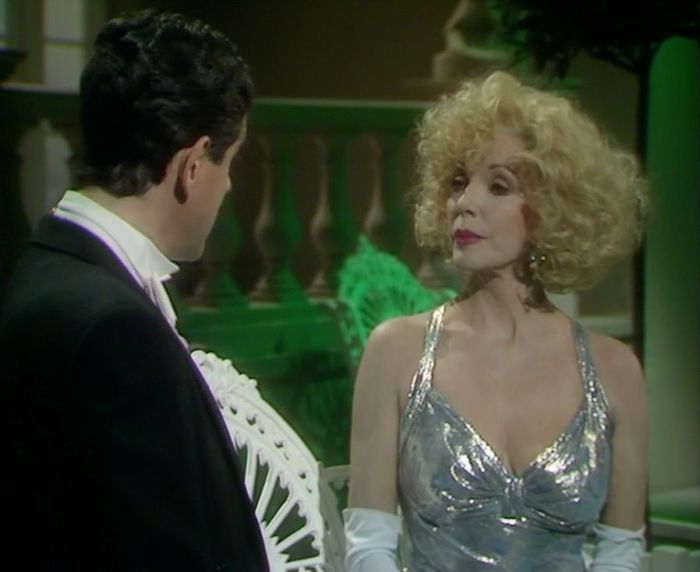
Vicky Gayforth’s (Joan Collins) life is collapsing around her.  Following an evening at the theatre, she elects not to go on to a late party as she’s convinced that her husband – Simon (Simon Williams) – will be there with another woman.  Taking three strong sleeping pills, Vicky is settling down for a peaceful night’s sleep when Simon enters her bedroom and requests a divorce.

As the pills begin to take effect, Vicky experiences multiple hallucinations as she relives her life with Simon in a series of highly theatrical vignettes ….

Described by Coward as “a musical fantasy”, Shadow Play is a very pleasing mix of reality and fantasy. It begins in the real world, with Vicky receiving sage advice from Aunt Martha (Jean Anderson). Anderson was the sort of actress who seemed to spend her career playing characters who dished out sage advice (whether the recipients wanted it or not).  Seven years as the matriarch of the Hammond family in The Brothers for example.

Given how perfectly Simon Williams fits into the Tonight at 8:30 world, it’s a little surprising that this was his only role – but he certainly makes the most of it. When we first meet Simon Gayforth he’s behaving in a rather beastly fashion towards the somewhat helpless Vicky (who is one of those characters rather buffeted about by events). But once the fantasies begin and he turns on the charm it’s easy to understand why Vicky fell in love with him in the first place.

I like the way that the sets become very stagey and unreal once we join Vicky in her dream world (this distinction probably would have been harder to draw on stage). Presumably Coward and Gertrude Lawrence handled several of the songs themselves – but Collins and Williams don’t get involved in the singing (I can’t recall either of them warbling in the past, so this was probably a wise move).

As Vicky dreams on, she’s not above re-editing events to make them even better than the real thing.

Vicky: You’re nice and slim. Your eyes smile and you move easily. I’m afraid you’re terribly attractive.
Simon: You never said that!
Vicky: No, but I thought it.
Simon: Stick to the script.

This happens on a number of occasions – characters breaking the reality of the fantasy (if you see what I mean) to pass an ironic commentary on what we’re seeing. This would hardly have been original even back in the 1930’s, but it’s still amusing and effective.

Several Tonight at 8:30 stalwarts turn up for one final bow. Edward Jewesbury is the perplexed Uncle George, unwillingly dragged into Vicky’s dreamworld, whilst Edward Duke plays a silly young ass (something of his signature role).

Even when Vicky returns to reality, there’s still a tinge of fantasy in the air as Simon has banished all thoughts of divorce, meaning he and Vicky will live happily ever after. Is she still dreaming? Maybe, or maybe Coward was simply content to send the theatregoers home in a good mood.

Tonight at 8:30 is a fascinating series. Happy to faithfully adapt the original plays (if the action took place in a single room, then the productions would remain in a single room) it’s the sort of VT show which belongs to a vanished television age. It’s a pity that three episodes are rather marred by the addition of laugh tracks, but that quibble apart it’s been something that I’ve enjoyed revisiting.  Certainly worth a look if you have the Noel Coward DVD boxset on your shelf.

shadow2

Tonight at 8:30 – Still Life (26th May 1991)

still1

Dr. Alec Harvey (John Alderton) and Laura Jesson (Jane Asher) meet by happenstance in a railway station café. An instant attraction blossoms between them and they begin to conduct a highly clandestine affair (both are already married).  As the seasons click by, their railway rendezvous continue – but the tone of their later meetings dissolve into anguish as both realise that their affair has to end ….

Still Life is, of course, Brief Encounter in miniature. What’s interesting about this adaptation is that Joan Collins elected not to play Laura, instead she tackled the role of Myrtle Bagot, the railway café proprietress.  That’s a little surprising since Laura is by far the best female role.  Collins could have done it – and it would have been interesting to see – but maybe she was more content with the comic role of Myrtle.

Myrtle has her own love affair to negotiate – with the cheerful ticket collector Albert Godby (Norman Rossington).  Comedy veteran Rossington was a safe pair of hands and builds up a nice rapport with Collins – who, complete with her dyed hair piled up and a pair of glasses, negotiates the role of Myrtle with a sure touch. I like the way Myrtle attempts (and fails!) to add a touch of refinement to her voice when talking to customers.

still2

Two relationships clearly weren’t enough, as a third is added for good measure between Myrtle’s assistant, Beryl (Diane Langton), and cheeky young Stanley (Steve Nicholson).  With only thirty minutes to play with, this partnership has the least amount of attention devoted to it – consisting mainly of giggles and pinched bottoms.

Langton had been playing busty sexpots since the mid seventies, so the part was hardly a stretch for her. She might have been nearly twenty years Nicholson’s senior but give her a blonde wig and she could play pretty much the same age as Nicholson quite easily.

Whilst Beryl and Stanley and Myrtle and Albert are able to be quite open about their love, poor Alec and Laura are required to be much more furtive. Their whispered conversations in the corner of the café, oblivious to the hubbub around them, are perfectly pitched though – with both Alderton and Asher managing to take the familiar material and still make it resonate.

Coward later said that Still Life was “well written, economical and well constructed. The characters, I think, are true, and I can say now, reading it with detachment after so many years, that I am proud to have written it.”

I’d agree with his assessment. Unlike the previous play, Ways and Means, in this one you do feel for the central characters, which means that their final, wretched separation comes as a sudden jolt. This is no mean feat when you consider that their whole relationship has taken probably no longer than five minutes, spread across a handful of scenes, to develop.

The way that Laura is denied a final farewell with Alec – due the arrival of her insensitive and oblivious friend, Dolly Messiter (Moyra Fraser) – is the cruelest blow of all and concludes a memorable production.

Sydney Lotterby, who recently passed away at the age of 93, was the director (his sole credit on the series). Lotterby always yearned to direct more drama and based on this example you have to say that it’s a shame that he didn’t.

still3

Tonight at 8:30 – Ways and Means (19th May 1991)

ways01

Stella and Toby Cartwright (Joan Collins and John Standing), living a comfortable life on the Côte d’Azur, appear to have everything – but appearances can be deceptive. Despite their outward elegance and poise, the pair are flat broke (following Toby’s disastrous misadventures at the casino) and face shame and scandal unless they can find a considerable sum of money very, very quickly ….

Ways and Means is a gossamer thin piece.  The Cartwrights give off an air of innocent decadence, which is best summed up by this comment from Toby. “We were brought up merely to be amiable and pleasant and socially attractive, and we have no ambition and no talent”.

Standing has something of Noel Coward’s delivery, so it’s easy to see how the Master would have tackled the part. Collins, once again cast in the Gertrude Lawrence role, also clicks into gear nicely and the pair (who dominate proceedings) are never less than totally watchable.

Four actors are each given a brief minute to shine. Edward Duke, as the ingenious Lord Chapworth, is first up (not much of a role, but he does his best). Siân Phillips has a little more to work with as Olive Lloyd-Ransome whilst Kate O’Sullivan sports the most outrageous Russian accent as the Princess Elena Krassiloff.

By far the most entertaining of these little cameo performances comes from Miriam Margolyes as Nanny.  Sounding not unlike Nursie from Blackadder II, Margoyles lights up the screen for the short time she’s on.  Harold Innocent, as the imperturbable servant Gaston, also deserves a tip of the hat.

There’s plenty of interest to be found on the acting front then, and there’s one more turn to come – Tony Slattery as Stevens, an ex-chauffer turned armed robber. His misfortune was to attempt to burgle the Cartwrights – who don’t have a bean – but he quickly becomes the object of their salvation.  Stevens readily agrees to rob the other house guests and pass all the loot onto Stella and Toby (taking care to tie them up so they look like victims too).

There seems to be little point in complaining about just how contrived the whole thing feels, as no doubt that was precisely the tone Coward was aiming for.  None of the characters really stir any feelings or emotions (such as whether the Cartwrights sink or swim, for example).  This air of unreality wouldn’t matter so much if the play was a little wittier or had some decent bedroom farce action, but there’s not a great deal to latch onto here.

You can’t fault the acting talent, but Ways and Means doesn’t really click for me. The return of the laugh track (for the first time since Red Peppers) is also a slight disappointment as the laughs still don’t feel totally natural (and they’re often on lines that aren’t really that funny).  This one’s not a total disaster, but it’s something of a dip in form after the last few episodes.

ways02

Tonight at 8:30 – Fumed Oak (12th May 1991)

oak3

Henry Gow (Anthony Newley) lives a life of stifling suburban respectability. The household consists of his nagging wife Doris (Joan Collins), his equally nagging mother-in-law Mrs Rockett (Joan Sims) and his adenoidal daughter Elsie (Prudence Olivier).  It would seem that the elder women rule the roost over the hen-pecked Henry, but initial appearances can be deceptive ….

Described by Coward as an “unpleasant comedy in two acts”, Fumed Oak provides Joan Collins with another opportunity to play very anti-glam. Starting the play with no make up and her hair in a scarf, she makes all the early running – effectively the first act is a two-hander between her and Sims.

It’s hard to know who Doris despises the most, as each member of the family receives a lashing from her caustic tongue in turn. The early conversations between Doris and her mother are incredibly inconsequential, which builds up a feeling of ever-increasing oppression. This is also helped by the way that Henry simply sits and eats his breakfast without speaking at all, seemingly resigned to having little say in the way the house is run.

The second act is where the comedy (and the unpleasantness) really begins, as we see a slightly alcoholically refreshed Henry returning home from work to drop the bombshell that he’s leaving them all for a new life abroad (complete with a small fortune he’s been secretly saving for a number of years).

But before he departs, Henry makes sure to insult them all thoroughly, which is where the cruel comedy is generated. Beginning reasonably gently (telling Doris that her hat is common) his abuse gradually starts to ramp up (when Doris counters that she’ll give him a piece of her mind, Henry responds that “it’ll have to be a small piece, Dorrie, I don’t think you can afford much”)

Several of Henry’s choicest insults (“this old bitch of a mother of yours”) are reserved for Mrs Rockett. Joan Sims reacts beautifully to these verbal volleys whilst Newley seems to be relishing every line.

oak2

Henry then rounds on Doris again, delighted to finally have the opportunity to speak his mind after years of silence.

What right have you got to nag at me and boss me? No right at all. I’m the one that pays the rent and works for you and keeps you. What do you give me in return, I’d like to know! Nothing! I sit through breakfast while you and mother wrangle. You’re too busy being snarly and bad-tempered even to say good morning. I come home tired after working all day and ten to one there isn’t even a hot dinner for me.

Coward rarely dipped his toe into the travails of suburban life. This – along with the more substantial This Happy Breed – are rare examples, and it’s intriguing to consider Fumed Oak as the dark inverse of the later play and film.

Doris, like Ethel Gibbons, lives her life by behaving as respectably as possible. Frank Gibbons responds to Ethel’s chiding and ministering with good humour, but it’s all too much for Henry who has to break free (there’s shades in this piece of the much later exploits of Reginald Perrin).

“You’re mean, you’re cold and you’re respectable”. Henry’s parting shot to Doris is a three pronged attack. I wonder which he deems to be the worst sin? Judging by the tone of the play I’d guess the latter.

The most effective drama of the series to date, Anthony Newley is top notch, but then so are the others (even Prudence Olivier, who doesn’t have a great deal to do except complain and sniffle).

Whilst some of the other plays in the cycle might come across today as rather twee period pieces, Fumed Oak still manages to be rather discomforting (and presumably was even more so back in 1935 when it was first performed). Another definite success.

oak1

Tonight at 8:30 – Family Album (5th May 1991)

fam1

Family Album was described by Coward as “a sly satire on Victorian hypocrisy”. It’s set in the comfortable drawing room of the Featherways family, who have just returned from their father’s funeral. The atmosphere is decidedly formal to begin with, but when the new head of the household, Jasper (Denis Quilley), suddenly breaks into song for no particular reason it triggers a rapid lightening of mood ….

This one has quite the cast. I never knew that Denis Quilley could sing, but sing he does (as do several other cast members – which explains, in part, why the likes of Bonnie Langford and Jessica Martin appear today). It’s a slight pity that all the songs were clearly pre-recorded (when Jasper launches into the first song, Quilley’s voice suddenly gains a large dollop of recording studio echo) but since this isn’t the sort of playlet where realism is key, let’s not quibble.

Joan Collins has undergone yet another transformation. Sporting a rather uncomfortable set of teeth, I doubt she’s ever looked quite as unglamorous as she does here. She’s cast as Lavinia, the eldest daughter of the family, and the one who – initially at least – is by far the most prim and proper. A spinster, and likely to remain so, she begins by casting a disapproving eye when the others begin to make slightly merry, but after swigging some wine she soon gets into the spirit of things.

This isn’t the play with Collins’ largest role, but Lavinia still manages to make the most important story contribution.

She reveals towards the end that their father had made a new will just before he died, leaving some of his money to his several mistresses and the rest to a new church, which was due to contain a gaudy memorial to himself. Lavinia – with the assistance of Burrows, the butler – destroyed the will, thereby ensuring that the family would all receive their inheritances.

Although it was broadcast nearly thirty years ago, it still slightly takes the breath away to remember this was transmitted on BBC1. It’s hard to imagine such a piece, even with this sort of top quality cast, slotting into the schedule today. Goodness knows what the audience watching at the time made of it – personally I love it, but the way the characters continually break into song with no warning would probably have taken most people by surprise. And maybe it wouldn’t have been a pleasant surprise …

Especially since the opening few minutes would have primed them to expect something quite different – a bleak(ish) drawing room playlet.  The way the rug is pulled from beneath the audience’s feet by the reveal that not only was the late head of the household an incurable letch but also that his children (all seemingly stolid and staid citizens) find it very easy to revert to the innocence of childhood at the drop of a hat, is a little stroke of genius.

Dominic Jephcott and Charles Collingwood are further strong additions to the cast whilst John Alderton seems to having a whale of a time as Burrows, the ancient family retainer. Sporting reasonably convincing old-age make up, Alderton manages to milk each comic moment for everything it’s worth.

I’m happy to report there was no laugh track on this one, so hopefully the remainder of the series will be equally unaffected.

Family Album is an odd treat from a series that continues to surprise and entertain.

fam2

Tonight at 8:30 – The Astonished Heart (28th April 1991)

heart1

Two old school friends – Leonora Vail (Collins) and Barbara Faber (Siân Phillips) meet for the first time in many years. Their lives have followed very different paths – Leonaora’s brief marriage ended in divorce whilst Barbara lives in blissful contentment with her husband Christian (John Alderton), an eminent psychiatrist.

The playful Leonora teases Barbara that, sight unseen, she plans to seduce Christian. But after this actually comes to pass, their torrid affair ends in bitter tragedy ….

After two comedies we move into more serious territory. That’s good news in one respect as it means there’s no laugh track (the peace and quiet comes as a blessed relief).

The Astonished Heart makes for an odd half hour. It certainly packs a lot into its brief running time (Coward described it as “a tragedy in six scenes” which gives you an idea about how quickly it moves). The play begins at the end of the story – it’s teased out that something terrible has happened, but we don’t know quite what – before rewinding back twelve months to start the tale properly.

Joan Collins is operating well within her comfort zone. Leonora could have slotted into several soap operas as she’s a man-eater with a seemingly impervious shell (although it is suggested several times that beneath her brash exterior lives a lonely and unfulfilled woman).

John Alderton is required to run the emotional gamut today. Christian goes from a gently amused individual, considering that a dalliance with Leonora will be something of an intellectual exercise, to a rampaging monster who’s consumed with jealousy when his mistress dares to even look at another man.  The climatic scene between Leonora and Christian has some powerful moments – but there’s also some rather ripe acting choices from both Collins and Alderton which are hard to take seriously.

That’s one of the drawbacks with The Astonished Heart. It’s always something of a balancing act, with the danger that any moment it could easily tumble over into melodrama.

Siân Phillips emerges with honour though. Whilst Leonora and Christian are called upon to ramp up the histrionics, Barbara is much more self contained (even when calmly deciding that her husband should enjoy a few months holiday with Leonora). Phillips’ skillful underplaying makes the occasional moment when Barbara shows a flash of anger all the more compelling.

Edward Duke, Jessica Martin and Edward Jewesbury fill out the minor roles with Martin catching the eye as Susan Birch, Christian’s dowdy but devoted secretary.

The Astonished Heart is somewhat hit and miss but it’s nice to have a pretty faithful version of the original one-act play to compare to Coward’s expanded 1950 film adaptation (directed by Terence Fisher, which saw Coward play the leading role of Christian with Margaret Leighton and Ceila Johnson as Leonora and Barbara).

heart2

Tonight at 8:30 – Red Peppers (21st April 1991)

peppers1

The first of Anthony Newley’s two appearances, Red Peppers is a delight from start to finish (my continuing grumbles about the odd audience laughter notwithstanding). There’s obviously considerable curiosity value in seeing Joan Collins teamed up with one of her ex-husbands (especially since Collins and Newley play a bickering married couple).

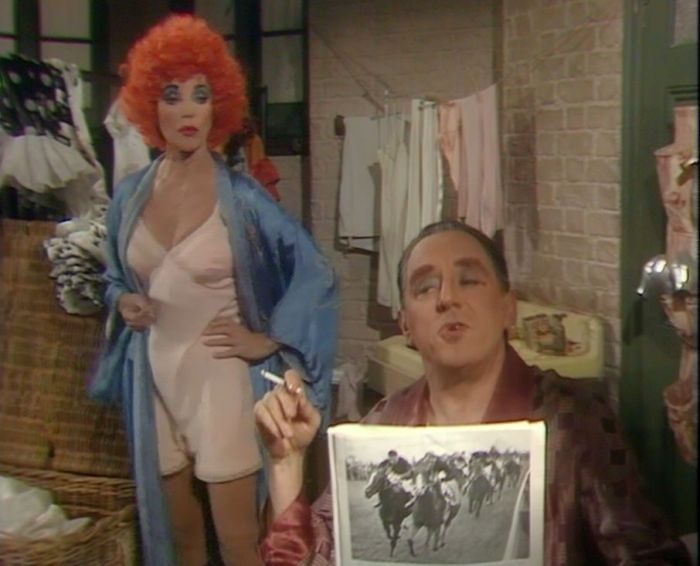
George and Lily Pepper are a middling music hall act, currently stuck in a nondescript provincial town in the middle of a fairly uninspiring (if varied) bill. They open the show on stage, dressed as sailors, with a saucy, innuendo laden song that I found to be great fun. How you could not love the sight of Newley and Collins bedecked in shocking orange wigs giving it everything they’ve got?
The one slight problem with this is they’re not supposed to be very good. Like Archie Rice in The Entertainer, the act should fall a little flat (which explains why the theatre audience react throughout with pained expressions). This doesn’t really come off though, since the studio audience are much more receptive, laughing regularly and applauding at the end.

Yet again this studio laughter doesn’t feel totally natural, although I didn’t find it as distracting as it was during Hands Across The Sea (maybe I’m just getting used to it). Mind you, if the studio audience did applaud warmly at the end of the song then I don’t know why it wasn’t removed, as it rather ruins the intention of the scene.

Post performance, the pair have a lengthy dressing room discussion about what went wrong. The barbs between George and Lily come flying thick and fast, with Collins and Newley both on very decent form.

Today’s playlet has a great deal of incidental colour. We never see any of the other acts perform – and only meet one of them, the tragedian Mabel Grace (Moyra Fraser), backstage – but enough comments about their fellow pros are slipped into the dialogue to build up an intriguing picture. The seediness of their current surroundings (at one point Lily laments that they don’t play the number one halls) also adds something – the production certainly benefited from location shooting in a real theatre.

Although Lily and George seem to loathe each other, they clearly despise everyone else even more. So when they’re attacked on several fronts – firstly by the alcoholically refreshed conductor Bert Bentley (Reg Varney) and then by the theatre manager Mr Edwards (Henry McGee) – they forget their differences and display an imposing united front. Watching Collins and Newley bickering is good fun, but it’s equally entertaining when they become a solid unit.

Reg Varney has the pick of the remaining roles. Bert is initially on affable terms with George but eventually they fall out when he dares to criticise George and Lily’s act. Varney looks to have been retired at the time (his previous television credit to this was a brief cameo in the Thames remake of The Plank back in 1979) but presumably the lure of acting with Collins and Newley was too intriguing a prospect to resist.

As for Joan, she’s good fun as a fast-talking, thoroughly working class turn. Quite a change from the previous week, but then that was the point of the series (and the original playlets too of course).

peppers2

Tonight at 8:30 – Hands Across The Sea (14th April 1991)

01

Tonight at 8:30 was the umbrella title for a series of ten one-act plays written by Noël Coward and performed in London and New York during 1936 and 1937.  One of the plays (Star Chamber) was quickly dropped but the other nine were performed regularly in various permutations of three per evening.

In 1991, eight of the ten plays (excluding Star Chamber and We Were Dancing) were adapted for this BBC series starring Joan Collins. Given that all the plays had originally been written as vehicles for Gertrude Lawrence, there was clearly plenty of good material here for a versatile leading actress.

However, whether that actress was Joan Collins was a topic somewhat debated at the time. Although Collins’ career received a massive boost thanks to her role in Dynasty between 1981 and 1989, she was still viewed by some critics with a degree of suspicion (who presumably didn’t consider a decade or so performing in Dynasty to be real acting).

Having not rewatched the series for a while, I’ve found it refreshing to come back to the episodes with few preconceptions, except a general anticipation about the first rate casts ….

The first thing to note is that the series has an opening title sequence to die for. Set in London’s glittering West End, we see a number of stars – led by Joanie of course – making their way to the theatre for tonight’s performance.  It helps to highlight Tonight at 8:30‘s rep-like nature – there’s ex-husband Anthony Newley all smiles, Denis Quilley on his bike, a dapper John Alderton taking time to sign an autograph, Reg Varney getting out of a taxi, Joan Sims walking to the stage door ….

None of them appear with Joan Collins in tonight’s production, but we don’t do badly for performers. John Nettles (complete with a ferocious looking beard) is Peter Gilpin, married to Collins’ Piggie. Nettles delivers all of his dialogue in a rather clipped fashion – it’s quite the turn.

Siân Phillips and Nickolas Grace are spot on as two of Piggie and Peter’s best pals – Clare Wedderburn and Bogey Gosling. Phillips is the recipient of some of the best lines (Clare’s description of a nightmare night out at the Cafe De Paris – all thanks to a performer whose duck quacks out Land of Hope and Glory once its bottom has been pinched – for example).

Piggie, Peter, Clare and Bogey are a perfect interlocking quartet (with a few other minor players added to the mix). So the introduction of Mr and Mrs Wadham (Bernard Cribbins and Miriam Margoyles) helps to shake things up a little.  They’re colonials (he’s in rubber) who Piggie met once and, hospitable to a fault, decides to invite round for drinks.

But as the conversation continues it becomes clear that they’re not the people Piggie believed them to be. This leads to a frantic barrage of subtle (and not so subtle) questioning to discover their true identities.  To be honest there’s no real mystery or sense of achievement once this question has been answered – with only thirty minutes to play with, the whole setup is simply an excuse for a large dollop of Coward wit (I daresay we’ll be saying that again as the series proceeds).

Poor Mr and Mrs Wadham are somewhat mistreated but always with the upmost courtesy, which means that both sides part with total equanimity. Margoyles tackles her role – a somewhat pushy social climber – perfectly whilst Cribbins is content to sit back and react with resignation to the chaos unfolding around him.

Despite the opening West End flavour, the series was recorded in the studio rather than on location at a theatre. It would have been interesting to have had the feel of a theatrical night out, as what we end up with here slightly misfires.

The direction is fine – multi-camera VT, largely concentrating on a single set (the drawing room). It’s the laugh track which rather disconcerts me.  I find it hard to believe that canned laughter was used, but it certainly doesn’t feel natural. Possibly the completed recording was shown to a studio audience (a not uncommon sitcom practice) but something odd seems to have happened somewhere down the line.  I’d like to hear Hands Across The Sea without the laughter, I certainly think the production would benefit.

A decent opener then (even allowing for the strange audience participation) with Joan Collins in her element as the distracted, but always unfailingly polite, society hostess.

02

Grange Hill. Series Twelve – Episode Twenty
gh12-1

Written by David Angus. Tx 10th March 1989

It’s the day of the prom and Ziggy and Georgina still haven’t got dates. This is an odd one, since it’s already been established several times throughout the series that they have a case of mutual attraction. Maybe the idea was to spin out the will they/wont they tension (i.e. will they/won’t they have a dance) right until the end of the episode.  Goodness knows why, as it’s hardly edge of the seat stuff.

Nothing of note really happens in this episode – it’s more a case of deriving enjoyment from small character moments.

Several revolve around the departure of Mr Bronson.  When he, Mr Griffiths, Miss Booth and Mrs McClusky are gathered together, the naturally garrulous Mr Griffiths can’t help but blurt out the clearly heartfelt sentiment that everyone will miss him.

That leaves a slightly awkward pause, with Mrs McClusky feeling duty bound to say something (“we wish you luck”) even if she can’t bring herself to agree with Mr Griffiths.  Mr Bronson responds with “you are very kind” and walks away without looking at her. That’s a perfect summation of their always icy relationship.

Later, Mr Bronson is called to the stage to receive his present (a strippogram who doesn’t actually strip – well this is kid’s tv).  He then makes a short and emotional speech in which maybe more of Michael Sheard than Mr Bronson was peeking through ….

So Ziggy is off, back to Liverpool. He at least gets a chance to say goodbye – Gonch, Mandy, Fiona, Vince and Susi also all bow out, but don’t have leaving scenes.

Gonch and Mandy have both scrubbed up very nicely – Gonch in his tux (which is later mangled by Mauler) and Mandy in a ballgown complete with tiara (her transformation from early series wallflower to prom beauty is therefore complete). Fiona doesn’t have much to do today, but then she’s been underused all year – which means that the loss of her character from the series will barely cause a ripple.

We get to meet Vince’s dad (played by Christopher Driscoll) for the first and last time. He gives Vince and some of the others a lift to the prom – although he could only run to a mini, rather than a limo.

Robbie’s date is finally revealed – it’s Ms Beatley from the radio. There’s a stunned reaction to this, which is fair enough (surely she’s a little old to be playing around with schoolboys?) Robbie, of course, is incredibly smug about it all – but then he’s been very smackable all year long.

The inevitable confrontation between Mauler and Trev (there can be only one Rambo, remember) is thankfully diffused when Mr Robson also comes dressed in the same garb. Indeed, the fancy dress aspect is one of the episode’s pleasures – especially spotting some of the odder costumes worn by the extras.

This was Ronald Smedley’s fourth and final year as producer. Covering the period from Christmas 1985 onwards, there were some highs along the way (Zammo’s heroin addiction) and some pretty dispiriting lows (Harriet the donkey).

Indeed, although Smedley’s producership started quite brightly in 1986 (possibly inheriting material from Ben Rhea’s brief time as producer?) GH hasn’t been firing on all cylinders for a while, which suggests that a change of producer was overdue. Albert Barber would be in the chair from series thirteen to sixteen – a period when Grange Hill began to pick up momentum again ….

gh12-2

Grange Hill. Series Twelve – Episode Nineteen

gh19-01

Written by David Angus. Tx 7th March 1989

The fund-raising for the prom is almost complete. That’s happened in double quick time – in series gone by you would have expected this to be a running plotline for some time (with sponsored events, etc). Given that elsewhere this year we’ve had the odd hint that life in the real world can be hard, the fact that an all expenses paid end of year bash can be put on with no apparent struggle sends out a strange sort of message ….

The pupils have only collected a fairly paltry fifteen pounds for Mr Bronson’s leaving present (out of a thousand potential donors).  You might have expected a few more to have chipped in, especially as he’s still acting in an unpredictably friendly manner.

I like the fact that the staff seem to have forgotten to do their own collection until the girls – Georgina, Helen, Fiona – reminded them. Judging by the number of notes in the jam jar they’ve all been quite generous in double-quick time – although this seems to be more out of politeness than love. Mr Robson, for example, suggests they buy him a copy of Hitler’s memoirs, although he worries that it may be too light! I wonder if this was an in-joke based around Michael Sheard’s multiple turns as the Fuhrer.

The way that Mr Bronson, upon entering the staff room, spots the collection in Mr MacKenzies hand and instantly makes a donation, without even asking what it’s for, is another obvious pointer that he’s a changed man. A slight pity we didn’t have a whole year of this new, improved Mr Bronson. That could have worked well in story terms (especially if the old Mr B came bubbling to surface every now and again).

Vince is furious because Trevor used his (Vince’s) name when rubbishing the standard of school meals on the recent radio report. This is an odd little moment, mainly because it’s so obviously Trev’s voice that I can’t see how anyone would think otherwise for even a moment

Vince is keen to extract his revenge and so persuades Trev to dress as Rambo for the prom. You’ll never guess, but Mauler will be going as Rambo and won’t be at all happy to meet a pretender. It seems crushingly obvious what will happen, but maybe for once it’ll be something less than totally predictable (I’m not holding my breath though).

Tegs’ quest to find his mother leads him and Justine halfway across London to an address where she used to live. She isn’t there anymore and the woman in residence doesn’t have a forwarding address.  The way the always outwardly tough Tegs crumples in distress on the bus ride home, resting his head on Justine’s shoulder, is a touching moment that plays in contrast to the rest of the episode (which is rather lacking in this sort of subtlety).

It’s interesting that Ziggy casually mentions he won’t be returning to Grange Hill next year and even more interesting that nobody really reacts. Still, at least his departure has been foregrounded a little – today’s episode sees Clarke make his final appearance, although there’s no great goodbye from him. His last words are a fairly feeble gag about the new mosaic.

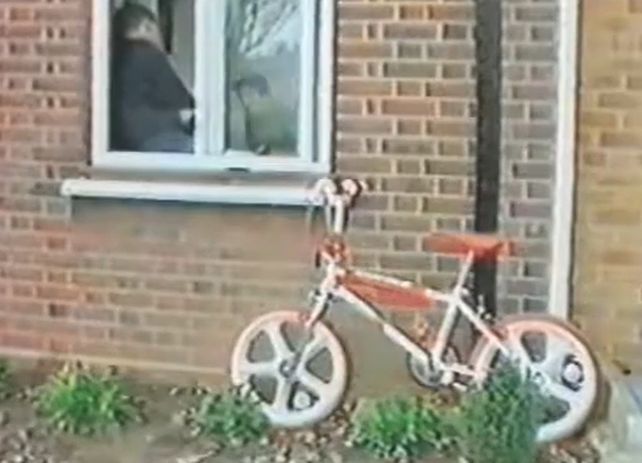
Still, wherever he’s gone, I hope he managed to hang onto his bike.

gh19-02

Grange Hill. Series Twelve – Episode Eighteen

gh18-01

Written by Sarah Daniels. Tx 3rd March 1989

A reporter from the local radio station, Paula Beatley (Barbara Durkin, probably best known for her regular role in I’m Alan Partridge), is in the school, which causes both Mr Bronson and Gonch to go into overdrive ….

It’s noticeable that the comedy gets ramped up in this episode, and it works very well (there are some genuine laugh out loud moments).  They centre around the continuing efforts of both Mr Bronson and Gonch to get a moment alone with Ms Beatley. Gonch, of course, wants to chat about his dating service but I’m not entirely sure why Mr Bronson is so keen for a chat, that’s never elaborated upon.

Maybe he’s just smitten with her? The way he holds her hand when Mrs McClusky reluctantly introduces him is a case in point (he doesn’t shake it, just clings onto it for dear life).  After the heaviness of the Danny Kendall storyline, it’s surprising how quickly Mr Bronson has been transformed into an object of comic relief – today he’s capering around the school, always one step behind Ms Beatley.

The most notable comedy amount occurs when Mr Bronson pokes his head through a row of books in the library. There’s just something about this image (and the expression on Michael Sheard’s face) which tickles my funny bone.

As for Gonch, every time he gets close to Ms Beatley he finds himself apprehended by Mauler. Or Mauler’s just about to pulverise him when Ms Beatley comes into view. Either way, Gonch never gets a chance to explain about the dating scheme (Ziggy and Robbie gazump him on that score).

There are several reasons why Mauler’s never been in the Gripper class of bully. Partly because Mauler has mostly been played for laughs, but also because we’ve never really seen him attack anyone in the way that Gripper would (gleefully kicking Roland around, for example).

So when Mauler gives a piece of dough a good hammering (explaining to Ted exactly what he’s going to do to Gonch) you just know that we’re not going to see anything really happen – this bakery substitute will have to do. Mauler later corners Gonch and threatens to stick a whisk “straight up where the sun don’t shine”. Cripes, that’s a bit rude, although this painful image is quickly diffused when Mauler explains that he means his left nostril. Something of a cop-out ….

Robbie is rather smitten with Ms Beatley. By the smug grin on his face you can tell that the lad thinks he’s pulled.

The quest to find Tegs’ mother begins to pick up speed whilst I’m cautiously optimistic to report that we can finally put the saga of Clarke’s missing bike to bed. After all this time it’s drawn to an odd (and rather oddly directed) conclusion.

It looks like the bike was pinched by a vicar’s son. He doesn’t react when Clarke goes racing up to the vicarage window and plonks down a bugging device, allowing us to hear the conversation between vicar and son (a bit of a cop-out). Neither does the lad show any emotion when Clarke wheels the bike away. After so many episodes you could be forgiven for expecting a little bit more, but let’s not grumble otherwise the bike might get stolen again.

gh18-02

Grange Hill. Series Twelve – Episode Seventeen

gh17-01

Written by Sarah Daniels. Tx 28th February 1989

It’s revealed that Mr Griffiths was single-handedly able to subdue the intruder (well, after Ziggy, Robbie, Mauler and Ted all went screaming off into the night he had no choice).  The mystery individual is now safely locked up in Mrs McClusky’s office – although the rumour has still spread like wildfire that it’s actually a ghost.

No, I don’t think this is terribly plausible either. It certainly stretches credibility to breaking point to see Robbie and Ziggy continuing to believe in supernatural occurrences (I know they’re not supposed to be the sharpest knives in the drawer, but still).

Thankfully we don’t have long to wait before the truth is put out there – a former classmate of Zammo’s, Gareth (Adrian Jeckells), has been forced to sleep rough in the school. There’s an obvious missed opportunity here as the storyline would have had a great deal more impact had the sleeper been a Grange Hill old boy we’d previously met – Zammo, Kevin, Banksey, etc.

That way, the brief tale of his life post GH would have carried a great deal more resonance.  But there’s still a certain weight to this scene – in earlier years it was suggested that life after school could be hard, but it’s never been spelt out in quite this fashion. It certainly makes you stop and wonder which of the current crop of pupils might find themselves in a similar position a few years down the line.

Gareth’s current choices seem limited, with no hostel accommodation available (plus he’s too old to be taken into care).  But Mr Bronson comes riding to the rescue (another sign of his recent change of personality) as he tells Mrs McClusky that Gareth can stay with himself and his sister on a temporary basis.

You have to say that Tegs is probably the most likely candidate to find himself on the streets once his time at Grange Hill is over. But for now he’s landed on his feet – fostered in a comfortable and welcoming home where he’s treated very well. But as he confides to Justine, there’s still something missing – the love of his real mother.  This sets us up nicely for a decent storyline – Tegs’ search for his mother.

Elsewhere, Clarke and Matthew are still on the trail of Clarke’s missing bike (I’m getting rather tired of typing that). Their next lead is a vicar (don’t ask) but they’re unable to follow him after he hops onto a bus. Tune in next time for the next thrilling installment ….

Helen’s knuckling down to some serious study, intent on getting the grades she needs for her engineering course. This leaves Georgina feeling a little sidelined, as she just wants to have fun.  Poor Georgina has had the short end of the character stick this year – either she’s been mauled by Trev or has had to suffer Ziggy’s faltering line in seduction. Either way it’s not been much of a role.

As I work my through through series twelve, I’ve pondered a few times about whether the standard of plotting had fallen over the last few years or if the audience is supposed to pick up instantly the way certain plots would develop. The blind date between Mauler and Big Tel is a case in point.

As soon as Big Tel’s name was mentioned, followed by the appearance of Mauler slapping his date form down, my senses began to prickle. That was certainly enough for me, although for those not paying attention everything was sledgehammered home later (Gonch has a dating slip from a Mau …., who likes cooking. It has to be a girl of course, so it must be Maureen).

Things wind their way to their inevitable comic conclusion, although as this is the last time we see Big Tel it looks as if Mauler will need to seek retribution from Ziggy, Robbie, et al all by himself next time.

gh17-02

Grange Hill. Series Twelve – Episode Sixteen

gh16-01

Written by Barry Purchese. Tx 24th February 1989

Mr Bronson appears to have undergone a change on several different fronts today. Not only does he tell Tegs (who’s still in care) that he hopes his run of bad luck will change soon, he also gives Trev a tenner towards the prom (Mandy quickly takes the note into protective custody).

A ripple of heated discussion has already gone around the fifth formers about Mr B – mainly concerned with the fact that he’s no longer wearing “it”. The attentive viewer will no doubt have already worked out what “it” is. The way Mr Bronson’s early scenes were framed exclusively on his lower half was a bit of a giveaway on that score ….

Yes, he’s now sans hairpiece. With immaculate timing, Mr Bronson saunters over to Trev and mutters that “it’s at the cleaners, Cleaver” in response to the unasked question.  Easy to imagine that Michael Sheard relished that little moment.

Helen continues to find that things are hard at the factory. Although there’s a happy ending to her time there (she gets valuable experience on the machines after she points out that Neil used the wrong drill-bit, thereby costing the company a small fortune) the most interesting part of this storyline was her earlier discussion with Mr Aldridge.

He shows Helen the computer room again and commiserates with her about the fact she’s had a tough time. The scene initially seems to be suggesting that Helen, as a woman, probably shouldn’t have been at the sharp end anyway and a nice, comfortable office job with the computers would be the best thing for her.

But that’s not the case. Mr Aldridge continues by bemoaning the fact that there simply wasn’t the time to train her to do anything useful (which isn’t their fault, it’s more to do with the way the placements are designed). This is a subtle but definite strike against the government, which was a little surprising to see (the series had been quite political in its early years, not so much recently).

Mandy and Gonch, in order to prove to Ziggy and Robbie that their computer dating questionnaire was hopelessly flawed, have arranged a blind date for Robbie and a lucky young lady (selected by the computer at random).  Robbie believes he’ll be stepping out with Emma Thompson (not that one) but he’s going to be disappointed. Can you guess who the computer believes is his perfect mate? Although the mystery is strung out for a little while, it should come as absolutely no surprise to learn that Calley is the (un)lucky girl.

Neither are delighted.

The episode ends with a mob – Ziggy, Robbie, Mauler, Ted, Mr Griffiths – chasing round the school at night, all intent on finding the intruder.  This may not be the most engaging storyline ever (thankfully though it hasn’t lingered quite as long as the saga of Clarke’s missing bike) but it’s just about worth it for George A. Cooper’s weary expressions of resignation.

You can tell that Mr Griffiths was looking forward to a nice quiet evening tracking the culprit down all by himself. But that went for a burton once the boys turned up as now it’s all hollering and a general testosterone overload.

The episode ends with Mr Griffiths running straight into the mystery man or woman. But in current time-honoured GH fashion (stretch those plotlines to breaking point, why don’t you) we don’t see who it is. Fingers crossed that next time this not-very-interesting mystery will be solved.

gh16-02

Grange Hill. Series Twelve – Episode Fifteen

gh15-01

Written by Barry Purchese. Tx 21st February 1989

Last time Helen attended work experience she was very much dressed for the office (despite wanting to work on the shop floor). There’s an obvious irony at work today as she’s come togged up in jeans and dungarees (ready to know what it means to work hard on machines) but finds herself shunted into the accounts department for the day.

She’s left in the delicate hands of Jeanette (Joanna Wright) and Alison (Kelly Cryer). Both are presented as short-skirted featherheads who are forever wittering on about their latest boyfriends. They have little in common with Helen – at one point they caustically comment that she probably isn’t the type to go out to clubs. Helen’s short hair and dungarees hammers this none-too-subtle point home.

She finds no more of a welcome with Neil (Garry Patrick), a boy slightly her senior who’s been working in the factory for a while. Neil’s been designated to look after her when she ventures onto the shop floor tomorrow, but he’s not relishing the task (after all, she’s a girl). This air of casual sexism is reinforced when Helen bumps into Mauler, who’s doing his work experience at the same place.

Mauler’s working in the kitchens, which is something that’s designed to raise an eyebrow. But if Helen wants to work in engineering and Mauler wants to peruse a career in cookery, why not? This plotline may be painted with rather broad brushstrokes but its heart (attempting to diffuse gender stereotypes) is in the right place.

Oh, and we also learn that Mauler’s first name is Francis. He’s kept that quiet (helped in no small part by all the teachers who only ever refer to him by his surname).

There still seems to be someone sleeping in the school overnight. It can’t be Tegs as he’s now living in care, so who is it? Trev’s convinced it’s the ghost of Danny Kendall and bets Robbie and Ziggy a fiver that they wouldn’t spend the night alone in the school.  Oh, no, not the Grange Hill ghost ….

Speaking of Trev, he seems to have fallen into bad ways again. Matthew and Clarke spy him taking multiple cans of lager out of his locker and decide to follow him to find out what he’s up to. Okay, this begs the obvious query about how they’ve missed the fact he’s been boozing his life away since the start of term.

There’s a happy-ish ending to this tale though, as Trev didn’t plan to drink the beer – he firstly tried to sell it back to the off licence and when that failed poured it into the canal. This wanton waste of good-ish alcohol enrages a random passing group of late teens who decide to duff him up for a laugh.

Matthew and Clarke come racing to Trev’s rescue (untying him and rescuing his trousers). Hurrah! But they have to leave him in the lurch (and let Trev’s trousers go floating down the canal) when Clarke realised that someone had pinched his bike again. Boo!

And so the saga of Clarke’s bike rumbles on. Goodness knows what’s so special about it.

The unholy quartet of Robbie, Ziggy, Mandy and Gonch are working on a computer dating scheme for the end of term prom. Robbie and Ziggy have already handed out a questionnaire (much to Mandy’s irritation). Robbie reacts to her criticism …. well, you can probably work out exactly how he reacts by now. He’s nothing if not totally predictable.

Mr Bronson only has one scene in this episode but it’s an absolute corker. He arrives in Mrs McClusky’s office and proffers his resignation with a certain flourish, telling her that he plans to take early retirement. The pair have had some battle royales in the past and today’s confrontation rekindles happy memories of days gone by.

Mrs McClusky clearly can’t find it in her heart to pretend that she’s sorry he’s going (on the contrary, she declares it’s for the best).  The conversation then merrily rattles downhill, concluding when she tells him that “you never supported me in any of the changes I wanted to introduce. It was as if you felt your job was to obstruct me”.

Mr Bronson counters that he’d offered her the benefit of his experience, only for Mrs McClusky to respond that it wasn’t experience she was short of. He has no answer to that and exits.

These are the sort of scenes I’m going to miss ….

gh15-02

Grange Hill. Series Twelve – Episode Fourteen

gh14-01

Written by Margaret Simpson. Tx 17th February 1989

Gonch and Mandy’s relationship hits a slightly rocky bump after he asks to borrow a fiver. That he does so immediately after giving her a birthday present can be marked down as very bad timing indeed.

She soon bounces back though and is full of ideas (whether they’re good or not is debatable). She muses on the possibility of Grange Hill throwing an American style Prom (do we have Grange Hill to blame for introducing this horror to the UK?) whilst she doesn’t think much of Gonch’s computer homework scheme. Mandy believes that computer dating will be a much more profitable venture ….

The episode has some incidental pleasures, most notably the revelation that Mauler is afraid of cows. Maybe one mooed at him when he was a small lad. Whatever the reason, when a group of bovines begin to stare at him in a threatening way, he falls over (straight into a cowpat). Shame.

The main dramatic beat of the episode is Trev’s fall and rise. It’s lunchtime and Trev’s drunk once again, so the well-meaning Vince and Fiona leave him to sleep it off behind a rock on the beach. The only problem is that the tide quickly goes out and before Trev knows what’s happening he’s been swept out to sea with only a rubber tyre for company.

Mr Bronson (lovely bobble hat, sir) has nipped into town to a local estate agent, clearly keen on buying a holiday (or retirement?) home. But the main reason for this scene becomes clear when the estate agent has to quickly proffer his apologies and leave – he’s one of the lifeboat crew.

Having the cooperation of RNLI Bembridge helps to give this part of the story considerable verisimilitude, as we follow the crew each step of the way – from the launching of the lifeboat to the rescue of a rather sodden Trev.

Sometimes Grange Hill‘s moral messages were subtle, other times they were rather forcibly hammered home.  Today’s is a rather forcible one, as a deeply contrite Trev promises to lay off the booze from now on.

Recovering in the dorm, Helen pays him a visit and the pair have a measured and quiet conversation. For Trevor this is something of a novelty, since he’s been unpleasant and bolshy for so long. To hear him speak with a measure of self awareness was certainly unexpected, but if a near death experience couldn’t shake him up, then I daresay nothing could.

gh14-02


Grange Hill. Series Twelve – Episode Thirteen

gh13-01

Written by Margaret Simpson. Tx 14th February 1989

The fifth formers are off to the Isle of Wight, although Trev’s trip gets off to a bad start after Mr Mackenzie discovers his not so secret stash of beer. Initially I thought Trev was being cunning by hiding it in Vince’s bag, but it seems that their labels were just mixed up. Which leaves Vince shouldering the blame and Trev wondering where the next off licence might be ….

Mandy arrives without her glasses (she’s trying out a pair of contact lenses). Gonch, who’s been interested in her anyway, perks up even more at this new, improved model. Quite what message this gives out to spectacle wearers I’m not sure, but it’s not really a positive one.

After learning that it’s Mandy’s birthday tomorrow, Gonch is desperate to buy her a present. He has a brief window of opportunity – ten minutes – before the ferry departs, so nips off rather smartish to the shops.  He doesn’t make it back in time though and so the ferry sails without him.

Odd that he didn’t think that the ferry (or indeed the island) might have a suitable present. There’s no real damage done though as Gonch – ever resourceful – simply hops onto the next catamaran and then takes a taxi to the outdoor centre. Mr Mackenzie, left behind to locate the missing boy, is far less impressed with Gonch’s antics.

If Gonch and Mandy are drawing ever closer, then Calley and Robbie seem to be somewhat fracturing. His attempt to place a friendly hand on her leg meets with icy disapproval (Robbie, of course, reacts in the only way he knows how – he gets angry).  I can’t really blame Calley, I think she’d be well shot of him.

Ronnie now goes into extra catty mode whenever Gonch and Mandy appear whilst the fine Isle of Wight air seems to have done Mr Bronson the world of good. He’s very avuncular, particularly with Joan Hamilton (Rita Davies), the head of the outdoor centre. Indeed he’s so smitten that he even elects to take a dip with her in what clearly is a rather chilly swimming pool. Love knows no greater sacrifice than that.

There’s another school party nearby and it doesn’t take Calley and the other girls long before they’ve got very pally with the boys. Can you guess how Robbie reacts to this? Yes, he’s pretty much apoplectic. Some geezer trying to steal his bird? They’re taking real liberties.

I like the way Trev keeps buying beer and Vince keeps throwing it away. Especially when Vince starts to mess with Trev’s mind by telling him that he must have drunk it all and then forgotten! Poor old Trev’s so addled at this point that he might even begin to believe it.

Another of those mysteries which never really was a mystery is solved. Trev was the one sending Georgina notes, so she decides to take offensive action – giving him a good kicking. Presumably she’s picked up some decent tips from the self awareness class.

gh13-02

Grange Hill. Series Twelve – Episode Twelve

gh12-01

Written by David Angus. Tx 10th February 1989

Georgina receives a disturbing phone call – a heavy breather. Who can it be? Trev’s been pestering her all year, making him fhe most likely suspect, but Helen decides that Ziggy is the guilty party. Nope, don’t understand that. I’m undecided whether we’re seriously supposed to think that Ziggy might be a phone pest or whether this is just another slightly misfiring plot point.

Helen’s all dolled up as she’s off to start her work experience. The affable Mr Aldridge (Jack Galloway) gives her a whistle-stop tour of the engineering plant. She takes in the drawing office, the accounts department and the C.A.D. (computer aided design) room before finally ending up on the works floor.

There’s a vague hint of sexism along the way. A computer chap gives her a wink (steady on fella, she’s underage) whilst we’re also set up to expect some shop-floor dissent from her fellow workers next time. However, I’ve the feeling that Helen will easily wipe the floor with the bolshy lad who thinks that women and heavy machinery shouldn’t mix ….

Susi finally confesses to her mother about her catalogue borrowing habits, which is good news as it means we can draw this storyline to a conclusion. You have to feel a little sorry for Lynne Radford (Susi). Her two years on the show were drawing to an close and this was her most substantial contribution.

Possibly it was her decision to drop out after series twelve or maybe the production team felt Susi was unlikely to develop much further. With both Justine and Chrissy already established as strong characters, it’s easy to imagine that Susi would have been pushed even more to the sidelines next year.

Calley continues to be something of a lone voice in support of Mr Bronson. She makes the very reasonable point that Danny was no saint (and quickly dismisses Fiona’s rather feeble defence that Danny only acted like he did because of his illness).

A slight plot contrivance later finds Calley and Mr Bronson alone in the classroom. She attempts to breech the awkward silence, but her well meaning comment of “we don’t all hate you” possibly wasn’t the most tactful remark ever! This encounter, whether indirectly or directly, does seem to spark Mr Bronson back into life though.

Later, he decides that he will attend the Isle of Wight field trip after all (which was in jeopardy after he decided to pull out).  The way he doesn’t react when Mrs McClusky mentions that she’s thinking of allowing the pupils to bring their motorbikes into school is also interesting.

Mandy has devised a plan, which Mrs McClusky is considering, re the bikes. Ronnie seems less than impressed when she finds out though (but I think we can chalk this down to the fact that Mandy and Gonch are increasingly becoming an item). Does Ronnie still pine for Gonch? It seems hard to credit, but this is Grange Hill – where strange things happen every day.

Speaking of strange things, we learn who’s been hiding out in the school. It’s Tegs of course, and now he has Justine for company. But this storyline suddenly becomes a little less predictable when the camera reveals that there’s someone else left in school besides the two of them. It can’t be Mr Griffiths, as we’ve already seen him leave, so who is it?

Hopefully it won’t be the Grange Hill ghost.

gh12-02