Angels – Concert (18th May 1976)

concert.jpg

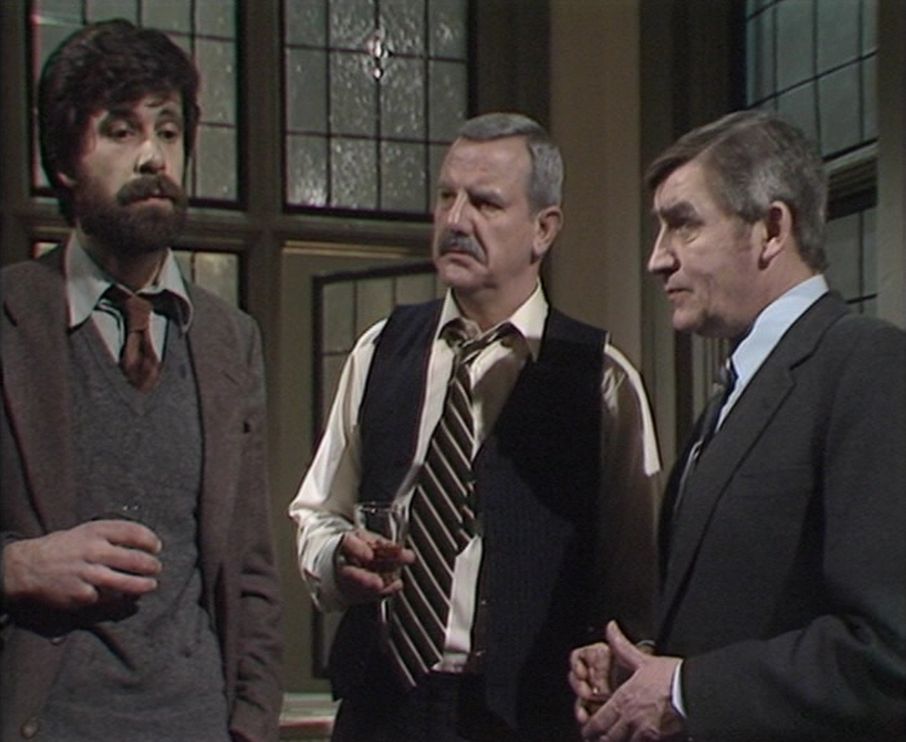
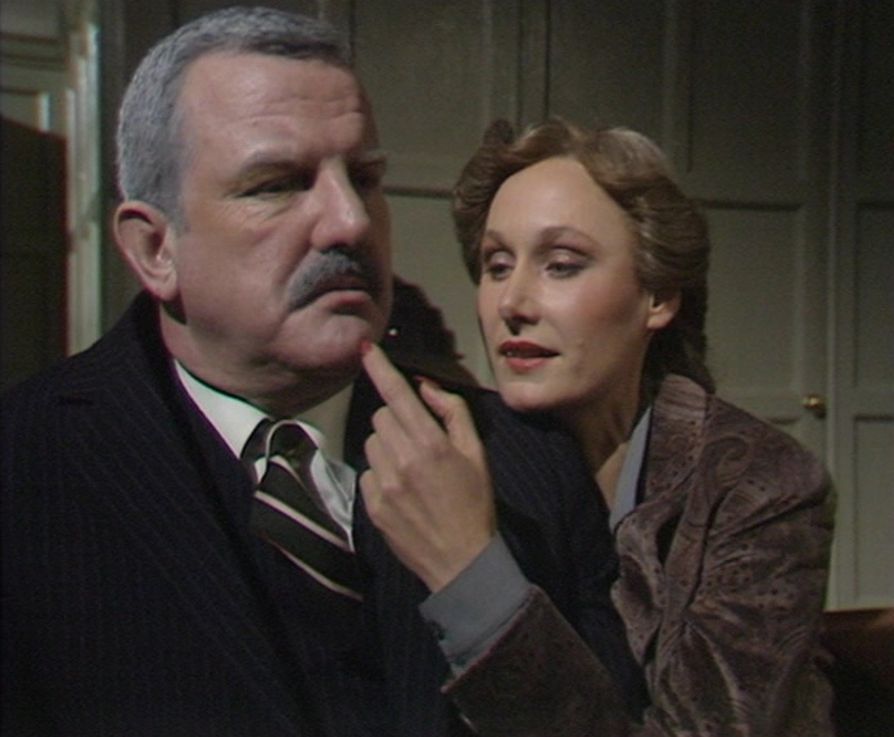
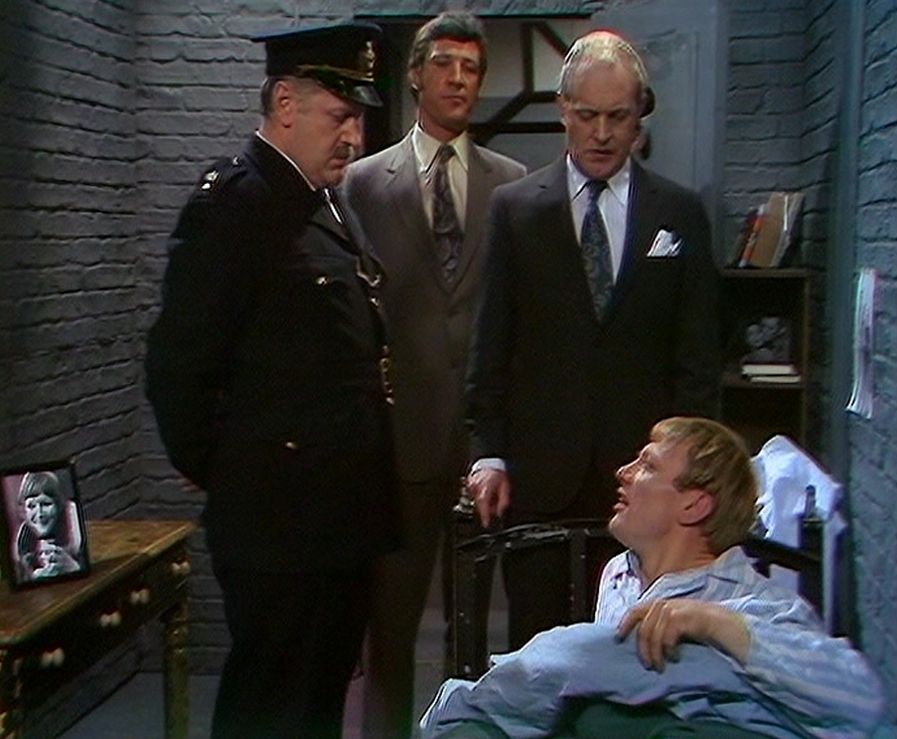
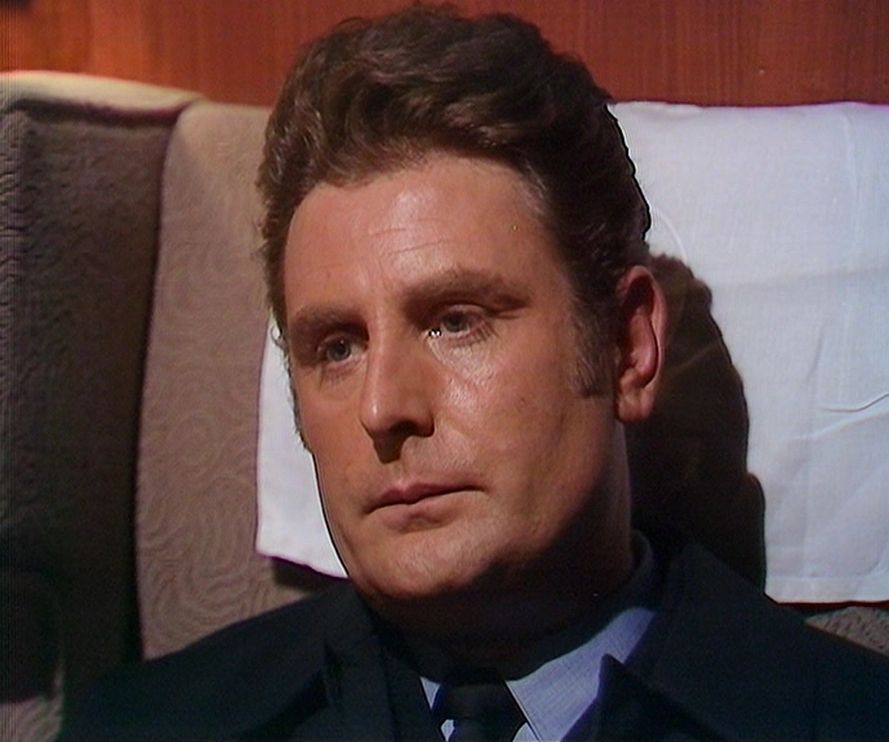
The second of Susan Pleat’s two scripts set in and around the geriatric ward, Concert, like Day Hospital before it, is an OB VT production shot on location.  As previously touched upon, this helps to make the story seem just that bit more real.  Sylvia Coleridge and Irene Handl return (the ranks of familiar senior actors is supplemented with the appearance of Leslie Dwyer) but it’s some of the background elderly players who, along with the location, are key to the documentary-like feel of the production.

They clearly are infirm and so don’t have to act the part.  We see Shirley attend to them via a series of brief vignettes – fulsomely praising one lady after she walks a handful of steps to the table, gently cajoling another into taking a bite of food – and these moments spark mixed emotions.  Shirley’s ever-growing connection to all her regulars is plain which makes her quick to react with anger when quizzed about the futility of looking after people who are clearly never going to get better.

This theme is developed when Jo, curious about the regular musical concerts organised in the hospital, decides to drop by and lend a hand.  Jo’s reluctance to get involved with the geriatric side of nursing has been mentioned in previous episodes and is put into words today by another character. “Feed ’em and clean ’em and that’s your lot. They’ll addle your brains and break your back”.

That seems to be a commonly held view and it’s the reason why many nurses elect to give geriatrics a miss.  Concert, aiming to challenge this opinion, is helped by the fact that both Annie (Handl) and Patrick (Dwyer) are still mentally sharp, even if physically they’re beginning to fail.  Their quick wits ensures that the viewer isn’t always dwelling on the frailer and more hopeless-looking cases.

But a feeling of melancholy is never far from the surface. At the same time that most of the old folks are having a jolly singalong at the concert (My Old Man being amongst the highlights) Ailsa, back in the ward, is being told by her son that they simply couldn’t cope with her at home.  She, naturally enough, descends into bitter tears whilst elsewhere Jim Murphy (Colin Higgins) lectures Jo about the growing population of old people and the issues with caring for them.

The series didn’t often take the opportunity to revisit one-off characters.  They do today though, with Gordon Massey (Colin Higgins) making a return (he’d previously featured in the series one episode Saturday Night). He doesn’t have a great deal to do in this episode (and there’s no particular link back to his previous appearance) but it’s still a nice touch.  Like Shirley, he’s passionate about his work on the geriatric ward – for him it’s because he knows what it’s like to be abandoned and therefore is adamant that it’s not going to happen to any of his charges.

No doubt Shirley would have loved to have been at the concert as well, but instead she’s sharing an evening from hell with the drippy Roland (Norman Tipton). Quite what their previous relationship has been isn’t too clear, but Roland – shortly to depart for a lengthy trip abroad – is keen to demonstrate to Shirley just how much he cares for her.  However it’s pretty obvious that the sooner he packs his bags and leaves, the better off she’ll be.  Shirley may usually be bereft of male company, but you have to draw the line somewhere ….

It’s bad enough when he’s attempting to force wine on her at the restaurant, but things get even more toe-curling when he decides that playing a deep and meaningful record on her Dansette is the way to go.  Not a good move. He may feel unfulfilled due to a lack of personal contact, but Shirley doesn’t.  She has her work, and that is her life.

When they can’t talk very much, or even talk at all, they can’t hear you, well then you really have to look at them. Because people’s eyes are really where they are. And if I have to talk to them in that way, then I can. But, say with you or my mother then I can’t do that at all. Or with a lot of people. But there I just get on with things. It’s me and it’s right somehow.

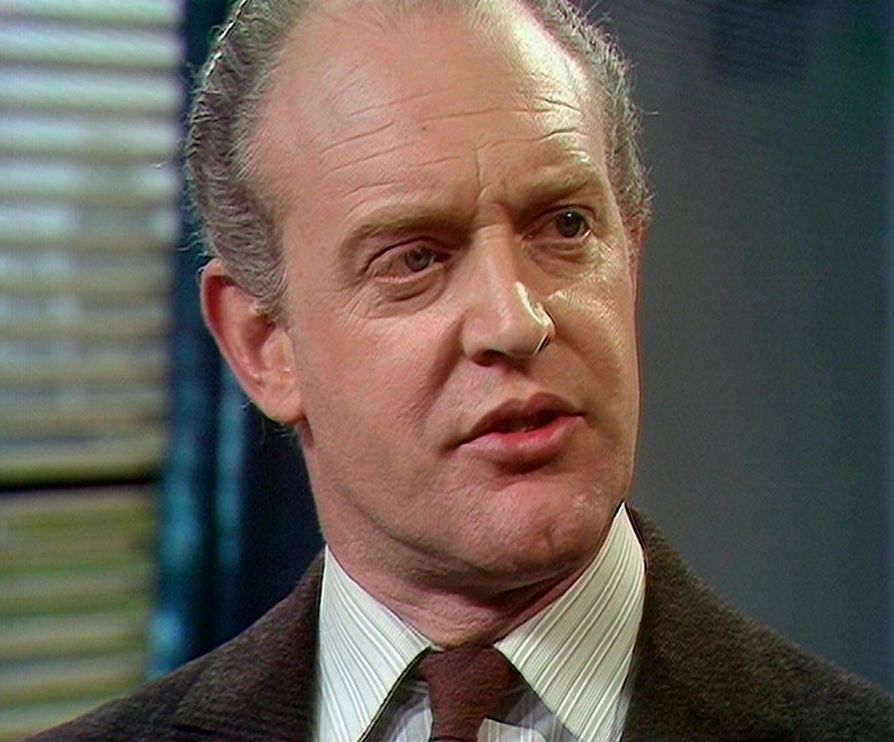
This is a nicely delivered monologue by Clare Clifford, which sees Derek Martinus flicking back between close-ups of her and Norman Tipton (an ironic touch, given Shirley’s comment about people’s eyes).

Concert may have a lecturing tone, but it isn’t done in a heavy-handed way. Jo, like the audience, is pitched into a strange new world and by the end she seems to have learnt something, although there’s still a sense that she’s reluctant to get too involved, unlike Shirley.  The episode doesn’t offer any pat solutions (given how complex the issues are, how could it?) but plenty of food for thought is generated.

a14.jpg

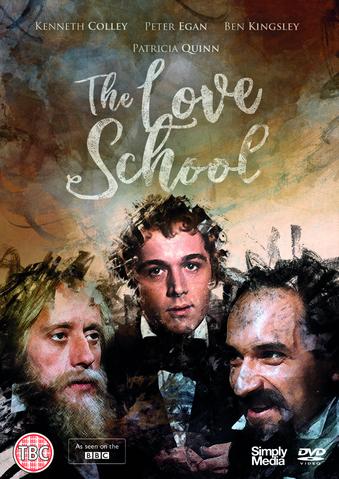
The Love School (BBC, 1975) – Simply Media DVD Review

love dvd.jpg

It is 1848.  Seven young men active in various artistic fields form a secret group, the Pre-Raphaelite Brotherhood.  All are bound together by common aims – chiefly a desire to innovate and so break free from the stifling constraints of conventional artistic thinking.  Critical and public acclaim for their work is sparse to begin with though, whilst their unity as a cohesive collective is threatened by their egos and conflicting desires …..

Broadcast in January and February 1975 (comprising six 75 minute episodes) The Love School boasts a cast chock full of talent.  Peter Egan, Ben Kingsley, Patricia Quinn, David Collings, David Burke, Kenneth Colley and Sheila White are just some of the leading players.

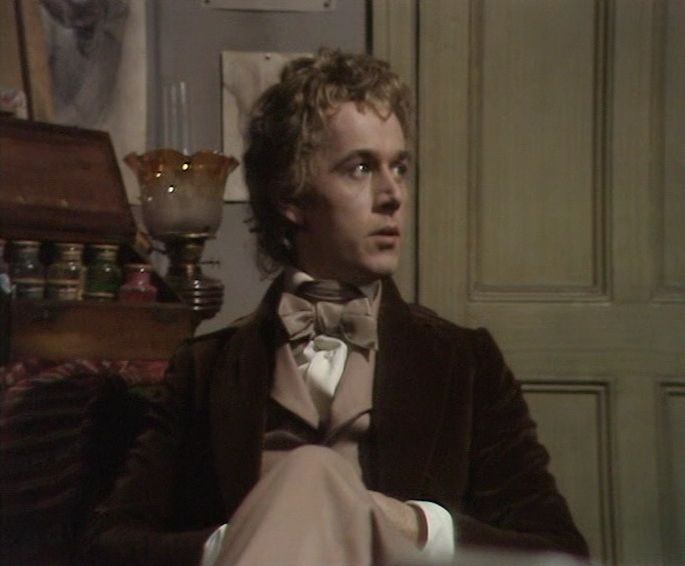
The opening episode – The Brotherhood – introduces us to several main characters.  In these early stages it’s Dante Gabriel Rossetti (Ben Kingsley) who makes the strongest impression. Resplendent in a flowing wig, Kingsley certainly has plenty to work with. Rossetti might be a genius (he certainly believes so) but he’s also capricious and manipulative.

After persuading Ford Madox Brown (Malcolm Tierney) to take him on as a pupil, he then promptly dumps his mentor in favour of Holman Hunt (Bernard Lloyd). And whilst Rossetti and Hunt may later be the prime movers in founding the Pre-Raphaelite Brotherhood, the opportunistic Rossetti is always happy to drop his friends at the drop of a hat if it means advancing his career

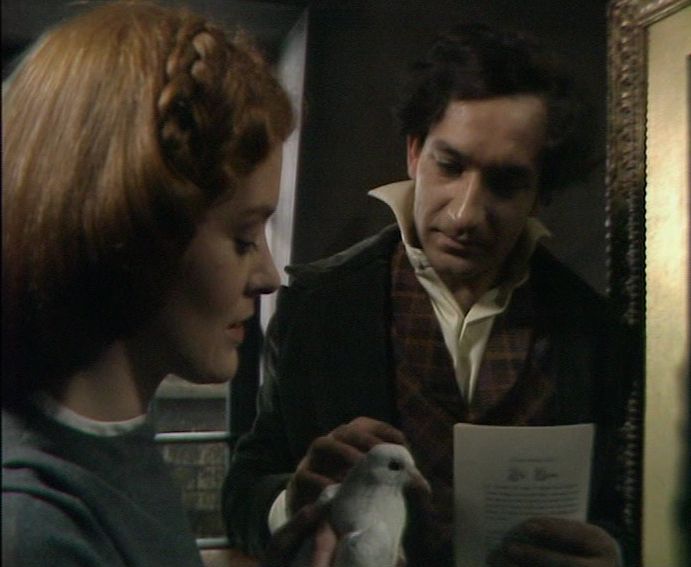
And yet to begin with Hunt is always prepared to forgive his friend his sins.  Lloyd, like Kingsley, shines in this first episide – bringing to life the engaging and sensitive Hunt.  Peter Egan (as John Everett Millais) has less to work with initially, but his natural charm still comes to the fore.  Millais is a gifted artist, and has been since he was a child, but recent rejections by the Royal Academy are beginning to sting.

love egan

David Troughton (Frederic Stephens), Gareth Hunt (Thomas Woolner), John Quentin (James Collinson) and Nicholas Grace (William Rossetti) skirt around the perimeters of several episodes whilst Patricia Quinn, as the haunting Lizzie Siddal, and Sheila White (the gloriously common Annie Miller) both make instant impressions.

The already strong cast is further enhanced when David Collings and Anne Kidd (as John and Effie Ruskin) appear. An influential critic, Ruskin champions Millais’ work, but the artist becomes besotted with his wife …

Collings teases out Ruskin’s icy detachment with skill. At times Ruskin treats Effie with casual indifference and cruelty, but on other occasions their bond seems very strong. Into this strange and dysfunctional marriage comes Millais, as open and eager as ever.

Given the lion’s share of episode two, Egan is excellent – showing us how the always indulged and spoilt Millais becomes increasingly confused by the signals he’s receiving from Effie (they eventually marry following her acrimonious divorce).

One way of marking the passing of time is to keep an eye on the false beards and moustaches which suddenly appear. Hunt, for example, after travelling abroad for several years returns with an impressive beard and then reaffirms his intention to marry Annie. He’s paid for the guttersnipe to receive the best education possible, but has this turned her into a lady fit for polite society?

Speaking of false beards, there’s an excellent example courtesy of Desmond Llewellyn as Mr Coombe. Elsewhere in this third episode, Seeking The Bubbles, Egan sports a bald cap as Milliais grows older. Acting under heavy make-up was something Egan did a lot of during the 1970’s (see also The Prince Regent).

It’s slightly disconcerting the way Millais and Hunt age so rapidly. One minute they’re in hale and hearty middle age and the next they’ve been transformed into doddery old men. It’s a shame to see them go so soon, but on the plus side it means that Rossetti then reappears to dominate the second half of the serial.

Two notable actors, Kenneth Colley and David Burke, make their first appearances in the fourth episode (Remember Me). As Edward Burne-Jones and William Morris (who is usually referred to as Topsy) they may come across as two of the oldest undergraduates ever seen, but in their early scenes both manage to convey an appropriate degree of youthful enthusiasm when meeting their idol Rossetti for the first time.

Some delightful comic scenes then develop. The pair may be obsessive admirers of Rossetti, but Topsy especially finds it easy to pick holes in some of his more recent work.

Rossetti’s tender relationship with the physically ailing Lizzie generates some compelling moments. Despite his numerous sexual conquests elsewhere, he does seem to be genuinely in love with her. Although the fact he’s content to leave her alone all day, suffering silently, whilst he’s out and about enjoying himself tells its own story.  After being absent in episode three, Kingsley comes roaring back to life in this one.

love kingsley

Writing credits for the serial were shared between Ray Lawler, John Pebble, Robin Chapman and John Hale (one apiece from Lawler and Pebble, two each from Chapman and Hale). Chapman’s two episodes – four and five – are especially interesting. Depicting the rise and fall of Rossetti, both are compelling (although once again, the ever-growing false beards sported by several key characters can be a tad distracting).

Despite being largely studio bound, the milieu of Victorian England is very efficiently brought to life. The way the production uses ambient noise (such as horses and carriages clopping past outside) is an effective way of creating an immersive atmosphere.

There are several eye-catching directorial flourishes. At one point the picture is speeded up to suggest a frantic burst of activity from several of the artists – although this isn’t entirely convincing (it rather brings to mind Benny Hill). Rather more memorable is the moment when Patricia Quinn’s mouth is overlaid on a painting of Lizzie.  This is a traumatic scene for the hallucinating Rossetti, convinced that his dead love has returned from the grave to taunt him.

Even with the lengthy running time, some stories feel slightly undeveloped (we hurtle very quickly through Milliais’ life, for example). But with multiple colourful characters jostling for position it’s not really surprising that some fare better than others.  Ben Kingsley’s Rossetti (who appears in five of the six episodes) emerges as the first amongst equals.

The Love School is deftly able to impart an appreciation for the works of the Pre-Raphaelite Brotherhood whilst at the same time not shying away from the multiple personality flaws which infected its leading lights (this makes for excellent drama of course).

Something of a neglected gem from the mid seventies, it’s yet another quality title that’s been brought back into circulation thanks to Simply.  An absorbing experience from start to finish, The Love School is worthy of your time.

The Love School is available now from Simply Media, RRP £24.99. It can be ordered directly from Simply here, quoting ARCHIVE10 will apply a 10% discount.


Angels – Weekend (11th May 1976)

a5

Three separate plotlines run throughout Weekend. Pat and Maureen (but especially Pat) are tired of living in at the hospital and so decide to go flat hunting, Miss Windrup makes a new friend whom she invites around for tea and Jo takes decisive action in order to convince Mr Paton (Duncan Lamont) that he should visit his hospital-bound sister.

The Pat/Maureen relationship has always seemed a slightly uneasy one, given their totally different backgrounds and outlooks.  Pat’s privileged and pampered life prior to becoming a nurse is touched upon during the scene where she’s ticked off about the untidy state of her room.  Being told that the cleaners are giving it a wide berth until it’s more presentable clearly doesn’t please her – the notion of Pat tidying up her own mess a little bit is plainly anathema to the girl (surely that’s what the cleaners are employed for).

This is the sort of petty rule which makes her very keen to find her own space.  The placid Maureen is perfectly content with her lot, but (as always) is happy to go along with her friend.  At this point the Pat/Maureen dynamic is operating along previously defined lines (Pat dominant, Maureen submissive) although later on the roles are switched around somewhat.

Maureen, her puritanical Irish upbringing brought to the fore, is shocked to discover that one potential flat share would see them thrown together with three men.  Pat’s quite unruffled (and indeed pleasantly curious) about this but Maureen dismisses the notion straight away. What would her mammy say? This scene might be played for laughs but it still helps to reiterate that they live in very different worlds.

The comic tone continues when they meet a representative (Carolyn Hudson) from the gloriously named ‘Fix A Pad’.  Pat and Maureen are now finding it difficult to agree on anything – for example, Pat wants to live far away from the hospital whilst Maureen would prefer to be close. And when Pat mentions that she’d like two bedrooms, Maureen is surprised since she’d assumed they’d be sharing.  Pat reacts to this with scorn (“what happens to my love life?”). Mind you, Maureen does bat this back quite effectively with “what love life?”

Following this awkward meeting, Pat decides that “the only thing we really had in common was that we were new together” and the pair then go their seperate ways. But although it looks for a while as if their friendship has indeed come to an end, it’s not too surprising to learn that by the end of the episode they’re pals once again. They may have many different interests but Pat comes to realise (thanks to a third party) that this is precisely why their friendship works. Maureen’s opinion on this goes unrecorded (which does tend to reinforce the notion that she’s very much the junior partner here).

It’s interesting how Miss Windrup manages to laser in on Nora Eden (Nancie Jackson). It’s true that she was sitting by herself in the canteen, but it does imply that Miss Windrup has a sixth sense which allows her to sniff out lonely souls like herself.  Of a similar age to Miss Windrup, Nora has come back into medical teaching after her offspring moved abroad.

A1.5.jpg

Their initial conversation is quite revealing, not least for the way in which it restates the hollowness of Miss Windrup’s existence away from the hospital.  She may bravely agree that her job keeps her busy and fulfilled, but we’re still left with the sense that she really doesn’t have much of a life (later she admits this herself).  Her air of sadness and melancholy is reinforced when we see her out shopping, picking up some choice delicacies for her visitor.  These establishing scenes leave us with a question – will there be a sting in the tale when Miss Windrup and Nora take afternoon tea?

The answer to that is yes, but it’s a fairly mild one. Nora doesn’t appear at the appointed time, leaving a crestfallen Miss Windrup to clear away the uneaten food. But there’s recompense the next day when Nora shows up with profuse apologies for having missed the date.  We then see a pathetically eager Miss Windrup invite her in for a cup of coffee and another heart-to-heart.

As for Jo’s plotline, Elsie Clegg (Maggie Flint) isn’t seriously ill but she becomes increasingly depressed about the fact that her brother never visits her.  He’s not too far away, but claims – via a letter – that he simply can’t spare the time to pop in.

This excuse isn’t good enough for Jo and she decides to pay him a visit.  Everybody else – Sita, Sandra – thinks this is a bad idea, but she’s adamant.  After a bit of a lull, this plotline gives Julie Dawn Cole something to get her teeth into.  She plays Jo’s apprehension (when she’s invited into Mr Paton’s house) very nicely.  Of course, having Duncan Lamont in the role of Len Paton doesn’t hurt.  Always the most solid of actors, the first scene between Jo and Len is quite absorbing.  A mystery is also established here.  Is Len really too busy to visit the hospital or is there another reason why he can’t bring himself to see his sister?

The knife is twisted just a little more after he finally makes an appearance at St Angela’s, only to promptly vanish before seeing Elsie (leaving behind a pot-plant flower as the only proof that he’d been there at all).  Elsie’s already burst into tears several times and when she does so again (after her puppy-like joy at learning that Len has finally come to visit her is dashed) it feels rather affecting.  Jo continues to dig away at this puzzle, despite the fact that it’s really nothing to do with her (it’s true that visiting Len late at night to demand answers does feel somewhat unwise).

The resolution to this mystery is an excellent showcase for Lamont and is the dramatic highpoint of an episode that overall still feels quite low-key. But possibly Weekend isn’t the worse for that, as even in a hospital it can’t always be a matter of life and death.

a3.jpg

Angels – Day Hospital (4th May 1976)

a1

The fact that Day Hospital was shot on OB VT in real locations helps to give the episode a totally different feel to what we’ve seen before.  As good as the studio sets always were, there’s just something more immersive and satisfying about the fact that you can look out of a window and see real life outside.

Set in a geriatric ward and attached day care unit, the episode manages to strike a good balance as it’s neither too maudlin (although there’s bleakness towards the end) or too superficial.  Shirley had mentioned previously that the infirm and elderly are similar in many ways to children – today it’s Ailsa (Sylvia Coleridge) who fits that description the closest.

If you wanted someone to play an eccentric, then you couldn’t really do better than Coleridge. Petulant and deeply irritating at times, Ailsa exists in part to try Shirley’s patience through a series of wheezes (smashing plates, pouring water from a vase onto the floor to try and fool Shirley into believing that one of the other patients has wet themselves, etc).  But she’s also given a few moments of pain and anguish, which enables the viewer to see the more complex person hiding beneath the dotty surface.

Dodi (Aimée Delamain) and Annie (Irene Handl) enjoy the best of the script though. Dodi is initially presented as an autocratic and imposing individual.  Living alone (albeit with nursing support) in a big house, she views the prospect of making regular trips to the day hospital with dismay and disdain.  But after one visit she’s quite won over.

Annie is a salt of the earth, speak as you find, type of person.  A hospital regular, along with Ailsa (whom she has a love/hate relationship with), she also finds the idea of going to the day hospital daunting (although at least she only has to travel down the corridor to reach it). Like Dodi though, she becomes a firm fan very quickly.

At first, Dodi seems to be a rather broadly drawn character, but as the episode wears on she’s shaded in very effectively.  The scene with Dodi and Annie in the day centre is beautifully played by both Delamain and Handl.  Dodi’s lonely, spinsterish existence, allied to the early deaths of her brothers (due to WW1 and its aftermath), is teased out in a heartbreaking way. Derek Martinus, as he does elsewhere, elects for close-ups during these dramatic moments, which is a simple but effective touch.

Even though Annie’s tale is also shot through with suffering (she lay undiscovered in her house for three days after suffering a stroke) there’s something about Handl’s delivery of these lines which still manages to create a sense of warmth.  No doubt residual affection from her long comic career is playing a part here.

With the guest actors featured heavily, the regulars are slightly pushed into the background, but those featured – Shirley, Maureen, Pat – still benefit from some decent character development throughout Susan Pleat’s script.  After suffering run-ins with both Ailsa and Annie, Shirley has to work hard to retain her self control (even more so after another patient suffers a broken leg and Shirley finds herself accused of negligence by her relatives).

Shirley’s slightly stunted personal development may be the reason why she finds all one-on-one interactions to be somewhat trying, although nobody could blame her for getting a little irritated with either Annie or (especially) Ailsa.  But by the end of the episode she’s definitely gone through something of a learning curve, leaving us with the impression that piece by piece she’s becoming more of a rounded person.

Although Shirley is having a trying time in the ward, Maureen (working in the day unit) appears to be having a much easier experience.  Maybe this is just down to the luck of the draw, or possibly Maureen’s more placid nature just fits in well with the atmosphere of the place.

Pat’s place in this story is very interesting.  She’s someone who we haven’t really explored in any great depth for a while, which makes this episode a very welcome one.  With Pat’s mother being a friend of Dodi, Pat is instantly drawn to her – she may be occasionally tetchy, but Dodi also has the aura of a wise sage.

Pat finds herself telling Dodi things – about her strained relationship with her mother and her doubts about nursing as a vocation – which she claims she’s never shared with her friends.  Given how close Pat and Maureen seem to be, this is a little surprising, but on reflection maybe not.  It’s a nice character beat either way though, as it helps to show that the outwardly confident Pat is just as riddled with insecurities as, say, the socially awkward Shirley.

Dodi’s death at the end of the episode therefore comes as a jarring blow, not only to the audience (who no doubt would have grown to appreciate her as the story wore on) but also to Pat, who tells Maureen that she’s lost her new-found confidant.  This seems to be a slightly selfish point of view, but it also feels quite truthful. Pat’s final visit to Dodi’s house – now covered in dustsheets and empty of all life – is nicely played, especially the moment when she picks up the small bell that Dodi was fond of ringing whenever she required attention.

The fact that Dodi died in a late-night fall down the stairs is a bleakly ironic twist.  Previously pretty much bed-bound, the strong inference is that her new-found confidence after attending the day hospital was a contributory factor in her death.  Maureen is quick to scotch Pat’s suggestion, but this lingering notion is left hanging in the air.

It’s pleasing to know that we’ll encounter Ailsa and Annie in another episode shortly.  Thanks to the nuanced performances of all three senior actresses, Day Hospital is a thought-provoking and memorable episode.

a9

The Phoenix And The Carpet (BBC, 1976/77) – Simply Media DVD Review

phoenix.jpg

When four children persuade their parents to buy them a rather shabby second hand carpet they have no idea what lies ahead for them.  For the carpet is a magic one, containing an egg which – when accidentally tossed into the fire – hatches a Phoenix who has been asleep for some considerable time.  With the wise Phoenix as their guide, the children embark on a series of amazing adventures ….

Published in 1904, The Phoenix and the Carpet was the second book in Edith Nesbit’s trilogy (beginning with Five Children and It and concluding with The Story of the Amulet). This 1976/77 adaptation by John Tully was retooled as a stand-alone tale, meaning that no knowledge of the previous story is required (the Psammead, from Five Children and It, appears briefly in the novel of The Phoenix And The Carpet but is omitted from this adaptation).

Given the technical limitations of the era, this was an incredibly ambitious production.  It’s not going to be to everybody’s tastes (there’s lashings of CSO and various other special effects which require considerable suspension of belief) but if you’re prepared to go with the flow then an utterly charming tale lies ahead.

Director Clive Doig had cut his teeth as a vision mixer on numerous 1960’s episodes of Doctor Who. Given this (as well as his work on Vision On and later Jigsaw) no doubt he wouldn’t have been phased by the taxing requirements of this eight-part serial.

I have to confess that within the first five minutes I was won over. Yes, the Phoenix may be a rather immobile puppet – but he’s brought to life by Robert Warner’s wonderful voice work.  Thanks to Warner, the Phoenix quickly becomes a character in his own right – knowledgeable and sage-like, but also possessed of an overweening sense of his own importance.

ph01

And although the children – Cyril (Gary Russell), Anthea (Tamzin Neville), Robert (Max Harris) and Jane (Jane Forster) – all have the slightly mannered stage-school delivery familiar from countless other period dramas of this era, there’s plenty of good one-liners and sly gags for them scattered throughout the script.

During the serial there are also some fine comic performances from the elder players. Robert Dorning as the carpet seller in the first episode for example, whilst Susan Field (as the children’s bad-tempered Cook) is a joy in episode two. Immediately after the Cook stumbles across the smooth-talking Phoenix she’s whisked away with the others to a desert island …

Clearly the serial had a decent budget as the island (whilst resolutely studio-bound) is shot on film rather than videotape. It doesn’t convince as a real location, but since the whole production has a heightened, theatrical feel this isn’t really a problem.

The island natives (browned up British actors with curly wigs and plenty of “ooga booga” mumblings) are slightly eyebrow raising, but these scenes only reflect the original novel, which sees the Cook carried off by the natives (who are so taken with her that they decide to make her their Queen).

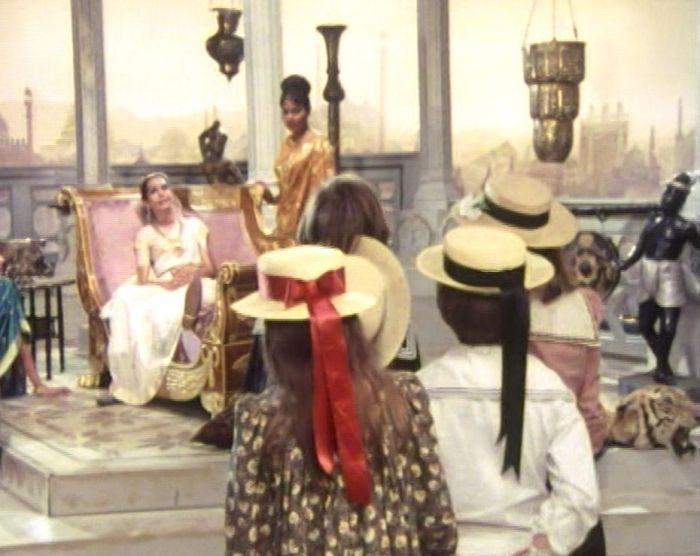
The children’s colourful trips continue when they head out to India – we go back on film for a sumptuous palace based sequence which introduces us to The Ranee (Surya Kumai), someone who has every material benefit but still feels desperately unhappy. Luckily for her, the four plucky English children are able to cheer her up. Cyril launches into a lengthy explanation about how they acquired the carpet (delightfully causing the others to roll their eyes!)

ph13

Back in London, the imperious Mrs Biddle (Hilary Mason) is helping to organise a church bazaar with an Indian theme. She’s proud of her contribution, but is trumped by the knick-knacks acquired by the children during their recent jaunt.  This contrast between the exotic adventuring of the children and their return to a more mundane life in London gives the serial a very appealing feel (even though the adventures are high on charm but low on jeopardy).

There are several other highlights scattered throughout the remainder of the serial. I was particularly taken with the Phoenix’s tour of London. It’s a lovely opportunity to ramp up the comedy as the Phoenix demands to be taken to one of the many temples established in the capital to worship him (he has a little trouble in understanding that the Phoenix Insurance Company is a different sort of beast altogether …)

Monica Sims, head of BBC children’s programmes, told The Stage and Television Today that “the production has all the difficulties of children, animals, magic and the technical tricks required for a magic carpet. Not to mention a haughty bird as the leading artist” (30th September 1976).

All these hurdles were successfully overcome and by the time the eighth and final episode concludes there’s a definite sense of poignancy in the air.  The Phoenix And The Carpet certainly seems to have left an indelible impression on those who saw it at the time and it’s pleasing to report that the decades haven’t diminished its magic.  Other bigger-budgeted adaptations are also available, but this one is very special indeed. It’s well worth checking out.
The Phoenix And The Carpet is available now from Simply Media, RRP £19.99. It can be ordered directly from Simply here (quoting ARCHIVE10 will apply a 10% discount).


Angels – Legacies (27th April 1976)

a4

Legacies is another episode which places Shirley front and centre.  It was established in the first series that she has an awkward relationship with her parents and this theme is developed during the early part of the episode.  It seems that Mr and Mrs Brent (Lloyd Lamble and Peggy Ann Wood) have given Shirley everything she could have asked for, apart from love.  They’re polite enough to their daughter but also emotionally closed-off, which strongly implies that Shirley’s repressed nature is a direct result of her upbringing.

The way that Mr and Mrs Brent display polite interest at the news that Shirley will be involved in the forthcoming celebrations at St Angela’s (to mark twenty five years as a teaching hospital) but firmly decline to attend is very cutting.  The thought that this might disappoint their daughter doesn’t seem to have crossed their minds.  Mind you, it’s also true that their own relationship seems just as superficial (polite on the surface but lacking any sort of emotional depth).

Intercut with these scenes are a number of gritty location shots following Diana (Mary Maude) as she makes her way back home to her squat. In story terms there’s no particular need to have them in the episode (it would have been just as easy to open with Diana being brought into the hospital) but they do add a little bit of grimy mid seventies colour to the episode.

A self-destructive drug addict, Diana’s a regular at St Angela’s and viewed with weary resignation by the staff.  Shirley begins by professing bafflement – since she can’t understand her, she has difficulty in treating her.  Sandra is on hand to dish out a dollop of common sense – personal feelings don’t matter, everyone deserves the same duty of care

Shirley’s psychological war of nerves with Diana is the dominant theme of today’s story.  It ebbs and flows, but eventually Shirley comes out on top, telling Diana that “we’re both losers, but you don’t even know it”.  Diana’s background is revealed to be similar to Shirley’s – well-off parents who gave her every material benefit but nothing else. That they’re two sides of the same coin is then explicitly stated, which is a slight shame (given how oblique some of Diana’s monologues are, it probably would have been better not to have spelled out this obvious point).

Legacies is a very verbose script. We do have an explanation as to why Diana is such an articulate junkie, but there are times when she does feel like an artificial character. Although if one were being generous it may be that this was intentional. Shirley does pick up on the fact that Diana is an arch-manipulator – always playing a role, she finds it easy to push people’s buttons in order to create the effect she requires.

The fact she causes Shirley to lose her temper pleases her – but not in a malicious way.  Rather, Shirley has now passed the test and can be treated as almost an equal (the way they smile at each other at the end of the episode feels encouraging but also faintly sinister).

If Shirley is the angel who has received by far the most character development during the series to date, then some of the others – such as Maureen – are rather lagging behind.  Maureen doesn’t feature very heavily today, but her scenes (mainly pouring scorn at the parasitic way Diana leeches from the state system) don’t quite ring true.  Nothing we’ve seen of her previously would suggest that she would react in this way, which leaves me with the impression that her character has been refashioned just to service this particular plot point.  If so, then it might have been better to create a one-off nurse for the role.
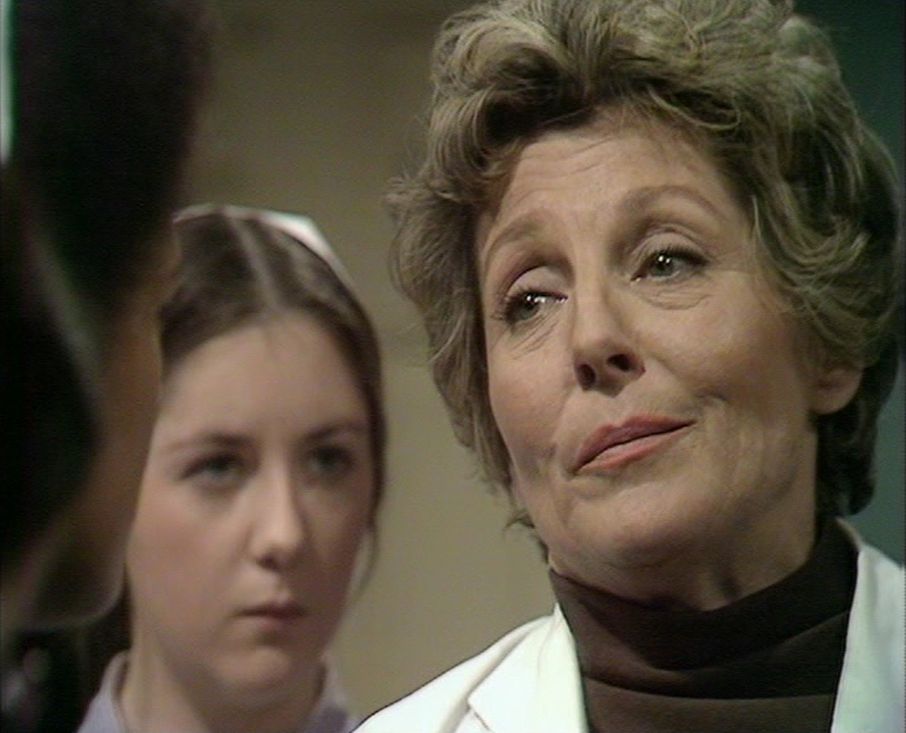
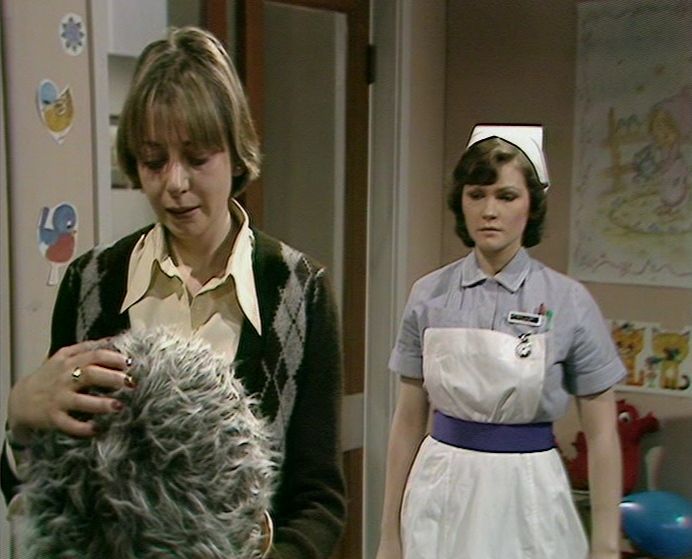
Shirley’s early interactions with Diana are quite awkward and unpleasant (although you are left with the strong sense – based on previous stories – that this will change).  Her relationship with the elderly Miss Buckle (Jean Kent) is quite different, although the attentive viewer would probably have been able to quickly work out the sting in this tale.

Miss Buckle is polite and thankful for all the attention she’s receiving, but she seems just a little too nice, meaning that the revelation she has munchausen syndrome doesn’t come as a total shock.  In her way she’s just as much of a drain on the resources of the hospital as Diana is, but the script has much more sympathy with her than it does with Diana. It’s not a particularly large role, but Kent (a British film regular during the 1940’s and 1950’s) is spot on.  The way Miss Buckle reacts when she realises that Shirley knows her secret is beautifully played.

With some familiar faces – Don Henderson as a drunk, Phil Davis as Diana’s friend, Christopher Coll as a doctor – popping up, there’s plenty of incidental interest in this one, although the Shirley/Diana relationship dominates.

a3.jpg

Angels – Ambition (20th April 1976)

a4.jpg

Up until now, Alison Salter (Cheryl Branker) has been an exemplary student nurse, which makes her recent erratic and tardy behaviour all the more puzzling. Both Shirley and Sister Easby attempt to discover what’s troubling her – but the fiercely private Alison is reluctant to divulge her secrets ….

There’s plenty of interest in Ambition, although unlike the previous episode it’s not a matter of life and death (unless you count Alison’s career).  One slight drawback with this one is the fact that Alison’s purely a one-shot character (never seen before, never seen again) which does mean that her background and character has to be verbally sketched in by the others very rapidly.

The problem with this approach is that we only ever witness the fraying and irritable Alison and not the remarkably efficient nurse destined for great things (according to Jo, she’s sure to be another Barbara Castle).

Leslie Duxbury’s script does its best to wrong-foot the viewer.  It opens with Alison dropping two pre-school children off for the day (either with a neighbour or a paid carer – this isn’t quite clear).  The inference is that they are her children, but they turn out to be her sisters. Equally, it’s easy to believe at first that Frank Salter (Oscar James) is Alison’s husband – and not, as later becomes clear, her father.

Throughout, Alison is quite effectively portrayed as an isolated figure in the hospital.  As the other nurses bustle into the locker area – chock full of gossip and rushing to get themselves together – Alison is always shown to be in her own self-contained bubble.  Presumably this is a change from her usual personality, although as previously stated the audience doesn’t really know what is usual for her.

I do like these scenes though. Shirley, Sita, Jo and Sandra are mixed in with a group of four or so minor players, with the result that there’s a fair amount of hubbub as they arrive and then later depart each day.   These scenes – and others throughout the episode – are also helpful as they solidify the attitudes of the regulars.

Sandra and Jo, rather like Maureen and Pat, really do seem to be chalk and cheese.  Sandra’s already planning her future (occupational nursing) whilst Jo doesn’t seem to have any ambitions at all.  Whilst Sandra rifles through the library looking for job opportunities, Jo is content to quote love poetry and dream of what might be ….

Shirley’s desire to work with geriatrics is teased out a little more. Indeed, the solid “b” plot of today’s episode concerns Shirley’s relationship with a cantankerous elderly patient, Mrs Cosgrove (Betty Romaine).  I did wonder whether there was going to be some sort of twist in this tale – but no, the storyline proceeds along a fairly predictable route.  Mrs Cosgrove doesn’t have a good word for anyone (she decides that Alison should get on the next banana boat home, for example) but most of her ire is directed towards the woman in the bed opposite her.  She’s a non-speaking extra though, so we’re denied any verbal contretemps between them.

Instead, Mrs Cosgrove crosses swords with Shirley who eventually manages to pierce her shell to discover the more approachable woman underneath.  Shirley’s patient, steely but jocular approach is a revelation compared to her more by-the-book nursing from series one and serves not only to demonstrate her growth as a nurse but also as a person.

Also lurking on this ward is Sister Easby.  The slipshod Alison receives a few hard stares whilst her interactions with Shirley are also noteworthy.  Sister Easby isn’t someone who dishes out praise that often, so Shirley isn’t sure whether her success with drawing out Mrs Cosgrove is being applauded by Sister Easby or mocked.  What’s interesting though is that when Sister Easby later joins Shirley and the others for lunch she’s quite affable and willing to chat.  Clearly she’s a very different person depending on whether she’s on or off duty.

Miss Windrup, making a late appearance, is the one who finally gets to the bottom of Alison’s issues (following failed attempts by both Shirley and Sister Easby).  It’s a nicely played scene, directed well by Derek Martinus.  Martinus maybe doesn’t throw in quite so many directorial flourishes throughout as in his previous episode, but there’s still some unusual low-angle studio camera angles and a couple of surprisingly panoramic film shots (a bit wobbly it’s true, but still effective).

Ambition doesn’t provide us with closure on Alison’s story, but it seems more than likely that she’ll be forced to leave nursing, much to Miss Windrup’s regret.  As has been seen before, Angels didn’t always go in for pat and happy endings – it would have been easy enough to leave the viewers with a sliver of hope, but real life is often untidy and unsatisfactory and this episode rather mirrors that.

a2

Pinter at the BBC – Landscape (4th February 1983)


Written for BBC radio in 1968 and performed on stage a year later, Landscape is a one-act play with decidedly Beckett-like overtones. A couple – Duff (Colin Blakely) and Beth (Dorothy Tutin) – sit at opposite ends of a long table, each indulging in lengthy monologues (they are either unable or unwilling to register the other’s conversation).

Duff does at least acknowledge that Beth is there, whereas she seems totally unaware of his presence. There is no plot as such, Beth recounts a story about a previous romantic interlude (possibly with Duff, possibly with somebody else) whilst Duff concerns himself with more practical matters.

The Lord Chamberlain’s office, back in 1967, found itself unimpressed with Landscape. “The nearer to Beckett, the more portentous Pinter gets. This is a long one-act play without any plot or development … a lot of useless information about the treatment of beer … And of course, there have to be the ornamental indecencies”.

The passage of time is illustrated by the diminishing light. At the start it’s a fairly bright day, but by the end of the play the pair are in virtual darkness. This lack of light generates a feeling of oppression and enclosure (director Kenneth Ives reinforces the mood at this point by focussing on close-ups of either Tutin or Blakely rather than cutting away to wide shots of the pair).

Dorothy Tutin remains wonderfully dialled-down and reflective throughout whilst Colin Blakely is given the chance for some expressive fireworks in the last few minutes. The way that Beth never for a moment acknowledges Duff’s histrionics (she simply continues with her tender tale) is a compelling moment.

Regularly punctuated by John Williams’ guitar interludes (the music was composed by Carl Davis) Landscape exercises a subtle, but strong, grip.

The Prince And The Pauper (BBC, 1976) – Simply Media DVD Review

164454- Chief Crazy Horse Sleeve.indd

Tom Canty, a street urchin, and Prince Edward, heir to the throne, bear an uncanny resemblance to each other. After they meet by chance, the Prince hatches a scheme in which the pair swop clothes and identities temporarily.  This will allow Edward to move incognito through the streets for an hour or so and get to learn a little about the ordinary folk he will soon be ruling.

But disaster strikes when Edward is captured by Tom’s cruel father, John Canty (Ronald Herdman). Unsurprisingly, no one believes he’s really the Prince of Wales whilst Tom, trapped in the palace, is equally unhappy.  The nobles take his protestations about being a commoner as a sign of madness, with Tom ending up as a pawn in a power game – the control of England being the prize ….

Published in 1881, Mark Twain’s evergreen nove! has spawned numerous big and small screen adaptations.  This BBC Classic Serial from 1976, adapted by Richard Harris and directed by Barry Letts, has many plusses in its favour – not least Nicholas Lyndhurt’s deftly played dual role as Tom and Edward.

The fourteen-year old Lyndhurst already had television experience (most notably in two previous classic serial adaptations – Heidi and Anne of Avonlea) but it still must have been a daunting prospect for him to have shared the screen with so many heavyweight actors.  He acquits himself with assurance though – creating two very separate personas for Tom and Edward (deferential and brow-beaten for Tom, autocratic and outspoken for Edward).

A quick glance down the cast-list makes it obvious that Barry Letts was in the directors chair. The first episode alone sees brief appearances from the likes of Dave Carter, Stuart Fell (as a juggler and fire-eater) and Max Faulkner.  Several other faces familiar from the Jon Pertwee era of Doctor Who enjoy decent roles, most notably Bernard Kay as Lord Hertford.

Kay, like many of the nobles at court, might be afflicted with a false beard, but as a very classy actor he’s easily able to rise above this handicap.  Nina Thomas is delightful as the sweetly concerned Princess Elizabeth whilst Martin Friend and Ronald Lacey, as Lords Sudbroke and Rushden, are both good value as a pair of devious plotters (Lacey was one of those actors who should have appeared in a Doctor Who, but sadly never did).

Ronald Radd is someone else who surprisingly never got the Doctor Who call.  As the ailing King Henry his understated playing bolsters the already strong cast. Henry’s death-bed imaginings is one highlight amongst many throughout the six episodes. Sadly this was one of Radd’s final roles – broadcast shortly before his death at the age of just forty seven.

June Brown does well with the fairly thankless role of Mother Canty (having little to do but act concerned) whilst Ronald Herdman might be a little ripe as John Canty but is still effective.  The early evening slot these serials enjoyed meant that violence tended to be implicit (so whilst we often see Canty raising his hand to Tom/Edward, blows are rarely struck).

But there is one jolting moment. Canty strikes down the inoffensive and bookish Father Andrew (Donald Eccles) leaving the old man dying the street, a trickle of blood on his face.  This sudden outburst of rage from Canty does help to illustrate that he’s an unstable powder keg, liable to explode at any moment, and therefore a constant danger to the outspoken Edward.

As the story progresses, both boys are drawn deeper into their new lives. Edward, despite making a new friend – Miles Hendon (Barry Stokes) – finds himself lurching from one dangerous situation to another, eventually ending up in prison. Meanwhile the increasingly confident Tom, following the death of the King, has to face the possibility that shortly he’ll be the focus point of a coronation ….

If the cast are first-rate, then there’s plenty to enjoy on the production side as well.  Kenneth Sharp’s sets are impressive, with several palace rooms possessing an imposing sense of scale.  James Acheson was an extremely safe pair of hands to have as the costume designer (later he would pick up three Oscars) so there’s no complaints there either.

The exterior film sequences gives the serial a glossy feel, although – as was the norm – most of the action takes place in the studio (and on videotape).  I’ve no doubt that Barry Letts relished the challenge of depicting the brief meeting between Tom and Edward.  There’s a very effective split-screen shot, but I was also impressed with a CSO mirror shot (Barry loved his CSO, sometimes to extremes, but this sequence works well).

Running for six episodes, each around 27 minutes duration, The Prince And The Pauper is a good example of the BBC Classic Serial output from the 1970’s.  It may lack the production gloss of later adaptations, but the excellent cast and fidelity shown to the source material means that it’s a very enjoyable watch.  There are many different versions of The Prince And The Pauper out there, but I have no hesitation in warmly recommending this one.

The Prince And The Pauper is available now from Simply Media, RRP £19.99, and can be ordered directly from Simply Media here (quoting ARCHIVE10 will apply a 10% discount).

Angels – Vocation (13th April 1976)

a4

A suicide attempt … Miss Windrup’s 30th anniversary … both disturb Nurse Sandra Ling … (Radio Times Listing).

The series opener, Round The Clock, concentrated on reintroducing the regulars from series one.  There would be one absentee though (Lesley Dunlop declined to return for this second run) which meant that Angela Bruce (as Sandra Ling) would now feature as a new regular (the character had appeared in a single first series episode).

Given how busy Round The Clock was, it made sense to hold Sandra back until this second episode.  She features strongly in the “A” plot (a young woman clings to life following a suicide attempt) with a “B” plot (Miss Windrup celebrating thirty years at St Angela’s) running alongside it. Although Paula Milne does manage the feat of tying both of these plot-threads together towards the end of the episode ….

Attentive first series viewers would have been able to pick up various unspoken touches which reinforce Miss Windrup’s previously established loneliness.  Some are quite subtle (switching off No Regrets by the Walker Brothers on the radio) although others are much more explicit – such as the way Miss Windrup’s face falls for a split second after Joan White (Sheila Keith) announces her intention to retire.

A contemporary of Miss Windrup, Joan has clearly had enough of trying to teach classes of disinterested students.  Although Miss Windrup attempts to dissuade her by declaring that she’ll be bored within a matter of weeks, it seems that Joan (presumably also single) has no such fears about finding activities to fill her days with.  Presumably Miss Windrup is most concerned about losing a friend, confidant and lunchtime companion.

This is interesting enough, but most of the drama today is occurring in the intensive care ward. The first sight we have of Sarah Carter (Lois Ward) is stark enough and things only get bleaker as the episode progresses.  For a series that was pre-watershed (this episode went out at 8.10 pm) Sarah’s later resuscitation attempt feels quite harrowing.

Derek Martinus’ direction throughout is noteworthy. For example, when we cut to Sarah’s resuscitation, the camera lingers on the flat-lining monitor for the first few seconds.  No dialogue is required, the visual image provides the viewer with all the information they need.

Martinus also favours framing shots of characters peering through glass doors – beginning with Mrs Carter (Josie Kidd) observing the work of the intensive care unit from the outside.  The mute, slightly distorted picture Mrs Carter sees is effectively disorientating.  Later, Sandra is pictured on the outside looking in at Mrs Carter (in the waiting room).

When Sandra does enter the room on one occasion, the scene begins with the camera still outside for a while, leaving the viewer voyeuristically witnessing Mrs Carter’s upset countenance but unable to hear any words.  A later, also mute, scene (the Doctor explaining how Sarah died to Mrs Carter, whilst Mr Carter rocks back and forward in his chair, obviously unable to process the news) also stands out.

Mrs Carter simply can’t understand why her daughter would have taken an overdose of sleeping tablets and since Sarah never wakes up we’re denied the answer to this question.  Her estranged husband (played by Bill Treacher) only features briefly, but his pleading final question to Sandra (wondering if Sarah could have taken the overdose by accident) is heartrending. After several beats, Sandra does confirm this might be true but it’s pretty clear that neither she or Mrs Carter believes it.  But it does give Mr Carter a faint hope to cling to.

Sarah’s death occurs offscreen, but I think this is a plus not a minus.  There’s something more powerful about the sight of Sandra observing the now quiet room than there would be in the cliché of a failed life-saving attempt.

Sandra’s bottled-up anguish following Sarah’s death comes spilling out on two separate occasions. The Intensive Care Ward Sister (played by Marcia King) is the first to clash with her.  Sandra’s hurt contrasts sharply to the Sister’s icy-cold control.  This is a theme familiar from countless hospital dramas – there’s simply no time to wallow in self-pity about the demise of one patient as there are always others who require care and attention.  King is so good in this pivotal scene that it’s surprising to see that she only has a handful of television credits to her name.

This opening skirmish merely sets us up for the grand finale – as Sandra finds herself a fairly unwilling attendee at an informal party held to celebrate Miss Windrup’s thirty years at St Angela’s.  The other nurses are indulgent, if occasionally mocking, towards ‘Windy’ although it’s no surprise that Shirley is the one who appreciates Miss Windrup’s efforts the most.

Pat is quite perceptive though – the fact that Miss Windrup’s office is decorated with the portraits of so many of her students but not her friends or family speaks volumes.  Miss Windrup has fully embraced the vocation of nursing, but at what personal cost?

Unlike Joan White, it seems that Miss Windrup simply can’t contemplate retirement (despite having to deal with giggly and irritating students). Her life is her job.  Sandra feels quite differently though, declaring that the vocation of nursing is little more than a “con”, designed to keep them compliant.  The intelligent nurses are the ones who walk away ….

She doesn’t find a great deal of support amongst her colleagues though and eventually the status quo is restored.  Sandra and Jo make their way home, with Jo promising something entertaining for tea.  But the cracks remain on both sides, meaning there’s the sense another eruption could happen again in the future.

Impressively uncompromising, Vocation is far removed from the cosy, soapy image that Angels sometimes conjures up (indeed, when it conjures up any image at all). A promising early series two instalment, this sort of quality bodes well for the stories to come.

A11.jpg

Angels – Round The Clock (6th April 1976)

a.jpg

The opening episode of series two, Round The Clock reintroduces us to all the S1 regulars quickly and effectively.  Within the first few minutes we see Pat and Maureen preparing for another working day (with Maureen also looking forward to a party in the evening), the effervescent Jo freewheeling down the corridor, poor Shirley enjoying a solitary lunchtime drink and Sita dishing out a dollop of sympathy to Mrs Andrews (Norma Andrews).

As the episode progresses, various threads are developed although two – Sita/Mrs Andrews and Shirley – dominate.  From her first scene, there’s a tense brittleness to Mrs Andrews, which is understandable after we learn that her young son, Ian (Stefan Gates), has been rushed to hospital with suspected meningitis.  Red-eyed and frantic with worry, she demands to have all the facts as quickly as possible.  But Sita prefers to be quite non-committal with her comments.

The unfortunate upshot is that Ian initially seems to be making a recovery, but this is only a temporary respite as he then takes a turn for the worse.  One of the interesting aspects of Round The Clock is observing which Angels have changed from series one.  Sita certainly seems to be a little different from the passive character she was then – when confronted about her behaviour, she remains fairly unrepentant (although her colleagues, such as Pat, are quick to pass unfavourable judgement out of her earshot).

It’s an interesting talking point – was Sita protecting Mrs Andrews by not telling her everything or simply making her agony (when she finally learnt the truth about Ian’s condition) even more painful?  There’s no definite answer to this, and Adele Rose’s script – to its credit – doesn’t plump for either side. Indeed, later on Mrs Andrews decides that Sita wasn’t at fault anyway, so this dramatic flashpoint is resolved in a low-key manner.

Mrs Andrews’ scenes in the children’s ward are quite haunting. Although we see the odd jolly child (with nothing worse than a broken leg) there’s something quite melancholy about this area, despite the bright posters and collection of toys. This plotline has no closure – although we’re told that most children make a full recovery, there’s the possibility that Ian may not.

Elsewhere, Shirley is working on a busy female ward.  Some of the patients, such as Mrs McCartney (Peggy Aitchison) are simply there for a spot of colour (she likes to scoff chocolates and call everyone “ducks”).  Mrs Fitch (June Brown) is also quite peripheral, but the way she clashes with Shirley is used to highlight the fact that Staff Nurse Brent isn’t her normal, efficient self.

Brown plays to type as a complaining sort (complete with her trademark droning voice) whilst it’s amusing that Mr Fitch (Alec Linstead) also has a similar tone. Being attacked by them on both sides means it’s not surprising that Shirley eventually loses her patience. Mild though her outburst is, this moment of crisis allows Sister Young to step in and have a heart to heart with her.

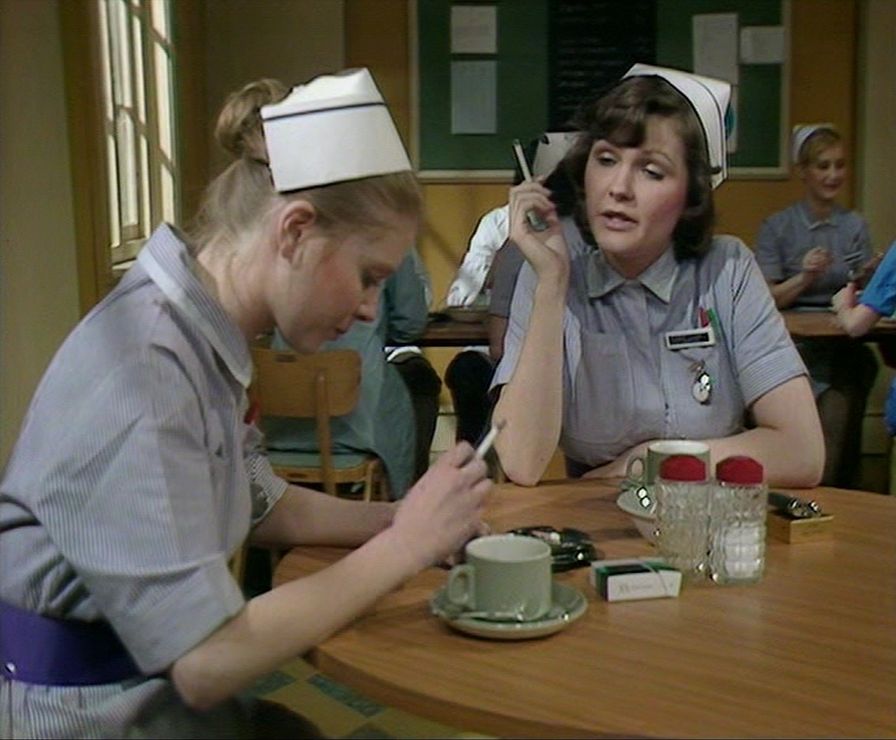
If Sita has changed since series one, then at this point it doesn’t appear there’s been any progress with Shirley.  In the pub she was as isolated as ever, sitting by herself whilst the rest of the world seemed to having a much better time.  She confesses to Sister Young that she still has no social life and no friends (although she does at least share a table in the canteen with Jo and Sita without the other two recoiling, so there’s been some progress there).

Shirley’s despair seeps out of the screen yet again, but there is a positive outcome, professionally at least, as she’s encouraged to take a geriatrics course.  This would seem to be something that most nurses (such as Jo) would avoid, but Shirley is very keen.  We’ll see this theme developed later in the season.

Jo isn’t given a great deal of screentime in this opening episode. Mainly she’s present to serve as a cool counsel for the unusually hot-headed Sita.  As for Pat and Maureen, Maureen’s suddenly become something of a party animal (closing the episode jiving with a George Best lookalike in the pub) whilst the previously flighty Pat has gained a dollop of common sense.

I liked the scene with Pat and an unnamed student nurse in the canteen.  The young nurse confided that she was on the verge of quitting, so Pat – who nearly did the same thing last year – gave her a pep talk.  Amusingly, the young nurse wasn’t at all convinced by Pat’s impassioned speech! That’s a nice touch, which shows that the series wasn’t always content to take the obvious or neat route.

a8.jpg

Softly Softly: Task Force – Money for Sale (17th January 1973)

ss-a

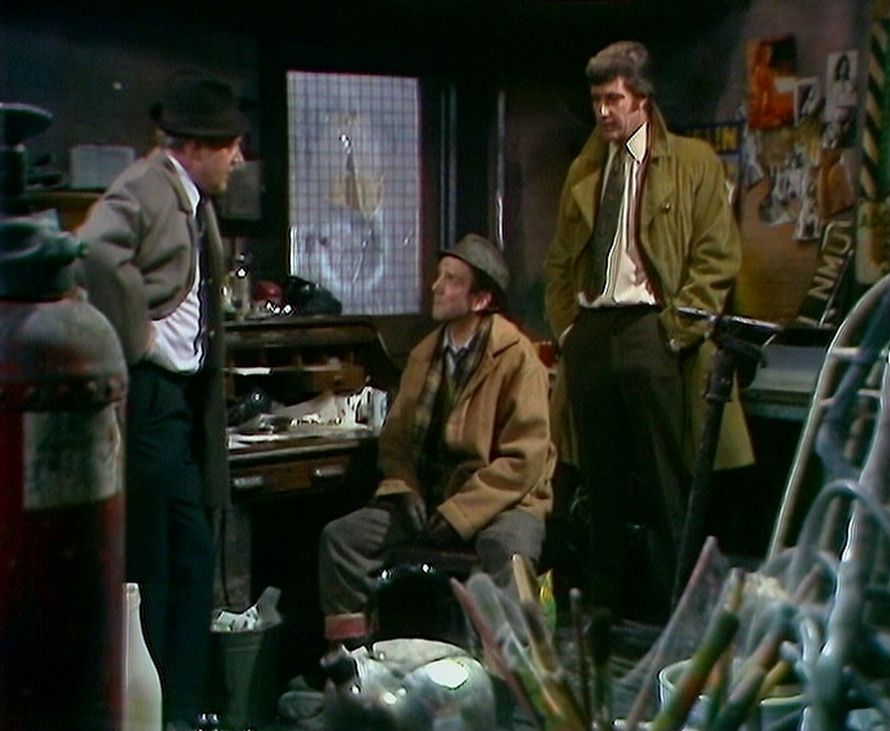
The Task Force are on the trail of Alfred Felton. A distinguished-looking criminal in his fifties, Felton has disappeared (the fact he was carrying a great deal of stolen money when he vanished piques Watt’s interest).

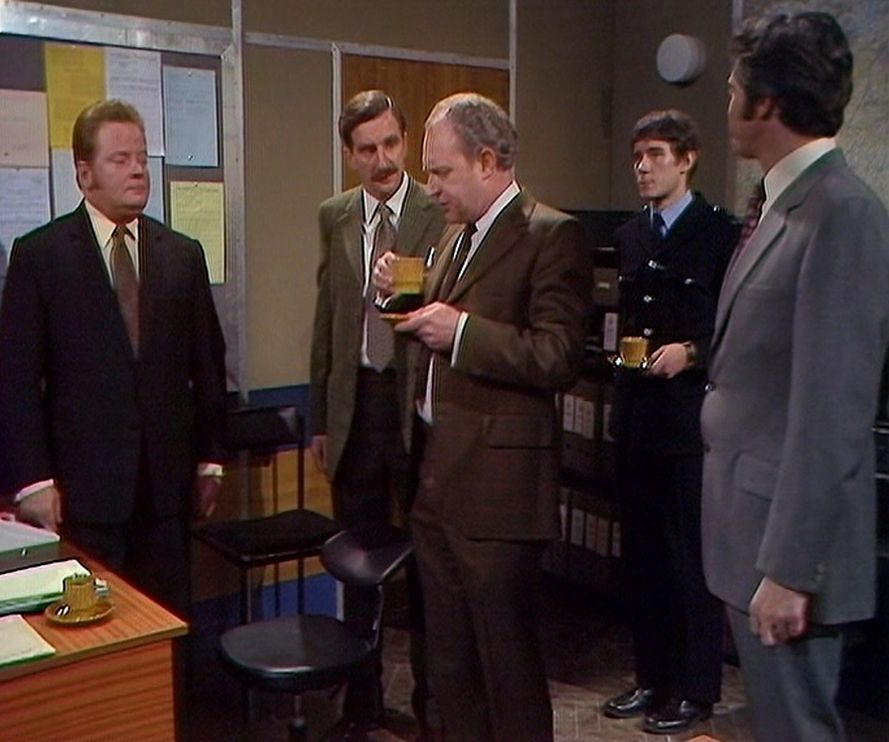
In the past John Watt has berated Harry Hawkins for his willingness to dash about. Senior staff, says Watt, should be more office bound. Today he seems to have forgotten that maxim – Watt spends the early part of the episode out and about and in full investigation mode.  It’s quite a rarity these days to see him playing detective, and even rarer that he’s digging around all by himself.

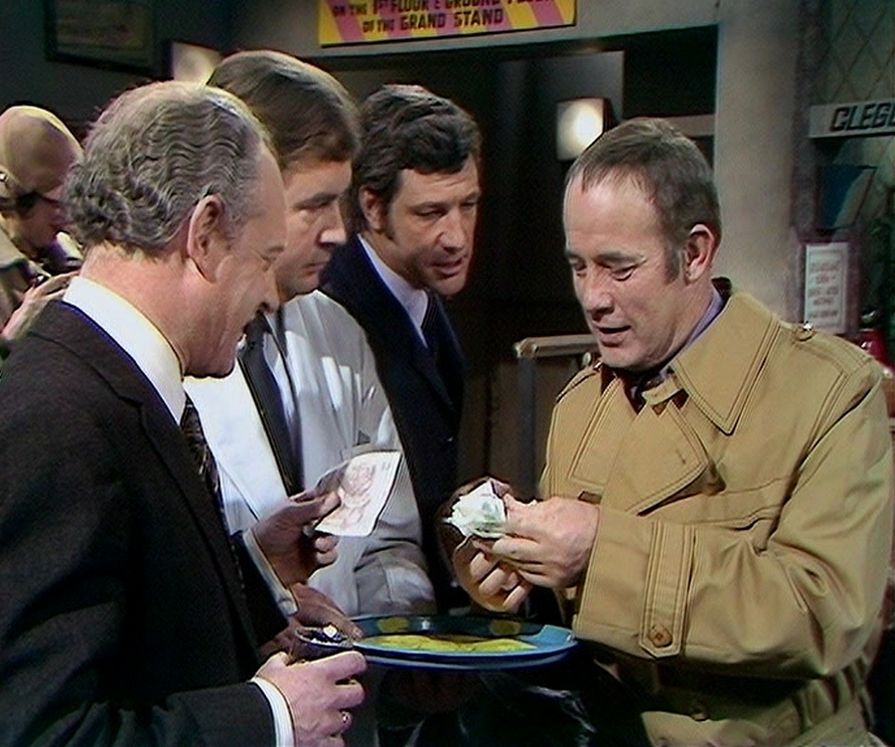
Felton’s car – a Wolseley – seems to be key. Find that and they might have a good chance of locating Felton. Watt tracks the car down to a scrapyard run by Paddy Reilly (Paddy Joyce).  One of those instantly recognisable actors, Joyce is highly entertaining as the endlessly slippery Reilly – a man who breezily breaks the law without a second thought.

Reilly doesn’t get the third degree from Watt though, that’s reserved for Powers (John White) – the man who sold the car to Reilly.  Powers, a man with a taste in flamboyant shirts, is eventually worn down by Watt.  Since Stratford Johns’ departure, there hasn’t been quite so many pulsating interview scenes, but Frank Windsor handles this one pretty well.

As the episode rumbles on, the main question remains unanswered – is Felton dead or alive? And if he is dead, who killed him? That the resolution of the mystery only occurs towards the tail end of the episode helps to explain why Money for Sale feels somewhat static. It doesn’t help that Felton’s criminal associates don’t appear until the last ten minutes or so – as when they do they help to give the story a little extra push.

ss-b

Softly Softly: Task Force – Time-Table (3rd January 1973)

ss7

Jack Rogers (Peter Whitbread) was a notable safebreaker in his day, but now seems to have gone straight.  But that doesn’t prevent him from being a person of interest to the Task Force whenever a job with his signature is pulled.

The first meeting between Hawkins and Rogers is an interesting one. Rogers is polite and helpful whilst Hawkins is antagonistic and confrontational. Given that this bank raid occurred up North (in Manchester) it seems barely credible that out of all the potential suspects up and down the country we zero in on Rogers.  Are we being set up for a story in which an innocent man is pursued?

We don’t have long to wait for the answer, indeed in the very next scene it’s revealed that Rogers was responsible.  Surprising that the mystery wasn’t eked out – there would have been dramatic capital in leaving it unclear for a while as to whether Rogers was guilty or innocent.  Watt later confides to his senior staff that in the past his mantra has been “concentrate on the criminal, not the crime”.  He has absolutely no evidence that Rogers was involved (in fact he has a water-tight alibi) but Watt is still content to keep chipping away at him.  That’s a slightly disturbing modus operandi, it has to be said.

Rogers has a powerful ally. His employer, Simmonds (Bryan Pringle), is someone who, according to Rogers, was prepared to take a chance on an ex-con.  The truth is once again revealed quickly – the older Simmonds has been corrupted by the younger Rogers and the pair have now formed a criminal partnership (Simmonds acting as a decoy whilst Rogers carries out the crimes).

What has made the previously law-abiding Simmonds suddenly turn crooked? It’s teased out subtly to begin with, but by the way the pair talk to each other it’s plain that there’s a mutual attraction.  This is handled in a far more restrained way than James Bree’s screamingly camp antiques dealer a few episodes back.  Their relationship is an intriguing part of the episode and Pringle’s self-important and wounded air as Simmonds easily bests Adler to begin with (even forcing the policeman to cough up some pennies for using his phone!) is nicely played too.

The precise mechanics of exactly how Simmonds covers for Rogers during the first two crimes is a bit of a puzzle. And a lengthy film sequence in which the pair drive identical vans around and around does tend to drag.

This apart, Time-Table contains plenty of interest. Whitbread and Pringle are both very solid, Watt’s clash with a budget-conscious Cullen catches the eye, whilst wedding bells contain to ring for Hawkins and Sara.  Evans views the forthcoming nuptials with a jaundiced eye – how will the upwardly mobile Sara survive on Hawkins’ relatively modest salary? The notion of her getting a job never seems to have been considered.

I also like the way that Watt (a man who clearly leads from the front) takes it upon himself to visit Sara in order to enquire what wedding present she’d like the force to give them.  An old-fashioned barometer, in case you were wondering.  And the way that Watt turns the screws on an increasingly frantic Rogers and Simmonds concludes the episode in a satisfactory fashion.

ss2

Pinter at the BBC – The Hothouse (27th March 1982)

Written in 1958, between The Birthday Party and The Caretaker, The Hothouse was then put aside by Pinter for more than twenty years. It wasn’t until 1979 that he picked it up again – it was staged in 1980 at the Hampstead Theatre and transferred to television two years later.

The most striking thing about the play at first glance is just how funny it is. Pinter’s other works aren’t always devoid of humour, but for long stretches The Hothouse plays like a farce (albeit one with a very dark heart).

The setting – a nameless Government run rest home which (it’s strongly implied) uses any means necessary to “cure” those unfortunates who’ve found themselves within its walls – is a sombre one. The dehumanising nature of the place is reinforced when it’s revealed that the patients are never referred to by their names – only numbers.

The momentary spasm of disquiet this generates is then negated when Roote (Derek Newark) launches into a lengthy argument with his second-in command, Gibbs (James Grant), about whether 6457 is alive or dead. This is an early example of Roote’s inability to grasp the simplest of arguments and as Derek Newark attacks the lines with gusto there’s little you can do but sit back and enjoy the ride.

Featuring seven speaking parts (five major, two minor) it’s the character of Roote who dominates throughout. Newark was always one of those actors who could be guaranteed to add a certain something to any production, but I can’t recall a better performance from him than this one. Raising the roof on more than one occasion, Newark delivers a sparkling comic turn. Roote presents himself as an expert of virtually any topic, but the reality appears to always contradict this (mind you, it’s possible that he’s more perceptive than his outwardly blimpish persona might suggest).

Although the plot is a good deal more straightforward than many of Pinter’s other plays, there are still points which are open to interpretation. Roote is shocked to learn that 6459 has given birth (and also that the majority of the staff had – at one time or another – taken advantage of her) but there’s strong evidence to suggest that he’s actually the father. And we never learn exactly who organised the revolution which – offscreen – slaughtered all but one of the senior staff towards the end of the play.

As a character, Roote will only work if he has equally strong personalities to bounce off. James Grant deadpans throughout as Gibbs, his passive and methodical nature contrasting nicely with Roote’s hysterical outbursts. Robert East (Lush) is a totally different character type from Gibbs (Lush is outspoken and arrogant) but again he’s another who interacts delightfully with Roote. In possibly the play’s funniest scene, an incensed Roote throws several glasses of whisky into Lush’s face before Lush decides it might be more sensible to hide the glass until he’s delivered his latest contentious comment.

Given the era it was written in, it’s possibly not surprising that The Hothouse only features one female character, Miss Cutts (Angela Pleasence) and also that she somewhat skirts the environs of the piece. The lover of both Roote and Gibbs, she may be somewhat indistinctly defined but Pleasence is able to bring her into sharp focus.

Roger Davidson as the hapless Lamb, also has limited screentime but leaves a lingering impression. The least experienced of the senior staff, Lush finds himself wired up with electrodes and tortured by Gibbs and Miss Cutts (Gibbs is looking for someone to take the blame for 6459’s pregnancy and the ingenious Lamb fits the bill nicely).

His name seems apt, since he really is a lamb to the slaughter (before, during and after his ordeal he doesn’t really seem to understand what’s happening). His blithe co-operation, even when being tortured, is played for laughs, but is undercut by the pain he suffers when the electricity is turned on. With the patients remaining off-screen throughout, this scene gives us an inkling about what could be occurring throughout the building.

Deftly juggling light and dark themes, The Hothouse doesn’t feel like a relic of more than sixty years ago. Indeed, maybe it’s even more relevant today than it was back then.

Softly Softly: Task Force – Needle (13th December 1972)

ss2

SS:TF, certainly during this era, used a very small pool of writers. There are pros and cons to this approach – a plus is the way it guarantees a constant tone, but on the negative side it can mean that the stories tend to feel somewhat similar.

Tony Hoare would later become a key writer on Minder, but his early work, such as his handful of SS:TF scripts and contributions to Crown Courtdemonstrates that his distinctive scripting style was already in place.

Hoare, a former inmate himself, is easily able to ensure that this prison-based story feels vivid and real.  As good as the series was, it’s sometimes noticeable that the villains can be unthreatening and lightly sketched.  Needle is quite different – there’s a sharp streak of cynicism which runs throughout.  This is unusual but not unwelcome.

After an unpopular prison officer, Watson (Edwin Brown), is brutally run down outside the prison gates, Watt and the others swiftly decamp to the prison in order to investigate. That we don’t have the usual preamble scenes at Task Force HQ is an interesting touch – no doubt this was partly logistical (saving studio space for the prison sets) but it also works in narrative terms. No sooner have we left Watson dying in the gutter than the story promptly moves onto the next stage.

As the episode progresses, Hoare’s voice seems to be coming through loud and clear. Prison life is shown to be thoroughly dehumanising – both for inmates and warders.  The crumbling Victorian structure, the indifferent diet and the constant threat of casual violence all helps to make it a hellish place.

One inmate, Bernie Bryson (Peter Armitage), later articulates why the warders are worse off than the prisoners. “They figure if they wear big boots and bark like dogs it makes them hard cases. They come straight off the dole queue, see. They ‘aint got the guts to thieve or the brains to work, but this way they can kid themselves that they’re something special. I’m here against my will and only temporary, they’re here permanently and because they need to be”.

Armitage is excellent as the cocky, unrepentant Bryson – comfortable in the knowledge that nothing can touch him. Nothing that is, except his marital problems ….

On the outside, his wife Jane (Janet Lees-Price) lives a comfortable existence in a remarkably decorated flat. Presumably Bernie chose the décor – the massive mural of classic Hollywood gangsters is certainly a talking point.

If Bernie feels a lot more real and dangerous than the series’ usual crop of villains, then so does Jimmy Cass (James Beckett). A friend of Bernie’s on the inside, Cass (one of the men who ran Watson down) finds himself becoming very friendly with the man-eating Jane on the outside.

Full of memorable touches (such as Adler keeping a close vigil on Watson, desperate to hear the dying man’s last, gasped words) Needle is certainly a cut above the norm.

ss11.jpg

Softly Softly: Task Force – Conversion (6th December 1972)

ss1.jpg

An ingenious bank raid – carried out at the same time that the street is undergoing a gas conversion – is today’s crime. But as so often, character dynamics are pushed to the fore whilst the crime sits in the background.

Adler’s continuing mission to refer to all the regulars as “son” continues (today it’s Snow who receives that honour). Having not featured too heavily for a while, it’s nice that Terence Rigby is given more to do (although the reason becomes clear at the end of the episode).

Pete Ryan (Billy Hamon) is befriended by Snow. Something of an innocent, the early part of Conversion leaves us in no doubt that he’s very slow on the uptake (two experienced villains plan to use him when they rob the bank).

Pete, one the army of gas fitters, agrees to block the road at the appointed time (thereby allowing the getaway car to escape). This he does, but it means that he becomes a person of interest to the police – although not as you might expect.  He isn’t lifted for a grilling, instead Snow buys him drinks and listens to his story.

This all the more remarkable since Pete is aware that Snow’s a copper.  Although Snow could never be called soft, something about Pete (who’s barely more than a lad) clearly engages his sympathy.  So when Pete is killed in a road accident, Snow (who was observing him at the time) blames himself.

Spike Harran (Frank Barrie) and Tom Bishop (Graham Weston) are the two members of the gang granted speaking roles.  Many more are seen when the bank raid is carried out, but they were clearly stuntmen and non-speaking extras.  Indeed, the robbery is something of a jolting moment – up until this point the episode has proceeded in a typical fashion for SS:TF (high on character detail, low on visual excitement) so the sight of a gaggle of stuntmen throwing themselves about with wild abandon certainly catches the eye.

The early scenes between Pete, Spike and Tom have something of a comic air. Partly this is down to Tom’s tie, but the dialogue (the way that Spike and Tom have to repeat things again and again to Pete) also reinforces the feeling that the whole escapade is a bit of a lark.  But the brief violence seen during the raid, Pete’s death and Snow’s cold fury at Pete’s wasted life all help to darken the mood.

Adler once again is placed at the centre of the story. His interactions with both Snow and Evans are fascinating.  Snow is happy to give the new Task Force boss a little time to settle in (his attitude reflects his phlegmatic nature). The voluble Evans is a totally different type of person, he’s never slow to reveal his feelings ….

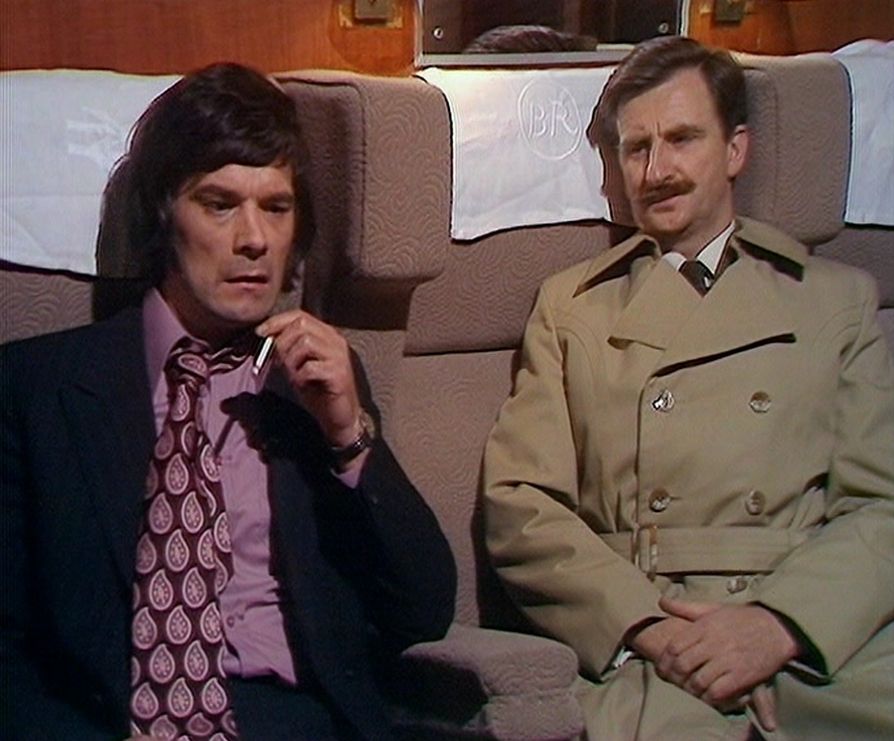
Adler and Snow later bring Spike back to the area.  Their train journey allows Snow to vent his feelings towards Spike, whom he feels had a part to play in Pete’s death. “If this was an old-fashioned compartment with a door there, I’d open it and shove you out”.  Snow’s impassioned tirade, which runs for several minutes, is easily the highlight of the episode.

Terence Rigby once again is excellent value, which makes it a pity that he then took something of a break from the series (sitting out the second half of series four and not returning until the fifth series).  Presumably Rigby had commitments elsewhere.

Grahame Mallard is drafted in as PC Nesbitt (he’d previously appeared in two previous episodes as two different PCs).  His introduction is typical of the series as it couldn’t really be any lower-key (he just appears out of nowhere).

ss2 

Softly Softly: Task Force – Justice (29th November 1972)

ss.jpg

Adler is moved back to CID by Cullen. Given what we’ve seen of Adler in previous episodes, it comes as no surprise to learn that he grasps this opportunity with both hands. But he’ll have to try and forge a close working relationship with Harry Hawkins, which may prove to be tricky ….

Adler’s character is delineated a little more at the start of this episode. He tends to be somewhat condescending (calling both Hawkins and Knowles “son”) and also there’s a nice moment concerning his love of plants.  A scene where he blithely offers Cullen some sage horticultural advice is preceded by a conversation between Knowles and one of Adler’s neighbours, Miss Polkington (Janet Burnell). She casts aspersions on Adler’s garden (hers is much better, she says).  A small touch, but it does suggest that Adler may occasionally place too much confidence in his own abilities.

Given Hawkins’ rather placid personality, putting him together with Adler is an interesting move.  Both have very different styles – Hawkins favours movement and action, Adler is methodical – which suggests that decent drama will be generated once they begin to come into conflict.  Especially since Adler is swiftly promoted and becomes Hawkins’ immediate superior ….

To be honest, the main plot (a crooked antique dealer) rather ambles along until we’re about mid-way through the episode. That’s when the antique dealer in question, Bensfield (James Bree), makes his first appearance.  James Bree was an actor who could do subtle (Secret Army) but could also deliver something a little broader (the Doctor Who story The War Games, say).  Today he’s screamingly camp. It’s the sort of turn that’s difficult to forget, especially the moment when Bensfield turns his lascivious attentions towards the stolid Hawkins.

Another familiar face popping up is Karl Howman. He plays Fletcher, Bensfield’s young, leather-jacketed bit of rough who duffs up Knowles (he was house-sitting for the antique laden Miss Polkington). Howman, in his first television role, is very squeaky but the scene he shares with Bree does manage to tease out a moment of tenderness between Bensfield and Fletcher (which helps to humanise Bensfield, making him seem like less of a camp caricature).

Plot-wise this isn’t the most interesting story, but the interaction between the regulars is pretty decent and whilst the guest players are somewhat mannered and stylised, they do catch the eye.

ss2

Softly Softly: Task Force – Paper Chase (15th November 1972)

ss

The aptly named Con Richards (John Abineri) and a young woman called Mary (Maggie Wells) are flooding the district with forged one pound notes.  As most of the scenes which feature them are in public places we don’t get much of a feel for their real characters. Con’s ever-changing accent is an entertaining touch though.

Paper Chase is more concerned with how this forged money impacts the recipients. The market trader Fisher (David Swift) and his wife (Paula Jacobs) are the first to be conned. Both are Jewish (very, very Jewish in fact – Mrs Fisher reacts with a heartfelt “oy vey” once she realises they’ve been passed dud notes).

They don’t twig for a while that the charming couple who bought a stack of clothes from them were dodgy (surprising, since I was instantly struck by Mary’s obvious wig). So their credulity is a little hard to swallow, especially since Snow has already been around to tip them off about the forged notes.

Swift (sporting an impressive pair of mutton-chop sideburns) is quite entertaining as a basically honest man who nevertheless attempts to later pass off the forgeries as genuine (he’s experienced enough to know that the chances of recovering his losses are slim to zero).

Poor Mrs Baker (Valerie Lush), the proprietor of a small corner shop, is also something of an innocent – but her lack of knowledge seems to be a little more credible. For a small business, the loss of ten pounds is clearly a real blow.  But even if it’s more than likely that she’ll end the story still out of pocket, at least she has the satisfaction of knowing she was the one who put the dogged Evans onto Con’s trail.

Whilst Fisher attempts a touch of fraud to resolve his loss and Mrs Baker simply stoically accepts it, our third victim – the greyhound track manager Clegg (Richard Hampton) – laughs it off as a matter of no concern (he’s insured). By the time that the episode gets to the fourth conned person (a hotel receptionist) clearly time is tight as we never learn how they feel about it.

Running alongside this theme is a subplot concerning an imminent raid on a cash-heavy business.  It’s assumed to be the greyhound track, although no robbery occurs by the time the episode concludes.  Watt’s picture of the gang (wielding pickaxes and knives) is quite vivid, although it does bring to mind a more 1950’s vision of crime (no guns are mentioned).

Paper Chase has several incidental pleasures. Alan Bennion, appearing as a bank manager, is one.  Although he racked up a fair number of credits over the years, it’s his Ice Lord appearances in Doctor Who which I instantly think of whenever I hear his name. So it’s nice to see him for once without his face being covered in latex.

The location work at the outdoor market is very evocative.  The film crew turned up on a regular market day, which makes me wonder whether some of the old biddies who crowd around our regulars were just ordinary members of the public, rather than extras.  A few are quite eye-catching.

There’s also a spot of character development for Harry Hawkins. Although he’s been a regular since the Softly Softly days, Hawkins has rarely made much of an impression (compared to the likes of Snow and Evans he seems quite stolid and far less quirky). But today he gets to cross swords with Watt (Hawkins likes to be out and about whilst Watt believes he should be more desk bound) and he also entertainingly interacts with PC Knowles, now firmly settled into the role of the office administrator.

Small touches maybe, but every little helps.

ss4

Pinter at the BBC – Old Times (22nd October 1975)

If some of the previous plays in the set – The Basement especially – were designed specifically for television (utilising numerous scene changes in a way which would have been impossible to achieve on stage) then Old Times turns out to be a very different beast. The staging is very theatrical with no concessions made to the television format. At the time (and indeed well into the eighties) this style of production was very common, but eventually it fell out of favour. The quest for realism demanded that drama be shot on single-camera film, with the result that multi-camera videotaped recordings of this type began to look hopelessly old-fashioned to certain people. Personally, I love the clarity of this type of production as it really does stand or fall on the quality of the writing and the performances. There’s no place to hide …. The stagey nature of the piece is evident right from the opening titles. Deeley (Barry Foster) and Kate (Anna Cropper) are seated in separate chairs. The room is dark and they are immobile (whilst the fact that both are spotlighted helps to suggest their emotional distance from each other). Meanwhile, Anna (Mary Miller) stands in darkness at the back of the room.

Deeley and Kate are a married couple, awaiting the arrival of Kate’s old friend, Anna. That the play begins with Deeley and Kate discussing Anna (who is present but ignored by them) gives the piece a strange, disconnected air. This odd feeling continues when Anna suddenly steps into the light and begins interacting with the other two. Several theories have been propounded to explain the meaning of the play. Possibly the whole drama is being played out in Deeley’s subconscious (and furthermore Kate and Anna are aspects of the same person). When Anthony Hopkins tackled the role of Deeley in 1984 he asked Pinter for some pointers. The playwright’s advice? “I don’t know, just do it”. Old Times finds us in familiar Pinter territory. A previously tranquil household is transformed into a battleground for supremacy as Deeley and Anna both stake their claim on Kate. As the play unfolds, every statement has to be parsed for meaning as the three interlock. Deeley begins the play in a dominant position, quickly joining forces with Anna to reminisce about times past via a medley of their favourite songs. Kate at this point seems to be somewhat passive and colourless compared to Anna. Deeley is keen to claim ownership of his wife (remembering how they bonded over the same film – Odd Man Out) but his own memories of Anna and the revelation of her previous closeness with Kate both serve to somewhat destabilise him. (a lengthy discussion between Deeley and Anna about the best way to dry a freshly bathed Kate crackles with intensity). As ever, if you want closure and neatness then you’ve come to the wrong playwright. Old Times is an emotionally distanced experience which isn’t afraid to leave questions unanswered. The fallibility of memory, a familiar Pinter device, is key here. And if there’s some doubt about the reality of the present-day setting, how many of these past reminisces can we actually rely upon?

Softly Softly: Task Force – New Broom (8th November 1972)

ss3.jpg

Despite the title, the primary focus of New Broom isn’t about establishing John Watt as the new Task Force boss.  Instead, it centres around a murder investigation, following the discovery of a severed arm at a rubbish dump ….

This is an unusually macabre plot element for the series and although the rest of the dismembered torso is mainly discussed and not seen, towards the end of the episode the murderer does reveal the only other body-part still in existence (a hand).

After the sensationalist opening, New Broom settles down into a pattern of pure routine.  It’s good to see a number of extras in uniform swelling the ranks in the incident room today. In some of the previous episodes we rarely saw any other police officers apart from the regulars, which tends to give the unfortunate impression that the Task Force is comprised of no more than around half a dozen officers.

John Franklyn-Robbins makes his second appearance as Chief Inspector Bill Adler. Having only skirted around the perimeters of the story in his previous episode, he’s much more central here.  A former detective, various indiscretions several years back (mainly concerning women and alcohol) have seen him reduced in rank, returned to uniform and forced to plough a frustrating furrow as a desk-bound administrator.

He’s never less than totally thorough, but it’s plain that jobs such as organising the furniture for Watt’s new office isn’t quite the sort of thing he joined the police force for.  This subplot is the episode’s one concession to portraying Watt as the new broom.  His office décor is very different from Charlie Barlow’s – Watt favours a minimalist approach (featuring strikingly modern chairs and desks) with the result that Cullen, passing by, first of all believes that there must have been a mix-up with the furniture delivery ….

Adler is later seconded to assist the murder investigation and it’s his dogged and painstaking approach (plenty of sifting of facts and staring at blackboards) which leads them to a suspect, Edward Harrison (Willie Jonah).  Adler will return in most of the remaining episodes on the third and final Pidax DVD set and I’m looking forward to seeing how his character develops.

There’s an intriguing relationship teased out here between him and Watt, which bodes well for the future.  Adler desperately wants to get back to being a detective, but Watt is content to keep him where he is for now (Adler offers to take a crack at Harrison, but Watt delegates Hawkins instead, much to Adler’s obvious disappointment).

If the majority of New Broom is interesting without being especially gripping, then the late interview between Hawkins and Harrison raises the temperature somewhat.  A good two-hander, it’s one of the highlights of the episode (the development of Adler’s character being another).

Elsewhere, Frank Windsor effortlessly slips into place as the new focus point of the series.  John Watt’s plain, no-nonsense style hasn’t really changed since he first appeared in Z Cars and New Broom makes it plain that business will carry on as usual.

ss2.jpg