Ghost in the Water – Simply Media DVD Review

ghost dvd.jpg

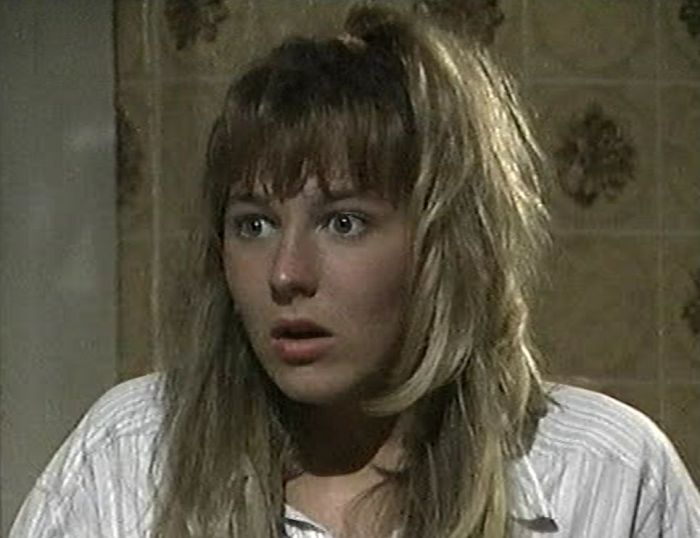
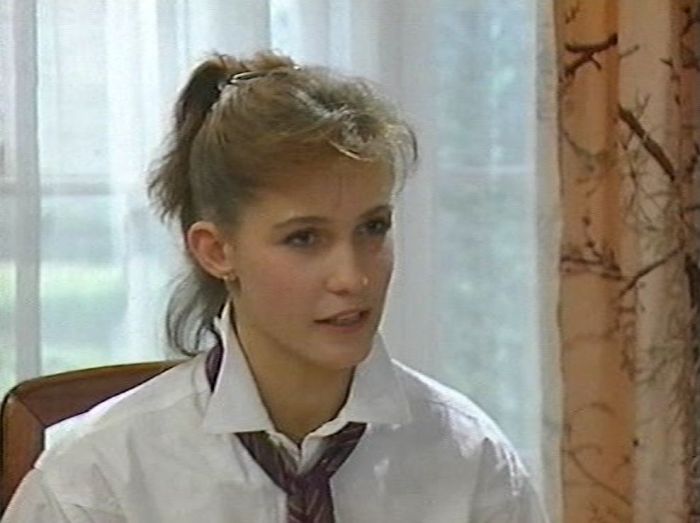
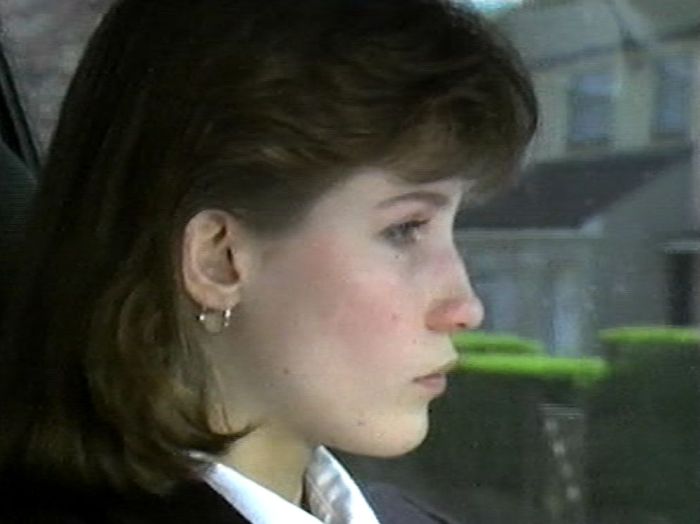
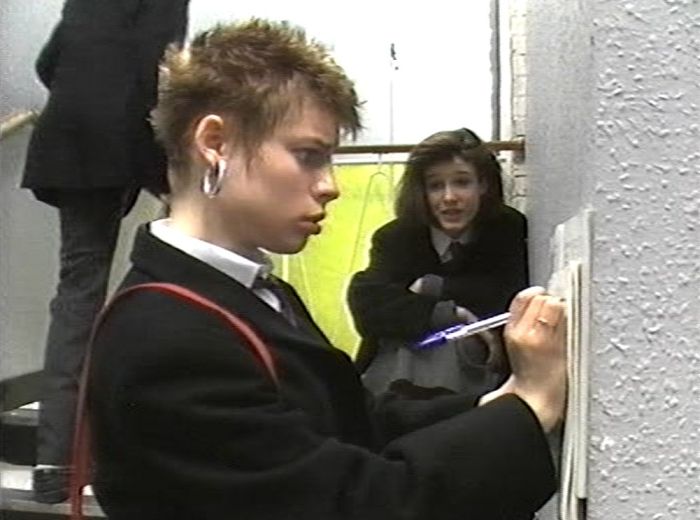
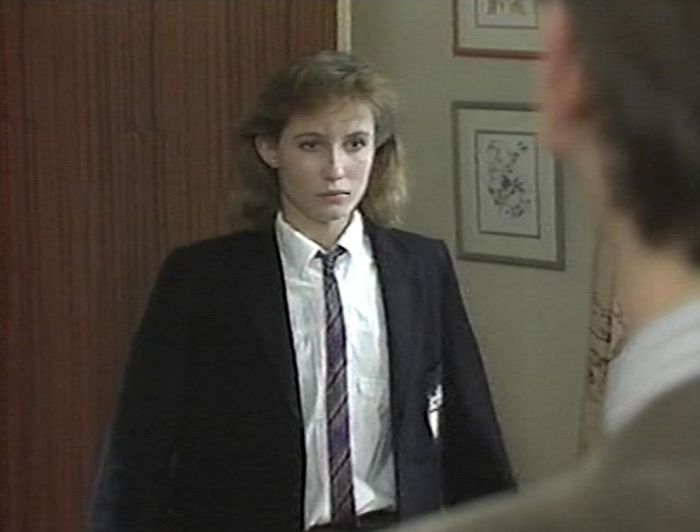
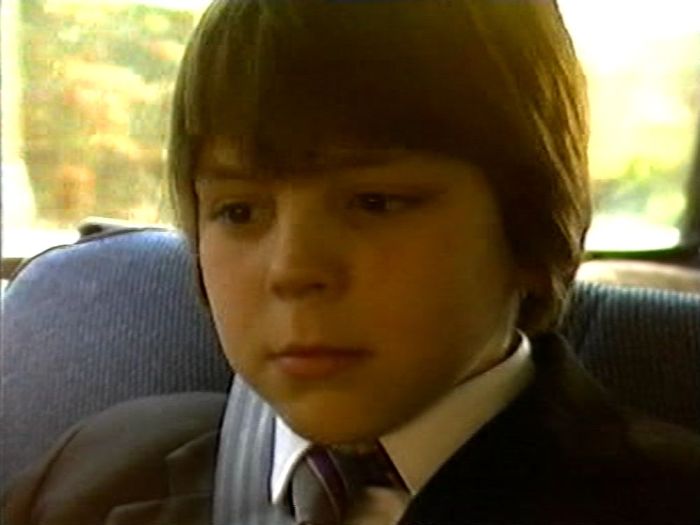
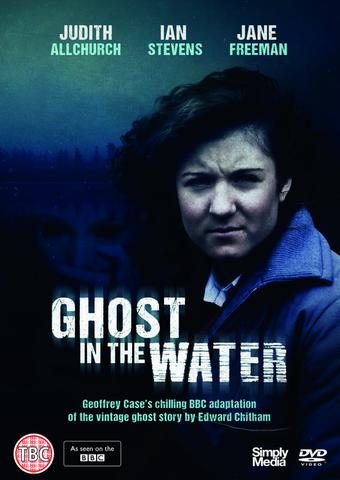
Tess (Judith Allchurch) and David (Ian Stevens) are set a school project which involves researching the history of Abigail Parkes. Abigail died in the mid nineteenth century, aged just eighteen, and her gravestone (inscribed “Innocent Of All Harm”) intrigues the pair of them. Tess’ interest in Abigail deepens as the story wears on – especially since Abigail seems to be calling from the grave for redemption ….

Broadcast on the 31st of December 1982, this works almost as a junior Ghost Story For Christmas (a popular BBC strand of ghostly tales which had run during the seventies). Not that Ghost in the Water is at all juvenile in tone – it may have been broadcast at twenty to five, but it could have easily have run in peak time.

Shot on 16mm film, it’s moodily directed by Renny Rye. Rye had cut his directing teeth on Rentaghost a few years earlier and would go on to helm The Box of Delights in 1984. It’s easy to see why film was chosen – as it offers a range of visual options (such as rapid intercutting) that wouldn’t have been so effective on videotape.

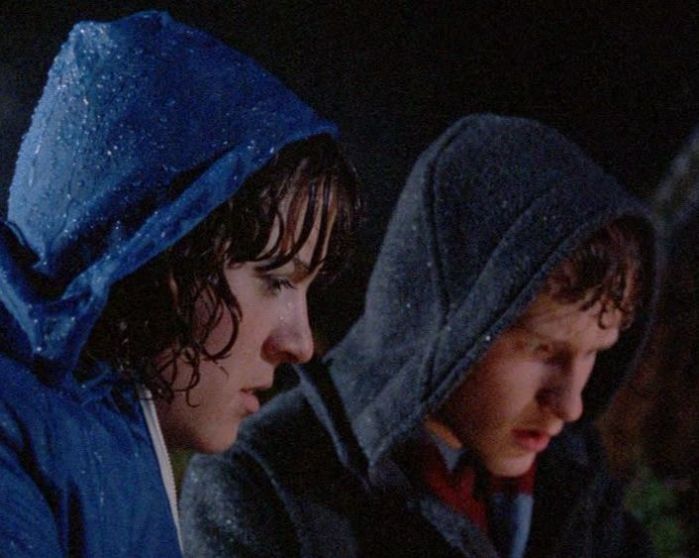
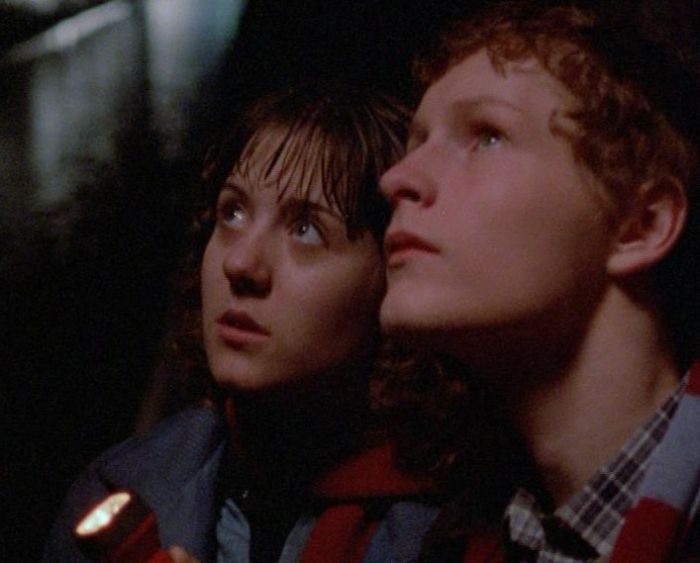
With a running time of only fifty minutes, Ghost on the Water has to hit the ground running, which explains why the opening scene (Tess and David lurking about the graveyard looking for Abigail’s tombstone) is intercut with flashbacks of the classroom discussion which sparked their investigation. Quite why Tess and David have to visit the graveyard late at night (and when it’s raining) isn’t made clear, but it helps to make the scene much more atmospheric ….
ghost 01.jpg

A clever cut occurs after this scene, as we move to a spooky sepia shot of a horse and carriage careering down the path of a graveyard. It seems so in tone with the atmosphere already established that it comes as a shock to realise that Tess is now at home and watching an old horror movie on television! This movie might explain the strange dream she later had, but when the flashbacks become more and more regular (she seems to be present at the point when Abigail’s coffin is being laid to rest, for example) it’s plain that something very strange is occurring.

Although the cast was bolstered by some familiar senior actors (Paul Copley, Jane Freeman, Hilary Mason, Ysanne Churchman) the two main roles – Tess and David – were taken by novices. This presumably was an intentional move – it certainly helps to position them as real people (both Allchurch and Stevens are more naturalistic and unpolished than experienced stage-school trained actors would have been). Neither seem to have pursued acting careers afterwards, which makes their performances here especially interesting.

Allchurch has to carry most of the narrative. Her lack of acting experience is never a factor though, as – helped by Rye’s skilful shot choices – she’s allowed plenty of memorable moments. A few are a little eye opening though, considering this was broadcast so early in the day. The scene where Tess – lying in the bath – decides to re-enact the moment when Abigail drowned (by slowly submerging herself in her bathwater) is a disturbing one. And the follow-on to this scene – we see a back-view of a naked Tess standing up in the bath (albeit framed in such a way that her modesty is preserved) – isn’t one you’d imagine would be repeated today.

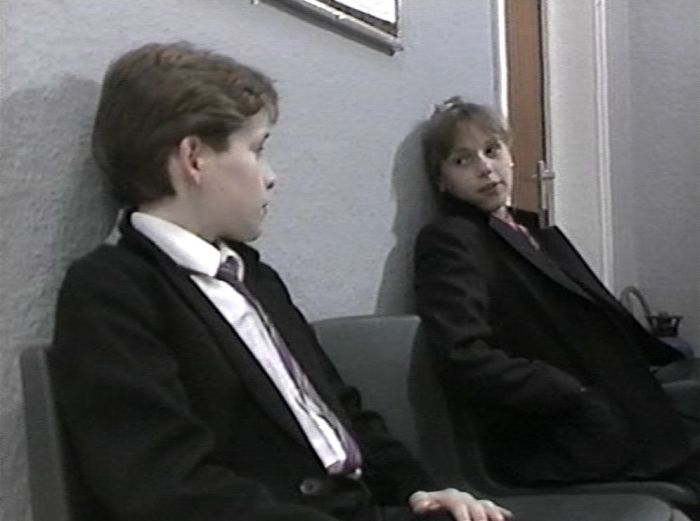
Although as touched upon, Tess and David are placed front and centre, there are good performances all the way down the cast list. Lynda Higginson (who like the principals was a novice actor) catches the eye as Tracy, a classmate of both Tess and David. She delights in teasing them about the considerable amount of time they’re spending in each other’s company.

Simply’s release looks to be a straight transfer of the 16mm master. There’s the usual intermittent signs of damage and dirt which you’d expect with material of this vintage, but overall it’s a pleasing viewing experience (the colours are quite bright and vibrant). With a running time of only fifty minutes, a little extra value is provided by a brief Blue Peter clip (a shame that it only runs for three minutes though).

Ghost in the Water may be short, but it’s always nice to see one-off plays like this exhumed from the archives. An intriguing mystery which drips with atmosphere, it’s plain to see why it made a lasting impression on so many at the time.

Ghost in the Water is released today with an RRP of £14.99 and can be ordered directly from Simply here.
ghost 02

Grange Hill. Series Eleven – Episode Twelve

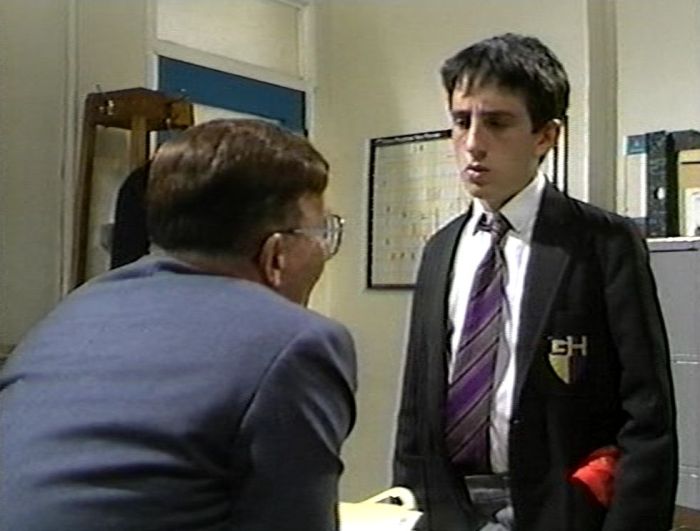
gh s11e12-01.jpg

Written by David Angus. Tx 12th February 1988

If Ronnie’s had a defining character trait since she first appeared back in 1985 then it probably would be her honesty. So the opening of this episode – she steals a ten pound note from behind her mother’s back – is the first sign that something’s awry with her. But no doubt she considers it was only “borrowed” and also in a good cause (expenses for the hip-hop competition).

What happens next is especially interesting. Ronnie, out in the local shopping precient, spies Calley, Helen and Georgina indulging in a little light shoplifting (lipsticks). Clearly blocking out her own pilfering, Ronnie is her usual moral self – she doesn’t directly accuse them, but it’s pretty obvious that everyone registers her disgust. How long have the others been shoplifting? It’s obviously not the first time. Calley must have become pally with the others offscreen as there’s not been a great deal of interaction between the three during the episodes to date. Whilst this seems to be just an incidental story detail, we’ll shortly see how it serves as the catalyst for Ronnie’s downfall.

Gonch, Robbie and Ziggy are back down the launderette. They seem to spend more time there than they do at school ….

Ziggy, attempting to get a free drink from the launderette drinks machine, gets squirted with boiling coffee for his pains. There are several points of interest here – not only is the drinks machine absolutely massive but the gleeful cackling from the old lady (played by Ruby Buchanan) after Ziggy gets splattered is very memorable. Subtle acting it isn’t. Ziggy then strips down to his boxer shorts, paying homage to a well known advert of the time.

Tensions at Chez Reagan remain high. Laura’s not exactly looking forward to an upcoming dinner party organised by her mother – as the loathsome Simon will be there – but the reappeance of a tanned Julia helps to cushion the blow somewhat.

Ronnie’s asked Gonch to arrange transport for the sound system, which will manipulated by Fiona’s cousin, the ebullient Wesley (Alan Cooke). This he does, although it probably wasn’t what they were expecting – a rag and bone man’s horse and cart! Were there still horses and carts on the streets of London during the late eighties? Slightly hard to believe, but it’s possible I guess.

Mrs Reagan’s party is in full swing and Simon makes an immediate beeline for Julia. He’s smoothness personified – expressing surprise that she’s not a teacher but is actually Laura’s former best friend.

The hip hop party is also swinging, albeit just a little bit louder. It’s probably not coincidental that the episode switches between the two – especially since we hear one of Mrs Reagan’s guests querying “what’s hip hop?” in their best high court judge’s voice. Luckily Simon’s on hand to explain to a bow-tied older gentleman that the Beastie Boys are hip hop people, sort of (everybody seems to have heard of them). Mrs Reagan wears an expression of delight as her beau once again demonstrates his knowledge of just about everything.

Later there’s some smoochy dancing in the (fairly small) living room. Spandau Ballet’s True (something of a golden oldie at this point) is their song of choice. We then jump back to the hip hop competition, where Fresh ‘n’ Fly finally have their chance to compete. They’re …. okay, but obviously not the best. Mind you, their weedy sound system might have had something to do with this.

Fresh ‘n’ Fly don’t win the competition, so there’s no prize money for them. How will Ronnie replace the ten pounds she pilfered from her mother?

And then we’re back again to the dinner party, where Simon’s decided that he’d rather like to kiss Julia (he corners her in the kitchen when no-one else is about). This is a final confirmation that he’s a rotter (to be honest, it would have been more of a shock had he turned out to be a decent chap after all). And then Julia disappears. This was her sole S11 appearance (and her final GH credit too) so clearly she featured here just to perform a single function – the reveal (only to the audience at this point) that Simon’s nothing more than a slippery snake.

gh s11e12-02.jpg

Grange Hill. Series Eleven – Episode Eleven

gh s11e11-01

Written by Margaret Simpson. Tx 9th February 1988

Mr Pearson speaks! His parting words to Matthew aren’t particularly friendly though. “How many times have I told you? Don’t say ‘aint’. Just because you have to go to this dump of a school doesn’t mean you have to forget how to talk properly”. As with Mr MacKenzie’s diatribe regarding the paucity of funds during the last episode, this comment helps to reinforce the notion (not often touched upon during recent years) that Grange Hill is a far from an affluent or top-rated school.

Of course, if the Pearson family are well-off, as has been mentioned in the past, why isn’t Matthew going to a private school?

Mr Pearson’s comment also helps to restate the impression that he’s a distant and uncaring father. With Mrs Pearson and Matthew’s sister having disappeared to the country (Mrs Pearson would return, making occasional appearances for the next few years, but we’ve seen the last of the brattish Lucy) it’s not too surprising that Matthew’s wearing a troubled expression – especially if he’s now been forced to live with his father.

There’s a big hip hop competition coming up and Danny’s keen to partner Ronnie and Fiona. He’s decided that – despite his inexperience – he’d be a wizard on the decks. Fiona believes that Danny would be a liability though, so she and Ronnie are economical with the truth when Danny mentions it. This seems slightly unkind – given Danny’s recent withdrawn and angry nature, something like this would appear to be just the thing he needs to perk him up. Fiona’s decision that they need someone more professional (which Ronnie hesitatingly goes along with) marks her down as – at best – a very ambitious young women. Clearly she doesn’t want to enter the completion just for fun, she wants to win.

And still the saga of the strip hire rumbles on. Gonch is besieged by angry punters, which seems less than credible. It appears that nobody in the school ever remembers to bring their strips, so Gonch and the others face an ever increasing cycle of kit maintenance. Like Vince’s belief that Helen is desperately in love with him, suspention of disbelief is required here. Poor Gonch, having just got out of his neck brace, now receives a nasty off-screen beating from Big Tel. There’s blood everywhere (especially on the kit) which doesn’t make their business any easier ….
Tegs’ decision to attend the remedial reading class is an interesting wrinkle. Given his unconvential homelife it’s not surprising that he’s fallen behind with his studies. Tegs displays a pleasing sense of vulnerability during this scene, although he returns to his more usual persona after sensing that he’s being accused of being behind the recent spate of petty thefts.

Tensions between Calley and Ronnie continue to bubble away. Calley’s unhappy that she’s been lumbered with the kit washing (Ronnie’s spending all her time hip hopping). Calley’s complaints are the latest reason why the kit hire scheme is beginning to crumble – hopefully so, as I think it’s about time it was knocked on the head.

Gonch, Ziggy and Robbie share quite a long scene in the launderette. It’s noteworthy since it’s a one take, single camera effort . This explains why when George Christopher slightly stumbles over a few lines they’re kept in (if it was a normal scene then they’d be able to drop in an insert to cover this fumbled moment).

Freddie continues to mock the efforts of those participating in the access group – such as Vince playing badminton – at all times. It’s another boorish display from a character who doesn’t have many positive traits (unless narcissistically self-obsessed womanisers appeal). Laura and a number of extras also join in with the general jeering. Luckily Mr Robson’s on hand to ram his point of view home. “I’ve no doubt you find it very amusing, you lads, who’ve never had any trouble with sport. But it’s people like you, to whom games come easily, who make it hell for the people who find it hard”.

Even after Mr Robson concludes by telling him that his job is to ensure everybody in the school enjoys physical education, Freddie remains locked in his tunnel-vision outlook. This clearly irritates Laura – who at least has the good grace to accept that Mr Robson has a point.

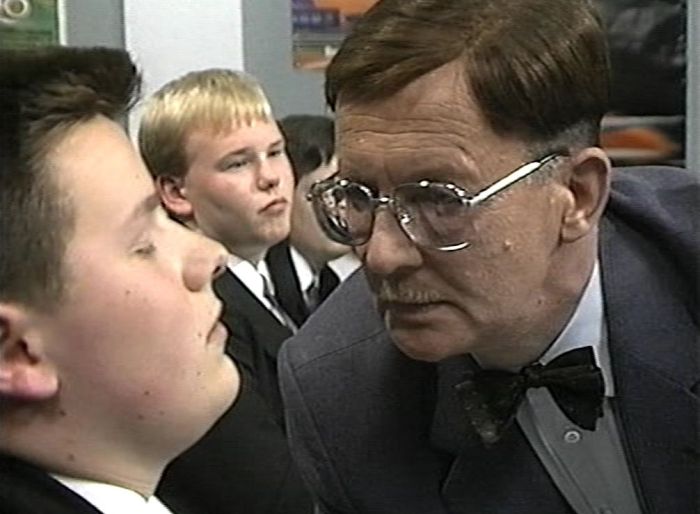
As with the previous episode, Mr Bronson only makes a brief appearance, but it’s certainly memorable. When Ziggy, Robbie and a clearly unenthusiastic Gonch decide that the time has come to teach Mauler a lesson, I was all set for another interminable “comedy” chase. But luckily that wasn’t so. Instead, they all cannon into Mr Bronson, knocking him to the ground and dislodging his wig. Not only is it a rare chance to see Mr Bronson sans hairpiece, but any time that Mr Bronson’s dignity is ruffled it allows Michael Sheard to shine. The sight of Mr Bronson, his wig replaced somewhat haphazardly, desperately attempting to reassert his authority is a lovely one.

gh s11e11-02

Grange Hill. Series Eleven – Episode Ten

gh s11e10-01.jpg

Written by Margaret Simpson. Tx 5th February 1988

Gonch, now sporting a neck brace, thanks to his previous encounter with Mauler, declares that something needs to be done about him. Ziggy agrees, leaving Robbie to shake his head at the impetuousness of them both. It’s a pity that we never actually see what happened to Gonch as Ronnie’s explanation – she found him trussed him up in Harriet’s old stable, complete with a sign saying donkey – sounds intriguing.

Why Mauler suddenly decided to attack Gonch (the two have barely, if ever, spoken) is another of those mysteries which I don’t think there’s an answer for. A case of sloppy storylining or was it designed to demonstrate that Mauler’s menace is totally random? The decision is yours.

Whilst Gonch thanks Ronnie for rescuing him (and also for not telling anyone else) this allows Robbie and Calley to enjoy a brief moment of intimacy. This slightly develops the possibility that they may become an item, although it’s still early days at present. Oh, and of course Ronnie couldn’t resist telling Calley about Gonch’s plight (she promptly told Robbie and then Ziggy found out) leading to maximum humiliation for GH’s top wheeler dealer.

Vince’s pursuit of Helen finds him running into Mauler. McCall’s not impressed with Vince’s American football top (deciding that Vince is setting up in opposition against him!). Vince is wearing the top at all times, as Trevor told him that Helen loves American football. I’ve got a feeling that Trev’s not been entirely honest with Vince ….

This is another of those slightly baffling incidental storylines. I’m not sure what’s harder to believe – the fact that Vince for a second believes that Helen (once she claps eyes on his shirt) will be overcome with passion or the notion that Mauler regards Vince as a rival. After a strong run of episodes (the two from Sarah Daniels were especially good) we seem to have hit something of a brick wall here.
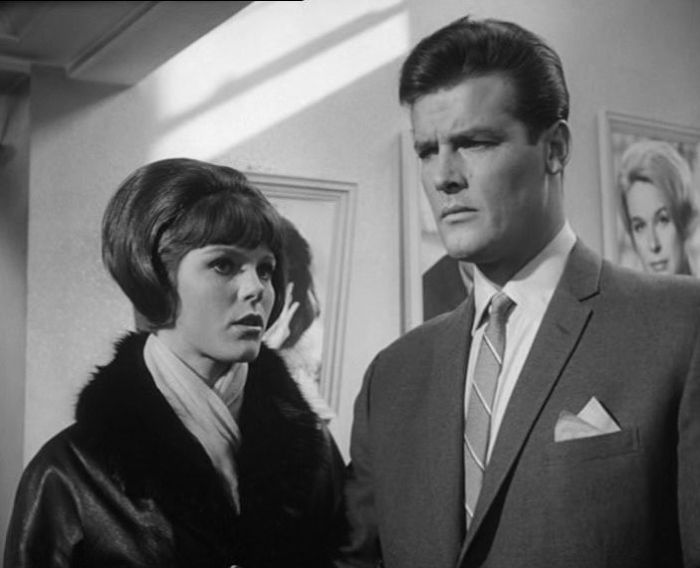
The normal affable Mr MacKenzie is in a strop today. Too much petty pilfering has finally caused him to snap – although maybe the final straw came when he saw that Trevor’s pockets were stuffed with computer keys. Clearly he spends his computer studies period dismantling the keyboards! It’s been a while since the topic of limited resources and vandalism was raised (back in the early eighties it was a particularly fruitful source of drama for the series) so it’s not unpleasing to see it touched upon again.

The sudden arrival of Mr Bronson is an episode highlight. Spotting Danny Kendall being escorted by the still highly irritated Mr MacKenzie, Mr Bronson lightly skips down the corridor before bellowing “do what do we owe this honour?” to the slightly nonplussed boy. As Mr Bronson then leads Danny down away, it’s notable that the walls are looking particularly grubby. Unless I’ve previously been unobservant, I don’t think this has been a regular feature this year, so possibly – like Mr MacKenzie’s diatribe – it’s something unique to this episode. Another notable feature of their extended walk is the ambient sounds we hear as they pass various classes. Only a small touch, but it helps to create the impression that this is a living and breathing school.

Vince’s stupidity has now reached previously uncharted proportions. Despite the fact that Helen’s told him she loathes all sports (and pushed him in the fountain for good measure!) he still believes Trevor when he casually mentions that Helen’s waiting for him over by the sheds. Of course, she’s not there – but Mauler’s gang is. So Vince finds himself chained up in the bike sheds, minus his prized shirt ….

gh s11e10-02.jpg

Grange Hill. Series Eleven – Episode Nine

gh s11e09-01.jpg

Written by Margaret Simpson. Tx 2nd February 1988

The peace of Laura’s breakfast is disturbed by the arrival of Simon. This obviously doesn’t please her (no doubt he picked up on this by the subtle way she banged a dish down on the table). True, Simon is his usual boorish self – grabbing the newspaper off her without thinking to ask first – but you could also argue that Laura’s not prepared to meet him half way. This is a plotline that’s been in a holding pattern for a while – Mrs Reagan loves Simon whilst Laura loathes him – with no sign of advancement.

I’m surprised to see that Gonch, Ziggy and Robbie’s kit hire service is still up and running. A few episodes back it seemed to be knocked on the head after Mr Robson rumbled them (or was that possibly just the reminder service?). Ziggy finds himself at the mercy of some fifth years who aren’t at all happy with the level of service being provided. These scenes are chiefly interesting for the way that Ziggy’s suddenly become the fall guy and junior partner – Gonch and Robbie very much have the air of senior partners, leaving the hapless Ziggy to do all the donkey work.

Mr Robson’s latest wheeze sees him launch an access club – featuring the likes of Badminton, Table Tennis, Weightlifting and Five a Side Football. Freddie’s not pleased, as it’ll mean that football practice will have to be cut down. This allows Freddie to once again restate his contempt for non-competitive sports. Instead, he harks back to the good old days of Mr Baxter and penny under the mat.

Helen continues to obsess about her tattoo, convinced that it’s growing larger. I love the way that Georgina shows the minimum of concern about her friend’s plight – she’s much more interested in filing her nails! Jane is the latest to view the tattoo and her obviously feigned delight only helps to reinforce the notion that Helen’s made a big mistake. She then confides to Georgina that “I bet Paula Yates had never had this problem” (yes a touch ungrammatical).

Vince has never been the brightest, but as the years roll on he seems to be regressing backwards. How else could you explain the fact that he believes Trevor’s assertion that he’s not only seen Helen’s tattoo, but that the two are an item? If that’s difficult to believe, then the notion that Trev’s prepared to nobly stand aside in order that Vince can ask her out is just bizarre ….

Danny’s return (he’s been in Scotland for a check-up apparently) sees him haunting the art room whilst avoiding Mr Robson. He’s also on hand to give Fiona and Ronnie some musical advice as they continue to craft their hip hop magnum opus. Quite how or why Danny’s suddenly become an expert (or even someone whose opinion they value) is never quite made clear.

The saga of the strip hire rumbles on. Surprisingly for a Margret Simpson script (she was always one of GH‘s more distinctive writers) the boys hit on a master plan which operates along rather sexist lines – they’ve got all these dirty clothes that need washing, so why not invite Calley and Ronnie to become equal partners? They can do the washing (well, they’re girls after all) whilst the boys handle the rough stuff, such as tangling with the likes of Big Tel (David Parker).

The episode ends with a “comedy” chase. Big Tel’s less than delighted that he was given one of Mr Robson’s football shirts (the teacher noticed and called him a thief) so there’s the inevitable run-around as he attempts to extract a suitable revenge. It’s mainly of interest due to the fact it continues during the end credits whuch at least allows it to be snappily edited. And if you think that this is one “comedy” chase without Mauler then think again – as he and his Grid Iron crew pop up out of nowhere to carry Gonch off. Quite what they’re doing wandering about the streets still dressed in their American football gear is a mystery which I don’t think has an answer.

gh s11e09-02.jpg

Grange Hill. Series Eleven – Episode Eight

gh s11e08-01.jpg

Written by Sarah Daniels. Tx 29th January 1988

Mr Griffiths has had his eye on Tegs for some time and finally runs him to ground in the girl’s cloakroom. The moment when Mr Griffiths attempts to stop him escaping by holding onto his blazer – only for Tegs to slip out of it – is slightly clumsily done, as it’s plain that George A. Cooper is actually tugging it off him.

Tegs, escorted to Mrs McClusky’s office by Mr Griffiths, remains uncowed. He denies that he’s responsible for the recent spite of bike thefts – instead he offers the head his professional opinion about safety measures (locking stands and chains would be a good idea). Poor Mr Griffiths gets a roasting from Mrs McClusky after Tegs leaves the office. Mr Griffiths’ confident assertion that Tegs is the culprit is quickly shot down by Mrs McClusky, who tells him that they have absolutely no evidence against him. Mr Griffiths’ hangdog expression after being ticked off speaks volumes. His heroine-worship of Mrs McClusky has long been one of his defining traits, so to be in her bad books is a painful moment for him.

Sarah Daniels once again comes up with the goods for Michael Sheard. Mr Bronson, lurking for no good reason in Mrs McClusky’s outer office, happens to overhear the head telling Mr Griffiths that if she can’t deal with this spate of thefts then she should resign. The words “it’s time for me to resign” catches his attention and his facial expression after this apparent bombshell speaks volumes! Also good to see the ever-faithful, if mute, Janet back in her familiar position as Mrs McClusky’s secretary.

You may, or may not, be delighted to hear that Mauler’s reign of idiotic terror shows no sign of abating. Desperate as I am for any small crumb of comfort during these scenes, I have to say that there’s a very unusual camera angle (high above the set, looking directly down) during the moment when Mauler and his posse chase Clarke round and round the lockers. Top marks to director John Smith for attempting to liven up yet another “comedy” chase.

But better times are just around the corner as Mr Bronson, like an avenging angel, strides into the frame and declares that Mauler was the boy responsible for giving him the soaking. Quite how he’s worked this out is a slight mystery – he didn’t see him at the time – but no matter as it’s a chance for Michael Sheard to turn the intensity right up. “You are the boy responsible for my getting wet”. It’s a fairly innocuous line, but it’s all about Sheard’s line delivery – the way he emphasises each word with increasing force.

I also love the conclusion to the scene. Mr Bronson tells Mauler to “follow me” and the teacher strides off, only twigging after a few seconds that Mauler’s legged it in the opposite direction! It’s only a pleasure deferred though, as Mr Bronson then runs the unfortunate Mauler to ground during the next lesson. Sheard is once again on top form as Bronson tells the boy to explain to the class, in French, exactly what he did. Sheard milks every last moment out of lines such as “you pathetic, unteachable specimen”. And what exactly was Mauler’s French explanation? “Mr Bronson, in boy’s bedroom, with basket of water on the head”.

Tegs explains a little more to Justine about his philosophy of life. “I nicked two hundred quid in fifteen minutes once. You’d have to be a politician or a pop star to earn that much in quarter of an hour”.

It’s fascinating how public acceptance of tattoos has changed over the last thirty years. Ronnie (unsurprisingly, given her straight-laced persona) isn’t at all impressed with Helen’s tattoo, telling her that she’s got it for life and only a skin graft will remove it. Back in 1988, a tattoo seems to have been seen as a departure from the norm – Ronnie wonders if Helen’s gone a bit funny and Fiona agrees, commenting that it’s a bit mad.

Matthew’s travails continue. After behaving quite normally during his few brief scenes last episode, he’s back to his old, storytelling tales today. Paul Adams’ breathless listing of untruths and half-truths isn’t terribly convincing – although I’m not sure whether this was supposed to be as scripted or was simply due to Adams’ acting. For sure, it’s a difficult part to play – and reviewing Matthew’s initial storyline some thirty years on, it seems a pity that he wasn’t given the opportunity to settle into the school community for a while before attention was drawn to his fractured homelife. Had this been done, then it probably would have generated a more rounded character.

Matthew’s father once again is nothing but more than an intimidating profile. We never hear his reply to Matthew’s request that they give Clarke a lift, but Mr Pearson’s disgusted expression speaks volumes.

gh s11e08-02

Grange Hill. Series Eleven – Episode Seven

gh s11e07-01

Written by Sarah Daniels. Tx 26th January 1988

The episode opens with a rare sighting of Justine’s elder sister, Tracey (Penny-Belle Fowler). Since Justine has more than an echo of Trisha about her – today she’s once again straining against the limits of school uniform – had Tracey been a regular, then like Trisha’s sister – Carol – she could have been used to tease out other aspects of Justine’s character.

I’m afraid that Mauler and his Grid Iron crew are still infesting the school corridors. After haranguing Matthew for the crime of bringing a briefcase to school, they’re distracted by Tegs, who throws a water bomb directly into Mauler’s face. Once again his reaction is horribly overplayed and yet another “comedy” chase ensues. The most interesting part of the scene is the way it demonstrates how Tegs is completely at home moving through the nooks and crannies of the school (his small frame makes it easy for him to enter the ventilation ductings).

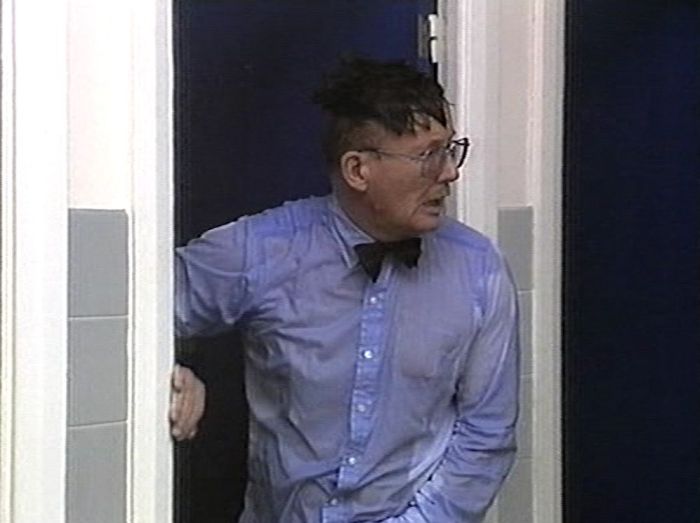
But this time, Mr Bronson is tugged into their orbit. After Mr Bronson views the out-of-order staff toilet with disfavour, we later see Tegs duck into the children’s urinals. Mauler and the others, hot on his heels, follow him in and prepare a series of water balloons to surprise the occupant of the locked cubicle, who turns out to be …. Mr Bronson. No, really.

Obvious though it is, this is still a decent payoff – the sight of a water-soaked Michael Sheard, complete with a distressed wig, is a lovely one. Even better is to come as Mr Bronson – a towel around his head – creeps into the staffroom. Only Mrs Reagan is there to begin with (reading a poetry anthology – Lovers Nosegay) but then Mrs McClusky walks in. Mr Bronson, caught behind the door, freezes and then delicately tip toes out of the room. That’s more like it, a nicely handled comedy moment which helps to erase the non-acting of the Grid Iron crew.

Indeed, having not featured a great deal this year, Sarah Daniels’ first 1988 script is a decent one for Mr Bronson. Post soaking, he has to deal with the sniggers of his fifth form French class (passing around notes that he’s wet himself) although the arrival of Justine, carrying a note for Laura from her mother, gives him the chance to reassert his authority. Was it scripted, or an involuntary reaction from Rachel Victoria Roberts, that Justine responds with a smirk after Mr Bronson booms at her? The latter, I think.

Tegs and Justine head out to the local café for a spot of lunch. En route, Justine spies a clothes shop and goes to investigate. Tegs, keen to please her, shoplifts a scarf she had her eye on. Before he reveals his unconventional present, Tegs tells her about his home life – a mother who left home when he was five, a father in and out of prison and an older brother currently in youth custody. When he tells her that his father was banged up when his mother left them, Justine asks him if he means hospital. This is either a signifier that Justine is more innocent than her streetwise persona might suggest or it’s designed to make Tegs’ situation crystal clear to the younger viewers.

Tegs explains his burglary modus operandi. As touched upon before, GH has had its fair share of criminally inclined children, but it’s always been made clear sense that eventually they would have to face up to the consequences of their actions. Tegs’ unrepentant, unabashed character feels different – mainly because he’s neither portrayed as an inherently “bad” person or a “good” one who’s temporarily gone off the rails. For him, this sort of life seems perfectly normal.

Helen’s latest dare involves her getting a tattoo ….

gh s11e07-02.jpg

Grange Hill. Series Eleven – Episode Six

gh s11e06-01.jpg

Written by David Angus.  Tx 22nd January 1988

The Grid Iron crew have been corralled to Mrs McClusky’s office.  As always, Gwyneth Powell is never more delightful than when we see Mrs McClusky turn on the sweetness.  Her feigned surprise at how Mauler and the others play a non-curriculum sport without a ball is nicely done.

Matthew’s dropped back to school after his weekend with his father (played by the non-speaking Bunny Losh).  So Matthew’s father is presented as little more than an intimidating presence – it’s Matthew himself who has to fill in all the blanks.  But considering the lies he’s continuing to spread (there was a strike, he tells Clarke, so they couldn’t go to Amsterdam but ended up touring the Lake District instead) it’s hard to believe anything he says anymore.  Especially when he mentions to Clarke that the Lake District is in Wales.

For once, Mauler and the others take part in a well choreographed comic scene.  Mr Griffiths has gone to the library in order to replace a lightbulb and after climbing the stepladder, he’s able to spot Mauler and his crew forceably “interviewing” a younger pupil.  After Mr Griffiths shouts out, they all quickly grab books from the nearest shelves and adopt poses of innocence!

Mr Robson is certainly a different character from the departed Mr Baxter.  Mr Baxter’s raison detre was to ensure that Grange Hill scooped up as many sports titles as possible – he was never happier than when his teams were crushing opposing schools into the ground.  Mr Robson’s vision of sport revolves around inclusiveness (ensuring that everybody gets a chance to shine) which means that he’s set on a collision course with Freddie, the first team captain, who believes that winning is everything.

Matthew sticking his fingers down his throat in order to make himself throw up is a disturbing image (which thankfully occurs just offscreen).  But it’s another indication that there’s something badly wrong with him (many children aren’t keen to do games, but don’t tend to go to those lengths).  In the girl’s changing rooms, Susi is equally unwilling to get changed, but she doesn’t act up so dramatically.  She’s simply uncommunicative, even brushing off Mrs Reagan’s delicate suggestion that it might be her time of the month.

Again, those with long GH memories might recall that Annette’s reluctance to get undressed during S7 was due to the fact that her body was bruised from physical abuse meted out by her mother.  Either Matthew or Susi could be in the same boat – with Matthew, due to his history of erratic behaviour, looking the more likely victim.

Fiona and Ronnie decide on a name for their hip-hop venture – Fresh ‘n’ Fly.  They meet in Ronnie’s bedroom in order to work on their masterpiece, but aren’t too impressed when Gonch comes calling.  They send him away, although Ronnie feels a pang of conscience afterwards.  But, as Fiona tells him, since Gonch only bothers with her when he feels like it, she shouldn’t feel too bad.  And after being slightly discomforted by Ronnie’s rebuff, Gonch is quite happy talking to Mrs Birtles (Angela Crow), especially when she starts dishing out the tea and cakes.

Mrs Reagan’s new beau, Simon, continues to irritate Laura.  Mind you, it’s hard not to feel slightly creeped out after he tells her that he wasn’t academically inclined at school – instead he spent most of his time watching the girls play tennis.  It’s when he then asks Laura if she plays tennis that you can’t help but squirm a little.  But Simon’s leering and boorish behaviour doesn’t seem to bother Laura’s mother, who locks lips with him as soon as her daughter exits the room.  Cue Laura standing by the door, looking on disapprovingly ….

gh s11e06-02.jpg

Grange Hill. Series Eleven – Episode Five

gh s11e05-01.jpg

Written by David Angus.  Tx 19th January 1988

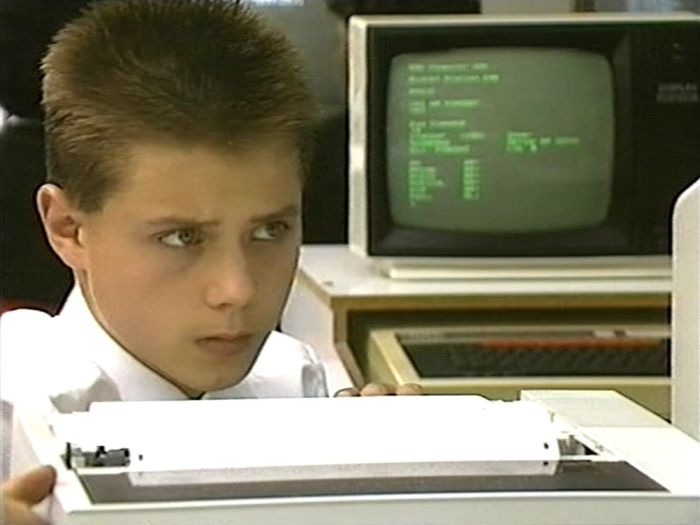
The great PE kit reminder service is in full swing and to assist the process, school equipment (namely the computer and printer) is being pressed into service by Gonch and the others.  There’s nothing so evocative as the sound of a dot matrix printer printing inexorably slowly, whilst it’s interesting to see that Grange Hill still uses BBC B’s.  It’s odd though that back in the heyday of the BBC computer (say 1983) Grange Hill never took the opportunity to utilise them in order to generate a spot of sneaky product placement.  Barbara Thorn, later that year to join The Bill as Inspector Frazer, makes a brief appearance as the computer studies teacher.

It does look like Mauler McCall and his rubbish Grid Iron Crew will be providing this years Harriet the Donkey moments.  They pursue Tegs around the school in a “comedy” chase before deciding to tie Ziggy up.  Ziggy declares that Mauler won’t be laughing for too much longer, but considering the eons it took for him and Robbie to gain revenge over Imelda, I won’t be holding my breath …..

Some of the first years dress up as people from different points in history.  Chrissy isn’t happy with her clothes, but Susi likes what she’s been given to wear.  Although it’s the boy dressed as a Viking (complete with a helmet sporting two very large horns) which really catches the eye.  Whilst Chrissy is out front – glowering – Matthew’s ever increasing web of lies is becoming more obvious.  He’s told Clarke that he’s due to fly to Amsterdam for the weekend with his father, but has trouble in remembering which airport they’re going to use.  Matthew’s habitual storytelling is gently teased out during these early episodes – it’s a signifier that the boy is unhappy, but the reason behind his tall tales remains nebulous at present.

Miss Stone and Mrs McClusky later debate Matthew’s weekend trip, with Mrs McClusky deciding that Matthew could be going to Amsterdam, although it seems unlikely (she declares that it’s rather grand).  Given that the journey from London to Amsterdam is hardly a lengthy one (223 miles) and wouldn’t have been that expensive, this seems like a slightly odd statement to make.

Stephen Churchett’s an actor with one of those faces that you know, but you just can’t remember exactly where you’ve seen him (he’s got a lengthy track record though – from Up Pompeii! in 1970 to EastEnders in 2015).  Today, he’s playing an Education Welfare Officer who is on the hunt for the absent Danny, but is equally happy to snag a truanting Trevor.  Trev, thinking on his feet for once, gives him Vince’s name instead of his own.  Mind you, since the Welfare Officer later gives Mr Bronson a description of “Vince” it’s maybe not as clever as he first thought.

Robbie’s delighted with the way the strip hire business is going, telling Ziggy that they’ll be laughing all the way to the Leeds.  A cultural reference which would have made sense at the time, although is possibly more obscure now.

Old GH hands may find the next scene a little familiar.  Mauler’s suddenly taken an unhealthy interest in Calley but avenging knight Robbie happens to be passing by and isn’t impressed.  This seems to be a definite echo of Gripper’s obsession with Claire (Stewpot, of course, was her knight in shining armour).  But the 1988 love triangle is less effective, mainly because Mauler – a very underdeveloped character anyway – has never shown any interest in Calley before.  Neither has Robbie, it has to be said, but it seems obvious that they’ll become an item soon.  I wonder if Calley’s horoscopes have foretold this?!

Joshua Fenton, as Mauler, pulls some extraordinary faces when Mauler confronts Robbie.  Compared to Gripper (or even Imelda) I’m afraid that Mauler is a very second-division heavy.  He may spout plenty of threats, but there’s no sense that – unlike Gripper or the even more unhinged Booga – he’s actually dangerous.

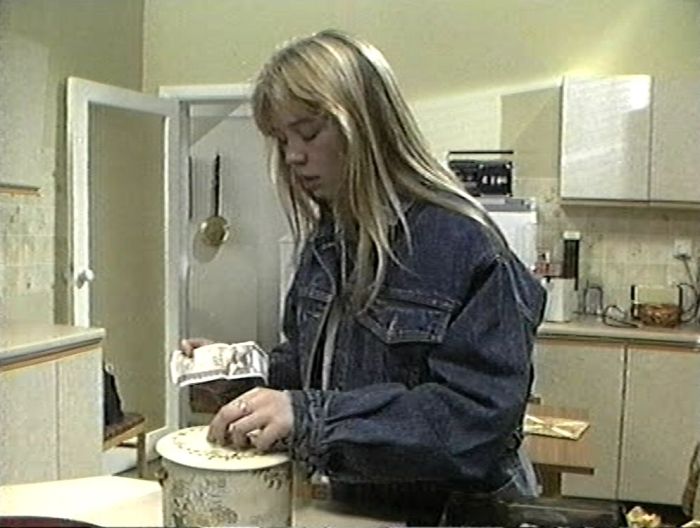
Things you wouldn’t see today …. Georgina’s latest dare involves her covering her face with yellow food dye and giving us her best Chinese impression.  “Ah so”.  Also appearing in the cookery scene is Susan Field as Mrs Evans.  Like Stephen Churchett. she’s an actor who you might instantly recognise (she was active between 1961 and 2000) even if you can’t name too many of her credits off the top of your head.  SF fans might remember her from the first Blakes 7 episode, The Way Back, where she played the conniving Alta Morag.

The saga of Mr Robson’s missing motorcycle helmet rumbles on throughout the episode. It’s eventually discovered in Mauler’s locker, although he didn’t pinch it (Tegs – looking to gain revenge – framed him).  Mauler’s reaction when he finds it is priceless – pricelessly bad that is.   He opens his mouth wide like a gaping fish.  This is supposed to be shock I guess, but it appears to be another example of bad acting.  Since Fenton will be a regular in the series until the end of series thirteen, I hope he improves soon.  Rather better fare can be found when a desperate Ziggy tries every trick in the book to stop Mr Bronson from inspecting his locker.  He’s innocent of stealing the helmet, but explaining all the PE kits he’s got stashed away might be difficult ….

gh s11e05-02.jpg


Grange Hill. Series Eleven – Episode Four

gh s11e04-01.jpg

Written by David Angus.  Tx 15th January 1988

Mrs Reagan is driving her daughter to school.  She comments approvingly that Matthew’s mother has dropped him off a street away from the gates (and also wonders if eventually she’ll detach him from her apron strings totally and let him catch the bus).  Of course, since she’s driving Laura to school this seems like an odd double standard.

Laura’s face is still set in the same expression she’s worn whenever she’s been in her mother’s company recently.  Think of someone sucking a lemon and you won’t be too far from the mark.

Helen and Georgina’s latest dare is to kiss all the boys in the playground.  This causes old-before-her-time Ronnie to tut in a disapproving manner whilst Ziggy is sanguine about the fact that girls are always throwing themselves at him!  Wisely they both decide to give Danny a wide birth – he’s still radiating despair and irritation at being pushed down a year.  He doesn’t pull his punches when Mrs McClusky innocently asks him how he’s getting on.  “The staff don’t know whether to treat me as an invalid or retarded”.

Danny’s returned to his series nine persona.  An uncommunicative individual, unwilling to accept that any of the school rules relate to him.  The first stirrings of the later conflict between Danny and Mr Bronson can be seen after the senior teacher discusses the boy’s wandering ways with Mr Robson.  Mr Bronson believes that they can no longer put his erratic behaviour down to his illness as he’s – apparently – now fully recovered.

Having forgotten his PE kit, Gonch is forced to borrow a strip from Mr Robson.  This leads to a lightbulb moment as he tells a slightly nonplussed Robbie and Ziggy that they should run a PE reminder service (and offer to hire out strips for anybody who forgets to bring theirs).  The only flaw in this wonderful scheme is that Mr Robson already supplies kit – for free – to anybody who’s forgotten to bring their own, so why should anybody pay for the privilege?

Mauler and his ridiculous crew are once again roaming the school corridors, looking for pint-sized first years to use as American footballs.  Tegs seems like the obvious choice but a militant Justine is having none of it.  He finds it hard to say thank you though – as a loner the words don’t come easy – but Justine continues to shadow him nonetheless.  Clearly there’s something about Tegs (his thieving ways?) which fascinates her.  He later shows his gratitude in a non-verbal way.  This is a moment clearly set up to later address Teg’s fondness for taking things which don’t belong to him.

Meanwhile, Matthew’s absent father (he’s working aboard at a secret location apparently) continues to be an object of innocent interest for the others.  It’s plain that there’s rather more to this than meets the eye as Matthew may be many things, but a fluent liar he isn’t.  Possibly this is connected to his, as yet, unspecified home-life issues.

Fiona and Ronnie now venture further afield for their ration of hip-hop tunes.  They’ve gone to a local club, where they run into Danny who’s painting a mural on the wall.  Fiona is keen to get up on stage and perform, and her hip-hop ambitions intrigue the other two – even Danny, who’s rarely shown an interest in anything this year.  Ronnie’s blossoming friendship with Fiona has started to isolate her from her long-term friend Calley, although this means that Jane – reduced during the last few series to a character with only a handful of lines – has now moved slightly more into prominence (she’s now operating as Calley’s confidant).

gh s11e04-02.jpg


Grange Hill. Series Eleven – Episode Three

gh s011e03-01.jpg

Written by David Angus. Tx 12th January 1988

It’s surprising that Ronnie and Gonch’s on-off relationship still seems to be just about on (I’d have assumed she would have dumped him by now). It’s the same old story from last year – she’s constantly exasperated that he never shows her any attention (mini-mogul Gonch is too concerned about where his next fortune is coming from).

Calley’s interest in all things astrological is still one of her main character traits. This has been constant since she first appeared in 1985 – which is either decent continuity or a sign that, as yet, nobody’s been able to think of anything better to do with her. Her latest fad is reading bumps – although Jane suddenly becomes less keen to be her guinea pig after Ronnie acidly tells her that it looks as if Calley’s checking for nits ….

Vince is always keen though (and keen to believe) so when Calley tells him that his bumps suggest he’s due a close encounter with something or someone from America he swallows it hook, line and sinker. Calley isn’t being deliberately malicious – it’s simply that other people’s expectations are greater than her own competence. And what does Trevor think of it all? He’s not impressed.

Although Vince and Trevor briefly teamed up in the first episode, they’ve now regressed to their more combative S10 personas – with Trevor keen to ridicule Vince at every opportunity. But some of Trevor’s sting has been drawn by the arrival of Mr Robson (a teacher that he finds impossible to bait in the same way as Mr Scott). This episode Trevor has regained his posse of silent hangers-on. He briefly had a similar in the previous series, but they vanished after an episode or two.

Helen and Georgina had a brief walk-on appearance in episode one, but this is the first time this series that we’ve been able to get reacquainted with them. Imelda might be long gone, but the remaining members of the Terrahawks still possess a sense of mischief (albiet playful, rather than malicious). Georgina dares Helen to tell Mr Bronson the true reason why her homework is incomplete (she was watching a good film starring Clint Eastwood) and Helen duly obliges. This scene was an obvious gift for Michael Sheard – the way that Mr Bronson slowly and unbelievably repeats the words “Clint Eastwood” are worth the price of admission alone.

Helen then dares Georgina to drop something into the lunchtime baked beans. She duly obliges with a bottle of salt and the inevitable hilarity ensues when some Louise later asks for beans and is less than impressed with her salty fare.

Ziggy and Robbie, like Gonch, are strapped for cash – so Robbie suggests a merger. Neither Ziggy or Gonch are keen, but eventually they agree. With three great business brains now working together in perfect harmony, what can possibly go wrong? Let’s wait and see.

Madeline Church makes her first appearance as Miss Stone, a fairly background teacher who appears throughout this series and a few episodes of the next. Miss Stone is keen as mustard to join Mrs Reagan’s keep fit class, whilst Mrs McClusky and Miss Booth are far less enthused (although eventually they’re shamed into attending). Gonch, Ziggy and Robbie – already debating how to make their first fortune – decide to stay in the gym and spy on them.

This is an odd little scene, although it doesn’t seem to be that the boys are perving (they’re simply being mischievous, I think). Their wonderful hiding place? Inside the vaulting horse, of course. Everything’s going swimmingly until the teachers leave and Mr Griffiths locks the gym!

The school disco is still going and there’s a sense that the series is attempting to keep up with the times when Ronnie asks the DJ to pop a hip-hop track on. This meets with the approval of Fiona (Michelle Gayle). From small acorns to the birth of Fresh ‘n’ Fly. The Hip-Hop advisor for the series was the late Mike Allen, at the time a DJ on Capital Radio.

Mr Griffiths is supplied with some top comedy moments – baffled at Calley’s head readings (convinced that she’s checking the others for nits), grumbling at the way his screwdrivers keep getting pinched and (of course) pursuing Gonch, Ziggy and Robbie around the school. He seems to have forgotten that he and Ziggy were allies last year, meaning that they’ve slipped back into their old roles.

gh s11e03-02.jpg

Grange Hill. Series Eleven – Episode Two

gh s11e02-01

Written by Chris Ellis. Tx 8th January 1988

Freddie’s continuing to play the lovesick martyr. Positioning himself at a handy point on the route to school, he presents an abject picture of misery as Laura and Louise pass by. It’s all part of his master plan to ensnare Laura of course (quite why he’s suddenly decided that Laura is the only girl for him is a mystery). His cunning ways weren’t well received by his younger sister earlier on though. Chrissy tells him that he’s “disgusting” before stomping off to school by herself! Laura’s well aware of the game he’s playing, but she’s content to let him carry on for now. There’s a vague element of humour here, but it’s all rather laboured.

Matthew and Clarke’s friendship continues to bloom. Matthew seems to have decided that Grange Hill isn’t as bad as he’d feared …. and that’s when Mauler McCaul turns up. Like the rest of his gang, he roams the school corridors in full American football gear (like Freddie’s moping this seems less than credible) looking for vulnerable youngsters to use as a ball. Is this going provide us with S11’s Harriet the Donkey moments? Hopefully it gets, ahem, kicked into touch soon.

A little more dramatic meat is provided by a continuing spate of thefts. Miss Booth – with no evidence – seems to believe that Tegs is responsible whilst the new head of the first year – Mrs Reagan – seems much more relaxed about the whole affair. So far we’ve seen very little of Tegs, although we’ve heard quite a lot about him. Most of the accounts have been negative – meaning that his card already seems to have been marked by some of the teachers (especially Miss Booth who, despite her free and easy air, has been shown in the past to be rather dogmatic and inflexible). That his character has been sharply defined in his absence is an interesting touch – the question is, will he live up to these low expectations?

Gonch still hasn’t given up on his money-making exercises (even if his right-hand man Hollo has disappeared – never to be spoken of again). This episode he’s giving the first years a guided tour of the building and, complete with his rolled up umbrella, he’s the epitome of a cheerful tour guide. The moment when he introduces Mr Griffiths as one of Grange Hill’s finest ancient moments is a proper laugh-out-loud moment.

That pair of juvenile delinquents – Tegs and Justine – find their relationship developing. Both are cooling their heels outside Mrs McClusky’s office – Tegs because of his poor attendance (and it’s only day two) and Justine because of her shocking pick blouse.

There’s a cracking cliffhanger. Laura returns home to find out the reason why her mother has had in a spring in her step recently. She’s got a new boyfriend, the oily, moustachioed Simon (Peter Meakin). His opening line is a classic. “So this is the lovely Laura. But not quite as lovely as her mother”. I think the way he rubs the back of Mrs Reagan’s neck whilst saying this is what makes the moment just a little off-putting.

I think we’re going to have trouble with this new arrival ….

gh s11e02-02.jpg

Grange Hill. Series Eleven – Episode One

gh s011e01-01

Written by Chris Ellis. Tx 5th January 1988

This episode saw the debut of a new title sequence and a re-arranged version of Chicken Man. Although both moves might have upset some old-timers, you can’t really argue that it wasn’t overdue. The original titles may have been iconic, but they always looked rather old fashioned, even back in the seventies. The new titles are more frenetic (Phil Cool, remember him?) but not as distinctive. In some respects they seem like a placeholder between the originals and the more successful nineties efforts.

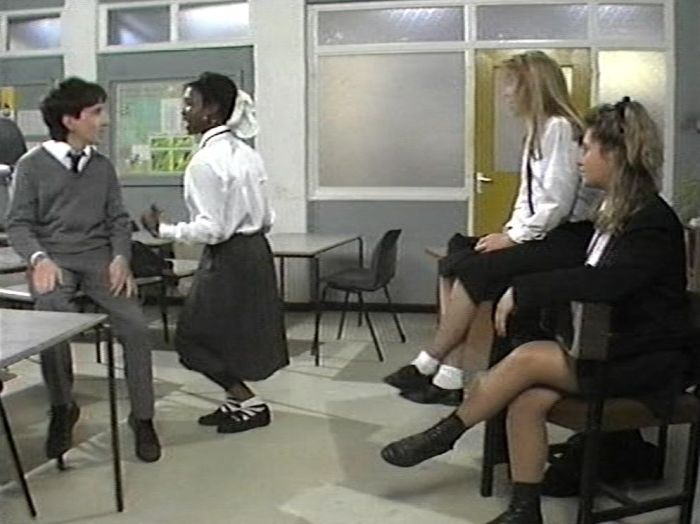
A new group of first years are rapidly introduced. For those who like to compare the new arrivals to old boys and girls (looking for archetypes) then Chrissy Mainwaring (Sonya Kearns) and Susi Young (Lynne Radford) fit very nicely as the new Trisha/Cathy, Fay/Annette or Calley/Ronnie. Throw in Justine Dean (Rachel Victoria Roberts) as a fashion rebel very similar to Trisha and it’s plain that – to begin with – the series was treading familiar ground with these new characters.

But Matthew Pearson (Paul Adams) and Clarke Trent (Darren Cudjoe) are hardly in the mould of Tucker/Alan, Zammo/Jonah or Gonch/Hollo. Matthew is positioned more as a Justin Bennett type – a fish out of water at Grange Hill – whilst poor Clarke (you possibly won’t be surprised to learn that he receives a few Superman jibes) seems to exist mainly to line feed his new friend.

Our first sight of Matthew sees him looking longingly at the comfort and security of home from the back seat of his mother’s car as she drives him and his sister to school. If the point that he’s an unwilling new pupil needs to be hammered home, then luckily his annoying younger sister is on hand to tell him exactly what awaits him (namely that his head will be shoved down the toilet on a regular basis!).

For the loveable bad-boy quotient, you have to look to Tegs Ratcliffe (Sean Maguire). Out of the newcomers, Tegs makes the most immediate impression. Grange Hill might have had its fair share of tearaways in the past, but Tegs is a little unusual. He’s sold to us as a positive character, even though his background is a dubious one (his family are comprised of unsuccessful petty criminals whilst he’s already racked up an impressive criminal record as well).

In time we’ll see how the isolated Tegs forms a bond with Justine which – again – is an uncommon move for the series. It wasn’t totally unheard of (Trisha and Simon Shaw for example, or Duane and Tracy/Clare) but those examples demonstrate that friendships between first year boys and girls hadn’t happened for some time.

Series eleven also saw the introduction of Mr Robson (Stuart Organ). He was by far the longest serving cast member (notching up 264 episodes) although I doubt few would have predicted back in 1988 that he would become such a fixture (he eventually left in 2003, shortly after the show relocated to Liverpool).

A few older pupils suddenly pop up without warning later on this year (an occasional hazard at this school). Fiona Wilson (Michelle Gayle) slots in neatly with the other fourth form girls whilst Mauler McCaul (Joshua Fenton) and Ted Fisk (Ian Congdon-Lee) initially exist solely to cause grief to the younger pupils.

Fair to say that Mauler’s not exactly a bully in the Gripper class (or even Imelda, come to that). He’s played much more for laughs with Ted operating as his even dimmer sidekick. But for those prepared to stick with the series, Ted’s character will undergo something of a transformation in the years to come …..

The opening few minutes plays out in a predictable way as we see various characters making their way to school – some willingly, some not. The old hands – Ziggy and Robbie – are quite casual whilst some of the younger pupils – like Susi – are more anxious. Luckily, she’s got a confident friend in Justine, who tells her that the horror stories she’s heard (about getting beaten up and having her dinner money pinched) are all rubbish. Justine’s positive attitude is therefore shown to be in sharp contrast to Matthew’s more negative viewpoint (like Susi he seems to think that everybody’s looking at him – hence the way he flinches when his mother attempts to give him a goodbye kiss).

It’s an old trick, but during these early scenes with Matthew, the camera is placed low – at his level – which makes the sudden arrival into the frame of Trevor and Vince (keen to make Matthew’s first day extra special) a little more impactful. A pity that Paul Adams seems to be registering amusement more than fear during this scene, but no doubt this was down to inexperience (although he did have a few credits prior to GH).

A few golden oldies from years gone by are given another airing – such as when Trevor and Ziggy send the first years the wrong way to the assembly hall. Another rehash from the first episode back in 1978 finds Matthew left alone in the assembly hall (everyone else has been assigned a form apart from him). Whilst this is almost certainly an intentional homage, it’s probably not a moment tailored for long term fans. Indeed, GH‘s core audience was no doubt self-renewing (new ones joining as the older ones moved on to the likes of EastEnders) so this would have seemed fresh to most of the viewers.

Both Chrissy and Justine seem to be channelling Trisha Yates. Chrissy has an overbearing older relative also at the school (in her case, Freddie) whilst Justine has a highly relaxed attitude to school uniform, which is sure to get her into trouble.

Poor Freddie is bereft to learn that Julia won’t be coming back to Grange Hill. Sorry? Considering the way that he’s burned his way through the female population at GH, it’s hard to take his sorrowful persona very seriously. But with Julia gone (and Banksie too) that leaves the way open for Freddie and Laura to hook up …..

Mr Robson lays down a marker with E4 right from the moment he first walks into the room. With a stentorian rant, he instantly silences them (easy to see that he’s not going to be a walkover like Mr Scott last year).

Mr Bronson and Danny pick up where they left off. Maybe it’s the fact that I’m growing older, but I now find it much easier to side with Mr Bronson than I do with Danny. The boy’s clearly aggrieved at being kept down a year, but since – due to his illness – he’s missed a considerable amount of coursework it’s easy to see why the decision was taken. Unlike his earlier targeting of Zammo and Ant, there doesn’t seem to be any malice – at present – from Mr Bronson’s side of the table.

gh s011e01-02.jpg

Hitting the Target. Doctor Who – The Mind of Evil

mind.jpg

Although most of the Pertwee stories were novelised during the seventies, four tales – The Ambassadors of Death, InfernoThe Mind of Evil and The Time Monster – were skipped.  It’s interesting that two of the titles were by Don Houghton, but presumably that’s just a coincidence as there’s never been any suggestion that he was actively blocking publication.

When Target eventually decided the time was right to mop up these stragglers, Houghton declined to tackle his stories – Inferno and Mind – so the task fell to that reliable old warhorse Terrance Dicks.  Published in 1985, The Mind of Evil is a very faithful transcript of the televised story (even keeping most of the original dialogue intact).  This had become Dicks’ style – something which was appreciated and mocked by different sections of fandom.

For some, in the days before VHS copies were widespread, having an almost verbatim novelisation of the television story was appreciated.  But others wanted books which went beyond the televised events and were less impressed with Dicks’ workmanlike style.  The printed word does had advantages over the television image in certain respects though – for example, the visual manifestations of the evil impulses generated by the Keller machine.  On screen we saw less than impressive superimposed images (water, fire) but there was no such limitations on the printed page.

Dicks also remembered that some readers might be unaware of the Doctor’s current status, so he helpfully sets the scene by informing them that, at present, the Doctor is exiled to Earth and working for UNIT.

The various criminal types are given very brief backstories.  We learn that Barnham had choked the life out of a security guard who had disturbed him whilst he was blowing a safe whilst Harry Mailer is painted as a Kray-like gangster (eventually caught because he was rash enough to kill somebody in public).

It’s notable throughout the television original that the Doctor’s in something of a bad mood, especially to begin with (his arrogance is very much on overdrive when attending the initial demonstration of the Keller process).  Dicks doesn’t attempt to soften this and, indeed, his condescending attitude to all around him – including Jo – is even added upon.  At one point, the Doctor despairs of having to leave the Keller machine in the hands of Jo (whom he regards as a feather-headed child).  But this was still early on in their relationship, so it’s maybe not as brutal a character assessment as it first seems.

Benton can always be relied upon for a comedy moment or two, and Dicks delightfully paints him as a wistful James Bond wannabe – dreaming of vodka martinis, shaken not stirred, Bentley sports cars and mysteriously beautiful international spies.  His actual assignment – keeping tabs on the suspicious Captain Chin Lee – is rather more down to earth though.  The Brigadier’s assessment of why Benton is fundamentally unsuitable for undercover work is also entertaining (Benton lurking in a doorway with his raincoat collar turned up, was about as inconspicuous as an elephant at a tea party).

Not the most essential Target then, unless you favour a very accurate reproduction of the events on screen, but it’s still one of those books which whetted my appetite for the television original.

Hitting the Target. Doctor Who – The Mind Robber

mind

I love the tranche of Hartnell and Troughton novelisations penned in the eighties.  Many were written by their original scriptwriters and it’s fascinating to see how they retooled the stories after a gap of several decades.  Peter Ling, like many of his fellow writers during the sixties, wasn’t steeped in Doctor Who lore.  He wrote a single story and then no doubt didn’t think about it or the series again until he was commissioned to write this novelisation in 1986.

This isn’t a problem though and in fact there’s something rather charming about the slight sideways feel that you get from many of these books.  There’s some odd moments to be sure (such as the sight of the Doctor pottering around the TARDIS engine room with a can of oil and a rag) whilst it’s hard to imagine Troughton’s Doctor ever uttering the line “ye gods. I need my brains taken out and buttered”.  But I’d sooner this approach than an obsessive fixation on continuity – where things are either “right” or “wrong”.

Ling sticks pretty closely to the original script, although there’s plenty of instances where he takes the opportunity to do things which would have been beyond the series’ budget.  When Jamie and Zoe are tempted out into the white void, they both see very personal images.  For Zoe, it’s the sight of her mother, looking down at her from the sky, whilst Jamie sees his cottage, complete with his family waiting for him and a spot of supper on the table.  These visitations upset Zoe especially (possibly this was a hint that her mother had died).

After the TARDIS has exploded, the image of Zoe slowly slipping off the console and descending into nothingness is an evocative and disturbing one.

I don’t know whether Ling’s script had originally intended for Zoe to briefly find herself dressed as Alice in Wonderland (encountering a white rabbit with a pocketwatch and falling down a rabbit hole) but if so, it’s a shame we didn’t get to see it.  Possibly the fact that the recording would have had to have been paused in order for Wendy Padbury to change clothes was the prosaic reason why it didn’t happen.

It’s slightly odd that Zoe has never heard of Alice (especially since she knows all about the Karkus – she’s aware of comic strips then, but not classic literature).  We’re told that this is because she comes from the twenty first century, which seems a fairly feeble rationale.  The Karkus is good fun – especially since he comes complete with Batman-style speech bubbles which accompany his every move and gesture.

Ling didn’t make any attempt to differentiate the Master in his story from the Doctor’s identically named arch nemesis, which no doubt would have confused some people.  Early reference books did make a distinction – The Making of Doctor Who called him the Mind Master, for example.  Mind you (sorry), that was confusing too – when I finally saw the story, I was surprised he wasn’t referred to as the Mind Master.

It’s characteristic that Jamie is disappointed when Rapunzel disappears (he was looking forward to getting to know her a little better).  Jamie – like Frazer Hines – always had an eye for an attractive female …

It’s a pity that Ling didn’t come up with an alternative ending as it seems to contradict everything we’ve previously been told.  Earlier, the Doctor realised that if he attempted to create fiction then he’d be trapped in the Land of Fiction forever.  But when he and the Master meet for their climatic battle, he does precisely this with no consequences.

But that apart, The Mind Robber is a cracking read.  There’s plenty of bonus material not seen in the original television production, but not so much as to make it unrecognisable.  Certainy a book that’s worth tracking down.

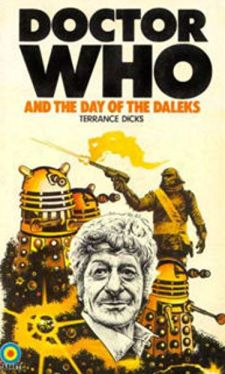
Hitting the Target.  Doctor Who and the Day of the Daleks 

day.jpg

My New Year’s resolution is to re-read all the Target novelisations.  And from time to time I’ll blog about the more interesting ones.

In the pre-VHS era they were incredibly important to me – every paperback was a window into the inaccessible past – but once it became possible to actually view the stories, the Targets were relegated to an increasingly dusty bookshelf.

Some I’ve re-read during the last few decades, but many have remained untouched since the early nineties. So, my non-chronological journey begins with an all-time favourite …. The Day of the Daleks.

Day is packed with extra value – the whole of chapter one (Moni’s flight through the workcamp and his tussle with the Ogrons) for example. I also love the many incidental touches added by Dicks which don’t alter the narrative, but help to broaden characters or generate more atmosphere. Jo’s dummy making skills (preparing an object for the Doctor to test the ray gun on) is a lovely example. It was very disappointing to later learn that on television the Doctor simply used a basic cardboard cut out (I wanted to see Jo’s lipstick smeared mannequin!).
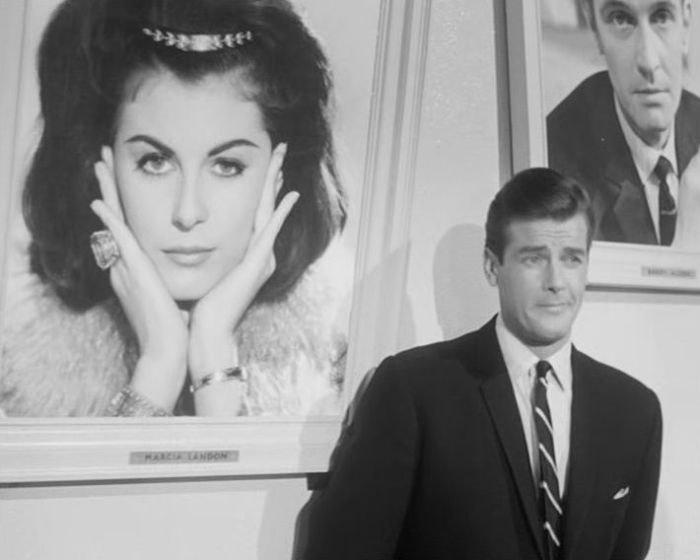
The Doctor’s first encounter with the Daleks – in the railway tunnel – is another of those moments which works terribly well in print, but turned out to be something of a damp squib on screen. In the book, the Doctor is horrified to see the slowly advancing Dalek. On television, he hot-foots it the other way as soon as he claps eyes on it!

When the Doctor and Jo are rescued from the clutches of the Controller by Anat and the others, Dicks cleverly names the various characters who were anonymous extras on screen. By giving them identities and very brief back-stories, their deaths resonate just a little bit more.

Dicks also took the opportunity to restore a “deleted scene” (a second encounter between the present Doctor and Jo and their future selves). On television, the loss of this scene wasn’t really a problem (the story concludes very effectively with a close-up of the Doctor) but it’s a nice book-ending moment that enhances the print version.

The Saint – The Work of Art

work 01

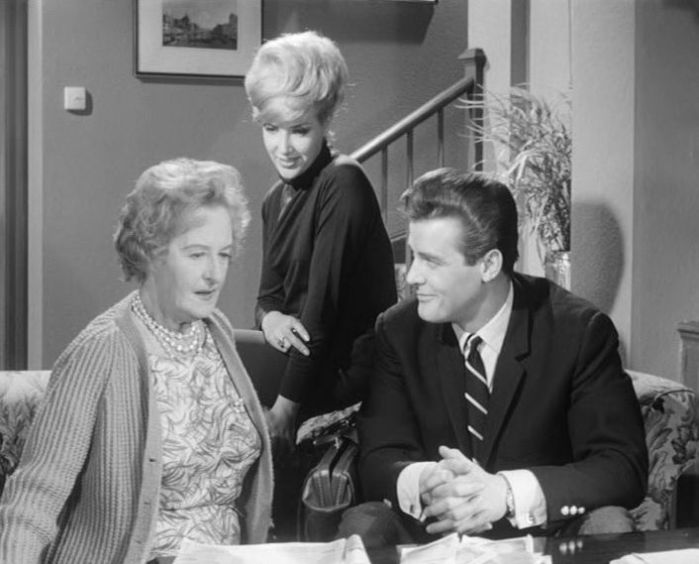
Simon’s gone to Paris in order to spend a little time with the attractive Juliette (Yoland Turner). But this pleasant sojourn is cut short after Juliette’s brother, Andre (Alex Scott), is accused of murdering his business partner, Jean Bougrenet (John Bailey). Unbeknown to Andre, Jean was a member of an Algerian rebel organisation and since he recently defrauded Andre out of five hundred thousand francs, Andre had a clear motive for murder.

Attempting to clear Andre’s name, the Saint finds himself tangling with the implacable Major Quintana (Martin Benson) as well as Vladek Urivetsky (Hamilton Dyce), known as the Master Forger of Europe …..

The pre-credits sequence shows Simon relaxing at a street café. Everything is calm and peaceful, at least until the police turn up and drag a seemingly inoffensive man into the back of their police car. You might expect that this will have some bearing on the plot, but no – the man simply exists in order for Simon to tell the viewers that whilst Paris looks calm on the surface, revolutionary intrigue is bubbling away in the most unlikely quarters. It’s a slightly clumsy way of signalling what the thrust of the story will be, but no matter it’s only a passing irritation.

John Bailey was one of those actors who suffered beautifully (he had a wonderfully expressive face which could express a world of pain). He’s therefore perfect as the twitchy Jean, a man on the run from the imposing Major Quintana. Jean works for Quintana, but Quintana has come to distrust him (easy to see why, since Jean radiates unease and guilt). It’s therefore no surprise that Jean doesn’t last terribly long – he’s throttled to death within the first twenty minutes.

If the opening half of the story is rather dour and humourless – it’s mainly comprised of a number of grim looking men looking grimly at each other – then the arrival of Mère Lafond (Hazel Hughes) helps to lighten matters somewhat. Hughes – an experienced actress with a career which dated back to 1938 – is great fun as the fiery Madame Lafond. She’s a woman who operates on the shadier side of the law and expresses disbelief that the Saint may now be aligned with the godly! Hughes’ appearance is only brief but it helps to provide the episode with a much needed injection of levity.

Yolande Turner, in the first of her two Saint appearances, manages a decent French accent as the alluring Juliette. It’s not the greatest of parts, but she does her best. Robert Cawdron is given some decent comic material as the long-suffering Sergeant Ludic. Tasked with the job of staying by the Saint’s side at all times, it’s no surprise that Simon delights in leading him a merry dance.

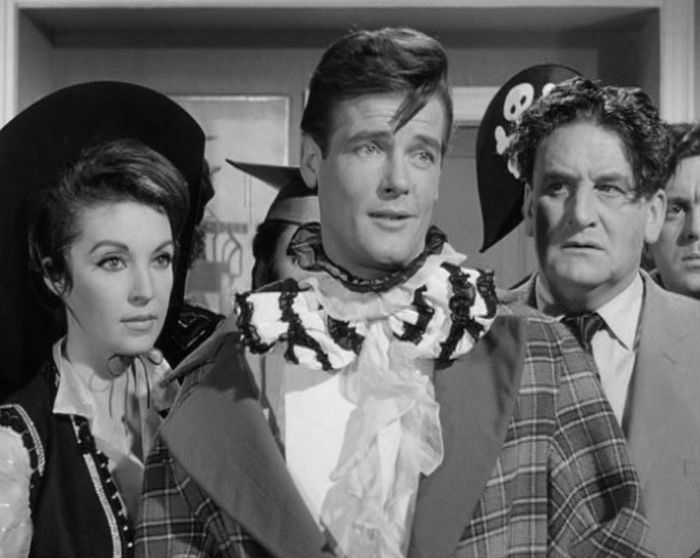
At one point, Ludic is dragged along to a fancy dress party. He remains in plain clothes whilst Simon enters into the spirt of things by dressing as a clown (some twenty years before he did so again in Octopussy). It’s difficult not to love the groovy music and general revelries, although it won’t surprise you to learn that Simon organised this treat as something of a diversion ….

Part of the problem with The Work of Art is that the Algerian question isn’t really examined in much detail (we therefore never really know exactly what Major Quintana is fighting for). Urivetsky – although he barely features – at least is given a clear motivation. Unlike Quintana he’s not interested in politics – money is his only goal.

Roger Moore gets the opportunity to demonstrate yet again that the Saint is very handy in a fistfight, whilst his trademark calm under fire is also in evidence. It’s a pity that Simon doesn’t meet Quintana and Urivestsky until the last ten minutes or so, as when he does the story starts to pick up a little impetus.

Adapted from Charteris’ 1937 novella The Spanish War, Harry Junkin’s teleplay retooled the original quite considerably – changing many of the names and relocating the action from London to Paris. The Work of Art is solid enough, but isn’t terribly engaging and so only rates two and a half halos out of five.

Watch for the sign of the Saint, he will return …..

work 02

The Saint – Judith

judith 01.jpg

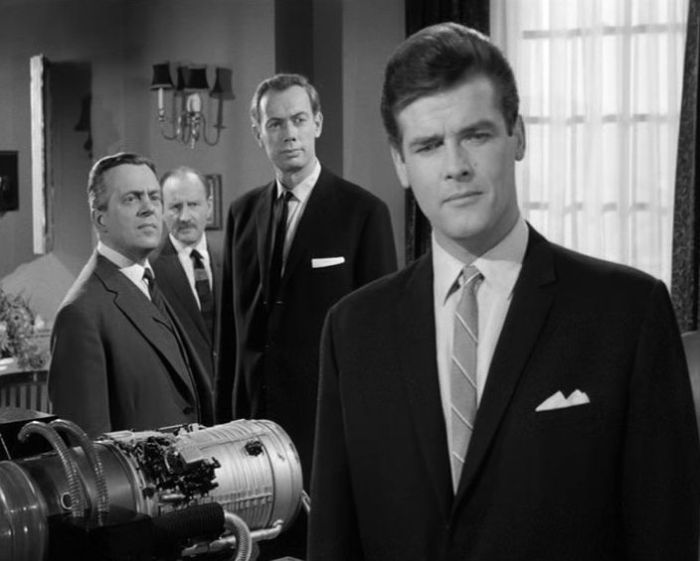
The Saint, relaxing in Canada, is approached by Judith Northwade (Julie Christie).  She  tells him that her uncle, ruthless businessman Burt Northwade (David Bauer), has appropriated the design for a revolutionary new engine from her father and plans to sell it for a small fortune.  So Simon agrees to break into Northwade’s house and steal back the plans …..

There’s plenty of stock footage used in the pre-credits sequence, which sees Simon attending an ice hockey game.  Although you might not have tagged this as Simon’s natural environment, he’s enjoying himself enormously (if the lusty shouts of encouragement he directs towards his team are anything to go by!).  His comfy sheepskin jacket was an unexpected fashion moment.

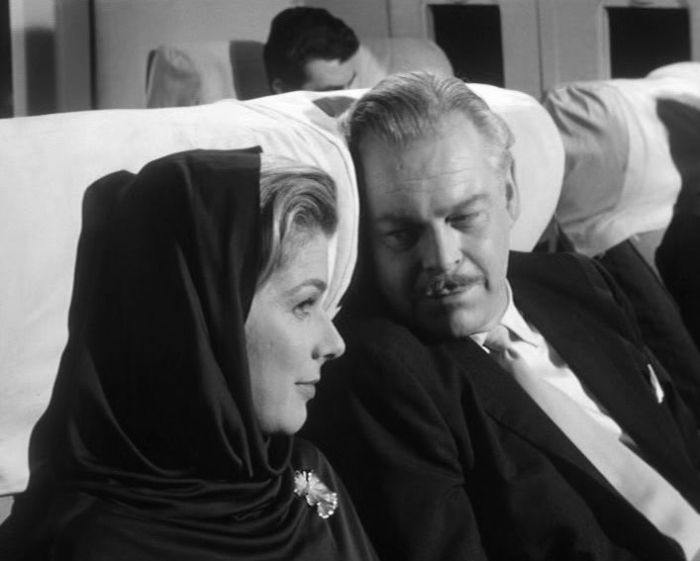
In the sort of remarkable coincidence that the series thrived on, Burt Northwade just happened to be sitting a few seats ahead of Simon.  They don’t talk – but this moment allows both of our principal characters to be seen together early on.  The episode then follows a traditional path as Simon, after popping up before the credits, fades away for a while in order to allow the guest characters to be established.

Northwade’s hard business streak is quickly spelt out.  His desire to press ahead with the sale of the engine distresses his wife, Ellen (Margo Johns) and their first scene together somewhat lurches into melodrama after he rather theatrically raises his hand to strike her.  She’s disgusted that he’s planning to swindle his own brother, whilst he blames her for not bearing him a son and heir.

We then see a mysterious and beautiful young woman keeping observation on their palatial house.  This is the titular Judith who – after being startled by Northwade’s guards – literally runs into Simon’s path (their two cars almost collide).   Judith drives off, but Simon finds himself arrested as a trespasser.  Clearly the Canadian laws on trespassers were very strict at this time – the Saint is told that if he moves before the police turn up then he could be shot!

This week’s police representative is Inspector Henri Lavan (John Serret).  He’s more suspicious of the Saint than some of his international colleagues and we’re left with the strong impression that he’s not prepared to be fobbed off by Simon’s easy charm.  The moment when he demolishes the Saint’s stated reason for visiting Montreal (Simon claimed he was planning to visit a favourite restaurant) is an interesting one, since it’s rare to see the Saint discomforted or outmanoeuvred by a member of the police force.  But Simon’s not knocked off his stride for long, as he then proceeds to laugh it off and disappears before Lavan has a chance to realise what’s happened.

Simon is given a police shadow – Sergeant Soustelle (Ross Parker) – who sticks to him like glue.  This is a little irksome, so the Saint boldly tells him that he’s planning to pick up a girl.  “And if you promise not to disturb me, you can sit at the bar and have an unlimited number of drinks at my expense”.  That Simon Templar, he’s something of a lad ….

But since the girl is Judith and Simon’s still curious about why she drove so erratically earlier, possibly his interest is purely professional.  Possibly.  Judith pours her heart out to him and it’s not surprising that her sob story hits home – after all, it’s a good story (and she’s gorgeous, which never hurts either).

Judith is an odd one.  For most of its duration it follows a linear path with no apparent mystery – Northwade’s deal is legally sound but morally reprehensible – which means that it’s not the most absorbing of yarns.  But you can still enjoy the various incidental pleasures along the way, such as the entertaining turn by Ross Parker as the gullible Sergeant (Simon is able to wrap the poor man around his little finger).

Although we shouldn’t feel too sorry for him as he doesn’t do badly out of their association – he’s able to eat and drink to his heart’s content!  And when Simon later locks him in the cupboard, the Sergeant’s half-hearted cries of “you’ll go to jail” never fails to amuse. Quite how he’s managed to stay in the force so long is a bit of a mystery.

Julie Christie is lovely of course, and she also helps to keep the interest ticking along although Judith isn’t the most sharply drawn or interesting of characters (at least not until the late twist).  This adaptation slightly softens the bite of the original, but otherwise it stays pretty faithful to Charteris’ story.  The reversal in the last ten minutes is a decent one, but since the rest of the episode is fairly forgettable, overall Judith only rates two and a half halos out of five.

judith 02.jpg


The Saint – The Bunco Artists

bunco 01.jpg

After the elderly Sophie Yarmouth (Mary Merrall) is cheated by two confidence tricksters, Simon – along with Mrs Yarmouth’s daughter Jean (Justine Lord) – decides to turn the tables and play the tricksters at their own game ….

We open in London’s glittering West End.  The scene-setting stock footage tells us that Phyllis Calvert, Marius Goring and Elizabeth Sheppard are playing in Menage A Trois whilst next door David Tomlinson is appearing in Boeing Boeing.

Simon is cooling his heels by the stage door, waiting for Jean to appear.  She’s delayed, which allows the Stage Door Keeper (played by Meadows White) to wax lyrical (“all the world’s a stage”, etc).  He also has one of the most arch deliveries of “why, you’re the famous Simon Templar” seen in the series to date.

She’s worth waiting for though (Justine Lord is a vision in white).  Jean’s a not terribly successful actress, but she’s hopeful that her big break is just around the corner.  I love her breathless précis of the exciting new role she’s hoping to snag.  “I go insane in act two, I yell and scream and carry on. And then in the end I put three bullets in my husband’s heart”.

But whilst Simon is squiring Jean around town, what of her mother?  She lives in a picturesque English village and is a big wheel at the Netherdon Parish Church.  She’s approached by a pleasant young American woman, Amelia Wade (Louise King), who tells her that the church is in line to receive a handsome donation from a mysterious American foundation (which would allow them to meet their restoration target).

This seems too good to be true – and alarm bells really start to ring when Amelia tells Sophie that she actually needs to see the money they’ve collected so far for the church restoration (records and receipts aren’t acceptable – only sight of the actual cash will do).  Of course, we’ve already got a good idea about what might happen, since Simon’s primed us in the pre-credits sequence about con artists.

But it seems as if Simon won’t be needed as Mr Henderson (Peter Dyneley), from the International Detective Agency in New York turns up, hot on Amelia’s heels.  Hurrah!  Along with the local copper, Charlie Lewis (Victor Platt), they ask Sophie to play along – if they can catch Amelia in the act, actually attempting to steal the cash, then she’ll be bang to rights.  But of course, Henderson isn’t what he seems either (he and Amelia – or Joyce, as she’s really called – are husband and wife confidence tricksters) so poor Sophie finds herself conned, good and proper.

The con is done very neatly – it’s not quite Hustle, but it’s still an effective set piece.  What’s especially entertaining is how Henderson explains to a rapt Charlie and Sophie exactly how “Amelia” carried out the switch (a case with a false bottom) only for him to then pull the same trick.  Dyneley and King make for an effective double act.  This was Dyneley’s second of three Saint appearances (it’s certainly a better role than his first, The Careful Terrorist).  American-born King made a string of appearances in British series during this period (her final credit was in 1964).  Her character is allowed a little twinge of conscience – after all, conning an old lady out of six thousand pounds (what will happen to the church roof now?) is a bit mean.

It doesn’t take Simon too long to work out that they’re actually called Mr and Mrs Richard Eade and have made their way to the South of France.  They can’t be terribly good criminals if they leave such an obvious trail ….

So the Saint and Jean set off for France and after the usual orgy of stock footage, Simon adopts the role of a friendly Texan and impresses Eade by flashing his cash about.  I’ve commented before about Moore’s interesting range of accents, and this is another good example.  Although as before, I’m not sure whether it’s supposed to be deliberately bad or not.  What’s certain is that Moore’s comic timing is put to good effect during these scenes (I like his bootlace tie as well).  But Simon’s not the only one with a silly accent as Jean’s gone all French.  Like Moore, Lord plays the comic scenes well.

There’s some familiar faces lurking about in the background. André Maranne makes his second and final Saint appearance. It’s not a terribly interesting role (hotel barman) but he does get a few lines.  John Standing plays a Gendarme whilst an uncredited Ingrid Pitt can be seen lounging by the hotel pool.

Charteris’ original tale appeared in the short-story collection, Thanks to the Saint (1957).  A fair bit of retooling went on during the first half of the adaptation (in the short story, Mrs Yarmouth believed she was handing over the money in order to make her nephew a film star) but the second half (Simon turns the tables with a sting revolving around a valueless necklace) was pretty much the same.

This change of emphasis – from film stardom to church welfare – allows Simon to make an amusingly impassioned speech after he and the Gendarme (Standing) run the crooks to ground.  “All over Netherdon parish, old people, widows, children, plumbers, bricklayers, carpenters, ordinary people, contributed their pennies and their shillings to the Netherdon Church restoration fund and these parasites stole it”.  Standing gets to react in a suitably shocked manner (“oh no”).

A lovely comic episode where everyone’s on fine form.  Roger Moore, of course, was made for this sort of role whilst Justine Lord is also very watchable.  Hard to see how this one could have been any better – five halos out of five.

bunco 02.jpg

The Saint – Marcia

marcia 01

Simon is mourning the death of Marcia Landon, famous film star, who took her own life after being disfigured in an acid attack.  Rising starlet Claire Avery (Samantha Eggar) has taken over the role Marcia was due to play in an upcoming film and after receiving a threatening letter – stating that unless she hands over five thousand pounds she too will be disfigured – calls on Simon for help.  So the Saint finds himself with a film studio full of suspects to investigate …..

The pre-credits sequence has a bleakness which wasn’t typical for the series, as we see Simon pay Marcia a fullsome eulogy.  Her face – prior to the attack – is prominently displayed both in the newspapers and on the studio walls where Simon has called to see Claire (and Marcia’s image will continue to appear throughout the episode).  The attack is shown in flashback – shot from distance and mostly using shadows, it’s effectively moody (and also isn’t explicit – which was always a consideration).

It’s a cliché but Samantha Eggar – just like Claire Avery – has undeniable star quality.  Director John Krish favours close-ups in the early part of the episode – as Claire and Simon chat about Marcia – and these shots, along with Eggar’s low, breathy voice helps to create a considerable impression.  The camera loves her and, to be honest, so do I.

Johnny Briggs creates an immediate impression as the chirpy runner, Johnny Desmond – he’s an upbeat sort of chap, always ready with a bad joke.  Marion Mathie, later to be the third and final television She Who Must Be Obeyed in Rumpole of the Bailey, is another familiar face who pops up (she plays Sheila – wife of Mike Sentinal, the director).

Jill Melford is deliciously bitchy as Irene Cromwell, an older actress who clearly believes that she should have been given Marcia’s role.  Dripping with honey-tongued venom, she’s highly entertaining.  Mix in Tony Beckley as Claire’s very disgruntled co-star and Philip Stone as a dogged police inspector and it’s hard to see how this story could have been better cast.

What’s nice about this one is that it gives us a rare chance to look behind the scenes at the studios where The Saint was shot.  It’s nowhere as self-reverential as some of the later UFO episodes, but it’s still interesting (and I daresay since it was pretty cheap to shoot, it would have pleased the producers).

As the story progresses, Claire continues to stress.  Things come to a head when a prop gun, used in the recording of the film, is substituted for a real one.  Simon, standing off-camera, shouts “drop that gun and nobody move!” in an incredibly forceful way (very uncharacteristic) whilst Claire just screams.  Oddly, she does so after the shot’s been fired (she appears to be working on a slight delay).  John Krish doesn’t really do Eggar any favours by zooming into her screaming mouth – it’s an arresting image, but not terribly flattering.

Towards the end of the episode, there’s a chance to see even more of the studio as Simon pursues a mysterious stranger through its various nooks and crannies.  This might be little more than padding, but it’s shot so well that it’s hard not to enjoy it.  Indeed, that sums up the story as a whole.  The mystery is fairly slight, but with such a strong cast it’s easy to be totally absorbed.

The use of Marcia’s photograph is an especially memorable touch.  It’s seen so often, in various different locations, that it’s almost like she’s always present – albeit as a passive, non-speaking observer.  This is one of the reasons why Marcia is a fascinating story which rates four and a half halos out of five.

marcia 02.jpg