The Saint – The Latin Touch

latin 01

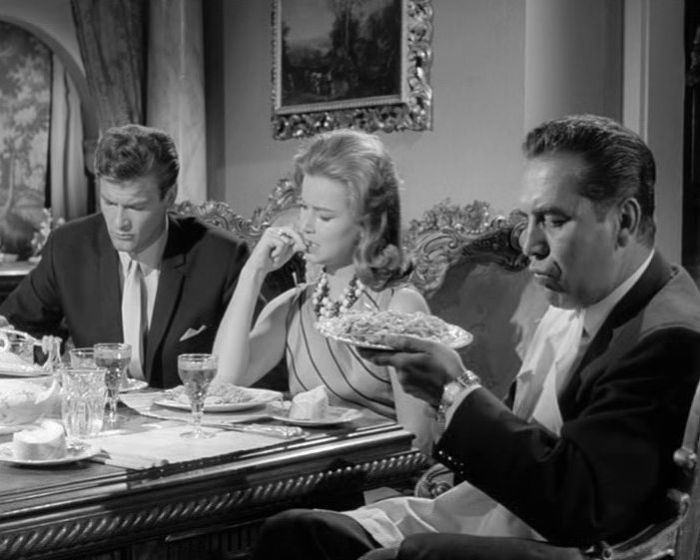
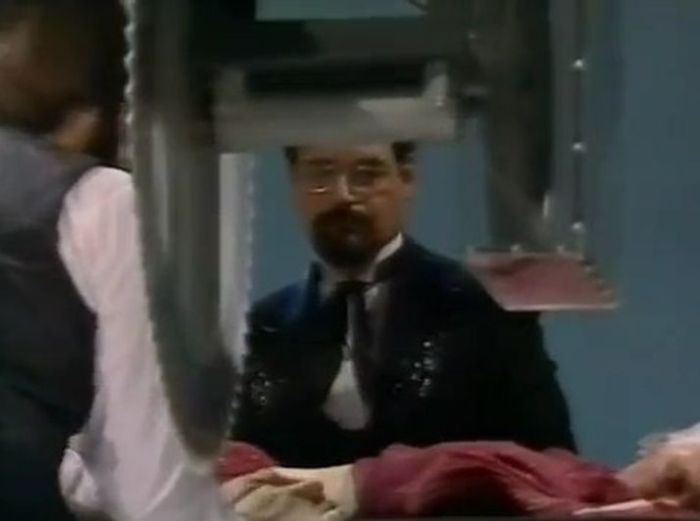
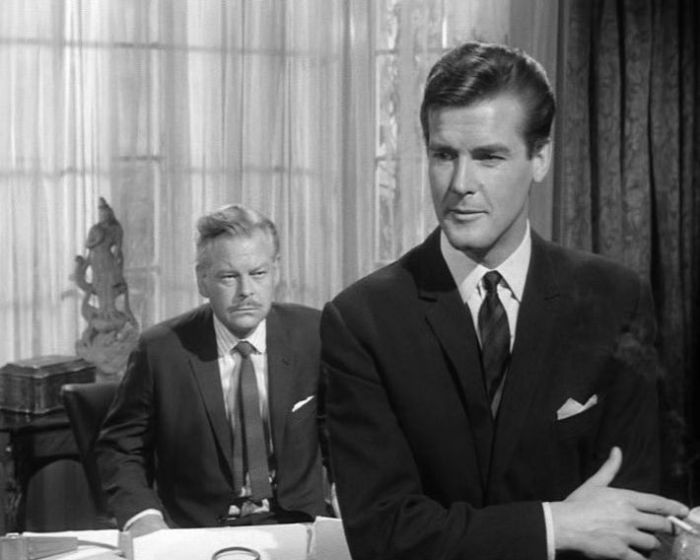
The Saint, vacationing in Rome, spots a damsel in distress, Sue Inverest (Suzan Farmer), who is locked in an argument with a stroppy cab-driver, Marco (Warren Mitchell).  Simon smoothly sorts out Marco and equally smoothly proposes to show Sue the sights – starting with the Colosseum.  But he’s hardly begun to display his impressive knowledge of history before he’s coshed by two thugs, who then abduct Sue.  Since she’s the daughter of an American politician, Hudson Inverest (Alexander Knox), it seems clear this wasn’t a random abduction.  But why was she kidnapped – for money, or is there some other reason?

The Saint‘s ability to travel all over the world despite rarely leaving the leafy environment of Borehamwood is well known.  But The Latin Touch does manage an early spot (albeit very brief) of genuine location shooting and these shots mingle pretty well with the studio work.  It also has to be said that the studio Colosseum set is quite impressive – we only see it for a short time, but it was money well spent.

It’s easy to spot that the two men who target Simon and Sue are bad ‘uns – the Frank Sinatra hats and flashy shoes are dead giveaways.  The revelation that Sue is the daughter of an American governor comes as something of a surprise, since Suzan Farmer doesn’t display a trace of an American accent.  Presumably accents weren’t her strongpoint.

She’s only onscreen for a few minutes before being nabbed, but  Farmer still manages to create a vivid impression.  It’s interesting that after Sue’s taken we don’t see her again until the 39th minute.  You’d have expected a few scenes with her to have been scattered through the story in order to ramp up the tension, but instead the human side of the drama is played out by Hudson and his wife, Maude (Doris Nolan).  Hudson puts duty first whilst Maude, as might be expected, is concerned only about her daughter.

Hudson faces a difficult moral dilemma.  Sue has been snatched by Mafia kingpin Tony Unciello (Bill Nagy), who demands that his younger brother, Nick, languishing in an American jail (his death warrant signed by Hudson), is reprieved from death row.  It’s highly debatable that Hudson would have the authority to do this (it’s hard to believe that the American government would agree to such a course either) but the way the story plays out it does seem that he has the power of life and death over Nick.

Warren Mitchell gives a lovely performance as Marco, this episode’s comic relief.  Marco is a rather slippery petty criminal, but Simon’s easily able to recruit him to the side of the godly.  Tony Unciello, like Sue, is rather lacking in screentime until the last ten minutes or so but Nagy’s scenes with Moore when they do arrive are good.  Hungarian-born Nagy might have seemed an odd choice to play an Italian/American gangster, but he’d do so again later (in Goldfinger).

With Tony remaining camera shy for most of the episode, it falls to others to sketch in aspects of his personality, such as the glamourous nightclub singer Maria (Carroll Simpson).  Maria’s short scene – she pulls back her hair to reveal a nasty scar (a legacy of her time with Tony) – helps to illustrate precisely what sort of man he is.  Since The Saint was extremely restricted in how it could depict violence (Leslie Charteris’ original stories often, much to his chagrin, had to be toned down) this scene is useful in the way that it suggests Tony’s violent nature without having to depict it.  Slightly surprising that Carroll Simpson, who is rather compelling, only seems to have made this single screen appearance.

Warren Mitchell’s entertaining as always and Bill Nagy’s nicely menacing, but The Latin Touch does suffer from a lack of tension, since it’s impossible to believe that Sue won’t be rescued in the end.  Given this, it rates a solid, but not spectacular, three halos out of five.
latin 02.jpg

The Saint – The Talented Husband

talented 01.jpg

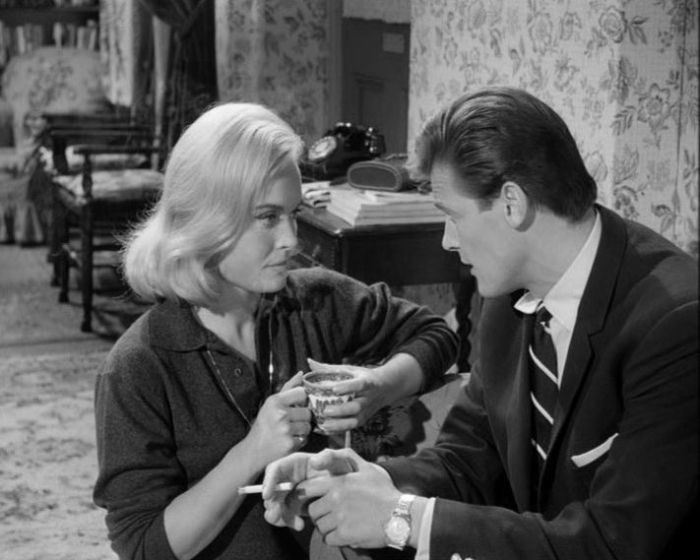
Simon Templar (Roger Moore) arrives in the small English village of Cookham, ostensibly for a relaxing holiday.  But in reality the Saint is on a mission and it doesn’t take him long before he teams up with the gorgeous Adrienne Halberd (Shirley Eaton) in order to run John Clarron (Derek Farr) to ground.  Clarron’s third wife, Madge (Patricia Roc), is a friend of Simon’s and he’s convinced that her life is in great danger.   Has Clarron hatched an ingenious plot to murder his latest wife and pocket her substantial fortune?

The Talented Husband, with its domestic English setting, seems a slightly unusual debut story for The Saint (original tx 4th October 1962).  Partly this is because Simon has to be placed in the background for a large part of the story, as the domestic tensions between Clarron and Madge slowly play out.  This is really Derek Farr’s episode – he deftly manages to portray Clarron as a man who’s constantly bubbling with resentment at the way he’s kept subservient by his wealthy wife (he’s a former actor turned unsuccessful theatre producer) although he’s also able to turn on the charm when necessary.

Adrienne, like Simon, has an ulterior motive for staying in Cookham.  She’s the most impossibly glamourous insurance agent you could ever wish to meet (although the dialogue does acknowledge this) and has been sent to keep tabs on Clarron.  Since he’s taken out a large insurance policy on Madge, foul play seems set to follow shortly ….

What’s interesting is that the “accident” which turns Madge into a bed-ridden invalid does seem to be genuine.  Clarron, reaching down from his bedroom balcony to throw a jumper down to Madge, knocks over a rather large plant pot – right onto her head.  He makes an attempt to stop it falling and looks genuinely contrite afterwards – or is this simply his acting abilities being brought into play?

There’s a large plot twist coming up now, so I’d advise anybody who doesn’t want the story spoiled to look away.  Although to be honest, I’d be amazed if anybody didn’t instantly twig what the twist actually is ….

Clarron hires a gem of a housekeeper, Mrs Jafferty, to look after Madge, but ….. she turns out to be Clarron in drag!

I think it’s fair to say that this isn’t the most successful part of the story.  It’s painfully obvious right from Mrs J’s first scene that it’s actually Derek Farr dragged up and this is made even clearer when we hear Mrs Jafferty speak.  Clearly Farr couldn’t provide a suitably feminine voice, so instead all of Mrs Jafferty’s lines are dubbed by an actress.  This is the sort of concept that works much better in print than on screen.

Although Simon is rather distanced from the action (he’s forced to keep a watching brief with Adrienne for most of the episode) Roger Moore still effortlessly manages to draw the viewers in.  From his opening monologue to camera, where he confides that he’s not a fan of the worthier type of theatre (i.e. the sort of production championed by Clarron), Moore and the Saint seem a perfect fit.

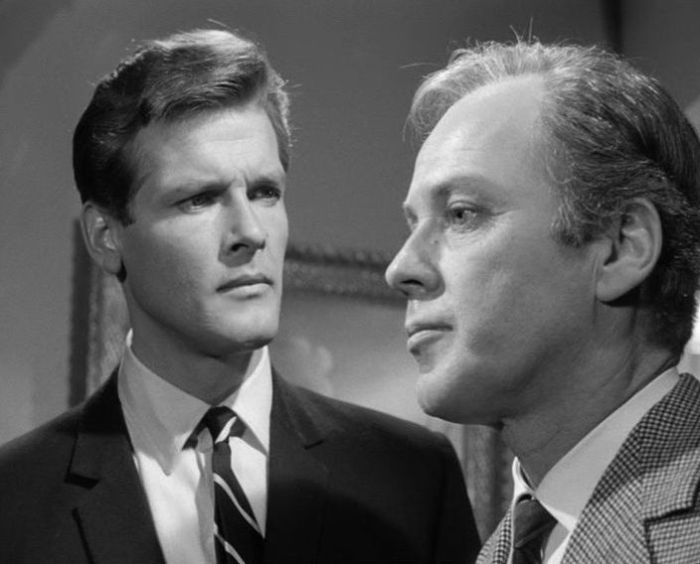
And his ability to turn from relaxed to remorseless is demonstrated at the end of the episode, when we see Simon confront Clarron with the evidence of his crime. Although Moore is best known for his light touch, he’s easily able – as here – to show a flash of steel when required.

With strong support from the lovely Shirley Eaton, the ever-glowering Derek Farr and the nobly suffering Patricia Roc, it’s plain that this one doesn’t lack for acting talent.  A good character piece, The Talented Husband rates a healthy three halos out of five.

talented 02.jpg

The Rag Trade – The Christmas Rush

rag 01

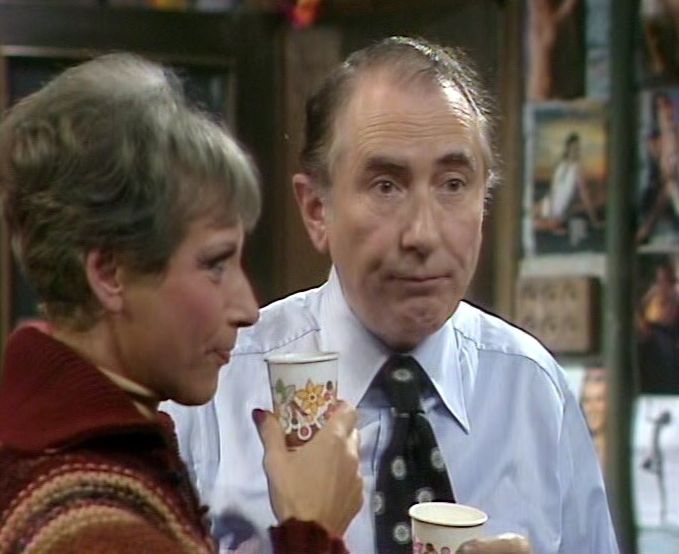
Following on from the original BBC run during the early sixties and an abortive BBC attempt in the early seventies to revive the series via an unscreened pilot, The Rag Trade finally returned to television during 1977 and 1978 thanks to this LWT series.

Although only Peter Jones (Fenner) and Miriam Karlin (Paddy) reprised their roles from the BBC incarnation, all of the new characters weren’t terribly dissimilar to the old ones – which made sense, as some of the LWT scripts were directly recycled from the BBC originals.

Christopher Beeney, as Tony, stepped easily to the role vacated by Reg Varney whilst Diane Langton (Kathy) had something of the vague air of Carole, Sheila Hancock’s character (although Kathy was much more pneumatically enhanced).   One interesting conundrum is whether Anna Karen’s character is meant to be the same Olive from On The Buses.  She certain looks and acts like her and since both series were written by Chesney and Wolfe it does seem likely, although it’s never directly confirmed.

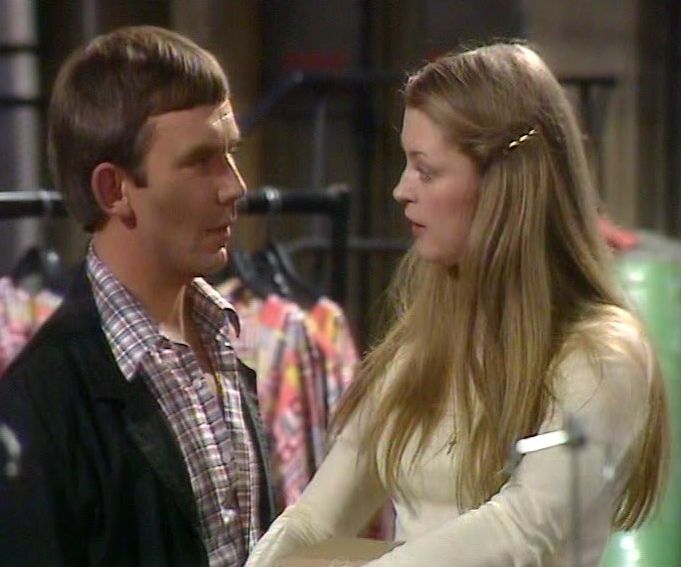
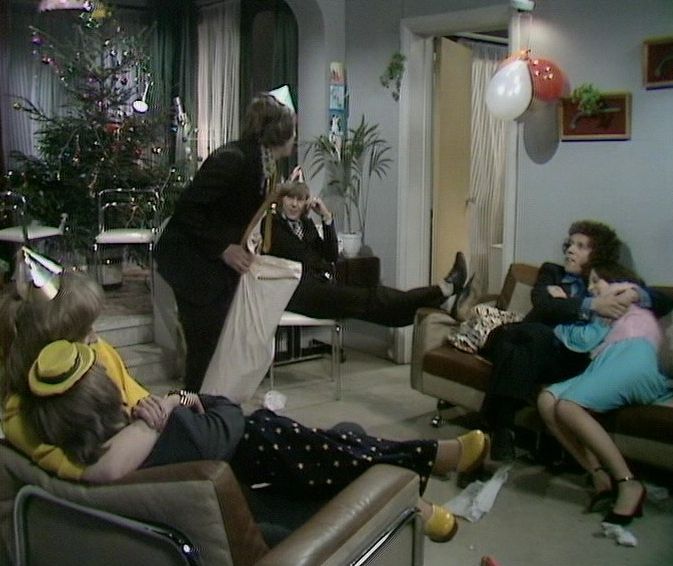
The Christmas Rush (tx 24th December 1977) finds a typically harassed Fenner attempting to chivvy the girls (and token male, Tony) into finishing up their latest order.  But of course, they’re much more interested in planning for Christmas …..

There’s a few different story threads in this one.  The first concerns Fenner’s annual dilemma – what to buy both his wife (played by Rowena Cooper) and Paddy for Christmas?  For the last fifteen years he’s abdicated this responsibility by asking Paddy to shop for his wife and his wife to shop for Paddy.  That Paddy elects to buy a smart handbag for Mrs Fenner but then pockets the accessories (purse, manicure set) is characteristic.  Mrs Fenner seem equally contemptuous about Paddy as she decides to give her one of her old presents (a manicure set!).  Fenner reacts in horror, since this was yet another gift selected by Paddy for his wife …..

The set piece comedy moment occurs after Tony bemoans the fact that he’s getting nowhere with Lyn (Gillian Taylforth).  His constant attempts to catch her under the mistletoe haven’t gone the way he planned, so Paddy suggests that if he waits until Lyn’s alone in the rest room and then switches out the light, he could embrace her in the dark.  Paddy tells him – and the other girls agree – that a woman shouldn’t be asked her consent, in fact quite the reverse (they like to be dominated).

Although Paddy later arms herself with a jug of water – all the better to pour over the randy Tony – it seems that the girls weren’t entirely lying when they suggested that the role of the female was to be submissive (although this is undercut in some of the dialogue).  You probably won’t be amazed to learn that things don’t go the way Tony planned since he ends up groping the unfortunate Mrs Fenner instead.

In today’s climate, it’s hard to imagine any scene being deemed less appropriate for broadcast (so don’t expect to see this popping up on ITV3 any time soon).  Mrs Fenner might be a little traumatised by her experience, but everybody else laughs it off and even Fenner doesn’t seem too concerned (telling his wife that Tony looks more upset than she does).

Whilst this scene, like most of the episode, is played very broadly, there’s one quiet moment – which closes the show.  With one dress ruined from an important order, Fenner needs to knock up a replacement quickly, but all the girls are keen to leave – all except Paddy.  Despite their combative relationship, she can’t bring herself to walk out (telling him that he was always a rotten machinist).  This is a beautifully played scene by Jones and Karlin which sees Fenner and Paddy share a drink in the peace and quiet of the workshop before she gets on with the job.  It certainly leaves us with the suggestion that this isn’t the first time they’ve shared a quiet moment together ….

rag 02


The Rag Trade – Christmas Box

rag 01

Like the later LWT Christmas Rag Trade, this is a programme you can’t imagine receiving a repeat these days – with this one it’s due to the fact that the girls have been making golliwogs on the side.

Although Fenner (Peter Jones) constantly bemoans the poor productivity of his staff, this never seems to be a problem when they’re working on their own initiative.  It’s very impressive that they’ve been able to knock up several hundred golliwogs over the last few days, although since they’ve used Fenner’s materials without his knowledge they have to keep him in the dark …..

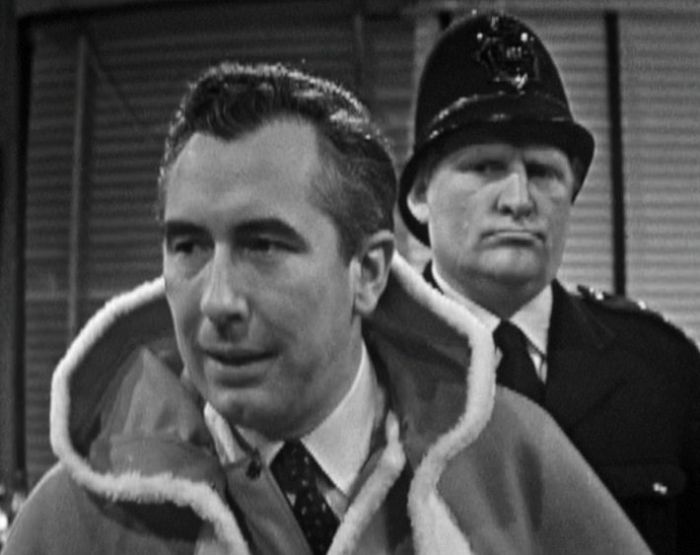
Poor Reg (Reg Varney) is deputised to dress up as Father Christmas and is sent out to flog the golliwogs from a street corner, but he runs foul of the law – in the formidable shape of Colin Douglas.  Always good to see Douglas and he’s his usual stolid self as the constable.  This officer may not be the brightest of chaps, but he’s certainly dogged in his determination to run the rogue Father Christmas to justice.

Reg, in haste, has to ditch the Father Christmas costume and so he gives it to Fenner.  It’s not hard to work out what happens next – the constable spies Fenner dressed as Father Christmass and arrests him.  But surely Fenner’s staff will vouch for him?  Mmm, not so.  They have a buyer for the golliwogs coming round and so it suits their purpose for the boss to be out of the way for a few hours.

This seems a tad cruel, especially the way Peter Jones milks the moment.  Fenner can’t even get through to Reg (we learn that they attempted to join the army together but were refused for the same reason – flat feet).  Once Fenner’s been carted off, Fenner’s Fashions undergoes a rapid transformation to become Union Toys!  This may be slightly hard to swallow, but it’s still amusing – especially the way that Reg quickly steps into the role of the boss and Paddy (Miriam Karlin) and Carole (Sheila Hancock) transform themselves into femme fatales as they prepare to use all of their wiles to persuade the hapless buyer that he really should purchase their golliwogs.

The fact that the buyer, Terence Nutley, is played by Terry Scott is something of a bonus since it ensures that every possible bit of comic potential will be wrung from these scenes.  As the girls ply Terence with drinks, he becomes more and more insensible, which creates something of a problem once Fenner returns ….

As with the rest of The Rag Trade, this one’s highly predictable from start to finish, but since everybody attacks the material with such gusto I’ve never regarded this as a problem.  Sheila Hancock is delightful as the dippy Carole whilst Esma Cannon can’t help but steal every scene she appears in (she plays the even dippier Lily).

The ending is quite neat.  After Fenner discovers the toys, the girls are forced to lie and pretend that they’ve made them for the kiddies at the local hospital.  Fenner, touched by this, happily promises to drop them off to the hospital on the way home.  So the workers don’t benefit by their pilfering, instead the only victors are the children – which seems appropriate for a Christmastime story.

rag 02

All Star Comedy Carnival – 1972. Part Two

all star 02-01.jpg

Christmas With Wogan

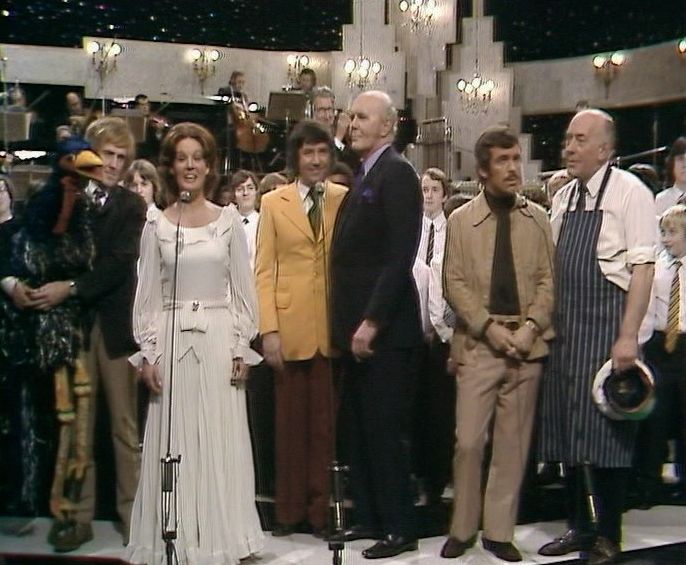
I think this could just be the greatest piece of television ever.  Things start sedately enough, with a song from Carl Wayne and Penny Lane (oh, their names rhyme) but after that the fun really begins.

Recorded on the set of Lunchtime with Wogan (all of which sadly seems to have been wiped) you can see that they’ve attempted to get the audience into the Christmas spirit by handing out some party hats.  But since there weren’t enough to go round, the camera tends to focus on the handful of lucky souls who do have one.  The audience shots are fascinating by the way (average age seems to be about eighty).

This segment is a celebration of ATV, so Crossroads naturally features quite heavily.  The sight of Amy Turtle (Ann George) pushing a tea trolley would surely melt even the hardest of hearts whilst Nurses Price and Shaw (Lynda Bellingham and Judy Buxton) from General Hospital also shuffle on.

The fun just keeps on coming as Peggy Mount, Hugh Lloyd, Leslie Crowther and Sylvia Syms appear as two ordinary couples who have been pulled out of the audience to play a game.  The sight of Crowther and Wogan attempting to shovel Mount’s ample form onto a high stool is something that will live long in the memory.

Larry Grayson, resplendent in a black cloak and mask, is brought on as the mystery guest. He has to recite his most famous catchphrases whilst the others attempt to guess his identity.  Simply sublime.

And just when you think things can’t get any better, Meg Richardson (Noele Gordon) arrives …..

Easily worth the price of the DVD alone, this is a rare Christmas treat.  Indeed, had the whole show come from the Wogan studio I would have been quite happy (although had this happened no doubt it would have been wiped along with the rest of his shows).

The Wandsworth School Choir are up next, entertaining Jimmy and the studio audience with The Holly and The Ivy.  Then Jimmy gets in the act and joins them for a trot through Do-Re-Me.  Bob Todd, as a drunken milkman, causes a little havoc for Jimmy.

all star 02-02

On The Buses

Like Love Thy NeighbourOn The Buses was one of those programmes which pulled huge contemporary audiences but hasn’t (in critical terms) aged well.  Although unlike Neighbour it does run regularly on ITV3, so clearly somebody still seems to enjoy it.  Like a number of later episodes, this was written by Stephen Lewis (Blakey) and Bob Grant (Jack).  Reg Varney is conspicuous by his absence, but he seems to have left the show after the 1972 run.

If you enjoy broad slapstick and incredible feats of mugging to the camera then this should appeal.  The story – a goose has been left on the bus and they have to stop it escaping – is the cue for everybody, including Olive (Anna Karin) and Mum (Doris Hare), to get covered in soot and flour.  For me, a little of On The Buses goes a very long way, so this is another series that I don’t have in my collection (but I don’t feel I’m missing out).

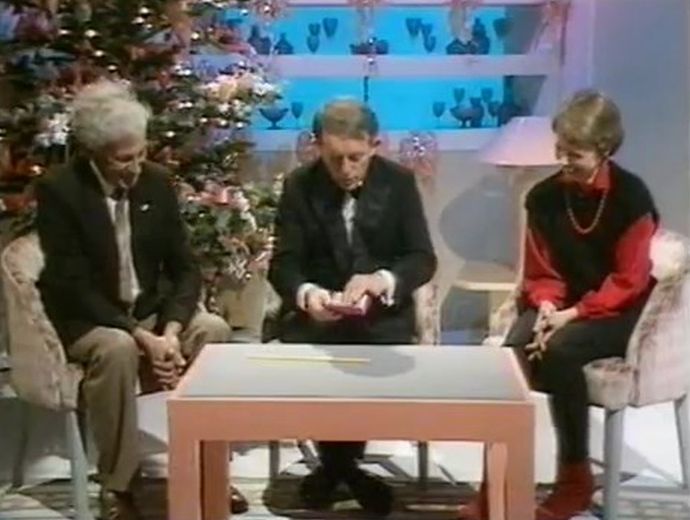
Jimmy welcomes David Nixon, who restores a touch of class to the programme.  It’s a mystery why Nixon’s existing magic shows aren’t available on DVD as he’s such an affable entertainer.  He does the eggs in the glass party trick which Tommy Cooper also attempted on his 1973 Christmas Show.  Tommy managed to get two out of four eggs in the glasses whilst David went one better – three out of three.

all star 02-03

Sez Lez

Les Dawson is on fine monologue form here.  “I bought my mother-in-law a nice fireside chair which cost me twenty five pounds and the first time I plugged it in, it fused”.  The Syd Lawrence Orchestra and Les’ dancers (Les Girls) also get in on the act.  The band are clearly all professionals as the sight of a group of attractive young ladies leaping about in silk pyjamas doesn’t put them off, not one little bit.

A moustachioed Tony Jacklin has a chat about golf with Jimmy.  They also sing ….

all star 02-04

The Fenn Street Gang

Spun out of Please Sir! after it became painfully obvious that the actors were no longer convincing as schoolchildren (they were well into their twenties by this point) The Fenn Street Gang followed their misadventures, post school.  Never as popular as Please Sir!, possibly due the fact that the characters no longer had a reason to be together and therefore the plotlines had to be split up, it still racked up an impressive thirty eight episodes.  This sketch has a good excuse for a reunion – Christmas dinner – and it passes the time nicely enough, although it’s not exactly an all-out showstopper.

Jimmy leads everybody, including Moria Anderson, Rod Hull & Emu and David Nixon, in a rousing singalong of White Christmas.  A traditional end to a real selection box of a programme – not every chocolate is especially tasty, but luckily there’s only a few hard centres.

all star 02-05

All Star Comedy Carnival – 1972. Part One

star 01

Airing for five years from the late sixties, All Star Comedy Carnival was ITV’s answer to the long-running BBC institution that was Christmas Night With The Stars.  Like its BBC counterpart, not all of All Star Comedy Carnival has survived intact, but at least the complete shows from 1972 and 1973 do exist.

“Mixed bag” is a far summation.  There’s some comedy greats and then there’s Love Thy Neighbour ….

star 02

Love Thy Neighbour

Love Thy Neighbour is one of those programmes that seems to ebb in and out of fashion.  Incredibly popular in the early seventies, by the eighties it had deeply fallen out of favour.  But whilst you shouldn’t expect a re-run on ITV3 any time soon, over the last few decades it’s begun to attract the odd kind comment – arguing that it’s not just a series of (ahem) off-colour jokes, but that there’s also an element of satire – as with Till Death.

Eddie (Jack Smethurst) tells next-door neighbour Barbie (Nina Baden-Semper) that he wishes to give her husband, Bill (Rudolph Walker), the compliments of the season (“peace on earth and goodwill to all men. Even Sambos”).  Eddie is quite happy to extend this goodwill to the wives too, which he demonstrates when he forcibly kisses Barbie under the mistletoe.  That she’s wearing the tiniest pair of hotpants imaginable suggests that the disdain Eddie shows towards Nig Nogs doesn’t extend to the attractive female ones ….

As might be expected, Bill storms in to find his wife being pawed by Eddie and then Eddie’s wife, Joan (Kate Williams), also appears.  What happens next?  Yep, Bill and Joan have a snog under the mistletoe.

To be generous, you could argue that Eddie and Bill are always equally as combative as each other and that, deep down, they have a spark of friendship.  This can be seen when Eddie (after losing the Christmas turkey on his way home from the pub) and Joan are invited round to share Christmas dinner with Bill and Barbie.

But the joke, such as it is, to close this segment is that Bill and Barbie have invited a fair few others – all of them black – which causes Eddie to visibly flinch at the thought of spending time in a room with them.  “I’m dreaming of a black Christmas”.

At the very least Love Thy Neighbour is a fascinating time capsule of the period, but I don’t think I’m going to be shelling out for the boxset anytime soon.

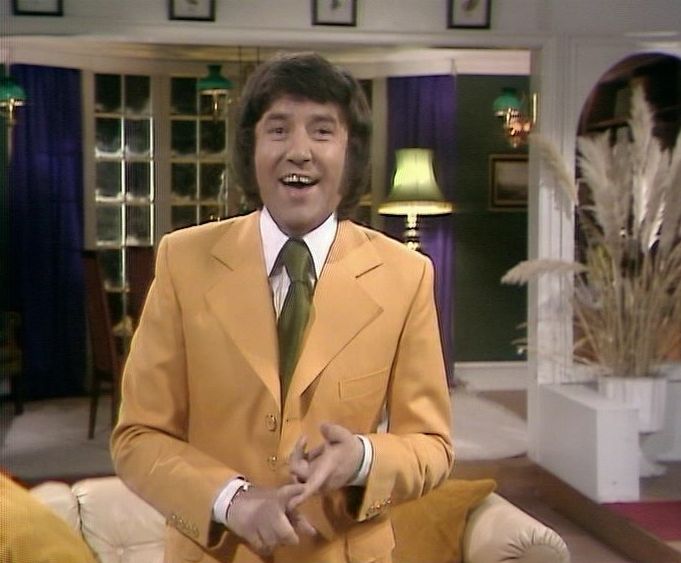
Jimmy Tarbuck, resplendent in an orange jacket, is our ebullient host – on hand to link all the segments. He’s also present to receive visitors, such as Rod Hull and Emu.  Jimmy has the perfect face for some loving attention from Emu and luckily the bird doesn’t let us down.

star 03

Nearest and Dearest

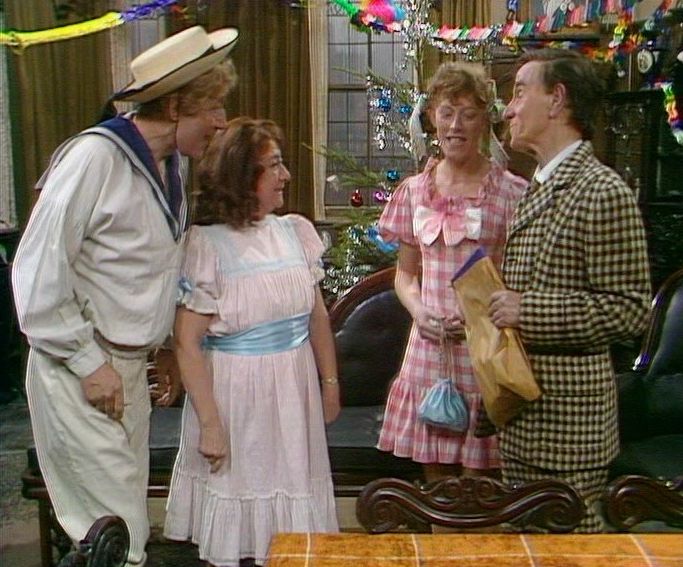
It’s Christmas time and brother and sister Eli and Nellie Pledge (Jimmy Jewell and Hylda Baker) are in a reminiscent mood.  As Nellie mentions that she gets filled with neuralgia (nostalgia) thinking about Christmases past, we’re transported back in time via the age-old trick of making the camera go in and out of focus.  Hylda Baker was a true one-off and therefore sight of her dressed as a young girl is worth the price of admission alone (the reaction of the studio audience makes it plain that they weren’t in on the gag).  Jimmy Jewell, resplendent in a sailor suit, and Madge Hindle (Lily) and Edward Main (Walter) also make for the most ridiculously unconvincing children imaginable.  Which is the point of the skit I guess.

Given that Baker and Jewel reputably loathed the sight of each other, it gives the combative relationship between Nellie and Eli something of an edge.

Once we’ve negotiated this part of the show, Jimmy Tarbuck introduces Moira Anderson singing Silver Bells.  It’s a slightly upmarket sort of song, given that the tone of most of the comedy segments are fairly low brow.  That there’s a full orchestra in the studio suggests that All Star Comedy Carnival had a more than generous budget.

star 04

Father Dear Father

Father Dear Father may have had a fairly thin premise – Patrick Glover (Patrick Cargill) finds his life endlessly complicated thanks to his two grown-up daughters Anna and Karen (Natasha Pyne and Ann Holloway) – but it’s still very agreeable.  Partly this is because of Cargill’s affable performance, although the attractiveness of Pyne and Holloway is another obvious plus (for this viewer at least).  So whilst Cargill bumbles and pratfalls about (here he manages to trip on a roller skate and fall into a lake whilst pulling the most incredible faces throughout), the girls provide an oasis of beauty.  The plot – Patrick’s dog has gone missing – shouldn’t really detain us for too long.

star 05

Thirty Minutes Worth

Harry is the increasingly disgruntled butler of a Lord and Lady.  Fuming because he hasn’t been given Christmas day off, he buttles between each end of their very long dining table, giving them increasingly garbled messages from the other whilst all the time helping himself to their port and brandy.  You’ve got to love a bit of Harry Worth.  His comic stumbles and general air of befuddlement isn’t subtle, but then the All Star Comedy Carnival isn’t really the place to find subtle.  It’s also a bonus to see the peerless William Mervyn playing the Lord.

Now we’ve reached the mid-way point it seems like the right time to take a break.  Tomorrow I’ll be tackling the remainder – Christmas With Wogan, On The Buses, Sez Lez and The Fenn Street Gang whilst various guests – including David Nixon – pop in to join Jimmy.

star 06

Tommy Cooper’s Christmas – 25th December 1973

cooper 01

Tommy Cooper’s ability to keep the audience in hysterics whilst apparently doing very little is firmly in evidence at the start of this Christmas Special.  Maybe it’s simply because the audience can see tables laden with magic props and therefore know that almost anything could happen ….

The first fifteen minutes is typical freewheeling Cooper – a captive audience, a wide selection of props and an almost endless supply of gags (“my wife’s just had a facelift. But it’s not high enough, I can still see her”).  How scripted this part of the show was is open to debate – there’s certainly a few sharp edits which suggests that some flab was excised (the fact that Cooper dashes from one trick to the other, apparently at random, may not entirely be an act then).  There are a few successes (a vanishing watch for example) but the standard of illusions here never rises above trick shop fare – although he does have a nice line in dexterity.  But then nobody watches Tommy Cooper for skilful magic.

In order to pad things out to an hour, Cooper later takes part in various sketches.  These are often not quite as entertaining as his magical efforts, but two of the longer efforts – playing snooker with Allan Cuthbertson and cooking with a puppet duck – stand out.

Cuthbertson was a Cooper regular during this time.  He’s the perfect straight man – able (almost always) to keep his composure whilst Cooper causes anarchy.  The premise of the sketch (Cooper is a golfer, not a snooker player, and so attempts to clamber on the table to take his shot, etc) may be thin but the pair of them make it work.  One of the best moments is an unscripted one after Cuthbertson has a temporary dry and garbles the order of the colours.  His slight loss of composure is palpable, although after sharing a wry grin with Cooper he pulls himself together (it’s noticeable that Cooper didn’t attempt to make capital from Cutherberton’s stumble – easy to imagine some other comics wouldn’t have been so forgiving).  The arrival of snooker legend Joe Davis (attired, like Cooper, for the golf course) proves to be a nice moment to close the sketch on.

Clodagh Rodgers and Sacha Distel provide the music.  Both have their own solo spots before joining forces for a duet.  Rogers essays a Christmas medley whilst standing in front of a series of silvery Christmas trees (maybe there was a lack of baubles that year – the trees look very underdressed).  Distel plumps for the non-Christmassy Playground in My Mind.  He doesn’t have to contend with denuded Christmas trees – instead he’s surrounded by slightly menacing masks.

Although Tommy Cooper tended to work better in the half hour format (The Tommy Cooper Hour, although boasting some impressive guests – including Abba – across its run, did sometimes feel a bit padded out) this is a decent special.  Unusual to see Johnnie Mortimer and Brian Cooke on scripting duties, as they were much better known for sitcoms than sketches.

dinnerladies – Christmas

dinner 01

Following directly on from the previous episode, Christmas finds the relationship between Bren (Victoria Wood) and Tony (Andrew Dunn) deepening – although the dramatic cliffhanger from last time (Tony and Bren enjoyed their first kiss, only to be interrupted by Bren’s estranged husband) has to be addressed first.

Although the first series of dinnerladies was traditional sitcom fare (in that each episode had a fairly linear plot) it’s clear that Victoria Wood had more ambitious plans for the second and final series.  Sitcoms with continuing storylines aren’t unique (Brass is a good example of a show with a strong serial theme) but they are unusual.

The growing attraction between Tony and Bren is one of the major plot-threads of series two, but all of the main characters have their own individual story arcs which peak at different times.  Drama mixes with comedy here, as Bren finds herself plagued by self doubt.  She can see a possible future with Tony, but her life to date (exemplified by her disastrous first marriage) makes her convinced that she’ll “bugger it all up” somehow.

Tony initially reassures her that nothing’s changed between them, but then later he becomes distant and distracted – which suggests that he’s lost interest.  He hasn’t of course (instead he’s rushing around attempting to organise an impressive Christmas and Birthday treat for her).  It has to be said that this is a slightly clumsy piece of plotting, since it demands that Bren has to jump to the wrong conclusion several times.

dinner 02.jpg

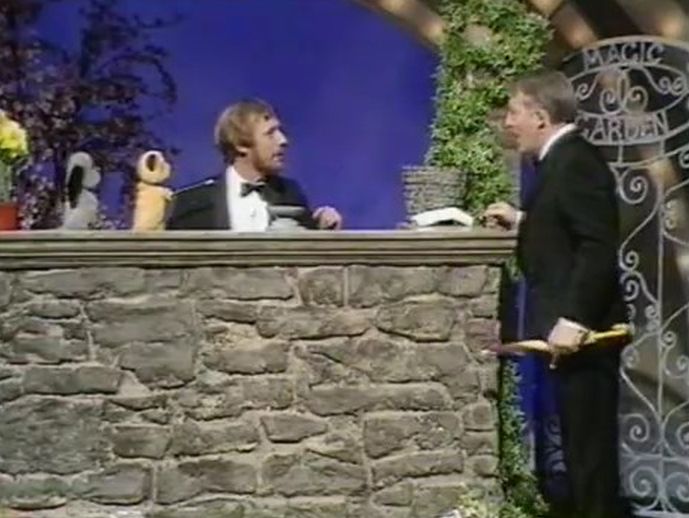
With Victoria Wood doing the heavy-lifting, drama-wise, the rest of the cast get all the best jokes.  Anita (Shobna Gulati) has her usual stream of bizarre conversational non sequiturs (today involving Disco Monks, thoughts of Michael Aspel, Sooty’s suitability as James Bond and bacon) whilst Jean (Anne Reid) and Dolly (Thelma Barlow) continue their gentle game of one-upmanship.  Jean’s latest attempt to roll back the years (she’s wearing an all-in-one bodyshaper but is having a spot of trouble with the studs) causes much merriment amongst those waiting for bacon – most notably Bob (Bernard Wrigley).

Bob later returns with Jane (Sue Devaney) for a spot of singing and dancing which draws a round of applause from the studio audience.  The unexpected arrival of Bren’s mother, Petula (Julie Walters), also – as always – entertains the audience.  With Janette Krankie in tow as her equally down-at-heel friend, Janice, Petula causes her usual amount of strife and discord, although there’s a nice sense of community as everybody else – in Bren’s absence – elects to send her packing.  If Bren has commitment issues then it’s in no small part due to her mother, who dumped her at an orphanage when she was a child (“I had her too early, there was too much going on. You can’t jive with one hand on a pram handle”).

There’s not a great deal of Stan (Duncan Preston) in this one, which is a shame, although he does have one lovely and typically bizarre monologue.  “Did I ever tell you about the day I had to go to casualty with a dart in me head? If you take my head as a dartboard it went in here (pointing to his chin) low score. Double top I’d have been dead”.  Although there’s method in his madness as he’s attempting to distract Bren, who’s on the verge of leaving Tony and the canteen forever.

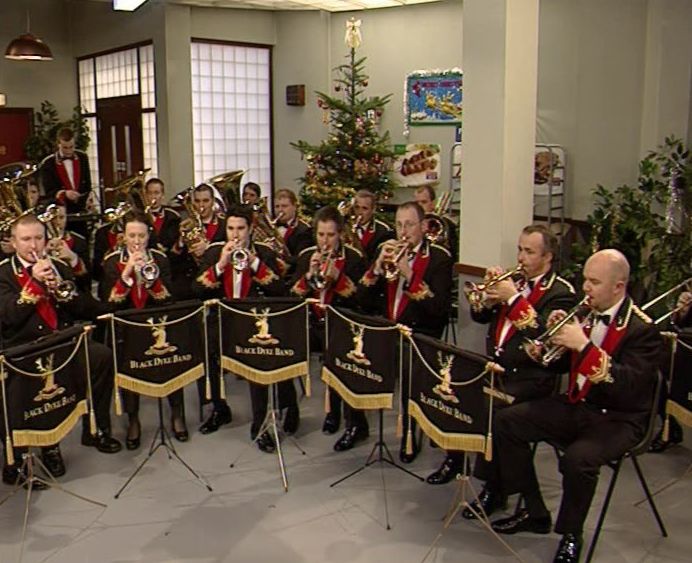
But then it’s revealed that Tony hadn’t forgotten to get her a present – in fact he’s managed to smuggle the Black Dyke Band into the canteen ….

This is another of those moments where you have to suspend your disbelief somewhat – not only that Tony could persuade the Black Dyke Band to give up their Christmas Eve but also that they were able to get Bren out of the way just long enough to sneak them all in.  Well it’s Christmas, so let’s be generous.

Slightly iffy plot mechanics aside, it’s still a touching moment and had the series ended here then it would have seemed like a natural conclusion.  But there were four more episodes to come, meaning that everybody’s stories still had a little time to run.

dinner 03.jpg

Telly Addicts – 1989 Christmas Special

telly 89

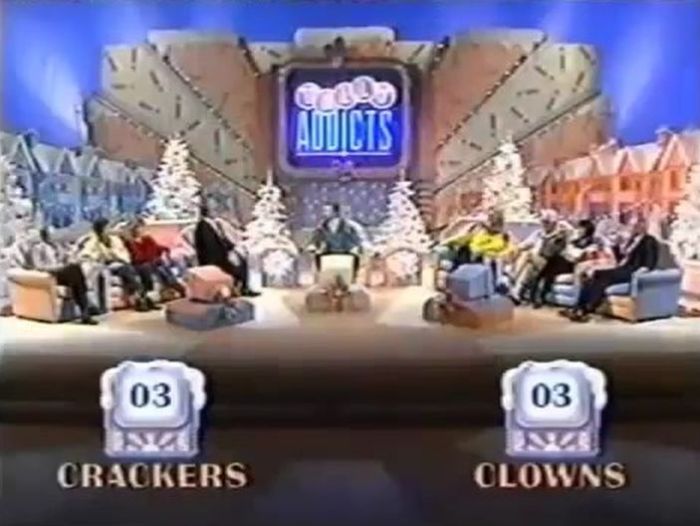
Back in those far off, pre-internet days, Telly Addicts was required viewing since it offered brief, tantalising glimpses into a television past that was otherwise pretty much off limits (look! A clip of Arthur Haynes …).  Today, of course, the archive clippage is less compelling, but it’s still an entertaining quiz.

As was usual, the Christmas special is something of a celebrity fest.  The Crackers (Graeme Garden, George Layton, Liza Goddard, Frank Carson) find themselves locked in a bitter battle with the Clowns (Chris Tarrant, Barry Cryer, Jessica Martin, Jim Bowen).  For some reason (self indulgence maybe) Noel Edmonds dubs each of them with a fictitious soap opera name.  Cryer is gifted the moniker Hugh Jampton, and no doubt he – and the older members of the audience – would have immediately understood the reference.

Memorable rounds include Guess Who, which sees ordinary members of the public stopped in the street and asked to describe a television favourite.  This sounds fair enough, but pretty much everyone picked looks a little, well … odd.  You have to assume that the television crew let the ordinary looking people pass by – it was the nutters they wanted ….

Sing the Sig is also good fun, whilst a clip from the Golden Girls seems to demonstrate that nobody on the Clowns team ever watched it.  We also get to see just the mildest amount of needle between Chris Tarrant and Noel Edmonds whilst Frank Carson (for him) is fairly subdued – although his exasperation in the final round (“why ask me? What’s wrong with them?”) is a joy.

The Paul Daniels Christmas Magic Show – 1985

paul 85-01.jpg

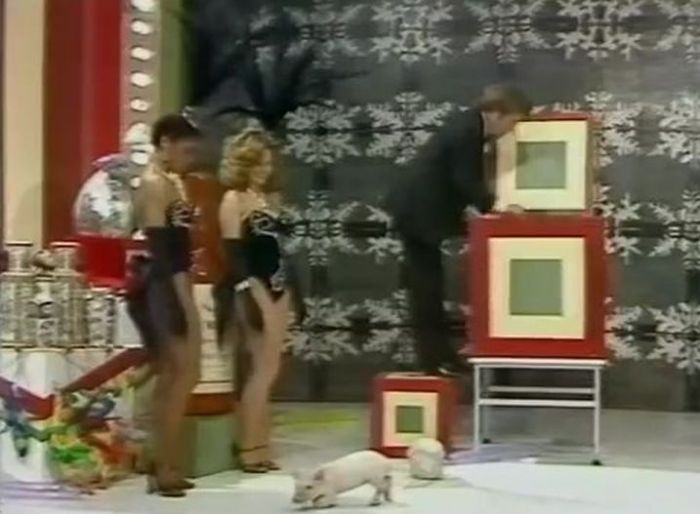
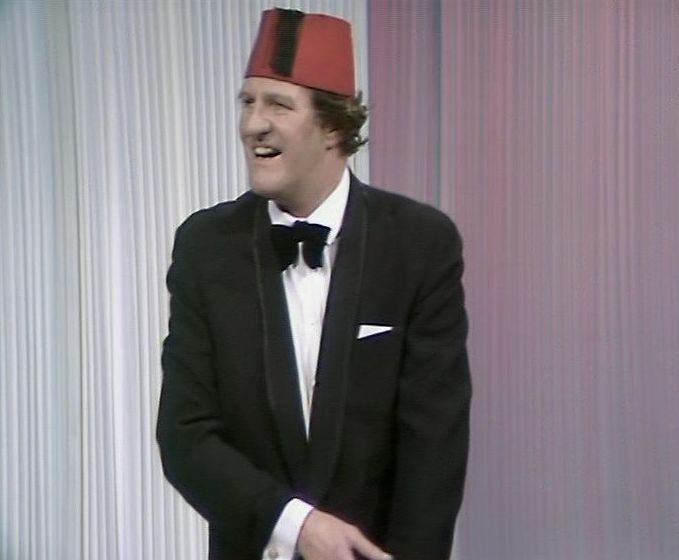
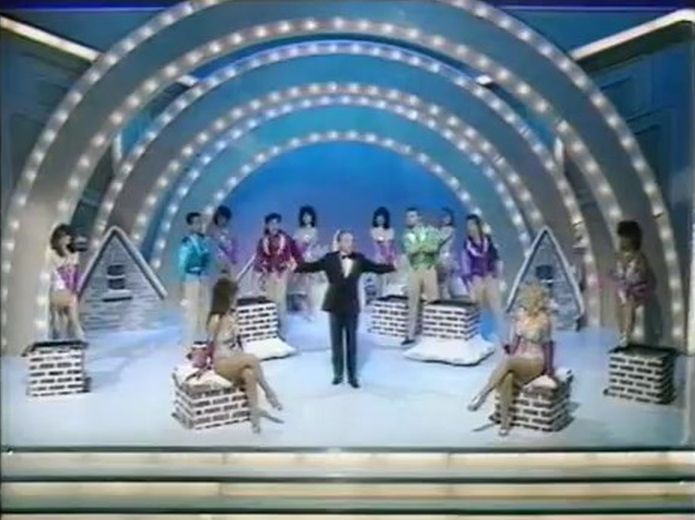
Right from the start, the 1985 Christmas Special suffers from something of a dance overload.  Paul introduces us to his two assistants (Kate Bellamy and Donald Waugh.  Yes, Hughsey from Grange Hill) who he proceeds to lock into two individual cabinets which have been made to look like chimneys.  So far, so predictable.  But then Paul ambles off the stage as the Brian Rogers dancers move onstage and proceed to leap about in a highly energetic manner.  They add a bit of glamour – albeit on the cheesy side.

As the orchestra grinds out a version of Slade’s Merry Christmas Everybody, the dancers take over the illusion – some of  them start to slice the cabinets up whilst the more attractive lady dancers are content to preen themselves.  This is all very odd, although there is a reasonable payoff when we see Paul – clearly deciding that he should get a little more involved in proceedings – mildly berating them for mixing up the boxes.  This means that the assistant’s clothes are revealed to have been swopped once the boxes are reassembled (a neat extra trick to go with the puzzle of where they disappeared to in the first place).

If Paul largely sits this one out, then it’s fair to say that he doesn’t really contribute a great deal to the remainder of the show.  There’s a few close-up illusions – the three card trick (done with four cards!) and a trick with a fifty pound note – but otherwise he’s fairly inactive until the end of show spectacular.  More on that in a minute.

paul 85-02.jpg

The Jazzy Jumpers come from America and are a young, energetic skipping troupe.  Not the most exciting of speciality acts, but undeniably skilful.  Lance Burton (direct from Las Vegas) offers us a reasonably good performance of the substitution trunk (created by Maskelyne, popularised by Houdini) although it’s odd that we never actually see the person inside the trunk who Burton had swopped with. Zhou Shurong offers eye-watering feats of flexibility.

It’s always fun when two great magicians meet – and so it is here as Paul comes face to face with Sooty.  Yes it’s Sooty, making a rare return to the BBC (and mistaking Paul for Terry Wogan – easy to do) whilst causing havoc with a miniature fountain.  This is apparently a scaled down version of an illusion performed by Dante and although it’s only a bit of throwaway fun it’s still appealing.  It was nice to see Sweep as well (oh, and Matthew Corbett).

paul 85-03.jpg

We then have a cutesy overload as Paul proceeds to tell a young chap called David all about Snow White. David looks too neat and scrubbed up to have been pulled out of the audience, so presumably he was selected well in advance (not that this really matters, as David’s main function is to react with wonder as the story of Snow White comes to life).

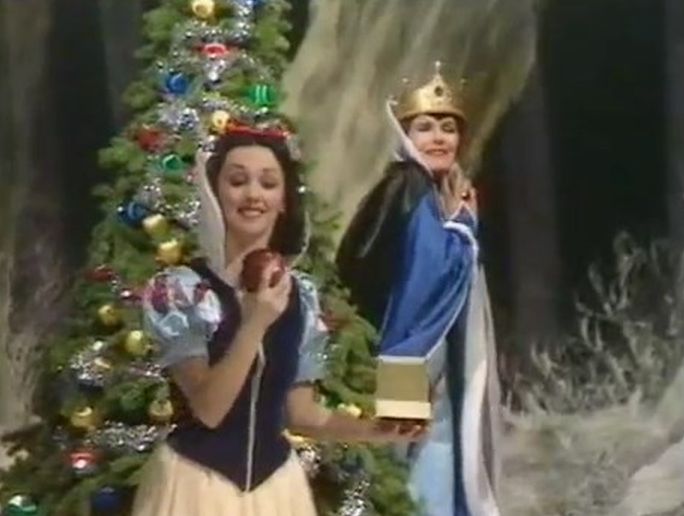
This is the cue for the return of the Brian Rogers dancers and there’s more dancing to come as we meet Snow White – who just happens to be played by Debbie.  It’s hard not to come to the conclusion that the whole closing sequence had been designed in order to show off her dancing talents (you may not be surprised to hear that Snow White gets the chance to do a spot of hoofing).  A few illusions are thrown in but they’re all rather secondary to the showbizzy razzle dazzle (the seven dwarfs are played by children, for that extra awww factor).  It’s nice to see Fenella Fielding as the wicked Queen though.

The showbiz feel is maintained right until the end as each performer returns to the stage in order to take their bows.  As a Christmassy extravaganza this is decent enough fare, but as a magic show it’s something of a disappointment.

paul 85-04.jpg

Detectorists – Series One to Three. Acorn DVD Review

cover.jpg

It may be a cliché but I just can’t help myself – Detectorists is a hidden treasure.

The fact it’s been tucked away on BBC4 has helped to ensure that it’s never achieved mainstream status, but I don’t feel this is necessarily a negative.  For the viewers it helps to create a sense that this is our programme, something we’ve discovered and cherish just that little bit more because it’s not topping the ratings each week.  As for Mackenzie Crook (the writer, actor and director) had Detectorists been a successful BBC1 programme then the pressure to keep that success going would no doubt have been just a little greater.  Although since it won the 2015 BAFTA for Best Situation Comedy, no doubt he may have felt just a little pressure anyway ….

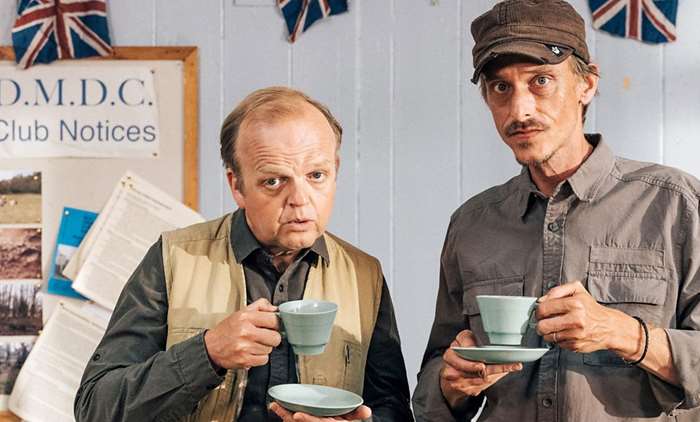
Andy (Crook) and Lance (Toby Jones) spend their leisure time metal detecting.  As members of the Danebury Metal Detecting Club (DMDC), they share their passion with others who – like Andy and Lance – could be said to exist somewhat on the fringes of society.  But whilst the small band of DMDC brothers and sisters may be slightly dysfunctional, one of the strengths of Detectorists is that Crook’s writing is never judgemental or designed to generate a cheap laugh.

Instead, there’s a feeling of warmth and inclusiveness that permeates each episode.  This is a difficult balancing act to achieve – a touch too much pathos and things are liable to turn mawkish and sentimental – but Crook rarely puts a foot wrong on this score.
As the first series opens, we find Andy and Lance fruitlessly searching for treasure (alas, they’re more inclined to discover a bewildering variety of ring-pulls).  Their dream – especially that of Lance – to one day find something of historical importance is a running theme, but it quickly becomes clear, as Crook has confirmed, that the core of Detectorists is the relationship between Andy and Lance (so their hobby could have been anything which appears, at first glance, to be inexplicable to the majority).

detectorists 01.jpg

It’s when they down tools and mull over the important issues of the day (how many questions they got right on last night’s University Challenge, for example) that the series first begins to spark into life.  But their musings about television quiz shows give way later in the series to deeper matters – as both begin to open up about their respective relationship issues.  And it’s this deeply nuanced byplay which really impresses – a depiction of male friendship which doesn’t rely on the scatological (Men Behaving Badly) is a rare thing indeed.

Andy’s relationship with his girlfriend Becky (Rachael Stirling) hits a few bumps during the various series.  In series one, the arrival of Sophie (Aimee-Ffion Edwards), an attractive young history student, sows discord between Andy and Becky whilst in series two, the pair have an important life decision to make – Becky is keen to move abroad for a while whilst Andy is equally keen to stay at home.

Meanwhile Lance also has his fair share of domestic problems.  His ex-wife Maggie (Lucy Benjamin) is a very needy character, despite the fact that she has a capable – if lazy – new boyfriend.  It’s testament to Crook’s writing that even early on, when the characters had barely been established, we feel for the unfortunate Lance – endlessly manipulated by the hideous new-age Maggie (a wonderfully self-centered performance by Lucy Benjamin).

And although she’s gone by series two (before making a memorable reappearance in series three) that doesn’t mean that Lance’s life became any less complicated.  The arrival of Kate (Alexa Davies), the grown-up daughter he’s meeting for the first time, sends him into something of a tailspin whilst Toni (Rebecca Callard) is everything that Maggie isn’t – a loving, warm-hearted individual who seems just right for him.  But the path of true love is never smooth …..

Each of the three series has a running metal-detecting sub-plot.  In the first, the DMDC clash with a rival club, led by two individuals – Art (Simon Farnaby) and Paul (Paul Lee) -who bear an uncanny resemblance to a singing duo whose name escapes me.  In series two, a young German called Peter (Daniel Donskoy) becomes a love-interest for Sophie whilst also attempting to locate a crashed WW2 plane. In series three, both Andy and Lance are on the hunt for treasure, although for Andy it’s a race against time (he’s desperate to buy his dream cottage – but without making a stunning find this seems unlikely).

Detectorists might be centered around Andy and Lance, but it’s a true ensemble production which allows every cast member their moment to shine.  Gerard Horan and Sophie Thompson, as Terry and Sheila, are both simply divine.  Terry is the president of the DMDC (grander than it sounds, since membership never seems to edge into double figures) whilst Sheila is his ever-helpful wife, always present at meetings in order to provide refreshments (although you’d be well advised never to touch her lemonade).  She’s gloriously disconnected from the real world whilst Terry is highly pedantic but strangely lovable (Horan’s possibly best known for playing a not totally dissimilar character – Charisma – in London’s Burning).

detectorists 02.jpg

Since Andy and Lance are something of an inseparable partnership, it’s logical that the other members of the DMDC are also paired up.  Although Louise (Laura Checkley) and Varde (Orion Ben) are in a relationship, this is handled in a very matter-of-fact way (they’re a couple, and that’s that).  Clearly with Varde, less is more as we don’t actually hear her speak until the middle of the second series.

A far less likely combination – although with them it’s strictly business – is Russell (Pearce Quigley) and Hugh (Divian Ladwa).  One of my favourite moments across all three series occurs when an incredulous Russell discovers that Hugh’s in his thirties (and therefore isn’t, as he’d previously assumed, a teenager).  It’s also hard to beat the sequences, also in series two, where the pair search for the Mayor’s chain of office, which he lost in a very strange place indeed.

Art and Paul have some of their finest moments during the third series. Paul develops an independent streak whilst both are involved in a hair-raising low-speed chase with Andy and Lance. That they also have a secret identity (as Batmen) comes as something of a surprise.

And whilst she may only feature fleetingly, Diana Rigg as Becky’s mother Veronica adds a dash of star quality to the cast.  It isn’t the first time that the real-life mother and daughter partnership of Rigg and Stirling have worked together, although it’s highly characteristic that the very diffident Crook was initially reluctant to approach her.  Mackenzie Crook has nothing of the bluster and self-importance of, say, Ricky Gervais – although maybe it’s precisely this seeming lack of ego (which appears to bleed into the programme) that is so attractive.

Each of the three series boasts substantial making-of documentaries – Discovering Detectorists (24″34′) on series one, A Day Out With The Detectorists (31″53′) on series two and Welcome to the Clubhouse (27″53′) on series three.  The series three disc also has interviews with Diana Rigg (5″09′), Mackenzie Crook (08″17′) and Sophie Thompson (07″04′).

It seems that Detectorists has now run its course (although Crook made similar comments after the second run).  A pity if so, but it’s wise to quit when you’re ahead I guess.  If there aren’t going to be any more episodes then this boxset is the ideal time to jump aboard if you’ve yet to sample the series.  And if you are a newcomer then I don’t think you’ll be disappointed as Mackenzie Crook has crafted a programme which can easily hold its own against some of the sitcom greats of the past.

Detectorists – Series One to Three (including the 2015 Christmas Special) is released by Acorn on the 18th of December 2017.  RRP £39.99.

detectorists 03.jpg

The Paul Daniels Christmas Magic Show – 1984

paul 84-01.jpg

The 1984 Christmas Show comes front-loaded with celebrities as Clare Francis, Anneka Rice, Bonnie Langford, Val Doonican and Larry Grayson are brought on for a spot of banter and magic.  All receive a warm reception from the studio audience but it’s Grayson who generates the most whoops and cheers by far.

Both Bonnie and Anneka are very eye-catching (Bonnie sports a silver pair of trousers whilst Anneka has a sparkly top and a  very short skirt).  Paul was never slow in appreciating female beauty, so it’s no surprise that he seems a little smitten with Anneka (“lovely leg, shame about the other one”).  Although I’m not sure whether his mispronunciation of her first name was deliberate or not ….

paul 84-02

This is a nice, relaxed opening to the show – allowing the likes of Larry Grayson to camp it up a little (unsurprisingly).  He’s also selected to wear a bag on his head (in order to check that when Paul puts it on, he can’t see out of it).  Given that Paul’s still wearing the wig, I was slightly concerned they’d be an accident, but everything passes off without a hitch (although it’s noticeable that when Paul removes the bag, he does instinctively check that everything’s still in place).

There are two speciality acts on the show.  Both are perfect for Christmastime viewing (maybe one day somebody might decide that a variety show on Christmas day would be a good idea – stranger things have happened).  First up is Kris Kremo.  I love a juggler, and they really don’t come any better than Kremo – who not only juggles with his hands but also his feet to begin with.  His act climaxes with the juggling of three cigar boxes – a familiar sight, but Kremo’s dexterity is something special.

George Carl has to slowly work the audience – his style of silent clowning proves to be something of a slow burn – but by the end he seems to have won everybody over (at the start, laughter is more sporadic – meaning that it’s possible to pick out several very distinctive hearty laughing types).

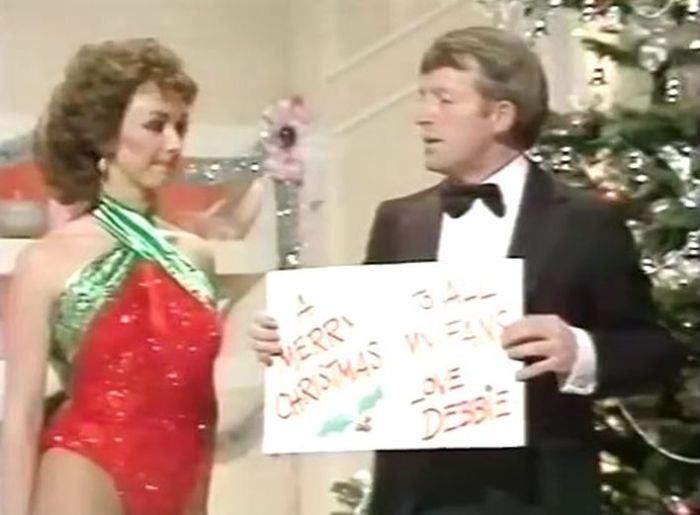
Debbie is now a part of the show.  She doesn’t have a great deal to say, but it’s plain that she’s higher up in the pecking order than Paul’s previous assistants (she appears in one of the six picture boxes on the end credits).

When I wrote about the 1980 special, I mentioned that there were no big illusions.  That’s redressed here, as Paul contrives to vanish one million pounds under the watchful eyes of Owen Rout (the general manager of Barclays Bank) and Robert Maxwell.  Maxwell’s later misdeeds gives this whole illusion something of a bleak irony.  It certainly proves hard to take your eyes off him.

When Paul announces that the money is shortly to enter the studio, it’s impossible to miss the way that Maxwell’s eyes light up.  Maxwell also can’t prevent himself from getting involved every step of the way (instinctively reaching for the safe key, constantly wanting to touch the money, etc). And then there’s the moment when Paul refers to Rout and Maxwell as men of integrity ….

As an unashamed television geek, one of the reasons I love this part of the show is that the cameras are allowed to shoot off the edge of the set.  So we get to see the studio cables, monitors and doors as well as the orchestra (who rarely, if ever, appeared on screen).  The money arrives in the studio to the strains of The A Team (no, me neither) and then the long process begins – opening the safe, extracting another safe containing the money, checking that the money is genuine, moving the safe with the money into a clear Perspex container.

This is one of those illusions where you know right from the start what’s going to happen (and also that it’ll only take a few seconds) but in order to have any impact the whole thing has to build very slowly.  Therefore some twenty minutes (the climax of the show) is spent on this trick – a considerable amount of time, but it never feels drawn out.  Luckily, after all the preamble it turns out to be a baffling mystery – no doubt if I searched hard enough I could find the solution, but discovering how tricks work is much less enjoyable than wondering how it was achieved.

paul 84-03.jpg

The Paul Daniels Christmas Magic Show – 1980

paul 80-01.jpg

Paul Daniels notched up fifteen consecutive Christmas Specials on the BBC between 1979 and 1993, a staggering feat which no other performer has come close to matching (unless I’ve missed someone blindingly obvious).   Daniels’ sometimes abrasive performing style (forged in the white heat of the Northern Working Mens Clubs) and his outspoken opinions on numerous subjects always ensured that he seemed to be as loathed as he was loved, but there’s no denying the influence he had on modern magic.

Following his death, most of the great and good of the magic world queued up to pay tribute – although it’s also fair to say that many were equally as fulsome when he was alive.  This clip from Penn and Teller: Fool Us never fails to bring a smile to my lips, not least for the obvious respect that both Penn and Teller – but especially the ebullient Penn – had for Paul.

Rewinding back to 1980, this was Daniels’ second BBC Christmas Special and the first to be transmitted on Christmas day itself (surprisingly he’d only manage this feat a further three times – in 1981, 1982 and 1985).  It’s the early days of the series, so the lovely Debbie McGee has yet to appear on the scene.  Daniels’ assistants here are equally as attractive – and sport some remarkable costumes – but are never allowed to speak.  Paul’s wig is still very much in evidence (as is, in the opening few minutes, a remarkable red velvet suit).

Another feature of these early series was “the jury” – a group of handpicked members of the studio audience who were allowed to get up close and personal (their job was to try and work out exactly how the tricks worked).  But it was also useful in another respect, as it meant that Paul didn’t have to trudge out to the wider studio audience in order to find his next hapless victim.

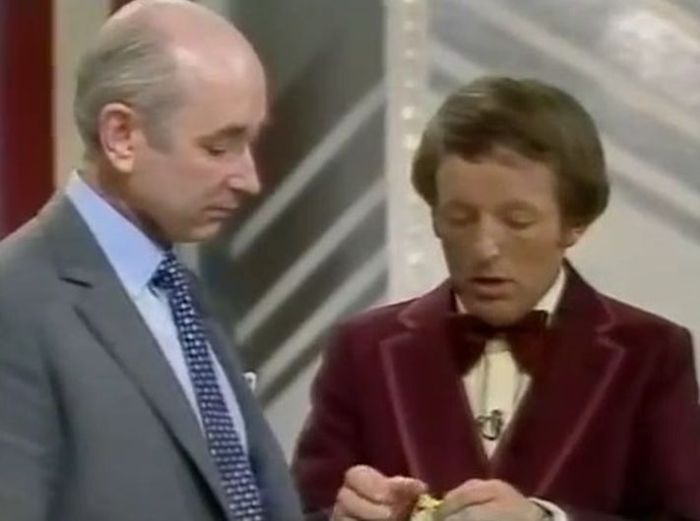
The first trick – involving Peter and his watch – is typical Daniels.  He borrows Peter’s watch in order to do a clever trick which inevitably goes wrong.  All appears lost and Peter seems resigned to losing his precious timepiece, until Paul miraculously pulls it out of the middle of a Christmas cracker (well this is a festive show).  Although Paul gives his victim a slightly hard time, you know that everything will work itself out in the end, so the joshing never seems particularly cruel or unkind.

I like the mentalism trick which he performs with a rather attractive young woman from the jury.  It’s another neat piece of close-up magic and doesn’t outstay it’s welcome.  Paul’s next turn – in the Christmas Bunco Booth – is possibly the most memorable part of the show.  Not because it’s a decent trick (in fact, there’s no trick at all) but simply because it demonstrates how some things never seem to change …..

paul 80-02.jpg

Paul opens by bemoaning the fact that since the economy is going through something of a rough patch, plenty of people are feeling the pinch (which plays equally as well in 2017 as it did in 1980).  But then he tells us his solution – separate Scotland from England and give the Scots their own currency.  Eerily prescient stuff.  As I said, there’s no trick here – just a clever piece of number juggling which allows him at the end to turn to camera and tell Mrs Thatcher and Geoffrey Howe that’s how they should be running the country!

Guest-wise, Lilly Yokoi’s bicycle act is very impressive (a pity it wasn’t a little longer).  Whereas during Michael McGiveney’s quick change act I did wish it was a little shorter.  There’s no denying the ability of McGiveney (acting out a scene from Olivier Twist, playing all the characters) but after you’ve seen one quick change you’ve seen them all (and it’s fair to say that McGiveney’s a better quick change artist than he is an actor).  Compagnie Philippe Genty offer diverting, but not riveting, puppet fun.

paul 80-03.jpg

Paul never seemed threatened by other magicians, as the appearance here of Harry Blackstone suggests.  Blackstone performs the sawing a woman in half trick – although by using a circular saw it creates a heightened sense of anticipation.  It’s the one major illusion in the show, which makes it all the more surprising that Paul didn’t perform it – but he was obviously happy doing the smaller stuff.  Other illusionists might have been tempted to throw in blood and screams, but Blackstone – possibly mindful of the Christmas Day audience – keeps it clean.  The camera’s close enough to see the saw apparently slicing through flesh though, so it’s still slightly disquieting.

Paul ends the show by pulling out a bewilderingly large number of Christmas presents from a very small box.  It’s a cute ending (although I’m not sure that they’d get away with using live animals today) and although there’s no staggering illusions in this 1980 Special it’s still a very convivial way to spend fifty minutes.

paul 80-04.jpg

Doctor Who – The Edge of Destruction. Episode Two – The Brink of Disaster

brink.jpg

The previous episode ended with the Doctor being attacked by a mysterious assailant.  It’s therefore something of a letdown to learn that it was only Ian – trying to warn the Doctor not to touch the controls, as they would have given him an electric shock.

Ian had two choices of course.  Choice number one would have seen him tell the Doctor not to touch the controls whilst choice number two is to throttle the Doctor into submission.  Yes, he goes for choice number two.

But why Ian would think the controls would be dangerous (and how he managed to awake from his drugged sleep) is a bit of a mystery.  Yes, Susan was attacked by the console in the previous episode, but we saw the Doctor touch the controls later on with no ill effects.

For a few minutes, the Doctor is still convinced that Ian and Barbara are the cause of his problems, but eventually the penny drops that something is wrong with the ship.  Barbara decides that the TARDIS has been trying to warn them.  “We had time taken away from us and now it’s being given back to us because it’s running out” is just one of her baffling utterances which make no sense at all.

And the reason why the TARDIS acting so oddly? The Fast Return Switch was broken (a faulty spring!) and is hurtling the ship towards destruction. But rather than issue a conventional warning, the TARDIS decided that a series of oblique and bizarre moments would be just the ticket.  Also, it’s impossible not to love the fact that somebody has written “fast return switch” in felt-tip on the console!

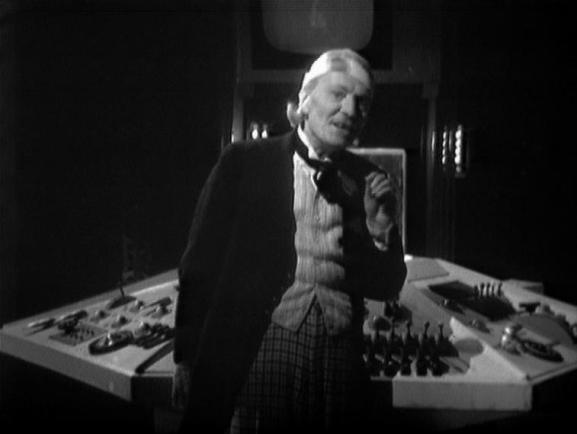
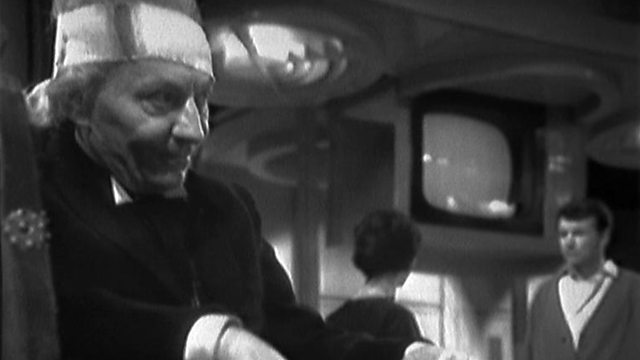
Hartnell has quite a long monologue which is designed to wrap the mystery up.  Even at this early stage he was never keen on lengthy speeches – due to the worries he had with remembering lines.  He is a bit wobbly in this story from time to time, but he’s pretty much perfect when it comes to this sequence.  Although his reaction when receiving the script (“Christ! It’s bloody Hamlet!”) strongly implies that he needed some persuading to learn it!

I know. I know. I said it would take the force of a total solar system to attract the power away from my ship. We’re at the very beginning, the new start of a solar system. Outside, the atoms are rushing towards each other. Fusing, coagulating, until minute little collections of matter are created. And so the process goes on, and on until dust is formed. Dust then becomes solid entity. A new birth, of a sun and its planets.

It was very possible that this would have been the final episode of Doctor Who.  If so, then it would have ended with a more mellow Doctor finally beginning to appreciate his two new companions.

DOCTOR: I’d like to talk to you, if I may. We’ve landed on a planet and the air is good, but it’s rather cold outside.
BARBARA: Susan told me.
DOCTOR: Yes, you haven’t forgiven me, have you.
BARBARA: You said terrible things to us.
DOCTOR: Yes, I suppose it’s the injustice that’s upsetting you, and when I made a threat to put you off the ship it must have affected you very deeply.
BARBARA: What do you care what I think or feel?
DOCTOR: As we learn about each other, so we learn about ourselves.
BARBARA: Perhaps.
DOCTOR: Oh, yes. Because I accused you unjustly, you were determined to prove me wrong. So, you put your mind to the problem and, luckily, you solved it.

It also reinforces the notion that all four members of the TARDIS crew have something to contribute.  It was Barbara who solved the mystery in this story, Susan returned to the TARDIS to fetch the anti-radiation drugs in The Daleks, Ian made fire in An Unearthly Child, etc.

This might be something of a ramshackle story, but at only two episodes it doesn’t outstay its welcome and apart from a few decent character moments it’s mainly memorable for the subtle reshaping of the Doctor’s character.

Doctor Who – The Edge of Destruction. Episode One

edge

This is odd.   A mysterious explosion in the TARDIS has robbed everybody of the ability to act.  William Hartnell’s the luckiest, as he spends the first ten minutes unconscious on the floor whilst Jacqueline Hill doesn’t come off too badly (she’s been positioned as the sensible one since the first episode and that carries on here).

It’s William Russell and Carole Ann Ford who get the rough end of the stick.  Whether it was as scripted or Russell’s choice, but for the first half of the episode Ian’s lines are spoken in a numbing monotone whilst Ford enjoys violent mood swings as Susan goes somewhat loopy.

There’s a number of bizarre moments, but one of my favourites is at 7:21 when Susan tries the controls of the TARDIS and extravagantly plummets to the floor.  “She’s fainted” says Ian afterwards, blindingly stating the obvious.

This was the first story to use stock music rather than specially composed tracks.  Eric Siday was the composer and one of the cues should be familiar (as it was later reused in The Moonbase).  But the problem is that there’s not enough music and ambient sound effects used – meaning that for long stretches there’s nothing but the raw studio sound.

A prime example is when Susan comes back into the console room and notices that the TARDIS doors are open.  This is clearly a dramatic moment – the ship hasn’t landed so it shouldn’t happen – but it’s played out to a totally dead atmosphere – no music, no effects.  It’s possible that this was intentional (to highlight something was wrong with the TARDIS).  Or possibly not.  It all depends how generous you want to be, I guess.

After fainting, Susan threatens Ian and later stabs her bed with a pair of scissors in a notorious scene which was somewhat controversial at the time.  Why Susan is acting irrationally (and why Ian doesn’t seem to be acting at all!) is never made clear – was this due to the explosion at the start or is it part of the TARDIS’ defence mechanisms (which we’ll discuss during the next episode).

This is an interesting exchange –

SUSAN: I never noticed the shadows before. It’s so silent in the ship.
BARBARA: Yes. Or we’re imagining things. We must be. I mean, how would anything get into the ship, anyway?
SUSAN: The doors were open.
BARBARA: Yes, but, but where would it hide?
SUSAN: In one of us.

It’s a red herring as nothing did get into the ship, but the concept that an alien invader might be hiding in one of them is a powerful and disturbing one.

The Doctor’s now up and about and is convinced that Ian and Barbara have sabotaged the TARDIS. It’s not possible to say for certain that the Doctor is acting irrationally (like Susan) because he’s been a very changeable character since episode one.

I think it was simply the Doctor being his usual suspicious, arrogant self – but it gives Barbara the chance to tell him some well deserved home truths. Jacqueline Hill is wonderful in this scene, as she is throughout the episode. Whilst the others have been erratic, Barbara remains strong.

BARBARA: How dare you! Do you realise, you stupid old man, that you’d have died in the Cave of Skulls if Ian hadn’t made fire for you?
DOCTOR: Oh, I.
BARBARA: And what about what we went through against the Daleks? Not just for us, but for you and Susan too. And all because you tricked us into going down to the city.
DOCTOR: But I, I.
BARBARA: Accuse us? You ought to go down on your hands and knees and thank us. But gratitude’s the last thing you’ll ever have, or any sort of common sense either.

Frankly it’s worth sitting through the episode for that exchange alone.

We end with the Doctor having drugged(!) the others so he can examine the TARDIS in peace. But somebody then attacks him. Or do they? Possibly it’s just a very contrived cliffhanger.  All will be revealed when we reach The Brink of Disaster.

Doctor Who – The Daleks. Episode Seven – The Rescue

rescue

The literal cliff-hanger from last time saw Antodus fail to jump the ravine – which means he’s plunged down a bottomless cavern and Ian (tied on the other end of the rope) is slowly losing his grip on him.  There’s something rather casual about this sequence – why Ian doesn’t call for help from the others?  And even when Ganatus does pop up, neither of them are very quick to twig that a little more assistance would be a good thing.  With Kristas and Barbara also holding onto the rope they should have been able to pull Antodus up.

As it is, Antodus settles the matter by cutting the rope and plunging to his death.  This is a moment that can be taken several ways – was it a noble act of self sacrifice (saving Ian’s life) or did Antodus (who was convinced they’d all die) commit suicide because he didn’t have the nerve to carry on?

Although Ian tells Ganatus that his brother died to give them a chance, it’s not really a credible statement.  Alydon and the rest of the Thals just seem to stroll into the Dalek City, which makes the efforts of Ian, Barbara, Ganatus and Kristas seem somewhat futile (why make all that effort to gain access via the caves when they could have just walked in through the front door?!)

Meanwhile, the Doctor and Susan are prisoners of the Daleks.  Hartnell has a great line – “this senseless, evil killing” – which helps to give the Doctor a sense of morality that hasn’t always been present in the episodes to date.
The climax of the story is a little bit of a damp squib – the Daleks’ control room is invaded by the Thals and after the briefest of battles the Daleks all die.  Their power has (somehow) drained away, exactly how is never really explained.  After seven episodes it would have been nicer to have a more considered conclusion.

In Nation’s original draft, it was revealed that a third party had engineered the war five hundred years ago between the Daleks and the Thals for their own benefit.  This mysterious alien presence then returns to Skaro and the Daleks and Thals team up to destroy it.  Although the televised ending is a little abrupt, I certainly prefer that to the original draft which poses more questions than it answers (why did the aliens decide to return to Skaro after so long?)

Hartnell’s Doctor has another small, defining moment. “I might just say this to you. Always search for truth. My truth is in the stars and yours is here.”  It’s character scenes like this where Hartnell really excels.

So if the conclusion is a little disappointing (as is well known, Terry Nation wrote the seven scripts very quickly – for him it was just another job.  “Take the money and fly like a thief”) then there’s still enough memorable moments from the earlier episodes to always make this a rewarding rewatch.

Doctor Who – The Daleks. Episode Six – The Ordeal

ordeal.jpg

An aptly named episode this.  The Ordeal is the point where the wheels start to come off as the story begins to splutter to a conclusion which will continue in the following episode.  The main problem with episode six is that the bulk is taken up with the efforts of Ian, Barbara and the Thals to break into the Dalek City – and this is very, very dull.

It can’t help but feel very padded out – had there not been seven episodes to fill then no doubt it wouldn’t have taken so long to find a way in.  Alas we have to follow them for almost the whole episode as they explore the very small cave sets very slowly.

There’s the odd moment of interest though.   There seems to be something of a romantic spark between Barbara and Ganatus which Ian is oblivious to.  Although Ganatus’ comment that they won’t use one of the customs of her planet – ladies first – is baffling (just how long have they had to discuss the Earth?)  When David Whitaker novelised the story he elected to make Barbara very antongistic and distant to Ian as they attempted to breach the city – it was a surprise to me that this wasn’t a part of the television original.  I mourn for the glass Dalek as well …..

Antodus continues to be the weak link in the group –

ANTODUS: Ganatus. I want to go back.
GANATUS: What for?
ANTODUS: I can’t go on any more.
GANATUS: You must.
ANTODUS: No. We’re going deeper, deeper all the time. We’ll be trapped in the mountain, I know we will. Please, Ganatus, let me go back.
GANATUS: You can’t.
ANTODUS: But you don’t really need me, not really. I could, well, I could go back and signal to the others that we’ve managed to get as far as we have.
GANATUS: Antodus, we go on together.
ANTODUS: Why? Why are you making me do all these things? Even if we do get through, we’ll never defeat the Daleks. Ganatus, we’re all going to be killed.
GANATUS: We can’t turn back now.
ANTODUS: The others can’t, but we could. Listen, they’re going to die anyway. We could just go back and tell the others that the Daleks killed them.

Alas, the next line is fluffed by Philip Bond (Ganatus) when he says that Antodus has to go back, rather than go on. But there’s nothing to do but press on, hope the audience hasn’t noticed and luckily an unconvincing rock-fall causes a distraction.

There’s not much Hartnell in this one, but he does have a lovely scene where he disables a control panel outside the city.  He spends so much time crowing about this (“a superior brain”) rather than taking Susan’s advice that they should leave, that the pair end up getting caught by a group of Daleks!

The first time, but by no means the last, that the plot has to come to a virtual halt to fill the episode count. Often there’s enough decent character interaction to make it more bearable, but The Ordeal (with its sub 1940’s adventure serial atmosphere) doesn’t have a great deal going for it.

Doctor Who – The Daleks. Episode Five – The Expedition

expedition.jpg

The Expedition opens with Ian ranged against the Doctor and Barbara.  The fluid link needs to be retrieved from the Dalek City, but Ian is reluctant to ask the Thals to help them (“What victory are you going to show these people when most of them have been killed? A fluid link? Is this what you’re going to hold up to them and say, ‘Thank you very much. This is what you fought and died for’?”).

The Doctor has no qualms in asking for the Thals’ help – he needs the fluid link back and they’re a ready made fighting-force, so it’s of no concern to him whether they all die in the attempt.  Barbara is equally keen to retrieve the fluid link and escape from Skaro – she’s convinced that the Daleks will find a way to travel out of the city and kill them all (“Oh, they’ll find a way. They’re clever enough. They’ll find us and kill us, you know that as well as I do.”)

There’s no evidence to support this though (is she simply playing on Ian’s fears for their safety?) and he remains resolute.  It’s a key part of the story and it’s a little surprising to find this debate in a Terry Nation story – his yarns tended to be drawn in more clearly defined shades of black white.  In the end Ian does persuade the Thals to help – by making them see that they will also be guaranteeing their own survival.  At one point Barbara complains that Ian is only playing with words and there’s more than a kernel of truth in this.

In the Dalek City there’s some interesting things going on, thanks to Christopher Barry’s direction.  A group of Daleks have elected to take the Thals anti-radiation drugs (inducing death).  We see one of the Daleks die from their POV, in a slightly trippy, drug-induced way.  The moans emanating from the Dalek do sound slightly comic, but it’s another reminder that in this story they’re not portrayed just as mindless killing machines.  These signs of vulnerability, together with their more conversational mode of speech, would later be dropped as the Daleks lose any spark of individuality (except maybe for David Whitaker’s two Troughton stories).

It does feel a little contrived that the Daleks only now realise the anti-radiation drugs don’t  work since they’ve become conditioned to radiation and need more of it to survive.  Therefore they intend to release another bomb which will also have the pleasing side effect of wiping out of Thals.  The war ended five hundred years ago, why have the Daleks only just twigged that radiation is essential to their survival?

The Doctor elects to mount a two-pronged attack – one group to distract the Daleks on the city wall whilst the others attempt to break into the city from the rear – braving the jungle and the lake of mutations.  This is the first of Terry Nation’s Doctor Who jungles and despite it’s small size is effectively realised.  Partly this is due to Brian Hodgson’s sound design which creates a real sense of unease (Ian beating off a clip of stock footage is less impressive).

The monster that rises out of the swamp is another decent moment, although it does slightly look like a rubber ring with two glowing eyes.  As previously mentioned, on the lower resolution televisions of the time this no doubt would have looked more convincing.  Although I’m quite convinced now – maybe I’m easily pleased?

Ian and Barbara are accompanied by five Thals – although their party is quickly reduced by one when the hapless Elyon is sucked into the lake at the end of the episode (via another decent inlay shot).  Antodus complains to his brother Ganatus that they’re all doomed, doomed (a theme which will continue into the next episode).

Doctor Who – The Daleks. Episode Four – The Ambush

ambush

The range of camera effects at the disposal of the Doctor Who production team in 1963/64 was incredibly limited, but The Ambush has some very effective shots (which were also quite easy to achieve).  Inlay effects are used to show the Dalek lift moving up and down and also a section of wall scorched by a Dalek gun.  Simple stuff, compared to what can be achieved today, but it works very well.

The Doctor’s capacity for self-preservation is still very much to the fore –

DOCTOR: Lets get back to the ship.
SUSAN: No, no, I must warn the Thals.
DOCTOR: Susan.
SUSAN: We can’t let them walk into a trap.
DOCTOR: The Thals are no concern of ours. We cannot jeopardise our lives getting involved in an affair which is none of our business.
BARBARA: Of course it’s our business. The Thals gave us the anti-radiation drug. Without that, we’d be dead!

The ambush scene is a little odd. Before the Thals arrive there’s a creepy scene showing the Daleks slowly backing into the alcoves. If they had stayed there and killed the Thals from the shadows this would have made sense. But instead, as Temmosus makes his impassioned speech about working together, the Daleks move out into the open. Since the Thals would have expected to meet the Daleks, why would they hide themselves?  It makes the moment a dramatic one, but that’s about all.

Also, why does Ian just stand there waiting as the Daleks move into position? He seems certain that the Daleks mean the Thals harm, so it’s baffling that he doesn’t speak until after the Daleks have opened fire.

This is very much Ian’s episode and it goes without saying that William Russell is very solid. And as the Doctor spends his time researching the history of Skaro (seemingly caring little for the modern-day plight of the Thals) it falls to Ian to try and make them understand that they may have to fight to secure their future.

ALYDON: If only I knew why the Daleks hated us. If I knew that, I, I could alter our approach to them, perhaps.
IAN: Your leader, Temmosus.
ALYDON: Yes?
IAN: Well, he appealed very sensibly to them. Any reasonable human beings would have responded to him. The Daleks didn’t. They obviously think and act and feel in an entirely different way. They just aren’t human.
GANATUS: Yes, but why destroy without any apparent thought or reason? That’s what I don’t understand.
IAN: Oh, there’s a reason. Explanation might be better. It’s stupid and ridiculous, but it’s the only one that fits.
ALYDON: What?
IAN: A dislike for the unlike.
ALYDON: I don’t follow you.
IAN: They’re afraid of you because you’re different from them. So whatever you do, it doesn’t matter.
DYONI: What would you have us do? Fight against them?
IAN: I didn’t say that. But you must teach them to respect you. Show them some strength.
DYONI: But you really believe we ought to fight.
IAN: Yes, I think it may have to come to that.
DYONI: You understand as little about us as the Daleks do!

Barbara later comments that “I don’t understand them. They’re not cowards, they don’t seem to be afraid. Can pacifism become a human instinct?” But the Doctor’s not concerned about the fate of the Daleks and the Thals and is keen to leave.  Ian, Barbara and Susan may feel more invested in the Thals’ fate, but they also agree with the Doctor that it’s time to move on.

Indeed, at the end of this fourth episode it does feel that the story has come to a conclusion. We didn’t witness the fate of the Tribe of Gum, so would there have been an expectation of the audience back in 1964 that this story would have been any different?

The Doctor’s missing fluid-link is the only reason that he decides to stay – ensuring that he’s forced to help the Thals (although as we’ll see, he’s ruthless in using them to help himself).

Doctor Who – The Daleks. Episode Three – The Escape

escape-01

The Escape opens with Susan meeting Alydon (John Lee).  Born in Tasmania, Australia, Lee didn’t have a trace of an Australian accent and instead spoke in the RP tones that were so prevalent during this era of British television.  Every line he intones is spoken with deadly seriousness (and note how, in his initial scene with Susan, he stays remarkably still).  It’s the sort of performance that can so easily seem wooden and unnatural, but Lee manages, just about, to give Alydon a spark of life.

Much more naturalistic is Philip Bond as Ganatus.  Bond (father of Samantha) has more to play with in the script, since Ganatus has a mocking sense of humour as well as a questioning nature.  If their leader Temmosus (Alan Wheatley) is inclined to think the best then Ganatus is a more reflective character.

Temmosus might well have had cannon fodder written on his forehead.  He’s no fool, but it seems clear that the Daleks have no intention of helping the Thals – and that he’s ill-suited to lead them in the struggle that will follow.

TEMMOSUS: I believe the Daleks hold the key to our future. Whatever that future may be, we must accept it gracefully and without regret.
ALYDON: I wish I could be as objective as you. We’ve lived for so long a time.
TEMMOSUS: Perhaps we have lived too long. I’ve never struggled against the inevitable. It’s a vain occupation. But I should always advise you to examine very closely what you think to be inevitable. It’s surprising how often apparent defeat can be turned to victory.

Ganatus’ brother Antodus in mentioned, but we don’t see him in this episode (although he’ll play a key part later on in the story). The suggestion that he’s a flawed character is established when Dyoni (Virginia Wetherell) wonders if he’s still afraid of the dark. A small point, but it helps to sow a seed of doubt about his ability to deal with stressful situations.

escape-02

Terry Nation never really excelled when writing for female characters (except, maybe, for Servalan in Blakes 7 – and that was probably only because she was originally written as a man) and Dyoni is no exception.  Wetherell spends most of her time in this episode pouting and reacting jealously to any mention of Susan.  Dyoni’s comment that Alydon should have given the drugs to a man, not Susan, are slightly wince-inducing.  As we’ll see, Dyoni’s only value to the plot seems to be her relationship to Alydon (she’s the lever that Ian later uses to persuade the Thals to fight the Daleks).  Apart from this, she’s very much a cipher.

And what of our four heroes?  They remain prisoners, but they work together to devise a plan to escape.  These scenes are particularly interesting because all four characters contribute to the debate.  In years to come it’ll mainly be the Doctor who has the solution – with everybody else relegated to sitting on the sidelines.  But the Doctor doesn’t have all the answers here, and it’s only after they pool their resources that a workable plan is produced.

DOCTOR: Let’s concentrate on the Daleks. Have you noticed, for example, that when they move about there’s a sort of acrid smell?
SUSAN: Yes, yes, I’ve noticed that.
BARBARA: I know. A fairground.
IAN: That’s it. Dodgems.
DOCTOR: It’s electricity. I think they’re powered that way.
IAN: Yes. But just a minute. They have no pick-up or anything. And only the base of the machine touches the floor. How do they complete the circuit?
SUSAN: Batteries?
DOCTOR: No, no. I believe the Daleks have discovered a way to exploit static electricity. Very ingenious, if I’m right.
BARBARA: What, drawing power from the floor?
DOCTOR: Precisely. If I’m right, of course.

This is a good episode for Carole Ann Ford. She’s typically wide-eyed and appealing in her initial meeting with Alydon and later has an excellent scene with the Daleks when they dictate a letter promising to help the Thals. It’s plain that they don’t intend to keep their promise though, reinforced by the push one of them gives to Susan with their sucker arm once the letter is written. It’s just a throwaway moment (possibly worked out in rehearsal) but it helps to give the Daleks more of a human touch.

The scene where the Doctor and the others disable a Dalek and remove the creature (in fact, nothing more than a joke-shop gorilla hand) is a memorable one and it leads into a strong-cliffhanger as Ian (inside the Dalek) leads the others out into the corridors as they attempt to make their escape.

escape-03.jpg