Brady is appalled to learn that one of his most trusted colleagues, Professor Owens (Walter Fitzgerald), is refusing to return from his holiday in Italy. Instead he’s taken to spending all his time at the roulette table. Brady rushes out to confront him, but everything’s not as it seems ….
It’s a little odd that the opening scene effectively blows the mystery. We see Owens and his teenage daughter Suzy (Julia Lockwood) being menaced by Curly Caletta (Alan Tilvern) which makes it pretty obvious that Owens is being forced to use his mathematical skills in order to win huge sums of money for Caletta.
Had this scene not been included, then the reason for Owens’ sudden change of character would have been less easy to understand. But no matter, bringing Tilvern in at the start means that he’s got a little more screentime (which is most welcome).
Alan Tilvern had the sort of face which ensured he spent a great deal of his time playing villains. He only has to pop up here in the background, glowering gently, and you just know that his character’s a bad type. And with a name like Curly Caletta it might not surprise you to hear that he’s an American gangster of Italian extraction.
Walter Fitzgerald, who earned a guest star credit, isn’t called on to do a great deal except look worried and bewildered whilst Julia Lockwood, playing Owens’ daughter, has the sort of cut-class accent which wouldn’t have sounded out of place in a 1930’s film. She’s very winsome and appealing as a damsel in distress though, even if she doesn’t have a great deal to do.
Once Brady learns of Owens’ dilemma he pledges to help, which means using his invisible skills to rig the roulette table. It’s rather strange that nobody questions the way that the ball seems to suddenly have developed a mind of its own – dashing from left to right until it settles precisely where Brady wants it to go! Dee, who unexpectedly turns out to be a devotee of the roulette table, is more than delighted at the way things turn out.
Familiar faces can be spotted at the casino. Olaf Pooley is the harassed casino manager whilst Oliver Reed is an uncredited player at the roulette table.
Like the ITC shows of the sixties, this episode mixes stock footage and studio sets to create an impression of foreign climes (pretty effectively it must be said). The climax allows the invisible Brady to confront Caletta with a string of obvious comments. “Your luck’s run out. The odds are against you. You spun the wheel just once too often.”
Another agreeable twenty five minutes, helped along by Alan Tilvern’s polished villainy.
Crowther (Willoughby Goddard) and his henchman Williams (Brian Rawlinson) kidnap Sally and issue Brady with an ultimatum. If he wants her returned, then he’ll have to steal £50,000 from the bank ….
Bank Raid was a pretty cost-effective tale, since it used material shot for the unaired pilot. The first half is new, with a different take on Sally’s kidnap, whilst part two is lifted direct from the pilot (the bank raid and aftermath).
The episode opens at the riverbank. Sally appears to be fishing by herself and Williams makes a move to snatch her. Rawlinson is decidedly creepy (Williams tells Crowther not to worry, he has a way with children). The tension ramps up a little more as Williams advances on Sally, preparing to use his scarf as a gag.
This tension is quickly dissipated once it’s revealed that Brady (in his invisible state) is fishing alongside her. The sight of his fishing rod bobbing up and down is a nice image as is the later scene of Brady lifting weights at home (once again invisible, of course) with Sally by his side, joining in. It’s odd though that Brady didn’t seem to notice Williams by the riverbank, chatting to Sally. Presumably he must have been engrossed in the fish he was attempting to land …..
In the pilot, Sally was kidnapped off-screen, here we see the girl abducted from her school. Crowther, posing as a doctor, manages to convince Sally’s headmistress that the child’s mother is lying desperately ill in hospital. When Dee later turns up to collect Sally she’s understandably shocked that her daughter was allowed to go off with a stranger. Clearly it was a more trusting time.
Deborah Watling is the recipient of a few nice new scenes, most notably when Crowther is driving her away. She idly decides that he would look much better if he was invisible!
But as with the original, once Sally’s in the clutches of Crowther and Williams she pretty much disappears, only popping up again right at the end. My comments on the bank raid part of the plot from the pilot still stands – it’s fairly diverting stuff but the tension level is pretty low.
Willoughby Goddard is good fun as the corpulent Crowther whilst Brian Rawlinson’s Williams starts off in sinister mode (both during the fishing scene and later, when he confronts Dee in a scene from the pilot). By the end though, both of them have been made to look faintly comic after Brady effortlessly outfoxes them.
A story of two halves then. The new material beefs up the episode somewhat, but it’s still not the best that the series has to offer.
When Joe Green (Dermot Walsh) is jailed for a crime he didn’t commit, he vows to clear his name. This he attempts to do by escaping multiple times, although on each occasion he’s caught and returned to prison. His story reaches Brady who decides that anyone who goes to such lengths might just be innocent. So Brady breaks into prison to find out more ….
The first thing to note is that security at the prison must be terribly lax if Joe’s been able to make a break for it on five separate occasions. Good grief, presumably there’s a constant stream of criminals making bids for freedom!
Dermot Walsh impresses as Joe. Walsh had a pretty lengthy career with a starring role in the 1962/63 series Richard the Lionheart. Clearly “inspired” by a string of similar 1950’s series (most notably The Adventures of Robin Hood) it’s good clean fun and comes complete with a theme-song that’s even more jaunty than the Robin Hood effort.
Joe might have been a bad ‘un in the past but he’s attempting to go straight now. Unfortunately for him, his reputation makes him the ideal choice to take the fall for other people’s crimes. Joe’s dogged determination (most notable during the scenes when he’s making his escape attempts – pursued by warders and dogs) makes you root for him. You know that everything’s going to come right in the end, but Walsh is skilled enough to take the material he’s given and play it for all it’s worth.
Lurking in the prison is Sharp (Ronald Fraser), a vicious inmate who is paid to dispose of Joe (although you get the feeling he would have been equally happy to do it for free). Fraser’s always an actor worth watching and whilst Sharp is only a small role he makes the most of it. The violence is kept to a minimum, but it’s plain that given the opportunity Sharp could be very unfriendly indeed.
Denny Dayviss also makes a brief, but memorable appearance. She plays Doris, a pickpocket who pinched Joe’s wallet on the night of the crime and therefore could prove his innocence. Dayviss only had three credits to her name, with one of the others being the wonderfully named Cynthia Smallpiece in the Hancock’s Half Hour episode Sid in Love.
Jailbreak is another routine crime story in which Brady’s invisible skills are pretty much surplus to requirements. But as so often, the guest cast makes it a joy to watch (also of interest are Ralph Michael as the prison governor and Michael Brennan as Brenner, a somewhat unfriendly warder. At one point Brenner moves to strike Joe, so Brady – in his invisible state – picks up an iron and knocks him unconscious!).
A friend of Brady’s, airline pilot Arthur Holt (Philip Friend), is convinced that his plane is being used for drug smuggling. His co-pilot Sandy Mason (Jack Watling) is implicated in the smuggling ring and frames Arthur. Before Arthur can tell the authorities all he knows about the smugglers, he’s shot – with the only witness to his attempted murder being his blind wife, Katherine (Honor Blackman).
A generous amount of the story – the first five minutes – is used to set everything up. It’s pretty evident right from the start that Arthur is honest whilst Sandy has something to hide (Watling ensures that Sandy looks more than a little shifty).
Jack Watling, father of Invisible Man co-star Deborah, had form for appearing in series which featured his daughter (Doctor Who being the other notable example). He’s just one member of a very strong cast who help to enliven this story. Honor Blackman, a few years away from finding fame as Cathy Gale in The Avengers, is another but it’s Leslie Phillips as the cold-hearted Sparrow who makes the most vivid impression.
More used to playing comedy, Phillips plays it dead straight as the well-spoken “Cock” Sparrow, who calls at Arthur’s house, claiming to be a friend of his. But when Arthur turns up, he shoots him and makes a swift exit. Did Sparrow know that Katherine was blind and would therefore struggle to describe him? Even if he did, it seems a little foolhardy to have struck up a conversation with her, as proves to be key in bringing him to justice.
Robert Raglan plays Detective Inspector Heath, yet another police officer completely unfazed at the prospect of receiving assistance from an invisible man, whilst the very recognisable Desmond Llewelyn hovers in the background as his sergeant.
Blind Justice (ah, do you see what they did there?) makes few calls on Brady’s special power until the last few minutes – as Brady convinces Katherine to pretend she can see (and helps her along the way) so that she can walk up to Sparrow and convince him that she saw him shoot her husband. Brady hopes that this will break his nerve and make him confess all.
A fairly routine crime story then, but the London location filming and the incredibly impressive guest cast (especially Honor Blackman and Leslie Phillips) are more than adequate compensation.
Two criminals break into an atomic plant and take photographs of a series of secret plans. But how will they get them out of the country? When Dee, traveling to Paris with Brady, spots a shady type – Walker (Derek Godfrey) – placing something into the lining of a mink coat owned by Penny Page (Hazel Court), she realises that something odd is happening. And soon they put two and two together ….
It has to be said that the secret plans weren’t terribly secure. The two crooks (immaculately attired in suits, ties and hats, as befits a well-dressed criminal from the 1950’s) only have to snip through some barbed wire and they’ve gained access to the compound. And once in, they have no trouble in locating the plans which are inside an unlocked drawer. Maybe putting them into a safe would have been wiser.
Top marks for the security guard, who dies an impressive death. No sooner has he rushed into the room and blurted out “who’s there?” than he gets shot (although he’s only on screen for a few seconds, the actor certainly milks it for everything he’s got).
For once, it’s Dee who’s ahead of the game and she has to keep plugging away at Brady to make him understand that something odd’s going on. Eventually he takes her seriously, especially after Walker attempts to ingrate himself with Penny aboard the flight. He wants to get close so he can obtain the microfilm, but Penny – an independent woman – isn’t impressed by his smooth approach.
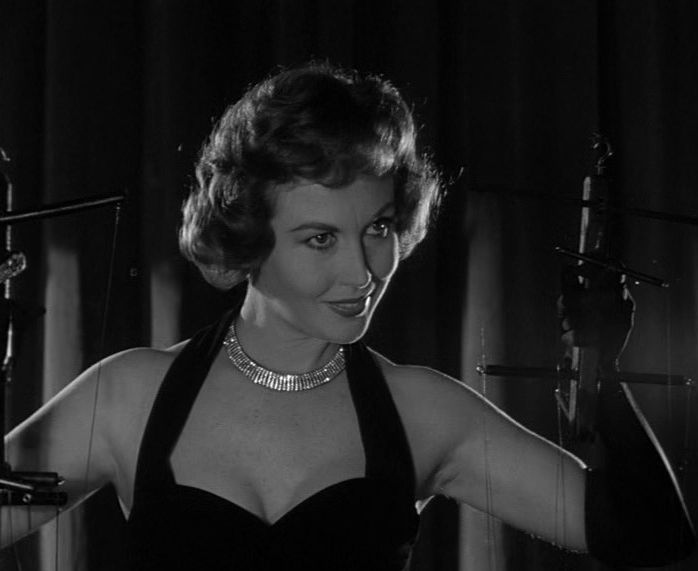
The Mink Coat is enhanced by the appearance of Hazel Court. She was renowned as a Scream Queen, thanks to her appearances in a string of classic horror films (The Curse of Frankenstein, The Raven, The Masque of the Red Death). Penny’s a quirky character, which is evident right from the start – before Penny boards the Paris flight she produces a puppet who converses with the customs officer.
She’s an ace puppeteer (the doll with the dolls, as her advert puts it) who plies her trade in Paris at the interestingly named Blue Jeans Club. The Blue Jeans Club is especially noteworthy for one of the worst examples of miming I’ve ever seen (13:32 in, the trumpeter is ridiculously unconvincing).
Penny’s act (with a striptease doll) is mildly risqué, but since this was the late 1950’s everything’s terribly restrained. This is also evident after Penny returns to her dressing room to get changed – the camera coyly moves away as she begins to undress and Brady – lurking around in his invisible state in order to examine her coat – also makes a break for the door (he’s too much of a gentleman to hang around and take advantage).
Hazel Court gets to scream a couple of times (most impressively) whilst there’s a late, dialogue-free appearance from Joan Hickson as Madame Dupont. Hickson’s expression as she spies Penny’s husband – the juggler Marcel le Magnifique (Murray Kash) – rushing to her rescue is memorable (possibly it was his tights which caught her attention).
Thanks to Hazel Court (and Penny’s puppets) this one is highly enjoyable. I especially like the tag scene, which sees Penny introduce a puppet Invisible Man into her act!
Brady is persuaded to board a Russian trawler in order to help a sailor who wishes to defect. But he doesn’t know that the Russians have developed an ingenious device which allows them to “see” him when he’s invisible ….
Shadow on the Screen is somewhat clunky. This is partly due to the wide array of false Russian accents on display but some of Ian Stuart Black’s dialogue is also rather stilted, especially in the early scenes. Brady is visited by Bratski (Raymond Phillips) a man who has dedicated his life to rescuing dissidents from behind the Iron Curtain. Whilst Bratski is impassioned, Brady is non-committal about pausing his researches in to order to help Stephan Vasa (Edward Judd). Phillips doesn’t really convince and things aren’t helped by the very earnest speech then delivered by Brady.
Week after week refugees escape from the tyranny of Eastern Europe. They jump ship, smuggle onto trains, cut their way through barbed wire. Each step calls for human courage and suffering.
This sort of polemic doesn’t feel natural – since it’s hard to believe anybody would actually speak like that.
Edward Judd doesn’t do a great deal, but it’s nice to see him nonetheless (if you haven’t caught it before, then I recommend the classic early 60’s British sci-fi film The Day The Earth Caught Fire, which features a fine performance from Judd). Vasa’s wife Sonia (Greta Gynt) is also lightly sketched and is chiefly memorable for her expressive facial contortions in the opening scene once Vasa is dragged back onto the ship (after an unsuccessful attempt to make a break for freedom).
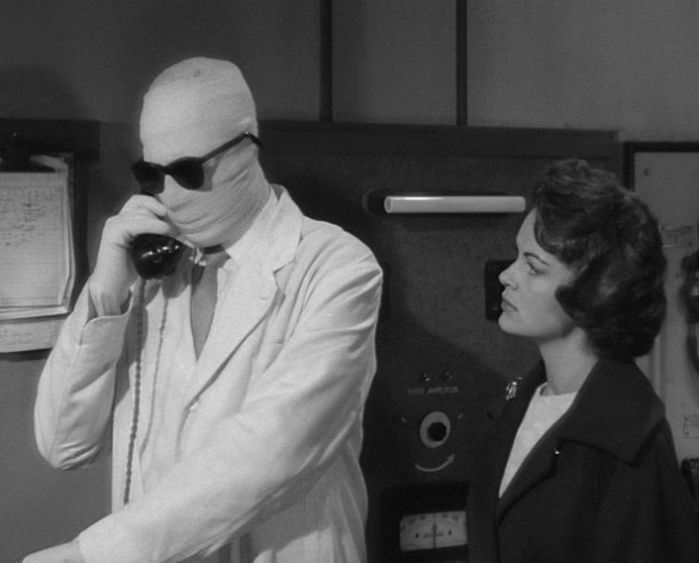
But if the main story is a little unengaging, there’s plenty of compensations elsewhere. Brady goes invisible and is driven around by Dee. The only way we know he’s there is courtesy of his cigarette, which pleasingly bobs up and down every time he talks! Such a simple effect, but it really sells the illusion that he’s sitting in the passenger seat.
These scenes also have a pleasant travelogue air as Dee drives around the eerily deserted streets of London (which more than anything helps to date the story) and past various notable landmarks.
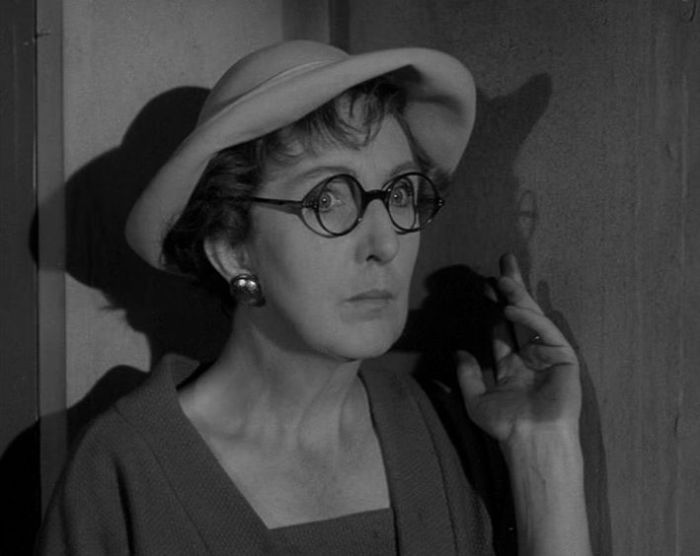
There’s a lovely touch of comedy as Brady encounters a woman in a lift, not once but twice, who he confounds each time with his invisible ways. She’s played by the peerless Irene Handel which is the reason why these short scenes are such a joy.
The Invisible Man detector is a handy gadget, although unsurprisingly it’s not something that turns up again (it’s pretty obvious why – since it rather negates Brady’s USP). There’s fun and games during the closing minutes as Brady – kept captive on the trawler – uses all the invisible tricks at his disposal to gain his freedom and that of Vasa.
It’s fairly simplistic stuff then, but if the twenty-five minute format always means that character development rarely rises above the perfunctory level, conversely it also allows the episode to rattle along at a fine pace.
Broadcast between February and April 1978, series two of 1990 continued to chronicle Jim Kyle’s (Edward Woodward) fight against the all-powerful Public Control Department (PCD). My thoughts on series one can be found here.
Several key cast changes had been made since the conclusion of the first series. Although Robert Lang returned as PCD supremo Herbert Skardon, Clifton Jones and Barbara Kellerman (who played deputy PCD controllers Henry Tasker and Delly Lomas during S1) didn’t. It’s fairly easy to understand why Jones might have been dropped (Tasker was by far the least developed of the three and therefore often seemed to be surplus to requirements) but Kellerman’s absence was more perplexing.
The relationship between Kyle and Delly provided the first series with dramatic impetus (especially the “will they, won’t they” conundrum) and the introduction of the new deputy PCD controller, Lynn Blake (Lisa Harrow), could be seen as an attempt to replicate a similar relationship. Kyle and Lynn have a history – they used to be lovers – which instantly creates a source of tension, since her new job will inevitably bring her into direct conflict with Kyle.
Lisa Harrow & Edward Woodward
It’s possible that Lynn’s character was a hastily written replacement for Delly Lomas (maybe because Kellerman was unavailable for S2) otherwise it rather stretches credibility that Delly’s replacement was also someone whose relationship with Kyle had the same uneasy mix of business and pleasure.
Home Secretary Dan Mellor (John Savident) is another absentee, with Kate Smith (Yvonne Mitchell) taking his place. 1990 was Mitchell’s final television role (she died in 1979, aged 63). Although primarily a stage actress, she had notched up some notable film and television credits during her career – for example, Nigel Kneale’s 1954 adaptation of Nineteen Eighty Four in which she played Julia opposite Peter Cushing’s Winston Smith.
Series two kicked off with Wilfred Greatorex’s Pentagons. Kyle is now a member of Pentagon, one of a growing number of dissident groups. But whilst he favours non-violent action (“words have won more batttles than bullets”) others, such as Thomson (John Nolan), are more keen to fight fire with fire ….
Nolan (probably best known for his semi-regular role in Doomwatch) is one of a number of familar faces who pop up in this one – Barry Lowe, Oscar James and Edward de Souza also feature. Lisa Harrow, debuting as Lynn, makes an immediate impression. Harrow and Woodward share a series of strong two-handed scenes which form the core of the episode (Lynn has been tasked to discover the identity of the PCD mole who has been passing sensitive material to Kyle). Juggling several plotlines – including the complex relationship between Kyle and Lynn – Pentagons is a solid season opener.
Lisa Harrow & Robert Lang
As with the first series, the second run of 1990 used a small pool of writers. Creator Wilfred Greatorex penned four episodes, Edmund Ward contributed three whilst the remaining episode was provided by Jim Hawkins (his sole contribution to the series).
Edmund Ward’s three episodes – Trapline, Ordeal by Small Brown Envelope and Hire and Fire – were broadcast third, fourth and fifth and therefore form the heart of the second series.
In Trapline, Commissioner Hallam (John Paul) seeks Kyle’s assistance. Hallam may be a senior officer in the civil police, but he bitterly tells Kyle that it’s “the second-class police force. The street sweepers that clear up after the politicals”. Private security firms such as Careguard, run by William Grainger (John Carson), are where the real power lies, thanks to their links to the PCD.
It’s always a pleasure to see John Paul (Doomwatch‘s Spencer Quist) as well as John Carson (one of the most dependable and watchable character actors of his generation). The episode explores how the authorities (both Hallam and the new Home Secretary, Kate Smith) have grown increasingly concerned about the unregulated power wielded by the PCD and Careguard. The fact they want Kyle to help them is an irony which amuses him greatly.
Edward Woodward & John Paul
The verbal fencing between Skardon and Smith, as both jostle for supremacy, is highly entertaining as is the interaction between Kyle and Smith, who become unlikely allies. When Kyle calls her “love” (a rather Callan-like touch) watch how Yvonne Mitchell moves from mild disapproval to amusement in a heartbeat.
Robert Lang is well served by this one. Not only has Skardon gained a girlfriend, the very attractive Barbara Fairlie (Sandra Payne), but he’s also given some killer lines. When informed that the Home Secretary is beating a path to his door, he replies on the intercom that he’s preparing to genuflect. Smith overhears this, leading Skardon to respond that on reflection he can’t. “Injury sustained in youth. Choirboy’s knee”!
In the intriguingly-tiled Ordeal by Small Brown Envelope, Skardon puts his latest plan into action – Authorised Systematic Harassment (ASH). Described as “an authorised version of the Chinese water torture” it uses the most deadly weapon of all – bureaucracy.
The unfortunate targets – Kyle’s editor Tom Doran (Clive Swift) and his family – find themselves under close surveillance, but that’s only the beginning. When the state bailiff moves to evict them from their home and into a slum area then the pressure really begins to tell. As a way of breaking somebody’s spirit, mindless officialdom can be more effective than kicks and blows.
Skardon succinctly sums it up. “The slow and noiseless steamroller of the state, the daily brown envelope dropping on the mat”. Doran used to be a fighter like Kyle, but now he’s older and more frightened of making waves, which makes this persecution even crueller. It’s all been arranged in order to put pressure on Kyle, but Lynn argues that by targeting Kyle’s friends they’ll simply turn him into an even more implacable enemy …
Because it’s so horribly plausable and shockingly bleak, Ordeal by Small Brown Envelope is one of the most memorable S2 episodes. Woodward, as usual, is electrifying.
A vicious protection racket, centered around a state factory, is the theme of Hire and Fire. Another first-rate cast – Colin Douglas, Joseph Brady, Simon Cadell – power a story which sees Kyle and the PCD (in the shape of Lynn) form an uneasy alliance for the common good. Skardon is less than impressed when he learns that Kyle has been brought in – which leads to an entertaining confrontation between them (Woodward once again in sparkling form). Also amusing is Kyle’s luncheon with Lynn and the Home Secretary, where he likens himself to “a rose between two thorns”.
Robert Lang & Yvonne Mitchell
Skardon’s pursuit of Kyle continues across the remaining episodes, with matters coming to a head in the series finale, What Pleasess The Prince. Will Kyle and his friends emerge victorious or can the beleaguered PCD fight back?
As with the first series, Edward Woodward shines. Kyle may be more of a thinker than a man of action like Callan, but their core characteristics (a disdain for authority and a highly developed conscience) aren’t too dissimilar. Robert Lang, Lisa Harrow and Yvonne Mitchell are all strong enough actors to hold their own against Woodward in full flight whilst Tony Doyle impresses again as Dave Brett, one of Kyle’s staunchest allies.
Even after all these years, it’s interesting to see how 1990 can be fashioned into a political weapon. This article from Conservative Woman makes great play of the fact that the government in 1990 was left-wing, although it has to be said that series rarely made party political points (if 1990‘s government had been of the opposite persuasion there would have been little need for any serious redrafting of the scripts – it’s easy to see a fascistic right-wing police state operating in pretty much the same way).
But whatever your political leanings, 1990‘s dystopian future continues to resonate. At the time of its original broadcast the show was tapping into contemporary concerns about the state of the country (numerous other examples can be found across many different series – Reggie Perrin’s brother-in-law Jimmy, feverishly planning for the day when “the balloon goes up”, is just one example). Forty years on, 1990 still raises talking points and stimulates the imagination – the year 1990 may be behind us, but many of the issues encountered by Jim Kyle and the others remain.
Tightly scripted and well cast, the second series of 1990 offers another eight episodes of thought-provoking, character-based drama. Both this and series one come highly recommended.
1990 Series Two is released by Simply Media on the 1st of May 2017. RRP £19.99.
The Nimon’s hyperspace portal has transported Romana to the Crinoth (the previous planet occupied by the Nimons) where she meets Sezom (John Bailey). Bailey adds an instant touch of class to proceedings: after some of the exuberant performances seen during the last few episodes he essays something which was much more subtle and grounded in reality
Needless to say, after what we’ve witnessed recently it’s somewhat jarring to have a decent spot of acting but never mind, this first scene brings into sharp focus the Nimon’s planet hopping and destructive capabilities. Sezom, like Soldeed, foolishly believed the Nimon’s promises.
SEZOM: But I have caused the deaths of so many others. The total destruction of our planet and all its people. I am to blame.
ROMANA: Why? What did you do?
SEZOM: I allowed the Nimons to come here. I worked for them, became their creature. They promised us technology, peace, prosperity. It ….
ROMANA: Go on.
SEZOM: It seemed so easy. Such a small price.
ROMANA: Did you have to provide them with some sort of tribute?
SEZOM: How did you know that?
ROMANA: I’ve seen something similar.
SEZOM: There was only one of them to start with. I never knew what was to come. I swear, I never knew what was to come. It seemed such a small price to pay.
ROMANA: It always does.
It’s something of an egregious info-dump it has to be said. Romana just happens to stumble straight into the path of someone who can put the final pieces of the plot together, but no matter – at least now we know the fate that awaits Skonnos.
Elsewhere, the Doctor has a friendly chat with the Nimons, which features one of my favourite exchanges of the story.
NIMON 2: Later you will be questioned, tortured and killed.
DOCTOR: Well I hope you get it in the right order.
The other main point of interest is Soldeed’s death scene which has to be seen to be believed. And even then, I don’t quite believe it …
To be fair to Crowden, it does appear that he believed they were only rehearsing rather than going for a take, but as the clock was probably ticking round to 10 pm (when the plugs would be pulled) it presumably was felt to be “good enough”. Which rather sums up the end of season feel of the story (even if Nimon was never intended to finish S17). By this point it seems that time, money and inspiration had rather run dry.
The Horns of Nimon is certainly fun if you’re in the right mood – Tom Baker, Lalla Ward and Graham Crowden are always worth watching – but it also has a definite end of an era feeling. Change was coming and for many it wasn’t a moment too soon.
Anthony Read once admitted that The Horns of Nimon was written as a somewhat tongue in cheek story, but he’d hoped it would have been played in a slightly more serious manner. Although if you script scenes like the opening one of this episode – the Doctor uses a red handkerchief to indulge in a spot of impromptu bull-fighting with the Nimon – then you can’t really be surprised if things turn out the way they did.
After being absent from the main action for the last episode or so, the Doctor is back in the thick of things after meeting up with Romana, Seth, Teka and the remainder of the Anethans (who remain – as befits non-speaking extras – mute). He starts to wonder exactly what the Nimon are up to, whilst also highlighting Soldeed’s clueless nature (whatever the Nimon are planning, Soldeed seems to be kept in total ignorance).
Sorak has begun to question why the Nimon has decided to aid them in their quest to once again become the dominant force in the galaxy. “Soldeed, it sometimes occurs to me to wonder exactly why the Nimon is doing this for us. I mean, to be blunt, what’s in it for him?” It’s a reasonable question, which you’d have assumed someone would have asked before. Possibly Skonnos is a totalitarian state which brooks no free will from any of its subjects or maybe Read’s script was just rather ill-defined on this point. Skonnos is pretty much represented by two individuals only – Soldeed and Sorak – which means that it never comes alive as a real, functioning society.
This isn’t a problem isolated to just this one story, since Doctor Who often struggled to create well-rounded civilisations. Some writers – such as Robert Holmes – were skilled at using dialogue to put meat onto the bones (think of The Ribos Operation which builds up a fairly vivid portrait of its planet – complete with changing seasons and a strong air of religious dogma) but this isn’t something that Read attempts here.
The major revelation in this instalment is that the Nimon isn’t a single creature as Soldeed thinks. There are many, many others and they all plan to use their newly built hyperspace tunnel to travel to Skonnos and take over the planet. As far as invasion plans go it’s rather long-winded – couldn’t they have found a planet closer to home to colonise?
This leads into a rather nice piece of dialogue, with Teka declaring that the Nimon’s invasion is going to take quite a while, considering they’ve only got the one transmat machine.
DOCTOR: Yes, it happens all the time. When a race runs out of space or destroys its home, it has to find somewhere else to live.
SETH: Skonnos?
DOCTOR: Yes.
SETH: But it’s already inhabited.
DOCTOR: Yes.
TEKA: Then how many more are coming?
DOCTOR: Well
ROMANA: To make all this worthwhile, there must be thousands.
DOCTOR: Millions.
TEKA: What, two at a time?
As Romana is accidentally transported in the hyperspace capsule to who knows where, Soldeed once again pops up to menace the Doctor ….
Episode Two opens with an ambitious effects sequence, which sees the TARDIS deliberately placed in the path of a spinning asteroid. The Doctor succinctly sums this up. “Oh, you know, K9, sometimes I think I’m wasted just rushing around the universe saving planets from destruction. With a talent like mine, I might have been a great slow bowler.”
With the Doctor and K9 stuck in the TARDIS, this leaves Romana, still onboard the ship, free to quiz Seth and Teka. She learns that the Nimon lives in the Power Complex (“that fits”) one of a number of witty lines which possibly may have gone a little unnoticed due to the broad performances elsewhere.
We meet the Nimon. Season 17 really wasn’t a vintage year for monsters, was it? Following Erato and the Mandrels, the Nimon are another disappointment. With a combination of stack heels, an obviously stuck-on head and weird movement, it’s hard to see the Nimon striking fear into anybody. It’s interesting to learn that the Nimon heads were supposed to look artificial (with their real faces being visible beneath) but this isn’t something that ever comes across during the story – they just look like cheap, ill-fitting masks.
Whilst Romana, Seth, Teka and the others are delivered up to the Nimon, the Doctor eventually arrives on Skonnos and has a chat with Soldeed.
DOCTOR: Having a little trouble with the neutrino converter?
SOLDEED: Neutrino converter?
DOCTOR: Neutrino converter.
SOLDEED: What do you know about such matters?
DOCTOR: Oh, I’ve seen similar things here and there.
SOLDEED: Oh, come now, Doctor. This is my invention.
DOCTOR: How very odd, how very extraordinary, then, you don’t know what a neutrino conversion is. Did you know that someone’s building a black hole on your doorstep?
It’s remarkable for Tom Baker to come up against a fellow actor who makes him look fairly normal, but Crowden’s idiosyncratic performance left Baker with two options – either attempt to match him or play it straight. Tom decides to play it straight, which was a wise move (leaving the field open for Crowden to indulge himself). Soldeed’s manic cackling as the Doctor enters the Power Complex is a joy to behold, a weird joy, but a joy nonetheless.
What’s interesting about this scene is the way it shines a light on Soldeed’s self delusion. He later claims to Sorak that making the Doctor venture into the Power Complex was all part of his great plan, when it was plainly nothing of the sort. Soldeed might nominally be the power on Skonnos, but he’s continually buffeted by events outside of his control (with the result that every time something unexpected happens, he desperately attempts to reconcile it into his worldview). This character trait makes Soldeed a much more interesting character than if he’d simply been just another single-minded maniac, utterly convinced of his own omnipotence. Soldeed’s increasing self-doubt is a nice touch.
Before the Doctor enters the Power Complex, he dashes about desperately looking for an alternative. This gives rise to one of my favourite moments in the story, as he spies a group of councillors standing about. “Unaccustomed as I am to public speaking, I’d like to say one thing and let me make it perfectly clear, I stand before you desperate to find the exit. Can anybody help me?” A wonderful Tom moment.
Meanwhile Romana and others come face to face with the terrifying Nimon. Roarrrrrr!!!!!
I have an affection for many of Doctor Who‘s also-rans, those stories which sit unloved and unappreciated at the bottom of every favourite story poll. You could argue that this is because I have absolutely no taste at all, but I prefer to believe that it’s more about appreciating what does work, rather than criticising what doesn’t.
There’s certainly plenty wrong with Horns of Nimon, but it also entertains (and sometimes intentionally). The first scene offers an impressive info dump, as we learn that Skonnos was once a mighty planet of warriors which has now fallen on hard times. No matter though, as the mysterious Nimon will make them great again (provided they deliver the final cargo – which turns out to be a collection of young people dressed in yellow jumpsuits).
The co-pilot (played by Malcolm Terris) has a limited line in insults (“weakling scum”) which he freely uses on several occassions to taunt the cargo. Terris possibly wasn’t best served by the two Doctor Who stories he appeared in (The Dominators being the other) but still manages to make something out of this unpromising material. The co-pilot, like most of his fellow Skonnons, is a weak man, full of bluster and desperately clinging onto the hope that Skonnos will rise once more to become feared throughout the galaxy. Is there a faint touch of satire here? For Skonnos, read Britain, which back in the late 1970’s had also fallen on hard times. I wonder.
Two of the cargo have speaking parts – Seth (Simon Gipps-Kent) and Teka (Janet Ellis). Seth and Teka are young and earnest (especially Teka, who hangs on Seth’s every word). Like most of the other roles across these four episodes, their characters are only lightly sketched, so both Ellis and Gipps-Kent have to work hard to make Seth and Teka come to life.
Meanwhile, the Doctor’s tinkering with the TARDIS. This is a scene which allows Tom Baker to freewheel as we see the Doctor carry out some slapdash repairs. If you view Tom’s performance during this era as somewhat self-indulgent then this probably isn’t the story for you – since the tone for Nimon is firmly set right from the start (it should come as no surprise to learn that the Doctor’s mouth to mouth resuscitation with K9 was unscripted).
But what we do have is a nice contrast between the increasingly erratic Doctor and the long-suffering Romana (as has often been observed, throughout the story Romana – complete with her own sonic screwdriver – acts more like the Doctor than the Doctor does).
We then jaunt to Skonnos to meet Soldeed (Graham Crowden) and Sorak (Michael Osborne). Plenty has been written about Crowden’s performance over the years and I can’t add much to what’s gone before, except to wonder what would have happened had Crowden been cast as the fourth Doctor in 1975. Given how exuberant he is as Soldeed, one can only imagine how his Doctor would have ended up by 1979. In contrast, Osborne looks faintly embarrassed, but then he is encased inside a somewhat bizarre costume, courtesy of June Hudson.
The Doctor, noticing the Skonnos ship in distress, naturally can’t resist popping over to help. He doesn’t take to the gun waving co-pilot, but is more concerned about the shivering cargo, which he learns are “sacrifices”. The Doctor agrees to help, but the co-pilot, more concerned about his cargo and his reputation, leaves the Doctor and K9 stranded in the TARDIS once the ship is operational again …
Stott seems a little surprised when the Doctor tells him that Tryst is behind the drug smuggling. Eh? Considering that Stott is a Major in the Intelligence section of the Space Corps and joined Tryst’s expedition in order to find out who was responsible for the smuggling, surely he must have considered the possibility? And anyway, how did the Space Corps know that Tryst’s expedition was involved in the first place?
Tryst’s personality tends to change from scene to scene. When he’s alone with Dymond (Geoffrey Bateman), the pilot of the other ship and his co-conspirator, he’s cold and ruthless. But when Della confronts him, he’s somewhat apologetic about his involvement.
DELLA: You! You’re smuggling the Vrax.
TRYST: Della, I, er …
DELLA: Yes is the word you’re looking for.
TRYST: No, it started just as a little thing, just to help me over a slight financial difficulty. The cost of the expedition, that was bankrupting me!
DELLA: But Vrax is destroying people by the millions!
TRYST: I had to continue my research! Without me, many of those creatures would have become extinct!
DELLA: I think a few million people becoming extinct is rather more serious.
TRYST: Ah, but they had a choice. It was their own fault that they became addicted.
Did Tryst really smuggle the Vraxoin because he wanted to continue to fund his expeditions or is he simply a cold-hearted criminal? It’s an intriguing question, but one which I doubt many audience members were too concerned about – by now I’ve a feeling that Fiander’s interesting performance choices had rather alienated them.
The Mandrels continue to wave their arms about in a windmilling fashion which makes me wonder why nobody in the gallery or on the floor told them it might be slightly better if they didn’t do that. Anyway, the Doctor leads them into the Eden projection and (off-screen) utters this immortal line. “Oh, my fingers, my arms, my legs! Ah! My everything! Argh!”
Tom does get a chance for a moment of more restrained acting a few minutes later, after Tryst attempts to justify his actions to the Doctor. “Doctor! Doctor, I didn’t want to be involved in all this. Tell them. Tell them that I only did it for the sake of funding my research. You understand all this. You’re a scientist.” The Doctor’s cold, whispered “go away” is very effective.
Nightmare of Eden is something of a mess then, but it tries hard and with a different roll of the dice (a more sympathetic director, a bigger budget) things might have been quite different. But there’s still plenty of things that work, albeit balanced out by those that don’t.
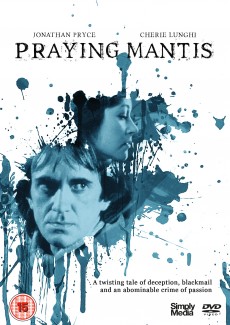
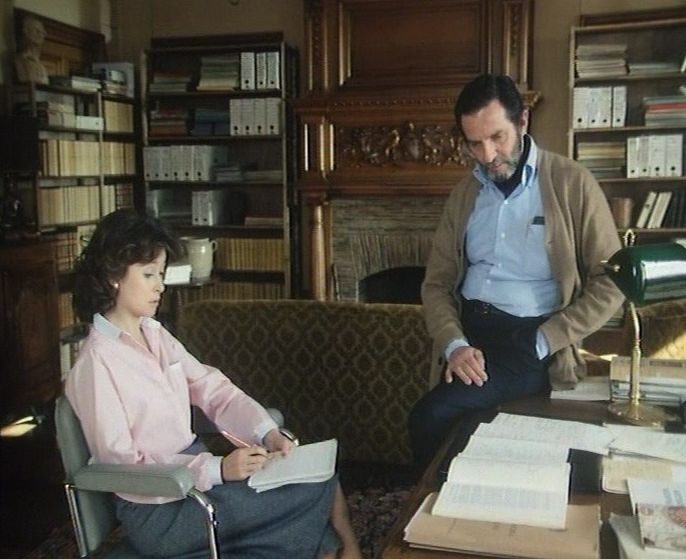
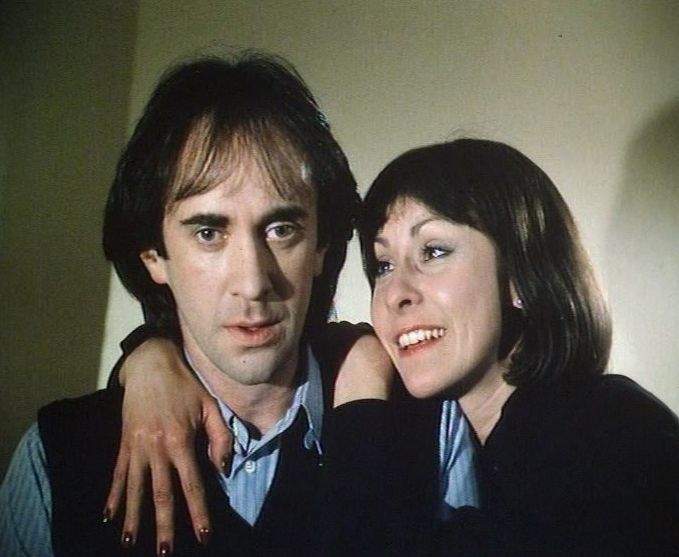
Vera Canova (Carmen Du Sautoy) has hatched a cold-blooded plan to dispose of her husband, Professor Paul Canova (Pinkas Braun). The Professor’s assistant, Christian Magny (Jonathan Pryce), is an integral part of her plot, as is Christian’s new wife, Beatrice (Cheri Lunghi), who has just been engaged as the Professor’s secretary.
Vera intends that Professor Canova and Beatrice should be placed in a compromising position, which would give Christian (Vera’s besotted accomplice) an excuse to shoot them both. And since crime passionnels are viewed by the courts more leniently than cold blooded murder, there’s a good chance he would be aquitted. But when Beatrice (known as Bea) discovers their plans, events take an unexpected turn ….
Praying Mantis was based on the award-winning novel by French author Hubert Monteilhet, originally published in 1960. Philip Mackie’s 1983 adaptation managed to keep the feel of the original, although this wasn’t straightforward since Monteilhet’s novel was constructed in the epistolary form (with the story unfolding through a series of letters, newspaper reports and diary entries).
Cheri Lunghi & Pinkaus Braun
It’s always surprised me that Mackie (1918 – 1985) isn’t better known or appreciated, considering the body of work he assembled between the mid fifties and the mid eighties (Praying Mantis was his final screenplay). He was skilled as an adapter of other people’s work – apart from Praying Mantis he also worked on Raffles, The Rivals of Sherlock Holmes and adapted The Naked Civil Servant from Quentin Crisp’s memoirs – but he also authored some notable television series. The Caesars (1969), The Organization (1972), An Englishman’s Castle (1978) and The Cleopatras (1983) have to rate amongst his career highlights. Three of these four are currently available on DVD, so hopefully someone will take up the challenge and release The Cleopatras in the near future.
Praying Mantis opens with a voice-over which sets the scene. “The praying mantis is a creature who devours her mate during the act of love.”
The first episode is a slow-burn which sets up the principal characters and their intertwined relationships. Vera is seen to be cold and manipulative and once we discover the Professor is a wealthy man it seems fairly obvious that she wishes to remove him. But the revelation that Christian is her partner in crime comes out of the blue – previously it was stated that he had little interest in women, although the fact we later hear his vigorous love-making to Vera (via a tape-recording secretly made by Bea) suggests otherwise.
Bea herself also seems to be somewhat manipulative – before Christian’s marriage proposal she’s quite content to conduct an affair with the Professor under Vera’s nose (although this is something which would have fitted in nicely with Vera’s plans). And after she discovers that her new husband plans to murder her, there’s no hysterics – instead she begins to wage a war of nerves against him (replaying the taped conversations between Vera and Christian whilst pretending not to hear them). And her plans don’t end there ….
As might be expected from the title, it’s the two female characters – Vera and Bea – who dominate the action, leaving Christian and Professor Canova as somewhat hapless pawns totally at their mercy. But there’s several twists and turns along the way which serve to alter the balance of fortune.
Jonathan Pyrce & Carmen Du Sautoy
It’s an interesting – and obviously intentional – touch that the title was changed from Monteilhet’s The Praying Mantises, to just the singular version for this adaptation. This ensures that we’re left in some doubt as to who will turn out to be the deadliest (the uneasy detente between Bea and Vera during the concluding episode is absorbing).
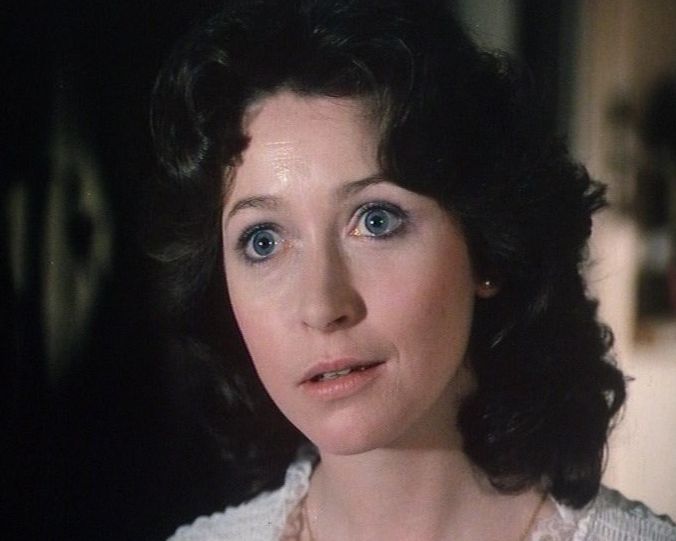
Lunghi and Du Sautoy both sparkle with deadly intent throughout. Bea starts off as the audience identification figure – we see the early action unfold from her viewpoint, which ensures that the audience is automatically placed on her side (although later events reveal a quite different side to her character). Du Sautoy instantly exudes more of an air of obvious menace whilst Pryce is characteristically good at capturing Christian’s sense of creeping, conflicted panic. Braun has the least developed role out of the four, but he’s still skilled at generating gravitas and weight as Professor Canova.
Although Praying Mantis retains the French locations of the original novel, given the British nature of most of the cast this either seems to suggest there’s a great many ex-pats in the area or they’re simply playing French, but without the accents. If it’s the latter then it was probably a wise move, since adopting foreign accents can be a little distracting.
If the French locations populated with British actors is a little quirky, then so is Carl Davis’ score. Davis’ credits are many and impressive, but I’m afraid that Praying Mantis can’t really be classed as one of his best. The piano is the dominant instrument, with a slightly discordant melody recurring regularly throughout the two episodes – frequently popping up between scenes or when there’s no dialogue. This does become slightly tiresome, even more so since Simply have opted to use it on the DVD menu screen. This is one time when hitting play as quickly as possible is most desirable!
Praying Mantis boasts strong, multi-layered performances from all four main cast-members with a host of familiar faces (Sarah Berger, Kevin McNally, David Schofield, Derek Smith, Douglas Wilmer, Joby Blanshard, Clive Swift and Peter Blake) making welcome appearances in supporting roles. Apparently shot on 35mm (a rarity for this era of television – most film productions tended to be made on 16mm) it looks in reasonable shape, considering that the materials are nearly thirty five years old.
Featuring a clever, twisting plot which moves in several unexpected directions, Praying Mantis never flags during the course of its 152 minutes (divided into two episodes of 76 minutes each). Apart from the slightly intrusive music there’s little else to fault here, with Cheri Lunghi especially impressive.
Praying Mantis is released by Simply Media on the 17th of April 2017. RRP £19.99.
There’s a lengthy reprise at the start of this episode, which allows us to once again marvel at the ineptitude of Fisk and Costa. The moment when Fisk angrily hits the door locked by the Doctor is also noteworthy – mainly because of how wobbly it looks. One good punch would no doubt have caused it to collapse.
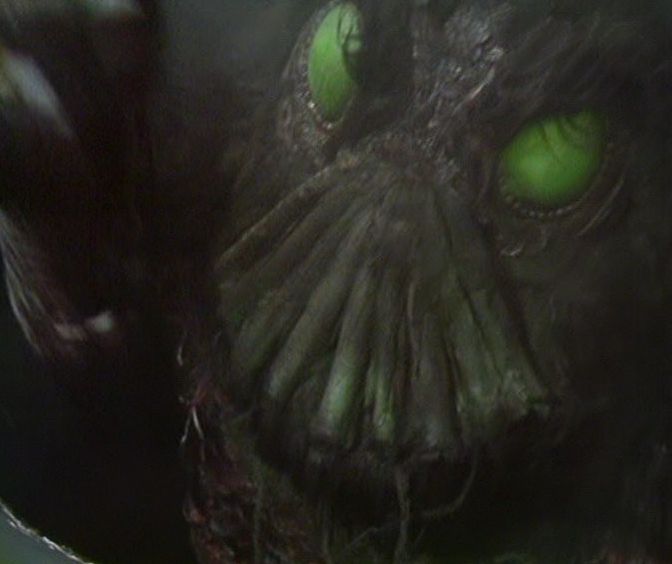
The jungle landscape of Eden is very dimly lit. This not only helps to create a forbidding atmosphere but was probably also done in order to disguise the limitations of the set dressing. As mentioned earlier, the Mandrels look very impressive in this environment – the sight of one such creature, eyes glowing green, looming in the shadows is a striking image.
Back on the ship they don’t look quite so good. Although it’s interesting that the lighting levels on the Empress seem to be a little lower than in the first two episodes (was this the point that Graham Williams had taken over directing duties from Alan Bromley?) even this can’t disguise how silly the Mandrels look in the cold studio light of day. Another infamous moment occurs when they kill a hapless passenger. What’s particularly silly about this scene is the fact that all the Mandrels were in a lift – are we to assume they piled in and then pressed the appropriate button? Well, maybe they did – perhaps they’re cleverer than we give them credit for.
The shots of rampaging Mandrels no doubt amused the audience at home and this seems to be acknowledged within the fiction of the programme and we then cut to a hysterically laughing Rigg, who’s watching similar events on a monitor. A nice post-modern touch, although pointing out the limitations of your production is a dangerous game.
Whilst in the Eden projection, the Doctor gets to tangle with a nasty plant and is forced to bite into it. “You know, that didn’t taste at all bad” he deadpans. All in a day’s work …
The identity of the Doctor’s mysterious assailant from the previous episode is established – it was Stott (Barry Lonsdale), a member of Tryst’s crew who apparently died on Eden. But now we learn he didn’t die, instead he’s been trapped inside the Eden projection ever since. This’ll bring the colour back to Della’s cheeks as she and Stott were something of an item. There’s another surprisingly adult moment in the script when Stott tells the Doctor and Romana of his despair about being trapped inside the CET. “There were a few times when I felt like blowing my brains out.”
In possibly one of the least surprising plot-twists ever, it’s revealed that Tryst is one of the people behind the Vraxoin smuggling. Well fancy that.
If the end of episode one was funny, then the start of the second episode is even funnier – mainly because the Mandrel gets to wave his arms about in a terribly expressive way. When seen in the shadows of their home planet, Eden (as stored on Tryst’s CET machine) they’re quite impressive – but in the harsh unforgiving light of the Empress’ corridors it’s a different matter entirely.
We don’t see too much of them in this episode thankfully, as the sight of the Mandrels stomping about tends to dissipate any tension which has been generated. And that’s a shame since there’s an interesting story unfolding. The problem with the two ships somewhat moves into the background once the Doctor realises that someone on board is smuggling a drug called Vraxion.
The Doctor tells us just how deadly it is. “I’ve seen whole communities, whole planets destroyed by this. It induces a kind of warm complacency and a total apathy. Until it wears off, that is, and soon you’re dead.” It’s more than a little unusual for the series to tackle drug abuse, even if it’s done in a fairly mild way. Whether the comedic aspect of the script worked against the drug message or actually helped to cushion the reality about the debilitating nature of Vraxoin is a rather moot point.
We get several opportunities to observe how deadly Vraxoin is, firstly after it affects Secker, Rigg’s co-pilot, and later when Rigg unwittingly takes a drink laced with the drug. This is a slightly perplexing moment – the drink was intended for Romana, but why would anybody wish to drug her? And just how long had this mystery person been waiting to drop the drug into the drink and how could they know that Romana would want a drink anyway?
The effect it has on Rigg is drastic as he goes from being a sober, responsible authority figure to a hysterical, twitchy mess. This is well-played by Daker, but unfortunately his role in the serial is coming to an end, something which is suggested as several new characters – Waterguard Fisk (Geoffrey Hinsliff) and Landing Officer Costa (Peter Craze) of the Azurian Excise – are introduced.
With their sparkly uniforms, Fisk and Costa are comedy authority figures who attempt to restrain the Doctor but fail hopelessly. The moment when the Doctor tells them to look over there whilst he hot-foots it in the opposite direction sums them up. Like Fiander, Hinsliff and Craze are playing it strictly for laughs and whilst they entertain, a little more genuine threat from them would have raised the stakes somewhat.
The Doctor’s spent part of the episode pursuing a mysterious man who clobbered him and took the Vraxoin he found in Secker’s locker. We’re no closer to solving that mystery, but the episode ends in an arresting way as the Doctor and Romana leap into the projected image of Eden ….
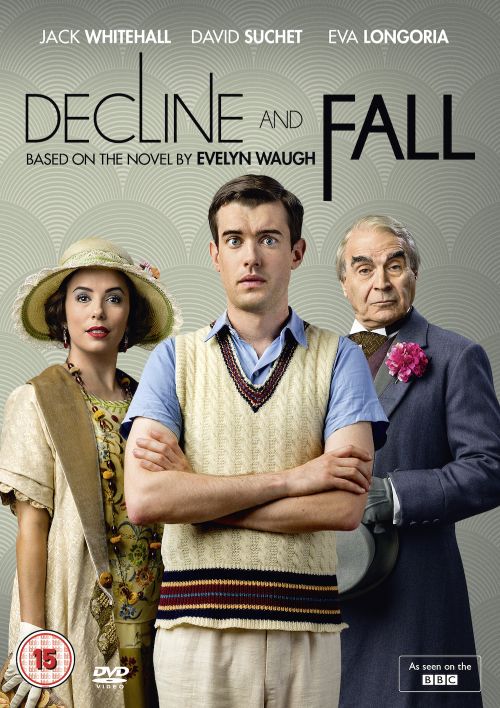
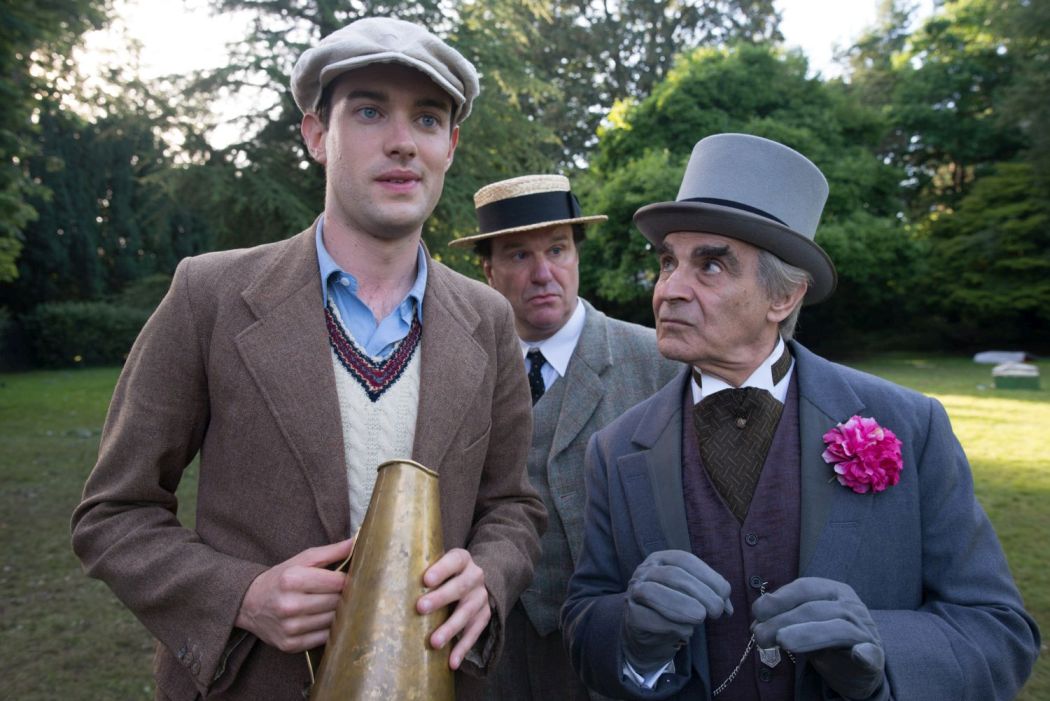
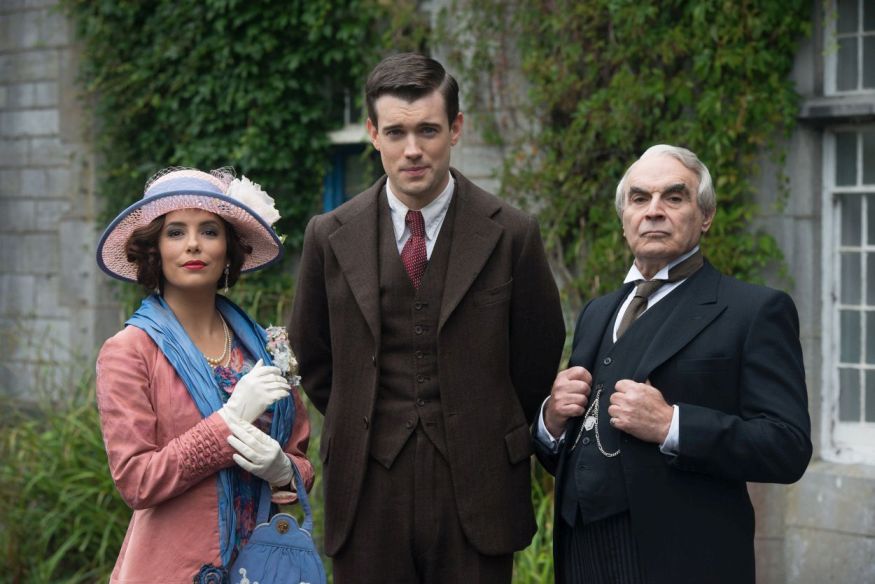
When Paul Pennyfeather (Jack Whitehall) is expelled from Oxford through no fault of his own, he finds his employment options to be rather limited. So he travels to Wales to take up a position as a teacher at a rather inferior public school, run by the intimidating Dr Fagan (David Suchet). Everything seems bleak until he spies the beautiful and wealthy Margot Beste-Chetwynde (Eve Longoria) …..
Evelyn Waugh’s classic class satire, first published in 1928, turns out to be surprisingly contemporary. James Wood’s adaptation wisely doesn’t stray too far from the original source material, so much so that some of Waugh’s most biting dialogue is lifted verbatim from the page.
The first episode finds Paul in Wales, Llanabba to be precise. Mr Levy (Kevin Eldon) who sends him on his way, tells him that the school he’s going to doesn’t have a terribly good name. “We class our schools into four grades here: leading schools, first-rate schools, good schools, and schools. The status of this school is … school. And school is pretty bad.” Eldon is just one of a number of quality actors who pop up in cameo roles, indeed the strength in depth of the casting is one of Decline and Fall‘s great assets.
It’s a bittersweet moment to see Tim Piggott-Smith as Sniggs, mere days after his death was announced. Piggott-Smith, along with Nickolas Grace, John Woodvine, Michael Cochrane, Tim Woodward and Geoffrey McGivern (great fun as Mr Wilson, an inebriated surgeon), all make brief – but very welcome – appearances.
David Suchet has some wonderful scenes throughout the first episode. In one of the DVD featurettes he mentions that he hasn’t played comedy for some time and it seems plain that he’s enjoying himself enormously. Fagan’s tirade against the Welsh is a classic Waugh moment which Suchet delivers impeccably. “I do truly believe that the Welsh are the only nation in the world that has produced nothing of any worth. The produce no painting or sculpture, no architecture or drama of any kind. They just sing.”
Three other grotesques – Grimes (Douglas Hodge), Prendergast (Vincent Franklin) and Philbrick (Stephen Graham) – are also lurking in and around the school. Grimes and Prendergast (or Prendy as he’s known) are Paul’s fellow tutors whilst Philbrick is the intimidating school porter, a man complete with a colourful, mysterious and ever-changing past. Like Suchet, it’s easy to see that Hodge, Franklin and Graham are relishing the material, although they manage to keep their characters grounded in some sort of reality.
Although Grimes is a comic character, wooden leg and all, the comedy is rather dark. Hodge is able to make him appear rakishly appealing even if it’s plain that there’s something nasty lurking just below the surface. Franklin is touching as the drunken, wig-wearing Prendy – a man who agonises through every school day – whilst Graham casts an imposing physical presence as Philbrick.
The disastrous sports day – with Prendy firing his starting pistol at one of the unfortunate pupils – is a fabulous early set-piece although this turns out to be another example of Waugh’s dark humour. In the second episode we see the unfortunate boy shot by Prendy having his injured foot amputated and in the final instalment we’re casually told that he died.
Jack Whitehall, Douglas Hodge & David Suchet
Grimes’ wedding to one of Dr Fagan’s daughters early in the second episode is another delightful scene, thanks to Hodge’s immaculate playing. Poor Grimes is really not keen to get married for several reasons and spends the ceremony desperately hoping that someone will step up to give a just cause or impediment. Alas, nobody does and when Grimes’ clothes are found a few days later on the beach it appears that he’s taken a pretty permanent way out. Or has he?
Episode two is where Paul’s relationship with Margot deepens. Like the others, she’s a bizarre creation – albeit very attractive – and Longoria is perfect in the role. Paul loves her deeply whilst she responds with an air of absent-minded affection, although she does finally agree that it might be pleasant if they did get married.
Surrounded as he is by effortless scene-stealers, Jack Whitehall has by far the most challenging part to play. Paul has to be the still centre – sensible and honest – otherwise the grotesques have nothing to reflect against. That Whitehall manages to make Paul much more than just a pompous prig is greatly to his credit – his role may be less showy than the others, but it’s just as skilled.
He gets some good comic moments though, such as when he demonstrates his piano skills to a roomful of Margot’s friends (he can’t play a note). Paul announces that his piece is thoroughly modern in style, which is the prelude for a discordant cacophony of noise which leaves most of them thoroughly nonplussed.
If there’s a theme to the story, then it seems to be that wealth and privilege ensure that you never have to face the consequences of your actions (something which seems as relevant today). In the first episode, Paul is the one sent down (expelled) from Oxford purely because the real troublemakers – all from affluent families – could afford to pay their fines, whilst Paul – from a more humble background – couldn’t.
This is somewhat mirrored at the start of the final instalment after Paul is arrested for his part in a white-slavery ring. Again, he’s innocent – it’s Margot who’s the guilty party – but he can’t bring himself to name her (plus it’s strongly implied that the establishment would never believe him anyway) so he finds himself sentenced to seven years penal servitude.
It’s a rather unlikely coincidence that both Grimes and Philbrick are his fellow prisoners whilst Prendy turns out to be the prison vicar (a sudden career change after he decided that the life of a schoolmaster wasn’t for him) but by this stage of the story there’s little point in complaining about a certain lack of naturalism. The prison episode gives Philbrick the chance to display a more human side to his nature, Grimes to make a daring escape on horseback (an impressive feat for a unidexter) whilst Prendy’s exit is the most memorable of them all ….
There’s a pleasing circular path to to Paul’s journey. After he’s sprung from prison with the aid of Dr Fagan, he’s able to fake his own death and return to Oxford as his own distant relation. Maybe second time around things will work out right.
Acorn’s DVD has three featurettes (all around five minutes each) – Adaptation, On Set and Satire. With such brief running times they obviously don’t go into great detail, but they do feature short interviews with all the main cast, plus James Wood and director Guillem Morales. A short picture gallery is also included.
Laugh-out loud funny in places, somewhat disturbing in others, Decline and Fall is a sparkling comic treat, albiet one with a strong cynical streak. Following the somewhat lumpy adaptation of Len Deighton’s SS-GB (somehow one of Deighton’s best books was transformed into a six-hour plod) Decline and Fall shows that the BBC hasn’t completely lost the ability to mount a successful adaptation of a literary classic.
Decline and Fall is released by Acorn on the 17th of April 2017. RRP £19.99.
It’s possible to tell from the opening few minutes that this one is going to give us a something of a bumpy ride. The modelwork is shot on videotape, rather than film, which would become a more regular occurrence as the series moved into the eighties. Compared to the model shots from City of Death it looks much less impressive (something which Colin Mapson, the visual effects designer admitted to) but he had no choice in the matter. Money was tight and since it would take several hours to record these scenes on videotape compared to about four days on film, it was an obvious cost saving.
Our first sight of the interior of the Empress, a space cruise-liner, doesn’t offer many surprises. Like many spaceships down the years it appears to have been cobbled together with whatever was at hand (I’m sure many of the instrument panels had played sterling service in other Doctor Who’s and Blakes’ 7’s).
If the visual aspect is a little lacking, then there’s still a nice hard-SF concept at the heart of Bob Baker’s only solo script for the series. After emerging from hyperspace, two spaceships collide with each other, which is just the sort of problem the Doctor relishes ….
With a wobbly production, what you really need is a strong guest cast. Hmm. David Daker is his usual solid self as Rigg, the captain of the Empress, whilst Lewis Fiander’s turn as Tryst is somewhat hampered by his decision to employ a comedy Germanic accent. This means that he mangles various words in a way that is supposed to be amusing, but really isn’t. There are two points of view with Fiander – either he sabotaged the story by overacting or he breathed life into a fairly routine script. I tend to favour the former over the latter, but there’s some undeniable pleasure to be gained from his wonky performance.
Tryst is a zoologist who has gone from planet to planet with his invention, the CET machine (the Continuous Event Transmuter). It doesn’t just record what it sees though, it scoops up whole sections of planets and stores them as electromagnetic signals on an event crystal inside the machine. The Doctor’s less than impressed with this electronic zoo.
Tryst’s assistant is Della, played by Jennifer Lonsdale. It’s not really her fault, as Della’s rather underwritten, but Lonsdale doesn’t really put a great deal of life into her performance. But I guess anybody standing next to Tryst would tend to be overshadowed.
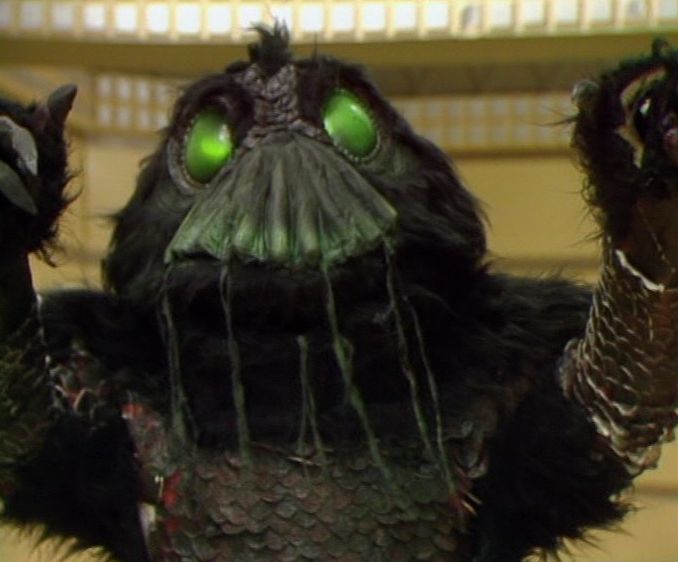
What we’re really waiting for is the reveal of the monster and it doesn’t disappoint. The episode one cliffhanger must be one of the funniest in the show’s history as a Mandrel pops his head through a hole in the wall (although I’m not sure that laughter was the intended effect). As seen below, in still shots they can look rather menacing, but when they’re called upon to move it’s more problematic ….
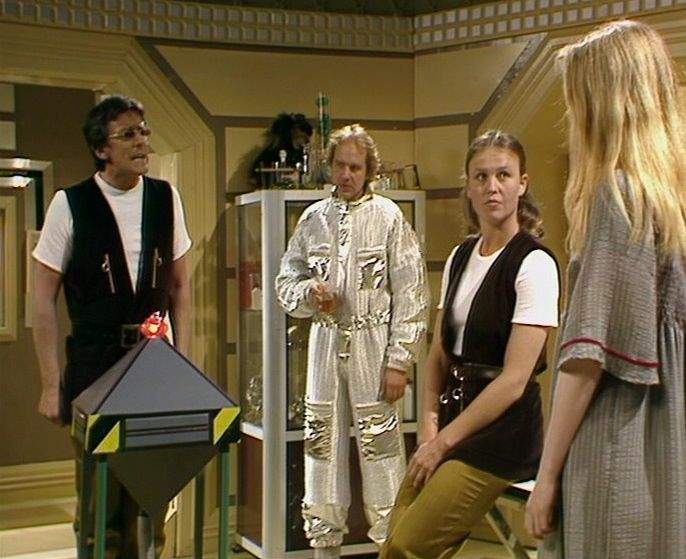
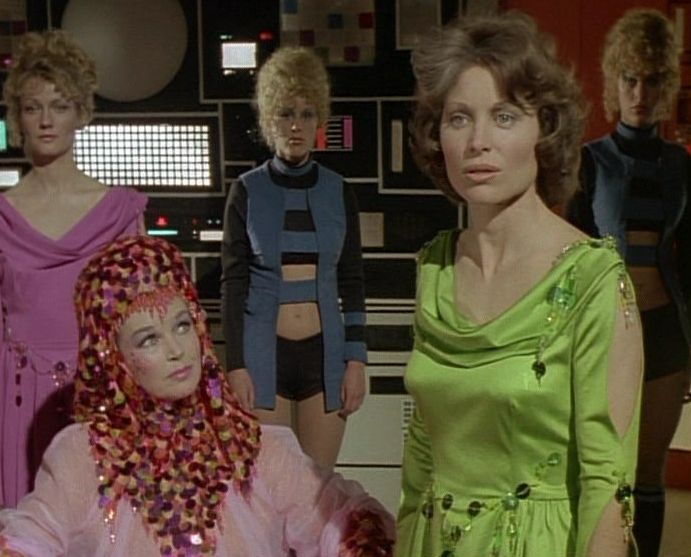
The planet Medusa is a world run by women where men are very much second-class citizens, only fit for menial domestic tasks (as well as pleasuring their mistresses of course). But after Medusa is blown out of its solar system (don’t ask) and drifts close to Earth, two worms, Adam (Pierre Brice) and Shem (Gareth Thomas), decide to turn. They steal a space-yacht and head for our world – a paradise where men are free to be men.
Star Maidens is a bizarre British/German co-production from the mid seventies. It’s been suggested that the series’ odd tone was a consequence of cultural differences – the Germans wanted to create a sex comedy whilst the British were more interested in crafting serious(ish) science fiction. These two different styles meet head on, with varying degrees of success …..
The fact that Star Maidens wasn’t networked indicates that ITV had little love for it. The show limped out at different days and times from region to region (a Sunday afternoon slot on Granada, a 5:15 pm weekday slot on both HTV and Anglia, etc) whilst some areas don’t appear to have shown it at all.
It certainly didn’t lack for talent though, both in-front of and behind the camera. It was created by Eric Paice, co-writer of the Pathfinders series with Malcolm Hulke (which had been a clear influence on the creation of Doctor Who). Several Doctor Who writers – Ian Stuart Black and John Lucarotti – contributed scripts whilst Freddie Francis, a respected director and cinematographer, directed five episodes. Another notable behind-the-scenes name lending his expertise to the series was Alan Hume, who worked as the director of photography on a score of major films (including multiple James Bonds and Return of the Jedi).
Gareth Thomas
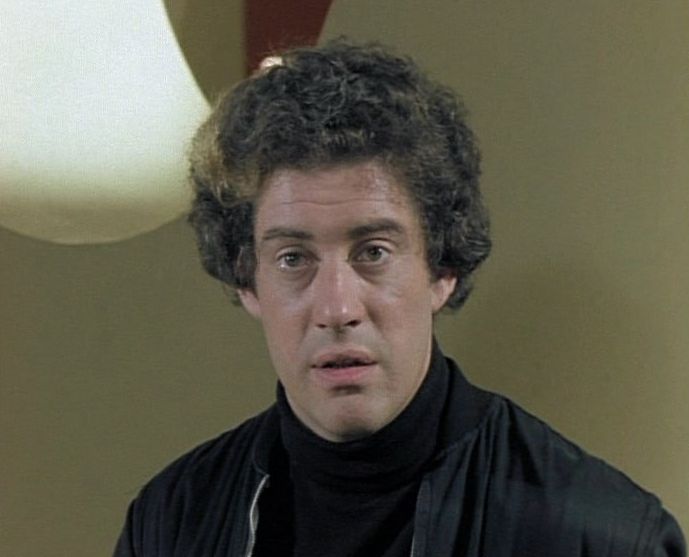
Three years before playing Roj Blake, Gareth Thomas had his first taste of the weird world of television science-fiction when he played Shem. Shem’s a rather subservient character, as not only is he in thrall to his female mistresses but he also plays second fiddle to Adam, who’s clearly marked as the alpha-male right from the start. In the first episode Shem is given several lines (“it’s a woman’s world”, “men’s liberation”) which hammers the point home that Medusa is a planet totally dominated by women. Subtlety is not a hallmark of this series.
French-born Pierre Brice might have been an unknown quantity for British audiences, but since he was a big star in Germany at the time it explains why he was drafted in to take one of the leading male roles. Adam’s decision to flee to Earth annoys his mistress Fulvia (Judy Geeson) whilst security chief Octavia (Christine Kruger) vows to get them back by any means necessary.
The Medusans kidnap two Earth scientists, Rudi (Christian Quadfleig) and Liz (Lisa Harrow), and as might be expected there’s a certain amount of irony and comedy to be mined out of their situation. Both are taken back to Medusa and suffer different fates – Rudi is assigned to a work-party whilst Liz is treated like a princess.
The guest casts feature familiar players such as Graham Crowden, Terence Alexander, Anna Carteret, Ronald Fraser and Alfie Bass. Those who enjoy picking out background faces might spot David Ellison playing a policeman (a few years later, along with Anna Carteret, he’d be a regular in Juliet Bravo) whilst any fans of Delta and the Bannermen may want to look out for Belinda Mayne in episode seven, Test for Love.
The first episode – Escape to Paradise – sets up the premise of the series with a very hard info-dump during the opening few minutes. This explains that Medusa (Space 1999 like) has somehow gained the ability to drift around the universe, eventually ending up not too far from Earth. There’s some nice modelwork on show, although unfortunately the models do rather look like models. That’s something of a hallmark of the series.
The next episode, Nemesis, sees Adam and Shem, newly arrived on Earth, forced to go on the run (it features the immortal line “there are two funny men stealing our apples”!). Following that, we have another Earth-based instalment, The Nightmare Cannon, notable for the eponymous device which causes the faces of Octavia and Fulvia to be seen by Adam and Shem everywhere. The moment when two suits of armour come lumbering towards Shem and raise their visors to display the features of Octavia and Fulvia (a not terribly convincing optical effect) is just one of many classic moments scattered thoughtout the series. Gareth Thomas certainly gives his all during this scene.
Terence Alexander has a good guest role in the fifth episode, Kidnap – he plays a smoothie with designs on Fulvia. Gregori (Alexander) plies Fulvia with champagne as a prelude to strapping her into a human thought transference machine. Alexander plays drunk amusingly, whilst decent actors like Philip Stone and Stanley Lebor lurk in a menacing manner.
One of the interesting things about the series is the fact that it features stories set both on Earth (featuring the misadventures of Adam, Shem and Fulvia) as well as Medusa (where Rudi and Liz find themselves to be fishes out of water). By centering the action around newcomers to both civilizations, there’s scope for drama and humour as they all come to terms with a new world which differs dramatically from their own. Although it’s something of a weakness that the first half of the series is dominated by Earth stories (a bit more variety at this point would have been welcome).
Test for Love finds us back on Medusa with Liz facing a terrible ordeal – she has to undergo a computer test in order to establish whether her claims that she doesn’t find Medusan men attractive is true (this mainly involves watching bare-chested men on a viewing screen). Lisa Harrow, who during her career has tackled many major roles at the RSC, admirably manages to keep a straight face. Quite what the lunchtime and early evening audiences made of this back in the seventies is anyone’s guess ….
Dawn Addams & Lisa Harrow
The Perfect Couple is a series highlight. Adam and Fulvia, still stranded on Earth, decide to set up home together. But things don’t go smoothly as Fulvia becomes annoyed that househusband Adam’s coffee mornings are spent entertaining attractive housewives! Meanwhile, Fulvia’s story of life on Medusa has inspired the local women to rise up and take control. Today suburbia, tomorrow the world. Although it’s as unsubtle as the rest of the series, this one is genuinely funny (as well as featuring a nice guest-turn from Ronald Fraser).
Gareth Thomas gets a chance to shine in Hideout. Shem, like Adam, is still on the Earth and remains a hunted fugitive. He’s befriended by Rose (Conny Collins) but with the police closing in there’s danger all around. Thomas and Collins both work well and even though they don’t spend a great deal of time together, their relationship still feels real.
The second half of the series concentrates more on Medusan stories, with both The End of Time and Creatures of the Mind being of particular interest. In The End of Time, Earth scientist Professor Evans (Derek Farr – a strong presence throughout the series) is brought to Medusa by Octavia, but they arrive to find a city in crisis with the President (Dawn Addams) apparently dead. There’s an eerie tone to this one, which contrasts well with some of the broad comedy seen elsewhere.
Creatures of the Mind finds Liz under attack from a group of whispering robots. Scripted by Ian Stuart Black, it puts Lisa Harrow centre-stage and gives her some good material to work with. It’s just a pity that the twenty five minute format results in everything feeling a little rushed (although since the thought of some of the slighter episodes bulked out to fifty minutes is a terrifying one, maybe the shorter running time was the best option overall).
The series finale, The Enemy, sees Adam eventually make his way back to Medusa, which means he’s on hand to save the day as the planet comes under attack from a mysterious alien craft. This feat even impresses the hard-bitten Octavia (although how long she stayed impressed we’ll never know, as it was decided not to renew the show for a second series).
Pierre Brice, Gareth Thomas & Judy Geeson
Originally released by Delta in 2005 but OOP for several years, Star Maidens has now been brought back into print by Simply. Simply’s release looks to be pretty much the same as Delta’s, with identical menu screens and picture quality. The PQ is reasonable, athough had new prints been struck from the negatives then things could have looked a good deal better. But apart from the expense, that supposes the original negatives still exist – which due to the age of the series isn’t certain.
There’s a bonus feature on disc two – an interview with Gareth Thomas. Running for 35 minutes, it offers a highly entertaining trot through the series, as well as briefly touching on other parts of his career. Thomas was always an affable and unpretentious interviewee, which becomes clear over the course of this feature. It’s easy to imagine that many actors would be reluctant to revisit such an undistinguished and faintly embarrassing part of their career, but Thomas had no such qualms and was happy to speak at length about the production.
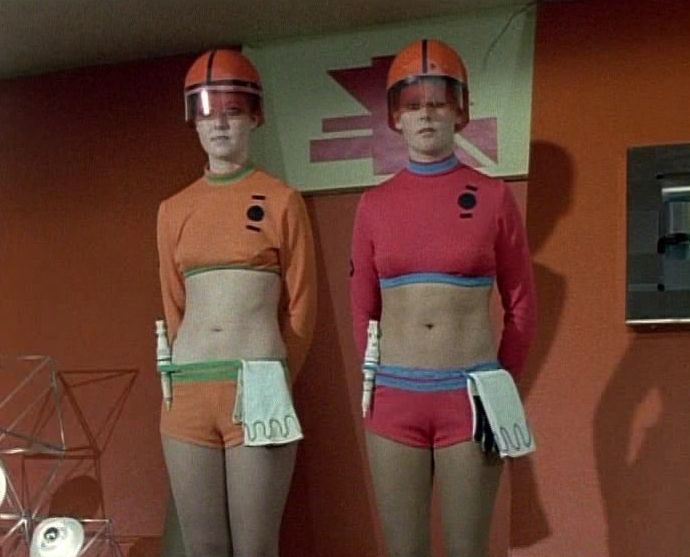
There isn’t another series like Star Maidens. It’s fusion of gender politics, mild titillation (the eye-catching female guards, decked out in hotpants and crop tops) and sci-fi themes all combine to produce a heady brew. And although it’s no classic, it possesses a certain wonky charm (even if there are times when it’s impossible not to react with slack-jawed incredulity at the events unfolding on the screen).
Hand on heart, some of the acting isn’t great, the music is of its time (that’s the kindest thing I can say about it) and the extensive redubbing tends to increase the unreal air of the stories. But I still find it a fascinating and entertaining time capsule of the period and whilst it won’t be to everybody’s tastes, I’m glad that it’s available once again.
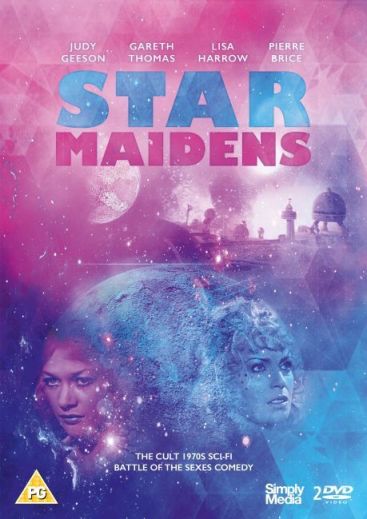
Star Maidens is released by Simply Media on the 17th of April 2017. The series is comprised of thirteen 25 minute episodes and has an RRP of £19.99.
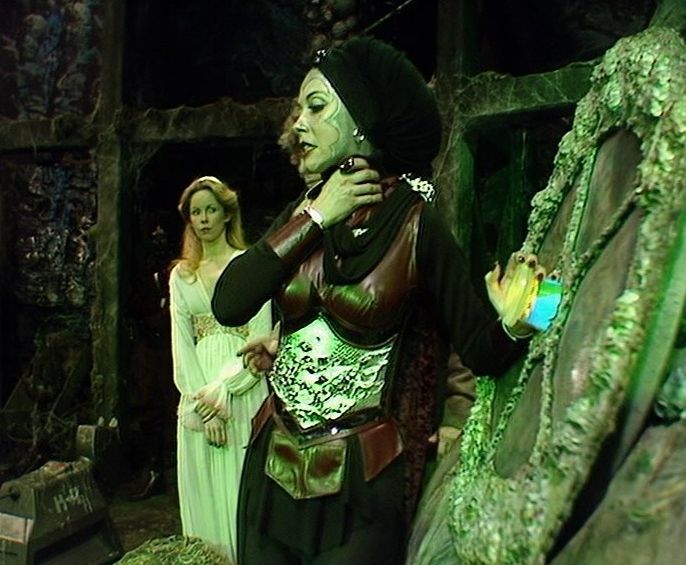
Now that the creature’s got his communicator back, the truth is finally revealed. His name is Erato and he responds sharply to the Doctor’s questions. “To skulk about in pits, as you so crudely put it, is not my normal habit. I most emphatically do not eat people. I live by ingesting chlorophyll and mineral salts. I would have you know that I am the Tythonian High Ambassador.”
Although Adrasta can see her authority draining away, she attempts to rally and tells the Doctor that she’ll kill Organon if K9 doesn’t destroy the creature. The Doctor’s response (and also Organon’s) is priceless – the Doctor looks a little downcast at the thought of Organon’s death, whilst the astrologer is more than a little shocked!
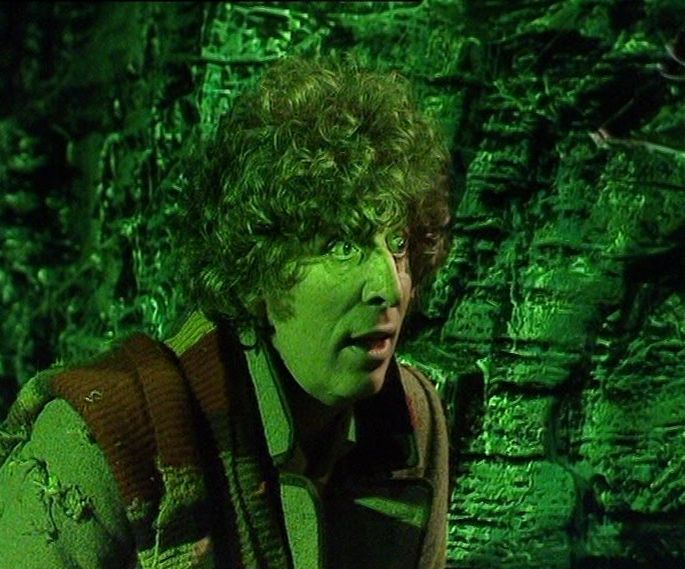
Is this just another gag moment or would the Doctor really have sacrificed Organon? It’s something we’ll never know as events take a different turn, but maybe it’s a brief glimpse of the earlier, more alien, Doctor seen during seasons twelve to fourteen. There he could blank out the deaths of people he’d been friendly with, such as Lawrence Scarman, by concentrating on the bigger picture. And he does mention that if the creature (Erato) dies then two planets could also perish …
It’s something I’ve touched on before, but even during the most comedic of stories during this era there’s still occasions when the Doctor drops the clowning and shows his true mettle. This exchange with Adrasta is one such moment and it’s all the more effective because his anger comes out of the blue.
ADRASTA: Huntsman, set the wolfweeds on the Doctor.
DOCTOR: No, wait. That’s all you’ve got on this planet, isn’t it? Weeds, weeds, forest and weeds. You scratch about for food wherever you can, but you can’t plough the land, can you? You can’t do anything until you’ve mastered the forests and the weeds. And you can’t do that without metal.
ADRASTA: Don’t listen to him. It’s just the ravings of a demented space tramp. Set the wolfweeds on him!
DOCTOR: Do that, and you will hurl this planet back into the dark ages. And for what? To satisfy the petty power cravings of that pathetic woman.
ADRASTA: Have a care, Doctor.
DOCTOR: Have a care yourself. Care for your people for a change.
Erato takes his revenge and kills Adrasta, but there’s still some way to go before the episode ends. This is where things slightly fall apart – namely the fact that there’s a neutron star on the way, requested by Erato, which will destroy all life on the planet. Firstly, how convenient that it’s due to arrive at this precise moment, just after Erato’s been released and can tell them all about and secondly, why did Erato decide to effectively commit suicide?
This means that the story finishes with something of a whimper as the sight of the Doctor in the TARDIS flicking switches doesn’t generate any tension. We’re told that the fate of the entire planet is at stake, but we never feel it.
However, before that happens there’s a few scenes of interest as Adrasta’s right hand woman, Karela (Eileen Way), forms an unlikely alliance with the bandits, once she’s killed the unfortunate Torvin. Torvin’s death is played for laughs – after Karela knifes him, his dying words are “tempered steel. Is that really tempered steel?” – proving to the end that he’s obsessed with metal (the scarcity of metal on the planet being a major plot point). It might be a humorous moment, but it’s somewhat black humour. It’s always a pleasure to see Way (Old Mother from An Unearthly Child) or as Gary Gillatt so memory dubbed her, Truth, Justice and the Eileen Way.
Erato’s a problem and the plot rather meanders, but Creature is still a story that entertains. And once you’ve watched the DVD, then the brief clip from Animal Magic with a manic Tom telling the audience tall tales about some of the monsters he’s met during the years is a must watch.
Although I’ve a lot of time for Creature, it has to be said that the plot’s fairly linear. The first three episodes revolve around identifying exactly who or what the creature is, before episode four goes off on a different tangent completely. I guess that David Fisher didn’t believe he could eke out the mystery of the creature for all four episodes, which is fair enough.
This episode has the unforgettable sight of the Doctor attempting to communicate with the creature via various ways, some of which look rather rude. Why Christopher Barry let this through is anybody’s guess, although I sometimes picture him up in the gallery, rather punch-drunk from the way things have gone so far ….
Torvin and the others lead a raiding party on Adrasta’s palace. Whilst they continue to be positioned as comedy characters, especially Torvin, this sits rather uneasily with the way they casually kill Adrasta’s guards. There’s something of an edit in the final programme – which makes their knifing less explicit – but it’s still a surprise to see a recognisable weapon used to kill (remember that whilst Leela carried a knife, over time she wasn’t allowed to use it on humanoids).
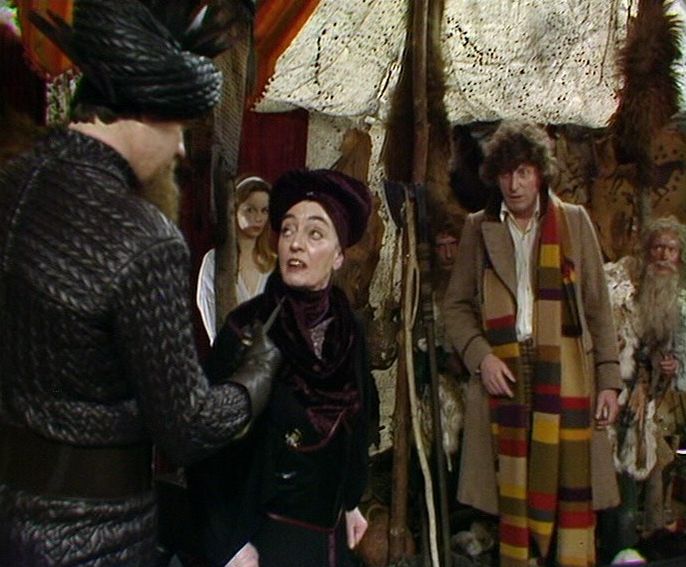
Geoffrey Bayldon continues to mine (sorry) his role for maximum comic effect. Organon’s meeting with Adrasta isn’t terribly pleasant (she’s more than disappointed to find out that the creature hasn’t eaten him) whilst he’s less than impressed after she orders him to find out what’s happening with the creature. Adrasta has a convincing manner about her though. “If you don’t go, my friend, that guard standing behind you will cut your throat from ear to ear.”
It becomes clear that the raiding party existed for one reason only – to enable the bandits to pinch what turns out to be the creature’s communication device and then, via a mysterious compulsion, be forced to deliver it up to him. This leads into an unusual cliffhanger, which sees Adrasta react in terror to the creature.
ADRASTA: Don’t let it get me. You mustn’t let that thing get me! It’ll kill me!
DOCTOR: What? An evil thing, killing. Why should it want to kill you? It didn’t want to kill me, did you, old fellow? Do you know something? I believe he wants to kill you.
ADRASTA: Keep it away from me. It’s, it’s going to eat me.
DOCTOR: Oh, come on. You know it really doesn’t eat people, don’t you? But you know what it does eat and you haven’t been letting it get any, have you. No, you just stuck it in a pit and threw people at it.
If the episode had concluded seconds earlier, then it would have ended with Adrasta holding a knife to the Doctor’s throat. That would have been a more obvious cliffhanger, as showing the villain under threat is much more uncommon although not totally unheard of (for example, episode for of The Daemons finds the Master menaced by Azal).






 Archive Television Musings