Barry Appleton’s Caught Red Handed juggles several plotlines at once and, as with previous episodes, it takes a little while before it becomes clear which ones will dominate and which will fade away.
The episode opens with the fallout from a stabbing. Jill Kelsey (Chrissie Cotterill) attacked her husband, John (Jim Barclay), with a breadknife – stabbing him eight times. It’s instructive to see how pretty much everybody (apart from Alec Peters) treats her with compassion, from Ted Roach at the scene to Inspector Frazer and Viv Martella at the nick. Jill Kelsey is positioned as a victim rather than a criminal, which explains why Ted’s usual brusque manner is absent.
Of course, the fact she stabbed her husband not once but eight times suggests this may be more than a family row which escalated. But she seems genuinely contrite and he – as soon as he regains consciousness – is completely forgiving and disinclined to press charges. It slightly stretches credibility that he recovers so quickly (after eight stab wounds? Clearly they were very shallow ones). His revelation that the argument started when he complained about soggy cornflakes signifies that this crime has a faintly comic air, strengthened when John turns up at Sun Hill to take his wife home.
So Burnside’s quite happy to let them go – the whole incident written off as a domestic – although it seems rather unlikely that he’d be discharged from hospital quite so soon (even if they were desperate for beds). That he turns up at the nick still dressed in his hospital pyjamas also seems a little unbelievable. There’s a late coda to this part of the story, which once again is played rather for laughs.
Attention then turns to an obbo at the local swimming baths with Tom Penny and June Ackland. This is chiefly of interest due to the way Tom reacts when put under stress (not very well). They’ve rigged up an observation point to monitor the changing rooms in an attempt to identity a thief who’s been rifling through the lockers.
When someone is spotted, June tells Tom to switch on the video recorder. This is a slight plot weakness – back in 1988 VHS tapes would have been quite cheap, so why not just keep the recorder running all the time? Although they catch the criminal, something goes wrong with the tape and they’re left with no visual evidence. This is enough to once again push Tom to breaking point – showing that whilst he appears to be fine on the surface, whenever there’s the merest hint of stress he’s liable to fold like a pack of cards. As before, there’s never any suggestion that he’s not in a fit state to do the job – or that the next time he makes a mistake it may have more fatal results – presumably everybody just expects that eventually he’ll pull himself together.
This part of the episode has a happy ending, money treated by the SOCO (Susan Curnow) was placed in the lockers. It contained an invisible red dye, which would stain the hands of anybody who handled it. Hence the episode title.
But Caught Red Handed could also refer to Yorkie Smith, who’s observed in the pub acting in a very suspicious manner. Frankly he wouldn’t make a very good criminal as he’s far too transparent (although his fashion sense – rolling up his jacket sleeves as though he was in Miami Vice – should certainly be against the law). Jim suspects he’s been buying drugs and a search of his locker reveals a packet of pills.
This places Jim in a moral quandary. After confronting Yorkie and a brief moment or two of soul searching he feels he has no alternative but to make it official. Later, Ted Roach is withering in his condemnation – telling Jim he may have irreparably damaged Yorkie’s career. Ted’s viewpoint would no doubt be shared by many of his colleagues, where it would be seen as closing ranks to protect your own, rather than concealing a crime.
Yorkie comes clean. The drugs are anabolic steroids, designed to help him rebuild his strength as a rugby player. He claims that many athletes take them (which is true, although his statement that it’s not an offence is a little harder to swallow).
Had Burnside not been DI then it’s possible it would have been dealt with unofficially. But Caught Red Handed provides us with early evidence that Burnside is keen to mould Sun Hill in his own image, and this incident gives him an ideal opportunity to clip the wings of the uniformed branch.
His summary of both Brownlow and Conway is insightfully caustic. He claims that Brownlow “is more interested in his golf swing and that converted barn he’s got up in the lakes than what goes down at Sun Hill”. He concedes that Conway is a good man and a good copper but that he has to play things “by the book. And that is a worse handicap that Brownlow’s golf swing.”
Frank Burnside (Christopher Ellison) returns to Sun Hill to take up the vacant post of DI. But first he has a little undercover business to deal with – rounding up a violent gang of football supporters.
Burnside had previously made three appearances in the 50 minute series at Det Sgt Tommy Burnside (his name was later changed to Frank when it was revealed there really was a Tommy Burnside serving in the Met). That he already has a little history with both the viewers and the officers at Sun Hill is something that works well.
We open with Conway explaining that Operation Red Card has infiltrated two undercover officers into Front Line (“a highly organised and extremely dangerous gang of thugs who are responsible for a great many of the violent acts at football matches up and down the country”). And now they’re going to arrest them all.
The countdown to the start of the operation takes place in the peace and quiet of the CAD room with Viv, Hollis and Tom Penny. Viv’s keen to be out on the streets with the others but the more pragmatic Hollis knows they’re well out of it. Ted, who is present at the scene, is wise enough to know that you don’t go rushing in – you let the uniforms soak up most of action and then bring up the rear.
One of my favourite moments occurs when one of the Front Line yobbos spits at Ted. He responds with a well-aimed headbutt!
It’s been expressly stated to all the troops that when they come across the undercover officers they should make no sign if they know them. However, Ted and Jim can’t help but goggle as Frank Burnside is taken away (dressed in a natty pair of underpants) which immediately blows his cover. Not the best way for Ted and Jim to encounter their new boss ….
Burnside and Bob Cryer have a history. Bob has always regarded Burnside in a very jaundiced light, convinced that he’s corrupt (and later tells him to his face that he doesn’t understand how Operation Countryman – set up to investigate police corruption – missed him). They don’t really hit it off when Burnside returns to Sun Hill either – as Frank enters the charge room and gives one of the suspects a quick slap. Unsurprisingly, Bob takes a dim view of this. “Let me remind you, as one of the duty officers on this relief, I will not have my prisoners assaulted.”
The needle between Bob and Burnside always remains bubbling under the surface, as – of course – does Ted’s spiky relationship with his new boss. Burnside does have some supporters though – chief amongst them being Inspector Frazer. This is partly because she knows that Burnside previously acted the part of a corrupt officer in order to ensnare others. Problem is he played the part so well that the likes of Bob Cryer are now convinced he actually is bent. Not that he’s bothered what others think of him.
The fact that Burnside and Frazer have a history is an interesting touch. He greets her with a “hello sexy” which doesn’t upset her. When he calls her Chrissie, she melts a little more – although both accept that “the past is the past” (there’s a hint that they had an affair back when he was a married man).
Just Call Me Guvnor is a cracking reintroduction for Burnside. It sets up the parameters of the character perfectly whilst letting the audience know more about him than his colleagues do. We know that Burnside isn’t corrupt, although Bob and Ted – contemptuously referred to as “a couple of tossers” by Burnside – and the rest of the nick believe otherwise. Bob is later put straight on this by Frazer and he’s forced to apologise to Burnside, although he also tells him that it still doesn’t mean he has to like him …
A late story beat (revolving around the prisoner headbutted by Ted) might not come as a total surprise, but it’s yet another victory for Frank Burnside who ends the episode very much on top.
All in Good Faith shows the sharp delineation between two very different types of coppers – on the one hand there’s Ramsey and Roach, on the other are Frazer and Conway.
Frazer calls Ramsey in for a chat. She’s concerned about his attitude – seven members of the public have made complaints about him this year alone. Given his faintly contemptuous and sarcastic attitude in front of her, it’s easy to see that he takes this same persona onto the streets. Ramsey doesn’t disagree, telling her that he treats people the same way others treat him – which isn’t really what she wants to hear.
He can’t resist adding that a frontline policeman is always going to be the subject of complaints which someone like her, with little or no experience of policing on the streets, will never be able to understand. This conflict – between the sharp end and the executive level – has been played out numerous times across multiple police series.
We also see it again with Roach and Conway. Ted Roach’s time as acting DI is going fairly smoothly (he’s off the drink for one thing) but the wheels start to come off when a gun handed in at a recent amnesty is tied back to a man called Duffy (Leslie Schofield) and linked to a crime which occurred five years ago.
Ted is keen to go round and nick him, but never stops to consider the nature of an amnesty. Conway decides that for the sake of community relations it wouldn’t be a good idea to arrest Duffy (if they did, the public would lose all faith in future weapons amnesties) but Roach ignores him and nicks him anyway.
Conway and Frazer discuss Ted, with Frazer musing that “surely he must understand there’s more to police work than arresting people, we have to gain the public’s cooperation and respect.”
However when Ted brings Duffy in, Frazer is more forgiving. “We’re sadly lacking good practical officers, with all his faults I wouldn’t like to see Roach get into trouble over this. I’m positive he’d make a good DI”. Conway then makes a revealing statement – as long as Brownlow is in charge at Sun Hill, Roach will never rise above his current status as DS.
All in Good Faith adds a little more meat to the bones of Ramsey’s character, whilst also throwing the spotlight on Conway and Frazer. Conway is shown to be more of a politician than a thief-taker, but in his position – where he has to face both public and political pressure – that’s understandable. Frazer’s character traits are teased out nicely – it’s difficult to say whether she or Ramsey came off best during their meeting (both made fairly valid points) but she seems more able to straddle both sides of the fence (a desire to catch criminals allied to the realisation that they need the respect and cooperation of the public) than Conway does.
Cryer leads an operation to evict a group of squatters. Councillor Thomas (John Bowe) is on hand to ensure that there’s no police brutality, but it seems any brutality will come from the squatters side ….
Whilst Thomas is quick to jump to the defence of the squatters, not many share his opinion (certainly not the other residents or the police). The squatters may soon be homeless, but Bob opines that it’s out of choice not necessity – they all come from affluent families and are indulging themselves by playing as revolutionaries. Cultural slumming, according to Hollis. CND posters serve as clear signifiers of their beliefs, although their desire to make a stand for liberty and freedom is rather dissipated when we see them bailed out by their parents to return home with fleas in their ears.
Marie Tucker (Sasha Mitchell) is also homeless, although she has no-one to come to her aid (apart from social services). Her social worker, Sonja Bloomfield (Janet Dale), is concerned, not only for Marie’s two young children, but also for Marie herself – who could be suicidal.
There’s a circular path to the story as Marie holes up in Councillor Thomas’ bathroom. On returning home, Thomas is less than impressed to find his house has been invaded (he makes a swift beeline for the scotch). There’s a clear irony at work here – Thomas was keen to champion the rights of the squatters earlier on, but (at least initially) he has little or no sympathy when events move to his own doorstep, as he urges Smith and Frazer to extract Marie as quickly as possible.
Bloomfield is on hand to discuss with Frazer how the system has failed Marie and countless others like her. Marie and her children had previously lived in a grotty bed and breakfast (“wardrobe there, bed there, damp bit there, rotting bit there, roaches all bloody over”) but walked out when she could stand it no more. Instead of pumping money into bed and breakfasts, Bloomfield despairs that there should be a better way.
The core of the episode – an unhappy Marie pouring out her heart to Frazer and Bloomfield – is unusual, since we can only hear Marie, we can’t see her. This means that Frazer and Bloomfield are the ones who have to react as Marie’s monologue takes an increasingly dark turn.
There’s no happy ending. Marie overdoses on pills from Thomas’ bathroom and by the time the door is broken down she’s unconscious and fading fast. The fact she’s surrounded by her two young children only serves to make this emotional punch even greater. Thomas sums it up (“what a mess”) and reflects how he entered politics to help people like Marie, but has failed to do so.
Cleverly changing gear away from the squatters (who initially seemed to be the focus of the episode) Home Sweet Home offers little hope or reassurance. When PC Haynes frets that the ambulance is taking too long, Thomas shrugs and says that it’s a sign of the times. “But we’re running out of time” counters Haynes. Can we draw any solace from these events? Thomas (who saw his marriage disintegrate due to his political ambitions) reacts with compassion to Marie’s children, which offers hope that in the future he’ll redouble his efforts to help the most vulnerable, but it’s about the only crumb of comfort on offer.
Nicholas McInerny contributed twenty nine scripts for The Bill between 1988 and 2008, although given the quality of Home Sweet Home, his debut, it’s surprising he didn’t write more. He’ll return later in 1988 for Old Habits, but then takes a break until 1995.
In later years Sun Hill nick would become a hotbed of tangled interpersonal relationships and corruption. But in 1988 things were much simpler. Back then, if the boys and girls in blue had personal relationships they had the good grace not to let it interfere with their work whilst rotten apples were few and far between.
True, the likes of Ted Roach were happy to bend the rules, but there’s no sense that he was actively fitting up suspects. Even Frank Burnside, briefly glimpsed during the 50 minute series and shortly to return as the new DI, was on the side of the angels. The series made capital out of his reputation for corruption several times, but nothing was ever proved (although you could always argue that he was simply good at concealing it!)
The introduction in this episode of PC Ramsey (Nick Reding) helps to shake up the relief. Ramsey, transferred from Barton Street, brings with him an unsavoury reputation and is viewed with suspicion and mistrust – at least to begin with – by the others. Ramsey didn’t stay at Sun Hill for too long (about six months) and it’s interesting to observe that over time his rough edges were smoothed down, leaving him as just another member of the team. The Bill would make capital out of bent coppers later on, but back in 1988/89 it was a storyline that seemed to be off-limits.
Ramsey’s first appearance – driving a flash car very fast (and parking in the Chief Super’s space no less) – is a non-verbal signifier of his attitude and his brusque manner when asking June and Yorkie for directions also helps to quickly define his character – he’s a self-contained unit, not interested in making friends unless (like Ted Roach) they can further his career.
His interview with Chief Inspector Conway (Ben Roberts) helps to fill in some of the blanks. Conway regards Ramsey as a bent copper, although Ramsey counters that he was cleared. Conway doesn’t see it that way – in his view (one shared by Ramsey’s previous Chief Super) Ramsey was clearly guilty, although when we discover what his crime was – cheating at cards – it doesn’t seem too bad, but it was serious enough for Ramsey to be busted down from plain clothes to uniform, a clear humiliation for him.
It doesn’t take long before Ramsey makes himself comfortable, demanding bribes from local traders, such as Leslie Fisk (Tony Portacio). But his actions quickly catch the attention of Bob Cryer, which sets up a nice dramatic tension – Cryer now knows that Ramsey’s a wrong ‘un, so he’ll be watching him like a hawk ….
Ted Roach continues to rampage around the building. Now he’s acting DI, Ted spends his time giving Mike and Jim a very hard time. Ted forces Mike and Jim onto the streets where they tangle with a couple of Asians. One of them launches himself at Jim with some flashy kung-fu moves, but the ever resourceful Jim throws a bin at him, which does the trick!
Mix in another subplot concerning Alec Peters and some sailors and you’ve got a typically dense episode of the series. The arrival at Sun Hill of a well-drilled squad of sailors (responsible for smashing up a bar) is a nice comedy moment, as is Conway’s acid response when he discovers exactly what Alec has done. “How can you board one of her majesties frigates in sight of traitor’s gate, of all place, without permission?”
Q – Volume 2 contains the final two series of Spike Milligan’s highly distinctive (and that’s putting it mildly) comedy series – Q8 and Q9, broadcast in 1979 and 1980. For those new to Q, I’ve discussed the first three series here.
The formula remains the same – scripted by Milligan and Neil Shand, Q8/Q9 offers up another twelve episodes of unique comedy. Familiar faces from previous series – John Bluthal, David Lodge, Alan Clare, Stella Tanner, the remarkably curvaceous Julia Breck and Keith Smith – return for Q8, whilst Bob Todd makes his Q debut. A familiar face from his years with Benny Hill, be slips seamlessly into the fold.
Todd was an excellent utility player and quickly became a key figure in many of the sketches (similar to Peter Jones in Q6), Bluthal’s gift for mimicking Hughie Greene and others is put to good use again, Keith Smith has some nice moments (most notably dangling upside down on a rope), David Lodge (he starred in Cockleshell Heroes you know) is always a joy, Stella Tanner handles all the non-glamorous female roles with aplomb, Alan Clare is still (deliberately) a terrible actor whilst Julia Breck unashamedly provides more than a touch of glamour.
Q8, like the three previous series, is almost impossible to characterise. It delights and baffles – sometimes in equal measure, although sometimes the balance decisively tips one way or the other.
Q often seems to be teetering on the brink, with all the cast, especially Spike, frequently having to fight the giggles (often not very successfully). Most sketch shows tend to break the fourth wall occasionally, but few ever played about with the artifice and conventions of television like Q did.
Having said all that, some elements are quite trad. Proceedings tend to kick off with Spike behind the desk, reading a series of news items which depend on wordplay. Not too dissimilar from The Two Ronnies …..
But after the relative sanity of the news we rush headlong into the first sketch of Q8. Stella Tanner is a housewife, Spike is her husband. Out of nowhere a pantomime horse, wearing pyjama bottoms, comes clopping across the screen to the sound of The Onedin Line theme.
This gets a polite reception from the audience, but Spike clearly wanted more. “Well, that didn’t get much of a laugh, ladies and gentlemen. I don’t think you understood the full nuance of that joke.” This is typical Spike – toying with the audience (both in the studio and at home) by producing moments which aren’t particularly funny, but then forcing the laughs to come by various methods. Bringing an elephant on seems to do the trick here.
The sketch then moves to a doctor’s office, where the doctor (Todd) is, naturally enough, dressed as Adolf Hitler. Spike drops his trousers to reveal he’s wearing stockings and suspenders whilst a football theme (Tony Gubba on commentary duties) continues. And when there’s nowhere else to go, all the cast edge towards the camera, repeating the mantra “what are we going to do now?”
And that sketch, in a nutshell, sums up Q. You have to be prepared to buy into Spike’s world and go with the flow – if you’re looking for well constructed comedy with neat punchlines you’re very much in the wrong place. Staples of the previous series (such as blackface and Irish jokes) remain very much in evidence, meaning that those who are easily offended are definitely in the wrong place.
Spike’s obession with Adolf Hitler remains as constant as ever. Hitler highlights include his song and dance act as a contestant on Opportunity Knocks. The Royal Family are also regular targets (the sight of the Royals all wearing tubas on their heads is an unforgettable image).
The musical spots throughout Q8 and Q9 are provided by Spike and Ed Welch, who perform a selection of their own songs. Spike’s skills as a comic songwriter are well known, but here we have an opportunity to hear some of his non-comic material (as well as providing him with a chance to occasionally play the trumpet). These spots offer the audience a few moments of calm each week.
Later highlights of Q8 include a typically surreal sketch which mashes up traffic wardens and WW2 (and also features stripteases from both Julia Breck and Bob Todd – something for everyone then). Johnny Vyvyan, a highly distinctive stooge probably best known for his appearances with Tony Hancock, makes a few brief appearances. Spike’s tribute to the late Sir Edward Elgar, utilising the B-flat garden hose, is yet another typically unique Q moment.
After being absent for a few shows, David Lodge makes a welcome return for a sketch where he and Spike demonstrate how different nationalities would deliver that old chestnut, “there’s a fly in my soup.” With Katie Boyle on hand to provide scores, ala the Eurovision Contest, it’s a typically ramshackle few minutes with both Spike and Lodge (but especially Spike of course) barely able to control their giggles. Michael Parkinson pops up in the last episode of Q8 to take part in another ramshackle skit.
It’s business as usual for Q9. Spike and most of his regular band of contributors (apart from Stella Tanner) return.
The first Q9 sketch has a WW1 theme, featuring Alan Clare as an umpire (with ridiculously large shoes) overseeing a battle between the Germans (Spike) and the English (Todd). It gets much stranger from there on in, although since Julia Breck makes an appearance in a remarkably tight top it’s inevitable there will be a reference to knockers ….
Spike dresses as Max Miller for an undertakers sketch, whilst Breck is dressed in very little (there’s clearly something of a theme here). Lounging on the other side of the set is Raymond Baxter, yet another familiar BBC face making an unexpected appearance. Baxter, a long-time presenter on Tomorrow’s World, is the ideal host for a feature which promises to “defeat the cemetery shortage” by “firing your loved one into outer space”. Baxter’s authoritive persona and his scripted disdain at the lines he’s been given helps to make the sketch even funnier.
Later in the series there’s a sketch set in a British Rail lost property office. Spike is the attendant, dressed as the Lord Chief Justice of England, and proceedings kick off with Spike and Bob Todd conversing in morse code. Say what you like about Q, but it’s never predictable. Todd can barely control his giggles, whilst David Rappaport passes by purely so that Spike can make a groanworthy pun. Throw in a spot of blackface, Keith Smith as a ghost and David Lodge dressed as a woman and you’ve got everything that made Q the series it was in highly concentrated form.
One of the notable things about Q9 is the way in which the audience is involved. The news items feature regular cutaways to the audience and on other occassions Spike will stop a sketch if he senses things aren’t going well in order to seek feedback from the audience. It’s always interesting to see exactly who turned up to watch these shows (something of a cross-section it must be said, with both young and old represented).
Bracing and baffling, but never boring, Q8 and Q9 are further examples of the skewered genius of Spike Milligan. Whatever era of British comedy you love, you’re bound to get something out of this set so, like Q Volume 1, it’s an essential purchase.
Hopefully There’s A Lot of It About (Q10 in all but name) will follow shortly, maybe with some of the Milligan miscellanea from his time at the BBC, but if even it doesn’t, at least all that exists of Q (bar a few small trims for rights reasons) is now available on shiny discs, something which just a year ago would have seemed highly unlikely.
Q – Volume Two is released by Simply Media on the 27th of February 2017. RRP £19.99.
Geoff McQueen returned to script The Three Wise Monkeys. It opens with Ted in a bad mood (for a change) although DC Mike Dashwood (Jon Iles) is, as ever, much more sanguine. Ted wants to be back at the nick, so he can deal with Blakelynn (Tom Owen) but instead has to deal with the fall-out from an attempted armed robbery.
Blakelynn ends up being extracted from Ted’s clutches and delivered into the care of DC Willis (Mark Carey) and DC Hawtrey (Nick Brimble). They come from the West Country, so are obviously “carrot crunchers”, as Ted so nicely calls them. Brimble makes the most of his handful of lines. Towering over Ted, Hawtrey tells him that “if you don’t shove off within the next five seconds I’m going to bounce your head around this yard for a pastime.” Lovely!
Tom Penny’s still on light duties (in the CAD room) but all this talk of shooters isn’t doing him any good. Frankly, he looks so flaky that it’s rather strange nobody has noticed anything is amiss – not even Chief Supt. Brownlow (Peter Ellis – sporting a severe new haircut) who’s wandered into the CAD room to stick his oar in (or coordinate proceedings, depending on your point of view).
But having said nobody’s noticed Tom’s traumas, that’s not quite the case. Both Alec Peters (Larry Dann) and Bob Cryer (Eric Richard) are aware he’s got something of a drink problem, as does Inspector Frazer. She’s only had a short time to make her presence felt, but the fact she elects not to do anything official about Tom- leaving it to Bob to have a quiet word – indicates that she’s on the side of the troops. The counter-conclusion we can draw is that she somewhat negligently leaves an officer she knows to be sub-par in a position of considerable authority.
Ted and Mike are cruising the area, looking for the armed robbers (they’ve stolen a car and taken the driver hostage). They have no joy, but WPC June Ackland (Trudie Goodwin) and PC Yorkie Smith (Robert Hudson) are more fortunate, or maybe unfortunate ….
They pick up three armed TSG officers who are rather forthright (“get right up his end son”) and it’s clear that their gung-ho attitude is going to bite them on the bottom very soon. And so it does. There’s a spot of gunplay before the end of part one, which is chiefly notable for how bad a shot the baddy is – he lets off twelve rounds at fairly close range but doesn’t hit anybody. It’s still a traumatic event though – which becomes plain later on as both June and Yorkie come to terms with their close escape.
And if it was stressful for them, then it’s even more so for Tom Penny. He might have been safe in the station, but even thinking about it is enough to push him to the point of collapse. Frazer continues to demonstrate her sense of empathy as she takes June into the toilets and encourages her to have a good cry (“there’s no men in here”). June prefers to throw up instead, which seems to please Frazer just as much. After a good cry or a good puke, she’ll no doubt feel a lot better.
The Three Wise Monkeys quite neatly shows how police work can be seconds of pure terror. The plotline with Tom Penny will be referenced again, which is a rarity during this period of The Bill as normally it didn’t string out character angst across multiple episodes. How that would change ….
Light Duties, the first episode from the reformatted 25 minute incarnation of The Bill, aired on the 19th July 1988. It gave us our first chance to see Jim Carver (Mark Wingett) in plainclothes (and demonstrates he’s something of a landlubber – Jim feels seasick after a trip down the Thames).
It’s not a pleasure cruise though, Jim and Ted Roach (Tony Scannell) are interested in a body fished out of the river. But anywhere that Ted goes trouble’s not too far behind – he finds himself tangling with DS Dougan (Andy Secombe) and DI Corrington (Anthony Dutton), both of whom claim the body for their own. Ted glowers at them in his trademark fashion.
Scripted by series creator Geoff McQueen, Light Duties demonstrates that even though the running time of each episode had halved, there wouldn’t be any problems keeping multiple plotlines on the go as per the previous series. A collapsed man in the street (along with his dog) and concerns over the health of Sgt Penny (Roger Leach) are both developed (Penny’s the one on light duties following a recent incident where he was shot).
Plenty of new characters are swiftly introduced. PC Haynes (Eamon Walker) is the new token black character, whilst Inspector Frazer (Barbara Thorn) is the new token female officer. PC Edwards (Colin Blemenau) remains as the token Welshman ….
Some of the troops aren’t too impressed about serving under a female officer. Given this was 1988 and both Juliet Bravo and The Gentle Touch had aired some years ago, this seems slightly surprising. Clearly Sun Hill was a very conservative area. Frazer’s first appearance, in plainclothes, is a treat. Poor PC Stamp (Graham Cole) shooed her away from the incident with the collapsed man in a rather heavy-handed way, not realising who she was. The audience didn’t know at the time either, but I’ve a feeling that the penny dropped with them long before it registered with Stamp.
Ted’s continuing to grizzle. With the DI’s room vacant, he feels that he’s the man for the job – but obviously nobody else does. So Ted does what he does best in times of crisis, grabs his bottle of whisky and heads off to drown his sorrows. The toilets are an obvious place for a spot of peace and quiet – presumably why Tom’s there, chugging down a handful of pills in order to soothe his shattered nerves. Ted offers him a swig from his bottle (“might help”) which Tom accepts. Pills and alcohol, not a good mixture ….
These episodes of The Bill tended to be self-contained but, as we’ll see, Tom’s issues carried over into the next episode – The Three Wise Monkeys. Understandable, since it would have been a little unbelievable to have neatly wrapped up his problems within twenty five minutes.
Ted’s blood pressure continues to take a pounding when he learns that Burnside (“bent Burnside!”) is a contender for the vacant post of DI. Although the pre-watershed placing of the series now means that his oaths (“naff off, Bob”) lack a certain something.
Rather coincidently, there’s a connection between the old man who collapsed and Ted’s dead body. This allows him to score something of a coup, although I’ve a feeling that any kudos will be short-lived. Ted operates on such a short fuse that you can guarantee he’ll soon put somebody’s nose out of joint and be back to square one.
A number of characters didn’t make the transition from the 50 minute format to the twice weekly 25 minute series, but I’m glad that Ted Roach did. Sun Hill wouldn’t have been the same without him, although it’s plain that one day he’s going to go too far. Luckily, that won’t be for a while yet.
I’ve recently been watching some editions of World in Action on YouTube (because that’s the way I like to roll) and the haunting theme music quickly captured my attention, just as it did all those years ago.
Composed by Shawn Weaver and Mick Phillips on the spot as an improvised jam, rather shockingly it appears that Weaver was diddled out of his royalties, as mentioned here. That, alas, was one injustice which World in Action never investigated …..
Sid’s made the acquaintance of the Count (Valentine Dyall), an art connoisseur who has commissioned him to “acquire” certain works of art. The latest acquisition will be made from the Tate Galley (Sid: “It’s not where Harry Tate used to live?”) albiet without their permission. Athough Sid is successful, he only just manages to escape the clutches of the police.
Where to hide the stolen Rembrandt? Because it’s been cut out of the frame it’s easy to tuck away somewhere, so he chooses a junk shop in Chelsea. Mixed in with all the other bric-a-brac it should be quite safe, shouldn’t it? However, this shop is a stones throw away from a small garret where Tony Hancock is eking out a miserable existence as a struggling artist. Somehow I think these two plotlines will be connected …..
What’s interesting about the start of The Artist is how long the set-up with Sid and the stolen painting goes on for. This means that we’re well into the episode before Tony makes his first appearance, although it’s worth waiting for. This is classic Hancock – the misunderstood genius, baffled as to why the world isn’t beating a path to his door.
Galton & Simpson would re-use the theme of Hancock as artist several times (most notably on the big screen in The Rebel). It’s done wonderfully here and there are so many lines you can just imagine tripping off Tony’s tongue. Here, he’s modestly reviewing his labours. “I mean it’s good stuff. You can’t grumble at that lot for an hour’s work. The public aren’t ready for me, that’s the trouble. I’m ten years ahead of me time.”
He then goes on to marvel at one of his own works (a picture of a matchstick man sitting on a horse). “The Saint on horseback. And what about that horse? Albert Munnings had to look twice when he saw it. Shook him rigid it did.” A great example of Hancock’s self delusion.
Continuity never really featured in HHH. Last week Tony was a big television star, this week he’s a starving artist, next week he’ll be something else. It’s slightly strange, but the fact that the reset button is hit every week doesn’t really matter.
His new model turns up – played by Irene Handl. One can only imagine how she would have looked after she’d changed into what the script called a 1930’s style bathing suit. It’s quite a thought though.
Popping out for some new canvases, he’s persuaded to buy some used ones from the local junk shop. It’s not ideal, but since it’s cheaper to paint over existing paintings, for the cash-strapped Tony it makes sense. Of course one of the canvases is the stolen Rembrandt but neither Tony or the shop owner realise this. Tony, art philistine that he is, views it with disdain. “Rubbish. Look at it, no idea. These amateurs, I wish they’d leave it alone. This sort of thing turns the public right off art … then they don’t appreciate blokes like me. It’ll be a pleasure to paint over this.”
When Sid and the Count learn that Tony has acquired the Rembrandt they need to get it back – but since Tony’s now painted over it, they have no idea which of Tony’s terrible efforts it’s hidden behind. This is another lovely scene, with G&S once again skewering the pretensions of the art world. The Count desperately tries to pretend that Tony’s daubs have some merit, asking him politely if one of his pictures was painted with yellow ochre and royal blue. Tony replies that no, it was Chlorophyl toothpaste (“I’m always picking up the wrong tube”).
Even better is the gag about his painting entitled cow in a field. Tony explains why it’s somewhat impressionistic. “I only had one sitting. And that was a fleeting glimpse, I was on a train.” This is simply glorious material.
The Count decides that buying all the pictures would be suspicious, so he buys one, takes it home to see if it’s the Rembrandt and when it isn’t he’s forced to return and buy another. This happens again and again, until he’s purchased twenty three of Tony’s paintings ….
Because the Count is a noted figure in the art world, everyone has now sat up and taken notice of Tony. If the Count has bought so many of his pictures, Tony must be a genius. So the establishment goes crazy for Tony and he quickly becomes one of the most famous (and richest) artists in the country. It’s another delightful dig at the nature of art and art criticism, topped by the final gag which shows the stolen Rembrandt – still with Tony’s awful painting on top – back in the same place in the Tate where the Rembrandt had originally been.
So for once Tony ends up on top, although I’ve a feeling next week it’ll all be forgotten. It’s a great pity this one doesn’t exist as it reads so well straight off the page. I’m sure Irene Handl would have been an absolute treat as would Valentine Dyall (the Man in Black). It’s yet more evidence that the television incarnation of HHH hit the ground running.
The first episode of the television incarnation of Hancock’s Half Hour called, unsurprisingly, The First TV Show (or Nelson in Hospital, according to the script) was broadcast on the 6th of July 1956. Like the rest of the first series and all but one episode from series two, no visual recording remains in the BBC archives.
The first three series of HHH were broadcast live (as were nine of the thirteen episodes from series four). From series five onwards the shows were pre-recorded, which partly explains why the bulk of the surviving episodes are from that era of the programme. But telerecordings of live programmes had occurred prior to 1956, so it’s a little disappointing that the survival rate from the first two series is so patchy.
Given that HHH had been a successful radio series for several years you’d have assumed someone might have thought it would have been a good idea to record the debut episode, but alas no.
However, all of Galton and Simpson’s scripts still exist and when reading them it’s very easy to imagine how Tony, Sid and the others would have delivered their lines. Recently I’ve been re-reading the scripts from the first series and even without any visual or verbal assistance they’re still laugh-out-loud funny.
The New TV Show is fascinating. It would have been easy enough to produce a typical episode, carrying on the themes already developed on radio, but instead Galton & Simpson crafted something which mocked the conventions and artifice of television itself. Today, these sort of things have been done so many times that they’ve lost their power to disconcert, but remember this was 1956 – so it’s fair to say it would have been much more unusual.
We open in, as the script describes it, a lower middle-class lounge where a husband and wife are waiting for the next programme. When they learn it’s Hancock’s Half Hour neither seem terribly impressed but Bert generously decides to give him a chance. Unfortunately, Tony doesn’t make a very good first impression with Ede (“I don’t think I’m going to like him. I don’t like his face”) which causes Tony a momentarily spasm of pain.
Yes, somehow Tony can sense the disapproval of Bert and Ede, even though they’re sat at home and he’s in the television studio. As they continue to pass judgement (Bert: “He hasn’t made me laugh yet, look at his face, a right misery”. Ede: “He’s much fatter than I’d expected”) Tony desperately tries to tailor his opening speech to suit their opinions. This sly commentary on the expectations of the watching audience is a pure joy.
The fun continues after Tony introduces his co-star, Sidney James. Ede instantly decides she likes him (“much better looking isn’t he?”) so Tony quickly elbows him out of frame! This part of the episode culminates with a series of quick impressions as Bert and Ede mention some of their favourite comedians and Tony – ever obliging – desperately imitates them, no doubt seeing it as a last ditch attempt to keep Ede and Bert onboard. This is just one of the reasons why it’s such a shame the episode no longer exists as I’d love the chance to see Tony give us his Arthur Askey, Norman Wisdom and Terry Thomas.
And just when you think things can’t get any more surreal, Tony appears in person to harangue Ede and Bert and smash their television. Mind you, he probably had good justification as this is Bert’s final word on Anthony Hancock. “I’d like to know how much he’s getting for this. It’s a disgrace. A waste of public money. Look, the dog’s crawled under the table now, and he’ll watch anything. I’ve never seen a bigger load of rubbish in all my life.”
It takes a certain amount of nerve to spend the first half of your debut episode rubbishing both the star and the programme. But it seems that Hancock at this point in his career wasn’t plagued by the sort of self-doubt he would succumb to later. Galton & Simpson’s scripts are often peppered with digs at Hancock (especially his quality – or lack of it – as a performer) but there was never the sense that Hancock took offence. Instead, he’s a willing participant in the mockery.
We then cut to a hospital, where a heavily bandaged Tony is stuck in bed. As he tells Sid, he wouldn’t have threatened Bert if he’d known he was a heavyweight wrestler. This leaves Sid with a problem, he’s not only Tony’s co-star but also his manager. If Tony doesn’t carry on with his programme then Sid will lose a great deal of money.
In addition to the surreal tone of the episode, there’s a weird timeline at work here. I think we’re supposed to accept that everything’s happening live, so Tony exiting the studio, getting duffed up and sent to the hospital has all happened in real time (very quickly, obviously). This means that the audience at home are impatiently waiting for HHH to continue and the interlude to cease, which explains why Sid urgently needs Tony to get back to the studio to finish the show.
He’s clearly incapable, but then Sid has a brainwave, bring the cameras to the hospital! They don’t have much time, so Sid decides to end this show with the Nelson sketch. This means dressing Tony up as Lord Nelson and disguising his hospital bed to look like the HMS Victory. Tony has his doubts. “Somehow I just can’t help thinking it’s not going to look right. This is supposed to be a serious drama.”
How well this worked is anyone’s guess, but it certainly had potential. I love the notion of the drama being broken when the bell sounds for the end of visiting time – the nurse on duty is in no mood for argument. “Tell your little friends to go home, they can finish their game tomorrow.”
Eventually they struggle through it, but what about next week? Sid already has an idea. “I thought we’d do the life story of Roger Bannister. Now we can disguise the ward like a running track and get a few blocks in, spread them around the floor ….”
If maybe the Nelson sketch dragged on a little, the opening section more than made up for it. Definitely an unusual way to launch the series, but one that played to Hancock’s strengths.
Geoffrey Tupper (Merton) and Sarah Tiptree (Josie Lawrence) are both trapped in loveless marriages and for the last ten years have met in the park each day for lunch. It offers them a small release from the anguish of their home lives and there’s nothing to suggest that today will be different from any other. But things end up taking a surprising turn ….
Lunch in the Park, along with Visiting Day and Sealed with a Loving Kiss, was broadcast as part of the first series of Comedy Playhouse. Back in 1961 Stanley Baxter and Daphne Anderson played the park-bench would-be lovers. Unfortunately all of the shows from the first series of Comedy Playhouse – apart from The Offer – have been wiped, so there’s no way to compare and contrast.
The most noticeable thing about this episode is that there’s no laugh track. This is probably because – deliberately – Lunch in the Park is not terribly funny. Galton and Simpson resisted the temptation to throw in many gags, instead there’s more of a straight-play feel as Geoffrey and Sarah’s characters are slowly drawn out.
We learn that Geoffrey works for the Ministry of Defence and has a bed-ridden wife, whilst Sarah is married to a lorry-driver who possesses a very limited culinary palate. Their chat is of a very inconsequential nature – Geoffrey frets that something might have happened to Sarah because she wasn’t waiting for him (she’s always there first). When she does arrive – just two minutes late – talk turns to weighty topics such as how difficult it is to get all the shopping done, especially when the shops shut early.
Geoffrey then remembers the time when, as a child, he went shopping for his mother. He bought eggs and then potatoes in that order, which ensured that the eggs were crushed. Sarah asks if his mother was angry but Geoffrey has only good things to say about her. “She was a very kind woman my mother. She’d never hit me. Not once in her whole life. She used to get me father to do it. She wouldn’t look, she used to go out the room, she couldn’t bear violence. She used to say ‘you wait till your father comes home’ and then she’d tell him. And then she’d have to go out because she didn’t like to hear me screaming.”
Moments like that make it obvious to see why a studio audience wouldn’t have enhanced this one. There are laughs to be had elsewhere – Geoffrey offers Sarah a bite of his apple, but warns her to look out for a worm – but the general tone isn’t comedic. Galton and Simpson had already tried this on occasions with Tony Hancock – the classic radio episode Sunday Afternoon at Home being a good example. Back then they weren’t scripting gags, it was inconsequential character interaction and pauses (a risky thing to do on radio) which made the episode work.
Merton and Lawrence are excellent, as they were in Sealed with a Loving Kiss. Merton dials down his usual persona, presenting Geoffrey as a kindly, thoughtful man whilst Lawrence’s Sarah is also shown to be a thoroughly decent type. Right up until the end it’s uncertain where this is heading – will they depart with a promise to meet again tomorrow or will something definite happen? Galton and Simpson elect to take the latter option and it finally becomes clear that the whole episode has simply been the setup for the final thirty second punchline.
That took a great amount of nerve. To make the payoff effective it was important not to even hint such a conclusion was possible, meaning that the episode had to maintain its humdrum course. There’s a certain amount of irony to be had from the fact that some online reviews of this episode found people bailing long before the ending, complaining that nothing was happening. If they’d made it to the end they might have understood what G&S had intended.
Does it work? Yes I think it does, but even if it didn’t, it was well worth trying. It’s an atypical effort from the Galton & Simpson catalogue, but one which I’m glad was dug out to conclude the series.
Following the death of Enoch Merton, his family meet for the reading of his will. Paul is astonished to discover that the man he believed to be his uncle was actually his father, and is further shocked – and delighted – to learn he’s been left Enoch’s fortune (some five hundred thousand pounds). There’s one caveat though – Paul is currently single, but the will demands that he gets married within seven days. If he doesn’t then Enoch’s fortune will go to a cat’s home ….
Being of Sound Mind was originally broadcast as part of Dawson’s Weekly in 1975, where it was titled Where There’s A Will. Les Dawson took the main role whilst Roy Barraclough played Evelyn.
Before Paul arrives, we observe the rest of his family – two warring sisters and their husbands. Freida (Toni Palmer) and Arthur (Brian Murphy) run a motorway café famed for its terrible hygienic reputation. An example is provided by Freida’s sister, Fanny (Pamela Cundell), who recalls the time that a lorry driver found a mouse inside one of Freida’s pies, but asked for it not to be taken away as it was the first bit of decent meat he’d seen in her establishment! Fanny’s husband, George (Reginald Marsh) agrees with her wholeheartedly.
It’s nice to see Brian Murphy again and Reginald Marsh (a familiar sitcom performer but someone who could also turn his hand to drama – The Plane Makers, for example) is another welcome addition to the cast. It’s just a pity that they’re overshadowed by their respective spouses – Freida and Fanny are clearly the dominant hands in both their marriages. Palmer and Cundell deliver rather broad and unsubtle performances, but thankfully Merton, Murphy and Marsh are on hand to deliver the odd decent putdown to them.
Being of Sound Mind is an episode of two halves. Part one features Paul, his relatives and the solicitor (Geoffrey Whitehead) whilst the second half sees Paul set out in his quest to find a partner – and quick.
He rolls up to a computer dating agency where he gets into a conversation with Evelyn (Sam Kelly) who’s also waiting patiently to be fixed up. Evelyn flatters Paul by telling him that he should have no trouble finding a partner. This is an excuse for Merton to throw in a few digs at his Have I Got News For You co-stars, replying that whilst he’s not as handsome as Angus Deaton at least he’s taller than Ian Hislop (“but then again who isn’t? A pigeon’s taller than Ian Hislop”).
There’s an odd tone from then on. Given the slightly overpowering interest that Evelyn pays to Paul it seems possible that Evelyn will turn out to be gay. And when Evelyn turns up at Paul’s door – as his date – this seems to be the way the story will develop. But no, it’s just a glitch in the computer system – Evelyn had been incorrectly logged in the system as a woman.
Paul is just preparing to turn him away when it’s revealed that Evelyn runs the cats home where Enoch’s money will end up if Paul doesn’t marry. So Paul decides that romancing Evelyn is now his best option …..
Not only is it an incredible coincidence that Paul would run into the possible recipient of Enoch’s fortune, there’s also something a little off about the way he suddenly decides to seduce Evelyn, especially since Evelyn’s looking for female company. Although Kelly is less camp than Roy Barraclough in the original, it’s still rather jarring. You could be generous and say that it might have worked in the seventies, but two decades later it doesn’t play well.
As I said, this is very much a tale of two halves. The first has some decent byplay, but the second really doesn’t work. It wasn’t effective back in 1975 and without a major rewrite it suffered the same fate in 1997. Something of a damp squib, even with all the comic talent onboard.
Sir Edward Marshall Hall (1858 – 1927) was a barrister in the late Victorian and Edwardian eras who, thanks to the media, became a well-known public figure. The most notorious court cases of the time – especially high profile murders – were reported in great detail by the newspapers, which meant that the exploits of Marshall Hall were keenly followed by millions of armchair criminologists.
Marshall Hall’s cases have been adapted for both radio and television. In 1996, John Mortimer presented a six-part BBC Radio 4 series starring Tom Baker. Prior to this, in 1989, came Shadow of the Noose, with Jonathan Hyde as Edward Marshall Hall, which ran for a single season on BBC2. All of its eight episodes are contained within this double DVD release.
Jonathan Hyde (b. 1948 in Brisbane, Australia) moved to Britain in the late 1960’s and graduated from RADA in 1972, winning the Bancroft Gold Medal. His television career began in the late 1970’s with appearances in programmes like The Professionals, Thomas and Sarah and Agony. Post Shadow of the Noose he continued to ply his trade in British television, in diverse series such as Lovejoy, Jackanory, The Memoirs of Sherlock Holmes, Peak Practice and Cadfael, before his profile was raised thanks to a string of Hollywood movies – Richie Rich, Jumanji, Titanic and The Mummy.
Appearing alongside Hyde in all eight episodes was Michael Feast as Edgar Bowker, Marshall Hall’s faithful assistant, whilst a host of quality actors made one-off appearances. These include Peter Capaldi, David Bradley, Caroline Quentin, Gawn Grainger, Robert James, Sian Phillips, John Bird, David Schofield, Tony Doyle, David Rintoul, Alan MacNaughton, Michael Melia, Phil Rose, Philip Franks, Morris Perry, Derek Newark, David Graham, Tim McInnerny and Kevin Stoney. An impressive roll call.
The series debuted with An Alien Shore (tx 1st March 1989). Defending a prostitute discovered with one of her client’s bodies in a trunk seems like a hopeless case. Everybody has already decided that she’s guilty, which explains why no barrister in London will take the case. No-one, except Edward Marshall Hall.
Jonathan Hyde
We have to wait some eighteen minutes before sighting Hyde, but as soon as Marshall Hall is introduced the series wastes no time in deftly defining his character. Newton (Terry Taplin), the solicitor representing the accused, Marie Hermann (Victoria Fairbrother), admits that it’s likely she’s going to hang, but tries to tempt Marshall Hall with the promise of fame (the trial is bound to be widely reported, so the defending barrister – even if he’s unsuccessful – will become a household name). He’s uninterested in fame, but is pained that Marie has no-one to defend her, and that’s why he takes the case.
When the focus switches to the courtroom then An Alien Shore, like the remainder of the series, really comes alive. Marshall Hall thrives in this combative environment, becoming remorseless and implacable. An excellent example of this is the grilling he gives the murdered man’s son, Henry Stephens (Michael Melia). Hyde excels whenever Marshall Hall is in cross-examining mode.
Despite the series title, not every case was a battle to save unfortunates from the gallows – for example, Noblesse Oblige finds Marshall Hall involved in a libel case. Lady Scott (Siân Phillips) alleged that her son-in-law’s marriage to her daughter foundered due to his homosexual tendencies. After a period of illness, Marshall Hall is desperate for any case to restore his fortunes, although this one is something of a comedown (and he’s not even the leading barrister).
Phillips is as good as you’d expect and the appearance of John Bird as Mr Justice Hawkins is another treat. This episode also introduces Leslee Udwin as Henriette Kroeger, who will shortly become Mrs Marshall Hall. John Leeson, sporting an impressive false beard, pops up as a private detective.
Leslee Udwin
Gone for a Soldier opens with Marshall Hall’s marriage to Henriette. This was either a whirlwind romance or a great deal of their courtship took place off screen (the latter I assume). David Rintoul guests as Captain James Fairbrother, a rich and privileged military man who had a brief but disastrous relationship with his wife’s maid, Annie Dyer (Natalie Forbes). Annie’s child, born out of wedlock, is found smothered, with Annie apparently confessing to the crime. Marshall Hall springs to her defence.
It’s a strong episode in which Forbes is compelling as an unmarried mother struggling to survive in a harsh world. Particularly affecting is the short scene down in the cells mid-trial, where Annie cradles a bundle of rags, pretending that it’s her dead child. The case also shines a light on Marshall Hall’s character, especially his tragic first marriage.
Another first rate guest cast – Caroline Quentin, Gawn Grainger, Tony Doyle, Morris Perry, Derek Newark – are assembled for Beside the Seaside. This week, Marshall Hall is called upon to defend Herbert Bennett (Vincent Riotta) who is accused of killing his wife Mary (Quentin). He’s a womanizer, a conman and a spy, but is he guilty of murder?
The opening few minutes of Gun in Hand are played at an extreme pitch of melodrama, not previously seen in the series. Edward Lawrence (David Bradley) and his mistress, Ruth Hadley (Nicola Duffett), are engaged in a violent argument. As Ruth taunts and attacks him (a wonderfully blowsy performance by Duffett), Lawrence rushes off to find a gun, whilst the poor downtrodden maid cowers in the corridor. A few minutes later several shots are fired and we see Lawrence cradling the dying woman in his arms.
Lawrence, a big wheel in Wolverhampton, has many influential friends – including the Mayor – so he can call upon the best, such as Marshall Hall. Bradley has several stand-out scenes, especially before the trial where Lawrence is briefly reunited with his wife (devotees of Survivors will be pleased to see Julie Neubert as Mrs Lawrence). This episode has a generous amount of courtroom action, featuring Marshall Hall in full theatrical flight. It’s easy to see why John Mortimer admired him so, and it’s clear that he borrowed certain character traits for his most famous creation, Horace Rumpole. Both loved to bait judges and Marshall Hall’s final speech to the jury here is pure Rumpole ….
Turn Again offers a change of pace, as Marshall Hall becomes the centre of the story. After winning a libel case for an actress against the Daily Mail, he finds himself targeted by the paper. He declared that his client’s reputation deserved the same degree of consideration as any lady in the land, including that of Mrs Alfred Harmsworth (the wife of the Daily Mail’s proprietor).
David Schofield
Alfred Harmsworth (David Schofield) doesn’t take kindly to this and vows to break Marshall Hall. Another excellent cast (Alan McNaughton, Kevin Stoney, Philip Franks, David Neal, amongst others) enhance an absorbing episode which raises some interesting points about the power of the press (which are as relevant today as they were then). Because Marshall Hall refuses to apologise to Harmsworth he has to sit and watch the entire press pack wage an intensive vendetta against him. Hyde really hits a peak here as an embattled Marshall Hall finds himself under extreme pressure.
Next up is one of his most famous cases, The Camden Town Murder. Peter Capaldi plays Robert Wood, tried for the murder of a prostitute called Emily Dimmock.
The opening drags a little, probably because Wood is not a terribly likeable or sympathetic character, but once Marshall Hall gets involved the pace picks up. The trial – with a typically barnstorming performance from Marshall Hall – is a memorable one (the noise from the public gallery helps to ramp up the tension) whilst the legendary David Graham, as Mr Justice Grantham, is the latest familiar face to sit in judgement.
The series concluded with Sentence of Death. Marshall Hall’s latest client is one of the most infamous murderers of the early twentieth century – Dr Hawley Harvey Crippen (David Hatton).
Hatton makes an impression, with limited screentime, as the diffident Crippen, whilst Marshall Hall’s recreation of the night of Mrs Crippen’s death is easily the standout moment. But there are a few problems with the episode – firstly, most people will be well aware of Crippen’s fate and secondly, Marshall Hall’s involvement with Crippen turns out to be fairly negligible (uniquely, this is the only episode which doesn’t feature a setpiece courtroom scene). Having said that, it still poses some interesting questions – had Crippen accepted Marshall Hall’s instructions, would he have hung? It’s more than likely that Crippen may have ended up guilty of manslaughter only and therefore would have served a relatively short prison term.
By the late eighties, although an increasing amount of drama was being shot on film, videotape was still also widely in use. Shadow of the Noose was shot entirely on VT, although the production was far from straightforward. An asbestos scare at BBC Television Centre meant that the studios were put out of action and the series was forced to relocate to a warehouse in Bristol. But not shooting in a dedicated studio certainly gave Shadow of the Noose a different feel – for example, the lighting feels more natural. The move may have been bourne out of necessity, but it ended up working in the series’ favour.
It’s a pity that the timeline between each episode is rather vague. In real terms, the cases we see in the series took place over a period of a decade or more, but there’s never any feeling that time has passed. And although we see his first marriage in flashback and are present for his second, Marshall Hall’s off-duty life isn’t really touched upon.
These small niggles apart, there’s little to fault across all the eight episodes. Shadow of the Noose is a consistently strong series, powered by Jonathan Hyde’s electric performance. His Marshall Hall is a pure showman – delighting in taunting judges and wooing juries – whilst the uniformly excellent guest casts help to bring the stories to life. A wonderful series which I’m delighted to finally see released on DVD.
Shadow of the Noose is released by Simply Media on the 20th of February 2017. RRP £24.99.
Howard (Merton) and Penny (Katy Carmichael) have spent the evening together, but while they were sleeping a burglar broke in and stole Howard’s suit. It’s now well past midnight and Howard has to return home to his wife (played by Louisa Rix). But how can he do so when he’s dressed only in his underwear?
The Suit was originally broadcast in 1969 as part of Galton and Simpson Comedy (just released on DVD from Network) with Leslie Phillips and Jennie Linden as the lovers.
One of the interesting things about PM in G&S …. is the fact that the scripts were, obviously, written for a variety of performers. Some – like Hancock – were a pretty close fit for Merton’s persona, but others – like Phillips in The Suit – are much more of a stretch. Leslie Phillips always excelled at playing louche womanisers and it’s plain that (mixed metaphor ahoy) The Suit fitted him like a glove. It’s slightly harder to accept Paul Merton as a philander though, just as it wouldn’t have been a role which would have suited Tony Hancock.
When Penny mentions how she’d earlier viewed Howard (“suave, sophisticated, unruffled, debonair”) it’s something of a stretch to reconcile this mental image to Merton. But if we do accept him as a devastating babe magnet, once his trousers are removed he reverts to a much more frantic type. Penny, puffing on a cigarette, isn’t too much help – now viewing Howard with an air of disfavour. He’s had his way with her and now he’s attempting to make a speedy exit (or would do, if only he could find some clothes ….)
If we can swallow the central premise of a burglar stealing clothes (true, he does also pinch a few reasonable trinkets, like a watch and a ring), then there’s a decent farce at work here. And the way that the suit makes a late reappearance, to ensure that Howard receives his well-due comeuppance, is a nice moment.
Carmichael is once again excellent (she’d also played Sandra in The Clerical Error). After Howard is stripped to his underwear he’s also reduced in stature – which allows Penny to take the dominant role. And it’s Carmichael who really drives the episode along, partly because Merton seems a little adrift, but also because Howard’s written as a rather ineffectual character.
The Suit may not be top-notch G&S, but Leslie Phillips was still able to make the most of the material back in 1969. Paul Merton wasn’t as successful, but there’s still some laughs to be had along the way.
Paul’s been laid up in hospital for six weeks with a broken leg. During that time he’s not had a single visitor, despite the fact his parents only live a short tube trip away. But when they do finally make an appearance (played by Lynda Baron and Brian Murphy) it’s more of a curse than a blessing ….
Visiting Day formed part of the first series of Comedy Playhouse, broadcast in 1962, Bernard Cribbins played the bed-bound patient with Betty Marsden and Wilfred Brambell as his insensitive parents. But aficionados of the radio incarnation of Hancock’s Half Hour will be aware that it was based pretty closely on a 1959 HHH episode.
The major change was replacing Sid and Bill (the visitors in the radio version) but otherwise a hefty early section was lifted pretty much verbatim. G&S would later acknowledge that the freedom of writing Comedy Playhouse (new characters and scenarios each week) had ironically turned out to be rather restricting. So it’s possible that with no new ideas forthcoming they were content to rehash something which had previously worked well.
As with the original HHH, we open with the unwilling patient subjected to a flannel wash from a friendly nurse (Nicole Arumugam). It’s in preparation for visiting day, but Paul really doesn’t see the point – he’s not had any visitors so far and doesn’t expect this to change today. He may profess to be not at all bothered, but there’s something rather dark about the way he’s been isolated and rejected.
His part of the ward is bare – no cards, flowers, fruit or other presents. Although strictly speaking that’s not true, he does have one present – a bar of soap – plucked off the hospital Christmas tree. That he was hospitalised during Christmas with no visitors or presents (apart from the bar of soap) is a slightly tragic touch.
The radio version is fairly melancholy too, but at least there it’s only Tony’s friends who have forgotten him. On television, the fact that his parents have found numerous reasons not to visit (chief amongst them, says Paul, are the EastEnders omnibus and bingo) is a remarkably bleak detail.
Lynda Baron’s mother is a monstrous creation. Overbearing and selfish, she effortlessly steamrollers her husband, played in typical hen-pecked fashion by Brian Murphy (hardly letting him get a word in). It’s Baron who dominates the latter part of the episode, especially when she gets into conversation with Mrs Thompson (Anne Reid), visiting her husband in the next bed.
Earlier we’d seen Mrs Thompson pay a solicitous visit to Paul, prior to his parents arriving, concerned that yet again he was all on his own. This was another scene lifted from the radio episode, albeit with the odd change (on radio she’s frequently attempting to press biscuits on him, on television it’s bananas). Reid is perfect as a kindly, solicitous, but rather irritating woman.
Visiting Day is hard to love, mainly because Lynda Barron’s character is so awful and insensitive. But its depiction of the despair that visiting days in hospital can sometimes bring is well observed – it’s one of those universal themes which has hardly changed over the years (from the original in 1959 to this version in 1997).
A family holiday in Spain is blighted for several reasons. Firstly the weather is appalling and secondly they find themselves having to entertain an incredibly annoying neighbour (Paul). He’s popped by just as they’re settling down to watch a film and Paul, uninvited, joins them. When Paul is convinced that the bit-part actor standing behind John Wayne is Burt Reynolds, despite all their protests to the contrary, he won’t let it lie. Instead, he goes to extremes in order to prove he’s right and they’re all wrong ….
I Tell You It’s Burt Reynolds was originally broadcast in 1977 as part of The Galton & Simpson Playhouse, with Leonard Rossiter playing the insufferable know-it-all. I took a look at it here.
Changing the location to Spain was a slightly pointless move which doesn’t really add anything to the story (it’s an entirely studio-bound piece, taking place in one room). Since he’d already played Nicholas Craig, Nigel Planer is perfectly cast as Gavin, a “resting” actor whilst there’s another part for Jim Sweeney, one of Merton’s fellow Comedy Store Players. Sweeney plays Steve, Maria McErlane is his wife Jill whilst Jean Haywood has some nice comic lines as the grandmother (complete with a whistling hearing-aid).
This is another case where the remake doesn’t really add a great deal to the original. As with Hancock, Rossiter’s shoes were large ones to fill and Merton never really captures the same sense of mounting hysteria that Rossiter excelled at. But although he lacks Rossiter’s manic intensity, Merton still manages to make his character a profoundly irritating one – simply by the dogged way he is calmly prepared to contradict the others.
No reversal daunts him. Burt isn’t listed in the TV Times, well not all the actors were, were they? He doesn’t feature on the end credits, still not a problem. There’s only one way to solve this once and for all, and that’s to phone Hollywood and speak to Burt direct. Amazingly he gets through, but he’s not at all pleased when Burt denies he was in the film. Of course, Paul can’t accept that and has to beg to differ ….
The ending’s rather flat. The credits roll and the argument continues with Burt (as in the original). The difference is that Rossiter was apoplectic by this point, whilst Paul is merely a little put out – and because he doesn’t sound too bothered the studio audience only responds with a few half-hearted titters, so we don’t close with a pleasing crescendo.
I Tell You It’s Burt Reynolds is a fairly thin piece that’s totally dependant on the lead actor. Leonard Rossiter was able to take it by the scruff of the neck and wring every last comic drop out of it but Paul Merton’s style wasn’t really suited to the same sort of full-throttle attack. Amusing but inessential.
The works of Alan Simpson and his writing partner Ray Galton have been an ever-present part of my life since the early eighties. It would have been about 1980 when, rooting around in my parents record collection for something of interest, I found two LPs – Steptoe & Son on the Pye label (The Bird on side one, a selection of series one highlights on side two) and the Golden Guinea LP of Tony Hancock’s The Blood Donor/The Radio Ham.
They may have already been twenty years old, but they didn’t feel like crackly relics from another age – instead they seemed quite fresh, even if some of the references were rather obscure (it took me years to work out what the Blue Streak was!) For me that’s one of the many reasons why I love their work – it may be rooted in a specific time but it’s also strangely timeless.
The blog’s been on a bit of a G&S trip recently, with the Paul Merton series, and once that’s done I’ll be moving onto a series of posts about series one of the television incarnation of Hancock’s Half Hour. Although only the scripts are left, the quality of the writing is so good that even without Tony, Sid and the others you can still get an excellent impression about how they would have played out. Which is a true testament to the skill of Alan and Ray.
Although Alan Simpson’s health had failed a little in recent years, he was still able to witness how the scripts he wrote with Ray Galton all those years ago continued to connect with fresh audiences. When they attended one of the R4 re-recordings of HHH a few years back they received a very warm reception (and a standing ovation) but Alan seemed more touched that the audience still responded enthusiastically to the script, just as they had sixty years ago.
Which returns me to my earlier point. Classic comedy is timeless and will endure long after more transient fare is forgotten. Nobody can tell what will be remembered in fifty years time, comedy-wise, but if anything deserves to be, then it’s the work of Alan Simpson and Ray Galton.
Paul, visiting the police station to report a flying saucer, agrees to do his civic duty and take part in an identity parade. The only problem is that three independent witnesses become convinced he’s the guilty man ….
The Wrong Man was the sole series two script to be adapted from a Hancock episode (series four, episode ten, broadcast on the 6th of March 1959). Because no recording of it exists, it would have been new to the majority of the audience and therefore, unlike the ones tacked in the first series, wouldn’t be overshadowed by a familiar original.
A significant amount of retooling was done, so it’s interesting to read the HHH script to see exactly what changes were made. Sid’s character was totally deleted (although some of his later dialogue was given to one of the other members of the identity parade who joins up with Paul in an attempt to prove his innocence). The original features a lengthy opening scene with Tony and Sid at home, playing various games. Following Snakes & Ladders, Sid suggests they try a card game but Tony, wary of Sid’s cheating ways, isn’t sure (unless it’s something like Snap or Happy Families). The arrival of a policeman, asking if they’d attend an identity parade, then moves the story onto the more familiar ground we see in this adaptation.
The Merton version opens with Paul arriving at the police station by himself. He’s come to report a flying saucer to the desk officer (Roger Lloyd Pack). The policeman asks if it came from outer space. “No, from next door’s kitchen window. Closely followed by a teapot, a saucepan and a wok. This has got to stop. Every time they have a row I get bombarded. I possess more of their wedding presents than they do.”
This two-handed scene takes up most of the first five minutes, with Lloyd Pack deadpanning delightfully. Along the way there’s time to slip in various digs at the underfunded nature of the modern police force (the security camera has been stolen, although it doesn’t really matter as the monitors were pinched the previous week).
Upon entering the identity parade, Paul spots a menacing looking character. He’s convinced that it’s the criminal, but instead it turns out to be the Inspector (Nicky Henson). Henson’s the latest quality actor to grace the series and wisely he decides not to milk the comedy, playing it straight instead. I’m not entirely sure why he’s dressed like he’s stepped out of 1940’s Film Noir though (raincoat, hat, etc).
The line-up has a bizarre mix of people, who are all different ages, heights and weights. This is never commented upon, but the oddness is plain to see. Lurking amongst the disparate characters are the familiar features of Ray Galton and Alan Simpson. A lovely little in-joke.
Once the first witness has identified Paul unhesitatingly it’s plain how things will play out. We know there’s two more witnesses, and whilst Paul is convinced they’ll clear his name, the wiser viewer knows that the opposite is bound to happen. Part of the comedy here comes from the anticipation, with the viewers being a few steps ahead of Paul and the others.
That they’re all convinced he’s guilty makes no sense at all, especially when the real criminal – who naturally enough looks nothing like Paul, is captured at the end. Credibility is stretched to breaking point after it seems that wherever Paul goes in an attempt to clear his name (such as the cinema to find a witness who’ll provide him with an alibi) someone will pop up to accuse him of yet another crime he wasn’t involved in.
This makes it hard to take the episode that seriously, but since there aren’t too many opportunities to see remakes of the missing episodes of HHH (even if this one has undergone major changes) it’s still a more than interesting curio.
The Vicar and his wife (Geoffrey Whitehead and Sally Giles) are anxiously waiting for their babysitter to turn up. But since they were expecting a woman, the arrival of Paul – in full wise-cracking mode – comes as something of a shock ….
The Clerical Error first surfaced in Comedy Playhouse back in 1963, with John Le Mesurier, although the 1975 remake, part of Dawson’s Weekly, is probably more familiar to most. There, Les Dawson played the irresponsible babysitter with John Bird as the Vicar.
The Vicar complains that he was expecting an experienced young woman. “You should have tried the rent-a-blonde escort service then” says Paul. Both services are available from the same phone number, with Paul’s mother (“Red Maggie Merton. The finest woman ever to bring down three mounted policeman in one charge. She was the one charging”) running things.
Paul’s character is so utterly horrible (his reassurance to the Vicar that he’s “been responsible for more babies than a nine-year old rabbit” doesn’t really inspire any confidence) that it seems odd anyone would leave him in charge of four children – aptly named Matthew, Mark, Luke and John.
But since the Vicar and his wife are desperate to leave for an important dinner with the Bishop, it was clearly Paul or nothing. Before they depart, Paul continues to bulldoze his way through their lives, lounging in the living room like he owns the place, asking the Vicar to move the television a little and complaining that the drinks cabinet is locked. He also mistakes the Vicar’s wife for his daughter. When he’s put straight on this, he enquires if the Vicar has “being going in for a little bit of font snatching? And why not? There’s many a good hymn come out of a good organ”!
With several hours stretching out in front of him, Paul decides to dress up and puts on a dog collar (as you do) which is the catalyst for several different comedy misunderstandings. Firstly, an attractive young woman, Sandra Evans (Katy Carmichael), comes knocking. She’s in a distressed state – her ex-boyfriend’s new girlfriend has beaten her up (and after she gave her ex-boyfriend the best two weeks of her life as well) – and is clearly looking for succour elsewhere ….
The arrival of two elderly parishioners (played by Rosalind Knight and Daphne Oxenford) only adds to the confusion. They spy the slightly undressed Sandra (she was hunting for some new clothes to replace her ripped ones) and are shocked and stunned. Paul’s decision to open the Vicarage up to a group of homeless people (a Christian act true, but not one that the Vicar will appreciate) and the arrival of Sandra’s ex-boyfriend, looking to duff up the Man of God who took advantage of his ex-girlfriend (of course he ends up throttling the totally innocent real Vicar) tops things off nicely.
If you can accept that anyone in their right minds would entrust the care of children to such an unpleasant force of nature, then The Clerical Error is a highly entertaining twenty five minutes. Katy Carmichael is deliciously tarty as Sandra and Sally Giles is good as the Vicar’s respectable young wife. Geoffrey Whitehead, as always, is pitch perfect as the unbending and humourless authority figure, although for once it’s easy to sympathise with his character, nobody deserves a babysitter like Paul.


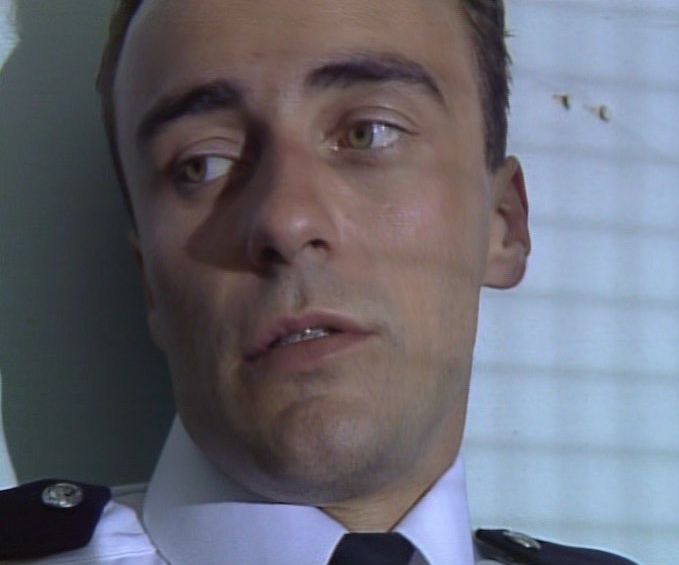

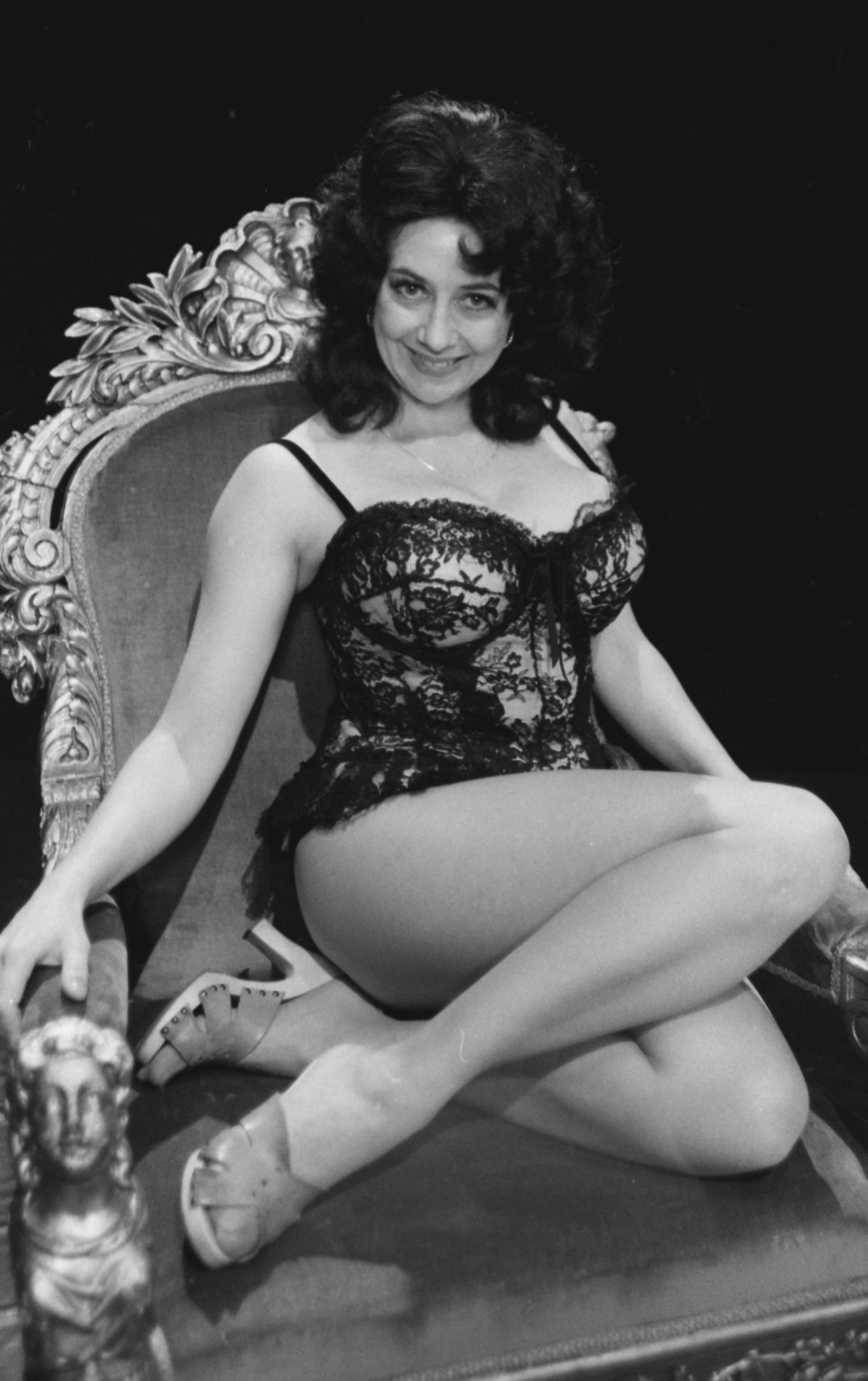
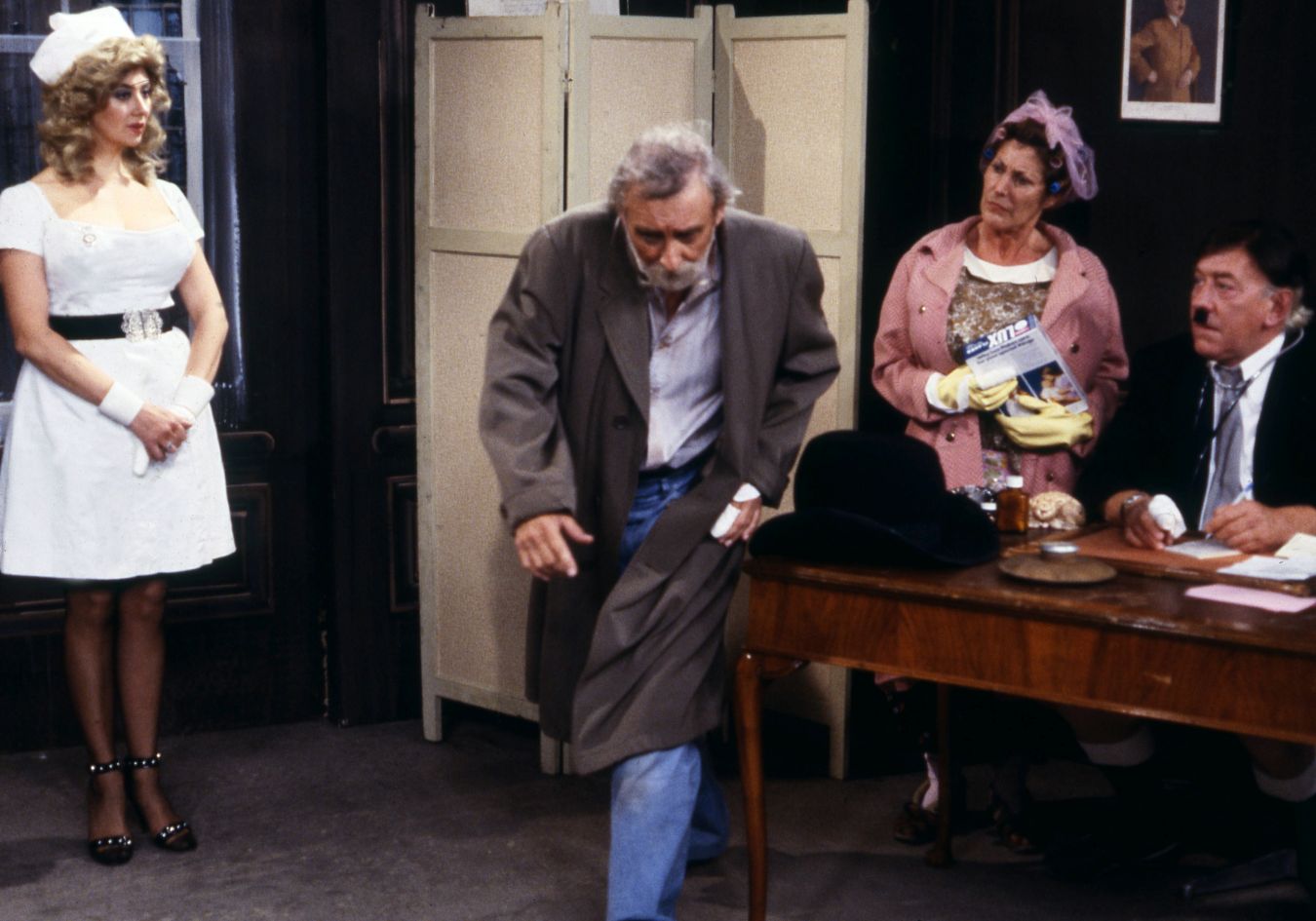
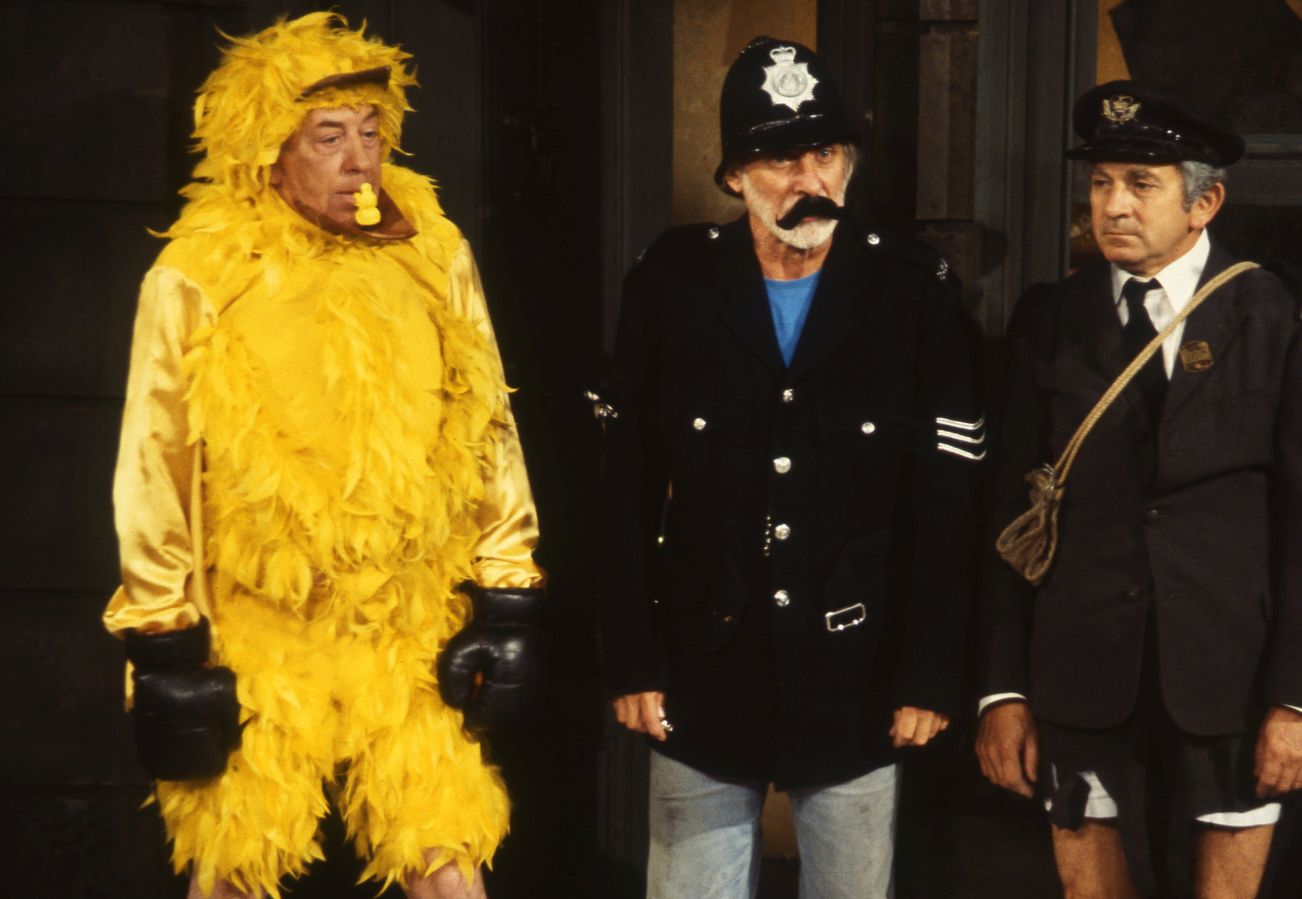
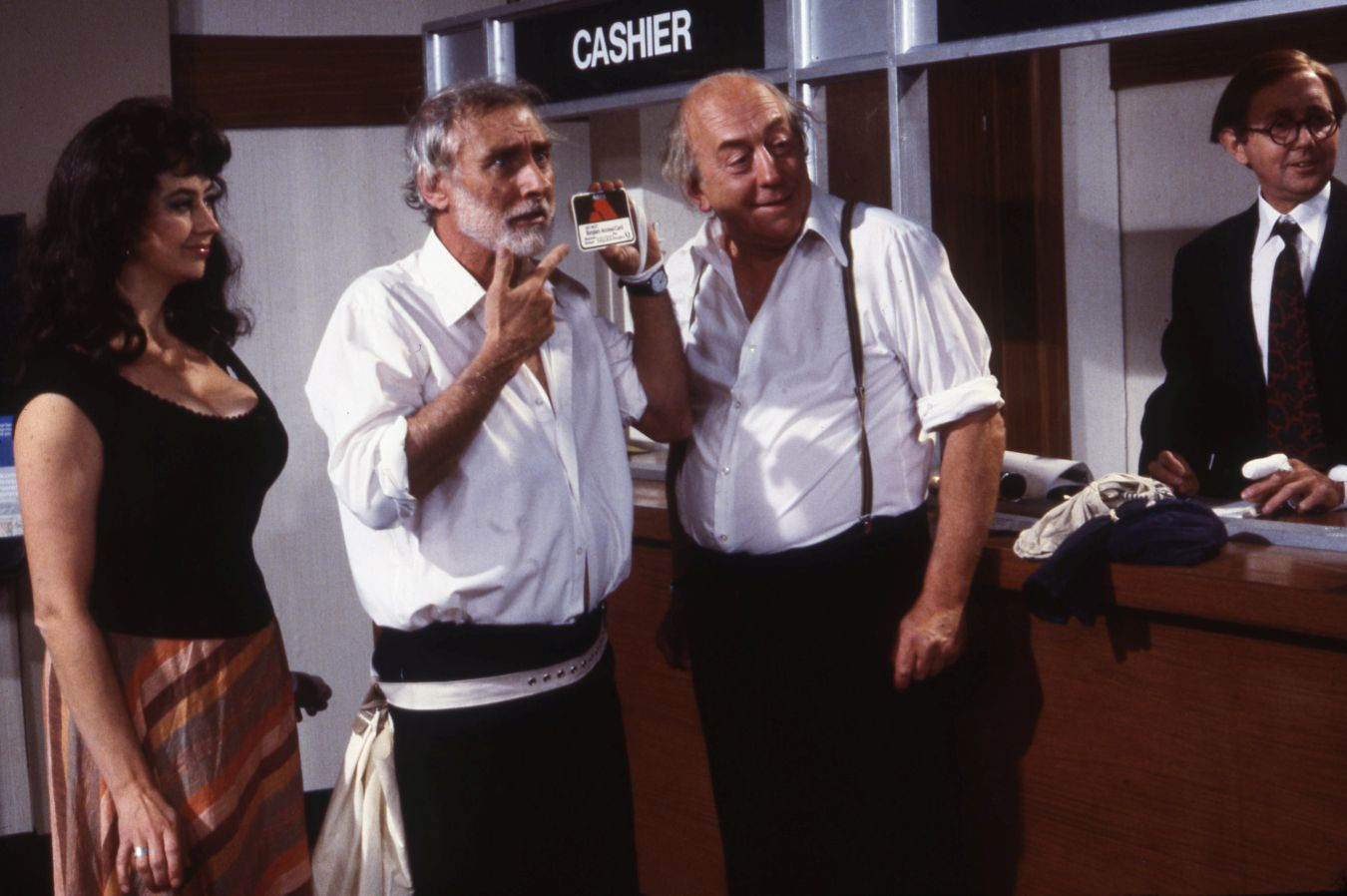
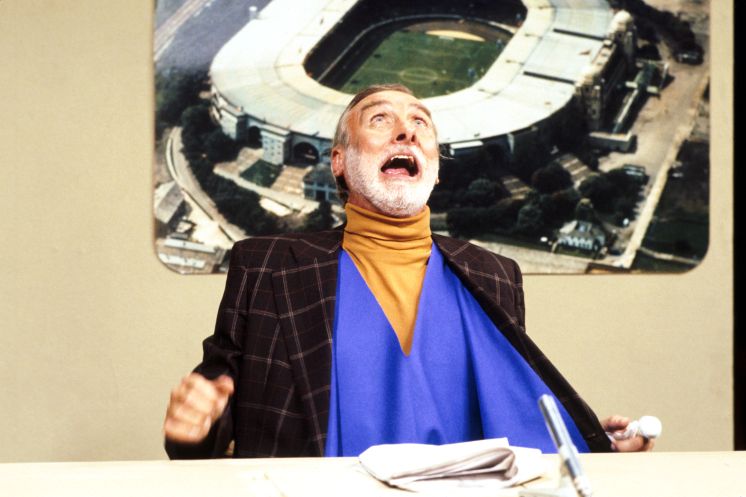
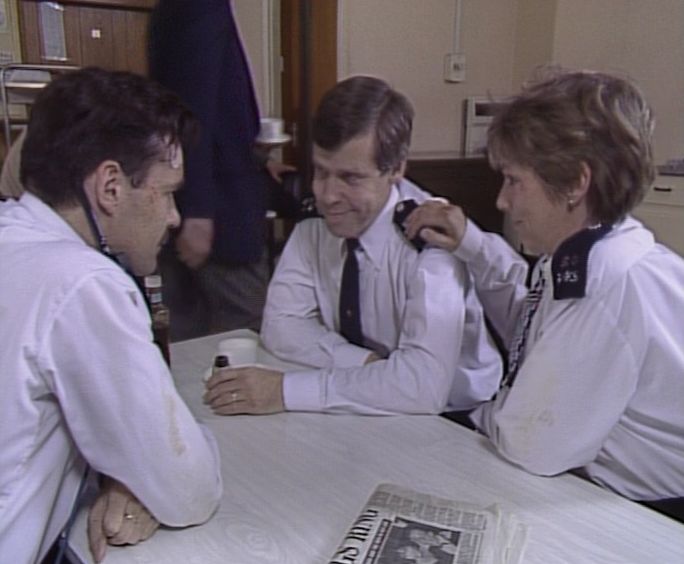
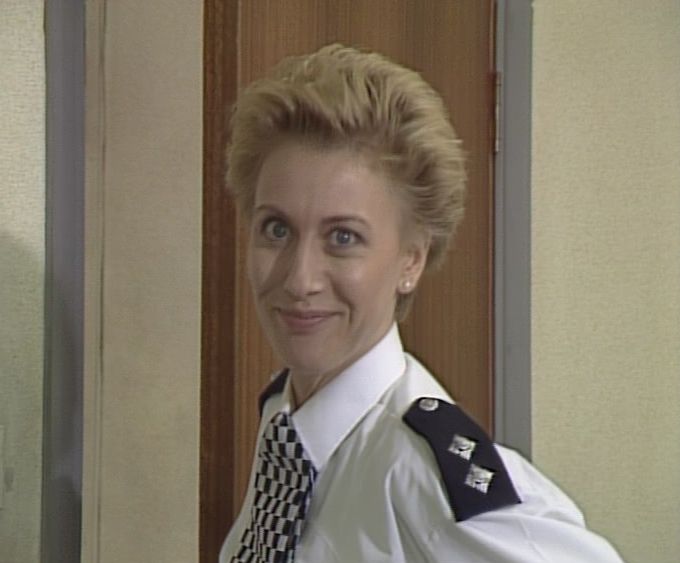
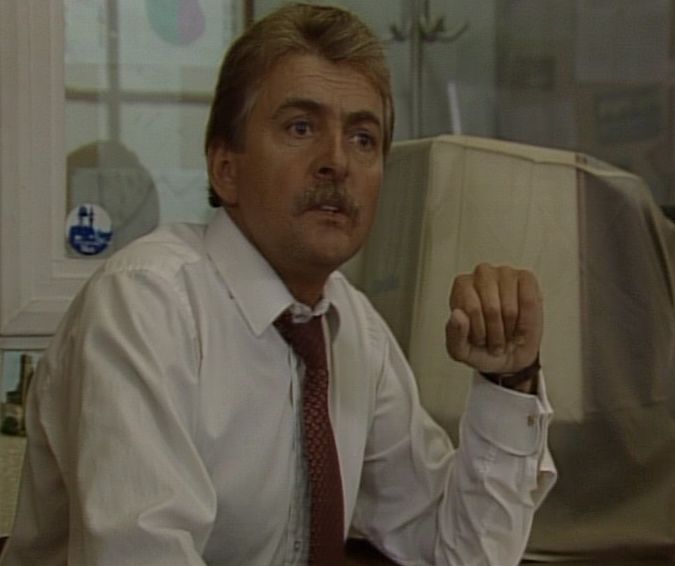
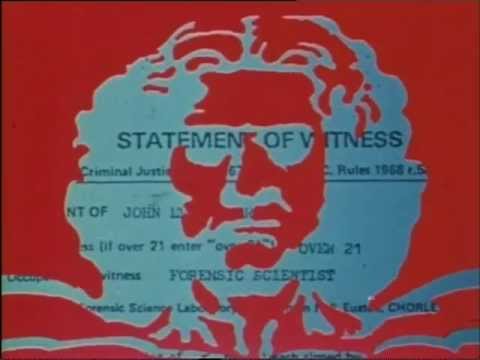
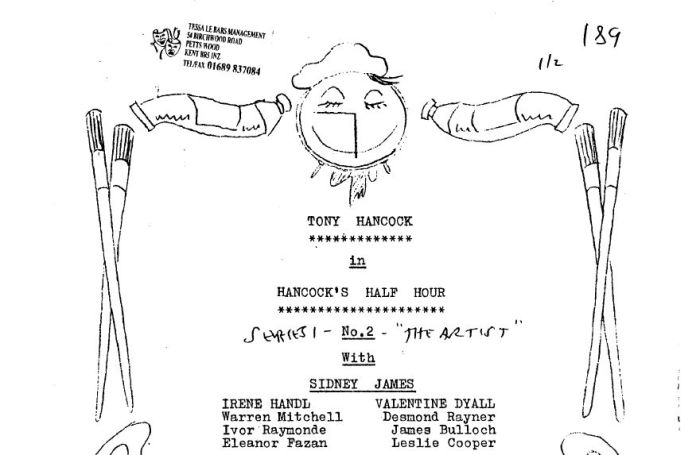
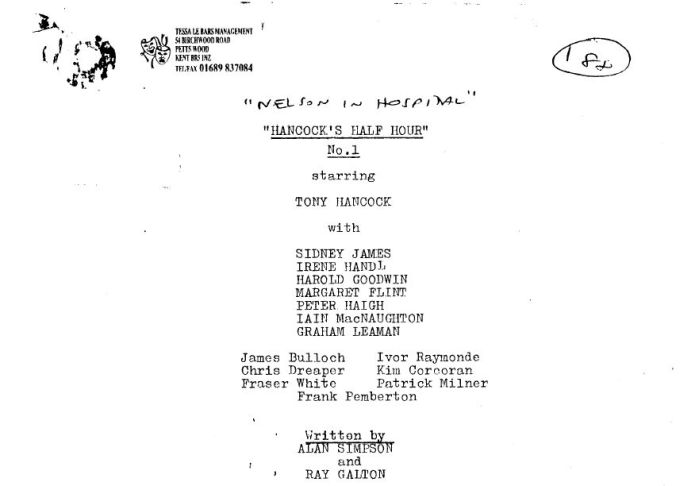
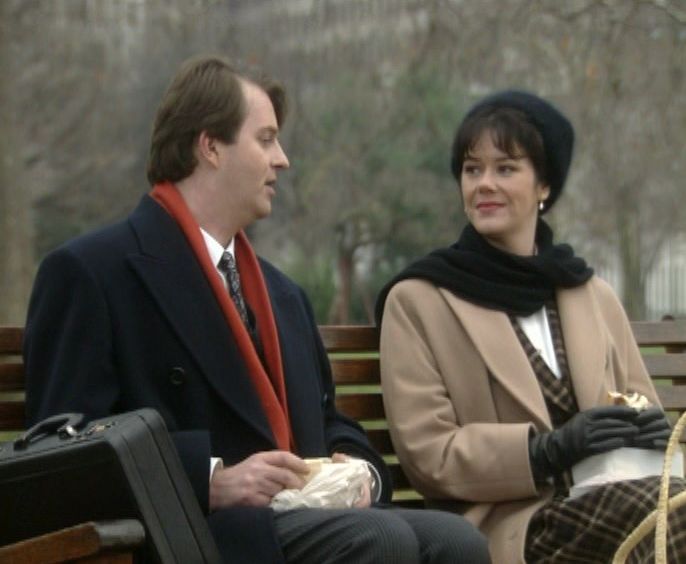

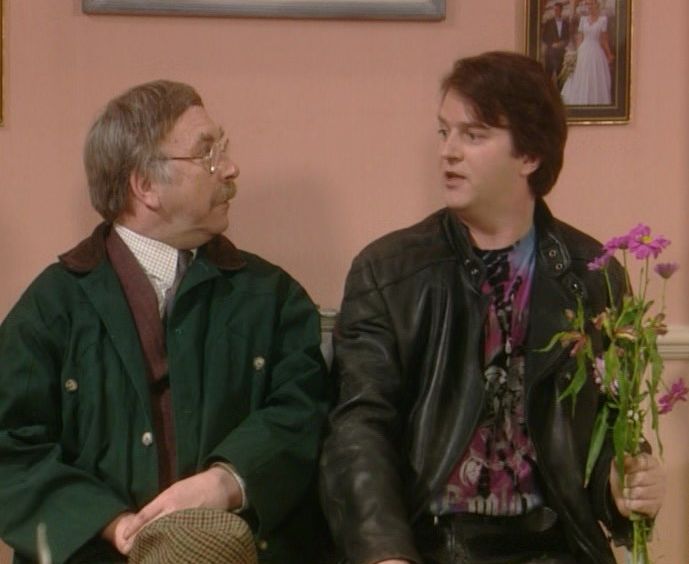
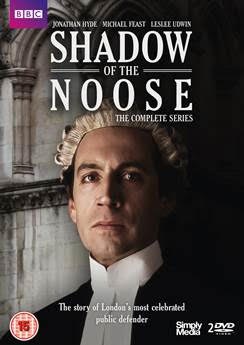
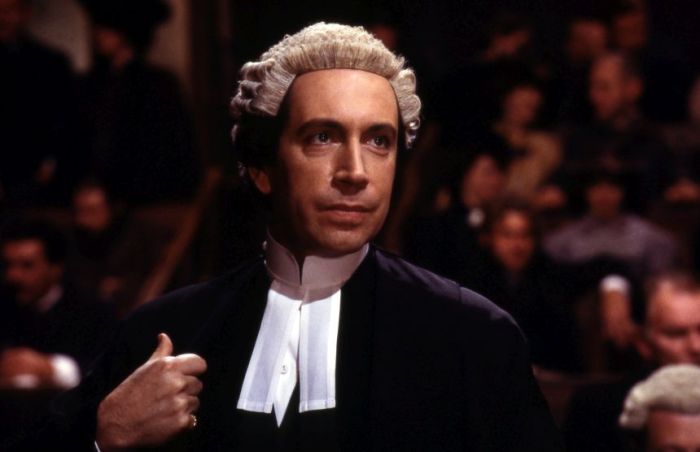
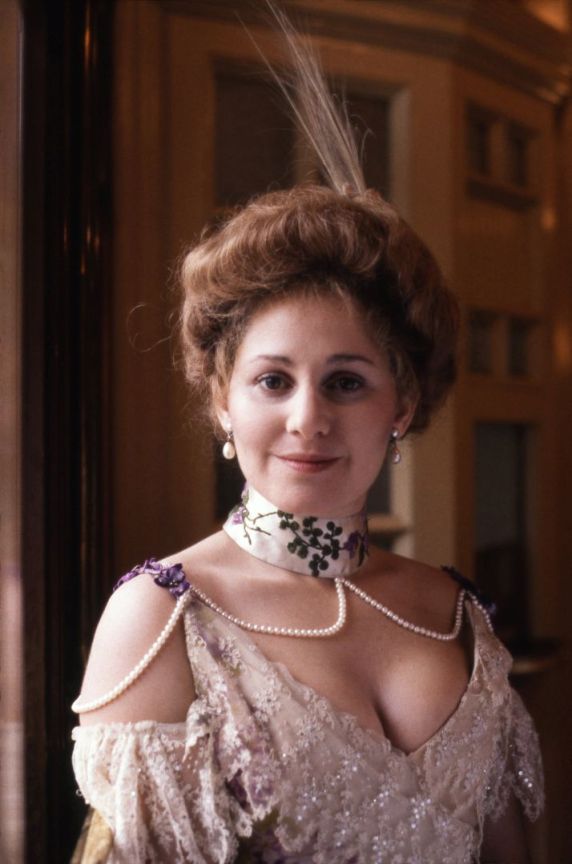
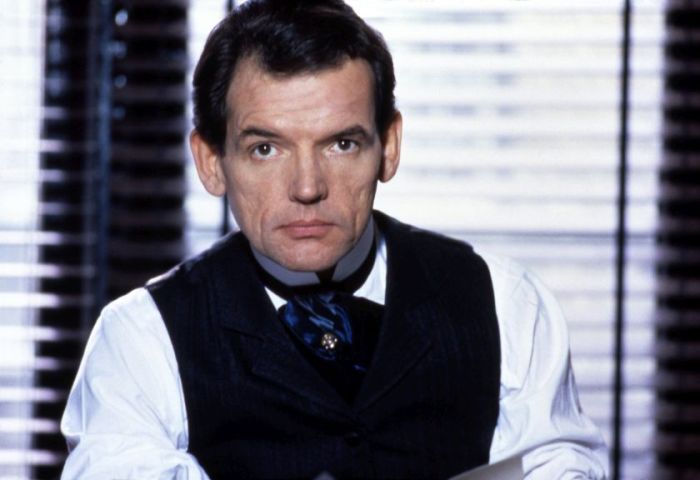
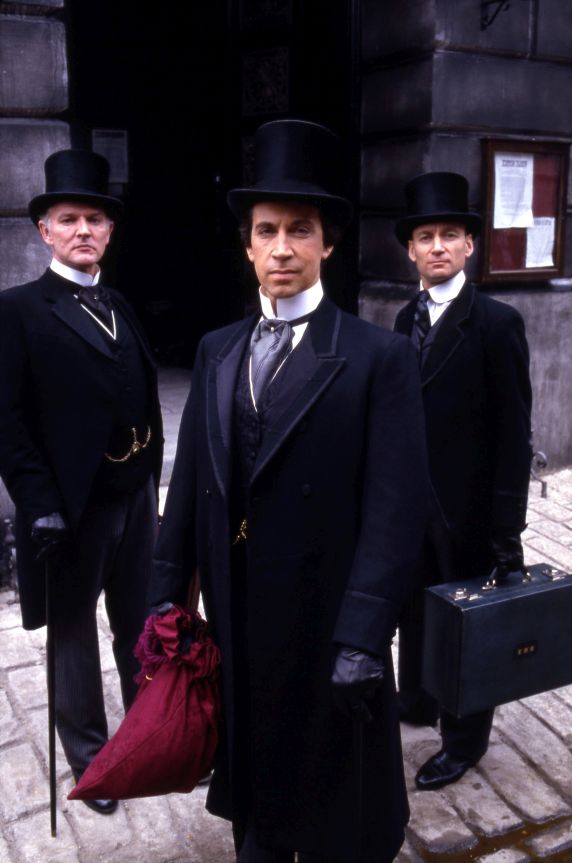

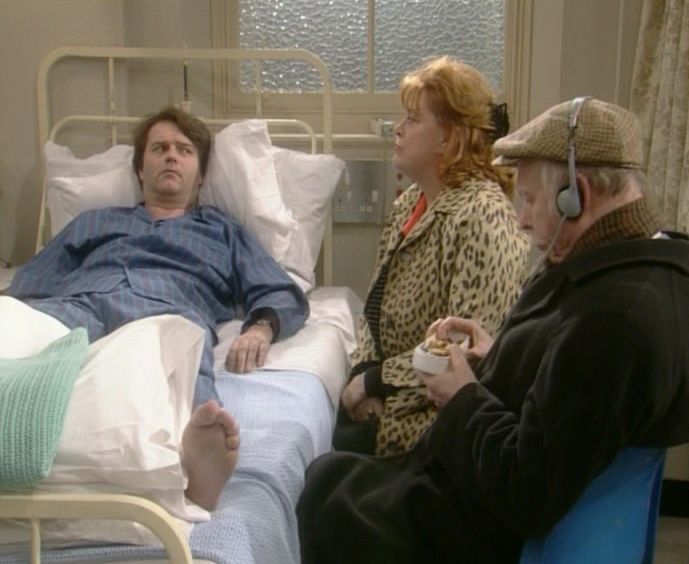
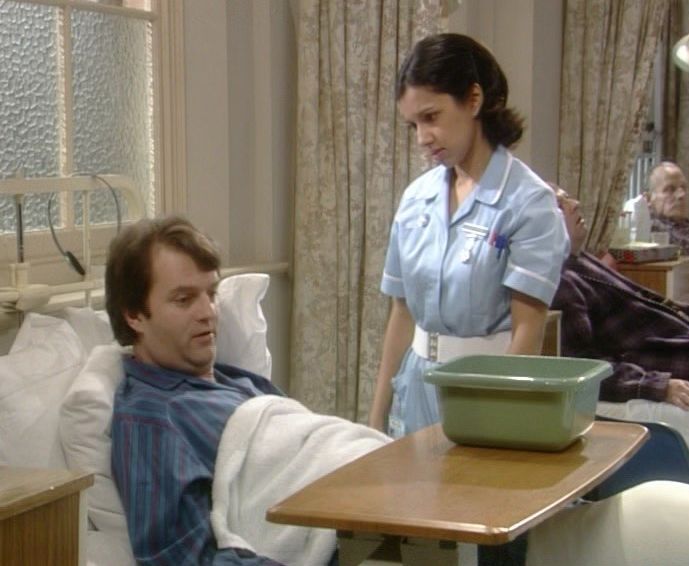
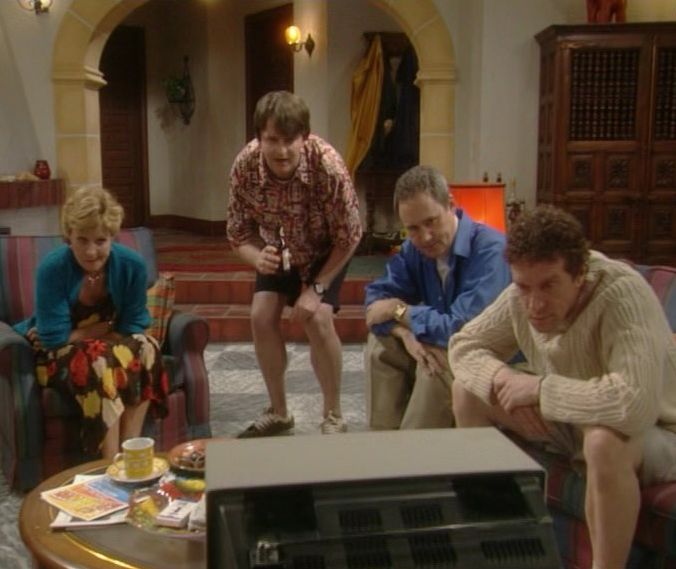
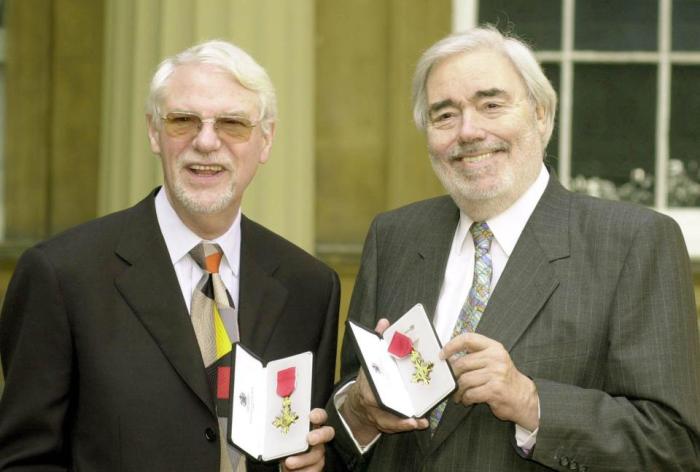

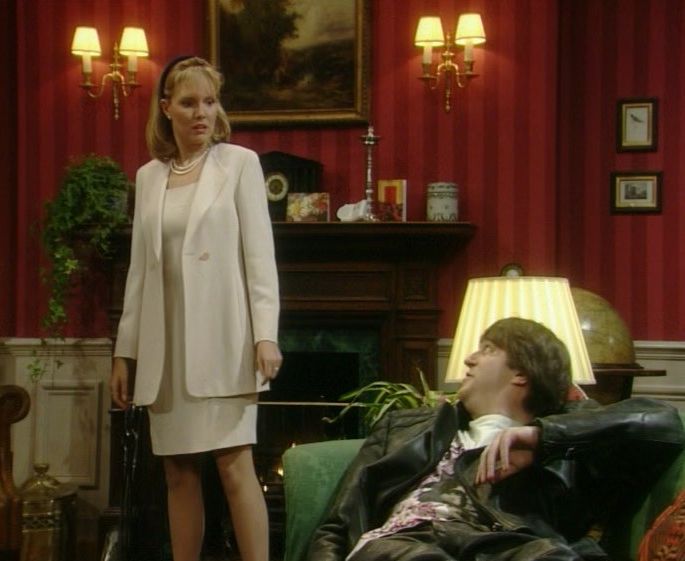

 Archive Television Musings