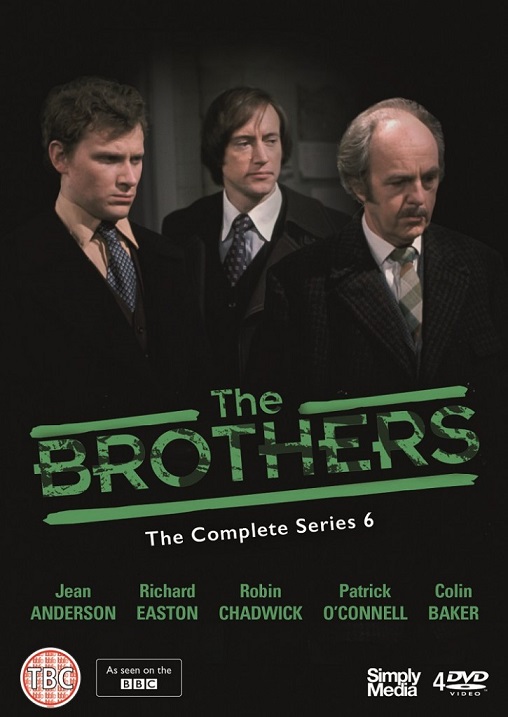
The Brothers – Series Six. Simply Media DVD Review

Series six kicks off in a typically confrontational way as Ted (Patrick O’Connell) clashes with Merroney over Brian’s future. Will Brian be welcomed back onto the board? Ted wants a fair deal for his brother and – possibly surprisingly – Merroney concurs. But the reason he gives is sure to put Ted’s back up. “Because of the three of you, he’s the only true professional”.

Colin Baker still looks as if he’s enjoying himself enormously as Merroney continues to call the tune, forcing the others to dance to it. His relationship with Brian (Richard Easton) has always been complex.  He values Brian’s business acumen and knows that Brian likes him personally (which has helped create a bond between them) but it’s also plain that Merroney would drop him like a stone if he proved to be unreliable.

Somewhat Godot like, Brian has an influence over events even when he’s not on screen. The series opener, Red Sky At Night, begins with the others awaiting his return. But when he’s not on Don Stacey’s charter-flight there’s concern all round. Where is he? Is his absence further evidence of his unreliability?

When Brian (still sporting the impressive moustache he grew last year) does reappear, it’s telling that it’s Merroney he goes to see. Although both David (Robin Chadwick) and Ted have fought for their brother’s interests in their own ways, Brian clearly feels more comfortable with somebody outside of the family.
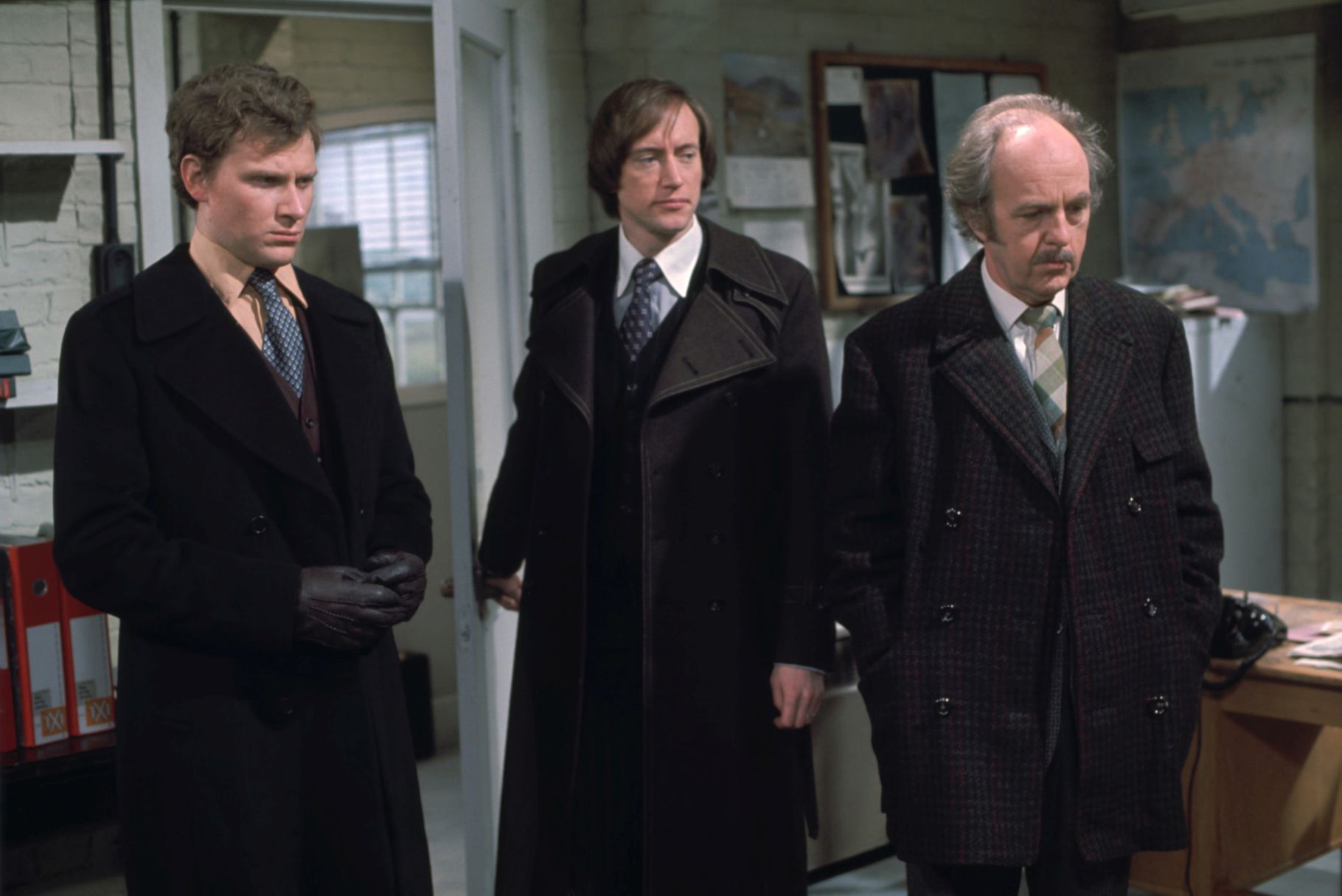
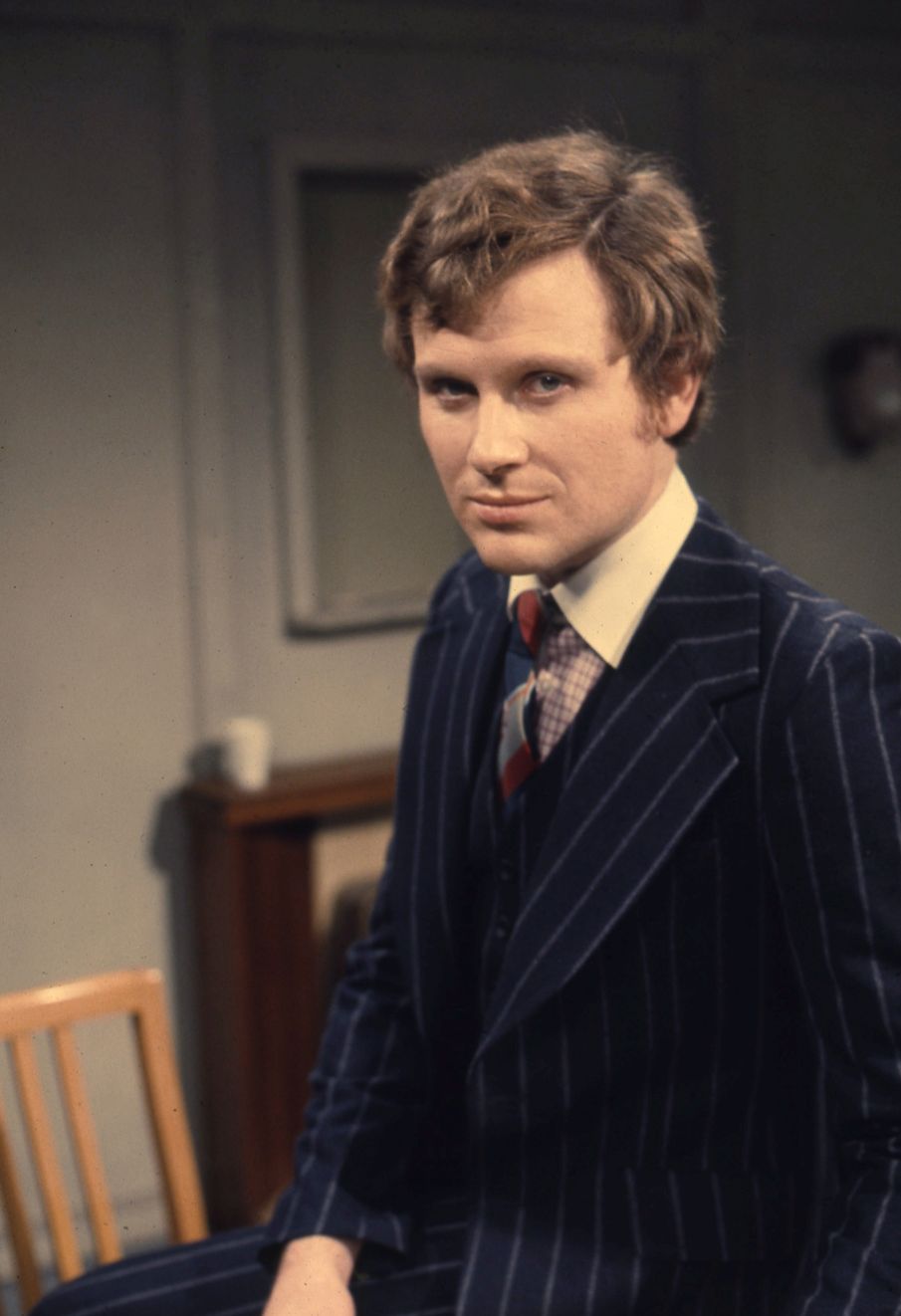
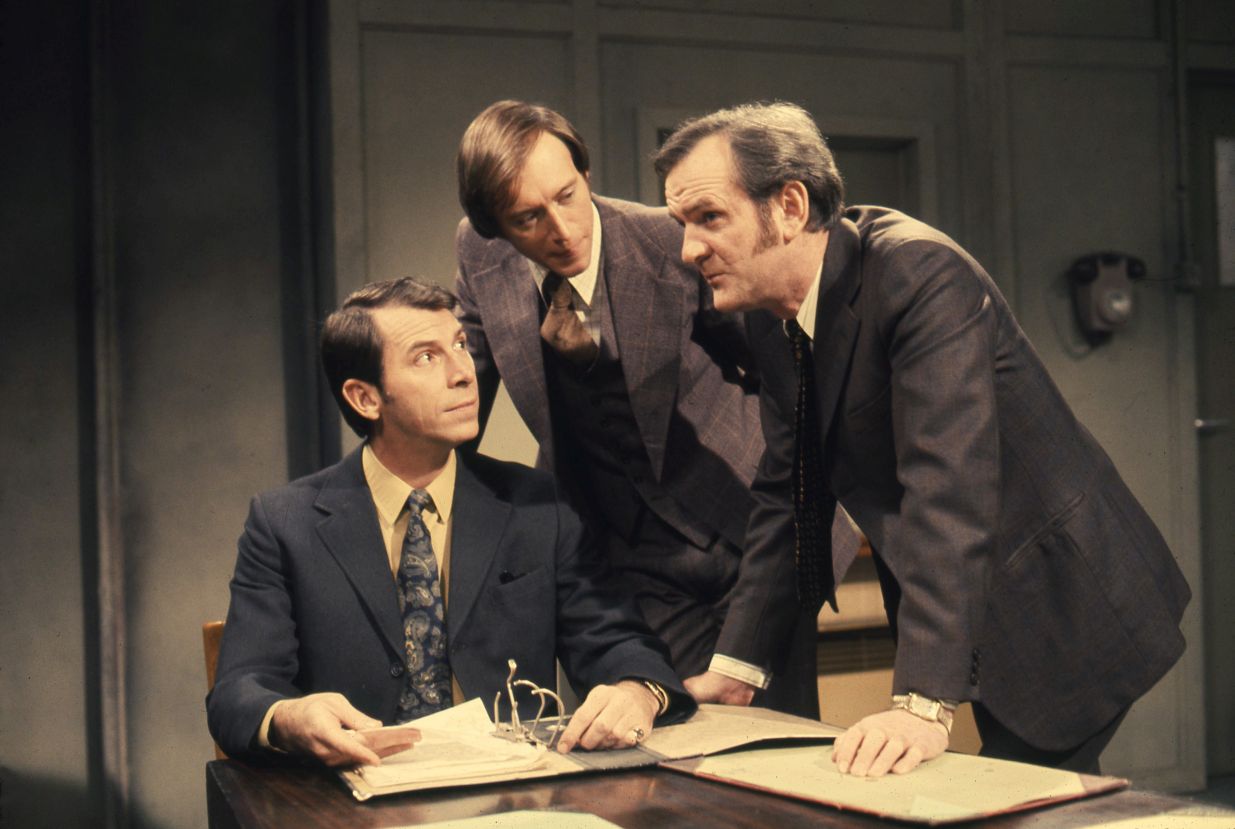
Colin Baker, Robin Chadwick and Derek Benfield

Brian’s gradual reintegration back into the business is a running theme during these early episodes as is the question of Jenny (Jennifer Wilson) and Ted’s adopted baby, William. When the baby’s real mother decides she wants him back, Jenny starts to feel the strain. One has to wonder why Jenny and Ted didn’t legally adopt the child (William was abandoned by her mother six months earlier but she now feels more confident that she can look after him).

Our sympathy should be with Jenny, but there’s something more than a little off-putting about her manic determination to hang onto William whatever it takes. Jennifer Wilson plays these scenes well and since her character’s usually so level-headed and sensible it’s an interesting change to see her put under pressure for once.

Jenny is happy to cast William’s natural mother, Pat Hawkins (Elaine Donnelly), in a poor light, but that’s not the impression most will get when they hear her story. “Look, I’m just a girl from the local estate, okay? And I got a baby. And I couldn’t explain to my mum and dad why I wanted to keep him. So I did the only thing I could do and I gave him away”.

One might raise an eyebrow at the revelation that Pat’s husband, Alan (Ian Marter), works for Hammonds. Something of a remarkable coincidence it must be said, but this does allow Ted to be pushed over the edge a little further (like Jennifer Wilson, Patrick O’Connell seems to relish these dramatic scenes). Plus it’s always a pleasure to see the late Ian Marter, even in a small role like this.
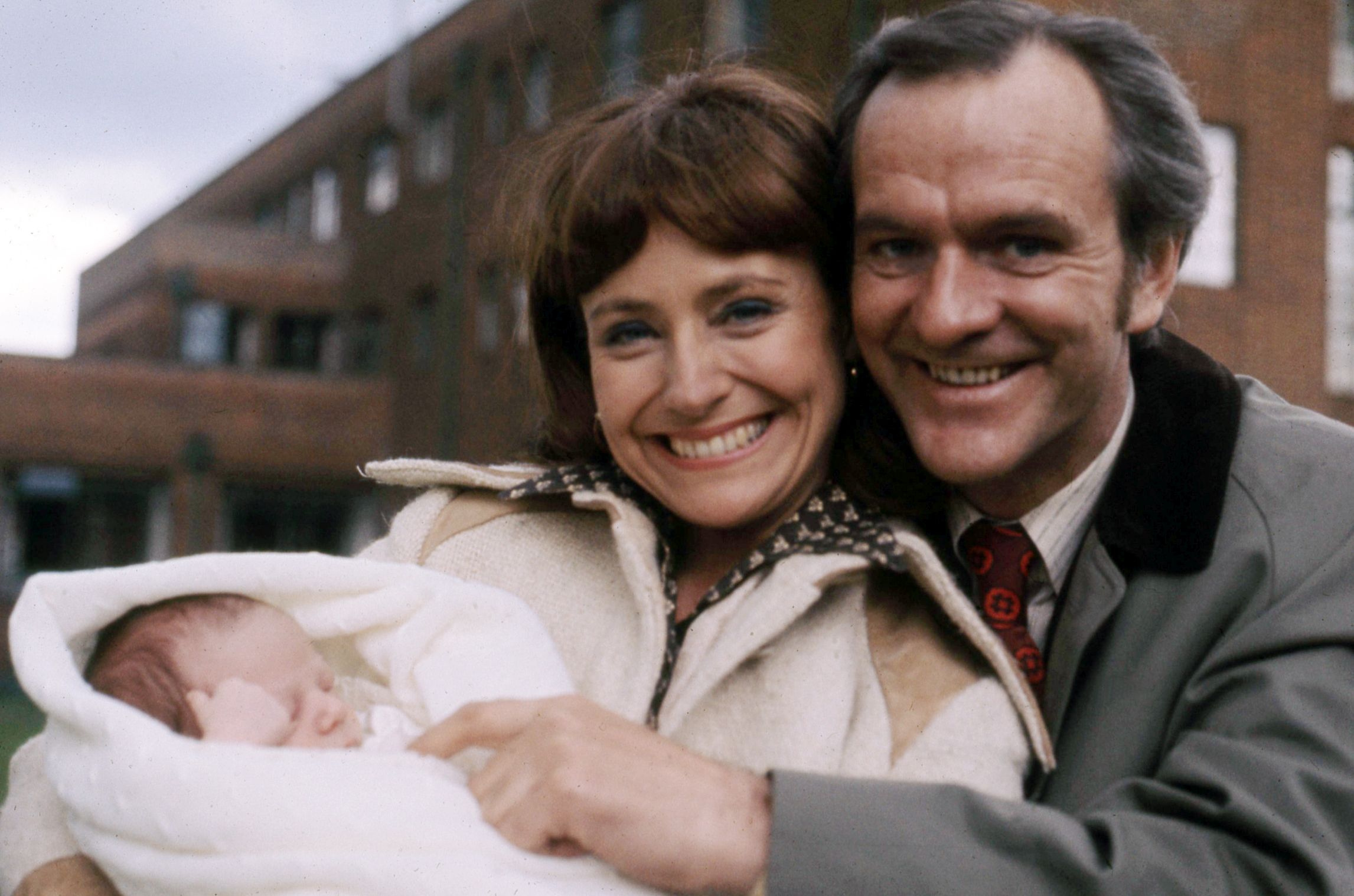
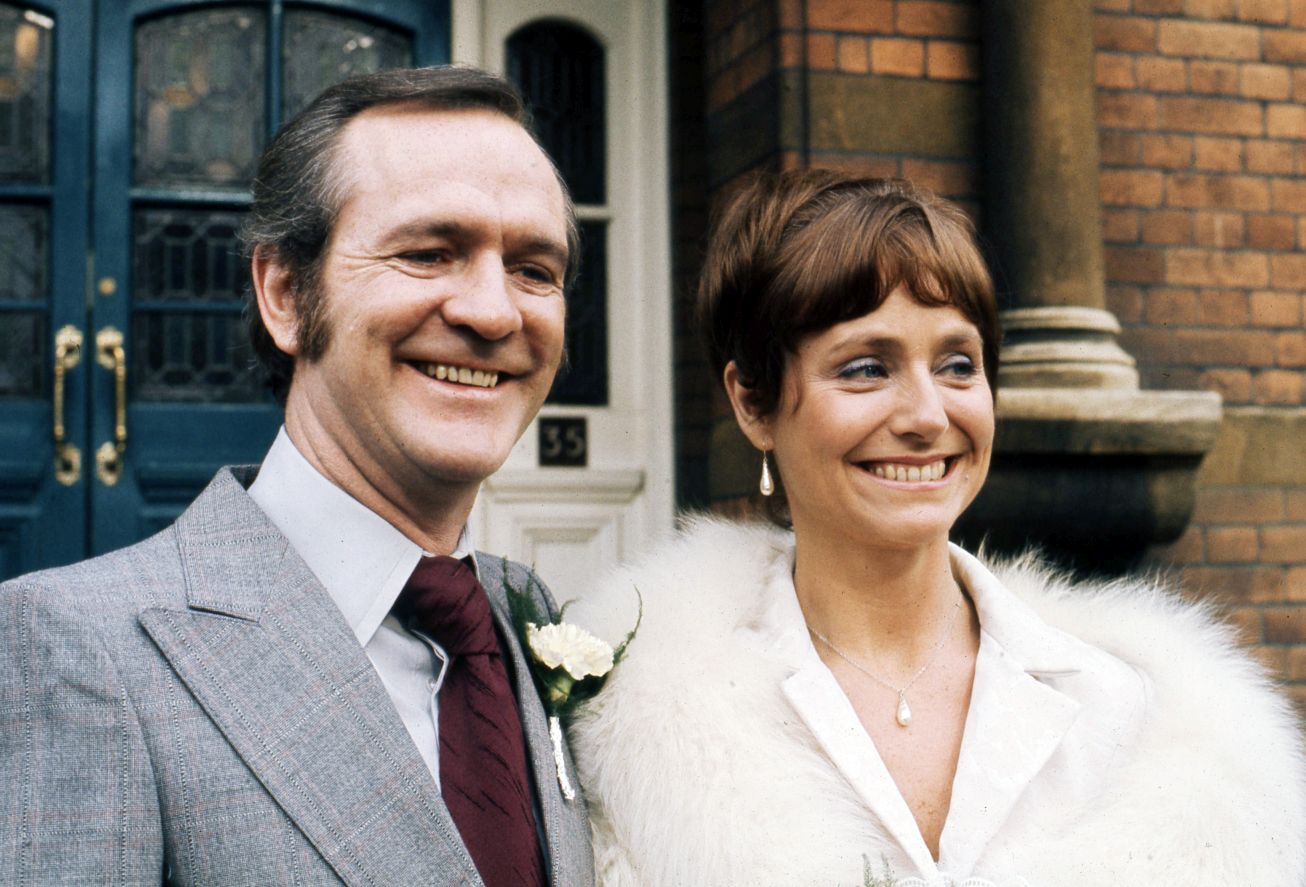
Jennifer Wilson & Patrick O’Connell

Carleton Hobbs makes a welcome reappearance as Sir Neville Henniswode (Hobbs had appeared in series four but was presumably unavailable for series five, which led to Llewellyn Rees taking over the role). Hobbs had a decent film and television career but for me – and I’m sure for many others – he’ll forever be the definitive radio Sherlock Holmes. Just to hear the timbre of his voice is enough to conjure up images of foggy streets and Hansom Cabs ….

One of the more unlikely developing plotlines concerns the relationship between Sir Neville and Mary Hammond (Jean Anderson), the imposing matriarch of the family. At least this enables Mary to get out of the house every so often and therefore makes a nice change from her usual scenes (which tend to consist of her chivvying one or more of her sons).  Since both David and Brian are currently living with her at the family home, she’s got ample opportunity to fuss around them.

The first half of series six sees the Hammonds struggling to balance their work/private lives. Brian is still finding his way back to fitness slowly, David has never been terribly business minded anyway, whilst Ted and Jenny are more concerned with the fallout from William’s departure than they are with Hammond Transport.

This leaves Merroney in a strong position, although Bill Riley (Derek Benfield) for one isn’t prepared to roll over for him. Bill’s rise through the ranks has been an entertaining running thread over the last few series. Initially he was a little diffident at board meetings – due to his elevation from the shop floor – but by this point he’s more then happy to speak his mind.
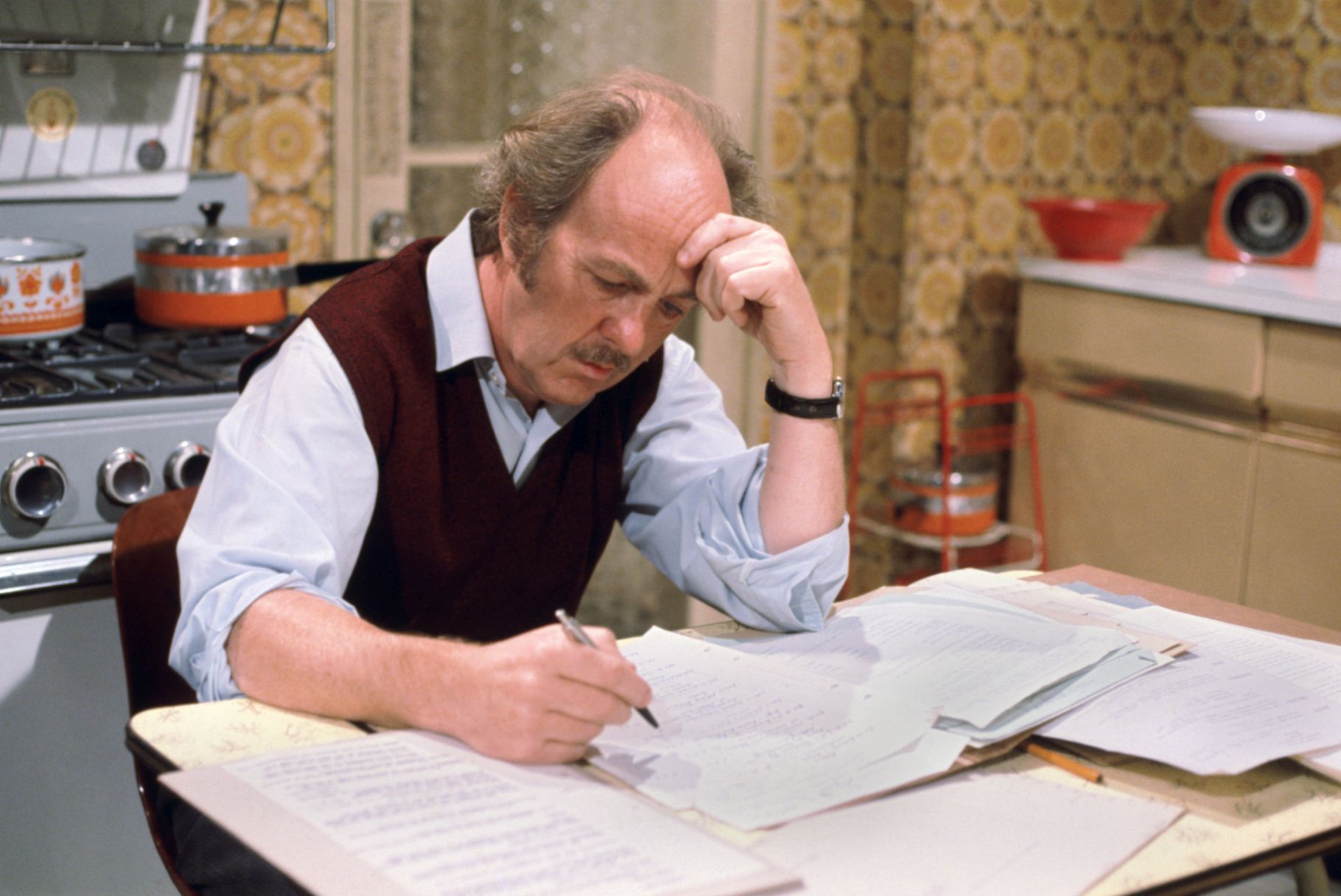
Derek Benfield

He’s matched in the common-sense stakes by his wife Gwen (Margaret Ashcroft). Whilst the majority of the characters in The Brothers are middle-class or higher, the Rileys are resolutely working-class and proud of it. It would be easy for them to be portrayed in a patronising light, but this doesn’t happen – meaning that there’s something charming in the way they enjoy the simple pleasures of life (an evening game of Scrabble, for instance). But they’ve not immune to pressure and Bill’s increasing workload will be seen to have a negative effect on their marriage.

Merroney’s private secretary Clare Miller (Carole Mowlam) still finds that her loyalty is divided between Merroney and David. With neither man in a regular relationship, both are content to use her as a dinner companion and confidant. Although Clare is a character designed to react to others rather than instigate her own plotlines, Mowlam still manages to give Clare a spiky sense of humour, ensuring she’s more than the cardboard character she otherwise could have been.

During S5, Merroney seemed mainly to exist in order to thwart the Hammonds at every turn. But throughout this run of episodes he’s more nuanced – whereas previously he was totally dedicated to Sir Neville and the bank, now he confesses that he’s beginning to side with the Hammonds over certain matters. Although on other occasions he’s quite prepared to steam-roller right through them, if he can ….

Brian also shows some unexpected facets to his personality (since his breakdown he’s become a more relaxed and far-thinking person). At one point he expresses his new personal philosophy. “You’ve got to feel that what you’re doing is really worth doing. Nobody makes money except the Mint. All the rest of us do is push it around a bit, trying to make sure that we get a little more than the next man. But it’s not wealth. Wealth is enriching. Making money is just debilitating. In the end it leads to a sense of personal isolation”.

When David finds himself rejected by Clare in episode eight  – The Chosen Victim – it serves as something of a wake-up call for him. All his life he’s been able to get whatever he wanted (until Clare). Will this make him a more rounded and less arrogant character? It’ll be interesting to see if his growth continues next series.

Paul Merroney and Jane Maxwell (Kate O’Mara) fractious relationship shows no sign of abating. At one point she tells him he’s “one of the lowest forms of life I’ve ever come across”. But when you learn that Merroney was castigating Jane’s ex-husband, the hard-drinking pilot Don Stacey (Mike Pratt) at the time, it’s easy to understand the reason for her anger.
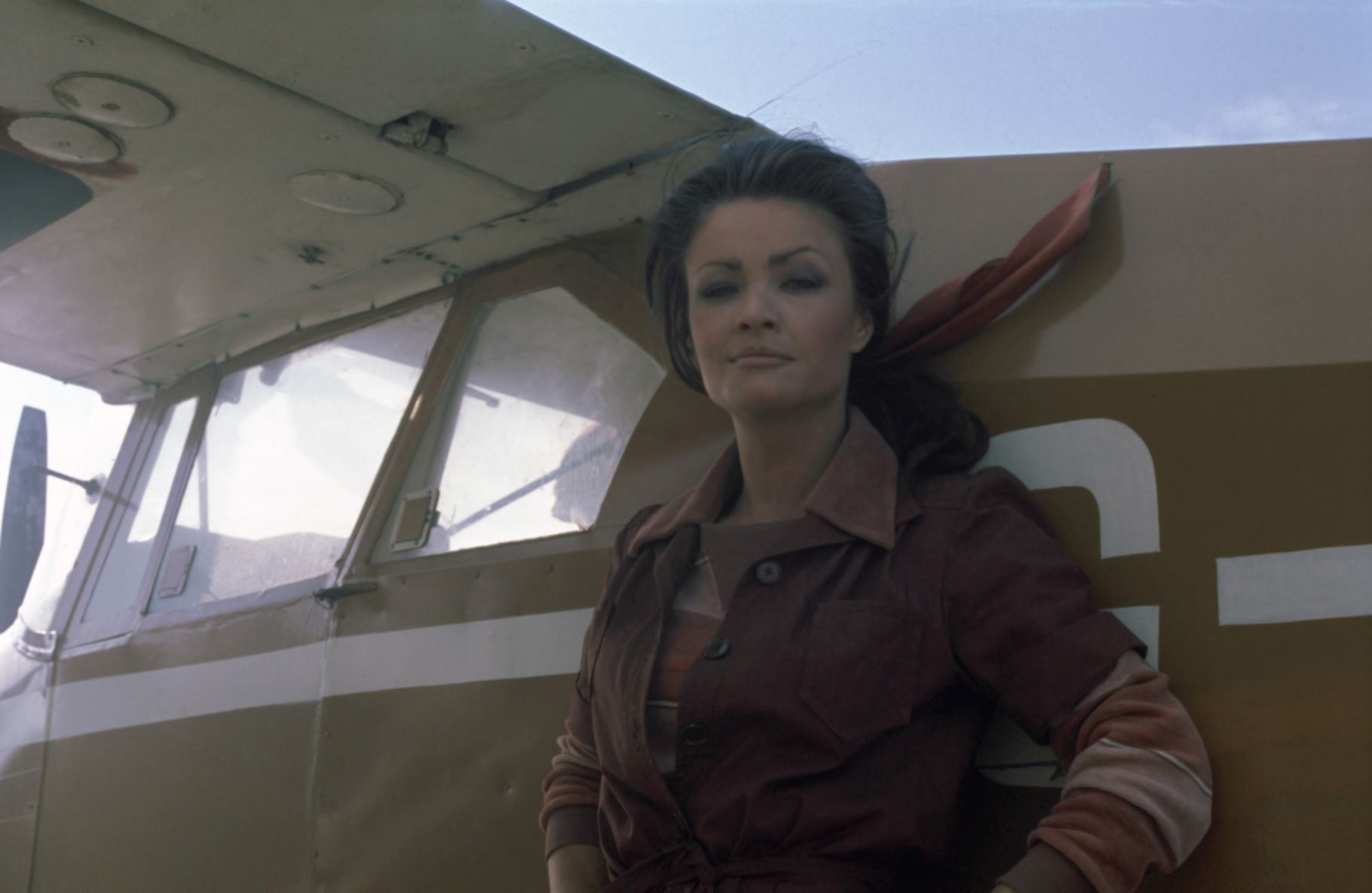
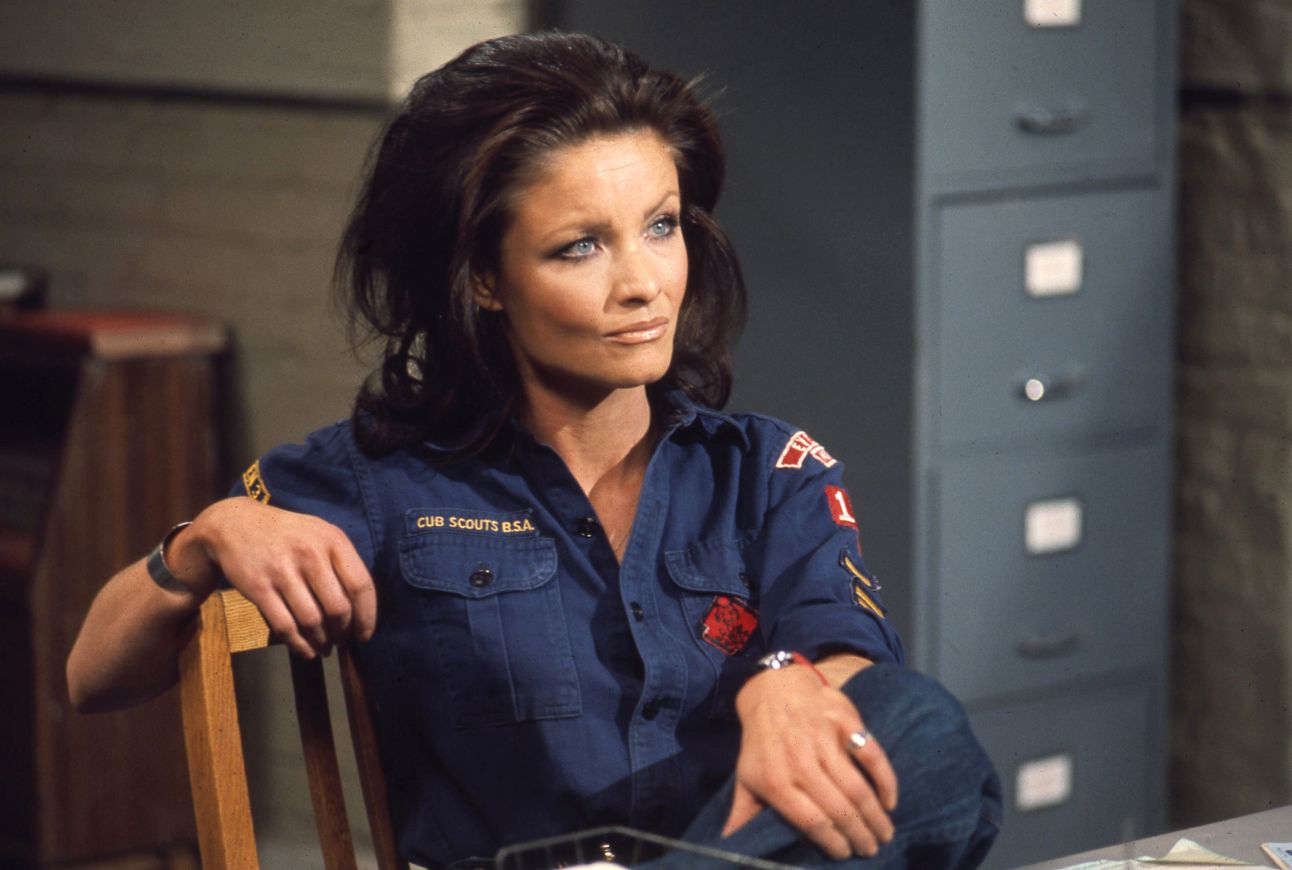
Kate O’Mara

Don bows out of the series in the sixth episode, Tender (broadcast just a few months before Pratt’s death at the age of 45). Pratt’s gaunt appearance gave the running plotline of Don’s impending medical exam a bitter irony. “Sooner or later they’ll find something that creaks or groans or doesn’t react fast enough and that’s it. You can keep as fit as you like, but Anno Domini gets you in the end”. Don didn’t do a great deal (although his leaving scene was a powerful one) but he was always an amusing character and Pratt, even though he was clearly ailing, always played him with an agreeable twinkle in his eye.

As series six moves towards its conclusion, several familiar faces pop up. Clive Swift plays the shifty Trevelyan whilst Joby Blanshard (best known as the plain-speaking Colin Bradley from Doomwatch) appears as Van der Merwe.

After being somewhat subdued in the early episodes, Ted roars back into life (few sights are more impressive than that of Patrick O’Connell in full flight) whilst Brian and Jane seem to be forming something of an alliance, both personally and professionally. But Brian’s wounded psyche (he has a fear of being touched) might be a problem. Richard Easton, as so often throughout all six series, impresses here.

The sight of April Winter (Liza Goddard) who briefly appears in the penultimate installment – The Bonus – signifies that change is on the way for Merroney. His offhand comment that she’s his fiancee is a real leftfield jolt – although April’s been mentioned on several occassions (which has prepared the ground for her arrival) it’s hard to imagine the coldly efficient Merroney ever being in love. Clare is crushed by the news. Bill later tells Gwen that “the torch that girl carries for him makes the Statue of Liberty look like a candle”.

Hammond Transport has undergone substantial changes over the last few years, morphing from a wholly-owned family concern into a company with strong ties to the bank (where Sir Neville and Merroney reign). But it’s the proposed takeover bid from Kirkmans which threatens to split the Hammond family down the middle. Some, like David, would be happy to sell their shares for a handsome profit whilst Ted (and especially Mary) are resolutely opposed to the deal.

When Merroney goes AWOL (he’s in Amsterdam, meeting with Van der Merwe) the others (especially Ted) are concerned that he’s plotting behind their back. His adventures in Amsterdam are great fun, adding a touch of out-of-season glamour to the series. The sight of his discomforted face as Van der Merwe’s daughter whisks him round Amsterdam at great speed in an open-top jeep is worth the price of admission alone.

The series finale – Birthday – might be partly concerned with Mary’s birthday celebrations but business matters are also on her mind. The takeover from Kirkmans may have foundered but a merger with Van der Merwe’s company is still very much on. But Mary, frustrated at being out of the loop, begins to flex her muscles. As with previous years, the final episode finishes on a strong hook which will lead in nicely to the start of the next series.

The Brothers remains a very moreish and ridiculously entertaining series.  Richard Easton and Colin Baker especially impress, but there’s no weak links here.  Four decades on it’s still easy to see why the show built up such a large and devoted fanbase (not only in the UK but in many other countries as well).  Sharply defined and well-acted characters, placed in perpetual conflict with each other was a key part to its success and the passing of time has done nothing to dull this winning format.

The Brothers – Series Six is released on the 12th of June 2017 by Simply Media and contains thirteen 50 minute episodes across four discs.  RRP £29.99.
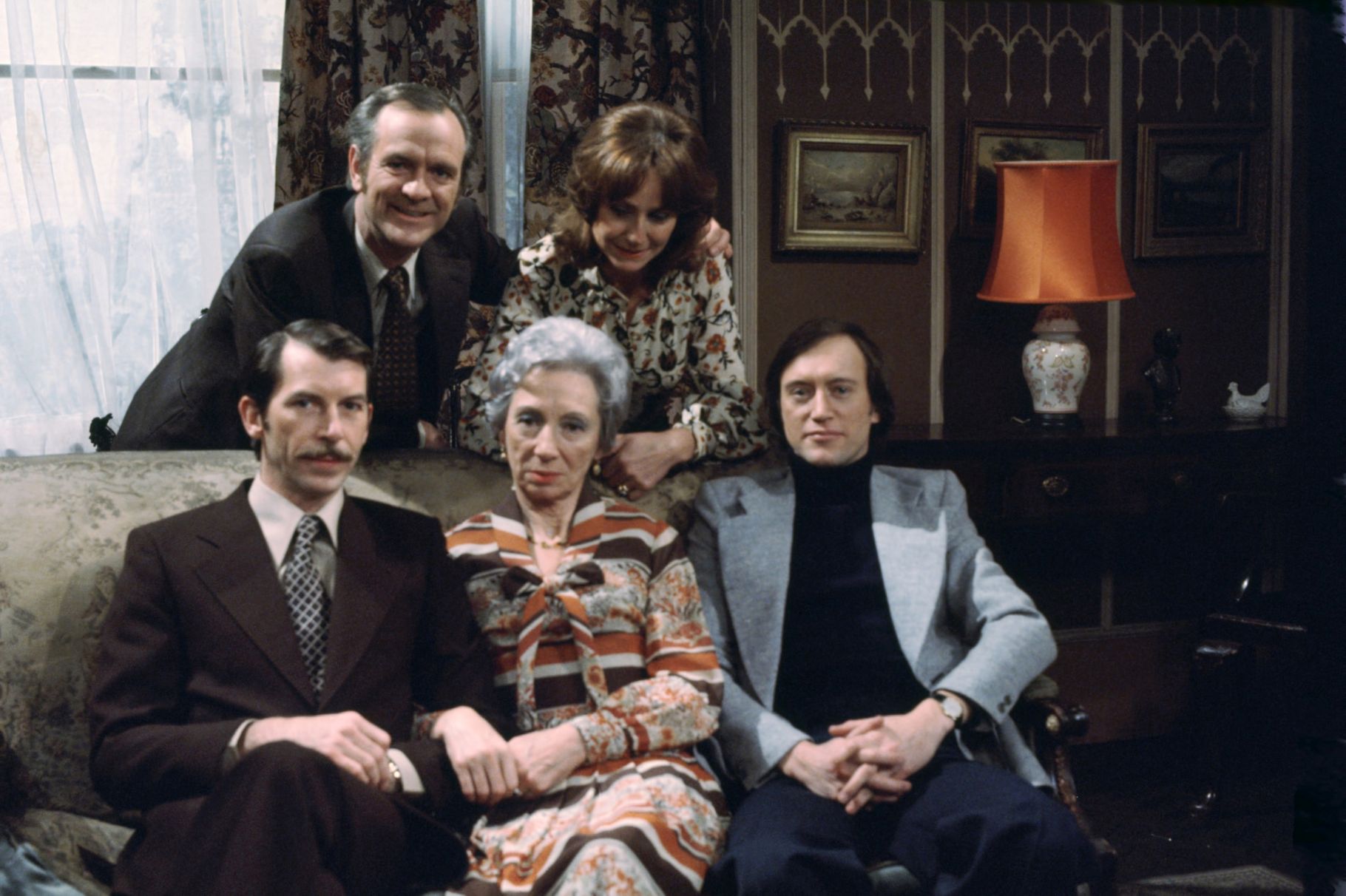
Patrick O’Connell, Jennifer Wilson, Richard Easton, Jean Anderson & Robin Chadwick

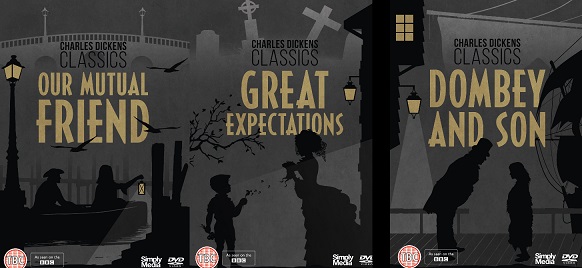
1950’s/1960’s BBC Charles Dickens Classics to be released by Simply Media – July 2017

covers2

It’s very pleasing to see that a number of 1950’s/1960’s BBC Classic Serial adaptations of Charles Dickens’ novels are due shortly from Simply Media.  Three have been confirmed for release on the 3rd of July 2007 – Our Mutual Friend, Great Expectations and Dombey & Son.

Below is a little more detail about them.

Our Mutual Friend.  Adapted by Freda Lingstrom and broadcast in twelve episodes during 1958/59.  Paul Daneman, Zena Walker, David McCallum, Richard Pearson, Rachel Roberts and Robert Leach head the cast, whilst many other familiar faces – Rachel Gurney, Peggy Thorpe-Bates, Wilfred Brambell, Melvyn Hayes and Barbara Lott – also appear.

Great Expectations.  Adapted by Hugh Leonard and broadcast in ten episodes during 1967.  Gary Bond, Francesca Annis, Neil McCarthy, Richard O’Sullivan, Peter Vaughan and Bernard Hepton are the major players in this one whilst there’s also plenty of quality to be found lower down the cast-list (Ronald Lacey, Jon Laurimore and Kevin Stoney amongst others).

Dombey & Son.  Adapted by Hugh Leonard and broadcast in thirteen episodes during 1969.  A typically strong cast is headed by John Carson as Mr Dombey with Clive Swift, Pat Coombs, Ronald Pickering and Davyd Harries amongst the other familiar faces appearing.

And with three further releases to come in late August – Barnaby Rudge (1960), Oliver Twist (1962) and Bleak House (1959) – the next few months look to be good for those who enjoy classic BBC B&W drama.

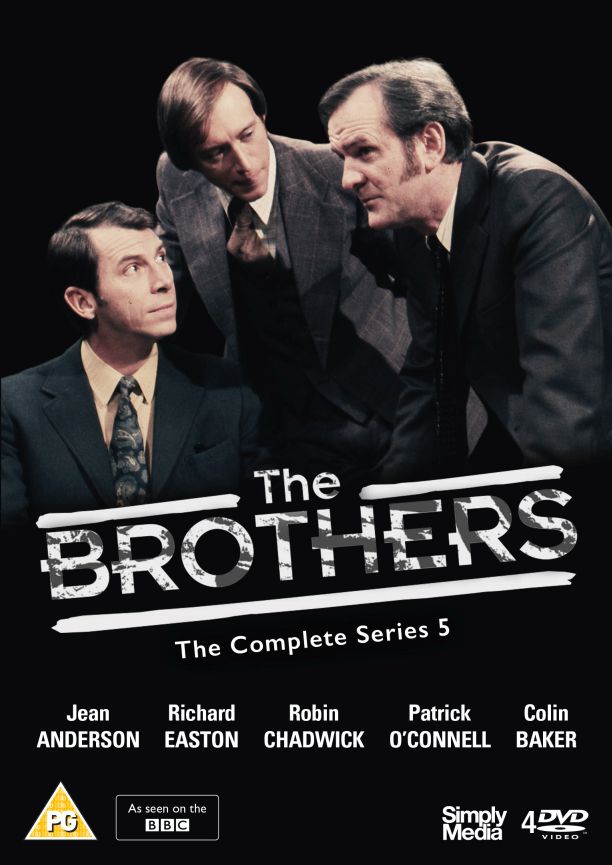
The Brothers – Series Five. Simply Media DVD Review

The beginning of series five finds The Brothers in something of a transitional phase.  Two key cast members (Gabrielle Drake and Hilary Tindall) had left the show at the end of the previous run, although fresh blood (most notably in the shape of Kate O’Mara as Jane Maxwell) would shortly arrive to shake things up.

The departures of both Drake (Jill Hammond) and Tindall (Ann Hammond) were used to good dramatic effect though.  Ann and Brian had gone through the relationship mill during the previous series and even though their union was now at an end, Brian continues to suffer.  But his broken marriage is just one reason why he goes severely off the rails in the early episodes.

Although Tindall was gone, her character was still alive and therefore a return was always possible (and  indeed Ann did make a fleeting reappearance in a handful of episodes at the start of the seventh and final series).  But Drake wasn’t so fortunate, as Jill is dispatched in the time-honoured way of dealing with soap actors who either can’t or won’t carry on (an off-screen accident).  Talking about this decades later in The Cult of The Brothers documentary, it seems that Drake was a little taken aback at just how ruthlessly Jill was dealt with.

Another character, Martin Farrell, had also left, which results in both personal and professional consequences.  Professionally, it means that the position of chairman is vacant – which seems tailor-made for the ambitious Paul Merroney.

And on a more personal note, it was plain that Ted Hammond’s nose was put out of joint last series by the interest Farrell had been taking in Jenny Kingsley (Jennifer Wilson).  So with Farrell out of the picture, Ted (Patrick O’Connell) rekindles his own relationship with her.  Lest we forget, Jenny carried on a lengthy and clandestine affair with Ted’s late father.  Unsurprisingly this meant she has always been viewed with great disfavour by Ted’s mother – the indomitable matriarch Mary Hammond – but it seems that Ted has eventually summoned up the courage to defy his mother and make an honest woman out of Jenny.  Although I’m sure there’s still going to be a few bumps ahead before they can enjoy a lifetime of wedded bliss.

Patrick O’Connell & Jennifer Wilson

The series opener, the aptly titled Life Goes On, finds Brian in a pretty poor state. This concerns the bank – they don’t want to see their investment in Hammonds put at risk because the new managing director is feeling flaky – but Paul Merroney has put plans in motion to protect their money ….

Although Merroney was a rather peripheral character during the last series, here he really starts to make his mark. For one thing, he’s gained an assistant – Clare Miller (Carole Mowlam). Apart from signifying Merroney’s increasing significance, Clare also emerges as a character in her own right – becoming close to David, for example.

Baker’s good value in these early episodes as Merroney begins his manoeuvres. Surprisingly, only the bluff Bill Riley realises that Merroney has his eye on the chairman’s job – which doesn’t say much for the business acumen of the others! There’s a delicious sense of duplicity on show from Merroney as he puts the blame for the recent ousting of Ted as managing director firmly on the shoulders of the departed (and innocent) Farrell.

The way the audience learns about Jill’s death is done in a very interesting way which makes a positive out of the fact that Gabrielle Drake was no longer a member of the cast.  Jill isn’t mentioned during most of the first episode, although that wasn’t unusual (she was absent from the first few episodes of series four).  It’s only right at the end of Life Goes On, when David runs into a friend who’s been out of town for several months that we find out Jill is dead.  This is an incredibly jolting moment which provides us with a strong hook into the next episode where her fate is discussed in detail.

The dynamic between the three brothers – Ted, Brian and David – has been the motor which has powered the series to date.  Whilst series five continues to play on their conflicts, the emergence of Paul Merroney as a major player refreshes this somewhat – as an outsider he has quite a different set of loyalties.

Colin Baker

But the brothers still dominate the storylines especially, in the early episodes, Brian.  In many ways he’s now got everything he wished for – he’s become managing director of Hammonds, ousting Ted.  Or has he?  We’d seen in previous series that it was Ann who was the ambitious one, constantly pushing him forward.  So the fact that he’s gained in business but lost out in his personal life must come as a bitter irony to him.

Richard Easton continues to impress as Brian, especially when he starts to lose the plot (the episode title Breakdown makes it fairly obvious what’s going to happen).  As his drinking increases, Brian is encouraged to seek psychiatric help.  And always around is Merroney, plotting to oust Brian at one point and then (so the others fear) attempting to buy Brian’s shares so he can gain overall control of the company. But as we’ll see, Merroney is no cardboard villain – he may be mainly motivated by self interest but he’s also not without compassion for the stricken Brian.

As Brian, ensconced in a nursing home, retreats into the background, so other plotlines begin to develop.  The long-running will they/won’t they relationship between Ted and Jenny is now very much back in “they will” territory and moves forward at a rate of knots.  The problem with Mary (Jean Alexander, as good as always) still has to be overcome though, as the icy disdain she feels towards the woman who conducted a long-term affair with her late husband continues to be a fruitful source of drama.  Even when Mary and Jenny appear to be on civil terms there’s always the sense that at any moment things could change ….

Although the departure of both Hilary Tindall and Gabrielle Drake left something of a hole, two new female characters filled the gap nicely.  Clare’s divided loyalties (between David and Merroney) generate a good source of drama which plays out as the series progresses whilst Kate O’Mara makes an immediate impression as Jane Maxwell.  Debuting in episode six, Flight of Fancy, Jane is the hard-headed director of an air-freight business which Hammonds have an interest in.  As a proactive business woman she’s something of a rarity in the world of The Brothers (Jenny might be a board member of Hammonds, but she’s a much more passive character).

Kate O’Mara

Also appearing for the first time in this episode is Mike Pratt as Don Stacey, a hard-drinking pilot.  This would be Pratt’s final television role before his death in 1976 at the age of just 45.  Don would appear throughout the remainder of series five and the first half of series six. Whilst it’s always a pleasure to see Pratt, it’s rather tempered by how ill and haggard he looks.

Yet again, things conclude in the boardroom (episode thirteen, Warpath) as Merroney continues to scheme although it’s possible that in Jane he’s finally met his match (a decade or so later Baker and O’Mara would once again lock horns, this time in Doctor Who).  With Ted under pressure and Brian’s fate still uncertain, things are left nicely poised for the following series to pick up where this one left off.

By now, The Brothers had become a well-oiled machine and series five not only manages to develop the existing characters in a variety of ways but it also develops intriguing new ones as well.  It continues to be highly addictive stuff, especially as the Hammonds, Merroney and Jane jostle for power and superiority.  But there’s time for more personal stories as well (Jenny’s longing for another child) which ensures that the series isn’t completely boardroom and business based.

The Brothers – Series Five is released by Simply Media on the 27th of March 2017.  RRP £29.99.

Richard Easton, Robin Chadwick & Patrick O’Connell

Shackleton – Simply Media DVD Review

Sir Ernest Henry Shackleton was a polar explorer who made three eventful expeditions to the Antarctic between 1902 and 1917.  His story has been tackled several times (for example, the 2002 mini-series starring Kenneth Branagh) but this 1983 BBC2 drama-documentary has long been regarded as one of the most authentic retellings of his exploits.

There are several reasons why this production is noteworthy.  Shackleton covered all of his Antarctic expeditions, not just the most well-known one (aboard the ship Endurance).  And since events are allowed to unfold over a number of years, this gives time for his relationships with other characters, such as Scott (Neil Stacey), to be explored in detail.  Also, it doesn’t shy away from the harsher aspects of life in the polar region (the toe amputation scene is authentically grisly).

Screenwriter Christopher Railing (who won an Emmy in 1971 for The Search for the Nile) worked from Shackleton’s journals to craft as accurate a picture as possible.  With location filming in Greenland, shot by BAFTA-award winner David Whitson, no expense was spared.

Although this ensured a visual treat for the audience, some at the BBC were less than impressed.  Will Wyatt, at the time the head of Documentary Features, recalls that “most years there was some sort of crisis. The worst was a four-part drama documentary about the Antarctic explorer Shackleton, shot on location in Greenland, around London, and at the BBC’s Ealing studios. The producer, an experienced drama production manager [John Harris], was unable to say ‘no’ to the director [Martyn Friend]. Shackleton went a disastrous record-breaking 50 per cent over budget. I told the producer he was finished with us and should return to drama, and I abandoned plans for all further drama docs.”

Whilst it’s a pity that this overspend seemed to have put paid to future productions (the same team had previously mounted the well-received Voyages of Charles Darwin) at least the money spent was put up on the screen for the viewers to enjoy.

David Schofield played Shackleton.  He made his television debut in a 1972 episode of Z Cars and worked steadily in television during the remainder of the seventies and early eighties.  After appearing in Shackleton his career continued to grow (later he chalked up appearances in Hollywood films such as Gladiator and Pirates of the Caribbean).

DAVID SCHOFIELD as Sir Ernest Shackleton.

Schofield is given strong support from an impressive supporting cast, which includes Michael Hayward, David Rodigan, Geoffrey Chater, Robert James, Robert Lang, Victoria Fairbrother, Stephen Tate, Michael Sheard, Kevin Whately and Anthony Bate.

Episode one, A Merchant Navy Man, opens with Scott’s Antarctic expedition of 1902.  Shackleton was a member of his party but due to ill health found himself sent home early.  These opening scenes sets up the tension that always existed between the pair.  Shackleton later discloses to his fiancé Emily (Victoria Fairbrother) that he found Scott to be a “button-up sort of fellow. Never manages to let his hair down.”  Shackleton, on the other hand, was approachable and friendly and seemed to be popular with the other members of Scott’s crew (there are some who contended that this was the real reason why Scott sent him home).

When Shackleton returns to London he’s invited to give several talks on their achievements and it’s here that Schofield really starts to make his mark, as Shackleton paints a vivid picture of life on the ice.  “I cannot leave you tonight without trying to convey to you something of the vast magnificence of the south polar regions. The immense forces of those contending elements – rock. wind, ice and water. The stillness of the Antarctic night. And the comradeship. The intensified feeling of life, of being alive, which men feel in those frozen wastes and which draws them back as if their souls belong there.”

With Shackleton now married to Emily and ensconced in Edinburgh, life for both of them is settled, but he regards the Antarctic as unfinished business.  With the backing of William Beardmore, a wealthy Clydeside industrialist, Shackleton mounts his own expedition, but finds that various obstacles – most notably Scott – have to be overcome first.  Scott insists he has a prior claim on the McMurdo Sound area and Shackleton agrees not to use it as his base of operations.  But when the heavy pack ice forces him into McMurdo, Scott – back in England – regards it as a personal betrayal.

The ominously titled Our Dead Bodies Must Tell The Tale sees Shackleton and his three companions, Frank Wild (David Rodigan), Jameson Adams (Kevin Whately) and Eric Marshall (Andrew Seear) set out for the South Pole.  Between late 1908 and early 1909 they made a trip of sixteen hundred miles, ending up just ninety seven miles away from the pole.  This feat turned Shackleton into a national hero and earned him a knighthood.

Rodigan is excellent throughout the series as Wild, one of Shackleton’s firmest friends and supporters whilst Seear adds a discordant note here as Marshall, a man who dislikes Shackleton intensely (he refers to him as “a moody vacillating boaster”).  A young Kevin Whately has a decent role as Adams.  There’s a nicely observed sense of desperation as the months tick by – they may have started sprightly enough (with plenty of supplies and horses to pull the sledges) but all four would have been well aware that the return trip would be the real test.

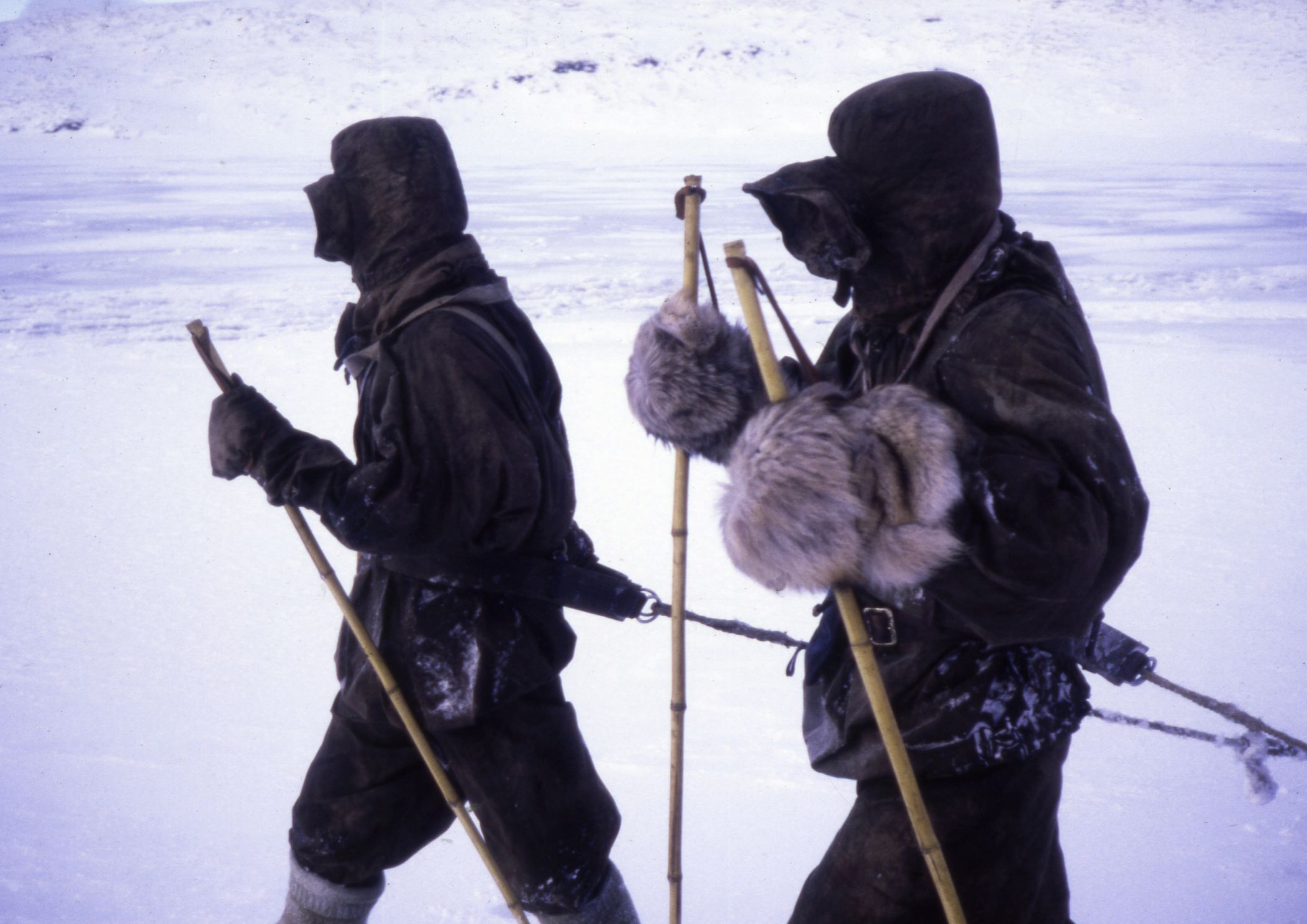
By then the horses have passed their usefulness, leaving the men to pull the sledges.  With dwindling supplies there’s a sense of anxiety that the others may have already left.  Will they return to base just to find an empty hut?  The stark beauty of the barren wastes, with Shackleton’s words in voice-over provided by Schofield, make the first half of this episode a memorable one.

Although not directly connected to Shackleton, Scott’s ultimately doomed attempt to reach the South Pole first was a key moment from this era of exploration and closes the second episode on something of a sombre note.

With the South Pole conquered by Amundsen, Shackleton needs a new challenge. He announces that he will mount a Trans-Antarctic Expedition to cover the entire continent – from a landing in the Weddell Sea, via the South Pole to McMurdo Sound.

This journey, which begins in the boat Endurance, is by far the most compelling part of Shackleton’s exploits.  Episode three, Men Wanted for Hazardous Journey, starts with Shackleton’s recruiting drive and shortly afterwards his hand-picked crew (and the odd stowaway) are making good progress after departing from South Georgia.

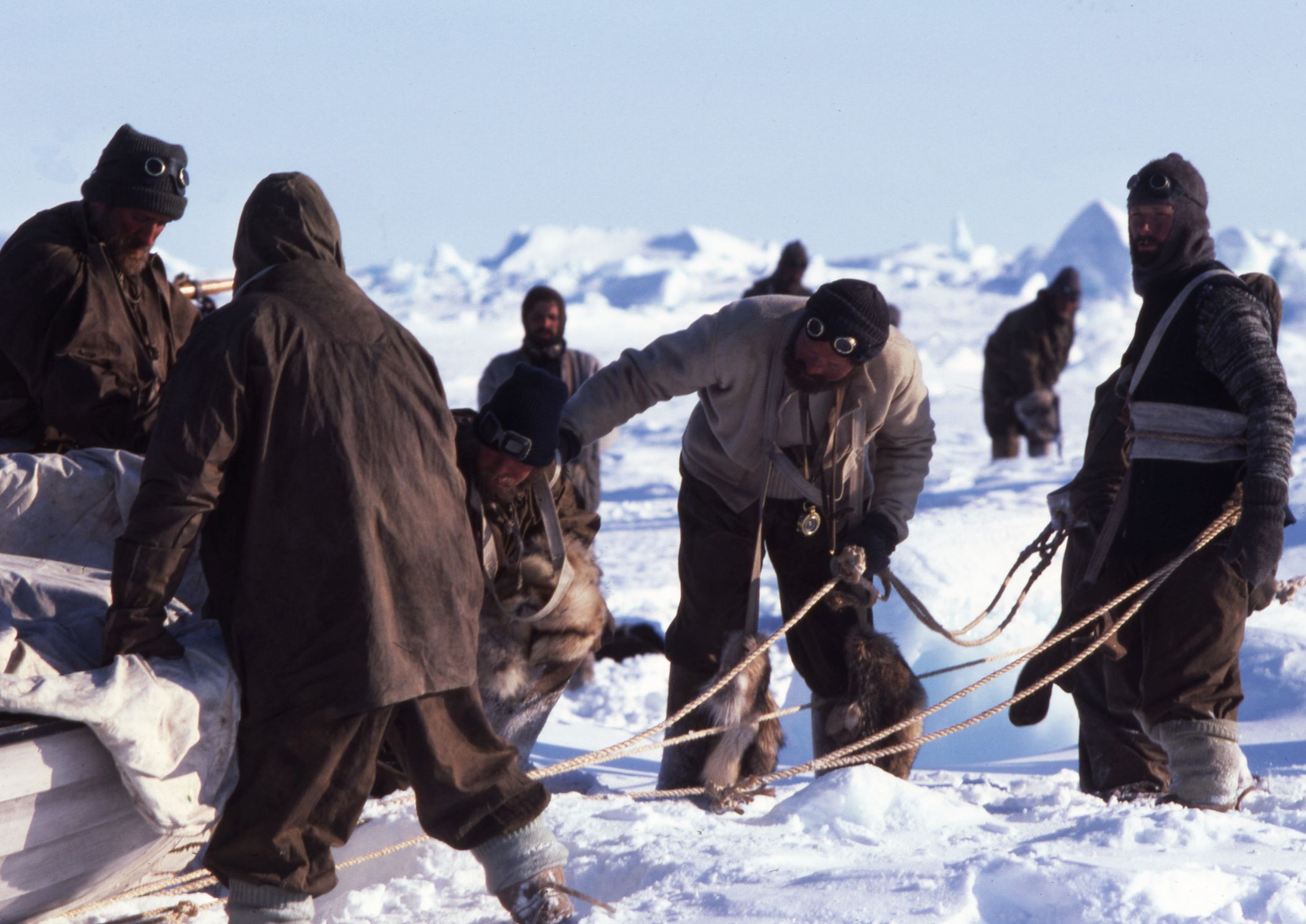
But it doesn’t take long before the ice pack traps Endurance solid.  It’s an awe-inspiring sight and if Shackleton did go as far over budget as Will Wyatt claims, then it was worth every penny.  Trapped fast in the ice, the crew have to find ways to while away the time (and this they certainly do – with a variety of light-hearted jinks, including dog racing and a spot of cross-dressing).

When the Endurance is lost, Shackleton and the others are left stranded on a large ice floe which they hope might drift towards civilisation.  Even in such a desperate situation, Shackleton continues to be an inspired leader and David Schofield continues to impress in the title role.

The desperate plight of Shackleton and his men continues during the fourth and final episode, Cape Horn – Or South Georgia?  It covers an especially memorable part of the Shackleton story – which begins with a hellish 800 mile journey made by himself and five others in the open-lifeboat James Caird.  But when they reach their destination – South Georgia – that’s not the end of the story as Shackleton and several others have to make a land crossing over the island (through previously unchartered territory) in order to reach the Norwegian whaling stations and safety.

With the stakes so high – if Shackleton doesn’t succeed then the rest of his crew – (stranded on Elephant Island) – are sure to die, Cape Horn – Or South Georgia? engages the attention right from the start.  It’s a suitably dramatic conclusion to the series, leaving the fate of the men stranded on Elephant Island unresolved until right before the end.

The series is split between Shackleton’s Antarctic explorations and his life back in the UK. The first instalment has the least Antarctic footage (it tops and tails the episode) but the scenes in Britain are integral to understanding Shackleton the man, so they shouldn’t be regarded as mere filler.

Not only do they document his relationship with his wife (with hints that his restless spirit has placed a burden on their marriage) but his clashes with the establishment are also key to understanding his character. And it doesn’t hurt that the establishment is represented by character actors as good as Geoffrey Chater, Robert James and Anthony Bate – all of whom excelled at playing precisely these types of stuffy, patrician mandarins.

The contrast between Shackleton’s comfortable life in Britain and the hardships endured by himself and the others in the Antarctic is teased out in several unspoken ways. Firstly, the members of the Royal Geographical Society are shown to be frequently dismissive of Shackleton – even going so far as to suggest (not to his face, at least) – that his claims of nearly reaching the South Pole were exaggerated.  How can they, stuck in their comfortable existence, even begin to understand the hazards and joys of Antarctic exploration?  And when we see Shackleton on his lecture tours, it again highlights how his audience (smartly dressed, affluent) live in a totally different world from the one he’s describing so vividly.

One of the ways you know if a real-life drama or documentary has engaged your attention is if it inspires you to seek out more information about the subject. That’s certainly the case for me here, as I get the feeling that – even with four hours to play with – the surface of Ernest Shackleton had only been scratched.  David Schofield deftly brings to life all of his key characteristics though – his anti-authoritarian streak, the way he inspired trust and loyalty amongst his crew, etc – and the fact that Shackleton’s words, via Schofield’s voice-overs, are heard throughout the four episodes also helps to bring us closer to the man.

Shot on 16mm film, it’s a pity that the print looks rather tired-looking and faded in places. Restoration or a new print struck from the negative would have been welcome, but – as so often with niche archive releases – had this been done then it’s doubtful the title would have been economically viable.  What we have is certainly watchable though – and no worse than other material of the same vintage – so once the story begins to grip, it shouldn’t be much of an issue.

Classed as a drama-documentary, Shackleton is much more drama than documentary. Although we hear a voice-over at key points, since they’re Shackleton’s words (delivered by Schofield) it doesn’t break the drama feel of the programme.

Shackleton is an engrossing tale of old-fashioned heroism and friendship. David Schofield excels as Shackleton, but in many ways the real star is the unforgiving, forbidding Antarctic (there’s no doubt that without the Greenland material it would  be much the poorer).  A quality production, it grips from beginning to end.  Warmly recommended.

Shackleton consists of four 60 minute episodes across two discs.  It’s released by Simply Media on the 13th of March 2017.  RRP £19.99.

Q – Volume 2 (Q8/Q9). Simply Media DVD Review

164454- Chief Crazy Horse Sleeve.indd

Q  – Volume 2 contains the final two series of Spike Milligan’s highly distinctive (and that’s putting it mildly) comedy series – Q8 and Q9, broadcast in 1979 and 1980.  For those new to Q, I’ve discussed the first three series here.

The formula remains the same – scripted by Milligan and Neil Shand, Q8/Q9 offers up another twelve episodes of unique comedy.  Familiar faces from previous series – John Bluthal, David Lodge, Alan Clare, Stella Tanner, the remarkably curvaceous Julia Breck and Keith Smith – return for Q8, whilst Bob Todd makes his Q debut.  A familiar face from his years with Benny Hill, be slips seamlessly into the fold.

Todd was an excellent utility player and quickly became a key figure in many of the sketches (similar to Peter Jones in Q6), Bluthal’s gift for mimicking Hughie Greene and others is put to good use again, Keith Smith has some nice moments (most notably dangling upside down on a rope), David Lodge (he starred in Cockleshell Heroes you know) is always a joy, Stella Tanner handles all the non-glamorous female roles with aplomb, Alan Clare is still (deliberately) a terrible actor whilst Julia Breck unashamedly provides more than a touch of glamour.

hi026748651

Q8, like the three previous series, is almost impossible to characterise.  It delights and baffles – sometimes in equal measure, although sometimes the balance decisively tips one way or the other.

Q often seems to be teetering on the brink, with all the cast, especially Spike, frequently having to fight the giggles (often not very successfully). Most sketch shows tend to break the fourth wall occasionally, but few ever played about with the artifice and conventions of television like Q did.

Having said all that, some elements are quite trad. Proceedings tend to kick off with Spike behind the desk, reading a series of news items which depend on wordplay. Not too dissimilar from The Two Ronnies …..

But after the relative sanity of the news we rush headlong into the first sketch of Q8. Stella Tanner is a housewife, Spike is her husband. Out of nowhere a pantomime horse, wearing pyjama bottoms, comes clopping across the screen to the sound of The Onedin Line theme.

This gets a polite reception from the audience, but Spike clearly wanted more. “Well, that didn’t get much of a laugh, ladies and gentlemen. I don’t think you understood the full nuance of that joke.” This is typical Spike – toying with the audience (both in the studio and at home) by producing moments which aren’t particularly funny, but then forcing the laughs to come by various methods. Bringing an elephant on seems to do the trick here.

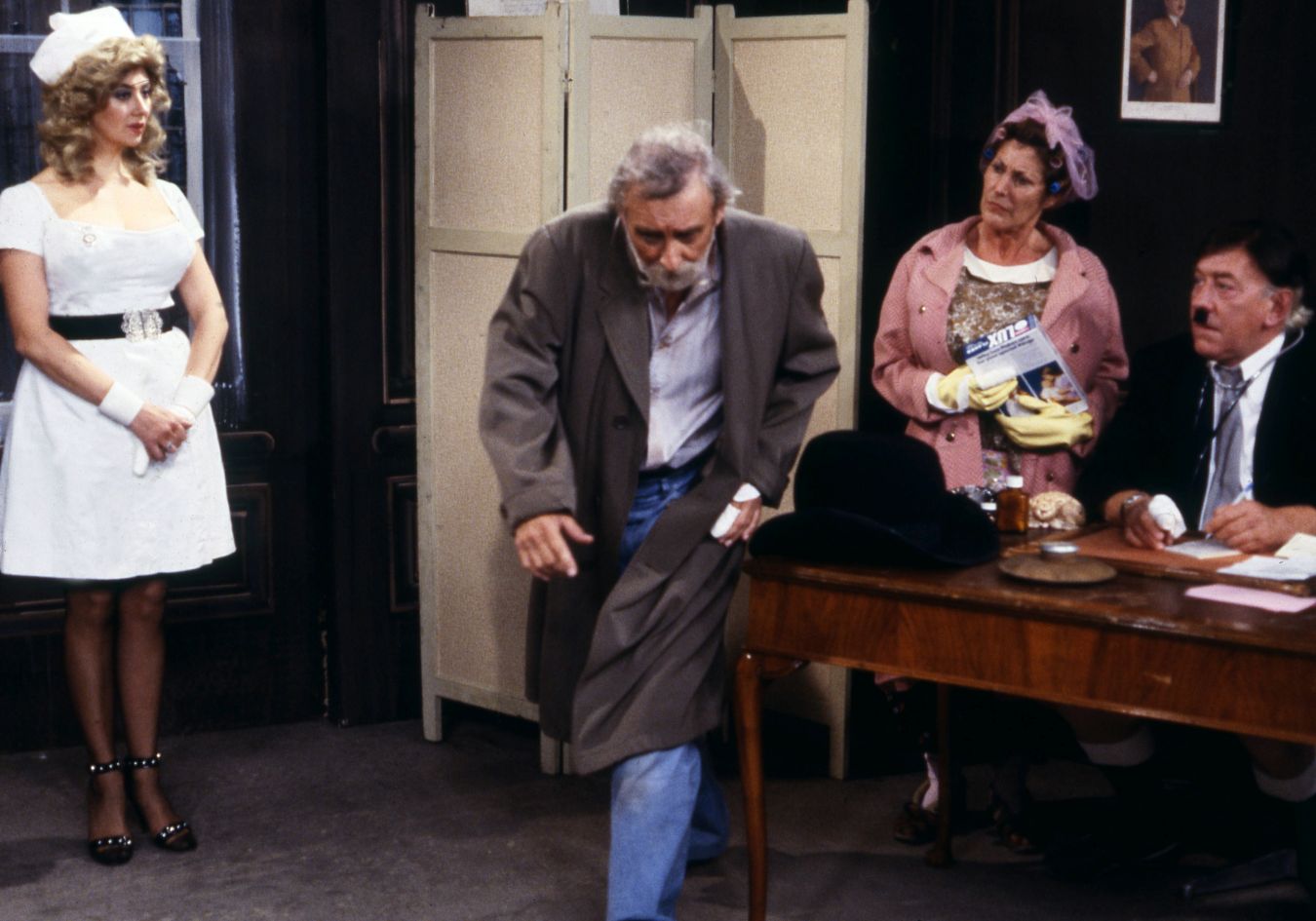
The sketch then moves to a doctor’s office, where the doctor (Todd) is, naturally enough, dressed as Adolf Hitler. Spike drops his trousers to reveal he’s wearing stockings and suspenders whilst a football theme (Tony Gubba on commentary duties) continues. And when there’s nowhere else to go, all the cast edge towards the camera, repeating the mantra “what are we going to do now?”

hi026746728

And that sketch, in a nutshell, sums up Q. You have to be prepared to buy into Spike’s world and go with the flow – if you’re looking for well constructed comedy with neat punchlines you’re very much in the wrong place. Staples of the previous series (such as blackface and Irish jokes) remain very much in evidence, meaning that those who are easily offended are definitely in the wrong place.

Spike’s obession with Adolf Hitler remains as constant as ever. Hitler highlights include his song and dance act as a contestant on Opportunity Knocks. The Royal Family are also regular targets (the sight of the Royals all wearing tubas on their heads is an unforgettable image).

The musical spots throughout Q8 and Q9 are provided by Spike and Ed Welch, who perform a selection of their own songs. Spike’s skills as a comic songwriter are well known, but here we have an opportunity to hear some of his non-comic material (as well as providing him with a chance to occasionally play the trumpet). These spots offer the audience a few moments of calm each week.

Later highlights of Q8 include a typically surreal sketch which mashes up traffic wardens and WW2 (and also features stripteases from both Julia Breck and Bob Todd – something for everyone then). Johnny Vyvyan, a highly distinctive stooge probably best known for his appearances with Tony Hancock, makes a few brief appearances. Spike’s tribute to the late Sir Edward Elgar, utilising the B-flat garden hose, is yet another typically unique Q moment.

After being absent for a few shows, David Lodge makes a welcome return for a sketch where he and Spike demonstrate how different nationalities would deliver that old chestnut, “there’s a fly in my soup.” With Katie Boyle on hand to provide scores, ala the Eurovision Contest, it’s a typically ramshackle few minutes with both Spike and Lodge (but especially Spike of course) barely able to control their giggles. Michael Parkinson pops up in the last episode of Q8 to take part in another ramshackle skit.

hi026746732

It’s business as usual for Q9. Spike and most of his regular band of contributors (apart from Stella Tanner) return.

The first Q9 sketch has a WW1 theme, featuring Alan Clare as an umpire (with ridiculously large shoes) overseeing a battle between the Germans (Spike) and the English (Todd). It gets much stranger from there on in, although since Julia Breck makes an appearance in a remarkably tight top it’s inevitable there will be a reference to knockers ….

Spike dresses as Max Miller for an undertakers sketch, whilst Breck is dressed in very little (there’s clearly something of a theme here). Lounging on the other side of the set is Raymond Baxter, yet another familiar BBC face making an unexpected appearance. Baxter, a long-time presenter on Tomorrow’s World, is the ideal host for a feature which promises to “defeat the cemetery shortage” by “firing your loved one into outer space”. Baxter’s authoritive persona and his scripted disdain at the lines he’s been given helps to make the sketch even funnier.

Later in the series there’s a sketch set in a British Rail lost property office. Spike is the attendant, dressed as the Lord Chief Justice of England, and proceedings kick off with Spike and Bob Todd conversing in morse code. Say what you like about Q, but it’s never predictable. Todd can barely control his giggles, whilst David Rappaport passes by purely so that Spike can make a groanworthy pun. Throw in a spot of blackface, Keith Smith as a ghost and David Lodge dressed as a woman and you’ve got everything that made Q the series it was in highly concentrated form.

hi026746720

One of the notable things about Q9 is the way in which the audience is involved. The news items feature regular cutaways to the audience and on other occassions Spike will stop a sketch if he senses things aren’t going well in order to seek feedback from the audience. It’s always interesting to see exactly who turned up to watch these shows (something of a cross-section it must be said, with both young and old represented).

Bracing and baffling, but never boring, Q8 and Q9 are further examples of the skewered genius of Spike Milligan.  Whatever era of British comedy you love, you’re bound to get something out of this set so, like Q Volume 1, it’s an essential purchase.

Hopefully There’s A Lot of It About (Q10 in all but name) will follow shortly, maybe with some of the Milligan miscellanea from his time at the BBC, but if even it doesn’t, at least all that exists of Q (bar a few small trims for rights reasons) is now available on shiny discs, something which just a year ago would have seemed highly unlikely.

Q – Volume Two is released by Simply Media on the 27th of February 2017.  RRP £19.99.
hi001918810

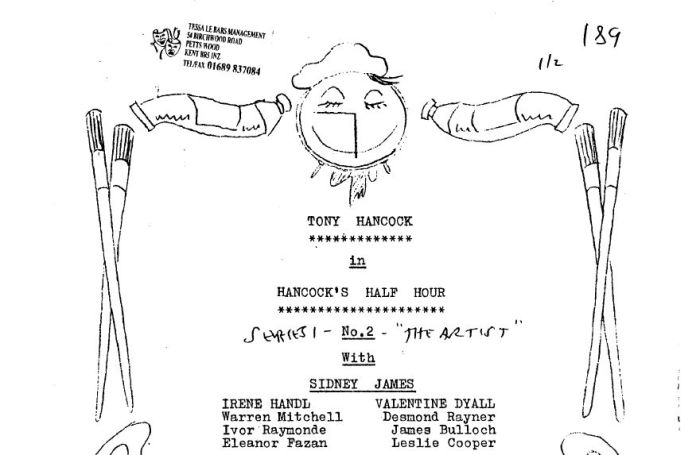
Hancock’s Half Hour – The Artist

artist

Sid’s made the acquaintance of the Count (Valentine Dyall), an art connoisseur who has commissioned him to “acquire” certain works of art.  The latest acquisition will be made from the Tate Galley (Sid: “It’s not where Harry Tate used to live?”) albiet without their permission. Athough Sid is successful, he only just manages to escape the clutches of the police.

Where to hide the stolen Rembrandt?  Because it’s been cut out of the frame it’s easy to tuck away somewhere, so he chooses a junk shop in Chelsea.  Mixed in with all the other bric-a-brac it should be quite safe, shouldn’t it?  However, this shop is a stones throw away from a small garret where Tony Hancock is eking out a miserable existence as a struggling artist.  Somehow I think these two plotlines will be connected …..

What’s interesting about the start of The Artist is how long the set-up with Sid and the stolen painting goes on for.  This means that we’re well into the episode before Tony makes his first appearance, although it’s worth waiting for.  This is classic Hancock – the misunderstood genius, baffled as to why the world isn’t beating a path to his door.

Galton & Simpson would re-use the theme of Hancock as artist several times (most notably on the big screen in The Rebel).  It’s done wonderfully here and there are so many lines you can just imagine tripping off Tony’s tongue. Here, he’s modestly reviewing his labours.   “I mean it’s good stuff. You can’t grumble at that lot for an hour’s work. The public aren’t ready for me, that’s the trouble. I’m ten years ahead of me time.”

He then goes on to marvel at one of his own works (a picture of a matchstick man sitting on a horse).  “The Saint on horseback. And what about that horse? Albert Munnings had to look twice when he saw it. Shook him rigid it did.”  A great example of Hancock’s self delusion.

Continuity never really featured in HHH.  Last week Tony was a big television star, this week he’s a starving artist, next week he’ll be something else.  It’s slightly strange, but the fact that the reset button is hit every week doesn’t really matter.

His new model turns up – played by Irene Handl.  One can only imagine how she would have looked after she’d changed into what the script called a 1930’s style bathing suit.  It’s quite a thought though.

Popping out for some new canvases, he’s persuaded to buy some used ones from the local junk shop.  It’s not ideal, but since it’s cheaper to paint over existing paintings, for the cash-strapped Tony it makes sense.  Of course one of the canvases is the stolen Rembrandt but neither Tony or the shop owner realise this.  Tony, art philistine that he is, views it with disdain.  “Rubbish. Look at it, no idea. These amateurs, I wish they’d leave it alone. This sort of thing turns the public right off art … then they don’t appreciate blokes like me. It’ll be a pleasure to paint over this.”

When Sid and the Count learn that Tony has acquired the Rembrandt they need to get it back – but since Tony’s now painted over it, they have no idea which of Tony’s terrible efforts it’s hidden behind.  This is another lovely scene, with G&S once again skewering the pretensions of the art world.  The Count desperately tries to pretend that Tony’s daubs have some merit, asking him politely if one of his pictures was painted with yellow ochre and royal blue.  Tony replies that no, it was Chlorophyl toothpaste (“I’m always picking up the wrong tube”).

Even better is the gag about his painting entitled cow in a field.  Tony explains why it’s somewhat impressionistic.  “I only had one sitting. And that was a fleeting glimpse, I was on a train.”  This is simply glorious material.

The Count decides that buying all the pictures would be suspicious, so he buys one, takes it home to see if it’s the Rembrandt and when it isn’t he’s forced to return and buy another.  This happens again and again, until he’s purchased twenty three of Tony’s paintings ….

Because the Count is a noted figure in the art world, everyone has now sat up and taken notice of Tony.  If the Count has bought so many of his pictures, Tony must be a genius.  So the establishment goes crazy for Tony and he quickly becomes one of the most famous (and richest) artists in the country.  It’s another delightful dig at the nature of art and art criticism, topped by the final gag which shows the stolen Rembrandt – still with Tony’s awful painting on top – back in the same place in the Tate where the Rembrandt had originally been.

So for once Tony ends up on top, although I’ve a feeling next week it’ll all be forgotten.  It’s a great pity this one doesn’t exist as it reads so well straight off the page.  I’m sure Irene Handl would have been an absolute treat as would Valentine Dyall (the Man in Black).  It’s yet more evidence that the television incarnation of HHH hit the ground running.

Hancock’s Half Hour – The First TV Show

first tv.jpg

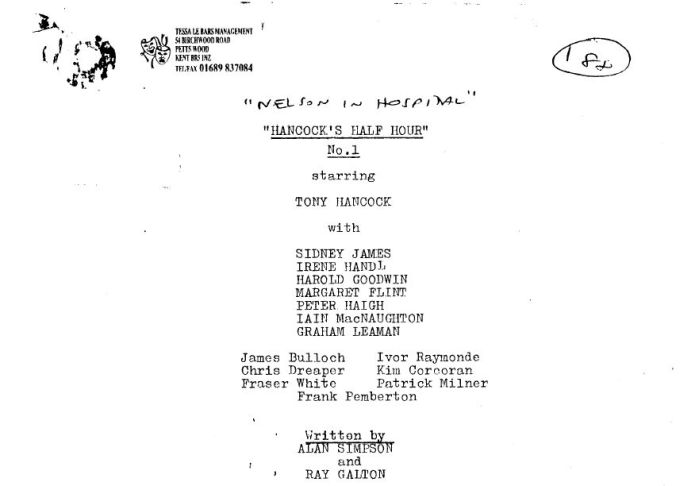
The first episode of the television incarnation of Hancock’s Half Hour called, unsurprisingly, The First TV Show (or Nelson in Hospital, according to the script) was broadcast on the 6th of July 1956.  Like the rest of the first series and all but one episode from series two, no visual recording remains in the BBC archives.

The first three series of HHH were broadcast live (as were nine of the thirteen episodes from series four).  From series five onwards the shows were pre-recorded, which partly explains why the bulk of the surviving episodes are from that era of the programme.  But telerecordings of live programmes had occurred  prior to 1956, so it’s a little disappointing that the survival rate from the first two series is so patchy.

Given that HHH had been a successful radio series for several years you’d have assumed someone might have thought it would have been a good idea to record the debut episode, but alas no.

However, all of Galton and Simpson’s scripts still exist and when reading them it’s very easy to imagine how Tony, Sid and the others would have delivered their lines.  Recently I’ve been re-reading the scripts from the first series and even without any visual or verbal assistance they’re still laugh-out-loud funny.

The New TV Show is fascinating.  It would have been easy enough to produce a typical episode, carrying on the themes already developed on radio, but instead Galton & Simpson crafted something which mocked the conventions and artifice of television itself.  Today, these sort of things have been done so many times that they’ve lost their power to disconcert, but remember this was 1956 – so it’s fair to say it would have been much more unusual.

We open in, as the script describes it, a lower middle-class lounge where a husband and wife are waiting for the next programme.  When they learn it’s Hancock’s Half Hour neither seem terribly impressed but Bert generously decides to give him a chance.  Unfortunately, Tony doesn’t make a very good first impression with Ede (“I don’t think I’m going to like him. I don’t like his face”) which causes Tony a momentarily spasm of pain.

Yes, somehow Tony can sense the disapproval of Bert and Ede, even though they’re sat at home and he’s in the television studio.  As they continue to pass judgement (Bert: “He hasn’t made me laugh yet, look at his face, a right misery”. Ede: “He’s much fatter than I’d expected”) Tony desperately tries to tailor his opening speech to suit their opinions.  This sly commentary on the expectations of the watching audience is a pure joy.

The fun continues after Tony introduces his co-star, Sidney James.  Ede instantly decides she likes him (“much better looking isn’t he?”) so Tony quickly elbows him out of frame!  This part of the episode culminates with a series of quick impressions as Bert and Ede mention some of their favourite comedians and Tony – ever obliging – desperately imitates them, no doubt seeing it as a last ditch attempt to keep Ede and Bert onboard.  This is just one of the reasons why it’s such a shame the episode no longer exists as I’d love the chance to see Tony give us his Arthur Askey, Norman Wisdom and Terry Thomas.

And just when you think things can’t get any more surreal, Tony appears in person to harangue Ede and Bert and smash their television.  Mind you, he probably had good justification as this is Bert’s final word on Anthony Hancock. “I’d like to know how much he’s getting for this. It’s a disgrace. A waste of public money. Look, the dog’s crawled under the table now, and he’ll watch anything. I’ve never seen a bigger load of rubbish in all my life.”

It takes a certain amount of nerve to spend the first half of your debut episode rubbishing both the star and the programme.  But it seems that Hancock at this point in his career wasn’t plagued by the sort of self-doubt he would succumb to later.  Galton & Simpson’s scripts are often peppered with digs at Hancock (especially his quality – or lack of it – as a performer) but there was never the sense that Hancock took offence.  Instead, he’s a willing participant in the mockery.

We then cut to a hospital, where a heavily bandaged Tony is stuck in bed.  As he tells Sid, he wouldn’t have threatened Bert if he’d known he was a heavyweight wrestler.  This leaves Sid with a problem, he’s not only Tony’s co-star but also his manager.  If Tony doesn’t carry on with his programme then Sid will lose a great deal of money.

In addition to the surreal tone of the episode, there’s a weird timeline at work here.  I think we’re supposed to accept that everything’s happening live, so Tony exiting the studio, getting duffed up and sent to the hospital has all happened in real time (very quickly, obviously).  This means that the audience at home are impatiently waiting for HHH to continue and the interlude to cease, which explains why Sid urgently needs Tony to get back to the studio to finish the show.

He’s clearly incapable, but then Sid has a brainwave, bring the cameras to the hospital!  They don’t have much time, so Sid decides to end this show with the Nelson sketch.  This means dressing Tony up as Lord Nelson and disguising his hospital bed to look like the HMS Victory.  Tony has his doubts. “Somehow I just can’t help thinking it’s not going to look right. This is supposed to be a serious drama.”

How well this worked is anyone’s guess, but it certainly had potential.  I love the notion of the drama being broken when the bell sounds for the end of visiting time – the nurse on duty is in no mood for argument.  “Tell your little friends to go home, they can finish their game tomorrow.”

Eventually they struggle through it, but what about next week?  Sid already has an idea.  “I thought we’d do the life story of Roger Bannister. Now we can disguise the ward like a running track and get a few blocks in, spread them around the floor ….”

If maybe the Nelson sketch dragged on a little, the opening section more than made up for it.  Definitely an unusual way to launch the series, but one that played to Hancock’s strengths.

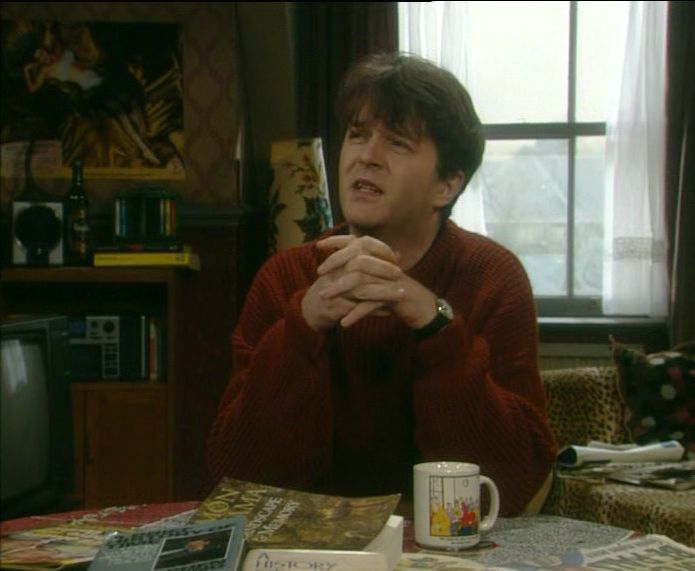
Paul Merton in Galton & Simpson’s The Bedsitter

bedsitter.jpg

This took nerve.  The Bedsitter is a daunting challenge for any performer – a twenty five minute solo performance where there’s nowhere to hide and no-one else to take the pressure off.  The Hancock original was simply sublime, one of the Lad’s finest half hours (well, twenty five minutes, to be strictly accurate).

Throughout this first series it’s been noticeable that Paul Merton really comes alive when he’s playing opposite good actors.  Reacting to others is one of Merton’s strengths (a reason why he’s a natural on panel games such as Have I Got News For You) whereas it’s harder to imagine him as a successful stand-up comedian, since the solo spotlight isn’t really his forte.  The fact that his comedy credentials were formed as part of a team – the Comedy Store Players – supports this observation.

Given this, I approached The Bedsitter with a little trepidation.  Could Merton pull it off or would it be another pallid remake?  Read on …..

Like some of other adaptations, this was a slightly weird viewing experience, mainly because some of the cultural references have been updated but others are left intact.  So Paul still sings Coward’s A Room With a View (this can be taken as an ironic comment on his surroundings of course).  His crooning of Maurice Chevailer’s Louise seems a little more out of place though.

Musings on the nature of bicuspids (“two swearing teeth”) and his inability to penetrate the works of Bertrand Russell are left intact and come over well.  One noticeable difference comes mid-way through when Paul looks out the window.  In the original, Tony stares out and we see a world of pain behind his eyes whereas Paul essays only mild irritation.

This is probably the main difference between their two approaches – Hancock was so good at expressing despair (possibly tapping into his real life melancholic nature) whilst Merton, whose performing persona isn’t too dissimilar to Hancock’s, offers a more buoyant outlook on life.   When Paul receives a wrong call and tells the lady on the other end that he’s a resting artiste, you get the sense that despite the fact he’s out of work and living in a crummy bedsit he still believes that things will turn around.

The remainder plays out pretty much as per the original, even the television set with the dodgy aerial (given the antiquated nature of the bedsitter this doesn’t jar too much).  Paul’s less than impressed with the number of repeats, although the BBC2 programme with Stephen Hawking (Bronowski in the original) is more to his taste.

He might clear up that theory he was postulating in his book. If I fell into a black hole a thousand light years away, my son would be fifty four, I’d be thirty five, and my dad would be ten and a half. Nah, he must be up the spout there.

It’s an obvious ironic touch that Paul, the failed intellectual, after singing the praises of Hawking, attempts to watch something rather more low-brow – a Western.

Once again, it’s hard to imagine this production supplanting Hancock’s original in many people’s affections, but it was a more than credible effort.  It was the final show in the first series and when PM in G&S’s … returned the following year, 1997, for a second run, the seven episodes adapted were much more obscure examples from the Galton & Simpson catalogue.

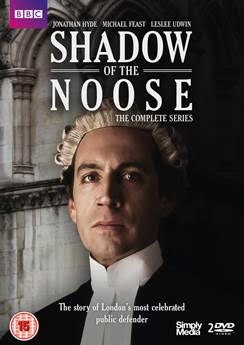
Shadow of the Noose to be released by Simply Media – 20th February 2017

shadow.jpg

Shadow of the Noose is coming later in the month from Simply Media –

A must-see series for fans of period drama and courtroom drama. Featuring outstanding acting talent including Jonathan Hyde, David Bradley, Siân Phillips, David Schofield, Caroline Quentin, and early performances from Peter Capaldi and David Rintoul

Simply Media is delighted to announce the DVD release of BBC’s Shadow of the Noose: The Complete Series. First shown on BBC Two in 1989, this highly regarded eight-part drama series, with an outstanding all-star cast, will be available to own for the first time on any home video format from 20th February 2017.

Directed by BAFTA-winner Matthew Robinson (Byker Grove / Eastenders) and Sebastian Graham Jones (Cadfael), Shadow of the Noose tells the true story of the career and personal life of “The Great Defender” Sir Edward Marshall Hall. He was London’s most celebrated barrister and the first world-famous legal celebrity, whose gripping cases consistently made news headlines and drew crowds in to the public gallery of the Old Bailey during the late Victorian era and early Edwardian era.

Jonathan Hyde (Titanic) brings Marshall Hall’s style and personality to life on screen in an outstanding performance. Marshall Hall was known for his theatrics as he argued his cases with gusto and determination, keeping the Court audience on the edge of their seat, particularly at a time when a guilty verdict meant facing the rope.

Throughout the series, which is based on true cases, Marshall Hall tackles a variety of seemingly impossible and controversial cases, and defends a colourful array of characters. Whether championing a lowly German prostitute accused of murdering a client, dissecting an ugly libel battle surrounding accusations of homosexuality within an aristocratic family, or defending the accused in the infamous Camden Town Murder…it’s all in a day’s work for Sir Edward Marshall Hall! But when a maid is accused of killing her illegitimate baby Marshall Hall is forced to face his own personal demons when it brings back unhappy memories of his first marriage…

The series also features stellar performances from the supporting cast, which includes Michael Feast (Game of Thrones) as Marshall Hall’s clerk Edgar Bowker, Caroline Quentin (Men Behaving Badly) and David Schofield (Gladiator). Marshall-Hall’s clients are also played by renowned actors such as  Golden Globe nominee Siân Phillips (I, Claudius), BAFTA-winner David Bradley (Broadchurch) and an early performance from Academy Award winner Peter Capaldi (The Thick of It, Doctor Who).

Connections – Simply Media DVD Review

connections2

James Burke (b. 1936) first came to prominence on Tomorrow’s World during the mid sixties, where his relaxed and conversational tone provided a sharp counterpoint to his co-presenter, the more precise and patrician Raymond Baxter.  His profile on TW meant that he was an obvious pick for the BBC’s Apollo coverage – he would go on to helm numerous hours of live television alongside Patrick Moore and Cliff Michelmore.

After leaving TW in 1971, Burke moved onto his own series, The Burke Special (1972 – 76), in which he examined various aspects of modern life and conjectured how they might develop in the future.  Already in place was Burke’s trademark style of swiftly jumping from one subject to another and some of the topics covered – such as test tube babies and gun control – ensured that the series generated a certain level of controversy.

Burke then moved out of the studio and onto film for Connections (1978).  Subtitled An Alternative View of Change, it sought to challenge the accepted linear view of technological progress.  Burke would argue that no part of the modern world can be regarded in isolation – instead you need to track back through history to find apparently unconnected events which can be linked together in order to show a continuity of change.

This interdisciplinary approach wasn’t to all tastes and neither was Burke’s presenting style – contradicting himself or walking out of shot during mid-sentence, for example.  But it’s fair to say that Connections was a programme which made a deep impression on a section of its audience and – whether you disagree or agree with all his theories – still provides substantial food for thought.

This three disc set contains the following –

The Trigger Effect – Original broadcast 17th October 1978

Death in the Morning – Original broadcast 24th October 1978

Distant Voices – Original broadcast 31st October 1978

Faith in Numbers – Original broadcast 7th November 1978

The Wheel of Fortune – Original broadcast 14th November 1978

Thunder in the Skies – Original broadcast 21st November 1978

The Long Chain – Original broadcast 28th November 1978

Eat, Drink and Be Merry – Original broadcast 5th December 1978

Countdown – Original broadcast 12th December 1978

Yesterday, Tomorrow and You  – Original broadcast 19th December 1978

connections-01

Burke’s idiosyncratic style is clear right from the opening moments of The Trigger Effect. He asks the audience (“would you do me a favour?”) to consider all the man-made objects in the room where they’re sitting (television, lights, etc) and the impact they have on their lives. He then moves out of shot, leaving an empty frame for a few seconds, an obvious visual cue which gives the audience some “thinking time”. It’s a good example of the way Burke challenges the viewers not to be passive observers, but instead to interact with the arguments and theories he’s generating.

In addition to Burke’s sometimes provocative statements, Connections boasts impressive visuals, thanks to the skills of director Mick Jackson. Jackson’s later and very varied CV includes the Whitney Houston/Kevin Costner movie The Bodyguard, the devastating nuclear drama Threads and the Ray McAnally political serial A Very British Coup.

Connections allowed Jackson a wide palette in which to craft some striking images.  And he was granted a very healthy budget – the series took fourteen months to shoot, travelled to nineteen countries and took in a hundred and fifty individual locations along the way.

Jackson’s eye for the unusual can be seen in the first episode as even the simple act of Burke travelling in a lift is presented in a memorable way. But this isn’t simply gloss for the sake of it – Burke makes the point that just as we have become increasingly dependent on technology, so our understanding of how it works has decreased sharply. Does he know how a lift works? No, he just accepts that it does.

I take going up in the world like that for granted. We all do. And as the years of the 20th century have gone by, the things we take for granted have multiplied way beyond the ability of any individual to understand in a lifetime. The things around us, the man-made inventions we provide ourselves with, are like a vast network, each part of which is interdependent with all the others.

This increasing dependency on technology is examined during The Trigger Effect as Burke looks back to a massive power-cut which engulfed New York in 1965. With discordant music (courtesy of Richard Yeoman-Clarke from the BBC Radiophonic Workshop) and the help of those who were present, re-enacting their roles, it’s presented in highly a dramatic fashion.

connections-02

“What does survival without technology look like?”. Burke effectively paints a nightmarish picture of the stuggles inherent in existing in a world without electricity (tapping into many of the themes developed in numerous post-apocalyptic dramas, such as Survivors) and then links this back to show how previous civilizations, such as the Ancient Egyptians, could be said to have been the first technological nations. He therorises that once an invention – such as the plough – is created, it must inevitably lead to further inventions through the ages (even if the connection between them isn’t immediately apparent).

The series’ aims are restated at the start of Death in the Morning.  Burke reflects that because knowledge of the future is impossible, tracing a modern man-made object back thousands of years is somewhat akin to a historical detective story, with twists and wrong turns along the way. He sets things up nicely by teasing us that the modern intention of this edition “affects the life of every man, woman and child on Earth” but doesn’t say what it is. Instead, his story begins two and a half thousand years earlier in the Eastern Mediterranean and is concerned with money, but will have become something totally different when we reach the present day. How we get from there to here, the intuitive leaps Burke makes and the visual imagery along the way, all help to make this a typically captivating instalment.

Highlights of later episodes include Burke’s imaginative arguments which connect the Little Ice Age of 1250 – 1300 AD to a whole host of later inventions, including the chimney and diverse objects as buttons and knitting (episode six, Thunder In The Skies).  Also of interest is Eat, Drink and Be Merry, which discusses how modern credit – the plastic credit card – can be traced back to the Dukes of Burgandy, the first state to use credit.  This then springboards into the problems of keeping food fresh (a particular issue for large armies in the nineteenth century) and Burke then presses on to show how these innovations led to the Saturn V rocket which took men to the moon.

The final edition, Yesterday, Tomorrow and You, neatly summaries everything that we’ve learnt in the series to date and returns to a theme posed by Burke posed at the start of the series, concerning the way that the world is developing increasingly advanced technology at a rate faster than our ability to understand it.  Should we be concerned about this, or just accept that change is inevitable?

With its globe-trotting camerawork, Connections engages on several levels.  Not only is it a visual treat, but it’s an intellectual one as well.  It may flit from subject to subject, but James Burke remains the series’ solid centre and his quirky approach helps to ensure that the series is much more than a series of dry lectures.  Picture quality is what you’d expect from material of this era – had fresh prints been struck from the negatives it could have looked much better, but as always it’s a question of cost.  What we have is perfectly watchable though.

Nearly four decades on, the series still engages, entertains and stimulates – a testament to the work of James Burke, Mick Jackson and the whole production team.  Warmly recommended.

Connections is released by Simply Media on the 7th of February 2017.  RRP £24.99.

connections 03.jpg

Grange Hill. Series Eight – Episode Eighteen

grange hill s08e18.jpg

Written by Barry Purchese.  Tx 22nd April 1985

The opening night of the school musical – Brighton Rock – is nearly here, but discord is still rife.  The lack of decent sets remains an issue, although Zammo is more concerned about the absence of any bikes, bitterly reflecting that they’re going to be the only Mods and Rockers who ever had to walk to Brighton.

Something certainly seems to be lacking and help comes from a most unexpected quarter – namely Mr Bronson.  After a year terrorising most of the pupils (and some of the staff!) he demonstrates his more approachable side after he corrals Vince into extracting sound effects from the film Death Race 2000.  Mr Bronson hopes that this will help to spice things up, although Mr Smart is less convinced.

Those with long memories will remember Gonch’s wheeze of copying tapes from the video shop owned by Vince’s dad (that explains how Mr Bronson discovered the tape of Death Race 2000 on the media resources machine).  Michael Sheard is on fine form as Mr Bronson informs Gonch that his old eyes get a little tired towards the end of term, but they’ll be undimmed at the start of the next.

It’s a pity that this new, briefly human, Mr Bronson doesn’t achieve rapprochement with Zammo.  After spending the year riling the boy, this part of the plot just fades away (next year Mr Bronson will have a new unfortunate – Ant Jones – to victimise and his contact with Zammo will be minimal).

Mr Baxter, standing in for the ever-absent headmaster, and Mrs McClusky are sandwiched either side of the Mayor, who regards the unfolding first night entertainment with a long suffering air.  Everybody seems convinced that something’s missing in the performance, although quite what is hard to say.

Banksie, after smashing up the sets, makes amends by persuading his brother Phil and some of his mates to bring their bikes into the auditorium.  When Mrs McClusky hears of this she’s not at all sure it’s a good idea (understandably) but Mr Bronson once again is on the side of the pupils.  Is this because he’s remembering his own salad days?  He seems to confess as much to Mr Smart at one point, although imagining Mr Bronson as either a Mod or a Rocker is something of a stretch ….

The bikes make an appearance, although since all they do is drive onto the stage and park up, you have to wonder whether it was worth all that effort.  The play comes to a decent conclusion thanks not to the bikes but because the final song is suitably stirring.  It claims that strife between warring groups can be settled if only everyone could learn to love one another.  It’s a nice, albeit hopelessly optimistic, sentiment and ties in neatly to the running theme of Grange Hill vs Brookdale vs Rodney Bennett.  Zammo and Jackie of course have been attempting to bridge this gap all year, although with limited success.

Whilst the 1985 Christmas Special touches on several topics (Roland’s lost love, the struggle between Cally’s real and adoptive mothers) developed during series eight, it was made as part of the production block for series nine, so series eight ends here.

Various characters – Jimmy Flynn, Julian Fairbrother, Annette Firman, Mandy Firth – all bow out with no ceremony.  Annette is at least mentioned at the start of the next series, the others join the list of the Grange Hill forgotten – pupils who simply disappear and are never referred to again.

Ben Rea’s sole year as producer introduced a host of characters who would have long term futures with the series and although at times the plotlines seemed not to be terribly well developed (frequently dropped or picked up again with little ceremony) it’s still an agreeable run of episodes.

Grange Hill. Series Eight – Episode Seventeen

grange-hill-s08e17

Written by Margaret Simpson. Tx 17th April 1985

Hollo has a brainwave about how to assemble a new set for the school play at short notice – raid the rubbish dump for suitable material.  Along with Miss Booth and the rest of E1 they head down to the dump to pick up numerous likely objects.  The fact that everything’s bound to be rusty and filthy doesn’t seem to concern Miss Booth, but I guess that needs must.

The new set doesn’t go down well with all the performers and Fay’s sporting commitments means that she’s not able to make a vital rehearsal.  This is all too much for Miss Washington who goes into something of a tizzy.  Miss Washington is sporting an interesting dress – something she’s worn before, but with a plain black dress over the top of it.

Roland’s back from his French misadventure and naturally enough doesn’t really want to talk about it.  Unluckily for him, Janet’s present to fill in all of the embarrassing details.  Now that Fabienne’s departed, so has Roland’s striped jacket and beret, although this particular storyline will be referenced again in the 1985 Christmas Special.

Jackie and Banksie are still serving their suspension.  Time is clearly hanging heavily on their hands, as we see them aimlessly wheel around on a roundabout in a deserted children’s playground.   There’s rather a nice bleakness to this scene – although it’s a sunny day, the inner-city feel of the location matches Banksie’s dialogue.  He tells Jackie they’d better get used to doing nothing, after all that’s what they’ll be doing after they leave school.

This nihilistic attitude has been aired by others before, with numerous pupils wondering why (like Jackie) they should be fretting about exams when there’s no jobs to go to after they leave school.  It’s not been touched upon for a while, so this moment helps to anchor the series in the mid eighties, when unemployment was still high.

Mr Smart continues to entertain (his transformation from the cold, unbending teacher of previous years is now complete).  Make no mistake, he’s not a man to cross, but his newly found sense of humour has certainly fleshed his character out.  Here he once again crosses swords with Gonch, who had popped into his office to retrieve Mr Bronson’s wig.  Simon Heywood doesn’t milk the comedy, but his incredulous reaction that the tattered hairpiece is Mr Bronson’s (at one point he gingerly pushes it across the desk with a pencil) is nicely done.  As is the moment when he hands Mr Bronson a small parcel containing his lost property.

With Mr Smart due to write to Gonch’s parents to tell them exactly how badly behaved he’s been all year (slightly odd that he hasn’t done so before) Gonch starts to fret about how well, or not, he’s going to do in the upcoming exams.  So naturally enough he decides to cheat ….

Even for Gonch, this is a particularly hairbrained scheme.  We’re told that Vince is a bit of a swot (not the first time this year that a character trait has been dropped on us out of the blue) and has prepared tapes which will help him in the exams.  Gonch “borrows” one such tape for a French exam, but Ronnie decides to swop it (for The Meteors – presumably it was 1985’s Monkey Breath) and everything goes downhill from there.  It’s quite interesting to see Trevor, introduced in episode one as something of a hard-man, tell Gonch that he’s mad to try and cheat in the exam.  For whatever reason it wasn’t decided to follow through and make Trevor the class bully – the introduction of Imelda will help to fill that gap.

The identities of the set smashers hasn’t been one of the series’ most taxing mysteries and N4 take their own brand out vengeance out on Banksie and his shadow, Loop.

Grange Hill. Series Eight – Episode Sixteen

grange hill s08e16.jpg

Written by Margaret Simpson.  Tx 15th April 1985

It’s time to bid a fond farewell to the French exchange students.  But Roland doesn’t seem to be too upset that he’s going to be parted from Fabienne, which no doubt has something to do with the fact that he’s decided to stow away with them on the return trip to France ….

Like the pelican crossing protests in the previous episode, this is another story beat that comes to us cold.  We’ve seen that Roland and Fabienne have been close, but since the ground for his misadventure hasn’t been laid at all, it comes across as a rather half-hearted escapade.  But it does give us our only chance this year to see Mike Savage as Mr Browning who, as ever, gives us his best hangdog expression when he learns the news, courtesy of the ever-zealous Janet (poor Mr Browning has had more than his fair share of strife with Roland over the years).

The cross-channel ferry crossing was done on the cheap – a quick bit of stock footage and then a cut to what is supposed to be a rough crossing (plenty of camera moves and overlaid mist).  Not terribly convincing, but then for such a short sequence it’s hardly surprising that they had to quickly cobble something together.

For those keeping up with the Zammo/Jackie relationship, it’s off again.  We never actually see Jackie (or Banksie) in this episode, but Julian breaks the bad news to Zammo that they’ve been seen together.  I have to admit that this eternal triangle is starting to wear a little thin with me, thankfully series nine shakes things up, as  Zammo spends the year otherwise engaged ….

Ronnie cleans Mr Bronson’s wig after Gonch asks her nicely.  Poor Mr Bronson has had to resort to wearing his emergency hair-piece, which causes a certain amount of merriment (even Mrs McClusky isn’t immune).  The question still remains about how they can return it though.

One of the longest running threads of series eight is finally brought to a conclusion as the identity of the thieves is discovered – Emma Stebson, her brother Gripper and Denny Rees.  Okay, let’s just stop for a moment and consider this – Gripper and Denny (both of whom would be recognisable to many of the pupils and staff) have apparently been wandering around the school corridors during the daytime for weeks on end, carrying out armfuls of swag.  Really?

It’s even more remarkable that we don’t even see them – we just hear their voices on Gonch’s Walkman.  At last his staffroom bugging came up trumps, it’s just a pity (for him) that Mrs McClusky, Mr McCartney and Mr Smart learn about it.  Mrs McClusky asks him, dangerously sweetly, if listening to the staff’s tittle tattle is very interesting.  Whenever Mrs McClusky is particularly pleasant you know there’s danger.  I also like the way that Mr Smart launches into full judicial mode when interrogating Gonch – grasping his lapels like he was at the Old Bailey.

With the robberies wrapped up, that just leaves the school play to sort out.  Everything seems to be going swimmingly, until it’s discovered that all the sets have been slashed.  Was this the work of Gripper or did someone else with a grudge against the school do the deed?

Grange Hill. Series Eight – Episode Fifteen

grange-hill-s08e15

Written by John Godber.  Tx 10th April 1985

Following her sons accident, Mrs Wallace (Zienia Merton), leads a spirited demonstration outside the school, calling for a pelican crossing.

This demo comes rather out of the blue, since we’ve seen no preparations previously.  But on the plus side it’s good to see Zienia Merton (probably best known for Space 1999) as a crusading parent.  What’s really interesting about these early scenes is that some of the other teachers – Miss Booth and Miss Washington – have already decided that Mrs McClusky is bound to react unfavourably.

It’s therefore ironic that Mrs McClusky is shown to be fully in favour of the aims of the demonstration.  She also calmly points out that blocking the road will do little good and instead will only serve to alienate both the police and motorists.  Mrs Wallace, in the white heat of anger, eventually comes around, but it’s much more surprising that Miss Booth or Miss Washington take so long to grasp this obvious point.

This episode is probably the best so far during series eight for Gwyneth Powell.  Mrs McClusky tangles entertainingly with Mr Bronson (always a delight when those two lock horns) and she also faces off against the builders.  They’ve returned to start work in earnest but have to shamefacedly admit that the reason they’re so far behind is because they’ve been nipping off to help the old folk with their house repairs.

Once again, there’s an inversion of our expectations – everything seems to be set up for Mrs McClusky to react in anger to this news, but instead she cues up Mr Bronson to splutter indignantly before swiftly cutting him off to sweetly praise them for their community spirit.  Lovely!

John Godber was a very infrequent contributor to the series (this was the third of his five scripts).  A pity, because there’s some sharp character work here (especially amongst the staff).  Another enjoyable moment comes when Mr Smart and Mr Baxter discuss Mr Smart’s forthcoming Hardy exhibition.  Mr Smart clearly assumes that Mr Baxter is unaware of Thomas Hardy, although Mr Baxter firmly makes the point that this isn’t so.  Mr Baxter’s disgusted expression is a delight (and continuity wise it ties back to series six, where we learnt that he has a great love of English literature).

There’s a nice literary joke when the builders confess to Mr Smart that everything’s taken so long because a good deal of the wood in the school is rotten and has to be replaced.  He wanders off, muttering that there’s “something rotten in the state of Denmark”, much to the builder’s bemusement (who later conclude he must have had a bad holiday there!).  I don’t know how many of the target audience would have got this Shakespearian joke, so maybe it was one for the parents watching.

The other running thread of the episode concerns Hollo’s new blazer and shoes.  This doesn’t really work, mainly because his blazer doesn’t look different from anybody else’s and we never see his shoes.  But it does allow Robbie to indulge in that time-honoured school gag (pinching Hollo’s clothes from the changing rooms, leaving the poor boy trouserless).

Hollo and Gonch have also done some pinching though, taking Mr Bronson’s wig (the teacher was enjoying a swim and had left it by the side of the pool).  It’s our first opportunity to see Mr Bronson sans wig (“he’s bald!” exclaims Hollo) and it leads into another great comic scene as the two boys, playing about with the hairpiece in the changing rooms, suddenly hear Mr Bronson approaching and have to swiftly hide the offending toupee.  Alas, Gonch shoves it in the rubbish bin, where it gets rather dusty!

So as the episode ends, Mr Bronson has lost his wig and Hollo is deficient in the trouser department.  Not the most dramatic of cliffhangers true, but an effective way to close one of the stronger episodes from series eight.

“I could play all day in my Green Cathedral.” Doctor Who and the Seeds of Doom

seeds

My irregular Doctor Who rewatch has reached Robert Banks Stewart’s second and last script for the series.  First things first, a few plot-holes that have always slightly irritated me.

In episode three, Dunbar tells Chase that he’s attended to the Doctor and Sarah (via a decoy chauffeur who’s rather handy with a gun).  We later learn that the chauffeur was on Chase’s payroll.  Eh?  Surely it would have made more sense for Chase to send the homicidal chauffeur to intercept our heroes, especially considering the way that Dunbar reacts in horror to the deaths in Antarctica.  So it doesn’t scan that Dunbar is happy to dispose of the Doctor and Sarah in cold blood.

Still, it’s some recompense that the chauffeur was played by Alan “Chuntzy” Chuntz, a familiar Doctor Who stuntman who rarely had the luxury of dialogue.  When you hear his rather stilted delivery, the reason becomes clear …..

The link between Chase and the stolen pod is done in an incredibly clumsy way – via Amelia Ducat’s painting, left in the car boot.  Surely Banks Stewart or Holmes could have found a slightly more nuanced way to bring Chase to the Doctor’s attention.

Another slightly baffling moment occurs when Amelia turns up at Chase’s palatial country house to demand payment for the painting.  That’s fine, but the revelation that she was sent there by Sir Colin makes little sense.  How did he know that the Doctor and Sarah had spoken to her?

But a few carps about the plotting aside (like Pyramids of Mars this had to be put together in extreme haste after other scripts collapsed) Seeds is gripping stuff.  Tony Beckley’s super-camp performance is an obvious highlight and from his first scene he’s an absolute joy (there’s no doubt that without him the story would sag a little).

Mark Jones’ role as Keeler is less showy, but equally impressive.  He’s clearly marked as doomed from the moment we first meet him and Jones is perfect as the twitchy, conscience-stricken scientist.

Possession has always been a theme in Doctor Who and it’s especially prevalent during the Hinchcliffe/Holmes era, where it’s usually tied in with a body horror theme (Noah in The Ark in Space, Sorenson in Planet of Evil).  It’s bad enough to be taken over, but even worse when it results in a grotesque physical change ….

Tom Baker’s Doctor dabbles in fisticuffs in a few other stories (such as knocking out Salamar in Planet of Evil) but this is certainly the serial in which he’s in full-on Duggan mode.  Had this happened more regularly it would have ended up as a touch monotonous, but there’s something undeniably appealing about the way that he becomes the man of action – springing through the skylight to duff up Scorby at the start of episode four is a definite highlight.  “What do you do for an encore Doctor?” indeed.

So although the tone of the story is odd and off-kilter (it rather feels like an ultra-violent TV Comic strip) it’s hard not to love The Seeds of Doom.  A little pruning (sorry) would have tightened things up – as a four-parter it would have been unbeatable – but I’m not unhappy with what we ended up with.

Grange Hill. Series Eight – Episode Fourteen

grange-hill-s08e14

Written by Barry Purchese.  Tx 3rd April 1985

There’s something a little odd going at the start of this episode.  Fay is agonising over how to tell Julian that she no longer wants to go out with him, but since they’ve never had that sort of relationship this doesn’t make any sense.  Julian’s got other things on his mind though – his beloved dog, Bumper, is nearing the end of his life, but Julian remains in denial, convinced that he’s going to get better.

Banksie’s latest plan for some quality time with Jackie involves taking his brother’s stock car for a spin, with Jean-Paul and Sarah tagging along.  Banksie might tell the others that his brother, Phil (John Blundell) is totally fine with this, but it doesn’t take a genius to work out that when Phil does make an appearance he’s going to be less than impressed.

Blundell (who had previously appeared in both the tv version and film of Scum) is menacing as Phil, probably because he doesn’t get angry.  His self-control, mildly telling his younger brother that it might be a good idea to flag down the car (Jean-Paul driving, Sarah sitting beside him) sooner rather than later, carries with it a certain chill as we can sense the inherent threat of violence behind his calm words.  This is put into action when he starts to give Banksie a few slaps and Jackie backs away in fear.

The next day Banksie turns up to school with a battered face, courtesy of his brother.  As with the familial beatings issued to pupils during the first few series, this isn’t dwelled upon – except in an obliquely approving way.  Since Banksie was in the wrong he deserved such a beating (which is certainly Zammo’s conclusion).

As for Jean-Paul and Sarah, he might have been a good driver but his luck finally runs out and he turns the car over (a nicely mounted stunt).  He walks away without a scratch but Sarah is hospitalised with a broken arm and facial bruising.  Sarah’s last moment in the episode – which also turned out to be Joanne Bell’s final scene in Grange Hill – is a powerful one, as she silently turns her ravaged face away from Jean-Paul who, finally shocked into a semblance of responsibility (or possibly he’s simply worried about the reception he’ll receive back home from his strict parents) visits her in hospital.

With Mr Humphries mysteriously absent once again, it falls to Mrs McClusky to host the parents meeting with Mr Wright, Mrs Wilks and Mrs Banks.  Mrs Banks was obviously played by a non-speaking extra though, so has nothing to say!  Mrs Wilks is much more voluble, although Mrs McClusky isn’t inclined to agree with her view that Sarah was totally innocent, so Jackie, Banksie and Sarah are all suspended indefinitely.

With Mrs McClusky now effectively back as the head, it does make you wonder why they decided to demote her to deputy if they weren’t going to follow through with any decent storylines on this topic.  It wasn’t the first and won’t be the last time that the head is an off-screen character, but at least here it’s not long until the matter is resolved.

With Banksie and Jackie suspended, that leaves an opening in the school play and Fay and Julian are drafted in at short notice.  It means they’ll have to work closely together, but now that the exciting, but reckless, Jean-Paul has returned to France, Fay regards the steady and reliable Julian more warmly.

Although since Julian doesn’t return in 1986, we’re not too far away from Fay’s next – and most catastrophic – choice of boyfriend …..

Grange Hill. Series Eight – Episode Thirteen

grange-hill-s08e13

Written by Frances Galleymore.  Tx 1st April 1985

Possibly inspired by Mr Baxter’s previous complaints that the others keep on finishing off the coffee without replacing it, the staff room is now the proud recipient of an imposing new vending machine.  Mr Smart and Miss Washington aren’t impressed though, she comments that it just makes a terrible groaning noise and doesn’t deliver, leading him to respond that it sounds like the school in general.  Mrs McClusky, of course, just happens to wander into the staff room at that precise moment ….

Caroline Gruber has another opportunity to demonstrate Miss Washington’s doe-eyed appeal after Mrs McClusky expresses her opinion that some of the first years (especially the ones in Miss Washington’s charge) are pushing the school uniform rules to the limit.  It’s plain that Mrs McClusky believes that the younger teacher isn’t setting them a good example, but politeness – and Mrs McClusky is sweetness personified during this scene – dictates that she doesn’t openly come out and say so.

There’s some later nice staff-room interplay (Mr Bronson complaining about the level of smoke and continuing to bemoan the fact that others have taken his seat) but the episode revolves around two main areas – Eric’s accident and the babysitting misadventures at the McCartneys.

Those with fairly long memories might recall that Eric, previously revealed to be partially deaf, featured in an earlier series eight episode.  The poor boy is now the recipient of Janet’s interest (who seems to have finally decided that Roland – constantly speaking French – is now totally absorbed with Fabienne) but she wasn’t there at the moment when Eric stepped out into the road and was knocked over.

I’m not sure whether Eric’s deafness is supposed to be a factor here – but this doesn’t make much sense if so, surely he’d have looked left and right to check the road was clear before crossing?  Possibly he was simply chosen because whilst not a main cast member (whose absence would be problematic) he was still someone with a higher profile than a non-speaking extra – and therefore his accident would carry a little more impact.

If that was the case, they could have used Diane.  Although she has a couple of lines in this episode, they only highlight just how underused she’s been throughout series eight (whereas during 83/84 she’d featured quite prominently).  It seemed that once her spots faded away so did any thoughts about developing her character, so she’ll not return in 1986.

One point of interest is the way that Mrs McClusky appears on the scene mere seconds after the accident.  How did she get from the school to the road outside so quickly?  Was she waiting in the playground for such an accident to happen?!

Real-life school politics of the mid eighties do get a brief mention when the fourth-formers are left to their own devices, thanks to a cover strike.  British schools were hit by waves of industrial action during this period, as teachers regularly worked to rule and refused to cover their colleague’s lessons.  Phil Redmond would have no doubt made capital out of this, but here it’s very much an incidental point – at this point in the show’s history, staff-room squabbles are more over coffee and chairs than politics ….

There’s an air of deceit running through this episode.  Fay agrees to babysit for Mr and Mrs McCartney and Julian offers to walk her home.  Fay, still not keen on the worthy-but-dull Julian, tells him that the babysitting’s been cancelled, so that Jean-Paul can go instead.  And with Annette and Stewpot also there, everything’s set for a cosy evening.  Which of course doesn’t go to plan.

If Fay lies to Julian, then Stewpot continues to lie to Annette.  Just as Claire’s been somewhat reduced in character during series eight, then poor Stewpot has also received the rough end of the scripting stick.  By continually stringing both Claire and Annette along – lacking the courage to choose between them – he’s portrayed as buffoonish at best and an insensitive idiot at worst.  Even here, he can’t bring himself to tell Annette that it’s over, but since he’s clearly not enjoying himself, why not?

Jean-Paul burns a hole in the McCartney’s carpet with his cigarette, providing us with yet another example of his flawed character.  His plan – chuck a scatter cushion over the offending mark and walk slowly away – also highlights that he never stops to think about the consequences of his actions.  This moment was no doubt one of several created in order to prepare the ground for episode fourteen.

Grange Hill. Series Eight – Episode Twelve

grange-hill-s08e12

Written by Frances Galleymore.  Tx 27th March 1985

So Claire and Stewpot’s on-off-on-off, etc relationship now seems to be on again.  I’m somewhat sorry that we didn’t see the scene where she agreed to have him back, as that would have been fun to watch.  Has anything changed?  Well Stewpot’s still making excuses when Claire attempts to arrange an evening out (this time he claims he has to help his father decorate the bathroom) so maybe not.  Surely he can’t still be juggling two girls, and both of them incredibly stroppy as well ….

I do feel a little sorry for Paula Ann Bland during this run of episodes, as Claire doesn’t really have anything to do except express disapproval at Stewpot, so she spends her time as a rather shrewish character with little light or shade.

But this does give us a lovely scene as Annette crashes into Stewpot, Claire and Precious and blithely arranges a date with him.  Claire’s response?  “Stewpot, you’d better not have chosen that tarty little fourth-year with the raggedy hair before me. ‘Cause if you have and you do see her on Friday night then you won’t be seeing me again.”  This gives Mark Burdis another chance to give us his best hangdog expression (something he’s had to do an awful lot this year).

The on-off-on-off relationship between Zammo and Jackie is now once more lurching into the off position, thanks to Zammo’s jealous and controlling nature.  Banksie invites Jackie to join him, Loop, Fay and Jean-Paul on a visit to the old Brookdale school.  She wasn’t sure, but after Zammo told her not to, it’s not hard to imagine the outcome ….

They decide to bunk off, which means that Fay spends the time in a highly stressed manner.  She may not quite be the goody-goody now she’s hooked up with the louche Jean-Paul, but she still knows right from wrong.

It’s odd that none of them seem to consider the possibility that there may still be a caretaker on site (if there wasn’t, why would there be a television set and a kettle?).  Of course there is (played by the wonderful Derek Deadman) which means there’s a short comic chase.  “Blast! Flipping kids!”


Grange Hill. Series Eight – Episode Eleven

grange-hill-s08e11

Written by Rosemary Mason. Tx 25th March 1985 

Mr Smart explains to E1 about the new timetables and homework arrangements.  Natasha (Patsy Palmer) has possibly her first line in the series, which sees her succinctly sum everything up.  “Bit of a fag, innit?”

It’s a system that seems to be deliberately confusing, so it’s possibly not surprising that Mr Smart mistakenly heads off for the upper school, convinced that’s where he should be.  It’s just a slight problem that it was Miss Washington who persuaded him to do so and when Mr McCartney points out that she was mistaken (mere seconds after Mr Smart has exited the staff room in a hurry) neither decide to rush out and stop him.  So you can’t really blame him for being a little miffed with Miss Washington later ….

There’s a fairly rare glimpse of the upper school corridors, which look incredibly dirty and run down.  But Mr Smart doesn’t haunt them for long as Mrs McClusky soon sends him back down to the lower school.  We haven’t had the old “two classes of pupils try to fit in one room” routine for a little while, so it was clearly overdue an airing.

This gives us a rare opportunity to see virtually all of E1 and N4 together at the same time (normally they tend to have their own episodes with minimal crossovers).  E1 might already be present in the room, but Banksie doesn’t believe that possession is nine tenths of the law.  Instead, he contends that since they’re older, they must prevail.  He makes this point forcibly to Miss Washington, which only serves to highlight the flaws in his character.

The stand-up row between Miss Washington and Mr Smart is good fun, as is Gonch’s plan to bug the staff room.  He’s convinced this will enable them to identify the thieves once and for all (presumably he doesn’t consider that they might be able to rob in silence).  Once again, security at Grange Hill is shown to be lax in the extreme as the staff room door isn’t locked, enabling Gonch to able to enter and secure a Walkman (hired off Vince for the princely sum of fifty pence per week) under the coffee table.  With the tape switched to record, what can possibly go wrong?  Mr Baxter making his way to the staff room is a bit of a problem, but Hollo, on guard duty, is able to distract him quite neatly.

The first fruits of their bugging is another episode highlight.  Gonch mentions “Grange Hill Watergate”, although quite how many children would have picked up on this reference is debatable.  One for the older members of the family watching I guess.  They manage to hear Mr Smart asking Miss Washington if she’d like to go out with him for a meal (he’s clearly recovered his equanimity), although this tender moment is cut short after Mr Baxter barges in and complains that once again they’ve finished off all the coffee!

Given that the longest cassette tape available would have been a C120, the most they could hope to record would be just an hour, so it’s not surprising that this is the only useful(?) part of the recording.  Clearly if they’re going to catch the thieves red-handed they’re going to have to be very, very lucky ….

Relationships, both real and fictional are key to this episode.  Annette and Fay are both shown to have less than ideal boyfriends, although it’s interesting to see that they react in different ways to being left on the sidelines (something which is mirrored later during rehearsals for the school play).  Annette is quite happy to hang around, watching Stewpot play football (to his obvious irritation) whilst Fay (once Jean-Paul joins in with the same game) is much less tolerant and heads off home alone.

Elsewhere in the episode, Mr Baxter pops up to remind Fay, and the audience, that her previously impressive sporting career is suffering.  And is Jean-Paul worth it?  He has inevitable Gallic charm, but apart from that he’s portrayed as rather feckless.  And all the time Julian stands on the sidelines, pining.  Mmm, maybe all will come right in the end.

The school play, centered around conflict between the mods and rockers in the 1960’s, takes shape.  Given what we’ve already seen, it can’t be a coincidence that both Mr Smart and some of the pupils aren’t terribly impressed that the plot is rather male-dominant (reducing the females to little more than appendages, standing on the sidelines).   Jackie, pencilled in to play the object of both Zammo and Banksie’s affection (perfect casting!) admits that having two boys fighting over her leaves her cold.

Another Six English Towns – Simply Media DVD Review

another

Another Six English Towns, originally broadcast in 1984, was the third and final series in which Alec Clifton-Taylor cast his expert eye over the architectural merits of a variety of English towns.  My review of the first two series can be found here.

The format remains unchanged.  Architectural historian Clifton-Taylor inspects the streets and notable buildings of each town, dispensing approbation or disfavour as he sees fit and quietly applauding those towns which have managed to preserve their status without recourse to the horrors of modern life (high rise buildings and pebbledash being two particular bête noires of his!).

We open in Cirencester, the capital of the Cotswolds, which finds Clifton-Taylor in an approving mood.  He’s particularly taken with the pleasing mixture of styles on display, commenting that “in the market place, the buildings burst forth into a chorus of painted stucco”.  The town’s mansion, Cirencester House, complete with a ten thousand acre park, also catches his eye.

Up next is the fishing town of Whitby, which nestles on the North East coast.  The ruins of Whitby Abbey are striking and whilst St Mary’s Church may look somewhat unprepossessing from the outside, inside it’s quite a different matter.  Clifton-Taylor regards it as “a thrill. Absolutely unforgettable. Not a work of art, but a most illuminating social document.”

Bury St Edmonds has an impressive collection of Georgian buildings, created with different varieties of coloured clay, although Clifton-Taylor is a little miffed that “they are so smothered with Virginia creeper that one can hardly see what colour they are!”  This town has rich pickings elsewhere though – the town hall (reconstructed by the notable eighteenth century architect Robert Adam) appeals, as does the Theatre Royal, designed by William Wilkins, architect of the National Gallery.

Clifton-Taylor travels to Wiltshire for the fourth episode, his destination being Devizes.  He’s saddened that the twelfth century castle no longer remains (on the site is something he dubs as a pantomime recreation from the Victorian period) and reacts in horror when he sees that some of the eighteenth century timber houses have recently “been smothered with that most repellent material – pebbledash!”

He remains in a slightly caustic mood when he reaches Sandwich, sorrowfully reflecting that the original character of some of the 16th century brickwork has been submerged under fresh coats of paint.  But the Salutation, a house and garden designed by Sir Edwin Lutyens (1869 – 1944), is much more to his taste.  Clifton-Taylor has little hesitation in regarding him as “the greatest English architect of the last 100 years”

The series concludes with Durham.  He’s impressed with the Cathedral, especially the vaults, which have remained unchanged for eight and a half centuries.  Clifton-Taylor is also taken with a public convenience, built in 1841, concluding that “few loos, surely, can hold their heads so high!”.  An idiosyncratic, but delightful, moment.

A lovely snapshot of six English towns frozen in time some thirty years ago, Another Six English Towns will certainly appeal both to those who have already collected the first two series, as well as anyone who is familiar with the featured locations and wishes to compare then to now.

Shot on 16mm film, the picture quality is on a par with the earlier releases.  The prints are rather faded and dirty in places, but still perfectly watchable.

Alec Clifton-Taylor maintains the persona of a kindly headmaster, eager to give credit where it’s due, but also quite capable of expressing irritation and exasperation (albeit with his impeccable manners always intact).  An impressive series of travelogues, Another Six English Towns also educates and informs, as Clifton-Taylor is effortlessly able to show how different periods of architecture can live side by side in harmony (or not, as the case may be!)

Another Six English Towns is released by Simply Media on the 23rd of January 2017.  RRP £19.99.

towns