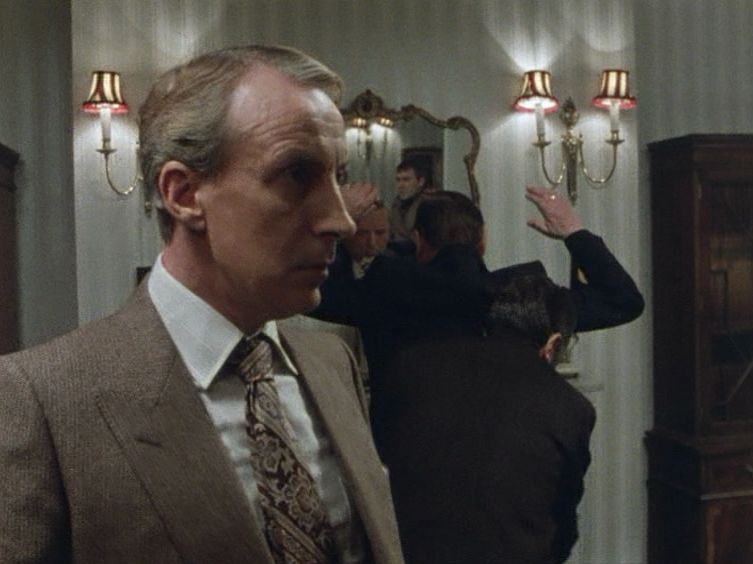
Tinker Tailor Soldier Spy (BBC 1979). Episode Seven

tinker 07

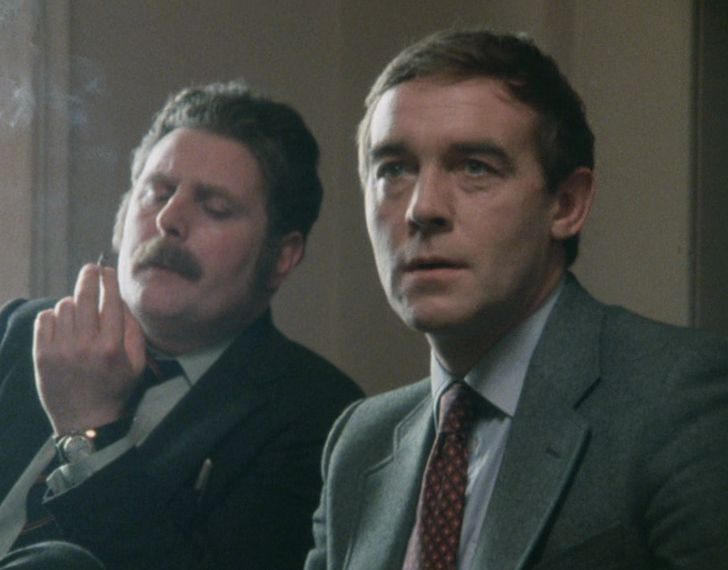
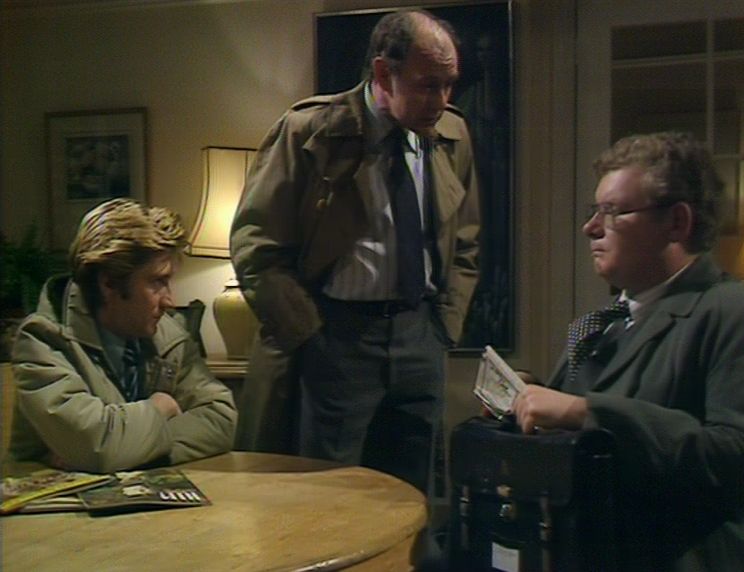
So after six and a bit episodes, the identity of the mole is revealed.  It’s interesting that they didn’t pad it out until later in the episode, instead the reveal happens at the ten minute mark.  Peter Guillam displays understandable anger at the lives lost. “You butchered my agents… How many since? How many? Two hundred?… Three?… FOUR?”  Smiley remains calm, although in his own undemonstrative way he does display the odd spasm of anger later on.

So Gerald the mole was Bill Haydon.  Smiley contacts Lacon, Alleline, Bland and Esterhase and plays them the incriminating recording which proves Haydon’s guilt.

Esterhase: Well, that’s that. Congratulations, George.
Lacon: Next step, gentlemen?
Smiley: Would you agree with me, Percy, that our best course of action is to make some positive use of Bill Haydon? We need to salvage what’s left of the networks he’s betrayed.
Alleline: [weakly] Yes…
Smiley: We sell Haydon to Moscow Centre for as many of our men in the field as can be saved – for humanitarian reasons. Professionally, of course, they’re finished.
Alleline: Quite.
Smiley: Then the sooner you open negotiations with Karla, the better. Well, you’re much better placed to talk terms than I am. Polyakov remains your direct link with Karla.
Lacon: The only difference is, this time you know it! It’s definitely your job, Percy. You’re still Chief, officially… for the moment.
Percy Alleline: Very well, George.

It’s a moment of triumph for Smiley, but there’s no overt display of emotion or triumphalism.  Indeed, as we’ll see, it’ll turn out to be something of a pyrrhic victory although as the above dialogue extract indicates, he must have displayed some pleasure in Alleline’s discomfiture, who is clearly on borrowed time as Chief.

Before Haydon is sent back to Moscow, the interrogators are keen to extract every piece of information they can.  The next time we see him, his face is covered in bruises, there’s blood on his shirt and he’s walking unsteadily – a clear sign of how he’s been “encouraged”.

It’s felt that he may open up more to Smiley, and in a way he does.  This enables Guinness to take up his usual role as the largely unspeaking observer – but it’s nevertheless quite easy to understand exactly what he thinks and feels just by the expressions on his face.  Ian Richardson takes centre-stage in these scenes as he explains why he became a Russian agent.

Haydon: What do you want to know?
Smiley: Oh… why? How? When?
Haydon: Why? You ask that? Because it was NECESSARY, that’s why! Someone had to! We were bluffed, George. You, me, even Control. Those Circus talent spotters, all those years ago. They plucked us when we were golden with hope, told us we were on our way to the Holy Grail… freedom’s protectors! My God! What a question… “why?”

Smiley learns that when Haydon had the affair with Ann, it was on Karla’s orders. He also keen to know about whether Haydon expected Jim Prideaux to be sent on the abortive Czechoslovakia operation. As the friendship between Haydon and Prideaux has been stressed several times, there’s an undeniable sense of emotion as he replies to Smiley’s questioning.

Smiley: Did you expect Control to send Jim Prideaux?
Haydon: Well… obviously we needed to be certain Control would rise to the bait. We had to send in a big gun to make the story stick, and we knew he’d only settle for someone outside London Station, someone he trusted.
Smiley: And someone who spoke Czech, of course.
Haydon: Naturally. It had to be a man who was old Circus, to bring the temple down a bit.
Smiley: Yes, I see the logic of it. It was, perhaps, the most famous partnership the Circus ever had: you and him, back in the old days. The iron fist, and the iron glove. Who was it coined that?
Haydon: I got him home, didn’t I?
Smiley: Yes. That was good of you.

The clearest sign that Haydon has got under Smiley’s skin is demonstrated by the angry way Smiley opens the door after he’s finished his questioning.  A small moment, like many of Smiley’s brief displays of anger, but it’s quite telling.

Haydon never made it back to Moscow, he was murdered before the exchange could be made.  The novel implies (but doesn’t overly state) that Jim Prideaux killed him, the television adaptation is a little clearer on this point.

This leaves a final scene, which effectively acts as a coda, in which Smiley and Ann discuss her latest (completed) affair as well as Bill Haydon.  She tells Smiley that she never loved Bill, and her final words “Poor George. Life’s such a puzzle to you, isn’t it?” is a bittersweet ending to an exceptional drama serial.
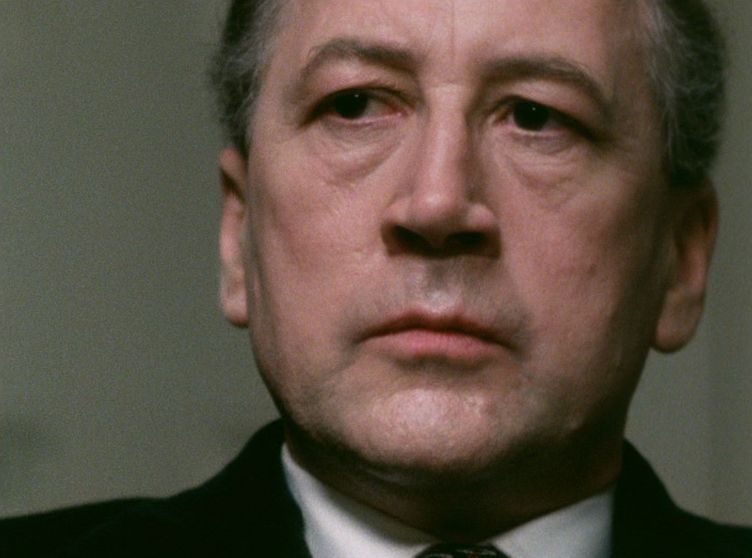
Tinker Tailor Soldier Spy (BBC 1979). Episode Six

tinker 06

Smiley’s hunt for the mole leads him to a rather dingy London drinking club.  There he meets Jerry Westerby (Joss Ackland).  Westerby is a newspaper reporter who’s done odd jobs for the Circus in the past – such as delivering packages to dead letter drops.  “Telephone kiosk, ledge at the top, dump a little package ready for collection.”

Westerby is clearly somebody who enjoys the cloak and dagger aspect of the job, as well as the glamour of operating on the fringes of the intelligence services, athough it seems that his usefulness has come to an end.  Possibly his fondness for alcohol is the reason.  “Firewater not good for braves. They think I’ll blab, crack up.”

Or it may be because of what he knows about the Jim Prideaux shooting.  Westerby was in Czechoslovakia at the time and he learnt that “the Russians moved in on Saturday, it was the day after they got Jim. Russians knew the lot, knew he was coming. They were lying in wait for him. Bad story, you see. Bad for big chief. Bad for tribe.”   When Westerby returned to England he told Toby Esterhase, but Toby professed not to believe it, dismissing it as nothing more than drunken ravings.

It’s a lovely cameo from Ackland and Guinness is his usual excellent self.  Whilst it’s clear from the outset that Westerby wouldn’t necessarily be Smiley’s first choice as a lunch companion, he’s easily able to tease the information out of the newspaper man.  As always, Smiley asks many more questions than he answers – witness the end of lunch, as Westerby wonders exactly what Smiley’s been after.  Guinness/Smiley remains inscrutable, offering very little.  At one point, rather than commit himself, he smiles – and the camera remains on him as the smile slowly fades away.  Tight close-ups (switching between Ackland and Guinness) are used in this scene, very effectively.  As they finish their lunch, Westerby muses about Toby Esterhase.

Westerby: Rum chap, Toby Esterhase.
Smiley: But good.
Westerby: God, brilliant! First-rate chap! But rum.

If Smiley has tended to be mostly passive so far, eliciting information rather than sharing it and not expressing too many of his own opinions, then that changes once he confronts Toby.  It’s the first time he’s spoken to one of the four suspects and it signals a major turning point in the story.

Toby meets Guillam at a safe house – apparently to see a potential agent – but instead he’s met by George Smiley.  Now it’s Smiley who does the majority of the talking, whilst the camera closes in on Toby’s increasingly pained face.  Guinness is, once again, excellent, as he’s able to fillet and humiliate Toby – but in the most gentlemanly way.

George Smiley: Ever bought a fake picture, Toby?
Esterhase: I sold a couple once.
Smiley: The more you pay for it, the less inclined you are to doubt its authenticity.

Eventually it becomes clear to Toby that source Merlin, and his London representative Polyakov, has deeply compromised the Circus.  He’s desperate to assure Smiley that he knew nothing about it, as well as downplaying his own involvement.

Esterhase: Why pick on the little guy? Why not pick on the big ones? Percy Allenine, Bill Haydon!
Guillam: I thought you were a big guy these days.
Smiley: You’re the perfect choice, Toby: resentful about slow promotion, sharp-witted, fond of money. With you as his agent, Polyakov has a cover story that really sits up and works. The big three give you the little sealed packets of chickenfeed, and Moscow Centre thinks you’re all theirs. The only problem arises when it turns out you’ve been handing Polyakov the crown jewels, and getting Russian chickenfeed in return. If that’s the case, Toby, you’re going to need some pretty good friends. Like us. Gerald’s a Russian mole, of course. And he’s pulled the Circus inside out.

Afterwards, Smiley commiserates with him.  “Poor Toby. Yes, I do see, what a dog’s life you must have had running between them all.”  It might be just another scene of people sat in a room talking, but in the context of the story it’s riveting stuff.  The result is that Smiley’s happy to discount Toby as a suspect, so that leaves the other three.

Now we’re into the endgame.  Toby has told Smiley about the location of the safe-house where Polyakov meets the representatives of the Circus.  In order to flush out the mole, a crisis needs to be created (so a crash meeting with Polyakov can be called).  He sends Ricki Tarr to Paris and instructs him to telex the following message back to London Station.  “Have information vital to the safeguarding of the service. Request immediate meeting. Personal.”

Tinker Tailor Soldier Spy (BBC 1979). Episode Five

tinker 05

LeCarre’s novel opens with Jim Prideaux taking up his new role as a schoolmaster.  Periodically through the book we return to Pridaeux and witness his growing friendship with one of the boys, Bill Roache, nicknamed “Jumbo” by Pridaeux.

Arthur Hopcraft’s adaptation chooses to hold back the school material until this episode, rather than scatter it throughout the story.  This was probably the right thing to do, although it does mean we lose a great deal of the interaction between Prideaux and Roach.  But a little does remain, such as the scene where Roach spies Prideaux digging up a package.  Roach can’t resist taking a peep through the caravan window (where Prideaux lives) and is shocked to see him holding a gun.

Prideaux: We’ve got a secret, haven’t we? I can trust you, I know that. We’re good at keeping secrets, loners like you and me.
Roach: Is it because of that man? Would you shoot him? Are you working undercover, like Bulldog Drummond in the book? Some of the boys wanted to call you Bulldog, but we thought Rhino was better. Bigger than a bulldog.
Prideaux: Well I, uh… I used to be a soldier, Jumbo. What you saw just now, that’s a souvenir, you know, it’s like this…
[he points to his back]
Prideaux: How I got it, they’re both secrets, I keep them to myself. Y’understand that, don’t you Jumbo?
Roach: Yes, sir.
Prideaux: Knew you would, knew you would.

Since getting shot, Jim’s turned into something of an eccentric, at least when the schoolboys are around.  He lets them drive his vintage car (an Alvis, his pride and joy) and has clearly made a deep impression on many of them (especially Roach).  But he still has wounds that haven’t healed (and not just physical ones) which will be examined later on, when Smiley visits him.

But before Smiley speaks to Prideaux, he makes a call on Sam Collins (John Standing) who was duty officer the night Jim Prideaux was shot.  When the crisis happened, Sam was unable to get much sense out of Control – so he recalls how relived he was when Bill Haydon turned up.  It’s been repeated several times already just how close Bill Haydon and Jim Prideaux were, and this is clear when Bill takes charge.

All right, Sam. Now, first thing you do, you call this number, it’s Toby Esterhase’s. Tell him you’re speaking for me, and he’s to pick up the two Czechos we’ve had our eyes on in London School of Economics, and lock them up. Now, right away, Sam. Jim’s worth a lot more than those two, but it’s a start. I’ll have a word with the chief hood of the Czech Embassy. If they hurt a hair on Jim Prideaux’s head, I’ll strip the entire Czech network in this country bare. You pass that on. I’ll make him a laughing-stock!

Later, Smiley finally speaks to Jim Pridaeux.  Given the number of flashbacks we’ve seen in the series so far, it was a little surprising that we don’t see Pridaeux’s interrogation by the Czechs – instead Pridaeux just tells us about it.  But in retrospect, that’s actually a plus – as it allows Ian Bannen full reign to describe exactly how bad it was.  And sometimes, words are more powerful than pictures – for example, when he describes the moment they finally broke him.  “I hoped I’d go mad. And no, they knew how to stop that. They left me alone for a couple of days; got me ready for the long one. That was when I ga… ga… gave… g… gave them what they wanted.”

Another interesting moment is when Smiley discusses the friendship between Haydon and Prideaux.  Haydon recommended Prideaux for the service and Smiley is able to quote verbatim from part of the letter that Haydon wrote to the Circus talent-scout, some thirty years earlier.  “He has that heavy quiet that commands. He’s my other half. Between us we’d make one marvelous man. He asks nothing better than to be in my company or that of my wicked, divine friends, and I’m vastly tickled by the compliment. He’s virgin, about eight foot tall, and built by the same firm that did Stonehenge.”

If Tinker Tailor Soldier Spy is a collection of great acting moments, then Ian Bannen’s in this episode must rate very highly.  And although his part of the story seems to be over, events might prove otherwise ….

Tinker Tailor Soldier Spy (BBC 1979). Episode Four

tinker 04

In many ways Michael Jayston is the glue that holds Tinker Tailor Soldier Spy together.  With Smiley remaining in the shadows until the end, it’s Peter Guillam who has to act as Smiley’s leg-man (for example, venturing into the Circus to obtain the information that he needs).  Guillam isn’t a showy part, but Jayston is perfect casting.  When Smiley’s People was made a few years later, Jayston presumably wasn’t available – so the role of Guillam was played by Michael Byrne.  Byrne’s a decent actor, but Jayston’s loss was keenly felt.

In episode four, Guillam is able to successfully liberate the Testify file from the Circus file-room, but his hopes for a quick getaway are scuppered when Toby Esterhase collars him in the corridor.  “Peter, I am very sorry to disturb you, but we have a crisis. Percy Alleline would like a word with you.”

Guillam finds himself confronted by the Circus’ top-men, with Alleline very much on the warpath.  He tells him he’s been seen with Ricki Tarr.  Guillam denies this and it becomes obvious that Alleline doesn’t have any proof – it’s more of a fishing exercise.  Source Merlin has divulged that Tarr’s wife and child are en-route to England, so logically Tarr must be here as well. And it’s clear that Alleline doesn’t believe Guillam’s denials.

Alleline: What the hell are you shrugging at us like that for? I’m accusing you of playing hooky behind our back with a damn defector from your own damn section, of playing damn-fool parlour games when you don’t know the stakes! And all you do is shrug at me? There’s a law, Guillam, against consorting with enemy agents! You want me to throw the book at you?

Guillam: I haven’t seen him! If anybody’s playing parlour games it’s not me, it’s you! So get off my back!

It’s another scene that throws the main suspects into sharp relief, especially Alleline, who is shown to be both patronising and condescending.  And when Guillam wonders exactly what use Tarr would be as a double-agent, Alleline can only respond with bluster.  “Well never mind what sort.  Muddying pools, poisoning wells maybe.  That damn sort.  Pulling the rug out.”

Whilst waiting for Guillam to return, Smiley and Mendel discuss him.  Mendel’s slightly concerned, since he’s heard some details about Guillam’s past operations – but Smiley remains confident in him.  It’s a scene that helps to give Peter Guillam a little more depth.

Mendel: He does sound jumpy. He might have overdone it a bit there. He was very loud. I’ve seen it all before, tough ones who crack at forty. They lock it away, pretend it isn’t happening, all of a sudden you find ’em sat in front of their desks, the tears pouring on the blotter.

Smiley: I think Peter will manage. You heard something about his murderous assignment in French North Africa, I suppose?

Mendel: Something. Whispers.

Smiley: Peter was over-matched, and lost. His agents were hanged. No one recovers entirely from that sort of thing. That is, I wouldn’t trust a man who did.

Later, Smiley and Guillam discuss Karla (Patrick Stewart) the man who is undoubtedly running the mole.  Smiley reveals that he met him once – in the mid 1950’s, long before Karla became the legendary figure he now is.  In the flashback scene of their meeting it’s notable that Stewart doesn’t have to utter a single word – Guinness does all the talking.

Look, I am not offering you money or hot women or fast cars, you have no use for such things. And I am not going to make any claims about the moral superiority of the West. I’m sure you can see through our values, just as I can see through yours in the East. You and I have spent our lives looking for the weaknesses in each others systems. I’m sure each of us experienced innumerable technical satisfactions in our wretched Cold War. But now your own side is going to shoot you, for nothing. For misdemeanors you have not committed, because of a power struggle within your own kind, because of someone’s suspicions or sheer incompetence.

Karla (Patrick Stewart)

Karla remains unmoved by Smiley’s offer and eventually returns to Moscow, where he wasn’t shot  – instead during the next few decades he was gradually able to increase his power-base.  When Guillam reflects that Karla’s fireproof, Smiley angrily responds that he’s “NOT fireproof!  Because he’s a fanatic! I may have acted like a soft dolt, the very archetype of a flabby Western liberal but I’d rather be my kind of fool than his. One day that lack of moderation will be Karla’s downfall.”

As there’s still three episodes to go, there’s a certain sense on running on the spot – but there’s still some important matters to be discussed.  The news that Irina has been executed in Moscow causes Smiley some concern.

Smiley: Ricky Tarr mustn’t know. It’s vital that he gets no wind of this! God knows what he would or would not do if he found out, and we may need to make further use of him.

Guillam: Do you really believe all that guff about Tarr being in love with her? The little homestead in the Highlands? The avenging lover, the honourable Ricky Tarr?

Smiley: He may be compelled, Peter, everyone has a loyalty somewhere. He mustn’t know.

It’s a moment that once again raises the question whether Ricky had any feelings for Irina or if he was purely interested in her for the information about the mole.  And Jim Prideaux has been tracked down (he’s teaching at a minor prep school) and it’s clear he’s somebody that Smiley needs to talk to urgently.  It’s emphasied that Prideaux and Bill Haydon were great friends.  Since this has been mentioned several times before, it’s obviously a point of some importance.

Tinker Tailor Soldier Spy (BBC 1979). Episode Three

tinker 03

Beryl Reid had an interesting career.  She first came to prominence in the 1950’s via the radio series Educating Archie, where she played several roles (the mischievous schoolgirl Monica and the Brummie Marlene).  During the 1960’s she continued to ply her trade as a comedienne and comic actress in a variety of different series.  She would later reflect that “comedy is the longest apprenticeship in the world.”

But it was a non-comic role, The Killing of Sister George, firstly on stage (for which she won a Tony award) and later on film (where she received a Golden Globe nomination), that bought her to critical prominence.  During the 1970’s she appeared in a number of films such Rosie Dixon – Night Nurse and Carry on Emmannuelle, which are pretty grim viewing, although they’re apparently comedies.  But there were also decent roles in several BBC Plays of the Month, such as Mrs Malaprop in Sheridan’s The Rivals and Amanda in Bernard Shaw’s The Apple Cart.

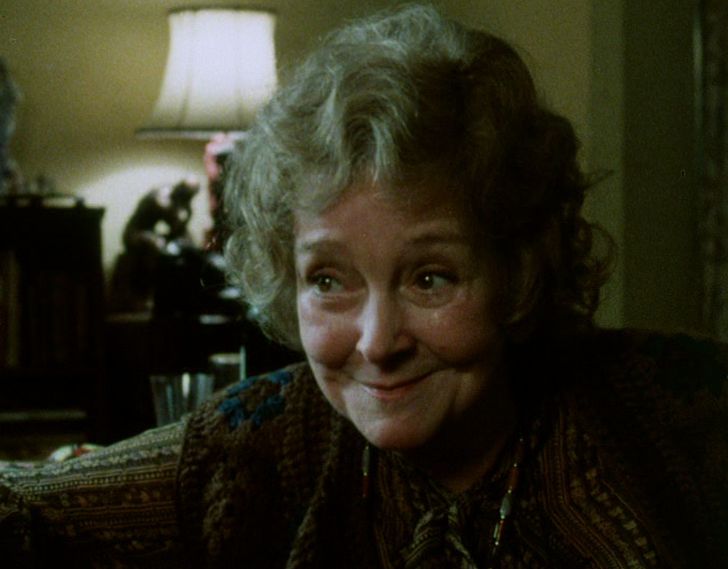
Her somewhat unpredictable career path would later lead her to the role of Connie Sachs in episode three of Tinker Tailor Soldier Spy.  Critically, both this and her later appearance as Connie (in Smiley’s People) can be considered career highlights – she was BAFTA nominated as Best Actress for Tinker Tailor Soldier Spy and won the BAFTA Best Actress award for Smiley’s People.

In Tinker Tailor she gives an effortless performance opposite Alec Guinness.  Smiley is the patient observer, gently guiding the voluble Connie to the topic he wishes to discuss.  Connie cuts a somewhat sad figure – disfigured by arthritis and living in rather shabby surroundings.  Like Smiley, she has been cast out of the Circus – and she still feels the pain.  “I was the best Head of Research the Circus ever had!  Everyone knew that! And what did they say the day they gave me the chop?  That personnel cow!  ‘You’re losing your sense of proportion, Connie.  Time you got out into the real world.’  I hate the real world!  I like the Circus and my lovely boys!”

With official Circus records not available to him, Connie is an invaluable resource, since she has instant recall of every case that ever passed her desk.  Smiley is interested in an agent called Polyakov and Connie recalls that when she tried to get Esterhase and Alleline to investigate him further, they declined.  And shortly afterwards Connie was retired from the Circus.  Another example of someone too close to the truth about the mole having to be removed?

Although her screen-time is only a little over seven minutes, it’s still one of the most memorable parts of the serial.  “Poor loves. Trained to Empire, trained to rule the waves. Englishmen could be proud then, George. They could… All gone.”

Smiley has entrusted Peter Guillam with the task of obtaining the log recording Ricki Tarr’s reports to London concerning the Russian agent Irina.  Smiley reminds him to exercise extreme caution.  “You must assume, Peter, the Circus has dogs on you twenty four hours a day. Think of it as a foreign country.”

The Circus, as befits Britain in the late 1970’s is somewhat shabby and tired-looking.  This is exemplified by the squeaky lift door.  When Guillam says it’s about time that it was sorted, the receptionist gloomily tells him that he’s asked for it to be dealt with on more than one occasion.

Guillam’s visit is fruitless – the log has been tampered with and a vital page removed, but along the way he bumps into Haydon, Bland, Esterhase and Alleline who all react to him with varying levels of suspicion.  Haydon seems the most amused.  “What the hell are you doing here, you pariah?”.  But like all spies, he’s not always easy to read.

These scenes give us our first proper look at the four top men at the Circus – one of whom is “Gerald” the Soviet mole.  They didn’t appear in episode two and their only appearance in the first episode was in the pre-credits sequence, when the four of them silently entered a meeting-room.

The scene in the first episode is worth looking at in a little more detail, as even though only Alleline speaks, the it still manages to clearly define all their characters.  First to enter is Toby Esterhase – the fact he’s early and that he gets up later to close the door behind Haydon clearly demonstrates his fussy, precise nature. Next is Roy Bland, cigarette dangling casually from his mouth. Percy Alleline is the third one in, sitting down with a pompous, self important air. Bill Haydon is last – balancing his cup of tea with the saucer on top, he betrays a sardonic, amused attitude

The remainder of the episode is told in flashback, some six months before Control’s death.  Alleline has just proudly unveiled his Witchcraft material, much to Control’s disgust.

Alleline: Merlin is the fruit of a long cultivation by certain people in the Circus. People who are bound to me as I am to them. People who are not at all entertained by the failure rate about this place. There’s been too much blown, too much lost, too much wasted. Too many scandals. I’ve said so many times, but I might as well have talked to the wind for all the heed he paid me.
Control: “He” means me, George.
Alleline: The ordinary principles of tradecraft and security have gone to the wall in this service. It’s all “divide and rule”, stimulated from the top.
Control: Me again.
Alleline: We’re losing our livelihood. Our self-respect. We’ve had enough. We’ve had a bellyfull, in fact.

Does Control distrust the material or Alleline?  He charges Smiley to speak to Haydon, Bland and Esterhase.  “Sweat them, George.  Tempt them.  Bully them. Anything damn thing.  Give them whatever they eat.  I need time.”

Smiley draws a blank with all three.  First he speaks to Toby Esterhase.

Esterhase: My problem is promotion. I mean the absence of it. I have so many years’ seniority that I feel actually quite embarrassed when these young fellows ask me to take orders from them.
Smiley: Who, Toby? Which young fellows? Roy Bland? Percy? Would you call Percy young? Who?
Esterhase: When you’re overdue for promotion and working your fingers to the bone, anyone looks young who’s above you on the ladder.
Smiley: Perhaps Control could move you up a few rungs…
Esterhase: Actually, George, I am not too sure he is able to.

Roy Bland, despite being a protegee of Smiley’s, is equally disinterested.

If there’s no deal, you’ll have to tell Control to get stuffed! I’ve paid, you see, you know that! I don’t know what the hell I’ve bought with it, but I’ve paid a packet. Poznan, Budapest, Prague, back to Poznan – have you ever been to Poznan? – Sofia, Kiev, two bloody nervous breakdowns and still between the shafts! That’s big money at any age. Even yours.

The relationship between George Smiley and Bill Haydon is tense, since Haydon had previously had an affair with Ann, Smiley’s wife. He does, however, argue quite convincingly that Control’s problem is with Alleline – not the Witchcraft material.

Merlin would do if he were my source, wouldn’t he? If dazzling bloody Bill here pottered along and said he’d hooked a whacking big fish and wanted to play him alone and sod the expense, what would happen then? Control would say, “That’s very nifty of you, Bill boy. You do it just the way you want, Bill Boy. Have some filthy jasmine tea.”

With the personalities of the four top men now firmly established, Smiley begins his investigation in earnest.

The Day of the Triffids (BBC 1981). Episode Six

triffids 06

Six years have passed since the events seen in episode five.  Bill and Jo now have a young son and Susan, the girl Bill effectively adopted, is growing up.  They, together with a blind couple who live with them, have managed to keep their small community ticking over.

There are problems though and these are mostly Triffid related.  Although they regularly destroy them, the Triffids always come back.  Bill has built an electric fence – but powering it constantly isn’t possible.  There’s a very effective sequence early on, when Jo opens the curtains to find a group of Triffids right outside.  Just the small glimpse that we can see of them makes them even more disturbing.

The unexpected arrival of Coker offers a way out.  He’s established a community of several hundred people on the Isle of Wight and since it’s an island, it can be defended against Triffids.  Coker asks Bill and the others to join them and work on a way to eradicate the Triffids once and for all.  He then talks a little about how the community functions.

Those of us all over there have all agreed we’re not out to reconstruct the world as it was.  We want to build something new, better.  Some people don’t agree with that, they want to keep a lot of the bad, old features.  If anybody doesn’t like us, or we don’t like them, we ask them to move somewhere else.

Shortly after Coker leaves, they are visited by a number of people in military fatigues headed by a man called Torrance (Gary Olsen).  The book makes it explicit that he’s the same red-headed man who shot at Bill and the blind people earlier in the story,  This doesn’t happen here, so you could be forgiven for thinking they’re two separate people.  Torrance wants to move another eighteen blind people into Bill’s community and whilst he admits that it’ll be hard work for them all to survive on the land for the next few years, after that he tells them they’ll be able to relax a little.

Bill comes to realise that Torrance is effectively inviting him to become a feudal lord.  Torrance, like Coker, is given a chance to outline how their community operates.

Supreme authority is vested in the council.  It will rule.  It will also control the armed forces.  Then, of course, there’s the rest of the world to consider.  Everywhere must be in the same sort of chaos.  Clearly, it’s our national duty to get on our feet as soon as possible and assume a dominant role and discourage any aggressors from organising against us.

It is the diametric opposite of Coker’s community.  Coker wants to build something new and different, whilst Torrance is seeking to rebuild the new world very much along the lines of the old.  Given that there’s been a general feeling throughout the story that any rebuilding must be an improvement on the old ways, it’s no surprise that Bill and the others reject Torrance’s offer and they leave him and his men to deal with the Triffids whilst they head for the Isle of Wight.

Earlier in the episode, Bill and Jo discuss exactly how the catastrophe happened.  Jo, like many people, believes that the comet was a natural phenomenon, but Bill isn’t so sure.

Do you know how many satellites were going round up there?  How many weapons?  Or what was in the weapons?  They never told us.  They never asked us.  I suppose one of these weapons had been specially constructed to emit a radiation that our eyes couldn’t stand.  Something that would burn out the optic nerve.  Suppose there was an accident.  This weapon would operate at low levels, only blinding people they wanted to blind.  But after the accident, it went off so far up that anyone on earth could receive direct radiation from it.

Back in 1981 this would have seemed horribly possible, so when you realise that it was part of Wyndham’s novel (published in 1951, six years before the first satellite was launched) it’s an impressive feat of prediction for him to anticapte the weaponising of space.  Torrance’s aggressive militarism seems set to repeat these same mistakes, so it’s understandable that Bill and his friends reject him.

In conclusion, this is a creepily effective serial that has only improved with age.  It naturally had a limited budget, so in earlier episodes it couldn’t show the devastation of London in any particular detail – but it did manage to efficiently imply it via sound effects (gunshots, cries, etc).  If you want to watch a faithful adaptation of the novel, then this is the only one to go for – as both the film and the 2009 TV version veer wildly from Wyndham’s original.

Something of a classic, this deserves a place in anybody’s collection.

The Day of the Triffids (BBC 1981). Episode Five

triffids 05

Episode Five concerns itself with Bill’s quest to find Jo, which leads him out of London and into the country.  Coker joins him for the trip.  One of the major plus-points of this episode is Maurice Colbourne, who was always such a watchable actor with a very strong presence.  Although he appeared briefly in a few previous episodes, he’s much more central in this one.  After he and Bill rest in an abandoned pub, it’s Coker who can clearly see the way forward.

We must be part of a community to have any hope for the future at all.  At the moment we’ve got all we need.  Food, supplies, everything.  But the food will go bad, the metal will rust, the petrol to drive the machines will run out.  Before that happens, we have to learn to plough and learn to make ploughs, and learn to smelt the iron to make the ploughshares.  We must learn to make good all that we wear out.  If not …. we say goodbye to civilisation and we slide right back into savagery.

Bill and Coker find the community at Tynsham, but Jo isn’t there.  A number of the survivors have also moved on, due to a serious disagreement.  The remaining survivors at Tynsham are led by Miss Durrant (Perlita Nelson) and they’ve rejected the notion that pro-creation is key to survival – instead they plan to exist by strictly Christian principles and they put their faith in God to save them.

Coker decides to stay with them, as he believes that he can make something of the community, and Bill travels on.  Along the way he effectively adopts an orphaned young girl, Susan (Emily Dean).  It’s interesting to see how this, like so much of The Day of the Triffids, was directly paralleled in Terry Nation’s Survivors.  Essentially Survivors is The Day of the Triffids writ-large, but without any Triffids.

Wyndham gave Susan more of a back-story (about the death of her parents and her fears and feelings) which isn’t used here, that’s a bit of a pity as without it she’s something of an underdeveloped character.

Together they eventually manage to find Jo (along with a few others) and they all decide to return to the community at Tynsham.  But disease has struck – many are dead and the others have left.  Of Coker, there’s no sign.  So they face the prospect of having to establish their own small community, whilst all around the Triffids are looming …..

There’s certainly more Triffid action in this episode.  Bill gets to shoot a few of them – with both a rile and a Triffid gun.  When Coker asks Bill if the Triffids frighten him he says yes, “and they sicken me, too.  And what sickens me the most is that inside this mess they are the only things that are going to fatten and thrive”.

Whilst there weren’t that many Triffids in London, there seems to be more of them in the countryside – whether they’re breeding or whether there were tens of thousands in captivity who’ve escaped is never made clear.  But they seem to be an ever-growing menace (even more so in the final episode).

A word about Christopher Gunning’s score.  It wouldn’t have been a surprise (because of period when this was made) for the BBC Radiophonic Workshop to have provided the incidental music, but instead Gunning uses more traditional instruments (instead of the synthesizers favoured by the Radiophonic Workshop).

In episode five’s score, the piano dominates – and as Bill’s search for Jo reaches a happy conclusion, the music reaches an appealing crescendo.  Given how dark the majority of the story is, Gunning’s music helps to provide a sliver of light and hope.

The Day of the Triffids (BBC 1981). Episode Four

triffids 04

Bill and a number of other people (including Jo) have been captured by Coker – who staged the phony fire at the end of episode three.  He allocates one sighted person to a party of blind people and assigns them to a district.  They have to find a place to live and make regular trips to locate food – which will keep everybody alive until (Coker says) more organised help turns up.

Bill doesn’t believe that any help is coming but Coker’s a good enough judge of character to know that once he gets to know them, Bill won’t leave his party.  Whilst he was previously able to discuss (in abstract terms) that keeping the blind alive was ultimately fruitless, when he has to deal with actual people his humanity will ensure that he’ll do everything he can for them.

But even with his best efforts, there are numerous dangers.  Several are killed by a red-haired man (Gary Olsen) who’s leading a rival party.  His motivation for shooting them isn’t clear here, but he’s a character that will return later in the story.

The Triffids also claim some victims in another nicely directed scene.  As mentioned before, as they haven’t featured for a while their sudden reappearance in the middle of the episode comes as something of a jolt.

Disease thins Bill’s party even more and he’s powerless to prevent their deaths.  As London becomes even more of a health hazard, it’s clear that the longer he remains, the more danger he’s in.  Bill seems to be on the point of leaving when he’s visited by a young woman (Eva Griffith) who asks him to stay and offers herself to him.  It’s a heartbreaking scene and like so much of Douglas Livingstone’s adaptation, it’s taken directly from Wyndham’s novel.

Shortly afterwards, she dies and the few survivors flee in panic.  So Bill’s left alone once more. but this time he has an aim – he needs to find Jo.

Brian Aldiss once notoriously dubbed the works of John Wyndham in general and The Day of the Triffids in particular as “cosy catastrophes”.  Aldiss wrote that “the essence of the cosy catastrophe is that the hero should have a pretty good time (a girl, free suites at the Savoy, automobiles for the taking) while everyone else is dying off”.

I have to admit, I don’t find anything particularly “cosy” about either this adaptation or Wyndham’s original novel.  True, Wyndham’s novel did tend to feature mostly middle-class characters (another point which upset Aldiss) and this is changed here by making Bill (courtesy of John Duttine) more working class – but the concepts and themes developed thus far are pretty bleak.

The Day of the Triffids (BBC 1981). Episode Three

triffids 03

After Bill and Jo escape from the maurding pack of blind people, they find a place to hole up for the night.  After enjoying a good meal and a decent mug of wine, they both learn a little more about each other – although Jo says, “but all that, all the details of my life, they were yesterday. It’s the same with you.  I think I’d like to know you from today and you know me from today.  You might not like what I was yesterday.  I might not like what you were”.  The sense that yesterday is a closed book and that the future starts today is a theme that is picked up again later in the episode.

They then discuss what to do next.  Bill is keen to get out of London as he tells Jo that soon, “the city will begin to stink like a great sewer.  There are already corpses lying around.  Soon they’ll be more.  That may mean cholera, typhoid.  God knows what”.

But a light in the distance changes their plans and the next morning they meet a group of thirty or so survivors who all have sight.  They see another sighted man, called Coker (Maurice Colbourne), who’s leading a group of blind people.  He asks the others for help in finding food, but they refuse.  This is a debate that has cropped up before and Bill and Jo discuss it again shortly afterwards.  Bill says that Coker is right and wrong.  “We could show some of them where to find food for a few days or for a few weeks.  But what happens afterwards?”.

They then meet the leader of the sighted group, Beadley (David Swift).  He proposes moving out of London and establishing a community that will isolate itself for a year (in order to protect against disease).  One of the other members of their ad-hoc committee explains how the community will function.

The men must work.  The women must have babies.  We can afford to support a limited number of women who cannot see, because they will have babies who can see.  We cannot afford to support men who cannot see.  In our community, babies will be more important than husbands.  It follows from this that the one man/one woman relationship as we understand it will probably become an illogical luxury.

As for the Triffids, they only appear in a single scene (where they attack an old couple who we’ve never seen before).  As their appearance (although it’s very nicely shot at night) is divorced from the main narrative, it seems to have been put in simply to remind the audience that they’re still out there.  And since they don’t feature much in this episode, it helps to make their sudden reappearance in episode four even more striking

At the end of this episode, Bill and Jo (along with the rest of the potential community members) are settling down for the night when a fire alarm is raised.  Bill rushes down the stairs, trips over and awakes to find himself tied up …..

The Day of the Triffids (BBC 1981). Episode Two

triffids 02

After leaving Dr Soames in an office, Bill tells him that he’ll go and find some help.  Soames knows there’s nothing to be done and he’s right – everyone else in the hospital is blind.  Along the way, Bill meets a patient in one of the wards who asks him to draw the curtains and when he has, the man tells him to stop playing about and draw the curtains.

This is another scene taken directly from the novel, although it might have been a good idea to omit it.  It’s impossible to believe that somebody couldn’t tell the difference between it simply being dark and being blind.  Even in the dark, it’s possible to distinguish shapes and outlines.

Elsewhere, he sees groups of people milling about anxiously and when he returns to the office he finds Dr Soames has jumped to his death.  As Bill ventures out onto the streets he finds no better news, until he spots a girl who can see.  He follows her into a house and meets her father, John (Stephen Yardley).  John and his wife are blind, but their daughter can still see.

John vacillates between believing that the problem is only local and temporary and pondering the implications if the majority of the population are now permanently blind.

Well, everybody will be like us at first. They won’t know what’s happened. They’ll be too frightened to move. Then they’ll get hungry and start looking for food. I mean this town’s nasty at the best of times. In two or three days it won’t just be hooligans, it’ll be people you thought butter wouldn’t melt killing each other for scraps of food.

There’s a great deal of truth in this, as we see pockets of the blind fighting each other for food, whilst one woman sits on the ground with a packet of washing powder in the mistaken belief that it’s edible.  Elsewhere, a group of football supporters are led by a sighted man and they grab a woman.  Their intentions are obvious and although Bill tries to intervene, it’s probable that his attempt was fruitless (we don’t see the conclusion).  As we witness other examples of people in distress, how will Bill decide which ones to help and which ones to leave?

Earlier in the episode, Josella (Emma Relph) was captured by a blind man and forced to be his eyes.  Bill discovers them and frees her.  Together they seek refuge in a pub and when she decides to find her father, Bill asks if he can come with her.  Jo agrees instantly and tells him it’s “not because I’m afraid of getting caught again.  I’ll watch out for that.  It’s just the dreadful sense of loneliness, being cut off from everybody else”.

Jo’s father is dead, killed by a Triffid and Bill and Jo only manage to escape after Bill kills another.  This the first major Triffid attack scene in the story and thanks to some tight framing and intense acting from Duttine it works well.  Whilst they’re not the most mobile of creatures, the occasional glimpse of them (as well as the eerie sound they make) is quite effective.

The episode has already discussed how the vast majority of the population could, because of their blindness, be turned into a mob – and this looks like it’s coming true at the end.  Bill and Jo’s car is surrounded by a group of blind people and whilst none of them are intrinsically evil, their desperation to hold onto any sighted person is somewhat disturbing.

triffid

The Day of the Triffids (BBC 1981). Episode One

triffids 01

John Wyndham Parkes Lucas Beynon Harris was born in 1903 and began his writing career in the 1930’s under a variety of names. Following the Second Word War he started writing again and produced his first novel as John Wyndham. That was The Day of the Triffids which was published in 1951.

The Day of the Triffids was an instant success and it established Wyndham’s reputation as one of Britain’s top science fiction writers.  It was faithfully adapted for the radio in 1957 (and the same script was re-recorded in 1968).  There was also a film version in 1962 which deviated substantially from the original book (as did the 2009 BBC adaptation).

In-between those two was this 1981 BBC adaptation by Douglas Livingstone.  It was directed by Ken Hannam and comprised six 26 minute episodes which were re-edited into three 52 minute episodes for overseas sales.  Livingstone did a remarkable job of faithfully transferring Wyndham’s novel to the small screen.  There are some changes (the action is moved from the 1950’s to the 1980’s and some minor characters are different) but overall there’s a great deal of fidelity to Wyndham’s original book.

In Livingstone’s teleplay, as in the novel, the thrust of the story is concerned with how the survivors of a global catastrophe will be able to survive after the technological infrastructure they’ve taken for granted has been destroyed.  The later BBC adaptation was much more of a straightforward adventure yarn, pitting the survivors against the Triffids.  But here, like in the book, the Triffids only pop up from time to time and they aren’t the most pressing problem.

The story opens with Bill Masen (John Duttine) recovering in hospital after an operation on his eyes.  He works at a Triffid farm and was stung by one of them – hence the operation.  Hopefully, once the bandages are removed he’ll be able to see again, but nothing is certain.

One annoying side-effect of his temporary blindness is that he was unable to witness the remarkable light-show the previous evening.  The precise origin of this natural display which lit up the night sky for hours (visible all over the world) was a mystery, but the morning after things feel different.  Where there should be noise and bustle (as befits a busy hospital) there is only an ominous silence …..

Both the novel and Livingstone’s adaptation open with Bill in hospital and work back from there to explain the history of the Triffids.  In Wyndham’s novel, Bill is writing the whole story to explain to those who were born after the catastrophe exactly what happened.  In the television version, Bill narrates how the Triffids came to exist onto cassette for his colleague Walter, who’s planning to write a book about them.

This is a decent framing device as it allows Bill to narrate over various scenes which explain where the Triffids came from and precisely the danger they pose. Walter (Edmund Pegge) works with Bill at the Triffid farm and in one of the flashbacks he discusses with him some of his theories.

Look at when they attack. They almost always go for the head. Now a great number of people who have been stung but not killed have been blinded. That’s significant of the fact they know the shortest way of putting a man out of action. If it were a choice of survival between a blind man and a Triffid, I know which I’d put my money on.

One interesting change by Livingstone is that to begin with, Bill still believes it’s the middle of the night – but we can clearly see the daylight streaming through the window and the time on the clock (the novel opens with him instantly aware that things aren’t right). This means that the viewers know more than Bill and so are aware, before he is, that something is seriously awry.

John Duttine spends the majority of the episode alone in his hospital room with his eyes bandaged.  It needed a good actor to make the character come alive, with so little to work with, and Duttine certainly delivers.  As time goes on, and still nobody comes, his self control begins to crack – until he decides to take off the bandages himself.

The irony that he’s now able to see whilst the majority of the world have gone blind isn’t something that’s overtly stated, but it’s obvious nonetheless.  As the episode ends, he meets the blind Dr Soames (Jonathan Newth) whilst the Triffids start to prowl …..

Hi-de-Hi! – Hey Diddle Diddle

hi

Many of the best sitcoms feature a disparate group of people who, for one reason or another, are trapped together.  Porridge is an obvious example, but it’s a theme that also runs through the work of Jimmy Perry and David Croft.

Dad’s Army and It Ain’t Half Hot Mum both had a diverse set of people thrown together by WW2 and in Hi-de-Hi! the characters are bound together because of their job.  It amounts to pretty much the same thing though – as we see people of different attitudes, ages and classes all forced to work with each other.

If there’s one thing that’s notable about most of Perry and Croft’s sitcoms (and also the ones that Croft wrote with other people) it’s the fact they tended to go on far too long.  When something is successful, the obvious thing to do is to continue – few writers are able (like John Cleese and Connie Booth with Fawlty Towers) to decide early on that all the comic potential has been mined from a certain idea.

But for now, let’s take a look at the first episode of He-de-Hi!, transmitted on the 1st of January 1980.  It has an extended running time of forty minutes and is probably best seen as a pilot – since it would be more than a year before the first series proper began.

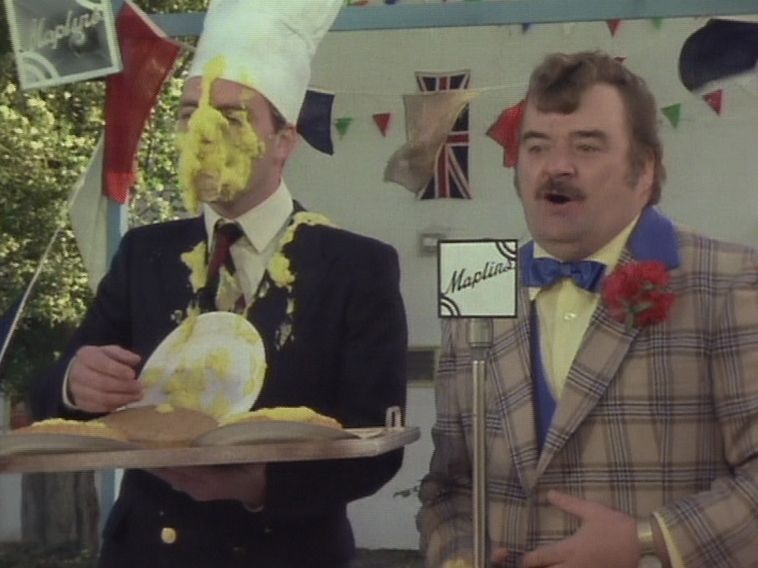
What’s interesting is the feeling of melancholy that hangs over many of the characters.  Whilst all of them are professional with the holidaymakers, behind the scenes there’s a sense that for many, Maplin’s Holiday Camp is something of a prison for their thwarted dreams and ambitions.

For example, Fred Quilley (Felix Bowness) was a jockey who, it’s implied, threw races – so he’s washed up at Maplin’s, teaching holidaymakers to ride a selection of clapped-out nags.  And Mr Partridge (Leslie Dwyer) is a Punch and Judy man who has an intense dislike of children, something of a handicap in his job.  Dwyer was a veteran actor with a list of credits stretching back to the 1930’s (In Which We Serve and The Way Ahead were two notable early film appearances).  He’s rarely a central figure in the stories, but his pithy bad temper were always worth watching out for.

Perhaps the most dismissive of the whole Maplin’s environment are Yvonne and Barry Stewart-Hargreaves (Diane Holland and Barry Howard) and Yvonne’s disdain for the common holidaymakers is never far from the surface.  Their marriage is also intriguing, since Barry acts so incredibly camp it’s possible to wonder whether theirs is a marriage of convenience.  There’s this exchange, for example.

BARRY: You’ve got your weight on the wrong foot, you silly cow.  It’s like dancing with an all-in wrestler.
YVONNE: Well you’ve more experience with that kind of thing that I’d have.

There are some positive people though.  Spike (Jeffrey Holland) is young, keen and eager to please.  But it’s possible to wonder if Ted Bovis (Paul Shane) is the sort of person that Spike will become in twenty five years if the breaks don’t come his way.  In the little world of Maplin’s, Ted is King – although the fact he’s still stuck in the holiday camps after all this time implies that his big break never materialised.

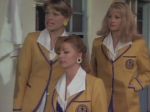
Given how Peggy (Su Pollard) came to define the series, it’s surprising that she hasn’t got her face in the opening credits.  Peggy is the most positive person of all, desperate to become a yellowcoat and eager to do anything that will advance her cause.

The person charged with bringing order to this group of misfits is the new Entertainments Manager Jeffrey Fairbrother (Simon Cadell).  Jeffrey is the real fish-out-of-water – formally a professor at Cambidge, he’s thrown that up because, as he tells his mother, “I’m in a rut. My wife’s left me because I’m boring, my students fall asleep at lectures because I bore them. And worst of all, I’m boring myself”.

Cadell is perfect as the indecisive, diffident, but decent man who’s completely out of his depth.  This is highlighted when he meets Gladys Pugh (Ruth Madoc) for the first time.  For Gladys, it’s clearly love at first sight.  For Jeffrey (whilst he’d have to be blind not to see the signs she’s giving off) there’s little more than exquisite embarrassment.

This opening episode has done enough to suggest that the differences between the characters will provide plenty of comic potential in the years to come.  And towards the end Jeffrey is visited by a couple who are about to leave.  The old man’s words help to explicitly state the series’ agenda – whilst the employees of Maplin’s might sometimes be at each others throats, ensuring that the holidaymakers enjoy themselves is something they can all take pride in.

It was wonderful.  Just sheer fun, and we haven’t had a lot of that in our lifetime. It’s grand being daft and forgetting all your troubles for a little while. I was telling Doris here, I said if the whole country could be run like a holiday camp then we’d be alright. We’d have Joe Maplin as prime minister and never mind that Harold Macmillan. He’s always telling us we’ve never had it so good. We’ve never had it. We’ve had a grand holiday and you were marvelous. You joined in the fun, supervising in your own quiet way and you didn’t make a lot of palaver. You just did it and we’d like to thank you, young man.

You have been watching –

Bird of Prey (BBC 1982). Episode Four – Printout Urgent

prey 04

The last in a four-part thriller for the electronic age featuring Richard Griffiths
Episode 4: Printout Urgent
Henry is at bay. His home in ruins, his allies and hard-won evidence all destroyed. Face to face with the gathering strength of ‘Le Pouvoir’ and the grandiose scheme of its protégé – Euro MP Hugo Jardine.
(Radio Times Listing, 13th May 1982)

With Henry believing that one of the explosions from the end of part three killed Anne (instead it was the unfortunate Tomkins who perished) he moves into attack mode.  He substitutes himself for Jardine’s chauffeur and drives him to an abandoned warehouse.  His original plan is to kill Jardine and then make as much trouble as he can for Jardine’s organisation before his own death – but when he learns that Anne is still alive he agrees to a swop.

There’s no denying that Henry’s abduction of Jardine stretches credibility as it’s difficult to believe that such a powerful man would travel with no protection at all.  Jardine (Christopher Logue) is a good example of the banality of evil, which makes his confrontation with Henry very interesting.

When Henry first speaks to Jardine he believes that Anne is dead – but Jardine professes not to know about her death or any of the others.  He tells Henry that “I know nothing of the names you mention. I have people imposed upon me. I have no say in their methods. Because your heart is broken does not license you to stop mine”.  How much of a pawn Jardine is in other people’s plans is a matter of conjecture, but it does highlight that there never seems to be a single person sitting in total control at the top of the pyramid – everybody always seems to answer to somebody else.

Elsewhere, Bridgnorth explains to Hendersly exactly what Jardine’s scheme is, in a scene that would be an unbearably egregious info-dump if it wasn’t for that fact that Nigel Davenport was such a good actor well able to rattle off such exposition-heavy dialogue with great aplomb.

Jardine, along with the shadowy Italian conglomerate, has tabled a bid to build a deluxe Channel tunnel.  Bridgnorth says that it will create “125,000 new jobs in construction and engineering. 50 or 60 thousand new service and retail jobs. Only Jardine has the political will and the financial clout to stitch a deal like this together. Road and rail links side by side. The Rolls Royce solution to the Channel link”.  With a potential fortune to be made, trouble-makers like Henry would appear to have a very limited life expectancy.

The hand-over between Jardine and Anne goes ahead – although not quite as some of the players might have expected.  Henry and Anne are safe though, but their future seems less certain.  Henry was able to broker a deal with Rome – he agreed not to release the files he has on them and in turn they pulled out of the Channel bid.  And if Henry doesn’t input a counter-instruction code every three months, the files will be released to every government computing centre across Europe.

This will keep Henry and Anne safe for now, but he’s well aware that they’ll try to break his code and if they do then their lives will be rather short (which sets us up nicely for the sequel Bird of Prey II).

Overall, this is a very decent thriller.  Although trailed in the Radio Times as a story for the electronic age, computers really don’t feature very significantly at all (except for the ending, where it’s the information contained within the computer that’s keeping Henry and Anne alive).  Production-wise, it’s typical of the era – VT interiors and film for exteriors.  If it had been all-film (like an increasing number of serials during the early to mid 80’s) then it might have been more stylish.  As it is, the direction is workmanlike but rather flat, with only the odd moment standing out.  Instead, it’s the actors (rather than the camerawork) which makes the story.

Richard Griffiths shines as the undemonstrative Henry and Nigel Davenport is impressive as his main rival.  As the DVD was deleted some time ago it now tends to sell for silly money – but if you can track down a reasonably priced copy then it’s certainly worth a look (particularly if you like drama of that era).

Bird of Prey (BBC 1982). Episode Three – Process Priority

prey 03

A four-part thriller for the electronic age featuring Richard Grifiths
Episode 3: Process Priority
One name recurs in Henry Jay’s single-handed investigation into the affairs of ‘Le Pouvoir’ – Euro MP Hugo Jardine. With British Intelligence now implicated in the cover-up, Henry has a story to sell – if he can stay alive long enough.
(Radio Times Listing, 6th May 1982)

Generally, the third part of a four part story is a bit of a problem. You’ve set up the plot and characters in the first two parts but you’re still one away from the conclusion – so part threes generally involve a good deal of running on the spot.

While it’s true to say that Process Priority does conform to this rule, on the plus side it introduces an interesting new character, Rochelle Halliday (Ann Pennington).  Rochelle runs a commercial intelligence consultancy and she had contact with Henry when he was drafting his report on computer fraud.

She’s a playful, irreverent character, which is highlighted when she asks Henry to read the notes she made about him after their previous meeting.  “First impressions are that he would be out of his depth in a car park puddle, but first impressions may be deceptive. Give him a couple of months then try sex or straight cash. Say five hundred. He shouldn’t be expensive”.

Ann Pennington is a major reason why this part three doesn’t feel too draggy.  It’s a pity that this is her only episode – but as has been mentioned before, many characters in Bird of Prey have a very short shelf life.

Rochelle sends Henry off to speak to Julia Falconer (Mandy Rice-Davies).  Julia is the proprietor of a high-class call-girl agency which has links to Hugo Jardine.  She’s able to fill in a few blanks, but these scenes are of primary interest due to Mandy Rice-Davies herself, since along with Christine Keeler she will be forever remembered for her role in the Profumo affair.  It could be regarded as stunt-casting, but since she’s a decent actress I wouldn’t say so.

Elsewhere, Hendersly (Jeremy Child) is starting to have his doubts about Bridgnorth (Nigel Davenport).  It’s been a fairly thankless role for Child so far, as his character has been drawn as a colourless, yes man.  But now the worm turns and he tells Bridgnorth that he’s compromised his career “to protect Hugo Jardine, who you advised me is risking his life in a long, drawn out and elaborate intelligence operation. On a need-to-know basis, you’re the only person I’ve had any contact with. As this operation staggers from one blunder to the next, I’ve just kept my head down and assumed that you’ve known what you’ve been doing. I find myself questioning that now. And even more seriously, questioning who it is that I’m ultimately working for and with whom your loyalties lie”.

After a speech like that (and given what we’ve already seen) it’s interesting to ponder what his life expectancy will be …..

As the end of the episode approaches it’s clear that matters are building to a head.  The cliffhanger is certainly arresting – as we witness two separate explosions (although the second is admittedly a little weedy).  Both explosions help to thin out the cast a little more but Henry is still unscathed and he appears to be heading for a showdown with Jardine.

Next Episode – Printout Urgent

Bird of Prey (BBC 1982). Episode Two – Mode Murder

prey 02

A four-part thriller for the electronic age, featuring Richard Griffiths.
Episode 2: Mode Murder
Murder and the power to subvert officialdom: Henry Jay has good reason to believe in ‘Le Pouvoir’ and its link with the growing evidence of a financial conspiracy. A dead detective’s legacy is a file pointing to a Euro MP and a girl in Brussels – which leaves Henry no option but to pick up the trail.
(Radio Times Listing, 29th April 1982)

Henry needs answers – so he sells his stamp collection and uses the money to rent a room under an assumed name and also buy a computer.  It’s the latest model and the salesgirl informs him that it has “64K memory, disk drive main, storage for 120,000 characters”.  Which was cutting edge stuff in 1982!  Henry’s computer hacking also raises an eyebrow – since it consists of him ringing up various people and asking for their passwords.

Whilst this will either seem charmingly naive or rather clumsy (depending on how forgiving you are) it does allow Henry to track down Hannah Brent (Sally Faulkner).  Hannah was the girlfriend of Louis Vacheron (a crook murdered in episode one) and Henry hopes she’ll have a lead that will lead him closer to the heart of the conspiracy, so he flies out to visit her in Brussels.  Before DI Richardson was murdered, he left a file for Henry (inside were clippings which mentioned a European MP and businessman called Hugo Jardine).  Hannah doesn’t recognise the name but promises to try and find out what she can.

A hallmark of a good conspiracy thriller is that nobody can be trusted.  Hannah Brent would have known about a simple code that Vacheron taught her (the Owl and the Pussycat in French).  The girl with Henry doesn’t, so he knows she’s not the real Hannah Brent.

This revelation moves us to the heart of the episode as we’re introduced to Charles Bridgnorth (Nigel Davenport). Bridgnorth works for British Security and the faux Hannah Brent works for him. As for the real Hannah? Bridgnorth surmises she’s “in the foundations of a Brussels office block most likely”.

Bridgnorth tells Henry that Jardine works for them and is part of a project stretching back several years – and that both his and Richardson’s investigations may have compromised Jardine’s safety. He also explains to Henry a little more about the Power (the mysterious force alluded to by Vacheron).

The Power is more a loose federation of people than a solid structure. People who temporarily find it an advantage to work with each other to repay each other for favours past and future. There’s a grey area in this sort of business, Henry. Terrorism shades into organised crime, into police undercover operations, into how the state security apparat responds to the chaos which mobile internationally-minded crooks and politicos have been creating since the early ’60’s, especially in Europe. Even those who did the killing may be unaware of what favour they are repaying to whom.

Henry doesn’t find this particularly comforting – so Richardson and Vacheron may have been killed by criminals or possibly by members of the police and security services.  Bridgnorth is pretty non-committal, but tells Henry that his involvement is over.

Get out of here, civilian. This is where the dirty work gets done. Dirty work that means that people like you can catch the 8:15 every morning and lead your boring little lives. Be thankful for the 8:15, Henry. Be thankful for your boring little life and the fact that we allow you to go back to it in one piece … or at all.

It’s a convincing story, but as it’s only the end of episode two there must be more revelations to come.  Henry knows they’re lying to him and explains to Anne that “an exceedingly elaborate construct has been made up of all the bits and pieces and odds and ends they know I know about. It concerns one of the many branches of Intelligence claiming Jardine for their own. They lied about Richardson going to Brussels. I had a computer agency check the relevant flight listings and he never made it”.  It’s only a small point, but Henry has to go on – he has to know if that was the only lie or if the whole story was false.

The episode ends with a few more bodies – DS Eric Vine (Richard Ireson) and the Department’s security officer Trevor Chambers (Trevor Martin) have been waiting for Henry to return to his rented flat.  Chambers is killed by someone who calls him Mr Jay, which adds another layer of mystery.  Bridgnorth has been keeping close tabs on Henry, so he knows exactly what he looks like.  Therefore it appears there are new players in town.

Next Episode – Process Priority

Bird of Prey (BBC 1982). Episode One – Input Classified

prey 01

Henry Jay: Civil Servant, mid-30s, good head for detail
Prospects: Steady promotion. Index-linked pension
Hobbies: Philately, Hi-fi
Current Project: Computer Fraud Report for Whitehall Trade Ministry.
Altogether a seemingly puny obstacle to a massive financial conspiracy – with the bureaucratic clout to silence the inquisitive.
(Radio Times listing, 22nd April 1982)

Bird of Prey, written by Ron Hutchinson, was a four-part conspiracy thriller broadcast in 1982.  It starred Richard Griffiths as Henry Jay, who is a mild-mannered, middle-aged civil servant and therefore just about the last person you would expect to be caught up in the middle of a vast and dangerous conspiracy.

That, of course, is one of the reasons why it works so well – had Henry been a more conventional hero (either in looks or approach) then the dramatic tension would have been far less.  But since Henry seems so ill-suited to the role of a crusading hero, it creates an interesting dynamic.  Whether the story manages to keep a sense of credibility as the bodies start to pile up, we’ll have to wait and see – but let’s start by taking a look at the first episode.

Henry Jay works for the Department of Commercial Development and has a special interest in computer security.  At the start of the story he has the following info-dump speech which he delivers to his boss Hendersly (Jeremy Child).

The Americans are considering restricting the publication of research into cryptography – code breaking. Well, you see, telephone networks are now, more or less, computer networks, as are modern office accounting and money transfer systems, and the Americans have only just woken up to the security aspects of the unregulated publication of research into cryptography because it offers ways of breaking into those networks.

Since Bird of Prey is commonly regarded as a computer thriller, it’s noticeable that we don’t see a single computer in the first episode.  Henry’s office, which he shares with Harry Tomkins (Roger Sloman), is computer free – instead there’s just typewriters and plenty of conventional files.  It’s certainly a window into a vanished world, where computers were still something of a rarity.

But if the possibility of everyone either owning a computer at home or using one in work was still a slightly alien concept in 1982, there certainly was a feeling that computers were beginning to have an increasing influence on people’s daily lives – hence Bird of Prey came out at the right time (even if the technology we’ll see in later episodes now looks rather quaint!).

The opening and closing titles are rather nostalgic for anybody of a certain age, since they mimic the computer graphics common at the time.  Dave Greenslade’s title music and score is also very evocative of the era.

It’s Henry’s report, “Fraud And Related Security Problems In The Age Of Electronic Accounting”, which is the catalyst for all of his problems.  He’s been liaising with Detective Inspector Richardson (Jim Broadbent) who shares his concerns about computer fraud and Richardson has been passing him information to use in the report.  One piece of information concerns a recent attempted bank fraud centered on Turin and London.

Louis Vacheron (Nicholas Chagrin) was caught at the London end, but he tells Richardson that he’s confident he’ll be released in a matter of months as their organisation has connections at the highest levels.  He mentions le Pouvoir (the Power) but when Vacheron is killed, it’s clear that the Power has silenced a weak link.  And Richardson believes that the Power will also remove any other links (which is a problem for Henry, since there’s a reference to this fraud in his report).

Of course, nobody, especially Henry’s wife Anne (Carole Nimmons), believes him at first.  Their marriage is best described as frosty and she spells this out quite succinctly.

I do a routine and boring job as well, only I don’t have to manufacture drama and excitement out of it. Some are born civil servants. Others achieve being civil servants. Others have being civil servants thrust upon them. You were born. Now after seven years of marriage, I accept that and the fact that you will never change or be anything else, so if you’re trying to make your job sound desperately important and exciting for my sake, don’t bother. When I said yes to you, I settled for cocoa, not champagne. Now I’m prepared to live with that. Sourly at times, mostly with mute acceptance.

Shortly afterwards, Henry is accused of soliciting an underage boy, although it’s clearly a set-up (which is confirmed by the two police officers as they leave Henry’s house).  Henry sees this as a warning – leave well alone or the next time they’ll make the charges stick.  Unfortunately for the shadowy conspiracy, they then send another policeman along to tell Henry that a woman at his office has made a complaint that he’s been following her.  But as Henry says –

So, how was I fitting in my importuning of young boys in public toilets whilst pursuing Miss Callaghan? I mean, how common is this condition I’m suffering from, that renders me such a menace to young people of either sex indiscriminately?

The first episode ends with the murder of Richardson at Henry’s office (Bird of Prey and its sequel does have a pretty high body count – so it’s best to get used to the idea that many characters won’t last the series out).  Quite why he was murdered isn’t clear at present – although the fact that they can strike at Henry’s office means that he’s not safe anywhere.

So Henry is literally on the run, armed with only a few files from the office as he tries to stay one step ahead of the people who want his head.

Next Episode – Mode Murder

Doomwatch – DVD now due for release April 2016

doomwatch

Update 27/10/15 – I’m delighted to say that Doomwatch will be released on DVD by Simply Media in April 2016.  More info here.  That happily means that this post, written when a DVD release looked unlikely, is now out of date.  I’ll leave it up though, as some of the info about the archive status of the series may be of interest to some.

As you’ll see, my thoughts were that if any company was going to take a risk on the series it would have been the BFI.  I certainly wasn’t expecting Simply to do so!  But credit to Simply for taking the plunge and I hope that the sales are healthy – if so, it might encourage them to continue digging through the BBC archives.  My DVD review can be found here.

Doomwatch has long been a series that many fans of British telefantasy, and indeed fans of British archive television in general, have wished to see released on DVD.  But it remains unreleased.  Why is this so?  I thought it was worth discussing some of the possible reasons and debating whether this is likely to change in the future.

Firstly, like a great many archive BBC programmes, a major stumbling block is the BBC themselves.  BBC Worldwide (and previously 2Entertain) have tended to only release archive programmes that they expect will sell well (classic Doctor Who, comedies such as Dad’s Army, Fawlty Towers, etc).  This was highlighted a few years back when BBC America released the Douglas Wilmer Sherlock Holmes stories.  2Entertain stated that they didn’t plan to release it in the UK, as they considered it was uneconomic to do so.

BBC Worldwide’s policy is the complete opposite from a company such as Network.  Over the last decade or so, Network have released a staggering amount of titles drawn from the ITV archive.  It must be said that many of them can’t have sold in particularly large quantities (unless I’ve dramatically under-appreciated the popularly of the likes of Yus My Dear for example!).  So Network seem to be happy to make a small profit on a large number of titles, whilst BBC Worldwide appear to be interested in making a larger profit on fewer titles.

This, of course, is frustrating for those of us interested in British archive television.  One of the solutions would be for other companies to licence BBC material – and in recent years there has been a notable increase in this.  Acorn DVD (Z Cars, Dixon of Dock Green) and Simply HE (Softly Softly: Task Force) are two companies that have a growing selection of BBC DVD titles.

And after a gap of many years, the BFI have also started to release BBC titles again.  Last year they had a season of programming entitled Days of Fear and Wonder which covered not only screenings but also DVD releases such as Out of the Unknown, The Boy from Space and The Changes.  They are also planning to release the Douglas Wilmer Sherlock Holmes later this year.

Inevitably, when the BFI announced the Days of Fear and Wonder titles, it was hoped that Doomwatch would be amongst them – but sadly this was not to be.  It would have fitted in with the other programmes released, but as we’ll see, its non-appearance may be due to the amount of work required on some episodes before they could be released on DVD.  First though, let’s see exactly what remains in the archive.  Existing episodes are highlighted in bold –

Series One

The Plastic Eaters
Friday’s Child
Burial at Sea
Tomorrow, the Rat
Project Sahara
Re-Entry Forbidden
The Devil’s Sweets
The Red Sky
Spectre at the Feast
Train And De-Train
The Battery People
Hear No Evil
Survival Code

Series Two

You Killed Toby Wren
Invasion
The Islanders
No Room for Error
By the Pricking of My Thumbs…
The Iron Doctor
Flight into Yesterday
The Web of Fear
In the Dark
The Human Time Bomb
The Inquest
The Logicians
Public Enemy

Series Three

Fire and Brimstone
High Mountain
Say Knife, Fat Man
Waiting for a Knighthood
Without the Bomb
Hair Trigger
Deadly Dangerous Tomorrow
Enquiry
Flood
Cause of Death
The Killer Dolphins
Sex and Violence

Looking at the list above, the first series has a fairly decent survival rate, series two is complete whilst series three is very patchy, with only three existing episodes – although one of them (Sex and Violence) is an interesting curio since it was never transmitted.

But things start to get complicated when we look a little closer at what formats the surviving episodes exist on.  The original videotapes remain in the archives for the following episodes – The Plastic Eaters, Project Sahara, Re-Entry Forbidden, The Devil’s Sweets, The Red Sky, The Battery People, Public Enemy, Waiting for a Knighthood, Hair Trigger and Sex and Violence. So all of these stories exist in a high quality format.

The original videotapes for the other existing stories were wiped in the 1970’s, but luckily NTSC 525-line recordings were made and sold to Canada, who returned them to the BBC in the early 1980’s.  These were then converted back to PAL 625-line recordings, although by then they were already at least three generations down (i.e. the original PAL 625-line tape was convered to NTSC 525-line tape which was then converted back to PAL 625-line tape).  Each conversion would degrade the picture (motion would be blurry, for example) but whilst the picture quality wasn’t perfect, it was still pretty watchable and these copies were broadcast on UK Gold in the 1990’s.

A process called Reverse Standards Conversion (RSC) was developed several years ago and it was designed to restore something of the natural PAL videotape look to programmes like these.  All of the BBC archive holdings of converted 525 NTSC tapes were processed with RSC, but unfortunately many of the original NTSC tapes were then junked – leaving only the new, raw RSC conversions.

The RSC conversions require grading before they can be issued on DVD and this seems to be one of the major factors in preventing the release of a Doomwatch DVD.  All of the Doomwatch RSC episodes can be made ready for DVD release – but it will cost time and money.  And it appears that the amount of money required for grading is greater than the potential profit of a DVD release, so at present it seems that these stories are fated to remain in the archive.  It does seem a shame that the 525 NTSC tapes were wiped, as it would have been possible for them to be released.  They wouldn’t have looked great, but at least they would have been watchable.

The 625 PAL episodes (comprising a good selection from the first series, one episode from series two and the three existing episodes from the final series) could be released on their own though.  And there is a possibility that B&W film recordings of the stories that now only remain as raw RSC dubs are still in the archive.  Black and white copies of these episodes would be better than not having them released at all.  Of course, the best scenario is that we get a fully-restored release, along the lines of OOTU.  For that possibility, the BFI would seem to be our best hope.

Extras announced for Dixon of Dock Green – Collection Three

dixon collection three

Acorn have announced a mouth-watering series of special features for Dixon of Dock Green – Collection Three, due for release in 2015.

Audio Commentary on Domino with actor Stephen Marsh (P.C. Harry Dunne).

Audio Commentary on Alice with director Michael E. Briant.

The Final Cases: Documentary on the making of this last series, with actors Nicholas Donnelly (Sgt. Johnny Wills), Richard Heffer (D.S. Alan Bruton), Gregory de Polnay (D.S. Mike Brewer) and production assistant Vivienne Cozens.

Good Evening All: A tribute to Jack Warner, with Nicholas Donnelly, Richard Heffer, Stephen Marsh, Gregory de Polnay and Vivenne Cozens.

Personnel Files: Extended Interviews with Nicholas Donnelly, Richard Heffer and Gregory de Polnay.

Acorn have also released a teaser video to further wet the appetite.

It can be pre-ordered from Acorn now (for release in early 2015).  If it follows the path of previous Acorn releases. then it should stay as an Acorn exclusive for a few months before going on general release.

Having the episodes themselves would have justified the purchase price, but this set of special features is more than welcome. More information on collection three can be found here whilst there’s an overview of collection one here.

The Two Ronnies Christmas Special 1987

ronnies 87

The 1987 Christmas Special was the Two Ronnies’ last hurrah.  This was primarily the decision of Ronnie Barker, who had decided to walk away from showbusiness at the age of 58.  Although the Two Ronnies was still popular, Barker was wise enough to realise that their time was coming to an end and presumably wanted to avoid the treatment meted out to the likes of Benny Hill (who had been unceremoniously dropped by Thames a few years earlier).  Barker would later confirm exactly why he retired.

“The reason I retired was that the material was getting less good. I’d run out of ideas. I was dry of sketches. Plus, I’d done everything I wanted to do. The situation sort of pushed me, goaded me into asking, ‘Well, haven’t you done enough?’ And I had.”

With one more series to come in 1988 (Clarence) and this final Christmas special from the Rons, Barker could ensure that he was leaving at a point where the audience still wanted more – which was much the best way to go.  He was tempted back for a few decent character roles, but in the main he stuck to his decision and enjoyed a long and happy retirement,

None of this would have been known at Christmas 1987, so it was just another special with none of the baggage that would have surrounded the show had it been known it was the last one.  As ever, there’s nothing radical here – no deviations from the tried and true formula.  But what they do, they do so well.

One of my favourite sketches (which reappeared several times down the years) gets one final outing here.  Ronnie C is a man who can never complete his sentences and Ronnie B is his friend who has several attempts at filling in the missing words.

RONNIE C: We had our Christmas party the other night. Funny old do, it was. It’s always the same every year.  Always takes the form of an egg and …
RONNIE B: Egg and … What, egg and spoon race?
RONNIE C: No, takes the form of an egg and …
RONNIE B: Egon Ronay banquet?
RONNIE C: No, no. No, an egg and chip supper

It’s just a pity that the final punch-line was so weak, but then the Rons never went down the Python route of abolishing punchlines, which was sometimes a problem.  The big musical number was set in the Klondyke Saloon, Alaska and goes from black and white to colour as well as featuring some gorgeous girls.

Ronnie Barker always enjoyed writing the Yokels sketches, since it gave him a chance to reuse old jokes and some of them (“‘Ere, the girl I was with last night wouldn’t kiss me under the mistletoe.  She didn’t like where I was wearing it”) would be familiar to anybody who’s been watching these Christmas specials in sequence.

After Ronnie C’s chair monologue, we’re into the big closing film – Pinocchio II – Killer Doll.  No expense was spared (the village set looks very impressive) and whilst it’s quite long (seventeen minutes) there’s more than enough going on to justify the length.

Ronnie C is wonderful as the evil Pinocchio II whilst Ronnie B has, as you might expect, spot-on comic timing as Geppetto.  They’re well supported by the likes of Lynda Baron and Sandra Dickinson and having Ed Bishop as the narrator was another joy.  Unlike Morecambe & Wise, the Two Ronnies didn’t make such a habit of featuring guest stars but there’s cameos here from Frank Finlay, Dennis Quilley and most unexpected of all, Charlton Heston.

It’s a more than decent way to bring their career to a close and whilst it’s interesting to ponder if they could have continued into the 1990’s, they probably made the best decision by deciding to bow out whilst they were still at the top.

The Two Ronnies Christmas Special 1984

ronnies 84

As might be expected from the Two Ronnies, there’s several wordplay orientated sketches in the show.  The first (upper class city gents who can’t pronounce their words properly) is amusing enough, but does slightly outstay its welcome.

Ronnie B’s monologue is delivered by a milkman (H.M. Quinn) in the style of the Queen’s Christmas speech.  His delivery clearly appeals to at least one member of the audience (listen out for some very audible female squealing on the most innocuous of lines).  The majority of the monologue doesn’t actually contain any jokes (just some milk-based wordplay). The idea that Barker is talking like the Queen is presumably supposed to do most of the comic heavy lifting.

Next up are a couple of Northern road-workers who exhume some golden oldies from the Old Jokes Home, such as –

RONNIE C: Sithee, does tha believe in reincarnation?
RONNIE B: Well, it’s all right on fruit salad, but I don’t like it in me tea.

Following the very Chrissmassy musical number (the Rons dressed as a couple of Stereo Santas) and a quick Ronnie C solo sketch we move into the best part of the show.  First up is another wordplay sketch – with the Ronnies as two soldiers in a WW1 trench.  Ronnie C has the unfortunate knack of mishearing everything that Ronnie B says, such as –

RONNIE B: God, I wish I were back in Blightly.
RONNIE C: Do you, sir? What sort of nightie, sir? Black frilly one?

RONNIE B: Sounded like a Jerry rifle.
RONNIE C: Bit strange in the trenches, sir. A sherry trifle.

It’s a lovely, typical Two Ronnies sketch.  The courtroom sketch that follows is something a little different.  It opens quite normally, with Ronnie C prosecuting and Ronnie B in the dock, but it quickly becomes a parody of several popular quiz shows (What’s my Line?, Call My Bluff, Blankety Blank, Mastermind, The Price is Right) – it’s also a pleasure to see Patrick Troughton as the judge.

Ronnie B has a solo singing spot as Lightweight Louie Danvers (not too dissimilar to Fatbelly Jones it has to be said).

Following Ronnie C in the chair, it’s the big film –  The Ballad of Snivelling and Grudge.  Guest star Peter Wyngarde is a delight – mainly because he takes the whole thing totally seriously.  There’s no winks to camera and his dead-pan performance is spot on.  And if, like me, you can spot Pat Gorman in the background, then you’ve probably watched far, far too much old British television.  If you don’t know who Pat Gorman is, then you’ve clearly not watched enough!

No news items to end the show – instead it’s a old-fashioned style song about Christmas.  It’s somewhat comforting and sums up the Two Ronnies quite well.  By the mid eighties they were pretty much out of step with contemporary comedy (and Barker knew that their time was nearly up) but it doesn’t really matter – great comedy is timeless, and there’s several examples here that still work thirty years later and will surely endure for decades to come.