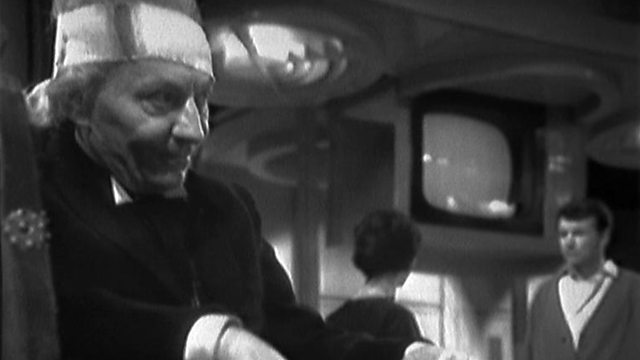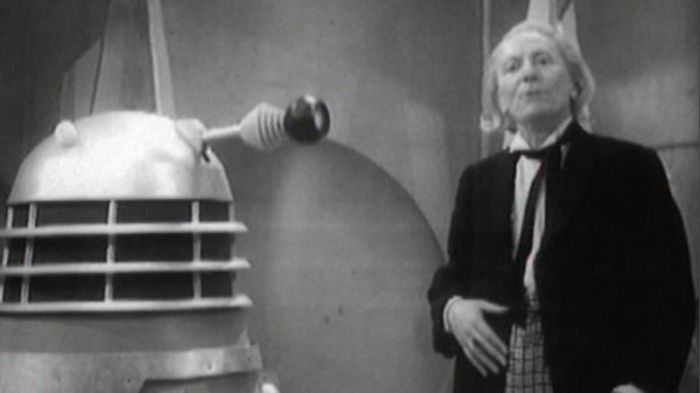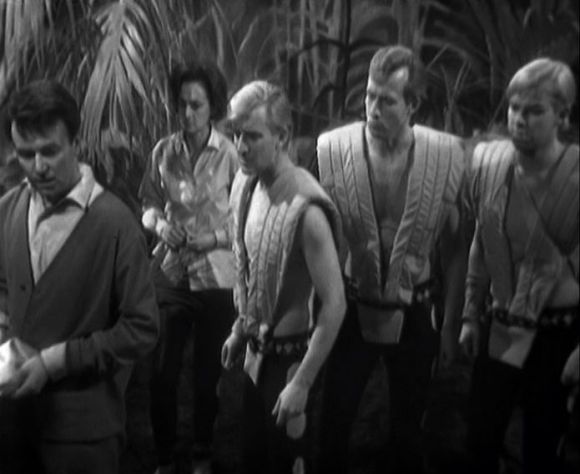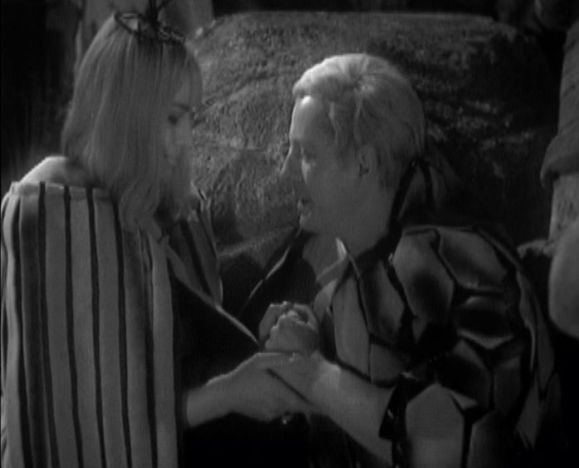
Doctor Who – The Keys of Marinus. Episode Four – The Shows of Terror

snows.jpg

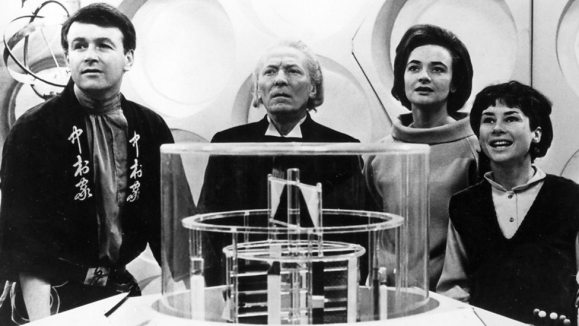
It was David Whitaker’s idea that the locations of the story should be quite varied – one week a jungle, the next desolate snowy wastes. This is something that doesn’t occur very often in Doctor Who – normally when the TARDIS lands we’re never expected to wonder what the rest of the planet might be like. Often (picking a few random examples – say, The Daleks and The Krotons) it’s strongly implied that everywhere else is of little interest and where the Doctor is now is all that matters. But The Keys of Marinus, which shows us several cities ruled by different people as well as more barren locales, is quite different and should be applauded for that.

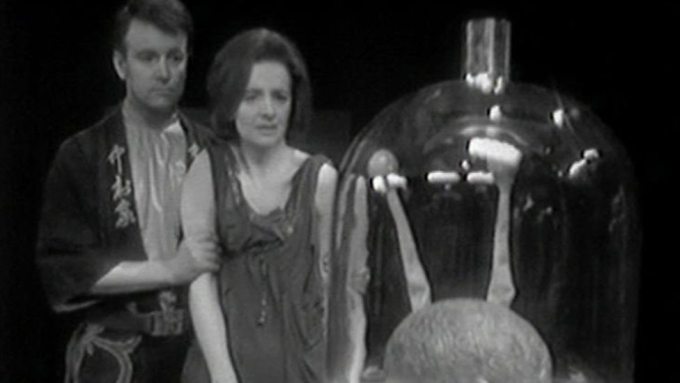
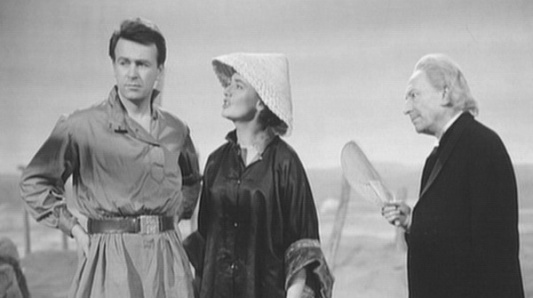
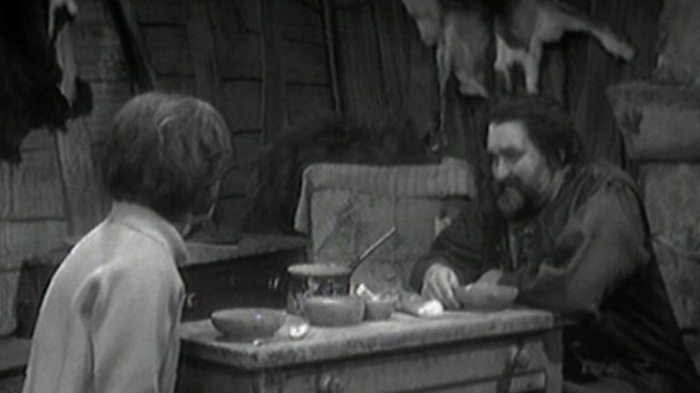
Last time, we left Ian and Barbara freezing to death in the fake snow. Luckily(?) they’ve been rescued by Vasor (Francis de Wolff) a man who lives in a hut all by himself in the middle of the snowy wastes. He shows Barbara how to restore life to her frost-bitten hands (doing so in a way that carries a certain overtone – it’s clear that he enjoys holding her hands in his). Indeed, there’s no two ways about it – Vasor is clearly keen for Barbara to spend some quality time with him (just as soon as he’s got Ian out of the way) and it’s equally clear what he wants to spend this time doing. It’s not spelt out, but then it doesn’t really need to be.

Ian sets out to find the others and hands over his travel dial in exchange for some of Vasor’s furs. Although Vasor, as scripted, tells Ian to pick up a coat and gloves, he only puts on a ratty piece of fur – which can hardly be expected to offer a great deal of protection (a poor bargain for his travel dial). Once Vasor and Barabara are alone he insists on feeding her some more food. “We must fatten you up, eh?” Brrrrr, I don’t fancy Barbara’s chances ….

Ian discovers Altos unconscious in the snow, but once Ian’s rubbed some life into his legs he seems able to carry on (yes, you can read something homoerotic into this if you wish). Luckily for Barbara, the two of them get back to the hut before Vasor’s been able to have his wicked way and the four of them then go back out to look for Susan and Sabetha.

They’re taking shelter in the ice caves, which is a decent-looking set. The Ice Soldiers, frozen warriors who are guarding the micro-key, aren’t quite so impressive though. This is another of those inexplicable Arbitan moments. The micro-key is contained within a solid block of ice, but if they melt the ice then the homicidal Ice Soldiers will wake up. Arbitan certainly didn’t like to make things easy, did he?

The excitement level as our heroes are pursued is fairly low – although Vasor gets his long overdue comeuppance from the Ice Soldiers (a sword in the back). Not the best episode of the story then, but Francis de Wolff (at times overacting like a good-un) is entertaining enough.

Next time, Ian faces a sentence of death.
Doctor Who – The Keys of Marinus. Episode Three – The Screaming Jungle

screaming

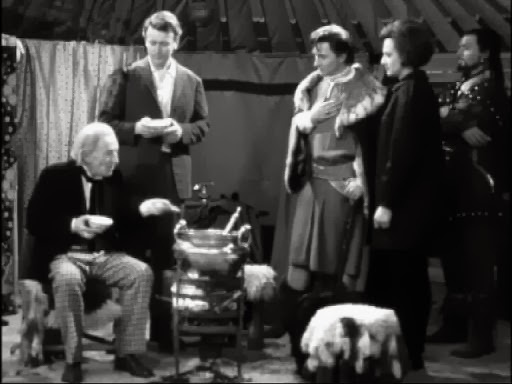
It’s not really correct to think of the Voord as the villains of the story as they only appear briefly in episode one and then not again until episode six. Had they decided to shadow the Doctor and his friends as they quested for the keys that would added a little extra excitement, although with their wetsuits and big flippers they probably would have stood out somewhat.

Carole Ann Ford wasn’t particularly enamoured of the way Susan was portrayed in this story and it’s not hard to see why – she seems to be written down in age somewhat (acting more like a very young child at times). So given how hysterical she is in the jungle setting, it’s a blessed relief she’s packed off to the next location pretty quickly.

Things to love about this episode number one – the jungle vines that attack Susan in a less than convincing way.

Things to love about this episode number two – the statue with human arms which gives Jacqueline Hill a quick grope (although in the interests of decency it’s lucky that it could only reach her lower legs).

When they find the micro key in the first few minutes, it appears that this episode will be ending twenty minutes early. Sabetha, Altos and Susan head off for the next location whilst Ian stays behind to look for Barbara. But the key is a fake, meaning that Barbara and Ian still have to find the real one. Slimming down the cast at this point isn’t a bad move since it would have been a stretch to find something for five characters to do (even worse if the Doctor had been there as well).

And since Ian and Barbara are left alone it allows them a decent share of the action. Indeed, had it been decided at the end of The Velvet Web that Sabetha, Altos and Susan should search for the third key, whilst the Doctor went off to look for the fourth, then they could have dispensed totally with the services of Carole Ann Ford, Robin Phillips and Katherine Schofield for this episode and the production would have saved itself some money.

What Ian and Barbara find is a building full of traps. At times, all the suspension of belief you can muster is required – especially when Barbara is menaced by slowly descending spikes (of the patently rubber variety). It’s the sort of thing you might expect to see in a 1940’s Flash Gordon serial, although done somewhat better. And whilst Barbara faces death of an especially unconvincing kind, Ian is struggling to free himself from a prison of solid iron bars.

Except that they’re not solid – it looks like one sneeze would cause them to collapse. Just as it takes all of Jacqueline Hill’s professionalism to make us believe that the spikes are dangerous, so William Russell has to call on his acting experience to make the bars seem solid. Bless them both, they don’t quite succeed but it’s fun to watch them try.

All these traps have been set by Darrius (Edmund Warwick). Rather oddly he tells Ian and Barbara that only couriers sent by Arbitan would have been able to negotiate the hazards that he’s set. But Arbitan didn’t pass this information on – simple absent-mindedness maybe?

The silliest episode so far, it’s somewhat disposable fare – but at least one of the good things about this story is that we’re never too far away from a new location. And as the cliffhanger looms, Ian and Barbara find themselves menaced by some fake snow …..

Doctor Who – The Keys of Marinus. Episode Two – The Velvet Web

velvet.jpg

The first stop on their quest to recover the keys of Marinus takes them to Morphoton. It’s a place where every whim and request is able to be indulged – although if this seems too good to be true it’ll probably comes as no surprise to learn that it is.

This episode is notable for having more edit points than was usual at the time – this was in order to demonstrate the difference between Barbara’s viewpoint (she can see their room for what it is – dirty and bare) and the others (they’re conditioned to view it as opulent). In later years this would be a scene that wouldn’t be at all remarkable, but when watching sequentially it’s another of those small moments which does stand out.

It’s maybe right that Barbara – the voice of reason – should be the one not to fall under the spell. But this wasn’t through any demonstration of free will, it was only because the conditioning disc placed on her forehead slipped off during the night. Note to the brains of Morphoton – it might be better to find a more effective way of conditioning your subjects (or at least use better glue).

The episodic nature of the serial means there’s not really time to develop the horror of Barbara being totally isolated.  She’s the only one of the four to retain her own memories (the Doctor, Ian and Susan have all been thoroughly brainwashed). This is a pity as the concept would have produced good material for several episodes. But there’s still the odd creepy moment, such as when Barbara rushes to the reassuring presence of Ian – but immediately after she’s embraced him it’s clear from his immobile stance that he’s no longer the man she knew.

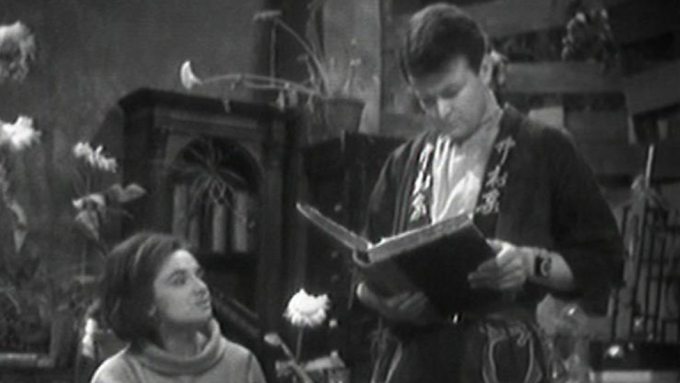
We meet Altos (Robin Phillips) and Sabetha (Katherine Schofield). Both will join the others on the quest (Sabetha is Arbitan’s daughter and Altos is one of Arbitan’s couriers). Their presence is a good thing, especially as Billy’s shortly off for a two-week holiday. They’re fairly stock Terry Nation characters, so how well they come across depends on the actors (who do the best they can).

The brains of Morphotron are a little disturbing (especially the way they’re voiced by Heron Carvic) although the black and white picture does rob them of some of their impact. Barbara saves the day by smashing their brain cases and killing them. Or, at least, that was how it was scripted – alas, Jacqueline Hill only managed to smash one of the four cases and there was clearly no time for a retake. Oh well.

The Doctor’s decided to nip ahead and look for the last key (so we won’t be seeing Hartnell for a few weeks) whilst the others head to their next destination.

And it’s a Terry Nation favourite – a dangerous jungle!

Doctor Who – The Keys of Marinus. Episode One – The Sea of Death

sea.jpg

By going from Marco Polo to The Keys of Marinus we’ve taken a trip from the sublime to the ridiculous. That’s not to say that Marinus is bad – it’s good, pulpy fun – but when watching the series sequentially it’s a little jarring to have this sudden shift in tone. But that’s one of Doctor Who‘s great strengths – the fact that every new adventure might play out in a totally different way from the previous one.

You have to admire the ambition of Verity Lambert’s time as producer. It seems that no story was too ambitious to mount (think of the expertly created props in Planet of Giants or the sheer weirdness of The Web Planet) and Marinus is another example of this. With such a tiny budget the notion of creating a new environment in episodes two, three, four and five obviously placed a huge strain on the meagre resources of Ray Cusick. He manages to pull it off quite successfully, although there are times when you do need to be a little forgiving.

The miniatures that open the story are excellent though. The shot of the island – with a model TARDIS (light flashing) then appearing – is a lovely one. The sight of the Voord’s submersibles traversing the sea of acid is less effective though – mainly because it’s painfully obvious they’re being pulled along by wires (and one of them is reluctant to move, so requires a few hard tugs to enable it to reach the beach!)

The sight of the Doctor, Susan, Ian and Barbara surveying this strange new planet shows how far we’ve come since The Daleks. Back then, Ian and Barbara were wracked with fear and doubt (hating the fact that they’d been uprooted from their safe, 20th century existence) but now they regard this bizarre island with nothing more than mild curiosity.

Hartnell’s a bit stumbly over his lines in the early part of the episode (which gives us one of his classic Billyfluffs – “yes, and if you’d had your shoes on, my boy, you could have lent her hers”). This part of the story – as the four examine the beach – is a little problematic. Given that the studio was so small, the beach set couldn’t be particularly large either – which becomes painfully obvious when everybody has to walk around rather slowly.

The moments when they notice the Voord’s submersibles and Arbitan’s building both seem false – there’s no way to imply that they’ve travelled any distance from the TARDIS, so these things must have been under their noses all the time.

I know that examining logical loopholes in a Terry Nation script is a little futile, but the sight of the Voord suit – which contained a man who’s been destroyed by acid – has always irked me. If the suit had a rip then that would have let the acid in, but he was inside a submersible – so that too, must have had a hole (which is rather unlucky really). And if that was the case, wouldn’t the submersible have been full of acid?

Why does Arbitan’s building allow people to enter? You’d have thought it would have made much more sense to keep them outside (and since the Voord don’t seem to have any particular weapons, an impenetrable wall seems as good a barrier as any). Instead, its obvious that although there’s interior defences, sheer force of numbers will allow the Voord to succeed once they do get inside.

It was a bit of a coup to get George Coulouris to appear as Arbitan, although he was no stranger to low-budget British science fiction, having appeared in ITV’s Pathfinder trilogy. He’s the Keeper of the Conscience of Marinus and he explains to the Doctor and his friends exactly what the machine does. “At first, this machine was simply a judge and jury that was never wrong or unfair. And then we added to it, improved on it, made it more and more sophisticated so that finally it became possible to radiate its power and influence the minds of men throughout the planet. They no longer had to decide what was wrong or right. The machine decided for them”.

And Arbitan wants the Doctor’s help to restore the machine’s power! The notion of anybody being denied free will would later become something the Doctor would fight against time and time again (for example, The Masque of Mandragora) so it’s astonishing that he sees nothing wrong with this machine.

Thanks to a handy bit of blackmail with the TARDIS (the Doctor’s still the type of person not prepared to launch into a dangerous adventure just for the fun of it – that will come a little later) Arbitan persuades the four time-travellers to set off for a jaunt around Marinus to recover the four keys that will restore the machine to its former glory.

The Doctors – The William Hartnell Years

doctors.jpg

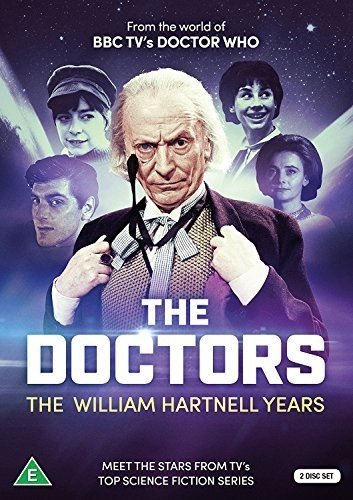
Many fans of a certain age will probably remember buying Reeltime’s range of Doctor Who interview videos from the mid-eighties onwards. In the early days, you could expect to pay ten pounds for a half hour interview – today, thanks to Koch Media’s range of re-releases, you can pick up six titles (each running between fifty and sixty minutes) on a double DVD for around the ten pound mark. I love progress ….

Despite some slightly sloppy back cover blurb (Hartnell was the Second Doctor apparently) The Doctors – The William Hartnell Years is a very decent package. It comprises a tribute to Hartnell, another to Jacqueline Hill and four interviews – with Carole Ann Ford, William Russell, Peter Purves and Jackie Lane.

It’s the Hartnell tribute which I’m going to touch upon today. Prior to the original release (in June 1999) Reeltime had already interviewed a number of Hartnell era actors and production personnel and this enabled them to bank comments from a range of interviewees about their memories of the man (with the result that their soundbite thoughts could then be sprinkled throughout the one hour programme).

The main interviewee is Jessica Carney, William Hartnell’s granddaughter, who in 1996 penned a biography of her grandfather. Recorded especially for the original release, Carney’s reminisces fill the bulk of the programme. Offering unique insights into Hartnell’s early life and his emergence as an actor, this documentary would have been much poorer without her.

It’s pleasing that a good chunk of the running time (around the first twenty minutes) is devoted to his pre Who life and career. It’s a reminder that there was a good deal more to him than just Doctor Who whilst Carney’s detail about Hartnell’s life outside acting helps to build a rounded picture of the man.

It’s not always a flattering one though – he gambled heavily on the horses (and rarely won) whilst he also was rather fond of a drink (although he wasn’t, claims Carney, an alcoholic). The likes of Anneke Wills and Michael Craze are also on hand to paint a portrait of Hartnell’s rather desperate final days on Who – when, due to ill health, he was very difficult to deal with. But Carney is able to put this behaviour into context, meaning that it’s difficult to come away from the documentary without a deep feeling of sadness that his time on Doctor Who came to such an awkward end.

But there are plenty of positives too – a typically relaxed and urbane William Russell warmly praises Hartnell’s acting pedigree whilst Maureen O’Brien’s contributions are simply delightful – her deep love for Hartnell shines through very clearly. A shame that, as yet, O’Brien hasn’t recorded her own Myth Makers release. Maybe one day ….

Carole Ann Ford, Verity Lambert, Christopher Barry, Peter Purves, Shaun Sutton, Jack Pitt (extra extraordinary) and Donald Tosh are amongst the others who also pay tribute.

This is a warm appreciation of Hartnell that still stands up well today. Some of the Myth Makers catalogue may have been superseded (certainly in production terms) by the numerous interviews and featurettes included on the DVD range, but since the DVDs never really looked at Hartnell outside of Doctor Who, this one is still of considerable interest.

Doctor Who – Marco Polo. Episode Seven – Assassin at Peking

assassin

We left the previous episode with Tegana seemingly triumphant. But, alas, it’s “curses, foiled again” as the Khan’s emissary, Ling-Tau, turns up just as his moment of victory beckons. Considering that the TARDIS had been taken off the main road it’s never explained what Ling-Tau and his men are doing there – we just have to accept that Tegana is a singularly unlucky War Lord.

The Doctor and the Khan have been playing backgammon –

KHAN: What do we owe?
DOCTOR: Er, thirty-five elephants with ceremonial bridles, trappings, brocades and pavilions. Four thousand white stallions, and twenty-five tigers.
KHAN: That’s not too bad, so far.
DOCTOR: And the sacred tooth of Buddha which Polo brought over from India.
KHAN: Oh, that? What else? What more?
DOCTOR: I’m very much afraid all the commerce from Burma for one year, sire.

This is lovely. Hartnell’s not really had the chance to play many comic scenes up to this point, so there’s the sense (even though we can’t see him) that he’s relishing this opportunity. There’s no doubt that later comic stories (like The Romans, The Myth Makers and The Gunfighters) really plays to his strengths. The Khan’s desire to prevent his wife (played by Clare Davenport) from learning that he’s been gambling is another nice touch. The Empress, although she has very few lines, certainly seems to be an imposing presence.

The Doctor’s skill at backgammon is another new fact we learn about him (he must be good, since it seems the Khan rarely loses). When the Doctor suggests one more game – with the prize being the TARDIS, the Khan reluctantly agrees. It seems clear that, given all he’s already won, it’s a foregone conclusion. Alas, the Doctor may be good, but he’s not unbeatable, and the Khan wins the game – meaning that the TARDIS seems lost forever.

It’s around now that Marco suddenly has a change of heart and decides that it was wrong of him to take the TARDIS. Since it’s already the Khan’s property it’s a pity he couldn’t have had this crisis of confidence beforehand!

Another plot-thread neatly tied up relates to Ping-Cho’s marriage. She’s informed by the Khan that “your beloved husband-to-be, so anxious to be worthy of your love, drank a potion of quicksilver and sulphur, the elixir of life and eternal youth, and expired.” Another delightful comic moment, delivered deadpan by Martin Miller.

This just leaves Tegana to be dealt with. The Doctor realises, rather belatedly, that his meeting with the Khan is for one reason only. “Kill the leader, and where are you? What happens? The whole army dissipates itself into chaos and utter confusion. It’s happened throughout your history time and time again!” If Tegana kills the Khan, then Noghai seems certain to succeed.

You do have to suspend disbelief a little that the Khan would meet Tegana without armed guards (only the poor Vizier seems to have been present – he sacrifices his life to prevent Tegana’s first attack). The lack of visuals means that it’s impossible to judge how effective the swordfight between Tegana and Marco was. But it was choreographed by Derek Ware, a key stunt-arranger during Doctor Who‘s first decade, so that’s a sign of quality. I’d also be fascinated to know just how graphic the moment was when the defeated Tegana committed suicide by throwing himself on a sword. Maybe one day the story will come back and we’ll find out ….

After all his intransigence during the story, it’s Marco who hands the key of the TARDIS back. The Khan, witnessing the departure of the ship, doesn’t seem particularly put-out that Marco’s just given away his flying caravan – although we never discover exactly what Marco’s fate will be. It could be that this action means he’ll never see his home again – but he obviously decided that the needs of the Doctor and his friends were more important than his own goals. Mark Eden was a solid presence throughout all the seven episodes. Although Marco was, at times, fairly unlikeable, Eden still managed to give him a sense of honour and nobility. And this final sacrifice speaks volumes about his character.

Even with just the soundtrack and a generous selection of photographs, this is a highly entertaining story. Yes, the fact that Tegana’s plans to kill Marco and steal the TARDIS are constantly scuppered do get a little annoying, but the scope of the journey allows all the cast plenty of time for character development. With just seven main characters (the four regulars, plus Marco, Tegana and Ping-Cho) and seven episodes to play with, there’s ample time to breathe and reflect.

Will the next story be of a similar standard, I wonder?

Doctor Who – Marco Polo. Episode Six – Mighty Kublai Khan

khan.jpg

Ian pleads with Tegana. “Let us all go, I appeal to you. What possible difference could it make to you? You hate Marco.” This is another indication that the emphasis in these early stories is very much centered around the TARDIS crew as they seem to care little about what Tegana might do to Marco and Ping-Cho once they leave. This is a hallmark of the early historical stories script-edited by David Whitaker (and is also a feature of his own serial The Crusade).

At times during these early historical stories (especially in Lucarotti’s next script, The Aztecs) the Doctor is a very passive character who is unwilling to get involved in local difficulties. This is possibly not because he shouldn’t, but because he can’t (the famous line in The Aztecs – “you can’t rewrite history, not one line!” – is something we’ll touch upon when we reach that story). Here, it might be more disinterest than a fear that he’ll somehow damage the delicate thread of space-time history.

Ian protects Ping-Cho by telling Marco that he stole the TARDIS key. We then have another scene where Ian pleads with Marco to hand back the TARDIS – and this time Ian tells him the truth (that the TARDIS can fly through time and space). Marco responds that he’s heard of many strange things, including a stone that burns (coal). “In Cathay, we call it the burning stone. And if a stone burns, why not a caravan that flies? Birds fly. I have even seen fish that fly. You are asking me to believe that your caravan can defy the passage of the sun? Move not merely from one place to another, but from today into tomorrow, today into yesterday? No, Ian. That I cannot accept.”

Although he can believe in a burning stone, a flying caravan and even flying fish, it seems that the concept of time-travel is a step too far. Marco then tells Ian that he knows he didn’t take the key and he only said it to shield Ping-Cho. It’s a clever piece of scripting as it demonstrates to Marco that Ian is capable of lying, which means that he can’t believe his tales of time-travel. If he did, then he would have handed the TARDIS key over (although given all he’s done so far, that seems a little improbable).

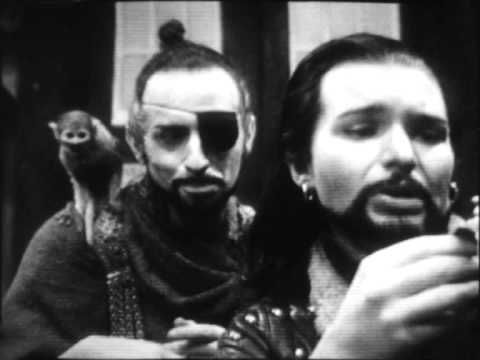
Ping-Cho, unwilling to marry a man old enough to be her grandfather, runs away – back to the Cheng-Ting Way Station. It’s a slight plot contrivance that of all the people she could meet, it’s Kuiju (the man commissioned by Tegana to steal the TARDIS). You’d have thought that the eyepatch and the monkey would have been strong indications that he was a wrong-‘un, but Ping-Cho, innocent girl that she is, mistakenly believes he’s an honest man and hands over all her money to pay for her passage back home.

That she should be robbed by the man who’s stolen the TARDIS is a bit of a coincidence – especially since it doesn’t really impact the plot. Ian has received Marco’s blessing to search for Ping-Cho and once he finds her and discovers that the TARDIS has been stolen the pair of them set off to find it.

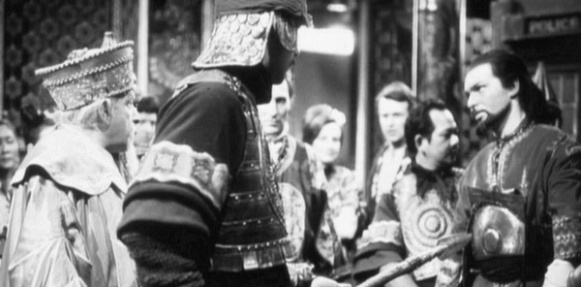
The others finally get to meet the mighty Khan, who certainly receives an impressive buildup –

Silence! Those who dare to come before the sight of the great Kublai Khan, kow-tow. Kow-tow before the War Lord of War Lords. Mighty and fearful in his strength. Kow-tow before the Ruler of Asia, India, Cathay and other territories. Kow-tow before the Master of the World.

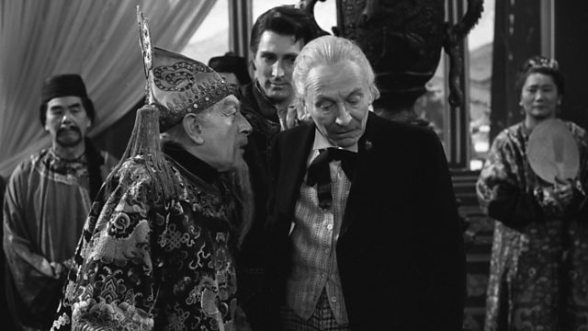
The eventual reveal that Kublai Khan (Martin Miller) is a little old man suffering from gout is amusing – but Marco is quick to tell the others that whilst the Khan is not the mightiest War Lord ever, he’s definitely a skilled administrator. And its his organisational skill, rather than his military might, that has seen his Empire grow – so it would be wise not to underestimate him.

His meeting with the Doctor has a nice touch of comedy – with both men suffering numerous aches and pains, plus the Doctor demonstrating his singular lack of respect for authority (a trait we’ll see time and time again over the years). The Khan, rather than expressing annoyance at the Doctor’s testiness, instead embraces him as a brother. Slightly implausible maybe, but it sets us up nicely for their interaction in the next episode.

Ian and Ping-Cho have found Kuiju and the TARDIS, but so has Tegana (who was given leave by Marco to track Ian down). At last it seems that Tegana has the upper hand – he can take the Doctor’s caravan and then dispatch Ian and Ping-Cho. What could possibly go wrong?

Doctor Who – Marco Polo. Episode Five – Rider from Shang-Tu

rider

The murder of the guard causes the four time-travellers to momentarily stop and reflect. It’s fascinating (and slightly disconcerting) that the Doctor asks Ian quite seriously whether he killed him – if Ian said he had it’s probable that the Doctor wouldn’t have been terribly put out. Another interesting character wrinkle is that although the camp seems to be under attack, the Doctor is still keen to escape (clearly the fates of Marco and Ping-Cho are of little interest to him).

Tegana’s appearance puts paid to their plans, so Ian decides to wake Marco and warn him. I’ve previously touched upon how Tegana’s numerous attempts to kill Marco end up being scuppered (sometimes in a slightly contrived way) and this sequence is one of the less convincing ones. Acromat (Philip Voss) and the other Mongols are waiting for Tegana’s signal to attack. After Ian’s warning, Marco asks Tegana to rouse the guard – but why didn’t he tackle Marco in single combat there and then? It’s difficult to believe that Tegana seriously considered the TARDIS crew to be a threat to his ambitions.

Instead, he obeys Marco and the small group organise themselves into a fighting force. Marco gives the Doctor a sword, commenting that “if you’re half as aggressive with this as you are with your tongue, Doctor, we can’t lose.” Although the Doctor is sometimes painted as a pacifist who abhors weapons of any type, that’s not really borne out by the evidence of the series – although it’s still unusual to seem him bear arms quite so keenly. The loss of the episode means that we’ve no way of telling how active he was in the brief skirmish – however, just before the fighting begins he delightfully tells Marco that “we’re not going to get very far with this overgrown bread knife!” which indicates he was keen for a scrap!

Eventually Acromat and the others grow tired of waiting for Tegana’s signal and attack anyway. This presented Tegana with another golden opportunity to kill Marco (as the Mongols were keeping the others busy). Instead, he kills Acromat before he had a chance to reveal his connection to Tegana. Again, it’s another moment that feels a little false – just how many chances does Tegana need?

The arrival of the caravans at the Cheng-Ting Way Station introduces us to Wang-Lo (Gábor Baraker). From the soundtrack and the photographs it sounds like a larger-than-life performance, this is another of those times when I’d love to see the visuals in order to complete the picture. Also lurking about is Kuiju (Tutte Lemkow). Lemkow had a lengthy career (popping up in films like Raiders of the Lost Ark) and an interesting private life (at one time he was married to Mai Zetterling). Lemkow’s Doctor Who career is rather unlucky – he appeared in three different stories (but all his episodes no longer exist). It seems that anything with an appearance by Tutte Lemkow was earmarked for destruction …

When Ping-Cho realises that Susan will never see her home again without the TARDIS, she takes the key from Marco’s room. This is when the never-ending feel of the early seasons works well – back then, unless you had a copy of next week’s Radio Times it wouldn’t always be obvious whether a story was concluding or not. But this one now seems to have run its course, as the Doctor, Ian and Barbara are all in the TARDIS – but somewhat belatedly they realise that Susan isn’t there.

She’s gone back to say goodbye to Ping-Cho, something which the Doctor finds inexplicable. Despite the months they’ve been journeying together, he’s clearly failed to notice the growing friendship between his granddaughter and Ping-Cho. It’s another character moment which highlights that recently the Doctor has been, at best, totally absorbed with repairing the TARDIS and, at worst, totally self-centered. His irritation with Susan sees him utter an oath (“Great Olympus”!) which is a little unusual.

No real surprise that the Doctor’s plan of escape is scuppered again – this time it’s because Tegana has caught Susan …..

Doctor Who – Marco Polo. Episode Four – The Wall of Lies

lies

Barbara is rescued from the clutches of the Mongols after Ian realises that Susan was right – the eyes in the cave did move (behind the wall was a secret room where Barbara was being held). Once again, the Doctor is shown not to posses all the answers – he was dismissive of Susan’s claim, seemingly treating it as nothing more than a hysterical outburst – so it fell to Ian and Marco to put two and two together.

Tegana continues to chip away at Marco’s trust in the Doctor and his friends. “Only a fool defends his enemies. Be warned, Marco. They will set us at each others throats by lies and deceit, and then, when they have divided us, then they will destroy us one by one.”

Barbara insists that she followed Tegana to the cave – something he strongly denies. As Marco tells Ian. “Tegana is a special emissary of Noghai, on his way to talk peace with Kublai Khan. He’s a very important man. You are mysterious travellers from some far off land I know nothing about. Now, if you were in my position, a servant of Kublai Khan, whose word would you take?”

A slight weakness of the story is that since Tegana has been presented as such a powerful presence it slightly diminishes him every time his plans to kill Marco and the others are scuppered. But there’s a sense in this episode that we’re now entering the endgame. I particularly like the way he displays his true feeling for Marco (telling his associate Acromat that Marco should be killed like an old woman in her bed). And the Doctor’s death holds no fear for him, a stake through the heart should deal with the magician.

The relationship between Marco and the others comes to a head when he realises that the Doctor has been working on the TARDIS in secret.

POLO: I’m sorry I doubted your word, Tegana. Give me the key, Doctor.
DOCTOR: No.
POLO: You’re an old man and I do not wish to use force.
DOCTOR: That is what you’ll precisely have to do, Polo.
(Tegana wrenches the key from the Doctor)
TEGANA: Did I not say he had another key?
DOCTOR: Put that key in the lock, Polo, and you will destroy the ship. Then where will your precious Khan be, hmmm? You need more than a key to enter my ship. You need knowledge. Knowledge you will never possess.
POLO: Tell me.
DOCTOR: No, understand? No! I’d let you wreck it first!

This results in the Doctor and the others being kept as virtual prisoners. Ian chafes against this and decides that they need to take action. They resolve to capture Marco and force him to hand over the TARDIS key. The Doctor’s statement that “I think by the time I’ve finished with that gentleman, he’ll only be too glad to let us go” is intriguing. Exactly what does the Doctor plan to do to?

Sadly, we never learn what the Doctor’s special brand of persuasion might be, as Ian discovers that the guard outside is dead. With Marco’s encampment under attack they have the perfect cover to escape, but can they really just cut and run?

Doctor Who – Marco Polo. Episode Three – Five Hundred Eyes

five.jpg

With Marco and the others lacking enough water to make the journey to the oasis, it falls to the Doctor to save the day. He notices that moisture has formed on the inside of the TARDIS overnight and saves every last drop. We then have another quick science lesson as the concept is explained to Marco (and the viewers at home).

IAN: Marco, you remember, last night it was cold. Bitterly cold, Marco. The outside of the caravan cooled, but the inside stayed warm, and so moisture formed on the inside. It’s condensation, we just call it that. It’s just a name.
SUSAN: That’s true, Messer Marco. It was running down the walls, and from the ceiling. We, we took it in this, look, we squeezed it in here. You see?

These precious drops of water are enough to aid their journey to the oasis, where they find Tegana. He tells them he was unable to travel back with water as the oasis was surrounded by bandits during the night. As so often in the early stories it’s not the Doctor who exposes the fallacies in his statement (if bandits were there, why didn’t they light a fire since it was a cold night?) but one of the others – in this case Barbara. Her suspicions against Tegana only harden as the episode continues, culminating in her capture when she ventures into the Cave of Five Hundred Eyes.

One noteworthy aspect of these early scenes is that Tristram Cary’s music has an electronic feel (similar to his score for The Daleks). This fits the mood well as Marco and the others face death under the unforgiving sun. Once they are rescued, it changes back to traditional instruments (as it is for the majority of the story). It’s a pity that Marco Polo is the only of his Doctor Who scores not to exist, although we should be grateful that his other music does.

Having reached the Tun-Huang Way Station, Marco mentions the nearby Cave of Five Hundred Eyes, a place once frequented by the Hashashins. Although Ping-Cho has never heard of the cave, she does know a story about Hulagu and the Hashashins and promises to tell it to them later. This is an extraordinary sequence – the story stops for several minutes for a spot of local colour. Like the chat about condensation, it’s probable to view its insertion as another educational box-ticking exercise. But it’s charmingly performed by Zienia Merton, who delivers the lengthy monologue with aplomb. It’s easy to imagine that the air would have turned blue had it been given to William Hartnell!

Gracious maidens, gentle lords, pray attend me while I tell my tale of Alaeddin, the Old Man of the Mountains, who by devious schemes, evil designs and foul murders ruled the land.

No host of arms, no vast array of banners served this wicked lord. They were but few, ruthless, reckless men who obeyed his cruel commands.

Thus did he persuade them. Promising paradise, he gave his followers a potent draught and whilst they slept transported them to a vale where streams of milk and honey, wine and water, flowed.

Here were gardens and flowers of every hue and essence. Here, too Golden pavilions outshone the sun and even the stars of heaven envied the bejewelled interiors strewn with incomparable silks, tapestries, and treasures.

Hand-maidens, dulcet-voiced, soft of face, attended them, and thus bemused did they dwell in this man-made paradise until Alaeddin intent upon some evil deed, proffered again the hashish draught and brought them sleeping to his castle.

“What lord, are we cast out of paradise?” awakening, they cried.

“Not so. Go abroad, seek out my enemies and strike them down. But care not for your lives. Paradise is eternal.”

So terror stalked the land for many years. Then one day, came mighty Hulagu to stand before Alaeddin’s lair for three long years in siege. Thus fell Alaeddin and his men.

Now honest hands reap harvests of life from the soil where death and evil reigned. And those who journey through the vale are heard to say ’tis truly paradise today.

When Barbara notices Tegana leave the room after Ping-Cho’s tale, she follows him as he heads up to the Cave of Five Hundred Eyes. She doesn’t hear Tegana plot Marco’s destruction and the theft of the TARDIS, but finds herself captured by a group of Mongols who hold her in the cave whilst they play dice. In the next episode she tells Ian that they were playing dice to decide which of them would kill her, but it’s no stretch to imagine that they were also keeping her alive so that they could take turns to rape her. Otherwise it would have made more sense to quickly kill her and leave. Barbara becomes the object of male interest several times – in the very next story The Keys of Marinus and also during season two. Sometimes played for comic effect (The Romans) and other times played dead straight (The Crusade).

An intriguing part of the episode revolves around Tegana’s attempts to sow discord between Marco and the TARDIS crew. Why is Tegana doing this? He clearly doesn’t have Marco’s interests at heart, since he plans to kill him very soon, so is it possible that he fears the Doctor’s magic? Or it could be that he simply enjoys stirring up trouble amongst his enemies?

Doctor Who – Marco Polo. Episode Two – The Singing Sands

singing.jpg

Ian and Marco enjoy a game of chess. Tegana is a keen student of the game, as he explains –

TEGANA: I find it a fascinating game of strategy of war. Two equally balanced armies deployed upon a field of battle, and each commander determined to be the one who cries shah mat.
IAN: Shah mat? Check mate?
TEGANA: It means the king is dead.

It’s a lovely character beat that illuminates his personality a little more. Indeed, since the level of threat in this episode is fairly low (apart from the Singing Sands) several other characters also benefit from Lucorotti’s dialogue. Susan is one, as she poetically tells Barbara that “one day we’ll know all the mysteries of the skies, and we’ll stop our wandering.” Although it’s rather strange that he also elected to put various 1960’s slang words (“I dig it”, “crazy”) into her mouth since she didn’t adopt this mode of speech in any other story.

The Doctor is absent until the end of the episode – either this was a last minute rewrite to cover a bout of ill-health from Hartnell or it was just decided to give him an easy week – but the rest of the cast are so strong that he’s not really missed.

Susan and Ping-Cho’s adventure, adrift in the Singing Sands, is one of the most intriguing parts of the episode. Just how good did it look? We’ll never know the answer, unless the story ever turns up, but it certainly sounds impressive.

In terms of creating dramatic tension it’s a bit of a damp squib though – Barbara is hysterical with the thought that the girls are out in the desert unprotected, but then they turn up unharmed shortly afterwards.

Last time Tegana had a very decent scheme – poison the water gourds and then return to Lop. But for some unknown reason he’s changed his mind and elects to slash all but one of the water gourds and wait for the others to die from lack of water. Was this change of plan down to the misadventures in the Singing Sands? Afterwards, Marco tightened security and that might explain why Tegana decided he wasn’t able to leave the camp. Although it’s difficult to believe that he couldn’t have snuck away if he really wanted to.

With only a small amount of water left, they have to strictly ration it as they make their way to the nearest oasis. Will they get there in time? Mmm, I think it’s possible they just might.

Doctor Who – Marco Polo. Episode One – The Roof of the World

roof.jpg

With Marco Polo we’ve reached the first of the missing stories, although back in 2013 it seemed very possible that it had been recovered and we’d be enjoying it on DVD within a matter of months. The MEW rumour had been bouncing around various Doctor Who forums for a while (basically stating that three stories – Marco Polo, Enemy of the World & Web of Fear had been found). And when all of Enemy and most of Web did resurface shortly afterwards you could have laid a guinea to a gooseberry that Marco wouldn’t be far behind them.

Four and a bit years later there’s still no sign of it, so it seems that this rumour was only 66% right (although there are still some who cling to the belief that Marco Polo is out there somewhere). I’ve love to think that it was and that some day I’d be able to watch it on DVD (no download for me, thank you!) but if it isn’t, and no other missing episodes are ever found, then we should really just count our blessings.

All ninety seven missing episodes exist as good quality audio recordings (which have been further improved by the work of Mark Ayres during the last decade or so). We may sometimes take the audios for granted, and grumble about how annoying it is that we can’t see the pictures, but it’s worth taking a moment to stop and consider how some other popular series of the time have fared.

There’s reputed to be one poor quality audio of an Avengers episode existing in private hands, some muffled audios of Public Eye exist (several found their way onto the early DVD releases) whilst a handful of audios from Out of the Unknown were made (and are included on the BFI’s DVD release. Not bought it yet? You really should, it’s an excellent package! If you need further convincing I’ve written about it at length here).

These fairly slim pickings demonstrate just how fortunate Doctor Who is. This is particularly noteworthy when it comes to Marco Polo. The show had only been running for three months, so it’s a little surprising (but very welcome) that there were people who even this early on were dedicated enough to record every episode.

Although The Roof of the World is generally held to be the point where the Doctor starts to act more like the Doctor we come to know, he’s still remarkably bad-tempered at the start. This may be because he’s concerned for their safety (the TARDIS has broken down in the Alps and with no heat their prospect of survival looks slim) but he’s still incredibly dismissive when Ian offers to look for fuel. “Oh well, I wish you luck.”

The telesnaps offer us an insight into how these early scenes look. It’s no surprise that the Roof of the World looks rather stagey and there also appears to be a wrinkled backdrop behind the time-travellers (always a hazzard in these early stories – see The Aztecs for another example). The subtle wind effect helps to sell the illusion of cold though.

Our heroes run into the warlord Tegana (Derren Nesbitt). From his first words his character is made clear. “Hear me, Mongols. In these parts live evil spirits, who take our likeness to deceive us and then lead us to our deaths. Let us therefore destroy these evil spirits before they destroy us.” Whilst we can’t see him, it seems clear that Nesbitt relishes the dialogue he’s been given and he’s wonderfully entertaining throughout the story.

Their execution is stopped by Marco Polo (Mark Eden). If Tegana is presented as superstitious and menacing then Marco appears to be enlightened and affable. But both have their own agendas and Marco, whilst he’s friendly, quickly demonstrates that he’s equally as ruthless as Tegana. He appropriates the TARDIS and tells the Doctor that he wishes to present it to Kublai Khan as a gift – he then hopes that the Khan will then grant him leave to travel home to Venice.

This is the plot device that ensures that the Doctor remains – otherwise he would have left at the first available opportunity. Variations to make the TARDIS inaccessible are used throughout the first season (the missing fluid link in The Daleks, a forcefield in The Keys of Marinus, etc) as the Doctor is not yet written as a character who’ll stay and help people simply because it’s the right thing to do.

There are a few examples of Doctor Who‘s early educational remit. Early on, Susan finds a giant footprint – although Ian ponders that it may be just a normal sized print which looks bigger because the snow around it has melted. And later on, the science teacher in him can’t help but give Marco a quick lesson.

POLO: I’m afraid the liquid is not too warm, but the cold here is so intense, it even robs a flame of its heat.
IAN: The cold can’t affect the heat of the flame, sir. The liquid boils at a lower temperature, because there’s so little air up here.
POLO: You mean the air is responsible?
IAN: Well, the lack of it. Just as the lack of it is responsible for the Doctor’s mountain sickness.

Susan makes friends with Ping-Cho (Zienia Merton). Having someone in the cast around Susan’s age allows her to have some decent character moments and she opens up to Ping-Cho in a way we haven’t seen before.

Hitting the Target. Doctor Who – The Mind of Evil

mind.jpg

Although most of the Pertwee stories were novelised during the seventies, four tales – The Ambassadors of Death, InfernoThe Mind of Evil and The Time Monster – were skipped.  It’s interesting that two of the titles were by Don Houghton, but presumably that’s just a coincidence as there’s never been any suggestion that he was actively blocking publication.

When Target eventually decided the time was right to mop up these stragglers, Houghton declined to tackle his stories – Inferno and Mind – so the task fell to that reliable old warhorse Terrance Dicks.  Published in 1985, The Mind of Evil is a very faithful transcript of the televised story (even keeping most of the original dialogue intact).  This had become Dicks’ style – something which was appreciated and mocked by different sections of fandom.

For some, in the days before VHS copies were widespread, having an almost verbatim novelisation of the television story was appreciated.  But others wanted books which went beyond the televised events and were less impressed with Dicks’ workmanlike style.  The printed word does had advantages over the television image in certain respects though – for example, the visual manifestations of the evil impulses generated by the Keller machine.  On screen we saw less than impressive superimposed images (water, fire) but there was no such limitations on the printed page.

Dicks also remembered that some readers might be unaware of the Doctor’s current status, so he helpfully sets the scene by informing them that, at present, the Doctor is exiled to Earth and working for UNIT.

The various criminal types are given very brief backstories.  We learn that Barnham had choked the life out of a security guard who had disturbed him whilst he was blowing a safe whilst Harry Mailer is painted as a Kray-like gangster (eventually caught because he was rash enough to kill somebody in public).

It’s notable throughout the television original that the Doctor’s in something of a bad mood, especially to begin with (his arrogance is very much on overdrive when attending the initial demonstration of the Keller process).  Dicks doesn’t attempt to soften this and, indeed, his condescending attitude to all around him – including Jo – is even added upon.  At one point, the Doctor despairs of having to leave the Keller machine in the hands of Jo (whom he regards as a feather-headed child).  But this was still early on in their relationship, so it’s maybe not as brutal a character assessment as it first seems.

Benton can always be relied upon for a comedy moment or two, and Dicks delightfully paints him as a wistful James Bond wannabe – dreaming of vodka martinis, shaken not stirred, Bentley sports cars and mysteriously beautiful international spies.  His actual assignment – keeping tabs on the suspicious Captain Chin Lee – is rather more down to earth though.  The Brigadier’s assessment of why Benton is fundamentally unsuitable for undercover work is also entertaining (Benton lurking in a doorway with his raincoat collar turned up, was about as inconspicuous as an elephant at a tea party).

Not the most essential Target then, unless you favour a very accurate reproduction of the events on screen, but it’s still one of those books which whetted my appetite for the television original.

Hitting the Target. Doctor Who – The Mind Robber

mind

I love the tranche of Hartnell and Troughton novelisations penned in the eighties.  Many were written by their original scriptwriters and it’s fascinating to see how they retooled the stories after a gap of several decades.  Peter Ling, like many of his fellow writers during the sixties, wasn’t steeped in Doctor Who lore.  He wrote a single story and then no doubt didn’t think about it or the series again until he was commissioned to write this novelisation in 1986.

This isn’t a problem though and in fact there’s something rather charming about the slight sideways feel that you get from many of these books.  There’s some odd moments to be sure (such as the sight of the Doctor pottering around the TARDIS engine room with a can of oil and a rag) whilst it’s hard to imagine Troughton’s Doctor ever uttering the line “ye gods. I need my brains taken out and buttered”.  But I’d sooner this approach than an obsessive fixation on continuity – where things are either “right” or “wrong”.

Ling sticks pretty closely to the original script, although there’s plenty of instances where he takes the opportunity to do things which would have been beyond the series’ budget.  When Jamie and Zoe are tempted out into the white void, they both see very personal images.  For Zoe, it’s the sight of her mother, looking down at her from the sky, whilst Jamie sees his cottage, complete with his family waiting for him and a spot of supper on the table.  These visitations upset Zoe especially (possibly this was a hint that her mother had died).

After the TARDIS has exploded, the image of Zoe slowly slipping off the console and descending into nothingness is an evocative and disturbing one.

I don’t know whether Ling’s script had originally intended for Zoe to briefly find herself dressed as Alice in Wonderland (encountering a white rabbit with a pocketwatch and falling down a rabbit hole) but if so, it’s a shame we didn’t get to see it.  Possibly the fact that the recording would have had to have been paused in order for Wendy Padbury to change clothes was the prosaic reason why it didn’t happen.

It’s slightly odd that Zoe has never heard of Alice (especially since she knows all about the Karkus – she’s aware of comic strips then, but not classic literature).  We’re told that this is because she comes from the twenty first century, which seems a fairly feeble rationale.  The Karkus is good fun – especially since he comes complete with Batman-style speech bubbles which accompany his every move and gesture.

Ling didn’t make any attempt to differentiate the Master in his story from the Doctor’s identically named arch nemesis, which no doubt would have confused some people.  Early reference books did make a distinction – The Making of Doctor Who called him the Mind Master, for example.  Mind you (sorry), that was confusing too – when I finally saw the story, I was surprised he wasn’t referred to as the Mind Master.

It’s characteristic that Jamie is disappointed when Rapunzel disappears (he was looking forward to getting to know her a little better).  Jamie – like Frazer Hines – always had an eye for an attractive female …

It’s a pity that Ling didn’t come up with an alternative ending as it seems to contradict everything we’ve previously been told.  Earlier, the Doctor realised that if he attempted to create fiction then he’d be trapped in the Land of Fiction forever.  But when he and the Master meet for their climatic battle, he does precisely this with no consequences.

But that apart, The Mind Robber is a cracking read.  There’s plenty of bonus material not seen in the original television production, but not so much as to make it unrecognisable.  Certainy a book that’s worth tracking down.

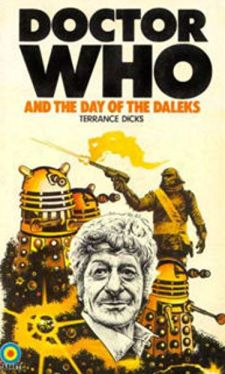
Hitting the Target.  Doctor Who and the Day of the Daleks 

day.jpg

My New Year’s resolution is to re-read all the Target novelisations.  And from time to time I’ll blog about the more interesting ones.

In the pre-VHS era they were incredibly important to me – every paperback was a window into the inaccessible past – but once it became possible to actually view the stories, the Targets were relegated to an increasingly dusty bookshelf.

Some I’ve re-read during the last few decades, but many have remained untouched since the early nineties. So, my non-chronological journey begins with an all-time favourite …. The Day of the Daleks.

Day is packed with extra value – the whole of chapter one (Moni’s flight through the workcamp and his tussle with the Ogrons) for example. I also love the many incidental touches added by Dicks which don’t alter the narrative, but help to broaden characters or generate more atmosphere. Jo’s dummy making skills (preparing an object for the Doctor to test the ray gun on) is a lovely example. It was very disappointing to later learn that on television the Doctor simply used a basic cardboard cut out (I wanted to see Jo’s lipstick smeared mannequin!).

The Doctor’s first encounter with the Daleks – in the railway tunnel – is another of those moments which works terribly well in print, but turned out to be something of a damp squib on screen. In the book, the Doctor is horrified to see the slowly advancing Dalek. On television, he hot-foots it the other way as soon as he claps eyes on it!

When the Doctor and Jo are rescued from the clutches of the Controller by Anat and the others, Dicks cleverly names the various characters who were anonymous extras on screen. By giving them identities and very brief back-stories, their deaths resonate just a little bit more.

Dicks also took the opportunity to restore a “deleted scene” (a second encounter between the present Doctor and Jo and their future selves). On television, the loss of this scene wasn’t really a problem (the story concludes very effectively with a close-up of the Doctor) but it’s a nice book-ending moment that enhances the print version.

Doctor Who – The Edge of Destruction. Episode Two – The Brink of Disaster

brink.jpg

The previous episode ended with the Doctor being attacked by a mysterious assailant.  It’s therefore something of a letdown to learn that it was only Ian – trying to warn the Doctor not to touch the controls, as they would have given him an electric shock.

Ian had two choices of course.  Choice number one would have seen him tell the Doctor not to touch the controls whilst choice number two is to throttle the Doctor into submission.  Yes, he goes for choice number two.

But why Ian would think the controls would be dangerous (and how he managed to awake from his drugged sleep) is a bit of a mystery.  Yes, Susan was attacked by the console in the previous episode, but we saw the Doctor touch the controls later on with no ill effects.

For a few minutes, the Doctor is still convinced that Ian and Barbara are the cause of his problems, but eventually the penny drops that something is wrong with the ship.  Barbara decides that the TARDIS has been trying to warn them.  “We had time taken away from us and now it’s being given back to us because it’s running out” is just one of her baffling utterances which make no sense at all.

And the reason why the TARDIS acting so oddly? The Fast Return Switch was broken (a faulty spring!) and is hurtling the ship towards destruction. But rather than issue a conventional warning, the TARDIS decided that a series of oblique and bizarre moments would be just the ticket.  Also, it’s impossible not to love the fact that somebody has written “fast return switch” in felt-tip on the console!

Hartnell has quite a long monologue which is designed to wrap the mystery up.  Even at this early stage he was never keen on lengthy speeches – due to the worries he had with remembering lines.  He is a bit wobbly in this story from time to time, but he’s pretty much perfect when it comes to this sequence.  Although his reaction when receiving the script (“Christ! It’s bloody Hamlet!”) strongly implies that he needed some persuading to learn it!

I know. I know. I said it would take the force of a total solar system to attract the power away from my ship. We’re at the very beginning, the new start of a solar system. Outside, the atoms are rushing towards each other. Fusing, coagulating, until minute little collections of matter are created. And so the process goes on, and on until dust is formed. Dust then becomes solid entity. A new birth, of a sun and its planets.

It was very possible that this would have been the final episode of Doctor Who.  If so, then it would have ended with a more mellow Doctor finally beginning to appreciate his two new companions.

DOCTOR: I’d like to talk to you, if I may. We’ve landed on a planet and the air is good, but it’s rather cold outside.
BARBARA: Susan told me.
DOCTOR: Yes, you haven’t forgiven me, have you.
BARBARA: You said terrible things to us.
DOCTOR: Yes, I suppose it’s the injustice that’s upsetting you, and when I made a threat to put you off the ship it must have affected you very deeply.
BARBARA: What do you care what I think or feel?
DOCTOR: As we learn about each other, so we learn about ourselves.
BARBARA: Perhaps.
DOCTOR: Oh, yes. Because I accused you unjustly, you were determined to prove me wrong. So, you put your mind to the problem and, luckily, you solved it.

It also reinforces the notion that all four members of the TARDIS crew have something to contribute.  It was Barbara who solved the mystery in this story, Susan returned to the TARDIS to fetch the anti-radiation drugs in The Daleks, Ian made fire in An Unearthly Child, etc.

This might be something of a ramshackle story, but at only two episodes it doesn’t outstay its welcome and apart from a few decent character moments it’s mainly memorable for the subtle reshaping of the Doctor’s character.

Doctor Who – The Edge of Destruction. Episode One

edge

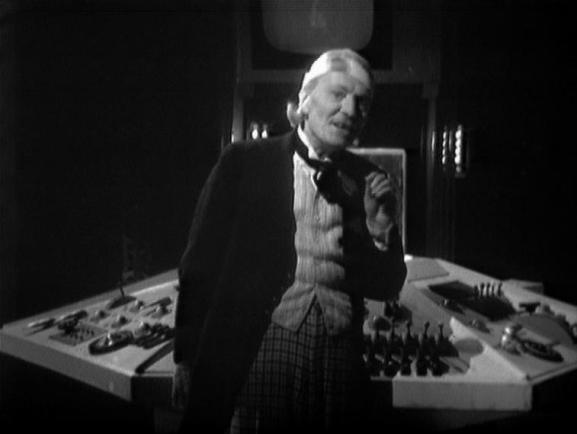
This is odd.   A mysterious explosion in the TARDIS has robbed everybody of the ability to act.  William Hartnell’s the luckiest, as he spends the first ten minutes unconscious on the floor whilst Jacqueline Hill doesn’t come off too badly (she’s been positioned as the sensible one since the first episode and that carries on here).

It’s William Russell and Carole Ann Ford who get the rough end of the stick.  Whether it was as scripted or Russell’s choice, but for the first half of the episode Ian’s lines are spoken in a numbing monotone whilst Ford enjoys violent mood swings as Susan goes somewhat loopy.

There’s a number of bizarre moments, but one of my favourites is at 7:21 when Susan tries the controls of the TARDIS and extravagantly plummets to the floor.  “She’s fainted” says Ian afterwards, blindingly stating the obvious.

This was the first story to use stock music rather than specially composed tracks.  Eric Siday was the composer and one of the cues should be familiar (as it was later reused in The Moonbase).  But the problem is that there’s not enough music and ambient sound effects used – meaning that for long stretches there’s nothing but the raw studio sound.

A prime example is when Susan comes back into the console room and notices that the TARDIS doors are open.  This is clearly a dramatic moment – the ship hasn’t landed so it shouldn’t happen – but it’s played out to a totally dead atmosphere – no music, no effects.  It’s possible that this was intentional (to highlight something was wrong with the TARDIS).  Or possibly not.  It all depends how generous you want to be, I guess.

After fainting, Susan threatens Ian and later stabs her bed with a pair of scissors in a notorious scene which was somewhat controversial at the time.  Why Susan is acting irrationally (and why Ian doesn’t seem to be acting at all!) is never made clear – was this due to the explosion at the start or is it part of the TARDIS’ defence mechanisms (which we’ll discuss during the next episode).

This is an interesting exchange –

SUSAN: I never noticed the shadows before. It’s so silent in the ship.
BARBARA: Yes. Or we’re imagining things. We must be. I mean, how would anything get into the ship, anyway?
SUSAN: The doors were open.
BARBARA: Yes, but, but where would it hide?
SUSAN: In one of us.

It’s a red herring as nothing did get into the ship, but the concept that an alien invader might be hiding in one of them is a powerful and disturbing one.

The Doctor’s now up and about and is convinced that Ian and Barbara have sabotaged the TARDIS. It’s not possible to say for certain that the Doctor is acting irrationally (like Susan) because he’s been a very changeable character since episode one.

I think it was simply the Doctor being his usual suspicious, arrogant self – but it gives Barbara the chance to tell him some well deserved home truths. Jacqueline Hill is wonderful in this scene, as she is throughout the episode. Whilst the others have been erratic, Barbara remains strong.

BARBARA: How dare you! Do you realise, you stupid old man, that you’d have died in the Cave of Skulls if Ian hadn’t made fire for you?
DOCTOR: Oh, I.
BARBARA: And what about what we went through against the Daleks? Not just for us, but for you and Susan too. And all because you tricked us into going down to the city.
DOCTOR: But I, I.
BARBARA: Accuse us? You ought to go down on your hands and knees and thank us. But gratitude’s the last thing you’ll ever have, or any sort of common sense either.

Frankly it’s worth sitting through the episode for that exchange alone.

We end with the Doctor having drugged(!) the others so he can examine the TARDIS in peace. But somebody then attacks him. Or do they? Possibly it’s just a very contrived cliffhanger.  All will be revealed when we reach The Brink of Disaster.

Doctor Who – The Daleks. Episode Seven – The Rescue

rescue

The literal cliff-hanger from last time saw Antodus fail to jump the ravine – which means he’s plunged down a bottomless cavern and Ian (tied on the other end of the rope) is slowly losing his grip on him.  There’s something rather casual about this sequence – why Ian doesn’t call for help from the others?  And even when Ganatus does pop up, neither of them are very quick to twig that a little more assistance would be a good thing.  With Kristas and Barbara also holding onto the rope they should have been able to pull Antodus up.

As it is, Antodus settles the matter by cutting the rope and plunging to his death.  This is a moment that can be taken several ways – was it a noble act of self sacrifice (saving Ian’s life) or did Antodus (who was convinced they’d all die) commit suicide because he didn’t have the nerve to carry on?

Although Ian tells Ganatus that his brother died to give them a chance, it’s not really a credible statement.  Alydon and the rest of the Thals just seem to stroll into the Dalek City, which makes the efforts of Ian, Barbara, Ganatus and Kristas seem somewhat futile (why make all that effort to gain access via the caves when they could have just walked in through the front door?!)

Meanwhile, the Doctor and Susan are prisoners of the Daleks.  Hartnell has a great line – “this senseless, evil killing” – which helps to give the Doctor a sense of morality that hasn’t always been present in the episodes to date.
The climax of the story is a little bit of a damp squib – the Daleks’ control room is invaded by the Thals and after the briefest of battles the Daleks all die.  Their power has (somehow) drained away, exactly how is never really explained.  After seven episodes it would have been nicer to have a more considered conclusion.

In Nation’s original draft, it was revealed that a third party had engineered the war five hundred years ago between the Daleks and the Thals for their own benefit.  This mysterious alien presence then returns to Skaro and the Daleks and Thals team up to destroy it.  Although the televised ending is a little abrupt, I certainly prefer that to the original draft which poses more questions than it answers (why did the aliens decide to return to Skaro after so long?)

Hartnell’s Doctor has another small, defining moment. “I might just say this to you. Always search for truth. My truth is in the stars and yours is here.”  It’s character scenes like this where Hartnell really excels.

So if the conclusion is a little disappointing (as is well known, Terry Nation wrote the seven scripts very quickly – for him it was just another job.  “Take the money and fly like a thief”) then there’s still enough memorable moments from the earlier episodes to always make this a rewarding rewatch.

Doctor Who – The Daleks. Episode Six – The Ordeal

ordeal.jpg

An aptly named episode this.  The Ordeal is the point where the wheels start to come off as the story begins to splutter to a conclusion which will continue in the following episode.  The main problem with episode six is that the bulk is taken up with the efforts of Ian, Barbara and the Thals to break into the Dalek City – and this is very, very dull.

It can’t help but feel very padded out – had there not been seven episodes to fill then no doubt it wouldn’t have taken so long to find a way in.  Alas we have to follow them for almost the whole episode as they explore the very small cave sets very slowly.

There’s the odd moment of interest though.   There seems to be something of a romantic spark between Barbara and Ganatus which Ian is oblivious to.  Although Ganatus’ comment that they won’t use one of the customs of her planet – ladies first – is baffling (just how long have they had to discuss the Earth?)  When David Whitaker novelised the story he elected to make Barbara very antongistic and distant to Ian as they attempted to breach the city – it was a surprise to me that this wasn’t a part of the television original.  I mourn for the glass Dalek as well …..

Antodus continues to be the weak link in the group –

ANTODUS: Ganatus. I want to go back.
GANATUS: What for?
ANTODUS: I can’t go on any more.
GANATUS: You must.
ANTODUS: No. We’re going deeper, deeper all the time. We’ll be trapped in the mountain, I know we will. Please, Ganatus, let me go back.
GANATUS: You can’t.
ANTODUS: But you don’t really need me, not really. I could, well, I could go back and signal to the others that we’ve managed to get as far as we have.
GANATUS: Antodus, we go on together.
ANTODUS: Why? Why are you making me do all these things? Even if we do get through, we’ll never defeat the Daleks. Ganatus, we’re all going to be killed.
GANATUS: We can’t turn back now.
ANTODUS: The others can’t, but we could. Listen, they’re going to die anyway. We could just go back and tell the others that the Daleks killed them.

Alas, the next line is fluffed by Philip Bond (Ganatus) when he says that Antodus has to go back, rather than go on. But there’s nothing to do but press on, hope the audience hasn’t noticed and luckily an unconvincing rock-fall causes a distraction.

There’s not much Hartnell in this one, but he does have a lovely scene where he disables a control panel outside the city.  He spends so much time crowing about this (“a superior brain”) rather than taking Susan’s advice that they should leave, that the pair end up getting caught by a group of Daleks!

The first time, but by no means the last, that the plot has to come to a virtual halt to fill the episode count. Often there’s enough decent character interaction to make it more bearable, but The Ordeal (with its sub 1940’s adventure serial atmosphere) doesn’t have a great deal going for it.

Doctor Who – The Daleks. Episode Five – The Expedition

expedition.jpg

The Expedition opens with Ian ranged against the Doctor and Barbara.  The fluid link needs to be retrieved from the Dalek City, but Ian is reluctant to ask the Thals to help them (“What victory are you going to show these people when most of them have been killed? A fluid link? Is this what you’re going to hold up to them and say, ‘Thank you very much. This is what you fought and died for’?”).

The Doctor has no qualms in asking for the Thals’ help – he needs the fluid link back and they’re a ready made fighting-force, so it’s of no concern to him whether they all die in the attempt.  Barbara is equally keen to retrieve the fluid link and escape from Skaro – she’s convinced that the Daleks will find a way to travel out of the city and kill them all (“Oh, they’ll find a way. They’re clever enough. They’ll find us and kill us, you know that as well as I do.”)

There’s no evidence to support this though (is she simply playing on Ian’s fears for their safety?) and he remains resolute.  It’s a key part of the story and it’s a little surprising to find this debate in a Terry Nation story – his yarns tended to be drawn in more clearly defined shades of black white.  In the end Ian does persuade the Thals to help – by making them see that they will also be guaranteeing their own survival.  At one point Barbara complains that Ian is only playing with words and there’s more than a kernel of truth in this.

In the Dalek City there’s some interesting things going on, thanks to Christopher Barry’s direction.  A group of Daleks have elected to take the Thals anti-radiation drugs (inducing death).  We see one of the Daleks die from their POV, in a slightly trippy, drug-induced way.  The moans emanating from the Dalek do sound slightly comic, but it’s another reminder that in this story they’re not portrayed just as mindless killing machines.  These signs of vulnerability, together with their more conversational mode of speech, would later be dropped as the Daleks lose any spark of individuality (except maybe for David Whitaker’s two Troughton stories).

It does feel a little contrived that the Daleks only now realise the anti-radiation drugs don’t  work since they’ve become conditioned to radiation and need more of it to survive.  Therefore they intend to release another bomb which will also have the pleasing side effect of wiping out of Thals.  The war ended five hundred years ago, why have the Daleks only just twigged that radiation is essential to their survival?

The Doctor elects to mount a two-pronged attack – one group to distract the Daleks on the city wall whilst the others attempt to break into the city from the rear – braving the jungle and the lake of mutations.  This is the first of Terry Nation’s Doctor Who jungles and despite it’s small size is effectively realised.  Partly this is due to Brian Hodgson’s sound design which creates a real sense of unease (Ian beating off a clip of stock footage is less impressive).

The monster that rises out of the swamp is another decent moment, although it does slightly look like a rubber ring with two glowing eyes.  As previously mentioned, on the lower resolution televisions of the time this no doubt would have looked more convincing.  Although I’m quite convinced now – maybe I’m easily pleased?

Ian and Barbara are accompanied by five Thals – although their party is quickly reduced by one when the hapless Elyon is sucked into the lake at the end of the episode (via another decent inlay shot).  Antodus complains to his brother Ganatus that they’re all doomed, doomed (a theme which will continue into the next episode).