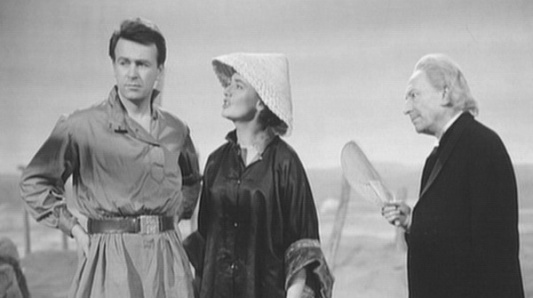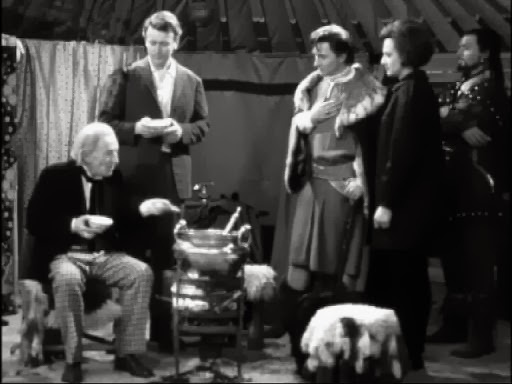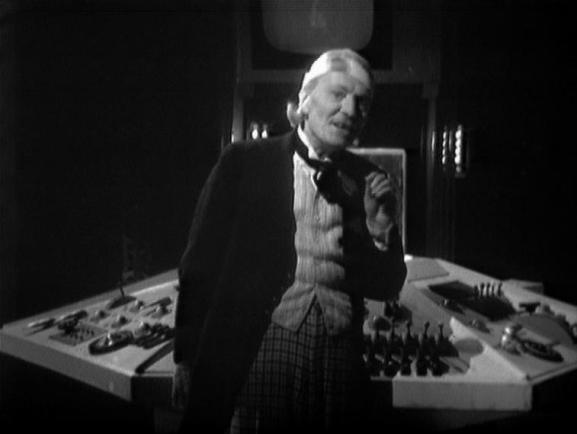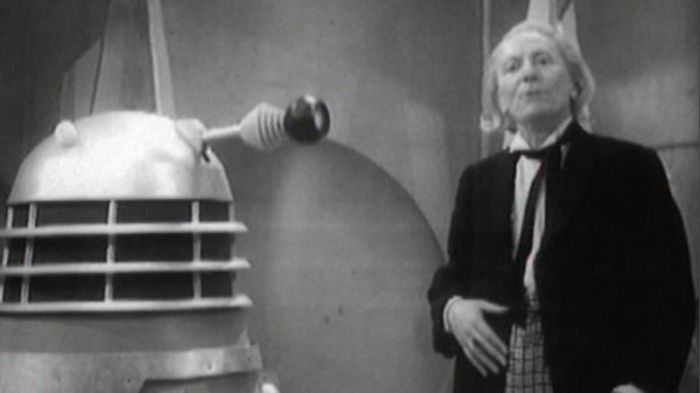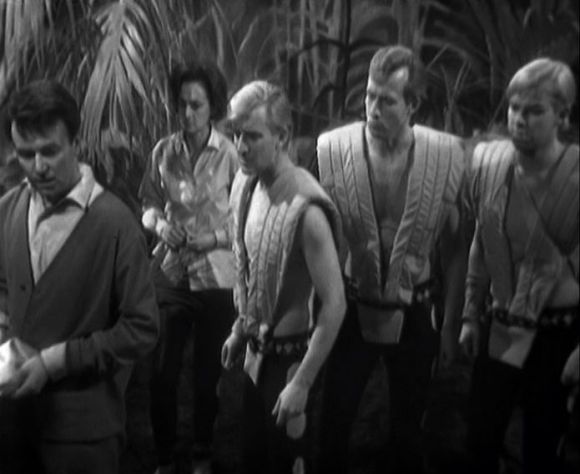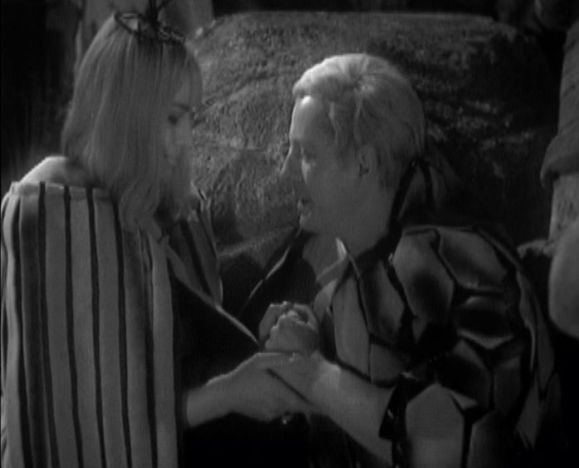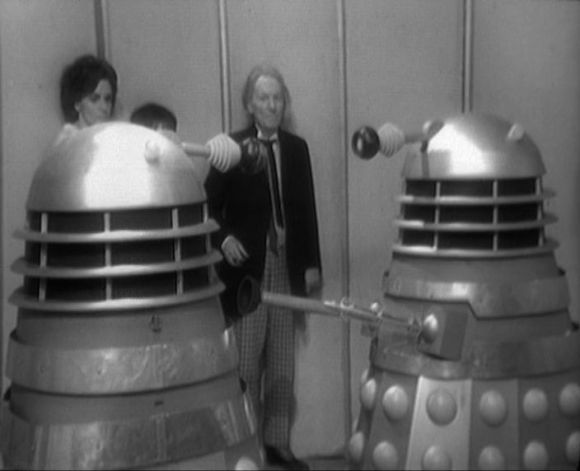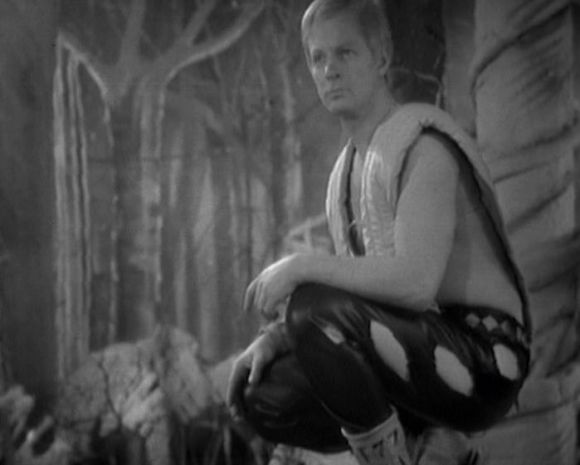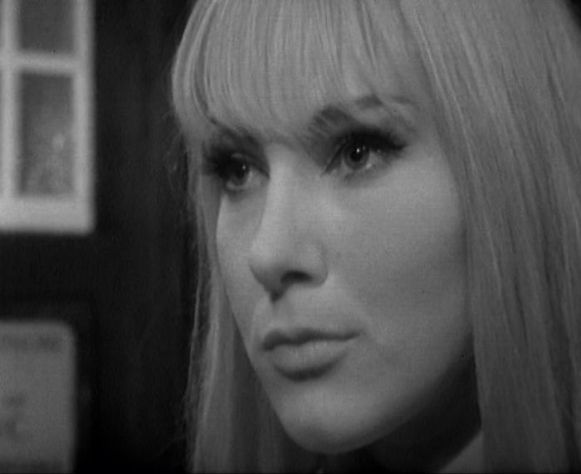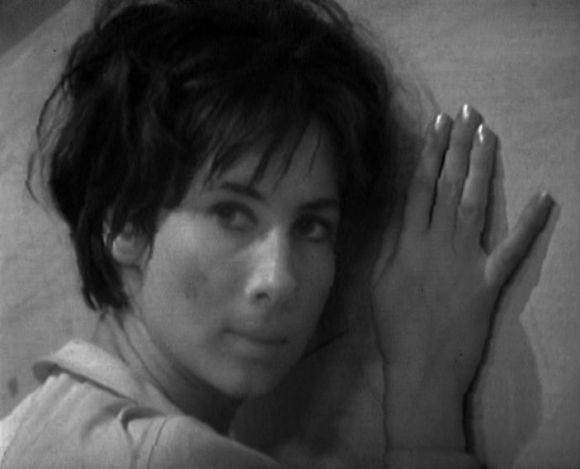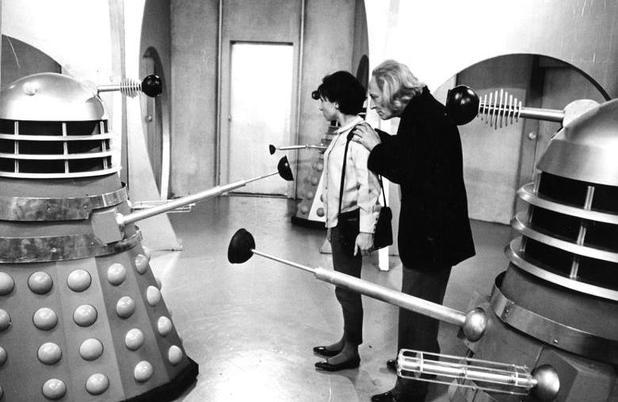
Doctor Who – Marco Polo. Episode Four – The Wall of Lies

lies

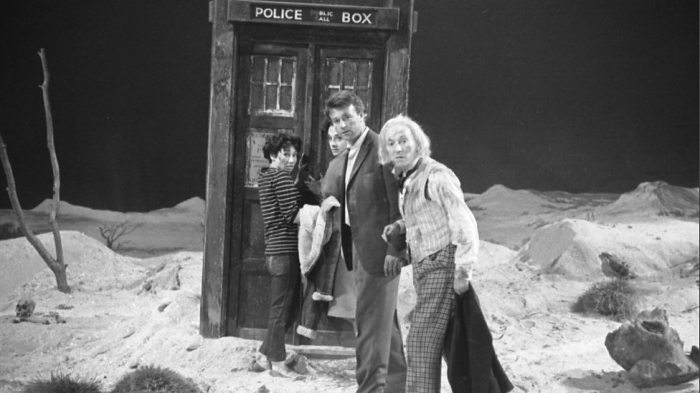
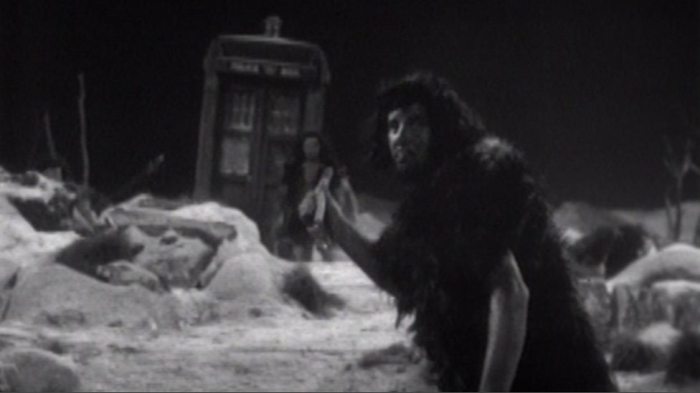
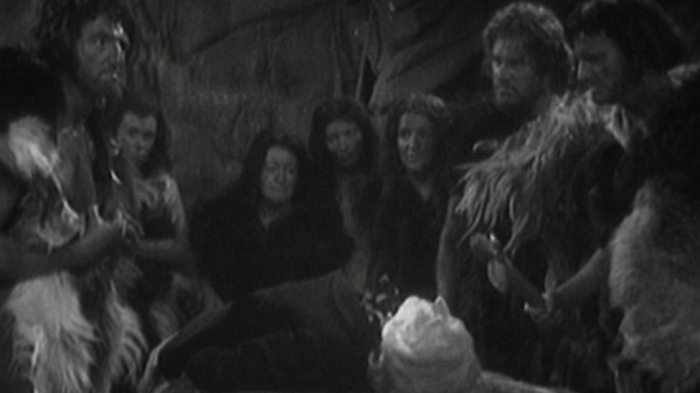
Barbara is rescued from the clutches of the Mongols after Ian realises that Susan was right – the eyes in the cave did move (behind the wall was a secret room where Barbara was being held). Once again, the Doctor is shown not to posses all the answers – he was dismissive of Susan’s claim, seemingly treating it as nothing more than a hysterical outburst – so it fell to Ian and Marco to put two and two together.

Tegana continues to chip away at Marco’s trust in the Doctor and his friends. “Only a fool defends his enemies. Be warned, Marco. They will set us at each others throats by lies and deceit, and then, when they have divided us, then they will destroy us one by one.”

Barbara insists that she followed Tegana to the cave – something he strongly denies. As Marco tells Ian. “Tegana is a special emissary of Noghai, on his way to talk peace with Kublai Khan. He’s a very important man. You are mysterious travellers from some far off land I know nothing about. Now, if you were in my position, a servant of Kublai Khan, whose word would you take?”

A slight weakness of the story is that since Tegana has been presented as such a powerful presence it slightly diminishes him every time his plans to kill Marco and the others are scuppered. But there’s a sense in this episode that we’re now entering the endgame. I particularly like the way he displays his true feeling for Marco (telling his associate Acromat that Marco should be killed like an old woman in her bed). And the Doctor’s death holds no fear for him, a stake through the heart should deal with the magician.

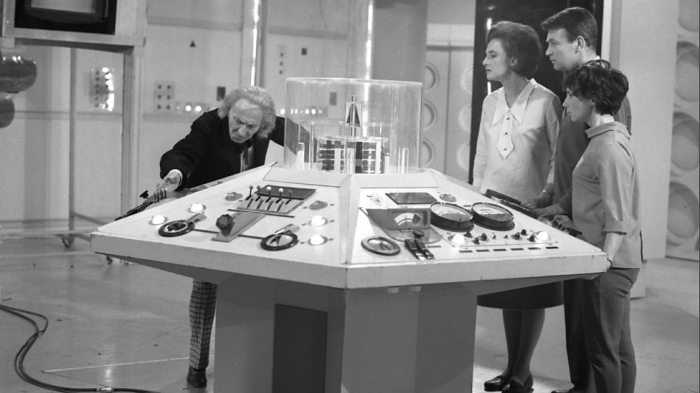
The relationship between Marco and the others comes to a head when he realises that the Doctor has been working on the TARDIS in secret.

POLO: I’m sorry I doubted your word, Tegana. Give me the key, Doctor.
DOCTOR: No.
POLO: You’re an old man and I do not wish to use force.
DOCTOR: That is what you’ll precisely have to do, Polo.
(Tegana wrenches the key from the Doctor)
TEGANA: Did I not say he had another key?
DOCTOR: Put that key in the lock, Polo, and you will destroy the ship. Then where will your precious Khan be, hmmm? You need more than a key to enter my ship. You need knowledge. Knowledge you will never possess.
POLO: Tell me.
DOCTOR: No, understand? No! I’d let you wreck it first!

This results in the Doctor and the others being kept as virtual prisoners. Ian chafes against this and decides that they need to take action. They resolve to capture Marco and force him to hand over the TARDIS key. The Doctor’s statement that “I think by the time I’ve finished with that gentleman, he’ll only be too glad to let us go” is intriguing. Exactly what does the Doctor plan to do to?

Sadly, we never learn what the Doctor’s special brand of persuasion might be, as Ian discovers that the guard outside is dead. With Marco’s encampment under attack they have the perfect cover to escape, but can they really just cut and run?

Doctor Who – Marco Polo. Episode Three – Five Hundred Eyes

five.jpg

With Marco and the others lacking enough water to make the journey to the oasis, it falls to the Doctor to save the day. He notices that moisture has formed on the inside of the TARDIS overnight and saves every last drop. We then have another quick science lesson as the concept is explained to Marco (and the viewers at home).

IAN: Marco, you remember, last night it was cold. Bitterly cold, Marco. The outside of the caravan cooled, but the inside stayed warm, and so moisture formed on the inside. It’s condensation, we just call it that. It’s just a name.
SUSAN: That’s true, Messer Marco. It was running down the walls, and from the ceiling. We, we took it in this, look, we squeezed it in here. You see?

These precious drops of water are enough to aid their journey to the oasis, where they find Tegana. He tells them he was unable to travel back with water as the oasis was surrounded by bandits during the night. As so often in the early stories it’s not the Doctor who exposes the fallacies in his statement (if bandits were there, why didn’t they light a fire since it was a cold night?) but one of the others – in this case Barbara. Her suspicions against Tegana only harden as the episode continues, culminating in her capture when she ventures into the Cave of Five Hundred Eyes.

One noteworthy aspect of these early scenes is that Tristram Cary’s music has an electronic feel (similar to his score for The Daleks). This fits the mood well as Marco and the others face death under the unforgiving sun. Once they are rescued, it changes back to traditional instruments (as it is for the majority of the story). It’s a pity that Marco Polo is the only of his Doctor Who scores not to exist, although we should be grateful that his other music does.

Having reached the Tun-Huang Way Station, Marco mentions the nearby Cave of Five Hundred Eyes, a place once frequented by the Hashashins. Although Ping-Cho has never heard of the cave, she does know a story about Hulagu and the Hashashins and promises to tell it to them later. This is an extraordinary sequence – the story stops for several minutes for a spot of local colour. Like the chat about condensation, it’s probable to view its insertion as another educational box-ticking exercise. But it’s charmingly performed by Zienia Merton, who delivers the lengthy monologue with aplomb. It’s easy to imagine that the air would have turned blue had it been given to William Hartnell!

Gracious maidens, gentle lords, pray attend me while I tell my tale of Alaeddin, the Old Man of the Mountains, who by devious schemes, evil designs and foul murders ruled the land.

No host of arms, no vast array of banners served this wicked lord. They were but few, ruthless, reckless men who obeyed his cruel commands.

Thus did he persuade them. Promising paradise, he gave his followers a potent draught and whilst they slept transported them to a vale where streams of milk and honey, wine and water, flowed.

Here were gardens and flowers of every hue and essence. Here, too Golden pavilions outshone the sun and even the stars of heaven envied the bejewelled interiors strewn with incomparable silks, tapestries, and treasures.

Hand-maidens, dulcet-voiced, soft of face, attended them, and thus bemused did they dwell in this man-made paradise until Alaeddin intent upon some evil deed, proffered again the hashish draught and brought them sleeping to his castle.

“What lord, are we cast out of paradise?” awakening, they cried.

“Not so. Go abroad, seek out my enemies and strike them down. But care not for your lives. Paradise is eternal.”

So terror stalked the land for many years. Then one day, came mighty Hulagu to stand before Alaeddin’s lair for three long years in siege. Thus fell Alaeddin and his men.

Now honest hands reap harvests of life from the soil where death and evil reigned. And those who journey through the vale are heard to say ’tis truly paradise today.

When Barbara notices Tegana leave the room after Ping-Cho’s tale, she follows him as he heads up to the Cave of Five Hundred Eyes. She doesn’t hear Tegana plot Marco’s destruction and the theft of the TARDIS, but finds herself captured by a group of Mongols who hold her in the cave whilst they play dice. In the next episode she tells Ian that they were playing dice to decide which of them would kill her, but it’s no stretch to imagine that they were also keeping her alive so that they could take turns to rape her. Otherwise it would have made more sense to quickly kill her and leave. Barbara becomes the object of male interest several times – in the very next story The Keys of Marinus and also during season two. Sometimes played for comic effect (The Romans) and other times played dead straight (The Crusade).

An intriguing part of the episode revolves around Tegana’s attempts to sow discord between Marco and the TARDIS crew. Why is Tegana doing this? He clearly doesn’t have Marco’s interests at heart, since he plans to kill him very soon, so is it possible that he fears the Doctor’s magic? Or it could be that he simply enjoys stirring up trouble amongst his enemies?

Doctor Who – Marco Polo. Episode Two – The Singing Sands

singing.jpg

Ian and Marco enjoy a game of chess. Tegana is a keen student of the game, as he explains –

TEGANA: I find it a fascinating game of strategy of war. Two equally balanced armies deployed upon a field of battle, and each commander determined to be the one who cries shah mat.
IAN: Shah mat? Check mate?
TEGANA: It means the king is dead.

It’s a lovely character beat that illuminates his personality a little more. Indeed, since the level of threat in this episode is fairly low (apart from the Singing Sands) several other characters also benefit from Lucorotti’s dialogue. Susan is one, as she poetically tells Barbara that “one day we’ll know all the mysteries of the skies, and we’ll stop our wandering.” Although it’s rather strange that he also elected to put various 1960’s slang words (“I dig it”, “crazy”) into her mouth since she didn’t adopt this mode of speech in any other story.

The Doctor is absent until the end of the episode – either this was a last minute rewrite to cover a bout of ill-health from Hartnell or it was just decided to give him an easy week – but the rest of the cast are so strong that he’s not really missed.

Susan and Ping-Cho’s adventure, adrift in the Singing Sands, is one of the most intriguing parts of the episode. Just how good did it look? We’ll never know the answer, unless the story ever turns up, but it certainly sounds impressive.

In terms of creating dramatic tension it’s a bit of a damp squib though – Barbara is hysterical with the thought that the girls are out in the desert unprotected, but then they turn up unharmed shortly afterwards.

Last time Tegana had a very decent scheme – poison the water gourds and then return to Lop. But for some unknown reason he’s changed his mind and elects to slash all but one of the water gourds and wait for the others to die from lack of water. Was this change of plan down to the misadventures in the Singing Sands? Afterwards, Marco tightened security and that might explain why Tegana decided he wasn’t able to leave the camp. Although it’s difficult to believe that he couldn’t have snuck away if he really wanted to.

With only a small amount of water left, they have to strictly ration it as they make their way to the nearest oasis. Will they get there in time? Mmm, I think it’s possible they just might.

Doctor Who – Marco Polo. Episode One – The Roof of the World

roof.jpg

With Marco Polo we’ve reached the first of the missing stories, although back in 2013 it seemed very possible that it had been recovered and we’d be enjoying it on DVD within a matter of months. The MEW rumour had been bouncing around various Doctor Who forums for a while (basically stating that three stories – Marco Polo, Enemy of the World & Web of Fear had been found). And when all of Enemy and most of Web did resurface shortly afterwards you could have laid a guinea to a gooseberry that Marco wouldn’t be far behind them.

Four and a bit years later there’s still no sign of it, so it seems that this rumour was only 66% right (although there are still some who cling to the belief that Marco Polo is out there somewhere). I’ve love to think that it was and that some day I’d be able to watch it on DVD (no download for me, thank you!) but if it isn’t, and no other missing episodes are ever found, then we should really just count our blessings.

All ninety seven missing episodes exist as good quality audio recordings (which have been further improved by the work of Mark Ayres during the last decade or so). We may sometimes take the audios for granted, and grumble about how annoying it is that we can’t see the pictures, but it’s worth taking a moment to stop and consider how some other popular series of the time have fared.

There’s reputed to be one poor quality audio of an Avengers episode existing in private hands, some muffled audios of Public Eye exist (several found their way onto the early DVD releases) whilst a handful of audios from Out of the Unknown were made (and are included on the BFI’s DVD release. Not bought it yet? You really should, it’s an excellent package! If you need further convincing I’ve written about it at length here).

These fairly slim pickings demonstrate just how fortunate Doctor Who is. This is particularly noteworthy when it comes to Marco Polo. The show had only been running for three months, so it’s a little surprising (but very welcome) that there were people who even this early on were dedicated enough to record every episode.

Although The Roof of the World is generally held to be the point where the Doctor starts to act more like the Doctor we come to know, he’s still remarkably bad-tempered at the start. This may be because he’s concerned for their safety (the TARDIS has broken down in the Alps and with no heat their prospect of survival looks slim) but he’s still incredibly dismissive when Ian offers to look for fuel. “Oh well, I wish you luck.”

The telesnaps offer us an insight into how these early scenes look. It’s no surprise that the Roof of the World looks rather stagey and there also appears to be a wrinkled backdrop behind the time-travellers (always a hazzard in these early stories – see The Aztecs for another example). The subtle wind effect helps to sell the illusion of cold though.

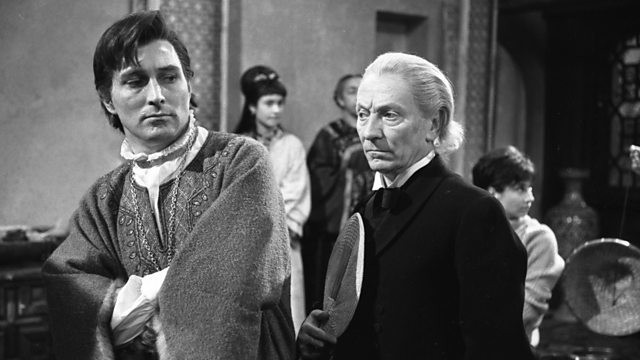
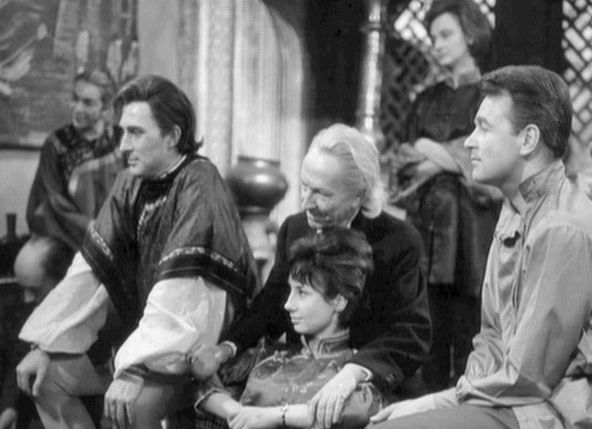
Our heroes run into the warlord Tegana (Derren Nesbitt). From his first words his character is made clear. “Hear me, Mongols. In these parts live evil spirits, who take our likeness to deceive us and then lead us to our deaths. Let us therefore destroy these evil spirits before they destroy us.” Whilst we can’t see him, it seems clear that Nesbitt relishes the dialogue he’s been given and he’s wonderfully entertaining throughout the story.

Their execution is stopped by Marco Polo (Mark Eden). If Tegana is presented as superstitious and menacing then Marco appears to be enlightened and affable. But both have their own agendas and Marco, whilst he’s friendly, quickly demonstrates that he’s equally as ruthless as Tegana. He appropriates the TARDIS and tells the Doctor that he wishes to present it to Kublai Khan as a gift – he then hopes that the Khan will then grant him leave to travel home to Venice.

This is the plot device that ensures that the Doctor remains – otherwise he would have left at the first available opportunity. Variations to make the TARDIS inaccessible are used throughout the first season (the missing fluid link in The Daleks, a forcefield in The Keys of Marinus, etc) as the Doctor is not yet written as a character who’ll stay and help people simply because it’s the right thing to do.

There are a few examples of Doctor Who‘s early educational remit. Early on, Susan finds a giant footprint – although Ian ponders that it may be just a normal sized print which looks bigger because the snow around it has melted. And later on, the science teacher in him can’t help but give Marco a quick lesson.

POLO: I’m afraid the liquid is not too warm, but the cold here is so intense, it even robs a flame of its heat.
IAN: The cold can’t affect the heat of the flame, sir. The liquid boils at a lower temperature, because there’s so little air up here.
POLO: You mean the air is responsible?
IAN: Well, the lack of it. Just as the lack of it is responsible for the Doctor’s mountain sickness.

Susan makes friends with Ping-Cho (Zienia Merton). Having someone in the cast around Susan’s age allows her to have some decent character moments and she opens up to Ping-Cho in a way we haven’t seen before.

Doctor Who – The Edge of Destruction. Episode Two – The Brink of Disaster

brink.jpg

The previous episode ended with the Doctor being attacked by a mysterious assailant.  It’s therefore something of a letdown to learn that it was only Ian – trying to warn the Doctor not to touch the controls, as they would have given him an electric shock.

Ian had two choices of course.  Choice number one would have seen him tell the Doctor not to touch the controls whilst choice number two is to throttle the Doctor into submission.  Yes, he goes for choice number two.

But why Ian would think the controls would be dangerous (and how he managed to awake from his drugged sleep) is a bit of a mystery.  Yes, Susan was attacked by the console in the previous episode, but we saw the Doctor touch the controls later on with no ill effects.

For a few minutes, the Doctor is still convinced that Ian and Barbara are the cause of his problems, but eventually the penny drops that something is wrong with the ship.  Barbara decides that the TARDIS has been trying to warn them.  “We had time taken away from us and now it’s being given back to us because it’s running out” is just one of her baffling utterances which make no sense at all.

And the reason why the TARDIS acting so oddly? The Fast Return Switch was broken (a faulty spring!) and is hurtling the ship towards destruction. But rather than issue a conventional warning, the TARDIS decided that a series of oblique and bizarre moments would be just the ticket.  Also, it’s impossible not to love the fact that somebody has written “fast return switch” in felt-tip on the console!

Hartnell has quite a long monologue which is designed to wrap the mystery up.  Even at this early stage he was never keen on lengthy speeches – due to the worries he had with remembering lines.  He is a bit wobbly in this story from time to time, but he’s pretty much perfect when it comes to this sequence.  Although his reaction when receiving the script (“Christ! It’s bloody Hamlet!”) strongly implies that he needed some persuading to learn it!

I know. I know. I said it would take the force of a total solar system to attract the power away from my ship. We’re at the very beginning, the new start of a solar system. Outside, the atoms are rushing towards each other. Fusing, coagulating, until minute little collections of matter are created. And so the process goes on, and on until dust is formed. Dust then becomes solid entity. A new birth, of a sun and its planets.

It was very possible that this would have been the final episode of Doctor Who.  If so, then it would have ended with a more mellow Doctor finally beginning to appreciate his two new companions.

DOCTOR: I’d like to talk to you, if I may. We’ve landed on a planet and the air is good, but it’s rather cold outside.
BARBARA: Susan told me.
DOCTOR: Yes, you haven’t forgiven me, have you.
BARBARA: You said terrible things to us.
DOCTOR: Yes, I suppose it’s the injustice that’s upsetting you, and when I made a threat to put you off the ship it must have affected you very deeply.
BARBARA: What do you care what I think or feel?
DOCTOR: As we learn about each other, so we learn about ourselves.
BARBARA: Perhaps.
DOCTOR: Oh, yes. Because I accused you unjustly, you were determined to prove me wrong. So, you put your mind to the problem and, luckily, you solved it.

It also reinforces the notion that all four members of the TARDIS crew have something to contribute.  It was Barbara who solved the mystery in this story, Susan returned to the TARDIS to fetch the anti-radiation drugs in The Daleks, Ian made fire in An Unearthly Child, etc.

This might be something of a ramshackle story, but at only two episodes it doesn’t outstay its welcome and apart from a few decent character moments it’s mainly memorable for the subtle reshaping of the Doctor’s character.

Doctor Who – The Edge of Destruction. Episode One

edge

This is odd.   A mysterious explosion in the TARDIS has robbed everybody of the ability to act.  William Hartnell’s the luckiest, as he spends the first ten minutes unconscious on the floor whilst Jacqueline Hill doesn’t come off too badly (she’s been positioned as the sensible one since the first episode and that carries on here).

It’s William Russell and Carole Ann Ford who get the rough end of the stick.  Whether it was as scripted or Russell’s choice, but for the first half of the episode Ian’s lines are spoken in a numbing monotone whilst Ford enjoys violent mood swings as Susan goes somewhat loopy.

There’s a number of bizarre moments, but one of my favourites is at 7:21 when Susan tries the controls of the TARDIS and extravagantly plummets to the floor.  “She’s fainted” says Ian afterwards, blindingly stating the obvious.

This was the first story to use stock music rather than specially composed tracks.  Eric Siday was the composer and one of the cues should be familiar (as it was later reused in The Moonbase).  But the problem is that there’s not enough music and ambient sound effects used – meaning that for long stretches there’s nothing but the raw studio sound.

A prime example is when Susan comes back into the console room and notices that the TARDIS doors are open.  This is clearly a dramatic moment – the ship hasn’t landed so it shouldn’t happen – but it’s played out to a totally dead atmosphere – no music, no effects.  It’s possible that this was intentional (to highlight something was wrong with the TARDIS).  Or possibly not.  It all depends how generous you want to be, I guess.

After fainting, Susan threatens Ian and later stabs her bed with a pair of scissors in a notorious scene which was somewhat controversial at the time.  Why Susan is acting irrationally (and why Ian doesn’t seem to be acting at all!) is never made clear – was this due to the explosion at the start or is it part of the TARDIS’ defence mechanisms (which we’ll discuss during the next episode).

This is an interesting exchange –

SUSAN: I never noticed the shadows before. It’s so silent in the ship.
BARBARA: Yes. Or we’re imagining things. We must be. I mean, how would anything get into the ship, anyway?
SUSAN: The doors were open.
BARBARA: Yes, but, but where would it hide?
SUSAN: In one of us.

It’s a red herring as nothing did get into the ship, but the concept that an alien invader might be hiding in one of them is a powerful and disturbing one.

The Doctor’s now up and about and is convinced that Ian and Barbara have sabotaged the TARDIS. It’s not possible to say for certain that the Doctor is acting irrationally (like Susan) because he’s been a very changeable character since episode one.

I think it was simply the Doctor being his usual suspicious, arrogant self – but it gives Barbara the chance to tell him some well deserved home truths. Jacqueline Hill is wonderful in this scene, as she is throughout the episode. Whilst the others have been erratic, Barbara remains strong.

BARBARA: How dare you! Do you realise, you stupid old man, that you’d have died in the Cave of Skulls if Ian hadn’t made fire for you?
DOCTOR: Oh, I.
BARBARA: And what about what we went through against the Daleks? Not just for us, but for you and Susan too. And all because you tricked us into going down to the city.
DOCTOR: But I, I.
BARBARA: Accuse us? You ought to go down on your hands and knees and thank us. But gratitude’s the last thing you’ll ever have, or any sort of common sense either.

Frankly it’s worth sitting through the episode for that exchange alone.

We end with the Doctor having drugged(!) the others so he can examine the TARDIS in peace. But somebody then attacks him. Or do they? Possibly it’s just a very contrived cliffhanger.  All will be revealed when we reach The Brink of Disaster.

Doctor Who – The Daleks. Episode Seven – The Rescue

rescue

The literal cliff-hanger from last time saw Antodus fail to jump the ravine – which means he’s plunged down a bottomless cavern and Ian (tied on the other end of the rope) is slowly losing his grip on him.  There’s something rather casual about this sequence – why Ian doesn’t call for help from the others?  And even when Ganatus does pop up, neither of them are very quick to twig that a little more assistance would be a good thing.  With Kristas and Barbara also holding onto the rope they should have been able to pull Antodus up.

As it is, Antodus settles the matter by cutting the rope and plunging to his death.  This is a moment that can be taken several ways – was it a noble act of self sacrifice (saving Ian’s life) or did Antodus (who was convinced they’d all die) commit suicide because he didn’t have the nerve to carry on?

Although Ian tells Ganatus that his brother died to give them a chance, it’s not really a credible statement.  Alydon and the rest of the Thals just seem to stroll into the Dalek City, which makes the efforts of Ian, Barbara, Ganatus and Kristas seem somewhat futile (why make all that effort to gain access via the caves when they could have just walked in through the front door?!)

Meanwhile, the Doctor and Susan are prisoners of the Daleks.  Hartnell has a great line – “this senseless, evil killing” – which helps to give the Doctor a sense of morality that hasn’t always been present in the episodes to date.
The climax of the story is a little bit of a damp squib – the Daleks’ control room is invaded by the Thals and after the briefest of battles the Daleks all die.  Their power has (somehow) drained away, exactly how is never really explained.  After seven episodes it would have been nicer to have a more considered conclusion.

In Nation’s original draft, it was revealed that a third party had engineered the war five hundred years ago between the Daleks and the Thals for their own benefit.  This mysterious alien presence then returns to Skaro and the Daleks and Thals team up to destroy it.  Although the televised ending is a little abrupt, I certainly prefer that to the original draft which poses more questions than it answers (why did the aliens decide to return to Skaro after so long?)

Hartnell’s Doctor has another small, defining moment. “I might just say this to you. Always search for truth. My truth is in the stars and yours is here.”  It’s character scenes like this where Hartnell really excels.

So if the conclusion is a little disappointing (as is well known, Terry Nation wrote the seven scripts very quickly – for him it was just another job.  “Take the money and fly like a thief”) then there’s still enough memorable moments from the earlier episodes to always make this a rewarding rewatch.

Doctor Who – The Daleks. Episode Six – The Ordeal

ordeal.jpg

An aptly named episode this.  The Ordeal is the point where the wheels start to come off as the story begins to splutter to a conclusion which will continue in the following episode.  The main problem with episode six is that the bulk is taken up with the efforts of Ian, Barbara and the Thals to break into the Dalek City – and this is very, very dull.

It can’t help but feel very padded out – had there not been seven episodes to fill then no doubt it wouldn’t have taken so long to find a way in.  Alas we have to follow them for almost the whole episode as they explore the very small cave sets very slowly.

There’s the odd moment of interest though.   There seems to be something of a romantic spark between Barbara and Ganatus which Ian is oblivious to.  Although Ganatus’ comment that they won’t use one of the customs of her planet – ladies first – is baffling (just how long have they had to discuss the Earth?)  When David Whitaker novelised the story he elected to make Barbara very antongistic and distant to Ian as they attempted to breach the city – it was a surprise to me that this wasn’t a part of the television original.  I mourn for the glass Dalek as well …..

Antodus continues to be the weak link in the group –

ANTODUS: Ganatus. I want to go back.
GANATUS: What for?
ANTODUS: I can’t go on any more.
GANATUS: You must.
ANTODUS: No. We’re going deeper, deeper all the time. We’ll be trapped in the mountain, I know we will. Please, Ganatus, let me go back.
GANATUS: You can’t.
ANTODUS: But you don’t really need me, not really. I could, well, I could go back and signal to the others that we’ve managed to get as far as we have.
GANATUS: Antodus, we go on together.
ANTODUS: Why? Why are you making me do all these things? Even if we do get through, we’ll never defeat the Daleks. Ganatus, we’re all going to be killed.
GANATUS: We can’t turn back now.
ANTODUS: The others can’t, but we could. Listen, they’re going to die anyway. We could just go back and tell the others that the Daleks killed them.

Alas, the next line is fluffed by Philip Bond (Ganatus) when he says that Antodus has to go back, rather than go on. But there’s nothing to do but press on, hope the audience hasn’t noticed and luckily an unconvincing rock-fall causes a distraction.

There’s not much Hartnell in this one, but he does have a lovely scene where he disables a control panel outside the city.  He spends so much time crowing about this (“a superior brain”) rather than taking Susan’s advice that they should leave, that the pair end up getting caught by a group of Daleks!

The first time, but by no means the last, that the plot has to come to a virtual halt to fill the episode count. Often there’s enough decent character interaction to make it more bearable, but The Ordeal (with its sub 1940’s adventure serial atmosphere) doesn’t have a great deal going for it.

Doctor Who – The Daleks. Episode Five – The Expedition

expedition.jpg

The Expedition opens with Ian ranged against the Doctor and Barbara.  The fluid link needs to be retrieved from the Dalek City, but Ian is reluctant to ask the Thals to help them (“What victory are you going to show these people when most of them have been killed? A fluid link? Is this what you’re going to hold up to them and say, ‘Thank you very much. This is what you fought and died for’?”).

The Doctor has no qualms in asking for the Thals’ help – he needs the fluid link back and they’re a ready made fighting-force, so it’s of no concern to him whether they all die in the attempt.  Barbara is equally keen to retrieve the fluid link and escape from Skaro – she’s convinced that the Daleks will find a way to travel out of the city and kill them all (“Oh, they’ll find a way. They’re clever enough. They’ll find us and kill us, you know that as well as I do.”)

There’s no evidence to support this though (is she simply playing on Ian’s fears for their safety?) and he remains resolute.  It’s a key part of the story and it’s a little surprising to find this debate in a Terry Nation story – his yarns tended to be drawn in more clearly defined shades of black white.  In the end Ian does persuade the Thals to help – by making them see that they will also be guaranteeing their own survival.  At one point Barbara complains that Ian is only playing with words and there’s more than a kernel of truth in this.

In the Dalek City there’s some interesting things going on, thanks to Christopher Barry’s direction.  A group of Daleks have elected to take the Thals anti-radiation drugs (inducing death).  We see one of the Daleks die from their POV, in a slightly trippy, drug-induced way.  The moans emanating from the Dalek do sound slightly comic, but it’s another reminder that in this story they’re not portrayed just as mindless killing machines.  These signs of vulnerability, together with their more conversational mode of speech, would later be dropped as the Daleks lose any spark of individuality (except maybe for David Whitaker’s two Troughton stories).

It does feel a little contrived that the Daleks only now realise the anti-radiation drugs don’t  work since they’ve become conditioned to radiation and need more of it to survive.  Therefore they intend to release another bomb which will also have the pleasing side effect of wiping out of Thals.  The war ended five hundred years ago, why have the Daleks only just twigged that radiation is essential to their survival?

The Doctor elects to mount a two-pronged attack – one group to distract the Daleks on the city wall whilst the others attempt to break into the city from the rear – braving the jungle and the lake of mutations.  This is the first of Terry Nation’s Doctor Who jungles and despite it’s small size is effectively realised.  Partly this is due to Brian Hodgson’s sound design which creates a real sense of unease (Ian beating off a clip of stock footage is less impressive).

The monster that rises out of the swamp is another decent moment, although it does slightly look like a rubber ring with two glowing eyes.  As previously mentioned, on the lower resolution televisions of the time this no doubt would have looked more convincing.  Although I’m quite convinced now – maybe I’m easily pleased?

Ian and Barbara are accompanied by five Thals – although their party is quickly reduced by one when the hapless Elyon is sucked into the lake at the end of the episode (via another decent inlay shot).  Antodus complains to his brother Ganatus that they’re all doomed, doomed (a theme which will continue into the next episode).

Doctor Who – The Daleks. Episode Four – The Ambush

ambush

The range of camera effects at the disposal of the Doctor Who production team in 1963/64 was incredibly limited, but The Ambush has some very effective shots (which were also quite easy to achieve).  Inlay effects are used to show the Dalek lift moving up and down and also a section of wall scorched by a Dalek gun.  Simple stuff, compared to what can be achieved today, but it works very well.

The Doctor’s capacity for self-preservation is still very much to the fore –

DOCTOR: Lets get back to the ship.
SUSAN: No, no, I must warn the Thals.
DOCTOR: Susan.
SUSAN: We can’t let them walk into a trap.
DOCTOR: The Thals are no concern of ours. We cannot jeopardise our lives getting involved in an affair which is none of our business.
BARBARA: Of course it’s our business. The Thals gave us the anti-radiation drug. Without that, we’d be dead!

The ambush scene is a little odd. Before the Thals arrive there’s a creepy scene showing the Daleks slowly backing into the alcoves. If they had stayed there and killed the Thals from the shadows this would have made sense. But instead, as Temmosus makes his impassioned speech about working together, the Daleks move out into the open. Since the Thals would have expected to meet the Daleks, why would they hide themselves?  It makes the moment a dramatic one, but that’s about all.

Also, why does Ian just stand there waiting as the Daleks move into position? He seems certain that the Daleks mean the Thals harm, so it’s baffling that he doesn’t speak until after the Daleks have opened fire.

This is very much Ian’s episode and it goes without saying that William Russell is very solid. And as the Doctor spends his time researching the history of Skaro (seemingly caring little for the modern-day plight of the Thals) it falls to Ian to try and make them understand that they may have to fight to secure their future.

ALYDON: If only I knew why the Daleks hated us. If I knew that, I, I could alter our approach to them, perhaps.
IAN: Your leader, Temmosus.
ALYDON: Yes?
IAN: Well, he appealed very sensibly to them. Any reasonable human beings would have responded to him. The Daleks didn’t. They obviously think and act and feel in an entirely different way. They just aren’t human.
GANATUS: Yes, but why destroy without any apparent thought or reason? That’s what I don’t understand.
IAN: Oh, there’s a reason. Explanation might be better. It’s stupid and ridiculous, but it’s the only one that fits.
ALYDON: What?
IAN: A dislike for the unlike.
ALYDON: I don’t follow you.
IAN: They’re afraid of you because you’re different from them. So whatever you do, it doesn’t matter.
DYONI: What would you have us do? Fight against them?
IAN: I didn’t say that. But you must teach them to respect you. Show them some strength.
DYONI: But you really believe we ought to fight.
IAN: Yes, I think it may have to come to that.
DYONI: You understand as little about us as the Daleks do!

Barbara later comments that “I don’t understand them. They’re not cowards, they don’t seem to be afraid. Can pacifism become a human instinct?” But the Doctor’s not concerned about the fate of the Daleks and the Thals and is keen to leave.  Ian, Barbara and Susan may feel more invested in the Thals’ fate, but they also agree with the Doctor that it’s time to move on.

Indeed, at the end of this fourth episode it does feel that the story has come to a conclusion. We didn’t witness the fate of the Tribe of Gum, so would there have been an expectation of the audience back in 1964 that this story would have been any different?

The Doctor’s missing fluid-link is the only reason that he decides to stay – ensuring that he’s forced to help the Thals (although as we’ll see, he’s ruthless in using them to help himself).

Doctor Who – The Daleks. Episode Three – The Escape

escape-01

The Escape opens with Susan meeting Alydon (John Lee).  Born in Tasmania, Australia, Lee didn’t have a trace of an Australian accent and instead spoke in the RP tones that were so prevalent during this era of British television.  Every line he intones is spoken with deadly seriousness (and note how, in his initial scene with Susan, he stays remarkably still).  It’s the sort of performance that can so easily seem wooden and unnatural, but Lee manages, just about, to give Alydon a spark of life.

Much more naturalistic is Philip Bond as Ganatus.  Bond (father of Samantha) has more to play with in the script, since Ganatus has a mocking sense of humour as well as a questioning nature.  If their leader Temmosus (Alan Wheatley) is inclined to think the best then Ganatus is a more reflective character.

Temmosus might well have had cannon fodder written on his forehead.  He’s no fool, but it seems clear that the Daleks have no intention of helping the Thals – and that he’s ill-suited to lead them in the struggle that will follow.

TEMMOSUS: I believe the Daleks hold the key to our future. Whatever that future may be, we must accept it gracefully and without regret.
ALYDON: I wish I could be as objective as you. We’ve lived for so long a time.
TEMMOSUS: Perhaps we have lived too long. I’ve never struggled against the inevitable. It’s a vain occupation. But I should always advise you to examine very closely what you think to be inevitable. It’s surprising how often apparent defeat can be turned to victory.

Ganatus’ brother Antodus in mentioned, but we don’t see him in this episode (although he’ll play a key part later on in the story). The suggestion that he’s a flawed character is established when Dyoni (Virginia Wetherell) wonders if he’s still afraid of the dark. A small point, but it helps to sow a seed of doubt about his ability to deal with stressful situations.

escape-02

Terry Nation never really excelled when writing for female characters (except, maybe, for Servalan in Blakes 7 – and that was probably only because she was originally written as a man) and Dyoni is no exception.  Wetherell spends most of her time in this episode pouting and reacting jealously to any mention of Susan.  Dyoni’s comment that Alydon should have given the drugs to a man, not Susan, are slightly wince-inducing.  As we’ll see, Dyoni’s only value to the plot seems to be her relationship to Alydon (she’s the lever that Ian later uses to persuade the Thals to fight the Daleks).  Apart from this, she’s very much a cipher.

And what of our four heroes?  They remain prisoners, but they work together to devise a plan to escape.  These scenes are particularly interesting because all four characters contribute to the debate.  In years to come it’ll mainly be the Doctor who has the solution – with everybody else relegated to sitting on the sidelines.  But the Doctor doesn’t have all the answers here, and it’s only after they pool their resources that a workable plan is produced.

DOCTOR: Let’s concentrate on the Daleks. Have you noticed, for example, that when they move about there’s a sort of acrid smell?
SUSAN: Yes, yes, I’ve noticed that.
BARBARA: I know. A fairground.
IAN: That’s it. Dodgems.
DOCTOR: It’s electricity. I think they’re powered that way.
IAN: Yes. But just a minute. They have no pick-up or anything. And only the base of the machine touches the floor. How do they complete the circuit?
SUSAN: Batteries?
DOCTOR: No, no. I believe the Daleks have discovered a way to exploit static electricity. Very ingenious, if I’m right.
BARBARA: What, drawing power from the floor?
DOCTOR: Precisely. If I’m right, of course.

This is a good episode for Carole Ann Ford. She’s typically wide-eyed and appealing in her initial meeting with Alydon and later has an excellent scene with the Daleks when they dictate a letter promising to help the Thals. It’s plain that they don’t intend to keep their promise though, reinforced by the push one of them gives to Susan with their sucker arm once the letter is written. It’s just a throwaway moment (possibly worked out in rehearsal) but it helps to give the Daleks more of a human touch.

The scene where the Doctor and the others disable a Dalek and remove the creature (in fact, nothing more than a joke-shop gorilla hand) is a memorable one and it leads into a strong-cliffhanger as Ian (inside the Dalek) leads the others out into the corridors as they attempt to make their escape.

escape-03.jpg

Doctor Who – The Daleks. Episode Two – The Survivors

survivors.jpg

Once the Doctor eventually realises that the planet is contaminated with a very high level of radioactive fallout it’s chilling to see how keen he is to abandon Barbara to her fate –

IAN: We’re not leaving until we’ve found Barbara.
DOCTOR: Very well. You may stay and search for her if you wish, but Susan and I are going back to the ship. Now, come along, child.
IAN: All right, carry on, fine. How far do you think you’ll get without this? (he shows him the fluid link)
DOCTOR: Give that to me.
IAN: Not until we’ve found Barbara.
DOCTOR: Give it to me, I say.
IAN: No! It’s time you faced up to your responsibilities. You got us here. Now I’m going to make sure that you get us back.

The point’s a moot one anyway as they shortly all end up prisoners of the Daleks. The iconic nature of this episode is pretty much self evident – the first meeting between the Doctor and the Daleks – although it’s understandable that the mythos would only be added in later years. Nobody really expected in 1963 that the Daleks would ever be anything more than a one-shot monster (especially since the series was struggling for survival) so they’re presented here not as a universal menace, but simply as a group of frightened, scarred survivors.

The Daleks are all that remains of a civilisation who fought a deadly war with the Thals.  So Galactic conquest isn’t their aim – that would be difficult anyway, since they can’t move out of their city – they just want to survive. But their survival doesn’t include the Thals and this is how the story will develop.

As in An Unearthly Child, the four time-travellers are prisoners.  Thanks to radiation sickness they’re in a pretty wretched way and Ian (after a tussle with the Daleks) is unable to walk.  A mysterious package of drugs left outside the TARDIS by an unknown hand might be their salvation and suspiciously the Daleks are keen for one of them to bring them back to the city.

But who will get it?  Ian is keen to go – there’s an unspoken sense that he should, since he’s a man (why send a woman or a child out, when he’s there?) – but since he can hardly walk it seems impossible.  Both the Doctor and Barbara have been badly hit by radiation, so that leaves Susan.  She doesn’t want to face the terrors of the forest (we’ve seen how she was affected by a brief encounter with a stranger in the previous episode) but it’s clear that their survival depends on her.

Christopher Barry certainly makes the most of his limited resources and the scenes of Susan’s return to the TARDIS are memorable – thanks to close-ups of her frightened face and the flashes of lightening in the forest.  And the occasional flash of light only serves to make the forest more, not less, intimidating.

So far the story has had an interesting structure – in episode one we concentrated on the four regulars, episode two has introduced the Daleks (with mention of the disgustingly mutated Thals) and episode three will see the arrival of the Thals proper.  With seven episodes to play with, it makes sense to hold back certain elements for a while – but once we get to The Escape there’s the sense that the story can really begin.

Doctor Who – The Daleks. Episode One – The Dead Planet

dead.jpg

The Daleks was the second William Hartnell story I watched, a mere eight years after the Five Faces screening of An Unearthly Child.  The year was 1989 and BBC Video had released a double-pack of The Daleks on VHS.  With every existing episode now accessible at the touch of a button it’s difficult to describe just how exciting it was to own this story – something I could watch again and again (and those early Doctor Who VHS’s did get many, many plays!)

As part of the generation who became fans in the period before the programme was widely available, I’d grown up with a distinct picture of many stories via the Target novels and articles in DWM.  The Daleks had also featured in Jeremy Bentham’s lavish 1986 book Doctor Who – The Early Years.  I’d pore over the numerous photographs and Ray Cusick’s designs for hours, wondering whether I’d ever get the chance to see these episodes.

David Whitaker’s novelisation is a must read and equally recommended is the talking book read by William Russell.  Although it compresses the seven episodes down to about a hundred pages (the first few chapters are basically an alternative version of An Unearthly Child – lots of fog, Barnes Common, lorries, everlasting matches, etc) nothing vital from the teleplay is omitted and for me the book was instrumental in painting a vivid picture of the story.

But before that, my first exposure to this tale was via the Peter Cushing movie Doctor Who and the Daleks.  BBC Genome confirms my memory that it received an airing on my birthday (the 10th of June 1978) and although the film strips away much of the subtlety of the orignal, the vivid comic-strip nature of the film was very much what this seven-year old wanted.

Therefore, watching The Daleks for the first time I was approaching it with a good deal of baggage – the same way I initially viewed every story from the first three Doctors.  I knew how the stories should look (the images were crystal clear from the Target books) and there was sometimes disappointment when things didn’t match up.  No doubt I’ll touch on this again, probably when we get to Day of the Daleks, but over the years I’ve come to love the series for what it was and not what I’d expected it to be.

One thing that’s always slightly irked me about The Dead Planet is the way the Doctor never even considers that the planet might be radioactive.  There are not-so subtle hints (“The heat must have been indescribable. Look at this soil here. Look at it. It’s all turned to sand and ashes.”)  I do love the way that the TARDIS radiation meter only flashes that it’s dangerous once everybody leaves the console room (and presumably stops flashing as soon as they re-enter!).  Is this an early example of the TARDIS’ sentience and had it therefore decided to kill them all?!

Ian and Barbara are still very unwilling adventurers –

BARBARA: Ian, where are we?
IAN: I don’t know.
BARBARA: Well why doesn’t he take us back?
IAN: I’m not sure that he can.
BARBARA: What, ever?
IAN: I hate it as much as you. I’m just as afraid. But what can we do?

This is a far cry from 21st Century Who, especially the RTD incarnation, where the TARDIS at times seemed to be similar to Starfleet – only the brightest and best are allowed.  Contrast this to the original series – the likes of Ian, Barbara and Tegan were abducted against their will, Vicki, Victoria and Nyssa were orphans taken in by the Doctor since they had nowhere else to go, Leela and Adric were stowaways, etc.

At this point in the series there’s a compelling sense of dramatic tension as Ian and Barbara are positioned against the Doctor.  The Doctor is now firmly established as an explorer with an unboundless sense of scientific curiosity.  He wants to explore, but Ian is unhappy (if anything happens to the Doctor, who will operate the ship?)   This is of no concern to the Doctor, he has little interest in Ian and Barbara’s opinions and is determined to get his own way.  This plot-line could only really happen right at the start of the series, very soon we’ll see that everybody will be keen to explore any new location and no thought is ever given to how dangerous it might be.

Terry Nation.  The series owes him a great debt (without this serial the programme might very well have come to an end after just thirteen episodes) although there’s no doubt that he collected this debt – these seven scripts, written in a great rush, were instrumental in making him a very rich man.  Often mocked by fandom (sometimes affectionately, sometimes not so) for his reliance on rehashing his own scripts, The Daleks is where it all began.  If you want to see it again then there’s always Planet of the Daleks in 1973 (was this a homage by Nation, paying tribute to the series’ 10th anniversary, or simply another lazy plundering of past glories?  With Nation, it’s not always easy to tell).

The cliches start here though, especially when the four decide to split up to explore the strange city.  The division is distinctly odd though – Barbara goes one way and the other three head off in the opposite direction.  This doesn’t seem plausible at all – there’s no way that Ian would allow Barbara to go off by herself (but it had to happen, so we could have that cliffhanger).

Mention must be made of Raymond Cusick’s design work and Tristram Cary’s music.  Cusick, along with Barry Newbery, would define the early years of Doctor Who and it’s staggering to see what they achieved with so little money.  In this episode we have the petrified forest, impressive model-shots of the city and our first brief glimpse at the city itself.  Yes, the painted backdrops do look a little obvious (although they would have been less so on the lower resolution televisions in 1963) but it’s the small details that impress – such as the cameras that focus in on the increasingly distraught Barbara.

Cary’s series of cues were impressive enough to be used in three more stories (although it’s also possible to argue that this was a cost-saving measure).  But I’d like to think they were used again because they were so good – they certainly help to create a sense of unease and tension which climaxes as Barbara is menaced by a threatening sink plunger.
Doctor Who – An Unearthly Child. Part Four – The Firemaker

firemaker.jpg

During season one the Doctor is a rather self-centered sort of person – far removed from the champion of the oppressed that he’d later become.

Sydney Newman’s original concept had portrayed the Doctor as something of an anti-hero and this is maintained through the early stories. Yes, he does help the Thals defeat the Daleks (but only because he needs to retrieve the fluid link – otherwise he’d have happily left them to their own devices at the end of episode four). Other examples (in both The Keys of Marinus and The Sensorites the Doctor would have sloped off early if the TARDIS hadn’t been immobilised) aren’t difficult to find.

This first story is also concerned with the Doctor’s attempt to escape and return to the ship. He’s not interested in the power-struggles of the tribe (although the others are) and in the end it turns out that he was right not to get involved as it’s debatable what (if anything) Za and Hur learnt from Ian and Barbara.

In an earlier draft of Anthony Coburn’s script, Ian’s influence was much more explicit. He insisted that he’d only show the whole tribe how fire was made (Za agreed to this) and therefore the fight between Za and Kal was not just a battle for tribal supremacy. If Kal had won then he’d have carried on as an autocratic leader (jealously guarding the secret of fire) whereas Za offered a more inclusive, enlightened leadership.

But since this part of the script was later redrafted the contrast between Za and Kal was somewhat lost. Although there is one exchange between Za and Hur –

ZA: They are a new tribe. Not like us. Not like Kal. The young one, whose name is Friend, spoke to me.
HUR: Do you remember it?
ZA: He said, Kal is not stronger than the whole tribe.
HUR: I do not understand.
ZA: The whole tribe drove Kal away with the stones. The whole tribe can collect more fruit than one. The whole tribe can kill a beast where one of the tribe would die.

Which indicates that some of Ian’s words have struck home.

The question of leadership is settled when Za kills Kal in an excellently directed film sequence (shot by production assistant Douglas Camfield). Camfield’s obvious affinity with both film & VT cameras would be seen time and again (not only on Doctor Who but numerous other series during the 1960’s, 1970’s and early 1980’s). The shots of the time-travellers, lit by the flickering fire recently made by Ian, are especially impressive – and it’s their reactions to the fairly brutal fight which really help to give it an impact.

Thanks to a ruse with some skulls and Ian’s fire, the TARDIS crew manage to make their escape. The shots of them escaping through the forest (shot at Ealing) are simply done – stage-hands brush plants at their faces as they run on the spot. It’s not sophisticated, but it works, so who can ask for more? Indeed, the tight focus on their faces might have been borne out of necessity – since the forest set was rather small – but it also works to the benefit of the scene.

Although the three episodes of tribal antics have never been to everybody’s tastes, I’ve always found plenty to enjoy in them. The barren landscape strips the Doctor, Susan, Ian and Barbara of any sort of superiority (see how the Doctor’s link with technology – his scientific equipment – is lost at the start of the second episode) so if they’re going to survive then they’ll need to rely on just their wits and ingenuity.

It demonstrates the first faltering steps that they take together, although it won’t be until the end of The Edge of Destruction that they finally become a fully-functioning unit.

The Doctor has intelligence and wisdom, but at the moment he’s disinclined to help others unless it’s of benefit to him. Ian is practical and able to organise whilst Barbara is the moral centre of the party. Since the three of them all have very clear skills it does pose the uncomfortable question as to exactly what Susan contributes.

In many ways Susan is what the traditional companion will become – someone who’ll fall over, sprain their ankle and need rescuing. Over the years we’ll see how the Doctor inherits the character traits of both Ian and Barbara, meaning they’ll only be room for a Susan-type companion.

But as this point the Doctor is far from infallible and is capable of capricious judgements – as we’ll see as the four explore The Dead Planet.

Doctor Who – An Unearthly Child. Part Three – The Forest of Fear

fear

The early years of Doctor Who have some fine examples of caption acting. As the episode and writers credits were superimposed over the opening scene it often called for an actor to freeze in a suitably impressive way. Here, we see Eileen Way’s outstretched arm, holding Kal’s knife, remaining rock-solid for five seconds or so. There are plenty of others to look out for (The Firemaker is another good-un).

Inside the Cave of Skulls the Doctor is offering Barbara some moral support (“Fear makes companions of all of us”) whilst also offering more practical advice – he recommends that they all take it in turns to free Ian, since he’s the strongest and may have to defend them.

Another example of the lack of editing that was available at the time comes when the Old Mother breaks into the Cave. Either Carole Ann Ford was cued too early or the vision-mixer cut too soon, but there’s a pause of a few seconds before Eileen Way comes into view. A few years later this would have been easily tightened up, but given the restrictions on tape editing at the time it had to remain.

Old Mother sets them free and the four time-travellers make their way back to the TARDIS through the forest of fear. It’s very noticeable how dirty and disheveled they are – something we rarely see in the years to come – which helps to add an extra level of reality to their situation. This is no casual stroll back to freedom, there’s a sense of desperation and hysteria about their escape.

And the worst affected is Barbara – she’ll later become such a sold reassuring presence that it’s disturbing to see her in such a state (Oh, we’re never going to get out of this awful place! Never! Never! Never!”). Her breakdown is what you’d expect for a middle-class woman snatched from 1963 and planted down into a totally alien landscape, but her extreme reaction couldn’t have been repeated too many times. So you can contrast this with the casual way the time-travellers view the various sights they encounter a few stories later in The Keys of Marinus.

Za’s not a very good leader is he? And if it wasn’t for Hur, constantly guiding him, it’s clear that story would have ended in episode three. Hur is something of a Lady Macbeth, having to constantly prod and push her man in order for him to do the right thing. She isn’t evil though – and neither is Za – they just live on a totally different level to the Doctor, Susan, Ian and Barbara.

Although Za and Hur catch up with the Doctor and the others, when Za is attacked by an (obviously) off-screen animal it’s the perfect time for them to make their escape. It’s therefore intriguing that it’s only Barbara, the one who’s been the most desperate to escape, who decides to stay and help him.

Ian and Susan are initially reluctant, but acquiesce when they see that Barbara won’t be persuaded. This leaves the Doctor as the sole dissenting voice as he tells Barbara that “you’re trying to say that everything you do is reasonable, and everything I do is inhuman. Well, I’m afraid your judgement’s at fault.”

Barbara explains to Hur that “we will make him well again. We will teach you how to make fire. In return, you show us the way back to our cave.” It sounds like a decent plan but we’ll see that things don’t quite work out like that. The Doctor’s observation that the tribe’s minds change as rapidly as night and day seems to be quite astute.

The Forest of Fear also has the noteworthy moment when the Doctor picks up a rock and attempts to murder Ka. Or does he? The interpretation of this scene is certainly open to debate and it’s not as cut and dried as received wisdom would suggest. Yes, he picks up a rock and moves towards Ka but there’s not even a hint that he’s preparing to strike. And although he’s initially hesitant to explain himself when confronted by Ian, is that really enough to condemn him? In these early stories the Doctor was played as an elderly man, so it seems unlikely that he would have had the strength to bash Kal’s brains in, even if he’d wanted to.

I’ve always found the chronology of the cliffhanger to be odd. In the penultimate scene we see Kal and the others decide to set off after Za, Hur and the strange tribe – but how can Kal have caught up with them by the very next scene? Ideally Kal should have set off earlier in the episode, that way it wouldn’t seem so jarring to suddenly see him pop up to bar the way to the TARDIS.

Doctor Who – An Unearthly Child. Part Two – The Cave of Skulls

skulls.jpg

After acting in a malevolent and mocking way in the previous episode (the highlight being his attempt to electrocute Ian) the Doctor’s in a much more friendly and mellow mood in The Cave of Skulls. Was this inconsistent scripting or intentional – ensuring that the audience would be forced to keep guessing about his ultimate motivations?

But maybe he only mildly rebukes Ian’s continuing inability to accept the situation (“You really are a stubborn young man, aren’t you?”) because he’s now in command, having left London in 1963. Whatever the reason, the Doctor’s keen to explore (which will, for the first but not the last time, get him into trouble).

If the title of 100,000 BC is to be believed, then the Doctor’s correct in his assumption that they’ve travelled back in time. It’s interesting though that this is never confirmed on screen – it’s explicitly stated that the TARDIS’ “yearometer” isn’t functioning and so the date can’t be confirmed.

Had it been revealed at the end of episode four that this was actually a future vision of the Earth, following a nuclear holocaust, then it wouldn’t have come as a surprise. Maybe this was the original intention but got lost after one of the many rewrites? Not that it really matters, but it would have given the story an extra little frisson.

The tribe are a mixed bunch. Most mannered is Howard Lang as Horg who’s difficult to take seriously, although Derek Newark (Za), Alethea Charlton (Hur), Kal (Jeremy Young) and Eileen Way (Old Mother) are much better. All would return to the series in later years, as well as popping up in numerous other series of the time.

Za, Hur and Kal form an unlikely love triangle with Old Mother looking on ironically from the sidelines, constantly muttering that it would be better if Za never learns the secret of fire. It’s hard to understand her vehemence against fire, especially if one believes Za’s statement that without fire they’d die. Exactly why fire strikes such fear into her heart is never explained.

The initial TARDIS scene is notable for allowing the doors to open on the alien landscape. This wasn’t very common (although it would crop up again in The Sensorites) but I’m grateful they did it here since it really helps to sell the illusion of stepping from the ship into the unknown.

The forced perspective sets of the apparently endless plains may be obvious if you look too hard, but given the small amount of money Barry Newbery had to play with they’re still impressive. The wind sound effects help to create the impression that it’s freezing (although that makes the moment when Ian touches the sand and is astonished how cold it is, all the more strange).

We get the first of Susan’s hysterical fits, when the Doctor disappears – I really wish Barbara had slapped her hard as it might have discouraged her from doing it again! As for the Doctor, we see him enjoying a crafty smoke with a pipe – clearly this was only introduced so that Kal could see the Doctor make fire (or maybe the trauma in the Cave of Skulls was the moment he decided to kick the habit?)

Although Ian’s still in denial about everything, there’s also the first sign of his practical nature – after the Doctor disappears he automatically takes command. And when they’re all imprisoned in the Cave of Skulls it’s no surprise that Barbara is the one he checks on first (“Are you all right? Did they hurt you?”). Although never explicitly stated on-screen it seems obvious Barbara and Ian are very much a couple (as David Whitaker later confirmed in The Crusaders novelisation).

With the Doctor having seemingly lost all of his previous bluster (“Oh, I’m sorry. I’m sorry, it’s all my fault. I’m desperately sorry.”) things look bleak for our four heroes as they contemplate the myriad of skulls – all of which have been split open.

Doctor Who – An Unearthly Child. Part One

unearthly 01.jpg

If you’ve seen the pilot episode, then you’ll know that technically the transmitted An Unearthly Child was considerably smoother – although it’s still far from perfect.

For example, In Ian and Barbara’s first scene, as they discuss the mysterious Susan, it’s hard not to be distracted by the loud off-screen banging (is this the reason why Jackie Hill seems to raise her voice at certain times?)

It’s a pity that couldn’t have gone back to the start, especially since there’s an edit at 5:47, just after Susan says “I like walking through the dark. It’s mysterious”, which indicates that the original plan – to shoot continually from the opening to the point where the Doctor, Ian and Barbara enter the TARDIS – had to be abandoned.

But Jacqueline Hill and William Russell, pros that they were, were able to carry on and this initial scene clearly defines their characters. Barbara dislikes mysteries – and the puzzle of Susan Foreman is an itch that won’t go away. Ian is mildly intrigued, but he doesn’t seem to be bothered either way. He’s also presented as a sober rationalist – a man of science – and it’s instructive to watch how his certainties are stripped away as the episode progresses.

Ian knows that the TARDIS is a scientific impossibility, but that doesn’t explain how he comes to be inside it. His initial narrow-minded attitude is contrasted by Barbara. She has no more understanding of the situation than he does – but she simply accepts the situation.

An Unearthly Child might have been filmed in a cramped studio with ancient cameras, but the few limited tricks it uses do work well. It’s possible to believe that Ian’s car actually moves – thanks to the combination of sound effects, camera angles and some judicious shaking by the stage hands!

And as Ian and Barbara sit in the car, waiting for Susan to return home, we flashback to scenes in the school as they both remember instances of Susan’s strange behaviour. It’s shot in the only way possible – we see Susan and the other pupils in the classroom whilst hearing the pre-recorded voices of Ian and Barbara – but although this was borne out of necessity it does work to the strength of the scene. Since we can’t see the teachers, the camera has to stand in for them – creating an unsettling atmosphere as it focuses in on Carole Ann Ford’s face.

This episode is a good vehicle for Ford – but once the mystery of Susan is solved mid-way through the character will very much be relegated fourth in the pecking order. With an initial production block of fifty two episodes eventually confirmed she’ll have her moments – but she’ll rarely get the opportunity to be more than the fifteen-year old girl she appears to be.

I love William Hartnell. I think it’s hard to be a Doctor Who fan and not have a deep appreciation of the man – although some people seem to manage it. Although Hartnell’s off-screen behaviour is a problem for many, it is true that whilst there’s plenty of evidence that he was unpleasant and prejudiced, there’s also countless anecdotes that speak to the contrary. He may have been a flawed human-being, like all of us, but there’s something magical about his Doctor right from the start.

I tolerate this century, but I don’t enjoy it. Have you ever thought what it’s like to be wanderers in the fourth dimension? Have you? To be exiles? Susan and I are cut off from our own planet, without friends or protection. But one day we shall get back. Yes, one day. One day.

This episode was my first exposure to Hartnell’s Doctor, way back in 1981 as part of the Five Faces season of repeats. It does seem slightly staggering that back then the story was a mere eighteen years old (which today would be like watching something from 1997) as it seemed to come from another age entirely.

The odd technical imperfection apart, this episode is pretty much perfect. Certainly as an introduction to the four regulars it couldn’t be bettered, especially since they share all the lines between them. It was clearly important to delineate all their characters precisely before they became prisoners in The Cave of Skulls.

Ah, yes. If An Unearthly Child is an excellent opening episode, then the next three do have their critics – with the likes of Verity Lambert, David Whitaker and Waris Hussein being amongst the first to express reservations (even before they were transmitted).

Had more time been available then they may have done something different, but there’s plenty of drama to be found with the tribe (of Gum?) especially when contrasting their values against those of the TARDIS crew.

unearthy 02