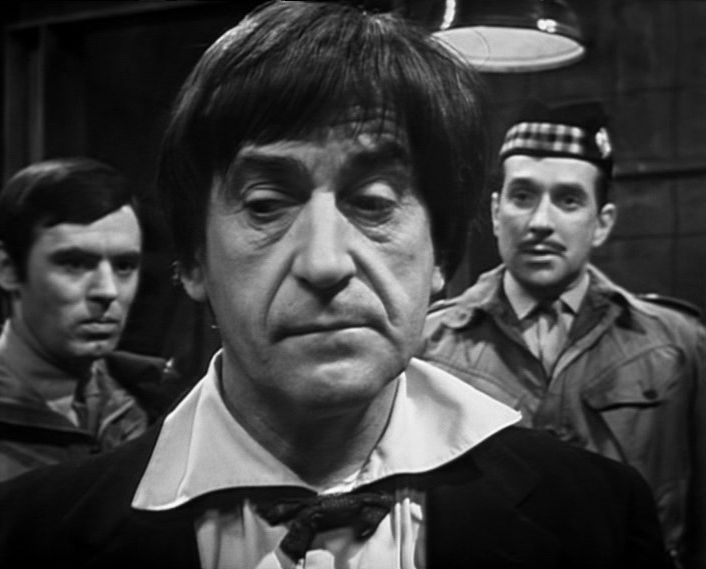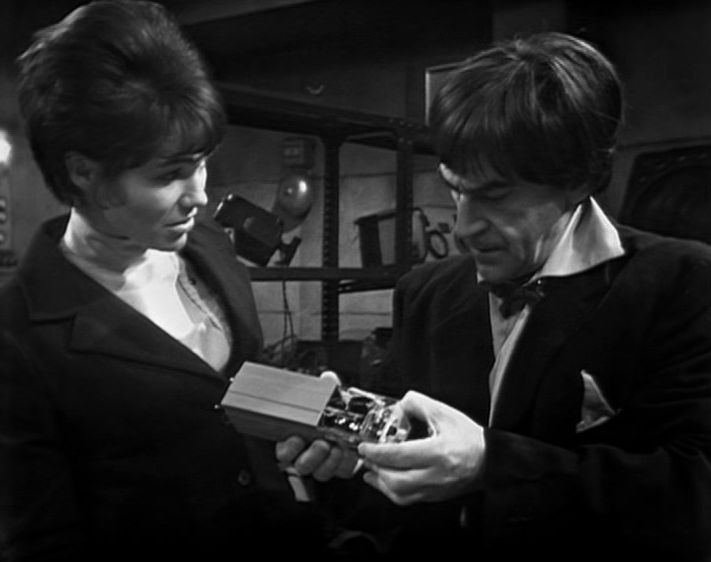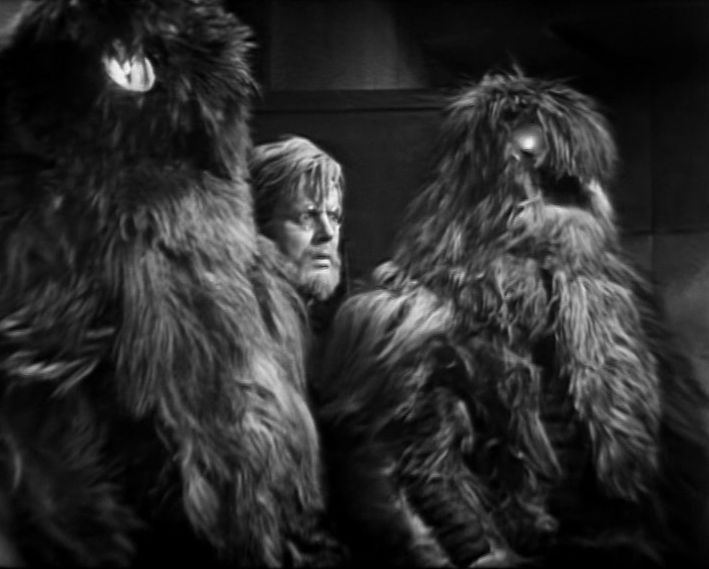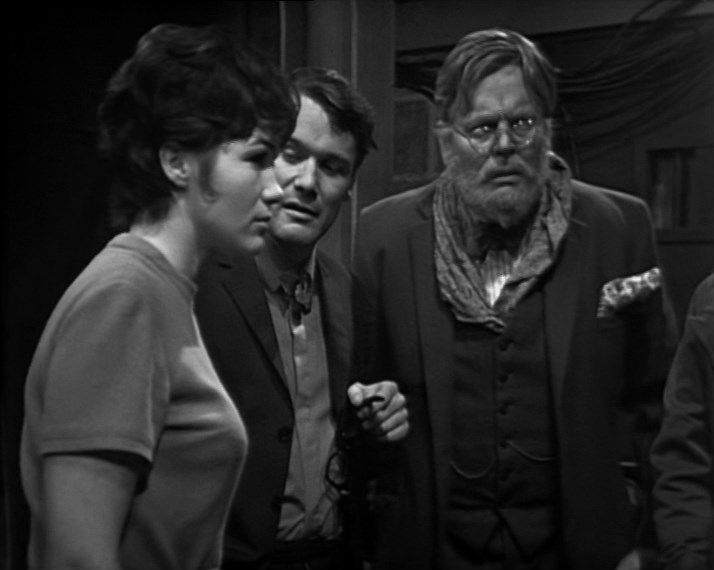
Pathfinders to Venus. Episode Two – Into the Poison Cloud

venus 02

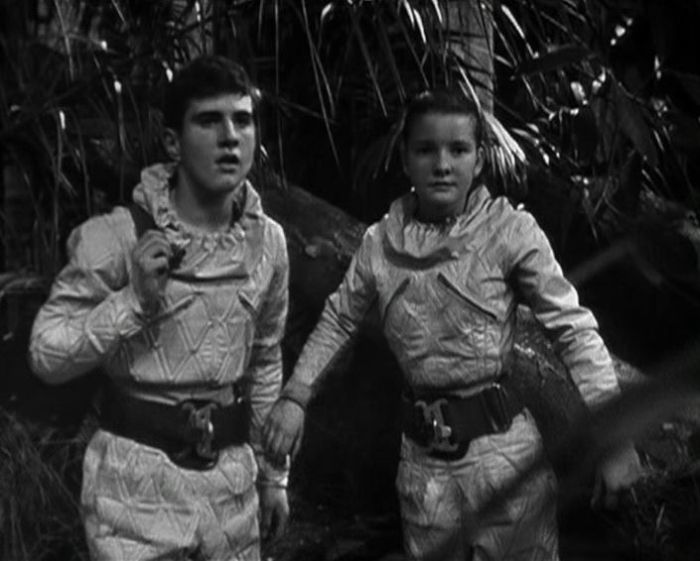
Convinced that Wilson is trapped on the surface of Venus, Conway and the others set out to rescue him.  But before they can do this they have to work out a way to negotiate the poison cloud that surrounds the planet.

After a few minutes chat, they seem confident so once again the dramatic stock music is cued as the sweet little model rocket slowly begins its descent.  You have to respect the abilities of the regulars (attempting to sell the illusion of danger with such limited resources is no easy task).

But although it’s easy to be critical of the effects, some are very effective.  The shots of the American rocket orbiting Venus are nicely done.  The rocket isn’t particularly detailed, but the fact it’s so small means that it contrasts well with the vast planet.  And our first sight of the planet’s surface – the camera tracks down to reveal the rocket nestling amongst surprising lush vegetation – is a decent model sequence.

Brown is convinced that Venus has a breathable atmosphere and – against the advice of the others – he emerges from the rocket without his space helmet.  And wouldn’t you know it, he’s correct.  This is probably the moment where it’s pointless to worry about scientific accuracy and simply go with the flow.  One obvious plus point about this is that it means our heroes don’t have to spend the entire serial wandering about with space helmets on (which I’m sure was Hulke and Paice’s reasoning).

Since this was 1961 you shouldn’t be surprised that the boys (Conway, Geoff and Brown) immediately go out to explore whilst the girls (Mary and Margaret) stay behind in the rocket.  But it isn’t long before the ever-squeaky Margaret gets her chance to take a look outside (albeit with Geoff as a chaperone).

Conway finds the place “menacing” although at present there’s no sign of life.  On the other hand, Brown is delighted – telling Margaret and Geoff that due to Venus’ slower orbit he could expect to live for another six hundred years here.  I’m going to have to think about that one ….

Poor Wilson.  Considering that the others had come to rescue him, now that they’re jaunting around on the surface he’s rather stuck.  So he too decides to make planetfall.  Geoff, manning the radio, can’t convince Conway that the blip he’s monitoring is a rocket (which is reasonable, since they all assume Wilson has already touched down).  The scene of Wilson’s rocket crash-landing is interesting.  Let’s assume that the planet’s surface is very springy (that would explain why his rocket seems to bounce up and down).

What should you never do on a strange new planet? Split up and explore.  So whilst Conway, Mary and Brown have stuck together (with Geoff and Margaret safely in the ship) what do the youngsters decide to do?  Yep, head off under their own steam for a spot of exploration.  Oh dear.

Towards the end of the episode we get to see a bit more of Venus’ lush vegetation (which seems to include large mushroom plants).  We also have our first sign of life – a snake – as Geoff and Margaret close in on Wilson’s crashed rocket.  But Wilson’s nowhere to be found and Geoff makes a disturbing discovery.  “This damage couldn’t have been done by a crash-landing. The rocket’s been ransacked by some creature!”

Stuart Guidotti’s performance, like Hester Cameron’s, is sometimes pitched at a level of extreme hysteria – as it is here.  Possibly they were both told to go for it (as in Doctor Who, end of episode acting was a specialised skill) and it’s fair to say that neither of them are holding back as this episode concludes.

Pathfinders to Venus. Episode One – S.O.S. from Venus

venus 01.jpg

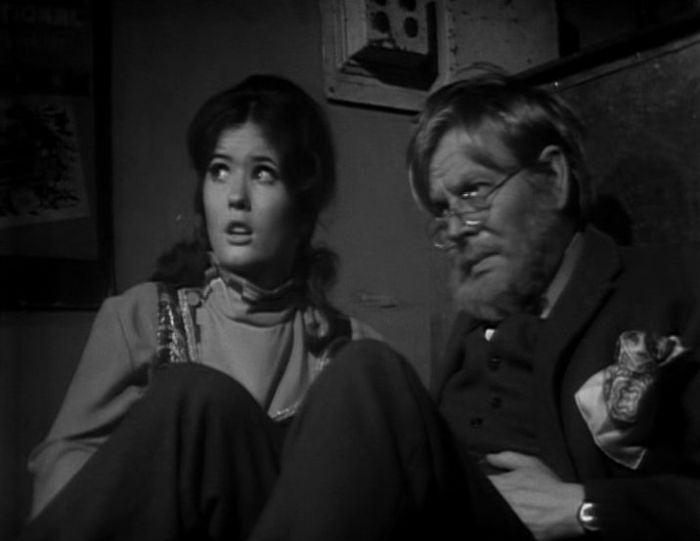
Following directly on from the events of Pathfinders to Mars, the opening of S.O.S. from Venus finds our plucky band of space explorers heading back home to Earth.  Somewhat awkwardly, the chisel-jawed Conway Henderson (Gerald Flood) decides to radio Earth with a rundown of the rocket’s personnel.

This, of course, is done purely for the benefit of new viewers who may not have caught the previous serial.  So in the same spirit, I can reveal that apart from Conway Henderson, also on-board are Professor Mary Meadows (Pamela Barney), youngsters Geoff Wedgewood (Stuart Guidotti) and Margaret Henderson (Hester Cameron) and the loose cannon that is Harcourt Brown (George Coulouris).  Oh, and Hamlet the guinea pig of course.

But when they receive a distress call from an American, Captain Wilson (Graydon Gould), trapped in an orbit around Venus, they elect to change course and help him.  Brown is delighted – his quest for exploration knows no bounds and within seconds he’s chomping at the bit to step foot on Venus.  Conway tells him that they’re only going to orbit the planet, so any jaunts to the surface are strictly out of bounds.  Hmm, we’ve been here before so the astute viewer won’t be surprised to learn that Brown will shortly get his way (otherwise, with eight episodes to fill, the story wouldn’t have been terribly interesting).

Although the serial would quickly abandon its loose grip on scientific realism, in this episode Malcolm Hulke and Eric Paice were at least still paying lip service to established scientific principles, such as degaussing.

The modelwork remains as endearingly low rent as before as do the limited special effects.  Given that this was made in 1961, that’s hardly surprising, although simple camera tricks (simulating weightlessness in space – crawling on the underside of the rocket – by simply turning the picture frame upside down) are still effective.

As has happened before, the opening episode is pretty much a bottle episode – set aboard the rocket.  This means that it’s something of a slow intro – although Conway’s space-walk is good fun.  A pity that the very dramatic stock music during this scene is rather miscued (it starts, then it stops for a few seconds, then it starts again) but such technical issues were common during this era of television.

Things seem to be going smoothly.  Conway and the others have nearly reached Wilson, whilst a Russian rescue rocket is also heading towards them.  But you can always guarantee that Brown will complicate matters and when he spots something through the viewfinder (“it’s a town! A town on Venus!”) he sets to work in order to convince the others that they should land.

The way he does so takes a little swallowing.  Since Wilson’s messages have been recorded, by chopping out a small section of the tape Brown can create the impression that Wilson is on the surface and asking for help.  That Brown is able to correctly estimate precisely how much tape he needs to remove without playing it first is a highly impressive skill …..

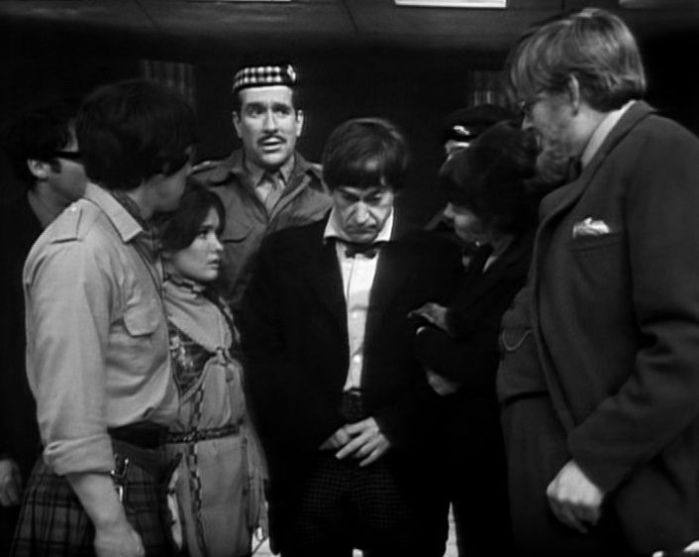
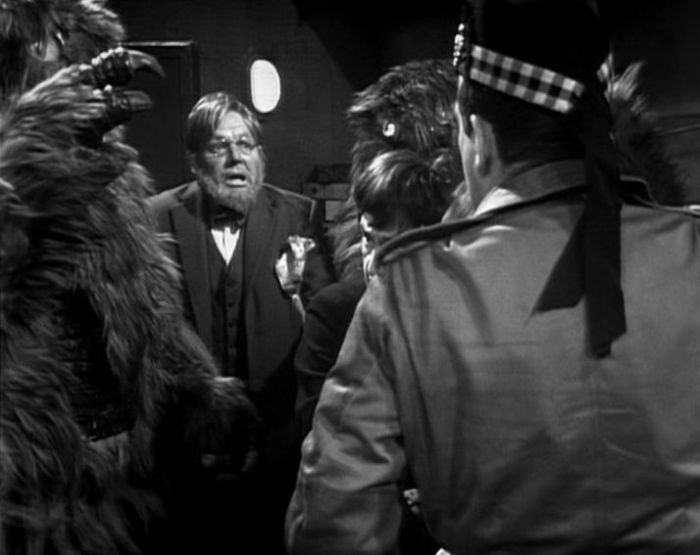
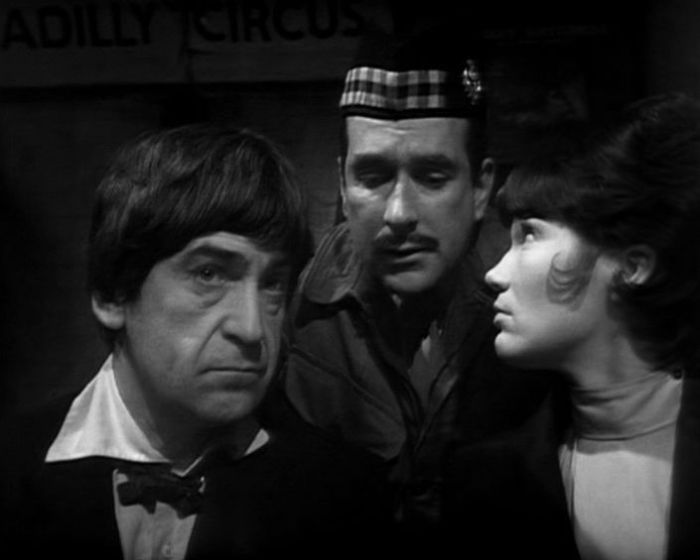
Doctor Who – The Web of Fear. Episode Six

web 06-01

We’ve seen over the last few episodes how Lethbridge-Stewart’s fighting force has been somewhat decimated.  Apart from himself, only Evans and Arnold are still standing.  Evans remains an unreconstructed coward whilst Arnold continues to be a pillar of no-nonsense strength.

ARNOLD: Now look, lad, you’re scared, that’s understandable. But you’ve been in the Army long enough to know that orders is orders. There’s four people up there. If we don’t warn them, they’re for the chop.
EVANS: So? Four of them’s getting the chop. There’s no reason to make it six, is there?

There’s another surprise reappearance – that of Chorley – who was last seen in episode three. It’s suggested again that he’s the Intelligence’s agent, but since he’s been absent for so long that doesn’t quite scan.

Evans getting carried off by the Yeti (“Hey, steady on. Oh, going for a walk, are we? There’s lovely”) is an episode highlight as is the moment when he’s deposited by the Yeti next to the Colonel and the Doctor. He brazenly denies that he had intended to make a break for it. “Desertion? Me? Oh, good heavens, no. No, I thought I’d try a single-handed and desperate attempt to rescue Professor Travers and the girl”.

We’re entering the end-game, as everyone is brought to the Piccadilly ticket hall, where the Intelligence has set up its brain drain machine. And this is where the Intelligence’s agent is finally revealed.  Right up until the last moment we’re teased that it’s Chorley, but then the shock reveal of Arnold is made.

Jack Woolgar impresses as the passionless voice of the Intelligence, but this is another of those moments which doesn’t make any sense. The Intelligence state that he’s been hiding in Arnold’s lifeless body for some time – but exactly how long?

Arnold seemed no different when he reappeared than he did before, but it’s equally hard to believe that he’s been controlled by the Intelligence all along (although that’s what the story tells us). There’s a faint air of disappointment here, somewhat akin to the feeling you get when a whodunit doesn’t play fair.

The story dropped numerous red herrings along the way, hinting that the Colonel, Evans, Chorley, etc were all credible candidates, but suspicion never fell on Arnold for a minute. Maybe this was due to the Great Intelligence’s skill, but it still feels like a little bit of a cheat.

And if the Doctor’s final reckoning with the Intelligence is a bit of damp squib, then it doesn’t really alter the fact that The Web of Fear is a classic slice of Who. A few quibbles about the script apart, this is glorious stuff and something which is always a pleasure to revisit.

web 06-02


Doctor Who – The Web of Fear. Episode Five

web 05-01

After four episodes, the Great Intelligence – speaking through the voice of Travers – finally explains what his/her/its evil plan is.  Some might think that the Intelligence has been somewhat slow on this score, but with six episodes to fill it clearly couldn’t show its hand too soon.

TRAVERS: Through time and space, I have observed you, Doctor. Your mind surpasses that of all other creatures.
DOCTOR: What do you want?
TRAVERS: You! Your mind will be invaluable to me. Therefore I have invented a machine that will drain all past knowledge and experience from your mind.

And this is where the wheels of the story slightly come off. I think that one of the reasons why I enjoy 60’s Who so much is that much of the mythos which would later build up around the character of the Doctor is absent. He’s no god-like creature, known and feared throughout the universe, he’s simply a wanderer in space and time.

So stories where he’s targeted by the baddies are pretty rare (this one and The Chase spring to mind) meaning that it’s much more likely that wherever he appears nobody’s heard of him.

And anyway, if the Great Intelligence needs the Doctor’s intelligence than he/she/it can’t be that great anyway. The Almost Great Intelligence maybe?

We’ve previously seen that the Lethbridge-Stewart of this story is a pragmatist, happy to escape rather than fight to the last man.  So when Evans suggests that if they agree to the Intelligence’s plan (delivering up the Doctor) possibly everyone else will be allowed to go free. The stalwart Brigadier would never consider this of course, but as has been touched upon, the man here isn’t quite the man he’d become and there’s a palpable moment of ambiguity in the air.

The controlled Travers stomps off with Victoria as a hostage whilst the others debate what to do next. Given that the Yeti have decimated the soldiers, there has to be a good reason why the Intelligence simply didn’t take the Doctor. And there is – unless the Doctor submits willingly, the brain drain machine won’t work.  So the fact that the Doctor has been given a deadline to either give himself up or face the consequences provides him with a welcome spot of breathing time.

The Doctor once again teams up with Anne. I wonder if these scenes influenced the creation of Zoe? Zoe might have been younger and more frivolous, but the seed of partnering the Doctor with a scientifically-minded companion might have been sown here.

The scene where Evans deliberately disobeys Lethbridge-Stewart’s order is a fascinating one.  The Brig wouldn’t have stood for this sort of insubordination of course, but the Colonel – still somewhat shell-shocked by the events of the previous episode – accepts Evans’ flagrant disregard of his orders quite calmly.  For those who know Lethbridge-Stewart well, to see the character so out of control is quite disturbing.

Deborah Watling is a little out of the action, but she does get to share a few nice scenes with her father. And when Jamie, out in the tunnels with the Colonel, spots Victoria’s handkerchief it’s hard not to be reminded of one of Frazer’s most famous convention anecdotes.

The Web of Fear is one of those stories where characters tend to disappear suddenly and then reappear with the same lack of ceremony. Both Arnold and Chorley have been MIA for a while but then Arnold pops up out of nowhere, seemingly no worse for wear.

The Doctor and Anne’s lash-up (a device to control the Yeti) seems to work, but a mass of web seems to spell the end for the Goodge Street fortress ….

web 05-02

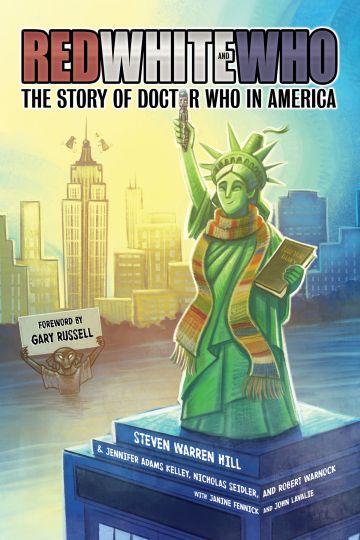
Red, White and Who – Book Preview

RedWhiteandWho

For many British Doctor Who fans, when considering America’s relationship with our favourite programme it’s the 1980’s which immediately springs to mind. That was the decade in which the show exploded in popularity across the US (in relative terms anyway) and whilst British fandom was beginning to turn on itself, becoming increasingly bitter and negative, in America there appeared to be only single-minded love for this newly discovered programme.

There was plenty of money too, as the stars of the programme quickly discovered. The leap from the fledgling and low-scale British convention circuit to the all-expenses paid, air-conditioned hotel experience of the American dream wasn’t lost on anybody. This helps to explain why just about anybody who was anybody in the Who world elected to celebrate the 20th anniversary of the programme at a massive American convention.

As Gary Russell explains in his brief, but amusing forward, this was one of the reasons why British fans regarded their American counterparts with jaundiced eyes. The fact that they also got The Five Doctors two days earlier than us simply rubbed salt into already bitter wounds. And then there’s the term Whovian ….

If you want to irritate an old-school British Doctor Who fan, just refer to them as a Whovian. It works every time. Coined by American fans back in the eighties, the new series has now brought this unlovely term back into common usage (something which continually irks me I have to admit, but then I’m an old-school British Doctor Who fan).

However, the story of Doctor Who in America began well before the 1980’s and continues right up to the current day, meaning that this mammoth book (704 pages, including 130 pages of appendixes) doesn’t leave any stones unturned in order to present us with the full picture.

I’ve had the chance to peruse several sample chapters from the book and what I’ve read has impressed me.  For example, whilst it’s fairly common knowledge that Doctor Who debuted on American television in the early 1970’s (with a package of Jon Pertwee stories) I wasn’t aware that the first faint flickers of interest in the series had occurred long before that.

In the mid 1960’s these mainly consisted of newspaper reports which took an amused look back over the pond during the period when Britain was gripped by Dalekmania.  For some American commentators there was plainly the fear that the Daleks might, following the Beatles, be the spearhead of another British invasion (something which filled certain writers with dread!)  An enthusiastic, if somewhat inaccurate, article from Famous Monsters of Filmland from 1965 is another early example of Doctor Who reporting in the US (these early chapters feature a plethora of fascinating press clippings and promotional material – both for the Dalek movies and the early television sales – which adds considerable extra value to the insightful text).

Chapter Eight – Love and Monsters – covers the PSB pledge drives as well as demonstrating early examples of fan-power.  This is another interesting topic for non-Americans – most of us have probably seen footage from various pledge drives over the years, but exactly how they worked (and the likelihood that money pledged for Doctor Who might not even go towards purchasing that series) was again another revelation.  I also loved Gail Bennett’s remembrance of John Nathan-Turner.   In the early eighties JN-T was, even in the UK, very much a fan’s producer, but it seems that he found greater acceptance in the US.  The notion of JN-T “holding court” at a convention with a group of fans in a hot tub sounds typical of the man, for good or for ill.

Chapter Ten – Doctor Who in Bits – discusses the way that American fans took to the brave new world of the internet whilst Chapter Fourteen – Creativity: Trippingly on the Tongue – exhumes another half-forgotten relic from the history of American Who.  John Ostrander’s stage-play The Inheritors of Time created a certain amount of interest in the mid eighties (not least for the fact that an American Doctor had been cast) but due to a lack of funds it was never mounted.  Ostrander teases the reader with a few hints about what the play contained, although he remains tight-lipped about many of the details (even after all these years it appears he hasn’t given up hope of resurrecting it).

Towards the end of the book, Chapter Twenty – It Couldn’t Have Happened to a More Deserving Fellow – examines the way that the series, in the Matt Smith era, really began to find a foothold in the public consciousness.  Which was a far cry from 2005, when American fans were frustrated that no broadcaster had picked up the Christopher Eccleston series.

Other chapters promise to cover Doctor Who’s first successful invasion, thanks to Tom Baker and Howard Da Silva (although possibly Da Silva’s help – via a series of narrations, designed to educate the American viewer about the series – was more of a hindrance).  As might be expected, the fan experience – via conventions and creative works – also looks to be covered in depth.

The sample chapters suggests that Red, White and Who will be the last word on this topic.  Although the list of authors – Steven Warren Hill, Jennifer Adams Kelley, Nicholas Seidler, Robert Warnock, Janine Fennick and John Lavalie – is a lengthy one, their voices seem to blend together seamlessly.

It’s available for pre-order here and whilst it isn’t cheap at $49.99, it does run to a hefty 704 pages and contains 600 images.  So whilst it’s true that the cost may be a little off-putting for some, what I’ve seen of it so far indicates that it’s no cheap cash in.  This looks to be something crafted with love and appreciation and should certainly be worth your consideration.

Doctor Who – The Web of Fear. Episode Four

,

Presumably sometime during the previous episode Anne decided to swop her mini-skirt and boots for a trouser suit, since that’s what see her wearing as the moving pictures start again.  Given all that’s going on it seems a little strange that she was such a slave to fashion.  She might be an independent young woman, making her way in a man’s world, but it’s possibly not too much of a surprise to find her portrayed as something of a clothes horse (a sign of those times).

When the Doctor and the others find her, she’s in a highly distressed state, which is pretty understandable since the Yeti have abducted her father.  Tina Packer rather overplays here, although given the situation Anne finds herself in that’s not too surprising.

Troughton continues to underplay though, which is notable in the early scene where Evans asks the Doctor if he believes that the Yeti have taken Travers.  The Doctor’s dialled-down, abstracted air makes it plain that he’s considering multiple possibilities, none of them good. When the Doctor later outlines what he knows about the Intelligence, it’s yet another wonderfully delivered few lines from Troughton. “Well, I wish I could give you a precise answer. Perhaps the best way to describe it is a sort of formless, shapeless thing floating about in space like a cloud of mist, only with a mind and will”.

Jack Woolgar continues to impress as well.  Look for the moment when Arnold tells Lethbridge-Stewart that Weams and the others are dead – Arnold’s voice cracks for a split-second, just enough to show the pain he feels at the loss of his men.  That Arnold later turns out to be the agent of the Intelligence, rather than the more obvious Chorley, is a cruel blow, possibly one of the cruellest of the story.

But red herrings continue to be spread about, since the Colonel doesn’t seem to remember meeting Evans (he was apparently his driver).  Does this mean that Lethbridge-Stewart is the agent or is Evans possibly the rotten apple?  No to both questions, but they’re nice misdirects.

Anne operates in this episode as pretty much a proto Zoe or Liz.  Like them, she’s able to speak to the Doctor on a similar scientific level (something that Jamie and Victoria were unable to do) which enables the Doctor to have a confidant who can also act as a sounding board for his theories.

One of the reasons why the Yeti work so well is that they’re not seen very often.  Keep them on screen for too long and their shortcomings become obvious.  But a few brief glimpses here and there, ideally lurking in the shadows, and they’re the stuff of nightmares.

But this episode sees them head out and about as they tangle with Lethbridge-Stewart and the others at Covent Garden.  This film sequence shouldn’t work at all – Yeti in the cold light of day sounds like a very bad idea – but Camfield pulls it off in a pulsating action scene that’s an obvious story highlight.

It’s interesting that Lethbridge-Stewart mounts the mission to Covent Garden for one reason only – to locate the TARDIS which will enable them all to escape.  The Brigadier would surely have remained and fought to the very last man, but the Colonel is much more of a pragmatist, keen to find an escape route.

During the scene you can play spot the stuntman – Terry Walsh, Derek Martin and Derek Ware should all be instantly recognisable and the minute they pop up you know that a spot of action is imminent.  It does seem a little odd that a very familiar piece of stock music (associated with the Cybermen) is used here, but maybe Camfield was unaware it had been used before or possibly it was felt that it didn’t matter that it had previously featured.

Favourite moment during this scene is Yeti who clutches his eyes before falling over.  Since we know that John Levene was playing one of the Yeti, I like to think that he was the one here who decided to go extra-dramatic.  Corporal Blake’s rather horrible death – mainly due to Richardson Morgan’s blood-curdling screams – is something which lingers long in the memory.

Knight and the Doctor head up to ground level to look for some vital electronic spares.  Alas, Knight doesn’t make it as he’s mown down by the Yeti.  The last shot we have of Knight – his lifeless body slumped across a table – is yet another unsettling choice from Camfield and Knight’s sudden, unexpected death helps to raise the stakes.  If Knight, one of those characters you’d have assumed would make it to the end, can be killed then no-one is safe.

This is also borne out when every member of the Covent Garden party – except the Colonel – is killed.  And with Knight also dead and Arnold missing, Lethbridge-Stewart is pushed to breaking point.  The cliffhanger – showing the arrival of the Yeti together with a catatonic Travers – ratchets up the tension several more notches.

Doctor Who – The Web of Fear. Episode Three

It’s a pity that this episode is still missing, although one day it might come back, yes it might come back ….

The major irritant is that it denies us our first glimpse of Nicholas Courtney as Lethbridge-Stewart (although since nothing from his debut existed in the archives before 2013 we can’t grumble about this too much).  And if there had to be a missing episode, then better this one than the next (the Covent Garden battle sequence would have been a much more serious loss).

Although Courtney’s characterisation as Lethbridge-Stewart is already pretty recognisable, the Colonel we see here isn’t quite the Brigadier that he’d become from The Invasion onwards.  Like some of the others (notably Chorley) he’s given the odd, off-key moment, suggesting he might have a secret to hide.   The fact that the story will shortly raise the spectre that the Intelligence must have a mole inside the fortress raises the possibility that the Colonel may well be a traitor ….

Chorley’s undergone something of a transformation from the previous episode.  Although things looked grim then, he was calm and in control. But now he’s suddenly become hysterical and desperate to leave.  Again, this suggests that he may be a man with his own agenda (or it could possibly be that he’s simply a coward, thinking only of his own survival).

The return of the Doctor energises the story – he quickly takes command and impresses the Colonel with his practical suggestions.  Lethbridge-Stewart also has ideas of his own – getting rid of the annoying Chorley by creating the superfluous job of “co-ordinator”, for example.

The Colonel is also in his element when leading a briefing.  Interestingly it’s Anne who is slightly riled when everybody’s presence is requested (“a briefing? We’re not in the army yet”) rather than the Doctor. It would be easy to imagine the Pertwee Doctor expressing a similar sentiment, but the Troughton incarnation was always much more easy-going.

But although the Doctor may appear to be pretty placid, it’s plain that there’s plenty going on under the surface. This was always one of the joys of Troughton’s Doctor. He didn’t need to dominate proceedings like Jon Pertwee or Tom Baker’s Doctors, he was content to sit, watch and wait. But when he spoke, people tended to listen – as seen with this short exchange between him and the Colonel.

DOCTOR: Someone here is in league with the Yeti. Maybe even controlling them.
COLONEL: What?
DOCTOR: The main door didn’t open by itself, did it? It may be any one of us.
COLONEL: Me, perhaps?
DOCTOR: Perhaps.

Based on what we later know, the idea of Lethbridge-Stewart as a traitor is laughable, but at this point we simply don’t know him, so it’s completely possible.  And the fact that Troughton doesn’t overplay this moment – he delivers his lines in very a matter-of-fact way – makes the scene even more powerful.  Unlike some of his successors, Troughton tended to understand that less was more.

Jamie spends most of the episodes stuck in the tunnels with the rather annoying Evans, whilst Victoria’s back in the fortress with the others. She doesn’t do a great deal in the episode sad to say, partly this seems to be because Anne – a more dominant character – is rather taking the limelight. And it’s a pity that as the episode draws to a conclusion we’re left with a whimpering Victoria and a slightly angry Doctor (she’s told Chorley about the TARDIS – a bad move if he’s the agent of the Intelligence).

The sudden death of Weams (the first – but not the last – of the established characters to die) and the cliffhanger shot of a terrified Travers tangling with the Yeti (who have been mostly off-screen during this twenty-five minutes) provides a strong hook into the next episode where – hurrah! – the pictures will move again.

Doctor Who – The Web of Fear. Episode Two

With Patrick Troughton on holiday, episode two allows the others, especially Frazer Hines and Deborah Watling, a little more screen-time.

Jamie and Victoria’s first encounter with the aged Travers is a treat.  Camfield favours lingering on Victoria’s delighted face as she instantly realises that the old man in front of them is the same person they encountered forty years earlier in Tibet.  It’s a nice touch that Victoria is several steps ahead of Jamie, who doesn’t recognise Travers to begin with at all (although when he finally twigs, his comment – “here, hasn’t he got old? Oh, but we’re very pleased to see you, Professor. Very pleased” – is lovely).

The formidable Anne tangles with another man and again easily bests him. Here, it’s the oily newspaperman Harold Chorley (Jon Rollason).

CHORLEY: Oh, for goodness sake, why is everybody being so evasive? Why won’t anybody answer any questions?
ANNE: Perhaps they’re afraid you’ll interpret them in your own inimitable style.
CHORLEY: And what does that mean, pray?
ANNE: It means you have a reputation for distorting the truth. You take reality and you make it into a comic strip. In short, Mister Chorley, you are a sensationaliser.
CHORLEY: You smug little redbrick university ….
ANNE: Don’t say it, Mister Chorley. I have a very quick temper and very long claws.

Ouch! It’s interesting that although Web was made some fifty years ago, Chorley’s character – a unscrupulous journalist – is still a very recognisable one. The more things change ….

Jack Woolgar gives a lovely performance as Staff Sergeant Arnold. Arnold is your archetypical NCO – a gruff, no-nonsense type who’s easily able to keep his subordinates in order. Amongst his charges is the familiar face of Richardson Morgan (as Corporal Blake). Morgan would later turn up in The Ark in Space. Also good value is Stephen Whitaker as Craftsman Weams.

The arrival of Driver Evans (Derek Politt) adds a little levity to the story. He’s a comic, cowardly Welshman (if his accent wasn’t obvious enough, then the fact he turns up singing the Welsh national anthem provides the audience with another clue as to his nationality. Not the subtlest of characterisations then).

The Yeti look very good when lumbering through the tunnels on film. When they pop up on videotape it’s fair to say that they’re slightly less impressive, but Camfield is still a good enough director to ensure that they don’t look completely ridiculous (other directors might not have been so successful on this score).

There’s already a nice sense of claustrophobia and unease throughout this instalment, which increases as the story progresses. Although the Troughton era tended to overdose on base-under-siege stories, when done well (as here) they’re gripping entertainment. By the end of the second episode, the parameters of the story have been established – a small group of heroes isolated in the underground and menaced by the Yeti on all sides.

With Victoria lost in the tunnels and the Doctor still missing, things are nicely set up for episode three.

Doctor Who – The Web of Fear. Episode One

Following the news of Deborah Watling’s death, I’m sure I wasn’t the only one to reach for this story.  Back in the mid eighties though, if you wanted to see Victoria in action you were limited to either the second episode of The Abominable Snowman, episode three of The Enemy of the World or the first episode of this one (and that was always supposing that you were able to obtain a pirate VHS from a friendly contact).

It’s very pleasing that season five is now much better represented than it was back then and, for me, it’s the two stories returned in 2013 – The Enemy of the World and this one – which are the real jewels in the crown.

I first encountered Web 1 back in the late eighties, on a pirate tape along with a selection of other orphaned Hartnell and Troughton episodes (a bit like an early Lost in Time then, although the picture quality sometimes left a little to be desired).  It’s therefore an episode which I’m very familiar with, having rewatched it countless times across the decades (always wondering whether the rest of the story would maintain this strong opening).

Non-controversial statement – Douglas Camfield was Doctor Who‘s best director.  It’s easy to see why he directed more stories than anybody else – his skill at crafting intriguing picture compositions (both in the studio and on film) was second to none and there’s plenty of examples to be found in this opener.

Since studio time was always limited, most directors wouldn’t spend too long on creating interesting visual images – simply getting the actors to hit their marks and deliver their lines without bumping into the scenery seemed to be the top priority.  Camfield, possibly due to the fact that he ran his productions with a military precision, was quite different as he was able to find the time to craft pleasing shot selections.

A good example can be found in the early TARDIS scenes.  The Doctor, Jamie and Victoria, staring at the scanner screen, are positioned with the Doctor in front, Victoria behind him and Jamie at the back.  In order to make this shot work, all three actors had to hit their marks exactly whilst the cameraman also had to be in precisely the right place.  If anybody was slightly off, then the composition wouldn’t work.  Many directors would simply have elected to line them up side by side (this would have been easier to shoot, but also would have looked unnatural – Peter Davison raises this point several times on his audio commentaries – the way that certain directors shot the TARDIS scenes very flatly).

I assume the reason why the confrontation between Travers (Jack Watling) and Julius Silverstein (Frederick Schrecker) is recorded on film was because the underground sets took all the available studio space.  Camfield always had an affinity with film (no surprise that he later graduated to all-film series like The Sweeney) which makes this scene a creepy pleasure.  It’s true that Jack Watling gives a very broad performance (“stubborn old goat!”) and his facial contortions are something to behold, but presumably he was playing the part as written.

Strong female characters aren’t terribly common during this period of the show, so Travers’ daughter Anne (Tina Packer) stands out rather.  A scientist in her own right, she’s acidly polite when the hapless Captain Knight (Ralph Watson) attempts to clumsily chat her up.

KNIGHT: What’s a girl like you doing in a job like this?
ANNE: Well, when I was a little girl I thought I’d like to be a scientist, so I became a scientist.
KNIGHT: Just like that?
ANNE: Just like that.

Compare and contrast this with The Invasion (which in its early drafts would have featured return appearances for Anne and Professor Travers). Anne’s replacement – Isobel – is a much more pallidly drawn character who’s happy to entertain romantic overtures from Knight’s counterpart – Captain Jimmy Turner.

Whilst I may love The Web of Fear dearly, it’s not a story that makes a lick of sense.  Firstly, if the Great Intelligence’s plan was to ensnare the Doctor, why envelop London in a web?  After all this wasn’t the early seventies – a time when the Doctor was resident on modern-day (to the viewers) Earth.

And the moment when the museum Yeti changes before our eyes from the cuddly Abominable Snowman version into the sleeker Web of Fear model might look good, but again it’s something which isn’t at all logical.

Quibbles apart, this opener effectively sets the story up.  We know what we’re dealing with (Yetis in the Underground!) and we’ve also been introduced to a varied cast of military characters who we’ll get to know better as the serial progresses.

For many long years there seemed to be little hope that we’d ever get to see the rest of the story.  And then in 2013 something remarkable happened …..

Out of the Blue – Series Two, Episode Six

blue s02e06

The team investigate the death of a fourteen year old prostitute called Justine Painton (Caroline O’Hara) ….

We’re pitched straight into the action. It’s late at night and in a run down part of town, Justine’s body is discovered. With a plastic bag over her head and rope marks on her wrists it seems that natural causes can be ruled out.

The officers stand around cracking weak jokes in the time honoured fashion (anything to take their minds off the actuality of the present situation). A brief moment of levity is provided when Becky sets the record straght about her night of limited passion with Lew (she knows that he would have already spun them his version of events). The only problem is that he hasn’t said a word ….

Justine’s mother, Fran (Siobhan Finneran), maitains a shrine to her daughter at home. Numerous school photos and beauty pagent trophies act as reminders of the girl she was, not what she’d become. Wasted potential (Becky and Warren view the cleaned up girl on the mortuary slab and Warren mentions how beautiful she was) is a theme of the story.

Family-man Ron finds the case a little hard to deal with. It’s not dificult to understand why (girls the same age as his daughter leading a dissolute life). One of Justine’s friends, Kirsty (Sarah Jane-Potts), tells him and Marty that Justine embraced life on the streets wholeheartedly. Is this the truth or simply an obfuscation? And what precisely did her mother know about her daughter’s new life?

One very striking moment occurs when Kirsty is speaking about Justine. The scene is overlaid with photographs of a younger Caroline O’Hara, which serves as an effective counterpoint between the past and the present.

It’s a remarkable coincidence that Richard Shaw (Pip Donaghy), the father of Warren’s ex-girlfriend Lucy, knew Justine intimately (he took bondage photographs of her). He offers to share his information, provided the police can arrange a meeting with his estranged daughter. Warren knows precisely where she is, because he’s been keeping tabs on her (mmm, a touch obsessive).

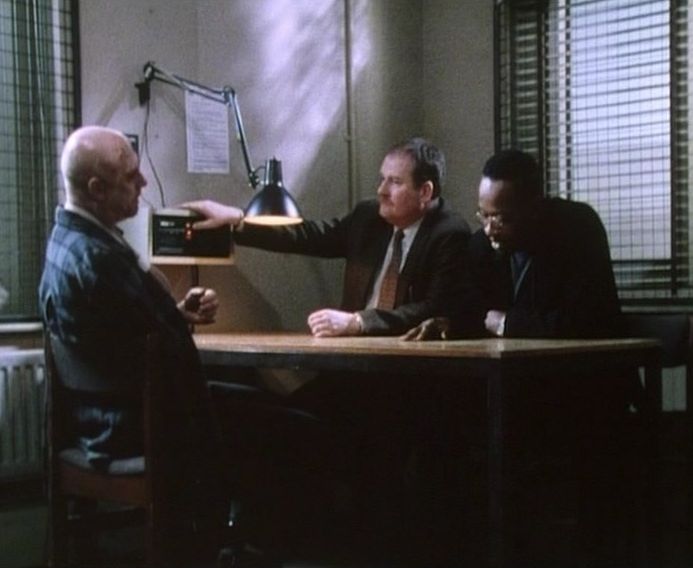
Local celebrity, boxer Vinnie Harper (Adam Kotz), was involved with Fran. But was he also intimate with Justine? The big guns (DI Temple and Lew) are wheeled out for a pulsating interrogation as we see Vinnie hauled over the coals.

Although Caroline O’Hara (making her screen debut) has very limited screentime (after all, her character is dead when we first see her) Justine still permeates every part of the story. Her death means that she’s robbed of her own voice, so others have to ascribe her with motivations and fill in her character for us.

Although answers are provided, justice is harder to come by. This was one of the strengths of Out of the Blue, a series which never felt obligated to pretend that life was fair. One of the final scenes – in which a distraught Lew makes this point to a resigned Temple – could be seen as a setup for the third series which never came. Would series three have finally been the point where Lew went too far?

We’ll never know, but while Out of the Blue never became a mainstream success, twenty years on it stands up as a flawed – but fascinating – series.

Deborah Watling (1948 – 2017)

image

I was very sorry to hear today that Deborah Watling has died at far too young an age. Whilst she’ll no doubt always be best remebered for Doctor Who, she had several other entries on her CV which are worth checking out.

Right at the beginning of her career was H.G. Wells’ Invisible Man (1958). Ten-year old Debbie played Sally, niece to Peter Brady, the invisible man of the title. Sally rarely played a central role in the stories but Debbie was always eye-catching and managed to steal more than a few scenes.

Her last dramatic television role was as the vampish Norma in Danger UXB (1979). Possibly not a series that’s terribly well-remebered today, but it’s a quality WW2 programme with a fine ensemble cast which I’ll have to dig out soon for a rewatch.

On the big screen, 1973 saw her act with two British pop stars from very different generations. Take Me High, a tale of Cliff Richard and brumburgers is a wonky guilty pleasure whilst That’ll Be The Day is in a different class altogether. Debbie played Sandra, a young girl used and rather abused by the feckless Jim MacLaine (David Essex). That’ll Be The Day is more than a David Essex star vehicle since it stands up as a decent film in its own right. It’s something else which I’ll no doubt be revisiting shortly.

Back In my convention-going days I had the opportunity to meet Debbie on several occassions and she was always a delight – an attentive and welcoming guest. Possibly my strongest memory of her comes from a small convention held in Weston-Super-Mare during the mid nineties.

As often happened, the timetable started to go a little awry which meant that nobody was terribly pleased when the auditorium was cleared for what appeared to be no good reason. But all turned out well in the end as it became clear that Debbie had been rehearsing a special entertainment – a song and dance routine where, showing a good deal of leg, she left most of us speechless! Happy days and a memory to treasure.

This is an obvious clip to end on, but it’s a very pertinent one. Thank you Debbie. RIP.

Out of the Blue – Series Two, Episode Five

blue s02e05

Three homeless people (one of them played by the highly recognisable Andy Devine – who would later appear as Shadrach in Emmerdale) are poisoned after a seemingly good Samaritan offers them a drink of champagne laced with prescription tranquillisers.

Temple’s mildly curious, but doesn’t regard it as much more than a sick joke.  It’s a sign of the times that the office only seems to have one computer and – as the victims use it to put together an identikit picture of their well-heeled poisoner – Temple gripes about the expense.  “Have you any idea how much that computer takes out of my budget? It’d be cheaper to hire Walt Disney”.

Temple’s given some good lines in this one.  A few minutes later he asks Becky and Warren exactly what they’re going to do.  “Put out an All Points Alert for Burlington Bertie?”  That’s a rather obscure reference which – back in the pre-internet nineties – would probably have perplexed a section of the audience.

Elsewhere, Bruce, Lew, Marty and Ron go in mob-handed to tackle Gibbs (Peter Jonfield), who appears to have a shop full of stolen goods – although annoyingly none of his stock appears to be on the stolen property register.  By racially taunting Bruce, Gibbs successfully manages to get under his skin – making him all the keener to nail him, although it also might serve to make him more reckless.

This subplot somewhat moves into the background once it’s discovered that Jackson (Devine) has been attacked again, only this time he’s dead.  Is it connected to the previous poisoning?  The descriptions of the suspects indicate not and the fact that one of them had red hair gives Marty the chance for a droll comeback.  “That’s handy, I’ve been looking for an excuse to arrest Mick Hucknall”.

They trawl the drug rehabilitation centres for clues, which sees Lew and Tony take diametrically opposing views on their usefulness.  It’s no surprise that the humanitarian Tony believes they help to prevent crime as well as getting people back on the straight and narrow whilst the more cynical Lew begrudges the fact that his taxes are used on such people.

Bruce has been operating on a tight-fuse for a while.  And after Warren makes an offhand remark (wondering if his obsessive nature is a family trait) Bruce takes it as a dig directed at his father and fisticuffs ensue.  This creates a nice sense of tension which, together with Lew’s off-kilter personality, means that the team have never been more dysfunctional.

Another soap favourite, Maggie Jones (Blance Hunt from Coronation Street) makes a brief appearance as Joan Palmer.  Bruce wants Joan to identify the property from Gibbs’ shop as hers, but when she’s unable to do so Bruce is once again frustrated.  Emma Bird, who also would have been a familiar face at the time (she’d played Maxine during the 1992/93 run of Casualty) makes an impression as Nikki, another of the poisoned down and outs.  She’s an actor who seems to have slipped off the radar, as her last screen credit (an episode of Liverpool 1) was all the way back in 1999.  And the eagle-eyed might spot a young Benedict Wong making a brief appearance as a wages clerk.

The team arrest a suspect, Eamon Timmer (Simon Tyrell), for Jackson’s murder.  He’s very talkative before the tape starts rolling (“I killed Jackson Hanley! I did it. And I’ll kill every tosser in this room”) but doesn’t say a word after the red light goes on.

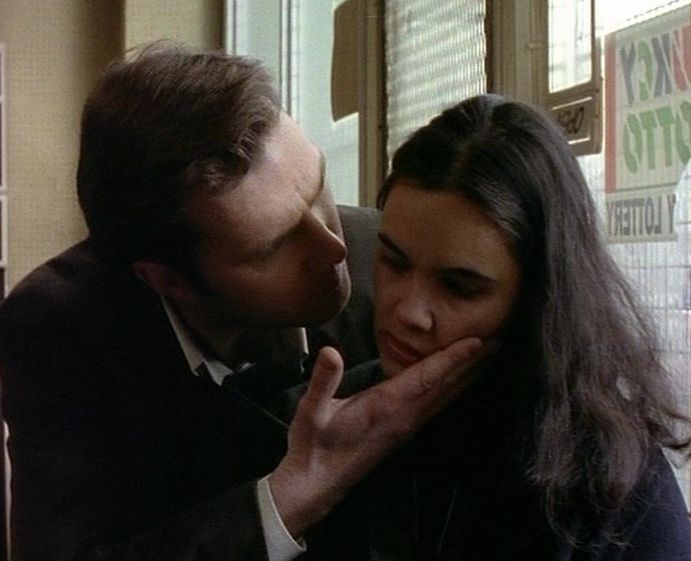
Although none of the plots really engage, the interactions between the team (especially the continually wise-cracking Marty) helps to keep the interest levels up.  The final scene is especially intriguing. After Becky’s attempt to console Warren (still smarting over the end of his relationship with Lucy) comes to nothing, she winds up in bed with Lew.  Her post-coital expression makes it plain that she realises what a terrible mistake it was ….

Out of the Blue – Series Two, Episode Four

blue s02e04

Danny Caswell (David Prosho) makes a stand against local drug dealer Tommy Defty (Neil Stuke). But when Danny’s house is trashed and his car is torched he wonders if talking to the police was the best option. Meanwhile, Tommy continues to taunt the police, convinced that he’s untouchable.

This episode’s cold open is very effective. A typically bleak, run-down estate is the venue as Lew and Bruce rush over to Danny’s house. It’s not just the damage that’s disturbing as the imagery (stickmen hanging) is plainly designed to intimidate. But although Danny’s not scared off, the CPS, in the form of Barbara, decide that they haven’t good enough evidence to proceed.

Warren caustically refers to the CPS as “Couldn’t Prosecute Satan” whilst Marty has his own unique take on how they might deal with Tommy. “I could take me Black and Decker round his house and drill his arse”.

Danny and his wife, Diane (Kate Rutter), cooperated with the police and got nothing for their pains – except a burnt car, a trashed house and the enmity of Tommy’s crew. It’s not really a great advert for working with the police. A frustrated Danny later vandalizes Barbara’s house and when questioned by Temple angrily tells him why. “You’ve given up on us. You’ve pulled the ladder up after you”.

Lew’s off-kilter personality comes to the fore when he and Bruce question Tommy’s mother, Mrs Defty (Barbara Ewing). He fingers her drying underwear and lays a delicate hand on her shoulder. Later, he breaks into her bedroom for a chat ….

Lew’s mind games are effective, if unconventional (and no doubt illegal). He knows that Tommy’s mother, just like everybody else, lives in fear of him – so needling both her and him might be the way to chip away at his hard shell. Ewing (best known for Brass) is effective whilst Stuke (who has gone on to enjoy a considerable career) is excellent value as the cocky drug-lord.

The loose cannon that is Lew is the motor which drives this episode along. Mrs Defty sums it up well. “Tommy scares me right enough, but you scare me more”.

Warren’s relationship with Lucy seems to have hit an impasse after she starts chatting to Tommy at a nightclub (despite Warren telling her not to). This might be good news for Becky, who seemed a little perturbed that Lucy and Warren were becoming serious. It’s doubtful that Lucy and Becky will ever be friends though, especially after Lucy spits in her face.

When Lucy – an unstable person if ever there was one – declares that she’s heading off to be with Tommy it adds another complication to the story. Warren and Becky go riding to the rescue, which involves them planting drugs on Lucy so they can extract her without making Tommy suspicious.

Another strong story which features a victory of sorts, although the collateral damage also has to be taken into account.

Olivier Twist/Bleak House/Barnaby Rudge to be released by Simply Media – 21st August 2017

Due on the 21st of August from Simply Media are another three classic Charles Dickens adaptations from the 1950’s and 1960’s.  Press release  –

Simply Media are delighted to announce the DVD release of three BBC Charles Dickens classic drama adaptations on 21st August 2017: Oliver Twist (1962), Bleak House (1959) and Barnaby Rudge (1960).

These rare and highly sought-after original BBC drama series are presented in their stunning black and white original form, and are all fondly remembered for their great production value and the fantastic acting talent in each production.

These will form a part of Simply Media’s Charles Dickens Classics Collection, with three other Charles Dickens classics already available on DVD from Simply Media: Dombey and Son (1969), Great Expectations (1967) and Our Mutual Friend (1958).


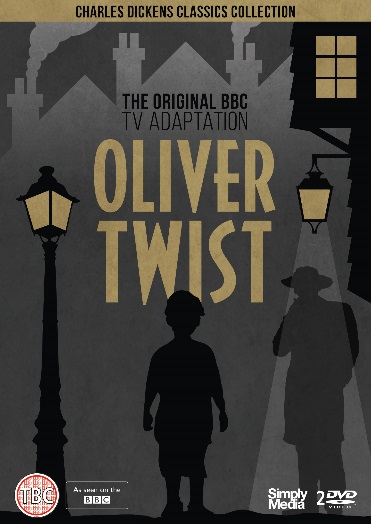
Oliver Twist (1962)

image003

The first ever BBC television adaptation of the Charles Dickens classic Oliver Twist. Adapted by Writers’ Guild of Great Britain award winner Constance Cox (The Forsyte Saga), who specialised in creating great adaptations of classic literature for screen, and featuring an atmospheric soundtrack composed by BAFTA-nominee Ron Grainer (Doctor Who).

This uncompromising adaptation of Dickens’ tale of a gang of orphan boys turned to crime changed the face of British Sunday teatime viewing. Cox’s unvarnished depiction of despair and depravity in the back alleys of 19th century London, and the cruel divide between rich and poor, shattered expectations of cosy family drama. But this is Oliver as Dickens intended, without the enforced jollity of the blockbuster Lionel Bart/Carol Reed musical.

BAFTA-nominees Max Adrian (The Devils) stars as villainous Fagin and Peter Vaughan (Game of Thrones / Our Friends in the North) an indelibly brutal Bill Sikes, Bruce Prochnik (Emergency-Ward 10) a gentle Oliver, Melvyn Hayes (It Ain’t Half Hot Mum) a spry Artful Dodger, and Carmel McSharry (Beryl’s Lot) the trapped and powerless Nancy. Interestingly, both Prochnik, who played Oliver, and Willoughby Goddard (William Tell), who played Mr. Bumble, reprised their roles in the original Broadway production of “Oliver!

This landmark BBC production was a gritty game-changer that raised the bar and stretched the boundaries of TV adaptation and serial drama.

Format: DVD / RRP: £19.99 / Certificate: PG

Catalogue Number: 169661 / Barcode: 5019322696612

Genre: TV Series – Drama / Run Time: 390 mins approx. on 2 discs


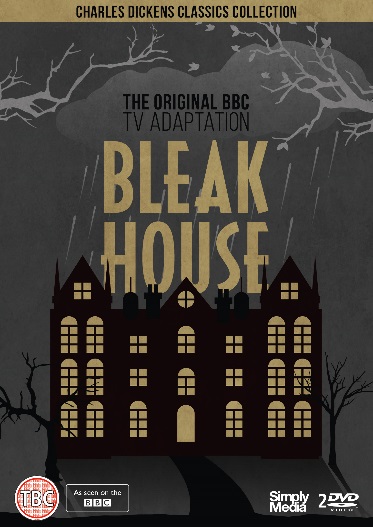
Bleak House 1959

image004

The first ever BBC television adaptation of the Charles Dickens classic Bleak House, also adapted by the prolific Constance Cox. Starring Andrew Cruickshank (Dr. Finlay’s Casebook), Diana Fairfax (Just William), Colin Jeavons (The French Lieutenant’s Woman), Timothy Bateson (Dad’s Army) and Michael Aldridge (Last of the Summer Wine).

Dickens’ elegant satire about a disputed inheritance and the self-serving workings of the legal system gripped the public’s imagination. Cruickshank stars as John Jarndyce and Fairfax as his ward Esther Summerson in this delightfully complex comic drama.

A mystery story in which Esther uncovers the truth about her birth and her lost mother Lady Dedlock (Iris Russell); a murder story featuring one of the first detectives in English fiction, Inspector Bucket (Richard Pearson); and at its heart a redemption tale about a desolate home transformed by compassionate love. A slick and satisfying examination of double-dealing and injustice.

Format: DVD / RRP: £19.99 / Certificate: U

Catalogue Number: 167536 / Barcode: 5019322675365

Genre: TV Series – Drama / Run Time: 390 mins approx. on 2 discs


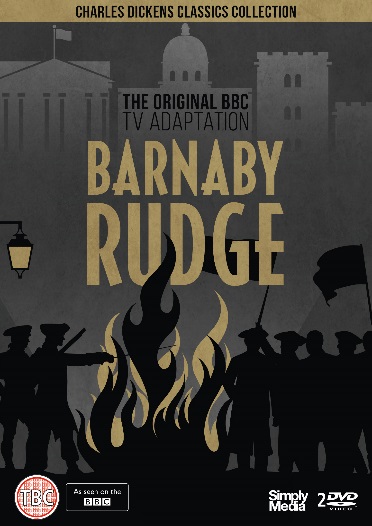
Barnaby Rudge (1960)

image005

The acclaimed BBC adaptation of Dickens’ classic tale of the 1780s Gordon Riots Barnaby Rudge, adapted by Michael Voysey and directed by Z Cars’ Morris Barry, remains the only TV portrayal of Dickens’ tantalizing gothic drama.

Starring John Wood (War Games), Barbara Hicks (Brazil), Timothy Bateson (Harry Potter and the Order of the Phoenix) and BAFTA-nominee Joan Hickson (Agatha Christie’s Miss Marple).

On a stormy night in 1775 a ragged stranger (Nigel Arkwright) wanders into the Maypole Inn. Edward Chester (Bernard Brown – Crown Court), whose horse is lame, leaves the inn on foot to meet his beloved Emma Haredale (Eira Heath – A Man for All Seasons) at a masked ball. Joe Willet (Alan Hayward – Cash on Demand), quarrels with his father, Maypole landlord John (Arthur Brough – Are you Being Served?), and joins the army, only saying goodbye to Dolly (Jennifer Daniel – The Reptile), the pretty daughter of locksmith Gabriel Varden (Newton Blick – Morgan: A Suitable Case for Treatment). Varden’s household includes his formidable wife (Joan Hickson) and dithering maid Miss Miggs (Barbara Hicks).

Simple-minded Barnaby Rudge (John Wood) wanders in and out of the story, chattering with his pet raven Grip. Barnaby’s mother Mary (Isabel Dean) is visited by the stranger, and feels compelled to protect him.

As the stories interweave, Barnaby is caught up in the Gordon Riots, a violent demonstration against Catholics. Jailed with the ringleaders, will he hang for their actions?

Format: DVD / RRP: £19.99 / Certificate: PG

Catalogue Number: 169660 / Barcode: 5019322696605

Genre: TV Series – Drama / Run Time: 390 mins approx. on 2 discs

Out of the Blue – Series Two, Episode Three

blue s02e03

Terry Forrest (Thomas Craig) is the victim of a male rape. Chris Mannings (Fine Time Fontayne), a gay man who lives on Terry’s estate, becomes a suspect ….

An unusual topic to cover, the episode isn’t graphic but the aftermath of the assault resonates throughout. Unsurprisingly there’s some unreconstructed views offered by the team, notably Marty. When Temple tells him and Ron to hit the gay clubs to look for leads, he mutters “better get that frock ironed Ron”. Ron seems to find the case particularly distasteful. Becky tells him to think of it as an assault, rather than a rape, but this doesn’t seem to help.

Ron later explains his problems to Temple. “It’s just that if it’s a lass who’s been raped, then I can tell her that she’s safe, that I’m there to protect her. I looked at Terry Forrest today. What can I say to him. What can I offer him?”

When Mannings’ naked, battered body is dumped outside the police station, it’s obvious that the locals have dished out their own brand of summary justice. One of Forrest’s friends, Kevin Ryan (Karl Draper), seems to be implicated in the attack, but he denies it.

There are plenty of parallels to be found in real life with this sort of knee-jerk vigilante action, but the question here is whether Mannings is actually guilty. The wonderfully-named Fine Time Fontayne (unsurprisingly not the name he was christened with) impresses as Mannings as does Thomas Craig as Forrest.

As the story continues, there are varying degrees of empathy to be found. Lew, on hearing the news of Mannings’ beating, decides there’s little they can do to help the gay community ward off further attacks unless they “supply an armed guard for everybody on the estate with a Judy Garland album”.

It’s also an interesting wrinkle that Becky is the one who voices the opinion that Forrest might not have been raped after all – possibly it was consensual sex which then turned violent. It wouldn’t have been surprising, had this been a female rape, to hear the male officers express a similar viewpoint, so there’s an obvious irony at work here.

We eventually learn the identity of Forrest’s attacker. Given that the story had only given us a few possibilities it doesn’t come as a complete surprise, but the scene where the rapist offers his plea of self-justification is another nicely done moment.

Although the various personal traumas of the regulars – Marty’s marriage problems, Warren’s tense relationship with Lucy – are still bubbling away, for once they’re reduced to background noise as the policework dominates.

Out of the Blue – Series Two, Episode Two

blue s02e02

Zamwa Sidikki, owner of a minicab business, is discovered bludgeoned to death, a blood-covered baseball bat nearby. Racial or personal? That’s what Temple and the others have to discover.

Since Sadikki wasn’t the most popular of men there’s no shortage of suspects, such as his estranged son – Rafi (Raji James) – who had a falling out with his father several months ago. Gareth Chester (Neil Boorman), the only white driver employed by Sadikki, also seems to be a strong suspect. But possibly Sadikki’s daughter, Yasmin (Rina Mahoney), might hold the key.

Warren continues to let his lower regions rule his head as his relationship with Lucy continues. He thinks nothing of nipping away during the middle of the day for a moment of passion with his attractive, if flaky girlfriend. This flakiness is on show after she flashes him (and a delighted elderly passer-by) from her bedroom window.

It’s fair to say that his colleagues aren’t terribly sympathetic about Warren’s conquest. Bruce succinctly sums up their mood. “He’s been going off at us for years about respecting womankind. And then it turns out that kid Warren is just another copper who can’t keep his toolbox in his trousers”.

He’s not the only one with personal concerns though. Marty and his wife have decided to adopt (a storyline which bubbles away in the background for the remainder of the series) whilst Bruce’s father, Andy (Oscar James), suffers a paranoid attack.

James, instantly recognisable thanks to his three year stint on EastEnders, makes an immediate impact here. Andy, currently living with his daughter, comprehensively smashes up her kitchen, although it’s clear that he’s not responsible for his actions.

The tricky subject of mental health would have been a fruitful one to tackle over the course of the series, but it’s somewhat glossed over since this episode is the only time we meet Andy. But even given this, Lennie James has a couple of decent scenes as Bruce attempts to come to terms with his father’s illness.

Although Sidikki’s murder is never that engrossing a mystery, the script still clips along at a nice pace, helped no end by the dialogue. One of my favourite moments occurs when Marty, who can always be relied upon, loses his patience with a suspect. “I can always tell when you’re lying ‘cos your lips move. We are not being paid to stand around here listening to you feeding us your tripe and bollocks. Do we look like Richard and Judy?”

Out of the Blue – Series Two, Episode One

blue s02e01

A baby is snatched from the bus station and a major incident is launched.  But things turn out to be more complicated than they first appear ….

After a new title sequence we’re thrust straight into the action via a cold opening.  The reason for all the rushing about quickly becomes obvious, but despite the best efforts of everybody there’s no sign of the child.  It’s interesting that Jim ‘Lew’ Llewyn (David Morrissey) isn’t given a proper introduction (Lew has obviously been a member of the team for some time) but this probably works to the series’ benefit.  Showing Lew finding his feet might have worked dramatically, but it also would have slowed the main story down.

But although Lew seems to have fitted in well, bantering easily with the likes of Marty, a slightly discordant note is struck by Temple.  A brief throwaway comment from him makes it plain that he has little love for his latest recruit.  The reason will become a little clearer as we work through the second series.

Joanne Player (Keeley Forsyth) and Matt Pearson (Paul Nicholls) play the young couple who may not be telling the whole truth.  Both Forsyth and Nicholls were at the start of their careers with only a handful of credits prior to this (both of them had appeared in The Biz, for example).

When a witness later suggests that when they saw Joanne and Matt the baby wasn’t with them, the story veers off into a different direction.  Temple orders the floorboards at their flat to be lifted up, although Marty comments that if they were organised enough to concoct a fake story of abduction, it’s unlikely they’d be stupid enough to shove the child under their floorboards.

Love is in the air.  Tony is going out with a widow, a fellow member at his local church.  Since Bruce has decided that Tony may be a little out of practice with women, he decides to give him the benefit of his advice – although it seems that Bruce is more concerned with winding the anxious Tony up.

Meanwhile, Warren meets Lucy Shaw (Nicola Stephenson) for the first time.  To begin with it doesn’t appear that a relationship is on the cards, since she’s simply a witness in an investigation.  Her father, Richard Shaw (Pip Donaghy), is accused of taking bondage photographs.  Although he strenuously denies it, as time goes on his true colours are revealed.

Donaghy gives a chilling performance as a seemingly innocent family man.  But his one-on-one interview with Becky provides us with clear evidence that there’s more to him than meets the eye (although since he’s done nothing illegal he can’t be charged).  Shaw will return in the final episode, whilst his daughter features throughout.  When Warren learns that a distraught Lucy doesn’t want to return home, he takes her under his wing.  I have to say that the sight of Darrell D’Silva’s naked backside, as Warren and Lucy become intimately acquainted, was something of a surprise.

Even this early on it seems obvious that their relationship is doomed.  She seems to be vulnerable and unstable, which suggests that Warren’s simply taking advantage of her.  The sensible thing would be for both of them to walk away, but since both are flawed characters it’s not that simple.

Marty remains in fine form.  On spying a teenager defacing a Missing Persons poster with a marker-pen, he gives the young lad a taste of his own medicine by drawing a pair of glasses and a beard on his face!  Quite how Marty manages to get away with these sort of things is anybody’s guess, but I daresay a certain section of the audience would have approved of his brand of rough justice.

Although the main story is pretty bleak, there’s the odd moment of levity.  Lew stops a man, Phil Draper (Jim Millea), who’s acting suspiciously.  After Lew asks him to open the boot of his car, he reacts in horror as a sheep jumps out and beats a hasty retreat down the road.  Phil coolly suggests that the sheep must have already been there when he bought the car.

The ending might not come as too much of a surprise, but Nicholls and Forsyth are both effective.  Overall, another strong episode and  it provides a more than decent opening to the second series.

Out of the Blue – Series One, Episode Six

blue s01e06

The hunt for Franky’s killer begins in earnest ….

There’s a certain amount of dramatic licence at play here, since it seems more than a little unlikely that the close colleagues of a dead officer would be the ones leading the investigation to find his killer. Surely the fact they’d be emotionally involved would have ruled them out?

The opening plays as you’d expect – the team are shellshocked (Bruce is the one we follow into the station as – disorientated – he reels from the buzz and bustle of the crime scene) whilst Franky’s widow, Lorraine (Denise Stephenson), blames Temple and just about any other copper she can find for Franky’s death.

Although Temple later warns the others not to cut any corners, Marty – when questioning a suspect – spells out precisely what Franky’s death signifies. “Do you know what a dead copper means? It means the sky falls in on every little arsewipe who might know anything”.

Assistant Chief Constable Friel (Trevor Cooper) makes a small, but telling, contribtion. He informs Temple that he doesn’t want any of Franky’s dirty linen washed in public. They have to tell the truth about Franky’s activities, but anything unsavoury needs to be hidden from public consumption. The conflict between the need for truth (the truth, but not necessarily the whole truth) and police politics is clearly delineated here.

It’s hard not to feel that the unstable Victor was pushed into a corner by Franky. Temple later makes that point to the team, although most of them – especially Marty – don’t really want to hear. Even though Temple then goes on to say that he’s making the potential case of Victor’s defence laywers, there’s more than a kernel of truth in his statement.

Apart from a voice on the phone, we don’t see Victor until we’re well into the episode. The stake-out nature of the middle part of the story, as the team wait for him to surface, enables there’s a little time for various personal problems to be given an airing. Warren still hasn’t given up hope that he and Becky might become an item whilst Ron gives Marty some sage advice about children (Marty and his wife have been unable to conceive).

The tension that hangs over the episode, indeed the whole series, concerning Franky continues here. His colleagues have always been loyal and – toasting his memory in the pub – they continue to be. All except the newcomer Tony. “When everything else comes second best to your ambition. Your mates, your wife, your kids …”

Victor confesses but there’s little sense of celebration. The mood is best summed up by Marty in a short speech which could easily serve as the series’ raison d’etre. “Where’s the blame? I’ve been searching in me head for where the blame is. All day. Thinking and looking. Asking and asking. No, it’s kids going mad, but its not. Who teaches you to be stupid? Where does greedy start from? You know what I’ve decided? I can’t find it”.

The last scene – Franky entertains the others from beyond the grave via the power of VHS – proves to be something of a cathartic experience. If some questions about his character will remain unanswered for ever, at least this provides them with the opportunity of remembering his better side.  The truth then, but not the whole truth ….

Out of the Blue – Series One, Episode Five

blue s01e05

A woman called Anna Cornish is shot. Who did it and why was her body moved across town?

Although Mrs Cornish is a respected member of the local community (a black lawyer and a noted anti-drugs campaigner) the team can’t expect to receive much in the way of cooperation. Temple sums the mood up when he mentions that the community despises the police only slightly more than they hate each other.

The bleakness and hopelessness of mid nineties inner-city Britain is a running theme of Out of the Blue and gets developed in this episode. Mr Megson (Tony Barton) was the publican who wheeled Anna from away from his pub and he doesn’t waste any time in explaining why.  Anna was “a colonial cousin” and, according to him, a member of a race that doesn’t have a great respect for human life.

Megson believes that all of the estate’s problems can be dated to the arrival of the black community, which leaves us with the strong impression that he regarded Anna as little more than a piece of rubbish to be removed. It’s striking that Megson doesn’t seem to understand that he’s done anything wrong although when Bruce tells him that he may end up charged with manslaughter he starts to take attention.

A tip-offf leads them to three suspects, Shaun Hayley (Tim Evans), Bunny (John Muir) and Daniel Gelder (Taurean Mulholland). They’re only fifteen though. Could a group of fifteen year-olds really be responsible for this shooting? It’s a telling moment that nobody dismisses this out of hand. It clearly wouldn’t be the first time something like this has happened.

On the plus side, the episode doesn’t feature Franky whining about his epilepsy. Instead we see just how far he’ll go in order to get a result. Convinced that the shooting has a drug connection, he infiltrates a gang of low-lifes. First he shares their drugs and then he asks to buy a gun (because, he says, he wants to shoot a copper). By acting alone and without backup he’s taking an incredible risk – this seems to demonstrate he’s got something of a death-wish.  He’s remarkably convincing as an unstable psychopath ….

Nobody wins in this one since the shooters can be said to have been just as much victims as Anna was. Moments of levity are therefore few, although the spat between Marty and Ron is good fun (Ron’s aggrieved that Marty let slip about his philandering ways to the others).

The episode ends with Franky being confronted by Victor (Gary Sefton). Victor’s a drug dealer as well as Franky’s informant. Although Victor seems upset and a little unstable, Franky’s the sort of person you always imagine will win through, so when he’s stabbed and collapses in a large pool of his own blood on the office floor it’s a considerable jolt.

That the action then switches to the pub, where we see the others unwinding after another long day.  We’ve seen during the course of the first series how Franky has isolated himself from the others – declining to join them in the pub or for bowling nights on previous occasions – so the fact he dies alone whilst the others are together is clearly an intentional bitter irony.

Out of the Blue – Series One, Episode Four

blue s01e04

A women is found dead in a bus shelter located just outside her house. It looks as if she was sleeping there, but why? A baker, Mr Flood (Kenneth Cope), is once again sweeping up broken glass from his shattered shop windows. Convinced that no-one is taking him seriously he resorts to drastic action to make himself heard. Meanwhile, Franky has disappeared. He had been working unofficially on a cold case, so the team follow it up ….

Dave Norman, playing Ray Chaplin, has an easy time of it. Ray, a pimp, previously had his tongue cut out, so Norman didn’t have to go to the trouble of learning any lines. All he had to do was look moody and scribble down his answers to Becky and Warren.

This was the cold case Franky was working on, so it serves a dual purpose in the narrative – not only is there a mystery to be solved, but finding the answer might allow the team to discover Franky’s location.

Ron’s dalliances with his ex-wife become public knowledge around the office (although his curent wife remains in the dark). He’s yet to discover that Marty let this secret slip though, but I’ve a feeling he’s going to find out soon …

Bruce and Tony visit Mr Flood. Their different reactions speak volumes about their characters. Bruce wants to be out looking for Franky, so dealing with a case of broken windows seems completely trivial (he caustically refers to Mr Flood as Mr Pastry).  But Tony instantly emphasises with the victim – he can see that Mr Flood is living a life of quiet desperation (his life made a misery due to abuse and vandalism) and wants to help. So Tony is idealistic, Bruce realistic.

Tony later confides that as a uniformed officer he felt part of the community, but now he’s in plain clothes there’s more of a sense of isolation. The fact that we never actually see any of the tearaways who abuse Mr Flood is an interesting touch – as making the threat abstract means it becomes more problematic and insoluble.

Kenneth Cope nicely underplays as a man driven to the edge by antisocial behaviour.  The way he finally gets a little attention is a wrong-footing moment (although due to the way the camera coyly doesn’t focus on the action, it’s possibly not as impactful as it could have been).  No matter though, Cope still deftly sketches the character of Mr Flood – a man who doesn’t want to be labelled a victim, but urgently needs help.

The dead woman at the bus stop, Angela Grainger, was also a victim of antisocial behaviour.  In her case, she was driven to distraction by pounding music played at all hours by her next door neighbours. But did one of them attack her in the days before she died of a heart attack?

It can’t be a coincidence that Kenneth Cope’s daughter, Martha, appears as Marilyn Jowett, Angela Grainger’s neighbour. Another familiar face, Sheila Ruskin, pops up as Margot Gillespie, the doctor who tells Franky that his epilepsy isn’t operable.

Alternating between these two storylines as well as the search for Ray’s attacker and Franky’s continuing tantrums, it’s a packed episode. At one point, Ron confides that there’s no justice and by the time the credits roll it’s hard to disagree with him.